GOVT M.H. COLLEGE OF HOME SCIENCEAND SCIENCE,
FOR WOMEN ,(AUTONOMOUS),JABALPUR (M.P.)
PRESENTATION ON : ADAPTATIONS
(it’s Levels,Types, Significance)
SUBMITTED TO : Dr Namrata Shrivastav SUBMITTED BY : Samiksha Rajak
(Department of zoology) (MSc. 2nd SEM zoology)
YEAR : 2022-23
SYNOPSIS : ADAPTATIONS
1) INTRODUCTION
2) Definition and concept of adaptations
3) Reasons of adaptation
4)Various kinds of adaptations:●1)Structural
●2)physiological
●3)behavioural
5)Ecological & Physiological Adaptation in different environments
1)Freshwater
2)Marine.
3)Terrestrial ( Reptiles & Birds )
6)Importance of Adaptation
7) Conclusion
8) References
1)INTRODUCTION: “Adaptation is the physical and morphological
characteristics of organism that helps an organism to survive better in surrounding
environment “.
• Living things are adapted to their habitat they live in .This is because they
have special features that help them to survive.The development of these
special features is the result of evolution due to gene mutation . These
mutation aids in survival and reproduction and pass from generation to
others.
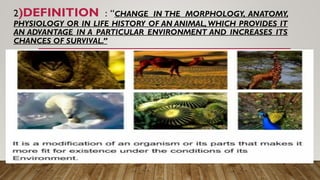
2)DEFINITION : “CHANGE IN THE MORPHOLOGY, ANATOMY,
PHYSIOLOGY OR IN LIFE HISTORY OF AN ANIMAL,WHICH PROVIDES IT
AN ADVANTAGE IN A PARTICULAR ENVIRONMENT AND INCREASES ITS
CHANCES OF SURVIVAL.”
3) REASONS OF ADAPTATIONS:
Can be many reasons:
■to find food
■to adjust their bodies to the temperature of their environment
■to defend themselves
■to find a mate
■to escape from predators and other dangers
■to adjust for the loss of their habitat.
4)VARIOUS KINDS OF ADAPTATIONS :
•There are three types of adaptations:
•1)structural,
•2)physiological,
•3) behavioral.
1》 STRUCTURALADAPTATION
Structural adaptations are how the animal’s body functions or looks on the
outside.
Note: structural adaptations take place over a very long period of time and
usually occur very slowly.
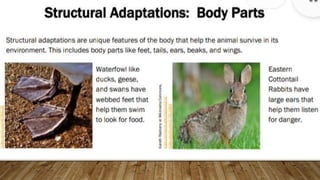
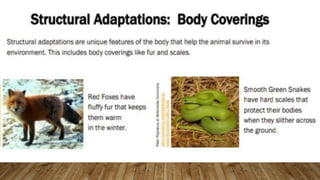
Body parts (like feet and ears) and body coverings (like fur and scales) are
structural adaptations.
Teeth –don’t all have the same kind of teeth
Body coverings – Hair, scales, spines, and feathers help animals survive in
their environments.
Movement – animals find food by moving from place to place
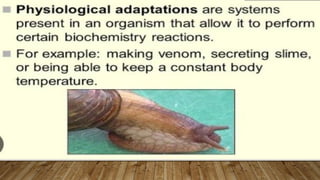
2》PHYSIOLOGICAL ADAPTATIONS:
Physiological adaptations are how the animal’s body
functions on the inside.
This includes changes in the cells,chemicals,and
processes inside an animal’s body.
Note : Physical adaptations do not develop during an
individual animal’s life,but over many generations.
3》BEHAVIORAL ADAPTATION :
Behavioral adaptations are how an animal acts.This includes actions
like hibernating and communicating.
Behavior adaptations can be learned or instinctive (a behavior an
animal is born with).
Note: behavioral adaptations can take place in a very short
amount of time.The more intelligent an animal is the faster it can
learn to make behavioural changes, order to survive.
5》 ECOLOGICAL
&PHYSIOLOGICAL
ADAPTATION IN DIFFERENT
ENVIRONMENTS:
1)FRESHWATERADAPTATION
It can be of two types : ( on the basis of environment)
(A)LoticAdaptations
(B)LenticAdaptations
A) LOTIC ADAPTATION: ( RUNNING WATER)
It includes springs,streams,and rivers.
Two Zones:-
[I] Rapid Zone :
•It is shallow water zone where the velocity of current is maximum.
•This zone is occupied by organisms living in sediments or attached to stems and leaves or
roots ,plants,or other surface and strong swimmers.
[II] Pool Zone :
•It represents the deep water where velocity of water is reduced.
•Silt and other material tends to settle at the bottom.
ADAPTATIONS FOUND IN FRESHWATER ANIMALS
■ PERMANENT ATTACHMENT TO A SUBSTRATUM :In fast running water ,the plants and animals are
permanently attached to substratum such as Stones, and logs.
■PRESENCE OF HOOKS AND SUCKERS :Certain animals posses hooks and suckres to gain hold on
substratum.
■ STICKY UNDERSURFACE : Snails and flat worms.
■ STREAM LINED BODY : Offers little resistance to water currents. Eg. FISHES &INSECTS
■ FLATTENED BODY : Help them to take shelter under stone. Eg. Nymphs of mayfly & stonefly
■ RESPIRATION: ( special organs,different type of gills)
■ SKILL SWIMMERS
■ EXCRETION: ammonia
■ CREEPING CAPACITY
2) MARINEWATERADAPTATIONS:
Can be of two types:
A) PELAGICADAPTATION
B) DEEP SEAWATER ADAPTATIONS
A) PELAGIC ADAPTATION :
■ FLOATING: Bladder-like ,hair-like,ribbon-like or branched
■ BODYWALL:Thin walled ,weight of she’ll is reduced, the skeleton is weak.
■ OIL : Some plankton have oil in their cells eg. Diatoms,this reduces specific gravity and helps in
floating on the surface.
■WATER RESISTANCE & ACTIVE SWIMMING: Many animals swim actively & thereby resist
sinking.
04Types of adaptations found in various animals :
• cilia
Jointed oar shaped limbs
Muscular work
Undulating movements
B) DEEP-SEA ADAPTATIONS:
■ SIZE : Small as Scarcity of food.
■ FORM : Delicate ,slender.
■ SKELETON: Skeleton of deep see forms is soft and non calcareous because they unable to
synthesis calcium at low temperature.
■COLOUR : Uniform color pattern,black,brown,red, violet
■ FOOD & FEEDING:vegetation is almost absent at sea bottom so deep sea animals have 03
alternative sources of food :
1) Pray upon one another
2) Depend on Fallin ercreta of surface animals
3) Depends upon surface plants & animals sink to bottom.
3) EXTREMETERRESTRIALADAPTATIONS:
• Can be of different types:
(A) DesertAdaptations
(B) Arial orVolantAdaptations
A) DESERT ADAPTATIONS:
1.Animals such as kangaroo rats found in the desert never drink water.
2.Ability to concentrate its urine to conserve water.
3.Desert lizards bask in sun and burrow in the sand (afternoon) to escape the heat of
the day.
4.These adaptations prevent the loss of water in desert animals.
IN INSECTS:
(1)Body colour:
i) Cryptic adaptation for protection against enemies.
ii) ii) Adaptation for reflecting the rays of the sun.
(2) Protective body wall:
The chitinous exoskeleton prevents the excessive evaporation of
water and body fluids.
(3)Wingless fused elytra:saves them from strong winds.
(4) Long legs:
(5) Oval or compressed body:
(6) Adaptation of internal anatomy for conservation of body water.
(7)Mimicry for protection
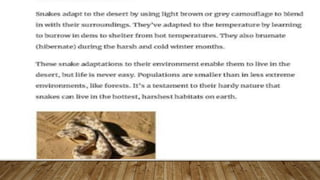
IN REPTILES ( SNAKE)
1)Several species possess nostrils with valves to prevent the intrusion of sand.
2.Tight closure of the lips an adaptation against wind-blown sand.
3. Horns over the eyes.
4. Head is raised out of the sand.
5.A countersunk lower jaw that prevents sand from entering the mouth.
6.A streamlined head and a lack of a neck constriction for easy burrowing in sand.
7. Nasal bones that support the pre-maxilla,supposedly strengthening the snout for burrowing.
8. Smooth scalation minimizing friction when crawling through the sand.
9.Angular ventral scales that prevent slipping while crawling.
10. Nasal valves.
11. A shovel-shaped snout.
12. Normal abdominal breathing occurs in air but shifts to gular fluttering, when the animal buries.
2)AERIAL ADAPTATIONS ( IN BIRDS)
1)Birds have a high tolerance to elevated body temperatures.
2) In many species colouration matches the colour of ground on which they live.
3)Birds are capable of flying long distances e.g. Seed eating Pterocles spp. (sandgrouse) can fly upto 160 km in
one day or even more in dry season in search of water.
4)Most birds are active during the day time but owls and nightjars are acceptional in hiding themselves in
rock clefts during the day time.
5)Shelter in trees.
6)Normal high constant body temperature.
7)Carnivorous and insectivorous birds obtain plenty of water with their food.
8)Concentrated urine.
9,)Male bird brings moisture to the young ones.
PROTECTIVEADAPTATIONS:
Mimicry : It is presentation in which an animal adopt the colour,shape,size,and nature of
other organism ,natural object in such a way that it protects itself from it’s enemies.
6)IMPORTANCE OF ADAPTATIONS
Adaptation is important for the survival of living
organisms.
The ability of the organisms to adapt to different
situations and surroundings helps the world to
move ahead.
7)CONCLUSION:
Sometimes, adaption is often mistaken for evolution, though
both are very different processes. Evolution brings about
drastic changes that occur in the genetic level, whereas
adaptation is a short-term process where the changes that
occur are usually reversible.But adaptation does lead to
evolution!!
8) REFERENCES:
• NCERT 11th and 12th
• Eskert,R physiology animal adaptations and mechanism
• Krebs C.J ecology . Harper and row ,NewYork
• JM Ecological Concept
• https://education.nationalgeographic.org/resource/adaptation/
• https://www.britannica.com/science/adaptation-biology-and-physiology
• https://www.twinkl.co.in/teaching-wiki/adaptation
• https://bio.libretexts.org/Courses/Gettysburg_College/01%3A_Ecology_for_All/04%3A_Adaptations_to_th
e_Physical_Environment/4.01%3A_What_is_adaptation

Adaptations (Levels, Types, Significance)

  • 1.
    GOVT M.H. COLLEGEOF HOME SCIENCEAND SCIENCE, FOR WOMEN ,(AUTONOMOUS),JABALPUR (M.P.) PRESENTATION ON : ADAPTATIONS (it’s Levels,Types, Significance) SUBMITTED TO : Dr Namrata Shrivastav SUBMITTED BY : Samiksha Rajak (Department of zoology) (MSc. 2nd SEM zoology) YEAR : 2022-23
  • 2.
    SYNOPSIS : ADAPTATIONS 1)INTRODUCTION 2) Definition and concept of adaptations 3) Reasons of adaptation 4)Various kinds of adaptations:●1)Structural ●2)physiological ●3)behavioural 5)Ecological & Physiological Adaptation in different environments 1)Freshwater 2)Marine. 3)Terrestrial ( Reptiles & Birds ) 6)Importance of Adaptation 7) Conclusion 8) References
  • 3.
    1)INTRODUCTION: “Adaptation isthe physical and morphological characteristics of organism that helps an organism to survive better in surrounding environment “. • Living things are adapted to their habitat they live in .This is because they have special features that help them to survive.The development of these special features is the result of evolution due to gene mutation . These mutation aids in survival and reproduction and pass from generation to others.
  • 4.
    2)DEFINITION : “CHANGEIN THE MORPHOLOGY, ANATOMY, PHYSIOLOGY OR IN LIFE HISTORY OF AN ANIMAL,WHICH PROVIDES IT AN ADVANTAGE IN A PARTICULAR ENVIRONMENT AND INCREASES ITS CHANCES OF SURVIVAL.”
  • 5.
    3) REASONS OFADAPTATIONS: Can be many reasons: ■to find food ■to adjust their bodies to the temperature of their environment ■to defend themselves ■to find a mate ■to escape from predators and other dangers ■to adjust for the loss of their habitat.
  • 6.
    4)VARIOUS KINDS OFADAPTATIONS : •There are three types of adaptations: •1)structural, •2)physiological, •3) behavioral.
  • 7.
    1》 STRUCTURALADAPTATION Structural adaptationsare how the animal’s body functions or looks on the outside. Note: structural adaptations take place over a very long period of time and usually occur very slowly. Body parts (like feet and ears) and body coverings (like fur and scales) are structural adaptations. Teeth –don’t all have the same kind of teeth Body coverings – Hair, scales, spines, and feathers help animals survive in their environments. Movement – animals find food by moving from place to place
  • 10.
    2》PHYSIOLOGICAL ADAPTATIONS: Physiological adaptationsare how the animal’s body functions on the inside. This includes changes in the cells,chemicals,and processes inside an animal’s body. Note : Physical adaptations do not develop during an individual animal’s life,but over many generations.
  • 13.
    3》BEHAVIORAL ADAPTATION : Behavioraladaptations are how an animal acts.This includes actions like hibernating and communicating. Behavior adaptations can be learned or instinctive (a behavior an animal is born with). Note: behavioral adaptations can take place in a very short amount of time.The more intelligent an animal is the faster it can learn to make behavioural changes, order to survive.
  • 16.
  • 17.
    1)FRESHWATERADAPTATION It can beof two types : ( on the basis of environment) (A)LoticAdaptations (B)LenticAdaptations
  • 18.
    A) LOTIC ADAPTATION:( RUNNING WATER) It includes springs,streams,and rivers. Two Zones:- [I] Rapid Zone : •It is shallow water zone where the velocity of current is maximum. •This zone is occupied by organisms living in sediments or attached to stems and leaves or roots ,plants,or other surface and strong swimmers. [II] Pool Zone : •It represents the deep water where velocity of water is reduced. •Silt and other material tends to settle at the bottom.
  • 19.
    ADAPTATIONS FOUND INFRESHWATER ANIMALS ■ PERMANENT ATTACHMENT TO A SUBSTRATUM :In fast running water ,the plants and animals are permanently attached to substratum such as Stones, and logs. ■PRESENCE OF HOOKS AND SUCKERS :Certain animals posses hooks and suckres to gain hold on substratum. ■ STICKY UNDERSURFACE : Snails and flat worms. ■ STREAM LINED BODY : Offers little resistance to water currents. Eg. FISHES &INSECTS ■ FLATTENED BODY : Help them to take shelter under stone. Eg. Nymphs of mayfly & stonefly ■ RESPIRATION: ( special organs,different type of gills) ■ SKILL SWIMMERS ■ EXCRETION: ammonia ■ CREEPING CAPACITY
  • 20.
    2) MARINEWATERADAPTATIONS: Can beof two types: A) PELAGICADAPTATION B) DEEP SEAWATER ADAPTATIONS
  • 21.
    A) PELAGIC ADAPTATION: ■ FLOATING: Bladder-like ,hair-like,ribbon-like or branched ■ BODYWALL:Thin walled ,weight of she’ll is reduced, the skeleton is weak. ■ OIL : Some plankton have oil in their cells eg. Diatoms,this reduces specific gravity and helps in floating on the surface. ■WATER RESISTANCE & ACTIVE SWIMMING: Many animals swim actively & thereby resist sinking. 04Types of adaptations found in various animals : • cilia Jointed oar shaped limbs Muscular work Undulating movements
  • 24.
    B) DEEP-SEA ADAPTATIONS: ■SIZE : Small as Scarcity of food. ■ FORM : Delicate ,slender. ■ SKELETON: Skeleton of deep see forms is soft and non calcareous because they unable to synthesis calcium at low temperature. ■COLOUR : Uniform color pattern,black,brown,red, violet ■ FOOD & FEEDING:vegetation is almost absent at sea bottom so deep sea animals have 03 alternative sources of food : 1) Pray upon one another 2) Depend on Fallin ercreta of surface animals 3) Depends upon surface plants & animals sink to bottom.
  • 27.
    3) EXTREMETERRESTRIALADAPTATIONS: • Canbe of different types: (A) DesertAdaptations (B) Arial orVolantAdaptations
  • 28.
    A) DESERT ADAPTATIONS: 1.Animalssuch as kangaroo rats found in the desert never drink water. 2.Ability to concentrate its urine to conserve water. 3.Desert lizards bask in sun and burrow in the sand (afternoon) to escape the heat of the day. 4.These adaptations prevent the loss of water in desert animals.
  • 31.
    IN INSECTS: (1)Body colour: i)Cryptic adaptation for protection against enemies. ii) ii) Adaptation for reflecting the rays of the sun. (2) Protective body wall: The chitinous exoskeleton prevents the excessive evaporation of water and body fluids. (3)Wingless fused elytra:saves them from strong winds. (4) Long legs: (5) Oval or compressed body: (6) Adaptation of internal anatomy for conservation of body water. (7)Mimicry for protection
  • 33.
    IN REPTILES (SNAKE) 1)Several species possess nostrils with valves to prevent the intrusion of sand. 2.Tight closure of the lips an adaptation against wind-blown sand. 3. Horns over the eyes. 4. Head is raised out of the sand. 5.A countersunk lower jaw that prevents sand from entering the mouth. 6.A streamlined head and a lack of a neck constriction for easy burrowing in sand. 7. Nasal bones that support the pre-maxilla,supposedly strengthening the snout for burrowing. 8. Smooth scalation minimizing friction when crawling through the sand. 9.Angular ventral scales that prevent slipping while crawling. 10. Nasal valves. 11. A shovel-shaped snout. 12. Normal abdominal breathing occurs in air but shifts to gular fluttering, when the animal buries.
  • 35.
    2)AERIAL ADAPTATIONS (IN BIRDS) 1)Birds have a high tolerance to elevated body temperatures. 2) In many species colouration matches the colour of ground on which they live. 3)Birds are capable of flying long distances e.g. Seed eating Pterocles spp. (sandgrouse) can fly upto 160 km in one day or even more in dry season in search of water. 4)Most birds are active during the day time but owls and nightjars are acceptional in hiding themselves in rock clefts during the day time. 5)Shelter in trees. 6)Normal high constant body temperature. 7)Carnivorous and insectivorous birds obtain plenty of water with their food. 8)Concentrated urine. 9,)Male bird brings moisture to the young ones.
  • 38.
    PROTECTIVEADAPTATIONS: Mimicry : Itis presentation in which an animal adopt the colour,shape,size,and nature of other organism ,natural object in such a way that it protects itself from it’s enemies.
  • 39.
    6)IMPORTANCE OF ADAPTATIONS Adaptationis important for the survival of living organisms. The ability of the organisms to adapt to different situations and surroundings helps the world to move ahead.
  • 40.
    7)CONCLUSION: Sometimes, adaption isoften mistaken for evolution, though both are very different processes. Evolution brings about drastic changes that occur in the genetic level, whereas adaptation is a short-term process where the changes that occur are usually reversible.But adaptation does lead to evolution!!
  • 41.
    8) REFERENCES: • NCERT11th and 12th • Eskert,R physiology animal adaptations and mechanism • Krebs C.J ecology . Harper and row ,NewYork • JM Ecological Concept • https://education.nationalgeographic.org/resource/adaptation/ • https://www.britannica.com/science/adaptation-biology-and-physiology • https://www.twinkl.co.in/teaching-wiki/adaptation • https://bio.libretexts.org/Courses/Gettysburg_College/01%3A_Ecology_for_All/04%3A_Adaptations_to_th e_Physical_Environment/4.01%3A_What_is_adaptation