By 
Ingrid- Melody 
English Letters, Universitas Ma Chung
Deconstruction’s view of language 
(Derrida) 
‘language is not the reliable tool of 
communication…’
Deconstruction’s theory of language 
based on the belief that language is much more 
slippery and ambiguous. 
e.g. (old saying) 
Time flies like an arrow = Times passed quickly. 
Time = noun 
flies = verb 
like an arrow = adv. clause
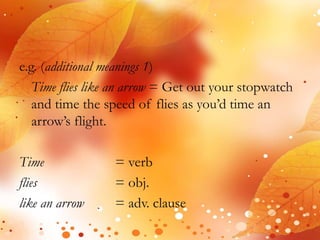
e.g. (additional meanings 1) 
Time flies like an arrow = Get out your stopwatch 
and time the speed of flies as you’d time an 
arrow’s flight. 
Time = verb 
flies = obj. 
like an arrow = adv. clause
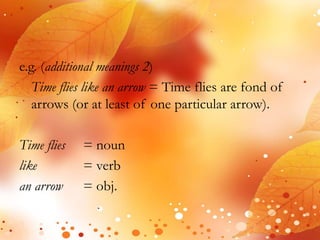
e.g. (additional meanings 2) 
Time flies like an arrow = Time flies are fond of 
arrows (or at least of one particular arrow). 
Time flies = noun 
like = verb 
an arrow = obj.
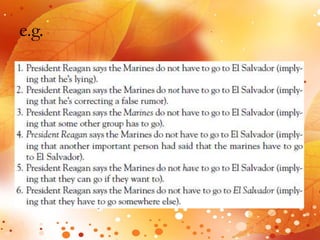
Slippery quality of language 
• changes in tone of voice and emphasis 
• meaning changes dramatically
e.g.
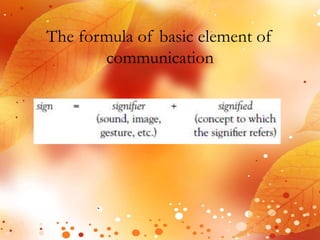
The formula of basic element of 
communication
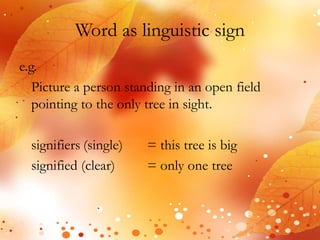
Word as linguistic sign 
e.g. 
Picture a person standing in an open field 
pointing to the only tree in sight. 
signifiers (single) = this tree is big 
signified (clear) = only one tree
Communication is such a complicated 
and uncertain thing 
• deconstruction look at the sentence’s 
ambiguities, even when the sentence seems, at 
first glance, as clear and specific. 
• any given signifier can refer to any number of 
signifieds at any given moment.
Language for deconstruction 
• language consists only of chains of signifiers. 
• language is nonreferential because it refers to the play 
of signifiers of which language itself consist. 
• language is what forms us and there is no way to get 
beyond it. 
• language is wholly ideological 
• language is ‘ground of being’ 
• language has implications for subjectivity (human 
being)
The important characteristics in 
language 
• its play of signifiers continually defers, or 
postpones, meaning. 
• the meaning seems to have the result of the 
differences by which we distinguish one signifier 
from another.
Binary opposition hierarchies 
• the pair is always privileged, or considered 
superior to the other. 
• examine the ways which two members of the 
opposition share some things in common.
Deconstruction as poststructuralist 
theory 
• it emerged in the wake of structuralism’s 
popularity 
• it constitutes a reaction against structuralism’s 
orderly vision of language and human 
experience.
Deconstructing Literature
The three main points we’ve discussed: 
For deconstruction, 
1. Language is dynamic, ambiguous, and unstable, 
continually disseminating 
2. Existence has no center, no stable meaning, no 
fixed ground 
3. Human being are fragmented battlefields for 
competing ideologies whose only “identities” 
are the ones we invent and choose to believe.
So… 
For deconstruction, literature is as dynamic, 
ambiguous, and unstable as the language 
of which it is composed. 
Literary text, like all texts, consist of a 
multiplicity of overlapping, conflicting 
meanings in dynamic, fluid relation to 
one another and to us.
There are two reasons to deconstruct 
literature: 
1. to reveal the text’s undecidability and/or 
2. to reveal the complex operations of the 
ideologies of which the text is constructed.
• Deconstructive critics believe meaning in literature 
is created during the act of reading a text. 
• It is precisely while the reader is reading that 
moments of meaning are created, but inevitably 
give way to even more meanings, each new 
reading creating its own unique meaning ad 
infinitum. 
• This is why Tyson says art and literature is "a 
seething cauldron of meanings in flux," because 
there can be a large range of meanings within a 
text therefore the ultimate meaning is undecidable.
Undecidability means that reader and text 
alike are inextricably bound within 
language’s dissemination of meanings. 
That is, reader and text are interwoven 
threads in the perpetually working loom 
of language
How can we prove undecidability: 
1. note all the various interpretations- of characters, 
events, images, and so on- the text seems to offer; 
2. show the ways in which these interpretations 
conflict with one another; 
3. show how these conflicts produce still more 
interpretations, which produce still more 
conflicts, which produce still more 
interpretations; 
4. use steps 1, 2, 3, to argue for the text’s 
“undecidability”
The following two questions summarize the 
two deconstructive approaches discussed 
above: 
1. How we can use the various conflicting 
interpretations a text produces (the “play of 
meanings”) or find the various ways in 
which the text doesn’t answer the questions 
it seems to answer, to demonstrate the 
instability of language and the 
undecidability of meaning?
2. What ideology does the text seem to 
promote-what is its main theme-and how 
does conflicting evidence in the text show 
the limitations of that ideology? 
We can usually discover a text’s overt 
ideological project by finding the binary 
opposition(S) that structure the text’s main 
theme(s).
• Keep in mind that not all deconstructive critics will 
interpret the same work in the same way, even if they 
focus on the same ideological projects in the text. 
• As in every yield, even expert practitioners disagree. 
Our goal is to use deconstruction to help enrich our 
reading of literary text, to help us see some important 
ideas they illustrate that we might not have seen so 
clearly or so deeply without deconstruction, and to help 
us see the ways in which language blinds us to the 
ideologies it embodies.
• As we noted earlier, because deconstruction helps us understand 
the hidden operations of ideology, it can be a useful tool for any 
critic interested in examining the oppressive role ideology can 
play in our lives.
Questions for further practice 
1. What does this ideological conflict suggest about the difficulties 
involved in the attempt to avoid stereotypes or about the 
difficulty any oppressed group might have asserting its own 
identity in the face of prejudice? 
2. How does Kate Chopin’s “The Storm” (1898) forward its 
theme of the importance of sexual fulfillment for women, 
which seems to be the story’s overt ideological project? How 
does the text’s use of nature imagery and the standard fairy-tale 
happy ending both promote and undermine this project? What 
does this ideological conflict imply about the story’s attempt to 
transcend the nineteenth-century social values of the culture it 
represents?
3. How might we account for the apparent failure of the 
American public to recognize this very different 
reading of the poem? 
4. Then show how the novel deconstructs this ideological 
project by finding, in the text, the ways in which nature 
does not live up to this definition. Speculate on the 
reasons why this ideological conflict is present in this 
text. 
5. How might William Blake’s “The Little Black Boy” 
(1789) provide an example of deconstruction’s notion 
of undecidability? Specifically, how does the poem 
seem to promote the mutually exclusive themes of 
racial equality, the superiority of white people to black 
people, and the superiority of black people to white 
people? What are the implications of this apparent 
ideological conflict?
sources 
• Tyson, Lois – Critical Theory Today.pdf

Deconstruction: Literary Criticism

  • 1.
    By Ingrid- Melody English Letters, Universitas Ma Chung
  • 2.
    Deconstruction’s view oflanguage (Derrida) ‘language is not the reliable tool of communication…’
  • 3.
    Deconstruction’s theory oflanguage based on the belief that language is much more slippery and ambiguous. e.g. (old saying) Time flies like an arrow = Times passed quickly. Time = noun flies = verb like an arrow = adv. clause
  • 4.
    e.g. (additional meanings1) Time flies like an arrow = Get out your stopwatch and time the speed of flies as you’d time an arrow’s flight. Time = verb flies = obj. like an arrow = adv. clause
  • 5.
    e.g. (additional meanings2) Time flies like an arrow = Time flies are fond of arrows (or at least of one particular arrow). Time flies = noun like = verb an arrow = obj.
  • 6.
    Slippery quality oflanguage • changes in tone of voice and emphasis • meaning changes dramatically
  • 7.
  • 8.
    The formula ofbasic element of communication
  • 9.
    Word as linguisticsign e.g. Picture a person standing in an open field pointing to the only tree in sight. signifiers (single) = this tree is big signified (clear) = only one tree
  • 10.
    Communication is sucha complicated and uncertain thing • deconstruction look at the sentence’s ambiguities, even when the sentence seems, at first glance, as clear and specific. • any given signifier can refer to any number of signifieds at any given moment.
  • 11.
    Language for deconstruction • language consists only of chains of signifiers. • language is nonreferential because it refers to the play of signifiers of which language itself consist. • language is what forms us and there is no way to get beyond it. • language is wholly ideological • language is ‘ground of being’ • language has implications for subjectivity (human being)
  • 12.
    The important characteristicsin language • its play of signifiers continually defers, or postpones, meaning. • the meaning seems to have the result of the differences by which we distinguish one signifier from another.
  • 13.
    Binary opposition hierarchies • the pair is always privileged, or considered superior to the other. • examine the ways which two members of the opposition share some things in common.
  • 14.
    Deconstruction as poststructuralist theory • it emerged in the wake of structuralism’s popularity • it constitutes a reaction against structuralism’s orderly vision of language and human experience.
  • 15.
  • 16.
    The three mainpoints we’ve discussed: For deconstruction, 1. Language is dynamic, ambiguous, and unstable, continually disseminating 2. Existence has no center, no stable meaning, no fixed ground 3. Human being are fragmented battlefields for competing ideologies whose only “identities” are the ones we invent and choose to believe.
  • 17.
    So… For deconstruction,literature is as dynamic, ambiguous, and unstable as the language of which it is composed. Literary text, like all texts, consist of a multiplicity of overlapping, conflicting meanings in dynamic, fluid relation to one another and to us.
  • 18.
    There are tworeasons to deconstruct literature: 1. to reveal the text’s undecidability and/or 2. to reveal the complex operations of the ideologies of which the text is constructed.
  • 19.
    • Deconstructive criticsbelieve meaning in literature is created during the act of reading a text. • It is precisely while the reader is reading that moments of meaning are created, but inevitably give way to even more meanings, each new reading creating its own unique meaning ad infinitum. • This is why Tyson says art and literature is "a seething cauldron of meanings in flux," because there can be a large range of meanings within a text therefore the ultimate meaning is undecidable.
  • 20.
    Undecidability means thatreader and text alike are inextricably bound within language’s dissemination of meanings. That is, reader and text are interwoven threads in the perpetually working loom of language
  • 21.
    How can weprove undecidability: 1. note all the various interpretations- of characters, events, images, and so on- the text seems to offer; 2. show the ways in which these interpretations conflict with one another; 3. show how these conflicts produce still more interpretations, which produce still more conflicts, which produce still more interpretations; 4. use steps 1, 2, 3, to argue for the text’s “undecidability”
  • 22.
    The following twoquestions summarize the two deconstructive approaches discussed above: 1. How we can use the various conflicting interpretations a text produces (the “play of meanings”) or find the various ways in which the text doesn’t answer the questions it seems to answer, to demonstrate the instability of language and the undecidability of meaning?
  • 23.
    2. What ideologydoes the text seem to promote-what is its main theme-and how does conflicting evidence in the text show the limitations of that ideology? We can usually discover a text’s overt ideological project by finding the binary opposition(S) that structure the text’s main theme(s).
  • 24.
    • Keep inmind that not all deconstructive critics will interpret the same work in the same way, even if they focus on the same ideological projects in the text. • As in every yield, even expert practitioners disagree. Our goal is to use deconstruction to help enrich our reading of literary text, to help us see some important ideas they illustrate that we might not have seen so clearly or so deeply without deconstruction, and to help us see the ways in which language blinds us to the ideologies it embodies.
  • 25.
    • As wenoted earlier, because deconstruction helps us understand the hidden operations of ideology, it can be a useful tool for any critic interested in examining the oppressive role ideology can play in our lives.
  • 26.
    Questions for furtherpractice 1. What does this ideological conflict suggest about the difficulties involved in the attempt to avoid stereotypes or about the difficulty any oppressed group might have asserting its own identity in the face of prejudice? 2. How does Kate Chopin’s “The Storm” (1898) forward its theme of the importance of sexual fulfillment for women, which seems to be the story’s overt ideological project? How does the text’s use of nature imagery and the standard fairy-tale happy ending both promote and undermine this project? What does this ideological conflict imply about the story’s attempt to transcend the nineteenth-century social values of the culture it represents?
  • 27.
    3. How mightwe account for the apparent failure of the American public to recognize this very different reading of the poem? 4. Then show how the novel deconstructs this ideological project by finding, in the text, the ways in which nature does not live up to this definition. Speculate on the reasons why this ideological conflict is present in this text. 5. How might William Blake’s “The Little Black Boy” (1789) provide an example of deconstruction’s notion of undecidability? Specifically, how does the poem seem to promote the mutually exclusive themes of racial equality, the superiority of white people to black people, and the superiority of black people to white people? What are the implications of this apparent ideological conflict?
  • 29.
    sources • Tyson,Lois – Critical Theory Today.pdf

Editor's Notes

  • #10 When the speaker says, “This tree is big,” is she comparing the tree to herself? To another tree? What other tree? Is she surprised by the size of the tree? It does illustrate that human utterances are rarely, if ever, as clear and simple as the structuralist formula signifier + signifed seems to imply.
  • #12 In Derrida’s words, what we take to be meaning is really only the mental trace left behind by the play of signifiers. There’s no getting beyond language: language mediates our experience of ourselves and the world. Ideological: consist entirely of the numerous conflicting, dynamic ideologies (systems of beliefs and values) operating at any given point in time in any given culture. For example, our use of the word slut for a woman who sleeps with many men and the word stud for a man who sleeps with many women reveals and perpetuates the cultural belief that sexual relations with multiple partners should be a source of shame for women and a source of pride for men. Ground is not out of play: it is self-dynamic, evolving, problematical, and ideologically saturated as the worldviews it produces. (discourse) Because human beings are constituted by language, they, too, are texts. Deconstruction asserts that our experience of ourselves and our world is produced by the language we speak, and because all language is an unstable, ambiguous force-field of competing ideologies, we are, ourselves, unstable and ambiguous force-fields of competing ideologies.
  • #13 He combines the French words for “to defer” and “to differ” to coin the word différance, which is his name for the only “meaning”’ language can have.
  • #19 http://i-readbooks.blogspot.com/2012/07/deconstructive-literary-criticism.html, http://scholasticinquiry.wordpress.com/2013/03/05/a-short-summary-of-jacques-derrida-and-deconstruction/