Aquaculture and Fisheries Biotechnology
Genetic Approaches
Dedicated to Diem for the great joy and happiness you have brought me
To Aubrey, Christian, Amy, Gabrielle and Sean, your great sacrifices made this
possible
To RO, thank you for opening the door of opportunity
To Limestone-Walters Grade School – you were the foundation
And to Mom and Dad, who always encouraged education
Aquaculture and Fisheries Biotechnology
Genetic Approaches
Rex A. Dunham
Department of Fisheries and Allied Aquacultures
Auburn University
Alabama
USA
CABI Publishing
CABI Publishing is a division of CAB International
CABI Publishing CABI Publishing
CAB International 875 Massachusetts Avenue
Wallingford 7th Floor
Oxfordshire OX10 8DE Cambridge, MA 02139
UK USA
Tel: +44 (0)1491 832111 Tel: +1 617 395 4056
Fax: +44 (0)1491 833508 Fax: +1 617 354 6875
E-mail: cabi@cabi.org E-mail: cabi-nao@cabi.org
Website: www.cabi-publishing.org
© R.A. Dunham 2004. All rights reserved. No part of this
publication may be reproduced in any form or by any means,
electronically, mechanically, by photocopying, recording or
otherwise, without the prior permission of the copyright
owners.
A catalogue record for this book is available from the
British Library, London, UK.
Library of Congress Cataloging-in-Publication Data
Dunham, Rex A.
Aquaculture and fisheries biotechnology : genetic approaches/Rex A.
Dunham.
p. cm.
Includes bibliographical references and index.
ISBN 0-85199-596-9 (alk. paper)
1. Fishes--Breeding. 2. Shellfish--Breeding. 3. Fishes--Molecular
genetics. 4. Shellfish--Molecular genetics. I. Title.
SH155.5.D86 2004
639.3--dc21
2003008159
ISBN 0 85199 596 9
Typeset in 9pt Palatino by Columns Design Ltd, Reading
Printed and bound in the UK by Biddles Ltd, King’s Lynn
Contents
Preface x
Acknowledgements xi
1 History of Genetic Biotechnology in Aquaculture and Fisheries 1
2 Phenotypic Variation and Environmental Effects 7
Stocking Density and Mortality 8
Age, Temperature and Water Quality 8
Biology and Physiology 9
Maternal Effects 10
Correction of Growth Data 13
Skewness and Feeding Practices 15
Compensatory Gain 17
Communal Stocking/Evaluation 19
3 Polyploidy 22
Polyploid Induction in Fish 22
Polyploid Induction in Shellfish 26
Triploid Cells 28
Ploidy Determination 28
Triploid Fish Performance 30
Growth 30
Feed conversion and consumption 32
Morphology, meristics and identification 33
Carcass traits and flesh quality 33
Survival 35
Tolerance of low oxygen 36
Disease resistance 38
Reproduction 38
Embryonic development 41
Sex ratio 41
Hybrid viability 41
Heterozygosity in triploids 43
Behaviour 43
Invertebrate Triploid Performance 43
Growth 43
Energy storage and bioenergetics 44
Survival and disease resistance 45
Reproduction 45
v
Reversion to diploidy 46
Sex ratio 47
Flesh quality 47
Tetraploids 47
Tetraploid induction 48
Fertility and performance 48
Hexaploid Fish 50
Tetraploid Shellfish 50
Limitations and Constraints 50
Fisheries Management Applications 51
Environmental Protection 52
Conclusions 52
4 Gynogenesis, Androgenesis, Cloned Populations and Nuclear Transplantation 54
Induction of Gynogenesis and Androgenesis 54
Performance of Gynogens and Androgens 57
Reproduction 57
Monosex Populations 58
Cloned Populations 59
Phenotypic variability 59
Regeneration of genetic variation in salmonids 60
Growth 60
Disease resistance 60
Clonal hybrids 61
Nuclear Transplantation – Nucleocytoplasmic Hybrids 61
5 Sex Reversal and Breeding 65
Sexual Dimorphism 66
Chemical and Mechanical Sterilization 68
Hormonal Sex Reversal 71
Anabolic Effect 73
Health Issues 74
Sex Reversal and Breeding 74
All-female XX systems 75
All-male ZZ systems 78
All-male YY systems 79
Genetics of Sex Determination 79
Effects of temperature 82
Genetics of temperature effects on sex determination 82
YY system in channel catfish 83
Constraints and Sex Markers 83
6 Biochemical and Molecular Markers 85
Isozymes and Enzymes 85
Restriction Fragment Length Polymorphism 88
Mitochondrial DNA 89
Randomly Amplified Polymorphic DNA 90
Amplified Fragment Length Polymorphism 92
Microsatellites 97
Expressed Sequence Tags 99
Single Nucleotide Polymorphisms 100
Relative Costs of Different Markers 100
Relative Effectiveness of Markers 101
vi Contents
7 Population Genetics and Interactions of Hatchery and Wild Fish 104
Genetic Variation, Population Structure and Biodiversity 104
Effects of Geography and Environment on Population Variation 109
Factors Affecting the Establishment of New Genotypes in Established
Natural Populations 112
Interspecific Hybridization 113
Interactions between Domestic and Wild Fish 115
Integrated Management Strategy 120
8 Gene Mapping, Quantitative Trait Locus Mapping and
Marker-assisted Selection 122
Choice of Markers 122
Mapping Systems 123
Linkage Disequilibrium 124
Isozyme Maps 124
DNA Markers and Maps 129
The Major Histocompatibility Complex and Oncogenes 133
Effects of Karyotypes, Clustering and Distortion 133
QTL Mapping 135
QTL markers in agriculture 136
QTLs of aquatic organisms 137
Marker-assisted Selection 139
Marker-assisted selection in agriculture 139
Marker-assisted selection in fish 140
9 Gene Expression, Isolation and Cloning 141
Gene Expression and Expressed Sequence Tags 141
Growth 143
Ovulation and Reproduction 146
Diseases 148
Brain 150
Cold Tolerance 151
Osmoregulation 152
Genetic Imprinting and Paternal Predominance 152
Transposable Elements 153
Ribosomes 156
Proteomics 159
10 Gene-transfer Technology 160
Gene-transfer Technique in Fish 161
Promoters 164
Integration 166
Transmission of Transgenes 169
Transgene Expression of Growth-hormone and Reporter Genes 169
Performance of Transgenic Fish 172
Growth 172
Dramatic growth of transgenic fish: explanations and limitations 177
Cold tolerance 179
Disease resistance 179
Transgenic Production of Pharmaceuticals 181
Gene Knockout Technology 181
Pleiotropic Effects of Transferred Genes 184
Potential Role of Mitochondrial DNA in Gene Transfer 190
Contents vii
11 Combining Genetic Enhancement Programmes 193
Sex Reversal and Triploidy 194
Genetic Engineering and Crossbreeding 194
Genetic Engineering, Selection, Crossbreeding, Strains and Hybrids 194
Selection, Crossbreeding and Sex Reversal 194
Gynogenesis, Selection and Hybridization 195
12 Genotype–Environment Interactions 198
Traditional Breeding 199
Polyploidy and Transgenics 200
13 Environmental Risk of Aquatic Organisms from Genetic Biotechnology 203
Theoretical Risks 203
Environmental Risk Data on Transgenic Fish 207
Common Goals of Aquaculture and Genetic Conservation 211
Genetic Sterilization 211
14 Food Safety of Transgenic Aquatic Organisms 219
International Guidelines 220
Labelling 220
15 A Case Example: Safety of Consumption of Transgenic Salmon
Potentially Containing Elevated Levels of Growth Hormone and
Insulin-like Growth Factor 222
Growth Hormone/Salmonid Growth Hormone 222
IGF/Salmonid IGF 223
GH Levels in Non-transgenic Salmon and Fish 224
IGF Levels in Non-transgenic Salmon and Fish 224
GH Levels in Transgenic Salmon and Fish 225
IGF Levels in Transgenic Salmon and Fish 226
GH and IGF Levels in Humans 226
GH and IGF Levels in Mammals 226
Bioavailability of sGH and sIGF in the Upper GI Tract 226
Dosage from Consumption 229
Bioactivity of Salmon/Non-primate GH in Humans 230
Bioactivity of Fish IGF 231
Explanation for Primate Specificity for GH Bioactivity 231
Potential Toxic Effects of GH/IGF and Food Safety 233
Studies on Transgenic GH Fish Food Safety 233
Conclusions on Human Food Safety 234
16 Government Regulation of Transgenic Fish 235
US Performance Standards 237
International Performance Standards 238
Canada 239
United Kingdom 239
Nomenclature 240
International Trade 241
Intellectual Property Rights 242
17 Commercial Application of Fish Biotechnology 244
Polyploidy 244
Sex Reversal and Breeding 245
Genetic Engineering 246
viii Contents
18 Strategies for Genetic Conservation, Gene Banking and
Maintaining Genetic Quality 248
Population Size, Inbreeding and Maintenance of Genetic Quality 248
Genetic Conservation 253
19 Constraints and Limitations of Genetic Biotechnology 255
Research Issues 255
General Recommendations 255
Development Issues 256
Biodiversity Issues 256
Political Issues 256
Economic Issues 256
Glossary 258
References and Further Reading 288
Index 367
Contents ix
Preface
Only 30 years ago, fish culturists and researchers complained of the lack of genetically
improved fish, and used this as a justification for increased research in the area of genetic
biotechnology. There has been an explosion of research in this area, and now genetics and
biotechnology are making a significant impact on aquaculture and fisheries, although poten-
tial for much greater progress exists. When improvements from biotechnology are consid-
ered, most people think of the impact on aquaculture and not the impact on fisheries. I have
tried to address, as the title of this book reflects, not only biotechnology in aquaculture but
the interrelationships with fisheries as well. There are several reasons for this. The biochemi-
cal and molecular genetic tools that can be applied in aquaculture are equally important for
studying population and conservation genetics in fisheries. The goals of aquaculture and
fisheries are often portrayed as antagonistic; however, that should not be true and the two
cannot be separated because of their interrelationships and impacts on each other. If applied
properly, aquaculture has the potential to relieve pressure on natural populations and have
positive environmental effects. Natural populations are the ultimate gene bank for future
aquaculture application and should be vigorously protected. We must also face the fact that
some sport-fish populations now exist in such urban environments, or are so overexploited
and artificial, and exist in such altered environments, that anglers could benefit from the
same genetic enhancement for these sport populations as is utilized for aquacultural applica-
tion, without concern for damaging something natural.
The concepts in the book are illustrated with numerous research examples and results in
an effort to teach, relate theory with reality and provide a strong review of the current status
of these biotechnological topics. I hope that the book is written in such a manner that it can
be used by students, farmers, fisheries biologists and scientists alike.
Early in the book phenotypic variation and environmental effects are addressed.
Sometimes we become lost within the nucleus, and temporarily lose sight of the fact that the
environment can overshadow genetic effects. Therefore, whether it be traditional selective
breeding or biotechnology, we must be aware of these environmental effects and how to con-
trol them to generate realistic genetic information and maximize its useful application.
In the chapter addressing aspects of population genetics, I often rely on data from organ-
isms other than fish and shellfish. There is not a tremendous database from fish, and some of
the examples from other organisms point us towards concepts and observations that are very
relevant to aquatic animals and should be more thoroughly examined in aquatic organisms.
The latter part of the book focuses on various aspects of transgenic biotechnology.
Obviously, at present, this topic can be highly emotionally charged. Data are often not yet
available to support the views of those who are strong proponents or opponents of transgenic
biotechnology. I have tried to be objective in this regard, presenting various viewpoints and
then discussing these perspectives with as many examples of actual data as possible to help
us to predict the true benefits and risks of transgenic as well as other types of biotechnology.
x
Acknowledgements
I am grateful to Bill Childers, Dave Philipp and Greg Whitt for introducing me to the world
of fish genetics. R. Oneal Smitherman gave me unfettered opportunity, and without opportu-
nity none of us can make significant achievements. Tim Townes, Tom Chen and Dennis
Powers were instrumental in my entry into transgenic biotechnology. Zhanjiang (John) Liu
has broadened my horizons, especially in genomics, and his copious research is the basis for
a significant portion of this book. The chapters on government regulation of biotechnology
are based heavily on the work and publications of Eric Hallerman and Devin Bartley. I often
relied on Roger Doyle’s (Genetic Computation Limited) website for a wealth of information,
difficult-to-find references, interesting viewpoints and research papers. I thank Meryl
Williams, Peter Gardiner, John Jensen and Richard Guthrie for giving me the opportunity to
develop an appreciation for the developing-country perspective on biotechnology. I would
like to thank Norman Maclean for reviewing this book.
xi
1
History of Genetic Biotechnology in Aquaculture
and Fisheries
© R.A. Dunham 2004. Aquaculture and Fisheries Biotechnology: Genetic Approaches
(R.A. Dunham) 1
Aquaculture is an ancient form of farming
dating back 2000 years or more in China and
the Roman Empire (Balon, 1995; Dunham et
al., 2001). However, only in the last few
decades has aquaculture grown into a global
practice resulting in tremendous worldwide
production. Aquaculture production has
enlarged dramatically since the early 1980s,
and will become increasingly important as
demand for fish products increases, world
harvest by capture fisheries reaches a plateau
or declines and human population numbers
expand. The biomass of fish that can be pro-
duced per surface area is much greater than
that for terrestrial animals, indicating that
aquaculture could be the key for providing
global food security.
Humans were hunter–gatherers prior to
being farmers, and fishermen before they
were aquaculturists. Although aquaculture is
growing in importance and must expand to
meet future demand for fish products, com-
mercial harvest of natural populations has
always been and is still of higher economic
value than aquaculture. Even as aquaculture
closes the gap or surpasses the value of com-
mercial fisheries, the genetic management
and conservation of natural fish stocks and
gene pools will be of great importance.
Genetic variation is one key variable in the
survival of various species. Also, natural
populations are perhaps the best gene banks,
a critical resource for genetic variation for
current and future application in genetic
improvement for farmed species and special-
ized sport-fish applications.
Recreational fishing is also of great impor-
tance in many countries. When the revenue
from the fish, the licences, fishing equip-
ment, boats, travel, food and lodging is con-
sidered, recreational fishing is probably more
than tenfold more important economically
than aquaculture in the USA. Biotechnology
is permanently linked not only to aquacul-
ture, but also to commercial and recreational
fisheries because of its potential positive and
negative impacts on these resources.
Currently, the quantity of animal protein
harvested from global aquatic sources via the
capture of natural fish populations is at max-
imum sustainable yield. Many major fish
stocks are showing precipitous declines in
productivity due to overfishing and further
increases are not anticipated under the cur-
rent global conditions and environment.
Wild fish stocks have been heavily fished or
overfished, which has resulted in a notice-
able levelling of fish landings at around 60
million t, with harvest from oceans unlikely
to expand (Hardy, 1999). Almost two-thirds
of marine stocks in the Pacific and Atlantic
Oceans are being fully exploited or have
already been overfished (Pauly et al., 1998).
The Food and Agriculture Organization
(FAO) predicts a 36% increase in the world
population, with only a 30% increase in pro-
duction from aquaculture and fisheries.
Hardy (1999) predicts a 55 million t shortage
in demanded seafood products by 2025
resulting from levelled wild catch and
increasing demand. By 2025, aquaculture
will have to increase by 350% to cover the
impending shortage (Hardy, 1999). In 1993,
approximately 16 million t of aquacultured
animal protein were produced, representing
some 13% of the total aquatic animal protein
harvested or produced (Tacon, 1996). The
growth of aquacultured animal protein has
been increasing at a rate of over 10% annu-
ally since the mid-1980s, compared with the
more modest growth of terrestrial meat pro-
duction, which ranges from 0.7% (beef) to
5.2% (poultry).
With increased demand for aquacultured
foods has come a need for more efficient pro-
duction systems. Major improvements have
been achieved through enhanced husbandry
procedures, improved nutrition, enhanced
disease diagnosis and therapies and the
application of genetics to production traits.
Although several aquaculture species have
been greatly improved through the applica-
tion of genetics, much greater improvements
can be accomplished (Dunham et al., 2001).
Genetics can greatly contribute to production
efficiency, enhancing production and increas-
ing sustainability. Resource utilization can be
greatly improved and impediments to sus-
tainability, such as slow growth of fish, inef-
ficient feed conversion, heavy mortality from
disease and the associated use of chemicals,
loss of fish from low oxygen levels, ineffi-
cient harvest, poor reproduction, inefficient
use of land space and processing loss, can all
be diminished by utilizing genetically
improved fish. Genetic enhancement of
farmed fish has advanced to the point that it
is now having an impact on aquaculture
worldwide, but potential maximum
improvement in overall performance is not
close to being achieved. As space for aqua-
culture becomes more limiting, the necessity
for more efficient production or increased
production within the same amount of space
will further increase the importance of
genetic improvement of aquaculture species.
Genetic research and its application have
had a significant role in the development of
aquaculture, and this role and impact will
become increasingly important as aquacul-
ture develops further.
Aquaculture genetics actually had its origin
with the beginning of aquaculture in China
and the Roman Empire more than 2000 years
ago. Without realizing it, the first fish cultur-
ists changed gene frequencies and altered per-
formance of the wild-caught fish, actually
genetically enhancing the fish for fish-farming
application by closing the life cycles and
domesticating species such as the common
carp, Cyprinus carpio. When the Chinese,
Europeans and others observed mutations
and phenotypic variation for colour, body
conformation and finnage, and then selected
for these phenotypes as well as for body size,
selective breeding, the predecessor of molecu-
lar genetics and biotechnology, of fish and
shellfish was born. Additionally, fish cultur-
ists and scientists who compared and evalu-
ated closely related species for their suitability
for aquaculture application over the past two
millennia were also unknowingly conducting
some of the first fish genetics research.
Closely related species are reproductively iso-
lated and have species status because of their
genetic distance from one another; therefore,
the comparison of different species is a
genetic comparison (Dunham et al., 2001).
However, directed breeding and genetics pro-
grammes were probably not intense and
strongly focused until the Japanese bred koi
in the 1800s and the Chinese developed fancy
goldfish.
Of course, fish biotechnology and molec-
ular genetics research and development
share the same beginnings as biotechnology
and molecular genetics as applied to other
organisms when in 1665 Robert Hooke
described cellular entities and developed the
cell theory. Shortly thereafter, in 1667, Anton
van Leeuwenhoek discovered that semen
contained spermatozoa and theorized that
they could fertilize eggs, although this was
not substantiated for another 200 years. A
series of discoveries during the 338 years
that followed have led to the current state of
biotechnology and molecular genetics.
The foundation for electrophoretic analy-
sis was laid in 1816 when R. Pornet reported
the effect of electric fields on charged parti-
cles, including proteins (Richardson et al.,
1986). Brown recognized the nucleus as a reg-
ular, constant cellular element within cells in
1831, and in the 1840s Carl Nageli had
observed that the nucleus divided first in
dividing cells but did not understand the
2 Chapter 1
significance of this observation. Although
Charles Darwin (1859) was not the first to
develop the theory of evolution, based on
selection of the fittest, this key concept was
made believable in the 1860s by Charles
Darwin and Alfred R. Wallace. Darwin’s
grandfather, Erasmus Darwin, was a propo-
nent of evolution, and by the late 18th century
Buffon and Lamarck had theorized that
acquired characteristics were heritable. Buffon
and Lamarck believed that the external envi-
ronment brought about change, but Geoffroy
Saint-Hilaire felt change was embryonic or
germinal. Although their knowledge is not
recorded in writing, obviously early fish
breeders understood these basic concepts.
Of course, one of the most important keys
for the emergence of the field of genetics
occurred in 1866 when Gregor Mendel dis-
covered the existence of genes and their
transmission from generation to generation.
Shortly thereafter, in 1869, Friedrich
Miescher discovered deoxyribonucleic acid
(DNA), although the full implications of this
discovery were obviously not completely
understood. In the 1870s, the German scien-
tist Abbe developed the condenser and the
oil-immersion lens, which enabled the
description of chromosomes, and by 1879
Walter Flemming first observed the doubling
of chromosomes. Eduard and Benden (1880s)
found that the nematode zygote received
half its chromosomes from each parent, and
in 1882 Flemming described the process and
named it mitosis.
In 1889, F. Galton laid the mathematical
foundations for the study of quantitative vari-
ation and quantitative genetics. Galton was a
cousin of Darwin, so that may have influ-
enced him to examine genetics from a quanti-
tative angle rather than the Mendelian
qualitative approach. Ernst von Tschermak in
Austria, Hugo DeVries in Holland and Carl
Correns in Germany independently cited
Mendel’s research in 1900, and Mendel’s
work was then recognized and appreciated.
About this time, Johanssen introduced the
term ‘gene’. Then, in the early 1900s, W.
Johannsen, H. Nilsson-Ehle, E.M. East and
R.A. Fisher tied the specific relationships of
Mendelian genetics to biometrical approaches
to develop the basis of quantitative genetics.
Sex chromosomes were discovered by C.E.
McClung, E.B. Wilson and Nettie Stevens
between 1901 and 1905 (Avers, 1980). In
1902–1903, Walter S. Sutton and Theodor
Boveri linked Mendel’s results with meiosis
to explain Mendel’s results, thereby connect-
ing two independent disciplines, genetics
and cytology, to develop the chromosomal
theory of inheritance (Hartwell et al., 2000).
Correns, William Bateson and R.C. Punnett
first discovered gene linkage – aberrations of
Mendelian ratios – in 1905, but were unable
to explain their results (Avers, 1980).
The relationship between genes and pro-
teins was first suggested by Archibold E.
Garrod in 1908. Also that year, G. Hardy and
W. Weinberg independently developed some
of the basic laws governing population genet-
ics (Goodenough and Levine, 1974). Thomas
Hunt Morgan and Calvin Bridges provided
experimental proof of the chromosome the-
ory in 1910. Thomas Hunt Morgan was one
of the first to demonstrate the concept of link-
age in Drosophila. Crossing over was first
described by F.A. Janssens about 1909 and
then verified in 1931 by Barbara McClintock
and Harriet Creighton. Early in the 20th cen-
tury, Thomas Hunt Morgan and his student
Alfred Sturtevant described single and multi-
factorial inheritance, chromosome mapping,
gene linkage and recombination, sex linkage,
mutagenesis and chromosome aberrations.
Sturtevant described linear linkage in 1913.
During the 1920s and 1930s much
progress was made in the field of population
genetics. These efforts were primarily led by
R.A. Fisher and Sewell Wright. Much of the
research was related to selection, inbreeding
and relatedness of individuals and popula-
tions, and also application and relevance to
quantitative genetics and selective breeding.
Also, Embody and Hayford (1925) conducted
some of the first fish genetics research, a
strain comparison of rainbow trout,
Oncorhynchus mykiss, during this time period.
George Beadle and Edward Tatum
advanced the hypothesis of one gene–one
enzyme in 1941 and Avery, McCarty and
MacLeod indicated that DNA was the physi-
cal material for heredity, bringing together
Mendelian genetics, biochemistry and cyto-
genetics for the beginning of molecular
History of Genetic Biotechnology in Aquaculture 3
genetics. By 1951, Barbara McClintock had
identified movable control elements, but the
understanding and appreciation of this con-
cept would wait for many years. A major
milestone was accomplished in 1953 when
James Watson, Francis Crick and Maurice
Wilkins discovered the molecular model for
the chemical structure of DNA, the double-
helical nature of DNA. Between 1961 and
1964, Marshall Nirenberg, Henry Matthaei,
Severo Ochoa, H.G. Khorana and others
deciphered the genetic code, and then
Charles Yanofsky and Alan Garen followed
with genetic evidence for the code
(Goodenough and Levine, 1974; Avers, 1980).
Isozyme analysis was also developed in the
1950s. Oliver Smithies developed starch gel
electrophoresis (Smithies, 1955), and Clement
Markert and R.L. Hunter developed histo-
chemical staining (Hunter and Markert, 1957)
for the visualization of enzymes and isozymes
(Richardson et al., 1986; Whitmore, 1990). By
the 1960s most of the key components for
modern biotechnology were in place.
Biotechnology can be a confusing term. A
Hungarian engineer defined biotechnology
as all lines of work by which products are
produced from raw materials with the aid of
living things, in reference to an integrated
process of using sugarbeets to produce pigs
(Glick and Pasternak, 1998). However, the
term was associated with industrial fermen-
tation or ergonomics until 1961, when Carl
Goran Heden’s scientific journal led to
biotechnology being defined as the industrial
production of goods and services by
processes using biological organisms, sys-
tems and processes. In the last two decades,
biotechnology has often been associated with
recombinant DNA technology, but in actual-
ity recombinant DNA technology is a subdis-
cipline of biotechnology.
Fish genetics programmes first emerged
in the 1900s after the basic principles of
genetics and quantitative genetics had been
established. However, there was not a sub-
stantial effort in fish genetics research and
the application of genetic enhancement pro-
grammes until the 1960s because of the
infancy and small scale of aquaculture, a lack
of knowledge of fish genetics and a lack of
appreciation of genetic principles by natural-
resource managers regarding genetic
enhancement, population genetics and con-
servation genetics. Slightly earlier, Ellis
Prather conducted selection of largemouth
bass, Micropterus salmoides, for improved
feed conversion efficiency in the 1940s and
Donaldson selected rainbow trout for
increased growth in the 1950s, but neither
utilized genetic controls, making any genetic
progress unverifiable. Since the 1960s, fish
genetics research and application of geneti-
cally improved fish and genetics principles
have been gaining momentum with each
passing decade. In 1959, H. Swarup was one
of the first to induce triploidy in fish – the
three-spined stickleback, Gasterosteus aculea-
tus. Giora Wohlfarth and Rom Moav initi-
ated a considerable amount of research on
traditional selective breeding of common
carp in the 1960s in Israel. This led to the
development of the channel catfish tradi-
tional selective breeding efforts of Rex
Dunham and R. Oneal Smitherman in the
1970s and 1980s in the USA after initial col-
laboration between the Israelis and
Smitherman. Also in the 1970s, Trgve
Gjedrem, Harold Kincaid and, later, William
Hershberger initiated long-term selection
programmes for various salmonids. This
early work on selective breeding was the
predecessor to later research on molecular
genetics of aquaculture species. Also in the
1970s, Rafael Guerrero III and William
Shelton developed sex-reversal technology
for tilapia, which would later lead to the
development and worldwide application of
genetically male tilapia.
The next major technological break-
through was the first isolation of restriction
endonucleases by Werner Arber, Hamilton
O. Smith and Daniel Nathans around 1970,
which was the key discovery allowing the
development of gene cloning (1978), genetic
engineering (1978) and various restriction-
fragment technologies (Glick and Pasternak,
1998). The discovery of reverse transcriptase
by Howard Temin and David Baltimore was,
of course, also key for the development of
modern recombinant DNA technology. Then
in 1973, Stanley Cohen and Herbert Boyer
devised recombinant DNA technology
(Cohen et al., 1973). This type of research was
4 Chapter 1
further enhanced in 1975 with the develop-
ment of procedures to rapidly obtain DNA
sequences (Sanger et al., 1977) and to visual-
ize specific DNA fragments (Southern, 1975).
The 1980s saw more quantum leaps in
molecular genetic biotechnology. Around
1980, Palmiter, Brinster and Wagner produced
the first transgenic animals, mice, and
Palmiter and Brinster demonstrated that the
transgenesis could lead to greatly accelerated
growth in the mice. Palmiter, Brinster and
Wagner demonstrated the dramatic pheno-
typic alterations that could be realized
through gene transfer. This provided the
motivation and impetus for the development
of technology for the generation of the first
transgenic fish. In a year-and-a-half span
from 1985 to 1987, Zhou first transferred
genes into goldfish in China, followed by
Ozato in Japan with medaka, Daniel
Chourrout in France with rainbow trout and
Rex Dunham in the USA with channel cat-
fish.
In 1985, Jeffreys developed DNA finger-
printing technology (Jeffreys et al., 1985), rev-
olutionizing not only population genetic
analysis and gene-mapping technology, but
also forensic and criminal science. The cur-
rent state of modern molecular genetics and
genomics research would not have been pos-
sible without the revolutionary invention of
the polymerase chain reaction (PCR) by Kary
Mullis in 1985.
The new biotechnologies, such as sex
reversal and breeding and polyploidy, began
to have a major impact on aquaculture pro-
duction in the late 1980s and early 1990s by
not only improving growth rates but allow-
ing major improvement of flesh quality in
species that exhibit sexual dimorphic and
sexual maturation effects. Chourrout (1982)
induced the first viable tetraploid fish, rain-
bow trout, Standish Allen developed triploid
technology for shellfish during the late 1980s
and Gary Thorgaard developed clonal lines
of rainbow trout via androgenesis. The pio-
neering research on sex reversal and breed-
ing technology by Shelton and Guerrero led
to worldwide production of monosex Nile
tilapia in the 1980s and 1990s, and Graham
Mair took this technology one step further in
the 1990s, leading to the development of YY
populations of Nile tilapia and the produc-
tion of genetically male tilapia (GMT) popu-
lations in many countries. Traditional
breeding has already been utilized in concert
with these new biotechnologies.
The 1990s brought continued rapid
progress in molecular genetics and biotech-
nology. DNA marker and gene-mapping
technology has exploded in the last decade.
Microsatellites were developed in 1989, radi-
ation hybridization in 1990, random ampli-
fied polymorphic DNA (RAPD) and
expressed sequence tag (EST) technologies in
1991, the amplified fragment length poly-
morphism (AFLP) technique in 1995 and
single nucleotide polymorphism (SNP) pro-
cedures in 1998. Another major advance was
the first nuclear cloning of a mammal, sheep,
in 1997.
Environmental concerns about the appli-
cation of biotechnology and genetic engi-
neering emerged in the 1980s. Application of
gene-transfer technology will not happen
until genetic engineering is proved to be a
safe technology. In the mid-1990s, Dunham
conducted the first environmental-risk
research with transgenic fish, channel catfish,
demonstrating that in natural conditions the
transgenics were slightly less fit than non-
transgenic cohorts. Also in the mid-1990s,
Du, Choy Hew, Garth Fletcher and Robert
Devlin produced the first transgenic fish,
salmon, exhibiting hyperlevels of growth –
two- to sixfold and, in the case of Devlin’s
research, 10–30-fold increases in growth rate.
Shortly thereafter, Norman Maclean pro-
duced transgenic tilapia with a two- to four-
fold increase in growth rate.
In the last few years, technological
advances in DNA marker technologies and
DNA microarray and gene chip technologies
have further accelerated the pace of aquacul-
ture and aquaculture genomics. Genomic
research has produced vast amounts of infor-
mation towards an understanding of the
genomic structures, organization, evolution
and genes involved in the determination of
important economic traits of aquatic organ-
isms. Positional cloning of genes from
aquatic species is no longer a dream.
Zhanjiang Liu, in the 1990s–2000s, has iso-
lated and sequenced more than 12,000 genes
History of Genetic Biotechnology in Aquaculture 5
from aquaculturally important species, such
as channel catfish, and an almost complete
genomic sequence for fugu has just been
published (Aparicio et al., 2002).
Another significant figure for fish genetics
biotechnology has been Elliot Entis, CEO of
AF Protein/Aqua Bounty Farms. His com-
pany is the first to attempt commercialization
of transgenic fish, again salmon, in the devel-
oped world, beginning the process in the lat-
ter 1990s and on into the new millennium.
Since the early 1980s, research in aquacul-
ture and fisheries genetic biotechnology has
steadily grown, and now research in this area
is extremely active. Currently, efforts are well
established in the areas of traditional selec-
tive breeding, biotechnology and molecular
genetics of aquatic organisms. Cultured fish
are being improved for a multitude of traits,
including growth rate, feed conversion effi-
ciency, disease resistance, tolerance of low
water quality, cold tolerance, body shape,
dress-out percentage, carcass quality, fish
quality, fertility and reproduction and har-
vestability. For many years there has been a
cry in the wilderness that aquaculture is
impeded by the lack of genetically improved
fish and the utilization of essentially wild
fish. This is still true for some species and for
new aquaculture species; however, for a few
well-established aquatic species, large genetic
gain has been realized, and there is evidence
of up to tenfold improvement of some traits
compared with that of poor-performing,
unimproved wild strains by combining vari-
ous combinations of traditional selective
breeding and biotechnology. The develop-
ment and utilization of genetically improved
fish are widespread across the world in the
21st century. A variety of genetic techniques
are being implemented commercially, includ-
ing domestication, selection, intraspecific
crossbreeding, interspecific hybridization, sex
reversal and breeding and polyploidy, to
improve aquacultured fish and shellfish.
Genetically improved fish and shellfish from
several different phylogenetic families are
utilized. Genetic principles and biotechnol-
ogy are also being utilized by fisheries man-
agers and by researchers to enhance natural
fisheries, to protect native populations and to
genetically conserve natural resources.
Genetically modified aquatic organisms are
already having an impact on global food
security in both developed and developing
countries. However, in general, much more
progress can and needs to be made. The com-
bination of a variety of genetic improvement
programmes – traditional, biotechnological
and genetic engineering – is likely to result in
the best genotypes for aquaculture and fish-
eries management.
6 Chapter 1
2
Phenotypic Variation and Environmental Effects
© R.A. Dunham 2004. Aquaculture and Fisheries Biotechnology: Genetic Approaches
(R.A. Dunham) 7
One of the most ignored areas in aquatic
genetics and biotechnological research is the
effect of the environment and experimental
procedure on genetic expression, the pheno-
type and phenotypic variation. Genetic
potential cannot be realized without the
proper environment. To conduct high-quality
genetics and molecular genetics research the
nuances of environmental effects must be
understood and superior fish culture must be
employed; otherwise the measurement of the
genetic effects may not be accurate and may
even be incorrect. Most scientific literature on
molecular genetics and biotechnology
describes detailed experimental procedures
concerning the molecular aspects of the
research, but often ignores the details con-
cerning the fish culture, making it nearly
impossible to properly evaluate the validity
and value of the research. If experiments or
genetic improvement programmes are not
conducted properly, the environmental
effects can mask the true genetic effects. This
is a problem not only for molecular and
biotechnological programmes, but for tradi-
tional selective breeding programmes as well.
Expertise on culture and the control of envi-
ronmental variation is as important as, if not
more important than, the genetic aspects of
genetics research and breeding programmes.
When evaluating genetic modification via
traditional genetic approaches or molecular
genetic and biotechnological approaches in
aquatic organisms, it is critical not to forget
the most important and basic equation for
genetic improvement, which defines the
components of the phenotype.
P = G + E + GE
where P = performance or phenotype
(appearance or characteristics) of an individ-
ual, G = the genotype or genetic make-up of
an individual, E = the environment of the
individual and GE = the interaction between
the genotype and the environment.
The breeder or geneticist accomplishes
genetic gain by utilizing the variation of phe-
notypes of individuals in a population or by
introducing new genotypes to genetically
improve the performance of individuals and
populations. Phenotypic variation, VP, is a
function of the following equation:
VP = VG + VE + VGE
where VP = phenotypic variation, VG =
genetic variation, VE = environmental varia-
tion and VGE = variation from genotype–
environment interactions. Variation in the
phenotypes of aquatic organisms must exist
or be introduced if genetic improvement is to
be made.
Phenotypic variation is affected by a
combination of genetic and environmental
factors. Genetic variation can also be
partitioned into additional components:
VG = VA + VD + VAA + VDD + VAD + VMH
where VA = additive genetic variation, VD =
dominance genetic variation, VAA = the vari-
ation from epistasis between additive genes,
VDD = the variation from epistasis between
dominant genes, VAD = the variation from
epistasis between additive and dominant
genes and VMH = the variation due to mater-
nal heterosis.
Obviously, the goal of genetic modifica-
tion is to utilize the component of genetic
variation or to artificially introduce genetic
variation to improve performance or the
phenotype. To effectively utilize the compo-
nents of genetic variation, make valid
genetic comparisons, study gene expression,
conduct quantitative trait loci (QTL) analy-
sis, utilize marker-assisted selection or
develop transgenic fish, among other activi-
ties, environmental variation must be con-
trolled to allow accurate determination of
the genetic value of an individual.
Environment must be carefully considered
in the design of tests to evaluate rate of
growth and other traits in populations of
aquatic organisms.
Environmental variation can be affected
by culture techniques. Aquatic environ-
ments naturally have a large amount of
environmental variation, which can be much
more difficult to control than in terrestrial
environments. For example, waste products
in the aquatic environment are difficult to
remove and oxygen levels can dramatically
fluctuate, whereas in the terrestrial environ-
ment waste can be readily removed and
oxygen levels are constant. Good or superior
fish culture must be practised to control
environmental variation so that accurate
and meaningful genetic data or genetic
enhancement is obtained. For these reasons,
aquaculture genetics research is actually
technically more difficult than general aqua-
culture research. Publications dealing with
aquatic biotechnology often omit details
concerning the fish husbandry, which in
actuality is quite important for the critical
evaluation of the data since the environmen-
tal conditions and environmental variability
can have such a large effect on phenotypic
expression.
There are numerous environmental
effects and variations that can affect the
phenotype and need to be controlled or cor-
rected. These include age, mortality, stock-
ing density, temperature, water quality,
maternal effects, compensatory gain, com-
petition, magnification effects, skewness,
size effects and procedures such as commu-
nal stocking.
Stocking Density and Mortality
Obviously, stocking density affects growth
rate and other performance factors.
Differential mortality has the same conse-
quence as having different stocking densi-
ties. The most severe error or problem with
data analysis, of course, occurs when differ-
ences in stocking or survival would alter the
true rank of the genotypes. In some cases,
rank is not altered, but the true difference
between genotypes may be underestimated.
For instance, in the case of inbreeding, the
inbreeding depresses both growth rate and
survival. The inbreeding depression of sur-
vival lowers the density of the inbred repli-
cates, which promotes their rate of growth.
The depression in survival causes underesti-
mation of the depression of growth.
Age, Temperature and Water Quality
Differences in spawning time and ultimately
age of the experimental fish or shellfish
result in additional environmental variation,
potentially masking genetic effects. In some
cases, minor age differences can result in
major environmental effects.
One dramatic example is the effect of a 1-
day difference in age on growth and survival
of different genotypes of common carp
(Wohlfarth and Moav, 1970; Fig. 2.1). The
environment was a communal earthen pond,
and the common carp fry relied on zooplank-
ton generated from fertilization for food; thus
environmental conditions were somewhat
severe. The two genetic groups were gold
and blue, two colour mutants. When both
groups were spawned on the same day, sur-
vival was equal, and the gold common carp
grew 30% faster than the blue common carp.
When the blue genotype was spawned earlier
and had a 1-day advantage, they grew faster
than the gold genotype for the first 30 days
and had a 20 times greater survival than gold
common carp. However, after 60 days, the
gold common carp were able to overcome the
environmental disadvantage for growth, sur-
passed the blue common carp in body weight
and were 50% larger. With regard to survival,
when the gold genotype was given a 1-day
8 Chapter 2
advantage, they were also able to translate
this into the same 20 times greater survival
that the blue common carp were able to gen-
erate when they had the advantage. With this
1-day advantage, the gold common carp had
a growth advantage of 50% higher body
weight than the blue individuals.
In the case of warm-blooded organisms,
the age effects are much more easily cor-
rected, simply by growing the test animals for
a standard length of time. However, this is
usually not a good solution for cold-blooded
organisms, such as fish and shellfish, as large
age differences can potentially subject them to
varying temperature regimes, which, of
course, alter metabolism and performance.
Correction by evaluating the experimental
genotypes for a standard number of tempera-
ture days also has its shortcomings, as a sin-
gle temperature day at optimum temperature
may have a much greater effect on the pheno-
type than several days at a suboptimal tem-
perature. In some cases, one alternative
would be to carefully monitor environmental
conditions and measure the aquatic organism
at a common temperature for a standard
number of days, even though the date of that
time period may not be the same.
Obviously, water-quality differences can
introduce additional environmental vari-
ance. Again, effects of pollution are greater
for cold-blooded aquatic organisms, as they
are more intricately linked to and living in
their waste products compared with warm-
blooded terrestrial animals.
Temperature and water quality affect
not only production traits, such as growth
and disease resistance, but also develop-
mental traits. Temperature affects the mean
for meristic traits. Temperature and water-
quality degradation can induce congenital
deformities that have no measurable
genetic basis (Dunham et al., 1991; Fig. 2.2).
Temperature can affect sex ratio in a variety
of fish, including channel catfish and Nile
tilapia.
Biology and Physiology
Natural biological and physiological
processes can also be responsible for envi-
ronmental effects. As a fish grows, its gill
surface to body volume ratio becomes
smaller. Usually, larger fish have less toler-
ance of low dissolved oxygen than smaller
Phenotypic Variation and Environmental Effects 9
Months Months
Pond No. 1. Blue-grey spawned on
first day and gold on second
Pond No. 2. Gold spawned on
first day and blue-grey on second
56
52
48
44
40
36
32
28
24
20
16
12
8
4
0
0 1 2
Bodyweight(g)
Gold
Blue-grey
56
52
48
44
40
36
32
28
24
20
16
12
8
4
0
0 1 2
Bodyweight(g)
Gold
Blue-grey
Fig. 2.1. The environmental effect of a 1-day age advantage on the growth of different genotypes of
common carp, Cyprinus carpio. When spawned 1 day before the gold genotype, blue-grey, the inferior
genotype, is larger for 1 month. Then the faster-growing genotype, gold, catches up and surpasses the size of
blue-grey. When spawned 1 day before blue-grey, the gold genotype has the largest body weight throughout
the entire experiment. (Adapted from Wohlfarth and Moav, 1970.)
fish. In a genetic evaluation, a smaller fish
has an inherent advantage compared with a
larger fish in a challenge test to evaluate low-
oxygen tolerance. Therefore, the relationship
between size and low-oxygen tolerance
needs to be determined and used to stan-
dardize the genetic data to a common size
for the experimental fish.
Usually a heavier, longer fish has a larger,
longer head. Morphological measurements
need to be standardized. One technique
would be to standardize morphology by
determining ratios. However, relative body
shape changes as a fish grows. The body
grows faster than the head in a young cat-
fish. Therefore, the head size to total length
ratio is naturally lower in a large fish.
However, as the fish grows and nears sexual
maturity, the relationship changes and the
head begins to grow faster than the body.
Again, the relationship between body size
and morphometric measurements needs to
be established and used to correct data in
genetic evaluations for valid genetic com-
parisons. The dress-out percentage varies
with size in a similar manner to morphomet-
ric measurements and needs correction in a
similar manner.
Maternal Effects
The maternal effect is a component of envi-
ronmental variation. Maternal effects are the
impacts made by the size, age and condition
of the female upon quality of the eggs and
upon the growth and viability characteris-
tics of the embryo after fertilization
(Kirpichnikov, 1981). Falconer and Mackay
(1996) defined the maternal effect as the
environmental influence that is attributed
from the mother to the phenotypes of her
offspring. Environmental paternal effects on
the variability of the early life stages are
usually insignificant (Heath et al., 1999)
since males have much smaller gametes
than females (Chambers and Leggett, 1996).
Maternal effects are of great importance
in mammals since embryonic development is
within the uterine environment. In fish, the
maternal effects are potentially important
during early life stages.
Many maternal effects for aquatic organ-
isms are related to egg size. It is well docu-
mented that the size of the eggs is related to
the size of the female in many species of fish,
and this directly influences the fitness of the
embryos and larvae. Egg size decreases as
10 Chapter 2
Fig. 2.2. Tailless and semi-tailless trait of channel catfish, Ictalurus punctatus (Dunham et al., 1991). This is an
example of an environmentally induced deformity without a genetic basis. (Photograph by R.O. Smitherman.)
channel catfish, Ictalurus punctatus, females
grow older and larger (r = Ϫ0.57 (Broussard,
1979)). However, there is no correlation (r =
0.04 (Dunham et al., 1983b) and r = Ϫ0.21
(Bondari et al., 1985)) between female weight
or total number of eggs in a spawn and egg
size in females of the same year class.
Disparity in egg sizes in pink salmon (Heath
et al., 1999), yellowtail flounder, Pleuronectis
ferrugineus (Benoit and Pepin, 1999), channel
catfish (Reagan, 1979), brown trout, Salmo
trutta, and rainbow trout (Blanc and
Chevassus, 1979) is a result of maternal
effects. The size of the female is usually
directly proportional to the size of the egg, as
is the case for the black porgy, Acanthopagnus
schlegel (Huang et al., 1999). In some cases,
maternal effect does not exist for reproduc-
tive traits, such as egg hatchability in coho
salmon, Oncorhynchus kisutch (Sato, 1980).
Female fish indirectly affect the survival of
their progeny. In the case of Nile tilapia, O.
niloticus, larger, older females produce larger
eggs (Siraj et al., 1983). The larger eggs also
had higher hatchability and fry survival. Egg
size and its correlation with fry size would be
the first opportunity for an individual fish to
gain a competitive environmental advantage.
In Baltic cod, Gadus morhua, there is a high cor-
relation between female size and egg diameter
(Vallin and Nissling, 2000). Larger females
(second-year spawning or repeat spawner)
produced larger eggs. The larger eggs had
neutral egg buoyancy at lower salinity, leading
to greater larval viability.
Heath et al. (1999) found a high positive
correlation between both egg size and larval
body size and size of the female in chinook
salmon, Oncorhyncus tshawytscha. The larvae
hatched from larger chinook salmon eggs
were more viable and initially grew faster.
The maternal effect on larval body size
decreased after 45 days postfertilization.
The paternal influence on phenotype was
dominant by day 116 postfertilization. The
relationship between egg size and fry size
disappeared by day 130. As usual, the mater-
nal effect was temporary. Females that pro-
duced large eggs had lower fecundity than
females that produced small eggs.
A positive correlation was observed
between total length of female haddock and
egg diameter and dry weight (Hislop, 1988).
Hislop suggested that larger larvae were
more viable under unfavourable environ-
mental conditions. A positive correlation
exists between egg size and early fry sur-
vival of brown trout (Einum and Fleming,
1999). Factors that led to greater starvation
tolerance of larvae and ultimately higher
survival were the amount of oil globules and
longer incubation periods (Huang et al.,
1999) that were associated with larger eggs
and females. Additionally, it appears that
egg size directly correlates to fitness, which
somehow affects later survival (Einum and
Fleming, 2000a,b).
Nagler et al. (2000) examined embryo sur-
vival using single pair mating in rainbow
trout. Survival rate of the embryos was
highly correlated with female parent in all
five developmental stages – second cleavage,
embryonic keel formation, retinal pigmenta-
tion, hatch and swim-up stage – examined,
while the paternal influence was insignifi-
cant. Such effects on embryo survival are
expected as maternal mRNA and yolk con-
tents influence translation of embryonic pro-
tein and nutrient supply for the embryo
before feeding is initiated. Herbinger et al.
(1995) also found a positive correlation
between dam and offspring survival. A
maternal effect was found for egg size, fry
size through 90 days posthatch, swimming
stamina and swimming stamina after starva-
tion in brown trout, with all of these traits
being positively correlated with large females
and large eggs (Ojanguren et al., 1996).
Coefficients of variation range from 6 to
7% for eggs in individual spawns of channel
catfish (Dunham et al., 1983b). The coeffi-
cients of variation were small, but some eggs
were more than 20% larger than the mean.
The small variation in egg size within indi-
vidual populations may explain why skew-
ness coefficients are small for channel catfish
fingerling populations as no individual
would have a large initial advantage due to
egg size. Additionally, no correlation exists
between egg size and per cent hatch
(Broussard, 1979; Bondari et al., 1985). The
maternal effect accounts for 82.5% of the
variance for egg diameter in yellowtail
flounder (Benoit and Pepin, 1999).
Phenotypic Variation and Environmental Effects 11
The interrelationships of female size, egg
size and fecundity are of great importance for
both aquaculture and the management of
fisheries resources. Egg size may be evolving
in two directions. Large eggs have a higher
probability for survival under poor environ-
mental conditions, while under good environ-
mental conditions the egg size is not as critical
for fry survival. In the latter case, natural
selection is in the direction of small eggs and
small females (Einum and Fleming, 1999).
Relative fecundity and egg size are usually
reciprocal. Heath et al. (1999) suggested that
large females produce large numbers of eggs
and therefore evolution is directed towards
increased egg size. Conversely, small females
produce a limited number of total eggs and
therefore they might increase the relative
fecundity by reducing the egg size to maxi-
mize the number of offspring. Natural selec-
tion occurs very early and can cause dramatic
density-independent mortality in eggs and in
early larval stages (Solemdal, 1997). The
maternal effects may disappear at faster rates
under culture conditions due to favourable
environmental parameters under culture con-
ditions (Einum and Fleming, 1999).
In the case of channel catfish, female
brood-fish weight is positively correlated
(r = 0.72–0.83 (Broussard, 1979; Bondari et al.,
1985)) to the number of eggs per spawn.
Some reports indicate that large egg masses
of channel catfish have a lower per cent
hatch than small egg masses (Bondari and
Joyce, 1980; Jensen, J. et al., 1983), but others
indicate that there is no correlation between
number of eggs per spawn and per cent
hatch (Broussard, 1979; Bondari et al., 1985).
In some hatchery conditions, large egg
masses have a low per cent hatch. This might
suggest that under natural conditions there
would be selection against large egg masses.
Managers of commercial hatcheries over-
come this potential maternal effect by split-
ting large egg masses into two or more
smaller masses to allow better aeration and
increased hatch. Although larger females
produce more eggs than smaller females, the
relative fecundity, eggs/kg body weight, is
much higher for younger, smaller females
than for older, larger females in both channel
catfish and Nile tilapia.
The maternal effect for fecundity may
actually be much more complex. Marshall et
al. (1999) found that liver weight of females,
as well as total lipid energy, was highly cor-
related to total number of eggs produced in
the Pacific cod, Gadus macrocephalus.
The maternal effect due to egg size is usu-
ally temporary and short, and the durability
of the maternal effect is related to the normal
water-temperature regime for spawning of
the fish and its developmental rate. The vari-
ance due to maternal effects is lost quickly
after initiation of exogenous feeding. The
longevity of the maternal effect is smaller in
fish that are grown in higher water tempera-
tures and that have more rapid developmen-
tal rates. For instance, O. niloticus has rapid
embryonic development and spawns at high
temperature and its maternal effect on fry
size lasts for only 20 days (Siraj et al., 1983),
suggesting that maternal effects should not
bias selection beyond this point. Palada-de
Vera and Eknath (1993) also concluded that
the initial size of fingerling O. niloticus did
not affect growth; however, minimal replica-
tion was used in this experiment.
Channel catfish spawn at slightly lower
temperatures, corresponding to slightly
slower embryonic development, resulting in
a longer maternal effect of egg size on fry
and fingerling size. Egg diameter influenced
the body weight of young channel catfish
through 30 days of age (Reagan and Conley,
1977). Egg weight was not correlated to size
of advanced fry in other studies (Broussard,
1979; Bondari et al., 1985). Weights of
advanced fry of several different strains were
correlated to weights at 30 and 60 days
(Broussard, 1979). Weights of 60-day-old fry
from these different genetic groups were not
correlated with fingerling weights.
Rainbow trout spawn at cold temperatures
(below 12°C) and embryonic development is
slow, and the maternal effect for egg size on
fry size is correspondingly longer, 154 days
before dissipating. Larger, older rainbow trout
females produce larger eggs, which result in
larger fingerlings through 75 days of growth,
compared with younger smaller females
(Gall, 1974). Maternal effect on growth and
survival decreased with age and was not
important for 1-year-old rainbow trout (Kanis
12 Chapter 2
et al., 1976; Springate and Bromage, 1985;
Springate et al., 1985; Bromage et al., 1992). A
maternal effect also exists in salmon for sur-
vival to first feeding. Heath et al. (1999) did
not detect maternal effects in 180-day-old fry
of chinook salmon. The maternal effects influ-
ence only the early stages of the fish. The
maternal effects are reduced with time, while
the expression of the offspring’s genome
increases in importance (Heath et al., 1999).
The nutrients that are contained in the fish
eggs obviously affect egg quality and the via-
bility of the larvae during early life stages,
and this is another aspect of the maternal
effect. The nutrition provided for female
brood fish influences the nutrient concentra-
tion of the eggs. Controlling the environmen-
tal variance, including nutritional history, of
experimental brood stock, particularly
females, is an important component in
designing and executing genetics experi-
ments. Nagler et al. (2000) suggested that sur-
vival of rainbow trout from fertilization to
swim-up can be determined from the egg
quality. Blom and Dabrowski (1996) deter-
mined that rainbow-trout females fed a diet
with high ascorbic acid concentration pro-
duced more viable fry. However, the dietary
ascorbic acid intake of the offspring was more
important than the initial amount of ascorbic
acid supplied in the eggs. The ascorbic acid
levels of the fry fell rapidly in the first 14 days
after first feeding, implying that nutritional
maternal effects are also short term.
Disease resistance can also be influenced
by maternal effects. The dam heritability for
resistance to channel catfish virus disease is
substantial in channel catfish, whereas the
sire heritability is zero, indicating a consider-
able long-lasting maternal effect until the
fish were at least 5–10 g. Maternal effects
have been observed for salinity tolerance
(Shikano and Fujio, 1997) and the specific
gravity of the eggs and the otolith size
(Solemdal, 1997) in guppies, Poecilia
reticulata. In both rainbow and brown trout,
alevins hatched from larger eggs had a
greater number of pyloric caeca (Blanc and
Chevassus, 1979).
Genetic maternal effects also exist for
traits in shellfish. Wavy and smooth shell
types are maternally inherited in Pacific oys-
ters. The maternal effect can be used as a tool
in fisheries management via fish-size regula-
tions for commercial and sport fishing
(Solemdal, 1997). The maternal effect can
also be utilized in a beneficial manner in
aquaculture, where the environmental condi-
tions can be optimum, and smaller brooders
can be used for more efficient fingerling pro-
duction (Siraj et al., 1983). Conversely, some
marine species produce tiny eggs; therefore
the live feed options are limited for first
feeding of larvae. In that case, large females
may be more desirable for brood stock.
Maternal effects can also have a genetic
component. The selection for positive mater-
nal effects may be complicated. Einum and
Fleming (1999) stated that the direction of
evolution for egg size is dependent on
favourable environmental conditions.
Females from large eggs would theoretically
grow to large sizes rapidly and easily and
therefore produce small eggs. However, if
there were a genetic component, one should
be able to manipulate or control the environ-
ment to conduct appropriate breeding to
accomplish genetic improvement. Falconer
and Mackay (1996) suggest that detailed
knowledge of the maternal effect is neces-
sary if selection for a maternal effect is to be
successful.
The Minnesota strain of channel catfish
produces large eggs and fry, not because of
environment but because of genetics. Data
analysis of Tave et al. (1990) indicates there
is a maternal heterosis for body weight in
O. niloticus. Dunham and Smitherman
(1987) report maternal effects on combining
ability in strains of channel catfish and
species of catfish for producing heterosis in
intraspecific crossbreeds and interspecific
hybrids, respectively. Genetically based
maternal effects can potentially be manipu-
lated to enhance early and long-term
performance in fish.
Correction of Growth Data
It is difficult to raise all genetic groups to
exactly the same size to initiate genetic com-
parisons of growth. Obviously, initial size
has a significant effect on final size (Dunham
Phenotypic Variation and Environmental Effects 13
et al., 1982b). The ideal comparison, of
course, is when newly hatched fry of the
same age are mixed together in the same
experimental unit and grown communally.
In this case, the environmental effects, other
than maternal effect, should be equal for all
individuals. However, it is difficult, if not
impossible, to mark the fry to distinguish
groups or individuals, except via DNA fin-
gerprinting, which could be expensive.
There are many methods for measuring
growth rate and correcting for initial size dif-
ferences. Gain can be calculated, but larger
individuals have an inherent advantage
since they are initially larger and can con-
sume more food and gain greater weight.
Similarly, average daily gain is biased in
favour of the individuals that have the
largest starting weight. Per cent gain and
instantaneous growth rate can be calculated.
However, both of these corrections are
biased in favour of the genetic groups with
the small initial size as the relative growth
rate of smaller fish is inherently faster,
regardless of genotype.
Regression can be a less biased method to
correct for initial size differences – initial
size, X, on final size, Y. This effect, b, the
regression coefficient, is calculated by:
final size difference (g)
b = –––––––––––––––––––––
initial size difference (g)
or:
⌺ (X Ϫ Xmean) (Y Ϫ Ymean)
b = –––––––––––––––––––––––
⌺ (X Ϫ Y)2
One technique is to calculate the regres-
sion coefficient from the data within the cur-
rent experiment. However, this regression
coefficient is confounded by genetic effects
and does not correct only for environmen-
tally induced differences. In this case, geno-
types that are larger at the beginning of the
experiment because of previous genetic
effects or genetic advantage demonstrated
during the actual experiment are penalized
when the final weights are corrected.
An alternative technique is to take a sin-
gle genetic group and split it into subsam-
ples. The subsamples are intentionally
grown to varying sizes. Then a growth
experiment is conducted and the effect of ini-
tial size on final size calculated based on
these fish. This regression coefficient should
only be a result of environmental effects
since all subsamples had the same genetic
make-up. Then this regression coefficient is
applied in other experiments where different
genotypes are being evaluated. Remarkably,
the magnitude of this regression coefficient is
quite similar – 3 – for experiments among
numerous species, including salmonids,
common carp, channel catfish, tilapia and
largemouth bass, when the starting weights
(15–30 g), final weights (250–500 g) and ini-
tial differences (less than 50%) are similar in
the experiments.
However, Dunham et al. (1982b) demon-
strated that the absolute initial size, the
absolute final size and the magnitude of the
initial size difference can cause the regression
coefficient for the effect of initial size on final
size to vary tenfold in channel catfish.
Regression coefficients, byx = 2.6–16.6, have
been measured for the effect of initial size dif-
ferences on final size of catfish in genetic
experiments (Dunham et al., 1982b; Table 2.1).
The magnitude of the regression coefficient
depends upon initial sizes, initial size differ-
ences and final sizes of the experimental fish,
and increases as these parameters increase.
Size differences in common carp were also
magnified as the fish grew, and final size dif-
ferences were greater when initial differences
were greater (Moav and Wohlfarth, 1974).
Some scientists have corrected initial size
differences by grading the genetic groups to
reach a common initial size. Obviously, the
grading is the same as conducting a selec-
tion, which alters the allele frequencies in the
population and invalidates the comparison.
Another alternative is to conduct multiple
rearing until all genetic groups reach the
same weight, and then the actual compari-
son is initiated. Multiple rearing is a tech-
nique to correct for initial size differences
(Moav and Wohlfarth, 1973). Groups of fin-
gerlings are treated differently by adjusting
feed and stocking rate so that all groups
reach a predetermined size simultaneously.
However, depending upon the species, the
artificial induction of skewness is a possible
complication. If compensatory gain exists,
multiple rearing is invalidated.
14 Chapter 2
Skewness and Feeding Practices
Feeding practices affect the amount of envi-
ronmental variation and the size distribution
of the population. Skewness, an undesirable
lack of symmetry in the frequency distribution
of a population, is often found in common-
carp populations (Wohlfarth, 1977), as well as
other species, and has both genetic and envi-
ronmental components or origins. Skewness
values of 1.0 are considered moderate, those
greater than 2.0 are considered large.
Skewness coefficients for the weight of
channel catfish can be affected by feeding
rate, food particle size and other conditions
resulting in competition for food (Moav and
Wohlfarth, 1973). Small initial differences in
size of fry that are caused by genetic or envi-
ronmental advantages can be magnified
through competition – the magnification
effect – allowing a subpopulation of larger
individuals – shooters or jumpers – to gain
exaggerated size advantages over their
cohorts (Fig. 2.3).
Nakamura and Kasahara (1955, 1956,
1957, 1961) conducted a series of classical
experiments that demonstrated the cause of
skewness and the factors affecting skewness
in common carp. Eggs and sac-fry demon-
strated normal distributions for size.
However, shortly after first feeding, skew-
ness emerged. By growing the fish in indi-
vidual containers, the populations remained
normally distributed in the absence of com-
petition. Decreasing particle size decreased
skewness. Increasing feeding rates and
increasing feeding frequency both decreased
skewness. If the jumpers were removed from
the population so as to regenerate a normal
distribution, new jumpers emerged to
occupy the vacant niche. The introduction of
large artificial jumpers, such as goldfish of a
larger size, prevented the emergence of
skewness and the common carp population
remained normally distributed.
Skewness is a result of competition for
food. Individuals with slightly larger body
size and consequently larger mouth size are
able to magnify these initial size differences
into extreme advantages. Wohlfarth (1977)
later eloquently illustrated that this magnifi-
cation effect had both environmental and
genetic components.
Population distributions for body weight
of channel catfish grown in cages were unex-
pectedly skewed (Konikoff and Lewis, 1974).
Body weights of populations that were fed
sinking pellets, which are more difficult to
utilize for fish in cages than floating pellets,
were skewed, whereas populations that were
fed more accessible floating feed were nor-
mally distributed.
Food particle size affects uniformity of
growth and skewness of population distribu-
tion in channel catfish fry grown in hapas
(fine-mesh net cages) and troughs (McGinty,
1980). In these types of environments, the fry
were largely dependent on the artificial food.
Phenotypic Variation and Environmental Effects 15
Table 2.1. Initial weights, final weights and the corresponding regression
coefficient for channel catfish (from Dunham et al., 1982b).
Initial Initial Final weight Final weight
weight Xl (g) weight X2 (g) Yl (g) Y2 (g) b
1 1.88 12 15.6 4.1
2 3.5 20 23.9 2.6
2 4.0 36 54 9.0
30 12 100 28 4.0
30 12 200 74 7.0
30 12 300 98 11.2
30 12 400 146 14.1
30 12 500 282 12.1
30 12 600 301 16.6
32 18 500 445 3.9
32 18 700 605 5.3
Treatments investigated included no feed,
pellets and meal. In hapas, the fry fed pellets
were more uniform in size and the popula-
tion distribution had less skewness than in
the other two treatments. This was a result of
similar phenomena observed for the food
size for fish in cages. Pellets were held
within the hapas, allowing fry more time to
consume the feed. Meal passed through the
hapas quickly and allowed only a short time
for feeding. This caused intensive competi-
tion for food and resulted in large amounts
of variation, like the unfed treatment. The
population fed meal had a positive skewness
coefficient, indicating that more aggressive
fish were monopolizing the meal as it passed
through the hapa. The unfed population had
a negative skewness coefficient, possibly an
indication of small starving individuals lag-
ging behind in growth. This treatment had
the lowest survival.
Channel catfish fry fed pellets in troughs
had lower survival, increased variation in
size and a more positively skewed popula-
tion distribution than fry fed meal. The meal,
which was retained in the trough, was more
accessible to the whole population than pel-
lets and resulted in more uniform growth
and higher survival.
Population skewness should be mini-
mized in genetics and molecular genetics
experiments, since the largest individual
may result or partially result from environ-
mental factors rather than genetic factors.
Skewness coefficients for channel catfish fry
grown in hapas and tanks were low to mod-
erate compared with the large skewness
coefficients found in common carp
(Wohlfarth, 1977). Since skewness is a result
of competition for food, species with rela-
tively small mouths – small mouth size to
body size ratios – appear to be more prone to
16 Chapter 2
Jumpers
Laggards
High
density
Low
density
Jum
pers
Interaction/magnification
Genetic difference
Slow growers
Days in pond
Communal pond
487 g
6.7%
7.3%
427 g
Separate ponds
7.3%
Genetic
difference
Jumpers
95.6 kg/pond
Laggards
89.1 kg/pond
Fig. 2.3. The magnification effect in common carp, Cyprinus carpio (adapted from Wohlfarth, 1977).
Jumpers and laggards are selected from a single population. They are then grown in separate ponds, high
density and low density, respectively, until they reach the same size by manipulating feeding rate and
stocking rate. Then they are grown in separate or communal ponds. The difference in growth in the separate
ponds represents true genetic differences in growth potential. The larger growth difference in the communal
ponds is a result of the true genetic difference from the separate evaluation and the magnification effect, an
environmental effect, from competition for food.
skewness. Skewness for length was minimal
in channel catfish fingerling populations
stocked at 250,000/ha or less in earthen
ponds and grown to 30 g (McGinty, 1980;
Brooks et al., 1982). Skewness can be reduced
by increasing feeding rate, decreasing parti-
cle size and decreasing stocking rate
(McGinty, 1980).
Compensatory Gain
Compensatory gain is a process in which
animals that have been ‘stunted’ by an
impoverished environment grow rapidly
and catch up with animals of similar age
once the environment is optimal. This phe-
nomenon is common in mammals and has
been documented in humans (Graham and
Adrianzen, 1972) and cattle (Horton and
Holmes, 1978). Some researchers report com-
pensatory gain for fish (Rueda et al., 1998;
Soether and Jobling, 1999), but others sug-
gest that the compensatory gain is limited in
fish (Gaylord and Gatlin, 2000). This phe-
nomenon is of great interest as it has several
applications in aquaculture. Some farmers
believe that stunted fingerlings exhibit extra-
ordinary growth and compensatory gain and
prefer them for stocking in grow-out ponds.
If compensatory gain were to exist in fish, it
would negate the validity of multiple rearing
to produce fish of similar size for initiation of
growth comparisons. The existence of com-
pensatory gain is controversial in fish.
Wang et al. (2000) examined the existence
of compensatory growth in hybrid tilapia
(Oreochromis mossambicus ϫ O. niloticus)
reared in sea water. The fingerlings were
deprived of feed for 1, 2 and 4 weeks, and no
groups exhibited full compensatory gain
during the 4 weeks of refeeding. The size of
the fish was almost perfectly correlated with
length of feed deprivation. Tilapia raised in
sea water do not compensate for feed depri-
vation. Feed and nutrient digestibility and
protein and energy retention efficiency were
calculated, and no significant differences
were found among the groups. Higher feed
intakes and higher specific growth rates
were observed for the deprived groups. The
higher the deprivation period, the higher the
feed intake and the specific growth rate
upon refeeding. This is, however, an
expected result and not compensatory gain,
because the final weights were smaller with
increasing deprivation and specific growth
rates and feed intake are naturally higher in
smaller fish. Food deprivation altered body
composition. Tilapia on the restricted feed-
ing regimes tended to have higher moisture
but lower protein, lipid, ash and energy lev-
els compared with the full-fed control, with,
again, the greater the period of starvation,
the greater the difference. However, the final
values might be due to either the food depri-
vation or could be related solely to size since
the deprived tilapia were small. It clearly
shows that, given this period of time, they
were unable to compensate in regard to body
composition.
Similar experiments with African catfish,
Heterobaranchus longifilis (Luquet et al., 1995),
and Alaska yellowfin sole, Pleuronectis asper
(Paul et al., 1995), gave virtually identical
results to those found for the hybrid tilapia.
In the case of the African catfish, again the
conclusion was that compensatory growth
occurred, although, again, it appears to be a
case of the stunted fish performing at the
level expected for smaller fish. However,
Luquet et al. (1995) did indicate that no
hyperphagy occurred after 2 weeks, once full
feeding was restored.
Jobling and Koskela (1996, 1997) believed
that they observed compensatory growth in
rainbow trout and that it was more pro-
nounced when food was completely with-
held than in partial restrictive feeding
regimes. The compensatory gain was associ-
ated with hyperphagia. After being restric-
tively fed, immature rainbow trout had an
increase in food intake and relative accumu-
lation of visceral adipose tissues, carcass and
hepatic liver content, carcass water content
and liver wet weight when fed again
(Farbridge et al., 1992), but, again, this could
be related to their smaller size compared
with controls. Dobson and Holmes (1984)
also report compensatory gain for rainbow
trout. This is another case where the fish cul-
ture methods are not reported in detail. True
compensatory growth occurs when the fish
grow at extraordinary rates compared with
Phenotypic Variation and Environmental Effects 17
fish of the same size. Careful examination of
the data of Dobson and Holmes (1984) shows
that true compensatory growth did not
occur. Weight gains of starved fish over the
same period of time appear quite similar to
those of fed controls.
Tiemeier (1957) indicated that compen-
satory gain occurs in channel catfish finger-
lings in recreational ponds. Several other
researchers report compensatory gain in
channel catfish in high-density ponds (Kim
and Lovell, 1995) and tanks (Gaylord and
Gatlin, 2000, 2001a,b; Gaylord et al., 2001),
but Sneed (1968) concluded that it does not
occur. Channel catfish fingerlings did not
exhibit compensatory gain in ponds
(Dunham et al., 1982b). No growth differ-
ences were exhibited between stunted and
normal fish after 26 days. The conflicting
reports may be the result of data interpreta-
tion rather than differences in results.
The relative growth rate of small catfish
compared with large catfish can give the
impression that the small fish exhibit com-
pensatory growth. The metabolism of
smaller fish gives them the ability to grow
at a relatively faster rate. The fish used by
Tiemeier (1957) had been stunted for 1–2
years. Examination of the growth curves
for his experiment shows that, although the
stunted catfish were growing at a faster
rate than other members of their age class,
the stunted fish were growing at the same
rate as similar-sized catfish of younger year
classes. This suggests that growth rate is a
function of size rather than age in subadult
catfish.
Lovell had previously reported that miss-
ing a single day of feeding per week signifi-
cantly reduced production. If compensatory
gain exists, missing a single day of feeding
should not decrease production. If the meth-
ods and results of Kim and Lovell (1995) are
closely examined, there are several inconsis-
tencies and explanations for the apparent
compensatory gain. As in other experiments,
the fish that had feed restriction the longest
never completely compensated for the food
deprivation. Again, details are missing from
the methods, but the feeding technique pre-
sented was not true satiation feeding.
Therefore, the control may have been some-
what restricted, allowing the short-term-
deprived fish to catch up. Mortality was not
significantly different among groups, but the
timing of mortality and the size of the mori-
bund fish could have given certain treat-
ments advantages or disadvantages. Specific
growth rate was equal or higher for the con-
trol during every period except one com-
pared with the short-term-restricted channel
catfish. Even though the controls were twice
the size of the short-term-restricted fish, dur-
ing the first 3 weeks after the restricted fish
were returned to full feed, their specific
growth rates were almost identical. In the
case of the long-term-restricted fish, when
they were returned to full feed, their specific
growth rates were the same as the control
when the control was of similar size. This is
not consistent with compensatory gain.
Possible effects of variation in dissolved oxy-
gen level were not analysed. Potential effects
of varying temperature days were not
analysed. When on full feed, the feed con-
version ratios were equivalent, which is
again inconsistent with compensatory gain.
Data analysis is misleading in the case of
the evaluation of compensatory gain for
channel catfish in tanks (Gaylord and Gatlin,
2000). If the data are converted to mean
weights and the per cent gain is examined
when the full-fed and 4-week-starved fish are
of the same size, the per cent gains are virtu-
ally identical. Again, in this case the
restricted fish never caught up and their final
weight was less than that of the full-fed fish.
Feed consumption rates are higher and feed
conversion is more efficient for the restricted
fish, but this is an expected result since they
were smaller throughout the experiment. The
data are very convincing for the conclusion
that compensatory gain does not exist. All of
these experiments demonstrate that compen-
satory gain was not exhibited by channel cat-
fish fingerlings; therefore the multiple rearing
technique is valid for genetics experiments
involving fingerling channel catfish.
Schaperclaus (1933) states that compen-
satory gain does not exist in common carp.
Deprivation of protein stunted growth in
common carp, but no compensatory growth
was observed after refeeding (Schwarz et
al., 1985).
18 Chapter 2
Restricted feeding could possibly result in
additional problems, such as alterations in
disease resistance. Lovell (1996) and
Okwoche and Lovell (1997) reported that
resistance to the bacterium Edwardsiella
ictaluri was better in 1-year-old channel cat-
fish that were fed compared with unfed chan-
nel catfish, but the opposite was true in
2-year-old fish. However, again, management
of the environment is important in these eval-
uations because these results were possibly
confounded by varying oxygen and ammo-
nia levels in the experimental aquaria.
Several researchers have reported compen-
satory gain in fish. However, if the methods
and results are carefully examined, it appears
that the fish are growing and performing nor-
mally based upon their size, and until recently
(Chatakondi and Yant, 2001) no data have con-
vincingly shown that compensatory gain
exists in fish. Chatakondi and Yant (2001) pro-
vide the first convincing evidence that com-
pensatory gain exists in catfish. They starved
channel catfish fingerlings (2.6 g) for 1–3 days
and then fed them to satiation as long as they
consumed more food than fish fed daily.
Control fish were fed for 70 consecutive days
and reached 25 g. Food deprivation and rein-
statement equated to eight to 19 feeding cycles
during the 70-day period. Chatakondi and
Yant (2001) concluded that not only did com-
pensatory gain occur, but also that the food-
deprived fish (only the fish periodically
feed-deprived for 3-day periods) had greater
growth than controls. However, initial size dif-
ferences account for all of the final size differ-
ences, so food-deprived fish did exhibit
compensatory gain but did not have increased
growth compared with controls. The 1-, 2- and
3-day-deprived fish consumed 33, 75 and 75%
more food, respectively, than controls on the
days when they were fed. The primary benefit
from the food deprivation was that the food-
deprived fish had 8–20% better feed conver-
sion efficiency. Previous experiments indicated
that long-term food deprivation cannot be
compensated for in comparison with continu-
ally fed controls. However, in this case, peri-
odic short-term food deprivation can
apparently be compensated for by a combina-
tion of hyperphagia and better feed conver-
sion efficiency.
Another result was that the resistance to
the bacterial pathogen E. ictaluri, causative
agent of enteric septicaemia of catfish (ESC),
was better – 30–33% survival – for all food-
deprived treatments compared with the fish
fed every day – 0% survival (Chatakondi
and Yant, 2001). One of the most effective
treatments for ESC is to take the fish off feed.
Apparently, the cyclical feeding placed the
fish in at least a partial physiological condi-
tion to better resist this disease.
Communal Stocking/Evaluation
Communal stocking was developed by
Israeli scientists (Moav and Wohlfarth, 1973)
to overcome shortages of experimental units.
In communal ponds, different genetic groups
of aquatic organisms are stocked together for
assessing differences among the groups.
Communal experiments, stocking all geno-
types in each replicate/experimental unit,
are more efficient than experiments where
the replicates are in separate ponds, cages,
aquaria or tanks. Many more groups can be
tested in fewer ponds or experimental units.
The environment is identical for all groups,
decreasing the error caused by between-
pond variation in separate replicates. The
results of communal experiments must be
highly correlated with separate experiments
for communal stocking to yield useful infor-
mation (Moav and Wohlfarth, 1973).
Communal stocking not only reduces the
environmental component of variation but
also reduces facility requirements.
Communal stocking is valid only when
certain genetic, environmental and physio-
logical criteria are met. Relative rankings of
the genetic groups must be the same in both
communal and separate evaluation. If the
relative rankings are not the same, geno-
type–environment interactions are indicated
and communal stocking is not valid. Results
of both communal and separate evaluations
can be affected by initial size differences of
the tested groups, necessitating elucidation
of the effects of initial size on final size. The
correlation between gain in communal
ponds and separate ponds for different
strains, crossbreeds, species and hybrids of
Phenotypic Variation and Environmental Effects 19
catfish in six experiments was 0.89–0.97 and
averaged 0.93 (Dunham et al., 1982b). The
mean correlation between replicate commu-
nal ponds was 0.91. These high correlations
were obtained within several experiments in
which various genetic crosses, ages of fish
and stocking rates were involved. Rank of
gain in communal ponds was the same as
rank of gain in separate ponds. This allows
the use of communal ponds for catfish genet-
ics research. Communal stocking is valid for
catfish genetics research (Dunham et al.,
1982b), since the correlations of the rankings
between communal and separate trials were
high, r = 0.89–0.97. Ad libitum feeding further
reduced competition among groups and the
best agreements between communal and
separate trials were obtained when this feed-
ing regime was utilized. Communal stocking
has been demonstrated to be a valid tech-
nique for genetic evaluations in several
species, including Nile tilapia (Fig. 2.4).
Although communal stocking of channel
catfish is valid, the effect of environmentally
induced initial size differences on final size
must still be considered. Although commu-
nal evaluation can accurately rank geno-
types, caution must still be exercised in
interpreting results and making recommen-
dations prior to commercial application of
genetically enhanced aquatic organisms.
Potential genotype–environment interactions
relative to the magnitude of the differences
between genotypes in comparison with sepa-
rate evaluation could occur even though the
rank of the genotypes would be the same.
This could be a potential cause of yield gap,
the difference in production in the research
environment and that in the farm environ-
ment. Commercial industry will be growing
the improved genotype in a situation analo-
gous to separate evaluation. In the case
where the genetically enhanced aquatic
organism was compared with other geno-
types and controls in the communal environ-
ment and the magnification effect occurred,
the genetic gain expected and indicated to
private industry would be exaggerated com-
20 Chapter 2
400
350
300
250
200
150
100
50
0
Meanbody-weightgain(g)
E G I E G I
Communal Separate
Strain
Environment
Fig. 2.4. Mean body-weight gain of three strains, Egypt (E), Ghana (G) and Ivory Coast (I), of Nile tilapia,
Oreochromis niloticus, in communal and separate evaluation (adapted from Khater, 1985). The rankings in
the two evaluations are identical, illustrating the validity of the communal stocking technique.
pared with what they would obtain in the
commercial setting. Therefore, if biotechno-
logically enhanced fish and shellfish are
either developed or evaluated with commu-
nal evaluation, they should be tested once
under separate evaluation to determine any
magnification effects and genotype–environ-
ment interaction prior to release to farms.
Phenotypic Variation and Environmental Effects 21
3
Polyploidy
© R.A. Dunham 2004. Aquaculture and Fisheries Biotechnology: Genetic Approaches
22 (R.A. Dunham)
Polyploidy has been thoroughly studied in
fish and shellfish. The polyploid state refers to
individuals with extra sets of chromosomes.
The normal and most common chromosome
complement is two sets (diploid). Triploidy
refers to individuals with three sets of chromo-
somes and tetraploidy refers to individuals
with four sets. Hexaploids have six sets, and
aneuploids have at least a diploid set with one
or more additional chromosomes, but not a
full complement, to the set. Polyploidy is
lethal in mammals and birds (Chourrout et al.,
1986a), but has led to the development of
many useful, improved plant varieties, includ-
ing domestic wheat (Strickberger, 1985).
Triploid fish are viable (Thorgaard et al., 1981;
Wolters et al., 1981a,b; Chourrout, 1984;
Cassani and Caton, 1986a) and are usually
sterile, which is a result of lack of gonadal
development (Allen and Stanley, 1981a,b;
Wolters et al., 1982b; Purdom, 1983; Cassani
and Caton, 1986a; Chourrout et al., 1986a).
Culture of triploid fish can be advanta-
geous for several reasons. The potential of
increased growth (Chourrout et al., 1986a),
increased carcass yield, increased survival
and increased flesh quality are the main cul-
ture advantages (Bye and Lincoln, 1986;
Thorgaard, 1986; Hussain et al., 1995;
Dunham, 1996). At the onset of sexual matu-
rity, reduced or inhibited gonadal develop-
ment may allow energy normally used in
reproductive processes to be used for growth
of somatic tissue (Thorgaard and Gall, 1979;
Lincoln, 1981; Wolters et al., 1982b). The
sterility of triploids would be desirable for
species such as tilapia, where excess repro-
duction may occur in production ponds
(Shelton and Jensen, 1979). Use of sterile
triploids can prevent the permanent estab-
lishment of exotic species in otherwise
restricted geographical locations (Shelton and
Jensen, 1979). Induction of triploidy in inter-
specific hybrids can prevent the backcrossing
of hybrids with parental species (Curtis et al.,
1987), and also allows viability in some unvi-
able diploid hybrids (Allen and Stanley,
1981b). Other potential uses include supple-
mental stocking of natural populations with-
out compromising the genetic integrity of the
resident population, disruption of reproduc-
tion in nuisance species and sterilization of
transgenic fish, all mechanisms for reducing
environmental risk and applying genetic con-
servation. The performance of triploid fish is
dependent on the species and age of the fish
as well as the experimental conditions.
Genotype–environment interactions are com-
mon for triploid fish.
Triploid production has great potential to
enhance performance in fish and shellfish;
however, many problems exist. The first is
that triploids can sometimes be fertile,
defeating the advantages of sterility.
Polyploidy can decrease performance for
some traits. For many species, polyploid pro-
duction may not be economically feasible.
Polyploid Induction in Fish
Triploidy is induced by allowing normal
fertilization and then forcing retention of
the second polar body (Chourrout, 1980,
1984; Lou and Purdom, 1984). The second
polar body is retained by applying tempera-
ture (hot or cold), hydrostatic pressure,
anaesthetics or chemical shocks shortly
after fertilization (Thorgaard et al., 1981;
Wolters et al., 1981a; Chourrout and
Itskovich, 1983; Benfey and Sutterlin, 1984a;
Chourrout, 1984; Cassani and Caton, 1986a;
Curtis et al., 1987; Johnstone et al., 1989;
Table 3.1). Ueda et al. (1988) were able to
induce triploidy in rainbow trout by apply-
ing high pH and high calcium to either
sperm or eggs. In some cases, this caused
fusion or adhesion of sperm, resulting in
dispermy, and apparently could also sup-
press expulsion of the second polar body.
Among failed procedures is the application
of ether. Ether alone or in combination with
hydrostatic pressure did not result in
triploid induction in rainbow trout (Lou
and Purdom, 1984). Nitrous oxide applica-
tion induced 80% triploidy in Atlantic
salmon, Salmo salar (Johnstone et al., 1989).
Freon was moderately effective, halothane
and ethane induced less than 10% triploidy
and cyclopropane was ineffective for induc-
ing triploidy in Atlantic salmon (Johnstone
et al., 1989). Hydrostatic pressure (Fig. 3.1)
produces more consistent results, survival
of treated eggs and per cent triploidy than
temperature shocks and other treatments
(Cassani and Caton, 1986a; Bury, 1989).
When hydrostatic pressure is applied to
the loach, Misgurnus fossilis, the polar body
has already started to extrude, but then
merges again with the egg cytoplasm and
the meiotic spindle is destroyed, resulting in
two female pronuclei (Betina et al., 1985).
The male pronucleus then fuses with the
female pronuclei, resulting in the triploid
zygote. The pronuclei is smaller and located
closer to the surface of the egg than in the
untreated diploid zygotes. At the beginning
of first cleavage (anaphase, furrow forma-
tion), the blastodisc in the control eggs is
thicker than in the triploid zygotes and the
nuclear transformations are accelerated in
the triploid eggs.
The success of treatments to induce poly-
ploidy depends upon the time of initiation of
the shock, the magnitude of the shock and its
duration. The best time for initiation of the
shock varies widely among different species,
but is related to the rate of development and,
specifically for triploidy, the timing of the
second meiotic division and, for tetraploidy,
the timing of the first mitotic division.
Naturally, within a species, the timing of
these cell-division events is based on temper-
ature, so results can vary depending upon
temperature. However, by standardizing for
temperature shifts, consistent results can be
obtained. One method is to apply the shocks
at a certain accumulated number of tempera-
ture degree minutes (Palti et al., 1997).
Cherfas et al. (1990) apply the shocks based
on τ0, the percentage of time until a division
event occurs, which is, of course, tempera-
ture dependent.
Often the hatch of embryos that have
been induced for triploidy is lower than that
for controls. In turbot, Scophthalmus maximus
(Piferrer et al., 2000), and sea bass,
Dicentrarchus labrax, the lower hatch is due to
handling and treatment of the eggs and not
due to the state of triploidy.
The quality of the gametes can affect the
efficiency of polyploidy and gynogenesis in
rainbow trout (Palti et al., 1997). When viabil-
ity of bighead carp eggs, Hypophthalmichthys
nobilis, was above 59%, high rates of
triploidy were produced, but, when the via-
bility was less than 40%, no triploids were
produced (Aldridge et al., 1990). Delaying
fertilization of ovulated grass carp eggs did
not affect the rate of triploid induction
(Cassani and Caton, 1986a).
Strain or family effects may have a bear-
ing on polyploid induction efficiency. The
strain of rainbow trout may react differently
for different temperature shocks to induce
triploidy (Anders, 1990). This is not surpris-
ing because one might expect genetic differ-
ences in rates of embryonic development
that might affect optimal parameters for
ploidy manipulation. Additionally, Blanc et
al. (1987) found sire effects on performance
and ploidy induction for triploid and
tetraploid rainbow trout. A heat shock of
30°C was required to produce 100%
triploidy in a domestic strain of rainbow
trout, whereas 28°C was required for the
same result in a wild strain (Solar and
Donaldson, 1985).
Polyploidy 23
24 Chapter 3
Table3.1.Techniquesforproductionofgynogen,androgen,triploidandtetraploidfishandshellfish.
ShockInitiationtime
SpeciesTechniqueintensityafterfertilizationDurationPolyploidyReference
Shellfish/Crustaceans
Atlanticsalmon(Salmosalar)Heat28°C50min10minRefstie(1984)
Heat30°C50min5min
Heat32°C20min5min95%Sutterlinetal.(1987)
Cohosalmon(Oncorhynchuskisutch)Heat28–30°C10min10min58–84%Utteretal.(1983)
Chinooksalmon(Oncorhynchustshawytscha)Heat28–30°C10min10min58–84%Utteretal.(1983)
Pinksalmon(Oncorhynchusgorbuscha)Heat28–30°C10min10min58–84%Utteretal.(1983)
Rainbowtrout(Oncorhynchusmykiss)Heat26°C1min10min100%Solaretal.(1984)
Hydrostatic40min10min80–90%LouandPurdom(1984)
Hydrostatic7000psi40min4min100%Chourrout(1984)
GynogenHeat26°C95–508°Cmin20minPaltietal.(1997)
GynogenHydrostatic9000psi273–693°Cmin3minPaltietal.(1997)
Nitrousoxide/pressure11atm0min30min90%Sheltonetal.(1986)
Brooktrout(Salvelinusfontinalis)Heat28°C10min10min98–100%GalbreathandSamples(2000)
Yellowtailflounder(Pleuronectesferrugineus)Hydrostatic7000psi5min10min93–100%ManningandCrim(2000)
Turbot(Scophthalmusmaximus)Cold0°C5min20min90%Piferreretal.(2000)
Giltheadseabream(Sparusaurata)Heat37°C3min2.5min100%Gorshkovetal.(1998)
Commoncarp(Cyprinuscarpio)Cold91.7%Ueno(1984)
Cold0–2°C0.3–0.7τ0045–60minCherfasetal.(1990)
Heat40°C4min1–1.5min80–100%Hollebecqetal.(1988)
Grasscarp(Ctenopharyngodonidella)Hydrostatic5.6ϫ103kPa4min95%McCarter(1988)
Hydrostatic7000–8000psi4min1–2min98%CassaniandCaton(1986a)
Heat42°C4min1min67%(0–100%)CassaniandCaton(1986a)
Bigheadcarp(Hypophthalmichthysnobilis)Hydrostatic500atm4min1.5min80–100%Aldridgeetal.(1990)
Rohu(Labeorohita)Heat42°C7min1–2min12%Reddyetal.(1990)
Silverbarb(Puntiusgonionotus)Coldshock2°C0.5min10min72.5%KoedprangandNa-Nakorn
(2000)
Bluetilapia(Oreochromisaureus)Heat39.5°C3min3.5–4min100%DonandAvtalion(1986)
Africancatfish(Clariasgariepinus)Cold5°C3min40min80–100%Henkenetal.(1987),Richter
etal.(1987)
Thaiwalkingcatfish(Clariasmacrocephalus)Cold5°C2min30–60minVejaratpimolandPewnim
(1990)
Cold7°C0min25min80%Na-NakornandLegrand
(1992)
Loach(Misgurnusanguillicaudatus)Cold1°C5min30–40min100%Chaoetal.(1986)
Loach(Misgurnusfossilis)Hydrostatic400–500kg/cm26min60–86%Betinaetal.(1985)
Ayu(Plecoglossusaltivelis)Cold0–0.5°C6min30–60min100%Taniguchietal.(1987)
Zebrafish(formerlyDaniorerio,now
Brachydaniorerio)Hydrostatic6140–6240Gestletal.(1997)
Heat41°C5min4min100%KavumpurathandPandian
(1990)
Polyploidy 25
Tetraploids
RainbowtroutHydrostatic7000psi5h50min4min100%Chourrout(1984)
GynogenHeat29°C/31.5°C981–2616°Cmin10/5minPaltietal.(1997)
GynogenHydrostatic9000psi2730–3696°CminPaltietal.(1997)
BigheadcarpHydrostatic500min36min1.5min0–100%Aldridgeetal.(1990)
RohuHeat392min70%Reddyetal.(1990)
Cold10–15°C10min30–55%Reddyetal.(1990)
Shellfish/Crustaceans
AtlanticBayscallop(Argopectenirradians)L-super-CB0.1mg10min10min94%Tabarini(1984a,b)
Scallop(Chlamysnobilis)CB0.5mg/l71.4%KomaruandWada
(1989)
Geoduckclam(Panopeabrupta)6-DMAP600M>95%VadopalasandDavis
(1998)
Manilaclam(Ruditapesphilippinarum)CB1mg/l20–35min75.8%DufyandDiter(1990)
Pacificoyster(Crassostreagigas)6-DMAP450µmol/l30%ofzygotesshowpolarbodyI10min94%Tianetal.(1999a,b)
CB1mg/l30min15min72%Downingetal.(1985)
Americanoyster(Crassostreavirginica)CB0.5mg/l(25°C)25min15minShatkinandAllen(1989)
Europeanflatoyster(Ostreaedulis)CB1mg/l30–35minor90–100min20min69%GendreauandGrizel
(1990)
PearloysterHeat/caffeine31.5°C/13mM53.8%Durandetal.(1990)
JapanesepearloysterCB0.5mg/l20–50min100%Wadaetal.(1989)
Mussel(Mytelusedulis)Heat32°C20min10min97.4%YamamotoandSugawara
(1988)
Chinesemitten-handedcrab(Eriocheirsinensis)CB0.5–2.0mg/l10–20min10–20min14–58%Chenetal.(1997a,b,c)
Tetraploids
Scallop(Chlamysfarreri)CB0.5µg/ml10minand1h10minand40%and21%Yang,H.etal.(1997b)
(polarbodyIand1stmitosis)10min
PacificoysterCB15–30minpolarbodyI91%StephensandDowning
(1988)
Chinesemitten-handedcrabCB1.5mg/l9.2–9.5h18min57–58%Chenetal.(1997a,b,c)
EuropeanflatoysterCB1mg/l5–25minor260–2800min20min40–53%GendreauandGrizel
(1990)
Shrimp(Penaeuschinensis)Heat28–32°C8–20min8–16min39–75%Fu-huaetal.(1999)
Pacificabalone(Haliotisdiscushannai)6-DMAP100–150µMPolarbodyII15min46–54%Zhang,G.etal.(1998a)
CB0.8mg/l8min20min36%Zhangetal.(2000b)
psi,poundspersquareinch;CB,cytochalasinB;6-DMAP,6-dimethylaminopurine.
Triploidy can occur naturally in untreated
individuals, and this has been documented
in pink salmon (Utter et al., 1983). There are
species that are naturally triploid or
tetraploid rather than diploid (Dunham et al.,
1980). Polyploidy is one mechanism of speci-
ation. Diploid and tetraploid races can exist
within the same species (Saitoh et al., 1984),
and different species of the same genera can
be either diploid or tetraploid (Dunham et
al., 1980). Although diploid, salmonids have
tetraploid ancestry and sometimes still show
vestiges of tetrasomic inheritance. Some
species of fish reproduce and exist as gyno-
gens and triploids (Monaco et al., 1984).
Polyploid Induction in Shellfish
Polyploid induction in shellfish is different
from that in fish as both polar bodies I and
II can be present after fertilization (Tian et
al., 1999a,b). Therefore, tetraploids and ane-
uploids can be produced, as well as
triploids, during triploid induction for
Pacific oysters, Crassostrea gigas (Tian et al.,
1999a,b,c). Temperature and salinity can
affect the rate of induction of polyploidy in
shellfish and invertebrates, specifically the
geoduck clam, Panope abrupta (Vadopalas
and Davis, 1998). The timing of the meiotic
divisions and extrusion of the first and sec-
ond polar bodies are different for fish and
shellfish. The timing of application of
cytochalasin B (CB) affects the ploidy induc-
tion and the segregation of the chromo-
somes in Pacific oysters (Stephens and
Downing, 1988; Guo et al., 1989). Fertilized
eggs are 2N, 3N or 4N if the treatment
affects polar body I, 3N if the treatment
affects polar body II and 5N if the treatment
affects both polar bodies I and II.
However, Stephens and Downing (1988)
produced at least some of the three ploidy
levels, 2N, 3N and 4N, when attempting to
block either polar body I or II. If polar body I
is blocked, 60% of the polyploids are aneu-
ploid, but if polar body II is blocked, the
number of aneuploids is no different from
that in diploid controls. An unusual configu-
ration of the maternal chromosomes
occurred following the blockage of polar
26 Chapter 3
Fig. 3.1. Hydrostatic pressure chamber for inducing polyploidy. It is important to utilize a design that allows
the bleeding off of all air to prevent the chamber from exploding and becoming a projectile. (Photograph by
Rex Dunham.)
body I, which possibly leads to the high pro-
portion of aneuploids and also abnormal
tetraploids. The 20 maternal dyads formed
three division planes oriented in a tripolar
configuration (Guo et al., 1989). Temperature
affects the rate of triploid induction in Pacific
oysters, and Downing (1988a) recommended
that the optimum temperature for producing
triploids (88%) was 25°C for 30–45 min after
insemination when using CB. However, the
concept of τ0 could probably be applied to
shellfish, and the application of the shocks or
treatments applied based on developmental
time (temperature minutes) rather than
absolute time associated with a single tem-
perature. CB also adversely affects survival
for the first 48 h after treatment.
Sperm quality affects rate of triploid
induction in Pacific and American oysters
and their hybrids (Downing, 1989b), and
poor sperm quality leads to very low triploid
induction rates. The application of CB to
induce the polyploidy results in the loss of
some embryos, and usually the survival of
monospecific embryos is higher than that of
their interspecific diploids and triploids.
Triploid induction for eastern oysters was
100% at 20 ppt, but was reduced to 84% at
30 ppt, whereas triploid induction for Pacific
oysters was 100% at both salinities.
Wada et al. (1989) compared CB, heat
shock and cold shock for producing triploid
Japanese pearl oysters, Pinctada fucata
martensii. Cold shock produced triploids, but
CB was the most effective treatment. CB was
also more effective in producing triploidy
than hydrostatic pressure in scallops,
Chlamys nobilis (Komaru and Wada, 1989).
Pressure shocks, thermal shocks, CB and
6-dimethylaminopurine (6-DMAP) have
been used to induce triploidy in gastropods
(Zhang, G. et al., 1998). Treatments of
300 µM of 6-DMAP for 15 min for blocking
polar body II yielded the highest percent-
age of triploids, but none of the veligers
survived. Treatments of 100–150 µM for
15 min to block polar body II gave 46–54%
triploids and allowed 90–95% survival of
the trocophores. Both heat and cold shocks
can be effective for producing triploid mus-
sels, Mytilus edulis (Yamamoto and
Sugawara, 1988).
CB was slightly more effective than 6-
DMAP for producing tetraploidy in Pacific
abalone, Haliotis discus hannai (Zhang et al.,
2000b). However, Zhang et al. (2000a) con-
cluded that 6-DMAP was more efficient than
CB for producing triploid Pacific oysters.
Tetraploid Pacific oysters were produced
by using polyethylene glycol (PEG) treat-
ment to fuse blastomeres (Guo et al., 1988).
This resulted in 1–4% tetraploids. Viable
tetraploid C. gigas have been produced by
inhibiting the first polar body of eggs from
triploids that had been fertilized with sperm
from diploids (Eudeline and Allen, 2000), but
repeatability for producing high yields of
tetraploids is inconsistent. Varying the dura-
tion of the treatment to inhibit polar body I
of triploid eggs had definite effects for opti-
mizing tetraploid production. Short treat-
ments 15–35 min after fertilization
(approximately half the period of meiosis I in
triploid eggs) yielded individuals with
tetraploid and heptaploid cells. Longer treat-
ments 7–43 min after fertilization (about
three-quarters of the period of meiosis I in
triploid eggs) yielded embryos with 100%
heptaploid cells. Tetraploid induction was
most consistent when treatments were
applied to eggs from individual triploid
females rather than from multiple pooled
females (Eudeline and Allen, 2000). Eggs
from individual triploids were fertilized and
0.5 mg/l CB added after 10 min. A subsam-
ple of the fertilized eggs was untreated.
When 50% of the untreated eggs exhibited
polar body I extrusion, the CB treatment was
terminated. Percentage tetraploidy ranged
from 13 to 92% after 8 days, with a mean of
55%. Seven of eight replicates went through
metamorphosis and settlement, and at settle-
ment the percentage of tetraploids ranged
from 7 to 96%, with a mean of 45%, allowing
the establishment of tetraploid brood stock
for the natural production of triploids.
Application of this technique – the cross-
ing of triploid females with diploid males to
produce tetraploids – was also attempted in
the pearl oyster, Pinctada martensii (He et al.,
2000a,b) and eastern oysters (Supan et al.,
2000b). Ploidy in the embryos ranged from
2N to 5N. At 1 year, the majority of the sur-
vivors were diploid, triploid and aneuploid,
Polyploidy 27
but 2% viable tetraploids remained. The
number of ripe female triploid eastern oys-
ters was extremely low, making production
of tetraploid individuals from CB-treated
2N ϫ 3N crosses extremely difficult, but it
has been accomplished.
Triploid Cells
Triploids have an extra set of chromosomes
and therefore a larger nucleus (Fankhauser,
1945). The cytoplasm/nucleus ratio is con-
stant; thus the larger polyploid nucleus
causes an increase in volume of cytoplasm
and total cell size (Fankhauser, 1945;
Swarup, 1959b). Theoretically, triploids
would reach a larger size than diploids
because of their larger cell size. However, the
stickleback and the ayu (Aliah et al., 1990)
adjust to this increased size by reducing cell
number, and triploid stickleback are the
same size as diploids. Conversely, triploid
European sea bass had a similar number of
cells to that of diploids (Felip et al.,
2001a,b,c).
The cell size increases in all tissues for
polyploids. There was a uniform increase in
cell size for erythrocytes, leucocytes, brain
cells and retinal cells in triploid coho
salmon and Atlantic salmon (Small and
Benfey, 1987).
The increase in DNA content per cell
could slow the growth of triploids by
decreasing the mitotic rate (Fankhauser,
1945) or the metabolic rate of the cell
(Szarski, 1970). Gene dosage compensation
could also reduce the growth rate of triploids
(Myers, 1985). Polyploid cells reduce overall
protein production proportional to cell size
such that the overall concentration of pro-
teins remains the same in non-fish species
(Lucchesi and Rawls, 1973).
Ploidy Determination
Karyotyping, the actual visualization and
enumeration of chromosomes, is, of course,
the most accurate method for determining
ploidy level. This technique is tedious and
slow and does not allow evaluation of sam-
ples in mass. Additionally, karyotyping
may not always detect mosaic ploidy types
because of the difficulty in sampling large
numbers of cells. Several other techniques
can be utilized, including flow cytometry,
cell-size measurement with a Coulter
Counter Channelyzer or blood smears, sil-
ver staining of nucleolar organizing regions
(NORs) and, in interspecific hybrids or
intraspecific crossbreeds with fixed differ-
ences, isozyme analysis.
Flow cytometry allows rapid analysis,
but the equipment is extremely expensive.
The Coulter Counter also allows rapid
analysis and the machinery is relatively
expensive, although much less expensive
than for flow cytometry. Flow cytometry
unequivocally identified diploid and
triploid coho and chinook salmon, whereas
11% of the samples analysed with a Coulter
Counter were inconclusive (Johnson et al.,
1984). However, Benfey et al. (1984) found
that the Coulter Counter Channelyzer was
comparable to flow cytometry for speed
and accuracy. They also determined that
measuring erythrocyte dimensions from
blood smears was also a valid technique to
determine ploidy level. The Coulter
Counter Channelyzer is a highly effective
technique for measuring ploidy in mass for
grass carp, and a three-person team is capa-
ble of evaluating up to 2400 fish in 8 h
(Wattendorf, 1986).
One procedure for flow cytometry utilizes
fixation of the red blood cells with formalin.
Burns et al. (1986) found that this formalin
fixation lowers the amount of fluorescence,
which could lead to problems in data inter-
pretation.
Analysis of NORs is another technique
for ascertaining ploidy level because, in
many species, as the ploidy increases, the
number of NORs increases (Phillips et al.,
1986). This is a highly accurate technique
for salmonids, rainbow trout, chinook
salmon and coho salmon, which have one
chromosome with a NOR per haploid
genome, as do most fish species. Any tissue
can be used since dividing cells, rather than
chromosomes, are needed for the analysis,
and samples can be taken from fish as small
as 7–8 mm in length without sacrificing the
28 Chapter 3
animal. Analysis of NORs is the least expen-
sive technique and is more rapid and tech-
nically easier than karyotyping, but again
does not allow measurement of a massive
number of samples. This technique tends to
be much more accurate in younger fish that
have a high rate of cell division, as the
NORs are usually only found during mito-
sis. The technique can be much less accurate
in older fish, which have a much slower
rate of cell division.
Blood-smear techniques for identifica-
tion of triploid walleye, Stizostedion vitreum,
ϫ sauger, Stizostedion canadense, hybrids
were 94% accurate, but took 1 h per fish to
process the samples (Garcia-Abiado et al.,
1999). However, Kucharczyk et al. (1997a,b,
1999) were able to distinguish 100% of hap-
loid, diploid and triploid bream, Abramis
brama, and northern pike, Esox lucius, with-
out sacrificing the fish, utilizing NORs, but
needed to examine 40 cells per fish to
obtain that accuracy. When this technique
is applied to turbot, it is 97% accurate
(Piferrer et al., 2000).
Mahmoud Rezk (unpublished) devel-
oped another technique for ploidy determi-
nation, resulting in karyotypes and NORs
being visualized on the same slide (Fig.
3.2). This is also a relatively slow proce-
dure, but increases accuracy and the infor-
mation generated.
When the correct marker alleles are
available for dimeric isozymes, diploids
display a 1:2:1 banding pattern and
triploids, as demonstrated in brown trout
(Crozier and Moffett, 1989a), have a 4:4:1
staining ratio. In the case of brown trout ϫ
brook trout hybrids, triploids could be dis-
tinguished from diploids by examining the
relative contribution of the maternal alleles,
which should be double that of the paternal
alleles for most, but not all, isozyme loci
(Scheerer and Thorgaard, 1987). Sugama et
al. (1988) were also able to utilize isozyme
markers to evaluate the success of triploid
induction in red sea bream, Pagrus major,
black sea bream, Acanthopagrus achlegeli,
and their hybrid. The triploid induction
rate was between 87 and 97%.
Polyploidy 29
Fig. 3.2. Karyotype and nucleolar organizer regions of striped bass, Morone saxatilis, stained on a single
slide. (Photograph by Mahmoud Rezk.)
Triploid Fish Performance
Growth
Triploid fish may grow faster (Valenti, 1975;
Purdom, 1976; Thorgaard and Gall, 1979;
Wolters et al., 1981a; Krasznai and Marian,
1986), at the same rate (Nile tilapia: Don and
Avtalion, 1986; Richter et al., 1986; Dunham,
1990a; Hussain et al., 1995) or slower (chan-
nel catfish and rainbow trout: Refstie, 1981;
Wright et al., 1982; Chourrout et al., 1986a;
Krasznai and Marian, 1986; Shah and
Beardmore, 1986; Wolters, 1986) than diploid
fish. Triploids rarely grow faster than
diploids during early stages of culture prior
to maturation effects (Swarup, 1959a,b;
Purdom, 1973, 1983; Allen and Stanley,
1981b; Wolters et al., 1982b; Chourrout, 1984;
Chourrout et al., 1986a; Don and Avtalion,
1986; Johnson et al., 1986; Taniguchi et al.,
1986; Penman et al., 1987; Richter et al., 1987).
Generally, diploids grow faster than triploids
until the onset of sexual maturity and then
the triploid grows faster and converts feed
more efficiently (Purdom, 1976; Thorgaard
and Gall, 1979; Wolters et al., 1981a;
Dunham, 1990b, 1996).
In some cases, the growth of triploids is
inferior to that of diploids (Gervai et al., 1980;
Wright et al., 1982; Utter et al., 1983;
Chourrout et al., 1986a). Triploid walking cat-
fish, Clarias macrocephalus, grew more slowly
than diploids (Na-Nakorn and Legrand,
1992). Triploid white bass, Morone chrysops,
female ϫ striped bass, Morone saxatilis, male
hybrids grew more slowly than diploid
hybrids – 868 g versus 1153 g through
15 months of age when evaluated in earthen
ponds (Kerby et al., 2002). Diploid male and
female common carp grew faster than corre-
sponding male and female triploid common
carp up to 100–400 g; however, gutted
weights were equivalent for the two ploidy
levels (Basavaraju et al., 2002). First-year
growth of triploid all-female rainbow trout
(Solar et al., 1984) and especially mixed-sex
rainbow trout (Tabata et al., 1999) and loach,
Misgurnus anguillicaudatus (Suzuki et al.,
1985), was slower than that of diploids. After
sexual maturation, triploid mixed-sex and
especially female triploid rainbow trout
grew faster than males (Tabata et al., 1999).
Triploid European sea bass, D. labrax, grew
more slowly than diploids, but after sexual
maturity they grew faster than diploids,
resulting in adult fish of similar size (Felip et
al., 2001b).
One explanation for the examples of
slower growth in triploids is that the larger
cell size of triploids may be compensated for
by a decrease in total cell number
(Muntzung, 1936). This probably results
from a reduced mitotic rate in triploids
(Astaurov, 1940). Another potential cause for
slowed growth in juvenile triploids may be
the effects of the triploid induction treatment
(Myers, 1986). Kafiani et al. (1969) and
Newport and Kirschner (1982) have shown
that initiation of the mid-blastula transition
is dependent on the nucleus/cytoplasm
ratio. The triploid zygote may initiate this
process earlier than normal. The period
between activation of the genome and gas-
trulation, however, remains unchanged and
organogenesis will probably begin with a
reduced number of precursor cells
(Chulitskava, 1970; Kobayakawa and
Kubota, 1981). This may cause initial aber-
rant embryonic development, which may
ultimately affect growth in juvenile fish.
No difference in growth is another poten-
tial outcome. There was no difference in the
growth of triploid and diploid land-locked
Atlantic salmon, although triploids were
longer and had a lower condition factor than
diploids (Benfey and Sutterlin, 1984b,c).
However, Quillet and Gaignon (1990)
observed slower growth by triploid Atlantic
salmon through 2.5 years of age. Growth and
survival of triploid Atlantic salmon were the
same as those of diploids in both communal
and separate evaluation. Coho salmon
triploids had growth similar to that of
diploids. The first-year growth of triploid
and diploid silver barb, Puntius gonionotus
(Koedprang and Na-Nakorn, 2000), pre- and
post-smolt coho salmon in sea water (Withler
et al., 1998), rainbow trout (Solar and
Donaldson, 1985; Kim et al., 1986; Oliva-Teles
and Kaushik, 1990a), zebra fish, Brachydanio
rerio (Kavumpurath and Pandian, 1990),
African catfish, Clarias gariepinus (Henken et
al., 1987; Richter et al., 1987), and common
30 Chapter 3
carp in Israel (Cherfas et al., 1994a) was the
same. Although triploids generally do not
grow faster than diploids, triploid rainbow
trout regenerated fins more often and more
rapidly than diploids (Alonso et al., 2000).
In some cases, triploids do have
enhanced growth compared with their nor-
mal diploid siblings (Valenti, 1975; Wolters
et al., 1982b; Taniguchi et al., 1986). This
increased growth rate can be a result of lack
of sexual development, since the growth
rate of fish slows as they approach sexual
maturity, or theoretically due to increased
cell size. Channel catfish triploids become
larger than diploids at 8–9 months of age
(90 g) when grown in tanks (Wolters et al.,
1982b; Chrisman et al., 1983). This is slightly
after the time when sexual dimorphism in
body weight is first detected in channel cat-
fish. Triploid coho salmon grew 14.5% faster
than diploids to about 20 g (Utter et al.,
1983); however, Johnson et al. (1986) found
no differences in growth and condition fac-
tor from 18 to 30 months between diploid
and triploid coho salmon after smoltification
when the fish were grown in either fresh or
salt water. Triploid Chinese catfish, Clarias
fuscus (Qin et al., 1998), and European cat-
fish, Silurus glanis (Krasznai and Marian,
1986), grew faster than diploids during the
first year of growth.
When the onset of sexual maturity and
gonad development slows the growth of
diploids, triploids can surpass the diploids in
size (Purdom, 1976; Thorgaard and Gall, 1979;
Chourrout et al., 1986a). Upon reaching
2 years of age, the growth of diploid rainbow
trout slows and triploid rainbow trout
become larger than diploids (Bye and Lincoln,
1986). After the onset of sexual maturity,
triploid channel catfish (Wolters et al., 1982b),
rainbow trout (Thorgaard and Gall, 1979) and
plaice–flounder hybrids (Pleuronectes platessa
crossed with Platichthys flesus) (Purdom, 1976)
not only exhibit faster growth but also better
feed conversion efficiency than diploids.
During the second year of life, as sexual mat-
uration approached, triploid common carp
grew faster than diploids (Bienarz et al., 1997).
The effect of triploidy on the growth of
interspecific hybrids can vary from that of
parental species. Triploid channel catfish ϫ
blue catfish hybrids grew at the same rate as
diploids in ponds and in tanks, and channel
ϫ white catfish, Ameirus catus, triploid
hybrids at the same rate as diploids in ponds
(Lilyestrom et al., 1999). However, diploid
channel ϫ blue hybrids had higher condition
factors when grown in tanks.
Triploid Atlantic salmon female ϫ brown
trout, Salmo trutta, females grew at the same
rate as Atlantic salmon in saltwater net pens
(Galbreath and Thorgaard, 1997). Gilthead
sea bream, Sparus aurata, eggs ϫ P. major
triploid hybrids (Gorshkova et al., 1995) had
no growth superiority compared with either
parent up to age 2 and 3 years.
The first-year growth of triploid hybrids
between female rainbow trout and either
male brook trout, Salvelinus fontinalis, Arctic
charr, Salvelinus alpinus, or lake charr,
Salvelinus namaycush, was inferior to that of
diploid and triploid rainbow trout made
with the same dams in a farming environ-
ment (Blanc et al., 2000). After 3 years, the
growth differences remained but were small.
Sexual maturation resulted in males of all
genotypes being smaller than females.
When female grass carp, Ctenopharyngodon
idella, were hybridized with male bighead carp,
H. nobilis, triploid hybrids grew faster and had
fewer abnormalities compared with diploid
hybrids (Beck et al., 1984; Cassani et al., 1984).
Triploid salmonid hybrids exhibited similar
growth to (Quillet et al., 1987) or slower growth
than (Parsons et al., 1986) diploid hybrids. As is
often the case with intraspecific triploids, inter-
specific salmonid triploids grew faster than
controls once the maturation period was
reached (Quillet et al., 1987).
Family effects for the performance of
triploids exist. Within and between families,
variance in growth was higher for triploid
Atlantic salmon in sea water compared with
diploids (Friars et al., 2001). Withler et al.
(1998) found an interaction between family
and ploidy level for growth of coho salmon.
Blanc and Vallee (1999) found a strong corre-
lation between family performance for
diploid and triploid brown trout and rain-
bow trout. However, hybridization seems to
break down this relationship. There was no
correlation between the performance of
triploid hybrids of female rainbow trout and
Polyploidy 31
brown or brook trout males and the growth
of maternal and paternal species family con-
trols (Blanc and Vallee, 1999). Blanc and
Poisson (1988) found that diploid rainbow
trout ϫ Arctic charr were not viable, but their
triploid was. Individual breeders affected
survival at different developmental stages as
well as the 90-day weight of the alevins.
Paternal effects were important before the
eyed stage, while maternal effects predomi-
nated at hatching time and during the early
life of the alevins (Blanc and Poisson, 1988).
Guo et al. (1989) found that the growth of
triploid rainbow trout was affected by mater-
nal strain. Triploid Nile tilapia grew 66–90%
faster than diploids and had decreased sexual
dimorphism for body weight; yet other stud-
ies indicate no growth advantage of triploid
Nile tilapia. Strain effects or genotype–envi-
ronment interactions are possible explana-
tions for these discrepancies. Use of specific
strains, crosses or families may improve
growth or other traits of triploid fish.
Triploidy could affect growth of different
tissues disproportionately. However, the sizes
of the retina, optic tectum and trunk kidney
of triploid and diploid ayu, Plecoglossus
altivelis, were the same (Aliah et al., 1990).
Some growth differences between
triploids and diploids might be explained by
differences in muscle development. Johnston
et al. (1999) examined muscle growth and
development in mixed-sex and all-female
diploid and triploid Atlantic salmon. Rate of
somite formation at 6°C was the same for
diploids and triploids. The rostral-to-caudal
development of myotubes and acetyl-
cholinesterase staining at the myosepta were
slightly more advanced in triploids than in
diploids. However, family differences were
larger than the differences between triploids
and diploids. Satellite cells are used in
postembryonic growth, and they were more
abundant in diploid than in triploid smolts.
Cells expressing the myogenic regulatory
factor myf-6, which indicates that the satel-
lite cells are committed to differentiation,
were about 20% more abundant in diploids.
The rate of muscle-fibre recruitment in sea-
water stages was double for all-female
diploid Atlantic salmon compared with all-
female triploid Atlantic salmon.
Metabolic utilization of endogenous
reserves, ammonia excretion, oxygen con-
sumption and protein, energy and lipid uti-
lization were no different for diploid and
triploid rainbow-trout embryos (Oliva-Teles
and Kaushik, 1987). Apparent digestibility
coefficients of protein and energy, oxygen
uptake, ammonia excretion and digestive
and metabolic utilization of diets were no
different in juvenile diploid and triploid
rainbow trout (Oliva-Teles and Kaushik,
1990a). Ammonia and urea excretion and
oxygen consumption were no different from
fertilization to complete absorption of the
yolk-sac for diploid and triploid rainbow
trout (Oliva-Teles and Kaushik, 1990b).
Similarly, diploid and triploid grass carp
sequestered and excreted similar amounts of
phosphorus when fed sago pond weed,
Potamogeton pectinatus (Chapman et al., 1987).
It has been suggested that the mechanical
induction of triploidy could have enduring
adverse effects on the survival and growth of
triploids. However, Blanc et al. (1987) found
that triploids produced from shocks had the
same growth and performance as triploids
naturally produced by mating diploid rain-
bow trout females with tetraploid males. In
contrast, triploid rainbow trout produced by
crossing female diploids with tetraploid
males grew at the same rate as diploids and
about 5% better than triploids produced by
cold shock (Chourrout et al., 1986a). This
slight difference in growth could be a result
of increased heterozygosity in the naturally
produced triploids compared with the
mechanically produced triploids, rather than
any effects from the induction procedure.
Feed conversion and consumption
The differences or lack of differences in
growth between triploids and diploids could
be related to feed conversion efficiency and
feed consumption. Triploid channel catfish
convert feed more efficiently than diploids in
the tank environment (Wolters et al., 1982b;
Chrisman et al., 1983), and in this example
the triploids also grew faster.
However, triploid channel catfish ϫ blue
catfish hybrids (Lilyestrom et al., 1999) and
32 Chapter 3
African catfish, C. gariepinus (Henken et al.,
1987), had the same feed conversion as
diploids in tanks. Age class 0 and 1 diploid
and triploid rainbow trout had the same feed
conversion (Oliva-Teles and Kaushik, 1990a).
The feed conversion of diploid Thai walking
catfish was better than that of triploids in the
first month, but diploid and triploid fish had
similar means in the second and fourth
months of growth (Na-Nakorn and Legrand,
1992). In all of these examples, the triploids
did not have better feed conversion efficiency
than diploids and the growth of the triploids
was also no better than that of the triploids.
To prevent the establishment of an exotic
species in the USA, triploid rather than
diploid grass carp are utilized for weed con-
trol. Unfortunately, triploid grass carp are
less efficient plant consumers than diploids
(Thomas et al., 1986), but, despite this, their
application is still an effective management
tool.
Morphology, meristics and identification
Traits related to external appearance, includ-
ing pigmentation, which is darker in triploid
channel catfish than in diploid channel cat-
fish, differ between diploids and triploids.
Triploid grass carp ϫ bighead carp had
fewer scales on the lateral line, a traverse
series below the lateral line and a relatively
longer gut compared with diploids. The
morphology (27 measurements) and meris-
tics (six scale counts and five fin formulae) of
diploid and triploid grass carp are different,
but not to the extent that they can be sepa-
rated on this basis with 100% accuracy
(Bonar et al., 1988). Analysis of covariance
and discriminant analysis indicated a classi-
fication accuracy of 65–85%.
Family differences may affect these differ-
ences in morphology and meristics in grass
carp. When examining batches of triploid
grass carp with a Coulter Counter at the ini-
tiation of an evaluation, technicians could
not distinguish diploids and triploids exter-
nally, but, after a large number of individu-
als were examined, some characteristic
would be observed that distinguished the
two genotypes (Florida Fish and Game
Commission, personal communication).
However, when a subsequent batch was
examined, the distinguishing factor would
not be present. After a substantial number of
individuals had been examined in the sec-
ond batch, a unique distinguishing charac-
teristic for differentiating the ploidy levels
externally would become apparent specifi-
cally for the second group.
Triploid channel ϫ white catfish were
more similar morphologically to their mater-
nal parent than their paternal parent
(Lilyestrom et al., 1999), which is not expected
since interspecific hybrids of ictalurid catfish
exhibit paternal predominance (Dunham et
al., 1982a). Perhaps the double dose of the
maternal chromosome complement super-
seded or overwhelmed the genetic mecha-
nisms for paternal predominance. However,
triploid channel ϫ blue catfish did have
appearances more similar to the male than
the female parent (Lilyestrom et al., 1999),
consistent with the paternal predominance
observed in diploid channel ϫ blue catfish
hybrids (Dunham et al., 1982a).
Tiwary et al. (1999) examined several
body proportions in triploid Indian catfish,
Heteropneustes fossilis, to distinguish the two
genotypes, triploid and diploid. Several sig-
nificant differences were found for various
morphometric ratios between the two ploidy
levels; however, only the ratio between stan-
dard length and body depth was a precise
indicator to separate triploids from diploids.
Carcass traits and flesh quality
A potential benefit of polyploidy is positive
changes in carcass traits (Dunham, 1990a).
Reduced gonadal development leads to less
waste in processing. Chrisman et al. (1983)
reported an average of 6% higher dress-out
in tank-raised triploid channel catfish at
3 years of age compared with diploids. The
increased carcass yield results from the lack
of gonadal development in triploids, but
these fish were well past the size and age
when catfish are usually marketed. If dress-
out percentage had been evaluated at
younger ages and smaller sizes, the result
might have been different. Hybrid channel ϫ
Polyploidy 33
blue catfish triploids had no dress-out
advantage when grown in tanks (Lilyestrom
et al., 1999). However, triploid channel cat-
fish ϫ blue catfish and channel ϫ white cat-
fish hybrids consistently had a slightly lower
dress-out percentage than diploids when
grown in ponds. Head weight and visceral
percentages did not differ between triploid
and diploid channel ϫ blue and channel ϫ
white hybrid catfish. Triploid Atlantic
salmon ϫ brown trout hybrids had the same
dress-out percentage as Atlantic salmon in
saltwater net pens (Galbreath and
Thorgaard, 1997).
Female triploid hybrids between female
rainbow trout hybridized with either male
brook trout, S. fontinalis, Arctic charr, S. alpi-
nus or lake charr, S. namaycush, had a higher
dress-out percentage than female triploid
rainbow trout made with the same dams in a
farming environment because of lower vis-
ceral losses (Blanc et al., 2000). Similar results
were obtained for triploid common carp in
India. Triploid populations had a higher
dress-out percentage particularly because of
the lack of gonadal development in the
females (Basavaraju et al., 2002). This would
be an advantage in most countries, but not
necessarily in India, where the ovaries and
eggs are considered edible; in some countries
they are a delicacy. Although diploid male
and female common carp grew faster than
the corresponding sexes of triploids, the gut-
ted weights for diploids and triploids were
the same. In reality, then, triploid production
is more efficient. Triploid African catfish also
yielded more product than diploids because
of lower visceral percentage at high feeding
levels, but not at low feeding levels (Henken
et al., 1987). Triploid and diploid Thai walk-
ing catfish had the same carcass percentages
(Lakhaanantakun, 1992).
The flesh quality of triploid rainbow trout
females is improved relative to diploid
females because postmaturational changes
are prevented (Bye and Lincoln, 1986).
However, proximate body composition was
no different in juvenile diploid and triploid
rainbow trout (Oliva-Teles and Kaushik,
1990a). Hussain et al. (1995) did not detect
differences between triploid and diploid Nile
tilapia for biochemical composition.
Triploid ayu had higher rates of fat accu-
mulation in the muscle compared with
diploids when fed on both low- and high-fat
diets (Watanabe et al., 1988). After matura-
tion, fat in the muscle decreased rapidly for
all treatments except that triploids fed a
high-fat diet continued to accumulate fat in
the muscle. Similarly, triploid African catfish
had less protein, more fat and more energy
deposited per gram of growth compared
with diploids (Henken et al., 1987). Female
triploid tench had large visceral fat deposits
and males had fat deposits along the connec-
tive-tissue capsule (Flajshans, 1997).
In regard to fatty acid composition,
triploid common carp had higher monoenes,
16:1 and 18:1, but lower polyenes, 22:6, than
diploids (Lee, E.-H. et al., 1989b). The neutral
lipid triglyceride was higher in the triploids
and in the diploids during the non-spawning
season in the belly and dorsal muscles com-
pared with the diploids during the spawning
season, but the glycolipid and the phospho-
lipid phosphatidylcholine were lower for
triploids and diploids of the non-spawning
season compared with diploids in the spawn-
ing season. The total lipids of triploid com-
mon carp and diploids out of spawning
season were higher than in diploids during
the spawning season. The sterility of the
triploid apparently prevents them from
mobilizing fat stores for reproduction.
The moisture, crude protein, lipid, mineral
content, fatty acid composition, free amino
acid composition and histology of triploid
and diploid amago salmon, Oncorhynchus
masou ishikawae, was evaluated (Saito et al.,
1997). In October, the lipid content in the
triploid was two to three times greater than
in the diploids and the moisture content of
the triploid was low. The cross-sectional area
of the muscle fibres decreased in the triploid
between March and June as compared with
the diploid, but decreased at the same rate as
in the diploids in September. The two geno-
types did not differ for any of the other traits
evaluated for the proximate analysis.
Fat affects flavour, as well as compounds
such as free amino acids, nucleotides, total
creatinine, betaine and trimethylamine oxide
(TMAO). These flavour compounds, exclud-
ing fat, were highest in diploid common carp
34 Chapter 3
outside the spawning season, intermediate
for triploids and lowest for diploids during
the spawning season (Lee, E.-H. et al., 1989a).
Total mineral content was highest for the
triploids. Flavour evaluations were not con-
ducted but, based on this analysis, might be
highest for diploids outside the spawning
season, intermediate for triploids and lowest
for diploids during the spawning season.
Flesh colour is another important carcass
trait for salmonids. Triploidy did not induce
flesh-colour changes of economic importance
in rainbow trout, and both genotypes
showed a similar ability to fix canthaxanthin
(Choubert and Blanc, 1985). When 12 diploid
and triploid families were fed canthaxanthin,
triploids did not differ from diploids in aver-
age dominant wavelength and excitation
purity; however, triploids were inferior for
luminosity after canthaxanthin ingestion.
When canthaxanthin was fed to maturing
females for 37 days, the canthaxanthin reten-
tion was three times higher for diploids dur-
ing the first 4 weeks, but later the
canthaxanthin deposit in the flesh of triploids
was higher than that of diploids (Choubert
and Blanc, 1989). The canthaxanthin concen-
tration in the muscle and ovary combined for
the diploids was not different from the total
in the muscle of the triploids, as apparently
the triploids diverted deposition to the flesh
as the ovaries are underdeveloped in the
triploids. Four weeks after spawning the can-
thaxanthin level reached the same level in the
muscle of both diploids and triploids.
Additionally, when fed astaxanthin for
39 days to enhance redness in the flesh,
triploids had a lower chroma than diploids,
but no differences were found for lightness
and hue angle (Choubert et al., 1997).
Survival
The relative survival of triploids is variable.
Salmon female ϫ brown trout males had the
same survival as Atlantic salmon in salt-
water net pens (Galbreath and Thorgaard,
1997). Triploid and diploid blue tilapia,
Oreochromis aureus, had the same survival in
tanks (Byamungu et al., 2001). Triploid chan-
nel ϫ blue and channel ϫ white hybrids
(Lilyestrom et al., 1999), white bass ϫ striped
bass hybrids (Kerby et al., 2002) and common
carp (Bieniarz et al., 1997) had similar sur-
vival to that of diploids in ponds.
Surprisingly, long-term survival of triploid
common carp – survival during the third
year – was lower for triploids than for
diploids (Bieniarz et al., 1997). Triploid walk-
ing catfish had lower survival than diploid
controls (Na-Nakorn and Legrand, 1992).
Early survival of rainbow trout through
60–105 days was lower for triploids than for
diploids (Solar et al., 1984; Solar and
Donaldson, 1985; Tabata et al., 1999), primar-
ily around the time of hatching (Guo et al.,
1990); however, as rainbow trout approach
sexual maturity during the second year of
growth, the mortality of diploids, especially
males (Tabata et al., 1999), is higher (Guo et
al., 1989; Tabata et al., 1999). Juvenile triploid
rainbow trout have poorer survival than
diploids when subjected to harsh environ-
mental conditions (Quillet et al., 1987).
The lower early survival of triploid rain-
bow trout may be related to differences in
embryonic development. Diploids and
triploids hatched at the same time (Happe et
al., 1988), but triploid embryos developed
more rapidly than diploids, perhaps causing
some problem between development time
and hatch. Absorption of water by yolk
reserves was similar for both ploidy levels,
but at swim-up triploids were 5% smaller
than diploids. Starvation resulted in an
increase in water content and a decrease in
wet weight. These changes were greater for
triploids than for diploids, and these differ-
ences in response to starvation could be
related to differences in mortality rates.
Through 2.5 years of age, triploid Atlantic
salmon had lower survival than diploids
(Quillet and Gaignon, 1990). Triploid Atlantic
salmon often have higher on-farm mortality
compared with diploids (Sadler et al.,
2000a,b). Sadler et al. (2000a) measured the
stress response in terms of levels of plasma
cortisol, glucose, lactate haematocrit, red
blood-cell count, mean cell volume, blood
haemoglobin concentration, mean cell haemo-
globin, mean cell haemoglobin concentration
(MCHC), total protein and erythrocyte ATP.
The magnitude of the stress response was
Polyploidy 35
similar for diploid and triploid smolts.
Triploids had a higher mean cell haemoglo-
bin but a lower blood haemoglobin concen-
tration than diploids. The isohaemoglobin
components were the same. The triploids
had enlarged erythrocytes, which exhibited
reduced shear dependence on blood viscos-
ity at constant haematocrit and should not
contribute to greater peripheral vascular
resistance. Sadler et al. (2000b) concluded
that the higher farm mortality of triploid
Atlantic salmon is not due to failure in respi-
ratory homeostasis when stressed.
Similar results were obtained for rainbow
trout and brook trout (Benfey and Biron,
2000). Plasma cortisol, glucose, chloride lev-
els, haematocrit levels, haemoglobin concen-
tration, total blood-cell concentrations
(erythrocytes and leucocytes) and differen-
tial leucocyte concentrations and their rela-
tive proportions were measured in diploid
and triploid rainbow and brook trout before
and after acute handling stress. Resting
blood-cell concentrations were lower in
triploids than in diploids. The triploids
exhibited a typical acute stress response that
was no different from that of diploids.
Additionally, the critical thermal maxima for
diploid and triploid brook trout at 1 year
(25 g) and 2 years (668 g) were not different
(Benfey et al., 1997).
O’Keefe et al. (2000) did find a difference
in one stress response between diploid and
triploid Atlantic salmon. Red blood cells do
not normally divide in the bloodstream;
however, O’Keefe et al. (2000) hypothesized
that mitosis of red blood cells in the plasma
could be effective for coping with stress.
Triploids did produce higher percentages of
mitotic red blood cells in response to han-
dling stress and transportation. Perhaps this
assists them in coping with stress or, alterna-
tively, it may be an indication that they are
experiencing a higher level of stress and are
responding in kind.
The blood of triploid brook trout contains
high numbers of immature erythrocytes,
which may indicate a premature release of
mitotically dividing cells into the peripheral
circulation in response to stress (Atkins et al.,
2000). Exercise could reduce stress and
enhance growth. Exercise did reduce the
incidence of dividing erythrocytes in triploid
brook trout, but did not affect the growth of
diploids or triploids (Atkins et al., 2000).
Swimming ability should be related to sur-
vival in natural conditions, as this trait would
be key for both capturing prey and avoiding
or escaping predators. Triploid coho salmon
had similar haematocrits, lower haemoglobin
content and the same sustained swimming
ability as diploids (Small and Randall, 1989).
Svobodova et al. (1998) hypothesized that
the blood characteristics of triploid tench
would both reduce oxygenation capacity of
the blood and lower non-specific immunity
compared with diploids. They base this
hypothesis on their findings that triploids had
lower erythrocyte counts, lower haemoglobin
content, higher median corpuscular volume,
higher median corpuscular haemoglobin,
lower median corpuscular haemoglobin con-
centration, observed lower haematocrit,
observed lower leucocyte count and a lower
total protein in the plasma compared with
diploids. Similar measurements were made
for triploid rainbow trout, but in this case
triploids had greater erythrocyte volume and
haemoglobin concentration, lower erythro-
cyte counts and no difference in the other
parameters compared with diploids (Ranzani-
Paiva et al., 1998).
Tolerance of low oxygen
The data on the tolerance of low oxygen of
triploids are contradictory. Stillwell and
Benfey (1999) indicate that triploids have
impaired performance when oxygen is lim-
ited, and this should be related to blood-
oxygen transport capacity. Blood haemoglo-
bin concentration should be a measure of the
ability of the blood to transport and supply
oxygen. Triploid fish of various species have
higher, lower or equivalent blood haemoglo-
bin concentrations. Blood haemoglobin con-
centrations in brook trout triploids and
diploids were equal, and Stillwell and Benfey
(1999) suggested that differences between
triploids and diploids may be artefacts of
intermittent endocrinological and physiologi-
cal fluctuations. They also hypothesize that
the blood of triploids and diploids should be
36 Chapter 3
equally effective in biological oxygen require-
ments. Further, Benfey and Sutterlin (1983,
1984b,d) report that triploid Atlantic salmon
had the same consumption rate and point of
asphyxiation as diploids despite the
increased erythrocyte volume and lower
haemoglobin content of the triploids. Atlantic
salmon triploids had similar blood oxygen
affinity to diploids, and had similar oxygen-
carrying capacity when stressed (Sadler et al.,
2000b). But this does not necessarily mean
that the triploids are able to deliver that oxy-
gen into the tissues at the same rate as
diploids. Triploid brook trout consume 20%
less oxygen than diploids during exertion,
despite the fact that they have the same
quantity of haemoglobin, the same opercular
movement rate and the same number of tail
beats per minute as diploids. Triploid amago
salmon, O. masou macrostomus, had higher
mean erythrocyte volume, lower erythrocyte
counts, but the same oxygen uptake as
diploids (Nakamura et al., 1989).
Hybrid triploid channel ϫ blue and chan-
nel ϫ white catfish had decreased tolerance
of low dissolved oxygen compared with
diploids (Lilyestrom et al., 1999). Some data
indicate that triploid salmonids, like triploid
hybrid ictalurids, may have a lower affinity
for oxygen. This was measured directly for
some salmonids.
Several potential explanations exist for
the decreased oxygen tolerance of triploids.
Ueno (1984) reports that the erythrocytes and
nuclei of triploid common carp had changed
to long ellipsoids, which had grown more in
the major axis than the minor axis and had
surface areas 1.44 and 1.40 times greater,
respectively, compared to those of diploids.
The increased cell volume could affect how
rapidly oxygen or metabolites are exchanged
in and out of the cells and into the circula-
tory system. Additionally, the triploid com-
mon carp compensated for the larger
erythrocyte size by reducing the number of
cells to 60% of that of the diploids (Ueno,
1984). The reduced erythrocyte number
could also adversely affect the ability of the
triploids to transport oxygen.
The affinity of triploid Atlantic salmon
blood for oxygen was the same as that of
diploids; the haemoglobin–oxygen loading
ratio – Hufner’s constant – was only 77% of
that for diploids (Graham et al., 1985). The
reduced haemoglobin–oxygen loading ratio
in combination with the lower haemoglobin
concentration resulted in the triploids having
a maximum blood oxygen content only 68%
of that for diploids. This reduced ability to
transport and bind oxygen may not harm the
resting triploid but may hinder its ability to
obtain oxygen during exertion or stress.
Triploid rainbow trout clearly have
decreased aerobic swimming capacity
(Virtanen et al., 1990). The blood haematocrit
value and plasma lactate concentration
increased and MCHC decreased in exercise,
indicating swelling of erythrocytes and accu-
mulation of anaerobic wastes, and these
changes were either not present in diploids
or more dramatic in triploids. These are indi-
cators that the triploids have lower aerobic
capacity than diploids. Additionally, plasma
insulin decreased more in triploids than in
diploids during exercise and plasma
glucagon levels and GLP decreased for
diploids but increased for triploids during
exercise.
Another possible explanation for reduced
low-oxygen tolerance of triploids could be
related to gill structure and deformities. Sadler
et al. (2001) examined skeletal deformity
throughout the development for all-female
triploids, mixed-sex triploids, all-female
diploids and mixed-sex diploids from the
Tasmanian strain of Atlantic salmon. Incidence
of skeletal deformities was higher in triploid
populations. Lower-jaw deformity was
observed in 2% of triploid fry, 7% of triploid
freshwater smolt, 14% of triploid saltwater
smolt and 1% of diploid freshwater smolt.
Short opercula were found in 22% of triploids
and 16.6% of diploids. Up to 60% of triploids
and 4% of diploids suffered from the absence
of primary gill filaments during freshwater
development prior to transfer to salt water.
Gill surface area was reduced in both normal
triploids and triploids afflicted with gill fila-
ment deformity compared with diploids. The
reduction of gill surface area, coupled with the
reduced or deformed gill filaments and oper-
cula, probably affects the capacity for meta-
bolic gas exchange under exercise or
suboptimal environmental conditions.
Polyploidy 37
Disease resistance
Disease resistance has been little studied in
triploid fish. Physiological studies indicate
that triploids should have inferior disease
resistance. However, diploid and triploid
Thai walking catfish had similar resistance to
Aeromonas hydrophila (Lakhaanantakun,
1992). Triploid ayu, P. altivelis, had similar
resistance to Vibrio anguillarum to that of
diploids (Inada et al., 1990).
Differences in haematology between
triploids and diploids could lead to differ-
ences in disease resistance. Svobodova et al.
(2001) found no differences in total or differ-
ential leucocyte counts between diploid and
triploid 3-year-old tench, in which lympho-
cytes dominated (> 90%) the total leucocyte
count. When the fish were 4 years old, there
were no differences in total leucocyte counts,
or in differential lymphocyte, monocyte and
myelocyte counts but triploids had lower
metamyelocyte counts and higher neutrophil
granulocyte counts.
The immune system of triploids may be
inferior to that of diploids. Sibling diploid
and triploid Atlantic salmon injected
intraperitoneally with lipopolysaccharide
were evaluated for the alternative comple-
ment pathway activity (measured by the titre
of haemolytic activity against rabbit erythro-
cytes) (Langston et al., 2001). Serum iron con-
centrations decreased to very low levels by
day 2 post-injection in the diploid fish and
by day 3 in the triploid fish. The longer time
taken for the triploids to recover comple-
ment activity and the slower onset of the
hypoferraemic response suggest that
triploids may be at a disadvantage compared
with their diploid siblings in their defence
against bacterial invasions.
Reproduction
Triploid fish are usually and essentially ster-
ile. Generally, triploid females have minimal
production of sex hormones. However,
triploid males, although almost always com-
pletely sterile, have sex-hormone profiles that
mimic those of diploid males. Grass carp and
some salmonid triploid males may exhibit
sexual behaviour and mate with females
without fertilizing the eggs (J. Casani, per-
sonal communication). Experimentally, there
have been extremely rare occasions where
triploid males produced small numbers of
viable progeny.
Triploid loach were completely sterile
(Suzuki et al., 1985). Most of the 1-year-old
triploid male and female common carp had
undeveloped gonads and were sterile (Cherfas
et al., 1994a). Long-term sterility was demon-
strated in white bass ϫ striped bass hybrids,
which had reduced and dysfunctional gonads
at 5 years of age (Kerby et al., 2002). Triploid
female Atlantic salmon were sterile (Benfey
and Sutterlin, 1984c; Refstie, 1984). The gona-
dosomatic index (GSI) was 7.7% reduced com-
pared with diploids (Benfey and Sutterlin,
1984c; Cotter et al., 2000b; Murphy et al., 2000)
or had the external appearance of undevel-
oped gonads (Benfey and Sutterlin, 1984c), but
the ovaries actually had a small number of
oocytes – one to 12 compared with several
hundred for diploid females. Female silver
barb did not undergo vitellogenesis
(Koedprang and Na-Nakorn, 2000), and
female triploid European sea bass had lower
hepatosomatic indices, possibly indicating a
lack of oestradiol-mediated hepatic synthesis
of vitellogenin (Felip et al., 2001a).
Male triploid Atlantic salmon (Refstie,
1984) and rainbow trout (Benfey et al., 1986;
Tabata et al., 1999) developed secondary sex-
ual characteristics, but had abnormal,
reduced gonads (Refstie, 1984; Benfey et al.,
1986). However, Murphy et al. (2000) indi-
cated that Atlantic salmon male triploid
grisle had testicular development similar to
diploids when grown in sea cages. Triploid
rainbow trout had a lower spermatocrit,
exhibited postspawning mortality and their
sperm were aneuploid (Benfey et al., 1986).
The GSI of male and female triploid
African catfish (Henken et al., 1987), catfish,
H. fossilis (Tiwary et al., 1999), and European
catfish (Krasznai and Marian, 1986) was
lower than that for diploids. Richter et al.
(1987) further indicate that triploid male
African catfish had testes containing cysts,
with primary spermatocytes that were
arrested in prophase 1 of meiosis. Triploid
male H. fossilis also had greatly reduced
38 Chapter 3
numbers of germ cells in their seminiferous
tubules (Tiwary et al., 1999). Triploid tench,
Tinca tinca, had islets of germ cells and sper-
matids (Flajshans, 1997). The GSI of triploid
Atlantic salmon males was 52% of that of
diploid males (Benfey and Sutterlin, 1984c),
testes were well developed but contained
few spermatids and no spermatozoa, and no
triploid males reached spermiation. The GSI
of male and female triploid silver barb was
reduced by about 50% compared with con-
trols (Koedprang and Na-Nakorn, 2000), and
spermatogenesis and oogenesis were
retarded in triploids. Triploid males had all
stages of spermatogenic cells in silver barb
(Koedprang and Na-Nakorn, 2000) and gold-
fish (Yamaha and Onozato, 1985), including
a few spermatozoa. However, functional
sperm from triploid males results in aneu-
ploid individuals that are unviable (Arai,
2001), specifically in zebra fish
(Kavumpurath and Pandian, 1990). Triploid
and diploid European sea bass males had
similar testicular development; however,
triploid males never spermiated (Felip et al.,
2000). Pre-adult triploid channel ϫ blue
hybrid catfish had GSIs equivalent to those
of diploids; however, diploids had normal
gonadal development and histology,
whereas triploid hybrids had abnormal
gonadal development (Lilyestrom et al.,
1999). The triploid males had abnormal
gonadal histology, and no sperm were pre-
sent in the seminiferous tubules. Females
had only one ovary 36% of the time.
Gonad development in bluegill, Lepomis
macrochirus–green sunfish, Lepomis cyanellus,
hybrid triploid males was more advanced
than that for triploid females (Wills et al.,
2000), but males failed to yield any milt
when hand-stripped. Some spermatozoa
were completely differentiated, having tails,
but all cells were at least 3N and most were
6N, indicating that, despite completion of
spermatogenesis, meiosis was interrupted at
the first reduction division. Similar results
have been obtained with grass carp (Allen et
al., 1986b). Triploid male grass carp pro-
duced sperm of abnormal shape and vari-
able size that were 1.5, 3 and 6N.
The detrimental effect of triploidy on
gonadal development is even more severe
for females. Male and female triploid
Atlantic salmon ϫ brown trout hybrids and
Atlantic salmon males had a lower GSI than
Atlantic salmon females when grown in salt-
water net pens (Galbreath and Thorgaard,
1997). Female triploid rainbow trout
(Nakamura et al., 1987; Sumpter et al., 1991b;
Krisfalusi et al., 2000) and European sea bass
(Felip et al., 2000) had little or no gonadal
development. Triploid female rainbow trout
have string-like ovaries lacking developing
oocytes, and their odd set of chromosomes
apparently disrupts oogenesis (Krisfalusi et
al., 2000). Their ovaries were composed of
numerous cysts containing small oocytes in
varying stages of degeneration and oogonia
and no evidence of vitellogenesis (Nakamura
et al., 1987). Triploid African catfish had
ovaries containing primarily oogonia and
some oocytes arrested in the previtellogenic
stage (Richter et al., 1987). Ovaries of triploid
European sea bass contained primarily oogo-
nia, and those of tench were of low maturity
(Flajshans, 1997). Triploid goldfish had pre-
dominantly degenerated oocytes of the chro-
matin–nucleolus stage and had no oocytes at
the perinucleolus stage (Yamaha and
Onozato, 1985). Gonads of female bluegill ϫ
male green sunfish triploid hybrids were
immature compared with those of diploid
hybrids (Wills et al., 2000), and they primar-
ily possessed oogonia and immature oocytes.
Most of the ovarian cells were triploid, possi-
bly indicating that the second reduction divi-
sion does not occur in the triploids. Triploid
female H. fossilis only had atresic follicles in
the ovaries (Tiwary et al., 1999). Triploid rain-
bow trout females do not develop secondary
sexual characteristics and have the appear-
ance of juveniles (Tabata et al., 1999). Female
triploid brook trout had no signs of matura-
tion at the time of ovulation of diploid
females, and maintained a silvery skin
colour and no protruding vent, typical of
immature fish (Smith and Benfey, 1999).
These triploid females had lowered GSI and
reduced-diameter oocytes.
Given sufficient time and age, triploid
females may be able to develop mature
oocytes. Smith and Benfey (2000) examined
three age classes of adult triploid and
diploid female brook trout. Triploid females
Polyploidy 39
always had lower means for reproductive
traits. However, when 4 years of age, triploid
females began to produce some mature
oocytes, while diploids began producing
mature oocytes at 2 years of age. Similarly,
triploid tilapia, Oreochromis mossambicus,
females had small ovaries containing degen-
erating oocytes, abnormal oocyte and yolk
development and few developing oocytes
(Pandian and Varadaraj, 1988a). At 3 months,
diploid females readily spawned, but
triploids did not produce any mature
oocytes. By 10 months of age triploid females
did contain some matured oocytes.
Triploidy greatly reduces the production
of sex hormones in females. Triploid
European sea bass (Felip et al., 2000), rain-
bow trout (Nakamura et al., 1987) and brook
trout (Smith and Benfey, 1999) females have
reduced levels of oestradiol and testosterone
compared with diploids. Triploid rainbow
trout females also had reduced levels of 17α,
20β-dihydroxy-4-pregnen-3-one (Nakamura
et al., 1987). Sex-steroid levels were lower in
female triploid Atlantic salmon grisle grown
in sea cages compared with diploids at the
time of maturation (Cotter et al., 2000b). The
decrease in endogenous levels of oestradiol
does not explain the failure of ovarian devel-
opment in female triploid rainbow trout
(Krisfalusi, 1999), and treatment of triploid
rainbow trout females (Krisfalusi, 1999) and
brook trout females (Smith and Benfey, 2000)
with oestradiol does not stimulate oocyte
development but will result in the develop-
ment of secondary sex characteristics in
triploid brook trout females. However, the
data of Benfey et al. (1989, 1990) suggest that
in some species, such as coho salmon, lack of
oestradiol does have a role in the lack of full
maturation of postmeiotic oocytes in
triploids. Injections of 17-β-oestradiol
increased vitellogenin levels, hepatosomatic
levels and pituitary gonadotrophin.
Vitellogenin levels were the same in diploid
and triploid injected coho salmon.
Sex-hormone levels are not much affected
by triploid induction in males. Testosterone
levels are similar for diploid and triploid
European sea bass males (Felip et al., 2000).
Gonadal steroid and gonadotrophin hor-
mone profiles were similar for diploid and
triploid Atlantic salmon male grisle when
grown in sea cages (Cotter et al., 2000b).
The probability is extremely low but it is
possible for triploid males to produce prog-
eny; however, even if progeny were pro-
duced, this would not be likely to result in a
reproducing population, as the progeny
would probably be sterile. Triploid rosy bit-
terling, Rhodeus ocellatus ocellatus, develop
nuptial coloration regardless of their spermi-
ation ability (Kawamura et al., 1999). Nearly
80% of the spermatozoa from triploid males
were abnormal, having malformation of the
head and mitochondrion, excessive forma-
tion of the head, mitochondrion and flagel-
lum, or no flagellum. Spermatazoa with
multiple flagella were common and they
often had a saccate-like organ (Kawamura et
al., 1999). The motile lifespan of spermatozoa
from triploids was the same as that in
diploids, but they were not able to advance
like spermatozoa from diploid males. They
spun rather than advancing in a forward
movement. Sperm density of the triploids
was less than 2% of that of diploids, and nor-
mal spermatids and spermatozoa were rare
inside the testes. One embryo developed
from the mixing of sperm from triploid
males with 1500 eggs from diploid females.
The resulting embryo had a ploidy level of
2.5N (Kawamura et al., 1999). If this embryo
survived to adulthood, it is likely that the
line would die as, if it were a female, it
would be sterile and, if it were a male, it
would have greatly reduced fertility if it
were not sterile.
However, there may be one exception to
the fertility rule, as triploid male grass carp
can produce small numbers of viable diploid
progeny when mated with diploid females
(Eenennaam et al., 1990). When diploid
females were artificially inseminated with
milt from triploid males, the fertilization rate
was one-half to one-third of that for diploid
matings. Diploid ϫ triploid embryos that
hatched had smaller bodies and yolk-sacs and
utilized their yolk more slowly than diploid ϫ
diploid embryos. Most hatched diploid ϫ
triploid embryos had notochord deformities
and died before first feeding. However,
0.1–0.2% of the embryos survived to 5 months
and were diploid (Eenennaam et al., 1990).
40 Chapter 3
This result is a little surprising since Allen
et al. (1986b) did not detect any 1N sperm in
triploid grass carp. Again, individual, family
or strain variation could be an explanation
for these variable results from one experi-
ment to another. Alternatively, aneuploid
embryos may have lost chromosomes during
development and reverted to the diploid
state. Chouinard and Boulanger (1988) were
also able to artificially backcross a triploid
rainbow trout–brook trout hybrid with brook
trout and produce viable progeny.
The ramification is that there must not be
any diploid females in the system in order to
be 100% certain that a breeding population
cannot be established or that there is
absolutely no possibility of a genetic impact.
If only triploids are in the system, the repro-
ductive limitations of the females in concert
with the males’ vastly reduced fertility
should ensure that no breeding populations
are established. If diploid fish are already
present in the system, an effective alternative
would be to use monosex female triploid
populations since the triploid females have
not been known to produce any progeny.
One complication regarding these experi-
ments demonstrating the fertility of triploid
males is that artificial insemination was uti-
lized. The possibility exists that male triploid
grass carp or other species might not be
capable of producing progeny naturally.
Videos taken by Dr Cassani in Florida show
that triploid male grass carp exhibit normal
courtship behaviour in spawning tanks but,
compared with diploids, have no visible
ejaculate when the female ovulates.
Therefore, these grass carp males may not be
able to produce progeny naturally, but if arti-
ficially hand-stripped might be capable of
producing progeny.
Embryonic development
Divergent embryonic development might
explain some of the differences between
diploids and triploids. Rainbow trout
diploids, diploid gynogenetics, triploids
from heat shock or from 2N–4N mating,
diploid rainbow trout ϫ coho salmon and
triploid hybrids were compared for hatching
time (Quillet et al., 1988). Gynogenesis did
not change hatching time but induced vari-
ability for hatching time. The higher the level
of ploidy, the more rapid the development
time; however, the variability in hatching
time was also higher for the polyploids in
comparison with the diploid controls.
Triploid hybrids also had more rapid embry-
onic development than diploid hybrids, but
had a more uniform hatch time than diploid
hybrids.
Sex ratio
If the female is homogametic when triploidy
is induced, all the progeny receive two X
chromosomes from the dam and either an X
or Y chromosome from the sire. XXX individ-
uals are female and XXY are male, and the
sex ratio should be 1:1. If the male were
homogametic, triploid progeny would have
the genotype WWZ, WZZ or ZZZ, but the
sex of these potential genotypes has not been
determined.
Triploid O. aureus, a species where the
female is heterogametic, WZ, were effec-
tively sterile and were 80% female
(Byamungu et al., 2001). This may indicate
that WWZ and WZZ genotypes are female;
otherwise there should have been a majority
of males. This is consistent with the female-
ness chromosome being dominant in fish
WZ sex-determining systems. Triploid
tilapia, O. mossambicus, produced both male
and female individuals (Pandian and
Varadaraj, 1988a,b). Triploid channel ϫ blue
catfish had a 1:1 sex ratio (Lilyestrom et al.,
1999) as expected since an XY system deter-
mines the sex in both parent species.
Hybrid viability
Triploidy may also benefit hybridization
efforts. Triploid induction can also allow pro-
duction of otherwise non-viable or subviable
diploid hybrids (Allen and Stanley, 1981b;
Chevassus et al., 1983; Chourrout and
Itskovich, 1983; Scheerer and Thorgaard,
1983; Parsons et al., 1986; Seeb et al., 1986,
1988; Quillet et al., 1987; Scheerer et al., 1987),
Polyploidy 41
probably because of the presence of a bal-
anced maternal chromosome set in triploids
that is not present in diploid hybrids.
Diploid Nile tilapia females ϫ Tilapia ren-
dalli male hybrid embryos experience near
100% mortality (Chourrout and Itskovich,
1983). However, this hybrid combination is
viable when triploidy is induced. Several
salmonid hybrids are non-viable in the
diploid state but are viable when triploidy is
induced (Chevassus et al., 1983; Parsons et
al., 1986; Seeb et al., 1986; Quillet et al., 1987;
Scheerer et al., 1987). This has allowed pro-
duction of otherwise unviable rainbow trout
ϫ coho salmon triploid hybrids with
increased resistance to infectious
haematopoietic necrosis virus (Parsons et al.,
1986) and osmoregulatory ability (Seeb et al.,
1986). Interspecific triploid and diploid
hybrids were produced between female
Atlantic salmon, brown trout and rainbow
trout and male Arctic charr, bull trout,
Salvelinus confluentus, lake trout and brook
trout (Shah et al., 1999). Triploids were more
viable than diploids. Only one diploid
hybrid, Atlantic salmon ϫ Arctic charr, had
good viability at swim-up stage. Reciprocal
diploid and triploid hybrids between masu
salmon, Oncorhynchus masou, and brook trout
did not differ in viability (Arai, 1988). Also, a
small number of triploid brook trout ϫ koka-
nee salmon, Oncorhynchus nerka (Arai, 1988)
survived to first feeding, and 62% of pink
salmon, Oncorhynchus gorbuscha ϫ Japanese
charr, Salvelinus leucomaenis, triploids sur-
vived (Yamao et al., 1988), while all diploids
of these two hybrids died during embryonic
development. Reciprocal triploids between
brook, brown and rainbow trout had greater
hatching and fry survival compared with
diploids (Dobosz and Goryczko, 1988).
Survival of the tiger trout, a brown trout
female crossed with a brook trout male, is
raised from 5 to 34% when triploidy is
induced (Scheerer et al., 1986). This may
allow utilization of this attractive sport fish,
which is sterile and exhibits fast growth
(Scheerer and Thorgaard, 1987). The rainbow
trout ϫ coho salmon triploid had decreased
growth, but had increased resistance to IHN.
This same triploid hybrid had total resis-
tance to VHS virus, while diploid and
triploid rainbow trout were sensitive to this
virus (Dorson and Chevassus, 1985).
Survival of triploid hybrids between female
rainbow trout and either male brook trout, S.
fontinalis, Arctic charr, S. alpinus, or lake
charr, S. namaycush, was inferior to diploid
and triploid rainbow trout made with the
same dams in a farming environment (Blanc
et al., 2000), and the Arctic charr hybrid was
the weakest. Two peaks of mortality
occurred for these triploid hybrids, one dur-
ing the embryonic and larval stages and the
other due to sexual maturation of the males.
Similar results were obtained for triploid
rainbow trout and triploid hybrids between
rainbow trout females and males of brown
trout, brook trout and coho salmon (Quillet
et al., 1987, 1988). Triploids had lower sur-
vival, especially early survival, compared
with parent species, and growth was inter-
mediate to that of the parents. The triploids
had faster growth once the parent species
began to mature sexually. In sea water,
triploid females had better growth and sur-
vival during the maturation period (Quillet
et al., 1987), except that brook trout and their
hybrids were not evaluated in this study.
Not all triploid hybrids exhibit greatly
increased viability, as brook trout–rainbow
trout hybrids produced by Choluinard and
Boulanger (1988) exhibited only slightly
increased viability. However, it did allow
them to eventually produce backcrosses uti-
lizing the triploids.
The triploid female grass carp ϫ bighead
carp male exhibited heterosis for tempera-
ture tolerance (Bettoli et al., 1985). The pre-
ferred temperature and the critical thermal
maximum were higher for the triploid
hybrid than for both parent species, both
experimentally and as observed in the field.
Wu et al. (1997) supply a possible explana-
tion – enzymatic gene dosage – for the
increased viability of triploid hybrids in
comparison with diploid hybrids. They state
that three kinds of abnormal isozymic
expression, paternal allele inhibition, delay
in parental gene activation and preferential
gene expression of the maternal allele, can
occur in hybrids from distantly related pater-
nal species. Since there are incompatibilities
and every allele only controls one-half of the
42 Chapter 3
gene product, the hybrid embryos act like
haploids and die during embryonic develop-
ment from double-haploid syndrome. There
may also exist incompatibilities in temporal
and spatial gene expression between the two
species, not only for isozyme loci but for
other loci as well, which could also force the
hybrid embryos to essentially function and
attempt to develop in an analogous manner
to haploids. Since the triploid hybrids have
two maternal genomes, the insufficient
dosages, the disturbances of spatial and tem-
poral expression of paternal and maternal
alleles are compensated for or inhibited by
the double set of maternal alleles. Thus nor-
mal metabolism and development, hatching
and growth occur for the triploid hybrids
from the two distantly related species.
Heterozygosity in triploids
Triploids should have an increase in het-
erozygosity since they have two chromo-
some sets from the mother and one from the
father. Leary et al. (1984, 1985a,b,c) measured
isozyme heterozygosity at 42 loci in triploid
rainbow trout and found an increased het-
erozygosity of 30% compared with diploids.
This led to an increase in developmental sta-
bility as fluctuating asymmetry decreased by
14%. However, Leary et al. (1985c) predicted
even greater developmental stability in these
triploids, based on the relationship between
enzyme heterozygosity and asymmetry in
random mating populations of rainbow
trout. Heterozygosity in triploid ayu was
60% higher than for diploids (Taniguchi et
al., 1987).
Behaviour
Triploidy alters behaviour and overall
appears to result in a calmer, less aggressive
fish. Triploid ayu have lower sensitivity to
sound and light than diploids (Aliah et al.,
1990). Triploid grass carp feed and behave
similarly to diploids (Allen and Wattendorf,
1987). Triploids appear to be more lethargic
and not as aggressive at feeding when
observed in tanks or ponds.
Invertebrate Triploid Performance
Recently, a considerable amount of research
has focused on the production of triploid
shellfish and various invertebrates (Dunham
et al., 2001). The use of triploid oysters can
enhance oyster culture, primarily by delay-
ing sexual maturity and increasing flesh
quality and secondarily by allowing some
growth improvement. Potential applications
of triploidy for invertebrates are the same as
for fish, including genetic conservation of
native gene pools when stocking sterile con-
specifics, utilization of exotic species without
their establishment, increasing the viability
of interspecific hybrids and sterilization of
transgenics.
Growth
In contrast to fish, triploidy increases the
growth rate of shellfish in the vast majority
of examples. Triploid Pacific oysters have a
20–25% growth enhancement. Triploids grew
linearly during the reproductive season,
while diploids grew little until spawning
and then lost 64% of their body weight
(Allen and Downing, 1986). After spawning,
the growth of triploids and diploids was
equivalent. In China, triploid Pacific oysters
had 14, 8, 35 and 73% greater shell length,
shell height, body weight and wet meat
weight compared with diploids (Zeng et al.,
1999b).
Stanley et al. (1984) compared the growth
of triploid eastern oysters, Crassostrea vir-
ginica, produced by blocking meiosis I or II.
Triploids produced during meiosis I grew
faster than diploids through 3 years of age,
whereas triploids created during meiosis II
grew at the same rate as diploids. Stanley et
al. (1984) attributed the greater growth of
meiosis I triploids to the fact that they had
higher heterozygosity than meiosis II
triploids. However, increased growth should
have been observed for meiosis II triploids
because of the lack of sexual development
alone. In Alabama and on the Atlantic coast,
triploid eastern oysters grew more rapidly
than diploids (Anderson and Rouse, 1998;
Guo et al., 2000). Eastern oyster triploids
Polyploidy 43
exhibited increased growth compared with
diploids in the majority of growth compar-
isons evaluated. Triploid Crassostrea ariaken-
sis grew faster than diploid eastern oysters in
a variety of salinities (Calvo et al., 2000).
Triploidy retards reproduction and
increases growth rate in Japanese pearl oys-
ters. Heterozygosity was not an explanation
for the increased growth. Soft-shell clams
had twice the heterozygosity as diploids, but
had no growth improvement. Consistently,
heterozygosity has not had an effect on the
growth of triploid shellfish. As expected, the
growth advantage of triploid Japanese pearl
oysters was less than that of diploids at
young ages – 5–15% – than at adult ages –
20–90%.
Triploid Sydney rock oysters, Saccostrea
commercialis, grew faster than diploids at
6–24 months of age, resulting in a 41–90%
increase in body weight (Hand et al., 1999;
Dunham et al., 2001). The triploids have a
higher dry meat weight and condition index.
After 2–2.5 years of growth on commercial
farms in Australia, the Sydney rock oyster
triploids were 31% heavier and had 9%
higher shell height than diploids (Hand et al.,
1998a). Similar to results with fish, the
growth advantage of the triploids was size-
specific rather than age-specific. The growth
advantage does not become obvious until
the oysters are larger than 5–10 g or have a
shell height of more than 30–40 mm.
Triploidy significantly decreased the amount
of time needed for the Sydney rock oysters
to reach minimum market size.
The size-specific growth advantage is
also found in triploid scallops, Pecten fuma-
tus (Heasman et al., 1998), and triploid scal-
lops, C. nobilis (Komaru and Wada, 1989).
Triploid P. fumatus are larger and have larger
muscle tissue once they reach the juvenile
stage. Through 9 months of age, there was
no size difference between triploid and
diploid scallops, C. nobilis, but by 14 months
of age the shell width and meat weight of
triploids were higher. Yearling triploid
Atlantic Bay scallops exhibited 36% greater
body weight, shell inflation and 73% greater
adductor-muscle weight (Tabarini, 1984a,b)
compared with diploids. Shell height and
length were unaffected.
Triploidy does not always result in faster
growth of shellfish. After 3 years, triploid
hard-shell clams, Mercenaria mercenaria, had
lower dry tissue weight and shell parameters
compared with diploids (Hidu et al., 1988).
Anueploid Pacific oysters – 2N + 1,
2N + 2, 2N + 3, 3N Ϫ 2, 3N Ϫ 1 – grew more
slowly than diploids (Guo et al., 2000).
Trisomics grew more slowly than diploids in
most families and in the remaining few fami-
lies there was no growth difference.
The fast growth of triploids has been
hypothesized to be a result of three factors:
sterility, cell size and heterozygosity. Wang et
al. (2002) compared diploid, triploid induced
and triploid mated (2N ϫ 4N) individuals.
Heterozygosity was strongly correlated with
growth when comparing the three groups;
however, within groups or among individu-
als the correlation between heterozygosity
and growth was weak or no different from
zero. Heterozygosity has an influence on
triploid growth but obviously does not
explain all of the growth differences among
diploids and various triploid genotypes.
Hawkins et al. (2000) obtained similar
results with Pacific oysters. Microsatellite and
allozyme variation, feeding rate, absorption
efficiency, net energy balance and growth
efficiency were measured in meiosis I
triploids, meiosis II triploids and diploid sib-
lings. Improved physiological performance
in triploids was associated with increased
allelic variation, rather than with the quanti-
tative dosage effects of ploidy status, leading
Hawkins et al. (2000) to suggest that it may be
preferable to induce triploidy by blocking
meiosis I, rather than meiosis II as has tradi-
tionally been undertaken during commercial
breeding, because genetic variation was high-
est in individuals triploidized at meiosis I.
Energy storage and bioenergetics
Mason et al. (1988) examined energy bud-
gets to ascertain the cause of growth differ-
ences between triploid and diploid clams,
Mya arenaria. They concluded that the
blockage of gametogenesis resulted in the
shunting and reallocation of energy to
somatic-tissue growth.
44 Chapter 3
As age of spawning approached, triploid
Pacific oysters saved glycogen and diploids
lost glycogen, which may also affect later
survival. Increased storage of glycogen
appears universal in triploid shellfish, and
this phenomenon has been observed in
Atlantic Bay scallops (Tabarini, 1984a,b).
Ripe yearling diploid Pacific oysters have
a negative energy balance, while triploids
remain in a state of positive energy balance
during the time of peak reproductive condi-
tion (Davis, 1988a,c). The reduced metabolic
costs and nitrogen excretion of the triploids
contributes to the differences in the energy
available for tissue production. Lower O/N
ratios in diploids possibly indicate that ger-
minal-tissue growth combined with warmer
water may contribute to stress and a nega-
tive energy balance during this time of year.
Triploid Pacific oysters spent 26% more
energy for growth and 13% more energy for
assimilation than diploids (Zhou et al., 2000).
In contrast to the results of Davis (1988a,c),
Zhou et al. (2000) found that the triploids
were excreting more nitrogen and twice the
ammonia compared with diploids. Oxygen
consumption was the same, but triploids
consumed 97% less energy for respiration
(Zhou et al., 2000). Dry gonad weight was
five times greater for diploids. In contrast,
ammonia excretion rates were no different
for triploid and diploid scallops, Chlamys far-
reri (Liu et al., 2000).
Survival and disease resistance
In general, triploid shellfish appear to have
higher mortality rates than diploids. Salinity
affected embryonic survival for diploid
Pacific oysters and even more severely for
triploids, but did not affect the survival of
diploid and triploid American oysters
(Downing, 1989b). Mortality rates of triploid
Pacific oysters were 2.5 times those of
diploids when exposed to elevated tempera-
ture and low dissolved oxygen (Cheney et
al., 1998). Survival of triploid scallops, P.
fumatus, is lower than that of diploids imme-
diately following treatment for triploid
induction and during early larval rearing
(Heasman et al., 1998). Glycogen levels of
triploid Pacific oysters were initially higher
than those for diploids, but, after 130 days of
starvation, survival of diploids was higher
than that for triploids (Davis, 1988c).
However, other examples exist where
triploids – Sydney rock oyster – have better
survival than diploids. Triploid Sydney rock
oysters had better survival on farms in
Australia than diploids (Hand et al., 1998b).
Winter mortality was the same between
triploid and diploid Sydney rock oysters in
commercial trials. Survival of triploid C. ari-
akensis was higher than that of eastern oys-
ters in Chesapeake Bay (Calvo et al., 2000).
Guo et al. (2000) were able to produce tri-
somic Pacific oysters. In most families the
percentage of trisomics decreased from 50%
at the two-cell stage to 5–25% when the oys-
ters were 1 year old, but in some families the
trisomics had high survival and remained at
a frequency of 40–61%.
When exposed to the parasite Mikrocytos
roughleyi, triploid Sydney rock oysters had
lower mortality (12%) than diploids (35%)
(Hand et al., 1998b). Triploid C. ariakensis had
greater resistance to Perkinsus marinus and
Haplosporidium nelsoni (MSX) in Chesapeake
Bay (Calvo et al., 2000) than native oysters.
Triploid C. gigas was more resistant than
triploid C. virginica to P. marinus and MSX
(Calvo et al., 1999a).
Reproduction
Gonadal development in triploid Pacific oys-
ters is one-seventh that of diploids. In
another evaluation, triploid male Pacific oys-
ters had gonads 50% as large as diploids and
female triploids had gonads 25% as large as
diploids (Allen and Downing, 1986). Gonadal
development was also retarded in Atlantic
Bay scallops, Argopecten irradians (Tabarini,
1984a,b; Allen and Downing, 1985). Triploid
eastern oysters have only slightly reduced
gonadal development compared with
diploids (Allen and Downing, 1985).
The gonads of triploid soft-shell clams are
greatly reduced (Allen and Downing, 1985),
but a small fraction develop full gonads
(Allen, 1987). Triploid males did not mature
and had undeveloped gonads and females
Polyploidy 45
had some oocytes but abnormal maturation
during the reproductive season of their sec-
ond season (Allen et al., 1986a).
Gametogenesis proceeds past the sperma-
tocyte stages in both triploid Pacific and
eastern oysters in about 50% of the individu-
als, and triploid Pacific oysters produce
numerous spermatocytes (Allen, 1987; Allen
and Downing, 1990). During their third year,
triploid male eastern oysters had macroscop-
ically visible gonads with no follicular inhi-
bition (Lee, 1988). Primary spermatocytes
were present, but spermatids and spermato-
zoa were absent. By late season triploid
males had well-developed follicles filled
with primary spermatocytes (Lee, 1988), and
diploids were fully ripe and many had
spawned. Pacific oyster triploid males have a
reduction in gametes (Davis, 1988a). Triploid
scallops, C. nobilis, had spermatocytes and
developing oocytes; however, there were no
spermatozoa or mature oocytes (Komaru
and Wada, 1989).
During their third year, triploid eastern
oyster females exhibited ovogonial prolifera-
tion, but very few primary ovocytes devel-
oped and these female oysters had
underdeveloped follicles (Lee, 1988). In some
cases, triploid female Pacific oysters have vir-
tually no gametes (Davis, 1988a). Although
oocyte development was severely retarded,
some females produced large numbers of
eggs (Allen and Downing, 1990). Gonads of
diploid catarina scallop, Argopecten ventrico-
sus, had higher concentrations of proteins,
carbohydrates, lipids and acylglycerols than
those of triploids, indicative of the fertility of
the diploids and the sterility of the triploids
(Ruiz-Verdugo et al., 2001b).
During vitellogenesis, oocytes of diploid
Pacific oysters were oval-shaped with well-
developed organelles and numerous yolk
granules evenly distributed in the cytoplasm
(Zeng et al., 1999c). Microvilli encircled the
oocytes. Most oocytes of triploids were
oblong or irregular in shape, with a small
number of organelles and fewer yolk gran-
ules. Granules in some oocytes were
deformed. No microvilli were observed out-
side oocytes of triploid Pacific oysters.
Development of triploid oocytes was
blocked during vitellogenesis.
The dynamics of polar-body release are
important for creating polyploid shellfish
(Eudeline et al., 2000). The timing of 50% first
polar body (polar body I) release in eggs of
triploid Pacific oyster is important for effi-
cient production of tetraploid individuals.
Polar body I release is generally slower in
triploid eggs than in diploid eggs at 26°C.
Lowering the temperature (from 26 to 19°C)
slowed development in diploid eggs, but
nearly stopped development in triploid eggs
(Eudeline et al., 2000) At any temperature,
the variability in 50% polar body I release
was much higher for triploid eggs than for
diploid eggs.
Both within- and between-female varia-
tion occurred for release of polar body I
(Eudeline et al., 2000). Greater synchroniza-
tion of polar body I release in triploid
females was not achieved through varying
the amount of time eggs remain in sea water
between the time they are stripped and
when they are fertilized (or time of hydra-
tion), increasing the time of hydration or
using serotonin. Because of this variability,
utilization of triploid eggs from a single
female at a time should result in greater
production of tetraploid embryos of Pacific
oysters than treating eggs in mass from
more than one female.
Diploid female Pacific oyster ϫ male
triploids produce a larger number of aneu-
ploids – 80–95% – and fewer triploids than
the reciprocal cross – 16–20% aneuploids and
20–53% triploids (Guo et al., 2000). Fertile tri-
somic oysters were identified and mated
with diploids to produce viable progeny.
High frequencies (50%) of trisomic progeny
were produced, but in most families the
trisomics were subviable.
Reversion to diploidy
Triploidy may not be a fail-safe technique to
genetically sterilize oysters, as triploids are
able to revert a portion of their cells back to
the diploid state. Either triploids had lower
survival than diploids or some reverted to
diploids. Some Pacific oysters grown in the
Chesapeake Bay also reverted from triploidy
to diploidy (Roger Mann, Virginia Institute
46 Chapter 3
of Marine Science, personal communication).
Allen (2000) also found reversion in C. ariak-
ensis. A large proportion of diploid/triploid
mosaics were detected in adult Sydney rock
oysters (Hand et al., 1999).
Sex ratio
Triploid soft-shell clams were 77% female
and 16% female-like (perhaps this 16% was
intersex) (Allen et al., 1986a), and 7% were
undifferentiated (Allen, 1987). The propor-
tion of hermaphrodites is considerably
higher in triploid Pacific and eastern oysters
than in diploids (Allen, 1987; Allen and
Downing, 1990). The sex ratio in both
triploid and diploid Pacific oysters was 1:1
(Allen and Downing, 1990).
However, Pacific oysters are protandric
dioecious: young oysters mature as males
and then change to females (Guo and Allen,
1998). Guo and Allen (1998) propose that the
primary sex determination is a single locus
where the XY genotype results in true males
and XX individuals can change sex. At 1 year
of age, diploids were 23% female, 75% male
and 2% hermaphrodites and, by 2 years of
age, the percentage of females had increased
to 46%. Triploids had a higher percentage of
females at 1 year of age, 46% for CB-induced
triploids and 91% for triploids from the mat-
ing of a 2N female and a 4N male. These last
two genotypes would have a higher mean
number of X or femaleness chromosomes, so
perhaps there is some dosage effect for the
hormone with regard to time to feminization.
Flesh quality
Meat quality is preserved in triploid shellfish
during reproduction (Allen, 1987). Diploid
Pacific oysters decreased glycogen content in
their flesh by 72% prior to spawning and
then glycogen increased after spawning
(Allen, 1988b). Female triploids matured less
than males and mobilized less glycogen than
males. Male triploids matured half as much
as diploids and twice as much as triploid
females. In triploids, the glycogen levels only
decreased by 8% prior to spawning but con-
tinued to decline for an additional 8 weeks
(Allen, 1988b). Numerous studies document
that glycogen levels of triploid shellfish of
many different genotypes and crosses
remain higher in triploids than in diploids
during gametogenesis (Downing, 1988a,b,c).
This higher glycogen content has been pro-
vided as an explanation for the superior
flavour of triploids (Allen and Downing,
1991); however, glycogen is flavourless
(Maguire et al., 1994b). Nell (2002) suggests
that the firmer texture of the triploid com-
pared with gravid diploids may be the real
taste or consumer preference.
The adductor muscles of triploid catarina
scallop were larger than those of diploids,
but no differences were observed for bio-
chemical composition (Ruiz-Verdugo et al.,
2001b). Triploid Sydney rock oysters are
readily accepted by processors in Australia
during the cool months, but these triploids
develop a discoloration on the gonads dur-
ing the warmer months, which may
adversely affect marketability (Hand et al.,
1998b). These oysters were especially prone
to localized discoloration of the gonad
(Hand and Nell, 1999). This brown patchi-
ness is distinctive from the grey gonad
patchiness seen in diploids following partial
spawning (Nell, 2002). This problem exists in
more than one species as 6% of triploids, but
not diploids, developed brown patches on
the meat in the summer in Tasmania
(Maguire et al., 1994a). Triploid Pacific oys-
ters (Allen and Downing, 1991; Maguire et
al., 1994b) and triploid Sydney rock oysters
have higher consumer acceptance than
diploids, based upon sensory evaluations by
taste panels.
Tetraploids
Mechanical production of triploids can be
tedious and difficult (Allen and Stanley,
1981a,b; Wolters et al., 1982a,b; Purdom,
1983; Cassani and Caton, 1986a; Chourrout
et al., 1986a), high egg mortality can occur
and the reproductive biology of some
species limits or prevents triploid induction.
Survival and triploid induction rate can
vary from laboratory to laboratory or
Polyploidy 47
hatchery to hatchery, even when the same
protocol is attempted (Wolters et al., 1981a,b;
Bidwell et al., 1985; Cassani and Caton,
1986a; Bury, 1988; Rezk, 1988). A possible
alternative is the natural production of
triploids by crossing tetraploids with
diploids (Chourrout et al., 1986a).
Tetraploids have a balanced set of chro-
mosomes, which can result in viability and
fertility. Theoretically, the progeny of mat-
ings between tetraploids and diploids
should be 100% triploid. If the tetraploids are
fertile, replacement of 4N brood stock is
accomplished by mating tetraploids with
each other to produce the next generation of
tetraploids.
Naturally produced triploids may have
advantages compared with those generated
mechanically (Chourrout et al., 1986a). The
possibility exists that the stress and
mechanical damage the embryo might
experience during treatments to retain the
second polar body could have long-lasting
effects on performance (Myers, 1985, 1986;
Chourrout et al., 1986a; Scheerer et al.,
1986) and this stress may be a partial
explanation for the lack of improved per-
formance by triploids prior to maturation
effects on diploids. Myers (1985) also
theorized that naturally produced triploids
would overcome the dosage compensation
and aberrant embryonic development that
depress the performance of triploids.
Triploids produced by mating tetraploids
with diploids have potential for greater
heterozygosity than those produced
mechanically (Allen and Stanley, 1981b)
and could have improved performance
through dominance or overdominance
effects.
Tetraploid induction
Allowing karyokinesis while blocking
cytokinesis produces tetraploids. Similar
techniques – temperature shocks and
hydrostatic pressure – are used to induce
both triploidy and tetraploidy (Bidwell et
al., 1985; Chourrout et al., 1986a; Bury, 1988;
Rezk, 1988), but of course later in embry-
onic development for tetraploids. Again,
pressure treatments appear to be more con-
sistent than temperature shocks for produc-
ing both triploidy and tetraploidy (Bury,
1988; Rezk, 1988). Mosaic individuals hav-
ing 3N, 4N and 5N cells sometimes result
(Bidwell et al., 1985), and catfish mosaics
usually have compressed bodies or caudal
deformities.
Multiple peaks can be observed in regard
to optimum time during embryonic develop-
ment in which tetraploidy can be induced.
Myers et al. (1986) found that, when they
tried to produce tetraploid chinook salmon,
coho salmon, rainbow trout and coho
salmon ϫ Atlantic salmon, two periods of
tetraploid induction occurred, corresponding
to 55–75% and 100–110% of the interval to
first cleavage.
Tetraploid catfish (Bidwell et al., 1985;
Rezk, 1988) and rainbow trout (Chourrout,
1982; Chourrout et al., 1986a; Blanc et al.,
1987) have been produced. These
tetraploids were subviable and had half the
survival rate of diploids and triploids. The
growth rate of tetraploid rainbow trout was
25% slower than that of diploids
(Chourrout et al., 1986a). Attempts were
made to produce tetraploid tilapia (Myers,
1985, 1986). Tetraploid tilapia embryos were
detected, but these individuals all died
prior to swim-up stage. The number of
allotetraploids (interspecific hybrid
tetraploids) detected was higher than that
of autotetraploids (pure-species tetraploid)
for Nile tilapia and O. mossambicus.
Tetraploid grass carp survived no longer
than 50 days (Cassani et al., 1990).
Fertility and performance
Although tetraploid rainbow trout are subvi-
able, tetraploid males matured sexually and
produced sperm (Chourrout et al., 1986a).
When tetraploid males were mated with
diploid females, the fertility of the 2N ϫ 4N
matings was variable (0 to 97%) and lower
(40% of control) than matings between
diploids. Second-generation tetraploids were
95% male (Chourrout et al., 1986a). These
tetraploid rainbow trout had very poor
growth and survival (Fig. 3.3).
48 Chapter 3
Eggs of certain diploid females were
more likely to be fertilized by tetraploid
males than those of others (Chourrout et al.,
1986a). Females that had large micropyle
openings for their eggs had higher rates of
fertilization with 2N sperm from 4N males
than females with small micropyle openings
(Fig. 3.4). The diploid sperm (cell) is twice
the size of haploid sperm, and apparently
has difficulty penetrating the micropyle of
diploid eggs with small-diameter micro-
pyles. If tetraploid females are fertile, the
problem of compatibility between diploid
micropyle diameter and tetraploid sperm
diameter should be alleviated since, theoret-
ically, the smaller sperm from diploids
should not have trouble penetrating the
micropyle of a 2N egg.
The triploid progeny produced by mating
diploid rainbow trout females with
tetraploid males had survival and growth
rates similar to mechanically (heat shock)
produced triploids, which are slightly
depressed compared with diploids (Blanc et
al., 1987). Apparently, heat shock does not
produce any long-term damage to perfor-
mance of triploids produced by this method,
and the expected higher heterozygosity of
the naturally produced triploids does not
benefit growth or survival.
The percentage of triploids produced by
mating 2N rainbow trout females and 4N
rainbow trout males was 97% (Chourrout et
al., 1986a). The remaining individuals con-
sisted of diploids and aneuploids – individu-
als with unbalanced chromosome sets.
Polyploidy 49
Survivalrate(%)
100
80
60
40
20
0
50 167 313 560
Age (days)
3N
2N
4N
Weight(%ofcontrol)
120
100
80
60
40
Age (days)
0 200 400 600 800 1000
4N
2N
3N
69g
94g
155g
388g
800g
Fig. 3.3. Relative survival and growth of diploid, triploid and tetraploid rainbow trout, Oncorhynchus
mykiss. (Adapted from Chourrout et al., 1986a.)
75
50
25
Fertilizationrate(%)
1.4 1.6 1.8 2.0 2.2
F2
F4
F1 F3
F5
Minimum diameter of the micropyle
inner opening (µm)
Fig. 3.4. The relationship between the minimum diameter of the micropyle inner opening and fertilization
rate for diploid rainbow trout, Oncorhynchus mykiss, females when fertilized with sperm from tetraploid
males. (Adapted from Chourrout et al., 1986a.)
Apparently, the meiotic process of tetraploid
rainbow trout males does not always allow
even division of chromosomes to produce
2N sperm or some chromosomal material
was lost during embryonic development. If
100% triploid rainbow trout populations are
required, all individuals would need to be
screened for ploidy level to allow culling of
non-triploid individuals.
Yamaki et al. (1999) were able to produce
diploid–triploid mosaic amago salmon, O.
masou ishikawai. Some of these females pro-
duced both diploid and triploid progeny. A
mosaic male produced only diploid prog-
eny. The haploid sperm may have been
more motile, faster and competitive or, sim-
ilar to the results of Chourrout et al.
(1986a), perhaps the 1.5N sperm had more
difficulty penetrating the micropyles of the
haploid eggs.
Metabolic differences may explain
growth and survival differences between
tetraploids and diploids. The uptake and
metabolic utilization of acetate and glu-
tamic acid did not differ among tetraploid,
triploid and diploid rainbow trout fry; how-
ever, oxidation of glucose was lower and
oxidation of leucine was higher for
tetraploids than for the other two genotypes
(Fauconneau et al., 1989).
Hexaploid Fish
Hexaploids have three pairs of chromo-
somes. Arai et al. (1999) produced hexaploid
loach, M. anguillicaudatus, by inhibiting the
extrusion of the second polar body when a
natural pair of tetraploids were mated. The
sex ratio of the hexaploids was 1:1, and all-
female tetraploid gynogens were produced
from these hexaploid fish, suggesting a
male heterogametic sex-determination sys-
tem. The progeny of 6N ϫ 6N, 6N ϫ 4N, 6N
ϫ 2N, 2N ϫ 6N and 4N ϫ 6N matings pro-
duced hexaploid, pentaploid, tetraploid,
tetraploid and pentaploid progeny, respec-
tively. The hexaploid loach produced viable
triploid sperm and eggs and produced sec-
ond-generation progeny of many ploidy
levels when mated with loach of varying
ploidy levels.
Tetraploid Shellfish
Similar to tetraploid fish, tetraploid shellfish
appear to be subviable. Tetraploidy was
induced (40–64%) in the Manila clam,
Ruditapes philippinarum (Diter and Dufy,
1990), Sydney rock oyster (Nell et al., 1998)
and the European flat oyster, Ostrea edulis
(Gendreau and Grizel, 1990), but no
tetraploids were detected in 4-month-old
spat. Tetraploid and pentaploid Pacific oys-
ters all died within 72 h postfertilization
(Cooper and Guo, 1989) or almost all died
within 12 days (Stephens and Downing,
1988). All triploid and tetraploid clam,
C. farreri, embryos died, leaving only diploid
juveniles (Yang, H. et al., 1999).
Guo and Allen (1998) were able to pro-
duce viable tetraploid Pacific oysters. A male
tetraploid was mated with a diploid female
to produce triploid progeny.
Limitations and Constraints
One limitation to the application of triploid
induction is identification of protocols and
procedures that consistently or always yield
100% triploids. A second limitation is that,
since newly fertilized embryos are needed
for manipulation, the species of interest
must be one that has reproductive traits
conducive to large-scale hand-stripping of
eggs and artificial fertilization. Production
of commercial quantities of triploids will be
relatively easy for some species, but diffi-
cult or near impossible for others. Triploid
induction of tilapia is an example that
would have great applicability in aquacul-
ture if the biology of the species were only
more compatible for triploid induction.
Brämick et al. (1995) suggest that triploidy
would suppress reproduction and signifi-
cantly increase yields from pond culture.
While it is fairly easy to induce triploid
tilapia under laboratory conditions and in
field trials, the low number of eggs per
batch and asynchronous spawning of
female tilapias currently prevent commer-
cial production of triploid tilapia.
A solution to the problems of mechani-
cal triploid induction and the necessary
50 Chapter 3
artificial spawning to obtain adequate num-
bers of gametes is to produce tetraploids
and mate them to naturally produced all-
triploid populations. This has been demon-
strated with rainbow trout, although only
96% triploids were produced. Fortunately,
the remaining progeny were aneuploids,
which are also sterile or unviable. This
breeding scheme will not be widely used
because induction of tetraploidy has been
proved extremely difficult for almost every
species evaluated. Additionally, when
tetraploid induction is successful,
tetraploids are weak and have low survival,
which may be problematic for producing
commercial-sized brood populations.
Another potential problem is that tetraploid
males have sperm twice the size of those of
diploid males. The tetraploid’s sperm can
be too large for the ova’s micropyle, portal
of entrance for the sperm, reducing fertility
in 2N female ϫ 4N male matings.
Theoretically, the reciprocal cross should
not possess this problem.
Even when sterile triploid fish are pro-
duced, adverse ecological impacts are possi-
ble through competition for food, space and
mates. Triploid female salmon and grass
carp do not undergo sexual development
and their sex-hormone levels are signifi-
cantly lower than in normal diploid females.
Triploid males (salmon and grass carp) have
sex-hormone cycles and sexual development
similar to those of diploid males, although
the triploids are sterile. These males also
exhibit sexual behaviour and can court and
mate diploid females, although all progeny
are usually aneuploid and die.
Obviously, if sufficiently large numbers of
triploid males were in a breeding popula-
tion, they could disrupt spawning and
potentially cause an adverse effect on
recruitment. Not only do male triploid fish
exhibit sexual behaviour, but male triploid
brook trout apparently emigrate in response
to sexual maturation (Warrillow et al., 1997),
potentially and naturally placing them in a
spawning habitat. A positive application
might be to use triploid males to control
reproduction of nuisance species. The com-
plication of this strategy is that the introduc-
tion of large numbers of nuisance-species
triploids could in the short term aggravate
the adverse ecological effects, although long-
term benefit may be derived.
Another constraint of triploidy is that for
some species unequivocal sterility cannot
be guaranteed. Triploid males can some-
times produce viable diploid progeny.
Oysters can revert from triploidy to at least
partial diploidy. Even trisomic oysters can
exhibit fertility.
Fisheries Management Applications
There are several ways in which triploidy
could be used for sport-fish management.
Since female triploid brook trout do not emi-
grate, Warrillow et al. (1997) suggest that
stocking of triploid females could reduce
autumn emigration and reduce the loss of
catchable brook trout from Adirondack lakes
with outlets and little spawning habitat. This
benefit would have to be weighed against
the likely higher mortality of the triploids.
Triploids could also be used to increase
angling opportunities while not jeopardizing
genetic conservation. It is impossible to have
a hatchery for every stream and to propagate
a specific genetic population individually for
each stream. There may be cases where
anglers may clamour for increased stocking
to enhance a fishery, but the only way to
meet demand would to be to bring in con-
specifics from an outside source, thereby
compromising the genetic integrity of the
original native population. The utilization of
sterile triploids to stock the system would
allow angler demand to be met while pre-
serving the genetic integrity of the popula-
tion already occupying the stream.
To evaluate this concept, triploid rainbow
trout were compared with diploid rainbow
trout after stocking 18 Idaho streams (Dillon
et al., 2000). Return to anglers was identical
for both genotypes and mean time to harvest
was the same. Estimated cost for producing
the catchable-sized triploids was 15% higher
than for diploids. These results demon-
strated that this management strategy could
allow the simultaneous satisfaction of con-
sumptive demand for fishing and conserva-
tion of native gene pools.
Polyploidy 51
Environmental Protection
Use of triploids has been proposed to pre-
vent domestic fish and transgenic fish from
having a genetic impact on native gene
pools. Cotter et al. (2000a) evaluated triploid
technology for minimizing the interaction
between domestic and wild Atlantic
salmon. Triploid and diploid Atlantic
salmon were released from hatcheries and
sea cages. The return of triploids to the
coast and to fresh water was reduced com-
pared with diploids. No salmon from the
cage releases returned to their home stream
and return to the streams was minimal. The
return of a small number of hormonally
deficient triploid females to fresh water
indicates that reproduction is not the sole
trigger for the homing migration.
Apparently, reduced survival of triploids
relative to diploids in the natural marine
environment was part, if not the major part,
of the explanation for the lack of triploids
returning to the spawning grounds.
Brook trout in the Adirondack lakes
have a high incidence of emigration corre-
sponding to maturation and spawning.
Warrillow et al. (1997) found that only
mature triploid males, diploid males and
diploid females emigrated. No triploid
females emigrated, triploid males had a
reduced rate of maturation and more
diploids emigrated than triploids. This
example also illustrates the possible success
of triploidy for protecting native gene pools
from outside sources of fish.
The reduced survival of triploids in the
natural environment, the reduced migration
success of the triploids and their infertility
indicate that application of triploids would
greatly reduce the genetic and ecological
impact of escaped farmed fish on native
populations.
Another potential application of triploidy
is to prevent the backcrossing and introgres-
sion of hybrids into the parent species. For
example, an important sport fish with poten-
tial for application in aquaculture is the
hybrid between striped and white bass.
There are concerns and efforts to limit the
use of this hybrid in sport-fish management
and aquaculture because these diploid
hybrids are fertile and have the potential to
backcross with the parent species or produce
F2 progeny (Bayless, 1972). Individuals that
are probably F2 progeny have been detected
in the wild (Avise and Van Den Avyle, 1984).
Triploid striped bass–white bass hybrids
have been produced with hydrostatic pres-
sure (Curtis et al., 1987) and, since Morone
bass have high fecundity, there is a good
possibility of commercial production of
triploid hybrids. The viability, growth,
behaviour, angling vulnerability and fertil-
ity of these triploid Morone hybrids must be
evaluated to ascertain their potential for
sport-fish management or aquaculture
when it is desirable to use triploids rather
than diploids.
Razak et al. (1999) evaluated the potential
of utilizing triploidy to sterilize transgenic
Nile tilapia containing growth-hormone
genes. Gonadal development of the triploid
males and females was retarded and they
were apparently sterile. However, there was
an adverse effect on growth enhancement
from the triploid induction. Diploid trans-
genic Nile tilapia grew 3–4.4-fold faster than
diploid controls. Triploid transgenics grew
1.3–1.8-fold faster than the diploid controls.
Triploid growth-hormone transgenics did
grow faster than normal diploids, but the
benefits of transgenesis from growth-hor-
mone gene transfer were partially negated
by the triploidy.
Conclusions
Very rarely does the induction of triploidy
enhance growth in fish, but it is very effec-
tive for enhancing growth in shellfish.
However, in fish species such as salmonids,
oysters and common carp, which are some-
times harvested and marketed at an age and
size when sexual-maturation effects can slow
growth and decrease flesh quality and car-
cass yield, the triploid genotype can be supe-
rior for growth, flesh quality and carcass
yield. However, the tolerance of low dis-
solved oxygen is reduced in triploid fish
compared with diploids. Triploid fish are
generally sterile and females have a greatly
reduced production of sex hormones, but
52 Chapter 3
triploid males can develop secondary sexual
characteristics, exhibit spawning behaviour
and induce females to expel eggs even
though they are unable to fertilize them.
Triploid shellfish are much more likely to
exhibit low levels of reproduction. Triploidy
can restore viability to unviable interspecific
hybrids. Triploid oysters can sometimes
revert some of their cells back to the diploid
state. Polyploidy has good potential for
applications in genetic conservation and
environmental protection.
Polyploidy 53
4
Gynogenesis, Androgenesis, Cloned Populations and
Nuclear Transplantation
© R.A. Dunham 2004. Aquaculture and Fisheries Biotechnology: Genetic Approaches
54 (R.A. Dunham)
Gynogenesis – all-maternal inheritance – and
androgenesis – all-paternal inheritance – can
be used to produce rapid inbreeding, clonal
populations or monosex populations.
Gynogenesis and androgenesis can also be
used to elucidate sex-determining mecha-
nisms in fish. These techniques can allow the
rapid generation of inbred lines since they
are selfing techniques.
If the female is the homogametic sex, all
the gynogens will be XX and female. If the
female is the heterogametic sex, the gyno-
gens will be ZZ, WZ and WW and both sexes
will be found in the progeny. In the ZW sys-
tem, the maleness gene or chromosome is Z
and the femaleness gene or chromosome is
W. If the male is the homogametic sex when
androgens are produced, the androgens will
be 100% ZZ and all male. If the male is the
heterogametic sex, XX and YY androgens
will result in equal proportions. Unlike
mammals, YY individuals are viable in fish
(Yamamoto, 1975; Parsons and Thorgaard,
1985) and should produce all-male XY prog-
eny when mated with normal XX females.
Induction of Gynogenesis and
Androgenesis
Gynogenesis is accomplished by activating
cell division with irradiated sperm
(Chourrout, 1986a,b; Thorgaard, 1986) and
then restoring diploidy to the developing
zygote. Irradiation breaks or destroys the
DNA in the sperm, so there is no paternal
contribution to the zygote, but the sperm is
still motile and can penetrate the egg and acti-
vate cell division. Either ultraviolet (UV) irra-
diation or gamma irradiation can inactivate
the nuclear genome of the male or female par-
ent. UV irradiation has advantages and is
more effective than gamma irradiation. If the
dosage is too low, gamma irradiation can pro-
duce supernumerary chromosome fragments
from the donor sperm, which can be inte-
grated in the host, replicate independently for
many cell divisions like a chromosome and be
expressed in the zygote (Chourrout, 1984,
1986b). However, gamma irradiation has the
advantage of being more penetrating than UV
rays, and UV rays are only effective when the
milt is diluted and spread in a thin layer
(Chourrout, 1986b). Chemical mutagens, such
as dimethylsulphate, can also inactivate large
volumes of sperm (Tsoi, 1969; Chourrout,
1986b); however, this procedure also produces
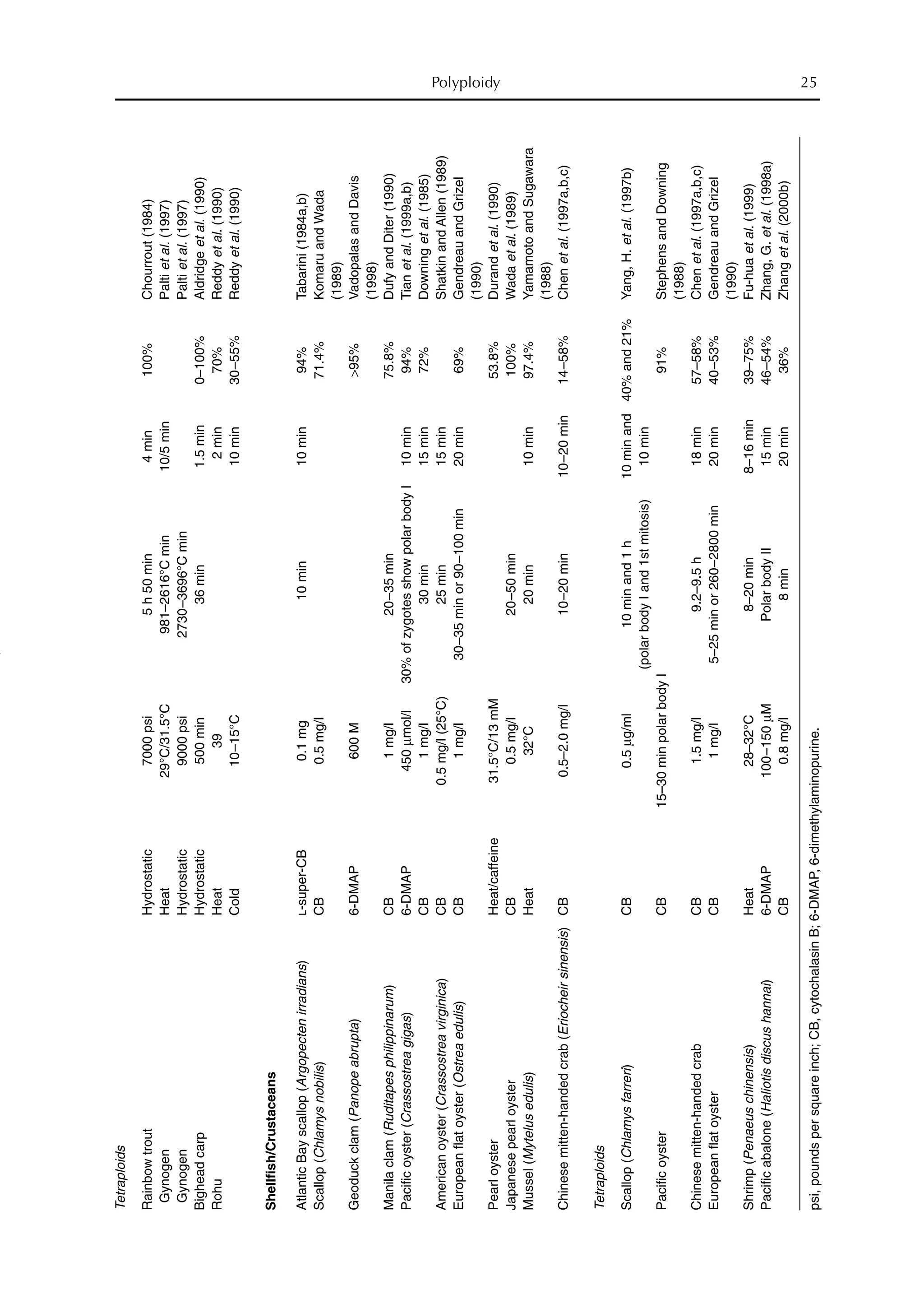
supernumerary chromosome fragments
(Chourrout, 1986b; Fig. 4.1).
To ensure that genetically viable sperm do
not fertilize the egg and produce normal
diploids, sperm from related species (het-
erologous sperm) can be irradiated and used
to activate cell division (Stanley and Jones,
1976; Chourrout and Quillet, 1982;
Chourrout and Itskovich, 1983; Chourrout,
1986a,b) to allow verification that the
embryos are gynogenetic. If a normal diploid
or triploid hybrid is produced, either it is
recognizable morphologically or it dies,
depending upon the viability of the hybrid.
After activation of the egg with irradiated
sperm, the second polar body will be
extruded, resulting in haploid embryos that
eventually die if no treatment is used
(Chourrout, 1986b). One alternative for pro-
ducing diploid gynogens is to block the
extrusion of the second polar body; then the
diploid gynogen has two sets of chromo-
somes, both of maternal origin. This type of
gynogen is referred to as a meiotic gynogen,
or meiogen, since it was produced by block-
ing the second meiotic division.
Treatments that result in high rates of
triploid induction should also be the most
effective for production of diploid meiogens
since both are produced by retaining the sec-
ond polar body. Retention of the second
polar body is accomplished with tempera-
ture shocks or pressure treatments
(Chourrout, 1980; Thorgaard et al., 1981;
Chourrout and Quillet, 1982; Benfey and
Sutterlin, 1984a; Lou and Purdom, 1984). The
treatment is applied shortly after sperm pen-
etration prior to extrusion of the second
polar body. The most effective time for these
shocks varies among species (Dunham,
1990a; see Chapter 3).
Gynogens produced by blockage of polar-
body extrusion are inbred since all genetic
information is maternal. Meiotic gynogens
are not totally homozygous since crossing
over and recombination during oogenesis
result in different gene combinations in the
ovum and the second polar body (Thompson
and Purdom, 1986). The chromosome sets in
the ova and the second polar body are not
identical. The rate of inbreeding or increase
in homozygosity through meiotic gynogene-
sis is roughly equivalent to one generation of
full-sib mating.
Diploid gynogens can also be generated
by blocking first cleavage (Thompson and
Purdom, 1986). Karyokinesis is allowed,
resulting in the doubling of chromosome
number to the diploid state, and, if the first
cell division is blocked, a single diploid cell
results. Gynogens produced by this tech-
nique – mitotic gynogens or mitogynotes –
are 100% homozygous since a single set of
chromosomes is duplicated (Thorgaard et al.,
1981; Thompson and Purdom, 1986).
Gynogenesis and Androgenesis 55
Fig. 4.1. Karyotype containing supernumerary chromosome fragments produced by gamma irradiation of
sperm (Thorgaard et al., 1985).
The first cell division can be blocked
chemically (Sriramula, 1962; Squire, 1968;
Valenti, 1975; Smith and Lemoine, 1979), with
temperature shocks or with hydrostatic pres-
sure (Chourrout, 1980; Thorgaard et al., 1981;
Chourrout and Quillet, 1982; Benfey and
Sutterlin, 1984a; Lou and Purdom, 1984). The
timing of these treatments and those that are
most effective are the same as for the induc-
tion of tetraploidy since both techniques rely
on blocking the first mitotic division.
Production of gynogens via blockage of
first cleavage is more difficult than produc-
tion of gynogens by retention of the second
polar body (Thorgaard, 1986), just as triploids
are also easier to produce than tetraploids
(Wolters et al., 1981a; Bidwell et al., 1985;
Thorgaard, 1986; Curtis et al., 1987; Rezk,
1988; Bury, 1989). This indicates that the sec-
ond polar body is easier to manipulate than
the first cell division or that embryos are
more sensitive to environmental shocks near
the first cell division compared with shortly
after fertilization. Alternatively, gynogens
produced by blocking the first mitotic divi-
sion would be more likely to die during
embryonic development because of a higher
frequency of deleterious recessive genotypes
found in these individuals, as they are all
100% homozygous (Scheerer et al., 1986).
Androgenesis is accomplished by irradiat-
ing eggs and then doubling the paternal
genome, as described for mitotic gynogenesis
(Thorgaard, 1986). Androgens are more diffi-
cult to produce than either type of gynogen
(Scheerer et al., 1986). Diploidy can only be
induced in androgens at first cell division, a
difficult developmental stage for manipulat-
ing the embryo. Since androgens are 100%
homozygous, like mitogynotes, a large per-
centage possess homozygous, deleterious
recessive genotypes, which may lead to death
(Scheerer et al., 1986). The irradiation of eggs
could, theoretically, destroy mitochondrial
DNA (mtDNA) or have damaging effects on
the cytoplasm which may adversely affect the
development and viability of androgens in
comparison with mitogynotes whose
mtDNA and cytoplasm have not been irradi-
ated. The function of loci found in the mito-
chondrial genome is primarily energy
metabolism (Chapman et al., 1982; Avise et al.,
1987; Moritz et al., 1987). MtDNA is almost
solely maternal in origin, and paternal leak-
age is negligible (Chapman et al., 1982; Avise
et al., 1987; Moritz et al., 1987). If YY individu-
als are subviable, there will be a preponder-
ance of female androgens, and the loss of YY
males would be another explanation for the
difficulty in producing androgens.
May and Grewe (1993) examined the
effects of gamma irradiation on nuclear
DNA and mtDNA of brown and brook trout
eggs fertilized with either brook trout or
splake (Salvelinus namaycush ϫ Salvelinus
fontinalis) sperm. Only paternal allozymes
were observed in embryos, confirming the
inactivation of the nuclear genome in the
eggs, and these embryos contained exclu-
sively maternal mtDNA. May and Grewe
(1993) suggest that mtDNAs are more resis-
tant to gamma irradiation and cobalt-60 inac-
tivation than nuclear DNAs, based on the
structure or numerical superiority of the
maternal nuclear DNA. These homozygous
androgens have the nuclear genome of the
paternal parent (androgenetic) and the mito-
chondrial genome of the maternal parent.
Apparently, mtDNA is protected from
irradiation by its additional double mem-
brane, its small circular genome or its large
copy number (May and Grewe, 1993; Brown
and Thorgaard, 2002). Restriction fragment
length polymorphisms (RFLP), amplified
fragment length polymorphism (AFLP) and
sequencing analysis did not detect any point
mutations from the irradiation treatments
(May and Grewe, 1993; Brown and
Thorgaard, 2002). This also has implications
in that it may be difficult to induce beneficial
mutations via irradiation.
Lee et al. (2000) studied factors that affect
irradiation levels and cause target doses and
actual absorbed doses to be different from
those expected when irradiating eggs or
sperm. They found high levels of vertical and
horizontal variation in dose rates inside a
small (but typical) container (14.5 cm high,
16.7 cm wide and 2.8 l in volume). Rotation or
lack of rotation affected the variation in the
dose actually applied. Rotated containers had
vertical variation ranging between 1 and 21%
and horizontal variation between 10 and 19%.
As expected, variation was much higher
56 Chapter 4
when containers were not rotated, with verti-
cal variation ranging between 6 and 28% and
horizontal variation between 20 and 72% (Lee
et al., 2000). Rotated containers had much less
variation in irradiation level when comparing
air and water as surrounding medium. Dose
rate in air was as much as 42% higher than in
water when the container was rotated, and as
much as 218% higher in air when the con-
tainer did not rotate. Samples irradiated in
water probably receive dosages lower than
desired. Lee et al. (2000) suggest that this type
of variation and error complicates compar-
isons among studies and organisms, and that
dosiometry studies should be conducted to
verify actual experimental parameters.
Performance of Gynogens and
Androgens
Homozygous gynogens of ayu show
increased variation for size and for meristic
traits (numerical traits such as anal-fin ray
number). Rainbow trout mitogynotes exhibit
greater amounts of bilateral asymmetry –
unequal counts for meristic traits on the right
and left sides of the bodies – than controls,
isogenic crossbreeds and normal crossbreeds.
Bilateral asymmetry has been previously doc-
umented in inbred rainbow trout, and is asso-
ciated with a reduction in biochemical genetic
variation. Isogenic crossbreeds – crossbreeds
resulting from mating two clonal lines (Fig.
4.2) – had similar bilateral asymmetry as out-
bred crossbreeds of common carp (Komen et
al., 1993). The coefficient of variation for size
was much larger for the common carp clones
compared with outcrossed populations.
Homozygous gynogens of common carp
exhibit growth depression compared with
crossbreeds (Komen et al., 1993). Growth
reduction was slightly more when compared
with outcrossed crossbreeds than when com-
pared with isogenic gynogenetic crossbreeds.
Reproduction
Komen et al. (1993) compared the gonad
development and fertility of common carp
produced by either full-sib mating (F = 0.25),
gynogenesis by retention of the second polar
body (F is approximately 0.25) or gynogene-
sis by endomitosis (F = 1.0) from a common
female. Meiogenetic offspring were all
female, but 50% of the mitogynotes were
homozygous for a recessive mutant sex-
determining gene, resulting in 50% males
and intersexes. Another mutation affecting
pigmentation in eggs was also detected in
the mitogynote offspring but not in meio-
genetic offspring.
The variation in body weight, gonad
weight and egg size in each group increased
with increased inbreeding. Full-sib inbreds
and meiogens (F = 0.25 for both) were com-
parable in mean gonadal development, but
gonads from homozygous gynogenetic carp
were often retarded. Ovulation response also
decreased with increasing levels of inbreed-
ing (Komen et al., 1993).
Gynogenetic and polyploid fish often
have abnormal ovarian development
(Krisfalusi et al., 2000). Piferrer et al. (1994)
compared the gonadal morphology of nor-
mal and sex-reversed juvenile triploid,
gynogenetic diploid and normal diploid
coho salmon. Gynogens were 100% females,
and 34% had reduced ovaries with areas
devoid of oocytes. About 30% of gyno-
genetic rainbow trout females also had aber-
rant ovarian development (Krisfalusi et al.,
2000). Gynogenetic fish may be more prone
to developmental abnormalities because of
either increased homozygosity or incom-
plete inactivation of the paternal chromatin.
In 90% of the gynogen rainbow trout exam-
ined, chromosomal fragments were posi-
tively correlated with aberrant ovarian
development. The atypical gonadal mor-
phology of the gynogens was similar to the
ovarian morphology of triploid rainbow
trout (Krisfalusi et al., 2000). Disruption of
the normal diploid chromosomal comple-
ment appears to alter germ-cell develop-
ment in gynogenetic female rainbow trout
and probably coho salmon due to the unbal-
anced nature of the genome. Contrary to
what has been observed in cyprinids, male
germ cells were not observed in the ovaries
of the gynogenetic coho salmon, perhaps
because of differing mechanisms of sex
determination for salmonids and cyprinids
Gynogenesis and Androgenesis 57
58 Chapter 4
Fig. 4.2. Three photographs representing three homozygous cloned populations of common carp, Cyprinus
carpio, maintained at Wageningen University, The Netherlands. Note the almost identical colour, scale
pattern and body shape of the clones within each aquarium. (Photographs by Rex Dunham.)
(Piferrer et al., 1994). However, this again
could be related to paternal chromatin and
the incomplete destruction of the paternal
genome, which might be affected by species
or temperature.
Monosex Populations
In many species of fish, the female is the
homogametic sex (Chen, 1969; Chourrout
and Quillet, 1982; Goudie et al., 1983, 1985;
Wohlfarth and Hulata, 1983; Shelton, 1986;
Shah, 1988). Theoretically, when this is the
case, gynogenesis can be used to produce
monosex female populations. Gynogenetic,
all-female, grass carp (Shelton, 1986), silver
carp, Hypophthalmichthys molitrix (Mirza and
Shelton, 1988), channel catfish (Goudie et al.,
1985) and rainbow trout (Chourrout and
Quillet, 1982) have been produced.
However, it is not feasible to produce com-
mercial quantities of monosex gynogenetic
fish because of the high mortality of the
manipulated eggs (Stanley, 1976a,b;
Donaldson and Hunter, 1982; Shelton, 1986).
Hatching rates of eggs activated and treated
to produce gynogens and survival of fry are
usually less than 1%.
If the male is the homogametic species,
androgenesis would result in monosex male
populations. Again, the low survival of eggs
treated to produce androgens prevents large-
scale production of androgens (Scheerer et
al., 1986). Gynogenesis and androgenesis can
be combined with sex-reversal technology to
produce commercial quantities of monosex
fish as discussed in Chapter 5.
Cloned Populations
Clonal populations of fish can be generated
in a non-specific manner, utilizing gyno-
genesis and sex reversal. Mitotic gynogens are
produced by blocking the first cell division,
and these individuals are 100% homozygous.
However, they are not clones of their mother
as their genotype is different from their dam
because of independent assortment and
recombination during meiosis and because of
the absolute homozygosity induced from the
gynogenesis. Additionally, each mitogynote is
different from its siblings, and each is variably
homozygous for a variety of allelic combina-
tions. Further, the breeder has no control over
which genotype survives and is generated by
the gynogenesis.
Clonal populations can be produced from
these mitogynotes by performing a second
generation of mitotic gynogenesis on the first-
generation mitotic gynogen. Presumably,
more than one offspring would be produced.
Then a portion of the fry would be sex-
reversed, both sexes would exist, although
genetically identical, and large numbers of
identical fry would be produced via natural
mating. Future male brood stock would again
be perpetuated via sex reversal. Theoretically,
clonal populations could be generated in a
similar way from androgens. The primary dif-
ficulty in this breeding scheme is that the
mitogynotes and androgens are maximally
inbred and 100% homozygous, often resulting
in reproductive problems.
Phenotypic variability
Cloned populations have been produced in
zebra fish, ayu, common carp and rainbow
trout (Komen et al., 1993). Theoretically,
clones – individuals with identical genotypes
for their entire genome – should have identi-
cal, non-variable performance. However,
individuals with extreme homozygosity
appear to lose significant ability to respond
to the environment in a consistent stable
manner, and microenvironmental differences
affect performance among individuals
(Komen et al., 1993). Thus, as the component
of genetic variation decreases, actually
becoming zero, the component of environ-
mental variation increases and at a more
rapid rate than the genetic component
decreases, resulting in populations with
extreme phenotypic variation.
Homozygous gynogens of ayu show
increased variation for size and for meristic
traits. Rainbow trout clones exhibit greater
amounts of bilateral asymmetry – unequal
counts for meristic traits on the right and left
sides of the bodies – compared with controls,
isogenic crossbreeds and normal crossbreeds.
Bilateral asymmetry has been previously doc-
umented in inbred rainbow trout and is asso-
ciated with a reduction in biochemical genetic
variation. Isogenic crossbreeds – crossbreeds
resulting from mating two clonal lines – had a
similar bilateral asymmetry to that of outbred
crossbreeds (Komen et al., 1993).
Almost identical results have been
obtained for clonal rainbow trout. Clonal lines
of rainbow trout were produced by androgen-
esis, followed by another generation of andro-
genesis or gynogenesis, followed by retention
of the second polar body (Young et al., 1995).
Clonal populations were more asymmetrical
and showed higher variance in total meristic
counts than either the isogenic crossbreeds or
outbred crossbreeds, indicating reduced fit-
ness in the clonal populations and their ability
to react to microenvironmental variation.
There was no difference in asymmetry
between outbred crossbreeds and isogenic
crossbreeds. Fluctuating asymmetry of spot-
ting pattern was also investigated as a poten-
tial measure of developmental stability.
Asymmetry of spotting pattern was not dif-
ferent in homozygous clones compared with
isogenic crossbreeds, but the spotting pattern
had a low coefficient of variation within lines
and may be useful for identifying isogenic
lines and monitoring genetic divergence
between lines. The increased developmental
stability and decreased variance of meristic
traits in the isogenic crossbred rainbow trout
indicate that they were less influenced by
environmental conditions and may make bet-
ter research organisms than the homozygous
clones. Vandeputte et al. (2002) used a
homozygous clone outcrossed to normal com-
mon carp as a powerful internal scaled con-
trol for the evaluation of mirror carp strains.
Gynogenesis and Androgenesis 59
Regeneration of genetic variation in
salmonids
Clonal individuals of rainbow trout can pro-
duce progeny with genetic variation.
Salmonids have autotetraploid ancestry and
tetrasomic inheritance (Brown and Thorgaard,
2002). The entire salmonid genome was dupli-
cated (Allendorf and Thorgaard, 1984), and
then the chromosome number was reduced
via Robertsonian rearrangement (Thorgaard,
1976). In secondary tetrasomy, homologous
regions on separate chromosomes can cross
over during gametogenesis to produce unique
genotypes (Brown and Thorgaard, 2002), caus-
ing problems in the production of clonal lines
(Allendorf and Danzmann, 1997). Brown and
Thorgaard (2002) were able to detect AFLP
variation in clonal populations of androgenic
rainbow trout. Of course, theoretically, the
AFLP sequences do not have phenotypic
importance, but this demonstrates that genetic
variation for protein-encoding DNA
sequences could also occur, resulting in
genetic variation and phenotypic variation in
what are supposed to be clonal lines.
Growth
Homozygous gynogens of common carp
exhibit depression in growth compared with
crossbreeds (Komen et al., 1993). Growth
reduction was slightly more when compared
with outcrossed crossbreeds than with iso-
genic gynogenetic crossbreeds. Again, the
coefficient of variation for size was much
larger for the common carp clones compared
with outcrossed populations.
Müller-Belecke and Hörstgen-Schwark
(2000) established six different homozygous
clonal lines of Nile tilapia, which was verified
by analysis of the allozymes of adenosine
deaminase and DNA fingerprints. Up to first
feeding, clones had a reduced survival rate
(4.0%) compared with normal heterozygous
fish (43.9%). Reproductive traits of the sec-
ond-generation clones varied between and
within clonal lines. The observed body
weight of all-female clonal groups (45.5 g)
kept under three different density classes was
slightly less than that of corresponding all-
female heterozygous control groups (50.2 g).
In contrast to what has been observed for
clonal populations of other species of fish,
Nile tilapia homozygous clones had more
uniform growth (coefficient of variation:
23.1%) than in all-female heterozygous con-
trols (coefficient of variation: 34.1%).
Disease resistance
Kobayashi et al. (1994) produced clonal lines
from different strains of amago salmon,
Oncorhynchus rhodurus. As expected, the
clones immunologically accepted operculum
allografts from inbred sisters. Survival was
similar among clones produced by dams
from the same strain, but survival was differ-
ent among clones using maternal parents
from different strains. Han et al. (1991) pro-
duced clonal ayu, Plecoglossus altivelis, that
accepted graft tissue transplanted from intra-
clonal siblings, but the graft tissue was
rejected when transplanted into different
clonal hosts. Strain and genetic background
affect the viability of clonal lines.
Non-specific immune responses, serum
lysozyme activity and phagocytosis were
different among inbred clones of Nile tilapia
(Sarder et al., 2001). Resistance to Aeromonas
hydrophila infection was positively correlated
to non-specific immune responses. When a
clonal line susceptible to A. hydrophila was
crossed with a resistant clonal line, the
resulting progeny demonstrated intermedi-
ate disease resistance, indicative of additive
genetic variation rather than dominance
gene action for this trait.
Four gynogenetic clonal lines of common
carp were selected as high or low responders
on the basis of their primary serum antibody
production to dinitrophenyl-keyhole limpet
haemocyanin (DNP-KLH) (Bandin et al.,
1997). Number of antibody-secreting cells and
not serum antibody titres were the primary
difference in progeny of high and low respon-
ders. High-responder clonal common-carp
lines produced 1.5–twofold higher numbers
of specific antibody-secreting cells than low-
responder clonal lines, after both primary and
secondary immunization. Individual varia-
tion within the inbred lines was reduced com-
pared with that in outbred common carp.
60 Chapter 4
Haematocrit, haemoglobin, red blood-cell
count and mean corpuscular volume were
measured for stressed and non-stressed
clonal lines of ayu and also verified by DNA
fingerprinting (del Valle et al., 1996).
Differences among clonal lines were
observed for haematocrit and mean corpus-
cular volume under the no-stress environ-
ment. Heritability values were moderate for
the no-stress measurements (mean of 0.24)
and very low or zero for the stressed groups’
traits (except one, 0.48).
Clonal hybrids
Salmonids are genetically unusual in many
ways, and it may be possible to develop
interspecific clonal hybrid lines. Clonal full-
sib progeny groups of Atlantic salmon ϫ
brown trout hybrids were produced by
gynogenesis (Galbreath et al., 1997). One
hybrid female had a large portion of the
oocytes undergo a premeiotic chromosome
doubling, or possibly a complete suppres-
sion of meiosis, resulting in ovulation of
diploid eggs, each possessing one full set of
both Atlantic salmon and brown trout chro-
mosomes identical to those in the maternal
somatic cells. This opens the possibility of
developing lines of clonal salmonid hybrids
for experimentation.
Nuclear Transplantation –
Nucleocytoplasmic Hybrids
A unique approach to genetic modification
in fish is nuclear transplantation. Of course,
this procedure is the key to the present-day
controversial research regarding cloning of
individuals. Intraspecific nuclear transplan-
tation – transplantation of nuclei into enucle-
ated eggs of the same species – has been
accomplished in a variety of organisms,
including amphibians (Briggs and King,
1952, 1953; Briggs, 1979; DiBerardino, 1987,
1997), mice (Illmensee and Hoppe, 1981;
McGrath and Solter, 1984a,b; Kono et al.,
1991; Cheong et al., 1993; Tsunoda and Kato,
1993), swine (Prather et al., 1989), cattle
(Prather et al., 1989; Bondioli et al., 1990; Sims
and First, 1994), goats (Du et al., 1995) and
sheep (Willadsen, 1986; Smith and Wilmut,
1989; Campbell et al., 1994).
Bondioli et al. (1990) produced eight
cloned male calves from the nuclei of a sin-
gle bovine embryo. Then, in 1997, Wilmut et
al. (1997) produced the famous cloned lamb,
Dolly, from adult cells – cultured adult mam-
mary epithelium cells. Although these are
major scientific advances, none of these indi-
viduals are true 100% clones because donor
eggs were used which have different cyto-
plasm and mtDNA from those of the indi-
vidual donating nuclei.
Intraspecific clones of individual fish
have recently been produced for the first
time (Lee et al., 2002). Fertile transgenic zebra
fish were obtained by nuclear transfer using
embryonic fibroblast cells from long-term
cultures. The donor nuclei were modified
with retroviral insertions expressing green
fluorescent protein (GFP) and were trans-
planted into manually enucleated eggs. A
typical 2% survival rate resulted in 11 adult
transgenic zebra fish expressing GFP. These
P1 nuclear-transplant transgenics produced
fertile, diploid F1/F2 progeny, which also
expressed GFP in a pattern identical to that
of the founder fish. Slowly dividing nuclei
from cultured cells can be reprogrammed to
support rapid embryonic development,
which should lead to targeted genetic
manipulation in zebra fish.
Until this recent development, fish
research revolved around an interspecific
approach. The nucleus from one species is
transplanted into the enucleated zygote of a
second host species, resulting in a hybrid
with nuclear DNA from one species and
cytoplasm and mtDNA from a second
species. This technique is tedious and few
embryos survive the procedure. This proce-
dure has been accomplished in carps in
China. The resulting embryos, with nuclei
and nuclear DNA from the donor species
and cytoplasm and mtDNA from the host
species, have been termed nucleocytoplas-
mic hybrids (Yan, 1998). Few details have
been published, but fish with altered perfor-
mance have been produced.
Nucleocytoplasmic hybrids have been
produced between different species, vari-
Gynogenesis and Androgenesis 61
eties, genera and subfamilies of fish, and
resulted in individuals that produced viable
offspring (Yan, 1998). This research demon-
strated that most traits are controlled by
nuclear DNA, a few are controlled by the
cytoplasm/mtDNA and others by a combi-
nation of the nuclear and mtDNA genomes
(Yan, 1998). The same conclusions were
obtained from interspecific nucleocytoplas-
mic hybrids of frogs, Rana (Kawamura and
Nishioka, 1963a,b). Interspecific nucleocyto-
plasmic hybrids of mammals have failed to
develop past the blastocyst or morula stages
(Mei et al., 1993; Yan, 1998), again illustrating
the greater genetic plasticity of fish com-
pared with mammals.
In the case of fish, there are some restric-
tions on the type of egg that can be used as
the host or recipient. Nile tilapia and Chinese
bitterling, Rhoedus sinensis, have ellipsoid
eggs that are rich in yolk and have only a sin-
gle layer of chorion. After the enveloping
chorion is removed, these eggs lose their elas-
ticity and become flat, frequently resulting in
abnormal development (Yan, 1998). Species
that have oil droplets in their eggs, causing
buoyancy, are also difficult to handle as host
cytoplasm. Eggs from females that are
spawning for the second year appear to be
more amenable to manipulation.
A stereomicroscope is utilized to accom-
plish the nuclear transplantation. Eggs are
kept at optimum spawning temperature (Yan,
1998). Embryos are incubated in standard
amphibian Holtfreter’s solution. NaCl
(0.35 g), KCl (0.005 g) and CaCl2 (0.01 g) are
mixed together in 100 ml of distilled water
and then sterilized by boiling. This solution is
then cooled to 50°C and then NaHCO3
(0.02 g) is added to adjust the pH to about 7.
A Holtfreter’s disassociation solution is uti-
lized to separate fish blastula cells. This solu-
tion is made by adding NaCl (0.35 g), KCl
(0.005 g) and ethylenediamine tetra-acetic
acid (EDTA) (55.8 mg) together in 100 ml of
distilled water, and then sterilized by boiling.
This solution is then cooled to 50°C and then
NaHCO3 (0.02 g) is added to adjust the pH to
about 7.
Fish eggs are placed on the bottom of a
Petri dish, which is covered with a layer of
1.2% agar to prevent friction between the egg
and the glass bottom. After activation of the
egg, the cytoplasm coalesces and moves
towards the animal pole, forming a blasto-
disc cap. Nuclear transplantation must be
accomplished prior to the complete forma-
tion of the blastodisc (Yan, 1998). Optimum
results are obtained if the operation is per-
formed between the time of first cleavage
and metaphase of the second meiotic divi-
sion; otherwise abnormal cleavage and
development of the nuclear-transplant eggs
will probably occur.
The blastodisc is located just under the
egg surface against the first polar body. The
egg should be gently rotated until the blas-
todisc can be located. The egg nucleus is
removed with a fine glass needle. Attempts
to do this by irradiation or lasers have
proved difficult to date. The host egg is now
ready to receive the donor nucleus. The
donor cells/nuclei are taken from the inner
side of the blastoderm of a mid-blastula.
Again, the blastoderm is separated with a
fine glass needle and a hair loop. After the
isolated blastoderm is placed in the disassoci-
ation solution, the cells separate in 1–2 min
and must be removed before more than 2 min
have elapsed. Durations longer than this will
damage the cells and they will not develop.
The cells should be moved directly from the
Holtfreter’s disassociation solution to the reg-
ular Holtfreter’s. There is an inconsistency in
the protocol of Yan (1998), as it indicates that
the isolated blastula cells should be held in a
calcium-free medium and yet Holtfreter’s
contains calcium. The cells need to be kept
separate as they can reassociate, divide con-
tinuously and form a cell mass.
The donor egg is prepared by removing
the chorion with forceps and the egg is
rotated to locate the blastodisc, which is just
below the polar body. The polar body has the
appearance of a small ball. The egg nucleus
is removed with a sharp glass needle by
quickly taking a small slice, which includes
the entire egg nucleus and a small portion of
the cytoplasm. The damaged site will imme-
diately heal in the Holtfreter’s.
Nuclear transplantation is accomplished
in Holtfreter’s, and both the donor cells and
recipient egg are placed in a Petri dish with
the bottom coated with a layer of agar to pre-
62 Chapter 4
vent adhesion of the eggs and cells to the
glass. Donor cells are sucked into a
micropipette. The diameter of the opening of
the pipette is slightly smaller than the donor
cell (10 µm) to break the cell and free the
nucleus. The donor blastula cell/nucleus is
then injected into the enucleated recipient
egg. If the nuclear-transplant cell gastrulates,
it will normally complete development.
Generally, 1–3% of the manipulated embryos
survive to adulthood.
Tung and Yan (1985) accomplished inter-
variety nuclear transplantation. They trans-
planted the nucleus from a crucian carp,
which is the wild type Carassius auratus, into
the cytoplasm of domestic goldfish, C. aura-
tus. These two varieties have vastly different
morphology and behaviour. The nucleocyto-
plasmic hybrids had the coloration, the num-
ber of scales on the lateral line and the
caudal fin to body length ratio of the donor
nucleus species, wild crucian carp. No traits
were exactly like the donor of the enucleated
egg, domestic goldfish. The vertebrate num-
ber was intermediate, and the isozyme pat-
terns were not exactly like the donor and
host, indicating that these traits were
effected by a combination of nuclear genes,
mitochondrial genes and/or cytoplasmic
interactions. Three of the embryos grew to
maturity, were females and produced normal
eggs.
Intergeneric nucleocytoplasmic hybrids
were also produced (Tung, 1980; Yan et al.,
1985). These nucleocytoplasmic hybrids had
a pair of lateral barbels, pharyngeal teeth
shape and number, morphology of pigment
cells, colour, scale morphology, swim blad-
der shape, haemoglobin patterns, lactate
dehydrogenase (LDH) allozyme pattern,
malate dehydrogenase allozyme pattern and
DNA reassociation kinetics that were the
same as those of the donor species of the
nucleus, common carp. Male and female F1
nucleocytoplasmic hybrids were fertile and
were mated to produce F2 and F3 genera-
tions. Many of these common carp donor
traits were then inherited by F2- and F3-gen-
eration nucleocytoplasmic hybrids (Yan,
1998), as expected . In the case of the lateral-
line scale count and the serum protein pat-
terns, means were intermediate of the two
parental types, but closer to those of the
donor species, the common carp. Vertebrate
number was nearer that of the enucleated
host egg species, goldfish. Perhaps develop-
ment rate and such meristic characters as
vertebrate number are sometimes dictated
by intrinsic factors of the cytoplasm or inter-
actions among the cytoplasm, mtDNA and
nuclear genome.
F3-generation nucleocytoplasmic hybrids
were compared with their parental donor
species, red common carp, in ponds (Yan,
1998). The F3 nucleocytoplasmic hybrids
grew 22% faster than the red common carp
and had 3.8% higher protein and 5.6% lower
fat in the muscle than the red common carp.
Reciprocal nucleocytoplasmic hybrids were
produced by transferring the nucleus of the
crucian carp to the enucleated eggs of com-
mon carp (Yan et al., 1984a). As expected, reci-
procal results were obtained. These fish had
no lateral barbels and had pharyngeal teeth,
vertebrate number and scale counts on the lat-
eral line very similar to those of the donor
species of the nucleus, crucian carp/goldfish.
Overcoming even greater genetic dis-
tances, intersubfamily nucleocytoplasmic
hybrids were produced (Yan et al., 1984b,
1985). Nuclei of blastula cells from the grass
carp, Ctenopharyngodon idella, subfamily
Leucinae, were transferred to enucleated eggs
of the blunt-snout bream, Megalobrama ambly-
cephala, subfamily Abramidinae. Overall mor-
phology and appearance, head length/total
length, body depth/total length, body
width/total length, anal fin ray number, gill-
raker number, swim bladder shape, number
of pharyngeal teeth, teeth patterns and num-
ber of vertebrae were the same as those of the
nuclear donor species and different from
those of the host cytoplasm species. In some
cases, the nucleocytoplasmic hybrids had
extra anal fin rays like the host cytoplasm
species, blunt-snout bream. The karyotype
and karyotype morphology were also the
same as the nuclear donor species, grass carp.
LDH isozyme patterns of the nucleocytoplas-
mic hybrids and the nuclear donor species
were the same. However, the serum protein
pattern and the immunoprecipitation of
serum proteins were different for the nucleo-
cytoplasmic hybrids compared with both the
Gynogenesis and Androgenesis 63
donor and host species, indicative of some
type of cytoplasmic or mtDNA influence.
Reciprocal interfamily nucleocytoplasmic
hybrids of goldfish, family Cyprinidae, and
large-scale loach, Paramisgurnus dabryas, fam-
ily Cobitidae, failed to produce adult fish (Yan
et al., 1990), as did hybrids between zebra fish
donors and large-scale loach hosts (Yan et al.,
1993). This confirms and illustrates the impor-
tance of the interactions of the nuclear
genome, the nucleus, the cytoplasm and the
mtDNA. The genetic distance of families
appears to be too great to allow the complete
development of nucleocytoplasmic hybrids.
Interorder nucleocytoplasmic hybrids
between Nile tilapia donors and large-scale
loach hosts sometimes produced larvae, but
never resulted in adult fish (Yan et al., 1990,
1991). Evidence was generated – karyological
and some morphological – indicating a func-
tioning nuclear genome from tilapia, but there
was some definite host influence on body
shape. Apparently, one of the primary reasons
for larval death was the incompatibilities in
the eggs’ developmental rate and the timing of
gene expression of the nuclear donor genome.
64 Chapter 4
5
Sex Reversal and Breeding
© R.A. Dunham 2004. Aquaculture and Fisheries Biotechnology: Genetic Approaches
(R.A. Dunham) 65
Monosex or sterile populations of fish are
desirable in aquaculture for a variety of rea-
sons. The male grows faster in some species
and the female faster in other species (Fig.
5.1). In this case, monosex culture of the
faster-growing sex can increase production,
and sexual dimorphism for growth occurs in
most cultured fish (Dunham, 1990a).
Some species of fish mature at small sizes
and young ages prior to the desired time of
harvest. This can decrease production
because unwanted reproduction results in
crowding of the fish and higher densities
than intended in the culture pond as well as
wasted energy from the sexual activity of
the stocked fish. Sex differences may also
Fig. 5.1. Sexual dimorphism for size in Nile tilapia, Oreochromis niloticus. The male is the larger
individual. (Photograph by R.O. Smitherman.)
exist for flesh quality and carcass yield.
Sexual maturity is also closely linked with
both carcass yield and growth rate: as the
fish become sexually mature, growth rate
slows and carcass yield decreases. Although
not well documented, sexual dimorphism
could also exist for other economic traits,
such as disease resistance or tolerance of
poor water quality.
In some countries, the introduction of
potentially valuable exotic fish species for
aquaculture is met with resistance or is not
allowed because of potential adverse ecolog-
ical impacts and conservation concerns.
Controversy also exists for the utilization of
fertile, diploid hybrids in aquaculture or in
sport-fish management, which may escape,
backcross with and genetically contaminate
parental species. The utilization of monosex
or sterile populations of fish is a solution or
partial solution for the problems associated
with sexual differences, sexual maturation
and unwanted reproduction.
Several techniques are available for pro-
ducing monosex or sterile populations of
fish for aquaculture. Manual sexing, steril-
ization, hybridization, gynogenesis, andro-
genesis, polyploidy, sex reversal, and sex
reversal combined with breeding are
options, all with advantages and disadvan-
tages for producing the desired populations.
Monosex populations can be produced by
direct hormonal sex reversal. Phenotypic sex
can be altered by administration of sex hor-
mones, oestrogens or androgens, at the criti-
cal period of sex determination to produce
skewed or all-female and skewed or all-male
populations, respectively. The development
of fish makes them conducive to the manip-
ulation of their sex. Although the male or
female genotype is established at fertiliza-
tion, phenotypic sex determination occurs
later in development. The artificial elevation
of the appropriate sex hormone is sufficient
to overcome the natural hormone or gene
product during the period of sexual differ-
entiation and to dictate the sex of the indi-
vidual. The period of sexual determination
is size- rather than age-related. Sex reversal
is another manipulation for controlling
reproduction in fish and ultimately improv-
ing the rate of growth.
Sexual Dimorphism
Sexual dimorphism for commercial traits of
aquacultural fish, game fish or ornamental
species is the key to the potential benefit of
producing monosex populations. One sex
grows faster than the other in most fish
species. Channel catfish and tilapia males
grow faster than females (Beaver et al., 1966;
Stone, 1981; Brooks et al., 1982), whereas the
opposite relationship exists for grass carp,
Ctenopharyngodon idella (Hickling, 1967), rain-
bow trout and other salmonids (Johnstone et
al., 1978; Bye and Lincoln, 1986; Gall, 1986)
and cyprinids, where females grow faster
than males.
Sexual dimorphism can develop at young
ages and small sizes. Two examples are
channel catfish, which become sexually
dimorphic for body weight by 6 months of
age, when the fish are approximately 12 cm
in length (Brooks et al., 1982), and tilapia,
which not only become sexually dimorphic
in size at 2 or 3 months, but also become
sexually mature (Shelton et al., 1978). The
timing and degree of sexual dimorphism
may vary among strains within a species.
Although male channel catfish usually grow
faster than females, the amount of sexual
dimorphism differs among strains, and the
Marion strain exhibits no sexual dimor-
phism for size (Benchakan, 1979; Dunham
and Smitherman, 1984).
Faster growth of one sex is presumably a
result of a combination of genetic and hor-
monal factors, although competition and
suppression of one sex and magnification of
initial size differences are alternative explana-
tions for sexually dimorphic growth. Most
measurements of growth have been made
when both sexes are in competition in the
same environment. If competition were elimi-
nated and the two sexes grown in separate
environments, sexual dimorphism for growth
rate might decrease, although Stone (1981)
and Hanson et al. (1983) demonstrated that,
when male and female Nile tilapia are grown
in separate and communal environments,
growth differences are similar and competi-
tion apparently has no large effect. Male Nile
tilapia grew 2.5 and 2.2 times faster than
females when grown in cages mixed and sep-
66 Chapter 5
arately, respectively (Stone, 1981), so there is
about a 12% magnification of the sexual
dimorphic growth from competition.
Manual separation of the sexes (Chimits,
1957; Mires, 1969; Lovshin and Da Silva,
1976) requires the least amount of technol-
ogy for monosex culture, but it is extremely
wasteful, tedious and inefficient. Although
this technique has been applied effectively,
especially in developing countries (Lovshin
and Da Silva, 1976; Popma, 1987), it has
numerous disadvantages. The first is that the
fingerlings must be grown to a size large
enough to visually determine sex before
manual separation, resulting in half the fin-
gerling production being wasted since the
slower-growing sex is culled unless the
slower-growing sex is utilized in separate
ponds, when prevention of reproduction is
the primary consideration. Manual separa-
tion of sexes is extremely labour-intensive
and has the potential for mistakes (Lovshin
and Da Silva, 1976; Popma, 1987).
An alternative method to hand-sexing is
mechanical separation by size grading,
which can separate most of the fish by sex.
Some of the same disadvantages exist, as
half the initial fingerling production is
wasted. If elimination of reproduction in
early-maturing species in production ponds
is the primary goal, grading will probably
result in too many mistakes to adequately
separate the sexes to eliminate reproduction.
Timing of sexual maturity and carcass
traits are often sexually dimorphic. Sexual
maturity, growth rate, maximum attainable
size, size at sexual maturity, degree of sexual
dimorphism and carcass traits are all interre-
lated, but different interrelationships exist
among various species (Alm, 1959;
Smitherman and Dunham, 1985; Tveranger,
1985; Gall, 1986; Dunham and Smitherman,
1987; Dunham, 1990a). In the case of rainbow
trout and Atlantic salmon, males mature at
younger ages than females (Johnstone et al.,
1978; Bye and Lincoln, 1986; Gall, 1986),
which prevents a portion of these males from
reaching harvestable size and reduces the
flesh quality in males by the time they reach
typical marketable sizes. Aggravating this
problem further, some Atlantic salmon males
– streak males – exhibit precocious sexual
maturity and reproduction. The most rapidly
growing salmonid males may reach maturity
early, but the slower-growing, later-maturing
males will eventually surpass the early-
maturing males in size (Tveranger, 1985;
Gall, 1986). Age at sexual maturity has a high
heritability in salmonids (Naevdal, 1983;
Gjerde, 1984; Gjerde and Gjedrem, 1984), and
a high genetic correlation exists between
growth rate and age of sexual maturity
(Thorpe et al., 1983; Gjerde and Gjedrem,
1984). Similarly to salmonids, rapidly grow-
ing male mosquito fish, Gambusia affinis, also
exhibit early sexual maturity (Busack and
Gall, 1983).
These interrelationships are different and
even the opposite in other species, so no
overall principle exists. Early- and late-
maturing platyfish, Xiphophorus maculatus,
males grow at the same rate until maturity
(Kallman and Borkoski, 1978). Early- and
late-maturing platyfish males differ at a sex-
linked maturation locus, and late-maturing
males reach twice the mature size of early-
maturing males (McKenzie et al., 1983). The
fastest-growing strain of channel catfish,
Kansas, matures a whole year later, on aver-
age, than slow-growing strains of channel
catfish (Dunham and Smitherman, 1984,
1987). The slower-growing strains of channel
catfish, such as Rio Grande, exhibit more
sexual dimorphism for body weight than the
faster-growing strains (Benchakan, 1979;
Dunham and Smitherman, 1984, 1987). This
opens the possibility that selection for
increased body weight could affect age and
size at sexual maturity and might also
reduce sexual dimorphism in size.
Examination of the sexual maturity, sexual
dimorphism and growth-rate interrelation-
ships among species of catfish, rather than
among strains within a species of catfish,
reveals interrelationships parallel, in some
aspects, to those for salmonids. White catfish,
Ameirus catus, have rapid early growth, early
sexual maturity, small mature size and much
sexual dimorphism for body weight (Brooks
et al., 1982; Dunham and Smitherman, 1984).
Blue catfish, Ictalurus furcatus, have slow
early growth, late sexual maturity, large
mature size (maximum for ictalurids) and
little sexual dimorphism for body weight,
Sex Reversal and Breeding 67
while channel catfish are intermediate for all
of these traits. Among ictalurid catfish, fast
early growth is correlated with early sexual
maturity and large sexual dimorphism for
body weight and is inversely related to
mature size and maximum attainable
weight. The same interrelationships exist
among species of centrarchid sunfishes
(Childers, 1967).
Some, but not all carcass traits of catfish
are sexually dimorphic. Carcass yield in
male and female channel catfish is similar as
the males develop larger heads and females
have increased visceral percentages, result-
ing in equal reduction of carcass yield (El-
Ibiary et al., 1976; Dunham et al., 1985). The
flesh texture of sexually mature 4-year-old
male channel catfish is much tougher than
that of females when the fish are processed
during the spawning season, similar to the
sexual dimorphism in flesh quality seen in
salmonids. This may be related to the
weight loss and increased muscularization
exhibited by males prior to spawning com-
pared with the weight gain, water retention
and relative lack of increased musculariza-
tion exhibited by females during the same
time (Jensen, J. et al., 1983).
Sexual maturation in both sexes of rain-
bow trout results in deterioration of flesh
quality and alterations in skin and muscle
pigmentation, reducing market acceptability
(Johnstone et al., 1978; Bye and Lincoln,
1986). Rainbow trout are usually marketed at
2 years of age or less, so the primary carcass
problems are related to early-maturing fish.
The degree of this problem varies depending
upon market demand, as the US market his-
torically requires a smaller fish while the
European market demands a larger fish,
aggravating the problem. Early maturation is
sexually dimorphic in rainbow trout, with
males more likely to mature early – jacks –
resulting in marketing problems (Johnstone
et al., 1978; Bye and Lincoln, 1986).
Chemical and Mechanical Sterilization
Sterilization is an alternative to prevent
unwanted reproduction in ponds or to pre-
vent the establishment of escaped, useful,
introduced or exotic species, domestic and
transgenic aquatic organisms or hybrids in
the natural environment. Sterilization might
also promote growth, change the behaviour
of the fish, alter body composition or
improve carcass yield. Sterilization can
potentially be accomplished through
surgery, immunology or radiation or with
chemicals. Sterilization can also be accom-
plished genetically through hybridization,
ploidy manipulation or transgenesis, which
will be discussed later. Unfortunately, none
of these non-genetic technologies have
shown much promise until recently. The
obvious disadvantages of surgical steriliza-
tion include large labour expenditures and
the possibility of mortality, which make it
impractical on a large scale. Although tilapia,
grass carp, salmonids and catfish all have
high survival after gonadectomy (Brown and
Richards, 1979; Akhtar, 1984; Underwood et
al., 1986; Bart, 1988; Bart and Dunham, 1990),
the labour expenditure does not allow the
use of this technique for large-scale commer-
cial production. Surgical sterilization might
be feasible for applications when only a few,
valuable fish need sterilization. Stocking of
small numbers of sterile grass carp for weed
control is a possible example.
Surgical sterilization has not been suc-
cessful in fish and does not allow permanent
sterilization because fish have the ability to
regenerate gonadal tissue. Both testes and
ovaries of grass carp fully regenerate and
function even after the surgery is conducted
on sexually mature fish (Underwood et al.,
1986). Regeneration occurred despite
removal of the entire gonad, including the
surrounding mesentery. Sonneman (1971)
and Brown and Richards (1979) felt that
regeneration came from tissue close to the
removed gonad, but the data on grass carp
refute this hypothesis. Clippinger and
Osborne (1984) also found that regeneration
occurred when only one-third of the gonad
was removed in immature grass carp, and
complete regeneration was more frequent in
mature grass carp males (91%) than in
mature females (38%) (Underwood et al.,
1986). Testicular regeneration occurs in both
adult blue catfish and channel catfish,
although it is slow and may take several
68 Chapter 5
years for complete regeneration. However,
the ability of male and female fish with
regenerated gonads to ejaculate or ovulate
on their own has not been determined,
although ictalurid catfish with regenerated
testes produce viable sperm (Bart, 1994). The
gonads of tilapia also have the ability to
regenerate. Ovariectomized Nile tilapia
females regenerated ovaries in 119 days
(Akhtar, 1984) and, despite being fed methyl-
testosterone, two-thirds of the females regen-
erated ovarian tissue.
Partial removal of gonads can also cause
compensation by the remaining tissue, as
Peters (1957) observed that, after removal of
one ovary or part of both ovaries, the remain-
ing tissue regenerated to the point of produc-
ing the normal mass of tissues and eggs.
Partial removal of the testes in rainbow trout
caused the remaining testes to grow at an
accelerated rate (Robertson, 1958). However,
cauterization may have potential applicabil-
ity, as cauterization of the seminal vesicles of
the catfish, Heteropneustes fossilis, during the
prespawning period caused complete regres-
sion of the seminal vesicle and, after cauteri-
zation, only one fish showed any sign of
regeneration (Sundararaj and Naygar, 1969).
Regenerative ability may be species- or
technique-specific, as Donaldson and Hunter
(1982) indicated that surgical sterilization
was somewhat successful in salmonids
(Robertson, 1961; McBride et al., 1963) and
that relatively rapid gonadectomy tech-
niques have been developed for fish greater
than 25 cm total length (Brown and Richards,
1979). Again, labour and the necessity of
complete testicular removal to prevent
development of secondary sexual character-
istics were cited as major problems (Brown
and Richards, 1979; Donaldson and Hunter,
1982). Additional problems were found
when sterilizing sockeye salmon,
Oncorhynchus nerka, which regenerated tes-
ticular tissue in the posterior region adjacent
to the spermatic duct, resulting in spermato-
genesis after gonadectomy, and females
regenerated ovarian tissue and developed a
limited number of eggs (Robertson, 1961).
Immunological sterilization of fish has
received limited attention. Laird et al. (1978,
1981) injected juvenile Atlantic salmon with
a homogenate of homologous gonadal tissue
with Freund’s adjuvant and obtained some
inhibition of gonadal development.
Sterilization of fish by irradiation, X-rays
and gamma rays has also been relatively
unsuccessful. Sterilization was achieved in
some cases (rainbow trout, tilapia), but,
similarly to surgical sterilization, the effects
were temporary (Kobayashi and Mogami,
1958; Al-Daham, 1970). Some experiments
have demonstrated promise for inhibiting
gonadal development of salmonids with
irradiation. Isotopes depressed the primary
sex cells of Atlantic salmon (Migalovskii,
1971), and gamma rays depressed sexual
maturation in rainbow trout (Tashiro, 1972)
and gonad development in chinook salmon,
Oncorhynchus tshawytscha, fry (Bonham and
Donaldson, 1972). X-rays reduced ovarian
size in rainbow trout fingerlings (Kobayashi
and Mogami, 1958) and suppressed gameto-
genesis for up to 7 months, sterilizing some
pink salmon, Oncorhynchus gorbuscha, males
(Pursov, 1975). Irradiation of adult rainbow
trout did not inhibit sexual maturation
(Foster et al., 1949), while irradiation of
young chinook salmon can alter sexual mat-
uration and inhibit anadromous migration
in at least some individuals (Hershberger et
al., 1978).
Chemosterilization has shown some
potential, although, as with the other steril-
ization procedures, the effects have been
temporary (Stanley, 1979). Chemosterilants
can interfere with mating behaviour or with
the production, release or utilization of sex
steroids. Chemosterilization had some suc-
cess in blocking mating competitiveness in
sea lampreys, Petromyzon marinus (Hanson
and Manion, 1978). Overdoses of hormones
and anabolic steroids can lead to steriliza-
tion (Hirose and Hibiya, 1968; Yamazaki,
1976). Hormone antagonists, such as methal-
libure, have shown the most potential
(Shelton and Jensen, 1979; Donaldson and
Hunter, 1982). This compound acts as a
chemical hypophysectomizing agent by
interrupting the production and release of
gonadotrophins (Paget et al., 1961; Pandey
and Leatherland, 1970). Methallibure may
act by blocking production or release of
gonadotrophins at one or more sites (Bell et
Sex Reversal and Breeding 69
al., 1962; Malven et al., 1971). Implantation of
methallibure in the hypothalamus of rats
prevented ovulation, indicating hypothala-
mic control of gonadotrophin release from
the pituitary (Malven et al., 1971).
Methallibure reduced plasma but not pitu-
itary gonadotrophin in goldfish, Carassius
auratus, indicating that methallibure acted
by inhibiting the gonadotrophin-releasing
factor (Breton and Jalabert, 1973; Merch et
al., 1975). Methallibure has prevented sper-
matogenesis and testicular steroidogenesis
in sea perch, Cymatogaster aggregata (Wiebe,
1968), blocked gonadal differentiation in
guppies, Poecilia reticulata (Pandey and
Leatherland, 1970), suppressed spermatoge-
nesis in guppies (Pandey and Leatherland,
1970) and caused degeneration of cells in
testes of adult tilapia (Dadzie, 1972). This
drug also reduced gonad weight and matu-
ration of gonads in both sexes of goldfish,
sea perch and stickleback, Gasterosteus
aculeatus (Hoar et al., 1967). Methallibure, a
dithiocarbamoylhydrazine derivative (ICI
33,828), inhibited sexual development in
males more than females in pink salmon
(Donaldson, 1973; Flynn, 1973).
Cyproterone acetate is a progestogen
with powerful antiandrogenic properties
that reduce gonadal development and sper-
matogenesis in mammals (Shelton and
Jensen, 1979). This compound blocked the
uptake of testosterone in rainbow trout
(Schreck, 1973). Cyproterone acetate was not
effective in producing sex reversal in
Japanese medaka, Oryzias latipes (Smith,
1976), or blue tilapia, Oreochromis aureus
(Hopkins, 1977), but administration of
cyproterone acetate delayed spawning and
reduced mating and total fry production in
blue tilapia. Methallibure also had a similar
effect of delaying spawning and reducing
reproduction in blue tilapia, but also
reduced body weight by 60% after 6 weeks
of treatment (Shelton and Jensen, 1979).
However, there were no long-term effects on
growth rate after termination of the methal-
libure treatment.
Recently, trenbolone acetate, which has
been approved for use in cattle, has shown
promise for masculinizing and sterilizing
channel catfish (Davis, K.B. et al., 2000).
Channel catfish fry were fed with 0, 50 or 100
mg of trenbolone acetate (TBA)/kg of feed for
60 days. Fingerlings were identified as males.
At 3 years of age the gonadal weight,
gonadosomatic index (GSI) and plasma
testosterone concentration were higher in
control fish than in treated fish. These TBA-
treated male channel catfish readily
spawned, but all spawns were infertile.
Histological examination of the gonads indi-
cated that TBA interferes with normal
gonadal development of both testis and
ovaries at the concentrations used, but did
not functionally masculinize channel catfish.
Another new means of chemical steriliza-
tion that has potential is administration of
γ-aminobutyric acid (GABA). In vivo adminis-
tration of GABA-A agonists to embryonic
mice decreased migration of gonadotrophin-
releasing hormone (GnRH) neurones out of
the nasal placode, and antagonism of GABA-A
receptors resulted in disorganized distribution
of GnRH neurones within the forebrain (Bless
et al., 2000). GABA directly acts on GABA-type
receptors, becoming a migratory stop signal
during GnRH neuronal development in mam-
mals. This temporary migrational pause is
necessary for proper organization of the
GnRH neurones in the forebrain.
Overall, the effects of chemosterilants
appear to be temporary to date, although
blue-tilapia fry treated with methallibure for
6 weeks after hatch had reduced fry produc-
tion when they were a year old (Shelton and
Jensen, 1979). However, Hoar et al. (1967)
found that, within 1 week after cessation of
methallibure treatment, spermatogenesis
resumed. Mechanical and chemical steriliza-
tion techniques have shown promise, but
have not been adequately developed for
practical application and 100% effectiveness.
Additionally, food safety issues and govern-
ment approval of these treatments will need
to be addressed before there is any future
application. Some of these methods warrant
further long-term evaluation to prove effi-
cacy and improve efficiency. If they were
effective, the impact of utilization on exotic
species, hybrids, transgenics and domestic
fish could be enormous and have major
implications for the preservation of biodiver-
sity and genetic biodiversity.
70 Chapter 5
Hormonal Sex Reversal
Monosex populations can sometimes be pro-
duced through hormonal sex reversal
(Quillet et al., 1987). The development and
sex-determination mechanisms of fish make
them conducive to the manipulation of their
sex. Although the male or female genotype is
established at fertilization, phenotypic sex
determination occurs later in development
and the timing of sex determination varies
among species. Production of monosex pop-
ulations by direct hormonal treatment
requires elucidation of the labile period of
sexual differentiation during which the fish
are susceptible to hormonal masculinization
or feminization.
Phenotypic sex is determined prior to
hatch in some salmonid species (Goetz et al.,
1979), during the first 3–4 weeks after hatch
in channel catfish (Goudie et al., 1983) and
Nile tilapia (Shelton et al., 1978), and even as
late as fingerling stage (85–200 mm) for grass
carp (Boney, 1982; Jensen and Shelton, 1983;
Boney et al., 1984). Sex determination is size
and developmental stage-dependent rather
than age-dependent, and this is critical for
planning the initiation and cessation of the
hormone treatment.
The phenotypic sex can be altered by
administration of oestrogens or androgens
during the critical period of sex determina-
tion to produce skewed, all-female or all-
male populations. The dosage of artificial
hormone is sufficient to overcome the nat-
ural hormone or gene product and dictate
the sex of the individual.
Several androgens have been used to pro-
duce monosex male populations (Yamazaki,
1983; Dunham, 1990a). Most of these andro-
gens are synthetic derivatives of testos-
terone. One of the most efficacious and
widely used is 17␣-methyltestosterone
(Dunham, 1990a). Other compounds used
include 19-norethynyltestosterone and 11-
ketotestosterone (Yamazaki, 1983). Thyroid
hormones have also been used to alter sex or
growth rate (Howerton et al., 1988; Reddy
and Lam, 1988).
Several oestrogenic compounds have
been used to produce monosex female popu-
lations. The hormone 3-oestradiol has been
one of the most efficacious compounds, and
oestrone and ethynyloestradiol can also be
used for feminization (Yamazaki, 1983;
Dunham, 1990a).
Sex reversal can be accomplished by
administering the exogenous hormones by
bath (Donaldson and Hunter, 1982;
Yamazaki, 1983), in feed (Shelton et al., 1978)
or through implants (Boney, 1982; Boney et
al., 1984), depending upon the developmen-
tal and culture characteristics of the species.
Coho salmon have been sex-reversed to
femaleness by bathing the embryos in
25 µg/l of 17β-oestradiol, followed by oral
administration of 10 mg/kg 17β-oestradiol to
the fry (Goetz et al., 1979). Immersion of
alevin Oncorhynchus masou with 0.5–5 µg/l
17β-oestradiol produced 100% females
(Nakamura, 1981). Tilapia have been sex-
reversed to all-maleness by feeding
10–60 mg 17α-methyltestosterone/kg feed
for 21–35 days post swim-up (Shelton et al.,
1978; Hanson et al., 1983; Popma, 1987).
Grass carp were sex-reversed to all-maleness
with silastic implants of 17␣-methyltestos-
terone in the abdominal cavity (Boney, 1982;
Boney et al., 1984). The androgenic hormone
was released from the implant over a 60-day
interval encompassing the period of sex
determination for grass carp (Shelton, 1986).
In the majority of species, sex reversal has
been accomplished by feeding the young fish
hormone-treated feed. This feed is prepared
by dissolving the hormone in ethanol and
spraying it on the feed (Shelton et al., 1978).
The feed is air-dried and is then ready for use.
All-female populations of rainbow trout
are desirable because of their late sexual
maturity, relative faster growth and superior
flesh quality compared with males. Successful
sex reversal of salmonids with oestrogens has
been inconsistent (Ashby, 1957; Jalabert et al.,
1975; Simpson, 1975; Simpson et al., 1976;
Johnstone et al., 1978, 1979a,b; Donaldson and
Hunter, 1982), and one problem has been the
incomplete sex reversal of genotypic males,
resulting in hermaphroditic individuals with
ovotestes (Jalabert et al., 1979).
Sex reversal of genotypic male blue tilapia
to phenotypic femaleness can be similarly
difficult (Hopkins, 1977; Liu, 1977; Sanico,
1977; Hopkins et al., 1979; Jensen and
Sex Reversal and Breeding 71
Shelton, 1979; Shelton and Jensen, 1979;
Meriwether and Shelton, 1981). Again, a
large percentage of individuals with
ovotestes resulted when oestrogens were
administered to genetic males (Meriwether
and Shelton, 1981). Apparently, for many
species it is easier to change genetic females
to phenotypic males than to change genetic
males to phenotypic females.
Channel catfish are an exception to the
trend in that it is problematic to change
genetic females to functional phenotypic
males (Goudie et al., 1983). All-female popu-
lations can easily be produced with a variety
of oestrogens, including 17β-oestradiol, and
all attempts to produce all-male populations
of channel catfish with androgens failed
(Goudie et al., 1985; Davis, K.B. et al., 2000).
In fact, administration of testosterone to
channel catfish fry results in populations
skewed towards femaleness – paradoxical
feminization. Apparently, biofeedback sys-
tems of channel catfish react to the elevated
levels of androgen by digesting and convert-
ing the excess androgen to oestrogen-like
compounds, ultimately elevating oestrogen
levels and sex-reversing genetic males to
phenotypic females. Compounds exist that
inhibit or block the enzymes that convert
testosterone to oestrogen. Initial attempts at
feeding these inhibitors simultaneously with
testosterone still resulted in populations
skewed towards femaleness (Goudie et al.,
1985). As is the case with Nile tilapia, 100%
female populations of channel catfish are not
desirable for commercial application since
males grow faster than females.
Sex reversal to all-maleness in tilapia, pri-
marily Nile tilapia, is now routine through-
out most of the world in both industrialized
and developing countries. Feeding swim-up
fry 10–60 mg 17α-methyltestosterone/kg
feed for 21–35 days results in populations
with 95–100% males (Clemens and Inslee,
1968; Guerrero, 1974, 1975; Rodriguez-
Guerrero, 1979; Hanson et al., 1983; Obi and
Shelton, 1983; Shepperd, 1984; El-Gamal,
1987; Popma, 1987; Jo et al., 1988; Muhaya et
al., 1988). Sex reversal to all-maleness using
methyltestosterone is widely done in Israel,
where it is commonly applied in conjunction
with interspecific hybridization of blue
tilapia and Nile tilapia to ensure 100% all-
male hybrids.
Several factors influence the effectiveness
of sex reversal in tilapia and other fish, includ-
ing species of fish (Yamazaki, 1983), genetics
(Shepperd, 1984; El-Gamal, 1987), type of hor-
mone (Shepperd, 1984), dosage of hormone
(Guerrero, 1974; Jo et al., 1988), duration of
treatment (Popma, 1987) and timing of treat-
ment (Popma, 1987). Genetic effects are evi-
dent as sex reversal to all-maleness has been
less successful for red tilapia than for Nile
tilapia, and this may be directly related to the
fact that the red tilapia populations had sex
ratios skewed towards femaleness (Shepperd,
1984; El-Gamal, 1987). The increased percent-
age of non-sex-reversed females is probably
related to the increased proportion of females
in the initial population.
Originally, researchers believed that the
sex-reversal procedure needed to be imple-
mented in the hatchery environment in
water relatively devoid of plankton.
Theoretically, if plankton were available, the
hormone-treated feed might not be a suffi-
cient proportion of the diet for effective sex
reversal, effectively reducing dosage rates.
However, sex-reversal rates in environments
with and without phytoplankton gave the
same high rates of sex reversal (Lopez-
Macias, 1980; Buddle, 1984; Chambers, 1984).
Timing and duration of hormone treat-
ment are extremely important. The critical
time for initiation of hormone treatment of
Nile tilapia was originally established at
12 mm for efficient sex reversal (Shelton et al.,
1978; Popma, 1987). However, Popma (1987)
later learned that tilapia fry as large as
14–15 mm can be effectively sex-reversed, and
that the duration of the treatment was also
important, not in terms of absolute time but
in terms of the growth of the fry. Treatments
of 28 days’ duration yielded higher percent-
ages of males than 21-day treatments. A large
percentage of females was found in popula-
tions where some of the fry were 12 mm or
less when treatment was terminated; how-
ever, most of these females were sex-reversed
if the treatment was not terminated until all
the fry reached 13–14 mm. Size is important
for the timing of sex determination in some
fish (Dutta, 1979; Popma, 1987).
72 Chapter 5
Grass carp are difficult to train to accept
artificial feed, limiting options to accomplish
sex reversal. However, sex reversal of grass
carp from genetic females to phenotypic
males is effective utilizing silastic implants of
methyltestosterone. Sex reversal is accom-
plished when the implants are placed in the
fish at 85 mm and the hormone is released
until the fish reach about 200 mm. These sex-
reversed males (genetic female, phenotypic
male) produce viable sperm capable of fertil-
izing normal eggs and producing all-female
progeny (Boney et al., 1984).
Anabolic Effect
Feeding male hormone to fish can result in
an anabolic, a catabolic or no effect on the
subsequent growth of the fry after cessation
of treatment (Hanson et al., 1983). Even
though the hormone-treated feed was only
delivered during that initial 3–4 weeks of
life, the feeding of the methyltestosterone-
treated feed to tilapia fry affected their
growth rate to 200 g or larger (Hanson et al.,
1983). Coho salmon treated with methyl-
testosterone also grew faster than untreated
controls (Fagerlund and McBride, 1975), and
both treated coho salmon and tilapia were
more efficient at converting feed than were
the untreated controls (Fagerlund and
McBride, 1975; Hanson et al., 1983; El-Gamal,
1987). Feed conversion was increased in sex-
reversed blue tilapia, Nile tilapia and their
respective red backcrosses compared with
control populations.
The type of male hormone utilized for
sex reversal determines the extent of ana-
bolic effect and whether or not it occurs
(Hanson et al., 1983; Dunham, 1990a). Sex
reversal with ethynyltestosterone depressed
the rate of growth by 5% in Nile tilapia and
blue tilapia relative to controls (Anderson
and Smitherman, 1978), whereas sex rever-
sal with 17␣-methyltestosterone increased
the growth rate of Nile tilapia 30% relative
to controls (Hanson et al., 1983).
Adrenosterone increased initial growth of
tilapia fry, but by the time the fish reached 3
g there was no difference in size between
treated and control fish (Katz et al., 1976).
The treatment level and duration of treat-
ment also have an effect on the extent of the
anabolic response. Coho salmon (Fagerlund
and McBride, 1975) and goldfish (Yamazaki,
1976) that were fed 1 mg methyltestos-
terone/kg of feed grew faster than controls,
but those fed 10 mg/kg of methyltestos-
terone did not exhibit accelerated growth,
and goldfish fed 30 mg methyltestos-
terone/kg of feed had depressed growth.
The anabolic response of Nile tilapia and
blue tilapia increased with the level of 17␣-
methyltestosterone and with duration
(Rodriguez-Guerrero, 1979; Muhaya et al.,
1988); however, no synergism between level
and duration existed for Nile tilapia
(Muhaya et al., 1988). Female blue tilapia
expressed larger anabolic responses than
males (Jo et al., 1988). In general, it appears
that increasing levels of androgens have the
potential to increase growth, but, if the peak
application rate is reached, no further
growth enhancement is obtained or growth
can actually be depressed.
Sex hormones may have different effects
on older fish. The anabolic effect decreased
with increased levels of 17␣-ethynyltestos-
terone and increased duration of feeding in
fingerling tilapia, and different size classes
gave different responses (Rothbard et al.,
1988). Responses in the hatchery environ-
ment differed from those in field tests. Large
doses of androgens can also result in
impaired gamete production and sterility in
both salmon adults and embryos; however,
the sterility can lead to extended lifespans
for the fish (Donaldson and Hunter, 1982).
One explanation for the anabolic effect is
that the conversion of females to males
results in the increased mean body weight.
However, the hormone is primarily respon-
sible for the anabolic effect, not the conver-
sion of the fry from female to male (Hanson
et al., 1983). Genotype also has an effect,
either by allowing enhanced effects of the
artificial hormone or by additional benefit
of increased gene expression and the pro-
duction of natural hormones. Hanson et al.
(1983) compared the growth of untreated
Nile tilapia males (all XY, hand-sexed), sex-
reversed males (all XX) and treated sex-
reversed males (mixed XX and XY,
Sex Reversal and Breeding 73
presumably 1:1) both sex-reversed with
17α-methyltestosterone. Sex-reversed males
(all XX) were slightly larger than untreated
normal males, despite the fact that they had
the female genotype, indicating that the
administration of the hormone and its
effects were more important than the geno-
type of the fish. The heaviest group was the
treated sex-reversed males (mixed XX and
XY), indicating that genotype has an impor-
tant effect also, as treated XY males grew
faster than treated XX males and untreated
XY males.
Additional data indicate that genetic
effects influence the anabolic response, as
the anabolic effect is more dramatic in Nile
tilapia than in blue tilapia (El-Gamal, 1987).
The anabolic effect was also larger in back-
crossed red–Nile tilapia than in back-
crossed red–blue tilapia, providing further
evidence for the genetic basis for variable
anabolic effects.
In contrast to androgens, oestrogens
may cause catabolic effects (Dunham,
1990a). Several examples exist illustrating
that oestrogen-treated salmon embryos and
fry exhibit depressed growth and some-
times high mortality (Donaldson and
Hunter, 1982).
Health Issues
In some countries restrictions exist on the
sale of hormone-treated aquatic organisms
unless it is proved that there are no risks to
human health from consuming these ani-
mals. This presents a problem for marketing
fish that have been treated with sex hor-
mones in countries with these regulations.
Of course, natural sex-hormone levels will be
higher in the juvenile or adult fish when
marketed than in the treated fry and the hor-
mone fed to the fry will have been long
metabolized; however, regulators do not
have an appreciation for this. Radiolabelled
methyltestosterone fed to rainbow trout and
Oreochromis mossambicus fry essentially dis-
appears within 100 h after consumption
(Johnstone et al., 1983), and similar results
have been obtained for blue tilapia (Goudie,
1984; Goudie et al., 1986).
Sex Reversal and Breeding
Sex reversal is not always 100% effective and
can be difficult or impossible for some
species. Additionally, marketing of hormone-
treated fish is allowed in some countries but
is illegal in others, such as the EU countries
and India.
One method of circumventing some of
these problems is combining sex reversal
with breeding. When sex reversal is com-
bined with genetic manipulation, popula-
tions can be produced that naturally and
genetically produce monosex progeny when
mated. Theoretically, this can allow natural
production of monosex populations by mat-
ing sex-reversed and untreated individuals
of like homogametic genotype. Alternatively,
if the desired sex is heterogametic, progeny
having 100% of this genotype can be pro-
duced by mating one sex artificially homoga-
metic for a genotype that does not naturally
occur with the other sex that is naturally
homogametic for the alternative allele. For
example, in some species, sex reversal is
used as the first step for eventually produc-
ing YY individuals, which, if viable and fer-
tile, could be mated to XX females to
produce 100% XY male populations.
Production of monosex populations via
sex reversal and breeding requires an under-
standing of the sex-determining mechanism
of the desired species. Fish express a wide
variety of sex-determination mechanisms
(Dunham et al., 2001). Many commercially
cultured species (carps, salmonids, catfishes)
exhibit an XX/XY sex-determination mecha-
nism, but some marine species and shellfish
are sequential hermaphrodites (gilthead
seabream, groupers, oysters), while others
exhibit mixed XX/XY genetic, polygenic and
temperature control over sex determination,
such as Nile tilapia (Dunham, 1990a; Mair et
al., 1991a; Dunham et al., 2001), hirame,
Paralichthys olivaceus (Yamamoto, 1999), and
loach (Nomura et al., 1998). The sex-determi-
nation mechanism of the European sea bass,
again a marine species, is still not clear,
although temperature does appear to be
important (Dunham et al., 2001). Different
mechanisms may be found in closely related
species. The Nile tilapia has an XX/XY sys-
74 Chapter 5
tem, while the blue tilapia has a WZ/ZZ sys-
tem (Dunham, 1990a; Mair et al., 1991b), and
evidence for similar diversity in sex determi-
nation exists for centrarchids (Childers, 1967)
and ictalurids (Dunham and Smitherman,
1984). Androgenesis (Bongers et al., 1994;
Myers et al., 1995), gynogenesis, analysis of
chromosomes in meiosis (synaptonemal
complexes) (Carrasco et al., 1999) and a vari-
ety of molecular-genetics techniques have
been used to assist in elucidating sex-deter-
mining systems.
Various breeding strategies utilizing sex
reversal and breeding, progeny testing,
gynogenesis and androgenesis can lead to
the development of all-male or female or
near 100% all-male or female populations
that are homozygous for the female geno-
type, XX, or the YY genotype, which has
been given the misnomer super-male. The
objectives of sex reversal and breeding are
similar to those of polyploidy: to control
reproduction or prevent the establishment of
exotic species and to enhance sexually
dimorphic traits, such as flesh quality and
growth. XX populations have been success-
fully developed for salmonids, carps and
tilapias and YY populations have been estab-
lished for Nile tilapia, salmonids and,
marginally, for channel catfish.
All-female XX systems
One approach is to combine gynogenesis
and sex reversal to produce monosex popu-
lations. The problem of low yield of gyno-
gens can also be overcome by this approach.
When the female is the homogametic sex, the
gynogenetic progeny are all XX. If these fry
are sex-reversed to phenotypic maleness and
if these sex-reversed XX males are fertile,
they can then be mated to normal XX
females and the progeny from this pairing
should be 100% XX females. Because of the
natural mating, the yield of XX embryos
should be high. When male brood-stock
replacements are needed, some of the mono-
sex XX fry are sex-reversed to males to
produce the future brood stock.
This system of combining gynogenesis
and sex reversal for producing all-female
populations has been accomplished for
grass carp (Boney et al., 1984; Shelton, 1986).
First, meiogenetic grass carp (genotype XX)
were produced and then they were sex-
reversed to phenotypic males. When the
gynogenetic grass carp reached 75 mm,
time-released methyltestosterone silastic
implants were surgically placed in their
abdomens, and fertile sex-reversed XX male
grass carp resulted. When mated with nor-
mal XX females, all-female progeny were
produced (Boney, 1982; Boney et al., 1984).
Grass carp sexually differentiate between 85
and 200 mm (Shelton and Jensen, 1979;
Shelton, 1986).
If this technology had developed prior to
the introduction of grass carp to the USA,
there would have been no need for steriliza-
tion of grass carp via triploidy to prevent the
establishment of this exotic species. When
this type of system results in 100% males or
100% females, the fish can be introduced and
applied anywhere outside their natural geo-
graphical range without fear of their estab-
lishment if that species is not already
present. Replacements of the phenotypically
reversed sex must be generated by hormone
application to the fry. If both sexes were to
escape, one generation of progeny could be
produced, but, when the original escapees
die, only one sex remains in the system and
the species dies out. Ecological impact is
temporary unless irreversible damage occurs
during the short time that the exotic species
is present, such as extinction of a native com-
peting species. Interspecific hybridization
with a native species is another potential
ecological/genetic risk, which is not elimi-
nated with the sex-reversal system.
This system of producing all-female pop-
ulations appears feasible for species where
the female is homogametic and can be sex-
reversed; however, not all species possess
these criteria. The disadvantages of the
gynogenetic system are that in some species
gynogenesis is difficult or impossible, the
low survival of the gynogens could make
generation of commercial-scale populations
difficult and the gynogenetic approach could
greatly increase inbreeding unless substan-
tial effort is implemented to utilize a large
number of progenitors. The inbreeding and
Sex Reversal and Breeding 75
random genetic drift can be prevented or
corrected by initiating the population with
several gynogenetic families or by cross-
breeding, respectively.
An alternative to the approach utilizing
gynogenesis and sex reversal is using sex
reversal with progeny testing and breeding to
develop monosex female populations. In con-
trast, one advantage of the gynogenetic sys-
tem is that it eliminates the progeny testing
necessary to identify and eliminate normal
XY males. Of course, both systems are only
useful when monosex female populations are
desirable or acceptable. A similar process
combining androgenesis and sex reversal
could produce all-male populations or all-
female populations or both, depending upon
whether the males are the homogametic or
heterogametic sex and whether males can be
sex-reversed to be functional females.
A classical example of producing mono-
sex populations through sex reversal, prog-
eny testing and breeding to produce
all-female populations was accomplished
with Nile tilapia (Calhoun, 1981; Calhoun
and Shelton, 1983). In this case, females are
XX and males are XY. Fry were fed 17α-
methyltestosterone to sex-reverse the group
to all males, half with the genotype XX and
half with the genotype XY. The treated fish
were then progeny-tested by mating them
with normal XX females. XX males should
produce 100% female progeny and were kept
as founder brood stock. XY males should
produce progeny that are approximately one
male : one female and these males were
culled. Thus, male and female brood stock
were all XX and produced nearly all-female
progeny. When needed, male brood-stock
replacements were generated by sex-revers-
ing the all-female progeny.
This system was tested on a commercial
scale for Nile tilapia and was essentially suc-
cessful (Calhoun and Shelton 1983). Of
course, all-female populations are not desir-
able for Nile tilapia because the females
grow 40% slower than males. However, the
research demonstrated that this system has
potential application for species with similar
sex determination and when monosex
female populations are desirable.
A small percentage of males was pro-
duced in the commercial-scale test of sex
reversal and breeding to produce all-female
Nile tilapia. Genetic variation for sex deter-
mination probably explains these unex-
pected results, although temperatures
experienced during development can affect
phenotypic sex in fish.
These systems for producing monosex
progeny that are affected by genetic varia-
tion at modifying loci might be made more
efficient through selection. Individuals or
families that produce the desired sex ratios
would be kept as brood stock and selected,
and those producing aberrant sex ratios
would be culled from the population.
XX all-female populations have been suc-
cessfully developed for salmonids, carps and
tilapias. All-female populations are desirable
in salmonids because of the more rapid
growth of females, the early sexual maturity
and associated slow growth of males and the
poor flesh quality of males, especially early-
maturing males. Production of all-female
populations through sex reversal alone was
inconsistent, and the use of sex hormones on
food fish had legal implications. Sex reversal
and breeding offered a good genetic alterna-
tive to solve these problems.
Sex reversal and breeding have been
effective for producing monosex female pop-
ulations of salmonids. A combination of sex
reversal and breeding to produce all-female
XX populations is the basis for the majority
of the rainbow trout industry in the UK (Bye
and Lincoln, 1986; Fig. 5.2) and the USA
(Dunham et al., 2001) and the entire chinook
salmon industry in Canada. All-female pop-
ulations are desirable because males display
early maturity at a small size and have
poorer flesh quality.
Female rainbow trout are the homoga-
metic genotype, XX. Fry were sex-reversed
with methyltestosterone and sex-reversed
XX males identified by progeny testing (Bye
and Lincoln, 1986). These fish mated with
normal XX females and produced 100%
female progeny. The primary hindrance to
this procedure occurs when generating the
XX male brood stock (Bye and Lincoln,
1986). The sperm ducts of these XX males do
not develop properly and become closed
during sex reversal. However, viable sperm
76 Chapter 5
are produced by these fish, the testes can be
removed and milt released through macera-
tion of the testes, circumventing the problem
of the closed sperm ducts. Decreasing the
level of methyltestosterone for sex-reversing
the fish allows opening of the sperm ducts
but decreases sex-reversal rates. Optimum
treatments for opening sperm ducts without
decreasing sex reversal are needed.
Monosex female populations of both chi-
nook salmon and coho salmon crossed with
chinook salmon (Hunter et al., 1983) have
been generated. Sex-reversed males in this
study did not have the problem of closed
sperm ducts. Sixty-two per cent of progeny
groups from sex-reversed males contained
between 1 and 8% males, and 38% were all-
female progeny. This suggests possible auto-
somal influence or polygenic inheritance for
sex in chinook salmon as found in tilapia and
other fish species (Hunter et al., 1983). Since a
large proportion of the families produced the
expected 100% female progeny, selection
might again be used to develop lines that
consistently produced the all-female spawns.
Common carp is another species where
all-female populations would be desirable
because of sexually dimorphic growth and
the fact that in some developing countries
the eggs are considered a delicacy. At the
Dor station (Agricultural Research
Organization (ARO)), Israel, all-female com-
mon carp populations (Cherfas et al., 1996)
have been produced by sex-reversing XX
gynogenetic females to males (Gomelsky et
al., 1994) and using these XX males for
breeding. All-female seed was released to
commercial farms and resulted in 10–15%
yield improvement over existing commercial
stocks.
Gynogenesis and sex reversal were suc-
cessfully induced in Morone saxatilis in an
attempt to obtain brood stocks producing
monosex populations to avoid limitations on
transfers of this exotic species (Gomelsky et
al., 1998, 1999). If inheritance is as expected,
100% XX all-female populations should
result, which could not become reproduc-
tively viable populations upon any potential
escape from captivity.
Sex Reversal and Breeding 77
Scottish rainbow trout: types of ova for hatching production
Percentageofovatypes
100
80
60
40
20
0
All-female
Triploid
Mixed-sex
1986 1988 1990 1992 1994 1996 1998
Year
Fig. 5.2. Percentage of all-female, triploid and mixed-sex rainbow trout, Oncorhynchus mykiss, utilized in
Scotland from 1986 to 1998, illustrating the increasing and almost exclusive adoption of the all-female
production technology (courtesy of David Penman).
The development of monosex female sil-
ver barbs, Barbodes gonionotus, is another
example of carrying out basic research on
the sex-determination system of a cultured
species and then adapting these findings to
produce genetically monosex XX females on
a commercial scale (Dunham et al., 2001).
This was accomplished over the relatively
short period of 8 years, and primarily on
research stations in developing countries in
Thailand and Bangladesh. Pongthana et al.
(1995) demonstrated that gynogenetic silver
barb were all females, that it was possible to
hormonally masculinize such gynogenetic
fish (Pongthana et al., 1999; Fig. 5.3) and
that most such neomales produced all- or
nearly all-female progeny. Monosex female
batches produced higher yields in pond cul-
ture than mixed-sex batches by demonstrat-
ing both better growth and higher survival
rates than the mixed-sex fish. The higher
survival was probably a result of them
growing fast enough to reach a size that
allowed them to utilize a larger and more
abundant prey source (N. Pongthana,
personal communication).
All-male ZZ systems
A similar scheme of sex reversal and breed-
ing for species such as blue tilapia where the
male is homogametic, ZZ, would theoreti-
cally allow the production of all-male prog-
eny (Hopkins et al., 1979; Jensen and
Shelton, 1979; Shelton, 1987). Fry were fed
oestrogen, resulting in ZZ sex-reversed
females and ZW normal females. Treated
females were progeny-tested by mating
them with normal ZZ males. ZZ sex-
reversed females should produce 100% all-
male ZZ progeny when crossed with normal
ZZ males. ZW females produce a normal 1:1
sex ratio and were culled. After the progeny
testing and culling, a brood population is
generated where the males and females
have the same genotype, ZZ. When the fish
are spawned, all-male progeny result and,
when brood replacements are needed, a por-
tion of the fry are fed oestrogen to generate
replacement ZZ females.
A functionally sex-reversed ZZ female
was identified and mated to a normal ZZ
male (Simpson, 1975; Shelton et al., 1978;
78 Chapter 5
Monosex female silver barbs
(Puntius gonionotus)
Females
All-female progeny
Methyltestosterone (MT)
Gynogenesis
Neomales Females
Commercial
production
cycle
MT
Mass production of
all-female fish
Fig. 5.3. Strategy for production of all-female silver barb, Puntius gonionotus (courtesy of David Penman).
Jensen and Shelton, 1979) and the resulting
progeny were 100% male, as expected.
However, this system is not yet feasible on a
commercial scale for blue tilapia because of
the small numbers of functionally sex-
reversed ZZ individuals that were gener-
ated. Most of the oestrogen-treated ZZ males
were partially sex-reversed and developed
abnormal genitalia and/or ovotestes. These
fish did not spawn and exhibited abnormal
sexual behaviour.
Although the functionally sex-reversed
ZZ female spawned, this fish either did not
exhibit or weakly exhibited normal sexual
behaviour or perhaps did not have normal
pheromone production (Meriwether and
Shelton, 1981). When the ZZ female was in
competition with normal ZW females, the
male blue tilapia always chose to mate with
the normal ZW females rather than the phe-
notypic ZZ female. However, when the nor-
mal ZW females were removed, the ZZ
female spawned three times in succession
with the male. The sex-reversal and breed-
ing programme for production of all-male
blue tilapia will not be commercially viable
until more effective hormone treatments are
developed for functionally sex-reversing
male fry.
All-male YY systems
The most successful sex-reversal and breed-
ing programme with the greatest economic
impact in tilapia has been the production of
all-male XY populations of Nile tilapia from
YY males. First tilapia fry are sex-reversed to
all females, resulting in sex-reversed XY and
normal XX females, which are then progeny-
tested with normal XY males. Spawns with
75% males (25% YY males, 50% XY males)
and 25% XX females result from the XY ϫ
XY mating, which allows identification of the
XY females. Male progeny from this mating
are then grown for a second generation of
progeny testing. When the YY males are test-
crossed with normal XX females, 100% XY
male progeny result. The repeated, tedious
progeny testing is not an efficient system, so
one more genetic step can be applied to
develop a more effective technology.
Mating the YY males with XY females
would also result in 100% males, both XY
and YY genotypes. If these fry are sex-
reversed and a subset of these fry are sex-
reversed to femaleness, YY and XY females
are produced. When these fish are mated to
normal XY males, the YY females produce
only male offspring and XY females pro-
duce 25% female fry. At this point, YY males
and YY females have both been identified.
All fingerlings produced from YY ϫ YY
matings are YY and male, making mass pro-
duction of YY males technically feasible.
Replacement YY females are easily pro-
duced by sex reversal without the three
generations of progeny testing, and pro-
geny testing is no longer needed.
This system of YY production has been
demonstrated for Nile tilapia and can
increase production of tilapia by 50%. YY
male genotypes of Nile tilapia have viabil-
ity and fertility equal to normal XY males.
Many, but not all, YY males produce all-
male progeny, once again illustrating the
probable polygenic nature of sex determi-
nation in Nile tilapia. All male progeny, XY,
known as genetically male tilapia (GMT),
produced from YY males are now mass-
produced on a commercial scale. The YY
male technology provides a robust and
reliable solution to the problem of early
sexual maturation, unwanted reproduction
and overpopulation in tilapia culture
(Beardmore et al., 2001; Dunham et al.,
2001).
Genetics of Sex Determination
The precise mechanism by which sex is
determined in tilapia, specifically Nile
tilapia, is still not fully understood. Early
hypotheses were based on the sex ratios
observed in hybrid crosses of different
species (Chen, 1969). However, so far, no
theory based on hybrid sex ratios success-
fully explains all observed sex ratios. The
theory of autosomal influence (Hammerman
and Avtalion, 1979) was developed to
explain aberrant sex ratios. Sex ratios can be
highly variable in hybrids between Nile
tilapia, blue tilapia and others.
Sex Reversal and Breeding 79
Genetic contamination from other species
or polygenic inheritance of sex, the same
explanations as for failure to produce all-
male hybrid tilapia, are also possible expla-
nations for the aberrant sex ratios in
all-female XX Nile tilapia populations
(Calhoun and Shelton, 1983) and in all-male
YY populations of Nile tilapia (Mair et al.,
1997). There were families in the commer-
cial-scale test for production of monosex
female Nile tilapia that did produce the
expected 100% female progeny (Calhoun
and Shelton 1983). When full-sibling males
and females were mated, 100% females were
produced, further evidence for genetic vari-
ation for sex determination within Nile
tilapia. Nile tilapia has a predominantly
monofactorial mechanism of sex determina-
tion with heterogametic XY males and
homogametic XX females (Calhoun and
Shelton, 1983; Shelton et al., 1983; Mair et al.,
1991a; Trombka and Avtalion, 1993), with
some additional polygenic effect. This also
indicates the potential for using selection to
produce populations that give the desired
100% monosex result when polygenic inher-
itance occurs.
Before data were generated suggesting
the existence of polygenic inheritance or
autosomal loci influencing sex, 1:1 sex
ratios were assumed for individual spawns
of Nile tilapia because 1:1 sex ratios were
observed for the overall population.
Calhoun and Shelton (1983) examined sex
ratios within individual spawns in the Ivory
Coast strain of Nile tilapia and sex ratios
were normally distributed. Numerous
spawns significantly deviated from 1:1 sex
ratios and, in fact, sex ratio was normally
distributed among individual spawns.
Some females produced as high as 90%
male progeny and others as high as 70%
female progeny. When those females were
respawned with other males, similar sex
ratios were observed in the progeny.
The female component of variation was
responsible for 13-fold more variation in
progeny sex ratios than the male component
of variation (Calhoun, 1981), suggesting the
possibility that the modifying loci may actu-
ally lie on the X chromosome rather than the
autosomes. This would result in X chromo-
somes of varying strength, if there was
genetic variation at these modifying loci. The
female would have more influence on the
sex ratio of the progeny than the male since
females have two X chromosomes and the
male has only one. The female also has more
influence on sex ratio than males in blue
tilapia (Shelton et al., 1983).
Cytoplasmic effects or interactions with
the nuclear genome could also explain or
contribute to the stronger influence of the
female on the sex ratio. Cytoplasm of the
embryo and mitochondrial DNA found in
the cytoplasm originate from the female
only. Although genes influencing sex have
not previously been found on mitochondrial
DNA (Chapman et al., 1982; Avise et al., 1987;
Moritz et al., 1987), if they existed in tilapia,
they would be inherited only through the
female. Interactions, epistasis or pleiotropy
with or in the nuclear genome could also
influence sex determination.
Additionally, sex-ratio distribution can
also vary among strains of Nile tilapia
(Shelton et al., 1983; Mair et al., 1991a). This
might be expected because alleles and allele
frequencies vary for polygenic traits among
strains. The percentage males in the
Chitralada strain of Nile tilapia was 50.5%;
however, progeny sex ratios ranged from
15.5 to 100% male and over 53% of the pair-
ings produced sex ratios significantly differ-
ent from 1:1 (Tuan et al., 1999). Both
maternal and paternal effects on progeny sex
ratio were evident. Capili (1995) demon-
strated that the rare females in progenies of
YY males conform to the expected XY geno-
type in progeny tests with known genotypes
in the same strain. Capili (1995) also noted
the existence of both paternal and maternal
effects on the occurrence of rare females in
the progeny of YY males. Sex ratios of prog-
eny from two YY males were also highly
variable, ranging from 36% to 100% male,
with a mean of 80.6%. These high levels of
heterogeneity for sex ratio are additional evi-
dence for polyfactorial sex determination in
this species. Lester et al. (1989) observed con-
siderably more heterogeneity in the sex
ratios of families collected from a mix of
strains, some of which were known to be
introgressed with O. mossambicus (Macaranas
80 Chapter 5
et al., 1986). The authors interpreted these
high levels of heterogeneity for sex ratio as
evidence for polyfactorial sex determination
in this species, as other researchers have con-
cluded, especially when introgressed with
other species. When species introgress,
inheritance appears to become more compli-
cated, with increased epistatic effects (Tave et
al., 1983; Halstrom, 1984), which would be
consistent with the high levels of heterogene-
ity observed by Lester et al. (1989).
YY male genotypes of Nile tilapia sired a
mean of 95.6% males (Mair et al., 1997;
Beardmore et al., 2001) when mated with XX
females. The overall sex ratio from YY males
mated with XX females can range from 95%
male to the majority being 100% male.
Again, genetic variation for sex determina-
tion probably explains these unexpected
results, although temperatures experienced
during development can affect phenotypic
sex in fish.
Scott et al. (1989) observed no females in
285 progeny of a single YY male crossed to
ten separate females. Similarly, Varadaraj
and Pandian (1989) observed no females
among the progeny of eight YY females in O.
mossambicus. Hussain et al. (1994) hypothe-
sized the existence of an autosomal sex-mod-
ifying locus (with alleles SR and sr) epistatic
to the gonosomal locus and which induces
female to male sex reversal when sr is
homozygous (Dunham et al., 2001). This
hypothesis explained the occurrence of vary-
ing proportions of males in heterozygous
and homozygous meiotic and mitotic gyno-
genetic progeny (Mair et al., 1991a; Hussain
et al., 1994). However, this hypothesis still
does not account for some of the aberrant sex
ratios observed in the progeny of hormon-
ally sex-reversed fish, indicating additional
autosomal influences and environmental
influences (Mair et al., 1990; Trombka and
Avtalion, 1993). When sex ratio varied in XY
GMT progenies, there was no apparent trend
in the occurrence of these aberrant sex ratios
that would indicate the segregation of a sin-
gle autosomal sex-modifying locus, as postu-
lated for Nile tilapia by Hussain et al. (1994)
and demonstrated for blue tilapia (Mair et
al., 1991b). These results substantiate the
hypothesis of predominantly monofactorial
sex determination, and the occurrence of
occasional females from the action of several
autosomal sex-modifying genes.
Many systems of sex determination may
be working synergistically or antagonisti-
cally in tilapia. Sarder et al. (1999) found
males in gynogenetic clonal lines of Nile
tilapia. This line appeared to be homozygous
for an allele or combination of alleles at an
autosomal locus or loci resulting in the sex
reversal of females to maleness but with
limited penetrance.
Guan et al. (2000) identified two sex-
determining genes in tilapia that appear to
be different versions of the ‘doublesex’ gene
first identified in Drosophila. Drosophila has
only one doublesex gene, and produces
male and female products by RNA splicing
after transcription. One of these genes is
already known in vertebrates (including
zebra fish), and is expressed mainly in the
testis. Tilapia have a variant of this same
gene which is expressed in the ovary and is
structurally somewhat like the female ver-
sion of the Drosophila doublesex gene –
again, a partial explanation of why female
tilapia may have a greater influence on sex
ratios than males. The expression of the two
tilapia doublesex genes is mutually exclu-
sive in any particular fish, and therefore
these genes are probably under the control
of additional genes and environmental fac-
tors. Guan et al. (2000) suggest that there are
many targets for genetic intervention in the
teleost sex-determining system.
Sexual differentiation in Drosophila is con-
trolled by a short cascade of regulatory genes
(Doyle, 2003), and perhaps similar systems
exist in tilapia and other aquatic organisms.
Their expression pattern determines all
aspects of maleness and femaleness, includ-
ing complex behaviours displayed by males
and females. Doublesex is expressed near to
the end of the cascade. Mutational and trans-
genic manipulation of specific genes in the
cascade produced Drosophila that are genetic
(XX) females but develop and behave as
males. This genetic sex reversal can be
blocked by other gene manipulations in the
cascade. If the blocking gene is coupled with
the appropriate promoter, the blocking
action can be stopped by applying a heat
Sex Reversal and Breeding 81
shock during development. The result is that
the transformed female flies develop as
males, display vigorous male courtship and
yet still produce female pheromones, thus
attracting males and possibly continually
stimulating themselves with their own
female pheromones.
Chromosome analysis can now provide
hints concerning sex determination in tilapia.
In tilapias the heterogametic sex chromo-
somes cannot be distinguished by their
appearance in karyotypes. When homolo-
gous chromosomes were observed with elec-
tron microscopy and were tightly paired,
two unpaired regions were observed in the
nuclei of female O. aureus, the heterogametic
sex (Campos-Ramos et al., 2001). The two
regions were on different chromosomes, one
of which has not yet been identified in the
karyotype. However, there were no unpaired
regions in O. aureus males. One of the
unpaired regions was closely related to the
sex-determining region of male O. niloticus,
which is also the heterogametic sex.
However, male Nile tilapia have only one
such region. It appears that O. aureus may
have two pairs of sex chromosomes, which
would contribute to the aberrant sex ratios
sometimes observed in tilapia.
Effects of temperature
Further complicating inheritance of sex in
tilapia and other fish are the effects of tem-
perature on sexual differentiation. Putative
all-female progeny from androgen sex-
reversed males (XX) crossed with normal
females in Nile tilapia yield higher propor-
tions of unexpected males in progeny reared
at high temperatures (36°C) during the
period of sex differentiation (Baroiller et al.,
1995a,b). Similar results occur in different
strains of Nile tilapia (Dunham et al., 2001).
However, the temperature effect on sex
determination still does not explain the
occurrence of a small percentage of males in
the expected all-female progeny reared at
ambient temperatures.
Abucay et al. (1999) exposed different sex
genotypes (putative all-female, all-male and
all-YY males) to varying temperatures and
salinities (putative all-female progeny only)
for a minimum period of 21 days after first
feeding. The majority of putative all-female
progeny exposed to high temperature – 36.5
± 0.4°C – produced higher percentages of
males compared with putative all-female
controls reared at ambient temperature – 27.9
± 1.4°C. Conversely, at high temperature,
some of the XY all-male and YY male proge-
nies had a lower percentage of males com-
pared with controls. Sex differentiation in YY
males was more labile than in normal XY
males. Alternatively, this could be an effect
of inbreeding. Low temperature – 25.8 ±
0.2°C – and salinity varying from 11.3 to 26.7
ppt did not affect sex ratios.
Similarly, constant high temperatures had
a strong masculinizing effect (M:F sex ratios
of 7.33–19.00:1.00 at 35°C versus
0.75–0.82:1.00 in controls reared at 27°C) in
O. aureus (Baras et al., 2000). Fluctuating tem-
peratures (day at 35°C, night at 27°C, and
vice versa) produced less masculinization,
but still produced sex ratios skewed towards
maleness (M:F sex ratios of 2.33–11.50:1.00).
Temperature also affects sex ratio in
normal diploid loach, Misgurnus
anguillicaudatus, which was 1:1 when the fish
were reared at 20°C, but the sex ratio was
skewed towards maleness when the fish
were reared at 25 and 30°C for 214 days from
day 6 after hatching (Nomura et al., 1998).
Gynogenetic diploids were all genetic males
and females at 20°C, but gynogenetic males
and intersexes were observed in fish reared
at high temperatures (25 and 30°C) for 220 or
240 days from day 11 after hatching and in
fish reared at 28°C for 1 month from day 11
after hatching.
Genetics of temperature effects on sex
determination
The effect of temperature on sex ratio appar-
ently has a genetic basis in Nile tilapia.
D’Cotta et al. (2001) examined genetically all-
female progenies (sired by XX phenotypic
males) and all-male progenies (sired by YY
phenotypic males) that developed at 27 and
35°C. The complementary DNA (cDNA)
transcript, MM20C, was differentially
82 Chapter 5
expressed. This gene has minimal expression
at normal temperature but is strongly
expressed by both sexes at the higher
masculinizing temperature, especially by the
genetic males. Apparently, MM20C is a gene
that stimulates testicular development of
tilapia and is up-regulated with elevated
temperature.
In conclusion, sex determination in tilapia
is predominantly monofactorial, with an
underlying mechanism of male heterogamy
playing the major role, but which is influenced
by several genetic and environmental factors.
YY system in channel catfish
The YY system of production for Nile tilapia
was almost completed for channel catfish.
All-male progeny would be beneficial for
catfish culture since they grow 10–30% faster
than females, depending upon strain of cat-
fish (Benchakan, 1979; Dunham and
Smitherman, 1984, 1987; Smitherman and
Dunham, 1985). However, there are strains of
channel catfish that have no sexual dimor-
phism for growth rate and all-male popula-
tions would not be beneficial when culturing
these strains unless other sexually dimorphic
traits exist and favour males, such as flesh
quality. Sex reversal and breeding allowed
the production of YY channel-catfish males
that can be mated to normal XX females to
produce all-male XY progeny. Channel cat-
fish were sex-reversed to femaleness with β-
oestradiol (Goudie et al., 1983). XY
phenotypic females were fertile and identi-
fied through progeny testing by mating them
to normal XY males (Goudie et al., 1985).
If the YY genotype is lethal, as it is in
mammals, the sex ratio of the progeny
should be 2 males : 1 female. If the YY geno-
type is viable, the sex ratio of the progeny
should be 3 males : 1 female. The sex ratio of
progeny from the mating of XY female and
XY male channel catfish was 2.8 males : 1
female, indicating that most, if not all, YY
individuals were viable. YY males have now
been demonstrated as viable in salmonids,
Nile tilapia, goldfish and channel catfish
(Donaldson and Hunter, 1982; Goudie et al.,
1985; Dunham, 1990a; Dunham et al., 2001).
When YY channel catfish males were mated
with normal XX females, 100% male progeny
were produced. The channel catfish YY sys-
tem has stalled, however, because YY
females have severe reproductive problems,
and large-scale progeny testing is not
economically feasible to identify YY males.
The type of sex-reversal and breeding
programme appears to have an effect on suc-
cess and the elucidation of hidden genetic
variability. Goudie et al. (1995) utilized an
alternative approach to produce all-male
channel catfish progeny. Gynogenetic prog-
eny were produced from XY females, which
should have resulted in YY males and XX
females. Sex ratios of offspring from matings
of gynogenetically derived YY male channel
catfish with normal XX females produced the
expected 100% male progney in only seven
of 18 males tested. Since YY males previ-
ously developed from sex reversal and prog-
eny testing of XY ϫ XY matings gave the
expected 100% male progeny, aberrant sex
ratios (< 100% males) were surprising and
suggest some disturbance in the meiotic
process or that instability in the sex-determi-
nation system occurs as a result of induced
gynogenesis of XY females (Goudie et al.,
1995). Alternatively, temperature may have
been the cause of the unexpected female
progeny, or the polygenic nature of sex
determination in channel catfish does exist
but was not previously detected because of
allele frequency differences in different fami-
lies or strains of channel catfish.
Constraints and Sex Markers
Progeny testing to identify sufficient YY chan-
nel catfish males for commercial production
would be tedious and require a large commit-
ment of facilities as the generation interval is
long (4 years), requiring 8 years to develop
the YY males, two-thirds of the tested males
must be discarded and most catfish farms are
large, requiring thousands of brood stock.
Either YY females must be generated and be
fertile, or DNA markers are needed to reduce
progeny-testing cost, effort and time.
The constraint of progeny testing can also
be alleviated if DNA or protein markers are
Sex Reversal and Breeding 83
found for sex-determining chromosomes.
Segments of the Y chromosome may have
distinctive DNA sequences that differ from
those found in the X chromosome. Once the
marker is found and utilized, genotype for
sex can be assayed and determined regard-
less of phenotype, eliminating the need for
progeny testing, which requires facilities,
extra effort and increased record keeping.
Although morphologically distinctive sex
chromosomes have not been found in chan-
nel catfish, distinctive DNA sequences asso-
ciated with the maleness chromosome may
exist, and such sequences are currently being
sought in channel catfish. Sex-determining
markers have been isolated for coho salmon,
but not for other species. Of course, a limita-
tion for this strategy is availability of exper-
tise and funding to conduct the DNA or
protein screening. If these DNA markers are
found, rapid evaluation of fingerling YY
males would easily allow large-scale com-
mercial production of all-male channel cat-
fish populations. To date, the YY system has
stalled and not become commercially feasi-
ble for channel catfish because YY females
did not reproduce or had severe reproduc-
tive problems, making large-scale produc-
tion of YY males too difficult.
There is a general lack of sex-specific
markers to aid in breeding programmes
aimed at producing monosex fish. Some
markers may have application across a
genus, such as Oncorhynchus (Nakayama et
al., 1999), but it appears likely that other sex-
specific markers may be species-specific.
Some of the problems of the sex-reversal
and breeding programmes are that not all
fish species are responsive to sex hormones
for sex reversal, and the effort needed to
determine proper dosages and length of
treatment time (proper initiation and termi-
nation times). Additionally, space may be
limiting for progeny testing for some farms
and for research stations. The multiple gen-
erations of progeny testing required to
develop a genetically homogeneous mono-
sex population are the primary restraint on
this technology for species with long gener-
ation intervals. However, once a research
institution has developed an XX, YY, WW or
ZZ population, progeny testing is no longer
required, assuming these genotypes can be
functionally sex-reversed to produce both
sexes, removing the major impediment to
application. However, farmers in both
developed and developing countries would
need to be supplied with brood-stock
replacements, since the opposite sex will
eventually die out, or they will need to be
taught how to sex-reverse brood replace-
ments. This latter strategy is feasible in both
developed and developing countries, espe-
cially if hormone-treated feed is provided
by government agencies or feed mills.
Another strategy is to sell only heterozy-
gous monosex offspring to protect propri-
etary brood stock.
84 Chapter 5
6
Biochemical and Molecular Markers
© R.A. Dunham 2004. Aquaculture and Fisheries Biotechnology: Genetic Approaches
(R.A. Dunham) 85
Markers are necessary to study genomes,
conduct gene-linkage mapping, locate genes
on chromosomes, isolate genes, determine
gene expression, study the biochemical and
molecular mechanisms of performance, con-
duct population genetic analysis and apply
marker-assisted selection. Knowledge of
gene locations can be utilized along with
physical mapping to clone useful genes by
positional cloning. However, before posi-
tional cloning of useful genes is possible,
thousands of molecular markers must be
identified for any aquatic species of interest
(Liu and Dunham, 1998a).
Technology has advanced to the point
that a tremendous array of biochemical and
molecular markers are available to study the
genetics of fish and aquatic invertebrates.
One of the earliest and most tedious analyses
was blood typing, but now this technique is
seldom utilized. Traditional markers
included isozymes (Liu et al., 1992), restric-
tion fragment length polymorphism (RFLP)
markers (Miller and Tanksley, 1990) and
mitochodrial DNA (mtDNA) analysis (Curtis
et al., 1987). Several powerful new types of
markers have been developed, including
random amplification of polymorphic DNA
(RAPD) (Williams et al., 1990; Welsh and
McClelland, 1990; Liu et al., 1998a),
microsatellites or simple sequence repeats
(SSRs) (Hughes and Queller, 1993; Queller et
al., 1993; Liu et al., 1999e,f; Tan et al., 1999),
amplified fragment length polymorphism
(AFLP) (Vos et al., 1995; Liu et al., 1998c),
expressed sequence tags (ESTs) (Liu et al.,
1999a; Ju, 2000) and single nucleotide poly-
morphism (SNP) (Kocabas et al., 2002a).
These new DNA technologies have allowed
the construction of gene maps in a matter of
months, rather than the years that were the
case for the construction of gene maps with
conventional molecular markers, such as
RFLP (Liu et al., 2003).
Isozymes and Enzymes
Isozymes are multiple molecular forms of
individual enzymes. These multiple forms
can be alleles of one another at a single locus
– allozymes – or can be products of different
loci where there are multiple copies of genes
making the same enzyme or enzyme sub-
units. Temporal differences in isozyme
expression exist, which can be utilized in the
study of developmental genetics – spatial or
tissue-specific expression as well as allelic
variation. Isozyme and enzyme analyses are
technically easy, but are limited in both the
numbers of loci available and polymor-
phism. For example, isozyme variation is
low in Nile tilapia (Abdelhamid, 1988;
Rognon et al., 1996; Agnese et al., 1997).
However, one major advantage is that
genetic variation is being measured, which is
directly related to protein products that actu-
ally affect performance. For example,
Hallerman et al. (1986) demonstrated that
isozyme variation is associated with growth
rate in channel catfish. Isozyme variation has
also been linked with disease resistance, tem-
perature tolerance, developmental speed and
salinity tolerance in fish (Dunham, 1996).
Additionally, when 1+-year-old smolts of
five hatchery strains of Atlantic salmon were
released into a Danish river in 1996, three of
the strains went to sea almost immediately,
but two strains waited for more than 2 weeks
before migrating (Nielsen et al., 2001).
Differences in the temporal expression of gill
enzyme development were highly correlated
with migration pattern, and early-migrating
strains reached high enzyme activity earlier
than late-migrating strains. The strains with
delayed enzyme development and migration
exhibited a delayed regression of seawater
tolerance compared with the early strains.
Additionally, northern and southern pop-
ulations of the minnow, Fundulus heteroclitus,
have different levels of expression of the lac-
tate dehydrogenase (LDH)-B gene, Ldh-B
(Schulte et al., 2000). The northern strains,
such as Newfoundland fish, have superior
expression at lower temperatures, while the
southern strains, such as Florida fish, have
superior expression at higher temperatures.
Deletion studies have been carried out to
identify the approximate location within the
regulatory sequence where the adaptive
changes in the transcript occurred. A differ-
ence of only 1 base pair in the regulatory
sequence accounted for the adaptive differ-
ence in Ldh-B expression between the north-
ern and southern populations.
Another major advantage is that isozymes
are inherited in a codominant fashion. This
makes heterozygotes and homozygotes read-
ily distinguishable, thus strengthening appli-
cations for gene mapping, population-genetics
studies and determining parentage.
Isozymes can be separated in an electric
field passed through a matrix, such as starch,
cellulose acetate or polyacrylamide, based on
their size, shape and charge, since most fre-
quently different isozyme forms of the same
enzyme vary in one or more of these para-
meters. Slices of the matrix are incubated in a
specific histochemical stain to visualize the
desired enzyme. Most staining procedures
result in the deposition of dye at the site of
enzyme activity, but a few stains involve a
reverse process in which only the site of
activity remains unstained, such as is the
case for superoxide dismutase (SOD). Upon
termination of the staining, the intensity of
zones of staining reflects the proportions in
which the gene products are present, pro-
vided that the staining is terminated before
overexposure occurs. The resulting zymo-
gram is genetically interpreted.
Most gene products migrate towards the
anode, and varying the pH of the buffer can
affect the mobility of gene products and, in
rare cases, the direction of migration.
Various enzymes/isozymes can be
encoded by single- or multiple-locus systems.
In all single-locus systems, the homozygous
genotype yields a single zone of activity
(band) on a starch-gel slice. Heterozygous
genotypes yield multiple bands. The pheno-
type of heterozygotes will include the super-
imposition of the homozygous patterns
in a diallelic situation, plus additional
zones attributed to allozyme and isozyme
heteromers of multimeric enzymes.
Enzymes are made of single or multiple
protein subunits – series of polypeptide
chains. Enzymes can be monomers, dimers,
trimers, tetramers, hexamers and octamers
made of one, two, three, four, six and eight
subunits, respectively. Allozymes encode a
single subunit, and these subunits bind in
the cell or tissue to form the entire
protein/enzyme. The dimeric system is the
most common. The trimeric, hexameric and
octameric systems are rare. Of 100 enzymes
frequently examined in human genetics
studies, there were 28% monomers, 43%
dimers, 4% trimers, 24% tetramers and 1%
octamers (Harris and Hopkinson, 1976).
In the case of single-locus monomeric sys-
tems, the homozygous genotype, both alleles
make the same subunit, resulting in a single
isozyme/band. When these loci produce dif-
ferent allelic products in the heterozygous
condition, each allele produces a different
subunit, but the subunit represents the entire
isozyme so there is expression of two prod-
ucts in the heterozygote at a 1:1 ratio.
Trimeric proteins are rare, and the trimeric
enzyme system most utilized for fish is
purine-nucleoside phosphorylase, which is
usually a multilocus system (Whitmore,
1990). A heterozygote for a single-locus
trimeric system would produce a 1:3:3:1
banding ratio, with the heterotrimers being
more abundant than the two homotrimers.
86 Chapter 6
Of course, in the case of a single-locus
tetrameric system, the homozygotes will
express a single band on starch gels because
the gene products or subunits that combine
to form the whole protein/enzyme are iden-
tical entities. In the case of the heterozygote,
five subunit combinations are expected in a
ratio of 1:4:6:4:1 reflecting random combi-
nations of AAAA, AAAB = AABA = ABAA =
BAAA, AABB = ABAB = BAAB = BABA =
BBAA = ABBA, ABBB = BABB = BBAB =
BBBA, and BBBB (Whitmore, 1990). The
three heterotetramers should have elec-
trophoretic mobilities spacing them equiva-
lently between the homotetramers. If limited
separation of the homotetramers occurs, the
heterotetramers may not be discrete and will
appear as an elongated smear of activity on
the gel slice (Whitmore, 1990).
In the case of single-locus dimeric sys-
tems, the homozygotes express a single band
on starch gels because the gene products –
subunits that combine to form the whole
protein/enzyme – are identical. The result-
ing bands are homodimers. Heterozygotes
express two allelic subunits, and these sub-
units generated by the homologous chromo-
somes usually bind together in random
fashion to produce the enzyme proper
(Whitmore, 1990). Heterozygotes express
both parental homodimers and a het-
erodimer from the two allelic subunits in a
1:2:1 ratio, with the heterodimer being the
most intense band (approximately twice the
intensity of the homodimers). The het-
erodimer should be intermediate to the two
homodimers in electrophoretic mobility.
Multilocus systems are more complex.
The gene products or subunits from different
loci may combine if they are expressed in the
same tissue and cell type, thereby forming
homomers within loci, heteromers within
loci and heteromers between loci (Whitmore,
1990). Alternatively, expression can be
strictly tissue-specific, or expression can be
temporally or spatially separated within a
tissue, preventing formation of heteromers
between loci. Since they are under different
regulatory control, the quantity of product
produced by each nuclear locus may not be
equivalent, as is the case for heterozygotes at
a single locus. Thus, ratios of banding inten-
sity in multilocus systems can be, but are not
necessarily, a predictable symmetrical series
(Whitmore, 1990). Interactions of products in
a multilocus system will not usually obscure
the predictable ratios of activity of products
within a given heterozygous locus, except in
unusual cases where duplicate loci have
allelic variation in the same tissue and when
distinct loci have alleles with the same
mobility being expressed in the same tissue.
Mitochondrial and supernatant cytoplas-
mic loci are assembled independently; there-
fore there is no possibility of heteromer
formation of multimeric enzymes between
these two types of loci (Whitmore, 1990).
However, some subunits of mitochondrial
enzymes, such as nicotinamide adenine din-
ucleotide (NADH) dehydrogenase and
cytochrome C oxidase, are coded in the
nucleus and transported to the mitochondria
after transcription and translation.
Isozymes are a strong tool for studying
evolutionary genetics. Knowledge of evolu-
tionary genetics is necessary in some cases to
fully understand and interpret isozyme data.
Genes may be duplicated via the tandem
duplication of a single gene or a set of neigh-
bouring genes (Whitmore, 1990). Tandem
duplications are rare (Ferris and Whitt, 1977;
Buth, 1979; Crabtree and Buth, 1981); until
they have diverged enough to express differ-
ent allelic products, tandem duplications are
difficult to detect (Whitmore, 1990).
Alternatively, genes can be duplicated and
speciation will occur following polyploidiza-
tion events of ancestral fish, and this has
occurred in lineages of at least six orders
(Buth, 1983). Species within the families
Salmonidae and Catostomidae are derived
from tetraploid ancestors. Salmonids are pre-
sumed to be of autotetraploid – intraspecific
polyploid event – origin (Shultz, 1980) and
catostomids of allotetraploid – interspecific
hybridization and polyploid event – origin
(Ferris and Whitt, 1977). As is the case with
tandem duplicates, the salmonid genes dupli-
cated by the polyploid event were initially
identical and under the same regulatory con-
trol (Whitmore, 1990). In cases where these
conditions have been maintained, equivalent
gene products are produced by isoloci, mak-
ing genetic interpretations of salmonid zymo-
grams more complex due to this form of
genetic control.
Biochemical and Molecular Markers 87
Duplicated loci can eventually diverge,
both in their allelic composition and in regu-
latory aspects of their tissue expression,
which would result in distinct loci with tis-
sue-specific expression. As long as at least
one of these loci maintains its original meta-
bolic function, the other is free to evolve and
acquire new functions through mutation and
be selectively maintained (Ohno, 1970). This
results in the evolution of multilocus sys-
tems. Another possibility is the silencing of a
duplicated locus via mutation or functional
diploidization, if no selective advantage is
afforded the diverged duplicate locus (Ferris
and Whitt, 1977, 1978a). Silenced loci might
be able to retetraploidize and resume their
former function if a favourable regulatory
mutation occurs, and this may have occurred
for glucose-phosphate isomerase expression
in Moxostoma lachneri (Buth, 1982).
Another phenomenon that can complicate
the interpretation of zymograms is null alle-
les that do not produce or encode protein
products (subunits) or produce very reduced
amounts of the subunits, which can yield
skewed ratios of activity or unexpected pro-
portions of certain genotypes. Of course, null
alleles act as recessive alleles as they cannot
be detected in the heterozygote individuals.
Progeny testing is one of the best ways of
detecting null alleles. Null alleles are rare but
have been detected in carp (Engel et al., 1973;
Lim and Bailey, 1977), rainbow trout
(Allendorf et al., 1984) and oysters (Gaffney,
2002).
Heteropolymer restriction can also compli-
cate interpretation of zymograms. In some
cases, random association of subunits of mul-
timeric enzymes does not occur and
formation of heteromers is restricted
(Whitmore, 1990). There is bias in the assem-
bly of the multimer, with similar allelic prod-
ucts being more likely to combine. For
example, the creatine kinase (CK) product pre-
dominating in skeletal muscle (Ck-A locus)
often has restriction of intralocus heterodimer
assembly in fishes. The heterodimeric combi-
nation is not formed, yielding heterozygotes
exhibiting two zones of activity or bands – the
two CK parental forms – on starch gels, as
would be expected for heterozygotes for
monomeric product (Ferris and Whitt, 1978b).
The restriction of heteromer assembly
among products of different loci is more
common (Whitmore, 1990). Interlocus
restriction of assembly occurs in the LDH
system. In most fishes, both Ldh-A and Ldh-B
products are usually present in skeletal mus-
cle and interact to form three interlocus het-
erotetramers and two homotetramers in the
double-homozygous genotype. However, in
several fish, such as darters, Etheostomatini,
the assembly is restricted to the homo-
tetramers (AAAA and BBBB) and the sym-
metrical heterotetramer (AABB – in some or
all of its six possible assemblies) (Buth et al.,
1980). In Etheostoma fonticola (Buth et al.,
1980) and Gyrinocheilus aymonieri (Rainboth
et al., 1986), all interlocus heterotetramers are
restricted and not assembled, limiting
expression to the homotetramers.
Vertebrate haemoglobins can also be
restricted in their assembly (Whitmore, 1990).
Two loci (␣ and β) are contributing tetrameric
subunits to the haemoglobin molecule, but
assembly is restricted to form only the sym-
metrical heterotetramer, ␣2β2 (Ingram, 1963).
Restriction Fragment Length
Polymorphism
RFLP was once widely used and is still very
useful, and has been used to construct genetic
maps of many species (Vaiman et al., 1996;
Smith, E.J. et al., 1997; Smith, T.P. et al., 1997;
Yang and Womack, 1997). Restriction endonu-
clease enzymes are used in this method to
directly cut the DNA at restriction sites. Base
substitution at the restriction sites, insertions,
deletions or DNA fragment rearrangements at
or between the restriction sites cause the poly-
morphism. The resulting products are then sep-
arated on agarose gel (Fig. 6.1), transferred to a
membrane and hybridized with labelled probes
to produce DNA fingerprints. The advantages
of RFLP include codominant inheritance and
easy interpretation and scoring. This technique
is now less frequently used because it is time-
consuming and requires tedious Southern blot-
ting. Additionally, probe development is
required for RFLP analysis, polymorphism is
generally low and sequence information is
needed if using polymerase chain reaction
88 Chapter 6
(PCR). This technique is too slow and tedious
to generate large numbers of markers.
Mitochondrial DNA
The analysis of mtDNA variation is an alter-
native for studying population genetics in
fish (Capili and Skibinski, 1996; Agnese et al.,
1997). For species such as striped bass where
isozyme variation was minimal, significant
mtDNA variation was observed (Wirgin et
al., 1989). The mutation rate of mtDNA is
about an order of magnitude higher than
that of the nuclear genome, and the control
region is particularly hypervariable, thus
allowing studies on recent evolution.
Since the mitochondrion is the major site
of cellular respiratory metabolism and a
possible source of maternal effect, genetic
improvement programmes should be con-
cerned with mtDNA as well as nuclear
Biochemical and Molecular Markers 89
Fig. 6.1. Loading a DNA gel.
DNA. MtDNA analysis often revealed
genetic differences among populations of
fish that were homogeneous for isozyme
variability. Three types of polymorphisms
can be detected for mtDNA in fish: length
polymorphisms, restriction-site polymor-
phisms caused by base-pair additions, dele-
tions or both, and heteroplasmy.
MtDNA heteroplasmy is the existence of
more than one form (genotype or haplotype)
of mtDNA in an individual. Natural mtDNA
heteroplasmy has been observed in bowfin,
Amia calva (Bermingham et al., 1986),
American shad, Alosa sapidissima (Bentzen et
al., 1988), striped bass (Wirgin et al., 1989),
white sturgeon, Acipenser transmontanus
(Buroker et al., 1990), dwarf cisco, Coregonus
artedii (Shields et al., 1990), red drum,
Sciaenops ocellatus (Gold and Richardson,
1990), Atlantic cod, Gadus morhua (Arnason
and Rand, 1992), and anchovy, Engraulis
encrasicolus (Magoulas and Zouros, 1993).
Heteroplasmy could result from one of
two mechanisms. On rare occasions, mtDNA
can be inserted and inherited from the male
parent – paternal leakage. A second mecha-
nism would be a mutation in the mtDNA
genome, with some type of selective force or
random process resulting in an increased
population of the mutated mtDNA until it
was detectable. It is likely that heteroplasmy
is more frequent than what is detected
because the secondary haplotype could be at
frequencies too low to detect.
MtDNA does encode genes and could
affect the performance of aquatic organisms.
Sequence and restriction analysis readily
detects variation in mitochondrial genes.
Genetic variation exists for the ND5/6 gene
of mtDNA in different strains of Oreochromis
niloticus (L. Sifa, personal communication).
The indices of haplotype diversity and
nucleotide diversity of O. niloticus were 0.69
± 0.10 and 0.03 ± 0.10, respectively.
Randomly Amplified Polymorphic DNA
RAPD markers are polymorphic DNA
sequences separated by gel electrophoresis
after PCR, using one or a pair of short (8–12
base pairs (bp)) random oligonucleotide
primers (Liu and Dunham, 1998a; Liu et al.,
1998a, 1999b). Polymorphisms are a result of
base changes in the primer-binding sites or of
sequence-length changes caused by inser-
tions, deletions or rearrangements. RAPD is
very powerful in detecting large numbers of
polymorphisms because oligonucleotide
primers scan the whole genome for perfect
and subperfect binding sites in a PCR reac-
tion (Fig. 6.2). When two binding sites are
close enough (3000 bp or less), a RAPD band
is produced on the gel. Each RAPD primer
90 Chapter 6
1000
517
396
MW(bp) S84 S85 S86 S90 S64 S65 S66 S67 S68 S63 S82 S83 E69 E70 E71 E72 E73 E76 E77 E78
Fig. 6.2. Fixed RAPD differences in Ozark hellbender populations found by evaluating a small number of
primers. Population S has a band at approximately 400 bp that is absent in population E. (Adapted from
Kucuktas et al., 2002.)
usually amplifies several bands, some of
which are polymorphic in even closely
related populations, which can be either
tremendously advantageous or disadvanta-
geous. This will be discussed in more detail
later.
RAPD markers are expressed and scored
as dominant alleles. The amplified DNA
product is scored based on size and pres-
ence. A polymorphism occurs when a band
is present in one parental type but absent in
the other. Even if a homologous fragment
exists in the other parent, exhibited as a band
with a different size, it would be scored as a
distinct marker, although it actually repre-
sents the same locus or the same general
location of the DNA sequence. Technically,
RAPDs are not genes or alleles as they do not
code for gene products. A potential disad-
vantage for RAPD analysis is that these
dominant banding patterns fail to distin-
guish between heterozygous and homozy-
gous individuals. Of course, inheritance of
the markers could be verified by progeny
testing, but this is not simple because of the
large number of bands. Potentially,
sequence-tagged site (STS) markers could be
developed from the RAPD markers by
cloning and sequencing of the RAPD mark-
ers, and the STS markers would be codomi-
nant, increasing the power of the analysis
(Liu et al., 1999a, 2001).
RAPD markers are particularly useful for
efficient, economic, non-radioactive DNA
fingerprinting of genotypes for the determi-
nation of genetic relationships and rapid
construction of genetic linkage maps
(Grattapaglia and Sederoff, 1994; Johnson et
al., 1994; Liu and Dunham, 1998a,b). RAPD
does not require any known probes or
sequence information necessary for RFLP or
microsatellite analysis. RAPDs are highly
polymorphic and the technique is simple
and fast. RAPD markers meet the require-
ments of a good marker system: the genera-
tion of large numbers of polymorphic
markers, simplicity, economical, repro-
ducible and normal Mendelian inheritance.
The primary drawback with RAPD analy-
sis is the potential for reduced reproducibility
(Hedrik, 1992; Riedy et al., 1992; Scott et al.,
1992) because of the use of short random
primers (usually ten nucleotides long), which
necessitate lower annealing temperatures for
PCR. Consequently, such short primers can
bind to both their perfectly homologous bind-
ing sites and sites that are not completely
homologous – suboptimal (non-specific)
regions – especially during the first few cycles.
This creates the risk of non-specific amplifica-
tion and possible variation in results among
experiments between different aliquots of the
same sample at different dilution, and espe-
cially among laboratories. However, repro-
ducibility was excellent for RAPD analysis of
ictalurid catfish within the size range of
400–1500 bp (Liu et al., 1998a, 1999b).
Amplified products larger than 2 kilobase
pairs (kbp) and smaller than 200 bp showed
lower reproducibility. The bands were repro-
ducible in number and over time. Higher con-
centrations of DNA template and primers led
to amplification of more bands, making scor-
ing more difficult. However, quantifying DNA
before RAPD analysis and using the same con-
centration of primers gave consistent and
reproducible results. The concentration and
purity of genomic DNA templates used for
PCR are the major factors for obtaining repro-
ducible results. Genomic DNA should be pre-
pared using a constant procedure, and the
quantity of DNA should be determined before
starting RAPD. Primer concentration should
be kept constant to obtain reproducible
results. Another weakness is that the testing of
large numbers of primers is required to gener-
ate large numbers of markers.
RAPD has been used in the guppy,
Poecilia reticulata (Foo et al., 1995), tiger barb,
Barbus tetrazona (Dinesh et al., 1993), and
medaka, Oryzias latipes (Kubota et al., 1992),
to study genetic variation. Only low levels of
RAPD polymorphism existed among strains
of channel catfish and strains of blue catfish
(Liu et al., 1998a). Fewer than 5–10% of the
bands appeared to be polymorphic in some
strains within each species. Fixed differences
in RAPD genotypes were found for hellben-
der (salamander) (Kucuktas et al., 2002) and
for striped bass (R.A. Dunham, H. Kucuktas
and Z. Liu, unpublished). It appears that the
likelihood of finding strain-specific markers
is greater via RAPD analysis than via
isozyme analysis.
Biochemical and Molecular Markers 91
As expected as it is for all types of genetic
markers, interspecific RAPD variation was
much greater than intraspecific RAPD varia-
tion for channel catfish and blue catfish (Liu
et al., 1998a, 1999b). More than 40% of the
bands were polymorphic when comparing
the two species. Each random RAPD primer
amplified 5.3 bands from channel catfish and
5.5 bands from blue catfish. About 47.3% of
the amplified bands from channel catfish and
blue catfish with random RAPD primers
were species specific.
Liu et al. (1998a) examined the inheritance
of RAPD sequences in channel catfish–blue
catfish hybrids. All polymorphic paternal and
maternal bands were amplified, and the sum
of all RAPD bands from both parents existed
in RAPD profiles of F1 hybrids, indicating full
penetrance, the dominant nature of RAPD
markers and a dominant Mendelian pattern
of inheritance in the F1 progeny (Fig. 6.3). All
polymorphic paternal and maternal bands
were amplified. In all cases, channel catfish
RAPDs segregated in F2 and reciprocal F1 ϫ
blue backcrosses and blue catfish RAPDs seg-
regated in F2 and reciprocal F1 ϫ channel
backcrosses in expected ratios, confirming
the dominant nature of the RAPD markers
and the Mendelian inheritance.
Reciprocal F1 hybrids (channel catfish
female ϫ blue catfish male and blue catfish
female ϫ channel catfish male) were also
evaluated (Liu et al., 1998a) because of pater-
nal predominance (Chappell, 1979; Dunham
et al., 1982a) being prevalent for many of the
phenotypic traits of the reciprocal hybrids.
However, all RAPD bands were transmitted
into the F1 hybrids, regardless of the sex of
the parents, and there was no apparent rela-
tionship between RAPD markers and pater-
nal predominance in channel–blue hybrids.
By adjusting experimental conditions,
almost any RAPD primer can be made to
yield data. However, certain analyses, such
as gene mapping, require testing of large
numbers of individuals for each primer, and
it is impractical and too time consuming to
elucidate and implement all of these condi-
tions or to utilize low-yielding primers (Liu
et al., 1998a, 1999b). RAPD primers for gene-
mapping analysis need to fulfil certain strin-
gent criteria. A RAPD primer for gene
mapping should generate a reasonable num-
ber of RAPD bands, detect high levels of
polymorphism, be easy to use without spe-
cial conditions and have high reproducibil-
ity. The number of bands amplified is
important because, if too few bands are gen-
erated, a large number of primers and gel
runs would be required to produce enough
data points. If too many bands are ampli-
fied, it may make scoring and analysis diffi-
cult or impossible. High levels of
polymorphism can reduce the numbers of
primers and gel runs required to give the
same numbers of markers.
RAPD markers must also pass some strin-
gent tests to be useful for gene-mapping
analysis. A useful RAPD marker for gene
mapping needs to be polymorphic and seg-
regational, highly reproducible, prominent in
band intensity and well separated from the
other bands for ease of scoring. Liu et al.
(1998a) found that 52% of the RAPD primers
tested for the blue catfish–channel catfish
system were good to excellent primers, gen-
erating seven or eight RAPD markers per
primer. In contrast, RAPD was inefficient in
producing intraspecific polymorphic mark-
ers in catfish and would not be a good choice
of molecular marker for intraspecific gene-
mapping strategies.
A RAPD primer’s usefulness for applica-
tion across multiple species may be dictated
by genetic distance. The primers evaluated by
Liu et al. (1998a) worked well for both channel
catfish and blue catfish, two highly related
species. However, selected primers that were
used for gene mapping in zebra fish (Johnson
et al., 1994) performed worse than random
primers in the channel catfish–blue catfish
evaluation, indicating that primers appropri-
ate for one family of fish are not the most
appropriate for another family. Similarly,
high-GC primers (Kubelik and Szabo, 1995)
were less useful than random RAPD primers
in ictalurid catfish (Liu et al., 1998a).
Amplified Fragment Length
Polymorphism
AFLP (Vos et al., 1995; Liu and Dunham,
1998a) combines the strengths of RFLP and
92 Chapter 6
RAPD. Genomic DNA is digested with two
restriction enzymes EcoRI and MseI, suitable
adaptors are ligated to the fragments and the
ligated DNA fragments are selectively ampli-
fied with different primer combinations (Vos
et al., 1995; Liu et al., 1998c); then the prod-
ucts are resolved by gel electrophoresis.
AFLPs are highly polymorphic and the tech-
nique is simple and fast. The molecular bases
of AFLP polymorphism are base substitu-
tions at the restriction sites, insertion or dele-
tion between the two restriction sites, base
substitution at the preselection and selection
bases and chromosomal rearrangements. The
advantages of AFLP include its PCR-based
approach, requiring a small amount of DNA;
no requirement for any known sequence
information or probes; and the specific
Biochemical and Molecular Markers 93
Segregation of RAPD markers
M B C F1 C × F1 B × F1 F2
Primer A20
M B C F1 C × F1 B × F1
Fig. 6.3. Mendelian transmission of RAPD markers in backcross channel catfish, Ictalurus punctatus–blue
catfish, Ictalurus furcatus, hybrids. (Adapted from Liu et al., 1998a.)
amplification of a subpopulation of the
restriction fragments because the long PCR
primers in the procedure allow high anneal-
ing temperature and high repeatability.
Perhaps the greatest advantage of AFLP
analysis is that it is capable of producing large
numbers of polymorphic bands in a single
analysis at a relatively low cost per marker
(Vos et al., 1995; Liu and Dunham, 1998a). The
generation of hundreds up to thousands of
bands with limited numbers of primer combi-
nations makes AFLP a very efficient and eco-
nomical system for genetic analysis. There can
be more than 100 loci per primer combination
and over 4000 primer combinations to evalu-
ate, and more than one restriction enzyme
can be used, making it possible to generate
tremendous numbers of markers. AFLP bands
are widespread and evenly distributed, giv-
ing near genome-wide coverage. AFLP is
highly reliable because it combines the advan-
tage of RFLP and RAPD and is devoid of the
disadvantages of the slow speed and low lev-
els of polymorphism of RFLP and the low
reproducibility of RAPD. The AFLP proce-
dure allows the genetic analysis of closely
related populations. The disadvantages of
AFLP are that they are dominantly inherited
and that more technically demanding and
specialized, expensive equipment, such as
DNA sequencers, is required.
In some ways, these new DNA technolo-
gies can be almost too powerful. If enough
markers are utilized, probably every popula-
tion or sample can eventually be distin-
guished from any other population or
sample. Criteria need to be established to
match the new technologies to define when
populations are actually differentiated. This
will not be an easy concept to develop.
Liu et al. (1998c, 1999d) indicate that,
among the polymorphic DNA fragments,
two subsets can be distinguished: the pres-
ence or absence of bands and band-intensity
polymorphisms. Presence or absence poly-
morphisms result from the gain or loss of
restriction sites, insertions, deletions or
reversions between restriction sites, or from
the fact that selective nucleotides of the
primer used in the AFLP procedure and the
sequences adjacent to the restriction site are
not complementary.
The intensity of the polymorphism is very
difficult to score. In reality, even if band
intensities could be quantified, the intensities
of the amplified band are not really polymor-
phisms. If the samples are obtained and
analysed in exactly the same way, the DNA
at the location of a specific AFLP marker
should be amplified equally among all indi-
viduals possessing that sequence, or allele.
If band intensities could actually be quanti-
fied, there would be two explanations for
varying band intensities. One case would be
the difference between homozygous individ-
uals, which would have two copies of the
marker, and heterozygous individuals,
which would have one copy of the marker.
The cumulative effects of different chromo-
somal locations generating AFLP fragments
of exactly the same size could also generate
bands of different intensities. This would
indeed be real genetic variation but would
not be specific to a single chromosomal loca-
tion, or locus. Differences in band intensity
could also be the result of a combination of
both these phenomena, making interpreta-
tion potentially difficult or impossible.
In the case of catfish (Liu et al., 1998c), the
polymorphic paternal and maternal bands
showed dominant Mendelian pattern of
inheritance in the F1 interspecific progeny of
channel and blue catfish. Few segregations of
polymorphic AFLP markers were observed
in F1 individuals, thus indicating that the
majority of the polymorphic loci were
homozygous in the parental species. The
majority of the AFLP markers must represent
species-specific markers. The markers segre-
gating in F1 individuals represented allelic
variation within a species. Those AFLP
markers were heterozygous in the paternal
or maternal parents. Since low levels of poly-
morphisms were detected within either
channel catfish or blue catfish, most AFLP
loci associated with interspecific variation
were homozygous within the species. This
also indicates that multiple chromosomal
locations for the same-sized bands utilizing
the same primers must be a rarity; otherwise
the transmission of the AFLP markers to the
F1 hybrids would have been more compli-
cated. That leaves no logical genetic mecha-
nism that would generate bands of different
94 Chapter 6
intensities in ictalurid catfish. This may be
true for other species of fish as well. The
results also indicated that chromosomes of
channel catfish and blue catfish paired prop-
erly and their AFLP markers followed
Mendelian inheritance.
The application of AFLP markers in
genetic linkage and quantitative trait locus
(QTL) mapping (Meksem et al., 1995; Cho et
al., 1996; Mackill et al., 1996; Otsen et al.,
1996; Liu et al., 2003) and analyses of genetic
resources (Folkertsma et al., 1996; Travis et
al., 1996; Keim et al., 1997a,b) has greatly
sped research in these areas. The efficient,
rapid, economical development of AFLP
markers linked to disease resistance genes,
has allowed application of these markers in
marker-assisted selection programmes
(Meksem et al., 1995).
Liu et al. (1998c, 1999b) examined the
characteristics of the production of high-
quality AFLP markers. AT-rich selection
bases were more associated with a lower
quality of AFLP fingerprinting. With the
exception of two primer combinations (Liu et
al., 1998c), all of the lower-quality primer
combinations were from primer combina-
tions with primers M-CAT or M-CTT. This
may indicate that the genomes of channel
catfish and blue catfish are AT-rich. The AT-
richness would create a greater number of
amplified bands when the selective bases are
AT-rich, especially at the most 3Ј position.
AT-rich primer combinations also resulted in
greater numbers of total amplified bands in
barley using AFLP (Qi and Lindhout, 1997).
The weak intensities of these bands may be
caused by low efficiency of primers with AT
3Ј ends in PCR reactions. However, if the AT-
richness does cause amplification of a greater
numbers of bands, the intensities should be
similar among all amplified bands, with the
exception of bands amplified from highly
repetitive elements. That was not the case for
channel and blue catfish. Alternatively, these
weak bands could be from non-specific
priming at the mismatched sites. Most of the
poor primer combinations had T as the 3Ј-
terminal base in the primer (Liu et al., 1998c).
Kwok et al. (1990) indicate that primers with
3Ј-terminal T mismatches can be efficiently
utilized by Taq polymerase when the
nucleotide concentration is high.
Amplification of a T mismatched with a C, G
or T may be initiated frequently, although at
a lower efficiency than with a matched base.
The catfish results of Liu et al. (1998c, 1999d)
are consistent with this explanation. If this is
correct, T should be avoided from the termi-
nal selective bases for the design of AFLP
primer kits.
The primers and selection bases can affect
the variation of AFLP profiles. For channel
catfish and blue catfish, EcoRI primers had a
large effect on the total number of amplified
bands – 49–267 bands (Liu et al., 1998c).
Eight EcoRI primers produced 69Ϫ161 total
bands per primer combination when com-
bined with the eight MseI primers, and the
eight MseI primers produced 93Ϫ145 total
amplified bands when combined with the
eight EcoRI primers.
The terminal selective bases have large
effects on both the total numbers of ampli-
fied bands and their reproducibility (Liu et
al., 1998c, 1999d). Terminal T exhibited the
lowest levels of selectivity, producing the
largest numbers of amplified bands and the
highest levels of background bands in
ictalurid catfish. Among eight EcoRI primers,
E-ACG produced the least numbers of total
amplified bands. Eight MseI primers pro-
duced a mean of 69 bands per primer combi-
nation. E-ACT produced the largest total
number of amplified bands, with a mean of
161 bands per primer combination, when
used with the eight MseI primers. Among
eight MseI primers, M-CTC generated the
lowest numbers of amplified bands, with a
mean of 93 bands per primer combination,
and M-CTT produced the largest numbers of
total amplified bands, with a mean of 145
bands per primer combination. The terminal-
T selection base generated large numbers of
amplified bands compared with other selec-
tive bases.
The position of selective bases, rather
than the AT-richness, has the greatest effect
on AFLP fingerprinting patterns. Although
the percentage of G/C and A/T bases in the
selection bases of EcoRI primers used by Liu
et al. (1998c, 1999d) when analysing channel
catfish and blue catfish was the same (50%)
as in the MseI primers (50%), their positions
Biochemical and Molecular Markers 95
are different. Two of the eight EcoRI primers
tested harboured A/T at their 3Ј terminus,
while four of the eight MseI primers had a
terminus of A/T bases. Similarly, at the
second-most 3Ј position, EcoRI primers had
two A/T bases out of eight. In contrast, MseI
primers had eight A/T bases out of eight.
Combining the second and the third most
terminal bases, EcoRI primers had four of 16
being A/T bases and MseI primers had 12 of
16 being A/T bases. This may explain the
larger variation of total numbers of ampli-
fied bands generated from EcoRI primers
(variation from high G/C to high A/T at the
terminal bases) than that from Mse I primers
(variation from medium A/T to high A/T at
the terminal bases).
The polymorphic rates of the AFLP bands
were inversely correlated to the total num-
bers of amplified bands in blue and channel
catfish (Liu et al., 1999d). Primer combina-
tions that produced large numbers of ampli-
fied bands had lower percentages of the
bands being polymorphic. Primer combina-
tions that produced small numbers of ampli-
fied bands generated higher rates of
polymorphism. Eight EcoRI primers pro-
duced a mean of 33–62% polymorphic
bands. The eight MseI primers resulted in a
mean of 30–50% polymorphic bands. Among
the EcoRI primer combinations, primer com-
binations that produced the smallest num-
bers of total amplified bands (X¯ = 69) had the
highest mean rate of polymorphism – 62%.
Similarly, among the MseI primer combina-
tions, primer combinations that produced
the smallest numbers of total bands (X¯ = 96)
exhibited the highest mean polymorphism –
49%. In contrast, the primer combinations
that produced the largest mean number of
amplified bands – 161 – among the EcoRI
primer combinations had the lowest mean
polymorphic rate (33%) among the EcoRI
primer combinations. Similarly, the primer
combinations with MseI primer 8 produced
the highest mean total of amplified bands –
145 per primer combination – but their mean
polymorphic rate (30%) was also the lowest
among the MseI primer combinations. Again,
the total numbers of amplified bands
appeared to be related to the terminal selec-
tive bases. Primers with the terminal T pro-
duced large numbers of amplified bands,
which was correlated with a lower percent-
age of polymorphic bands than primers with
G, C or A terminal bases.
High reproducibility is required for good
DNA markers. Liu et al. (1998c, 1999d) tested
the reproducibility of AFLP markers in
channel and blue catfish by using DNA tem-
plates from different individual fish isolated
at different times. High levels of repro-
ducibility were observed as all individuals
tested over time always exhibited identical
banding patterns.
Different numbers of bands may be
observed as a function of different radioiso-
topes (Liu, 1999d). Generally, the same AFLP
profiles were obtained with either 32P or 33P
for ictalurid catfishes. However, 33P allowed
detection of more AFLP bands than 32P. This
difference is probably related to the low-
energy radioisotope 33P allowing longer
exposures than the high-energy 32P. For
instance, with a 1-week exposure of 33P it is
possible to obtain reasonably clean autoradio-
grams, while a 1-week exposure with 32P
generated overexposed dark autoradio-
grams. Longer exposure allowed some
weaker bands to be detected, which other-
wise were not visible or were just too weak.
While the detection of more bands assisted
robust analysis of many loci simultaneously,
too many bands could make analysis
extremely difficult, especially for adjacent
markers all segregating. Another factor for
the reproducibility of AFLP bands is the size
of amplified products. Generally, amplified
products with large sizes displayed on the
top of sequencing gels have lower repro-
ducibility. Often the large fragments were
not efficiently amplified to generate strong
bands. AFLP bands of 50–500 bp exhibited
the highest reproducibility. Large variation
in the number of bands amplified was
observed when different primer combina-
tions were used. This is not a reproducibility
issue, but is relevant for primer selection for
genetic linkage analysis.
Similarly to RAPD analysis, intraspecific
poymorphism for AFLP can be relatively
low. Intraspecific polymorphisms in ictalurid
catfishes were generally less than 10% of all
bands (Liu et al., 1999d). However, over 50%
96 Chapter 6
of AFLP bands were polymorphic between
channel catfish and blue catfish, and were
suitable for use in mapping analysis using
the interspecific hybrid system.
As expected and similarly to the case with
RAPD markers, there was no relationship
between AFLP genetic variation and paternal
predominance in channel–blue catfish
hybrids (Liu et al., 1998c). Even though
strong paternal predominance was observed
for the morphological and meristic traits of
interspecific F1 hybrids, transmission of
AFLP markers to F1 was normal, and the two
reciprocal F1 hybrids of channel catfish ϫ
blue catfish had identical AFLP profiles.
Most AFLP markers were inherited in
expected Mendelian ratios in F2 or backcross
hybrids (Liu et al., 1998c).
AFLP can generate large numbers of
DNA bands without any previous know-
ledge of a fish genome. This technology
offers a robust analysis of genomes, allowing
approximately 100 catfish genomic frag-
ments to be displayed in a single analysis.
The high levels of interspecific polymor-
phism between the channel catfish and blue
catfish suggest that AFLP analysis should be
highly useful for generating a large number
of markers for genetic linkage analysis, using
the interspecific hybrid system to produce
mapping populations. Exactly as in the case
for RAPD molecular markers, the low level
of intraspecific polymorphism makes AFLP
an inefficient marker system for mapping
analysis using an intraspecific mating
design. More intraspecific polymorphism
was detected with AFLP analysis than with
RAPD analysis for channel catfish and blue
catfish (Liu et al., 1998a, c).
Segregation of channel catfish and blue
catfish AFLP markers followed expected
ratios except that there was strong segrega-
tion distortion for two blue catfish markers
in the F2 and backcross hybrids selected for
increased growth rates (Liu et al., 1998c).
These two markers were either not detected
or were detected at much lower frequencies
than expected. Since the F2 and backcross
hybrids were selected for increased growth
rate, these markers and the corresponding
markers in channel catfish may be linked to
growth loci. The segregation could be caused
by selection pressure for increased growth or
possibly by natural selection. If there were
genes or genomic sequences in blue catfish
that had a negative effect on growth rate in
comparison with the channel catfish
sequences, selection for increased growth
rate should select against these genes or
genomic sequences. Since both markers were
absent from the individuals analysed, the
two markers may be linked or they could be
independently linked to two separate
growth-encoding loci. Alternatively, the seg-
regation distortion may be due to natural
selection for survival. If some genes or
genomic sequences have a negative effect on
survival, they would be selected against and
detected at a reduced frequency.
Microsatellites
Microsatellites are simple-sequence, tandem
repeats of 1–6 bp. The molecular basis of
microsatellites is the difference in number
of repeats (Liu and Dunham, 1998a; Liu et al.,
1999e; Tan et al., 1999). Microsatellite mark-
ers are ideal molecular markers because
they are highly polymorphic, evenly distrib-
uted in genomes and codominantly inher-
ited. They are highly useful among various
types of DNA markers because their high
rate of polymorphism and codominant
inheritance allow precise genetic analyses,
increase mapping accuracy, maximize the
genetic information generated and allow
lineages of individuals or families (individ-
ual spawns) to be accurately traced
(Waldbieser and Wolters, 1999). High levels
of polymorphism also indicate that
microsatellite markers may be highly useful
for population genetic analysis and strain
identification. Microsatellite loci are short in
size, facilitating genotyping via PCR. Their
disadvantage is that microsatellite analysis
requires great effort, time and expense in
library construction, screening, sequencing
and PCR primer analysis, and they may
have non-specific bands (Liu and Dunham,
1998a). Characterization of large numbers
of microsatellites for the construction of
genetic maps with high resolution is a
tedious and strenuous task.
Biochemical and Molecular Markers 97
The majority of microsatellite loci can be
amplified in both channel catfish and blue
catfish (Fig. 6.4), suggesting evolutionary con-
servation between these two catfish species
(Liu et al., 1999e), and microsatellite markers
can be used as codominant markers in the
interspecific hybrid system for genetic linkage
analysis. Liu et al. (1999e) confirmed that
microsatellite markers are inherited as
codominant markers in catfish. Microsatellites
were highly polymorphic in both channel cat-
fish and blue catfish. The microsatellites were
developed from channel catfish. Only 10% of
microsatellite loci could not be amplified in
blue catfish. In the case of these loci, the
divergence may be quite dramatic so that
primers could not bind at all, or it could be
minor so that primer binding might require
lower temperatures. One microsatellite locus,
Ip351, was amplified at 40°C to produce
allelic fragments, which were not amplified
from blue catfish at 50°C or higher tempera-
tures, indicating conservation of the locus
with minor base substitutions at the primer-
binding sites.
If large percentages of primers can
amplify across species borders, high levels of
genomic conservation are indicated. The
high levels of genomic conservation of chan-
nel catfish and blue catfish were consistent
with the indistinguishable karyotypes of the
two species (LeGrande et al., 1984).
Conservation of microsatellite loci among
closely related species is expected, although
successful amplification of these loci across
species boundaries depends on the conserva-
tion of primer sequences (Liu et al., 1999e;
Tan et al., 1999). In some genera, families,
orders or phyla, microsatellites are deficient
and primers from one species will often not
work in related species. Sequence variations
at the primer region can significantly affect
the success of PCR amplification. Base
changes at the 3Ј end of the primer-binding
sites are more critical than at the 5Ј end (Liu
et al. 1999e). Caution should be exercised
when interpreting the existence of null alle-
les, because they can be obtained from
amplifications from only one allele when one
or both primers fail to bind to the alternative
allele, thus skewing the data towards a
higher frequency of homozygosity (Menotti-
Raymond and O’Brien, 1995).
Genomic conservation of microsatellite
loci has also been compared among channel
catfish, blue catfish, white catfish (Ameiurus
catus) and flathead catfish (Pylodictus olivaris)
(Liu et al., 1999e; Tan et al., 1999), all in the
family Ictaluridae. The microsatellite loci
were highly conserved in all genera tested
from Ictaluridae. All channel catfish primers
tested successfully amplified genomic DNA
from flathead catfish, and 86% of the channel
catfish primers successfully amplified the
genomic DNA from white catfish. Southern
blot analysis confirmed allelic amplification.
If the amplification is allelic, all the amplified
bands from all species should harbour
microsatellite sequences and thus should
hybridize to the microsatellite probes. All
amplified bands from channel catfish, flat-
head catfish and white catfish hybridized to
the (CA)15 probe, confirming allele-specific
amplifications.
Ictalurid catfish have similar genomic
organization. Microsatellites appear to
evolve free of selection pressure, and thus
evolve towards high evolutionary diver-
gence because they are non-coding
sequences (Liu et al., 1999e). This may be the
98 Chapter 6
Fig. 6.4. Amplification of blue catfish, Ictalurus furcatus, microsatellites with channel catfish, Ictalurus
punctatus, primers. (Adapted from Liu et al., 1999e.)
general case; however, some microsatellites
are found within coding regions and in this
case might be subject to strong selective
pressures (Liu et al., 1999f). The recent dis-
covery of high conservation of microsatellite
marker loci across wide taxonomic borders
in fish may indicate either that such
sequences evolve under unknown selection
pressure or that sequence evolution in
aquatic animals is slower than in land
animals (Liu et al., 1999e).
Various classes of microsatellites exist and
can be found at varying frequencies. In east-
ern oysters, dinucleotide motifs within
microsatellites were dominated by AG, tri-
nucleotide microsatellites had all possible
motifs in equal frequencies and tetranu-
cleotides were more prevalent than trinu-
cleotides and were strongly associated with
specific repetitive sequences, which was not
the case for other classes of microsatellites
(Gaffney, 2002).
Expressed Sequence Tags
ESTs are short, single-pass complementary
DNA (cDNA) sequences reverse-transcribed
from mRNAs and generated from randomly
selected cDNA-library clones (Adams et al.,
1991; Liu et al., 1999a). The single-pass
sequencing is at both the upstream and the
downstream segments of cDNAs. The basis
of EST analysis is that specific mRNAs and
transcript quantities vary in different tissues,
in different developmental stages or when
the organism faces different environmental
conditions. Characterization of ESTs is a rela-
tively easy and rapid way for identification
of new genes in various organisms
(Tilghman, 1996). Because of the relative ease
of EST analysis, the EST database is the
fastest-growing division of GenBank (Karsi,
2001). More than 415,000 human ESTs have
been characterized (Wolfsberg and
Landsman, 1997). Extensive EST analysis is
not only an efficient way to identify genes,
but is also powerful for the analysis of their
expression (Karsi, 2001). ESTs indicate when,
where and how strongly genes are
expressed, and each EST represents a gene,
so they can be used in functional genomics
analysis. ESTs are particularly useful for the
development of cDNA microarrays, which
allow the study of differentially expressed
genes in a systematic way. EST analysis is
useful for comparative genomics by deter-
mining orthologous counterparts of genes
through evolution. Profiling of expression
provides a rapid means of examining gene
expression or differential gene expression in
specific tissue types, in biological pathways,
under specific physiological conditions, dur-
ing specific developmental stages or in
response to various environmental chal-
lenges. ESTs are also efficient molecular
markers for genomic mapping (Hudson et
al., 1995; Schuler et al., 1996), and microsatel-
lites can be found within ESTs, making ESTs
even more useful for gene-mapping research.
However, only 4.6% of ESTs characterized
from the skin of channel catfish contained
microsatellites (Karsi, 2001; Karsi et al.,
2002a). Disadvantages of EST analysis are
that a large amount of preparatory work is
required, the cDNA library may not contain
transcripts of low abundance and normaliza-
tion of the cDNA library may be necessary.
EST analysis greatly speeds the pace of
genomics research. Implementing a tran-
scriptomic approach, all of the 47 ribosomal
protein genes in the 60S ribosome
(Patterson et al., 2003) and all of the 32 ribo-
somal protein genes in the 40S ribosome of
channel catfish (Karsi et al., 2002b) were
characterized in a few months, which
would have taken years of analysis, requir-
ing much greater resources to accomplish,
prior to the development of EST proce-
dures. Such systematic EST analyses
allowed identification of alternative spliced
transcripts as well as alternatively
polyadenylated transcripts, demonstrating
the greater power and value of EST analysis
than are given by only surveys of genes and
their expression (Karsi, 2001).
Microsatellites have been discovered in
ESTs generated from a variety of tissues in
channel catfish (Karsi et al., 2002a; Kocabas et
al., 2002a). The percentage of ribosomal pro-
tein genes (ESTs) containing microsatellites
was 4.6% (Karsi, 2001). Ribosomal protein
S16 of channel catfish contained a compound
microsatellite composed of CT and CA
Biochemical and Molecular Markers 99
repeats. The microsatellite locus for this pro-
tein had both types of simple sequence
repeats. They were short and both were
expanding. The CT repeat had genotypes
ranging from eight to 11 repeats, while the
CA repeat was found to have genotypes with
four to five repeats. This polymorphic
microsatellite should allow the genomic
mapping of the S16 gene (Karsi, 2001).
Microsatellites of channel catfish are also
found in muscle-specific genes. The catfish
myostatin gene possesses multiple
microsatellites (Kocabas et al., 2002a), mak-
ing this gene highly polymorphic and
potentially useful for gene mapping and
probably marker-assisted selection. These
microsatellites were found in numerous
regions of the gene, including the upstream
untranslated region (UTR), exons and
introns. The upstream untranslated region
contained highly repetitive sequences,
including several hundred base pairs of sim-
ple sequence repeats with a simplified con-
sensus of TGGTAG (Kocabas et al., 2002a).
One (CAG) repeat was found within the first
exon encoding a polyglutamine tract. Three
microsatellite sequences existed in the first
intron with (GTTT)7, (TG)11 and (TA)38
repeats. One microsatellite repeat of (GAA)7
existed in the second intron. In the 3Ј-UTR,
one (AC) repeat was present.
Single Nucleotide Polymorphisms
SNP is caused by base variation among indi-
viduals at any site of the genome (Kocabas,
2001). This single base variation can be deter-
mined by DNA sequencing, primer exten-
sion typing, the designing of allele-specific
oligo and gene-chip technology. The advan-
tages of SNP are that SNP sites are abundant
throughout the entire genome (3 ϫ 107
different sites have SNP in humans), they are
highly polymorphic and the SNP analysis is
the only system that identifies every single
difference or polymorphism among individ-
uals. SNP analysis has several disadvan-
tages, including the need for sequence
information, the necessity of probes and
hybridization, high expense and difficult
genotyping.
The channel catfish myostatin gene not
only contained microsatellites, but also had
many SNPs (Kocabas et al., 2002a). Many of
these SNPs were neutral and did not change
amino acid sequences, but five SNPs caused
changes in amino acid sequences.
Relative Costs of Different Markers
In some cases, costs may dictate what type of
markers may be used for a genetic applica-
tion. RFLP, RAPD, AFLP, microsatellites and
SNP were compared for their relative costs
(Table 6.1). The primary advantage of RFLP
and RAPD is the very low start-up costs.
When considering the start-up costs, the
analysis using RFLP and RAPD is going to
be much less expensive until you reach
about 10,000 samples for 50 markers. Once
start-up costs are met, if a small number of
individuals – ten to 100 – are compared for
anywhere from one to 50 markers, the costs
are similar for all five techniques. RFLP and
RAPD costs are about 25% less for this num-
ber of samples compared with the other
three technologies; however, the quality and
power of the data sets are lower for RAPD
and RFLP. Increasing the sample size from
ten to 100 individuals does not have a large
impact on costs. Increasing the sample size
from 100 to 1000 about doubles the costs. At
1000 individuals, the number of markers
starts to have an impact on cost. Increasing
the number of markers from ten to 50
increases costs by about 25% for RFLP,
RAPD and microsatellites, but does not have
much impact on AFLP and SNP. Costs dou-
ble again when going from 1000 to 10,000
individuals, except that costs rapidly
increase an additional 2.5-fold for RFLP,
RAPD and microsatellites and about 50% for
SNP when increasing from ten to 50 markers.
Number of markers does not affect cost for
AFLP because of its ability to generate many
markers with limited primers.
Isozyme costs are about $16,000/160 sam-
ples for 40 loci. Therefore, for small sample
numbers isozyme analysis is going to be
more cost-effective than DNA markers, and
the biological meaningfulness is going to be
greater. However, the ability to find fixed
100 Chapter 6
differences between populations will be
vastly inferior for isozymes compared with
RAPD and AFLP and inferior to microsatel-
lites for tracing lineages. Once sample sizes
reach 1000 or more, the DNA analyses are
more cost-effective than isozymes, with the
same advantages and disadvantages for bio-
logical information generation as for the
smaller sample sizes.
Relative Effectiveness of Markers
The various markers have different strengths
and weaknesses. Yuan et al. (2000) compared
RFLP, RAPD, SSR and AFLP for their effec-
tiveness in delineating inbred lines of maize
(Doyle, 2003). The information content, as
measured by expected heterozygosity and
mean number of alleles polymorphic, was
best for SSR analysis. AFLP resulted in the
lowest polymorphic values. The genetic-sim-
ilarity trees were highly correlated except for
those generated by RAPD. Yuan et al. (2000)
concluded that AFLP was the most efficient
system because of the large number of bands
generated and that both AFLP and SSR could
replace RFLP for maize population genetic
analysis.
Desvignes et al. (2001) examined allozyme
and microsatellite gene frequencies in
domestic carp strains in France and the
Czech Republic. French strains had lower
heterozygosity but a higher number of alle-
les. The two marker systems generated data
giving similar results and conclusions, but
the microsatellites better discriminated
strains within and between countries.
Allendorf and Seeb (2000) examined 21
allozyme polymorphisms, 15 nuclear DNA
polymorphisms and mtDNA variation in
four Alaskan populations of Oncorhynchus
nerka. Concordance was obtained among
markers in the amount of genetic variation
within and among populations, with the
striking exception of one allozyme locus
(sAH), which exhibited more than three
times the amount of among-population dif-
ferentiation as other loci. Allendorf and Seeb
(2000) concluded that information should be
Biochemical and Molecular Markers 101
Table 6.1. Relative costs of RFLP, RAPD, AFLP, microsatellites and SNP at variable numbers of individuals
sampled, markers tested and technicians required. The laboratory, basic equipment, water, glassware and
other miscellaneous items were assumed to already exist. Several technologies, such as DNA sequencing,
allele-specific oligo and gene chip, can generate SNP genotypes. DNA sequencing and gene chip are
expensive, so costs were estimated for allele-specific oligo, which is a widely used technique.
Costs (US$)
Fish/markers/technicians RFLP RAPD AFLP Microsatellites SNP
Start-up costs 6,358 6,329 92,320 98,104 96,327
10/1/1 31,889 31,820 40,402 41,040 40,670
10/3/1 32,056 31,851 40,402 41,278 40,839
10/10/1 32,752 31,924 40,402 41,995 41,125
10/50/1 36,205 32,337 40,402 45,693 42,581
100/1/1 32,094 31,927 40,976 41,212 40,774
100/3/1 32,487 32,075 40,976 41,457 40,978
100/10/1 33,207 32,420 40,976 42,380 41,473
100/50/1 37,480 34,370 40,976 47,691 43,269
1,000/1/2 64,605 63,543 74,964 73,753 72,343
1,000/3/2 65,318 66,642 74,964 73,917 72,667
1,000/10/2 69,685 67,933 74,964 77,571 73,442
1,000/50/2 89,905 85,493 74,964 97,321 79,323
10,000/1/4 150,494 139,886 177,848 139,349 146,536
10,000/3/4 157,658 152,894 177,848 148,405 148,870
10,000/10/4 194,744 183,246 177,848 180,101 160,402
10,000/50/4 370,000 356,686 177,848 349,221 214,866
gathered on many loci for population com-
parisons, but that the type of locus or marker
system is of secondary importance.
Microsatellite markers underestimate
genetic divergence among populations when
gene flow is low (Balloux et al., 2000).
Microsatellites are extremely powerful but
discriminate less well at the species level
than at the subpopulation level (Doyle,
2003). Balloux et al. (2000) examined genetic
divergence among two chromosome races of
the common shrew in which gene flow is
reduced by a number of factors, including
male hybrid sterility. The genetic divergence
of these two races of shrew estimated from
mtDNA, proteins and karyotypes was much
larger than that estimated from microsatel-
lites, with the exception of one microsatellite
located on the male (Y) chromosome.
Balloux et al. (2000) utilized computer simu-
lations to show that the discrepancy arises
mainly from the high mutation rate of
microsatellite markers for F statistics and
from deviations from a single-step mutation
model for R statistics.
Gerber et al. (2000) compared dominant
markers, such as AFLPs, with codominant
multiallelic markers, such as microsatellites,
for reconstructing parentage. Both sets of
markers produced high exclusion probabili-
ties; dominant markers with dominant allele
frequencies in the range 0.1–0.4 were more
informative (Doyle, 2003). Not unexpectedly,
dominant markers were less efficient than
codominant markers for reconstructing
parentage, but can still be used with good
confidence when loci are deliberately
selected according to their allele frequencies.
Controversy and uncertainty surround
the issue of whether or not a population at
risk of extinction is actually worth saving,
given that resources are limited and priori-
ties must be set. Genetic uniqueness and
genetic diversity are often cited as the appro-
priate criteria for expending effort to save
populations (Doyle, 2003). The genetic diver-
sity and uniqueness of neutral markers may
have no correlation with the quantitative
genetic variation, which is the actual basis of
adaptation and short-term adaptation.
McKay et al. (2001) found that small, peri-
pheral populations of the rare plant sapphire
rockcress are genetically adapted to local
microclimates, and that local adaptation
occurs despite the absence of divergence at
almost all marker loci and very small effec-
tive population sizes, as indicated by
extremely low levels of allozyme and DNA
sequence polymorphism. This empirical evi-
dence proves that setting conservation prior-
ities based exclusively on molecular-marker
diversity may lead to the loss of locally
adapted populations.
Comparison of living and fossil samples
of marine snails revealed that the northern
populations have come to be dominated by
snails with a new, probably adaptive, thick-
shelled morphology (Hellberg et al., 2001),
and have become morphologically more
diverse despite being relatively uniform at
the mtDNA-marker loci. Similar conclusions
can be drawn from data on freshwater fishes,
in which post-Pleistocene colonization of
new habitats has also led to evolutionary
divergences (Hellberg et al., 2001; Doyle,
2003). When given the opportunity, quantita-
tive traits can diverge at more rapid rates
than neutral markers.
Freeland and Boag (1999) found that dif-
ferentiation of the Darwin’s ground-finch
species based on morphological data is not
reflected in either mtDNA or nuclear DNA
sequence phylogenies, and inferred genealo-
gies based on mitochondrial and nuclear
markers are not even concordant with each
other. This is obviously another example
illustrating that DNA markers do not always
correlate with important quantitative and
qualitative traits, which Lewontin (1985)
predicted based on the theory that the two
measures should be very poorly correlated.
Similarly, estimates of molecular and
quantitative genetic variation were essen-
tially uncorrelated in natural populations of
Daphnia (Pfrender et al., 2000). Although mol-
ecular markers provided little information
on the level of genetic variation for quantita-
tive traits within populations, they may be
valid indicators of population subdivision
for such characters, as molecular measures of
population subdivision gave conservatively
low estimates of the degree of genetic subdi-
vision at the level of quantitative traits
(Pfrender et al., 2000; Doyle, 2003).
102 Chapter 6
Reed and Frankham (2001) examined 71
sets of data where quantitative variation and
marker variation were both estimated. The
mean correlation between molecular and
quantitative measures of genetic variation
was weak (r = 0.22), and there was no signifi-
cant correlation between molecular variation
and life-history traits (r = 0.11) or heritability
(r = 0.08). DNA markers may have only a
very limited ability to predict quantitative
genetic variability (Doyle, 2003).
Individuals that are more heterozygous at
allozyme loci are often more fit, by several
measures of fitness, than individuals in the
same random-mating population that are
less heterozygous (Doyle, 2003). Several pos-
sible explanations exist for this observation,
including that allozyme heterozygosity may
itself be beneficial, which implies that
allozymes are not selectively neutral;
allozymes may be neutral markers for chro-
mosome segments carrying unknown genes
that enhance fitness when heterozygous
(associative overdominance); or marker
homozygosity may be an indicator of
inbreeding depression.
Thelen and Allendorf (2001) analysed ten
allozyme and ten microsatellite loci in a
hatchery population of rainbow trout.
Allozyme heterozygosity correlated posi-
tively with condition factor, but microsatel-
lite, non-coding DNA heterozygosity did
not. The observed relationship between het-
erozygosity at allozyme loci and condition
factor in rainbow trout appears to be the
direct effect of the allozymes themselves,
rather than associative overdominance or
linkage to unidentified selected genes. The
results indicate that allozymes and
microsatellites are differentially affected by
natural selection, and that allozymes are
selected whereas microsatellites are not.
Additionally, isozymes/enzymes may
experience quite different rates of evolution
in different species. The neutrality theory
predicts that the rate of molecular evolution
will be constant over time (Ayala, 2000).
However, the variance of the rate of evolu-
tion is generally larger than expected,
according to the neutrality theory. Several
modifications of the theory have been pro-
posed to account for the ‘overdispersion’ of
the molecular clock, such as effects due to
generation time, population size, slightly
deleterious mutations, repair mechanisms
and more. An extensive examination of two
proteins, glycerol-3-phosphate dehydroge-
nase (GPDH) and SOD, indicates that none
of these modifications can simultaneously
account for the disparate patterns observed
in the two proteins (Ayala, 2000). GPDH
evolves very slowly in Drosophila species, but
several times faster in mammals, other ani-
mals, plants and fungi, whereas SOD evolves
very fast in Drosophila species and also in
mammals, but much more slowly in other
animals and still more slowly when plants
and fungi are compared with one another or
with animals. Sometimes generalizations
cannot be made even with a single marker.
This series of experiments indicates that
genetic markers need to be matched prop-
erly with the objective of the research and
the type of information and analysis being
pursued. For some applications, the type of
marker is not so important. For others, some
markers are more powerful than others. In
some cases, the type of genetic variation
detected and the genetic conclusions can
vary depending upon the type of marker uti-
lized. One unfortunate result was that the
lack of marker genetic variation does not
eliminate the possible existence of environ-
mentally and evolutionarily important quan-
titative genetic variation in the very same
individuals, and this quantitative genetic
variation can exist without any discernible
biochemical- or molecular-marker variability.
Biochemical and Molecular Markers 103
7
Population Genetics and Interactions of Hatchery and
Wild Fish
© R.A. Dunham 2004. Aquaculture and Fisheries Biotechnology: Genetic Approaches
104 (R.A. Dunham)
Genetic Variation, Population Structure
and Biodiversity
Genetics is in reality a relatively new field.
For centuries, humans moved fish among
countries and stocked conspecifics in new
watersheds without any knowledge or con-
cern regarding genetic principles, impact or
consequences. During the first 70 years of the
20th century, fish movement and stocking
were rampant. Beginning in the 1970s, con-
servation genetics has become recognized
and is a burgeoning issue, as well as biodi-
versity and genetic biodiversity. In general,
individual countries and natural-resource
agencies now take a much more conservative
approach to stocking programmes, genetic
conservation and biodiversity. However,
many decisions and policies are made and
implemented without data on population
genetics and the genetic interactions of fish
populations. There is a need for much more
research in this area.
When data are available, lack of accurate
stocking histories complicates data interpreta-
tion. Another void is a lack of data demon-
strating the relationship between performance
and biochemical and molecular markers,
which was introduced in the previous chapter.
These are very difficult data to generate, as it
is not easy to replicate the natural environ-
ment, rivers, reservoirs, lakes and oceans in a
realistic manner. Geneticists sometimes give
natural-resource managers conflicting advice
regarding the desirability of increased or
decreased genetic variation and the policies
and mechanisms to achieve various goals.
The first question that needs to be consid-
ered is the importance of genetic variation in
natural populations. Is it better to have more
genetic variation or less genetic variation?
These are difficult questions to answer, and
the answer may be different depending upon
the individual circumstances. Do population
structures dictate the need for the quantity
and type of genetic variation? In the circum-
stances leading to different population struc-
tures, have the selective pressures led to the
optimum genotypes in a particular environ-
ment or have limitations on gene flow in that
environment limited the development of the
optimum genetic structure of a population?
Theoretically, genetic variation is benefi-
cial and important. Genetic variation is
important for the long-term survival of a
species. Genetic variation can ensure the
fitness of a species or population by giving
the species or population the ability to adapt
to changing environments.
Obviously, a lack of genetic variation or
too much homozygosity can be detrimental
to an individual’s or a population’s survival
traits and fitness. The cheetah is a prime
example of the potential detrimental effects
of excess homozygosity. This highly
homozygous species has severe reproductive
problems. Homozygosity has also been cor-
related with bilateral asymmetry (fluctuating
asymmetry) – unbalanced meristic counts on
the right and left halves of the body – in
fishes. Additionally, highly or totally
homozygous individuals and populations
actually exhibit greater phenotypic variation
than outbred controls because they are more
greatly affected by environmental or
microenvironmental change and have
reduced homoeostatic ability compared with
more heterozygous individuals and popula-
tions. Inbreeding in small, natural popula-
tions increases extinction rate (Doyle, 2003).
Inbreeding depression resulting from
increased homozygosity is well documented
in fish (Dunham et al., 2001). Field crops have
been endangered when they did not have the
genetic variation to respond to new
pathogens or plagues. Clearly, the existence of
genetic variation is important to the long-
term survival and fitness of a species. Many
natural populations respond to different
forms of selection, such as directional, bidirec-
tional, cyclical and stabilizing selection, which
help to ensure the maintenance of the genetic
variability and/or fitness of populations.
Levels of homozygosity and inbreeding
can be important not only in domestic or
aquaculture populations, but in wild popula-
tions as well. Inbreeding does adversely
affect reproductive success in wild deer
(Slate et al., 2000). Microsatellite heterozygos-
ity was utilized as an indicator of individual
inbreeding coefficients among unmanaged
deer on the island of Rhum, Scotland.
Heterozygosity was correlated with lifetime
breeding success (total offspring) in both
males and females.
The majority of inbreeding experiments
on fish (Dunham et al., 2001) and other
organisms have been done in aquaculture
and laboratory-type environments. Some
have hypothesized that inbreeding depres-
sion would be more severe and affect fitness
more adversely in the harsher natural envi-
ronment compared with the laboratory envi-
ronment or aquaculture environment where
animals are well taken care of. However, the
fitness of mosquito populations declined to
the same extent in natural tree holes as
under favourable laboratory conditions for
mosquitoes (Armbruster et al., 2000).
Depending upon population structure,
inbreeding can be prevented in natural pop-
ulations via migration. However, migration
rates may need to be larger than previously
expected to prevent inbreeding. A simulation
by Vucetich and Waite (2001) indicates that
in real populations the number of immi-
grants needed to prevent inbreeding is actu-
ally much greater than one individual per
generation, which is the theoretical require-
ment in idealized Fisher–Wright populations
(Doyle, 2003). In random-mating popula-
tions, where reproductive variance follows a
Poisson distribution, one immigrant per gen-
eration will theoretically prevent inbreeding
if the numerical population size is larger
than about 20. However, variation in mating
success caused by spawning frequency,
fecundity and mortality differences in real
populations increases reproductive variance
and causes the effective population size, Ne,
to be considerably less than the numerical
(census) size. The reproductive variance of
immigrants is highly variable, as well exacer-
bating the problem. Therefore, more than
one immigrant individual is needed to pre-
vent inbreeding and the situation becomes
worse the greater the discrepancy between
actual and effective population sizes. The
required number of immigrants increases
with the census size of population, which is
not the case in idealized, theoretical popula-
tions, in which the census and effective sizes
are equal (Doyle, 2003).
Migration can counteract the deleterious
effects of inbreeding. Experimental popula-
tions of mustard, Brassica campestris, were
maintained at a census population size of
N = 5 for five generations, with three levels
of migration (0, 20 and 50%) per generation,
and the result was that several measures of
fitness were lower in populations that had
experienced no in-migration (Newman and
Tallmon, 2001). Similarly, in a natural popu-
lation of warbler on an island off the west
coast of Canada, 98% of the population died
in the winter of 1989, with the resulting
inbred birds suffering higher mortalities
(Keller et al., 2001). All measures of genetic
diversity dropped dramatically, and then
quickly recovered to pre-crash values due to
the immigration of only one animal per year.
This immigration made the bottleneck unde-
tectable. The increased mortality of inbred
individuals during the crash also eliminated
many deleterious recessive alleles.
However, immigration can also have nega-
tive effects. A single immigrant warbler imme-
diately introduced deleterious alleles back into
Population Genetics 105
the population (Doyle, 2003) and, because
inbreeding was high, the overall level of
inbreeding and inbreeding depression (Keller
et al., 2001) rapidly increased to their high pre-
crash levels. The purging of deleterious alleles
in the bottleneck by one set of immigrations
was counteracted by immigration from a sin-
gle individual. Wright called this phenomenon
immigration load (Doyle, 2003).
Data from houseflies support this popula-
tion phenomenon of recovery from bottle-
necks and purging of deleterious alleles.
Housefly lines were inbred either rapidly
and severely followed by population expan-
sion, or by chronic low population size over
a long period (Reed, 2001), both resulting in
the same inbreeding. As expected, inbred
populations have consistently lower fitness
than outbred populations across a range of
environments. However, the bottlenecked
populations had lower inbreeding depres-
sion for a given level of inbreeding in all
environments than populations kept at a
constant small size. Populations initiated
from a small number of founders are able to
recover fitness and survive novel environ-
mental challenges, provided that habitat is
available for rapid population growth
(Doyle, 2003).
Doyle (2003) also explores how a bottle-
neck – a brief period of very low numbers –
affects the ability of a population to meet new
selective challenges and evolve new adapta-
tions. In the most extreme case, with one pair
of breeders passing through the bottleneck,
only a maximum of four alleles per locus will
be available for population regrowth and
evolutionary adaptation, and some of those
alleles may be identical. Possibly the effects
of individual genes simply add together,
genetic variance will decrease when genes
are lost by drift and the rate at which the
population can evolve will decrease because
of the bottleneck. Generally, only additive
genetic variance allows an evolutionary
response to selection. Theoretically, when
some alleles are lost by drift from a non-addi-
tive genetic system, the remaining genes will
sometimes make a contribution to additive
genetic variance (Doyle, 2003), and in this
case the capacity to respond to selection will
be enhanced by the bottleneck.
Experiments with butterflies support this
hypothesis that additive variance will
increase in traits closely related to fitness,
such as fecundity and survival. However,
quantitative traits that are under weak selec-
tion pressure will lose additive genetic vari-
ance in the bottleneck, as do neutral marker
alleles (Doyle, 2003). The traits related to fit-
ness have an especially high proportion of
dominance variance, complicating the inter-
pretation of the data related to the theories
presented here.
Additive genetic variance of wing size
(supposedly a neutral fitness trait) decreased
during bottlenecks, while additive variance
and heritability of egg-hatching rate – a fit-
ness component – increased (Saccheri et al.,
2001). The change of wing-size variance, but
not hatching rate, followed random-sampling
expectation exactly. Dominant genes can be
selected for and therefore, especially in early
generations of experiments, this response
could increase the narrow-sense heritability
as reflected by the increase response to selec-
tion from the dominant alleles.
Although genetic variation is usually con-
sidered desirable, cases may exist where a
lack of genetic variation may enhance an
organism’s short-term fitness when a popu-
lation is highly adapted for a particular envi-
ronment. Theoretically, the introduction of
inferior genotypes could reduce a popula-
tion’s fitness, and some conservation geneti-
cists have coined the term outbreeding
depression for this population phenomenon,
although it is not well documented.
Outbreeding depression is usually related to
temporary relaxation of selection pressure.
For some critical developmental events and
biochemical pathways, canalization and
epistasis negate potentially detrimental
genetic variation.
Organisms near the periphery of a recent
range or habitat expansion are often geneti-
cally less variable than those at the heart of the
geographical range (Doyle, 2003). For example,
mitochondrial DNA (mtDNA) variation is low
in the current northernmost populations of
marine snails, which have recently been recolo-
nized from glacial refugia located further south
(Hellberg et al., 2001). These homozygous pop-
ulations at the edges of geographical ranges or
106 Chapter 7
in suboptimum habitats may be a result of
founder effects and drift or they may be a
result of selection. They could be strengthened,
weakened or not affected by the introduction
of new genetic variation, but this is little
studied and needs to be addressed.
Various forms of stabilizing selection may
lead to wild homozygous lines, and out-
breeding depression may be a natural phe-
nomenon required for the long-term fitness
of a population or a natural product of a par-
ticular genetic structure. In some cases, selec-
tion acts to develop lines that then mate to
produce fit offspring, although these off-
spring do not have hybrid vigour in terms of
ecological or reproductive fitness. Landry et
al. (2001) found that wild Atlantic salmon
chose mates with genotypes different from
their own, maximizing the heterozygosity of
offspring at the major histocompatibility
complex (MHC). Microsatellite allele and
MHC data indicated that enhancing the
diversity of the peptide-binding region of the
MHC appeared to be the mating objective,
not solely the avoidance of inbreeding. Such
an apparent genetic structure and process
are counter to recent information that indi-
cated that salmon mating was highly ran-
dom (Doyle, 2003). This stabilizing selection
is a major influence on MHC gene-frequency
distributions only at the local population
level, such as within rivers, but over larger
geographical distances migration and ran-
dom drift were the dominant evolutionary
process at the MHC locus, as indicated by
the similar geographical pattern of MHC
allele frequencies and neutral microsatellite
variation (Landry and Bernatchez, 2001).
This same balancing selection exists at the
MHC in the endangered chinook salmon of
the Sacramento river, and has apparently
maintained MHC diversity for millions of
years in these fish and continues to counteract
potential random loss of diversity via genetic
drift caused by the recent, local population
bottlenecks (Garrigan and Hedrick, 2001).
Mounting evidence indicates that this
balancing selection to maintain high levels
of genetic diversity via overdominance for
disease resistance is common in salmon
and has been documented in 31 popula-
tions of a third species, sockeye salmon
(Miller et al., 2001). Again, balancing selec-
tion took place locally, within sockeye
salmon populations. However, directional
selection also occurred at the MHC in sev-
eral of the sockeye populations, illustrating
that different forms of selection can be
prevalent in different populations.
In the case of Atlantic salmon, genetic dis-
tances between populations as measured at
the MHC locus correlated well with genetic
distances measured at neutral microsatellite
loci and also with geographical distance
(Landry and Bernatchez, 2001). Additionally,
divergence of the Atlantic salmon popula-
tions was essentially a random process.
Conversely, the apparent heterogeneity in
selection at MHC loci in sockeye salmon
resulted in strong genetic differentiation
between geographically proximate popula-
tions with and without detectable levels of
balancing selection, in stark contrast to
observations at neutral loci (Miller et al.,
2001; Doyle, 2003). Miller et al. (2001) con-
clude that, based on the distribution of MHC
class II diversity throughout the Fraser
drainage, conservation of sockeye salmon
must be conducted on the basis of individual
lake systems.
Fontaine and Dodson (1999) established
the relatedness of salmon fry (in their first
summer of life) and parr (in their second and
third summers of life) captured in adjacent
territories by examining microsatellites, and
found that fish collected near each other
were not full sibs, which possibly has impli-
cations on how to collect brood stock for
genetic conservation, assuming that a similar
distribution of individuals is found for
adults. However, the distribution of individ-
uals appears to be different for other species.
Pouyaud et al. (1999) found that in mouth-
brooding black-chin tilapia, Sarotherodon
melanotheron, related individuals tended to
aggregate in open water environments and
that mating occurred preferentially within
small groups of kin, based on heterozygote
deficiencies and similarity indices at four
microsatellite loci. However, this inbreeding
did not take place in riverine populations. If
similar breeding structures exist in other
tilapias, inbreeding may be higher in aqua-
culture populations than expected.
Population Genetics 107
Various population structures exist, such
as panmixia, sympatry, disjunct and step-
ping-stone (May and Krueger, 1990). When
all of the fish constitute a single reproductive
unit, panmixia exists and mating is random.
Whether a panmictic (a single stock) exists or
several discrete, non-interbreeding stocks
dictates the genetic management strategy.
The conclusion that individuals within a
body of water represent one panmictic popu-
lation can be considerably strengthened if a
study uses genetic data in combination with
fish movement data relative to spawning
areas and observations of reproductive
behaviour (May and Krueger, 1990). Based
on allozyme data, most panmictic popula-
tions are marine species, such as the milk-
fish, Chanos chanos (Winans, 1980), or the
southern African anchovy, Engraulis capensis
(Grant, 1985). Low levels or lack of genetic
differentiation may be observed in fresh-
water species such as northern pike, Esox
lucius (Seeb et al., 1987), even though geo-
graphical isolation through lake and
drainage boundaries prevent panmixia.
Populations that are genetically differenti-
ated but apparently have free access to
spawn with each other because they live in
the same body of water are sympatric.
Reproductive isolation among sympatric
populations is not due to geographical
boundaries, such as waterfalls or lake shore-
lines, but instead is due to processes such as
olfactory homing to natal areas, assortative
mating, behavioural selection of different
spawning substrates or physiologically
based differences in the timing of spawning
(May and Krueger, 1990). Populations of
Pacific salmon, such as the coho salmon, mix
during part of their life cycle and then subse-
quently assort to natal waters prior to
spawning, representing one form of sympa-
try (Wehrhahn and Powell, 1987). Temporal
rather than spatial reproductive isolation,
such as is the case with pink salmon,
Oncorhynchus gorbuscha, which have a strict
2-year life cycle, resulting in genetic differen-
tiation between odd- and even-year popula-
tions that use the same spawning stream
(Aspinwall, 1974; Beacham et al., 1985), rep-
resents another form of sympatry. Lake
Superior is large enough to have discrete
spawning areas for lake trout, and geneti-
cally differentiated populations appear to
occupy the same body of water for their
entire life cycle (Dehring et al., 1981; Goodier,
1981; Krueger et al., 1989).
Genetically differentiated sympatric pop-
ulations may exhibit differences in quantita-
tive life-history traits that are important to
fishery management (May and Krueger,
1990). Brown trout individuals sampled
from a single body of water often demon-
strate genetic differentiation between life-
history categories, suggesting that the traits
were population-specific. Morphologically
dissimilar brown trout in Lake
Brunnersjoma, Sweden, have fixed gene dif-
ferences, indicating two isolated sympatric
populations (Allendorf et al., 1976; Ryman et
al., 1979) and sympatric populations of
brown trout have different feeding habits
(Ferguson and Mason, 1981) and migration
traits (Krieg and Guyomard, 1985; Krueger
and May, 1987).
Discrete or disjunct populations, such as
those that live in separate ponds or lakes
with no outlet or in headwater streams
with inaccessible barriers to upstream
migration, have no possibility of reproduc-
tive contact between them, and these iso-
lated breeding units tend to diverge
genetically with time (May and Krueger,
1990). The extent of differentiation of these
populations from their nearest neighbour
will be directly proportional to the time of
their separation and will be influenced by
effective population size, selection, mating
pattern, migration and mutation rates.
Allozyme differentiation for disjunct popu-
lations has been measured in populations
of largemouth bass (Philipp et al., 1981,
1983a, 1985; Norgren et al., 1986), bluegill,
Lepomis macrochirus (Felley and Avise,
1980), and brook trout (Stoneking et al.,
1981; Dunham et al., 2002e).
Stepping-stone is a population structure
where localized breeding populations are
adjacent to one another such as in many trib-
utary streams of a major river system, and
the populations maintain reproductive isola-
tion by homing to their hatching location but
occasionally stray to neighbouring streams,
leading to gene flow among populations
108 Chapter 7
(May and Krueger, 1990). Genetic differentia-
tion among populations is then directly pro-
portional to geographical or stream distance
and the intensity or frequency of homing to
natal areas. This population structure will
often lead to genetic similarity among stocks
within a region or area and increasing levels
of differentiation as geographical distances
increase between sources, as observed in
Alaskan chinook salmon (Gharrett et al.,
1987) and sea lamprey, Petromyzon marinus,
in the Great Lakes (Krueger and Spangler,
1981; Wright et al., 1985).
Continuous geographical changes in
allele frequency within a population are
called clines (Richardson et al., 1986); the
change in allele frequency along a cline may
be gradual or there may be steps in allele fre-
quency. Clines can be produced by selection
or drift, and can be counteracted by migra-
tion and stabilizing selection.
In regard to identifying significant evolu-
tionary units, what is the relationship
between biochemical and molecular markers
and meaningful performance or quantitative
traits? Should genetic conservation be based
on markers or on performance? Obviously,
classification by performance would be
ideal, but it is extremely difficult to accu-
rately measure true differences in perfor-
mance of wild populations because of
problems with replication, environmental
variation and genotype–environment inter-
actions. Very few data comparing markers
and performance are available for wild
aquatic organisms.
However, some data are being generated
to provide some answers to these problems
relevant to genetic management. Merilä and
Crnokrak (2001) analysed 18 independent
studies of the degree of differentiation in
neutral marker loci and genes coding quan-
titative traits with standardized and equiva-
lent measures of genetic differentiation, FST
and QST, respectively. Quantitative-trait
divergence among populations was almost
always larger than neutral-marker diver-
gence. Natural selection rather than random
genetic drift drove the populations towards
different means for quantitative traits, phys-
iology and behaviour (Merilä and
Crnokrak, 2001): that is, mean differences in
appearance are due to selection, not drift.
Merilä and Crnokrak (2001) conclude that
selection pressures, and hence optimal phe-
notypes, in populations of the same species
are unlikely to be often similar, natural
selection promotes unique local adaptations
and the unique quantitative features of local
populations are primarily due to selection,
not drift.
This also indicates that genetic conserva-
tion based on neutral DNA markers may be
too conservative and may miss ecologically
important genetic differences among popula-
tions. Both fitness and non-fitness traits have
significant additive variation (Doyle, 2003).
Do genetic variation and population struc-
ture in natural populations affect global food
security, fisheries and aquaculture? Should
we be concerned about the effect of domesti-
cated aquaculture stocks on the genetics of
natural populations? Aquaculturists, fisheries
managers, conservationists and ecologists
should work together to preserve genetic
variation in natural populations. This is prob-
ably desirable to ensure the short- and long-
term survival and health of native
populations. Additionally, natural popula-
tions are the best form of gene banks, and
preservation of these gene pools may
enhance our ability to utilize these genetic
resources in beneficial ways in the future. If
genetic variation enhances a species’ long-
term survival, genetic variation also enhances
global food security.
Effects of Geography and Environment
on Population Variation
The amount and type of genetic variation
and population structure in a fish population
vary depending upon geographical location,
environmental conditions, selective forces,
stocking of conspecifics, hybridization and
interactions between domestic and wild pop-
ulations. An understanding of these factors
is essential and must be accounted for to
properly determine the effects of stocking –
intentional and accidental – of native con-
specifics, domesticated fish, hybrids or
transgenic fish on genetic variation in wild
populations.
Population Genetics 109
Geographical location, environment and
climate have major effects on population
genetic variation (May and Krueger, 1990).
Generally, the greater the geographical sepa-
ration of breeding areas, the more genetically
differentiated will be the populations of fish
that use them (Wright, 1943).
Location within the geographical range
affects genetic variation, and there appears
to be a relationship between periphery of
range, climate extremes and genetic varia-
tion. The southern subspecies of largemouth
bass exhibits more isozyme variation than
the northern subspecies (Philipp et al., 1983a,
1985). The same trend is observed in north-
ern and southern populations of striped bass
(Dunham et al., 1989) and the same relation-
ship has been observed in Fundulus heterocli-
tus (D. Powers, Stanford University, personal
communication).
The opposite trend was seen for brook
trout, where isozyme variation was higher in
northern strains than in the southern strain
(Dunham et al., 2002d). As was the case for
largemouth bass, mixed or intergrade popu-
lations had intermediate levels of genetic
variability.
Possibly, the real explanation for these
clinal trends is not actually the north–south
change in latitude but the change in temper-
ature as it relates to thermal limits. As the
populations near climates that approach a
thermal limit for the species, genetic varia-
tion becomes restricted. This may be due to
either founder effects, random genetic drift
or selection associated with the harsher envi-
ronment. In the case of the largemouth bass,
isozyme variation nears zero in the more
northerly populations living near the end of
the geographical range of the species and
possible limit of the temperature regime for
their survival. In the case of the brook trout,
the most southern populations are near the
southernmost extent of the geographical
range and are at the uppermost thermal limit
of the species, and they too have low levels
of isozyme variation.
Physiological and ecological differences
among Florida largemouth bass, Micropterus
salmoides floridanus, northern largemouth
bass, M. salmoides salmoides, and their
hybrids have been documented that are
probably related to natural selection at dif-
ferent environmental temperatures (Philipp
et al., 1985; Figs 7.1 and 7.2). A number of
studies have shown a difference in their
response to various temperature regimes
(Fields et al., 1987; Carmichael et al., 1988).
Other studies have shown differences in tim-
ing of spawning, growth rate, reproductive
success and survival of the two subspecies
that are probably related to temperature and
selection (Isley et al., 1987; Maceina et al.,
1988; Philipp and Whitt, 1991).
Such selective pressures related to tem-
peratures are well documented in other
species. Strains of Nile tilapia that origi-
nated from geographical locations furthest
110 Chapter 7
1000
800
600
400
200
0
MDH-BЈfrequency
0 1200 2400 3600 4800 6000 7200 8400
Heating degree days
Fig. 7.1. Change in malate dehydrogenase (MDH)-BЈ allele frequency in largemouth bass, Micropterus
salmoides, with heating degree days. (Adapted from Philipp et al., 1985.)
from the equator (Khater, 1985) and popula-
tions domesticated furthest from the equa-
tor (Li et al., 2002) have the best cold
tolerance. The Minnesota strain of channel
catfish, originating from the St Louis River,
which empties into the coldest of the Great
Lakes, Superior, spawns at colder tempera-
tures and produces larger eggs than other
strains of channel catfish. The Rio Grande
strain of channel catfish, from the hottest
and southernmost extent of the geographi-
cal range for channel catfish, spawns later at
higher temperatures and has smaller eggs
and greater fecundity than other strains of
channel catfish.
In the case of shoal bass, Micropterus sp.
cf. Micropterus coosae, and redeye bass, M.
coosae, the more northerly populations of
both species in Georgia exhibited the great-
est genetic variation as measured by number
of alleles per locus, percentage loci polymor-
phic and mean heterozygosity compared
with more southern Georgia populations
and with the South Carolina redeye bass
(R.A. Dunham et al., unpublished). One
notable exception was the high variability of
the Ocmulgee River redeye bass, one of the
most southerly populations sampled. The
higher genetic variability in the middle of
the range of redeye bass may be a result of
this being a zone of intergradation. These are
more specialized species that have very
restricted geographical ranges. In this case,
the borders of the geographical range do not
define thermal maxima or minima. The
greater level of genetic variation may be the
expected result in the centre of the geograph-
ical range, which could historically have had
the greatest gene flow.
Allele and genotype frequencies are also
influenced by selective factors. Certain
isozyme alleles are selectively advantageous
for traits such as growth (Dunham and
Smitherman, 1984; Hallerman et al., 1986) or
temperature tolerances (Philipp et al., 1985).
Pollution could also selectively influence
genetic variation by increasing variation
through mutation or disruptive selection, by
decreasing variation through differential
mortality of some genotypes or by reducing
population sizes, which would result in
random genetic drift.
Fish populations in Weiss Lake, a pol-
luted lake in Alabama, exhibit interesting
patterns of genetic variation. Largemouth
bass and spotted bass, Micropterus punctula-
tus, populations in this lake exhibit large
amounts of genetic variation relative to other
bass populations in Alabama. However,
black crappie, Pomoxis nigromaculatus, and
white crappie, Pomoxis annularis, in Weiss
Lake have little isozyme variation compared
with other south-eastern crappie popula-
tions. These extremes are difficult to explain,
and may represent different responses to
pollution or may be a result of totally differ-
ent factors. Brown bullheads, Ictalurus nebu-
losus, exhibit decreased genetic variation in
polluted waters, possibly due to selective
reductions in population size (Mary
Murdoch, personal communication).
Environmental heterogeneity is a major
factor in maintaining and structuring genetic
variation in natural populations. The patch-
work effect of freshwater habitats could have
important consequences for the genetic
structure and evolution of a species.
Population Genetics 111
60
50
40
30
20
10
0
Km(oxaloacetate)×105
20 25 30 35 40
Temperature (°C)
B1
B1
B2
B2
Fig. 7.2. The effect of temperature on the rate
constant for malate dehydrogenase allozymes in
largemouth bass, Micropterus salmoides. (Adapted
from Hines et al., 1983.) Km, rate constant.
Geographical location can also affect
genetic variation because of its relationship to
humans and exploitation. Populations of
brook trout living in nine eastern Canadian
lakes had lower allozyme heterozygosities
than trout in the adjacent streams, and a posi-
tive correlation existed between the magni-
tude of the lake–stream difference and the
distance of the lakes from the nearest all-sea-
son road (Jones et al., 2001). Jones et al. (2001)
hypothesize a negative causal relationship
between angling mortality and heterozygos-
ity in the lake, with bottlenecks and random
genetic drift being the cause of the increased
homozygosity. They suggest that angling
delays recovery from natural population
crashes and reduces long-term effective pop-
ulation number, and suggest that managers
should prevent human-induced mortality at
any indication of a large natural mortality
event to allow populations to rapidly
increase in size following a decline. However,
there is an alternative explanation. Increased
homozygosity might be an expected result in
populations even when not in decline. If het-
erozygous individuals are faster-growing and
more aggressive, they will be differentially
selected by angling, resulting in increased
homozygosity in the populations.
Geography, in terms of marine, fresh or
combinations of both environments, affects
genetic variation in fish. DeWoody and Avise
(2000) reviewed microsatellite data from
thousands of individuals from about 80
species, and found that freshwater fish dis-
played levels of population genetic variation
similar to those of non-piscine animals.
Marine fish populations exhibited higher het-
erozygosities and had nearly three times the
number of alleles per locus. Anadromous fish
were intermediate to marine and freshwater
fish for these parameters. These results were
consistent with earlier results using
allozymes (DeWoody and Avise, 2000; Doyle,
2003), indicating that allozymes and
microsatellites have congruence in regard to
measuring overall genetic variation.
DeWoody and Avise (2000) suggest that the
consistent difference between freshwater and
marine within-population genetic diversity is
due to characteristic differences in evolution-
arily effective population size (Doyle, 2003).
Factors Affecting the Establishment of
New Genotypes in Established Natural
Populations
Several factors might affect the establish-
ment of new genotypes, either conspecific
wild or domestic populations, by accidental
or intentional release and their opportunity
or ability to interact with and influence wild
populations. These include size of fish, num-
ber of fish stocked, number of repeat stock-
ings or releases, timing of stocking or
release, selective value of the new genotype
and other environmental variables. These
variables have not been completely evalu-
ated, but a growing data base illustrates
their importance and function (Kulzer et al.,
1985; Philipp et al., 1985; Norgren et al., 1986;
Isley et al., 1987; Maceina et al., 1988;
Dunham et al., 1992b). These studies indicate
that it is difficult to establish a new geno-
type, even wild rather than domesticated, in
an established natural population (Dunham
et al., 1992b).
One example illustrating this point is that
of the massive stockings of Florida large-
mouth bass into established northern or
native largemouth bass, M. salmoides
salmoides, populations (Kulzer et al., 1985;
Norgren et al., 1986; Maceina et al., 1988;
Dunham et al., 1992b). Genes from Florida
largemouth bass were established in these
populations at varying levels and, in some
cases, the stocking of the Florida largemouth
bass was unsuccessful, resulting in no
genetic changes in the populations. Key fac-
tors in the establishment of Florida alleles
were total numbers of fish stocked, number
of years since initial stocking, number of
repeat stockings, elevation, age of the lake
and water clarity.
Size of fingerling or subadult fish stocked
has an effect that is not well defined. Kulzer
et al. (1985) did not find a correlation
between size of fingerling or subadult large-
mouth bass stocked and the success of the
introduction in largemouth bass. However,
the results were confounded by lack of repli-
cation and a multitude of additional vari-
ables. Studies on the success of stocking
large and small subadult trout have had
112 Chapter 7
contradictory results (Pycha and King, 1967;
Plosila, 1977). The large subadults had
greater survival when introduced in one
study and lower survival in another. For
years, the state of Alabama in the USA has
heavily stocked small Florida largemouth
bass fingerlings into specific reservoirs. In
these cases, 10 years of stocking have not
changed the diagnostic isozyme allele fre-
quencies in these reservoirs, indicating no
genetic impact. In response to this result, the
state of Alabama has altered its stocking
programme and is attempting to stock larger
fingerlings to gain a genetic impact. In con-
trast, the state of Arkansas has been quite
successful in shifting allele frequencies
towards the Florida genotype via stocking in
Arkansas reservoirs. The factors resulting in
these differing results and impacts need to
be determined.
A similar example and result were found
in the example of stocking brook trout and
striped bass. Hatchery brook trout stocks
from the north were extensively stocked in
southern waters from the 1930s to the 1970s.
Despite this stocking, 22–56% of the popu-
lations remain pure southern in the states of
Georgia, North Carolina and Tennessee (an
undetermined number, perhaps 25%, never
received stocking) (Dunham et al., 2002e).
Forty to fifty per cent of the current popula-
tions are a hybrid mix. Historical stocking
records are not clear and complete, but
many of these hybrid populations were
probably established by the stocking of
hatchery populations that were already F1
hybrids into environments already devoid
of brook trout. In summary, it appears that
where the native genotype was still present
and established, there was little genetic
impact from the stockings. Additionally, in
mixed populations, there appears to be
natural selection occurring that favoured the
original southern genotype.
Historically, massive stockings of north-
ern strains of striped bass also took place in
the Deep South of the USA. Preliminary
evidence based on mtDNA genotypes sug-
gests that these stockings did not have a
genetic impact either and that the prevalent
genotype in the South is the native Gulf
genotype.
The main conclusion of these series of
studies is that it is difficult to establish new
genotypes in established wild populations.
In the event that conspecifics of native
fish populations were able to successfully
crossbreed, short-term outbreeding depres-
sion could result, based on results obtained
for Swiss weeds. Keller et al. (2000) crossed
local (Swiss) weeds of three species with
weeds of the same species obtained from
other parts of western Europe, and grew the
F1 crossbreed and F2 backcross progenies in
Switzerland. Outbreeding depression
occurred, as indicated by smaller plants and
lower survival in some F1 and many, but not
all, of the F2 backcrosses (Doyle, 2003). Seed
mass showed positive benefits from cross-
breeding in one species in the F1, but depres-
sion occurred in the F2 backcross, an
expected result as backcrosses generally
have intermediate performance. Temporary
outbreeding depression might be an
expected result because of independent
assortment. However, long-term benefits
might accrue from selection on the new
genotypes generated from the introgression,
and this needs study.
Individual heterozygosity, a result of out-
breeding, is associated with increased fitness,
especially under harsh conditions (Doyle,
2003). Outbreeding is associated with the
survival of young male bats in Great Britain
(Rossiter et al., 2001). Heterozygosity itself
was not associated with fitness, but the influ-
ence of mean d2, a measure of total out-
breeding due to a wide multilocus effect
rather than single loci, representing heterosis
as opposed to solely negating inbreeding
depression, had a positive impact on fitness
(Rossiter et al., 2001; Doyle, 2003). Mean d2
may also be correlated with immunocompe-
tence, which influences mortality.
Interspecific Hybridization
Ecological concerns also pertain to the appli-
cation of interspecific hybridization. Fertile
hybrids have the potential to backcross and
genetically contaminate the parent species in
the wild if they are accidentally or intention-
ally released. The long-term ecological,
Population Genetics 113
evolutionary and genetic consequences are
unknown. Hybridization is, of course, one
mode of evolution and speciation. If back-
crossing were to occur, theoretically a
species’ fitness could be improved, unaf-
fected or weakened. If backcross individuals
were detrimental, they might be eliminated
by selection.
Argue and Dunham (1998) extensively
reviewed interspecific hybridization in fish.
In general, reproductive isolating mecha-
nisms appear to be quite effective in fish.
Many F1 hybrids are sterile. Even if F1
hybrids are fertile, F2 breakdown may occur
or the F1 hybrids or F2 hybrids or backcrosses
may be less competitive reproductively com-
pared with the parent species. F2 breakdown
can occur in ictalurid and tilapia hybrids.
Attempts to produce F3 generations of
mixed-species hybrids have resulted in fish
that have severe reproductive problems.
Hundreds of cases of hybridization were
reviewed. Permanent introgression into one
of the parent species almost never occurred.
Hybridization is, of course, a natural
phenomenon. Hybridization occurs fre-
quently between wild populations of black
crappie and white crappie. Isozyme analy-
sis indicates that F1 hybrids, F2 hybrids and
backcrosses have reduced reproduction
compared with the original parents and
therefore the parental species remain the
dominant genotype. Striped bass–white
bass hybrids have backcrossed with
parental species in natural settings. How-
ever, this occurrence is rare and F2 individu-
als are rare.
In the case of various species of Darwin’s
ground finch in the Galapagos Islands, differ-
entiation of the species based on morphologi-
cal data is not reflected in either mtDNA or
nuclear DNA sequence phylogenies, and
genealogies based on mitochondrial and
nuclear markers are not concordant with each
other (Freeland and Boag, 1999). Freeland and
Boag (1999) interpret the absence of species-
specific DNA sequence lineages as evidence
for ongoing hybridization involving all six
species of Geospiza. Interspecific hybrids have
an advantage in some years, so there is no
selection against hybridization, but there is
strong, ongoing selection for morphological
traits such as the size of the beak in relation
to the size of the seeds available for food
(Doyle, 2003). Apparently, in this case, even
interspecific hybridization did not lead to
outbreeding depression and interspecific
hybridization is being utilized for strong
evolutionary selection.
Natural hybridization may be a mecha-
nism for species to exchange genetic
resources with the goal and possible out-
come of strengthening fitness. Shoal bass had
alleles commonly found in redeye bass at
very low frequencies and, in some cases, red-
eye bass had alleles common for shoal bass
at high frequencies (R.A. Dunham et al.,
unpublished). This relationship is not sur-
prising since shoal bass were more homozy-
gous than redeye bass and therefore less
likely to possess alternative alleles common
in redeye bass. Either hybridization events
had occurred between the two species sev-
eral generations ago or the two species share
alleles from a common ancestor. No geno-
types were observed that would be expected
for an F1 hybrid, indicating no recent
hybridization. Virtually all polymorphic loci
for both species were at Hardy–Weinberg
equilibrium, which indicates random breed-
ing, and no selection, mutation or migration.
Any hybridization would have had to occur
several generations ago with genotype fre-
quencies now stable and at equilibrium.
Hybridization appears to be most damag-
ing, if we assume change is bad, when species
of limited geographical distribution must
compete with stockings of related species or
hybrids. The rare and less dominant species
can be genetically compromised through
hybridization and backcrossing. Hybrid-
ization of Micropterus, black bass, in Texas,
USA, is an example of this phenomenon.
The risk of genetic impact by interspecific
hybrids on related species in the natural
environment is probably low. However, cur-
rent scientific opinion is to view hybrids and
their application in a conservative manner.
These views could lead to a restrictive policy
limiting the application of hybrids. However,
there appears to be less scientific concern
regarding hybrids that naturally occur in
nature or that are already widely utilized
(Hallerman et al., 1998). Natural-resource
114 Chapter 7
agencies, particularly in the USA, are much
more aware of the potential adverse ecologi-
cal effects of hybrids, although strong man-
agement pressure exists to utilize hybrids
already considered beneficial to a fishery.
In some cases, there may be legitimate
concern. The impact of artificially high popu-
lation numbers from aquaculture and of
domestication may lead to behaviours, geno-
types or environmental situations more
conducive to interspecific hybridization.
High frequencies of Atlantic salmon ϫ
brown trout hybrids have been detected in
rivers near intensive salmon-farming sites in
Norway and Scotland, which may be indica-
tive of a breakdown or partial breakdown of
reproductive isolating mechanisms between
these two species (Matthews et al., 2000). Fish
from several rivers, located both near and far
from salmon farms, were analysed. All
hybrids were Atlantic salmon female ϫ brown
trout male, even though careful sampling was
conducted to avoid biasing the sample
towards spawning sites dominated by salmon
(Doyle, 2003). Hybrid parr representing 1.0%
of the reproduction were recorded from one of
the rivers distant from farms, but were present
at frequencies ranging from 0.7% to 3.1% in
seven out of ten systems located within 38 km
of salmon farms. Hindar et al. (1998) also indi-
cate that in western Scotland hybridization
between escaped farmed female Atlantic
salmon and brown trout occurs about an order
of magnitude more frequently compared with
their wild counterparts, and that the rate of
hybridization between Atlantic salmon and
brown trout in Norway is increasing relative
to pre-aquaculture levels.
Interactions between Domestic and
Wild Fish
There is concern that domesticated fish used
in aquaculture, such as domestic strains,
selected lines and intraspecific crossbreeds,
could have a genetic impact on natural pop-
ulations when or if these fish escape or are
intentionally released. A potential philosoph-
ical conflict exists between enhancers, such
as aquaculturists, and preservationists, such
as ecologists and conservation geneticists.
Fish in the natural environment have little
contact with humans, are at relatively low
densities, have relatively low exposure to
diseases, live in relatively good water qual-
ity, are almost never subjected to low oxygen
levels, must catch and feed on prey items
and must avoid predators. In contrast, the
associated selective pressures in the aqua-
culture or hatchery environment are very
different. In this environment, fish are in
frequent contact with humans, are at tremen-
dous densities, have frequent exposure to
pathogens, are often exposed to poor water
quality and low oxygen levels, are provided
with artificial diets and are relatively pro-
tected from predators.
When fish are removed from the natural
environment and placed in the culture envi-
ronment, random genetic drift and domesti-
cation effects (new and greatly different
selective forces act upon fish in the domes-
tic environment compared with the natural
environment) alter gene frequencies and
reduce genetic variation as measured by
isozyme analysis and DNA markers.
Domestication reduces genetic variability in
fish (Allendorf and Utter, 1979; Allendorf
and Phelps, 1980; Ryman and Stahl, 1980;
Stahl, 1983; Dunham and Smitherman, 1984;
Hallerman et al., 1986; Koljonen, 1989)
through both selective processes and ran-
dom genetic drift. The majority of this
research was demonstrated with salmonids.
The same trend has been observed in lim-
ited studies of channel catfish. One sample
of six wild fish was compared with 15 pop-
ulations of domesticated channel catfish
(Dunham and Smitherman, 1984; Hallerman
et al., 1986). The small sample of wild fish
had more genetic variation than any of
the domesticated populations and also
possessed two new alleles. The analysis of
five microsatellite loci also indicated that
hatchery sea trout, Salmo trutta, had fewer
alleles but the same heterozygosity as wild
sea trout in Poland (Was and Wenne, 2002).
Finnish populations of land-locked Arctic
charr had high population differentiation
even among nearby lakes, based on
microsatellites (Primmer et al., 1999). The
hatchery stocks were similar to wild popu-
lations for allele number and mean
Population Genetics 115
heterozygosity; however, hatchery popula-
tions demonstrated higher levels of single-
and multilocus genotypic disequilibrium.
One lake population was completely depen-
dent on stocking, had increased egg and
alevin mortality, had increased disease sus-
ceptibility and exhibited particularly low
levels of genetic variation; however, some
abundant unstocked natural populations
demonstrated similar low levels of
microsatellite variation.
Atlantic salmon in Norway and Ireland
have reduced genetic variability, and founder
effects and subsequent selection have a
stronger effect on the genetic differentiation
among domestic strains than geographical
origin (Norris et al., 1999). Domestic popula-
tions of Atlantic salmon in north-west Ireland
had a reduction in mean heterozygosity
(0.281 ± 0.057) at three minisatellite loci com-
pared with wild Atlantic salmon (0.532 ±
0.063) (Clifford et al., 1997, 1998).
The relative amounts of genetic variation
of wild and domestic populations of fish
need further definition, although wild popu-
lations are expected to continue to have
more genetic variation. Understanding of
this genetic variation is important not only
for risk assessment, but also for evaluation of
future genetic resources for utilization in
biotechnology.
Domesticated populations with reduced
genetic variability are propagated in large
numbers, sometimes reaching population
numbers much greater than those found in
natural populations. Purposeful or acciden-
tal (as a result of flooding or escape during
harvest) introduction of the domestic fish
may then allow mixing of the domestic and
natural populations. The population genet-
ics of such mixing of domestic and wild
populations of fish is not well understood. If
the domesticated fish do not survive or
reproduce or if their progeny do not survive,
no effect on gene frequencies of the wild
population will be observed. If large num-
bers of domesticated fish survive and repro-
duce relative to wild fish, genetic variation
might be reduced since much genetic varia-
tion may have been lost during the domesti-
cation process (Allendorf and Utter, 1979;
Allendorf and Phelps, 1980; Ryman and
Stahl, 1980; Stahl, 1983; Dunham and
Smitherman, 1984; Hallerman et al., 1986;
Koljonen, 1989). If both domestic and wild
fish reproduce or multiple domestic stocks
of different origin are introduced, genetic
variation of the fish in the affected natural
environment may increase.
Initial studies also indicate that wild fish
generally outcompete domestic strains of
fish in the natural environment (Rawson,
1941; Greene, 1952; Miller, 1952; Smith, 1957;
Vincent, 1960; Anderson, 1962; Buettner,
1962). Again, almost all of these observa-
tions were on salmonids (Flick and Webster,
1962, 1964; Mason et al., 1967; Pycha and
King, 1967; Moyle, 1969; Cordon and Nicola,
1970; Kempinger and Churchill, 1970; Fraser,
1972, 1974, 1980, 1981; Flick and Webster,
1976; Reisenbichler and McIntyre, 1977; Van
Velson, 1978; Reimers, 1979; Hynes et al.,
1981; Maclean et al., 1981; Ryman and Stahl,
1981; Webster and Flick, 1981; Lerder et al.,
1984; Petrosky, 1985; Johnsen and Ugedal,
1986; Seelbach and Whelan, 1988; Krieg et
al., 1990), which are coldwater fish, and
were localized experiments or observations.
Recent results (Dunham et al., 2002e) exam-
ining the interaction of hatchery and wild
brook trout provide circumstantial evidence
corroborating these earlier observations.
Despite a long history of systematic restock-
ing and the geographical proximity of two
unstocked tributary streams, Atlantic salmon
in the Penobscot River in Maine and the two
tributaries are genetically differentiated,
based on microsatellite loci, from each other
(Spidle et al., 2001). In the River Shannon
system in Ireland, extensive stocking of
Canadian Atlantic salmon following the
construction of a hydroelectric dam had no
genetic impact and no Canadian alleles were
detected using minisatellites (Galvin et al.,
1996). Populations from the tributaries
below the hydroelectric scheme appeared
distinct from those above; however, the
differentiation detected in the upper system
was attributed primarily to genetic drift
resulting from the poor escapement of adult
salmon to some of the upper tributaries.
Ruzzante et al. (2001) found that related-
ness, but not inbreeding, appears to differ
among locations within rivers for Danish
116 Chapter 7
brown trout based on microsatellite data.
The presence of both native and hatchery
stocks was detected at most locations, and
the number of domestic individuals detected
was correlated with the intensity of the
stocking. However, a disproportionately
large number of wild brown trout were
found at locations where stocking with
domestic fish no longer takes place, suggest-
ing the limited long-term genetic success of
stocking and further demonstrating the
greater competitiveness of wild genotypes.
The data of Hansen et al. (2001) with brown
trout gave even more dramatic results as
there was an almost complete absence of
stocked, domesticated trout in samples of
trout from Danish rivers.
Larger-scale examples with more species,
including warm-water species, are needed
to determine the interactions between wild
and domestic fish and to confirm or refute
the hypothesis that wild fish generally
outcompete domestic fish in the natural
environment.
Several factors may contribute to the
domesticated fishes’ potential decreased fit-
ness and competitiveness in these exam-
ples. Possibly the loss of certain variation
may make these fish less adaptable in the
natural environment. Wild trout tend to be
stronger than domesticated trout and
exhibit superior swimming stamina
(Dickson and Kramer, 1971; Woodward and
Strange, 1987). Wild trout have a greater
ability to raise blood parameters in
response to stress than domesticated strains
(Woodward and Strange, 1987). Lepage et
al. (2000) obtained similar results with sea
(brown) trout. The metabolic stress
responses of wild and domesticated fish
originating from the same river were mea-
sured by placing the fish in a new environ-
ment, alone as well as in combination with
predators. This stress induced elevated
plasma concentrations of glucose and corti-
sol and brain levels of cortisol, dopamine,
serotonin and metabolites of dopamine and
serotonin. The stress responses in the
domestic brown trout were weaker that
those of wild cohorts, and alterations in
brain monoamine neurotransmission were
part of this effect.
The behaviour of domesticated fish varies
from that of wild fish. Domesticated trout
have a lag phase when released into the nat-
ural environment, during which they do not
know how to feed properly (Johnsen and
Ugedal, 1986). During this 1–2-week period,
analysis of stomachs indicated that the
domesticated trout were consuming algae
prior to learning how to catch appropriate
prey items. Domesticated hatchery masu
salmon fed higher in the water column than
domestic sea-ranched and wild masu salmon
(Reinhardt, 2001). Sea-ranched masu salmon
were intermediate in the water column when
feeding. Aggression was about the same in
all three genotypes. Hatchery techniques are
needed to develop fish that avoid the surface
or to prevent selection for surface-seeking
behaviour in order to increase the survival of
post-release ranched salmon. Alternatively,
utilization of wild strains already possessing
this trait should achieve the same objective.
Domestic fish are more aggressive, which
may be related to their increased vulnerabil-
ity to predation or harvest (Moyle, 1969;
Dickson and Kramer, 1971; Fraser, 1974). The
nervous behaviour and wariness of wild
salmonids relative to domestic salmonids is
well documented (Moyle, 1969; Fraser, 1974).
Wild trout position themselves deep in
hatchery tanks and domesticated trout orient
themselves nearer the surface of the water
(Moyle, 1969). Johnsson et al. (2001) found
that 1-year-old wild Atlantic salmon had a
stronger heart rate and flight response from
a simulated predator than seventh-genera-
tion farmed salmon derived from the same
founder wild population, but the differences
were weaker or reversed in 2-year-old fish.
Wild trout are less vulnerable to angling,
have greater survival traits, live longer and
contribute much more to the total biomass
produced in the natural environment (Miller,
1952; Smith, 1957; Mason et al., 1967; Fraser,
1972, 1980, 1981; Flick and Webster, 1976;
Webster and Flick, 1981). Mezzera and
Largiadèr (2001) utilized microsatellite
analysis to demonstrate that in angling a
stocked hatchery strain of brown trout and
its hatchery crossbreeds were selectively
removed compared with wild brown trout.
They suggest that angling might be used to
Population Genetics 117
reduce the genetic impact of supplementary
breeding programmes or domestic escapees
to help preserve wild gene pools (Doyle,
2003). Domesticated common carp are also
more vulnerable to angling than wild com-
mon carp (Beukema, 1969). Wild carp also
exhibit more wariness and greater seine or
harvest avoidance (Hoffmann, 1934; Hulata
et al., 1974; Wohlfarth et al., 1975b, 1976;
Moav et al., 1975; Suzuki et al., 1976).
Wild fish can also be more reproductively
competitive than domestic fish. Wild coho
salmon males outcompeted captively reared
males and controlled access to spawning
females in 11 of 14 paired trials in laboratory
stream channels and, in two cases where
domestic satellite males were observed par-
ticipating in spawning, DNA genotyping
indicated that they did not sire any of the
progeny (Berejikian et al., 2001). This has
additional practical management implica-
tions when the objective is to enhance the
effective population number of a naturally
spawning population with fish reared in cap-
tivity (Doyle, 2003).
Farmed domestic salmon were competi-
tively and reproductively inferior to wild
fish after deliberate release into the Imsa
River in Norway, achieving less than one-
third the breeding success of the native
salmon (Fleming et al., 2000). Most of the
introgression was a result of native males
mating with farmed females, as domestic
males were relatively uncompetitive. There
were also indications of selection against
farm genotypes during early survival but not
thereafter, leading to a lifetime reproductive
success, adult to adult, of the domestic
salmon that was 16% that of the native
salmon. The productivity impact of the
domesticated salmon was higher than the
genetic impact as the productivity of the
native population was reduced by more than
30% through resource competition and
competitive displacement.
If fast growth rate is advantageous, why
do aquatic organisms not evolve to reach
larger and larger body sizes? One reason
why domestic fish may not compete well
with wild conspecifics is that fast growth
rate might, in some cases, be detrimental to
fitness. Drosophila lines selected for high
feeding rates as larvae grew faster but had
reduced lifespans, and those selected for a
low larval feeding rate grew more slowly to
adulthood, had lower mortalities and had
enhanced expression of genes known to
promote resistance to stress (Foley and
Luckinbill, 2001). Aquatic organisms that
grow too fast or have very large appetites
might be selected against under natural
conditions.
There are additional explanations for the
reduced fitness of domestic genotypes com-
pared with wild genotypes in the natural
environment. In a culture environment, if
selection is relaxed, some of the genetic gain
will be lost when this selection pressure is
removed. When aquatic organisms are
removed from the natural environment,
again a selective pressure is removed and
gene frequencies can change. Therefore,
reduced natural selection in the benign,
domestic environment can theoretically per-
mit unfavourable genes to accumulate in the
population by drift and/or mutation pres-
sure even though they are not selected
(relaxed selection), which could result in a
catastrophic loss of fitness when the organ-
isms are exposed again to the full force of
natural selection, such as in fisheries stock
enhancement (Doyle, 2003). These effects can
occur in captive populations of any size since
they are related to selective pressure, not
population size. If the size is small for the
captive population, inbreeding and the
accumulation of deleterious homozygotes
can further exacerbate the reduced fitness
for natural settings, unless the population is
selected for fitness traits (Doyle, 2003).
This theory is demonstrated in house-
flies. Large (500) and small (50) housefly
populations were maintained in an environ-
ment that eliminated selection on traits that
are expressed after 21 days of age by killing
all the flies at 21 days (Reed and Bryant,
2001). The rate of loss of later-life fitness
components due to relaxed selection was
equivalent to the rate of loss due to inbreed-
ing in populations with an effective size of
50 individuals, illustrating how domestica-
tion could reduce fitness. Even if captive
populations are kept large to avoid inbreed-
ing, breeding them in benign environments
118 Chapter 7
where natural selection for fitness traits is
absent may reduce the capability of these
populations to exist in natural environ-
ments within a few generations (Doyle,
2003).
Another possible interaction between
domestic and wild populations of fish is the
establishment of sympatric, but reproduc-
tively isolated, populations. Although strains
of fish do not usually have reproductive iso-
lating mechanisms preventing them from
interbreeding, occasionally behavioural mat-
ing blocks prevent or decrease the rate of
interstrain matings. Marion channel catfish
females preferentially mated with their own
strain rather than with Kansas males
(Smitherman et al., 1984), and the Ghana
strain of Oreochromis niloticus was more
likely to mate with its own strain than with
other strains (Smitherman et al., 1988). The
existence of reproductively isolated, sym-
patric populations of trout (Brown et al.,
1981; Lerder et al., 1984), especially brown
trout, S. trutta, is well documented. Some
strains of domestic and wild rainbow trout
are sympatric, but are reproductively or near
to reproductively isolated. This occurs
because of behavioural differences, including
temporal or spatial differences in spawning
(Smitherman et al., 1988).
Recently, reports have been widely publi-
cized that domestic salmon have escaped in
Norway and are observed on spawning
grounds, as 20–30% of the Atlantic salmon
spawning in local rivers have escaped from
aquaculture operations (Saegrov et al., 1997).
Spawning does not guarantee genetic
impact, but the first examples of genetic
impact have now been demonstrated. The
genetic effects of sea-ranched and domestic
salmonids on local stocks are reviewed by
Hindar et al. (1991) and Hindar (1999). Three
effects have been identified: interbreeding,
competition and disease contamination of
parasites and diseases for which the poten-
tial for impact may be higher on genetically
naïve local strains (Grewe et al., 2001).
Impacts on native salmonid species and
strains range from complete eradication to
no effect. Hindar (1999) concludes that eco-
logical effects on native populations are typi-
cally negative – reduced population size and
lower survival rates – which he attributes to
the effects of genetic pollution of locally
adapted stocks. Because of the widespread
nature of these potential impacts of sea-
ranched fish, great effort is under way to
preserve native strains for both Pacific
salmonid stocks on the North American west
coast and Atlantic salmon on the east coast
(Grewe et al., 2001).
Domestic populations of shrimp may be
affecting genetic variation in wild popula-
tions. Wild populations of Penaeus monodon
in the Philippines could be differentiated
from each other and from cultured popula-
tions in the same general area on the basis of
six polymorphic microsatellite loci (Xu et al.,
2001). There was a weak (non-significant)
trend for the wild populations to have less
genetic variation in areas where aquaculture
was intense.
Atlantic salmon that escape from farms in
north-west Ireland can interbreed with wild
Atlantic salmon (Clifford et al., 1998).
Escaped domestic juvenile Atlantic salmon
completed their life cycle and bred with each
other and native fish upon their return to the
river in north-west Ireland, based on
mtDNA and minisatellite markers (Ferguson
et al., 1998). Escaped fish homed accurately,
as adults, to the site of escape, the area adja-
cent to the hatchery outflow in the upstream
part of the river. The proportion of juveniles
of maternal farm parentage in two rivers
averaged 7%, but reached a high of 70% in
an individual sample, illustrating the impor-
tance of adequate sampling and possible
clustering of different genotypes (Clifford et
al., 1998). Juveniles of domestic parentage
survived to at least the 1+ summer stage.
Only a small proportion of 29,000 adult farm
salmon that escaped in spring 1992 appear to
have bred successfully in the rivers studied
(Clifford et al., 1998).
The genetic impact of land-locked
Atlantic salmon was greater in Canada,
where salmon migrate in and out of four
rivers that enter a large freshwater lake
(Tessier et al., 1997). Hatchery stocks had
changed allele frequencies and losses of low-
frequency alleles, but no reduction in
heterozygosity, and some of the riverine
populations were supplemented by hatchery
Population Genetics 119
stock originating in the same rivers. In one of
the riverine populations, susceptibility to
genetic drift and inbreeding doubled after
only one generation of supplementation.
Genetic impact may vary depending
upon the type of wild population, its behav-
iour and its life history. The introgression of
genes, microsatellites and mtDNA markers
from hatchery brown trout used for stocking
was much higher in the resident, non-migra-
tory wild brown trout in Danish rivers than
in the migratory sea trout (brown trout) that
spawn in the river but also spend time in the
ocean (Hansen et al., 2000). In contrast to our
previous examples with Atlantic salmon,
domestic males had a greater genetic impact
than domestic females; however, this may be
due to natural selection rather than sexual
selection. Hansen et al. (2000) conclude that
stronger selection acts against stocked hatch-
ery brown trout that become anadromous
compared with hatchery brown trout that
become resident and, since most resident
brown trout are males, this might also
explain the apparent gene flow from hatch-
ery to wild brown trout being male-biased.
However, Thompson et al. (1998) provide
evidence that domestic Atlantic salmon
males can be competitive and breed with
wild females at high rates, again in contrast
to our earlier examples for Atlantic salmon,
where primarily domestic females were mat-
ing with wild fish. Secondary males – either
subdominant adults or, more often, parr,
which mature in fresh water – can success-
fully fertilize Atlantic salmon ova that the
primary male is trying to protect and fertil-
ize. Eight wild and 11 ranched, domestic
redds were sampled from the Burrishoole
system, western Ireland, in 2 consecutive
years. Multiple paternal genotypes were
detected in 18 of the 19 samples and, of 1484
progeny analysed, 29% could not have been
derived from the primary adult male geno-
type. However, the percentage of progeny
sired by domestic redds was significantly
higher (mean 42%). When only 1995 was con-
sidered, the average level of secondary male
contribution to parentage was almost double
for ranched redds compared with wild redds.
The performance of domestic Atlantic
salmon in the natural environment is of great
importance, as well as the genetic introgres-
sion. McGinnity et al. (1997) examined this
question in a natural spawning tributary of
the Burrishoole system in western Ireland, and
found that survival of the progeny of farmed
Atlantic salmon to the smolt stage was lower
than that of wild salmon, with increased mor-
tality being greatest in the period from the
eyed egg to the first summer. Progeny of
domestic Atlantic salmon grew fastest and
competitively displaced the smaller native fish
downstream. The offspring of domestic
Atlantic salmon had a reduced incidence of
male parr maturity compared with native fish,
and the native fish had a greater tendency to
migrate as autumn presmolts. The growth and
performance of domestic ϫ wild crossbreeds
were generally either intermediate or no dif-
ferent from the wild fish. The domestic and
crossbred progeny can survive in the wild to
the smolt stage, survive at sea and home to
their river of origin, indicating the potential
for genetic impact on natural populations.
Anglers were pleased with the crossbred
Atlantic salmon and domestic salmon and
how they matured and homed at different
ages, thereby improving fishing (A. Ferguson,
1997, personal communication).
Integrated Management Strategy
Natural-resource agencies have a variety of
mandates and agendas. One objective is to
provide quality fishing and to serve the pub-
lic. Another objective is to preserve and pro-
tect natural resources, including biodiversity
and genetic biodiversity, possibly with a
programme of genetic conservation. On
occasion, these agendas and goals could be
contradictory. In some cases, the goal may be
to maintain the native, natural genetic status
quo. In other cases, it may be desirable to
intentionally mix or genetically enhance
populations. Genetic variation can be impor-
tant at an individual level or a population
level, and some natural populations are
already mixed or in highly altered environ-
ments. Genetic enhancement and modifica-
tion may be desirable for some wild
populations, and there may be specialized
applications, such as artificial urban fishing
120 Chapter 7
environments, where genetically modified
‘wild‘ fish may be of great benefit. A three-
tiered management plan may be the answer,
worldwide, to meet these potentially con-
flicting goals for natural populations. This
plan may allow genetic enhancement of
some native populations while also accom-
plishing wise conservation of our natural
genetic resources, global food security and
the establishment of natural live gene banks
for species preservation and fitness enhance-
ment, as well as future exploitation. Under
this plan:
1. Unique distinctive and representative
populations would be identified, protected
and preserved.
2. Some areas and populations would be
designated for genetic improvement to meet
recreational goals (humans are part of the
environment) or to restore or enhance geneti-
cally damaged populations.
3. Some areas should be designated for the
intentional mixing, deposition and propaga-
tion of many genotypes to form large diver-
sified living gene banks for future utilization
in fisheries and aquaculture.
Population Genetics 121
8
Gene Mapping, Quantitative Trait Locus Mapping and
Marker-assisted Selection
© R.A. Dunham 2004. Aquaculture and Fisheries Biotechnology: Genetic Approaches
122 (R.A. Dunham)
Choice of Markers
Segregation analysis of polymorphic markers
allows the assignment of isozymes, biochemi-
cal markers, DNA fragments and genes to
chromosomes, ordering of these genetic
markers and genes, establishment of genetic
linkages, mapping of important genes and
identification of modes of inheritance of pro-
duction traits by demonstrating the linkage
of major genes, either singly or as part of
polygenic systems (Liu and Dunham, 1998a).
Initially, most of this research was conducted
with isozymes and easily scored qualitative
traits; however, advances in DNA technology
during the past decade have allowed rapid
identification of very large numbers of mark-
ers for producing genetic linkage maps – the
mapping of genes on chromosomes.
Isozymes and other biochemical markers,
such as genes associated with the immune
system, have the probable advantages of
being conserved across taxa and linked to
quantitative traits, but have the disadvantage
of being few in number. However, the advent
of ESTs is rapidly overcoming this shortcom-
ing for type I markers – actual genes – for
gene mapping.
Assuming a recombination genome size to
be 2000 centimorgans (cM), 200 evenly dis-
tributed genetic markers would be required
for a map with a resolution of 10 cM (or a
map for any locus being within a 5 cM aver-
age to the nearest marker) (Poompuang and
Hallerman, 1997; Dunham and Liu, 2002).
Theoretically, a genetic map with 1000 molec-
ular markers can place any locus in close
proximity to less than a million base pairs.
Thus, several thousands of markers may be
needed to construct genetic linkage maps
that can tightly localize specific genes for
practical applications, such as gene isolation.
Microsatellites and AFLP markers are the
most reliable, efficient and abundant mark-
ers for detailed genetic linkage mapping in
catfish (Liu and Dunham, 1998a,b; Liu et al.,
1998a,b,c, 1999a,b,c,d,e,f, 2003; Waldbieser et
al. 2001), and perhaps other aquatic organ-
isms. Fine linkage mapping depends on the
availability of large numbers of ESTs and the
anchoring of well-ordered contigs of bacter-
ial artifical chromosome (BAC) clones to
linkage maps.
Conservation of microsatellites across a
broad range of taxa in aquatic organisms has
potentially important applications and
implications (Liu et al., 2003) for gene map-
ping, marker-assisted selection (MAS),
cloning of genes and evolutionary studies.
High levels of genetic conservation allow
comparative gene mapping, which is espe-
cially important considering the rare avail-
ability of type I markers (markers that
encode genes) in fish (Z.J. Liu, unpublished
results). Comparative gene mapping would
facilitate rapid advancements in gene
mapping of major aquaculture species.
Conservation of microsatellite loci across a
broad range of species has been demonstrated
among various taxa (Moore et al., 1991; Deka
et al., 1994; FitzSimmons et al., 1995; Fredholm
and Wintero, 1995; Menotti-Raymond and
O’Brien, 1995; Coote and Bruford, 1996; Rico
et al., 1996; Sun and Kirkpatrick, 1996;
Zardoya et al., 1996; de Gortari, et al., 1997;
Surridge et al., 1997; Liu et al., 2001c, 2003). In
the majority of these studies, primers
designed from microsatellite-flanking regions
of one species were successfully evaluated in
closely related species. For example, primers
from humans were tested in other primates
(Coote and Bruford, 1996), or primers from
one species member of a family were evalu-
ated for their conservation among other
species in the family (Fredholm and Wintero,
1995; Menotti-Raymond and O’Brien, 1995).
Microsatellites are highly conserved
among species of fish. Most channel catfish,
Ictaluridae, primers amplified microsatellites
from Cichlidae (Liu et al., 1999e).
Homologous microsatellite loci have
endured for approximately 300 million years
in turtle (FitzSimmons et al., 1995) and for
about 470 million years in fish (Rico et al.,
1996). Microsatellite-flanking sequences of
fish may evolve at a slower rate than those of
mammals (Liu et al., 2003) based on fish gene
maps generated to date. The identification of
homologous chromosome segments in siluri-
form, cyprinodontiform and salmoniform
fishes supports the hypothesis (Morizot,
1994) that teleostean gene arrangements may
have diverged more slowly from those of the
vertebrate ancestor than those same gene
arrangements in mammalian orders. Gene
map locations in one teleost may be highly
predictive of map locations in other fish
(Dunham et al., 1998).
Mapping Systems
Gene mapping can be accomplished by using
either intraspecific or interspecific systems.
Interspecific hybridization systems are pow-
erful for the construction of genetic linkage
maps. Interspecific approaches to gene map-
ping have frequently been used, in recent
years utilizing both microsatellites and AFLPs
(Agresti et al., 2000) and in the early fish gene
maps generated with isozymes (Morizot and
Siciliano, 1979; Pasdar et al., 1984; Johnson
and Wright, 1984; Johnson et al., 1987)
because of the power and high level of poly-
morphism found in interspecific systems. Liu
et al. (2003) utilized a channel catfish ϫ blue
catfish hybrid system for gene mapping. The
F1 hybrids are fertile and F2 hybrids or back-
cross progeny can be readily produced
(Argue, 1996; Argue and Dunham, 1998). The
primary advantages of using this hybrid sys-
tem for genetic linkage analysis are the high
level of polymorphism between channel
catfish and blue catfish and the fact that few
reference families are needed because single
families can be generated that are heterozy-
gous for virtually every genetic marker.
Additionally, there are large performance dif-
ferences between species for production
traits, which could expedite QTL mapping.
Conservation of microsatellite loci between
closely related species, as demonstrated by
Liu et al. (1999e) for ictalurid catfish, allows
construction of unified maps among those
generated from intraspecific and interspecific
mapping systems. One individual channel
catfish was heterozygous for 24 of 31
microsatellite loci. Similar results were gener-
ated for blue catfish, white catfish and flat-
head catfish. These results indicate that small
numbers of interspecific or intraspecific refer-
ence families would be sufficient for gene
mapping of microsatellite loci, and
microsatellite markers would be almost as
numerous as RAPD and AFLP markers. The
microsatellites would, in fact, be even more
powerful because of their codominance and
ability to identify heterozygotes.
Utilization of haploid gynogenesis is
another powerful mapping strategy. Single
sperm typing is now possible but haploid
gynogenesis has advantages compared with
single sperm typing (Lie et al., 1994). Cell divi-
sion in eggs is activated by irradiated sperm,
resulting in haploid individuals, representing
a single maternal meiotic event with no pater-
nal genome contribution. The haploid gyno-
genesis strategy represents the female
counterpart of sperm typing but has the
advantages that no individual sorting is
needed, repeated tests are possible on the
same individual because of the large amount
of cells and DNA, it is not entirely dependent
on PCR and markers that can be mapped are
not restricted to non-coding nuclear DNA and
include isozymes, mtDNA and ESTs (Lie et al.,
1994). Both single sperm typing and haploid
gynogenesis allow resolution of recombina-
Mapping and Marker-assisted Selection 123
tion rates below 0.5% and discrimination of
loose linkages above 45%, up to no linkage,
50%. Computer simulation indicates that
lethal genes, which may eliminate specific
haplotypes and cause segregation distortion
of markers linked with such genes, do not
interfere with the recombination estimate (Lie
et al., 1994). Additionally, haploid gynogenesis
indicates the location of putative lethal genes
relative to the informative markers. This strat-
egy is efficient in distinguishing between vari-
ants, and allowed Lie et al. (1994) to detect
segregation distortion of microsatellites in
Atlantic salmon, probably due to preselection
of eggs or embryos resulting in differential
mortality of certain genotypes.
Linkage Disequilibrium
When conducting linkage or population
genetic analyses, linkage disequilibrium is
sometimes observed. Linkage (or gametic)
disequilibrium is when there is a lack of fit
for observed two-locus gametic frequencies
compared with those expected, based on the
product of the single-locus allelic frequencies
(May and Krueger, 1990). The frequency of
an A1B2 gamete (loci A and B) in the popula-
tion should be equal to frequency of the Al
allele times the frequency of the B2 allele.
Linkage disequilibrium should decay by
1‫מ‬r each generation for random mating,
where r is the recombination rate between
the two loci (May and Krueger, 1990). The
value for r can vary from zero for complete
linkage to 0.5 for no linkage; therefore, link-
age disequilibrium will decay by one-half
each generation for most pairs of loci.
Linkage disequilibrium can be caused by
mixtures in the sample of two or more popu-
lations with different allelic frequencies, a
founding population already in disequilib-
rium, selection for certain heterozygous
genotypes or random genetic drift to high
frequencies of particular chromosome types
(May and Krueger, 1990). In most population
studies, the linkage disequilibrium is caused
by mixing or founder effects. If a population
has a bottleneck with a low effective popula-
tion size, linkage disequilibrium might be
expected for several generations.
For most population studies, variance
components of the linkage disequilibrium
values will only help indicate recent mixing
(zero to two generations) of two highly
divergent intraspecific gene pools (May and
Krueger, 1990). Forbes and Allendorf (1989)
found linkage disequilibrium values for link-
ages that have not yet decayed through
recombination for fixed alternate alleles for
several mixed populations of two distinct
subspecies of cutthroat trout, Westslope and
Yellowstone, after five to 15 generations of
interbreeding.
Isozyme Maps
Isozymes were the first biochemical or mole-
cular markers utilized for gene mapping in
fish. Pasdar et al. (1984) examined linkage
relationships of nine enzyme loci – aconitase
(ACON), esterase (EST), glucose-phosphate
isomerase A and B (GPI), glycerate-2-dehy-
drogenase (G2DH), malic enzyme (ME),
phosphoglycerate kinase (PGK), phospho-
glucomutase (PGM) and superoxide dismu-
tase (SOD) – in backcrosses of reciprocal F1
hybrids between green sunfish (Lepomis
cyanellus) and red-ear sunfish (Lepomis
microlophus) to each of their two parental
species. A three-point linkage map contain-
ing G2DH, PGK and SOD was obtained,
with frequencies of recombination between
G2DH and PGK and between PGK and SOD
at 45.3 and 24.7%, respectively. The remain-
ing six loci assorted independently.
Although partial tetraploidy is wide-
spread in the teleost genome, salmonids pre-
sent one of the most obvious and most
studied problems in fish gene mapping
because of their tetraploid ancestry. Johnson
and Wright (1984) and Johnson et al. (1987)
examined the joint segregation analyses of
isozyme loci in males and females of seven
species and three fertile species hybrids of
trout, charr and salmon, and identified 15
linkage groups. Johnson and Wright (1984)
were proponents of the interspecific
approach to gene mapping, and concluded
that, since linkage groups are highly con-
served among species and hybrids, they can
be combined to form a common linkage
124 Chapter 8
map, in this case one for salmonids.
Pseudolinkage was observed and was
explained as preferential multivalent pairing
and disjunction of metacentric (centrally
fused) chromosome arms with homoeolo-
gous arms of other chromosomes in male
salmonids, in contrast to bivalent pairing in
females. Five pseudolinkage groups were
detected and were highly conserved among
species and hybrids. Conservation of
pseudolinkages among salmonids must have
been a result of major chromosomal fusions
in a common tetraploid ancestor before the
radiation of salmonid species.
Earlier, Davisson et al. (1973) and Lee and
Wright (1981) had observed the psuedolink-
age found in some salmonid males. Both
cytological and linkage analyses indicated
that spontaneous centric fusion and fission
could account for the curious patterns of
pseudolinkage of two lactate dehydrogenase
(LDH) loci in males of brook trout and in the
F1, F2 and backcross generations of lake trout
ϫ brook trout hybrids (Davisson et al., 1973).
Intraindividual polymorphisms for acrocen-
tric and metacentric chromosomes in somatic
and gonadal tissue of these fish are consistent
with the proposed polyploid evolution in
Salmonidae. Mitotic and meiotic analyses of
the tetraploid-derivative species, brook trout,
indicated that the process of diploidization
was incomplete (Lee and Wright, 1981).
The diploid number was 2N = 84, with 16
metacentrics and 68 acrocentrics for both
males and females from different sources,
and no inter- or intraindividual Robertsonian
polymorphism was present. Oocytes at
pachytene had the expected 42 bivalents with
eight metacentric and 34 acrocentric pairs.
However, variable numbers of tetravalents,
with a total of 35–40 bivalent plus tetravalent
elements, were observed in metaphase I cells
of males. Each tetravalent was composed of
two acrocentric and two metacentric chromo-
somes. Variability in the number of tetrava-
lents was found not only among different
brook trout sources, but also among different
cells of the same fish (Lee and Wright, 1981).
Differential homoeologous pairing was pro-
posed to account for the variable number of
tetravalents and to explain the occurrence of
pseudolinkage in some salmonid males.
Some of the linkage relationships in
salmonids are due to duplicated loci result-
ing from the tetraploid ancestry. Hollister et
al. (1984) observed variable genotypes for
the duplicate loci encoding the enzyme pep-
tidase D (PEPD) in lake trout, brook trout
and their fertile hybrid (splake). Non-ran-
dom assortment was observed among prog-
eny of parents doubly heterozygous for the
PEPD-1 and PEPD-2 loci, the duplicate loci
encoding GPI and the locus sorbitol dehy-
drogenase (SDH). Linkage groups were
PEPD-1 with GPI-1 and PEPD-2 with GPI-2
with SDH. The results fitted and were con-
sistent with the earlier-determined chromo-
somal model involving preferential
tetravalent pairing of homoeologous chro-
mosomes – pseudolinkage.
Disney and Wright (1990) later observed
extensive multivalent pairing in lake trout,
which, along with data on hybrid splake
(brook ϫ lake) trout, supported a meiotic
model to explain pseudolinkage.
Additionally, C-banding of mitotic and
meiotic lake trout chromosomes revealed an
intraindividual polymorphism for a
Robertsonian fusion, and silver staining
showed that the chromosomes with active
nucleolar organizer regions located proximal
to a centromere were not involved in the
fusion event.
Null alleles can also complicate linkage
analysis in salmonids and in oysters.
Unusual phenotypic distributions were
observed at the muscle-specific, duplicate
aspartate aminotransferase (AAT) locus in a
wild population of brook trout, and analysis
of these phenotypic distributions eliminated
disparate gene frequencies, non-random
association between the two loci and inbreed-
ing as possible explanations (Stoneking et al.,
1981). Models incorporating a null allele and
inheritance data from hatchery populations
of brook trout fitted the data and confirmed a
null-allele polymorphism. This AAT null
allele, along with other null-allele polymor-
phisms in salmonids, is evidence that loss of
duplicate gene expression is still occurring;
however, there is no such evidence of ongo-
ing loss of duplicate gene expression in the
Catostomidae, another tetraploid-derivative
lineage (Stoneking et al., 1981).
Mapping and Marker-assisted Selection 125
Early gene-mapping research was also
conducted with Xiphophorus, utilizing inter-
specific approaches. Morizot et al. (1977)
obtained a three-point linkage group com-
prised of loci coding for adenosine deami-
nase (ADA), glucose-6-phosphate dehydro-
genase (G6PDH) and 6-phosphogluconate
dehydrogenase (6PGD) for Xiphophorus
(Poeciliidae) by utilizing reciprocal backcross
hybrids from crosses between either
Xiphophorus helleri guentheri or X. helleri striga-
tus and Xiphophorus maculatus. The alleles at
this linkage group assorted independently
from the alleles at isocitrate dehydrogenase
(IDH) 1 and 2 and glyceraldehyde-3-phos-
phate dehydrogenase (GAPDH) 1, and the
latter assorted independently from each
other. The linkage group was conserved in all
populations of both species of Xiphophorus
examined. Data from X. helleri guentheri back-
crosses indicate the linkage relationship,
ADA-6%-G6PDH-24%-6PGD, and ADA-
29%-6PGD (30% when corrected for double
crossovers), but results from backcrosses X.
helleri strigatus gave different recombination
frequencies for the same gene order. Possible
explanations include differences due to an
inversion or a sex effect on recombination.
The linkage of 6PGD and G6PDH exists in
species of at least three classes of vertebrates
(Morizot et al., 1977).
Recombination data from backcross
hybrids among three species and four sub-
species of Xiphophorus indicate four addi-
tional linked loci, linkage group (LG) II,
(esterase) EST-2-0.43-EST-3-0.26- (retinal
lactate dehydrogenase) LDH-1-0.19- (man-
nose phosphate isomerase) MPI (Morizot
and Siciliano, 1979). Interference was
detected in the EST-3 to MPI region, and LG
II assorted independently from the six loci of
LG I and from GAPDH-2 and IDH-2.
Next, Morizot et al. (1991) analysed 76
polymorphic isozyme loci in backcross
hybrid individuals from intra- and interspe-
cific crosses of the genus Xiphophorus
(Poeciliidae), identifying 17 multipoint link-
age groups containing 55 protein-coding loci
and one sex-chromosome-linked pigment-
pattern gene. Gene orders were determined
for ten linkage groups, and total genome
length was estimated to be 1800 cM.
Comparisons of the Xiphophorus linkage map
with those of other fishes, amphibians and
mammals suggested that fish gene maps are
remarkably similar and probably retain many
syntenic groups (Morizot et al., 1991); this
will be discussed in more detail later.
Six isozyme linkage groups have been
established for ictalurid catfish, using the
channel–blue catfish interspecific hybrid sys-
tem. Gene–centromere distances were esti-
mated for six loci in gynogenetic channel
catfish (Liu et al., 1992) and for additional
polymorphic loci in blue–channel triploid
hybrids. At least 28 polymorphic isozyme loci
were found and used to establish channel cat-
fish multipoint LGs I–VI, comprising 18 loci
(R.A. Dunham, B. Argue and D. Morizot,
unpublished). Eleven unlinked loci may bring
the total of isozyme-marked chromosomes to
17 of the 29 chromosome pairs of channel and
blue catfish. The extensive genetic variability
within and between blue and channel catfish
at approximately 70 isozyme loci (Dunham
and Smitherman, 1984; Hallerman et al., 1986;
Carmichael et al., 1992) could allow significant
expansion of this isozyme-based gene map.
Ictalurus LG I is comprised of loci coding for
glutathione reductase and PGM (Morizot et
al., 1994). Three other loci assort indepen-
dently from the LG I pair, providing isozyme
markers for four chromosomes.
Three isozyme loci assigned to catfish
linkage group LG II are also linked in LG II
of poeciliid fishes, indicating the evolution-
ary conservation of both neutral and physio-
logical markers. Comparison of the gene
maps of poeciliid and salmonid fishes sub-
stantiates that this result is not a rare event.
Orthology is sometimes difficult to establish
because poeciliids are diploid and salmonids
are recently tetraploid-derived (Johnson et
al., 1987). However, at least four cases of
linkage-group conservation have been iden-
tified, and linkage-group divergence has yet
to be observed (Morizot, 1990), again illus-
trating the strength of the linkage conserva-
tion in fish. Within poeciliids, LGs II of
Xiphophorus and Poeciliopsis are homologous
(Morizot et al., 1989) and are homologues of
Poecilia LG I (Narine et al., 1992).
Additionally, poeciliid and salmonid synte-
nies can be identified in centrarchid fishes
126 Chapter 8
and ranid frogs and are apparently even evo-
lutionarily conserved in segments of human
chromosomes 12, 15 and 19 (Morizot, 1990).
Morizot (1990, 1994) and Morizot et al. (1991)
proposed that the chromosomal arrange-
ments of duplicated genes in fishes suggest
retention of patterns produced by three
rounds of tetraploidization.
In Xiphophorus poeciliids, CA1 (ortholo-
gous to catfish CAH-2) has been assigned to
LG XXIV (the X. maculatus sex-chromosome
linkage group), and GAPDH-2 (orthologous
to catfish GAPDH-1) is linked to PEPC
(orthology with catfish dimeric peptidases
is uncertain) in LG U3. Sex-chromosome
linkage groups vary widely even within
orders for fish.
Catfish LGs II and III are strong examples
of evolutionary conservation of linkage
groups in fishes and between fishes and
mammals. The orthologues of the three cat-
fish LG II isozyme loci are also linked in
Xiphophorus LG II, and GPI and MPI ortho-
logues are also linked in salmonid LG 13.
Orthologues of MPI and ␣-mannosidase are
syntenic on human chromosome 15 (O’Brien,
1993). Catfish LG III shows homology with
other fish linkage groups. Xiphophorus LG IV
contains pyruvate kinse (PK), GPI, PEPD and
probably a cytosolic IDH locus, which is
orthologous to the catfish arrangement of
loci. Salmonid LG 3 also contains GPI and
PEPD loci, as well as human chromosome 19.
The sole example of definitive divergence
between catfish, poeciliid and salmonid link-
age groups involves muscle IDH (mIDH).
The location of mIDH in catfish LG III is dif-
ferent from that in poeciliids and salmonids,
and the orthologies of PNP and EST loci in
catfish LG III with those of loci in other
fishes are not yet absolutely determined.
mIDH is linked to LDH-A, LDH-C and two
esterase loci in Poeciliopsis LG I, which is
homologous to Xiphophorus LG II. This link-
age is conserved in salmonid LG 13, which is
also partly homologous to Xiphophorus LG II.
Loci for muscle PK, mIDH and MPI appear
to be conserved on human chromosome 15,
suggesting a symplesiomorphic vertebrate
gene arrangement (Morizot, 1994). In con-
trast, the catfish position of mIDH in LG III
is within a segment conserved in Xiphophorus
LG IV, salmonid LG 3 and human chromo-
some 19. The apparent homology of catfish
LG III with synteny of GPI, PEPD and mIDH
on mouse chromosome 7 might suggest a
polymorphic symplesiomorphy.
Morizot (1994) proposes that linkage of
duplicates of GPI, IDH, PK and, by extension
from salmonids, AAT and malate dehydro-
genase (MDH) loci indicates that poeciliid LGs
II and IV (catfish LGs II and III) are derived
from ancestral chromosome duplications
and translocations, which are more likely to
occur between homoeologous chromosomes,
perhaps because of mispairings in regions of
residual homology. The translocations of
mIDH on to catfish LG III and mouse chromo-
some 7, therefore, both represent a relatively
frequent type of chromosomal rearrangement.
Since chromosome numbers vary widely
among fish, some linkage-group divergence
among fish gene maps should be expected,
but the observed example differs from the
expected pattern of linkage-group splitting to
produce new linkage groups. The loci
assessed for linkage in ictalurid catfish
include markers assigned to multipoint link-
age groups in poeciliid and/or salmonid
fishes. These studies indicate that many, but
not all, gene arrangements among fish gene
maps can probably be predicted from the
gene arrangements of other fish gene maps.
While no mechanisms have been found that
result in gene-arrangement conservation, it is
possible that highly conserved areas of the
genome may be under stringent selection,
and that disruption of these arrangements
may result in disturbances of gene regulation.
Gene sequencing has now begun to con-
firm these hypotheses and observations from
gene-mapping studies. Ninety-five per cent
of the Fugu rubripes genome has been
sequenced and, as in the human genome,
gene loci are not evenly distributed but are
clustered into sparse and dense regions
(Aparicio et al., 2002). Some ‘giant’ genes had
average coding-sequence sizes, but were
spread over genomic lengths significantly
larger than those of their human ortho-
logues. Three-quarters of predicted human
proteins match strongly to Fugu, but approx-
imately one-quarter have highly diverged
from Fugu or have no pufferfish homo-
Mapping and Marker-assisted Selection 127
logues, illustrating the extent of
protein/gene evolution in the 450 million
years since teleosts and mammals diverged.
Some Fugu genes, either specific to teleosts
or lost in human lineages, are no longer
found in humans (Gajewski and Voolstra,
2002; Gilligan et al., 2002). In general,
conserved linkages of chromosomal seg-
ments were preserved from the common
vertebrate ancestor of Fugu and humans, but
with considerable scrambling of gene order.
Additionally, several conserved non-coding
sequences in the promoter and intronic
regions were identified that are probably
involved in gene regulation (Gilligan et al.,
2002). More than 80% of the gene assembly
of Fugu was multigene-sized scaffolds.
Repetitive DNA accounted for less than one-
sixth of the sequence, and gene loci occupied
about one-third of the genome in this small
365-megabase genome (Aparicio et al., 2002).
The evolution of mitochondrial genomes
is not necessarily parallel to that of the
nuclear genome. The gene order, nucleotide
composition and evolutionary rate of the
mtDNA genome of Fugu correspond to those
of other teleosts, suggesting that the evolu-
tion of this genome was not affected by the
processes that led to the dramatic reduction
of the size of the nuclear genome of Fugu
(Elmerot et al., 2002).
Divergences of catfish and Xiphophorus
occur for gene arrangements where human
and Xiphophorus gene arrangements are also
dissimilar and where rearrangements are
found in human or rodent lineages. These
chromosomal segments provide a focal point
for critical testing of homology of fish gene
arrangements in three teleost orders, involv-
ing gene families with members located on
human chromosomes 11, 12, 15 and 19.
Human chromosome 19 contains the
most highly conserved genetic linkage in
vertebrates, the GPI and PEPD loci. Synteny
of these genes has been shown for humans, a
variety of other mammals, amphibians,
salmonid fishes and the poeciliid fishes
Xiphophorus and Poeciliopsis (O’Brien, 1993).
Not a single case of asynteny has been found
among vertebrate gene maps.
A second strongly conserved DNA seg-
ment is homologous to arrangements on
human chromosome 15 and includes PKM2
and MPI, which are conserved in poeciliids,
salmonids and mammals. The only excep-
tion to the linkage of these two genes so far
identified in mammals is in bovines, where
PKM2 is located on chromosome 10 and MPI
on chromosome 21. Linkage groups of fishes
homologous to these segments of human
chromosomes 15 and 19 appear to have ori-
ginated by chromosome duplication, as evi-
denced by the linkage of GPI, IDH and PK
loci in each linkage group (Morizot, 1994).
The presence of duplicate genes for cytosolic
and membrane-bound isozymes of α-man-
nosidase on human chromosomes 15 and 19
is another example of this pattern of linkage
of gene duplicates (Lundin, 1993).
Surprisingly, the first definitive case of
linkage-group divergence among teleost
gene maps involved two linkage groups that
are otherwise highly conserved throughout
vertebrate evolution. Gene maps of mam-
mals other than mouse and human contain
numerous examples consistent with the
hypothesis that most translocations occur
between paralogous chromosomal segments.
For example, the most common location of
NP in mammalian gene maps appears to be
in syntenic groups homologous to human
chromosome 15 segments. Synteny of purine
nucleoside phosphorylase (NP) with creatine
kinase (CK) B, PKM2 and usually MPI
occurs in many mammalian species.
However, NP and CKB are syntenic on chro-
mosome 14 in humans, while in apes NP and
CKB are asyntenic. Rabbits have diverged
even further not only by having NP asyn-
tenic with CKB, but also by relocating NP on
to yet another paralogue, syntenic with
PEPB, which is found on human chromo-
some 12, syntenic with LDH-B, an arrange-
ment also exhibited by salmonid fishes.
Mechanisms must exist that make certain
chromosome segments across orders suscep-
tible to rearrangements and translocations.
Linkage of LDH-A (human chromosome
11) to human chromosome 15 loci, mIDH,
PK2 and MPI in poeciliid fishes, similar to
synteny of mIDH and LDH-A in frogs, fur-
ther illustrates this cycle of translocations
among paralogous segments of human
chromosomes 11, 12, 15 and 19, which are
128 Chapter 8
predicted to have arisen through a minimum
of two rounds of tetraploidization (Morizot,
1990, 1994; Lundin, 1993). The presence of
mIDH in poeciliids on a human chromosome
15 homologue and in catfish in a human
chromosome 19-related syntenic group is
logical, as exactly the same pattern is evident
in mammals by the location of sorbitol dehy-
drogenase (SORD) on human chromosome
15 syntenic with GPI and PEPD (human
chromosome 19) in African green monkeys.
For practical genetic improvement for
aquacultural species, understanding why, how
and in what directions linkage arrangements
have diverged is less important than the pre-
dictiveness implied by slow divergence of
teleost gene arrangements from those of the
vertebrate ancestor. This should allow
research with one species usually to be of
practical application in another species. To
provide the most conclusive estimates of rates
of gene-map divergence in fishes, the seg-
ments where fish and mammalian gene maps
have substantially diverged should be exam-
ined. The comparison of catfish gene arrange-
ments of orthologues located on human
chromosome 19 with those mapped in
Xiphophorus illustrates the clearest test of
teleost linkage-group conservation. Chromo-
some 19 in human carries loci of GPI, PEPD,
CKM (= CK-A), ERCC2, LIGI and CMT genes
(another possible orthologue, PGK2, is listed
in many human gene-map summaries, but in
fact is a pseudogene (D.C. Morizot, personal
communication)). In Xiphophorus, GPI and
PEPD loci are linked in LG IV (and in catfish
LG III), but, in contrast to humans, ERCC2
and CK-A are assigned to LG XIV and LIGI to
LG VI and CMT is polymorphic but is as yet
unassigned to the gene map.
Loci for muscle PK, mIDH and MPI
appear to be conserved even further on
human chromosome 15, suggesting a symple-
siomorphic vertebrate gene arrangement
(Morizot, 1994). The catfish position of mIDH,
in contrast, is within a segment conserved in
Xiphophorus LG IV, salmonid LG 3 and human
chromosome 19. The apparent homology of
catfish LG III with synteny of GPI, PEPD and
mIDH on mouse chromosome 7 might
suggest a polymorphic symplesiomorphy;
however, the following explanation proposed
by Morizot (1994) seems more likely. Linkage
of duplicates of GPI, IDH, PK and, by ex-
tension from salmonids, AAT and MDH loci
indicates that poeciliid LGs II and IV (catfish
LGs II and III) are derived from ancestral
chromosome duplications, and translocations
are more likely to occur between homoeo-
logous chromosomes, perhaps because of
mispairings in regions of residual homology.
The translocations of mIDH on to catfish LG
III and mouse chromosome 7, then, represent
examples of a relatively frequent type of
chromosomal rearrangement.
DNA Markers and Maps
The development of powerful DNA tech-
niques, such as AFLP, RAPD and microsatel-
lites, which generate large numbers of
molecular markers, has allowed rapid
progress in aquatic organism linkage map-
ping. Construction of framework genetic link-
age maps has progressed rapidly in
aquaculture species such as catfish (Li et al.,
2000; Waldbieser et al., 2001; Liu et al., 2003),
tilapia (Lee and Kocher, 1996; Kocher et al.,
1998), salmonids (Allendorf et al., 1994; Moran
et al., 1997; Reed et al., 1997; Hoyheim et al.,
1998; Young et al., 1998; Rexroad et al., 2002),
shrimp (Li et al., 2000; Alcivar-Warren et al.,
2002) and oysters (Guo and Allen, 1997;
Gaffney, 1999; Hubert et al., 2000), and espe-
cially for model species, such as zebra fish and
Fugu (Aparicio et al., 2002). Radiation hybrid
panels have been developed in tilapia (Kocher
et al., 2002), BAC libraries in catfish (G.C.
Waldbieser, unpublished data) and normal-
ized complementary DNA (cDNA) libraries
constructed for EST analysis and functional
genomics analysis (Liu and Feng, 2001).
Over 350 microsatellite markers and over
600 AFLP markers have been mapped (Li et
al., 2000; Waldbieser et al., 2001; Liu et al.,
2003) for channel catfish (Fig. 8.1). Outbred
populations of channel catfish contained an
average of eight microsatellite alleles per
locus and an average heterozygosity of 0.70
(Waldbieser et al., 2001). A total of 293
microsatellite loci were polymorphic in one
or two families, with an average of 171 infor-
mative meioses per locus and these data
Mapping and Marker-assisted Selection 129
were used to construct a genetic linkage map
of the channel catfish genome (N = 29).
Nineteen type I loci, 243 type II loci and one
EST were placed in 32 multipoint linkage
groups covering 1958 cM (Waldbieser et al.,
2001). Nine additional type II loci were con-
tained in three two-point linkage groups
covering 24.5 cM, 22 type II loci were
unlinked and multipoint linkage groups
ranged from 11.9 to 110.5 cM, with an aver-
age intermarker distance of 8.7 cM.
In the case of the interspecific mapping
strategy of Liu et al. (2003), a total of 607
polymorphic AFLP loci were produced, with
the 64 EcoRI/MseI primer combinations,
using a (channel catfish female ϫ blue catfish
male) ϫ blue catfish male backcross family.
A total of 101 markers (16.6%) were not used
for the construction of the linkage map
because they showed distortion – linkage
disequilibrium – from the expected 1:1 ratio.
Four hundred and forty-five markers were
assigned to 40 linkage groups, with 29
markers unlinked, and 32 markers were
excluded because of large map distances.
The number of markers on the 40 linkage
groups ranged from two to 33, compared
with two to seven markers per linkage group
for fish isozyme maps (Johnson et al., 1987),
13 to 49 for various types of markers, but pri-
marily AFLPs, in medaka, Oryzias latipes
(Naruse et al., 2000), and 73 to 201 ESTs for
extensive zebra fish, Brachydanio rerio, maps
(Hukriede et al., 1999, 2001). There were 25
major linkage groups with five to 33 AFLP
markers and 15 small linkage groups with
two to four AFLP markers with genomic
coverage of this AFLP linkage map spanning
2511 cM Kosambi, compared with the
1958 cM channel catfish map based on
microsatellites (Waldbieser et al., 2001). The
largest linkage group spanned 216.9 cM,
with 19 AFLP markers, and the smallest 0.0
cM, with two AFLP markers, with the mean
for the linkage map of one AFLP marker
every 5.6 cM. However, the distances between
any two given markers varied greatly, rang-
ing from 0 cM to 51.2 cM. The microsatellite
catfish map (Waldbieser et al., 2001) was less
variable in regard to range of length of link-
age groups, with multipoint linkage groups
ranging from 11.9 to 110.5 cM, with an
average intermarker distance of 8.7 cM,
similar to the mean intermarker distances for
the AFLP map. Eight of the AFLP linkage
groups were longer than the longest
microsatellite linkage group, indicating that in
many cases the microsatellite strategy may be
underestimating the size of the linkage group,
which may be related to marker distributions.
Karyotypes of channel and blue catfish
are indistinguishable and both species have
small chromosomes. However, some channel
catfish chromosomes are larger than those of
130 Chapter 8
Fig. 8.1. Channel catfish, Ictalurus punctatus, the major aquaculture species in the USA. Currently, about
1000 markers have been mapped, including isozyme, microsatellite and AFLP markers. (Photograph by
R.O. Smitherman.)
blue catfish, with length ranging from 1.5 to
3.5 µm and 1.0 to 2.0 µm for channel and
blue catfish chromosomes, respectively
(LeGrande et al., 1984). In both species, the
relative size of the individual chromosomes
ranges from 2 to 10% of the total comple-
ment length. Based on chromosome length
(LeGrande et al., 1984) for channel catfish,
the largest linkage group would be expected
to be approximately 2.3 times larger than the
smallest linkage group. Future fine-tuning of
the catfish map and consolidation of the link-
age groups should bring the variation in
linkage length closer to this much tighter
range, compared with the much more vari-
able length of the microsatellite and AFLP
catfish linkage maps.
Based on segregation ratios in 41 haploid
embryos derived from a single Oreochromis
niloticus female, a tilapia gene map was
developed from 62 microsatellite and 112
AFLPs (Kocher et al., 1998). Linkages were
identified for 162 of the markers, with 95% of
the microsatellites and 92% of the AFLPs
linked on the map. The map covered 704 cM
Kosambi in 30 linkage groups covering the
22 chromosomes of Nile tilapia and 24 of
these linkage groups contain at least one
microsatellite polymorphism. From the per-
centage of markers 15 or fewer cM apart, a
total map length of 1000–1200 cM was esti-
mated (Kocher et al., 1998). High levels of
interference were observed, consistent with
measurements in other species of fish. The
Oreochromis gene map now contains more
than 500 microsatellites, indicating that the
genome size is about 1 gigabase and the map
length is 500 kb/cM (Kocher et al., 2002).
Agresti et al. (2000) utilized the interspe-
cific approach to develop tilapia gene maps.
A synthetic stock (artificial centre of origin
(ACO)) was produced by crossing five
groups of fish, O. niloticus (wild type (On)
and red (ROn) strains), Oreochromis aureus
(Oa), Oreochromis mossambicus (Om) and
Sarotherodon galilaeus (Sg). Three-way cross
families (3WC) and four-way cross families
(4WC) were produced, to introgress all four
species into the ACO. An Om ϫ (Oa ϫ ROn)
family was used to develop a gene map
using microsatellite and AFLP DNA mark-
ers. The female (Om) parent had a total of 78
segregating markers (17 microsatellites, 61
AFLPs), and 62 markers (13 microsatellites,
49 AFLPs) were linked in 14 linkage groups
covering a total of 514 cM. The F1 hybrid
male parent had a total of 229 segregating
markers (62 microsatellites, 167 AFLPs), and
214 of these markers (60 microsatellites, 154
AFLPs) were linked in 24 linkage groups
covering a total of 1632 cM.
Young et al. (1998) conducted gene map-
ping for rainbow trout by utilizing doubled
haploids – androgens. The sex-determining
locus was at a distal position on one of the
chromosomes. AFLPs appeared to be pri-
marily clustered near centromeres, variable-
number tandem repeats were frequently
more telomeric and salmonid-specific small
interspersed nuclear elements were interme-
diate in distribution compared with the
other two marker types. This is another
example of the choice of markers affecting
the outcome of a genetic analysis.
Paint probes of whole-arm chromosomes
of rainbow trout were specific for single
pairs of arms, suggesting that the majority of
chromosomes from ancestral tetraploids
have diploidized (Phillips et al., 2000). Paint
probes for the sex chromosomes of lake trout
paint different autosomal chromosome pairs
for rainbow trout and chinook salmon, indi-
cating separate evolution of sex chromo-
somes in Salvelinus and Oncorhynchus.
Similar fluorescent techniques have been
used for gene mapping in salmonids. The Y
chromosome in chinook salmon has been
identified using fluorescence in situ
hybridization (FISH), with a probe to a male-
specific repetitive sequence isolated from
this species. The probe lights up the distal
end of the short arm of an acrocentric chro-
mosome (Stein et al., 2001).
Sakamoto et al. (2000) constructed a rain-
bow trout – a tetraploid-derivative species –
gene map with 191 microsatellites, three
RAPD, seven expressed sequence marker
polymorphisms (ESMP) and seven allozyme
markers. Twenty-nine linkage groups were
identified, with potential arm displacement
in the female map because of male-specific
pseudolinkage arrangements. Synteny of
duplicated microsatellite markers confirms
some previously reported pseudolinkage
Mapping and Marker-assisted Selection 131
arrangements based upon allozyme markers.
Fifteen centromeric regions (20 chromosome
arms) were identified with a half-tetrad
analysis using gynogenetic diploids
(Sakamoto et al., 2000). Female map length
was about 1000 cM, but this is a substantial
underestimate, as many genotyped segments
remained unassigned at the LOD threshold
of 3.0. Female:male map distances (ratio
F:M, 3.25:1) were tremendously different.
Females had an eightfold lower recombina-
tion rate in telometric regions compared
with males, whereas proximal to the cen-
tromeres the female recombination rate was
tenfold greater than that of males. Sakamoto
(2000) proposed that quadrivalent forma-
tions, which were almost exclusive in males,
is the cause of the sex-specific differences in
recombination rates.
The initial linkage map of zebra fish,
Brachydanio rerio, was constructed using hap-
loid genetics and was saturated with 401
RAPD markers and 13 simple sequence
repeats, spaced at an average interval of 5.8
cM (Postlethwait et al., 1994). This strategy
allowed rapid mapping of lethal and visible
mutations. Then Johnson et al. (1996)
expanded the zebra-fish map using half-
tetrads. A total of identified 652 PCR-based
markers were closely linked to each of the 25
centromeres of zebra fish.
Since then, radiation hybrid maps have
been generated for zebra fish containing
4226 markers, including 459 genes and 3867
ESTs, covering more than 88% of the genome
(Hukriede et al., 1999, 2001). The map was
14,372 centirays, and average breakpoint fre-
quency corresponded to 1 centiray = 118 kb.
The concordance between radiation hybrid
maps and meiotic maps was 96%. The distri-
bution of the ESTs was very uniform, rang-
ing from 73 to 201 ESTs per linkage group,
indicating that there are no gene-rich or
gene-poor chromosomes in zebra fish.
The zebra-fish map now contains more
than 1267 expressed sequences (Postlethwait
et al., 2002). Postlethwait et al.’s (2002) data
indicate that in some cases the entire content
of some human chromosomes has been con-
served for the 450 million years since the lin-
eages of zebra fish and humans diverged.
Intrachromosomal rearrangements have
been frequent, resulting in altered gene
orders within conserved syntenies. The maps
indicate that about 30% of the zebra-fish
genes have been retained from a genome
duplication that probably occurred before
teleost radiation. Teleost and mammalian
genomes have about the same number of
chromosomes despite the teleost genome
duplication, probably because of fissions of
human chromosomes not because of fusions
of fish chromosomes (Postlethwait et al.,
2000). Zebra-fish chromosomes can be identi-
fied by AT-rich repetitive sequences at the
centromere and GC-rich sequences adjacent
to the centromeres (Phillips et al., 2000).
Wada et al. (1995) found 227 informative
RAPD markers in the Japanese medaka,
Oryzias latipes, segregating at 170 loci, including
three pigment-pattern loci, five enzyme-coding
loci and one male-determining factor. A gene
map was constructed consisting of 28 linkage
groups spanning about 2480 contiguous cM
with an average of 323 kb/cM. Naruse et al.
(2000) used a reference-typing DNA panel from
39 cell lines derived from backcross progeny to
map 633 markers (488 AFLPs, 28 RAPDs, 34
IRSs, 75 ESTs, four sequence-tagged sites (STSs)
and four phenotypic markers) for the medaka,
O. latipes, of the order Beloniformes. The total
map length of 24 linkage groups – the haploid
number for medaka – was 1354.5 cM, and
13–49 markers were obtained for each linkage
group. Conserved synteny between medaka
and zebra fish was observed for two indepen-
dent linkage groups; however, unlike zebra
fish, the medaka linkage map exhibited obvi-
ous restriction of recombination on the linkage
group containing the male-determining region
(Y) locus compared with the autosomal chro-
mosomes. Different genomic phenomena can
be seen among different species of fish.
Gene mapping in Pacific oysters
(Hedgecock, 2002) and eastern oysters
(Gaffney, 2002) is difficult because of distor-
tion of Mendelian segregation ratios, and
this might be aggravated by a high fre-
quency of null alleles (Gaffney, 2002).
Hedgecock (2002) found by utilizing
microsatellite markers in F2 crossbreeds that
this distortion is caused by a very large num-
ber of deleterious recessive alleles/muta-
tions carried by oysters.
132 Chapter 8
Wilson et al. (2002) used 673 AFLP poly-
morphic markers and some microsatellites
that were free from segregation distortion to
develop a low-density linkage map for black
tiger shrimp, Penaeus monodon. A total of 116
markers segregated in more than one of the
experimental families, resulting in 20 distinct
linkage groups covering a total genetic dis-
tance of 1412 cM, although black tiger shrimp
have more than 40 chromosome pairs.
The Major Histocopatibility Complex
and Oncogenes
Genes other than isozymes and DNA mark-
ers have recently been mapped in fish, such
as major histocompatibility complex (MHC)
class genes and tyrosinase genes, which, in
the future, may serve as good starting-points
to search for related QTLs. McConnell et al.
(1998) isolated two MHC class II B genes
from an inbred X. maculatus strain, Jp 163 A,
and mapped one of these genes, DXB, to
linkage group III, linked to a malic enzyme
locus, which is also syntenic with human
and mouse MHC. A second type of class II B
clone, a DAB-like gene, was orthologous to
class II genes identified in other fishes, and
was 63% identical to the X. maculatus DXB
sequence in the conserved β2-encoding exon.
This second DXB gene is an unlinked dupli-
cated locus not previously identified in
teleosts, and was assigned to a new linkage
group, LG U24.
Interspecific hybrids of Xiphophorus have a
number of simple oncogenes and tumour-sup-
pressor genes, and these fish serve as malig-
nant melanoma models (Morizot et al., 1998;
Gomez et al., 2002). The gene map of
Xiphophorus has about 100 genes assigned to at
least 20 independently assorting linkage
groups, in addition to more than 250 anony-
mous DNA sequence markers. Morizot et al.
(1998) mapped the tumour-suppressor locus,
DIFF, which is one of two genetic determi-
nants of melanoma formation in the hybrid
melanoma, the Gordon–Kosswig melanoma
model. The other gene responsible for
melanoma formation in this model is a sex-
linked tyrosine kinase gene, Xiphophorus
melanoma receptor kinase (Xmrk), which is
related to EGFR. The cellular oncogene homo-
logues of the non-receptor tyrosine kinase
family orthologous to yes and fyn are over-
expressed in malignant melanomas of
Xiphophorus and may be involved in tumour
progression (Morizot et al., 1998). The
Xiphophorus yes gene, YES1, belongs to LG VI,
closest to the EGFR gene, and a fyn gene
homologue to LG XV, linked to the gene for
cytosolic α-galactosidase (Morizot et al., 1998).
The EGFR-related sequence (EGFRL1) previ-
ously assigned to Xiphophorus LG VI was
determined to be the EGFR orthologue.
Morizot et al. (1998) conclude that the presence
of expressed duplicates of members of the
tyrosine kinase gene family in teleost fishes
may increase the potential number of targets
in oncogenic cascades in fish tumour models.
Wellbrock et al. (2002) reviewed the genet-
ics of melanoma in Xiphophorus and indicate
that the primary event for tumour formation
is the cell lineage-specific overexpression of a
structurally altered tyrosine kinase receptor.
This phenomenon is also found in many
tumours of birds and mammals. Once
expressed at high levels, the Xiphophorus
melanoma inducing receptor kinase Xmrk
shows constitutive activation. Analyses of
the different signalling cascades induced by
the Xmrk receptor has led to the identifica-
tion of the src-kinase Fyn, the MAP kinases
ERK1 and ERK2, the signal transducer and
activator of transcription (STAT5) and the
PI3-kinase as its major downstream
substrates (Wellbrock et al., 2002).
Effects of Karyotypes, Clustering and
Distortion
Theoretically, mapping results can be
affected by the karyotype, DNA profile and
chromosome characteristics of the species of
interest. The mapping results of Liu et al.
(2003) may be unique because of the kary-
otype of ictalurid catfish, just as the nature of
the tetraploid ancestry of salmonids makes
mapping of their genome unique because of
phenomena such as pseudolinkage. The hap-
loid chromosome number for channel catfish
is 29. The number of linkage groups is
expected to be equal to the chromosome
Mapping and Marker-assisted Selection 133
number of 29, but initial linkage maps iden-
tify 35–40 linkage groups (Waldbieser et al.,
2001, Liu et al., 2003). The ancestral ictalurid
karyotype is proposed to be 2N = 58, which
is the 2N for both channel and blue catfish,
with a relatively high arm number (FN)
(LeGrande, 1981), and which is probably the
ancestral karyoptype for all siluriforms. FN
for the ancestral ictalurid was probably
greater than 80, and that for both blue and
channel catfish is estimated to be 90–92
(LeGrande, 1981; LeGrande et al., 1984). This
high arm number is characteristic of
ictalurids and siluriforms in general. It may
not be surprising that six to 11 extra linkage
groups were indicated by the microsatellite
and AFLP maps, respectively, because of the
large arm number, 92, of channel catfish.
Channel catfish have 17 pairs of metacen-
tric/submetacentric chromosomes and some
of these AFLP and microsatellite linkage
groups may represent single arms of meta-
centric/submetacentric chromosomes.
AFLP primer combinations affected
marker distribution and number of markers
in channel catfish gene mapping (Liu et al.,
2003). Various numbers of markers were pro-
duced, depending on the primer combina-
tions, with an average of 9.4 markers
produced per primer combination. Several
primer combinations produced over 20
AFLP markers; however, six primer combi-
nations produced two or fewer AFLP mark-
ers. Additionally, the AFLP markers had an
uneven distribution on the catfish gene map.
A highly clustered distribution was observed
for 133 AFLP markers, and these markers
tended to be distributed at the end of several
major linkage groups, perhaps centromeric,
telomeric or both. Their distribution at the
end of these linkage groups does not confirm
a telomeric or centromeric location, as there
were 11 more linkage groups than chromo-
some pairs, eventually requiring combining
of some linkage groups. Therefore, many of
the clustered AFLP markers could be at a
position close to centromeres, or alterna-
tively near telomeres. Additionally, several
very small linkage groups were obtained,
and some of these might belong to the 12
pairs of chromosomes that are subtelocentric
in channel and blue catfish.
Clustering may be a characteristic of
AFLP markers, as this phenomenon has been
observed in other gene maps (Liu et al.,
2003). Highly clustered AFLP markers were
found in potato (Van Eck et al., 1995), barley
(Becker et al., 1995; Powell et al., 1997) and
soybean (Keim et al., 1997b) and clustered
near centromere regions (Alonso-Blanco et
al., 1998) in Arabidopsis thaliana. In the case of
fish, AFLPs appeared to be primarily clus-
tered near centromeres in rainbow trout
(Young et al., 1998), as stated earlier in this
chapter.
Different markers appear to have different
distributions in fish, as variable-number tan-
dem repeats were frequently more telomeric
and salmonid-specific small interspersed
nuclear elements were intermediate in distri-
bution compared with each other and AFLPs
in the rainbow trout (Young et al., 1998). In
the case of zebra-fish, the distribution of the
ESTs was very uniform, ranging from 73 to
201 ESTs per linkage group, indicating that
there are no gene-rich or gene-poor chromo-
somes in zebra fish (Hukriede et al., 1999,
2001), and zebra-fish chromosomes can be
identified by AT-rich repetitive sequences at
the centromere and GC-rich sequences
adjacent to the centromeres (Phillips et al.,
2000). This may be related to the fact that cer-
tain AFLP primers tend to amplify regions
rich in specific nucleotides in catfish (Liu et
al., 1999d), and this might influence cluster-
ing and distribution patterns. This may be
true for other aquatic organisms as well, and
marker type definitely has an influence on
the type of coverage and marker distribution
pattern in the fish gene map. Preliminary
results hint at consistent results among fish
when using the same class of marker.
Several explanations have been put for-
ward for the AFLP clustering in gene maps,
such as the possibility that a small pro-
portion of the clustered markers result from
allelism between some AFLP bands, since
AFLP are allelic markers, a reduced recombi-
nation rate around centromere regions
and/or telomere regions, an actual enrich-
ment of AFLP markers in these regions due
to uneven distribution of restriction sites, the
presence of highly repetitive elements within
these genomic regions with great variation in
134 Chapter 8
both the lengths and sequences among the
repetitive elements, or a combination of
these explanations (Alonso-Blanco et al.,
1998; Liu et al., 2003). The pericentromeric
regions contain mainly repeated sequences
of unknown functions (Maluszynska and
Heslop-Harrison, 1991; Fransz et al., 1998) in
Arabidopsis. High levels of marker clustering
hinder the effectiveness of AFLP markers
and therefore warrant study of the nature of
the genomic sequences surrounding the
regions of clustering markers.
Segregation distortion is common in fish
gene maps, and was observed for 101 of 607
markers in ictalurid catfish (Liu et al., 2003).
The distorted markers appeared to be corre-
lated with certain primer combinations.
When primers MseI-CAC and MseI-CTG
were used, large numbers of markers segre-
gated in non-Mendelian ratios.
The distortion rate of 16% for catfish
AFLP markers was lower than that found
for other organisms when AFLPs were uti-
lized to construct gene maps – 65% for club-
root (Voorrips et al., 1997) and 54% for
silkworm (Tan et al., 2001). Several reasons
may account for the observed marker distor-
tion in channel catfish and other aquatic
organisms. Channel catfish have highly
abundant Tc1-like transposable elements
(Liu et al., 1999d), and fragments amplified
from such elements or other types of repeti-
tive elements may not follow Mendelian
segregation ratios. Additionally, competition
among gametes for preferential fertilization
(Lyttle, 1991), sampling in finite mapping
populations or amplification of a single-
sized fragment derived from several
genomic regions (Faris et al., 1998) may
cause marker distortion. Segregation distor-
tion of microsatellites in Atlantic salmon
appeared to be related to preselection of
eggs or embryos (Lie et al., 1994).
These distortions in fish gene mapping
are expected, as linkage disequilibrium is
caused by mixing of highly differentiated
genotypes – species certainly qualify – and
selection for heterozygous genotypes (May
and Krueger, 1990), which are purposely
generated in mapping resource families.
Perhaps linkage disequilibrium could also be
caused by selection for homozygous geno-
types. If selection for heterozygotes or
homozygotes has occurred in these fish
gene-mapping studies, the distorted markers
that were unmapped because of distortion
could, in fact, be important and of signifi-
cance for QTL mapping, selective genotyp-
ing and MAS.
QTL Mapping
A great acceleration in genomics and gene-
mapping research for aquatic organisms has
recently occurred. A large number of fish
genes and regulatory sequences have been
identified and isolated, the structure of the
fish genome is much better understood and
extensive gene maps for fish, oysters and
shrimp have recently been generated. QTL
mapping and MAS are becoming a reality.
QTL markers for growth, feed-conversion
efficiency, tolerance of bacterial disease,
spawning time, embryonic developmental
rates and cold tolerance have been identified
in species such as channel catfish, rainbow
trout and tilapias. A large number of molecu-
lar markers are needed to map QTLs and
economic trait loci (ETLs) for MAS pro-
grammes and for cloning genes from various
organisms for gene transfer and genetic engi-
neering.
All types of biochemical and molecular
markers are potentially useful for QTL map-
ping. Genes coding for isozymes and other
actual genes have an inherent advantage
because, of course, they are actual genes and
thus have a good probability of being corre-
lated with quantitative and qualitative traits
of economic importance. Again, their disad-
vantage is that they are not numerous. ESTs
are a solution to this problem, but much fol-
low-up work is needed to identify polymor-
phism in the ESTs. The EST approach is
productive for generating type I (expressed
sequence) markers for gene mapping.
Although many other types of molecular
markers are currently available for use in
genome mapping, ESTs represent actual
genes. Because DNA sequences are more
conserved in genes than in non-expressed
sequences, comparative anchorage maps can
be constructed using ESTs. Type I markers –
Mapping and Marker-assisted Selection 135
known genes – which facilitate mapping of
QTLs of aquaculture performance traits
important to MAS (Poompuang and
Hallerman, 1998), have been identified and
are numerous (Liu et al., 1999f, 2001; Kim et
al., 2000; Liu and Feng, 2001; Karsi et al.,
2002a).
In contrast, neutral DNA markers have
the dual advantage for QTL analysis of
being abundant and highly polymorphic.
Microsatellites are particularly good candi-
dates for QTL mapping and MAS as they are
sometimes found within genes, they are
highly polymorphic and they are inherited
codominantly. Microsatellites have been
identified within ESTs (Karsi, 2001; Kocabas
et al., 2002a), and these microsatellites can be
potentially useful for genomic mapping if
they are polymorphic. Microsatellites were
found in 4.6% of skin ESTs in channel catfish
(Karsi et al., 2002a). Polymorphic microsatel-
lites were found within dopamine receptor,
profilin ribosomal protein S16, S100-cal-
cium-binding protein A14, urokinase recep-
tor and protein-tyrosine-phosphatase IF1
genes of channel catfish. High levels of poly-
morphism in the channel catfish myostatin
gene should facilitate genomic mapping of
this gene. Variation was found in microsatel-
lites and SNPs in myostatin (Kocabas et al.,
2002a).
Theoretically, there are certain principles
that can affect the reliability and applicabil-
ity of QTL analysis. Care must be taken
when searching for QTLs from mixtures of
populations with different gene frequencies,
as Hardy–Weinberg disequilibrium is not a
powerful tool for detecting admixtures and,
if populations are mixed, many false-positive
associations can occur (Deng et al., 2001).
Additionally, correlations between a molecu-
lar marker and disease susceptibility or resis-
tance in a single generation of evaluation of
an aquaculture species may be false because
aquaculture brood stocks usually consist of
relatively few groups of siblings and/or
admixed populations that have different
marker gene frequencies, according to Deng
(2002). He suggests that possible solutions to
this QTL problem include controlled breed-
ing and progeny testing or doubled-haploid
analyses (Doyle, 2003).
Novel computerized QTL mapping may
be on the horizon. Grupe et al. (2001) have
developed an accelerated QTL mapping pro-
cedure – in silico mapping – which can be
utilized if homozygous lines, phenotypic
data on the lines and a marker database are
available. A computational procedure pre-
dicts the chromosomal regions that regulate
the phenotypic traits, using a database of
SNPs. A linkage-prediction program scans a
murine SNP database and, on the basis of
known inbred strain phenotypes and geno-
types, predicts the chromosomal regions
most likely to contribute to complex traits
(Doyle, 2003). This computational prediction
method does not require the generation and
analysis of experimental intercross progeny,
but still correctly predicted the chromosomal
regions identified by analysis of experimen-
tal intercross populations for multiple traits
analysed. Of course, the experimental
crosses had to be produced to verify that the
program worked. A total of 19 of 26 experi-
mentally verified QTL loci affecting ten traits
were correctly identified. The computational
algorithm is available free at www.
mouseSNP.roche.com (Doyle, 2003).
QTL markers in agriculture
Many QTL markers have now been identi-
fied. Disease resistance-linked markers have
been identified in plants and animals
(Michelmore et al., 1991; Ballvora et al., 1995;
Meksem et al., 1995; Knight et al., 1999).
Percentages of the phenotypic and genetic
variation attributable to QTLs have been
estimated. QTL alleles accounted for 27% of
phenotypic variation and 46% of genotypic
variation for crop yield and quality in barley,
with a heritability ranging from 0.43 to 0.80
(Romagosa et al., 1999; Zhu et al., 1999). Fifty-
nine QTLs explained 2.2–15.4% of trait varia-
tion in the height of maize plants (Austin
and Lee, 1996). Multilocus analysis indicated
that the cumulative action of all significant
QTLs accounted for 43.8% of the total pheno-
type variation for cold tolerance of tomatoes
(Foolad et al., 1998) In maize, three loci, on
chromosomes 1, 7 and 10, explained most of
the variation of seedling tolerance for herbi-
136 Chapter 8
cide (Sari-Gorla et al., 1997). QTLs accounted
for 24–61% of the variation of adaptation dif-
ferences between highland and lowland
tropical maize (Jiang et al., 1999). Restriction
fragment length polymorphism (RFLP)
markers discriminated with 100% accuracy
between the semi-double and double flower
type of carnations (Scovel et al., 1998).
Isozymes can also act as QTLs, and there is a
link between inherited morphological traits
and four enzyme loci in oat (Avena spp).
QTLs do not always act in simple additive
form. Nine clock genes – potential QTL genes
– affect the circadian behaviour of mice, but
few or none of the 14 circadian QTLs found
were clock genes (Shimomura et al., 2001).
Two additional pairs of QTL loci that had
strong effects on circadian behaviour together
but not separately, indicating variation in
behaviour, were determined not by single
QTL genes acting additively, but by multiple
genes acting interactively. This has implica-
tions for the design of MAS programmes.
QTLs of aquatic organisms
Chromosomal positions have been deter-
mined for some quantitative and perfor-
mance traits in aquatic organisms. A great
amount of QTL research has been conducted
for sex determination and sex linkage in fish
because of the great interest in producing
monosex populations of certain species. Sex-
linked inheritance in fish was first reported
by Aida (1921) in medaka. Chromosomal
positions have been identified for single
genes in Xiphophorus livebearers, which
determine age and size at sexual maturity
(Kallman and Borkoski, 1978). Waldbieser et
al. (2001) examined 293 polymorphic
microsatellite loci in channel catfish, and
seven of these loci were closely linked to the
sex-determining chromosome region.
Oreochromis QTLs for sex and colour have
been mapped (Kocher et al., 2002). Young et
al. (1998) conducted gene mapping for rain-
bow trout by utilizing doubled haploids –
androgens. The sex-determining locus was at
a distal position on one of the chromosomes.
Sex-linked markers have been found for
medaka (Matsuda and Nagahama, 2002).
May et al. (1989) backcrossed second-genera-
tion sparctics (Salvelinus fontinalis ϫ
Salvelinus alpinus) to S. fontinalis, allowing
identification of a tight classical linkage of
phenotypic sex, Sex-1, the primary sex-deter-
mining locus in salmonids, with Ldh-1, Aat-5
and Gpi-3. The map order was centro-
mere–Ldh-1–(Aat-5 and Gpi-3), with the latter
two loci being tightly linked. There was no
association of phenotypic sex (presumably
Sex-1) with these same three loci and other
loci known to be linked to these loci from
maps generated from splakes (S. fontinalis
ϫ Salvelinus namaycush) and cutbows
(Oncorhynchus mykiss ϫ Salmo clarki). The link-
age of Sex-1 with these loci is only observed in
S. alpinus, indicative that Sex-1 lies across the
centromere from these three loci in S. alpinus,
and represents a Robertsonian fusion not
found in any of the other four species (May et
al., 1989). Sex-determining genes and their
locations vary in fish.
QTLs for growth and feed-conversion
efficiency have been identified in fish and
shellfish. Chromosomal positions have also
been identified for single genes in
Xiphophorus that control growth rate from
birth (Kallman and Borkoski, 1978).
Hallerman et al. (1986) observed that several
isozyme loci were correlated with growth in
channel catfish. In contrast, variation at 14
allozyme loci, as measured by expected het-
erozygosity, was not lost after two genera-
tions of selection for weight in oysters
(English et al., 2001), indicating a lack of cor-
relation between growth and isozymes for
this species. This may be a result of the
vastly different reproductive strategy of oys-
ters, discussed later. Putative linked markers
to the traits of feed-conversion efficiency and
growth rate have been identified for channel
catfish (R.A. Dunham, Z. Liu, R. Yant and N.
Chatakondi, unpublished; Fig. 8.2). Tanck et
al. (2001) utilized 11 microsatellites and
found that they were correlated with mass
and length in common carp. Length poly-
morphisms have been detected in the
growth-hormone gene (GH-2) intron of pink
salmon and could serve as QTLs, and a null
allele at this microsatellite locus was respon-
sible for an apparent deficit in heterozygotes
in populations of pink salmon.
Mapping and Marker-assisted Selection 137
QTLs have also been identified for dis-
ease resistance in fish. In salmonids, a DNA
marker linked to infectious haematopoietic
necrosis (IHN) virus disease resistance has
been identified and associated with resis-
tance to this disease in rainbow trout (Palti
et al., 1999). Ozaki et al. (2001) used 51
microsatellite markers to identify several
chromosome regions containing putative
QTL genes that affect resistance to infectious
pancreatic necrosis (IPN) in rainbow trout.
Two putative QTLs affecting disease resis-
tance were detected on chromosomes A
(IPN R/S-1) and C (IPN R/S-2), respectively,
suggesting that this is a polygenic trait in
rainbow trout. MHC polymorphism is
linked to immunity to infectious diseases in
rainbow trout (Palti et al., 2001). QTLs for
IPN virus have been obtained for rainbow
trout (Okamoto et al., 2002). Putative
microsatellite markers are linked to resis-
tance to the bacterium Edwardsiella ictaluri in
channel catfish (R.A. Dunham, Z. Liu, R.
Yant and N. Chatakondi, unpublished).
Tanck et al. (2001) utilized 11 microsatellites
and found that they were correlated with
stress-related plasma cortisol levels and
basal plasma glucose levels in common carp.
QTLs for fitness traits and survival have
been identified in fish and shellfish. A
microsatellite accounted for 7.5% of the vari-
ance in thermal tolerance in unselected pop-
ulations of rainbow trout (Perry et al., 2001).
Negative QTLs can also exist. Oysters and
elm trees rely on sexual recombination and
high fecundities, with millions of highly var-
ied offspring, to respond adaptively to envi-
ronments that are highly heterogeneous in
space and time, and usually exhibit strong
heterosis in nature, with homozygous off-
spring at marker loci expiring quickly as a
cohort of offspring ages (Doyle, 2003). This
can result in unusual, non-Mendelian inheri-
tance of allozyme and microsatellite marker
loci. Heterosis and segregation distortion are
due to linkage between the (neutral) markers
and deleterious recessive alleles at nearby
loci in Pacific oysters (Launey and
Hedgecock, 2001). The heterosis in Pacific
oysters was due to linkage, not to the intrin-
sically higher fitness of shellfish that are
heterozygous for the markers, and the non-
Mendelian inheritance of markers in the oys-
ter was due to the selection against deleterious
homozygotes at linked loci. Oysters carry a
high load of deleterious mutations, but the
strategy of producing millions of recombinant
offspring allows them to thrive (Doyle, 2003).
Similar results have been obtained in
Drosophila (Rice and Chippendale, 2001),
which demonstrated that evolution proceeds
in sexual organisms because recombination
allows favourable genes to overcome deleteri-
ous genetic backgrounds. These factors affect
the ability to identify QTLs and, in some cases,
identification of negative QTLs to select
against may be as valuable as identifying
positive QTLs to select for.
138 Chapter 8
Best feed-converting individuals Worst feed-converting individuals
Fig. 8.2. Microsatellite markers linked to quantitative trait loci for feed-conversion efficiency in channel catfish,
Ictalurus punctatus. Best-converting individuals are on the left and worst-converting individuals are on the right.
Strong relationships also exist between
DNA markers and reproduction in fish.
Fishback et al. (2000) examined the matura-
tion of a domestic strain of rainbow trout for
which the spawning season had been
expanded from 2 weeks to 8 months
through selection. The spawning time for
the majority of the females, but not the
males, could be predicted based on geno-
types from 14 microsatellite loci. The distrib-
utions of the neutral microsatellites diverged
along with the selective divergence of
spawning date, and the changes in spawn-
ing date were correlated with changes in the
frequencies of QTL markers.
Marker-assisted Selection
Theoretically, MAS has the potential to
greatly accelerate genetic improvement in
livestock, aquatic organisms and plants.
Highly saturated genetic maps have been
generated for rice, maize, wheat, tomato,
cotton, soybean, cattle, pigs and sheep as
well as aquatic organisms, providing the
genetic framework and tools for developing
MAS programmes. MAS potentially enables
improvement in economically important
traits and may provide a powerful alterna-
tive for improving traits that are difficult to
breed for, such as carcass yield, disease
resistance, feed-conversion efficiency and
sex-limited traits, compared with traditional
approaches, such as family and indirect
selection. MAS may be particularly useful
for low-heritability traits and those compli-
cated by dominance effects. Theoretical cal-
culations predict that MAS would increase
the rate of genetic gain by 25–50% over
traditional animal-breeding programmes
(Weller, 1994). Traditional selective breeding
in cattle, pigs and sheep results in a genetic
progress per year of approximately 1% for
several traits (Korver et al., 1988). MAS may
be less dramatic for fish than for livestock in
comparison with selection for improving
growth, since typical genetic gain for fish
growth rates are 6–14% per generation
(Dunham et al., 2001), which is equivalent to
2–14% per year, with an average of about
3–4% per year.
To commercialize MAS technology, QTLs
are located and their effects on the pheno-
type measured. Then the markers are evalu-
ated in commercial populations. Lastly, the
markers are combined with phenotypic and
pedigree information in genetic evaluation
for predicting the genetic merit of individu-
als within the population to allow actual
MAS.
Marker-assisted selection in agriculture
Initial experiments with maize, tomatoes,
barley, pigs, dairy cattle and aquatic organ-
isms (Kashi et al., 1990; Lande and Thompson,
1990; Meuwissen and Arendonk, 1992; Soller,
1994; Stromberg et al., 1994; Miklas et al.,
1996; Spelman and Garrick, 1998) have all
given positive results, indicating that the uti-
lization of DNA and protein markers has the
potential to speed genetic improvement in
comparison with traditional selection. MAS
programmes have been successfully utilized
in various animal and plant systems, but
only a few examples exist for fish. Since not
many data exist for fish, the potential useful-
ness of MAS will be illustrated by utilizing
examples from plants and livestock as well
as fish.
MAS has been used successfully to
improve several traits in plants. This approach
has been very successful for improving dis-
ease resistance in plants, which translates to
great improvements in yield. Yield was
increased in wheat by about 87% by utilizing
MAS to increase resistance to stripe rust fun-
gus, using the YrH52-resistant gene from wild
wheat (Peng et al., 2000). In contrast, tradi-
tional selection resulted in an 84% yield
increase for wheat, but only after eight succes-
sive generations of selection (Wallace, 1998). A
moderate resistance against barley mosaic
bymovirus, which is transmitted by soil-borne
fungus and cannot be controlled by chemical
methods (Ordon et al., 1999), was obtained via
MAS. Increasing pathogen resistance in
tomato increased yield by 24% (Rast, 1975),
reduced the diameter of lesions caused by bac-
teria from 18.5 mm in control plants to 2.5 mm
in resistant plants (Chen et al., 2000), and
improved insect resistance by 47.4% in recom-
Mapping and Marker-assisted Selection 139
binant inbred lines (Groh et al., 1998). Soybean
resistance to cyst nematodes by conduction
MAS with the rhg1 gene was improved by
50% (Cregan et al., 1999) and 54% (Concibido
et al., 1996). Traditional plant breeding for
insect resistance in plants has had the impedi-
ment that resistance has normally been lost
during the course of breeding programmes
(Murray, 1991), perhaps as the insects adapted
to overcome the phenotypic manifestations of
the genetic enhancement of the plant. Time
will be needed to determine the durability of
genetic improvement from MAS.
Yield has also been improved in crops via
MAS. The grain and malt quality of a maize
hybrid was improved by about 60% using
genetic maps that spanned 1413 cM and
1601 cM in the genome (Austin et al., 2000). In
spring turnip rape, F2 individuals homozy-
gous for the marker allele associated with
high oleic acid character was 89% for fad high
and 86.7% for SCAR-h17b, while the wild
type was 63.4% for fad low and 65.1% for
SCAR-H17c (Tanhuanpaa and Vilkki, 1999); a
2.5-fold variability was measured by tradi-
tional selection (Vlahakis and Hazebroek,
2000). MAS improved potato-tuber starch
content by 21% and tuber yield by 63%
(Schaefer-Pregl et al., 1998). MAS in seedless
grape increased dry matter by 78.7%
(Lahogue et al., 1998), and the markers
accounted for 64.9% of the phenotype varia-
tion. MAS improved drought resistance by
43% and increased photosynthesis by 24% in
small-grained cereals (Quarrie et al., 1999).
Lodging can reduce grain yield of wheat by
40%, but MAS improved waterlogging and
the molecular markers accounted for 77% of
the phenotypic variation in plant height and
stiffness (Keller et al., 1999), but traditional
selection for adaptation of barley improved
yield by 81% (Wallace, 1998). MAS increased
osmotic adjustment ability by up to 70%
(Zhang et al., 1999).
MAS has been effective in livestock. It
increased beef production efficiency by 29%
(Winkelman et al., 1996; Keele et al., 1999).
Selecting for the SW790 marker on chromo-
some 8 increased ovulation rate and repro-
duction in pigs by 25% in F2 progeny (Rathje
et al., 1997).
Initial data on MAS in livestock indicate
that MAS is sometimes more productive
than traditional selective breeding, but in
some cases is equally effective or less effec-
tive than traditional selection. MAS and tra-
ditional selection were evaluated for several
conformation and reproductive traits in
dairy cattle (Rice, 1979; Schrooten et al.,
2000). The genetic improvement for udder
size was MAS genetic gain = 25%, tradi-
tional selection = 21%; chest width, MAS
genetic gain = 43%; gestation length, MAS
genetic gain = 57%; stature, MAS = 36%,
traditional = 51%; body capacity and size,
MAS = 78%, traditional = 27%; dairy charac-
ter, MAS = 39%, traditional = 19%; angular-
ity, genetic gain = 29%; fore-udder
attachment, MAS = 64%, traditional = 21%;
and front-teat placement, MAS = 25%, tradi-
tional = 31%. Short-term MAS in chicken
increased antibody response 50% and 62%
by chickens with the FF and UU genotypes,
respectively (Yonash et al., 2000). Long-term,
traditional selection of inbred chicken lines
improved disease resistance about twofold
(Owen and Axford, 1991).
Marker-assisted selection in fish
Only a few examples of actual MAS exist for
fish. The growth rate of rainbow trout was
increased by 26% based on selection for an
mtDNA marker, but this method was strain-
specific because the relative performance of
fish with the specific haplotype was consis-
tent across males within strains but not
across strains (Ferguson and Danzmann,
1999). In contrast, six generations of tradi-
tional selection increased body weight by
30% in rainbow trout (Kincaid, 1983). MAS
improved feed-conversion efficiency by 11%
for aquaculture species, while traditional
selection improved feed-conversion effi-
ciency by 4.3% (Davis and Hetzel, 2000a). In
rainbow trout, 25% of progeny exhibited a
high degree of upper-temperature tolerance
after MAS for heat tolerance (Danzmann et
al., 1999). It appears that MAS has the poten-
tial to accelerate genetic improvement of
aquaculture species.
140 Chapter 8
9
Gene Expression, Isolation and Cloning
© R.A. Dunham 2004. Aquaculture and Fisheries Biotechnology: Genetic Approaches
(R.A. Dunham) 141
Our ability to isolate and clone beneficial
genes for biotechnological applications relies
on an understanding of genomic structure
and organization. Elucidation of gene func-
tion and tissue physiology through the iden-
tification of genes that are specifically
expressed under a specific environment or
physiological condition allows an under-
standing of molecular mechanisms control-
ling performance traits. The transcriptomic
approach is an efficient technique for the sys-
tematic analysis of abundantly expressed
genes (Karsi et al., 2002b). The role and func-
tion of the majority of transcribed genes are
still unknown.
Gene Expression and Expressed
Sequence Tags
Transcriptome (all the RNA of an organism)
analysis is an efficient alternative to genomic
sequencing analysis (Ju et al., 2000; Karsi et
al., 2002b). Current sequencing technology
allows the production of vast numbers of
ESTs representing a large percentage of the
transcriptome – the overall transcriptional
activity – of an organism. Determination of
overall transcripts of tissues and organs not
only produces large numbers of ESTs, but
also generates expression profiles by using
non-normalized complementary DNA
(cDNA) libraries. Since gene expression is
tissue-specific, no cDNA library contains all
genes. However, this problem is partially
overcome by making multiple cDNA
libraries from a series of tissue types.
EST cataloguing and profiling provides
the basis for functional genomics research.
ESTs – short, single-pass cDNA sequences –
are generated from randomly selected
library clones (Adams et al., 1991; Karsi,
2001). Characterization of ESTs is a rapid,
efficient, cost-effective method for the identi-
fication of new genes (Tilghman, 1996). The
EST approach is particularly valuable for the
characterization of genes with low levels of
expression and for systems where biological
samples are limited, such as with the pitu-
itary gland, as well as for identifying genes
in general. One attribute of EST analysis
using non-normalized libraries is its ability
to produce expression profiles. The fre-
quency of cDNAs in a cDNA library is a
reflection of mRNA abundance in the mRNA
pool of the tissue from which the library was
derived. For the purpose of EST cataloguing
for the development of molecular tools and
gene isolation, repeated sequencing of highly
expressed genes is wasteful. Normalized
cDNA libraries (Patanjali et al., 1991; Sasaki
et al., 1994) are extremely important for the
characterization of large numbers of unique
ESTs, as they equalize the number of clones
for each gene, allowing the detection of
genes that have low expression levels and
reducing wasteful redundant sequencing.
The EST approach is used extensively to
analyse genes from various species (Franco
et al., 1995; Aliyeva et al., 1996; Ju et al., 2000;
Cao et al., 2001; Karsi et al., 2002a,b), and
large-scale EST analysis is an efficient
method for the identification of genes and
the determination of their expression pro-
files. This technology offers a rapid, informa-
tive initial examination of genes expressed in
specific tissue types under specific physio-
logical conditions or during specific develop-
mental stages and in specific biological
pathways. ESTs are an efficient tool for
genomic mapping (Hudson et al., 1995;
Schuler et al., 1996).
ESTs will be useful for comparative
genomics and functional genomics using
cDNA microarray technology, for the deter-
mination of their orthologous counterparts
through evolution, for mapping by PCR
analysis using radiation hybrid panels and
for identification of polymorphic markers in
genes of known functions (type I markers),
all of which will increase gene cloning (Ju et
al., 2000; Karsi et al., 2002a,b; Kocabas et al.,
2002a,b). ESTs greatly advance the study of
gene expression via microarray analysis.
Hybridization-based cDNA microarray
technology allows simultaneous quantifica-
tion of gene expression levels for thousands
of genes among samples of different geno-
types, developmental stages, tissues, physio-
logical states, stresses and challenges and
various environmental conditions (Karsi et
al., 2002a,b). Microarray analysis can deter-
mine the temporal expression of suites of
genes and examine which genes are turned
on before, during and at different points of
time after the initial gene induction, thus
revealing information on gene interrelation-
ships and interactions. A cDNA microarray
is an orderly arrangement of cDNA inserts.
This technology can monitor the entire tran-
scriptome or a major fraction of the tran-
scriptome on a single chip or membrane,
allowing interactions among thousands of
genes to be ascertained simultaneously. Old
technologies were sometimes limited to only
qualitative evaluation determining which
genes were inactive, active or very active,
whereas microarray technology allows rela-
tive levels of expression among genes to be
quantified much more precisely.
The construction of cDNA microarrays is
dependent on information gained from ESTs,
allowing the evaluation of large sets of
clones and sequences. The importance of
EST analysis has its basis in the fact that
mRNA quantities vary in different tissues,
different organs and different developmental
stages, or when the organism faces different
environmental conditions (Ju et al., 2000).
After sequence analysis, EST inserts can be
amplified, using PCR to produce cDNA
inserts. A cDNA microarray is developed by
arraying large numbers of unique ESTs on a
gene filter or chip.
To conduct a cDNA microarray analysis,
cDNA inserts are spotted and fixed on to
specially treated nylon membranes or glass
slides (Kim, 2000). Next, probes are made
from mRNAs isolated from the control sam-
ple and the treatment sample, using reverse
transcriptase. Usually, the two probes are
labelled with different fluorescent dyes, and
labelled probes are then hybridized to the
arrayed substrates. The relative intensity of
each fluorescent spot between the two
probes quantifies the relative level of gene
expression for each treatment or sample.
Differential expression of specific genes can
then be more thoroughly examined by con-
ventional techniques, such as Northern blot
or quantitative reverse transcriptase PCR
(RT-PCR).
These analyses allow the detection of rela-
tive expression of groups of genes at the
same point in time and under the same envi-
ronmental conditions, resulting in informa-
tion on function (Kim, 2000; Karsi, 2001).
Data from a series of experiments can be
combined to assign function to genes, and
genes showing similar expression profiles
across differing states and conditions proba-
bly function in common physiological or
metabolic pathways. The identification of
genes expressed in cells of a specific tissue is
necessary to understand gene function and
tissue physiology. Sequenced ESTs can be
catalogued according to tissue specificity
(Hishiki et al., 2000) or biochemical pathways
(Mekhedov et al., 2000) or as a high-fidelity
set of non-redundant transcripts (Boguski
and Schuler, 1995). These can then be used
for more extensive functional annotation and
assessment and integrated with linkage and
physical maps.
The characterization of a large number
of ESTs from various organisms allows the
assembly of EST sequences into tentative
consensus sequences or gene-indexing
142 Chapter 9
databases, such as the UniGene (Boguski
and Schuler, 1995), STACK (Burke et al.,
1998) and TIGR gene indexes
(Quackenbush et al., 2000). Such tentative
consensus sequences can be used to assign
genes to functional annotation, to link the
transcripts to mapping and genomic
sequence data and to provide links
between orthologous and paralogous
genes (Quackenbush et al., 2000; Karsi,
2001; Kocabas et al., 2002a,b). More than
one gene product can result from alterna-
tive splicing, as there are many more vari-
ant proteins than there are genes and
alleles. EST analysis can assist in identify-
ing and understanding the origin of these
alternatively spliced variant proteins
(Karsi, 2001; Karsi et al., 2002a,b).
ESTs now represent 71% of all GenBank
entries and 40% of the individual
nucleotides recorded (Schuler, 1997;
Quackenbush et al., 2000; Karsi, 2001).
Because of the relative ease of EST analysis,
the EST database is the fastest-growing seg-
ment of GenBank, with 415,000 human ESTs
recorded, which is believed to represent
40–80% of the total number of human genes
(Wolfsberg and Landsman, 1997). Among
molecular bioinformation databases, dbEST
is the fastest-growing database (Schuler,
1997; Quackenbush et al., 2000), with over
11 million sequence entries at the beginning
of 2002. However, ESTs generated from
teleosts account for only 2% of all ESTs in
the dbEST, but this represents a doubling of
the proportion of fish ESTs in the database
over the past couple of years. Notably,
almost 95% of the teleost ESTs were gener-
ated from zebra fish, a small experimental
model organism. The greatest effort has
been made in zebra fish (Gong, 1999), floun-
der (Gong et al., 1994; Douglas et al., 1999),
Japanese flounder (Inoue et al., 1997),
medaka (Hirono and Aoki, 1997) and chan-
nel catfish. More than 11,000 cDNA clones
from various tissues have been analysed in
channel catfish (Karsi et al., 1998, 2002a;
Kim et al., 2000; Kocabas et al., 2002a,b).
Obviously, much greater effort needs to
be directed towards EST development in
economically and food-security-important
aquaculture species.
Growth
A considerable amount of research has been
oriented towards the isolation of growth hor-
mone (GH) genes, and many have already
been applied for transgenesis. Pseudo-GH
genes have also been isolated. A male-
specific GH pseudogene, GH-Y, is found in
two of three subspecies of Oncorhynchus
masou – masu and biwa but not amago
(Zhang et al., 2001). About 95% of these
males contain this marker and a few females.
These abnormal female individuals appear
to be the result of sex reversion, which may
have an autosomal modifying locus basis.
The utilization of EST analysis has
resulted in the identification of several
growth- and muscle-related genes. ESTs
from Pacific oyster gonads and early
embryos typically included tubulin, actin,
the mitochondrial genes cytochrome B and
NADH dehydrogenase, and the general clas-
sifications of proteins, protein kinases, pro-
tein phosphatases, cell-cycle proteins and
genes for DNA replication (Shimizu et al.,
2002). In zebra fish, precursor cells give rise
to fast and slow muscles and these precursor
cells are regulated by competing influences
of two key signalling molecules, hedgehog
and transforming growth factor beta (TGF-β)
(Westerfield et al., 2000).
Fibre recruitment to growth and the num-
ber and behaviour of satellite cells are
affected in Atlantic salmon by genetic varia-
tion, ploidy level and temperature during
early development (Johnston, 2000). Fibre
density is important as high density is asso-
ciated with firmer texture and the absence of
gaping during filleting. Postembryonic
growth of skeletal muscle is a result of
myotomal cross-section fibre number in
Atlantic salmon, which is 10,000, 180,000 and
1,000,000 for fry, smolts and fish in sea water
for 1 year. Muscle growth in older fish is a
result of hypertrophy alone, with fibres
reaching a maximum diameter of 240 µm.
Myostatin functions as a negative regulator
of fibre number. Myogenic regulator factors
from the ␤-helix loop helix family of tran-
scription factors, MyoD, myf-5 and myo-
genin, myf-6, are related to the commitment
and differentiation of muscle cells, respec-
Gene Expression, Isolation and Cloning 143
tively. Eighty per cent of the mononuclear
cells of fast muscle in Atlantic salmon fry are
actively dividing satellite cells that are differ-
entiating and expressing one or more myo-
genic regulator factors.
The growth and development of fast- and
slow-twitch muscles are also related to
swimming ability. Swimming speed is asso-
ciated with temperature acclimatization in
goldfish and carp (Kobiyama et al., 2002).
Goldfish fast muscle has increased adenosine
triphosphase (ATPase) activity in the myo-
fibres after acclimatization to cold tempera-
tures. Myosin increased actin-activated Mg2+
ATPase in carp after acclimatization.
Twenty-nine isoforms of fast-muscle heavy-
chain myosin exist in carp. Two different
specific forms are up-regulated in carp when
they are cold-acclimatized to 10°C or heat-
acclimatized to 30°C.
Myostatin is a gene that inhibits muscle
growth by acting as a negative regulator of
muscle deposition, as confirmed from knock-
out experiments in mice, which resulted in
tremendous increases in skeletal muscle mass.
Natural mutations of the myostatin gene have
been found in two breeds of cattle, the Belgian
Blue and the Piedmontese, which results in a
double-muscling phenotype (Kocabas, 2001).
Knockout of myostatin could increase
muscling, growth, flesh quality, flavour and
processing yields of fish. The catfish myo-
statin was encoded by a single-copy gene,
making the knockout less complicated and
more feasible than for many other traits.
The myostatin gene is a member of the
TGF-β superfamily (McPherron and Lee,
1996), although myostatin shares only low
levels of identity with other well-known
members of this superfamily, which include
the inhibins, the TGF-βs and the bone mor-
phogenetic proteins (McPherron et al., 1997).
The deduced amino acid sequences of the
channel catfish myostatin were highly con-
served compared with a variety of other
organisms (Kocabas et al., 2002a) in regard to
sequence identity, structure and organization
of the gene. Genomic sequences are available
only from chicken, bovines and sea bream
(GenBank accession numbers AF346599,
AF320998 and AF258447, respectively), and
all had three exons and two introns. Such
high levels of conservation through evolu-
tion suggest intense selective constraints and
the importance of the function of myostatin.
Myostatin is expressed by cells from a
variety of tissues in mature sheep and fish
(Sharma et al., 1999; Kocabas, 2001; Roberts
and Goetz, 2001; Rodgers et al., 2001). The
myostatin gene was expressed in various tis-
sues and developmental stages at differential
levels in channel catfish, suggesting complex
regulation of this gene and perhaps addi-
tional roles for myostatin in addition to
growth inhibition (Kocabas et al., 2002a).
Expression was strongest in the muscle, inter-
mediate in brain, eye, intestine and trunk
kidneys, but low in gill, spleen, heart and
liver; the lowest expression was observed in
the stomach, head, kidney and swim bladder.
Expression in the stomach was minuscule but
detectable with intense PCR.
As expected, expression was variable dur-
ing development and at various ages in chan-
nel catfish (Kocabas et al., 2002a). Expression
of a variety of muscle genes varies with the
age of fish (Fig. 9.1). Myostatin was not
detectable in unfertilized eggs; however,
expression was detectable in 1-day-old
embryos. Myostatin expression gradually
increased as the embryos developed and
hatched, reaching high levels of expression
about 2 weeks after fertilization. Expression
of myostatin was high before channel catfish
reach 3 years of age, but levels of expression
dropped three- to fivefold at the ages of 4–7
years. This was a surprising result, but the
older fish may be losing the ability for rapid
muscle growth, reducing the need for nega-
tive regulation by myostatin.
Biochemical analysis might also indicate
what genes are important for examination
of the growth process. The biochemical
components in serum of four strains of
Oreochromis niloticus were determined quan-
titatively, including serum potassium,
sodium, chlorine, calcium, cholesterol, urea
nitrogen, total protein, albumin, globulin,
lactate dehydrogenase (LDH), glutamic
oxaloacetic transaminase (GOT), alkaline
phosphatase (ALP) and ␮-amylase (J.S. Li,
M. Pey and R.A. Dunham, unpublished).
There were significant differences for strain
and sex in most biochemical components.
144 Chapter 9
Gene Expression, Isolation and Cloning 145
The relationship between the biochemical
components in serum and growth, as well
as feeding habits, was determined. The con-
tents of serum potassium, sodium, chlorine
and calcium maintain the balance of elec-
trolytes and osmotic pressure in the internal
milieu. The appropriate ratio of sodium to
the other electrolytes (potassium, calcium)
is necessary to maintain the normal neuro-
muscular response of the body. There was a
difference between females and males in
serum components, except for the activity
of serum ␮-amylase, but there was a differ-
ence among four strains of Nile tilapia in
the activity of serum ␮-amylase. The
endoenzyme of starch is ␮-amylase, and it
acts at the end of the starch chains and at
the glucosidic bond in the inner part of
the starch chains. The activity of serum
␮-amylase is related to feeding habits (Lou
et al., 1995). Since sex did not affect the
activity of serum ␮-amylase, but strain dif-
ferences did, the difference in feeding habit
could be larger between strains than
between the sexes.
Both sex and strain affected the content of
serum cholesterol, and the content of serum
cholesterol of females was higher than that
of males. Differences also exist between
females and males for serum total protein,
albumin and globulin, related to the meta-
bolic difference between females and males
in synthesizing serum proteins in the liver.
Strain also affected serum total protein and
globulin. Serum globulin is related to the
immune system.
GOT is one of two important transami-
nases that can catalyse the amino-transporta-
tion between glutamic acid and oxaloacetic
acid. Serum GOT is probably related to the
growth of fish, with higher activity of serum
GOT promoting growth (Lou et al., 1995).
The activity of the serum GOT of the male is
higher than that of the female O. niloticus, so
it is one of the physiological factors that
causes sexually dimorphic growth. Serum
GOT was also highest in the fastest-growing
strains of Nile tilapia.
Sex and strain also affected serum urea
nitrogen. The fastest-growing strain of Nile
tilapia had the highest serum urea, so growth
may be related to amino acid metabolism.
LDH is a highly studied glycolytic enzyme,
delivering the hydrogen of coenzyme I; it can
turn lactic acid into pyruvic acid by dehydro-
genation. ALP is a non-specific enzyme that
catalyses the hydrolysis of organic monophos-
phate ester (Qi, 1988). Again, differences of
both sex and strain in the activities of these
two serum enzymes were detected.
1 2 3 4 5 6 7 8 9 10 11 12
A
B
C
A
B
C
Fig. 9.1. Dot-blot analysis of gene expression in muscle tissues at 9 months (young fish, upper) and 4 years
(mature fish, lower) in channel catfish, Ictalurus punctatus. White arrows are genes that are up-regulated
and black arrows are genes that are down-regulated in mature fish.
Ovulation and Reproduction
When channel catfish were induced to ovu-
late with carp pituitary extract, expression
of the gonadotrophin (GtH) β subunit was
elevated 149% and prolactin by 176% (Karsi
et al., 1998). Levels of several peptide hor-
mones were dramatically increased as a
result of induced ovulation (Fig. 9.2). GtH
β-I and β-II, GH and pro-opiomelanocortin
(POMC) increased 486, 393 and 345%,
respectively. POMC accounted for about
20% of all transcriptional activity in the
pituitaries after induced ovulation. GtH,
GH and POMC may be important for final
oocyte maturation and/or ovulation in
channel catfish and other species of fish and
shellfish. One application of this infor-
mation could be the design of improved
spawning reagents for spawning induction
utilizing these hormones.
Induction of ovulation in catfish using
currently available reagents, such as carp
pituitary extract, is extremely inefficient, and
this might be corrected by development of
alternative ovulation-inducing reagents using
the homologous catfish GtHs. GH and
POMC may play important roles in regulat-
ing final oocyte maturation or ovulation and
might be used along with the GtHs to further
enhance ovulation, synchronize ovulation
and increase the quality and hatching poten-
tial of artificially hand-stripped gametes.
Almost two-thirds of the known gene
products found in the pituitary cDNA
library of channel catfish generated after
induced ovulation were hormonal or cellular
regulator-gene products (Karsi et al., 1998).
Hormones and other regulators are the
major transcriptional products in the catfish
pituitary just prior to spawning. Thirty
known genes were identified and can be
grouped into three major groups: hormones
and other cell-cycle regulators, translational
proteins and enzymes. Hormonal clones –
POMC, GH, prolactin, GtHs and somato-
lactin – accounted for 54.2% of clones.
Cellular regulators – RAP1A, cyclic adeno-
sine monophosphate (cAMP)-responsive ele-
ment modulator, cyclin 2b and guanosine
triphosphate (GTP)-binding protein – repre-
sented another 8% of the clones.
The second major group of genes
expressed in the catfish pituitary after hor-
mone induction (18.6%) included those
encoding translational-machinery proteins,
such as large and small ribosomal proteins
(Karsi et al., 1998). This is an expected result
for all tissues since the ribosomal proteins
are, of course, necessary for all translational
activity. Among these were seven clones of
large ribosomal proteins representing six
proteins, L7a, L10, L18, L30, L35 and L41
(two clones), three small ribosomal protein
clones, ribosomal protein S11, S24 and S29
and ribosomal phosphoprotein P1.
146 Chapter 9
20
18
16
14
12
10
8
6
4
2
0
Percentexpression
19
4.2
1.4 1.2
0.50.2
7.4
5.5
1.92.4 2.0
Before After
POMC
Prolactin
GH
GtH α subunit
GtH β-I
GtH β-II
5.5
Fig. 9.2. Changes in hormone profiles after induced ovulation in channel catfish, Ictalurus punctatus.
POMC, pro-opiomelanocortin; GH, growth hormone; GtH, gonadotrophin. (Adapted from Karsi et al., 1998.)
The third group of genes represented by
the ESTs included those for several enzymes:
alcohol dehydrogenase, cytochrome c oxi-
dase, vascular ATPase and acylphosphatase
(Karsi et al., 1998). Additionally, β-globin
cDNA, major histocompatability complex
(MHC) B protein and ictacalcin were detected.
The major transcriptional activities in the
pituitary are related to hormone and cell reg-
ulation (Karsi et al., 1998). The other gene
products probably support the hormonal
and regulatory functions of the pituitary.
Since the pituitary cDNA library was gener-
ated from females induced to ovulate during
the spawning season, the pituitary may be
more polarized at this time than at other
times of the year.
The exact mechanism of induction of ovu-
lation is not completely understood. GtHs
from the injected carp pituitary extract may
directly elicit ovulation at the ovarian folli-
cle, since pituitary extract can induce oocyte
maturation and ovulation in vitro (Kime and
Dolben, 1985; Kime et al., 1989), although the
indirect effect from GtH-releasing hormones
(GnRHs) may be able to increase endogenous
gene expression of certain hormones such as
GtH, resulting in ovulation (Liu et al., 1997).
GnRH is the key hormone in fish repro-
duction. Information on GnRH genes is
rapidly expanding. Medaka, eel (Anguilla
japonica) and arowana (Scleropages jardini)
all produce three forms of GnRH (Okubo et
al., 2002). In the medaka the three forms are
expressed in the preoptic area, midbrain
tegmentum and nucleus olfactoretinalis,
which hypothetically would stimulate GtH
secretion from the preoptic region and act
as neurotransmitters in the other two
regions. The medaka has at least two GnRH
receptor genes.
GtH-II is believed to have a role in final
oocyte maturation and has been termed
maturational GtH (Liu et al., 1997, 2001;
Karsi et al., 1998). The description of the role
of the maturational GtH in fish reproduc-
tive physiology was derived from studies
using immunoassays to measure pituitary
and plasma levels of GtH during sexual
maturation and the subsequent reproduc-
tive cycles (Hassin et al., 1995). Hassin et al.
(1995) indicate that many of the data
obtained prior to 1986 are difficult to inter-
pret since the cross-reactivity of the antisera
used in these assays with GtH-I was not
known. Additionally, most research of this
kind was done with salmonids (Swanson,
1991), which respond strongly to photope-
riod for their reproductive cycles, whereas
temperature is a more important natural
regulator of reproductive cycles of catfish
and many other species, further complicat-
ing comparisons among species.
GtH β-I and GtH β-II were differentially
regulated in channel catfish (Karsi et al.,
1998), and the increased gene expression
from GtH β after induced ovulation suggests
an important role for GtH β in the final
oocyte maturation and ovulation of catfish,
similar to what was found for final oocyte
maturation and ovulation of salmonids and
other fishes (Swanson, 1991; Prat et al., 1996;
Zohar, 1996). Perhaps the different reproduc-
tive physiology and responses to photope-
riod and temperature of salmonids and
ictalurids do not complicate the interpreta-
tion of the GtH data.
GH expression was also up-regulated
during induced ovulation of channel catfish
(Karsi et al., 1998). Although GH is a main
regulator of growth, it has been used
together with GtHs for the induction of ovu-
lation in mammals (Artini et al., 1996) and
may act with GtH to augment the actions of
follicle-stimulating hormone (FSH) and
luteinizing hormone (LH) on oestradiol and
progesterone production (Sharara and
Giudice, 1997; Liu et al., 2001). GH acceler-
ates bovine oocyte maturation in vitro
(Izadyar et al., 1996). The great increase in
GH expression during induced ovulation in
channel catfish indicates that GH may have
similar reproductive functions in mammals,
chickens and fish and may play important
roles in the final oocyte maturation and ovu-
lation in fish. Although similarities in GH
up-regulation were observed among channel
catfish, mammals and chickens in reproduc-
tive cycles, prolactin was only slightly
enhanced in channel catfish in contrast to the
warm-blooded animals.
POMC was the most abundant gene
product in the pituitaries of ovulating chan-
nel catfish, indicating potentially significant
Gene Expression, Isolation and Cloning 147
roles of opioid peptides in the final oocyte
maturation or for actual spawning (Karsi et
al., 1998). Alternatively, this could be a
response to stress from the injections and
handling of the fish. POMC is the common
precursor of adrenocorticotrophin (ACTH),
ACTH-related peptides, endorphin (Eipper
and Mains, 1980) and melanotrophins
(melanocyte-stimulating hormone (MSH))
(Nakanishi et al., 1979). POMC is synthe-
sized in the pars distalis (PD) in the pitu-
itary as a precursor protein and is then
cleaved to produce the biologically active
mature peptide. Transcriptional activation
and/or repression of POMC has been
reported in several studies in late gestation
(McMillen et al., 1988; Yang et al., 1991;
Myers et al., 1993; Matthews and Challis,
1995) and during active labour (Matthews et
al., 1994) in mammals. The opioid peptides
inhibit GnRH-mediated LH release and
interfere with the GtH stimulatory effect on
gonadal sex-steroid production (Fabbri et al.,
1989); however, there are exceptions
(Mahmound et al., 1989). The opioid pep-
tides do not have an unconditional
inhibitory effect on GtH release (Kandeel
and Swerdloff, 1997), as they are ineffective
at the time of preovulatory GtH surge (Van
Vugt et al., 1983; Piva et al., 1985) or they
would inhibit ovulation. Opioids have a role
in hypothalamus–pituitary–gonadal axis
activity regulation in the frog (Rana
esculenta) (Facchinetti et al., 1992, 1993) and
in goldfish (Rosenblum and Peter, 1989).
Their role in fish reproduction needs eluci-
dation, but the current information suggests
a role in the ovulatory process.
POMC also has a role in stress response in
mammals (Hollt et al., 1986; Wu and Childs,
1991; Larsen and Mau, 1994), but the eleva-
tion in POMC expression in mammals under
stress is less than 100% compared with the
three- to fourfold increases associated with
reproduction. Although stress response is a
possible explanation for the spike of POMC
during catfish ovulation, POMC is probably
up-regulated due to the dramatic increase in
GtH-β expression during induced ovulation
in channel catfish, as POMC increases due to
reproduction were much greater than those
induced by stress in mammals.
Diseases
Diseases cause tremendous economic losses
in the aquaculture industry. Disease resis-
tance may actually be the most important
trait for genetic enhancement. The skin is the
first layer of defence, and is involved in both
physical and immune defences against path-
ogenic bacteria, viruses and parasites. Host
responses against skin-inhabiting parasites
and infectious diseases are often observed,
but the mechanisms and genetics of defence
reactions against diseases in fish skin are not
completely understood (Karsi et al., 2002a).
The fish spleen is comparable to that of
mammals, and protects the fish from blood-
borne antigens (Ellis, 1992; Zapata, et al.,
1996). The spleen contains immune cells,
such as T and B cells, that proliferate and
secrete specific cell-surface molecules,
enzymes and specific antibodies to either
destroy the antigen or neutralize it to pre-
vent further disease manifestations (Kaattari
and Piganelli, 1996). Identification of func-
tional genes in immune cells during disease
processes may facilitate the understanding of
mechanisms involved in disease resistance
and disease defences, allowing future genetic
improvement in aquatic organisms for dis-
ease resistance. Thus, the identification of
genes in the spleen and skin and the charac-
terization of their expression profiles are
among the objectives of transcriptome analy-
sis in aquatic organisms (Karsi et al., 2002a;
Kocabas et al., 2002b).
Gene regulation in the skin of channel cat-
fish is highly polarized, and the most abun-
dantly expressed genes in the channel catfish
skin were those for calcium-binding proteins,
indicated by high expression levels of icta-
calcin – 4.8% of all cDNA clones – and S100-
like calcium-binding protein (Karsi et al.,
2002a). This high level of expression surpassed
that of the most abundantly expressed gene
in the head kidney of channel catfish, β-actin
(~2%). Other highly expressed genes were
ribosomal proteins, cytoskeleton genes,
kinases and phosphatases, receptors, mito-
chondrial genes, enzymes, immune-related
genes, other proteases, translational factors,
transcriptional factors and known ESTs with
unknown function. Ictacalcin (4.8%), riboso-
148 Chapter 9
mal protein S02 (2.0%), ribosomal protein
L11 (1.6%), ribosomal protein L41 (1.6%), cre-
atine kinase (1.2%), keratin type I (1.2%),
ribosomal protein S20 (1.1%), ribosomal pro-
tein S09 (1.0%), dopamine receptor (0.9%)
and ribosomal protein L35 (0.8%) were
responsible for 16.2% of all gene expression
in the skin. This expression profile in the
channel catfish skin is more polarized than
in its brain or head kidney (Ju et al., 2000;
Cao et al., 2001), partially because of the high
levels of expression of translational riboso-
mal protein genes in the skin (Karsi et al.,
2002a; Patterson et al., 2003).
The majority of EST clones in channel cat-
fish could be identified by similarity compar-
isons with other organisms, indicating that
intense EST analysis is an efficient way for
gene annotation in less well-studied species
(Karsi et al., 2002a,b; Patterson et al., 2003).
Similar to the data generated from cDNA
libraries from the brain and head kidney,
2.8% of skin clones were similar to known
sequences of unknown function from model
systems, such as Homo sapiens, Mus musculus,
Caenorhabditis elegans, Bos taurus, Macaca fasci-
cularis and Arabidopsis thaliana. Once a gene is
characterized and its function known in any
one of these species, comparative functional
genomics will allow the explanation and
understanding of these orthologous genes.
The percentage of known genes in the
channel catfish spleen was comparable to
that of the catfish brain, head kidney, skin
and liver (Ju et al., 2000; Cao et al., 2001; Karsi
et al., 2002a; Kocabas, 2002b). The percentage
of ESTs that can be characterized and identi-
fied is also a function of the EST length,
which is important when attempting to com-
pare data. Long ESTs probably produce
sequences within the coding regions, while
short ESTs often produce sequences in the
untranslated regions. As sequence conserva-
tion is not prominent in untranslated
regions, short sequences often lead to the
production of unknown ESTs.
The most abundantly expressed genes in
the channel catfish spleen were involved in
the translational machinery, including 33
ribosomal proteins (Kocabas et al., 2002b).
The genes for haemoglobin β chain (2.6%)
and α-globin (1.2%) were highly expressed in
the spleen. In addition to the many structural
genes, other genes highly expressed in the
spleen were for the β2-microglobulin precur-
sor, the high-affinity immunoglobulin E (IgE)
receptor ␥, the immunoglobulin heavy chain,
interferon-induced protein 1–8D, MHC class
I α chain and C1q-related factor. Many of
these abundantly expressed genes in the
spleen were related to immunological func-
tions, as expected for a disease defence organ
such as the spleen.
Ribosomal genes also dominate expres-
sion in tissues of other species of fish. In the
case of Japanese flounder, Paralychthys oli-
vaceus, 45% of EST clones were known genes
from the liver and leucocytes (Aoki et al.,
2002). Ribosomal protein L23 and gelatinase
(1.34%), and apolipoprotein A-I (4.29%), were
the most commonly expressed genes in the
liver and leucocytes, respectively. As
expected, concanavalin A (ConA)-treated and
hirame rhabdovirus-infected leucocytes had
differential expression, as these treatments
should elicit an immune response and its
associated gene expression. Hirono and Aoki
(2002) further examined the immune-related
genes in Japanese flounder. The cytokines
interleukin 1β, tumour necrosis factor (TNF)
and chemokine were isolated as well as the
cytokine receptors TNF 1 and 2, interleukin
1R and 6R, chemokine receptors, toll-like
receptors, cell-surface molecules, such as T-
cell receptors, IgM, IgD, CD3 and CD8, tran-
scription factors, such as IRF, CEBP and Stat3,
complement components C3, 8 and 9, the
antimicrobial proteins lysozyme, transferrin
and Mx, proteases and protease inhibitors.
The immune and defence genes isolated were
similar to those found for humans and mam-
mals. However, unique fish-specific genes
were found as well. Several unidentified
genes were up-regulated and induced by
viruses, bacterial endotoxins or mitogen in
Japanese flounder leucocytes.
Fish possess some of their own antibacter-
ial genes. Japanese flounder have two
lysozyme (muramidase) genes – c and g
type (Hikima et al., 2002) – and both are
single-copy genes. Their gene products were
able to lyse Vibrio anguillarum and Pasteurella
piscida, but not the two major pathogens of
Japanese flounder, Edwardsiella tarda and Beta
Gene Expression, Isolation and Cloning 149
streptococcus. E. tarda induced lysozyme pro-
duction even though the lysozyme was not
effective in lysing this bacterium. It seems
logical that the most devastating pathogens
for a species would be ones that have
evolved to circumvent the natural immune
and defence mechanisms. In this case the
invader induces the counter-attack, but has
developed its own defence mechanism.
Likewise, long-term selection for disease
resistance may never achieve total resistance,
as the pathogen counters with its own selec-
tion response and the variety of strains of
pathogens within a single species of pathogen
may allow circumvention of host defences
and result in varying heritabilities dependent
on the serotype used for the challenges.
MHC genes should also play an impor-
tant role in disease resistance. McConnell et
al. (1998) isolated two MHC class II B genes
from an inbred Xiphophorus maculatus strain,
and these genes contained six exons and
five introns. The encoded β1 domain had
three amino acids deleted and a cytoplas-
mic tail nine amino acids longer than what
has been observed in other teleost class II β
chains; thus it was more similar to human
leucocyte antigen (HLA)-DRB, clawed frog
Xela-F3 and nurse shark Gici-B (McConnell
et al., 1998). Key residues for disulphide
bonds, glycosylation and interaction with α
chains was conserved, and these same fea-
tures are also present in the swordtail,
Xiphophorus helleri.
Brain
Gene expression profiles in the channel
catfish brain are similar to those in humans
and mice (Adams et al., 1991; Lee et al., 2000).
The expression profile in the catfish brain (Ju
et al., 2000, 2002) was much less polarized
than those of the catfish pituitary (Karsi et al.,
1998) and muscle (Kim et al., 2000), which
might be expected since the brain is a com-
plex organ with many different cell types.
Only 49.5% of clones sequenced from
channel catfish brain cDNA library were
known genes, and the remainder were
unknown genes (Ju, 2001). Considering the
large numbers of genes already sequenced
and known from the human brain, a large
number of novel genes must be quite specific
to teleost fish brains.
The variety of genes expressed in the
channel catfish brain was tremendously
diverse as might be expected (Ju et al., 2000,
2002; Kocabas, 2001). The following classes of
genes were expressed in the channel-catfish
brain: protein translational machinery, such
as ribosomal proteins, translational factors or
transfer RNA (tRNA) genes; cellular struc-
tural genes, such as actins, tubulins, keratins
and histones; enzymes, transcriptional fac-
tors, DNA-binding proteins, DNA repair pro-
teins; genes involved in the immune system;
metal-binding proteins, ionic channels and
genes involved in protein sorting and trans-
portation; proto-oncogenes, tumour repres-
sors and tumour-related proteins; hormones,
receptors and regulatory proteins; develop-
mental genes, such as clock genes and genes
involved in tissue or organ differentiation;
stress-induced genes, such as heat-shock pro-
teins and cold-acclimatization proteins; genes
in lipid metabolism; genes homologous to
human mental disease-related genes; genes
homologous to known sequences of
unknown functions; mitochondrial genes;
and others. Genes involved in protein trans-
lation accounted for the greatest proportion
of expression in the brain (21.4%), as has been
repeatedly found for other tissues and
organs, followed by mitochondrial genes
(6.2%), structural genes (3.1%), enzymes
(2.7%), hormones and regulatory proteins
(2.5%), immune-related proteins (2.1%) and
transcriptional factors or genes involved in
DNA binding or DNA repair (1.6%), and
those for transport and translocation of small
molecules accounted for 1.8% of expression.
Many genes in this last category encoded
voltage-gated ionic channels, metal-binding
proteins, such as metallothionein and
calmodulin, and amino acid transporters. A
total of 1.2% of the gene expression was from
proto-oncogenes, tumour suppressors and
tumour- or malignancy-related proteins,
which may make channel catfish another
valuable organism for studying cancer mech-
anisms. Three fatty-acid-binding protein
genes accounted for 1.1% of all expression in
the brain (Ju, 2001).
150 Chapter 9
Genes involved in mental processes were
also expressed (Ju, 2001). Six genes shared
high levels of similarity to known human
genes involved in a number of human men-
tal disorders, such as Huntington’s disease,
the atrophin-1 gene of dentatorubral and
pallidoluylsian atrophy (DRPLA) disease
(Khan et al., 1996), the CGI-108 gene of clini-
cal global disease and the small EDRK-rich
factor 2 of spinal muscular atrophy (Scharf et
al., 1998), again indicating a possible role for
fish research to contribute to mental health
research. Four stress-induced genes were
expressed in the channel catfish brain (Ju et
al., 2002): the heat-shock proteins hsp70 and
hsp90, the ependymin gene, which has been
demonstrated to be important for cold
acclimatization in fish (Tang et al., 1999), and
the stress-inducible homologue of mouse
(Blatch et al., 1997).
Mitochondrial genes were among the
most highly expressed genes, perhaps
emphasizing the importance of respiration
and energy transport in the brain (Ju et al.,
2000, 2002). Alternatively, there may be an
abundance of mitochondrial transcripts
because of the abundance of mitochondria,
of which there are 200 to thousands of copies
in individual cells; however, if this were the
primary explanation, higher levels of expres-
sion of mitochondrial DNA (mtDNA) genes
should be found in other tissues. Of course,
this large copy number could also be a mech-
anism for increasing levels of expression.
The mitochondrial tRNA-Val gene was
the most highly expressed gene – 4.5% of
clones – in the channel catfish brain (Ju,
2001). Several other mitochondrial genes
were also expressed at high levels, including
cytochrome c oxidase I (1.8%), cytochrome
oxidase III (0.8%) and cytochrome b (0.6%).
Several nuclear genes were expressed at
high levels in the channel catfish brain (Ju,
2001), such as ribosomal protein genes L41
(1.5%), L24 (0.8%), S27 (0.8%), L35 (0.7%),
immunoglobulin heavy chain (1.1%) and
fatty-acid-binding protein (0.6%). The high
levels of expression of these genes may indi-
cate high copy numbers for the loci encoding
these proteins in the catfish genome, but
more probably their promoters were either
strongly or continually active (Ju et al., 2002).
Alpha- and β-globin genes were repeat-
edly sequenced – redundancy factor of 10.5 –
but these globin genes were presumably
from blood contained in the brain, despite
great care in avoiding contamination with
blood (Ju et al., 2002). Globin genes are nor-
mally expressed at extremely high levels in
the blood, and even minimal blood contami-
nation may result in the false appearance of
high expression of globin genes in the brain
or other tissues.
Mitochondrial genes of channel catfish
(Ju, 2001) had a high level of sequencing
redundancy (4.63), a measure of relative
expression level. Translational proteins,
such as ribosomal proteins, were also highly
expressed, with a redundancy factor of 3.89.
Other categories of genes with a redun-
dancy factor of more than 2.0 included
lipid-binding proteins (3.75), genes
involved in immune systems (2.50) and
stress-induced proteins (2.25). The redun-
dancy factor was lowest for development
and differentiation-related genes (1.00), fol-
lowed by genes homologous to known
sequences of unknown functions (1.04),
proto-oncogenes (1.07), enzyme genes
(1.10), brain genes homologous to human
disease-related genes (1.17) and transcrip-
tional factors (1.27).
Cold Tolerance
Environmental stressors, such as tempera-
ture change, have a large effect on fish
metabolism, physiology, growth and disease
resistance (Kocabas, 2001; Ju et al., 2002).
Low temperature can threaten the survival
of cells by decreasing the fluidity of mem-
branes, disassembling the cytoskeleton,
slowing enzymatic processes, inhibiting
secretory processes and decreasing metabolic
rates (Tang et al., 1999). Adverse effects at the
cellular level can result in drastic reduction
in feeding, growth and sometimes survival
of warmwater and tropical fish.
Several genes that protect cells from
damage during temperature change have
been discovered. Cold acclimatization is
attained by altering structure from the
induction of the desaturase gene for the
Gene Expression, Isolation and Cloning 151
desaturation of phospholipids, resulting in
increased membrane fluidity, or by func-
tional means involving the expression of
metabolic isozymes, as well as the induction
of protecting proteins, such as chaperons, to
assist enzyme folding under cold stress
(Tang et al., 1999).
In the case of channel catfish (Ju et al.,
2002), gene induction was rapid – within 2 h
of temperature shift. Exposure to cold
induced the chaperons, hsp70 and
hsp70/hsp90 organizing protein, transcrip-
tion factors and genes involved in signal-
transduction pathways, such as zinc-finger
proteins, calmodulin kinase inhibitor, the
nuclear autoantigen SG2NA, interferon regu-
latory factor 3 and inorganic pyrophos-
phatase, genes involved in lipid metabolism,
such as TB2 and acyl-coenzyme A (CoA)-
binding protein, and genes involved in the
translational machinery, such as ribosomal
proteins. Some of these genes were induced
transiently and others continually. Down-
regulated genes were primarily ribosomal
protein genes, indicating reduced metabolic
activity and the need for translation of
mRNA when channel catfish were held at
the low temperature for extended lengths of
time. Channel catfish responded to low tem-
perature by adjusting the expression of a
large number of genes. The rapid induction
of proteins involved in signal transduction
and chaperons suggest that both de novo syn-
thesis of cold-induced proteins and modifi-
cation of existing proteins are required in the
adaptation and tolerance of fish to low
temperature (Ju et al., 2002).
Osmoregulation
Osmoregulation is critical in fish, and fish
cells accomplish this by storing osmolites,
such as amino acids and their derivatives,
sugar alcohols, urea and methylamines. One
of the most important osmolites is taurine,
2-aminoethanesulphonic acid. Taurine trans-
porter genes are up-regulated in carp epider-
mal cells in vitro in response to hyperosmotic
conditions. The taurine transporter gene in
Oreochromis mossambicus, a euryhaline species,
was up-regulated in all organs examined –
kidney, stomach, intestine, gill, eye, liver, fin
and muscle – when the fish were challenged
with saline water (Takeuchi and Toyohara,
2002). The response was time-dependent in
all tissues except fin and muscles, which
had an acute, delayed response. The
Mozambique tilapia taurine transporter gene
encodes 629 amino acids and has 12 putative
membrane-spanning domains.
Genetic Imprinting and Paternal
Predominance
Genetic imprinting based on parental origin
of genes has been demonstrated for a variety
of organisms (Swain et al., 1987; Silva and
White, 1988; El-Sherbini, 1990). Specific
methylation of genes based on origin of
gametes, followed by inactivation of gene
expression, is the molecular mechanism for
genetic imprinting.
Genetic imprinting or chromosome
incompatibility could be explanations for the
strong paternal predominance observed in
catfish (channel catfish female ϫ blue catfish
male, and blue catfish female ϫ channel
catfish male) (Dunham et al., 1982a). This
phenomenon has been well documented only
in interspecific hybrids in ictalurids and in
hybrids between the horse and donkey. The
paternal predominance is greatly reduced in
intraspecific crosses of channel catfish (El-
Sherbini, 1990). Chromosomal incompatibil-
ity, followed by maternal chromosomal
losses, in the interspecific hybrid could cause
the paternal predominance; however, com-
parative karyology studies of the parental
channel and blue catfish and their reciprocal
hybrids did not reveal any differences
in karyotypes or chromosomal losses
(LeGrande et al., 1984). If chromosomal
breakage or losses occurred, changes in DNA
fragments located in these regions should be
detectable by AFLP analysis. However, AFLP
profiles of the two reciprocal hybrids were
the same, confirming that chromosome
breakage and loss probably do not account
for paternal predominance (Liu et al., 1998c).
Genetic imprinting is an alternative expla-
nation for paternal predominance in catfish.
If certain maternal genes are selectively
152 Chapter 9
methylated in an interspecific system, caus-
ing them to be inactivated or to be more
weakly expressed than the same paternal
genes in the F1 channel–blue hybrid, pheno-
typic manifestation of paternal predomi-
nance could occur. Similar genetic
mechanisms might also explain the paternal
predominance in horse–donkey reciprocal
hybrids. However, intraspecific gynogens
and androgens of fish are viable, indicating
that there may not be specific gender
imprinting in fish. Alternatively, the lowered
viability of gynogens and androgens might
be partially explained by weakening of
expression of some genes from imprinting.
Transposable Elements
Transposable elements can be classified as
retrotransposons and DNA transposons
based on their mode of transposition
(Finnegan, 1989; Karsi, 2001). Retrotrans-
posons are more abundant in vertebrates,
while DNA transposons are common in bac-
teria and invertebrates (Henikoff, 1992).
Retrotransposons move – ‘jump’ – via RNA
intermediates and depend on reverse tran-
scriptase, while DNA-mediated transposons
move through DNA intermediates by cut
and splice mechanisms, relying on trans-
posases (Plasterk, 1996). Transposition of
DNA transposons requires short terminal
inverted repeats (IRs) in cis and transposase
encoded in trans (Ivics et al., 1997; Karsi,
2001). Examples of DNA transposons include
the P elements of Drosophila melanogaster, the
mariner element of Drosophila mauritiana, the
Ac and Spm elements of maize and the Tc1
elements from C. elegans. The P element has
been developed and utilized as a powerful
tool for genomic manipulations in Drosophila,
such as insertional mutagenesis, transposon
tagging, enhancer trapping and enhanced
integration of transgenes into the germ line
(Karsi, 2001). Unfortunately, P elements from
Drosophila cannot be widely applied among
various organisms because they are unable
to transpose in non-host species.
Theoretically, specific host factors are
required for activity (Rio et al., 1988; Handler
et al., 1993; Gibbs et al., 1994).
The first vertebrate DNA transposon dis-
covered was in a fish, channel catfish, utiliz-
ing electronic screening (Henikoff, 1992), and
then in other vertebrates (Radice et al., 1994;
Smit and Riggs, 1996). Tc1-like elements have
been found in hagfish (Heierhorst et al.,
1992), salmonids (Goodier and Davidson,
1994; Radice et al., 1994), zebra fish (Radice et
al., 1994; Izsvak et al., 1995) and amphibians
(Lam et al., 1996b).
Most transposable elements from verte-
brates are inactive because of extensive inser-
tions/deletions, and the presence of in-frame
termination codons in their transposase
genes (Ivics et al., 1996, 1997; Lam et al.,
1996a,b; Karsi, 2001). The genetic conserva-
tion of transposase, the structure of the verte-
brate Tc1-like elements and remnants of these
elements observed within active genes imply
that they were once mobile (Heierhorst et al.,
1992; Henikoff, 1992; Goodier and Davidson,
1994; Radice et al., 1994; Lam et al., 1996a,b).
Lam et al. (1996b) detected the emergence of
11 new Tzf loci from 25 offspring, suggesting
movement of the elements in amphibians. If
the existence of these active transposases is
confirmed, they would be extremely useful as
genetic tools for mutation analysis by
sequence tagging, transgenesis and other
gene manipulations.
In contrast to P elements, Tc1-like trans-
posases seem to have fewer requirements
for various cellular factors for transposition
(Loukeris et al., 1995; Plasterk, 1996;
Gueiros-Filho and Beverley, 1997) and there-
fore should function in a wider variety of
hosts (Karsi, 2001). The first Tc1-like element
in vertebrates, TcIp1, was discovered from
channel catfish (Henikoff, 1992), despite a
very limited number of sequenced genes
from channel catfish (Liu et al., 1997; Karsi et
al., 1998), indicating that channel catfish
may be a rich source of these elements. The
sequence of TcIp1 is the most distinctive Tc1-
like element identified in teleosts, suggest-
ing a unique position in the molecular
evolution of the Tc1 transposons in verte-
brates (Liu et al., 1999c).
Channel catfish have multiple families of
Tc1-like transposons, Tip1 and Tip2 (Liu et
al., 1999c). Tip1 and Tip2 are similar in struc-
tural organization to other Tc1-like elements
Gene Expression, Isolation and Cloning 153
isolated from teleosts, but sequence analysis
indicated that each one belongs to different
subfamilies within the Tc1/mariner superfam-
ily. Tip1 resembles Tss and Tdr elements iso-
lated from salmonids and zebra fish, while
Tip2 is similar to Tc1 elements from inverte-
brates, such as fruit flies and nematodes. Tip1
includes 1568 base pairs (bp) and harbours a
short IR 30 bp long, while Tip2 is 1011 bp and
contains a long IR of 176 bp (Karsi, 2001).
Both elements have terminal repeats sharing
some similarity to the Tss and Tdr elements,
have extensive mutations in their trans-
posase gene, but are different in that they
show sequence divergence within the IRs at
regions important for transposase binding.
Tip1 and Tip2 are different from TcIp1;
therefore Tip1, Tip2 and TcIp1 may represent
three subfamilies of the Tc1/mariner super-
family. TcIp1 (Henikoff, 1992; Liu et al.,
1999c) and Tip2 are not simply deleted forms
of Tip1, and multiple sequence alignments of
the TcIp1 (Henikoff, 1992), Tip1 and Tip2 did
not indicate any significant sequence similar-
ities among them (Karsi, 2001). TcIp1
(Henikoff, 1992) seems to be the most diver-
gent member of the Tc1-like elements identi-
fied from various fish species (Radice et al.,
1994; Izsvak et al., 1995), whereas Tip1
exhibits high levels of similarity with most
other Tc1-like elements isolated from
teleosts. High similarities were observed
between Tip1 with Tc1-like elements from
salmon (Tss1), carp (Tcc), goldfish (Tca), zebra
fish (Tdr1) and northern pike (Tel) (Ivics et al.,
1996; Liu et al., 1999c; Karsi, 2001). High sim-
ilarities between Tip2 and other Tc1-like ele-
ments from teleost species were primarily
due to the terminal IR and codon usage
being similar among teleosts and different
from those of invertebrates such as C. elegans
and Drosophila (Karsi, 2001). The amino acid
blocks of Tip2, with the exception of the Tes
element isolated from hagfish, were similar
to Tc1 elements from nematodes or fruit flies.
Curiously, the amino acid identity of Tip2 is
similar to that of invertebrate transposons,
followed by Tc1-like elements from amphib-
ians, such as Txz and Txr.
Channel catfish Tip2 is an ancient member
of the Tc1 superfamily, more homologous to
Tc1-like elements from invertebrates than to
other elements, and Tip1 is an element com-
mon in teleosts highly homologous to Tc1-
like elements from zebra fish and salmonids
(Liu et al., 1999c). TcIp1 is more divergent
from any Tc1-like elements thus far identi-
fied from invertebrates or from teleosts
(Karsi, 2001). Karsi (2001) concludes that
three Tc1-like elements – TcIp1, Tip1 and Tip2
– may belong to three divergent families in
the Tc1/mariner superfamily.
In addition to the Tip1 and Tip2 families of
transposons, at least four more fragments
were amplified using the same PCR primer
amplifying Tip1 and Tip2; thus multiple fam-
ilies of Tc1-like elements coexist in channel
catfish (Liu et al., 1999c). Tip1 elements have
approximately 150 copies and Tip2 4000
copies per haploid genome. They are linked
with active genes, indicating their previous
mobility and potential importance in evolu-
tion and gene expression. The coding of Tip2
potentially contains amino acid blocks simi-
lar to those in a variety of cellular and viral
genes, such as that for the human immuno-
deficiency virus (HIV) envelope glyco-
protein. Therefore, their previous activity
may have had both positive and negative
effects: these elements may have been used
by viruses against the host organism and
transposable elements may have had a large
role in shaping the genomic structure and
organization of vertebrates (Karsi, 2001).
The first vertebrate Tc1-like element,
TcIp1 from channel catfish, was not initially
recognized as a transposable element
because it was localized in the fifth intron of
the IgM gene (Wilson et al., 1990). Sequences
similar to Tip1 are associated with globin
genes in Atlantic salmon (McMorrow et al.,
1996), the Atlantic salmon ependymin gene
(Mueller-Schmid et al., 1992) and the rainbow
trout methycholanthrene-responsive gene
(Berndtson and Chen, 1994). The Tip1-like
sequences in lake trout were associated with
SnAluI-8 repetitive elements (Reed and
Phillips, 1995), suggesting a high abundance
of Tip1-like sequences in lake trout (Karsi,
2001). Tip2-like sequences from channel
catfish (Karsi, 2001) were associated with
Atlantic salmon globin genes (McMorrow et
al., 1996) and the glutathine S-transferase
gene in plaice (Leaver et al., 1997).
154 Chapter 9
Alignments of deduced amino acid
sequences among homologous Tc1-like ele-
ments from various organisms suggest the
existence of four highly conserved amino acid
blocks (Liu et al., 1999c; Karsi, 2001) with all
four domains located in the C-terminal half of
the transposases. Three of four conserved
domains contain the previously identified
DDE box (Doak et al., 1994); the other con-
served domain possesses the glycine-rich box
(Ivics et al., 1997), and the bipartite nuclear
localization signal (Vos and Plasterk, 1994;
Ivics et al., 1996) is also conserved, but not as
highly as the other four blocks. The DDE box
is the catalytic centre of the transposase activ-
ity (Vos and Plasterk, 1994; Craig, 1995). A
GAA → AAA mutation in Tip2 changes the
glutamic acid (E) to lysine (K) in the DDE box,
indicating that the E residue in the DDE box
might not be required for transposase activity
in Tip1 transposase in channel catfish as it is
in other Tc1 transposases. In contrast, Tip2
was inactivated at this functional DDE box
prior to its inactivation in other regions. The
occurrence of the latter phenomenon should
have been less likely because functional
domains are often protected from mutation
by selective pressures (Karsi, 2001). A similar
mutation exists in the SALT element of
Atlantic salmon (Goodier and Davidson,
1994). These divergences are consistent with a
recent study that found the conserved DDE
box to be non-functional (Lohe et al., 1997).
The DDE and glycine-rich boxes appear to be
well conserved but completely conserved
residues in the four domains are difficult to
find (Karsi, 2001). Correlated sequences may
make complete conservation unnecessary,
however, as several highly conserved sub-
blocks exist within the four domains for Tc1-
like elements (Karsi, 2001). Three regions of
leucine/isoleucine/valine–tryptophan (LW)
appear well conserved, in addition to the two
D regions in the original DDE box. The con-
served triple-LW boxes, along with the com-
pletely conserved double-D boxes, suggests
their important functionality in a wide range
of transposases in the Tc1/mariner superfamily.
Additionally, a histidine residue (H) in the
third block and an isoleucine residue (I) in the
fourth block are completely conserved among
all Tc1-like elements (Karsi, 2001).
Additional Tc1-related genomic sequences
also exist (Karsi, 2001), but these genomic
sequences cannot be easily classified as trans-
poson sequences because of their low identity
to Tc1 elements. Blocks of transposon-related
sequences may have served as genetic materi-
als, building blocks and pools of diversity for
both hosts and transposons. Reassortment of
functional domains and horizontal transmis-
sion between species have been proposed
mechanisms for the formation and spread of
new types of transposable elements
(Robertson, 1993; Ivics et al., 1996).
Although not statistically significant,
sequences of the A. thaliana chromosome 4
within the bacterial artificial chromosome
(BAC) clone F28A23 (accession AL021961)
and of the human chromosome 19 cosmid
clone F18547 (accession AC003682) have
noticeable DNA sequence identity to Tip2
from channel catfish (Karsi, 2001), and amino
acid blocks of many proteins, such as black-
beetle virus coat protein (accession P04329,
30% identity and 51% similarity in a block of
71 amino acids), contain homologous amino
acid blocks to Tip2. High levels of amino acid
similarities between Tc1-like transposase and
Pax paired-domain family of transcriptional
regulators also exist (Ivics et al., 1996). An
amino acid identity of 44% and similarity of
52% exist between the conceptual Tip2 trans-
posase and a 34-amino acid block of the HIV-
1 envelope glycoprotein (Karsi, 2001), and
45–52% similarity still exists when this block
of amino acids is extended to 55 amino acids
from both sides. This block of sequences also
encodes the highly conserved amino acid
blocks of transposase, although a different
reading frame is used. The similarity of HIV
envelope protein to Tip2 transposase was
higher than that to several transposases from
the fungus Fusarium oxysporium (accession
number S75106), the biting fly Haematobia
(accession number U13806) and the biting fly
Stomoxys (accession number U13824). HIV-
homologous sequences have also been
observed in IS-encoded transposases and
bacterial recombinases (Zuerner, 1994); how-
ever, in these cases, the sequences are homol-
ogous to the HIV reverse transcriptase,
which is functionally related to the IS-
encoded transposases.
Gene Expression, Isolation and Cloning 155
The fact that Tip2 exhibits homologous
sequences to the HIV envelope glycoprotein
provides additional evidence of horizontal
transmission of transposase sequences (Karsi,
2001). Alternatively, many of these sequences
could have evolved by chance and gained
similarities independent of the Tc1 elements,
but the possibility that they could have been
horizontally transmitted among hosts via
parasites, viruses, bacteria and the trans-
posons cannot be excluded (Houck et al.,
1991; Kidwell, 1992). Horizontal DNA trans-
fers require at least an ecological relationship
between the species concerned, but in reality
vast arrays of organisms are interconnected
ecologically. Horizontal transfer of a Tc1-like
transposon from the Cydia pomonella host into
its baculovirus, the granulovirus, has been
confirmed (Jehle et al., 1995, 1998), so this is a
plausible explanation for some of the various
similarities of nucleotide sequences and
amino acid sequences among various trans-
posons and genes.
Ribosomes
Ribosomes are responsible for protein syn-
thesis, and the structure of ribosomal pro-
teins and their interactions with RNAs have
been thoroughly studied (Wool, 1979, 1986;
Wool et al., 1995, 1996; Draper and Reynaldo,
1999; Patterson, 2001; Karsi et al., 2002a;
Patterson et al., 2003). Ribosomal protein
genes are highly expressed in cells because
they are obviously critical for protein synthe-
sis; therefore, ribosomal protein genes are
abundant in cDNA libraries constructed for
EST analysis in various tissues and fish, such
as channel catfish and Japanese flounder
(Adams et al., 1991; Ju et al., 2000; Cao et al.,
2001; Karsi, 2001). Due to this high represen-
tation, it is relatively easy to compile a com-
plete set of ribosomal protein cDNA
sequences using EST analysis (Karsi, 2001).
Ribosomes are responsible for protein syn-
thesis in all cells and thus link transcriptomes
with proteomes (Karsi, 2001). Ribosomal pro-
teins have been studied to understand the
post-transcriptional regulation of gene expres-
sion (Perry and Meyuhas, 1990; Aloni et al.,
1992; Meyuhas et al., 1996; Meyuhas, 2000).
Mammalian ribosomes are derived from a
total of 79 proteins and four RNAs (Wool,
1995; Warner and Nierras, 1998). The 60S
ribosome is composed of three rRNAs and 47
ribosomal proteins, whereas the 40S contains
the 18S ribosomal RNA (rRNA) and 32 ribo-
somal proteins (Wool, 1979; Wool et al., 1995).
The large number of ribosomal proteins and
the fact that all ribosomal proteins studied to
date have large pseudogene families (Wool et
al., 1996) has complicated the full understand-
ing and deciphering of their gene structures
and genomic organizations (Karsi, 2001).
The basic structural and functional fea-
tures of ribosomes are evolutionarily con-
served. Initial research examined the small
subunit rRNA (Sogin, 1991), but rRNA-based
phylogenies were difficult to determine
because of drastic differences in GC content
among taxa (Loomis and Smith, 1990; Galtier
and Gouy, 1995). Translation of ribosomal
protein genes into amino acid sequences
overcame the problem of GC-content differ-
ences, and large numbers of ribosomal pro-
teins provide a large set of homologous
sequences for analysis; thus they have been
used in more recent phylogenetic studies
(Liao and Dennis, 1994; Veuthey and Bittar,
1998; Yang, D. et al., 1999).
In the case of fish, ribosomal genes have
been thoroughly studied in the channel cat-
fish. All 79 channel catfish 40S ribosomal pro-
tein genes were obtained from EST analysis
of brain, head kidney and skin tissues (Ju et
al., 2000; Cao et al., 2001; Karsi et al., 2002b),
and so were all 47 60S ribosomal protein
genes (Patterson et al., 2003). The nomencla-
ture of the rat (Wool et al., 1996) was fol-
lowed because of the numerous synonyms
existing in the GenBank databases and in the
literature (Karsi, 2001). Thirty-four large and
25 small ribosome subunits were sequenced
for channel catfish. Each ribosome contained
50 distinct proteins, which must be made,
theoretically, at exactly the same rate (Karsi,
2001). Although ribosomal proteins are pro-
portionally required for the assembly of ribo-
somes, large differences were observed in the
abundance of ESTs for the ribosomal pro-
teins (Karsi, 2001). Perhaps some are used in
a greater number of ribosomes than others.
The primary control of ribosomal protein
156 Chapter 9
synthesis focuses on translation of the
mRNA, not on its synthesis (Nomura et al.,
1984); thus the level of translational regula-
tion is dramatic and potentially complex.
The most abundant ribosomal protein
gene products were L41 (18 clones), L24 (ten
clones), S27 (nine clones), L35 (eight clones),
L21 and L22 (both seven clones), L5b and
L32 (both six clones), ribosomal protein large
P2, L35a, L37a and L38 (all five clones) and
L7a, L11, L39, S9 and S24 (all four clones)
(Karsi et al., 2002b). Three clones were
obtained for L10a, L12, L15, L18, L30, L31,
L36, S2, S3, S8, S15, S16, S18, S20, S21 and
S22. Two clones were observed for S4, S10,
S11, S12, S13, S19 and S23. Only one clone
was found for the remaining 16 ribosomal
genes. The expression level of ribosomal pro-
teins varied 18-fold. Several ribosomal pro-
tein genes, such as L41, S24 and S27, must
have strong promoters, and translational
control must account for more than ten to 20
times of the adjustment in RNA abundance
for the end-products to be the same level of
ribosomal proteins (Karsi et al., 2002b).
Despite high levels of evolutionary conserva-
tion of the 40S ribosomal protein genes, the
channel catfish ribosomal protein genes
exhibited several unique features, including
high levels of alternative polyadenylation,
differential splicing and multifunctional
genes encoding for two ribosomal protein
mRNAs (Karsi, 2001).
All 32 40S ribosomal proteins of channel
catfish initiate at the first AUG, which is simi-
lar to the rat, where all but L5 initiate at the
first AUG; however, UAA is the most fre-
quently used termination codon in the catfish
ribosomal protein genes (73.53% (Karsi et al.,
2002b)), which is different from the most fre-
quently used termination codon, UGA, in
other vertebrates (Cavener and Ray, 1991).
The 3Ј-UTRs were highly AT-rich, and the
catfish genome is AT-rich. Of the 34 mRNAs
(including two different mRNAs for S26 and
S27), 33 have the typical AAUAAA
polyadenylation signals (Proudfoot, 1991),
and only S11 has the AAUUAA poly-(A)+
signal (Karsi et al., 2002b). The poly-(A)+ tract
begins eight to 21 nucleotides from the poly-
(A)+ signal, with the exception being S8,
which had the typical AAUAAA poly-(A)+
signal 49 bases upstream of the poly-A sites.
However, a non-typical AUUAAA was found
16 bases from the poly-(A)+ sites, and possi-
bly this second poly-(A)+ signal was used by
channel catfish.
S19 had two typical poly-(A)+ signals of
AAUAAA in the 3Ј-UTR located 126 bases
apart, and both poly-(A)+ signals were used,
generating S19–1 and S19–2 mRNAs (Karsi,
2001). In contrast, S21 also produces two
mRNAs, but has only one poly-(A)+ signal,
AATAAA, located 15 bases and 6 bases
upstream from the poly-(A)+ tails of S21–1
and S21–2, respectively. The only difference
between S21–1 and S21–2 mRNAs was the
presence of two bases (TG) after a stretch of
As within S21–1, and the differential mRNAs
may have been a result of alternative
polyadenylation or by non-specific addition
of bases into poly-(A)+ tails (Karsi, 2001).
In eukaryotes, a conserved AAUAAA and
a variable GU-rich element located ten to 40
nucleotides from the 3Ј end (Wahle and
Keller, 1996; Colgan and Manley, 1997;
Beaudoing et al., 2000), coupled with
endonucleolytic cleavage, followed by poly-
(A)+ synthesis, result in effective polyadenyl-
ation and mature mRNAs (Karsi, 2001). A
significant fraction of mRNAs contains mul-
tiple poly-(A)+ (Gautheret et al., 1998); how-
ever, alternative polyadenylation may occur
more frequently in channel catfish than in
other eukaryotes (Karsi et al., 2002b).
Patterson et al. (2003) also found that riboso-
mal protein L31 has three types of mRNAs
from differential polyadenylation, and alter-
native polyadenylation may play a role in
the post-transcriptional regulation of the
ribosomal protein gene expression by affect-
ing the stabilities of the ribosomal protein
mRNAs (Shatkin and Manley, 2000; Karsi,
2001; Macdonald, 2001).
Differentially spliced forms of ribosomes
may be another post-translational mecha-
nism (Karsi et al., 2002b). For example, S3–1
is the longest version of the S3 cDNA in
channel catfish, while S3–2 and S3–3 are dif-
ferentially spliced forms (Karsi, 2001). S3–2
has a deletion of 48 bp while S3–3 has a dele-
tion of 85 bp; typical AG and GT splicing
junction sequences exist in the S3–2 but are
absent in S3–3. S3–1 and S3–2 possess proper
Gene Expression, Isolation and Cloning 157
open reading frames, but S3–3 is out of
frame due to a deletion of 85 bp (non-inte-
gral of triplet codon) (Karsi, 2001). S3–1, the
major spliced form (85%), encodes a protein
of 245 amino acids, while S3–2 encodes a
protein of 229 amino acids. The shorter ver-
sion of the S3 may or may not be biologically
active, but the production of the aberrant
transcripts may reduce the overall expres-
sion of the S3 protein and serve as one mech-
anism of post-transcriptional regulation of its
expression.
Channel catfish ribosomal protein genes
have zinc-finger domains (Karsi et al., 2002b)
similar to zinc-finger structures from rat
(Chan et al., 1993). The conservation of these
structural features suggests that zinc may
have a role in the binding to rRNA (Wool et
al., 1996).
The majority of the 40S channel catfish
ribosomal proteins were highly similar to
their mammalian counterparts for deduced
amino acid sequences, and the number of
amino acids were highly conserved evolu-
tionarily (Karsi et al., 2002b). Channel catfish
40S ribosomal proteins contain basic and
acidic amino acid clusters, also consistent
with findings in the rat ribosomal proteins
(Wool et al., 1996). Channel catfish S27, S27a
and S30 have basic amino acid clusters, such
as KKKKK and KKRKKK, whereas S9 has an
acidic amino acid cluster, DDEEED (Karsi et
al., 2002b). Sa contains KEE repeats, and S3a
has a polar SSSS repeat. Again, similar to the
rat, the channel catfish RP S27a and S30 are
also expressed as carboxyl extensions of
ubiquitin-like proteins. Of the 32 40S riboso-
mal protein cDNAs, 21 had open reading
frames with identical numbers of amino
acids to those in the rat, two had one extra
amino acid, three had one fewer amino acid
and four had two extra amino acids.
The overall similarity of the channel
catfish 40S ribosomal proteins to those of the
mammals was 94.3% (Karsi et al., 2002b). The
most conserved 40S ribosomal proteins were
S18, S14 and S23, and the most divergent
ones were S19, S21 and S25.
All of the channel catfish 40S ribosomal
proteins had only one type of mRNA, except
S26 and S27, with each of these having two
(Karsi, 2001). S26–1 and S26–2 were highly
divergent at the nucleotide level, sharing
only 72.3% identity, but encoded highly simi-
lar proteins, having 94.8% identity, and
S27–1 and S27–2 were even more divergent
at nucleotide level with only 55.3% identity,
but their proteins differed only by one amino
acid. These data are again indicative of
strong selection pressures to retain specific
amino acid sequences, despite base substitu-
tions at the nucleotide level.
The different cDNAs for both the S26 and
S27 may be transcripts of two different
genes, since single nucleotide polymor-
phisms (SNPs) within coding regions are
generally around 1–2% in channel catfish (Z.
Liu, unpublished data); however, two func-
tional genes are rare for ribosomal protein
genes in mammalian species (Karsi, 2001).
Most mammalian ribosomal genes have
multiple copies – presumably retroposon
pseudogenes – but prior to this example
with channel catfish, only human S4
encoded separate functional genes (Fisher et
al., 1990; Wool et al., 1996). Patterson et al.
(2003) also found that two different genes
encode channel catfish L5; therefore at least
three ribosomal proteins might be encoded
by two loci in channel catfish.
The 40S ribosomal protein genes were
highly expressed, accounting for
5.33Ϫ11.42% of the cDNA clones in head
kidney, brain and skin (Karsi, 2001). This
high level of expression would be expected
for proteins involved in all cellular transla-
tion.
Despite the specific stoichiometric ratio of
ribosomal proteins required by the ribosome
structure (Wool, 1979), differential gene
expression was observed within a single tis-
sue/organ or among the tissues for the vari-
ous ribosomal proteins in channel catfish
(Karsi et al., 2002b). Strong tissue-specific
expression was observed for some of the
highly expressed ribosomal proteins, such as
S2, which was highly expressed in the head
kidney and skin, but had relatively low
expression in the brain. Sa was strongly
expressed in the head kidney and S9, S20,
S24 and S30 in the skin, while S27 was more
highly expressed in the brain than in the
head kidney or skin. The highly variable
mRNA levels of various ribosomal protein
158 Chapter 9
genes within and among tissues strongly
suggest significant regulation at the post-
transcriptional levels to meet the equimolar
requirement of the ribosomal proteins in the
ribosomes (Karsi, 2001).
Proteomics
The entire protein counterpart of the
genome, the proteome, can be examined for
its changes in expression in response to spe-
cific treatments, challenges and environmen-
tal conditions (Dunham et al., 2001). The
collective methodology is defined as pro-
teomics. Protein expression can be efficiently
examined utilizing two-dimensional protein
gel electrophoresis, followed by analysis
with powerful computer software packages.
Proteins, the genetic end-product, are of ulti-
mate functional importance, which can more
accurately reflect real functional and physio-
logical differences because of the occasional
deviation between the measured expression
of RNAs and proteins. Protein expression
signatures can be obtained and displayed for
thousands of proteins under specific sets of
environmental conditions. The disadvan-
tages of proteomics are that molecular stud-
ies after the initial identification of proteins
and protein differences are difficult, and
sequencing of proteins is extremely difficult,
requiring purification of proteins. Lastly,
protein sequences can be decoded into only
degenerated sequences, which often specify
too many oligonucleotides to be highly use-
ful for further research on the corresponding
genes (Dunham et al., 2001).
Gene Expression, Isolation and Cloning 159
10
Gene-transfer Technology
Recombinant DNA technology and genetic
engineering allowed a new biotechnology
that became feasible for application in aqua-
culture species during the 1980s. The first
successful gene transfer – genetic engineer-
ing – for fish was reported in China in 1985.
Since that time, gene transfer in aquaculture
species has been accomplished in many
countries. Most of the research has focused
on growth hormone (GH) gene transfer.
Genetic engineering (gene transfer) tech-
niques have been developed that may comple-
ment traditional breeding programmes for the
improvement of quantitative and qualitative
traits. Individual genes from one species are
isolated, linked to promoters (regulatory DNA
sequences or on/off switches), cloned and
multiplied, primarily in plasmids, but bacte-
riophages and cosmids may be used for spe-
cific cases. These genes are then transferred
into genomes of other species by viral vectors,
microinjection, electroporation, sperm-medi-
ated transport or gene-gun bombardment.
Organisms containing foreign genes, homolo-
gous genes or DNA sequences inserted artifi-
cially are termed transgenic. Six objectives
must be met to have a successful gene transfer.
The appropriate gene needs to be isolated and
cloned. The foreign gene must be transferred
to the fish and be integrated in the host’s
genome. The transgene must be expressed, as
transfer of the gene does not guarantee that it
will express and function. A positive biological
effect must result from expression of the for-
eign DNA, and no adverse biological or com-
mercial effects occur. Finally, the foreign gene
must be inherited by subsequent generations.
Transgenic fish can provide insights into
the mechanisms of development, gene regu-
lation, actions of oncogenes and the intricate
interactions within the immune system
(Chen and Powers, 1990). The transfer of
exogenous DNA in fish represents a powerful
strategy for studying the regulation of gene
expression in vivo (Volckaert et al., 1994).
Fish and many aquatic organisms pro-
duce large quantities of eggs, which are usu-
ally fertilized and incubated externally
(Dunham, 1990a). The embryos are relatively
easy to obtain, manipulate, incubate and
hatch rapidly in warmwater species of fish
and shellfish. Because fish undergo external
fertilization, the potential transgenic
embryos do not require complex manipula-
tions, such as in vivo culturing of embryos
and transferring of embryos into foster-
mothers, manipulations essential in mam-
malian systems (Powers et al., 1992). These
features make fish a good organism for the
application of gene-transfer technology.
The foundation for gene-transfer research
was actually laid as early as 1910, when
embryologists experimented with injecting
cellular material into frog eggs (Gurdon and
Melton, 1981). By the early 1970s, it was
apparent that gene-transfer technology
could provide great insight into the function
of DNA sequences (Gurdon and Melton,
1981). Technological advances in the isola-
tion and proliferation of eukaryotic genes,
coupled with the development of micro-
injection procedures for amphibian eggs,
resulted in the rapid expansion of gene-
transfer research. Continued research
© R.A. Dunham 2004. Aquaculture and Fisheries Biotechnology: Genetic Approaches
160 (R.A. Dunham)
improved microinjection techniques and the
techniques used to detect the expression of
transferred genes (Joyce, 1989). By the late
1970s, the focus of gene transfer shifted to
mammalian tissue-culture cells and, soon
after, mammalian embryos.
The first widely publicized work was the
transfer of mRNA and DNA into mouse
eggs (Palmiter and Brinster, 1986). Gordon
et al. (1980) were among the first to microin-
ject a series of recombinant molecules into
the pronuclei of mouse embryos at the one-
cell stage of development. This pioneering,
landmark research in mice provided the
impetus for the initiation of genetic-engi-
neering research with fish, which followed
in 4–5 years.
Originally, fusion genes – constructs pro-
duced by splicing DNA sequences from dif-
ferent sources – with origins from mammals,
birds, insects, bacteria and viruses were
transferred to fish embryos by microinjec-
tion. Prior to the early 1990s, very few fish
genes had been isolated. With the advent of
functional genomics and new molecular
genetic techniques, such as EST analysis, and
the generation of huge gene databases, thou-
sands of fish genes have been isolated, and a
long list of fish genes is growing for the
study of gene expression and potential trans-
fer and manipulation in fish and aquatic
invertebrates. These genes may have appli-
cation for the enhancement of growth, repro-
duction, disease resistance, carcass yield,
cold tolerance and other economic traits.
Gene-transfer Technique in Fish
Gene-transfer research with fish began in
the mid-1980s, utilizing microinjection (Zhu
et al., 1985; Chourrout et al., 1986b; Dunham
et al., 1987). Transgenic individuals of sev-
eral farmed fish species, including goldfish
(Zhu et al., 1985), rainbow trout (Chourrout
et al., 1986b), channel catfish (Dunham et al.,
1987) and Nile tilapia (Brem et al., 1988),
were produced. Transgenic research was
also initiated in non-commercial species,
such as the loach, Misgurnus anguilIicaudatus
(Maclean et al., 1987a), and medaka, Oryzias
latipes (Ozato et al., 1986).
Zhu et al. (1985) published the first report
of transgenes microinjected into the fertilized
eggs of goldfish. In almost all fish gene trans-
fer, the foreign gene was microinjected (Fig.
10.1) into the cytoplasm (Hayat, 1989). Zhu et
al. (1985) injected a linear DNA fragment
from the recombinant plasmid pBPMG-b
into the germinal disc of the egg. Chourrout
et al. (1986b) and Dunham et al. (1987) suc-
cessfully transferred human growth hor-
mone gene (hGHg) constructs into rainbow
trout and channel catfish, respectively.
Transgenic fish containing bacterial genes,
β-galactosidase (McEvoy et al., 1988),
neomycin resistance (goldfish) (Yoon et al.,
1990), hygromycin resistance (Stuart et al.,
1988) and chloramphenicol transacetylase
(tilapia) (Indiq and Moav, 1988) were pro-
duced. The primary purpose of these studies
was to develop gene-transfer technology and
develop systems for the rapid and easy
study of gene transfer, as these genes obvi-
ously have little commercial importance.
Ozato et al. (1986) had a slightly different
approach, and injected the oocytes of the
medaka, which had been removed from the
ovaries 9 h before ovulation. The chicken δ-
crystallin gene was injected and found in
four of the eight medaka embryos examined
(Ozato et al., 1986); however, when they
microinjected the cytoplasm of the medaka
eggs, they had no success.
Once the foreign DNA is microinjected, it
appears to replicate rapidly in the cyto-
plasm of the developing embryo, and then
begins to disappear as development pro-
ceeds (Houdebine and Chourrout, 1991).
This phenomenon has probably led to over-
estimation of the number of transgenic indi-
viduals in several experiments where
embryos or fry were evaluated, because
positive individuals probably often pos-
sessed non-integrated concatemers in the
cytoplasm rather than integrated sequences
in the genome. An average of about 5% of
the surviving injected embryos integrated
the foreign DNA (although this figure
varies widely) at the two-cell stage or
beyond (integration at the one-cell stage has
never been observed), resulting in mosaic
transgenic individuals when microinjection
was used.
Gene-transfer Technology 161
Regardless of survival or integration rate,
microinjection is a tedious and slow pro-
cedure (Powers et al., 1992) and can result in
high egg mortality (Dunham et al., 1987).
After the initial development of microinjec-
tion, new techniques, such as electropora-
tion, retroviral integration, liposomal
reverse-phase evaporation, sperm-mediated
transfer and high-velocity microprojectile
bombardment, followed (Chen and Powers,
1990), which can more efficiently produce
large quantities of transgenic individuals in a
shorter time period. Mass-transfer systems
are especially beneficial for recombinant
DNA research in fish and shellfish because of
the high fecundity and high embryo mortal-
ity of some of these aquatic species (Powers
et al., 1992).
Electroporation involves placing the eggs
in a buffer solution containing DNA and
applying short electrical pulses to create
transient openings of the cell membrane,
allowing the transfer of genetic material
from the solution into the cell (Figs 10.2 and
10.3). However, the exact behaviour of the
cell membrane under the influence of elec-
troporation is not known. The efficiency of
the electroporation is affected by a variety of
factors including voltage, number of pulses
and frequency of pulses.
The first successful gene transfer utilizing
electroporation produced integration rates
and survival similar to those for microinjec-
tion (Inoue et al., 1990). Powers et al. (1992)
then demonstrated that electroporation can
be more efficient than microinjection,
162 Chapter 10
Fig. 10.1. Microinjection of DNA into salmon eggs. (Photograph by Robert Devlin.)
Gene-transfer Technology 163
Fig. 10.2. Equipment for electroporation of channel catfish, Ictalurus punctatus, eggs for gene transfer.
Fig. 10.3. Electroporation of fish eggs. Eggs (15–50) are placed in a DNA solution inside the cuvette and
then placed between two electrodes to receive rapid pulses of high voltage.
although even electroporation has limita-
tions, including the number of embryos that
can be electroporated at a time. Higher rates
of integration – sometimes as much as
30–100% – were obtained using electropora-
tion rather than microinjection of DNA
(Powers et al., 1992). When compared with
microinjection, electroporation is an excellent
method for the transfer of DNA into a large
number of fish embryos in a short time
period (Powers et al., 1992).
In the case of channel catfish, Walker
(1993) found that hatching rates were higher
for electroporated embryos than for those
that were microinjected. Postfertilization elec-
troporation treatments had higher hatching
rates than electroporation of sperm and then
eggs prior to fertilization. Electroporation of
sperm followed by fertilization of non-
manipulated eggs also resulted in high hatch
rates. Embryos electroporated with GH com-
plementary DNA (cDNA) (5.2 kb) had higher
hatching rates and greater survival to 15 g
than those manipulated with the larger
immunoglobin genes (20 kb). GH genes (5.2
kb) could be more easily transferred with
electroporation than with microinjection.
However, when using the larger immunoglo-
bin gene constructs (20 kb), no integration
was obtained for either microinjection or
electroporation. Apparently, these larger
DNA fragments can have an adverse effect
on hatch and subsequent survival. This is
consistent with results obtained for the
induction of gynogenesis, where low radia-
tion levels for sperm inactivation resulted in
the introduction of large supernumerary
chromosome fragments and lower hatching
rates than in embryos with smaller supernu-
merary chromosomes. Large DNA fragments
reduce viability.
The efficiency of gene transfer is deter-
mined by several factors, including hatching
percentage, gene integration frequency, the
number of eggs that can be manipulated in a
given amount of time and the quantity of
effort required to manipulate the embryos.
Powers et al. (1992) indicated that electro-
poration resulted in higher integration rates
than microinjection, and 15 to 100 catfish
eggs can be electroporated every 4 s simply
by depressing a button, while the tedious
microinjection procedure is more dependent
upon the skill of the operator, with a maxi-
mum speed of about one egg microinjected
per minute. Electroporation is one of the
most promising and powerful techniques for
the mass of generation P1transgenic fish.
Promoters
The recombinant gene (transgene or fusion
gene) needs to be fused to a promoter
sequence, which regulates or allows the
expression of the recombinant DNA. If the
gene were introduced without a promoter, it
is highly unlikely that it would be integrated
near an endogenous (already in the host
genome) promoter that would allow expres-
sion. In reality, one of the keys to transgenic
technology is the use of artificial regulatory
sequences. The use of artificial promoters
may allow circumvention of natural regula-
tory mechanisms that may inhibit and regu-
late expression. The efficient production of
transgenic fish with enhanced performance
relies on the development of expression vec-
tors that both have high integration rates
and can maintain reliable and stable trans-
gene expression in the transgenic progeny.
The promoters most commonly evaluated
in early studies of transgenic fish were of
viral and mammalian origin. The viral pro-
moters pose no known or logical biological
or food-safety risk. However, less research is
conducted today with viral promoters
because of poor public perception of the
word virus, which would probably make the
future commercialization of transgenic fish
extremely difficult.
Numerous promoters have been evalu-
ated in transgenic fish and they vary greatly
in their ability to allow expression of foreign
DNA. Cytomegalovirus (CMV), Rous sar-
coma virus long terminal repeat (RSV-LTR),
β-actin and chicken δ-crystallin are constitu-
tive promoters that allow expression of
foreign DNA in the host species. Mouse met-
allothionein (MT) and rainbow-trout MT are
inducible promoters that have allowed
expression in transgenic fish. However, they
are leaky and appear to allow expression
even when not induced. Deletions, modifica-
164 Chapter 10
tions and rearrangements can drastically
strengthen or weaken the ability of these reg-
ulatory sequences to produce mRNA.
Transgenic fish commonly produce the for-
eign gene product in tissues and cells where
expression is not normally found, since the
artificial regulatory sequences apparently
circumvent natural regulatory mechanisms
and biological feedback mechanisms.
Palmiter et al. (1983) used the mouse
MT promoter fused to the rat GH gene or
hGHg to successfully express GH genes in
mice. The mouse MT promoter has been
fused to the human hGHg (Dunham et al.,
1987) and the β-galactosidase gene from
Escherichia coli (McEvoy et al., 1988) for
studies with transgenic fish. The MT pro-
moter was able to drive expression of the β-
galactosidase gene in Atlantic salmon
embryos (McEvoy et al., 1988).
A variety of promoters have been shown
to be active in fish cells, and initial investi-
gations used promoters derived from non-
piscine vertebrates and their viruses.
Reporter-gene activity was detected in fish
or fish tissue-culture cells when the inserted
sequence was driven by the promoters RSV-
LTR, simian virus type 40 (SV40), CMV-tk,
CMV-IE and MMTV, polyoma viral promot-
ers, human and mouse MT, and human
heat-shock protein 70 (hsp70) promoters
(Hackett, 1993).
Piscine genes and their promoters were
the next sequences utilized in fish transgen-
esis and in cell transfection studies.
Promoters from flounder antifreeze, carp β-
actin and salmonid MT-B and histone H3
have been found to be active (Liu et al., 1990;
Gong et al., 1991; Chan and Devlin, 1993). In
general, it appears that many eukaryotic
promoters are able to function in fish cells,
although, if derived from non-homologous
sources, the level of expression may be
somewhat reduced.
Expression of uninterrupted coding
regions from prokaryotic and eukaryotic
sources has been successful in fish cells (Du
et al., 1992). However, expression in fish cells
of gene constructs containing mammalian
introns may be inefficient due to difficulties
in RNA processing to yield functional
mRNA (Bearzotti et al., 1992; Bétancourt et
al., 1993). At present, it is not possible to gen-
eralize about the activities of various gene
promoters and gene constructs in different
fish species because of lack of data.
Green fluorescent protein (GFP) has
been utilized to study promoters and
expression. Yoshizaki et al. (2000) cloned
and characterized rainbow trout vasa-like
gene regulatory regions, whose transcripts
are restricted to primordial germ cells.
Transgenic rainbow trout were produced
containing the vasa promoter fused with
the GFP gene. Green fluorescence was first
observed in the mid-blastula stage, but no
cell-specific expression was detected at this
time. At the eyed stage, about 30% of the
transgenic embryos expressed GFP in the
primordial germ cells, and this increased to
70% at hatching. GFP-expressing cells were
located on the genital ridge. Kinoshita and
Tanaka (2002) obtained similar results in
medaka, utilizing medaka vasa promoter
and GFP. GFP expression was detected at
the ventrolateral region of the intestine at
the blood-circulation stage. By hatching,
the GFP-expressing cells had moved to the
gonadal region.
Several tissue-specific promoters have
been developed from zebra fish (Gong et al.,
2002), including epidermis-specific keratin 8
fast-muscle-specific myosin light polypeptide
2 and pancreatic exocrine-cell-specific elas-
tase B. Two-colour transgenic zebra fish have
been developed by introducing epidermis-
specific keratin 8 promoter–GFP and muscle-
specific myosin light polypeptide–red
fluorescent pigment (Gong et al., 2002).
For some applications, inducible promot-
ers may be desirable to allow induction of
transgene expression at specific developmen-
tal life stages. The inducible hsp70 gene,
which encodes an enzyme that plays an
essential role in protein metabolism and has
been isolated and characterized from
Oreochromis mossambicus, dramatically
increased its rate of mRNA transcription
when fish were exposed to a transient heat
shock (Molina et al., 2000). The entire isolated
regulatory region was able to mediate heat-
shock-inducible expression of the reporter
gene, with no preference for a particular tis-
sue, in microinjected zebra-fish embryos.
Gene-transfer Technology 165
Integration
Some researchers feel that low integration
rates and mosaicism hinder research on trans-
genic fish and the development of potentially
valuable commercial lines of transgenic fish.
The basis for this thinking is that most of the
DNA constructs introduced via microinjection
or other transfer procedures are lost during
the first 10 days after delivery into host
embryos. A million copies of the gene are
introduced into each embryo and only about
0.0001% of the constructs take up permanent
residence in the fish genome. Of course, if the
opposite were true and genes were easily
integrated, the addition of too many multiple
copies could be problematic, so some middle
ground is needed. However, if gene transfer
were highly efficient, the number of copies
introduced per embryo could be reduced,
greatly reducing the need to grow and purify
huge quantities of the constructs. Screening
for transgenic individuals is extremely time-
consuming and expensive, so efficient trans-
formation would be a great benefit.
Integration rates between 2 and 30% have
been reported (Chen and Powers, 1990;
Hackett, 1993), although some batches of
embryos can have integration rates of 100%.
Delayed integration also causes
mosaicism (Stuart et al., 1988, 1990; Culp et
al., 1991; Hayat et al., 1991; Gross et al., 1992;
Hackett, 1993): not all tissues contain the
transgene and not all cells within the trans-
genic tissues harbour the transgene. This
phenomenon has been reported in all trans-
genic fish studies, including those involving
common carp (Hayat, 1989), medaka (Ozato
et al., 1986) and zebra fish (Stuart et al., 1988).
All tissues examined in transgenic medaka
had foreign DNA, but only half of the cells
examined contained foreign DNA.
The mouse metallothionein–human
growth hormone fusion gene (MThGHg) was
transferred to the channel catfish. The inte-
gration rate of the foreign DNA was 20% for
fish analysed at 3 weeks of age (Dunham et
al., 1987). When the fish were resampled at 3
months of age, only 4% of the fish contained
the MThGHg. One of three
3-month-old transgenic channel catfish
survived to sexual maturation. This female
was mated to a non-transgenic male. None of
the resulting 65 progeny analysed inherited
the MThGHg. Although this female pos-
sessed MThGHg in fin tissue, she was mosaic
and did not have MThGHg in her germ line.
The percentage of individuals detected as
transgenic was lower when individual fish
were analysed as fingerlings compared with
fry, which is consistent with other studies
(Dunham, 1990a). Individuals possessing
these foreign DNA constructs may be subvi-
able and experience differential mortality
compared with non-transgenic siblings. Two
more likely explanations exist. DNA may
persist for several cell divisions or possibly
for a few weeks without integration or
degradation, resulting in false positives
being detected when the fish are analysed as
fry. Alternatively, mosaicism may occur in
embryos microinjected with foreign DNA.
Since whole fry are homogenized and
assayed when analysing fish at this stage,
most mosaics would be detected. When
tissues are biopsied from older, larger fish,
many mosaics may not be detected unless all
tissues are assayed.
The entire MThGHg fusion gene was
incorporated in two of the three transgenic
channel catfish. The third individual had a
fraction of the fusion gene deleted during
chromosomal insertion. All three indi-
viduals were smaller than non-transgenic
siblings. No conclusion on growth rate can
be drawn because of the low number of
transgenic individuals and because no
expression data were obtained from these
three individuals.
Mosaicism is a common phenomenon in
transgenic fish produced by microinjection of
recombinant DNA. One of 20 transgenic
zebra fish possessed foreign DNA in their
germ line and transmitted it to their offspring
(Stuart et al., 1988). Although 75% of trans-
genic common carp transmitted their foreign
construct to their progeny, 50% of these
parental transgenic carp were probably
mosaics (Zhang et al., 1990).
The microinjected DNA can persist and
replicate for several cell divisions in fish
prior to degradation. This has been demon-
strated in rainbow trout and Atlantic salmon
(Rokkones et al., 1985, 1989), loach, M. anguil-
166 Chapter 10
licaudatus (Maclean et al., 1987a), zebra fish
(Stuart et al., 1988) and tilapia (Phillips,
1989). Stuart et al. (1988) reported that the
microinjected DNA was actually amplified in
early embryos prior to degradation, and
non-integrated DNA was detectable in low
copy number after 3 weeks. Copy numbers
can range from one to several thousand at a
single locus, and, in contrast to the head-to-
tail organization observed in the mouse sys-
tem, in some cases the DNA can also be
found organized in all possible concatameric
forms (Tewari et al., 1992), suggesting ran-
dom end-to-end ligation of the injected DNA
prior to integration.
Microinjected DNA can persist in proto-
zoa for 2 years as extrachromosomal DNA
(Garvey and Santi, 1986). Theoretically, the
DNA forms circular concatamers, although
it has not been proven that the foreign DNA
is unable to persist and replicate in linear
form. Zhu et al. (1985) indicated that injected
DNA was replicating in circular form in
goldfish embryos. Evidently, integration can
occur after one or more cell divisions, result-
ing in mosaics.
Apparently, it is common for recombi-
nant genes microinjected into fish embryos
not to be integrated until some time after
the first cell division, resulting in a large
percentage of mosaics. Even individuals
transmitting their foreign DNA to progeny
in normal Mendelian ratios could lack the
recombinant gene in other tissues. Probably
due to the cytoplasmic nature of DNA
injection, virtually all founder transgenic
fish are mosaic and the integrated DNA is
found only in a subset of developmental
cell lineages. Mosaicism has been demon-
strated in somatic tissues based on mole-
cular tests, and can also be inferred for the
germ line based on the observed fre-
quencies of transgene transmission to F1
progeny being less than at Mendelian
ratios. For salmonids, the frequency of
transgene transmission from founder ani-
mals averages about 15%, suggesting that
integration of the foreign DNA occurs on
average at the two- to four-cell stage of
development (Devlin, 1997b). Transmission
of transgenes to F2 or later progeny occurs
at Mendelian frequencies (Shears et al.,
1991), indicating that the DNA is stably
integrated into the host genome and passes
normally through the germ line.
A low integration rate coupled with
mosaicism causes inefficiency, results in an
extra generation of research to generate a
product and increases the effort needed for
producing transgenic fish. If parental trans-
genic (P1) fish are mosaic, only a fraction of
transgenic P1 fish transmit the transgene to
F1, and even then usually at lower than
expected rates. Then transgenic F1 fish usu-
ally transmit the transgene to the F2 genera-
tion in expected Mendelian ratios (Stuart et
al., 1988; Shears et al., 1991; Chen et al., 1993,
1995; Gibbs et al., 1994; Moav et al., 1995).
Achieving early and high integration, there-
fore, might enhance efficiency of production
of transgenic fish by reducing the screening
required of the original fish and possibly by
eliminating mosaicism in P1. Additionally,
inefficient integration results in few lines and
genetic backgrounds to choose from when
attempting to select for lines with optimal
gene expression. Higher integration rates
would potentially increase the number of
lines generated, with a greater number of
genotypes to evaluate and select from, as
well as reducing potential problems with
inbreeding and founder effects from initiat-
ing transgenic populations from a limited
number of founders. Of course, the inbreed-
ing and lack of genetic variation could be
corrected by crossbreeding, but this compli-
cates evaluation of performance because of
potential variation in combining abilities in
the crossbreeds.
Mosaicism is not a critical problem if
sufficient fish-culture facilities are avail-
able. Spawning of large numbers of pairs or
mass spawning of potentially transgenic
fish almost guarantees the generation of F1
transgenics that harbour the transgenes in
every cell. Detailed research and commer-
cialization can readily follow from this
point. Alternatively, a considerable amount
of research has been directed towards
developing constructs that can enhance
integration rates and minimize the position
effects on gene expression. Transposon
sequences, retroviral sequences and border
elements have been studied to overcome
Gene-transfer Technology 167
integration inefficiencies and position
effects on expression.
Retroviral vectors containing the enve-
lope protein of vesicular stomatitis virus
have been developed (Burns et al., 1994) and
used to produce transgenic fish (Lin et al.,
1994; Yee et al., 1994; Lu et al., 1996).
Integration rates may be increased because
of active infection. Unfortunately, these vec-
tors are prone to unstable expression or even
complete silencing of transgene expression.
Ivics et al. (1993) used a retroviral integrase
protein to improve gene integration in zebra
fish; however, the integrase activity was
short-lived in fish cells, which, if this held
true for whole fish embryos, would limit its
usefulness. However, Sarmasik et al.
(2001a,b) successfully utilized retroviral con-
structs to produce transgenic crayfish and
topminnows, Poeciliposis lucida.
Standard techniques for inserting foreign
genes have been difficult to apply to shrimp,
crustaceans and live-bearing fish, because
embryos are released from their mothers at a
relatively advanced stage. Thus, newly fertil-
ized eggs are unavailable for microinjection
or electroporation. Sarmasik et al. (2001a,b)
developed pantropic retroviral vectors
derived from the hepatitus B virus and the
vesicular stomatitis virus, a pathogen similar
to foot and mouth disease, which infects
mammals, insects and possibly plants. The
vector sticks to most cell membranes of any
species. Transgenic crayfish and topminnows
were produced by injecting immature
gonads of the crayfish and topminnow with
a solution of the vector about 1 month before
the normal age of first reproduction.
Matured injected individuals were mated
with normal individuals and produced 50%
transgenic offspring. Integration, expression
and transmission of the pantropic retroviral
reporter transgene were observed for at least
three generations. This is a very good gene-
transfer technique for live-bearers, but,
again, the introduction of viral sequences –
in this case, retrovirus sequences – into food
fish may not be accepted by the public.
The use of transposases to enhance inte-
gration rates may be a more viable option
than retroviral vectors for oviparous aquatic
organisms, but does not solve the problem of
live-bearers. Several sequences similar to
transposable elements have been character-
ized from fish (Henikoff, 1992; Radice et al.,
1994; Izsvak et al., 1995; Liu et al., 1999c).
However, no functioning transposable ele-
ments have been found in any fish. The
Tc1/mariner superfamily of transposons have
a wide phylogenetic distribution, may not
require specific host factors and therefore
might possibly be used to develop gene con-
structs to enhance gene transfer (Karsi, 2001).
Unfortunately, all Tc1/mariner elements
found in vertebrates have been defective
(Henikoff, 1992; Heierhorst et al., 1992;
Goodier and Davidson, 1994; Radice et al.,
1994; Izsvak et al., 1995; Ivics et al., 1996; Lam
et al., 1996a,b; Liu et al., 1999c), and thus have
no potential without modification to enhance
gene-transfer efficiency.
Two options exist for utilizing transpos-
able elements: the introduction of trans-
posons into heterologous systems or, since
all of these vertebrate elements discovered
to date have been inactive, the reconstitution
of active transposons based on sequences
(Karsi, 2001). Both of these approaches have
had success. The mariner element from
Drosophila mauritiana was transposed in the
parasitic flagellate protozoan, Leishmania
(Gueiros-Filho and Beverley, 1997), and
reconstitution of the transposability of a
synthetic transposon, Sleeping Beauty (Ivics
et al., 1997), was accomplished in carp EPC
cells, mouse LMTK cells and human HeLa
cells (Ivics et al., 1997; Izsvak et al., 1997; Luo
et al., 1998). Sleeping Beauty enhanced inte-
gration two- to 20-fold when tested in these
cell types (Ivics et al., 1997). Ivics et al. (1996,
1997) developed the artificial transposon
system, Sleeping Beauty, by reconstructing
open reading frames using a comparative
phylogenetic approach. The basis of the
approach is the ability of the transposase to
enhance integration of DNA placed between
the inverted repeats. Karsi (2001) also had
success transforming cells with Sleeping
Beauty, as cotransfection of the Sleeping
Beauty expression plasmid pCMVSB with
pTSVNeo increased the number of resistant
colonies by more than threefold for NIH3T3
cells as compared with the control without
the transposase.
168 Chapter 10
Sleeping Beauty was reconstructed based
on 1.6 kb Tc1-like elements. The utility of this
construct will partially be based upon its
ability to insert constructs of variable sizes.
Karsi et al. (2001) found that insert size
affected the transposition efficiency of
Sleeping Beauty. Increasing insert size
decreases the transformation efficiency of
Sleeping Beauty constructs, and transforma-
tion efficiency was inversely correlated with
the insert sizes. Insertion of stuffing frag-
ments of 1.4Ϫ3.4 kb resulted in increasingly
reduced transformation efficiency, and no
enhancement in transformation occurred
with the insertion of a 6.9 kb stuffing frag-
ment. Sleeping Beauty transposase enhanced
integration for 5.6 kb constructs, but was
unable to transpose 9.1 kb transposons. The
Sleeping Beauty transposon is effective for
transferring genes of small sizes into cell
lines, but may not be useful for transferring
genes of large sizes. The correlation between
transposing ability in cell lines and whole
embryos needs to be determined to confirm
the practicality of these results. Although
there is an upper limit in DNA size for which
Sleeping Beauty provides increased integra-
tion, most eukaryotic cDNAs are smaller
than 5 kb; thus this transposon system will
be potentially useful for most genetic-engi-
neering development in aquatic organisms
(Karsi et al., 2001).
Transmission of Transgenes
Initial P1 transgenic fish produced via any
transfer technique are all mosaics, which do
not possess the foreign DNA in every cell or
tissue. However, many of these fish still
transmit the stably integrated DNA to their
progeny, but at less than the expected
Mendelian ratios because of the mosaicism.
During the late 1980s, the first data were
generated demonstrating that transgenes
could be inherited and transmitted to future
generations. The resulting F1 transgenics
have the foreign gene in all of their somatic
cells and the germ cells, and usually transmit
the foreign DNA to their progeny in
expected Mendelian ratios (Stuart et al., 1990;
Shears et al., 1991), except in some families of
transgenic common carp (Chen et al., 1993),
which either transmitted the introduced
gene in less than expected ratios or experi-
enced differential mortality. Perhaps the
mechanism that allows the insertion of for-
eign DNA may act in reverse if the foreign
DNA has been integrated in an unstable
location of the genome.
Stuart et al. (1988) showed the replication,
integration and transmission of the
hygromycin resistance gene to F1 and F2
zebra fish. Guyomard et al. (1989a,b) demon-
strated persistence, integration and germ-
line transmission but no expression of rat
GH gene or hGHg microinjected into fertil-
ized rainbow-trout eggs. Zhang et al. (1990)
have shown gene transfer, expression and
inheritance of rainbow trout GH (rtGH)
cDNA in the common carp. Chen et al.
(1990) demonstrated the expression and
inheritance of GH gene in carp and loach.
Culp et al. (1991) demonstrated a high level
of germ-line transmission in zebra fish
inserted with Rous sarcoma virus (RSV) ␤-
galactosidase (gal).
Transgene Expression of Growth-
hormone and Reporter Genes
The initial emphasis for transgenic fish
research was the transfer of GH genes and
reporter genes. At first, the most commonly
transferred gene was the hGHg (Zhu et al.,
1985; Chourrout et al., 1986b; Dunham et
al., 1987; Maclean et al., 1987b; Brem et al.,
1988) because of the exciting results for
enhancement of mouse growth with this
gene, and because fish genes including GH
were not available.
Zhu et al. (1985, 1986) introduced hGHg
into the germinal disc of goldfish, carp and
loach, and reported a transformation rate of
75% and up to a 4.6-fold increase in body
weight when GH gene was injected, com-
pared with uninjected control fish. However,
integration and expression data were not
generated. Chourrout et al. (1986b) showed
that hGH cDNA injected with the cytoplasm
of fertilized trout eggs was integrated into
the genome of 30-day-old embryos at a rate
of about 33%; however, expression and
Gene-transfer Technology 169
enhanced growth were not obtained. Ozato et
al. (1986) and Inoue et al. (1989) reported the
introduction and expression of chicken δ-
crystallin gene in 7-day-old medaka embryos,
and the transformation rate was 16%. The
data that they have presented do not exclude
transient expression of the δ-crystallin gene.
Maclean et al. (1987a,b) and Penman et al.
(1990) introduced hGHg into loach and rain-
bow trout, and rat GH (Rahman and
Maclean, 1992) into tilapia. Dunham et al.
(1987) reported the microinjection of mouse
MThGHg into channel catfish and the persis-
tence of the gene in head-to-tail tandem array
in 3-week-old fish. Brem et al. (1988) injected
MThGH vector into tilapia and obtained a
low rate of integration of the DNA.
After the initial focus on the transfer of
the hGHg, a variety of GH genes were iso-
lated and became available for transgenic
fish research. The bovine (Schneider et al.,
1989), rat (Maclean et al., 1987a; Penman et
al., 1987; Guyomard et al., 1988; Rokkones et
al., 1989), rainbow trout (Zhang et al., 1990)
and coho salmon (Hayat et al., 1991) GH
genes have also been transferred.
Rokkones et al. (1989) demonstrated the
expression of hGHg in 1-year-old Atlantic
salmon. Rokkones et al. (1989) also found that
MT allowed expression of the hGHg in
Atlantic salmon and rainbow trout embryos.
Human GH RNA was found (1–4 ng/egg) in
salmonid embryos. Higher levels of RNA
were found in embryos microinjected with
circular DNA than with linear DNA, suggest-
ing that non-integrated concatamers were
transcribing more efficiently than integrated
or non-integrated linear DNA or, more proba-
bly, the concatamers were much more abun-
dant than the integrated sequences. Human
GH was found in one of seven and three of
seven groups of embryos injected with circu-
lar and linear DNA, respectively, perhaps
suggesting higher integration rates when lin-
earized DNA was introduced and the expres-
sion being associated with integrated
sequences. Contradictorily, hGH was not
detected in the blood of 1-year-old transgenic
salmonid fingerlings.
Crucian and silver carp possessing the
MThGHg construct also expressed hGH
(Chen et al., 1989). Fifty per cent of the trans-
genic carp evaluated had hGH. Zhu et al.
(1988) also reported expression of hGH in
progeny of transgenic carp. Mouse MT pro-
moter appears to be effective in fish, but
again utilization of mouse DNA could lead
to negative advertisement campaigns by
competitors towards a public that has little
knowledge concerning genetics and genetic
manipulation.
A promoter from SV40 has also been
fused to hGHg, and transferred to rainbow
trout (Chourrout et al., 1986b). The
SV40–hygromycin fusion gene was not tran-
scribed or translated in transgenic zebra fish
(Stuart et al., 1988). SV40 did drive the expres-
sion of the chloramphenicol transacetylase
gene in transgenic Nile tilapia (Indiq and
Moav, 1988).
Ozato et al. (1986) observed the expres-
sion in five of six medaka embryos possess-
ing the C-18 plasmid chicken δ-crystallin
gene. The quantity of δ-crystallin ranged
from 20 to 400 pg/embryo. Expression was
highest in the brain, muscle and gills and
was also observed in the spinal cord, retina
and lens, which is a broader range of tissue
expression than found in the chicken for this
gene, again illustrating how the fusion genes
overcome normal gene regulation.
Zhang et al. (1990) fused the RSV-LTR –
RSV is a chicken virus – to rtGH cDNA,
and transferred this fusion gene to common
carp. All nine transgenic common carp
evaluated produced rtGH. The level of
expression ranged from 8 to 89 pg/g
protein in the red blood cells (Fig. 10.4),
and was not correlated with the copy
number integrated per individual.
Expression of the rtGH gene was obtained,
despite the presence of plasmid vector
sequences on each end of the recombinant
GH genes (Zhang et al., 1990). Prokaryotic
vector sequences inhibited expression in
transgenic mice (Townes et al., 1985;
Palmiter and Brinster, 1986).
The rtGH was found in the red blood cells
but not the serum of these transgenic carp
(Zhang et al., 1990). Normally, GH is pro-
duced in the pituitary and secreted into the
serum. The transferred cDNA lacked a signal
peptide sequence that codes for a portion of
the protein necessary for secretion, which
170 Chapter 10
explains the absence of rtGH in the serum.
Gene expression was observed in a cell – the
red blood cell – where expression is usually
absent, because of the artificial regulatory
mechanism, the RSV-LTR promoter. The
rtGH cannot reach target tissues via the
serum when the signal peptide sequence is
absent; however, the rtGH was found in sev-
eral tissues. Since these transgenic common
carp grew faster than controls, this natural
mechanism of GH distribution must not be
necessary if target cells are producing their
own elevated levels of GH.
Similar results were obtained for trans-
genic GH tilapia. Transgenic Oreochromis
hornorum urolepis were produced containing
one copy per cell of the tilapia GH (tiGH)
cDNA under the regulatory sequences
derived from the human CMV (Martinez et
al., 1999). The transgene was transmitted to
F1–F4 generations in a Mendelian fashion,
and there was low-level expression of tiGH
in brain, heart, gonad, liver and muscle
cells, where GH expression is not normally
found.
RSV promoter also allowed the transcrip-
tion of the neomycin resistance gene in gold-
fish (Yoon et al., 1990) and the production of
bovine GH in northern pike, Esox lucius
(Schneider et al., 1989). Gross et al. (1992) have
shown the integration and expression of
salmon and bovine GH cDNA in northern
pike. The RSV-LTR promoter appears to be
another strong, useful promoter for fish trans-
genic research, except again has negative
commercial connotations.
Very high levels of transgene expression
have been found in wild transgenic salmon
(Mori and Devlin, 1999). Mori and Devlin
(1999) examined the expression of the sock-
eye salmon MT-B–sockeye GH1 in transgenic
coho salmon, utilizing RT-PCR. These fish
have dramatically elevated growth and
serum GH levels 40-fold greater than nor-
mal. GH was found in all tissues examined –
liver, kidney, skin, intestine, stomach, mus-
cle, spleen and pyloric caeca. Surprisingly,
because of the sensitivity of this technique,
GH expression was also detected in the
intestine of the control salmon. GH expres-
sion was greater in younger transgenic coho
salmon (20–21 g) compared with older trans-
genic salmon (400–500 g). Although trans-
genic fry grew much faster than controls,
transgene expression was not detectable.
Effects on the pituitary were dramatically dif-
ferent in the transgenics compared with the
controls. When similar-size transgenics and
controls (older) were compared, GH mRNA
levels were higher in the controls, pituitary
Gene-transfer Technology 171
Fig. 10.4. Variable expression of rainbow trout growth hormone in growth-hormone-transgenic common carp,
Cyprinus carpio. Control wells a and b are positive controls; c and d are negative controls. Numbered wells
are individual transgenic common carp with different levels of rainbow trout growth-hormone expression
based upon radioimmunoassay. (Adapted from Zhang et al., 1990.)
glands were larger in the controls and rela-
tive pituitary size decreased with increasing
body weight in transgenic coho salmon, but
not in non-transgenic coho salmon. The site
of GH production was the same in trans-
genic and control pituitary glands.
Most studies have not found a correlation
between copy number and expression. One
exception is found for transgenic Nile tilapia.
Three lines of transgenic tilapia were gener-
ated with a construct containing a ␤-galactosi-
dase (lacZ) reporter gene spliced to a 4.7 kb 5Ј
regulatory region of a carp β-actin gene
(Rahman et al., 2000). The three lines contained
different copy numbers of transgenes, and the
levels of lacZ expression were related to trans-
gene copy number. Mosaic patterns of somatic
lacZ expression were observed in these three
lines of tilapia, which differed between lines
but were consistent within a line. The expres-
sion of the reporter gene in homozygous
transgenic tilapia was approximately twice
that of hemizygous transgenics, and analysis
of expression of the reporter gene on a tissue-
to-tissue basis demonstrated that lacZ expres-
sion of the reporter gene in stably transformed
F1 and F2 tilapia was variable in different
organs and tissues and was also sometimes
variable in different cells of the same tissue.
Transgenic O. hornorum urolepis contain-
ing one copy per cell of the tiGH cDNA
under the regulatory sequences derived from
the human CMV also appeared to exhibit a
gene-dosage effect at 4 months of age
(Martinez et al., 1999). Heterozygote GH
transgenics appeared to grow faster than
homozygous transgenics, and both grew
faster than controls in an experiment with
limited replication.
Performance of Transgenic Fish
Growth
Positive biological effects have been obtained
by transferring transgenes to fish in some,
but not all, cases. Initially, this research
focused on the transfer of foreign GH gene
constructs into fish. Due to the lack of avail-
able piscine gene sequences, transgenic fish
research in the mid-1980s employed existing
mammalian GH gene constructs, and growth
enhancement was reported for some fish
species examined (Zhu et al., 1986;
Enikolopov et al., 1989; Gross et al., 1992; Lu
et al., 1992; Zhu, 1992; Wu et al., 1994).
Mammalian gene constructs mouse metal-
lothionein/rat growth hormone (mMT/rGH)
failed to affect the growth of salmonids
(Guyomard et al., 1989a,b; Penman et al.,
1991), despite the fact that salmonids are
very responsive to growth stimulation by
exogenously administered mammalian GH
protein (McLean and Donaldson, 1993).
Gene constructs containing fish GH
sequences driven by non-piscine promoters
elicited growth enhancement in transgenic
carp, catfish, zebra fish and tilapia (Zhang et
al., 1990; Dunham et al., 1992a; Chen et al.,
1993; Zhao et al., 1993; Martinez et al., 1996).
Growth stimulatory effects observed with
the above constructs have ranged from no
effect to twofold increases in weight relative
to controls, and provided the first convincing
data demonstrating that growth enhance-
ment in fish can be achieved by transgenesis.
However, subsequent experiments
demonstrated that growth can be enhanced
through transgenesis from 10% up to an
incredible 30-fold in some conditions (Figs
10.5, 10.6 and 10.7). Like other breeding pro-
grammes, sometimes no enhancement is
obtained. The results are basically consistent.
Several species, including loach, common
carp, crucian carp, Atlantic salmon, channel
catfish, tilapia, medaka and northern pike,
containing either human, bovine or salmonid
GH genes are reported to grow 10–80%
faster than non-transgenic fish in aquacul-
ture conditions, if the proper promoters are
utilized. Chen et al. (1990) have shown inte-
gration of hGHg in loach and significant
increases in the length and weight of these
fish. Du et al. (1992) used an all-fish GH gene
construct to make transgenic Atlantic
salmon. They report a two- to sixfold
increase of the transgenic fish growth rate.
Similar results have been obtained for
transgenic Oreochromis niloticus possessing
one copy of an eel (ocean pout) promoter–
chinook salmon GH fusion: they grew 2.5- to
fourfold faster and converted feed 20% better
than their non-transgenic siblings (Rahman et
172 Chapter 10
Gene-transfer Technology 173
Fig. 10.5. Growth-hormone-transgenic common carp, Cyprinus carpio, and control (bottom fish),
illustrating a 50% growth increase. (Photograph by Rex Dunham.)
Fig. 10.6. Growth-hormone-transgenic Nile tilapia, illustrating a two- to fourfold body-weight enhancement
compared with non-transgenic controls. (Photograph by Norman Maclean.)
al., 1998, 2001; Rahman and Maclean, 1999).
At 7 months, the mean body weight of trans-
genic tilapia was 653 g compared with 260 g
for non-transgenic siblings. These were het-
erozygous lines of GH transgenic Nile tilapia,
and the accelerated growth was obtained in
the F1 and F2 generations. However, F1 fish
transgenic for a construct consisting of a
sockeye salmon MT promoter spliced to a
sockeye salmon GH gene exhibited no
growth enhancement (Rahman et al., 1998),
although salmon transgenic for this construct
show greatly enhanced growth. The growth-
enhanced transgenic lines of Nile tilapia were
strongly positive for the salmon GH in their
serum, whereas the non-growth-enhanced
lines were negative. Attempts to induce
expression from the MT promoter by expos-
ing fish to increased levels of zinc failed.
Preliminary results indicated that homozy-
gous transgenic Nile tilapia produced from
the ocean-pout antifreeze-chinook salmon
GH construct have growth similar to that of
the hemizygous transgenics.
174 Chapter 10
Fig. 10.7. Growth-hormone-transgenic salmon and controls illustrating a ten- to 30-fold increase in growth
rate. (Photograph by Robert Devlin, adapted from Devlin et al., 1994b.)
Insertion of other GH constructs into
tilapia have also yielded positive results, but
not as dramatic as those with the salmon GH
constructs. Two possible explanations for the
difference in results are that the type of con-
struct and the type of tilapia studied were
different. Introduction of a CMV–tiGH con-
struct into a hybrid O. hornorum resulted in a
60–80% growth acceleration (Martinez et al.,
1996; Estrada et al., 1999), depending on the
culture conditions. Different patterns and lev-
els of ectopic expression of tiGH and tilapia
insulin-like growth factor (IGF) were
detected in organs of four lines of transgenic
tilapia by RNA or protein analysis
(Hernandez et al., 1997). The two lines with
lower ectopic tiGH mRNA levels were the
only ones that exhibited growth acceleration,
suggesting that the expression of ectopic
tiGH promoted growth only at low expres-
sion levels. Higher ectopic tiGH levels
resulted in a low condition factor.
Overexpression of tiGH had no positive or
negative effects, similar to the result observed
in transgenic GH pigs but opposite to what
was observed in transgenic GH salmon
exhibiting hyperlevels of GH expression.
One of the most thorough studies of GH
gene transfer is that of the transfer of the
rtGH cDNA driven by the RSV-LTR promoter
into channel catfish and common carp.
Transgenic individuals of some families of
carp and catfish grow 20–60% faster than
their non-transgenic full siblings, but in some
families no differences exist. Differences in
genetic background, epistasis, copy number
of the foreign gene, insertion site and level of
expression are logical explanations for these
results, which also illustrate the fact that a
combination of traditional breeding pro-
grammes, such as selection, along with gene
transfer will probably be necessary to
develop the best genotypes for aquaculture.
Zhang et al. (1990) have shown the gene
transfer, expression and inheritance of rtGH
cDNA in the common carp. Progeny that
inherited the transgene from transgenic com-
mon carp possessing the RSV–rtGH cDNA
grew 20–40% faster than full siblings that
did not inherit the gene (Zhang et al., 1990).
Thirty to fifty per cent of the transgenic
progeny were larger than the largest non-
transgenic sibling. The coefficient of varia-
tion for body weight was similar for trans-
genic and non-transgenic siblings, indicating
that the population distribution was the
same for body weight. The percentage of
individuals that were deformed was not
different between transgenic and non-
transgenic progeny.
Transgenic common carp and silver cru-
cian carp possessing MThGHg grew 11 and
78% faster than non-transgenic controls,
respectively (Chen et al., 1989). The different
response of the two species can be
explained by the variable expression of
individuals, differing insertion sites and
therefore differing regulation and expres-
sion, or small sample sizes.
The transgenic common and silver cru-
cian carp had a coefficient of variation twice
that of non-transgenic controls (Chen et al.,
1989). This is in contrast to the results of
Zhang et al. (1990), and may be due to the
less consistent expression of the transgenic
carp in the experiments of Chen et al. (1989).
All transgenic carp evaluated that pos-
sessed RSV–rainbow trout cDNA expressed
recombinant GH, while only 50% of the
transgenic carp that possessed MThGHg
expressed recombinant growth hormone.
Variable expression should lead to variable
growth. Loach containing MThGHg
(Maclean et al., 1987a) and northern pike
containing RSV–bovine GH gene (Schneider
et al., 1989) also exhibited more variable
growth than controls. Combining selection
with genetic engineering procedures might
reduce this variation.
Transgenic salmon illustrate the most dra-
matic results obtained in fish genetic engi-
neering (Devlin et al., 1994b). The GH gene
constructs utilized were comprised entirely
of piscine gene sequences using either an
ocean-pout antifreeze promoter (opAFP) dri-
ving a chinook salmon GH cDNA, or a sock-
eye salmon MT promoter driving the
full-length sockeye GH1 gene. When intro-
duced into salmonids, these gene constructs
elevated circulating GH levels by as much as
40-fold (Devlin et al., 1994b; Devlin, 1997b),
resulted in up to five- to 30-fold increase in
weight after 1 year of growth (Du et al., 1992;
Devlin et al., 1994b, 1995a,b), and allowed
Gene-transfer Technology 175
precocious development of physiological
capabilities necessary for marine survival
(smoltification). The largest of these P1 trans-
genics were mated and produced offspring
with extraordinary growth.
The extraordinary accelerated growth was
obtained in a number of salmonid species.
The opAFP–chinook salmon GH gene con-
struct accelerated growth in coho salmon by
ten to 30 times (Devlin et al., 1995a).
Parr–smolt transformation occurred 6 months
early in the transgenic fish compared to the
control fish. Results varied among species and
families and might be related to different gene
constructs, coding regions, chromosome posi-
tions and copy numbers. Insertion of
opAFP–chinook salmon GH1 cDNA
increased growth 3.2-fold in rainbow trout,
whereas the sockeye MTB–sockeye GH1
accelerated growth tenfold (Devlin et al.,
1995a; Devlin, 1997b). The opAFP–chinook
salmon GH1 cDNA construct improved
growth tenfold in cutthroat trout,
Oncorhynchus clarki, and 6.2-fold in chinook
salmon (Devlin et al., 1995a). Growth at 5
months was better than growth at 15 months,
again illustrating that, on a relative basis,
genetic improvement for growth is usually
more impressive at younger ages than at
older ages. Condition factor, K, was lower for
transgenic fish because length changed more
rapidly than weight. Some families that had
30-fold increased growth exhibited
acromegaly in the jaw, skull and opercular
area (Fig. 10.8) and, by 15 months, the growth
of these fish slowed and they died. As was
seen with transgenic common carp and chan-
nel catfish, the effect of GH gene insertion
was variable among families, and multiple
insertion sites and multiple copies of the gene
were observed. Transgenic rainbow trout
experienced early maturation at 2 years of
age, but in the same season as the controls.
Sockeye MTB–sockeye GH cDNA1 intro-
duced into coho salmon increased growth
11- to 37-fold and increased GH expression
by 40-fold in cold temperatures, when GH
expression is normally low (Devlin et al.,
2001). Results with Atlantic salmon are not
quite as impressive as with coho salmon.
Transgenic Atlantic salmon containing the
opAFP–chinook salmon GH cDNA1 gene
construct had a three- to sixfold accelerated
growth rate compared to non-transgenic
salmon (Du et al., 1992; Cook et al., 2000a).
Insertion of sockeye MTB–sockeye GH
cDNA1 (Devlin, 1997b) produced a similar
result, fivefold growth enhancement.
Prior to first feeding, the transgenic prog-
eny were found to be 21.2% heavier and
11.9% longer than their non-transgenic sib-
lings, suggesting that the expression of GH
in early development can influence the rate
or efficiency of conversion of yolk energy
176 Chapter 10
Fig. 10.8. Growth-hormone-transgenic salmon exhibiting both hyperlevels of growth and acromegaly.
(Photograph by Robert Devlin, adapted from Devlin et al., 1995b.)
reserves (Devlin et al., 1995a,b). Mag-
nification effects can explain some of the
growth differences between transgenic and
control salmon; however, specific growth
rates of the transgenic coho salmon were
approximately 2.7-fold higher than those of
older non-transgenic animals of similar size
and 1.7-fold higher than those of their non-
transgenic siblings (Devlin et al., 2000), indi-
cating that the transgenic salmon are
growing at a faster rate at numerous sizes
and life stages. GH levels were increased
dramatically (19.3- to 32.1-fold) relative to
size-control salmon, but IGF-I levels were
only modestly affected, being slightly
enhanced in one experiment and slightly
reduced in another. Insulin levels in trans-
genic animals did not differ from same-size
controls, but were higher than in non-trans-
genic siblings, and thyroxine levels in trans-
genic salmon were intermediate between
levels found in size and age controls.
Dramatic growth of transgenic fish:
explanations and limitations
Growth enhancement varies greatly among
different transgenic fish systems (Devlin,
1997b; Dunham and Devlin, 1998), and
salmonids in particular have shown the
greatest response to stimulation to date.
Several potential explanations exist that indi-
cate that it may be difficult to duplicate these
results in other fish species.
It is possible that completely homolo-
gous gene constructs, derived only from
the same species or from piscine sources,
such as those used successfully in
salmonids, are expressed in fish more effi-
ciently than are gene constructs derived
from other vertebrates. While this probably
plays a role in efficient expression, it is also
very likely that the differences in growth
response observed in different transgenic
systems are due to the vastly different
physiologies and life-history characteristics
that exist among the fish species examined
(Dunham and Devlin, 1998).
The biology of salmon and their unique
physiological adaptations probably play an
important role in the dramatic growth
enhancement observed in transgenic indi-
viduals. Growth in salmonids is normally
relatively slow throughout the year, and is
extremely low when water temperatures are
low and food resources in nature are scarce.
This low growth rate appears to be con-
trolled at least in part by the level of circu-
lating GH, and can be dramatically
stimulated with exogenous GH protein and
sufficient food. The dramatic growth stimu-
lation observed in transgenic salmonids
may arise partially from the seasonal dereg-
ulation of GH expression (Devlin et al.,
1994b, 1995a,b) to allow high growth rates
during winter months when control salmon
have very slow growth rates. This acceler-
ated winter growth may also give the trans-
genic fish a large advantage that can later
be magnified (Moav and Wohlfarth, 1974).
Additionally, salmonids are anadromous,
and accelerated growth in transgenics
allows them to reach a size at which they
smolt earlier than controls. Growth in the
smolt stage is naturally increased, provid-
ing transgenic individuals with a further
advantage to increase the relative growth
difference from controls (Dunham and
Devlin, 1998).
Non-salmonid fish species often display
more rapid growth, and consequently may
be much more difficult to stimulate by
expression of GH in transgenic organisms
(Devlin, 1997a,b). These high growth rates
occur naturally in some species such as
tilapia, whereas others have been enhanced
through genetic selection and through many
years of domestication. Strains or species
that have been selected to near maximal
growth rates presumably have had many of
their metabolic and physiological processes
optimized, and might be expected to be
more difficult to stimulate by a single factor
such as GH.
Domestication is also important in trans-
genic growth responses, and Devlin et al.
(2001) observed that salmonid GH gene
constructs that have a dramatic effect on
growth in wild rainbow trout strains (with
naturally low growth rates) have little or no
effect in strains where growth rate has been
enhanced by selection over many years.
P1 and F1 rainbow trout derived from a
slow-growing wild strain and containing
Gene-transfer Technology 177
salmon metallothionein growth hormone
(OnMTGH1) grew 17-fold faster than con-
trols. Transgenic males and females eventu-
ally reached 8.2 and 14.2 kg, compared with
220 and 171g for non-transgenic males and
females, respectively. These wild transgenic
rainbow trout grew no faster than a fast-
growing non-transgenic, domestic rainbow
trout. This is indicative of the tremendous
progress that domestication and selection
have had on some aquaculture species and
implies a possible ten- to 20-fold improve-
ment of growth through selection.
Introduction of the transgene into the
domesticated P1 only increased growth by
4.4% (Devlin et al., 2001); however, replication
was extremely low, and fast-growing families
could have been missed. These data indicate
that the effects of selection and transgenesis
are similar, but not additive in any way.
Supportive of the conclusions reached by
Devlin et al. (2001), rainbow trout treated
with exogenous GH protein exhibited similar
effects (Maclean et al., 1987b) to those in the
wild and domestic transgenic rainbow trout.
Body weight of untreated wild-strain rain-
bow trout increased at a modest specific
growth rate of 0.68%/day and untreated
domestic rainbow trout grew at 2.18%/day;
however, specific growth rates of hormone-
treated wild-strain trout were enhanced 2.7-
fold, similar to the untreated domestic fish,
and domestic rainbow trout had an increase
of only 9%. However, when we look at
absolute rather than specific growth rate, the
treated domestic fish were the largest group
and were 25% larger than the untreated
domestic fish, which is very close to and
analogous to the transgenic GH results for
domestic channel catfish and common carp.
Consistent with these observations, the dra-
matically growth-responsive salmon previ-
ously observed (Du et al., 1992; Devlin et al.,
1994b, 1995a,b) were also derived from wild
strains. Apparently, slow-growing wild
strains can benefit much more from GH
insertion than fish that already have growth
enhancement from selective breeding.
Similarly, dramatic growth stimulation in
the mammalian system using GH transgenes
has been observed in mice, but not in
selected mice and domestic livestock that
have had many centuries of genetic selection
(Palmiter et al., 1982; Pursel et al., 1989). In
these domesticated and selected lines, the
capacity for further growth improvement by
GH may now be restricted by limitations in
other physiological pathways, and other
methods, including traditional selective
breeding methods, may yield the greatest
gains. For aquacultural species, which have a
much shorter history of domestication and
selection, future genetic improvement will
probably be accomplished by utilizing a
combination of both approaches simultane-
ously (Dunham and Devlin, 1998).
In contrast and in comparison, GH trans-
genic catfish derived from domesticated and
selectively bred strains exhibit only a moder-
ate growth enhancement (41%). However, if
we extrapolate from a series of experiments
starting with slow-growing wild strains of
channel catfish and then improve their
growth through domestication (Dunham,
1996), followed by further improvement from
selective breeding (Padi, 1995) and then fur-
ther increases from interspecific hybridiza-
tion (Jeppsen, 1995) or gene transfer, the
overall growth enhancement is approxi-
mately tenfold, comparable to that observed
with transgenic wild salmon. Thus it appears
that growth of wild fish can apparently be
improved in one or two generations with the
insertion of GH genes to the extent that
would take many generations of selective
breeding to achieve.
However, additional data on transgenic
rainbow trout (Devlin et al., 2001) refute this
hypothesis of the effect of wild and domestic
genetic backgrounds on response to GH
transgene insertion. When OnMTGH1 was
transferred to another wild rainbow trout
strain, F77, growth was enhanced sevenfold,
which was almost a fourfold greater growth
than that observed in a non-transgenic
domestic rainbow trout. In this case, the wild
transgenic rainbow trout is actually superior
to the domestic selected strain, indicating
that genetic engineering can have a greater
effect than, rather than an equivalent effect
to, domestication and selection. Perhaps
strain effects in general, epistasis and genetic
background are more significant in regard to
affecting transgene response, rather than the
178 Chapter 10
domestic or wild nature of the fish. When F77
was crossbred with the domestic strain,
growth of the crossbreed was intermediate to
the parent strains, a typical result (Dunham
and Devlin, 1998). However, the transgenic
wild ϫ domestic crossbreed was by far the
largest genotype, 18 times larger than the
non-transgenic wild parent, 13 times larger
than the non-transgenic wild ϫ domestic
crossbreed, nine times larger than the non-
transgenic domestic parent and more than 2.5
times larger than the wild F77 transgenic par-
ent (Devlin et al., 2001). The combined effects
of transgenesis and crossbreeding had a
much greater growth enhancement than
crossbreeding or transgenesis alone.
Additionally, a transgenic with 50% of its her-
itage from domestic sources was much larger
than a wild transgenic, so great response
from some domestic genotypes is possible.
Cold tolerance
Most efforts in transgenic fish have been
devoted to growth enhancement, although
there are reports of improvement in cold and
disease resistance (Fletcher and Davies, 1991;
Shears et al., 1991; Anderson et al., 1996; Liang
et al., 1996). Early research also involved the
transfer of the antifreeze protein gene of the
winter flounder (Fletcher et al., 1988). The pri-
mary purpose of this research was to produce
salmon that could be farmed under Arctic
conditions, but expression levels obtained
have been inadequate for increasing the cold
tolerance of salmon. However, preliminary
results with goldfish show some promise for
increasing survival within the normal cold
temperature range. Initial thrusts at improv-
ing cold tolerance via gene transfer have been
minimally successful.
Disease resistance
Momentum is being gained in transgenic
enhancement of disease resistance. Expression
of viral coat protein genes (Anderson et al.,
1996) or antisense expression of viral early
genes may improve virus resistance, although
bacterial diseases are often greater threats to
the major aquaculture species, and bacterial
disease resistance may be easier to genetically
engineer than resistance for diseases caused
by other classes of pathogens.
One potential mechanism for improving
disease resistance is the production of trans-
genic aquatic organisms containing lytic
peptide genes. A great deal of information is
available concerning antibacterial peptides;
the number of structural families into which
they fall is very large, it seems likely that
they occur ubiquitously (Bevins and Zasloff,
1990; Lehrer et al., 1993; Boman, 1996;
Hoffmann et al., 1996; Hancock, 1997) and
organisms containing these genes should
exhibit enhanced disease resistance. The ear-
liest discovered and most thoroughly stud-
ied antibacterial peptides are the cecropins,
small cationic peptides found originally in
the moth Hyalophora cecropia (Steiner et al.,
1981). Antimicrobial peptides other than
cecropin have been identified in many inver-
tebrates and vertebrates.
Cecropins are initially translated into pre-
cursors of 62–64 amino acid residues, and
are then processed intracellularly into
mature peptides of 35–37 amino acid
residues (Boman et al., 1991; Boman, 1995).
The unique structural features of cecropins
and other antimicrobial peptides allows
them to readily incorporate into cellular
membranes of bacteria, fungi and parasites,
resulting in the formation of pores on the
membrane, leading to the inevitable death of
pro- and eukaryotic pathogens (Bechinger,
1997). Cecropin analogues can be designed
and synthesized that are as effective as, or
even more potent than, the native com-
pounds against animal and plant bacterial
pathogens (Kadono-Okuda et al., 1995;
Merrifield et al., 1995; Vunnam et al., 1995)
and protozoa (Rodriguez et al., 1995).
Cecropin genes and their analogues have
been used to produce transgenic plants, such
as potato and tobacco, with increased resis-
tance to infection by bacterial or fungal
pathogens (Hassan et al., 1993; Jia et al., 1993;
Huang et al., 1997).
Several studies have demonstrated the in
vitro effectiveness of cecropins. Cecropins are
of potential benefit in aquaculture because
they show a broad spectrum of activity
Gene-transfer Technology 179
against Gram-negative bacteria (Kelly et al.,
1990; Kjuul et al., 1999), which include most
of the major bacterial pathogens of ictalurid
catfish (Thune, 1993), they are non-toxic to
eukaryotic cells (Jaynes et al. 1989; Kjuul et al.,
1999), they are found in mammals, as
described for the pig (Lee, J.Y. et al., 1989), as
well as insects, and there is an extensive liter-
ature on the physicochemical properties and
mode of action of cecropins, which will facili-
tate the redesign of cecropin derivatives, if
necessary. Passively administered cecropin
derivatives can confer some protection
against infection with Edwardsiella ictaluri
(Kelly et al., 1993), a major pathogen of cul-
tured catfish (Thune, 1993). Chiou et al. (2002)
examined the in vitro effectiveness of native
cecropin B and a synthetic analogue, CF17,
for killing several fish viral pathogens, infec-
tious haematopoietic necrosis virus (IHNV),
viral haemorrhagic septicaemia virus
(VHSV), snakehead rhabdovirus (SHRV) and
infectious pancreatic necrosis virus (IPNV).
When these peptides and viruses were co-
incubated, the viral titres yielded in fish cells
were reduced from several- to 104-fold.
Direct disruption of the viral envelope and
disintegration of the viral capsids may be the
explanation for the inhibition of viral replica-
tion by the peptides. These antimicrobial
peptides were more effective on enveloped
viruses than on non-enveloped viruses, and
may act at different stages during viral infec-
tion to inhibit viral replication (Chiou et al.,
2002). Three mechanisms – direct inactivation
of viral particles by perturbing the lipid
bilayers of the viral envelopes (Daher et al.,
1986), prevention of viral penetration into the
host cell by inhibiting viral–cellular mem-
brane fusion (Srinivas et al., 1990; Baghian et
al., 1997) and inhibition of viral replication in
infected cells by suppressing viral gene
expression (Wachinger et al., 1998) – have
been proposed to explain the antiviral action.
The same antimicrobial peptides act on dif-
ferent viruses through different mechanisms
(Daher et al., 1986; Srinivas et al., 1990;
Aboudy et al., 1994; Marcos et al., 1995;
Baghian et al., 1997; Wachinger et al., 1998).
The in vitro studies indicate that transgen-
esis utilizing cecropin constructs should
improve disease resistance in aquatic organ-
isms. Bacterial disease resistance may be
improved up to three- to fourfold through
gene transfer. Insertion of the lytic peptide
cecropin-B construct enhanced resistance to
bacterial diseases two- to fourfold in channel
catfish (Dunham et al., 2002c). There was no
pleiotropic effect on growth. P1 transgenic
catfish containing the cecropin-B construct
were spawned and the transgene was trans-
mitted to the F1 generation. Transgenic and
non-transgenic full siblings containing the
cecropin-B construct were challenged in
tanks with E. ictaluri. Both genotypes experi-
enced mortality, but the survival of the trans-
genic individuals was twice that of the
controls. Transgenic channel catfish contain-
ing the preprocecropin-B construct and their
full-sibling controls experienced a natural
epizootic of columnaris, Flavobacterium
columnare. No cecropin-transgenic fish were
among the mortalities, and only control fish
died. Both transgenic and control individuals
were among the survivors. In this case,
the transgene appears to have imparted
complete resistance. Catfish transgenic
for cecropin constructs show enhanced
resistance to both deliberate and natural
challenge with pathogenic bacteria.
Similar results were obtained for cecropin-
transgenic medaka (Sarmasik et al., 2002). F2
transgenic medaka from different families and
controls were challenged with Pseudomonas
fluorescens and Vibrio anguillarum, killing about
40% of the control fish by both pathogens, but
only 0–10% of the F2 transgenic fish were
killed by P. fluorescens and about 10–30% by V.
anguillarum. When challenged with P. fluo-
rescens, zero mortality was found in one trans-
genic fish family carrying preprocecropin B
and two families with porcine cecropin P1 and
0–10% cumulative mortality for five trans-
genic families with procecropin B and two
families with cecropin B. When challenged
with V. anguillarum, the cumulative mortality
was 40% for non-transgenic control medaka,
20% in one transgenic family carrying prepro-
cecropin B, between 20 and 30% in three trans-
genic families with procecropin B and 10% in
one family with porcine cecropin P1. RT-PCR
analysis confirmed that transgenic fish from
most of the F2 families expressed cecropin
transgenes except those in three F2 families.
180 Chapter 10
Other antimicrobial peptides have shown
promise for the protection of fish against
pathogens and might be utilized with trans-
genic approaches. A cecropin–melittin hybrid
peptide (CEME) or pleurocidin amide, a
C-terminally amidated form of the natural
flounder peptide, was delivered continuously
using miniosmotic pumps placed in the peri-
toneal cavity, followed 12 days after pump
implantation with intraperitoneal injections,
into juvenile coho salmon infected with V.
anguillarum, the causative agent of vibriosis
(Jia et al., 2000). Juvenile coho salmon that
received 200 µg of CEME/day had lower
mortality (13%) than the control groups
(50–58%), as well as fish that received pleuro-
cidin amide at 250 µg/day, which had lower
mortality (5%) than control groups (67–75%).
Transgenic Production of
Pharmaceuticals
Another use of transgenic organisms is as
biological factories to produce highly valu-
able pharmaceutical proteins. With the
advent of diseases such as acquired immune
deficiency syndrome (AIDS) and hepatitis, it
became even more important to develop
alternatives for extracting compounds such
as blood-clotting factors from human blood.
Transgenic goats, cows and other livestock
have been developed that produce valuable
biomedical products. Usually, the transgeni-
cally produced protein is extracted from the
milk. The potential exists to apply this same
concept in aquatic organisms, and recently
transgenic tilapia have been developed that
express human factor VII (N. Maclean, per-
sonal communication) and transgenic rain-
bow trout developed expressing human
proteins (data presented at Maize
Biotechnology Conference, Tokyo, 1993).
Gene Knockout Technology
Theoretically, inactivation of a gene can be
accomplished by knockout of the gene by
replacing the original gene with a mutated
copy of the gene or by disruption of gene
expression using the antisense approach or
ribozyme technology. Although the latter two
approaches are currently feasible, the knock-
out approach is the ultimate method for gene
inactivation because it will eliminate the gene
products completely. Disadvantages of the
antisense and ribozyme approaches are
potential problems with position effect after
integration and transgene inactivation in F1
or later generations due to methylation of the
transgenes.
Gene knockout has not yet been accom-
plished with aquatic organisms. Gene knock-
out efficiency would probably be low since the
selection methodology has not been devel-
oped to screen for the proper genotypes. A
second approach using pluripotent embryonic
stem (ES) cells or primordial germ cells has
been employed for the production of knock-
out transgenics in mice (Evans and Kaufman,
1981; Gossler et al., 1986; Matsui et al., 1992;
Nagy et al., 1993; Labosky et al., 1994). Because
ES cells and primordial germ cells are pluripo-
tent and contribute to the germ-cell lineage
when transplanted into host embryos, these
cells, if transformed, can serve as a vector for
the introduction of foreign DNA into the germ
line of the organism. In vivo pluripotency has
been demonstrated by transmission of ES-cell
genotypes to chimeric offspring in rabbit and
pig (Wheeler, 1994; Schoonjans et al., 1996;
Shim et al., 1997) and recently in fish (Hong et
al., 2000). Additionally, pluripotency of
embryo-derived cells has been demonstrated
by bovine conceptus development and the
birth of live lambs after nuclear transfer
(Campbell et al., 1996; Stice et al., 1996).
The use of cultured cells as a vector for
the production of transgenic aquatic organ-
isms is advantageous because it eliminates
the problem of mosaicism, since in vitro
selection follows transfer of foreign DNA
into the cultured cells to isolate cell clones
that have stably integrated and properly
expressed the transgene. Additionally,
homologous recombination can be used to
inactivate or replace endogenous genes by
targeted insertion (Thompson et al., 1988;
Capecchi, 1989), which has resulted in the
production of knockout mice for the exami-
nation of specific gene function without
changing any other genomic or physiological
condition (Ernfors et al., 1994; Olson et al.,
1996; McPherron et al., 1997).
Gene-transfer Technology 181
Homologous recombination activity has
been observed in zebra-fish embryos
(Hagmann et al., 1998), indicating the poten-
tial for knockout and knock-in technology in
fish. Chen et al. (2002) then developed
homologous recombination vectors and posi-
tive–negative selection procedures for fish
cells. The positive–negative selection proce-
dures were functional, but the gene targeting
was not achieved.
Despite the advantages of using primor-
dial germ cells and ES cells for transgenic
research, this technology has not been fully
developed for use with aquatic organisms.
The primary disadvantage of this technology
is that the founder knockout stock would be
derived from an extremely small genetic
base. This could be corrected by crossbreed-
ing, but it would take two generations to
develop an outbred population that was
homozygous for the knockout construct.
The first step for developing this technol-
ogy is the isolation of ES cells form aquatic
organisms, and some initial work has been
conducted with zebra fish (Collodi et al.,
1992a,b). Pluripotent embryonic cells exhibit-
ing in vitro characteristics of ES cells have been
cultured (Sun et al., 1995a,b,c), and they con-
tributed to tissues derived from all three germ
layers when introduced into developing host
embryos (Sun et al., 1995a,b,c; Ghosh et al.,
1997; Speksnijder et al., 1997). These cultures
were obtained from blastulae. These zebra-fish
embryonic cells exhibited a morphology simi-
lar to that of ES cells, and were induced to dif-
ferentiate into multiple cell types in culture,
including melanocytes and muscle and nerve
cells. Since this earlier work, ES-like cell lines
have been developed from medaka
(Wakamatsu et al., 1994; Hong and Schartl,
1996; Hong et al., 1996; Chen et al., 2002) and
sea bream (Bejar et al., 1997, 1999). The zebra-
fish cells stained positive for alkaline phos-
phatase activity, an indicator of pluripotency.
The medaka cell line, MES1, has shown
pleuropotency, retains the aneudiploid geno-
type and forms viable chimeras when
injected into blastulae that later contribute to
all three germ layers (Hong et al., 1996,
1998a,b, 2000; Chen et al., 2002). Genetic
background has a key role in establishing
these ES cell lines (Chen et al., 2002).
However, the ES-like cells have yet to
contribute to the germ-line cells of a host
embryo. One explanation for the absence of
germ-line transmission is that fish cells are
committed to the germ line very early dur-
ing embryogenesis, prior to the blastula
stage from which the ES cells were derived
and injected. Another option would be to
inject cells before commitment to the germ
line has occurred, but injection of cells prior
to blastulation is technically difficult. A
more logical option may be to utilize pri-
mordial germ cells, the embryonic precur-
sors of germ cells.
In vitro selection can also be conducted
on primordial germ cells to establish cell
lines containing genomes with specific
genes knocked out. The strategy of knockout
is to produce transgenic fish that are
homozygous for null genes, which have
negative effects on commercially important
traits. One difficulty is identifying and
marking primordial germ cells. Alkaline
phosphatase activity can be used as markers
for germ cells, and vasa, a DEAE box protein
family and a homologue of Drosophila vasa,
has been cloned from mouse and Xenopus
and has been used for marking germ cells
(Fujiwara et al., 1994; Komiya et al., 1994).
Vasa mRNA is visible in embryos at the four-
cell stage and, by mid-blastula, four distinct
small groups of primordial germ cells can be
visualized by in situ hybridization using a
vasa probe. At the early somite stage the pri-
mordial germ cells should aggregate on the
ventral side of the embryo near the interface
with the developing yolk-sac.
An alternative method for identifying pri-
mordial germ cells is to examine the cells for
their ability to produce well-differentiated
embryoid bodies similar to pluripotent ES
cells (Matsui et al., 1990; Labosky et al., 1994).
Primordial germ cells are homologously
transfected with the gene-targeting vectors
and selected using drugs such as G418
(neomycin is used in the vector). Prior to
reintroduction into host embryos by micro-
injection, transformed cells need to be
karyotyped to ensure that they still contain
the full chromosome complement.
Theoretically, the transformation of the
embryos can be accomplished by combin-
182 Chapter 10
ing androgenesis and microinjection (Yoon
et al., 1990; Moav et al., 1992a,b; Dunham,
1996) or by traditional nuclear transfer. In
the case of the androgenetic approach,
eggs are irradiated with gamma rays or UV
rays to enucleate or destroy the maternal
DNA. The irradiated eggs are activated
with UV-irradiated sperm so that there is
no paternal contribution. Transformed pri-
mordial germ cells are microinjected into
the enucleated eggs for the production of
transgenic fish.
Knockout technology has been utilized to
develop transgenic mice with greatly altered
growth and body composition. Disruption of
the myostatin gene, GDF-8, resulted in GDF-
8-null mice with a 262% increase in muscle, a
25% increase in growth rate and a 27%
decrease in fat percentage compared with
controls. Homozygous mutants of the knock-
out mice were viable and fertile.
Additional techniques for gene silencing
or knockout exist. Not all of them can be
used for transgenesis. Some of the techniques
do not have an effect on the germ line, but
can be used to study gene expression, per-
haps leading to future gene manipulations.
The insertion of a transgene can some-
times have a paradoxical effect and actually
silence rather than enhance gene expres-
sion, apparently due to the effects of the
mRNA that is generated. Another tech-
nique for post-transcriptional gene silenc-
ing is the utilization of single-stranded
RNA antisense constructs; however, Fire et
al. (1998) found that double-stranded RNA
was more effective at gene silencing – RNA
interference – than single-stranded RNA,
and some earlier success of single-stranded
RNA was actually due to contamination
with double-stranded RNA. For RNA inter-
ference to work, an organism apparently
has to have specific genes present. RNA-
dependent RNA polymerases may need to
be present, and this phenomenon may be
associated with the evolution of defence
mechanisms against RNA viruses. RNA
interference can be accomplished in verte-
brates. Both double-stranded RNA and
antisense RNA were effective in disrupting
the expression of GFP in transgenic zebra
fish (Gong et al., 2002).
Utilization of antisense oligos is another
alternative for gene silencing. Antisense oli-
gos need to possess the following traits: they
must achieve efficacy in the cell at reasonable
concentrations, should inhibit the target
sequences without attacking other
sequences, need to be stable extracellularly
and within the cell, and must be deliverable
to the cellular compartments containing the
target RNA (Summerton and Weller, 1997).
Antisense oligos need to be as structurally
similar to DNA as possible without coming
under attack by nucleases.
The original antisense oligos were made
from natural genetic material, with artificial
crosslinking moieties added to irreversibly
bind the antisense oligos to their target RNA,
but these first-generation oligos were usually
degraded naturally (Summerton et al., 1997).
Methylphosphonate-linked DNA oligos were
then designed, which resisted enzymatic
degradation, but they had poor efficacy and
poor aqueous solubility. Phosphorothionate-
linked DNAs (S-DNAs) were next devel-
oped, resulting in greater efficacy and
solubility; however, they had the disadvan-
tages of a narrow range of efficacious con-
centrations and various interactions with
non-target proteins. Morpholines have over-
come most of these problems. They contain
6-membered morpholine backbone moieties,
joined by non-ionic phosphorodiamidate
intersubunit linkages. Morpholines are
designed for their excellent RNA-binding
ability and their specificity. The design and
construction of morpholines are quite com-
plex. This is a useful tool for studying gene
expression, but production of a morpholine
transgenic fish is probably extremely difficult
to accomplish.
Targeted gene knock-down or knockout
has been accomplished in zebra fish
(Nasevicius and Ekker, 2000). Antisense,
morpholine-modified oligonucleotides (mor-
pholinos) blocked the ubiquitous expression
of the GFP transgene in transgenic zebra fish.
This approach also generated phenocopies of
the mutations of the genes no tail, chordin,
one-eyed-pinhead, nacre and sparse and
knocked out or reduced expression of the
uroporphyrinogen decarboxylase, sonic
hedgehog and tiggy-winkle hedgehog.
Gene-transfer Technology 183
Casanova mutant zebra-fish embryos lack
endoderm and develop cardia bifidia, and
Dickmeis et al. (2001) were able to duplicate
this condition by knocking out the HMG
box-containing gene, 10J3, with morpholine
oligonucleotides.
Manipulating and transplanting nuclei to
accomplish gene knockout is difficult and has
yet to produce a transgenic aquatic organism.
Manipulating blastomeres to either add or
knock out genes may be a future possibility.
Takeuchi et al. (2002) were able to produce
germ-line chimeras of rainbow trout. Orange
mutant embryos were used for donor cells to
wild-type embryo donors, and cells were
transplanted utilizing microinjection. Mid-
blastula and early blastula were optimum
developmental times for donor and host
embryos. Survival of manipulated embryos
was 12%, and 50% of these fish exhibited
mutant coloration. When mated with wild-
type individuals, 32% of the chimeras trans-
mitted the orange colour to progeny at a rate
of 0.4Ϫ14%; therefore the orange mutant
must be a dominant mutant.
Pleiotropic Effects of Transferred Genes
When a gene is inserted with the objective of
improving a specific trait, that gene may
affect more than one trait. One gene affecting
more than one trait is pleiotropy. Since
pleiotropic effects could be positive or nega-
tive, it is important to evaluate several com-
mercially important traits in transgenic fish
in addition to the trait of intended alteration.
Pleiotropic effects and correlated responses
should be measured in any genetic improve-
ment programme. The true breeding value of
the fish and its value to the private sector are
not completely known without measuring its
performance for a variety of traits. The
improvement of one trait may be offset by a
decrease in performance of another trait.
Additionally, in the case of transgenic fish,
it is important to measure numerous traits
and potential pleiotropic effects because of
environmental concerns, risks and specula-
tions (Hallerman and Kapuscinski, 1995). The
transfer of GH genes has pleiotropic effects
and body composition, body shape, feed-con-
version efficiency, disease resistance, repro-
duction, tolerance of low oxygen, carcass
yield, swimming ability and predator avoid-
ance can be altered.
The increased growth rate of transgenic
individuals could be a result of increased
food consumption, feed-conversion effi-
ciency or both. Fast-growing transgenic com-
mon carp and channel catfish containing
rtGH gene had lower feed-conversion effi-
ciency than controls (Chatakondi, 1995;
Dunham and Liu, 2002). Salmonids injected
with GH also had improved feed conversion.
Various transgenic common carp families
had increased, decreased or no change in
food consumption. Transgenic Nile tilapia
also had a 20% improvement in feed-conver-
sion efficiency and were better utilizers of
protein and energy compared with controls
(Rahman et al., 2001). Transgenic tilapia
expressing the tiGH cDNA under the control
of human CMV regulatory sequences exhib-
ited about 3.6 times less food consumption
than non-transgenic controls, and feed-
conversion efficiency was 290% better for the
transgenic tilapia (Martinez et al., 2000).
Efficiency of growth, synthesis retention,
anabolic stimulation and average protein
synthesis were higher in transgenic than in
control tilapia. Martinez et al. (2000)
observed differences in hepatic glucose and
in the level of enzymatic activities in target
organs in the transgenic and control tilapia.
In GH-transgenic coho salmon,
Oncorhynchus kisutch, the surface area of the
intestine was 2.2 times that of control salmon
and the growth rate was about twice that of
controls. It seems likely that the enhanced
intestinal surface area is a compensatory fea-
ture that is manifested in fast-growing
salmonids (Stevens and Devlin, 2000b). The
relative intestinal length was the same in
transgenic and control salmon, but the sur-
face area was greater for transgenics as a
result of an increased number of folds. These
differences could be related to the level of
food consumption or GH may have a direct
effect on intestinal growth. This increased
intestinal surface area was found in both
Atlantic and coho salmon. This change in
intestinal surface area could also be associ-
ated with the increased feed-conversion
184 Chapter 10
efficiency of transgenic salmon. A digestibil-
ity trial suggested that transgenic tilapia
were more efficient utilizers of protein, dry
matter and energy (Rahman et al., 2001).
The insertion of the rtGH gene alters the
survival of common carp. The number of F2
progeny inheriting this transgene was much
less than expected. Differential mortality – a
true pleiotropic effect – or loss of the recom-
binant gene during meiosis are likely expla-
nations. These individuals were identified as
transgenic or non-transgenic after reaching
fingerling size. From that point on, survival
of the remaining transgenic individuals was
higher than that of controls when subjected
to a series of stressors and pathogens, such
as low oxygen, anchor worms, Lernia,
Aeromonas and dropsy.
When subjected to low dissolved oxygen
(0.4 ppm), mean absolute survival was the
same for transgenic and control common
carp. However, when mean survival time
was calculated for all fish dead or alive, the
transgenic individuals had longer mean sur-
vival time than the non-transgenic full sib-
lings (Chatakondi, 1995; Dunham et al.,
2002b). The absolute mean survival of trans-
genic common carp subjected to low oxygen
(0.4 mg/l) was higher than that of control
carp in two of the eight families of common
carp tested. The mean survival time in min-
utes for the transgenic genotype was greater
in four of the eight families assessed.
Transgenic common carp in some families
had higher and longer survival than control
common carp when subjected to low oxygen.
The pleiotropic effect of pRSV–rtGH1 cDNA
on survival under low oxygen in common
carp has important implications for intensive
fish culture.
Growth hormone can interact with a vari-
ety of other hormones, including thyroid
hormone (Brent et al., 1991). The conse-
quence of additive effects of small changes
in levels of numerous rate-limiting enzymes
can be the stimulation of oxygen consump-
tion (Brent et al., 1991); thus tolerance of low
dissolved oxygen should be a trait studied
in GH-transgenic fish. One expectation is
that fish with higher growth rates consume
more oxygen and therefore would be more
sensitive to low oxygen. In fact, channel cat-
fish selected for increased growth rate
exhibit greater sensitivity to low dissolved
oxygen than controls (Rezk, 1993; Padi,
1995). Ventilation rate could be a possible
explanation for the slightly better tolerance
of low oxygen exhibited by the transgenic
common carp. Transgenic channel catfish
with the same rtGH construct as the com-
mon carp have a lower ventilation rate
when subjected to low dissolved oxygen,
compared with controls. Also, GH has a crit-
ical role in osmoregulation (Tang et al.,
2001), and this could be related to response
under conditions of oxygen stress. There
was a wide variation in the tolerance of low
oxygen in various families of common carp
tested. The most tolerant transgenic com-
mon carp would be produced by utilizing a
combination of family and mass selection
with gene transfer after the introduction of
the foreign gene.
In one example, domestic and wild GH-
transgenic rainbow trout both had reduced
survival, and all domestic transgenics died
before sexual maturation (Devlin et al., 2001).
From an ecological standpoint, this is benefi-
cial, but, from an aquaculture or genetic
improvement standpoint, this prevents uti-
lization of the technology and F1s and pro-
duction populations cannot be produced.
In the case of mammals, GH gene inser-
tion has a dramatic effect on body composi-
tion. Ebert et al. (1988) produced transgenic
pigs containing an MLV–rat somatotrophin
fusion gene. Elevated levels of soma-
totrophin resulted in increased growth of
skeletal tissue, with a drastic reduction in fat
deposition, without improvement in growth.
Transgenic pigs grew faster, were more effi-
cient feed converters and were leaner than
littermate controls (Pursel et al., 1989). Lower
lipid levels were observed in transgenic mice
(Pomp et al., 1992; Knapp et al., 1994), pigs
(Ebert et al., 1988; Pursel et al., 1990; Wieghart
et al., 1990) and lamb (Nancarrow et al.,
1991). Machlin (1972) reported that exoge-
nous porcine GH increased the muscle
growth and decreased the fat deposition in
pigs. Transgenic pigs containing bovine GH
gene had a reduction of 41% in back-fat
thickness (Wieghart et al., 1990) and a 20%
reduction in body fat (Pursel et al., 1990).
Gene-transfer Technology 185
Nancarrow et al. (1991) reported a 20–50%
reduction of fat in transgenic lambs contain-
ing sMT–sGH gene. Reduction of fat in
transgenic animals is attributed to hyper-
glycaemia and glucosuria (Rexroad et al.,
1991) or the direct action of GH (Etherton et
al., 1986; Ebert et al., 1988). In mammals, GH
is known to stimulate fat mobilization or
activate the lipase to catalyse triglyceride
hydrolysis. Transgenic sheep containing the
callipyge gene directed the nutrients towards
muscle-fibre growth and not towards fat
deposition. Transgenic mammals with
recombinant GH genes also show elevated
levels of protein.
GH-transgenic fish also exhibit body-
composition changes, but they are not as
dramatic as those observed in mammals.
However, the potential for similar dramatic
body-composition changes exists for trans-
genic fish, as the treatment of salmonids
with sustained-release recombinant porcine
somatotrophin decreased carcass fat by
42–50% (Maclean et al., 1994). The body com-
position of transgenic common carp contain-
ing rtGH gene was different from that of
controls. The transgenic common carp had
more protein, less fat and less moisture than
non-transgenic full siblings (about a 10%
change). Body composition also changes in
transgenic salmon, as the data of Maclean et
al. (1994) would lead one to predict. Moisture
content in GH-transgenic Atlantic salmon
was higher, relative to protein and ash, than
in normal controls (Cook et al., 2000a). GH
promotes the synthesis of protein over fat,
with the elevated levels of GH increasing
this ratio in transgenic fish.
Dunham et al. (2002c) examined body-
composition changes in GH-transgenic com-
mon carp over two generations, F1 and F2.
The carcass composition of transgenic mus-
cle had a lower percentage of lipids and
higher protein in both generations. Moisture
was lower in F1 transgenic muscle, but
unchanged in F2 transgenic individuals.
Sheridan et al. (1987) reported that endoge-
nous somatotrophin stimulated the release of
free fatty acids from coho salmon liver in
vivo. Smith et al. (1988) suggested that
slower-growing genotypes of fish direct their
dietary energy into fat deposition and less to
protein synthesis. This is not always true as
fast-growing catfish hybrids have increased
fat deposition (Yant et al., 1975). The faster-
growing transgenic common carp may direct
a greater proportion of their energy towards
protein synthesis. Transgenic O. hornorum
urolepis containing one copy per cell of tiGH
cDNA under the regulatory sequences
derived from the human CMV had lower
levels of cholesterol, free alanine and aspar-
tic acid in the muscle compared with con-
trols (Martinez et al., 1999).
The GH transgene not only improved the
target trait but also improved correlated
traits, which contribute to the economic
merit of the carcass composition (Smith et al.,
1988). The body-composition data provide
the expected change in nutrient requirement
resulting from transgene manipulations
(Steele and Pursel, 1990). The expression of
the transgene had a significant effect on the
proximate composition of transgenic fish. A
7.5% increase in the protein and a 13%
decrease in the fat of a transgenic fish muscle
results in the superior quality of transgenic
common carp muscle compared with control
common carp muscle and would be consid-
ered a healthier meat for human consump-
tion. An increase in GH level of fish resulted
in improved growth rate and an alteration of
carcass composition. The reduced fat in the
fish muscle could improve the shelf-life of
the carcass, reduce the tendency to absorb off
flavours and improve the fish’s ability to tol-
erate low dissolved oxygen (Chatakondi,
1995) under intensive farming systems.
Transgenic channel catfish with the same
rtGH cDNA also had more protein, less fat
and less moisture in their edible muscle than
non-transgenic full siblings (about a 10%
change). GH promotes the synthesis of pro-
tein over fat, and the elevated levels of GH
in transgenic fish thus increase the
protein/lipid ratio.
The increased level of protein in transgenic
common carp and channel catfish muscle
also results in increased levels of amino
acids. However, amino acid ratios and fatty
acid ratios were virtually identical in control
and transgenic common carp and channel
catfish, although some amino acids increase
in proportion slightly more than others do.
186 Chapter 10
Six of the 18 amino acids analysed in F1
transgenic common carp muscle were higher
than in the control genotype; however,
amino acid ratios were minimally changed.
Most of the amino acids were higher in
transgenic common carp muscle: the amino
acids aspartic acid, cystine, glutamic acid,
histidine, lysine and threonine were higher
than in the control carp muscle (Chatakondi
et al., 1995). Overall, the essential amino acid
ratios were similar in transgenic and control
genotypes; however, the differences
observed were parallel to the essential amino
acid content of the fish muscle (Chatakondi
et al., 1995). The computed essential amino
acid ratios in transgenic carp muscle
reflected increased histidine and lysine levels
compared with control fish. These ratios are
the basis for developing fish diets (Gatlin,
1987). The provision of the minimum dietary
protein level with the proper essential amino
acid pattern in the protein should satisfy the
amino acid requirements of transgenic geno-
types. Higher histidine and lysine ratios in
the diet are recommended for the maximum
growth and health of transgenic common
carp in intensive culture systems based on
essential amino acid ratios.
The fatty acid profiles of transgenic and
control common carp were not different. No
differences in omega-3, omega-6, total satu-
rated fatty acids, unsaturated fatty acids and
polyunsaturated fatty acid were observed in
transgenic and control genotypes (Chatakondi
et al., 1995). The fatty acid contents of the
transgenic and the control genotypes were
comparable and the absence of major highly
unsaturated fatty acids in both genotypes
suggested that the grain-based diet dictates
the fatty acid profile of the fish muscle.
GH transgenesis also affects muscle
characteristics and activity. GH-transgenic
channel catfish also had increased numbers of
mitochondria in the cell, increased numbers
of glycogen globules and increased numbers
of muscle fibres, but a reduced number of fat
globules. Muscle-fibre size was unchanged.
Perhaps due to these changes in amino acid
levels and ratio, changes in fat and ultra-
structure of the muscle, the flavour and tex-
ture of transgenic catfish flesh were slightly
better than those of non-transgenic controls.
Heterozygous GH-transgenic coho
salmon had higher numbers of small-diame-
ter fibres in somite muscles (Hill et al., 2000).
Both the dorsal and lateral region of the
somitic muscle were affected, suggesting
that transgenic salmon grow by greater rates
of hyperplasia relative to slower-growing
non-transgenic fish. Higher levels of activity
were found for phosphofructokinase and
cytochrome oxidase in the white muscle of
transgenic fish, indicating a higher glycolytic
and aerobic requirement in the muscle of
transgenic fish. The GH gene insertion
affected expression of several other genes,
and many of the additional mRNAs in the
transgenic fish were specifying myosin light
chain 2, consistent with a high level of
expression in the early stages of muscle-fibre
construction.
Zhu (1992) reported an increase in muscle
thickness and body width in transgenic com-
mon carp containing the hGHg. This obser-
vation was not quantified and was observed
in only a few individuals. The effect of
rtGH1 cDNA on body shape, dress-out yield
and body composition were assessed in the
F1 and F2 generations of transgenic common
carp (Chatakondi et al., 1994, 1995; Dunham
et al., 2002d). All measurements were com-
pared with non-transgenic full-sibling com-
mon carp in their respective families and
were communally evaluated in earthen
ponds. The body weight and body length
were highly correlated in both genotypes in
all of the families. The correlation between
head morphometric measurements and
length or weight for F1 and F2 generations
was negative (Chatakondi, 1995), indicating
that the fish’s head does not grow propor-
tionately to its length or weight. Various
head, body and caudal traits grew dispro-
portionately faster than total body length
and this effect was greater in transgenic fish
in both generations compared with control
common carp. The transgenic individuals
have relatively larger heads and deeper and
wider bodies and caudal areas compared
with controls. Quantitatively, the transgenic
phenotype was stockier or more truncate,
although this was not visually obvious. In
both generations, as the difference in growth
between transgenic and control families
Gene-transfer Technology 187
increased, the relative body-size differences
increased and plateaued and then a small
decline in relative difference was observed
(Fig. 10.9). Similar changes are seen in GH-
transgenic Nile tilapia, as the head:total
length ratio, viscera–somatic index and
hepatosomatic index increased in transgenic
fish relative to controls (Rahman et al., 2001).
The condition factor (K), which indicates
the robustness of the fish, was proportion-
ately higher in transgenic common carp in
most of the families (Chatakondi, 1995).
However, families 1 and 7 of the F1 genera-
tion and 69 and 70 of the F2 generation had a
lower condition factor than their controls,
despite a higher weight increase. The altered
body shape of transgenic fish resulted in
improved dress-out percentage in the F2 gen-
eration, and a similar result was obtained for
transgenic channel catfish containing the
same GH construct. Dress-out percentage was
higher in all the transgenic families, with the
exception of family 18 of the F1 generation.
Transgenic wild-strain rainbow trout had
a slender body shape similar to that of wild
controls, but their final size at sexual matu-
rity was much larger than non-transgenic
wild rainbow trout (Devlin et al., 2001); thus
no pleiotropic effect on body shape was seen
for these fish, in contrast to the stockier,
more truncate body shape of GH-transgenic
domestic common carp compared with non-
transgenics. However, the domestic trans-
genic rainbow trout derived from a
deep-bodied strain, despite their minimal
growth enhancement, had an even deeper
body depth than the controls, caused by
either increased muscle or tremendous
visceral fat deposits or both.
Change in body shape as a result of GH
gene transfer is common in transgenic fish.
The P1 generation of transgenic Pacific
salmon, containing chinook salmon GH
gene, had an impressive growth rate, with a
slightly lower condition factor (Devlin et al.,
1995a). However, the excessive levels of GH
resulted in morphological abnormalities in
head, fin, jaw and operculum as a result of
excessive cartilage and bone growth of the
fastest-growing transgenic fish. Insertion of
an Oncorhynchus metallothionein GH1
plasmid (pOnMTGH1) gene construct into
coho salmon altered centroid size, and the
dorsal caudal peduncle and abdominal
regions were also distinctly enhanced in
transgenic fish when compared with controls
(Ostenfeld et al., 1998). Morphological
changes of both whole body and syncranium
were prominent.
GH gene transgenesis also affects gill
morphology. Transgenic Atlantic salmon
(Stevens and Sutterlin, 1999) and Pacific
salmon (Stevens and Devlin, 2000a) had dif-
ferent gill morphology from that of controls,
but the difference was expressed in different
ways in the two species. Pacific transgenic
salmon had gill filaments similar to those of
controls in length but had smaller lamellar
spacing. Atlantic transgenics had longer gill
filaments than controls but with similar
lamellar spacing to controls. This illustrates
that the pleiotropic effects from GH transge-
nesis can be dissimilar for even closely
related species.
Transgenic salmon represent one of the
most dramatic results obtained in fish
genetic engineering (Devlin et al., 1994b). P1
and F1 salmon containing extra copies of
salmon GH genes driven by recombinant
promoters can grow two to 30 times faster
than normal. The largest of these P1 trans-
188 Chapter 10
20
10
0
–10
0 10 20 30 40 50
% Increase in body weight
%Increaseinheadmorphometrics
Head width
Head length
Head depth
Fig. 10.9. Relationship of change in relative head
size with body-weight improvement in growth-
hormone-transgenic common carp, Cyprinus
carpio. (Adapted from Chatakondi, 1995.)
genics have been mated and produce off-
spring with extraordinary growth.
Unfortunately, these fish are subviable and
virtually all die. The endocrine stimulation
has been elevated to pathological levels in
these GH-transgenic salmon, and excessive,
deleterious deposition of cartilage was
observed (Devlin et al., 1995a,b), analogous
to the mammalian acromegaly syndrome.
This effect can be sufficiently severe for
impaired feeding and respiration to result in
reduced growth and poor viability.
Consequently, salmon that ultimately dis-
play the greatest growth enhancement as
adults are those that have been only moder-
ately stimulated (Devlin et al., 1995a,b).
Similar problems have been observed in
transgenic pigs that expressed hyperlevels of
recombinant GH. Progeny from transgenic
parents with more moderate accelerated
growth do not exhibit reduced survival or
increased skeletal anomalies.
GH-transgenic rainbow trout also exhib-
ited cranial deformities (Devlin et al., 2001).
Despite their minimal growth enhancement,
domestic transgenic rainbow trout exhibited
cranial deformities, and Devlin et al. (2001)
suggested that this is evidence that transgen-
esis affects growth pathways outside the
range supported by the homoeostatic
processes that maintain normal morphology
and viability. The fact that growth was not
enhanced but certain tissue types responded
seems odd. Devlin et al. (2001) do not report
the status of the mosaicism in these fish, and
uneven expression of GH throughout the
body of mosaic individuals could cause dif-
ferent rates of growth in various tissues,
resulting in deformity and mortality.
However, this hypothesis is not supported
by the data of Maclean et al. (1987b), as
domestic rainbow trout receiving exogenous
GH showed modest increases in growth
(9%), but also had cranial abnormalities and
silver body coloration, whereas controls did
not have these characteristics.
The deformities could be a species-spe-
cific phenomenon. Despite much more sig-
nificant growth acceleration compared with
the slow-growing rtGH transgenics, P1, F1,
F2, F3 and F4 GH-transgenic common carp
and channel catfish do not exhibit deformi-
ties. Additionally, no abnormalities were
apparent in rapidly growing GH-transgenic
Nile tilapia, although minor changes to skull
shape were observed in some fish (Rahman
et al., 1998).
The range of phenotypic variation needs
to be assessed as a consequence of foreign
integration in the fish genome to better
assess how to utilize these fish, as well as for
understanding the potential environmental
impact of genetically modified fish. Dunham
et al. (1992a) assessed the performance traits
of transgenic channel catfish containing the
salmonid GH gene and recorded the range in
body weights of microinjected fish egg at
various developing egg stages. The pheno-
typic variations for body weights for trans-
genic members of families were generally
less than in their non-transgenic full siblings,
resulting in uniform growth rate. This may
be surprising since these P1 individuals are
mosaic, which, conversely, could have
induced phenotypic variation.
The increased production of GH in trans-
genic common carp (rtGH and common carp
GH) could result in uniform levels of growth
rates or mask the effects of other loci and
genes affecting growth-rate uniformity. The
range of body size of F1 and F2 generations of
transgenic common carp containing rtGH
cDNA was evaluated in earthen ponds and
aquariums. Zhang et al. (1990) observed that
the smallest and largest transgenic individu-
als were larger than the corresponding small-
est and largest full-sibling control common
carp in the F1 generation. The coefficient of
variation for body weights was smaller for
transgenic fish than for non-transgenic fish in
the families in which the mean body weight
of the transgenic common carp was greater
than that of the control common carp. The
growth response was variable in transgenic
and non-transgenic common carp, when
analysed by the two generations, by sex, by
age and by environments.
Observed minimum body weight was
higher for transgenic individuals compared
with control full siblings in most F1 and F2
families; however, transgenic individuals had
the highest maximum body weights in only
one-half of the families (Dunham et al.,
2002a). This relationship changed, and as the
Gene-transfer Technology 189
fish aged, maximum body weight was usu-
ally obtained by a transgenic full sibling. F1
transgenic common carp, all heterozygous
for the transgene, had more uniform growth
than control siblings. However, F2 non-trans-
genic individuals were less variable for body
weight than transgenic full siblings in ponds.
A genotype–environment interaction for
growth variability was observed in the F2
generation, as non-transgenic common carp
were more variable for body weight in aquar-
iums compared with transgenic full siblings.
The growth data may be used to formu-
late ecosystem risk analyses. The response of
the transgenic common carp to the insertion
of rtGH gene appears to be variable. The
overall population variation was large for
both the transgenic and the non-transgenic
common carp; however, the variation was
variable and may be a result of different sites
of foreign gene insertion, copy number of the
foreign gene and level of expression.
Evaluation of several families and large
numbers of fish is important in transgenic
research to overcome the great natural varia-
tion in fish, and provides further insight into
the potential of transgenic fish in natural
systems. The results of Dunham et al. (2002a)
were more variable than those found by
Zhang et al. (1990). The largest F1 transgenic
common carp weighed more than the largest
control in two of four families and in three
of eight for the F2 generation. However,
minimum body weight was highest for the
transgenic genotype in all four F1 families
but only five of eight F2 families. Maximum
length was greater in four of four F1 trans-
genic families and four of eight F2 transgenic
families. Minimum length was longest for
three of four F1 transgenic families but only
three of eight F2 families. These relation-
ships changed with age and size and in F2
families almost all of the largest minimum
and maximum weights were found in the
transgenic genotype. Sex also affected body-
weight range. In the F2 both transgenic
males and females tended to have the maxi-
mum size but the smallest males were also
transgenic. This was not the case for trans-
genic females. Insertion of pRSV–rtGH1
cDNA increased the absolute maximum size
after two generations. The longest fish in the
F1 generation was a transgenic individual
but the heaviest was a control. However, the
longest and heaviest fish in the F2 was a
transgenic individual.
Reproductive traits have not been greatly
affected by GH transgenesis. Fecundity is
not affected by insertion of rtGH in common
carp. Precocious sexual development was
not observed in transgenic common carp.
However, GH-transgenic male tilapia had
reduced sperm production. Female GH-
transgenic Nile tilapia had a lower gonado-
somatic index than non-transgenic siblings
in both mixed and separate culture condi-
tions (Rahman et al., 2001). The transgenic
male gonadosomatic index was higher in
mixed culture and lower in separate culture
than that of their non-transgenic siblings.
Colour changes in the GH-transgenic
coho salmon (Devlin et al., 1995b; Devlin,
1997b). Individuals containing opAFP or
OnMT salmon GH constructs have lighter
skin pigmentation and this is a reliable
marker to identify transgenic salmon prior to
first feeding (Devlin et al., 1995b). Control
fish possessed the normal brown coloration
typical of coho salmon alevins, whereas the
GH transgenics had a distinct green col-
oration and exhibited signs of cranial defor-
mities and opercular overgrowth.
The most important pleiotropic effect,
which is one of the major explanations for
the growth differences in transgenic and con-
trol salmon, is the accelerated smoltification
of the transgenics. The transgenics smolt up
to 2 years early and display enhanced silver
coloration and osmoregulatory ability
(Devlin, 1997b).
Potential Role of Mitochondrial DNA in
Gene Transfer
Optimizing accelerated growth rates of
transgenic fish may depend on utilizing the
proper combination of the specific transgene,
mtDNA-encoded subunits and subunits
encoded by nuclear DNA (nDNA).
Mitochondrial DNA contains several impor-
tant genes that in some manner can interact
with the nuclear genome. Cytochrome c oxi-
dase, encoded by a mitochondrial gene,
190 Chapter 10
couples the reduction of oxygen to water
with the production of adenosine triphos-
phate (ATP) as the final step in aerobic respi-
ration. Since cytochrome c oxidase is a
limiting step at the end of the respiratory
chain, rates of respiration and chemical
energy conversion are proportional to
cytochrome c oxidase activity (Kadenbach et
al., 1987, 1988). The three subunits at the core
of cytochrome c oxidase are encoded by
mtDNA, and up to ten additional subunits
are encoded by nDNA. Subunits encoded by
nDNA may modulate catalytic activity, be
tissue-specific and be specific to certain
developmental stages. Subunits VIa, VIIb,
VIc and VIII are not found in yeast, and may
have a catalytic role in higher eukaryotes
through their interaction with hormones,
growth factors or neurotransmitters. Because
of interactions between the mtDNA genes
and the nuclear genes, maximum perfor-
mance from transgenics could require trans-
fer of both foreign nDNA and its conspecific
mtDNA. Interspecific transfer of mtDNA
would allow in vivo study of these interac-
tions and confirm their importance.
Liepens and Hennen (1977) studied
cytochrome oxidase deficiency in nucleocy-
toplasmic hybrids of two species of the
genus Rana and found that, for regular mito-
chondrial metabolism to take place, at least a
haploid set of nDNA from the same species
as the mtDNA had to be present. Abramova
et al. (1979) successfully transferred mito-
chondria isolated from loach embryos or
frog heart into oocytes or fertilized eggs of
the loach, newt, toad and frog, and this did
not affect normal development. In another
experiment, mitochondria isolated from a
variety of sources have been successfully
microinjected into oocytes or fertilized eggs
of the loach, Misgurnus fossilis (Abramova et
al., 1979, 1980, 1983, 1989), and these are the
only successful transfer of whole mitochon-
dria in fish. Abramova et al. (1989) demon-
strated the utility of induced heteroplasmy
in the study of mitochondrial biogenesis,
regulation and function by transferring mito-
chondria isolated from two lines of mouse
fibroblast cell cultures, one chloramphenicol-
resistant and one chloramphenicol-sensitive,
into fertilized loach eggs. When incubated in
the presence of chloramphenicol, only those
embryos containing the transferred mito-
chondria from the resistant line survived,
indicating that the injected mitochondria
were retained and functioned in the develop-
ing embryos. Using isotopically labelled
exogenous and endogenous mitochondria,
Abramova et al. (1983) also demonstrated
that the number of mitochondria or their
mass is a regulated value that may be due to
an increase in the degradation of mitochon-
drial proteins compared with their synthesis.
There was no selection against the exoge-
nous mitochondria. The long-term stability
and function of these mtDNA transgenics
are not known as the experiments were
concluded when the loach embryos were at
the larval stage.
Induced heteroplasmy may also lead to
elucidation of the mechanism causing the phe-
nomenon of paternal predominance observed
in catfish hybrids (Dunham et al., 1982a),
which may be caused by pleiotropic enhance-
ment of paternal nDNA by maternally inher-
ited mtDNA. Growth rates of reciprocal
catfish hybrids appear to be maternally influ-
enced and may be linked to interactions
between mtDNA and nDNA. The ability to
induce heteroplasmy would allow production
of sufficient numbers of fish to enable compar-
ison of their production characteristics with
those of their monoplasmic half-siblings and
might also be used to enhance the production
of androgenic fish by replacing destroyed
mtDNA. Finally, the study of nDNA–mtDNA
interactions may lead to an explanation of the
phenomenon of F2 breakdown observed in F2
and Fn interspecific hybrids.
Whitehead (1994) attempted to transfer
whole mitochondria and purified mtDNA
between species of ictalurid catfish, using the
electroporation parameters of Powers et al.
(1992) to transfer salmonid GH genes into
channel catfish. The mtDNA molecule is
approximately three times the size of GH
genes, but Ozato et al. (1986) successfully
transferred an nDNA segment almost as
large as mtDNA via electroporation. Whole
mitochondria are much larger, usually
1–2 ␮m long by 0.3–0.7 ␮m wide, and trans-
fer of intact mitochondria into fish eggs by
electroporation has not been previously
Gene-transfer Technology 191
accomplished. Electroporation has been used
to transfer protein macromolecules into
mouse oocytes (Zhao et al., 1989).
The transfer of mtDNA among ictalurids
was apparently unsuccessful (Whitehead,
1994); however, if the exogenous mtDNA
represented a minor fraction of the total
mtDNA, the transferred mtDNA may have
gone undetected because of analytical limita-
tions. The fate of the exogenous mtDNA
molecule once in the host cell is uncertain.
The naked DNA may be degraded in the
cytoplasm; it may linearize, enter the
nucleus and integrate within a chromosome;
it may replicate autonomously or as a con-
catemer; or it may enter a mitochondrion
and replicate normally. Counter to the earlier
hypothesis, the exogenous mtDNA could
encounter transcriptional or translational
problems resulting in the production of
faulty proteins due to differences in genetic
codes, and thus reducing the viability of the
transgenic fish. The transfer of whole mito-
chondria might overcome these problems.
Even if the exogenous mtDNA were not
eliminated by selection, it could still be elim-
inated by chance, especially if the copy num-
ber were low as compared with endogenous
counterparts. The testing of electroporated
embryos or fry may demonstrate successful
short-term transfer not seen in older fish.
The success of future electroporation
attempts would probably be greatly
enhanced by artificially selecting for the
transferred material, such as exploiting dif-
ferential sensitivity to antibiotics. Another
possibility is that low numbers of transferred
mtDNA or mitochondria could have resulted
in mosaic catfish, which is a universal phe-
nomenon in transgenic fish (Dunham et al.,
1992a), again making detection of mitochon-
drial transgenics difficult.
192 Chapter 10
11
Combining Genetic Enhancement Programmes
© R.A. Dunham 2004. Aquaculture and Fisheries Biotechnology: Genetic Approaches
(R.A. Dunham) 193
Although much progress has been made in
the genetic improvement of cultured fish via
traditional genetic approaches, the potential
remains for much greater improvement
through biotechnology. Maximum progress
will probably be made by combining the
tools of selective breeding and molecular
genetics; utilizing more than one of these
programmes together simultaneously can
maximize genetic gain. The best genotypes
for application in aquaculture in the future
will be developed by using a combination of
traditional selective breeding and the new
biotechnologies (Fig. 11.1).
Initial experiments already indicate great
promise for this approach. There is at least
one example each illustrating that mass
selection and crossbreeding, genetic engi-
neering and selection, genetic engineering
and crossbreeding and sex reversal and
polyploidy work more effectively in combi-
nation than alone.
Fig. 11.1. Utililization of multiple genetic improvement programmes; hand-stripping eggs from striped bass,
Morone saxatilis, to increase performance via interspecific hybridization with white bass, Morone chrysops,
and sterilization from triploid induction.
Sex Reversal and Triploidy
The system of sex reversal and breeding
implemented in Scotland for the production
of monosex female populations of rainbow
trout is being evaluated in combination with
triploid induction to produce monosex
triploid female populations. Lincoln and
Scott (1984) first made sterile, triploid, all-
female (XX) rainbow trout. It is hoped that
these fish will have both superior growth
rate and flesh quality resulting from both
the sex reversal and the triploidy (Bye and
Lincoln, 1986), and now selection, sex rever-
sal and polyploidy are routinely used to
maximize the overall performance and
value of salmonids (R. Devlin, personal
communication).
Genetic Engineering and Crossbreeding
In Israel, Hinits and Moav (1999) were able
to improve common carp growth by using
genetic engineering with crossbreeding, more
than by using crossbreeding alone. Similarly,
when salmon metallothionein (MT) pro-
moter/salmon growth hormone complemen-
tary DNA (GH1 cDNA), (OnMTGH1), was
transferred to another wild rainbow trout
strain, F77, growth was enhanced sevenfold,
which was almost fourfold more than that of
a domestic rainbow trout (Devlin et al., 2001).
In this case, the wild transgenic is actually
superior to the domestic selected strain, indi-
cating that genetic engineering can have a
greater effect than, rather than an equivalent
effect to, domestication and selection.
Perhaps strain effects in general, epistasis
and genetic background are more significant
in regard to affecting transgene response
rather than the domestic or wild nature of
the fish. When F77 was crossbred with the
domestic strain, growth of the crossbreed
was intermediate to that of the parent
strains, a typical result (Dunham and Devlin,
1998). However, the transgenic wild ϫ
domestic crossbreed was by far the largest
genotype, 18 times larger than the non-trans-
genic wild parent, 13 times larger than the
non-transgenic wild ϫ domestic crossbreed,
nine times larger than the non-transgenic
domestic parent and more than 2.5 times
larger than the wild F77 transgenic (Devlin et
al., 2001). The combined effects of transgene-
sis and crossbreeding had a much greater
growth enhancement than crossbreeding or
transgenesis alone.
Genetic Engineering, Selection,
Crossbreeding, Strains and Hybrids
Dunham and Liu (2002) were able to
improve growth of channel catfish more by
combining selection and genetic engineering
than by selection alone. Combining selection
and crossbreeding improves growth more
than using one of these programmes singly
for both common carp and channel catfish
(Gupta and Acosta, 2001; R.A. Dunham,
unpublished). The best strains of blue catfish
and channel catfish produce faster-growing
interspecific hybrids.
Channel catfish transgenic for rainbow
trout growth hormone (GH) exhibited a
moderate growth enhancement, 41%, and
were derived from domestic, selectively bred
catfish. If we extrapolate from a series of
experiments starting with slow-growing
wild strains of channel catfish and then
improve their growth through domestication
(Dunham, 1996), followed by further
improvement from selective breeding (Padi,
1995) and then further increases from inter-
specific hybridization (Jeppsen, 1995) or
gene transfer, the overall growth enhance-
ment is tenfold, comparable to that observed
with wild transgenic salmon (Devlin et al.,
1994b). This illustrates the potential and
value of combining various genetic enhance-
ment programmes.
Selection, Crossbreeding and Sex
Reversal
Combining selective breeding and biotech-
nology has the potential to address weak-
nesses within genetic biotechnology
programmes. For instance, reciprocal recur-
rent selection has the potential to identify
and propagate YY males and XX females that
consistently produce the desired 100% male
194 Chapter 11
XY fry. Mair and Abucay (2001) found an
increase in the overall proportions of males
in the progeny testing of YY genotypes
derived from crosses of selected (on the basis
of the 100% male sex ratios in initial progeny
tests) YY males, indicating some form of
response to this selection and thus a genetic
basis to the occurrence of these aberrant
females (Dunham et al., 2001). Similarly the
higher than average proportions of males in
repeat matings of selected (produced > 96%
male sex ratios in initial progeny tests) YY
males provided further support for this
hypothesis of a genetic basis for the unex-
pected existence of females in putative all-
male progenies.
Then Mair and Abucay (2001) utilized
selection to improve the growth perfor-
mance and sex ratio (% male) of genetically
male Nile tilapia (GMT). YY males and YY
females from different families were prog-
eny-tested by mating them to randomly cho-
sen normal XX females and sex-reversed XX
male genotypes, respectively. YY males and
females that produced 100% male progeny
were selected to produce the next generation
of YY brood stock, and those that did not
were culled. The percentage of males sired
by YY males increased from 92.3 ± 7.5 in the
base population to 97.4 ± 7.7 and 98.3 ± 3.6
after one and two generations of selection,
respectively. The percentage of males pro-
duced by YY females was consistently above
99.4% in all generations.
Males and females were divergently
selected for growth, utilizing a within-family
selection in a rotational mating scheme with
five original strains of Nile tilapia. Selection
for sex ratio for the growth-selected females
crossed to YY males was conducted in the
base, first and third generations. Mixed sex
progeny from high-growth selected lines
were 37–102% larger than progeny from low-
selected lines when tested in a range of envi-
ronments after three generations of
divergent selection. Heritability estimates
ranged from Ϫ0.08 to 0.4. Unfortunately, this
is not proof of growth improvement, as bidi-
rectional selection responses can be asym-
metric. Theoretically, the difference between
the two lines could be entirely from
decreases in body weight in the low line. In
fact, previously one generation of bidirec-
tional selection in Nile tilapia resulted in no
increased body weight in the high line and
a significant drop in body weight for the
low line (Teichert-Coddington and
Smitherman, 1988). GMT produced by
crossing high-line females to YY males
showed superior growth performance com-
pared with the best crossbred GMT and the
original intrastrain GMT, illustrating the
value of combining selection, crossbreeding,
sex reversal and breeding, but not substan-
tiating selection response.
Other tests also indicate the value of com-
bining crossbreeding with GMT technology,
as crossbred GMT produced growth rates
and yields 20–40% greater than the original
GMT, indicating heterosis for growth above
and beyond the improvement from all-male-
ness (Mair et al., 1997). The sex ratio was
more variable in some crossbred GMT,
which is not surprising since sex ratio varies
in strains of both normal and GMT Nile
tilapia.
Gynogenesis, Selection and
Hybridization
Another example of combining a biotechno-
logical approach with traditional breeding
was also utilized to increase the percentage
of males in tilapia hybrids. A meiogyno-
genetic line of blue tilapia was established
and gynogenetically propagated for five gen-
erations in Israel (Dunham et al., 2001).
Viability successively increased over these
five generations, perhaps indicating a grad-
ual elimination of lethal genes.
Mitogynogenetic blue tilapia were produced
(Shirak et al., 1998), using third-generation
meiogynogenetic females from this stock,
and three generations of gynogenetic Nile
tilapia were also produced. Males from the
gynogenetic blue tilapia line were
hybridized with gynogenetic Nile tilapia
females, resulting in the consistent produc-
tion of 100% male hybrids (R.R. Avtalion,
personal communication).
Wiegertjes et al. (1994) demonstrated the
potential of combining gynogenesis and
selection to enhance immune responses.
Combining Genetic Enhancement Programmes 195
Crossbred common carp from a single mat-
ing were immunized with the hapten–car-
rier complex DNP-KLH, and then divergent
selection for antibody response was con-
ducted at 12 and 21 days post-immuniza-
tion, followed by the propagation of
homozygous mitogens of early/high or
late/low responders (Wiegertjes et al., 1994).
Upon immunization with DNP-KLH, the
antibody response was higher in the
early/high-responder homozygous off-
spring. The homozygosity of the high-
responder offspring apparently caused a
lower and slower antibody response com-
pared with the base population – inbreeding
depression. However, the differences
between the high- and low-responder off-
spring do indicate a genetic basis for anti-
body response. The realized heritability for
antibody production was 0.37 ± 0.36, indi-
cating the potential to combine gynogenesis
with selection. However, some caution is
needed concerning expectations for the ulti-
mate outcome of such a programme. Often
genetic improvement after inbreeding
allows the inbreds to approach or reach the
performance of the base population, which
is the suggested scenario from these com-
mon carp results. In reality, no genetic gain
is accomplished. However, if the cumulative
selection response eventually surpasses that
of the original base population, true genetic
gain or enhancement is accomplished.
Bongers et al. (1997) addressed selection
theory in the light of the changed genetic
variation and population structure of 100%
homozygous clonal populations. Their
analysis indicates that the additive genetic
variance (VA) in homozygous populations
doubles as compared with the VA in the base
population, and they examined the possibility
of using gynogenesis and androgenesis for
estimating VA. Additive genetic relationships
and the distribution of VA between and
within homozygous gynogenetic and andro-
genetic families were derived. Derivations
indicated that within-gynogenetic-family
variance equals VA + environmental vari-
ation (VE) and between-family variation
equals VA, and this theory was used to
analyse experimental data on gonad devel-
opment and fertility in homozygous gyno-
genetic common carp. Five gynogenetic fam-
ilies were produced from full-sib, outbred
female parents, and they demonstrated large
between- and within-family variance for the
gonadosomatic index (GSI) and egg-quality
parameters. Heritabilities for GSI at 13
months and the percentage of normal larvae
obtained after fertilization of egg samples at
19 months were 0.71 and 0.72, respectively,
using Gibbs sampling. These heritabilities
indicate significant levels of VA and that
homozygous individuals can be successfully
selected from these common-carp families to
produce early- or late-maturing homozygous
gynogenetic inbred strains with increased
egg quality. Again, it will be important to
determine if the amount of improvement
will surpass the level of performance
demonstrated by the base population. These
heritabilities may be overestimated, as
between-family variation should have both
VE and dominance genetic (VD) components
of variation. These are important because
within a single family there should be no VA,
as these individuals are 100% homozygous
and within-family selection should not be
successful.
The difference between families should be
due to VE + VA + VD + variation due to epista-
sis (VI). Between-family selection should be
successful, but is limited in potential by how
many families are generated to choose from.
A selection plateau should be reached in a
single generation unless additional families
are evaluated or selection intensity is
increased, because, again, there is no genetic
variation within the family. The selection
plateau could be overcome by crossing the
selected families, all theoretically possessing
the best sets of genes for the trait of interest.
Inada et al. (1997) suggest that useful
quantitative characters can be fixed via two
generations of gynogenesis. The range of the
variation for agglutinating antibody titre fol-
lowing an intraperitoneal injection of forma-
lin-killed Vibrio anguillarum was greater in
gynogenetic (first-generation meiogens) ayu,
Plecoglossus altivelis, than that of normal
diploids. Gynogenetic and normal diploid
fish resistant to the disease were selected for
two generations from challenges and perpet-
uated via gynogenesis. When challenged,
196 Chapter 11
survival and number of individuals showing
high titre were higher in the gynogenetic
group than for normal diploid or non-
selected control groups in both generations.
Gynogenesis combined with selection was
more effective than selection alone for devel-
oping fish resistant to vibriosis.
Similarly, heritability for resistance to
viral haemorrhagic septicaemia virus
(VHSV) in rainbow trout was 0.63 ± 0.26 and
selected lines had 0–10% mortality, while
mortality of the controls was 70–90%
(Dorson et al., 1995). The meiotic gynogenetic
progeny of select-line females also demon-
strated high resistance (mortality less than
10%). The virus replicated poorly in fins
from resistant fish compared with fins of
susceptible rainbow trout.
Combining Genetic Enhancement Programmes 197
12
Genotype–Environment Interactions
Aquaculture genetic research is of reduced
utility unless it results in an impact on the
farm or the industry. For application of
genetic research intended to improve
aquatic organisms for aquaculture, the geno-
type–environment (GE) interaction is criti-
cal, as the best genotype for one
environment is not necessarily the best
genotype for another environment. Thus,
fish and shellfish genetically improved in
the research environment are not necessarily
the best for the commercial environment
and these relationships have to be verified
before the application of research stocks in
the farm environment. In general, the GE
interactions increase for aquacultured
aquatic organisms with increasing genetic
distance and increasing environmental dif-
ferences (Fig. 12.1), especially associated
with species such as carps or tilapias, which
can be cultured simply and low on the food
chain or with complete artificial feeds. The
Fig. 12.1. Genetic evaluation of channel catfish, Ictalurus punctatus, in cages. The photograph depicts two
major environments, cages and earthen ponds, for genetic evaluations of fish and shellfish for which
genotype–environment interactions could occur. (Photograph by R.O. Smitherman.)
© R.A. Dunham 2004. Aquaculture and Fisheries Biotechnology: Genetic Approaches
198 (R.A. Dunham)
most valuable genetic research is that which
is conducted in environments that most
closely simulate commercial environments.
GE interactions are most likely to occur
when there is a large change in the environ-
ment or when comparing fish with large
genetic distances (more distantly related).
Two types of GE interactions exist. One
occurs when the rank of two or more geno-
types changes when compared in two or
more environments (Fig. 12.2). In the second
case, the rank does not change, but the mag-
nitude of the differences between the two
genotypes significantly changes when com-
pared across environments, and this change
in magnitude of the difference would have
economic implications (Fig. 12.3).
Traditional Breeding
GE interactions are prevalent in aquacul-
ture, and interactions are more important
for crossbreeds and hybrids of fishes than
for strains or select lines. Strains and select
lines of channel catfish performed similarly
in aquariums, cages and ponds
(Smitherman and Dunham, 1985). Channel
catfish selected for increased body weight at
one stocking density in ponds also grew
faster than their control populations at
other stocking densities (Brummett, 1986).
Similar results have been obtained for com-
mon carp. Relative growth rates of several
strains of common carp remained constant
in three widely different environments
(Suzuki et al., 1976). Gunnes and Gjedrem
(1978, 1981) found little evidence for GE
interactions among strains of both Atlantic
salmon and rainbow trout. However, dis-
tinct interactions among strains of rainbow
trout were observed for different stocking
densities (Gall, 1969), different ponds
(Ayles, 1975) and different culture units,
cages and ponds (Klupp et al., 1978).
However, genetic rank did not change in
different ponds (Ayles, 1975), and the same
strain grew the fastest in both cages and
ponds (Klupp et al., 1978).
GE interactions are large and significant
when comparing the growth of different
species, intraspecific crossbreeds, interspe-
cific hybrids or polyploids of catfish. The
best genotype for ponds, the channel catfish
female ϫ blue catfish male, has mediocre
growth in aquariums, tanks and cages (Fig.
12.4). The behaviours nervousness and
aggressiveness are the factors causing GE
interactions for the channel ϫ blue hybrid
and triploid channel catfish, respectively.
Culture unit size is an alternative explana-
tion. Additionally, GE interactions can be
related to low oxygen levels when compar-
ing channel–blue hybrids and their parents.
Steffens (1974) also found GE interactions for
crossbred common carp and Klupp et al.
(1978) found interactions for crossbred
rainbow trout grown in cages and ponds.
Genotype–Environment Interactions 199
Performance
Environment
1 2
Genotype
B
Genotype
A
Genotype B
Genotype A
Performance
Environment
1 2
Fig. 12.2. Genotype–environment interaction occurs
when the rank of genotypes changes.
Fig. 12.3. Genotype–environment interaction: rank
of genotypes does not change, but the magnitude of
the performance difference changes.
GE interactions affect the h2 values
obtained for growth in European oysters.
GE interactions can affect other traits.
Environments with different oxygen levels
can result in GE interactions when compar-
ing channel catfish and channel–blue hybrid
catfish for angling vulnerability. Chum
salmon exhibit GE interactions for incuba-
tion rates.
GE interactions are more likely to occur
for cultured fish that can be grown low on
the food chain with natural foods or with
artificial feeds. This type of interaction has
been observed in both strains of common
carp (Moav et al., 1975; Wohlfarth et al., 1983)
and strains of Nile tilapia (Khater, 1985)
when the fish were grown in ponds fertil-
ized with manure or in ponds receiving
pelleted fish feed.
Polyploidy and Transgenics
Altered ploidy level changes behaviour, and
this appears to cause GE interactions
(Wolters et al., 1991). In tanks, triploid chan-
nel catfish were not as active as diploids
(Wolters et al., 1982b). However, this lack of
activity and aggressiveness did not affect
their food consumption in the tank environ-
ment where the water was clear, sinking pel-
lets were utilized and the feed was presented
in a manner that required minimal effort to
find the food. Triploid channel catfish grown
in ponds were difficult to train to feed and
did not exhibit aggressive feeding behaviour
in that environment, requiring more effort to
find the feed because of plankton turbidity
and the use of floating feed (Wolters et al.,
1991). These differences in behaviour led to
GE interactions for growth rate in triploid
channel catfish as triploids grew faster in
tanks but slower in earthen ponds after 18
months (454 g) (Wolters et al., 1981a, 1991).
Ploidy level also affects behaviour and
performance in grass carp (Cassani and
Caton, 1986b). When in competition with
diploids in a variety of environmental condi-
tions varying in stocking density and quanti-
ties of food, triploids grew more slowly than
diploids and had lower condition factors. If
triploids were grown to satiation in separate
ponds with duck weed, their growth, condi-
tion factor, feed conversion, rate of food con-
sumption and ability to control aquatic
vegetation were similar to those of diploids.
Since in competition the diploids grew faster,
this size difference could be used as a tool to
200 Chapter 12
Weight (g)
425
375
325
275
225
175
125
75
7410 14,820 22,230 7410 +
1000 large
7410 +
1000 large
Cage
Channel
catfish
Channel
× blue hybrid
catfish
Stocking density (no. of fingerlings/ha + no. of full size fish/ha)
Fig. 12.4. Genotype–environment interaction for channel catfish, Ictalurus punctatus, and channel catfish–blue
catfish (Ictalurus furcatus) hybrids grown in cages and ponds. (Adapted from Dunham et al., 1990.)
sort and eliminate diploids from the triploid
population prior to screening by Coulter
Counter for commercial sales and commer-
cial-scale verification of ploidy levels. In con-
trast to diploid channel catfish and grass
carp, which were more aggressive and more
competitive for food, diploid and triploid
brook trout had similar food intake and
growth when food was limiting (O’Keefe
and Benfey, 1999).
GE interactions occur when comparing
triploid and diploid Chinese catfish in regard
to a combination of temperature and feed
type (Qin et al., 1998). GE interactions were
observed in regard to feeding level and car-
cass yield in triploid African catfish (Henken
et al., 1987). However, GE interactions did not
occur for growth, feed conversion or gonado-
somatic index (GSI) in relation to these differ-
ent feeding levels. GE interactions were
observed for accumulation of fat in the mus-
cle for triploid and diploid ayu in relation to
fat levels in the diet (Watanabe et al., 1988).
Feeding frequency and type of feed can
cause GE interactions. Triploid blue tilapia
were produced and compared with diploids
when fed organic manure (Byamungu et al.,
2001). The triploids were 80% female and the
diploids had a 1:1 sex ratio. As expected,
diploids grew faster than triploids in both
tanks and ponds since males grow much
faster than females in blue tilapia and the
triploids were primarily female. When female
triploids were compared with female diploids
in tanks, there was no difference in growth
when the fish were fed 7 days per week, but
triploids grew more than 30% faster when the
fish were fed 5 days per week.
GE interactions are common in oyster cul-
ture. Usually, the local genotype has the best
performance, but is not the best oyster when
transferred from its geographical region.
Additionally, triploid oysters cannot express
their increased growth potential in oligo-
trophic environments. The advantage of the
triploid oyster is minimized or lost in culture
situations where food is limiting (Dunham,
1986). This is an important point, which may
be relevant to other genetic improvement
programmes of shellfish and finfish.
However, some studies are contradictory.
Triploid Pacific oysters grew faster than
diploids in environments with reduced lev-
els of suspended particulate matter, and
were apparently more efficient filter feeders
than diploids, but in more productive envi-
ronments growth differences were not
observed (Davis, 1988a, 1989).
Depth of culture can result in GE interac-
tions. Downing (1988b,c) made all possible
diploid and triploid crosses between
Crassostrea gigas and Crassostrea rivularis, and
grew them on long lines or suspended off a
dock in California. No differences in growth
rate were observed except that crosses with at
least two chromosome sets from C. rivularis
grew faster in bottom culture.
Temperature may lead to GE interactions.
Triploids were larger than diploids for
Pacific oysters at two locations in
Washington (Davis, 1989). However, the rela-
tive advantage of the triploid was greater in
the warmer environment.
Fluctuating severe versus constant salin-
ity did not cause major GE interactions when
comparing triploid, tetraploid and diploid
Pacific oysters (Brooks and Langdon, 1998).
Five tetraploid families had the best growth,
followed by three diploid families and then
the triploids. However, triploid eastern oys-
ters grew faster than triploid Pacific oysters
at low salinities, the same at medium salini-
ties and more slowly at high salinities (Calvo
et al., 1999a). Triploid eastern oysters had
higher production than triploid Pacific oys-
ters in Chesapeake Bay, but the reverse was
true along the Atlantic coast of Virginia
(Calvo et al., 1998). The Pacific oyster triploid
was more susceptible to the mud worm,
Polydora spp., than triploid eastern oysters at
low and medium salinities, but there was no
difference at high salinities. Similarly, at low
densities survival of triploid eastern oysters
was higher than that of triploid Pacific oys-
ters, but at medium and high salinities there
was no difference in survival.
GE interactions occur for the growth of
transgenic channel catfish (Dunham et al.,
1995) containing salmonid growth-hormone
genes, and the transgenics grew 33% faster
than normal channel catfish in aquaculture
conditions with supplemental feeding.
However, there was no significant difference
in growth performance between transgenic
Genotype–Environment Interactions 201
and non-transgenic channel catfish in ponds
without supplemental feeding, indicating
equal foraging abilities and the inability of
transgenic catfish to exhibit their growth
potential with limited feed (Chitminat,
1996). The foraging ability of transgenic and
control catfish is similar under these condi-
tions of competition and natural food
sources, and, as is the case for most genetic
improvement programmes, genetically engi-
neered fish need adequate food to express
their potential.
GE interactions should be considered in
all genetics and breeding programmes.
Manipulated fish should be evaluated in
the commercial environment as well as the
laboratory before being recommended for
wide use.
202 Chapter 12
13
Environmental Risk of Aquatic Organisms from Genetic
Biotechnology
Theoretical Risks
Commercialization of transgenic aquatic
organisms on a large scale may have a vari-
ety of ecological implications (Hallerman
and Kapuscinski, 1992a,b, 1993). Eventual
escape of transgenic aquatic organisms from
confinement will occur from a commercial
facility, and the range of receiving ecosys-
tems is broader.
Much concern exists concerning the
potential food safety, ethics of utilization and
ecological impacts of transgenic fish
(Dunham et al., 2001). In addition to benefits,
aquatic genetically modified organisms
(GMOs) may also pose environmental and
food-safety hazards (FAO, 2001). Potential
ecological hazards include adverse interac-
tions with a range of species with which a
GMO interacts in the accessible ecosystem,
and genetic hazards to conspecific natural
populations. Ecological hazards include the
possibility of increased predation or competi-
tion, colonization by GMOs in ecosystems
outside the native range of the species and,
possibly, alteration of population or commu-
nity dynamics due to the activities of GMOs
(Dunham et al., 2001; FAO, 2001). Fertile
GMOs could interbreed with natural popula-
tions, and any genetic or evolutionary
impacts, positive, negative or neutral, would
depend on the fitness of the new genotypes
in the wild. Risk would exist when fitness rel-
ative to the wild type is high, and also when
maladaptive traits and genes might be intro-
duced into native populations, although,
logically, these would be selected against.
The ecological, genetic and evolutionary
impacts of GMOs in the range of relevant
aquatic and marine systems, and the ecologi-
cal and genetic risk pathways and end-points
posed by commercial-scale application of
aquaculture biotechnology, need to be thor-
oughly studied (Bartley and Hallerman,
1995). Interdisciplinary approaches to envi-
ronmental risk assessment and monitoring
will be needed to totally understand the
effects of transgenic aquatic organisms in the
environment (Kapuscinski and Hallerman,
1995). Risk will need to be evaluated on a
temporal basis. Rapidly occurring phenom-
ena, such as large-scale escapement, needs to
be compared with slowly occurring phenom-
ena, such as the adaptive evolution of trans-
genic aquatic organisms in the environment.
Spatial connections among aquatic ecosys-
tems will also need consideration.
Concerns about hazards posed by
aquatic GMOs have been inferred on the
basis of ecological principles (Kapuscinski
and Hallerman, 1990b, 1991; Hallerman and
Kapuscinski, 1992a,b, 1993); however, the
totality of the impact and how it might
occur are more complex than what is pre-
sented in these papers based on principles.
Existing experimental evidence (Dunham,
1996; Farrell et al., 1997; Devlin et al., 1999;
Guillen et al., 1999) indicates that most
transgenics pose little ecological risk and a
subset of transgenics may pose a potential
risk, although these data were derived from
models in highly artificial situations.
Questions concerning these issues are
beginning to be answered, and it has been
© R.A. Dunham 2004. Aquaculture and Fisheries Biotechnology: Genetic Approaches
(R.A. Dunham) 203
rumoured that commercialization of trans-
genic fish has taken place in China and
Cuba. However, government officials of
these two countries indicate that commer-
cialization has not occurred, but that poten-
tial commercialization is being evaluated.
Brood stock for potential commercialization
of transgenic salmon were once present in
New Zealand, but are now probably in
Chile. Transgenic salmon will probably be
approved for human consumption in the
USA in 2004, but approval for the growth of
these fish in the USA will not be granted at
the same time. A non-food fish, transgenic
zebra fish containing fluorescent pigment
genes, has been commercialized in both
Asia and the USA. However, in locations
such as Europe and Japan, conservative
approaches to the development of trans-
genic fish will prevail politically for many
more years. Because of these concerns, trans-
genic fish will probably be utilized commer-
cially to a greater extent in developing
countries than in developed countries in the
short term (Bartley and Hallerman, 1995).
Transgenic fish, assuming they are derived
from domestic strains, may not have any more
genetic impact on natural populations than
domestic conspecifics. However, genetic modi-
fications that would allow expansion of a
species’ range – essentially the development of
an exotic species – would probably have the
greatest ecological impact. For instance, the
development of a cold-resistant tilapia or a
cold-resistant salmon with antifreeze protein
would allow these fish to expand their geo-
graphical range. As an exotic species, they
would interact with local biota and have the
potential for ecological impact, as alterations in
species composition is considered detrimental.
The majority of introductions of exotic fish
are unsuccessful (Courtenay and Stauffer,
1984). Successful introductions are more likely
to occur in temperate rather than tropical
habitats, in environmentally stressed fish
communities, in simple rather than diverse
fish communities and in environmentally
stressed habitats. About 10% of attempted
introductions are successful and, of these,
10–20% result in species introductions that are
considered to have adverse ecological effects.
However, when they occur, the adverse
impacts can be severe. One example is the
introduction of Nile perch in Lake Victoria
resulting in the extinction of several cichlids.
The introduction of predatory species of
transgenics may have the potential for larger
effects than the introduction of prey species.
The US Department of Agriculture
(USDA) has developed performance stan-
dards for conducting research on transgenic
fish and assessing their risk (ABRAC, 1995;
Hallerman et al., 1998; http://nps. ars.usda.
gov/static/arsoibiotecws2001/contribution/
Hallermanrev.htm). Changes in a genetically
modified fish’s metabolism, tolerance of
physical factors, behaviour, resource/sub-
strate use, population regulatory factors,
reproduction, morphology and life history
could lead to ecological impacts. This docu-
ment concludes that escapement of aquatic
GMOs into environments containing threat-
ened or endangered species, introgression
with conspecifics with a likely lowering of
fitness, low-resiliency environments (lack of
species diversity or perturbed environment),
genetically modified predators and genetic
modifications with a large likelihood of
allowing the transgenic fish to alter the
ecosystem structure would pose the greatest
environmental risks.
Because of these concerns about trans-
genic aquatic organisms, research on food
safety and potential environmental impact,
including the measurement of fitness traits,
such as predator avoidance, foraging ability,
swimming ability and reproduction, is
needed to allow educated decisions on the
risk of utilizing specific transgenic fish
(Dunham et al., 2001). These data will be
necessary for the application of transgenic
fish in North America and Europe.
The impact of domestic aquacultured
organisms, interspecific hybrids, polyploids
and genetically engineered fish on the
genetic variation of conspecifics, population
numbers and performance of conspecifics
and the ecosystem in general, is currently
being questioned, debated and researched.
Data are building up concerning the interac-
tions between domestic and wild popula-
tions and the fitness of genetically enhanced
aquatic organisms such as to allow policy
development and management application
204 Chapter 13
to be based solely on scientific fact and
principle.
Certain triploid aquatic organisms may
also pose risk under particular circumstances.
Triploid male grass carp and salmonids
undergo sexual maturation and may seek
matings, which would result in loss of the
resulting broods, posing demographic risk to
the small natural populations they may
encounter (Dunham et al., 2001). Triploid
Pacific oysters, Crassostrea gigas, can exhibit
reversion to diploidy (Hallerman, 1996),
although it is not yet known whether this
restores fertility. The effectiveness of triploidy
as a means of limiting risks associated with
introductions of non-native species, geno-
types or transgenics needs further evaluation.
Assuming that environmental risks associ-
ated with transgenic fish exist, benefit–risk
analysis will be required (Bartley and
Hallerman, 1995). Ecologically, the primary
concerns regarding the utilization of trans-
genic fish are loss of genetic diversity, loss of
biodiversity and changes in the relative abun-
dance of species upon release or escape fol-
lowed by establishment of transgenic fish in
the natural environment. Conversely, the uti-
lization of transgenic fish in aquaculture
could actually enhance genetic diversity and
biodiversity by increasing food production
and production efficiency, thus relieving pres-
sure on commercial harvests of natural popu-
lations and decreasing pressure on land and
water use for agriculture and aquaculture.
In the past, society decided to increase
population size, expand agriculture, exploit
natural populations and dam rivers to gener-
ate electricity, feed people and increase the
quality of life at the expense of biodiversity.
Although we need to be mindful and cautious
concerning the effect of aquaculture gene
pools on native conspecific gene pools, and
we need to determine the relative benefit and
risks of genetically enhanced fish to society
and to the environment, the primary dangers
to genetic diversity and biodiversity that need
to be addressed most urgently with more
effort are the effects of overexploitation, pollu-
tion, habitat alteration and stocking of exotic
species on genetic diversity. Aquaculture, if
properly implemented, and genetic improve-
ment have the potential to increase produc-
tion and fish availability and to decrease pres-
sure on wild stocks, thus preserving natural
genetic diversity. Captive stocks, if properly
managed, could also be utilized to preserve
genetic diversity. Cost–benefit analysis will be
necessary to assess whether or not transgenic
fish application is warranted.
The extent of phenotypic change from the
introduction of a fusion gene could be ana-
logous to the development of an exotic species,
a select line or a domestic strain, depending
upon the magnitude of the phenotypic change.
Transgenic fish could express phenotypes that
are analogous to the formation of a new exotic
species. Research on gene transfer that has a
high probability of such a result should be
avoided, since it is well documented that
exotic species can cause major changes in
ecological and population balance and lead to
the elimination of native species in the invaded
environment. Approximately 11% of intro-
ductions of exotic species actually become
established and of these about 10% have
negative ecological impacts (Welcomme, 1988).
The genetic impact of genetically
improved aquaculture fish could have neu-
tral, positive or negative effects on wild pop-
ulations, in the short term or long term.
Transgenic fish could escape and the trans-
gene become part of the gene pool. This
could add genetic diversity to the population,
lower or raise fitness or have no phenotypic
or ecological effect. If there is a lowering of
fitness, it should be temporary as the trans-
gene should be selected against. The mixing
of the gene pools might enhance genetic
resources, increase genetic variation or result
in heterosis, all potentially positive results.
The wild fish may outcompete and eliminate
the domestic fish or the domestic fish may
have no long-term impact on the perfor-
mance of the population – neutral or non-
effects. Negative impacts could result from
outbreeding depression, which would theo-
retically be temporary, or from the elimina-
tion of wild genotypes through competition.
Although the concern that the accidental or
intentional release of domestic and genetically
improved fish will have a damaging effect on
native gene pools is legitimate and requires
careful scrutiny, the available data indicate
that the potential damage of domestic fish to
Environmental Risk from Genetic Biotechnology 205
native conspecific gene pools is quite small
(see Chapter 7). First, it is even difficult to
change the genetic make-up of an established
native gene pool with the intentional stocking
of wild conspecifics from another watershed.
Secondly, wild fish almost always outcompete
their domestic genotypes in a natural setting.
Most data indicate that wild fish are more
competitive than domestic fish (Dunham,
1996), resulting in the elimination of the
domestic fish and their potential positive or
negative impacts. However, recent evidence
from salmonid research indicates that there
are situations where domestic fish can have a
genetic impact on wild populations. When
repeated large-scale escapes of domestic fish
occur, genetic impact can occur just from the
swamping effect of sheer force of numbers.
Transgenic fish could make an impact in this
scenario of large-scale escape, but again the
consequences should not vary much from
that of fish genetically altered by other means.
Most types of transgenic fish, including
those that are growth hormone (GH)-gene
transformants, are more analogous to a
selected line or domestic strain. The change
in phenotype is similar to what would be
observed in or what would be the goal of
strain selection, selection, intraspecific cross-
breeding, interspecific hybridization, sex
reversal or gynogenesis. If a fourfold
increase in growth is possible through tradi-
tional breeding (and such gains are possible
(Dunham, 1996)), ecological impacts would
be the same regardless of the mechanism of
phenotypic alteration – traditional or
biotechnological.
Transgenic fish should be analogous to
select lines and domestic strains in a second
manner. Transgenic fish will probably be
generated from select lines and domestic
strains since these fish are generally more
suited for aquaculture and already have
increased performance in the aquaculture
environment (Dunham, 1996).
Obviously the primary benefits of trans-
genic fish would be increased aquaculture
production and profitability. However, other
potential benefits exist in addition to those
mentioned earlier.
Escaped transgenic fish could add
genetic diversity to populations. This would
be artificially induced genetic diversity,
which some sectors of society would value
and to which others would be opposed. This
artificial genetic diversity could actually
increase fitness in some endangered popula-
tions or species and make such genetic units
more viable. For example, natural and
human-induced factors (if we consider
humans an unnatural aspect of global ecol-
ogy) have apparently reduced genetic varia-
tion in the cheetah to the point where
reduced reproductive performance threatens
their existence. Gene transfer would be an
option to restore reproductive performance
and save this species.
Evidence exists that when humans began
exploiting fish populations much more effi-
ciently and intensively in the last 200 years,
certain traits, such as size, were genetically
selected against (Ricker, 1975, 1981). It is
likely that we have permanently eliminated
important growth alleles and perhaps alleles
for other traits from some fish species. Gene
transfer is an option to restore phenotypes
that have been artificially eliminated.
The escaped transgenic fish could replace
the natural population. Depending upon the
existence or absence of this genotype, genetic
diversity would be lost. The long-term sur-
vival of that species or population at the
location could be enhanced, decreased or
unchanged. Environmental risk data to date,
however, indicate that the above scenario,
replacement of the natural population, is
unlikely (Devlin et al., 1995a,b; Dunham,
1995; Dunham et al., 1995; Chitmanat, 1996).
Transgenic fish could become established
and hybridize with other species, spreading
the transgene to other species. This scenario
is unlikely since reproductive isolating
mechanisms usually restrict permanent gene
flow between species of fish (Argue and
Dunham, 1998).
All available data indicate that transgenic
fish are less fit than non-transgenic fish and
would probably have little, if any, environ-
mental impact. Additionally, domesticated
transgenic fish would be expected to have less
environmental risk than wild transgenic fish,
based on the discussion above. However, the
greatest environmental risk that a transgenic
fish would have is when the gene insert
206 Chapter 13
would allow the transgenic genotype to
expand its geographical range, essentially
becoming equivalent to an exotic species.
About 1% of such releases of exotics result in
adverse environmental consequences.
Altering temperature or salinity tolerance
would be analogous to the development of an
exotic species since this would allow the
expansion of a species outside its natural
range. This type of transgenic research and
application should be avoided. Antifreeze-
protein genes from winter flounder have
been introduced into Atlantic salmon in an
attempt to increase their cold tolerance
(Shears et al., 1991). If this research were suc-
cessful, a real possibility of environmental
impact exists. Similarly, if tilapia were made
more cold-tolerant, a strong possibility of
detrimental environmental impact exists.
Sterilization could reduce risk, but genetic
means of sterilization, such as triploidy,
decrease performance (Dunham, 1996).
Additionally, fertile brood stock are neces-
sary, so risk is minimized but not eliminated.
Transgenic sterilization, to be discussed later,
is potentially a much better option than
triploidy.
Currently, it is common practice in Asia
to introduce exotic species to address short-
comings in the aquaculture performance of
native species. Again, the introduction of
exotic species has the greatest potential to
adversely affect biodiversity and, conse-
quently, genetic diversity (Welcomme,
1988). The utilization of transgenic fish
derived from the indigenous aquaculture
species is more likely to be an environmen-
tally safe means of addressing the per-
ceived aquaculture shortcomings of native
species and is less likely to decrease biodi-
versity and genetic diversity compared
with the continued practice of exotic-
species introduction.
Interspecific hybrids pose similar envi-
ronmental risks to those of transgenic
aquatic organisms. In some cases, usually
where parent species have limited geograph-
ical distributions, but very rarely, hybrids
introgress permanently with parent species
in a natural setting. It appears to be a greater
problem in maintaining aquaculture popula-
tions pure for hybridization programmes.
Environmental Risk Data on Transgenic
Fish
Efforts should be organized to evaluate the
potential environmental risk of transgenic
fish. Reproductive performance, foraging
ability, swimming ability and predator
avoidance (Fig. 13.1) are the key factors
determining fitness of transgenic fish and
should be a standard measurement prior to
commercial application. Most ecological data
on transgenic fish gathered to date indicate a
low probability of environmental impact.
Extremely fast-growing salmon and loach
have low fitness and die (Devlin et al., 1994b,
1995a,b).
Several models have been developed that
estimate and indicate genetic risk of trans-
genic fish. Muir and Howard (1999) evalu-
ated a model and described the Trojan gene
effect: the extinction of a population due to
mating preferences for large transgenic
males with reduced fitness. Therefore,
reduced fitness as well as increased fitness
has potential adverse ecological effects. This
modelling was based on experimental results
of medaka in aquariums.
Hedrick (2001) developed a deterministic
model indicating that, if a transgene has a
male-mating advantage and a general viabil-
ity disadvantage, analogous to the Trojan
gene effect of Muir and Howard (1999), then
in 66.7% of the possible combinations for
possible mating and viability parameters for
its invasion in a natural population, the
transgene increases in frequency and, for
50% of the combinations – the possible com-
binations of the possible mating and viability
parameters – the transgene goes to fixation.
The increase in the frequency of the trans-
gene reduces the viability of the natural
population, increasing the probability
of extinction of the natural population.
In another modelling exercise, Muir and
Howard (2001) again conclude that a trans-
gene is able to spread to a wild population
even if the gene markedly reduces a compo-
nent of fitness, based on data from a labora-
tory population of medaka harbouring a
regulatory sequence from salmon fused to
the coding sequence for human GH. The
juvenile survival of transgenics was reduced
Environmental Risk from Genetic Biotechnology 207
in the laboratory but the growth rate
increased, resulting in changes in the devel-
opment rate and size-dependent female
fecundity. The important factors in the
model were the probabilities of the various
genotypes mating, the number of eggs
produced by each female genotype, the
probability that the eggs would be fertilized
by the sperm of each male genotype (male
fertility), the probability that an embryo
would be a specific genotype given its
parental genotypes, the probability that the
fry would survive and parental survival.
Muir and Howard’s (2001) interpretation
was that transgenes would increase in popu-
lations despite high juvenile viability costs if
transgenes also had sufficiently high positive
effects on other fitness traits. Sensitivity
analyses indicated that transgene effects on
age at sexual maturity should have the great-
est impact on transgene allele frequency.
Juvenile viability had the second greatest
impact. A defect in the simulation was the
fact that the effect of predation in the wild
could not be included in the model, biasing
viability estimates (Muir and Howard, 2001).
Although these modelling experiments
based on laboratory data on small model
species illustrate the potential risk of trans-
genic fish, some weaknesses in the analysis
exist. The environment was artificial, the
mating preference does not exist for many
fish, including catfish, the data were not
put into the model to account for genotype–
environment interactions, which are likely,
predation is absent, as Muir and Howard
208 Chapter 13
Fig. 13.1. Dragonfly predation on young fish. Most fish in the natural environment die of predation or
starvation prior to reaching sexual maturation. Therefore, predator avoidance is a key trait for evaluating
fitness to determine the environmental or genetic risk of genetically improved fish.
(2001) indicate, and the overall performance
of the fish is not accounted for.
Body size does not necessarily result in
mating advantages. Rakitin et al. (2001) uti-
lized allozymes and minisatellites to deter-
mine that male size, condition factor and
total or relative body-weight loss over the
season were not correlated with the esti-
mated proportion of larvae sired by each
Atlantic cod male during the spawning sea-
son. Similar results were observed in salmon
(Doyle, 2003). However, Atlantic cod male
reproductive success was affected by female
size, with males larger (> 25% total length)
than females siring a smaller proportion of
larvae (Rakitin et al., 2001). In this case, large
size was reproductively disadvantageous.
Although there may be cases where size
increases reproductive fitness of both sexes,
cultured transgenic fish may not be allowed to
grow large enough to have a mating advan-
tage as escapees (Doyle, 2003), and data on
transgenics of larger aquaculture species have
not shown any reproductive advantage for the
transgenics. Fast-growing transgenic tilapia
have reduced sperm production. Transgenic
channel catfish and common carp have a simi-
lar reproduction and rate of sexual maturity
compared with controls (Dunham et al., 1992a;
Chen et al., 1993; Chatakondi, 1995). The
spawning success of transgenic channel catfish
and controls appeared similar. When the two
genotypes were given a choice in a mixed
pond, the mating was random and the spawn-
ing ability of transgenic and control channel
catfish was equal (Dunham et al., 1995).
Genotype–environment interactions are
important and occur for the growth of trans-
genic channel catfish (Dunham et al., 1995).
Transgenic channel catfish containing
salmonid GH genes grew 33% faster than
normal channel catfish in aquaculture condi-
tions with supplemental feeding. However,
there was no significant difference in growth
performance between transgenic and non-
transgenic channel catfish in ponds without
supplemental feeding, indicating equal for-
aging abilities and the inability of transgenic
catfish to exhibit their growth potential with
limited feed (Chitmanat, 1996). The foraging
ability of transgenic and control catfish is
similar under these conditions of competi-
tion and natural food sources and growth is
no different between transgenic and control
catfish in these more natural conditions.
When grown under natural conditions
where food is limiting, the transgenic chan-
nel catfish has a slightly lower survival than
controls and grows at the same rate as non-
transgenic controls. As is the case in most
genetic improvement programmes, geneti-
cally altered fish need adequate food to
express their potential.
The faster-growing transgenic fish could
have impaired swimming, leading to preda-
tor vulnerability, problems in capturing prey,
reduced mating ability for some species and
reduction in competitiveness for any trait
requiring speed. Selection for swimming
ability may be one of the primary mecha-
nisms limiting the genetic increase in size of
fish and preventing fish from evolving to
larger and larger sizes.
Silversides, Menidia menidia, from Nova
Scotia ate more food, had more efficient feed
conversion and grew faster than a population
from South Carolina (Billerbeck et al., 2001a).
However, the maximum prolonged and short-
term swimming speeds of Nova Scotia strain
were lower than those of the South Carolina
strain, and the swimming speeds of fast-grow-
ing phenotypes/genotypes were lower than
those of slow-growing phenotypes/genotypes
within each strain. Slow swimming speed has
a fitness cost: vulnerability to predation. The
Nova Scotia strain was more vulnerable to
predation than the South Carolina strain, and
predation increased with growth rate and
feeding rate both within and between strains
(Billerbeck et al., 2000). Maximizing energy
intake and growth rate engenders fitness costs
in the form of increased vulnerability to
predation (Doyle, 2003).
In fact, initial experiments all indicate that
the predator avoidance of transgenic fish is
inferior compared with controls, as would be
predicted by the experiment with the silver-
sides. Predator avoidance was slightly better
for non-transgenic catfish fry and fingerlings
when exposed to largemouth bass, Micropterus
salmoides, and green sunfish, Lepomis cyanellus,
than for transgenic channel catfish (Dunham,
1995; Dunham et al., 1995, 1999). Data on
salmon also indicate that they probably have
Environmental Risk from Genetic Biotechnology 209
reduced fitness for non-aquaculture, the nat-
ural environment. GH-transgenic salmon have
an increased need for dissolved oxygen
(Stevens et al., 1998; Cook et al., 2000b,c), a
reduced swimming ability (Farrell et al., 1997;
Stevens et al., 1998) and a lack of fear of natural
predators (Abrahams and Sutterlin, 1999).
On an absolute speed basis, transgenic
coho salmon swam no faster at their critical
swimming speed than smaller non-trans-
genic controls, and much more slowly than
older non-transgenic controls of the same
size (Farrell et al., 1997). Again, as was found
with the silversides, a marked trade-off was
observed between growth rate and swim-
ming performance. Farrell et al. (1997)
hypothesized that the decreased swimming
ability may be a result of some physiological
change due to the hyperlevels of GH excre-
tion. However, Ostenfeld et al. (1998) offer an
alternative explanation. Coho salmon con-
taining the Oncorhynchus metallothionein
GH1 plasmid (pOnMTGH1) had an altered
body contour and centroid size and
enhanced caudal peduncle and abdominal
regions compared with controls. The most
prominent alterations were the change in the
syncranium and that the head of the trans-
genics was less elliptical. The opercular
series were shifted, with an enlargement of
the branchiostegal and augmentation of both
the opercular and the cleitrum regions. The
overall body shape is less fusiform for the
transgenic coho salmon. Therefore, the
decrease in swimming ability may be a result
of loss of hydrodynamics and increased drag
coefficients caused by the altered body
shape. This change in body shape might also
alter leverage or efficiency of the muscle
movements for swimming. The inferior
swimming ability of the transgenic salmon
should cause them to have inferior predator
avoidance, inferior ability to capture food
and inferior ability to migrate to reach the
sea or return to reproduce.
Transgenic fish could be more competi-
tive in seeking feed. Devlin et al. (1999)
examined the ability of F1 coho salmon
(250 g) containing a sockeye MT-B promoter
fused to the type 1 growth hormone gene-
coding region to compete for food through
higher feeding motivation. The consumption
of contested food pellets was determined by
matching pairs of one sibling control or by
size-matching pairs of one control (1 year
older non-transgenic coho salmon) and one
GH-transgenic coho salmon, and then deter-
mining which fish captured the first three
pellets presented one at a time at each feed-
ing trial. The transgenic coho salmon con-
sumed 2.5 times more contested pellets than
the sibling controls and the transgenic fish
consumed 2.9 times more pellets than the
non-transgenic size controls, indicating the
high feeding motivation of the transgenic
fish, throughout the feeding trials. The short-
comings are that this is a highly artificial
environment and a food type that will not be
encountered under natural conditions.
F2 transgenic Atlantic salmon contained a
salmon GH gene that was continuously
expressed in the liver, enhancing growth
2.62- to 2.85-fold over the size range 8–55 g
and improving feed-conversion efficiency by
10% (Cook et al., 2000a). These transgenic
fish had higher metabolic rates, but they con-
sumed 42% less total oxygen between hatch-
ing and smolt size and, when starved, the
rate of oxygen consumption declined more
rapidly in the transgenic Atlantic salmon.
The starved transgenic Atlantic salmon also
lost protein, dry matter, lipid and energy
more quickly than controls. The persistence
of transgenic Atlantic salmon in maintaining
a higher metabolic rate, combined with their
lower initial endogenous energy reserves,
suggests that the likelihood of growth-
enhanced transgenic salmon achieving maxi-
mum growth or even surviving outside
intensive culture conditions may be lower
than that of non-transgenic salmon (Cook et
al., 2000a,b,c). These hypotheses are consis-
tent with the data of Dunham et al. (1999)
with GH-transgenic catfish, which did not
come near to the dramatic phenotypic alter-
ations observed in GH-transgenic salmon.
These transgenic catfish grew at the same
rate as controls under natural conditions,
perhaps due to lack of food, higher metabo-
lism coupled with lack of food or inferior
swimming ability to allow capture of prey.
These fish also exhibited higher mortality
under the natural conditions – again, possi-
bly being related to the lack of food and
210 Chapter 13
inability to capture food, coupled with
higher metabolism and more rapid loss of
nutrient stores, as well as possible differen-
tial mortality due to predation by aquatic
insects and the potential slower swimming
of the transgenics.
All transgenic fish evaluated to date
have fitness traits that are either the same or
weaker compared with controls (Dunham
and Devlin, 1998). The increased vulnerabil-
ity to predators, lack of increased growth
when foraging and unchanged spawning
percentage of these transgenic fish exam-
ples indicate that some transgenic fish may
not compete well under natural conditions
or cause major ecological or environmental
damage. Although transgenic fish may be
released to nature by accident, ecological
effects should be unlikely because of these
examples of reduced fitness. However,
implementation of physical and biological
(sterilization) containment methods may
reduce further potential interaction between
transgenic and wild fish populations
(Devlin and Donaldson, 1992).
Common Goals of Aquaculture and
Genetic Conservation
The preservation of genetic diversity is a
common goal for both aquaculture breeders
and managers of natural populations. Wild
populations and their genes represent a liv-
ing gene bank that is needed for future
resources for genetic improvement. There-
fore, transgenic fish research as well as aqua-
culture genetics research should be
conducted in a manner that minimizes
genetic impact on natural populations for
sound ecological reasons, as well as protect-
ing future resources for exploitation, except
in situations where genetic impact on the
natural population is desirable.
Production of transgenic fish and aquatic
invertebrates is an extremely promising
approach to enhancing global food security
and efficiency by developing high-perfor-
mance aquatic organisms. Transgenic fish
may actually provide better protection of
natural genetic resources by relieving pres-
sure on natural exploitation and decreasing
the need for the destruction of habitat for
increased food production. Early evidence
indicates that high-performance transgenic
fish may actually have low fitness, decreas-
ing the likelihood of their establishment in
the wild and of associated potential impacts.
Transgenic fish and aquatic invertebrate
research is now conducted in many coun-
tries (Dunham, 1999). Transgenic fish devel-
opment is inevitable. The organized
development of these programmes would
help ensure that environmental risk and fit-
ness traits, as well as food-safety issues, are
addressed. The establishment of collabora-
tive networks to develop protocols for and
to conduct sound and safe research on trans-
genic aquatic organisms would help to
ensure that the benefits rather than the detri-
ments are the product of aquaculture gene-
transfer research throughout the world.
Genetic Sterilization
Genetic enhancement of farmed fish has
advanced to the point that it is now having an
impact on aquaculture worldwide; however,
potential maximum improvement in overall
performance is not close to being achieved
(Dunham et al., 2001). Examples exist that
indicate that greater genetic gain can be
obtained in one or more traits by simultane-
ously utilizing more than one genetic strategy.
Overall performance can probably be maxi-
mized by combining the advantages of selec-
tion, intraspecific crossbreeding, interspecific
hybridization, polyploidy and genetic engi-
neering. There are environmental concerns
regarding the application of domestic, hybrid
and transgenic aquatic organisms.
Additionally, the aquaculture industry’s
ability to capitalize on market potential is
hampered by community and scientific con-
cern over escapees from aquaculture facili-
ties and their impact on aquatic ecosystems
(Naylor et al., 2000). Debate over the
costs/benefits of these issues has divided
communities and resulted in the develop-
ment of strict environmental policies and
legislation that often preclude growers from
producing the aquaculture product of choice
(Grewe et al., 2001). Utilization of exotic
Environmental Risk from Genetic Biotechnology 211
species is especially unacceptable for many
government and stakeholder groups,
because of the perception and sometimes
reality of the high risk of escapees establish-
ing feral populations and having a negative
impact on local ecosystems.
Aquacultured organisms, such as Pacific
oysters in Australia and Atlantic salmon in
British Columbia, and recreational/com-
mercial species, such as Nile perch, have
established destructive feral populations,
creating environmental problems (Grewe et
al., 2001). Additionally, stocked domestic
and wild conspecifics have the potential to
alter the allele frequencies of established
native populations, limiting management
options for natural-resources agencies.
Concern about these potential environmen-
tal and genetic effects has led to restrictions
on industry development at some locations
(Grewe et al., 2001). Concern over these
issues is likely to grow as demand for
genetically improved stock escalates to fulfil
production requirements.
One option is physical containment, but
in reality protection of native stocks from
escapees of aquaculture production facilities
by the use of physical containment cannot
be guaranteed in most cases. The ultimate
safeguard would be a mechanism that pre-
vented breeding in the wild of domestic,
exotic, highly selected or transgenic stocks.
Such a mechanism would prevent cultured
aquatic organisms from establishing feral
populations, preventing genetic pollution of
local strains from domestic conspecifics and
protecting the intellectual property invested
in highly selected lines or genetically
enhanced populations.
Combining variations of chromosome
manipulation, monosex and transgenic tech-
niques may produce sterile individuals of
only one sex. For example, manipulating
gonadotrophin-releasing hormone (GnRH)
gene expression may cause sterility, which
could be accomplished, theoretically,
through antisense RNA constructs, ribozyme
approaches or gene knockout. Sterilization
with polyploidy, hybridization, transgenesis
or combinations of these is the ultimate
method to diminish these concerns and envi-
ronmental risk.
However, in many cases, hybridization
reduces, but does not eliminate, reproduction
(Dunham and Argue, 2000), so it has limita-
tions, including the fact that fertile parental
stocks must be maintained, which could
escape. A better sterilization procedure is the
induction of triploidy. However, the disad-
vantages are that triploidy also requires the
existence of completely fertile brood stock,
and triploidy can have adverse effects on per-
formance (Wolters et al., 1991; Lilyestrom et
al., 1999), at least partially negating the
genetic gain from the primary enhancement
programme. Additionally, triploidy is not fea-
sible or commercially feasible for some
species, batch-to-batch variation does not
guarantee that all individuals produced are
triploid (Reichhardt, 2000) and triploid oys-
ters and some triploid fish have the ability to
produce small numbers of diploid progeny.
Therefore, triploidy is not 100% effective for
some species and triploidy would reduce the
rate at which feral populations become estab-
lished, but would not prevent them.
Monosex approaches could be successful
for some, but not all, species. However, they
would only be effective for application of
exotic species, not conspecifics. Additionally,
in the case of applying this technology for
exotic species, it is only effective if the exotic
species is not already present and, in the
event of escape of the monosex/mono-
genetic organisms of both sexes, short-term
impacts are possible for two generations
until both sexes die out. The transgenic
approach is the ultimate approach.
The Commonwealth Scientific Industrial
Research Organisation (CSIRO), Australia,
has initiated research on an untested trans-
genic sterilization approach, utilizing the
insertion of gene constructs that reversibly
interrupt development (Grewe et al., 2001),
resulting in functional sterility (Grewe et al.,
2001). This technique by itself or in combina-
tion with others is the ideal solution for
inducing sterility and protecting the environ-
ment. Theoretically, aquatic organisms would
only be able to complete their life cycle under
culture conditions, and escapees from captiv-
ity would be unable to breed or produce
viable offspring. Progeny from fish that
escape die without the intervention of
212 Chapter 13
humans, effectively meaning that the escaped
parents are sterile. In the hatchery, a simple
repressor compound is applied at a particular
embryonic stage, allowing the aquatic organ-
ism to live and eventually breed. If success-
ful, this technique has profound implications
for preventing gene introgression from
domestic translocations and escapes into
wild gene pools, for importing exotics for
culture without establishment or long-term
effects on biodiverstiy and for controlling
nuisance species via the sterile screwfly
approach (Klassen, 2003).
This technology is related to a procedure
to sterilize genetically modified plants: the
terminator gene or technology protection
system (TPS) developed by the Delta and
Pine Land Company (D&PL) (Oliver et al.,
1998). The method stops the seeds of certain
plants from germinating, and utilizes a tran-
siently active promoter operably linked to a
toxic gene, but separated from the toxic gene
by a blocking sequence that prevents the
lethal gene’s expression. A second gene
encodes a recombinase, which, upon expres-
sion, excises the blocker sequence, and a
third gene encodes a tetracycline-control-
lable repressor of the recombinase.
Plants transgenic for all three genes grow
normally and are fertile. Seeds sold to farm-
ers are treated with tetracycline, which acti-
vates expression of the recombinase, which
then excises the blocker sequence. These
seeds germinate, but once the blocker
sequence is removed, expression of the toxin
gene occurs, causing these plants to produce
seeds that are sterile (Grewe et al., 2001).
Theoretically, this technology works, but its
existence has not been verified. This technol-
ogy may be difficult to duplicate exactly in
aquatic organisms, as few recombinases have
been identified that will function in animals,
and those that have been identified, Cre and
Flp recombinase, function in only a limited
number of species. This technology has met
great opposition because it forces the farmer
to repeatedly return to the vendor for seeds,
and the controversy has been so great that
the technology has been temporarily aban-
doned for plants (Service, 1998; Niiler, 1999;
Grewe et al., 2001). However, because of the
tremendous potential mobility of and the
concern for transgenic aquatic organisms
and their perceived potential impact, such
technology for aquatic organisms should be
welcomed, in contrast to the situation with
less mobile plants. Other strategies, such as
trait-specific genetic use restriction tech-
nology (T-Gurt), have also been suggested to
provide intellectual-property protection, but
these technologies do not prevent gene
transfer to wild stocks (Masood, 1999).
In the CSIRO approach, genes have been
identified that are crucial for and activated
only during embryonic development and/or
gametogenesis. DNA constructs have been
made containing a blocker to development or
gametogenesis and a genetic switch to con-
trol its function. Grewe et al. (2001) have
developed promoters, blockers and repres-
sors for zebra fish, Brachydanio rerio, and
Pacific oyster. Usually native promoters and
blocking sequences were utilized for each
species. Sterile feral gene constructs developed
from these components prevent production of
functional gametes or cause mortality in off-
spring produced by escapees mating outside
a controlled hatchery environment (Grewe et
al., 2001). Components of the sterile feral con-
struct are fused so that a species-specific pro-
moter is coupled to a repressible element,
which in turn drives expression of a blocker
gene. In captivity, the blocker can be inacti-
vated by triggering the promoter to allow
production of the repressor protein with
materials such as zinc or an antibiotic, via
diet or in soluble form, so that fertilization
can occur or embryos can complete develop-
ment. In the wild, where the compounds to
activate the repressor are not available, the
blocker would remain active and disrupt the
function of the critical gene, either preventing
fertility or causing lethality in embryos. The
promoter that drives expression of the
blocker gene has a narrow spatial and tempo-
ral window of activity. Thus, addition of a
specific repressor molecule to the food or
water in the hatchery is only required for a
brief period to repress transcription and sub-
sequent knockout in the resulting offspring.
Outside this temporal window, even in the
absence the repressor molecule, the promoter
is inactive and the blocker gene is not tran-
scribed. This permits hatchery-reared off-
Environmental Risk from Genetic Biotechnology 213
spring to survive and remain free once
placed into the farm environment for grow-
out. However, the promoter is expressed in
the absence of the repressor molecule in any
offspring that are produced outside the
hatchery conditions and they die. The active
promoter transcribes the blocker sequence,
which leads to disruption of critical gene
function and eventual mortality. The blocker
gene functions as a dominant allele and thus
escapees cannot produce viable offspring
even if they interbreed with wild-type fish.
The same approach as above can be used
to block gametogenesis. Without delivery of
a repressor activator, gamete production
does not occur and escapees cannot breed.
With the delivery of the repressor via feed,
injection or implant, gamete production is
allowed, but the offspring of escapees are
sterile as no repressor is available in the nat-
ural environment. Again, the blocker must
act as a dominant allele so that the offspring
of transgenic aquatic organisms mated with
wild types are sterile.
One option for the blocker mechanism for
embryogenesis is disruption of normal cellu-
lar activity to cause embryonic mortality via
production of a cytotoxic protein. However,
production of aquatic animals possessing a
toxic gene, although biologically safe, would
probably not be accepted by consumers.
An approach to achieving embryonic
gene disruption, or knockout, is the use of
mRNA specifically targeted to interference of
gene function. Mechanisms used to achieve
mRNA knockout, including the expression of
ribozymes, antisense mRNA and double-
stranded mRNA (dsRNA), have succeeded
in several organisms (Izant and Weintraub,
1984; Xie et al., 1997; Fire et al., 1998;
Waterhouse et al., 1998; Bosher and
Labouesse, 2000; Yin-Xiong et al., 2000).
Because of the high specificity of mRNA tar-
geting, the targets in aquaculture species are
unlikely to have any close homologies in
humans, which eliminates this as an issue
should it ever become of concern (Grewe et
al., 2001). Currently, there are efforts to trans-
genically sterilize tilapia by preventing
expression of GnRH and luteinizing hor-
mone via knockout, antisense and
ribozymes, and there is some preliminary
evidence of reduced fertility in these fish
(Maclean et al., 2002a,b).
Repression of the knockout function is
achieved in zebra fish by coupling a develop-
mental stage-specific promoter to components
derived from the commercially available Tet-
Off controllable expression system, marketed
by CLONTECH (http://www.bdbiosciences.
com/clontech/archive/JUL03UPD/Knockout.
shtml (Grewe et al., 2001). The Tet-Off system is
also functional in oyster primary cell cultures,
and has also proved effective at repressing the
action of a transgene system in Drosophila
(Thomas et al., 2000). Tetratracycline or doxycy-
cline is used as the repressor molecule, and
both can be easily administered (Grewe et al.,
2001) either in hatchery water to allow embry-
onic development or in food or by injection to
allow gametogenesis in brood stock.
Tetracycline is a routinely used antibiotic in
fish and shellfish culture (Stoffregen et al., 1996)
and should therefore be acceptable from a
food-safety perspective.
Grewe et al. (2001) describe the sterile
feral construct as follows: the sterile feral
construct accomplishes repression of the
blocker gene by tetracycline or doxycycline
acting upon the regulatory protein (trans-
activator protein (tTA)), a fusion of TetR and
VP16 as derived from the pTet-Off regu-
latory plasmid (Grewe et al., 2001). A zebra-
fish promoter drives expression of the tTA,
and tTA regulates the tetracycline (Tet)-
responsive human cytomegalovirus pro-
moter (PhCMV*-1), which controls
expression of the blocker gene. PhCMV*-1
contains the tetracycline-responsive element
(TRE), which consists of seven copies of the
tet operator sequence (tetO) located just
upstream of the minimal cytomegalovirus
(CMV) promoter (PminCMV). PhCMV*-1
does not function in the absence of the bind-
ing of tTA to the tetO. The tetracycline-sensi-
tive element is described by Gossen and
Bujard (1992) for Tet-Off and Tet-On is
described by Gossen et al. (1995) and Kistner
et al. (1996). In the Tet-Off system, the addi-
tion of tetracycline (Tet) or doxycycline
(Dox), a Tet derivative, prevents the binding
of tTA to the Tet-responsive element.
Expression of the blocker gene is controlled
by TRE, and is repressed until tetracycline is
214 Chapter 13
removed from the incubation water. In the
absence of Tc or Dox, the blocker gene is
transcribed as long as the zebra-fish pro-
moter continues to express tTA, thus killing
the embryo (Fig. 13.2).
The lac operon system may provide
another transgenic mechanism for steriliza-
tion. The essential parts of the Escherichia coli
repressor system were altered to function at
high efficiency in mice, and then transferred
into mice to control the production of tyro-
sinase (Cronin et al., 2001). When fed a stan-
dard laboratory diet, the transgenic mice were
albino, as the repressor protein of the trans-
gene blocks the operation of the mouse tyrosi-
nase gene. When a lactose analogue is added
to the diet, the repressor protein changes its
shape and disconnects from the DNA, and the
tyrosinase gene begins functioning, turning
the mice brown. When the lactose feeding
ceases, the mice revert to albinism when they
run out of tyrosinase. The modified lac
operon might be used to control many other
types of vertebrate genes, such as those that
are normally lethal early in embryonic
development (Cronin et al., 2001; Doyle, 2003).
An alternative, although even the initial
steps of building such construct have yet to
be initiated, is to produce a γ-aminobutyric
acid (GABA) enhancement system to disrupt
GnRH production and also induce sterility.
The background and rationale follow.
Recently, GABA (Mananos et al., 1999) has
shown great promise as a potential steriliz-
ing agent during embryogenesis. GnRH is
the main regulator of gonadal development,
and disruption of GnRH production, which
can theoretically be accomplished with
GABA, could result in enhanced growth,
enhanced nutrient utilization, increased
carcass yield and improved flesh quality.
GnRH is produced in the neurones of the
brain and then secreted into the pituitary
gland. This results in the secretion of luteiniz-
ing hormone and follicle stimulating hor-
mone into the circulatory system, resulting in
steroidogenesis, gametogenesis and growth
from the target gonads. Control of GnRH
production could be of great utility as it is the
key hormone for reproduction (Amano et al.,
1997; Zohar and Mylonas, 2001), and there-
fore could also affect other traits that interact
with hormone production, sexual matura-
tion, gonadal development and reproduction,
such as growth and nutrient utilization.
Production of GnRH is at maximum lev-
els in the pituitary during gamete matura-
tion (Amano et al., 1992; Holland et al., 1998,
2001). GnRH production is stimulated when
salmonids become sexually mature
(Okuzawa et al., 1990; Amano et al., 1992;
Lewis et al., 1992), and administration of
GnRH can induce oocyte maturation and
spawning of fish under artificial conditions
(Zohar and Mylonas, 2001).
Perciform fish have three molecular forms
of GnRH, chicken GnRH II, salmon GnRH
and sea bream GnRH (Gothilf et al., 1995,
1997), and these multiple forms have two
distinct GnRH neuronal systems, resulting in
specific expression in different areas of the
brain (Montero and Dufour, 1996; Amano et
al., 1997) – forebrain for the fish forms of
GnRH and midbrain for the chicken form.
Environmental Risk from Genetic Biotechnology 215
Early developmental promoter Early developmental promoter
Regulatory protein tTA
tTA turns on
Regulatory protein tTA
TRE add tetracycline
No tetracycline tTA and TRE bind tTA and TRE do not bind
Promoter 2 on Promoter 2 off
Blocker gene (knockout) on
embryo dies
Blocker gene (knockout) off
embryo lives
Fig. 13.2. Sterile feral mechanism. tTA, transactivator protein; TRE, tetracycline-responsive element.
Within the forebrain, the sea bream GnRH is
expressed in the preoptic area of the anterior
hypothalamus (Gothilf et al., 1995, 1997;
Okuzawa et al., 1997; Parhar and Sakuma,
1997; Parhar et al., 1998; White and Fernald,
1998a,b; Munoz-Cueto et al., 2000), and the
GnRH neurones located here innervate the
fish pituitary gland (Kah et al., 1993), which
is correlated with germ-cell differentiation
(Chiba et al., 1999). Apparently, the salmon
GnRH serves another function, as it is
expressed in the terminal nerve of the olfac-
tory bulb, and the GnRH nerves here affect
sexual behaviour, gonad function (Demski,
1993) and salmon migration (Parhar et al.,
1994; Kudo et al., 1996), which is reproduc-
tively influenced.
The forebrain and midbrain GnRH neu-
rones have different embryonic-stem origins
(Schwanzel-Fukuda and Pfaff, 1989; Wray et
al., 1989; Northcutt and Muske, 1994;
Quanbeck et al., 1997; Amano et al., 1998;
Daikoku and Koide, 1998; Parhar et al., 1998;
White and Fernald, 1998a,b; Kim et al., 1999).
In mammalian and avian embryos GnRH
neurones migrate out of the nasal region into
the forebrain, establish their final location
and develop projections to the pituitary
(Murakami et al., 1991, 1998; Norgren and
Lehman, 1991; Wray et al., 1994; Takada et al.,
1995; Daikoku and Koide, 1998; Mulrenin et
al., 1999). Initial studies indicate that the
development of these systems in fish is simi-
lar to that of mammals and birds. Cells of the
preoptic area that express sea bream GnRH
in the African cichlid and cells from the ter-
minal nerve of the olfactory bulb that
express salmon GnRH both originate from
the nasal placode; however, there are tempo-
ral differences in expression, with salmon
GnRH expression initiated earlier than sea
bream GnRH (White and Fernald, 1998a,b).
In mammals and birds, the migration
process of GnRH neurones during develop-
ment takes a few days and is mediated by
nerve cells, chemical products and enhanc-
ing and inhibiting factors, including GABA,
a naturally occurring endogenous com-
pound (Schwanzel-Fukuda et al., 1992a,b;
Norgren and Brackenbury, 1993; Wray et al.,
1994; Takada et al., 1995; Mulrenin et al., 1999;
Gao et al., 2000; Kramer and Wray, 2000).
GABA, C4H9NO2, molecular weight
103.12, is an amino acid that functions as a
neurotransmitter (Badavari et al., 1996) and is
a decarboxylation product of glutamate
(Zubay, 1983). GABA is a major factor con-
trolling chemotaxic and chemokinetic
processes in vertebrate brain development,
mediated through GABA-A, GABA-B and
GABA-C receptor subtypes on cells of the
central nervous system (Behar et al., 1996). In
mouse, rat and human, GABA-ergic neurones
are associated with, are spatially and tempo-
rally located near and migrate in a parallel
fashion to GnRH neurones (Tobet et al., 1996;
Wray et al., 1996). Axonal projections from
GABA neurones migrate across the nasal pla-
code and terminate at the cribriform plate,
appearing at the nasal side of the cribriform
plate at exactly the same time that the GnRH
neurones pause at the nasal/forebrain junc-
tion. However, at this point the GnRH neu-
rones migrate into the forebrain while the
GABA neurones remain behind.
GABA has an inhibitory effect on GnRH
neuronal migration. In vitro administration of
GABA agonists to mouse embryonic nasal
explants decreased GnRH gene expression
(Fueshko et al., 1998a) and inhibited normal
GnRH neuronal migration to the forebrain
(Fueshko et al., 1998b) by activating GABA-A
receptors. GABA directly acts on GABA-A-
type receptors to provide a migratory stop
signal during mammalian GnRH neuronal
development, and the migrational pause is
required for proper organization of the
GnRH neurones in the forebrain, as in vivo
administration of GABA-A agonists to early
mouse embryos caused decreased migration
of GnRH neurones out of the nasal placode,
and antagonism of GABA-A receptors caused
disorganized distribution of GnRH neurones
within the forebrain (Bless et al., 2000).
Adult goldfish (Kah et al., 1992), rainbow
trout (Mananos et al., 1999) and Atlantic
croaker (Khan and Thomas, 1999) respond
to in vivo administration of GABA with
increased plasma gonadotrophin during
early gonadal recrudescence; GABA had no
effect on gonadotrophin release from dis-
persed pituitary cells in vitro, but pituitary
GnRH nerve terminals exhibited an increase
in gonadotrophin release, indicating that
216 Chapter 13
GABA acts directly on GnRH nerve termi-
nals to potentiate GnRH secretion and sub-
sequent gonadotrophin release. This is
further confirmed by the fact that GABA
stimulates the release of sea bream GnRH
from red sea bream hypothalamic explants
(Senthilkumaran et al., 2001). The stimula-
tory mechanism of GABA on GnRH secre-
tion in fish is mediated by GABA-A-type
receptors (Khan and Thomas, 1999; Trudeau
et al., 2000; Senthilkumaran et al., 2001), just
as is observed in mammals.
GABA inhibits activated GnRH neurones
in immature mammals (Lamberts et al., 1983;
Donoso, 1988; Mitsushima et al., 1994) and in
immature rainbow trout, which do not show
an increase in gonadotrophin release unless
GABA is coadministered with gonadal
steroids (Mananos et al., 1999). Data to date
indicate that interactions of the GABA and
GnRH neuronal systems in fish (Medina et
al., 1994; Ekstroem and Ohlin, 1995; Anglade
et al., 1998; Doldan et al., 1999) are similar to
those in mammals and birds.
In summary, the key factors are that GABA
inhibits GnRH neurone migration during
embryogenesis in higher vertebrates, and
GnRH is critical for gonadal development.
This is further substantiated by GnRH muta-
tions in mice (Mason et al., 1986) and humans
(Schwanzel-Fukuda et al., 1989), both resulting
in hypogonadism and infertility. Introduction
of a complete GnRH gene restores fertility in
the mutant mouse, and administration of syn-
thetic GnRH restores fertility in the mutant
humans. Similarly, recent data indicate that
reproductive dysfunction of captive fish can
be overcome and early sexual maturation can
be induced in fish by the administration of
GnRH and GnRH analogues (Hassin et al.,
2000; Fornies et al., 2001; Mylonas and Zohar,
2001; Zohar and Mylonas, 2001).
The sterilization strategy would require
the insertion of two genes. Glutamate is the
substrate for the synthesis of GABA. A gluta-
mate construct would need to be transferred
to increase levels of glutamate in the devel-
oping embryo. Glutamate decarboxylase
action would need to be enhanced as well to
convert the glutamate to GABA. An artificial
glutamate decarboxylase gene would also
need to be introduced. The increased ex-
pression of both would hopefully result in
elevated levels of GABA, which would
disrupt GnRH neurone migration, and sub-
sequently the production of GnRH. Fertility
of brood fish would be restored by the arti-
ficial application of GnRH. The gene action
in this case would differ from the sterile feral
gene action. Brood stock would need to be
homozygous for each transgene. Although
both constructs would act as dominant
genes, matings of heterozygous individuals
would result in some individuals being
homozygous recessive for one or both trans-
genes and these individuals would be fertile.
Preliminary results where the GnRH anti-
sense approach was utilized to transgeni-
cally sterilize fish have been very promising.
Antisense is most effective when rare mes-
sages are targeted and the antisense con-
struct is driven by a strong promoter. A carp
β-actin–tilapia salmon-type GnRH antisense
construct was injected into Nile tilapia
(N. Maclean, personal communication).
Transgenic females were crossed with wild-
type males. A reduction in fertility of about
half that of non-transgenic control females
was observed. Fertility was much more
greatly reduced in transgenic males crossed
to control females. In some cases, 0% fertility
was obtained, with an average of about an
80% reduction in fertility. Limited data on
transgenic females crossed with transgenic
males indicated near-zero fertility.
A tilapia β-actin–tilapia sea bream GnRH
antisense construct was injected into Nile
tilapia. In this case, no reduction in the fertil-
ity of heterozygous transgenic males and
females was observed.
Limited data on transgenic females
crossed with transgenic males indicated no
reduction in fertility. Reciprocal crosses
between sea bream and salmon GnRH anti-
sense transgenics gave hatch rates that
appeared to be dictated by the salmon GnRH
antisense parent. Apparently, salmon-type
GnRH has a more critical role in fertility than
sea bream-type GnRH.
This type of result has been confirmed in
transgenic rainbow trout. Transgenic rainbow
trout containing salmon-type antisense GnRH
from Atlantic salmon, driven by either the
GnRH or histone-3 promoter, had reduced
Environmental Risk from Genetic Biotechnology 217
levels of GnRH and appeared to be sterile
(Uzbekova et al., 2000a,b). Preliminary data
indicated that spermiation of transgenic
males was only obtained after prolonged
treatment with salmon pituitary extract,
whereas control males spermiated naturally.
Data are still needed for the females.
Transgenic sterilization has many applica-
tions and would allow domestic, transgenic,
hybrid or exotic aquatic organisms to be cul-
tured in any watershed without any potential
for affecting native gene pools or local bio-
diversity. Even conspecific wild strains could
be moved from one watershed to another for
various purposes without the risk of genetic
impact. However, short-term ecological dam-
age could occur from the escape of any of these
fish until the time of their death. However, this
is the only technology that would assure no
genetic impacts. This is the best-case scenario
and will provide the best benefit–cost ratio.
Another strategy would be to utilize multiple
sterile feral constructs for redundant sterility,
virtually ensuring no escapement (Grewe et al.,
2001). This technology also allows the protec-
tion of proprietary germplasm.
Another transgenic sterilization applica-
tion is the disruption of reproduction of pest
species by the intentional release of sterile
individuals into the environment, the
‘screwfly approach’. The sterile individuals,
males, mate with fertile females, resulting in
infertile egg clutches and thus reducing the
number of individuals in a population or
totally eliminating the population. The
release of large numbers of sterile or other-
wise unsuitable mates has been used for
many years to control insect pests by dis-
rupting reproduction, resulting in infertile
eggs (Doyle, 2003). S.A. Davis et al. (2000)
analysed classical deterministic genetic mod-
els to determine the result of flooding a tar-
get population with individuals carrying a
transgene that can be switched on at will by
a chemical spray in the watershed. The
chemical would induce expression of a trans-
gene that causes death or sterility in fish car-
rying the transgene. The population growth
of the target population is reduced, and the
triggering chemical would be environmen-
tally harmless (Doyle, 2003). The model indi-
cated that the population level of the target
species can be reduced to any desired level,
but, if the inducer is applied too often,
selection for transgene-free individuals will
nullify the effect.
218 Chapter 13
14
Food Safety of Transgenic Aquatic Organisms
© R.A. Dunham 2004. Aquaculture and Fisheries Biotechnology: Genetic Approaches
(R.A. Dunham) 219
In addition to environmental concerns, the
expression of transgenes in foods has
brought about concerns and debate regard-
ing food-safety issues. Food safety and edu-
cation are also critical issues, particularly in
regard to consumption of transgenic aquatic
organisms. The general public has little
understanding of biology and the vagaries of
how their food is grown and where it comes
from, so public education on the positive
aspects of transgenic food and its risks is
lacking and is needed (FAO, 2001). Food-
safety issues posed by transgenic fish are dis-
cussed by Berkowitz and Kryspin-Sorensen
(1994). Concerns have been voiced over the
possible risks of consumption of transgenes,
their resulting protein, the potential produc-
tion of toxins by aquatic transgenic organ-
isms, changes in the nutritional composition
of foods, the activation of viral sequences
and the allergenicity of transgenic products.
These risks have been analysed and, while
the majority of genetic modifications to food-
stuffs will be safe, the greatest potential for
risk and harm is allergenicity.
A transgenic soybean has been developed
expressing a gene from Brazil nut to increase
its protein content and this transgenic soy-
bean was allergenic to some humans
(Nordlee et al., 1996). Labelling laws concern-
ing transgenic foods are also currently being
debated and some companies argue that
they would be unfairly discriminated against
for being compartmentalized as transgenic;
however, the potential allergic reactions to
transgenic proteins from the donor organ-
isms is one of the strongest arguments for
the enactment of some type of labelling
(Hallerman, 1992, 1993, 2001b; FAO, 2001).
People do not understand where their
food comes from or how it is grown and do
not necessarily have a logical perspective,
partly because of the influence of the popular
media. For instance, people who regularly
consume the enzyme chymosin from trans-
genic bacteria in their Parmesan cheese (the
natural source is from calf stomach) or who
would use genetically engineered insulin for
diabetes are sometimes opposed to the con-
sumption of transgenic aquatic organisms
(Dunham et al., 2001). Hoban and Kendall
(1993) surveyed North Carolinians in the
USA concerning their attitudes towards
transgenic foods. Having hypothesized the
importance of the perception of biotechno-
logical foods put forward by the media and
various watch groups and the importance of
the lack of knowledge for influencing opin-
ion, Hoban and Kendall (1993) included two
biological questions to allow a proper inter-
pretation of the answers. The first was ‘Have
you ever eaten a hybrid fruit or vegetable?’
and the second was ‘Do you think it is ethical
to eat a hybrid fruit or vegetable?’
Approximately 60% of the respondents
answered no to both questions. Of course,
almost all Americans consume hybrid fruit
and vegetables on a regular basis, as most
fruits and vegetables are hybrids. There is a
great need for public education on biotech-
nology’s advantages, disadvantages, benefits
and risks for the benefit of society and to
restore faith in science, industry, government
and environmental organizations.
International Guidelines
Internationally, the European Union (EU)
and the Codex Alimentarius Commission
(CAC) have taken the lead roles in voicing
concerns about the consumption of trans-
genic foods and the need for labelling and
regulation (Dunham et al., 2001; FAO, 2001).
CAC is an intergovernmental body estab-
lished by the Food and Agiculture
Organization (FAO) and the World Health
Organization, and has a current member-
ship of 163 countries. CAC has developed
Codex Standards, which address all food-
safety considerations, descriptions of essen-
tial food hygiene and quality characteristics,
labelling, methods of analysis and sampling
and systems for inspection and certification
(Bartley, 1999). Codex standards, guidelines
and recommendations are not binding on
member countries, but are a point of refer-
ence for international law (General
Assembly Resolution 39/248; Agreement
on the Application of Sanitary and
Phytosanitary Measures; Agreement on
Technical Barriers to Trade) (D. Bartley,
personal communication).
At the 23rd session in July 1999, the CAC
established an Ad Hoc Intergovernmental
Task Force on Foods Derived from
Biotechnology to develop standards, guide-
lines or recommendations for foods derived
from biotechnology or traits introduced into
food by biotechnology. This was to be
accomplished on the basis of scientific evi-
dence and risk analysis and having regard
to other legitimate factors relevant to the
health of consumers and the promotion of
fair trade practices.
In the USA, the Food and Drug
Administration (FDA) regulates transgenic
foods under the purview that the introduc-
tion of an exogenous gene is analogous to
the introduction of a drug (Bartley, 1999;
Hallerman, 2000, 2001a). The consumption of
transgenic plants has been approved, but no
approval has been granted for the marketing
of transgenic aquatic organisms. As stated
earlier, an application from Aqua Bounty
Farms to market growth hormone (GH)-
transgenic salmon in the USA is under con-
sideration by the FDA.
Labelling
The CAC also preliminarily adopted an
amendment to the General Standard for the
Labelling of Prepackaged Foods (D. Bartley,
personal communication). This amendment
addresses the need to label foods developed
through biotechnology that are substantially
different from usual foods. In the EU, the
1997 EU Novel Foods and Novel Food
Ingredients Regulation 258/97 dictates
mandatory premarket approval and labelling
for all foods without a history of consump-
tion in the EU or for food obtained from
genetically modified organisms (GMOs)
(Dunham et al., 2001). For foods that are sub-
stantially equivalent, only a simple notifica-
tion is required to speed approval if the
GMO or product is equivalent to the non-
GMO counterpart, and then no extra legisla-
tion or oversight is needed. These include
cases when there is no evidence of any spe-
cific health hazards. The Proposed Draft
Recommendations for the Labelling of Foods
Obtained through Biotechnology from the
CAC states:
When a food produced by biotechnology is not
substantially equivalent to any existing food in
the food supply and no conventional
comparator exists, the labelling shall indicate
clearly the nature of the product, its nutritional
composition, its intended use and any other
essential characteristic necessary to provide a
clear description of the product.
Labelling of GMOs or products from
GMOs has become controversial, and major
trade conflicts were and are waged between
Europe and the USA over labelling of geneti-
cally modified crops, such as maize and soy-
beans (Bartley, 1999; Dunham et al., 2001).
This is extremely important to the USA as
50–70% of its maize and soybean crop is now
transgenic. Some countries think labelling is
impractical and ambiguous at best; however,
most of Europe thinks it is necessary for
informed consumer decisions and proper
public relations. Recently, the USA and
Europe agreed to the importation of trans-
genic crops into Europe if they are labelled.
Labels can be a potentially positive mar-
keting tool, as in the example of ‘dolphin-
friendly tuna’ and ‘organically grown
220 Chapter 14
food’. However, the labels could also be
used for negative advertising as well. It
will be critical to have potentially allergenic
transgenic products properly labelled.
Additionally, issues such as the extent of
the information on the label, verification of
the authenticity of labels and enforcement
will need to be resolved. The International
Federation of Organic Agriculture
Movements (IFOAM) has produced
standards required for their certification
(Dunham et al., 2001; www.ifoam.org), and
vaccines are allowed, but genetically engi-
neered vaccines are not; feeds may not con-
tain GMOs or their products; triploids and
genetically engineered species or breeds are
also not allowed for organic certification.
For many transgenic products, these
restrictions do not make biological sense
and may be overly restrictive.
Food Safety of Transgenic Aquatic Organisms 221
15
A Case Example: Safety of Consumption of Transgenic
Salmon Potentially Containing Elevated Levels of Growth
Hormone and Insulin-like Growth Factor
© R.A. Dunham 2004. Aquaculture and Fisheries Biotechnology: Genetic Approaches
222 (R.A. Dunham)
Transgenic Atlantic salmon containing the
ocean-pout antifreeze promoter–salmon
growth hormone (GH) gene construct have
been developed by Aqua Bounty Farms, and
these fish have a four- to sixfold accelerated
growth rate compared with non-transgenic
salmon (Cook et al., 2000a). This is an impres-
sive phenotypic change, but these fish are far
from abnormal in regard to growth enhance-
ment. The growth rate of channel catfish,
Ictalurus punctatus, has been improved up to
tenfold over many years from the cumulative
effect of many genetic enhancement pro-
grammes, mostly traditional, such as domesti-
cation, strain selection, mass selection,
intraspecific crossbreeding and interspecific
hybridization, as well as from gene transfer
(Dunham and Devlin, 1998; Dunham and Liu,
2002). Additionally, many species of wild fish
have growth rates far in excess of transgenic
farmed salmon.
A discussion of the safety of the consump-
tion of transgenic salmon potentially contain-
ing elevated levels of GH and insulin-like
growth factor (IGF) follows. Safety is defined
as the absence (minimal probability) of
known harm (Klassen et al., 1996). Berkowitz
and Kryspin-Sorensen (1994) and Dunham
(1999) have discussed and analysed the food-
safety issues for transgenic fish. Allergenicity
is probably the most important and, in most
cases, the only real potential health risk, but
only in unusual cases where genes from
groundnuts, maize, shellfish or other foods to
which people are allergic might be inserted
into a fish and the fish produces the appro-
priate antigen. In the case of the transgenic
salmon containing a recombinant gene and
producing a protein of totally salmonid
origin, no foreign protein is produced.
Therefore, there is no change in allergenicity,
so that is not an issue for these fish.
Because of a lack of understanding
(Hoban and Kendall, 1993), there is potential
public concern regarding food safety due to
potentially elevated levels of GH and IGF in
transgenic salmon. Addressing this safety
issue will be the focus of the discussion.
Growth Hormone/Salmonid Growth
Hormone
Human GH (hGH) (somatotrophin) is a small
protein containing 191 amino acids in mam-
mals. Somatotrophin is a naturally occurring
peptide hormone normally produced in the
pituitary gland of humans and animals,
including fish. The sequence and number of
the amino acids vary among species and,
because there is species variation in the struc-
ture, there is species specificity for its biologi-
cal activity (Bauman, 1992).
GH causes the growth of all tissues
capable of growing by promoting increased
cell size and an increased number of cells.
GH increases the rate of protein synthesis,
the mobilization of fatty acids from adipose
tissue and the use of fatty acids for energy,
and decreases the rate of glucose utiliza-
tion, with the overall effect of increasing
growth, enhancing body protein, utilizing
fat stores and conserving carbohydrates
(Guyton, 1981).
Salmonid GH is quite different from hGH
or mammalian GH (Nicoll et al., 1987; Agellon
et al., 1988). The salmonid GH gene spans a
region of approximately 4 kb, nearly twice
that of mammalian GH genes. The salmonid
GH gene is comprised of six exons, in contrast
to the five exons in mammals (Agellon et al.,
1988). The additional intron in the fish gene
interrupts translated regions that are analo-
gous to the last exon of the mammalian coun-
terpart. Additionally, the alleged internally
repeating sequence in mammalian GH is not
present in the predicted polypeptide sequence
of fish GH. The direct repeats that flank exons
I, III and V of the mammalian GH genes are
absent in the fish GH gene.
The salmon GH polypeptide (sGH) has
210 amino acid residues, including the 22
amino acid residues of the signal peptide
(Sekine et al., 1989). The number of amino
acids in the actual hormone, 188, is slightly
smaller than the 191 for humans. Salmon GH
I has two disulphide bonds, Cys 49–Cys 161
and Cys 178–Cys 186, as observed in mam-
malian GHs (Sugimoto et al., 1991; Vestling et
al., 1991). This is analogous to the big-
loop–little-loop pattern found in hGH.
Recombinant sGH I, as well as natural sGH
I, is an α-helix-rich protein, as indicated by
its circular dichroism spectrum. The homol-
ogy between sGH and hGH is very low –
approximately 30% (Watanabe et al., 1992).
IGF/Salmonid IGF
IGFs, including IGF-I and IGF-II, are single-
chain polypeptides having structural homol-
ogy to proinsulin. IGF-I and IGF-II are
essential for fetal and postnatal growth in
mammals (Jones and Clemmons, 1995), and
IGF-I mediates many of the growth-promot-
ing effects of GH. IGF-I is synthesized in the
liver under the regulation of GH, circulates in
the blood and acts on distant target tissues in
an endocrine fashion, but is also produced in
a wide variety of cell types and acts locally in
a paracrine and autocrine fashion (Duan,
1998). IGF-II is expressed predominantly dur-
ing the fetal stage in multiple tissues, and
IGF-I is expressed in a wide variety of tissues
during fetal and postnatal stages. Shortly
after birth, the liver becomes the predomi-
nant site for endocrine IGF-I production,
under the regulation of GH (Duan, 1998).
The expression patterns of IGF in teleost
fish seem to be similar to those in mammals
(Duan, 1998). The biological actions of IGF are
diverse and IGF may stimulate cell growth,
stimulate the expression of differentiated func-
tions and inhibit apoptosis (Jones and
Clemmons, 1995). Biological actions of IGF are
mediated by the IGF-I receptors, which are
expressed in a broad array of cell types. The
IGF-I receptor has a heterotetrameric structure
with a tyrosine kinase domain in the cytoplas-
mic portion of the β subunit (Czech, 1989). In
mammals, a second transmembrane IGF recep-
tor, the IGF-II/mannose 6-phosphate receptor,
also exists and preferentially binds to IGF-II
over IGF-I, but this causes the internalization
and degradation of IGF-II (Oka et al., 1985).
Most of the IGF present in circulation and
throughout the extracellular fluids is bound
to members of a family of high-affinity IGF-
binding proteins (IGFBPs), which are critical
for transport and bioactivity (Duan, 1998).
These proteins can act as carrier proteins in
the bloodstream and control the efflux of IGF
from the vascular space. The IGF/IGFBP
complexes prolong the half-lives of IGF and
buffer the acute hypoglycaemic effects of IGF
(Duan, 1998). More importantly, because
IGFs bind to IGFBPs with higher affinities
than to the IGF receptors, IGFBP may pro-
vide a means of localizing IGF on target cells
and can alter their biological activity by regu-
lating their interaction with IGF receptors
(Jones and Clemmons, 1995).
Cao et al. (1989) deduced the amino acid
sequence of coho salmon preproIGF-I, which
contains 176 amino acids, including a 44-
amino acid signal peptide, a 70-amino acid
mature IGF-I and a 62-amino acid E peptide.
Nucleotide sequences of IGF-I complemen-
tary DNAs (cDNAs) have been determined
in coho salmon, Atlantic salmon, chinook
salmon, rainbow trout, carp, catfish, sea
bream and shark (Cao et al., 1989; Duguay et
al., 1992, 1995, 1996; Shamblott and Chen,
1992; Wallis and Devlin, 1993; McRory and
Sherwood, 1994; Liang et al., 1996). The
amino acid sequence of the coding regions is
well conserved among these fishes, as well
as among a variety of organisms including
humans. The predicted amino acid sequence
Case Study: Consumption of Transgenic Salmon 223
of salmon IGF-I (sIGF-I) is 80% identical to
that of human IGF-I (hGF-I) (Duan, 1998).
Fish IGF-II is also very similar to mammalian
IGF-II (Shamblott and Chen, 1992; Duguay et
al., 1995, 1996), and the amino acid sequence
of trout IGF-II is 80% identical to hIGF-II.
The IGF receptors would also be expected
to be highly conserved. Sea bream, Sparus
auratus, IGF-I receptors are very similar to
those of mammals, and the amino acid
sequence identity between sea bream and
human IGF-I receptors is greater than 70%
(Duan, 1998). Fish and mammalian IGFBPs
are also similar (Duan, 1998).
GH Levels in Non-transgenic Salmon
and Fish
GH levels fluctuate widely and naturally,
depending upon the size and age of the fish,
the environmental conditions and the
species. There may be large peaks for GH
expression stimulated by environmental
change, stress or reproduction. Karsi et al.
(1998) found that, during ovulation of chan-
nel catfish, GH expression increases by 393%.
Therefore, assuming similar natural changes
in salmon, the GH levels in a farm-raised
transgenic salmon may in fact be similar to
those in wild-caught female salmon on
spawning runs, which are consumed by
native Americans and others. The spawning
cycle and spawning result in a five- to ten-
fold increase in GH production in rainbow
trout (LeBail et al., 1991; Sumpter et al.,
1991b), which is in excess of that observed by
Karsi et al. (1998) for channel catfish.
Plasma GH levels in juvenile Atlantic
salmon can range from 0.7 to 11 ng/ml
(Björnsson et al., 2000). GH is photoperiod-
responsive in salmonids and increases in
March as photoperiod increases (Björnsson et
al., 1989, 1995; McCormick et al., 1995), which
is consistent with the GH shifts seen due to
temperature in catfish by Karsi et al. (1998).
Plasma GH levels ranged from 1 to 20 ng/ml
in cultured juvenile Atlantic salmon and were
affected by photoperiod, salinity and onset of
smoltification (Björnsson et al., 1998). Similar
to what is discussed below for wild chinook
salmon, free-living, migratory Atlantic salmon
smolts have very high levels of plasma GH
(McCormick and Björnsson, 1994), and it is
well documented that GH increases dramati-
cally when salmon smolt (Björnsson et al.,
1989, 1995; McCormick et al., 1995).
Temperature, sexual-maturation effects,
size and salinity can all cause changes in
plasma GH levels, and these factors cause
two- to fivefold levels of change in channel
catfish (Tang et al., 2001). In general, GH
expression was highest in fingerling fish,
decreased by half in food-size fish and
increased to equivalent levels found in
fingerlings prior to the onset of spawning
season for older fish. Increase in salinity
stimulated increases in GH in catfish and
other species. GH levels were minimal for
large catfish in winter. Stress can cause a five
to tenfold increase in GH levels in rainbow
trout (Pickering et al., 1991).
Salinity also induces GH changes in
salmon. GH ranged from 1 to 3 ng/ml in
Atlantic salmon parr, increased slightly
when the fish were stressed (McCormick et
al., 1998) and ranged from 1 to 14 ng/ml in
response to salinity and temperature changes
(Handeland et al., 2000). GH is also elevated
during exercise (Sweeting and McKeown,
1987), so GH levels can be naturally altered
and manipulated by providing the right
environmental conditions.
Food consumption also affects GH levels,
and fasting rainbow trout demonstrate high
levels of GH (Farbridge and Leatherland,
1992). In both gilthead sea bream (S. auratus)
and rainbow trout, rapidly growing fish
have low levels of GH and high levels of IGF
(Storebakken et al., 1991; Perez-Sanchez et al.,
1995). Nutritional status has a large impact
on the GH–IGF-I axis in fish. In salmonids,
prolonged starvation causes cessation of
growth, but significant elevation of plasma
GH concentrations (Sumpter et al., 1991a;
Duan and Plisetskaya, 1993). This phenome-
non has been documented in many verte-
brate species, including humans, sheep, dogs
and chickens (Thissen et al., 1994).
IGF Levels in Non-transgenic Salmon
and Fish
IGF is primarily expressed in the liver (Duan
et al., 1993). In the case of coho salmon,
224 Chapter 15
expression of IGF in the muscle, as indicated
by the presence of mRNA, is 12% of that
found in liver (Duan et al., 1993). Similar to
what was observed with catfish and GH,
increasing plasma IGF levels are associated
with gametogenesis in rainbow trout (Le Gac
and Loir, 1993). Salmon that are in the midst
of spawning migrations are traditionally
consumed as food, and would be expected to
have elevated IGF levels.
Chinook salmon parr have plasma IGF-I
values that fluctuate from 25 to 60 ng/ml
and then soar to 70–110 ng/ml when they
smolt (Beckman et al., 2000). These changes
in IGF-I associated with smoltification in
wild fish were much more dramatic than
previously measured for fish reared in hatch-
eries, laboratories and aquaculture environ-
ments (Beckman and Dickhoff, 1998;
Beckman et al., 1998, 1999; Silverstein et al.,
1998). Apparently, salmon in the wild may
express higher IGF values than salmon in
captivity, actually making transgenic salmon
more comparable with wild fish in regard to
IGF compared with other domestic salmon.
Chinook salmon demonstrate another peak
of IGF in the autumn, which is either associ-
ated with autumn smoltification or possibly
with redistribution movements (Beckman et
al., 2000).
Myers et al. (1998) found that faster-grow-
ing species of salmon and larger individuals
within a species had higher IGF levels. This
implies that IGF levels produced by trans-
genic salmon are not outside the natural
ranges expected for fish and that consump-
tion of fast-growing and large fish, regard-
less of species or genotype, probably results
in the consumption of an organism with high
IGF levels.
IGF-I ranged from 100 to 130 ng/ml in
Atlantic salmon parr and increased slightly
when the fish were stressed (McCormick et
al., 1998). Aquacultured barramundi, Lates
calcarifer, had low levels of plasma IGF-I –
20–30 ng/ml (Nankervis et al., 2000).
As in mammals, food deprivation causes
reduction of circulating levels of IGF-I in
coho salmon (Moriyama et al., 1994). In a
closely related species, rainbow trout,
4 weeks of starvation caused a significant
decrease in the circulating levels of IGF-like
peptide(s) (Niu et al., 1993). Perez-Sanchez et
al. (1995) showed a positive correlation
between dietary protein content and plasma
IGF-I concentrations in the gilthead sea
bream. Increasing feeding ration size
resulted in an increase in plasma IGF-I con-
centrations in these fish. Both protein and
energy intakes are important in the regula-
tion of circulating IGF-I concentrations in
fish (Duan, 1998).
IGF and GH can both fluctuate greatly
from one year to the next or from one envi-
ronmental condition to the next. For trans-
genic salmon, domestic salmon and wild
salmon of the same genotypes, GH and IGF
levels both varied from one year to the next
by as much as five- to sevenfold, demon-
strating the sensitivity of these two hor-
mones to environmental change (Devlin et
al., 2000).
GH Levels in Transgenic Salmon and Fish
The increased production of GH can be as
much as 19–40-fold greater for transgenic
coho salmon compared with non-transgenic
salmon (Devlin et al., 1994b, 2000). Similar
results were obtained with different con-
structs – Oncorhynchus metallothionein GH1
(OnMTGH1) and ocean-pout antifreeze pro-
moter growth hormone (opAFPGHc)
(Devlin et al., 1994b; Devlin, 1997b).
OpAFPGHc accelerated growth similarly
and dramatically in both coho salmon
(Devlin et al., 2000) and Atlantic salmon
(Du et al., 1992); however, this construct
dramatically increased GH in coho salmon,
but not in Atlantic salmon. Transgenic coho
salmon containing the GH construct
opAFPGHc (Du et al., 1992) had a 19.3–32.1-
fold (65–410 ng/ml serum) increase in GH
(Devlin et al., 2000) compared with controls
(0–15 ng/ml) for fish weighing about 250 g.
However, GH expression decreases in larger
transgenic salmon (400–500 g) as they
approach harvest size (Mori and Devlin,
1999). This would be expected because, as
fish grow larger, their relative rate of
growth slows, since rate of growth is size-
dependent. Therefore, it is likely that the
plasma GH levels of transgenic and non-
transgenic fish become more similar when
measured at equal weights (which would
Case Study: Consumption of Transgenic Salmon 225
correspond to different ages). The lower-
end values of GH for transgenic salmon and
fish are in the normal range found in the
cyclical fluctuations for humans, as dis-
cussed below.
Estimates of GH production in transgenic
carps containing exogenous GH genes can be
quite variable – 200–500 ng/ml (Zhang et al.,
1990), 1–4 ng/ml (Chen et al., 1992a,b) – and
extremely high in small 0.2 g carp – 26–50
ng/fish. Analogous to the transgenic situa-
tion, ovine GH implants resulted in GH levels
of 19 ng/ml in rainbow trout and increased
their growth rate (Foster et al., 1991).
IGF Levels in Transgenic Salmon and Fish
Transgenic coho salmon containing the GH
construct opAFPGHc (Du et al., 1992) had
only slight changes in IGF-I levels, both
increasing and decreasing (Devlin et al., 2000).
Transgenic coho salmon containing the GH
construct opAFPGHc (Du et al., 1992) had
plasma IGF-I levels of 75–280 ng/ml (Devlin
et al., 2000) compared with 35–400 ng/ml in
controls for fish weighing about 250 g.
Analogous to a transgenic fish, when
Silverstein et al. (2000) injected channel catfish
with bovine GH, the plasma IGF-I levels
increased from 4–8 ng/ml to 8–12 ng/ml and
differences were attributed to the injection,
temperature and strain of fish. IGF levels in
transgenic and non-transgenic fish do not
appear to be very different.
GH and IGF Levels in Humans
Serum GH levels in human children fluctu-
ate throughout the day and average about
5 ng/ml (Bright et al., 1983). Peaks as high as
20–70 ng/ml can be reached during a 24 h
period and can be spontaneous or associated
with sleep and exercise (Nindl et al., 2001).
Total daily production of GH in humans is
estimated to be 100,000–1,000,000 ng, based
on 24 h secretion (Hartman et al., 1991, 1992;
Pralong et al., 1991; Weissberger et al., 1991;
Cuneo et al., 1995; Friend et al., 1997; de la
Motte et al., 2001) and total plasma volume
(Guyton, 1981).
In adult humans the mean blood concen-
tration of IGF-I is 200 ng/ml and in infants
100 ng/ml (Juskevich and Guyer, 1990;
Blum et al., 1993) and in children it is
reported to be 20–60 ng/ml (Frost et al.,
1996). The plasma concentration of IGF-I
and II has also been reported as 315 ± 27
ng/ml (Costigan et al., 1988) in humans.
The normal range is 50–800 ng/ml. Total
daily production of IGF-I in adults is 10–13
million ng (Guier et al., 1989). To consume
this much IGF-I from a meal of transgenic
salmon would be nearly impossible, even if
IGF were not broken down when the meat
was cooked. Obviously, with this amount of
production, the metabolism and excretion
of IGF-I are also enormous. Gastrointestinal
(GI) (saliva, gastric juice, intestinal secre-
tions, pancreatic juice and bile) secretions of
IGF-I by adult humans is 357,400 ng/day
(Vander et al., 1990; Chaurasia et al., 1994).
GH and IGF Levels in Mammals
Serum GH levels can fluctuate between 1.8
and 5.7 ng/ml in small mammals (Lauterio et
al., 1988). In large mammals, serum IGF-I can
range from 46 to 158 ng/ml and serum IGF-II
from 128 to 228 ng/ml. IGF-I in heifers can
vary between 5 and 30 ng/ml, with a surge
2 h after feeding. In cows values can vary
between 5 and 20 ng/ml and in sheep
between 2.5 and 4 ng/ml, with increased IGF
in response to cold (Trenkle, 1978).
Rats can have bursts of GH production
resulting in GH blood concentrations
greater than 200 ng/ml associated with
compensatory gain after fasting (Mosier et
al., 1985). Somatostatin withdrawal can
result in dogs expressing plasma GH levels
as high as 15.3 times higher than normal
(Cowan et al., 1984).
Bioavailability of sGH and sIGF in the
Upper GI Tract
Foods such as milk, meat and eggs natu-
rally contain trace amounts of GH and IGF
from the species of origin. Proteins, includ-
ing GH and IGF, are denatured and hydro-
226 Chapter 15
lysed to amino acids and short, inactive
peptide fragments when eaten – hydrolysed
in the stomach and both hydrolysed and
enzymatically degraded in the small intes-
tine (Hammond et al., 1990; Bauman, 1992;
Pontiroli, 1998). This is true for all large pro-
tein hormones in all species. However, if,
for any reason, some were to escape diges-
tion, only a miniscule amount has been
shown to be absorbed intact across the
mucosa (Ziv and Bendayan, 2000).
Insulin is another example of a large pro-
tein hormone that is not biologically avail-
able or active when taken orally and, like
GH must be injected into the bloodstream to
be active (Bauman, 1992). Bovine GH (bGH)
is active when injected into rats, and a vari-
ety of GHs are active when injected into fish.
However, when ingested, GH has no avail-
ability or activity. Even at neutral pH, GH is
proteolytically degraded by organ prepara-
tions in vitro (Wroblewski et al., 1991).
Additionally, the fact the sGH and sIGF
would be destroyed by cooking makes the
probability that these compounds would be
biologically available even less likely. Even
in the case of consumption of raw salmon,
the GH and IGF would be destroyed and
denatured in the gut. The lack of bioavail-
ability of sGH and sIGF precludes bioactivity
in the human and therefore would not cause
any biological effects.
When the fish is cooked, the polypep-
tides (IGF-I and IGF-II) are denatured by
heat. Cooking temperatures in excess of
90°C for several minutes denature even the
most stable of proteins, bacterial proteins
(Morita, 1980). Not all cooked fish is subject
to such high temperatures and some protein
possibly escapes thermal denaturation. Both
IGF-I and IGF-II (Bell et al., 1995a,b), rela-
tively more thermostable proteins, can sur-
vive Holder pasteurization (62.5°C for 30
min) (Ford et al., 1977; Eyres et al., 1978;
Donovan et al., 1991). Thus, the two growth
factors may be present (Chaurasia et al.,
1994) in partially cooked salmon. Further,
any IGF-I and IGF-II escaping the effect of
proteolysis could retain biological activity.
Evidence that milk-borne IGFs, like epider-
mal derived growth factor (EDGF), are
probably biologically active while in the
neonate GI tract for as long as 30 min after
ingestion (Britton et al., 1988; Philipps et al.,
1995, 2000) supports this idea; however,
physiological doses (8.6 ng) of IGF-I
administered orally to adult rats were
rapidly metabolized (proteolysis) in the
stomach (half-life (t1/2
) = 2.5–8 min), duo-
denum and ileum (t1/2
= 2 min) (Xian et al.,
1995), and pharmacological doses –
2–12.5 ␮g/g three times a day (t.i.d.) (Steeb
et al., 1998) or 2 mg/kg (Fholenhag et al.,
1997) – of IGF1 administered orally to suck-
ling or weaned rat pups, respectively, were
not mitogenic in the gut nor did any dose
cause enzyme induction in the gut. The dif-
ferences in these experiments are explained
by the fact that gastric proteolysis is 50-fold
greater in weanling rats when compared
with suckling rats (Britton and Koldovsky,
1988). This latter point is important, as it
would be unreasonable to expect neonatal
humans to consume the proposed product,
especially in the raw form.
This principle that GH is digested in the
gut and is not bioavailable is not a phenome-
non unique to humans. Further substantiation
of this principle is the fact that GH is also
digested and not bioavailable in other organ-
isms. Rats fed doses of bGH did not have
detectable bGH in their serum or any growth
response when fed doses up to 40,000 ␮g/kg
body weight (Seaman et al., 1988). Further,
huge doses (40,000 ␮g/kg/day (Seaman et al.,
1988) or 50,000 ␮g/kg/day (Hammond et al.,
1990) of bGH for 90 days) of bGH adminis-
tered orally to rats have been shown to have
no effect on body-weight gain (a sensitive
assay). Additionally, very large doses
(200–2000 ␮g/kg/day for 14 days) of bovine
IGF (bIGF-I) administered orally to rats were
not bioavailable or active (Hammond et al.,
1990). In another study, three treatment
groups were given 60, 600 or 6000 ␮g of bGH
zinc/kg body weight daily (FDA/CVM,
2001). Animals were observed daily and a
number of parameters were examined, includ-
ing body weight and food consumption,
haematology, blood chemistry, urinalysis,
post-mortem examination, organ weights and
histopathology. No adverse effects were
observed in test animals. Body weights, food
Case Study: Consumption of Transgenic Salmon 227
consumption, clinical parameters, organ
weights and gross and microscopic pathology
were unaffected at all dosage levels. Therefore,
the highest dosage tested, 6000 ␮g/kg body
weight, was considered as having no observ-
able effect and no bioavailability. IGF-I, as pre-
viously mentioned, is digested in the
gastrointestinal tract like other dietary pro-
teins and none is absorbed (NIH, 1990; Houle
et al., 1995; Philipps et al., 1995). Because it is
not orally active, experiments to determine the
effects of IGF in rats are always conducted by
injecting the rats (Svanberg et al., 1998).
Additionally, there is no reason to sup-
pose that sIGF is different from other pro-
teins with respect to digestion and
inactivation (Matthews and Laster, 1965;
Rindi, 1966; Fisher, 1967; Goldberg et al.,
1968; Gardner et al., 1970a,b; Nixon and
Mawer, 1970a,b; Peters, 1970; Adamson et al.,
1988; Britton and Koldovsky, 1988; Britton et
al., 1988; Nikolaevskaia, 1989; Hammond et
al., 1990; Draghia-Akli et al., 1999; Frenhani
and Burini, 1999). The three-dimensional
structure of GH and IGF is necessary for it to
have biological activity (Bauman, 1992). As a
result, consumption of foods containing
small amounts of peptide or growth-promot-
ing compounds are safe because the com-
pound is destroyed in the digestive system.
Therefore, the consumption of foods contain-
ing GH produced endogenously through
normal endocrinological function, endoge-
nously by alteration of genomic DNA to
induce the production of GH or IGF charac-
teristic of another food animal or present in
the animal from exogenous injection or ele-
vated levels within an animal is safe because
the bioactivity and physical structure of the
GH or IGF are both destroyed by enzymatic
function in the digestive tract, making them
unavailable biologically.
Additional evidence that IGF-I is not
bioavailable when orally delivered was
obtained from experimentation with rats
(FDA/CVM, 2001). IGF-I was administered
by daily oral gavage to groups of 20 male
and 20 female rats for 16 consecutive days.
Oral-gavage treatment groups were given 20,
200 or 2000 ␮g IGF-I/kg body weight daily.
The positive control groups were adminis-
tered either IGF-I (50 or 200 ␮g/day) or
4000 ␮g/day alanyl porcine somatotrophin
(APS) via implanted osmotic pumps for 14
consecutive days. Animals were observed
daily and a number of parameters were
examined, including body weight, food
consumption, haematology, blood clinical
chemistry, blood IGF-I levels, urinalysis,
post-mortem examination, organ weights,
histological examination of the GI tract, tibia
length and tibial epiphyseal width.
No adverse effects were observed in this
study. Body weights and food consumption
were not affected by oral administration of
IGF-I in male and female rats. There were no
dose-related changes in organ weights, blood
IGF-I levels or other measured clinical para-
meters in male or female gavage-dosed rats.
The GI tract of gavage-treated rats was normal
as indicated by microscopic examination. Rats
administered IGF-I systemically (pump), espe-
cially at the higher dose, exhibited increased
body-weight gain, changes in clinical parame-
ters and various organ weights, elevated
blood IGF-I and increased tibial epiphyseal
width in contrast to there being no effect in the
rats receiving bGH via the gut. The highest
oral-gavage dosage of 2000 ␮g/kg body
weight was considered a no-observed-effect
level, since no significant effect or toxicity was
observed in rats at this level of exposure.
Binding proteins modulate plasma IGF-I
bioavailability in humans (Mauras et al., 1999).
IGF-I/II-binding proteins are not present in
gut exocrine secretions in humans (Chaurasia
et al., 1994). This is one reason why IGF is not
absorbed across the mucosa in significant
quantities. Assuming some amount of protein
possibly escapes digestion due to the presence
of achlorhydria, hypermotility or pancreatic
insufficiency, systemic exposure is limited by
bioavailability and first-pass effects. Two fac-
tors, mucosal (also liver) first-pass metabolism
and the ability to cross the mucosa, by either
diffusion or active transport, determine
bioavailability and hence systemic exposure.
In this respect, absorption across the intestinal
epithelium of peptides and proteins still able
to retain their biological activity has recently
been discovered (Webb, 1986; Ziv et al., 1987;
Bendayan et al., 1990, 1994; Milstein et al., 1998;
Ziv and Bendayan, 2000); however, only
minute amounts of active protein are absorbed
228 Chapter 15
in this manner (Ziv and Bendayan, 2000).
Hence, dose and bioavailability as a result of
intestinal absorption would be essentially
non-existent.
Even hGH is not biologically available
when ingested. Human GH is an essential
therapeutic drug for the treatment of human
individuals with GH deficiency (Iyoda et al.,
1999). Since GH of all types, including sGH
and hGH, cannot be effectively delivered via
the gut, the delivery system for therapy is
the extremely inconvenient technique of
injection, and alternative forms of delivery
have focused on nasal absorption for poten-
tially replacing the daily subcutaneous injec-
tions (Laursen et al., 1994; Moller et al.,
1994). However, this alternative route of
delivery has still not replaced injections
(Iyoda et al., 1999; Muller et al., 1999).
Additionally, hGH can now be utilized for
correcting muscle weakness, muscle protein
kinetics in cancer patients, reconditioning
respiratory muscle after lung surgery and
various other medical applications (Berman
et al., 1999; Felbinger et al., 1999; Janssen et
al., 1999). Once again, even though GH ther-
apy is now 50 years old, the method of
administration in these new medical applica-
tions is still injections, since GH and hGH are
not orally bioavailable.
Thus, it can safely be assumed, without
investigating other parameters, that any sGH
and sIGFs absorbed from the adult gut
would not result in a concentration high
enough to produce any systemic physiologi-
cal effect. Any measurable physiological
effect obtained from such a brief exposure
(single meal) to either of the growth factors
seems highly implausible.
In summary, therapeutic proteins and
peptides do not survive in the gut of
humans, requiring administration via par-
enteral routes. The fact that sGH and sIGF
would be destroyed by cooking or, in the
case of consumption of raw salmon,
destroyed and denatured in the gut makes
them not biologically available, and they
would not cause any biological effects.
Therefore, there are no risks and no detri-
ment to health from the consumption of
transgenic salmon. Lack of bioavailability
provides one level of safety.
Dosage from Consumption
If we were to make the unrealistic assump-
tion that sGH and sIGF were totally bioavail-
able and active when orally ingested, we
could calculate the maximum dose from con-
sumption of the transgenic product. The
amount of raw fish in one serving would be
approximately 60–120 g (restaurant stan-
dard). If one assumes there is no effect of
autolysis (Fricker, 1969), then IGF concentra-
tion in the raw fish is identical to that in the
live fish. Autolytic enzymes may reduce the
expected dose of both GH and IGF.
Therefore, assuming a worst-case (and unre-
alistic) scenario that sGH and sIGF are
totally available biologically, the dose deliv-
ered to the bloodstream from a single meal
could be calculated as follows below.
Blood volume in salmon is approximately
50 ml/kg (Olson, 1992). The red blood cells
account for 30–35% of that volume, so plasma
volume is approximately 35 ml/kg. We shall
assume that the majority of GH and IGF is
located in the plasma, and the plasma remains
in the flesh upon processing. Plasma volume
in the red and white muscle is 16 and 6 ml/kg,
respectively. Blood volumes are difficult to
measure and, if individual tissues are mea-
sured and summed, blood-volume estimates
can double. The total plasma volume in a 1 kg
rainbow trout has been estimated to be 45, 3
and 0.5 ml for skin, white muscle and red
muscle, respectively (Olson, 1992). The plasma
volume for a 70 kg man is 3 l (Guyton, 1981).
As discussed earlier, a transgenic salmon
may have a maximum value of 400 ng/ml of
GH and 300 ng/ml of IGF in its plasma. If a
man were to consume a huge portion of flesh
(more than the restaurant standard), nearly
600 g, skin (a rare practice) and all the mus-
cle from a 1 kg fish, he would ingest, assum-
ing no degradation or denaturation of the
protein, a total of 19,400 ng and 14,550 ng of
GH and IGF, respectively, and 1400 ng and
1050 ng of GH and IGF, respectively, if he ate
only the muscle.
Total GH present in the body at any one
time ranges from 15,000 to 210,000 ng.
Therefore, if the protein was not digested
and 100% was absorbed and bioavailable,
the man would be consuming anywhere
Case Study: Consumption of Transgenic Salmon 229
from 9% to 130% of his current GH level in
the case where he had this huge portion and
ate all of the skin. If he did not eat the skin,
he would be consuming between 0.6% and
9% of his current level of plasma GH. Based
upon the total daily GH production of
humans, consumption of the large salmon
meal with skin would be equivalent to
1.9–19% of the daily production of GH, and
consumption of the meat would equal only
0.1–1.0% of the total daily production.
Similarly, as the daily production of IGF is
10 million ng, if he consumed the skin and
muscle of this huge portion, he would con-
sume an amount equivalent to only 0.2% of
his daily production of IGF. If he did not eat
the skin, he would consume an amount
equivalent to 0.01% of his daily IGF produc-
tion. If we were to be more conservative and
assume that the standard restaurant-size
portion is consumed, all of these dose esti-
mates are reduced another five- to tenfold.
Even if sGH and sIGF were bioavailable
and bioactive, their consumption via trans-
genic salmon flesh would represent an
extremely small percentage of daily human
GH and IGF production even in the case
where the salmon are producing maximum
amounts of hormone and the human is con-
suming maximum amounts of flesh. The
contribution of ingested GH and IGF is
physiologically insignificant when compared
with the total daily production of these hor-
mones, and also with what is usually present
at any one time in a human, and the physio-
logical significance of the ingested GH and
IGF would be questionable even if they were
biologically available, which they are not.
Bioactivity of Salmon/Non-primate GH
in Humans
GH contains 191 amino acids in mammals,
and the sequence of the 191 amino acids
varies among species. Because there is
species variation in the structure, there is
species specificity for its biological activity.
For instance, bGH and porcine GH are recog-
nized by the human immune system as for-
eign proteins, and the human body destroys
bovine and porcine somatotrophin if it is
given systemically (Bauman, 1992). Orally
administered GH is not active in mammals
(Albert et al., 1993; Stoll et al., 2000). GH must
be injected to be biologically active
(Juskevich and Guyer, 1990; Bauman, 1992).
It has been known for more than four
decades that only primate GH is effective in
primates, and GH from other organisms is
not active in primates and humans (Lauterio
et al., 1988; Behncken et al., 1997). Clinical
studies in the 1950s uniformly demonstrated
that non-primate GH was biologically inac-
tive in humans (Bauman and Vernon, 1993).
In the 1960s, it was determined that certain
forms of human dwarfism were a result of
inadequate production of GH. Human GH
was not abundantly available at that time and
extensive research was conducted in the hope
that injection or ingestion of non-human GH
would be biologically active and correct the
dwarfism (Bauman, 1992). However, only pri-
mate GH was active in humans, and GH from
all non-primate organisms tested failed to
elicit any biologically activity and response in
humans (Wallis, 1975; Kostyo and Reagan,
1976; Juskevich and Guyer, 1990).
Again, there is convincing medical evi-
dence that non-human GH is not bioactive in
humans (Raben, 1959). Therefore, sGH would
not have an effect on humans even in the
implausible event that sGH was bioavailable
after being exposed to the digestive system.
Additional supporting evidence that fish
GH is not active in mammals comes from
studies with fish prolactin. Prolactins and
GH are derived from a common ancestral
protein and are quite similar. Tilapia pro-
lactin has no potency on mouse mammary
gland, and fish prolactins, closely related to
fish GH, satisfy structural requirements for
activity in fish only (Doneen, 1976), again
demonstrating that fish hormones are not
bioactive in or effective in humans.
In summary, the physiological response to
any fraction of salmonid hormone surviving
the gut would be minimal in humans, since
human receptors for these hormones exhibit a
high degree of species specificity with respect
to ligand, unlike the receptors of lower verte-
brates. Human GH has bioactivity in lower
vertebrates but the reverse is not true. This
provides a second level of food safety.
230 Chapter 15
Bioactivity of Fish IGF
The IGF system appears highly conserved
between teleost fish and mammals. There are
only 14 amino acid differences out of 70
between sIGF-I and hIGF-I. The C-terminal E
domain of salmon proIGF-I, which is pre-
sumed to be proteolytically cleaved during
biosynthesis, also shows striking amino acid
sequence homology with its mammalian
counterpart, except for an internal 27-residue
segment that is unique to salmon proIGF-I
(Duan, 1998).
The biological potency of IGF-I is remark-
ably conserved. However, the data on fish
IGF bioactivity on mammalian cells are con-
tradictory. In general, the evidence indicates
that fish and salmon IGF are bioactive on
mammalian and human cells, but are much
less potent than hIGF. However, Upton et al.
(1996) showed that hIGF-I and sIGF-I are
equally potent in binding to the hIGF-I
receptors and in stimulating protein synthe-
sis in mammalian cells. Human and fish IGF-
I can be equally potent in mammalian and
fish bioassay systems (Duan, 1998).
Rat, kangaroo, chicken, salmon and barra-
mundi IGF-I proteins differ from hIGF-I by 3,
6, 8, 14 and 16 amino acids, respectively
(Upton et al., 1996, 1998). Of these organisms,
the fish IGFs are the most distant from those of
humans. IGF-I proteins exhibit similar biologi-
cal activities and type-I IGF receptor-binding
affinities, regardless of whether mammalian,
avian or piscine cell lines are tested (Upton et
al., 1998); however, there was a trend suggest-
ing that the fish IGFs were most effective in
studies using homologous systems.
In contradiction to the study previously
discussed, sIGF-I was not as potent as hIGF-I
in bioassays in mammalian cells, but was as
effective as hIGF-I in piscine cells (Upton et
al., 1998). When tested in rat myoblasts, fish
IGF, including sIGF, required two- to three-
fold more protein to obtain one-half of the
effect. Fish (barramundi) IGF-I could com-
pete equally well with hIGF-I for binding to
rat IGF-I receptors, but the fish IGF-I potency
was sixfold less (Upton et al., 1998). Fish IGF-
I was less effective than hIGF-II for binding
to type II IGF receptors of rat. Although not
potent, fish IGF-I was more competitive for
binding to IGF-II receptors than human and
mammalian IGF-I.
In vitro assessment of recombinant hag-
fish IGF in cultured cells indicates that hag-
fish IGF shares functional properties with
mammalian IGFs (Upton et al., 1997). Thus,
hagfish IGF stimulates protein synthesis in
rat myoblasts, but 20- and fivefold more pep-
tide, respectively, is required to achieve the
same half-maximal responses as with hIGF-I
or hIGF-II. Hagfish IGF also competes for
binding to the type I IGF receptor present
both on rat myoblasts and on salmon
embryo fibroblasts, though with somewhat
lower affinity than either hIGF-I or hIGF-II.
In general, fish IGF appears to be less potent
in mammalian systems than hIGF.
Explanation for Primate Specificity for
GH Bioactivity
The hGH receptor (hGHR) only recognizes
primate GH (Hammond et al., 1990; Juskevich
and Guyer, 1990; Baumann et al., 1994;
Clackson and Wells, 1995; Souza et al., 1995;
Wells, 1995, 1996; Behncken et al., 1997;
Clackson et al., 1998; Pearce et al., 1999). And,
unlike IGF, GH, because of variation in its
amino acid sequences (Machlin, 1976;
Holladay and Puett, 1977; Li et al., 1986; Nicoll
et al., 1987; Hammond et al., 1990), has failed to
retain its bioactivity across species (Souza et
al., 1995; Behncken et al., 1997). Non-primate
GHs bind and activate non-primate GHRs but
have very limited activity for primate GHRs
(Lesniak et al., 1977; Carr and Friesen, 1976).
The ligand selectivity of the primate GHRs
was first recognized in 1956 (Knobil et al.,
1956), but has only recently been explored at
the structural level, using mutagenic studies
with recombinant GHs and receptors. The
presence of complementary residues – argi-
nine 43 (Arg-43) on the primate receptor and
aspartate 171 (AsP-171) on the ligand (primate
GH) – is required for binding and subsequent
activity. There is a second specific binding
domain. hGH binding to hGHRs is species-
and ligand-specific and is facilitated by the
binding of GH to its two receptors and their
interactions, and probably requires a confor-
mational change in the receptor (Behncken
Case Study: Consumption of Transgenic Salmon 231
and Waters, 1999). Both sites 1 and 2 must
bind to activate the receptor, thus fragments of
GH are not active.
The GHR1 is a member of the
haematopoietic cytokine receptor family, and
shares common structural and functional
features with receptors for prolactin, erythro-
poietin, granulocyte and granulocyte–
macrophage colony-stimulating factors,
many interleukins, thrombopoietin, ciliary
neurotrophic factor, oncostatin M and leptin
(Takahashi et al., 1996; Wells, 1996). The
interaction of GH with its receptor is well
characterized, as extensive structure/func-
tion studies have been conducted on both
GH and the GHR (Wells, 1996). The crystal
structure of the hormone–receptor complex
is known (De Vos et al., 1992). Binding of
hGH to its receptor is required for bioactivity
and the regulation of normal human growth
and development. The 2.8 Å crystal structure
of the complex between the hormone and the
extracellular domain of its receptor (hGH-
binding protein (hGHbp)) consists of one
molecule of GH per two molecules of recep-
tor (De Vos et al., 1992).
The hormone is a four-helix bundle with
an unusual topology. The binding protein
has two distinct domains. Both hGHbp
domains contribute residues that participate
in hGH binding. In the complex, both recep-
tors donate essentially the same residues to
interact with the hGH, despite the fact that
the two binding sites on hGH have no struc-
tural similarity.
In addition to the hormone–receptor
interfaces, a substantial contact surface exists
between the carboxyl-terminal domains of
the receptors. The relative extents of the con-
tact areas support a sequential mechanism
for dimerization, which is possibly crucial
for signal transduction. Both crystal struc-
ture and solution studies support the con-
cept that two identical receptor subunits
bind the helix-bundle hormone through sim-
ilar loop determinants on the receptor-sand-
wich structures. The hormone is caught by
receptor 1 through binding to determinants
located in a 900 Å2 patch encompassing
helices 1 and 4 and the unstructured loop
between helices 1 and 2. Eight key residues
are responsible for 85% of the binding
energy, with electrostatic interactions gov-
erning the approach of hormone to the
receptor binding site (Cunningham and
Wells, 1993; Clackson and Wells, 1995).
Additionally, electrostatic interactions are
important specificity determinants since five
of the seven residues that are modified to
allow prolactin to bind to the GHR with high
affinity involve charged residues
(Cunningham and Wells, 1991).
Of residues within the five major loops
involved in hGH binding (Takahashi et al.,
1996), the interaction between Arg-43 of the
human receptor and Asp-171 of the hGH is
remarkable because in non-primate receptors
this position is replaced by leucine and histi-
dine replaces aspartate in non-primate GH
(the same position in porcine and bovine GH
is 170) (Souza et al., 1995; Behncken et al.,
1997). There is an unfavourable charge repul-
sion/steric hindrance between GH His-170
and receptor Arg-43, rather than a favourable
salt bridge between this arginine and primate
GH Asp-171, and this is probably an impor-
tant element in the inability of non-primate
hormones to bind to the human receptor.
Behncken et al. (1997) found that the sin-
gle interaction between Arg-43 primate GHR
and non-primate complementary GH hor-
mone residue His-170/171 explains most of
the primate GH species specificity and this is
in agreement with the crystal structure of
GH. In the case of non-primate hormones,
the steric hindrance resulting from the
incompatibility of histidine at GH residue
170 and arginine at receptor residue 43 pre-
sumably increases because of repulsive inter-
actions between these basic residues.
Even when the appropriate mutation is
induced for these key receptors in the labora-
tory, the non-primate GH has only 5% of the
affinity for the hGHR and 5% of the potency
of hGH (Behncken et al., 1997). Such a muta-
tion is highly improbable given that this has
not already occurred naturally.
Although the evidence presented here sup-
ports a central role for His-170 in determining
binding specificity, other species-specific
determinants may reside in the unstructured
loop between helices 1 and 2, based on the
homologue scanning mutagenesis study of
Cunningham et al. (2001). They found that,
232 Chapter 15
while substituting porcine growth hormone
(pGH) residues 164–191 into hGH eliminated
binding to the hGHR binding domain, sub-
stitution of pGH residues 54–74 resulted in a
17-fold decrease in affinity. These data can be
interpreted as possibly indicating that other
species determinants exist.
These determinants were probably found
by Peterson and Brooks (2000). Their data
indicate that the Asp-171 along with
DeltaPhe-44 or Delta-32–46 residues give
hGH its specificity and the acceptance of
hGHRs to only primate GH. The cooperative
interaction of these two distant motifs deter-
mines the species specificity of GH activity
in humans (Peterson and Brooks, 2000).
Potential Toxic Effects of GH/IGF and
Food Safety
The potential toxic effects of megadoses of
IGF and GH have been studied in rats. In
these studies daily oral administration of
bIGF-I for 16 days at doses of 20, 200 and
2000 ␮g/kg/day or even higher doses of up
to 6000 ␮g/kg/day for up to 4 weeks did not
produce any adverse clinical signs or any GI
pathology indicative of a preneoplastic
effect. When rats were fed a dose of bGH
equivalent to a human ingesting 2.3 million
times more GH than what would be found in
five glasses of milk, there was no activity or
effect (Sechen, 1989; Juskevich and Guyer,
1990). Adverse effects from high concentra-
tions of GH in foods, particularly milk, are
not reported in the large body of scientific
literature examined (PubMed, EMBASE,
Current Contents, Biosis and Medline data-
bases). The World Health Organization has
also examined and reviewed potential health
risks of GH (bGH) and IGF (Ungemach and
Weber, 1998). They also concluded that
megadoses of these two compounds posed
no health risks and had no or minimal
bioavailability and bioactivity. Elevated lev-
els of IGF in the plasma are associated with
growth-factor tumours (Ungemach and
Weber, 1998), and therefore there is concern
regarding the cancer risk of IGF. However,
the World Health Organization concluded
that the exposure to IGF from biotechnologi-
cal applications was miniscule compared
with endogenous natural production and
exposure and posed no health/cancer risk.
The data presented earlier in this chapter
demonstrated that the IGF levels in trans-
genic salmon were essentially the same as in
normal salmon, the concentration of IGF in
transgenic salmon flesh is minuscule com-
pared with that in the human system and the
sIGF is not bioavailable; therefore, it is illogi-
cal for there to be any cancer risk or increase
in cancer risk from consuming this product.
The food safety of GH and specifically of
bGH or bovine somatotrophin has been care-
fully analysed. A variety of organizations,
including the American Medical Association,
American Academy of Pediatrics, American
Cancer Society, Council of Agricultural Science
and Technology, Food and Nutrition Science
Alliance, Food and Agriculture Organization
of the United Nations and World Health
Organization, all concluded that GH posed no
health or safety concerns for consumers.
No adverse effects from the ingestion of
GH or IGF, including megadoses of these
hormones, have ever been found.
Studies on Transgenic GH Fish Food Safety
Human food-safety data have been collected
in an example or model relevant to the case of
the transgenic GH salmon. Specific experi-
mental evidence that teleost GH is not active
in primates was obtained by Guillen et al.
(1999). Juvenile monkeys, Macaca fascicularis
(macaques), were injected with 1000 ng/kg of
recombinant tilapia GH per day for 30 days,
equivalent to administering 70,000 ng/day to
a 70 kg human. Blood parameters examined
included haemoglobin, serum total proteins,
blood glucose, packed-cell column, total leu-
cocytes and total erythrocytes. Body weight,
rectal temperature, heart rate and respiratory
rate were recorded daily. Head-to-tail length,
interscapular cutaneous pleat, left-flank cuta-
neous pleat, cranial circumference and cranial
diameter were measured. At the end of the
experiment, the animals were sacrificed,
autopsies conducted and the organs and tis-
sues macroscopically examined and weighed.
Histopathological analysis was conducted for
Case Study: Consumption of Transgenic Salmon 233
all organs and tissues. Tilapia GH did not
affect animal behaviour pattern or food intake.
Body weight, temperature, heart rate and res-
piratory rate were unaffected by tilapia GH
administration to macaques. The blood pro-
files and somatic growth of tilapia-GH-treated
macaques and controls were no different.
Autopsies revealed that all organs, tissues and
cavities were normal, and no changes relative
to controls were detected for common targets
of GH, such as tongue, palate plate concavity,
liver, muscle, heart, kidneys and others.
Subcutaneous and abdominal fat, mesenteric
fat and peritoneal fat were unchanged, normal
and of the usual colour. No histopathological
or morphological changes were observed.
Additionally, doses of recombinant tilapia
GH did not affect sulphate uptake in rabbit
cartilage with doses up to 20 µg/ml.
However, tilapia GH did stimulate sulphate
uptake in tilapia cartilage with doses as low
as 1 µg/ml. Bovine insulin and hGH stimu-
lated sulphate uptake in rabbit cartilage. The
results reported here and those of others sug-
gest that mammalian (rabbit) GHRs have no
or a very low affinity for teleost GH.
Twenty-two humans were fed tilapia
(transgenic hybrid Oreochromis hornorum) that
contained and expressed tilapia GH transgene
(Guillen et al., 1999). These tilapia grew twice
as fast as non-transgenic controls. The humans
were fed transgenic or control tilapia for 5 con-
secutive days, twice daily. Haemoglobin, total
serum proteins, glucose, creatinine, choles-
terol, leucocytes and erythrocytes were mea-
sured. No clinical or biochemical parameters
and no blood profiles of humans evaluated
before and after onset of experimentation were
affected by consuming transgenic tilapia.
The fact that tilapia (teleost) GH did not
promote modifications of blood glucose val-
ues and total protein and creatinine, as well
as having no effect on growth, target tissues,
lipolysis and protein synthesis in the muscle
and no contra-insulin effects, is indicative
and confirms that fish GH is not bioactive in
primates. GH should stimulate erythro-
poiesis and lymphopoiesis and increase
spleen and kidney weight (Gluckman et al.,
1991) and is associated with stimulating fluid
retention, growth and changes in blood vol-
ume and blood characteristics (Ho and Kelly,
1991), but none of these phenomena were
observed.
When clinical and pathology data were
evaluated, there was no evidence for any
activity or harm to primates that could be
attributed to the additional fish GH. Tilapia
(fish) GH had no effect when administered to
the non-human primates. There were no
effects on the humans who participated in
consumption studies of transgenic GH tilapia.
At the end of the experiment, comprehensive
clinical, pathology, necropsy and histopatho-
logical examinations were conducted. No
effect of the teleost GH was detected in any
parameters expected to change, including
body weight and adipose tissue.
Conclusions on Human Food Safety
To summarize with respect to food safety: lev-
els of GH and IGF expressed by transgenic GH
salmon are not always outside the range or
much greater than the upper limit of GH and
IGF secretion for other fish, food animals or
humans; sGH and sIGF are not bioavailable
when orally ingested (cooked or raw; adequate
cooking would denature the proteins); even if
they were totally bioavailable, the dose from
one meal would only be a small fraction of
total daily human production of GH and IGF;
GH is not orally active in higher species; sGH
is not bioactive in humans; the primate GHR
binds only primate GH and it requires both
binding sites to be occupied; initial studies
indicate that fish GH has no biological effect on
primates and short-term ingestion of GH-
transgenic fish has no biological effect on
humans. The lack of oral activity of GH and
IGF-I and the non-toxic nature of the residues
of these compounds, even at exaggerated
doses, demonstrates that salmonid GH and
IGF-I present no human-safety concern when
consumed orally. Therefore, there is no need to
establish a safe concentration of total residue or
a residue method in transgenic salmon meat.
Thus, viewed from a number of aspects, any
increased concentrations of GH or IGF in edi-
ble salmon skeletal muscle or skin is not haz-
ardous to human health.
234 Chapter 15
16
Government Regulation of Transgenic Fish
© R.A. Dunham 2004. Aquaculture and Fisheries Biotechnology: Genetic Approaches
(R.A. Dunham) 235
The fisheries-science community (Hallerman
and Kapuscinski, 1990a,b, 1992a,b;
Kapuscinski and Hallerman, 1990b) recog-
nized the potential hazards posed by
research, development work and commercial-
ization of aquatic genetically modified organ-
isms (GMOs), published position papers and
testified at government hearings (Hallerman,
1991). This has influenced government policy
and regulations. The American Fisheries
Society (AFS) adopted a position statement
(Kapuscinski and Hallerman, 1990a) that
recommends a cautious approach to research
and development of aquatic GMOs.
Hallerman (1991) testified before a US con-
gressional committee discussing biotech-
nology oversight by the US Department of
Agriculture (USDA), which later led to volun-
tary research guidelines that have funding
ramifications if not followed. Several fisheries
and aquaculture professional communities
have since adopted position statements
(Hallerman and Kapuscinski, 1995).
Worldwide, policies for the research and
marketing of transgenic food organisms
range from non-existent to rather strict, as in
the European Union (EU) (Bartley, 1999;
Kapuscinski et al., 1999; Dunham et al., 2001;
FAO, 2001). Government regulation of trans-
genic aquacultured species based on sound
scientific data is needed; however, those data
are lacking. Not surprisingly, global coopera-
tion on issues of biotechnology is not
unified. Countries that are party to the
Convention on Biological Diversity (CBD)
and involved in the World Trade
Organization (WTO) are divided on key
issues, such as transport of transgenic organ-
isms between countries, precautionary prin-
ciples driving bisosafety decisions, liability
in the case of negative effects on human
health or biodiversity, possible social and
economic impacts on rural cultures, regula-
tion of transgenic products across borders,
food safety and protection of transgenic
trade goods.
Recently, countries involved in the WTO
took the first steps in resolving some of their
differences. International legislation, guide-
lines and codes of conduct have been or are
being established to address these issues
(Dunham et al., 2001).
International instruments, some legally
binding and others voluntary, cover a broad
range of issues associated with GMOs in
aquaculture: the introduction (transbound-
ary movements) and release into the envi-
ronment, international trade, human health,
labelling, intellectual property rights (IPR)
and ethics (Bartley, 1999; Dunham et al., 2001;
FAO, 2001). Much of what is presented
below comes from the plant sector, but aqua-
culture may expect similar processes, oppor-
tunities and problems in the further
development of aquatic GMOs; it will be
prudent to follow developments in the crop
sector. The importation of a transgenic
aquatic organism and its environmental
release are addressed by European
Community Directives, United Nations (UN)
Recommendations on the Transport of
Dangerous Goods (1995) (CBD), the Food
and Agriculture Organization (FAO) Code of
Conduct for Responsible Fisheries (CCRF),
the International Council for the Exploration
of the Sea (ICES) and the Food and Drug
Administration (FDA) in the USA. Common
denominators of the legislation or guidelines
are licensing for field trials and release of
GMOs, notification that a GMO is being
exported/imported and released and an
environmental impact assessment. Members
of the EU agreed to uniform licensing pro-
cedures for testing and sales of GMOs,
directing that, if a GMO was licensed in one
country, field testing, release and sale should
also be allowed in the other countries.
However, European countries have not
adhered to this policy, some operating
strictly under home rule and others over-
turning approvals granted earlier by previ-
ous administrations. Politics and
protectionism appear to have major roles in
the decision-making process.
EC Directive 94/15/EC/ of 15 April 1994
(Council Directive 90/220/EEC) requires
notification that a GMO is to be deliberately
released in the environment (Bartley, 1999;
Dunham et al., 2001; FAO, 2001). The direc-
tive includes requirements for impact assess-
ment, control and risk assessment.
Requirements are different for higher plants
and other organisms, and the definition of
release includes placement on the market.
In 1992, the CBD (UNCED, 1994), which
includes 175 countries, requested the estab-
lishment of ‘means to regulate, manage or
control the risks associated with the use and
release of LMOs [living modified organisms]
… which are likely to have adverse environ-
mental impacts’ (Article 8g). CBD also
requests legislative, policy or administrative
measures to support biotechnological
research, especially in those countries that
provide genetic resources (Article 19).
Additionally, Article 19 (3) directs participat-
ing countries to consider the establishment
of internationally binding protocols for the
safe transfer, handling and utilization of
LMOs that have a potentially adverse effect
on the conservation and sustainable use of
biological diversity.
The Convention seeks to promote
biosafety regimes to allow the conservation
of biodiversity as well as the sustainable use
of biotechnology (Bartley, 1999; Dunham et
al., 2001; FAO, 2001). Article 14 mandates
each signatory to require environmental
impact assessments of proposed projects that
are likely to have adverse effects on biologi-
cal diversity, with the goal of avoiding or
minimizing such effects. A Working Group
on Biosafety developed a biosafety protocol,
and each country was encouraged to
develop central units capable of collecting
and analysing data and to require industry
to share their technical knowledge with gov-
ernments. A worldwide data bank was sug-
gested that would collect information on
GMOs and manage research on their envi-
ronmental effects. Some, but not all, of the
participating countries agreed that industry
has a responsibility to inform governments
of countries when it wishes to produce or
export genetically modified (GM) foods.
The sixth meeting of the Working Group
on Biosafety was held in February 1999 to
finalize the International Protocol on
Biosafety on transport between countries of
living GMOs. The meeting was not success-
ful, with a few nations blocking final
approval (Pratt, 1999). Delegates were
divided along issues such as: whether or not
to have the precautionary principle drive
biosafety decisions; liability in the case of
negative effects on human health or biodi-
versity; possible social and economic
impacts on rural cultures; whether or not to
regulate movement across borders of prod-
ucts derived from genetically engineered
crops; and whether to segregate and label
genetically engineered crops and, possibly,
their derived products. The negotiations,
development and ratification of these proto-
cols are ongoing (www.biodiv.org).
Article 9.3 of the FAO CCRF addresses the
‘Use of aquatic genetic resources for the pur-
poses of aquaculture including culture-based
fisheries’ (Bartley, 1999; Kapuscinski et al.,
1999; Dunham et al., 2001; FAO, 2001). The
key components of this article recommend the
conservation of genetic diversity and ecosys-
tem integrity, minimization of the risks from
non-native species and genetically altered
stocks, creation and implementation of rele-
vant codes of practice and procedures and
adoption of appropriate practices in the
genetic improvement and selection of brood
236 Chapter 16
stock and their progeny. Article 9.2.3 instructs:
‘States should consult with their neighbour-
ing States, as appropriate, before introducing
non-indigenous species into transboundary
aquatic ecosystems.’ The Technical Guidelines
on Aquaculture Development indicate:
‘Consultation on the introduction of geneti-
cally modified organisms should also be pur-
sued.’ The definition of non-indigenous in
this case is not conventional and includes
domesticated, selected breeding, chromo-
some-manipulated, hybridized, sex-reversed
and transgenic organisms.
Aquatic GMOs will also eventually come
under the purview of the FAO Commission
on Genetic Resources for Food and
Agriculture (CGRFA) (Bartley, 1999;
Kapuscinski et al., 1999; Dunham et al., 2001;
FAO, 2001). This Commission is the only per-
manent UN intergovernmental agency work-
ing on the conservation and utilization of
genetic resources and technologies for food
and agriculture. The Commission estab-
lished working groups for plant genetic
resources and farm-animal genetic resources,
but not for aquatic resources.
ICES has guidelines for GMOs, and recog-
nizes them as a form of non-native species,
which again is scientifically questionable
(Bartley, 1999; Kapuscinski et al., 1999;
Dunham et al., 2001; FAO, 2001). Like the
CCRF of FAO, the ICES protocols are volun-
tary; however, they have been adopted by
numerous regional fishery bodies, by the
International Network for Genetics in
Aquaculture (International Center for Living
Aquatic Resources (ICLARM) secretariat
(now the World Fish Centre)) and by national
governments, including the Philippines.
US Performance Standards
The US government approach to oversight of
biotechnology was established in the
Coordinated Framework for the Regulation
of Biotechnology (OSTP, 1985, 1986), under
which the USDA was given jurisdiction over
research and development activities with
multicellular agricultural organisms (Bartley,
1999; Kapuscinski et al., 1999; Dunham et al.,
2001; FAO, 2001). USDA procedures and
actions must comply with the National
Environmental Policy Act (NEPA). USDA’s
Office of Agricultural Biotechnology (OAB),
which no longer exists, determined that a
strong environmental review procedure
should be developed. The OAB organized a
Working Group on Aquaculture
Biotechnology and Environmental Safety,
which, with public and scientific-community
input, produced the Performance Standards
for Safely Conducting Research with
Genetically Modified Fish and Shellfish
(ABRAC, 1995).
The Performance Standards contain deci-
sion-support flowcharts to achieve biosafety
while allowing flexibility in how to achieve
safety (Fig. 16.1) (ABRAC, 1995). The
Performance Standards ask questions con-
cerning fish and shellfish that are to be altered
by gene transfer, chromosome-set manipula-
tion or interspecific hybridization. If a specific
risk(s) is identified, the user is led to risk man-
agement; if not, the experiment exits the
Performance Standards. If no summary find-
ing is reached, the user proceeds to the section
to evaluate ecosystem-effects assessment.
Potential impacts assessed are introgres-
sion, non-reproductive interference, reproduc-
tive interference and effects on ecosystem
structure and process. If no risk pathways are
identified, the conclusion is that there is
reason to believe that the GMO is safe, and the
Performance Standards are exited. If a specific
risk is identified or if a judgement cannot be
reached, the user proceeds to the risk manage-
ment and the Performance Standards offer
technical and procedural guidance. This
procedure was adopted by USDA in 1996 and
exists in interactive electronic versions
(Hallerman et al., 1998), both on diskette and
on the Internet (www.nbiap.vt.edu). The
Performance Standards have limitations as
they are voluntary and scope is limited to
small-scale research and development with
fish and shellfish. The Performance
Standards do not address large-scale com-
mercial use of GMOs, nor do they address
aquatic organisms beyond fish and shellfish.
Although voluntary, adverse consequences
would probably result if they were not
followed. This system of oversight and
voluntary control, which in reality existed
Government Regulation of Transgenic Fish 237
prior to the USDA Performance Standards,
and which is still in existence today as indi-
vidual institutional biosafety committees at
universities and in research organizations,
has successfully prevented any release of
transgenic aquatic organisms in the USA. The
commercial use of transgenic aquatic organ-
isms is controlled by the FDA.
In the USA, under the authority of the
Federal Food, Drugs, and Cosmetics Act, the
FDA has jurisdiction for approval of both
commercial production and marketing of
transgenic aquatic organisms. Transgenic
fish and shellfish expressing an introduced
growth-hormone gene are considered the
same as new animal drugs (Matheson, 1999),
with transgenesis defined as a means for
delivering growth hormone to the fish or
shellfish. Under the authority of NEPA, the
FDA has the mandate to consider the envi-
ronmental effects of production of transgenic
aquatic organisms, and it appears that, in
cooperation with the US Fish and Wildlife
Service, they will exercise this mandate. In
addition to federal control, some individual
states, such as North Carolina and
Minnesota, have enacted their own regula-
tion of aquatic GMOs.
US policy on research and development
work with aquatic GMOs has influenced that
in other countries, and national policies have
been adopted in Canada (DFO, 1998),
Norway, China, Denmark and other coun-
tries, including those of the EU (Hallerman
and Kapuscinski, 1995; Dunham, 1999). Other
countries, such as Chile, remain without pol-
icy and regulation on aquaculture biotechnol-
ogy. Further, considering the growing scale of
international trade and the connectivity of
aquatic and marine environments, national
policies have inherent limitations.
International Performance Standards
The Performance Standards were the impe-
tus for another larger international effort by
the Edmonds Institute to approach the prob-
lems of risk assessment and risk manage-
ment at the commercialization scale (Bartley,
1999; Kapuscinski et al., 1999; Dunham et al.,
2001; FAO, 2001). A manual was developed
to assess ecological and human health effects
for all taxa of GMOs (Klinger, 1998). The
Scientists’ Working Group on Biosafety
(1998) of this effort identified four major
238 Chapter 16
Fig. 16.1. Outdoor confinement facilities at Auburn University. Designed by Auburn University, a team of
US scientists and aquaculture engineers and environmental organizations, and then approved by the Office
of Agricultural Biotechnology, US Department of Agriculture. (Photograph by Rex Dunham.)
goals of biosafety: determination in advance
of hazards to human health and natural sys-
tems if any specific GMO is released into the
environment; anticipation of when a specific
GMO or any of its products(s) will be harm-
ful if it becomes human food; discernment of
actual benefit(s) of a GMO as designed; and
ascertaining that hazards will not occur
when GMOs are transported, intentionally
or unintentionally, among different ecosys-
tems and nations. These four objectives were
developed into a set of decision trees
designed to allow the user to identify, assess
and manage specific risks for specific GMOs
and applications. This manual builds upon
the US Performance Standards and is more
extensive, as flowcharts cover environmental
and human-food safety as well as additional
aquatic taxa, including algae, vascular
aquatic plants and aquatic microorganisms
(www.edmonds-institute.org).
Canada
In Canada legislation has proposed to
transfer responsibility for food safety from
the Health Department to the Agriculture
Department (Bartley, 1999; Kapuscinski et
al., 1999; Dunham et al., 2001; FAO, 2001).
This is perceived by some as being a direct
conflict of interest, as there is great mis-
trust, some justified and some unjustified,
of government and specifically agriculture
and aquaculture sectors. Natural-resources
agencies, on the other hand, can be overly
restrictive in the other direction and may
have the opposite conflicts of interest and
even be anti-aquaculture. The goals of
aquaculture and natural-resource manage-
ment/conservation should be the same,
and both can benefit the goals of the other.
Some balance based on scientific fact is
needed.
In Canada, government regulation also
appears to be working. Aqua Bounty Farms
indicate that their hatchery is in full com-
pliance with Canadian guideline regula-
tions (DFO, 1998). Licensees of Aqua
Bounty are required to produce their fish in
closed aquaculture systems to effectively
confine the GMOs, and those growing
transgenic salmon in net pens are required
to produce triploids.
Recently, the Royal Society of Canada rec-
ommended a more conservative approach
concerning application of transgenic fish.
They concluded that the consequences of the
escape of transgenic fish would have uncer-
tain effects on wild populations, and that the
effectiveness of sterilizing transgenic fish
was uncertain. The report recommended a
moratorium on the rearing of GM fish in
marine pens and suggested that transgenic
fish be raised only in land-locked facilities.
United Kingdom
Regulations concerning the application of
transgenic animals in Europe are strict. In
general, public opinion is negative concern-
ing GM foods. The Royal Society (UK) has
studied the issue of GM animals, including
fish, and have issued a report and policy
statement (Royal Society (UK), 2001).
In summary, the Royal Society (UK) con-
cluded that the debate concerning GMOs
should not just revolve around moral and
social issues, but should stress sound scien-
tific evidence. They recognized the impor-
tance of GM animals as tools and models for
medical research on human disease and the
critical need for GM animals for producing
medical compounds and preventing the
extraction of such substances from human
tissues that could be harbouring viruses. The
Society believed that much of the technology
for agriculture application was still at an
early stage, more research was needed and
the benefits of the transgenic approaches,
cloning and other biotechnologies needed to
be compared with those of traditional selec-
tive breeding to ascertain benefit. They rec-
ommend the sharing of knowledge, currently
restricted under patenting and licensing
agreements, and assisting developing coun-
tries with GMO technology, particularly in
the area of disease control. The importance of
developing the transgenic transformation of
insects that normally carry human disease so
that they are incapable of transmitting dis-
ease and replacing natural populations with
the modified insects was stressed.
Government Regulation of Transgenic Fish 239
The Royal Society (UK) cited the recent
report on biotechnology by the Royal Society
of Canada (discussed above) that concluded
that the consequences of the escape of trans-
genic fish would have uncertain effects on
wild populations and that the effectiveness
of sterilizing transgenic fish was uncertain.
The Royal Society of London endorsed the
recommendation of a moratorium on the
rearing of GM fish in marine pens and sug-
gested that transgenic fish be raised only in
land-locked facilities.
All GM animals and fish developed in the
UK, regardless of their application, must be
evaluated by a comprehensive framework of
committees and legislation that regulate and
provide advice on GM animals. This policy
is administered by the newly formed
Agriculture and Environment Biotechnology
Commission (AEBC), which is independent
of the UK government. The Cabinet
Biotechnology Committee has the responsi-
bility of coordinating government policy and
legislation, which is quite complex. This pol-
icy is confusing to the point that the Society
recommends the development of a simple
handbook, so that scientists can understand
the procedure for obtaining permission to
conduct research.
Although the Society recognized the great
potential benefits of genetic engineering and
new biotechnologies, they expressed con-
cerns over the hazards of such organisms,
the cost–benefit analyses and the effect of
such genetic modifications on animal wel-
fare. However, they felt that the same ani-
mal-welfare issues probably existed
regardless of whether the approach was tra-
ditional or a new biotechnology. The Society
recommended open, frank, public debate
concerning GMO and transgenic issues.
Laws concerning genetic engineering are
extensive in the UK (Royal Society (UK),
2001). There are nine Acts dating back as far
as 1968 that affect work in or employment of
transgenic applications and eight European
Directives, not all ratified by the UK.
Upwards of four UK agencies regulate these
policies. All scientific research with animals
in the UK must be licensed under the
Animals (Scientific Procedures) Act 1986,
analogous to the animal-welfare regulations
in the USA. GM animals and fish must be
demonstrated not to be likely to suffer pain
and distress under this Act. Every laboratory
conducting gene-transfer research in the UK
must be registered with the Health and
Safety Executive (HSE) under the Genetically
Modified Organisms (Contained Use)
Regulations 2000. Approximately nine com-
mittees review the application, and HSE
inspectors ensure compliance with regula-
tions. The research must not cause harm to
humans. Environmental-risk assessment of
the research must be conducted.
Application of GMOs is regulated under
EPA 1990. Under Part VI of the EPA 1990, it
is illegal to purposely or accidentally release
GMOs to the environment without the con-
sent of the Secretary of State. If GM animals
are to be released outside a contained facility,
an application of consent must describe the
GMO and assess the risks to human health
and safety and to the environment under the
Genetically Modified Organisms (Deliberate
Release) Regulations 1992, 1995, 1997, which
are administered by the Department of the
Environment, Transport and the Regions and
reviewed by the nine committees. There
have been no applications to release or
market GM animals in the UK.
Application and approval for commercial
use of GM animals or fish would also have
to be made to the Food Standards Agency to
ascertain safety of transgenic animals for
consumption, and, of course, no applications
have been made. Lastly, insertion of trans-
genes should not cause adverse animal
welfare, and this is regulated by a variety of
Acts dating back to 1912.
Nomenclature
One problem that hinders responsible devel-
opment of legislation and government regu-
lation is the lack of a common,
understandable nomenclature for GMOs.
This is further hampered by jargon and the
development of new terms, and a new lan-
guage called ‘genetics’ (Bartley, 1999;
Kapuscinski et al., 1999; Dunham et al., 2001;
FAO, 2001). Aquaculture geneticists at the
Fourth Meeting of the International
240 Chapter 16
Association of Geneticists in Aquaculture
refused to draft a technical definition, and
the CBD has yet to develop a definition of
LMO (D. Bartley, personal communication).
Generally, international legal organizations
and the industry restrict the definition of
GMOs to transgenics, whereas some volun-
tary guidelines adopt a wider definition that
includes additional genetic modifications,
such as hybridization, chromosome manipu-
lations, sex reversal and selective breeding.
ICES defines a GMO as:
An organism in which the genetic material has
been altered anthropogenically by means of
gene or cell technologies. Such technologies
include isolation, characterization, and
modification of genes and their introduction
into living cells or viruses of DNA as well as
techniques for the production involving cells
with new combinations of genetic material by
the fusion of two or more cells.
(Bartley, 1999; Kapuscinski et al., 1999;
Dunham et al., 2001; FAO, 2001)
USDA Performance Standards on con-
ducting research on GMOs apply to deliber-
ate gene changes, including changes in
genes, transposable elements, non-coding
DNA (including regulatory sequences), syn-
thetic DNA sequences and mitochondrial
DNA; deliberate chromosome manipula-
tions, including manipulation of chromo-
some numbers and chromosome fragments;
and deliberate interspecific hybridization
(except for non-applicable species), referring
to human-induced hybridization between
taxonomically distinct species (Bartley, 1999;
Kapuscinski et al., 1999; Dunham et al., 2001;
FAO, 2001). The USDA defines non-applica-
ble organisms as intraspecific selectively
bred species and widespread and well-
known interspecific hybrids that do not have
adverse ecological effects.
The CBD (GMOs have become LMOs in
the language of the CBD) definition of a
‘living modified organism’ is any living
organism that possesses a novel combina-
tion of genetic material obtained through
the use of modern biotechnology (Bartley,
1999; Kapuscinski et al., 1999; Dunham et al.,
2001; FAO, 2001). ‘Living organism’ means
any biological entity capable of transferring
or replicating genetic material, including
sterile organisms, viruses and viroids.
‘Modern biotechnology’ means the applica-
tion of: (i) in vitro nucleic acid techniques,
including recombinant DNA and direct
injection of nucleic acid into cells or
organelles; and (ii) fusion of cells beyond the
taxonomic family that overcome natural
physiological reproductive or recombination
barriers and that are not techniques used in
traditional breeding and selection.
The EU defines a GMO as ‘an organism in
which the genetic material has been altered
in a way that does not occur naturally by
mating and/or natural recombination’
(Bartley, 1999). ‘Genetically modified micro-
organisms are organisms in which genetic
material has been purposely altered through
genetic engineering in a way that does not
occur naturally.’ It is obvious that the defini-
tion of GMO varies considerably, and the
scope can vary from one user to another
(Bartley, 1999; Kapuscinski et al., 1999;
Dunham et al., 2001; FAO, 2001).
International Trade
The primary body governing international
trade, the WTO, organized through the
General Agreement on Tariffs and Trade
(GATT), was created in 1995 following the
Uruguay Round of trade negotiations and
currently has 134 member countries (Bartley,
1999; Kapuscinski et al., 1999; Dunham et al.,
2001; FAO, 2001). Its responsibilities include
administration of international trade, resolv-
ing international trade disputes, promoting
trade liberalization, which includes non-dis-
crimination, and establishing conditions for
stable, predictable and transparent trade.
The Center for International Environmental
Law (CIEL) has concluded that, with the
‘interlocking relationships between trade
and other issues, including environmental
protection, WTO activities now have more
extensive ramifications’ (http://www.igc.
apc.org/ciel/shmptur.html). WTO’s objec-
tives are to minimize and remove trade bar-
riers, to promote international commerce
and to establish guidelines for intellectual
property protection, patenting and labelling
for aquatic transgenic organisms.
Government Regulation of Transgenic Fish 241
Some conflict exists within the WTO, and
key issues concerning biotechnology dead-
locked talks between trade ministers at the
WTO meeting in Seattle (Bartley, 1999;
Kapuscinski et al., 1999; Dunham et al., 2001;
FAO, 2001). The USA wanted to create a
WTO working group on GM goods with the
goal of establishing rules that would protect
trade in these goods, but Europe refused, cit-
ing that the safety of such products had not
been proved (Kaiser and Burgess, 1999).
Eventually a WTO group was formed to
study international trade in GM foods
(Pearlstein, 1999). The EU members of the
WTO refused to accept transgenic crops from
the USA. Later, this was partially resolved,
with the EU accepting imports if labelled as
transgenic.
Intellectual Property Rights
IPR concerning GM aquatic organisms are
controversial (Bartley, 1999; Kapuscinski et al.,
1999; Dunham et al., 2001; FAO 2001). Some
feel that it is not ethical to patent life-forms
and that such systems restrict access or make
access too expensive for farmers in develop-
ing countries. The other opinion is that the
research investment will not be made unless
protection of IPR is maintained and that this
protection and commercialization ultimately
lead to greater access to genetically enhanced
stocks in developing countries. There is also
some debate about ownership when biologi-
cal or genetic resources are removed from one
country to another and what the cost of access
should be for countries where the genetic
resource originated.
The WTO initiated the first global system
to establish guidelines for IPR for biological
diversity, specifically referring to plants, to
protect the inventors of products and to pro-
mote innovation (Bartley, 1999; Kapuscinski
et al., 1999; Dunham et al., 2001; FAO, 2001).
The Agreement on Trade-related Aspects of
Intellectual Property Rights (TRIPS) requires
members to form intellectual monopoly
rights on, inter alia, certain food and living
organisms. TRIPS Article 27(3)(b) allows the
patenting of life-forms and mandates that
systems for IPR be developed by 2000 in
developing countries and by 2005 in least
developed countries. Article 27 of TRIPS indi-
cates that patentable life-forms must meet the
criteria of novelty, inventiveness (non-obvi-
ous) and industrial applicability. TRIPS has
loopholes as TRIPS countries have discretion
on whether or not to protect plants or ani-
mals with patents or sui generis system and
whether or not to recognize such patents.
DG XII of the EC has similar guidelines
for IPR protection, except that the EC states
that ‘plant and animal varieties and essen-
tially biological processes for the production
of plants or animals, including crossing or
selection, are not patentable’ nor are they
biotechnological processes (Bartley, 1999;
Kapuscinski et al., 1999; Dunham et al., 2001;
FAO, 2001). Plant variety protection and the
registration of pure breeds partly fill this
void of protection in the USA. Genetic steril-
ization will eventually provide the ultimate
IPR protection. Biotechnological inventions
are now more strongly protected in the EU
because common rules for patent law are
established in the new Directive 98/44/EC
(http://europa.eu.int/).
Patenting and intellectual property pro-
tection from various organizations and coun-
tries are complicated and in conflict (Bartley,
1999; Kapuscinski et al., 1999; Dunham et al.,
2001). Some countries do not have patent
laws, do not recognize international patent
law, are difficult to work with or do not have
enforcement. Countries like Vietnam, where
there are no animal and plant IPR, are losing
access to some genetic resources. The WTO
and the USA allow patenting of living organ-
isms, whereas the EC does not
(http://www.uspto.gov/web/offices/pac/
doc/general/what.htm), so trade is compli-
cated and divisive. The FAO is also becom-
ing involved in this arena as the FAO
CGRFA is establishing and negotiating a
Code of Conduct on Biotechnology, which
has a component on IPR.
A conflict exists between those who want
open access to the world’s indigenous genetic
resources and those who want to restrict
ownership so that benefits can return to the
developing countries where useful genes
commonly originate (Charles, 2001a,b; Doyle,
2003). Multinational agrobiotechnology firms
242 Chapter 16
and some international agricultural develop-
ment agencies desire the open access, while
national governments, environmentalists and
native-rights groups want restrictions. The
CBD inspired the enactment in more than 50
nations of laws restricting the export of plant
seeds and other local genetic materials
(including, in some instances, human genes)
to restrict exploitation of developing coun-
tries by multinationals; however, one nega-
tive outcome is that non-profit research and
gene banking, which greatly benefit the
development of agriculture in poor countries,
are stopping (Charles, 2001a; Doyle, 2003).
The legal walls that Third World govern-
ments are building around seed banks force
farmers and researchers to reduce their
options and restrict their access to diversity
and it is as irresponsible as the exploitation of
these genetic resources (Charles, 2001a). For
example, a strain of drought-resistant maize
was developed in Kenya at the International
Centre for the Improvement of Maize and
Wheat and will be distributed free to farmers
in southern Africa (Charles, 2001a). This
could not have happened without free access
to seed from local maize landraces in Latin
America, for which access is now impossible.
Genetic resources now flow mainly from
‘North’ to ‘South’ rather than vice versa.
Recently, for every single seed sample that
developing nations sent to international gene
banks, those gene banks sent about 60 sam-
ples back (Charles, 2001a; Doyle, 2003).
Farmers in poor nations now depend on
seeds held by gene banks located in or
funded by developed nations and, if poor
nations create a world in which they have to
bargain for access to the genetic resources in
these banks, they might lose (Charles, 2001a;
Doyle, 2003). Obviously, this has implications
for the future of the development, sharing
and utilization of genetic resources from
aquatic organisms.
Government Regulation of Transgenic Fish 243
17
Commercial Application of Fish Biotechnology
© R.A. Dunham 2004. Aquaculture and Fisheries Biotechnology: Genetic Approaches
244 (R.A. Dunham)
Genetic enhancement programmes and
improved germplasms are being applied in
both developed and developing countries
and are having an impact. Select lines of sev-
eral aquatic species are utilized in many
countries and crossbreeding, particularly of
common carp, has been applied in many
Asian, European and Middle Eastern coun-
tries. Interspecific hybridization, polyploidy,
monosex application and transgenic fish are
being utilized in various countries world-
wide. Breeding companies and aquatic
biotechnology companies have been estab-
lished. Great progress has been made since
the early 1970s, but much more can be done.
Polyploidy
Sex-reversal and polyploidy technologies are
beginning to have an impact on fish produc-
tion. This is a distinct advantage for the
genetic improvement of aquatic species since
terrestrial animals are less plastic genetically
and cannot currently be improved via poly-
ploidy. These technologies are on the thresh-
old of advancing global food security
significantly, and will be rapidly adopted
and applied in both developed and develop-
ing countries.
Several examples of the successful appli-
cation of triploidy exist in aquaculture.
Triploid salmon, trout, grass carp and Pacific
oysters are commercially produced.
Triploid grass carp are widely utilized in
the USA to control aquatic vegetation
(Cassani and Caton, 1986b; Fig. 17.1). Many
states have banned the use of fertile diploid
grass carp since it is an exotic species, which,
if established, might have a detrimental
impact on native species and on local aquatic
plant ecology. Many states have legalized
triploid grass carp because of its sterility and
public pressure to utilize these beneficial
fish. The triploid genotype results in func-
tional sterility, which allows application of
this exotic species for aquatic weed control
where diploid grass carp are still illegal
(Wattendorf, 1986; Wattendorf and
Anderson, 1986). States that allow the use of
triploid grass carp require that only triploids
be introduced. Screening of most or all
potential triploids for ploidy level is
required, which makes it desirable for an
induction procedure that yields a high per-
centage of, if not 100%, triploids.
In Europe, particularly the UK, monosex
female rainbow trout that are triploids are
cultured. The European market requires a
larger trout than the American market, and
the triploid fish continues to grow and sur-
pass the diploids in size after onset of sexual-
maturation effects slows the growth of the
diploids. Additionally, as sexual maturation
emerges, flesh quality decreases in diploids,
whereas triploid salmonids have superior
flesh quality at this time. There is also a pref-
erence for stocking triploid rather than
diploid brown trout in European rivers and
lakes for fishery enhancement.
Commercialization of triploid Pacific oys-
ters began on the west coast of the USA in
1985 (Nell, 2002) and they are now widely
utilized, accounting for 30% of oyster pro-
duction. Similar to the example with salmon,
the triploid oysters grow faster and have
superior flesh quality. The triploidy again
counteracts the sexual-maturation effects of
decreased growth rate and flesh quality.
Triploid oysters are now being used in
Brittany (Legraien and Crosaz, 1999), and the
demand for triploid Sydney rock oysters is
greater than supply (Nell et al., 1999). The
only oyster with widespread commercial
application is the Pacific oyster (Nell, 2002).
Geographical variation in culturists’ atti-
tudes affects the acceptance and utilization
of triploid oysters. Triploid Pacific oysters,
Crassostrea gigas, are commonly cultured on
the west coast of the USA and also in France
and Australia; however, triploid induction is
seldom utilized for eastern oyster,
Crassostrea virginica, culture on the east coast
of the USA, although recently this has
started to change.
One of the keys to the widespread utiliza-
tion of triploid Pacific oysters is hatchery
production of seed (Nell, 2002). There is
almost total dependence on hatcheries in the
Pacific Northwest for triploid oyster seed.
Use of tetraploid males to produce triploid
spat is now common (Nell, 2002). Triploids
are especially preferred over diploids in the
summer because of the decreased mar-
ketability of diploids in spawning condition.
Triploid oyster utilization was virtually non-
existent in France until sperm from
tetraploids was made available in 1999/2000,
resulting in 10–20% utilization of triploid
spat. Application of triploid oysters in the
UK has not been successful as the growth
and meat yield of cytochalasin-B (CB)-pro-
duced oysters have been poor; however,
hatcheries in the UK appear anxious to try
the technology again, using tetraploid sperm
(Nell, 2002). China has produced triploid
Pacific oysters since 1997. Worldwide, the
application of triploid oysters is minimal
except where hatcheries have been estab-
lished to provide triploid spat.
Sex Reversal and Breeding
Major examples of sex reversal and breeding
include the commercial aquaculture of
salmonids and Nile tilapia and silver barb
farming. Monosex female culture is now being
applied in salmonid and silver barb culture,
and monosex male culture for Nile tilapia.
Sex-reversed XX male rainbow trout are
mated with normal XX female rainbow trout
to produce 100% XX monosex females. This
technology is commonly used in the UK. The
advantages of this system are the faster
growth and higher flesh quality of female
salmonids. This technology is being adopted
by many American rainbow trout farmers.
The sex-reversal technology has been
adopted, along with triploid technology, in
Europe to take advantage of the growth and
carcass-quality characteristics of salmonids
Commercial Application of Fish Biotechnology 245
Fig. 17.1. Application of triploidy to sterilize and utilize an exotic species, grass carp, Ctenonpharyngodon
idella, in the USA.
produced by both of these programmes.
Multiple generations of sex reversal and
progeny testing of Oreochromis niloticus have
resulted in both YY males and YY females.
When mated, they produce 100% all-male
YY progeny. The advantage of this system is
the increased growth of the males and the
lack of reproduction of the monosex popula-
tions. The progeny of the YY males (‘geneti-
cally male tilapia’ (GMT) distinguishes them
from sex-reversed male tilapia) have been
tested in commercial field trials in the
Philippines. Results from on-station trials
indicate that GMT application increased
yields by up to 58% compared with mixed-
sex tilapia of the same strain (Mair et al.,
1995), which were consistently greater than
those for sex-reversed male tilapia. In addi-
tion to the negligible recruitment of females
in GMT populations, GMT have more uni-
form harvest size distribution, higher sur-
vival and better food-conversion ratios.
Economic analysis based on the results of
these field trials indicated a major impact on
profitability for Philippine tilapia farms from
the use of monosex YY populations. Another
advantage of monosex technology is the
elimination of the need for sex hormones to
produce the monosex populations. The relia-
bility of this system is also superior to hybrid
technology, where cross-contamination of
brood stock of different species living near
each other is problematic, resulting in the
production of less than 100% male popula-
tions. The GMT technique is environmen-
tally friendly, species/strain purity is
maintained and the fish produced for culture
are normal genetic males.
Although the development process takes
several years and is labour-intensive, once
developed the production of monosex males
can be maintained through occasional femi-
nization of YY genotypes (Dunham et al.,
2001). Assuming that brood-stock purity can
be maintained, GMT production can be
applied in existing hatchery systems without
any special facilities or labour requirements.
Disregarding the initial development costs,
additional costs for the utilization of GMT
technology at the hatchery level should be
minimal, while the potential economic
advantage to growers is substantial.
The outputs of the research on the YY male
technology, GMT and GMT-producing brood
stock have been widely disseminated in the
Philippines since 1995, in Thailand since 1997
and to a lesser extent in a number of other
countries, including Vietnam, China, Fiji and
the USA. In the Philippines and Thailand, the
strategy for dissemination was to produce and
distribute brood stock from breeding centres
to accredited hatcheries. As of 2000, 32 accred-
ited hatcheries existed in the Philippines, pro-
ducing an estimated 40 million GMT,
representing 5–10% of fingerling production
(Dunham et al., 2001). In Thailand, conserva-
tive estimates indicate that GMT now
accounts for more than 15% of fry produced.
The XX system was proved effective in main-
taining quality control over the technology,
but limits the scale of the dissemination. This
dissemination strategy is being carried out in a
financially viable way, which is considered
essential to the long-term sustainability of the
technology and its impact.
Dissemination of GMT has reached a scale
where the technology may begin to have a sig-
nificant impact upon worldwide tilapia pro-
duction. This impact will grow as availability
of further improved GMT increases, along
with the increased likelihood of restrictions on
the use of hormones in aquaculture (combined
with consumer resistance).
Wide-scale application of XX all-female
(neomale) silver barb has occurred in
Thailand. Hatchery trials on station and
pilot-scale commercial production in private
hatcheries in Thailand demonstrated that
neomale brood stock performed satisfacto-
rily. Monosex female fingerlings from neo-
male brood stock are now produced on a
significant scale in commercial hatcheries in
Thailand, and research is ongoing in other
countries in the region.
Genetic Engineering
Genetic engineering will probably be one of
the best tools to improve disease resistance
and tolerance of low oxygen in fish in the
future. Faster-growing, genetically engi-
neered fish will soon be available for
commercial use. However, environmental
246 Chapter 17
concerns, public fear and government regu-
lation may slow the commercialization of
genetically engineered fish. Transgenic fish
must be shown to be safe for the environ-
ment and for consumption. If this is demon-
strated, the general public, leaders and
legislators must be educated on the safety
and benefits of genetically engineered food,
and scientists, industry and policy makers
need to work together to ensure realistic and
reasonable government regulations.
Recently, salmon have been produced in
Europe, New Zealand and North America
that contain additional salmon growth hor-
mone (GH) genes, which enhance levels of
GH and rate of growth (Reichhardt, 2000).
However, approval and consumption of
transgenic salmon will probably be long in
coming in Europe because of the strong anti-
transgenic sentiment there. Otter Ferry
Salmon in Scotland initiated a growth trial
with transgenic Atlantic salmon in 1996 in a
closed system. The fish were grown for 18
months and then destroyed, and the Scottish
Salmon Association distanced itself from the
experiments, fearing consumer protests in
the market. Later, when it was learned in the
House of Commons that the government
had approved the privately funded experi-
ment with transgenic salmon, there was
great concern and opposition to this govern-
ment support in the UK. The trials were suc-
cessful as the transgenic salmon grew at four
times the rate of controls; however, nine
salmon-growing countries agreed to a ban
on genetically modified fish subsequent to
this trial (Seafood Datasearch, 1999).
In contrast, in North America the market-
ing of transgenic salmon may be close, fol-
lowing submission of an application by A/F
Protein, Aqua Bounty Farms, Waltham,
Massachusetts, to the US Food and Drug
Administration (FDA) to gain approval to
sell GH-transgenic salmon, which contain
genetically modified GH genes (Niiler, 1999).
FDA approval for consumption of these fish
is expected in 2004. Aqua Bounty has poten-
tial licensees for their salmon in Scotland,
New Zealand and the USA, and they expect
to add others in Canada, Chile and Europe.
Stocks of these same growth-enhanced
salmon were also eliminated in New
Zealand, although near commercialization,
because of environmental concerns, public
opinion and business reasons.
Possibly, transgenic carps have been com-
mercialized in China and transgenic Nile
tilapia in Cuba, but this is disputed. The
University of Connecticut is working with
Connecticut Aquaculture to commercially
produce transgenic tilapia (Oreochromis sp.),
and Kent SeaFarms (San Diego, California)
has started a programme for developing
transgenic striped bass, although products
from these efforts have yet to be commer-
cialized.
Commercial Application of Fish Biotechnology 247
18
Strategies for Genetic Conservation, Gene Banking and
Maintaining Genetic Quality
© R.A. Dunham 2004. Aquaculture and Fisheries Biotechnology: Genetic Approaches
248 (R.A. Dunham)
Population Size, Inbreeding and
Maintenance of Genetic Quality
An important aspect of genetic biotechnol-
ogy is not only improvement of perfor-
mance, but also the maintenance of genetic
and stock quality. Inbreeding is the mating
of individuals more closely related to one
another than the average of the population.
Inbreeding increases homozygosity, which
can lead to reduced rate of growth, viability
and reproductive performance and
increased biochemical disorders and de-
formities from lethal and sublethal recessive
alleles. Inbreeding can occur in both cul-
tured and natural populations. When com-
pared with much larger populations in
Ukraine, the Hungarian meadow viper,
Vipera ursinii rakosiensis, had low major his-
tocompatibility complex (MHC) variability,
which presumably reduced the immune
response, and greater genetic uniformity
(Újvári et al., 2002). These small populations
also had birth deformities, chromosomal
abnormalities and low juvenile survival,
suggesting that the Hungarian vipers are
exhibiting inbreeding depression.
Avoidance of inbreeding and utilization
of breeding schemes to avoid inbreeding are
critical for the maintenance of genetic vari-
ance in both developed and developing
countries; it may be just as important not to
lose production from lack of genetic mainte-
nance as to gain production from genetic
enhancement. This is especially problematic
when farming species with high fecundity.
such as Indian and Chinese carps, where
only a few brood stock can easily meet fry-
production needs. The detrimental effects of
inbreeding depression are expressed when
the inbreeding coefficient, F, reaches
approximately 0.25. This is well docu-
mented in cultured aquatic organisms and
this level of F results in depression of
growth, production, survival and reproduc-
tion of up to 30% or more, as well as
increases in bilateral asymmetry.
Regardless of whether or not a commer-
cial company or farm develops or obtains its
own genetically enhanced aquatic organism
or does not have an improved stock, it is
important to maintain stock quality and pre-
vent the current stock from regressing in
genetic quality. Even when genetic improve-
ment is not the goal, the avoidance of
inbreeding depression and random genetic
drift primarily revolves around population
size.
The objective is to prevent the inbreed-
ing coefficient, F, of a population from
reaching 0.25 or 25%. At this level of
inbreeding, inbreeding depression is likely
to occur in fish.
A fish farmer can easily calculate the
accumulation of inbreeding per generation
as follows:
⌬F/generation = 1/8 (number of males
that successfully breed) +
1/8 (number of females
that successfully breed)
This indicates the change in F each individ-
ual generation and must be calculated for
each generation. The values are then added
from all generations to determine the accu-
mulated inbreeding to the present.
Generally, if 50 pairs of fish randomly mate
each generation, an F of 0.25 will not accu-
mulate for 50 generations. Most large chan-
nel catfish farms, Clarias farms and tilapia
farms maintain larger brood populations
than 50 pairs, and inbreeding depression is
probably not a concern in these cases. Of
course, even with an adequate population
size, inbreeding could still occur if progeny
from these 50 pairs are not mixed or become
segregated and care is not taken to ran-
domly choose replacement brood stock that
would represent all spawns from the 50 mat-
ings. Also, selection programmes are actu-
ally mild inbreeding programmes, as mating
is not random and, even with large popula-
tion sizes, inbreeding could, theoretically,
occur. Of course, when inbreeding is known,
suspected or calculated, it and its effects can
be immediately eliminated by mating to
unrelated individuals and F immediately
returns to zero.
Avoidance of inbreeding and mainte-
nance of genetic quality can be especially
critical for genetic approaches to biotechnol-
ogy. The nature of these biotechnologies
makes it tempting to initiate populations
with inadequate or small population num-
bers. This could lead to inbreeding or drift,
which might partially or completely negate
or counter the improvements made through
the biotechnology. Gene transfer, gynogene-
sis, cloning, sex reversal and breeding
would all be potentially initiated with small
population numbers without extra effort. Of
course, these genetic changes could be bred
into a population and genetic variation and
population-size parameters addressed
through traditional means. However, this
could delay commercialization by a genera-
tion while the new genotype is being spread
into a larger population base. However,
another strategy would be to initiate com-
mercialization with the narrower genetic
base and correct the problem over time with
conventional breeding strategies.
Bilateral asymmetry – unbalanced num-
bers for meristic traits on the right and left
halves of the body – has been shown to be an
indirect indicator of homozygosity in fish
(Leary et al., 1983, 1984, 1985a,b,c). Since the
two halves of an embryo should be geneti-
cally identical, the random asymmetry can
be interpreted as failure of the genotype to
adequately regulate the development of the
phenotype (Doyle, 2003). It is assumed that
this bilateral asymmetry may also be an indi-
cator of inbreeding depression and reduced
fitness. Bilateral asymmetry of abdominal
bristles in 32 fruit-fly lines was not correlated
to two measures of fitness: productivity (a
combined measure of fecundity and egg-to-
adult survivorship) and competitive male
mating success (Bourget, 2000). This indi-
cates that, although bilateral asymmetry is
usually not desirable, it may not always be a
reliable indicator of reduced fitness.
Bryden and Heath (2000) found that bilat-
eral asymmetry for the meristic and quanti-
tative traits in chinook salmon is not
heritable, and they conclude that bilateral
asymmetry estimates in chinook salmon will
not be confounded by appreciable additive
genetic contributions and thus can be reli-
ably used as an environmental and genetic
stress indicator. This should also indicate
that bilateral asymmetry has a dominance
genetic component.
Allozymes do not always measure
changes in inbreeding accurately and this
was the case in guppy, Poecilia reticulata
(Shikano et al., 2001a,b). Three closed lines
of guppies (n = 10) were propagated for six
generations, achieving inbreeding levels of
0.19, 0.32 and 0.41 and salinity tolerances
were 82.5, 71.7 and 67.6%, respectively, of
their original values. Salinity tolerance was
reduced linearly by 8.4% per 10% increase
in inbreeding.
To monitor parentage to maintain
genetic quality, the number of markers nec-
essary to accomplish the goal needs to be
known. The analysis of Bernatchez and
Duchesne (2000) indicates that, if sufficient
allelic diversity exists, a relatively low
number of loci is required to achieve high
allocation success to full-sib families even
for relatively large numbers of possible
parents, but there is no significant gain in
increasing allelic diversity beyond approxi-
mately six to ten alleles per locus in popu-
lation-assignment studies.
Genetic Conservation and Genetic Quality 249
Microsatellites are an excellent tool for
checking pedigrees and lineages.
Cunningham et al. (2001) examined
Thoroughbred horse pedigrees extending
back about 300 years with 12 microsatellite
loci, and agreement between relatedness cal-
culated from pedigree records and estimated
from the microsatellites was extremely high.
Theoretically, it might be a good idea to
deliberately inbreed small, captive popula-
tions to eliminate inbreeding depression as
inbreeding exposes deleterious recessive
alleles in the homozygous state to selection,
allowing their removal and rapid purging
from the population (Doyle, 2003). This would
eliminate future inbreeding depression even
in small populations. Frankham et al. (2001)
developed two populations of fruit flies by
inbreeding (brother–sister mating) for 12 gen-
erations. One population was outbred until
the inbreeding started and was presumably
genetically variable, while the second type
had been inbred for 20 generations and then
multiply hybridized just prior to the final
inbreeding experiment. Thus the second pop-
ulation was also genetically variable, because
of the hybridization, but purged of deleterious
alleles because of the prior inbreeding. The
purging was not successful, and there was a
small but non-significant difference between
the extinction rates at an inbreeding coefficient
of 0.93 in the non-purged (0.74 ± 0.03) and
purged (0.69 ± 0.03) treatments. This is consis-
tent with other evidence indicating that the
effects of purging are often small, and purging
using rapid inbreeding in very small popula-
tions is not a reliable method to eliminate the
deleterious effects of inbreeding (Doyle, 2003).
Results of purging in the laboratory may
differ from those in more natural conditions.
The native silversword, Argyroxiphium sand-
wicense sandwicense, plants on the Hawaiian
island of Mauna Kea were almost eliminated
by cows and then were reintroduced in a
recovery programme (Doyle, 2003). The popu-
lation crash did not reduce the number of
microsatellite alleles or heterozygosity.
However, a population bottleneck resulted
from the reintroduction, reducing the
observed number of alleles, effective number
of alleles and expected heterozygosity, though
not the observed heterozygosity (Friar et al.,
2000). The data are consistent with other stud-
ies indicating that small populations, includ-
ing those resulting from severe reductions, are
not necessarily devoid of genetic variability,
and distortion can be caused when a popula-
tion is founded or supplemented by a few
individuals (Friar et al., 2000; Doyle, 2003).
Genotype–environment interactions may
occur for inbreeding depression, and labora-
tory studies, where organisms are pampered,
may not reflect the inbreeding depression
observed in more natural conditions. Inbred
Mus domesticus males sired only one-fifth as
many surviving offspring as outbred males
because of their poor competitive ability and
survivorship in large, seminatural enclo-
sures, but this reduced fitness is not
observed in the laboratory where competi-
tion for mates does not exist, or in inbred
females, which do not have to compete for
mates in either environment (Meagher et al.,
2000). The reduced fitness of inbred males in
the competitive environment was almost five
times larger than what has previously been
seen in the laboratory.
Theoretically, the mixing of sperm from
multiple males, followed by fertilization of
eggs, should increase genetic diversity.
However, in reality, this is not the case.
When salmon milt was mixed, sperm from
one male were more competitive and domi-
nated the fertilization, so fertilization was
essentially the same as using a single male.
Ten microsatellite loci were analysed for the
veliger larva of abalone; three loci were gen-
erally sufficient to assign parentage
(Selvamani et al., 2001). Most fertilizations
were attributable to just one of the males in a
multiple male sperm pool. Fertilizing with a
mixed pool of sperm is not a good procedure
for increasing genetic diversity, because
almost always one male has faster, more
competitive sperm, which fertilize the major-
ity of, if not all, the eggs. The practical solu-
tion is to divide the eggs from single females
into multiple lots, and then fertilize each lot
with sperm from different single males to
eliminate competition of the sperm and to
maximize genetic diversity.
Similar results were obtained with Pacific
oysters. Boudry et al. (2002) used a single,
highly variable, microsatellite locus to trace
250 Chapter 18
the sources, showing large variation in
parental contributions at various develop-
mental stages of Pacific oysters, which led to
a strong reduction of effective population
sizes in experimental populations.
Segregation distortions fluctuated with time,
and variance in reproductive success was
attributed to gamete quality, sperm–egg
interaction and differential viability among
genotypes. Sperm competition increased
reproductive variance and decreased effec-
tive population size, as observed in abalone
and salmon.
Waldbieser and Wolters (1999) studied
reproductive behaviour in channel catfish
using microsatellite markers. Multiple
spawning by males was found in seven of the
eight ponds examined, and 47% of the males
fertilized two to six egg masses over 1–8
weeks, although most were 2–3 weeks apart.
Four different spawns were identified as two
full-sib families and were probably due to
interrupted spawning, with the pair reinitiat-
ing mating at a later time and/or different
location. The fish did not randomly spawn. A
subset of males would dominate spawning
for a couple of weeks and then they would be
replaced by a new dominant subset.
Microsatellite analysis indicates that
Atlantic salmon are polygynous, and polyga-
mous mating behaviour is the norm (Garant
et al., 2001). The number of offspring, the
major component of fitness, was correlated
with the number of mates, but not with body
size. This seems almost contradictory to
hatchery results, where artificial mixing of
sperm does not result in a strong genetic
contribution of multiple males. Perhaps,
under the natural conditions, the stimulation
of natural mating results in more even matu-
ration of sperm among the males.
Some controversy exists concerning the
effectiveness and benefits of supplemental
stocking programmes. Hedrick et al.
(2000a,b) evaluated the effectiveness of a
supplementation programme for winter-run
chinook salmon in the Sacramento River in
California. In this well-designed programme,
supplementation stabilized and increased
the effective population size. Returning
spawners represented a broad sample of par-
ents and not fish from only a few families.
Ryman and Laikre (1991) demonstrated
that the effective population number of an
endangered, wild population would actually
be decreased by supplementing it with
hatchery stock based on the first generation
of stock supplementation; however, Wang
and Ryman (2001) show, both analytically
and by simulation, that the reduction in
effective number (both drift and inbreeding)
is quickly reversed in later generations as
long as the census size of the population –
the actual number of animals, including
those breeding in the hatchery and the wild
– is increased by supplementation. Selecting
either wild or hatchery brood stock accom-
plished the increase in effective population
size. This experiment also illustrates the
point that erroneous conclusions can be
reached in short-term experiments of insuffi-
cient length.
Poon and Otto (2000) developed a model
to determine the balance of detrimental and
beneficial mutation, and the modelling exer-
cise indicated that the loss of fitness caused
by random fixation of deleterious mutations
is directly proportional to the dimensionality
and inversely proportional to the effective
population size. Poon and Otto (2000) con-
clude that the reciprocal relationship
between the loss of fitness and effective pop-
ulation size implies that the fixation of dele-
terious mutations is unlikely to cause
extinction when there is a broad scope for
compensatory mutations, except in very
small populations, and pleiotropy plays a
large role in determining the extinction risk
of small populations. This appears logical as,
when one gene affects more than one trait,
its importance and impact must be substan-
tial for fitness. Compensatory mutations
must be considered to increase the accuracy
of predictions concerning the genetics of
small populations (Doyle, 2003).
To minimize the accumulation of inbreed-
ing, each brood fish should contribute
equally to the next generation, but this is
often impossible to accomplish (Doyle, 2003).
Sonesson and Meuwissen (2001) developed a
scheme of overlapping generations to mini-
mize inbreeding and evaluated it with simu-
lation. Selection of older breeders from the
age-class mixture reduced the rate of accu-
Genetic Conservation and Genetic Quality 251
mulation of co-ancestry and inbreeding, was
practical when mature mortality rates are
reasonably low and there is good control
over family size and, theoretically, was even
superior to pedigree analysis for reducing
the accumulation of inbreeding. However,
surely a combination of this overlapping-
generation technique and pedigree mainte-
nance would be even more effective.
Standard management practices recom-
mend equalizing family sizes from one-on-
one mating of males and females to
minimize inbreeding and random genetic
drift (Doyle, 2003), but theoretically this pro-
cedure can also reduce the intensity of nat-
ural selection (actually domestication) for
fitness as mutational load will accumulate.
However, computer simulations indicate that
equalization of family sizes does not produce
a high short-term threat to small conserved
populations, up to about 20 generations, and
the more efficient preservation of genetic
variability outweighs the disadvantages of
the procedure.
Doyle et al. (2001) describe a method to
increase the genetic diversity of a bottle-
necked brood stock without bringing in
new breeders. The procedure is an exten-
sion of minimal kinship selection, which
has been used to preserve diversity in
brood stocks where complete pedigree
records exist, such as in zoos.
Unfortunately, pedigrees are rarely avail-
able in fish hatcheries; therefore, instead of
using pedigrees to calculate kinships, Doyle
et al. (2001) used Ritland’s genetic related-
ness estimator, calculated from microsatel-
lites, to estimate the mean relatedness of
each potential breeder to the whole popula-
tion. A subset of breeders was then selected
to maximize the number of founder lin-
eages, in order to carry the fewest redun-
dant copies of ancestral genes.
Microsatellite data from a hatchery popula-
tion of red sea bream for which pedigrees
were independently available were used to
validate the method (Doyle et al., 2001),
resulting in higher standard measures of
marker diversity in the selected subset of
breeders than in randomly chosen subsets.
In the next generation, a partial reversal of
the effects occurred from genetic erosion
and drift. The procedure differs from
marker-assisted selection (MAS) in that
DNA marker data were used to identify
rare pedigrees or extended families, rather
than to identify rare chromosome segments
carrying quantiative trait loci (QTLs), and
the particular application emphasized the
recovery of the genetic diversity lost when a
hatchery is founded with a small and non-
representative sample of an ancestral wild
population (Doyle et al., 2001).
Inbreeding and thus selection could
change genetic covariances. Phillips et al.
(2001) produced a large number of small
populations of Drosophila to generate ran-
dom drift, resulting in no change in average
variance–covariance matrix (G) and overall
structure among traits of the inbred lines rel-
ative to the outbred controls. However, there
was a great deal of variation among inbred
lines around this expectation, even changes
in the sign of genetic correlations. Since any
given line can be quite different from the
outbred control, it is likely that in nature
unreplicated drift will lead to changes in the
G matrix; the shape of G is malleable under
genetic drift, and the evolutionary response
of any particular population will probably
depend on the specifics of its evolutionary
history (Doyle, 2003). Thus, the establish-
ment of a small aquaculture population from
a larger population may result in genetic
changes that are qualitatively and quantita-
tively different from those in the source
brood stock.
Amos et al. (2001) examined neutral
markers in three long-lived vertebrates –
long-finned pilot whale, grey seal and wan-
dering albatross – revealing negative rela-
tionships between parental similarity and
genetic estimates of reproductive success.
The negative correlation between parental
relatedness and fitness was not merely the
result of inbreeding depression, caused by
the mating of close relatives, as the correla-
tion extended to low levels of relatedness,
where conventional inbreeding depression
was unlikely. There appears to be a positive
advantage to finding a dissimilar mate
(Doyle, 2003), and this result was similar to
that for Atlantic salmon, which may choose
mates to maximize MHC diversity.
252 Chapter 18
Genetic Conservation
Gene banking or genetic conservation may
be accomplished by protecting native popu-
lations (Fig. 18.1), by artificially propagating
a variety of genotypes, lines and strains
and/or through the use of cryopreservation.
Cryopreservation of sperm from several fish
species has been accomplished and is fairly
routine; however, the technology for the
cryopreservation of eggs and embryos of
aquatic species does not yet exist. An alterna-
tive would be to cryopreserve cells from the
blastula stage of the embryo. After thawing,
these cells can be placed into a donor
embryo of the same species. If the donor is
triploidized, the only viable cells in the
gonads will be from the cryopreserved blas-
tulas and, reproductively, the entire genome
of an individual has been preserved and
banked, including the mitochondria and the
cytoplasm. Of course in the case of cryopre-
served sperm, even if the individual is
regenerated via androgenesis, the cytoplasm
and the mitochondrial DNA (mtDNA) from
the original fish are lost, so the exact total
genome and its potential interactions with
the cytoplasm have been lost.
Currently, long-term storage of fish eggs
or embryos is not possible, severely limiting
the effectiveness of cryopreservation for
gene banking. However, androgenesis is a
potential mechanism to recover diploid
genotypes from cryopreserved sperm, which
is, of course, a viable technology. There are
major drawbacks to this strategy since
androgens have low viability, all individuals
would be 100% homozygous and the
mtDNA portion of the genome would be
different from the original cryopreserved
individuals unless donor eggs came from
exactly the same family or genotype.
Cloning of individuals from somatic cells
is another option for regenerating individu-
als. The problem is that, in the case of
cloning, although it would theoretically be
superior to the androgenesis approach
because androgens are 100% homozygous
and clones would preserve the genetic varia-
tion from every locus of the individual,
clones, like the androgens, have the cyto-
plasm and mtDNA of the recipient cell and
not their own. Cloning has become a reality.
Another potential method of conserving a
species may be the isolation of spermatogonial
stem cells, if they can be adequately frozen, and
transferring these cells into other species, which
have been made experimentally, sterilized and
depleted of cells in their testis. The spermatogo-
nial stem cells then colonize in the host male
and differentiate into sperm cells, which may
then be used for fertilization. Stem cells have
been cryopreserved and revived and they
behave similarly to those of non-cryopreserved
Genetic Conservation and Genetic Quality 253
Fig. 18.1. Giant Mekong catfish, Pangasius gigas, in Thailand. An example of a potential species for genetic
conservation.
controls. Again, the shortcoming is the cyto-
plasm and mtDNA issue. Similarly, ovarian
stem cells could be transplanted to regenerate
ovarian tissues, and theoretically this would
not have the disadvantage of loss of original
mtDNAgenotype and cytoplasm.
Another potential technique to gene-bank
individuals or transfer genes might be the
transfer of genes into cultured blastula cells
and then reinserting transgenic or normal
blastula cells into embryos via nuclear trans-
plantation. Alternatively, diploid blastulas,
transgenic or normal, could be inserted into
triploids and, if they became part of the
germ line, a fertile individual would be
regenerated. Chen et al. (1986) were able to
transplant 59th-generation cultured blastula
cells into crucian carp. Nuclear-transplant
gastrulae were obtained at a rate of 7.9%.
Cells from these gastrulae were then serially
transplanted into additional enucleated
crucian carp cells and one adult fish
was obtained that lived for 3 years.
Unfortunately, this fish was aneuploid, illus-
trating some of the problems of nuclear
transplantation with cultured cells. The
gonads of this fish did not develop.
The same researchers also transferred cul-
tured kidney cells in a similar manner and
produced a fertile female; however, they do
not provide sufficient information to confirm
that the injected nuclei directed develop-
ment. Gasaryan et al. (1979) irradiated and
then transferred blastulae of loach,
Misgurnus fossilis, donors, and the resulting
nuclei were 1N, 2N, 3N, 4N. Nuclear trans-
plantation is somewhat problematic.
Tufto (2001) addresses the possibility of
re-establishing an extinct population using
animals bred in captivity, considering that
those animals may have strayed from the
local fitness optimum. The supplementation
of wild stocks by release of domesticated,
gene-banked animals could damage the fit-
ness of the remnant wild population. The
deterministic model he developed had com-
plex results, dependent on selection inten-
sity, immigration rate, recombination rate,
the presence or absence of competitors, the
basal intrinsic rate of increase and the carry-
ing capacity (Doyle, 2003). When immigra-
tion and selection were both small, the
population was reduced below carrying
capacity only if the immigrating maladapted
animals were far from the optimum, indicat-
ing that it is important to prevent as much
domestication in the gene bank as possible.
When selection is strong but density depen-
dence is weak, as it might be in the early
stages of reintroduction, it may be feasible to
use maladapted individuals to initiate a pop-
ulation (Doyle, 2003). If the ongoing supple-
mentation (immigration) continues at a low,
constant rate, the new population will adapt
sufficiently and quickly reach a stable popu-
lation equilibrium (Tufto, 2001).
254 Chapter 18
19
Constraints and Limitations of Genetic Biotechnology
© R.A. Dunham 2004. Aquaculture and Fisheries Biotechnology: Genetic Approaches
(R.A. Dunham) 255
During the International Conference on
Aquaculture in the Third Millennium, a
genetics working group convened to define
the issues, constraints and limitations facing
aquaculture genetics in the near future.
Working-group members included Rex A.
Dunham (chair), Kshitish Majumdar (co-
chair), Zhanjiang (John) Liu, Eric Hallerman,
Gideon Hulata, Trgve Gjedrem, Peter
Rothlisberg, David Penman, Nuanmanee
Pongthana, Ambekar Eknath, Modadugu
Gupta, Graham Mair, P.V.G.K. Reddy, Janos
Bakos, S. Ayyappan, Devin Bartley and
Gabriele Hoerstgen-Schwark. The following
is adapted from Dunham et al. (2001) and
this was the output from this working group
regarding these issues.
Several constraints and limitations will
need to be overcome for aquaculture genet-
ics to have its maximum impact and benefit
in the coming years. These include environ-
mental issues, such as biodiversity, genetic
conservation and the environmental risk of
genetically altered aquatic organisms;
research issues, such as funding, training of
scientists and impact assessment; economic
issues, such as proprietary rights, dissemina-
tion, food safety and consumer perceptions;
and political issues, such as government
regulation and global cooperation.
Research Issues
Manpower – the lack of trained traditional
and molecular aquaculture geneticists – is
another potential constraint that needs to be
addressed. Impact assessment is another
void that needs more intense consideration.
This is needed to ensure that the research
and germplasm developed through research
are appropriate for the commercial sector
and are applied properly and disseminated
properly to achieve maximum impact.
Research on impact assessment should be
influential in the design of the most effective
breeding programmes, extension develop-
ment and dissemination strategy.
General Recommendations
The genetic improvement of cultured fish
and shellfish should be given higher priority
by government, non-government and com-
mercial organizations. This will increase pro-
ductivity and turnover rate, result in better
utilization of resources and reduce produc-
tion costs. Multiple-trait selection pro-
grammes need to be further developed.
Efficient breeding plans should be developed
where selection is combined with other
genetic technologies. Better genetic controls
need to be developed for monitoring the
progress of breeding programmes. More
education and training programmes are
needed for the further development of aqua-
culture geneticists, especially in developing
countries. The establishment of national and
international genetic controls, including
homozygous and heterozygous clonal popu-
lations for some key species, would help in
comparing genetic results and germplasm
from different research institutions, increase
global cooperation and enhance research effi-
ciency. Domestication of some wild-cultured
organisms, such as shrimp, is needed.
Development Issues
There is a greater need for intervention and
collaboration in developing hatchery manage-
ment and breeding programmes for low
value/low input species in developing coun-
tries. Good brood-stock management needs to
be promoted to counter the negative genetic
impacts of inbreeding. Species and traits rele-
vant to low-input systems need to be priori-
tized for genetic-enhancement programmes
that better address food-security issues.
Networking (e.g. the International
Network on Genetics in Aquaculture (INGA))
as a way to circumvent the lack of resources
(human and infrastructure) in developing
countries should be strengthened to coordi-
nate sharing of information, expert opinion,
education and research and to assist in
obtaining funding. Efforts should be made to
design and promote equitable dissemination
strategies that ensure that genetic enhance-
ments have positive impacts on aquaculture
and food security and enhance livelihoods.
Research should be carried out to assess the
impact of research, development and dis-
semination of genetically improved stocks,
including intellectual property rights (IPR)
issues. Species and traits need to be priori-
tized for genetic-enhancement programmes
that better address global food security.
Biodiversity Issues
Aquatic biodiversity needs to be character-
ized and protected. The population genetics
of many key species require closer examina-
tion. Interactions of wild and domesticated
species needs much closer study, including
modelling. There should be an intensification
of live, frozen and molecular gene-banking
efforts. More research is needed in the area of
effective sterilization techniques for domesti-
cated and transgenic aquatic organisms.
There is a need for greater controls of trans-
boundary movements of aquatic germplasm.
Research on transgenic aquatic organisms
should continue because of their potential
benefits (especially in developing countries);
however, much greater understanding of
potential environmental impacts is necessary.
Linkages should be formed among civil soci-
ety, organizations, scientists, industry and
governments to address genetic issues and to
support the development of practical regula-
tions and sound policy. Dissemination of
transgenic aquatic organisms for aquaculture
should only be carried out within the frame-
work of adequate regulations and policy.
Political Issues
Worldwide, policies for research and market-
ing of transgenic food organisms range from
non-existent to stringent, as in the EU.
Government regulation of transgenic aqua-
cultured species, based on sound scientific
data, is lacking and much needed. Not sur-
prisingly, global cooperation on issues of
biotechnology is not unified. Countries party
to the International Convention on Biological
Diversity (CBD) and involved in the World
Trade Organization (WTO) are divided on
key issues, such as transport of transgenic
organisms between countries, precautionary
principles driving biosafety decisions, liabil-
ity in the case of negative effects on human
health or biodiversity, possible social and
economic impacts on rural cultures, regula-
tion of transgenic products across borders,
food safety and protection of transgenic
trade goods. Recently, however, international
legislation, guidelines and codes of conduct
have been, or are being, established to help
address these areas of concern.
Economic Issues
Among the key issues are economic ones,
particularly those revolving around propri-
etary rights issues. There are many aspects
to this, including those related to biodiver-
sity and molecular genetics, as organisms
found in almost any country have genes
that are potentially valuable to another
organism in a different country. Ownership
256 Chapter 19
in cases of international germplasm transfer
is an issue. A genetics research and breed-
ing programme requires financial support.
Appropriate, equitable dissemination and
ownership of germplasm developed with
tax monies or donor funding, with the goal
of having a positive impact on the impover-
ished in developing countries, is a complex
and controversial topic. This is an increas-
ingly difficult problem as, with the initia-
tion of private breeding companies and
biotechnology companies, alternative
options to government dissemination, with
both impact and income generation for
research opportunities, exist. The most cost-
efficient dissemination strategies with the
highest impact have not been completely
defined and evaluated.
Constraints and Limitations 257
Glossary
acentric chromosome A chromosome with no centromere.
acentric fragment Generated by breakage of a chromosome, lacks a centromere and is lost at cell division.
acridine A chemical mutagen that intercalates between the bases of a DNA molecule, causing single-base
insertions or deletions.
acrocentric chromosome A chromosome with the centromere near one end.
adaptation Any characteristic of an organism that improves its chance of survival and reproduction in its
environment; the evolutionary process by which a species undergoes progressive modification
favouring its survival and reproduction in a given environment.
addition rule The principle that the probability that any one of a set of mutually exclusive events is
realized equals the sum of the probabilities of the separate events.
additive genetic variance Genetic or hereditary variance dependent upon additive gene effects, i.e. a
gene has a given plus or minus effect regardless of which other member of the pair or allelic series
may be present.
adenine (A) A nitrogenous purine base found in DNA and RNA.
adjacent segregation Type of segregation from a heterozygous reciprocal translocation in which a struc-
turally normal chromosome segregates with a translocated chromosome. In adjacent-1 segregation,
homologous centromeres go to opposite poles of the first-division spindle; in adjacent-2 segrega-
tion, homologous centromeres go to the same pole of the first-division spindle.
allele frequency The relative proportion of all alleles of a gene that are of a designated type.
alleles/allelomorphs One of two or more alternative forms of a gene occupying a given locus on a
chromosome; members of a pair (or series) of different hereditary factors that may occupy a given
locus on a specific chromosome and that segregate in the formation of gametes.
allopolyploid A polyploid formed by hybridization between two different species.
allozyme Any of the alternative electrophoretic forms of a protein coded by different alleles of a
single gene.
alpha satellite Highly repetitive DNA sequences associated with mammalian centromeres.
alternate segregation Segregation from a heterozygous reciprocal translocation in which both parts of
the reciprocal translocation separate from both non-translocated chromosomes in the first meiotic
division.
amber codon The nucleotide triplet UAG, one of three codons that cause termination of protein synthesis.
amber mutation Any change in DNA that creates an amber codon at a site previously occupied by a
codon representing an amino acid in a protein.
amber suppressors Mutant genes that code for transfer RNAs (tRNAs) whose anticodons have been
altered so that they can respond to UAG codons as well as or instead of their previous codons.
amino acid Any one of a class of organic molecules that have an amino group and a carboxyl group;
20 different amino acids are the usual components of proteins.
aminoacylated transfer RNA (tRNA) A tRNA covalently attached to its amino acid; charged tRNA;
tRNA carrying an amino acid; the covalent linkage is between the NHQ group of the amino acid
and either the 3Ј- or the 2Ј-OH group of the terminal base of the tRNA.
aminoacyl-tRNA synthetases Enzymes responsible for covalently linking amino acids to the 2Ј- or
3Ј-OH position of transfer RNA (tRNA).
258
amino terminus The end of a polypeptide chain at which the amino acid bears a free amino group
(–NH2).
amplification of genes The production of additional copies of a chromosomal sequence, found as intra-
chromosomal or extrachromosomal DNA.
amplified fragment length polymorphism (AFLP) markers Genomic DNA is digested with two restric-
tion enzymes, EcoRI and MseI, suitable adaptors are ligated to the fragments and the ligated DNA
fragments are selectively amplified with different primer combinations; then the products are
resolved by gel electrophoresis. AFLPs are highly polymorphic, and the molecular bases of AFLP
polymorphism are base substitutions at the restriction sites, insertion or deletion between the two
restriction sites, base substitution at the preselection and selection bases and chromosomal
rearrangements. Bands are inherited in a dominant fashion.
anaphase The stage of mitosis or meiosis in which chromosomes move to opposite ends of the spindle. In
anaphase I of meiosis, homologous centromeres separate; in anaphase II, sister centromeres separate.
ancestor Animal of a previous generation that has passed on genes through a line of descent.
androgen An individual whose nuclear DNA is all paternally inherited. Also a term for hormones that
stimulate activity of accessory sex organs and sexual characteristics in males. Testosterone is one of
these hormones. They are often termed male sex hormones.
aneuploid A cell or organism in which the chromosome number is not an exact multiple of the haploid
number; more generally, aneuploidy refers to a condition in which particular genes or chromosomal
regions are present in extra or fewer copies compared with the wild type; the constitution differs
from the usual diploid constitution by loss or duplication of chromosomes or chromosomal
segments.
antibody A blood protein produced in response to a specific antigen and capable of binding with the
antigen.
anticoding strand A template of duplex DNA used to direct the synthesis of RNA that is complemen-
tary to it.
anticodon The three bases in a transfer RNA (tRNA) molecule that are complementary to the three-base
codon in mRNA.
antigen A substance able to stimulate the production of antibodies.
antiparallel The chemical orientation of the two strands of a double-stranded nucleic acid molecule; the
5Ј-to-3Ј orientations of the two strands run in opposite directions.
antitermination proteins Allow RNA polymerase to transcribe through certain terminator sites.
AP endonuclease An endonuclease (nuclease enzyme) that cleaves a DNA strand at any site at which the
deoxyribose lacks a base; make incisions in DNA on the 5Ј side of either apurinic or apyrimidinic sites.
apoinducer Protein that binds to DNA to switch on transcription by RNA polymerase.
apoptosis Genetically programmed cell death, especially in embryonic development.
aporepressor Protein converted into a transcriptional repressor by binding with a particular molecule.
atavism Reappearance of an ancestral trait or character after a skip of one or more generations; also
referred to as reversion; usually results from recessive genes being present in the homozygous
condition in an individual after having been masked in ancestors by their dominant alleles.
attached-X chromosome Chromosome in which two X chromosomes are joined to a common
centromere; also called a compound X chromosome.
attenuation/attenuator Regulatory base sequence near the beginning of an mRNA molecule at which
transcription can be terminated; when an attenuator is present, it precedes the coding sequences.
autonomous determination Cellular differentiation determined intrinsically and not dependent on exter-
nal signals or interactions with other cells.
autopolyploid organism Organism whose cells contain more than two basic sets of homologous chromo-
somes; intraspecific polyploid.
autoregulation Regulation of gene expression by the product of the gene itself.
autosomes Chromosome pairs which are alike in both sexes; all chromosomes other than the sex chromo-
somes; a diploid cell has two copies of each autosome.
backcross Cross of an F1 heterozygote with a partner that has the same genotype as one of its parents.
bacterial artificial chromosome (BAC) Plasmid vector with regions derived from the F plasmid, which
contains a large fragment of cloned DNA.
bands of polytene chromosomes Visible as condensed regions that contain the majority of DNA; bands
of normal mitotic chromosomes are relatively much larger and are generated in the form of regions
that retain a stain on certain chemical treatments.
Glossary 259
Barr body A darkly staining body found in the interphase nucleus of certain cells of female mammals;
consists of the condensed, inactivated X chromosome.
base Single-ring (pyrimidine) or double-ring (purine) component of a nucleic acid.
base analogue Chemical so similar to one of the normal bases that it can be incorporated into DNA.
base pair Pair of nitrogenous bases, most commonly one purine and one pyrimidine, held together by
hydrogen bonds in a double-stranded region of a nucleic acid molecule; commonly abbreviated bp,
the term is often used interchangeably with the term nucleotide pair. The normal base pairs in DNA
are A–T and G–C.
base-substitution mutation Incorporation of an incorrect base into a DNA duplex.
biochemical pathway Diagram showing the order in which intermediate molecules are produced in the
synthesis or degradation of a metabolite in a cell.
bivalent A pair of homologous chromosomes, each consisting of two chromatids, associated in meiosis I;
this structure contains all four chromatids (two representing each homologous chromosome) at the
start of meiosis.
blastoderm Structure formed in the early development of an insect larva; the syncytial blastoderm is formed
from repeated cleavage of the zygote nucleus without cytoplasmic division; the cellular blastoderm is
formed by migration of the nuclei to the surface and their inclusion in separate cell membranes.
blastula A hollow sphere of cells formed early in animal development.
block in a biochemical pathway Stoppage in a reaction sequence due to a defective or missing enzyme.
blocked reading frame Cannot be translated into protein because it is interrupted by termination codons.
blunt ends Ends of a DNA molecule in which all terminal bases are paired; the term usually refers to
termini formed by a restriction enzyme that does not produce single-stranded ends.
blunt-end ligation A reaction that joins two DNA duplex molecules directly at their ends.
breakage and reunion The mode of genetic recombination in which two DNA duplex molecules are
broken at corresponding points and then rejoined crosswise (involving formation of a length of
heteroduplex DNA around the site of joining).
breed Group of animals having a common origin and identifying characters that distinguish them as
belonging to a breeding group.
breeding value Genetic worth of an animal’s genotype for a specific trait.
broad-sense heritability The ratio of genotypic variance to total phenotypic variance.
C banding A technique for generating stained regions around centromeres.
C value The total amount of DNA in a haploid.
cAMP–CRP complex A regulatory complex in prokaryotes consisting of cyclic AMP (cAMP) and the
CAP protein; the complex is needed for transcription of certain operons.
candidate gene A gene proposed to be involved in the genetic determination of a trait because of the role
of the gene product in the cell or organism.
cap A complex structure at the 5Ј termini of most eukaryotic mRNA molecules, having a 5Ј–5Ј linkage
instead of the usual 3Ј–5Ј linkage; the structure at the 5Ј end of eukaryotic mRNA, introduced after
transcription by linking the terminal phosphate of 5Ј guanosine triphosphate (GTP) to the terminal
base of the mRNA. The added G (and sometimes some other bases) is methylated, giving a struc-
ture of the form 7MeG5Јppp5ЈNp.
carboxyl terminus The end of a polypeptide chain at which the amino acid has a free carboxyl group
(–COOH).
CARG box Part of a conserved sequence located upstream of the start-points of eukaryotic transcription
units; it is recognized by a large group of transcription factors.
carrier A heterozygote for a recessive allele.
cDNA clone A duplex DNA sequence representing an RNA, carried in a cloning vector.
cell cycle The growth cycle of a cell; in eukaryotes, it is subdivided into Gl (gap 1), S (DNA synthesis), G2
(gap 2) and M (mitosis).
cell fate The pathway of differentiation that a cell normally undergoes.
cell lineage The ancestor–descendant relationships of a group of cells in development.
cellular oncogene (proto-oncogene) A gene coding for a cellular growth factor whose abnormal expres-
sion predisposes to malignancy.
centimorgan A unit of distance in the genetic map equal to 1% recombination; also called a map unit.
central dogma The concept that genetic information is transferred from the nucleotide sequence in DNA
to the nucleotide sequence in an RNA transcript to the amino acid sequence of a polypeptide chain
(now proved to have exceptions – see reverse transcriptase).
260 Glossary
centrioles Small hollow cylinders consisting of microtubules that become located near the poles during
mitosis. They reside within the centrosomes.
centromere The region of the chromosome that is associated with spindle fibres and that participates in
normal chromosome movement during mitosis and meiosis; a constricted region of a chromosome
that includes the site of attachment to the mitotic or meiotic spindle (see also kinetochore).
centrosomes The regions from which microtubules are organized at the poles of a mitotic cell. In animal
cells, each centrosome contains a pair of centrioles surrounded by a dense amorphous region to
which the microtubules attach.
chain elongation The process of addition of successive amino acids to the growing end of a polypeptide
chain.
chain initiation The process by which polypeptide synthesis is begun.
chain termination The process of ending polypeptide synthesis and releasing the polypeptide from the
ribosome; a chain-termination mutation creates a new stop codon, resulting in premature termina-
tion of synthesis of the polypeptide chain.
charged tRNA A transfer RNA molecule to which an amino acid is linked; acylated tRNA.
chiasma (pl. chiasmata) The cytological manifestation of crossing over; the cross-shaped exchange configura-
tion between non-sister chromatids of homologous chromosomes that is visible in prophase I of meio-
sis; a site at which two homologous chromosomes appear to have exchanged material during meiosis.
chimeric gene A gene produced by recombination, or by genetic engineering, that is a mosaic of DNA
sequences from two or more different genes.
chromatid Either of the linear subunits produced by chromosome replication; the copies of a chromo-
some produced by replication. The name is usually used to describe them in the period before they
separate at the subsequent cell division.
chromatid interference In meiosis, the effect that crossing over between one pair of non-sister
chromatids may have on the probability that a second crossing over in the same chromosome will
involve the same or different chromatids; chromatid interference does not generally occur.
chromatin The aggregate of DNA and histone proteins that makes up a eukaryotic chromosome;
complex of DNA and protein in the nucleus of the interphase cell. Individual chromosomes cannot
be readily distinguished in it except during mitosis or meiosois. It was originally recognized by its
reaction with stains specific for DNA.
chromocentre An aggregate of heterochromatin from different chromosomes.
chromomere A tightly coiled, bead-like region of a chromosome most readily seen during the pachytene
substage of meiosis; the beads are in register in a polytene chromosome, resulting in the banded
appearance of the chromosome; densely staining granules visible in chromosomes under certain
conditions, especially early in meiosis, when a chromosome may appear to consist of a series of
chromomeres.
chromosome complement The set of chromosomes in a cell or organism.
chromosome map A diagram showing the locations and relative spacing of genes along a chromosome.
chromosome painting Use of differentially labelled, chromosome-specific DNA strands for hybridization
with chromosomes to label each chromosome or area of a chromosome with a different colour.
chromosome theory of heredity The theory that chromosomes are the cellular objects that contain the genes.
chromosome walking The sequential isolation of clones carrying overlapping sequences of DNA, allow-
ing large regions of the chromosome to be spanned. Walking is often performed in order to reach a
particular locus of interest.
chromosomes Darkly staining bodies in cell nuclei which carry the hereditary material. They occur in
pairs in somatic cells, with the number of pairs being characteristic of the species. In eukaryotes, a
DNA molecule that contains genes in linear order to which numerous proteins are bound and that
has a telomere at each end and a centromere; in prokaryotes, the DNA is associated with fewer pro-
teins, lacks telomeres and a centromere, and is often circular; in viruses, the chromosome is DNA or
RNA, single-stranded or double-stranded, linear or circular, and often free of bound proteins; dis-
crete unit of the genome carrying many genes. Each chromosome consists of a very long molecule of
duplex DNA and an approximately equal mass of proteins. It is visible as a morphological entity
only during cell division.
cis-acting locus Affects the activity only of DNA sequences on its own molecule of DNA; this property
usually implies that the locus does not code for protein.
cis-acting protein Has the exceptional property of acting only on the molecule of DNA from which it
was expressed.
Glossary 261
cis configuration Two sites on the same molecule of DNA. The arrangement of linked genes in a double
heterozygote in which both mutations are present in the same chromosome – for example, b1b2/++;
also called coupling.
cis-dominant Of or pertaining to a mutation that affects the expression of only those genes on the same
DNA molecule.
cis/trans test Assays the effect of relative configuration on expression of two mutations. In a double
heterozygote, two mutations in the same gene show mutant phenotype in trans configuration, wild
type in cis configuration.
cistron A DNA sequence specifying a single genetic function as defined by a complementation test; a
nucleotide sequence coding for a single polypeptide. The genetic unit defined by the cis/trans test;
equivalent to gene in comprising a unit of DNA representing a protein.
cleavage division Mitosis in the early embryo.
clone Individual genetically identical to another. A collection of organisms derived from a single parent
and, except for new mutations, genetically identical to that parent; in genetic engineering, also a
segment of recombinant DNA and its vector after insertion in a vector, commonly a plasmid; the
linking of a specific gene or DNA fragment to a replicable DNA molecule, such as a plasmid or
phage DNA.
cloned DNA sequence A DNA fragment inserted into a vector and transfected into a host organism.
cloned gene A DNA sequence incorporated into a vector molecule capable of replication in the same or a
different organism.
cloning The process of producing cloned genes.
cloning vector A plasmid or phage that is used to carry inserted foreign DNA for the purposes of
producing more material or a protein product.
closed reading frame Contains termination codons that prevent its translation into protein.
coding region The part of a DNA sequence that codes for the amino acids in a protein.
coding sequence A region of a DNA strand with the same sequence as is found in the coding region of a
messenger RNA, except that T is present in DNA instead of U.
codominance The expression of both alleles in a heterozygote.
codominant alleles Both contribute to the phenotype; neither is dominant over the other.
codon A sequence of three adjacent nucleotides (triplet) in an mRNA molecule, specifying or represent-
ing either an amino acid or a stop signal in protein synthesis.
coefficient of coincidence An experimental value obtained by dividing the observed number of double
recombinants by the expected number calculated under the assumption that the two events take
place independently.
coefficient of variation The standard deviation of a trait in all individuals of a population expressed as a
percentage of the mean and multiplied by 100.
cohesive end A single-stranded region at the end of a double-stranded DNA molecule that can adhere to
a complementary single-stranded sequence at the other end or in another molecule.
collateral relatives Individuals not related directly, e.g. aunts, uncles, cousins.
collinearity The linear correspondence between the order of amino acids in a polypeptide chain and the
corresponding sequence of nucleotides in the DNA molecule.
colony A visible cluster of cells formed on a solid growth medium by repeated division of a single
parental cell and its daughter cells.
colony hybridization assay A technique for identifying colonies that contain a particular cloned gene;
many colonies are transferred to a filter, lysed and exposed to radioactive DNA or RNA comple-
mentary to the DNA sequence of interest, after which colonies that contain a sequence complemen-
tary to the probe are located by autoradiography.
combinatorial control Strategy of gene regulation in which a relatively small number of time- and tissue-
specific positive and negative regulatory elements are used in various combinations to control the
expression of a much larger number of genes.
combining or nicking ability The ability of two strains, lines or breeds to produce heterosis when crossed.
complementary DNA (cDNA) A DNA molecule made by copying RNA with reverse transcriptase; a sin-
gle-stranded DNA complementary to an RNA, synthesized from it by reverse transcription in vitro.
complementation The phenomenon in which two recessive mutations with similar phenotypes result in
a wild-type phenotype when both are heterozygous in the same genotype; complementation means
that the mutations are in different genes; complementation refers to the ability of independent (non-
allelic) genes to provide diffusible products that produce a wild phenotype when two mutants are
tested in trans configuration in a heterozygote.
262 Glossary
complementation group A group of mutations that fail to complement one another; a series of mutations
unable to complement when tested in pairwise combinations in trans; defines a genetic unit (the
cistron) that might better be called a non-complementation group.
complementation test A genetic test to determine whether two mutations are alleles (are present in the
same functional gene).
complex trait A multifactorial trait influenced by multiple genetic and environmental factors, each of
relatively small effect, and their interactions.
concatamer DNA consisting of a series of unit sequences repeated in tandem.
concatenated circles DNA interlocked like rings on a chain.
concerted evolution The ability of two related genes to evolve together as though constituting a single locus.
conditional mutation A mutation that results in a mutant phenotype under certain (restrictive) environ-
mental conditions but results in a wild-type phenotype under other (permissive) conditions.
conformation Externally visible or measurable variations in shape or body proportions of animals (see
also type).
consensus sequence A generalized base sequence derived from closely related sequences found in many
locations in a genome or in many organisms; each position in the consensus sequence consists of the
base found in the majority of sequences at that position; an idealized sequence in which each posi-
tion represents the base most often found when many actual sequences are compared.
conservative recombination Breakage and reunion of pre-existing strands of DNA without any synthesis
of new stretches of DNA.
conservative transposition The movement of large elements, originally classified as transposons, but
now considered to be episomes. The mechanism of movement resembles that of phage lambda.
conserved sequence A base or amino acid sequence that changes very slowly in the course of evolution.
constant antibody region The part of the heavy and light chains of an antibody molecule that has the same
amino acid sequence among all antibodies derived from the same heavy-chain and light-chain genes.
constitutive genes Are expressed as a function of the interaction of RNA polymerase with the promoter,
without additional regulation; sometimes also called housekeeping genes in the context of describ-
ing functions expressed in all cells at a low level.
constitutive heterochromatin The inert state of permanently non-expressed sequences, usually satellite
DNA.
constitutive mutant A mutant in which synthesis of a particular mRNA molecule (and the protein that it
encodes) takes place at a constant rate independent of the presence or absence of any inducer or
repressor molecule; constitutive mutations cause genes that are usually regulated to be expressed
without regulation.
contig A set of cloned DNA fragments overlapping in such a way as to provide unbroken coverage of a
contiguous region of the genome; a contig contains no gaps.
continuous trait A trait in which the possible phenotypes have a continuous range from one extreme to
the other, rather than falling into discrete classes.
coordinate gene Any of a group of genes that establish the basic anterior–posterior and dorsal–ventral
axes of the early embryo.
coordinate regulation Control of synthesis of several proteins by a single regulatory element; in prokary-
otes, the proteins are usually translated from a single mRNA molecule.
core particle The aggregate of histones and DNA in a nucleosome, without the linking DNA.
corepressor A small molecule that binds with an aporepressor to create a functional repressor molecule;
small molecule that triggers repression of transcription by binding to a regulator protein.
correlated response Change of the mean in one trait in a population accompanying selection for another
trait.
correlation Association between characteristics of individuals. The correlation coefficient is a statistical
measure of degree of association and varies from Ϫ1.0 to +1.0 (see also regression).
correlation coefficient A measure of association between pairs of numbers, equalling the covariance
divided by the product of the standard deviations.
cosmids Plasmids into which phage lambda cos sites have been inserted; as a result, the plasmid DNA
can be packaged in vitro in the phage coat.
cotransduction Transduction of two or more linked genetic markers by one transducing particle.
coupling cis configuration.
covariance Variation that is common between two traits. It may result from joint hereditary or environ-
mental influences. A measure of association between pairs of numbers that is defined as the average
product of the deviations from the respective means.
Glossary 263
crossbreed/crossbred An animal produced by crossing two or more pure breeds, strains or lines. Cross-
bred individuals are from intraspecific matings.
crossbreeding Mating systems in which hereditary material from two or more pure breeds, strains or
lines is combined.
crossing over A process of exchange between non-sister chromatids of a pair of homologous chromo-
somes that results in the recombination of linked genes; describes the reciprocal exchange of mater-
ial between chromosomes that occurs during meiosis and is responsible for genetic recombination.
crossover fixation A possible consequence of unequal crossing over that allows a mutation in one
member of a tandem cluster to spread through the whole cluster (or to be eliminated).
cruciform The structure that can potentially be produced at inverted repeats of DNA if the repeated
sequence pairs with its complement on the same strand (instead of with its regular partner in the
other strand of the duplex).
cryptic satellite A satellite DNA sequence not identified as such by a separate peak on a density gradient;
that is, it remains present in main-band DNA.
cryptic splice site A potential splice site not normally used in RNA processing unless a normal splice site
is blocked or mutated.
cyclin One of a group of proteins that participates in controlling the cell cycle. Different types of cyclins
interact with the p34 kinase subunit and regulate the G1/S and G2/M transitions. The proteins are
called cyclins because their abundance rises and falls rhythmically in the cell cycle.
cytokinesis The final process involved in separation and movement apart of daughter cells at the end of
mitosis.
cytological map Diagrammatic representation of a chromosome.
cytoplasm The material between the plasma membrane and the nucleus.
cytoplasmic inheritance A property of genes located in mitochondria or chloroplasts (or possibly other
extranuclear organelles).
cytoplasmic protein synthesis The translation of mRNAs representing nuclear genes; it occurs via
ribosomes attached to the cytoskeleton.
cytosine (C) A nitrogenous pyrimidine base found in DNA and RNA.
cytosol The general volume of cytoplasm in which organelles (such as the mitochondria) are located.
D loop A region within mitochondrial DNA in which a short stretch of RNA is paired with one strand of
DNA, displacing the original partner DNA strand in this region. The same term is used also to
describe the displacement of a region of one strand of duplex DNA by a single-stranded invader in
the reaction catalysed by RecA protein.
dam Female parent, the mother of an animal.
daughter strand A newly synthesized single DNA or chromosome strand.
degeneracy In the genetic code refers to the lack of an effect of many changes in the third base of the
codon on the amino acid that is represented.
deleterious genes Genes which in either the homozygous or heterozygous state have undesirable effects
on an individual’s viability or usefulness.
deletion Loss of a segment of the genetic material from a chromosome; also called deficiency. Generated
by removal of a sequence of DNA, the regions on either side being joined together.
denaturation (DNA or RNA) Conversion from the double-stranded to the single-stranded state; separa-
tion of the strands is most often accomplished by heating.
denaturation (protein) Conversion from the physiological conformation to some other (inactive)
conformation.
deoxyribose The five-carbon sugar present in DNA.
depurination Removal of purine bases from DNA.
derepressed state A gene that is turned on. It is synonymous with induced when describing the normal
state of a gene; it has the same meaning as constitutive in describing the effect of mutation.
diakinesis The substage of meiotic prophase I, immediately preceding metaphase I, in which the biva-
lents attain maximum shortening and condensation.
dicentric chromosome A chromosome with two centromeres; the product of fusing two chromosome
fragments, each of which has a centromere. It is unstable and may be broken when the two
centromeres are pulled to opposite poles in mitosis.
dideoxy sequencing method Procedure for DNA sequencing in which a template strand is replicated from a
particular primer sequence and terminated by the incorporation of a nucleotide that contains
dideoxyribose instead of deoxyribose; the resulting fragments are separated by size via electrophoresis.
264 Glossary
dideoxyribose A deoxyribose sugar that lacks the 3Ј hydroxyl group; when incorporated into a polynu-
cleotide chain, it blocks further chain elongation.
dihybrid Heterozygous at each of two loci; progeny of a cross between true-breeding, or homozygous,
strains that differ genetically at two loci.
diploid Cells with two members of each pair of chromosomes. This is termed the 2N condition and is
characteristic of the body cells of most fish species. A cell or organism with two complete sets of
homologous chromosomes; set of chromosomes containing two copies of each autosome and two
sex chromosomes.
diplotene The substage of meiotic prophase I, immediately following pachytene and preceding diakin-
esis, in which pairs of sister chromatids that make up a bivalent (tetrad) begin to separate from each
other and chiasmata become visible.
direct repeat Copies of an identical or very similar DNA or RNA base sequence in the same molecule
and in the same orientation; identical (or related) sequences present in two or more copies in the
same orientation in the same molecule of DNA; they are not necessarily adjacent.
discontinuous replication The synthesis of DNA in short (Okazaki) fragments that are later joined
(ligated) into a continuous strand.
disjunction The movement of members of a chromosome pair to opposite poles during cell division. At
mitosis and the second meiotic division, disjunction applies to sister chromatids; at first meiotic
division, it applies to sister chromatid pairs.
distribution In quantitative genetics, the mathematical relation that gives the proportion of members in a
population that have each possible phenotype.
divergence The per cent difference in nucleotide sequence between two related DNA sequences or in
amino acid sequences between two proteins.
divergent transcription The initiation of transcription at two promoters on opposite DNA strands facing
in the opposite direction, so that transcription proceeds away in both directions from a central region.
DNA (deoxyribonucleic acid) The basic hereditary material of all living matter. It is composed of basic
units or nucleotides, each of which contains an organic base, a sugar and a phosphate. It is a chemi-
cally complex substance with gigantic molecules in a spiral, double-helix configuration capable of
virtually infinite numbers of structural variations; the macromolecule, usually composed of two
polarized and anti-parallel polynucleotide chains in a double helix, that is the carrier of the genetic
information in all cells and many viruses.
DNA chip A small plate of silicon, glass or other material containing an array of oligonucleotides to
which DNA samples can be hybridized.
DNA ligase An enzyme that catalyses the formation of a covalent bond between adjacent 5Ј-P and 3Ј-OH
termini in a broken polynucleotide strand of double-stranded DNA.
DNA looping A mechanism by which enhancers that are distant from the immediate proximity of a pro-
moter can still regulate transcription; the enhancer and promoter, both bound with suitable protein
factors, come into indirect physical contact by means of the looping out of the DNA between them.
The physical interaction stimulates transcription.
DNA methylase An enzyme that adds methyl groups (–CH3) to certain bases, particularly cytosine.
DNA polymerase Any enzyme that catalyses the synthesis of DNA from deoxynucleoside 5Ј-triphos-
phates, using a template strand; enzyme that synthesizes daughter strands of DNA (under direction
from a DNA template). May be involved in repair or replication.
DNA repair Any of several different processes for restoration of the correct base sequence of a DNA mole-
cule into which incorrect bases have been incorporated or whose bases have been chemically modified.
DNA replicase A DNA-synthesizing enzyme required specifically for replication.
DNA replication The semiconservative copying of a DNA molecule.
DNA typing Electrophoretic identification of individual persons by the use of DNA probes for highly
polymorphic regions of repetitious DNA in the genome, such that the genome of virtually every
person exhibits a unique pattern of bands; sometimes called DNA fingerprinting.
DNA uracyl glycosylase An enzyme that removes uracil bases when they occur in double-stranded
DNA.
DNase An enzyme that attacks bonds in DNA.
dominance variance That portion of the hereditary or genetic variance which is due to dominance. That
portion of the hereditary or genetic variance over and above that which can be accounted for by
additive effects and which is due to dominance. Alternatively, can be defined as due to dominance
deviations from a description based upon assumed additive effects.
Glossary 265
dominant gene Allelic form of gene that has an observable effect when present in only one member of a
chromosome pair. An allele whose presence in a heterozygous genotype results in a phenotype
characteristic of the allele and not the phenotype of the alternative allele is not observed.
dosage compensation A mechanism regulating X-linked genes such that their activities are equal in
males and females; in mammals, random inactivation of one X chromosome in females results in
equal amounts of the products of X-linked genes in males and females.
double-stranded DNA A DNA molecule consisting of two antiparallel strands that are complementary
in nucleotide sequence.
down promoter mutations Decrease the frequency of initiation of transcription.
downstream Identifies sequences proceeding further in the direction of expression – for example, the
coding region is downstream of the initiation codon.
duplex DNA A double-stranded DNA molecule.
duplication A chromosome aberration in which a chromosome segment is present more than once in the
haploid genome; if the two segments are adjacent, the duplication is a tandem duplication.
ectopic expression The expression of a gene in a tissue in which it is not usually expressed – for example,
expression in atypical tissues in a transgenic animal.
editing function The activity of a DNA polymerase that removes incorrectly incorporated nucleotides;
also called the proofreading function.
electrophoresis A technique used to separate molecules on the basis of their different rates of movement
in response to an applied electric field, typically through a gel.
elongation factors (EF in prokaryotes, eEF in eukaryotes) Proteins that associate with ribosomes cycli-
cally, during addition of each amino acid to the polypeptide chain.
embryonic stem cells Cells in the blastocyst that give rise to the body of the embryo.
3Ј end The end of a DNA or RNA strand that terminates in a sugar and so has a free hydroxyl group on
the number 3Ј carbon.
5Ј end The end of a DNA or RNA strand that terminates in a free phosphate group not connected to a
sugar further along.
end labelling The addition of a radioactively labelled group to one end (5Ј or 3Ј) of a DNA strand.
endocytic vesicles Membranous particles that transport proteins through endocytosis; also known as
clathrin-coated vesicles.
endocytosis Process by which proteins at the surface of the cell are internalized, being transported into
the cell within membranous vesicles.
endonuclease An enzyme that breaks internal phosphodiester bonds in a single- or double-stranded
nucleic acid molecule; usually specific for either DNA or RNA; cleaves bonds within a nucleic acid
chain; may be specific for RNA or for single-stranded or double-stranded DNA.
endoreduplication Doubling of the chromosome complement because of chromosome replication and
centromere division without nuclear or cytoplasmic division.
end-product inhibition The ability of a product of a metabolic pathway to inhibit the activity of an
enzyme that catalyses an early step in the pathway.
enhancer A base sequence in eukaryotes and eukaryotic viruses that increases the rate of transcription of
nearby genes; the defining characteristics are that it need not be adjacent to the transcribed gene; a
cis-acting sequence that increases the utilization of (some) eukaryotic promoters, and can function
in either orientation and in any location (upstream or downstream) relative to the promoter.
environment All the external factors within which an animal’s genotype acts to determine its phenotypic
traits.
environmental variance The variance, in absolute terms, of any character in a population which is due to
environmental influences. The part of the phenotypic variance that is attributable to differences in
environment.
enzyme A protein that catalyses a specific biochemical reaction and is not itself altered in the process.
epigenetic changes Influence the phenotype without altering the genotype. They consist of changes in
the properties of a cell that are inherited but do not represent a change in genetic information.
epistasis Genetic effects due to interactions among two or more pairs (or series) of non-allelic genes
(genes at different loci). A term referring to an interaction between non-allelic genes in their effects
on a trait. Generally, epistasis means any type of interaction in which the genotype at one locus
affects the phenotypic expression of the genotype at another locus. In a more restricted sense, it
refers to a situation in which the genotype at one locus determines the phenotype in such a way as
to mask the genotype present at a second locus; expression of one gene wipes out the phenotypic
effects of another gene at another locus.
266 Glossary
epistatic variance That residual portion of the hereditary variance due to non-allelic gene interactions
not accounted for by additive or dominance effects.
equational division Term applied to the second meiotic division because the haploid chromosome
complement is retained throughout.
essential gene Gene whose deletion is lethal to the organism.
euchromatin A region of a chromosome that is relatively uncondensed during interphase and has nor-
mal staining properties and undergoes the normal cycle of mitotic condensation; relatively uncoiled
in the interphase nucleus (compared with condensed chromosomes), it apparently contains most of
the genes.
euploid A cell or an organism having a chromosome number that is an exact multiple of the haploid
number.
evolution Cumulative change in the genetic characteristics of a species through time.
excisionase An enzyme that is needed for prophage excision; works together with an integrase.
excision repair Type of DNA repair in which segments of a DNA strand that are chemically damaged are
removed enzymatically and then resynthesized, using the other strand as a template; the action of
removing a single-stranded sequence of DNA containing damaged or mispaired bases and replac-
ing it in the duplex by synthesizing a sequence complementary to the remaining strand.
exon The sequences in a gene that are retained in the messenger RNA after the introns are removed from
the primary transcript; any segment of an interrupted gene that is represented in the mature RNA
product.
exon shuffle The theory that new genes can evolve by the assembly of separate exons from pre-existing
genes, each coding for a discrete functional domain in the new protein.
exonuclease An enzyme that removes a terminal nucleotide in a polynucleotide chain by cleavage of the
terminal phosphodiester bond; nucleotides are removed successively, one by one; usually specific
for either DNA or RNA and for either single-stranded or double-stranded nucleic acids. A 5Ј-to-3Ј
exonuclease cleaves successive nucleotides from the 5Ј end of the molecule; a 3Ј-to-5Ј exonuclease
cleaves successive nucleotides from the 3Ј end; cleaves nucleotides, one at a time from the end of a
polynucleotide chain; may be specific for either the 5Ј or 3Ј end of DNA or RNA.
expressed sequence tag (EST) A partial or complete complementary DNA (cDNA) sequence that is a
short, single-pass cDNA sequence; both the upstream and the downstream segments of cDNAs
reverse-transcribed from mRNAs, and generated from randomly selected cDNA library clones.
expression vector A cloning vector designed so that a coding sequence inserted at a particular site will be
transcribed and translated into protein.
extranuclear genes Reside outside the nucleus in organelles such as mitochondria and chloroplasts.
F Inbreeding coefficient (values 0–1), 0 indicates no inbreeding.
F1 The hybrid offspring, crossbred offspring or first filial generation from a given mating; the first genera-
tion of descent from a given mating.
F2 Offspring of F1 ϫ F1 matings or second filial generation; the second generation of descent from a given
mating, produced by intercrossing or self-fertilizing F1 organisms.
F3 Offspring of F2 ϫ F2 matings or third filial generation.
Fn Extension of foregoing.
family In animal breeding sometimes used to denote a line of descent (similar to family names in people)
but more often to represent a group of animals having a genetic relationship. In fish genetics,
commonly refers to full siblings from a single spawning between an individual male and female.
30 nm fibre The level of compaction of eukaryotic chromatin resulting from coiling of the extended,
nucleosome-bound DNA fibre.
fingerprint (DNA) A pattern of polymorphic restriction fragments that differ between individual genomes.
fingerprint (protein) The pattern of fragments (usually resolved on a two-dimensional electrophoretic
gel) generated by cleavage with an enzyme such as trypsin.
first meiotic division The meiotic division that reduces the chromosome number; sometimes called the
reduction division.
first-division segregation Separation of a pair of alleles into different nuclei in the first meiotic division;
happens when there is no crossing over between the gene and the centromere in a particular cell.
fitness A measure of the average ability of organisms with a given genotype to survive and reproduce.
fixed allele An allele whose allele frequency equals 1.0.
fold-back DNA Consists of inverted repeats that have renatured by intrastrand reassociation of
denatured DNA.
Glossary 267
folding domain A short region of a polypeptide chain within which interactions between amino acids
result in a three-dimensional conformation that is attained relatively independently of the folding of
the rest of the molecule.
footprinting A technique for identifying the site on DNA bound by some protein by virtue of the protec-
tion of bonds in this region against attack by nucleases.
forward mutation A change from a wild-type allele to a mutant allele. Inactivates a wild-type gene.
founder effect The presence in a population of many individuals all with the same chromosome (or
region of a chromosome) derived from a single ancestor.
fragile-X chromosome A type of X chromosome containing a site towards the end of the long arm that
tends to break in cultured cells that are starved for DNA precursors; causes fragile-X syndrome.
frameshift mutation A mutational event caused by the insertion or deletion of one or more nucleotide
pairs in a gene, resulting in a shift in the reading frame of all codons following the mutational site;
arises by deletions or insertions that are not a multiple of 3 bp; changes the frame in which triplets
are translated into protein.
frequency of cotransduction The proportion of transductants carrying a selected genetic marker that
also carry a non-selected genetic marker.
frequency of recombination The proportion of gametes carrying combinations of alleles that are not
present in either parental chromosome.
full sibs or siblings Individuals with the same sire and dam, full brothers or full sisters or a full
brother–sister pair.
functional genomics A branch of genomics that studies the relationship of genome expression and
genome functions.
fusion gene Gene resulting from the joining of transcriptional control sequences from one gene to struc-
tural sequences from a second gene.
G1 The period of the eukaryotic cell cycle between the last mitosis and the start of DNA replication.
G2 The period of the eukaryotic cell cycle between the end of DNA replication and the start of the next
mitosis.
G banding A technique that generates a striated pattern in metaphase chromosomes that distinguishes
the members of a haploid set.
gain-of-function mutation Mutation in which a gene is overexpressed or inappropriately expressed.
gamete A mature reproductive or germ cell. In animals, the male gamete is the sperm or spermatozoan
and the female gamete is the egg or ovum. Gametes carry the reduced, 1N, or haploid number of
chromosomes.
gap In DNA, the absence of one or more nucleotides in one strand of the duplex.
gene (cistron) The classical term for the basic unit of heredity. Functionally, the gene is equivalent to the
cistron. The hereditary unit defined experimentally by the complementation test. At the molecular
level, a region of DNA containing genetic information, usually transcribed into an RNA molecule,
which is processed and either functions directly or is translated into a polypeptide chain; a gene can
mutate to various forms, called alleles; segment of DNA involved in producing a polypeptide chain;
it includes regions preceding and following the coding region (leader and trailer), as well as inter-
vening sequences (introns) between individual coding segments (exons).
gene amplification A process in which certain genes undergo differential replication either within the
chromosome or extrachromosomally (temporarily or permanently), increasing the number of copies
of the gene.
gene cluster A group of adjacent genes that are identical or related.
gene conversion The phenomenon in which the products of a meiotic division in an Aa heterozygous
genotype are in some ratio other than the expected 1A:1a – for example, 3A:1a, 1A: 3a, 5A:3a or
3A:5a; the alteration of one strand of a heteroduplex DNA to make it complementary with the other
strand at any position(s) where there were mispaired bases.
gene dosage Number of gene copies; gives the number of copies of a particular gene in the genome.
gene expression The multistep process by which a gene is regulated and its product synthesized, thus
making a contribution to the phenotype.
gene family Set of genes whose exons are related; the members were derived by duplication and varia-
tion from some ancestral gene.
gene frequency The proportion in a population of the loci of a given allelic series occupied by a particu-
lar gene or the frequency of a gene at a locus for a population.
gene pool The totality of genetic information in a population of organisms.
268 Glossary
gene product A term used for the polypeptide chain translated from an mRNA molecule transcribed
from a gene; if the RNA is not translated (for example, ribosomal RNA), the RNA molecule is the
gene product.
gene regulation Process by which gene expression is controlled in response to external or internal signals.
gene targeting Disruption or mutation of a designated gene by homologous recombination.
gene transfer Usually refers to the transfer of a specific gene or piece of DNA from one species or
organism to another, involving recombinant DNA technology.
general transcription factor A protein molecule needed to bind with a promoter before transcription can
proceed; transcription factors are necessary, but not sufficient, for transcription, and they are often
shared among many different promoters.
generation interval Average age of parents when their offspring are born that become the next genera-
tion’s brood stock.
genetic architecture Specification of the genetic and environmental factors that contribute to a complex
trait and their interactions.
genetic code The correspondence between triplets in DNA (or RNA) and amino acids in protein; the set
of 64 triplets of bases (codons) that correspond to the 20 amino acids in proteins and the signals for
initiation and termination of polypeptide synthesis.
genetic correlation Association among traits of individuals due to genetic influences.
genetic drift Changes in gene or allele frequency in a population due to chance variations in proportions
of gametes that are formed carrying specific genes or that succeed in accomplishing fertilization.
Also called random genetic drift and is caused by small reproducing population numbers.
genetic engineering Genetic manipulation programme utilizing recombinant DNA technology and gene
transfer. The linking of two DNA molecules by in vitro manipulations for the purpose of generating
a novel organism with desired characteristics.
genetic marker Any pair of alleles or DNA sequence whose inheritance can be traced through a mating
or through a pedigree.
genetic variance Phenotypic variance attributable to genetic factors.
genetics The science concerned with determining the mode of inheritance or the transmission of biologi-
cal properties from generation to generation in plants, animals and lower organisms. The study of
biological heredity.
genome The total complement of genes contained in a cell or virus; commonly used to refer to all genes
present in one complete haploid set of chromosomes in eukaryotes.
genomics The study and development of genetic and physical maps, large-scale DNA sequencing, gene
discovery and computer-based systems for managing and analysing genomic data.
genotype The complete genetic make-up of an individual. Can also be partial make-up or specific to one
locus; refers to make-up of both alleles possessed by an individual. Complete genetic make-up is
also referred to as the genome.
genotype-by-sex interaction Genetic determination that differs between the sexes to result in different
phenotypes for the same genotype depending on the sex of the individual.
genotype–environment association The condition in which genotypes and environments are not in
random combinations.
genotype–environment interaction When the rank or value of a genotype changes relative to other
genotypes when the environment changes.
genotype frequency The proportion of members of a population that are of a particular prescribed
genotype.
genotypic variance The part of the phenotypic variance that is attributable to differences in genotype.
germ cell A cell that gives rise to reproductive cells.
germ line Cell lineage consisting of germ cells.
GT–AG rule The presence of these constant dinucleotides at the first two and last two positions of
introns of nuclear genes.
guanine (G) A nitrogenous purine base found in DNA and RNA.
guide RNA The RNA template present in telomerase.
gynogen An individual whose DNA is all maternally inherited.
hairpin A double-helical region formed by base pairing between adjacent (inverted) complementary
sequences in a single strand of RNA or DNA.
half sib One of a pair of animals having one common parent; half-brother or half-sister.
haploid Cells with one member of each chromosome pair. This is termed the 1N condition and is often
referred to as the reduced chromosome number. The reproductive cells or gametes have a haploid
Glossary 269
number of chromosomes. A cell or organism of a species containing the set of chromosomes
normally found in gametes. Set of chromosomes containing one copy of each autosome and one sex
chromosome; the haploid number N is characteristic of gametes of diploid organisms.
haplotype The particular combination of alleles in a defined region of some chromosome, in effect the
genotype in miniature. Originally used to describe combinations of major histocompatibility com-
plex (MHC) alleles, it may now be used to describe particular combinations of restriction fragment
length polymorphisms (RFLPs) and mitochondrial DNA (mtDNA) genotypes.
Hardy–Weinberg law A law which states that in a population mating at random, with no migration,
selection or mutation, the proportion of different types of zygotes produced for any allelic pair or
series is directly proportional to the square of their respective gametic frequencies.
hemizygote A diploid individual that has lost its copy of a particular gene (for example, because a chro-
mosome has been lost) and which therefore has only a single copy. Also, a transgenic organism with
a novel introduced gene on one chromosome only.
hereditary A condition controlled or influenced to some degree by gene action. This is in contrast to char-
acters that are entirely controlled by environmental variables.
hereditary variance The variance, in absolute terms, for any trait in a population that is due to genetic
influences, additive, dominance and epistatic effects (see also heritability).
heritability (h2) That portion or fraction of the total variance for any trait in a population which is due to
additive genetic effects (narrow-sense definition).
heterochromatin Chromatin that remains condensed and heavily stained during interphase; commonly
present adjacent to the centromere and in the telomeres of chromosomes. Some chromosomes are
composed primarily of heterochromatin. Describes regions of the genome that are permanently in a
highly condensed condition and are frequently not expressed genetically. May be constitutive or
facultative subunit of chromatin.
heteroduplex (hybrid) All or part of a double-stranded nucleic acid molecule in which the two strands
have different hereditary origins; produced either as an intermediate in recombination or by the in
vitro annealing of single-stranded complementary molecules; DNA is generated by base pairing
between complementary single strands derived from the different parental duplex molecules; it
occurs during genetic recombination.
heterogametic Having sex chromosomes or genes that are not alike. Heterogametic sex has the diploid
chromosome constitution 2A + XY.
heterogeneous nuclear RNA (hnRNA) Transcript of nuclear genes made by RNA polymerase II; it has a
wide size distribution and low stability, and is the precursor of messenger RNA.
heterokaryon A cell containing two (or more) nuclei in a common cytoplasm, generated by fusing
somatic cells.
heteromultimeric proteins Non-identical subunits (coded by different genes).
heterosis Positive or negative differences in performance of progeny from the average of the parental
types in crossbred or hybrid matings (see also hybrid vigour). The superiority of hybrids over either
parent in respect of one or more traits.
heterozygote (adj. heterozygous) An individual in which a given locus in a chromosome pair carries
unlike members or a pair or series of alleles; carrying dissimilar alleles of one or more genes; not
homozygous; an individual with different alleles at some particular locus.
heterozygote superiority Gene pairs (or series) in which heterozygous individuals are superior to any
homozygote of the pair or series. Technically called overdominance. The condition in which a
heterozygous genotype has greater fitness than either of the homozygotes.
hexaploid A cell or organism with six complete sets of chromosomes.
highly repetitive DNA The first component to reassociate; is equated with satellite DNA.
histones Conserved DNA-binding proteins of eukaryotes that form the nucleosome.
homoeobox The conserved sequence that is part of the coding region of Drosophila melanogaster
homoeotic genes; it is also found in some vertebrate genes, and expressed in early embryonic
development.
homoeotic genes Defined by mutations that convert one body part into another; for example, an insect
leg may replace an antenna.
homogametic Having sex chromosomes or genes that are alike. Homogametic sex has the diploid
chromosome constitution 2A + XX.
homologues Chromosomes carrying the same genetic loci; a diploid cell has two copies of each homo-
logue, one derived from each parent.
270 Glossary
homomultimeric protein Consists of identical subunits.
homozygote (adj. homozygous) An individual in which both members of a chromosome pair carry the
same gene at a specific locus. Homozygotes are therefore genetically pure for a given pair or series
of hereditary factors. An individual with the same allele at corresponding loci on the homologous
chromosomes.
hot spot A site at which the frequency of mutation (or recombination) is very much increased.
hox genes Clusters of mammalian genes containing homoeoboxes; the individual members are related to
the genes of the complex loci AN7-C and BX-C in Drosophila melanogaster.
housekeeping (constitutive) genes Those expressed in all cells because they provide basic functions
needed for the sustenance of all cell types.
hybrid Technically refers to the offspring of parents that are each genetically pure (homozygous) for one or
more pairs of hereditary factors, but with the two parents being homozygous for different members of
allelic pairs or series. In practice the term has been extended to include offspring of species crosses, to
progeny of crosses of inbred lines and in some cases to breed crosses. An organism produced by the
mating of genetically unlike parents. Since intra- and interspecific crosses of fish can be routinely made,
we strongly suggest that this term only be used for interspecific crosses or hybrids to reduce confusion.
hybrid (DNA) A duplex nucleic acid molecule produced of strands derived from different sources.
hybrid-arrested translation A technique that identifies the complmentary DNA (cDNA) corresponding
to an mRNA by relying on the ability to base-pair with the RNA in vitro to inhibit translation.
hybrid vigour Increased vigour or productivity often observed in hybrid, crossbred or cross-line individ-
uals as compared with that of the average of the parental types (see also heterosis). The evolutionary
definition is different and refers to the case where F1 hybrids or crossbreeds contribute greater
proportions of genes to the next generation than parental types.
ideogram A diagrammatic representation of the G-banding pattern of a chromosome.
imprinting A process of DNA modification in gametogenesis that affects gene expression in the zygote; a
probable mechanism is the methylation of certain bases in the DNA; describes a change in a gene
that occurs during passage through the sperm or egg with the result that the paternal and maternal
alleles have different properties in the very early embryo.
inbreeding A system of mating in which mates are more closely related than average individuals of the
population to which they belong. Mating between relatives.
inbreeding coefficient A measure of the genetic effects of inbreeding in terms of the proportionate reduc-
tion in heterozygosity in an inbred organism compared with the heterozygosity expected with
random mating.
inbreeding depression Decreased performance due to inbreeding.
incomplete penetrance Condition in which a mutant phenotype is not expressed in all organisms with
the mutant genotype.
independent assortment Behaviour at meiosis of genes located on different chromosome pairs. Random
distribution of unlinked genes into gametes, as with genes in different (non-homologous) chromo-
somes or genes that are so far apart on a single chromosome that the recombination frequency
between them is 1/2.
indirect selection Selection for one trait by selecting a second trait.
individual selection Selection based on each organism’s own phenotype.
induced mutation A mutation formed under the influence of a chemical mutagen or radiation.
inducer A small molecule that inactivates a repressor, usually by binding to it and thereby altering the
ability of the repressor to bind to an operator; small molecule that triggers gene transcription by
binding to a regulator protein.
inducible transcription Transcription of a gene, or a group of genes, only in the presence of an inducer
molecule.
induction Activation of an inducible gene; prophage induction is the derepression of a prophage that
initiates a lytic cycle of phage development.
initiation The beginning of protein synthesis.
initiation factors (IF in prokaryotes, eIF in eukaryotes) Proteins that associate with the small subunit of
the ribosome specifically at the stage of initiation of protein synthesis.
inosine (I) One of a number of unusual bases found in transfer RNA.
insertions Identified by the presence of an additional stretch of base pairs in DNA.
in situ hybridization Performed by denaturing the DNA of cells squashed on a microscope slide so that
a reaction is possible with an added single-stranded RNA or DNA; the added preparation is
Glossary 271
radioactively or immunologically labelled and its hybridization is followed by autoradiography or
specific staining.
integration A DNA sequence’s insertion into a host genome as a region covalently linked on either side
to the host sequences.
interallelic complementation The change in the properties of a heteromultimeric protein brought about
by the
Aquaculture and fisheries biotechnology genetic approaches

Aquaculture and fisheries biotechnology genetic approaches

  • 2.
    Aquaculture and FisheriesBiotechnology Genetic Approaches
  • 3.
    Dedicated to Diemfor the great joy and happiness you have brought me To Aubrey, Christian, Amy, Gabrielle and Sean, your great sacrifices made this possible To RO, thank you for opening the door of opportunity To Limestone-Walters Grade School – you were the foundation And to Mom and Dad, who always encouraged education
  • 4.
    Aquaculture and FisheriesBiotechnology Genetic Approaches Rex A. Dunham Department of Fisheries and Allied Aquacultures Auburn University Alabama USA CABI Publishing
  • 5.
    CABI Publishing isa division of CAB International CABI Publishing CABI Publishing CAB International 875 Massachusetts Avenue Wallingford 7th Floor Oxfordshire OX10 8DE Cambridge, MA 02139 UK USA Tel: +44 (0)1491 832111 Tel: +1 617 395 4056 Fax: +44 (0)1491 833508 Fax: +1 617 354 6875 E-mail: cabi@cabi.org E-mail: cabi-nao@cabi.org Website: www.cabi-publishing.org © R.A. Dunham 2004. All rights reserved. No part of this publication may be reproduced in any form or by any means, electronically, mechanically, by photocopying, recording or otherwise, without the prior permission of the copyright owners. A catalogue record for this book is available from the British Library, London, UK. Library of Congress Cataloging-in-Publication Data Dunham, Rex A. Aquaculture and fisheries biotechnology : genetic approaches/Rex A. Dunham. p. cm. Includes bibliographical references and index. ISBN 0-85199-596-9 (alk. paper) 1. Fishes--Breeding. 2. Shellfish--Breeding. 3. Fishes--Molecular genetics. 4. Shellfish--Molecular genetics. I. Title. SH155.5.D86 2004 639.3--dc21 2003008159 ISBN 0 85199 596 9 Typeset in 9pt Palatino by Columns Design Ltd, Reading Printed and bound in the UK by Biddles Ltd, King’s Lynn
  • 6.
    Contents Preface x Acknowledgements xi 1History of Genetic Biotechnology in Aquaculture and Fisheries 1 2 Phenotypic Variation and Environmental Effects 7 Stocking Density and Mortality 8 Age, Temperature and Water Quality 8 Biology and Physiology 9 Maternal Effects 10 Correction of Growth Data 13 Skewness and Feeding Practices 15 Compensatory Gain 17 Communal Stocking/Evaluation 19 3 Polyploidy 22 Polyploid Induction in Fish 22 Polyploid Induction in Shellfish 26 Triploid Cells 28 Ploidy Determination 28 Triploid Fish Performance 30 Growth 30 Feed conversion and consumption 32 Morphology, meristics and identification 33 Carcass traits and flesh quality 33 Survival 35 Tolerance of low oxygen 36 Disease resistance 38 Reproduction 38 Embryonic development 41 Sex ratio 41 Hybrid viability 41 Heterozygosity in triploids 43 Behaviour 43 Invertebrate Triploid Performance 43 Growth 43 Energy storage and bioenergetics 44 Survival and disease resistance 45 Reproduction 45 v
  • 7.
    Reversion to diploidy46 Sex ratio 47 Flesh quality 47 Tetraploids 47 Tetraploid induction 48 Fertility and performance 48 Hexaploid Fish 50 Tetraploid Shellfish 50 Limitations and Constraints 50 Fisheries Management Applications 51 Environmental Protection 52 Conclusions 52 4 Gynogenesis, Androgenesis, Cloned Populations and Nuclear Transplantation 54 Induction of Gynogenesis and Androgenesis 54 Performance of Gynogens and Androgens 57 Reproduction 57 Monosex Populations 58 Cloned Populations 59 Phenotypic variability 59 Regeneration of genetic variation in salmonids 60 Growth 60 Disease resistance 60 Clonal hybrids 61 Nuclear Transplantation – Nucleocytoplasmic Hybrids 61 5 Sex Reversal and Breeding 65 Sexual Dimorphism 66 Chemical and Mechanical Sterilization 68 Hormonal Sex Reversal 71 Anabolic Effect 73 Health Issues 74 Sex Reversal and Breeding 74 All-female XX systems 75 All-male ZZ systems 78 All-male YY systems 79 Genetics of Sex Determination 79 Effects of temperature 82 Genetics of temperature effects on sex determination 82 YY system in channel catfish 83 Constraints and Sex Markers 83 6 Biochemical and Molecular Markers 85 Isozymes and Enzymes 85 Restriction Fragment Length Polymorphism 88 Mitochondrial DNA 89 Randomly Amplified Polymorphic DNA 90 Amplified Fragment Length Polymorphism 92 Microsatellites 97 Expressed Sequence Tags 99 Single Nucleotide Polymorphisms 100 Relative Costs of Different Markers 100 Relative Effectiveness of Markers 101 vi Contents
  • 8.
    7 Population Geneticsand Interactions of Hatchery and Wild Fish 104 Genetic Variation, Population Structure and Biodiversity 104 Effects of Geography and Environment on Population Variation 109 Factors Affecting the Establishment of New Genotypes in Established Natural Populations 112 Interspecific Hybridization 113 Interactions between Domestic and Wild Fish 115 Integrated Management Strategy 120 8 Gene Mapping, Quantitative Trait Locus Mapping and Marker-assisted Selection 122 Choice of Markers 122 Mapping Systems 123 Linkage Disequilibrium 124 Isozyme Maps 124 DNA Markers and Maps 129 The Major Histocompatibility Complex and Oncogenes 133 Effects of Karyotypes, Clustering and Distortion 133 QTL Mapping 135 QTL markers in agriculture 136 QTLs of aquatic organisms 137 Marker-assisted Selection 139 Marker-assisted selection in agriculture 139 Marker-assisted selection in fish 140 9 Gene Expression, Isolation and Cloning 141 Gene Expression and Expressed Sequence Tags 141 Growth 143 Ovulation and Reproduction 146 Diseases 148 Brain 150 Cold Tolerance 151 Osmoregulation 152 Genetic Imprinting and Paternal Predominance 152 Transposable Elements 153 Ribosomes 156 Proteomics 159 10 Gene-transfer Technology 160 Gene-transfer Technique in Fish 161 Promoters 164 Integration 166 Transmission of Transgenes 169 Transgene Expression of Growth-hormone and Reporter Genes 169 Performance of Transgenic Fish 172 Growth 172 Dramatic growth of transgenic fish: explanations and limitations 177 Cold tolerance 179 Disease resistance 179 Transgenic Production of Pharmaceuticals 181 Gene Knockout Technology 181 Pleiotropic Effects of Transferred Genes 184 Potential Role of Mitochondrial DNA in Gene Transfer 190 Contents vii
  • 9.
    11 Combining GeneticEnhancement Programmes 193 Sex Reversal and Triploidy 194 Genetic Engineering and Crossbreeding 194 Genetic Engineering, Selection, Crossbreeding, Strains and Hybrids 194 Selection, Crossbreeding and Sex Reversal 194 Gynogenesis, Selection and Hybridization 195 12 Genotype–Environment Interactions 198 Traditional Breeding 199 Polyploidy and Transgenics 200 13 Environmental Risk of Aquatic Organisms from Genetic Biotechnology 203 Theoretical Risks 203 Environmental Risk Data on Transgenic Fish 207 Common Goals of Aquaculture and Genetic Conservation 211 Genetic Sterilization 211 14 Food Safety of Transgenic Aquatic Organisms 219 International Guidelines 220 Labelling 220 15 A Case Example: Safety of Consumption of Transgenic Salmon Potentially Containing Elevated Levels of Growth Hormone and Insulin-like Growth Factor 222 Growth Hormone/Salmonid Growth Hormone 222 IGF/Salmonid IGF 223 GH Levels in Non-transgenic Salmon and Fish 224 IGF Levels in Non-transgenic Salmon and Fish 224 GH Levels in Transgenic Salmon and Fish 225 IGF Levels in Transgenic Salmon and Fish 226 GH and IGF Levels in Humans 226 GH and IGF Levels in Mammals 226 Bioavailability of sGH and sIGF in the Upper GI Tract 226 Dosage from Consumption 229 Bioactivity of Salmon/Non-primate GH in Humans 230 Bioactivity of Fish IGF 231 Explanation for Primate Specificity for GH Bioactivity 231 Potential Toxic Effects of GH/IGF and Food Safety 233 Studies on Transgenic GH Fish Food Safety 233 Conclusions on Human Food Safety 234 16 Government Regulation of Transgenic Fish 235 US Performance Standards 237 International Performance Standards 238 Canada 239 United Kingdom 239 Nomenclature 240 International Trade 241 Intellectual Property Rights 242 17 Commercial Application of Fish Biotechnology 244 Polyploidy 244 Sex Reversal and Breeding 245 Genetic Engineering 246 viii Contents
  • 10.
    18 Strategies forGenetic Conservation, Gene Banking and Maintaining Genetic Quality 248 Population Size, Inbreeding and Maintenance of Genetic Quality 248 Genetic Conservation 253 19 Constraints and Limitations of Genetic Biotechnology 255 Research Issues 255 General Recommendations 255 Development Issues 256 Biodiversity Issues 256 Political Issues 256 Economic Issues 256 Glossary 258 References and Further Reading 288 Index 367 Contents ix
  • 11.
    Preface Only 30 yearsago, fish culturists and researchers complained of the lack of genetically improved fish, and used this as a justification for increased research in the area of genetic biotechnology. There has been an explosion of research in this area, and now genetics and biotechnology are making a significant impact on aquaculture and fisheries, although poten- tial for much greater progress exists. When improvements from biotechnology are consid- ered, most people think of the impact on aquaculture and not the impact on fisheries. I have tried to address, as the title of this book reflects, not only biotechnology in aquaculture but the interrelationships with fisheries as well. There are several reasons for this. The biochemi- cal and molecular genetic tools that can be applied in aquaculture are equally important for studying population and conservation genetics in fisheries. The goals of aquaculture and fisheries are often portrayed as antagonistic; however, that should not be true and the two cannot be separated because of their interrelationships and impacts on each other. If applied properly, aquaculture has the potential to relieve pressure on natural populations and have positive environmental effects. Natural populations are the ultimate gene bank for future aquaculture application and should be vigorously protected. We must also face the fact that some sport-fish populations now exist in such urban environments, or are so overexploited and artificial, and exist in such altered environments, that anglers could benefit from the same genetic enhancement for these sport populations as is utilized for aquacultural applica- tion, without concern for damaging something natural. The concepts in the book are illustrated with numerous research examples and results in an effort to teach, relate theory with reality and provide a strong review of the current status of these biotechnological topics. I hope that the book is written in such a manner that it can be used by students, farmers, fisheries biologists and scientists alike. Early in the book phenotypic variation and environmental effects are addressed. Sometimes we become lost within the nucleus, and temporarily lose sight of the fact that the environment can overshadow genetic effects. Therefore, whether it be traditional selective breeding or biotechnology, we must be aware of these environmental effects and how to con- trol them to generate realistic genetic information and maximize its useful application. In the chapter addressing aspects of population genetics, I often rely on data from organ- isms other than fish and shellfish. There is not a tremendous database from fish, and some of the examples from other organisms point us towards concepts and observations that are very relevant to aquatic animals and should be more thoroughly examined in aquatic organisms. The latter part of the book focuses on various aspects of transgenic biotechnology. Obviously, at present, this topic can be highly emotionally charged. Data are often not yet available to support the views of those who are strong proponents or opponents of transgenic biotechnology. I have tried to be objective in this regard, presenting various viewpoints and then discussing these perspectives with as many examples of actual data as possible to help us to predict the true benefits and risks of transgenic as well as other types of biotechnology. x
  • 12.
    Acknowledgements I am gratefulto Bill Childers, Dave Philipp and Greg Whitt for introducing me to the world of fish genetics. R. Oneal Smitherman gave me unfettered opportunity, and without opportu- nity none of us can make significant achievements. Tim Townes, Tom Chen and Dennis Powers were instrumental in my entry into transgenic biotechnology. Zhanjiang (John) Liu has broadened my horizons, especially in genomics, and his copious research is the basis for a significant portion of this book. The chapters on government regulation of biotechnology are based heavily on the work and publications of Eric Hallerman and Devin Bartley. I often relied on Roger Doyle’s (Genetic Computation Limited) website for a wealth of information, difficult-to-find references, interesting viewpoints and research papers. I thank Meryl Williams, Peter Gardiner, John Jensen and Richard Guthrie for giving me the opportunity to develop an appreciation for the developing-country perspective on biotechnology. I would like to thank Norman Maclean for reviewing this book. xi
  • 14.
    1 History of GeneticBiotechnology in Aquaculture and Fisheries © R.A. Dunham 2004. Aquaculture and Fisheries Biotechnology: Genetic Approaches (R.A. Dunham) 1 Aquaculture is an ancient form of farming dating back 2000 years or more in China and the Roman Empire (Balon, 1995; Dunham et al., 2001). However, only in the last few decades has aquaculture grown into a global practice resulting in tremendous worldwide production. Aquaculture production has enlarged dramatically since the early 1980s, and will become increasingly important as demand for fish products increases, world harvest by capture fisheries reaches a plateau or declines and human population numbers expand. The biomass of fish that can be pro- duced per surface area is much greater than that for terrestrial animals, indicating that aquaculture could be the key for providing global food security. Humans were hunter–gatherers prior to being farmers, and fishermen before they were aquaculturists. Although aquaculture is growing in importance and must expand to meet future demand for fish products, com- mercial harvest of natural populations has always been and is still of higher economic value than aquaculture. Even as aquaculture closes the gap or surpasses the value of com- mercial fisheries, the genetic management and conservation of natural fish stocks and gene pools will be of great importance. Genetic variation is one key variable in the survival of various species. Also, natural populations are perhaps the best gene banks, a critical resource for genetic variation for current and future application in genetic improvement for farmed species and special- ized sport-fish applications. Recreational fishing is also of great impor- tance in many countries. When the revenue from the fish, the licences, fishing equip- ment, boats, travel, food and lodging is con- sidered, recreational fishing is probably more than tenfold more important economically than aquaculture in the USA. Biotechnology is permanently linked not only to aquacul- ture, but also to commercial and recreational fisheries because of its potential positive and negative impacts on these resources. Currently, the quantity of animal protein harvested from global aquatic sources via the capture of natural fish populations is at max- imum sustainable yield. Many major fish stocks are showing precipitous declines in productivity due to overfishing and further increases are not anticipated under the cur- rent global conditions and environment. Wild fish stocks have been heavily fished or overfished, which has resulted in a notice- able levelling of fish landings at around 60 million t, with harvest from oceans unlikely to expand (Hardy, 1999). Almost two-thirds of marine stocks in the Pacific and Atlantic Oceans are being fully exploited or have already been overfished (Pauly et al., 1998). The Food and Agriculture Organization (FAO) predicts a 36% increase in the world population, with only a 30% increase in pro- duction from aquaculture and fisheries. Hardy (1999) predicts a 55 million t shortage in demanded seafood products by 2025 resulting from levelled wild catch and increasing demand. By 2025, aquaculture will have to increase by 350% to cover the
  • 15.
    impending shortage (Hardy,1999). In 1993, approximately 16 million t of aquacultured animal protein were produced, representing some 13% of the total aquatic animal protein harvested or produced (Tacon, 1996). The growth of aquacultured animal protein has been increasing at a rate of over 10% annu- ally since the mid-1980s, compared with the more modest growth of terrestrial meat pro- duction, which ranges from 0.7% (beef) to 5.2% (poultry). With increased demand for aquacultured foods has come a need for more efficient pro- duction systems. Major improvements have been achieved through enhanced husbandry procedures, improved nutrition, enhanced disease diagnosis and therapies and the application of genetics to production traits. Although several aquaculture species have been greatly improved through the applica- tion of genetics, much greater improvements can be accomplished (Dunham et al., 2001). Genetics can greatly contribute to production efficiency, enhancing production and increas- ing sustainability. Resource utilization can be greatly improved and impediments to sus- tainability, such as slow growth of fish, inef- ficient feed conversion, heavy mortality from disease and the associated use of chemicals, loss of fish from low oxygen levels, ineffi- cient harvest, poor reproduction, inefficient use of land space and processing loss, can all be diminished by utilizing genetically improved fish. Genetic enhancement of farmed fish has advanced to the point that it is now having an impact on aquaculture worldwide, but potential maximum improvement in overall performance is not close to being achieved. As space for aqua- culture becomes more limiting, the necessity for more efficient production or increased production within the same amount of space will further increase the importance of genetic improvement of aquaculture species. Genetic research and its application have had a significant role in the development of aquaculture, and this role and impact will become increasingly important as aquacul- ture develops further. Aquaculture genetics actually had its origin with the beginning of aquaculture in China and the Roman Empire more than 2000 years ago. Without realizing it, the first fish cultur- ists changed gene frequencies and altered per- formance of the wild-caught fish, actually genetically enhancing the fish for fish-farming application by closing the life cycles and domesticating species such as the common carp, Cyprinus carpio. When the Chinese, Europeans and others observed mutations and phenotypic variation for colour, body conformation and finnage, and then selected for these phenotypes as well as for body size, selective breeding, the predecessor of molecu- lar genetics and biotechnology, of fish and shellfish was born. Additionally, fish cultur- ists and scientists who compared and evalu- ated closely related species for their suitability for aquaculture application over the past two millennia were also unknowingly conducting some of the first fish genetics research. Closely related species are reproductively iso- lated and have species status because of their genetic distance from one another; therefore, the comparison of different species is a genetic comparison (Dunham et al., 2001). However, directed breeding and genetics pro- grammes were probably not intense and strongly focused until the Japanese bred koi in the 1800s and the Chinese developed fancy goldfish. Of course, fish biotechnology and molec- ular genetics research and development share the same beginnings as biotechnology and molecular genetics as applied to other organisms when in 1665 Robert Hooke described cellular entities and developed the cell theory. Shortly thereafter, in 1667, Anton van Leeuwenhoek discovered that semen contained spermatozoa and theorized that they could fertilize eggs, although this was not substantiated for another 200 years. A series of discoveries during the 338 years that followed have led to the current state of biotechnology and molecular genetics. The foundation for electrophoretic analy- sis was laid in 1816 when R. Pornet reported the effect of electric fields on charged parti- cles, including proteins (Richardson et al., 1986). Brown recognized the nucleus as a reg- ular, constant cellular element within cells in 1831, and in the 1840s Carl Nageli had observed that the nucleus divided first in dividing cells but did not understand the 2 Chapter 1
  • 16.
    significance of thisobservation. Although Charles Darwin (1859) was not the first to develop the theory of evolution, based on selection of the fittest, this key concept was made believable in the 1860s by Charles Darwin and Alfred R. Wallace. Darwin’s grandfather, Erasmus Darwin, was a propo- nent of evolution, and by the late 18th century Buffon and Lamarck had theorized that acquired characteristics were heritable. Buffon and Lamarck believed that the external envi- ronment brought about change, but Geoffroy Saint-Hilaire felt change was embryonic or germinal. Although their knowledge is not recorded in writing, obviously early fish breeders understood these basic concepts. Of course, one of the most important keys for the emergence of the field of genetics occurred in 1866 when Gregor Mendel dis- covered the existence of genes and their transmission from generation to generation. Shortly thereafter, in 1869, Friedrich Miescher discovered deoxyribonucleic acid (DNA), although the full implications of this discovery were obviously not completely understood. In the 1870s, the German scien- tist Abbe developed the condenser and the oil-immersion lens, which enabled the description of chromosomes, and by 1879 Walter Flemming first observed the doubling of chromosomes. Eduard and Benden (1880s) found that the nematode zygote received half its chromosomes from each parent, and in 1882 Flemming described the process and named it mitosis. In 1889, F. Galton laid the mathematical foundations for the study of quantitative vari- ation and quantitative genetics. Galton was a cousin of Darwin, so that may have influ- enced him to examine genetics from a quanti- tative angle rather than the Mendelian qualitative approach. Ernst von Tschermak in Austria, Hugo DeVries in Holland and Carl Correns in Germany independently cited Mendel’s research in 1900, and Mendel’s work was then recognized and appreciated. About this time, Johanssen introduced the term ‘gene’. Then, in the early 1900s, W. Johannsen, H. Nilsson-Ehle, E.M. East and R.A. Fisher tied the specific relationships of Mendelian genetics to biometrical approaches to develop the basis of quantitative genetics. Sex chromosomes were discovered by C.E. McClung, E.B. Wilson and Nettie Stevens between 1901 and 1905 (Avers, 1980). In 1902–1903, Walter S. Sutton and Theodor Boveri linked Mendel’s results with meiosis to explain Mendel’s results, thereby connect- ing two independent disciplines, genetics and cytology, to develop the chromosomal theory of inheritance (Hartwell et al., 2000). Correns, William Bateson and R.C. Punnett first discovered gene linkage – aberrations of Mendelian ratios – in 1905, but were unable to explain their results (Avers, 1980). The relationship between genes and pro- teins was first suggested by Archibold E. Garrod in 1908. Also that year, G. Hardy and W. Weinberg independently developed some of the basic laws governing population genet- ics (Goodenough and Levine, 1974). Thomas Hunt Morgan and Calvin Bridges provided experimental proof of the chromosome the- ory in 1910. Thomas Hunt Morgan was one of the first to demonstrate the concept of link- age in Drosophila. Crossing over was first described by F.A. Janssens about 1909 and then verified in 1931 by Barbara McClintock and Harriet Creighton. Early in the 20th cen- tury, Thomas Hunt Morgan and his student Alfred Sturtevant described single and multi- factorial inheritance, chromosome mapping, gene linkage and recombination, sex linkage, mutagenesis and chromosome aberrations. Sturtevant described linear linkage in 1913. During the 1920s and 1930s much progress was made in the field of population genetics. These efforts were primarily led by R.A. Fisher and Sewell Wright. Much of the research was related to selection, inbreeding and relatedness of individuals and popula- tions, and also application and relevance to quantitative genetics and selective breeding. Also, Embody and Hayford (1925) conducted some of the first fish genetics research, a strain comparison of rainbow trout, Oncorhynchus mykiss, during this time period. George Beadle and Edward Tatum advanced the hypothesis of one gene–one enzyme in 1941 and Avery, McCarty and MacLeod indicated that DNA was the physi- cal material for heredity, bringing together Mendelian genetics, biochemistry and cyto- genetics for the beginning of molecular History of Genetic Biotechnology in Aquaculture 3
  • 17.
    genetics. By 1951,Barbara McClintock had identified movable control elements, but the understanding and appreciation of this con- cept would wait for many years. A major milestone was accomplished in 1953 when James Watson, Francis Crick and Maurice Wilkins discovered the molecular model for the chemical structure of DNA, the double- helical nature of DNA. Between 1961 and 1964, Marshall Nirenberg, Henry Matthaei, Severo Ochoa, H.G. Khorana and others deciphered the genetic code, and then Charles Yanofsky and Alan Garen followed with genetic evidence for the code (Goodenough and Levine, 1974; Avers, 1980). Isozyme analysis was also developed in the 1950s. Oliver Smithies developed starch gel electrophoresis (Smithies, 1955), and Clement Markert and R.L. Hunter developed histo- chemical staining (Hunter and Markert, 1957) for the visualization of enzymes and isozymes (Richardson et al., 1986; Whitmore, 1990). By the 1960s most of the key components for modern biotechnology were in place. Biotechnology can be a confusing term. A Hungarian engineer defined biotechnology as all lines of work by which products are produced from raw materials with the aid of living things, in reference to an integrated process of using sugarbeets to produce pigs (Glick and Pasternak, 1998). However, the term was associated with industrial fermen- tation or ergonomics until 1961, when Carl Goran Heden’s scientific journal led to biotechnology being defined as the industrial production of goods and services by processes using biological organisms, sys- tems and processes. In the last two decades, biotechnology has often been associated with recombinant DNA technology, but in actual- ity recombinant DNA technology is a subdis- cipline of biotechnology. Fish genetics programmes first emerged in the 1900s after the basic principles of genetics and quantitative genetics had been established. However, there was not a sub- stantial effort in fish genetics research and the application of genetic enhancement pro- grammes until the 1960s because of the infancy and small scale of aquaculture, a lack of knowledge of fish genetics and a lack of appreciation of genetic principles by natural- resource managers regarding genetic enhancement, population genetics and con- servation genetics. Slightly earlier, Ellis Prather conducted selection of largemouth bass, Micropterus salmoides, for improved feed conversion efficiency in the 1940s and Donaldson selected rainbow trout for increased growth in the 1950s, but neither utilized genetic controls, making any genetic progress unverifiable. Since the 1960s, fish genetics research and application of geneti- cally improved fish and genetics principles have been gaining momentum with each passing decade. In 1959, H. Swarup was one of the first to induce triploidy in fish – the three-spined stickleback, Gasterosteus aculea- tus. Giora Wohlfarth and Rom Moav initi- ated a considerable amount of research on traditional selective breeding of common carp in the 1960s in Israel. This led to the development of the channel catfish tradi- tional selective breeding efforts of Rex Dunham and R. Oneal Smitherman in the 1970s and 1980s in the USA after initial col- laboration between the Israelis and Smitherman. Also in the 1970s, Trgve Gjedrem, Harold Kincaid and, later, William Hershberger initiated long-term selection programmes for various salmonids. This early work on selective breeding was the predecessor to later research on molecular genetics of aquaculture species. Also in the 1970s, Rafael Guerrero III and William Shelton developed sex-reversal technology for tilapia, which would later lead to the development and worldwide application of genetically male tilapia. The next major technological break- through was the first isolation of restriction endonucleases by Werner Arber, Hamilton O. Smith and Daniel Nathans around 1970, which was the key discovery allowing the development of gene cloning (1978), genetic engineering (1978) and various restriction- fragment technologies (Glick and Pasternak, 1998). The discovery of reverse transcriptase by Howard Temin and David Baltimore was, of course, also key for the development of modern recombinant DNA technology. Then in 1973, Stanley Cohen and Herbert Boyer devised recombinant DNA technology (Cohen et al., 1973). This type of research was 4 Chapter 1
  • 18.
    further enhanced in1975 with the develop- ment of procedures to rapidly obtain DNA sequences (Sanger et al., 1977) and to visual- ize specific DNA fragments (Southern, 1975). The 1980s saw more quantum leaps in molecular genetic biotechnology. Around 1980, Palmiter, Brinster and Wagner produced the first transgenic animals, mice, and Palmiter and Brinster demonstrated that the transgenesis could lead to greatly accelerated growth in the mice. Palmiter, Brinster and Wagner demonstrated the dramatic pheno- typic alterations that could be realized through gene transfer. This provided the motivation and impetus for the development of technology for the generation of the first transgenic fish. In a year-and-a-half span from 1985 to 1987, Zhou first transferred genes into goldfish in China, followed by Ozato in Japan with medaka, Daniel Chourrout in France with rainbow trout and Rex Dunham in the USA with channel cat- fish. In 1985, Jeffreys developed DNA finger- printing technology (Jeffreys et al., 1985), rev- olutionizing not only population genetic analysis and gene-mapping technology, but also forensic and criminal science. The cur- rent state of modern molecular genetics and genomics research would not have been pos- sible without the revolutionary invention of the polymerase chain reaction (PCR) by Kary Mullis in 1985. The new biotechnologies, such as sex reversal and breeding and polyploidy, began to have a major impact on aquaculture pro- duction in the late 1980s and early 1990s by not only improving growth rates but allow- ing major improvement of flesh quality in species that exhibit sexual dimorphic and sexual maturation effects. Chourrout (1982) induced the first viable tetraploid fish, rain- bow trout, Standish Allen developed triploid technology for shellfish during the late 1980s and Gary Thorgaard developed clonal lines of rainbow trout via androgenesis. The pio- neering research on sex reversal and breed- ing technology by Shelton and Guerrero led to worldwide production of monosex Nile tilapia in the 1980s and 1990s, and Graham Mair took this technology one step further in the 1990s, leading to the development of YY populations of Nile tilapia and the produc- tion of genetically male tilapia (GMT) popu- lations in many countries. Traditional breeding has already been utilized in concert with these new biotechnologies. The 1990s brought continued rapid progress in molecular genetics and biotech- nology. DNA marker and gene-mapping technology has exploded in the last decade. Microsatellites were developed in 1989, radi- ation hybridization in 1990, random ampli- fied polymorphic DNA (RAPD) and expressed sequence tag (EST) technologies in 1991, the amplified fragment length poly- morphism (AFLP) technique in 1995 and single nucleotide polymorphism (SNP) pro- cedures in 1998. Another major advance was the first nuclear cloning of a mammal, sheep, in 1997. Environmental concerns about the appli- cation of biotechnology and genetic engi- neering emerged in the 1980s. Application of gene-transfer technology will not happen until genetic engineering is proved to be a safe technology. In the mid-1990s, Dunham conducted the first environmental-risk research with transgenic fish, channel catfish, demonstrating that in natural conditions the transgenics were slightly less fit than non- transgenic cohorts. Also in the mid-1990s, Du, Choy Hew, Garth Fletcher and Robert Devlin produced the first transgenic fish, salmon, exhibiting hyperlevels of growth – two- to sixfold and, in the case of Devlin’s research, 10–30-fold increases in growth rate. Shortly thereafter, Norman Maclean pro- duced transgenic tilapia with a two- to four- fold increase in growth rate. In the last few years, technological advances in DNA marker technologies and DNA microarray and gene chip technologies have further accelerated the pace of aquacul- ture and aquaculture genomics. Genomic research has produced vast amounts of infor- mation towards an understanding of the genomic structures, organization, evolution and genes involved in the determination of important economic traits of aquatic organ- isms. Positional cloning of genes from aquatic species is no longer a dream. Zhanjiang Liu, in the 1990s–2000s, has iso- lated and sequenced more than 12,000 genes History of Genetic Biotechnology in Aquaculture 5
  • 19.
    from aquaculturally importantspecies, such as channel catfish, and an almost complete genomic sequence for fugu has just been published (Aparicio et al., 2002). Another significant figure for fish genetics biotechnology has been Elliot Entis, CEO of AF Protein/Aqua Bounty Farms. His com- pany is the first to attempt commercialization of transgenic fish, again salmon, in the devel- oped world, beginning the process in the lat- ter 1990s and on into the new millennium. Since the early 1980s, research in aquacul- ture and fisheries genetic biotechnology has steadily grown, and now research in this area is extremely active. Currently, efforts are well established in the areas of traditional selec- tive breeding, biotechnology and molecular genetics of aquatic organisms. Cultured fish are being improved for a multitude of traits, including growth rate, feed conversion effi- ciency, disease resistance, tolerance of low water quality, cold tolerance, body shape, dress-out percentage, carcass quality, fish quality, fertility and reproduction and har- vestability. For many years there has been a cry in the wilderness that aquaculture is impeded by the lack of genetically improved fish and the utilization of essentially wild fish. This is still true for some species and for new aquaculture species; however, for a few well-established aquatic species, large genetic gain has been realized, and there is evidence of up to tenfold improvement of some traits compared with that of poor-performing, unimproved wild strains by combining vari- ous combinations of traditional selective breeding and biotechnology. The develop- ment and utilization of genetically improved fish are widespread across the world in the 21st century. A variety of genetic techniques are being implemented commercially, includ- ing domestication, selection, intraspecific crossbreeding, interspecific hybridization, sex reversal and breeding and polyploidy, to improve aquacultured fish and shellfish. Genetically improved fish and shellfish from several different phylogenetic families are utilized. Genetic principles and biotechnol- ogy are also being utilized by fisheries man- agers and by researchers to enhance natural fisheries, to protect native populations and to genetically conserve natural resources. Genetically modified aquatic organisms are already having an impact on global food security in both developed and developing countries. However, in general, much more progress can and needs to be made. The com- bination of a variety of genetic improvement programmes – traditional, biotechnological and genetic engineering – is likely to result in the best genotypes for aquaculture and fish- eries management. 6 Chapter 1
  • 20.
    2 Phenotypic Variation andEnvironmental Effects © R.A. Dunham 2004. Aquaculture and Fisheries Biotechnology: Genetic Approaches (R.A. Dunham) 7 One of the most ignored areas in aquatic genetics and biotechnological research is the effect of the environment and experimental procedure on genetic expression, the pheno- type and phenotypic variation. Genetic potential cannot be realized without the proper environment. To conduct high-quality genetics and molecular genetics research the nuances of environmental effects must be understood and superior fish culture must be employed; otherwise the measurement of the genetic effects may not be accurate and may even be incorrect. Most scientific literature on molecular genetics and biotechnology describes detailed experimental procedures concerning the molecular aspects of the research, but often ignores the details con- cerning the fish culture, making it nearly impossible to properly evaluate the validity and value of the research. If experiments or genetic improvement programmes are not conducted properly, the environmental effects can mask the true genetic effects. This is a problem not only for molecular and biotechnological programmes, but for tradi- tional selective breeding programmes as well. Expertise on culture and the control of envi- ronmental variation is as important as, if not more important than, the genetic aspects of genetics research and breeding programmes. When evaluating genetic modification via traditional genetic approaches or molecular genetic and biotechnological approaches in aquatic organisms, it is critical not to forget the most important and basic equation for genetic improvement, which defines the components of the phenotype. P = G + E + GE where P = performance or phenotype (appearance or characteristics) of an individ- ual, G = the genotype or genetic make-up of an individual, E = the environment of the individual and GE = the interaction between the genotype and the environment. The breeder or geneticist accomplishes genetic gain by utilizing the variation of phe- notypes of individuals in a population or by introducing new genotypes to genetically improve the performance of individuals and populations. Phenotypic variation, VP, is a function of the following equation: VP = VG + VE + VGE where VP = phenotypic variation, VG = genetic variation, VE = environmental varia- tion and VGE = variation from genotype– environment interactions. Variation in the phenotypes of aquatic organisms must exist or be introduced if genetic improvement is to be made. Phenotypic variation is affected by a combination of genetic and environmental factors. Genetic variation can also be partitioned into additional components: VG = VA + VD + VAA + VDD + VAD + VMH where VA = additive genetic variation, VD = dominance genetic variation, VAA = the vari- ation from epistasis between additive genes, VDD = the variation from epistasis between dominant genes, VAD = the variation from epistasis between additive and dominant genes and VMH = the variation due to mater- nal heterosis.
  • 21.
    Obviously, the goalof genetic modifica- tion is to utilize the component of genetic variation or to artificially introduce genetic variation to improve performance or the phenotype. To effectively utilize the compo- nents of genetic variation, make valid genetic comparisons, study gene expression, conduct quantitative trait loci (QTL) analy- sis, utilize marker-assisted selection or develop transgenic fish, among other activi- ties, environmental variation must be con- trolled to allow accurate determination of the genetic value of an individual. Environment must be carefully considered in the design of tests to evaluate rate of growth and other traits in populations of aquatic organisms. Environmental variation can be affected by culture techniques. Aquatic environ- ments naturally have a large amount of environmental variation, which can be much more difficult to control than in terrestrial environments. For example, waste products in the aquatic environment are difficult to remove and oxygen levels can dramatically fluctuate, whereas in the terrestrial environ- ment waste can be readily removed and oxygen levels are constant. Good or superior fish culture must be practised to control environmental variation so that accurate and meaningful genetic data or genetic enhancement is obtained. For these reasons, aquaculture genetics research is actually technically more difficult than general aqua- culture research. Publications dealing with aquatic biotechnology often omit details concerning the fish husbandry, which in actuality is quite important for the critical evaluation of the data since the environmen- tal conditions and environmental variability can have such a large effect on phenotypic expression. There are numerous environmental effects and variations that can affect the phenotype and need to be controlled or cor- rected. These include age, mortality, stock- ing density, temperature, water quality, maternal effects, compensatory gain, com- petition, magnification effects, skewness, size effects and procedures such as commu- nal stocking. Stocking Density and Mortality Obviously, stocking density affects growth rate and other performance factors. Differential mortality has the same conse- quence as having different stocking densi- ties. The most severe error or problem with data analysis, of course, occurs when differ- ences in stocking or survival would alter the true rank of the genotypes. In some cases, rank is not altered, but the true difference between genotypes may be underestimated. For instance, in the case of inbreeding, the inbreeding depresses both growth rate and survival. The inbreeding depression of sur- vival lowers the density of the inbred repli- cates, which promotes their rate of growth. The depression in survival causes underesti- mation of the depression of growth. Age, Temperature and Water Quality Differences in spawning time and ultimately age of the experimental fish or shellfish result in additional environmental variation, potentially masking genetic effects. In some cases, minor age differences can result in major environmental effects. One dramatic example is the effect of a 1- day difference in age on growth and survival of different genotypes of common carp (Wohlfarth and Moav, 1970; Fig. 2.1). The environment was a communal earthen pond, and the common carp fry relied on zooplank- ton generated from fertilization for food; thus environmental conditions were somewhat severe. The two genetic groups were gold and blue, two colour mutants. When both groups were spawned on the same day, sur- vival was equal, and the gold common carp grew 30% faster than the blue common carp. When the blue genotype was spawned earlier and had a 1-day advantage, they grew faster than the gold genotype for the first 30 days and had a 20 times greater survival than gold common carp. However, after 60 days, the gold common carp were able to overcome the environmental disadvantage for growth, sur- passed the blue common carp in body weight and were 50% larger. With regard to survival, when the gold genotype was given a 1-day 8 Chapter 2
  • 22.
    advantage, they werealso able to translate this into the same 20 times greater survival that the blue common carp were able to gen- erate when they had the advantage. With this 1-day advantage, the gold common carp had a growth advantage of 50% higher body weight than the blue individuals. In the case of warm-blooded organisms, the age effects are much more easily cor- rected, simply by growing the test animals for a standard length of time. However, this is usually not a good solution for cold-blooded organisms, such as fish and shellfish, as large age differences can potentially subject them to varying temperature regimes, which, of course, alter metabolism and performance. Correction by evaluating the experimental genotypes for a standard number of tempera- ture days also has its shortcomings, as a sin- gle temperature day at optimum temperature may have a much greater effect on the pheno- type than several days at a suboptimal tem- perature. In some cases, one alternative would be to carefully monitor environmental conditions and measure the aquatic organism at a common temperature for a standard number of days, even though the date of that time period may not be the same. Obviously, water-quality differences can introduce additional environmental vari- ance. Again, effects of pollution are greater for cold-blooded aquatic organisms, as they are more intricately linked to and living in their waste products compared with warm- blooded terrestrial animals. Temperature and water quality affect not only production traits, such as growth and disease resistance, but also develop- mental traits. Temperature affects the mean for meristic traits. Temperature and water- quality degradation can induce congenital deformities that have no measurable genetic basis (Dunham et al., 1991; Fig. 2.2). Temperature can affect sex ratio in a variety of fish, including channel catfish and Nile tilapia. Biology and Physiology Natural biological and physiological processes can also be responsible for envi- ronmental effects. As a fish grows, its gill surface to body volume ratio becomes smaller. Usually, larger fish have less toler- ance of low dissolved oxygen than smaller Phenotypic Variation and Environmental Effects 9 Months Months Pond No. 1. Blue-grey spawned on first day and gold on second Pond No. 2. Gold spawned on first day and blue-grey on second 56 52 48 44 40 36 32 28 24 20 16 12 8 4 0 0 1 2 Bodyweight(g) Gold Blue-grey 56 52 48 44 40 36 32 28 24 20 16 12 8 4 0 0 1 2 Bodyweight(g) Gold Blue-grey Fig. 2.1. The environmental effect of a 1-day age advantage on the growth of different genotypes of common carp, Cyprinus carpio. When spawned 1 day before the gold genotype, blue-grey, the inferior genotype, is larger for 1 month. Then the faster-growing genotype, gold, catches up and surpasses the size of blue-grey. When spawned 1 day before blue-grey, the gold genotype has the largest body weight throughout the entire experiment. (Adapted from Wohlfarth and Moav, 1970.)
  • 23.
    fish. In agenetic evaluation, a smaller fish has an inherent advantage compared with a larger fish in a challenge test to evaluate low- oxygen tolerance. Therefore, the relationship between size and low-oxygen tolerance needs to be determined and used to stan- dardize the genetic data to a common size for the experimental fish. Usually a heavier, longer fish has a larger, longer head. Morphological measurements need to be standardized. One technique would be to standardize morphology by determining ratios. However, relative body shape changes as a fish grows. The body grows faster than the head in a young cat- fish. Therefore, the head size to total length ratio is naturally lower in a large fish. However, as the fish grows and nears sexual maturity, the relationship changes and the head begins to grow faster than the body. Again, the relationship between body size and morphometric measurements needs to be established and used to correct data in genetic evaluations for valid genetic com- parisons. The dress-out percentage varies with size in a similar manner to morphomet- ric measurements and needs correction in a similar manner. Maternal Effects The maternal effect is a component of envi- ronmental variation. Maternal effects are the impacts made by the size, age and condition of the female upon quality of the eggs and upon the growth and viability characteris- tics of the embryo after fertilization (Kirpichnikov, 1981). Falconer and Mackay (1996) defined the maternal effect as the environmental influence that is attributed from the mother to the phenotypes of her offspring. Environmental paternal effects on the variability of the early life stages are usually insignificant (Heath et al., 1999) since males have much smaller gametes than females (Chambers and Leggett, 1996). Maternal effects are of great importance in mammals since embryonic development is within the uterine environment. In fish, the maternal effects are potentially important during early life stages. Many maternal effects for aquatic organ- isms are related to egg size. It is well docu- mented that the size of the eggs is related to the size of the female in many species of fish, and this directly influences the fitness of the embryos and larvae. Egg size decreases as 10 Chapter 2 Fig. 2.2. Tailless and semi-tailless trait of channel catfish, Ictalurus punctatus (Dunham et al., 1991). This is an example of an environmentally induced deformity without a genetic basis. (Photograph by R.O. Smitherman.)
  • 24.
    channel catfish, Ictaluruspunctatus, females grow older and larger (r = Ϫ0.57 (Broussard, 1979)). However, there is no correlation (r = 0.04 (Dunham et al., 1983b) and r = Ϫ0.21 (Bondari et al., 1985)) between female weight or total number of eggs in a spawn and egg size in females of the same year class. Disparity in egg sizes in pink salmon (Heath et al., 1999), yellowtail flounder, Pleuronectis ferrugineus (Benoit and Pepin, 1999), channel catfish (Reagan, 1979), brown trout, Salmo trutta, and rainbow trout (Blanc and Chevassus, 1979) is a result of maternal effects. The size of the female is usually directly proportional to the size of the egg, as is the case for the black porgy, Acanthopagnus schlegel (Huang et al., 1999). In some cases, maternal effect does not exist for reproduc- tive traits, such as egg hatchability in coho salmon, Oncorhynchus kisutch (Sato, 1980). Female fish indirectly affect the survival of their progeny. In the case of Nile tilapia, O. niloticus, larger, older females produce larger eggs (Siraj et al., 1983). The larger eggs also had higher hatchability and fry survival. Egg size and its correlation with fry size would be the first opportunity for an individual fish to gain a competitive environmental advantage. In Baltic cod, Gadus morhua, there is a high cor- relation between female size and egg diameter (Vallin and Nissling, 2000). Larger females (second-year spawning or repeat spawner) produced larger eggs. The larger eggs had neutral egg buoyancy at lower salinity, leading to greater larval viability. Heath et al. (1999) found a high positive correlation between both egg size and larval body size and size of the female in chinook salmon, Oncorhyncus tshawytscha. The larvae hatched from larger chinook salmon eggs were more viable and initially grew faster. The maternal effect on larval body size decreased after 45 days postfertilization. The paternal influence on phenotype was dominant by day 116 postfertilization. The relationship between egg size and fry size disappeared by day 130. As usual, the mater- nal effect was temporary. Females that pro- duced large eggs had lower fecundity than females that produced small eggs. A positive correlation was observed between total length of female haddock and egg diameter and dry weight (Hislop, 1988). Hislop suggested that larger larvae were more viable under unfavourable environ- mental conditions. A positive correlation exists between egg size and early fry sur- vival of brown trout (Einum and Fleming, 1999). Factors that led to greater starvation tolerance of larvae and ultimately higher survival were the amount of oil globules and longer incubation periods (Huang et al., 1999) that were associated with larger eggs and females. Additionally, it appears that egg size directly correlates to fitness, which somehow affects later survival (Einum and Fleming, 2000a,b). Nagler et al. (2000) examined embryo sur- vival using single pair mating in rainbow trout. Survival rate of the embryos was highly correlated with female parent in all five developmental stages – second cleavage, embryonic keel formation, retinal pigmenta- tion, hatch and swim-up stage – examined, while the paternal influence was insignifi- cant. Such effects on embryo survival are expected as maternal mRNA and yolk con- tents influence translation of embryonic pro- tein and nutrient supply for the embryo before feeding is initiated. Herbinger et al. (1995) also found a positive correlation between dam and offspring survival. A maternal effect was found for egg size, fry size through 90 days posthatch, swimming stamina and swimming stamina after starva- tion in brown trout, with all of these traits being positively correlated with large females and large eggs (Ojanguren et al., 1996). Coefficients of variation range from 6 to 7% for eggs in individual spawns of channel catfish (Dunham et al., 1983b). The coeffi- cients of variation were small, but some eggs were more than 20% larger than the mean. The small variation in egg size within indi- vidual populations may explain why skew- ness coefficients are small for channel catfish fingerling populations as no individual would have a large initial advantage due to egg size. Additionally, no correlation exists between egg size and per cent hatch (Broussard, 1979; Bondari et al., 1985). The maternal effect accounts for 82.5% of the variance for egg diameter in yellowtail flounder (Benoit and Pepin, 1999). Phenotypic Variation and Environmental Effects 11
  • 25.
    The interrelationships offemale size, egg size and fecundity are of great importance for both aquaculture and the management of fisheries resources. Egg size may be evolving in two directions. Large eggs have a higher probability for survival under poor environ- mental conditions, while under good environ- mental conditions the egg size is not as critical for fry survival. In the latter case, natural selection is in the direction of small eggs and small females (Einum and Fleming, 1999). Relative fecundity and egg size are usually reciprocal. Heath et al. (1999) suggested that large females produce large numbers of eggs and therefore evolution is directed towards increased egg size. Conversely, small females produce a limited number of total eggs and therefore they might increase the relative fecundity by reducing the egg size to maxi- mize the number of offspring. Natural selec- tion occurs very early and can cause dramatic density-independent mortality in eggs and in early larval stages (Solemdal, 1997). The maternal effects may disappear at faster rates under culture conditions due to favourable environmental parameters under culture con- ditions (Einum and Fleming, 1999). In the case of channel catfish, female brood-fish weight is positively correlated (r = 0.72–0.83 (Broussard, 1979; Bondari et al., 1985)) to the number of eggs per spawn. Some reports indicate that large egg masses of channel catfish have a lower per cent hatch than small egg masses (Bondari and Joyce, 1980; Jensen, J. et al., 1983), but others indicate that there is no correlation between number of eggs per spawn and per cent hatch (Broussard, 1979; Bondari et al., 1985). In some hatchery conditions, large egg masses have a low per cent hatch. This might suggest that under natural conditions there would be selection against large egg masses. Managers of commercial hatcheries over- come this potential maternal effect by split- ting large egg masses into two or more smaller masses to allow better aeration and increased hatch. Although larger females produce more eggs than smaller females, the relative fecundity, eggs/kg body weight, is much higher for younger, smaller females than for older, larger females in both channel catfish and Nile tilapia. The maternal effect for fecundity may actually be much more complex. Marshall et al. (1999) found that liver weight of females, as well as total lipid energy, was highly cor- related to total number of eggs produced in the Pacific cod, Gadus macrocephalus. The maternal effect due to egg size is usu- ally temporary and short, and the durability of the maternal effect is related to the normal water-temperature regime for spawning of the fish and its developmental rate. The vari- ance due to maternal effects is lost quickly after initiation of exogenous feeding. The longevity of the maternal effect is smaller in fish that are grown in higher water tempera- tures and that have more rapid developmen- tal rates. For instance, O. niloticus has rapid embryonic development and spawns at high temperature and its maternal effect on fry size lasts for only 20 days (Siraj et al., 1983), suggesting that maternal effects should not bias selection beyond this point. Palada-de Vera and Eknath (1993) also concluded that the initial size of fingerling O. niloticus did not affect growth; however, minimal replica- tion was used in this experiment. Channel catfish spawn at slightly lower temperatures, corresponding to slightly slower embryonic development, resulting in a longer maternal effect of egg size on fry and fingerling size. Egg diameter influenced the body weight of young channel catfish through 30 days of age (Reagan and Conley, 1977). Egg weight was not correlated to size of advanced fry in other studies (Broussard, 1979; Bondari et al., 1985). Weights of advanced fry of several different strains were correlated to weights at 30 and 60 days (Broussard, 1979). Weights of 60-day-old fry from these different genetic groups were not correlated with fingerling weights. Rainbow trout spawn at cold temperatures (below 12°C) and embryonic development is slow, and the maternal effect for egg size on fry size is correspondingly longer, 154 days before dissipating. Larger, older rainbow trout females produce larger eggs, which result in larger fingerlings through 75 days of growth, compared with younger smaller females (Gall, 1974). Maternal effect on growth and survival decreased with age and was not important for 1-year-old rainbow trout (Kanis 12 Chapter 2
  • 26.
    et al., 1976;Springate and Bromage, 1985; Springate et al., 1985; Bromage et al., 1992). A maternal effect also exists in salmon for sur- vival to first feeding. Heath et al. (1999) did not detect maternal effects in 180-day-old fry of chinook salmon. The maternal effects influ- ence only the early stages of the fish. The maternal effects are reduced with time, while the expression of the offspring’s genome increases in importance (Heath et al., 1999). The nutrients that are contained in the fish eggs obviously affect egg quality and the via- bility of the larvae during early life stages, and this is another aspect of the maternal effect. The nutrition provided for female brood fish influences the nutrient concentra- tion of the eggs. Controlling the environmen- tal variance, including nutritional history, of experimental brood stock, particularly females, is an important component in designing and executing genetics experi- ments. Nagler et al. (2000) suggested that sur- vival of rainbow trout from fertilization to swim-up can be determined from the egg quality. Blom and Dabrowski (1996) deter- mined that rainbow-trout females fed a diet with high ascorbic acid concentration pro- duced more viable fry. However, the dietary ascorbic acid intake of the offspring was more important than the initial amount of ascorbic acid supplied in the eggs. The ascorbic acid levels of the fry fell rapidly in the first 14 days after first feeding, implying that nutritional maternal effects are also short term. Disease resistance can also be influenced by maternal effects. The dam heritability for resistance to channel catfish virus disease is substantial in channel catfish, whereas the sire heritability is zero, indicating a consider- able long-lasting maternal effect until the fish were at least 5–10 g. Maternal effects have been observed for salinity tolerance (Shikano and Fujio, 1997) and the specific gravity of the eggs and the otolith size (Solemdal, 1997) in guppies, Poecilia reticulata. In both rainbow and brown trout, alevins hatched from larger eggs had a greater number of pyloric caeca (Blanc and Chevassus, 1979). Genetic maternal effects also exist for traits in shellfish. Wavy and smooth shell types are maternally inherited in Pacific oys- ters. The maternal effect can be used as a tool in fisheries management via fish-size regula- tions for commercial and sport fishing (Solemdal, 1997). The maternal effect can also be utilized in a beneficial manner in aquaculture, where the environmental condi- tions can be optimum, and smaller brooders can be used for more efficient fingerling pro- duction (Siraj et al., 1983). Conversely, some marine species produce tiny eggs; therefore the live feed options are limited for first feeding of larvae. In that case, large females may be more desirable for brood stock. Maternal effects can also have a genetic component. The selection for positive mater- nal effects may be complicated. Einum and Fleming (1999) stated that the direction of evolution for egg size is dependent on favourable environmental conditions. Females from large eggs would theoretically grow to large sizes rapidly and easily and therefore produce small eggs. However, if there were a genetic component, one should be able to manipulate or control the environ- ment to conduct appropriate breeding to accomplish genetic improvement. Falconer and Mackay (1996) suggest that detailed knowledge of the maternal effect is neces- sary if selection for a maternal effect is to be successful. The Minnesota strain of channel catfish produces large eggs and fry, not because of environment but because of genetics. Data analysis of Tave et al. (1990) indicates there is a maternal heterosis for body weight in O. niloticus. Dunham and Smitherman (1987) report maternal effects on combining ability in strains of channel catfish and species of catfish for producing heterosis in intraspecific crossbreeds and interspecific hybrids, respectively. Genetically based maternal effects can potentially be manipu- lated to enhance early and long-term performance in fish. Correction of Growth Data It is difficult to raise all genetic groups to exactly the same size to initiate genetic com- parisons of growth. Obviously, initial size has a significant effect on final size (Dunham Phenotypic Variation and Environmental Effects 13
  • 27.
    et al., 1982b).The ideal comparison, of course, is when newly hatched fry of the same age are mixed together in the same experimental unit and grown communally. In this case, the environmental effects, other than maternal effect, should be equal for all individuals. However, it is difficult, if not impossible, to mark the fry to distinguish groups or individuals, except via DNA fin- gerprinting, which could be expensive. There are many methods for measuring growth rate and correcting for initial size dif- ferences. Gain can be calculated, but larger individuals have an inherent advantage since they are initially larger and can con- sume more food and gain greater weight. Similarly, average daily gain is biased in favour of the individuals that have the largest starting weight. Per cent gain and instantaneous growth rate can be calculated. However, both of these corrections are biased in favour of the genetic groups with the small initial size as the relative growth rate of smaller fish is inherently faster, regardless of genotype. Regression can be a less biased method to correct for initial size differences – initial size, X, on final size, Y. This effect, b, the regression coefficient, is calculated by: final size difference (g) b = ––––––––––––––––––––– initial size difference (g) or: ⌺ (X Ϫ Xmean) (Y Ϫ Ymean) b = ––––––––––––––––––––––– ⌺ (X Ϫ Y)2 One technique is to calculate the regres- sion coefficient from the data within the cur- rent experiment. However, this regression coefficient is confounded by genetic effects and does not correct only for environmen- tally induced differences. In this case, geno- types that are larger at the beginning of the experiment because of previous genetic effects or genetic advantage demonstrated during the actual experiment are penalized when the final weights are corrected. An alternative technique is to take a sin- gle genetic group and split it into subsam- ples. The subsamples are intentionally grown to varying sizes. Then a growth experiment is conducted and the effect of ini- tial size on final size calculated based on these fish. This regression coefficient should only be a result of environmental effects since all subsamples had the same genetic make-up. Then this regression coefficient is applied in other experiments where different genotypes are being evaluated. Remarkably, the magnitude of this regression coefficient is quite similar – 3 – for experiments among numerous species, including salmonids, common carp, channel catfish, tilapia and largemouth bass, when the starting weights (15–30 g), final weights (250–500 g) and ini- tial differences (less than 50%) are similar in the experiments. However, Dunham et al. (1982b) demon- strated that the absolute initial size, the absolute final size and the magnitude of the initial size difference can cause the regression coefficient for the effect of initial size on final size to vary tenfold in channel catfish. Regression coefficients, byx = 2.6–16.6, have been measured for the effect of initial size dif- ferences on final size of catfish in genetic experiments (Dunham et al., 1982b; Table 2.1). The magnitude of the regression coefficient depends upon initial sizes, initial size differ- ences and final sizes of the experimental fish, and increases as these parameters increase. Size differences in common carp were also magnified as the fish grew, and final size dif- ferences were greater when initial differences were greater (Moav and Wohlfarth, 1974). Some scientists have corrected initial size differences by grading the genetic groups to reach a common initial size. Obviously, the grading is the same as conducting a selec- tion, which alters the allele frequencies in the population and invalidates the comparison. Another alternative is to conduct multiple rearing until all genetic groups reach the same weight, and then the actual compari- son is initiated. Multiple rearing is a tech- nique to correct for initial size differences (Moav and Wohlfarth, 1973). Groups of fin- gerlings are treated differently by adjusting feed and stocking rate so that all groups reach a predetermined size simultaneously. However, depending upon the species, the artificial induction of skewness is a possible complication. If compensatory gain exists, multiple rearing is invalidated. 14 Chapter 2
  • 28.
    Skewness and FeedingPractices Feeding practices affect the amount of envi- ronmental variation and the size distribution of the population. Skewness, an undesirable lack of symmetry in the frequency distribution of a population, is often found in common- carp populations (Wohlfarth, 1977), as well as other species, and has both genetic and envi- ronmental components or origins. Skewness values of 1.0 are considered moderate, those greater than 2.0 are considered large. Skewness coefficients for the weight of channel catfish can be affected by feeding rate, food particle size and other conditions resulting in competition for food (Moav and Wohlfarth, 1973). Small initial differences in size of fry that are caused by genetic or envi- ronmental advantages can be magnified through competition – the magnification effect – allowing a subpopulation of larger individuals – shooters or jumpers – to gain exaggerated size advantages over their cohorts (Fig. 2.3). Nakamura and Kasahara (1955, 1956, 1957, 1961) conducted a series of classical experiments that demonstrated the cause of skewness and the factors affecting skewness in common carp. Eggs and sac-fry demon- strated normal distributions for size. However, shortly after first feeding, skew- ness emerged. By growing the fish in indi- vidual containers, the populations remained normally distributed in the absence of com- petition. Decreasing particle size decreased skewness. Increasing feeding rates and increasing feeding frequency both decreased skewness. If the jumpers were removed from the population so as to regenerate a normal distribution, new jumpers emerged to occupy the vacant niche. The introduction of large artificial jumpers, such as goldfish of a larger size, prevented the emergence of skewness and the common carp population remained normally distributed. Skewness is a result of competition for food. Individuals with slightly larger body size and consequently larger mouth size are able to magnify these initial size differences into extreme advantages. Wohlfarth (1977) later eloquently illustrated that this magnifi- cation effect had both environmental and genetic components. Population distributions for body weight of channel catfish grown in cages were unex- pectedly skewed (Konikoff and Lewis, 1974). Body weights of populations that were fed sinking pellets, which are more difficult to utilize for fish in cages than floating pellets, were skewed, whereas populations that were fed more accessible floating feed were nor- mally distributed. Food particle size affects uniformity of growth and skewness of population distribu- tion in channel catfish fry grown in hapas (fine-mesh net cages) and troughs (McGinty, 1980). In these types of environments, the fry were largely dependent on the artificial food. Phenotypic Variation and Environmental Effects 15 Table 2.1. Initial weights, final weights and the corresponding regression coefficient for channel catfish (from Dunham et al., 1982b). Initial Initial Final weight Final weight weight Xl (g) weight X2 (g) Yl (g) Y2 (g) b 1 1.88 12 15.6 4.1 2 3.5 20 23.9 2.6 2 4.0 36 54 9.0 30 12 100 28 4.0 30 12 200 74 7.0 30 12 300 98 11.2 30 12 400 146 14.1 30 12 500 282 12.1 30 12 600 301 16.6 32 18 500 445 3.9 32 18 700 605 5.3
  • 29.
    Treatments investigated includedno feed, pellets and meal. In hapas, the fry fed pellets were more uniform in size and the popula- tion distribution had less skewness than in the other two treatments. This was a result of similar phenomena observed for the food size for fish in cages. Pellets were held within the hapas, allowing fry more time to consume the feed. Meal passed through the hapas quickly and allowed only a short time for feeding. This caused intensive competi- tion for food and resulted in large amounts of variation, like the unfed treatment. The population fed meal had a positive skewness coefficient, indicating that more aggressive fish were monopolizing the meal as it passed through the hapa. The unfed population had a negative skewness coefficient, possibly an indication of small starving individuals lag- ging behind in growth. This treatment had the lowest survival. Channel catfish fry fed pellets in troughs had lower survival, increased variation in size and a more positively skewed popula- tion distribution than fry fed meal. The meal, which was retained in the trough, was more accessible to the whole population than pel- lets and resulted in more uniform growth and higher survival. Population skewness should be mini- mized in genetics and molecular genetics experiments, since the largest individual may result or partially result from environ- mental factors rather than genetic factors. Skewness coefficients for channel catfish fry grown in hapas and tanks were low to mod- erate compared with the large skewness coefficients found in common carp (Wohlfarth, 1977). Since skewness is a result of competition for food, species with rela- tively small mouths – small mouth size to body size ratios – appear to be more prone to 16 Chapter 2 Jumpers Laggards High density Low density Jum pers Interaction/magnification Genetic difference Slow growers Days in pond Communal pond 487 g 6.7% 7.3% 427 g Separate ponds 7.3% Genetic difference Jumpers 95.6 kg/pond Laggards 89.1 kg/pond Fig. 2.3. The magnification effect in common carp, Cyprinus carpio (adapted from Wohlfarth, 1977). Jumpers and laggards are selected from a single population. They are then grown in separate ponds, high density and low density, respectively, until they reach the same size by manipulating feeding rate and stocking rate. Then they are grown in separate or communal ponds. The difference in growth in the separate ponds represents true genetic differences in growth potential. The larger growth difference in the communal ponds is a result of the true genetic difference from the separate evaluation and the magnification effect, an environmental effect, from competition for food.
  • 30.
    skewness. Skewness forlength was minimal in channel catfish fingerling populations stocked at 250,000/ha or less in earthen ponds and grown to 30 g (McGinty, 1980; Brooks et al., 1982). Skewness can be reduced by increasing feeding rate, decreasing parti- cle size and decreasing stocking rate (McGinty, 1980). Compensatory Gain Compensatory gain is a process in which animals that have been ‘stunted’ by an impoverished environment grow rapidly and catch up with animals of similar age once the environment is optimal. This phe- nomenon is common in mammals and has been documented in humans (Graham and Adrianzen, 1972) and cattle (Horton and Holmes, 1978). Some researchers report com- pensatory gain for fish (Rueda et al., 1998; Soether and Jobling, 1999), but others sug- gest that the compensatory gain is limited in fish (Gaylord and Gatlin, 2000). This phe- nomenon is of great interest as it has several applications in aquaculture. Some farmers believe that stunted fingerlings exhibit extra- ordinary growth and compensatory gain and prefer them for stocking in grow-out ponds. If compensatory gain were to exist in fish, it would negate the validity of multiple rearing to produce fish of similar size for initiation of growth comparisons. The existence of com- pensatory gain is controversial in fish. Wang et al. (2000) examined the existence of compensatory growth in hybrid tilapia (Oreochromis mossambicus ϫ O. niloticus) reared in sea water. The fingerlings were deprived of feed for 1, 2 and 4 weeks, and no groups exhibited full compensatory gain during the 4 weeks of refeeding. The size of the fish was almost perfectly correlated with length of feed deprivation. Tilapia raised in sea water do not compensate for feed depri- vation. Feed and nutrient digestibility and protein and energy retention efficiency were calculated, and no significant differences were found among the groups. Higher feed intakes and higher specific growth rates were observed for the deprived groups. The higher the deprivation period, the higher the feed intake and the specific growth rate upon refeeding. This is, however, an expected result and not compensatory gain, because the final weights were smaller with increasing deprivation and specific growth rates and feed intake are naturally higher in smaller fish. Food deprivation altered body composition. Tilapia on the restricted feed- ing regimes tended to have higher moisture but lower protein, lipid, ash and energy lev- els compared with the full-fed control, with, again, the greater the period of starvation, the greater the difference. However, the final values might be due to either the food depri- vation or could be related solely to size since the deprived tilapia were small. It clearly shows that, given this period of time, they were unable to compensate in regard to body composition. Similar experiments with African catfish, Heterobaranchus longifilis (Luquet et al., 1995), and Alaska yellowfin sole, Pleuronectis asper (Paul et al., 1995), gave virtually identical results to those found for the hybrid tilapia. In the case of the African catfish, again the conclusion was that compensatory growth occurred, although, again, it appears to be a case of the stunted fish performing at the level expected for smaller fish. However, Luquet et al. (1995) did indicate that no hyperphagy occurred after 2 weeks, once full feeding was restored. Jobling and Koskela (1996, 1997) believed that they observed compensatory growth in rainbow trout and that it was more pro- nounced when food was completely with- held than in partial restrictive feeding regimes. The compensatory gain was associ- ated with hyperphagia. After being restric- tively fed, immature rainbow trout had an increase in food intake and relative accumu- lation of visceral adipose tissues, carcass and hepatic liver content, carcass water content and liver wet weight when fed again (Farbridge et al., 1992), but, again, this could be related to their smaller size compared with controls. Dobson and Holmes (1984) also report compensatory gain for rainbow trout. This is another case where the fish cul- ture methods are not reported in detail. True compensatory growth occurs when the fish grow at extraordinary rates compared with Phenotypic Variation and Environmental Effects 17
  • 31.
    fish of thesame size. Careful examination of the data of Dobson and Holmes (1984) shows that true compensatory growth did not occur. Weight gains of starved fish over the same period of time appear quite similar to those of fed controls. Tiemeier (1957) indicated that compen- satory gain occurs in channel catfish finger- lings in recreational ponds. Several other researchers report compensatory gain in channel catfish in high-density ponds (Kim and Lovell, 1995) and tanks (Gaylord and Gatlin, 2000, 2001a,b; Gaylord et al., 2001), but Sneed (1968) concluded that it does not occur. Channel catfish fingerlings did not exhibit compensatory gain in ponds (Dunham et al., 1982b). No growth differ- ences were exhibited between stunted and normal fish after 26 days. The conflicting reports may be the result of data interpreta- tion rather than differences in results. The relative growth rate of small catfish compared with large catfish can give the impression that the small fish exhibit com- pensatory growth. The metabolism of smaller fish gives them the ability to grow at a relatively faster rate. The fish used by Tiemeier (1957) had been stunted for 1–2 years. Examination of the growth curves for his experiment shows that, although the stunted catfish were growing at a faster rate than other members of their age class, the stunted fish were growing at the same rate as similar-sized catfish of younger year classes. This suggests that growth rate is a function of size rather than age in subadult catfish. Lovell had previously reported that miss- ing a single day of feeding per week signifi- cantly reduced production. If compensatory gain exists, missing a single day of feeding should not decrease production. If the meth- ods and results of Kim and Lovell (1995) are closely examined, there are several inconsis- tencies and explanations for the apparent compensatory gain. As in other experiments, the fish that had feed restriction the longest never completely compensated for the food deprivation. Again, details are missing from the methods, but the feeding technique pre- sented was not true satiation feeding. Therefore, the control may have been some- what restricted, allowing the short-term- deprived fish to catch up. Mortality was not significantly different among groups, but the timing of mortality and the size of the mori- bund fish could have given certain treat- ments advantages or disadvantages. Specific growth rate was equal or higher for the con- trol during every period except one com- pared with the short-term-restricted channel catfish. Even though the controls were twice the size of the short-term-restricted fish, dur- ing the first 3 weeks after the restricted fish were returned to full feed, their specific growth rates were almost identical. In the case of the long-term-restricted fish, when they were returned to full feed, their specific growth rates were the same as the control when the control was of similar size. This is not consistent with compensatory gain. Possible effects of variation in dissolved oxy- gen level were not analysed. Potential effects of varying temperature days were not analysed. When on full feed, the feed con- version ratios were equivalent, which is again inconsistent with compensatory gain. Data analysis is misleading in the case of the evaluation of compensatory gain for channel catfish in tanks (Gaylord and Gatlin, 2000). If the data are converted to mean weights and the per cent gain is examined when the full-fed and 4-week-starved fish are of the same size, the per cent gains are virtu- ally identical. Again, in this case the restricted fish never caught up and their final weight was less than that of the full-fed fish. Feed consumption rates are higher and feed conversion is more efficient for the restricted fish, but this is an expected result since they were smaller throughout the experiment. The data are very convincing for the conclusion that compensatory gain does not exist. All of these experiments demonstrate that compen- satory gain was not exhibited by channel cat- fish fingerlings; therefore the multiple rearing technique is valid for genetics experiments involving fingerling channel catfish. Schaperclaus (1933) states that compen- satory gain does not exist in common carp. Deprivation of protein stunted growth in common carp, but no compensatory growth was observed after refeeding (Schwarz et al., 1985). 18 Chapter 2
  • 32.
    Restricted feeding couldpossibly result in additional problems, such as alterations in disease resistance. Lovell (1996) and Okwoche and Lovell (1997) reported that resistance to the bacterium Edwardsiella ictaluri was better in 1-year-old channel cat- fish that were fed compared with unfed chan- nel catfish, but the opposite was true in 2-year-old fish. However, again, management of the environment is important in these eval- uations because these results were possibly confounded by varying oxygen and ammo- nia levels in the experimental aquaria. Several researchers have reported compen- satory gain in fish. However, if the methods and results are carefully examined, it appears that the fish are growing and performing nor- mally based upon their size, and until recently (Chatakondi and Yant, 2001) no data have con- vincingly shown that compensatory gain exists in fish. Chatakondi and Yant (2001) pro- vide the first convincing evidence that com- pensatory gain exists in catfish. They starved channel catfish fingerlings (2.6 g) for 1–3 days and then fed them to satiation as long as they consumed more food than fish fed daily. Control fish were fed for 70 consecutive days and reached 25 g. Food deprivation and rein- statement equated to eight to 19 feeding cycles during the 70-day period. Chatakondi and Yant (2001) concluded that not only did com- pensatory gain occur, but also that the food- deprived fish (only the fish periodically feed-deprived for 3-day periods) had greater growth than controls. However, initial size dif- ferences account for all of the final size differ- ences, so food-deprived fish did exhibit compensatory gain but did not have increased growth compared with controls. The 1-, 2- and 3-day-deprived fish consumed 33, 75 and 75% more food, respectively, than controls on the days when they were fed. The primary benefit from the food deprivation was that the food- deprived fish had 8–20% better feed conver- sion efficiency. Previous experiments indicated that long-term food deprivation cannot be compensated for in comparison with continu- ally fed controls. However, in this case, peri- odic short-term food deprivation can apparently be compensated for by a combina- tion of hyperphagia and better feed conver- sion efficiency. Another result was that the resistance to the bacterial pathogen E. ictaluri, causative agent of enteric septicaemia of catfish (ESC), was better – 30–33% survival – for all food- deprived treatments compared with the fish fed every day – 0% survival (Chatakondi and Yant, 2001). One of the most effective treatments for ESC is to take the fish off feed. Apparently, the cyclical feeding placed the fish in at least a partial physiological condi- tion to better resist this disease. Communal Stocking/Evaluation Communal stocking was developed by Israeli scientists (Moav and Wohlfarth, 1973) to overcome shortages of experimental units. In communal ponds, different genetic groups of aquatic organisms are stocked together for assessing differences among the groups. Communal experiments, stocking all geno- types in each replicate/experimental unit, are more efficient than experiments where the replicates are in separate ponds, cages, aquaria or tanks. Many more groups can be tested in fewer ponds or experimental units. The environment is identical for all groups, decreasing the error caused by between- pond variation in separate replicates. The results of communal experiments must be highly correlated with separate experiments for communal stocking to yield useful infor- mation (Moav and Wohlfarth, 1973). Communal stocking not only reduces the environmental component of variation but also reduces facility requirements. Communal stocking is valid only when certain genetic, environmental and physio- logical criteria are met. Relative rankings of the genetic groups must be the same in both communal and separate evaluation. If the relative rankings are not the same, geno- type–environment interactions are indicated and communal stocking is not valid. Results of both communal and separate evaluations can be affected by initial size differences of the tested groups, necessitating elucidation of the effects of initial size on final size. The correlation between gain in communal ponds and separate ponds for different strains, crossbreeds, species and hybrids of Phenotypic Variation and Environmental Effects 19
  • 33.
    catfish in sixexperiments was 0.89–0.97 and averaged 0.93 (Dunham et al., 1982b). The mean correlation between replicate commu- nal ponds was 0.91. These high correlations were obtained within several experiments in which various genetic crosses, ages of fish and stocking rates were involved. Rank of gain in communal ponds was the same as rank of gain in separate ponds. This allows the use of communal ponds for catfish genet- ics research. Communal stocking is valid for catfish genetics research (Dunham et al., 1982b), since the correlations of the rankings between communal and separate trials were high, r = 0.89–0.97. Ad libitum feeding further reduced competition among groups and the best agreements between communal and separate trials were obtained when this feed- ing regime was utilized. Communal stocking has been demonstrated to be a valid tech- nique for genetic evaluations in several species, including Nile tilapia (Fig. 2.4). Although communal stocking of channel catfish is valid, the effect of environmentally induced initial size differences on final size must still be considered. Although commu- nal evaluation can accurately rank geno- types, caution must still be exercised in interpreting results and making recommen- dations prior to commercial application of genetically enhanced aquatic organisms. Potential genotype–environment interactions relative to the magnitude of the differences between genotypes in comparison with sepa- rate evaluation could occur even though the rank of the genotypes would be the same. This could be a potential cause of yield gap, the difference in production in the research environment and that in the farm environ- ment. Commercial industry will be growing the improved genotype in a situation analo- gous to separate evaluation. In the case where the genetically enhanced aquatic organism was compared with other geno- types and controls in the communal environ- ment and the magnification effect occurred, the genetic gain expected and indicated to private industry would be exaggerated com- 20 Chapter 2 400 350 300 250 200 150 100 50 0 Meanbody-weightgain(g) E G I E G I Communal Separate Strain Environment Fig. 2.4. Mean body-weight gain of three strains, Egypt (E), Ghana (G) and Ivory Coast (I), of Nile tilapia, Oreochromis niloticus, in communal and separate evaluation (adapted from Khater, 1985). The rankings in the two evaluations are identical, illustrating the validity of the communal stocking technique.
  • 34.
    pared with whatthey would obtain in the commercial setting. Therefore, if biotechno- logically enhanced fish and shellfish are either developed or evaluated with commu- nal evaluation, they should be tested once under separate evaluation to determine any magnification effects and genotype–environ- ment interaction prior to release to farms. Phenotypic Variation and Environmental Effects 21
  • 35.
    3 Polyploidy © R.A. Dunham2004. Aquaculture and Fisheries Biotechnology: Genetic Approaches 22 (R.A. Dunham) Polyploidy has been thoroughly studied in fish and shellfish. The polyploid state refers to individuals with extra sets of chromosomes. The normal and most common chromosome complement is two sets (diploid). Triploidy refers to individuals with three sets of chromo- somes and tetraploidy refers to individuals with four sets. Hexaploids have six sets, and aneuploids have at least a diploid set with one or more additional chromosomes, but not a full complement, to the set. Polyploidy is lethal in mammals and birds (Chourrout et al., 1986a), but has led to the development of many useful, improved plant varieties, includ- ing domestic wheat (Strickberger, 1985). Triploid fish are viable (Thorgaard et al., 1981; Wolters et al., 1981a,b; Chourrout, 1984; Cassani and Caton, 1986a) and are usually sterile, which is a result of lack of gonadal development (Allen and Stanley, 1981a,b; Wolters et al., 1982b; Purdom, 1983; Cassani and Caton, 1986a; Chourrout et al., 1986a). Culture of triploid fish can be advanta- geous for several reasons. The potential of increased growth (Chourrout et al., 1986a), increased carcass yield, increased survival and increased flesh quality are the main cul- ture advantages (Bye and Lincoln, 1986; Thorgaard, 1986; Hussain et al., 1995; Dunham, 1996). At the onset of sexual matu- rity, reduced or inhibited gonadal develop- ment may allow energy normally used in reproductive processes to be used for growth of somatic tissue (Thorgaard and Gall, 1979; Lincoln, 1981; Wolters et al., 1982b). The sterility of triploids would be desirable for species such as tilapia, where excess repro- duction may occur in production ponds (Shelton and Jensen, 1979). Use of sterile triploids can prevent the permanent estab- lishment of exotic species in otherwise restricted geographical locations (Shelton and Jensen, 1979). Induction of triploidy in inter- specific hybrids can prevent the backcrossing of hybrids with parental species (Curtis et al., 1987), and also allows viability in some unvi- able diploid hybrids (Allen and Stanley, 1981b). Other potential uses include supple- mental stocking of natural populations with- out compromising the genetic integrity of the resident population, disruption of reproduc- tion in nuisance species and sterilization of transgenic fish, all mechanisms for reducing environmental risk and applying genetic con- servation. The performance of triploid fish is dependent on the species and age of the fish as well as the experimental conditions. Genotype–environment interactions are com- mon for triploid fish. Triploid production has great potential to enhance performance in fish and shellfish; however, many problems exist. The first is that triploids can sometimes be fertile, defeating the advantages of sterility. Polyploidy can decrease performance for some traits. For many species, polyploid pro- duction may not be economically feasible. Polyploid Induction in Fish Triploidy is induced by allowing normal fertilization and then forcing retention of the second polar body (Chourrout, 1980,
  • 36.
    1984; Lou andPurdom, 1984). The second polar body is retained by applying tempera- ture (hot or cold), hydrostatic pressure, anaesthetics or chemical shocks shortly after fertilization (Thorgaard et al., 1981; Wolters et al., 1981a; Chourrout and Itskovich, 1983; Benfey and Sutterlin, 1984a; Chourrout, 1984; Cassani and Caton, 1986a; Curtis et al., 1987; Johnstone et al., 1989; Table 3.1). Ueda et al. (1988) were able to induce triploidy in rainbow trout by apply- ing high pH and high calcium to either sperm or eggs. In some cases, this caused fusion or adhesion of sperm, resulting in dispermy, and apparently could also sup- press expulsion of the second polar body. Among failed procedures is the application of ether. Ether alone or in combination with hydrostatic pressure did not result in triploid induction in rainbow trout (Lou and Purdom, 1984). Nitrous oxide applica- tion induced 80% triploidy in Atlantic salmon, Salmo salar (Johnstone et al., 1989). Freon was moderately effective, halothane and ethane induced less than 10% triploidy and cyclopropane was ineffective for induc- ing triploidy in Atlantic salmon (Johnstone et al., 1989). Hydrostatic pressure (Fig. 3.1) produces more consistent results, survival of treated eggs and per cent triploidy than temperature shocks and other treatments (Cassani and Caton, 1986a; Bury, 1989). When hydrostatic pressure is applied to the loach, Misgurnus fossilis, the polar body has already started to extrude, but then merges again with the egg cytoplasm and the meiotic spindle is destroyed, resulting in two female pronuclei (Betina et al., 1985). The male pronucleus then fuses with the female pronuclei, resulting in the triploid zygote. The pronuclei is smaller and located closer to the surface of the egg than in the untreated diploid zygotes. At the beginning of first cleavage (anaphase, furrow forma- tion), the blastodisc in the control eggs is thicker than in the triploid zygotes and the nuclear transformations are accelerated in the triploid eggs. The success of treatments to induce poly- ploidy depends upon the time of initiation of the shock, the magnitude of the shock and its duration. The best time for initiation of the shock varies widely among different species, but is related to the rate of development and, specifically for triploidy, the timing of the second meiotic division and, for tetraploidy, the timing of the first mitotic division. Naturally, within a species, the timing of these cell-division events is based on temper- ature, so results can vary depending upon temperature. However, by standardizing for temperature shifts, consistent results can be obtained. One method is to apply the shocks at a certain accumulated number of tempera- ture degree minutes (Palti et al., 1997). Cherfas et al. (1990) apply the shocks based on τ0, the percentage of time until a division event occurs, which is, of course, tempera- ture dependent. Often the hatch of embryos that have been induced for triploidy is lower than that for controls. In turbot, Scophthalmus maximus (Piferrer et al., 2000), and sea bass, Dicentrarchus labrax, the lower hatch is due to handling and treatment of the eggs and not due to the state of triploidy. The quality of the gametes can affect the efficiency of polyploidy and gynogenesis in rainbow trout (Palti et al., 1997). When viabil- ity of bighead carp eggs, Hypophthalmichthys nobilis, was above 59%, high rates of triploidy were produced, but, when the via- bility was less than 40%, no triploids were produced (Aldridge et al., 1990). Delaying fertilization of ovulated grass carp eggs did not affect the rate of triploid induction (Cassani and Caton, 1986a). Strain or family effects may have a bear- ing on polyploid induction efficiency. The strain of rainbow trout may react differently for different temperature shocks to induce triploidy (Anders, 1990). This is not surpris- ing because one might expect genetic differ- ences in rates of embryonic development that might affect optimal parameters for ploidy manipulation. Additionally, Blanc et al. (1987) found sire effects on performance and ploidy induction for triploid and tetraploid rainbow trout. A heat shock of 30°C was required to produce 100% triploidy in a domestic strain of rainbow trout, whereas 28°C was required for the same result in a wild strain (Solar and Donaldson, 1985). Polyploidy 23
  • 37.
    24 Chapter 3 Table3.1.Techniquesforproductionofgynogen,androgen,triploidandtetraploidfishandshellfish. ShockInitiationtime SpeciesTechniqueintensityafterfertilizationDurationPolyploidyReference Shellfish/Crustaceans Atlanticsalmon(Salmosalar)Heat28°C50min10minRefstie(1984) Heat30°C50min5min Heat32°C20min5min95%Sutterlinetal.(1987) Cohosalmon(Oncorhynchuskisutch)Heat28–30°C10min10min58–84%Utteretal.(1983) Chinooksalmon(Oncorhynchustshawytscha)Heat28–30°C10min10min58–84%Utteretal.(1983) Pinksalmon(Oncorhynchusgorbuscha)Heat28–30°C10min10min58–84%Utteretal.(1983) Rainbowtrout(Oncorhynchusmykiss)Heat26°C1min10min100%Solaretal.(1984) Hydrostatic40min10min80–90%LouandPurdom(1984) Hydrostatic7000psi40min4min100%Chourrout(1984) GynogenHeat26°C95–508°Cmin20minPaltietal.(1997) GynogenHydrostatic9000psi273–693°Cmin3minPaltietal.(1997) Nitrousoxide/pressure11atm0min30min90%Sheltonetal.(1986) Brooktrout(Salvelinusfontinalis)Heat28°C10min10min98–100%GalbreathandSamples(2000) Yellowtailflounder(Pleuronectesferrugineus)Hydrostatic7000psi5min10min93–100%ManningandCrim(2000) Turbot(Scophthalmusmaximus)Cold0°C5min20min90%Piferreretal.(2000) Giltheadseabream(Sparusaurata)Heat37°C3min2.5min100%Gorshkovetal.(1998) Commoncarp(Cyprinuscarpio)Cold91.7%Ueno(1984) Cold0–2°C0.3–0.7τ0045–60minCherfasetal.(1990) Heat40°C4min1–1.5min80–100%Hollebecqetal.(1988) Grasscarp(Ctenopharyngodonidella)Hydrostatic5.6ϫ103kPa4min95%McCarter(1988) Hydrostatic7000–8000psi4min1–2min98%CassaniandCaton(1986a) Heat42°C4min1min67%(0–100%)CassaniandCaton(1986a) Bigheadcarp(Hypophthalmichthysnobilis)Hydrostatic500atm4min1.5min80–100%Aldridgeetal.(1990) Rohu(Labeorohita)Heat42°C7min1–2min12%Reddyetal.(1990) Silverbarb(Puntiusgonionotus)Coldshock2°C0.5min10min72.5%KoedprangandNa-Nakorn (2000) Bluetilapia(Oreochromisaureus)Heat39.5°C3min3.5–4min100%DonandAvtalion(1986) Africancatfish(Clariasgariepinus)Cold5°C3min40min80–100%Henkenetal.(1987),Richter etal.(1987) Thaiwalkingcatfish(Clariasmacrocephalus)Cold5°C2min30–60minVejaratpimolandPewnim (1990) Cold7°C0min25min80%Na-NakornandLegrand (1992) Loach(Misgurnusanguillicaudatus)Cold1°C5min30–40min100%Chaoetal.(1986) Loach(Misgurnusfossilis)Hydrostatic400–500kg/cm26min60–86%Betinaetal.(1985) Ayu(Plecoglossusaltivelis)Cold0–0.5°C6min30–60min100%Taniguchietal.(1987) Zebrafish(formerlyDaniorerio,now Brachydaniorerio)Hydrostatic6140–6240Gestletal.(1997) Heat41°C5min4min100%KavumpurathandPandian (1990)
  • 38.
    Polyploidy 25 Tetraploids RainbowtroutHydrostatic7000psi5h50min4min100%Chourrout(1984) GynogenHeat29°C/31.5°C981–2616°Cmin10/5minPaltietal.(1997) GynogenHydrostatic9000psi2730–3696°CminPaltietal.(1997) BigheadcarpHydrostatic500min36min1.5min0–100%Aldridgeetal.(1990) RohuHeat392min70%Reddyetal.(1990) Cold10–15°C10min30–55%Reddyetal.(1990) Shellfish/Crustaceans AtlanticBayscallop(Argopectenirradians)L-super-CB0.1mg10min10min94%Tabarini(1984a,b) Scallop(Chlamysnobilis)CB0.5mg/l71.4%KomaruandWada (1989) Geoduckclam(Panopeabrupta)6-DMAP600M>95%VadopalasandDavis (1998) Manilaclam(Ruditapesphilippinarum)CB1mg/l20–35min75.8%DufyandDiter(1990) Pacificoyster(Crassostreagigas)6-DMAP450µmol/l30%ofzygotesshowpolarbodyI10min94%Tianetal.(1999a,b) CB1mg/l30min15min72%Downingetal.(1985) Americanoyster(Crassostreavirginica)CB0.5mg/l(25°C)25min15minShatkinandAllen(1989) Europeanflatoyster(Ostreaedulis)CB1mg/l30–35minor90–100min20min69%GendreauandGrizel (1990) PearloysterHeat/caffeine31.5°C/13mM53.8%Durandetal.(1990) JapanesepearloysterCB0.5mg/l20–50min100%Wadaetal.(1989) Mussel(Mytelusedulis)Heat32°C20min10min97.4%YamamotoandSugawara (1988) Chinesemitten-handedcrab(Eriocheirsinensis)CB0.5–2.0mg/l10–20min10–20min14–58%Chenetal.(1997a,b,c) Tetraploids Scallop(Chlamysfarreri)CB0.5µg/ml10minand1h10minand40%and21%Yang,H.etal.(1997b) (polarbodyIand1stmitosis)10min PacificoysterCB15–30minpolarbodyI91%StephensandDowning (1988) Chinesemitten-handedcrabCB1.5mg/l9.2–9.5h18min57–58%Chenetal.(1997a,b,c) EuropeanflatoysterCB1mg/l5–25minor260–2800min20min40–53%GendreauandGrizel (1990) Shrimp(Penaeuschinensis)Heat28–32°C8–20min8–16min39–75%Fu-huaetal.(1999) Pacificabalone(Haliotisdiscushannai)6-DMAP100–150µMPolarbodyII15min46–54%Zhang,G.etal.(1998a) CB0.8mg/l8min20min36%Zhangetal.(2000b) psi,poundspersquareinch;CB,cytochalasinB;6-DMAP,6-dimethylaminopurine.
  • 39.
    Triploidy can occurnaturally in untreated individuals, and this has been documented in pink salmon (Utter et al., 1983). There are species that are naturally triploid or tetraploid rather than diploid (Dunham et al., 1980). Polyploidy is one mechanism of speci- ation. Diploid and tetraploid races can exist within the same species (Saitoh et al., 1984), and different species of the same genera can be either diploid or tetraploid (Dunham et al., 1980). Although diploid, salmonids have tetraploid ancestry and sometimes still show vestiges of tetrasomic inheritance. Some species of fish reproduce and exist as gyno- gens and triploids (Monaco et al., 1984). Polyploid Induction in Shellfish Polyploid induction in shellfish is different from that in fish as both polar bodies I and II can be present after fertilization (Tian et al., 1999a,b). Therefore, tetraploids and ane- uploids can be produced, as well as triploids, during triploid induction for Pacific oysters, Crassostrea gigas (Tian et al., 1999a,b,c). Temperature and salinity can affect the rate of induction of polyploidy in shellfish and invertebrates, specifically the geoduck clam, Panope abrupta (Vadopalas and Davis, 1998). The timing of the meiotic divisions and extrusion of the first and sec- ond polar bodies are different for fish and shellfish. The timing of application of cytochalasin B (CB) affects the ploidy induc- tion and the segregation of the chromo- somes in Pacific oysters (Stephens and Downing, 1988; Guo et al., 1989). Fertilized eggs are 2N, 3N or 4N if the treatment affects polar body I, 3N if the treatment affects polar body II and 5N if the treatment affects both polar bodies I and II. However, Stephens and Downing (1988) produced at least some of the three ploidy levels, 2N, 3N and 4N, when attempting to block either polar body I or II. If polar body I is blocked, 60% of the polyploids are aneu- ploid, but if polar body II is blocked, the number of aneuploids is no different from that in diploid controls. An unusual configu- ration of the maternal chromosomes occurred following the blockage of polar 26 Chapter 3 Fig. 3.1. Hydrostatic pressure chamber for inducing polyploidy. It is important to utilize a design that allows the bleeding off of all air to prevent the chamber from exploding and becoming a projectile. (Photograph by Rex Dunham.)
  • 40.
    body I, whichpossibly leads to the high pro- portion of aneuploids and also abnormal tetraploids. The 20 maternal dyads formed three division planes oriented in a tripolar configuration (Guo et al., 1989). Temperature affects the rate of triploid induction in Pacific oysters, and Downing (1988a) recommended that the optimum temperature for producing triploids (88%) was 25°C for 30–45 min after insemination when using CB. However, the concept of τ0 could probably be applied to shellfish, and the application of the shocks or treatments applied based on developmental time (temperature minutes) rather than absolute time associated with a single tem- perature. CB also adversely affects survival for the first 48 h after treatment. Sperm quality affects rate of triploid induction in Pacific and American oysters and their hybrids (Downing, 1989b), and poor sperm quality leads to very low triploid induction rates. The application of CB to induce the polyploidy results in the loss of some embryos, and usually the survival of monospecific embryos is higher than that of their interspecific diploids and triploids. Triploid induction for eastern oysters was 100% at 20 ppt, but was reduced to 84% at 30 ppt, whereas triploid induction for Pacific oysters was 100% at both salinities. Wada et al. (1989) compared CB, heat shock and cold shock for producing triploid Japanese pearl oysters, Pinctada fucata martensii. Cold shock produced triploids, but CB was the most effective treatment. CB was also more effective in producing triploidy than hydrostatic pressure in scallops, Chlamys nobilis (Komaru and Wada, 1989). Pressure shocks, thermal shocks, CB and 6-dimethylaminopurine (6-DMAP) have been used to induce triploidy in gastropods (Zhang, G. et al., 1998). Treatments of 300 µM of 6-DMAP for 15 min for blocking polar body II yielded the highest percent- age of triploids, but none of the veligers survived. Treatments of 100–150 µM for 15 min to block polar body II gave 46–54% triploids and allowed 90–95% survival of the trocophores. Both heat and cold shocks can be effective for producing triploid mus- sels, Mytilus edulis (Yamamoto and Sugawara, 1988). CB was slightly more effective than 6- DMAP for producing tetraploidy in Pacific abalone, Haliotis discus hannai (Zhang et al., 2000b). However, Zhang et al. (2000a) con- cluded that 6-DMAP was more efficient than CB for producing triploid Pacific oysters. Tetraploid Pacific oysters were produced by using polyethylene glycol (PEG) treat- ment to fuse blastomeres (Guo et al., 1988). This resulted in 1–4% tetraploids. Viable tetraploid C. gigas have been produced by inhibiting the first polar body of eggs from triploids that had been fertilized with sperm from diploids (Eudeline and Allen, 2000), but repeatability for producing high yields of tetraploids is inconsistent. Varying the dura- tion of the treatment to inhibit polar body I of triploid eggs had definite effects for opti- mizing tetraploid production. Short treat- ments 15–35 min after fertilization (approximately half the period of meiosis I in triploid eggs) yielded individuals with tetraploid and heptaploid cells. Longer treat- ments 7–43 min after fertilization (about three-quarters of the period of meiosis I in triploid eggs) yielded embryos with 100% heptaploid cells. Tetraploid induction was most consistent when treatments were applied to eggs from individual triploid females rather than from multiple pooled females (Eudeline and Allen, 2000). Eggs from individual triploids were fertilized and 0.5 mg/l CB added after 10 min. A subsam- ple of the fertilized eggs was untreated. When 50% of the untreated eggs exhibited polar body I extrusion, the CB treatment was terminated. Percentage tetraploidy ranged from 13 to 92% after 8 days, with a mean of 55%. Seven of eight replicates went through metamorphosis and settlement, and at settle- ment the percentage of tetraploids ranged from 7 to 96%, with a mean of 45%, allowing the establishment of tetraploid brood stock for the natural production of triploids. Application of this technique – the cross- ing of triploid females with diploid males to produce tetraploids – was also attempted in the pearl oyster, Pinctada martensii (He et al., 2000a,b) and eastern oysters (Supan et al., 2000b). Ploidy in the embryos ranged from 2N to 5N. At 1 year, the majority of the sur- vivors were diploid, triploid and aneuploid, Polyploidy 27
  • 41.
    but 2% viabletetraploids remained. The number of ripe female triploid eastern oys- ters was extremely low, making production of tetraploid individuals from CB-treated 2N ϫ 3N crosses extremely difficult, but it has been accomplished. Triploid Cells Triploids have an extra set of chromosomes and therefore a larger nucleus (Fankhauser, 1945). The cytoplasm/nucleus ratio is con- stant; thus the larger polyploid nucleus causes an increase in volume of cytoplasm and total cell size (Fankhauser, 1945; Swarup, 1959b). Theoretically, triploids would reach a larger size than diploids because of their larger cell size. However, the stickleback and the ayu (Aliah et al., 1990) adjust to this increased size by reducing cell number, and triploid stickleback are the same size as diploids. Conversely, triploid European sea bass had a similar number of cells to that of diploids (Felip et al., 2001a,b,c). The cell size increases in all tissues for polyploids. There was a uniform increase in cell size for erythrocytes, leucocytes, brain cells and retinal cells in triploid coho salmon and Atlantic salmon (Small and Benfey, 1987). The increase in DNA content per cell could slow the growth of triploids by decreasing the mitotic rate (Fankhauser, 1945) or the metabolic rate of the cell (Szarski, 1970). Gene dosage compensation could also reduce the growth rate of triploids (Myers, 1985). Polyploid cells reduce overall protein production proportional to cell size such that the overall concentration of pro- teins remains the same in non-fish species (Lucchesi and Rawls, 1973). Ploidy Determination Karyotyping, the actual visualization and enumeration of chromosomes, is, of course, the most accurate method for determining ploidy level. This technique is tedious and slow and does not allow evaluation of sam- ples in mass. Additionally, karyotyping may not always detect mosaic ploidy types because of the difficulty in sampling large numbers of cells. Several other techniques can be utilized, including flow cytometry, cell-size measurement with a Coulter Counter Channelyzer or blood smears, sil- ver staining of nucleolar organizing regions (NORs) and, in interspecific hybrids or intraspecific crossbreeds with fixed differ- ences, isozyme analysis. Flow cytometry allows rapid analysis, but the equipment is extremely expensive. The Coulter Counter also allows rapid analysis and the machinery is relatively expensive, although much less expensive than for flow cytometry. Flow cytometry unequivocally identified diploid and triploid coho and chinook salmon, whereas 11% of the samples analysed with a Coulter Counter were inconclusive (Johnson et al., 1984). However, Benfey et al. (1984) found that the Coulter Counter Channelyzer was comparable to flow cytometry for speed and accuracy. They also determined that measuring erythrocyte dimensions from blood smears was also a valid technique to determine ploidy level. The Coulter Counter Channelyzer is a highly effective technique for measuring ploidy in mass for grass carp, and a three-person team is capa- ble of evaluating up to 2400 fish in 8 h (Wattendorf, 1986). One procedure for flow cytometry utilizes fixation of the red blood cells with formalin. Burns et al. (1986) found that this formalin fixation lowers the amount of fluorescence, which could lead to problems in data inter- pretation. Analysis of NORs is another technique for ascertaining ploidy level because, in many species, as the ploidy increases, the number of NORs increases (Phillips et al., 1986). This is a highly accurate technique for salmonids, rainbow trout, chinook salmon and coho salmon, which have one chromosome with a NOR per haploid genome, as do most fish species. Any tissue can be used since dividing cells, rather than chromosomes, are needed for the analysis, and samples can be taken from fish as small as 7–8 mm in length without sacrificing the 28 Chapter 3
  • 42.
    animal. Analysis ofNORs is the least expen- sive technique and is more rapid and tech- nically easier than karyotyping, but again does not allow measurement of a massive number of samples. This technique tends to be much more accurate in younger fish that have a high rate of cell division, as the NORs are usually only found during mito- sis. The technique can be much less accurate in older fish, which have a much slower rate of cell division. Blood-smear techniques for identifica- tion of triploid walleye, Stizostedion vitreum, ϫ sauger, Stizostedion canadense, hybrids were 94% accurate, but took 1 h per fish to process the samples (Garcia-Abiado et al., 1999). However, Kucharczyk et al. (1997a,b, 1999) were able to distinguish 100% of hap- loid, diploid and triploid bream, Abramis brama, and northern pike, Esox lucius, with- out sacrificing the fish, utilizing NORs, but needed to examine 40 cells per fish to obtain that accuracy. When this technique is applied to turbot, it is 97% accurate (Piferrer et al., 2000). Mahmoud Rezk (unpublished) devel- oped another technique for ploidy determi- nation, resulting in karyotypes and NORs being visualized on the same slide (Fig. 3.2). This is also a relatively slow proce- dure, but increases accuracy and the infor- mation generated. When the correct marker alleles are available for dimeric isozymes, diploids display a 1:2:1 banding pattern and triploids, as demonstrated in brown trout (Crozier and Moffett, 1989a), have a 4:4:1 staining ratio. In the case of brown trout ϫ brook trout hybrids, triploids could be dis- tinguished from diploids by examining the relative contribution of the maternal alleles, which should be double that of the paternal alleles for most, but not all, isozyme loci (Scheerer and Thorgaard, 1987). Sugama et al. (1988) were also able to utilize isozyme markers to evaluate the success of triploid induction in red sea bream, Pagrus major, black sea bream, Acanthopagrus achlegeli, and their hybrid. The triploid induction rate was between 87 and 97%. Polyploidy 29 Fig. 3.2. Karyotype and nucleolar organizer regions of striped bass, Morone saxatilis, stained on a single slide. (Photograph by Mahmoud Rezk.)
  • 43.
    Triploid Fish Performance Growth Triploidfish may grow faster (Valenti, 1975; Purdom, 1976; Thorgaard and Gall, 1979; Wolters et al., 1981a; Krasznai and Marian, 1986), at the same rate (Nile tilapia: Don and Avtalion, 1986; Richter et al., 1986; Dunham, 1990a; Hussain et al., 1995) or slower (chan- nel catfish and rainbow trout: Refstie, 1981; Wright et al., 1982; Chourrout et al., 1986a; Krasznai and Marian, 1986; Shah and Beardmore, 1986; Wolters, 1986) than diploid fish. Triploids rarely grow faster than diploids during early stages of culture prior to maturation effects (Swarup, 1959a,b; Purdom, 1973, 1983; Allen and Stanley, 1981b; Wolters et al., 1982b; Chourrout, 1984; Chourrout et al., 1986a; Don and Avtalion, 1986; Johnson et al., 1986; Taniguchi et al., 1986; Penman et al., 1987; Richter et al., 1987). Generally, diploids grow faster than triploids until the onset of sexual maturity and then the triploid grows faster and converts feed more efficiently (Purdom, 1976; Thorgaard and Gall, 1979; Wolters et al., 1981a; Dunham, 1990b, 1996). In some cases, the growth of triploids is inferior to that of diploids (Gervai et al., 1980; Wright et al., 1982; Utter et al., 1983; Chourrout et al., 1986a). Triploid walking cat- fish, Clarias macrocephalus, grew more slowly than diploids (Na-Nakorn and Legrand, 1992). Triploid white bass, Morone chrysops, female ϫ striped bass, Morone saxatilis, male hybrids grew more slowly than diploid hybrids – 868 g versus 1153 g through 15 months of age when evaluated in earthen ponds (Kerby et al., 2002). Diploid male and female common carp grew faster than corre- sponding male and female triploid common carp up to 100–400 g; however, gutted weights were equivalent for the two ploidy levels (Basavaraju et al., 2002). First-year growth of triploid all-female rainbow trout (Solar et al., 1984) and especially mixed-sex rainbow trout (Tabata et al., 1999) and loach, Misgurnus anguillicaudatus (Suzuki et al., 1985), was slower than that of diploids. After sexual maturation, triploid mixed-sex and especially female triploid rainbow trout grew faster than males (Tabata et al., 1999). Triploid European sea bass, D. labrax, grew more slowly than diploids, but after sexual maturity they grew faster than diploids, resulting in adult fish of similar size (Felip et al., 2001b). One explanation for the examples of slower growth in triploids is that the larger cell size of triploids may be compensated for by a decrease in total cell number (Muntzung, 1936). This probably results from a reduced mitotic rate in triploids (Astaurov, 1940). Another potential cause for slowed growth in juvenile triploids may be the effects of the triploid induction treatment (Myers, 1986). Kafiani et al. (1969) and Newport and Kirschner (1982) have shown that initiation of the mid-blastula transition is dependent on the nucleus/cytoplasm ratio. The triploid zygote may initiate this process earlier than normal. The period between activation of the genome and gas- trulation, however, remains unchanged and organogenesis will probably begin with a reduced number of precursor cells (Chulitskava, 1970; Kobayakawa and Kubota, 1981). This may cause initial aber- rant embryonic development, which may ultimately affect growth in juvenile fish. No difference in growth is another poten- tial outcome. There was no difference in the growth of triploid and diploid land-locked Atlantic salmon, although triploids were longer and had a lower condition factor than diploids (Benfey and Sutterlin, 1984b,c). However, Quillet and Gaignon (1990) observed slower growth by triploid Atlantic salmon through 2.5 years of age. Growth and survival of triploid Atlantic salmon were the same as those of diploids in both communal and separate evaluation. Coho salmon triploids had growth similar to that of diploids. The first-year growth of triploid and diploid silver barb, Puntius gonionotus (Koedprang and Na-Nakorn, 2000), pre- and post-smolt coho salmon in sea water (Withler et al., 1998), rainbow trout (Solar and Donaldson, 1985; Kim et al., 1986; Oliva-Teles and Kaushik, 1990a), zebra fish, Brachydanio rerio (Kavumpurath and Pandian, 1990), African catfish, Clarias gariepinus (Henken et al., 1987; Richter et al., 1987), and common 30 Chapter 3
  • 44.
    carp in Israel(Cherfas et al., 1994a) was the same. Although triploids generally do not grow faster than diploids, triploid rainbow trout regenerated fins more often and more rapidly than diploids (Alonso et al., 2000). In some cases, triploids do have enhanced growth compared with their nor- mal diploid siblings (Valenti, 1975; Wolters et al., 1982b; Taniguchi et al., 1986). This increased growth rate can be a result of lack of sexual development, since the growth rate of fish slows as they approach sexual maturity, or theoretically due to increased cell size. Channel catfish triploids become larger than diploids at 8–9 months of age (90 g) when grown in tanks (Wolters et al., 1982b; Chrisman et al., 1983). This is slightly after the time when sexual dimorphism in body weight is first detected in channel cat- fish. Triploid coho salmon grew 14.5% faster than diploids to about 20 g (Utter et al., 1983); however, Johnson et al. (1986) found no differences in growth and condition fac- tor from 18 to 30 months between diploid and triploid coho salmon after smoltification when the fish were grown in either fresh or salt water. Triploid Chinese catfish, Clarias fuscus (Qin et al., 1998), and European cat- fish, Silurus glanis (Krasznai and Marian, 1986), grew faster than diploids during the first year of growth. When the onset of sexual maturity and gonad development slows the growth of diploids, triploids can surpass the diploids in size (Purdom, 1976; Thorgaard and Gall, 1979; Chourrout et al., 1986a). Upon reaching 2 years of age, the growth of diploid rainbow trout slows and triploid rainbow trout become larger than diploids (Bye and Lincoln, 1986). After the onset of sexual maturity, triploid channel catfish (Wolters et al., 1982b), rainbow trout (Thorgaard and Gall, 1979) and plaice–flounder hybrids (Pleuronectes platessa crossed with Platichthys flesus) (Purdom, 1976) not only exhibit faster growth but also better feed conversion efficiency than diploids. During the second year of life, as sexual mat- uration approached, triploid common carp grew faster than diploids (Bienarz et al., 1997). The effect of triploidy on the growth of interspecific hybrids can vary from that of parental species. Triploid channel catfish ϫ blue catfish hybrids grew at the same rate as diploids in ponds and in tanks, and channel ϫ white catfish, Ameirus catus, triploid hybrids at the same rate as diploids in ponds (Lilyestrom et al., 1999). However, diploid channel ϫ blue hybrids had higher condition factors when grown in tanks. Triploid Atlantic salmon female ϫ brown trout, Salmo trutta, females grew at the same rate as Atlantic salmon in saltwater net pens (Galbreath and Thorgaard, 1997). Gilthead sea bream, Sparus aurata, eggs ϫ P. major triploid hybrids (Gorshkova et al., 1995) had no growth superiority compared with either parent up to age 2 and 3 years. The first-year growth of triploid hybrids between female rainbow trout and either male brook trout, Salvelinus fontinalis, Arctic charr, Salvelinus alpinus, or lake charr, Salvelinus namaycush, was inferior to that of diploid and triploid rainbow trout made with the same dams in a farming environ- ment (Blanc et al., 2000). After 3 years, the growth differences remained but were small. Sexual maturation resulted in males of all genotypes being smaller than females. When female grass carp, Ctenopharyngodon idella, were hybridized with male bighead carp, H. nobilis, triploid hybrids grew faster and had fewer abnormalities compared with diploid hybrids (Beck et al., 1984; Cassani et al., 1984). Triploid salmonid hybrids exhibited similar growth to (Quillet et al., 1987) or slower growth than (Parsons et al., 1986) diploid hybrids. As is often the case with intraspecific triploids, inter- specific salmonid triploids grew faster than controls once the maturation period was reached (Quillet et al., 1987). Family effects for the performance of triploids exist. Within and between families, variance in growth was higher for triploid Atlantic salmon in sea water compared with diploids (Friars et al., 2001). Withler et al. (1998) found an interaction between family and ploidy level for growth of coho salmon. Blanc and Vallee (1999) found a strong corre- lation between family performance for diploid and triploid brown trout and rain- bow trout. However, hybridization seems to break down this relationship. There was no correlation between the performance of triploid hybrids of female rainbow trout and Polyploidy 31
  • 45.
    brown or brooktrout males and the growth of maternal and paternal species family con- trols (Blanc and Vallee, 1999). Blanc and Poisson (1988) found that diploid rainbow trout ϫ Arctic charr were not viable, but their triploid was. Individual breeders affected survival at different developmental stages as well as the 90-day weight of the alevins. Paternal effects were important before the eyed stage, while maternal effects predomi- nated at hatching time and during the early life of the alevins (Blanc and Poisson, 1988). Guo et al. (1989) found that the growth of triploid rainbow trout was affected by mater- nal strain. Triploid Nile tilapia grew 66–90% faster than diploids and had decreased sexual dimorphism for body weight; yet other stud- ies indicate no growth advantage of triploid Nile tilapia. Strain effects or genotype–envi- ronment interactions are possible explana- tions for these discrepancies. Use of specific strains, crosses or families may improve growth or other traits of triploid fish. Triploidy could affect growth of different tissues disproportionately. However, the sizes of the retina, optic tectum and trunk kidney of triploid and diploid ayu, Plecoglossus altivelis, were the same (Aliah et al., 1990). Some growth differences between triploids and diploids might be explained by differences in muscle development. Johnston et al. (1999) examined muscle growth and development in mixed-sex and all-female diploid and triploid Atlantic salmon. Rate of somite formation at 6°C was the same for diploids and triploids. The rostral-to-caudal development of myotubes and acetyl- cholinesterase staining at the myosepta were slightly more advanced in triploids than in diploids. However, family differences were larger than the differences between triploids and diploids. Satellite cells are used in postembryonic growth, and they were more abundant in diploid than in triploid smolts. Cells expressing the myogenic regulatory factor myf-6, which indicates that the satel- lite cells are committed to differentiation, were about 20% more abundant in diploids. The rate of muscle-fibre recruitment in sea- water stages was double for all-female diploid Atlantic salmon compared with all- female triploid Atlantic salmon. Metabolic utilization of endogenous reserves, ammonia excretion, oxygen con- sumption and protein, energy and lipid uti- lization were no different for diploid and triploid rainbow-trout embryos (Oliva-Teles and Kaushik, 1987). Apparent digestibility coefficients of protein and energy, oxygen uptake, ammonia excretion and digestive and metabolic utilization of diets were no different in juvenile diploid and triploid rainbow trout (Oliva-Teles and Kaushik, 1990a). Ammonia and urea excretion and oxygen consumption were no different from fertilization to complete absorption of the yolk-sac for diploid and triploid rainbow trout (Oliva-Teles and Kaushik, 1990b). Similarly, diploid and triploid grass carp sequestered and excreted similar amounts of phosphorus when fed sago pond weed, Potamogeton pectinatus (Chapman et al., 1987). It has been suggested that the mechanical induction of triploidy could have enduring adverse effects on the survival and growth of triploids. However, Blanc et al. (1987) found that triploids produced from shocks had the same growth and performance as triploids naturally produced by mating diploid rain- bow trout females with tetraploid males. In contrast, triploid rainbow trout produced by crossing female diploids with tetraploid males grew at the same rate as diploids and about 5% better than triploids produced by cold shock (Chourrout et al., 1986a). This slight difference in growth could be a result of increased heterozygosity in the naturally produced triploids compared with the mechanically produced triploids, rather than any effects from the induction procedure. Feed conversion and consumption The differences or lack of differences in growth between triploids and diploids could be related to feed conversion efficiency and feed consumption. Triploid channel catfish convert feed more efficiently than diploids in the tank environment (Wolters et al., 1982b; Chrisman et al., 1983), and in this example the triploids also grew faster. However, triploid channel catfish ϫ blue catfish hybrids (Lilyestrom et al., 1999) and 32 Chapter 3
  • 46.
    African catfish, C.gariepinus (Henken et al., 1987), had the same feed conversion as diploids in tanks. Age class 0 and 1 diploid and triploid rainbow trout had the same feed conversion (Oliva-Teles and Kaushik, 1990a). The feed conversion of diploid Thai walking catfish was better than that of triploids in the first month, but diploid and triploid fish had similar means in the second and fourth months of growth (Na-Nakorn and Legrand, 1992). In all of these examples, the triploids did not have better feed conversion efficiency than diploids and the growth of the triploids was also no better than that of the triploids. To prevent the establishment of an exotic species in the USA, triploid rather than diploid grass carp are utilized for weed con- trol. Unfortunately, triploid grass carp are less efficient plant consumers than diploids (Thomas et al., 1986), but, despite this, their application is still an effective management tool. Morphology, meristics and identification Traits related to external appearance, includ- ing pigmentation, which is darker in triploid channel catfish than in diploid channel cat- fish, differ between diploids and triploids. Triploid grass carp ϫ bighead carp had fewer scales on the lateral line, a traverse series below the lateral line and a relatively longer gut compared with diploids. The morphology (27 measurements) and meris- tics (six scale counts and five fin formulae) of diploid and triploid grass carp are different, but not to the extent that they can be sepa- rated on this basis with 100% accuracy (Bonar et al., 1988). Analysis of covariance and discriminant analysis indicated a classi- fication accuracy of 65–85%. Family differences may affect these differ- ences in morphology and meristics in grass carp. When examining batches of triploid grass carp with a Coulter Counter at the ini- tiation of an evaluation, technicians could not distinguish diploids and triploids exter- nally, but, after a large number of individu- als were examined, some characteristic would be observed that distinguished the two genotypes (Florida Fish and Game Commission, personal communication). However, when a subsequent batch was examined, the distinguishing factor would not be present. After a substantial number of individuals had been examined in the sec- ond batch, a unique distinguishing charac- teristic for differentiating the ploidy levels externally would become apparent specifi- cally for the second group. Triploid channel ϫ white catfish were more similar morphologically to their mater- nal parent than their paternal parent (Lilyestrom et al., 1999), which is not expected since interspecific hybrids of ictalurid catfish exhibit paternal predominance (Dunham et al., 1982a). Perhaps the double dose of the maternal chromosome complement super- seded or overwhelmed the genetic mecha- nisms for paternal predominance. However, triploid channel ϫ blue catfish did have appearances more similar to the male than the female parent (Lilyestrom et al., 1999), consistent with the paternal predominance observed in diploid channel ϫ blue catfish hybrids (Dunham et al., 1982a). Tiwary et al. (1999) examined several body proportions in triploid Indian catfish, Heteropneustes fossilis, to distinguish the two genotypes, triploid and diploid. Several sig- nificant differences were found for various morphometric ratios between the two ploidy levels; however, only the ratio between stan- dard length and body depth was a precise indicator to separate triploids from diploids. Carcass traits and flesh quality A potential benefit of polyploidy is positive changes in carcass traits (Dunham, 1990a). Reduced gonadal development leads to less waste in processing. Chrisman et al. (1983) reported an average of 6% higher dress-out in tank-raised triploid channel catfish at 3 years of age compared with diploids. The increased carcass yield results from the lack of gonadal development in triploids, but these fish were well past the size and age when catfish are usually marketed. If dress- out percentage had been evaluated at younger ages and smaller sizes, the result might have been different. Hybrid channel ϫ Polyploidy 33
  • 47.
    blue catfish triploidshad no dress-out advantage when grown in tanks (Lilyestrom et al., 1999). However, triploid channel cat- fish ϫ blue catfish and channel ϫ white cat- fish hybrids consistently had a slightly lower dress-out percentage than diploids when grown in ponds. Head weight and visceral percentages did not differ between triploid and diploid channel ϫ blue and channel ϫ white hybrid catfish. Triploid Atlantic salmon ϫ brown trout hybrids had the same dress-out percentage as Atlantic salmon in saltwater net pens (Galbreath and Thorgaard, 1997). Female triploid hybrids between female rainbow trout hybridized with either male brook trout, S. fontinalis, Arctic charr, S. alpi- nus or lake charr, S. namaycush, had a higher dress-out percentage than female triploid rainbow trout made with the same dams in a farming environment because of lower vis- ceral losses (Blanc et al., 2000). Similar results were obtained for triploid common carp in India. Triploid populations had a higher dress-out percentage particularly because of the lack of gonadal development in the females (Basavaraju et al., 2002). This would be an advantage in most countries, but not necessarily in India, where the ovaries and eggs are considered edible; in some countries they are a delicacy. Although diploid male and female common carp grew faster than the corresponding sexes of triploids, the gut- ted weights for diploids and triploids were the same. In reality, then, triploid production is more efficient. Triploid African catfish also yielded more product than diploids because of lower visceral percentage at high feeding levels, but not at low feeding levels (Henken et al., 1987). Triploid and diploid Thai walk- ing catfish had the same carcass percentages (Lakhaanantakun, 1992). The flesh quality of triploid rainbow trout females is improved relative to diploid females because postmaturational changes are prevented (Bye and Lincoln, 1986). However, proximate body composition was no different in juvenile diploid and triploid rainbow trout (Oliva-Teles and Kaushik, 1990a). Hussain et al. (1995) did not detect differences between triploid and diploid Nile tilapia for biochemical composition. Triploid ayu had higher rates of fat accu- mulation in the muscle compared with diploids when fed on both low- and high-fat diets (Watanabe et al., 1988). After matura- tion, fat in the muscle decreased rapidly for all treatments except that triploids fed a high-fat diet continued to accumulate fat in the muscle. Similarly, triploid African catfish had less protein, more fat and more energy deposited per gram of growth compared with diploids (Henken et al., 1987). Female triploid tench had large visceral fat deposits and males had fat deposits along the connec- tive-tissue capsule (Flajshans, 1997). In regard to fatty acid composition, triploid common carp had higher monoenes, 16:1 and 18:1, but lower polyenes, 22:6, than diploids (Lee, E.-H. et al., 1989b). The neutral lipid triglyceride was higher in the triploids and in the diploids during the non-spawning season in the belly and dorsal muscles com- pared with the diploids during the spawning season, but the glycolipid and the phospho- lipid phosphatidylcholine were lower for triploids and diploids of the non-spawning season compared with diploids in the spawn- ing season. The total lipids of triploid com- mon carp and diploids out of spawning season were higher than in diploids during the spawning season. The sterility of the triploid apparently prevents them from mobilizing fat stores for reproduction. The moisture, crude protein, lipid, mineral content, fatty acid composition, free amino acid composition and histology of triploid and diploid amago salmon, Oncorhynchus masou ishikawae, was evaluated (Saito et al., 1997). In October, the lipid content in the triploid was two to three times greater than in the diploids and the moisture content of the triploid was low. The cross-sectional area of the muscle fibres decreased in the triploid between March and June as compared with the diploid, but decreased at the same rate as in the diploids in September. The two geno- types did not differ for any of the other traits evaluated for the proximate analysis. Fat affects flavour, as well as compounds such as free amino acids, nucleotides, total creatinine, betaine and trimethylamine oxide (TMAO). These flavour compounds, exclud- ing fat, were highest in diploid common carp 34 Chapter 3
  • 48.
    outside the spawningseason, intermediate for triploids and lowest for diploids during the spawning season (Lee, E.-H. et al., 1989a). Total mineral content was highest for the triploids. Flavour evaluations were not con- ducted but, based on this analysis, might be highest for diploids outside the spawning season, intermediate for triploids and lowest for diploids during the spawning season. Flesh colour is another important carcass trait for salmonids. Triploidy did not induce flesh-colour changes of economic importance in rainbow trout, and both genotypes showed a similar ability to fix canthaxanthin (Choubert and Blanc, 1985). When 12 diploid and triploid families were fed canthaxanthin, triploids did not differ from diploids in aver- age dominant wavelength and excitation purity; however, triploids were inferior for luminosity after canthaxanthin ingestion. When canthaxanthin was fed to maturing females for 37 days, the canthaxanthin reten- tion was three times higher for diploids dur- ing the first 4 weeks, but later the canthaxanthin deposit in the flesh of triploids was higher than that of diploids (Choubert and Blanc, 1989). The canthaxanthin concen- tration in the muscle and ovary combined for the diploids was not different from the total in the muscle of the triploids, as apparently the triploids diverted deposition to the flesh as the ovaries are underdeveloped in the triploids. Four weeks after spawning the can- thaxanthin level reached the same level in the muscle of both diploids and triploids. Additionally, when fed astaxanthin for 39 days to enhance redness in the flesh, triploids had a lower chroma than diploids, but no differences were found for lightness and hue angle (Choubert et al., 1997). Survival The relative survival of triploids is variable. Salmon female ϫ brown trout males had the same survival as Atlantic salmon in salt- water net pens (Galbreath and Thorgaard, 1997). Triploid and diploid blue tilapia, Oreochromis aureus, had the same survival in tanks (Byamungu et al., 2001). Triploid chan- nel ϫ blue and channel ϫ white hybrids (Lilyestrom et al., 1999), white bass ϫ striped bass hybrids (Kerby et al., 2002) and common carp (Bieniarz et al., 1997) had similar sur- vival to that of diploids in ponds. Surprisingly, long-term survival of triploid common carp – survival during the third year – was lower for triploids than for diploids (Bieniarz et al., 1997). Triploid walk- ing catfish had lower survival than diploid controls (Na-Nakorn and Legrand, 1992). Early survival of rainbow trout through 60–105 days was lower for triploids than for diploids (Solar et al., 1984; Solar and Donaldson, 1985; Tabata et al., 1999), primar- ily around the time of hatching (Guo et al., 1990); however, as rainbow trout approach sexual maturity during the second year of growth, the mortality of diploids, especially males (Tabata et al., 1999), is higher (Guo et al., 1989; Tabata et al., 1999). Juvenile triploid rainbow trout have poorer survival than diploids when subjected to harsh environ- mental conditions (Quillet et al., 1987). The lower early survival of triploid rain- bow trout may be related to differences in embryonic development. Diploids and triploids hatched at the same time (Happe et al., 1988), but triploid embryos developed more rapidly than diploids, perhaps causing some problem between development time and hatch. Absorption of water by yolk reserves was similar for both ploidy levels, but at swim-up triploids were 5% smaller than diploids. Starvation resulted in an increase in water content and a decrease in wet weight. These changes were greater for triploids than for diploids, and these differ- ences in response to starvation could be related to differences in mortality rates. Through 2.5 years of age, triploid Atlantic salmon had lower survival than diploids (Quillet and Gaignon, 1990). Triploid Atlantic salmon often have higher on-farm mortality compared with diploids (Sadler et al., 2000a,b). Sadler et al. (2000a) measured the stress response in terms of levels of plasma cortisol, glucose, lactate haematocrit, red blood-cell count, mean cell volume, blood haemoglobin concentration, mean cell haemo- globin, mean cell haemoglobin concentration (MCHC), total protein and erythrocyte ATP. The magnitude of the stress response was Polyploidy 35
  • 49.
    similar for diploidand triploid smolts. Triploids had a higher mean cell haemoglo- bin but a lower blood haemoglobin concen- tration than diploids. The isohaemoglobin components were the same. The triploids had enlarged erythrocytes, which exhibited reduced shear dependence on blood viscos- ity at constant haematocrit and should not contribute to greater peripheral vascular resistance. Sadler et al. (2000b) concluded that the higher farm mortality of triploid Atlantic salmon is not due to failure in respi- ratory homeostasis when stressed. Similar results were obtained for rainbow trout and brook trout (Benfey and Biron, 2000). Plasma cortisol, glucose, chloride lev- els, haematocrit levels, haemoglobin concen- tration, total blood-cell concentrations (erythrocytes and leucocytes) and differen- tial leucocyte concentrations and their rela- tive proportions were measured in diploid and triploid rainbow and brook trout before and after acute handling stress. Resting blood-cell concentrations were lower in triploids than in diploids. The triploids exhibited a typical acute stress response that was no different from that of diploids. Additionally, the critical thermal maxima for diploid and triploid brook trout at 1 year (25 g) and 2 years (668 g) were not different (Benfey et al., 1997). O’Keefe et al. (2000) did find a difference in one stress response between diploid and triploid Atlantic salmon. Red blood cells do not normally divide in the bloodstream; however, O’Keefe et al. (2000) hypothesized that mitosis of red blood cells in the plasma could be effective for coping with stress. Triploids did produce higher percentages of mitotic red blood cells in response to han- dling stress and transportation. Perhaps this assists them in coping with stress or, alterna- tively, it may be an indication that they are experiencing a higher level of stress and are responding in kind. The blood of triploid brook trout contains high numbers of immature erythrocytes, which may indicate a premature release of mitotically dividing cells into the peripheral circulation in response to stress (Atkins et al., 2000). Exercise could reduce stress and enhance growth. Exercise did reduce the incidence of dividing erythrocytes in triploid brook trout, but did not affect the growth of diploids or triploids (Atkins et al., 2000). Swimming ability should be related to sur- vival in natural conditions, as this trait would be key for both capturing prey and avoiding or escaping predators. Triploid coho salmon had similar haematocrits, lower haemoglobin content and the same sustained swimming ability as diploids (Small and Randall, 1989). Svobodova et al. (1998) hypothesized that the blood characteristics of triploid tench would both reduce oxygenation capacity of the blood and lower non-specific immunity compared with diploids. They base this hypothesis on their findings that triploids had lower erythrocyte counts, lower haemoglobin content, higher median corpuscular volume, higher median corpuscular haemoglobin, lower median corpuscular haemoglobin con- centration, observed lower haematocrit, observed lower leucocyte count and a lower total protein in the plasma compared with diploids. Similar measurements were made for triploid rainbow trout, but in this case triploids had greater erythrocyte volume and haemoglobin concentration, lower erythro- cyte counts and no difference in the other parameters compared with diploids (Ranzani- Paiva et al., 1998). Tolerance of low oxygen The data on the tolerance of low oxygen of triploids are contradictory. Stillwell and Benfey (1999) indicate that triploids have impaired performance when oxygen is lim- ited, and this should be related to blood- oxygen transport capacity. Blood haemoglo- bin concentration should be a measure of the ability of the blood to transport and supply oxygen. Triploid fish of various species have higher, lower or equivalent blood haemoglo- bin concentrations. Blood haemoglobin con- centrations in brook trout triploids and diploids were equal, and Stillwell and Benfey (1999) suggested that differences between triploids and diploids may be artefacts of intermittent endocrinological and physiologi- cal fluctuations. They also hypothesize that the blood of triploids and diploids should be 36 Chapter 3
  • 50.
    equally effective inbiological oxygen require- ments. Further, Benfey and Sutterlin (1983, 1984b,d) report that triploid Atlantic salmon had the same consumption rate and point of asphyxiation as diploids despite the increased erythrocyte volume and lower haemoglobin content of the triploids. Atlantic salmon triploids had similar blood oxygen affinity to diploids, and had similar oxygen- carrying capacity when stressed (Sadler et al., 2000b). But this does not necessarily mean that the triploids are able to deliver that oxy- gen into the tissues at the same rate as diploids. Triploid brook trout consume 20% less oxygen than diploids during exertion, despite the fact that they have the same quantity of haemoglobin, the same opercular movement rate and the same number of tail beats per minute as diploids. Triploid amago salmon, O. masou macrostomus, had higher mean erythrocyte volume, lower erythrocyte counts, but the same oxygen uptake as diploids (Nakamura et al., 1989). Hybrid triploid channel ϫ blue and chan- nel ϫ white catfish had decreased tolerance of low dissolved oxygen compared with diploids (Lilyestrom et al., 1999). Some data indicate that triploid salmonids, like triploid hybrid ictalurids, may have a lower affinity for oxygen. This was measured directly for some salmonids. Several potential explanations exist for the decreased oxygen tolerance of triploids. Ueno (1984) reports that the erythrocytes and nuclei of triploid common carp had changed to long ellipsoids, which had grown more in the major axis than the minor axis and had surface areas 1.44 and 1.40 times greater, respectively, compared to those of diploids. The increased cell volume could affect how rapidly oxygen or metabolites are exchanged in and out of the cells and into the circula- tory system. Additionally, the triploid com- mon carp compensated for the larger erythrocyte size by reducing the number of cells to 60% of that of the diploids (Ueno, 1984). The reduced erythrocyte number could also adversely affect the ability of the triploids to transport oxygen. The affinity of triploid Atlantic salmon blood for oxygen was the same as that of diploids; the haemoglobin–oxygen loading ratio – Hufner’s constant – was only 77% of that for diploids (Graham et al., 1985). The reduced haemoglobin–oxygen loading ratio in combination with the lower haemoglobin concentration resulted in the triploids having a maximum blood oxygen content only 68% of that for diploids. This reduced ability to transport and bind oxygen may not harm the resting triploid but may hinder its ability to obtain oxygen during exertion or stress. Triploid rainbow trout clearly have decreased aerobic swimming capacity (Virtanen et al., 1990). The blood haematocrit value and plasma lactate concentration increased and MCHC decreased in exercise, indicating swelling of erythrocytes and accu- mulation of anaerobic wastes, and these changes were either not present in diploids or more dramatic in triploids. These are indi- cators that the triploids have lower aerobic capacity than diploids. Additionally, plasma insulin decreased more in triploids than in diploids during exercise and plasma glucagon levels and GLP decreased for diploids but increased for triploids during exercise. Another possible explanation for reduced low-oxygen tolerance of triploids could be related to gill structure and deformities. Sadler et al. (2001) examined skeletal deformity throughout the development for all-female triploids, mixed-sex triploids, all-female diploids and mixed-sex diploids from the Tasmanian strain of Atlantic salmon. Incidence of skeletal deformities was higher in triploid populations. Lower-jaw deformity was observed in 2% of triploid fry, 7% of triploid freshwater smolt, 14% of triploid saltwater smolt and 1% of diploid freshwater smolt. Short opercula were found in 22% of triploids and 16.6% of diploids. Up to 60% of triploids and 4% of diploids suffered from the absence of primary gill filaments during freshwater development prior to transfer to salt water. Gill surface area was reduced in both normal triploids and triploids afflicted with gill fila- ment deformity compared with diploids. The reduction of gill surface area, coupled with the reduced or deformed gill filaments and oper- cula, probably affects the capacity for meta- bolic gas exchange under exercise or suboptimal environmental conditions. Polyploidy 37
  • 51.
    Disease resistance Disease resistancehas been little studied in triploid fish. Physiological studies indicate that triploids should have inferior disease resistance. However, diploid and triploid Thai walking catfish had similar resistance to Aeromonas hydrophila (Lakhaanantakun, 1992). Triploid ayu, P. altivelis, had similar resistance to Vibrio anguillarum to that of diploids (Inada et al., 1990). Differences in haematology between triploids and diploids could lead to differ- ences in disease resistance. Svobodova et al. (2001) found no differences in total or differ- ential leucocyte counts between diploid and triploid 3-year-old tench, in which lympho- cytes dominated (> 90%) the total leucocyte count. When the fish were 4 years old, there were no differences in total leucocyte counts, or in differential lymphocyte, monocyte and myelocyte counts but triploids had lower metamyelocyte counts and higher neutrophil granulocyte counts. The immune system of triploids may be inferior to that of diploids. Sibling diploid and triploid Atlantic salmon injected intraperitoneally with lipopolysaccharide were evaluated for the alternative comple- ment pathway activity (measured by the titre of haemolytic activity against rabbit erythro- cytes) (Langston et al., 2001). Serum iron con- centrations decreased to very low levels by day 2 post-injection in the diploid fish and by day 3 in the triploid fish. The longer time taken for the triploids to recover comple- ment activity and the slower onset of the hypoferraemic response suggest that triploids may be at a disadvantage compared with their diploid siblings in their defence against bacterial invasions. Reproduction Triploid fish are usually and essentially ster- ile. Generally, triploid females have minimal production of sex hormones. However, triploid males, although almost always com- pletely sterile, have sex-hormone profiles that mimic those of diploid males. Grass carp and some salmonid triploid males may exhibit sexual behaviour and mate with females without fertilizing the eggs (J. Casani, per- sonal communication). Experimentally, there have been extremely rare occasions where triploid males produced small numbers of viable progeny. Triploid loach were completely sterile (Suzuki et al., 1985). Most of the 1-year-old triploid male and female common carp had undeveloped gonads and were sterile (Cherfas et al., 1994a). Long-term sterility was demon- strated in white bass ϫ striped bass hybrids, which had reduced and dysfunctional gonads at 5 years of age (Kerby et al., 2002). Triploid female Atlantic salmon were sterile (Benfey and Sutterlin, 1984c; Refstie, 1984). The gona- dosomatic index (GSI) was 7.7% reduced com- pared with diploids (Benfey and Sutterlin, 1984c; Cotter et al., 2000b; Murphy et al., 2000) or had the external appearance of undevel- oped gonads (Benfey and Sutterlin, 1984c), but the ovaries actually had a small number of oocytes – one to 12 compared with several hundred for diploid females. Female silver barb did not undergo vitellogenesis (Koedprang and Na-Nakorn, 2000), and female triploid European sea bass had lower hepatosomatic indices, possibly indicating a lack of oestradiol-mediated hepatic synthesis of vitellogenin (Felip et al., 2001a). Male triploid Atlantic salmon (Refstie, 1984) and rainbow trout (Benfey et al., 1986; Tabata et al., 1999) developed secondary sex- ual characteristics, but had abnormal, reduced gonads (Refstie, 1984; Benfey et al., 1986). However, Murphy et al. (2000) indi- cated that Atlantic salmon male triploid grisle had testicular development similar to diploids when grown in sea cages. Triploid rainbow trout had a lower spermatocrit, exhibited postspawning mortality and their sperm were aneuploid (Benfey et al., 1986). The GSI of male and female triploid African catfish (Henken et al., 1987), catfish, H. fossilis (Tiwary et al., 1999), and European catfish (Krasznai and Marian, 1986) was lower than that for diploids. Richter et al. (1987) further indicate that triploid male African catfish had testes containing cysts, with primary spermatocytes that were arrested in prophase 1 of meiosis. Triploid male H. fossilis also had greatly reduced 38 Chapter 3
  • 52.
    numbers of germcells in their seminiferous tubules (Tiwary et al., 1999). Triploid tench, Tinca tinca, had islets of germ cells and sper- matids (Flajshans, 1997). The GSI of triploid Atlantic salmon males was 52% of that of diploid males (Benfey and Sutterlin, 1984c), testes were well developed but contained few spermatids and no spermatozoa, and no triploid males reached spermiation. The GSI of male and female triploid silver barb was reduced by about 50% compared with con- trols (Koedprang and Na-Nakorn, 2000), and spermatogenesis and oogenesis were retarded in triploids. Triploid males had all stages of spermatogenic cells in silver barb (Koedprang and Na-Nakorn, 2000) and gold- fish (Yamaha and Onozato, 1985), including a few spermatozoa. However, functional sperm from triploid males results in aneu- ploid individuals that are unviable (Arai, 2001), specifically in zebra fish (Kavumpurath and Pandian, 1990). Triploid and diploid European sea bass males had similar testicular development; however, triploid males never spermiated (Felip et al., 2000). Pre-adult triploid channel ϫ blue hybrid catfish had GSIs equivalent to those of diploids; however, diploids had normal gonadal development and histology, whereas triploid hybrids had abnormal gonadal development (Lilyestrom et al., 1999). The triploid males had abnormal gonadal histology, and no sperm were pre- sent in the seminiferous tubules. Females had only one ovary 36% of the time. Gonad development in bluegill, Lepomis macrochirus–green sunfish, Lepomis cyanellus, hybrid triploid males was more advanced than that for triploid females (Wills et al., 2000), but males failed to yield any milt when hand-stripped. Some spermatozoa were completely differentiated, having tails, but all cells were at least 3N and most were 6N, indicating that, despite completion of spermatogenesis, meiosis was interrupted at the first reduction division. Similar results have been obtained with grass carp (Allen et al., 1986b). Triploid male grass carp pro- duced sperm of abnormal shape and vari- able size that were 1.5, 3 and 6N. The detrimental effect of triploidy on gonadal development is even more severe for females. Male and female triploid Atlantic salmon ϫ brown trout hybrids and Atlantic salmon males had a lower GSI than Atlantic salmon females when grown in salt- water net pens (Galbreath and Thorgaard, 1997). Female triploid rainbow trout (Nakamura et al., 1987; Sumpter et al., 1991b; Krisfalusi et al., 2000) and European sea bass (Felip et al., 2000) had little or no gonadal development. Triploid female rainbow trout have string-like ovaries lacking developing oocytes, and their odd set of chromosomes apparently disrupts oogenesis (Krisfalusi et al., 2000). Their ovaries were composed of numerous cysts containing small oocytes in varying stages of degeneration and oogonia and no evidence of vitellogenesis (Nakamura et al., 1987). Triploid African catfish had ovaries containing primarily oogonia and some oocytes arrested in the previtellogenic stage (Richter et al., 1987). Ovaries of triploid European sea bass contained primarily oogo- nia, and those of tench were of low maturity (Flajshans, 1997). Triploid goldfish had pre- dominantly degenerated oocytes of the chro- matin–nucleolus stage and had no oocytes at the perinucleolus stage (Yamaha and Onozato, 1985). Gonads of female bluegill ϫ male green sunfish triploid hybrids were immature compared with those of diploid hybrids (Wills et al., 2000), and they primar- ily possessed oogonia and immature oocytes. Most of the ovarian cells were triploid, possi- bly indicating that the second reduction divi- sion does not occur in the triploids. Triploid female H. fossilis only had atresic follicles in the ovaries (Tiwary et al., 1999). Triploid rain- bow trout females do not develop secondary sexual characteristics and have the appear- ance of juveniles (Tabata et al., 1999). Female triploid brook trout had no signs of matura- tion at the time of ovulation of diploid females, and maintained a silvery skin colour and no protruding vent, typical of immature fish (Smith and Benfey, 1999). These triploid females had lowered GSI and reduced-diameter oocytes. Given sufficient time and age, triploid females may be able to develop mature oocytes. Smith and Benfey (2000) examined three age classes of adult triploid and diploid female brook trout. Triploid females Polyploidy 39
  • 53.
    always had lowermeans for reproductive traits. However, when 4 years of age, triploid females began to produce some mature oocytes, while diploids began producing mature oocytes at 2 years of age. Similarly, triploid tilapia, Oreochromis mossambicus, females had small ovaries containing degen- erating oocytes, abnormal oocyte and yolk development and few developing oocytes (Pandian and Varadaraj, 1988a). At 3 months, diploid females readily spawned, but triploids did not produce any mature oocytes. By 10 months of age triploid females did contain some matured oocytes. Triploidy greatly reduces the production of sex hormones in females. Triploid European sea bass (Felip et al., 2000), rain- bow trout (Nakamura et al., 1987) and brook trout (Smith and Benfey, 1999) females have reduced levels of oestradiol and testosterone compared with diploids. Triploid rainbow trout females also had reduced levels of 17α, 20β-dihydroxy-4-pregnen-3-one (Nakamura et al., 1987). Sex-steroid levels were lower in female triploid Atlantic salmon grisle grown in sea cages compared with diploids at the time of maturation (Cotter et al., 2000b). The decrease in endogenous levels of oestradiol does not explain the failure of ovarian devel- opment in female triploid rainbow trout (Krisfalusi, 1999), and treatment of triploid rainbow trout females (Krisfalusi, 1999) and brook trout females (Smith and Benfey, 2000) with oestradiol does not stimulate oocyte development but will result in the develop- ment of secondary sex characteristics in triploid brook trout females. However, the data of Benfey et al. (1989, 1990) suggest that in some species, such as coho salmon, lack of oestradiol does have a role in the lack of full maturation of postmeiotic oocytes in triploids. Injections of 17-β-oestradiol increased vitellogenin levels, hepatosomatic levels and pituitary gonadotrophin. Vitellogenin levels were the same in diploid and triploid injected coho salmon. Sex-hormone levels are not much affected by triploid induction in males. Testosterone levels are similar for diploid and triploid European sea bass males (Felip et al., 2000). Gonadal steroid and gonadotrophin hor- mone profiles were similar for diploid and triploid Atlantic salmon male grisle when grown in sea cages (Cotter et al., 2000b). The probability is extremely low but it is possible for triploid males to produce prog- eny; however, even if progeny were pro- duced, this would not be likely to result in a reproducing population, as the progeny would probably be sterile. Triploid rosy bit- terling, Rhodeus ocellatus ocellatus, develop nuptial coloration regardless of their spermi- ation ability (Kawamura et al., 1999). Nearly 80% of the spermatozoa from triploid males were abnormal, having malformation of the head and mitochondrion, excessive forma- tion of the head, mitochondrion and flagel- lum, or no flagellum. Spermatazoa with multiple flagella were common and they often had a saccate-like organ (Kawamura et al., 1999). The motile lifespan of spermatozoa from triploids was the same as that in diploids, but they were not able to advance like spermatozoa from diploid males. They spun rather than advancing in a forward movement. Sperm density of the triploids was less than 2% of that of diploids, and nor- mal spermatids and spermatozoa were rare inside the testes. One embryo developed from the mixing of sperm from triploid males with 1500 eggs from diploid females. The resulting embryo had a ploidy level of 2.5N (Kawamura et al., 1999). If this embryo survived to adulthood, it is likely that the line would die as, if it were a female, it would be sterile and, if it were a male, it would have greatly reduced fertility if it were not sterile. However, there may be one exception to the fertility rule, as triploid male grass carp can produce small numbers of viable diploid progeny when mated with diploid females (Eenennaam et al., 1990). When diploid females were artificially inseminated with milt from triploid males, the fertilization rate was one-half to one-third of that for diploid matings. Diploid ϫ triploid embryos that hatched had smaller bodies and yolk-sacs and utilized their yolk more slowly than diploid ϫ diploid embryos. Most hatched diploid ϫ triploid embryos had notochord deformities and died before first feeding. However, 0.1–0.2% of the embryos survived to 5 months and were diploid (Eenennaam et al., 1990). 40 Chapter 3
  • 54.
    This result isa little surprising since Allen et al. (1986b) did not detect any 1N sperm in triploid grass carp. Again, individual, family or strain variation could be an explanation for these variable results from one experi- ment to another. Alternatively, aneuploid embryos may have lost chromosomes during development and reverted to the diploid state. Chouinard and Boulanger (1988) were also able to artificially backcross a triploid rainbow trout–brook trout hybrid with brook trout and produce viable progeny. The ramification is that there must not be any diploid females in the system in order to be 100% certain that a breeding population cannot be established or that there is absolutely no possibility of a genetic impact. If only triploids are in the system, the repro- ductive limitations of the females in concert with the males’ vastly reduced fertility should ensure that no breeding populations are established. If diploid fish are already present in the system, an effective alternative would be to use monosex female triploid populations since the triploid females have not been known to produce any progeny. One complication regarding these experi- ments demonstrating the fertility of triploid males is that artificial insemination was uti- lized. The possibility exists that male triploid grass carp or other species might not be capable of producing progeny naturally. Videos taken by Dr Cassani in Florida show that triploid male grass carp exhibit normal courtship behaviour in spawning tanks but, compared with diploids, have no visible ejaculate when the female ovulates. Therefore, these grass carp males may not be able to produce progeny naturally, but if arti- ficially hand-stripped might be capable of producing progeny. Embryonic development Divergent embryonic development might explain some of the differences between diploids and triploids. Rainbow trout diploids, diploid gynogenetics, triploids from heat shock or from 2N–4N mating, diploid rainbow trout ϫ coho salmon and triploid hybrids were compared for hatching time (Quillet et al., 1988). Gynogenesis did not change hatching time but induced vari- ability for hatching time. The higher the level of ploidy, the more rapid the development time; however, the variability in hatching time was also higher for the polyploids in comparison with the diploid controls. Triploid hybrids also had more rapid embry- onic development than diploid hybrids, but had a more uniform hatch time than diploid hybrids. Sex ratio If the female is homogametic when triploidy is induced, all the progeny receive two X chromosomes from the dam and either an X or Y chromosome from the sire. XXX individ- uals are female and XXY are male, and the sex ratio should be 1:1. If the male were homogametic, triploid progeny would have the genotype WWZ, WZZ or ZZZ, but the sex of these potential genotypes has not been determined. Triploid O. aureus, a species where the female is heterogametic, WZ, were effec- tively sterile and were 80% female (Byamungu et al., 2001). This may indicate that WWZ and WZZ genotypes are female; otherwise there should have been a majority of males. This is consistent with the female- ness chromosome being dominant in fish WZ sex-determining systems. Triploid tilapia, O. mossambicus, produced both male and female individuals (Pandian and Varadaraj, 1988a,b). Triploid channel ϫ blue catfish had a 1:1 sex ratio (Lilyestrom et al., 1999) as expected since an XY system deter- mines the sex in both parent species. Hybrid viability Triploidy may also benefit hybridization efforts. Triploid induction can also allow pro- duction of otherwise non-viable or subviable diploid hybrids (Allen and Stanley, 1981b; Chevassus et al., 1983; Chourrout and Itskovich, 1983; Scheerer and Thorgaard, 1983; Parsons et al., 1986; Seeb et al., 1986, 1988; Quillet et al., 1987; Scheerer et al., 1987), Polyploidy 41
  • 55.
    probably because ofthe presence of a bal- anced maternal chromosome set in triploids that is not present in diploid hybrids. Diploid Nile tilapia females ϫ Tilapia ren- dalli male hybrid embryos experience near 100% mortality (Chourrout and Itskovich, 1983). However, this hybrid combination is viable when triploidy is induced. Several salmonid hybrids are non-viable in the diploid state but are viable when triploidy is induced (Chevassus et al., 1983; Parsons et al., 1986; Seeb et al., 1986; Quillet et al., 1987; Scheerer et al., 1987). This has allowed pro- duction of otherwise unviable rainbow trout ϫ coho salmon triploid hybrids with increased resistance to infectious haematopoietic necrosis virus (Parsons et al., 1986) and osmoregulatory ability (Seeb et al., 1986). Interspecific triploid and diploid hybrids were produced between female Atlantic salmon, brown trout and rainbow trout and male Arctic charr, bull trout, Salvelinus confluentus, lake trout and brook trout (Shah et al., 1999). Triploids were more viable than diploids. Only one diploid hybrid, Atlantic salmon ϫ Arctic charr, had good viability at swim-up stage. Reciprocal diploid and triploid hybrids between masu salmon, Oncorhynchus masou, and brook trout did not differ in viability (Arai, 1988). Also, a small number of triploid brook trout ϫ koka- nee salmon, Oncorhynchus nerka (Arai, 1988) survived to first feeding, and 62% of pink salmon, Oncorhynchus gorbuscha ϫ Japanese charr, Salvelinus leucomaenis, triploids sur- vived (Yamao et al., 1988), while all diploids of these two hybrids died during embryonic development. Reciprocal triploids between brook, brown and rainbow trout had greater hatching and fry survival compared with diploids (Dobosz and Goryczko, 1988). Survival of the tiger trout, a brown trout female crossed with a brook trout male, is raised from 5 to 34% when triploidy is induced (Scheerer et al., 1986). This may allow utilization of this attractive sport fish, which is sterile and exhibits fast growth (Scheerer and Thorgaard, 1987). The rainbow trout ϫ coho salmon triploid had decreased growth, but had increased resistance to IHN. This same triploid hybrid had total resis- tance to VHS virus, while diploid and triploid rainbow trout were sensitive to this virus (Dorson and Chevassus, 1985). Survival of triploid hybrids between female rainbow trout and either male brook trout, S. fontinalis, Arctic charr, S. alpinus, or lake charr, S. namaycush, was inferior to diploid and triploid rainbow trout made with the same dams in a farming environment (Blanc et al., 2000), and the Arctic charr hybrid was the weakest. Two peaks of mortality occurred for these triploid hybrids, one dur- ing the embryonic and larval stages and the other due to sexual maturation of the males. Similar results were obtained for triploid rainbow trout and triploid hybrids between rainbow trout females and males of brown trout, brook trout and coho salmon (Quillet et al., 1987, 1988). Triploids had lower sur- vival, especially early survival, compared with parent species, and growth was inter- mediate to that of the parents. The triploids had faster growth once the parent species began to mature sexually. In sea water, triploid females had better growth and sur- vival during the maturation period (Quillet et al., 1987), except that brook trout and their hybrids were not evaluated in this study. Not all triploid hybrids exhibit greatly increased viability, as brook trout–rainbow trout hybrids produced by Choluinard and Boulanger (1988) exhibited only slightly increased viability. However, it did allow them to eventually produce backcrosses uti- lizing the triploids. The triploid female grass carp ϫ bighead carp male exhibited heterosis for tempera- ture tolerance (Bettoli et al., 1985). The pre- ferred temperature and the critical thermal maximum were higher for the triploid hybrid than for both parent species, both experimentally and as observed in the field. Wu et al. (1997) supply a possible explana- tion – enzymatic gene dosage – for the increased viability of triploid hybrids in comparison with diploid hybrids. They state that three kinds of abnormal isozymic expression, paternal allele inhibition, delay in parental gene activation and preferential gene expression of the maternal allele, can occur in hybrids from distantly related pater- nal species. Since there are incompatibilities and every allele only controls one-half of the 42 Chapter 3
  • 56.
    gene product, thehybrid embryos act like haploids and die during embryonic develop- ment from double-haploid syndrome. There may also exist incompatibilities in temporal and spatial gene expression between the two species, not only for isozyme loci but for other loci as well, which could also force the hybrid embryos to essentially function and attempt to develop in an analogous manner to haploids. Since the triploid hybrids have two maternal genomes, the insufficient dosages, the disturbances of spatial and tem- poral expression of paternal and maternal alleles are compensated for or inhibited by the double set of maternal alleles. Thus nor- mal metabolism and development, hatching and growth occur for the triploid hybrids from the two distantly related species. Heterozygosity in triploids Triploids should have an increase in het- erozygosity since they have two chromo- some sets from the mother and one from the father. Leary et al. (1984, 1985a,b,c) measured isozyme heterozygosity at 42 loci in triploid rainbow trout and found an increased het- erozygosity of 30% compared with diploids. This led to an increase in developmental sta- bility as fluctuating asymmetry decreased by 14%. However, Leary et al. (1985c) predicted even greater developmental stability in these triploids, based on the relationship between enzyme heterozygosity and asymmetry in random mating populations of rainbow trout. Heterozygosity in triploid ayu was 60% higher than for diploids (Taniguchi et al., 1987). Behaviour Triploidy alters behaviour and overall appears to result in a calmer, less aggressive fish. Triploid ayu have lower sensitivity to sound and light than diploids (Aliah et al., 1990). Triploid grass carp feed and behave similarly to diploids (Allen and Wattendorf, 1987). Triploids appear to be more lethargic and not as aggressive at feeding when observed in tanks or ponds. Invertebrate Triploid Performance Recently, a considerable amount of research has focused on the production of triploid shellfish and various invertebrates (Dunham et al., 2001). The use of triploid oysters can enhance oyster culture, primarily by delay- ing sexual maturity and increasing flesh quality and secondarily by allowing some growth improvement. Potential applications of triploidy for invertebrates are the same as for fish, including genetic conservation of native gene pools when stocking sterile con- specifics, utilization of exotic species without their establishment, increasing the viability of interspecific hybrids and sterilization of transgenics. Growth In contrast to fish, triploidy increases the growth rate of shellfish in the vast majority of examples. Triploid Pacific oysters have a 20–25% growth enhancement. Triploids grew linearly during the reproductive season, while diploids grew little until spawning and then lost 64% of their body weight (Allen and Downing, 1986). After spawning, the growth of triploids and diploids was equivalent. In China, triploid Pacific oysters had 14, 8, 35 and 73% greater shell length, shell height, body weight and wet meat weight compared with diploids (Zeng et al., 1999b). Stanley et al. (1984) compared the growth of triploid eastern oysters, Crassostrea vir- ginica, produced by blocking meiosis I or II. Triploids produced during meiosis I grew faster than diploids through 3 years of age, whereas triploids created during meiosis II grew at the same rate as diploids. Stanley et al. (1984) attributed the greater growth of meiosis I triploids to the fact that they had higher heterozygosity than meiosis II triploids. However, increased growth should have been observed for meiosis II triploids because of the lack of sexual development alone. In Alabama and on the Atlantic coast, triploid eastern oysters grew more rapidly than diploids (Anderson and Rouse, 1998; Guo et al., 2000). Eastern oyster triploids Polyploidy 43
  • 57.
    exhibited increased growthcompared with diploids in the majority of growth compar- isons evaluated. Triploid Crassostrea ariaken- sis grew faster than diploid eastern oysters in a variety of salinities (Calvo et al., 2000). Triploidy retards reproduction and increases growth rate in Japanese pearl oys- ters. Heterozygosity was not an explanation for the increased growth. Soft-shell clams had twice the heterozygosity as diploids, but had no growth improvement. Consistently, heterozygosity has not had an effect on the growth of triploid shellfish. As expected, the growth advantage of triploid Japanese pearl oysters was less than that of diploids at young ages – 5–15% – than at adult ages – 20–90%. Triploid Sydney rock oysters, Saccostrea commercialis, grew faster than diploids at 6–24 months of age, resulting in a 41–90% increase in body weight (Hand et al., 1999; Dunham et al., 2001). The triploids have a higher dry meat weight and condition index. After 2–2.5 years of growth on commercial farms in Australia, the Sydney rock oyster triploids were 31% heavier and had 9% higher shell height than diploids (Hand et al., 1998a). Similar to results with fish, the growth advantage of the triploids was size- specific rather than age-specific. The growth advantage does not become obvious until the oysters are larger than 5–10 g or have a shell height of more than 30–40 mm. Triploidy significantly decreased the amount of time needed for the Sydney rock oysters to reach minimum market size. The size-specific growth advantage is also found in triploid scallops, Pecten fuma- tus (Heasman et al., 1998), and triploid scal- lops, C. nobilis (Komaru and Wada, 1989). Triploid P. fumatus are larger and have larger muscle tissue once they reach the juvenile stage. Through 9 months of age, there was no size difference between triploid and diploid scallops, C. nobilis, but by 14 months of age the shell width and meat weight of triploids were higher. Yearling triploid Atlantic Bay scallops exhibited 36% greater body weight, shell inflation and 73% greater adductor-muscle weight (Tabarini, 1984a,b) compared with diploids. Shell height and length were unaffected. Triploidy does not always result in faster growth of shellfish. After 3 years, triploid hard-shell clams, Mercenaria mercenaria, had lower dry tissue weight and shell parameters compared with diploids (Hidu et al., 1988). Anueploid Pacific oysters – 2N + 1, 2N + 2, 2N + 3, 3N Ϫ 2, 3N Ϫ 1 – grew more slowly than diploids (Guo et al., 2000). Trisomics grew more slowly than diploids in most families and in the remaining few fami- lies there was no growth difference. The fast growth of triploids has been hypothesized to be a result of three factors: sterility, cell size and heterozygosity. Wang et al. (2002) compared diploid, triploid induced and triploid mated (2N ϫ 4N) individuals. Heterozygosity was strongly correlated with growth when comparing the three groups; however, within groups or among individu- als the correlation between heterozygosity and growth was weak or no different from zero. Heterozygosity has an influence on triploid growth but obviously does not explain all of the growth differences among diploids and various triploid genotypes. Hawkins et al. (2000) obtained similar results with Pacific oysters. Microsatellite and allozyme variation, feeding rate, absorption efficiency, net energy balance and growth efficiency were measured in meiosis I triploids, meiosis II triploids and diploid sib- lings. Improved physiological performance in triploids was associated with increased allelic variation, rather than with the quanti- tative dosage effects of ploidy status, leading Hawkins et al. (2000) to suggest that it may be preferable to induce triploidy by blocking meiosis I, rather than meiosis II as has tradi- tionally been undertaken during commercial breeding, because genetic variation was high- est in individuals triploidized at meiosis I. Energy storage and bioenergetics Mason et al. (1988) examined energy bud- gets to ascertain the cause of growth differ- ences between triploid and diploid clams, Mya arenaria. They concluded that the blockage of gametogenesis resulted in the shunting and reallocation of energy to somatic-tissue growth. 44 Chapter 3
  • 58.
    As age ofspawning approached, triploid Pacific oysters saved glycogen and diploids lost glycogen, which may also affect later survival. Increased storage of glycogen appears universal in triploid shellfish, and this phenomenon has been observed in Atlantic Bay scallops (Tabarini, 1984a,b). Ripe yearling diploid Pacific oysters have a negative energy balance, while triploids remain in a state of positive energy balance during the time of peak reproductive condi- tion (Davis, 1988a,c). The reduced metabolic costs and nitrogen excretion of the triploids contributes to the differences in the energy available for tissue production. Lower O/N ratios in diploids possibly indicate that ger- minal-tissue growth combined with warmer water may contribute to stress and a nega- tive energy balance during this time of year. Triploid Pacific oysters spent 26% more energy for growth and 13% more energy for assimilation than diploids (Zhou et al., 2000). In contrast to the results of Davis (1988a,c), Zhou et al. (2000) found that the triploids were excreting more nitrogen and twice the ammonia compared with diploids. Oxygen consumption was the same, but triploids consumed 97% less energy for respiration (Zhou et al., 2000). Dry gonad weight was five times greater for diploids. In contrast, ammonia excretion rates were no different for triploid and diploid scallops, Chlamys far- reri (Liu et al., 2000). Survival and disease resistance In general, triploid shellfish appear to have higher mortality rates than diploids. Salinity affected embryonic survival for diploid Pacific oysters and even more severely for triploids, but did not affect the survival of diploid and triploid American oysters (Downing, 1989b). Mortality rates of triploid Pacific oysters were 2.5 times those of diploids when exposed to elevated tempera- ture and low dissolved oxygen (Cheney et al., 1998). Survival of triploid scallops, P. fumatus, is lower than that of diploids imme- diately following treatment for triploid induction and during early larval rearing (Heasman et al., 1998). Glycogen levels of triploid Pacific oysters were initially higher than those for diploids, but, after 130 days of starvation, survival of diploids was higher than that for triploids (Davis, 1988c). However, other examples exist where triploids – Sydney rock oyster – have better survival than diploids. Triploid Sydney rock oysters had better survival on farms in Australia than diploids (Hand et al., 1998b). Winter mortality was the same between triploid and diploid Sydney rock oysters in commercial trials. Survival of triploid C. ari- akensis was higher than that of eastern oys- ters in Chesapeake Bay (Calvo et al., 2000). Guo et al. (2000) were able to produce tri- somic Pacific oysters. In most families the percentage of trisomics decreased from 50% at the two-cell stage to 5–25% when the oys- ters were 1 year old, but in some families the trisomics had high survival and remained at a frequency of 40–61%. When exposed to the parasite Mikrocytos roughleyi, triploid Sydney rock oysters had lower mortality (12%) than diploids (35%) (Hand et al., 1998b). Triploid C. ariakensis had greater resistance to Perkinsus marinus and Haplosporidium nelsoni (MSX) in Chesapeake Bay (Calvo et al., 2000) than native oysters. Triploid C. gigas was more resistant than triploid C. virginica to P. marinus and MSX (Calvo et al., 1999a). Reproduction Gonadal development in triploid Pacific oys- ters is one-seventh that of diploids. In another evaluation, triploid male Pacific oys- ters had gonads 50% as large as diploids and female triploids had gonads 25% as large as diploids (Allen and Downing, 1986). Gonadal development was also retarded in Atlantic Bay scallops, Argopecten irradians (Tabarini, 1984a,b; Allen and Downing, 1985). Triploid eastern oysters have only slightly reduced gonadal development compared with diploids (Allen and Downing, 1985). The gonads of triploid soft-shell clams are greatly reduced (Allen and Downing, 1985), but a small fraction develop full gonads (Allen, 1987). Triploid males did not mature and had undeveloped gonads and females Polyploidy 45
  • 59.
    had some oocytesbut abnormal maturation during the reproductive season of their sec- ond season (Allen et al., 1986a). Gametogenesis proceeds past the sperma- tocyte stages in both triploid Pacific and eastern oysters in about 50% of the individu- als, and triploid Pacific oysters produce numerous spermatocytes (Allen, 1987; Allen and Downing, 1990). During their third year, triploid male eastern oysters had macroscop- ically visible gonads with no follicular inhi- bition (Lee, 1988). Primary spermatocytes were present, but spermatids and spermato- zoa were absent. By late season triploid males had well-developed follicles filled with primary spermatocytes (Lee, 1988), and diploids were fully ripe and many had spawned. Pacific oyster triploid males have a reduction in gametes (Davis, 1988a). Triploid scallops, C. nobilis, had spermatocytes and developing oocytes; however, there were no spermatozoa or mature oocytes (Komaru and Wada, 1989). During their third year, triploid eastern oyster females exhibited ovogonial prolifera- tion, but very few primary ovocytes devel- oped and these female oysters had underdeveloped follicles (Lee, 1988). In some cases, triploid female Pacific oysters have vir- tually no gametes (Davis, 1988a). Although oocyte development was severely retarded, some females produced large numbers of eggs (Allen and Downing, 1990). Gonads of diploid catarina scallop, Argopecten ventrico- sus, had higher concentrations of proteins, carbohydrates, lipids and acylglycerols than those of triploids, indicative of the fertility of the diploids and the sterility of the triploids (Ruiz-Verdugo et al., 2001b). During vitellogenesis, oocytes of diploid Pacific oysters were oval-shaped with well- developed organelles and numerous yolk granules evenly distributed in the cytoplasm (Zeng et al., 1999c). Microvilli encircled the oocytes. Most oocytes of triploids were oblong or irregular in shape, with a small number of organelles and fewer yolk gran- ules. Granules in some oocytes were deformed. No microvilli were observed out- side oocytes of triploid Pacific oysters. Development of triploid oocytes was blocked during vitellogenesis. The dynamics of polar-body release are important for creating polyploid shellfish (Eudeline et al., 2000). The timing of 50% first polar body (polar body I) release in eggs of triploid Pacific oyster is important for effi- cient production of tetraploid individuals. Polar body I release is generally slower in triploid eggs than in diploid eggs at 26°C. Lowering the temperature (from 26 to 19°C) slowed development in diploid eggs, but nearly stopped development in triploid eggs (Eudeline et al., 2000) At any temperature, the variability in 50% polar body I release was much higher for triploid eggs than for diploid eggs. Both within- and between-female varia- tion occurred for release of polar body I (Eudeline et al., 2000). Greater synchroniza- tion of polar body I release in triploid females was not achieved through varying the amount of time eggs remain in sea water between the time they are stripped and when they are fertilized (or time of hydra- tion), increasing the time of hydration or using serotonin. Because of this variability, utilization of triploid eggs from a single female at a time should result in greater production of tetraploid embryos of Pacific oysters than treating eggs in mass from more than one female. Diploid female Pacific oyster ϫ male triploids produce a larger number of aneu- ploids – 80–95% – and fewer triploids than the reciprocal cross – 16–20% aneuploids and 20–53% triploids (Guo et al., 2000). Fertile tri- somic oysters were identified and mated with diploids to produce viable progeny. High frequencies (50%) of trisomic progeny were produced, but in most families the trisomics were subviable. Reversion to diploidy Triploidy may not be a fail-safe technique to genetically sterilize oysters, as triploids are able to revert a portion of their cells back to the diploid state. Either triploids had lower survival than diploids or some reverted to diploids. Some Pacific oysters grown in the Chesapeake Bay also reverted from triploidy to diploidy (Roger Mann, Virginia Institute 46 Chapter 3
  • 60.
    of Marine Science,personal communication). Allen (2000) also found reversion in C. ariak- ensis. A large proportion of diploid/triploid mosaics were detected in adult Sydney rock oysters (Hand et al., 1999). Sex ratio Triploid soft-shell clams were 77% female and 16% female-like (perhaps this 16% was intersex) (Allen et al., 1986a), and 7% were undifferentiated (Allen, 1987). The propor- tion of hermaphrodites is considerably higher in triploid Pacific and eastern oysters than in diploids (Allen, 1987; Allen and Downing, 1990). The sex ratio in both triploid and diploid Pacific oysters was 1:1 (Allen and Downing, 1990). However, Pacific oysters are protandric dioecious: young oysters mature as males and then change to females (Guo and Allen, 1998). Guo and Allen (1998) propose that the primary sex determination is a single locus where the XY genotype results in true males and XX individuals can change sex. At 1 year of age, diploids were 23% female, 75% male and 2% hermaphrodites and, by 2 years of age, the percentage of females had increased to 46%. Triploids had a higher percentage of females at 1 year of age, 46% for CB-induced triploids and 91% for triploids from the mat- ing of a 2N female and a 4N male. These last two genotypes would have a higher mean number of X or femaleness chromosomes, so perhaps there is some dosage effect for the hormone with regard to time to feminization. Flesh quality Meat quality is preserved in triploid shellfish during reproduction (Allen, 1987). Diploid Pacific oysters decreased glycogen content in their flesh by 72% prior to spawning and then glycogen increased after spawning (Allen, 1988b). Female triploids matured less than males and mobilized less glycogen than males. Male triploids matured half as much as diploids and twice as much as triploid females. In triploids, the glycogen levels only decreased by 8% prior to spawning but con- tinued to decline for an additional 8 weeks (Allen, 1988b). Numerous studies document that glycogen levels of triploid shellfish of many different genotypes and crosses remain higher in triploids than in diploids during gametogenesis (Downing, 1988a,b,c). This higher glycogen content has been pro- vided as an explanation for the superior flavour of triploids (Allen and Downing, 1991); however, glycogen is flavourless (Maguire et al., 1994b). Nell (2002) suggests that the firmer texture of the triploid com- pared with gravid diploids may be the real taste or consumer preference. The adductor muscles of triploid catarina scallop were larger than those of diploids, but no differences were observed for bio- chemical composition (Ruiz-Verdugo et al., 2001b). Triploid Sydney rock oysters are readily accepted by processors in Australia during the cool months, but these triploids develop a discoloration on the gonads dur- ing the warmer months, which may adversely affect marketability (Hand et al., 1998b). These oysters were especially prone to localized discoloration of the gonad (Hand and Nell, 1999). This brown patchi- ness is distinctive from the grey gonad patchiness seen in diploids following partial spawning (Nell, 2002). This problem exists in more than one species as 6% of triploids, but not diploids, developed brown patches on the meat in the summer in Tasmania (Maguire et al., 1994a). Triploid Pacific oys- ters (Allen and Downing, 1991; Maguire et al., 1994b) and triploid Sydney rock oysters have higher consumer acceptance than diploids, based upon sensory evaluations by taste panels. Tetraploids Mechanical production of triploids can be tedious and difficult (Allen and Stanley, 1981a,b; Wolters et al., 1982a,b; Purdom, 1983; Cassani and Caton, 1986a; Chourrout et al., 1986a), high egg mortality can occur and the reproductive biology of some species limits or prevents triploid induction. Survival and triploid induction rate can vary from laboratory to laboratory or Polyploidy 47
  • 61.
    hatchery to hatchery,even when the same protocol is attempted (Wolters et al., 1981a,b; Bidwell et al., 1985; Cassani and Caton, 1986a; Bury, 1988; Rezk, 1988). A possible alternative is the natural production of triploids by crossing tetraploids with diploids (Chourrout et al., 1986a). Tetraploids have a balanced set of chro- mosomes, which can result in viability and fertility. Theoretically, the progeny of mat- ings between tetraploids and diploids should be 100% triploid. If the tetraploids are fertile, replacement of 4N brood stock is accomplished by mating tetraploids with each other to produce the next generation of tetraploids. Naturally produced triploids may have advantages compared with those generated mechanically (Chourrout et al., 1986a). The possibility exists that the stress and mechanical damage the embryo might experience during treatments to retain the second polar body could have long-lasting effects on performance (Myers, 1985, 1986; Chourrout et al., 1986a; Scheerer et al., 1986) and this stress may be a partial explanation for the lack of improved per- formance by triploids prior to maturation effects on diploids. Myers (1985) also theorized that naturally produced triploids would overcome the dosage compensation and aberrant embryonic development that depress the performance of triploids. Triploids produced by mating tetraploids with diploids have potential for greater heterozygosity than those produced mechanically (Allen and Stanley, 1981b) and could have improved performance through dominance or overdominance effects. Tetraploid induction Allowing karyokinesis while blocking cytokinesis produces tetraploids. Similar techniques – temperature shocks and hydrostatic pressure – are used to induce both triploidy and tetraploidy (Bidwell et al., 1985; Chourrout et al., 1986a; Bury, 1988; Rezk, 1988), but of course later in embry- onic development for tetraploids. Again, pressure treatments appear to be more con- sistent than temperature shocks for produc- ing both triploidy and tetraploidy (Bury, 1988; Rezk, 1988). Mosaic individuals hav- ing 3N, 4N and 5N cells sometimes result (Bidwell et al., 1985), and catfish mosaics usually have compressed bodies or caudal deformities. Multiple peaks can be observed in regard to optimum time during embryonic develop- ment in which tetraploidy can be induced. Myers et al. (1986) found that, when they tried to produce tetraploid chinook salmon, coho salmon, rainbow trout and coho salmon ϫ Atlantic salmon, two periods of tetraploid induction occurred, corresponding to 55–75% and 100–110% of the interval to first cleavage. Tetraploid catfish (Bidwell et al., 1985; Rezk, 1988) and rainbow trout (Chourrout, 1982; Chourrout et al., 1986a; Blanc et al., 1987) have been produced. These tetraploids were subviable and had half the survival rate of diploids and triploids. The growth rate of tetraploid rainbow trout was 25% slower than that of diploids (Chourrout et al., 1986a). Attempts were made to produce tetraploid tilapia (Myers, 1985, 1986). Tetraploid tilapia embryos were detected, but these individuals all died prior to swim-up stage. The number of allotetraploids (interspecific hybrid tetraploids) detected was higher than that of autotetraploids (pure-species tetraploid) for Nile tilapia and O. mossambicus. Tetraploid grass carp survived no longer than 50 days (Cassani et al., 1990). Fertility and performance Although tetraploid rainbow trout are subvi- able, tetraploid males matured sexually and produced sperm (Chourrout et al., 1986a). When tetraploid males were mated with diploid females, the fertility of the 2N ϫ 4N matings was variable (0 to 97%) and lower (40% of control) than matings between diploids. Second-generation tetraploids were 95% male (Chourrout et al., 1986a). These tetraploid rainbow trout had very poor growth and survival (Fig. 3.3). 48 Chapter 3
  • 62.
    Eggs of certaindiploid females were more likely to be fertilized by tetraploid males than those of others (Chourrout et al., 1986a). Females that had large micropyle openings for their eggs had higher rates of fertilization with 2N sperm from 4N males than females with small micropyle openings (Fig. 3.4). The diploid sperm (cell) is twice the size of haploid sperm, and apparently has difficulty penetrating the micropyle of diploid eggs with small-diameter micro- pyles. If tetraploid females are fertile, the problem of compatibility between diploid micropyle diameter and tetraploid sperm diameter should be alleviated since, theoret- ically, the smaller sperm from diploids should not have trouble penetrating the micropyle of a 2N egg. The triploid progeny produced by mating diploid rainbow trout females with tetraploid males had survival and growth rates similar to mechanically (heat shock) produced triploids, which are slightly depressed compared with diploids (Blanc et al., 1987). Apparently, heat shock does not produce any long-term damage to perfor- mance of triploids produced by this method, and the expected higher heterozygosity of the naturally produced triploids does not benefit growth or survival. The percentage of triploids produced by mating 2N rainbow trout females and 4N rainbow trout males was 97% (Chourrout et al., 1986a). The remaining individuals con- sisted of diploids and aneuploids – individu- als with unbalanced chromosome sets. Polyploidy 49 Survivalrate(%) 100 80 60 40 20 0 50 167 313 560 Age (days) 3N 2N 4N Weight(%ofcontrol) 120 100 80 60 40 Age (days) 0 200 400 600 800 1000 4N 2N 3N 69g 94g 155g 388g 800g Fig. 3.3. Relative survival and growth of diploid, triploid and tetraploid rainbow trout, Oncorhynchus mykiss. (Adapted from Chourrout et al., 1986a.) 75 50 25 Fertilizationrate(%) 1.4 1.6 1.8 2.0 2.2 F2 F4 F1 F3 F5 Minimum diameter of the micropyle inner opening (µm) Fig. 3.4. The relationship between the minimum diameter of the micropyle inner opening and fertilization rate for diploid rainbow trout, Oncorhynchus mykiss, females when fertilized with sperm from tetraploid males. (Adapted from Chourrout et al., 1986a.)
  • 63.
    Apparently, the meioticprocess of tetraploid rainbow trout males does not always allow even division of chromosomes to produce 2N sperm or some chromosomal material was lost during embryonic development. If 100% triploid rainbow trout populations are required, all individuals would need to be screened for ploidy level to allow culling of non-triploid individuals. Yamaki et al. (1999) were able to produce diploid–triploid mosaic amago salmon, O. masou ishikawai. Some of these females pro- duced both diploid and triploid progeny. A mosaic male produced only diploid prog- eny. The haploid sperm may have been more motile, faster and competitive or, sim- ilar to the results of Chourrout et al. (1986a), perhaps the 1.5N sperm had more difficulty penetrating the micropyles of the haploid eggs. Metabolic differences may explain growth and survival differences between tetraploids and diploids. The uptake and metabolic utilization of acetate and glu- tamic acid did not differ among tetraploid, triploid and diploid rainbow trout fry; how- ever, oxidation of glucose was lower and oxidation of leucine was higher for tetraploids than for the other two genotypes (Fauconneau et al., 1989). Hexaploid Fish Hexaploids have three pairs of chromo- somes. Arai et al. (1999) produced hexaploid loach, M. anguillicaudatus, by inhibiting the extrusion of the second polar body when a natural pair of tetraploids were mated. The sex ratio of the hexaploids was 1:1, and all- female tetraploid gynogens were produced from these hexaploid fish, suggesting a male heterogametic sex-determination sys- tem. The progeny of 6N ϫ 6N, 6N ϫ 4N, 6N ϫ 2N, 2N ϫ 6N and 4N ϫ 6N matings pro- duced hexaploid, pentaploid, tetraploid, tetraploid and pentaploid progeny, respec- tively. The hexaploid loach produced viable triploid sperm and eggs and produced sec- ond-generation progeny of many ploidy levels when mated with loach of varying ploidy levels. Tetraploid Shellfish Similar to tetraploid fish, tetraploid shellfish appear to be subviable. Tetraploidy was induced (40–64%) in the Manila clam, Ruditapes philippinarum (Diter and Dufy, 1990), Sydney rock oyster (Nell et al., 1998) and the European flat oyster, Ostrea edulis (Gendreau and Grizel, 1990), but no tetraploids were detected in 4-month-old spat. Tetraploid and pentaploid Pacific oys- ters all died within 72 h postfertilization (Cooper and Guo, 1989) or almost all died within 12 days (Stephens and Downing, 1988). All triploid and tetraploid clam, C. farreri, embryos died, leaving only diploid juveniles (Yang, H. et al., 1999). Guo and Allen (1998) were able to pro- duce viable tetraploid Pacific oysters. A male tetraploid was mated with a diploid female to produce triploid progeny. Limitations and Constraints One limitation to the application of triploid induction is identification of protocols and procedures that consistently or always yield 100% triploids. A second limitation is that, since newly fertilized embryos are needed for manipulation, the species of interest must be one that has reproductive traits conducive to large-scale hand-stripping of eggs and artificial fertilization. Production of commercial quantities of triploids will be relatively easy for some species, but diffi- cult or near impossible for others. Triploid induction of tilapia is an example that would have great applicability in aquacul- ture if the biology of the species were only more compatible for triploid induction. Brämick et al. (1995) suggest that triploidy would suppress reproduction and signifi- cantly increase yields from pond culture. While it is fairly easy to induce triploid tilapia under laboratory conditions and in field trials, the low number of eggs per batch and asynchronous spawning of female tilapias currently prevent commer- cial production of triploid tilapia. A solution to the problems of mechani- cal triploid induction and the necessary 50 Chapter 3
  • 64.
    artificial spawning toobtain adequate num- bers of gametes is to produce tetraploids and mate them to naturally produced all- triploid populations. This has been demon- strated with rainbow trout, although only 96% triploids were produced. Fortunately, the remaining progeny were aneuploids, which are also sterile or unviable. This breeding scheme will not be widely used because induction of tetraploidy has been proved extremely difficult for almost every species evaluated. Additionally, when tetraploid induction is successful, tetraploids are weak and have low survival, which may be problematic for producing commercial-sized brood populations. Another potential problem is that tetraploid males have sperm twice the size of those of diploid males. The tetraploid’s sperm can be too large for the ova’s micropyle, portal of entrance for the sperm, reducing fertility in 2N female ϫ 4N male matings. Theoretically, the reciprocal cross should not possess this problem. Even when sterile triploid fish are pro- duced, adverse ecological impacts are possi- ble through competition for food, space and mates. Triploid female salmon and grass carp do not undergo sexual development and their sex-hormone levels are signifi- cantly lower than in normal diploid females. Triploid males (salmon and grass carp) have sex-hormone cycles and sexual development similar to those of diploid males, although the triploids are sterile. These males also exhibit sexual behaviour and can court and mate diploid females, although all progeny are usually aneuploid and die. Obviously, if sufficiently large numbers of triploid males were in a breeding popula- tion, they could disrupt spawning and potentially cause an adverse effect on recruitment. Not only do male triploid fish exhibit sexual behaviour, but male triploid brook trout apparently emigrate in response to sexual maturation (Warrillow et al., 1997), potentially and naturally placing them in a spawning habitat. A positive application might be to use triploid males to control reproduction of nuisance species. The com- plication of this strategy is that the introduc- tion of large numbers of nuisance-species triploids could in the short term aggravate the adverse ecological effects, although long- term benefit may be derived. Another constraint of triploidy is that for some species unequivocal sterility cannot be guaranteed. Triploid males can some- times produce viable diploid progeny. Oysters can revert from triploidy to at least partial diploidy. Even trisomic oysters can exhibit fertility. Fisheries Management Applications There are several ways in which triploidy could be used for sport-fish management. Since female triploid brook trout do not emi- grate, Warrillow et al. (1997) suggest that stocking of triploid females could reduce autumn emigration and reduce the loss of catchable brook trout from Adirondack lakes with outlets and little spawning habitat. This benefit would have to be weighed against the likely higher mortality of the triploids. Triploids could also be used to increase angling opportunities while not jeopardizing genetic conservation. It is impossible to have a hatchery for every stream and to propagate a specific genetic population individually for each stream. There may be cases where anglers may clamour for increased stocking to enhance a fishery, but the only way to meet demand would to be to bring in con- specifics from an outside source, thereby compromising the genetic integrity of the original native population. The utilization of sterile triploids to stock the system would allow angler demand to be met while pre- serving the genetic integrity of the popula- tion already occupying the stream. To evaluate this concept, triploid rainbow trout were compared with diploid rainbow trout after stocking 18 Idaho streams (Dillon et al., 2000). Return to anglers was identical for both genotypes and mean time to harvest was the same. Estimated cost for producing the catchable-sized triploids was 15% higher than for diploids. These results demon- strated that this management strategy could allow the simultaneous satisfaction of con- sumptive demand for fishing and conserva- tion of native gene pools. Polyploidy 51
  • 65.
    Environmental Protection Use oftriploids has been proposed to pre- vent domestic fish and transgenic fish from having a genetic impact on native gene pools. Cotter et al. (2000a) evaluated triploid technology for minimizing the interaction between domestic and wild Atlantic salmon. Triploid and diploid Atlantic salmon were released from hatcheries and sea cages. The return of triploids to the coast and to fresh water was reduced com- pared with diploids. No salmon from the cage releases returned to their home stream and return to the streams was minimal. The return of a small number of hormonally deficient triploid females to fresh water indicates that reproduction is not the sole trigger for the homing migration. Apparently, reduced survival of triploids relative to diploids in the natural marine environment was part, if not the major part, of the explanation for the lack of triploids returning to the spawning grounds. Brook trout in the Adirondack lakes have a high incidence of emigration corre- sponding to maturation and spawning. Warrillow et al. (1997) found that only mature triploid males, diploid males and diploid females emigrated. No triploid females emigrated, triploid males had a reduced rate of maturation and more diploids emigrated than triploids. This example also illustrates the possible success of triploidy for protecting native gene pools from outside sources of fish. The reduced survival of triploids in the natural environment, the reduced migration success of the triploids and their infertility indicate that application of triploids would greatly reduce the genetic and ecological impact of escaped farmed fish on native populations. Another potential application of triploidy is to prevent the backcrossing and introgres- sion of hybrids into the parent species. For example, an important sport fish with poten- tial for application in aquaculture is the hybrid between striped and white bass. There are concerns and efforts to limit the use of this hybrid in sport-fish management and aquaculture because these diploid hybrids are fertile and have the potential to backcross with the parent species or produce F2 progeny (Bayless, 1972). Individuals that are probably F2 progeny have been detected in the wild (Avise and Van Den Avyle, 1984). Triploid striped bass–white bass hybrids have been produced with hydrostatic pres- sure (Curtis et al., 1987) and, since Morone bass have high fecundity, there is a good possibility of commercial production of triploid hybrids. The viability, growth, behaviour, angling vulnerability and fertil- ity of these triploid Morone hybrids must be evaluated to ascertain their potential for sport-fish management or aquaculture when it is desirable to use triploids rather than diploids. Razak et al. (1999) evaluated the potential of utilizing triploidy to sterilize transgenic Nile tilapia containing growth-hormone genes. Gonadal development of the triploid males and females was retarded and they were apparently sterile. However, there was an adverse effect on growth enhancement from the triploid induction. Diploid trans- genic Nile tilapia grew 3–4.4-fold faster than diploid controls. Triploid transgenics grew 1.3–1.8-fold faster than the diploid controls. Triploid growth-hormone transgenics did grow faster than normal diploids, but the benefits of transgenesis from growth-hor- mone gene transfer were partially negated by the triploidy. Conclusions Very rarely does the induction of triploidy enhance growth in fish, but it is very effec- tive for enhancing growth in shellfish. However, in fish species such as salmonids, oysters and common carp, which are some- times harvested and marketed at an age and size when sexual-maturation effects can slow growth and decrease flesh quality and car- cass yield, the triploid genotype can be supe- rior for growth, flesh quality and carcass yield. However, the tolerance of low dis- solved oxygen is reduced in triploid fish compared with diploids. Triploid fish are generally sterile and females have a greatly reduced production of sex hormones, but 52 Chapter 3
  • 66.
    triploid males candevelop secondary sexual characteristics, exhibit spawning behaviour and induce females to expel eggs even though they are unable to fertilize them. Triploid shellfish are much more likely to exhibit low levels of reproduction. Triploidy can restore viability to unviable interspecific hybrids. Triploid oysters can sometimes revert some of their cells back to the diploid state. Polyploidy has good potential for applications in genetic conservation and environmental protection. Polyploidy 53
  • 67.
    4 Gynogenesis, Androgenesis, ClonedPopulations and Nuclear Transplantation © R.A. Dunham 2004. Aquaculture and Fisheries Biotechnology: Genetic Approaches 54 (R.A. Dunham) Gynogenesis – all-maternal inheritance – and androgenesis – all-paternal inheritance – can be used to produce rapid inbreeding, clonal populations or monosex populations. Gynogenesis and androgenesis can also be used to elucidate sex-determining mecha- nisms in fish. These techniques can allow the rapid generation of inbred lines since they are selfing techniques. If the female is the homogametic sex, all the gynogens will be XX and female. If the female is the heterogametic sex, the gyno- gens will be ZZ, WZ and WW and both sexes will be found in the progeny. In the ZW sys- tem, the maleness gene or chromosome is Z and the femaleness gene or chromosome is W. If the male is the homogametic sex when androgens are produced, the androgens will be 100% ZZ and all male. If the male is the heterogametic sex, XX and YY androgens will result in equal proportions. Unlike mammals, YY individuals are viable in fish (Yamamoto, 1975; Parsons and Thorgaard, 1985) and should produce all-male XY prog- eny when mated with normal XX females. Induction of Gynogenesis and Androgenesis Gynogenesis is accomplished by activating cell division with irradiated sperm (Chourrout, 1986a,b; Thorgaard, 1986) and then restoring diploidy to the developing zygote. Irradiation breaks or destroys the DNA in the sperm, so there is no paternal contribution to the zygote, but the sperm is still motile and can penetrate the egg and acti- vate cell division. Either ultraviolet (UV) irra- diation or gamma irradiation can inactivate the nuclear genome of the male or female par- ent. UV irradiation has advantages and is more effective than gamma irradiation. If the dosage is too low, gamma irradiation can pro- duce supernumerary chromosome fragments from the donor sperm, which can be inte- grated in the host, replicate independently for many cell divisions like a chromosome and be expressed in the zygote (Chourrout, 1984, 1986b). However, gamma irradiation has the advantage of being more penetrating than UV rays, and UV rays are only effective when the milt is diluted and spread in a thin layer (Chourrout, 1986b). Chemical mutagens, such as dimethylsulphate, can also inactivate large volumes of sperm (Tsoi, 1969; Chourrout, 1986b); however, this procedure also produces supernumerary chromosome fragments (Chourrout, 1986b; Fig. 4.1). To ensure that genetically viable sperm do not fertilize the egg and produce normal diploids, sperm from related species (het- erologous sperm) can be irradiated and used to activate cell division (Stanley and Jones, 1976; Chourrout and Quillet, 1982; Chourrout and Itskovich, 1983; Chourrout, 1986a,b) to allow verification that the embryos are gynogenetic. If a normal diploid or triploid hybrid is produced, either it is recognizable morphologically or it dies, depending upon the viability of the hybrid. After activation of the egg with irradiated sperm, the second polar body will be extruded, resulting in haploid embryos that
  • 68.
    eventually die ifno treatment is used (Chourrout, 1986b). One alternative for pro- ducing diploid gynogens is to block the extrusion of the second polar body; then the diploid gynogen has two sets of chromo- somes, both of maternal origin. This type of gynogen is referred to as a meiotic gynogen, or meiogen, since it was produced by block- ing the second meiotic division. Treatments that result in high rates of triploid induction should also be the most effective for production of diploid meiogens since both are produced by retaining the sec- ond polar body. Retention of the second polar body is accomplished with tempera- ture shocks or pressure treatments (Chourrout, 1980; Thorgaard et al., 1981; Chourrout and Quillet, 1982; Benfey and Sutterlin, 1984a; Lou and Purdom, 1984). The treatment is applied shortly after sperm pen- etration prior to extrusion of the second polar body. The most effective time for these shocks varies among species (Dunham, 1990a; see Chapter 3). Gynogens produced by blockage of polar- body extrusion are inbred since all genetic information is maternal. Meiotic gynogens are not totally homozygous since crossing over and recombination during oogenesis result in different gene combinations in the ovum and the second polar body (Thompson and Purdom, 1986). The chromosome sets in the ova and the second polar body are not identical. The rate of inbreeding or increase in homozygosity through meiotic gynogene- sis is roughly equivalent to one generation of full-sib mating. Diploid gynogens can also be generated by blocking first cleavage (Thompson and Purdom, 1986). Karyokinesis is allowed, resulting in the doubling of chromosome number to the diploid state, and, if the first cell division is blocked, a single diploid cell results. Gynogens produced by this tech- nique – mitotic gynogens or mitogynotes – are 100% homozygous since a single set of chromosomes is duplicated (Thorgaard et al., 1981; Thompson and Purdom, 1986). Gynogenesis and Androgenesis 55 Fig. 4.1. Karyotype containing supernumerary chromosome fragments produced by gamma irradiation of sperm (Thorgaard et al., 1985).
  • 69.
    The first celldivision can be blocked chemically (Sriramula, 1962; Squire, 1968; Valenti, 1975; Smith and Lemoine, 1979), with temperature shocks or with hydrostatic pres- sure (Chourrout, 1980; Thorgaard et al., 1981; Chourrout and Quillet, 1982; Benfey and Sutterlin, 1984a; Lou and Purdom, 1984). The timing of these treatments and those that are most effective are the same as for the induc- tion of tetraploidy since both techniques rely on blocking the first mitotic division. Production of gynogens via blockage of first cleavage is more difficult than produc- tion of gynogens by retention of the second polar body (Thorgaard, 1986), just as triploids are also easier to produce than tetraploids (Wolters et al., 1981a; Bidwell et al., 1985; Thorgaard, 1986; Curtis et al., 1987; Rezk, 1988; Bury, 1989). This indicates that the sec- ond polar body is easier to manipulate than the first cell division or that embryos are more sensitive to environmental shocks near the first cell division compared with shortly after fertilization. Alternatively, gynogens produced by blocking the first mitotic divi- sion would be more likely to die during embryonic development because of a higher frequency of deleterious recessive genotypes found in these individuals, as they are all 100% homozygous (Scheerer et al., 1986). Androgenesis is accomplished by irradiat- ing eggs and then doubling the paternal genome, as described for mitotic gynogenesis (Thorgaard, 1986). Androgens are more diffi- cult to produce than either type of gynogen (Scheerer et al., 1986). Diploidy can only be induced in androgens at first cell division, a difficult developmental stage for manipulat- ing the embryo. Since androgens are 100% homozygous, like mitogynotes, a large per- centage possess homozygous, deleterious recessive genotypes, which may lead to death (Scheerer et al., 1986). The irradiation of eggs could, theoretically, destroy mitochondrial DNA (mtDNA) or have damaging effects on the cytoplasm which may adversely affect the development and viability of androgens in comparison with mitogynotes whose mtDNA and cytoplasm have not been irradi- ated. The function of loci found in the mito- chondrial genome is primarily energy metabolism (Chapman et al., 1982; Avise et al., 1987; Moritz et al., 1987). MtDNA is almost solely maternal in origin, and paternal leak- age is negligible (Chapman et al., 1982; Avise et al., 1987; Moritz et al., 1987). If YY individu- als are subviable, there will be a preponder- ance of female androgens, and the loss of YY males would be another explanation for the difficulty in producing androgens. May and Grewe (1993) examined the effects of gamma irradiation on nuclear DNA and mtDNA of brown and brook trout eggs fertilized with either brook trout or splake (Salvelinus namaycush ϫ Salvelinus fontinalis) sperm. Only paternal allozymes were observed in embryos, confirming the inactivation of the nuclear genome in the eggs, and these embryos contained exclu- sively maternal mtDNA. May and Grewe (1993) suggest that mtDNAs are more resis- tant to gamma irradiation and cobalt-60 inac- tivation than nuclear DNAs, based on the structure or numerical superiority of the maternal nuclear DNA. These homozygous androgens have the nuclear genome of the paternal parent (androgenetic) and the mito- chondrial genome of the maternal parent. Apparently, mtDNA is protected from irradiation by its additional double mem- brane, its small circular genome or its large copy number (May and Grewe, 1993; Brown and Thorgaard, 2002). Restriction fragment length polymorphisms (RFLP), amplified fragment length polymorphism (AFLP) and sequencing analysis did not detect any point mutations from the irradiation treatments (May and Grewe, 1993; Brown and Thorgaard, 2002). This also has implications in that it may be difficult to induce beneficial mutations via irradiation. Lee et al. (2000) studied factors that affect irradiation levels and cause target doses and actual absorbed doses to be different from those expected when irradiating eggs or sperm. They found high levels of vertical and horizontal variation in dose rates inside a small (but typical) container (14.5 cm high, 16.7 cm wide and 2.8 l in volume). Rotation or lack of rotation affected the variation in the dose actually applied. Rotated containers had vertical variation ranging between 1 and 21% and horizontal variation between 10 and 19%. As expected, variation was much higher 56 Chapter 4
  • 70.
    when containers werenot rotated, with verti- cal variation ranging between 6 and 28% and horizontal variation between 20 and 72% (Lee et al., 2000). Rotated containers had much less variation in irradiation level when comparing air and water as surrounding medium. Dose rate in air was as much as 42% higher than in water when the container was rotated, and as much as 218% higher in air when the con- tainer did not rotate. Samples irradiated in water probably receive dosages lower than desired. Lee et al. (2000) suggest that this type of variation and error complicates compar- isons among studies and organisms, and that dosiometry studies should be conducted to verify actual experimental parameters. Performance of Gynogens and Androgens Homozygous gynogens of ayu show increased variation for size and for meristic traits (numerical traits such as anal-fin ray number). Rainbow trout mitogynotes exhibit greater amounts of bilateral asymmetry – unequal counts for meristic traits on the right and left sides of the bodies – than controls, isogenic crossbreeds and normal crossbreeds. Bilateral asymmetry has been previously doc- umented in inbred rainbow trout, and is asso- ciated with a reduction in biochemical genetic variation. Isogenic crossbreeds – crossbreeds resulting from mating two clonal lines (Fig. 4.2) – had similar bilateral asymmetry as out- bred crossbreeds of common carp (Komen et al., 1993). The coefficient of variation for size was much larger for the common carp clones compared with outcrossed populations. Homozygous gynogens of common carp exhibit growth depression compared with crossbreeds (Komen et al., 1993). Growth reduction was slightly more when compared with outcrossed crossbreeds than when com- pared with isogenic gynogenetic crossbreeds. Reproduction Komen et al. (1993) compared the gonad development and fertility of common carp produced by either full-sib mating (F = 0.25), gynogenesis by retention of the second polar body (F is approximately 0.25) or gynogene- sis by endomitosis (F = 1.0) from a common female. Meiogenetic offspring were all female, but 50% of the mitogynotes were homozygous for a recessive mutant sex- determining gene, resulting in 50% males and intersexes. Another mutation affecting pigmentation in eggs was also detected in the mitogynote offspring but not in meio- genetic offspring. The variation in body weight, gonad weight and egg size in each group increased with increased inbreeding. Full-sib inbreds and meiogens (F = 0.25 for both) were com- parable in mean gonadal development, but gonads from homozygous gynogenetic carp were often retarded. Ovulation response also decreased with increasing levels of inbreed- ing (Komen et al., 1993). Gynogenetic and polyploid fish often have abnormal ovarian development (Krisfalusi et al., 2000). Piferrer et al. (1994) compared the gonadal morphology of nor- mal and sex-reversed juvenile triploid, gynogenetic diploid and normal diploid coho salmon. Gynogens were 100% females, and 34% had reduced ovaries with areas devoid of oocytes. About 30% of gyno- genetic rainbow trout females also had aber- rant ovarian development (Krisfalusi et al., 2000). Gynogenetic fish may be more prone to developmental abnormalities because of either increased homozygosity or incom- plete inactivation of the paternal chromatin. In 90% of the gynogen rainbow trout exam- ined, chromosomal fragments were posi- tively correlated with aberrant ovarian development. The atypical gonadal mor- phology of the gynogens was similar to the ovarian morphology of triploid rainbow trout (Krisfalusi et al., 2000). Disruption of the normal diploid chromosomal comple- ment appears to alter germ-cell develop- ment in gynogenetic female rainbow trout and probably coho salmon due to the unbal- anced nature of the genome. Contrary to what has been observed in cyprinids, male germ cells were not observed in the ovaries of the gynogenetic coho salmon, perhaps because of differing mechanisms of sex determination for salmonids and cyprinids Gynogenesis and Androgenesis 57
  • 71.
    58 Chapter 4 Fig.4.2. Three photographs representing three homozygous cloned populations of common carp, Cyprinus carpio, maintained at Wageningen University, The Netherlands. Note the almost identical colour, scale pattern and body shape of the clones within each aquarium. (Photographs by Rex Dunham.) (Piferrer et al., 1994). However, this again could be related to paternal chromatin and the incomplete destruction of the paternal genome, which might be affected by species or temperature. Monosex Populations In many species of fish, the female is the homogametic sex (Chen, 1969; Chourrout and Quillet, 1982; Goudie et al., 1983, 1985; Wohlfarth and Hulata, 1983; Shelton, 1986; Shah, 1988). Theoretically, when this is the case, gynogenesis can be used to produce monosex female populations. Gynogenetic, all-female, grass carp (Shelton, 1986), silver carp, Hypophthalmichthys molitrix (Mirza and Shelton, 1988), channel catfish (Goudie et al., 1985) and rainbow trout (Chourrout and Quillet, 1982) have been produced. However, it is not feasible to produce com- mercial quantities of monosex gynogenetic fish because of the high mortality of the manipulated eggs (Stanley, 1976a,b; Donaldson and Hunter, 1982; Shelton, 1986). Hatching rates of eggs activated and treated to produce gynogens and survival of fry are usually less than 1%. If the male is the homogametic species, androgenesis would result in monosex male populations. Again, the low survival of eggs treated to produce androgens prevents large- scale production of androgens (Scheerer et al., 1986). Gynogenesis and androgenesis can be combined with sex-reversal technology to produce commercial quantities of monosex fish as discussed in Chapter 5.
  • 72.
    Cloned Populations Clonal populationsof fish can be generated in a non-specific manner, utilizing gyno- genesis and sex reversal. Mitotic gynogens are produced by blocking the first cell division, and these individuals are 100% homozygous. However, they are not clones of their mother as their genotype is different from their dam because of independent assortment and recombination during meiosis and because of the absolute homozygosity induced from the gynogenesis. Additionally, each mitogynote is different from its siblings, and each is variably homozygous for a variety of allelic combina- tions. Further, the breeder has no control over which genotype survives and is generated by the gynogenesis. Clonal populations can be produced from these mitogynotes by performing a second generation of mitotic gynogenesis on the first- generation mitotic gynogen. Presumably, more than one offspring would be produced. Then a portion of the fry would be sex- reversed, both sexes would exist, although genetically identical, and large numbers of identical fry would be produced via natural mating. Future male brood stock would again be perpetuated via sex reversal. Theoretically, clonal populations could be generated in a similar way from androgens. The primary dif- ficulty in this breeding scheme is that the mitogynotes and androgens are maximally inbred and 100% homozygous, often resulting in reproductive problems. Phenotypic variability Cloned populations have been produced in zebra fish, ayu, common carp and rainbow trout (Komen et al., 1993). Theoretically, clones – individuals with identical genotypes for their entire genome – should have identi- cal, non-variable performance. However, individuals with extreme homozygosity appear to lose significant ability to respond to the environment in a consistent stable manner, and microenvironmental differences affect performance among individuals (Komen et al., 1993). Thus, as the component of genetic variation decreases, actually becoming zero, the component of environ- mental variation increases and at a more rapid rate than the genetic component decreases, resulting in populations with extreme phenotypic variation. Homozygous gynogens of ayu show increased variation for size and for meristic traits. Rainbow trout clones exhibit greater amounts of bilateral asymmetry – unequal counts for meristic traits on the right and left sides of the bodies – compared with controls, isogenic crossbreeds and normal crossbreeds. Bilateral asymmetry has been previously doc- umented in inbred rainbow trout and is asso- ciated with a reduction in biochemical genetic variation. Isogenic crossbreeds – crossbreeds resulting from mating two clonal lines – had a similar bilateral asymmetry to that of outbred crossbreeds (Komen et al., 1993). Almost identical results have been obtained for clonal rainbow trout. Clonal lines of rainbow trout were produced by androgen- esis, followed by another generation of andro- genesis or gynogenesis, followed by retention of the second polar body (Young et al., 1995). Clonal populations were more asymmetrical and showed higher variance in total meristic counts than either the isogenic crossbreeds or outbred crossbreeds, indicating reduced fit- ness in the clonal populations and their ability to react to microenvironmental variation. There was no difference in asymmetry between outbred crossbreeds and isogenic crossbreeds. Fluctuating asymmetry of spot- ting pattern was also investigated as a poten- tial measure of developmental stability. Asymmetry of spotting pattern was not dif- ferent in homozygous clones compared with isogenic crossbreeds, but the spotting pattern had a low coefficient of variation within lines and may be useful for identifying isogenic lines and monitoring genetic divergence between lines. The increased developmental stability and decreased variance of meristic traits in the isogenic crossbred rainbow trout indicate that they were less influenced by environmental conditions and may make bet- ter research organisms than the homozygous clones. Vandeputte et al. (2002) used a homozygous clone outcrossed to normal com- mon carp as a powerful internal scaled con- trol for the evaluation of mirror carp strains. Gynogenesis and Androgenesis 59
  • 73.
    Regeneration of geneticvariation in salmonids Clonal individuals of rainbow trout can pro- duce progeny with genetic variation. Salmonids have autotetraploid ancestry and tetrasomic inheritance (Brown and Thorgaard, 2002). The entire salmonid genome was dupli- cated (Allendorf and Thorgaard, 1984), and then the chromosome number was reduced via Robertsonian rearrangement (Thorgaard, 1976). In secondary tetrasomy, homologous regions on separate chromosomes can cross over during gametogenesis to produce unique genotypes (Brown and Thorgaard, 2002), caus- ing problems in the production of clonal lines (Allendorf and Danzmann, 1997). Brown and Thorgaard (2002) were able to detect AFLP variation in clonal populations of androgenic rainbow trout. Of course, theoretically, the AFLP sequences do not have phenotypic importance, but this demonstrates that genetic variation for protein-encoding DNA sequences could also occur, resulting in genetic variation and phenotypic variation in what are supposed to be clonal lines. Growth Homozygous gynogens of common carp exhibit depression in growth compared with crossbreeds (Komen et al., 1993). Growth reduction was slightly more when compared with outcrossed crossbreeds than with iso- genic gynogenetic crossbreeds. Again, the coefficient of variation for size was much larger for the common carp clones compared with outcrossed populations. Müller-Belecke and Hörstgen-Schwark (2000) established six different homozygous clonal lines of Nile tilapia, which was verified by analysis of the allozymes of adenosine deaminase and DNA fingerprints. Up to first feeding, clones had a reduced survival rate (4.0%) compared with normal heterozygous fish (43.9%). Reproductive traits of the sec- ond-generation clones varied between and within clonal lines. The observed body weight of all-female clonal groups (45.5 g) kept under three different density classes was slightly less than that of corresponding all- female heterozygous control groups (50.2 g). In contrast to what has been observed for clonal populations of other species of fish, Nile tilapia homozygous clones had more uniform growth (coefficient of variation: 23.1%) than in all-female heterozygous con- trols (coefficient of variation: 34.1%). Disease resistance Kobayashi et al. (1994) produced clonal lines from different strains of amago salmon, Oncorhynchus rhodurus. As expected, the clones immunologically accepted operculum allografts from inbred sisters. Survival was similar among clones produced by dams from the same strain, but survival was differ- ent among clones using maternal parents from different strains. Han et al. (1991) pro- duced clonal ayu, Plecoglossus altivelis, that accepted graft tissue transplanted from intra- clonal siblings, but the graft tissue was rejected when transplanted into different clonal hosts. Strain and genetic background affect the viability of clonal lines. Non-specific immune responses, serum lysozyme activity and phagocytosis were different among inbred clones of Nile tilapia (Sarder et al., 2001). Resistance to Aeromonas hydrophila infection was positively correlated to non-specific immune responses. When a clonal line susceptible to A. hydrophila was crossed with a resistant clonal line, the resulting progeny demonstrated intermedi- ate disease resistance, indicative of additive genetic variation rather than dominance gene action for this trait. Four gynogenetic clonal lines of common carp were selected as high or low responders on the basis of their primary serum antibody production to dinitrophenyl-keyhole limpet haemocyanin (DNP-KLH) (Bandin et al., 1997). Number of antibody-secreting cells and not serum antibody titres were the primary difference in progeny of high and low respon- ders. High-responder clonal common-carp lines produced 1.5–twofold higher numbers of specific antibody-secreting cells than low- responder clonal lines, after both primary and secondary immunization. Individual varia- tion within the inbred lines was reduced com- pared with that in outbred common carp. 60 Chapter 4
  • 74.
    Haematocrit, haemoglobin, redblood-cell count and mean corpuscular volume were measured for stressed and non-stressed clonal lines of ayu and also verified by DNA fingerprinting (del Valle et al., 1996). Differences among clonal lines were observed for haematocrit and mean corpus- cular volume under the no-stress environ- ment. Heritability values were moderate for the no-stress measurements (mean of 0.24) and very low or zero for the stressed groups’ traits (except one, 0.48). Clonal hybrids Salmonids are genetically unusual in many ways, and it may be possible to develop interspecific clonal hybrid lines. Clonal full- sib progeny groups of Atlantic salmon ϫ brown trout hybrids were produced by gynogenesis (Galbreath et al., 1997). One hybrid female had a large portion of the oocytes undergo a premeiotic chromosome doubling, or possibly a complete suppres- sion of meiosis, resulting in ovulation of diploid eggs, each possessing one full set of both Atlantic salmon and brown trout chro- mosomes identical to those in the maternal somatic cells. This opens the possibility of developing lines of clonal salmonid hybrids for experimentation. Nuclear Transplantation – Nucleocytoplasmic Hybrids A unique approach to genetic modification in fish is nuclear transplantation. Of course, this procedure is the key to the present-day controversial research regarding cloning of individuals. Intraspecific nuclear transplan- tation – transplantation of nuclei into enucle- ated eggs of the same species – has been accomplished in a variety of organisms, including amphibians (Briggs and King, 1952, 1953; Briggs, 1979; DiBerardino, 1987, 1997), mice (Illmensee and Hoppe, 1981; McGrath and Solter, 1984a,b; Kono et al., 1991; Cheong et al., 1993; Tsunoda and Kato, 1993), swine (Prather et al., 1989), cattle (Prather et al., 1989; Bondioli et al., 1990; Sims and First, 1994), goats (Du et al., 1995) and sheep (Willadsen, 1986; Smith and Wilmut, 1989; Campbell et al., 1994). Bondioli et al. (1990) produced eight cloned male calves from the nuclei of a sin- gle bovine embryo. Then, in 1997, Wilmut et al. (1997) produced the famous cloned lamb, Dolly, from adult cells – cultured adult mam- mary epithelium cells. Although these are major scientific advances, none of these indi- viduals are true 100% clones because donor eggs were used which have different cyto- plasm and mtDNA from those of the indi- vidual donating nuclei. Intraspecific clones of individual fish have recently been produced for the first time (Lee et al., 2002). Fertile transgenic zebra fish were obtained by nuclear transfer using embryonic fibroblast cells from long-term cultures. The donor nuclei were modified with retroviral insertions expressing green fluorescent protein (GFP) and were trans- planted into manually enucleated eggs. A typical 2% survival rate resulted in 11 adult transgenic zebra fish expressing GFP. These P1 nuclear-transplant transgenics produced fertile, diploid F1/F2 progeny, which also expressed GFP in a pattern identical to that of the founder fish. Slowly dividing nuclei from cultured cells can be reprogrammed to support rapid embryonic development, which should lead to targeted genetic manipulation in zebra fish. Until this recent development, fish research revolved around an interspecific approach. The nucleus from one species is transplanted into the enucleated zygote of a second host species, resulting in a hybrid with nuclear DNA from one species and cytoplasm and mtDNA from a second species. This technique is tedious and few embryos survive the procedure. This proce- dure has been accomplished in carps in China. The resulting embryos, with nuclei and nuclear DNA from the donor species and cytoplasm and mtDNA from the host species, have been termed nucleocytoplas- mic hybrids (Yan, 1998). Few details have been published, but fish with altered perfor- mance have been produced. Nucleocytoplasmic hybrids have been produced between different species, vari- Gynogenesis and Androgenesis 61
  • 75.
    eties, genera andsubfamilies of fish, and resulted in individuals that produced viable offspring (Yan, 1998). This research demon- strated that most traits are controlled by nuclear DNA, a few are controlled by the cytoplasm/mtDNA and others by a combi- nation of the nuclear and mtDNA genomes (Yan, 1998). The same conclusions were obtained from interspecific nucleocytoplas- mic hybrids of frogs, Rana (Kawamura and Nishioka, 1963a,b). Interspecific nucleocyto- plasmic hybrids of mammals have failed to develop past the blastocyst or morula stages (Mei et al., 1993; Yan, 1998), again illustrating the greater genetic plasticity of fish com- pared with mammals. In the case of fish, there are some restric- tions on the type of egg that can be used as the host or recipient. Nile tilapia and Chinese bitterling, Rhoedus sinensis, have ellipsoid eggs that are rich in yolk and have only a sin- gle layer of chorion. After the enveloping chorion is removed, these eggs lose their elas- ticity and become flat, frequently resulting in abnormal development (Yan, 1998). Species that have oil droplets in their eggs, causing buoyancy, are also difficult to handle as host cytoplasm. Eggs from females that are spawning for the second year appear to be more amenable to manipulation. A stereomicroscope is utilized to accom- plish the nuclear transplantation. Eggs are kept at optimum spawning temperature (Yan, 1998). Embryos are incubated in standard amphibian Holtfreter’s solution. NaCl (0.35 g), KCl (0.005 g) and CaCl2 (0.01 g) are mixed together in 100 ml of distilled water and then sterilized by boiling. This solution is then cooled to 50°C and then NaHCO3 (0.02 g) is added to adjust the pH to about 7. A Holtfreter’s disassociation solution is uti- lized to separate fish blastula cells. This solu- tion is made by adding NaCl (0.35 g), KCl (0.005 g) and ethylenediamine tetra-acetic acid (EDTA) (55.8 mg) together in 100 ml of distilled water, and then sterilized by boiling. This solution is then cooled to 50°C and then NaHCO3 (0.02 g) is added to adjust the pH to about 7. Fish eggs are placed on the bottom of a Petri dish, which is covered with a layer of 1.2% agar to prevent friction between the egg and the glass bottom. After activation of the egg, the cytoplasm coalesces and moves towards the animal pole, forming a blasto- disc cap. Nuclear transplantation must be accomplished prior to the complete forma- tion of the blastodisc (Yan, 1998). Optimum results are obtained if the operation is per- formed between the time of first cleavage and metaphase of the second meiotic divi- sion; otherwise abnormal cleavage and development of the nuclear-transplant eggs will probably occur. The blastodisc is located just under the egg surface against the first polar body. The egg should be gently rotated until the blas- todisc can be located. The egg nucleus is removed with a fine glass needle. Attempts to do this by irradiation or lasers have proved difficult to date. The host egg is now ready to receive the donor nucleus. The donor cells/nuclei are taken from the inner side of the blastoderm of a mid-blastula. Again, the blastoderm is separated with a fine glass needle and a hair loop. After the isolated blastoderm is placed in the disassoci- ation solution, the cells separate in 1–2 min and must be removed before more than 2 min have elapsed. Durations longer than this will damage the cells and they will not develop. The cells should be moved directly from the Holtfreter’s disassociation solution to the reg- ular Holtfreter’s. There is an inconsistency in the protocol of Yan (1998), as it indicates that the isolated blastula cells should be held in a calcium-free medium and yet Holtfreter’s contains calcium. The cells need to be kept separate as they can reassociate, divide con- tinuously and form a cell mass. The donor egg is prepared by removing the chorion with forceps and the egg is rotated to locate the blastodisc, which is just below the polar body. The polar body has the appearance of a small ball. The egg nucleus is removed with a sharp glass needle by quickly taking a small slice, which includes the entire egg nucleus and a small portion of the cytoplasm. The damaged site will imme- diately heal in the Holtfreter’s. Nuclear transplantation is accomplished in Holtfreter’s, and both the donor cells and recipient egg are placed in a Petri dish with the bottom coated with a layer of agar to pre- 62 Chapter 4
  • 76.
    vent adhesion ofthe eggs and cells to the glass. Donor cells are sucked into a micropipette. The diameter of the opening of the pipette is slightly smaller than the donor cell (10 µm) to break the cell and free the nucleus. The donor blastula cell/nucleus is then injected into the enucleated recipient egg. If the nuclear-transplant cell gastrulates, it will normally complete development. Generally, 1–3% of the manipulated embryos survive to adulthood. Tung and Yan (1985) accomplished inter- variety nuclear transplantation. They trans- planted the nucleus from a crucian carp, which is the wild type Carassius auratus, into the cytoplasm of domestic goldfish, C. aura- tus. These two varieties have vastly different morphology and behaviour. The nucleocyto- plasmic hybrids had the coloration, the num- ber of scales on the lateral line and the caudal fin to body length ratio of the donor nucleus species, wild crucian carp. No traits were exactly like the donor of the enucleated egg, domestic goldfish. The vertebrate num- ber was intermediate, and the isozyme pat- terns were not exactly like the donor and host, indicating that these traits were effected by a combination of nuclear genes, mitochondrial genes and/or cytoplasmic interactions. Three of the embryos grew to maturity, were females and produced normal eggs. Intergeneric nucleocytoplasmic hybrids were also produced (Tung, 1980; Yan et al., 1985). These nucleocytoplasmic hybrids had a pair of lateral barbels, pharyngeal teeth shape and number, morphology of pigment cells, colour, scale morphology, swim blad- der shape, haemoglobin patterns, lactate dehydrogenase (LDH) allozyme pattern, malate dehydrogenase allozyme pattern and DNA reassociation kinetics that were the same as those of the donor species of the nucleus, common carp. Male and female F1 nucleocytoplasmic hybrids were fertile and were mated to produce F2 and F3 genera- tions. Many of these common carp donor traits were then inherited by F2- and F3-gen- eration nucleocytoplasmic hybrids (Yan, 1998), as expected . In the case of the lateral- line scale count and the serum protein pat- terns, means were intermediate of the two parental types, but closer to those of the donor species, the common carp. Vertebrate number was nearer that of the enucleated host egg species, goldfish. Perhaps develop- ment rate and such meristic characters as vertebrate number are sometimes dictated by intrinsic factors of the cytoplasm or inter- actions among the cytoplasm, mtDNA and nuclear genome. F3-generation nucleocytoplasmic hybrids were compared with their parental donor species, red common carp, in ponds (Yan, 1998). The F3 nucleocytoplasmic hybrids grew 22% faster than the red common carp and had 3.8% higher protein and 5.6% lower fat in the muscle than the red common carp. Reciprocal nucleocytoplasmic hybrids were produced by transferring the nucleus of the crucian carp to the enucleated eggs of com- mon carp (Yan et al., 1984a). As expected, reci- procal results were obtained. These fish had no lateral barbels and had pharyngeal teeth, vertebrate number and scale counts on the lat- eral line very similar to those of the donor species of the nucleus, crucian carp/goldfish. Overcoming even greater genetic dis- tances, intersubfamily nucleocytoplasmic hybrids were produced (Yan et al., 1984b, 1985). Nuclei of blastula cells from the grass carp, Ctenopharyngodon idella, subfamily Leucinae, were transferred to enucleated eggs of the blunt-snout bream, Megalobrama ambly- cephala, subfamily Abramidinae. Overall mor- phology and appearance, head length/total length, body depth/total length, body width/total length, anal fin ray number, gill- raker number, swim bladder shape, number of pharyngeal teeth, teeth patterns and num- ber of vertebrae were the same as those of the nuclear donor species and different from those of the host cytoplasm species. In some cases, the nucleocytoplasmic hybrids had extra anal fin rays like the host cytoplasm species, blunt-snout bream. The karyotype and karyotype morphology were also the same as the nuclear donor species, grass carp. LDH isozyme patterns of the nucleocytoplas- mic hybrids and the nuclear donor species were the same. However, the serum protein pattern and the immunoprecipitation of serum proteins were different for the nucleo- cytoplasmic hybrids compared with both the Gynogenesis and Androgenesis 63
  • 77.
    donor and hostspecies, indicative of some type of cytoplasmic or mtDNA influence. Reciprocal interfamily nucleocytoplasmic hybrids of goldfish, family Cyprinidae, and large-scale loach, Paramisgurnus dabryas, fam- ily Cobitidae, failed to produce adult fish (Yan et al., 1990), as did hybrids between zebra fish donors and large-scale loach hosts (Yan et al., 1993). This confirms and illustrates the impor- tance of the interactions of the nuclear genome, the nucleus, the cytoplasm and the mtDNA. The genetic distance of families appears to be too great to allow the complete development of nucleocytoplasmic hybrids. Interorder nucleocytoplasmic hybrids between Nile tilapia donors and large-scale loach hosts sometimes produced larvae, but never resulted in adult fish (Yan et al., 1990, 1991). Evidence was generated – karyological and some morphological – indicating a func- tioning nuclear genome from tilapia, but there was some definite host influence on body shape. Apparently, one of the primary reasons for larval death was the incompatibilities in the eggs’ developmental rate and the timing of gene expression of the nuclear donor genome. 64 Chapter 4
  • 78.
    5 Sex Reversal andBreeding © R.A. Dunham 2004. Aquaculture and Fisheries Biotechnology: Genetic Approaches (R.A. Dunham) 65 Monosex or sterile populations of fish are desirable in aquaculture for a variety of rea- sons. The male grows faster in some species and the female faster in other species (Fig. 5.1). In this case, monosex culture of the faster-growing sex can increase production, and sexual dimorphism for growth occurs in most cultured fish (Dunham, 1990a). Some species of fish mature at small sizes and young ages prior to the desired time of harvest. This can decrease production because unwanted reproduction results in crowding of the fish and higher densities than intended in the culture pond as well as wasted energy from the sexual activity of the stocked fish. Sex differences may also Fig. 5.1. Sexual dimorphism for size in Nile tilapia, Oreochromis niloticus. The male is the larger individual. (Photograph by R.O. Smitherman.)
  • 79.
    exist for fleshquality and carcass yield. Sexual maturity is also closely linked with both carcass yield and growth rate: as the fish become sexually mature, growth rate slows and carcass yield decreases. Although not well documented, sexual dimorphism could also exist for other economic traits, such as disease resistance or tolerance of poor water quality. In some countries, the introduction of potentially valuable exotic fish species for aquaculture is met with resistance or is not allowed because of potential adverse ecolog- ical impacts and conservation concerns. Controversy also exists for the utilization of fertile, diploid hybrids in aquaculture or in sport-fish management, which may escape, backcross with and genetically contaminate parental species. The utilization of monosex or sterile populations of fish is a solution or partial solution for the problems associated with sexual differences, sexual maturation and unwanted reproduction. Several techniques are available for pro- ducing monosex or sterile populations of fish for aquaculture. Manual sexing, steril- ization, hybridization, gynogenesis, andro- genesis, polyploidy, sex reversal, and sex reversal combined with breeding are options, all with advantages and disadvan- tages for producing the desired populations. Monosex populations can be produced by direct hormonal sex reversal. Phenotypic sex can be altered by administration of sex hor- mones, oestrogens or androgens, at the criti- cal period of sex determination to produce skewed or all-female and skewed or all-male populations, respectively. The development of fish makes them conducive to the manip- ulation of their sex. Although the male or female genotype is established at fertiliza- tion, phenotypic sex determination occurs later in development. The artificial elevation of the appropriate sex hormone is sufficient to overcome the natural hormone or gene product during the period of sexual differ- entiation and to dictate the sex of the indi- vidual. The period of sexual determination is size- rather than age-related. Sex reversal is another manipulation for controlling reproduction in fish and ultimately improv- ing the rate of growth. Sexual Dimorphism Sexual dimorphism for commercial traits of aquacultural fish, game fish or ornamental species is the key to the potential benefit of producing monosex populations. One sex grows faster than the other in most fish species. Channel catfish and tilapia males grow faster than females (Beaver et al., 1966; Stone, 1981; Brooks et al., 1982), whereas the opposite relationship exists for grass carp, Ctenopharyngodon idella (Hickling, 1967), rain- bow trout and other salmonids (Johnstone et al., 1978; Bye and Lincoln, 1986; Gall, 1986) and cyprinids, where females grow faster than males. Sexual dimorphism can develop at young ages and small sizes. Two examples are channel catfish, which become sexually dimorphic for body weight by 6 months of age, when the fish are approximately 12 cm in length (Brooks et al., 1982), and tilapia, which not only become sexually dimorphic in size at 2 or 3 months, but also become sexually mature (Shelton et al., 1978). The timing and degree of sexual dimorphism may vary among strains within a species. Although male channel catfish usually grow faster than females, the amount of sexual dimorphism differs among strains, and the Marion strain exhibits no sexual dimor- phism for size (Benchakan, 1979; Dunham and Smitherman, 1984). Faster growth of one sex is presumably a result of a combination of genetic and hor- monal factors, although competition and suppression of one sex and magnification of initial size differences are alternative explana- tions for sexually dimorphic growth. Most measurements of growth have been made when both sexes are in competition in the same environment. If competition were elimi- nated and the two sexes grown in separate environments, sexual dimorphism for growth rate might decrease, although Stone (1981) and Hanson et al. (1983) demonstrated that, when male and female Nile tilapia are grown in separate and communal environments, growth differences are similar and competi- tion apparently has no large effect. Male Nile tilapia grew 2.5 and 2.2 times faster than females when grown in cages mixed and sep- 66 Chapter 5
  • 80.
    arately, respectively (Stone,1981), so there is about a 12% magnification of the sexual dimorphic growth from competition. Manual separation of the sexes (Chimits, 1957; Mires, 1969; Lovshin and Da Silva, 1976) requires the least amount of technol- ogy for monosex culture, but it is extremely wasteful, tedious and inefficient. Although this technique has been applied effectively, especially in developing countries (Lovshin and Da Silva, 1976; Popma, 1987), it has numerous disadvantages. The first is that the fingerlings must be grown to a size large enough to visually determine sex before manual separation, resulting in half the fin- gerling production being wasted since the slower-growing sex is culled unless the slower-growing sex is utilized in separate ponds, when prevention of reproduction is the primary consideration. Manual separa- tion of sexes is extremely labour-intensive and has the potential for mistakes (Lovshin and Da Silva, 1976; Popma, 1987). An alternative method to hand-sexing is mechanical separation by size grading, which can separate most of the fish by sex. Some of the same disadvantages exist, as half the initial fingerling production is wasted. If elimination of reproduction in early-maturing species in production ponds is the primary goal, grading will probably result in too many mistakes to adequately separate the sexes to eliminate reproduction. Timing of sexual maturity and carcass traits are often sexually dimorphic. Sexual maturity, growth rate, maximum attainable size, size at sexual maturity, degree of sexual dimorphism and carcass traits are all interre- lated, but different interrelationships exist among various species (Alm, 1959; Smitherman and Dunham, 1985; Tveranger, 1985; Gall, 1986; Dunham and Smitherman, 1987; Dunham, 1990a). In the case of rainbow trout and Atlantic salmon, males mature at younger ages than females (Johnstone et al., 1978; Bye and Lincoln, 1986; Gall, 1986), which prevents a portion of these males from reaching harvestable size and reduces the flesh quality in males by the time they reach typical marketable sizes. Aggravating this problem further, some Atlantic salmon males – streak males – exhibit precocious sexual maturity and reproduction. The most rapidly growing salmonid males may reach maturity early, but the slower-growing, later-maturing males will eventually surpass the early- maturing males in size (Tveranger, 1985; Gall, 1986). Age at sexual maturity has a high heritability in salmonids (Naevdal, 1983; Gjerde, 1984; Gjerde and Gjedrem, 1984), and a high genetic correlation exists between growth rate and age of sexual maturity (Thorpe et al., 1983; Gjerde and Gjedrem, 1984). Similarly to salmonids, rapidly grow- ing male mosquito fish, Gambusia affinis, also exhibit early sexual maturity (Busack and Gall, 1983). These interrelationships are different and even the opposite in other species, so no overall principle exists. Early- and late- maturing platyfish, Xiphophorus maculatus, males grow at the same rate until maturity (Kallman and Borkoski, 1978). Early- and late-maturing platyfish males differ at a sex- linked maturation locus, and late-maturing males reach twice the mature size of early- maturing males (McKenzie et al., 1983). The fastest-growing strain of channel catfish, Kansas, matures a whole year later, on aver- age, than slow-growing strains of channel catfish (Dunham and Smitherman, 1984, 1987). The slower-growing strains of channel catfish, such as Rio Grande, exhibit more sexual dimorphism for body weight than the faster-growing strains (Benchakan, 1979; Dunham and Smitherman, 1984, 1987). This opens the possibility that selection for increased body weight could affect age and size at sexual maturity and might also reduce sexual dimorphism in size. Examination of the sexual maturity, sexual dimorphism and growth-rate interrelation- ships among species of catfish, rather than among strains within a species of catfish, reveals interrelationships parallel, in some aspects, to those for salmonids. White catfish, Ameirus catus, have rapid early growth, early sexual maturity, small mature size and much sexual dimorphism for body weight (Brooks et al., 1982; Dunham and Smitherman, 1984). Blue catfish, Ictalurus furcatus, have slow early growth, late sexual maturity, large mature size (maximum for ictalurids) and little sexual dimorphism for body weight, Sex Reversal and Breeding 67
  • 81.
    while channel catfishare intermediate for all of these traits. Among ictalurid catfish, fast early growth is correlated with early sexual maturity and large sexual dimorphism for body weight and is inversely related to mature size and maximum attainable weight. The same interrelationships exist among species of centrarchid sunfishes (Childers, 1967). Some, but not all carcass traits of catfish are sexually dimorphic. Carcass yield in male and female channel catfish is similar as the males develop larger heads and females have increased visceral percentages, result- ing in equal reduction of carcass yield (El- Ibiary et al., 1976; Dunham et al., 1985). The flesh texture of sexually mature 4-year-old male channel catfish is much tougher than that of females when the fish are processed during the spawning season, similar to the sexual dimorphism in flesh quality seen in salmonids. This may be related to the weight loss and increased muscularization exhibited by males prior to spawning com- pared with the weight gain, water retention and relative lack of increased musculariza- tion exhibited by females during the same time (Jensen, J. et al., 1983). Sexual maturation in both sexes of rain- bow trout results in deterioration of flesh quality and alterations in skin and muscle pigmentation, reducing market acceptability (Johnstone et al., 1978; Bye and Lincoln, 1986). Rainbow trout are usually marketed at 2 years of age or less, so the primary carcass problems are related to early-maturing fish. The degree of this problem varies depending upon market demand, as the US market his- torically requires a smaller fish while the European market demands a larger fish, aggravating the problem. Early maturation is sexually dimorphic in rainbow trout, with males more likely to mature early – jacks – resulting in marketing problems (Johnstone et al., 1978; Bye and Lincoln, 1986). Chemical and Mechanical Sterilization Sterilization is an alternative to prevent unwanted reproduction in ponds or to pre- vent the establishment of escaped, useful, introduced or exotic species, domestic and transgenic aquatic organisms or hybrids in the natural environment. Sterilization might also promote growth, change the behaviour of the fish, alter body composition or improve carcass yield. Sterilization can potentially be accomplished through surgery, immunology or radiation or with chemicals. Sterilization can also be accom- plished genetically through hybridization, ploidy manipulation or transgenesis, which will be discussed later. Unfortunately, none of these non-genetic technologies have shown much promise until recently. The obvious disadvantages of surgical steriliza- tion include large labour expenditures and the possibility of mortality, which make it impractical on a large scale. Although tilapia, grass carp, salmonids and catfish all have high survival after gonadectomy (Brown and Richards, 1979; Akhtar, 1984; Underwood et al., 1986; Bart, 1988; Bart and Dunham, 1990), the labour expenditure does not allow the use of this technique for large-scale commer- cial production. Surgical sterilization might be feasible for applications when only a few, valuable fish need sterilization. Stocking of small numbers of sterile grass carp for weed control is a possible example. Surgical sterilization has not been suc- cessful in fish and does not allow permanent sterilization because fish have the ability to regenerate gonadal tissue. Both testes and ovaries of grass carp fully regenerate and function even after the surgery is conducted on sexually mature fish (Underwood et al., 1986). Regeneration occurred despite removal of the entire gonad, including the surrounding mesentery. Sonneman (1971) and Brown and Richards (1979) felt that regeneration came from tissue close to the removed gonad, but the data on grass carp refute this hypothesis. Clippinger and Osborne (1984) also found that regeneration occurred when only one-third of the gonad was removed in immature grass carp, and complete regeneration was more frequent in mature grass carp males (91%) than in mature females (38%) (Underwood et al., 1986). Testicular regeneration occurs in both adult blue catfish and channel catfish, although it is slow and may take several 68 Chapter 5
  • 82.
    years for completeregeneration. However, the ability of male and female fish with regenerated gonads to ejaculate or ovulate on their own has not been determined, although ictalurid catfish with regenerated testes produce viable sperm (Bart, 1994). The gonads of tilapia also have the ability to regenerate. Ovariectomized Nile tilapia females regenerated ovaries in 119 days (Akhtar, 1984) and, despite being fed methyl- testosterone, two-thirds of the females regen- erated ovarian tissue. Partial removal of gonads can also cause compensation by the remaining tissue, as Peters (1957) observed that, after removal of one ovary or part of both ovaries, the remain- ing tissue regenerated to the point of produc- ing the normal mass of tissues and eggs. Partial removal of the testes in rainbow trout caused the remaining testes to grow at an accelerated rate (Robertson, 1958). However, cauterization may have potential applicabil- ity, as cauterization of the seminal vesicles of the catfish, Heteropneustes fossilis, during the prespawning period caused complete regres- sion of the seminal vesicle and, after cauteri- zation, only one fish showed any sign of regeneration (Sundararaj and Naygar, 1969). Regenerative ability may be species- or technique-specific, as Donaldson and Hunter (1982) indicated that surgical sterilization was somewhat successful in salmonids (Robertson, 1961; McBride et al., 1963) and that relatively rapid gonadectomy tech- niques have been developed for fish greater than 25 cm total length (Brown and Richards, 1979). Again, labour and the necessity of complete testicular removal to prevent development of secondary sexual character- istics were cited as major problems (Brown and Richards, 1979; Donaldson and Hunter, 1982). Additional problems were found when sterilizing sockeye salmon, Oncorhynchus nerka, which regenerated tes- ticular tissue in the posterior region adjacent to the spermatic duct, resulting in spermato- genesis after gonadectomy, and females regenerated ovarian tissue and developed a limited number of eggs (Robertson, 1961). Immunological sterilization of fish has received limited attention. Laird et al. (1978, 1981) injected juvenile Atlantic salmon with a homogenate of homologous gonadal tissue with Freund’s adjuvant and obtained some inhibition of gonadal development. Sterilization of fish by irradiation, X-rays and gamma rays has also been relatively unsuccessful. Sterilization was achieved in some cases (rainbow trout, tilapia), but, similarly to surgical sterilization, the effects were temporary (Kobayashi and Mogami, 1958; Al-Daham, 1970). Some experiments have demonstrated promise for inhibiting gonadal development of salmonids with irradiation. Isotopes depressed the primary sex cells of Atlantic salmon (Migalovskii, 1971), and gamma rays depressed sexual maturation in rainbow trout (Tashiro, 1972) and gonad development in chinook salmon, Oncorhynchus tshawytscha, fry (Bonham and Donaldson, 1972). X-rays reduced ovarian size in rainbow trout fingerlings (Kobayashi and Mogami, 1958) and suppressed gameto- genesis for up to 7 months, sterilizing some pink salmon, Oncorhynchus gorbuscha, males (Pursov, 1975). Irradiation of adult rainbow trout did not inhibit sexual maturation (Foster et al., 1949), while irradiation of young chinook salmon can alter sexual mat- uration and inhibit anadromous migration in at least some individuals (Hershberger et al., 1978). Chemosterilization has shown some potential, although, as with the other steril- ization procedures, the effects have been temporary (Stanley, 1979). Chemosterilants can interfere with mating behaviour or with the production, release or utilization of sex steroids. Chemosterilization had some suc- cess in blocking mating competitiveness in sea lampreys, Petromyzon marinus (Hanson and Manion, 1978). Overdoses of hormones and anabolic steroids can lead to steriliza- tion (Hirose and Hibiya, 1968; Yamazaki, 1976). Hormone antagonists, such as methal- libure, have shown the most potential (Shelton and Jensen, 1979; Donaldson and Hunter, 1982). This compound acts as a chemical hypophysectomizing agent by interrupting the production and release of gonadotrophins (Paget et al., 1961; Pandey and Leatherland, 1970). Methallibure may act by blocking production or release of gonadotrophins at one or more sites (Bell et Sex Reversal and Breeding 69
  • 83.
    al., 1962; Malvenet al., 1971). Implantation of methallibure in the hypothalamus of rats prevented ovulation, indicating hypothala- mic control of gonadotrophin release from the pituitary (Malven et al., 1971). Methallibure reduced plasma but not pitu- itary gonadotrophin in goldfish, Carassius auratus, indicating that methallibure acted by inhibiting the gonadotrophin-releasing factor (Breton and Jalabert, 1973; Merch et al., 1975). Methallibure has prevented sper- matogenesis and testicular steroidogenesis in sea perch, Cymatogaster aggregata (Wiebe, 1968), blocked gonadal differentiation in guppies, Poecilia reticulata (Pandey and Leatherland, 1970), suppressed spermatoge- nesis in guppies (Pandey and Leatherland, 1970) and caused degeneration of cells in testes of adult tilapia (Dadzie, 1972). This drug also reduced gonad weight and matu- ration of gonads in both sexes of goldfish, sea perch and stickleback, Gasterosteus aculeatus (Hoar et al., 1967). Methallibure, a dithiocarbamoylhydrazine derivative (ICI 33,828), inhibited sexual development in males more than females in pink salmon (Donaldson, 1973; Flynn, 1973). Cyproterone acetate is a progestogen with powerful antiandrogenic properties that reduce gonadal development and sper- matogenesis in mammals (Shelton and Jensen, 1979). This compound blocked the uptake of testosterone in rainbow trout (Schreck, 1973). Cyproterone acetate was not effective in producing sex reversal in Japanese medaka, Oryzias latipes (Smith, 1976), or blue tilapia, Oreochromis aureus (Hopkins, 1977), but administration of cyproterone acetate delayed spawning and reduced mating and total fry production in blue tilapia. Methallibure also had a similar effect of delaying spawning and reducing reproduction in blue tilapia, but also reduced body weight by 60% after 6 weeks of treatment (Shelton and Jensen, 1979). However, there were no long-term effects on growth rate after termination of the methal- libure treatment. Recently, trenbolone acetate, which has been approved for use in cattle, has shown promise for masculinizing and sterilizing channel catfish (Davis, K.B. et al., 2000). Channel catfish fry were fed with 0, 50 or 100 mg of trenbolone acetate (TBA)/kg of feed for 60 days. Fingerlings were identified as males. At 3 years of age the gonadal weight, gonadosomatic index (GSI) and plasma testosterone concentration were higher in control fish than in treated fish. These TBA- treated male channel catfish readily spawned, but all spawns were infertile. Histological examination of the gonads indi- cated that TBA interferes with normal gonadal development of both testis and ovaries at the concentrations used, but did not functionally masculinize channel catfish. Another new means of chemical steriliza- tion that has potential is administration of γ-aminobutyric acid (GABA). In vivo adminis- tration of GABA-A agonists to embryonic mice decreased migration of gonadotrophin- releasing hormone (GnRH) neurones out of the nasal placode, and antagonism of GABA-A receptors resulted in disorganized distribution of GnRH neurones within the forebrain (Bless et al., 2000). GABA directly acts on GABA-type receptors, becoming a migratory stop signal during GnRH neuronal development in mam- mals. This temporary migrational pause is necessary for proper organization of the GnRH neurones in the forebrain. Overall, the effects of chemosterilants appear to be temporary to date, although blue-tilapia fry treated with methallibure for 6 weeks after hatch had reduced fry produc- tion when they were a year old (Shelton and Jensen, 1979). However, Hoar et al. (1967) found that, within 1 week after cessation of methallibure treatment, spermatogenesis resumed. Mechanical and chemical steriliza- tion techniques have shown promise, but have not been adequately developed for practical application and 100% effectiveness. Additionally, food safety issues and govern- ment approval of these treatments will need to be addressed before there is any future application. Some of these methods warrant further long-term evaluation to prove effi- cacy and improve efficiency. If they were effective, the impact of utilization on exotic species, hybrids, transgenics and domestic fish could be enormous and have major implications for the preservation of biodiver- sity and genetic biodiversity. 70 Chapter 5
  • 84.
    Hormonal Sex Reversal Monosexpopulations can sometimes be pro- duced through hormonal sex reversal (Quillet et al., 1987). The development and sex-determination mechanisms of fish make them conducive to the manipulation of their sex. Although the male or female genotype is established at fertilization, phenotypic sex determination occurs later in development and the timing of sex determination varies among species. Production of monosex pop- ulations by direct hormonal treatment requires elucidation of the labile period of sexual differentiation during which the fish are susceptible to hormonal masculinization or feminization. Phenotypic sex is determined prior to hatch in some salmonid species (Goetz et al., 1979), during the first 3–4 weeks after hatch in channel catfish (Goudie et al., 1983) and Nile tilapia (Shelton et al., 1978), and even as late as fingerling stage (85–200 mm) for grass carp (Boney, 1982; Jensen and Shelton, 1983; Boney et al., 1984). Sex determination is size and developmental stage-dependent rather than age-dependent, and this is critical for planning the initiation and cessation of the hormone treatment. The phenotypic sex can be altered by administration of oestrogens or androgens during the critical period of sex determina- tion to produce skewed, all-female or all- male populations. The dosage of artificial hormone is sufficient to overcome the nat- ural hormone or gene product and dictate the sex of the individual. Several androgens have been used to pro- duce monosex male populations (Yamazaki, 1983; Dunham, 1990a). Most of these andro- gens are synthetic derivatives of testos- terone. One of the most efficacious and widely used is 17␣-methyltestosterone (Dunham, 1990a). Other compounds used include 19-norethynyltestosterone and 11- ketotestosterone (Yamazaki, 1983). Thyroid hormones have also been used to alter sex or growth rate (Howerton et al., 1988; Reddy and Lam, 1988). Several oestrogenic compounds have been used to produce monosex female popu- lations. The hormone 3-oestradiol has been one of the most efficacious compounds, and oestrone and ethynyloestradiol can also be used for feminization (Yamazaki, 1983; Dunham, 1990a). Sex reversal can be accomplished by administering the exogenous hormones by bath (Donaldson and Hunter, 1982; Yamazaki, 1983), in feed (Shelton et al., 1978) or through implants (Boney, 1982; Boney et al., 1984), depending upon the developmen- tal and culture characteristics of the species. Coho salmon have been sex-reversed to femaleness by bathing the embryos in 25 µg/l of 17β-oestradiol, followed by oral administration of 10 mg/kg 17β-oestradiol to the fry (Goetz et al., 1979). Immersion of alevin Oncorhynchus masou with 0.5–5 µg/l 17β-oestradiol produced 100% females (Nakamura, 1981). Tilapia have been sex- reversed to all-maleness by feeding 10–60 mg 17α-methyltestosterone/kg feed for 21–35 days post swim-up (Shelton et al., 1978; Hanson et al., 1983; Popma, 1987). Grass carp were sex-reversed to all-maleness with silastic implants of 17␣-methyltestos- terone in the abdominal cavity (Boney, 1982; Boney et al., 1984). The androgenic hormone was released from the implant over a 60-day interval encompassing the period of sex determination for grass carp (Shelton, 1986). In the majority of species, sex reversal has been accomplished by feeding the young fish hormone-treated feed. This feed is prepared by dissolving the hormone in ethanol and spraying it on the feed (Shelton et al., 1978). The feed is air-dried and is then ready for use. All-female populations of rainbow trout are desirable because of their late sexual maturity, relative faster growth and superior flesh quality compared with males. Successful sex reversal of salmonids with oestrogens has been inconsistent (Ashby, 1957; Jalabert et al., 1975; Simpson, 1975; Simpson et al., 1976; Johnstone et al., 1978, 1979a,b; Donaldson and Hunter, 1982), and one problem has been the incomplete sex reversal of genotypic males, resulting in hermaphroditic individuals with ovotestes (Jalabert et al., 1979). Sex reversal of genotypic male blue tilapia to phenotypic femaleness can be similarly difficult (Hopkins, 1977; Liu, 1977; Sanico, 1977; Hopkins et al., 1979; Jensen and Sex Reversal and Breeding 71
  • 85.
    Shelton, 1979; Sheltonand Jensen, 1979; Meriwether and Shelton, 1981). Again, a large percentage of individuals with ovotestes resulted when oestrogens were administered to genetic males (Meriwether and Shelton, 1981). Apparently, for many species it is easier to change genetic females to phenotypic males than to change genetic males to phenotypic females. Channel catfish are an exception to the trend in that it is problematic to change genetic females to functional phenotypic males (Goudie et al., 1983). All-female popu- lations can easily be produced with a variety of oestrogens, including 17β-oestradiol, and all attempts to produce all-male populations of channel catfish with androgens failed (Goudie et al., 1985; Davis, K.B. et al., 2000). In fact, administration of testosterone to channel catfish fry results in populations skewed towards femaleness – paradoxical feminization. Apparently, biofeedback sys- tems of channel catfish react to the elevated levels of androgen by digesting and convert- ing the excess androgen to oestrogen-like compounds, ultimately elevating oestrogen levels and sex-reversing genetic males to phenotypic females. Compounds exist that inhibit or block the enzymes that convert testosterone to oestrogen. Initial attempts at feeding these inhibitors simultaneously with testosterone still resulted in populations skewed towards femaleness (Goudie et al., 1985). As is the case with Nile tilapia, 100% female populations of channel catfish are not desirable for commercial application since males grow faster than females. Sex reversal to all-maleness in tilapia, pri- marily Nile tilapia, is now routine through- out most of the world in both industrialized and developing countries. Feeding swim-up fry 10–60 mg 17α-methyltestosterone/kg feed for 21–35 days results in populations with 95–100% males (Clemens and Inslee, 1968; Guerrero, 1974, 1975; Rodriguez- Guerrero, 1979; Hanson et al., 1983; Obi and Shelton, 1983; Shepperd, 1984; El-Gamal, 1987; Popma, 1987; Jo et al., 1988; Muhaya et al., 1988). Sex reversal to all-maleness using methyltestosterone is widely done in Israel, where it is commonly applied in conjunction with interspecific hybridization of blue tilapia and Nile tilapia to ensure 100% all- male hybrids. Several factors influence the effectiveness of sex reversal in tilapia and other fish, includ- ing species of fish (Yamazaki, 1983), genetics (Shepperd, 1984; El-Gamal, 1987), type of hor- mone (Shepperd, 1984), dosage of hormone (Guerrero, 1974; Jo et al., 1988), duration of treatment (Popma, 1987) and timing of treat- ment (Popma, 1987). Genetic effects are evi- dent as sex reversal to all-maleness has been less successful for red tilapia than for Nile tilapia, and this may be directly related to the fact that the red tilapia populations had sex ratios skewed towards femaleness (Shepperd, 1984; El-Gamal, 1987). The increased percent- age of non-sex-reversed females is probably related to the increased proportion of females in the initial population. Originally, researchers believed that the sex-reversal procedure needed to be imple- mented in the hatchery environment in water relatively devoid of plankton. Theoretically, if plankton were available, the hormone-treated feed might not be a suffi- cient proportion of the diet for effective sex reversal, effectively reducing dosage rates. However, sex-reversal rates in environments with and without phytoplankton gave the same high rates of sex reversal (Lopez- Macias, 1980; Buddle, 1984; Chambers, 1984). Timing and duration of hormone treat- ment are extremely important. The critical time for initiation of hormone treatment of Nile tilapia was originally established at 12 mm for efficient sex reversal (Shelton et al., 1978; Popma, 1987). However, Popma (1987) later learned that tilapia fry as large as 14–15 mm can be effectively sex-reversed, and that the duration of the treatment was also important, not in terms of absolute time but in terms of the growth of the fry. Treatments of 28 days’ duration yielded higher percent- ages of males than 21-day treatments. A large percentage of females was found in popula- tions where some of the fry were 12 mm or less when treatment was terminated; how- ever, most of these females were sex-reversed if the treatment was not terminated until all the fry reached 13–14 mm. Size is important for the timing of sex determination in some fish (Dutta, 1979; Popma, 1987). 72 Chapter 5
  • 86.
    Grass carp aredifficult to train to accept artificial feed, limiting options to accomplish sex reversal. However, sex reversal of grass carp from genetic females to phenotypic males is effective utilizing silastic implants of methyltestosterone. Sex reversal is accom- plished when the implants are placed in the fish at 85 mm and the hormone is released until the fish reach about 200 mm. These sex- reversed males (genetic female, phenotypic male) produce viable sperm capable of fertil- izing normal eggs and producing all-female progeny (Boney et al., 1984). Anabolic Effect Feeding male hormone to fish can result in an anabolic, a catabolic or no effect on the subsequent growth of the fry after cessation of treatment (Hanson et al., 1983). Even though the hormone-treated feed was only delivered during that initial 3–4 weeks of life, the feeding of the methyltestosterone- treated feed to tilapia fry affected their growth rate to 200 g or larger (Hanson et al., 1983). Coho salmon treated with methyl- testosterone also grew faster than untreated controls (Fagerlund and McBride, 1975), and both treated coho salmon and tilapia were more efficient at converting feed than were the untreated controls (Fagerlund and McBride, 1975; Hanson et al., 1983; El-Gamal, 1987). Feed conversion was increased in sex- reversed blue tilapia, Nile tilapia and their respective red backcrosses compared with control populations. The type of male hormone utilized for sex reversal determines the extent of ana- bolic effect and whether or not it occurs (Hanson et al., 1983; Dunham, 1990a). Sex reversal with ethynyltestosterone depressed the rate of growth by 5% in Nile tilapia and blue tilapia relative to controls (Anderson and Smitherman, 1978), whereas sex rever- sal with 17␣-methyltestosterone increased the growth rate of Nile tilapia 30% relative to controls (Hanson et al., 1983). Adrenosterone increased initial growth of tilapia fry, but by the time the fish reached 3 g there was no difference in size between treated and control fish (Katz et al., 1976). The treatment level and duration of treat- ment also have an effect on the extent of the anabolic response. Coho salmon (Fagerlund and McBride, 1975) and goldfish (Yamazaki, 1976) that were fed 1 mg methyltestos- terone/kg of feed grew faster than controls, but those fed 10 mg/kg of methyltestos- terone did not exhibit accelerated growth, and goldfish fed 30 mg methyltestos- terone/kg of feed had depressed growth. The anabolic response of Nile tilapia and blue tilapia increased with the level of 17␣- methyltestosterone and with duration (Rodriguez-Guerrero, 1979; Muhaya et al., 1988); however, no synergism between level and duration existed for Nile tilapia (Muhaya et al., 1988). Female blue tilapia expressed larger anabolic responses than males (Jo et al., 1988). In general, it appears that increasing levels of androgens have the potential to increase growth, but, if the peak application rate is reached, no further growth enhancement is obtained or growth can actually be depressed. Sex hormones may have different effects on older fish. The anabolic effect decreased with increased levels of 17␣-ethynyltestos- terone and increased duration of feeding in fingerling tilapia, and different size classes gave different responses (Rothbard et al., 1988). Responses in the hatchery environ- ment differed from those in field tests. Large doses of androgens can also result in impaired gamete production and sterility in both salmon adults and embryos; however, the sterility can lead to extended lifespans for the fish (Donaldson and Hunter, 1982). One explanation for the anabolic effect is that the conversion of females to males results in the increased mean body weight. However, the hormone is primarily respon- sible for the anabolic effect, not the conver- sion of the fry from female to male (Hanson et al., 1983). Genotype also has an effect, either by allowing enhanced effects of the artificial hormone or by additional benefit of increased gene expression and the pro- duction of natural hormones. Hanson et al. (1983) compared the growth of untreated Nile tilapia males (all XY, hand-sexed), sex- reversed males (all XX) and treated sex- reversed males (mixed XX and XY, Sex Reversal and Breeding 73
  • 87.
    presumably 1:1) bothsex-reversed with 17α-methyltestosterone. Sex-reversed males (all XX) were slightly larger than untreated normal males, despite the fact that they had the female genotype, indicating that the administration of the hormone and its effects were more important than the geno- type of the fish. The heaviest group was the treated sex-reversed males (mixed XX and XY), indicating that genotype has an impor- tant effect also, as treated XY males grew faster than treated XX males and untreated XY males. Additional data indicate that genetic effects influence the anabolic response, as the anabolic effect is more dramatic in Nile tilapia than in blue tilapia (El-Gamal, 1987). The anabolic effect was also larger in back- crossed red–Nile tilapia than in back- crossed red–blue tilapia, providing further evidence for the genetic basis for variable anabolic effects. In contrast to androgens, oestrogens may cause catabolic effects (Dunham, 1990a). Several examples exist illustrating that oestrogen-treated salmon embryos and fry exhibit depressed growth and some- times high mortality (Donaldson and Hunter, 1982). Health Issues In some countries restrictions exist on the sale of hormone-treated aquatic organisms unless it is proved that there are no risks to human health from consuming these ani- mals. This presents a problem for marketing fish that have been treated with sex hor- mones in countries with these regulations. Of course, natural sex-hormone levels will be higher in the juvenile or adult fish when marketed than in the treated fry and the hor- mone fed to the fry will have been long metabolized; however, regulators do not have an appreciation for this. Radiolabelled methyltestosterone fed to rainbow trout and Oreochromis mossambicus fry essentially dis- appears within 100 h after consumption (Johnstone et al., 1983), and similar results have been obtained for blue tilapia (Goudie, 1984; Goudie et al., 1986). Sex Reversal and Breeding Sex reversal is not always 100% effective and can be difficult or impossible for some species. Additionally, marketing of hormone- treated fish is allowed in some countries but is illegal in others, such as the EU countries and India. One method of circumventing some of these problems is combining sex reversal with breeding. When sex reversal is com- bined with genetic manipulation, popula- tions can be produced that naturally and genetically produce monosex progeny when mated. Theoretically, this can allow natural production of monosex populations by mat- ing sex-reversed and untreated individuals of like homogametic genotype. Alternatively, if the desired sex is heterogametic, progeny having 100% of this genotype can be pro- duced by mating one sex artificially homoga- metic for a genotype that does not naturally occur with the other sex that is naturally homogametic for the alternative allele. For example, in some species, sex reversal is used as the first step for eventually produc- ing YY individuals, which, if viable and fer- tile, could be mated to XX females to produce 100% XY male populations. Production of monosex populations via sex reversal and breeding requires an under- standing of the sex-determining mechanism of the desired species. Fish express a wide variety of sex-determination mechanisms (Dunham et al., 2001). Many commercially cultured species (carps, salmonids, catfishes) exhibit an XX/XY sex-determination mecha- nism, but some marine species and shellfish are sequential hermaphrodites (gilthead seabream, groupers, oysters), while others exhibit mixed XX/XY genetic, polygenic and temperature control over sex determination, such as Nile tilapia (Dunham, 1990a; Mair et al., 1991a; Dunham et al., 2001), hirame, Paralichthys olivaceus (Yamamoto, 1999), and loach (Nomura et al., 1998). The sex-determi- nation mechanism of the European sea bass, again a marine species, is still not clear, although temperature does appear to be important (Dunham et al., 2001). Different mechanisms may be found in closely related species. The Nile tilapia has an XX/XY sys- 74 Chapter 5
  • 88.
    tem, while theblue tilapia has a WZ/ZZ sys- tem (Dunham, 1990a; Mair et al., 1991b), and evidence for similar diversity in sex determi- nation exists for centrarchids (Childers, 1967) and ictalurids (Dunham and Smitherman, 1984). Androgenesis (Bongers et al., 1994; Myers et al., 1995), gynogenesis, analysis of chromosomes in meiosis (synaptonemal complexes) (Carrasco et al., 1999) and a vari- ety of molecular-genetics techniques have been used to assist in elucidating sex-deter- mining systems. Various breeding strategies utilizing sex reversal and breeding, progeny testing, gynogenesis and androgenesis can lead to the development of all-male or female or near 100% all-male or female populations that are homozygous for the female geno- type, XX, or the YY genotype, which has been given the misnomer super-male. The objectives of sex reversal and breeding are similar to those of polyploidy: to control reproduction or prevent the establishment of exotic species and to enhance sexually dimorphic traits, such as flesh quality and growth. XX populations have been success- fully developed for salmonids, carps and tilapias and YY populations have been estab- lished for Nile tilapia, salmonids and, marginally, for channel catfish. All-female XX systems One approach is to combine gynogenesis and sex reversal to produce monosex popu- lations. The problem of low yield of gyno- gens can also be overcome by this approach. When the female is the homogametic sex, the gynogenetic progeny are all XX. If these fry are sex-reversed to phenotypic maleness and if these sex-reversed XX males are fertile, they can then be mated to normal XX females and the progeny from this pairing should be 100% XX females. Because of the natural mating, the yield of XX embryos should be high. When male brood-stock replacements are needed, some of the mono- sex XX fry are sex-reversed to males to produce the future brood stock. This system of combining gynogenesis and sex reversal for producing all-female populations has been accomplished for grass carp (Boney et al., 1984; Shelton, 1986). First, meiogenetic grass carp (genotype XX) were produced and then they were sex- reversed to phenotypic males. When the gynogenetic grass carp reached 75 mm, time-released methyltestosterone silastic implants were surgically placed in their abdomens, and fertile sex-reversed XX male grass carp resulted. When mated with nor- mal XX females, all-female progeny were produced (Boney, 1982; Boney et al., 1984). Grass carp sexually differentiate between 85 and 200 mm (Shelton and Jensen, 1979; Shelton, 1986). If this technology had developed prior to the introduction of grass carp to the USA, there would have been no need for steriliza- tion of grass carp via triploidy to prevent the establishment of this exotic species. When this type of system results in 100% males or 100% females, the fish can be introduced and applied anywhere outside their natural geo- graphical range without fear of their estab- lishment if that species is not already present. Replacements of the phenotypically reversed sex must be generated by hormone application to the fry. If both sexes were to escape, one generation of progeny could be produced, but, when the original escapees die, only one sex remains in the system and the species dies out. Ecological impact is temporary unless irreversible damage occurs during the short time that the exotic species is present, such as extinction of a native com- peting species. Interspecific hybridization with a native species is another potential ecological/genetic risk, which is not elimi- nated with the sex-reversal system. This system of producing all-female pop- ulations appears feasible for species where the female is homogametic and can be sex- reversed; however, not all species possess these criteria. The disadvantages of the gynogenetic system are that in some species gynogenesis is difficult or impossible, the low survival of the gynogens could make generation of commercial-scale populations difficult and the gynogenetic approach could greatly increase inbreeding unless substan- tial effort is implemented to utilize a large number of progenitors. The inbreeding and Sex Reversal and Breeding 75
  • 89.
    random genetic driftcan be prevented or corrected by initiating the population with several gynogenetic families or by cross- breeding, respectively. An alternative to the approach utilizing gynogenesis and sex reversal is using sex reversal with progeny testing and breeding to develop monosex female populations. In con- trast, one advantage of the gynogenetic sys- tem is that it eliminates the progeny testing necessary to identify and eliminate normal XY males. Of course, both systems are only useful when monosex female populations are desirable or acceptable. A similar process combining androgenesis and sex reversal could produce all-male populations or all- female populations or both, depending upon whether the males are the homogametic or heterogametic sex and whether males can be sex-reversed to be functional females. A classical example of producing mono- sex populations through sex reversal, prog- eny testing and breeding to produce all-female populations was accomplished with Nile tilapia (Calhoun, 1981; Calhoun and Shelton, 1983). In this case, females are XX and males are XY. Fry were fed 17α- methyltestosterone to sex-reverse the group to all males, half with the genotype XX and half with the genotype XY. The treated fish were then progeny-tested by mating them with normal XX females. XX males should produce 100% female progeny and were kept as founder brood stock. XY males should produce progeny that are approximately one male : one female and these males were culled. Thus, male and female brood stock were all XX and produced nearly all-female progeny. When needed, male brood-stock replacements were generated by sex-revers- ing the all-female progeny. This system was tested on a commercial scale for Nile tilapia and was essentially suc- cessful (Calhoun and Shelton 1983). Of course, all-female populations are not desir- able for Nile tilapia because the females grow 40% slower than males. However, the research demonstrated that this system has potential application for species with similar sex determination and when monosex female populations are desirable. A small percentage of males was pro- duced in the commercial-scale test of sex reversal and breeding to produce all-female Nile tilapia. Genetic variation for sex deter- mination probably explains these unex- pected results, although temperatures experienced during development can affect phenotypic sex in fish. These systems for producing monosex progeny that are affected by genetic varia- tion at modifying loci might be made more efficient through selection. Individuals or families that produce the desired sex ratios would be kept as brood stock and selected, and those producing aberrant sex ratios would be culled from the population. XX all-female populations have been suc- cessfully developed for salmonids, carps and tilapias. All-female populations are desirable in salmonids because of the more rapid growth of females, the early sexual maturity and associated slow growth of males and the poor flesh quality of males, especially early- maturing males. Production of all-female populations through sex reversal alone was inconsistent, and the use of sex hormones on food fish had legal implications. Sex reversal and breeding offered a good genetic alterna- tive to solve these problems. Sex reversal and breeding have been effective for producing monosex female pop- ulations of salmonids. A combination of sex reversal and breeding to produce all-female XX populations is the basis for the majority of the rainbow trout industry in the UK (Bye and Lincoln, 1986; Fig. 5.2) and the USA (Dunham et al., 2001) and the entire chinook salmon industry in Canada. All-female pop- ulations are desirable because males display early maturity at a small size and have poorer flesh quality. Female rainbow trout are the homoga- metic genotype, XX. Fry were sex-reversed with methyltestosterone and sex-reversed XX males identified by progeny testing (Bye and Lincoln, 1986). These fish mated with normal XX females and produced 100% female progeny. The primary hindrance to this procedure occurs when generating the XX male brood stock (Bye and Lincoln, 1986). The sperm ducts of these XX males do not develop properly and become closed during sex reversal. However, viable sperm 76 Chapter 5
  • 90.
    are produced bythese fish, the testes can be removed and milt released through macera- tion of the testes, circumventing the problem of the closed sperm ducts. Decreasing the level of methyltestosterone for sex-reversing the fish allows opening of the sperm ducts but decreases sex-reversal rates. Optimum treatments for opening sperm ducts without decreasing sex reversal are needed. Monosex female populations of both chi- nook salmon and coho salmon crossed with chinook salmon (Hunter et al., 1983) have been generated. Sex-reversed males in this study did not have the problem of closed sperm ducts. Sixty-two per cent of progeny groups from sex-reversed males contained between 1 and 8% males, and 38% were all- female progeny. This suggests possible auto- somal influence or polygenic inheritance for sex in chinook salmon as found in tilapia and other fish species (Hunter et al., 1983). Since a large proportion of the families produced the expected 100% female progeny, selection might again be used to develop lines that consistently produced the all-female spawns. Common carp is another species where all-female populations would be desirable because of sexually dimorphic growth and the fact that in some developing countries the eggs are considered a delicacy. At the Dor station (Agricultural Research Organization (ARO)), Israel, all-female com- mon carp populations (Cherfas et al., 1996) have been produced by sex-reversing XX gynogenetic females to males (Gomelsky et al., 1994) and using these XX males for breeding. All-female seed was released to commercial farms and resulted in 10–15% yield improvement over existing commercial stocks. Gynogenesis and sex reversal were suc- cessfully induced in Morone saxatilis in an attempt to obtain brood stocks producing monosex populations to avoid limitations on transfers of this exotic species (Gomelsky et al., 1998, 1999). If inheritance is as expected, 100% XX all-female populations should result, which could not become reproduc- tively viable populations upon any potential escape from captivity. Sex Reversal and Breeding 77 Scottish rainbow trout: types of ova for hatching production Percentageofovatypes 100 80 60 40 20 0 All-female Triploid Mixed-sex 1986 1988 1990 1992 1994 1996 1998 Year Fig. 5.2. Percentage of all-female, triploid and mixed-sex rainbow trout, Oncorhynchus mykiss, utilized in Scotland from 1986 to 1998, illustrating the increasing and almost exclusive adoption of the all-female production technology (courtesy of David Penman).
  • 91.
    The development ofmonosex female sil- ver barbs, Barbodes gonionotus, is another example of carrying out basic research on the sex-determination system of a cultured species and then adapting these findings to produce genetically monosex XX females on a commercial scale (Dunham et al., 2001). This was accomplished over the relatively short period of 8 years, and primarily on research stations in developing countries in Thailand and Bangladesh. Pongthana et al. (1995) demonstrated that gynogenetic silver barb were all females, that it was possible to hormonally masculinize such gynogenetic fish (Pongthana et al., 1999; Fig. 5.3) and that most such neomales produced all- or nearly all-female progeny. Monosex female batches produced higher yields in pond cul- ture than mixed-sex batches by demonstrat- ing both better growth and higher survival rates than the mixed-sex fish. The higher survival was probably a result of them growing fast enough to reach a size that allowed them to utilize a larger and more abundant prey source (N. Pongthana, personal communication). All-male ZZ systems A similar scheme of sex reversal and breed- ing for species such as blue tilapia where the male is homogametic, ZZ, would theoreti- cally allow the production of all-male prog- eny (Hopkins et al., 1979; Jensen and Shelton, 1979; Shelton, 1987). Fry were fed oestrogen, resulting in ZZ sex-reversed females and ZW normal females. Treated females were progeny-tested by mating them with normal ZZ males. ZZ sex- reversed females should produce 100% all- male ZZ progeny when crossed with normal ZZ males. ZW females produce a normal 1:1 sex ratio and were culled. After the progeny testing and culling, a brood population is generated where the males and females have the same genotype, ZZ. When the fish are spawned, all-male progeny result and, when brood replacements are needed, a por- tion of the fry are fed oestrogen to generate replacement ZZ females. A functionally sex-reversed ZZ female was identified and mated to a normal ZZ male (Simpson, 1975; Shelton et al., 1978; 78 Chapter 5 Monosex female silver barbs (Puntius gonionotus) Females All-female progeny Methyltestosterone (MT) Gynogenesis Neomales Females Commercial production cycle MT Mass production of all-female fish Fig. 5.3. Strategy for production of all-female silver barb, Puntius gonionotus (courtesy of David Penman).
  • 92.
    Jensen and Shelton,1979) and the resulting progeny were 100% male, as expected. However, this system is not yet feasible on a commercial scale for blue tilapia because of the small numbers of functionally sex- reversed ZZ individuals that were gener- ated. Most of the oestrogen-treated ZZ males were partially sex-reversed and developed abnormal genitalia and/or ovotestes. These fish did not spawn and exhibited abnormal sexual behaviour. Although the functionally sex-reversed ZZ female spawned, this fish either did not exhibit or weakly exhibited normal sexual behaviour or perhaps did not have normal pheromone production (Meriwether and Shelton, 1981). When the ZZ female was in competition with normal ZW females, the male blue tilapia always chose to mate with the normal ZW females rather than the phe- notypic ZZ female. However, when the nor- mal ZW females were removed, the ZZ female spawned three times in succession with the male. The sex-reversal and breed- ing programme for production of all-male blue tilapia will not be commercially viable until more effective hormone treatments are developed for functionally sex-reversing male fry. All-male YY systems The most successful sex-reversal and breed- ing programme with the greatest economic impact in tilapia has been the production of all-male XY populations of Nile tilapia from YY males. First tilapia fry are sex-reversed to all females, resulting in sex-reversed XY and normal XX females, which are then progeny- tested with normal XY males. Spawns with 75% males (25% YY males, 50% XY males) and 25% XX females result from the XY ϫ XY mating, which allows identification of the XY females. Male progeny from this mating are then grown for a second generation of progeny testing. When the YY males are test- crossed with normal XX females, 100% XY male progeny result. The repeated, tedious progeny testing is not an efficient system, so one more genetic step can be applied to develop a more effective technology. Mating the YY males with XY females would also result in 100% males, both XY and YY genotypes. If these fry are sex- reversed and a subset of these fry are sex- reversed to femaleness, YY and XY females are produced. When these fish are mated to normal XY males, the YY females produce only male offspring and XY females pro- duce 25% female fry. At this point, YY males and YY females have both been identified. All fingerlings produced from YY ϫ YY matings are YY and male, making mass pro- duction of YY males technically feasible. Replacement YY females are easily pro- duced by sex reversal without the three generations of progeny testing, and pro- geny testing is no longer needed. This system of YY production has been demonstrated for Nile tilapia and can increase production of tilapia by 50%. YY male genotypes of Nile tilapia have viabil- ity and fertility equal to normal XY males. Many, but not all, YY males produce all- male progeny, once again illustrating the probable polygenic nature of sex determi- nation in Nile tilapia. All male progeny, XY, known as genetically male tilapia (GMT), produced from YY males are now mass- produced on a commercial scale. The YY male technology provides a robust and reliable solution to the problem of early sexual maturation, unwanted reproduction and overpopulation in tilapia culture (Beardmore et al., 2001; Dunham et al., 2001). Genetics of Sex Determination The precise mechanism by which sex is determined in tilapia, specifically Nile tilapia, is still not fully understood. Early hypotheses were based on the sex ratios observed in hybrid crosses of different species (Chen, 1969). However, so far, no theory based on hybrid sex ratios success- fully explains all observed sex ratios. The theory of autosomal influence (Hammerman and Avtalion, 1979) was developed to explain aberrant sex ratios. Sex ratios can be highly variable in hybrids between Nile tilapia, blue tilapia and others. Sex Reversal and Breeding 79
  • 93.
    Genetic contamination fromother species or polygenic inheritance of sex, the same explanations as for failure to produce all- male hybrid tilapia, are also possible expla- nations for the aberrant sex ratios in all-female XX Nile tilapia populations (Calhoun and Shelton, 1983) and in all-male YY populations of Nile tilapia (Mair et al., 1997). There were families in the commer- cial-scale test for production of monosex female Nile tilapia that did produce the expected 100% female progeny (Calhoun and Shelton 1983). When full-sibling males and females were mated, 100% females were produced, further evidence for genetic vari- ation for sex determination within Nile tilapia. Nile tilapia has a predominantly monofactorial mechanism of sex determina- tion with heterogametic XY males and homogametic XX females (Calhoun and Shelton, 1983; Shelton et al., 1983; Mair et al., 1991a; Trombka and Avtalion, 1993), with some additional polygenic effect. This also indicates the potential for using selection to produce populations that give the desired 100% monosex result when polygenic inher- itance occurs. Before data were generated suggesting the existence of polygenic inheritance or autosomal loci influencing sex, 1:1 sex ratios were assumed for individual spawns of Nile tilapia because 1:1 sex ratios were observed for the overall population. Calhoun and Shelton (1983) examined sex ratios within individual spawns in the Ivory Coast strain of Nile tilapia and sex ratios were normally distributed. Numerous spawns significantly deviated from 1:1 sex ratios and, in fact, sex ratio was normally distributed among individual spawns. Some females produced as high as 90% male progeny and others as high as 70% female progeny. When those females were respawned with other males, similar sex ratios were observed in the progeny. The female component of variation was responsible for 13-fold more variation in progeny sex ratios than the male component of variation (Calhoun, 1981), suggesting the possibility that the modifying loci may actu- ally lie on the X chromosome rather than the autosomes. This would result in X chromo- somes of varying strength, if there was genetic variation at these modifying loci. The female would have more influence on the sex ratio of the progeny than the male since females have two X chromosomes and the male has only one. The female also has more influence on sex ratio than males in blue tilapia (Shelton et al., 1983). Cytoplasmic effects or interactions with the nuclear genome could also explain or contribute to the stronger influence of the female on the sex ratio. Cytoplasm of the embryo and mitochondrial DNA found in the cytoplasm originate from the female only. Although genes influencing sex have not previously been found on mitochondrial DNA (Chapman et al., 1982; Avise et al., 1987; Moritz et al., 1987), if they existed in tilapia, they would be inherited only through the female. Interactions, epistasis or pleiotropy with or in the nuclear genome could also influence sex determination. Additionally, sex-ratio distribution can also vary among strains of Nile tilapia (Shelton et al., 1983; Mair et al., 1991a). This might be expected because alleles and allele frequencies vary for polygenic traits among strains. The percentage males in the Chitralada strain of Nile tilapia was 50.5%; however, progeny sex ratios ranged from 15.5 to 100% male and over 53% of the pair- ings produced sex ratios significantly differ- ent from 1:1 (Tuan et al., 1999). Both maternal and paternal effects on progeny sex ratio were evident. Capili (1995) demon- strated that the rare females in progenies of YY males conform to the expected XY geno- type in progeny tests with known genotypes in the same strain. Capili (1995) also noted the existence of both paternal and maternal effects on the occurrence of rare females in the progeny of YY males. Sex ratios of prog- eny from two YY males were also highly variable, ranging from 36% to 100% male, with a mean of 80.6%. These high levels of heterogeneity for sex ratio are additional evi- dence for polyfactorial sex determination in this species. Lester et al. (1989) observed con- siderably more heterogeneity in the sex ratios of families collected from a mix of strains, some of which were known to be introgressed with O. mossambicus (Macaranas 80 Chapter 5
  • 94.
    et al., 1986).The authors interpreted these high levels of heterogeneity for sex ratio as evidence for polyfactorial sex determination in this species, as other researchers have con- cluded, especially when introgressed with other species. When species introgress, inheritance appears to become more compli- cated, with increased epistatic effects (Tave et al., 1983; Halstrom, 1984), which would be consistent with the high levels of heterogene- ity observed by Lester et al. (1989). YY male genotypes of Nile tilapia sired a mean of 95.6% males (Mair et al., 1997; Beardmore et al., 2001) when mated with XX females. The overall sex ratio from YY males mated with XX females can range from 95% male to the majority being 100% male. Again, genetic variation for sex determina- tion probably explains these unexpected results, although temperatures experienced during development can affect phenotypic sex in fish. Scott et al. (1989) observed no females in 285 progeny of a single YY male crossed to ten separate females. Similarly, Varadaraj and Pandian (1989) observed no females among the progeny of eight YY females in O. mossambicus. Hussain et al. (1994) hypothe- sized the existence of an autosomal sex-mod- ifying locus (with alleles SR and sr) epistatic to the gonosomal locus and which induces female to male sex reversal when sr is homozygous (Dunham et al., 2001). This hypothesis explained the occurrence of vary- ing proportions of males in heterozygous and homozygous meiotic and mitotic gyno- genetic progeny (Mair et al., 1991a; Hussain et al., 1994). However, this hypothesis still does not account for some of the aberrant sex ratios observed in the progeny of hormon- ally sex-reversed fish, indicating additional autosomal influences and environmental influences (Mair et al., 1990; Trombka and Avtalion, 1993). When sex ratio varied in XY GMT progenies, there was no apparent trend in the occurrence of these aberrant sex ratios that would indicate the segregation of a sin- gle autosomal sex-modifying locus, as postu- lated for Nile tilapia by Hussain et al. (1994) and demonstrated for blue tilapia (Mair et al., 1991b). These results substantiate the hypothesis of predominantly monofactorial sex determination, and the occurrence of occasional females from the action of several autosomal sex-modifying genes. Many systems of sex determination may be working synergistically or antagonisti- cally in tilapia. Sarder et al. (1999) found males in gynogenetic clonal lines of Nile tilapia. This line appeared to be homozygous for an allele or combination of alleles at an autosomal locus or loci resulting in the sex reversal of females to maleness but with limited penetrance. Guan et al. (2000) identified two sex- determining genes in tilapia that appear to be different versions of the ‘doublesex’ gene first identified in Drosophila. Drosophila has only one doublesex gene, and produces male and female products by RNA splicing after transcription. One of these genes is already known in vertebrates (including zebra fish), and is expressed mainly in the testis. Tilapia have a variant of this same gene which is expressed in the ovary and is structurally somewhat like the female ver- sion of the Drosophila doublesex gene – again, a partial explanation of why female tilapia may have a greater influence on sex ratios than males. The expression of the two tilapia doublesex genes is mutually exclu- sive in any particular fish, and therefore these genes are probably under the control of additional genes and environmental fac- tors. Guan et al. (2000) suggest that there are many targets for genetic intervention in the teleost sex-determining system. Sexual differentiation in Drosophila is con- trolled by a short cascade of regulatory genes (Doyle, 2003), and perhaps similar systems exist in tilapia and other aquatic organisms. Their expression pattern determines all aspects of maleness and femaleness, includ- ing complex behaviours displayed by males and females. Doublesex is expressed near to the end of the cascade. Mutational and trans- genic manipulation of specific genes in the cascade produced Drosophila that are genetic (XX) females but develop and behave as males. This genetic sex reversal can be blocked by other gene manipulations in the cascade. If the blocking gene is coupled with the appropriate promoter, the blocking action can be stopped by applying a heat Sex Reversal and Breeding 81
  • 95.
    shock during development.The result is that the transformed female flies develop as males, display vigorous male courtship and yet still produce female pheromones, thus attracting males and possibly continually stimulating themselves with their own female pheromones. Chromosome analysis can now provide hints concerning sex determination in tilapia. In tilapias the heterogametic sex chromo- somes cannot be distinguished by their appearance in karyotypes. When homolo- gous chromosomes were observed with elec- tron microscopy and were tightly paired, two unpaired regions were observed in the nuclei of female O. aureus, the heterogametic sex (Campos-Ramos et al., 2001). The two regions were on different chromosomes, one of which has not yet been identified in the karyotype. However, there were no unpaired regions in O. aureus males. One of the unpaired regions was closely related to the sex-determining region of male O. niloticus, which is also the heterogametic sex. However, male Nile tilapia have only one such region. It appears that O. aureus may have two pairs of sex chromosomes, which would contribute to the aberrant sex ratios sometimes observed in tilapia. Effects of temperature Further complicating inheritance of sex in tilapia and other fish are the effects of tem- perature on sexual differentiation. Putative all-female progeny from androgen sex- reversed males (XX) crossed with normal females in Nile tilapia yield higher propor- tions of unexpected males in progeny reared at high temperatures (36°C) during the period of sex differentiation (Baroiller et al., 1995a,b). Similar results occur in different strains of Nile tilapia (Dunham et al., 2001). However, the temperature effect on sex determination still does not explain the occurrence of a small percentage of males in the expected all-female progeny reared at ambient temperatures. Abucay et al. (1999) exposed different sex genotypes (putative all-female, all-male and all-YY males) to varying temperatures and salinities (putative all-female progeny only) for a minimum period of 21 days after first feeding. The majority of putative all-female progeny exposed to high temperature – 36.5 ± 0.4°C – produced higher percentages of males compared with putative all-female controls reared at ambient temperature – 27.9 ± 1.4°C. Conversely, at high temperature, some of the XY all-male and YY male proge- nies had a lower percentage of males com- pared with controls. Sex differentiation in YY males was more labile than in normal XY males. Alternatively, this could be an effect of inbreeding. Low temperature – 25.8 ± 0.2°C – and salinity varying from 11.3 to 26.7 ppt did not affect sex ratios. Similarly, constant high temperatures had a strong masculinizing effect (M:F sex ratios of 7.33–19.00:1.00 at 35°C versus 0.75–0.82:1.00 in controls reared at 27°C) in O. aureus (Baras et al., 2000). Fluctuating tem- peratures (day at 35°C, night at 27°C, and vice versa) produced less masculinization, but still produced sex ratios skewed towards maleness (M:F sex ratios of 2.33–11.50:1.00). Temperature also affects sex ratio in normal diploid loach, Misgurnus anguillicaudatus, which was 1:1 when the fish were reared at 20°C, but the sex ratio was skewed towards maleness when the fish were reared at 25 and 30°C for 214 days from day 6 after hatching (Nomura et al., 1998). Gynogenetic diploids were all genetic males and females at 20°C, but gynogenetic males and intersexes were observed in fish reared at high temperatures (25 and 30°C) for 220 or 240 days from day 11 after hatching and in fish reared at 28°C for 1 month from day 11 after hatching. Genetics of temperature effects on sex determination The effect of temperature on sex ratio appar- ently has a genetic basis in Nile tilapia. D’Cotta et al. (2001) examined genetically all- female progenies (sired by XX phenotypic males) and all-male progenies (sired by YY phenotypic males) that developed at 27 and 35°C. The complementary DNA (cDNA) transcript, MM20C, was differentially 82 Chapter 5
  • 96.
    expressed. This genehas minimal expression at normal temperature but is strongly expressed by both sexes at the higher masculinizing temperature, especially by the genetic males. Apparently, MM20C is a gene that stimulates testicular development of tilapia and is up-regulated with elevated temperature. In conclusion, sex determination in tilapia is predominantly monofactorial, with an underlying mechanism of male heterogamy playing the major role, but which is influenced by several genetic and environmental factors. YY system in channel catfish The YY system of production for Nile tilapia was almost completed for channel catfish. All-male progeny would be beneficial for catfish culture since they grow 10–30% faster than females, depending upon strain of cat- fish (Benchakan, 1979; Dunham and Smitherman, 1984, 1987; Smitherman and Dunham, 1985). However, there are strains of channel catfish that have no sexual dimor- phism for growth rate and all-male popula- tions would not be beneficial when culturing these strains unless other sexually dimorphic traits exist and favour males, such as flesh quality. Sex reversal and breeding allowed the production of YY channel-catfish males that can be mated to normal XX females to produce all-male XY progeny. Channel cat- fish were sex-reversed to femaleness with β- oestradiol (Goudie et al., 1983). XY phenotypic females were fertile and identi- fied through progeny testing by mating them to normal XY males (Goudie et al., 1985). If the YY genotype is lethal, as it is in mammals, the sex ratio of the progeny should be 2 males : 1 female. If the YY geno- type is viable, the sex ratio of the progeny should be 3 males : 1 female. The sex ratio of progeny from the mating of XY female and XY male channel catfish was 2.8 males : 1 female, indicating that most, if not all, YY individuals were viable. YY males have now been demonstrated as viable in salmonids, Nile tilapia, goldfish and channel catfish (Donaldson and Hunter, 1982; Goudie et al., 1985; Dunham, 1990a; Dunham et al., 2001). When YY channel catfish males were mated with normal XX females, 100% male progeny were produced. The channel catfish YY sys- tem has stalled, however, because YY females have severe reproductive problems, and large-scale progeny testing is not economically feasible to identify YY males. The type of sex-reversal and breeding programme appears to have an effect on suc- cess and the elucidation of hidden genetic variability. Goudie et al. (1995) utilized an alternative approach to produce all-male channel catfish progeny. Gynogenetic prog- eny were produced from XY females, which should have resulted in YY males and XX females. Sex ratios of offspring from matings of gynogenetically derived YY male channel catfish with normal XX females produced the expected 100% male progney in only seven of 18 males tested. Since YY males previ- ously developed from sex reversal and prog- eny testing of XY ϫ XY matings gave the expected 100% male progeny, aberrant sex ratios (< 100% males) were surprising and suggest some disturbance in the meiotic process or that instability in the sex-determi- nation system occurs as a result of induced gynogenesis of XY females (Goudie et al., 1995). Alternatively, temperature may have been the cause of the unexpected female progeny, or the polygenic nature of sex determination in channel catfish does exist but was not previously detected because of allele frequency differences in different fami- lies or strains of channel catfish. Constraints and Sex Markers Progeny testing to identify sufficient YY chan- nel catfish males for commercial production would be tedious and require a large commit- ment of facilities as the generation interval is long (4 years), requiring 8 years to develop the YY males, two-thirds of the tested males must be discarded and most catfish farms are large, requiring thousands of brood stock. Either YY females must be generated and be fertile, or DNA markers are needed to reduce progeny-testing cost, effort and time. The constraint of progeny testing can also be alleviated if DNA or protein markers are Sex Reversal and Breeding 83
  • 97.
    found for sex-determiningchromosomes. Segments of the Y chromosome may have distinctive DNA sequences that differ from those found in the X chromosome. Once the marker is found and utilized, genotype for sex can be assayed and determined regard- less of phenotype, eliminating the need for progeny testing, which requires facilities, extra effort and increased record keeping. Although morphologically distinctive sex chromosomes have not been found in chan- nel catfish, distinctive DNA sequences asso- ciated with the maleness chromosome may exist, and such sequences are currently being sought in channel catfish. Sex-determining markers have been isolated for coho salmon, but not for other species. Of course, a limita- tion for this strategy is availability of exper- tise and funding to conduct the DNA or protein screening. If these DNA markers are found, rapid evaluation of fingerling YY males would easily allow large-scale com- mercial production of all-male channel cat- fish populations. To date, the YY system has stalled and not become commercially feasi- ble for channel catfish because YY females did not reproduce or had severe reproduc- tive problems, making large-scale produc- tion of YY males too difficult. There is a general lack of sex-specific markers to aid in breeding programmes aimed at producing monosex fish. Some markers may have application across a genus, such as Oncorhynchus (Nakayama et al., 1999), but it appears likely that other sex- specific markers may be species-specific. Some of the problems of the sex-reversal and breeding programmes are that not all fish species are responsive to sex hormones for sex reversal, and the effort needed to determine proper dosages and length of treatment time (proper initiation and termi- nation times). Additionally, space may be limiting for progeny testing for some farms and for research stations. The multiple gen- erations of progeny testing required to develop a genetically homogeneous mono- sex population are the primary restraint on this technology for species with long gener- ation intervals. However, once a research institution has developed an XX, YY, WW or ZZ population, progeny testing is no longer required, assuming these genotypes can be functionally sex-reversed to produce both sexes, removing the major impediment to application. However, farmers in both developed and developing countries would need to be supplied with brood-stock replacements, since the opposite sex will eventually die out, or they will need to be taught how to sex-reverse brood replace- ments. This latter strategy is feasible in both developed and developing countries, espe- cially if hormone-treated feed is provided by government agencies or feed mills. Another strategy is to sell only heterozy- gous monosex offspring to protect propri- etary brood stock. 84 Chapter 5
  • 98.
    6 Biochemical and MolecularMarkers © R.A. Dunham 2004. Aquaculture and Fisheries Biotechnology: Genetic Approaches (R.A. Dunham) 85 Markers are necessary to study genomes, conduct gene-linkage mapping, locate genes on chromosomes, isolate genes, determine gene expression, study the biochemical and molecular mechanisms of performance, con- duct population genetic analysis and apply marker-assisted selection. Knowledge of gene locations can be utilized along with physical mapping to clone useful genes by positional cloning. However, before posi- tional cloning of useful genes is possible, thousands of molecular markers must be identified for any aquatic species of interest (Liu and Dunham, 1998a). Technology has advanced to the point that a tremendous array of biochemical and molecular markers are available to study the genetics of fish and aquatic invertebrates. One of the earliest and most tedious analyses was blood typing, but now this technique is seldom utilized. Traditional markers included isozymes (Liu et al., 1992), restric- tion fragment length polymorphism (RFLP) markers (Miller and Tanksley, 1990) and mitochodrial DNA (mtDNA) analysis (Curtis et al., 1987). Several powerful new types of markers have been developed, including random amplification of polymorphic DNA (RAPD) (Williams et al., 1990; Welsh and McClelland, 1990; Liu et al., 1998a), microsatellites or simple sequence repeats (SSRs) (Hughes and Queller, 1993; Queller et al., 1993; Liu et al., 1999e,f; Tan et al., 1999), amplified fragment length polymorphism (AFLP) (Vos et al., 1995; Liu et al., 1998c), expressed sequence tags (ESTs) (Liu et al., 1999a; Ju, 2000) and single nucleotide poly- morphism (SNP) (Kocabas et al., 2002a). These new DNA technologies have allowed the construction of gene maps in a matter of months, rather than the years that were the case for the construction of gene maps with conventional molecular markers, such as RFLP (Liu et al., 2003). Isozymes and Enzymes Isozymes are multiple molecular forms of individual enzymes. These multiple forms can be alleles of one another at a single locus – allozymes – or can be products of different loci where there are multiple copies of genes making the same enzyme or enzyme sub- units. Temporal differences in isozyme expression exist, which can be utilized in the study of developmental genetics – spatial or tissue-specific expression as well as allelic variation. Isozyme and enzyme analyses are technically easy, but are limited in both the numbers of loci available and polymor- phism. For example, isozyme variation is low in Nile tilapia (Abdelhamid, 1988; Rognon et al., 1996; Agnese et al., 1997). However, one major advantage is that genetic variation is being measured, which is directly related to protein products that actu- ally affect performance. For example, Hallerman et al. (1986) demonstrated that isozyme variation is associated with growth rate in channel catfish. Isozyme variation has also been linked with disease resistance, tem- perature tolerance, developmental speed and salinity tolerance in fish (Dunham, 1996).
  • 99.
    Additionally, when 1+-year-oldsmolts of five hatchery strains of Atlantic salmon were released into a Danish river in 1996, three of the strains went to sea almost immediately, but two strains waited for more than 2 weeks before migrating (Nielsen et al., 2001). Differences in the temporal expression of gill enzyme development were highly correlated with migration pattern, and early-migrating strains reached high enzyme activity earlier than late-migrating strains. The strains with delayed enzyme development and migration exhibited a delayed regression of seawater tolerance compared with the early strains. Additionally, northern and southern pop- ulations of the minnow, Fundulus heteroclitus, have different levels of expression of the lac- tate dehydrogenase (LDH)-B gene, Ldh-B (Schulte et al., 2000). The northern strains, such as Newfoundland fish, have superior expression at lower temperatures, while the southern strains, such as Florida fish, have superior expression at higher temperatures. Deletion studies have been carried out to identify the approximate location within the regulatory sequence where the adaptive changes in the transcript occurred. A differ- ence of only 1 base pair in the regulatory sequence accounted for the adaptive differ- ence in Ldh-B expression between the north- ern and southern populations. Another major advantage is that isozymes are inherited in a codominant fashion. This makes heterozygotes and homozygotes read- ily distinguishable, thus strengthening appli- cations for gene mapping, population-genetics studies and determining parentage. Isozymes can be separated in an electric field passed through a matrix, such as starch, cellulose acetate or polyacrylamide, based on their size, shape and charge, since most fre- quently different isozyme forms of the same enzyme vary in one or more of these para- meters. Slices of the matrix are incubated in a specific histochemical stain to visualize the desired enzyme. Most staining procedures result in the deposition of dye at the site of enzyme activity, but a few stains involve a reverse process in which only the site of activity remains unstained, such as is the case for superoxide dismutase (SOD). Upon termination of the staining, the intensity of zones of staining reflects the proportions in which the gene products are present, pro- vided that the staining is terminated before overexposure occurs. The resulting zymo- gram is genetically interpreted. Most gene products migrate towards the anode, and varying the pH of the buffer can affect the mobility of gene products and, in rare cases, the direction of migration. Various enzymes/isozymes can be encoded by single- or multiple-locus systems. In all single-locus systems, the homozygous genotype yields a single zone of activity (band) on a starch-gel slice. Heterozygous genotypes yield multiple bands. The pheno- type of heterozygotes will include the super- imposition of the homozygous patterns in a diallelic situation, plus additional zones attributed to allozyme and isozyme heteromers of multimeric enzymes. Enzymes are made of single or multiple protein subunits – series of polypeptide chains. Enzymes can be monomers, dimers, trimers, tetramers, hexamers and octamers made of one, two, three, four, six and eight subunits, respectively. Allozymes encode a single subunit, and these subunits bind in the cell or tissue to form the entire protein/enzyme. The dimeric system is the most common. The trimeric, hexameric and octameric systems are rare. Of 100 enzymes frequently examined in human genetics studies, there were 28% monomers, 43% dimers, 4% trimers, 24% tetramers and 1% octamers (Harris and Hopkinson, 1976). In the case of single-locus monomeric sys- tems, the homozygous genotype, both alleles make the same subunit, resulting in a single isozyme/band. When these loci produce dif- ferent allelic products in the heterozygous condition, each allele produces a different subunit, but the subunit represents the entire isozyme so there is expression of two prod- ucts in the heterozygote at a 1:1 ratio. Trimeric proteins are rare, and the trimeric enzyme system most utilized for fish is purine-nucleoside phosphorylase, which is usually a multilocus system (Whitmore, 1990). A heterozygote for a single-locus trimeric system would produce a 1:3:3:1 banding ratio, with the heterotrimers being more abundant than the two homotrimers. 86 Chapter 6
  • 100.
    Of course, inthe case of a single-locus tetrameric system, the homozygotes will express a single band on starch gels because the gene products or subunits that combine to form the whole protein/enzyme are iden- tical entities. In the case of the heterozygote, five subunit combinations are expected in a ratio of 1:4:6:4:1 reflecting random combi- nations of AAAA, AAAB = AABA = ABAA = BAAA, AABB = ABAB = BAAB = BABA = BBAA = ABBA, ABBB = BABB = BBAB = BBBA, and BBBB (Whitmore, 1990). The three heterotetramers should have elec- trophoretic mobilities spacing them equiva- lently between the homotetramers. If limited separation of the homotetramers occurs, the heterotetramers may not be discrete and will appear as an elongated smear of activity on the gel slice (Whitmore, 1990). In the case of single-locus dimeric sys- tems, the homozygotes express a single band on starch gels because the gene products – subunits that combine to form the whole protein/enzyme – are identical. The result- ing bands are homodimers. Heterozygotes express two allelic subunits, and these sub- units generated by the homologous chromo- somes usually bind together in random fashion to produce the enzyme proper (Whitmore, 1990). Heterozygotes express both parental homodimers and a het- erodimer from the two allelic subunits in a 1:2:1 ratio, with the heterodimer being the most intense band (approximately twice the intensity of the homodimers). The het- erodimer should be intermediate to the two homodimers in electrophoretic mobility. Multilocus systems are more complex. The gene products or subunits from different loci may combine if they are expressed in the same tissue and cell type, thereby forming homomers within loci, heteromers within loci and heteromers between loci (Whitmore, 1990). Alternatively, expression can be strictly tissue-specific, or expression can be temporally or spatially separated within a tissue, preventing formation of heteromers between loci. Since they are under different regulatory control, the quantity of product produced by each nuclear locus may not be equivalent, as is the case for heterozygotes at a single locus. Thus, ratios of banding inten- sity in multilocus systems can be, but are not necessarily, a predictable symmetrical series (Whitmore, 1990). Interactions of products in a multilocus system will not usually obscure the predictable ratios of activity of products within a given heterozygous locus, except in unusual cases where duplicate loci have allelic variation in the same tissue and when distinct loci have alleles with the same mobility being expressed in the same tissue. Mitochondrial and supernatant cytoplas- mic loci are assembled independently; there- fore there is no possibility of heteromer formation of multimeric enzymes between these two types of loci (Whitmore, 1990). However, some subunits of mitochondrial enzymes, such as nicotinamide adenine din- ucleotide (NADH) dehydrogenase and cytochrome C oxidase, are coded in the nucleus and transported to the mitochondria after transcription and translation. Isozymes are a strong tool for studying evolutionary genetics. Knowledge of evolu- tionary genetics is necessary in some cases to fully understand and interpret isozyme data. Genes may be duplicated via the tandem duplication of a single gene or a set of neigh- bouring genes (Whitmore, 1990). Tandem duplications are rare (Ferris and Whitt, 1977; Buth, 1979; Crabtree and Buth, 1981); until they have diverged enough to express differ- ent allelic products, tandem duplications are difficult to detect (Whitmore, 1990). Alternatively, genes can be duplicated and speciation will occur following polyploidiza- tion events of ancestral fish, and this has occurred in lineages of at least six orders (Buth, 1983). Species within the families Salmonidae and Catostomidae are derived from tetraploid ancestors. Salmonids are pre- sumed to be of autotetraploid – intraspecific polyploid event – origin (Shultz, 1980) and catostomids of allotetraploid – interspecific hybridization and polyploid event – origin (Ferris and Whitt, 1977). As is the case with tandem duplicates, the salmonid genes dupli- cated by the polyploid event were initially identical and under the same regulatory con- trol (Whitmore, 1990). In cases where these conditions have been maintained, equivalent gene products are produced by isoloci, mak- ing genetic interpretations of salmonid zymo- grams more complex due to this form of genetic control. Biochemical and Molecular Markers 87
  • 101.
    Duplicated loci caneventually diverge, both in their allelic composition and in regu- latory aspects of their tissue expression, which would result in distinct loci with tis- sue-specific expression. As long as at least one of these loci maintains its original meta- bolic function, the other is free to evolve and acquire new functions through mutation and be selectively maintained (Ohno, 1970). This results in the evolution of multilocus sys- tems. Another possibility is the silencing of a duplicated locus via mutation or functional diploidization, if no selective advantage is afforded the diverged duplicate locus (Ferris and Whitt, 1977, 1978a). Silenced loci might be able to retetraploidize and resume their former function if a favourable regulatory mutation occurs, and this may have occurred for glucose-phosphate isomerase expression in Moxostoma lachneri (Buth, 1982). Another phenomenon that can complicate the interpretation of zymograms is null alle- les that do not produce or encode protein products (subunits) or produce very reduced amounts of the subunits, which can yield skewed ratios of activity or unexpected pro- portions of certain genotypes. Of course, null alleles act as recessive alleles as they cannot be detected in the heterozygote individuals. Progeny testing is one of the best ways of detecting null alleles. Null alleles are rare but have been detected in carp (Engel et al., 1973; Lim and Bailey, 1977), rainbow trout (Allendorf et al., 1984) and oysters (Gaffney, 2002). Heteropolymer restriction can also compli- cate interpretation of zymograms. In some cases, random association of subunits of mul- timeric enzymes does not occur and formation of heteromers is restricted (Whitmore, 1990). There is bias in the assem- bly of the multimer, with similar allelic prod- ucts being more likely to combine. For example, the creatine kinase (CK) product pre- dominating in skeletal muscle (Ck-A locus) often has restriction of intralocus heterodimer assembly in fishes. The heterodimeric combi- nation is not formed, yielding heterozygotes exhibiting two zones of activity or bands – the two CK parental forms – on starch gels, as would be expected for heterozygotes for monomeric product (Ferris and Whitt, 1978b). The restriction of heteromer assembly among products of different loci is more common (Whitmore, 1990). Interlocus restriction of assembly occurs in the LDH system. In most fishes, both Ldh-A and Ldh-B products are usually present in skeletal mus- cle and interact to form three interlocus het- erotetramers and two homotetramers in the double-homozygous genotype. However, in several fish, such as darters, Etheostomatini, the assembly is restricted to the homo- tetramers (AAAA and BBBB) and the sym- metrical heterotetramer (AABB – in some or all of its six possible assemblies) (Buth et al., 1980). In Etheostoma fonticola (Buth et al., 1980) and Gyrinocheilus aymonieri (Rainboth et al., 1986), all interlocus heterotetramers are restricted and not assembled, limiting expression to the homotetramers. Vertebrate haemoglobins can also be restricted in their assembly (Whitmore, 1990). Two loci (␣ and β) are contributing tetrameric subunits to the haemoglobin molecule, but assembly is restricted to form only the sym- metrical heterotetramer, ␣2β2 (Ingram, 1963). Restriction Fragment Length Polymorphism RFLP was once widely used and is still very useful, and has been used to construct genetic maps of many species (Vaiman et al., 1996; Smith, E.J. et al., 1997; Smith, T.P. et al., 1997; Yang and Womack, 1997). Restriction endonu- clease enzymes are used in this method to directly cut the DNA at restriction sites. Base substitution at the restriction sites, insertions, deletions or DNA fragment rearrangements at or between the restriction sites cause the poly- morphism. The resulting products are then sep- arated on agarose gel (Fig. 6.1), transferred to a membrane and hybridized with labelled probes to produce DNA fingerprints. The advantages of RFLP include codominant inheritance and easy interpretation and scoring. This technique is now less frequently used because it is time- consuming and requires tedious Southern blot- ting. Additionally, probe development is required for RFLP analysis, polymorphism is generally low and sequence information is needed if using polymerase chain reaction 88 Chapter 6
  • 102.
    (PCR). This techniqueis too slow and tedious to generate large numbers of markers. Mitochondrial DNA The analysis of mtDNA variation is an alter- native for studying population genetics in fish (Capili and Skibinski, 1996; Agnese et al., 1997). For species such as striped bass where isozyme variation was minimal, significant mtDNA variation was observed (Wirgin et al., 1989). The mutation rate of mtDNA is about an order of magnitude higher than that of the nuclear genome, and the control region is particularly hypervariable, thus allowing studies on recent evolution. Since the mitochondrion is the major site of cellular respiratory metabolism and a possible source of maternal effect, genetic improvement programmes should be con- cerned with mtDNA as well as nuclear Biochemical and Molecular Markers 89 Fig. 6.1. Loading a DNA gel.
  • 103.
    DNA. MtDNA analysisoften revealed genetic differences among populations of fish that were homogeneous for isozyme variability. Three types of polymorphisms can be detected for mtDNA in fish: length polymorphisms, restriction-site polymor- phisms caused by base-pair additions, dele- tions or both, and heteroplasmy. MtDNA heteroplasmy is the existence of more than one form (genotype or haplotype) of mtDNA in an individual. Natural mtDNA heteroplasmy has been observed in bowfin, Amia calva (Bermingham et al., 1986), American shad, Alosa sapidissima (Bentzen et al., 1988), striped bass (Wirgin et al., 1989), white sturgeon, Acipenser transmontanus (Buroker et al., 1990), dwarf cisco, Coregonus artedii (Shields et al., 1990), red drum, Sciaenops ocellatus (Gold and Richardson, 1990), Atlantic cod, Gadus morhua (Arnason and Rand, 1992), and anchovy, Engraulis encrasicolus (Magoulas and Zouros, 1993). Heteroplasmy could result from one of two mechanisms. On rare occasions, mtDNA can be inserted and inherited from the male parent – paternal leakage. A second mecha- nism would be a mutation in the mtDNA genome, with some type of selective force or random process resulting in an increased population of the mutated mtDNA until it was detectable. It is likely that heteroplasmy is more frequent than what is detected because the secondary haplotype could be at frequencies too low to detect. MtDNA does encode genes and could affect the performance of aquatic organisms. Sequence and restriction analysis readily detects variation in mitochondrial genes. Genetic variation exists for the ND5/6 gene of mtDNA in different strains of Oreochromis niloticus (L. Sifa, personal communication). The indices of haplotype diversity and nucleotide diversity of O. niloticus were 0.69 ± 0.10 and 0.03 ± 0.10, respectively. Randomly Amplified Polymorphic DNA RAPD markers are polymorphic DNA sequences separated by gel electrophoresis after PCR, using one or a pair of short (8–12 base pairs (bp)) random oligonucleotide primers (Liu and Dunham, 1998a; Liu et al., 1998a, 1999b). Polymorphisms are a result of base changes in the primer-binding sites or of sequence-length changes caused by inser- tions, deletions or rearrangements. RAPD is very powerful in detecting large numbers of polymorphisms because oligonucleotide primers scan the whole genome for perfect and subperfect binding sites in a PCR reac- tion (Fig. 6.2). When two binding sites are close enough (3000 bp or less), a RAPD band is produced on the gel. Each RAPD primer 90 Chapter 6 1000 517 396 MW(bp) S84 S85 S86 S90 S64 S65 S66 S67 S68 S63 S82 S83 E69 E70 E71 E72 E73 E76 E77 E78 Fig. 6.2. Fixed RAPD differences in Ozark hellbender populations found by evaluating a small number of primers. Population S has a band at approximately 400 bp that is absent in population E. (Adapted from Kucuktas et al., 2002.)
  • 104.
    usually amplifies severalbands, some of which are polymorphic in even closely related populations, which can be either tremendously advantageous or disadvanta- geous. This will be discussed in more detail later. RAPD markers are expressed and scored as dominant alleles. The amplified DNA product is scored based on size and pres- ence. A polymorphism occurs when a band is present in one parental type but absent in the other. Even if a homologous fragment exists in the other parent, exhibited as a band with a different size, it would be scored as a distinct marker, although it actually repre- sents the same locus or the same general location of the DNA sequence. Technically, RAPDs are not genes or alleles as they do not code for gene products. A potential disad- vantage for RAPD analysis is that these dominant banding patterns fail to distin- guish between heterozygous and homozy- gous individuals. Of course, inheritance of the markers could be verified by progeny testing, but this is not simple because of the large number of bands. Potentially, sequence-tagged site (STS) markers could be developed from the RAPD markers by cloning and sequencing of the RAPD mark- ers, and the STS markers would be codomi- nant, increasing the power of the analysis (Liu et al., 1999a, 2001). RAPD markers are particularly useful for efficient, economic, non-radioactive DNA fingerprinting of genotypes for the determi- nation of genetic relationships and rapid construction of genetic linkage maps (Grattapaglia and Sederoff, 1994; Johnson et al., 1994; Liu and Dunham, 1998a,b). RAPD does not require any known probes or sequence information necessary for RFLP or microsatellite analysis. RAPDs are highly polymorphic and the technique is simple and fast. RAPD markers meet the require- ments of a good marker system: the genera- tion of large numbers of polymorphic markers, simplicity, economical, repro- ducible and normal Mendelian inheritance. The primary drawback with RAPD analy- sis is the potential for reduced reproducibility (Hedrik, 1992; Riedy et al., 1992; Scott et al., 1992) because of the use of short random primers (usually ten nucleotides long), which necessitate lower annealing temperatures for PCR. Consequently, such short primers can bind to both their perfectly homologous bind- ing sites and sites that are not completely homologous – suboptimal (non-specific) regions – especially during the first few cycles. This creates the risk of non-specific amplifica- tion and possible variation in results among experiments between different aliquots of the same sample at different dilution, and espe- cially among laboratories. However, repro- ducibility was excellent for RAPD analysis of ictalurid catfish within the size range of 400–1500 bp (Liu et al., 1998a, 1999b). Amplified products larger than 2 kilobase pairs (kbp) and smaller than 200 bp showed lower reproducibility. The bands were repro- ducible in number and over time. Higher con- centrations of DNA template and primers led to amplification of more bands, making scor- ing more difficult. However, quantifying DNA before RAPD analysis and using the same con- centration of primers gave consistent and reproducible results. The concentration and purity of genomic DNA templates used for PCR are the major factors for obtaining repro- ducible results. Genomic DNA should be pre- pared using a constant procedure, and the quantity of DNA should be determined before starting RAPD. Primer concentration should be kept constant to obtain reproducible results. Another weakness is that the testing of large numbers of primers is required to gener- ate large numbers of markers. RAPD has been used in the guppy, Poecilia reticulata (Foo et al., 1995), tiger barb, Barbus tetrazona (Dinesh et al., 1993), and medaka, Oryzias latipes (Kubota et al., 1992), to study genetic variation. Only low levels of RAPD polymorphism existed among strains of channel catfish and strains of blue catfish (Liu et al., 1998a). Fewer than 5–10% of the bands appeared to be polymorphic in some strains within each species. Fixed differences in RAPD genotypes were found for hellben- der (salamander) (Kucuktas et al., 2002) and for striped bass (R.A. Dunham, H. Kucuktas and Z. Liu, unpublished). It appears that the likelihood of finding strain-specific markers is greater via RAPD analysis than via isozyme analysis. Biochemical and Molecular Markers 91
  • 105.
    As expected asit is for all types of genetic markers, interspecific RAPD variation was much greater than intraspecific RAPD varia- tion for channel catfish and blue catfish (Liu et al., 1998a, 1999b). More than 40% of the bands were polymorphic when comparing the two species. Each random RAPD primer amplified 5.3 bands from channel catfish and 5.5 bands from blue catfish. About 47.3% of the amplified bands from channel catfish and blue catfish with random RAPD primers were species specific. Liu et al. (1998a) examined the inheritance of RAPD sequences in channel catfish–blue catfish hybrids. All polymorphic paternal and maternal bands were amplified, and the sum of all RAPD bands from both parents existed in RAPD profiles of F1 hybrids, indicating full penetrance, the dominant nature of RAPD markers and a dominant Mendelian pattern of inheritance in the F1 progeny (Fig. 6.3). All polymorphic paternal and maternal bands were amplified. In all cases, channel catfish RAPDs segregated in F2 and reciprocal F1 ϫ blue backcrosses and blue catfish RAPDs seg- regated in F2 and reciprocal F1 ϫ channel backcrosses in expected ratios, confirming the dominant nature of the RAPD markers and the Mendelian inheritance. Reciprocal F1 hybrids (channel catfish female ϫ blue catfish male and blue catfish female ϫ channel catfish male) were also evaluated (Liu et al., 1998a) because of pater- nal predominance (Chappell, 1979; Dunham et al., 1982a) being prevalent for many of the phenotypic traits of the reciprocal hybrids. However, all RAPD bands were transmitted into the F1 hybrids, regardless of the sex of the parents, and there was no apparent rela- tionship between RAPD markers and pater- nal predominance in channel–blue hybrids. By adjusting experimental conditions, almost any RAPD primer can be made to yield data. However, certain analyses, such as gene mapping, require testing of large numbers of individuals for each primer, and it is impractical and too time consuming to elucidate and implement all of these condi- tions or to utilize low-yielding primers (Liu et al., 1998a, 1999b). RAPD primers for gene- mapping analysis need to fulfil certain strin- gent criteria. A RAPD primer for gene mapping should generate a reasonable num- ber of RAPD bands, detect high levels of polymorphism, be easy to use without spe- cial conditions and have high reproducibil- ity. The number of bands amplified is important because, if too few bands are gen- erated, a large number of primers and gel runs would be required to produce enough data points. If too many bands are ampli- fied, it may make scoring and analysis diffi- cult or impossible. High levels of polymorphism can reduce the numbers of primers and gel runs required to give the same numbers of markers. RAPD markers must also pass some strin- gent tests to be useful for gene-mapping analysis. A useful RAPD marker for gene mapping needs to be polymorphic and seg- regational, highly reproducible, prominent in band intensity and well separated from the other bands for ease of scoring. Liu et al. (1998a) found that 52% of the RAPD primers tested for the blue catfish–channel catfish system were good to excellent primers, gen- erating seven or eight RAPD markers per primer. In contrast, RAPD was inefficient in producing intraspecific polymorphic mark- ers in catfish and would not be a good choice of molecular marker for intraspecific gene- mapping strategies. A RAPD primer’s usefulness for applica- tion across multiple species may be dictated by genetic distance. The primers evaluated by Liu et al. (1998a) worked well for both channel catfish and blue catfish, two highly related species. However, selected primers that were used for gene mapping in zebra fish (Johnson et al., 1994) performed worse than random primers in the channel catfish–blue catfish evaluation, indicating that primers appropri- ate for one family of fish are not the most appropriate for another family. Similarly, high-GC primers (Kubelik and Szabo, 1995) were less useful than random RAPD primers in ictalurid catfish (Liu et al., 1998a). Amplified Fragment Length Polymorphism AFLP (Vos et al., 1995; Liu and Dunham, 1998a) combines the strengths of RFLP and 92 Chapter 6
  • 106.
    RAPD. Genomic DNAis digested with two restriction enzymes EcoRI and MseI, suitable adaptors are ligated to the fragments and the ligated DNA fragments are selectively ampli- fied with different primer combinations (Vos et al., 1995; Liu et al., 1998c); then the prod- ucts are resolved by gel electrophoresis. AFLPs are highly polymorphic and the tech- nique is simple and fast. The molecular bases of AFLP polymorphism are base substitu- tions at the restriction sites, insertion or dele- tion between the two restriction sites, base substitution at the preselection and selection bases and chromosomal rearrangements. The advantages of AFLP include its PCR-based approach, requiring a small amount of DNA; no requirement for any known sequence information or probes; and the specific Biochemical and Molecular Markers 93 Segregation of RAPD markers M B C F1 C × F1 B × F1 F2 Primer A20 M B C F1 C × F1 B × F1 Fig. 6.3. Mendelian transmission of RAPD markers in backcross channel catfish, Ictalurus punctatus–blue catfish, Ictalurus furcatus, hybrids. (Adapted from Liu et al., 1998a.)
  • 107.
    amplification of asubpopulation of the restriction fragments because the long PCR primers in the procedure allow high anneal- ing temperature and high repeatability. Perhaps the greatest advantage of AFLP analysis is that it is capable of producing large numbers of polymorphic bands in a single analysis at a relatively low cost per marker (Vos et al., 1995; Liu and Dunham, 1998a). The generation of hundreds up to thousands of bands with limited numbers of primer combi- nations makes AFLP a very efficient and eco- nomical system for genetic analysis. There can be more than 100 loci per primer combination and over 4000 primer combinations to evalu- ate, and more than one restriction enzyme can be used, making it possible to generate tremendous numbers of markers. AFLP bands are widespread and evenly distributed, giv- ing near genome-wide coverage. AFLP is highly reliable because it combines the advan- tage of RFLP and RAPD and is devoid of the disadvantages of the slow speed and low lev- els of polymorphism of RFLP and the low reproducibility of RAPD. The AFLP proce- dure allows the genetic analysis of closely related populations. The disadvantages of AFLP are that they are dominantly inherited and that more technically demanding and specialized, expensive equipment, such as DNA sequencers, is required. In some ways, these new DNA technolo- gies can be almost too powerful. If enough markers are utilized, probably every popula- tion or sample can eventually be distin- guished from any other population or sample. Criteria need to be established to match the new technologies to define when populations are actually differentiated. This will not be an easy concept to develop. Liu et al. (1998c, 1999d) indicate that, among the polymorphic DNA fragments, two subsets can be distinguished: the pres- ence or absence of bands and band-intensity polymorphisms. Presence or absence poly- morphisms result from the gain or loss of restriction sites, insertions, deletions or reversions between restriction sites, or from the fact that selective nucleotides of the primer used in the AFLP procedure and the sequences adjacent to the restriction site are not complementary. The intensity of the polymorphism is very difficult to score. In reality, even if band intensities could be quantified, the intensities of the amplified band are not really polymor- phisms. If the samples are obtained and analysed in exactly the same way, the DNA at the location of a specific AFLP marker should be amplified equally among all indi- viduals possessing that sequence, or allele. If band intensities could actually be quanti- fied, there would be two explanations for varying band intensities. One case would be the difference between homozygous individ- uals, which would have two copies of the marker, and heterozygous individuals, which would have one copy of the marker. The cumulative effects of different chromo- somal locations generating AFLP fragments of exactly the same size could also generate bands of different intensities. This would indeed be real genetic variation but would not be specific to a single chromosomal loca- tion, or locus. Differences in band intensity could also be the result of a combination of both these phenomena, making interpreta- tion potentially difficult or impossible. In the case of catfish (Liu et al., 1998c), the polymorphic paternal and maternal bands showed dominant Mendelian pattern of inheritance in the F1 interspecific progeny of channel and blue catfish. Few segregations of polymorphic AFLP markers were observed in F1 individuals, thus indicating that the majority of the polymorphic loci were homozygous in the parental species. The majority of the AFLP markers must represent species-specific markers. The markers segre- gating in F1 individuals represented allelic variation within a species. Those AFLP markers were heterozygous in the paternal or maternal parents. Since low levels of poly- morphisms were detected within either channel catfish or blue catfish, most AFLP loci associated with interspecific variation were homozygous within the species. This also indicates that multiple chromosomal locations for the same-sized bands utilizing the same primers must be a rarity; otherwise the transmission of the AFLP markers to the F1 hybrids would have been more compli- cated. That leaves no logical genetic mecha- nism that would generate bands of different 94 Chapter 6
  • 108.
    intensities in ictaluridcatfish. This may be true for other species of fish as well. The results also indicated that chromosomes of channel catfish and blue catfish paired prop- erly and their AFLP markers followed Mendelian inheritance. The application of AFLP markers in genetic linkage and quantitative trait locus (QTL) mapping (Meksem et al., 1995; Cho et al., 1996; Mackill et al., 1996; Otsen et al., 1996; Liu et al., 2003) and analyses of genetic resources (Folkertsma et al., 1996; Travis et al., 1996; Keim et al., 1997a,b) has greatly sped research in these areas. The efficient, rapid, economical development of AFLP markers linked to disease resistance genes, has allowed application of these markers in marker-assisted selection programmes (Meksem et al., 1995). Liu et al. (1998c, 1999b) examined the characteristics of the production of high- quality AFLP markers. AT-rich selection bases were more associated with a lower quality of AFLP fingerprinting. With the exception of two primer combinations (Liu et al., 1998c), all of the lower-quality primer combinations were from primer combina- tions with primers M-CAT or M-CTT. This may indicate that the genomes of channel catfish and blue catfish are AT-rich. The AT- richness would create a greater number of amplified bands when the selective bases are AT-rich, especially at the most 3Ј position. AT-rich primer combinations also resulted in greater numbers of total amplified bands in barley using AFLP (Qi and Lindhout, 1997). The weak intensities of these bands may be caused by low efficiency of primers with AT 3Ј ends in PCR reactions. However, if the AT- richness does cause amplification of a greater numbers of bands, the intensities should be similar among all amplified bands, with the exception of bands amplified from highly repetitive elements. That was not the case for channel and blue catfish. Alternatively, these weak bands could be from non-specific priming at the mismatched sites. Most of the poor primer combinations had T as the 3Ј- terminal base in the primer (Liu et al., 1998c). Kwok et al. (1990) indicate that primers with 3Ј-terminal T mismatches can be efficiently utilized by Taq polymerase when the nucleotide concentration is high. Amplification of a T mismatched with a C, G or T may be initiated frequently, although at a lower efficiency than with a matched base. The catfish results of Liu et al. (1998c, 1999d) are consistent with this explanation. If this is correct, T should be avoided from the termi- nal selective bases for the design of AFLP primer kits. The primers and selection bases can affect the variation of AFLP profiles. For channel catfish and blue catfish, EcoRI primers had a large effect on the total number of amplified bands – 49–267 bands (Liu et al., 1998c). Eight EcoRI primers produced 69Ϫ161 total bands per primer combination when com- bined with the eight MseI primers, and the eight MseI primers produced 93Ϫ145 total amplified bands when combined with the eight EcoRI primers. The terminal selective bases have large effects on both the total numbers of ampli- fied bands and their reproducibility (Liu et al., 1998c, 1999d). Terminal T exhibited the lowest levels of selectivity, producing the largest numbers of amplified bands and the highest levels of background bands in ictalurid catfish. Among eight EcoRI primers, E-ACG produced the least numbers of total amplified bands. Eight MseI primers pro- duced a mean of 69 bands per primer combi- nation. E-ACT produced the largest total number of amplified bands, with a mean of 161 bands per primer combination, when used with the eight MseI primers. Among eight MseI primers, M-CTC generated the lowest numbers of amplified bands, with a mean of 93 bands per primer combination, and M-CTT produced the largest numbers of total amplified bands, with a mean of 145 bands per primer combination. The terminal- T selection base generated large numbers of amplified bands compared with other selec- tive bases. The position of selective bases, rather than the AT-richness, has the greatest effect on AFLP fingerprinting patterns. Although the percentage of G/C and A/T bases in the selection bases of EcoRI primers used by Liu et al. (1998c, 1999d) when analysing channel catfish and blue catfish was the same (50%) as in the MseI primers (50%), their positions Biochemical and Molecular Markers 95
  • 109.
    are different. Twoof the eight EcoRI primers tested harboured A/T at their 3Ј terminus, while four of the eight MseI primers had a terminus of A/T bases. Similarly, at the second-most 3Ј position, EcoRI primers had two A/T bases out of eight. In contrast, MseI primers had eight A/T bases out of eight. Combining the second and the third most terminal bases, EcoRI primers had four of 16 being A/T bases and MseI primers had 12 of 16 being A/T bases. This may explain the larger variation of total numbers of ampli- fied bands generated from EcoRI primers (variation from high G/C to high A/T at the terminal bases) than that from Mse I primers (variation from medium A/T to high A/T at the terminal bases). The polymorphic rates of the AFLP bands were inversely correlated to the total num- bers of amplified bands in blue and channel catfish (Liu et al., 1999d). Primer combina- tions that produced large numbers of ampli- fied bands had lower percentages of the bands being polymorphic. Primer combina- tions that produced small numbers of ampli- fied bands generated higher rates of polymorphism. Eight EcoRI primers pro- duced a mean of 33–62% polymorphic bands. The eight MseI primers resulted in a mean of 30–50% polymorphic bands. Among the EcoRI primer combinations, primer com- binations that produced the smallest num- bers of total amplified bands (X¯ = 69) had the highest mean rate of polymorphism – 62%. Similarly, among the MseI primer combina- tions, primer combinations that produced the smallest numbers of total bands (X¯ = 96) exhibited the highest mean polymorphism – 49%. In contrast, the primer combinations that produced the largest mean number of amplified bands – 161 – among the EcoRI primer combinations had the lowest mean polymorphic rate (33%) among the EcoRI primer combinations. Similarly, the primer combinations with MseI primer 8 produced the highest mean total of amplified bands – 145 per primer combination – but their mean polymorphic rate (30%) was also the lowest among the MseI primer combinations. Again, the total numbers of amplified bands appeared to be related to the terminal selec- tive bases. Primers with the terminal T pro- duced large numbers of amplified bands, which was correlated with a lower percent- age of polymorphic bands than primers with G, C or A terminal bases. High reproducibility is required for good DNA markers. Liu et al. (1998c, 1999d) tested the reproducibility of AFLP markers in channel and blue catfish by using DNA tem- plates from different individual fish isolated at different times. High levels of repro- ducibility were observed as all individuals tested over time always exhibited identical banding patterns. Different numbers of bands may be observed as a function of different radioiso- topes (Liu, 1999d). Generally, the same AFLP profiles were obtained with either 32P or 33P for ictalurid catfishes. However, 33P allowed detection of more AFLP bands than 32P. This difference is probably related to the low- energy radioisotope 33P allowing longer exposures than the high-energy 32P. For instance, with a 1-week exposure of 33P it is possible to obtain reasonably clean autoradio- grams, while a 1-week exposure with 32P generated overexposed dark autoradio- grams. Longer exposure allowed some weaker bands to be detected, which other- wise were not visible or were just too weak. While the detection of more bands assisted robust analysis of many loci simultaneously, too many bands could make analysis extremely difficult, especially for adjacent markers all segregating. Another factor for the reproducibility of AFLP bands is the size of amplified products. Generally, amplified products with large sizes displayed on the top of sequencing gels have lower repro- ducibility. Often the large fragments were not efficiently amplified to generate strong bands. AFLP bands of 50–500 bp exhibited the highest reproducibility. Large variation in the number of bands amplified was observed when different primer combina- tions were used. This is not a reproducibility issue, but is relevant for primer selection for genetic linkage analysis. Similarly to RAPD analysis, intraspecific poymorphism for AFLP can be relatively low. Intraspecific polymorphisms in ictalurid catfishes were generally less than 10% of all bands (Liu et al., 1999d). However, over 50% 96 Chapter 6
  • 110.
    of AFLP bandswere polymorphic between channel catfish and blue catfish, and were suitable for use in mapping analysis using the interspecific hybrid system. As expected and similarly to the case with RAPD markers, there was no relationship between AFLP genetic variation and paternal predominance in channel–blue catfish hybrids (Liu et al., 1998c). Even though strong paternal predominance was observed for the morphological and meristic traits of interspecific F1 hybrids, transmission of AFLP markers to F1 was normal, and the two reciprocal F1 hybrids of channel catfish ϫ blue catfish had identical AFLP profiles. Most AFLP markers were inherited in expected Mendelian ratios in F2 or backcross hybrids (Liu et al., 1998c). AFLP can generate large numbers of DNA bands without any previous know- ledge of a fish genome. This technology offers a robust analysis of genomes, allowing approximately 100 catfish genomic frag- ments to be displayed in a single analysis. The high levels of interspecific polymor- phism between the channel catfish and blue catfish suggest that AFLP analysis should be highly useful for generating a large number of markers for genetic linkage analysis, using the interspecific hybrid system to produce mapping populations. Exactly as in the case for RAPD molecular markers, the low level of intraspecific polymorphism makes AFLP an inefficient marker system for mapping analysis using an intraspecific mating design. More intraspecific polymorphism was detected with AFLP analysis than with RAPD analysis for channel catfish and blue catfish (Liu et al., 1998a, c). Segregation of channel catfish and blue catfish AFLP markers followed expected ratios except that there was strong segrega- tion distortion for two blue catfish markers in the F2 and backcross hybrids selected for increased growth rates (Liu et al., 1998c). These two markers were either not detected or were detected at much lower frequencies than expected. Since the F2 and backcross hybrids were selected for increased growth rate, these markers and the corresponding markers in channel catfish may be linked to growth loci. The segregation could be caused by selection pressure for increased growth or possibly by natural selection. If there were genes or genomic sequences in blue catfish that had a negative effect on growth rate in comparison with the channel catfish sequences, selection for increased growth rate should select against these genes or genomic sequences. Since both markers were absent from the individuals analysed, the two markers may be linked or they could be independently linked to two separate growth-encoding loci. Alternatively, the seg- regation distortion may be due to natural selection for survival. If some genes or genomic sequences have a negative effect on survival, they would be selected against and detected at a reduced frequency. Microsatellites Microsatellites are simple-sequence, tandem repeats of 1–6 bp. The molecular basis of microsatellites is the difference in number of repeats (Liu and Dunham, 1998a; Liu et al., 1999e; Tan et al., 1999). Microsatellite mark- ers are ideal molecular markers because they are highly polymorphic, evenly distrib- uted in genomes and codominantly inher- ited. They are highly useful among various types of DNA markers because their high rate of polymorphism and codominant inheritance allow precise genetic analyses, increase mapping accuracy, maximize the genetic information generated and allow lineages of individuals or families (individ- ual spawns) to be accurately traced (Waldbieser and Wolters, 1999). High levels of polymorphism also indicate that microsatellite markers may be highly useful for population genetic analysis and strain identification. Microsatellite loci are short in size, facilitating genotyping via PCR. Their disadvantage is that microsatellite analysis requires great effort, time and expense in library construction, screening, sequencing and PCR primer analysis, and they may have non-specific bands (Liu and Dunham, 1998a). Characterization of large numbers of microsatellites for the construction of genetic maps with high resolution is a tedious and strenuous task. Biochemical and Molecular Markers 97
  • 111.
    The majority ofmicrosatellite loci can be amplified in both channel catfish and blue catfish (Fig. 6.4), suggesting evolutionary con- servation between these two catfish species (Liu et al., 1999e), and microsatellite markers can be used as codominant markers in the interspecific hybrid system for genetic linkage analysis. Liu et al. (1999e) confirmed that microsatellite markers are inherited as codominant markers in catfish. Microsatellites were highly polymorphic in both channel cat- fish and blue catfish. The microsatellites were developed from channel catfish. Only 10% of microsatellite loci could not be amplified in blue catfish. In the case of these loci, the divergence may be quite dramatic so that primers could not bind at all, or it could be minor so that primer binding might require lower temperatures. One microsatellite locus, Ip351, was amplified at 40°C to produce allelic fragments, which were not amplified from blue catfish at 50°C or higher tempera- tures, indicating conservation of the locus with minor base substitutions at the primer- binding sites. If large percentages of primers can amplify across species borders, high levels of genomic conservation are indicated. The high levels of genomic conservation of chan- nel catfish and blue catfish were consistent with the indistinguishable karyotypes of the two species (LeGrande et al., 1984). Conservation of microsatellite loci among closely related species is expected, although successful amplification of these loci across species boundaries depends on the conserva- tion of primer sequences (Liu et al., 1999e; Tan et al., 1999). In some genera, families, orders or phyla, microsatellites are deficient and primers from one species will often not work in related species. Sequence variations at the primer region can significantly affect the success of PCR amplification. Base changes at the 3Ј end of the primer-binding sites are more critical than at the 5Ј end (Liu et al. 1999e). Caution should be exercised when interpreting the existence of null alle- les, because they can be obtained from amplifications from only one allele when one or both primers fail to bind to the alternative allele, thus skewing the data towards a higher frequency of homozygosity (Menotti- Raymond and O’Brien, 1995). Genomic conservation of microsatellite loci has also been compared among channel catfish, blue catfish, white catfish (Ameiurus catus) and flathead catfish (Pylodictus olivaris) (Liu et al., 1999e; Tan et al., 1999), all in the family Ictaluridae. The microsatellite loci were highly conserved in all genera tested from Ictaluridae. All channel catfish primers tested successfully amplified genomic DNA from flathead catfish, and 86% of the channel catfish primers successfully amplified the genomic DNA from white catfish. Southern blot analysis confirmed allelic amplification. If the amplification is allelic, all the amplified bands from all species should harbour microsatellite sequences and thus should hybridize to the microsatellite probes. All amplified bands from channel catfish, flat- head catfish and white catfish hybridized to the (CA)15 probe, confirming allele-specific amplifications. Ictalurid catfish have similar genomic organization. Microsatellites appear to evolve free of selection pressure, and thus evolve towards high evolutionary diver- gence because they are non-coding sequences (Liu et al., 1999e). This may be the 98 Chapter 6 Fig. 6.4. Amplification of blue catfish, Ictalurus furcatus, microsatellites with channel catfish, Ictalurus punctatus, primers. (Adapted from Liu et al., 1999e.)
  • 112.
    general case; however,some microsatellites are found within coding regions and in this case might be subject to strong selective pressures (Liu et al., 1999f). The recent dis- covery of high conservation of microsatellite marker loci across wide taxonomic borders in fish may indicate either that such sequences evolve under unknown selection pressure or that sequence evolution in aquatic animals is slower than in land animals (Liu et al., 1999e). Various classes of microsatellites exist and can be found at varying frequencies. In east- ern oysters, dinucleotide motifs within microsatellites were dominated by AG, tri- nucleotide microsatellites had all possible motifs in equal frequencies and tetranu- cleotides were more prevalent than trinu- cleotides and were strongly associated with specific repetitive sequences, which was not the case for other classes of microsatellites (Gaffney, 2002). Expressed Sequence Tags ESTs are short, single-pass complementary DNA (cDNA) sequences reverse-transcribed from mRNAs and generated from randomly selected cDNA-library clones (Adams et al., 1991; Liu et al., 1999a). The single-pass sequencing is at both the upstream and the downstream segments of cDNAs. The basis of EST analysis is that specific mRNAs and transcript quantities vary in different tissues, in different developmental stages or when the organism faces different environmental conditions. Characterization of ESTs is a rela- tively easy and rapid way for identification of new genes in various organisms (Tilghman, 1996). Because of the relative ease of EST analysis, the EST database is the fastest-growing division of GenBank (Karsi, 2001). More than 415,000 human ESTs have been characterized (Wolfsberg and Landsman, 1997). Extensive EST analysis is not only an efficient way to identify genes, but is also powerful for the analysis of their expression (Karsi, 2001). ESTs indicate when, where and how strongly genes are expressed, and each EST represents a gene, so they can be used in functional genomics analysis. ESTs are particularly useful for the development of cDNA microarrays, which allow the study of differentially expressed genes in a systematic way. EST analysis is useful for comparative genomics by deter- mining orthologous counterparts of genes through evolution. Profiling of expression provides a rapid means of examining gene expression or differential gene expression in specific tissue types, in biological pathways, under specific physiological conditions, dur- ing specific developmental stages or in response to various environmental chal- lenges. ESTs are also efficient molecular markers for genomic mapping (Hudson et al., 1995; Schuler et al., 1996), and microsatel- lites can be found within ESTs, making ESTs even more useful for gene-mapping research. However, only 4.6% of ESTs characterized from the skin of channel catfish contained microsatellites (Karsi, 2001; Karsi et al., 2002a). Disadvantages of EST analysis are that a large amount of preparatory work is required, the cDNA library may not contain transcripts of low abundance and normaliza- tion of the cDNA library may be necessary. EST analysis greatly speeds the pace of genomics research. Implementing a tran- scriptomic approach, all of the 47 ribosomal protein genes in the 60S ribosome (Patterson et al., 2003) and all of the 32 ribo- somal protein genes in the 40S ribosome of channel catfish (Karsi et al., 2002b) were characterized in a few months, which would have taken years of analysis, requir- ing much greater resources to accomplish, prior to the development of EST proce- dures. Such systematic EST analyses allowed identification of alternative spliced transcripts as well as alternatively polyadenylated transcripts, demonstrating the greater power and value of EST analysis than are given by only surveys of genes and their expression (Karsi, 2001). Microsatellites have been discovered in ESTs generated from a variety of tissues in channel catfish (Karsi et al., 2002a; Kocabas et al., 2002a). The percentage of ribosomal pro- tein genes (ESTs) containing microsatellites was 4.6% (Karsi, 2001). Ribosomal protein S16 of channel catfish contained a compound microsatellite composed of CT and CA Biochemical and Molecular Markers 99
  • 113.
    repeats. The microsatellitelocus for this pro- tein had both types of simple sequence repeats. They were short and both were expanding. The CT repeat had genotypes ranging from eight to 11 repeats, while the CA repeat was found to have genotypes with four to five repeats. This polymorphic microsatellite should allow the genomic mapping of the S16 gene (Karsi, 2001). Microsatellites of channel catfish are also found in muscle-specific genes. The catfish myostatin gene possesses multiple microsatellites (Kocabas et al., 2002a), mak- ing this gene highly polymorphic and potentially useful for gene mapping and probably marker-assisted selection. These microsatellites were found in numerous regions of the gene, including the upstream untranslated region (UTR), exons and introns. The upstream untranslated region contained highly repetitive sequences, including several hundred base pairs of sim- ple sequence repeats with a simplified con- sensus of TGGTAG (Kocabas et al., 2002a). One (CAG) repeat was found within the first exon encoding a polyglutamine tract. Three microsatellite sequences existed in the first intron with (GTTT)7, (TG)11 and (TA)38 repeats. One microsatellite repeat of (GAA)7 existed in the second intron. In the 3Ј-UTR, one (AC) repeat was present. Single Nucleotide Polymorphisms SNP is caused by base variation among indi- viduals at any site of the genome (Kocabas, 2001). This single base variation can be deter- mined by DNA sequencing, primer exten- sion typing, the designing of allele-specific oligo and gene-chip technology. The advan- tages of SNP are that SNP sites are abundant throughout the entire genome (3 ϫ 107 different sites have SNP in humans), they are highly polymorphic and the SNP analysis is the only system that identifies every single difference or polymorphism among individ- uals. SNP analysis has several disadvan- tages, including the need for sequence information, the necessity of probes and hybridization, high expense and difficult genotyping. The channel catfish myostatin gene not only contained microsatellites, but also had many SNPs (Kocabas et al., 2002a). Many of these SNPs were neutral and did not change amino acid sequences, but five SNPs caused changes in amino acid sequences. Relative Costs of Different Markers In some cases, costs may dictate what type of markers may be used for a genetic applica- tion. RFLP, RAPD, AFLP, microsatellites and SNP were compared for their relative costs (Table 6.1). The primary advantage of RFLP and RAPD is the very low start-up costs. When considering the start-up costs, the analysis using RFLP and RAPD is going to be much less expensive until you reach about 10,000 samples for 50 markers. Once start-up costs are met, if a small number of individuals – ten to 100 – are compared for anywhere from one to 50 markers, the costs are similar for all five techniques. RFLP and RAPD costs are about 25% less for this num- ber of samples compared with the other three technologies; however, the quality and power of the data sets are lower for RAPD and RFLP. Increasing the sample size from ten to 100 individuals does not have a large impact on costs. Increasing the sample size from 100 to 1000 about doubles the costs. At 1000 individuals, the number of markers starts to have an impact on cost. Increasing the number of markers from ten to 50 increases costs by about 25% for RFLP, RAPD and microsatellites, but does not have much impact on AFLP and SNP. Costs dou- ble again when going from 1000 to 10,000 individuals, except that costs rapidly increase an additional 2.5-fold for RFLP, RAPD and microsatellites and about 50% for SNP when increasing from ten to 50 markers. Number of markers does not affect cost for AFLP because of its ability to generate many markers with limited primers. Isozyme costs are about $16,000/160 sam- ples for 40 loci. Therefore, for small sample numbers isozyme analysis is going to be more cost-effective than DNA markers, and the biological meaningfulness is going to be greater. However, the ability to find fixed 100 Chapter 6
  • 114.
    differences between populationswill be vastly inferior for isozymes compared with RAPD and AFLP and inferior to microsatel- lites for tracing lineages. Once sample sizes reach 1000 or more, the DNA analyses are more cost-effective than isozymes, with the same advantages and disadvantages for bio- logical information generation as for the smaller sample sizes. Relative Effectiveness of Markers The various markers have different strengths and weaknesses. Yuan et al. (2000) compared RFLP, RAPD, SSR and AFLP for their effec- tiveness in delineating inbred lines of maize (Doyle, 2003). The information content, as measured by expected heterozygosity and mean number of alleles polymorphic, was best for SSR analysis. AFLP resulted in the lowest polymorphic values. The genetic-sim- ilarity trees were highly correlated except for those generated by RAPD. Yuan et al. (2000) concluded that AFLP was the most efficient system because of the large number of bands generated and that both AFLP and SSR could replace RFLP for maize population genetic analysis. Desvignes et al. (2001) examined allozyme and microsatellite gene frequencies in domestic carp strains in France and the Czech Republic. French strains had lower heterozygosity but a higher number of alle- les. The two marker systems generated data giving similar results and conclusions, but the microsatellites better discriminated strains within and between countries. Allendorf and Seeb (2000) examined 21 allozyme polymorphisms, 15 nuclear DNA polymorphisms and mtDNA variation in four Alaskan populations of Oncorhynchus nerka. Concordance was obtained among markers in the amount of genetic variation within and among populations, with the striking exception of one allozyme locus (sAH), which exhibited more than three times the amount of among-population dif- ferentiation as other loci. Allendorf and Seeb (2000) concluded that information should be Biochemical and Molecular Markers 101 Table 6.1. Relative costs of RFLP, RAPD, AFLP, microsatellites and SNP at variable numbers of individuals sampled, markers tested and technicians required. The laboratory, basic equipment, water, glassware and other miscellaneous items were assumed to already exist. Several technologies, such as DNA sequencing, allele-specific oligo and gene chip, can generate SNP genotypes. DNA sequencing and gene chip are expensive, so costs were estimated for allele-specific oligo, which is a widely used technique. Costs (US$) Fish/markers/technicians RFLP RAPD AFLP Microsatellites SNP Start-up costs 6,358 6,329 92,320 98,104 96,327 10/1/1 31,889 31,820 40,402 41,040 40,670 10/3/1 32,056 31,851 40,402 41,278 40,839 10/10/1 32,752 31,924 40,402 41,995 41,125 10/50/1 36,205 32,337 40,402 45,693 42,581 100/1/1 32,094 31,927 40,976 41,212 40,774 100/3/1 32,487 32,075 40,976 41,457 40,978 100/10/1 33,207 32,420 40,976 42,380 41,473 100/50/1 37,480 34,370 40,976 47,691 43,269 1,000/1/2 64,605 63,543 74,964 73,753 72,343 1,000/3/2 65,318 66,642 74,964 73,917 72,667 1,000/10/2 69,685 67,933 74,964 77,571 73,442 1,000/50/2 89,905 85,493 74,964 97,321 79,323 10,000/1/4 150,494 139,886 177,848 139,349 146,536 10,000/3/4 157,658 152,894 177,848 148,405 148,870 10,000/10/4 194,744 183,246 177,848 180,101 160,402 10,000/50/4 370,000 356,686 177,848 349,221 214,866
  • 115.
    gathered on manyloci for population com- parisons, but that the type of locus or marker system is of secondary importance. Microsatellite markers underestimate genetic divergence among populations when gene flow is low (Balloux et al., 2000). Microsatellites are extremely powerful but discriminate less well at the species level than at the subpopulation level (Doyle, 2003). Balloux et al. (2000) examined genetic divergence among two chromosome races of the common shrew in which gene flow is reduced by a number of factors, including male hybrid sterility. The genetic divergence of these two races of shrew estimated from mtDNA, proteins and karyotypes was much larger than that estimated from microsatel- lites, with the exception of one microsatellite located on the male (Y) chromosome. Balloux et al. (2000) utilized computer simu- lations to show that the discrepancy arises mainly from the high mutation rate of microsatellite markers for F statistics and from deviations from a single-step mutation model for R statistics. Gerber et al. (2000) compared dominant markers, such as AFLPs, with codominant multiallelic markers, such as microsatellites, for reconstructing parentage. Both sets of markers produced high exclusion probabili- ties; dominant markers with dominant allele frequencies in the range 0.1–0.4 were more informative (Doyle, 2003). Not unexpectedly, dominant markers were less efficient than codominant markers for reconstructing parentage, but can still be used with good confidence when loci are deliberately selected according to their allele frequencies. Controversy and uncertainty surround the issue of whether or not a population at risk of extinction is actually worth saving, given that resources are limited and priori- ties must be set. Genetic uniqueness and genetic diversity are often cited as the appro- priate criteria for expending effort to save populations (Doyle, 2003). The genetic diver- sity and uniqueness of neutral markers may have no correlation with the quantitative genetic variation, which is the actual basis of adaptation and short-term adaptation. McKay et al. (2001) found that small, peri- pheral populations of the rare plant sapphire rockcress are genetically adapted to local microclimates, and that local adaptation occurs despite the absence of divergence at almost all marker loci and very small effec- tive population sizes, as indicated by extremely low levels of allozyme and DNA sequence polymorphism. This empirical evi- dence proves that setting conservation prior- ities based exclusively on molecular-marker diversity may lead to the loss of locally adapted populations. Comparison of living and fossil samples of marine snails revealed that the northern populations have come to be dominated by snails with a new, probably adaptive, thick- shelled morphology (Hellberg et al., 2001), and have become morphologically more diverse despite being relatively uniform at the mtDNA-marker loci. Similar conclusions can be drawn from data on freshwater fishes, in which post-Pleistocene colonization of new habitats has also led to evolutionary divergences (Hellberg et al., 2001; Doyle, 2003). When given the opportunity, quantita- tive traits can diverge at more rapid rates than neutral markers. Freeland and Boag (1999) found that dif- ferentiation of the Darwin’s ground-finch species based on morphological data is not reflected in either mtDNA or nuclear DNA sequence phylogenies, and inferred genealo- gies based on mitochondrial and nuclear markers are not even concordant with each other. This is obviously another example illustrating that DNA markers do not always correlate with important quantitative and qualitative traits, which Lewontin (1985) predicted based on the theory that the two measures should be very poorly correlated. Similarly, estimates of molecular and quantitative genetic variation were essen- tially uncorrelated in natural populations of Daphnia (Pfrender et al., 2000). Although mol- ecular markers provided little information on the level of genetic variation for quantita- tive traits within populations, they may be valid indicators of population subdivision for such characters, as molecular measures of population subdivision gave conservatively low estimates of the degree of genetic subdi- vision at the level of quantitative traits (Pfrender et al., 2000; Doyle, 2003). 102 Chapter 6
  • 116.
    Reed and Frankham(2001) examined 71 sets of data where quantitative variation and marker variation were both estimated. The mean correlation between molecular and quantitative measures of genetic variation was weak (r = 0.22), and there was no signifi- cant correlation between molecular variation and life-history traits (r = 0.11) or heritability (r = 0.08). DNA markers may have only a very limited ability to predict quantitative genetic variability (Doyle, 2003). Individuals that are more heterozygous at allozyme loci are often more fit, by several measures of fitness, than individuals in the same random-mating population that are less heterozygous (Doyle, 2003). Several pos- sible explanations exist for this observation, including that allozyme heterozygosity may itself be beneficial, which implies that allozymes are not selectively neutral; allozymes may be neutral markers for chro- mosome segments carrying unknown genes that enhance fitness when heterozygous (associative overdominance); or marker homozygosity may be an indicator of inbreeding depression. Thelen and Allendorf (2001) analysed ten allozyme and ten microsatellite loci in a hatchery population of rainbow trout. Allozyme heterozygosity correlated posi- tively with condition factor, but microsatel- lite, non-coding DNA heterozygosity did not. The observed relationship between het- erozygosity at allozyme loci and condition factor in rainbow trout appears to be the direct effect of the allozymes themselves, rather than associative overdominance or linkage to unidentified selected genes. The results indicate that allozymes and microsatellites are differentially affected by natural selection, and that allozymes are selected whereas microsatellites are not. Additionally, isozymes/enzymes may experience quite different rates of evolution in different species. The neutrality theory predicts that the rate of molecular evolution will be constant over time (Ayala, 2000). However, the variance of the rate of evolu- tion is generally larger than expected, according to the neutrality theory. Several modifications of the theory have been pro- posed to account for the ‘overdispersion’ of the molecular clock, such as effects due to generation time, population size, slightly deleterious mutations, repair mechanisms and more. An extensive examination of two proteins, glycerol-3-phosphate dehydroge- nase (GPDH) and SOD, indicates that none of these modifications can simultaneously account for the disparate patterns observed in the two proteins (Ayala, 2000). GPDH evolves very slowly in Drosophila species, but several times faster in mammals, other ani- mals, plants and fungi, whereas SOD evolves very fast in Drosophila species and also in mammals, but much more slowly in other animals and still more slowly when plants and fungi are compared with one another or with animals. Sometimes generalizations cannot be made even with a single marker. This series of experiments indicates that genetic markers need to be matched prop- erly with the objective of the research and the type of information and analysis being pursued. For some applications, the type of marker is not so important. For others, some markers are more powerful than others. In some cases, the type of genetic variation detected and the genetic conclusions can vary depending upon the type of marker uti- lized. One unfortunate result was that the lack of marker genetic variation does not eliminate the possible existence of environ- mentally and evolutionarily important quan- titative genetic variation in the very same individuals, and this quantitative genetic variation can exist without any discernible biochemical- or molecular-marker variability. Biochemical and Molecular Markers 103
  • 117.
    7 Population Genetics andInteractions of Hatchery and Wild Fish © R.A. Dunham 2004. Aquaculture and Fisheries Biotechnology: Genetic Approaches 104 (R.A. Dunham) Genetic Variation, Population Structure and Biodiversity Genetics is in reality a relatively new field. For centuries, humans moved fish among countries and stocked conspecifics in new watersheds without any knowledge or con- cern regarding genetic principles, impact or consequences. During the first 70 years of the 20th century, fish movement and stocking were rampant. Beginning in the 1970s, con- servation genetics has become recognized and is a burgeoning issue, as well as biodi- versity and genetic biodiversity. In general, individual countries and natural-resource agencies now take a much more conservative approach to stocking programmes, genetic conservation and biodiversity. However, many decisions and policies are made and implemented without data on population genetics and the genetic interactions of fish populations. There is a need for much more research in this area. When data are available, lack of accurate stocking histories complicates data interpreta- tion. Another void is a lack of data demon- strating the relationship between performance and biochemical and molecular markers, which was introduced in the previous chapter. These are very difficult data to generate, as it is not easy to replicate the natural environ- ment, rivers, reservoirs, lakes and oceans in a realistic manner. Geneticists sometimes give natural-resource managers conflicting advice regarding the desirability of increased or decreased genetic variation and the policies and mechanisms to achieve various goals. The first question that needs to be consid- ered is the importance of genetic variation in natural populations. Is it better to have more genetic variation or less genetic variation? These are difficult questions to answer, and the answer may be different depending upon the individual circumstances. Do population structures dictate the need for the quantity and type of genetic variation? In the circum- stances leading to different population struc- tures, have the selective pressures led to the optimum genotypes in a particular environ- ment or have limitations on gene flow in that environment limited the development of the optimum genetic structure of a population? Theoretically, genetic variation is benefi- cial and important. Genetic variation is important for the long-term survival of a species. Genetic variation can ensure the fitness of a species or population by giving the species or population the ability to adapt to changing environments. Obviously, a lack of genetic variation or too much homozygosity can be detrimental to an individual’s or a population’s survival traits and fitness. The cheetah is a prime example of the potential detrimental effects of excess homozygosity. This highly homozygous species has severe reproductive problems. Homozygosity has also been cor- related with bilateral asymmetry (fluctuating asymmetry) – unbalanced meristic counts on the right and left halves of the body – in fishes. Additionally, highly or totally homozygous individuals and populations actually exhibit greater phenotypic variation than outbred controls because they are more
  • 118.
    greatly affected byenvironmental or microenvironmental change and have reduced homoeostatic ability compared with more heterozygous individuals and popula- tions. Inbreeding in small, natural popula- tions increases extinction rate (Doyle, 2003). Inbreeding depression resulting from increased homozygosity is well documented in fish (Dunham et al., 2001). Field crops have been endangered when they did not have the genetic variation to respond to new pathogens or plagues. Clearly, the existence of genetic variation is important to the long- term survival and fitness of a species. Many natural populations respond to different forms of selection, such as directional, bidirec- tional, cyclical and stabilizing selection, which help to ensure the maintenance of the genetic variability and/or fitness of populations. Levels of homozygosity and inbreeding can be important not only in domestic or aquaculture populations, but in wild popula- tions as well. Inbreeding does adversely affect reproductive success in wild deer (Slate et al., 2000). Microsatellite heterozygos- ity was utilized as an indicator of individual inbreeding coefficients among unmanaged deer on the island of Rhum, Scotland. Heterozygosity was correlated with lifetime breeding success (total offspring) in both males and females. The majority of inbreeding experiments on fish (Dunham et al., 2001) and other organisms have been done in aquaculture and laboratory-type environments. Some have hypothesized that inbreeding depres- sion would be more severe and affect fitness more adversely in the harsher natural envi- ronment compared with the laboratory envi- ronment or aquaculture environment where animals are well taken care of. However, the fitness of mosquito populations declined to the same extent in natural tree holes as under favourable laboratory conditions for mosquitoes (Armbruster et al., 2000). Depending upon population structure, inbreeding can be prevented in natural pop- ulations via migration. However, migration rates may need to be larger than previously expected to prevent inbreeding. A simulation by Vucetich and Waite (2001) indicates that in real populations the number of immi- grants needed to prevent inbreeding is actu- ally much greater than one individual per generation, which is the theoretical require- ment in idealized Fisher–Wright populations (Doyle, 2003). In random-mating popula- tions, where reproductive variance follows a Poisson distribution, one immigrant per gen- eration will theoretically prevent inbreeding if the numerical population size is larger than about 20. However, variation in mating success caused by spawning frequency, fecundity and mortality differences in real populations increases reproductive variance and causes the effective population size, Ne, to be considerably less than the numerical (census) size. The reproductive variance of immigrants is highly variable, as well exacer- bating the problem. Therefore, more than one immigrant individual is needed to pre- vent inbreeding and the situation becomes worse the greater the discrepancy between actual and effective population sizes. The required number of immigrants increases with the census size of population, which is not the case in idealized, theoretical popula- tions, in which the census and effective sizes are equal (Doyle, 2003). Migration can counteract the deleterious effects of inbreeding. Experimental popula- tions of mustard, Brassica campestris, were maintained at a census population size of N = 5 for five generations, with three levels of migration (0, 20 and 50%) per generation, and the result was that several measures of fitness were lower in populations that had experienced no in-migration (Newman and Tallmon, 2001). Similarly, in a natural popu- lation of warbler on an island off the west coast of Canada, 98% of the population died in the winter of 1989, with the resulting inbred birds suffering higher mortalities (Keller et al., 2001). All measures of genetic diversity dropped dramatically, and then quickly recovered to pre-crash values due to the immigration of only one animal per year. This immigration made the bottleneck unde- tectable. The increased mortality of inbred individuals during the crash also eliminated many deleterious recessive alleles. However, immigration can also have nega- tive effects. A single immigrant warbler imme- diately introduced deleterious alleles back into Population Genetics 105
  • 119.
    the population (Doyle,2003) and, because inbreeding was high, the overall level of inbreeding and inbreeding depression (Keller et al., 2001) rapidly increased to their high pre- crash levels. The purging of deleterious alleles in the bottleneck by one set of immigrations was counteracted by immigration from a sin- gle individual. Wright called this phenomenon immigration load (Doyle, 2003). Data from houseflies support this popula- tion phenomenon of recovery from bottle- necks and purging of deleterious alleles. Housefly lines were inbred either rapidly and severely followed by population expan- sion, or by chronic low population size over a long period (Reed, 2001), both resulting in the same inbreeding. As expected, inbred populations have consistently lower fitness than outbred populations across a range of environments. However, the bottlenecked populations had lower inbreeding depres- sion for a given level of inbreeding in all environments than populations kept at a constant small size. Populations initiated from a small number of founders are able to recover fitness and survive novel environ- mental challenges, provided that habitat is available for rapid population growth (Doyle, 2003). Doyle (2003) also explores how a bottle- neck – a brief period of very low numbers – affects the ability of a population to meet new selective challenges and evolve new adapta- tions. In the most extreme case, with one pair of breeders passing through the bottleneck, only a maximum of four alleles per locus will be available for population regrowth and evolutionary adaptation, and some of those alleles may be identical. Possibly the effects of individual genes simply add together, genetic variance will decrease when genes are lost by drift and the rate at which the population can evolve will decrease because of the bottleneck. Generally, only additive genetic variance allows an evolutionary response to selection. Theoretically, when some alleles are lost by drift from a non-addi- tive genetic system, the remaining genes will sometimes make a contribution to additive genetic variance (Doyle, 2003), and in this case the capacity to respond to selection will be enhanced by the bottleneck. Experiments with butterflies support this hypothesis that additive variance will increase in traits closely related to fitness, such as fecundity and survival. However, quantitative traits that are under weak selec- tion pressure will lose additive genetic vari- ance in the bottleneck, as do neutral marker alleles (Doyle, 2003). The traits related to fit- ness have an especially high proportion of dominance variance, complicating the inter- pretation of the data related to the theories presented here. Additive genetic variance of wing size (supposedly a neutral fitness trait) decreased during bottlenecks, while additive variance and heritability of egg-hatching rate – a fit- ness component – increased (Saccheri et al., 2001). The change of wing-size variance, but not hatching rate, followed random-sampling expectation exactly. Dominant genes can be selected for and therefore, especially in early generations of experiments, this response could increase the narrow-sense heritability as reflected by the increase response to selec- tion from the dominant alleles. Although genetic variation is usually con- sidered desirable, cases may exist where a lack of genetic variation may enhance an organism’s short-term fitness when a popu- lation is highly adapted for a particular envi- ronment. Theoretically, the introduction of inferior genotypes could reduce a popula- tion’s fitness, and some conservation geneti- cists have coined the term outbreeding depression for this population phenomenon, although it is not well documented. Outbreeding depression is usually related to temporary relaxation of selection pressure. For some critical developmental events and biochemical pathways, canalization and epistasis negate potentially detrimental genetic variation. Organisms near the periphery of a recent range or habitat expansion are often geneti- cally less variable than those at the heart of the geographical range (Doyle, 2003). For example, mitochondrial DNA (mtDNA) variation is low in the current northernmost populations of marine snails, which have recently been recolo- nized from glacial refugia located further south (Hellberg et al., 2001). These homozygous pop- ulations at the edges of geographical ranges or 106 Chapter 7
  • 120.
    in suboptimum habitatsmay be a result of founder effects and drift or they may be a result of selection. They could be strengthened, weakened or not affected by the introduction of new genetic variation, but this is little studied and needs to be addressed. Various forms of stabilizing selection may lead to wild homozygous lines, and out- breeding depression may be a natural phe- nomenon required for the long-term fitness of a population or a natural product of a par- ticular genetic structure. In some cases, selec- tion acts to develop lines that then mate to produce fit offspring, although these off- spring do not have hybrid vigour in terms of ecological or reproductive fitness. Landry et al. (2001) found that wild Atlantic salmon chose mates with genotypes different from their own, maximizing the heterozygosity of offspring at the major histocompatibility complex (MHC). Microsatellite allele and MHC data indicated that enhancing the diversity of the peptide-binding region of the MHC appeared to be the mating objective, not solely the avoidance of inbreeding. Such an apparent genetic structure and process are counter to recent information that indi- cated that salmon mating was highly ran- dom (Doyle, 2003). This stabilizing selection is a major influence on MHC gene-frequency distributions only at the local population level, such as within rivers, but over larger geographical distances migration and ran- dom drift were the dominant evolutionary process at the MHC locus, as indicated by the similar geographical pattern of MHC allele frequencies and neutral microsatellite variation (Landry and Bernatchez, 2001). This same balancing selection exists at the MHC in the endangered chinook salmon of the Sacramento river, and has apparently maintained MHC diversity for millions of years in these fish and continues to counteract potential random loss of diversity via genetic drift caused by the recent, local population bottlenecks (Garrigan and Hedrick, 2001). Mounting evidence indicates that this balancing selection to maintain high levels of genetic diversity via overdominance for disease resistance is common in salmon and has been documented in 31 popula- tions of a third species, sockeye salmon (Miller et al., 2001). Again, balancing selec- tion took place locally, within sockeye salmon populations. However, directional selection also occurred at the MHC in sev- eral of the sockeye populations, illustrating that different forms of selection can be prevalent in different populations. In the case of Atlantic salmon, genetic dis- tances between populations as measured at the MHC locus correlated well with genetic distances measured at neutral microsatellite loci and also with geographical distance (Landry and Bernatchez, 2001). Additionally, divergence of the Atlantic salmon popula- tions was essentially a random process. Conversely, the apparent heterogeneity in selection at MHC loci in sockeye salmon resulted in strong genetic differentiation between geographically proximate popula- tions with and without detectable levels of balancing selection, in stark contrast to observations at neutral loci (Miller et al., 2001; Doyle, 2003). Miller et al. (2001) con- clude that, based on the distribution of MHC class II diversity throughout the Fraser drainage, conservation of sockeye salmon must be conducted on the basis of individual lake systems. Fontaine and Dodson (1999) established the relatedness of salmon fry (in their first summer of life) and parr (in their second and third summers of life) captured in adjacent territories by examining microsatellites, and found that fish collected near each other were not full sibs, which possibly has impli- cations on how to collect brood stock for genetic conservation, assuming that a similar distribution of individuals is found for adults. However, the distribution of individ- uals appears to be different for other species. Pouyaud et al. (1999) found that in mouth- brooding black-chin tilapia, Sarotherodon melanotheron, related individuals tended to aggregate in open water environments and that mating occurred preferentially within small groups of kin, based on heterozygote deficiencies and similarity indices at four microsatellite loci. However, this inbreeding did not take place in riverine populations. If similar breeding structures exist in other tilapias, inbreeding may be higher in aqua- culture populations than expected. Population Genetics 107
  • 121.
    Various population structuresexist, such as panmixia, sympatry, disjunct and step- ping-stone (May and Krueger, 1990). When all of the fish constitute a single reproductive unit, panmixia exists and mating is random. Whether a panmictic (a single stock) exists or several discrete, non-interbreeding stocks dictates the genetic management strategy. The conclusion that individuals within a body of water represent one panmictic popu- lation can be considerably strengthened if a study uses genetic data in combination with fish movement data relative to spawning areas and observations of reproductive behaviour (May and Krueger, 1990). Based on allozyme data, most panmictic popula- tions are marine species, such as the milk- fish, Chanos chanos (Winans, 1980), or the southern African anchovy, Engraulis capensis (Grant, 1985). Low levels or lack of genetic differentiation may be observed in fresh- water species such as northern pike, Esox lucius (Seeb et al., 1987), even though geo- graphical isolation through lake and drainage boundaries prevent panmixia. Populations that are genetically differenti- ated but apparently have free access to spawn with each other because they live in the same body of water are sympatric. Reproductive isolation among sympatric populations is not due to geographical boundaries, such as waterfalls or lake shore- lines, but instead is due to processes such as olfactory homing to natal areas, assortative mating, behavioural selection of different spawning substrates or physiologically based differences in the timing of spawning (May and Krueger, 1990). Populations of Pacific salmon, such as the coho salmon, mix during part of their life cycle and then subse- quently assort to natal waters prior to spawning, representing one form of sympa- try (Wehrhahn and Powell, 1987). Temporal rather than spatial reproductive isolation, such as is the case with pink salmon, Oncorhynchus gorbuscha, which have a strict 2-year life cycle, resulting in genetic differen- tiation between odd- and even-year popula- tions that use the same spawning stream (Aspinwall, 1974; Beacham et al., 1985), rep- resents another form of sympatry. Lake Superior is large enough to have discrete spawning areas for lake trout, and geneti- cally differentiated populations appear to occupy the same body of water for their entire life cycle (Dehring et al., 1981; Goodier, 1981; Krueger et al., 1989). Genetically differentiated sympatric pop- ulations may exhibit differences in quantita- tive life-history traits that are important to fishery management (May and Krueger, 1990). Brown trout individuals sampled from a single body of water often demon- strate genetic differentiation between life- history categories, suggesting that the traits were population-specific. Morphologically dissimilar brown trout in Lake Brunnersjoma, Sweden, have fixed gene dif- ferences, indicating two isolated sympatric populations (Allendorf et al., 1976; Ryman et al., 1979) and sympatric populations of brown trout have different feeding habits (Ferguson and Mason, 1981) and migration traits (Krieg and Guyomard, 1985; Krueger and May, 1987). Discrete or disjunct populations, such as those that live in separate ponds or lakes with no outlet or in headwater streams with inaccessible barriers to upstream migration, have no possibility of reproduc- tive contact between them, and these iso- lated breeding units tend to diverge genetically with time (May and Krueger, 1990). The extent of differentiation of these populations from their nearest neighbour will be directly proportional to the time of their separation and will be influenced by effective population size, selection, mating pattern, migration and mutation rates. Allozyme differentiation for disjunct popu- lations has been measured in populations of largemouth bass (Philipp et al., 1981, 1983a, 1985; Norgren et al., 1986), bluegill, Lepomis macrochirus (Felley and Avise, 1980), and brook trout (Stoneking et al., 1981; Dunham et al., 2002e). Stepping-stone is a population structure where localized breeding populations are adjacent to one another such as in many trib- utary streams of a major river system, and the populations maintain reproductive isola- tion by homing to their hatching location but occasionally stray to neighbouring streams, leading to gene flow among populations 108 Chapter 7
  • 122.
    (May and Krueger,1990). Genetic differentia- tion among populations is then directly pro- portional to geographical or stream distance and the intensity or frequency of homing to natal areas. This population structure will often lead to genetic similarity among stocks within a region or area and increasing levels of differentiation as geographical distances increase between sources, as observed in Alaskan chinook salmon (Gharrett et al., 1987) and sea lamprey, Petromyzon marinus, in the Great Lakes (Krueger and Spangler, 1981; Wright et al., 1985). Continuous geographical changes in allele frequency within a population are called clines (Richardson et al., 1986); the change in allele frequency along a cline may be gradual or there may be steps in allele fre- quency. Clines can be produced by selection or drift, and can be counteracted by migra- tion and stabilizing selection. In regard to identifying significant evolu- tionary units, what is the relationship between biochemical and molecular markers and meaningful performance or quantitative traits? Should genetic conservation be based on markers or on performance? Obviously, classification by performance would be ideal, but it is extremely difficult to accu- rately measure true differences in perfor- mance of wild populations because of problems with replication, environmental variation and genotype–environment inter- actions. Very few data comparing markers and performance are available for wild aquatic organisms. However, some data are being generated to provide some answers to these problems relevant to genetic management. Merilä and Crnokrak (2001) analysed 18 independent studies of the degree of differentiation in neutral marker loci and genes coding quan- titative traits with standardized and equiva- lent measures of genetic differentiation, FST and QST, respectively. Quantitative-trait divergence among populations was almost always larger than neutral-marker diver- gence. Natural selection rather than random genetic drift drove the populations towards different means for quantitative traits, phys- iology and behaviour (Merilä and Crnokrak, 2001): that is, mean differences in appearance are due to selection, not drift. Merilä and Crnokrak (2001) conclude that selection pressures, and hence optimal phe- notypes, in populations of the same species are unlikely to be often similar, natural selection promotes unique local adaptations and the unique quantitative features of local populations are primarily due to selection, not drift. This also indicates that genetic conserva- tion based on neutral DNA markers may be too conservative and may miss ecologically important genetic differences among popula- tions. Both fitness and non-fitness traits have significant additive variation (Doyle, 2003). Do genetic variation and population struc- ture in natural populations affect global food security, fisheries and aquaculture? Should we be concerned about the effect of domesti- cated aquaculture stocks on the genetics of natural populations? Aquaculturists, fisheries managers, conservationists and ecologists should work together to preserve genetic variation in natural populations. This is prob- ably desirable to ensure the short- and long- term survival and health of native populations. Additionally, natural popula- tions are the best form of gene banks, and preservation of these gene pools may enhance our ability to utilize these genetic resources in beneficial ways in the future. If genetic variation enhances a species’ long- term survival, genetic variation also enhances global food security. Effects of Geography and Environment on Population Variation The amount and type of genetic variation and population structure in a fish population vary depending upon geographical location, environmental conditions, selective forces, stocking of conspecifics, hybridization and interactions between domestic and wild pop- ulations. An understanding of these factors is essential and must be accounted for to properly determine the effects of stocking – intentional and accidental – of native con- specifics, domesticated fish, hybrids or transgenic fish on genetic variation in wild populations. Population Genetics 109
  • 123.
    Geographical location, environmentand climate have major effects on population genetic variation (May and Krueger, 1990). Generally, the greater the geographical sepa- ration of breeding areas, the more genetically differentiated will be the populations of fish that use them (Wright, 1943). Location within the geographical range affects genetic variation, and there appears to be a relationship between periphery of range, climate extremes and genetic varia- tion. The southern subspecies of largemouth bass exhibits more isozyme variation than the northern subspecies (Philipp et al., 1983a, 1985). The same trend is observed in north- ern and southern populations of striped bass (Dunham et al., 1989) and the same relation- ship has been observed in Fundulus heterocli- tus (D. Powers, Stanford University, personal communication). The opposite trend was seen for brook trout, where isozyme variation was higher in northern strains than in the southern strain (Dunham et al., 2002d). As was the case for largemouth bass, mixed or intergrade popu- lations had intermediate levels of genetic variability. Possibly, the real explanation for these clinal trends is not actually the north–south change in latitude but the change in temper- ature as it relates to thermal limits. As the populations near climates that approach a thermal limit for the species, genetic varia- tion becomes restricted. This may be due to either founder effects, random genetic drift or selection associated with the harsher envi- ronment. In the case of the largemouth bass, isozyme variation nears zero in the more northerly populations living near the end of the geographical range of the species and possible limit of the temperature regime for their survival. In the case of the brook trout, the most southern populations are near the southernmost extent of the geographical range and are at the uppermost thermal limit of the species, and they too have low levels of isozyme variation. Physiological and ecological differences among Florida largemouth bass, Micropterus salmoides floridanus, northern largemouth bass, M. salmoides salmoides, and their hybrids have been documented that are probably related to natural selection at dif- ferent environmental temperatures (Philipp et al., 1985; Figs 7.1 and 7.2). A number of studies have shown a difference in their response to various temperature regimes (Fields et al., 1987; Carmichael et al., 1988). Other studies have shown differences in tim- ing of spawning, growth rate, reproductive success and survival of the two subspecies that are probably related to temperature and selection (Isley et al., 1987; Maceina et al., 1988; Philipp and Whitt, 1991). Such selective pressures related to tem- peratures are well documented in other species. Strains of Nile tilapia that origi- nated from geographical locations furthest 110 Chapter 7 1000 800 600 400 200 0 MDH-BЈfrequency 0 1200 2400 3600 4800 6000 7200 8400 Heating degree days Fig. 7.1. Change in malate dehydrogenase (MDH)-BЈ allele frequency in largemouth bass, Micropterus salmoides, with heating degree days. (Adapted from Philipp et al., 1985.)
  • 124.
    from the equator(Khater, 1985) and popula- tions domesticated furthest from the equa- tor (Li et al., 2002) have the best cold tolerance. The Minnesota strain of channel catfish, originating from the St Louis River, which empties into the coldest of the Great Lakes, Superior, spawns at colder tempera- tures and produces larger eggs than other strains of channel catfish. The Rio Grande strain of channel catfish, from the hottest and southernmost extent of the geographi- cal range for channel catfish, spawns later at higher temperatures and has smaller eggs and greater fecundity than other strains of channel catfish. In the case of shoal bass, Micropterus sp. cf. Micropterus coosae, and redeye bass, M. coosae, the more northerly populations of both species in Georgia exhibited the great- est genetic variation as measured by number of alleles per locus, percentage loci polymor- phic and mean heterozygosity compared with more southern Georgia populations and with the South Carolina redeye bass (R.A. Dunham et al., unpublished). One notable exception was the high variability of the Ocmulgee River redeye bass, one of the most southerly populations sampled. The higher genetic variability in the middle of the range of redeye bass may be a result of this being a zone of intergradation. These are more specialized species that have very restricted geographical ranges. In this case, the borders of the geographical range do not define thermal maxima or minima. The greater level of genetic variation may be the expected result in the centre of the geograph- ical range, which could historically have had the greatest gene flow. Allele and genotype frequencies are also influenced by selective factors. Certain isozyme alleles are selectively advantageous for traits such as growth (Dunham and Smitherman, 1984; Hallerman et al., 1986) or temperature tolerances (Philipp et al., 1985). Pollution could also selectively influence genetic variation by increasing variation through mutation or disruptive selection, by decreasing variation through differential mortality of some genotypes or by reducing population sizes, which would result in random genetic drift. Fish populations in Weiss Lake, a pol- luted lake in Alabama, exhibit interesting patterns of genetic variation. Largemouth bass and spotted bass, Micropterus punctula- tus, populations in this lake exhibit large amounts of genetic variation relative to other bass populations in Alabama. However, black crappie, Pomoxis nigromaculatus, and white crappie, Pomoxis annularis, in Weiss Lake have little isozyme variation compared with other south-eastern crappie popula- tions. These extremes are difficult to explain, and may represent different responses to pollution or may be a result of totally differ- ent factors. Brown bullheads, Ictalurus nebu- losus, exhibit decreased genetic variation in polluted waters, possibly due to selective reductions in population size (Mary Murdoch, personal communication). Environmental heterogeneity is a major factor in maintaining and structuring genetic variation in natural populations. The patch- work effect of freshwater habitats could have important consequences for the genetic structure and evolution of a species. Population Genetics 111 60 50 40 30 20 10 0 Km(oxaloacetate)×105 20 25 30 35 40 Temperature (°C) B1 B1 B2 B2 Fig. 7.2. The effect of temperature on the rate constant for malate dehydrogenase allozymes in largemouth bass, Micropterus salmoides. (Adapted from Hines et al., 1983.) Km, rate constant.
  • 125.
    Geographical location canalso affect genetic variation because of its relationship to humans and exploitation. Populations of brook trout living in nine eastern Canadian lakes had lower allozyme heterozygosities than trout in the adjacent streams, and a posi- tive correlation existed between the magni- tude of the lake–stream difference and the distance of the lakes from the nearest all-sea- son road (Jones et al., 2001). Jones et al. (2001) hypothesize a negative causal relationship between angling mortality and heterozygos- ity in the lake, with bottlenecks and random genetic drift being the cause of the increased homozygosity. They suggest that angling delays recovery from natural population crashes and reduces long-term effective pop- ulation number, and suggest that managers should prevent human-induced mortality at any indication of a large natural mortality event to allow populations to rapidly increase in size following a decline. However, there is an alternative explanation. Increased homozygosity might be an expected result in populations even when not in decline. If het- erozygous individuals are faster-growing and more aggressive, they will be differentially selected by angling, resulting in increased homozygosity in the populations. Geography, in terms of marine, fresh or combinations of both environments, affects genetic variation in fish. DeWoody and Avise (2000) reviewed microsatellite data from thousands of individuals from about 80 species, and found that freshwater fish dis- played levels of population genetic variation similar to those of non-piscine animals. Marine fish populations exhibited higher het- erozygosities and had nearly three times the number of alleles per locus. Anadromous fish were intermediate to marine and freshwater fish for these parameters. These results were consistent with earlier results using allozymes (DeWoody and Avise, 2000; Doyle, 2003), indicating that allozymes and microsatellites have congruence in regard to measuring overall genetic variation. DeWoody and Avise (2000) suggest that the consistent difference between freshwater and marine within-population genetic diversity is due to characteristic differences in evolution- arily effective population size (Doyle, 2003). Factors Affecting the Establishment of New Genotypes in Established Natural Populations Several factors might affect the establish- ment of new genotypes, either conspecific wild or domestic populations, by accidental or intentional release and their opportunity or ability to interact with and influence wild populations. These include size of fish, num- ber of fish stocked, number of repeat stock- ings or releases, timing of stocking or release, selective value of the new genotype and other environmental variables. These variables have not been completely evalu- ated, but a growing data base illustrates their importance and function (Kulzer et al., 1985; Philipp et al., 1985; Norgren et al., 1986; Isley et al., 1987; Maceina et al., 1988; Dunham et al., 1992b). These studies indicate that it is difficult to establish a new geno- type, even wild rather than domesticated, in an established natural population (Dunham et al., 1992b). One example illustrating this point is that of the massive stockings of Florida large- mouth bass into established northern or native largemouth bass, M. salmoides salmoides, populations (Kulzer et al., 1985; Norgren et al., 1986; Maceina et al., 1988; Dunham et al., 1992b). Genes from Florida largemouth bass were established in these populations at varying levels and, in some cases, the stocking of the Florida largemouth bass was unsuccessful, resulting in no genetic changes in the populations. Key fac- tors in the establishment of Florida alleles were total numbers of fish stocked, number of years since initial stocking, number of repeat stockings, elevation, age of the lake and water clarity. Size of fingerling or subadult fish stocked has an effect that is not well defined. Kulzer et al. (1985) did not find a correlation between size of fingerling or subadult large- mouth bass stocked and the success of the introduction in largemouth bass. However, the results were confounded by lack of repli- cation and a multitude of additional vari- ables. Studies on the success of stocking large and small subadult trout have had 112 Chapter 7
  • 126.
    contradictory results (Pychaand King, 1967; Plosila, 1977). The large subadults had greater survival when introduced in one study and lower survival in another. For years, the state of Alabama in the USA has heavily stocked small Florida largemouth bass fingerlings into specific reservoirs. In these cases, 10 years of stocking have not changed the diagnostic isozyme allele fre- quencies in these reservoirs, indicating no genetic impact. In response to this result, the state of Alabama has altered its stocking programme and is attempting to stock larger fingerlings to gain a genetic impact. In con- trast, the state of Arkansas has been quite successful in shifting allele frequencies towards the Florida genotype via stocking in Arkansas reservoirs. The factors resulting in these differing results and impacts need to be determined. A similar example and result were found in the example of stocking brook trout and striped bass. Hatchery brook trout stocks from the north were extensively stocked in southern waters from the 1930s to the 1970s. Despite this stocking, 22–56% of the popu- lations remain pure southern in the states of Georgia, North Carolina and Tennessee (an undetermined number, perhaps 25%, never received stocking) (Dunham et al., 2002e). Forty to fifty per cent of the current popula- tions are a hybrid mix. Historical stocking records are not clear and complete, but many of these hybrid populations were probably established by the stocking of hatchery populations that were already F1 hybrids into environments already devoid of brook trout. In summary, it appears that where the native genotype was still present and established, there was little genetic impact from the stockings. Additionally, in mixed populations, there appears to be natural selection occurring that favoured the original southern genotype. Historically, massive stockings of north- ern strains of striped bass also took place in the Deep South of the USA. Preliminary evidence based on mtDNA genotypes sug- gests that these stockings did not have a genetic impact either and that the prevalent genotype in the South is the native Gulf genotype. The main conclusion of these series of studies is that it is difficult to establish new genotypes in established wild populations. In the event that conspecifics of native fish populations were able to successfully crossbreed, short-term outbreeding depres- sion could result, based on results obtained for Swiss weeds. Keller et al. (2000) crossed local (Swiss) weeds of three species with weeds of the same species obtained from other parts of western Europe, and grew the F1 crossbreed and F2 backcross progenies in Switzerland. Outbreeding depression occurred, as indicated by smaller plants and lower survival in some F1 and many, but not all, of the F2 backcrosses (Doyle, 2003). Seed mass showed positive benefits from cross- breeding in one species in the F1, but depres- sion occurred in the F2 backcross, an expected result as backcrosses generally have intermediate performance. Temporary outbreeding depression might be an expected result because of independent assortment. However, long-term benefits might accrue from selection on the new genotypes generated from the introgression, and this needs study. Individual heterozygosity, a result of out- breeding, is associated with increased fitness, especially under harsh conditions (Doyle, 2003). Outbreeding is associated with the survival of young male bats in Great Britain (Rossiter et al., 2001). Heterozygosity itself was not associated with fitness, but the influ- ence of mean d2, a measure of total out- breeding due to a wide multilocus effect rather than single loci, representing heterosis as opposed to solely negating inbreeding depression, had a positive impact on fitness (Rossiter et al., 2001; Doyle, 2003). Mean d2 may also be correlated with immunocompe- tence, which influences mortality. Interspecific Hybridization Ecological concerns also pertain to the appli- cation of interspecific hybridization. Fertile hybrids have the potential to backcross and genetically contaminate the parent species in the wild if they are accidentally or intention- ally released. The long-term ecological, Population Genetics 113
  • 127.
    evolutionary and geneticconsequences are unknown. Hybridization is, of course, one mode of evolution and speciation. If back- crossing were to occur, theoretically a species’ fitness could be improved, unaf- fected or weakened. If backcross individuals were detrimental, they might be eliminated by selection. Argue and Dunham (1998) extensively reviewed interspecific hybridization in fish. In general, reproductive isolating mecha- nisms appear to be quite effective in fish. Many F1 hybrids are sterile. Even if F1 hybrids are fertile, F2 breakdown may occur or the F1 hybrids or F2 hybrids or backcrosses may be less competitive reproductively com- pared with the parent species. F2 breakdown can occur in ictalurid and tilapia hybrids. Attempts to produce F3 generations of mixed-species hybrids have resulted in fish that have severe reproductive problems. Hundreds of cases of hybridization were reviewed. Permanent introgression into one of the parent species almost never occurred. Hybridization is, of course, a natural phenomenon. Hybridization occurs fre- quently between wild populations of black crappie and white crappie. Isozyme analy- sis indicates that F1 hybrids, F2 hybrids and backcrosses have reduced reproduction compared with the original parents and therefore the parental species remain the dominant genotype. Striped bass–white bass hybrids have backcrossed with parental species in natural settings. How- ever, this occurrence is rare and F2 individu- als are rare. In the case of various species of Darwin’s ground finch in the Galapagos Islands, differ- entiation of the species based on morphologi- cal data is not reflected in either mtDNA or nuclear DNA sequence phylogenies, and genealogies based on mitochondrial and nuclear markers are not concordant with each other (Freeland and Boag, 1999). Freeland and Boag (1999) interpret the absence of species- specific DNA sequence lineages as evidence for ongoing hybridization involving all six species of Geospiza. Interspecific hybrids have an advantage in some years, so there is no selection against hybridization, but there is strong, ongoing selection for morphological traits such as the size of the beak in relation to the size of the seeds available for food (Doyle, 2003). Apparently, in this case, even interspecific hybridization did not lead to outbreeding depression and interspecific hybridization is being utilized for strong evolutionary selection. Natural hybridization may be a mecha- nism for species to exchange genetic resources with the goal and possible out- come of strengthening fitness. Shoal bass had alleles commonly found in redeye bass at very low frequencies and, in some cases, red- eye bass had alleles common for shoal bass at high frequencies (R.A. Dunham et al., unpublished). This relationship is not sur- prising since shoal bass were more homozy- gous than redeye bass and therefore less likely to possess alternative alleles common in redeye bass. Either hybridization events had occurred between the two species sev- eral generations ago or the two species share alleles from a common ancestor. No geno- types were observed that would be expected for an F1 hybrid, indicating no recent hybridization. Virtually all polymorphic loci for both species were at Hardy–Weinberg equilibrium, which indicates random breed- ing, and no selection, mutation or migration. Any hybridization would have had to occur several generations ago with genotype fre- quencies now stable and at equilibrium. Hybridization appears to be most damag- ing, if we assume change is bad, when species of limited geographical distribution must compete with stockings of related species or hybrids. The rare and less dominant species can be genetically compromised through hybridization and backcrossing. Hybrid- ization of Micropterus, black bass, in Texas, USA, is an example of this phenomenon. The risk of genetic impact by interspecific hybrids on related species in the natural environment is probably low. However, cur- rent scientific opinion is to view hybrids and their application in a conservative manner. These views could lead to a restrictive policy limiting the application of hybrids. However, there appears to be less scientific concern regarding hybrids that naturally occur in nature or that are already widely utilized (Hallerman et al., 1998). Natural-resource 114 Chapter 7
  • 128.
    agencies, particularly inthe USA, are much more aware of the potential adverse ecologi- cal effects of hybrids, although strong man- agement pressure exists to utilize hybrids already considered beneficial to a fishery. In some cases, there may be legitimate concern. The impact of artificially high popu- lation numbers from aquaculture and of domestication may lead to behaviours, geno- types or environmental situations more conducive to interspecific hybridization. High frequencies of Atlantic salmon ϫ brown trout hybrids have been detected in rivers near intensive salmon-farming sites in Norway and Scotland, which may be indica- tive of a breakdown or partial breakdown of reproductive isolating mechanisms between these two species (Matthews et al., 2000). Fish from several rivers, located both near and far from salmon farms, were analysed. All hybrids were Atlantic salmon female ϫ brown trout male, even though careful sampling was conducted to avoid biasing the sample towards spawning sites dominated by salmon (Doyle, 2003). Hybrid parr representing 1.0% of the reproduction were recorded from one of the rivers distant from farms, but were present at frequencies ranging from 0.7% to 3.1% in seven out of ten systems located within 38 km of salmon farms. Hindar et al. (1998) also indi- cate that in western Scotland hybridization between escaped farmed female Atlantic salmon and brown trout occurs about an order of magnitude more frequently compared with their wild counterparts, and that the rate of hybridization between Atlantic salmon and brown trout in Norway is increasing relative to pre-aquaculture levels. Interactions between Domestic and Wild Fish There is concern that domesticated fish used in aquaculture, such as domestic strains, selected lines and intraspecific crossbreeds, could have a genetic impact on natural pop- ulations when or if these fish escape or are intentionally released. A potential philosoph- ical conflict exists between enhancers, such as aquaculturists, and preservationists, such as ecologists and conservation geneticists. Fish in the natural environment have little contact with humans, are at relatively low densities, have relatively low exposure to diseases, live in relatively good water qual- ity, are almost never subjected to low oxygen levels, must catch and feed on prey items and must avoid predators. In contrast, the associated selective pressures in the aqua- culture or hatchery environment are very different. In this environment, fish are in frequent contact with humans, are at tremen- dous densities, have frequent exposure to pathogens, are often exposed to poor water quality and low oxygen levels, are provided with artificial diets and are relatively pro- tected from predators. When fish are removed from the natural environment and placed in the culture envi- ronment, random genetic drift and domesti- cation effects (new and greatly different selective forces act upon fish in the domes- tic environment compared with the natural environment) alter gene frequencies and reduce genetic variation as measured by isozyme analysis and DNA markers. Domestication reduces genetic variability in fish (Allendorf and Utter, 1979; Allendorf and Phelps, 1980; Ryman and Stahl, 1980; Stahl, 1983; Dunham and Smitherman, 1984; Hallerman et al., 1986; Koljonen, 1989) through both selective processes and ran- dom genetic drift. The majority of this research was demonstrated with salmonids. The same trend has been observed in lim- ited studies of channel catfish. One sample of six wild fish was compared with 15 pop- ulations of domesticated channel catfish (Dunham and Smitherman, 1984; Hallerman et al., 1986). The small sample of wild fish had more genetic variation than any of the domesticated populations and also possessed two new alleles. The analysis of five microsatellite loci also indicated that hatchery sea trout, Salmo trutta, had fewer alleles but the same heterozygosity as wild sea trout in Poland (Was and Wenne, 2002). Finnish populations of land-locked Arctic charr had high population differentiation even among nearby lakes, based on microsatellites (Primmer et al., 1999). The hatchery stocks were similar to wild popu- lations for allele number and mean Population Genetics 115
  • 129.
    heterozygosity; however, hatcherypopula- tions demonstrated higher levels of single- and multilocus genotypic disequilibrium. One lake population was completely depen- dent on stocking, had increased egg and alevin mortality, had increased disease sus- ceptibility and exhibited particularly low levels of genetic variation; however, some abundant unstocked natural populations demonstrated similar low levels of microsatellite variation. Atlantic salmon in Norway and Ireland have reduced genetic variability, and founder effects and subsequent selection have a stronger effect on the genetic differentiation among domestic strains than geographical origin (Norris et al., 1999). Domestic popula- tions of Atlantic salmon in north-west Ireland had a reduction in mean heterozygosity (0.281 ± 0.057) at three minisatellite loci com- pared with wild Atlantic salmon (0.532 ± 0.063) (Clifford et al., 1997, 1998). The relative amounts of genetic variation of wild and domestic populations of fish need further definition, although wild popu- lations are expected to continue to have more genetic variation. Understanding of this genetic variation is important not only for risk assessment, but also for evaluation of future genetic resources for utilization in biotechnology. Domesticated populations with reduced genetic variability are propagated in large numbers, sometimes reaching population numbers much greater than those found in natural populations. Purposeful or acciden- tal (as a result of flooding or escape during harvest) introduction of the domestic fish may then allow mixing of the domestic and natural populations. The population genet- ics of such mixing of domestic and wild populations of fish is not well understood. If the domesticated fish do not survive or reproduce or if their progeny do not survive, no effect on gene frequencies of the wild population will be observed. If large num- bers of domesticated fish survive and repro- duce relative to wild fish, genetic variation might be reduced since much genetic varia- tion may have been lost during the domesti- cation process (Allendorf and Utter, 1979; Allendorf and Phelps, 1980; Ryman and Stahl, 1980; Stahl, 1983; Dunham and Smitherman, 1984; Hallerman et al., 1986; Koljonen, 1989). If both domestic and wild fish reproduce or multiple domestic stocks of different origin are introduced, genetic variation of the fish in the affected natural environment may increase. Initial studies also indicate that wild fish generally outcompete domestic strains of fish in the natural environment (Rawson, 1941; Greene, 1952; Miller, 1952; Smith, 1957; Vincent, 1960; Anderson, 1962; Buettner, 1962). Again, almost all of these observa- tions were on salmonids (Flick and Webster, 1962, 1964; Mason et al., 1967; Pycha and King, 1967; Moyle, 1969; Cordon and Nicola, 1970; Kempinger and Churchill, 1970; Fraser, 1972, 1974, 1980, 1981; Flick and Webster, 1976; Reisenbichler and McIntyre, 1977; Van Velson, 1978; Reimers, 1979; Hynes et al., 1981; Maclean et al., 1981; Ryman and Stahl, 1981; Webster and Flick, 1981; Lerder et al., 1984; Petrosky, 1985; Johnsen and Ugedal, 1986; Seelbach and Whelan, 1988; Krieg et al., 1990), which are coldwater fish, and were localized experiments or observations. Recent results (Dunham et al., 2002e) exam- ining the interaction of hatchery and wild brook trout provide circumstantial evidence corroborating these earlier observations. Despite a long history of systematic restock- ing and the geographical proximity of two unstocked tributary streams, Atlantic salmon in the Penobscot River in Maine and the two tributaries are genetically differentiated, based on microsatellite loci, from each other (Spidle et al., 2001). In the River Shannon system in Ireland, extensive stocking of Canadian Atlantic salmon following the construction of a hydroelectric dam had no genetic impact and no Canadian alleles were detected using minisatellites (Galvin et al., 1996). Populations from the tributaries below the hydroelectric scheme appeared distinct from those above; however, the differentiation detected in the upper system was attributed primarily to genetic drift resulting from the poor escapement of adult salmon to some of the upper tributaries. Ruzzante et al. (2001) found that related- ness, but not inbreeding, appears to differ among locations within rivers for Danish 116 Chapter 7
  • 130.
    brown trout basedon microsatellite data. The presence of both native and hatchery stocks was detected at most locations, and the number of domestic individuals detected was correlated with the intensity of the stocking. However, a disproportionately large number of wild brown trout were found at locations where stocking with domestic fish no longer takes place, suggest- ing the limited long-term genetic success of stocking and further demonstrating the greater competitiveness of wild genotypes. The data of Hansen et al. (2001) with brown trout gave even more dramatic results as there was an almost complete absence of stocked, domesticated trout in samples of trout from Danish rivers. Larger-scale examples with more species, including warm-water species, are needed to determine the interactions between wild and domestic fish and to confirm or refute the hypothesis that wild fish generally outcompete domestic fish in the natural environment. Several factors may contribute to the domesticated fishes’ potential decreased fit- ness and competitiveness in these exam- ples. Possibly the loss of certain variation may make these fish less adaptable in the natural environment. Wild trout tend to be stronger than domesticated trout and exhibit superior swimming stamina (Dickson and Kramer, 1971; Woodward and Strange, 1987). Wild trout have a greater ability to raise blood parameters in response to stress than domesticated strains (Woodward and Strange, 1987). Lepage et al. (2000) obtained similar results with sea (brown) trout. The metabolic stress responses of wild and domesticated fish originating from the same river were mea- sured by placing the fish in a new environ- ment, alone as well as in combination with predators. This stress induced elevated plasma concentrations of glucose and corti- sol and brain levels of cortisol, dopamine, serotonin and metabolites of dopamine and serotonin. The stress responses in the domestic brown trout were weaker that those of wild cohorts, and alterations in brain monoamine neurotransmission were part of this effect. The behaviour of domesticated fish varies from that of wild fish. Domesticated trout have a lag phase when released into the nat- ural environment, during which they do not know how to feed properly (Johnsen and Ugedal, 1986). During this 1–2-week period, analysis of stomachs indicated that the domesticated trout were consuming algae prior to learning how to catch appropriate prey items. Domesticated hatchery masu salmon fed higher in the water column than domestic sea-ranched and wild masu salmon (Reinhardt, 2001). Sea-ranched masu salmon were intermediate in the water column when feeding. Aggression was about the same in all three genotypes. Hatchery techniques are needed to develop fish that avoid the surface or to prevent selection for surface-seeking behaviour in order to increase the survival of post-release ranched salmon. Alternatively, utilization of wild strains already possessing this trait should achieve the same objective. Domestic fish are more aggressive, which may be related to their increased vulnerabil- ity to predation or harvest (Moyle, 1969; Dickson and Kramer, 1971; Fraser, 1974). The nervous behaviour and wariness of wild salmonids relative to domestic salmonids is well documented (Moyle, 1969; Fraser, 1974). Wild trout position themselves deep in hatchery tanks and domesticated trout orient themselves nearer the surface of the water (Moyle, 1969). Johnsson et al. (2001) found that 1-year-old wild Atlantic salmon had a stronger heart rate and flight response from a simulated predator than seventh-genera- tion farmed salmon derived from the same founder wild population, but the differences were weaker or reversed in 2-year-old fish. Wild trout are less vulnerable to angling, have greater survival traits, live longer and contribute much more to the total biomass produced in the natural environment (Miller, 1952; Smith, 1957; Mason et al., 1967; Fraser, 1972, 1980, 1981; Flick and Webster, 1976; Webster and Flick, 1981). Mezzera and Largiadèr (2001) utilized microsatellite analysis to demonstrate that in angling a stocked hatchery strain of brown trout and its hatchery crossbreeds were selectively removed compared with wild brown trout. They suggest that angling might be used to Population Genetics 117
  • 131.
    reduce the geneticimpact of supplementary breeding programmes or domestic escapees to help preserve wild gene pools (Doyle, 2003). Domesticated common carp are also more vulnerable to angling than wild com- mon carp (Beukema, 1969). Wild carp also exhibit more wariness and greater seine or harvest avoidance (Hoffmann, 1934; Hulata et al., 1974; Wohlfarth et al., 1975b, 1976; Moav et al., 1975; Suzuki et al., 1976). Wild fish can also be more reproductively competitive than domestic fish. Wild coho salmon males outcompeted captively reared males and controlled access to spawning females in 11 of 14 paired trials in laboratory stream channels and, in two cases where domestic satellite males were observed par- ticipating in spawning, DNA genotyping indicated that they did not sire any of the progeny (Berejikian et al., 2001). This has additional practical management implica- tions when the objective is to enhance the effective population number of a naturally spawning population with fish reared in cap- tivity (Doyle, 2003). Farmed domestic salmon were competi- tively and reproductively inferior to wild fish after deliberate release into the Imsa River in Norway, achieving less than one- third the breeding success of the native salmon (Fleming et al., 2000). Most of the introgression was a result of native males mating with farmed females, as domestic males were relatively uncompetitive. There were also indications of selection against farm genotypes during early survival but not thereafter, leading to a lifetime reproductive success, adult to adult, of the domestic salmon that was 16% that of the native salmon. The productivity impact of the domesticated salmon was higher than the genetic impact as the productivity of the native population was reduced by more than 30% through resource competition and competitive displacement. If fast growth rate is advantageous, why do aquatic organisms not evolve to reach larger and larger body sizes? One reason why domestic fish may not compete well with wild conspecifics is that fast growth rate might, in some cases, be detrimental to fitness. Drosophila lines selected for high feeding rates as larvae grew faster but had reduced lifespans, and those selected for a low larval feeding rate grew more slowly to adulthood, had lower mortalities and had enhanced expression of genes known to promote resistance to stress (Foley and Luckinbill, 2001). Aquatic organisms that grow too fast or have very large appetites might be selected against under natural conditions. There are additional explanations for the reduced fitness of domestic genotypes com- pared with wild genotypes in the natural environment. In a culture environment, if selection is relaxed, some of the genetic gain will be lost when this selection pressure is removed. When aquatic organisms are removed from the natural environment, again a selective pressure is removed and gene frequencies can change. Therefore, reduced natural selection in the benign, domestic environment can theoretically per- mit unfavourable genes to accumulate in the population by drift and/or mutation pres- sure even though they are not selected (relaxed selection), which could result in a catastrophic loss of fitness when the organ- isms are exposed again to the full force of natural selection, such as in fisheries stock enhancement (Doyle, 2003). These effects can occur in captive populations of any size since they are related to selective pressure, not population size. If the size is small for the captive population, inbreeding and the accumulation of deleterious homozygotes can further exacerbate the reduced fitness for natural settings, unless the population is selected for fitness traits (Doyle, 2003). This theory is demonstrated in house- flies. Large (500) and small (50) housefly populations were maintained in an environ- ment that eliminated selection on traits that are expressed after 21 days of age by killing all the flies at 21 days (Reed and Bryant, 2001). The rate of loss of later-life fitness components due to relaxed selection was equivalent to the rate of loss due to inbreed- ing in populations with an effective size of 50 individuals, illustrating how domestica- tion could reduce fitness. Even if captive populations are kept large to avoid inbreed- ing, breeding them in benign environments 118 Chapter 7
  • 132.
    where natural selectionfor fitness traits is absent may reduce the capability of these populations to exist in natural environ- ments within a few generations (Doyle, 2003). Another possible interaction between domestic and wild populations of fish is the establishment of sympatric, but reproduc- tively isolated, populations. Although strains of fish do not usually have reproductive iso- lating mechanisms preventing them from interbreeding, occasionally behavioural mat- ing blocks prevent or decrease the rate of interstrain matings. Marion channel catfish females preferentially mated with their own strain rather than with Kansas males (Smitherman et al., 1984), and the Ghana strain of Oreochromis niloticus was more likely to mate with its own strain than with other strains (Smitherman et al., 1988). The existence of reproductively isolated, sym- patric populations of trout (Brown et al., 1981; Lerder et al., 1984), especially brown trout, S. trutta, is well documented. Some strains of domestic and wild rainbow trout are sympatric, but are reproductively or near to reproductively isolated. This occurs because of behavioural differences, including temporal or spatial differences in spawning (Smitherman et al., 1988). Recently, reports have been widely publi- cized that domestic salmon have escaped in Norway and are observed on spawning grounds, as 20–30% of the Atlantic salmon spawning in local rivers have escaped from aquaculture operations (Saegrov et al., 1997). Spawning does not guarantee genetic impact, but the first examples of genetic impact have now been demonstrated. The genetic effects of sea-ranched and domestic salmonids on local stocks are reviewed by Hindar et al. (1991) and Hindar (1999). Three effects have been identified: interbreeding, competition and disease contamination of parasites and diseases for which the poten- tial for impact may be higher on genetically naïve local strains (Grewe et al., 2001). Impacts on native salmonid species and strains range from complete eradication to no effect. Hindar (1999) concludes that eco- logical effects on native populations are typi- cally negative – reduced population size and lower survival rates – which he attributes to the effects of genetic pollution of locally adapted stocks. Because of the widespread nature of these potential impacts of sea- ranched fish, great effort is under way to preserve native strains for both Pacific salmonid stocks on the North American west coast and Atlantic salmon on the east coast (Grewe et al., 2001). Domestic populations of shrimp may be affecting genetic variation in wild popula- tions. Wild populations of Penaeus monodon in the Philippines could be differentiated from each other and from cultured popula- tions in the same general area on the basis of six polymorphic microsatellite loci (Xu et al., 2001). There was a weak (non-significant) trend for the wild populations to have less genetic variation in areas where aquaculture was intense. Atlantic salmon that escape from farms in north-west Ireland can interbreed with wild Atlantic salmon (Clifford et al., 1998). Escaped domestic juvenile Atlantic salmon completed their life cycle and bred with each other and native fish upon their return to the river in north-west Ireland, based on mtDNA and minisatellite markers (Ferguson et al., 1998). Escaped fish homed accurately, as adults, to the site of escape, the area adja- cent to the hatchery outflow in the upstream part of the river. The proportion of juveniles of maternal farm parentage in two rivers averaged 7%, but reached a high of 70% in an individual sample, illustrating the impor- tance of adequate sampling and possible clustering of different genotypes (Clifford et al., 1998). Juveniles of domestic parentage survived to at least the 1+ summer stage. Only a small proportion of 29,000 adult farm salmon that escaped in spring 1992 appear to have bred successfully in the rivers studied (Clifford et al., 1998). The genetic impact of land-locked Atlantic salmon was greater in Canada, where salmon migrate in and out of four rivers that enter a large freshwater lake (Tessier et al., 1997). Hatchery stocks had changed allele frequencies and losses of low- frequency alleles, but no reduction in heterozygosity, and some of the riverine populations were supplemented by hatchery Population Genetics 119
  • 133.
    stock originating inthe same rivers. In one of the riverine populations, susceptibility to genetic drift and inbreeding doubled after only one generation of supplementation. Genetic impact may vary depending upon the type of wild population, its behav- iour and its life history. The introgression of genes, microsatellites and mtDNA markers from hatchery brown trout used for stocking was much higher in the resident, non-migra- tory wild brown trout in Danish rivers than in the migratory sea trout (brown trout) that spawn in the river but also spend time in the ocean (Hansen et al., 2000). In contrast to our previous examples with Atlantic salmon, domestic males had a greater genetic impact than domestic females; however, this may be due to natural selection rather than sexual selection. Hansen et al. (2000) conclude that stronger selection acts against stocked hatch- ery brown trout that become anadromous compared with hatchery brown trout that become resident and, since most resident brown trout are males, this might also explain the apparent gene flow from hatch- ery to wild brown trout being male-biased. However, Thompson et al. (1998) provide evidence that domestic Atlantic salmon males can be competitive and breed with wild females at high rates, again in contrast to our earlier examples for Atlantic salmon, where primarily domestic females were mat- ing with wild fish. Secondary males – either subdominant adults or, more often, parr, which mature in fresh water – can success- fully fertilize Atlantic salmon ova that the primary male is trying to protect and fertil- ize. Eight wild and 11 ranched, domestic redds were sampled from the Burrishoole system, western Ireland, in 2 consecutive years. Multiple paternal genotypes were detected in 18 of the 19 samples and, of 1484 progeny analysed, 29% could not have been derived from the primary adult male geno- type. However, the percentage of progeny sired by domestic redds was significantly higher (mean 42%). When only 1995 was con- sidered, the average level of secondary male contribution to parentage was almost double for ranched redds compared with wild redds. The performance of domestic Atlantic salmon in the natural environment is of great importance, as well as the genetic introgres- sion. McGinnity et al. (1997) examined this question in a natural spawning tributary of the Burrishoole system in western Ireland, and found that survival of the progeny of farmed Atlantic salmon to the smolt stage was lower than that of wild salmon, with increased mor- tality being greatest in the period from the eyed egg to the first summer. Progeny of domestic Atlantic salmon grew fastest and competitively displaced the smaller native fish downstream. The offspring of domestic Atlantic salmon had a reduced incidence of male parr maturity compared with native fish, and the native fish had a greater tendency to migrate as autumn presmolts. The growth and performance of domestic ϫ wild crossbreeds were generally either intermediate or no dif- ferent from the wild fish. The domestic and crossbred progeny can survive in the wild to the smolt stage, survive at sea and home to their river of origin, indicating the potential for genetic impact on natural populations. Anglers were pleased with the crossbred Atlantic salmon and domestic salmon and how they matured and homed at different ages, thereby improving fishing (A. Ferguson, 1997, personal communication). Integrated Management Strategy Natural-resource agencies have a variety of mandates and agendas. One objective is to provide quality fishing and to serve the pub- lic. Another objective is to preserve and pro- tect natural resources, including biodiversity and genetic biodiversity, possibly with a programme of genetic conservation. On occasion, these agendas and goals could be contradictory. In some cases, the goal may be to maintain the native, natural genetic status quo. In other cases, it may be desirable to intentionally mix or genetically enhance populations. Genetic variation can be impor- tant at an individual level or a population level, and some natural populations are already mixed or in highly altered environ- ments. Genetic enhancement and modifica- tion may be desirable for some wild populations, and there may be specialized applications, such as artificial urban fishing 120 Chapter 7
  • 134.
    environments, where geneticallymodified ‘wild‘ fish may be of great benefit. A three- tiered management plan may be the answer, worldwide, to meet these potentially con- flicting goals for natural populations. This plan may allow genetic enhancement of some native populations while also accom- plishing wise conservation of our natural genetic resources, global food security and the establishment of natural live gene banks for species preservation and fitness enhance- ment, as well as future exploitation. Under this plan: 1. Unique distinctive and representative populations would be identified, protected and preserved. 2. Some areas and populations would be designated for genetic improvement to meet recreational goals (humans are part of the environment) or to restore or enhance geneti- cally damaged populations. 3. Some areas should be designated for the intentional mixing, deposition and propaga- tion of many genotypes to form large diver- sified living gene banks for future utilization in fisheries and aquaculture. Population Genetics 121
  • 135.
    8 Gene Mapping, QuantitativeTrait Locus Mapping and Marker-assisted Selection © R.A. Dunham 2004. Aquaculture and Fisheries Biotechnology: Genetic Approaches 122 (R.A. Dunham) Choice of Markers Segregation analysis of polymorphic markers allows the assignment of isozymes, biochemi- cal markers, DNA fragments and genes to chromosomes, ordering of these genetic markers and genes, establishment of genetic linkages, mapping of important genes and identification of modes of inheritance of pro- duction traits by demonstrating the linkage of major genes, either singly or as part of polygenic systems (Liu and Dunham, 1998a). Initially, most of this research was conducted with isozymes and easily scored qualitative traits; however, advances in DNA technology during the past decade have allowed rapid identification of very large numbers of mark- ers for producing genetic linkage maps – the mapping of genes on chromosomes. Isozymes and other biochemical markers, such as genes associated with the immune system, have the probable advantages of being conserved across taxa and linked to quantitative traits, but have the disadvantage of being few in number. However, the advent of ESTs is rapidly overcoming this shortcom- ing for type I markers – actual genes – for gene mapping. Assuming a recombination genome size to be 2000 centimorgans (cM), 200 evenly dis- tributed genetic markers would be required for a map with a resolution of 10 cM (or a map for any locus being within a 5 cM aver- age to the nearest marker) (Poompuang and Hallerman, 1997; Dunham and Liu, 2002). Theoretically, a genetic map with 1000 molec- ular markers can place any locus in close proximity to less than a million base pairs. Thus, several thousands of markers may be needed to construct genetic linkage maps that can tightly localize specific genes for practical applications, such as gene isolation. Microsatellites and AFLP markers are the most reliable, efficient and abundant mark- ers for detailed genetic linkage mapping in catfish (Liu and Dunham, 1998a,b; Liu et al., 1998a,b,c, 1999a,b,c,d,e,f, 2003; Waldbieser et al. 2001), and perhaps other aquatic organ- isms. Fine linkage mapping depends on the availability of large numbers of ESTs and the anchoring of well-ordered contigs of bacter- ial artifical chromosome (BAC) clones to linkage maps. Conservation of microsatellites across a broad range of taxa in aquatic organisms has potentially important applications and implications (Liu et al., 2003) for gene map- ping, marker-assisted selection (MAS), cloning of genes and evolutionary studies. High levels of genetic conservation allow comparative gene mapping, which is espe- cially important considering the rare avail- ability of type I markers (markers that encode genes) in fish (Z.J. Liu, unpublished results). Comparative gene mapping would facilitate rapid advancements in gene mapping of major aquaculture species. Conservation of microsatellite loci across a broad range of species has been demonstrated among various taxa (Moore et al., 1991; Deka et al., 1994; FitzSimmons et al., 1995; Fredholm and Wintero, 1995; Menotti-Raymond and O’Brien, 1995; Coote and Bruford, 1996; Rico et al., 1996; Sun and Kirkpatrick, 1996;
  • 136.
    Zardoya et al.,1996; de Gortari, et al., 1997; Surridge et al., 1997; Liu et al., 2001c, 2003). In the majority of these studies, primers designed from microsatellite-flanking regions of one species were successfully evaluated in closely related species. For example, primers from humans were tested in other primates (Coote and Bruford, 1996), or primers from one species member of a family were evalu- ated for their conservation among other species in the family (Fredholm and Wintero, 1995; Menotti-Raymond and O’Brien, 1995). Microsatellites are highly conserved among species of fish. Most channel catfish, Ictaluridae, primers amplified microsatellites from Cichlidae (Liu et al., 1999e). Homologous microsatellite loci have endured for approximately 300 million years in turtle (FitzSimmons et al., 1995) and for about 470 million years in fish (Rico et al., 1996). Microsatellite-flanking sequences of fish may evolve at a slower rate than those of mammals (Liu et al., 2003) based on fish gene maps generated to date. The identification of homologous chromosome segments in siluri- form, cyprinodontiform and salmoniform fishes supports the hypothesis (Morizot, 1994) that teleostean gene arrangements may have diverged more slowly from those of the vertebrate ancestor than those same gene arrangements in mammalian orders. Gene map locations in one teleost may be highly predictive of map locations in other fish (Dunham et al., 1998). Mapping Systems Gene mapping can be accomplished by using either intraspecific or interspecific systems. Interspecific hybridization systems are pow- erful for the construction of genetic linkage maps. Interspecific approaches to gene map- ping have frequently been used, in recent years utilizing both microsatellites and AFLPs (Agresti et al., 2000) and in the early fish gene maps generated with isozymes (Morizot and Siciliano, 1979; Pasdar et al., 1984; Johnson and Wright, 1984; Johnson et al., 1987) because of the power and high level of poly- morphism found in interspecific systems. Liu et al. (2003) utilized a channel catfish ϫ blue catfish hybrid system for gene mapping. The F1 hybrids are fertile and F2 hybrids or back- cross progeny can be readily produced (Argue, 1996; Argue and Dunham, 1998). The primary advantages of using this hybrid sys- tem for genetic linkage analysis are the high level of polymorphism between channel catfish and blue catfish and the fact that few reference families are needed because single families can be generated that are heterozy- gous for virtually every genetic marker. Additionally, there are large performance dif- ferences between species for production traits, which could expedite QTL mapping. Conservation of microsatellite loci between closely related species, as demonstrated by Liu et al. (1999e) for ictalurid catfish, allows construction of unified maps among those generated from intraspecific and interspecific mapping systems. One individual channel catfish was heterozygous for 24 of 31 microsatellite loci. Similar results were gener- ated for blue catfish, white catfish and flat- head catfish. These results indicate that small numbers of interspecific or intraspecific refer- ence families would be sufficient for gene mapping of microsatellite loci, and microsatellite markers would be almost as numerous as RAPD and AFLP markers. The microsatellites would, in fact, be even more powerful because of their codominance and ability to identify heterozygotes. Utilization of haploid gynogenesis is another powerful mapping strategy. Single sperm typing is now possible but haploid gynogenesis has advantages compared with single sperm typing (Lie et al., 1994). Cell divi- sion in eggs is activated by irradiated sperm, resulting in haploid individuals, representing a single maternal meiotic event with no pater- nal genome contribution. The haploid gyno- genesis strategy represents the female counterpart of sperm typing but has the advantages that no individual sorting is needed, repeated tests are possible on the same individual because of the large amount of cells and DNA, it is not entirely dependent on PCR and markers that can be mapped are not restricted to non-coding nuclear DNA and include isozymes, mtDNA and ESTs (Lie et al., 1994). Both single sperm typing and haploid gynogenesis allow resolution of recombina- Mapping and Marker-assisted Selection 123
  • 137.
    tion rates below0.5% and discrimination of loose linkages above 45%, up to no linkage, 50%. Computer simulation indicates that lethal genes, which may eliminate specific haplotypes and cause segregation distortion of markers linked with such genes, do not interfere with the recombination estimate (Lie et al., 1994). Additionally, haploid gynogenesis indicates the location of putative lethal genes relative to the informative markers. This strat- egy is efficient in distinguishing between vari- ants, and allowed Lie et al. (1994) to detect segregation distortion of microsatellites in Atlantic salmon, probably due to preselection of eggs or embryos resulting in differential mortality of certain genotypes. Linkage Disequilibrium When conducting linkage or population genetic analyses, linkage disequilibrium is sometimes observed. Linkage (or gametic) disequilibrium is when there is a lack of fit for observed two-locus gametic frequencies compared with those expected, based on the product of the single-locus allelic frequencies (May and Krueger, 1990). The frequency of an A1B2 gamete (loci A and B) in the popula- tion should be equal to frequency of the Al allele times the frequency of the B2 allele. Linkage disequilibrium should decay by 1‫מ‬r each generation for random mating, where r is the recombination rate between the two loci (May and Krueger, 1990). The value for r can vary from zero for complete linkage to 0.5 for no linkage; therefore, link- age disequilibrium will decay by one-half each generation for most pairs of loci. Linkage disequilibrium can be caused by mixtures in the sample of two or more popu- lations with different allelic frequencies, a founding population already in disequilib- rium, selection for certain heterozygous genotypes or random genetic drift to high frequencies of particular chromosome types (May and Krueger, 1990). In most population studies, the linkage disequilibrium is caused by mixing or founder effects. If a population has a bottleneck with a low effective popula- tion size, linkage disequilibrium might be expected for several generations. For most population studies, variance components of the linkage disequilibrium values will only help indicate recent mixing (zero to two generations) of two highly divergent intraspecific gene pools (May and Krueger, 1990). Forbes and Allendorf (1989) found linkage disequilibrium values for link- ages that have not yet decayed through recombination for fixed alternate alleles for several mixed populations of two distinct subspecies of cutthroat trout, Westslope and Yellowstone, after five to 15 generations of interbreeding. Isozyme Maps Isozymes were the first biochemical or mole- cular markers utilized for gene mapping in fish. Pasdar et al. (1984) examined linkage relationships of nine enzyme loci – aconitase (ACON), esterase (EST), glucose-phosphate isomerase A and B (GPI), glycerate-2-dehy- drogenase (G2DH), malic enzyme (ME), phosphoglycerate kinase (PGK), phospho- glucomutase (PGM) and superoxide dismu- tase (SOD) – in backcrosses of reciprocal F1 hybrids between green sunfish (Lepomis cyanellus) and red-ear sunfish (Lepomis microlophus) to each of their two parental species. A three-point linkage map contain- ing G2DH, PGK and SOD was obtained, with frequencies of recombination between G2DH and PGK and between PGK and SOD at 45.3 and 24.7%, respectively. The remain- ing six loci assorted independently. Although partial tetraploidy is wide- spread in the teleost genome, salmonids pre- sent one of the most obvious and most studied problems in fish gene mapping because of their tetraploid ancestry. Johnson and Wright (1984) and Johnson et al. (1987) examined the joint segregation analyses of isozyme loci in males and females of seven species and three fertile species hybrids of trout, charr and salmon, and identified 15 linkage groups. Johnson and Wright (1984) were proponents of the interspecific approach to gene mapping, and concluded that, since linkage groups are highly con- served among species and hybrids, they can be combined to form a common linkage 124 Chapter 8
  • 138.
    map, in thiscase one for salmonids. Pseudolinkage was observed and was explained as preferential multivalent pairing and disjunction of metacentric (centrally fused) chromosome arms with homoeolo- gous arms of other chromosomes in male salmonids, in contrast to bivalent pairing in females. Five pseudolinkage groups were detected and were highly conserved among species and hybrids. Conservation of pseudolinkages among salmonids must have been a result of major chromosomal fusions in a common tetraploid ancestor before the radiation of salmonid species. Earlier, Davisson et al. (1973) and Lee and Wright (1981) had observed the psuedolink- age found in some salmonid males. Both cytological and linkage analyses indicated that spontaneous centric fusion and fission could account for the curious patterns of pseudolinkage of two lactate dehydrogenase (LDH) loci in males of brook trout and in the F1, F2 and backcross generations of lake trout ϫ brook trout hybrids (Davisson et al., 1973). Intraindividual polymorphisms for acrocen- tric and metacentric chromosomes in somatic and gonadal tissue of these fish are consistent with the proposed polyploid evolution in Salmonidae. Mitotic and meiotic analyses of the tetraploid-derivative species, brook trout, indicated that the process of diploidization was incomplete (Lee and Wright, 1981). The diploid number was 2N = 84, with 16 metacentrics and 68 acrocentrics for both males and females from different sources, and no inter- or intraindividual Robertsonian polymorphism was present. Oocytes at pachytene had the expected 42 bivalents with eight metacentric and 34 acrocentric pairs. However, variable numbers of tetravalents, with a total of 35–40 bivalent plus tetravalent elements, were observed in metaphase I cells of males. Each tetravalent was composed of two acrocentric and two metacentric chromo- somes. Variability in the number of tetrava- lents was found not only among different brook trout sources, but also among different cells of the same fish (Lee and Wright, 1981). Differential homoeologous pairing was pro- posed to account for the variable number of tetravalents and to explain the occurrence of pseudolinkage in some salmonid males. Some of the linkage relationships in salmonids are due to duplicated loci result- ing from the tetraploid ancestry. Hollister et al. (1984) observed variable genotypes for the duplicate loci encoding the enzyme pep- tidase D (PEPD) in lake trout, brook trout and their fertile hybrid (splake). Non-ran- dom assortment was observed among prog- eny of parents doubly heterozygous for the PEPD-1 and PEPD-2 loci, the duplicate loci encoding GPI and the locus sorbitol dehy- drogenase (SDH). Linkage groups were PEPD-1 with GPI-1 and PEPD-2 with GPI-2 with SDH. The results fitted and were con- sistent with the earlier-determined chromo- somal model involving preferential tetravalent pairing of homoeologous chro- mosomes – pseudolinkage. Disney and Wright (1990) later observed extensive multivalent pairing in lake trout, which, along with data on hybrid splake (brook ϫ lake) trout, supported a meiotic model to explain pseudolinkage. Additionally, C-banding of mitotic and meiotic lake trout chromosomes revealed an intraindividual polymorphism for a Robertsonian fusion, and silver staining showed that the chromosomes with active nucleolar organizer regions located proximal to a centromere were not involved in the fusion event. Null alleles can also complicate linkage analysis in salmonids and in oysters. Unusual phenotypic distributions were observed at the muscle-specific, duplicate aspartate aminotransferase (AAT) locus in a wild population of brook trout, and analysis of these phenotypic distributions eliminated disparate gene frequencies, non-random association between the two loci and inbreed- ing as possible explanations (Stoneking et al., 1981). Models incorporating a null allele and inheritance data from hatchery populations of brook trout fitted the data and confirmed a null-allele polymorphism. This AAT null allele, along with other null-allele polymor- phisms in salmonids, is evidence that loss of duplicate gene expression is still occurring; however, there is no such evidence of ongo- ing loss of duplicate gene expression in the Catostomidae, another tetraploid-derivative lineage (Stoneking et al., 1981). Mapping and Marker-assisted Selection 125
  • 139.
    Early gene-mapping researchwas also conducted with Xiphophorus, utilizing inter- specific approaches. Morizot et al. (1977) obtained a three-point linkage group com- prised of loci coding for adenosine deami- nase (ADA), glucose-6-phosphate dehydro- genase (G6PDH) and 6-phosphogluconate dehydrogenase (6PGD) for Xiphophorus (Poeciliidae) by utilizing reciprocal backcross hybrids from crosses between either Xiphophorus helleri guentheri or X. helleri striga- tus and Xiphophorus maculatus. The alleles at this linkage group assorted independently from the alleles at isocitrate dehydrogenase (IDH) 1 and 2 and glyceraldehyde-3-phos- phate dehydrogenase (GAPDH) 1, and the latter assorted independently from each other. The linkage group was conserved in all populations of both species of Xiphophorus examined. Data from X. helleri guentheri back- crosses indicate the linkage relationship, ADA-6%-G6PDH-24%-6PGD, and ADA- 29%-6PGD (30% when corrected for double crossovers), but results from backcrosses X. helleri strigatus gave different recombination frequencies for the same gene order. Possible explanations include differences due to an inversion or a sex effect on recombination. The linkage of 6PGD and G6PDH exists in species of at least three classes of vertebrates (Morizot et al., 1977). Recombination data from backcross hybrids among three species and four sub- species of Xiphophorus indicate four addi- tional linked loci, linkage group (LG) II, (esterase) EST-2-0.43-EST-3-0.26- (retinal lactate dehydrogenase) LDH-1-0.19- (man- nose phosphate isomerase) MPI (Morizot and Siciliano, 1979). Interference was detected in the EST-3 to MPI region, and LG II assorted independently from the six loci of LG I and from GAPDH-2 and IDH-2. Next, Morizot et al. (1991) analysed 76 polymorphic isozyme loci in backcross hybrid individuals from intra- and interspe- cific crosses of the genus Xiphophorus (Poeciliidae), identifying 17 multipoint link- age groups containing 55 protein-coding loci and one sex-chromosome-linked pigment- pattern gene. Gene orders were determined for ten linkage groups, and total genome length was estimated to be 1800 cM. Comparisons of the Xiphophorus linkage map with those of other fishes, amphibians and mammals suggested that fish gene maps are remarkably similar and probably retain many syntenic groups (Morizot et al., 1991); this will be discussed in more detail later. Six isozyme linkage groups have been established for ictalurid catfish, using the channel–blue catfish interspecific hybrid sys- tem. Gene–centromere distances were esti- mated for six loci in gynogenetic channel catfish (Liu et al., 1992) and for additional polymorphic loci in blue–channel triploid hybrids. At least 28 polymorphic isozyme loci were found and used to establish channel cat- fish multipoint LGs I–VI, comprising 18 loci (R.A. Dunham, B. Argue and D. Morizot, unpublished). Eleven unlinked loci may bring the total of isozyme-marked chromosomes to 17 of the 29 chromosome pairs of channel and blue catfish. The extensive genetic variability within and between blue and channel catfish at approximately 70 isozyme loci (Dunham and Smitherman, 1984; Hallerman et al., 1986; Carmichael et al., 1992) could allow significant expansion of this isozyme-based gene map. Ictalurus LG I is comprised of loci coding for glutathione reductase and PGM (Morizot et al., 1994). Three other loci assort indepen- dently from the LG I pair, providing isozyme markers for four chromosomes. Three isozyme loci assigned to catfish linkage group LG II are also linked in LG II of poeciliid fishes, indicating the evolution- ary conservation of both neutral and physio- logical markers. Comparison of the gene maps of poeciliid and salmonid fishes sub- stantiates that this result is not a rare event. Orthology is sometimes difficult to establish because poeciliids are diploid and salmonids are recently tetraploid-derived (Johnson et al., 1987). However, at least four cases of linkage-group conservation have been iden- tified, and linkage-group divergence has yet to be observed (Morizot, 1990), again illus- trating the strength of the linkage conserva- tion in fish. Within poeciliids, LGs II of Xiphophorus and Poeciliopsis are homologous (Morizot et al., 1989) and are homologues of Poecilia LG I (Narine et al., 1992). Additionally, poeciliid and salmonid synte- nies can be identified in centrarchid fishes 126 Chapter 8
  • 140.
    and ranid frogsand are apparently even evo- lutionarily conserved in segments of human chromosomes 12, 15 and 19 (Morizot, 1990). Morizot (1990, 1994) and Morizot et al. (1991) proposed that the chromosomal arrange- ments of duplicated genes in fishes suggest retention of patterns produced by three rounds of tetraploidization. In Xiphophorus poeciliids, CA1 (ortholo- gous to catfish CAH-2) has been assigned to LG XXIV (the X. maculatus sex-chromosome linkage group), and GAPDH-2 (orthologous to catfish GAPDH-1) is linked to PEPC (orthology with catfish dimeric peptidases is uncertain) in LG U3. Sex-chromosome linkage groups vary widely even within orders for fish. Catfish LGs II and III are strong examples of evolutionary conservation of linkage groups in fishes and between fishes and mammals. The orthologues of the three cat- fish LG II isozyme loci are also linked in Xiphophorus LG II, and GPI and MPI ortho- logues are also linked in salmonid LG 13. Orthologues of MPI and ␣-mannosidase are syntenic on human chromosome 15 (O’Brien, 1993). Catfish LG III shows homology with other fish linkage groups. Xiphophorus LG IV contains pyruvate kinse (PK), GPI, PEPD and probably a cytosolic IDH locus, which is orthologous to the catfish arrangement of loci. Salmonid LG 3 also contains GPI and PEPD loci, as well as human chromosome 19. The sole example of definitive divergence between catfish, poeciliid and salmonid link- age groups involves muscle IDH (mIDH). The location of mIDH in catfish LG III is dif- ferent from that in poeciliids and salmonids, and the orthologies of PNP and EST loci in catfish LG III with those of loci in other fishes are not yet absolutely determined. mIDH is linked to LDH-A, LDH-C and two esterase loci in Poeciliopsis LG I, which is homologous to Xiphophorus LG II. This link- age is conserved in salmonid LG 13, which is also partly homologous to Xiphophorus LG II. Loci for muscle PK, mIDH and MPI appear to be conserved on human chromosome 15, suggesting a symplesiomorphic vertebrate gene arrangement (Morizot, 1994). In con- trast, the catfish position of mIDH in LG III is within a segment conserved in Xiphophorus LG IV, salmonid LG 3 and human chromo- some 19. The apparent homology of catfish LG III with synteny of GPI, PEPD and mIDH on mouse chromosome 7 might suggest a polymorphic symplesiomorphy. Morizot (1994) proposes that linkage of duplicates of GPI, IDH, PK and, by extension from salmonids, AAT and malate dehydro- genase (MDH) loci indicates that poeciliid LGs II and IV (catfish LGs II and III) are derived from ancestral chromosome duplications and translocations, which are more likely to occur between homoeologous chromosomes, perhaps because of mispairings in regions of residual homology. The translocations of mIDH on to catfish LG III and mouse chromo- some 7, therefore, both represent a relatively frequent type of chromosomal rearrangement. Since chromosome numbers vary widely among fish, some linkage-group divergence among fish gene maps should be expected, but the observed example differs from the expected pattern of linkage-group splitting to produce new linkage groups. The loci assessed for linkage in ictalurid catfish include markers assigned to multipoint link- age groups in poeciliid and/or salmonid fishes. These studies indicate that many, but not all, gene arrangements among fish gene maps can probably be predicted from the gene arrangements of other fish gene maps. While no mechanisms have been found that result in gene-arrangement conservation, it is possible that highly conserved areas of the genome may be under stringent selection, and that disruption of these arrangements may result in disturbances of gene regulation. Gene sequencing has now begun to con- firm these hypotheses and observations from gene-mapping studies. Ninety-five per cent of the Fugu rubripes genome has been sequenced and, as in the human genome, gene loci are not evenly distributed but are clustered into sparse and dense regions (Aparicio et al., 2002). Some ‘giant’ genes had average coding-sequence sizes, but were spread over genomic lengths significantly larger than those of their human ortho- logues. Three-quarters of predicted human proteins match strongly to Fugu, but approx- imately one-quarter have highly diverged from Fugu or have no pufferfish homo- Mapping and Marker-assisted Selection 127
  • 141.
    logues, illustrating theextent of protein/gene evolution in the 450 million years since teleosts and mammals diverged. Some Fugu genes, either specific to teleosts or lost in human lineages, are no longer found in humans (Gajewski and Voolstra, 2002; Gilligan et al., 2002). In general, conserved linkages of chromosomal seg- ments were preserved from the common vertebrate ancestor of Fugu and humans, but with considerable scrambling of gene order. Additionally, several conserved non-coding sequences in the promoter and intronic regions were identified that are probably involved in gene regulation (Gilligan et al., 2002). More than 80% of the gene assembly of Fugu was multigene-sized scaffolds. Repetitive DNA accounted for less than one- sixth of the sequence, and gene loci occupied about one-third of the genome in this small 365-megabase genome (Aparicio et al., 2002). The evolution of mitochondrial genomes is not necessarily parallel to that of the nuclear genome. The gene order, nucleotide composition and evolutionary rate of the mtDNA genome of Fugu correspond to those of other teleosts, suggesting that the evolu- tion of this genome was not affected by the processes that led to the dramatic reduction of the size of the nuclear genome of Fugu (Elmerot et al., 2002). Divergences of catfish and Xiphophorus occur for gene arrangements where human and Xiphophorus gene arrangements are also dissimilar and where rearrangements are found in human or rodent lineages. These chromosomal segments provide a focal point for critical testing of homology of fish gene arrangements in three teleost orders, involv- ing gene families with members located on human chromosomes 11, 12, 15 and 19. Human chromosome 19 contains the most highly conserved genetic linkage in vertebrates, the GPI and PEPD loci. Synteny of these genes has been shown for humans, a variety of other mammals, amphibians, salmonid fishes and the poeciliid fishes Xiphophorus and Poeciliopsis (O’Brien, 1993). Not a single case of asynteny has been found among vertebrate gene maps. A second strongly conserved DNA seg- ment is homologous to arrangements on human chromosome 15 and includes PKM2 and MPI, which are conserved in poeciliids, salmonids and mammals. The only excep- tion to the linkage of these two genes so far identified in mammals is in bovines, where PKM2 is located on chromosome 10 and MPI on chromosome 21. Linkage groups of fishes homologous to these segments of human chromosomes 15 and 19 appear to have ori- ginated by chromosome duplication, as evi- denced by the linkage of GPI, IDH and PK loci in each linkage group (Morizot, 1994). The presence of duplicate genes for cytosolic and membrane-bound isozymes of α-man- nosidase on human chromosomes 15 and 19 is another example of this pattern of linkage of gene duplicates (Lundin, 1993). Surprisingly, the first definitive case of linkage-group divergence among teleost gene maps involved two linkage groups that are otherwise highly conserved throughout vertebrate evolution. Gene maps of mam- mals other than mouse and human contain numerous examples consistent with the hypothesis that most translocations occur between paralogous chromosomal segments. For example, the most common location of NP in mammalian gene maps appears to be in syntenic groups homologous to human chromosome 15 segments. Synteny of purine nucleoside phosphorylase (NP) with creatine kinase (CK) B, PKM2 and usually MPI occurs in many mammalian species. However, NP and CKB are syntenic on chro- mosome 14 in humans, while in apes NP and CKB are asyntenic. Rabbits have diverged even further not only by having NP asyn- tenic with CKB, but also by relocating NP on to yet another paralogue, syntenic with PEPB, which is found on human chromo- some 12, syntenic with LDH-B, an arrange- ment also exhibited by salmonid fishes. Mechanisms must exist that make certain chromosome segments across orders suscep- tible to rearrangements and translocations. Linkage of LDH-A (human chromosome 11) to human chromosome 15 loci, mIDH, PK2 and MPI in poeciliid fishes, similar to synteny of mIDH and LDH-A in frogs, fur- ther illustrates this cycle of translocations among paralogous segments of human chromosomes 11, 12, 15 and 19, which are 128 Chapter 8
  • 142.
    predicted to havearisen through a minimum of two rounds of tetraploidization (Morizot, 1990, 1994; Lundin, 1993). The presence of mIDH in poeciliids on a human chromosome 15 homologue and in catfish in a human chromosome 19-related syntenic group is logical, as exactly the same pattern is evident in mammals by the location of sorbitol dehy- drogenase (SORD) on human chromosome 15 syntenic with GPI and PEPD (human chromosome 19) in African green monkeys. For practical genetic improvement for aquacultural species, understanding why, how and in what directions linkage arrangements have diverged is less important than the pre- dictiveness implied by slow divergence of teleost gene arrangements from those of the vertebrate ancestor. This should allow research with one species usually to be of practical application in another species. To provide the most conclusive estimates of rates of gene-map divergence in fishes, the seg- ments where fish and mammalian gene maps have substantially diverged should be exam- ined. The comparison of catfish gene arrange- ments of orthologues located on human chromosome 19 with those mapped in Xiphophorus illustrates the clearest test of teleost linkage-group conservation. Chromo- some 19 in human carries loci of GPI, PEPD, CKM (= CK-A), ERCC2, LIGI and CMT genes (another possible orthologue, PGK2, is listed in many human gene-map summaries, but in fact is a pseudogene (D.C. Morizot, personal communication)). In Xiphophorus, GPI and PEPD loci are linked in LG IV (and in catfish LG III), but, in contrast to humans, ERCC2 and CK-A are assigned to LG XIV and LIGI to LG VI and CMT is polymorphic but is as yet unassigned to the gene map. Loci for muscle PK, mIDH and MPI appear to be conserved even further on human chromosome 15, suggesting a symple- siomorphic vertebrate gene arrangement (Morizot, 1994). The catfish position of mIDH, in contrast, is within a segment conserved in Xiphophorus LG IV, salmonid LG 3 and human chromosome 19. The apparent homology of catfish LG III with synteny of GPI, PEPD and mIDH on mouse chromosome 7 might suggest a polymorphic symplesiomorphy; however, the following explanation proposed by Morizot (1994) seems more likely. Linkage of duplicates of GPI, IDH, PK and, by ex- tension from salmonids, AAT and MDH loci indicates that poeciliid LGs II and IV (catfish LGs II and III) are derived from ancestral chromosome duplications, and translocations are more likely to occur between homoeo- logous chromosomes, perhaps because of mispairings in regions of residual homology. The translocations of mIDH on to catfish LG III and mouse chromosome 7, then, represent examples of a relatively frequent type of chromosomal rearrangement. DNA Markers and Maps The development of powerful DNA tech- niques, such as AFLP, RAPD and microsatel- lites, which generate large numbers of molecular markers, has allowed rapid progress in aquatic organism linkage map- ping. Construction of framework genetic link- age maps has progressed rapidly in aquaculture species such as catfish (Li et al., 2000; Waldbieser et al., 2001; Liu et al., 2003), tilapia (Lee and Kocher, 1996; Kocher et al., 1998), salmonids (Allendorf et al., 1994; Moran et al., 1997; Reed et al., 1997; Hoyheim et al., 1998; Young et al., 1998; Rexroad et al., 2002), shrimp (Li et al., 2000; Alcivar-Warren et al., 2002) and oysters (Guo and Allen, 1997; Gaffney, 1999; Hubert et al., 2000), and espe- cially for model species, such as zebra fish and Fugu (Aparicio et al., 2002). Radiation hybrid panels have been developed in tilapia (Kocher et al., 2002), BAC libraries in catfish (G.C. Waldbieser, unpublished data) and normal- ized complementary DNA (cDNA) libraries constructed for EST analysis and functional genomics analysis (Liu and Feng, 2001). Over 350 microsatellite markers and over 600 AFLP markers have been mapped (Li et al., 2000; Waldbieser et al., 2001; Liu et al., 2003) for channel catfish (Fig. 8.1). Outbred populations of channel catfish contained an average of eight microsatellite alleles per locus and an average heterozygosity of 0.70 (Waldbieser et al., 2001). A total of 293 microsatellite loci were polymorphic in one or two families, with an average of 171 infor- mative meioses per locus and these data Mapping and Marker-assisted Selection 129
  • 143.
    were used toconstruct a genetic linkage map of the channel catfish genome (N = 29). Nineteen type I loci, 243 type II loci and one EST were placed in 32 multipoint linkage groups covering 1958 cM (Waldbieser et al., 2001). Nine additional type II loci were con- tained in three two-point linkage groups covering 24.5 cM, 22 type II loci were unlinked and multipoint linkage groups ranged from 11.9 to 110.5 cM, with an aver- age intermarker distance of 8.7 cM. In the case of the interspecific mapping strategy of Liu et al. (2003), a total of 607 polymorphic AFLP loci were produced, with the 64 EcoRI/MseI primer combinations, using a (channel catfish female ϫ blue catfish male) ϫ blue catfish male backcross family. A total of 101 markers (16.6%) were not used for the construction of the linkage map because they showed distortion – linkage disequilibrium – from the expected 1:1 ratio. Four hundred and forty-five markers were assigned to 40 linkage groups, with 29 markers unlinked, and 32 markers were excluded because of large map distances. The number of markers on the 40 linkage groups ranged from two to 33, compared with two to seven markers per linkage group for fish isozyme maps (Johnson et al., 1987), 13 to 49 for various types of markers, but pri- marily AFLPs, in medaka, Oryzias latipes (Naruse et al., 2000), and 73 to 201 ESTs for extensive zebra fish, Brachydanio rerio, maps (Hukriede et al., 1999, 2001). There were 25 major linkage groups with five to 33 AFLP markers and 15 small linkage groups with two to four AFLP markers with genomic coverage of this AFLP linkage map spanning 2511 cM Kosambi, compared with the 1958 cM channel catfish map based on microsatellites (Waldbieser et al., 2001). The largest linkage group spanned 216.9 cM, with 19 AFLP markers, and the smallest 0.0 cM, with two AFLP markers, with the mean for the linkage map of one AFLP marker every 5.6 cM. However, the distances between any two given markers varied greatly, rang- ing from 0 cM to 51.2 cM. The microsatellite catfish map (Waldbieser et al., 2001) was less variable in regard to range of length of link- age groups, with multipoint linkage groups ranging from 11.9 to 110.5 cM, with an average intermarker distance of 8.7 cM, similar to the mean intermarker distances for the AFLP map. Eight of the AFLP linkage groups were longer than the longest microsatellite linkage group, indicating that in many cases the microsatellite strategy may be underestimating the size of the linkage group, which may be related to marker distributions. Karyotypes of channel and blue catfish are indistinguishable and both species have small chromosomes. However, some channel catfish chromosomes are larger than those of 130 Chapter 8 Fig. 8.1. Channel catfish, Ictalurus punctatus, the major aquaculture species in the USA. Currently, about 1000 markers have been mapped, including isozyme, microsatellite and AFLP markers. (Photograph by R.O. Smitherman.)
  • 144.
    blue catfish, withlength ranging from 1.5 to 3.5 µm and 1.0 to 2.0 µm for channel and blue catfish chromosomes, respectively (LeGrande et al., 1984). In both species, the relative size of the individual chromosomes ranges from 2 to 10% of the total comple- ment length. Based on chromosome length (LeGrande et al., 1984) for channel catfish, the largest linkage group would be expected to be approximately 2.3 times larger than the smallest linkage group. Future fine-tuning of the catfish map and consolidation of the link- age groups should bring the variation in linkage length closer to this much tighter range, compared with the much more vari- able length of the microsatellite and AFLP catfish linkage maps. Based on segregation ratios in 41 haploid embryos derived from a single Oreochromis niloticus female, a tilapia gene map was developed from 62 microsatellite and 112 AFLPs (Kocher et al., 1998). Linkages were identified for 162 of the markers, with 95% of the microsatellites and 92% of the AFLPs linked on the map. The map covered 704 cM Kosambi in 30 linkage groups covering the 22 chromosomes of Nile tilapia and 24 of these linkage groups contain at least one microsatellite polymorphism. From the per- centage of markers 15 or fewer cM apart, a total map length of 1000–1200 cM was esti- mated (Kocher et al., 1998). High levels of interference were observed, consistent with measurements in other species of fish. The Oreochromis gene map now contains more than 500 microsatellites, indicating that the genome size is about 1 gigabase and the map length is 500 kb/cM (Kocher et al., 2002). Agresti et al. (2000) utilized the interspe- cific approach to develop tilapia gene maps. A synthetic stock (artificial centre of origin (ACO)) was produced by crossing five groups of fish, O. niloticus (wild type (On) and red (ROn) strains), Oreochromis aureus (Oa), Oreochromis mossambicus (Om) and Sarotherodon galilaeus (Sg). Three-way cross families (3WC) and four-way cross families (4WC) were produced, to introgress all four species into the ACO. An Om ϫ (Oa ϫ ROn) family was used to develop a gene map using microsatellite and AFLP DNA mark- ers. The female (Om) parent had a total of 78 segregating markers (17 microsatellites, 61 AFLPs), and 62 markers (13 microsatellites, 49 AFLPs) were linked in 14 linkage groups covering a total of 514 cM. The F1 hybrid male parent had a total of 229 segregating markers (62 microsatellites, 167 AFLPs), and 214 of these markers (60 microsatellites, 154 AFLPs) were linked in 24 linkage groups covering a total of 1632 cM. Young et al. (1998) conducted gene map- ping for rainbow trout by utilizing doubled haploids – androgens. The sex-determining locus was at a distal position on one of the chromosomes. AFLPs appeared to be pri- marily clustered near centromeres, variable- number tandem repeats were frequently more telomeric and salmonid-specific small interspersed nuclear elements were interme- diate in distribution compared with the other two marker types. This is another example of the choice of markers affecting the outcome of a genetic analysis. Paint probes of whole-arm chromosomes of rainbow trout were specific for single pairs of arms, suggesting that the majority of chromosomes from ancestral tetraploids have diploidized (Phillips et al., 2000). Paint probes for the sex chromosomes of lake trout paint different autosomal chromosome pairs for rainbow trout and chinook salmon, indi- cating separate evolution of sex chromo- somes in Salvelinus and Oncorhynchus. Similar fluorescent techniques have been used for gene mapping in salmonids. The Y chromosome in chinook salmon has been identified using fluorescence in situ hybridization (FISH), with a probe to a male- specific repetitive sequence isolated from this species. The probe lights up the distal end of the short arm of an acrocentric chro- mosome (Stein et al., 2001). Sakamoto et al. (2000) constructed a rain- bow trout – a tetraploid-derivative species – gene map with 191 microsatellites, three RAPD, seven expressed sequence marker polymorphisms (ESMP) and seven allozyme markers. Twenty-nine linkage groups were identified, with potential arm displacement in the female map because of male-specific pseudolinkage arrangements. Synteny of duplicated microsatellite markers confirms some previously reported pseudolinkage Mapping and Marker-assisted Selection 131
  • 145.
    arrangements based uponallozyme markers. Fifteen centromeric regions (20 chromosome arms) were identified with a half-tetrad analysis using gynogenetic diploids (Sakamoto et al., 2000). Female map length was about 1000 cM, but this is a substantial underestimate, as many genotyped segments remained unassigned at the LOD threshold of 3.0. Female:male map distances (ratio F:M, 3.25:1) were tremendously different. Females had an eightfold lower recombina- tion rate in telometric regions compared with males, whereas proximal to the cen- tromeres the female recombination rate was tenfold greater than that of males. Sakamoto (2000) proposed that quadrivalent forma- tions, which were almost exclusive in males, is the cause of the sex-specific differences in recombination rates. The initial linkage map of zebra fish, Brachydanio rerio, was constructed using hap- loid genetics and was saturated with 401 RAPD markers and 13 simple sequence repeats, spaced at an average interval of 5.8 cM (Postlethwait et al., 1994). This strategy allowed rapid mapping of lethal and visible mutations. Then Johnson et al. (1996) expanded the zebra-fish map using half- tetrads. A total of identified 652 PCR-based markers were closely linked to each of the 25 centromeres of zebra fish. Since then, radiation hybrid maps have been generated for zebra fish containing 4226 markers, including 459 genes and 3867 ESTs, covering more than 88% of the genome (Hukriede et al., 1999, 2001). The map was 14,372 centirays, and average breakpoint fre- quency corresponded to 1 centiray = 118 kb. The concordance between radiation hybrid maps and meiotic maps was 96%. The distri- bution of the ESTs was very uniform, rang- ing from 73 to 201 ESTs per linkage group, indicating that there are no gene-rich or gene-poor chromosomes in zebra fish. The zebra-fish map now contains more than 1267 expressed sequences (Postlethwait et al., 2002). Postlethwait et al.’s (2002) data indicate that in some cases the entire content of some human chromosomes has been con- served for the 450 million years since the lin- eages of zebra fish and humans diverged. Intrachromosomal rearrangements have been frequent, resulting in altered gene orders within conserved syntenies. The maps indicate that about 30% of the zebra-fish genes have been retained from a genome duplication that probably occurred before teleost radiation. Teleost and mammalian genomes have about the same number of chromosomes despite the teleost genome duplication, probably because of fissions of human chromosomes not because of fusions of fish chromosomes (Postlethwait et al., 2000). Zebra-fish chromosomes can be identi- fied by AT-rich repetitive sequences at the centromere and GC-rich sequences adjacent to the centromeres (Phillips et al., 2000). Wada et al. (1995) found 227 informative RAPD markers in the Japanese medaka, Oryzias latipes, segregating at 170 loci, including three pigment-pattern loci, five enzyme-coding loci and one male-determining factor. A gene map was constructed consisting of 28 linkage groups spanning about 2480 contiguous cM with an average of 323 kb/cM. Naruse et al. (2000) used a reference-typing DNA panel from 39 cell lines derived from backcross progeny to map 633 markers (488 AFLPs, 28 RAPDs, 34 IRSs, 75 ESTs, four sequence-tagged sites (STSs) and four phenotypic markers) for the medaka, O. latipes, of the order Beloniformes. The total map length of 24 linkage groups – the haploid number for medaka – was 1354.5 cM, and 13–49 markers were obtained for each linkage group. Conserved synteny between medaka and zebra fish was observed for two indepen- dent linkage groups; however, unlike zebra fish, the medaka linkage map exhibited obvi- ous restriction of recombination on the linkage group containing the male-determining region (Y) locus compared with the autosomal chro- mosomes. Different genomic phenomena can be seen among different species of fish. Gene mapping in Pacific oysters (Hedgecock, 2002) and eastern oysters (Gaffney, 2002) is difficult because of distor- tion of Mendelian segregation ratios, and this might be aggravated by a high fre- quency of null alleles (Gaffney, 2002). Hedgecock (2002) found by utilizing microsatellite markers in F2 crossbreeds that this distortion is caused by a very large num- ber of deleterious recessive alleles/muta- tions carried by oysters. 132 Chapter 8
  • 146.
    Wilson et al.(2002) used 673 AFLP poly- morphic markers and some microsatellites that were free from segregation distortion to develop a low-density linkage map for black tiger shrimp, Penaeus monodon. A total of 116 markers segregated in more than one of the experimental families, resulting in 20 distinct linkage groups covering a total genetic dis- tance of 1412 cM, although black tiger shrimp have more than 40 chromosome pairs. The Major Histocopatibility Complex and Oncogenes Genes other than isozymes and DNA mark- ers have recently been mapped in fish, such as major histocompatibility complex (MHC) class genes and tyrosinase genes, which, in the future, may serve as good starting-points to search for related QTLs. McConnell et al. (1998) isolated two MHC class II B genes from an inbred X. maculatus strain, Jp 163 A, and mapped one of these genes, DXB, to linkage group III, linked to a malic enzyme locus, which is also syntenic with human and mouse MHC. A second type of class II B clone, a DAB-like gene, was orthologous to class II genes identified in other fishes, and was 63% identical to the X. maculatus DXB sequence in the conserved β2-encoding exon. This second DXB gene is an unlinked dupli- cated locus not previously identified in teleosts, and was assigned to a new linkage group, LG U24. Interspecific hybrids of Xiphophorus have a number of simple oncogenes and tumour-sup- pressor genes, and these fish serve as malig- nant melanoma models (Morizot et al., 1998; Gomez et al., 2002). The gene map of Xiphophorus has about 100 genes assigned to at least 20 independently assorting linkage groups, in addition to more than 250 anony- mous DNA sequence markers. Morizot et al. (1998) mapped the tumour-suppressor locus, DIFF, which is one of two genetic determi- nants of melanoma formation in the hybrid melanoma, the Gordon–Kosswig melanoma model. The other gene responsible for melanoma formation in this model is a sex- linked tyrosine kinase gene, Xiphophorus melanoma receptor kinase (Xmrk), which is related to EGFR. The cellular oncogene homo- logues of the non-receptor tyrosine kinase family orthologous to yes and fyn are over- expressed in malignant melanomas of Xiphophorus and may be involved in tumour progression (Morizot et al., 1998). The Xiphophorus yes gene, YES1, belongs to LG VI, closest to the EGFR gene, and a fyn gene homologue to LG XV, linked to the gene for cytosolic α-galactosidase (Morizot et al., 1998). The EGFR-related sequence (EGFRL1) previ- ously assigned to Xiphophorus LG VI was determined to be the EGFR orthologue. Morizot et al. (1998) conclude that the presence of expressed duplicates of members of the tyrosine kinase gene family in teleost fishes may increase the potential number of targets in oncogenic cascades in fish tumour models. Wellbrock et al. (2002) reviewed the genet- ics of melanoma in Xiphophorus and indicate that the primary event for tumour formation is the cell lineage-specific overexpression of a structurally altered tyrosine kinase receptor. This phenomenon is also found in many tumours of birds and mammals. Once expressed at high levels, the Xiphophorus melanoma inducing receptor kinase Xmrk shows constitutive activation. Analyses of the different signalling cascades induced by the Xmrk receptor has led to the identifica- tion of the src-kinase Fyn, the MAP kinases ERK1 and ERK2, the signal transducer and activator of transcription (STAT5) and the PI3-kinase as its major downstream substrates (Wellbrock et al., 2002). Effects of Karyotypes, Clustering and Distortion Theoretically, mapping results can be affected by the karyotype, DNA profile and chromosome characteristics of the species of interest. The mapping results of Liu et al. (2003) may be unique because of the kary- otype of ictalurid catfish, just as the nature of the tetraploid ancestry of salmonids makes mapping of their genome unique because of phenomena such as pseudolinkage. The hap- loid chromosome number for channel catfish is 29. The number of linkage groups is expected to be equal to the chromosome Mapping and Marker-assisted Selection 133
  • 147.
    number of 29,but initial linkage maps iden- tify 35–40 linkage groups (Waldbieser et al., 2001, Liu et al., 2003). The ancestral ictalurid karyotype is proposed to be 2N = 58, which is the 2N for both channel and blue catfish, with a relatively high arm number (FN) (LeGrande, 1981), and which is probably the ancestral karyoptype for all siluriforms. FN for the ancestral ictalurid was probably greater than 80, and that for both blue and channel catfish is estimated to be 90–92 (LeGrande, 1981; LeGrande et al., 1984). This high arm number is characteristic of ictalurids and siluriforms in general. It may not be surprising that six to 11 extra linkage groups were indicated by the microsatellite and AFLP maps, respectively, because of the large arm number, 92, of channel catfish. Channel catfish have 17 pairs of metacen- tric/submetacentric chromosomes and some of these AFLP and microsatellite linkage groups may represent single arms of meta- centric/submetacentric chromosomes. AFLP primer combinations affected marker distribution and number of markers in channel catfish gene mapping (Liu et al., 2003). Various numbers of markers were pro- duced, depending on the primer combina- tions, with an average of 9.4 markers produced per primer combination. Several primer combinations produced over 20 AFLP markers; however, six primer combi- nations produced two or fewer AFLP mark- ers. Additionally, the AFLP markers had an uneven distribution on the catfish gene map. A highly clustered distribution was observed for 133 AFLP markers, and these markers tended to be distributed at the end of several major linkage groups, perhaps centromeric, telomeric or both. Their distribution at the end of these linkage groups does not confirm a telomeric or centromeric location, as there were 11 more linkage groups than chromo- some pairs, eventually requiring combining of some linkage groups. Therefore, many of the clustered AFLP markers could be at a position close to centromeres, or alterna- tively near telomeres. Additionally, several very small linkage groups were obtained, and some of these might belong to the 12 pairs of chromosomes that are subtelocentric in channel and blue catfish. Clustering may be a characteristic of AFLP markers, as this phenomenon has been observed in other gene maps (Liu et al., 2003). Highly clustered AFLP markers were found in potato (Van Eck et al., 1995), barley (Becker et al., 1995; Powell et al., 1997) and soybean (Keim et al., 1997b) and clustered near centromere regions (Alonso-Blanco et al., 1998) in Arabidopsis thaliana. In the case of fish, AFLPs appeared to be primarily clus- tered near centromeres in rainbow trout (Young et al., 1998), as stated earlier in this chapter. Different markers appear to have different distributions in fish, as variable-number tan- dem repeats were frequently more telomeric and salmonid-specific small interspersed nuclear elements were intermediate in distri- bution compared with each other and AFLPs in the rainbow trout (Young et al., 1998). In the case of zebra-fish, the distribution of the ESTs was very uniform, ranging from 73 to 201 ESTs per linkage group, indicating that there are no gene-rich or gene-poor chromo- somes in zebra fish (Hukriede et al., 1999, 2001), and zebra-fish chromosomes can be identified by AT-rich repetitive sequences at the centromere and GC-rich sequences adjacent to the centromeres (Phillips et al., 2000). This may be related to the fact that cer- tain AFLP primers tend to amplify regions rich in specific nucleotides in catfish (Liu et al., 1999d), and this might influence cluster- ing and distribution patterns. This may be true for other aquatic organisms as well, and marker type definitely has an influence on the type of coverage and marker distribution pattern in the fish gene map. Preliminary results hint at consistent results among fish when using the same class of marker. Several explanations have been put for- ward for the AFLP clustering in gene maps, such as the possibility that a small pro- portion of the clustered markers result from allelism between some AFLP bands, since AFLP are allelic markers, a reduced recombi- nation rate around centromere regions and/or telomere regions, an actual enrich- ment of AFLP markers in these regions due to uneven distribution of restriction sites, the presence of highly repetitive elements within these genomic regions with great variation in 134 Chapter 8
  • 148.
    both the lengthsand sequences among the repetitive elements, or a combination of these explanations (Alonso-Blanco et al., 1998; Liu et al., 2003). The pericentromeric regions contain mainly repeated sequences of unknown functions (Maluszynska and Heslop-Harrison, 1991; Fransz et al., 1998) in Arabidopsis. High levels of marker clustering hinder the effectiveness of AFLP markers and therefore warrant study of the nature of the genomic sequences surrounding the regions of clustering markers. Segregation distortion is common in fish gene maps, and was observed for 101 of 607 markers in ictalurid catfish (Liu et al., 2003). The distorted markers appeared to be corre- lated with certain primer combinations. When primers MseI-CAC and MseI-CTG were used, large numbers of markers segre- gated in non-Mendelian ratios. The distortion rate of 16% for catfish AFLP markers was lower than that found for other organisms when AFLPs were uti- lized to construct gene maps – 65% for club- root (Voorrips et al., 1997) and 54% for silkworm (Tan et al., 2001). Several reasons may account for the observed marker distor- tion in channel catfish and other aquatic organisms. Channel catfish have highly abundant Tc1-like transposable elements (Liu et al., 1999d), and fragments amplified from such elements or other types of repeti- tive elements may not follow Mendelian segregation ratios. Additionally, competition among gametes for preferential fertilization (Lyttle, 1991), sampling in finite mapping populations or amplification of a single- sized fragment derived from several genomic regions (Faris et al., 1998) may cause marker distortion. Segregation distor- tion of microsatellites in Atlantic salmon appeared to be related to preselection of eggs or embryos (Lie et al., 1994). These distortions in fish gene mapping are expected, as linkage disequilibrium is caused by mixing of highly differentiated genotypes – species certainly qualify – and selection for heterozygous genotypes (May and Krueger, 1990), which are purposely generated in mapping resource families. Perhaps linkage disequilibrium could also be caused by selection for homozygous geno- types. If selection for heterozygotes or homozygotes has occurred in these fish gene-mapping studies, the distorted markers that were unmapped because of distortion could, in fact, be important and of signifi- cance for QTL mapping, selective genotyp- ing and MAS. QTL Mapping A great acceleration in genomics and gene- mapping research for aquatic organisms has recently occurred. A large number of fish genes and regulatory sequences have been identified and isolated, the structure of the fish genome is much better understood and extensive gene maps for fish, oysters and shrimp have recently been generated. QTL mapping and MAS are becoming a reality. QTL markers for growth, feed-conversion efficiency, tolerance of bacterial disease, spawning time, embryonic developmental rates and cold tolerance have been identified in species such as channel catfish, rainbow trout and tilapias. A large number of molecu- lar markers are needed to map QTLs and economic trait loci (ETLs) for MAS pro- grammes and for cloning genes from various organisms for gene transfer and genetic engi- neering. All types of biochemical and molecular markers are potentially useful for QTL map- ping. Genes coding for isozymes and other actual genes have an inherent advantage because, of course, they are actual genes and thus have a good probability of being corre- lated with quantitative and qualitative traits of economic importance. Again, their disad- vantage is that they are not numerous. ESTs are a solution to this problem, but much fol- low-up work is needed to identify polymor- phism in the ESTs. The EST approach is productive for generating type I (expressed sequence) markers for gene mapping. Although many other types of molecular markers are currently available for use in genome mapping, ESTs represent actual genes. Because DNA sequences are more conserved in genes than in non-expressed sequences, comparative anchorage maps can be constructed using ESTs. Type I markers – Mapping and Marker-assisted Selection 135
  • 149.
    known genes –which facilitate mapping of QTLs of aquaculture performance traits important to MAS (Poompuang and Hallerman, 1998), have been identified and are numerous (Liu et al., 1999f, 2001; Kim et al., 2000; Liu and Feng, 2001; Karsi et al., 2002a). In contrast, neutral DNA markers have the dual advantage for QTL analysis of being abundant and highly polymorphic. Microsatellites are particularly good candi- dates for QTL mapping and MAS as they are sometimes found within genes, they are highly polymorphic and they are inherited codominantly. Microsatellites have been identified within ESTs (Karsi, 2001; Kocabas et al., 2002a), and these microsatellites can be potentially useful for genomic mapping if they are polymorphic. Microsatellites were found in 4.6% of skin ESTs in channel catfish (Karsi et al., 2002a). Polymorphic microsatel- lites were found within dopamine receptor, profilin ribosomal protein S16, S100-cal- cium-binding protein A14, urokinase recep- tor and protein-tyrosine-phosphatase IF1 genes of channel catfish. High levels of poly- morphism in the channel catfish myostatin gene should facilitate genomic mapping of this gene. Variation was found in microsatel- lites and SNPs in myostatin (Kocabas et al., 2002a). Theoretically, there are certain principles that can affect the reliability and applicabil- ity of QTL analysis. Care must be taken when searching for QTLs from mixtures of populations with different gene frequencies, as Hardy–Weinberg disequilibrium is not a powerful tool for detecting admixtures and, if populations are mixed, many false-positive associations can occur (Deng et al., 2001). Additionally, correlations between a molecu- lar marker and disease susceptibility or resis- tance in a single generation of evaluation of an aquaculture species may be false because aquaculture brood stocks usually consist of relatively few groups of siblings and/or admixed populations that have different marker gene frequencies, according to Deng (2002). He suggests that possible solutions to this QTL problem include controlled breed- ing and progeny testing or doubled-haploid analyses (Doyle, 2003). Novel computerized QTL mapping may be on the horizon. Grupe et al. (2001) have developed an accelerated QTL mapping pro- cedure – in silico mapping – which can be utilized if homozygous lines, phenotypic data on the lines and a marker database are available. A computational procedure pre- dicts the chromosomal regions that regulate the phenotypic traits, using a database of SNPs. A linkage-prediction program scans a murine SNP database and, on the basis of known inbred strain phenotypes and geno- types, predicts the chromosomal regions most likely to contribute to complex traits (Doyle, 2003). This computational prediction method does not require the generation and analysis of experimental intercross progeny, but still correctly predicted the chromosomal regions identified by analysis of experimen- tal intercross populations for multiple traits analysed. Of course, the experimental crosses had to be produced to verify that the program worked. A total of 19 of 26 experi- mentally verified QTL loci affecting ten traits were correctly identified. The computational algorithm is available free at www. mouseSNP.roche.com (Doyle, 2003). QTL markers in agriculture Many QTL markers have now been identi- fied. Disease resistance-linked markers have been identified in plants and animals (Michelmore et al., 1991; Ballvora et al., 1995; Meksem et al., 1995; Knight et al., 1999). Percentages of the phenotypic and genetic variation attributable to QTLs have been estimated. QTL alleles accounted for 27% of phenotypic variation and 46% of genotypic variation for crop yield and quality in barley, with a heritability ranging from 0.43 to 0.80 (Romagosa et al., 1999; Zhu et al., 1999). Fifty- nine QTLs explained 2.2–15.4% of trait varia- tion in the height of maize plants (Austin and Lee, 1996). Multilocus analysis indicated that the cumulative action of all significant QTLs accounted for 43.8% of the total pheno- type variation for cold tolerance of tomatoes (Foolad et al., 1998) In maize, three loci, on chromosomes 1, 7 and 10, explained most of the variation of seedling tolerance for herbi- 136 Chapter 8
  • 150.
    cide (Sari-Gorla etal., 1997). QTLs accounted for 24–61% of the variation of adaptation dif- ferences between highland and lowland tropical maize (Jiang et al., 1999). Restriction fragment length polymorphism (RFLP) markers discriminated with 100% accuracy between the semi-double and double flower type of carnations (Scovel et al., 1998). Isozymes can also act as QTLs, and there is a link between inherited morphological traits and four enzyme loci in oat (Avena spp). QTLs do not always act in simple additive form. Nine clock genes – potential QTL genes – affect the circadian behaviour of mice, but few or none of the 14 circadian QTLs found were clock genes (Shimomura et al., 2001). Two additional pairs of QTL loci that had strong effects on circadian behaviour together but not separately, indicating variation in behaviour, were determined not by single QTL genes acting additively, but by multiple genes acting interactively. This has implica- tions for the design of MAS programmes. QTLs of aquatic organisms Chromosomal positions have been deter- mined for some quantitative and perfor- mance traits in aquatic organisms. A great amount of QTL research has been conducted for sex determination and sex linkage in fish because of the great interest in producing monosex populations of certain species. Sex- linked inheritance in fish was first reported by Aida (1921) in medaka. Chromosomal positions have been identified for single genes in Xiphophorus livebearers, which determine age and size at sexual maturity (Kallman and Borkoski, 1978). Waldbieser et al. (2001) examined 293 polymorphic microsatellite loci in channel catfish, and seven of these loci were closely linked to the sex-determining chromosome region. Oreochromis QTLs for sex and colour have been mapped (Kocher et al., 2002). Young et al. (1998) conducted gene mapping for rain- bow trout by utilizing doubled haploids – androgens. The sex-determining locus was at a distal position on one of the chromosomes. Sex-linked markers have been found for medaka (Matsuda and Nagahama, 2002). May et al. (1989) backcrossed second-genera- tion sparctics (Salvelinus fontinalis ϫ Salvelinus alpinus) to S. fontinalis, allowing identification of a tight classical linkage of phenotypic sex, Sex-1, the primary sex-deter- mining locus in salmonids, with Ldh-1, Aat-5 and Gpi-3. The map order was centro- mere–Ldh-1–(Aat-5 and Gpi-3), with the latter two loci being tightly linked. There was no association of phenotypic sex (presumably Sex-1) with these same three loci and other loci known to be linked to these loci from maps generated from splakes (S. fontinalis ϫ Salvelinus namaycush) and cutbows (Oncorhynchus mykiss ϫ Salmo clarki). The link- age of Sex-1 with these loci is only observed in S. alpinus, indicative that Sex-1 lies across the centromere from these three loci in S. alpinus, and represents a Robertsonian fusion not found in any of the other four species (May et al., 1989). Sex-determining genes and their locations vary in fish. QTLs for growth and feed-conversion efficiency have been identified in fish and shellfish. Chromosomal positions have also been identified for single genes in Xiphophorus that control growth rate from birth (Kallman and Borkoski, 1978). Hallerman et al. (1986) observed that several isozyme loci were correlated with growth in channel catfish. In contrast, variation at 14 allozyme loci, as measured by expected het- erozygosity, was not lost after two genera- tions of selection for weight in oysters (English et al., 2001), indicating a lack of cor- relation between growth and isozymes for this species. This may be a result of the vastly different reproductive strategy of oys- ters, discussed later. Putative linked markers to the traits of feed-conversion efficiency and growth rate have been identified for channel catfish (R.A. Dunham, Z. Liu, R. Yant and N. Chatakondi, unpublished; Fig. 8.2). Tanck et al. (2001) utilized 11 microsatellites and found that they were correlated with mass and length in common carp. Length poly- morphisms have been detected in the growth-hormone gene (GH-2) intron of pink salmon and could serve as QTLs, and a null allele at this microsatellite locus was respon- sible for an apparent deficit in heterozygotes in populations of pink salmon. Mapping and Marker-assisted Selection 137
  • 151.
    QTLs have alsobeen identified for dis- ease resistance in fish. In salmonids, a DNA marker linked to infectious haematopoietic necrosis (IHN) virus disease resistance has been identified and associated with resis- tance to this disease in rainbow trout (Palti et al., 1999). Ozaki et al. (2001) used 51 microsatellite markers to identify several chromosome regions containing putative QTL genes that affect resistance to infectious pancreatic necrosis (IPN) in rainbow trout. Two putative QTLs affecting disease resis- tance were detected on chromosomes A (IPN R/S-1) and C (IPN R/S-2), respectively, suggesting that this is a polygenic trait in rainbow trout. MHC polymorphism is linked to immunity to infectious diseases in rainbow trout (Palti et al., 2001). QTLs for IPN virus have been obtained for rainbow trout (Okamoto et al., 2002). Putative microsatellite markers are linked to resis- tance to the bacterium Edwardsiella ictaluri in channel catfish (R.A. Dunham, Z. Liu, R. Yant and N. Chatakondi, unpublished). Tanck et al. (2001) utilized 11 microsatellites and found that they were correlated with stress-related plasma cortisol levels and basal plasma glucose levels in common carp. QTLs for fitness traits and survival have been identified in fish and shellfish. A microsatellite accounted for 7.5% of the vari- ance in thermal tolerance in unselected pop- ulations of rainbow trout (Perry et al., 2001). Negative QTLs can also exist. Oysters and elm trees rely on sexual recombination and high fecundities, with millions of highly var- ied offspring, to respond adaptively to envi- ronments that are highly heterogeneous in space and time, and usually exhibit strong heterosis in nature, with homozygous off- spring at marker loci expiring quickly as a cohort of offspring ages (Doyle, 2003). This can result in unusual, non-Mendelian inheri- tance of allozyme and microsatellite marker loci. Heterosis and segregation distortion are due to linkage between the (neutral) markers and deleterious recessive alleles at nearby loci in Pacific oysters (Launey and Hedgecock, 2001). The heterosis in Pacific oysters was due to linkage, not to the intrin- sically higher fitness of shellfish that are heterozygous for the markers, and the non- Mendelian inheritance of markers in the oys- ter was due to the selection against deleterious homozygotes at linked loci. Oysters carry a high load of deleterious mutations, but the strategy of producing millions of recombinant offspring allows them to thrive (Doyle, 2003). Similar results have been obtained in Drosophila (Rice and Chippendale, 2001), which demonstrated that evolution proceeds in sexual organisms because recombination allows favourable genes to overcome deleteri- ous genetic backgrounds. These factors affect the ability to identify QTLs and, in some cases, identification of negative QTLs to select against may be as valuable as identifying positive QTLs to select for. 138 Chapter 8 Best feed-converting individuals Worst feed-converting individuals Fig. 8.2. Microsatellite markers linked to quantitative trait loci for feed-conversion efficiency in channel catfish, Ictalurus punctatus. Best-converting individuals are on the left and worst-converting individuals are on the right.
  • 152.
    Strong relationships alsoexist between DNA markers and reproduction in fish. Fishback et al. (2000) examined the matura- tion of a domestic strain of rainbow trout for which the spawning season had been expanded from 2 weeks to 8 months through selection. The spawning time for the majority of the females, but not the males, could be predicted based on geno- types from 14 microsatellite loci. The distrib- utions of the neutral microsatellites diverged along with the selective divergence of spawning date, and the changes in spawn- ing date were correlated with changes in the frequencies of QTL markers. Marker-assisted Selection Theoretically, MAS has the potential to greatly accelerate genetic improvement in livestock, aquatic organisms and plants. Highly saturated genetic maps have been generated for rice, maize, wheat, tomato, cotton, soybean, cattle, pigs and sheep as well as aquatic organisms, providing the genetic framework and tools for developing MAS programmes. MAS potentially enables improvement in economically important traits and may provide a powerful alterna- tive for improving traits that are difficult to breed for, such as carcass yield, disease resistance, feed-conversion efficiency and sex-limited traits, compared with traditional approaches, such as family and indirect selection. MAS may be particularly useful for low-heritability traits and those compli- cated by dominance effects. Theoretical cal- culations predict that MAS would increase the rate of genetic gain by 25–50% over traditional animal-breeding programmes (Weller, 1994). Traditional selective breeding in cattle, pigs and sheep results in a genetic progress per year of approximately 1% for several traits (Korver et al., 1988). MAS may be less dramatic for fish than for livestock in comparison with selection for improving growth, since typical genetic gain for fish growth rates are 6–14% per generation (Dunham et al., 2001), which is equivalent to 2–14% per year, with an average of about 3–4% per year. To commercialize MAS technology, QTLs are located and their effects on the pheno- type measured. Then the markers are evalu- ated in commercial populations. Lastly, the markers are combined with phenotypic and pedigree information in genetic evaluation for predicting the genetic merit of individu- als within the population to allow actual MAS. Marker-assisted selection in agriculture Initial experiments with maize, tomatoes, barley, pigs, dairy cattle and aquatic organ- isms (Kashi et al., 1990; Lande and Thompson, 1990; Meuwissen and Arendonk, 1992; Soller, 1994; Stromberg et al., 1994; Miklas et al., 1996; Spelman and Garrick, 1998) have all given positive results, indicating that the uti- lization of DNA and protein markers has the potential to speed genetic improvement in comparison with traditional selection. MAS programmes have been successfully utilized in various animal and plant systems, but only a few examples exist for fish. Since not many data exist for fish, the potential useful- ness of MAS will be illustrated by utilizing examples from plants and livestock as well as fish. MAS has been used successfully to improve several traits in plants. This approach has been very successful for improving dis- ease resistance in plants, which translates to great improvements in yield. Yield was increased in wheat by about 87% by utilizing MAS to increase resistance to stripe rust fun- gus, using the YrH52-resistant gene from wild wheat (Peng et al., 2000). In contrast, tradi- tional selection resulted in an 84% yield increase for wheat, but only after eight succes- sive generations of selection (Wallace, 1998). A moderate resistance against barley mosaic bymovirus, which is transmitted by soil-borne fungus and cannot be controlled by chemical methods (Ordon et al., 1999), was obtained via MAS. Increasing pathogen resistance in tomato increased yield by 24% (Rast, 1975), reduced the diameter of lesions caused by bac- teria from 18.5 mm in control plants to 2.5 mm in resistant plants (Chen et al., 2000), and improved insect resistance by 47.4% in recom- Mapping and Marker-assisted Selection 139
  • 153.
    binant inbred lines(Groh et al., 1998). Soybean resistance to cyst nematodes by conduction MAS with the rhg1 gene was improved by 50% (Cregan et al., 1999) and 54% (Concibido et al., 1996). Traditional plant breeding for insect resistance in plants has had the impedi- ment that resistance has normally been lost during the course of breeding programmes (Murray, 1991), perhaps as the insects adapted to overcome the phenotypic manifestations of the genetic enhancement of the plant. Time will be needed to determine the durability of genetic improvement from MAS. Yield has also been improved in crops via MAS. The grain and malt quality of a maize hybrid was improved by about 60% using genetic maps that spanned 1413 cM and 1601 cM in the genome (Austin et al., 2000). In spring turnip rape, F2 individuals homozy- gous for the marker allele associated with high oleic acid character was 89% for fad high and 86.7% for SCAR-h17b, while the wild type was 63.4% for fad low and 65.1% for SCAR-H17c (Tanhuanpaa and Vilkki, 1999); a 2.5-fold variability was measured by tradi- tional selection (Vlahakis and Hazebroek, 2000). MAS improved potato-tuber starch content by 21% and tuber yield by 63% (Schaefer-Pregl et al., 1998). MAS in seedless grape increased dry matter by 78.7% (Lahogue et al., 1998), and the markers accounted for 64.9% of the phenotype varia- tion. MAS improved drought resistance by 43% and increased photosynthesis by 24% in small-grained cereals (Quarrie et al., 1999). Lodging can reduce grain yield of wheat by 40%, but MAS improved waterlogging and the molecular markers accounted for 77% of the phenotypic variation in plant height and stiffness (Keller et al., 1999), but traditional selection for adaptation of barley improved yield by 81% (Wallace, 1998). MAS increased osmotic adjustment ability by up to 70% (Zhang et al., 1999). MAS has been effective in livestock. It increased beef production efficiency by 29% (Winkelman et al., 1996; Keele et al., 1999). Selecting for the SW790 marker on chromo- some 8 increased ovulation rate and repro- duction in pigs by 25% in F2 progeny (Rathje et al., 1997). Initial data on MAS in livestock indicate that MAS is sometimes more productive than traditional selective breeding, but in some cases is equally effective or less effec- tive than traditional selection. MAS and tra- ditional selection were evaluated for several conformation and reproductive traits in dairy cattle (Rice, 1979; Schrooten et al., 2000). The genetic improvement for udder size was MAS genetic gain = 25%, tradi- tional selection = 21%; chest width, MAS genetic gain = 43%; gestation length, MAS genetic gain = 57%; stature, MAS = 36%, traditional = 51%; body capacity and size, MAS = 78%, traditional = 27%; dairy charac- ter, MAS = 39%, traditional = 19%; angular- ity, genetic gain = 29%; fore-udder attachment, MAS = 64%, traditional = 21%; and front-teat placement, MAS = 25%, tradi- tional = 31%. Short-term MAS in chicken increased antibody response 50% and 62% by chickens with the FF and UU genotypes, respectively (Yonash et al., 2000). Long-term, traditional selection of inbred chicken lines improved disease resistance about twofold (Owen and Axford, 1991). Marker-assisted selection in fish Only a few examples of actual MAS exist for fish. The growth rate of rainbow trout was increased by 26% based on selection for an mtDNA marker, but this method was strain- specific because the relative performance of fish with the specific haplotype was consis- tent across males within strains but not across strains (Ferguson and Danzmann, 1999). In contrast, six generations of tradi- tional selection increased body weight by 30% in rainbow trout (Kincaid, 1983). MAS improved feed-conversion efficiency by 11% for aquaculture species, while traditional selection improved feed-conversion effi- ciency by 4.3% (Davis and Hetzel, 2000a). In rainbow trout, 25% of progeny exhibited a high degree of upper-temperature tolerance after MAS for heat tolerance (Danzmann et al., 1999). It appears that MAS has the poten- tial to accelerate genetic improvement of aquaculture species. 140 Chapter 8
  • 154.
    9 Gene Expression, Isolationand Cloning © R.A. Dunham 2004. Aquaculture and Fisheries Biotechnology: Genetic Approaches (R.A. Dunham) 141 Our ability to isolate and clone beneficial genes for biotechnological applications relies on an understanding of genomic structure and organization. Elucidation of gene func- tion and tissue physiology through the iden- tification of genes that are specifically expressed under a specific environment or physiological condition allows an under- standing of molecular mechanisms control- ling performance traits. The transcriptomic approach is an efficient technique for the sys- tematic analysis of abundantly expressed genes (Karsi et al., 2002b). The role and func- tion of the majority of transcribed genes are still unknown. Gene Expression and Expressed Sequence Tags Transcriptome (all the RNA of an organism) analysis is an efficient alternative to genomic sequencing analysis (Ju et al., 2000; Karsi et al., 2002b). Current sequencing technology allows the production of vast numbers of ESTs representing a large percentage of the transcriptome – the overall transcriptional activity – of an organism. Determination of overall transcripts of tissues and organs not only produces large numbers of ESTs, but also generates expression profiles by using non-normalized complementary DNA (cDNA) libraries. Since gene expression is tissue-specific, no cDNA library contains all genes. However, this problem is partially overcome by making multiple cDNA libraries from a series of tissue types. EST cataloguing and profiling provides the basis for functional genomics research. ESTs – short, single-pass cDNA sequences – are generated from randomly selected library clones (Adams et al., 1991; Karsi, 2001). Characterization of ESTs is a rapid, efficient, cost-effective method for the identi- fication of new genes (Tilghman, 1996). The EST approach is particularly valuable for the characterization of genes with low levels of expression and for systems where biological samples are limited, such as with the pitu- itary gland, as well as for identifying genes in general. One attribute of EST analysis using non-normalized libraries is its ability to produce expression profiles. The fre- quency of cDNAs in a cDNA library is a reflection of mRNA abundance in the mRNA pool of the tissue from which the library was derived. For the purpose of EST cataloguing for the development of molecular tools and gene isolation, repeated sequencing of highly expressed genes is wasteful. Normalized cDNA libraries (Patanjali et al., 1991; Sasaki et al., 1994) are extremely important for the characterization of large numbers of unique ESTs, as they equalize the number of clones for each gene, allowing the detection of genes that have low expression levels and reducing wasteful redundant sequencing. The EST approach is used extensively to analyse genes from various species (Franco et al., 1995; Aliyeva et al., 1996; Ju et al., 2000; Cao et al., 2001; Karsi et al., 2002a,b), and large-scale EST analysis is an efficient method for the identification of genes and the determination of their expression pro-
  • 155.
    files. This technologyoffers a rapid, informa- tive initial examination of genes expressed in specific tissue types under specific physio- logical conditions or during specific develop- mental stages and in specific biological pathways. ESTs are an efficient tool for genomic mapping (Hudson et al., 1995; Schuler et al., 1996). ESTs will be useful for comparative genomics and functional genomics using cDNA microarray technology, for the deter- mination of their orthologous counterparts through evolution, for mapping by PCR analysis using radiation hybrid panels and for identification of polymorphic markers in genes of known functions (type I markers), all of which will increase gene cloning (Ju et al., 2000; Karsi et al., 2002a,b; Kocabas et al., 2002a,b). ESTs greatly advance the study of gene expression via microarray analysis. Hybridization-based cDNA microarray technology allows simultaneous quantifica- tion of gene expression levels for thousands of genes among samples of different geno- types, developmental stages, tissues, physio- logical states, stresses and challenges and various environmental conditions (Karsi et al., 2002a,b). Microarray analysis can deter- mine the temporal expression of suites of genes and examine which genes are turned on before, during and at different points of time after the initial gene induction, thus revealing information on gene interrelation- ships and interactions. A cDNA microarray is an orderly arrangement of cDNA inserts. This technology can monitor the entire tran- scriptome or a major fraction of the tran- scriptome on a single chip or membrane, allowing interactions among thousands of genes to be ascertained simultaneously. Old technologies were sometimes limited to only qualitative evaluation determining which genes were inactive, active or very active, whereas microarray technology allows rela- tive levels of expression among genes to be quantified much more precisely. The construction of cDNA microarrays is dependent on information gained from ESTs, allowing the evaluation of large sets of clones and sequences. The importance of EST analysis has its basis in the fact that mRNA quantities vary in different tissues, different organs and different developmental stages, or when the organism faces different environmental conditions (Ju et al., 2000). After sequence analysis, EST inserts can be amplified, using PCR to produce cDNA inserts. A cDNA microarray is developed by arraying large numbers of unique ESTs on a gene filter or chip. To conduct a cDNA microarray analysis, cDNA inserts are spotted and fixed on to specially treated nylon membranes or glass slides (Kim, 2000). Next, probes are made from mRNAs isolated from the control sam- ple and the treatment sample, using reverse transcriptase. Usually, the two probes are labelled with different fluorescent dyes, and labelled probes are then hybridized to the arrayed substrates. The relative intensity of each fluorescent spot between the two probes quantifies the relative level of gene expression for each treatment or sample. Differential expression of specific genes can then be more thoroughly examined by con- ventional techniques, such as Northern blot or quantitative reverse transcriptase PCR (RT-PCR). These analyses allow the detection of rela- tive expression of groups of genes at the same point in time and under the same envi- ronmental conditions, resulting in informa- tion on function (Kim, 2000; Karsi, 2001). Data from a series of experiments can be combined to assign function to genes, and genes showing similar expression profiles across differing states and conditions proba- bly function in common physiological or metabolic pathways. The identification of genes expressed in cells of a specific tissue is necessary to understand gene function and tissue physiology. Sequenced ESTs can be catalogued according to tissue specificity (Hishiki et al., 2000) or biochemical pathways (Mekhedov et al., 2000) or as a high-fidelity set of non-redundant transcripts (Boguski and Schuler, 1995). These can then be used for more extensive functional annotation and assessment and integrated with linkage and physical maps. The characterization of a large number of ESTs from various organisms allows the assembly of EST sequences into tentative consensus sequences or gene-indexing 142 Chapter 9
  • 156.
    databases, such asthe UniGene (Boguski and Schuler, 1995), STACK (Burke et al., 1998) and TIGR gene indexes (Quackenbush et al., 2000). Such tentative consensus sequences can be used to assign genes to functional annotation, to link the transcripts to mapping and genomic sequence data and to provide links between orthologous and paralogous genes (Quackenbush et al., 2000; Karsi, 2001; Kocabas et al., 2002a,b). More than one gene product can result from alterna- tive splicing, as there are many more vari- ant proteins than there are genes and alleles. EST analysis can assist in identify- ing and understanding the origin of these alternatively spliced variant proteins (Karsi, 2001; Karsi et al., 2002a,b). ESTs now represent 71% of all GenBank entries and 40% of the individual nucleotides recorded (Schuler, 1997; Quackenbush et al., 2000; Karsi, 2001). Because of the relative ease of EST analysis, the EST database is the fastest-growing seg- ment of GenBank, with 415,000 human ESTs recorded, which is believed to represent 40–80% of the total number of human genes (Wolfsberg and Landsman, 1997). Among molecular bioinformation databases, dbEST is the fastest-growing database (Schuler, 1997; Quackenbush et al., 2000), with over 11 million sequence entries at the beginning of 2002. However, ESTs generated from teleosts account for only 2% of all ESTs in the dbEST, but this represents a doubling of the proportion of fish ESTs in the database over the past couple of years. Notably, almost 95% of the teleost ESTs were gener- ated from zebra fish, a small experimental model organism. The greatest effort has been made in zebra fish (Gong, 1999), floun- der (Gong et al., 1994; Douglas et al., 1999), Japanese flounder (Inoue et al., 1997), medaka (Hirono and Aoki, 1997) and chan- nel catfish. More than 11,000 cDNA clones from various tissues have been analysed in channel catfish (Karsi et al., 1998, 2002a; Kim et al., 2000; Kocabas et al., 2002a,b). Obviously, much greater effort needs to be directed towards EST development in economically and food-security-important aquaculture species. Growth A considerable amount of research has been oriented towards the isolation of growth hor- mone (GH) genes, and many have already been applied for transgenesis. Pseudo-GH genes have also been isolated. A male- specific GH pseudogene, GH-Y, is found in two of three subspecies of Oncorhynchus masou – masu and biwa but not amago (Zhang et al., 2001). About 95% of these males contain this marker and a few females. These abnormal female individuals appear to be the result of sex reversion, which may have an autosomal modifying locus basis. The utilization of EST analysis has resulted in the identification of several growth- and muscle-related genes. ESTs from Pacific oyster gonads and early embryos typically included tubulin, actin, the mitochondrial genes cytochrome B and NADH dehydrogenase, and the general clas- sifications of proteins, protein kinases, pro- tein phosphatases, cell-cycle proteins and genes for DNA replication (Shimizu et al., 2002). In zebra fish, precursor cells give rise to fast and slow muscles and these precursor cells are regulated by competing influences of two key signalling molecules, hedgehog and transforming growth factor beta (TGF-β) (Westerfield et al., 2000). Fibre recruitment to growth and the num- ber and behaviour of satellite cells are affected in Atlantic salmon by genetic varia- tion, ploidy level and temperature during early development (Johnston, 2000). Fibre density is important as high density is asso- ciated with firmer texture and the absence of gaping during filleting. Postembryonic growth of skeletal muscle is a result of myotomal cross-section fibre number in Atlantic salmon, which is 10,000, 180,000 and 1,000,000 for fry, smolts and fish in sea water for 1 year. Muscle growth in older fish is a result of hypertrophy alone, with fibres reaching a maximum diameter of 240 µm. Myostatin functions as a negative regulator of fibre number. Myogenic regulator factors from the ␤-helix loop helix family of tran- scription factors, MyoD, myf-5 and myo- genin, myf-6, are related to the commitment and differentiation of muscle cells, respec- Gene Expression, Isolation and Cloning 143
  • 157.
    tively. Eighty percent of the mononuclear cells of fast muscle in Atlantic salmon fry are actively dividing satellite cells that are differ- entiating and expressing one or more myo- genic regulator factors. The growth and development of fast- and slow-twitch muscles are also related to swimming ability. Swimming speed is asso- ciated with temperature acclimatization in goldfish and carp (Kobiyama et al., 2002). Goldfish fast muscle has increased adenosine triphosphase (ATPase) activity in the myo- fibres after acclimatization to cold tempera- tures. Myosin increased actin-activated Mg2+ ATPase in carp after acclimatization. Twenty-nine isoforms of fast-muscle heavy- chain myosin exist in carp. Two different specific forms are up-regulated in carp when they are cold-acclimatized to 10°C or heat- acclimatized to 30°C. Myostatin is a gene that inhibits muscle growth by acting as a negative regulator of muscle deposition, as confirmed from knock- out experiments in mice, which resulted in tremendous increases in skeletal muscle mass. Natural mutations of the myostatin gene have been found in two breeds of cattle, the Belgian Blue and the Piedmontese, which results in a double-muscling phenotype (Kocabas, 2001). Knockout of myostatin could increase muscling, growth, flesh quality, flavour and processing yields of fish. The catfish myo- statin was encoded by a single-copy gene, making the knockout less complicated and more feasible than for many other traits. The myostatin gene is a member of the TGF-β superfamily (McPherron and Lee, 1996), although myostatin shares only low levels of identity with other well-known members of this superfamily, which include the inhibins, the TGF-βs and the bone mor- phogenetic proteins (McPherron et al., 1997). The deduced amino acid sequences of the channel catfish myostatin were highly con- served compared with a variety of other organisms (Kocabas et al., 2002a) in regard to sequence identity, structure and organization of the gene. Genomic sequences are available only from chicken, bovines and sea bream (GenBank accession numbers AF346599, AF320998 and AF258447, respectively), and all had three exons and two introns. Such high levels of conservation through evolu- tion suggest intense selective constraints and the importance of the function of myostatin. Myostatin is expressed by cells from a variety of tissues in mature sheep and fish (Sharma et al., 1999; Kocabas, 2001; Roberts and Goetz, 2001; Rodgers et al., 2001). The myostatin gene was expressed in various tis- sues and developmental stages at differential levels in channel catfish, suggesting complex regulation of this gene and perhaps addi- tional roles for myostatin in addition to growth inhibition (Kocabas et al., 2002a). Expression was strongest in the muscle, inter- mediate in brain, eye, intestine and trunk kidneys, but low in gill, spleen, heart and liver; the lowest expression was observed in the stomach, head, kidney and swim bladder. Expression in the stomach was minuscule but detectable with intense PCR. As expected, expression was variable dur- ing development and at various ages in chan- nel catfish (Kocabas et al., 2002a). Expression of a variety of muscle genes varies with the age of fish (Fig. 9.1). Myostatin was not detectable in unfertilized eggs; however, expression was detectable in 1-day-old embryos. Myostatin expression gradually increased as the embryos developed and hatched, reaching high levels of expression about 2 weeks after fertilization. Expression of myostatin was high before channel catfish reach 3 years of age, but levels of expression dropped three- to fivefold at the ages of 4–7 years. This was a surprising result, but the older fish may be losing the ability for rapid muscle growth, reducing the need for nega- tive regulation by myostatin. Biochemical analysis might also indicate what genes are important for examination of the growth process. The biochemical components in serum of four strains of Oreochromis niloticus were determined quan- titatively, including serum potassium, sodium, chlorine, calcium, cholesterol, urea nitrogen, total protein, albumin, globulin, lactate dehydrogenase (LDH), glutamic oxaloacetic transaminase (GOT), alkaline phosphatase (ALP) and ␮-amylase (J.S. Li, M. Pey and R.A. Dunham, unpublished). There were significant differences for strain and sex in most biochemical components. 144 Chapter 9
  • 158.
    Gene Expression, Isolationand Cloning 145 The relationship between the biochemical components in serum and growth, as well as feeding habits, was determined. The con- tents of serum potassium, sodium, chlorine and calcium maintain the balance of elec- trolytes and osmotic pressure in the internal milieu. The appropriate ratio of sodium to the other electrolytes (potassium, calcium) is necessary to maintain the normal neuro- muscular response of the body. There was a difference between females and males in serum components, except for the activity of serum ␮-amylase, but there was a differ- ence among four strains of Nile tilapia in the activity of serum ␮-amylase. The endoenzyme of starch is ␮-amylase, and it acts at the end of the starch chains and at the glucosidic bond in the inner part of the starch chains. The activity of serum ␮-amylase is related to feeding habits (Lou et al., 1995). Since sex did not affect the activity of serum ␮-amylase, but strain dif- ferences did, the difference in feeding habit could be larger between strains than between the sexes. Both sex and strain affected the content of serum cholesterol, and the content of serum cholesterol of females was higher than that of males. Differences also exist between females and males for serum total protein, albumin and globulin, related to the meta- bolic difference between females and males in synthesizing serum proteins in the liver. Strain also affected serum total protein and globulin. Serum globulin is related to the immune system. GOT is one of two important transami- nases that can catalyse the amino-transporta- tion between glutamic acid and oxaloacetic acid. Serum GOT is probably related to the growth of fish, with higher activity of serum GOT promoting growth (Lou et al., 1995). The activity of the serum GOT of the male is higher than that of the female O. niloticus, so it is one of the physiological factors that causes sexually dimorphic growth. Serum GOT was also highest in the fastest-growing strains of Nile tilapia. Sex and strain also affected serum urea nitrogen. The fastest-growing strain of Nile tilapia had the highest serum urea, so growth may be related to amino acid metabolism. LDH is a highly studied glycolytic enzyme, delivering the hydrogen of coenzyme I; it can turn lactic acid into pyruvic acid by dehydro- genation. ALP is a non-specific enzyme that catalyses the hydrolysis of organic monophos- phate ester (Qi, 1988). Again, differences of both sex and strain in the activities of these two serum enzymes were detected. 1 2 3 4 5 6 7 8 9 10 11 12 A B C A B C Fig. 9.1. Dot-blot analysis of gene expression in muscle tissues at 9 months (young fish, upper) and 4 years (mature fish, lower) in channel catfish, Ictalurus punctatus. White arrows are genes that are up-regulated and black arrows are genes that are down-regulated in mature fish.
  • 159.
    Ovulation and Reproduction Whenchannel catfish were induced to ovu- late with carp pituitary extract, expression of the gonadotrophin (GtH) β subunit was elevated 149% and prolactin by 176% (Karsi et al., 1998). Levels of several peptide hor- mones were dramatically increased as a result of induced ovulation (Fig. 9.2). GtH β-I and β-II, GH and pro-opiomelanocortin (POMC) increased 486, 393 and 345%, respectively. POMC accounted for about 20% of all transcriptional activity in the pituitaries after induced ovulation. GtH, GH and POMC may be important for final oocyte maturation and/or ovulation in channel catfish and other species of fish and shellfish. One application of this infor- mation could be the design of improved spawning reagents for spawning induction utilizing these hormones. Induction of ovulation in catfish using currently available reagents, such as carp pituitary extract, is extremely inefficient, and this might be corrected by development of alternative ovulation-inducing reagents using the homologous catfish GtHs. GH and POMC may play important roles in regulat- ing final oocyte maturation or ovulation and might be used along with the GtHs to further enhance ovulation, synchronize ovulation and increase the quality and hatching poten- tial of artificially hand-stripped gametes. Almost two-thirds of the known gene products found in the pituitary cDNA library of channel catfish generated after induced ovulation were hormonal or cellular regulator-gene products (Karsi et al., 1998). Hormones and other regulators are the major transcriptional products in the catfish pituitary just prior to spawning. Thirty known genes were identified and can be grouped into three major groups: hormones and other cell-cycle regulators, translational proteins and enzymes. Hormonal clones – POMC, GH, prolactin, GtHs and somato- lactin – accounted for 54.2% of clones. Cellular regulators – RAP1A, cyclic adeno- sine monophosphate (cAMP)-responsive ele- ment modulator, cyclin 2b and guanosine triphosphate (GTP)-binding protein – repre- sented another 8% of the clones. The second major group of genes expressed in the catfish pituitary after hor- mone induction (18.6%) included those encoding translational-machinery proteins, such as large and small ribosomal proteins (Karsi et al., 1998). This is an expected result for all tissues since the ribosomal proteins are, of course, necessary for all translational activity. Among these were seven clones of large ribosomal proteins representing six proteins, L7a, L10, L18, L30, L35 and L41 (two clones), three small ribosomal protein clones, ribosomal protein S11, S24 and S29 and ribosomal phosphoprotein P1. 146 Chapter 9 20 18 16 14 12 10 8 6 4 2 0 Percentexpression 19 4.2 1.4 1.2 0.50.2 7.4 5.5 1.92.4 2.0 Before After POMC Prolactin GH GtH α subunit GtH β-I GtH β-II 5.5 Fig. 9.2. Changes in hormone profiles after induced ovulation in channel catfish, Ictalurus punctatus. POMC, pro-opiomelanocortin; GH, growth hormone; GtH, gonadotrophin. (Adapted from Karsi et al., 1998.)
  • 160.
    The third groupof genes represented by the ESTs included those for several enzymes: alcohol dehydrogenase, cytochrome c oxi- dase, vascular ATPase and acylphosphatase (Karsi et al., 1998). Additionally, β-globin cDNA, major histocompatability complex (MHC) B protein and ictacalcin were detected. The major transcriptional activities in the pituitary are related to hormone and cell reg- ulation (Karsi et al., 1998). The other gene products probably support the hormonal and regulatory functions of the pituitary. Since the pituitary cDNA library was gener- ated from females induced to ovulate during the spawning season, the pituitary may be more polarized at this time than at other times of the year. The exact mechanism of induction of ovu- lation is not completely understood. GtHs from the injected carp pituitary extract may directly elicit ovulation at the ovarian folli- cle, since pituitary extract can induce oocyte maturation and ovulation in vitro (Kime and Dolben, 1985; Kime et al., 1989), although the indirect effect from GtH-releasing hormones (GnRHs) may be able to increase endogenous gene expression of certain hormones such as GtH, resulting in ovulation (Liu et al., 1997). GnRH is the key hormone in fish repro- duction. Information on GnRH genes is rapidly expanding. Medaka, eel (Anguilla japonica) and arowana (Scleropages jardini) all produce three forms of GnRH (Okubo et al., 2002). In the medaka the three forms are expressed in the preoptic area, midbrain tegmentum and nucleus olfactoretinalis, which hypothetically would stimulate GtH secretion from the preoptic region and act as neurotransmitters in the other two regions. The medaka has at least two GnRH receptor genes. GtH-II is believed to have a role in final oocyte maturation and has been termed maturational GtH (Liu et al., 1997, 2001; Karsi et al., 1998). The description of the role of the maturational GtH in fish reproduc- tive physiology was derived from studies using immunoassays to measure pituitary and plasma levels of GtH during sexual maturation and the subsequent reproduc- tive cycles (Hassin et al., 1995). Hassin et al. (1995) indicate that many of the data obtained prior to 1986 are difficult to inter- pret since the cross-reactivity of the antisera used in these assays with GtH-I was not known. Additionally, most research of this kind was done with salmonids (Swanson, 1991), which respond strongly to photope- riod for their reproductive cycles, whereas temperature is a more important natural regulator of reproductive cycles of catfish and many other species, further complicat- ing comparisons among species. GtH β-I and GtH β-II were differentially regulated in channel catfish (Karsi et al., 1998), and the increased gene expression from GtH β after induced ovulation suggests an important role for GtH β in the final oocyte maturation and ovulation of catfish, similar to what was found for final oocyte maturation and ovulation of salmonids and other fishes (Swanson, 1991; Prat et al., 1996; Zohar, 1996). Perhaps the different reproduc- tive physiology and responses to photope- riod and temperature of salmonids and ictalurids do not complicate the interpreta- tion of the GtH data. GH expression was also up-regulated during induced ovulation of channel catfish (Karsi et al., 1998). Although GH is a main regulator of growth, it has been used together with GtHs for the induction of ovu- lation in mammals (Artini et al., 1996) and may act with GtH to augment the actions of follicle-stimulating hormone (FSH) and luteinizing hormone (LH) on oestradiol and progesterone production (Sharara and Giudice, 1997; Liu et al., 2001). GH acceler- ates bovine oocyte maturation in vitro (Izadyar et al., 1996). The great increase in GH expression during induced ovulation in channel catfish indicates that GH may have similar reproductive functions in mammals, chickens and fish and may play important roles in the final oocyte maturation and ovu- lation in fish. Although similarities in GH up-regulation were observed among channel catfish, mammals and chickens in reproduc- tive cycles, prolactin was only slightly enhanced in channel catfish in contrast to the warm-blooded animals. POMC was the most abundant gene product in the pituitaries of ovulating chan- nel catfish, indicating potentially significant Gene Expression, Isolation and Cloning 147
  • 161.
    roles of opioidpeptides in the final oocyte maturation or for actual spawning (Karsi et al., 1998). Alternatively, this could be a response to stress from the injections and handling of the fish. POMC is the common precursor of adrenocorticotrophin (ACTH), ACTH-related peptides, endorphin (Eipper and Mains, 1980) and melanotrophins (melanocyte-stimulating hormone (MSH)) (Nakanishi et al., 1979). POMC is synthe- sized in the pars distalis (PD) in the pitu- itary as a precursor protein and is then cleaved to produce the biologically active mature peptide. Transcriptional activation and/or repression of POMC has been reported in several studies in late gestation (McMillen et al., 1988; Yang et al., 1991; Myers et al., 1993; Matthews and Challis, 1995) and during active labour (Matthews et al., 1994) in mammals. The opioid peptides inhibit GnRH-mediated LH release and interfere with the GtH stimulatory effect on gonadal sex-steroid production (Fabbri et al., 1989); however, there are exceptions (Mahmound et al., 1989). The opioid pep- tides do not have an unconditional inhibitory effect on GtH release (Kandeel and Swerdloff, 1997), as they are ineffective at the time of preovulatory GtH surge (Van Vugt et al., 1983; Piva et al., 1985) or they would inhibit ovulation. Opioids have a role in hypothalamus–pituitary–gonadal axis activity regulation in the frog (Rana esculenta) (Facchinetti et al., 1992, 1993) and in goldfish (Rosenblum and Peter, 1989). Their role in fish reproduction needs eluci- dation, but the current information suggests a role in the ovulatory process. POMC also has a role in stress response in mammals (Hollt et al., 1986; Wu and Childs, 1991; Larsen and Mau, 1994), but the eleva- tion in POMC expression in mammals under stress is less than 100% compared with the three- to fourfold increases associated with reproduction. Although stress response is a possible explanation for the spike of POMC during catfish ovulation, POMC is probably up-regulated due to the dramatic increase in GtH-β expression during induced ovulation in channel catfish, as POMC increases due to reproduction were much greater than those induced by stress in mammals. Diseases Diseases cause tremendous economic losses in the aquaculture industry. Disease resis- tance may actually be the most important trait for genetic enhancement. The skin is the first layer of defence, and is involved in both physical and immune defences against path- ogenic bacteria, viruses and parasites. Host responses against skin-inhabiting parasites and infectious diseases are often observed, but the mechanisms and genetics of defence reactions against diseases in fish skin are not completely understood (Karsi et al., 2002a). The fish spleen is comparable to that of mammals, and protects the fish from blood- borne antigens (Ellis, 1992; Zapata, et al., 1996). The spleen contains immune cells, such as T and B cells, that proliferate and secrete specific cell-surface molecules, enzymes and specific antibodies to either destroy the antigen or neutralize it to pre- vent further disease manifestations (Kaattari and Piganelli, 1996). Identification of func- tional genes in immune cells during disease processes may facilitate the understanding of mechanisms involved in disease resistance and disease defences, allowing future genetic improvement in aquatic organisms for dis- ease resistance. Thus, the identification of genes in the spleen and skin and the charac- terization of their expression profiles are among the objectives of transcriptome analy- sis in aquatic organisms (Karsi et al., 2002a; Kocabas et al., 2002b). Gene regulation in the skin of channel cat- fish is highly polarized, and the most abun- dantly expressed genes in the channel catfish skin were those for calcium-binding proteins, indicated by high expression levels of icta- calcin – 4.8% of all cDNA clones – and S100- like calcium-binding protein (Karsi et al., 2002a). This high level of expression surpassed that of the most abundantly expressed gene in the head kidney of channel catfish, β-actin (~2%). Other highly expressed genes were ribosomal proteins, cytoskeleton genes, kinases and phosphatases, receptors, mito- chondrial genes, enzymes, immune-related genes, other proteases, translational factors, transcriptional factors and known ESTs with unknown function. Ictacalcin (4.8%), riboso- 148 Chapter 9
  • 162.
    mal protein S02(2.0%), ribosomal protein L11 (1.6%), ribosomal protein L41 (1.6%), cre- atine kinase (1.2%), keratin type I (1.2%), ribosomal protein S20 (1.1%), ribosomal pro- tein S09 (1.0%), dopamine receptor (0.9%) and ribosomal protein L35 (0.8%) were responsible for 16.2% of all gene expression in the skin. This expression profile in the channel catfish skin is more polarized than in its brain or head kidney (Ju et al., 2000; Cao et al., 2001), partially because of the high levels of expression of translational riboso- mal protein genes in the skin (Karsi et al., 2002a; Patterson et al., 2003). The majority of EST clones in channel cat- fish could be identified by similarity compar- isons with other organisms, indicating that intense EST analysis is an efficient way for gene annotation in less well-studied species (Karsi et al., 2002a,b; Patterson et al., 2003). Similar to the data generated from cDNA libraries from the brain and head kidney, 2.8% of skin clones were similar to known sequences of unknown function from model systems, such as Homo sapiens, Mus musculus, Caenorhabditis elegans, Bos taurus, Macaca fasci- cularis and Arabidopsis thaliana. Once a gene is characterized and its function known in any one of these species, comparative functional genomics will allow the explanation and understanding of these orthologous genes. The percentage of known genes in the channel catfish spleen was comparable to that of the catfish brain, head kidney, skin and liver (Ju et al., 2000; Cao et al., 2001; Karsi et al., 2002a; Kocabas, 2002b). The percentage of ESTs that can be characterized and identi- fied is also a function of the EST length, which is important when attempting to com- pare data. Long ESTs probably produce sequences within the coding regions, while short ESTs often produce sequences in the untranslated regions. As sequence conserva- tion is not prominent in untranslated regions, short sequences often lead to the production of unknown ESTs. The most abundantly expressed genes in the channel catfish spleen were involved in the translational machinery, including 33 ribosomal proteins (Kocabas et al., 2002b). The genes for haemoglobin β chain (2.6%) and α-globin (1.2%) were highly expressed in the spleen. In addition to the many structural genes, other genes highly expressed in the spleen were for the β2-microglobulin precur- sor, the high-affinity immunoglobulin E (IgE) receptor ␥, the immunoglobulin heavy chain, interferon-induced protein 1–8D, MHC class I α chain and C1q-related factor. Many of these abundantly expressed genes in the spleen were related to immunological func- tions, as expected for a disease defence organ such as the spleen. Ribosomal genes also dominate expres- sion in tissues of other species of fish. In the case of Japanese flounder, Paralychthys oli- vaceus, 45% of EST clones were known genes from the liver and leucocytes (Aoki et al., 2002). Ribosomal protein L23 and gelatinase (1.34%), and apolipoprotein A-I (4.29%), were the most commonly expressed genes in the liver and leucocytes, respectively. As expected, concanavalin A (ConA)-treated and hirame rhabdovirus-infected leucocytes had differential expression, as these treatments should elicit an immune response and its associated gene expression. Hirono and Aoki (2002) further examined the immune-related genes in Japanese flounder. The cytokines interleukin 1β, tumour necrosis factor (TNF) and chemokine were isolated as well as the cytokine receptors TNF 1 and 2, interleukin 1R and 6R, chemokine receptors, toll-like receptors, cell-surface molecules, such as T- cell receptors, IgM, IgD, CD3 and CD8, tran- scription factors, such as IRF, CEBP and Stat3, complement components C3, 8 and 9, the antimicrobial proteins lysozyme, transferrin and Mx, proteases and protease inhibitors. The immune and defence genes isolated were similar to those found for humans and mam- mals. However, unique fish-specific genes were found as well. Several unidentified genes were up-regulated and induced by viruses, bacterial endotoxins or mitogen in Japanese flounder leucocytes. Fish possess some of their own antibacter- ial genes. Japanese flounder have two lysozyme (muramidase) genes – c and g type (Hikima et al., 2002) – and both are single-copy genes. Their gene products were able to lyse Vibrio anguillarum and Pasteurella piscida, but not the two major pathogens of Japanese flounder, Edwardsiella tarda and Beta Gene Expression, Isolation and Cloning 149
  • 163.
    streptococcus. E. tardainduced lysozyme pro- duction even though the lysozyme was not effective in lysing this bacterium. It seems logical that the most devastating pathogens for a species would be ones that have evolved to circumvent the natural immune and defence mechanisms. In this case the invader induces the counter-attack, but has developed its own defence mechanism. Likewise, long-term selection for disease resistance may never achieve total resistance, as the pathogen counters with its own selec- tion response and the variety of strains of pathogens within a single species of pathogen may allow circumvention of host defences and result in varying heritabilities dependent on the serotype used for the challenges. MHC genes should also play an impor- tant role in disease resistance. McConnell et al. (1998) isolated two MHC class II B genes from an inbred Xiphophorus maculatus strain, and these genes contained six exons and five introns. The encoded β1 domain had three amino acids deleted and a cytoplas- mic tail nine amino acids longer than what has been observed in other teleost class II β chains; thus it was more similar to human leucocyte antigen (HLA)-DRB, clawed frog Xela-F3 and nurse shark Gici-B (McConnell et al., 1998). Key residues for disulphide bonds, glycosylation and interaction with α chains was conserved, and these same fea- tures are also present in the swordtail, Xiphophorus helleri. Brain Gene expression profiles in the channel catfish brain are similar to those in humans and mice (Adams et al., 1991; Lee et al., 2000). The expression profile in the catfish brain (Ju et al., 2000, 2002) was much less polarized than those of the catfish pituitary (Karsi et al., 1998) and muscle (Kim et al., 2000), which might be expected since the brain is a com- plex organ with many different cell types. Only 49.5% of clones sequenced from channel catfish brain cDNA library were known genes, and the remainder were unknown genes (Ju, 2001). Considering the large numbers of genes already sequenced and known from the human brain, a large number of novel genes must be quite specific to teleost fish brains. The variety of genes expressed in the channel catfish brain was tremendously diverse as might be expected (Ju et al., 2000, 2002; Kocabas, 2001). The following classes of genes were expressed in the channel-catfish brain: protein translational machinery, such as ribosomal proteins, translational factors or transfer RNA (tRNA) genes; cellular struc- tural genes, such as actins, tubulins, keratins and histones; enzymes, transcriptional fac- tors, DNA-binding proteins, DNA repair pro- teins; genes involved in the immune system; metal-binding proteins, ionic channels and genes involved in protein sorting and trans- portation; proto-oncogenes, tumour repres- sors and tumour-related proteins; hormones, receptors and regulatory proteins; develop- mental genes, such as clock genes and genes involved in tissue or organ differentiation; stress-induced genes, such as heat-shock pro- teins and cold-acclimatization proteins; genes in lipid metabolism; genes homologous to human mental disease-related genes; genes homologous to known sequences of unknown functions; mitochondrial genes; and others. Genes involved in protein trans- lation accounted for the greatest proportion of expression in the brain (21.4%), as has been repeatedly found for other tissues and organs, followed by mitochondrial genes (6.2%), structural genes (3.1%), enzymes (2.7%), hormones and regulatory proteins (2.5%), immune-related proteins (2.1%) and transcriptional factors or genes involved in DNA binding or DNA repair (1.6%), and those for transport and translocation of small molecules accounted for 1.8% of expression. Many genes in this last category encoded voltage-gated ionic channels, metal-binding proteins, such as metallothionein and calmodulin, and amino acid transporters. A total of 1.2% of the gene expression was from proto-oncogenes, tumour suppressors and tumour- or malignancy-related proteins, which may make channel catfish another valuable organism for studying cancer mech- anisms. Three fatty-acid-binding protein genes accounted for 1.1% of all expression in the brain (Ju, 2001). 150 Chapter 9
  • 164.
    Genes involved inmental processes were also expressed (Ju, 2001). Six genes shared high levels of similarity to known human genes involved in a number of human men- tal disorders, such as Huntington’s disease, the atrophin-1 gene of dentatorubral and pallidoluylsian atrophy (DRPLA) disease (Khan et al., 1996), the CGI-108 gene of clini- cal global disease and the small EDRK-rich factor 2 of spinal muscular atrophy (Scharf et al., 1998), again indicating a possible role for fish research to contribute to mental health research. Four stress-induced genes were expressed in the channel catfish brain (Ju et al., 2002): the heat-shock proteins hsp70 and hsp90, the ependymin gene, which has been demonstrated to be important for cold acclimatization in fish (Tang et al., 1999), and the stress-inducible homologue of mouse (Blatch et al., 1997). Mitochondrial genes were among the most highly expressed genes, perhaps emphasizing the importance of respiration and energy transport in the brain (Ju et al., 2000, 2002). Alternatively, there may be an abundance of mitochondrial transcripts because of the abundance of mitochondria, of which there are 200 to thousands of copies in individual cells; however, if this were the primary explanation, higher levels of expres- sion of mitochondrial DNA (mtDNA) genes should be found in other tissues. Of course, this large copy number could also be a mech- anism for increasing levels of expression. The mitochondrial tRNA-Val gene was the most highly expressed gene – 4.5% of clones – in the channel catfish brain (Ju, 2001). Several other mitochondrial genes were also expressed at high levels, including cytochrome c oxidase I (1.8%), cytochrome oxidase III (0.8%) and cytochrome b (0.6%). Several nuclear genes were expressed at high levels in the channel catfish brain (Ju, 2001), such as ribosomal protein genes L41 (1.5%), L24 (0.8%), S27 (0.8%), L35 (0.7%), immunoglobulin heavy chain (1.1%) and fatty-acid-binding protein (0.6%). The high levels of expression of these genes may indi- cate high copy numbers for the loci encoding these proteins in the catfish genome, but more probably their promoters were either strongly or continually active (Ju et al., 2002). Alpha- and β-globin genes were repeat- edly sequenced – redundancy factor of 10.5 – but these globin genes were presumably from blood contained in the brain, despite great care in avoiding contamination with blood (Ju et al., 2002). Globin genes are nor- mally expressed at extremely high levels in the blood, and even minimal blood contami- nation may result in the false appearance of high expression of globin genes in the brain or other tissues. Mitochondrial genes of channel catfish (Ju, 2001) had a high level of sequencing redundancy (4.63), a measure of relative expression level. Translational proteins, such as ribosomal proteins, were also highly expressed, with a redundancy factor of 3.89. Other categories of genes with a redun- dancy factor of more than 2.0 included lipid-binding proteins (3.75), genes involved in immune systems (2.50) and stress-induced proteins (2.25). The redun- dancy factor was lowest for development and differentiation-related genes (1.00), fol- lowed by genes homologous to known sequences of unknown functions (1.04), proto-oncogenes (1.07), enzyme genes (1.10), brain genes homologous to human disease-related genes (1.17) and transcrip- tional factors (1.27). Cold Tolerance Environmental stressors, such as tempera- ture change, have a large effect on fish metabolism, physiology, growth and disease resistance (Kocabas, 2001; Ju et al., 2002). Low temperature can threaten the survival of cells by decreasing the fluidity of mem- branes, disassembling the cytoskeleton, slowing enzymatic processes, inhibiting secretory processes and decreasing metabolic rates (Tang et al., 1999). Adverse effects at the cellular level can result in drastic reduction in feeding, growth and sometimes survival of warmwater and tropical fish. Several genes that protect cells from damage during temperature change have been discovered. Cold acclimatization is attained by altering structure from the induction of the desaturase gene for the Gene Expression, Isolation and Cloning 151
  • 165.
    desaturation of phospholipids,resulting in increased membrane fluidity, or by func- tional means involving the expression of metabolic isozymes, as well as the induction of protecting proteins, such as chaperons, to assist enzyme folding under cold stress (Tang et al., 1999). In the case of channel catfish (Ju et al., 2002), gene induction was rapid – within 2 h of temperature shift. Exposure to cold induced the chaperons, hsp70 and hsp70/hsp90 organizing protein, transcrip- tion factors and genes involved in signal- transduction pathways, such as zinc-finger proteins, calmodulin kinase inhibitor, the nuclear autoantigen SG2NA, interferon regu- latory factor 3 and inorganic pyrophos- phatase, genes involved in lipid metabolism, such as TB2 and acyl-coenzyme A (CoA)- binding protein, and genes involved in the translational machinery, such as ribosomal proteins. Some of these genes were induced transiently and others continually. Down- regulated genes were primarily ribosomal protein genes, indicating reduced metabolic activity and the need for translation of mRNA when channel catfish were held at the low temperature for extended lengths of time. Channel catfish responded to low tem- perature by adjusting the expression of a large number of genes. The rapid induction of proteins involved in signal transduction and chaperons suggest that both de novo syn- thesis of cold-induced proteins and modifi- cation of existing proteins are required in the adaptation and tolerance of fish to low temperature (Ju et al., 2002). Osmoregulation Osmoregulation is critical in fish, and fish cells accomplish this by storing osmolites, such as amino acids and their derivatives, sugar alcohols, urea and methylamines. One of the most important osmolites is taurine, 2-aminoethanesulphonic acid. Taurine trans- porter genes are up-regulated in carp epider- mal cells in vitro in response to hyperosmotic conditions. The taurine transporter gene in Oreochromis mossambicus, a euryhaline species, was up-regulated in all organs examined – kidney, stomach, intestine, gill, eye, liver, fin and muscle – when the fish were challenged with saline water (Takeuchi and Toyohara, 2002). The response was time-dependent in all tissues except fin and muscles, which had an acute, delayed response. The Mozambique tilapia taurine transporter gene encodes 629 amino acids and has 12 putative membrane-spanning domains. Genetic Imprinting and Paternal Predominance Genetic imprinting based on parental origin of genes has been demonstrated for a variety of organisms (Swain et al., 1987; Silva and White, 1988; El-Sherbini, 1990). Specific methylation of genes based on origin of gametes, followed by inactivation of gene expression, is the molecular mechanism for genetic imprinting. Genetic imprinting or chromosome incompatibility could be explanations for the strong paternal predominance observed in catfish (channel catfish female ϫ blue catfish male, and blue catfish female ϫ channel catfish male) (Dunham et al., 1982a). This phenomenon has been well documented only in interspecific hybrids in ictalurids and in hybrids between the horse and donkey. The paternal predominance is greatly reduced in intraspecific crosses of channel catfish (El- Sherbini, 1990). Chromosomal incompatibil- ity, followed by maternal chromosomal losses, in the interspecific hybrid could cause the paternal predominance; however, com- parative karyology studies of the parental channel and blue catfish and their reciprocal hybrids did not reveal any differences in karyotypes or chromosomal losses (LeGrande et al., 1984). If chromosomal breakage or losses occurred, changes in DNA fragments located in these regions should be detectable by AFLP analysis. However, AFLP profiles of the two reciprocal hybrids were the same, confirming that chromosome breakage and loss probably do not account for paternal predominance (Liu et al., 1998c). Genetic imprinting is an alternative expla- nation for paternal predominance in catfish. If certain maternal genes are selectively 152 Chapter 9
  • 166.
    methylated in aninterspecific system, caus- ing them to be inactivated or to be more weakly expressed than the same paternal genes in the F1 channel–blue hybrid, pheno- typic manifestation of paternal predomi- nance could occur. Similar genetic mechanisms might also explain the paternal predominance in horse–donkey reciprocal hybrids. However, intraspecific gynogens and androgens of fish are viable, indicating that there may not be specific gender imprinting in fish. Alternatively, the lowered viability of gynogens and androgens might be partially explained by weakening of expression of some genes from imprinting. Transposable Elements Transposable elements can be classified as retrotransposons and DNA transposons based on their mode of transposition (Finnegan, 1989; Karsi, 2001). Retrotrans- posons are more abundant in vertebrates, while DNA transposons are common in bac- teria and invertebrates (Henikoff, 1992). Retrotransposons move – ‘jump’ – via RNA intermediates and depend on reverse tran- scriptase, while DNA-mediated transposons move through DNA intermediates by cut and splice mechanisms, relying on trans- posases (Plasterk, 1996). Transposition of DNA transposons requires short terminal inverted repeats (IRs) in cis and transposase encoded in trans (Ivics et al., 1997; Karsi, 2001). Examples of DNA transposons include the P elements of Drosophila melanogaster, the mariner element of Drosophila mauritiana, the Ac and Spm elements of maize and the Tc1 elements from C. elegans. The P element has been developed and utilized as a powerful tool for genomic manipulations in Drosophila, such as insertional mutagenesis, transposon tagging, enhancer trapping and enhanced integration of transgenes into the germ line (Karsi, 2001). Unfortunately, P elements from Drosophila cannot be widely applied among various organisms because they are unable to transpose in non-host species. Theoretically, specific host factors are required for activity (Rio et al., 1988; Handler et al., 1993; Gibbs et al., 1994). The first vertebrate DNA transposon dis- covered was in a fish, channel catfish, utiliz- ing electronic screening (Henikoff, 1992), and then in other vertebrates (Radice et al., 1994; Smit and Riggs, 1996). Tc1-like elements have been found in hagfish (Heierhorst et al., 1992), salmonids (Goodier and Davidson, 1994; Radice et al., 1994), zebra fish (Radice et al., 1994; Izsvak et al., 1995) and amphibians (Lam et al., 1996b). Most transposable elements from verte- brates are inactive because of extensive inser- tions/deletions, and the presence of in-frame termination codons in their transposase genes (Ivics et al., 1996, 1997; Lam et al., 1996a,b; Karsi, 2001). The genetic conserva- tion of transposase, the structure of the verte- brate Tc1-like elements and remnants of these elements observed within active genes imply that they were once mobile (Heierhorst et al., 1992; Henikoff, 1992; Goodier and Davidson, 1994; Radice et al., 1994; Lam et al., 1996a,b). Lam et al. (1996b) detected the emergence of 11 new Tzf loci from 25 offspring, suggesting movement of the elements in amphibians. If the existence of these active transposases is confirmed, they would be extremely useful as genetic tools for mutation analysis by sequence tagging, transgenesis and other gene manipulations. In contrast to P elements, Tc1-like trans- posases seem to have fewer requirements for various cellular factors for transposition (Loukeris et al., 1995; Plasterk, 1996; Gueiros-Filho and Beverley, 1997) and there- fore should function in a wider variety of hosts (Karsi, 2001). The first Tc1-like element in vertebrates, TcIp1, was discovered from channel catfish (Henikoff, 1992), despite a very limited number of sequenced genes from channel catfish (Liu et al., 1997; Karsi et al., 1998), indicating that channel catfish may be a rich source of these elements. The sequence of TcIp1 is the most distinctive Tc1- like element identified in teleosts, suggest- ing a unique position in the molecular evolution of the Tc1 transposons in verte- brates (Liu et al., 1999c). Channel catfish have multiple families of Tc1-like transposons, Tip1 and Tip2 (Liu et al., 1999c). Tip1 and Tip2 are similar in struc- tural organization to other Tc1-like elements Gene Expression, Isolation and Cloning 153
  • 167.
    isolated from teleosts,but sequence analysis indicated that each one belongs to different subfamilies within the Tc1/mariner superfam- ily. Tip1 resembles Tss and Tdr elements iso- lated from salmonids and zebra fish, while Tip2 is similar to Tc1 elements from inverte- brates, such as fruit flies and nematodes. Tip1 includes 1568 base pairs (bp) and harbours a short IR 30 bp long, while Tip2 is 1011 bp and contains a long IR of 176 bp (Karsi, 2001). Both elements have terminal repeats sharing some similarity to the Tss and Tdr elements, have extensive mutations in their trans- posase gene, but are different in that they show sequence divergence within the IRs at regions important for transposase binding. Tip1 and Tip2 are different from TcIp1; therefore Tip1, Tip2 and TcIp1 may represent three subfamilies of the Tc1/mariner super- family. TcIp1 (Henikoff, 1992; Liu et al., 1999c) and Tip2 are not simply deleted forms of Tip1, and multiple sequence alignments of the TcIp1 (Henikoff, 1992), Tip1 and Tip2 did not indicate any significant sequence similar- ities among them (Karsi, 2001). TcIp1 (Henikoff, 1992) seems to be the most diver- gent member of the Tc1-like elements identi- fied from various fish species (Radice et al., 1994; Izsvak et al., 1995), whereas Tip1 exhibits high levels of similarity with most other Tc1-like elements isolated from teleosts. High similarities were observed between Tip1 with Tc1-like elements from salmon (Tss1), carp (Tcc), goldfish (Tca), zebra fish (Tdr1) and northern pike (Tel) (Ivics et al., 1996; Liu et al., 1999c; Karsi, 2001). High sim- ilarities between Tip2 and other Tc1-like ele- ments from teleost species were primarily due to the terminal IR and codon usage being similar among teleosts and different from those of invertebrates such as C. elegans and Drosophila (Karsi, 2001). The amino acid blocks of Tip2, with the exception of the Tes element isolated from hagfish, were similar to Tc1 elements from nematodes or fruit flies. Curiously, the amino acid identity of Tip2 is similar to that of invertebrate transposons, followed by Tc1-like elements from amphib- ians, such as Txz and Txr. Channel catfish Tip2 is an ancient member of the Tc1 superfamily, more homologous to Tc1-like elements from invertebrates than to other elements, and Tip1 is an element com- mon in teleosts highly homologous to Tc1- like elements from zebra fish and salmonids (Liu et al., 1999c). TcIp1 is more divergent from any Tc1-like elements thus far identi- fied from invertebrates or from teleosts (Karsi, 2001). Karsi (2001) concludes that three Tc1-like elements – TcIp1, Tip1 and Tip2 – may belong to three divergent families in the Tc1/mariner superfamily. In addition to the Tip1 and Tip2 families of transposons, at least four more fragments were amplified using the same PCR primer amplifying Tip1 and Tip2; thus multiple fam- ilies of Tc1-like elements coexist in channel catfish (Liu et al., 1999c). Tip1 elements have approximately 150 copies and Tip2 4000 copies per haploid genome. They are linked with active genes, indicating their previous mobility and potential importance in evolu- tion and gene expression. The coding of Tip2 potentially contains amino acid blocks simi- lar to those in a variety of cellular and viral genes, such as that for the human immuno- deficiency virus (HIV) envelope glyco- protein. Therefore, their previous activity may have had both positive and negative effects: these elements may have been used by viruses against the host organism and transposable elements may have had a large role in shaping the genomic structure and organization of vertebrates (Karsi, 2001). The first vertebrate Tc1-like element, TcIp1 from channel catfish, was not initially recognized as a transposable element because it was localized in the fifth intron of the IgM gene (Wilson et al., 1990). Sequences similar to Tip1 are associated with globin genes in Atlantic salmon (McMorrow et al., 1996), the Atlantic salmon ependymin gene (Mueller-Schmid et al., 1992) and the rainbow trout methycholanthrene-responsive gene (Berndtson and Chen, 1994). The Tip1-like sequences in lake trout were associated with SnAluI-8 repetitive elements (Reed and Phillips, 1995), suggesting a high abundance of Tip1-like sequences in lake trout (Karsi, 2001). Tip2-like sequences from channel catfish (Karsi, 2001) were associated with Atlantic salmon globin genes (McMorrow et al., 1996) and the glutathine S-transferase gene in plaice (Leaver et al., 1997). 154 Chapter 9
  • 168.
    Alignments of deducedamino acid sequences among homologous Tc1-like ele- ments from various organisms suggest the existence of four highly conserved amino acid blocks (Liu et al., 1999c; Karsi, 2001) with all four domains located in the C-terminal half of the transposases. Three of four conserved domains contain the previously identified DDE box (Doak et al., 1994); the other con- served domain possesses the glycine-rich box (Ivics et al., 1997), and the bipartite nuclear localization signal (Vos and Plasterk, 1994; Ivics et al., 1996) is also conserved, but not as highly as the other four blocks. The DDE box is the catalytic centre of the transposase activ- ity (Vos and Plasterk, 1994; Craig, 1995). A GAA → AAA mutation in Tip2 changes the glutamic acid (E) to lysine (K) in the DDE box, indicating that the E residue in the DDE box might not be required for transposase activity in Tip1 transposase in channel catfish as it is in other Tc1 transposases. In contrast, Tip2 was inactivated at this functional DDE box prior to its inactivation in other regions. The occurrence of the latter phenomenon should have been less likely because functional domains are often protected from mutation by selective pressures (Karsi, 2001). A similar mutation exists in the SALT element of Atlantic salmon (Goodier and Davidson, 1994). These divergences are consistent with a recent study that found the conserved DDE box to be non-functional (Lohe et al., 1997). The DDE and glycine-rich boxes appear to be well conserved but completely conserved residues in the four domains are difficult to find (Karsi, 2001). Correlated sequences may make complete conservation unnecessary, however, as several highly conserved sub- blocks exist within the four domains for Tc1- like elements (Karsi, 2001). Three regions of leucine/isoleucine/valine–tryptophan (LW) appear well conserved, in addition to the two D regions in the original DDE box. The con- served triple-LW boxes, along with the com- pletely conserved double-D boxes, suggests their important functionality in a wide range of transposases in the Tc1/mariner superfamily. Additionally, a histidine residue (H) in the third block and an isoleucine residue (I) in the fourth block are completely conserved among all Tc1-like elements (Karsi, 2001). Additional Tc1-related genomic sequences also exist (Karsi, 2001), but these genomic sequences cannot be easily classified as trans- poson sequences because of their low identity to Tc1 elements. Blocks of transposon-related sequences may have served as genetic materi- als, building blocks and pools of diversity for both hosts and transposons. Reassortment of functional domains and horizontal transmis- sion between species have been proposed mechanisms for the formation and spread of new types of transposable elements (Robertson, 1993; Ivics et al., 1996). Although not statistically significant, sequences of the A. thaliana chromosome 4 within the bacterial artificial chromosome (BAC) clone F28A23 (accession AL021961) and of the human chromosome 19 cosmid clone F18547 (accession AC003682) have noticeable DNA sequence identity to Tip2 from channel catfish (Karsi, 2001), and amino acid blocks of many proteins, such as black- beetle virus coat protein (accession P04329, 30% identity and 51% similarity in a block of 71 amino acids), contain homologous amino acid blocks to Tip2. High levels of amino acid similarities between Tc1-like transposase and Pax paired-domain family of transcriptional regulators also exist (Ivics et al., 1996). An amino acid identity of 44% and similarity of 52% exist between the conceptual Tip2 trans- posase and a 34-amino acid block of the HIV- 1 envelope glycoprotein (Karsi, 2001), and 45–52% similarity still exists when this block of amino acids is extended to 55 amino acids from both sides. This block of sequences also encodes the highly conserved amino acid blocks of transposase, although a different reading frame is used. The similarity of HIV envelope protein to Tip2 transposase was higher than that to several transposases from the fungus Fusarium oxysporium (accession number S75106), the biting fly Haematobia (accession number U13806) and the biting fly Stomoxys (accession number U13824). HIV- homologous sequences have also been observed in IS-encoded transposases and bacterial recombinases (Zuerner, 1994); how- ever, in these cases, the sequences are homol- ogous to the HIV reverse transcriptase, which is functionally related to the IS- encoded transposases. Gene Expression, Isolation and Cloning 155
  • 169.
    The fact thatTip2 exhibits homologous sequences to the HIV envelope glycoprotein provides additional evidence of horizontal transmission of transposase sequences (Karsi, 2001). Alternatively, many of these sequences could have evolved by chance and gained similarities independent of the Tc1 elements, but the possibility that they could have been horizontally transmitted among hosts via parasites, viruses, bacteria and the trans- posons cannot be excluded (Houck et al., 1991; Kidwell, 1992). Horizontal DNA trans- fers require at least an ecological relationship between the species concerned, but in reality vast arrays of organisms are interconnected ecologically. Horizontal transfer of a Tc1-like transposon from the Cydia pomonella host into its baculovirus, the granulovirus, has been confirmed (Jehle et al., 1995, 1998), so this is a plausible explanation for some of the various similarities of nucleotide sequences and amino acid sequences among various trans- posons and genes. Ribosomes Ribosomes are responsible for protein syn- thesis, and the structure of ribosomal pro- teins and their interactions with RNAs have been thoroughly studied (Wool, 1979, 1986; Wool et al., 1995, 1996; Draper and Reynaldo, 1999; Patterson, 2001; Karsi et al., 2002a; Patterson et al., 2003). Ribosomal protein genes are highly expressed in cells because they are obviously critical for protein synthe- sis; therefore, ribosomal protein genes are abundant in cDNA libraries constructed for EST analysis in various tissues and fish, such as channel catfish and Japanese flounder (Adams et al., 1991; Ju et al., 2000; Cao et al., 2001; Karsi, 2001). Due to this high represen- tation, it is relatively easy to compile a com- plete set of ribosomal protein cDNA sequences using EST analysis (Karsi, 2001). Ribosomes are responsible for protein syn- thesis in all cells and thus link transcriptomes with proteomes (Karsi, 2001). Ribosomal pro- teins have been studied to understand the post-transcriptional regulation of gene expres- sion (Perry and Meyuhas, 1990; Aloni et al., 1992; Meyuhas et al., 1996; Meyuhas, 2000). Mammalian ribosomes are derived from a total of 79 proteins and four RNAs (Wool, 1995; Warner and Nierras, 1998). The 60S ribosome is composed of three rRNAs and 47 ribosomal proteins, whereas the 40S contains the 18S ribosomal RNA (rRNA) and 32 ribo- somal proteins (Wool, 1979; Wool et al., 1995). The large number of ribosomal proteins and the fact that all ribosomal proteins studied to date have large pseudogene families (Wool et al., 1996) has complicated the full understand- ing and deciphering of their gene structures and genomic organizations (Karsi, 2001). The basic structural and functional fea- tures of ribosomes are evolutionarily con- served. Initial research examined the small subunit rRNA (Sogin, 1991), but rRNA-based phylogenies were difficult to determine because of drastic differences in GC content among taxa (Loomis and Smith, 1990; Galtier and Gouy, 1995). Translation of ribosomal protein genes into amino acid sequences overcame the problem of GC-content differ- ences, and large numbers of ribosomal pro- teins provide a large set of homologous sequences for analysis; thus they have been used in more recent phylogenetic studies (Liao and Dennis, 1994; Veuthey and Bittar, 1998; Yang, D. et al., 1999). In the case of fish, ribosomal genes have been thoroughly studied in the channel cat- fish. All 79 channel catfish 40S ribosomal pro- tein genes were obtained from EST analysis of brain, head kidney and skin tissues (Ju et al., 2000; Cao et al., 2001; Karsi et al., 2002b), and so were all 47 60S ribosomal protein genes (Patterson et al., 2003). The nomencla- ture of the rat (Wool et al., 1996) was fol- lowed because of the numerous synonyms existing in the GenBank databases and in the literature (Karsi, 2001). Thirty-four large and 25 small ribosome subunits were sequenced for channel catfish. Each ribosome contained 50 distinct proteins, which must be made, theoretically, at exactly the same rate (Karsi, 2001). Although ribosomal proteins are pro- portionally required for the assembly of ribo- somes, large differences were observed in the abundance of ESTs for the ribosomal pro- teins (Karsi, 2001). Perhaps some are used in a greater number of ribosomes than others. The primary control of ribosomal protein 156 Chapter 9
  • 170.
    synthesis focuses ontranslation of the mRNA, not on its synthesis (Nomura et al., 1984); thus the level of translational regula- tion is dramatic and potentially complex. The most abundant ribosomal protein gene products were L41 (18 clones), L24 (ten clones), S27 (nine clones), L35 (eight clones), L21 and L22 (both seven clones), L5b and L32 (both six clones), ribosomal protein large P2, L35a, L37a and L38 (all five clones) and L7a, L11, L39, S9 and S24 (all four clones) (Karsi et al., 2002b). Three clones were obtained for L10a, L12, L15, L18, L30, L31, L36, S2, S3, S8, S15, S16, S18, S20, S21 and S22. Two clones were observed for S4, S10, S11, S12, S13, S19 and S23. Only one clone was found for the remaining 16 ribosomal genes. The expression level of ribosomal pro- teins varied 18-fold. Several ribosomal pro- tein genes, such as L41, S24 and S27, must have strong promoters, and translational control must account for more than ten to 20 times of the adjustment in RNA abundance for the end-products to be the same level of ribosomal proteins (Karsi et al., 2002b). Despite high levels of evolutionary conserva- tion of the 40S ribosomal protein genes, the channel catfish ribosomal protein genes exhibited several unique features, including high levels of alternative polyadenylation, differential splicing and multifunctional genes encoding for two ribosomal protein mRNAs (Karsi, 2001). All 32 40S ribosomal proteins of channel catfish initiate at the first AUG, which is simi- lar to the rat, where all but L5 initiate at the first AUG; however, UAA is the most fre- quently used termination codon in the catfish ribosomal protein genes (73.53% (Karsi et al., 2002b)), which is different from the most fre- quently used termination codon, UGA, in other vertebrates (Cavener and Ray, 1991). The 3Ј-UTRs were highly AT-rich, and the catfish genome is AT-rich. Of the 34 mRNAs (including two different mRNAs for S26 and S27), 33 have the typical AAUAAA polyadenylation signals (Proudfoot, 1991), and only S11 has the AAUUAA poly-(A)+ signal (Karsi et al., 2002b). The poly-(A)+ tract begins eight to 21 nucleotides from the poly- (A)+ signal, with the exception being S8, which had the typical AAUAAA poly-(A)+ signal 49 bases upstream of the poly-A sites. However, a non-typical AUUAAA was found 16 bases from the poly-(A)+ sites, and possi- bly this second poly-(A)+ signal was used by channel catfish. S19 had two typical poly-(A)+ signals of AAUAAA in the 3Ј-UTR located 126 bases apart, and both poly-(A)+ signals were used, generating S19–1 and S19–2 mRNAs (Karsi, 2001). In contrast, S21 also produces two mRNAs, but has only one poly-(A)+ signal, AATAAA, located 15 bases and 6 bases upstream from the poly-(A)+ tails of S21–1 and S21–2, respectively. The only difference between S21–1 and S21–2 mRNAs was the presence of two bases (TG) after a stretch of As within S21–1, and the differential mRNAs may have been a result of alternative polyadenylation or by non-specific addition of bases into poly-(A)+ tails (Karsi, 2001). In eukaryotes, a conserved AAUAAA and a variable GU-rich element located ten to 40 nucleotides from the 3Ј end (Wahle and Keller, 1996; Colgan and Manley, 1997; Beaudoing et al., 2000), coupled with endonucleolytic cleavage, followed by poly- (A)+ synthesis, result in effective polyadenyl- ation and mature mRNAs (Karsi, 2001). A significant fraction of mRNAs contains mul- tiple poly-(A)+ (Gautheret et al., 1998); how- ever, alternative polyadenylation may occur more frequently in channel catfish than in other eukaryotes (Karsi et al., 2002b). Patterson et al. (2003) also found that riboso- mal protein L31 has three types of mRNAs from differential polyadenylation, and alter- native polyadenylation may play a role in the post-transcriptional regulation of the ribosomal protein gene expression by affect- ing the stabilities of the ribosomal protein mRNAs (Shatkin and Manley, 2000; Karsi, 2001; Macdonald, 2001). Differentially spliced forms of ribosomes may be another post-translational mecha- nism (Karsi et al., 2002b). For example, S3–1 is the longest version of the S3 cDNA in channel catfish, while S3–2 and S3–3 are dif- ferentially spliced forms (Karsi, 2001). S3–2 has a deletion of 48 bp while S3–3 has a dele- tion of 85 bp; typical AG and GT splicing junction sequences exist in the S3–2 but are absent in S3–3. S3–1 and S3–2 possess proper Gene Expression, Isolation and Cloning 157
  • 171.
    open reading frames,but S3–3 is out of frame due to a deletion of 85 bp (non-inte- gral of triplet codon) (Karsi, 2001). S3–1, the major spliced form (85%), encodes a protein of 245 amino acids, while S3–2 encodes a protein of 229 amino acids. The shorter ver- sion of the S3 may or may not be biologically active, but the production of the aberrant transcripts may reduce the overall expres- sion of the S3 protein and serve as one mech- anism of post-transcriptional regulation of its expression. Channel catfish ribosomal protein genes have zinc-finger domains (Karsi et al., 2002b) similar to zinc-finger structures from rat (Chan et al., 1993). The conservation of these structural features suggests that zinc may have a role in the binding to rRNA (Wool et al., 1996). The majority of the 40S channel catfish ribosomal proteins were highly similar to their mammalian counterparts for deduced amino acid sequences, and the number of amino acids were highly conserved evolu- tionarily (Karsi et al., 2002b). Channel catfish 40S ribosomal proteins contain basic and acidic amino acid clusters, also consistent with findings in the rat ribosomal proteins (Wool et al., 1996). Channel catfish S27, S27a and S30 have basic amino acid clusters, such as KKKKK and KKRKKK, whereas S9 has an acidic amino acid cluster, DDEEED (Karsi et al., 2002b). Sa contains KEE repeats, and S3a has a polar SSSS repeat. Again, similar to the rat, the channel catfish RP S27a and S30 are also expressed as carboxyl extensions of ubiquitin-like proteins. Of the 32 40S riboso- mal protein cDNAs, 21 had open reading frames with identical numbers of amino acids to those in the rat, two had one extra amino acid, three had one fewer amino acid and four had two extra amino acids. The overall similarity of the channel catfish 40S ribosomal proteins to those of the mammals was 94.3% (Karsi et al., 2002b). The most conserved 40S ribosomal proteins were S18, S14 and S23, and the most divergent ones were S19, S21 and S25. All of the channel catfish 40S ribosomal proteins had only one type of mRNA, except S26 and S27, with each of these having two (Karsi, 2001). S26–1 and S26–2 were highly divergent at the nucleotide level, sharing only 72.3% identity, but encoded highly simi- lar proteins, having 94.8% identity, and S27–1 and S27–2 were even more divergent at nucleotide level with only 55.3% identity, but their proteins differed only by one amino acid. These data are again indicative of strong selection pressures to retain specific amino acid sequences, despite base substitu- tions at the nucleotide level. The different cDNAs for both the S26 and S27 may be transcripts of two different genes, since single nucleotide polymor- phisms (SNPs) within coding regions are generally around 1–2% in channel catfish (Z. Liu, unpublished data); however, two func- tional genes are rare for ribosomal protein genes in mammalian species (Karsi, 2001). Most mammalian ribosomal genes have multiple copies – presumably retroposon pseudogenes – but prior to this example with channel catfish, only human S4 encoded separate functional genes (Fisher et al., 1990; Wool et al., 1996). Patterson et al. (2003) also found that two different genes encode channel catfish L5; therefore at least three ribosomal proteins might be encoded by two loci in channel catfish. The 40S ribosomal protein genes were highly expressed, accounting for 5.33Ϫ11.42% of the cDNA clones in head kidney, brain and skin (Karsi, 2001). This high level of expression would be expected for proteins involved in all cellular transla- tion. Despite the specific stoichiometric ratio of ribosomal proteins required by the ribosome structure (Wool, 1979), differential gene expression was observed within a single tis- sue/organ or among the tissues for the vari- ous ribosomal proteins in channel catfish (Karsi et al., 2002b). Strong tissue-specific expression was observed for some of the highly expressed ribosomal proteins, such as S2, which was highly expressed in the head kidney and skin, but had relatively low expression in the brain. Sa was strongly expressed in the head kidney and S9, S20, S24 and S30 in the skin, while S27 was more highly expressed in the brain than in the head kidney or skin. The highly variable mRNA levels of various ribosomal protein 158 Chapter 9
  • 172.
    genes within andamong tissues strongly suggest significant regulation at the post- transcriptional levels to meet the equimolar requirement of the ribosomal proteins in the ribosomes (Karsi, 2001). Proteomics The entire protein counterpart of the genome, the proteome, can be examined for its changes in expression in response to spe- cific treatments, challenges and environmen- tal conditions (Dunham et al., 2001). The collective methodology is defined as pro- teomics. Protein expression can be efficiently examined utilizing two-dimensional protein gel electrophoresis, followed by analysis with powerful computer software packages. Proteins, the genetic end-product, are of ulti- mate functional importance, which can more accurately reflect real functional and physio- logical differences because of the occasional deviation between the measured expression of RNAs and proteins. Protein expression signatures can be obtained and displayed for thousands of proteins under specific sets of environmental conditions. The disadvan- tages of proteomics are that molecular stud- ies after the initial identification of proteins and protein differences are difficult, and sequencing of proteins is extremely difficult, requiring purification of proteins. Lastly, protein sequences can be decoded into only degenerated sequences, which often specify too many oligonucleotides to be highly use- ful for further research on the corresponding genes (Dunham et al., 2001). Gene Expression, Isolation and Cloning 159
  • 173.
    10 Gene-transfer Technology Recombinant DNAtechnology and genetic engineering allowed a new biotechnology that became feasible for application in aqua- culture species during the 1980s. The first successful gene transfer – genetic engineer- ing – for fish was reported in China in 1985. Since that time, gene transfer in aquaculture species has been accomplished in many countries. Most of the research has focused on growth hormone (GH) gene transfer. Genetic engineering (gene transfer) tech- niques have been developed that may comple- ment traditional breeding programmes for the improvement of quantitative and qualitative traits. Individual genes from one species are isolated, linked to promoters (regulatory DNA sequences or on/off switches), cloned and multiplied, primarily in plasmids, but bacte- riophages and cosmids may be used for spe- cific cases. These genes are then transferred into genomes of other species by viral vectors, microinjection, electroporation, sperm-medi- ated transport or gene-gun bombardment. Organisms containing foreign genes, homolo- gous genes or DNA sequences inserted artifi- cially are termed transgenic. Six objectives must be met to have a successful gene transfer. The appropriate gene needs to be isolated and cloned. The foreign gene must be transferred to the fish and be integrated in the host’s genome. The transgene must be expressed, as transfer of the gene does not guarantee that it will express and function. A positive biological effect must result from expression of the for- eign DNA, and no adverse biological or com- mercial effects occur. Finally, the foreign gene must be inherited by subsequent generations. Transgenic fish can provide insights into the mechanisms of development, gene regu- lation, actions of oncogenes and the intricate interactions within the immune system (Chen and Powers, 1990). The transfer of exogenous DNA in fish represents a powerful strategy for studying the regulation of gene expression in vivo (Volckaert et al., 1994). Fish and many aquatic organisms pro- duce large quantities of eggs, which are usu- ally fertilized and incubated externally (Dunham, 1990a). The embryos are relatively easy to obtain, manipulate, incubate and hatch rapidly in warmwater species of fish and shellfish. Because fish undergo external fertilization, the potential transgenic embryos do not require complex manipula- tions, such as in vivo culturing of embryos and transferring of embryos into foster- mothers, manipulations essential in mam- malian systems (Powers et al., 1992). These features make fish a good organism for the application of gene-transfer technology. The foundation for gene-transfer research was actually laid as early as 1910, when embryologists experimented with injecting cellular material into frog eggs (Gurdon and Melton, 1981). By the early 1970s, it was apparent that gene-transfer technology could provide great insight into the function of DNA sequences (Gurdon and Melton, 1981). Technological advances in the isola- tion and proliferation of eukaryotic genes, coupled with the development of micro- injection procedures for amphibian eggs, resulted in the rapid expansion of gene- transfer research. Continued research © R.A. Dunham 2004. Aquaculture and Fisheries Biotechnology: Genetic Approaches 160 (R.A. Dunham)
  • 174.
    improved microinjection techniquesand the techniques used to detect the expression of transferred genes (Joyce, 1989). By the late 1970s, the focus of gene transfer shifted to mammalian tissue-culture cells and, soon after, mammalian embryos. The first widely publicized work was the transfer of mRNA and DNA into mouse eggs (Palmiter and Brinster, 1986). Gordon et al. (1980) were among the first to microin- ject a series of recombinant molecules into the pronuclei of mouse embryos at the one- cell stage of development. This pioneering, landmark research in mice provided the impetus for the initiation of genetic-engi- neering research with fish, which followed in 4–5 years. Originally, fusion genes – constructs pro- duced by splicing DNA sequences from dif- ferent sources – with origins from mammals, birds, insects, bacteria and viruses were transferred to fish embryos by microinjec- tion. Prior to the early 1990s, very few fish genes had been isolated. With the advent of functional genomics and new molecular genetic techniques, such as EST analysis, and the generation of huge gene databases, thou- sands of fish genes have been isolated, and a long list of fish genes is growing for the study of gene expression and potential trans- fer and manipulation in fish and aquatic invertebrates. These genes may have appli- cation for the enhancement of growth, repro- duction, disease resistance, carcass yield, cold tolerance and other economic traits. Gene-transfer Technique in Fish Gene-transfer research with fish began in the mid-1980s, utilizing microinjection (Zhu et al., 1985; Chourrout et al., 1986b; Dunham et al., 1987). Transgenic individuals of sev- eral farmed fish species, including goldfish (Zhu et al., 1985), rainbow trout (Chourrout et al., 1986b), channel catfish (Dunham et al., 1987) and Nile tilapia (Brem et al., 1988), were produced. Transgenic research was also initiated in non-commercial species, such as the loach, Misgurnus anguilIicaudatus (Maclean et al., 1987a), and medaka, Oryzias latipes (Ozato et al., 1986). Zhu et al. (1985) published the first report of transgenes microinjected into the fertilized eggs of goldfish. In almost all fish gene trans- fer, the foreign gene was microinjected (Fig. 10.1) into the cytoplasm (Hayat, 1989). Zhu et al. (1985) injected a linear DNA fragment from the recombinant plasmid pBPMG-b into the germinal disc of the egg. Chourrout et al. (1986b) and Dunham et al. (1987) suc- cessfully transferred human growth hor- mone gene (hGHg) constructs into rainbow trout and channel catfish, respectively. Transgenic fish containing bacterial genes, β-galactosidase (McEvoy et al., 1988), neomycin resistance (goldfish) (Yoon et al., 1990), hygromycin resistance (Stuart et al., 1988) and chloramphenicol transacetylase (tilapia) (Indiq and Moav, 1988) were pro- duced. The primary purpose of these studies was to develop gene-transfer technology and develop systems for the rapid and easy study of gene transfer, as these genes obvi- ously have little commercial importance. Ozato et al. (1986) had a slightly different approach, and injected the oocytes of the medaka, which had been removed from the ovaries 9 h before ovulation. The chicken δ- crystallin gene was injected and found in four of the eight medaka embryos examined (Ozato et al., 1986); however, when they microinjected the cytoplasm of the medaka eggs, they had no success. Once the foreign DNA is microinjected, it appears to replicate rapidly in the cyto- plasm of the developing embryo, and then begins to disappear as development pro- ceeds (Houdebine and Chourrout, 1991). This phenomenon has probably led to over- estimation of the number of transgenic indi- viduals in several experiments where embryos or fry were evaluated, because positive individuals probably often pos- sessed non-integrated concatemers in the cytoplasm rather than integrated sequences in the genome. An average of about 5% of the surviving injected embryos integrated the foreign DNA (although this figure varies widely) at the two-cell stage or beyond (integration at the one-cell stage has never been observed), resulting in mosaic transgenic individuals when microinjection was used. Gene-transfer Technology 161
  • 175.
    Regardless of survivalor integration rate, microinjection is a tedious and slow pro- cedure (Powers et al., 1992) and can result in high egg mortality (Dunham et al., 1987). After the initial development of microinjec- tion, new techniques, such as electropora- tion, retroviral integration, liposomal reverse-phase evaporation, sperm-mediated transfer and high-velocity microprojectile bombardment, followed (Chen and Powers, 1990), which can more efficiently produce large quantities of transgenic individuals in a shorter time period. Mass-transfer systems are especially beneficial for recombinant DNA research in fish and shellfish because of the high fecundity and high embryo mortal- ity of some of these aquatic species (Powers et al., 1992). Electroporation involves placing the eggs in a buffer solution containing DNA and applying short electrical pulses to create transient openings of the cell membrane, allowing the transfer of genetic material from the solution into the cell (Figs 10.2 and 10.3). However, the exact behaviour of the cell membrane under the influence of elec- troporation is not known. The efficiency of the electroporation is affected by a variety of factors including voltage, number of pulses and frequency of pulses. The first successful gene transfer utilizing electroporation produced integration rates and survival similar to those for microinjec- tion (Inoue et al., 1990). Powers et al. (1992) then demonstrated that electroporation can be more efficient than microinjection, 162 Chapter 10 Fig. 10.1. Microinjection of DNA into salmon eggs. (Photograph by Robert Devlin.)
  • 176.
    Gene-transfer Technology 163 Fig.10.2. Equipment for electroporation of channel catfish, Ictalurus punctatus, eggs for gene transfer. Fig. 10.3. Electroporation of fish eggs. Eggs (15–50) are placed in a DNA solution inside the cuvette and then placed between two electrodes to receive rapid pulses of high voltage.
  • 177.
    although even electroporationhas limita- tions, including the number of embryos that can be electroporated at a time. Higher rates of integration – sometimes as much as 30–100% – were obtained using electropora- tion rather than microinjection of DNA (Powers et al., 1992). When compared with microinjection, electroporation is an excellent method for the transfer of DNA into a large number of fish embryos in a short time period (Powers et al., 1992). In the case of channel catfish, Walker (1993) found that hatching rates were higher for electroporated embryos than for those that were microinjected. Postfertilization elec- troporation treatments had higher hatching rates than electroporation of sperm and then eggs prior to fertilization. Electroporation of sperm followed by fertilization of non- manipulated eggs also resulted in high hatch rates. Embryos electroporated with GH com- plementary DNA (cDNA) (5.2 kb) had higher hatching rates and greater survival to 15 g than those manipulated with the larger immunoglobin genes (20 kb). GH genes (5.2 kb) could be more easily transferred with electroporation than with microinjection. However, when using the larger immunoglo- bin gene constructs (20 kb), no integration was obtained for either microinjection or electroporation. Apparently, these larger DNA fragments can have an adverse effect on hatch and subsequent survival. This is consistent with results obtained for the induction of gynogenesis, where low radia- tion levels for sperm inactivation resulted in the introduction of large supernumerary chromosome fragments and lower hatching rates than in embryos with smaller supernu- merary chromosomes. Large DNA fragments reduce viability. The efficiency of gene transfer is deter- mined by several factors, including hatching percentage, gene integration frequency, the number of eggs that can be manipulated in a given amount of time and the quantity of effort required to manipulate the embryos. Powers et al. (1992) indicated that electro- poration resulted in higher integration rates than microinjection, and 15 to 100 catfish eggs can be electroporated every 4 s simply by depressing a button, while the tedious microinjection procedure is more dependent upon the skill of the operator, with a maxi- mum speed of about one egg microinjected per minute. Electroporation is one of the most promising and powerful techniques for the mass of generation P1transgenic fish. Promoters The recombinant gene (transgene or fusion gene) needs to be fused to a promoter sequence, which regulates or allows the expression of the recombinant DNA. If the gene were introduced without a promoter, it is highly unlikely that it would be integrated near an endogenous (already in the host genome) promoter that would allow expres- sion. In reality, one of the keys to transgenic technology is the use of artificial regulatory sequences. The use of artificial promoters may allow circumvention of natural regula- tory mechanisms that may inhibit and regu- late expression. The efficient production of transgenic fish with enhanced performance relies on the development of expression vec- tors that both have high integration rates and can maintain reliable and stable trans- gene expression in the transgenic progeny. The promoters most commonly evaluated in early studies of transgenic fish were of viral and mammalian origin. The viral pro- moters pose no known or logical biological or food-safety risk. However, less research is conducted today with viral promoters because of poor public perception of the word virus, which would probably make the future commercialization of transgenic fish extremely difficult. Numerous promoters have been evalu- ated in transgenic fish and they vary greatly in their ability to allow expression of foreign DNA. Cytomegalovirus (CMV), Rous sar- coma virus long terminal repeat (RSV-LTR), β-actin and chicken δ-crystallin are constitu- tive promoters that allow expression of foreign DNA in the host species. Mouse met- allothionein (MT) and rainbow-trout MT are inducible promoters that have allowed expression in transgenic fish. However, they are leaky and appear to allow expression even when not induced. Deletions, modifica- 164 Chapter 10
  • 178.
    tions and rearrangementscan drastically strengthen or weaken the ability of these reg- ulatory sequences to produce mRNA. Transgenic fish commonly produce the for- eign gene product in tissues and cells where expression is not normally found, since the artificial regulatory sequences apparently circumvent natural regulatory mechanisms and biological feedback mechanisms. Palmiter et al. (1983) used the mouse MT promoter fused to the rat GH gene or hGHg to successfully express GH genes in mice. The mouse MT promoter has been fused to the human hGHg (Dunham et al., 1987) and the β-galactosidase gene from Escherichia coli (McEvoy et al., 1988) for studies with transgenic fish. The MT pro- moter was able to drive expression of the β- galactosidase gene in Atlantic salmon embryos (McEvoy et al., 1988). A variety of promoters have been shown to be active in fish cells, and initial investi- gations used promoters derived from non- piscine vertebrates and their viruses. Reporter-gene activity was detected in fish or fish tissue-culture cells when the inserted sequence was driven by the promoters RSV- LTR, simian virus type 40 (SV40), CMV-tk, CMV-IE and MMTV, polyoma viral promot- ers, human and mouse MT, and human heat-shock protein 70 (hsp70) promoters (Hackett, 1993). Piscine genes and their promoters were the next sequences utilized in fish transgen- esis and in cell transfection studies. Promoters from flounder antifreeze, carp β- actin and salmonid MT-B and histone H3 have been found to be active (Liu et al., 1990; Gong et al., 1991; Chan and Devlin, 1993). In general, it appears that many eukaryotic promoters are able to function in fish cells, although, if derived from non-homologous sources, the level of expression may be somewhat reduced. Expression of uninterrupted coding regions from prokaryotic and eukaryotic sources has been successful in fish cells (Du et al., 1992). However, expression in fish cells of gene constructs containing mammalian introns may be inefficient due to difficulties in RNA processing to yield functional mRNA (Bearzotti et al., 1992; Bétancourt et al., 1993). At present, it is not possible to gen- eralize about the activities of various gene promoters and gene constructs in different fish species because of lack of data. Green fluorescent protein (GFP) has been utilized to study promoters and expression. Yoshizaki et al. (2000) cloned and characterized rainbow trout vasa-like gene regulatory regions, whose transcripts are restricted to primordial germ cells. Transgenic rainbow trout were produced containing the vasa promoter fused with the GFP gene. Green fluorescence was first observed in the mid-blastula stage, but no cell-specific expression was detected at this time. At the eyed stage, about 30% of the transgenic embryos expressed GFP in the primordial germ cells, and this increased to 70% at hatching. GFP-expressing cells were located on the genital ridge. Kinoshita and Tanaka (2002) obtained similar results in medaka, utilizing medaka vasa promoter and GFP. GFP expression was detected at the ventrolateral region of the intestine at the blood-circulation stage. By hatching, the GFP-expressing cells had moved to the gonadal region. Several tissue-specific promoters have been developed from zebra fish (Gong et al., 2002), including epidermis-specific keratin 8 fast-muscle-specific myosin light polypeptide 2 and pancreatic exocrine-cell-specific elas- tase B. Two-colour transgenic zebra fish have been developed by introducing epidermis- specific keratin 8 promoter–GFP and muscle- specific myosin light polypeptide–red fluorescent pigment (Gong et al., 2002). For some applications, inducible promot- ers may be desirable to allow induction of transgene expression at specific developmen- tal life stages. The inducible hsp70 gene, which encodes an enzyme that plays an essential role in protein metabolism and has been isolated and characterized from Oreochromis mossambicus, dramatically increased its rate of mRNA transcription when fish were exposed to a transient heat shock (Molina et al., 2000). The entire isolated regulatory region was able to mediate heat- shock-inducible expression of the reporter gene, with no preference for a particular tis- sue, in microinjected zebra-fish embryos. Gene-transfer Technology 165
  • 179.
    Integration Some researchers feelthat low integration rates and mosaicism hinder research on trans- genic fish and the development of potentially valuable commercial lines of transgenic fish. The basis for this thinking is that most of the DNA constructs introduced via microinjection or other transfer procedures are lost during the first 10 days after delivery into host embryos. A million copies of the gene are introduced into each embryo and only about 0.0001% of the constructs take up permanent residence in the fish genome. Of course, if the opposite were true and genes were easily integrated, the addition of too many multiple copies could be problematic, so some middle ground is needed. However, if gene transfer were highly efficient, the number of copies introduced per embryo could be reduced, greatly reducing the need to grow and purify huge quantities of the constructs. Screening for transgenic individuals is extremely time- consuming and expensive, so efficient trans- formation would be a great benefit. Integration rates between 2 and 30% have been reported (Chen and Powers, 1990; Hackett, 1993), although some batches of embryos can have integration rates of 100%. Delayed integration also causes mosaicism (Stuart et al., 1988, 1990; Culp et al., 1991; Hayat et al., 1991; Gross et al., 1992; Hackett, 1993): not all tissues contain the transgene and not all cells within the trans- genic tissues harbour the transgene. This phenomenon has been reported in all trans- genic fish studies, including those involving common carp (Hayat, 1989), medaka (Ozato et al., 1986) and zebra fish (Stuart et al., 1988). All tissues examined in transgenic medaka had foreign DNA, but only half of the cells examined contained foreign DNA. The mouse metallothionein–human growth hormone fusion gene (MThGHg) was transferred to the channel catfish. The inte- gration rate of the foreign DNA was 20% for fish analysed at 3 weeks of age (Dunham et al., 1987). When the fish were resampled at 3 months of age, only 4% of the fish contained the MThGHg. One of three 3-month-old transgenic channel catfish survived to sexual maturation. This female was mated to a non-transgenic male. None of the resulting 65 progeny analysed inherited the MThGHg. Although this female pos- sessed MThGHg in fin tissue, she was mosaic and did not have MThGHg in her germ line. The percentage of individuals detected as transgenic was lower when individual fish were analysed as fingerlings compared with fry, which is consistent with other studies (Dunham, 1990a). Individuals possessing these foreign DNA constructs may be subvi- able and experience differential mortality compared with non-transgenic siblings. Two more likely explanations exist. DNA may persist for several cell divisions or possibly for a few weeks without integration or degradation, resulting in false positives being detected when the fish are analysed as fry. Alternatively, mosaicism may occur in embryos microinjected with foreign DNA. Since whole fry are homogenized and assayed when analysing fish at this stage, most mosaics would be detected. When tissues are biopsied from older, larger fish, many mosaics may not be detected unless all tissues are assayed. The entire MThGHg fusion gene was incorporated in two of the three transgenic channel catfish. The third individual had a fraction of the fusion gene deleted during chromosomal insertion. All three indi- viduals were smaller than non-transgenic siblings. No conclusion on growth rate can be drawn because of the low number of transgenic individuals and because no expression data were obtained from these three individuals. Mosaicism is a common phenomenon in transgenic fish produced by microinjection of recombinant DNA. One of 20 transgenic zebra fish possessed foreign DNA in their germ line and transmitted it to their offspring (Stuart et al., 1988). Although 75% of trans- genic common carp transmitted their foreign construct to their progeny, 50% of these parental transgenic carp were probably mosaics (Zhang et al., 1990). The microinjected DNA can persist and replicate for several cell divisions in fish prior to degradation. This has been demon- strated in rainbow trout and Atlantic salmon (Rokkones et al., 1985, 1989), loach, M. anguil- 166 Chapter 10
  • 180.
    licaudatus (Maclean etal., 1987a), zebra fish (Stuart et al., 1988) and tilapia (Phillips, 1989). Stuart et al. (1988) reported that the microinjected DNA was actually amplified in early embryos prior to degradation, and non-integrated DNA was detectable in low copy number after 3 weeks. Copy numbers can range from one to several thousand at a single locus, and, in contrast to the head-to- tail organization observed in the mouse sys- tem, in some cases the DNA can also be found organized in all possible concatameric forms (Tewari et al., 1992), suggesting ran- dom end-to-end ligation of the injected DNA prior to integration. Microinjected DNA can persist in proto- zoa for 2 years as extrachromosomal DNA (Garvey and Santi, 1986). Theoretically, the DNA forms circular concatamers, although it has not been proven that the foreign DNA is unable to persist and replicate in linear form. Zhu et al. (1985) indicated that injected DNA was replicating in circular form in goldfish embryos. Evidently, integration can occur after one or more cell divisions, result- ing in mosaics. Apparently, it is common for recombi- nant genes microinjected into fish embryos not to be integrated until some time after the first cell division, resulting in a large percentage of mosaics. Even individuals transmitting their foreign DNA to progeny in normal Mendelian ratios could lack the recombinant gene in other tissues. Probably due to the cytoplasmic nature of DNA injection, virtually all founder transgenic fish are mosaic and the integrated DNA is found only in a subset of developmental cell lineages. Mosaicism has been demon- strated in somatic tissues based on mole- cular tests, and can also be inferred for the germ line based on the observed fre- quencies of transgene transmission to F1 progeny being less than at Mendelian ratios. For salmonids, the frequency of transgene transmission from founder ani- mals averages about 15%, suggesting that integration of the foreign DNA occurs on average at the two- to four-cell stage of development (Devlin, 1997b). Transmission of transgenes to F2 or later progeny occurs at Mendelian frequencies (Shears et al., 1991), indicating that the DNA is stably integrated into the host genome and passes normally through the germ line. A low integration rate coupled with mosaicism causes inefficiency, results in an extra generation of research to generate a product and increases the effort needed for producing transgenic fish. If parental trans- genic (P1) fish are mosaic, only a fraction of transgenic P1 fish transmit the transgene to F1, and even then usually at lower than expected rates. Then transgenic F1 fish usu- ally transmit the transgene to the F2 genera- tion in expected Mendelian ratios (Stuart et al., 1988; Shears et al., 1991; Chen et al., 1993, 1995; Gibbs et al., 1994; Moav et al., 1995). Achieving early and high integration, there- fore, might enhance efficiency of production of transgenic fish by reducing the screening required of the original fish and possibly by eliminating mosaicism in P1. Additionally, inefficient integration results in few lines and genetic backgrounds to choose from when attempting to select for lines with optimal gene expression. Higher integration rates would potentially increase the number of lines generated, with a greater number of genotypes to evaluate and select from, as well as reducing potential problems with inbreeding and founder effects from initiat- ing transgenic populations from a limited number of founders. Of course, the inbreed- ing and lack of genetic variation could be corrected by crossbreeding, but this compli- cates evaluation of performance because of potential variation in combining abilities in the crossbreeds. Mosaicism is not a critical problem if sufficient fish-culture facilities are avail- able. Spawning of large numbers of pairs or mass spawning of potentially transgenic fish almost guarantees the generation of F1 transgenics that harbour the transgenes in every cell. Detailed research and commer- cialization can readily follow from this point. Alternatively, a considerable amount of research has been directed towards developing constructs that can enhance integration rates and minimize the position effects on gene expression. Transposon sequences, retroviral sequences and border elements have been studied to overcome Gene-transfer Technology 167
  • 181.
    integration inefficiencies andposition effects on expression. Retroviral vectors containing the enve- lope protein of vesicular stomatitis virus have been developed (Burns et al., 1994) and used to produce transgenic fish (Lin et al., 1994; Yee et al., 1994; Lu et al., 1996). Integration rates may be increased because of active infection. Unfortunately, these vec- tors are prone to unstable expression or even complete silencing of transgene expression. Ivics et al. (1993) used a retroviral integrase protein to improve gene integration in zebra fish; however, the integrase activity was short-lived in fish cells, which, if this held true for whole fish embryos, would limit its usefulness. However, Sarmasik et al. (2001a,b) successfully utilized retroviral con- structs to produce transgenic crayfish and topminnows, Poeciliposis lucida. Standard techniques for inserting foreign genes have been difficult to apply to shrimp, crustaceans and live-bearing fish, because embryos are released from their mothers at a relatively advanced stage. Thus, newly fertil- ized eggs are unavailable for microinjection or electroporation. Sarmasik et al. (2001a,b) developed pantropic retroviral vectors derived from the hepatitus B virus and the vesicular stomatitis virus, a pathogen similar to foot and mouth disease, which infects mammals, insects and possibly plants. The vector sticks to most cell membranes of any species. Transgenic crayfish and topminnows were produced by injecting immature gonads of the crayfish and topminnow with a solution of the vector about 1 month before the normal age of first reproduction. Matured injected individuals were mated with normal individuals and produced 50% transgenic offspring. Integration, expression and transmission of the pantropic retroviral reporter transgene were observed for at least three generations. This is a very good gene- transfer technique for live-bearers, but, again, the introduction of viral sequences – in this case, retrovirus sequences – into food fish may not be accepted by the public. The use of transposases to enhance inte- gration rates may be a more viable option than retroviral vectors for oviparous aquatic organisms, but does not solve the problem of live-bearers. Several sequences similar to transposable elements have been character- ized from fish (Henikoff, 1992; Radice et al., 1994; Izsvak et al., 1995; Liu et al., 1999c). However, no functioning transposable ele- ments have been found in any fish. The Tc1/mariner superfamily of transposons have a wide phylogenetic distribution, may not require specific host factors and therefore might possibly be used to develop gene con- structs to enhance gene transfer (Karsi, 2001). Unfortunately, all Tc1/mariner elements found in vertebrates have been defective (Henikoff, 1992; Heierhorst et al., 1992; Goodier and Davidson, 1994; Radice et al., 1994; Izsvak et al., 1995; Ivics et al., 1996; Lam et al., 1996a,b; Liu et al., 1999c), and thus have no potential without modification to enhance gene-transfer efficiency. Two options exist for utilizing transpos- able elements: the introduction of trans- posons into heterologous systems or, since all of these vertebrate elements discovered to date have been inactive, the reconstitution of active transposons based on sequences (Karsi, 2001). Both of these approaches have had success. The mariner element from Drosophila mauritiana was transposed in the parasitic flagellate protozoan, Leishmania (Gueiros-Filho and Beverley, 1997), and reconstitution of the transposability of a synthetic transposon, Sleeping Beauty (Ivics et al., 1997), was accomplished in carp EPC cells, mouse LMTK cells and human HeLa cells (Ivics et al., 1997; Izsvak et al., 1997; Luo et al., 1998). Sleeping Beauty enhanced inte- gration two- to 20-fold when tested in these cell types (Ivics et al., 1997). Ivics et al. (1996, 1997) developed the artificial transposon system, Sleeping Beauty, by reconstructing open reading frames using a comparative phylogenetic approach. The basis of the approach is the ability of the transposase to enhance integration of DNA placed between the inverted repeats. Karsi (2001) also had success transforming cells with Sleeping Beauty, as cotransfection of the Sleeping Beauty expression plasmid pCMVSB with pTSVNeo increased the number of resistant colonies by more than threefold for NIH3T3 cells as compared with the control without the transposase. 168 Chapter 10
  • 182.
    Sleeping Beauty wasreconstructed based on 1.6 kb Tc1-like elements. The utility of this construct will partially be based upon its ability to insert constructs of variable sizes. Karsi et al. (2001) found that insert size affected the transposition efficiency of Sleeping Beauty. Increasing insert size decreases the transformation efficiency of Sleeping Beauty constructs, and transforma- tion efficiency was inversely correlated with the insert sizes. Insertion of stuffing frag- ments of 1.4Ϫ3.4 kb resulted in increasingly reduced transformation efficiency, and no enhancement in transformation occurred with the insertion of a 6.9 kb stuffing frag- ment. Sleeping Beauty transposase enhanced integration for 5.6 kb constructs, but was unable to transpose 9.1 kb transposons. The Sleeping Beauty transposon is effective for transferring genes of small sizes into cell lines, but may not be useful for transferring genes of large sizes. The correlation between transposing ability in cell lines and whole embryos needs to be determined to confirm the practicality of these results. Although there is an upper limit in DNA size for which Sleeping Beauty provides increased integra- tion, most eukaryotic cDNAs are smaller than 5 kb; thus this transposon system will be potentially useful for most genetic-engi- neering development in aquatic organisms (Karsi et al., 2001). Transmission of Transgenes Initial P1 transgenic fish produced via any transfer technique are all mosaics, which do not possess the foreign DNA in every cell or tissue. However, many of these fish still transmit the stably integrated DNA to their progeny, but at less than the expected Mendelian ratios because of the mosaicism. During the late 1980s, the first data were generated demonstrating that transgenes could be inherited and transmitted to future generations. The resulting F1 transgenics have the foreign gene in all of their somatic cells and the germ cells, and usually transmit the foreign DNA to their progeny in expected Mendelian ratios (Stuart et al., 1990; Shears et al., 1991), except in some families of transgenic common carp (Chen et al., 1993), which either transmitted the introduced gene in less than expected ratios or experi- enced differential mortality. Perhaps the mechanism that allows the insertion of for- eign DNA may act in reverse if the foreign DNA has been integrated in an unstable location of the genome. Stuart et al. (1988) showed the replication, integration and transmission of the hygromycin resistance gene to F1 and F2 zebra fish. Guyomard et al. (1989a,b) demon- strated persistence, integration and germ- line transmission but no expression of rat GH gene or hGHg microinjected into fertil- ized rainbow-trout eggs. Zhang et al. (1990) have shown gene transfer, expression and inheritance of rainbow trout GH (rtGH) cDNA in the common carp. Chen et al. (1990) demonstrated the expression and inheritance of GH gene in carp and loach. Culp et al. (1991) demonstrated a high level of germ-line transmission in zebra fish inserted with Rous sarcoma virus (RSV) ␤- galactosidase (gal). Transgene Expression of Growth- hormone and Reporter Genes The initial emphasis for transgenic fish research was the transfer of GH genes and reporter genes. At first, the most commonly transferred gene was the hGHg (Zhu et al., 1985; Chourrout et al., 1986b; Dunham et al., 1987; Maclean et al., 1987b; Brem et al., 1988) because of the exciting results for enhancement of mouse growth with this gene, and because fish genes including GH were not available. Zhu et al. (1985, 1986) introduced hGHg into the germinal disc of goldfish, carp and loach, and reported a transformation rate of 75% and up to a 4.6-fold increase in body weight when GH gene was injected, com- pared with uninjected control fish. However, integration and expression data were not generated. Chourrout et al. (1986b) showed that hGH cDNA injected with the cytoplasm of fertilized trout eggs was integrated into the genome of 30-day-old embryos at a rate of about 33%; however, expression and Gene-transfer Technology 169
  • 183.
    enhanced growth werenot obtained. Ozato et al. (1986) and Inoue et al. (1989) reported the introduction and expression of chicken δ- crystallin gene in 7-day-old medaka embryos, and the transformation rate was 16%. The data that they have presented do not exclude transient expression of the δ-crystallin gene. Maclean et al. (1987a,b) and Penman et al. (1990) introduced hGHg into loach and rain- bow trout, and rat GH (Rahman and Maclean, 1992) into tilapia. Dunham et al. (1987) reported the microinjection of mouse MThGHg into channel catfish and the persis- tence of the gene in head-to-tail tandem array in 3-week-old fish. Brem et al. (1988) injected MThGH vector into tilapia and obtained a low rate of integration of the DNA. After the initial focus on the transfer of the hGHg, a variety of GH genes were iso- lated and became available for transgenic fish research. The bovine (Schneider et al., 1989), rat (Maclean et al., 1987a; Penman et al., 1987; Guyomard et al., 1988; Rokkones et al., 1989), rainbow trout (Zhang et al., 1990) and coho salmon (Hayat et al., 1991) GH genes have also been transferred. Rokkones et al. (1989) demonstrated the expression of hGHg in 1-year-old Atlantic salmon. Rokkones et al. (1989) also found that MT allowed expression of the hGHg in Atlantic salmon and rainbow trout embryos. Human GH RNA was found (1–4 ng/egg) in salmonid embryos. Higher levels of RNA were found in embryos microinjected with circular DNA than with linear DNA, suggest- ing that non-integrated concatamers were transcribing more efficiently than integrated or non-integrated linear DNA or, more proba- bly, the concatamers were much more abun- dant than the integrated sequences. Human GH was found in one of seven and three of seven groups of embryos injected with circu- lar and linear DNA, respectively, perhaps suggesting higher integration rates when lin- earized DNA was introduced and the expres- sion being associated with integrated sequences. Contradictorily, hGH was not detected in the blood of 1-year-old transgenic salmonid fingerlings. Crucian and silver carp possessing the MThGHg construct also expressed hGH (Chen et al., 1989). Fifty per cent of the trans- genic carp evaluated had hGH. Zhu et al. (1988) also reported expression of hGH in progeny of transgenic carp. Mouse MT pro- moter appears to be effective in fish, but again utilization of mouse DNA could lead to negative advertisement campaigns by competitors towards a public that has little knowledge concerning genetics and genetic manipulation. A promoter from SV40 has also been fused to hGHg, and transferred to rainbow trout (Chourrout et al., 1986b). The SV40–hygromycin fusion gene was not tran- scribed or translated in transgenic zebra fish (Stuart et al., 1988). SV40 did drive the expres- sion of the chloramphenicol transacetylase gene in transgenic Nile tilapia (Indiq and Moav, 1988). Ozato et al. (1986) observed the expres- sion in five of six medaka embryos possess- ing the C-18 plasmid chicken δ-crystallin gene. The quantity of δ-crystallin ranged from 20 to 400 pg/embryo. Expression was highest in the brain, muscle and gills and was also observed in the spinal cord, retina and lens, which is a broader range of tissue expression than found in the chicken for this gene, again illustrating how the fusion genes overcome normal gene regulation. Zhang et al. (1990) fused the RSV-LTR – RSV is a chicken virus – to rtGH cDNA, and transferred this fusion gene to common carp. All nine transgenic common carp evaluated produced rtGH. The level of expression ranged from 8 to 89 pg/g protein in the red blood cells (Fig. 10.4), and was not correlated with the copy number integrated per individual. Expression of the rtGH gene was obtained, despite the presence of plasmid vector sequences on each end of the recombinant GH genes (Zhang et al., 1990). Prokaryotic vector sequences inhibited expression in transgenic mice (Townes et al., 1985; Palmiter and Brinster, 1986). The rtGH was found in the red blood cells but not the serum of these transgenic carp (Zhang et al., 1990). Normally, GH is pro- duced in the pituitary and secreted into the serum. The transferred cDNA lacked a signal peptide sequence that codes for a portion of the protein necessary for secretion, which 170 Chapter 10
  • 184.
    explains the absenceof rtGH in the serum. Gene expression was observed in a cell – the red blood cell – where expression is usually absent, because of the artificial regulatory mechanism, the RSV-LTR promoter. The rtGH cannot reach target tissues via the serum when the signal peptide sequence is absent; however, the rtGH was found in sev- eral tissues. Since these transgenic common carp grew faster than controls, this natural mechanism of GH distribution must not be necessary if target cells are producing their own elevated levels of GH. Similar results were obtained for trans- genic GH tilapia. Transgenic Oreochromis hornorum urolepis were produced containing one copy per cell of the tilapia GH (tiGH) cDNA under the regulatory sequences derived from the human CMV (Martinez et al., 1999). The transgene was transmitted to F1–F4 generations in a Mendelian fashion, and there was low-level expression of tiGH in brain, heart, gonad, liver and muscle cells, where GH expression is not normally found. RSV promoter also allowed the transcrip- tion of the neomycin resistance gene in gold- fish (Yoon et al., 1990) and the production of bovine GH in northern pike, Esox lucius (Schneider et al., 1989). Gross et al. (1992) have shown the integration and expression of salmon and bovine GH cDNA in northern pike. The RSV-LTR promoter appears to be another strong, useful promoter for fish trans- genic research, except again has negative commercial connotations. Very high levels of transgene expression have been found in wild transgenic salmon (Mori and Devlin, 1999). Mori and Devlin (1999) examined the expression of the sock- eye salmon MT-B–sockeye GH1 in transgenic coho salmon, utilizing RT-PCR. These fish have dramatically elevated growth and serum GH levels 40-fold greater than nor- mal. GH was found in all tissues examined – liver, kidney, skin, intestine, stomach, mus- cle, spleen and pyloric caeca. Surprisingly, because of the sensitivity of this technique, GH expression was also detected in the intestine of the control salmon. GH expres- sion was greater in younger transgenic coho salmon (20–21 g) compared with older trans- genic salmon (400–500 g). Although trans- genic fry grew much faster than controls, transgene expression was not detectable. Effects on the pituitary were dramatically dif- ferent in the transgenics compared with the controls. When similar-size transgenics and controls (older) were compared, GH mRNA levels were higher in the controls, pituitary Gene-transfer Technology 171 Fig. 10.4. Variable expression of rainbow trout growth hormone in growth-hormone-transgenic common carp, Cyprinus carpio. Control wells a and b are positive controls; c and d are negative controls. Numbered wells are individual transgenic common carp with different levels of rainbow trout growth-hormone expression based upon radioimmunoassay. (Adapted from Zhang et al., 1990.)
  • 185.
    glands were largerin the controls and rela- tive pituitary size decreased with increasing body weight in transgenic coho salmon, but not in non-transgenic coho salmon. The site of GH production was the same in trans- genic and control pituitary glands. Most studies have not found a correlation between copy number and expression. One exception is found for transgenic Nile tilapia. Three lines of transgenic tilapia were gener- ated with a construct containing a ␤-galactosi- dase (lacZ) reporter gene spliced to a 4.7 kb 5Ј regulatory region of a carp β-actin gene (Rahman et al., 2000). The three lines contained different copy numbers of transgenes, and the levels of lacZ expression were related to trans- gene copy number. Mosaic patterns of somatic lacZ expression were observed in these three lines of tilapia, which differed between lines but were consistent within a line. The expres- sion of the reporter gene in homozygous transgenic tilapia was approximately twice that of hemizygous transgenics, and analysis of expression of the reporter gene on a tissue- to-tissue basis demonstrated that lacZ expres- sion of the reporter gene in stably transformed F1 and F2 tilapia was variable in different organs and tissues and was also sometimes variable in different cells of the same tissue. Transgenic O. hornorum urolepis contain- ing one copy per cell of the tiGH cDNA under the regulatory sequences derived from the human CMV also appeared to exhibit a gene-dosage effect at 4 months of age (Martinez et al., 1999). Heterozygote GH transgenics appeared to grow faster than homozygous transgenics, and both grew faster than controls in an experiment with limited replication. Performance of Transgenic Fish Growth Positive biological effects have been obtained by transferring transgenes to fish in some, but not all, cases. Initially, this research focused on the transfer of foreign GH gene constructs into fish. Due to the lack of avail- able piscine gene sequences, transgenic fish research in the mid-1980s employed existing mammalian GH gene constructs, and growth enhancement was reported for some fish species examined (Zhu et al., 1986; Enikolopov et al., 1989; Gross et al., 1992; Lu et al., 1992; Zhu, 1992; Wu et al., 1994). Mammalian gene constructs mouse metal- lothionein/rat growth hormone (mMT/rGH) failed to affect the growth of salmonids (Guyomard et al., 1989a,b; Penman et al., 1991), despite the fact that salmonids are very responsive to growth stimulation by exogenously administered mammalian GH protein (McLean and Donaldson, 1993). Gene constructs containing fish GH sequences driven by non-piscine promoters elicited growth enhancement in transgenic carp, catfish, zebra fish and tilapia (Zhang et al., 1990; Dunham et al., 1992a; Chen et al., 1993; Zhao et al., 1993; Martinez et al., 1996). Growth stimulatory effects observed with the above constructs have ranged from no effect to twofold increases in weight relative to controls, and provided the first convincing data demonstrating that growth enhance- ment in fish can be achieved by transgenesis. However, subsequent experiments demonstrated that growth can be enhanced through transgenesis from 10% up to an incredible 30-fold in some conditions (Figs 10.5, 10.6 and 10.7). Like other breeding pro- grammes, sometimes no enhancement is obtained. The results are basically consistent. Several species, including loach, common carp, crucian carp, Atlantic salmon, channel catfish, tilapia, medaka and northern pike, containing either human, bovine or salmonid GH genes are reported to grow 10–80% faster than non-transgenic fish in aquacul- ture conditions, if the proper promoters are utilized. Chen et al. (1990) have shown inte- gration of hGHg in loach and significant increases in the length and weight of these fish. Du et al. (1992) used an all-fish GH gene construct to make transgenic Atlantic salmon. They report a two- to sixfold increase of the transgenic fish growth rate. Similar results have been obtained for transgenic Oreochromis niloticus possessing one copy of an eel (ocean pout) promoter– chinook salmon GH fusion: they grew 2.5- to fourfold faster and converted feed 20% better than their non-transgenic siblings (Rahman et 172 Chapter 10
  • 186.
    Gene-transfer Technology 173 Fig.10.5. Growth-hormone-transgenic common carp, Cyprinus carpio, and control (bottom fish), illustrating a 50% growth increase. (Photograph by Rex Dunham.) Fig. 10.6. Growth-hormone-transgenic Nile tilapia, illustrating a two- to fourfold body-weight enhancement compared with non-transgenic controls. (Photograph by Norman Maclean.)
  • 187.
    al., 1998, 2001;Rahman and Maclean, 1999). At 7 months, the mean body weight of trans- genic tilapia was 653 g compared with 260 g for non-transgenic siblings. These were het- erozygous lines of GH transgenic Nile tilapia, and the accelerated growth was obtained in the F1 and F2 generations. However, F1 fish transgenic for a construct consisting of a sockeye salmon MT promoter spliced to a sockeye salmon GH gene exhibited no growth enhancement (Rahman et al., 1998), although salmon transgenic for this construct show greatly enhanced growth. The growth- enhanced transgenic lines of Nile tilapia were strongly positive for the salmon GH in their serum, whereas the non-growth-enhanced lines were negative. Attempts to induce expression from the MT promoter by expos- ing fish to increased levels of zinc failed. Preliminary results indicated that homozy- gous transgenic Nile tilapia produced from the ocean-pout antifreeze-chinook salmon GH construct have growth similar to that of the hemizygous transgenics. 174 Chapter 10 Fig. 10.7. Growth-hormone-transgenic salmon and controls illustrating a ten- to 30-fold increase in growth rate. (Photograph by Robert Devlin, adapted from Devlin et al., 1994b.)
  • 188.
    Insertion of otherGH constructs into tilapia have also yielded positive results, but not as dramatic as those with the salmon GH constructs. Two possible explanations for the difference in results are that the type of con- struct and the type of tilapia studied were different. Introduction of a CMV–tiGH con- struct into a hybrid O. hornorum resulted in a 60–80% growth acceleration (Martinez et al., 1996; Estrada et al., 1999), depending on the culture conditions. Different patterns and lev- els of ectopic expression of tiGH and tilapia insulin-like growth factor (IGF) were detected in organs of four lines of transgenic tilapia by RNA or protein analysis (Hernandez et al., 1997). The two lines with lower ectopic tiGH mRNA levels were the only ones that exhibited growth acceleration, suggesting that the expression of ectopic tiGH promoted growth only at low expres- sion levels. Higher ectopic tiGH levels resulted in a low condition factor. Overexpression of tiGH had no positive or negative effects, similar to the result observed in transgenic GH pigs but opposite to what was observed in transgenic GH salmon exhibiting hyperlevels of GH expression. One of the most thorough studies of GH gene transfer is that of the transfer of the rtGH cDNA driven by the RSV-LTR promoter into channel catfish and common carp. Transgenic individuals of some families of carp and catfish grow 20–60% faster than their non-transgenic full siblings, but in some families no differences exist. Differences in genetic background, epistasis, copy number of the foreign gene, insertion site and level of expression are logical explanations for these results, which also illustrate the fact that a combination of traditional breeding pro- grammes, such as selection, along with gene transfer will probably be necessary to develop the best genotypes for aquaculture. Zhang et al. (1990) have shown the gene transfer, expression and inheritance of rtGH cDNA in the common carp. Progeny that inherited the transgene from transgenic com- mon carp possessing the RSV–rtGH cDNA grew 20–40% faster than full siblings that did not inherit the gene (Zhang et al., 1990). Thirty to fifty per cent of the transgenic progeny were larger than the largest non- transgenic sibling. The coefficient of varia- tion for body weight was similar for trans- genic and non-transgenic siblings, indicating that the population distribution was the same for body weight. The percentage of individuals that were deformed was not different between transgenic and non- transgenic progeny. Transgenic common carp and silver cru- cian carp possessing MThGHg grew 11 and 78% faster than non-transgenic controls, respectively (Chen et al., 1989). The different response of the two species can be explained by the variable expression of individuals, differing insertion sites and therefore differing regulation and expres- sion, or small sample sizes. The transgenic common and silver cru- cian carp had a coefficient of variation twice that of non-transgenic controls (Chen et al., 1989). This is in contrast to the results of Zhang et al. (1990), and may be due to the less consistent expression of the transgenic carp in the experiments of Chen et al. (1989). All transgenic carp evaluated that pos- sessed RSV–rainbow trout cDNA expressed recombinant GH, while only 50% of the transgenic carp that possessed MThGHg expressed recombinant growth hormone. Variable expression should lead to variable growth. Loach containing MThGHg (Maclean et al., 1987a) and northern pike containing RSV–bovine GH gene (Schneider et al., 1989) also exhibited more variable growth than controls. Combining selection with genetic engineering procedures might reduce this variation. Transgenic salmon illustrate the most dra- matic results obtained in fish genetic engi- neering (Devlin et al., 1994b). The GH gene constructs utilized were comprised entirely of piscine gene sequences using either an ocean-pout antifreeze promoter (opAFP) dri- ving a chinook salmon GH cDNA, or a sock- eye salmon MT promoter driving the full-length sockeye GH1 gene. When intro- duced into salmonids, these gene constructs elevated circulating GH levels by as much as 40-fold (Devlin et al., 1994b; Devlin, 1997b), resulted in up to five- to 30-fold increase in weight after 1 year of growth (Du et al., 1992; Devlin et al., 1994b, 1995a,b), and allowed Gene-transfer Technology 175
  • 189.
    precocious development ofphysiological capabilities necessary for marine survival (smoltification). The largest of these P1 trans- genics were mated and produced offspring with extraordinary growth. The extraordinary accelerated growth was obtained in a number of salmonid species. The opAFP–chinook salmon GH gene con- struct accelerated growth in coho salmon by ten to 30 times (Devlin et al., 1995a). Parr–smolt transformation occurred 6 months early in the transgenic fish compared to the control fish. Results varied among species and families and might be related to different gene constructs, coding regions, chromosome posi- tions and copy numbers. Insertion of opAFP–chinook salmon GH1 cDNA increased growth 3.2-fold in rainbow trout, whereas the sockeye MTB–sockeye GH1 accelerated growth tenfold (Devlin et al., 1995a; Devlin, 1997b). The opAFP–chinook salmon GH1 cDNA construct improved growth tenfold in cutthroat trout, Oncorhynchus clarki, and 6.2-fold in chinook salmon (Devlin et al., 1995a). Growth at 5 months was better than growth at 15 months, again illustrating that, on a relative basis, genetic improvement for growth is usually more impressive at younger ages than at older ages. Condition factor, K, was lower for transgenic fish because length changed more rapidly than weight. Some families that had 30-fold increased growth exhibited acromegaly in the jaw, skull and opercular area (Fig. 10.8) and, by 15 months, the growth of these fish slowed and they died. As was seen with transgenic common carp and chan- nel catfish, the effect of GH gene insertion was variable among families, and multiple insertion sites and multiple copies of the gene were observed. Transgenic rainbow trout experienced early maturation at 2 years of age, but in the same season as the controls. Sockeye MTB–sockeye GH cDNA1 intro- duced into coho salmon increased growth 11- to 37-fold and increased GH expression by 40-fold in cold temperatures, when GH expression is normally low (Devlin et al., 2001). Results with Atlantic salmon are not quite as impressive as with coho salmon. Transgenic Atlantic salmon containing the opAFP–chinook salmon GH cDNA1 gene construct had a three- to sixfold accelerated growth rate compared to non-transgenic salmon (Du et al., 1992; Cook et al., 2000a). Insertion of sockeye MTB–sockeye GH cDNA1 (Devlin, 1997b) produced a similar result, fivefold growth enhancement. Prior to first feeding, the transgenic prog- eny were found to be 21.2% heavier and 11.9% longer than their non-transgenic sib- lings, suggesting that the expression of GH in early development can influence the rate or efficiency of conversion of yolk energy 176 Chapter 10 Fig. 10.8. Growth-hormone-transgenic salmon exhibiting both hyperlevels of growth and acromegaly. (Photograph by Robert Devlin, adapted from Devlin et al., 1995b.)
  • 190.
    reserves (Devlin etal., 1995a,b). Mag- nification effects can explain some of the growth differences between transgenic and control salmon; however, specific growth rates of the transgenic coho salmon were approximately 2.7-fold higher than those of older non-transgenic animals of similar size and 1.7-fold higher than those of their non- transgenic siblings (Devlin et al., 2000), indi- cating that the transgenic salmon are growing at a faster rate at numerous sizes and life stages. GH levels were increased dramatically (19.3- to 32.1-fold) relative to size-control salmon, but IGF-I levels were only modestly affected, being slightly enhanced in one experiment and slightly reduced in another. Insulin levels in trans- genic animals did not differ from same-size controls, but were higher than in non-trans- genic siblings, and thyroxine levels in trans- genic salmon were intermediate between levels found in size and age controls. Dramatic growth of transgenic fish: explanations and limitations Growth enhancement varies greatly among different transgenic fish systems (Devlin, 1997b; Dunham and Devlin, 1998), and salmonids in particular have shown the greatest response to stimulation to date. Several potential explanations exist that indi- cate that it may be difficult to duplicate these results in other fish species. It is possible that completely homolo- gous gene constructs, derived only from the same species or from piscine sources, such as those used successfully in salmonids, are expressed in fish more effi- ciently than are gene constructs derived from other vertebrates. While this probably plays a role in efficient expression, it is also very likely that the differences in growth response observed in different transgenic systems are due to the vastly different physiologies and life-history characteristics that exist among the fish species examined (Dunham and Devlin, 1998). The biology of salmon and their unique physiological adaptations probably play an important role in the dramatic growth enhancement observed in transgenic indi- viduals. Growth in salmonids is normally relatively slow throughout the year, and is extremely low when water temperatures are low and food resources in nature are scarce. This low growth rate appears to be con- trolled at least in part by the level of circu- lating GH, and can be dramatically stimulated with exogenous GH protein and sufficient food. The dramatic growth stimu- lation observed in transgenic salmonids may arise partially from the seasonal dereg- ulation of GH expression (Devlin et al., 1994b, 1995a,b) to allow high growth rates during winter months when control salmon have very slow growth rates. This acceler- ated winter growth may also give the trans- genic fish a large advantage that can later be magnified (Moav and Wohlfarth, 1974). Additionally, salmonids are anadromous, and accelerated growth in transgenics allows them to reach a size at which they smolt earlier than controls. Growth in the smolt stage is naturally increased, provid- ing transgenic individuals with a further advantage to increase the relative growth difference from controls (Dunham and Devlin, 1998). Non-salmonid fish species often display more rapid growth, and consequently may be much more difficult to stimulate by expression of GH in transgenic organisms (Devlin, 1997a,b). These high growth rates occur naturally in some species such as tilapia, whereas others have been enhanced through genetic selection and through many years of domestication. Strains or species that have been selected to near maximal growth rates presumably have had many of their metabolic and physiological processes optimized, and might be expected to be more difficult to stimulate by a single factor such as GH. Domestication is also important in trans- genic growth responses, and Devlin et al. (2001) observed that salmonid GH gene constructs that have a dramatic effect on growth in wild rainbow trout strains (with naturally low growth rates) have little or no effect in strains where growth rate has been enhanced by selection over many years. P1 and F1 rainbow trout derived from a slow-growing wild strain and containing Gene-transfer Technology 177
  • 191.
    salmon metallothionein growthhormone (OnMTGH1) grew 17-fold faster than con- trols. Transgenic males and females eventu- ally reached 8.2 and 14.2 kg, compared with 220 and 171g for non-transgenic males and females, respectively. These wild transgenic rainbow trout grew no faster than a fast- growing non-transgenic, domestic rainbow trout. This is indicative of the tremendous progress that domestication and selection have had on some aquaculture species and implies a possible ten- to 20-fold improve- ment of growth through selection. Introduction of the transgene into the domesticated P1 only increased growth by 4.4% (Devlin et al., 2001); however, replication was extremely low, and fast-growing families could have been missed. These data indicate that the effects of selection and transgenesis are similar, but not additive in any way. Supportive of the conclusions reached by Devlin et al. (2001), rainbow trout treated with exogenous GH protein exhibited similar effects (Maclean et al., 1987b) to those in the wild and domestic transgenic rainbow trout. Body weight of untreated wild-strain rain- bow trout increased at a modest specific growth rate of 0.68%/day and untreated domestic rainbow trout grew at 2.18%/day; however, specific growth rates of hormone- treated wild-strain trout were enhanced 2.7- fold, similar to the untreated domestic fish, and domestic rainbow trout had an increase of only 9%. However, when we look at absolute rather than specific growth rate, the treated domestic fish were the largest group and were 25% larger than the untreated domestic fish, which is very close to and analogous to the transgenic GH results for domestic channel catfish and common carp. Consistent with these observations, the dra- matically growth-responsive salmon previ- ously observed (Du et al., 1992; Devlin et al., 1994b, 1995a,b) were also derived from wild strains. Apparently, slow-growing wild strains can benefit much more from GH insertion than fish that already have growth enhancement from selective breeding. Similarly, dramatic growth stimulation in the mammalian system using GH transgenes has been observed in mice, but not in selected mice and domestic livestock that have had many centuries of genetic selection (Palmiter et al., 1982; Pursel et al., 1989). In these domesticated and selected lines, the capacity for further growth improvement by GH may now be restricted by limitations in other physiological pathways, and other methods, including traditional selective breeding methods, may yield the greatest gains. For aquacultural species, which have a much shorter history of domestication and selection, future genetic improvement will probably be accomplished by utilizing a combination of both approaches simultane- ously (Dunham and Devlin, 1998). In contrast and in comparison, GH trans- genic catfish derived from domesticated and selectively bred strains exhibit only a moder- ate growth enhancement (41%). However, if we extrapolate from a series of experiments starting with slow-growing wild strains of channel catfish and then improve their growth through domestication (Dunham, 1996), followed by further improvement from selective breeding (Padi, 1995) and then fur- ther increases from interspecific hybridiza- tion (Jeppsen, 1995) or gene transfer, the overall growth enhancement is approxi- mately tenfold, comparable to that observed with transgenic wild salmon. Thus it appears that growth of wild fish can apparently be improved in one or two generations with the insertion of GH genes to the extent that would take many generations of selective breeding to achieve. However, additional data on transgenic rainbow trout (Devlin et al., 2001) refute this hypothesis of the effect of wild and domestic genetic backgrounds on response to GH transgene insertion. When OnMTGH1 was transferred to another wild rainbow trout strain, F77, growth was enhanced sevenfold, which was almost a fourfold greater growth than that observed in a non-transgenic domestic rainbow trout. In this case, the wild transgenic rainbow trout is actually superior to the domestic selected strain, indicating that genetic engineering can have a greater effect than, rather than an equivalent effect to, domestication and selection. Perhaps strain effects in general, epistasis and genetic background are more significant in regard to affecting transgene response, rather than the 178 Chapter 10
  • 192.
    domestic or wildnature of the fish. When F77 was crossbred with the domestic strain, growth of the crossbreed was intermediate to the parent strains, a typical result (Dunham and Devlin, 1998). However, the transgenic wild ϫ domestic crossbreed was by far the largest genotype, 18 times larger than the non-transgenic wild parent, 13 times larger than the non-transgenic wild ϫ domestic crossbreed, nine times larger than the non- transgenic domestic parent and more than 2.5 times larger than the wild F77 transgenic par- ent (Devlin et al., 2001). The combined effects of transgenesis and crossbreeding had a much greater growth enhancement than crossbreeding or transgenesis alone. Additionally, a transgenic with 50% of its her- itage from domestic sources was much larger than a wild transgenic, so great response from some domestic genotypes is possible. Cold tolerance Most efforts in transgenic fish have been devoted to growth enhancement, although there are reports of improvement in cold and disease resistance (Fletcher and Davies, 1991; Shears et al., 1991; Anderson et al., 1996; Liang et al., 1996). Early research also involved the transfer of the antifreeze protein gene of the winter flounder (Fletcher et al., 1988). The pri- mary purpose of this research was to produce salmon that could be farmed under Arctic conditions, but expression levels obtained have been inadequate for increasing the cold tolerance of salmon. However, preliminary results with goldfish show some promise for increasing survival within the normal cold temperature range. Initial thrusts at improv- ing cold tolerance via gene transfer have been minimally successful. Disease resistance Momentum is being gained in transgenic enhancement of disease resistance. Expression of viral coat protein genes (Anderson et al., 1996) or antisense expression of viral early genes may improve virus resistance, although bacterial diseases are often greater threats to the major aquaculture species, and bacterial disease resistance may be easier to genetically engineer than resistance for diseases caused by other classes of pathogens. One potential mechanism for improving disease resistance is the production of trans- genic aquatic organisms containing lytic peptide genes. A great deal of information is available concerning antibacterial peptides; the number of structural families into which they fall is very large, it seems likely that they occur ubiquitously (Bevins and Zasloff, 1990; Lehrer et al., 1993; Boman, 1996; Hoffmann et al., 1996; Hancock, 1997) and organisms containing these genes should exhibit enhanced disease resistance. The ear- liest discovered and most thoroughly stud- ied antibacterial peptides are the cecropins, small cationic peptides found originally in the moth Hyalophora cecropia (Steiner et al., 1981). Antimicrobial peptides other than cecropin have been identified in many inver- tebrates and vertebrates. Cecropins are initially translated into pre- cursors of 62–64 amino acid residues, and are then processed intracellularly into mature peptides of 35–37 amino acid residues (Boman et al., 1991; Boman, 1995). The unique structural features of cecropins and other antimicrobial peptides allows them to readily incorporate into cellular membranes of bacteria, fungi and parasites, resulting in the formation of pores on the membrane, leading to the inevitable death of pro- and eukaryotic pathogens (Bechinger, 1997). Cecropin analogues can be designed and synthesized that are as effective as, or even more potent than, the native com- pounds against animal and plant bacterial pathogens (Kadono-Okuda et al., 1995; Merrifield et al., 1995; Vunnam et al., 1995) and protozoa (Rodriguez et al., 1995). Cecropin genes and their analogues have been used to produce transgenic plants, such as potato and tobacco, with increased resis- tance to infection by bacterial or fungal pathogens (Hassan et al., 1993; Jia et al., 1993; Huang et al., 1997). Several studies have demonstrated the in vitro effectiveness of cecropins. Cecropins are of potential benefit in aquaculture because they show a broad spectrum of activity Gene-transfer Technology 179
  • 193.
    against Gram-negative bacteria(Kelly et al., 1990; Kjuul et al., 1999), which include most of the major bacterial pathogens of ictalurid catfish (Thune, 1993), they are non-toxic to eukaryotic cells (Jaynes et al. 1989; Kjuul et al., 1999), they are found in mammals, as described for the pig (Lee, J.Y. et al., 1989), as well as insects, and there is an extensive liter- ature on the physicochemical properties and mode of action of cecropins, which will facili- tate the redesign of cecropin derivatives, if necessary. Passively administered cecropin derivatives can confer some protection against infection with Edwardsiella ictaluri (Kelly et al., 1993), a major pathogen of cul- tured catfish (Thune, 1993). Chiou et al. (2002) examined the in vitro effectiveness of native cecropin B and a synthetic analogue, CF17, for killing several fish viral pathogens, infec- tious haematopoietic necrosis virus (IHNV), viral haemorrhagic septicaemia virus (VHSV), snakehead rhabdovirus (SHRV) and infectious pancreatic necrosis virus (IPNV). When these peptides and viruses were co- incubated, the viral titres yielded in fish cells were reduced from several- to 104-fold. Direct disruption of the viral envelope and disintegration of the viral capsids may be the explanation for the inhibition of viral replica- tion by the peptides. These antimicrobial peptides were more effective on enveloped viruses than on non-enveloped viruses, and may act at different stages during viral infec- tion to inhibit viral replication (Chiou et al., 2002). Three mechanisms – direct inactivation of viral particles by perturbing the lipid bilayers of the viral envelopes (Daher et al., 1986), prevention of viral penetration into the host cell by inhibiting viral–cellular mem- brane fusion (Srinivas et al., 1990; Baghian et al., 1997) and inhibition of viral replication in infected cells by suppressing viral gene expression (Wachinger et al., 1998) – have been proposed to explain the antiviral action. The same antimicrobial peptides act on dif- ferent viruses through different mechanisms (Daher et al., 1986; Srinivas et al., 1990; Aboudy et al., 1994; Marcos et al., 1995; Baghian et al., 1997; Wachinger et al., 1998). The in vitro studies indicate that transgen- esis utilizing cecropin constructs should improve disease resistance in aquatic organ- isms. Bacterial disease resistance may be improved up to three- to fourfold through gene transfer. Insertion of the lytic peptide cecropin-B construct enhanced resistance to bacterial diseases two- to fourfold in channel catfish (Dunham et al., 2002c). There was no pleiotropic effect on growth. P1 transgenic catfish containing the cecropin-B construct were spawned and the transgene was trans- mitted to the F1 generation. Transgenic and non-transgenic full siblings containing the cecropin-B construct were challenged in tanks with E. ictaluri. Both genotypes experi- enced mortality, but the survival of the trans- genic individuals was twice that of the controls. Transgenic channel catfish contain- ing the preprocecropin-B construct and their full-sibling controls experienced a natural epizootic of columnaris, Flavobacterium columnare. No cecropin-transgenic fish were among the mortalities, and only control fish died. Both transgenic and control individuals were among the survivors. In this case, the transgene appears to have imparted complete resistance. Catfish transgenic for cecropin constructs show enhanced resistance to both deliberate and natural challenge with pathogenic bacteria. Similar results were obtained for cecropin- transgenic medaka (Sarmasik et al., 2002). F2 transgenic medaka from different families and controls were challenged with Pseudomonas fluorescens and Vibrio anguillarum, killing about 40% of the control fish by both pathogens, but only 0–10% of the F2 transgenic fish were killed by P. fluorescens and about 10–30% by V. anguillarum. When challenged with P. fluo- rescens, zero mortality was found in one trans- genic fish family carrying preprocecropin B and two families with porcine cecropin P1 and 0–10% cumulative mortality for five trans- genic families with procecropin B and two families with cecropin B. When challenged with V. anguillarum, the cumulative mortality was 40% for non-transgenic control medaka, 20% in one transgenic family carrying prepro- cecropin B, between 20 and 30% in three trans- genic families with procecropin B and 10% in one family with porcine cecropin P1. RT-PCR analysis confirmed that transgenic fish from most of the F2 families expressed cecropin transgenes except those in three F2 families. 180 Chapter 10
  • 194.
    Other antimicrobial peptideshave shown promise for the protection of fish against pathogens and might be utilized with trans- genic approaches. A cecropin–melittin hybrid peptide (CEME) or pleurocidin amide, a C-terminally amidated form of the natural flounder peptide, was delivered continuously using miniosmotic pumps placed in the peri- toneal cavity, followed 12 days after pump implantation with intraperitoneal injections, into juvenile coho salmon infected with V. anguillarum, the causative agent of vibriosis (Jia et al., 2000). Juvenile coho salmon that received 200 µg of CEME/day had lower mortality (13%) than the control groups (50–58%), as well as fish that received pleuro- cidin amide at 250 µg/day, which had lower mortality (5%) than control groups (67–75%). Transgenic Production of Pharmaceuticals Another use of transgenic organisms is as biological factories to produce highly valu- able pharmaceutical proteins. With the advent of diseases such as acquired immune deficiency syndrome (AIDS) and hepatitis, it became even more important to develop alternatives for extracting compounds such as blood-clotting factors from human blood. Transgenic goats, cows and other livestock have been developed that produce valuable biomedical products. Usually, the transgeni- cally produced protein is extracted from the milk. The potential exists to apply this same concept in aquatic organisms, and recently transgenic tilapia have been developed that express human factor VII (N. Maclean, per- sonal communication) and transgenic rain- bow trout developed expressing human proteins (data presented at Maize Biotechnology Conference, Tokyo, 1993). Gene Knockout Technology Theoretically, inactivation of a gene can be accomplished by knockout of the gene by replacing the original gene with a mutated copy of the gene or by disruption of gene expression using the antisense approach or ribozyme technology. Although the latter two approaches are currently feasible, the knock- out approach is the ultimate method for gene inactivation because it will eliminate the gene products completely. Disadvantages of the antisense and ribozyme approaches are potential problems with position effect after integration and transgene inactivation in F1 or later generations due to methylation of the transgenes. Gene knockout has not yet been accom- plished with aquatic organisms. Gene knock- out efficiency would probably be low since the selection methodology has not been devel- oped to screen for the proper genotypes. A second approach using pluripotent embryonic stem (ES) cells or primordial germ cells has been employed for the production of knock- out transgenics in mice (Evans and Kaufman, 1981; Gossler et al., 1986; Matsui et al., 1992; Nagy et al., 1993; Labosky et al., 1994). Because ES cells and primordial germ cells are pluripo- tent and contribute to the germ-cell lineage when transplanted into host embryos, these cells, if transformed, can serve as a vector for the introduction of foreign DNA into the germ line of the organism. In vivo pluripotency has been demonstrated by transmission of ES-cell genotypes to chimeric offspring in rabbit and pig (Wheeler, 1994; Schoonjans et al., 1996; Shim et al., 1997) and recently in fish (Hong et al., 2000). Additionally, pluripotency of embryo-derived cells has been demonstrated by bovine conceptus development and the birth of live lambs after nuclear transfer (Campbell et al., 1996; Stice et al., 1996). The use of cultured cells as a vector for the production of transgenic aquatic organ- isms is advantageous because it eliminates the problem of mosaicism, since in vitro selection follows transfer of foreign DNA into the cultured cells to isolate cell clones that have stably integrated and properly expressed the transgene. Additionally, homologous recombination can be used to inactivate or replace endogenous genes by targeted insertion (Thompson et al., 1988; Capecchi, 1989), which has resulted in the production of knockout mice for the exami- nation of specific gene function without changing any other genomic or physiological condition (Ernfors et al., 1994; Olson et al., 1996; McPherron et al., 1997). Gene-transfer Technology 181
  • 195.
    Homologous recombination activityhas been observed in zebra-fish embryos (Hagmann et al., 1998), indicating the poten- tial for knockout and knock-in technology in fish. Chen et al. (2002) then developed homologous recombination vectors and posi- tive–negative selection procedures for fish cells. The positive–negative selection proce- dures were functional, but the gene targeting was not achieved. Despite the advantages of using primor- dial germ cells and ES cells for transgenic research, this technology has not been fully developed for use with aquatic organisms. The primary disadvantage of this technology is that the founder knockout stock would be derived from an extremely small genetic base. This could be corrected by crossbreed- ing, but it would take two generations to develop an outbred population that was homozygous for the knockout construct. The first step for developing this technol- ogy is the isolation of ES cells form aquatic organisms, and some initial work has been conducted with zebra fish (Collodi et al., 1992a,b). Pluripotent embryonic cells exhibit- ing in vitro characteristics of ES cells have been cultured (Sun et al., 1995a,b,c), and they con- tributed to tissues derived from all three germ layers when introduced into developing host embryos (Sun et al., 1995a,b,c; Ghosh et al., 1997; Speksnijder et al., 1997). These cultures were obtained from blastulae. These zebra-fish embryonic cells exhibited a morphology simi- lar to that of ES cells, and were induced to dif- ferentiate into multiple cell types in culture, including melanocytes and muscle and nerve cells. Since this earlier work, ES-like cell lines have been developed from medaka (Wakamatsu et al., 1994; Hong and Schartl, 1996; Hong et al., 1996; Chen et al., 2002) and sea bream (Bejar et al., 1997, 1999). The zebra- fish cells stained positive for alkaline phos- phatase activity, an indicator of pluripotency. The medaka cell line, MES1, has shown pleuropotency, retains the aneudiploid geno- type and forms viable chimeras when injected into blastulae that later contribute to all three germ layers (Hong et al., 1996, 1998a,b, 2000; Chen et al., 2002). Genetic background has a key role in establishing these ES cell lines (Chen et al., 2002). However, the ES-like cells have yet to contribute to the germ-line cells of a host embryo. One explanation for the absence of germ-line transmission is that fish cells are committed to the germ line very early dur- ing embryogenesis, prior to the blastula stage from which the ES cells were derived and injected. Another option would be to inject cells before commitment to the germ line has occurred, but injection of cells prior to blastulation is technically difficult. A more logical option may be to utilize pri- mordial germ cells, the embryonic precur- sors of germ cells. In vitro selection can also be conducted on primordial germ cells to establish cell lines containing genomes with specific genes knocked out. The strategy of knockout is to produce transgenic fish that are homozygous for null genes, which have negative effects on commercially important traits. One difficulty is identifying and marking primordial germ cells. Alkaline phosphatase activity can be used as markers for germ cells, and vasa, a DEAE box protein family and a homologue of Drosophila vasa, has been cloned from mouse and Xenopus and has been used for marking germ cells (Fujiwara et al., 1994; Komiya et al., 1994). Vasa mRNA is visible in embryos at the four- cell stage and, by mid-blastula, four distinct small groups of primordial germ cells can be visualized by in situ hybridization using a vasa probe. At the early somite stage the pri- mordial germ cells should aggregate on the ventral side of the embryo near the interface with the developing yolk-sac. An alternative method for identifying pri- mordial germ cells is to examine the cells for their ability to produce well-differentiated embryoid bodies similar to pluripotent ES cells (Matsui et al., 1990; Labosky et al., 1994). Primordial germ cells are homologously transfected with the gene-targeting vectors and selected using drugs such as G418 (neomycin is used in the vector). Prior to reintroduction into host embryos by micro- injection, transformed cells need to be karyotyped to ensure that they still contain the full chromosome complement. Theoretically, the transformation of the embryos can be accomplished by combin- 182 Chapter 10
  • 196.
    ing androgenesis andmicroinjection (Yoon et al., 1990; Moav et al., 1992a,b; Dunham, 1996) or by traditional nuclear transfer. In the case of the androgenetic approach, eggs are irradiated with gamma rays or UV rays to enucleate or destroy the maternal DNA. The irradiated eggs are activated with UV-irradiated sperm so that there is no paternal contribution. Transformed pri- mordial germ cells are microinjected into the enucleated eggs for the production of transgenic fish. Knockout technology has been utilized to develop transgenic mice with greatly altered growth and body composition. Disruption of the myostatin gene, GDF-8, resulted in GDF- 8-null mice with a 262% increase in muscle, a 25% increase in growth rate and a 27% decrease in fat percentage compared with controls. Homozygous mutants of the knock- out mice were viable and fertile. Additional techniques for gene silencing or knockout exist. Not all of them can be used for transgenesis. Some of the techniques do not have an effect on the germ line, but can be used to study gene expression, per- haps leading to future gene manipulations. The insertion of a transgene can some- times have a paradoxical effect and actually silence rather than enhance gene expres- sion, apparently due to the effects of the mRNA that is generated. Another tech- nique for post-transcriptional gene silenc- ing is the utilization of single-stranded RNA antisense constructs; however, Fire et al. (1998) found that double-stranded RNA was more effective at gene silencing – RNA interference – than single-stranded RNA, and some earlier success of single-stranded RNA was actually due to contamination with double-stranded RNA. For RNA inter- ference to work, an organism apparently has to have specific genes present. RNA- dependent RNA polymerases may need to be present, and this phenomenon may be associated with the evolution of defence mechanisms against RNA viruses. RNA interference can be accomplished in verte- brates. Both double-stranded RNA and antisense RNA were effective in disrupting the expression of GFP in transgenic zebra fish (Gong et al., 2002). Utilization of antisense oligos is another alternative for gene silencing. Antisense oli- gos need to possess the following traits: they must achieve efficacy in the cell at reasonable concentrations, should inhibit the target sequences without attacking other sequences, need to be stable extracellularly and within the cell, and must be deliverable to the cellular compartments containing the target RNA (Summerton and Weller, 1997). Antisense oligos need to be as structurally similar to DNA as possible without coming under attack by nucleases. The original antisense oligos were made from natural genetic material, with artificial crosslinking moieties added to irreversibly bind the antisense oligos to their target RNA, but these first-generation oligos were usually degraded naturally (Summerton et al., 1997). Methylphosphonate-linked DNA oligos were then designed, which resisted enzymatic degradation, but they had poor efficacy and poor aqueous solubility. Phosphorothionate- linked DNAs (S-DNAs) were next devel- oped, resulting in greater efficacy and solubility; however, they had the disadvan- tages of a narrow range of efficacious con- centrations and various interactions with non-target proteins. Morpholines have over- come most of these problems. They contain 6-membered morpholine backbone moieties, joined by non-ionic phosphorodiamidate intersubunit linkages. Morpholines are designed for their excellent RNA-binding ability and their specificity. The design and construction of morpholines are quite com- plex. This is a useful tool for studying gene expression, but production of a morpholine transgenic fish is probably extremely difficult to accomplish. Targeted gene knock-down or knockout has been accomplished in zebra fish (Nasevicius and Ekker, 2000). Antisense, morpholine-modified oligonucleotides (mor- pholinos) blocked the ubiquitous expression of the GFP transgene in transgenic zebra fish. This approach also generated phenocopies of the mutations of the genes no tail, chordin, one-eyed-pinhead, nacre and sparse and knocked out or reduced expression of the uroporphyrinogen decarboxylase, sonic hedgehog and tiggy-winkle hedgehog. Gene-transfer Technology 183
  • 197.
    Casanova mutant zebra-fishembryos lack endoderm and develop cardia bifidia, and Dickmeis et al. (2001) were able to duplicate this condition by knocking out the HMG box-containing gene, 10J3, with morpholine oligonucleotides. Manipulating and transplanting nuclei to accomplish gene knockout is difficult and has yet to produce a transgenic aquatic organism. Manipulating blastomeres to either add or knock out genes may be a future possibility. Takeuchi et al. (2002) were able to produce germ-line chimeras of rainbow trout. Orange mutant embryos were used for donor cells to wild-type embryo donors, and cells were transplanted utilizing microinjection. Mid- blastula and early blastula were optimum developmental times for donor and host embryos. Survival of manipulated embryos was 12%, and 50% of these fish exhibited mutant coloration. When mated with wild- type individuals, 32% of the chimeras trans- mitted the orange colour to progeny at a rate of 0.4Ϫ14%; therefore the orange mutant must be a dominant mutant. Pleiotropic Effects of Transferred Genes When a gene is inserted with the objective of improving a specific trait, that gene may affect more than one trait. One gene affecting more than one trait is pleiotropy. Since pleiotropic effects could be positive or nega- tive, it is important to evaluate several com- mercially important traits in transgenic fish in addition to the trait of intended alteration. Pleiotropic effects and correlated responses should be measured in any genetic improve- ment programme. The true breeding value of the fish and its value to the private sector are not completely known without measuring its performance for a variety of traits. The improvement of one trait may be offset by a decrease in performance of another trait. Additionally, in the case of transgenic fish, it is important to measure numerous traits and potential pleiotropic effects because of environmental concerns, risks and specula- tions (Hallerman and Kapuscinski, 1995). The transfer of GH genes has pleiotropic effects and body composition, body shape, feed-con- version efficiency, disease resistance, repro- duction, tolerance of low oxygen, carcass yield, swimming ability and predator avoid- ance can be altered. The increased growth rate of transgenic individuals could be a result of increased food consumption, feed-conversion effi- ciency or both. Fast-growing transgenic com- mon carp and channel catfish containing rtGH gene had lower feed-conversion effi- ciency than controls (Chatakondi, 1995; Dunham and Liu, 2002). Salmonids injected with GH also had improved feed conversion. Various transgenic common carp families had increased, decreased or no change in food consumption. Transgenic Nile tilapia also had a 20% improvement in feed-conver- sion efficiency and were better utilizers of protein and energy compared with controls (Rahman et al., 2001). Transgenic tilapia expressing the tiGH cDNA under the control of human CMV regulatory sequences exhib- ited about 3.6 times less food consumption than non-transgenic controls, and feed- conversion efficiency was 290% better for the transgenic tilapia (Martinez et al., 2000). Efficiency of growth, synthesis retention, anabolic stimulation and average protein synthesis were higher in transgenic than in control tilapia. Martinez et al. (2000) observed differences in hepatic glucose and in the level of enzymatic activities in target organs in the transgenic and control tilapia. In GH-transgenic coho salmon, Oncorhynchus kisutch, the surface area of the intestine was 2.2 times that of control salmon and the growth rate was about twice that of controls. It seems likely that the enhanced intestinal surface area is a compensatory fea- ture that is manifested in fast-growing salmonids (Stevens and Devlin, 2000b). The relative intestinal length was the same in transgenic and control salmon, but the sur- face area was greater for transgenics as a result of an increased number of folds. These differences could be related to the level of food consumption or GH may have a direct effect on intestinal growth. This increased intestinal surface area was found in both Atlantic and coho salmon. This change in intestinal surface area could also be associ- ated with the increased feed-conversion 184 Chapter 10
  • 198.
    efficiency of transgenicsalmon. A digestibil- ity trial suggested that transgenic tilapia were more efficient utilizers of protein, dry matter and energy (Rahman et al., 2001). The insertion of the rtGH gene alters the survival of common carp. The number of F2 progeny inheriting this transgene was much less than expected. Differential mortality – a true pleiotropic effect – or loss of the recom- binant gene during meiosis are likely expla- nations. These individuals were identified as transgenic or non-transgenic after reaching fingerling size. From that point on, survival of the remaining transgenic individuals was higher than that of controls when subjected to a series of stressors and pathogens, such as low oxygen, anchor worms, Lernia, Aeromonas and dropsy. When subjected to low dissolved oxygen (0.4 ppm), mean absolute survival was the same for transgenic and control common carp. However, when mean survival time was calculated for all fish dead or alive, the transgenic individuals had longer mean sur- vival time than the non-transgenic full sib- lings (Chatakondi, 1995; Dunham et al., 2002b). The absolute mean survival of trans- genic common carp subjected to low oxygen (0.4 mg/l) was higher than that of control carp in two of the eight families of common carp tested. The mean survival time in min- utes for the transgenic genotype was greater in four of the eight families assessed. Transgenic common carp in some families had higher and longer survival than control common carp when subjected to low oxygen. The pleiotropic effect of pRSV–rtGH1 cDNA on survival under low oxygen in common carp has important implications for intensive fish culture. Growth hormone can interact with a vari- ety of other hormones, including thyroid hormone (Brent et al., 1991). The conse- quence of additive effects of small changes in levels of numerous rate-limiting enzymes can be the stimulation of oxygen consump- tion (Brent et al., 1991); thus tolerance of low dissolved oxygen should be a trait studied in GH-transgenic fish. One expectation is that fish with higher growth rates consume more oxygen and therefore would be more sensitive to low oxygen. In fact, channel cat- fish selected for increased growth rate exhibit greater sensitivity to low dissolved oxygen than controls (Rezk, 1993; Padi, 1995). Ventilation rate could be a possible explanation for the slightly better tolerance of low oxygen exhibited by the transgenic common carp. Transgenic channel catfish with the same rtGH construct as the com- mon carp have a lower ventilation rate when subjected to low dissolved oxygen, compared with controls. Also, GH has a crit- ical role in osmoregulation (Tang et al., 2001), and this could be related to response under conditions of oxygen stress. There was a wide variation in the tolerance of low oxygen in various families of common carp tested. The most tolerant transgenic com- mon carp would be produced by utilizing a combination of family and mass selection with gene transfer after the introduction of the foreign gene. In one example, domestic and wild GH- transgenic rainbow trout both had reduced survival, and all domestic transgenics died before sexual maturation (Devlin et al., 2001). From an ecological standpoint, this is benefi- cial, but, from an aquaculture or genetic improvement standpoint, this prevents uti- lization of the technology and F1s and pro- duction populations cannot be produced. In the case of mammals, GH gene inser- tion has a dramatic effect on body composi- tion. Ebert et al. (1988) produced transgenic pigs containing an MLV–rat somatotrophin fusion gene. Elevated levels of soma- totrophin resulted in increased growth of skeletal tissue, with a drastic reduction in fat deposition, without improvement in growth. Transgenic pigs grew faster, were more effi- cient feed converters and were leaner than littermate controls (Pursel et al., 1989). Lower lipid levels were observed in transgenic mice (Pomp et al., 1992; Knapp et al., 1994), pigs (Ebert et al., 1988; Pursel et al., 1990; Wieghart et al., 1990) and lamb (Nancarrow et al., 1991). Machlin (1972) reported that exoge- nous porcine GH increased the muscle growth and decreased the fat deposition in pigs. Transgenic pigs containing bovine GH gene had a reduction of 41% in back-fat thickness (Wieghart et al., 1990) and a 20% reduction in body fat (Pursel et al., 1990). Gene-transfer Technology 185
  • 199.
    Nancarrow et al.(1991) reported a 20–50% reduction of fat in transgenic lambs contain- ing sMT–sGH gene. Reduction of fat in transgenic animals is attributed to hyper- glycaemia and glucosuria (Rexroad et al., 1991) or the direct action of GH (Etherton et al., 1986; Ebert et al., 1988). In mammals, GH is known to stimulate fat mobilization or activate the lipase to catalyse triglyceride hydrolysis. Transgenic sheep containing the callipyge gene directed the nutrients towards muscle-fibre growth and not towards fat deposition. Transgenic mammals with recombinant GH genes also show elevated levels of protein. GH-transgenic fish also exhibit body- composition changes, but they are not as dramatic as those observed in mammals. However, the potential for similar dramatic body-composition changes exists for trans- genic fish, as the treatment of salmonids with sustained-release recombinant porcine somatotrophin decreased carcass fat by 42–50% (Maclean et al., 1994). The body com- position of transgenic common carp contain- ing rtGH gene was different from that of controls. The transgenic common carp had more protein, less fat and less moisture than non-transgenic full siblings (about a 10% change). Body composition also changes in transgenic salmon, as the data of Maclean et al. (1994) would lead one to predict. Moisture content in GH-transgenic Atlantic salmon was higher, relative to protein and ash, than in normal controls (Cook et al., 2000a). GH promotes the synthesis of protein over fat, with the elevated levels of GH increasing this ratio in transgenic fish. Dunham et al. (2002c) examined body- composition changes in GH-transgenic com- mon carp over two generations, F1 and F2. The carcass composition of transgenic mus- cle had a lower percentage of lipids and higher protein in both generations. Moisture was lower in F1 transgenic muscle, but unchanged in F2 transgenic individuals. Sheridan et al. (1987) reported that endoge- nous somatotrophin stimulated the release of free fatty acids from coho salmon liver in vivo. Smith et al. (1988) suggested that slower-growing genotypes of fish direct their dietary energy into fat deposition and less to protein synthesis. This is not always true as fast-growing catfish hybrids have increased fat deposition (Yant et al., 1975). The faster- growing transgenic common carp may direct a greater proportion of their energy towards protein synthesis. Transgenic O. hornorum urolepis containing one copy per cell of tiGH cDNA under the regulatory sequences derived from the human CMV had lower levels of cholesterol, free alanine and aspar- tic acid in the muscle compared with con- trols (Martinez et al., 1999). The GH transgene not only improved the target trait but also improved correlated traits, which contribute to the economic merit of the carcass composition (Smith et al., 1988). The body-composition data provide the expected change in nutrient requirement resulting from transgene manipulations (Steele and Pursel, 1990). The expression of the transgene had a significant effect on the proximate composition of transgenic fish. A 7.5% increase in the protein and a 13% decrease in the fat of a transgenic fish muscle results in the superior quality of transgenic common carp muscle compared with control common carp muscle and would be consid- ered a healthier meat for human consump- tion. An increase in GH level of fish resulted in improved growth rate and an alteration of carcass composition. The reduced fat in the fish muscle could improve the shelf-life of the carcass, reduce the tendency to absorb off flavours and improve the fish’s ability to tol- erate low dissolved oxygen (Chatakondi, 1995) under intensive farming systems. Transgenic channel catfish with the same rtGH cDNA also had more protein, less fat and less moisture in their edible muscle than non-transgenic full siblings (about a 10% change). GH promotes the synthesis of pro- tein over fat, and the elevated levels of GH in transgenic fish thus increase the protein/lipid ratio. The increased level of protein in transgenic common carp and channel catfish muscle also results in increased levels of amino acids. However, amino acid ratios and fatty acid ratios were virtually identical in control and transgenic common carp and channel catfish, although some amino acids increase in proportion slightly more than others do. 186 Chapter 10
  • 200.
    Six of the18 amino acids analysed in F1 transgenic common carp muscle were higher than in the control genotype; however, amino acid ratios were minimally changed. Most of the amino acids were higher in transgenic common carp muscle: the amino acids aspartic acid, cystine, glutamic acid, histidine, lysine and threonine were higher than in the control carp muscle (Chatakondi et al., 1995). Overall, the essential amino acid ratios were similar in transgenic and control genotypes; however, the differences observed were parallel to the essential amino acid content of the fish muscle (Chatakondi et al., 1995). The computed essential amino acid ratios in transgenic carp muscle reflected increased histidine and lysine levels compared with control fish. These ratios are the basis for developing fish diets (Gatlin, 1987). The provision of the minimum dietary protein level with the proper essential amino acid pattern in the protein should satisfy the amino acid requirements of transgenic geno- types. Higher histidine and lysine ratios in the diet are recommended for the maximum growth and health of transgenic common carp in intensive culture systems based on essential amino acid ratios. The fatty acid profiles of transgenic and control common carp were not different. No differences in omega-3, omega-6, total satu- rated fatty acids, unsaturated fatty acids and polyunsaturated fatty acid were observed in transgenic and control genotypes (Chatakondi et al., 1995). The fatty acid contents of the transgenic and the control genotypes were comparable and the absence of major highly unsaturated fatty acids in both genotypes suggested that the grain-based diet dictates the fatty acid profile of the fish muscle. GH transgenesis also affects muscle characteristics and activity. GH-transgenic channel catfish also had increased numbers of mitochondria in the cell, increased numbers of glycogen globules and increased numbers of muscle fibres, but a reduced number of fat globules. Muscle-fibre size was unchanged. Perhaps due to these changes in amino acid levels and ratio, changes in fat and ultra- structure of the muscle, the flavour and tex- ture of transgenic catfish flesh were slightly better than those of non-transgenic controls. Heterozygous GH-transgenic coho salmon had higher numbers of small-diame- ter fibres in somite muscles (Hill et al., 2000). Both the dorsal and lateral region of the somitic muscle were affected, suggesting that transgenic salmon grow by greater rates of hyperplasia relative to slower-growing non-transgenic fish. Higher levels of activity were found for phosphofructokinase and cytochrome oxidase in the white muscle of transgenic fish, indicating a higher glycolytic and aerobic requirement in the muscle of transgenic fish. The GH gene insertion affected expression of several other genes, and many of the additional mRNAs in the transgenic fish were specifying myosin light chain 2, consistent with a high level of expression in the early stages of muscle-fibre construction. Zhu (1992) reported an increase in muscle thickness and body width in transgenic com- mon carp containing the hGHg. This obser- vation was not quantified and was observed in only a few individuals. The effect of rtGH1 cDNA on body shape, dress-out yield and body composition were assessed in the F1 and F2 generations of transgenic common carp (Chatakondi et al., 1994, 1995; Dunham et al., 2002d). All measurements were com- pared with non-transgenic full-sibling com- mon carp in their respective families and were communally evaluated in earthen ponds. The body weight and body length were highly correlated in both genotypes in all of the families. The correlation between head morphometric measurements and length or weight for F1 and F2 generations was negative (Chatakondi, 1995), indicating that the fish’s head does not grow propor- tionately to its length or weight. Various head, body and caudal traits grew dispro- portionately faster than total body length and this effect was greater in transgenic fish in both generations compared with control common carp. The transgenic individuals have relatively larger heads and deeper and wider bodies and caudal areas compared with controls. Quantitatively, the transgenic phenotype was stockier or more truncate, although this was not visually obvious. In both generations, as the difference in growth between transgenic and control families Gene-transfer Technology 187
  • 201.
    increased, the relativebody-size differences increased and plateaued and then a small decline in relative difference was observed (Fig. 10.9). Similar changes are seen in GH- transgenic Nile tilapia, as the head:total length ratio, viscera–somatic index and hepatosomatic index increased in transgenic fish relative to controls (Rahman et al., 2001). The condition factor (K), which indicates the robustness of the fish, was proportion- ately higher in transgenic common carp in most of the families (Chatakondi, 1995). However, families 1 and 7 of the F1 genera- tion and 69 and 70 of the F2 generation had a lower condition factor than their controls, despite a higher weight increase. The altered body shape of transgenic fish resulted in improved dress-out percentage in the F2 gen- eration, and a similar result was obtained for transgenic channel catfish containing the same GH construct. Dress-out percentage was higher in all the transgenic families, with the exception of family 18 of the F1 generation. Transgenic wild-strain rainbow trout had a slender body shape similar to that of wild controls, but their final size at sexual matu- rity was much larger than non-transgenic wild rainbow trout (Devlin et al., 2001); thus no pleiotropic effect on body shape was seen for these fish, in contrast to the stockier, more truncate body shape of GH-transgenic domestic common carp compared with non- transgenics. However, the domestic trans- genic rainbow trout derived from a deep-bodied strain, despite their minimal growth enhancement, had an even deeper body depth than the controls, caused by either increased muscle or tremendous visceral fat deposits or both. Change in body shape as a result of GH gene transfer is common in transgenic fish. The P1 generation of transgenic Pacific salmon, containing chinook salmon GH gene, had an impressive growth rate, with a slightly lower condition factor (Devlin et al., 1995a). However, the excessive levels of GH resulted in morphological abnormalities in head, fin, jaw and operculum as a result of excessive cartilage and bone growth of the fastest-growing transgenic fish. Insertion of an Oncorhynchus metallothionein GH1 plasmid (pOnMTGH1) gene construct into coho salmon altered centroid size, and the dorsal caudal peduncle and abdominal regions were also distinctly enhanced in transgenic fish when compared with controls (Ostenfeld et al., 1998). Morphological changes of both whole body and syncranium were prominent. GH gene transgenesis also affects gill morphology. Transgenic Atlantic salmon (Stevens and Sutterlin, 1999) and Pacific salmon (Stevens and Devlin, 2000a) had dif- ferent gill morphology from that of controls, but the difference was expressed in different ways in the two species. Pacific transgenic salmon had gill filaments similar to those of controls in length but had smaller lamellar spacing. Atlantic transgenics had longer gill filaments than controls but with similar lamellar spacing to controls. This illustrates that the pleiotropic effects from GH transge- nesis can be dissimilar for even closely related species. Transgenic salmon represent one of the most dramatic results obtained in fish genetic engineering (Devlin et al., 1994b). P1 and F1 salmon containing extra copies of salmon GH genes driven by recombinant promoters can grow two to 30 times faster than normal. The largest of these P1 trans- 188 Chapter 10 20 10 0 –10 0 10 20 30 40 50 % Increase in body weight %Increaseinheadmorphometrics Head width Head length Head depth Fig. 10.9. Relationship of change in relative head size with body-weight improvement in growth- hormone-transgenic common carp, Cyprinus carpio. (Adapted from Chatakondi, 1995.)
  • 202.
    genics have beenmated and produce off- spring with extraordinary growth. Unfortunately, these fish are subviable and virtually all die. The endocrine stimulation has been elevated to pathological levels in these GH-transgenic salmon, and excessive, deleterious deposition of cartilage was observed (Devlin et al., 1995a,b), analogous to the mammalian acromegaly syndrome. This effect can be sufficiently severe for impaired feeding and respiration to result in reduced growth and poor viability. Consequently, salmon that ultimately dis- play the greatest growth enhancement as adults are those that have been only moder- ately stimulated (Devlin et al., 1995a,b). Similar problems have been observed in transgenic pigs that expressed hyperlevels of recombinant GH. Progeny from transgenic parents with more moderate accelerated growth do not exhibit reduced survival or increased skeletal anomalies. GH-transgenic rainbow trout also exhib- ited cranial deformities (Devlin et al., 2001). Despite their minimal growth enhancement, domestic transgenic rainbow trout exhibited cranial deformities, and Devlin et al. (2001) suggested that this is evidence that transgen- esis affects growth pathways outside the range supported by the homoeostatic processes that maintain normal morphology and viability. The fact that growth was not enhanced but certain tissue types responded seems odd. Devlin et al. (2001) do not report the status of the mosaicism in these fish, and uneven expression of GH throughout the body of mosaic individuals could cause dif- ferent rates of growth in various tissues, resulting in deformity and mortality. However, this hypothesis is not supported by the data of Maclean et al. (1987b), as domestic rainbow trout receiving exogenous GH showed modest increases in growth (9%), but also had cranial abnormalities and silver body coloration, whereas controls did not have these characteristics. The deformities could be a species-spe- cific phenomenon. Despite much more sig- nificant growth acceleration compared with the slow-growing rtGH transgenics, P1, F1, F2, F3 and F4 GH-transgenic common carp and channel catfish do not exhibit deformi- ties. Additionally, no abnormalities were apparent in rapidly growing GH-transgenic Nile tilapia, although minor changes to skull shape were observed in some fish (Rahman et al., 1998). The range of phenotypic variation needs to be assessed as a consequence of foreign integration in the fish genome to better assess how to utilize these fish, as well as for understanding the potential environmental impact of genetically modified fish. Dunham et al. (1992a) assessed the performance traits of transgenic channel catfish containing the salmonid GH gene and recorded the range in body weights of microinjected fish egg at various developing egg stages. The pheno- typic variations for body weights for trans- genic members of families were generally less than in their non-transgenic full siblings, resulting in uniform growth rate. This may be surprising since these P1 individuals are mosaic, which, conversely, could have induced phenotypic variation. The increased production of GH in trans- genic common carp (rtGH and common carp GH) could result in uniform levels of growth rates or mask the effects of other loci and genes affecting growth-rate uniformity. The range of body size of F1 and F2 generations of transgenic common carp containing rtGH cDNA was evaluated in earthen ponds and aquariums. Zhang et al. (1990) observed that the smallest and largest transgenic individu- als were larger than the corresponding small- est and largest full-sibling control common carp in the F1 generation. The coefficient of variation for body weights was smaller for transgenic fish than for non-transgenic fish in the families in which the mean body weight of the transgenic common carp was greater than that of the control common carp. The growth response was variable in transgenic and non-transgenic common carp, when analysed by the two generations, by sex, by age and by environments. Observed minimum body weight was higher for transgenic individuals compared with control full siblings in most F1 and F2 families; however, transgenic individuals had the highest maximum body weights in only one-half of the families (Dunham et al., 2002a). This relationship changed, and as the Gene-transfer Technology 189
  • 203.
    fish aged, maximumbody weight was usu- ally obtained by a transgenic full sibling. F1 transgenic common carp, all heterozygous for the transgene, had more uniform growth than control siblings. However, F2 non-trans- genic individuals were less variable for body weight than transgenic full siblings in ponds. A genotype–environment interaction for growth variability was observed in the F2 generation, as non-transgenic common carp were more variable for body weight in aquar- iums compared with transgenic full siblings. The growth data may be used to formu- late ecosystem risk analyses. The response of the transgenic common carp to the insertion of rtGH gene appears to be variable. The overall population variation was large for both the transgenic and the non-transgenic common carp; however, the variation was variable and may be a result of different sites of foreign gene insertion, copy number of the foreign gene and level of expression. Evaluation of several families and large numbers of fish is important in transgenic research to overcome the great natural varia- tion in fish, and provides further insight into the potential of transgenic fish in natural systems. The results of Dunham et al. (2002a) were more variable than those found by Zhang et al. (1990). The largest F1 transgenic common carp weighed more than the largest control in two of four families and in three of eight for the F2 generation. However, minimum body weight was highest for the transgenic genotype in all four F1 families but only five of eight F2 families. Maximum length was greater in four of four F1 trans- genic families and four of eight F2 transgenic families. Minimum length was longest for three of four F1 transgenic families but only three of eight F2 families. These relation- ships changed with age and size and in F2 families almost all of the largest minimum and maximum weights were found in the transgenic genotype. Sex also affected body- weight range. In the F2 both transgenic males and females tended to have the maxi- mum size but the smallest males were also transgenic. This was not the case for trans- genic females. Insertion of pRSV–rtGH1 cDNA increased the absolute maximum size after two generations. The longest fish in the F1 generation was a transgenic individual but the heaviest was a control. However, the longest and heaviest fish in the F2 was a transgenic individual. Reproductive traits have not been greatly affected by GH transgenesis. Fecundity is not affected by insertion of rtGH in common carp. Precocious sexual development was not observed in transgenic common carp. However, GH-transgenic male tilapia had reduced sperm production. Female GH- transgenic Nile tilapia had a lower gonado- somatic index than non-transgenic siblings in both mixed and separate culture condi- tions (Rahman et al., 2001). The transgenic male gonadosomatic index was higher in mixed culture and lower in separate culture than that of their non-transgenic siblings. Colour changes in the GH-transgenic coho salmon (Devlin et al., 1995b; Devlin, 1997b). Individuals containing opAFP or OnMT salmon GH constructs have lighter skin pigmentation and this is a reliable marker to identify transgenic salmon prior to first feeding (Devlin et al., 1995b). Control fish possessed the normal brown coloration typical of coho salmon alevins, whereas the GH transgenics had a distinct green col- oration and exhibited signs of cranial defor- mities and opercular overgrowth. The most important pleiotropic effect, which is one of the major explanations for the growth differences in transgenic and con- trol salmon, is the accelerated smoltification of the transgenics. The transgenics smolt up to 2 years early and display enhanced silver coloration and osmoregulatory ability (Devlin, 1997b). Potential Role of Mitochondrial DNA in Gene Transfer Optimizing accelerated growth rates of transgenic fish may depend on utilizing the proper combination of the specific transgene, mtDNA-encoded subunits and subunits encoded by nuclear DNA (nDNA). Mitochondrial DNA contains several impor- tant genes that in some manner can interact with the nuclear genome. Cytochrome c oxi- dase, encoded by a mitochondrial gene, 190 Chapter 10
  • 204.
    couples the reductionof oxygen to water with the production of adenosine triphos- phate (ATP) as the final step in aerobic respi- ration. Since cytochrome c oxidase is a limiting step at the end of the respiratory chain, rates of respiration and chemical energy conversion are proportional to cytochrome c oxidase activity (Kadenbach et al., 1987, 1988). The three subunits at the core of cytochrome c oxidase are encoded by mtDNA, and up to ten additional subunits are encoded by nDNA. Subunits encoded by nDNA may modulate catalytic activity, be tissue-specific and be specific to certain developmental stages. Subunits VIa, VIIb, VIc and VIII are not found in yeast, and may have a catalytic role in higher eukaryotes through their interaction with hormones, growth factors or neurotransmitters. Because of interactions between the mtDNA genes and the nuclear genes, maximum perfor- mance from transgenics could require trans- fer of both foreign nDNA and its conspecific mtDNA. Interspecific transfer of mtDNA would allow in vivo study of these interac- tions and confirm their importance. Liepens and Hennen (1977) studied cytochrome oxidase deficiency in nucleocy- toplasmic hybrids of two species of the genus Rana and found that, for regular mito- chondrial metabolism to take place, at least a haploid set of nDNA from the same species as the mtDNA had to be present. Abramova et al. (1979) successfully transferred mito- chondria isolated from loach embryos or frog heart into oocytes or fertilized eggs of the loach, newt, toad and frog, and this did not affect normal development. In another experiment, mitochondria isolated from a variety of sources have been successfully microinjected into oocytes or fertilized eggs of the loach, Misgurnus fossilis (Abramova et al., 1979, 1980, 1983, 1989), and these are the only successful transfer of whole mitochon- dria in fish. Abramova et al. (1989) demon- strated the utility of induced heteroplasmy in the study of mitochondrial biogenesis, regulation and function by transferring mito- chondria isolated from two lines of mouse fibroblast cell cultures, one chloramphenicol- resistant and one chloramphenicol-sensitive, into fertilized loach eggs. When incubated in the presence of chloramphenicol, only those embryos containing the transferred mito- chondria from the resistant line survived, indicating that the injected mitochondria were retained and functioned in the develop- ing embryos. Using isotopically labelled exogenous and endogenous mitochondria, Abramova et al. (1983) also demonstrated that the number of mitochondria or their mass is a regulated value that may be due to an increase in the degradation of mitochon- drial proteins compared with their synthesis. There was no selection against the exoge- nous mitochondria. The long-term stability and function of these mtDNA transgenics are not known as the experiments were concluded when the loach embryos were at the larval stage. Induced heteroplasmy may also lead to elucidation of the mechanism causing the phe- nomenon of paternal predominance observed in catfish hybrids (Dunham et al., 1982a), which may be caused by pleiotropic enhance- ment of paternal nDNA by maternally inher- ited mtDNA. Growth rates of reciprocal catfish hybrids appear to be maternally influ- enced and may be linked to interactions between mtDNA and nDNA. The ability to induce heteroplasmy would allow production of sufficient numbers of fish to enable compar- ison of their production characteristics with those of their monoplasmic half-siblings and might also be used to enhance the production of androgenic fish by replacing destroyed mtDNA. Finally, the study of nDNA–mtDNA interactions may lead to an explanation of the phenomenon of F2 breakdown observed in F2 and Fn interspecific hybrids. Whitehead (1994) attempted to transfer whole mitochondria and purified mtDNA between species of ictalurid catfish, using the electroporation parameters of Powers et al. (1992) to transfer salmonid GH genes into channel catfish. The mtDNA molecule is approximately three times the size of GH genes, but Ozato et al. (1986) successfully transferred an nDNA segment almost as large as mtDNA via electroporation. Whole mitochondria are much larger, usually 1–2 ␮m long by 0.3–0.7 ␮m wide, and trans- fer of intact mitochondria into fish eggs by electroporation has not been previously Gene-transfer Technology 191
  • 205.
    accomplished. Electroporation hasbeen used to transfer protein macromolecules into mouse oocytes (Zhao et al., 1989). The transfer of mtDNA among ictalurids was apparently unsuccessful (Whitehead, 1994); however, if the exogenous mtDNA represented a minor fraction of the total mtDNA, the transferred mtDNA may have gone undetected because of analytical limita- tions. The fate of the exogenous mtDNA molecule once in the host cell is uncertain. The naked DNA may be degraded in the cytoplasm; it may linearize, enter the nucleus and integrate within a chromosome; it may replicate autonomously or as a con- catemer; or it may enter a mitochondrion and replicate normally. Counter to the earlier hypothesis, the exogenous mtDNA could encounter transcriptional or translational problems resulting in the production of faulty proteins due to differences in genetic codes, and thus reducing the viability of the transgenic fish. The transfer of whole mito- chondria might overcome these problems. Even if the exogenous mtDNA were not eliminated by selection, it could still be elim- inated by chance, especially if the copy num- ber were low as compared with endogenous counterparts. The testing of electroporated embryos or fry may demonstrate successful short-term transfer not seen in older fish. The success of future electroporation attempts would probably be greatly enhanced by artificially selecting for the transferred material, such as exploiting dif- ferential sensitivity to antibiotics. Another possibility is that low numbers of transferred mtDNA or mitochondria could have resulted in mosaic catfish, which is a universal phe- nomenon in transgenic fish (Dunham et al., 1992a), again making detection of mitochon- drial transgenics difficult. 192 Chapter 10
  • 206.
    11 Combining Genetic EnhancementProgrammes © R.A. Dunham 2004. Aquaculture and Fisheries Biotechnology: Genetic Approaches (R.A. Dunham) 193 Although much progress has been made in the genetic improvement of cultured fish via traditional genetic approaches, the potential remains for much greater improvement through biotechnology. Maximum progress will probably be made by combining the tools of selective breeding and molecular genetics; utilizing more than one of these programmes together simultaneously can maximize genetic gain. The best genotypes for application in aquaculture in the future will be developed by using a combination of traditional selective breeding and the new biotechnologies (Fig. 11.1). Initial experiments already indicate great promise for this approach. There is at least one example each illustrating that mass selection and crossbreeding, genetic engi- neering and selection, genetic engineering and crossbreeding and sex reversal and polyploidy work more effectively in combi- nation than alone. Fig. 11.1. Utililization of multiple genetic improvement programmes; hand-stripping eggs from striped bass, Morone saxatilis, to increase performance via interspecific hybridization with white bass, Morone chrysops, and sterilization from triploid induction.
  • 207.
    Sex Reversal andTriploidy The system of sex reversal and breeding implemented in Scotland for the production of monosex female populations of rainbow trout is being evaluated in combination with triploid induction to produce monosex triploid female populations. Lincoln and Scott (1984) first made sterile, triploid, all- female (XX) rainbow trout. It is hoped that these fish will have both superior growth rate and flesh quality resulting from both the sex reversal and the triploidy (Bye and Lincoln, 1986), and now selection, sex rever- sal and polyploidy are routinely used to maximize the overall performance and value of salmonids (R. Devlin, personal communication). Genetic Engineering and Crossbreeding In Israel, Hinits and Moav (1999) were able to improve common carp growth by using genetic engineering with crossbreeding, more than by using crossbreeding alone. Similarly, when salmon metallothionein (MT) pro- moter/salmon growth hormone complemen- tary DNA (GH1 cDNA), (OnMTGH1), was transferred to another wild rainbow trout strain, F77, growth was enhanced sevenfold, which was almost fourfold more than that of a domestic rainbow trout (Devlin et al., 2001). In this case, the wild transgenic is actually superior to the domestic selected strain, indi- cating that genetic engineering can have a greater effect than, rather than an equivalent effect to, domestication and selection. Perhaps strain effects in general, epistasis and genetic background are more significant in regard to affecting transgene response rather than the domestic or wild nature of the fish. When F77 was crossbred with the domestic strain, growth of the crossbreed was intermediate to that of the parent strains, a typical result (Dunham and Devlin, 1998). However, the transgenic wild ϫ domestic crossbreed was by far the largest genotype, 18 times larger than the non-trans- genic wild parent, 13 times larger than the non-transgenic wild ϫ domestic crossbreed, nine times larger than the non-transgenic domestic parent and more than 2.5 times larger than the wild F77 transgenic (Devlin et al., 2001). The combined effects of transgene- sis and crossbreeding had a much greater growth enhancement than crossbreeding or transgenesis alone. Genetic Engineering, Selection, Crossbreeding, Strains and Hybrids Dunham and Liu (2002) were able to improve growth of channel catfish more by combining selection and genetic engineering than by selection alone. Combining selection and crossbreeding improves growth more than using one of these programmes singly for both common carp and channel catfish (Gupta and Acosta, 2001; R.A. Dunham, unpublished). The best strains of blue catfish and channel catfish produce faster-growing interspecific hybrids. Channel catfish transgenic for rainbow trout growth hormone (GH) exhibited a moderate growth enhancement, 41%, and were derived from domestic, selectively bred catfish. If we extrapolate from a series of experiments starting with slow-growing wild strains of channel catfish and then improve their growth through domestication (Dunham, 1996), followed by further improvement from selective breeding (Padi, 1995) and then further increases from inter- specific hybridization (Jeppsen, 1995) or gene transfer, the overall growth enhance- ment is tenfold, comparable to that observed with wild transgenic salmon (Devlin et al., 1994b). This illustrates the potential and value of combining various genetic enhance- ment programmes. Selection, Crossbreeding and Sex Reversal Combining selective breeding and biotech- nology has the potential to address weak- nesses within genetic biotechnology programmes. For instance, reciprocal recur- rent selection has the potential to identify and propagate YY males and XX females that consistently produce the desired 100% male 194 Chapter 11
  • 208.
    XY fry. Mairand Abucay (2001) found an increase in the overall proportions of males in the progeny testing of YY genotypes derived from crosses of selected (on the basis of the 100% male sex ratios in initial progeny tests) YY males, indicating some form of response to this selection and thus a genetic basis to the occurrence of these aberrant females (Dunham et al., 2001). Similarly the higher than average proportions of males in repeat matings of selected (produced > 96% male sex ratios in initial progeny tests) YY males provided further support for this hypothesis of a genetic basis for the unex- pected existence of females in putative all- male progenies. Then Mair and Abucay (2001) utilized selection to improve the growth perfor- mance and sex ratio (% male) of genetically male Nile tilapia (GMT). YY males and YY females from different families were prog- eny-tested by mating them to randomly cho- sen normal XX females and sex-reversed XX male genotypes, respectively. YY males and females that produced 100% male progeny were selected to produce the next generation of YY brood stock, and those that did not were culled. The percentage of males sired by YY males increased from 92.3 ± 7.5 in the base population to 97.4 ± 7.7 and 98.3 ± 3.6 after one and two generations of selection, respectively. The percentage of males pro- duced by YY females was consistently above 99.4% in all generations. Males and females were divergently selected for growth, utilizing a within-family selection in a rotational mating scheme with five original strains of Nile tilapia. Selection for sex ratio for the growth-selected females crossed to YY males was conducted in the base, first and third generations. Mixed sex progeny from high-growth selected lines were 37–102% larger than progeny from low- selected lines when tested in a range of envi- ronments after three generations of divergent selection. Heritability estimates ranged from Ϫ0.08 to 0.4. Unfortunately, this is not proof of growth improvement, as bidi- rectional selection responses can be asym- metric. Theoretically, the difference between the two lines could be entirely from decreases in body weight in the low line. In fact, previously one generation of bidirec- tional selection in Nile tilapia resulted in no increased body weight in the high line and a significant drop in body weight for the low line (Teichert-Coddington and Smitherman, 1988). GMT produced by crossing high-line females to YY males showed superior growth performance com- pared with the best crossbred GMT and the original intrastrain GMT, illustrating the value of combining selection, crossbreeding, sex reversal and breeding, but not substan- tiating selection response. Other tests also indicate the value of com- bining crossbreeding with GMT technology, as crossbred GMT produced growth rates and yields 20–40% greater than the original GMT, indicating heterosis for growth above and beyond the improvement from all-male- ness (Mair et al., 1997). The sex ratio was more variable in some crossbred GMT, which is not surprising since sex ratio varies in strains of both normal and GMT Nile tilapia. Gynogenesis, Selection and Hybridization Another example of combining a biotechno- logical approach with traditional breeding was also utilized to increase the percentage of males in tilapia hybrids. A meiogyno- genetic line of blue tilapia was established and gynogenetically propagated for five gen- erations in Israel (Dunham et al., 2001). Viability successively increased over these five generations, perhaps indicating a grad- ual elimination of lethal genes. Mitogynogenetic blue tilapia were produced (Shirak et al., 1998), using third-generation meiogynogenetic females from this stock, and three generations of gynogenetic Nile tilapia were also produced. Males from the gynogenetic blue tilapia line were hybridized with gynogenetic Nile tilapia females, resulting in the consistent produc- tion of 100% male hybrids (R.R. Avtalion, personal communication). Wiegertjes et al. (1994) demonstrated the potential of combining gynogenesis and selection to enhance immune responses. Combining Genetic Enhancement Programmes 195
  • 209.
    Crossbred common carpfrom a single mat- ing were immunized with the hapten–car- rier complex DNP-KLH, and then divergent selection for antibody response was con- ducted at 12 and 21 days post-immuniza- tion, followed by the propagation of homozygous mitogens of early/high or late/low responders (Wiegertjes et al., 1994). Upon immunization with DNP-KLH, the antibody response was higher in the early/high-responder homozygous off- spring. The homozygosity of the high- responder offspring apparently caused a lower and slower antibody response com- pared with the base population – inbreeding depression. However, the differences between the high- and low-responder off- spring do indicate a genetic basis for anti- body response. The realized heritability for antibody production was 0.37 ± 0.36, indi- cating the potential to combine gynogenesis with selection. However, some caution is needed concerning expectations for the ulti- mate outcome of such a programme. Often genetic improvement after inbreeding allows the inbreds to approach or reach the performance of the base population, which is the suggested scenario from these com- mon carp results. In reality, no genetic gain is accomplished. However, if the cumulative selection response eventually surpasses that of the original base population, true genetic gain or enhancement is accomplished. Bongers et al. (1997) addressed selection theory in the light of the changed genetic variation and population structure of 100% homozygous clonal populations. Their analysis indicates that the additive genetic variance (VA) in homozygous populations doubles as compared with the VA in the base population, and they examined the possibility of using gynogenesis and androgenesis for estimating VA. Additive genetic relationships and the distribution of VA between and within homozygous gynogenetic and andro- genetic families were derived. Derivations indicated that within-gynogenetic-family variance equals VA + environmental vari- ation (VE) and between-family variation equals VA, and this theory was used to analyse experimental data on gonad devel- opment and fertility in homozygous gyno- genetic common carp. Five gynogenetic fam- ilies were produced from full-sib, outbred female parents, and they demonstrated large between- and within-family variance for the gonadosomatic index (GSI) and egg-quality parameters. Heritabilities for GSI at 13 months and the percentage of normal larvae obtained after fertilization of egg samples at 19 months were 0.71 and 0.72, respectively, using Gibbs sampling. These heritabilities indicate significant levels of VA and that homozygous individuals can be successfully selected from these common-carp families to produce early- or late-maturing homozygous gynogenetic inbred strains with increased egg quality. Again, it will be important to determine if the amount of improvement will surpass the level of performance demonstrated by the base population. These heritabilities may be overestimated, as between-family variation should have both VE and dominance genetic (VD) components of variation. These are important because within a single family there should be no VA, as these individuals are 100% homozygous and within-family selection should not be successful. The difference between families should be due to VE + VA + VD + variation due to epista- sis (VI). Between-family selection should be successful, but is limited in potential by how many families are generated to choose from. A selection plateau should be reached in a single generation unless additional families are evaluated or selection intensity is increased, because, again, there is no genetic variation within the family. The selection plateau could be overcome by crossing the selected families, all theoretically possessing the best sets of genes for the trait of interest. Inada et al. (1997) suggest that useful quantitative characters can be fixed via two generations of gynogenesis. The range of the variation for agglutinating antibody titre fol- lowing an intraperitoneal injection of forma- lin-killed Vibrio anguillarum was greater in gynogenetic (first-generation meiogens) ayu, Plecoglossus altivelis, than that of normal diploids. Gynogenetic and normal diploid fish resistant to the disease were selected for two generations from challenges and perpet- uated via gynogenesis. When challenged, 196 Chapter 11
  • 210.
    survival and numberof individuals showing high titre were higher in the gynogenetic group than for normal diploid or non- selected control groups in both generations. Gynogenesis combined with selection was more effective than selection alone for devel- oping fish resistant to vibriosis. Similarly, heritability for resistance to viral haemorrhagic septicaemia virus (VHSV) in rainbow trout was 0.63 ± 0.26 and selected lines had 0–10% mortality, while mortality of the controls was 70–90% (Dorson et al., 1995). The meiotic gynogenetic progeny of select-line females also demon- strated high resistance (mortality less than 10%). The virus replicated poorly in fins from resistant fish compared with fins of susceptible rainbow trout. Combining Genetic Enhancement Programmes 197
  • 211.
    12 Genotype–Environment Interactions Aquaculture geneticresearch is of reduced utility unless it results in an impact on the farm or the industry. For application of genetic research intended to improve aquatic organisms for aquaculture, the geno- type–environment (GE) interaction is criti- cal, as the best genotype for one environment is not necessarily the best genotype for another environment. Thus, fish and shellfish genetically improved in the research environment are not necessarily the best for the commercial environment and these relationships have to be verified before the application of research stocks in the farm environment. In general, the GE interactions increase for aquacultured aquatic organisms with increasing genetic distance and increasing environmental dif- ferences (Fig. 12.1), especially associated with species such as carps or tilapias, which can be cultured simply and low on the food chain or with complete artificial feeds. The Fig. 12.1. Genetic evaluation of channel catfish, Ictalurus punctatus, in cages. The photograph depicts two major environments, cages and earthen ponds, for genetic evaluations of fish and shellfish for which genotype–environment interactions could occur. (Photograph by R.O. Smitherman.) © R.A. Dunham 2004. Aquaculture and Fisheries Biotechnology: Genetic Approaches 198 (R.A. Dunham)
  • 212.
    most valuable geneticresearch is that which is conducted in environments that most closely simulate commercial environments. GE interactions are most likely to occur when there is a large change in the environ- ment or when comparing fish with large genetic distances (more distantly related). Two types of GE interactions exist. One occurs when the rank of two or more geno- types changes when compared in two or more environments (Fig. 12.2). In the second case, the rank does not change, but the mag- nitude of the differences between the two genotypes significantly changes when com- pared across environments, and this change in magnitude of the difference would have economic implications (Fig. 12.3). Traditional Breeding GE interactions are prevalent in aquacul- ture, and interactions are more important for crossbreeds and hybrids of fishes than for strains or select lines. Strains and select lines of channel catfish performed similarly in aquariums, cages and ponds (Smitherman and Dunham, 1985). Channel catfish selected for increased body weight at one stocking density in ponds also grew faster than their control populations at other stocking densities (Brummett, 1986). Similar results have been obtained for com- mon carp. Relative growth rates of several strains of common carp remained constant in three widely different environments (Suzuki et al., 1976). Gunnes and Gjedrem (1978, 1981) found little evidence for GE interactions among strains of both Atlantic salmon and rainbow trout. However, dis- tinct interactions among strains of rainbow trout were observed for different stocking densities (Gall, 1969), different ponds (Ayles, 1975) and different culture units, cages and ponds (Klupp et al., 1978). However, genetic rank did not change in different ponds (Ayles, 1975), and the same strain grew the fastest in both cages and ponds (Klupp et al., 1978). GE interactions are large and significant when comparing the growth of different species, intraspecific crossbreeds, interspe- cific hybrids or polyploids of catfish. The best genotype for ponds, the channel catfish female ϫ blue catfish male, has mediocre growth in aquariums, tanks and cages (Fig. 12.4). The behaviours nervousness and aggressiveness are the factors causing GE interactions for the channel ϫ blue hybrid and triploid channel catfish, respectively. Culture unit size is an alternative explana- tion. Additionally, GE interactions can be related to low oxygen levels when compar- ing channel–blue hybrids and their parents. Steffens (1974) also found GE interactions for crossbred common carp and Klupp et al. (1978) found interactions for crossbred rainbow trout grown in cages and ponds. Genotype–Environment Interactions 199 Performance Environment 1 2 Genotype B Genotype A Genotype B Genotype A Performance Environment 1 2 Fig. 12.2. Genotype–environment interaction occurs when the rank of genotypes changes. Fig. 12.3. Genotype–environment interaction: rank of genotypes does not change, but the magnitude of the performance difference changes.
  • 213.
    GE interactions affectthe h2 values obtained for growth in European oysters. GE interactions can affect other traits. Environments with different oxygen levels can result in GE interactions when compar- ing channel catfish and channel–blue hybrid catfish for angling vulnerability. Chum salmon exhibit GE interactions for incuba- tion rates. GE interactions are more likely to occur for cultured fish that can be grown low on the food chain with natural foods or with artificial feeds. This type of interaction has been observed in both strains of common carp (Moav et al., 1975; Wohlfarth et al., 1983) and strains of Nile tilapia (Khater, 1985) when the fish were grown in ponds fertil- ized with manure or in ponds receiving pelleted fish feed. Polyploidy and Transgenics Altered ploidy level changes behaviour, and this appears to cause GE interactions (Wolters et al., 1991). In tanks, triploid chan- nel catfish were not as active as diploids (Wolters et al., 1982b). However, this lack of activity and aggressiveness did not affect their food consumption in the tank environ- ment where the water was clear, sinking pel- lets were utilized and the feed was presented in a manner that required minimal effort to find the food. Triploid channel catfish grown in ponds were difficult to train to feed and did not exhibit aggressive feeding behaviour in that environment, requiring more effort to find the feed because of plankton turbidity and the use of floating feed (Wolters et al., 1991). These differences in behaviour led to GE interactions for growth rate in triploid channel catfish as triploids grew faster in tanks but slower in earthen ponds after 18 months (454 g) (Wolters et al., 1981a, 1991). Ploidy level also affects behaviour and performance in grass carp (Cassani and Caton, 1986b). When in competition with diploids in a variety of environmental condi- tions varying in stocking density and quanti- ties of food, triploids grew more slowly than diploids and had lower condition factors. If triploids were grown to satiation in separate ponds with duck weed, their growth, condi- tion factor, feed conversion, rate of food con- sumption and ability to control aquatic vegetation were similar to those of diploids. Since in competition the diploids grew faster, this size difference could be used as a tool to 200 Chapter 12 Weight (g) 425 375 325 275 225 175 125 75 7410 14,820 22,230 7410 + 1000 large 7410 + 1000 large Cage Channel catfish Channel × blue hybrid catfish Stocking density (no. of fingerlings/ha + no. of full size fish/ha) Fig. 12.4. Genotype–environment interaction for channel catfish, Ictalurus punctatus, and channel catfish–blue catfish (Ictalurus furcatus) hybrids grown in cages and ponds. (Adapted from Dunham et al., 1990.)
  • 214.
    sort and eliminatediploids from the triploid population prior to screening by Coulter Counter for commercial sales and commer- cial-scale verification of ploidy levels. In con- trast to diploid channel catfish and grass carp, which were more aggressive and more competitive for food, diploid and triploid brook trout had similar food intake and growth when food was limiting (O’Keefe and Benfey, 1999). GE interactions occur when comparing triploid and diploid Chinese catfish in regard to a combination of temperature and feed type (Qin et al., 1998). GE interactions were observed in regard to feeding level and car- cass yield in triploid African catfish (Henken et al., 1987). However, GE interactions did not occur for growth, feed conversion or gonado- somatic index (GSI) in relation to these differ- ent feeding levels. GE interactions were observed for accumulation of fat in the mus- cle for triploid and diploid ayu in relation to fat levels in the diet (Watanabe et al., 1988). Feeding frequency and type of feed can cause GE interactions. Triploid blue tilapia were produced and compared with diploids when fed organic manure (Byamungu et al., 2001). The triploids were 80% female and the diploids had a 1:1 sex ratio. As expected, diploids grew faster than triploids in both tanks and ponds since males grow much faster than females in blue tilapia and the triploids were primarily female. When female triploids were compared with female diploids in tanks, there was no difference in growth when the fish were fed 7 days per week, but triploids grew more than 30% faster when the fish were fed 5 days per week. GE interactions are common in oyster cul- ture. Usually, the local genotype has the best performance, but is not the best oyster when transferred from its geographical region. Additionally, triploid oysters cannot express their increased growth potential in oligo- trophic environments. The advantage of the triploid oyster is minimized or lost in culture situations where food is limiting (Dunham, 1986). This is an important point, which may be relevant to other genetic improvement programmes of shellfish and finfish. However, some studies are contradictory. Triploid Pacific oysters grew faster than diploids in environments with reduced lev- els of suspended particulate matter, and were apparently more efficient filter feeders than diploids, but in more productive envi- ronments growth differences were not observed (Davis, 1988a, 1989). Depth of culture can result in GE interac- tions. Downing (1988b,c) made all possible diploid and triploid crosses between Crassostrea gigas and Crassostrea rivularis, and grew them on long lines or suspended off a dock in California. No differences in growth rate were observed except that crosses with at least two chromosome sets from C. rivularis grew faster in bottom culture. Temperature may lead to GE interactions. Triploids were larger than diploids for Pacific oysters at two locations in Washington (Davis, 1989). However, the rela- tive advantage of the triploid was greater in the warmer environment. Fluctuating severe versus constant salin- ity did not cause major GE interactions when comparing triploid, tetraploid and diploid Pacific oysters (Brooks and Langdon, 1998). Five tetraploid families had the best growth, followed by three diploid families and then the triploids. However, triploid eastern oys- ters grew faster than triploid Pacific oysters at low salinities, the same at medium salini- ties and more slowly at high salinities (Calvo et al., 1999a). Triploid eastern oysters had higher production than triploid Pacific oys- ters in Chesapeake Bay, but the reverse was true along the Atlantic coast of Virginia (Calvo et al., 1998). The Pacific oyster triploid was more susceptible to the mud worm, Polydora spp., than triploid eastern oysters at low and medium salinities, but there was no difference at high salinities. Similarly, at low densities survival of triploid eastern oysters was higher than that of triploid Pacific oys- ters, but at medium and high salinities there was no difference in survival. GE interactions occur for the growth of transgenic channel catfish (Dunham et al., 1995) containing salmonid growth-hormone genes, and the transgenics grew 33% faster than normal channel catfish in aquaculture conditions with supplemental feeding. However, there was no significant difference in growth performance between transgenic Genotype–Environment Interactions 201
  • 215.
    and non-transgenic channelcatfish in ponds without supplemental feeding, indicating equal foraging abilities and the inability of transgenic catfish to exhibit their growth potential with limited feed (Chitminat, 1996). The foraging ability of transgenic and control catfish is similar under these condi- tions of competition and natural food sources, and, as is the case for most genetic improvement programmes, genetically engi- neered fish need adequate food to express their potential. GE interactions should be considered in all genetics and breeding programmes. Manipulated fish should be evaluated in the commercial environment as well as the laboratory before being recommended for wide use. 202 Chapter 12
  • 216.
    13 Environmental Risk ofAquatic Organisms from Genetic Biotechnology Theoretical Risks Commercialization of transgenic aquatic organisms on a large scale may have a vari- ety of ecological implications (Hallerman and Kapuscinski, 1992a,b, 1993). Eventual escape of transgenic aquatic organisms from confinement will occur from a commercial facility, and the range of receiving ecosys- tems is broader. Much concern exists concerning the potential food safety, ethics of utilization and ecological impacts of transgenic fish (Dunham et al., 2001). In addition to benefits, aquatic genetically modified organisms (GMOs) may also pose environmental and food-safety hazards (FAO, 2001). Potential ecological hazards include adverse interac- tions with a range of species with which a GMO interacts in the accessible ecosystem, and genetic hazards to conspecific natural populations. Ecological hazards include the possibility of increased predation or competi- tion, colonization by GMOs in ecosystems outside the native range of the species and, possibly, alteration of population or commu- nity dynamics due to the activities of GMOs (Dunham et al., 2001; FAO, 2001). Fertile GMOs could interbreed with natural popula- tions, and any genetic or evolutionary impacts, positive, negative or neutral, would depend on the fitness of the new genotypes in the wild. Risk would exist when fitness rel- ative to the wild type is high, and also when maladaptive traits and genes might be intro- duced into native populations, although, logically, these would be selected against. The ecological, genetic and evolutionary impacts of GMOs in the range of relevant aquatic and marine systems, and the ecologi- cal and genetic risk pathways and end-points posed by commercial-scale application of aquaculture biotechnology, need to be thor- oughly studied (Bartley and Hallerman, 1995). Interdisciplinary approaches to envi- ronmental risk assessment and monitoring will be needed to totally understand the effects of transgenic aquatic organisms in the environment (Kapuscinski and Hallerman, 1995). Risk will need to be evaluated on a temporal basis. Rapidly occurring phenom- ena, such as large-scale escapement, needs to be compared with slowly occurring phenom- ena, such as the adaptive evolution of trans- genic aquatic organisms in the environment. Spatial connections among aquatic ecosys- tems will also need consideration. Concerns about hazards posed by aquatic GMOs have been inferred on the basis of ecological principles (Kapuscinski and Hallerman, 1990b, 1991; Hallerman and Kapuscinski, 1992a,b, 1993); however, the totality of the impact and how it might occur are more complex than what is pre- sented in these papers based on principles. Existing experimental evidence (Dunham, 1996; Farrell et al., 1997; Devlin et al., 1999; Guillen et al., 1999) indicates that most transgenics pose little ecological risk and a subset of transgenics may pose a potential risk, although these data were derived from models in highly artificial situations. Questions concerning these issues are beginning to be answered, and it has been © R.A. Dunham 2004. Aquaculture and Fisheries Biotechnology: Genetic Approaches (R.A. Dunham) 203
  • 217.
    rumoured that commercializationof trans- genic fish has taken place in China and Cuba. However, government officials of these two countries indicate that commer- cialization has not occurred, but that poten- tial commercialization is being evaluated. Brood stock for potential commercialization of transgenic salmon were once present in New Zealand, but are now probably in Chile. Transgenic salmon will probably be approved for human consumption in the USA in 2004, but approval for the growth of these fish in the USA will not be granted at the same time. A non-food fish, transgenic zebra fish containing fluorescent pigment genes, has been commercialized in both Asia and the USA. However, in locations such as Europe and Japan, conservative approaches to the development of trans- genic fish will prevail politically for many more years. Because of these concerns, trans- genic fish will probably be utilized commer- cially to a greater extent in developing countries than in developed countries in the short term (Bartley and Hallerman, 1995). Transgenic fish, assuming they are derived from domestic strains, may not have any more genetic impact on natural populations than domestic conspecifics. However, genetic modi- fications that would allow expansion of a species’ range – essentially the development of an exotic species – would probably have the greatest ecological impact. For instance, the development of a cold-resistant tilapia or a cold-resistant salmon with antifreeze protein would allow these fish to expand their geo- graphical range. As an exotic species, they would interact with local biota and have the potential for ecological impact, as alterations in species composition is considered detrimental. The majority of introductions of exotic fish are unsuccessful (Courtenay and Stauffer, 1984). Successful introductions are more likely to occur in temperate rather than tropical habitats, in environmentally stressed fish communities, in simple rather than diverse fish communities and in environmentally stressed habitats. About 10% of attempted introductions are successful and, of these, 10–20% result in species introductions that are considered to have adverse ecological effects. However, when they occur, the adverse impacts can be severe. One example is the introduction of Nile perch in Lake Victoria resulting in the extinction of several cichlids. The introduction of predatory species of transgenics may have the potential for larger effects than the introduction of prey species. The US Department of Agriculture (USDA) has developed performance stan- dards for conducting research on transgenic fish and assessing their risk (ABRAC, 1995; Hallerman et al., 1998; http://nps. ars.usda. gov/static/arsoibiotecws2001/contribution/ Hallermanrev.htm). Changes in a genetically modified fish’s metabolism, tolerance of physical factors, behaviour, resource/sub- strate use, population regulatory factors, reproduction, morphology and life history could lead to ecological impacts. This docu- ment concludes that escapement of aquatic GMOs into environments containing threat- ened or endangered species, introgression with conspecifics with a likely lowering of fitness, low-resiliency environments (lack of species diversity or perturbed environment), genetically modified predators and genetic modifications with a large likelihood of allowing the transgenic fish to alter the ecosystem structure would pose the greatest environmental risks. Because of these concerns about trans- genic aquatic organisms, research on food safety and potential environmental impact, including the measurement of fitness traits, such as predator avoidance, foraging ability, swimming ability and reproduction, is needed to allow educated decisions on the risk of utilizing specific transgenic fish (Dunham et al., 2001). These data will be necessary for the application of transgenic fish in North America and Europe. The impact of domestic aquacultured organisms, interspecific hybrids, polyploids and genetically engineered fish on the genetic variation of conspecifics, population numbers and performance of conspecifics and the ecosystem in general, is currently being questioned, debated and researched. Data are building up concerning the interac- tions between domestic and wild popula- tions and the fitness of genetically enhanced aquatic organisms such as to allow policy development and management application 204 Chapter 13
  • 218.
    to be basedsolely on scientific fact and principle. Certain triploid aquatic organisms may also pose risk under particular circumstances. Triploid male grass carp and salmonids undergo sexual maturation and may seek matings, which would result in loss of the resulting broods, posing demographic risk to the small natural populations they may encounter (Dunham et al., 2001). Triploid Pacific oysters, Crassostrea gigas, can exhibit reversion to diploidy (Hallerman, 1996), although it is not yet known whether this restores fertility. The effectiveness of triploidy as a means of limiting risks associated with introductions of non-native species, geno- types or transgenics needs further evaluation. Assuming that environmental risks associ- ated with transgenic fish exist, benefit–risk analysis will be required (Bartley and Hallerman, 1995). Ecologically, the primary concerns regarding the utilization of trans- genic fish are loss of genetic diversity, loss of biodiversity and changes in the relative abun- dance of species upon release or escape fol- lowed by establishment of transgenic fish in the natural environment. Conversely, the uti- lization of transgenic fish in aquaculture could actually enhance genetic diversity and biodiversity by increasing food production and production efficiency, thus relieving pres- sure on commercial harvests of natural popu- lations and decreasing pressure on land and water use for agriculture and aquaculture. In the past, society decided to increase population size, expand agriculture, exploit natural populations and dam rivers to gener- ate electricity, feed people and increase the quality of life at the expense of biodiversity. Although we need to be mindful and cautious concerning the effect of aquaculture gene pools on native conspecific gene pools, and we need to determine the relative benefit and risks of genetically enhanced fish to society and to the environment, the primary dangers to genetic diversity and biodiversity that need to be addressed most urgently with more effort are the effects of overexploitation, pollu- tion, habitat alteration and stocking of exotic species on genetic diversity. Aquaculture, if properly implemented, and genetic improve- ment have the potential to increase produc- tion and fish availability and to decrease pres- sure on wild stocks, thus preserving natural genetic diversity. Captive stocks, if properly managed, could also be utilized to preserve genetic diversity. Cost–benefit analysis will be necessary to assess whether or not transgenic fish application is warranted. The extent of phenotypic change from the introduction of a fusion gene could be ana- logous to the development of an exotic species, a select line or a domestic strain, depending upon the magnitude of the phenotypic change. Transgenic fish could express phenotypes that are analogous to the formation of a new exotic species. Research on gene transfer that has a high probability of such a result should be avoided, since it is well documented that exotic species can cause major changes in ecological and population balance and lead to the elimination of native species in the invaded environment. Approximately 11% of intro- ductions of exotic species actually become established and of these about 10% have negative ecological impacts (Welcomme, 1988). The genetic impact of genetically improved aquaculture fish could have neu- tral, positive or negative effects on wild pop- ulations, in the short term or long term. Transgenic fish could escape and the trans- gene become part of the gene pool. This could add genetic diversity to the population, lower or raise fitness or have no phenotypic or ecological effect. If there is a lowering of fitness, it should be temporary as the trans- gene should be selected against. The mixing of the gene pools might enhance genetic resources, increase genetic variation or result in heterosis, all potentially positive results. The wild fish may outcompete and eliminate the domestic fish or the domestic fish may have no long-term impact on the perfor- mance of the population – neutral or non- effects. Negative impacts could result from outbreeding depression, which would theo- retically be temporary, or from the elimina- tion of wild genotypes through competition. Although the concern that the accidental or intentional release of domestic and genetically improved fish will have a damaging effect on native gene pools is legitimate and requires careful scrutiny, the available data indicate that the potential damage of domestic fish to Environmental Risk from Genetic Biotechnology 205
  • 219.
    native conspecific genepools is quite small (see Chapter 7). First, it is even difficult to change the genetic make-up of an established native gene pool with the intentional stocking of wild conspecifics from another watershed. Secondly, wild fish almost always outcompete their domestic genotypes in a natural setting. Most data indicate that wild fish are more competitive than domestic fish (Dunham, 1996), resulting in the elimination of the domestic fish and their potential positive or negative impacts. However, recent evidence from salmonid research indicates that there are situations where domestic fish can have a genetic impact on wild populations. When repeated large-scale escapes of domestic fish occur, genetic impact can occur just from the swamping effect of sheer force of numbers. Transgenic fish could make an impact in this scenario of large-scale escape, but again the consequences should not vary much from that of fish genetically altered by other means. Most types of transgenic fish, including those that are growth hormone (GH)-gene transformants, are more analogous to a selected line or domestic strain. The change in phenotype is similar to what would be observed in or what would be the goal of strain selection, selection, intraspecific cross- breeding, interspecific hybridization, sex reversal or gynogenesis. If a fourfold increase in growth is possible through tradi- tional breeding (and such gains are possible (Dunham, 1996)), ecological impacts would be the same regardless of the mechanism of phenotypic alteration – traditional or biotechnological. Transgenic fish should be analogous to select lines and domestic strains in a second manner. Transgenic fish will probably be generated from select lines and domestic strains since these fish are generally more suited for aquaculture and already have increased performance in the aquaculture environment (Dunham, 1996). Obviously the primary benefits of trans- genic fish would be increased aquaculture production and profitability. However, other potential benefits exist in addition to those mentioned earlier. Escaped transgenic fish could add genetic diversity to populations. This would be artificially induced genetic diversity, which some sectors of society would value and to which others would be opposed. This artificial genetic diversity could actually increase fitness in some endangered popula- tions or species and make such genetic units more viable. For example, natural and human-induced factors (if we consider humans an unnatural aspect of global ecol- ogy) have apparently reduced genetic varia- tion in the cheetah to the point where reduced reproductive performance threatens their existence. Gene transfer would be an option to restore reproductive performance and save this species. Evidence exists that when humans began exploiting fish populations much more effi- ciently and intensively in the last 200 years, certain traits, such as size, were genetically selected against (Ricker, 1975, 1981). It is likely that we have permanently eliminated important growth alleles and perhaps alleles for other traits from some fish species. Gene transfer is an option to restore phenotypes that have been artificially eliminated. The escaped transgenic fish could replace the natural population. Depending upon the existence or absence of this genotype, genetic diversity would be lost. The long-term sur- vival of that species or population at the location could be enhanced, decreased or unchanged. Environmental risk data to date, however, indicate that the above scenario, replacement of the natural population, is unlikely (Devlin et al., 1995a,b; Dunham, 1995; Dunham et al., 1995; Chitmanat, 1996). Transgenic fish could become established and hybridize with other species, spreading the transgene to other species. This scenario is unlikely since reproductive isolating mechanisms usually restrict permanent gene flow between species of fish (Argue and Dunham, 1998). All available data indicate that transgenic fish are less fit than non-transgenic fish and would probably have little, if any, environ- mental impact. Additionally, domesticated transgenic fish would be expected to have less environmental risk than wild transgenic fish, based on the discussion above. However, the greatest environmental risk that a transgenic fish would have is when the gene insert 206 Chapter 13
  • 220.
    would allow thetransgenic genotype to expand its geographical range, essentially becoming equivalent to an exotic species. About 1% of such releases of exotics result in adverse environmental consequences. Altering temperature or salinity tolerance would be analogous to the development of an exotic species since this would allow the expansion of a species outside its natural range. This type of transgenic research and application should be avoided. Antifreeze- protein genes from winter flounder have been introduced into Atlantic salmon in an attempt to increase their cold tolerance (Shears et al., 1991). If this research were suc- cessful, a real possibility of environmental impact exists. Similarly, if tilapia were made more cold-tolerant, a strong possibility of detrimental environmental impact exists. Sterilization could reduce risk, but genetic means of sterilization, such as triploidy, decrease performance (Dunham, 1996). Additionally, fertile brood stock are neces- sary, so risk is minimized but not eliminated. Transgenic sterilization, to be discussed later, is potentially a much better option than triploidy. Currently, it is common practice in Asia to introduce exotic species to address short- comings in the aquaculture performance of native species. Again, the introduction of exotic species has the greatest potential to adversely affect biodiversity and, conse- quently, genetic diversity (Welcomme, 1988). The utilization of transgenic fish derived from the indigenous aquaculture species is more likely to be an environmen- tally safe means of addressing the per- ceived aquaculture shortcomings of native species and is less likely to decrease biodi- versity and genetic diversity compared with the continued practice of exotic- species introduction. Interspecific hybrids pose similar envi- ronmental risks to those of transgenic aquatic organisms. In some cases, usually where parent species have limited geograph- ical distributions, but very rarely, hybrids introgress permanently with parent species in a natural setting. It appears to be a greater problem in maintaining aquaculture popula- tions pure for hybridization programmes. Environmental Risk Data on Transgenic Fish Efforts should be organized to evaluate the potential environmental risk of transgenic fish. Reproductive performance, foraging ability, swimming ability and predator avoidance (Fig. 13.1) are the key factors determining fitness of transgenic fish and should be a standard measurement prior to commercial application. Most ecological data on transgenic fish gathered to date indicate a low probability of environmental impact. Extremely fast-growing salmon and loach have low fitness and die (Devlin et al., 1994b, 1995a,b). Several models have been developed that estimate and indicate genetic risk of trans- genic fish. Muir and Howard (1999) evalu- ated a model and described the Trojan gene effect: the extinction of a population due to mating preferences for large transgenic males with reduced fitness. Therefore, reduced fitness as well as increased fitness has potential adverse ecological effects. This modelling was based on experimental results of medaka in aquariums. Hedrick (2001) developed a deterministic model indicating that, if a transgene has a male-mating advantage and a general viabil- ity disadvantage, analogous to the Trojan gene effect of Muir and Howard (1999), then in 66.7% of the possible combinations for possible mating and viability parameters for its invasion in a natural population, the transgene increases in frequency and, for 50% of the combinations – the possible com- binations of the possible mating and viability parameters – the transgene goes to fixation. The increase in the frequency of the trans- gene reduces the viability of the natural population, increasing the probability of extinction of the natural population. In another modelling exercise, Muir and Howard (2001) again conclude that a trans- gene is able to spread to a wild population even if the gene markedly reduces a compo- nent of fitness, based on data from a labora- tory population of medaka harbouring a regulatory sequence from salmon fused to the coding sequence for human GH. The juvenile survival of transgenics was reduced Environmental Risk from Genetic Biotechnology 207
  • 221.
    in the laboratorybut the growth rate increased, resulting in changes in the devel- opment rate and size-dependent female fecundity. The important factors in the model were the probabilities of the various genotypes mating, the number of eggs produced by each female genotype, the probability that the eggs would be fertilized by the sperm of each male genotype (male fertility), the probability that an embryo would be a specific genotype given its parental genotypes, the probability that the fry would survive and parental survival. Muir and Howard’s (2001) interpretation was that transgenes would increase in popu- lations despite high juvenile viability costs if transgenes also had sufficiently high positive effects on other fitness traits. Sensitivity analyses indicated that transgene effects on age at sexual maturity should have the great- est impact on transgene allele frequency. Juvenile viability had the second greatest impact. A defect in the simulation was the fact that the effect of predation in the wild could not be included in the model, biasing viability estimates (Muir and Howard, 2001). Although these modelling experiments based on laboratory data on small model species illustrate the potential risk of trans- genic fish, some weaknesses in the analysis exist. The environment was artificial, the mating preference does not exist for many fish, including catfish, the data were not put into the model to account for genotype– environment interactions, which are likely, predation is absent, as Muir and Howard 208 Chapter 13 Fig. 13.1. Dragonfly predation on young fish. Most fish in the natural environment die of predation or starvation prior to reaching sexual maturation. Therefore, predator avoidance is a key trait for evaluating fitness to determine the environmental or genetic risk of genetically improved fish.
  • 222.
    (2001) indicate, andthe overall performance of the fish is not accounted for. Body size does not necessarily result in mating advantages. Rakitin et al. (2001) uti- lized allozymes and minisatellites to deter- mine that male size, condition factor and total or relative body-weight loss over the season were not correlated with the esti- mated proportion of larvae sired by each Atlantic cod male during the spawning sea- son. Similar results were observed in salmon (Doyle, 2003). However, Atlantic cod male reproductive success was affected by female size, with males larger (> 25% total length) than females siring a smaller proportion of larvae (Rakitin et al., 2001). In this case, large size was reproductively disadvantageous. Although there may be cases where size increases reproductive fitness of both sexes, cultured transgenic fish may not be allowed to grow large enough to have a mating advan- tage as escapees (Doyle, 2003), and data on transgenics of larger aquaculture species have not shown any reproductive advantage for the transgenics. Fast-growing transgenic tilapia have reduced sperm production. Transgenic channel catfish and common carp have a simi- lar reproduction and rate of sexual maturity compared with controls (Dunham et al., 1992a; Chen et al., 1993; Chatakondi, 1995). The spawning success of transgenic channel catfish and controls appeared similar. When the two genotypes were given a choice in a mixed pond, the mating was random and the spawn- ing ability of transgenic and control channel catfish was equal (Dunham et al., 1995). Genotype–environment interactions are important and occur for the growth of trans- genic channel catfish (Dunham et al., 1995). Transgenic channel catfish containing salmonid GH genes grew 33% faster than normal channel catfish in aquaculture condi- tions with supplemental feeding. However, there was no significant difference in growth performance between transgenic and non- transgenic channel catfish in ponds without supplemental feeding, indicating equal for- aging abilities and the inability of transgenic catfish to exhibit their growth potential with limited feed (Chitmanat, 1996). The foraging ability of transgenic and control catfish is similar under these conditions of competi- tion and natural food sources and growth is no different between transgenic and control catfish in these more natural conditions. When grown under natural conditions where food is limiting, the transgenic chan- nel catfish has a slightly lower survival than controls and grows at the same rate as non- transgenic controls. As is the case in most genetic improvement programmes, geneti- cally altered fish need adequate food to express their potential. The faster-growing transgenic fish could have impaired swimming, leading to preda- tor vulnerability, problems in capturing prey, reduced mating ability for some species and reduction in competitiveness for any trait requiring speed. Selection for swimming ability may be one of the primary mecha- nisms limiting the genetic increase in size of fish and preventing fish from evolving to larger and larger sizes. Silversides, Menidia menidia, from Nova Scotia ate more food, had more efficient feed conversion and grew faster than a population from South Carolina (Billerbeck et al., 2001a). However, the maximum prolonged and short- term swimming speeds of Nova Scotia strain were lower than those of the South Carolina strain, and the swimming speeds of fast-grow- ing phenotypes/genotypes were lower than those of slow-growing phenotypes/genotypes within each strain. Slow swimming speed has a fitness cost: vulnerability to predation. The Nova Scotia strain was more vulnerable to predation than the South Carolina strain, and predation increased with growth rate and feeding rate both within and between strains (Billerbeck et al., 2000). Maximizing energy intake and growth rate engenders fitness costs in the form of increased vulnerability to predation (Doyle, 2003). In fact, initial experiments all indicate that the predator avoidance of transgenic fish is inferior compared with controls, as would be predicted by the experiment with the silver- sides. Predator avoidance was slightly better for non-transgenic catfish fry and fingerlings when exposed to largemouth bass, Micropterus salmoides, and green sunfish, Lepomis cyanellus, than for transgenic channel catfish (Dunham, 1995; Dunham et al., 1995, 1999). Data on salmon also indicate that they probably have Environmental Risk from Genetic Biotechnology 209
  • 223.
    reduced fitness fornon-aquaculture, the nat- ural environment. GH-transgenic salmon have an increased need for dissolved oxygen (Stevens et al., 1998; Cook et al., 2000b,c), a reduced swimming ability (Farrell et al., 1997; Stevens et al., 1998) and a lack of fear of natural predators (Abrahams and Sutterlin, 1999). On an absolute speed basis, transgenic coho salmon swam no faster at their critical swimming speed than smaller non-trans- genic controls, and much more slowly than older non-transgenic controls of the same size (Farrell et al., 1997). Again, as was found with the silversides, a marked trade-off was observed between growth rate and swim- ming performance. Farrell et al. (1997) hypothesized that the decreased swimming ability may be a result of some physiological change due to the hyperlevels of GH excre- tion. However, Ostenfeld et al. (1998) offer an alternative explanation. Coho salmon con- taining the Oncorhynchus metallothionein GH1 plasmid (pOnMTGH1) had an altered body contour and centroid size and enhanced caudal peduncle and abdominal regions compared with controls. The most prominent alterations were the change in the syncranium and that the head of the trans- genics was less elliptical. The opercular series were shifted, with an enlargement of the branchiostegal and augmentation of both the opercular and the cleitrum regions. The overall body shape is less fusiform for the transgenic coho salmon. Therefore, the decrease in swimming ability may be a result of loss of hydrodynamics and increased drag coefficients caused by the altered body shape. This change in body shape might also alter leverage or efficiency of the muscle movements for swimming. The inferior swimming ability of the transgenic salmon should cause them to have inferior predator avoidance, inferior ability to capture food and inferior ability to migrate to reach the sea or return to reproduce. Transgenic fish could be more competi- tive in seeking feed. Devlin et al. (1999) examined the ability of F1 coho salmon (250 g) containing a sockeye MT-B promoter fused to the type 1 growth hormone gene- coding region to compete for food through higher feeding motivation. The consumption of contested food pellets was determined by matching pairs of one sibling control or by size-matching pairs of one control (1 year older non-transgenic coho salmon) and one GH-transgenic coho salmon, and then deter- mining which fish captured the first three pellets presented one at a time at each feed- ing trial. The transgenic coho salmon con- sumed 2.5 times more contested pellets than the sibling controls and the transgenic fish consumed 2.9 times more pellets than the non-transgenic size controls, indicating the high feeding motivation of the transgenic fish, throughout the feeding trials. The short- comings are that this is a highly artificial environment and a food type that will not be encountered under natural conditions. F2 transgenic Atlantic salmon contained a salmon GH gene that was continuously expressed in the liver, enhancing growth 2.62- to 2.85-fold over the size range 8–55 g and improving feed-conversion efficiency by 10% (Cook et al., 2000a). These transgenic fish had higher metabolic rates, but they con- sumed 42% less total oxygen between hatch- ing and smolt size and, when starved, the rate of oxygen consumption declined more rapidly in the transgenic Atlantic salmon. The starved transgenic Atlantic salmon also lost protein, dry matter, lipid and energy more quickly than controls. The persistence of transgenic Atlantic salmon in maintaining a higher metabolic rate, combined with their lower initial endogenous energy reserves, suggests that the likelihood of growth- enhanced transgenic salmon achieving maxi- mum growth or even surviving outside intensive culture conditions may be lower than that of non-transgenic salmon (Cook et al., 2000a,b,c). These hypotheses are consis- tent with the data of Dunham et al. (1999) with GH-transgenic catfish, which did not come near to the dramatic phenotypic alter- ations observed in GH-transgenic salmon. These transgenic catfish grew at the same rate as controls under natural conditions, perhaps due to lack of food, higher metabo- lism coupled with lack of food or inferior swimming ability to allow capture of prey. These fish also exhibited higher mortality under the natural conditions – again, possi- bly being related to the lack of food and 210 Chapter 13
  • 224.
    inability to capturefood, coupled with higher metabolism and more rapid loss of nutrient stores, as well as possible differen- tial mortality due to predation by aquatic insects and the potential slower swimming of the transgenics. All transgenic fish evaluated to date have fitness traits that are either the same or weaker compared with controls (Dunham and Devlin, 1998). The increased vulnerabil- ity to predators, lack of increased growth when foraging and unchanged spawning percentage of these transgenic fish exam- ples indicate that some transgenic fish may not compete well under natural conditions or cause major ecological or environmental damage. Although transgenic fish may be released to nature by accident, ecological effects should be unlikely because of these examples of reduced fitness. However, implementation of physical and biological (sterilization) containment methods may reduce further potential interaction between transgenic and wild fish populations (Devlin and Donaldson, 1992). Common Goals of Aquaculture and Genetic Conservation The preservation of genetic diversity is a common goal for both aquaculture breeders and managers of natural populations. Wild populations and their genes represent a liv- ing gene bank that is needed for future resources for genetic improvement. There- fore, transgenic fish research as well as aqua- culture genetics research should be conducted in a manner that minimizes genetic impact on natural populations for sound ecological reasons, as well as protect- ing future resources for exploitation, except in situations where genetic impact on the natural population is desirable. Production of transgenic fish and aquatic invertebrates is an extremely promising approach to enhancing global food security and efficiency by developing high-perfor- mance aquatic organisms. Transgenic fish may actually provide better protection of natural genetic resources by relieving pres- sure on natural exploitation and decreasing the need for the destruction of habitat for increased food production. Early evidence indicates that high-performance transgenic fish may actually have low fitness, decreas- ing the likelihood of their establishment in the wild and of associated potential impacts. Transgenic fish and aquatic invertebrate research is now conducted in many coun- tries (Dunham, 1999). Transgenic fish devel- opment is inevitable. The organized development of these programmes would help ensure that environmental risk and fit- ness traits, as well as food-safety issues, are addressed. The establishment of collabora- tive networks to develop protocols for and to conduct sound and safe research on trans- genic aquatic organisms would help to ensure that the benefits rather than the detri- ments are the product of aquaculture gene- transfer research throughout the world. Genetic Sterilization Genetic enhancement of farmed fish has advanced to the point that it is now having an impact on aquaculture worldwide; however, potential maximum improvement in overall performance is not close to being achieved (Dunham et al., 2001). Examples exist that indicate that greater genetic gain can be obtained in one or more traits by simultane- ously utilizing more than one genetic strategy. Overall performance can probably be maxi- mized by combining the advantages of selec- tion, intraspecific crossbreeding, interspecific hybridization, polyploidy and genetic engi- neering. There are environmental concerns regarding the application of domestic, hybrid and transgenic aquatic organisms. Additionally, the aquaculture industry’s ability to capitalize on market potential is hampered by community and scientific con- cern over escapees from aquaculture facili- ties and their impact on aquatic ecosystems (Naylor et al., 2000). Debate over the costs/benefits of these issues has divided communities and resulted in the develop- ment of strict environmental policies and legislation that often preclude growers from producing the aquaculture product of choice (Grewe et al., 2001). Utilization of exotic Environmental Risk from Genetic Biotechnology 211
  • 225.
    species is especiallyunacceptable for many government and stakeholder groups, because of the perception and sometimes reality of the high risk of escapees establish- ing feral populations and having a negative impact on local ecosystems. Aquacultured organisms, such as Pacific oysters in Australia and Atlantic salmon in British Columbia, and recreational/com- mercial species, such as Nile perch, have established destructive feral populations, creating environmental problems (Grewe et al., 2001). Additionally, stocked domestic and wild conspecifics have the potential to alter the allele frequencies of established native populations, limiting management options for natural-resources agencies. Concern about these potential environmen- tal and genetic effects has led to restrictions on industry development at some locations (Grewe et al., 2001). Concern over these issues is likely to grow as demand for genetically improved stock escalates to fulfil production requirements. One option is physical containment, but in reality protection of native stocks from escapees of aquaculture production facilities by the use of physical containment cannot be guaranteed in most cases. The ultimate safeguard would be a mechanism that pre- vented breeding in the wild of domestic, exotic, highly selected or transgenic stocks. Such a mechanism would prevent cultured aquatic organisms from establishing feral populations, preventing genetic pollution of local strains from domestic conspecifics and protecting the intellectual property invested in highly selected lines or genetically enhanced populations. Combining variations of chromosome manipulation, monosex and transgenic tech- niques may produce sterile individuals of only one sex. For example, manipulating gonadotrophin-releasing hormone (GnRH) gene expression may cause sterility, which could be accomplished, theoretically, through antisense RNA constructs, ribozyme approaches or gene knockout. Sterilization with polyploidy, hybridization, transgenesis or combinations of these is the ultimate method to diminish these concerns and envi- ronmental risk. However, in many cases, hybridization reduces, but does not eliminate, reproduction (Dunham and Argue, 2000), so it has limita- tions, including the fact that fertile parental stocks must be maintained, which could escape. A better sterilization procedure is the induction of triploidy. However, the disad- vantages are that triploidy also requires the existence of completely fertile brood stock, and triploidy can have adverse effects on per- formance (Wolters et al., 1991; Lilyestrom et al., 1999), at least partially negating the genetic gain from the primary enhancement programme. Additionally, triploidy is not fea- sible or commercially feasible for some species, batch-to-batch variation does not guarantee that all individuals produced are triploid (Reichhardt, 2000) and triploid oys- ters and some triploid fish have the ability to produce small numbers of diploid progeny. Therefore, triploidy is not 100% effective for some species and triploidy would reduce the rate at which feral populations become estab- lished, but would not prevent them. Monosex approaches could be successful for some, but not all, species. However, they would only be effective for application of exotic species, not conspecifics. Additionally, in the case of applying this technology for exotic species, it is only effective if the exotic species is not already present and, in the event of escape of the monosex/mono- genetic organisms of both sexes, short-term impacts are possible for two generations until both sexes die out. The transgenic approach is the ultimate approach. The Commonwealth Scientific Industrial Research Organisation (CSIRO), Australia, has initiated research on an untested trans- genic sterilization approach, utilizing the insertion of gene constructs that reversibly interrupt development (Grewe et al., 2001), resulting in functional sterility (Grewe et al., 2001). This technique by itself or in combina- tion with others is the ideal solution for inducing sterility and protecting the environ- ment. Theoretically, aquatic organisms would only be able to complete their life cycle under culture conditions, and escapees from captiv- ity would be unable to breed or produce viable offspring. Progeny from fish that escape die without the intervention of 212 Chapter 13
  • 226.
    humans, effectively meaningthat the escaped parents are sterile. In the hatchery, a simple repressor compound is applied at a particular embryonic stage, allowing the aquatic organ- ism to live and eventually breed. If success- ful, this technique has profound implications for preventing gene introgression from domestic translocations and escapes into wild gene pools, for importing exotics for culture without establishment or long-term effects on biodiverstiy and for controlling nuisance species via the sterile screwfly approach (Klassen, 2003). This technology is related to a procedure to sterilize genetically modified plants: the terminator gene or technology protection system (TPS) developed by the Delta and Pine Land Company (D&PL) (Oliver et al., 1998). The method stops the seeds of certain plants from germinating, and utilizes a tran- siently active promoter operably linked to a toxic gene, but separated from the toxic gene by a blocking sequence that prevents the lethal gene’s expression. A second gene encodes a recombinase, which, upon expres- sion, excises the blocker sequence, and a third gene encodes a tetracycline-control- lable repressor of the recombinase. Plants transgenic for all three genes grow normally and are fertile. Seeds sold to farm- ers are treated with tetracycline, which acti- vates expression of the recombinase, which then excises the blocker sequence. These seeds germinate, but once the blocker sequence is removed, expression of the toxin gene occurs, causing these plants to produce seeds that are sterile (Grewe et al., 2001). Theoretically, this technology works, but its existence has not been verified. This technol- ogy may be difficult to duplicate exactly in aquatic organisms, as few recombinases have been identified that will function in animals, and those that have been identified, Cre and Flp recombinase, function in only a limited number of species. This technology has met great opposition because it forces the farmer to repeatedly return to the vendor for seeds, and the controversy has been so great that the technology has been temporarily aban- doned for plants (Service, 1998; Niiler, 1999; Grewe et al., 2001). However, because of the tremendous potential mobility of and the concern for transgenic aquatic organisms and their perceived potential impact, such technology for aquatic organisms should be welcomed, in contrast to the situation with less mobile plants. Other strategies, such as trait-specific genetic use restriction tech- nology (T-Gurt), have also been suggested to provide intellectual-property protection, but these technologies do not prevent gene transfer to wild stocks (Masood, 1999). In the CSIRO approach, genes have been identified that are crucial for and activated only during embryonic development and/or gametogenesis. DNA constructs have been made containing a blocker to development or gametogenesis and a genetic switch to con- trol its function. Grewe et al. (2001) have developed promoters, blockers and repres- sors for zebra fish, Brachydanio rerio, and Pacific oyster. Usually native promoters and blocking sequences were utilized for each species. Sterile feral gene constructs developed from these components prevent production of functional gametes or cause mortality in off- spring produced by escapees mating outside a controlled hatchery environment (Grewe et al., 2001). Components of the sterile feral con- struct are fused so that a species-specific pro- moter is coupled to a repressible element, which in turn drives expression of a blocker gene. In captivity, the blocker can be inacti- vated by triggering the promoter to allow production of the repressor protein with materials such as zinc or an antibiotic, via diet or in soluble form, so that fertilization can occur or embryos can complete develop- ment. In the wild, where the compounds to activate the repressor are not available, the blocker would remain active and disrupt the function of the critical gene, either preventing fertility or causing lethality in embryos. The promoter that drives expression of the blocker gene has a narrow spatial and tempo- ral window of activity. Thus, addition of a specific repressor molecule to the food or water in the hatchery is only required for a brief period to repress transcription and sub- sequent knockout in the resulting offspring. Outside this temporal window, even in the absence the repressor molecule, the promoter is inactive and the blocker gene is not tran- scribed. This permits hatchery-reared off- Environmental Risk from Genetic Biotechnology 213
  • 227.
    spring to surviveand remain free once placed into the farm environment for grow- out. However, the promoter is expressed in the absence of the repressor molecule in any offspring that are produced outside the hatchery conditions and they die. The active promoter transcribes the blocker sequence, which leads to disruption of critical gene function and eventual mortality. The blocker gene functions as a dominant allele and thus escapees cannot produce viable offspring even if they interbreed with wild-type fish. The same approach as above can be used to block gametogenesis. Without delivery of a repressor activator, gamete production does not occur and escapees cannot breed. With the delivery of the repressor via feed, injection or implant, gamete production is allowed, but the offspring of escapees are sterile as no repressor is available in the nat- ural environment. Again, the blocker must act as a dominant allele so that the offspring of transgenic aquatic organisms mated with wild types are sterile. One option for the blocker mechanism for embryogenesis is disruption of normal cellu- lar activity to cause embryonic mortality via production of a cytotoxic protein. However, production of aquatic animals possessing a toxic gene, although biologically safe, would probably not be accepted by consumers. An approach to achieving embryonic gene disruption, or knockout, is the use of mRNA specifically targeted to interference of gene function. Mechanisms used to achieve mRNA knockout, including the expression of ribozymes, antisense mRNA and double- stranded mRNA (dsRNA), have succeeded in several organisms (Izant and Weintraub, 1984; Xie et al., 1997; Fire et al., 1998; Waterhouse et al., 1998; Bosher and Labouesse, 2000; Yin-Xiong et al., 2000). Because of the high specificity of mRNA tar- geting, the targets in aquaculture species are unlikely to have any close homologies in humans, which eliminates this as an issue should it ever become of concern (Grewe et al., 2001). Currently, there are efforts to trans- genically sterilize tilapia by preventing expression of GnRH and luteinizing hor- mone via knockout, antisense and ribozymes, and there is some preliminary evidence of reduced fertility in these fish (Maclean et al., 2002a,b). Repression of the knockout function is achieved in zebra fish by coupling a develop- mental stage-specific promoter to components derived from the commercially available Tet- Off controllable expression system, marketed by CLONTECH (http://www.bdbiosciences. com/clontech/archive/JUL03UPD/Knockout. shtml (Grewe et al., 2001). The Tet-Off system is also functional in oyster primary cell cultures, and has also proved effective at repressing the action of a transgene system in Drosophila (Thomas et al., 2000). Tetratracycline or doxycy- cline is used as the repressor molecule, and both can be easily administered (Grewe et al., 2001) either in hatchery water to allow embry- onic development or in food or by injection to allow gametogenesis in brood stock. Tetracycline is a routinely used antibiotic in fish and shellfish culture (Stoffregen et al., 1996) and should therefore be acceptable from a food-safety perspective. Grewe et al. (2001) describe the sterile feral construct as follows: the sterile feral construct accomplishes repression of the blocker gene by tetracycline or doxycycline acting upon the regulatory protein (trans- activator protein (tTA)), a fusion of TetR and VP16 as derived from the pTet-Off regu- latory plasmid (Grewe et al., 2001). A zebra- fish promoter drives expression of the tTA, and tTA regulates the tetracycline (Tet)- responsive human cytomegalovirus pro- moter (PhCMV*-1), which controls expression of the blocker gene. PhCMV*-1 contains the tetracycline-responsive element (TRE), which consists of seven copies of the tet operator sequence (tetO) located just upstream of the minimal cytomegalovirus (CMV) promoter (PminCMV). PhCMV*-1 does not function in the absence of the bind- ing of tTA to the tetO. The tetracycline-sensi- tive element is described by Gossen and Bujard (1992) for Tet-Off and Tet-On is described by Gossen et al. (1995) and Kistner et al. (1996). In the Tet-Off system, the addi- tion of tetracycline (Tet) or doxycycline (Dox), a Tet derivative, prevents the binding of tTA to the Tet-responsive element. Expression of the blocker gene is controlled by TRE, and is repressed until tetracycline is 214 Chapter 13
  • 228.
    removed from theincubation water. In the absence of Tc or Dox, the blocker gene is transcribed as long as the zebra-fish pro- moter continues to express tTA, thus killing the embryo (Fig. 13.2). The lac operon system may provide another transgenic mechanism for steriliza- tion. The essential parts of the Escherichia coli repressor system were altered to function at high efficiency in mice, and then transferred into mice to control the production of tyro- sinase (Cronin et al., 2001). When fed a stan- dard laboratory diet, the transgenic mice were albino, as the repressor protein of the trans- gene blocks the operation of the mouse tyrosi- nase gene. When a lactose analogue is added to the diet, the repressor protein changes its shape and disconnects from the DNA, and the tyrosinase gene begins functioning, turning the mice brown. When the lactose feeding ceases, the mice revert to albinism when they run out of tyrosinase. The modified lac operon might be used to control many other types of vertebrate genes, such as those that are normally lethal early in embryonic development (Cronin et al., 2001; Doyle, 2003). An alternative, although even the initial steps of building such construct have yet to be initiated, is to produce a γ-aminobutyric acid (GABA) enhancement system to disrupt GnRH production and also induce sterility. The background and rationale follow. Recently, GABA (Mananos et al., 1999) has shown great promise as a potential steriliz- ing agent during embryogenesis. GnRH is the main regulator of gonadal development, and disruption of GnRH production, which can theoretically be accomplished with GABA, could result in enhanced growth, enhanced nutrient utilization, increased carcass yield and improved flesh quality. GnRH is produced in the neurones of the brain and then secreted into the pituitary gland. This results in the secretion of luteiniz- ing hormone and follicle stimulating hor- mone into the circulatory system, resulting in steroidogenesis, gametogenesis and growth from the target gonads. Control of GnRH production could be of great utility as it is the key hormone for reproduction (Amano et al., 1997; Zohar and Mylonas, 2001), and there- fore could also affect other traits that interact with hormone production, sexual matura- tion, gonadal development and reproduction, such as growth and nutrient utilization. Production of GnRH is at maximum lev- els in the pituitary during gamete matura- tion (Amano et al., 1992; Holland et al., 1998, 2001). GnRH production is stimulated when salmonids become sexually mature (Okuzawa et al., 1990; Amano et al., 1992; Lewis et al., 1992), and administration of GnRH can induce oocyte maturation and spawning of fish under artificial conditions (Zohar and Mylonas, 2001). Perciform fish have three molecular forms of GnRH, chicken GnRH II, salmon GnRH and sea bream GnRH (Gothilf et al., 1995, 1997), and these multiple forms have two distinct GnRH neuronal systems, resulting in specific expression in different areas of the brain (Montero and Dufour, 1996; Amano et al., 1997) – forebrain for the fish forms of GnRH and midbrain for the chicken form. Environmental Risk from Genetic Biotechnology 215 Early developmental promoter Early developmental promoter Regulatory protein tTA tTA turns on Regulatory protein tTA TRE add tetracycline No tetracycline tTA and TRE bind tTA and TRE do not bind Promoter 2 on Promoter 2 off Blocker gene (knockout) on embryo dies Blocker gene (knockout) off embryo lives Fig. 13.2. Sterile feral mechanism. tTA, transactivator protein; TRE, tetracycline-responsive element.
  • 229.
    Within the forebrain,the sea bream GnRH is expressed in the preoptic area of the anterior hypothalamus (Gothilf et al., 1995, 1997; Okuzawa et al., 1997; Parhar and Sakuma, 1997; Parhar et al., 1998; White and Fernald, 1998a,b; Munoz-Cueto et al., 2000), and the GnRH neurones located here innervate the fish pituitary gland (Kah et al., 1993), which is correlated with germ-cell differentiation (Chiba et al., 1999). Apparently, the salmon GnRH serves another function, as it is expressed in the terminal nerve of the olfac- tory bulb, and the GnRH nerves here affect sexual behaviour, gonad function (Demski, 1993) and salmon migration (Parhar et al., 1994; Kudo et al., 1996), which is reproduc- tively influenced. The forebrain and midbrain GnRH neu- rones have different embryonic-stem origins (Schwanzel-Fukuda and Pfaff, 1989; Wray et al., 1989; Northcutt and Muske, 1994; Quanbeck et al., 1997; Amano et al., 1998; Daikoku and Koide, 1998; Parhar et al., 1998; White and Fernald, 1998a,b; Kim et al., 1999). In mammalian and avian embryos GnRH neurones migrate out of the nasal region into the forebrain, establish their final location and develop projections to the pituitary (Murakami et al., 1991, 1998; Norgren and Lehman, 1991; Wray et al., 1994; Takada et al., 1995; Daikoku and Koide, 1998; Mulrenin et al., 1999). Initial studies indicate that the development of these systems in fish is simi- lar to that of mammals and birds. Cells of the preoptic area that express sea bream GnRH in the African cichlid and cells from the ter- minal nerve of the olfactory bulb that express salmon GnRH both originate from the nasal placode; however, there are tempo- ral differences in expression, with salmon GnRH expression initiated earlier than sea bream GnRH (White and Fernald, 1998a,b). In mammals and birds, the migration process of GnRH neurones during develop- ment takes a few days and is mediated by nerve cells, chemical products and enhanc- ing and inhibiting factors, including GABA, a naturally occurring endogenous com- pound (Schwanzel-Fukuda et al., 1992a,b; Norgren and Brackenbury, 1993; Wray et al., 1994; Takada et al., 1995; Mulrenin et al., 1999; Gao et al., 2000; Kramer and Wray, 2000). GABA, C4H9NO2, molecular weight 103.12, is an amino acid that functions as a neurotransmitter (Badavari et al., 1996) and is a decarboxylation product of glutamate (Zubay, 1983). GABA is a major factor con- trolling chemotaxic and chemokinetic processes in vertebrate brain development, mediated through GABA-A, GABA-B and GABA-C receptor subtypes on cells of the central nervous system (Behar et al., 1996). In mouse, rat and human, GABA-ergic neurones are associated with, are spatially and tempo- rally located near and migrate in a parallel fashion to GnRH neurones (Tobet et al., 1996; Wray et al., 1996). Axonal projections from GABA neurones migrate across the nasal pla- code and terminate at the cribriform plate, appearing at the nasal side of the cribriform plate at exactly the same time that the GnRH neurones pause at the nasal/forebrain junc- tion. However, at this point the GnRH neu- rones migrate into the forebrain while the GABA neurones remain behind. GABA has an inhibitory effect on GnRH neuronal migration. In vitro administration of GABA agonists to mouse embryonic nasal explants decreased GnRH gene expression (Fueshko et al., 1998a) and inhibited normal GnRH neuronal migration to the forebrain (Fueshko et al., 1998b) by activating GABA-A receptors. GABA directly acts on GABA-A- type receptors to provide a migratory stop signal during mammalian GnRH neuronal development, and the migrational pause is required for proper organization of the GnRH neurones in the forebrain, as in vivo administration of GABA-A agonists to early mouse embryos caused decreased migration of GnRH neurones out of the nasal placode, and antagonism of GABA-A receptors caused disorganized distribution of GnRH neurones within the forebrain (Bless et al., 2000). Adult goldfish (Kah et al., 1992), rainbow trout (Mananos et al., 1999) and Atlantic croaker (Khan and Thomas, 1999) respond to in vivo administration of GABA with increased plasma gonadotrophin during early gonadal recrudescence; GABA had no effect on gonadotrophin release from dis- persed pituitary cells in vitro, but pituitary GnRH nerve terminals exhibited an increase in gonadotrophin release, indicating that 216 Chapter 13
  • 230.
    GABA acts directlyon GnRH nerve termi- nals to potentiate GnRH secretion and sub- sequent gonadotrophin release. This is further confirmed by the fact that GABA stimulates the release of sea bream GnRH from red sea bream hypothalamic explants (Senthilkumaran et al., 2001). The stimula- tory mechanism of GABA on GnRH secre- tion in fish is mediated by GABA-A-type receptors (Khan and Thomas, 1999; Trudeau et al., 2000; Senthilkumaran et al., 2001), just as is observed in mammals. GABA inhibits activated GnRH neurones in immature mammals (Lamberts et al., 1983; Donoso, 1988; Mitsushima et al., 1994) and in immature rainbow trout, which do not show an increase in gonadotrophin release unless GABA is coadministered with gonadal steroids (Mananos et al., 1999). Data to date indicate that interactions of the GABA and GnRH neuronal systems in fish (Medina et al., 1994; Ekstroem and Ohlin, 1995; Anglade et al., 1998; Doldan et al., 1999) are similar to those in mammals and birds. In summary, the key factors are that GABA inhibits GnRH neurone migration during embryogenesis in higher vertebrates, and GnRH is critical for gonadal development. This is further substantiated by GnRH muta- tions in mice (Mason et al., 1986) and humans (Schwanzel-Fukuda et al., 1989), both resulting in hypogonadism and infertility. Introduction of a complete GnRH gene restores fertility in the mutant mouse, and administration of syn- thetic GnRH restores fertility in the mutant humans. Similarly, recent data indicate that reproductive dysfunction of captive fish can be overcome and early sexual maturation can be induced in fish by the administration of GnRH and GnRH analogues (Hassin et al., 2000; Fornies et al., 2001; Mylonas and Zohar, 2001; Zohar and Mylonas, 2001). The sterilization strategy would require the insertion of two genes. Glutamate is the substrate for the synthesis of GABA. A gluta- mate construct would need to be transferred to increase levels of glutamate in the devel- oping embryo. Glutamate decarboxylase action would need to be enhanced as well to convert the glutamate to GABA. An artificial glutamate decarboxylase gene would also need to be introduced. The increased ex- pression of both would hopefully result in elevated levels of GABA, which would disrupt GnRH neurone migration, and sub- sequently the production of GnRH. Fertility of brood fish would be restored by the arti- ficial application of GnRH. The gene action in this case would differ from the sterile feral gene action. Brood stock would need to be homozygous for each transgene. Although both constructs would act as dominant genes, matings of heterozygous individuals would result in some individuals being homozygous recessive for one or both trans- genes and these individuals would be fertile. Preliminary results where the GnRH anti- sense approach was utilized to transgeni- cally sterilize fish have been very promising. Antisense is most effective when rare mes- sages are targeted and the antisense con- struct is driven by a strong promoter. A carp β-actin–tilapia salmon-type GnRH antisense construct was injected into Nile tilapia (N. Maclean, personal communication). Transgenic females were crossed with wild- type males. A reduction in fertility of about half that of non-transgenic control females was observed. Fertility was much more greatly reduced in transgenic males crossed to control females. In some cases, 0% fertility was obtained, with an average of about an 80% reduction in fertility. Limited data on transgenic females crossed with transgenic males indicated near-zero fertility. A tilapia β-actin–tilapia sea bream GnRH antisense construct was injected into Nile tilapia. In this case, no reduction in the fertil- ity of heterozygous transgenic males and females was observed. Limited data on transgenic females crossed with transgenic males indicated no reduction in fertility. Reciprocal crosses between sea bream and salmon GnRH anti- sense transgenics gave hatch rates that appeared to be dictated by the salmon GnRH antisense parent. Apparently, salmon-type GnRH has a more critical role in fertility than sea bream-type GnRH. This type of result has been confirmed in transgenic rainbow trout. Transgenic rainbow trout containing salmon-type antisense GnRH from Atlantic salmon, driven by either the GnRH or histone-3 promoter, had reduced Environmental Risk from Genetic Biotechnology 217
  • 231.
    levels of GnRHand appeared to be sterile (Uzbekova et al., 2000a,b). Preliminary data indicated that spermiation of transgenic males was only obtained after prolonged treatment with salmon pituitary extract, whereas control males spermiated naturally. Data are still needed for the females. Transgenic sterilization has many applica- tions and would allow domestic, transgenic, hybrid or exotic aquatic organisms to be cul- tured in any watershed without any potential for affecting native gene pools or local bio- diversity. Even conspecific wild strains could be moved from one watershed to another for various purposes without the risk of genetic impact. However, short-term ecological dam- age could occur from the escape of any of these fish until the time of their death. However, this is the only technology that would assure no genetic impacts. This is the best-case scenario and will provide the best benefit–cost ratio. Another strategy would be to utilize multiple sterile feral constructs for redundant sterility, virtually ensuring no escapement (Grewe et al., 2001). This technology also allows the protec- tion of proprietary germplasm. Another transgenic sterilization applica- tion is the disruption of reproduction of pest species by the intentional release of sterile individuals into the environment, the ‘screwfly approach’. The sterile individuals, males, mate with fertile females, resulting in infertile egg clutches and thus reducing the number of individuals in a population or totally eliminating the population. The release of large numbers of sterile or other- wise unsuitable mates has been used for many years to control insect pests by dis- rupting reproduction, resulting in infertile eggs (Doyle, 2003). S.A. Davis et al. (2000) analysed classical deterministic genetic mod- els to determine the result of flooding a tar- get population with individuals carrying a transgene that can be switched on at will by a chemical spray in the watershed. The chemical would induce expression of a trans- gene that causes death or sterility in fish car- rying the transgene. The population growth of the target population is reduced, and the triggering chemical would be environmen- tally harmless (Doyle, 2003). The model indi- cated that the population level of the target species can be reduced to any desired level, but, if the inducer is applied too often, selection for transgene-free individuals will nullify the effect. 218 Chapter 13
  • 232.
    14 Food Safety ofTransgenic Aquatic Organisms © R.A. Dunham 2004. Aquaculture and Fisheries Biotechnology: Genetic Approaches (R.A. Dunham) 219 In addition to environmental concerns, the expression of transgenes in foods has brought about concerns and debate regard- ing food-safety issues. Food safety and edu- cation are also critical issues, particularly in regard to consumption of transgenic aquatic organisms. The general public has little understanding of biology and the vagaries of how their food is grown and where it comes from, so public education on the positive aspects of transgenic food and its risks is lacking and is needed (FAO, 2001). Food- safety issues posed by transgenic fish are dis- cussed by Berkowitz and Kryspin-Sorensen (1994). Concerns have been voiced over the possible risks of consumption of transgenes, their resulting protein, the potential produc- tion of toxins by aquatic transgenic organ- isms, changes in the nutritional composition of foods, the activation of viral sequences and the allergenicity of transgenic products. These risks have been analysed and, while the majority of genetic modifications to food- stuffs will be safe, the greatest potential for risk and harm is allergenicity. A transgenic soybean has been developed expressing a gene from Brazil nut to increase its protein content and this transgenic soy- bean was allergenic to some humans (Nordlee et al., 1996). Labelling laws concern- ing transgenic foods are also currently being debated and some companies argue that they would be unfairly discriminated against for being compartmentalized as transgenic; however, the potential allergic reactions to transgenic proteins from the donor organ- isms is one of the strongest arguments for the enactment of some type of labelling (Hallerman, 1992, 1993, 2001b; FAO, 2001). People do not understand where their food comes from or how it is grown and do not necessarily have a logical perspective, partly because of the influence of the popular media. For instance, people who regularly consume the enzyme chymosin from trans- genic bacteria in their Parmesan cheese (the natural source is from calf stomach) or who would use genetically engineered insulin for diabetes are sometimes opposed to the con- sumption of transgenic aquatic organisms (Dunham et al., 2001). Hoban and Kendall (1993) surveyed North Carolinians in the USA concerning their attitudes towards transgenic foods. Having hypothesized the importance of the perception of biotechno- logical foods put forward by the media and various watch groups and the importance of the lack of knowledge for influencing opin- ion, Hoban and Kendall (1993) included two biological questions to allow a proper inter- pretation of the answers. The first was ‘Have you ever eaten a hybrid fruit or vegetable?’ and the second was ‘Do you think it is ethical to eat a hybrid fruit or vegetable?’ Approximately 60% of the respondents answered no to both questions. Of course, almost all Americans consume hybrid fruit and vegetables on a regular basis, as most fruits and vegetables are hybrids. There is a great need for public education on biotech- nology’s advantages, disadvantages, benefits and risks for the benefit of society and to restore faith in science, industry, government and environmental organizations.
  • 233.
    International Guidelines Internationally, theEuropean Union (EU) and the Codex Alimentarius Commission (CAC) have taken the lead roles in voicing concerns about the consumption of trans- genic foods and the need for labelling and regulation (Dunham et al., 2001; FAO, 2001). CAC is an intergovernmental body estab- lished by the Food and Agiculture Organization (FAO) and the World Health Organization, and has a current member- ship of 163 countries. CAC has developed Codex Standards, which address all food- safety considerations, descriptions of essen- tial food hygiene and quality characteristics, labelling, methods of analysis and sampling and systems for inspection and certification (Bartley, 1999). Codex standards, guidelines and recommendations are not binding on member countries, but are a point of refer- ence for international law (General Assembly Resolution 39/248; Agreement on the Application of Sanitary and Phytosanitary Measures; Agreement on Technical Barriers to Trade) (D. Bartley, personal communication). At the 23rd session in July 1999, the CAC established an Ad Hoc Intergovernmental Task Force on Foods Derived from Biotechnology to develop standards, guide- lines or recommendations for foods derived from biotechnology or traits introduced into food by biotechnology. This was to be accomplished on the basis of scientific evi- dence and risk analysis and having regard to other legitimate factors relevant to the health of consumers and the promotion of fair trade practices. In the USA, the Food and Drug Administration (FDA) regulates transgenic foods under the purview that the introduc- tion of an exogenous gene is analogous to the introduction of a drug (Bartley, 1999; Hallerman, 2000, 2001a). The consumption of transgenic plants has been approved, but no approval has been granted for the marketing of transgenic aquatic organisms. As stated earlier, an application from Aqua Bounty Farms to market growth hormone (GH)- transgenic salmon in the USA is under con- sideration by the FDA. Labelling The CAC also preliminarily adopted an amendment to the General Standard for the Labelling of Prepackaged Foods (D. Bartley, personal communication). This amendment addresses the need to label foods developed through biotechnology that are substantially different from usual foods. In the EU, the 1997 EU Novel Foods and Novel Food Ingredients Regulation 258/97 dictates mandatory premarket approval and labelling for all foods without a history of consump- tion in the EU or for food obtained from genetically modified organisms (GMOs) (Dunham et al., 2001). For foods that are sub- stantially equivalent, only a simple notifica- tion is required to speed approval if the GMO or product is equivalent to the non- GMO counterpart, and then no extra legisla- tion or oversight is needed. These include cases when there is no evidence of any spe- cific health hazards. The Proposed Draft Recommendations for the Labelling of Foods Obtained through Biotechnology from the CAC states: When a food produced by biotechnology is not substantially equivalent to any existing food in the food supply and no conventional comparator exists, the labelling shall indicate clearly the nature of the product, its nutritional composition, its intended use and any other essential characteristic necessary to provide a clear description of the product. Labelling of GMOs or products from GMOs has become controversial, and major trade conflicts were and are waged between Europe and the USA over labelling of geneti- cally modified crops, such as maize and soy- beans (Bartley, 1999; Dunham et al., 2001). This is extremely important to the USA as 50–70% of its maize and soybean crop is now transgenic. Some countries think labelling is impractical and ambiguous at best; however, most of Europe thinks it is necessary for informed consumer decisions and proper public relations. Recently, the USA and Europe agreed to the importation of trans- genic crops into Europe if they are labelled. Labels can be a potentially positive mar- keting tool, as in the example of ‘dolphin- friendly tuna’ and ‘organically grown 220 Chapter 14
  • 234.
    food’. However, thelabels could also be used for negative advertising as well. It will be critical to have potentially allergenic transgenic products properly labelled. Additionally, issues such as the extent of the information on the label, verification of the authenticity of labels and enforcement will need to be resolved. The International Federation of Organic Agriculture Movements (IFOAM) has produced standards required for their certification (Dunham et al., 2001; www.ifoam.org), and vaccines are allowed, but genetically engi- neered vaccines are not; feeds may not con- tain GMOs or their products; triploids and genetically engineered species or breeds are also not allowed for organic certification. For many transgenic products, these restrictions do not make biological sense and may be overly restrictive. Food Safety of Transgenic Aquatic Organisms 221
  • 235.
    15 A Case Example:Safety of Consumption of Transgenic Salmon Potentially Containing Elevated Levels of Growth Hormone and Insulin-like Growth Factor © R.A. Dunham 2004. Aquaculture and Fisheries Biotechnology: Genetic Approaches 222 (R.A. Dunham) Transgenic Atlantic salmon containing the ocean-pout antifreeze promoter–salmon growth hormone (GH) gene construct have been developed by Aqua Bounty Farms, and these fish have a four- to sixfold accelerated growth rate compared with non-transgenic salmon (Cook et al., 2000a). This is an impres- sive phenotypic change, but these fish are far from abnormal in regard to growth enhance- ment. The growth rate of channel catfish, Ictalurus punctatus, has been improved up to tenfold over many years from the cumulative effect of many genetic enhancement pro- grammes, mostly traditional, such as domesti- cation, strain selection, mass selection, intraspecific crossbreeding and interspecific hybridization, as well as from gene transfer (Dunham and Devlin, 1998; Dunham and Liu, 2002). Additionally, many species of wild fish have growth rates far in excess of transgenic farmed salmon. A discussion of the safety of the consump- tion of transgenic salmon potentially contain- ing elevated levels of GH and insulin-like growth factor (IGF) follows. Safety is defined as the absence (minimal probability) of known harm (Klassen et al., 1996). Berkowitz and Kryspin-Sorensen (1994) and Dunham (1999) have discussed and analysed the food- safety issues for transgenic fish. Allergenicity is probably the most important and, in most cases, the only real potential health risk, but only in unusual cases where genes from groundnuts, maize, shellfish or other foods to which people are allergic might be inserted into a fish and the fish produces the appro- priate antigen. In the case of the transgenic salmon containing a recombinant gene and producing a protein of totally salmonid origin, no foreign protein is produced. Therefore, there is no change in allergenicity, so that is not an issue for these fish. Because of a lack of understanding (Hoban and Kendall, 1993), there is potential public concern regarding food safety due to potentially elevated levels of GH and IGF in transgenic salmon. Addressing this safety issue will be the focus of the discussion. Growth Hormone/Salmonid Growth Hormone Human GH (hGH) (somatotrophin) is a small protein containing 191 amino acids in mam- mals. Somatotrophin is a naturally occurring peptide hormone normally produced in the pituitary gland of humans and animals, including fish. The sequence and number of the amino acids vary among species and, because there is species variation in the struc- ture, there is species specificity for its biologi- cal activity (Bauman, 1992). GH causes the growth of all tissues capable of growing by promoting increased cell size and an increased number of cells. GH increases the rate of protein synthesis, the mobilization of fatty acids from adipose tissue and the use of fatty acids for energy, and decreases the rate of glucose utiliza- tion, with the overall effect of increasing growth, enhancing body protein, utilizing fat stores and conserving carbohydrates (Guyton, 1981).
  • 236.
    Salmonid GH isquite different from hGH or mammalian GH (Nicoll et al., 1987; Agellon et al., 1988). The salmonid GH gene spans a region of approximately 4 kb, nearly twice that of mammalian GH genes. The salmonid GH gene is comprised of six exons, in contrast to the five exons in mammals (Agellon et al., 1988). The additional intron in the fish gene interrupts translated regions that are analo- gous to the last exon of the mammalian coun- terpart. Additionally, the alleged internally repeating sequence in mammalian GH is not present in the predicted polypeptide sequence of fish GH. The direct repeats that flank exons I, III and V of the mammalian GH genes are absent in the fish GH gene. The salmon GH polypeptide (sGH) has 210 amino acid residues, including the 22 amino acid residues of the signal peptide (Sekine et al., 1989). The number of amino acids in the actual hormone, 188, is slightly smaller than the 191 for humans. Salmon GH I has two disulphide bonds, Cys 49–Cys 161 and Cys 178–Cys 186, as observed in mam- malian GHs (Sugimoto et al., 1991; Vestling et al., 1991). This is analogous to the big- loop–little-loop pattern found in hGH. Recombinant sGH I, as well as natural sGH I, is an α-helix-rich protein, as indicated by its circular dichroism spectrum. The homol- ogy between sGH and hGH is very low – approximately 30% (Watanabe et al., 1992). IGF/Salmonid IGF IGFs, including IGF-I and IGF-II, are single- chain polypeptides having structural homol- ogy to proinsulin. IGF-I and IGF-II are essential for fetal and postnatal growth in mammals (Jones and Clemmons, 1995), and IGF-I mediates many of the growth-promot- ing effects of GH. IGF-I is synthesized in the liver under the regulation of GH, circulates in the blood and acts on distant target tissues in an endocrine fashion, but is also produced in a wide variety of cell types and acts locally in a paracrine and autocrine fashion (Duan, 1998). IGF-II is expressed predominantly dur- ing the fetal stage in multiple tissues, and IGF-I is expressed in a wide variety of tissues during fetal and postnatal stages. Shortly after birth, the liver becomes the predomi- nant site for endocrine IGF-I production, under the regulation of GH (Duan, 1998). The expression patterns of IGF in teleost fish seem to be similar to those in mammals (Duan, 1998). The biological actions of IGF are diverse and IGF may stimulate cell growth, stimulate the expression of differentiated func- tions and inhibit apoptosis (Jones and Clemmons, 1995). Biological actions of IGF are mediated by the IGF-I receptors, which are expressed in a broad array of cell types. The IGF-I receptor has a heterotetrameric structure with a tyrosine kinase domain in the cytoplas- mic portion of the β subunit (Czech, 1989). In mammals, a second transmembrane IGF recep- tor, the IGF-II/mannose 6-phosphate receptor, also exists and preferentially binds to IGF-II over IGF-I, but this causes the internalization and degradation of IGF-II (Oka et al., 1985). Most of the IGF present in circulation and throughout the extracellular fluids is bound to members of a family of high-affinity IGF- binding proteins (IGFBPs), which are critical for transport and bioactivity (Duan, 1998). These proteins can act as carrier proteins in the bloodstream and control the efflux of IGF from the vascular space. The IGF/IGFBP complexes prolong the half-lives of IGF and buffer the acute hypoglycaemic effects of IGF (Duan, 1998). More importantly, because IGFs bind to IGFBPs with higher affinities than to the IGF receptors, IGFBP may pro- vide a means of localizing IGF on target cells and can alter their biological activity by regu- lating their interaction with IGF receptors (Jones and Clemmons, 1995). Cao et al. (1989) deduced the amino acid sequence of coho salmon preproIGF-I, which contains 176 amino acids, including a 44- amino acid signal peptide, a 70-amino acid mature IGF-I and a 62-amino acid E peptide. Nucleotide sequences of IGF-I complemen- tary DNAs (cDNAs) have been determined in coho salmon, Atlantic salmon, chinook salmon, rainbow trout, carp, catfish, sea bream and shark (Cao et al., 1989; Duguay et al., 1992, 1995, 1996; Shamblott and Chen, 1992; Wallis and Devlin, 1993; McRory and Sherwood, 1994; Liang et al., 1996). The amino acid sequence of the coding regions is well conserved among these fishes, as well as among a variety of organisms including humans. The predicted amino acid sequence Case Study: Consumption of Transgenic Salmon 223
  • 237.
    of salmon IGF-I(sIGF-I) is 80% identical to that of human IGF-I (hGF-I) (Duan, 1998). Fish IGF-II is also very similar to mammalian IGF-II (Shamblott and Chen, 1992; Duguay et al., 1995, 1996), and the amino acid sequence of trout IGF-II is 80% identical to hIGF-II. The IGF receptors would also be expected to be highly conserved. Sea bream, Sparus auratus, IGF-I receptors are very similar to those of mammals, and the amino acid sequence identity between sea bream and human IGF-I receptors is greater than 70% (Duan, 1998). Fish and mammalian IGFBPs are also similar (Duan, 1998). GH Levels in Non-transgenic Salmon and Fish GH levels fluctuate widely and naturally, depending upon the size and age of the fish, the environmental conditions and the species. There may be large peaks for GH expression stimulated by environmental change, stress or reproduction. Karsi et al. (1998) found that, during ovulation of chan- nel catfish, GH expression increases by 393%. Therefore, assuming similar natural changes in salmon, the GH levels in a farm-raised transgenic salmon may in fact be similar to those in wild-caught female salmon on spawning runs, which are consumed by native Americans and others. The spawning cycle and spawning result in a five- to ten- fold increase in GH production in rainbow trout (LeBail et al., 1991; Sumpter et al., 1991b), which is in excess of that observed by Karsi et al. (1998) for channel catfish. Plasma GH levels in juvenile Atlantic salmon can range from 0.7 to 11 ng/ml (Björnsson et al., 2000). GH is photoperiod- responsive in salmonids and increases in March as photoperiod increases (Björnsson et al., 1989, 1995; McCormick et al., 1995), which is consistent with the GH shifts seen due to temperature in catfish by Karsi et al. (1998). Plasma GH levels ranged from 1 to 20 ng/ml in cultured juvenile Atlantic salmon and were affected by photoperiod, salinity and onset of smoltification (Björnsson et al., 1998). Similar to what is discussed below for wild chinook salmon, free-living, migratory Atlantic salmon smolts have very high levels of plasma GH (McCormick and Björnsson, 1994), and it is well documented that GH increases dramati- cally when salmon smolt (Björnsson et al., 1989, 1995; McCormick et al., 1995). Temperature, sexual-maturation effects, size and salinity can all cause changes in plasma GH levels, and these factors cause two- to fivefold levels of change in channel catfish (Tang et al., 2001). In general, GH expression was highest in fingerling fish, decreased by half in food-size fish and increased to equivalent levels found in fingerlings prior to the onset of spawning season for older fish. Increase in salinity stimulated increases in GH in catfish and other species. GH levels were minimal for large catfish in winter. Stress can cause a five to tenfold increase in GH levels in rainbow trout (Pickering et al., 1991). Salinity also induces GH changes in salmon. GH ranged from 1 to 3 ng/ml in Atlantic salmon parr, increased slightly when the fish were stressed (McCormick et al., 1998) and ranged from 1 to 14 ng/ml in response to salinity and temperature changes (Handeland et al., 2000). GH is also elevated during exercise (Sweeting and McKeown, 1987), so GH levels can be naturally altered and manipulated by providing the right environmental conditions. Food consumption also affects GH levels, and fasting rainbow trout demonstrate high levels of GH (Farbridge and Leatherland, 1992). In both gilthead sea bream (S. auratus) and rainbow trout, rapidly growing fish have low levels of GH and high levels of IGF (Storebakken et al., 1991; Perez-Sanchez et al., 1995). Nutritional status has a large impact on the GH–IGF-I axis in fish. In salmonids, prolonged starvation causes cessation of growth, but significant elevation of plasma GH concentrations (Sumpter et al., 1991a; Duan and Plisetskaya, 1993). This phenome- non has been documented in many verte- brate species, including humans, sheep, dogs and chickens (Thissen et al., 1994). IGF Levels in Non-transgenic Salmon and Fish IGF is primarily expressed in the liver (Duan et al., 1993). In the case of coho salmon, 224 Chapter 15
  • 238.
    expression of IGFin the muscle, as indicated by the presence of mRNA, is 12% of that found in liver (Duan et al., 1993). Similar to what was observed with catfish and GH, increasing plasma IGF levels are associated with gametogenesis in rainbow trout (Le Gac and Loir, 1993). Salmon that are in the midst of spawning migrations are traditionally consumed as food, and would be expected to have elevated IGF levels. Chinook salmon parr have plasma IGF-I values that fluctuate from 25 to 60 ng/ml and then soar to 70–110 ng/ml when they smolt (Beckman et al., 2000). These changes in IGF-I associated with smoltification in wild fish were much more dramatic than previously measured for fish reared in hatch- eries, laboratories and aquaculture environ- ments (Beckman and Dickhoff, 1998; Beckman et al., 1998, 1999; Silverstein et al., 1998). Apparently, salmon in the wild may express higher IGF values than salmon in captivity, actually making transgenic salmon more comparable with wild fish in regard to IGF compared with other domestic salmon. Chinook salmon demonstrate another peak of IGF in the autumn, which is either associ- ated with autumn smoltification or possibly with redistribution movements (Beckman et al., 2000). Myers et al. (1998) found that faster-grow- ing species of salmon and larger individuals within a species had higher IGF levels. This implies that IGF levels produced by trans- genic salmon are not outside the natural ranges expected for fish and that consump- tion of fast-growing and large fish, regard- less of species or genotype, probably results in the consumption of an organism with high IGF levels. IGF-I ranged from 100 to 130 ng/ml in Atlantic salmon parr and increased slightly when the fish were stressed (McCormick et al., 1998). Aquacultured barramundi, Lates calcarifer, had low levels of plasma IGF-I – 20–30 ng/ml (Nankervis et al., 2000). As in mammals, food deprivation causes reduction of circulating levels of IGF-I in coho salmon (Moriyama et al., 1994). In a closely related species, rainbow trout, 4 weeks of starvation caused a significant decrease in the circulating levels of IGF-like peptide(s) (Niu et al., 1993). Perez-Sanchez et al. (1995) showed a positive correlation between dietary protein content and plasma IGF-I concentrations in the gilthead sea bream. Increasing feeding ration size resulted in an increase in plasma IGF-I con- centrations in these fish. Both protein and energy intakes are important in the regula- tion of circulating IGF-I concentrations in fish (Duan, 1998). IGF and GH can both fluctuate greatly from one year to the next or from one envi- ronmental condition to the next. For trans- genic salmon, domestic salmon and wild salmon of the same genotypes, GH and IGF levels both varied from one year to the next by as much as five- to sevenfold, demon- strating the sensitivity of these two hor- mones to environmental change (Devlin et al., 2000). GH Levels in Transgenic Salmon and Fish The increased production of GH can be as much as 19–40-fold greater for transgenic coho salmon compared with non-transgenic salmon (Devlin et al., 1994b, 2000). Similar results were obtained with different con- structs – Oncorhynchus metallothionein GH1 (OnMTGH1) and ocean-pout antifreeze pro- moter growth hormone (opAFPGHc) (Devlin et al., 1994b; Devlin, 1997b). OpAFPGHc accelerated growth similarly and dramatically in both coho salmon (Devlin et al., 2000) and Atlantic salmon (Du et al., 1992); however, this construct dramatically increased GH in coho salmon, but not in Atlantic salmon. Transgenic coho salmon containing the GH construct opAFPGHc (Du et al., 1992) had a 19.3–32.1- fold (65–410 ng/ml serum) increase in GH (Devlin et al., 2000) compared with controls (0–15 ng/ml) for fish weighing about 250 g. However, GH expression decreases in larger transgenic salmon (400–500 g) as they approach harvest size (Mori and Devlin, 1999). This would be expected because, as fish grow larger, their relative rate of growth slows, since rate of growth is size- dependent. Therefore, it is likely that the plasma GH levels of transgenic and non- transgenic fish become more similar when measured at equal weights (which would Case Study: Consumption of Transgenic Salmon 225
  • 239.
    correspond to differentages). The lower- end values of GH for transgenic salmon and fish are in the normal range found in the cyclical fluctuations for humans, as dis- cussed below. Estimates of GH production in transgenic carps containing exogenous GH genes can be quite variable – 200–500 ng/ml (Zhang et al., 1990), 1–4 ng/ml (Chen et al., 1992a,b) – and extremely high in small 0.2 g carp – 26–50 ng/fish. Analogous to the transgenic situa- tion, ovine GH implants resulted in GH levels of 19 ng/ml in rainbow trout and increased their growth rate (Foster et al., 1991). IGF Levels in Transgenic Salmon and Fish Transgenic coho salmon containing the GH construct opAFPGHc (Du et al., 1992) had only slight changes in IGF-I levels, both increasing and decreasing (Devlin et al., 2000). Transgenic coho salmon containing the GH construct opAFPGHc (Du et al., 1992) had plasma IGF-I levels of 75–280 ng/ml (Devlin et al., 2000) compared with 35–400 ng/ml in controls for fish weighing about 250 g. Analogous to a transgenic fish, when Silverstein et al. (2000) injected channel catfish with bovine GH, the plasma IGF-I levels increased from 4–8 ng/ml to 8–12 ng/ml and differences were attributed to the injection, temperature and strain of fish. IGF levels in transgenic and non-transgenic fish do not appear to be very different. GH and IGF Levels in Humans Serum GH levels in human children fluctu- ate throughout the day and average about 5 ng/ml (Bright et al., 1983). Peaks as high as 20–70 ng/ml can be reached during a 24 h period and can be spontaneous or associated with sleep and exercise (Nindl et al., 2001). Total daily production of GH in humans is estimated to be 100,000–1,000,000 ng, based on 24 h secretion (Hartman et al., 1991, 1992; Pralong et al., 1991; Weissberger et al., 1991; Cuneo et al., 1995; Friend et al., 1997; de la Motte et al., 2001) and total plasma volume (Guyton, 1981). In adult humans the mean blood concen- tration of IGF-I is 200 ng/ml and in infants 100 ng/ml (Juskevich and Guyer, 1990; Blum et al., 1993) and in children it is reported to be 20–60 ng/ml (Frost et al., 1996). The plasma concentration of IGF-I and II has also been reported as 315 ± 27 ng/ml (Costigan et al., 1988) in humans. The normal range is 50–800 ng/ml. Total daily production of IGF-I in adults is 10–13 million ng (Guier et al., 1989). To consume this much IGF-I from a meal of transgenic salmon would be nearly impossible, even if IGF were not broken down when the meat was cooked. Obviously, with this amount of production, the metabolism and excretion of IGF-I are also enormous. Gastrointestinal (GI) (saliva, gastric juice, intestinal secre- tions, pancreatic juice and bile) secretions of IGF-I by adult humans is 357,400 ng/day (Vander et al., 1990; Chaurasia et al., 1994). GH and IGF Levels in Mammals Serum GH levels can fluctuate between 1.8 and 5.7 ng/ml in small mammals (Lauterio et al., 1988). In large mammals, serum IGF-I can range from 46 to 158 ng/ml and serum IGF-II from 128 to 228 ng/ml. IGF-I in heifers can vary between 5 and 30 ng/ml, with a surge 2 h after feeding. In cows values can vary between 5 and 20 ng/ml and in sheep between 2.5 and 4 ng/ml, with increased IGF in response to cold (Trenkle, 1978). Rats can have bursts of GH production resulting in GH blood concentrations greater than 200 ng/ml associated with compensatory gain after fasting (Mosier et al., 1985). Somatostatin withdrawal can result in dogs expressing plasma GH levels as high as 15.3 times higher than normal (Cowan et al., 1984). Bioavailability of sGH and sIGF in the Upper GI Tract Foods such as milk, meat and eggs natu- rally contain trace amounts of GH and IGF from the species of origin. Proteins, includ- ing GH and IGF, are denatured and hydro- 226 Chapter 15
  • 240.
    lysed to aminoacids and short, inactive peptide fragments when eaten – hydrolysed in the stomach and both hydrolysed and enzymatically degraded in the small intes- tine (Hammond et al., 1990; Bauman, 1992; Pontiroli, 1998). This is true for all large pro- tein hormones in all species. However, if, for any reason, some were to escape diges- tion, only a miniscule amount has been shown to be absorbed intact across the mucosa (Ziv and Bendayan, 2000). Insulin is another example of a large pro- tein hormone that is not biologically avail- able or active when taken orally and, like GH must be injected into the bloodstream to be active (Bauman, 1992). Bovine GH (bGH) is active when injected into rats, and a vari- ety of GHs are active when injected into fish. However, when ingested, GH has no avail- ability or activity. Even at neutral pH, GH is proteolytically degraded by organ prepara- tions in vitro (Wroblewski et al., 1991). Additionally, the fact the sGH and sIGF would be destroyed by cooking makes the probability that these compounds would be biologically available even less likely. Even in the case of consumption of raw salmon, the GH and IGF would be destroyed and denatured in the gut. The lack of bioavail- ability of sGH and sIGF precludes bioactivity in the human and therefore would not cause any biological effects. When the fish is cooked, the polypep- tides (IGF-I and IGF-II) are denatured by heat. Cooking temperatures in excess of 90°C for several minutes denature even the most stable of proteins, bacterial proteins (Morita, 1980). Not all cooked fish is subject to such high temperatures and some protein possibly escapes thermal denaturation. Both IGF-I and IGF-II (Bell et al., 1995a,b), rela- tively more thermostable proteins, can sur- vive Holder pasteurization (62.5°C for 30 min) (Ford et al., 1977; Eyres et al., 1978; Donovan et al., 1991). Thus, the two growth factors may be present (Chaurasia et al., 1994) in partially cooked salmon. Further, any IGF-I and IGF-II escaping the effect of proteolysis could retain biological activity. Evidence that milk-borne IGFs, like epider- mal derived growth factor (EDGF), are probably biologically active while in the neonate GI tract for as long as 30 min after ingestion (Britton et al., 1988; Philipps et al., 1995, 2000) supports this idea; however, physiological doses (8.6 ng) of IGF-I administered orally to adult rats were rapidly metabolized (proteolysis) in the stomach (half-life (t1/2 ) = 2.5–8 min), duo- denum and ileum (t1/2 = 2 min) (Xian et al., 1995), and pharmacological doses – 2–12.5 ␮g/g three times a day (t.i.d.) (Steeb et al., 1998) or 2 mg/kg (Fholenhag et al., 1997) – of IGF1 administered orally to suck- ling or weaned rat pups, respectively, were not mitogenic in the gut nor did any dose cause enzyme induction in the gut. The dif- ferences in these experiments are explained by the fact that gastric proteolysis is 50-fold greater in weanling rats when compared with suckling rats (Britton and Koldovsky, 1988). This latter point is important, as it would be unreasonable to expect neonatal humans to consume the proposed product, especially in the raw form. This principle that GH is digested in the gut and is not bioavailable is not a phenome- non unique to humans. Further substantiation of this principle is the fact that GH is also digested and not bioavailable in other organ- isms. Rats fed doses of bGH did not have detectable bGH in their serum or any growth response when fed doses up to 40,000 ␮g/kg body weight (Seaman et al., 1988). Further, huge doses (40,000 ␮g/kg/day (Seaman et al., 1988) or 50,000 ␮g/kg/day (Hammond et al., 1990) of bGH for 90 days) of bGH adminis- tered orally to rats have been shown to have no effect on body-weight gain (a sensitive assay). Additionally, very large doses (200–2000 ␮g/kg/day for 14 days) of bovine IGF (bIGF-I) administered orally to rats were not bioavailable or active (Hammond et al., 1990). In another study, three treatment groups were given 60, 600 or 6000 ␮g of bGH zinc/kg body weight daily (FDA/CVM, 2001). Animals were observed daily and a number of parameters were examined, includ- ing body weight and food consumption, haematology, blood chemistry, urinalysis, post-mortem examination, organ weights and histopathology. No adverse effects were observed in test animals. Body weights, food Case Study: Consumption of Transgenic Salmon 227
  • 241.
    consumption, clinical parameters,organ weights and gross and microscopic pathology were unaffected at all dosage levels. Therefore, the highest dosage tested, 6000 ␮g/kg body weight, was considered as having no observ- able effect and no bioavailability. IGF-I, as pre- viously mentioned, is digested in the gastrointestinal tract like other dietary pro- teins and none is absorbed (NIH, 1990; Houle et al., 1995; Philipps et al., 1995). Because it is not orally active, experiments to determine the effects of IGF in rats are always conducted by injecting the rats (Svanberg et al., 1998). Additionally, there is no reason to sup- pose that sIGF is different from other pro- teins with respect to digestion and inactivation (Matthews and Laster, 1965; Rindi, 1966; Fisher, 1967; Goldberg et al., 1968; Gardner et al., 1970a,b; Nixon and Mawer, 1970a,b; Peters, 1970; Adamson et al., 1988; Britton and Koldovsky, 1988; Britton et al., 1988; Nikolaevskaia, 1989; Hammond et al., 1990; Draghia-Akli et al., 1999; Frenhani and Burini, 1999). The three-dimensional structure of GH and IGF is necessary for it to have biological activity (Bauman, 1992). As a result, consumption of foods containing small amounts of peptide or growth-promot- ing compounds are safe because the com- pound is destroyed in the digestive system. Therefore, the consumption of foods contain- ing GH produced endogenously through normal endocrinological function, endoge- nously by alteration of genomic DNA to induce the production of GH or IGF charac- teristic of another food animal or present in the animal from exogenous injection or ele- vated levels within an animal is safe because the bioactivity and physical structure of the GH or IGF are both destroyed by enzymatic function in the digestive tract, making them unavailable biologically. Additional evidence that IGF-I is not bioavailable when orally delivered was obtained from experimentation with rats (FDA/CVM, 2001). IGF-I was administered by daily oral gavage to groups of 20 male and 20 female rats for 16 consecutive days. Oral-gavage treatment groups were given 20, 200 or 2000 ␮g IGF-I/kg body weight daily. The positive control groups were adminis- tered either IGF-I (50 or 200 ␮g/day) or 4000 ␮g/day alanyl porcine somatotrophin (APS) via implanted osmotic pumps for 14 consecutive days. Animals were observed daily and a number of parameters were examined, including body weight, food consumption, haematology, blood clinical chemistry, blood IGF-I levels, urinalysis, post-mortem examination, organ weights, histological examination of the GI tract, tibia length and tibial epiphyseal width. No adverse effects were observed in this study. Body weights and food consumption were not affected by oral administration of IGF-I in male and female rats. There were no dose-related changes in organ weights, blood IGF-I levels or other measured clinical para- meters in male or female gavage-dosed rats. The GI tract of gavage-treated rats was normal as indicated by microscopic examination. Rats administered IGF-I systemically (pump), espe- cially at the higher dose, exhibited increased body-weight gain, changes in clinical parame- ters and various organ weights, elevated blood IGF-I and increased tibial epiphyseal width in contrast to there being no effect in the rats receiving bGH via the gut. The highest oral-gavage dosage of 2000 ␮g/kg body weight was considered a no-observed-effect level, since no significant effect or toxicity was observed in rats at this level of exposure. Binding proteins modulate plasma IGF-I bioavailability in humans (Mauras et al., 1999). IGF-I/II-binding proteins are not present in gut exocrine secretions in humans (Chaurasia et al., 1994). This is one reason why IGF is not absorbed across the mucosa in significant quantities. Assuming some amount of protein possibly escapes digestion due to the presence of achlorhydria, hypermotility or pancreatic insufficiency, systemic exposure is limited by bioavailability and first-pass effects. Two fac- tors, mucosal (also liver) first-pass metabolism and the ability to cross the mucosa, by either diffusion or active transport, determine bioavailability and hence systemic exposure. In this respect, absorption across the intestinal epithelium of peptides and proteins still able to retain their biological activity has recently been discovered (Webb, 1986; Ziv et al., 1987; Bendayan et al., 1990, 1994; Milstein et al., 1998; Ziv and Bendayan, 2000); however, only minute amounts of active protein are absorbed 228 Chapter 15
  • 242.
    in this manner(Ziv and Bendayan, 2000). Hence, dose and bioavailability as a result of intestinal absorption would be essentially non-existent. Even hGH is not biologically available when ingested. Human GH is an essential therapeutic drug for the treatment of human individuals with GH deficiency (Iyoda et al., 1999). Since GH of all types, including sGH and hGH, cannot be effectively delivered via the gut, the delivery system for therapy is the extremely inconvenient technique of injection, and alternative forms of delivery have focused on nasal absorption for poten- tially replacing the daily subcutaneous injec- tions (Laursen et al., 1994; Moller et al., 1994). However, this alternative route of delivery has still not replaced injections (Iyoda et al., 1999; Muller et al., 1999). Additionally, hGH can now be utilized for correcting muscle weakness, muscle protein kinetics in cancer patients, reconditioning respiratory muscle after lung surgery and various other medical applications (Berman et al., 1999; Felbinger et al., 1999; Janssen et al., 1999). Once again, even though GH ther- apy is now 50 years old, the method of administration in these new medical applica- tions is still injections, since GH and hGH are not orally bioavailable. Thus, it can safely be assumed, without investigating other parameters, that any sGH and sIGFs absorbed from the adult gut would not result in a concentration high enough to produce any systemic physiologi- cal effect. Any measurable physiological effect obtained from such a brief exposure (single meal) to either of the growth factors seems highly implausible. In summary, therapeutic proteins and peptides do not survive in the gut of humans, requiring administration via par- enteral routes. The fact that sGH and sIGF would be destroyed by cooking or, in the case of consumption of raw salmon, destroyed and denatured in the gut makes them not biologically available, and they would not cause any biological effects. Therefore, there are no risks and no detri- ment to health from the consumption of transgenic salmon. Lack of bioavailability provides one level of safety. Dosage from Consumption If we were to make the unrealistic assump- tion that sGH and sIGF were totally bioavail- able and active when orally ingested, we could calculate the maximum dose from con- sumption of the transgenic product. The amount of raw fish in one serving would be approximately 60–120 g (restaurant stan- dard). If one assumes there is no effect of autolysis (Fricker, 1969), then IGF concentra- tion in the raw fish is identical to that in the live fish. Autolytic enzymes may reduce the expected dose of both GH and IGF. Therefore, assuming a worst-case (and unre- alistic) scenario that sGH and sIGF are totally available biologically, the dose deliv- ered to the bloodstream from a single meal could be calculated as follows below. Blood volume in salmon is approximately 50 ml/kg (Olson, 1992). The red blood cells account for 30–35% of that volume, so plasma volume is approximately 35 ml/kg. We shall assume that the majority of GH and IGF is located in the plasma, and the plasma remains in the flesh upon processing. Plasma volume in the red and white muscle is 16 and 6 ml/kg, respectively. Blood volumes are difficult to measure and, if individual tissues are mea- sured and summed, blood-volume estimates can double. The total plasma volume in a 1 kg rainbow trout has been estimated to be 45, 3 and 0.5 ml for skin, white muscle and red muscle, respectively (Olson, 1992). The plasma volume for a 70 kg man is 3 l (Guyton, 1981). As discussed earlier, a transgenic salmon may have a maximum value of 400 ng/ml of GH and 300 ng/ml of IGF in its plasma. If a man were to consume a huge portion of flesh (more than the restaurant standard), nearly 600 g, skin (a rare practice) and all the mus- cle from a 1 kg fish, he would ingest, assum- ing no degradation or denaturation of the protein, a total of 19,400 ng and 14,550 ng of GH and IGF, respectively, and 1400 ng and 1050 ng of GH and IGF, respectively, if he ate only the muscle. Total GH present in the body at any one time ranges from 15,000 to 210,000 ng. Therefore, if the protein was not digested and 100% was absorbed and bioavailable, the man would be consuming anywhere Case Study: Consumption of Transgenic Salmon 229
  • 243.
    from 9% to130% of his current GH level in the case where he had this huge portion and ate all of the skin. If he did not eat the skin, he would be consuming between 0.6% and 9% of his current level of plasma GH. Based upon the total daily GH production of humans, consumption of the large salmon meal with skin would be equivalent to 1.9–19% of the daily production of GH, and consumption of the meat would equal only 0.1–1.0% of the total daily production. Similarly, as the daily production of IGF is 10 million ng, if he consumed the skin and muscle of this huge portion, he would con- sume an amount equivalent to only 0.2% of his daily production of IGF. If he did not eat the skin, he would consume an amount equivalent to 0.01% of his daily IGF produc- tion. If we were to be more conservative and assume that the standard restaurant-size portion is consumed, all of these dose esti- mates are reduced another five- to tenfold. Even if sGH and sIGF were bioavailable and bioactive, their consumption via trans- genic salmon flesh would represent an extremely small percentage of daily human GH and IGF production even in the case where the salmon are producing maximum amounts of hormone and the human is con- suming maximum amounts of flesh. The contribution of ingested GH and IGF is physiologically insignificant when compared with the total daily production of these hor- mones, and also with what is usually present at any one time in a human, and the physio- logical significance of the ingested GH and IGF would be questionable even if they were biologically available, which they are not. Bioactivity of Salmon/Non-primate GH in Humans GH contains 191 amino acids in mammals, and the sequence of the 191 amino acids varies among species. Because there is species variation in the structure, there is species specificity for its biological activity. For instance, bGH and porcine GH are recog- nized by the human immune system as for- eign proteins, and the human body destroys bovine and porcine somatotrophin if it is given systemically (Bauman, 1992). Orally administered GH is not active in mammals (Albert et al., 1993; Stoll et al., 2000). GH must be injected to be biologically active (Juskevich and Guyer, 1990; Bauman, 1992). It has been known for more than four decades that only primate GH is effective in primates, and GH from other organisms is not active in primates and humans (Lauterio et al., 1988; Behncken et al., 1997). Clinical studies in the 1950s uniformly demonstrated that non-primate GH was biologically inac- tive in humans (Bauman and Vernon, 1993). In the 1960s, it was determined that certain forms of human dwarfism were a result of inadequate production of GH. Human GH was not abundantly available at that time and extensive research was conducted in the hope that injection or ingestion of non-human GH would be biologically active and correct the dwarfism (Bauman, 1992). However, only pri- mate GH was active in humans, and GH from all non-primate organisms tested failed to elicit any biologically activity and response in humans (Wallis, 1975; Kostyo and Reagan, 1976; Juskevich and Guyer, 1990). Again, there is convincing medical evi- dence that non-human GH is not bioactive in humans (Raben, 1959). Therefore, sGH would not have an effect on humans even in the implausible event that sGH was bioavailable after being exposed to the digestive system. Additional supporting evidence that fish GH is not active in mammals comes from studies with fish prolactin. Prolactins and GH are derived from a common ancestral protein and are quite similar. Tilapia pro- lactin has no potency on mouse mammary gland, and fish prolactins, closely related to fish GH, satisfy structural requirements for activity in fish only (Doneen, 1976), again demonstrating that fish hormones are not bioactive in or effective in humans. In summary, the physiological response to any fraction of salmonid hormone surviving the gut would be minimal in humans, since human receptors for these hormones exhibit a high degree of species specificity with respect to ligand, unlike the receptors of lower verte- brates. Human GH has bioactivity in lower vertebrates but the reverse is not true. This provides a second level of food safety. 230 Chapter 15
  • 244.
    Bioactivity of FishIGF The IGF system appears highly conserved between teleost fish and mammals. There are only 14 amino acid differences out of 70 between sIGF-I and hIGF-I. The C-terminal E domain of salmon proIGF-I, which is pre- sumed to be proteolytically cleaved during biosynthesis, also shows striking amino acid sequence homology with its mammalian counterpart, except for an internal 27-residue segment that is unique to salmon proIGF-I (Duan, 1998). The biological potency of IGF-I is remark- ably conserved. However, the data on fish IGF bioactivity on mammalian cells are con- tradictory. In general, the evidence indicates that fish and salmon IGF are bioactive on mammalian and human cells, but are much less potent than hIGF. However, Upton et al. (1996) showed that hIGF-I and sIGF-I are equally potent in binding to the hIGF-I receptors and in stimulating protein synthe- sis in mammalian cells. Human and fish IGF- I can be equally potent in mammalian and fish bioassay systems (Duan, 1998). Rat, kangaroo, chicken, salmon and barra- mundi IGF-I proteins differ from hIGF-I by 3, 6, 8, 14 and 16 amino acids, respectively (Upton et al., 1996, 1998). Of these organisms, the fish IGFs are the most distant from those of humans. IGF-I proteins exhibit similar biologi- cal activities and type-I IGF receptor-binding affinities, regardless of whether mammalian, avian or piscine cell lines are tested (Upton et al., 1998); however, there was a trend suggest- ing that the fish IGFs were most effective in studies using homologous systems. In contradiction to the study previously discussed, sIGF-I was not as potent as hIGF-I in bioassays in mammalian cells, but was as effective as hIGF-I in piscine cells (Upton et al., 1998). When tested in rat myoblasts, fish IGF, including sIGF, required two- to three- fold more protein to obtain one-half of the effect. Fish (barramundi) IGF-I could com- pete equally well with hIGF-I for binding to rat IGF-I receptors, but the fish IGF-I potency was sixfold less (Upton et al., 1998). Fish IGF- I was less effective than hIGF-II for binding to type II IGF receptors of rat. Although not potent, fish IGF-I was more competitive for binding to IGF-II receptors than human and mammalian IGF-I. In vitro assessment of recombinant hag- fish IGF in cultured cells indicates that hag- fish IGF shares functional properties with mammalian IGFs (Upton et al., 1997). Thus, hagfish IGF stimulates protein synthesis in rat myoblasts, but 20- and fivefold more pep- tide, respectively, is required to achieve the same half-maximal responses as with hIGF-I or hIGF-II. Hagfish IGF also competes for binding to the type I IGF receptor present both on rat myoblasts and on salmon embryo fibroblasts, though with somewhat lower affinity than either hIGF-I or hIGF-II. In general, fish IGF appears to be less potent in mammalian systems than hIGF. Explanation for Primate Specificity for GH Bioactivity The hGH receptor (hGHR) only recognizes primate GH (Hammond et al., 1990; Juskevich and Guyer, 1990; Baumann et al., 1994; Clackson and Wells, 1995; Souza et al., 1995; Wells, 1995, 1996; Behncken et al., 1997; Clackson et al., 1998; Pearce et al., 1999). And, unlike IGF, GH, because of variation in its amino acid sequences (Machlin, 1976; Holladay and Puett, 1977; Li et al., 1986; Nicoll et al., 1987; Hammond et al., 1990), has failed to retain its bioactivity across species (Souza et al., 1995; Behncken et al., 1997). Non-primate GHs bind and activate non-primate GHRs but have very limited activity for primate GHRs (Lesniak et al., 1977; Carr and Friesen, 1976). The ligand selectivity of the primate GHRs was first recognized in 1956 (Knobil et al., 1956), but has only recently been explored at the structural level, using mutagenic studies with recombinant GHs and receptors. The presence of complementary residues – argi- nine 43 (Arg-43) on the primate receptor and aspartate 171 (AsP-171) on the ligand (primate GH) – is required for binding and subsequent activity. There is a second specific binding domain. hGH binding to hGHRs is species- and ligand-specific and is facilitated by the binding of GH to its two receptors and their interactions, and probably requires a confor- mational change in the receptor (Behncken Case Study: Consumption of Transgenic Salmon 231
  • 245.
    and Waters, 1999).Both sites 1 and 2 must bind to activate the receptor, thus fragments of GH are not active. The GHR1 is a member of the haematopoietic cytokine receptor family, and shares common structural and functional features with receptors for prolactin, erythro- poietin, granulocyte and granulocyte– macrophage colony-stimulating factors, many interleukins, thrombopoietin, ciliary neurotrophic factor, oncostatin M and leptin (Takahashi et al., 1996; Wells, 1996). The interaction of GH with its receptor is well characterized, as extensive structure/func- tion studies have been conducted on both GH and the GHR (Wells, 1996). The crystal structure of the hormone–receptor complex is known (De Vos et al., 1992). Binding of hGH to its receptor is required for bioactivity and the regulation of normal human growth and development. The 2.8 Å crystal structure of the complex between the hormone and the extracellular domain of its receptor (hGH- binding protein (hGHbp)) consists of one molecule of GH per two molecules of recep- tor (De Vos et al., 1992). The hormone is a four-helix bundle with an unusual topology. The binding protein has two distinct domains. Both hGHbp domains contribute residues that participate in hGH binding. In the complex, both recep- tors donate essentially the same residues to interact with the hGH, despite the fact that the two binding sites on hGH have no struc- tural similarity. In addition to the hormone–receptor interfaces, a substantial contact surface exists between the carboxyl-terminal domains of the receptors. The relative extents of the con- tact areas support a sequential mechanism for dimerization, which is possibly crucial for signal transduction. Both crystal struc- ture and solution studies support the con- cept that two identical receptor subunits bind the helix-bundle hormone through sim- ilar loop determinants on the receptor-sand- wich structures. The hormone is caught by receptor 1 through binding to determinants located in a 900 Å2 patch encompassing helices 1 and 4 and the unstructured loop between helices 1 and 2. Eight key residues are responsible for 85% of the binding energy, with electrostatic interactions gov- erning the approach of hormone to the receptor binding site (Cunningham and Wells, 1993; Clackson and Wells, 1995). Additionally, electrostatic interactions are important specificity determinants since five of the seven residues that are modified to allow prolactin to bind to the GHR with high affinity involve charged residues (Cunningham and Wells, 1991). Of residues within the five major loops involved in hGH binding (Takahashi et al., 1996), the interaction between Arg-43 of the human receptor and Asp-171 of the hGH is remarkable because in non-primate receptors this position is replaced by leucine and histi- dine replaces aspartate in non-primate GH (the same position in porcine and bovine GH is 170) (Souza et al., 1995; Behncken et al., 1997). There is an unfavourable charge repul- sion/steric hindrance between GH His-170 and receptor Arg-43, rather than a favourable salt bridge between this arginine and primate GH Asp-171, and this is probably an impor- tant element in the inability of non-primate hormones to bind to the human receptor. Behncken et al. (1997) found that the sin- gle interaction between Arg-43 primate GHR and non-primate complementary GH hor- mone residue His-170/171 explains most of the primate GH species specificity and this is in agreement with the crystal structure of GH. In the case of non-primate hormones, the steric hindrance resulting from the incompatibility of histidine at GH residue 170 and arginine at receptor residue 43 pre- sumably increases because of repulsive inter- actions between these basic residues. Even when the appropriate mutation is induced for these key receptors in the labora- tory, the non-primate GH has only 5% of the affinity for the hGHR and 5% of the potency of hGH (Behncken et al., 1997). Such a muta- tion is highly improbable given that this has not already occurred naturally. Although the evidence presented here sup- ports a central role for His-170 in determining binding specificity, other species-specific determinants may reside in the unstructured loop between helices 1 and 2, based on the homologue scanning mutagenesis study of Cunningham et al. (2001). They found that, 232 Chapter 15
  • 246.
    while substituting porcinegrowth hormone (pGH) residues 164–191 into hGH eliminated binding to the hGHR binding domain, sub- stitution of pGH residues 54–74 resulted in a 17-fold decrease in affinity. These data can be interpreted as possibly indicating that other species determinants exist. These determinants were probably found by Peterson and Brooks (2000). Their data indicate that the Asp-171 along with DeltaPhe-44 or Delta-32–46 residues give hGH its specificity and the acceptance of hGHRs to only primate GH. The cooperative interaction of these two distant motifs deter- mines the species specificity of GH activity in humans (Peterson and Brooks, 2000). Potential Toxic Effects of GH/IGF and Food Safety The potential toxic effects of megadoses of IGF and GH have been studied in rats. In these studies daily oral administration of bIGF-I for 16 days at doses of 20, 200 and 2000 ␮g/kg/day or even higher doses of up to 6000 ␮g/kg/day for up to 4 weeks did not produce any adverse clinical signs or any GI pathology indicative of a preneoplastic effect. When rats were fed a dose of bGH equivalent to a human ingesting 2.3 million times more GH than what would be found in five glasses of milk, there was no activity or effect (Sechen, 1989; Juskevich and Guyer, 1990). Adverse effects from high concentra- tions of GH in foods, particularly milk, are not reported in the large body of scientific literature examined (PubMed, EMBASE, Current Contents, Biosis and Medline data- bases). The World Health Organization has also examined and reviewed potential health risks of GH (bGH) and IGF (Ungemach and Weber, 1998). They also concluded that megadoses of these two compounds posed no health risks and had no or minimal bioavailability and bioactivity. Elevated lev- els of IGF in the plasma are associated with growth-factor tumours (Ungemach and Weber, 1998), and therefore there is concern regarding the cancer risk of IGF. However, the World Health Organization concluded that the exposure to IGF from biotechnologi- cal applications was miniscule compared with endogenous natural production and exposure and posed no health/cancer risk. The data presented earlier in this chapter demonstrated that the IGF levels in trans- genic salmon were essentially the same as in normal salmon, the concentration of IGF in transgenic salmon flesh is minuscule com- pared with that in the human system and the sIGF is not bioavailable; therefore, it is illogi- cal for there to be any cancer risk or increase in cancer risk from consuming this product. The food safety of GH and specifically of bGH or bovine somatotrophin has been care- fully analysed. A variety of organizations, including the American Medical Association, American Academy of Pediatrics, American Cancer Society, Council of Agricultural Science and Technology, Food and Nutrition Science Alliance, Food and Agriculture Organization of the United Nations and World Health Organization, all concluded that GH posed no health or safety concerns for consumers. No adverse effects from the ingestion of GH or IGF, including megadoses of these hormones, have ever been found. Studies on Transgenic GH Fish Food Safety Human food-safety data have been collected in an example or model relevant to the case of the transgenic GH salmon. Specific experi- mental evidence that teleost GH is not active in primates was obtained by Guillen et al. (1999). Juvenile monkeys, Macaca fascicularis (macaques), were injected with 1000 ng/kg of recombinant tilapia GH per day for 30 days, equivalent to administering 70,000 ng/day to a 70 kg human. Blood parameters examined included haemoglobin, serum total proteins, blood glucose, packed-cell column, total leu- cocytes and total erythrocytes. Body weight, rectal temperature, heart rate and respiratory rate were recorded daily. Head-to-tail length, interscapular cutaneous pleat, left-flank cuta- neous pleat, cranial circumference and cranial diameter were measured. At the end of the experiment, the animals were sacrificed, autopsies conducted and the organs and tis- sues macroscopically examined and weighed. Histopathological analysis was conducted for Case Study: Consumption of Transgenic Salmon 233
  • 247.
    all organs andtissues. Tilapia GH did not affect animal behaviour pattern or food intake. Body weight, temperature, heart rate and res- piratory rate were unaffected by tilapia GH administration to macaques. The blood pro- files and somatic growth of tilapia-GH-treated macaques and controls were no different. Autopsies revealed that all organs, tissues and cavities were normal, and no changes relative to controls were detected for common targets of GH, such as tongue, palate plate concavity, liver, muscle, heart, kidneys and others. Subcutaneous and abdominal fat, mesenteric fat and peritoneal fat were unchanged, normal and of the usual colour. No histopathological or morphological changes were observed. Additionally, doses of recombinant tilapia GH did not affect sulphate uptake in rabbit cartilage with doses up to 20 µg/ml. However, tilapia GH did stimulate sulphate uptake in tilapia cartilage with doses as low as 1 µg/ml. Bovine insulin and hGH stimu- lated sulphate uptake in rabbit cartilage. The results reported here and those of others sug- gest that mammalian (rabbit) GHRs have no or a very low affinity for teleost GH. Twenty-two humans were fed tilapia (transgenic hybrid Oreochromis hornorum) that contained and expressed tilapia GH transgene (Guillen et al., 1999). These tilapia grew twice as fast as non-transgenic controls. The humans were fed transgenic or control tilapia for 5 con- secutive days, twice daily. Haemoglobin, total serum proteins, glucose, creatinine, choles- terol, leucocytes and erythrocytes were mea- sured. No clinical or biochemical parameters and no blood profiles of humans evaluated before and after onset of experimentation were affected by consuming transgenic tilapia. The fact that tilapia (teleost) GH did not promote modifications of blood glucose val- ues and total protein and creatinine, as well as having no effect on growth, target tissues, lipolysis and protein synthesis in the muscle and no contra-insulin effects, is indicative and confirms that fish GH is not bioactive in primates. GH should stimulate erythro- poiesis and lymphopoiesis and increase spleen and kidney weight (Gluckman et al., 1991) and is associated with stimulating fluid retention, growth and changes in blood vol- ume and blood characteristics (Ho and Kelly, 1991), but none of these phenomena were observed. When clinical and pathology data were evaluated, there was no evidence for any activity or harm to primates that could be attributed to the additional fish GH. Tilapia (fish) GH had no effect when administered to the non-human primates. There were no effects on the humans who participated in consumption studies of transgenic GH tilapia. At the end of the experiment, comprehensive clinical, pathology, necropsy and histopatho- logical examinations were conducted. No effect of the teleost GH was detected in any parameters expected to change, including body weight and adipose tissue. Conclusions on Human Food Safety To summarize with respect to food safety: lev- els of GH and IGF expressed by transgenic GH salmon are not always outside the range or much greater than the upper limit of GH and IGF secretion for other fish, food animals or humans; sGH and sIGF are not bioavailable when orally ingested (cooked or raw; adequate cooking would denature the proteins); even if they were totally bioavailable, the dose from one meal would only be a small fraction of total daily human production of GH and IGF; GH is not orally active in higher species; sGH is not bioactive in humans; the primate GHR binds only primate GH and it requires both binding sites to be occupied; initial studies indicate that fish GH has no biological effect on primates and short-term ingestion of GH- transgenic fish has no biological effect on humans. The lack of oral activity of GH and IGF-I and the non-toxic nature of the residues of these compounds, even at exaggerated doses, demonstrates that salmonid GH and IGF-I present no human-safety concern when consumed orally. Therefore, there is no need to establish a safe concentration of total residue or a residue method in transgenic salmon meat. Thus, viewed from a number of aspects, any increased concentrations of GH or IGF in edi- ble salmon skeletal muscle or skin is not haz- ardous to human health. 234 Chapter 15
  • 248.
    16 Government Regulation ofTransgenic Fish © R.A. Dunham 2004. Aquaculture and Fisheries Biotechnology: Genetic Approaches (R.A. Dunham) 235 The fisheries-science community (Hallerman and Kapuscinski, 1990a,b, 1992a,b; Kapuscinski and Hallerman, 1990b) recog- nized the potential hazards posed by research, development work and commercial- ization of aquatic genetically modified organ- isms (GMOs), published position papers and testified at government hearings (Hallerman, 1991). This has influenced government policy and regulations. The American Fisheries Society (AFS) adopted a position statement (Kapuscinski and Hallerman, 1990a) that recommends a cautious approach to research and development of aquatic GMOs. Hallerman (1991) testified before a US con- gressional committee discussing biotech- nology oversight by the US Department of Agriculture (USDA), which later led to volun- tary research guidelines that have funding ramifications if not followed. Several fisheries and aquaculture professional communities have since adopted position statements (Hallerman and Kapuscinski, 1995). Worldwide, policies for the research and marketing of transgenic food organisms range from non-existent to rather strict, as in the European Union (EU) (Bartley, 1999; Kapuscinski et al., 1999; Dunham et al., 2001; FAO, 2001). Government regulation of trans- genic aquacultured species based on sound scientific data is needed; however, those data are lacking. Not surprisingly, global coopera- tion on issues of biotechnology is not unified. Countries that are party to the Convention on Biological Diversity (CBD) and involved in the World Trade Organization (WTO) are divided on key issues, such as transport of transgenic organ- isms between countries, precautionary prin- ciples driving bisosafety decisions, liability in the case of negative effects on human health or biodiversity, possible social and economic impacts on rural cultures, regula- tion of transgenic products across borders, food safety and protection of transgenic trade goods. Recently, countries involved in the WTO took the first steps in resolving some of their differences. International legislation, guide- lines and codes of conduct have been or are being established to address these issues (Dunham et al., 2001). International instruments, some legally binding and others voluntary, cover a broad range of issues associated with GMOs in aquaculture: the introduction (transbound- ary movements) and release into the envi- ronment, international trade, human health, labelling, intellectual property rights (IPR) and ethics (Bartley, 1999; Dunham et al., 2001; FAO, 2001). Much of what is presented below comes from the plant sector, but aqua- culture may expect similar processes, oppor- tunities and problems in the further development of aquatic GMOs; it will be prudent to follow developments in the crop sector. The importation of a transgenic aquatic organism and its environmental release are addressed by European Community Directives, United Nations (UN) Recommendations on the Transport of Dangerous Goods (1995) (CBD), the Food and Agriculture Organization (FAO) Code of Conduct for Responsible Fisheries (CCRF),
  • 249.
    the International Councilfor the Exploration of the Sea (ICES) and the Food and Drug Administration (FDA) in the USA. Common denominators of the legislation or guidelines are licensing for field trials and release of GMOs, notification that a GMO is being exported/imported and released and an environmental impact assessment. Members of the EU agreed to uniform licensing pro- cedures for testing and sales of GMOs, directing that, if a GMO was licensed in one country, field testing, release and sale should also be allowed in the other countries. However, European countries have not adhered to this policy, some operating strictly under home rule and others over- turning approvals granted earlier by previ- ous administrations. Politics and protectionism appear to have major roles in the decision-making process. EC Directive 94/15/EC/ of 15 April 1994 (Council Directive 90/220/EEC) requires notification that a GMO is to be deliberately released in the environment (Bartley, 1999; Dunham et al., 2001; FAO, 2001). The direc- tive includes requirements for impact assess- ment, control and risk assessment. Requirements are different for higher plants and other organisms, and the definition of release includes placement on the market. In 1992, the CBD (UNCED, 1994), which includes 175 countries, requested the estab- lishment of ‘means to regulate, manage or control the risks associated with the use and release of LMOs [living modified organisms] … which are likely to have adverse environ- mental impacts’ (Article 8g). CBD also requests legislative, policy or administrative measures to support biotechnological research, especially in those countries that provide genetic resources (Article 19). Additionally, Article 19 (3) directs participat- ing countries to consider the establishment of internationally binding protocols for the safe transfer, handling and utilization of LMOs that have a potentially adverse effect on the conservation and sustainable use of biological diversity. The Convention seeks to promote biosafety regimes to allow the conservation of biodiversity as well as the sustainable use of biotechnology (Bartley, 1999; Dunham et al., 2001; FAO, 2001). Article 14 mandates each signatory to require environmental impact assessments of proposed projects that are likely to have adverse effects on biologi- cal diversity, with the goal of avoiding or minimizing such effects. A Working Group on Biosafety developed a biosafety protocol, and each country was encouraged to develop central units capable of collecting and analysing data and to require industry to share their technical knowledge with gov- ernments. A worldwide data bank was sug- gested that would collect information on GMOs and manage research on their envi- ronmental effects. Some, but not all, of the participating countries agreed that industry has a responsibility to inform governments of countries when it wishes to produce or export genetically modified (GM) foods. The sixth meeting of the Working Group on Biosafety was held in February 1999 to finalize the International Protocol on Biosafety on transport between countries of living GMOs. The meeting was not success- ful, with a few nations blocking final approval (Pratt, 1999). Delegates were divided along issues such as: whether or not to have the precautionary principle drive biosafety decisions; liability in the case of negative effects on human health or biodi- versity; possible social and economic impacts on rural cultures; whether or not to regulate movement across borders of prod- ucts derived from genetically engineered crops; and whether to segregate and label genetically engineered crops and, possibly, their derived products. The negotiations, development and ratification of these proto- cols are ongoing (www.biodiv.org). Article 9.3 of the FAO CCRF addresses the ‘Use of aquatic genetic resources for the pur- poses of aquaculture including culture-based fisheries’ (Bartley, 1999; Kapuscinski et al., 1999; Dunham et al., 2001; FAO, 2001). The key components of this article recommend the conservation of genetic diversity and ecosys- tem integrity, minimization of the risks from non-native species and genetically altered stocks, creation and implementation of rele- vant codes of practice and procedures and adoption of appropriate practices in the genetic improvement and selection of brood 236 Chapter 16
  • 250.
    stock and theirprogeny. Article 9.2.3 instructs: ‘States should consult with their neighbour- ing States, as appropriate, before introducing non-indigenous species into transboundary aquatic ecosystems.’ The Technical Guidelines on Aquaculture Development indicate: ‘Consultation on the introduction of geneti- cally modified organisms should also be pur- sued.’ The definition of non-indigenous in this case is not conventional and includes domesticated, selected breeding, chromo- some-manipulated, hybridized, sex-reversed and transgenic organisms. Aquatic GMOs will also eventually come under the purview of the FAO Commission on Genetic Resources for Food and Agriculture (CGRFA) (Bartley, 1999; Kapuscinski et al., 1999; Dunham et al., 2001; FAO, 2001). This Commission is the only per- manent UN intergovernmental agency work- ing on the conservation and utilization of genetic resources and technologies for food and agriculture. The Commission estab- lished working groups for plant genetic resources and farm-animal genetic resources, but not for aquatic resources. ICES has guidelines for GMOs, and recog- nizes them as a form of non-native species, which again is scientifically questionable (Bartley, 1999; Kapuscinski et al., 1999; Dunham et al., 2001; FAO, 2001). Like the CCRF of FAO, the ICES protocols are volun- tary; however, they have been adopted by numerous regional fishery bodies, by the International Network for Genetics in Aquaculture (International Center for Living Aquatic Resources (ICLARM) secretariat (now the World Fish Centre)) and by national governments, including the Philippines. US Performance Standards The US government approach to oversight of biotechnology was established in the Coordinated Framework for the Regulation of Biotechnology (OSTP, 1985, 1986), under which the USDA was given jurisdiction over research and development activities with multicellular agricultural organisms (Bartley, 1999; Kapuscinski et al., 1999; Dunham et al., 2001; FAO, 2001). USDA procedures and actions must comply with the National Environmental Policy Act (NEPA). USDA’s Office of Agricultural Biotechnology (OAB), which no longer exists, determined that a strong environmental review procedure should be developed. The OAB organized a Working Group on Aquaculture Biotechnology and Environmental Safety, which, with public and scientific-community input, produced the Performance Standards for Safely Conducting Research with Genetically Modified Fish and Shellfish (ABRAC, 1995). The Performance Standards contain deci- sion-support flowcharts to achieve biosafety while allowing flexibility in how to achieve safety (Fig. 16.1) (ABRAC, 1995). The Performance Standards ask questions con- cerning fish and shellfish that are to be altered by gene transfer, chromosome-set manipula- tion or interspecific hybridization. If a specific risk(s) is identified, the user is led to risk man- agement; if not, the experiment exits the Performance Standards. If no summary find- ing is reached, the user proceeds to the section to evaluate ecosystem-effects assessment. Potential impacts assessed are introgres- sion, non-reproductive interference, reproduc- tive interference and effects on ecosystem structure and process. If no risk pathways are identified, the conclusion is that there is reason to believe that the GMO is safe, and the Performance Standards are exited. If a specific risk is identified or if a judgement cannot be reached, the user proceeds to the risk manage- ment and the Performance Standards offer technical and procedural guidance. This procedure was adopted by USDA in 1996 and exists in interactive electronic versions (Hallerman et al., 1998), both on diskette and on the Internet (www.nbiap.vt.edu). The Performance Standards have limitations as they are voluntary and scope is limited to small-scale research and development with fish and shellfish. The Performance Standards do not address large-scale com- mercial use of GMOs, nor do they address aquatic organisms beyond fish and shellfish. Although voluntary, adverse consequences would probably result if they were not followed. This system of oversight and voluntary control, which in reality existed Government Regulation of Transgenic Fish 237
  • 251.
    prior to theUSDA Performance Standards, and which is still in existence today as indi- vidual institutional biosafety committees at universities and in research organizations, has successfully prevented any release of transgenic aquatic organisms in the USA. The commercial use of transgenic aquatic organ- isms is controlled by the FDA. In the USA, under the authority of the Federal Food, Drugs, and Cosmetics Act, the FDA has jurisdiction for approval of both commercial production and marketing of transgenic aquatic organisms. Transgenic fish and shellfish expressing an introduced growth-hormone gene are considered the same as new animal drugs (Matheson, 1999), with transgenesis defined as a means for delivering growth hormone to the fish or shellfish. Under the authority of NEPA, the FDA has the mandate to consider the envi- ronmental effects of production of transgenic aquatic organisms, and it appears that, in cooperation with the US Fish and Wildlife Service, they will exercise this mandate. In addition to federal control, some individual states, such as North Carolina and Minnesota, have enacted their own regula- tion of aquatic GMOs. US policy on research and development work with aquatic GMOs has influenced that in other countries, and national policies have been adopted in Canada (DFO, 1998), Norway, China, Denmark and other coun- tries, including those of the EU (Hallerman and Kapuscinski, 1995; Dunham, 1999). Other countries, such as Chile, remain without pol- icy and regulation on aquaculture biotechnol- ogy. Further, considering the growing scale of international trade and the connectivity of aquatic and marine environments, national policies have inherent limitations. International Performance Standards The Performance Standards were the impe- tus for another larger international effort by the Edmonds Institute to approach the prob- lems of risk assessment and risk manage- ment at the commercialization scale (Bartley, 1999; Kapuscinski et al., 1999; Dunham et al., 2001; FAO, 2001). A manual was developed to assess ecological and human health effects for all taxa of GMOs (Klinger, 1998). The Scientists’ Working Group on Biosafety (1998) of this effort identified four major 238 Chapter 16 Fig. 16.1. Outdoor confinement facilities at Auburn University. Designed by Auburn University, a team of US scientists and aquaculture engineers and environmental organizations, and then approved by the Office of Agricultural Biotechnology, US Department of Agriculture. (Photograph by Rex Dunham.)
  • 252.
    goals of biosafety:determination in advance of hazards to human health and natural sys- tems if any specific GMO is released into the environment; anticipation of when a specific GMO or any of its products(s) will be harm- ful if it becomes human food; discernment of actual benefit(s) of a GMO as designed; and ascertaining that hazards will not occur when GMOs are transported, intentionally or unintentionally, among different ecosys- tems and nations. These four objectives were developed into a set of decision trees designed to allow the user to identify, assess and manage specific risks for specific GMOs and applications. This manual builds upon the US Performance Standards and is more extensive, as flowcharts cover environmental and human-food safety as well as additional aquatic taxa, including algae, vascular aquatic plants and aquatic microorganisms (www.edmonds-institute.org). Canada In Canada legislation has proposed to transfer responsibility for food safety from the Health Department to the Agriculture Department (Bartley, 1999; Kapuscinski et al., 1999; Dunham et al., 2001; FAO, 2001). This is perceived by some as being a direct conflict of interest, as there is great mis- trust, some justified and some unjustified, of government and specifically agriculture and aquaculture sectors. Natural-resources agencies, on the other hand, can be overly restrictive in the other direction and may have the opposite conflicts of interest and even be anti-aquaculture. The goals of aquaculture and natural-resource manage- ment/conservation should be the same, and both can benefit the goals of the other. Some balance based on scientific fact is needed. In Canada, government regulation also appears to be working. Aqua Bounty Farms indicate that their hatchery is in full com- pliance with Canadian guideline regula- tions (DFO, 1998). Licensees of Aqua Bounty are required to produce their fish in closed aquaculture systems to effectively confine the GMOs, and those growing transgenic salmon in net pens are required to produce triploids. Recently, the Royal Society of Canada rec- ommended a more conservative approach concerning application of transgenic fish. They concluded that the consequences of the escape of transgenic fish would have uncer- tain effects on wild populations, and that the effectiveness of sterilizing transgenic fish was uncertain. The report recommended a moratorium on the rearing of GM fish in marine pens and suggested that transgenic fish be raised only in land-locked facilities. United Kingdom Regulations concerning the application of transgenic animals in Europe are strict. In general, public opinion is negative concern- ing GM foods. The Royal Society (UK) has studied the issue of GM animals, including fish, and have issued a report and policy statement (Royal Society (UK), 2001). In summary, the Royal Society (UK) con- cluded that the debate concerning GMOs should not just revolve around moral and social issues, but should stress sound scien- tific evidence. They recognized the impor- tance of GM animals as tools and models for medical research on human disease and the critical need for GM animals for producing medical compounds and preventing the extraction of such substances from human tissues that could be harbouring viruses. The Society believed that much of the technology for agriculture application was still at an early stage, more research was needed and the benefits of the transgenic approaches, cloning and other biotechnologies needed to be compared with those of traditional selec- tive breeding to ascertain benefit. They rec- ommend the sharing of knowledge, currently restricted under patenting and licensing agreements, and assisting developing coun- tries with GMO technology, particularly in the area of disease control. The importance of developing the transgenic transformation of insects that normally carry human disease so that they are incapable of transmitting dis- ease and replacing natural populations with the modified insects was stressed. Government Regulation of Transgenic Fish 239
  • 253.
    The Royal Society(UK) cited the recent report on biotechnology by the Royal Society of Canada (discussed above) that concluded that the consequences of the escape of trans- genic fish would have uncertain effects on wild populations and that the effectiveness of sterilizing transgenic fish was uncertain. The Royal Society of London endorsed the recommendation of a moratorium on the rearing of GM fish in marine pens and sug- gested that transgenic fish be raised only in land-locked facilities. All GM animals and fish developed in the UK, regardless of their application, must be evaluated by a comprehensive framework of committees and legislation that regulate and provide advice on GM animals. This policy is administered by the newly formed Agriculture and Environment Biotechnology Commission (AEBC), which is independent of the UK government. The Cabinet Biotechnology Committee has the responsi- bility of coordinating government policy and legislation, which is quite complex. This pol- icy is confusing to the point that the Society recommends the development of a simple handbook, so that scientists can understand the procedure for obtaining permission to conduct research. Although the Society recognized the great potential benefits of genetic engineering and new biotechnologies, they expressed con- cerns over the hazards of such organisms, the cost–benefit analyses and the effect of such genetic modifications on animal wel- fare. However, they felt that the same ani- mal-welfare issues probably existed regardless of whether the approach was tra- ditional or a new biotechnology. The Society recommended open, frank, public debate concerning GMO and transgenic issues. Laws concerning genetic engineering are extensive in the UK (Royal Society (UK), 2001). There are nine Acts dating back as far as 1968 that affect work in or employment of transgenic applications and eight European Directives, not all ratified by the UK. Upwards of four UK agencies regulate these policies. All scientific research with animals in the UK must be licensed under the Animals (Scientific Procedures) Act 1986, analogous to the animal-welfare regulations in the USA. GM animals and fish must be demonstrated not to be likely to suffer pain and distress under this Act. Every laboratory conducting gene-transfer research in the UK must be registered with the Health and Safety Executive (HSE) under the Genetically Modified Organisms (Contained Use) Regulations 2000. Approximately nine com- mittees review the application, and HSE inspectors ensure compliance with regula- tions. The research must not cause harm to humans. Environmental-risk assessment of the research must be conducted. Application of GMOs is regulated under EPA 1990. Under Part VI of the EPA 1990, it is illegal to purposely or accidentally release GMOs to the environment without the con- sent of the Secretary of State. If GM animals are to be released outside a contained facility, an application of consent must describe the GMO and assess the risks to human health and safety and to the environment under the Genetically Modified Organisms (Deliberate Release) Regulations 1992, 1995, 1997, which are administered by the Department of the Environment, Transport and the Regions and reviewed by the nine committees. There have been no applications to release or market GM animals in the UK. Application and approval for commercial use of GM animals or fish would also have to be made to the Food Standards Agency to ascertain safety of transgenic animals for consumption, and, of course, no applications have been made. Lastly, insertion of trans- genes should not cause adverse animal welfare, and this is regulated by a variety of Acts dating back to 1912. Nomenclature One problem that hinders responsible devel- opment of legislation and government regu- lation is the lack of a common, understandable nomenclature for GMOs. This is further hampered by jargon and the development of new terms, and a new lan- guage called ‘genetics’ (Bartley, 1999; Kapuscinski et al., 1999; Dunham et al., 2001; FAO, 2001). Aquaculture geneticists at the Fourth Meeting of the International 240 Chapter 16
  • 254.
    Association of Geneticistsin Aquaculture refused to draft a technical definition, and the CBD has yet to develop a definition of LMO (D. Bartley, personal communication). Generally, international legal organizations and the industry restrict the definition of GMOs to transgenics, whereas some volun- tary guidelines adopt a wider definition that includes additional genetic modifications, such as hybridization, chromosome manipu- lations, sex reversal and selective breeding. ICES defines a GMO as: An organism in which the genetic material has been altered anthropogenically by means of gene or cell technologies. Such technologies include isolation, characterization, and modification of genes and their introduction into living cells or viruses of DNA as well as techniques for the production involving cells with new combinations of genetic material by the fusion of two or more cells. (Bartley, 1999; Kapuscinski et al., 1999; Dunham et al., 2001; FAO, 2001) USDA Performance Standards on con- ducting research on GMOs apply to deliber- ate gene changes, including changes in genes, transposable elements, non-coding DNA (including regulatory sequences), syn- thetic DNA sequences and mitochondrial DNA; deliberate chromosome manipula- tions, including manipulation of chromo- some numbers and chromosome fragments; and deliberate interspecific hybridization (except for non-applicable species), referring to human-induced hybridization between taxonomically distinct species (Bartley, 1999; Kapuscinski et al., 1999; Dunham et al., 2001; FAO, 2001). The USDA defines non-applica- ble organisms as intraspecific selectively bred species and widespread and well- known interspecific hybrids that do not have adverse ecological effects. The CBD (GMOs have become LMOs in the language of the CBD) definition of a ‘living modified organism’ is any living organism that possesses a novel combina- tion of genetic material obtained through the use of modern biotechnology (Bartley, 1999; Kapuscinski et al., 1999; Dunham et al., 2001; FAO, 2001). ‘Living organism’ means any biological entity capable of transferring or replicating genetic material, including sterile organisms, viruses and viroids. ‘Modern biotechnology’ means the applica- tion of: (i) in vitro nucleic acid techniques, including recombinant DNA and direct injection of nucleic acid into cells or organelles; and (ii) fusion of cells beyond the taxonomic family that overcome natural physiological reproductive or recombination barriers and that are not techniques used in traditional breeding and selection. The EU defines a GMO as ‘an organism in which the genetic material has been altered in a way that does not occur naturally by mating and/or natural recombination’ (Bartley, 1999). ‘Genetically modified micro- organisms are organisms in which genetic material has been purposely altered through genetic engineering in a way that does not occur naturally.’ It is obvious that the defini- tion of GMO varies considerably, and the scope can vary from one user to another (Bartley, 1999; Kapuscinski et al., 1999; Dunham et al., 2001; FAO, 2001). International Trade The primary body governing international trade, the WTO, organized through the General Agreement on Tariffs and Trade (GATT), was created in 1995 following the Uruguay Round of trade negotiations and currently has 134 member countries (Bartley, 1999; Kapuscinski et al., 1999; Dunham et al., 2001; FAO, 2001). Its responsibilities include administration of international trade, resolv- ing international trade disputes, promoting trade liberalization, which includes non-dis- crimination, and establishing conditions for stable, predictable and transparent trade. The Center for International Environmental Law (CIEL) has concluded that, with the ‘interlocking relationships between trade and other issues, including environmental protection, WTO activities now have more extensive ramifications’ (http://www.igc. apc.org/ciel/shmptur.html). WTO’s objec- tives are to minimize and remove trade bar- riers, to promote international commerce and to establish guidelines for intellectual property protection, patenting and labelling for aquatic transgenic organisms. Government Regulation of Transgenic Fish 241
  • 255.
    Some conflict existswithin the WTO, and key issues concerning biotechnology dead- locked talks between trade ministers at the WTO meeting in Seattle (Bartley, 1999; Kapuscinski et al., 1999; Dunham et al., 2001; FAO, 2001). The USA wanted to create a WTO working group on GM goods with the goal of establishing rules that would protect trade in these goods, but Europe refused, cit- ing that the safety of such products had not been proved (Kaiser and Burgess, 1999). Eventually a WTO group was formed to study international trade in GM foods (Pearlstein, 1999). The EU members of the WTO refused to accept transgenic crops from the USA. Later, this was partially resolved, with the EU accepting imports if labelled as transgenic. Intellectual Property Rights IPR concerning GM aquatic organisms are controversial (Bartley, 1999; Kapuscinski et al., 1999; Dunham et al., 2001; FAO 2001). Some feel that it is not ethical to patent life-forms and that such systems restrict access or make access too expensive for farmers in develop- ing countries. The other opinion is that the research investment will not be made unless protection of IPR is maintained and that this protection and commercialization ultimately lead to greater access to genetically enhanced stocks in developing countries. There is also some debate about ownership when biologi- cal or genetic resources are removed from one country to another and what the cost of access should be for countries where the genetic resource originated. The WTO initiated the first global system to establish guidelines for IPR for biological diversity, specifically referring to plants, to protect the inventors of products and to pro- mote innovation (Bartley, 1999; Kapuscinski et al., 1999; Dunham et al., 2001; FAO, 2001). The Agreement on Trade-related Aspects of Intellectual Property Rights (TRIPS) requires members to form intellectual monopoly rights on, inter alia, certain food and living organisms. TRIPS Article 27(3)(b) allows the patenting of life-forms and mandates that systems for IPR be developed by 2000 in developing countries and by 2005 in least developed countries. Article 27 of TRIPS indi- cates that patentable life-forms must meet the criteria of novelty, inventiveness (non-obvi- ous) and industrial applicability. TRIPS has loopholes as TRIPS countries have discretion on whether or not to protect plants or ani- mals with patents or sui generis system and whether or not to recognize such patents. DG XII of the EC has similar guidelines for IPR protection, except that the EC states that ‘plant and animal varieties and essen- tially biological processes for the production of plants or animals, including crossing or selection, are not patentable’ nor are they biotechnological processes (Bartley, 1999; Kapuscinski et al., 1999; Dunham et al., 2001; FAO, 2001). Plant variety protection and the registration of pure breeds partly fill this void of protection in the USA. Genetic steril- ization will eventually provide the ultimate IPR protection. Biotechnological inventions are now more strongly protected in the EU because common rules for patent law are established in the new Directive 98/44/EC (http://europa.eu.int/). Patenting and intellectual property pro- tection from various organizations and coun- tries are complicated and in conflict (Bartley, 1999; Kapuscinski et al., 1999; Dunham et al., 2001). Some countries do not have patent laws, do not recognize international patent law, are difficult to work with or do not have enforcement. Countries like Vietnam, where there are no animal and plant IPR, are losing access to some genetic resources. The WTO and the USA allow patenting of living organ- isms, whereas the EC does not (http://www.uspto.gov/web/offices/pac/ doc/general/what.htm), so trade is compli- cated and divisive. The FAO is also becom- ing involved in this arena as the FAO CGRFA is establishing and negotiating a Code of Conduct on Biotechnology, which has a component on IPR. A conflict exists between those who want open access to the world’s indigenous genetic resources and those who want to restrict ownership so that benefits can return to the developing countries where useful genes commonly originate (Charles, 2001a,b; Doyle, 2003). Multinational agrobiotechnology firms 242 Chapter 16
  • 256.
    and some internationalagricultural develop- ment agencies desire the open access, while national governments, environmentalists and native-rights groups want restrictions. The CBD inspired the enactment in more than 50 nations of laws restricting the export of plant seeds and other local genetic materials (including, in some instances, human genes) to restrict exploitation of developing coun- tries by multinationals; however, one nega- tive outcome is that non-profit research and gene banking, which greatly benefit the development of agriculture in poor countries, are stopping (Charles, 2001a; Doyle, 2003). The legal walls that Third World govern- ments are building around seed banks force farmers and researchers to reduce their options and restrict their access to diversity and it is as irresponsible as the exploitation of these genetic resources (Charles, 2001a). For example, a strain of drought-resistant maize was developed in Kenya at the International Centre for the Improvement of Maize and Wheat and will be distributed free to farmers in southern Africa (Charles, 2001a). This could not have happened without free access to seed from local maize landraces in Latin America, for which access is now impossible. Genetic resources now flow mainly from ‘North’ to ‘South’ rather than vice versa. Recently, for every single seed sample that developing nations sent to international gene banks, those gene banks sent about 60 sam- ples back (Charles, 2001a; Doyle, 2003). Farmers in poor nations now depend on seeds held by gene banks located in or funded by developed nations and, if poor nations create a world in which they have to bargain for access to the genetic resources in these banks, they might lose (Charles, 2001a; Doyle, 2003). Obviously, this has implications for the future of the development, sharing and utilization of genetic resources from aquatic organisms. Government Regulation of Transgenic Fish 243
  • 257.
    17 Commercial Application ofFish Biotechnology © R.A. Dunham 2004. Aquaculture and Fisheries Biotechnology: Genetic Approaches 244 (R.A. Dunham) Genetic enhancement programmes and improved germplasms are being applied in both developed and developing countries and are having an impact. Select lines of sev- eral aquatic species are utilized in many countries and crossbreeding, particularly of common carp, has been applied in many Asian, European and Middle Eastern coun- tries. Interspecific hybridization, polyploidy, monosex application and transgenic fish are being utilized in various countries world- wide. Breeding companies and aquatic biotechnology companies have been estab- lished. Great progress has been made since the early 1970s, but much more can be done. Polyploidy Sex-reversal and polyploidy technologies are beginning to have an impact on fish produc- tion. This is a distinct advantage for the genetic improvement of aquatic species since terrestrial animals are less plastic genetically and cannot currently be improved via poly- ploidy. These technologies are on the thresh- old of advancing global food security significantly, and will be rapidly adopted and applied in both developed and develop- ing countries. Several examples of the successful appli- cation of triploidy exist in aquaculture. Triploid salmon, trout, grass carp and Pacific oysters are commercially produced. Triploid grass carp are widely utilized in the USA to control aquatic vegetation (Cassani and Caton, 1986b; Fig. 17.1). Many states have banned the use of fertile diploid grass carp since it is an exotic species, which, if established, might have a detrimental impact on native species and on local aquatic plant ecology. Many states have legalized triploid grass carp because of its sterility and public pressure to utilize these beneficial fish. The triploid genotype results in func- tional sterility, which allows application of this exotic species for aquatic weed control where diploid grass carp are still illegal (Wattendorf, 1986; Wattendorf and Anderson, 1986). States that allow the use of triploid grass carp require that only triploids be introduced. Screening of most or all potential triploids for ploidy level is required, which makes it desirable for an induction procedure that yields a high per- centage of, if not 100%, triploids. In Europe, particularly the UK, monosex female rainbow trout that are triploids are cultured. The European market requires a larger trout than the American market, and the triploid fish continues to grow and sur- pass the diploids in size after onset of sexual- maturation effects slows the growth of the diploids. Additionally, as sexual maturation emerges, flesh quality decreases in diploids, whereas triploid salmonids have superior flesh quality at this time. There is also a pref- erence for stocking triploid rather than diploid brown trout in European rivers and lakes for fishery enhancement. Commercialization of triploid Pacific oys- ters began on the west coast of the USA in 1985 (Nell, 2002) and they are now widely utilized, accounting for 30% of oyster pro-
  • 258.
    duction. Similar tothe example with salmon, the triploid oysters grow faster and have superior flesh quality. The triploidy again counteracts the sexual-maturation effects of decreased growth rate and flesh quality. Triploid oysters are now being used in Brittany (Legraien and Crosaz, 1999), and the demand for triploid Sydney rock oysters is greater than supply (Nell et al., 1999). The only oyster with widespread commercial application is the Pacific oyster (Nell, 2002). Geographical variation in culturists’ atti- tudes affects the acceptance and utilization of triploid oysters. Triploid Pacific oysters, Crassostrea gigas, are commonly cultured on the west coast of the USA and also in France and Australia; however, triploid induction is seldom utilized for eastern oyster, Crassostrea virginica, culture on the east coast of the USA, although recently this has started to change. One of the keys to the widespread utiliza- tion of triploid Pacific oysters is hatchery production of seed (Nell, 2002). There is almost total dependence on hatcheries in the Pacific Northwest for triploid oyster seed. Use of tetraploid males to produce triploid spat is now common (Nell, 2002). Triploids are especially preferred over diploids in the summer because of the decreased mar- ketability of diploids in spawning condition. Triploid oyster utilization was virtually non- existent in France until sperm from tetraploids was made available in 1999/2000, resulting in 10–20% utilization of triploid spat. Application of triploid oysters in the UK has not been successful as the growth and meat yield of cytochalasin-B (CB)-pro- duced oysters have been poor; however, hatcheries in the UK appear anxious to try the technology again, using tetraploid sperm (Nell, 2002). China has produced triploid Pacific oysters since 1997. Worldwide, the application of triploid oysters is minimal except where hatcheries have been estab- lished to provide triploid spat. Sex Reversal and Breeding Major examples of sex reversal and breeding include the commercial aquaculture of salmonids and Nile tilapia and silver barb farming. Monosex female culture is now being applied in salmonid and silver barb culture, and monosex male culture for Nile tilapia. Sex-reversed XX male rainbow trout are mated with normal XX female rainbow trout to produce 100% XX monosex females. This technology is commonly used in the UK. The advantages of this system are the faster growth and higher flesh quality of female salmonids. This technology is being adopted by many American rainbow trout farmers. The sex-reversal technology has been adopted, along with triploid technology, in Europe to take advantage of the growth and carcass-quality characteristics of salmonids Commercial Application of Fish Biotechnology 245 Fig. 17.1. Application of triploidy to sterilize and utilize an exotic species, grass carp, Ctenonpharyngodon idella, in the USA.
  • 259.
    produced by bothof these programmes. Multiple generations of sex reversal and progeny testing of Oreochromis niloticus have resulted in both YY males and YY females. When mated, they produce 100% all-male YY progeny. The advantage of this system is the increased growth of the males and the lack of reproduction of the monosex popula- tions. The progeny of the YY males (‘geneti- cally male tilapia’ (GMT) distinguishes them from sex-reversed male tilapia) have been tested in commercial field trials in the Philippines. Results from on-station trials indicate that GMT application increased yields by up to 58% compared with mixed- sex tilapia of the same strain (Mair et al., 1995), which were consistently greater than those for sex-reversed male tilapia. In addi- tion to the negligible recruitment of females in GMT populations, GMT have more uni- form harvest size distribution, higher sur- vival and better food-conversion ratios. Economic analysis based on the results of these field trials indicated a major impact on profitability for Philippine tilapia farms from the use of monosex YY populations. Another advantage of monosex technology is the elimination of the need for sex hormones to produce the monosex populations. The relia- bility of this system is also superior to hybrid technology, where cross-contamination of brood stock of different species living near each other is problematic, resulting in the production of less than 100% male popula- tions. The GMT technique is environmen- tally friendly, species/strain purity is maintained and the fish produced for culture are normal genetic males. Although the development process takes several years and is labour-intensive, once developed the production of monosex males can be maintained through occasional femi- nization of YY genotypes (Dunham et al., 2001). Assuming that brood-stock purity can be maintained, GMT production can be applied in existing hatchery systems without any special facilities or labour requirements. Disregarding the initial development costs, additional costs for the utilization of GMT technology at the hatchery level should be minimal, while the potential economic advantage to growers is substantial. The outputs of the research on the YY male technology, GMT and GMT-producing brood stock have been widely disseminated in the Philippines since 1995, in Thailand since 1997 and to a lesser extent in a number of other countries, including Vietnam, China, Fiji and the USA. In the Philippines and Thailand, the strategy for dissemination was to produce and distribute brood stock from breeding centres to accredited hatcheries. As of 2000, 32 accred- ited hatcheries existed in the Philippines, pro- ducing an estimated 40 million GMT, representing 5–10% of fingerling production (Dunham et al., 2001). In Thailand, conserva- tive estimates indicate that GMT now accounts for more than 15% of fry produced. The XX system was proved effective in main- taining quality control over the technology, but limits the scale of the dissemination. This dissemination strategy is being carried out in a financially viable way, which is considered essential to the long-term sustainability of the technology and its impact. Dissemination of GMT has reached a scale where the technology may begin to have a sig- nificant impact upon worldwide tilapia pro- duction. This impact will grow as availability of further improved GMT increases, along with the increased likelihood of restrictions on the use of hormones in aquaculture (combined with consumer resistance). Wide-scale application of XX all-female (neomale) silver barb has occurred in Thailand. Hatchery trials on station and pilot-scale commercial production in private hatcheries in Thailand demonstrated that neomale brood stock performed satisfacto- rily. Monosex female fingerlings from neo- male brood stock are now produced on a significant scale in commercial hatcheries in Thailand, and research is ongoing in other countries in the region. Genetic Engineering Genetic engineering will probably be one of the best tools to improve disease resistance and tolerance of low oxygen in fish in the future. Faster-growing, genetically engi- neered fish will soon be available for commercial use. However, environmental 246 Chapter 17
  • 260.
    concerns, public fearand government regu- lation may slow the commercialization of genetically engineered fish. Transgenic fish must be shown to be safe for the environ- ment and for consumption. If this is demon- strated, the general public, leaders and legislators must be educated on the safety and benefits of genetically engineered food, and scientists, industry and policy makers need to work together to ensure realistic and reasonable government regulations. Recently, salmon have been produced in Europe, New Zealand and North America that contain additional salmon growth hor- mone (GH) genes, which enhance levels of GH and rate of growth (Reichhardt, 2000). However, approval and consumption of transgenic salmon will probably be long in coming in Europe because of the strong anti- transgenic sentiment there. Otter Ferry Salmon in Scotland initiated a growth trial with transgenic Atlantic salmon in 1996 in a closed system. The fish were grown for 18 months and then destroyed, and the Scottish Salmon Association distanced itself from the experiments, fearing consumer protests in the market. Later, when it was learned in the House of Commons that the government had approved the privately funded experi- ment with transgenic salmon, there was great concern and opposition to this govern- ment support in the UK. The trials were suc- cessful as the transgenic salmon grew at four times the rate of controls; however, nine salmon-growing countries agreed to a ban on genetically modified fish subsequent to this trial (Seafood Datasearch, 1999). In contrast, in North America the market- ing of transgenic salmon may be close, fol- lowing submission of an application by A/F Protein, Aqua Bounty Farms, Waltham, Massachusetts, to the US Food and Drug Administration (FDA) to gain approval to sell GH-transgenic salmon, which contain genetically modified GH genes (Niiler, 1999). FDA approval for consumption of these fish is expected in 2004. Aqua Bounty has poten- tial licensees for their salmon in Scotland, New Zealand and the USA, and they expect to add others in Canada, Chile and Europe. Stocks of these same growth-enhanced salmon were also eliminated in New Zealand, although near commercialization, because of environmental concerns, public opinion and business reasons. Possibly, transgenic carps have been com- mercialized in China and transgenic Nile tilapia in Cuba, but this is disputed. The University of Connecticut is working with Connecticut Aquaculture to commercially produce transgenic tilapia (Oreochromis sp.), and Kent SeaFarms (San Diego, California) has started a programme for developing transgenic striped bass, although products from these efforts have yet to be commer- cialized. Commercial Application of Fish Biotechnology 247
  • 261.
    18 Strategies for GeneticConservation, Gene Banking and Maintaining Genetic Quality © R.A. Dunham 2004. Aquaculture and Fisheries Biotechnology: Genetic Approaches 248 (R.A. Dunham) Population Size, Inbreeding and Maintenance of Genetic Quality An important aspect of genetic biotechnol- ogy is not only improvement of perfor- mance, but also the maintenance of genetic and stock quality. Inbreeding is the mating of individuals more closely related to one another than the average of the population. Inbreeding increases homozygosity, which can lead to reduced rate of growth, viability and reproductive performance and increased biochemical disorders and de- formities from lethal and sublethal recessive alleles. Inbreeding can occur in both cul- tured and natural populations. When com- pared with much larger populations in Ukraine, the Hungarian meadow viper, Vipera ursinii rakosiensis, had low major his- tocompatibility complex (MHC) variability, which presumably reduced the immune response, and greater genetic uniformity (Újvári et al., 2002). These small populations also had birth deformities, chromosomal abnormalities and low juvenile survival, suggesting that the Hungarian vipers are exhibiting inbreeding depression. Avoidance of inbreeding and utilization of breeding schemes to avoid inbreeding are critical for the maintenance of genetic vari- ance in both developed and developing countries; it may be just as important not to lose production from lack of genetic mainte- nance as to gain production from genetic enhancement. This is especially problematic when farming species with high fecundity. such as Indian and Chinese carps, where only a few brood stock can easily meet fry- production needs. The detrimental effects of inbreeding depression are expressed when the inbreeding coefficient, F, reaches approximately 0.25. This is well docu- mented in cultured aquatic organisms and this level of F results in depression of growth, production, survival and reproduc- tion of up to 30% or more, as well as increases in bilateral asymmetry. Regardless of whether or not a commer- cial company or farm develops or obtains its own genetically enhanced aquatic organism or does not have an improved stock, it is important to maintain stock quality and pre- vent the current stock from regressing in genetic quality. Even when genetic improve- ment is not the goal, the avoidance of inbreeding depression and random genetic drift primarily revolves around population size. The objective is to prevent the inbreed- ing coefficient, F, of a population from reaching 0.25 or 25%. At this level of inbreeding, inbreeding depression is likely to occur in fish. A fish farmer can easily calculate the accumulation of inbreeding per generation as follows: ⌬F/generation = 1/8 (number of males that successfully breed) + 1/8 (number of females that successfully breed) This indicates the change in F each individ- ual generation and must be calculated for each generation. The values are then added
  • 262.
    from all generationsto determine the accu- mulated inbreeding to the present. Generally, if 50 pairs of fish randomly mate each generation, an F of 0.25 will not accu- mulate for 50 generations. Most large chan- nel catfish farms, Clarias farms and tilapia farms maintain larger brood populations than 50 pairs, and inbreeding depression is probably not a concern in these cases. Of course, even with an adequate population size, inbreeding could still occur if progeny from these 50 pairs are not mixed or become segregated and care is not taken to ran- domly choose replacement brood stock that would represent all spawns from the 50 mat- ings. Also, selection programmes are actu- ally mild inbreeding programmes, as mating is not random and, even with large popula- tion sizes, inbreeding could, theoretically, occur. Of course, when inbreeding is known, suspected or calculated, it and its effects can be immediately eliminated by mating to unrelated individuals and F immediately returns to zero. Avoidance of inbreeding and mainte- nance of genetic quality can be especially critical for genetic approaches to biotechnol- ogy. The nature of these biotechnologies makes it tempting to initiate populations with inadequate or small population num- bers. This could lead to inbreeding or drift, which might partially or completely negate or counter the improvements made through the biotechnology. Gene transfer, gynogene- sis, cloning, sex reversal and breeding would all be potentially initiated with small population numbers without extra effort. Of course, these genetic changes could be bred into a population and genetic variation and population-size parameters addressed through traditional means. However, this could delay commercialization by a genera- tion while the new genotype is being spread into a larger population base. However, another strategy would be to initiate com- mercialization with the narrower genetic base and correct the problem over time with conventional breeding strategies. Bilateral asymmetry – unbalanced num- bers for meristic traits on the right and left halves of the body – has been shown to be an indirect indicator of homozygosity in fish (Leary et al., 1983, 1984, 1985a,b,c). Since the two halves of an embryo should be geneti- cally identical, the random asymmetry can be interpreted as failure of the genotype to adequately regulate the development of the phenotype (Doyle, 2003). It is assumed that this bilateral asymmetry may also be an indi- cator of inbreeding depression and reduced fitness. Bilateral asymmetry of abdominal bristles in 32 fruit-fly lines was not correlated to two measures of fitness: productivity (a combined measure of fecundity and egg-to- adult survivorship) and competitive male mating success (Bourget, 2000). This indi- cates that, although bilateral asymmetry is usually not desirable, it may not always be a reliable indicator of reduced fitness. Bryden and Heath (2000) found that bilat- eral asymmetry for the meristic and quanti- tative traits in chinook salmon is not heritable, and they conclude that bilateral asymmetry estimates in chinook salmon will not be confounded by appreciable additive genetic contributions and thus can be reli- ably used as an environmental and genetic stress indicator. This should also indicate that bilateral asymmetry has a dominance genetic component. Allozymes do not always measure changes in inbreeding accurately and this was the case in guppy, Poecilia reticulata (Shikano et al., 2001a,b). Three closed lines of guppies (n = 10) were propagated for six generations, achieving inbreeding levels of 0.19, 0.32 and 0.41 and salinity tolerances were 82.5, 71.7 and 67.6%, respectively, of their original values. Salinity tolerance was reduced linearly by 8.4% per 10% increase in inbreeding. To monitor parentage to maintain genetic quality, the number of markers nec- essary to accomplish the goal needs to be known. The analysis of Bernatchez and Duchesne (2000) indicates that, if sufficient allelic diversity exists, a relatively low number of loci is required to achieve high allocation success to full-sib families even for relatively large numbers of possible parents, but there is no significant gain in increasing allelic diversity beyond approxi- mately six to ten alleles per locus in popu- lation-assignment studies. Genetic Conservation and Genetic Quality 249
  • 263.
    Microsatellites are anexcellent tool for checking pedigrees and lineages. Cunningham et al. (2001) examined Thoroughbred horse pedigrees extending back about 300 years with 12 microsatellite loci, and agreement between relatedness cal- culated from pedigree records and estimated from the microsatellites was extremely high. Theoretically, it might be a good idea to deliberately inbreed small, captive popula- tions to eliminate inbreeding depression as inbreeding exposes deleterious recessive alleles in the homozygous state to selection, allowing their removal and rapid purging from the population (Doyle, 2003). This would eliminate future inbreeding depression even in small populations. Frankham et al. (2001) developed two populations of fruit flies by inbreeding (brother–sister mating) for 12 gen- erations. One population was outbred until the inbreeding started and was presumably genetically variable, while the second type had been inbred for 20 generations and then multiply hybridized just prior to the final inbreeding experiment. Thus the second pop- ulation was also genetically variable, because of the hybridization, but purged of deleterious alleles because of the prior inbreeding. The purging was not successful, and there was a small but non-significant difference between the extinction rates at an inbreeding coefficient of 0.93 in the non-purged (0.74 ± 0.03) and purged (0.69 ± 0.03) treatments. This is consis- tent with other evidence indicating that the effects of purging are often small, and purging using rapid inbreeding in very small popula- tions is not a reliable method to eliminate the deleterious effects of inbreeding (Doyle, 2003). Results of purging in the laboratory may differ from those in more natural conditions. The native silversword, Argyroxiphium sand- wicense sandwicense, plants on the Hawaiian island of Mauna Kea were almost eliminated by cows and then were reintroduced in a recovery programme (Doyle, 2003). The popu- lation crash did not reduce the number of microsatellite alleles or heterozygosity. However, a population bottleneck resulted from the reintroduction, reducing the observed number of alleles, effective number of alleles and expected heterozygosity, though not the observed heterozygosity (Friar et al., 2000). The data are consistent with other stud- ies indicating that small populations, includ- ing those resulting from severe reductions, are not necessarily devoid of genetic variability, and distortion can be caused when a popula- tion is founded or supplemented by a few individuals (Friar et al., 2000; Doyle, 2003). Genotype–environment interactions may occur for inbreeding depression, and labora- tory studies, where organisms are pampered, may not reflect the inbreeding depression observed in more natural conditions. Inbred Mus domesticus males sired only one-fifth as many surviving offspring as outbred males because of their poor competitive ability and survivorship in large, seminatural enclo- sures, but this reduced fitness is not observed in the laboratory where competi- tion for mates does not exist, or in inbred females, which do not have to compete for mates in either environment (Meagher et al., 2000). The reduced fitness of inbred males in the competitive environment was almost five times larger than what has previously been seen in the laboratory. Theoretically, the mixing of sperm from multiple males, followed by fertilization of eggs, should increase genetic diversity. However, in reality, this is not the case. When salmon milt was mixed, sperm from one male were more competitive and domi- nated the fertilization, so fertilization was essentially the same as using a single male. Ten microsatellite loci were analysed for the veliger larva of abalone; three loci were gen- erally sufficient to assign parentage (Selvamani et al., 2001). Most fertilizations were attributable to just one of the males in a multiple male sperm pool. Fertilizing with a mixed pool of sperm is not a good procedure for increasing genetic diversity, because almost always one male has faster, more competitive sperm, which fertilize the major- ity of, if not all, the eggs. The practical solu- tion is to divide the eggs from single females into multiple lots, and then fertilize each lot with sperm from different single males to eliminate competition of the sperm and to maximize genetic diversity. Similar results were obtained with Pacific oysters. Boudry et al. (2002) used a single, highly variable, microsatellite locus to trace 250 Chapter 18
  • 264.
    the sources, showinglarge variation in parental contributions at various develop- mental stages of Pacific oysters, which led to a strong reduction of effective population sizes in experimental populations. Segregation distortions fluctuated with time, and variance in reproductive success was attributed to gamete quality, sperm–egg interaction and differential viability among genotypes. Sperm competition increased reproductive variance and decreased effec- tive population size, as observed in abalone and salmon. Waldbieser and Wolters (1999) studied reproductive behaviour in channel catfish using microsatellite markers. Multiple spawning by males was found in seven of the eight ponds examined, and 47% of the males fertilized two to six egg masses over 1–8 weeks, although most were 2–3 weeks apart. Four different spawns were identified as two full-sib families and were probably due to interrupted spawning, with the pair reinitiat- ing mating at a later time and/or different location. The fish did not randomly spawn. A subset of males would dominate spawning for a couple of weeks and then they would be replaced by a new dominant subset. Microsatellite analysis indicates that Atlantic salmon are polygynous, and polyga- mous mating behaviour is the norm (Garant et al., 2001). The number of offspring, the major component of fitness, was correlated with the number of mates, but not with body size. This seems almost contradictory to hatchery results, where artificial mixing of sperm does not result in a strong genetic contribution of multiple males. Perhaps, under the natural conditions, the stimulation of natural mating results in more even matu- ration of sperm among the males. Some controversy exists concerning the effectiveness and benefits of supplemental stocking programmes. Hedrick et al. (2000a,b) evaluated the effectiveness of a supplementation programme for winter-run chinook salmon in the Sacramento River in California. In this well-designed programme, supplementation stabilized and increased the effective population size. Returning spawners represented a broad sample of par- ents and not fish from only a few families. Ryman and Laikre (1991) demonstrated that the effective population number of an endangered, wild population would actually be decreased by supplementing it with hatchery stock based on the first generation of stock supplementation; however, Wang and Ryman (2001) show, both analytically and by simulation, that the reduction in effective number (both drift and inbreeding) is quickly reversed in later generations as long as the census size of the population – the actual number of animals, including those breeding in the hatchery and the wild – is increased by supplementation. Selecting either wild or hatchery brood stock accom- plished the increase in effective population size. This experiment also illustrates the point that erroneous conclusions can be reached in short-term experiments of insuffi- cient length. Poon and Otto (2000) developed a model to determine the balance of detrimental and beneficial mutation, and the modelling exer- cise indicated that the loss of fitness caused by random fixation of deleterious mutations is directly proportional to the dimensionality and inversely proportional to the effective population size. Poon and Otto (2000) con- clude that the reciprocal relationship between the loss of fitness and effective pop- ulation size implies that the fixation of dele- terious mutations is unlikely to cause extinction when there is a broad scope for compensatory mutations, except in very small populations, and pleiotropy plays a large role in determining the extinction risk of small populations. This appears logical as, when one gene affects more than one trait, its importance and impact must be substan- tial for fitness. Compensatory mutations must be considered to increase the accuracy of predictions concerning the genetics of small populations (Doyle, 2003). To minimize the accumulation of inbreed- ing, each brood fish should contribute equally to the next generation, but this is often impossible to accomplish (Doyle, 2003). Sonesson and Meuwissen (2001) developed a scheme of overlapping generations to mini- mize inbreeding and evaluated it with simu- lation. Selection of older breeders from the age-class mixture reduced the rate of accu- Genetic Conservation and Genetic Quality 251
  • 265.
    mulation of co-ancestryand inbreeding, was practical when mature mortality rates are reasonably low and there is good control over family size and, theoretically, was even superior to pedigree analysis for reducing the accumulation of inbreeding. However, surely a combination of this overlapping- generation technique and pedigree mainte- nance would be even more effective. Standard management practices recom- mend equalizing family sizes from one-on- one mating of males and females to minimize inbreeding and random genetic drift (Doyle, 2003), but theoretically this pro- cedure can also reduce the intensity of nat- ural selection (actually domestication) for fitness as mutational load will accumulate. However, computer simulations indicate that equalization of family sizes does not produce a high short-term threat to small conserved populations, up to about 20 generations, and the more efficient preservation of genetic variability outweighs the disadvantages of the procedure. Doyle et al. (2001) describe a method to increase the genetic diversity of a bottle- necked brood stock without bringing in new breeders. The procedure is an exten- sion of minimal kinship selection, which has been used to preserve diversity in brood stocks where complete pedigree records exist, such as in zoos. Unfortunately, pedigrees are rarely avail- able in fish hatcheries; therefore, instead of using pedigrees to calculate kinships, Doyle et al. (2001) used Ritland’s genetic related- ness estimator, calculated from microsatel- lites, to estimate the mean relatedness of each potential breeder to the whole popula- tion. A subset of breeders was then selected to maximize the number of founder lin- eages, in order to carry the fewest redun- dant copies of ancestral genes. Microsatellite data from a hatchery popula- tion of red sea bream for which pedigrees were independently available were used to validate the method (Doyle et al., 2001), resulting in higher standard measures of marker diversity in the selected subset of breeders than in randomly chosen subsets. In the next generation, a partial reversal of the effects occurred from genetic erosion and drift. The procedure differs from marker-assisted selection (MAS) in that DNA marker data were used to identify rare pedigrees or extended families, rather than to identify rare chromosome segments carrying quantiative trait loci (QTLs), and the particular application emphasized the recovery of the genetic diversity lost when a hatchery is founded with a small and non- representative sample of an ancestral wild population (Doyle et al., 2001). Inbreeding and thus selection could change genetic covariances. Phillips et al. (2001) produced a large number of small populations of Drosophila to generate ran- dom drift, resulting in no change in average variance–covariance matrix (G) and overall structure among traits of the inbred lines rel- ative to the outbred controls. However, there was a great deal of variation among inbred lines around this expectation, even changes in the sign of genetic correlations. Since any given line can be quite different from the outbred control, it is likely that in nature unreplicated drift will lead to changes in the G matrix; the shape of G is malleable under genetic drift, and the evolutionary response of any particular population will probably depend on the specifics of its evolutionary history (Doyle, 2003). Thus, the establish- ment of a small aquaculture population from a larger population may result in genetic changes that are qualitatively and quantita- tively different from those in the source brood stock. Amos et al. (2001) examined neutral markers in three long-lived vertebrates – long-finned pilot whale, grey seal and wan- dering albatross – revealing negative rela- tionships between parental similarity and genetic estimates of reproductive success. The negative correlation between parental relatedness and fitness was not merely the result of inbreeding depression, caused by the mating of close relatives, as the correla- tion extended to low levels of relatedness, where conventional inbreeding depression was unlikely. There appears to be a positive advantage to finding a dissimilar mate (Doyle, 2003), and this result was similar to that for Atlantic salmon, which may choose mates to maximize MHC diversity. 252 Chapter 18
  • 266.
    Genetic Conservation Gene bankingor genetic conservation may be accomplished by protecting native popu- lations (Fig. 18.1), by artificially propagating a variety of genotypes, lines and strains and/or through the use of cryopreservation. Cryopreservation of sperm from several fish species has been accomplished and is fairly routine; however, the technology for the cryopreservation of eggs and embryos of aquatic species does not yet exist. An alterna- tive would be to cryopreserve cells from the blastula stage of the embryo. After thawing, these cells can be placed into a donor embryo of the same species. If the donor is triploidized, the only viable cells in the gonads will be from the cryopreserved blas- tulas and, reproductively, the entire genome of an individual has been preserved and banked, including the mitochondria and the cytoplasm. Of course in the case of cryopre- served sperm, even if the individual is regenerated via androgenesis, the cytoplasm and the mitochondrial DNA (mtDNA) from the original fish are lost, so the exact total genome and its potential interactions with the cytoplasm have been lost. Currently, long-term storage of fish eggs or embryos is not possible, severely limiting the effectiveness of cryopreservation for gene banking. However, androgenesis is a potential mechanism to recover diploid genotypes from cryopreserved sperm, which is, of course, a viable technology. There are major drawbacks to this strategy since androgens have low viability, all individuals would be 100% homozygous and the mtDNA portion of the genome would be different from the original cryopreserved individuals unless donor eggs came from exactly the same family or genotype. Cloning of individuals from somatic cells is another option for regenerating individu- als. The problem is that, in the case of cloning, although it would theoretically be superior to the androgenesis approach because androgens are 100% homozygous and clones would preserve the genetic varia- tion from every locus of the individual, clones, like the androgens, have the cyto- plasm and mtDNA of the recipient cell and not their own. Cloning has become a reality. Another potential method of conserving a species may be the isolation of spermatogonial stem cells, if they can be adequately frozen, and transferring these cells into other species, which have been made experimentally, sterilized and depleted of cells in their testis. The spermatogo- nial stem cells then colonize in the host male and differentiate into sperm cells, which may then be used for fertilization. Stem cells have been cryopreserved and revived and they behave similarly to those of non-cryopreserved Genetic Conservation and Genetic Quality 253 Fig. 18.1. Giant Mekong catfish, Pangasius gigas, in Thailand. An example of a potential species for genetic conservation.
  • 267.
    controls. Again, theshortcoming is the cyto- plasm and mtDNA issue. Similarly, ovarian stem cells could be transplanted to regenerate ovarian tissues, and theoretically this would not have the disadvantage of loss of original mtDNAgenotype and cytoplasm. Another potential technique to gene-bank individuals or transfer genes might be the transfer of genes into cultured blastula cells and then reinserting transgenic or normal blastula cells into embryos via nuclear trans- plantation. Alternatively, diploid blastulas, transgenic or normal, could be inserted into triploids and, if they became part of the germ line, a fertile individual would be regenerated. Chen et al. (1986) were able to transplant 59th-generation cultured blastula cells into crucian carp. Nuclear-transplant gastrulae were obtained at a rate of 7.9%. Cells from these gastrulae were then serially transplanted into additional enucleated crucian carp cells and one adult fish was obtained that lived for 3 years. Unfortunately, this fish was aneuploid, illus- trating some of the problems of nuclear transplantation with cultured cells. The gonads of this fish did not develop. The same researchers also transferred cul- tured kidney cells in a similar manner and produced a fertile female; however, they do not provide sufficient information to confirm that the injected nuclei directed develop- ment. Gasaryan et al. (1979) irradiated and then transferred blastulae of loach, Misgurnus fossilis, donors, and the resulting nuclei were 1N, 2N, 3N, 4N. Nuclear trans- plantation is somewhat problematic. Tufto (2001) addresses the possibility of re-establishing an extinct population using animals bred in captivity, considering that those animals may have strayed from the local fitness optimum. The supplementation of wild stocks by release of domesticated, gene-banked animals could damage the fit- ness of the remnant wild population. The deterministic model he developed had com- plex results, dependent on selection inten- sity, immigration rate, recombination rate, the presence or absence of competitors, the basal intrinsic rate of increase and the carry- ing capacity (Doyle, 2003). When immigra- tion and selection were both small, the population was reduced below carrying capacity only if the immigrating maladapted animals were far from the optimum, indicat- ing that it is important to prevent as much domestication in the gene bank as possible. When selection is strong but density depen- dence is weak, as it might be in the early stages of reintroduction, it may be feasible to use maladapted individuals to initiate a pop- ulation (Doyle, 2003). If the ongoing supple- mentation (immigration) continues at a low, constant rate, the new population will adapt sufficiently and quickly reach a stable popu- lation equilibrium (Tufto, 2001). 254 Chapter 18
  • 268.
    19 Constraints and Limitationsof Genetic Biotechnology © R.A. Dunham 2004. Aquaculture and Fisheries Biotechnology: Genetic Approaches (R.A. Dunham) 255 During the International Conference on Aquaculture in the Third Millennium, a genetics working group convened to define the issues, constraints and limitations facing aquaculture genetics in the near future. Working-group members included Rex A. Dunham (chair), Kshitish Majumdar (co- chair), Zhanjiang (John) Liu, Eric Hallerman, Gideon Hulata, Trgve Gjedrem, Peter Rothlisberg, David Penman, Nuanmanee Pongthana, Ambekar Eknath, Modadugu Gupta, Graham Mair, P.V.G.K. Reddy, Janos Bakos, S. Ayyappan, Devin Bartley and Gabriele Hoerstgen-Schwark. The following is adapted from Dunham et al. (2001) and this was the output from this working group regarding these issues. Several constraints and limitations will need to be overcome for aquaculture genet- ics to have its maximum impact and benefit in the coming years. These include environ- mental issues, such as biodiversity, genetic conservation and the environmental risk of genetically altered aquatic organisms; research issues, such as funding, training of scientists and impact assessment; economic issues, such as proprietary rights, dissemina- tion, food safety and consumer perceptions; and political issues, such as government regulation and global cooperation. Research Issues Manpower – the lack of trained traditional and molecular aquaculture geneticists – is another potential constraint that needs to be addressed. Impact assessment is another void that needs more intense consideration. This is needed to ensure that the research and germplasm developed through research are appropriate for the commercial sector and are applied properly and disseminated properly to achieve maximum impact. Research on impact assessment should be influential in the design of the most effective breeding programmes, extension develop- ment and dissemination strategy. General Recommendations The genetic improvement of cultured fish and shellfish should be given higher priority by government, non-government and com- mercial organizations. This will increase pro- ductivity and turnover rate, result in better utilization of resources and reduce produc- tion costs. Multiple-trait selection pro- grammes need to be further developed. Efficient breeding plans should be developed where selection is combined with other genetic technologies. Better genetic controls need to be developed for monitoring the progress of breeding programmes. More education and training programmes are needed for the further development of aqua- culture geneticists, especially in developing countries. The establishment of national and international genetic controls, including homozygous and heterozygous clonal popu- lations for some key species, would help in comparing genetic results and germplasm from different research institutions, increase
  • 269.
    global cooperation andenhance research effi- ciency. Domestication of some wild-cultured organisms, such as shrimp, is needed. Development Issues There is a greater need for intervention and collaboration in developing hatchery manage- ment and breeding programmes for low value/low input species in developing coun- tries. Good brood-stock management needs to be promoted to counter the negative genetic impacts of inbreeding. Species and traits rele- vant to low-input systems need to be priori- tized for genetic-enhancement programmes that better address food-security issues. Networking (e.g. the International Network on Genetics in Aquaculture (INGA)) as a way to circumvent the lack of resources (human and infrastructure) in developing countries should be strengthened to coordi- nate sharing of information, expert opinion, education and research and to assist in obtaining funding. Efforts should be made to design and promote equitable dissemination strategies that ensure that genetic enhance- ments have positive impacts on aquaculture and food security and enhance livelihoods. Research should be carried out to assess the impact of research, development and dis- semination of genetically improved stocks, including intellectual property rights (IPR) issues. Species and traits need to be priori- tized for genetic-enhancement programmes that better address global food security. Biodiversity Issues Aquatic biodiversity needs to be character- ized and protected. The population genetics of many key species require closer examina- tion. Interactions of wild and domesticated species needs much closer study, including modelling. There should be an intensification of live, frozen and molecular gene-banking efforts. More research is needed in the area of effective sterilization techniques for domesti- cated and transgenic aquatic organisms. There is a need for greater controls of trans- boundary movements of aquatic germplasm. Research on transgenic aquatic organisms should continue because of their potential benefits (especially in developing countries); however, much greater understanding of potential environmental impacts is necessary. Linkages should be formed among civil soci- ety, organizations, scientists, industry and governments to address genetic issues and to support the development of practical regula- tions and sound policy. Dissemination of transgenic aquatic organisms for aquaculture should only be carried out within the frame- work of adequate regulations and policy. Political Issues Worldwide, policies for research and market- ing of transgenic food organisms range from non-existent to stringent, as in the EU. Government regulation of transgenic aqua- cultured species, based on sound scientific data, is lacking and much needed. Not sur- prisingly, global cooperation on issues of biotechnology is not unified. Countries party to the International Convention on Biological Diversity (CBD) and involved in the World Trade Organization (WTO) are divided on key issues, such as transport of transgenic organisms between countries, precautionary principles driving biosafety decisions, liabil- ity in the case of negative effects on human health or biodiversity, possible social and economic impacts on rural cultures, regula- tion of transgenic products across borders, food safety and protection of transgenic trade goods. Recently, however, international legislation, guidelines and codes of conduct have been, or are being, established to help address these areas of concern. Economic Issues Among the key issues are economic ones, particularly those revolving around propri- etary rights issues. There are many aspects to this, including those related to biodiver- sity and molecular genetics, as organisms found in almost any country have genes that are potentially valuable to another organism in a different country. Ownership 256 Chapter 19
  • 270.
    in cases ofinternational germplasm transfer is an issue. A genetics research and breed- ing programme requires financial support. Appropriate, equitable dissemination and ownership of germplasm developed with tax monies or donor funding, with the goal of having a positive impact on the impover- ished in developing countries, is a complex and controversial topic. This is an increas- ingly difficult problem as, with the initia- tion of private breeding companies and biotechnology companies, alternative options to government dissemination, with both impact and income generation for research opportunities, exist. The most cost- efficient dissemination strategies with the highest impact have not been completely defined and evaluated. Constraints and Limitations 257
  • 271.
    Glossary acentric chromosome Achromosome with no centromere. acentric fragment Generated by breakage of a chromosome, lacks a centromere and is lost at cell division. acridine A chemical mutagen that intercalates between the bases of a DNA molecule, causing single-base insertions or deletions. acrocentric chromosome A chromosome with the centromere near one end. adaptation Any characteristic of an organism that improves its chance of survival and reproduction in its environment; the evolutionary process by which a species undergoes progressive modification favouring its survival and reproduction in a given environment. addition rule The principle that the probability that any one of a set of mutually exclusive events is realized equals the sum of the probabilities of the separate events. additive genetic variance Genetic or hereditary variance dependent upon additive gene effects, i.e. a gene has a given plus or minus effect regardless of which other member of the pair or allelic series may be present. adenine (A) A nitrogenous purine base found in DNA and RNA. adjacent segregation Type of segregation from a heterozygous reciprocal translocation in which a struc- turally normal chromosome segregates with a translocated chromosome. In adjacent-1 segregation, homologous centromeres go to opposite poles of the first-division spindle; in adjacent-2 segrega- tion, homologous centromeres go to the same pole of the first-division spindle. allele frequency The relative proportion of all alleles of a gene that are of a designated type. alleles/allelomorphs One of two or more alternative forms of a gene occupying a given locus on a chromosome; members of a pair (or series) of different hereditary factors that may occupy a given locus on a specific chromosome and that segregate in the formation of gametes. allopolyploid A polyploid formed by hybridization between two different species. allozyme Any of the alternative electrophoretic forms of a protein coded by different alleles of a single gene. alpha satellite Highly repetitive DNA sequences associated with mammalian centromeres. alternate segregation Segregation from a heterozygous reciprocal translocation in which both parts of the reciprocal translocation separate from both non-translocated chromosomes in the first meiotic division. amber codon The nucleotide triplet UAG, one of three codons that cause termination of protein synthesis. amber mutation Any change in DNA that creates an amber codon at a site previously occupied by a codon representing an amino acid in a protein. amber suppressors Mutant genes that code for transfer RNAs (tRNAs) whose anticodons have been altered so that they can respond to UAG codons as well as or instead of their previous codons. amino acid Any one of a class of organic molecules that have an amino group and a carboxyl group; 20 different amino acids are the usual components of proteins. aminoacylated transfer RNA (tRNA) A tRNA covalently attached to its amino acid; charged tRNA; tRNA carrying an amino acid; the covalent linkage is between the NHQ group of the amino acid and either the 3Ј- or the 2Ј-OH group of the terminal base of the tRNA. aminoacyl-tRNA synthetases Enzymes responsible for covalently linking amino acids to the 2Ј- or 3Ј-OH position of transfer RNA (tRNA). 258
  • 272.
    amino terminus Theend of a polypeptide chain at which the amino acid bears a free amino group (–NH2). amplification of genes The production of additional copies of a chromosomal sequence, found as intra- chromosomal or extrachromosomal DNA. amplified fragment length polymorphism (AFLP) markers Genomic DNA is digested with two restric- tion enzymes, EcoRI and MseI, suitable adaptors are ligated to the fragments and the ligated DNA fragments are selectively amplified with different primer combinations; then the products are resolved by gel electrophoresis. AFLPs are highly polymorphic, and the molecular bases of AFLP polymorphism are base substitutions at the restriction sites, insertion or deletion between the two restriction sites, base substitution at the preselection and selection bases and chromosomal rearrangements. Bands are inherited in a dominant fashion. anaphase The stage of mitosis or meiosis in which chromosomes move to opposite ends of the spindle. In anaphase I of meiosis, homologous centromeres separate; in anaphase II, sister centromeres separate. ancestor Animal of a previous generation that has passed on genes through a line of descent. androgen An individual whose nuclear DNA is all paternally inherited. Also a term for hormones that stimulate activity of accessory sex organs and sexual characteristics in males. Testosterone is one of these hormones. They are often termed male sex hormones. aneuploid A cell or organism in which the chromosome number is not an exact multiple of the haploid number; more generally, aneuploidy refers to a condition in which particular genes or chromosomal regions are present in extra or fewer copies compared with the wild type; the constitution differs from the usual diploid constitution by loss or duplication of chromosomes or chromosomal segments. antibody A blood protein produced in response to a specific antigen and capable of binding with the antigen. anticoding strand A template of duplex DNA used to direct the synthesis of RNA that is complemen- tary to it. anticodon The three bases in a transfer RNA (tRNA) molecule that are complementary to the three-base codon in mRNA. antigen A substance able to stimulate the production of antibodies. antiparallel The chemical orientation of the two strands of a double-stranded nucleic acid molecule; the 5Ј-to-3Ј orientations of the two strands run in opposite directions. antitermination proteins Allow RNA polymerase to transcribe through certain terminator sites. AP endonuclease An endonuclease (nuclease enzyme) that cleaves a DNA strand at any site at which the deoxyribose lacks a base; make incisions in DNA on the 5Ј side of either apurinic or apyrimidinic sites. apoinducer Protein that binds to DNA to switch on transcription by RNA polymerase. apoptosis Genetically programmed cell death, especially in embryonic development. aporepressor Protein converted into a transcriptional repressor by binding with a particular molecule. atavism Reappearance of an ancestral trait or character after a skip of one or more generations; also referred to as reversion; usually results from recessive genes being present in the homozygous condition in an individual after having been masked in ancestors by their dominant alleles. attached-X chromosome Chromosome in which two X chromosomes are joined to a common centromere; also called a compound X chromosome. attenuation/attenuator Regulatory base sequence near the beginning of an mRNA molecule at which transcription can be terminated; when an attenuator is present, it precedes the coding sequences. autonomous determination Cellular differentiation determined intrinsically and not dependent on exter- nal signals or interactions with other cells. autopolyploid organism Organism whose cells contain more than two basic sets of homologous chromo- somes; intraspecific polyploid. autoregulation Regulation of gene expression by the product of the gene itself. autosomes Chromosome pairs which are alike in both sexes; all chromosomes other than the sex chromo- somes; a diploid cell has two copies of each autosome. backcross Cross of an F1 heterozygote with a partner that has the same genotype as one of its parents. bacterial artificial chromosome (BAC) Plasmid vector with regions derived from the F plasmid, which contains a large fragment of cloned DNA. bands of polytene chromosomes Visible as condensed regions that contain the majority of DNA; bands of normal mitotic chromosomes are relatively much larger and are generated in the form of regions that retain a stain on certain chemical treatments. Glossary 259
  • 273.
    Barr body Adarkly staining body found in the interphase nucleus of certain cells of female mammals; consists of the condensed, inactivated X chromosome. base Single-ring (pyrimidine) or double-ring (purine) component of a nucleic acid. base analogue Chemical so similar to one of the normal bases that it can be incorporated into DNA. base pair Pair of nitrogenous bases, most commonly one purine and one pyrimidine, held together by hydrogen bonds in a double-stranded region of a nucleic acid molecule; commonly abbreviated bp, the term is often used interchangeably with the term nucleotide pair. The normal base pairs in DNA are A–T and G–C. base-substitution mutation Incorporation of an incorrect base into a DNA duplex. biochemical pathway Diagram showing the order in which intermediate molecules are produced in the synthesis or degradation of a metabolite in a cell. bivalent A pair of homologous chromosomes, each consisting of two chromatids, associated in meiosis I; this structure contains all four chromatids (two representing each homologous chromosome) at the start of meiosis. blastoderm Structure formed in the early development of an insect larva; the syncytial blastoderm is formed from repeated cleavage of the zygote nucleus without cytoplasmic division; the cellular blastoderm is formed by migration of the nuclei to the surface and their inclusion in separate cell membranes. blastula A hollow sphere of cells formed early in animal development. block in a biochemical pathway Stoppage in a reaction sequence due to a defective or missing enzyme. blocked reading frame Cannot be translated into protein because it is interrupted by termination codons. blunt ends Ends of a DNA molecule in which all terminal bases are paired; the term usually refers to termini formed by a restriction enzyme that does not produce single-stranded ends. blunt-end ligation A reaction that joins two DNA duplex molecules directly at their ends. breakage and reunion The mode of genetic recombination in which two DNA duplex molecules are broken at corresponding points and then rejoined crosswise (involving formation of a length of heteroduplex DNA around the site of joining). breed Group of animals having a common origin and identifying characters that distinguish them as belonging to a breeding group. breeding value Genetic worth of an animal’s genotype for a specific trait. broad-sense heritability The ratio of genotypic variance to total phenotypic variance. C banding A technique for generating stained regions around centromeres. C value The total amount of DNA in a haploid. cAMP–CRP complex A regulatory complex in prokaryotes consisting of cyclic AMP (cAMP) and the CAP protein; the complex is needed for transcription of certain operons. candidate gene A gene proposed to be involved in the genetic determination of a trait because of the role of the gene product in the cell or organism. cap A complex structure at the 5Ј termini of most eukaryotic mRNA molecules, having a 5Ј–5Ј linkage instead of the usual 3Ј–5Ј linkage; the structure at the 5Ј end of eukaryotic mRNA, introduced after transcription by linking the terminal phosphate of 5Ј guanosine triphosphate (GTP) to the terminal base of the mRNA. The added G (and sometimes some other bases) is methylated, giving a struc- ture of the form 7MeG5Јppp5ЈNp. carboxyl terminus The end of a polypeptide chain at which the amino acid has a free carboxyl group (–COOH). CARG box Part of a conserved sequence located upstream of the start-points of eukaryotic transcription units; it is recognized by a large group of transcription factors. carrier A heterozygote for a recessive allele. cDNA clone A duplex DNA sequence representing an RNA, carried in a cloning vector. cell cycle The growth cycle of a cell; in eukaryotes, it is subdivided into Gl (gap 1), S (DNA synthesis), G2 (gap 2) and M (mitosis). cell fate The pathway of differentiation that a cell normally undergoes. cell lineage The ancestor–descendant relationships of a group of cells in development. cellular oncogene (proto-oncogene) A gene coding for a cellular growth factor whose abnormal expres- sion predisposes to malignancy. centimorgan A unit of distance in the genetic map equal to 1% recombination; also called a map unit. central dogma The concept that genetic information is transferred from the nucleotide sequence in DNA to the nucleotide sequence in an RNA transcript to the amino acid sequence of a polypeptide chain (now proved to have exceptions – see reverse transcriptase). 260 Glossary
  • 274.
    centrioles Small hollowcylinders consisting of microtubules that become located near the poles during mitosis. They reside within the centrosomes. centromere The region of the chromosome that is associated with spindle fibres and that participates in normal chromosome movement during mitosis and meiosis; a constricted region of a chromosome that includes the site of attachment to the mitotic or meiotic spindle (see also kinetochore). centrosomes The regions from which microtubules are organized at the poles of a mitotic cell. In animal cells, each centrosome contains a pair of centrioles surrounded by a dense amorphous region to which the microtubules attach. chain elongation The process of addition of successive amino acids to the growing end of a polypeptide chain. chain initiation The process by which polypeptide synthesis is begun. chain termination The process of ending polypeptide synthesis and releasing the polypeptide from the ribosome; a chain-termination mutation creates a new stop codon, resulting in premature termina- tion of synthesis of the polypeptide chain. charged tRNA A transfer RNA molecule to which an amino acid is linked; acylated tRNA. chiasma (pl. chiasmata) The cytological manifestation of crossing over; the cross-shaped exchange configura- tion between non-sister chromatids of homologous chromosomes that is visible in prophase I of meio- sis; a site at which two homologous chromosomes appear to have exchanged material during meiosis. chimeric gene A gene produced by recombination, or by genetic engineering, that is a mosaic of DNA sequences from two or more different genes. chromatid Either of the linear subunits produced by chromosome replication; the copies of a chromo- some produced by replication. The name is usually used to describe them in the period before they separate at the subsequent cell division. chromatid interference In meiosis, the effect that crossing over between one pair of non-sister chromatids may have on the probability that a second crossing over in the same chromosome will involve the same or different chromatids; chromatid interference does not generally occur. chromatin The aggregate of DNA and histone proteins that makes up a eukaryotic chromosome; complex of DNA and protein in the nucleus of the interphase cell. Individual chromosomes cannot be readily distinguished in it except during mitosis or meiosois. It was originally recognized by its reaction with stains specific for DNA. chromocentre An aggregate of heterochromatin from different chromosomes. chromomere A tightly coiled, bead-like region of a chromosome most readily seen during the pachytene substage of meiosis; the beads are in register in a polytene chromosome, resulting in the banded appearance of the chromosome; densely staining granules visible in chromosomes under certain conditions, especially early in meiosis, when a chromosome may appear to consist of a series of chromomeres. chromosome complement The set of chromosomes in a cell or organism. chromosome map A diagram showing the locations and relative spacing of genes along a chromosome. chromosome painting Use of differentially labelled, chromosome-specific DNA strands for hybridization with chromosomes to label each chromosome or area of a chromosome with a different colour. chromosome theory of heredity The theory that chromosomes are the cellular objects that contain the genes. chromosome walking The sequential isolation of clones carrying overlapping sequences of DNA, allow- ing large regions of the chromosome to be spanned. Walking is often performed in order to reach a particular locus of interest. chromosomes Darkly staining bodies in cell nuclei which carry the hereditary material. They occur in pairs in somatic cells, with the number of pairs being characteristic of the species. In eukaryotes, a DNA molecule that contains genes in linear order to which numerous proteins are bound and that has a telomere at each end and a centromere; in prokaryotes, the DNA is associated with fewer pro- teins, lacks telomeres and a centromere, and is often circular; in viruses, the chromosome is DNA or RNA, single-stranded or double-stranded, linear or circular, and often free of bound proteins; dis- crete unit of the genome carrying many genes. Each chromosome consists of a very long molecule of duplex DNA and an approximately equal mass of proteins. It is visible as a morphological entity only during cell division. cis-acting locus Affects the activity only of DNA sequences on its own molecule of DNA; this property usually implies that the locus does not code for protein. cis-acting protein Has the exceptional property of acting only on the molecule of DNA from which it was expressed. Glossary 261
  • 275.
    cis configuration Twosites on the same molecule of DNA. The arrangement of linked genes in a double heterozygote in which both mutations are present in the same chromosome – for example, b1b2/++; also called coupling. cis-dominant Of or pertaining to a mutation that affects the expression of only those genes on the same DNA molecule. cis/trans test Assays the effect of relative configuration on expression of two mutations. In a double heterozygote, two mutations in the same gene show mutant phenotype in trans configuration, wild type in cis configuration. cistron A DNA sequence specifying a single genetic function as defined by a complementation test; a nucleotide sequence coding for a single polypeptide. The genetic unit defined by the cis/trans test; equivalent to gene in comprising a unit of DNA representing a protein. cleavage division Mitosis in the early embryo. clone Individual genetically identical to another. A collection of organisms derived from a single parent and, except for new mutations, genetically identical to that parent; in genetic engineering, also a segment of recombinant DNA and its vector after insertion in a vector, commonly a plasmid; the linking of a specific gene or DNA fragment to a replicable DNA molecule, such as a plasmid or phage DNA. cloned DNA sequence A DNA fragment inserted into a vector and transfected into a host organism. cloned gene A DNA sequence incorporated into a vector molecule capable of replication in the same or a different organism. cloning The process of producing cloned genes. cloning vector A plasmid or phage that is used to carry inserted foreign DNA for the purposes of producing more material or a protein product. closed reading frame Contains termination codons that prevent its translation into protein. coding region The part of a DNA sequence that codes for the amino acids in a protein. coding sequence A region of a DNA strand with the same sequence as is found in the coding region of a messenger RNA, except that T is present in DNA instead of U. codominance The expression of both alleles in a heterozygote. codominant alleles Both contribute to the phenotype; neither is dominant over the other. codon A sequence of three adjacent nucleotides (triplet) in an mRNA molecule, specifying or represent- ing either an amino acid or a stop signal in protein synthesis. coefficient of coincidence An experimental value obtained by dividing the observed number of double recombinants by the expected number calculated under the assumption that the two events take place independently. coefficient of variation The standard deviation of a trait in all individuals of a population expressed as a percentage of the mean and multiplied by 100. cohesive end A single-stranded region at the end of a double-stranded DNA molecule that can adhere to a complementary single-stranded sequence at the other end or in another molecule. collateral relatives Individuals not related directly, e.g. aunts, uncles, cousins. collinearity The linear correspondence between the order of amino acids in a polypeptide chain and the corresponding sequence of nucleotides in the DNA molecule. colony A visible cluster of cells formed on a solid growth medium by repeated division of a single parental cell and its daughter cells. colony hybridization assay A technique for identifying colonies that contain a particular cloned gene; many colonies are transferred to a filter, lysed and exposed to radioactive DNA or RNA comple- mentary to the DNA sequence of interest, after which colonies that contain a sequence complemen- tary to the probe are located by autoradiography. combinatorial control Strategy of gene regulation in which a relatively small number of time- and tissue- specific positive and negative regulatory elements are used in various combinations to control the expression of a much larger number of genes. combining or nicking ability The ability of two strains, lines or breeds to produce heterosis when crossed. complementary DNA (cDNA) A DNA molecule made by copying RNA with reverse transcriptase; a sin- gle-stranded DNA complementary to an RNA, synthesized from it by reverse transcription in vitro. complementation The phenomenon in which two recessive mutations with similar phenotypes result in a wild-type phenotype when both are heterozygous in the same genotype; complementation means that the mutations are in different genes; complementation refers to the ability of independent (non- allelic) genes to provide diffusible products that produce a wild phenotype when two mutants are tested in trans configuration in a heterozygote. 262 Glossary
  • 276.
    complementation group Agroup of mutations that fail to complement one another; a series of mutations unable to complement when tested in pairwise combinations in trans; defines a genetic unit (the cistron) that might better be called a non-complementation group. complementation test A genetic test to determine whether two mutations are alleles (are present in the same functional gene). complex trait A multifactorial trait influenced by multiple genetic and environmental factors, each of relatively small effect, and their interactions. concatamer DNA consisting of a series of unit sequences repeated in tandem. concatenated circles DNA interlocked like rings on a chain. concerted evolution The ability of two related genes to evolve together as though constituting a single locus. conditional mutation A mutation that results in a mutant phenotype under certain (restrictive) environ- mental conditions but results in a wild-type phenotype under other (permissive) conditions. conformation Externally visible or measurable variations in shape or body proportions of animals (see also type). consensus sequence A generalized base sequence derived from closely related sequences found in many locations in a genome or in many organisms; each position in the consensus sequence consists of the base found in the majority of sequences at that position; an idealized sequence in which each posi- tion represents the base most often found when many actual sequences are compared. conservative recombination Breakage and reunion of pre-existing strands of DNA without any synthesis of new stretches of DNA. conservative transposition The movement of large elements, originally classified as transposons, but now considered to be episomes. The mechanism of movement resembles that of phage lambda. conserved sequence A base or amino acid sequence that changes very slowly in the course of evolution. constant antibody region The part of the heavy and light chains of an antibody molecule that has the same amino acid sequence among all antibodies derived from the same heavy-chain and light-chain genes. constitutive genes Are expressed as a function of the interaction of RNA polymerase with the promoter, without additional regulation; sometimes also called housekeeping genes in the context of describ- ing functions expressed in all cells at a low level. constitutive heterochromatin The inert state of permanently non-expressed sequences, usually satellite DNA. constitutive mutant A mutant in which synthesis of a particular mRNA molecule (and the protein that it encodes) takes place at a constant rate independent of the presence or absence of any inducer or repressor molecule; constitutive mutations cause genes that are usually regulated to be expressed without regulation. contig A set of cloned DNA fragments overlapping in such a way as to provide unbroken coverage of a contiguous region of the genome; a contig contains no gaps. continuous trait A trait in which the possible phenotypes have a continuous range from one extreme to the other, rather than falling into discrete classes. coordinate gene Any of a group of genes that establish the basic anterior–posterior and dorsal–ventral axes of the early embryo. coordinate regulation Control of synthesis of several proteins by a single regulatory element; in prokary- otes, the proteins are usually translated from a single mRNA molecule. core particle The aggregate of histones and DNA in a nucleosome, without the linking DNA. corepressor A small molecule that binds with an aporepressor to create a functional repressor molecule; small molecule that triggers repression of transcription by binding to a regulator protein. correlated response Change of the mean in one trait in a population accompanying selection for another trait. correlation Association between characteristics of individuals. The correlation coefficient is a statistical measure of degree of association and varies from Ϫ1.0 to +1.0 (see also regression). correlation coefficient A measure of association between pairs of numbers, equalling the covariance divided by the product of the standard deviations. cosmids Plasmids into which phage lambda cos sites have been inserted; as a result, the plasmid DNA can be packaged in vitro in the phage coat. cotransduction Transduction of two or more linked genetic markers by one transducing particle. coupling cis configuration. covariance Variation that is common between two traits. It may result from joint hereditary or environ- mental influences. A measure of association between pairs of numbers that is defined as the average product of the deviations from the respective means. Glossary 263
  • 277.
    crossbreed/crossbred An animalproduced by crossing two or more pure breeds, strains or lines. Cross- bred individuals are from intraspecific matings. crossbreeding Mating systems in which hereditary material from two or more pure breeds, strains or lines is combined. crossing over A process of exchange between non-sister chromatids of a pair of homologous chromo- somes that results in the recombination of linked genes; describes the reciprocal exchange of mater- ial between chromosomes that occurs during meiosis and is responsible for genetic recombination. crossover fixation A possible consequence of unequal crossing over that allows a mutation in one member of a tandem cluster to spread through the whole cluster (or to be eliminated). cruciform The structure that can potentially be produced at inverted repeats of DNA if the repeated sequence pairs with its complement on the same strand (instead of with its regular partner in the other strand of the duplex). cryptic satellite A satellite DNA sequence not identified as such by a separate peak on a density gradient; that is, it remains present in main-band DNA. cryptic splice site A potential splice site not normally used in RNA processing unless a normal splice site is blocked or mutated. cyclin One of a group of proteins that participates in controlling the cell cycle. Different types of cyclins interact with the p34 kinase subunit and regulate the G1/S and G2/M transitions. The proteins are called cyclins because their abundance rises and falls rhythmically in the cell cycle. cytokinesis The final process involved in separation and movement apart of daughter cells at the end of mitosis. cytological map Diagrammatic representation of a chromosome. cytoplasm The material between the plasma membrane and the nucleus. cytoplasmic inheritance A property of genes located in mitochondria or chloroplasts (or possibly other extranuclear organelles). cytoplasmic protein synthesis The translation of mRNAs representing nuclear genes; it occurs via ribosomes attached to the cytoskeleton. cytosine (C) A nitrogenous pyrimidine base found in DNA and RNA. cytosol The general volume of cytoplasm in which organelles (such as the mitochondria) are located. D loop A region within mitochondrial DNA in which a short stretch of RNA is paired with one strand of DNA, displacing the original partner DNA strand in this region. The same term is used also to describe the displacement of a region of one strand of duplex DNA by a single-stranded invader in the reaction catalysed by RecA protein. dam Female parent, the mother of an animal. daughter strand A newly synthesized single DNA or chromosome strand. degeneracy In the genetic code refers to the lack of an effect of many changes in the third base of the codon on the amino acid that is represented. deleterious genes Genes which in either the homozygous or heterozygous state have undesirable effects on an individual’s viability or usefulness. deletion Loss of a segment of the genetic material from a chromosome; also called deficiency. Generated by removal of a sequence of DNA, the regions on either side being joined together. denaturation (DNA or RNA) Conversion from the double-stranded to the single-stranded state; separa- tion of the strands is most often accomplished by heating. denaturation (protein) Conversion from the physiological conformation to some other (inactive) conformation. deoxyribose The five-carbon sugar present in DNA. depurination Removal of purine bases from DNA. derepressed state A gene that is turned on. It is synonymous with induced when describing the normal state of a gene; it has the same meaning as constitutive in describing the effect of mutation. diakinesis The substage of meiotic prophase I, immediately preceding metaphase I, in which the biva- lents attain maximum shortening and condensation. dicentric chromosome A chromosome with two centromeres; the product of fusing two chromosome fragments, each of which has a centromere. It is unstable and may be broken when the two centromeres are pulled to opposite poles in mitosis. dideoxy sequencing method Procedure for DNA sequencing in which a template strand is replicated from a particular primer sequence and terminated by the incorporation of a nucleotide that contains dideoxyribose instead of deoxyribose; the resulting fragments are separated by size via electrophoresis. 264 Glossary
  • 278.
    dideoxyribose A deoxyribosesugar that lacks the 3Ј hydroxyl group; when incorporated into a polynu- cleotide chain, it blocks further chain elongation. dihybrid Heterozygous at each of two loci; progeny of a cross between true-breeding, or homozygous, strains that differ genetically at two loci. diploid Cells with two members of each pair of chromosomes. This is termed the 2N condition and is characteristic of the body cells of most fish species. A cell or organism with two complete sets of homologous chromosomes; set of chromosomes containing two copies of each autosome and two sex chromosomes. diplotene The substage of meiotic prophase I, immediately following pachytene and preceding diakin- esis, in which pairs of sister chromatids that make up a bivalent (tetrad) begin to separate from each other and chiasmata become visible. direct repeat Copies of an identical or very similar DNA or RNA base sequence in the same molecule and in the same orientation; identical (or related) sequences present in two or more copies in the same orientation in the same molecule of DNA; they are not necessarily adjacent. discontinuous replication The synthesis of DNA in short (Okazaki) fragments that are later joined (ligated) into a continuous strand. disjunction The movement of members of a chromosome pair to opposite poles during cell division. At mitosis and the second meiotic division, disjunction applies to sister chromatids; at first meiotic division, it applies to sister chromatid pairs. distribution In quantitative genetics, the mathematical relation that gives the proportion of members in a population that have each possible phenotype. divergence The per cent difference in nucleotide sequence between two related DNA sequences or in amino acid sequences between two proteins. divergent transcription The initiation of transcription at two promoters on opposite DNA strands facing in the opposite direction, so that transcription proceeds away in both directions from a central region. DNA (deoxyribonucleic acid) The basic hereditary material of all living matter. It is composed of basic units or nucleotides, each of which contains an organic base, a sugar and a phosphate. It is a chemi- cally complex substance with gigantic molecules in a spiral, double-helix configuration capable of virtually infinite numbers of structural variations; the macromolecule, usually composed of two polarized and anti-parallel polynucleotide chains in a double helix, that is the carrier of the genetic information in all cells and many viruses. DNA chip A small plate of silicon, glass or other material containing an array of oligonucleotides to which DNA samples can be hybridized. DNA ligase An enzyme that catalyses the formation of a covalent bond between adjacent 5Ј-P and 3Ј-OH termini in a broken polynucleotide strand of double-stranded DNA. DNA looping A mechanism by which enhancers that are distant from the immediate proximity of a pro- moter can still regulate transcription; the enhancer and promoter, both bound with suitable protein factors, come into indirect physical contact by means of the looping out of the DNA between them. The physical interaction stimulates transcription. DNA methylase An enzyme that adds methyl groups (–CH3) to certain bases, particularly cytosine. DNA polymerase Any enzyme that catalyses the synthesis of DNA from deoxynucleoside 5Ј-triphos- phates, using a template strand; enzyme that synthesizes daughter strands of DNA (under direction from a DNA template). May be involved in repair or replication. DNA repair Any of several different processes for restoration of the correct base sequence of a DNA mole- cule into which incorrect bases have been incorporated or whose bases have been chemically modified. DNA replicase A DNA-synthesizing enzyme required specifically for replication. DNA replication The semiconservative copying of a DNA molecule. DNA typing Electrophoretic identification of individual persons by the use of DNA probes for highly polymorphic regions of repetitious DNA in the genome, such that the genome of virtually every person exhibits a unique pattern of bands; sometimes called DNA fingerprinting. DNA uracyl glycosylase An enzyme that removes uracil bases when they occur in double-stranded DNA. DNase An enzyme that attacks bonds in DNA. dominance variance That portion of the hereditary or genetic variance which is due to dominance. That portion of the hereditary or genetic variance over and above that which can be accounted for by additive effects and which is due to dominance. Alternatively, can be defined as due to dominance deviations from a description based upon assumed additive effects. Glossary 265
  • 279.
    dominant gene Allelicform of gene that has an observable effect when present in only one member of a chromosome pair. An allele whose presence in a heterozygous genotype results in a phenotype characteristic of the allele and not the phenotype of the alternative allele is not observed. dosage compensation A mechanism regulating X-linked genes such that their activities are equal in males and females; in mammals, random inactivation of one X chromosome in females results in equal amounts of the products of X-linked genes in males and females. double-stranded DNA A DNA molecule consisting of two antiparallel strands that are complementary in nucleotide sequence. down promoter mutations Decrease the frequency of initiation of transcription. downstream Identifies sequences proceeding further in the direction of expression – for example, the coding region is downstream of the initiation codon. duplex DNA A double-stranded DNA molecule. duplication A chromosome aberration in which a chromosome segment is present more than once in the haploid genome; if the two segments are adjacent, the duplication is a tandem duplication. ectopic expression The expression of a gene in a tissue in which it is not usually expressed – for example, expression in atypical tissues in a transgenic animal. editing function The activity of a DNA polymerase that removes incorrectly incorporated nucleotides; also called the proofreading function. electrophoresis A technique used to separate molecules on the basis of their different rates of movement in response to an applied electric field, typically through a gel. elongation factors (EF in prokaryotes, eEF in eukaryotes) Proteins that associate with ribosomes cycli- cally, during addition of each amino acid to the polypeptide chain. embryonic stem cells Cells in the blastocyst that give rise to the body of the embryo. 3Ј end The end of a DNA or RNA strand that terminates in a sugar and so has a free hydroxyl group on the number 3Ј carbon. 5Ј end The end of a DNA or RNA strand that terminates in a free phosphate group not connected to a sugar further along. end labelling The addition of a radioactively labelled group to one end (5Ј or 3Ј) of a DNA strand. endocytic vesicles Membranous particles that transport proteins through endocytosis; also known as clathrin-coated vesicles. endocytosis Process by which proteins at the surface of the cell are internalized, being transported into the cell within membranous vesicles. endonuclease An enzyme that breaks internal phosphodiester bonds in a single- or double-stranded nucleic acid molecule; usually specific for either DNA or RNA; cleaves bonds within a nucleic acid chain; may be specific for RNA or for single-stranded or double-stranded DNA. endoreduplication Doubling of the chromosome complement because of chromosome replication and centromere division without nuclear or cytoplasmic division. end-product inhibition The ability of a product of a metabolic pathway to inhibit the activity of an enzyme that catalyses an early step in the pathway. enhancer A base sequence in eukaryotes and eukaryotic viruses that increases the rate of transcription of nearby genes; the defining characteristics are that it need not be adjacent to the transcribed gene; a cis-acting sequence that increases the utilization of (some) eukaryotic promoters, and can function in either orientation and in any location (upstream or downstream) relative to the promoter. environment All the external factors within which an animal’s genotype acts to determine its phenotypic traits. environmental variance The variance, in absolute terms, of any character in a population which is due to environmental influences. The part of the phenotypic variance that is attributable to differences in environment. enzyme A protein that catalyses a specific biochemical reaction and is not itself altered in the process. epigenetic changes Influence the phenotype without altering the genotype. They consist of changes in the properties of a cell that are inherited but do not represent a change in genetic information. epistasis Genetic effects due to interactions among two or more pairs (or series) of non-allelic genes (genes at different loci). A term referring to an interaction between non-allelic genes in their effects on a trait. Generally, epistasis means any type of interaction in which the genotype at one locus affects the phenotypic expression of the genotype at another locus. In a more restricted sense, it refers to a situation in which the genotype at one locus determines the phenotype in such a way as to mask the genotype present at a second locus; expression of one gene wipes out the phenotypic effects of another gene at another locus. 266 Glossary
  • 280.
    epistatic variance Thatresidual portion of the hereditary variance due to non-allelic gene interactions not accounted for by additive or dominance effects. equational division Term applied to the second meiotic division because the haploid chromosome complement is retained throughout. essential gene Gene whose deletion is lethal to the organism. euchromatin A region of a chromosome that is relatively uncondensed during interphase and has nor- mal staining properties and undergoes the normal cycle of mitotic condensation; relatively uncoiled in the interphase nucleus (compared with condensed chromosomes), it apparently contains most of the genes. euploid A cell or an organism having a chromosome number that is an exact multiple of the haploid number. evolution Cumulative change in the genetic characteristics of a species through time. excisionase An enzyme that is needed for prophage excision; works together with an integrase. excision repair Type of DNA repair in which segments of a DNA strand that are chemically damaged are removed enzymatically and then resynthesized, using the other strand as a template; the action of removing a single-stranded sequence of DNA containing damaged or mispaired bases and replac- ing it in the duplex by synthesizing a sequence complementary to the remaining strand. exon The sequences in a gene that are retained in the messenger RNA after the introns are removed from the primary transcript; any segment of an interrupted gene that is represented in the mature RNA product. exon shuffle The theory that new genes can evolve by the assembly of separate exons from pre-existing genes, each coding for a discrete functional domain in the new protein. exonuclease An enzyme that removes a terminal nucleotide in a polynucleotide chain by cleavage of the terminal phosphodiester bond; nucleotides are removed successively, one by one; usually specific for either DNA or RNA and for either single-stranded or double-stranded nucleic acids. A 5Ј-to-3Ј exonuclease cleaves successive nucleotides from the 5Ј end of the molecule; a 3Ј-to-5Ј exonuclease cleaves successive nucleotides from the 3Ј end; cleaves nucleotides, one at a time from the end of a polynucleotide chain; may be specific for either the 5Ј or 3Ј end of DNA or RNA. expressed sequence tag (EST) A partial or complete complementary DNA (cDNA) sequence that is a short, single-pass cDNA sequence; both the upstream and the downstream segments of cDNAs reverse-transcribed from mRNAs, and generated from randomly selected cDNA library clones. expression vector A cloning vector designed so that a coding sequence inserted at a particular site will be transcribed and translated into protein. extranuclear genes Reside outside the nucleus in organelles such as mitochondria and chloroplasts. F Inbreeding coefficient (values 0–1), 0 indicates no inbreeding. F1 The hybrid offspring, crossbred offspring or first filial generation from a given mating; the first genera- tion of descent from a given mating. F2 Offspring of F1 ϫ F1 matings or second filial generation; the second generation of descent from a given mating, produced by intercrossing or self-fertilizing F1 organisms. F3 Offspring of F2 ϫ F2 matings or third filial generation. Fn Extension of foregoing. family In animal breeding sometimes used to denote a line of descent (similar to family names in people) but more often to represent a group of animals having a genetic relationship. In fish genetics, commonly refers to full siblings from a single spawning between an individual male and female. 30 nm fibre The level of compaction of eukaryotic chromatin resulting from coiling of the extended, nucleosome-bound DNA fibre. fingerprint (DNA) A pattern of polymorphic restriction fragments that differ between individual genomes. fingerprint (protein) The pattern of fragments (usually resolved on a two-dimensional electrophoretic gel) generated by cleavage with an enzyme such as trypsin. first meiotic division The meiotic division that reduces the chromosome number; sometimes called the reduction division. first-division segregation Separation of a pair of alleles into different nuclei in the first meiotic division; happens when there is no crossing over between the gene and the centromere in a particular cell. fitness A measure of the average ability of organisms with a given genotype to survive and reproduce. fixed allele An allele whose allele frequency equals 1.0. fold-back DNA Consists of inverted repeats that have renatured by intrastrand reassociation of denatured DNA. Glossary 267
  • 281.
    folding domain Ashort region of a polypeptide chain within which interactions between amino acids result in a three-dimensional conformation that is attained relatively independently of the folding of the rest of the molecule. footprinting A technique for identifying the site on DNA bound by some protein by virtue of the protec- tion of bonds in this region against attack by nucleases. forward mutation A change from a wild-type allele to a mutant allele. Inactivates a wild-type gene. founder effect The presence in a population of many individuals all with the same chromosome (or region of a chromosome) derived from a single ancestor. fragile-X chromosome A type of X chromosome containing a site towards the end of the long arm that tends to break in cultured cells that are starved for DNA precursors; causes fragile-X syndrome. frameshift mutation A mutational event caused by the insertion or deletion of one or more nucleotide pairs in a gene, resulting in a shift in the reading frame of all codons following the mutational site; arises by deletions or insertions that are not a multiple of 3 bp; changes the frame in which triplets are translated into protein. frequency of cotransduction The proportion of transductants carrying a selected genetic marker that also carry a non-selected genetic marker. frequency of recombination The proportion of gametes carrying combinations of alleles that are not present in either parental chromosome. full sibs or siblings Individuals with the same sire and dam, full brothers or full sisters or a full brother–sister pair. functional genomics A branch of genomics that studies the relationship of genome expression and genome functions. fusion gene Gene resulting from the joining of transcriptional control sequences from one gene to struc- tural sequences from a second gene. G1 The period of the eukaryotic cell cycle between the last mitosis and the start of DNA replication. G2 The period of the eukaryotic cell cycle between the end of DNA replication and the start of the next mitosis. G banding A technique that generates a striated pattern in metaphase chromosomes that distinguishes the members of a haploid set. gain-of-function mutation Mutation in which a gene is overexpressed or inappropriately expressed. gamete A mature reproductive or germ cell. In animals, the male gamete is the sperm or spermatozoan and the female gamete is the egg or ovum. Gametes carry the reduced, 1N, or haploid number of chromosomes. gap In DNA, the absence of one or more nucleotides in one strand of the duplex. gene (cistron) The classical term for the basic unit of heredity. Functionally, the gene is equivalent to the cistron. The hereditary unit defined experimentally by the complementation test. At the molecular level, a region of DNA containing genetic information, usually transcribed into an RNA molecule, which is processed and either functions directly or is translated into a polypeptide chain; a gene can mutate to various forms, called alleles; segment of DNA involved in producing a polypeptide chain; it includes regions preceding and following the coding region (leader and trailer), as well as inter- vening sequences (introns) between individual coding segments (exons). gene amplification A process in which certain genes undergo differential replication either within the chromosome or extrachromosomally (temporarily or permanently), increasing the number of copies of the gene. gene cluster A group of adjacent genes that are identical or related. gene conversion The phenomenon in which the products of a meiotic division in an Aa heterozygous genotype are in some ratio other than the expected 1A:1a – for example, 3A:1a, 1A: 3a, 5A:3a or 3A:5a; the alteration of one strand of a heteroduplex DNA to make it complementary with the other strand at any position(s) where there were mispaired bases. gene dosage Number of gene copies; gives the number of copies of a particular gene in the genome. gene expression The multistep process by which a gene is regulated and its product synthesized, thus making a contribution to the phenotype. gene family Set of genes whose exons are related; the members were derived by duplication and varia- tion from some ancestral gene. gene frequency The proportion in a population of the loci of a given allelic series occupied by a particu- lar gene or the frequency of a gene at a locus for a population. gene pool The totality of genetic information in a population of organisms. 268 Glossary
  • 282.
    gene product Aterm used for the polypeptide chain translated from an mRNA molecule transcribed from a gene; if the RNA is not translated (for example, ribosomal RNA), the RNA molecule is the gene product. gene regulation Process by which gene expression is controlled in response to external or internal signals. gene targeting Disruption or mutation of a designated gene by homologous recombination. gene transfer Usually refers to the transfer of a specific gene or piece of DNA from one species or organism to another, involving recombinant DNA technology. general transcription factor A protein molecule needed to bind with a promoter before transcription can proceed; transcription factors are necessary, but not sufficient, for transcription, and they are often shared among many different promoters. generation interval Average age of parents when their offspring are born that become the next genera- tion’s brood stock. genetic architecture Specification of the genetic and environmental factors that contribute to a complex trait and their interactions. genetic code The correspondence between triplets in DNA (or RNA) and amino acids in protein; the set of 64 triplets of bases (codons) that correspond to the 20 amino acids in proteins and the signals for initiation and termination of polypeptide synthesis. genetic correlation Association among traits of individuals due to genetic influences. genetic drift Changes in gene or allele frequency in a population due to chance variations in proportions of gametes that are formed carrying specific genes or that succeed in accomplishing fertilization. Also called random genetic drift and is caused by small reproducing population numbers. genetic engineering Genetic manipulation programme utilizing recombinant DNA technology and gene transfer. The linking of two DNA molecules by in vitro manipulations for the purpose of generating a novel organism with desired characteristics. genetic marker Any pair of alleles or DNA sequence whose inheritance can be traced through a mating or through a pedigree. genetic variance Phenotypic variance attributable to genetic factors. genetics The science concerned with determining the mode of inheritance or the transmission of biologi- cal properties from generation to generation in plants, animals and lower organisms. The study of biological heredity. genome The total complement of genes contained in a cell or virus; commonly used to refer to all genes present in one complete haploid set of chromosomes in eukaryotes. genomics The study and development of genetic and physical maps, large-scale DNA sequencing, gene discovery and computer-based systems for managing and analysing genomic data. genotype The complete genetic make-up of an individual. Can also be partial make-up or specific to one locus; refers to make-up of both alleles possessed by an individual. Complete genetic make-up is also referred to as the genome. genotype-by-sex interaction Genetic determination that differs between the sexes to result in different phenotypes for the same genotype depending on the sex of the individual. genotype–environment association The condition in which genotypes and environments are not in random combinations. genotype–environment interaction When the rank or value of a genotype changes relative to other genotypes when the environment changes. genotype frequency The proportion of members of a population that are of a particular prescribed genotype. genotypic variance The part of the phenotypic variance that is attributable to differences in genotype. germ cell A cell that gives rise to reproductive cells. germ line Cell lineage consisting of germ cells. GT–AG rule The presence of these constant dinucleotides at the first two and last two positions of introns of nuclear genes. guanine (G) A nitrogenous purine base found in DNA and RNA. guide RNA The RNA template present in telomerase. gynogen An individual whose DNA is all maternally inherited. hairpin A double-helical region formed by base pairing between adjacent (inverted) complementary sequences in a single strand of RNA or DNA. half sib One of a pair of animals having one common parent; half-brother or half-sister. haploid Cells with one member of each chromosome pair. This is termed the 1N condition and is often referred to as the reduced chromosome number. The reproductive cells or gametes have a haploid Glossary 269
  • 283.
    number of chromosomes.A cell or organism of a species containing the set of chromosomes normally found in gametes. Set of chromosomes containing one copy of each autosome and one sex chromosome; the haploid number N is characteristic of gametes of diploid organisms. haplotype The particular combination of alleles in a defined region of some chromosome, in effect the genotype in miniature. Originally used to describe combinations of major histocompatibility com- plex (MHC) alleles, it may now be used to describe particular combinations of restriction fragment length polymorphisms (RFLPs) and mitochondrial DNA (mtDNA) genotypes. Hardy–Weinberg law A law which states that in a population mating at random, with no migration, selection or mutation, the proportion of different types of zygotes produced for any allelic pair or series is directly proportional to the square of their respective gametic frequencies. hemizygote A diploid individual that has lost its copy of a particular gene (for example, because a chro- mosome has been lost) and which therefore has only a single copy. Also, a transgenic organism with a novel introduced gene on one chromosome only. hereditary A condition controlled or influenced to some degree by gene action. This is in contrast to char- acters that are entirely controlled by environmental variables. hereditary variance The variance, in absolute terms, for any trait in a population that is due to genetic influences, additive, dominance and epistatic effects (see also heritability). heritability (h2) That portion or fraction of the total variance for any trait in a population which is due to additive genetic effects (narrow-sense definition). heterochromatin Chromatin that remains condensed and heavily stained during interphase; commonly present adjacent to the centromere and in the telomeres of chromosomes. Some chromosomes are composed primarily of heterochromatin. Describes regions of the genome that are permanently in a highly condensed condition and are frequently not expressed genetically. May be constitutive or facultative subunit of chromatin. heteroduplex (hybrid) All or part of a double-stranded nucleic acid molecule in which the two strands have different hereditary origins; produced either as an intermediate in recombination or by the in vitro annealing of single-stranded complementary molecules; DNA is generated by base pairing between complementary single strands derived from the different parental duplex molecules; it occurs during genetic recombination. heterogametic Having sex chromosomes or genes that are not alike. Heterogametic sex has the diploid chromosome constitution 2A + XY. heterogeneous nuclear RNA (hnRNA) Transcript of nuclear genes made by RNA polymerase II; it has a wide size distribution and low stability, and is the precursor of messenger RNA. heterokaryon A cell containing two (or more) nuclei in a common cytoplasm, generated by fusing somatic cells. heteromultimeric proteins Non-identical subunits (coded by different genes). heterosis Positive or negative differences in performance of progeny from the average of the parental types in crossbred or hybrid matings (see also hybrid vigour). The superiority of hybrids over either parent in respect of one or more traits. heterozygote (adj. heterozygous) An individual in which a given locus in a chromosome pair carries unlike members or a pair or series of alleles; carrying dissimilar alleles of one or more genes; not homozygous; an individual with different alleles at some particular locus. heterozygote superiority Gene pairs (or series) in which heterozygous individuals are superior to any homozygote of the pair or series. Technically called overdominance. The condition in which a heterozygous genotype has greater fitness than either of the homozygotes. hexaploid A cell or organism with six complete sets of chromosomes. highly repetitive DNA The first component to reassociate; is equated with satellite DNA. histones Conserved DNA-binding proteins of eukaryotes that form the nucleosome. homoeobox The conserved sequence that is part of the coding region of Drosophila melanogaster homoeotic genes; it is also found in some vertebrate genes, and expressed in early embryonic development. homoeotic genes Defined by mutations that convert one body part into another; for example, an insect leg may replace an antenna. homogametic Having sex chromosomes or genes that are alike. Homogametic sex has the diploid chromosome constitution 2A + XX. homologues Chromosomes carrying the same genetic loci; a diploid cell has two copies of each homo- logue, one derived from each parent. 270 Glossary
  • 284.
    homomultimeric protein Consistsof identical subunits. homozygote (adj. homozygous) An individual in which both members of a chromosome pair carry the same gene at a specific locus. Homozygotes are therefore genetically pure for a given pair or series of hereditary factors. An individual with the same allele at corresponding loci on the homologous chromosomes. hot spot A site at which the frequency of mutation (or recombination) is very much increased. hox genes Clusters of mammalian genes containing homoeoboxes; the individual members are related to the genes of the complex loci AN7-C and BX-C in Drosophila melanogaster. housekeeping (constitutive) genes Those expressed in all cells because they provide basic functions needed for the sustenance of all cell types. hybrid Technically refers to the offspring of parents that are each genetically pure (homozygous) for one or more pairs of hereditary factors, but with the two parents being homozygous for different members of allelic pairs or series. In practice the term has been extended to include offspring of species crosses, to progeny of crosses of inbred lines and in some cases to breed crosses. An organism produced by the mating of genetically unlike parents. Since intra- and interspecific crosses of fish can be routinely made, we strongly suggest that this term only be used for interspecific crosses or hybrids to reduce confusion. hybrid (DNA) A duplex nucleic acid molecule produced of strands derived from different sources. hybrid-arrested translation A technique that identifies the complmentary DNA (cDNA) corresponding to an mRNA by relying on the ability to base-pair with the RNA in vitro to inhibit translation. hybrid vigour Increased vigour or productivity often observed in hybrid, crossbred or cross-line individ- uals as compared with that of the average of the parental types (see also heterosis). The evolutionary definition is different and refers to the case where F1 hybrids or crossbreeds contribute greater proportions of genes to the next generation than parental types. ideogram A diagrammatic representation of the G-banding pattern of a chromosome. imprinting A process of DNA modification in gametogenesis that affects gene expression in the zygote; a probable mechanism is the methylation of certain bases in the DNA; describes a change in a gene that occurs during passage through the sperm or egg with the result that the paternal and maternal alleles have different properties in the very early embryo. inbreeding A system of mating in which mates are more closely related than average individuals of the population to which they belong. Mating between relatives. inbreeding coefficient A measure of the genetic effects of inbreeding in terms of the proportionate reduc- tion in heterozygosity in an inbred organism compared with the heterozygosity expected with random mating. inbreeding depression Decreased performance due to inbreeding. incomplete penetrance Condition in which a mutant phenotype is not expressed in all organisms with the mutant genotype. independent assortment Behaviour at meiosis of genes located on different chromosome pairs. Random distribution of unlinked genes into gametes, as with genes in different (non-homologous) chromo- somes or genes that are so far apart on a single chromosome that the recombination frequency between them is 1/2. indirect selection Selection for one trait by selecting a second trait. individual selection Selection based on each organism’s own phenotype. induced mutation A mutation formed under the influence of a chemical mutagen or radiation. inducer A small molecule that inactivates a repressor, usually by binding to it and thereby altering the ability of the repressor to bind to an operator; small molecule that triggers gene transcription by binding to a regulator protein. inducible transcription Transcription of a gene, or a group of genes, only in the presence of an inducer molecule. induction Activation of an inducible gene; prophage induction is the derepression of a prophage that initiates a lytic cycle of phage development. initiation The beginning of protein synthesis. initiation factors (IF in prokaryotes, eIF in eukaryotes) Proteins that associate with the small subunit of the ribosome specifically at the stage of initiation of protein synthesis. inosine (I) One of a number of unusual bases found in transfer RNA. insertions Identified by the presence of an additional stretch of base pairs in DNA. in situ hybridization Performed by denaturing the DNA of cells squashed on a microscope slide so that a reaction is possible with an added single-stranded RNA or DNA; the added preparation is Glossary 271
  • 285.
    radioactively or immunologicallylabelled and its hybridization is followed by autoradiography or specific staining. integration A DNA sequence’s insertion into a host genome as a region covalently linked on either side to the host sequences. interallelic complementation The change in the properties of a heteromultimeric protein brought about by the