WELCOME TO OUR PRESENTATION
A PRESENTATION ON
FISH TRANSPORTATION
INTRODUCTION
 Fish Transportation is a process by which fish is transported from one place to
another place in a scientific way.
 It plays an important role in the distribution of quality fish fry among a country or
even the world.
 Fishes are transported mainly for three purposes :
I. For breeding purposes
II. Stocking in nursery pond
III. For selling purposes
TOLERANCE TO TRANSPORT
 A Famous saying in fish culture is,' Fish are not potatoes’. They need tender care
and love to remain strong and healthy.
 Tolerance of fish to transport depends on their ability to resists or adapt to stressful
condition.
 Tolerance varies with species to species. Some species mainly species having air
breathing organ are more tolerant to transport. E.g. Oreochromis spp. , Cyprinus
carpio etc.
 Some medium tolerant species including Bighead carp, Grass carp
 Low tolerant species- Silver carp
CONDITIONING OF FISH BEFORE TRANSPORTATION
o Conditioning is the pre-requisition of fish transportation.
o Conditioning reduces the mortality rate during transportation.
o The temperature of the conditioning water should not be high –
it should be preferably on the lower side of the optimal thermal
range of the species.
o Fry, fingerlings should not be handled with bare hand- the slime
over the fish body should remain in tact.
o Fish survived better if they have no food in their intestine.
METHODS FOR PACKING AND
TRANSPORTATION
There are two system for packing of fish fry
I. Open system
II. Close system
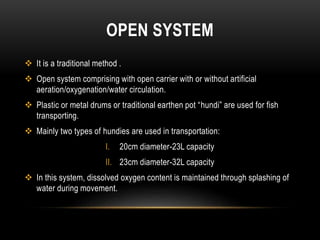
OPEN SYSTEM
 It is a traditional method .
 Open system comprising with open carrier with or without artificial
aeration/oxygenation/water circulation.
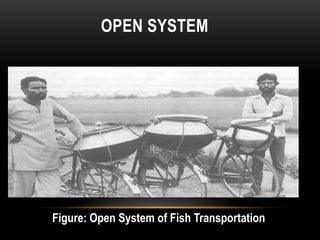
 Plastic or metal drums or traditional earthen pot “hundi” are used for fish
transporting.
 Mainly two types of hundies are used in transportation:
I. 20cm diameter-23L capacity
II. 23cm diameter-32L capacity
 In this system, dissolved oxygen content is maintained through splashing of
water during movement.
OPEN SYSTEM
Figure: Open System of Fish Transportation
OPEN SYSTEM
ADVANTAGES:
i. It is cheap and easier method
ii. Equipment are locally available
iii. It keep water cool for long time
iv. No need to oxygen supply from outside
v. More suitable for broodfish
OPEN SYSTEM
DISADVANTAGES:
I. Relatively less amount of fish can be transported at
a time.
II. Needs close observation.
III. Not suitable for larger distance.
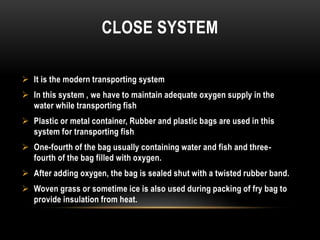
CLOSE SYSTEM
 It is the modern transporting system
 In this system , we have to maintain adequate oxygen supply in the
water while transporting fish
 Plastic or metal container, Rubber and plastic bags are used in this
system for transporting fish
 One-fourth of the bag usually containing water and fish and three-
fourth of the bag filled with oxygen.
 After adding oxygen, the bag is sealed shut with a twisted rubber band.
 Woven grass or sometime ice is also used during packing of fry bag to
provide insulation from heat.
CLOSE SYSTEM
Figure: Close System of Fish Transportation
CLOSE SYSTEM
ADVANTAGES:
 Oxygen can be supplied easily
 Mortality rate is very low
 Easily transportable
 It can be transported from a long distance even from one
country to another
 Large number of fish can be transported at a time
 It is most suitable for commercial fish farm
CLOSE SYSTEM
DISADVANTAGES:
 It is a cost effective method
 Packing materials are not locally available
 Need skilled person for packing and handling
 Additional oxygenation is required
CAUSES OF MORTALITY IN TRANSPORRTATION
I. Oxygen depletion due to oxidation of organic materials.
II. Accumulation of free Carbon-di-oxide,, resulting from
respiration and Ammonia as excretory product.
III. Sudden fluctuation in temperature.
IV. Hyperactivity and stress due to handling.
V. Ion-osmotic imbalance due to stress.
VI. Physical injury due to handling
VII.Diseases.
CHEMICALS USED IN FISH TRANSPORTATION
 Drugs and chemicals are either used as tranquilizers and sedatives or
as antiseptic.
 Sedatives are mainly used for :
I. Reducing metabolic rates
II. Reducing excitability of fishes
III. Convenience in handling fish
 Several drugs have been studied for use as anesthetic for transport of
fish.
E.g. Tricaine methane sulphonate (MS-222), Sodium amytal, Quinaldine,
Novocaine etc.

Fish Transportation

  • 1.
    WELCOME TO OURPRESENTATION A PRESENTATION ON FISH TRANSPORTATION
  • 2.
    INTRODUCTION  Fish Transportationis a process by which fish is transported from one place to another place in a scientific way.  It plays an important role in the distribution of quality fish fry among a country or even the world.  Fishes are transported mainly for three purposes : I. For breeding purposes II. Stocking in nursery pond III. For selling purposes
  • 3.
    TOLERANCE TO TRANSPORT A Famous saying in fish culture is,' Fish are not potatoes’. They need tender care and love to remain strong and healthy.  Tolerance of fish to transport depends on their ability to resists or adapt to stressful condition.  Tolerance varies with species to species. Some species mainly species having air breathing organ are more tolerant to transport. E.g. Oreochromis spp. , Cyprinus carpio etc.  Some medium tolerant species including Bighead carp, Grass carp  Low tolerant species- Silver carp
  • 4.
    CONDITIONING OF FISHBEFORE TRANSPORTATION o Conditioning is the pre-requisition of fish transportation. o Conditioning reduces the mortality rate during transportation. o The temperature of the conditioning water should not be high – it should be preferably on the lower side of the optimal thermal range of the species. o Fry, fingerlings should not be handled with bare hand- the slime over the fish body should remain in tact. o Fish survived better if they have no food in their intestine.
  • 5.
    METHODS FOR PACKINGAND TRANSPORTATION There are two system for packing of fish fry I. Open system II. Close system
  • 6.
    OPEN SYSTEM  Itis a traditional method .  Open system comprising with open carrier with or without artificial aeration/oxygenation/water circulation.  Plastic or metal drums or traditional earthen pot “hundi” are used for fish transporting.  Mainly two types of hundies are used in transportation: I. 20cm diameter-23L capacity II. 23cm diameter-32L capacity  In this system, dissolved oxygen content is maintained through splashing of water during movement.
  • 7.
    OPEN SYSTEM Figure: OpenSystem of Fish Transportation
  • 8.
    OPEN SYSTEM ADVANTAGES: i. Itis cheap and easier method ii. Equipment are locally available iii. It keep water cool for long time iv. No need to oxygen supply from outside v. More suitable for broodfish
  • 9.
    OPEN SYSTEM DISADVANTAGES: I. Relativelyless amount of fish can be transported at a time. II. Needs close observation. III. Not suitable for larger distance.
  • 10.
    CLOSE SYSTEM  Itis the modern transporting system  In this system , we have to maintain adequate oxygen supply in the water while transporting fish  Plastic or metal container, Rubber and plastic bags are used in this system for transporting fish  One-fourth of the bag usually containing water and fish and three- fourth of the bag filled with oxygen.  After adding oxygen, the bag is sealed shut with a twisted rubber band.  Woven grass or sometime ice is also used during packing of fry bag to provide insulation from heat.
  • 11.
    CLOSE SYSTEM Figure: CloseSystem of Fish Transportation
  • 12.
    CLOSE SYSTEM ADVANTAGES:  Oxygencan be supplied easily  Mortality rate is very low  Easily transportable  It can be transported from a long distance even from one country to another  Large number of fish can be transported at a time  It is most suitable for commercial fish farm
  • 13.
    CLOSE SYSTEM DISADVANTAGES:  Itis a cost effective method  Packing materials are not locally available  Need skilled person for packing and handling  Additional oxygenation is required
  • 14.
    CAUSES OF MORTALITYIN TRANSPORRTATION I. Oxygen depletion due to oxidation of organic materials. II. Accumulation of free Carbon-di-oxide,, resulting from respiration and Ammonia as excretory product. III. Sudden fluctuation in temperature. IV. Hyperactivity and stress due to handling. V. Ion-osmotic imbalance due to stress. VI. Physical injury due to handling VII.Diseases.
  • 15.
    CHEMICALS USED INFISH TRANSPORTATION  Drugs and chemicals are either used as tranquilizers and sedatives or as antiseptic.  Sedatives are mainly used for : I. Reducing metabolic rates II. Reducing excitability of fishes III. Convenience in handling fish  Several drugs have been studied for use as anesthetic for transport of fish. E.g. Tricaine methane sulphonate (MS-222), Sodium amytal, Quinaldine, Novocaine etc.