Transgenic Fish
A transgenic fish is one that contains genes
from another species. A transgenic fish is an
improved variety of fish provided with one or
more desirable foreign gene for the purpose of
enhancing fish quality, growth, resistance and
productivity.
Typically, genes of one or more donor-species
are isolated, and spliced into artificially
constructed infectious agents, which act as
vectors to carry the genes into the cells of
recipient species. Once inside a cell, the vector
carrying the genes will insert into the cell’s
genome.
The following are the important
points needed for genetic engineering
(gene transfer) to produce transgenic
fish:
(1) A gene sequence is to isolate for the
particular characteristics; for example,
growth hormone gene.
(2) These genes (gene sequence) are then
inserted into a circular DNA known as
plasmid Vector (enzymes endonucleases
and ligases are used).
(3) Plasmids are harvested in the bacteria
to produced billions of copies
(4) Plasmids are introduced into linear
DNA.
(5) Making the cassette a permanent part
of fish’s genetic makeup.
ADVANTAGES:
Increase the growth rate.
Improve the disease resistance.
Increase the muscle mass.
Improve the nutritional value.
DISADVANTAGES:
Inserted gene has multiplefunction.
Breeding problem.
Some times leads to mutagenesis.
Low survival rate of transgenic animals.
Transgenic Salmon:
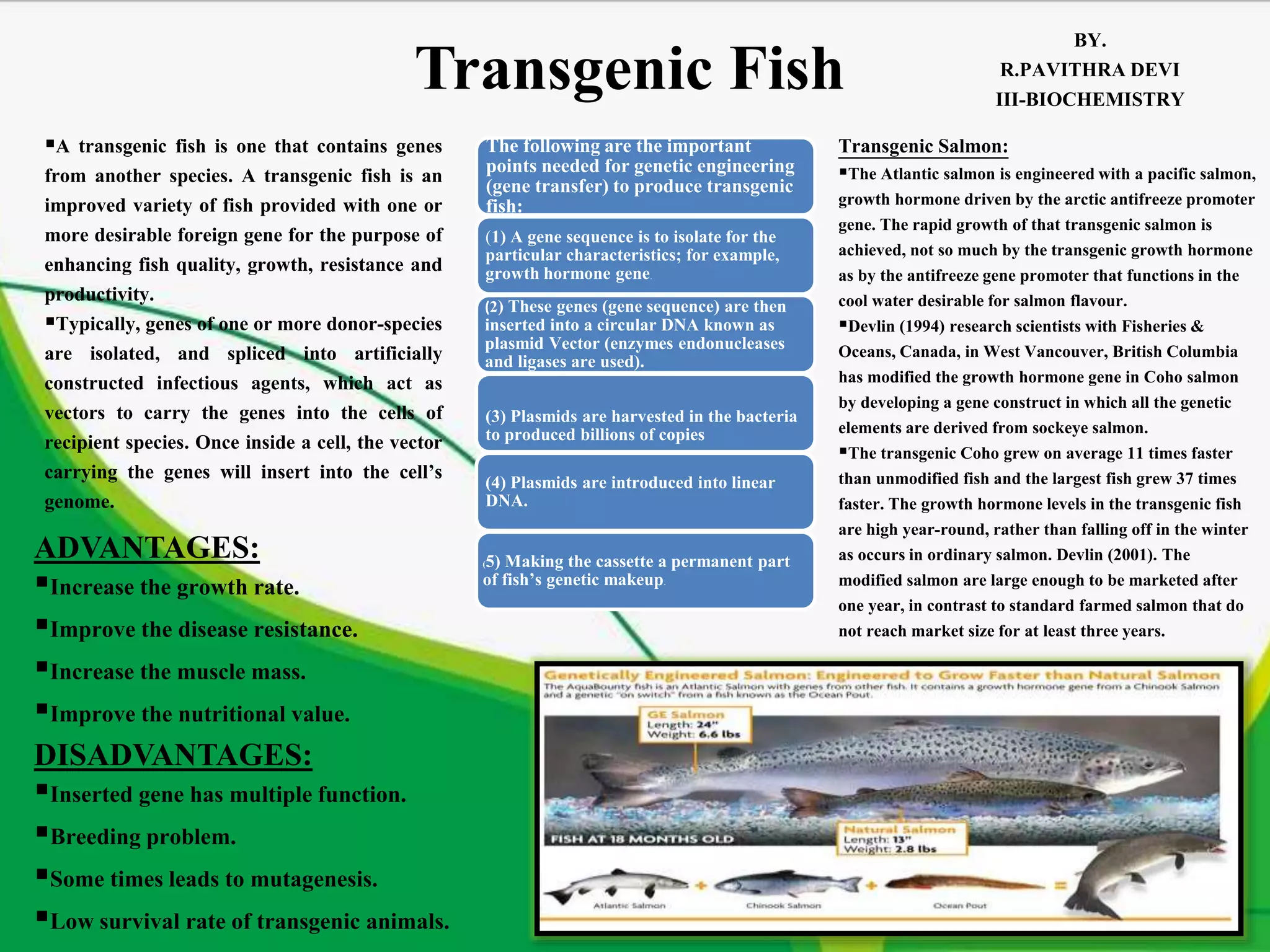
The Atlantic salmon is engineered with a pacific salmon,
growth hormone driven by the arctic antifreeze promoter
gene. The rapid growth of that transgenic salmon is
achieved, not so much by the transgenic growth hormone
as by the antifreeze gene promoter that functions in the
cool water desirable for salmon flavour.
Devlin (1994) research scientists with Fisheries &
Oceans, Canada, in West Vancouver, British Columbia
has modified the growth hormone gene in Coho salmon
by developing a gene construct in which all the genetic
elements are derived from sockeye salmon.
The transgenic Coho grew on average 11 times faster
than unmodified fish and the largest fish grew 37 times
faster. The growth hormone levels in the transgenic fish
are high year-round, rather than falling off in the winter
as occurs in ordinary salmon. Devlin (2001). The
modified salmon are large enough to be marketed after
one year, in contrast to standard farmed salmon that do
not reach market size for at least three years.
BY.
R.PAVITHRA DEVI
III-BIOCHEMISTRY

Transgenic fish

  • 1.
    Transgenic Fish A transgenicfish is one that contains genes from another species. A transgenic fish is an improved variety of fish provided with one or more desirable foreign gene for the purpose of enhancing fish quality, growth, resistance and productivity. Typically, genes of one or more donor-species are isolated, and spliced into artificially constructed infectious agents, which act as vectors to carry the genes into the cells of recipient species. Once inside a cell, the vector carrying the genes will insert into the cell’s genome. The following are the important points needed for genetic engineering (gene transfer) to produce transgenic fish: (1) A gene sequence is to isolate for the particular characteristics; for example, growth hormone gene. (2) These genes (gene sequence) are then inserted into a circular DNA known as plasmid Vector (enzymes endonucleases and ligases are used). (3) Plasmids are harvested in the bacteria to produced billions of copies (4) Plasmids are introduced into linear DNA. (5) Making the cassette a permanent part of fish’s genetic makeup. ADVANTAGES: Increase the growth rate. Improve the disease resistance. Increase the muscle mass. Improve the nutritional value. DISADVANTAGES: Inserted gene has multiplefunction. Breeding problem. Some times leads to mutagenesis. Low survival rate of transgenic animals. Transgenic Salmon: The Atlantic salmon is engineered with a pacific salmon, growth hormone driven by the arctic antifreeze promoter gene. The rapid growth of that transgenic salmon is achieved, not so much by the transgenic growth hormone as by the antifreeze gene promoter that functions in the cool water desirable for salmon flavour. Devlin (1994) research scientists with Fisheries & Oceans, Canada, in West Vancouver, British Columbia has modified the growth hormone gene in Coho salmon by developing a gene construct in which all the genetic elements are derived from sockeye salmon. The transgenic Coho grew on average 11 times faster than unmodified fish and the largest fish grew 37 times faster. The growth hormone levels in the transgenic fish are high year-round, rather than falling off in the winter as occurs in ordinary salmon. Devlin (2001). The modified salmon are large enough to be marketed after one year, in contrast to standard farmed salmon that do not reach market size for at least three years. BY. R.PAVITHRA DEVI III-BIOCHEMISTRY