GOVERNMENT DEGREE & PG COLLEGE
(A) SIDDIPET
FISH DISEASES & TREATMENT
PRESENTED BY
BHUKYASAIKUMAR
MSCFISHERIES
Department of MSc Fisheries
Introduction :
 Fish disease , in various forms have been tormenting the aquaculture ever
since man learned the art of fish husbandry
 The stability of a fish population in a particular habit is very often disputed
by various factors viz., disease, habitat destruction depletion of resources
 Environmental change and fluctuations in water quality parameters are
also resulting illness to the fish
 It should be understood that fish suffer from many diseases, of which
from causative point of view they are classified as follows
 Fish disease is a disorder of structure or function in a fish one of that
has a known cause and a distinctive group of symptoms signs or
anatomical changes
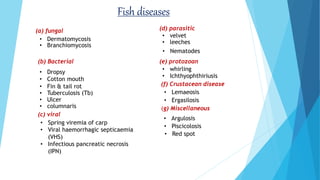
Fish diseases
(a) fungal
(b) Bacterial
• Dermatomycosis
• Branchiomycosis
• Dropsy
• Ulcer
• Fin & tail rot
• columnaris
• Tuberculosis (Tb)
• Cotton mouth
(c) viral
• Spring viremia of carp
• Viral haemorrhagic septicaemia
(VHS)
• Infectious pancreatic necrosis
(IPN)
(d) parasitic
• velvet
• leeches
• Nematodes
(e) protozoan
• whirling
• Ichthyophthiriusis
(f) Crustacean disease
• Lemaeosis
• Ergasilosis
(g) Miscellaneous
• Argulosis
• Piscicolosis
• Red spot
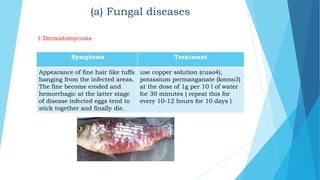
(a) Fungal diseases
Symptoms Treatment
Appearance of fine hair like tuffs
hanging from the infected areas.
The fine become eroded and
hemorrhagic at the latter stage
of disease infected eggs tend to
stick together and finally die.
use copper solution (cuso4),
potassium permanganate (kmno3)
at the dose of 1g per 10 l of water
for 30 minutes ( repeat this for
every 10-12 hours for 10 days )
1.Dermatomycosis
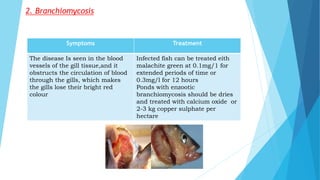
2. Branchiomycosis
Symptoms Treatment
The disease Is seen in the blood
vessels of the gill tissue,and it
obstructs the circulation of blood
through the gills, which makes
the gills lose their bright red
colour
Infected fish can be treated eith
malachite green at 0.1mg/1 for
extended periods of time or
0.3mg/l for 12 hours
Ponds with enzootic
branchiomycosis should be dries
and treated with calcium oxide or
2-3 kg copper sulphate per
hectare
(b) Bacterial
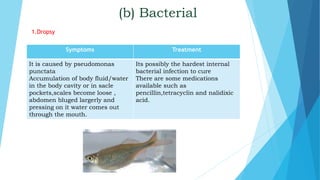
1.Dropsy
Symptoms Treatment
It is caused by pseudomonas
punctata
Accumulation of body fluid/water
in the body cavity or in sacle
pockets,scales become loose ,
abdomen bluged largerly and
pressing on it water comes out
through the mouth.
Its possibly the hardest internal
bacterial infection to cure
There are some medications
available such as
pencillin,tetracyclin and nalidixic
acid.
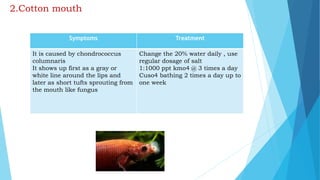
2.Cotton mouth
Symptoms Treatment
It is caused by chondrococcus
columnaris
It shows up first as a gray or
white line around the lips and
later as short tufts sprouting from
the mouth like fungus
Change the 20% water daily , use
regular dosage of salt
1:1000 ppt kmo4 @ 3 times a day
Cuso4 bathing 2 times a day up to
one week
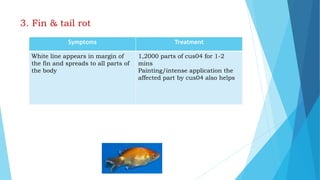
3. Fin & tail rot
Symptoms Treatment
White line appears in margin of
the fin and spreads to all parts of
the body
1,2000 parts of cus04 for 1-2
mins
Painting/intense application the
affected part by cus04 also helps
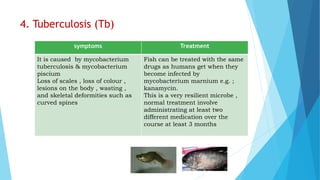
4. Tuberculosis (Tb)
symptoms Treatment
It is caused by mycobacterium
tuberculosis & mycobacterium
piscium
Loss of scales , loss of colour ,
lesions on the body , wasting ,
and skeletal deformities such as
curved spines
Fish can be treated with the same
drugs as humans get when they
become infected by
mycobacterium marnium e.g. ;
kanamycin.
This is a very resilient microbe ,
normal treatment involve
administrating at least two
different medication over the
course at least 3 months
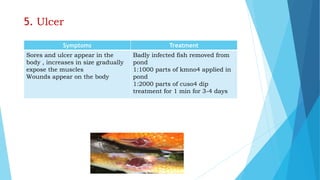
5. Ulcer
Symptoms Treatment
Sores and ulcer appear in the
body , increases in size gradually
expose the muscles
Wounds appear on the body
Badly infected fish removed from
pond
1:1000 parts of kmno4 applied in
pond
1:2000 parts of cuso4 dip
treatment for 1 min for 3-4 days
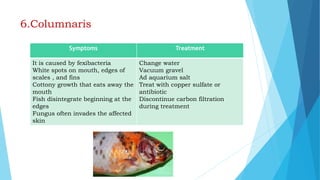
6.Columnaris
Symptoms Treatment
It is caused by fexibacteria
White spots on mouth, edges of
scales , and fins
Cottony growth that eats away the
mouth
Fish disintegrate beginning at the
edges
Fungus often invades the affected
skin
Change water
Vacuum gravel
Ad aquarium salt
Treat with copper sulfate or
antibiotic
Discontinue carbon filtration
during treatment
(c) Viral
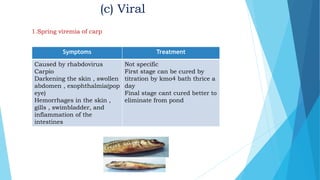
1.Spring viremia of carp
Symptoms Treatment
Caused by rhabdovirus
Carpio
Darkening the skin , swollen
abdomen , exophthalmia(pop
eye)
Hemorrhages in the skin ,
gills , swimbladder, and
inflammation of the
intestines
Not specific
First stage can be cured by
titration by kmo4 bath thrice a
day
Final stage cant cured better to
eliminate from pond
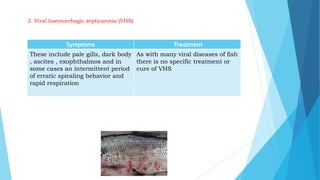
2. Viral haemorrhagic septicaemia (VHS)
Symptoms Treatment
These include pale gills, dark body
, ascites , exophthalmos and in
some cases an intermittent period
of erratic spiraling behavior and
rapid respiration
As with many viral diseases of fish
there is no specific treatment or
cure of VHS
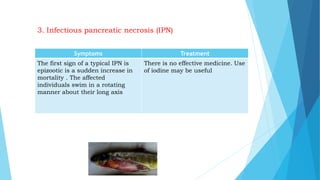
3. Infectious pancreatic necrosis (IPN)
Symptoms Treatment
The first sign of a typical IPN is
epizootic is a sudden increase in
mortality . The affected
individuals swim in a rotating
manner about their long axis
There is no effective medicine. Use
of iodine may be useful
(d) Parasitic
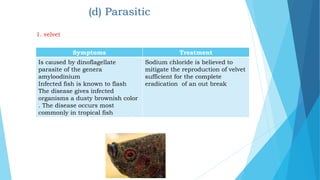
1. velvet
Symptoms Treatment
Is caused by dinoflagellate
parasite of the genera
amyloodinium
Infected fish is known to flash
The disease gives infected
organisms a dusty brownish color
. The disease occurs most
commonly in tropical fish
Sodium chloride is believed to
mitigate the reproduction of velvet
sufficient for the complete
eradication of an out break
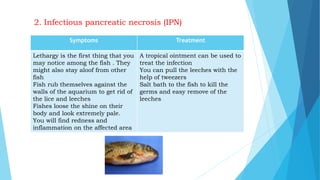
2. Infectious pancreatic necrosis (IPN)
Symptoms Treatment
Lethargy is the first thing that you
may notice among the fish . They
might also stay aloof from other
fish
Fish rub themselves against the
walls of the aquarium to get rid of
the lice and leeches
Fishes loose the shine on their
body and look extremely pale.
You will find redness and
inflammation on the affected area
A tropical ointment can be used to
treat the infection
You can pull the leeches with the
help of tweezers
Salt bath to the fish to kill the
germs and easy remove of the
leeches
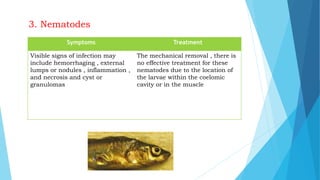
3. Nematodes
Symptoms Treatment
Visible signs of infection may
include hemorrhaging , external
lumps or nodules , inflammation ,
and necrosis and cyst or
granulomas
The mechanical removal , there is
no effective treatment for these
nematodes due to the location of
the larvae within the coelomic
cavity or in the muscle
(e) Protozoan
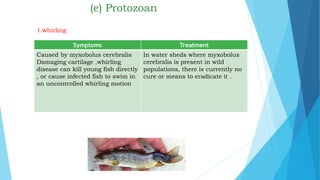
1.whirling
Symptoms Treatment
Caused by myxobolus cerebralis
Damaging cartilage ,whirling
disease can kill young fish directly
, or cause infected fish to swim in
an uncontrolled whirling motion
In water sheds where myxobolus
cerebralis is present in wild
populations, there is currently no
cure or means to eradicate it .
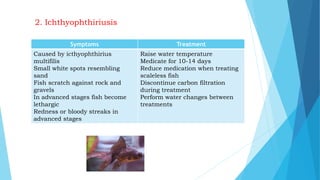
2. Ichthyophthiriusis
Symptoms Treatment
Caused by icthyophthirius
multifilis
Small white spots resembling
sand
Fish scratch against rock and
gravels
In advanced stages fish become
lethargic
Redness or bloody streaks in
advanced stages
Raise water temperature
Medicate for 10-14 days
Reduce medication when treating
scaleless fish
Discontinue carbon filtration
during treatment
Perform water changes between
treatments
(f) Crustacean disease
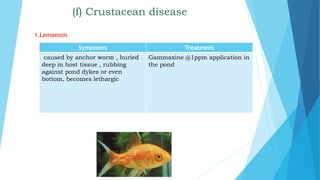
1.Lemaeosis
Symptoms Treatment
caused by anchor worm , buried
deep in host tissue , rubbing
against pond dykes or even
bottom, becomes lethargic
Gammaxine @1ppm application in
the pond
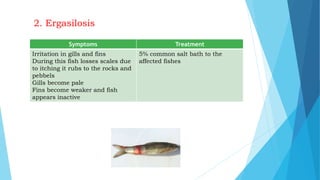
2. Ergasilosis
Symptoms Treatment
Irritation in gills and fins
During this fish losses scales due
to itching it rubs to the rocks and
pebbels
Gills become pale
Fins become weaker and fish
appears inactive
5% common salt bath to the
affected fishes
(g)Miscellaneous
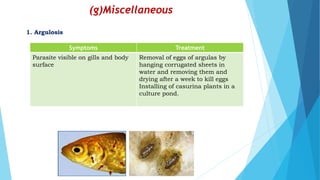
1. Argulosis
Symptoms Treatment
Parasite visible on gills and body
surface
Removal of eggs of argulas by
hanging corrugated sheets in
water and removing them and
drying after a week to kill eggs
Installing of casurina plants in a
culture pond.
References :
 Fish pathology by Ronald j. Roberts
 www.lkouniv.ac.in
 John Hoenig Virginia Institute of Marine
Science · Department of Fisheries Science PhD
 Krishi Mala
 My aquarium.br
 dkphoto.photoseller.com
 www.picstopin.com
 www.lalaukhan.com
 Modelst fish.com
 Thegolden fishbowl.co.uk
 www.aqua.ugent.be
 Veteriankey.com
 www.nps.gov
 www.diction.id
 www.thesprucepets.com
 www.apikheti.com
 Fish pathogens.net
 Rheareview.com
Thank You

fish disease and treatment

  • 1.
    GOVERNMENT DEGREE &PG COLLEGE (A) SIDDIPET FISH DISEASES & TREATMENT PRESENTED BY BHUKYASAIKUMAR MSCFISHERIES Department of MSc Fisheries
  • 2.
    Introduction :  Fishdisease , in various forms have been tormenting the aquaculture ever since man learned the art of fish husbandry  The stability of a fish population in a particular habit is very often disputed by various factors viz., disease, habitat destruction depletion of resources  Environmental change and fluctuations in water quality parameters are also resulting illness to the fish  It should be understood that fish suffer from many diseases, of which from causative point of view they are classified as follows  Fish disease is a disorder of structure or function in a fish one of that has a known cause and a distinctive group of symptoms signs or anatomical changes
  • 3.
    Fish diseases (a) fungal (b)Bacterial • Dermatomycosis • Branchiomycosis • Dropsy • Ulcer • Fin & tail rot • columnaris • Tuberculosis (Tb) • Cotton mouth (c) viral • Spring viremia of carp • Viral haemorrhagic septicaemia (VHS) • Infectious pancreatic necrosis (IPN) (d) parasitic • velvet • leeches • Nematodes (e) protozoan • whirling • Ichthyophthiriusis (f) Crustacean disease • Lemaeosis • Ergasilosis (g) Miscellaneous • Argulosis • Piscicolosis • Red spot
  • 4.
    (a) Fungal diseases SymptomsTreatment Appearance of fine hair like tuffs hanging from the infected areas. The fine become eroded and hemorrhagic at the latter stage of disease infected eggs tend to stick together and finally die. use copper solution (cuso4), potassium permanganate (kmno3) at the dose of 1g per 10 l of water for 30 minutes ( repeat this for every 10-12 hours for 10 days ) 1.Dermatomycosis
  • 5.
    2. Branchiomycosis Symptoms Treatment Thedisease Is seen in the blood vessels of the gill tissue,and it obstructs the circulation of blood through the gills, which makes the gills lose their bright red colour Infected fish can be treated eith malachite green at 0.1mg/1 for extended periods of time or 0.3mg/l for 12 hours Ponds with enzootic branchiomycosis should be dries and treated with calcium oxide or 2-3 kg copper sulphate per hectare
  • 6.
    (b) Bacterial 1.Dropsy Symptoms Treatment Itis caused by pseudomonas punctata Accumulation of body fluid/water in the body cavity or in sacle pockets,scales become loose , abdomen bluged largerly and pressing on it water comes out through the mouth. Its possibly the hardest internal bacterial infection to cure There are some medications available such as pencillin,tetracyclin and nalidixic acid.
  • 7.
    2.Cotton mouth Symptoms Treatment Itis caused by chondrococcus columnaris It shows up first as a gray or white line around the lips and later as short tufts sprouting from the mouth like fungus Change the 20% water daily , use regular dosage of salt 1:1000 ppt kmo4 @ 3 times a day Cuso4 bathing 2 times a day up to one week
  • 8.
    3. Fin &tail rot Symptoms Treatment White line appears in margin of the fin and spreads to all parts of the body 1,2000 parts of cus04 for 1-2 mins Painting/intense application the affected part by cus04 also helps
  • 9.
    4. Tuberculosis (Tb) symptomsTreatment It is caused by mycobacterium tuberculosis & mycobacterium piscium Loss of scales , loss of colour , lesions on the body , wasting , and skeletal deformities such as curved spines Fish can be treated with the same drugs as humans get when they become infected by mycobacterium marnium e.g. ; kanamycin. This is a very resilient microbe , normal treatment involve administrating at least two different medication over the course at least 3 months
  • 10.
    5. Ulcer Symptoms Treatment Soresand ulcer appear in the body , increases in size gradually expose the muscles Wounds appear on the body Badly infected fish removed from pond 1:1000 parts of kmno4 applied in pond 1:2000 parts of cuso4 dip treatment for 1 min for 3-4 days
  • 11.
    6.Columnaris Symptoms Treatment It iscaused by fexibacteria White spots on mouth, edges of scales , and fins Cottony growth that eats away the mouth Fish disintegrate beginning at the edges Fungus often invades the affected skin Change water Vacuum gravel Ad aquarium salt Treat with copper sulfate or antibiotic Discontinue carbon filtration during treatment
  • 12.
    (c) Viral 1.Spring viremiaof carp Symptoms Treatment Caused by rhabdovirus Carpio Darkening the skin , swollen abdomen , exophthalmia(pop eye) Hemorrhages in the skin , gills , swimbladder, and inflammation of the intestines Not specific First stage can be cured by titration by kmo4 bath thrice a day Final stage cant cured better to eliminate from pond
  • 13.
    2. Viral haemorrhagicsepticaemia (VHS) Symptoms Treatment These include pale gills, dark body , ascites , exophthalmos and in some cases an intermittent period of erratic spiraling behavior and rapid respiration As with many viral diseases of fish there is no specific treatment or cure of VHS
  • 14.
    3. Infectious pancreaticnecrosis (IPN) Symptoms Treatment The first sign of a typical IPN is epizootic is a sudden increase in mortality . The affected individuals swim in a rotating manner about their long axis There is no effective medicine. Use of iodine may be useful
  • 15.
    (d) Parasitic 1. velvet SymptomsTreatment Is caused by dinoflagellate parasite of the genera amyloodinium Infected fish is known to flash The disease gives infected organisms a dusty brownish color . The disease occurs most commonly in tropical fish Sodium chloride is believed to mitigate the reproduction of velvet sufficient for the complete eradication of an out break
  • 16.
    2. Infectious pancreaticnecrosis (IPN) Symptoms Treatment Lethargy is the first thing that you may notice among the fish . They might also stay aloof from other fish Fish rub themselves against the walls of the aquarium to get rid of the lice and leeches Fishes loose the shine on their body and look extremely pale. You will find redness and inflammation on the affected area A tropical ointment can be used to treat the infection You can pull the leeches with the help of tweezers Salt bath to the fish to kill the germs and easy remove of the leeches
  • 17.
    3. Nematodes Symptoms Treatment Visiblesigns of infection may include hemorrhaging , external lumps or nodules , inflammation , and necrosis and cyst or granulomas The mechanical removal , there is no effective treatment for these nematodes due to the location of the larvae within the coelomic cavity or in the muscle
  • 18.
    (e) Protozoan 1.whirling Symptoms Treatment Causedby myxobolus cerebralis Damaging cartilage ,whirling disease can kill young fish directly , or cause infected fish to swim in an uncontrolled whirling motion In water sheds where myxobolus cerebralis is present in wild populations, there is currently no cure or means to eradicate it .
  • 19.
    2. Ichthyophthiriusis Symptoms Treatment Causedby icthyophthirius multifilis Small white spots resembling sand Fish scratch against rock and gravels In advanced stages fish become lethargic Redness or bloody streaks in advanced stages Raise water temperature Medicate for 10-14 days Reduce medication when treating scaleless fish Discontinue carbon filtration during treatment Perform water changes between treatments
  • 20.
    (f) Crustacean disease 1.Lemaeosis SymptomsTreatment caused by anchor worm , buried deep in host tissue , rubbing against pond dykes or even bottom, becomes lethargic Gammaxine @1ppm application in the pond
  • 21.
    2. Ergasilosis Symptoms Treatment Irritationin gills and fins During this fish losses scales due to itching it rubs to the rocks and pebbels Gills become pale Fins become weaker and fish appears inactive 5% common salt bath to the affected fishes
  • 22.
    (g)Miscellaneous 1. Argulosis Symptoms Treatment Parasitevisible on gills and body surface Removal of eggs of argulas by hanging corrugated sheets in water and removing them and drying after a week to kill eggs Installing of casurina plants in a culture pond.
  • 23.
    References :  Fishpathology by Ronald j. Roberts  www.lkouniv.ac.in  John Hoenig Virginia Institute of Marine Science · Department of Fisheries Science PhD  Krishi Mala  My aquarium.br  dkphoto.photoseller.com  www.picstopin.com  www.lalaukhan.com  Modelst fish.com  Thegolden fishbowl.co.uk  www.aqua.ugent.be  Veteriankey.com  www.nps.gov  www.diction.id  www.thesprucepets.com  www.apikheti.com  Fish pathogens.net  Rheareview.com
  • 24.