A Review of Biotechnology in Aquaculture and Fisheries
T. Gwaza, D. Kassam, E. Kaunda
WB African Centre of Excellence & NEPAD/SANBio Regional Fish Node
Lilongwe University Of Agriculture And Natural Resources, Box 219, Lilongwe, Malawi
Presented at the FAO Regional Meeting on Agricultural Biotechnologies in Sustainable Food Systems and Nutrition in Africa- 22-24 Nov 2017, AUCC, Addis
Ababa, Ethiopia
Introduction
 Increased Pressure on fish demand
 Approximately 40% of fish for human consumption comes
from aquaculture (SIFO, 2013)
 With population growth comes the need to produce ‘more’
fish
 Tremendous progress made in developing optimal
management practices in aquaculture – Effects- Example -
Pressure in Aquaculture for fishmeal
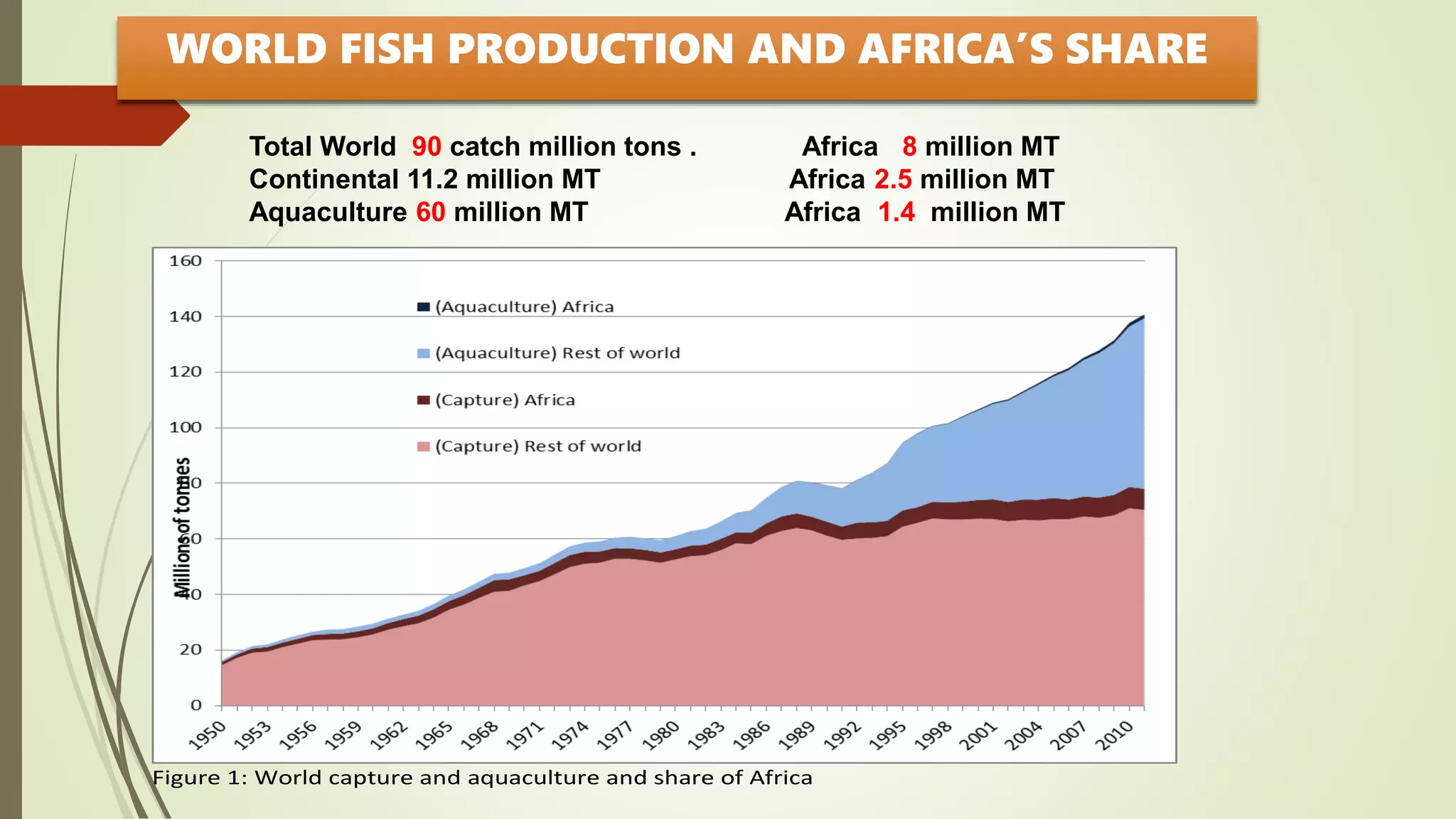
WORLD FISH PRODUCTION AND AFRICA’S SHARE
Figure 1: World capture and aquaculture and share of Africa
Total World 90 catch million tons . Africa 8 million MT
Continental 11.2 million MT Africa 2.5 million MT
Aquaculture 60 million MT Africa 1.4 million MT
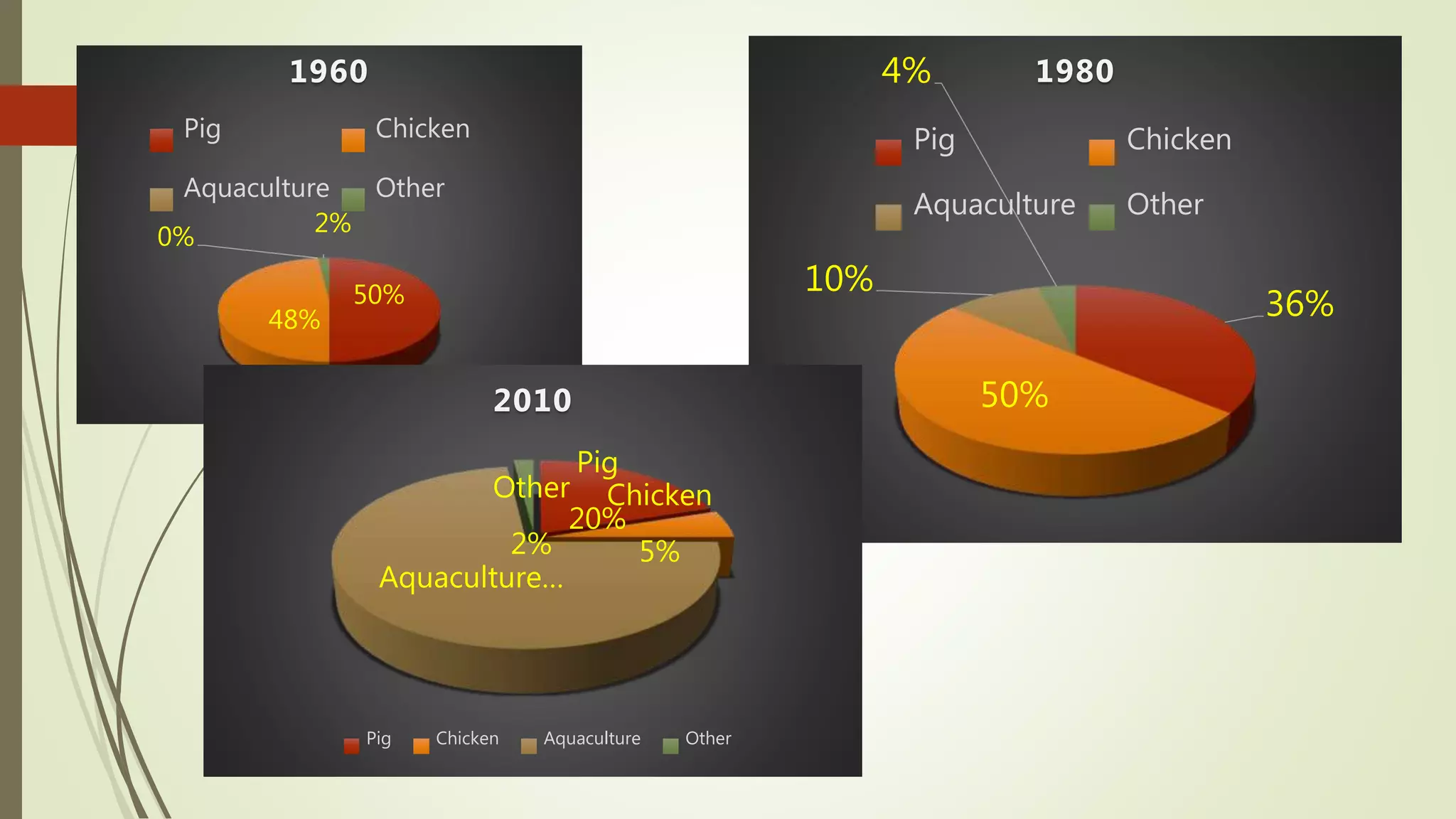
4
50%
48%
0%
2%
1960
Pig Chicken
Aquaculture Other
36%
50%
10%
4% 1980
Pig Chicken
Aquaculture Other
Pig
20%
Chicken
5%
Aquaculture…
Other
2%
2010
Pig Chicken Aquaculture Other
More Worries for Africa .. Much on
Aquaculture is from China- 70 per cent
Content
Background
information
Value chain map
Production
Fact&Figure from our
study
Productivity
Cost structure
Income structure
Internal factor
Fingerling
Feed
Transportation
Finance
Full-time vs hobby
farmer
External factor
Historical reason
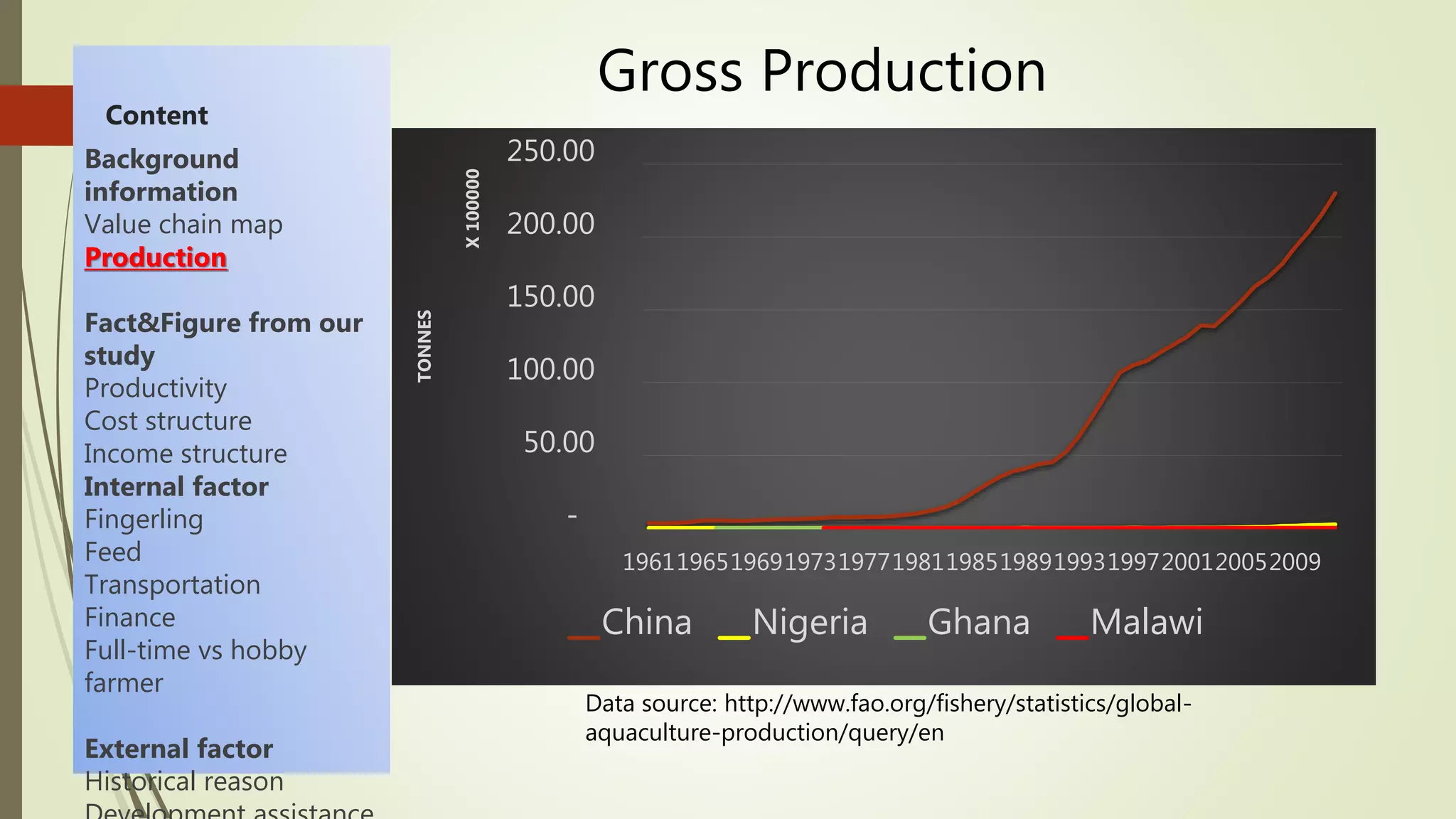
Gross Production
Data source: http://www.fao.org/fishery/statistics/global-
aquaculture-production/query/en
-
50.00
100.00
150.00
200.00
250.00
1961196519691973197719811985198919931997200120052009
TONNES
X100000
China Nigeria Ghana Malawi
7
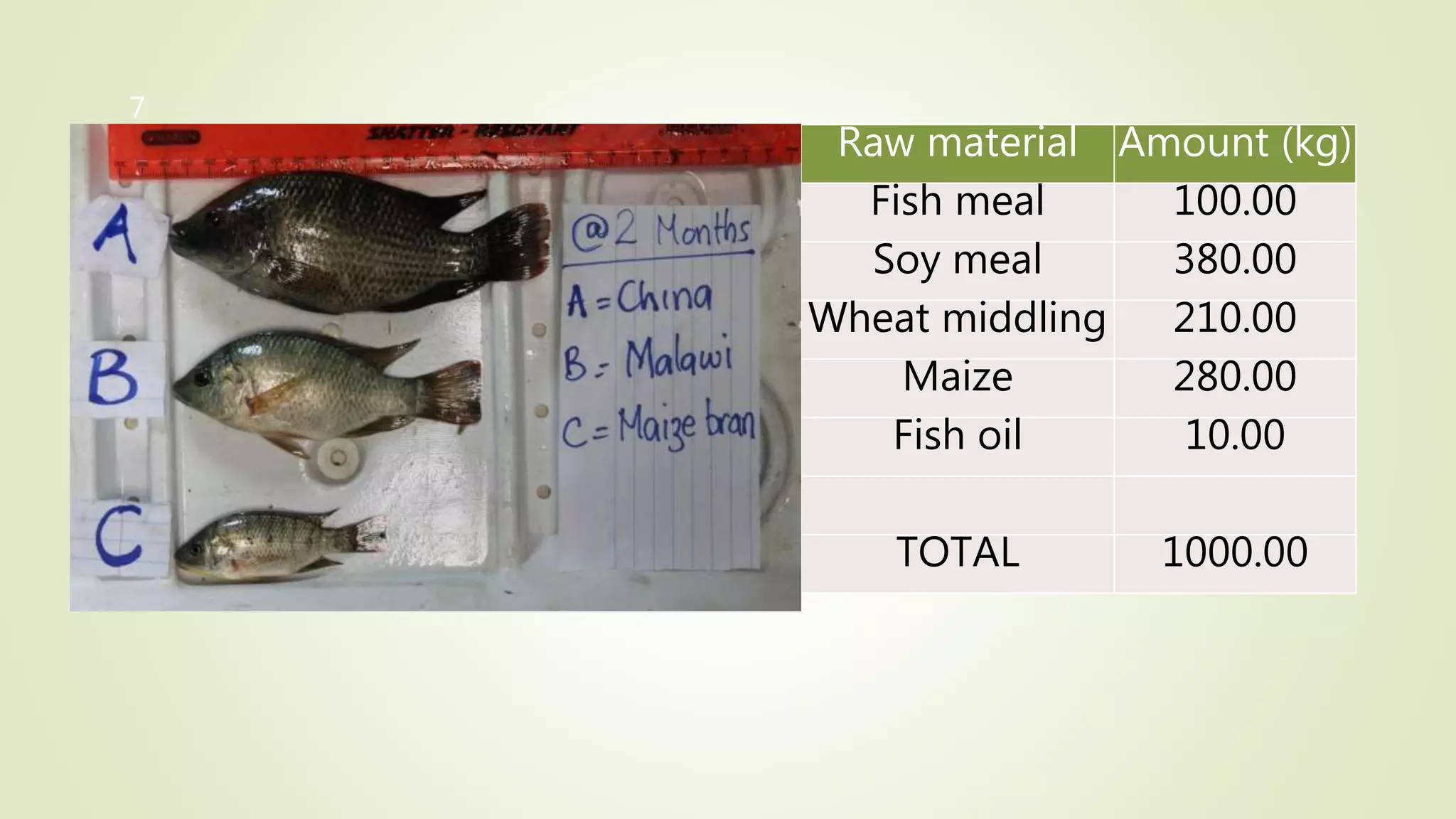
Raw material Amount (kg)
Fish meal 100.00
Soy meal 380.00
Wheat middling 210.00
Maize 280.00
Fish oil 10.00
TOTAL 1000.00
Four Main areas where Biotechonologies have
been used in Aquaculture and Fisheries
 Genetic improvements and control of reproduction;
 Biosecurity and disease control;
 Environmental management and bioremediation;
 Biodiversity conservation and fisheries management.
Genetic improvements and control of
reproduction
Introduction
 Future expansion of aquaculture will depend on improved productivity
through improved genetic make-up of species (Neira, 2010)
 Genetic potential of aquaculture animals is plastic and can be improved
over a relatively short timeframe (Gjedrem et al., 2012; Synder and Ziegler,
2013)
 Dramatic improvements documented in many species through various
genetic improvement programs
 Need to review various genetic improvement strategies to encourage
adoption in least developed countries
Genetic Improvement Programs in Aquaculture
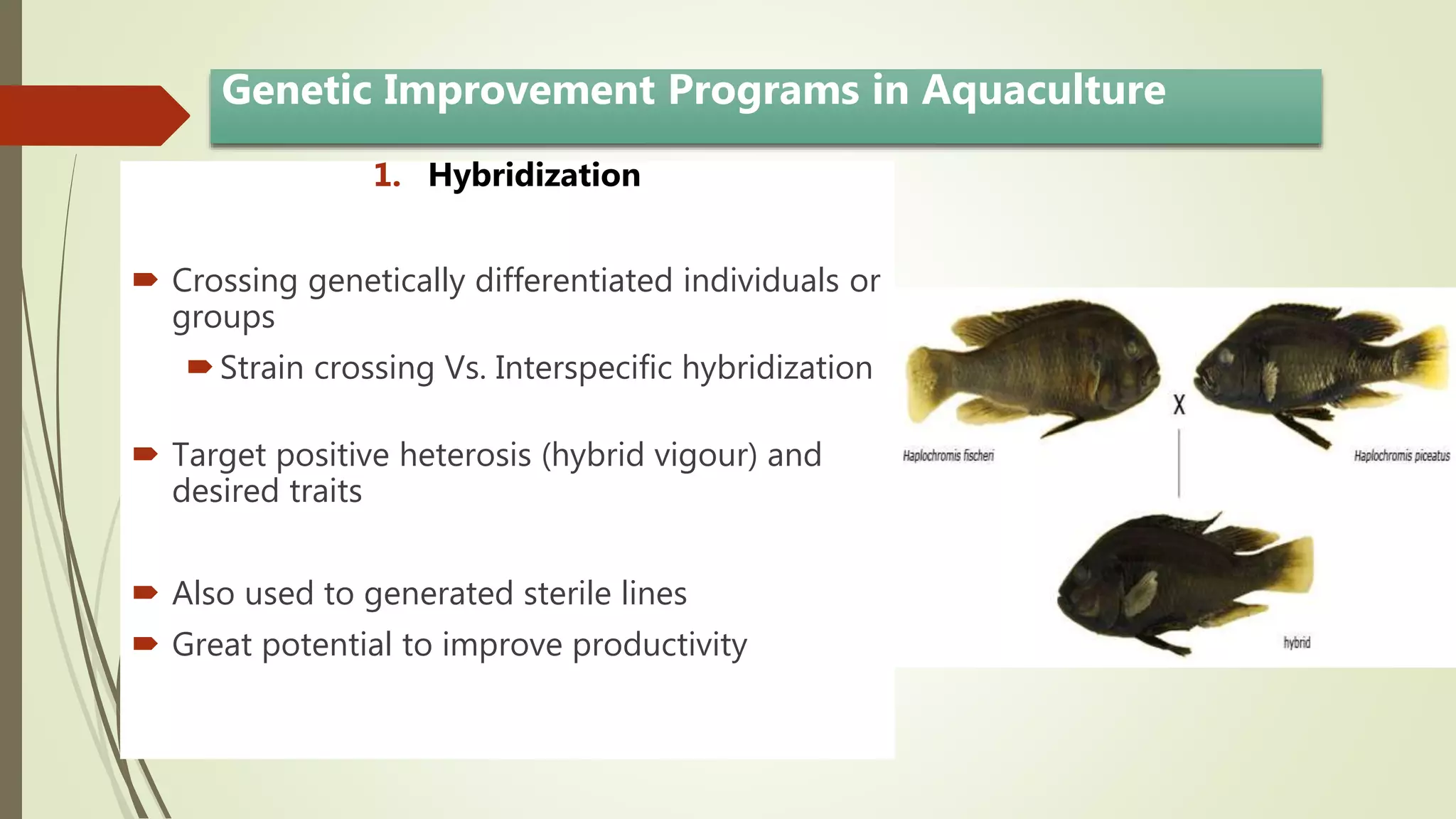
1. Hybridization
 Crossing genetically differentiated individuals or
groups
Strain crossing Vs. Interspecific hybridization
 Target positive heterosis (hybrid vigour) and
desired traits
 Also used to generated sterile lines
 Great potential to improve productivity
Genetic Improvement Programs in Aquaculture
1. Hybridization
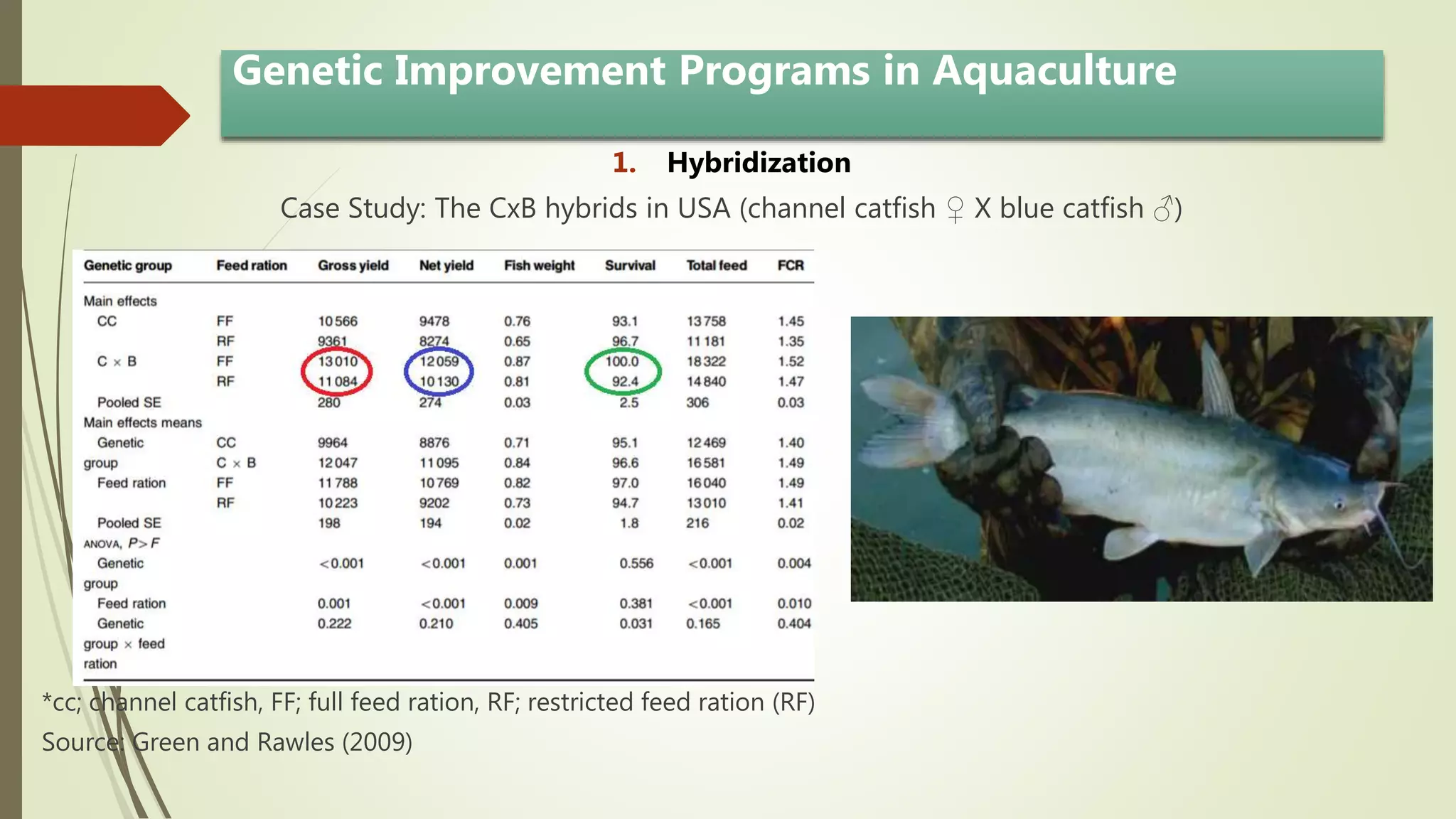
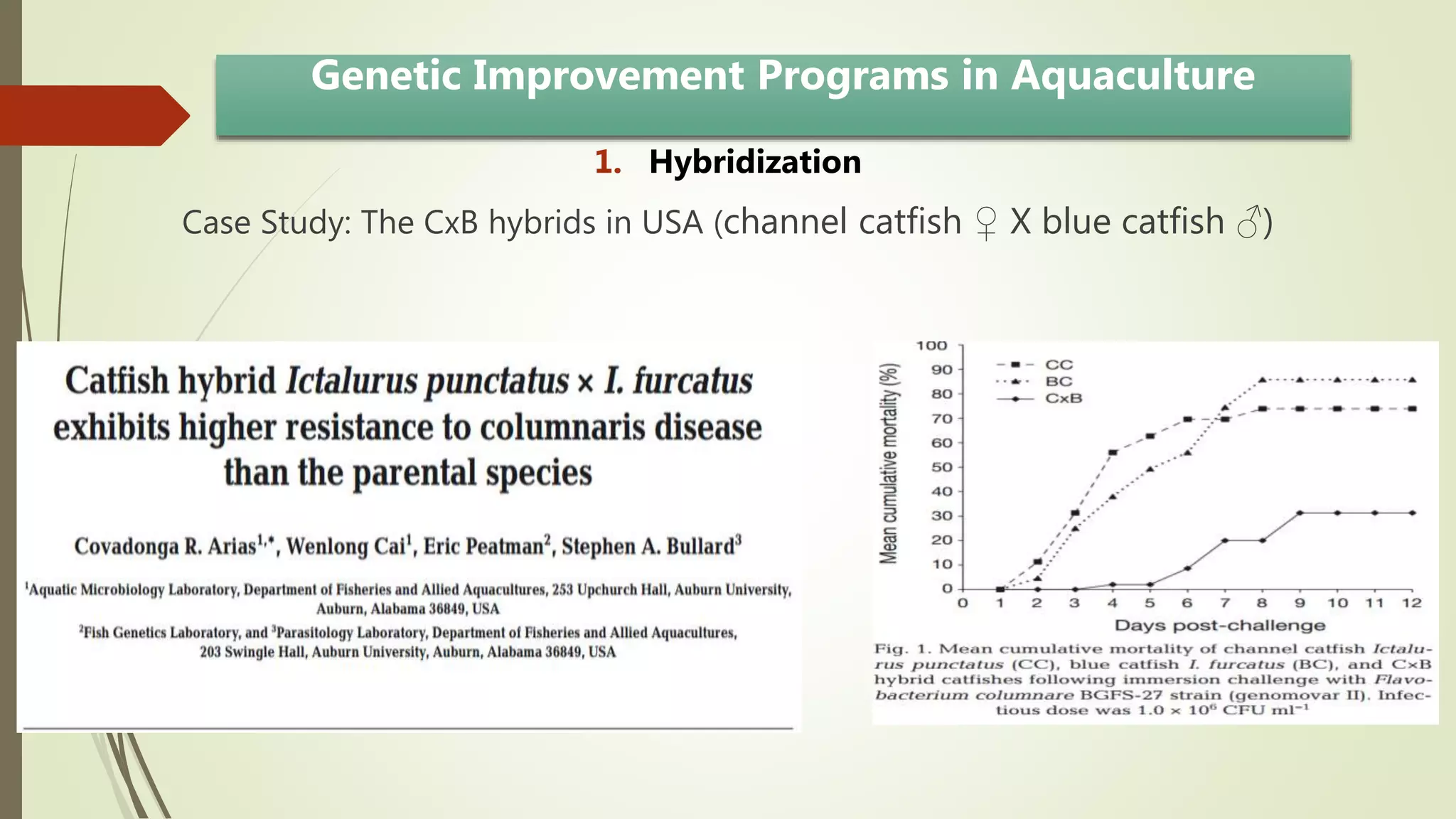
Case Study: The CxB hybrids in USA (channel catfish ♀ X blue catfish ♂)
*cc; channel catfish, FF; full feed ration, RF; restricted feed ration (RF)
Source: Green and Rawles (2009)
Genetic Improvement Programs in Aquaculture
1. Hybridization
Case Study: The CxB hybrids in USA (channel catfish ♀ X blue catfish ♂)
Genetic Improvement Programs in Aquaculture
1. Hybridization and sex control
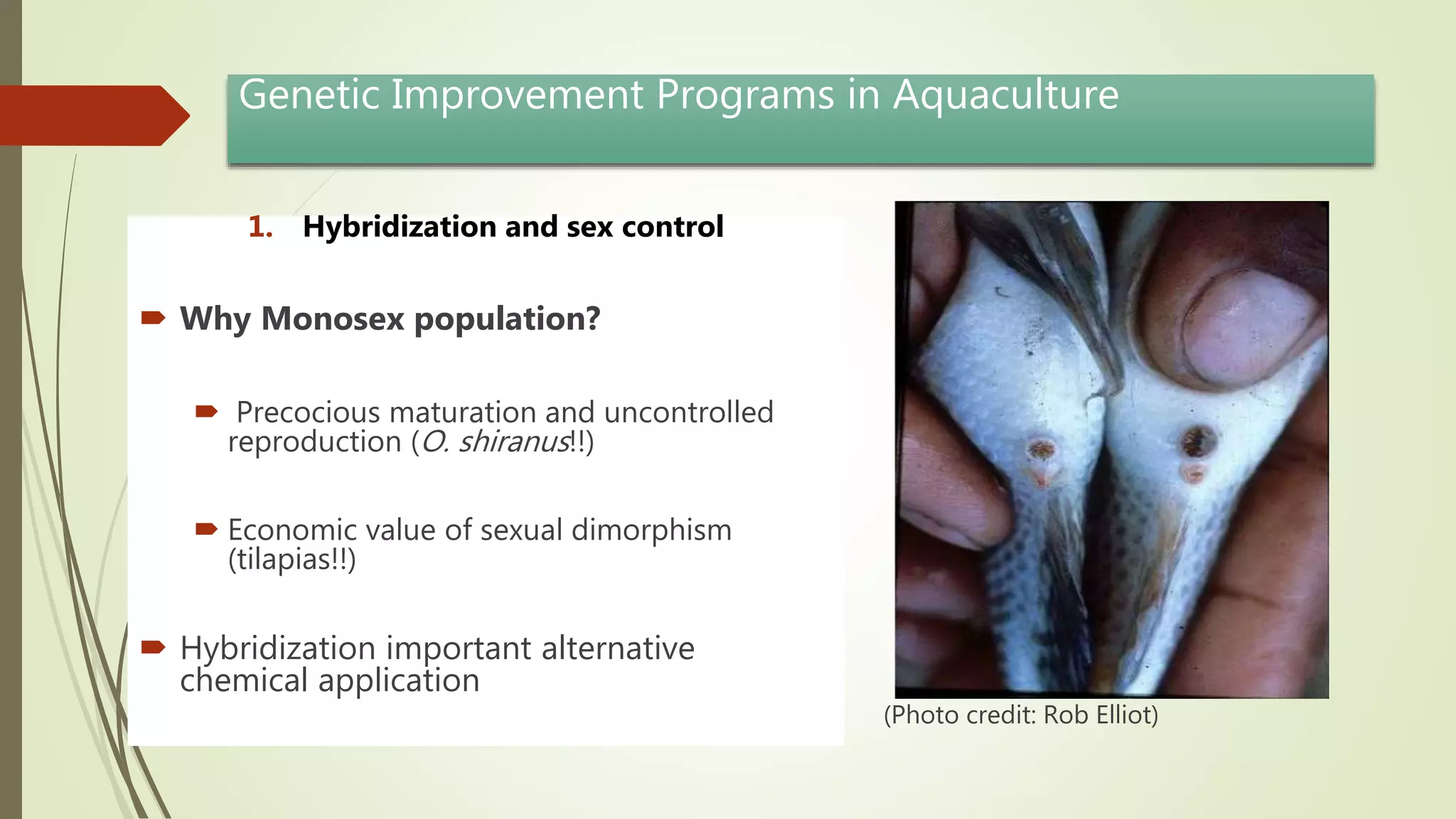
 Why Monosex population?
 Precocious maturation and uncontrolled
reproduction (O. shiranus!!)
 Economic value of sexual dimorphism
(tilapias!!)
 Hybridization important alternative
chemical application
(Photo credit: Rob Elliot)
Genetic Improvement Programs in Aquaculture
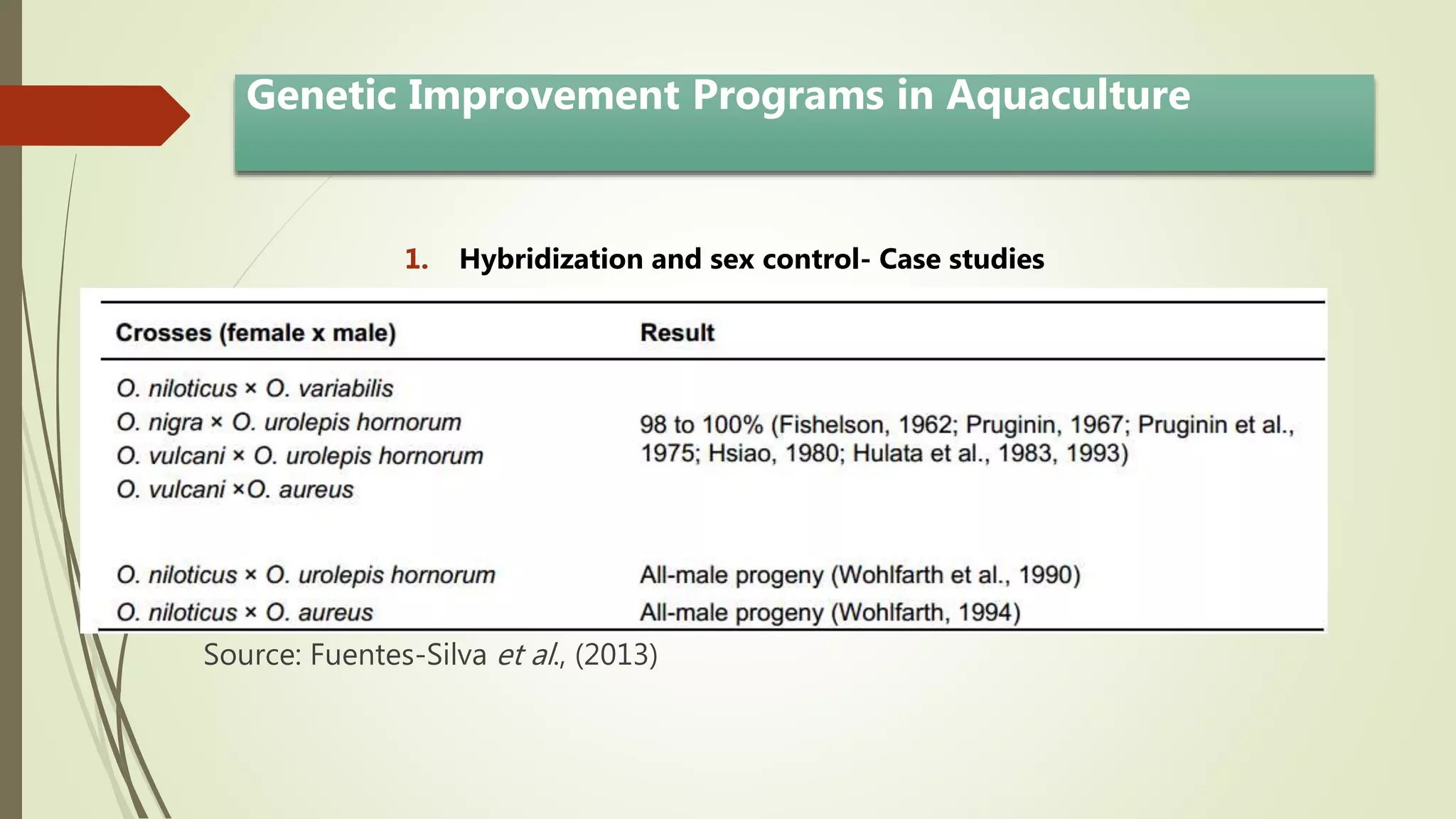
1. Hybridization and sex control- Case studies
Source: Fuentes-Silva et al., (2013)
Genetic Improvement Programs in Aquaculture
1. Hybridization and sex control
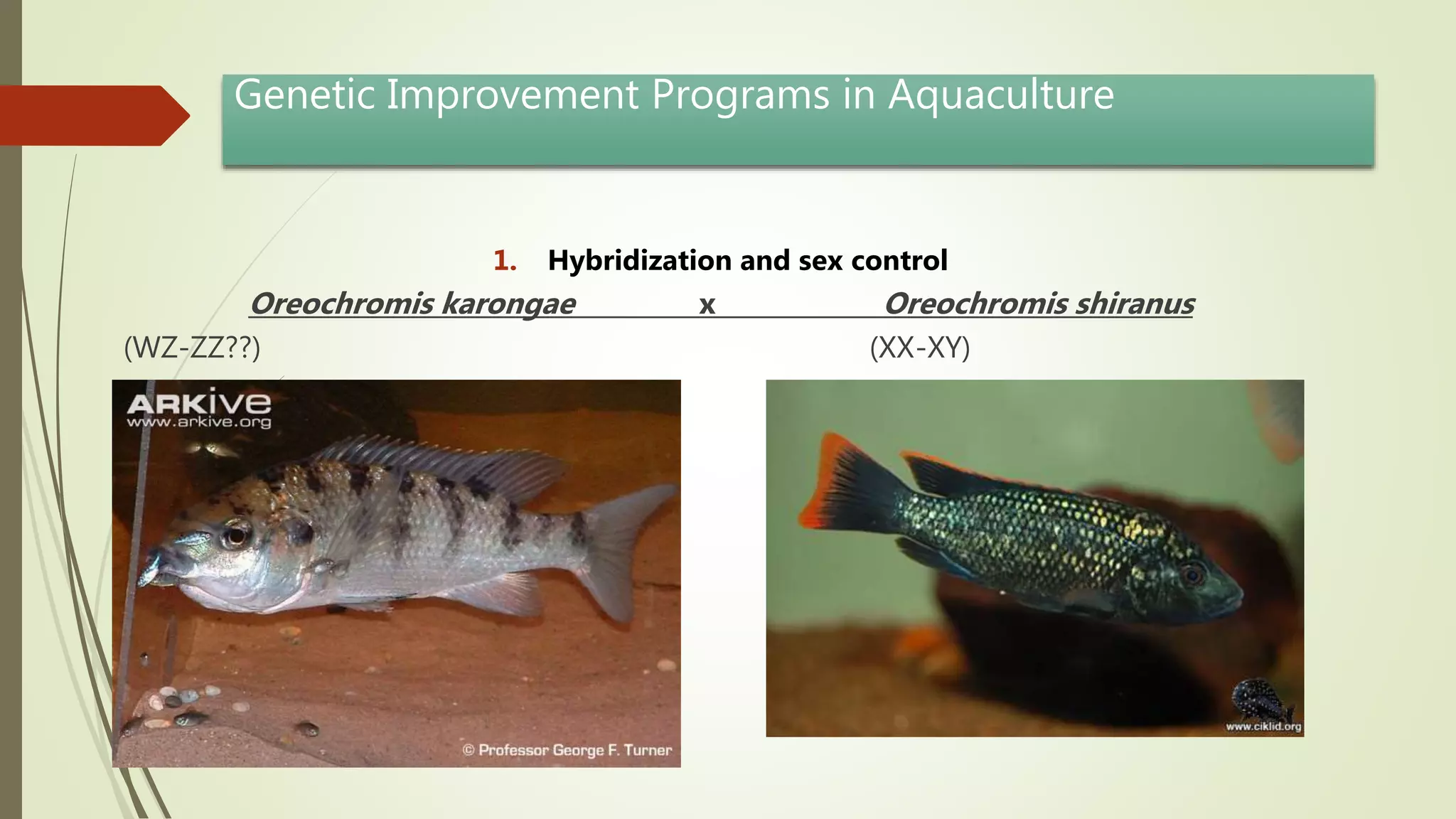
Oreochromis karongae x Oreochromis shiranus
(WZ-ZZ??) (XX-XY)
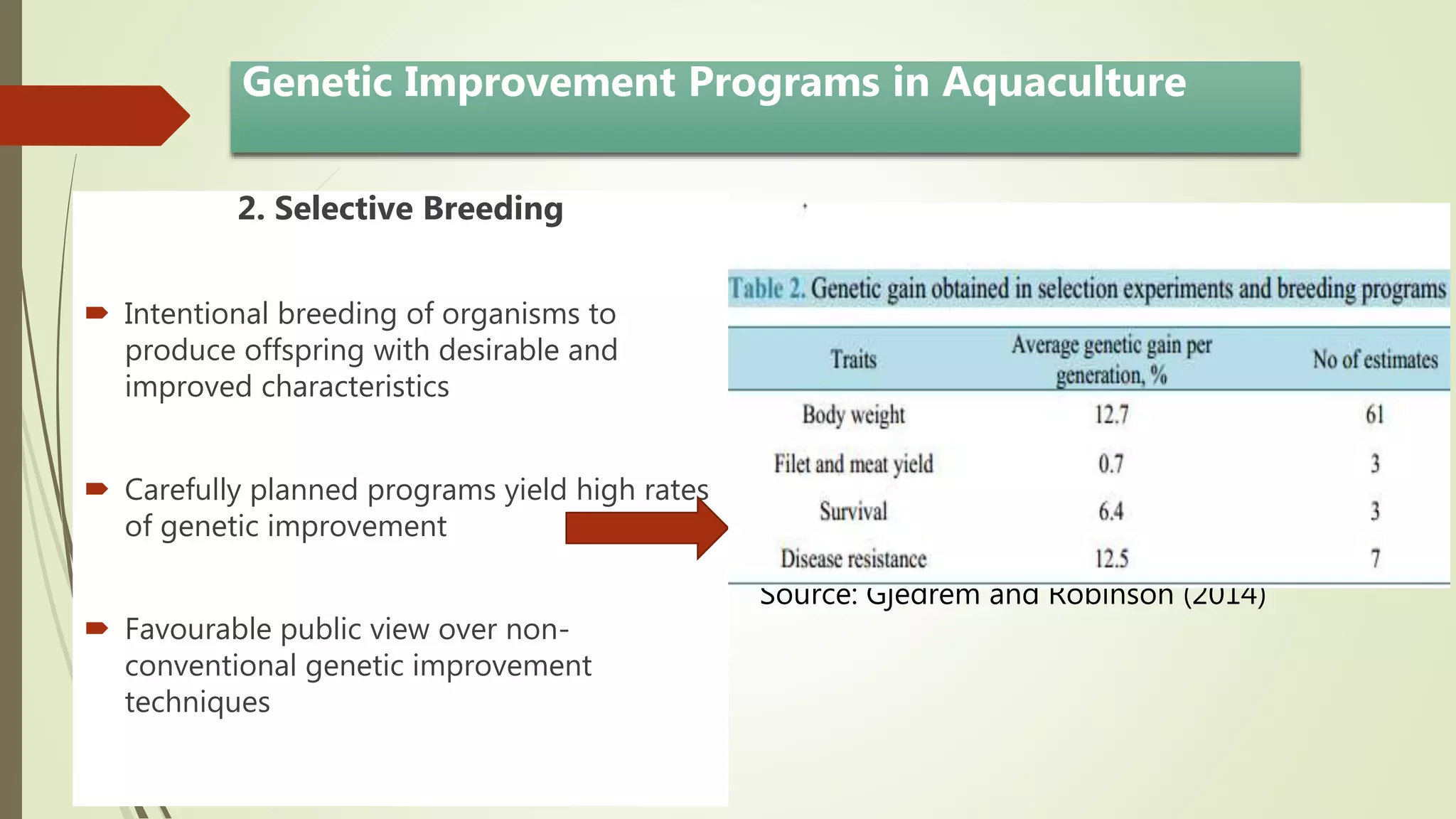
2. Selective Breeding
 Intentional breeding of organisms to
produce offspring with desirable and
improved characteristics
 Carefully planned programs yield high rates
of genetic improvement
 Favourable public view over non-
conventional genetic improvement
techniques
Source: Gjedrem and Robinson (2014)
Genetic Improvement Programs in Aquaculture
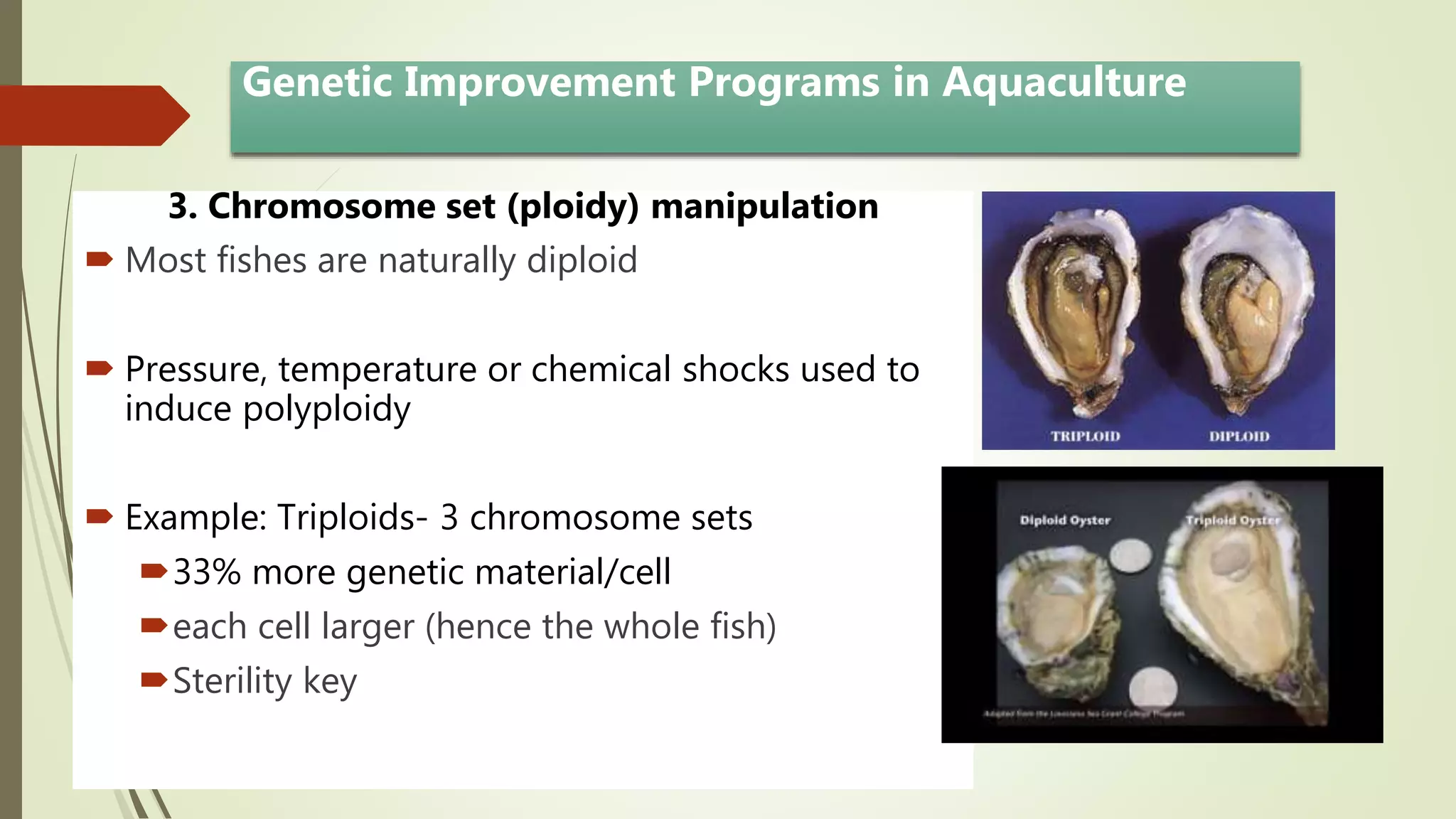
3. Chromosome set (ploidy) manipulation
 Most fishes are naturally diploid
 Pressure, temperature or chemical shocks used to
induce polyploidy
 Example: Triploids- 3 chromosome sets
33% more genetic material/cell
each cell larger (hence the whole fish)
Sterility key
Genetic Improvement Programs in Aquaculture
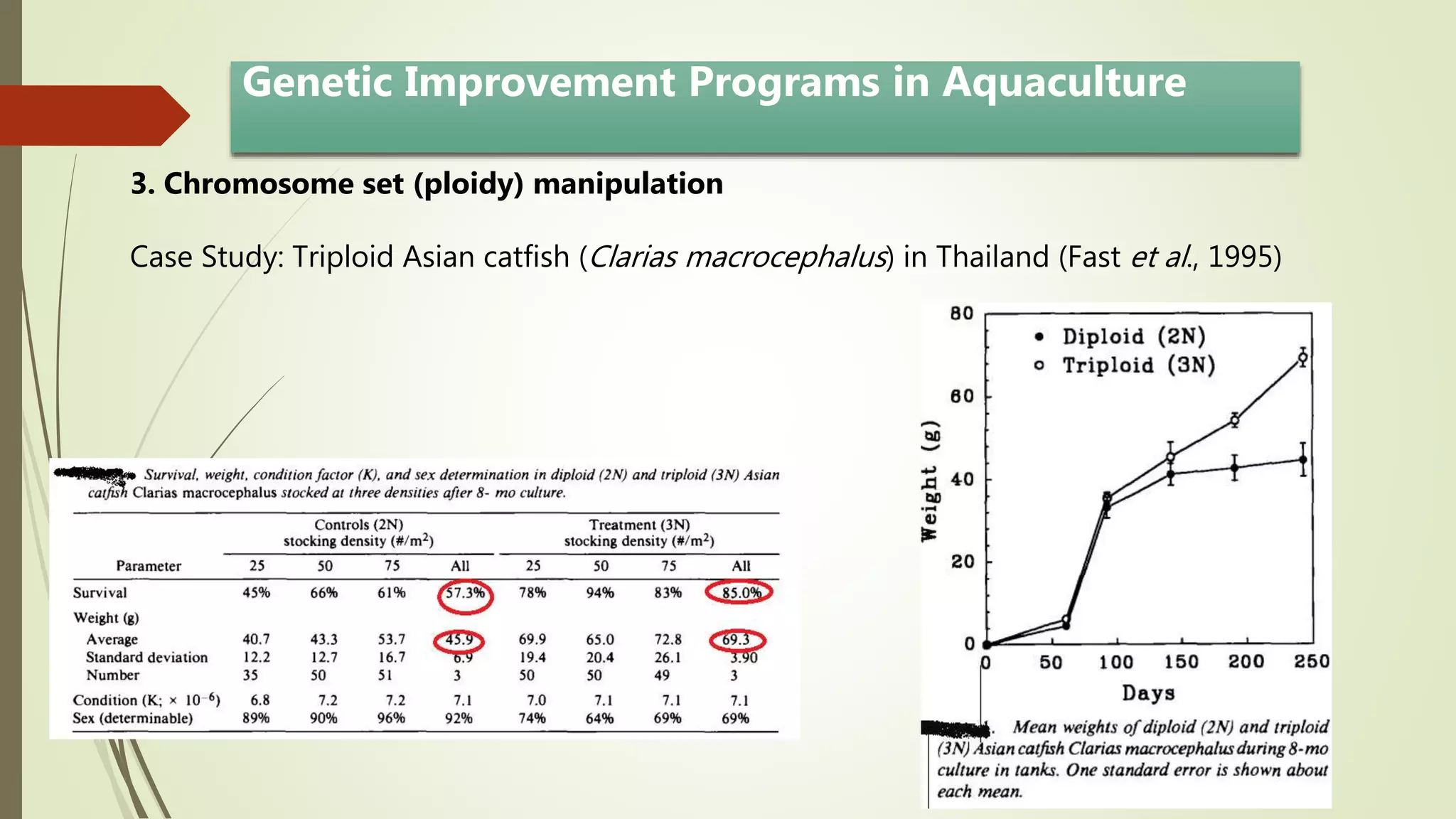
3. Chromosome set (ploidy) manipulation
Case Study: Triploid Asian catfish (Clarias macrocephalus) in Thailand (Fast et al., 1995)
Genetic Improvement Programs in Aquaculture
5. Genetic Engineering
 Combining genetic material from two or more separate
species
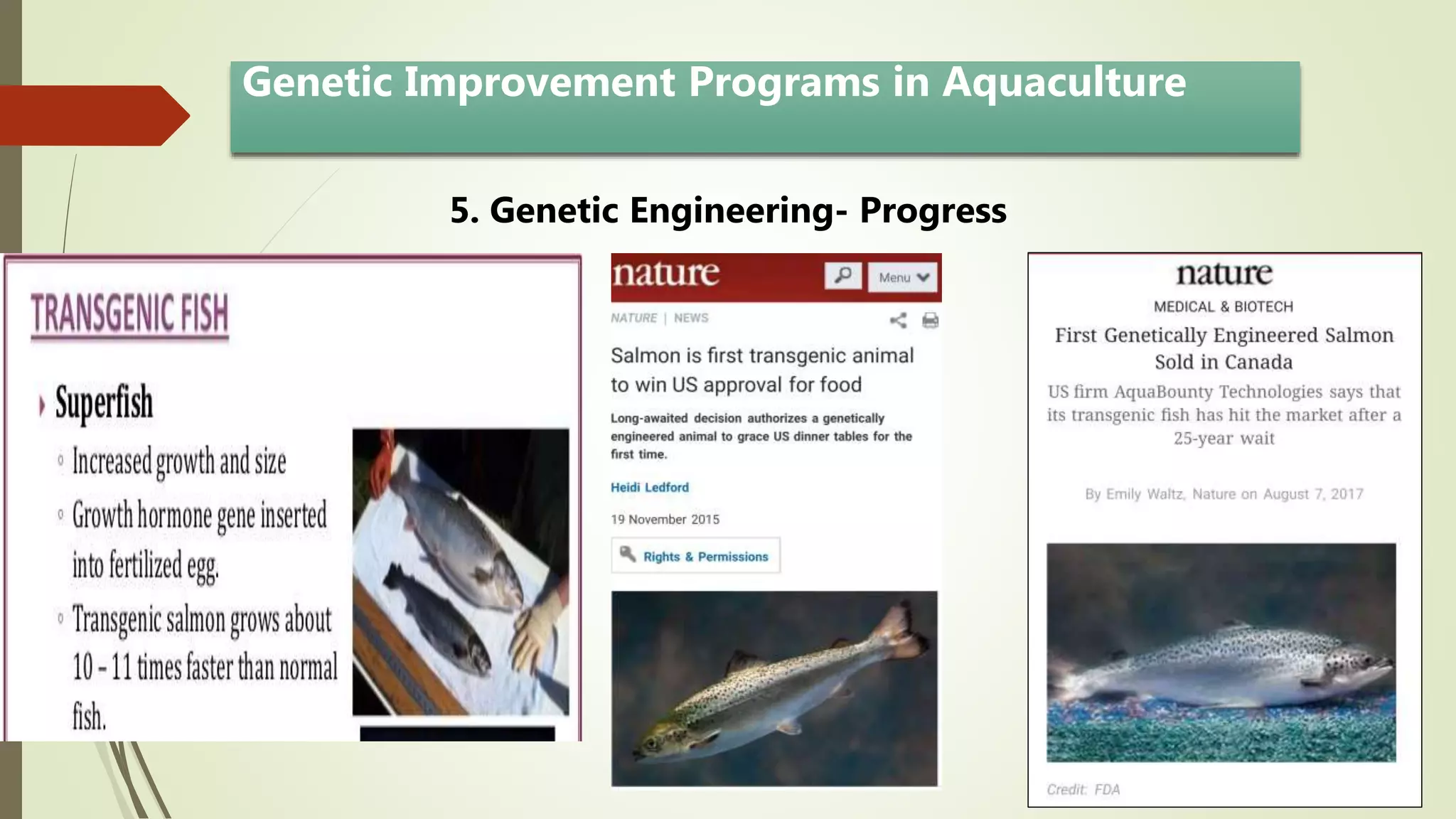
 Why GE? Simply, Time! (Beaumont and Hoare, 2003)
 Conventional selective breeding requires generations of
careful breeding
 GE- almost instant improvement on given trait
 Public opposition presents serious challenge (Durham,
2011
Genetic Improvement Programs in Aquaculture
5. Genetic Engineering- Progress

Genetic Improvement Programs in Aquaculture
5. Genetic Engineering
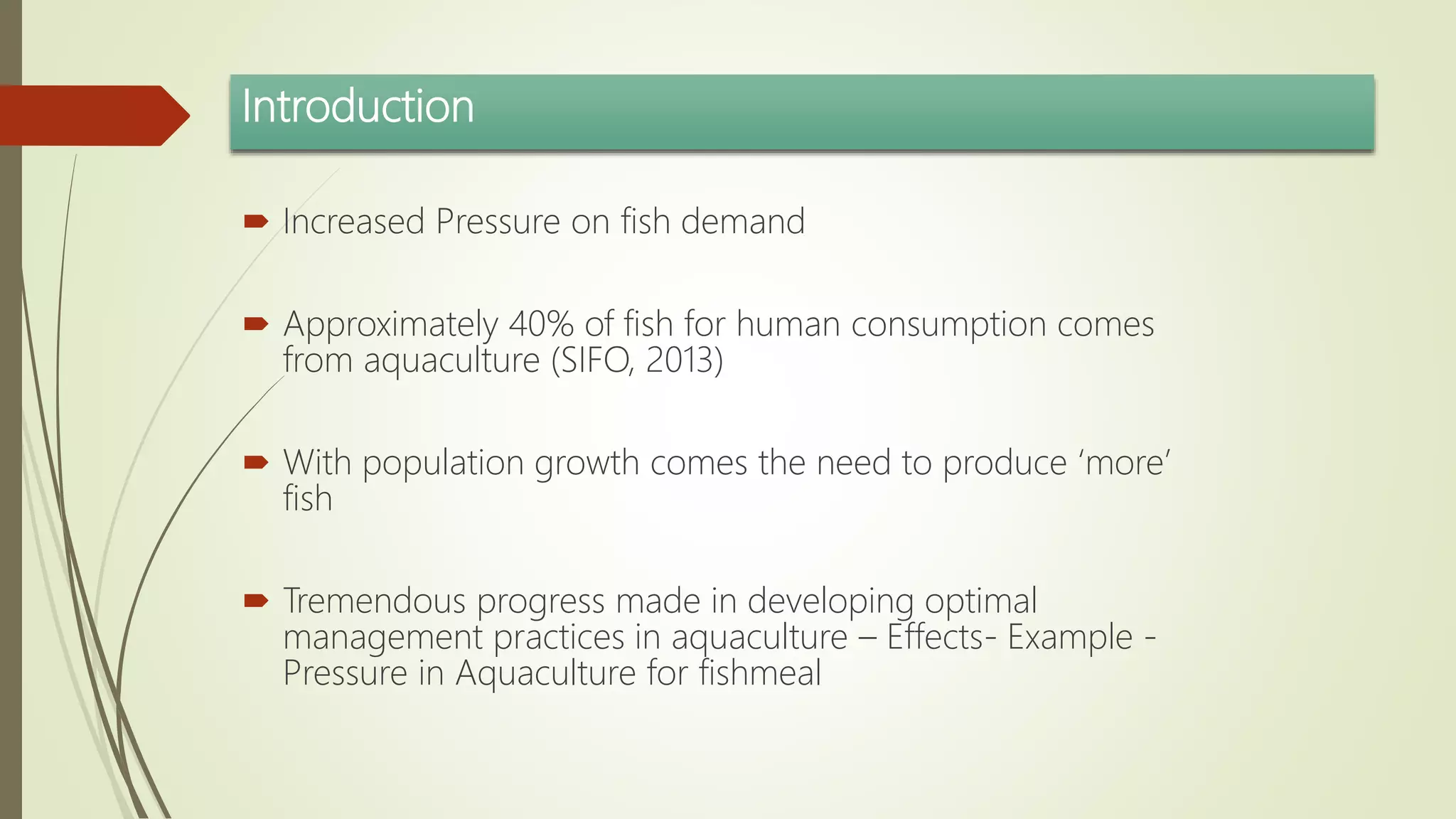
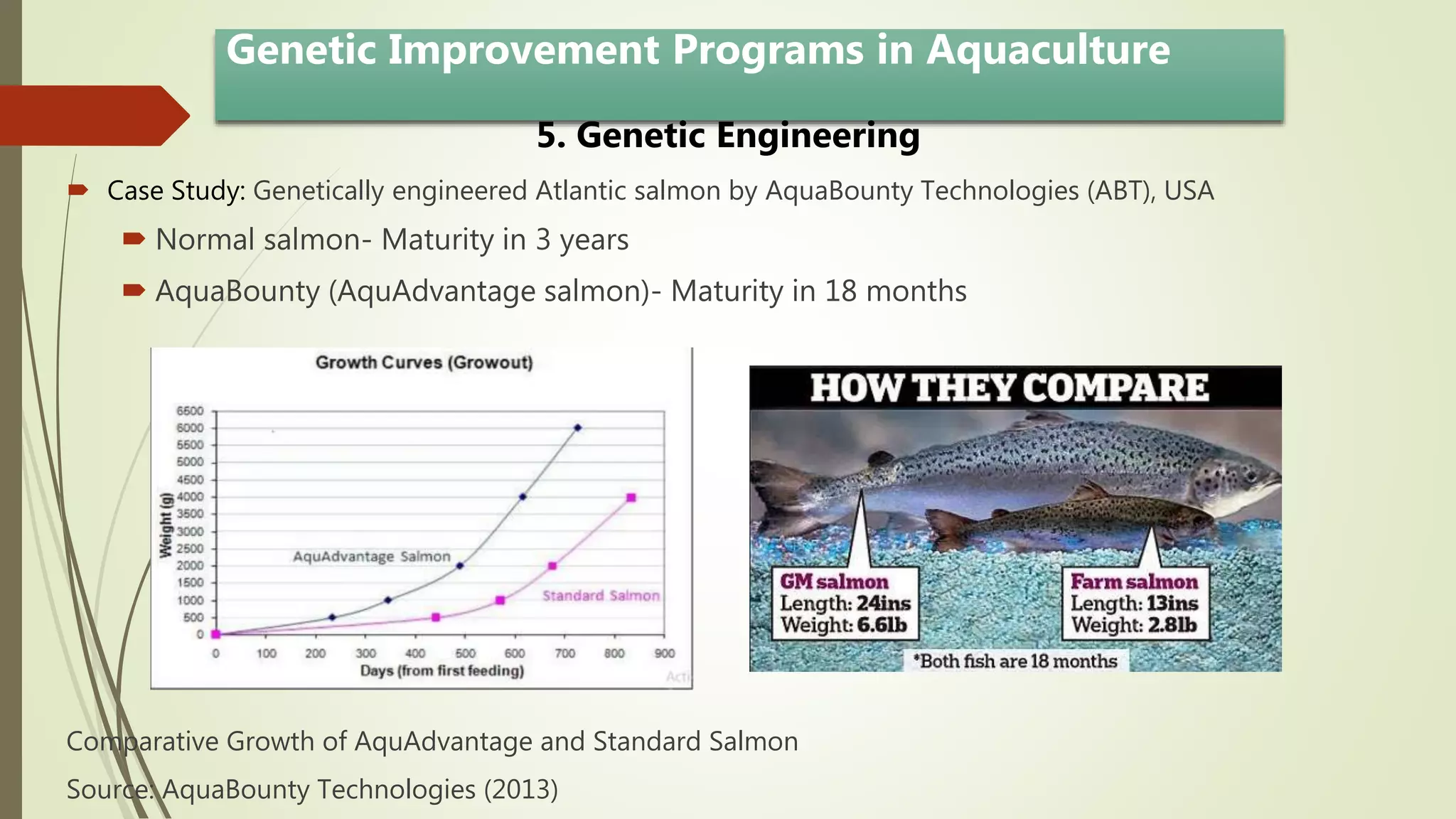
 Case Study: Genetically engineered Atlantic salmon by AquaBounty Technologies (ABT), USA
 Normal salmon- Maturity in 3 years
 AquaBounty (AquAdvantage salmon)- Maturity in 18 months
Comparative Growth of AquAdvantage and Standard Salmon
Source: AquaBounty Technologies (2013)
Genetic Improvement Programs in Aquaculture
Biosecurity and disease control;
 Disease outbreaks are a serious constraint to the development of intensive
aquaculture systems (10-90 % Losses)
 diagnosis of fish diseases - histopathological methods, supported by
parasitological, bacteriological and viral studies based on necropsy and in vitro cell
culture.
 Require a high level of expertise and are often quite time-consuming, not being
susceptible to automation.
 Polymerase chain reaction (PCR) technology become an important tool for
pathogen assessment in developing countries
Environmental management and
bioremediation
 Is Aquaculture – Envirornmental friendly?
 Reducing the impact of effluent discharge,
 improving of water quality and the responsible use of water are key areas
to be considered during aquaculture development
 Need for Bioremediation for the degradation of hazardous wastes; the use
of vaccination and probiotics to reduce antimicrobial use in aquaculture;
and the use of DNA-based methodologies for the early detection of toxin
producing algae.
Biodiversity conservation and fisheries
management
Good fisheries management - Effective conservation measures, = understanding of the
population structure - Effective population size (Ne).
Ne determines = genetic variation, genetic drift and linkage disequilibrium in populations avpof
ates of inbreeding expected in these populations.
Biodiversity conservation and fisheries
management
A range of biotechnology-based approaches are being used to
conserve wild fish populations
use of molecular markers: to estimate Ne in wild populations; to
study gene flow between farmed and wild fish populations; and to
monitor and understand changes in wild fish population sizes
DNA in water has been used to determine what fish live where
Biotechnology in Fisheries in Africa
 BiioTechnology Tools are available in the world : But hardly applied in
programmic way to make meaninglful impact:
 Aquaculture production remains low: Africa needs to run
 Spotted success stories are available: Sex reversal in many farms;
Genetic Improvement in Ghana – Akosombo train with 30 per cent
growth rate of O.niloticus
 Trails made on Feed Coating with Enzymes- Private
 Three Immediate Programmes are recommended for Africa
Biotechnology for Genetic Improvement
Biotechnology for Feed Improvement
Biotechnology for disease control and Biosecutity
Thank You

Overview of the biotechnology in fishery

  • 1.
    A Review ofBiotechnology in Aquaculture and Fisheries T. Gwaza, D. Kassam, E. Kaunda WB African Centre of Excellence & NEPAD/SANBio Regional Fish Node Lilongwe University Of Agriculture And Natural Resources, Box 219, Lilongwe, Malawi Presented at the FAO Regional Meeting on Agricultural Biotechnologies in Sustainable Food Systems and Nutrition in Africa- 22-24 Nov 2017, AUCC, Addis Ababa, Ethiopia
  • 2.
    Introduction  Increased Pressureon fish demand  Approximately 40% of fish for human consumption comes from aquaculture (SIFO, 2013)  With population growth comes the need to produce ‘more’ fish  Tremendous progress made in developing optimal management practices in aquaculture – Effects- Example - Pressure in Aquaculture for fishmeal
  • 3.
    WORLD FISH PRODUCTIONAND AFRICA’S SHARE Figure 1: World capture and aquaculture and share of Africa Total World 90 catch million tons . Africa 8 million MT Continental 11.2 million MT Africa 2.5 million MT Aquaculture 60 million MT Africa 1.4 million MT
  • 4.
    4 50% 48% 0% 2% 1960 Pig Chicken Aquaculture Other 36% 50% 10% 4%1980 Pig Chicken Aquaculture Other Pig 20% Chicken 5% Aquaculture… Other 2% 2010 Pig Chicken Aquaculture Other
  • 5.
    More Worries forAfrica .. Much on Aquaculture is from China- 70 per cent
  • 6.
    Content Background information Value chain map Production Fact&Figurefrom our study Productivity Cost structure Income structure Internal factor Fingerling Feed Transportation Finance Full-time vs hobby farmer External factor Historical reason Gross Production Data source: http://www.fao.org/fishery/statistics/global- aquaculture-production/query/en - 50.00 100.00 150.00 200.00 250.00 1961196519691973197719811985198919931997200120052009 TONNES X100000 China Nigeria Ghana Malawi
  • 7.
    7 Raw material Amount(kg) Fish meal 100.00 Soy meal 380.00 Wheat middling 210.00 Maize 280.00 Fish oil 10.00 TOTAL 1000.00
  • 8.
    Four Main areaswhere Biotechonologies have been used in Aquaculture and Fisheries  Genetic improvements and control of reproduction;  Biosecurity and disease control;  Environmental management and bioremediation;  Biodiversity conservation and fisheries management.
  • 9.
    Genetic improvements andcontrol of reproduction
  • 10.
    Introduction  Future expansionof aquaculture will depend on improved productivity through improved genetic make-up of species (Neira, 2010)  Genetic potential of aquaculture animals is plastic and can be improved over a relatively short timeframe (Gjedrem et al., 2012; Synder and Ziegler, 2013)  Dramatic improvements documented in many species through various genetic improvement programs  Need to review various genetic improvement strategies to encourage adoption in least developed countries
  • 11.
    Genetic Improvement Programsin Aquaculture 1. Hybridization  Crossing genetically differentiated individuals or groups Strain crossing Vs. Interspecific hybridization  Target positive heterosis (hybrid vigour) and desired traits  Also used to generated sterile lines  Great potential to improve productivity
  • 12.
    Genetic Improvement Programsin Aquaculture 1. Hybridization Case Study: The CxB hybrids in USA (channel catfish ♀ X blue catfish ♂) *cc; channel catfish, FF; full feed ration, RF; restricted feed ration (RF) Source: Green and Rawles (2009)
  • 13.
    Genetic Improvement Programsin Aquaculture 1. Hybridization Case Study: The CxB hybrids in USA (channel catfish ♀ X blue catfish ♂)
  • 14.
    Genetic Improvement Programsin Aquaculture 1. Hybridization and sex control  Why Monosex population?  Precocious maturation and uncontrolled reproduction (O. shiranus!!)  Economic value of sexual dimorphism (tilapias!!)  Hybridization important alternative chemical application (Photo credit: Rob Elliot)
  • 15.
    Genetic Improvement Programsin Aquaculture 1. Hybridization and sex control- Case studies Source: Fuentes-Silva et al., (2013)
  • 16.
    Genetic Improvement Programsin Aquaculture 1. Hybridization and sex control Oreochromis karongae x Oreochromis shiranus (WZ-ZZ??) (XX-XY)
  • 17.
    2. Selective Breeding Intentional breeding of organisms to produce offspring with desirable and improved characteristics  Carefully planned programs yield high rates of genetic improvement  Favourable public view over non- conventional genetic improvement techniques Source: Gjedrem and Robinson (2014) Genetic Improvement Programs in Aquaculture
  • 18.
    3. Chromosome set(ploidy) manipulation  Most fishes are naturally diploid  Pressure, temperature or chemical shocks used to induce polyploidy  Example: Triploids- 3 chromosome sets 33% more genetic material/cell each cell larger (hence the whole fish) Sterility key Genetic Improvement Programs in Aquaculture
  • 19.
    3. Chromosome set(ploidy) manipulation Case Study: Triploid Asian catfish (Clarias macrocephalus) in Thailand (Fast et al., 1995) Genetic Improvement Programs in Aquaculture
  • 20.
    5. Genetic Engineering Combining genetic material from two or more separate species  Why GE? Simply, Time! (Beaumont and Hoare, 2003)  Conventional selective breeding requires generations of careful breeding  GE- almost instant improvement on given trait  Public opposition presents serious challenge (Durham, 2011 Genetic Improvement Programs in Aquaculture
  • 21.
    5. Genetic Engineering-Progress  Genetic Improvement Programs in Aquaculture
  • 22.
    5. Genetic Engineering Case Study: Genetically engineered Atlantic salmon by AquaBounty Technologies (ABT), USA  Normal salmon- Maturity in 3 years  AquaBounty (AquAdvantage salmon)- Maturity in 18 months Comparative Growth of AquAdvantage and Standard Salmon Source: AquaBounty Technologies (2013) Genetic Improvement Programs in Aquaculture
  • 23.
    Biosecurity and diseasecontrol;  Disease outbreaks are a serious constraint to the development of intensive aquaculture systems (10-90 % Losses)  diagnosis of fish diseases - histopathological methods, supported by parasitological, bacteriological and viral studies based on necropsy and in vitro cell culture.  Require a high level of expertise and are often quite time-consuming, not being susceptible to automation.  Polymerase chain reaction (PCR) technology become an important tool for pathogen assessment in developing countries
  • 24.
    Environmental management and bioremediation Is Aquaculture – Envirornmental friendly?  Reducing the impact of effluent discharge,  improving of water quality and the responsible use of water are key areas to be considered during aquaculture development  Need for Bioremediation for the degradation of hazardous wastes; the use of vaccination and probiotics to reduce antimicrobial use in aquaculture; and the use of DNA-based methodologies for the early detection of toxin producing algae.
  • 25.
    Biodiversity conservation andfisheries management Good fisheries management - Effective conservation measures, = understanding of the population structure - Effective population size (Ne). Ne determines = genetic variation, genetic drift and linkage disequilibrium in populations avpof ates of inbreeding expected in these populations.
  • 26.
    Biodiversity conservation andfisheries management A range of biotechnology-based approaches are being used to conserve wild fish populations use of molecular markers: to estimate Ne in wild populations; to study gene flow between farmed and wild fish populations; and to monitor and understand changes in wild fish population sizes DNA in water has been used to determine what fish live where
  • 27.
    Biotechnology in Fisheriesin Africa  BiioTechnology Tools are available in the world : But hardly applied in programmic way to make meaninglful impact:  Aquaculture production remains low: Africa needs to run  Spotted success stories are available: Sex reversal in many farms; Genetic Improvement in Ghana – Akosombo train with 30 per cent growth rate of O.niloticus  Trails made on Feed Coating with Enzymes- Private  Three Immediate Programmes are recommended for Africa Biotechnology for Genetic Improvement Biotechnology for Feed Improvement Biotechnology for disease control and Biosecutity
  • 28.