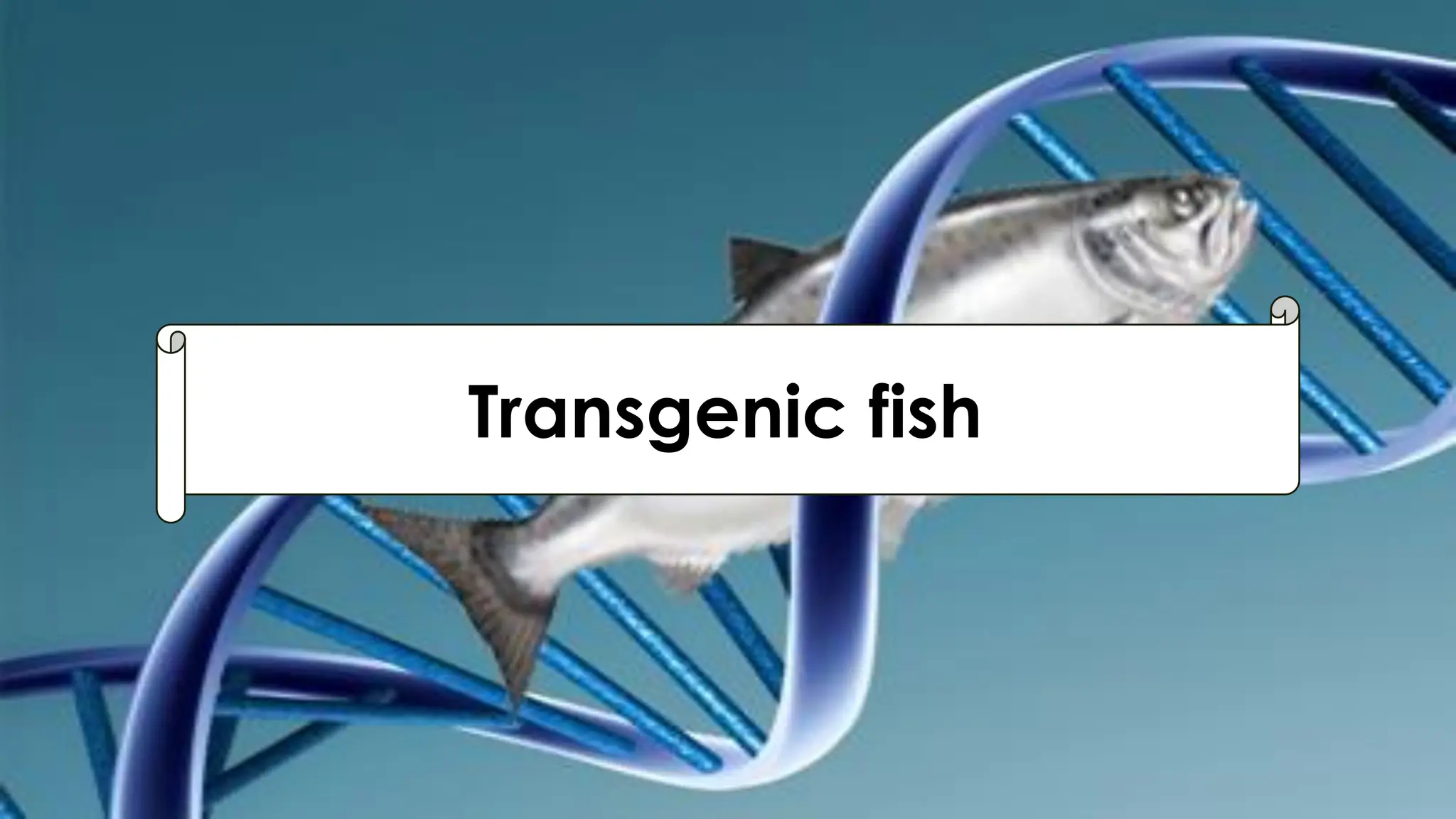
Transgenic fish
TRANSGENIC FISH
Transgenic fish means fish that have genes or
groups of genes that have been transferred from
another organism through the process of genetic
engineering
Transfer of transgene into the nucleus of a target
cell where integration into the host genome takes
place.
GOALS
➢ The primary goals for genetic manipulation of fish
species used in aquaculture are to
➢ a) Intensify the growth and efficiency of food
conservation
➢ b) Increase tolerance to environmental variables,
such as temperature and salinity
➢ c) Bring out new colour variants of ornamental
fishes
➢ d) Develop disease resistant fishes
HISTORY
➢ The first report of the generation of transgenic fish in
the aquaculture field was in goldfish (Zhu et al. 1985)
and rainbow trout (Onchorhycus mykiss)
➢ Growth hormone gene has been targeted as a
transgene aiming to increase the growth rate in
more than 20 teleost species.
➢ Transgenic fish show better gross food conversion,
the increase in fish weight per unit of food fed
➢ U.S. Food and Drug Administration (FDA)
approved the request to market GM fish as pets
in 2003
➢ The first GM animal commercialized was GloFish,
a zebrafish with a fluorescent gene to glow in
the dark under UV light
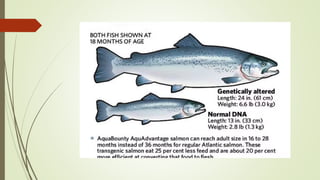
➢ In 2015, the U.S. FDA approved the first edible
commercial product, the genetically modified
AquAdvantage Salmon
➢ However, the commercial use of genetically
modified fish, particularly in aquaculture, is still
under debate in many countries
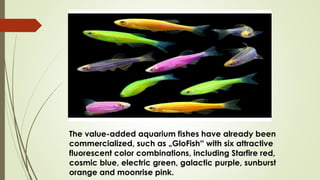
The value-added aquarium fishes have already been
commercialized, such as „GloFish‟ with six attractive
fluorescent color combinations, including Starfire red,
cosmic blue, electric green, galactic purple, sunburst
orange and moonrise pink.
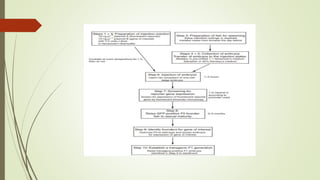
GENETICALLY MODIFIED FISH PREPARATION
VIA GENE TRANSFER
(1) selection of the appropriate parental fish line
(2) construction of a functional expression vector
including a promoter and target gene
(3) transferring the target DNA into fish embryos;
(4) screening and identification of transgenic F1
individuals
(5) Selection of F2 individuals with the same
genotype
METHODS
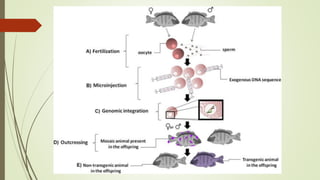
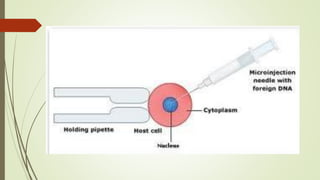
MICROINJECTION METHOD
➢ successfully in the production of transgenic fish
➢ commonly used technique due to its simplicity
and reliability
➢ Results in higher survival rates for manipulated
fish embryos than the electroporation method
➢ The most established method for gene transfer in
fish is microinjection
➢ Microinjection that allows delivery of the
transgene directly into the nucleus.
Disadvantages
 Time-consuming and labour intensive
 The nuclei of fish eggs are small and difficult to visualize
 The chorion, hardens soon after fertilization and in many fish
species the pronuclei of fertilized eggs is not visible and
transgenes are usually injected into the egg cytoplasm.
 Low efficiency of generation of transgenics
 To improve the efficiency of selection of transgenics, genetic
markers are co-injected with the transgene to monitor for
transformed zygotes.
 The Green Fluorescent Protein (GFP) from Jellyfish (Aequorea
victoria) has been used for this purpose in zebrafish
Electroporation
 Electroporation has been shown to be the most effective
means of gene transfer in fish since a large number of
fertilized eggs can be treated in a short time by this method
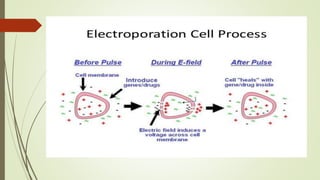
 Electroporation utilizes a series of short electric pulses to
permeate the cell membrane that make possible the
formation of temporary pores on the surface of the target cells
through which the transgene is introduced into the cytoplasm
where it is then delivered to the nucleus by the cellular
machinery
 Electroporation has been preferred in many laboratories for
gene transfer in fish systems because of its efficiency, speed
and simplicity
Disadvantages
The presence of a tough chorion layer around
the fish eggs reduces efficiency, removal of the
chorion is a tedious procedure and introduces
additional stress on newly fertilized eggs
The efficiency of the electroporation reduced
because of voltage, number and frequency of
pulses
Sperm mediated gene transfer method
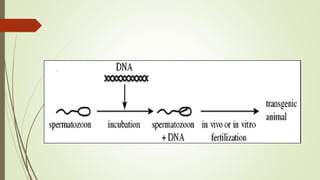
SMGT is a transgenic technique that transfers
genes based on the ability of sperm cells to
spontaneously bind to exogenous DNA and
transport it into an oocyte during fertilization to
produce genetically modified animals.
SMGT have low efficiency and it is mainly due to
low uptake of exogenous DNA by the
spermatozoa.
Retroviral infection method
 The successfully used retroviral vector or constructs
reported to produce transgenic crayfish and top minnows,
Poeciliposis lucida.
 Retroviral vector has been used as a tool for transducing
sea urchin embryos.
 This is a valuable gene transfer technique for fishes, in
general.
 But, introduction of viral sequences into food fish may not
be accepted by the public, but it could be used for
ornamental fish development.
 Disadvantage: The preparation of retroviral particles
including the transgene of interest is a very laborious
process, increases costs and requires technology.
Current and potential applications
Growth rate
 The trait of growth rate has received the greatest attention
because of its importance in aquatic animal production
systems
 Two- to threefold increases relative to non transgenic fish
have been reported for tilapia and Atlantic salmon,and up to
twofold increases in common carp
Freeze resistance
 Resistance to freezing is the second major application of
transgenesis to fish, but it is restricted to one species, the
Atlantic salmon.
 The idea is to use “antifreeze” genes from fish that live in polar
regions..
Disease resistance
 If successful, developments of increased disease resistance
could result in reduced production losses and less use of
antibiotics to control disease
 Whereas there are promising results with channel catfish in
the United States, there is still more work to be done
 Some fear that disease-resistant fish could be toxic to humans
or become reservoirs for pathogens.
Metabolic modification
 If the carbohydrate metabolism of the fsh could be improved,
they could better use diets based on ingredients of land
origin, such as soybean meal and vegetable oils.
Advantages of transgenic fish
 The growth rate of Transgenic fish can be increased by 400%
to 600%
 Can reduce feed input by up to 25% per unit of output,
thereby improving food conversion ratios
 Transgenic fish have been developed for various applications
such as the experimental models for biological research,
environmental monitoring, ornamental fish and aquaculture
production.
 Use of transgenic fish as bioreactors for the large-scale
production of rare human therapeutic proteins or novel foods
for specific dietary requirements.
 Transgenic lines of tilapia engineered to produce human
clotting factor VII, which is used in liver transplants and in
treating injuries
 Development of transgenic animal models represents a
revolutionary advance in the study of a variety of disease
processes
 Development of transgenic fish as a model in reducing or
replacing selected mammals used in toxicity testing
 Medaka fish has several characteristics that are especially well
suited for environmental toxicology, including well-
characterized histopathology
 They have been used extensively in chemical hazard testing,
carcinogenesis bioassays and germ cell mutagenesis studies
Disadvantages of transgenic fish
Mosaicism, the condition in which not all cells in
embryos have the targeted transgene, can
occur
Risk of involuntary escape of transgenic fish into
environment.
Concerns of interbreeding with native fish
populations and effects resulting from
heightened competition for food and prey
species
Reduced milt production in the GH transgenic
Nile tilapia
 Extremely fast-growing transgenic salmon and loach have low
fitness and can die
 Only about one out of every 100 eggs microinjected will stably
incorporate the recombinant DNA sequence into its genome
and subsequently transmit the transgene to its progeny
 Transgenes is the unnatural in the sense
 Transgenic fish could produce new or modified proteins that
could be toxic to humans, they generally show reduced
swimming ability and lower reproductive performance than
non-transgenic fish
The transgenic fish are also more active and
aggressive when feeding, and more willing to risk
exposure to predation
The transgenic salmon pose serious ecological
threats to wild populations and are not engineered
for natural environments
Transgenesis can result in an unpredictable
number of copies and site of integration of the
insert
THANK YOU

transgenic-fish (1).pdf uses and application

  • 1.
  • 2.
    TRANSGENIC FISH Transgenic fishmeans fish that have genes or groups of genes that have been transferred from another organism through the process of genetic engineering Transfer of transgene into the nucleus of a target cell where integration into the host genome takes place.
  • 3.
    GOALS ➢ The primarygoals for genetic manipulation of fish species used in aquaculture are to ➢ a) Intensify the growth and efficiency of food conservation ➢ b) Increase tolerance to environmental variables, such as temperature and salinity ➢ c) Bring out new colour variants of ornamental fishes ➢ d) Develop disease resistant fishes
  • 4.
    HISTORY ➢ The firstreport of the generation of transgenic fish in the aquaculture field was in goldfish (Zhu et al. 1985) and rainbow trout (Onchorhycus mykiss) ➢ Growth hormone gene has been targeted as a transgene aiming to increase the growth rate in more than 20 teleost species. ➢ Transgenic fish show better gross food conversion, the increase in fish weight per unit of food fed
  • 5.
    ➢ U.S. Foodand Drug Administration (FDA) approved the request to market GM fish as pets in 2003 ➢ The first GM animal commercialized was GloFish, a zebrafish with a fluorescent gene to glow in the dark under UV light ➢ In 2015, the U.S. FDA approved the first edible commercial product, the genetically modified AquAdvantage Salmon ➢ However, the commercial use of genetically modified fish, particularly in aquaculture, is still under debate in many countries
  • 6.
    The value-added aquariumfishes have already been commercialized, such as „GloFish‟ with six attractive fluorescent color combinations, including Starfire red, cosmic blue, electric green, galactic purple, sunburst orange and moonrise pink.
  • 8.
    GENETICALLY MODIFIED FISHPREPARATION VIA GENE TRANSFER (1) selection of the appropriate parental fish line (2) construction of a functional expression vector including a promoter and target gene (3) transferring the target DNA into fish embryos; (4) screening and identification of transgenic F1 individuals (5) Selection of F2 individuals with the same genotype
  • 11.
    METHODS MICROINJECTION METHOD ➢ successfullyin the production of transgenic fish ➢ commonly used technique due to its simplicity and reliability ➢ Results in higher survival rates for manipulated fish embryos than the electroporation method ➢ The most established method for gene transfer in fish is microinjection ➢ Microinjection that allows delivery of the transgene directly into the nucleus.
  • 13.
    Disadvantages  Time-consuming andlabour intensive  The nuclei of fish eggs are small and difficult to visualize  The chorion, hardens soon after fertilization and in many fish species the pronuclei of fertilized eggs is not visible and transgenes are usually injected into the egg cytoplasm.  Low efficiency of generation of transgenics  To improve the efficiency of selection of transgenics, genetic markers are co-injected with the transgene to monitor for transformed zygotes.  The Green Fluorescent Protein (GFP) from Jellyfish (Aequorea victoria) has been used for this purpose in zebrafish
  • 14.
    Electroporation  Electroporation hasbeen shown to be the most effective means of gene transfer in fish since a large number of fertilized eggs can be treated in a short time by this method  Electroporation utilizes a series of short electric pulses to permeate the cell membrane that make possible the formation of temporary pores on the surface of the target cells through which the transgene is introduced into the cytoplasm where it is then delivered to the nucleus by the cellular machinery  Electroporation has been preferred in many laboratories for gene transfer in fish systems because of its efficiency, speed and simplicity
  • 16.
    Disadvantages The presence ofa tough chorion layer around the fish eggs reduces efficiency, removal of the chorion is a tedious procedure and introduces additional stress on newly fertilized eggs The efficiency of the electroporation reduced because of voltage, number and frequency of pulses
  • 17.
    Sperm mediated genetransfer method SMGT is a transgenic technique that transfers genes based on the ability of sperm cells to spontaneously bind to exogenous DNA and transport it into an oocyte during fertilization to produce genetically modified animals. SMGT have low efficiency and it is mainly due to low uptake of exogenous DNA by the spermatozoa.
  • 19.
    Retroviral infection method The successfully used retroviral vector or constructs reported to produce transgenic crayfish and top minnows, Poeciliposis lucida.  Retroviral vector has been used as a tool for transducing sea urchin embryos.  This is a valuable gene transfer technique for fishes, in general.  But, introduction of viral sequences into food fish may not be accepted by the public, but it could be used for ornamental fish development.  Disadvantage: The preparation of retroviral particles including the transgene of interest is a very laborious process, increases costs and requires technology.
  • 20.
    Current and potentialapplications Growth rate  The trait of growth rate has received the greatest attention because of its importance in aquatic animal production systems  Two- to threefold increases relative to non transgenic fish have been reported for tilapia and Atlantic salmon,and up to twofold increases in common carp
  • 21.
    Freeze resistance  Resistanceto freezing is the second major application of transgenesis to fish, but it is restricted to one species, the Atlantic salmon.  The idea is to use “antifreeze” genes from fish that live in polar regions.. Disease resistance  If successful, developments of increased disease resistance could result in reduced production losses and less use of antibiotics to control disease  Whereas there are promising results with channel catfish in the United States, there is still more work to be done  Some fear that disease-resistant fish could be toxic to humans or become reservoirs for pathogens.
  • 22.
    Metabolic modification  Ifthe carbohydrate metabolism of the fsh could be improved, they could better use diets based on ingredients of land origin, such as soybean meal and vegetable oils.
  • 23.
    Advantages of transgenicfish  The growth rate of Transgenic fish can be increased by 400% to 600%  Can reduce feed input by up to 25% per unit of output, thereby improving food conversion ratios  Transgenic fish have been developed for various applications such as the experimental models for biological research, environmental monitoring, ornamental fish and aquaculture production.  Use of transgenic fish as bioreactors for the large-scale production of rare human therapeutic proteins or novel foods for specific dietary requirements.
  • 24.
     Transgenic linesof tilapia engineered to produce human clotting factor VII, which is used in liver transplants and in treating injuries  Development of transgenic animal models represents a revolutionary advance in the study of a variety of disease processes  Development of transgenic fish as a model in reducing or replacing selected mammals used in toxicity testing  Medaka fish has several characteristics that are especially well suited for environmental toxicology, including well- characterized histopathology  They have been used extensively in chemical hazard testing, carcinogenesis bioassays and germ cell mutagenesis studies
  • 25.
    Disadvantages of transgenicfish Mosaicism, the condition in which not all cells in embryos have the targeted transgene, can occur Risk of involuntary escape of transgenic fish into environment. Concerns of interbreeding with native fish populations and effects resulting from heightened competition for food and prey species Reduced milt production in the GH transgenic Nile tilapia
  • 26.
     Extremely fast-growingtransgenic salmon and loach have low fitness and can die  Only about one out of every 100 eggs microinjected will stably incorporate the recombinant DNA sequence into its genome and subsequently transmit the transgene to its progeny  Transgenes is the unnatural in the sense  Transgenic fish could produce new or modified proteins that could be toxic to humans, they generally show reduced swimming ability and lower reproductive performance than non-transgenic fish
  • 27.
    The transgenic fishare also more active and aggressive when feeding, and more willing to risk exposure to predation The transgenic salmon pose serious ecological threats to wild populations and are not engineered for natural environments Transgenesis can result in an unpredictable number of copies and site of integration of the insert
  • 28.