Global and national scenario of ornamental
fisheries:
trade and future scope
Department of Aquaculture
College of Fisheries
Maharana Pratap University of Agriculture and Technology
Udaipur-313001
Presented by:
Mr. Kavindra
M. F. Sc. (Aquaculture)
III Sem.
Credit Seminar
AQCUL-591
Table of Content
• Introduction
• Why Ornamental fisheries ?
• Overview of Global Trade
• Top 10 Exporter countries
• Top 10 Importer countries
• Present status and trade of ornamental fishery in India
• Freshwater ornamental fisheries
• Marine water ornamental fisheries
• Brackish water ornamental fisheries
• Entrepreneurship: A scope in ornamental fisheries
• Scope of Indian ornamental fisheries
• Aqua Aquaria India
• The future: Our expectations and warnings
• Conclusion
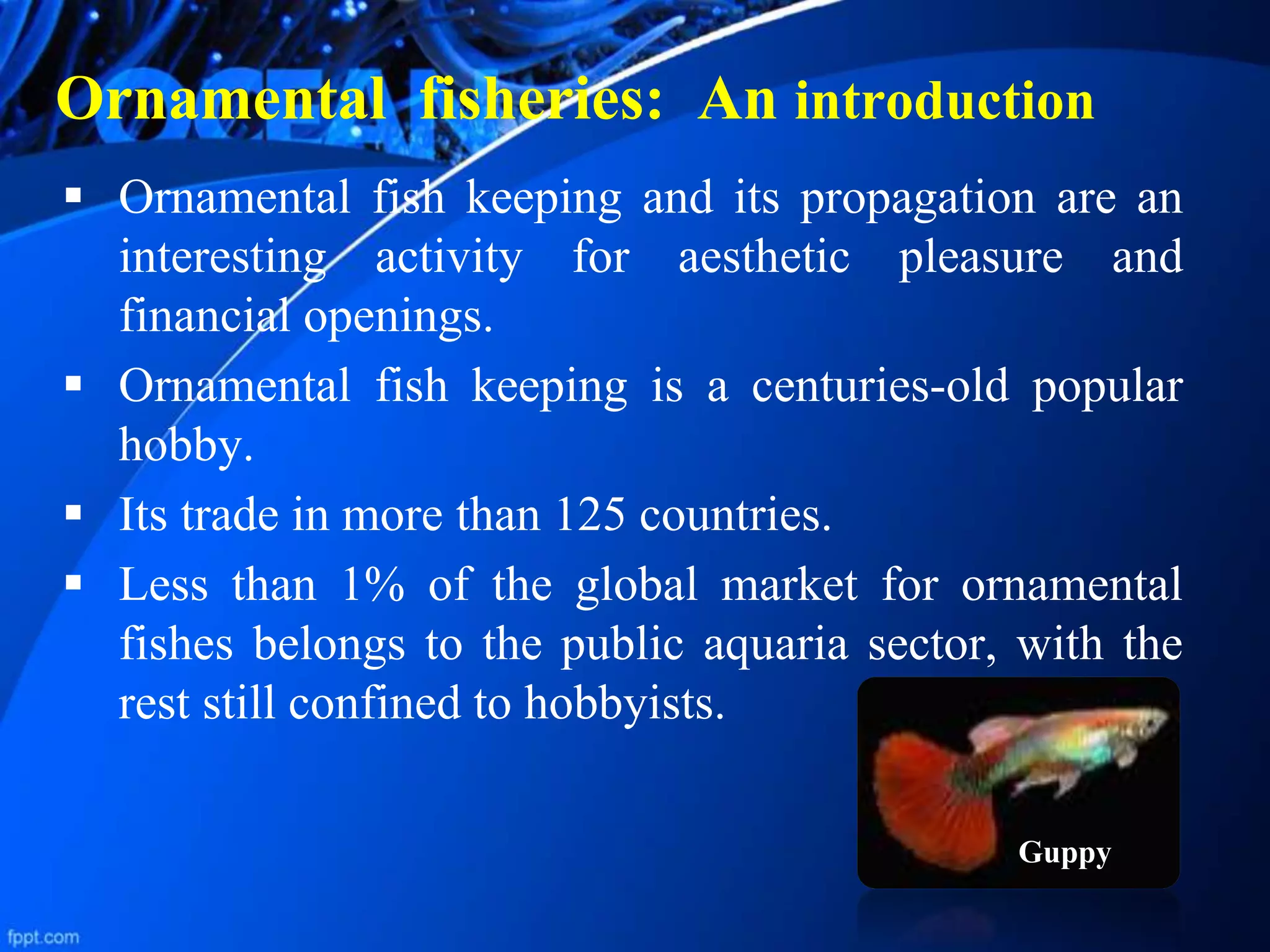
Ornamental fisheries: An introduction
 Ornamental fish keeping and its propagation are an
interesting activity for aesthetic pleasure and
financial openings.
 Ornamental fish keeping is a centuries-old popular
hobby.
 Its trade in more than 125 countries.
 Less than 1% of the global market for ornamental
fishes belongs to the public aquaria sector, with the
rest still confined to hobbyists.
Guppy
Cont
 The top exporting country is Singapore followed
by Honkong, Malaysia, Thailand, Philippines, Sri
lanka, Taiwan, Indonesia and India.
 The major part of the export trade is based on wild
collection.
 More than 50% of the exports come from Asia.
 Over 2500 species are involved in the global
ornamental fish industry, of which over 60% are
of freshwater origin.
 Marine fish species constitute more than 15% of
the market by value, with about 98% collected
from the wild.
Koi Carp
Cont
• About 7.2 million homes in the USA and 3.2
million homes in European union have aquaria.
• The largest importer of Ornamental fish is the
USA followed by Europe and Japan.
• The overall domestic trade in this field cross 10
crores and is growing at the rate of 20 per cent
annually.
Tiger Barb
Why Ornamental fisheries ?
• Ornamental fish can fetch about 100 times more price
than the food fish.
• Marine ornamentals are about ten times costlier
compared to freshwater fishes.
• Ornamental fish culture and breeding activity is
possible not only on large scale but on a small scale
basis as well. It provides good opportunity even to
small entrepreneurs.
• Institutional funding for research and development
activities is, however, essential.
Overview of global trade
• The trade at retail level is worth more than US$ 10
billion with an average annual growth of over 10%,
while the entire industry including plants, accessories,
aquarium, feed, and drugs is estimated to be worth more
than US$ 18-20 billion.
• India's share in ornamental fish trade is estimated to
be Rs. 158.23 lakh which is only 0.008% of the
global trade.
Siamese Fighter Fish
Global trade
Between 2000 and 2011, global exports of ornamental fish
increased from US$ 1.81 billion to a peak of US$ 3.72
billion in 2011, then declining slightly to US$ 3.47 billion in
2014.
Top 10 Exporters Countries
(By Value)
Singapore
15%
spain
14%
japan
11%
Burma
11%
Indonesia
9%Chez Republic
7%
Thiland
5%
Malaysia
5%
Netherland
5%
Sri Lnaka
4% Other
14%
Export
Source: factfish.com
Top 10 Importer Countries
(By Value)
USA
30%
UK
12%
Germany
10%
Japan
8%
Netherland
8%
Singapore
7%
China
7%
France
7%
Honkong
6%
Italy
5%
Import
Source: factfish.com
Source: FAO
58%
28%
8%
4%
2%
Export Share by continents (in US$ Million)
Asia : 197.7
Europe: 95.8
South America:
25.88
North America:
13.8
Africa:7.6
Present status of ornamental fish culture and
trade in India
• In India freshwater ornamental fish trade 98 % are cultured
and 2% captured wild.
• Marine ornamental fish - 98% are capture and 2% from
cultured stock.
• There are around 600 varieties of fishes available in the
market with mollies, catfish, angel fish, giant gouramis and
Indian Golden fish, are the fast moving fishes transported
to Kolkata, Hyderabad, Kochi, and other places in India,
and also it’s sold in the local markets.
• India ranked 66th in global import of ornamental fishery
and ranked 31th in export of ornamental fishes by value
(2017).
Cont.
• India’s import for ornamental fish was US$ 0.34 million
and India’s export is only US$ 1.02 million.
• The internal trade is estimated to be about US$ 3.26
million and the export trade is in the vicinity of U.S.$
0.38 million.
• The annual growth rate of this trade is 14%.
• The major export destination for Indian ornamental fish
is Singapore followed by Japan, USA, Malaysia and
Germany.
• About 90% of Indian aquarium fish exports from
Kolkata, followed by 8% from Mumbai and 2% from
Chennai.
9
11
5 5
13
3
6
20
7
40
28
0
5
10
15
20
25
30
35
40
45
No of Species in Indian water bodies
No of apecies in Indian water bodies
Fresh water ornamental fisheries :
 More than 100 varieties of indigenous freshwater
ornamental fish species are known in Indian
waters.
 Mollies, Platies, Guppies and Swordtails are
typical examples of live bearers.
 Gold fish, tiger barbs, golden rosi barbs, Koi
carp, Gouramies and fighters are egg layers.
 Isariel and Japan are major exporter of Koi carp.
Marine ornamental fishes:
• India has a vast coastline of 8,129 km with around 400
species of ornamental fishes belonging to 175 genera,
coming under 50 reef families occurring in the Indian seas.
 The marine ornamental fish industry has been expanding in
recent years.
 Potential marine ornamental fish species resources are clown
fish, damsel fish, lion fish, parrot fishes, marine angels.
 India can annually export marine ornamental fishes to the
tune of US$ 340 millions.
 Indonesia, Philippines and Sri lanka are major suppliers of
marine ornamental fishes.
Clown fish
Brackish water ornamental fishes :
 The brackish water pearlspot (Etroplus suratensis ),
Orange chromide (Etroplus maculates) and brackish
water Indian glass fish Ambassis sp. have been
successfully bred in low saline fish ponds.
 These are potential ornamental fishes, suitable for
planed mass production and export.
Etroplus suratensis
Entrepreneurship: A scope in ornamental
fisheries
• An innovative entrepreneur can earn much higher profits
by implementing such activities.
• NFDB, in collaboration with premier institutions like
the Central Institute of Fishery Education, has started
skill development programmes, particularly for women
so as to upgrade their technical knowledge and expose
them to best practices in the sector.
• Ornamental fish training and research institute, Udaipur,
has been roped in by the board for organizing training
programmes in a big way.
• NFDB has sanctioned Rs.2.13 crore to establish ten
ornamental fisheries hubs in ten districts of Tamil Nadu
alone (2017).
Scope of Indian ornamental fisheries
• Ornamental fishes have a good potential due to
enormous geographical spread, extensive species
diversity and intensive research.
• Our county possess a rich diversity of ornamental fish,
with over 100 indigenous varieties, in addition to a
similar number of exotic species that are bred in
captivity.
• The natural resource - Andaman, Nicobar, Gulf of
Mannar, Palk bay Gulf Kutch and Lakshdweep islands
which are very potential areas .
• The marine fish and invertebrate resources from the
Andaman, Nicobar and Lakshadweep Islands are
reported to be the greatest in Asia.
Aqua Aquaria India
• Aqua Aquaria India is one of the largest aquaculture
products shows in Asia.
• It is organized by the Marine Products Exports Development
Authority (MPEDA), Ministry of Commerce and Industry,
Government of India.
• It is a biennial event concentrating on the aquaculture
and ornamental fish culture sectors.
• The 4th edition (2017) of the event was an overwhelming
success with 186 exhibitors, 3151 delegates and thousands of
visitors at the expo.
• Aqua Aquaria India is an ideal platform for farmers, hatchery
operators, feed manufacturers, input suppliers, manufacturers
and suppliers of various aquaculture and
aquarium implements.
The future: our expectations and warnings
Cont.
 The market continues to grow and new markets
will come up.
 Increase variety and species of ornamental fishes.
 Install a good fish health management plan.
 Investment in bio-security becomes an obligation.
 Important to plan good welfare for all our aquatic
creatures.
 Good quality of fish means a sound business and
higher profits.
 Work in accordance with laws and regulations: Get
involved with our national authorities, since most
laws and regulations are adapted and implemented
at national level .
Conclusion
• The trade opportunities of ornamental fishes from India have
been recognized by the producers, collectors and traders both
nationally and internally.
• Business opportunities in ornamental fish farming can be
realized by production, marketing and wild catch of
ornamental fishes.
• Even though, India is one of the global hotspots of ornamental
fish biodiversity but its ornamental fish trade is based mostly
on wild collection.
• There is no proper policy for the development of ornamental
fish industry in India, especially in the export trade at present.
• Public private partnership can be encouraged through
establishment of ornamental fish production units in different
parts of the region to make this sector more vibrant and
remunerative for employment generation and livelihood
improvement.
References
• FAO Fisheries and Aquaculture Department [online]. Rome. Globefish
Research Program (2017). Volume 102.
• Pandey, P. K. & Mandal, S.C.(2017). Present status, challenges and
scope of ornamental fish trade in India. College of Fisheries, Central
Agricultural University (Imphal), Lembucherra, Tripura (West)-799210,
India.
• Raja, S., Babu, T.D., Nammalwar, P., Thomson, J. C., and Dinesh, K. P. B.
(2014). Potential of ornamental fish culture and marketing strategies
for future prospects in India. International Journal of Biosciences and
Nanosciences. Volume 1 (5), pp. 119-125.
• The global ornamental aquarium industry: Facts and figures – Part I &
Part II. Ornamental fish exporters , Journal -77_10.
• DB - AGRISAU - Murty, V SriramachandraAN - AV2012044964UR -
http://eprints.cmfri.org.in/7786/1/678-Mur.
• http://www.factfish.com/statistic/ornamentalfishvalue.
• https://www.ofish.org/ornamental-fish-industry-data
Ornamental aquaculture scenario

Ornamental aquaculture scenario

  • 1.
    Global and nationalscenario of ornamental fisheries: trade and future scope Department of Aquaculture College of Fisheries Maharana Pratap University of Agriculture and Technology Udaipur-313001 Presented by: Mr. Kavindra M. F. Sc. (Aquaculture) III Sem. Credit Seminar AQCUL-591
  • 2.
    Table of Content •Introduction • Why Ornamental fisheries ? • Overview of Global Trade • Top 10 Exporter countries • Top 10 Importer countries • Present status and trade of ornamental fishery in India • Freshwater ornamental fisheries • Marine water ornamental fisheries • Brackish water ornamental fisheries • Entrepreneurship: A scope in ornamental fisheries • Scope of Indian ornamental fisheries • Aqua Aquaria India • The future: Our expectations and warnings • Conclusion
  • 3.
    Ornamental fisheries: Anintroduction  Ornamental fish keeping and its propagation are an interesting activity for aesthetic pleasure and financial openings.  Ornamental fish keeping is a centuries-old popular hobby.  Its trade in more than 125 countries.  Less than 1% of the global market for ornamental fishes belongs to the public aquaria sector, with the rest still confined to hobbyists. Guppy
  • 4.
    Cont  The topexporting country is Singapore followed by Honkong, Malaysia, Thailand, Philippines, Sri lanka, Taiwan, Indonesia and India.  The major part of the export trade is based on wild collection.  More than 50% of the exports come from Asia.  Over 2500 species are involved in the global ornamental fish industry, of which over 60% are of freshwater origin.  Marine fish species constitute more than 15% of the market by value, with about 98% collected from the wild. Koi Carp
  • 5.
    Cont • About 7.2million homes in the USA and 3.2 million homes in European union have aquaria. • The largest importer of Ornamental fish is the USA followed by Europe and Japan. • The overall domestic trade in this field cross 10 crores and is growing at the rate of 20 per cent annually. Tiger Barb
  • 6.
    Why Ornamental fisheries? • Ornamental fish can fetch about 100 times more price than the food fish. • Marine ornamentals are about ten times costlier compared to freshwater fishes. • Ornamental fish culture and breeding activity is possible not only on large scale but on a small scale basis as well. It provides good opportunity even to small entrepreneurs. • Institutional funding for research and development activities is, however, essential.
  • 7.
    Overview of globaltrade • The trade at retail level is worth more than US$ 10 billion with an average annual growth of over 10%, while the entire industry including plants, accessories, aquarium, feed, and drugs is estimated to be worth more than US$ 18-20 billion. • India's share in ornamental fish trade is estimated to be Rs. 158.23 lakh which is only 0.008% of the global trade. Siamese Fighter Fish
  • 8.
    Global trade Between 2000and 2011, global exports of ornamental fish increased from US$ 1.81 billion to a peak of US$ 3.72 billion in 2011, then declining slightly to US$ 3.47 billion in 2014.
  • 9.
    Top 10 ExportersCountries (By Value) Singapore 15% spain 14% japan 11% Burma 11% Indonesia 9%Chez Republic 7% Thiland 5% Malaysia 5% Netherland 5% Sri Lnaka 4% Other 14% Export Source: factfish.com
  • 10.
    Top 10 ImporterCountries (By Value) USA 30% UK 12% Germany 10% Japan 8% Netherland 8% Singapore 7% China 7% France 7% Honkong 6% Italy 5% Import Source: factfish.com
  • 11.
    Source: FAO 58% 28% 8% 4% 2% Export Shareby continents (in US$ Million) Asia : 197.7 Europe: 95.8 South America: 25.88 North America: 13.8 Africa:7.6
  • 12.
    Present status ofornamental fish culture and trade in India • In India freshwater ornamental fish trade 98 % are cultured and 2% captured wild. • Marine ornamental fish - 98% are capture and 2% from cultured stock. • There are around 600 varieties of fishes available in the market with mollies, catfish, angel fish, giant gouramis and Indian Golden fish, are the fast moving fishes transported to Kolkata, Hyderabad, Kochi, and other places in India, and also it’s sold in the local markets. • India ranked 66th in global import of ornamental fishery and ranked 31th in export of ornamental fishes by value (2017).
  • 13.
    Cont. • India’s importfor ornamental fish was US$ 0.34 million and India’s export is only US$ 1.02 million. • The internal trade is estimated to be about US$ 3.26 million and the export trade is in the vicinity of U.S.$ 0.38 million. • The annual growth rate of this trade is 14%. • The major export destination for Indian ornamental fish is Singapore followed by Japan, USA, Malaysia and Germany. • About 90% of Indian aquarium fish exports from Kolkata, followed by 8% from Mumbai and 2% from Chennai.
  • 14.
    9 11 5 5 13 3 6 20 7 40 28 0 5 10 15 20 25 30 35 40 45 No ofSpecies in Indian water bodies No of apecies in Indian water bodies
  • 15.
    Fresh water ornamentalfisheries :  More than 100 varieties of indigenous freshwater ornamental fish species are known in Indian waters.  Mollies, Platies, Guppies and Swordtails are typical examples of live bearers.  Gold fish, tiger barbs, golden rosi barbs, Koi carp, Gouramies and fighters are egg layers.  Isariel and Japan are major exporter of Koi carp.
  • 17.
    Marine ornamental fishes: •India has a vast coastline of 8,129 km with around 400 species of ornamental fishes belonging to 175 genera, coming under 50 reef families occurring in the Indian seas.  The marine ornamental fish industry has been expanding in recent years.  Potential marine ornamental fish species resources are clown fish, damsel fish, lion fish, parrot fishes, marine angels.  India can annually export marine ornamental fishes to the tune of US$ 340 millions.  Indonesia, Philippines and Sri lanka are major suppliers of marine ornamental fishes. Clown fish
  • 18.
    Brackish water ornamentalfishes :  The brackish water pearlspot (Etroplus suratensis ), Orange chromide (Etroplus maculates) and brackish water Indian glass fish Ambassis sp. have been successfully bred in low saline fish ponds.  These are potential ornamental fishes, suitable for planed mass production and export. Etroplus suratensis
  • 19.
    Entrepreneurship: A scopein ornamental fisheries • An innovative entrepreneur can earn much higher profits by implementing such activities. • NFDB, in collaboration with premier institutions like the Central Institute of Fishery Education, has started skill development programmes, particularly for women so as to upgrade their technical knowledge and expose them to best practices in the sector. • Ornamental fish training and research institute, Udaipur, has been roped in by the board for organizing training programmes in a big way. • NFDB has sanctioned Rs.2.13 crore to establish ten ornamental fisheries hubs in ten districts of Tamil Nadu alone (2017).
  • 20.
    Scope of Indianornamental fisheries • Ornamental fishes have a good potential due to enormous geographical spread, extensive species diversity and intensive research. • Our county possess a rich diversity of ornamental fish, with over 100 indigenous varieties, in addition to a similar number of exotic species that are bred in captivity. • The natural resource - Andaman, Nicobar, Gulf of Mannar, Palk bay Gulf Kutch and Lakshdweep islands which are very potential areas . • The marine fish and invertebrate resources from the Andaman, Nicobar and Lakshadweep Islands are reported to be the greatest in Asia.
  • 21.
    Aqua Aquaria India •Aqua Aquaria India is one of the largest aquaculture products shows in Asia. • It is organized by the Marine Products Exports Development Authority (MPEDA), Ministry of Commerce and Industry, Government of India. • It is a biennial event concentrating on the aquaculture and ornamental fish culture sectors. • The 4th edition (2017) of the event was an overwhelming success with 186 exhibitors, 3151 delegates and thousands of visitors at the expo. • Aqua Aquaria India is an ideal platform for farmers, hatchery operators, feed manufacturers, input suppliers, manufacturers and suppliers of various aquaculture and aquarium implements.
  • 22.
    The future: ourexpectations and warnings Cont.  The market continues to grow and new markets will come up.  Increase variety and species of ornamental fishes.  Install a good fish health management plan.  Investment in bio-security becomes an obligation.  Important to plan good welfare for all our aquatic creatures.
  • 23.
     Good qualityof fish means a sound business and higher profits.  Work in accordance with laws and regulations: Get involved with our national authorities, since most laws and regulations are adapted and implemented at national level .
  • 24.
    Conclusion • The tradeopportunities of ornamental fishes from India have been recognized by the producers, collectors and traders both nationally and internally. • Business opportunities in ornamental fish farming can be realized by production, marketing and wild catch of ornamental fishes. • Even though, India is one of the global hotspots of ornamental fish biodiversity but its ornamental fish trade is based mostly on wild collection. • There is no proper policy for the development of ornamental fish industry in India, especially in the export trade at present. • Public private partnership can be encouraged through establishment of ornamental fish production units in different parts of the region to make this sector more vibrant and remunerative for employment generation and livelihood improvement.
  • 25.
    References • FAO Fisheriesand Aquaculture Department [online]. Rome. Globefish Research Program (2017). Volume 102. • Pandey, P. K. & Mandal, S.C.(2017). Present status, challenges and scope of ornamental fish trade in India. College of Fisheries, Central Agricultural University (Imphal), Lembucherra, Tripura (West)-799210, India. • Raja, S., Babu, T.D., Nammalwar, P., Thomson, J. C., and Dinesh, K. P. B. (2014). Potential of ornamental fish culture and marketing strategies for future prospects in India. International Journal of Biosciences and Nanosciences. Volume 1 (5), pp. 119-125. • The global ornamental aquarium industry: Facts and figures – Part I & Part II. Ornamental fish exporters , Journal -77_10. • DB - AGRISAU - Murty, V SriramachandraAN - AV2012044964UR - http://eprints.cmfri.org.in/7786/1/678-Mur. • http://www.factfish.com/statistic/ornamentalfishvalue. • https://www.ofish.org/ornamental-fish-industry-data