Introduction to aptamer technology and possible therapeutic applications


            APTÁMEROS: NUEVAS POSIBILIDADES DE DESARROLLO
                  Y APLICACIONES EN BIOTECNOLOGÍA
                                        17 de Noviembre de 2011


    Introducción a la tecnología de aptámeros y
         posibles aplicaciones terapéuticas
                                       Víctor M. González
                              Servicio de Bioquímica-Investigación
                               Hospital Ramón y Cajal (IRYCIS)
Introduction to aptamer technology and possible therapeutic applications


              APTAMERS: NEW DEVELOPMENT POSSIBILITIES AND
                    APPLICATIONS IN BIOTECHNOLOGY
                                            November 17, 2011


        Introduction to aptamer technology and
            possible therapeutic applications
                                       Víctor M. González
                              Servicio de Bioquímica-Investigación
                               Hospital Ramón y Cajal (IRYCIS)
Introduction to aptamer technology and possible therapeutic applications


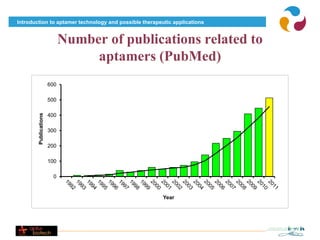
                             Number of publications related to
                                  aptamers (PubMed)
                       600

                       500
        Publications


                       400

                       300

                       200

                       100

                         0


                                                        Year
Introduction to aptamer technology and possible therapeutic applications


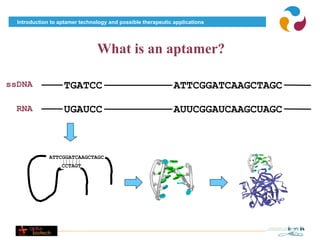
                                What is an aptamer?

ssDNA               TGATCC                                    ATTCGGATCAAGCTAGC

 RNA                UGAUCC                                    AUUCGGAUCAAGCUAGC


              ATTCGGATCAAGCTAGC
                   CCTAGT
Introduction to aptamer technology and possible therapeutic applications


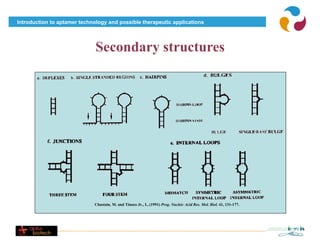
                              Secondary structures


                             Chastain, M. and Tinoco Jr., I., (1991) Prog. Nucleic Acid Res. Mol. Biol. 41, 131-177.
Introduction to aptamer technology and possible therapeutic applications


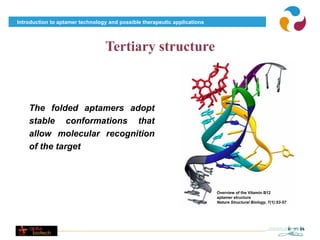
                                  Tertiary structure


    The folded aptamers adopt
    stable conformations that
    allow molecular recognition
    of the target


                                                                           Overview of the Vitamin B12
                                                                           aptamer structure
                                                                           Nature Structural Biology, 7(1):53-57
Introduction to aptamer technology and possible therapeutic applications


                      Aptamers are obtained…
   • …from libraries of oligonucleotides with random
     sequences
   • …by an in vitro method called Systematic Evolution of
     Ligands by Exponential Enrichment (SELEX)
     consisting of successive rounds of selection-
     amplification
Introduction to aptamer technology and possible therapeutic applications


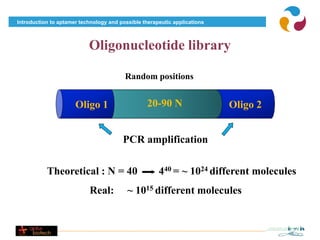
                           Oligonucleotide library

                                         Random positions


                      Oligo 1                     20-90 N                  Oligo 2


                                        PCR amplification

           Theoretical : N = 40                       440 = ~ 1024 different molecules
                           Real:          ~ 1015 different molecules
Introduction to aptamer technology and possible therapeutic applications


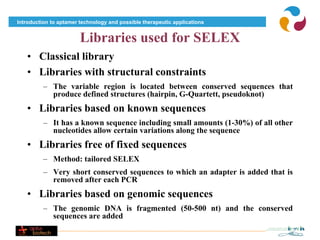
                        Libraries used for SELEX
   • Classical library
   • Libraries with structural constraints
          – The variable region is located between conserved sequences that
            produce defined structures (hairpin, G-Quartett, pseudoknot)
   • Libraries based on known sequences
          – It has a known sequence including small amounts (1-30%) of all other
            nucleotides allow certain variations along the sequence
   • Libraries free of fixed sequences
          – Method: tailored SELEX
          – Very short conserved sequences to which an adapter is added that is
            removed after each PCR
   • Libraries based on genomic sequences
          – The genomic DNA is fragmented (50-500 nt) and the conserved
            sequences are added
Introduction to aptamer technology and possible therapeutic applications


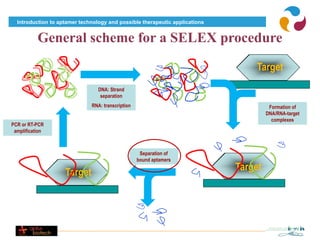
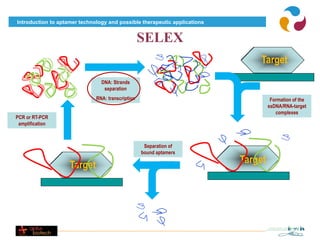
           General scheme for a SELEX procedure
                                                                                 Target
                                 DNA: Strand
                                  separation
                              RNA: transcription                                       Formation of
                                                                                      DNA/RNA-target
                                                                                        complexes
PCR or RT-PCR
 amplification


                                                    Separation of
                                                   bound aptamers
                                                                             Target
                    Target
Introduction to aptamer technology and possible therapeutic applications


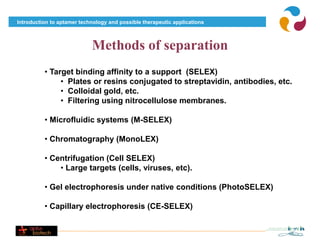
                            Methods of separation
          • Target binding affinity to a support (SELEX)
               • Plates or resins conjugated to streptavidin, antibodies, etc.
               • Colloidal gold, etc.
               • Filtering using nitrocellulose membranes.

          • Microfluidic systems (M-SELEX)

          • Chromatography (MonoLEX)

          • Centrifugation (Cell SELEX)
              • Large targets (cells, viruses, etc).

          • Gel electrophoresis under native conditions (PhotoSELEX)

          • Capillary electrophoresis (CE-SELEX)
Introduction to aptamer technology and possible therapeutic applications


                                                   SELEX
                                                                               Target
                                DNA: Strands
                                 separation
                              RNA: transcription                                     Formation of the
                                                                                    ssDNA/RNA-target
                                                                                       complexes
PCR or RT-PCR
 amplification


                                                    Separation of
                                                   bound aptamers
                                                                           Target
                    Target
Introduction to aptamer technology and possible therapeutic applications


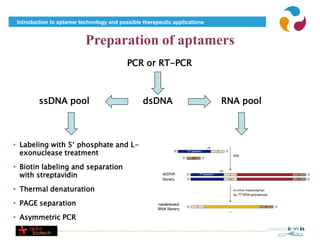
                           Preparation of aptamers
                                           PCR or RT-PCR


         ssDNA pool                              dsDNA                      RNA pool


• Labeling with 5‘ phosphate and L-
  exonuclease treatment
• Biotin labeling and separation
  with streptavidin
• Thermal denaturation
• PAGE separation
• Asymmetric PCR
Introduction to aptamer technology and possible therapeutic applications


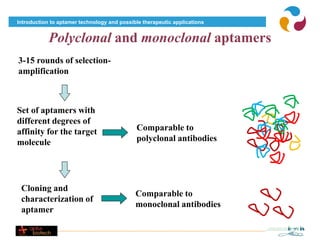
            Polyclonal and monoclonal aptamers
3-15 rounds of selection-
amplification


Set of aptamers with
different degrees of
affinity for the target                       Comparable to
molecule                                      polyclonal antibodies


 Cloning and
                                             Comparable to
 characterization of
                                             monoclonal antibodies
 aptamer
Introduction to aptamer technology and possible therapeutic applications


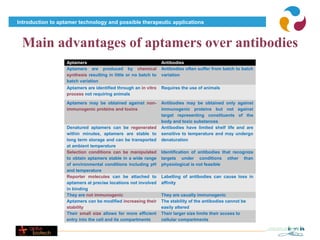
 Main advantages of aptamers over antibodies
                   Aptamers                                       Antibodies
                   Aptamers are produced by chemical              Antibodies often suffer from batch to batch
                   synthesis resulting in little or no batch to   variation
                   batch variation
                   Aptamers are identified through an in vitro    Requires the use of animals
                   process not requiring animals

                   Aptamers may be obtained against non-          Antibodies may be obtained only against
                   immunogenic proteins and toxins                immunogenic proteins but not against
                                                                  target representing constituents of the
                                                                  body and toxic substances
                   Denatured aptamers can be regenerated          Antibodies have limited shelf life and are
                   within minutes, aptamers are stable to         sensitive to temperature and may undergo
                   long term storage and can be transported       denaturation
                   at ambient temperature
                   Selection conditions can be manipulated        Identification of antibodies that recognize
                   to obtain aptamers stable in a wide range      targets under conditions other than
                   of environmental conditions including pH       physiological is not feasible
                   and temperature
                   Reporter molecules can be attached to          Labelling of antibodies can cause loss in
                   aptamers at precise locations not involved     affinity
                   in binding
                   They are not immunogenic                       They are usually immunogenic
                   Aptamers can be modified increasing their      The stability of the antibodies cannot be
                   stability                                      easily altered
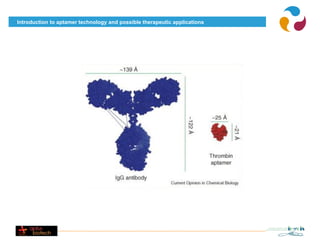
                   Their small size allows for more efficient     Their larger size limits their access to
                   entry into the cell and its compartments       cellular compartments
Introduction to aptamer technology and possible therapeutic applications


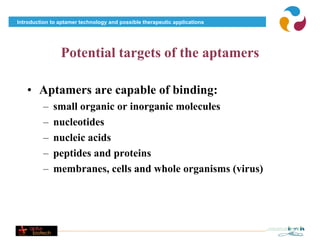
                Potential targets of the aptamers

   • Aptamers are capable of binding:
          –   small organic or inorganic molecules
          –   nucleotides
          –   nucleic acids
          –   peptides and proteins
          –   membranes, cells and whole organisms (virus)
Introduction to aptamer technology and possible therapeutic applications


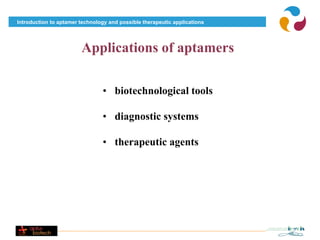
                        Applications of aptamers

                                • biotechnological tools

                                • diagnostic systems

                                • therapeutic agents
Introduction to aptamer technology and possible therapeutic applications


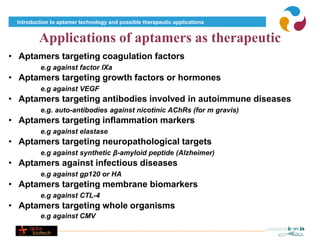
         Applications of aptamers as therapeutic
• Aptamers targeting coagulation factors
          e.g against factor IXa
• Aptamers targeting growth factors or hormones
          e.g against VEGF
• Aptamers targeting antibodies involved in autoimmune diseases
          e.g. auto-antibodies against nicotinic AChRs (for m gravis)
• Aptamers targeting inflammation markers
          e.g against elastase
• Aptamers targeting neuropathological targets
          e.g against synthetic β-amyloid peptide (Alzheimer)
• Aptamers against infectious diseases
          e.g against gp120 or HA
• Aptamers targeting membrane biomarkers
          e.g against CTL-4
• Aptamers targeting whole organisms
          e.g against CMV
Introduction to aptamer technology and possible therapeutic applications


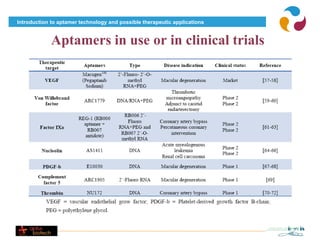
             Aptamers in use or in clinical trials
Introduction to aptamer technology and possible therapeutic applications


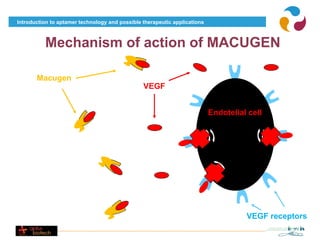
         Mechanism of action of MACUGEN

• Macugen is a chemically synthesized aptamer that binds to and
  inhibits the function of VEGF.

• VEGF is a protein that plays an important role in the abnormal
  growth of blood vessels associated with AMD (age-related
  macular degeneration) or DME (diabetic macular edema).
Introduction to aptamer technology and possible therapeutic applications


          Mechanism of action of MACUGEN

       Macugen
                                                VEGF


                                                                           Endotelial cell


                                                                                     VEGF receptors
Introduction to aptamer technology and possible therapeutic applications


                          Projects of the laboratory
•    Biotechnological or diagnostic tool
      –   Aptamers against proteins of Leishmania (LiKmp-11, LiH2A, LiH3, LiPABP) (Dr. Manuel Soto, Centro de Biología
          Molecular Severo Ochoa-UAM, Madrid; Aptus Biotech)
      –   Aptamers against NL1Tc endonuclease of T. cruzi (Dr. Manuel Carlos López, Instituto de Parasitología y Biomedicina
          “López Neyra”, Granada)
      –   Aptamers against CD3, CD4 and CD8 (Dr. Ernesto Roldán, Hospital Ramón y Cajal, Madrid)
      –   Aptamers against β-amiloid peptide and “tau” protein (Drs. Ginés Lifante and Juan Jiménez, Universidad Autónoma
          de Madrid)
      –   Aptamers against bacteria (Bioapter SL)
      –   Aptamers against Apo A IV (Dr. Mª Dolores López Tejero. Facultad de Biología. Universidad de Barcelona y
          CEREMET-UB, Barcelona; Aptus Biotech)

•    Therapeutic agents
      –   Aptamers against proteins involved in translation (4E-BP1, eIF4E and Mnk1 kinase) (Dr. M. Elena Martín, Hospital
          Ramón y Cajal, Madrid)
      –   Aptamers against TLR-4 (Dr. Ignacio Lizasoaín, U. Complutense, Madrid; Aptus Biotech)
      –   Aptamers against purinergic receptors T2X (Dr. Juan M. Gómez, Hospital Ramón y Cajal, Madrid)
      –   Aptamers against abscisic acid (ABA) (Dr. Elena Zocchi, Universidad de Génova, Italia)
Introduction to aptamer technology and possible therapeutic applications


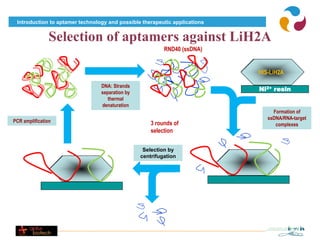
                Selection of aptamers against LiH2A
                                                          RND40 (ssDNA)


                                                                            HIS-LiH2A

                                 DNA: Strands
                                 separation by
                                                                            Ni2+ resin
                                    thermal
                                 denaturation
                                                                                 Formation of
                                                                               ssDNA/RNA-target
PCR amplification                                    3 rounds of                  complexes
                                                     selection


                                                  Selection by
                                                 centrifugation
Introduction to aptamer technology and possible therapeutic applications


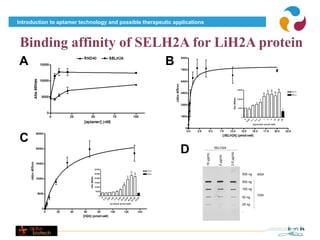
 Binding affinity of SELH2A for LiH2A protein
A                                                        B


C
                                                              D                       SELH2A


                                                                                                  2.5 μg/mL
                                                                           10 μg/mL


                                                                                        5 μg/mL
                                                                                                              500 ng   BSA

                                                                                                              500 ng

                                                                                                              100 ng
                                                                                                                       H2A
                                                                                                              50 ng

                                                                                                              25 ng

                                                                                                              -
Introduction to aptamer technology and possible therapeutic applications


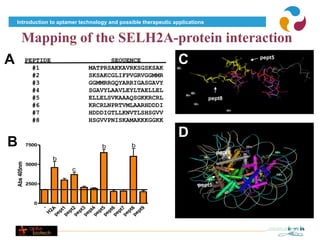
         Mapping of the SELH2A-protein interaction
A               PEPTIDE
                  #1
                                         SEQUENCE
                                   MATPRSAKKAVRKSGSKSAK
                                                                  C                      pept5


                  #2               SKSAKCGLIFPVGRVGGMMR
                  #3               GGMMRRGQYARRIGASGAVY
                  #4               SGAVYLAAVLEYLTAELLEL
                  #5               ELLELSVKAAAQSGKKRCRL                        pept8
                  #6               KRCRLNPRTVMLAARHDDDI
                  #7               HDDDIGTLLKNVTLSHSGVV
                  #8               HSGVVPNISKAMAKKKGGKK
                  #9               KGGKKGKATPSA
                                                                  D
B               7500                  b         b
                                                                                 pept8
                           b
    Abs 405nm


                5000
                               c

                2500                                                     pept5


                  0
                            -
                          2A

                       pe 1
                       pe 2
                       pe 3
                       pe 4
                       pe 5
                       pe 6
                       pe 7
                       pe 8
                            9
                         pt
                         pt
                         pt
                         pt
                         pt
                         pt
                         pt
                         pt
                         pt
                       H
                       pe
Introduction to aptamer technology and possible therapeutic applications


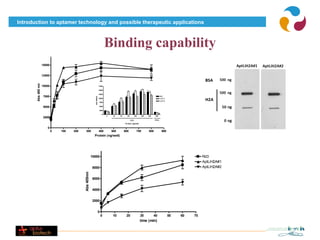
                                                                               Binding capability
A                   15000
                                                                                            B
                    12500
       Abs 405 nm


                    10000                                              17500

                                                                       15000

                                                                       12500
                    7500                                   Abs 405nm                                                                   Rd3
                                                                       10000                                                           LiAPT1
                                                                                                                                       LiAPT2
                                                                       7500


                    5000                                               5000

                                                                       2500

                                                                           0
                                                                               0    25   50     100         200     400   800    800
                    2500
                                                                                                      H2A                       BSA
                                                                                              Protein (ng/well)

                       0
                            0   100   200    300                       400         500        600             700         800            900
                                                          Protein (ng/well)


                                      C                 10000                                                                                                  Rd3
                                                                                                                                                               AptLiH2A#1
                                                        8000                                                                                                   AptLiH2A#2
                                            Abs 405nm


                                                        6000


                                                        4000


                                                        2000


                                                                       0
                                                                           0        10         20                 30            40              50   60   70
                                                                                                                  time (min)
Introduction to aptamer technology and possible therapeutic applications


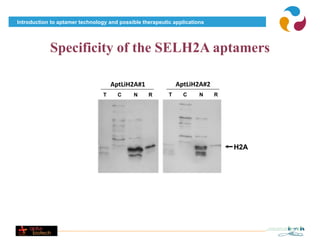
            Specificity of the SELH2A aptamers

                                     AptLiH2A#1               AptLiH2A#2
                                 T     C    N     R       T     C     N    R


                                                                               H2A
Introduction to aptamer technology and possible therapeutic applications


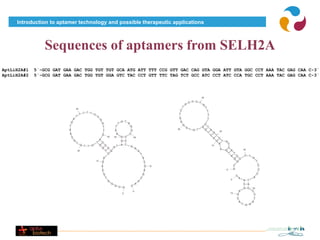
                 Sequences of aptamers from SELH2A
AptLiH2A#1   5´-GCG GAT GAA GAC TGG TGT TGT GCA ATG ATT TTT CCG GTT GAC CAG GTA GGA ATT GTA GGC CCT AAA TAC GAG CAA C-3´
AptLiH2A#2   5´-GCG GAT GAA GAC TGG TGT GGA GTC TAC CCT GTT TTC TAG TCT GCC ATC CCT ATC CCA TGC CCT AAA TAC GAG CAA C-3´
Introduction to aptamer technology and possible therapeutic applications


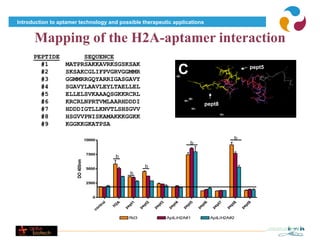
      Mapping of the H2A-aptamer interaction
A     PEPTIDE
        #1
                       SEQUENCE
                  MATPRSAKKAVRKSGSKSAK
        #2
        #3
                  SKSAKCGLIFPVGRVGGMMR
                  GGMMRRGQYARRIGASGAVY
                                                                                       C                                   pept5


        #4        SGAVYLAAVLEYLTAELLEL
        #5        ELLELSVKAAAQSGKKRCRL
        #6        KRCRLNPRTVMLAARHDDDI                                                            pept8
        #7        HDDDIGTLLKNVTLSHSGVV
        #8        HSGVVPNISKAMAKKKGGKK
        #9        KGGKKGKATPSA

               B                  10000
                                                                                           b
                                                                                                                   b


                                  7500
                                                   b
                       DO 405nm


                                  5000
                                                                  b
                                                          b

                                  2500


                                     0
                                           l

                                               2A


                                                           1


                                                                   2


                                                                           3


                                                                                   4


                                                                                           5


                                                                                                   6


                                                                                                           7


                                                                                                                   8


                                                                                                                           9
                                         ro


                                                         pt


                                                                 pt


                                                                         pt


                                                                                 pt


                                                                                         pt


                                                                                                 pt


                                                                                                         pt


                                                                                                                 pt


                                                                                                                         pt
                                       nt


                                               H


                                                       pe


                                                               pe


                                                                       pe


                                                                               pe


                                                                                       pe


                                                                                               pe


                                                                                                       pe


                                                                                                               pe


                                                                                                                       pe
                                     co


                                                         Rd3                   AptLiH2A#1              AptLiH2A#2
Introduction to aptamer technology and possible therapeutic applications


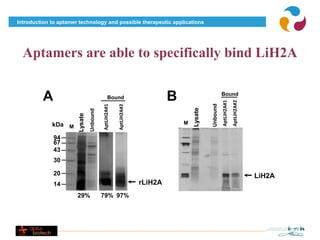
  Aptamers are able to specifically bind LiH2A


         A                                      Bound                        B                          Bound


                                                                                                        AptLiH2A#1
                                                                                                                     AptLiH2A#2
                                                                                              Unbound
                                          AptLiH2A#1

                                                       AptLiH2A#2


                                                                                     Lysate
                                Unbound
                       Lysate


             kDa M                                                               M

              94
              67
              43
              30

              20                                                                                                                  LiH2A
              14                                                    rLiH2A
                       29%                79% 97%
Introduction to aptamer technology and possible therapeutic applications


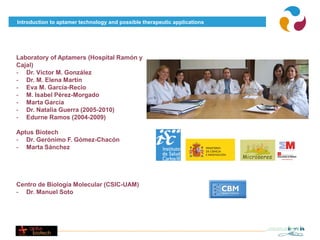
Laboratory of Aptamers (Hospital Ramón y
Cajal)
- Dr. Víctor M. González
- Dr. M. Elena Martín
- Eva M. García-Recio
- M. Isabel Pérez-Morgado
- Marta García
- Dr. Natalia Guerra (2005-2010)
- Edurne Ramos (2004-2009)

Aptus Biotech
- Dr. Gerónimo F. Gómez-Chacón
- Marta Sánchez


Centro de Biología Molecular (CSIC-UAM)
- Dr. Manuel Soto

Víctor M. González - Introducción a la tecnología de aptámeros y posibles aplicaciones terapéuticas

  • 1.
    Introduction to aptamertechnology and possible therapeutic applications APTÁMEROS: NUEVAS POSIBILIDADES DE DESARROLLO Y APLICACIONES EN BIOTECNOLOGÍA 17 de Noviembre de 2011 Introducción a la tecnología de aptámeros y posibles aplicaciones terapéuticas Víctor M. González Servicio de Bioquímica-Investigación Hospital Ramón y Cajal (IRYCIS)
  • 2.
    Introduction to aptamertechnology and possible therapeutic applications APTAMERS: NEW DEVELOPMENT POSSIBILITIES AND APPLICATIONS IN BIOTECHNOLOGY November 17, 2011 Introduction to aptamer technology and possible therapeutic applications Víctor M. González Servicio de Bioquímica-Investigación Hospital Ramón y Cajal (IRYCIS)
  • 3.
    Introduction to aptamertechnology and possible therapeutic applications Number of publications related to aptamers (PubMed) 600 500 Publications 400 300 200 100 0 Year
  • 4.
    Introduction to aptamertechnology and possible therapeutic applications What is an aptamer? ssDNA TGATCC ATTCGGATCAAGCTAGC RNA UGAUCC AUUCGGAUCAAGCUAGC ATTCGGATCAAGCTAGC CCTAGT
  • 5.
    Introduction to aptamertechnology and possible therapeutic applications Secondary structures Chastain, M. and Tinoco Jr., I., (1991) Prog. Nucleic Acid Res. Mol. Biol. 41, 131-177.
  • 6.
    Introduction to aptamertechnology and possible therapeutic applications Tertiary structure The folded aptamers adopt stable conformations that allow molecular recognition of the target Overview of the Vitamin B12 aptamer structure Nature Structural Biology, 7(1):53-57
  • 7.
    Introduction to aptamertechnology and possible therapeutic applications Aptamers are obtained… • …from libraries of oligonucleotides with random sequences • …by an in vitro method called Systematic Evolution of Ligands by Exponential Enrichment (SELEX) consisting of successive rounds of selection- amplification
  • 8.
    Introduction to aptamertechnology and possible therapeutic applications Oligonucleotide library Random positions Oligo 1 20-90 N Oligo 2 PCR amplification Theoretical : N = 40 440 = ~ 1024 different molecules Real: ~ 1015 different molecules
  • 9.
    Introduction to aptamertechnology and possible therapeutic applications Libraries used for SELEX • Classical library • Libraries with structural constraints – The variable region is located between conserved sequences that produce defined structures (hairpin, G-Quartett, pseudoknot) • Libraries based on known sequences – It has a known sequence including small amounts (1-30%) of all other nucleotides allow certain variations along the sequence • Libraries free of fixed sequences – Method: tailored SELEX – Very short conserved sequences to which an adapter is added that is removed after each PCR • Libraries based on genomic sequences – The genomic DNA is fragmented (50-500 nt) and the conserved sequences are added
  • 10.
    Introduction to aptamertechnology and possible therapeutic applications General scheme for a SELEX procedure Target DNA: Strand separation RNA: transcription Formation of DNA/RNA-target complexes PCR or RT-PCR amplification Separation of bound aptamers Target Target
  • 11.
    Introduction to aptamertechnology and possible therapeutic applications Methods of separation • Target binding affinity to a support (SELEX) • Plates or resins conjugated to streptavidin, antibodies, etc. • Colloidal gold, etc. • Filtering using nitrocellulose membranes. • Microfluidic systems (M-SELEX) • Chromatography (MonoLEX) • Centrifugation (Cell SELEX) • Large targets (cells, viruses, etc). • Gel electrophoresis under native conditions (PhotoSELEX) • Capillary electrophoresis (CE-SELEX)
  • 12.
    Introduction to aptamertechnology and possible therapeutic applications SELEX Target DNA: Strands separation RNA: transcription Formation of the ssDNA/RNA-target complexes PCR or RT-PCR amplification Separation of bound aptamers Target Target
  • 13.
    Introduction to aptamertechnology and possible therapeutic applications Preparation of aptamers PCR or RT-PCR ssDNA pool dsDNA RNA pool • Labeling with 5‘ phosphate and L- exonuclease treatment • Biotin labeling and separation with streptavidin • Thermal denaturation • PAGE separation • Asymmetric PCR
  • 14.
    Introduction to aptamertechnology and possible therapeutic applications Polyclonal and monoclonal aptamers 3-15 rounds of selection- amplification Set of aptamers with different degrees of affinity for the target Comparable to molecule polyclonal antibodies Cloning and Comparable to characterization of monoclonal antibodies aptamer
  • 15.
    Introduction to aptamertechnology and possible therapeutic applications Main advantages of aptamers over antibodies Aptamers Antibodies Aptamers are produced by chemical Antibodies often suffer from batch to batch synthesis resulting in little or no batch to variation batch variation Aptamers are identified through an in vitro Requires the use of animals process not requiring animals Aptamers may be obtained against non- Antibodies may be obtained only against immunogenic proteins and toxins immunogenic proteins but not against target representing constituents of the body and toxic substances Denatured aptamers can be regenerated Antibodies have limited shelf life and are within minutes, aptamers are stable to sensitive to temperature and may undergo long term storage and can be transported denaturation at ambient temperature Selection conditions can be manipulated Identification of antibodies that recognize to obtain aptamers stable in a wide range targets under conditions other than of environmental conditions including pH physiological is not feasible and temperature Reporter molecules can be attached to Labelling of antibodies can cause loss in aptamers at precise locations not involved affinity in binding They are not immunogenic They are usually immunogenic Aptamers can be modified increasing their The stability of the antibodies cannot be stability easily altered Their small size allows for more efficient Their larger size limits their access to entry into the cell and its compartments cellular compartments
  • 16.
    Introduction to aptamertechnology and possible therapeutic applications
  • 17.
    Introduction to aptamertechnology and possible therapeutic applications Potential targets of the aptamers • Aptamers are capable of binding: – small organic or inorganic molecules – nucleotides – nucleic acids – peptides and proteins – membranes, cells and whole organisms (virus)
  • 18.
    Introduction to aptamertechnology and possible therapeutic applications Applications of aptamers • biotechnological tools • diagnostic systems • therapeutic agents
  • 19.
    Introduction to aptamertechnology and possible therapeutic applications Applications of aptamers as therapeutic • Aptamers targeting coagulation factors e.g against factor IXa • Aptamers targeting growth factors or hormones e.g against VEGF • Aptamers targeting antibodies involved in autoimmune diseases e.g. auto-antibodies against nicotinic AChRs (for m gravis) • Aptamers targeting inflammation markers e.g against elastase • Aptamers targeting neuropathological targets e.g against synthetic β-amyloid peptide (Alzheimer) • Aptamers against infectious diseases e.g against gp120 or HA • Aptamers targeting membrane biomarkers e.g against CTL-4 • Aptamers targeting whole organisms e.g against CMV
  • 20.
    Introduction to aptamertechnology and possible therapeutic applications Aptamers in use or in clinical trials
  • 21.
    Introduction to aptamertechnology and possible therapeutic applications Mechanism of action of MACUGEN • Macugen is a chemically synthesized aptamer that binds to and inhibits the function of VEGF. • VEGF is a protein that plays an important role in the abnormal growth of blood vessels associated with AMD (age-related macular degeneration) or DME (diabetic macular edema).
  • 22.
    Introduction to aptamertechnology and possible therapeutic applications Mechanism of action of MACUGEN Macugen VEGF Endotelial cell VEGF receptors
  • 23.
    Introduction to aptamertechnology and possible therapeutic applications Projects of the laboratory • Biotechnological or diagnostic tool – Aptamers against proteins of Leishmania (LiKmp-11, LiH2A, LiH3, LiPABP) (Dr. Manuel Soto, Centro de Biología Molecular Severo Ochoa-UAM, Madrid; Aptus Biotech) – Aptamers against NL1Tc endonuclease of T. cruzi (Dr. Manuel Carlos López, Instituto de Parasitología y Biomedicina “López Neyra”, Granada) – Aptamers against CD3, CD4 and CD8 (Dr. Ernesto Roldán, Hospital Ramón y Cajal, Madrid) – Aptamers against β-amiloid peptide and “tau” protein (Drs. Ginés Lifante and Juan Jiménez, Universidad Autónoma de Madrid) – Aptamers against bacteria (Bioapter SL) – Aptamers against Apo A IV (Dr. Mª Dolores López Tejero. Facultad de Biología. Universidad de Barcelona y CEREMET-UB, Barcelona; Aptus Biotech) • Therapeutic agents – Aptamers against proteins involved in translation (4E-BP1, eIF4E and Mnk1 kinase) (Dr. M. Elena Martín, Hospital Ramón y Cajal, Madrid) – Aptamers against TLR-4 (Dr. Ignacio Lizasoaín, U. Complutense, Madrid; Aptus Biotech) – Aptamers against purinergic receptors T2X (Dr. Juan M. Gómez, Hospital Ramón y Cajal, Madrid) – Aptamers against abscisic acid (ABA) (Dr. Elena Zocchi, Universidad de Génova, Italia)
  • 24.
    Introduction to aptamertechnology and possible therapeutic applications Selection of aptamers against LiH2A RND40 (ssDNA) HIS-LiH2A DNA: Strands separation by Ni2+ resin thermal denaturation Formation of ssDNA/RNA-target PCR amplification 3 rounds of complexes selection Selection by centrifugation
  • 25.
    Introduction to aptamertechnology and possible therapeutic applications Binding affinity of SELH2A for LiH2A protein A B C D SELH2A 2.5 μg/mL 10 μg/mL 5 μg/mL 500 ng BSA 500 ng 100 ng H2A 50 ng 25 ng -
  • 26.
    Introduction to aptamertechnology and possible therapeutic applications Mapping of the SELH2A-protein interaction A PEPTIDE #1 SEQUENCE MATPRSAKKAVRKSGSKSAK C pept5 #2 SKSAKCGLIFPVGRVGGMMR #3 GGMMRRGQYARRIGASGAVY #4 SGAVYLAAVLEYLTAELLEL #5 ELLELSVKAAAQSGKKRCRL pept8 #6 KRCRLNPRTVMLAARHDDDI #7 HDDDIGTLLKNVTLSHSGVV #8 HSGVVPNISKAMAKKKGGKK #9 KGGKKGKATPSA D B 7500 b b pept8 b Abs 405nm 5000 c 2500 pept5 0 - 2A pe 1 pe 2 pe 3 pe 4 pe 5 pe 6 pe 7 pe 8 9 pt pt pt pt pt pt pt pt pt H pe
  • 27.
    Introduction to aptamertechnology and possible therapeutic applications Binding capability A 15000 B 12500 Abs 405 nm 10000 17500 15000 12500 7500 Abs 405nm Rd3 10000 LiAPT1 LiAPT2 7500 5000 5000 2500 0 0 25 50 100 200 400 800 800 2500 H2A BSA Protein (ng/well) 0 0 100 200 300 400 500 600 700 800 900 Protein (ng/well) C 10000 Rd3 AptLiH2A#1 8000 AptLiH2A#2 Abs 405nm 6000 4000 2000 0 0 10 20 30 40 50 60 70 time (min)
  • 28.
    Introduction to aptamertechnology and possible therapeutic applications Specificity of the SELH2A aptamers AptLiH2A#1 AptLiH2A#2 T C N R T C N R H2A
  • 29.
    Introduction to aptamertechnology and possible therapeutic applications Sequences of aptamers from SELH2A AptLiH2A#1 5´-GCG GAT GAA GAC TGG TGT TGT GCA ATG ATT TTT CCG GTT GAC CAG GTA GGA ATT GTA GGC CCT AAA TAC GAG CAA C-3´ AptLiH2A#2 5´-GCG GAT GAA GAC TGG TGT GGA GTC TAC CCT GTT TTC TAG TCT GCC ATC CCT ATC CCA TGC CCT AAA TAC GAG CAA C-3´
  • 30.
    Introduction to aptamertechnology and possible therapeutic applications Mapping of the H2A-aptamer interaction A PEPTIDE #1 SEQUENCE MATPRSAKKAVRKSGSKSAK #2 #3 SKSAKCGLIFPVGRVGGMMR GGMMRRGQYARRIGASGAVY C pept5 #4 SGAVYLAAVLEYLTAELLEL #5 ELLELSVKAAAQSGKKRCRL #6 KRCRLNPRTVMLAARHDDDI pept8 #7 HDDDIGTLLKNVTLSHSGVV #8 HSGVVPNISKAMAKKKGGKK #9 KGGKKGKATPSA B 10000 b b 7500 b DO 405nm 5000 b b 2500 0 l 2A 1 2 3 4 5 6 7 8 9 ro pt pt pt pt pt pt pt pt pt nt H pe pe pe pe pe pe pe pe pe co Rd3 AptLiH2A#1 AptLiH2A#2
  • 31.
    Introduction to aptamertechnology and possible therapeutic applications Aptamers are able to specifically bind LiH2A A Bound B Bound AptLiH2A#1 AptLiH2A#2 Unbound AptLiH2A#1 AptLiH2A#2 Lysate Unbound Lysate kDa M M 94 67 43 30 20 LiH2A 14 rLiH2A 29% 79% 97%
  • 32.
    Introduction to aptamertechnology and possible therapeutic applications Laboratory of Aptamers (Hospital Ramón y Cajal) - Dr. Víctor M. González - Dr. M. Elena Martín - Eva M. García-Recio - M. Isabel Pérez-Morgado - Marta García - Dr. Natalia Guerra (2005-2010) - Edurne Ramos (2004-2009) Aptus Biotech - Dr. Gerónimo F. Gómez-Chacón - Marta Sánchez Centro de Biología Molecular (CSIC-UAM) - Dr. Manuel Soto