WELCOME
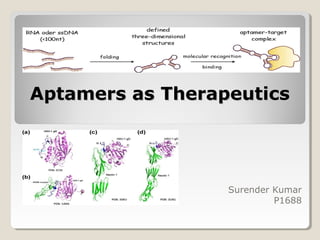
Aptamers as TherapeuticsAptamers as Therapeutics
Surender Kumar
P1688
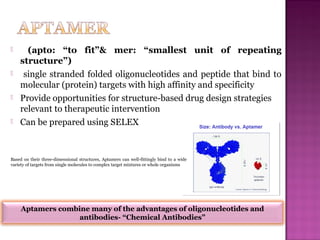
 (apto: “to fit”& mer: “smallest unit of repeating
structure”)
 single stranded folded oligonucleotides and peptide that bind to
molecular (protein) targets with high affinity and specificity
 Provide opportunities for structure-based drug design strategies
relevant to therapeutic intervention
 Can be prepared using SELEX
Aptamers combine many of the advantages of oligonucleotides and
antibodies- “Chemical Antibodies”
Based on their three-dimensional structures, Aptamers can well-fittingly bind to a wide
variety of targets from single molecules to complex target mixtures or whole organisms
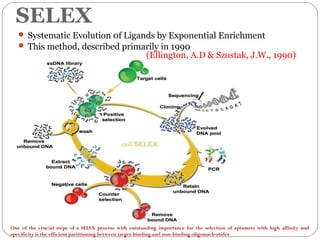
SELEX
 Systematic Evolution 0f Ligands by Exponential Enrichment
 This method, described primarily in 1990
(Ellington, A.D & Szostak, J.W., 1990)
One of the crucial steps of a SELEX process with outstanding importance for the selection of aptamers with high affinity and
specificity is the efficient partitioning between target-binding and non-binding oligonucleotides
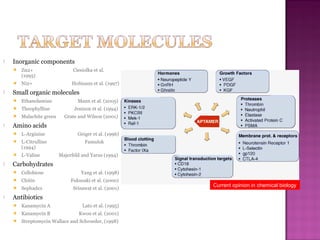
 Inorganic components
 Zn2+ Ciesiolka et al.
(1995)
 Ni2+ Hofmann et al. (1997)
 Small organic molecules
 Ethanolamine Mann et al. (2005)
 Theophylline Jenison et al. (1994)
 Malachite green Grate and Wilson (2001)
 Amino acids
 L-Arginine Geiger et al. (1996)
 L-Citrulline Famulok
(1994)
 L-Valine Majerfeld and Yarus (1994)
 Carbohydrates
 Cellobiose Yang et al. (1998)
 Chitin Fukusaki et al. (2000)
 Sephadex Srisawat et al. (2001)
 Antibiotics
 Kanamycin A Lato et al. (1995)
 Kanamycin B Kwon et al. (2001)
 Streptomycin Wallace and Schroeder, (1998)
Current opinion in chemical biology
Random DNA Oligonucleotide Library
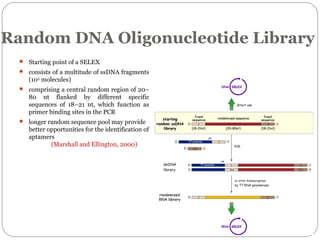
 Starting point of a SELEX
 consists of a multitude of ssDNA fragments
(1015
molecules)
 comprising a central random region of 20–
80 nt flanked by different specific
sequences of 18–21 nt, which function as
primer binding sites in the PCR
 longer random sequence pool may provide
better opportunities for the identification of
aptamers
(Marshall and Ellington, 2000)
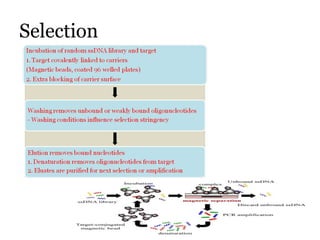
Selection
 quantification of the enriched target-binding oligonucleotides as
well as the amount of non-binding oligonucleotides of each
selection round have to be determined.
 Radioactive markers
(Beinoraviciute-Kellner et al., 2005; Ellington and Szostak, 1990; Shi et al., 2002)
 Fluorescence labels may be used for quantification
(Stoltenburg et al., 2005; Davis et al., 1997; Rhie et al., 2003)
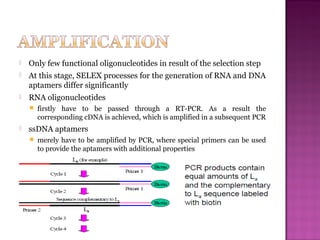
 Only few functional oligonucleotides in result of the selection step
 At this stage, SELEX processes for the generation of RNA and DNA
aptamers differ significantly
 RNA oligonucleotides
 firstly have to be passed through a RT-PCR. As a result the
corresponding cDNA is achieved, which is amplified in a subsequent PCR
 ssDNA aptamers
 merely have to be amplified by PCR, where special primers can be used
to provide the aptamers with additional properties
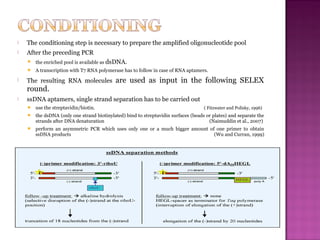
 The conditioning step is necessary to prepare the amplified oligonucleotide pool
 After the preceding PCR
 the enriched pool is available as dsDNA.
 A transcription with T7 RNA polymerase has to follow in case of RNA aptamers.
 The resulting RNA molecules are used as input in the following SELEX
round.
 ssDNA aptamers, single strand separation has to be carried out
 use the streptavidin/biotin. ( Fitzwater and Polisky, 1996)
 the dsDNA (only one strand biotinylated) bind to streptavidin surfaces (beads or plates) and separate the
strands after DNA denaturation (Naimuddin et al., 2007)
 perform an asymmetric PCR which uses only one or a much bigger amount of one primer to obtain
ssDNA products (Wu and Curran, 1999)
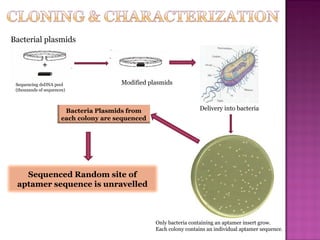
Bacterial plasmids
Sequencing dsDNA pool
(thousands of sequences)
Modified plasmids
Delivery into bacteria
Only bacteria containing an aptamer insert grow.
Each colony contains an individual aptamer sequence.
Bacteria Plasmids from
each colony are sequenced
Sequenced Random site of
aptamer sequence is unravelled
 chemically modified oligonucleotide libraries
 with the goal to increase the complexity of a library
 To introduce new features like functional groups providing new possibilities for the
interaction with target molecules
 To enhance the stability of oligonucleotide conformations
 To increase the resistance to nucleases
(Jayasena, 1999; Klussmann, 2006; Kopylov and Spiridonova, 2000; Kusser, 2000)
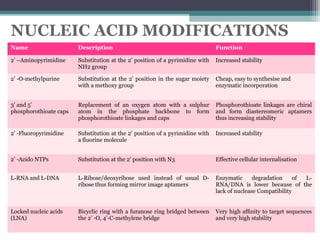
NUCLEIC ACID MODIFICATIONS
Name Description Function
2’ –Aminopyrimidine Substitution at the 2’ position of a pyrimidine with
NH2 group
Increased stability
2’ -O-methylpurine Substitution at the 2’ position in the sugar moiety
with a methoxy group
Cheap, easy to synthesise and
enzymatic incorporation
3’ and 5’
phosphorothioate caps
Replacement of an oxygen atom with a sulphur
atom in the phosphate backbone to form
phosphorothioate linkages and caps
Phosphorothioate linkages are chiral
and form diastereomeric aptamers
thus increasing stability
2’ -Fluoropyrimidine Substitution at the 2’ position of a pyrimidine with
a fluorine molecule
Increased stability
2’ -Azido NTPs Substitution at the 2’ position with N3 Effective cellular internalisation
L-RNA and L-DNA L-Ribose/deoxyribose used instead of usual D-
ribose thus forming mirror image aptamers
Enzymatic degradation of L-
RNA/DNA is lower because of the
lack of nuclease Compatibility
Locked nucleic acids
(LNA)
Bicyclic ring with a furanose ring bridged between
the 2’ -O, 4’-C-methylene bridge
Very high affinity to target sequences
and very high stability
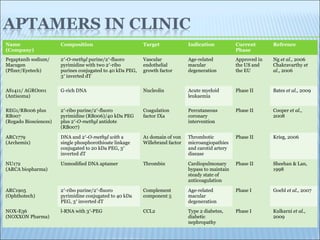
Name
(Company)
Composition Target Indication Current
Phase
Refrence
Pegaptanib sodium/
Macugen
(Pfizer/Eyetech)
2′-O-methyl purine/2′-fluoro
pyrimidine with two 2′-ribo
purines conjugated to 40 kDa PEG,
3′ inverted dT
Vascular
endothelial
growth factor
Age-related
macular
degeneration
Approved in
the US and
the EU
Ng et al., 2006
Chakravarthy et
al., 2006
AS1411/ AGRO001
(Antisoma)
G-rich DNA Nucleolin Acute myeloid
leukaemia
Phase II Bates et al., 2009
REG1/RB006 plus
RB007
(Regado Biosciences)
2′-ribo purine/2′-fluoro
pyrimidine (RB006)/40 kDa PEG
plus 2′-O-methyl antidote
(RB007)
Coagulation
factor IXa
Percutaneous
coronary
intervention
Phase II Cooper et al.,
2008
ARC1779
(Archemix)
DNA and 2′-O-methyl with a
single phosphorothioate linkage
conjugated to 20 kDa PEG, 3′
inverted dT
A1 domain of von
Willebrand factor
Thrombotic
microangiopathies
and carotid artery
disease
Phase II Krieg, 2006
NU172
(ARCA biopharma)
Unmodified DNA aptamer Thrombin Cardiopulmonary
bypass to maintain
steady state of
anticoagulation
Phase II Sheehan & Lan,
1998
ARC1905
(Ophthotech)
2′-ribo purine/2′-fluoro
pyrimidine conjugated to 40 kDa
PEG, 3′ inverted dT
Complement
component 5
Age-related
macular
degeneration
Phase I Goebl et al., 2007
NOX-E36
(NOXXON Pharma)
l-RNA with 3′-PEG CCL2 Type 2 diabetes,
diabetic
nephropathy
Phase I Kulkarni et al.,
2009
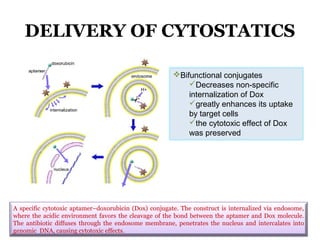
DELIVERY OF CYTOSTATICS
A specific cytotoxic aptamer–doxorubicin (Dox) conjugate. The construct is internalized via endosome,
where the acidic environment favors the cleavage of the bond between the aptamer and Dox molecule.
The antibiotic diffuses through the endosome membrane, penetrates the nucleus and intercalates into
genomic DNA, causing cytotoxic effects.
Bifunctional conjugates
Decreases non-specific
internalization of Dox
greatly enhances its uptake
by target cells
the cytotoxic effect of Dox
was preserved
 Data on drug biodistribution
 Monitoring the therapeutic effect in real time
 SPION– Apt–Dox conjugates
 Dual Purpose
 Both detection and elimination of Prostate cancer cells (PCa)
 A10 RNA aptamer specific for PSMA
SPION- Apt Conjugate
Imaged with NMR and displayed high
specificity for PSMA-expressing LNCaP
cells but not for a PMSA-non-expressing
PC-3 cell line
SPION– Apt–Dox conjugates Targeted Delivery
 Gold–Silver nanorods (Au–Ag NRs)
 high near-infrared light absorption
 Aptamer Canjugates with Au-Ag NRs
 offers spatial precision in targeted treatment
Huang, Y. F., Sefah, K., Bamrungsap, S., Chang, H. T. and Tan, W. 2008. Selective
photothermal therapy for mixed cancer cells using aptamer-conjugated nanorods. Langmuir;
24(20): 11860–5.
Huang, Y. F., Sefah, K., Bamrungsap, S., Chang, H. T. and Tan, W. 2008. Selective
photothermal therapy for mixed cancer cells using aptamer-conjugated nanorods. Langmuir;
24(20): 11860–5.
Aptamer-directed NRs
 Efficient photothermal
Convectors
 Promoted selective destruction
of the target cells.
 Efficient photothermal
Convectors
 Promoted selective destruction
of the target cells.
 aptamer–liposome conjugates
 cargo internalization via
 Fusion of membranes
 Endosome-mediated delivery of liposomes to the

lysosome
Major deficits
1.Stability
2.Nonspecific interactions which were reported
during long-period incubations
Major deficits
1.Stability
2.Nonspecific interactions which were reported
during long-period incubations
 Amphipathic unit
 hydrophilic oligonucleotide
 a hydrophobic polymer
 In aqueous solution, self-assembled into a polarized
three-dimensional structure
 Micelle system
 enables delivery of targeted intracellular drugs doped
inside the nanostructure as well as of therapeutic
aptamers into the cell by simple membrane fusion.
Micellization could be also used as a general strategy to
promote binding of low-affinity aptamers
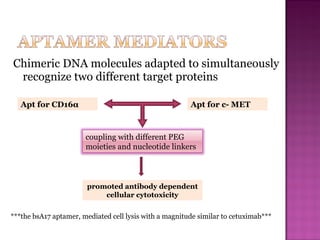
Chimeric DNA molecules adapted to simultaneously
recognize two different target proteins
Apt for CD16α Apt for c- MET
coupling with different PEG
moieties and nucleotide linkers
promoted antibody dependent
cellular cytotoxicity
***the bsA17 aptamer, mediated cell lysis with a magnitude similar to cetuximab***
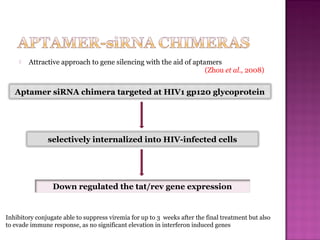
 Attractive approach to gene silencing with the aid of aptamers
(Zhou et al., 2008)
Aptamer siRNA chimera targeted at HIV1 gp120 glycoprotein
selectively internalized into HIV-infected cells
Down regulated the tat/rev gene expression
Inhibitory conjugate able to suppress viremia for up to 3 weeks after the final treatment but also
to evade immune response, as no significant elevation in interferon induced genes
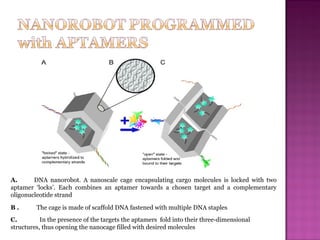
C. In the presence of the targets the aptamers fold into their three-dimensional
structures, thus opening the nanocage filled with desired molecules
A. DNA nanorobot. A nanoscale cage encapsulating cargo molecules is locked with two
aptamer ‘locks’. Each combines an aptamer towards a chosen target and a complementary
oligonucleotide strand
B . The cage is made of scaffold DNA fastened with multiple DNA staples
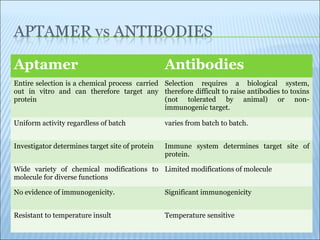
Aptamer Antibodies
Entire selection is a chemical process carried
out in vitro and can therefore target any
protein
Selection requires a biological system,
therefore difficult to raise antibodies to toxins
(not tolerated by animal) or non-
immunogenic target.
Uniform activity regardless of batch varies from batch to batch.
Investigator determines target site of protein Immune system determines target site of
protein.
Wide variety of chemical modifications to
molecule for diverse functions
Limited modifications of molecule
No evidence of immunogenicity. Significant immunogenicity
Resistant to temperature insult Temperature sensitive
 Produced chemically in a readily scalable process
 Not prone to viral or bacterial contamination
 Non-immunogenic
 more efficient entry into biological compartments
 Able to select for and against specific targets and to select against
cell-surface targets
 Can usually be reversibly denatured
 Dyes or functional groups can be readily introduced during
synthesis
 Pharmacokinetic and other systemic properties are variable
and often hard to predict
 Small size makes them susceptible to renal filtration
 have a shorter half-life
 Unmodified aptamers are highly susceptible to serum
degradation
 Aptamer technologies are currently largely covered by a
single intellectual property portfolio
 Aptamers can be optimized for activity and persistence under physiological conditions
during selection or during structure–activity relationship and medicinal chemistry studies
conducted after discovery
Guo et al., 2008
 Addition of conjugation partners such as polyethylene glycol or cholesterol can increase
circulating half-life
Healy et al., 2004
 Chemical modifications incorporated into the sugars or internucleotide phosphodiester
linkages enhance nuclease resistance
Burmeister et al., 2006
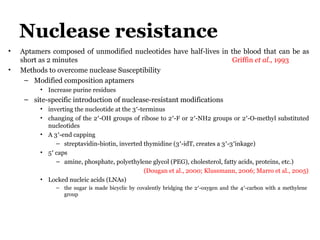
Nuclease resistance
• Aptamers composed of unmodified nucleotides have half-lives in the blood that can be as
short as 2 minutes Griffin et al., 1993
• Methods to overcome nuclease Susceptibility
– Modified composition aptamers
• Increase purine residues
– site-specific introduction of nuclease-resistant modifications
• inverting the nucleotide at the 3′-terminus
• changing of the 2′-OH groups of ribose to 2′-F or 2′-NH2 groups or 2′-O-methyl substituted
nucleotides
• A 3′-end capping
– streptavidin-biotin, inverted thymidine (3′-idT, creates a 3′-3′inkage)
• 5′ caps
– amine, phosphate, polyethylene glycol (PEG), cholesterol, fatty acids, proteins, etc.)
(Dougan et al., 2000; Klussmann, 2006; Marro et al., 2005)
• Locked nucleic acids (LNAs)
– the sugar is made bicyclic by covalently bridging the 2′-oxygen and the 4′-carbon with a methylene
group
 molecular mass cutoff for the renal
glomerulus is 30–50 kDa
 Aptamers: 5–15 kDa
 Methods to avoid renal filteration
 Conjugation to polymers
 Cholesterol conjugation
 PEG conjugation
 May lead to reduction of activity
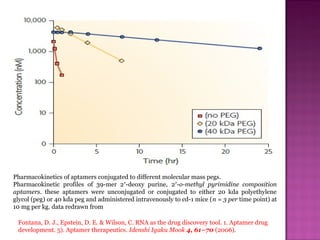
Pharmacokinetics of aptamers conjugated to different molecular mass pegs.
Pharmacokinetic profiles of 39-mer 2′-deoxy purine, 2′-o-methyl pyrimidine composition
aptamers. these aptamers were unconjugated or conjugated to either 20 kda polyethylene
glycol (peg) or 40 kda peg and administered intravenously to cd-1 mice (n = 3 per time point) at
10 mg per kg. data redrawn from
Fontana, D. J., Epstein, D. E. & Wilson, C. RNA as the drug discovery tool. 1. Aptamer drug
development. 5). Aptamer therapeutics. Idenshi Igaku Mook 4, 61–70 (2006).
 Antibodies to oligonucleotide conjugation partners
 Innate immune activation
 TLR3 ds RNA
 TLR7 and TLR8 ss RNA
 TLR9 unmethylated CG motifs(CpG) in DNA
 Anticoagulation
 consequence of low-affinity interactions between the
oligonucleotide and protein components of the clotting cascade
 Complement activation
 inter action of oligonucleotides with complement factor H
 Aptamers provide opportunities for structure-based drug design
strategies relevant to therapeutic intervention
 Recent advances in the chemical modifications of nucleic acids
suggest that one of the major barriers to use, stability, can be
overcome
 The high affinity and specificity of aptamers rival antibodies and
make them a promising tool in diagnostic and therapeutic
application
 We should expect more aptamers to be isolated in the near
future against an ever increasing repertoire of targets, using
these different SELEX approaches with increased speed and
efficiency
 Aptamers are poised to successfully compete with monoclonal
Abs in therapeutics and drug development within the next few
decades
 Keefe, A. D., Pai, S and Ellington, A. 2010. Aptamers as therapeutics.
nature reviews, 9:537-50.
 Huang, Y. F., Sefah, K., Bamrungsap, S., Chang, H. T. and Tan, W.
2008. Selective photothermal therapy for mixed cancer cells using
aptamer-conjugated nanorods. Langmuir; 24(20): 11860–5.
 Stoltenburg, R., Reinemann, C. and Strehlitz, B. SELEX—A
(r)evolutionary method to generate high-affinity nucleic acid ligands
Biomolecular Engineering 24 (2007) 381–403
 Nimjee, S. M., Rusconi, C. P. and Sullenger, B. A. Aptamers: an
emerging class of therapeutics. Annu Rev Med 2005, 56:555-583.
Aptamer as therapeutic

Aptamer as therapeutic

  • 1.
  • 2.
    Aptamers as TherapeuticsAptamersas Therapeutics Surender Kumar P1688
  • 3.
     (apto: “tofit”& mer: “smallest unit of repeating structure”)  single stranded folded oligonucleotides and peptide that bind to molecular (protein) targets with high affinity and specificity  Provide opportunities for structure-based drug design strategies relevant to therapeutic intervention  Can be prepared using SELEX Aptamers combine many of the advantages of oligonucleotides and antibodies- “Chemical Antibodies” Based on their three-dimensional structures, Aptamers can well-fittingly bind to a wide variety of targets from single molecules to complex target mixtures or whole organisms
  • 5.
    SELEX  Systematic Evolution0f Ligands by Exponential Enrichment  This method, described primarily in 1990 (Ellington, A.D & Szostak, J.W., 1990) One of the crucial steps of a SELEX process with outstanding importance for the selection of aptamers with high affinity and specificity is the efficient partitioning between target-binding and non-binding oligonucleotides
  • 6.
     Inorganic components Zn2+ Ciesiolka et al. (1995)  Ni2+ Hofmann et al. (1997)  Small organic molecules  Ethanolamine Mann et al. (2005)  Theophylline Jenison et al. (1994)  Malachite green Grate and Wilson (2001)  Amino acids  L-Arginine Geiger et al. (1996)  L-Citrulline Famulok (1994)  L-Valine Majerfeld and Yarus (1994)  Carbohydrates  Cellobiose Yang et al. (1998)  Chitin Fukusaki et al. (2000)  Sephadex Srisawat et al. (2001)  Antibiotics  Kanamycin A Lato et al. (1995)  Kanamycin B Kwon et al. (2001)  Streptomycin Wallace and Schroeder, (1998) Current opinion in chemical biology
  • 7.
    Random DNA OligonucleotideLibrary  Starting point of a SELEX  consists of a multitude of ssDNA fragments (1015 molecules)  comprising a central random region of 20– 80 nt flanked by different specific sequences of 18–21 nt, which function as primer binding sites in the PCR  longer random sequence pool may provide better opportunities for the identification of aptamers (Marshall and Ellington, 2000)
  • 8.
  • 9.
     quantification ofthe enriched target-binding oligonucleotides as well as the amount of non-binding oligonucleotides of each selection round have to be determined.  Radioactive markers (Beinoraviciute-Kellner et al., 2005; Ellington and Szostak, 1990; Shi et al., 2002)  Fluorescence labels may be used for quantification (Stoltenburg et al., 2005; Davis et al., 1997; Rhie et al., 2003)
  • 10.
     Only fewfunctional oligonucleotides in result of the selection step  At this stage, SELEX processes for the generation of RNA and DNA aptamers differ significantly  RNA oligonucleotides  firstly have to be passed through a RT-PCR. As a result the corresponding cDNA is achieved, which is amplified in a subsequent PCR  ssDNA aptamers  merely have to be amplified by PCR, where special primers can be used to provide the aptamers with additional properties
  • 11.
     The conditioningstep is necessary to prepare the amplified oligonucleotide pool  After the preceding PCR  the enriched pool is available as dsDNA.  A transcription with T7 RNA polymerase has to follow in case of RNA aptamers.  The resulting RNA molecules are used as input in the following SELEX round.  ssDNA aptamers, single strand separation has to be carried out  use the streptavidin/biotin. ( Fitzwater and Polisky, 1996)  the dsDNA (only one strand biotinylated) bind to streptavidin surfaces (beads or plates) and separate the strands after DNA denaturation (Naimuddin et al., 2007)  perform an asymmetric PCR which uses only one or a much bigger amount of one primer to obtain ssDNA products (Wu and Curran, 1999)
  • 12.
    Bacterial plasmids Sequencing dsDNApool (thousands of sequences) Modified plasmids Delivery into bacteria Only bacteria containing an aptamer insert grow. Each colony contains an individual aptamer sequence. Bacteria Plasmids from each colony are sequenced Sequenced Random site of aptamer sequence is unravelled
  • 13.
     chemically modifiedoligonucleotide libraries  with the goal to increase the complexity of a library  To introduce new features like functional groups providing new possibilities for the interaction with target molecules  To enhance the stability of oligonucleotide conformations  To increase the resistance to nucleases (Jayasena, 1999; Klussmann, 2006; Kopylov and Spiridonova, 2000; Kusser, 2000)
  • 14.
    NUCLEIC ACID MODIFICATIONS NameDescription Function 2’ –Aminopyrimidine Substitution at the 2’ position of a pyrimidine with NH2 group Increased stability 2’ -O-methylpurine Substitution at the 2’ position in the sugar moiety with a methoxy group Cheap, easy to synthesise and enzymatic incorporation 3’ and 5’ phosphorothioate caps Replacement of an oxygen atom with a sulphur atom in the phosphate backbone to form phosphorothioate linkages and caps Phosphorothioate linkages are chiral and form diastereomeric aptamers thus increasing stability 2’ -Fluoropyrimidine Substitution at the 2’ position of a pyrimidine with a fluorine molecule Increased stability 2’ -Azido NTPs Substitution at the 2’ position with N3 Effective cellular internalisation L-RNA and L-DNA L-Ribose/deoxyribose used instead of usual D- ribose thus forming mirror image aptamers Enzymatic degradation of L- RNA/DNA is lower because of the lack of nuclease Compatibility Locked nucleic acids (LNA) Bicyclic ring with a furanose ring bridged between the 2’ -O, 4’-C-methylene bridge Very high affinity to target sequences and very high stability
  • 16.
    Name (Company) Composition Target IndicationCurrent Phase Refrence Pegaptanib sodium/ Macugen (Pfizer/Eyetech) 2′-O-methyl purine/2′-fluoro pyrimidine with two 2′-ribo purines conjugated to 40 kDa PEG, 3′ inverted dT Vascular endothelial growth factor Age-related macular degeneration Approved in the US and the EU Ng et al., 2006 Chakravarthy et al., 2006 AS1411/ AGRO001 (Antisoma) G-rich DNA Nucleolin Acute myeloid leukaemia Phase II Bates et al., 2009 REG1/RB006 plus RB007 (Regado Biosciences) 2′-ribo purine/2′-fluoro pyrimidine (RB006)/40 kDa PEG plus 2′-O-methyl antidote (RB007) Coagulation factor IXa Percutaneous coronary intervention Phase II Cooper et al., 2008 ARC1779 (Archemix) DNA and 2′-O-methyl with a single phosphorothioate linkage conjugated to 20 kDa PEG, 3′ inverted dT A1 domain of von Willebrand factor Thrombotic microangiopathies and carotid artery disease Phase II Krieg, 2006 NU172 (ARCA biopharma) Unmodified DNA aptamer Thrombin Cardiopulmonary bypass to maintain steady state of anticoagulation Phase II Sheehan & Lan, 1998 ARC1905 (Ophthotech) 2′-ribo purine/2′-fluoro pyrimidine conjugated to 40 kDa PEG, 3′ inverted dT Complement component 5 Age-related macular degeneration Phase I Goebl et al., 2007 NOX-E36 (NOXXON Pharma) l-RNA with 3′-PEG CCL2 Type 2 diabetes, diabetic nephropathy Phase I Kulkarni et al., 2009
  • 17.
    DELIVERY OF CYTOSTATICS Aspecific cytotoxic aptamer–doxorubicin (Dox) conjugate. The construct is internalized via endosome, where the acidic environment favors the cleavage of the bond between the aptamer and Dox molecule. The antibiotic diffuses through the endosome membrane, penetrates the nucleus and intercalates into genomic DNA, causing cytotoxic effects. Bifunctional conjugates Decreases non-specific internalization of Dox greatly enhances its uptake by target cells the cytotoxic effect of Dox was preserved
  • 18.
     Data ondrug biodistribution  Monitoring the therapeutic effect in real time  SPION– Apt–Dox conjugates  Dual Purpose  Both detection and elimination of Prostate cancer cells (PCa)  A10 RNA aptamer specific for PSMA SPION- Apt Conjugate Imaged with NMR and displayed high specificity for PSMA-expressing LNCaP cells but not for a PMSA-non-expressing PC-3 cell line SPION– Apt–Dox conjugates Targeted Delivery
  • 19.
     Gold–Silver nanorods(Au–Ag NRs)  high near-infrared light absorption  Aptamer Canjugates with Au-Ag NRs  offers spatial precision in targeted treatment Huang, Y. F., Sefah, K., Bamrungsap, S., Chang, H. T. and Tan, W. 2008. Selective photothermal therapy for mixed cancer cells using aptamer-conjugated nanorods. Langmuir; 24(20): 11860–5. Huang, Y. F., Sefah, K., Bamrungsap, S., Chang, H. T. and Tan, W. 2008. Selective photothermal therapy for mixed cancer cells using aptamer-conjugated nanorods. Langmuir; 24(20): 11860–5. Aptamer-directed NRs  Efficient photothermal Convectors  Promoted selective destruction of the target cells.  Efficient photothermal Convectors  Promoted selective destruction of the target cells.
  • 20.
     aptamer–liposome conjugates cargo internalization via  Fusion of membranes  Endosome-mediated delivery of liposomes to the lysosome Major deficits 1.Stability 2.Nonspecific interactions which were reported during long-period incubations Major deficits 1.Stability 2.Nonspecific interactions which were reported during long-period incubations
  • 21.
     Amphipathic unit hydrophilic oligonucleotide  a hydrophobic polymer  In aqueous solution, self-assembled into a polarized three-dimensional structure  Micelle system  enables delivery of targeted intracellular drugs doped inside the nanostructure as well as of therapeutic aptamers into the cell by simple membrane fusion. Micellization could be also used as a general strategy to promote binding of low-affinity aptamers
  • 22.
    Chimeric DNA moleculesadapted to simultaneously recognize two different target proteins Apt for CD16α Apt for c- MET coupling with different PEG moieties and nucleotide linkers promoted antibody dependent cellular cytotoxicity ***the bsA17 aptamer, mediated cell lysis with a magnitude similar to cetuximab***
  • 23.
     Attractive approachto gene silencing with the aid of aptamers (Zhou et al., 2008) Aptamer siRNA chimera targeted at HIV1 gp120 glycoprotein selectively internalized into HIV-infected cells Down regulated the tat/rev gene expression Inhibitory conjugate able to suppress viremia for up to 3 weeks after the final treatment but also to evade immune response, as no significant elevation in interferon induced genes
  • 24.
    C. In thepresence of the targets the aptamers fold into their three-dimensional structures, thus opening the nanocage filled with desired molecules A. DNA nanorobot. A nanoscale cage encapsulating cargo molecules is locked with two aptamer ‘locks’. Each combines an aptamer towards a chosen target and a complementary oligonucleotide strand B . The cage is made of scaffold DNA fastened with multiple DNA staples
  • 25.
    Aptamer Antibodies Entire selectionis a chemical process carried out in vitro and can therefore target any protein Selection requires a biological system, therefore difficult to raise antibodies to toxins (not tolerated by animal) or non- immunogenic target. Uniform activity regardless of batch varies from batch to batch. Investigator determines target site of protein Immune system determines target site of protein. Wide variety of chemical modifications to molecule for diverse functions Limited modifications of molecule No evidence of immunogenicity. Significant immunogenicity Resistant to temperature insult Temperature sensitive
  • 26.
     Produced chemicallyin a readily scalable process  Not prone to viral or bacterial contamination  Non-immunogenic  more efficient entry into biological compartments  Able to select for and against specific targets and to select against cell-surface targets  Can usually be reversibly denatured  Dyes or functional groups can be readily introduced during synthesis
  • 27.
     Pharmacokinetic andother systemic properties are variable and often hard to predict  Small size makes them susceptible to renal filtration  have a shorter half-life  Unmodified aptamers are highly susceptible to serum degradation  Aptamer technologies are currently largely covered by a single intellectual property portfolio
  • 28.
     Aptamers canbe optimized for activity and persistence under physiological conditions during selection or during structure–activity relationship and medicinal chemistry studies conducted after discovery Guo et al., 2008  Addition of conjugation partners such as polyethylene glycol or cholesterol can increase circulating half-life Healy et al., 2004  Chemical modifications incorporated into the sugars or internucleotide phosphodiester linkages enhance nuclease resistance Burmeister et al., 2006
  • 30.
    Nuclease resistance • Aptamerscomposed of unmodified nucleotides have half-lives in the blood that can be as short as 2 minutes Griffin et al., 1993 • Methods to overcome nuclease Susceptibility – Modified composition aptamers • Increase purine residues – site-specific introduction of nuclease-resistant modifications • inverting the nucleotide at the 3′-terminus • changing of the 2′-OH groups of ribose to 2′-F or 2′-NH2 groups or 2′-O-methyl substituted nucleotides • A 3′-end capping – streptavidin-biotin, inverted thymidine (3′-idT, creates a 3′-3′inkage) • 5′ caps – amine, phosphate, polyethylene glycol (PEG), cholesterol, fatty acids, proteins, etc.) (Dougan et al., 2000; Klussmann, 2006; Marro et al., 2005) • Locked nucleic acids (LNAs) – the sugar is made bicyclic by covalently bridging the 2′-oxygen and the 4′-carbon with a methylene group
  • 31.
     molecular masscutoff for the renal glomerulus is 30–50 kDa  Aptamers: 5–15 kDa  Methods to avoid renal filteration  Conjugation to polymers  Cholesterol conjugation  PEG conjugation  May lead to reduction of activity
  • 32.
    Pharmacokinetics of aptamersconjugated to different molecular mass pegs. Pharmacokinetic profiles of 39-mer 2′-deoxy purine, 2′-o-methyl pyrimidine composition aptamers. these aptamers were unconjugated or conjugated to either 20 kda polyethylene glycol (peg) or 40 kda peg and administered intravenously to cd-1 mice (n = 3 per time point) at 10 mg per kg. data redrawn from Fontana, D. J., Epstein, D. E. & Wilson, C. RNA as the drug discovery tool. 1. Aptamer drug development. 5). Aptamer therapeutics. Idenshi Igaku Mook 4, 61–70 (2006).
  • 33.
     Antibodies tooligonucleotide conjugation partners  Innate immune activation  TLR3 ds RNA  TLR7 and TLR8 ss RNA  TLR9 unmethylated CG motifs(CpG) in DNA  Anticoagulation  consequence of low-affinity interactions between the oligonucleotide and protein components of the clotting cascade  Complement activation  inter action of oligonucleotides with complement factor H
  • 34.
     Aptamers provideopportunities for structure-based drug design strategies relevant to therapeutic intervention  Recent advances in the chemical modifications of nucleic acids suggest that one of the major barriers to use, stability, can be overcome  The high affinity and specificity of aptamers rival antibodies and make them a promising tool in diagnostic and therapeutic application  We should expect more aptamers to be isolated in the near future against an ever increasing repertoire of targets, using these different SELEX approaches with increased speed and efficiency  Aptamers are poised to successfully compete with monoclonal Abs in therapeutics and drug development within the next few decades
  • 35.
     Keefe, A.D., Pai, S and Ellington, A. 2010. Aptamers as therapeutics. nature reviews, 9:537-50.  Huang, Y. F., Sefah, K., Bamrungsap, S., Chang, H. T. and Tan, W. 2008. Selective photothermal therapy for mixed cancer cells using aptamer-conjugated nanorods. Langmuir; 24(20): 11860–5.  Stoltenburg, R., Reinemann, C. and Strehlitz, B. SELEX—A (r)evolutionary method to generate high-affinity nucleic acid ligands Biomolecular Engineering 24 (2007) 381–403  Nimjee, S. M., Rusconi, C. P. and Sullenger, B. A. Aptamers: an emerging class of therapeutics. Annu Rev Med 2005, 56:555-583.

Editor's Notes

  • #4 Antibody: 139 *122 A Aptamer : 25*21 A
  • #6 In vitro selection of target-specific aptamers using SELEX technology. Starting point of each SELEX process is a synthetic random DNA oligonucleotide library consisting of a multitude of ssDNA fragments with different sequences (1015). This library is used directly for the selection of DNA aptamers. For the selection of RNA aptamers the library has to be transferred into an RNA library. The SELEX procedure is characterized by the repetition of successive steps consisting of selection (binding, partition, and elution), amplification and conditioning. In the first SELEX round the library and the target molecules are incubated for binding. Unbound oligonucleotides are removed by several stringent washing steps of the binding complexes. The target-bound oligonucleotides are eluted and subsequently amplified by PCR or RT-PCR. A new enriched pool of selected oligonucleotides is generated by preparation of the relevant ssDNA from the PCR products (DNA SELEX) or by in vitro transcription (RNA SELEX). This selected oligonucleotide pool is then used for the next selection round. In general, 6 to 20 SELEX rounds are needed for the selection of highly affine, target-specific aptamers. The last SELEX round is finished after the amplification step. The enriched aptamer pool is cloned and several individual aptamers have to be characterized.
  • #7 Define target molecule. (The target molecule can be a protein, small molecule, or a supramolecular structure.)  SELEX technology has been applied to different classes of targets. Inorganic and small organic molecules, peptides, proteins, carbohydrates, antibiotics, as well as complex targets like target mixtures or whole cells andorganisms were used for an aptamer selection Beside organic molecules, divalent metal ions were also used as target in SELEX experiments. Ciesiolka et al. and Hofmann et al. described the selection of RNA aptamers with affinities for Zn2+ and Ni2+, respectively The smallest molecular target so far used for an aptamer selection is ethanolamine, a simple structured molecule (C2 chain) with two functional groups (–OH, –NH2)
  • #8 Starting random DNA oligonucleotide library. The classical SELEX process for the selection of target-specific aptamers starts with a chemically synthesized DNA oligonucleotide library. Each oligonucleotide is characterized by an internal randomized sequence of 20–80 nt flanked by two fixed sequences (termed 1 and 2), which act as primer binding sites in the PCR. This library is used directly for the selection of DNA aptamers (DNA SELEX). For the selection of RNA aptamers (RNA SELEX) the library has to be converted to a dsDNA pool by PCR followed by in vitro transcription to generate a randomized RNA library. Two special primers are needed for the PCR. The antisense primer (termed 2rc) is reverse complementary to the fixed sequence at the 3’-end of the library. The sense primer is derived from the fixed sequence at the 5’-end and is modified by an extension containing the T7 promoter sequence (termed-T7 promoter-/1). The T7 RNA polymerase specifically recognizes this promoter and permits an in vitro transcription to synthesize the RNA library for starting an RNA SELEX. * T7 RNA Polymerase is an RNA polymerase from the T7 bacteriophage that catalyzes the formation of RNA in the 5'→ 3' direction*
  • #12 Two methods for ssDNA separation. The displayed methods are used for separation of the wanted ssDNA, the (+)strand, after PCR. Special primers are applied during PCR. One method (left side) uses a 30-end riboU modification, which bears a single ribonucleotide containing uracil. During the follow-up alkaline hydrolysis with sodium hydroxide, the unwanted ()strand disrupts selectively at the riboU-position. The result is a truncation of the ()strand by some nucleotides. The other method (on the right of the figure) works with a primer that contains a hexaethyleneglycol (HEGL) spacer at its 50-end and an extension of several adenine nucleotides (polyA). The HEGL-spacer acts as a terminator for Taq polymerase. The elongation of the (+)strand stops, while the ()strand grows further. No follow-up treatment is necessary. In both methods the created size difference can be identified in subsequent electrophoresis by UV shadowing or by fluorescence (use of fluorophore modified primer for the (+)strand). The wanted strand is cutted out and processed further.
  • #19 Superparamagnetic iron oxide nanoparticles (SPION) LNCaP cells are androgen-sensitive human prostate adenocarcinoma cells derived from the left supraclavicular lymph node metastasis from a 50-year-old caucasian male in 1977 prostate-specific membrane antigen (PSMA)
  • #23 Cetuximab (Erbitux) is an epidermal growth factor receptor(EGFR) inhibitor used for the treatment of metastatic colorectal cancer and head and neck cancer. Cetuximab is a chimeric (mouse/human) monoclonal antibody given by intravenous infusion  c-Met (MET or MNNG HOS Transforming gene) is a proto-oncogene that encodes a protein known as hepatocyte growth factor receptor (HGFR) CD16 is a low affinity Fc receptor
  • #24 Regulator of Expression of Virion Proteins: rev tat (HIV trans-activator) plays an important role in regulating the reverse transcription of viral genome RNA ensuring efficient synthesis of viral mRNAs as well as regulating the release of the virions from the infected cells
  • #34 Because unmodified RNA is highly sensitive to endogenous nucleases and because 2′-modification abrogates the TLR response62, it is probably TLR9 that is most relevant to the study of potential adverse effects of therapeutic aptamers, although other TLRs may be relevant to the interpretation of in vivo responses to siRNA. Innate immune responses mediated by TLR9 include the activation of antigen-specific B cells and the secretion of cytokines including interleukin-6 and interferon63,64. Nevertheless, TLR9-mediated immune responses to oligonucleotides are being considered for therapeutic applications in which immune stimulation is desirable such as in oncology Factor H is a member of the regulators of complement activation family and is a complement control protein. Its principal function is to regulate the Alternative Pathway of the complement system, ensuring that the complement system is directed towards pathogens or other dangerous material and does not damage host tissue