PREENTED BY
NOMRATA DAS
M.PHARM 2nd sem
Roll.no 8
GIPS
CONTENTS
 ANTISENSE INTRDUCTION
 ANTISENSE THERAPY
 MECHANISM OF ANTISENSE ACTIVITY
 ROLE OF ANTISENSE, APPLICATION ,CHALLENGES
 ADVANTAGES AND DISADVANTAGES
 APTAMERS INTRODUCTION
 CLASSIFICATION
 APTAMERS TARGET BINDING MECHANISM
 PRODUCTION OF APTAMERS (SELEX)
 PROPERTIES AND APPLICATION
 ADVANTAGES AND DISADVANTAGES
 STRATEGIES TO OVERCOME APTAMER LIMITATIONS
 CONCLUSION
ANTISENSE MOLECULE
• Antisense molecules are synthetic segments of DNA or RNA,
designed to mirror specific messenger RNA (mRNA) sequences
and block protein production.
•Messenger RNA (mRNA) is single-stranded sequence of
nucleotides is called "sense" because it results in a gene product
(protein).
• One way to target the genetic material is to block mRNA by using
“antisense DNA”, which prevents the message from ever becoming
a protein.
Antisense therapy
•Antisense therapy is a form of treatment for genetic disorders or
infections.
• Antisense drugs blocks abnormal disease related proteins and are
being researched to treat a variety of diseases such as cancers,
diabetes, asthma, arthritis.
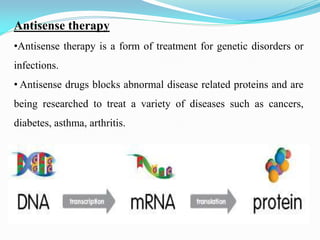
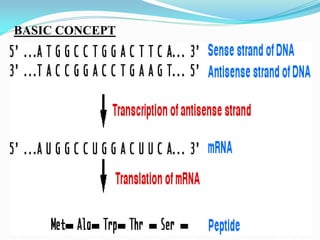
Protein production occurs in two phases
Transcription and Translation.
In the transcription phase , the DNA strand is used as a
template for manufacturing an mRNA molecule.
mRNA is responsible for communicating the genetic message in
the DNA to the cell so that protein production can take place.
In the translation phase , the mRNA travels to the ribosome,
and carry out protein synthesis.
BASIC CONCEPT
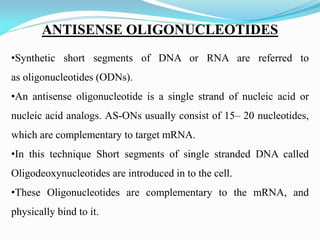
ANTISENSE OLIGONUCLEOTIDES
•Synthetic short segments of DNA or RNA are referred to
as oligonucleotides (ODNs).
•An antisense oligonucleotide is a single strand of nucleic acid or
nucleic acid analogs. AS-ONs usually consist of 15– 20 nucleotides,
which are complementary to target mRNA.
•In this technique Short segments of single stranded DNA called
Oligodeoxynucleotides are introduced in to the cell.
•These Oligonucleotides are complementary to the mRNA, and
physically bind to it.
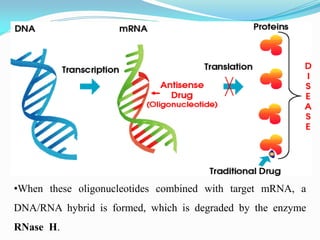
•When these oligonucleotides combined with target mRNA, a
DNA/RNA hybrid is formed, which is degraded by the enzyme
RNase H.
MECHANISM OF ANTISENSE ACTIVITY
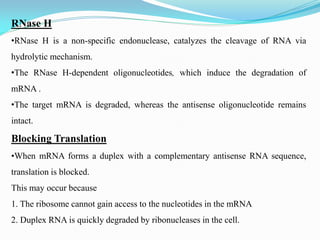
RNase H
•RNase H is a non-specific endonuclease, catalyzes the cleavage of RNA via
hydrolytic mechanism.
•The RNase H-dependent oligonucleotides, which induce the degradation of
mRNA .
•The target mRNA is degraded, whereas the antisense oligonucleotide remains
intact.
Blocking Translation
•When mRNA forms a duplex with a complementary antisense RNA sequence,
translation is blocked.
This may occur because
1. The ribosome cannot gain access to the nucleotides in the mRNA
2. Duplex RNA is quickly degraded by ribonucleases in the cell.
ROLE OF ANTESENSE
•To inactivate ethylene synthesis.
• Reduction of starch content in vegetables.
• Modification of flower colour in various decorative plant.
• Mammalian genomes encode numerous natural antisense
transcripts, but the function of these transcripts is not well
understood.
APPLICATIONS
 Genetic Disorder
 Cancer
 Renal Transplant Rejection
 Infection (Viral, Protozoal, Fungal)
 Cardiovascular disorder ( hypertension)
 Inflammatory and autoimmuno disorders (Asthema)
CHALLENGES
• Need to identify appropiate gene target.
• Need to generate antisense oligonucleotide that is specific for the gene of
interest
• Molecules need to be modified to prevent degredation by RNAses and other
enzyme.
• Drugs need to be deliverable to the organ of interest.
ADVANTAGES
 Sensitivity of therapy can easily measured
 Potential to produce long lasting responsrs
 Oligonucleotides are manufactured quickly i.e, within a week.
DISADVANTAGES
 Completely artificial molecule, so no vectors possible
 Not always highly effects.
 Side effects for high dosage.
 Delivery usually only via microinjection or electropration.
APTAMERS
In, Latin aptus/apto – to fit, and
In, Greek meros – part (Smallest Unit Of Repeating
Structure)
• Single stranded folded oligonucleotides and peptide that bind to
molecular (protein) targets with high affinity and specificity
• Provide opportunities for structure-based drug design strategies
relevant to therapeutic intervention.
•Can be prepared using SELEX.
•They are similar to monoclonal antibodies.
CLASSIFICATION OF APTAMERS
BASED ON STRUCTURE
APTAMERS
NUCLEIC ACID
RNA
AMINO ACID
XNA
DNA
AFFIMER
PEPTIDES
RNA aptamer DNA aptamer Peptide aptamer
From complex
secondary and
Tertiary structure
From complex
secondary and
Tertiary structure
Structure constrains
by Scaffoled
(temporary structure
From diverse 3d
structure
Less diverse 3d
structure than RNA
aptamer
3d structure
constraints by
Scaffold
Bind target with the
entire Sequence
Bind target with the
entire Sequence
Bind target variable
region only
Biosenseor,
diagonostic ,
Therapeutics
applications
Biosenseor,
diagonostic,
Therapeutics
applications
Biosenseor,
diagonostic,
Therapeutics
applications
COMPARISON OF RNA, DNAAND PEPTIDE APTAMERS:
Based on their three-dimensional structures, aptamers can well-
fittingly bind to a wide variety of targets from single molecules to
complex target mixtures or whole organisms.
• They range in size from 20 to 80 bases.
•Aptamers can binds to nucleic acid, proteins and small organic
compounds
APTAMERS – TARGET BINDING MECHANISM
APTAMER PRODUCTION
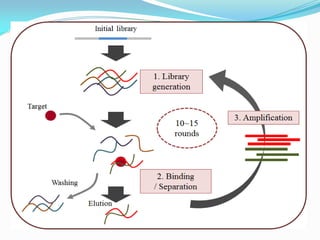
SELEX
• Systematic Evolution of Ligands by Exponential Enrichment
•Aptamer are produced by an in vitro selection or systematic
evolution of ligand by exponential enrichment (SELEX).
• SELEX produces ssRNA with specific binding target.
• This is an iterative process of binding, partitioning, amplifying
novel nucleic acids & regeneration.
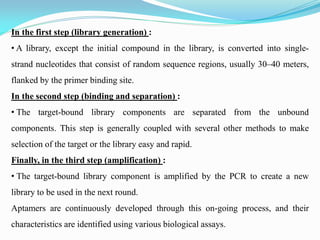
In the first step (library generation) :
• A library, except the initial compound in the library, is converted into single-
strand nucleotides that consist of random sequence regions, usually 30–40 meters,
flanked by the primer binding site.
In the second step (binding and separation) :
• The target-bound library components are separated from the unbound
components. This step is generally coupled with several other methods to make
selection of the target or the library easy and rapid.
Finally, in the third step (amplification) :
• The target-bound library component is amplified by the PCR to create a new
library to be used in the next round.
Aptamers are continuously developed through this on-going process, and their
characteristics are identified using various biological assays.
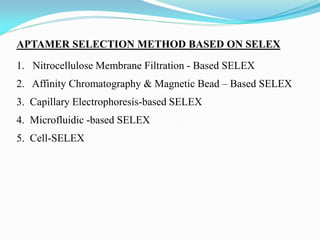
APTAMER SELECTION METHOD BASED ON SELEX
1. Nitrocellulose Membrane Filtration - Based SELEX
2. Affinity Chromatography & Magnetic Bead – Based SELEX
3. Capillary Electrophoresis-based SELEX
4. Microfluidic -based SELEX
5. Cell-SELEX
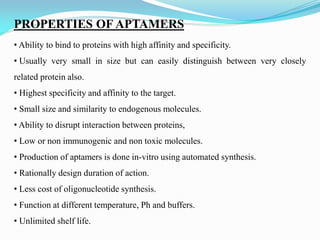
PROPERTIES OF APTAMERS
• Ability to bind to proteins with high affinity and specificity.
• Usually very small in size but can easily distinguish between very closely
related protein also.
• Highest specificity and affinity to the target.
• Small size and similarity to endogenous molecules.
• Ability to disrupt interaction between proteins,
• Low or non immunogenic and non toxic molecules.
• Production of aptamers is done in-vitro using automated synthesis.
• Rationally design duration of action.
• Less cost of oligonucleotide synthesis.
• Function at different temperature, Ph and buffers.
• Unlimited shelf life.
APPLICATION OFAPTAMERS
•For new drug
•In drug delivery
•As tehrapeutic tool
•In diagnosis of disease
•In food inspection
•In hazard detection
•In bio-imaging
•As analytical reagent
Aptamers have similar affinities
ADVANTAGES
•Produced chemically in a readily scalable process
• Not prone to viral or bacterial contamination
• Non-immunogenic
• more efficient entry into biological compartments
• greater stability
• Can usually be reversibly denatured.
• Dyes or functional groups can be readily introduced during
synthesis.
•Aptamers have similar affinities as antibodies to target molecules.
• They are non-toxic and elicit little or no immunogenic response.
DISADVANTAGES
• Pharmacokinetic and other systemic properties are variable and
often hard to predict
• Small size makes them susceptible to renal filtration
• have a shorter half-life
• Unmodified aptamers are highly susceptible to serum
degradation
• Aptamer technologies are currently largely covered by a single
intellectual property portfolio.
STRATEGIES TO OVERCOME APTAMER
LIMITATIONS
• Aptamers can be optimized for activity and persistence under
physiological conditions during selection or during structure–
activity relationship and medicinal chemistry studies conducted
after discovery.
• Addition of conjugation partners such as polyethylene glycol or
cholesterol can increase circulating half-life.
• Chemical modifications incorporated into the sugars or
internucleotide phosphodiester linkages enhance nuclease
resistance.
CONCLUSION
Aptamers provide opportunities for structure-based drug design
strategies relevant to therapeutic intervention.
Aptamers’ entire selection process can be carried out in a test tube.
They have high binding affinities, selectivity and specificity to their
targets making them important for diagnostics and targeted therapy.
They are thermostable and can be structurally modified to enhance
specificity and stability, therefore increasing aptamer half-life in in
vivo applications.
References
• http://en.wikipedia.org/wiki/Antisense_RNA
•http://users.rcn.com/jkimball.ma.ultranet/BiologyPages/A/Antisens
eRNA.html
•Walton, S. P., Roth, C. M., Yarmush, M. L. “Antisense
Technology.”The Biomedical Engineering Handbook: Second
Edition.
•Keefe, A. D., Pai, S and Ellington, A. 2010. Aptamers as
therapeutics nature reviews, 9:537-50.
•Mascini, M. Aptamers and their applications. Anal. Bioanal. Chem.
2008
•Gopinath, S.C. Methods developed for SELEX. Anal. Bioanal.
Chem. 2007
•Tombelli, S.; Minunni, M.; Mascini, M. Analytical applications of
aptamers.
BIOPHARMACEUTICS  OF  ANTISENSE MOLECULE AND  APTAMERS