PROTEINURIA AND HEMATURIA CARMEN PRIET0-JIMENEZ, M.D.
Proteinuria and Nephrotic Syndrome Occurrence  of proteinuria in a single urine is relatively common. Will present in 5% to 15% of normal children in a random urine specimen.
-Proteinuria is a marker of renal disease. -The dilemma for the PCP is to differentiate the child with transient or any other benign forms of proteinuria from children with renal disease.
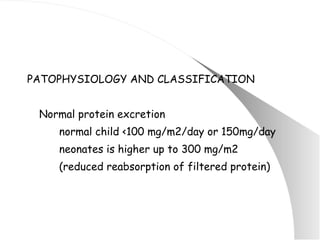
PATOPHYSIOLOGY AND CLASSIFICATION Normal protein excretion normal child <100 mg/m2/day or 150mg/day neonates is higher up to 300 mg/m2  (reduced reabsorption of filtered protein)
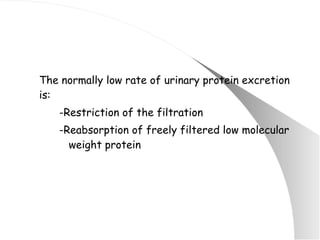
The normally low rate of urinary protein excretion is: -Restriction of the filtration -Reabsorption of freely filtered low molecular    weight protein
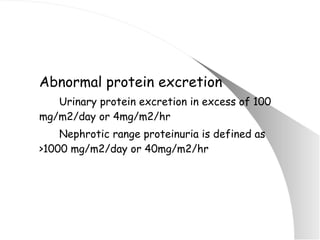
Abnormal protein excretion Urinary protein excretion in excess of 100 mg/m2/day or 4mg/m2/hr  Nephrotic range proteinuria is defined as >1000 mg/m2/day or 40mg/m2/hr
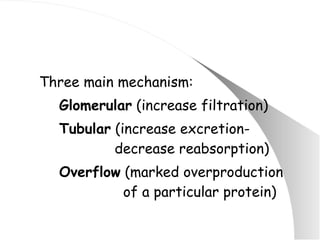
Three main mechanism: Glomerular  (increase filtration) Tubular  (increase excretion-   decrease reabsorption) Overflow  (marked overproduction  of a particular protein)
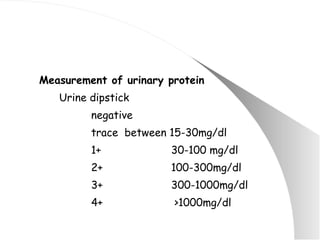
Measurement of urinary protein Urine dipstick negative trace  between 15-30mg/dl 1+    30-100 mg/dl 2+   100-300mg/dl 3+   300-1000mg/dl 4+   >1000mg/dl
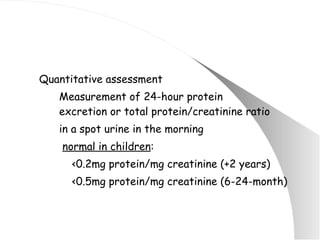
Quantitative assessment Measurement of 24-hour protein  excretion or total protein/creatinine ratio  in a spot urine in the morning   normal in children :   <0.2mg protein/mg creatinine (+2 years)   <0.5mg protein/mg creatinine (6-24-month)
Qualitative assessment May be necessary to differentiate glomerular  from tubular protein
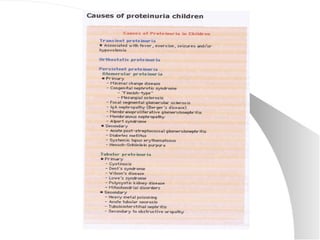
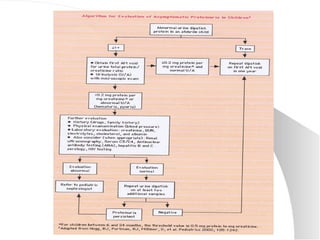
Approach to the child with proteinuria Transient or Intermittent Orthostatic Persistent
 
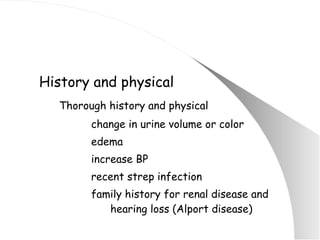
History and physical Thorough history and physical change in urine volume or color edema increase BP recent strep infection family history for renal disease and    hearing loss (Alport disease)
 
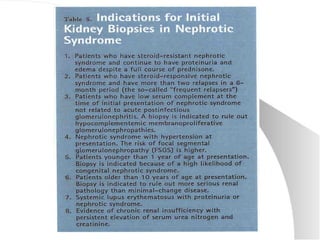
The Need for Renal Biopsy The key indication for biopsy in any renal disorder are the need to make specific diagnosis for therapeutic reasons or to provide a prognosis.
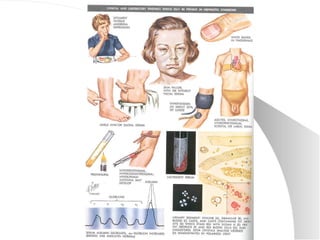
Neprotic Syndrome Nephrotic syndrome is characterized by massive proteinuria, hypoalbuminemia, edema, and hyperlipidemia; the most common presenting symptom is edema.
Introduction The annual incidence of Nephrotic syndrome in healthy children is  2 to 7 new case per 100,000 children younger than 18 years of age. The peak age lf onset is at 2 to 3 years.
Definition The diagnosis of NS is the presence of urinary protein, with the albumin disproportionately greater than globulin.
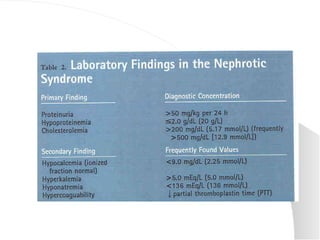
Clinical Diagnostic Criteria 1- Generalized edema  2- Hypoproteinemia <2 g/dL (disproportionately low albumin in relation to globulin)
3-Urine protein to urine creatinine ratio in excess of 2 (first A.M. void) or a 24- hour urine that exceeds 50mg/Kg body weight 4-Hypercholesterolemia (>200 mg/dL)
 
 
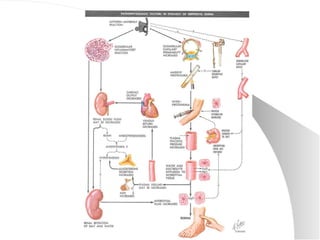
The mechanisms for edema include: -Transudation of fluid from the intravascular space into the intestitium secondary to decreased albumin and - Increased renal tubular reabsorption of sodium and water
 
The hyperlipidemia is secondary to: -Increase in lipoprotein synthesis by the liver and -Decrease in lipid catabolism resulting from reduced activity of the enzyme lipoprotein lipase and lecithin cholesterol acetyltransferase.
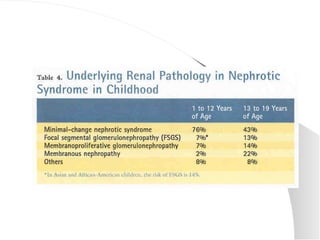
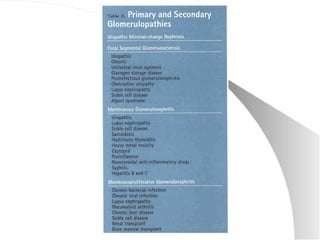
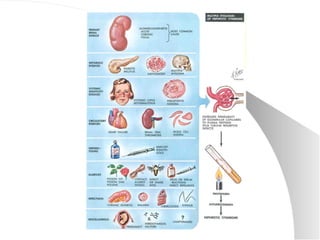
INCIDENCE FOR UNDERLYING PATHOLOGY


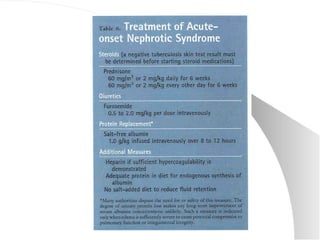
TREATMENT
 
 
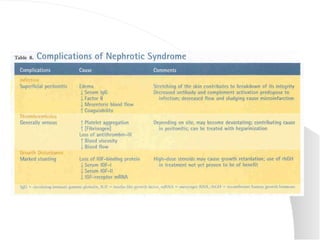
Complications One true complication of NS is the tendency to developed infections. IgG antibody is lost in the urine, and complement activation is impaired by concomitant loss of factor B.
Marked intravascular depletion causes diminished splachnic blood flow and hypoxia, and a marked tendency to thrombosis cause microinfarction, lowering resistance of the bowel wall to bacteria passage.
Peritonitis is a major contributor to the 1% to 2% mortality in NS The second major contributor is Thromboembolism, however anticoagulant therapy is not justified during remission.
Growth is often impaired in NS There may be losses of IGF-binding protein, which could account for the depressed serum concentration of IGF-I and IGF-II.
 
Prognosis Mortality in minimal-change NS is approximately 2% Of the remaining 98%, most are steroid-responsive about 2/3 experience 1/3 possible single relapse developing  protracted series of  relapses
Hematuria and Glomerulonephitis
Introduction Recognition, definition, differential diagnosis, and orderly evaluation of hematuria in infants and children is often an important issue in pediatric practice
Definition Hematuria is defined by the presence of an abnormal quantity of red blood cells in the urine  Macroscopic: grossly visible Microscopic: only upon urinalysis >5-10 RBC’s per high power field
A large number of benign and serious conditions can cause hematuria in children.
Gross hematuria UTI Irritation of the meatus or perineum Trauma Nephrolithiasis Sickle cell disease/trait Post infectious glomerulonephritis IgA nephropathy
Microscopic hematuria Glomerulopathies Hypercalciuria Microlithiasis UTI
Children with hematuria may present in one of three way 1-Onset of gross hematuria 2-Onset of urinary or other  symptoms with incidental finding 3-Incidental finding during a  health evaluation
Historical clues The color of the urine Glomerulonephritis may be brown and/or frothy urine, while bleeding is suggested by the presence of blood clots, or pink or clearly red urine
The timing of the hematuria   Initial (urethral bleeding) Terminal (bladder) Throughout (no localizing value)
Circumstances associated  History of trauma, pain, micturating symptoms, systemic signs including fever and skin and nasopharyngeal infection
Age of onset Periodicity Blood on diapers of underwear Exposure to medications Relation with exercise Flank pain  (loin pain hematuria syndrome)
Physical examination Should Include  Blood Pressure measurement Assessment for edema or weight  gain Close skin examination Direct visualization of the genitals Abdominal mass or discomfort
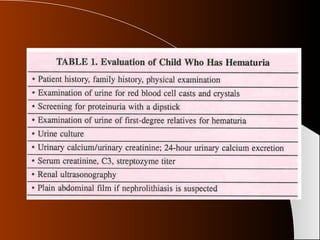
Laboratory evaluation -Urinalysis, urine culture, and urinary  excretion studies -Glomerular bleeding evaluation (24-hour urinary protein  excretion/creatinine ratio,  excretion of casts, protein  excretion, blood clots)
Imaging studies USD of the kidney and bladder. Cytoscopy  Is rarely indicated. May be useful to determine if the bleeding comes from bladder or one or both ureters.
 
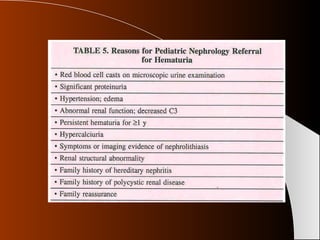
Etiology The causes of gross and microscopic hematuria are extensive.
A natomical abnormalities B ladder and kidney infection C oagulation/hematology D rugs E xercise F amilial hematuria G lomerulonephritis H ypercalciuria-hyperuricosuria-urolithiasis I nterstitial nephritis T rauma and tumors
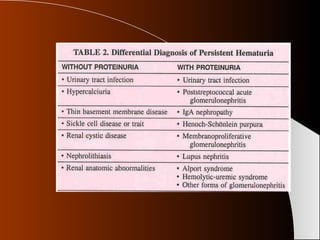
Extrarrenal causes Usually gross hematuria, no proteinuria, and RBC’s that are suggestive of nonglomerular origin.
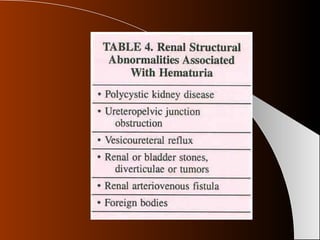
-Neprholithiasis -UTI  -Adenovirus -Kidney tumor -Polycystic kidney -Urethral irritation
-Obstructive uropathy -Post-traumatic kidney -Onset of menarche -Exposure to cyclophosphamide -Thrombogenic condition -Sickle cell trait
-Vascular bleeding -”Nutcracker syndrome” -Left renal vein entrapment  (Also orthostatic proteinuria) -Loin pain hematuria syndrome -Urethrovesical bleeding
Renal Causes  ( Glomerular causes) Most patients also have proteinuria, red cell casts, and/or renal insufficiency. The clinical context is also suggestive.
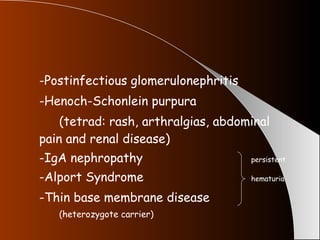
-Postinfectious glomerulonephritis -Henoch-Schonlein purpura (tetrad: rash, arthralgias, abdominal pain and renal disease) -IgA nephropathy persistent -Alport Syndrome hematuria -Thin base membrane disease (heterozygote carrier)
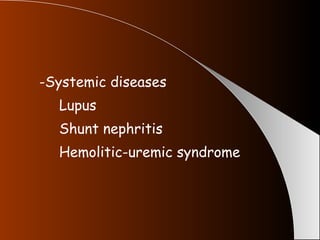
-Systemic diseases Lupus Shunt nephritis Hemolitic-uremic syndrome
Unexplained hematuria - Factitious hematuria


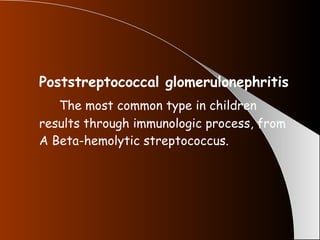
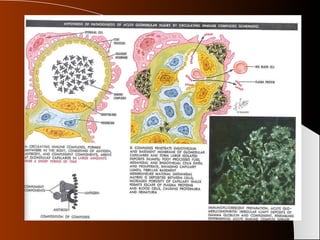
Poststreptococcal glomerulonephritis The most common type in children results through immunologic process, from A Beta-hemolytic streptococcus.
 
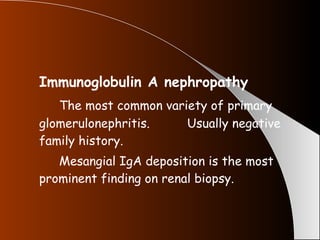
Immunoglobulin A nephropathy The most common variety of primary glomerulonephritis.  Usually negative family history. Mesangial IgA deposition is the most prominent finding on renal biopsy.
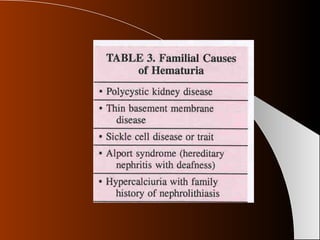
Alport Syndrome Its classically X-linked form, suggested by hematuria in a male. Positive family history of hematuria, deafness, and renal failure. Abnormal collagen IV composition.
Thin base membrane disease Also called  benign familial   hematuria , transmitted in a dominant fashion but, in most cases a heterozygous form of autosomal recessive Alport syndrome.
Treatment General management Salt and water restriction. Specific treatment   Depends of the etiology or severity of the disorder.
 

Proteinuria & Hematuria

  • 1.
    PROTEINURIA AND HEMATURIACARMEN PRIET0-JIMENEZ, M.D.
  • 2.
    Proteinuria and NephroticSyndrome Occurrence of proteinuria in a single urine is relatively common. Will present in 5% to 15% of normal children in a random urine specimen.
  • 3.
    -Proteinuria is amarker of renal disease. -The dilemma for the PCP is to differentiate the child with transient or any other benign forms of proteinuria from children with renal disease.
  • 4.
    PATOPHYSIOLOGY AND CLASSIFICATIONNormal protein excretion normal child <100 mg/m2/day or 150mg/day neonates is higher up to 300 mg/m2 (reduced reabsorption of filtered protein)
  • 5.
    The normally lowrate of urinary protein excretion is: -Restriction of the filtration -Reabsorption of freely filtered low molecular weight protein
  • 6.
    Abnormal protein excretionUrinary protein excretion in excess of 100 mg/m2/day or 4mg/m2/hr Nephrotic range proteinuria is defined as >1000 mg/m2/day or 40mg/m2/hr
  • 7.
    Three main mechanism:Glomerular (increase filtration) Tubular (increase excretion- decrease reabsorption) Overflow (marked overproduction of a particular protein)
  • 8.
    Measurement of urinaryprotein Urine dipstick negative trace between 15-30mg/dl 1+ 30-100 mg/dl 2+ 100-300mg/dl 3+ 300-1000mg/dl 4+ >1000mg/dl
  • 9.
    Quantitative assessment Measurementof 24-hour protein excretion or total protein/creatinine ratio in a spot urine in the morning normal in children : <0.2mg protein/mg creatinine (+2 years) <0.5mg protein/mg creatinine (6-24-month)
  • 10.
    Qualitative assessment Maybe necessary to differentiate glomerular from tubular protein
  • 11.
    Approach to thechild with proteinuria Transient or Intermittent Orthostatic Persistent
  • 12.
  • 13.
    History and physicalThorough history and physical change in urine volume or color edema increase BP recent strep infection family history for renal disease and hearing loss (Alport disease)
  • 14.
  • 15.
    The Need forRenal Biopsy The key indication for biopsy in any renal disorder are the need to make specific diagnosis for therapeutic reasons or to provide a prognosis.
  • 16.
    Neprotic Syndrome Nephroticsyndrome is characterized by massive proteinuria, hypoalbuminemia, edema, and hyperlipidemia; the most common presenting symptom is edema.
  • 17.
    Introduction The annualincidence of Nephrotic syndrome in healthy children is 2 to 7 new case per 100,000 children younger than 18 years of age. The peak age lf onset is at 2 to 3 years.
  • 18.
    Definition The diagnosisof NS is the presence of urinary protein, with the albumin disproportionately greater than globulin.
  • 19.
    Clinical Diagnostic Criteria1- Generalized edema 2- Hypoproteinemia <2 g/dL (disproportionately low albumin in relation to globulin)
  • 20.
    3-Urine protein tourine creatinine ratio in excess of 2 (first A.M. void) or a 24- hour urine that exceeds 50mg/Kg body weight 4-Hypercholesterolemia (>200 mg/dL)
  • 21.
  • 22.
  • 23.
    The mechanisms foredema include: -Transudation of fluid from the intravascular space into the intestitium secondary to decreased albumin and - Increased renal tubular reabsorption of sodium and water
  • 24.
  • 25.
    The hyperlipidemia issecondary to: -Increase in lipoprotein synthesis by the liver and -Decrease in lipid catabolism resulting from reduced activity of the enzyme lipoprotein lipase and lecithin cholesterol acetyltransferase.
  • 26.
  • 27.
  • 28.
  • 29.
  • 30.
  • 31.
  • 32.
  • 33.
    Complications One truecomplication of NS is the tendency to developed infections. IgG antibody is lost in the urine, and complement activation is impaired by concomitant loss of factor B.
  • 34.
    Marked intravascular depletioncauses diminished splachnic blood flow and hypoxia, and a marked tendency to thrombosis cause microinfarction, lowering resistance of the bowel wall to bacteria passage.
  • 35.
    Peritonitis is amajor contributor to the 1% to 2% mortality in NS The second major contributor is Thromboembolism, however anticoagulant therapy is not justified during remission.
  • 36.
    Growth is oftenimpaired in NS There may be losses of IGF-binding protein, which could account for the depressed serum concentration of IGF-I and IGF-II.
  • 37.
  • 38.
    Prognosis Mortality inminimal-change NS is approximately 2% Of the remaining 98%, most are steroid-responsive about 2/3 experience 1/3 possible single relapse developing protracted series of relapses
  • 39.
  • 40.
    Introduction Recognition, definition,differential diagnosis, and orderly evaluation of hematuria in infants and children is often an important issue in pediatric practice
  • 41.
    Definition Hematuria isdefined by the presence of an abnormal quantity of red blood cells in the urine Macroscopic: grossly visible Microscopic: only upon urinalysis >5-10 RBC’s per high power field
  • 42.
    A large numberof benign and serious conditions can cause hematuria in children.
  • 43.
    Gross hematuria UTIIrritation of the meatus or perineum Trauma Nephrolithiasis Sickle cell disease/trait Post infectious glomerulonephritis IgA nephropathy
  • 44.
    Microscopic hematuria GlomerulopathiesHypercalciuria Microlithiasis UTI
  • 45.
    Children with hematuriamay present in one of three way 1-Onset of gross hematuria 2-Onset of urinary or other symptoms with incidental finding 3-Incidental finding during a health evaluation
  • 46.
    Historical clues Thecolor of the urine Glomerulonephritis may be brown and/or frothy urine, while bleeding is suggested by the presence of blood clots, or pink or clearly red urine
  • 47.
    The timing ofthe hematuria Initial (urethral bleeding) Terminal (bladder) Throughout (no localizing value)
  • 48.
    Circumstances associated History of trauma, pain, micturating symptoms, systemic signs including fever and skin and nasopharyngeal infection
  • 49.
    Age of onsetPeriodicity Blood on diapers of underwear Exposure to medications Relation with exercise Flank pain (loin pain hematuria syndrome)
  • 50.
    Physical examination ShouldInclude Blood Pressure measurement Assessment for edema or weight gain Close skin examination Direct visualization of the genitals Abdominal mass or discomfort
  • 51.
    Laboratory evaluation -Urinalysis,urine culture, and urinary excretion studies -Glomerular bleeding evaluation (24-hour urinary protein excretion/creatinine ratio, excretion of casts, protein excretion, blood clots)
  • 52.
    Imaging studies USDof the kidney and bladder. Cytoscopy Is rarely indicated. May be useful to determine if the bleeding comes from bladder or one or both ureters.
  • 53.
  • 54.
    Etiology The causesof gross and microscopic hematuria are extensive.
  • 55.
    A natomical abnormalitiesB ladder and kidney infection C oagulation/hematology D rugs E xercise F amilial hematuria G lomerulonephritis H ypercalciuria-hyperuricosuria-urolithiasis I nterstitial nephritis T rauma and tumors
  • 56.
    Extrarrenal causes Usuallygross hematuria, no proteinuria, and RBC’s that are suggestive of nonglomerular origin.
  • 57.
    -Neprholithiasis -UTI -Adenovirus -Kidney tumor -Polycystic kidney -Urethral irritation
  • 58.
    -Obstructive uropathy -Post-traumatickidney -Onset of menarche -Exposure to cyclophosphamide -Thrombogenic condition -Sickle cell trait
  • 59.
    -Vascular bleeding -”Nutcrackersyndrome” -Left renal vein entrapment (Also orthostatic proteinuria) -Loin pain hematuria syndrome -Urethrovesical bleeding
  • 60.
    Renal Causes ( Glomerular causes) Most patients also have proteinuria, red cell casts, and/or renal insufficiency. The clinical context is also suggestive.
  • 61.
    -Postinfectious glomerulonephritis -Henoch-Schonleinpurpura (tetrad: rash, arthralgias, abdominal pain and renal disease) -IgA nephropathy persistent -Alport Syndrome hematuria -Thin base membrane disease (heterozygote carrier)
  • 62.
    -Systemic diseases LupusShunt nephritis Hemolitic-uremic syndrome
  • 63.
    Unexplained hematuria -Factitious hematuria
  • 64.
  • 65.
  • 66.
  • 67.
    Poststreptococcal glomerulonephritis Themost common type in children results through immunologic process, from A Beta-hemolytic streptococcus.
  • 68.
  • 69.
    Immunoglobulin A nephropathyThe most common variety of primary glomerulonephritis. Usually negative family history. Mesangial IgA deposition is the most prominent finding on renal biopsy.
  • 70.
    Alport Syndrome Itsclassically X-linked form, suggested by hematuria in a male. Positive family history of hematuria, deafness, and renal failure. Abnormal collagen IV composition.
  • 71.
    Thin base membranedisease Also called benign familial hematuria , transmitted in a dominant fashion but, in most cases a heterozygous form of autosomal recessive Alport syndrome.
  • 72.
    Treatment General managementSalt and water restriction. Specific treatment Depends of the etiology or severity of the disorder.
  • 73.