APPROACH TO A CHILD
WITH GDD
Dr. Hanine
INTRODUCTION
 Developmental disability is estimated to occur in 5-10%
of the population with enormous psychological, emotional,
and economic impact on the affected individuals and
society.
 Developmentally delayed children who are recognized at
an early age receive more developmental optimization and
greater gains
 Early recognition of children with developmental
problems is therefore important.
 A child who does not reach his or her developmental
milestones at the expected age is considered
developmentally delayed.
 Gross motor delay - Significant delay in fine or gross
motor skills with no impairment in other developmental
areas
 Developmental language disorders - Significant
delay in receptive and/or expressive language skills with
no delay in other developmental domains
GLOBAL DEVELOPMENTAL DELAY
 Global developmental delay—defined as significant
delay in 2 or more developmental domains (gross/fine
motor, speech / language,cognition, social/personal, and
activities of daily living)
 Significant delay—defined as performance 2 standard
deviations or more below the mean on age-appropriate,
standardized norm referenced testing
 Global developmental delay usually applied to younger
children(1-5yrs)whereas mental retardation is usually
applied to older children when IQ testing is more valid
 Cerebral palsy - Early-onset non-progressive motor
impairment with associated abnormalities in muscle tone
 Learning disabilities - Significantly lowered
individual achievement than predicted by intellectual
ability as measured by standardized psycho-educational
tests assessing reading, mathematics, or written expression
 Pervasive developmental delay (PPD) / Autism -
Impairments in social skills, communication skills and
restrictive / repetitive patterns of behavior
Approach to a Child with Developmental Delay
 A child’s development is a dynamic process, and
assessment at any point in time is merely a snap shot of the
bigger picture.
 Therefore should be interpreted in the context of the
child’s history from conception to the present
 While a child may appear to have normal development for
the first twelve months of life, a deviation in the course of
the child’s development in subsequent years is indicative
of an underlying disability
DEVELOPMENAL ASSESSMENT
 Developmental assessment involves three aspects:
Developmental screening
Developmental surveillance
Definitive diagnostic assessment
 Developmental screening is identifying children who
may need more comprehensive evaluation.
 It is a brief assessment procedure designed to identify
children who should receive more intensive diagnosis or
assessment using screening tools such as the Denver or
Bayley Scales of infant development.
 Developmental surveillance -is a continuous
process whereby the child is followed over time to pick up
on subtle deficiencies in the child’s developmental
trajectory.
 The components of developmental surveillance include
eliciting and attending to parental concerns, obtaining a
relevant developmental history, observing the child’s
development in the office and referring for further
assessment of development by other relevant professionals
such as PT for motor developmental concerns or hearing
tests for concerns with language acquisition
 Diagnostic assessment is performed on a child
who has been identified as having a potential problem.
 This step requires extensive involvement of various team
such as a pediatrician, psychologist, educator, social
worker,, geneticist, and/or other medical professionals
HISTORY
 To perform a developmental assessment, a detailed history
from conception to the present is required to assess
developmental level.
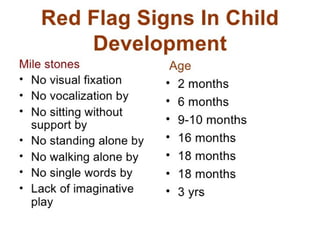
 Knowing the appropriate milestones is key to this
assessment.
 Any signs of developmental regression should be regarded
as a medical emergency and an urgent medical workup is
indicated
 An underlying etiology for developmental delay should be
sought through attention to the clues from history
 1) PRENATAL HISTORY
a. Complications
b. Prenatal diagnoses (eg. Down Syndrome)
c. Infections (eg. TORCH)
d. Exposures (eg. Fetal Alcohol Syndrome)
 2) NATAL & POST NATAL HISTORY
a. Complications
b. APGAR scores
c. Infections (eg. Group B Strep)
d. Seizures
e. Hearing test performed
f. Newborn screening performed
 3) PAST MEDICAL HISTORY AND MEDICATIONS
a. Ototoxic antibiotics eg. Gentamicin
b. Frequent ear infections may lead to effusions affecting
hearing
 4) BEHAVIORAL ISSUES
a. Behavioral disturbances – aggression, self injury,
defiance, inattention, anxiety, depression, sleep disturbances,
stereotypic behaviors, poor social skills, hyperactivity,
difficult temperaments
 5) FAMILY HISTORY
a. Relatives with developmental delay, genetic abnormalities
or syndromes
b. Consanguinity
 6) SOCIAL HISTORY
a. Evidence of neglect or abuse which may
have a negative influence on development.
b.Primary languages- children may have
relative delay in language acquisition.
c. In children with a previously identified
delay it is important to assess the resources
already accessed to support the family.
SCREENING TOOLS
 The Denver Development Screening Test(DDST)
Originally designed as a screening tool ,now being
increasingly used as a tool for routine developmental
assesment.
The scale reflects what percentage of a certain age
group is able to perform a certain task.
In a test to be administered by a pediatrician or
other health or social service professional, a subject's
performance against the regular age distribution is noted.
 Tasks are grouped into four categories (social contact, fine
motor skill, language, and gross motor skill)
 Include items such as smiles spontaneously (performed by
90% of three-month-olds), knocks two building blocks
against each other (90% of 13-month-olds), speaks three
words other than "mom" and "dad" (90% of 21-month-
olds), or hops on one leg (90% of 5-year-olds).
 Baroda Developmental Screening Test is a screening test
for motor-mental assessment of infants, developed
from Bayley Scales of Infant Development
 It is meant to be used by child psychologists rather than
physicians.
 It can be applied up to 30 month of age, kit is
commercially available .
 The Bayley Scales of Infant and Toddler Development
is a standard series of measurements originally developed
by psychologist Nancy Bayley & used primarily to assess
the development of infants and toddlers, ages 1–42 months
 This measure consists of a series of developmental play
tasks and takes between 45 – 60 minutes to administer and
derives a developmental quotient (DQ) rather than
an intelligence quotient (IQ)
 Trivandrum Developmental Screening Test (TDSC) is a
developmental screening test for children. It was
developed by selecting 17 test items from BSID (Baroda
Norms)
 It was validated both at the hospital and the community
level against the standard DDST
 With a sensitivity of 66.7% and specificity of 78.8%, it can
be used even by community level health worker for mass
screening and takes around 5 minutes to complete.[2]
 Includes adequate mental and motor development
milestones spread over the first 2 years.
 Requires only a pencil and a bunch of keys as test items.
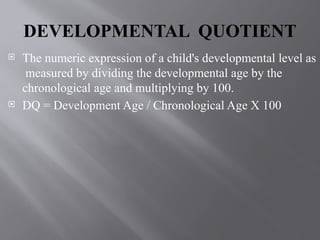
DEVELOPMENTAL QUOTIENT
 The numeric expression of a child's developmental level as
measured by dividing the developmental age by the
chronological age and multiplying by 100.
 DQ = Development Age / Chronological Age X 100
PHYSICAL EXAMINATION
 A thorough physical examination is important in the
assessment of a developmentally delayed child.
 Characteristic findings on physical exam may provide
clues as to the cause of the developmental delay.
 GROWTH PARAMETERS:
Microcephaly: eg in Rett’s Disorder
Macrocephaly: eg in hydrocephalus
Short stature: Turner syndrome, Williams syndrome
Obesity: Prader-Willi syndrome, Beckwith-
Wiedemann syndrome
 HEAD AND NECK
Flat occiput: Down syndrome, Zellweger syndrome
Prominent occiput: trisomy 18
Craniosynostosis: Crouzon syndrome, Pfeiffer syndrome
Midface hypoplasia: Fetal Alcohol Syndrome (FAS), Down
syndrome
Prominent nose and chin: Fragile X syndrome
Round facies: Prader-Willi syndrome
Hypertelorism: Fetal hydantoin syndrome
Hypotelorism: Maternal PKU effect
Lisch nodules: Neurofibromatosis
Large pinna: Fragile X syndrome
Malformed pinna: Treacher Collins syndrome, CHARGE
association
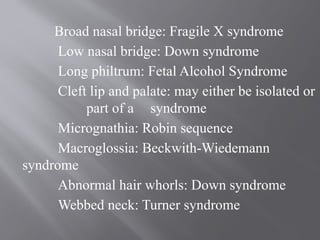
Broad nasal bridge: Fragile X syndrome
Low nasal bridge: Down syndrome
Long philtrum: Fetal Alcohol Syndrome
Cleft lip and palate: may either be isolated or
part of a syndrome
Micrognathia: Robin sequence
Macroglossia: Beckwith-Wiedemann
syndrome
Abnormal hair whorls: Down syndrome
Webbed neck: Turner syndrome
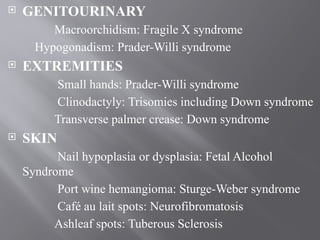
 GENITOURINARY
Macroorchidism: Fragile X syndrome
Hypogonadism: Prader-Willi syndrome
 EXTREMITIES
Small hands: Prader-Willi syndrome
Clinodactyly: Trisomies including Down syndrome
Transverse palmer crease: Down syndrome
 SKIN
Nail hypoplasia or dysplasia: Fetal Alcohol
Syndrome
Port wine hemangioma: Sturge-Weber syndrome
Café au lait spots: Neurofibromatosis
Ashleaf spots: Tuberous Sclerosis
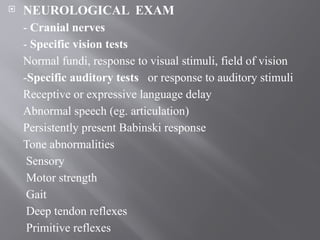
 NEUROLOGICAL EXAM
- Cranial nerves
- Specific vision tests
Normal fundi, response to visual stimuli, field of vision
-Specific auditory tests or response to auditory stimuli
Receptive or expressive language delay
Abnormal speech (eg. articulation)
Persistently present Babinski response
Tone abnormalities
Sensory
Motor strength
Gait
Deep tendon reflexes
Primitive reflexes
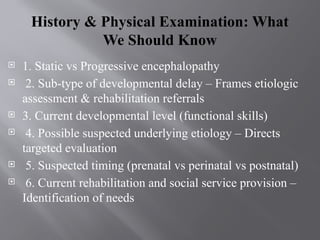
History & Physical Examination: What
We Should Know
 1. Static vs Progressive encephalopathy
 2. Sub-type of developmental delay – Frames etiologic
assessment & rehabilitation referrals
 3. Current developmental level (functional skills)
 4. Possible suspected underlying etiology – Directs
targeted evaluation
 5. Suspected timing (prenatal vs perinatal vs postnatal)
 6. Current rehabilitation and social service provision –
Identification of needs
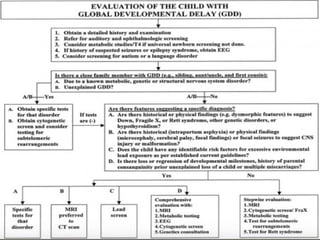
INVESTIGATIONS
 1) GENETICS:
a. Karyotyping to assess for chromosomal abnormalities
b. FISH analysis to assess for microdeletions
 2) ENDOCRINOLOGY:
a. TFT
b. Referral to endocrinology should be considered.
 3) METABOLIC:
a. Metabolic screening – Glucose, SE, Serum lactate, Ammonia,
LFT, Triglycerides, Uric acid, Urine organic acids, Acylcarnitines,
Creatinine phosphokinase (if suspecting myopathy)
 4) NEUROIMAGING
a. EEG
b. Head CT
-Probably most widely available.
-Most useful in the context of global
developmental delay with motor impairment ie.
CP, Cerebral Dysgenesis Microcephaly
-If available MRI is preferential.
 CT Scan indications: suspected perinatal infection,
calcification ,abnormality of skull bones.
 EEG
Evidence supports EEG in the presence of a history
or examination features suggesting Epilepsy or seizures, in
the context of GDD.
 SYNDROMES WITH RECOGNISABLE
PHENOTYPE
 Syndromes which may prompt specific testing:
-Prader Willi
-Angelman
-Rett Syndrome
-Cardiofacial Syndromes: Williams,22Q
Deletion
 VISION AND HEARING
 Newborn screening for vision (clinical, red reflex,
surveillance) and hearing (OAE’s, behavioural
audiometry)
 Children with Global developmental delay are at much
higher risk of sensory impairments and if detected early
often correctable, and may improve outcome.
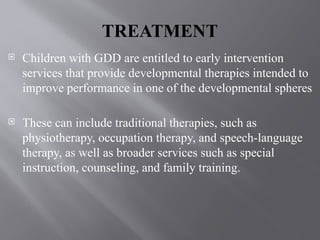
TREATMENT
 Children with GDD are entitled to early intervention
services that provide developmental therapies intended to
improve performance in one of the developmental spheres
 These can include traditional therapies, such as
physiotherapy, occupation therapy, and speech-language
therapy, as well as broader services such as special
instruction, counseling, and family training.
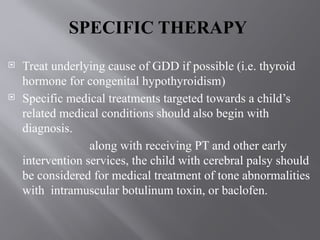
SPECIFIC THERAPY
 Treat underlying cause of GDD if possible (i.e. thyroid
hormone for congenital hypothyroidism)
 Specific medical treatments targeted towards a child’s
related medical conditions should also begin with
diagnosis.
along with receiving PT and other early
intervention services, the child with cerebral palsy should
be considered for medical treatment of tone abnormalities
with intramuscular botulinum toxin, or baclofen.
 The child with behavior disorders accompanying a
communication or intellectual disability can have
psychopharmacologic treatments, such as stimulants for
ADHD and risperidone for aggression.
 Finally, the child with a developmental disability should
have a medical home as a child with special health care
needs.
THANK YOU…….

Treating a Child with Global Developmental Delay

  • 1.
    APPROACH TO ACHILD WITH GDD Dr. Hanine
  • 2.
    INTRODUCTION  Developmental disabilityis estimated to occur in 5-10% of the population with enormous psychological, emotional, and economic impact on the affected individuals and society.  Developmentally delayed children who are recognized at an early age receive more developmental optimization and greater gains  Early recognition of children with developmental problems is therefore important.
  • 3.
     A childwho does not reach his or her developmental milestones at the expected age is considered developmentally delayed.  Gross motor delay - Significant delay in fine or gross motor skills with no impairment in other developmental areas  Developmental language disorders - Significant delay in receptive and/or expressive language skills with no delay in other developmental domains
  • 4.
    GLOBAL DEVELOPMENTAL DELAY Global developmental delay—defined as significant delay in 2 or more developmental domains (gross/fine motor, speech / language,cognition, social/personal, and activities of daily living)  Significant delay—defined as performance 2 standard deviations or more below the mean on age-appropriate, standardized norm referenced testing  Global developmental delay usually applied to younger children(1-5yrs)whereas mental retardation is usually applied to older children when IQ testing is more valid
  • 5.
     Cerebral palsy- Early-onset non-progressive motor impairment with associated abnormalities in muscle tone  Learning disabilities - Significantly lowered individual achievement than predicted by intellectual ability as measured by standardized psycho-educational tests assessing reading, mathematics, or written expression  Pervasive developmental delay (PPD) / Autism - Impairments in social skills, communication skills and restrictive / repetitive patterns of behavior
  • 6.
    Approach to aChild with Developmental Delay  A child’s development is a dynamic process, and assessment at any point in time is merely a snap shot of the bigger picture.  Therefore should be interpreted in the context of the child’s history from conception to the present  While a child may appear to have normal development for the first twelve months of life, a deviation in the course of the child’s development in subsequent years is indicative of an underlying disability
  • 7.
    DEVELOPMENAL ASSESSMENT  Developmentalassessment involves three aspects: Developmental screening Developmental surveillance Definitive diagnostic assessment  Developmental screening is identifying children who may need more comprehensive evaluation.  It is a brief assessment procedure designed to identify children who should receive more intensive diagnosis or assessment using screening tools such as the Denver or Bayley Scales of infant development.
  • 8.
     Developmental surveillance-is a continuous process whereby the child is followed over time to pick up on subtle deficiencies in the child’s developmental trajectory.  The components of developmental surveillance include eliciting and attending to parental concerns, obtaining a relevant developmental history, observing the child’s development in the office and referring for further assessment of development by other relevant professionals such as PT for motor developmental concerns or hearing tests for concerns with language acquisition
  • 9.
     Diagnostic assessmentis performed on a child who has been identified as having a potential problem.  This step requires extensive involvement of various team such as a pediatrician, psychologist, educator, social worker,, geneticist, and/or other medical professionals
  • 10.
    HISTORY  To performa developmental assessment, a detailed history from conception to the present is required to assess developmental level.  Knowing the appropriate milestones is key to this assessment.  Any signs of developmental regression should be regarded as a medical emergency and an urgent medical workup is indicated  An underlying etiology for developmental delay should be sought through attention to the clues from history
  • 11.
     1) PRENATALHISTORY a. Complications b. Prenatal diagnoses (eg. Down Syndrome) c. Infections (eg. TORCH) d. Exposures (eg. Fetal Alcohol Syndrome)  2) NATAL & POST NATAL HISTORY a. Complications b. APGAR scores c. Infections (eg. Group B Strep) d. Seizures e. Hearing test performed f. Newborn screening performed
  • 12.
     3) PASTMEDICAL HISTORY AND MEDICATIONS a. Ototoxic antibiotics eg. Gentamicin b. Frequent ear infections may lead to effusions affecting hearing  4) BEHAVIORAL ISSUES a. Behavioral disturbances – aggression, self injury, defiance, inattention, anxiety, depression, sleep disturbances, stereotypic behaviors, poor social skills, hyperactivity, difficult temperaments  5) FAMILY HISTORY a. Relatives with developmental delay, genetic abnormalities or syndromes b. Consanguinity
  • 13.
     6) SOCIALHISTORY a. Evidence of neglect or abuse which may have a negative influence on development. b.Primary languages- children may have relative delay in language acquisition. c. In children with a previously identified delay it is important to assess the resources already accessed to support the family.
  • 15.
    SCREENING TOOLS  TheDenver Development Screening Test(DDST) Originally designed as a screening tool ,now being increasingly used as a tool for routine developmental assesment. The scale reflects what percentage of a certain age group is able to perform a certain task. In a test to be administered by a pediatrician or other health or social service professional, a subject's performance against the regular age distribution is noted.
  • 16.
     Tasks aregrouped into four categories (social contact, fine motor skill, language, and gross motor skill)  Include items such as smiles spontaneously (performed by 90% of three-month-olds), knocks two building blocks against each other (90% of 13-month-olds), speaks three words other than "mom" and "dad" (90% of 21-month- olds), or hops on one leg (90% of 5-year-olds).
  • 17.
     Baroda DevelopmentalScreening Test is a screening test for motor-mental assessment of infants, developed from Bayley Scales of Infant Development  It is meant to be used by child psychologists rather than physicians.  It can be applied up to 30 month of age, kit is commercially available .  The Bayley Scales of Infant and Toddler Development is a standard series of measurements originally developed by psychologist Nancy Bayley & used primarily to assess the development of infants and toddlers, ages 1–42 months  This measure consists of a series of developmental play tasks and takes between 45 – 60 minutes to administer and derives a developmental quotient (DQ) rather than an intelligence quotient (IQ)
  • 18.
     Trivandrum DevelopmentalScreening Test (TDSC) is a developmental screening test for children. It was developed by selecting 17 test items from BSID (Baroda Norms)  It was validated both at the hospital and the community level against the standard DDST  With a sensitivity of 66.7% and specificity of 78.8%, it can be used even by community level health worker for mass screening and takes around 5 minutes to complete.[2]  Includes adequate mental and motor development milestones spread over the first 2 years.  Requires only a pencil and a bunch of keys as test items.
  • 19.
    DEVELOPMENTAL QUOTIENT  Thenumeric expression of a child's developmental level as measured by dividing the developmental age by the chronological age and multiplying by 100.  DQ = Development Age / Chronological Age X 100
  • 20.
    PHYSICAL EXAMINATION  Athorough physical examination is important in the assessment of a developmentally delayed child.  Characteristic findings on physical exam may provide clues as to the cause of the developmental delay.  GROWTH PARAMETERS: Microcephaly: eg in Rett’s Disorder Macrocephaly: eg in hydrocephalus Short stature: Turner syndrome, Williams syndrome Obesity: Prader-Willi syndrome, Beckwith- Wiedemann syndrome
  • 21.
     HEAD ANDNECK Flat occiput: Down syndrome, Zellweger syndrome Prominent occiput: trisomy 18 Craniosynostosis: Crouzon syndrome, Pfeiffer syndrome Midface hypoplasia: Fetal Alcohol Syndrome (FAS), Down syndrome Prominent nose and chin: Fragile X syndrome Round facies: Prader-Willi syndrome Hypertelorism: Fetal hydantoin syndrome Hypotelorism: Maternal PKU effect Lisch nodules: Neurofibromatosis Large pinna: Fragile X syndrome Malformed pinna: Treacher Collins syndrome, CHARGE association
  • 22.
    Broad nasal bridge:Fragile X syndrome Low nasal bridge: Down syndrome Long philtrum: Fetal Alcohol Syndrome Cleft lip and palate: may either be isolated or part of a syndrome Micrognathia: Robin sequence Macroglossia: Beckwith-Wiedemann syndrome Abnormal hair whorls: Down syndrome Webbed neck: Turner syndrome
  • 23.
     GENITOURINARY Macroorchidism: FragileX syndrome Hypogonadism: Prader-Willi syndrome  EXTREMITIES Small hands: Prader-Willi syndrome Clinodactyly: Trisomies including Down syndrome Transverse palmer crease: Down syndrome  SKIN Nail hypoplasia or dysplasia: Fetal Alcohol Syndrome Port wine hemangioma: Sturge-Weber syndrome Café au lait spots: Neurofibromatosis Ashleaf spots: Tuberous Sclerosis
  • 24.
     NEUROLOGICAL EXAM -Cranial nerves - Specific vision tests Normal fundi, response to visual stimuli, field of vision -Specific auditory tests or response to auditory stimuli Receptive or expressive language delay Abnormal speech (eg. articulation) Persistently present Babinski response Tone abnormalities Sensory Motor strength Gait Deep tendon reflexes Primitive reflexes
  • 25.
    History & PhysicalExamination: What We Should Know  1. Static vs Progressive encephalopathy  2. Sub-type of developmental delay – Frames etiologic assessment & rehabilitation referrals  3. Current developmental level (functional skills)  4. Possible suspected underlying etiology – Directs targeted evaluation  5. Suspected timing (prenatal vs perinatal vs postnatal)  6. Current rehabilitation and social service provision – Identification of needs
  • 26.
    INVESTIGATIONS  1) GENETICS: a.Karyotyping to assess for chromosomal abnormalities b. FISH analysis to assess for microdeletions  2) ENDOCRINOLOGY: a. TFT b. Referral to endocrinology should be considered.  3) METABOLIC: a. Metabolic screening – Glucose, SE, Serum lactate, Ammonia, LFT, Triglycerides, Uric acid, Urine organic acids, Acylcarnitines, Creatinine phosphokinase (if suspecting myopathy)
  • 27.
     4) NEUROIMAGING a.EEG b. Head CT -Probably most widely available. -Most useful in the context of global developmental delay with motor impairment ie. CP, Cerebral Dysgenesis Microcephaly -If available MRI is preferential.  CT Scan indications: suspected perinatal infection, calcification ,abnormality of skull bones.
  • 28.
     EEG Evidence supportsEEG in the presence of a history or examination features suggesting Epilepsy or seizures, in the context of GDD.  SYNDROMES WITH RECOGNISABLE PHENOTYPE  Syndromes which may prompt specific testing: -Prader Willi -Angelman -Rett Syndrome -Cardiofacial Syndromes: Williams,22Q Deletion
  • 29.
     VISION ANDHEARING  Newborn screening for vision (clinical, red reflex, surveillance) and hearing (OAE’s, behavioural audiometry)  Children with Global developmental delay are at much higher risk of sensory impairments and if detected early often correctable, and may improve outcome.
  • 31.
    TREATMENT  Children withGDD are entitled to early intervention services that provide developmental therapies intended to improve performance in one of the developmental spheres  These can include traditional therapies, such as physiotherapy, occupation therapy, and speech-language therapy, as well as broader services such as special instruction, counseling, and family training.
  • 32.
    SPECIFIC THERAPY  Treatunderlying cause of GDD if possible (i.e. thyroid hormone for congenital hypothyroidism)  Specific medical treatments targeted towards a child’s related medical conditions should also begin with diagnosis. along with receiving PT and other early intervention services, the child with cerebral palsy should be considered for medical treatment of tone abnormalities with intramuscular botulinum toxin, or baclofen.
  • 33.
     The childwith behavior disorders accompanying a communication or intellectual disability can have psychopharmacologic treatments, such as stimulants for ADHD and risperidone for aggression.  Finally, the child with a developmental disability should have a medical home as a child with special health care needs.
  • 34.