
LABORATORY APPROACH TO
BLEEDING DISORDERS & MIXING
STUDIES
SUNILKUMAR P
HEMATLOGY& TRANSFUSION MEDICINE
ST.JOHN’S MEDICAL COLLEGE HOSPITAL , BANGALORE
10/13/2018 1
SUNIL KUMAR P , ST.JOHN'S MEDICAL
COLLEGE
Haemostasis : -
• Arrests bleeding from injured site.
• Maintain blood in fluid state in normal
vessels.
10/13/2018 2
SUNIL KUMAR P , ST.JOHN'S MEDICAL
COLLEGE
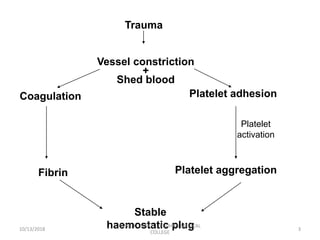
Trauma
Vessel constriction
+
Shed blood
Coagulation Platelet adhesion
Fibrin Platelet aggregation
Platelet
activation
Stable
haemostatic plug10/13/2018 3
SUNIL KUMAR P , ST.JOHN'S MEDICAL
COLLEGE
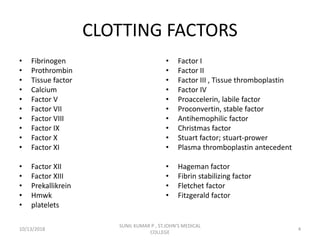
CLOTTING FACTORS
• Fibrinogen
• Prothrombin
• Tissue factor
• Calcium
• Factor V
• Factor VII
• Factor VIII
• Factor IX
• Factor X
• Factor XI
• Factor XII
• Factor XIII
• Prekallikrein
• Hmwk
• platelets
• Factor I
• Factor II
• Factor III , Tissue thromboplastin
• Factor IV
• Proaccelerin, labile factor
• Proconvertin, stable factor
• Antihemophilic factor
• Christmas factor
• Stuart factor; stuart-prower
• Plasma thromboplastin antecedent
• Hageman factor
• Fibrin stabilizing factor
• Fletchet factor
• Fitzgerald factor
10/13/2018 4
SUNIL KUMAR P , ST.JOHN'S MEDICAL
COLLEGE
10/13/2018 5
SUNIL KUMAR P , ST.JOHN'S MEDICAL
COLLEGE
Evaluation of the patient
• History
• Physical Examination
• Laboratory Evaluation
10/13/2018 6
SUNIL KUMAR P , ST.JOHN'S MEDICAL
COLLEGE
History
–surgical challenges
–accidents & injuries
–dental extractions
–menstrual history
10/13/2018 7
SUNIL KUMAR P , ST.JOHN'S MEDICAL
COLLEGE
Physical Examination
• current hemorrhage
• intercurrent illnesses
–liver disease
• petechiae/ecchymoses
10/13/2018 8
SUNIL KUMAR P , ST.JOHN'S MEDICAL
COLLEGE
Type of Bleeding
• ecchymoses
• petechiae
• epistaxis
• deep soft tissue bleed
• hemarthroses
• GI bleeding
10/13/2018 9
SUNIL KUMAR P , ST.JOHN'S MEDICAL
COLLEGE
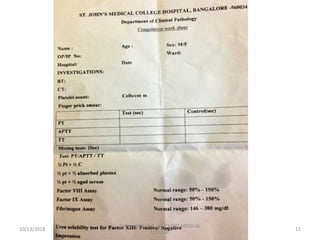
Laboratory Assessment
• Guided by history
• Screening tests:
• BT, CT, Platelet count,
– PT
– APTT
– thrombin time
– Fibrinogen
10/13/2018 10
SUNIL KUMAR P , ST.JOHN'S MEDICAL
COLLEGE
10/13/2018 11
SUNIL KUMAR P , ST.JOHN'S MEDICAL
COLLEGE
Specific Laboratory Tests
• Factor assays
• Euglobin Lysis test
• Urea solubility test
• D-Dimer
• Screening test for inhibitors
• Platelet function test
10/13/2018 12
SUNIL KUMAR P , ST.JOHN'S MEDICAL
COLLEGE
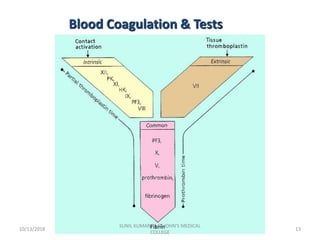
Blood Coagulation & Tests
10/13/2018 13
SUNIL KUMAR P , ST.JOHN'S MEDICAL
COLLEGE
FIRST LINE TESTS
10/13/2018 14
SUNIL KUMAR P , ST.JOHN'S MEDICAL
COLLEGE
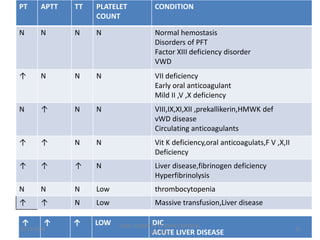
PT APTT TT PLATELET
COUNT
CONDITION
N N N N Normal hemostasis
Disorders of PFT
Factor XIII deficiency disorder
VWD
↑ N N N VII deficiency
Early oral anticoagulant
Mild II ,V ,X deficiency
N ↑ N N VIII,IX,XI,XII ,prekallikerin,HMWK def
vWD disease
Circulating anticoagulants
↑ ↑ N N Vit K deficiency,oral anticoagulats,F V ,X,II
Deficiency
↑ ↑ ↑ N Liver disease,fibrinogen deficiency
Hyperfibrinolysis
N N N Low thrombocytopenia
↑ ↑ N Low Massive transfusion,Liver disease
↑ ↑ ↑ LOW DIC
ACUTE LIVER DISEASE
10/13/2018 15
SUNIL KUMAR P , ST.JOHN'S MEDICAL
COLLEGE
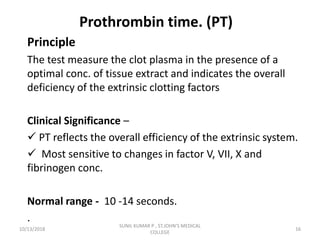
Prothrombin time. (PT)
Principle
The test measure the clot plasma in the presence of a
optimal conc. of tissue extract and indicates the overall
deficiency of the extrinsic clotting factors
Clinical Significance –
 PT reflects the overall efficiency of the extrinsic system.
 Most sensitive to changes in factor V, VII, X and
fibrinogen conc.
Normal range - 10 -14 seconds.
.
10/13/2018 16
SUNIL KUMAR P , ST.JOHN'S MEDICAL
COLLEGE
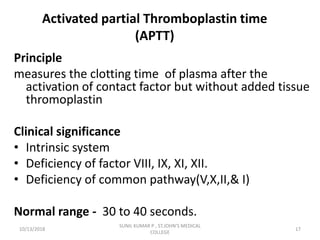
Activated partial Thromboplastin time
(APTT)
Principle
measures the clotting time of plasma after the
activation of contact factor but without added tissue
thromoplastin
Clinical significance
• Intrinsic system
• Deficiency of factor VIII, IX, XI, XII.
• Deficiency of common pathway(V,X,II,& I)
Normal range - 30 to 40 seconds.
10/13/2018 17
SUNIL KUMAR P , ST.JOHN'S MEDICAL
COLLEGE
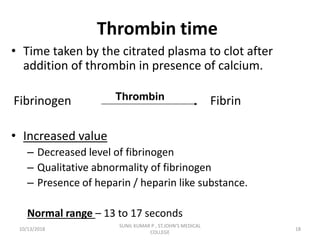
Thrombin time
• Time taken by the citrated plasma to clot after
addition of thrombin in presence of calcium.
Fibrinogen Fibrin
• Increased value
– Decreased level of fibrinogen
– Qualitative abnormality of fibrinogen
– Presence of heparin / heparin like substance.
Normal range – 13 to 17 seconds
Thrombin
10/13/2018 18
SUNIL KUMAR P , ST.JOHN'S MEDICAL
COLLEGE
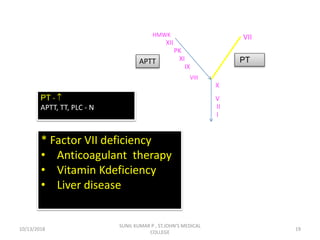
PT
TT
APTT
PT - 
APTT, TT, PLC - N
HMWK
XII
PK
XI
IX
VIII
VII
X
V
II
I
* Factor VII deficiency
• Anticoagulant therapy
• Vitamin Kdeficiency
• Liver disease
10/13/2018 19
SUNIL KUMAR P , ST.JOHN'S MEDICAL
COLLEGE
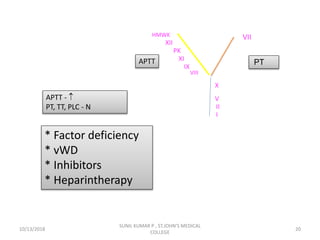
APTT - 
PT, TT, PLC - N
* Factor deficiency
* vWD
* Inhibitors
* Heparintherapy
PT
TT
APTT
HMWK
XII
PK
XI
IX
VII
X
V
II
I
10/13/2018 20
SUNIL KUMAR P , ST.JOHN'S MEDICAL
COLLEGE
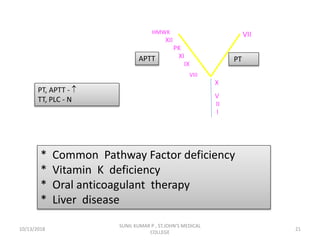
PT
TT
APTT
PT, APTT - 
TT, PLC - N
HMWK
XII
PK
XI
IX
VIII
VII
X
V
II
I
* Common Pathway Factor deficiency
* Vitamin K deficiency
* Oral anticoagulant therapy
* Liver disease
10/13/2018 21
SUNIL KUMAR P , ST.JOHN'S MEDICAL
COLLEGE
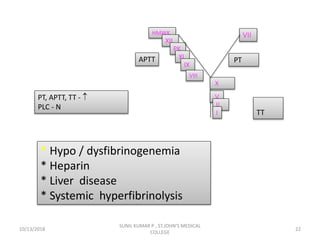
PT
TT
APTT
PT, APTT, TT - 
PLC - N
HMWK
XII
PK
XI
IX
VIII
VII
X
V
II
I
* Hypo / dysfibrinogenemia
* Heparin
* Liver disease
* Systemic hyperfibrinolysis
10/13/2018 22
SUNIL KUMAR P , ST.JOHN'S MEDICAL
COLLEGE
PT
TT
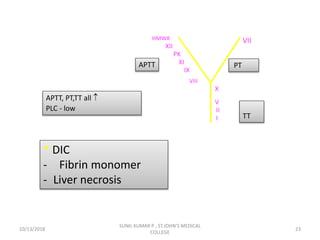
* DIC
- Fibrin monomer
- Liver necrosis
APTT
APTT, PT,TT all 
PLC - low
HMWK
XII
PK
XI
IX
VIII
VII
X
V
II
I
10/13/2018 23
SUNIL KUMAR P , ST.JOHN'S MEDICAL
COLLEGE
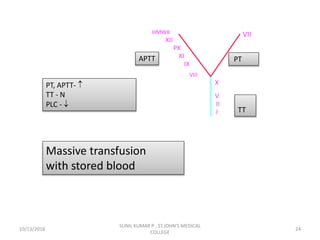
PT
TT
APTT
PT, APTT- 
TT - N
PLC - 
HMWK
XII
PK
XI
IX
VIII
VII
X
V
II
I
Massive transfusion
with stored blood
10/13/2018 24
SUNIL KUMAR P , ST.JOHN'S MEDICAL
COLLEGE
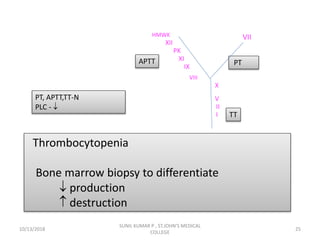
Thrombocytopenia
Bone marrow biopsy to differentiate
 production
 destruction
PTAPTT
PT, APTT,TT-N
PLC - 
HMWK
XII
PK
XI
IX
VIII
VII
X
V
II
I TT
10/13/2018 25
SUNIL KUMAR P , ST.JOHN'S MEDICAL
COLLEGE
INHIBITORS-SCREENING TEST
• PRINCIPLE
• Inhibitors are Ab’s developed against factor VIII.
They are time dependent thus if factor VIII:C is added
to plasma containg an inhibitor and the mixture is
incubated, factor VIII:C will be progresively neutralized.
If the amount of factor VIII:C added and the duration of
incubation are standardized.
The strength of the inhibitor may be measured in
units according to how much of the added factor VIII:C
is destroyed.
10/13/2018 26
SUNIL KUMAR P , ST.JOHN'S MEDICAL
COLLEGE
REAGENTS
• APTT reagent
• Control plasma
• PROCEDURE
• Screening for coagulation inhibitors
• A. perform APTT of patient & control
• B. if prolonged do APTT with 1/2 patient + ½
control
• C. if there is no correction –suggest the presence
of inhibitors
10/13/2018 27
SUNIL KUMAR P , ST.JOHN'S MEDICAL
COLLEGE
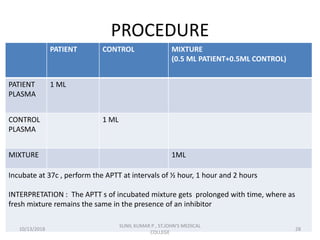
PROCEDURE
PATIENT CONTROL MIXTURE
(0.5 ML PATIENT+0.5ML CONTROL)
PATIENT
PLASMA
1 ML
CONTROL
PLASMA
1 ML
MIXTURE 1ML
Incubate at 37c , perform the APTT at intervals of ½ hour, 1 hour and 2 hours
INTERPRETATION : The APTT s of incubated mixture gets prolonged with time, where as
fresh mixture remains the same in the presence of an inhibitor
10/13/2018 28
SUNIL KUMAR P , ST.JOHN'S MEDICAL
COLLEGE
FIBRINOGEN ASSAY
• PRINCIPLE :
• Fibriquik is based on a method described by
clauss. When thrombin is added to a sample
plasma, fibrinogen is converted enzymatically to
fibrin, fibrin in turn, undergoes polymerization to
form a fibrin network.
• factor XIII activated by thrombin, catalyzes
the formation of stabilizing crosslink to produce a
visible clot the time from addition of thrombin to
the formation of clot is inversely proportional to
fibrinogen level
10/13/2018 29
SUNIL KUMAR P , ST.JOHN'S MEDICAL
COLLEGE
Reagents
• Thrombin reagent
• Owner’s veronal buffer
10/13/2018 30
SUNIL KUMAR P , ST.JOHN'S MEDICAL
COLLEGE
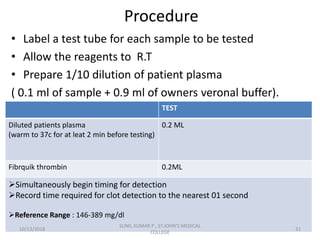
Procedure
• Label a test tube for each sample to be tested
• Allow the reagents to R.T
• Prepare 1/10 dilution of patient plasma
( 0.1 ml of sample + 0.9 ml of owners veronal buffer).
TEST
Diluted patients plasma
(warm to 37c for at leat 2 min before testing)
0.2 ML
Fibrquik thrombin 0.2ML
Simultaneously begin timing for detection
Record time required for clot detection to the nearest 01 second
Reference Range : 146-389 mg/dl
10/13/2018 31
SUNIL KUMAR P , ST.JOHN'S MEDICAL
COLLEGE
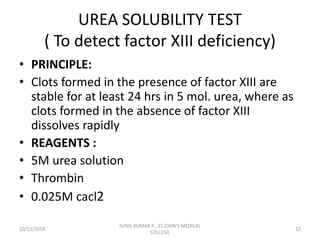
UREA SOLUBILITY TEST
( To detect factor XIII deficiency)
• PRINCIPLE:
• Clots formed in the presence of factor XIII are
stable for at least 24 hrs in 5 mol. urea, where as
clots formed in the absence of factor XIII
dissolves rapidly
• REAGENTS :
• 5M urea solution
• Thrombin
• 0.025M cacl2
10/13/2018 32
SUNIL KUMAR P , ST.JOHN'S MEDICAL
COLLEGE
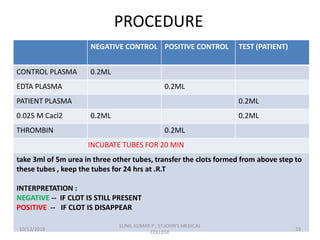
PROCEDURE
NEGATIVE CONTROL POSITIVE CONTROL TEST (PATIENT)
CONTROL PLASMA 0.2ML
EDTA PLASMA 0.2ML
PATIENT PLASMA 0.2ML
0.025 M Cacl2 0.2ML 0.2ML
THROMBIN 0.2ML
INCUBATE TUBES FOR 20 MIN
take 3ml of 5m urea in three other tubes, transfer the clots formed from above step to
these tubes , keep the tubes for 24 hrs at .R.T
INTERPRETATION :
NEGATIVE -- IF CLOT IS STILL PRESENT
POSITIVE -- IF CLOT IS DISAPPEAR
10/13/2018 33
SUNIL KUMAR P , ST.JOHN'S MEDICAL
COLLEGE
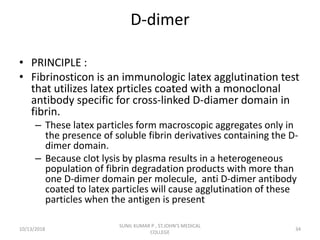
D-dimer
• PRINCIPLE :
• Fibrinosticon is an immunologic latex agglutination test
that utilizes latex prticles coated with a monoclonal
antibody specific for cross-linked D-diamer domain in
fibrin.
– These latex particles form macroscopic aggregates only in
the presence of soluble fibrin derivatives containing the D-
dimer domain.
– Because clot lysis by plasma results in a heterogeneous
population of fibrin degradation products with more than
one D-dimer domain per molecule, anti D-dimer antibody
coated to latex particles will cause agglutination of these
particles when the antigen is present
10/13/2018 34
SUNIL KUMAR P , ST.JOHN'S MEDICAL
COLLEGE
CORRECTION TEST USING PT & APTT
 Unexplained prolongation of PT ,APTT can be
corrected by simple correction test.
 Correction done by mixing patient plasma with
normal plasma.
 Failure to correction indicates presence of
inhibitor.
Specific factor deficiency can be identified.
10/13/2018 35
SUNIL KUMAR P , ST.JOHN'S MEDICAL
COLLEGE
Mixing studies in coagulation
• When PT and / or APTT are prolonged further
investigation done to identify specific
abnormality.
• Mixing studies are used to distinguish factor
deficiency from factor inhibitor (such as lupus
anticoagulant or specific factor inhibitor such
as Ab directed against factor VIII).
10/13/2018 36
SUNIL KUMAR P , ST.JOHN'S MEDICAL
COLLEGE
• PRINCIPLE
Mixing studies are used to determine whether
a prolonged PT or APTT is due to factor
deficiency or an inhibitor. Correction of the
abnormality by an additive reagent indicates
that the reagent contains the substance
deficient in the test sample
10/13/2018 37
SUNIL KUMAR P , ST.JOHN'S MEDICAL
COLLEGE
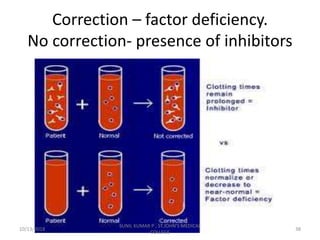
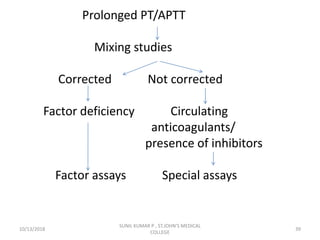
Correction – factor deficiency.
No correction- presence of inhibitors
10/13/2018 38
SUNIL KUMAR P , ST.JOHN'S MEDICAL
COLLEGE
Prolonged PT/APTT
Mixing studies
Corrected Not corrected
Factor deficiency Circulating
anticoagulants/
presence of inhibitors
Factor assays Special assays
10/13/2018 39
SUNIL KUMAR P , ST.JOHN'S MEDICAL
COLLEGE
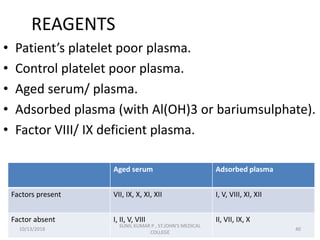
REAGENTS
• Patient’s platelet poor plasma.
• Control platelet poor plasma.
• Aged serum/ plasma.
• Adsorbed plasma (with Al(OH)3 or bariumsulphate).
• Factor VIII/ IX deficient plasma.
Aged serum Adsorbed plasma
Factors present VII, IX, X, XI, XII I, V, VIII, XI, XII
Factor absent I, II, V, VIII II, VII, IX, X
10/13/2018 40
SUNIL KUMAR P , ST.JOHN'S MEDICAL
COLLEGE
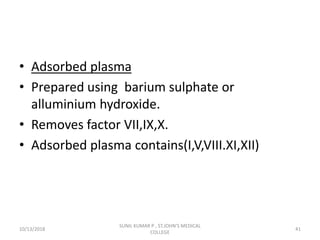
• Adsorbed plasma
• Prepared using barium sulphate or
alluminium hydroxide.
• Removes factor VII,IX,X.
• Adsorbed plasma contains(I,V,VIII.XI,XII)
10/13/2018 41
SUNIL KUMAR P , ST.JOHN'S MEDICAL
COLLEGE
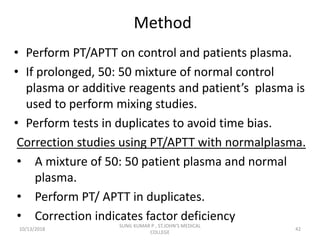
Method
• Perform PT/APTT on control and patients plasma.
• If prolonged, 50: 50 mixture of normal control
plasma or additive reagents and patient’s plasma is
used to perform mixing studies.
• Perform tests in duplicates to avoid time bias.
Correction studies using PT/APTT with normalplasma.
• A mixture of 50: 50 patient plasma and normal
plasma.
• Perform PT/ APTT in duplicates.
• Correction indicates factor deficiency
10/13/2018 42
SUNIL KUMAR P , ST.JOHN'S MEDICAL
COLLEGE
If APTT corrects by more than 50% of the difference
between clotting times of normal plasma and test
plasma good correction.
A poor correction ie, prolonged APTT on mixing
indicates presence of an inhibitor.
Eg:-
APTT test =60˝
Control = 35˝ 100%
• Correction with ½ patient +
½ control = 42˝ [50%]
60˝- 35˝ =25˝ [100%]
25/2 = 12.5˝ [50%] with out correction.
10/13/2018 43
SUNIL KUMAR P , ST.JOHN'S MEDICAL
COLLEGE
60˝- 42˝ =18˝ [50%] after correction.
18˝ >12.5˝ Good correction.
• ½ patient + ½ control = 52˝ [50%]
60˝ - 52˝ = 8˝ [50%]
8˝ < 12.5˝ poor or no correction
2) Using aged serum.
½ patient serum + ½ aged serum.
Perform PT/APTT in duplicates.
Interpret the result.
10/13/2018 44
SUNIL KUMAR P , ST.JOHN'S MEDICAL
COLLEGE
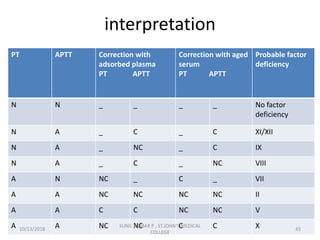
interpretation
PT APTT Correction with
adsorbed plasma
PT APTT
Correction with aged
serum
PT APTT
Probable factor
deficiency
N N _ _ _ _ No factor
deficiency
N A _ C _ C XI/XII
N A _ NC _ C IX
N A _ C _ NC VIII
A N NC _ C _ VII
A A NC NC NC NC II
A A C C NC NC V
A A NC NC C C X10/13/2018 45
SUNIL KUMAR P , ST.JOHN'S MEDICAL
COLLEGE
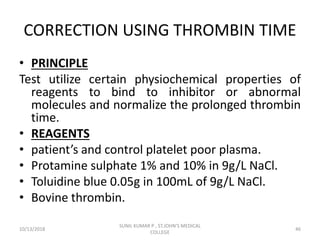
CORRECTION USING THROMBIN TIME
• PRINCIPLE
Test utilize certain physiochemical properties of
reagents to bind to inhibitor or abnormal
molecules and normalize the prolonged thrombin
time.
• REAGENTS
• patient’s and control platelet poor plasma.
• Protamine sulphate 1% and 10% in 9g/L NaCl.
• Toluidine blue 0.05g in 100mL of 9g/L NaCl.
• Bovine thrombin.
10/13/2018 46
SUNIL KUMAR P , ST.JOHN'S MEDICAL
COLLEGE
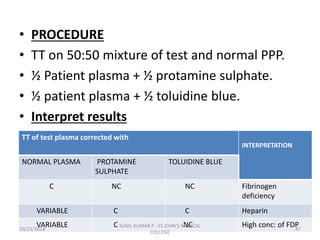
• PROCEDURE
• TT on 50:50 mixture of test and normal PPP.
• ½ Patient plasma + ½ protamine sulphate.
• ½ patient plasma + ½ toluidine blue.
• Interpret results
TT of test plasma corrected with
INTERPRETATION
NORMAL PLASMA PROTAMINE
SULPHATE
TOLUIDINE BLUE
C NC NC Fibrinogen
deficiency
VARIABLE C C Heparin
VARIABLE C NC High conc: of FDP10/13/2018 47
SUNIL KUMAR P , ST.JOHN'S MEDICAL
COLLEGE
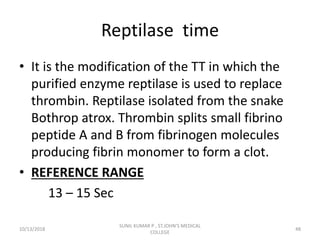
Reptilase time
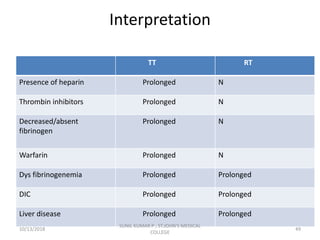
• It is the modification of the TT in which the
purified enzyme reptilase is used to replace
thrombin. Reptilase isolated from the snake
Bothrop atrox. Thrombin splits small fibrino
peptide A and B from fibrinogen molecules
producing fibrin monomer to form a clot.
• REFERENCE RANGE
13 – 15 Sec
10/13/2018 48
SUNIL KUMAR P , ST.JOHN'S MEDICAL
COLLEGE
Interpretation
TT RT
Presence of heparin Prolonged N
Thrombin inhibitors Prolonged N
Decreased/absent
fibrinogen
Prolonged N
Warfarin Prolonged N
Dys fibrinogenemia Prolonged Prolonged
DIC Prolonged Prolonged
Liver disease Prolonged Prolonged
10/13/2018 49
SUNIL KUMAR P , ST.JOHN'S MEDICAL
COLLEGE
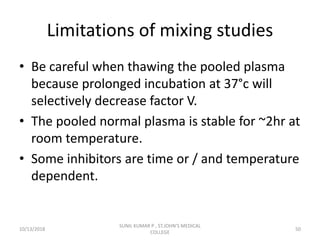
Limitations of mixing studies
• Be careful when thawing the pooled plasma
because prolonged incubation at 37°c will
selectively decrease factor V.
• The pooled normal plasma is stable for ~2hr at
room temperature.
• Some inhibitors are time or / and temperature
dependent.
10/13/2018 50
SUNIL KUMAR P , ST.JOHN'S MEDICAL
COLLEGE
REFERENCES
• Text book of Haematology William's,
chapter118,pg No-1883-1889.
• Text book of Hemostasis & Thrombosis,
columan, mardwill chapter 12.
• Text book of postgraduate hematology
Hoffbrand.
• Practical Haematology dacie and Lewis .
10/13/2018 51
SUNIL KUMAR P , ST.JOHN'S MEDICAL
COLLEGE
THANK YOU
10/13/2018 52
SUNIL KUMAR P , ST.JOHN'S MEDICAL
COLLEGE

Approach to bleeding disorders

  • 1.
    LABORATORY APPROACH TO BLEEDINGDISORDERS & MIXING STUDIES SUNILKUMAR P HEMATLOGY& TRANSFUSION MEDICINE ST.JOHN’S MEDICAL COLLEGE HOSPITAL , BANGALORE 10/13/2018 1 SUNIL KUMAR P , ST.JOHN'S MEDICAL COLLEGE
  • 2.
    Haemostasis : - •Arrests bleeding from injured site. • Maintain blood in fluid state in normal vessels. 10/13/2018 2 SUNIL KUMAR P , ST.JOHN'S MEDICAL COLLEGE
  • 3.
    Trauma Vessel constriction + Shed blood CoagulationPlatelet adhesion Fibrin Platelet aggregation Platelet activation Stable haemostatic plug10/13/2018 3 SUNIL KUMAR P , ST.JOHN'S MEDICAL COLLEGE
  • 4.
    CLOTTING FACTORS • Fibrinogen •Prothrombin • Tissue factor • Calcium • Factor V • Factor VII • Factor VIII • Factor IX • Factor X • Factor XI • Factor XII • Factor XIII • Prekallikrein • Hmwk • platelets • Factor I • Factor II • Factor III , Tissue thromboplastin • Factor IV • Proaccelerin, labile factor • Proconvertin, stable factor • Antihemophilic factor • Christmas factor • Stuart factor; stuart-prower • Plasma thromboplastin antecedent • Hageman factor • Fibrin stabilizing factor • Fletchet factor • Fitzgerald factor 10/13/2018 4 SUNIL KUMAR P , ST.JOHN'S MEDICAL COLLEGE
  • 5.
    10/13/2018 5 SUNIL KUMARP , ST.JOHN'S MEDICAL COLLEGE
  • 6.
    Evaluation of thepatient • History • Physical Examination • Laboratory Evaluation 10/13/2018 6 SUNIL KUMAR P , ST.JOHN'S MEDICAL COLLEGE
  • 7.
    History –surgical challenges –accidents &injuries –dental extractions –menstrual history 10/13/2018 7 SUNIL KUMAR P , ST.JOHN'S MEDICAL COLLEGE
  • 8.
    Physical Examination • currenthemorrhage • intercurrent illnesses –liver disease • petechiae/ecchymoses 10/13/2018 8 SUNIL KUMAR P , ST.JOHN'S MEDICAL COLLEGE
  • 9.
    Type of Bleeding •ecchymoses • petechiae • epistaxis • deep soft tissue bleed • hemarthroses • GI bleeding 10/13/2018 9 SUNIL KUMAR P , ST.JOHN'S MEDICAL COLLEGE
  • 10.
    Laboratory Assessment • Guidedby history • Screening tests: • BT, CT, Platelet count, – PT – APTT – thrombin time – Fibrinogen 10/13/2018 10 SUNIL KUMAR P , ST.JOHN'S MEDICAL COLLEGE
  • 11.
    10/13/2018 11 SUNIL KUMARP , ST.JOHN'S MEDICAL COLLEGE
  • 12.
    Specific Laboratory Tests •Factor assays • Euglobin Lysis test • Urea solubility test • D-Dimer • Screening test for inhibitors • Platelet function test 10/13/2018 12 SUNIL KUMAR P , ST.JOHN'S MEDICAL COLLEGE
  • 13.
    Blood Coagulation &Tests 10/13/2018 13 SUNIL KUMAR P , ST.JOHN'S MEDICAL COLLEGE
  • 14.
    FIRST LINE TESTS 10/13/201814 SUNIL KUMAR P , ST.JOHN'S MEDICAL COLLEGE
  • 15.
    PT APTT TTPLATELET COUNT CONDITION N N N N Normal hemostasis Disorders of PFT Factor XIII deficiency disorder VWD ↑ N N N VII deficiency Early oral anticoagulant Mild II ,V ,X deficiency N ↑ N N VIII,IX,XI,XII ,prekallikerin,HMWK def vWD disease Circulating anticoagulants ↑ ↑ N N Vit K deficiency,oral anticoagulats,F V ,X,II Deficiency ↑ ↑ ↑ N Liver disease,fibrinogen deficiency Hyperfibrinolysis N N N Low thrombocytopenia ↑ ↑ N Low Massive transfusion,Liver disease ↑ ↑ ↑ LOW DIC ACUTE LIVER DISEASE 10/13/2018 15 SUNIL KUMAR P , ST.JOHN'S MEDICAL COLLEGE
  • 16.
    Prothrombin time. (PT) Principle Thetest measure the clot plasma in the presence of a optimal conc. of tissue extract and indicates the overall deficiency of the extrinsic clotting factors Clinical Significance –  PT reflects the overall efficiency of the extrinsic system.  Most sensitive to changes in factor V, VII, X and fibrinogen conc. Normal range - 10 -14 seconds. . 10/13/2018 16 SUNIL KUMAR P , ST.JOHN'S MEDICAL COLLEGE
  • 17.
    Activated partial Thromboplastintime (APTT) Principle measures the clotting time of plasma after the activation of contact factor but without added tissue thromoplastin Clinical significance • Intrinsic system • Deficiency of factor VIII, IX, XI, XII. • Deficiency of common pathway(V,X,II,& I) Normal range - 30 to 40 seconds. 10/13/2018 17 SUNIL KUMAR P , ST.JOHN'S MEDICAL COLLEGE
  • 18.
    Thrombin time • Timetaken by the citrated plasma to clot after addition of thrombin in presence of calcium. Fibrinogen Fibrin • Increased value – Decreased level of fibrinogen – Qualitative abnormality of fibrinogen – Presence of heparin / heparin like substance. Normal range – 13 to 17 seconds Thrombin 10/13/2018 18 SUNIL KUMAR P , ST.JOHN'S MEDICAL COLLEGE
  • 19.
    PT TT APTT PT -  APTT,TT, PLC - N HMWK XII PK XI IX VIII VII X V II I * Factor VII deficiency • Anticoagulant therapy • Vitamin Kdeficiency • Liver disease 10/13/2018 19 SUNIL KUMAR P , ST.JOHN'S MEDICAL COLLEGE
  • 20.
    APTT -  PT,TT, PLC - N * Factor deficiency * vWD * Inhibitors * Heparintherapy PT TT APTT HMWK XII PK XI IX VII X V II I 10/13/2018 20 SUNIL KUMAR P , ST.JOHN'S MEDICAL COLLEGE
  • 21.
    PT TT APTT PT, APTT - TT, PLC - N HMWK XII PK XI IX VIII VII X V II I * Common Pathway Factor deficiency * Vitamin K deficiency * Oral anticoagulant therapy * Liver disease 10/13/2018 21 SUNIL KUMAR P , ST.JOHN'S MEDICAL COLLEGE
  • 22.
    PT TT APTT PT, APTT, TT-  PLC - N HMWK XII PK XI IX VIII VII X V II I * Hypo / dysfibrinogenemia * Heparin * Liver disease * Systemic hyperfibrinolysis 10/13/2018 22 SUNIL KUMAR P , ST.JOHN'S MEDICAL COLLEGE
  • 23.
    PT TT * DIC - Fibrinmonomer - Liver necrosis APTT APTT, PT,TT all  PLC - low HMWK XII PK XI IX VIII VII X V II I 10/13/2018 23 SUNIL KUMAR P , ST.JOHN'S MEDICAL COLLEGE
  • 24.
    PT TT APTT PT, APTT-  TT- N PLC -  HMWK XII PK XI IX VIII VII X V II I Massive transfusion with stored blood 10/13/2018 24 SUNIL KUMAR P , ST.JOHN'S MEDICAL COLLEGE
  • 25.
    Thrombocytopenia Bone marrow biopsyto differentiate  production  destruction PTAPTT PT, APTT,TT-N PLC -  HMWK XII PK XI IX VIII VII X V II I TT 10/13/2018 25 SUNIL KUMAR P , ST.JOHN'S MEDICAL COLLEGE
  • 26.
    INHIBITORS-SCREENING TEST • PRINCIPLE •Inhibitors are Ab’s developed against factor VIII. They are time dependent thus if factor VIII:C is added to plasma containg an inhibitor and the mixture is incubated, factor VIII:C will be progresively neutralized. If the amount of factor VIII:C added and the duration of incubation are standardized. The strength of the inhibitor may be measured in units according to how much of the added factor VIII:C is destroyed. 10/13/2018 26 SUNIL KUMAR P , ST.JOHN'S MEDICAL COLLEGE
  • 27.
    REAGENTS • APTT reagent •Control plasma • PROCEDURE • Screening for coagulation inhibitors • A. perform APTT of patient & control • B. if prolonged do APTT with 1/2 patient + ½ control • C. if there is no correction –suggest the presence of inhibitors 10/13/2018 27 SUNIL KUMAR P , ST.JOHN'S MEDICAL COLLEGE
  • 28.
    PROCEDURE PATIENT CONTROL MIXTURE (0.5ML PATIENT+0.5ML CONTROL) PATIENT PLASMA 1 ML CONTROL PLASMA 1 ML MIXTURE 1ML Incubate at 37c , perform the APTT at intervals of ½ hour, 1 hour and 2 hours INTERPRETATION : The APTT s of incubated mixture gets prolonged with time, where as fresh mixture remains the same in the presence of an inhibitor 10/13/2018 28 SUNIL KUMAR P , ST.JOHN'S MEDICAL COLLEGE
  • 29.
    FIBRINOGEN ASSAY • PRINCIPLE: • Fibriquik is based on a method described by clauss. When thrombin is added to a sample plasma, fibrinogen is converted enzymatically to fibrin, fibrin in turn, undergoes polymerization to form a fibrin network. • factor XIII activated by thrombin, catalyzes the formation of stabilizing crosslink to produce a visible clot the time from addition of thrombin to the formation of clot is inversely proportional to fibrinogen level 10/13/2018 29 SUNIL KUMAR P , ST.JOHN'S MEDICAL COLLEGE
  • 30.
    Reagents • Thrombin reagent •Owner’s veronal buffer 10/13/2018 30 SUNIL KUMAR P , ST.JOHN'S MEDICAL COLLEGE
  • 31.
    Procedure • Label atest tube for each sample to be tested • Allow the reagents to R.T • Prepare 1/10 dilution of patient plasma ( 0.1 ml of sample + 0.9 ml of owners veronal buffer). TEST Diluted patients plasma (warm to 37c for at leat 2 min before testing) 0.2 ML Fibrquik thrombin 0.2ML Simultaneously begin timing for detection Record time required for clot detection to the nearest 01 second Reference Range : 146-389 mg/dl 10/13/2018 31 SUNIL KUMAR P , ST.JOHN'S MEDICAL COLLEGE
  • 32.
    UREA SOLUBILITY TEST (To detect factor XIII deficiency) • PRINCIPLE: • Clots formed in the presence of factor XIII are stable for at least 24 hrs in 5 mol. urea, where as clots formed in the absence of factor XIII dissolves rapidly • REAGENTS : • 5M urea solution • Thrombin • 0.025M cacl2 10/13/2018 32 SUNIL KUMAR P , ST.JOHN'S MEDICAL COLLEGE
  • 33.
    PROCEDURE NEGATIVE CONTROL POSITIVECONTROL TEST (PATIENT) CONTROL PLASMA 0.2ML EDTA PLASMA 0.2ML PATIENT PLASMA 0.2ML 0.025 M Cacl2 0.2ML 0.2ML THROMBIN 0.2ML INCUBATE TUBES FOR 20 MIN take 3ml of 5m urea in three other tubes, transfer the clots formed from above step to these tubes , keep the tubes for 24 hrs at .R.T INTERPRETATION : NEGATIVE -- IF CLOT IS STILL PRESENT POSITIVE -- IF CLOT IS DISAPPEAR 10/13/2018 33 SUNIL KUMAR P , ST.JOHN'S MEDICAL COLLEGE
  • 34.
    D-dimer • PRINCIPLE : •Fibrinosticon is an immunologic latex agglutination test that utilizes latex prticles coated with a monoclonal antibody specific for cross-linked D-diamer domain in fibrin. – These latex particles form macroscopic aggregates only in the presence of soluble fibrin derivatives containing the D- dimer domain. – Because clot lysis by plasma results in a heterogeneous population of fibrin degradation products with more than one D-dimer domain per molecule, anti D-dimer antibody coated to latex particles will cause agglutination of these particles when the antigen is present 10/13/2018 34 SUNIL KUMAR P , ST.JOHN'S MEDICAL COLLEGE
  • 35.
    CORRECTION TEST USINGPT & APTT  Unexplained prolongation of PT ,APTT can be corrected by simple correction test.  Correction done by mixing patient plasma with normal plasma.  Failure to correction indicates presence of inhibitor. Specific factor deficiency can be identified. 10/13/2018 35 SUNIL KUMAR P , ST.JOHN'S MEDICAL COLLEGE
  • 36.
    Mixing studies incoagulation • When PT and / or APTT are prolonged further investigation done to identify specific abnormality. • Mixing studies are used to distinguish factor deficiency from factor inhibitor (such as lupus anticoagulant or specific factor inhibitor such as Ab directed against factor VIII). 10/13/2018 36 SUNIL KUMAR P , ST.JOHN'S MEDICAL COLLEGE
  • 37.
    • PRINCIPLE Mixing studiesare used to determine whether a prolonged PT or APTT is due to factor deficiency or an inhibitor. Correction of the abnormality by an additive reagent indicates that the reagent contains the substance deficient in the test sample 10/13/2018 37 SUNIL KUMAR P , ST.JOHN'S MEDICAL COLLEGE
  • 38.
    Correction – factordeficiency. No correction- presence of inhibitors 10/13/2018 38 SUNIL KUMAR P , ST.JOHN'S MEDICAL COLLEGE
  • 39.
    Prolonged PT/APTT Mixing studies CorrectedNot corrected Factor deficiency Circulating anticoagulants/ presence of inhibitors Factor assays Special assays 10/13/2018 39 SUNIL KUMAR P , ST.JOHN'S MEDICAL COLLEGE
  • 40.
    REAGENTS • Patient’s plateletpoor plasma. • Control platelet poor plasma. • Aged serum/ plasma. • Adsorbed plasma (with Al(OH)3 or bariumsulphate). • Factor VIII/ IX deficient plasma. Aged serum Adsorbed plasma Factors present VII, IX, X, XI, XII I, V, VIII, XI, XII Factor absent I, II, V, VIII II, VII, IX, X 10/13/2018 40 SUNIL KUMAR P , ST.JOHN'S MEDICAL COLLEGE
  • 41.
    • Adsorbed plasma •Prepared using barium sulphate or alluminium hydroxide. • Removes factor VII,IX,X. • Adsorbed plasma contains(I,V,VIII.XI,XII) 10/13/2018 41 SUNIL KUMAR P , ST.JOHN'S MEDICAL COLLEGE
  • 42.
    Method • Perform PT/APTTon control and patients plasma. • If prolonged, 50: 50 mixture of normal control plasma or additive reagents and patient’s plasma is used to perform mixing studies. • Perform tests in duplicates to avoid time bias. Correction studies using PT/APTT with normalplasma. • A mixture of 50: 50 patient plasma and normal plasma. • Perform PT/ APTT in duplicates. • Correction indicates factor deficiency 10/13/2018 42 SUNIL KUMAR P , ST.JOHN'S MEDICAL COLLEGE
  • 43.
    If APTT correctsby more than 50% of the difference between clotting times of normal plasma and test plasma good correction. A poor correction ie, prolonged APTT on mixing indicates presence of an inhibitor. Eg:- APTT test =60˝ Control = 35˝ 100% • Correction with ½ patient + ½ control = 42˝ [50%] 60˝- 35˝ =25˝ [100%] 25/2 = 12.5˝ [50%] with out correction. 10/13/2018 43 SUNIL KUMAR P , ST.JOHN'S MEDICAL COLLEGE
  • 44.
    60˝- 42˝ =18˝[50%] after correction. 18˝ >12.5˝ Good correction. • ½ patient + ½ control = 52˝ [50%] 60˝ - 52˝ = 8˝ [50%] 8˝ < 12.5˝ poor or no correction 2) Using aged serum. ½ patient serum + ½ aged serum. Perform PT/APTT in duplicates. Interpret the result. 10/13/2018 44 SUNIL KUMAR P , ST.JOHN'S MEDICAL COLLEGE
  • 45.
    interpretation PT APTT Correctionwith adsorbed plasma PT APTT Correction with aged serum PT APTT Probable factor deficiency N N _ _ _ _ No factor deficiency N A _ C _ C XI/XII N A _ NC _ C IX N A _ C _ NC VIII A N NC _ C _ VII A A NC NC NC NC II A A C C NC NC V A A NC NC C C X10/13/2018 45 SUNIL KUMAR P , ST.JOHN'S MEDICAL COLLEGE
  • 46.
    CORRECTION USING THROMBINTIME • PRINCIPLE Test utilize certain physiochemical properties of reagents to bind to inhibitor or abnormal molecules and normalize the prolonged thrombin time. • REAGENTS • patient’s and control platelet poor plasma. • Protamine sulphate 1% and 10% in 9g/L NaCl. • Toluidine blue 0.05g in 100mL of 9g/L NaCl. • Bovine thrombin. 10/13/2018 46 SUNIL KUMAR P , ST.JOHN'S MEDICAL COLLEGE
  • 47.
    • PROCEDURE • TTon 50:50 mixture of test and normal PPP. • ½ Patient plasma + ½ protamine sulphate. • ½ patient plasma + ½ toluidine blue. • Interpret results TT of test plasma corrected with INTERPRETATION NORMAL PLASMA PROTAMINE SULPHATE TOLUIDINE BLUE C NC NC Fibrinogen deficiency VARIABLE C C Heparin VARIABLE C NC High conc: of FDP10/13/2018 47 SUNIL KUMAR P , ST.JOHN'S MEDICAL COLLEGE
  • 48.
    Reptilase time • Itis the modification of the TT in which the purified enzyme reptilase is used to replace thrombin. Reptilase isolated from the snake Bothrop atrox. Thrombin splits small fibrino peptide A and B from fibrinogen molecules producing fibrin monomer to form a clot. • REFERENCE RANGE 13 – 15 Sec 10/13/2018 48 SUNIL KUMAR P , ST.JOHN'S MEDICAL COLLEGE
  • 49.
    Interpretation TT RT Presence ofheparin Prolonged N Thrombin inhibitors Prolonged N Decreased/absent fibrinogen Prolonged N Warfarin Prolonged N Dys fibrinogenemia Prolonged Prolonged DIC Prolonged Prolonged Liver disease Prolonged Prolonged 10/13/2018 49 SUNIL KUMAR P , ST.JOHN'S MEDICAL COLLEGE
  • 50.
    Limitations of mixingstudies • Be careful when thawing the pooled plasma because prolonged incubation at 37°c will selectively decrease factor V. • The pooled normal plasma is stable for ~2hr at room temperature. • Some inhibitors are time or / and temperature dependent. 10/13/2018 50 SUNIL KUMAR P , ST.JOHN'S MEDICAL COLLEGE
  • 51.
    REFERENCES • Text bookof Haematology William's, chapter118,pg No-1883-1889. • Text book of Hemostasis & Thrombosis, columan, mardwill chapter 12. • Text book of postgraduate hematology Hoffbrand. • Practical Haematology dacie and Lewis . 10/13/2018 51 SUNIL KUMAR P , ST.JOHN'S MEDICAL COLLEGE
  • 52.
    THANK YOU 10/13/2018 52 SUNILKUMAR P , ST.JOHN'S MEDICAL COLLEGE

Editor's Notes

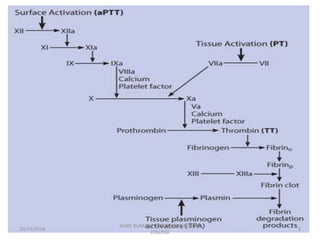
  • #6 SURFACE ACTIVTOR KALLIKREIN
  • #7 April 4, 1998
  • #8 April 4, 1998
  • #9 April 4, 1998
  • #10 April 4, 1998
  • #11 April 4, 1998
  • #13 April 4, 1998
  • #18 Activation by kaolin,elagic acid celite.