TESTS FOR BLEEDING
DISORDERS
INTRODUCTION
What Is a bleeding disorder???
ď‚— General term for a wide range of
medical problems that lead to poor
blood clotting and continuous
bleeding.
 E.g. Von Willebrand’s disease,
haemophilias.
Coagulation Cascade
ORAL FINDINGS
ď‚— Platelet deficiency and vascular wall
disorders result in extravasation of blood into
connective tissue of mucosa creating
ď‚— small pinpoint haemorrhages called
petechiae and large patches called
ecchymosis.
ď‚— Platelet disorders with severly altered
hemostatsis can result in spontaneous
gingival bleeding.
ď‚— Continous oral bleeding over long periods of
time can foster deposits of hemosiderin and
other blood degradation products on tooth
ď‚— Hemarthosis is a common complication in
hemophiliacs weight bearing joint yet it
rarely occurs in the TMJ.
ď‚— Evaluation of dental disease in a population
with bleeding disorders revealed a higher
caries rates, a greater number of un
restored teeth and severe periodontal
disease.
ď‚— Evaluation of dental disease patterns in
children with severe haemophilia revealed a
significantly lower prevelance of dental
caries and low plaque scores as compared
to matched healthy controls.
CLINICAL LABORATORY
TESTS
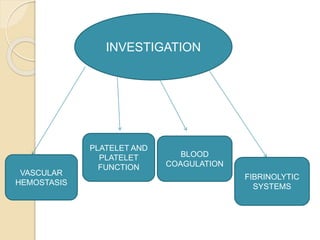
INVESTIGATION
PLATELET AND
PLATELET
FUNCTION
VASCULAR
HEMOSTASIS
BLOOD
COAGULATION
FIBRINOLYTIC
SYSTEMS
I) INVESTIGATION OF DISORDERED
VASCULAR HEMOSTASIS
BLEEDING TIME
TEST FOR CAPILLARY
FRAGILITY
(TORNIQUET TEST)
BLEEDING TIME
 Modified Ivy’s test
ď‚— Normal value 1- 6 minutes
ď‚— Indicates time taken for a standardised skin puncture
to stop bleeding.
ď‚— Poor indicator of clinically significant bleeding at other
sites, hence its use as a predictive screening test for
oral surgical procedures has been discouraged.
ď‚— A prolonged bleeding time may be due to following
causes:
i)Thrombocytopenia ii)disorders of platelet function
iii) von Willebrands disease
vascular abnormality and factor v and xi deficiency
TORNIQUET TEST
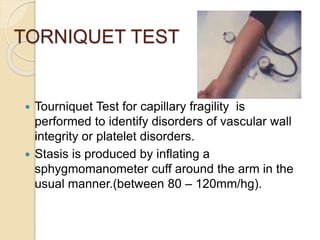
ď‚— Tourniquet Test for capillary fragility is
performed to identify disorders of vascular wall
integrity or platelet disorders.
ď‚— Stasis is produced by inflating a
sphygmomanometer cuff around the arm in the
usual manner.(between 80 – 120mm/hg).
ď‚— This moderate degree of stasis is maintained for
5 minutes.
ď‚— 2.5 cm diameter region of skin on the volar
surface of the arm 4 cm distal to the antecubital
fossa is observed for petechial haemorrhages.
ď‚— Presence of more than 20 petechiae is
considered a positive test
INVESTIGATION OF PLATELET AND PLATELET
FUNCTION
SCREENING
TESTS
SPECIAL TESTS
• Platelet count
• Bleeding time
• Examination of fresh
blood film to see the
morphologic
abnormalities of platelets
• Platelet adhesion tests
• Aggregation tests
• Electron microscopy
• Prothombin
consumption index
PLATELET COUNT
 Normal platelet count – 150,000to 450,000/mm3.
 Platelet count below 10,000/mm3 – platelet
transfusion.- To prevent haemmorhagic shock
 Platelet count <50,000/mm3 – surgical or
traumatic haemorrhage.
ď‚— Platelets are more difficult to count due to their
small size and its tendency to adhere to foreign
surface.
ď‚— 3 methods are used to count the number of
platelets which includes
Direct method- whole blood is diluted
and the platelets are counted
Semi Automated method -platelets are
subjected to sedimentation and coagulation
and then counted using electronic particle
counter
Fully Automated method- platelets are
directly counted
SPECIAL TESTS
ď‚— If the screening test indicate a disorder of
platelet function the following tests are
carried out
ď‚— i)Platelet adhesion tests such as retention
in a glass bead column
ď‚— ii)Aggregation tests which are
turbidometric techniques using
ADP,collagen or ristocetin
ď‚— iii)Granular content of the platelets and their
release can be assessed by electron
microscopy or by measuring the substances
released
ď‚— iv)Platelet Coagulation activity is measured
indirectly by prothombin consumption index,
which provides information about the first stage
of clotting, by measuring the amount of residual
serum prothrombin which remains after clotting.
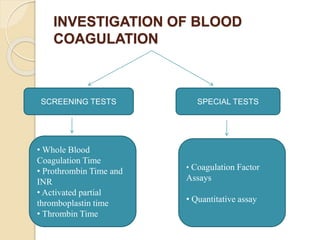
INVESTIGATION OF BLOOD
COAGULATION
SCREENING TESTS SPECIAL TESTS
• Whole Blood
Coagulation Time
• Prothrombin Time and
INR
• Activated partial
thromboplastin time
• Thrombin Time
• Coagulation Factor
Assays
• Quantitative assay
COAGULATION TIME
ď‚— Normal range is 4-9 minutes at 37ÂşC
 Insensitive and non specific – hence
not used
ď‚— It is done by various capillary and
tube methods
PROTHROMBIN TIME
 Normal range – 11-13 seconds.
ď‚— Its tests the adequacy of extrinsic and
common coagulation pathways
ď‚— Increased prothrombin values
indicate deficiency of factors v , vii, x,
prothrombin or fibrinogen.
ď‚— Use : measure the effects of coumarin
anticoagulants and reduction of
vitamin K dependent Fs II, VII, IX and
X
ď‚— Causes of prolonged PT :
adminstration of oral anticoagulant
drugs, liver disease especially
obstructive liver disease, Vitamin K
deficiency and DIC
INTERNATIONAL NORMALISED RATIO
ď‚— INR was introduced by WHO in 1983
ď‚— INR is based on the ratio of the patient's
prothrombin time and the normal mean
prothrombin time.
ď‚— Normal coagulation profile is when INR is 1.
ď‚— Evaluates the extrinsic coagulation system
and measures the presence or absence of
clotting factor i, ii, v, vii and x
ď‚— Use : measure the effects of coumarin
anticoagulants ,reduction of vitamin k
dependant factors ii, vii, ix and x and
metabolic aspects of protein synthesis in
the liver.
ď‚— It doesnot measure the reduction of factors
viii or ix which characterize hemophilias A
and B because the extrinsic system uses
only these factors.
ď‚— Dental procedures are carried out upto a
maximum value of 2.5 above which no
surgical procedures are undertaken.
ACTIVATED PARTIAL THROMBOPLASTIN TIME
ď‚— Normal range :10- 30seconds
ď‚— aPTT is considered normal if the test aPTT and
control aPTT are within 10 sec of each other.
ď‚— Use: evaluate intrinsic cascade and measure
functional levels of Fs VIII, IX, XI, XII which are
the intrinsic system factors. It also measures the
factors common to both intrinsic and extrinsic
systems (factors x ,v ,prothrombin and
fibrinogen.)
ď‚— aPTT is altered in haemophilias A and
B and with use of anticoagulant
heparin.
ď‚— Prolonged aPTT is seen in parentral
administration of heparin,
disseminated Intravascular
coagulation, liver diseases and
circulating anticoagulants
THROMBIN TIME
 Normal TT – 9-13 sec.
ď‚— Use: Test the ability to form the initial clot from
fibrinogen and to measure the activity of heparin
or other paraproteins that inhibit conversion of
fibrinogen to fibrin.
ď‚— This tests yield abnormal result when the
fibrinogen level is below 70 – 100 mg/dl but is
unaffected by levels of any other coagulation
factor
ď‚— Advantages
Simple
Can be performed quickly
Useful in diagnosis of DIC
ď‚— The causes for increased TT value
are hypofibrinogenaemia, raised
concentration of FDP, presence of
Heparin.
SPECIAL TESTS
In the presence of an abnormality in screening
tests, detailed investigations for the possible
cause is carried out. These include
i)Coagulation Factor Assays
ď‚— These are usually based on familiar
screening and conformatory tests such as PT
and aPTT.
ď‚— Normal range of coagulation factors ranges
from 50-150%of normal
FACTOR IX ASSAY
ď‚— Measures the activity of factor IX -- one of
the substances involved in blood
coagulation.
ď‚— The test is also known by the names
Christmas factor assay; Serum factor IX
assay
ď‚— Decreased factor IX activity may be
related to:
i)Congenital deficiency of factor IX (hemophilia B)
ii ) Disseminated intravascular coagulation (DIC)
iii) Fat malabsorption
iv) Liver disease (such as cirrhosis)
FACTOR VII ASSAY
ď‚— It is also known by the names proconvertin assay
and stable factor assay
ď‚— Decreased factor VII activity may be related to:
i)Congenital deficiency of factor vii
ii)Fat malabsorption
iii)Liver cirrhosis
iv)Vitamin K deficiency
v)Use of Warfarin
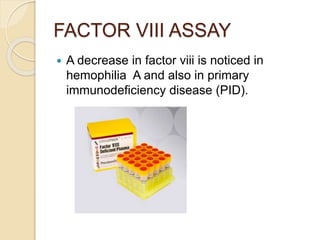
FACTOR VIII ASSAY
ď‚— A decrease in factor viii is noticed in
hemophilia A and also in primary
immunodeficiency disease (PID).
ď‚— ii) Quantitative assay
ď‚— The coagulation factors can be quantitatively
estimated by immunological and various other
chemical methods.
ď‚— vWF assay
ď‚— It can be assayed by immunological
technique or by ristocetin method
ď‚— Ristocetin binds to platelets in vitro and
activates vWF receptors on their surface,
this leads to platelet aggregation if vWF is
available .
ď‚— Thus the ristocetin induced platelets
aggregate can be used as an assay for
vWF
ď‚— The half life of factor viii in circulation is 12
hours if vWF levels are normal but 24hours
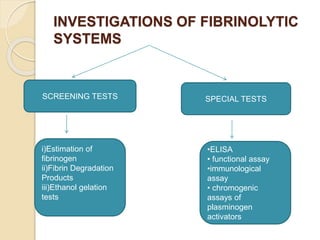
INVESTIGATIONS OF FIBRINOLYTIC
SYSTEMS
SCREENING TESTS SPECIAL TESTS
i)Estimation of
fibrinogen
ii)Fibrin Degradation
Products
iii)Ethanol gelation
tests
•ELISA
• functional assay
•immunological
assay
• chromogenic
assays of
plasminogen
activators
FIBRIN DEGRADATION PRODUCTS
ď‚— FDPs evaluate the presence of the dimer of
fibrinogen and/or fibrin above normal levels.
 Normal Fibrinogen level – 200-400mg/ dL
ď‚— FDPs are protein fragments of varying size that
result from proteolytic action of plasmin on fibrin
or fibrinogen.
ď‚— This state can result from primary fibrinolytic
disorders or DIC.
INDICATION FOR A FEW LAB TESTS
ď‚— Identification of a dental patient with or at a risk
for a bleeding disorder begins with a thorough
review of the medical history.
ď‚— Patient report of a family history of bleeding
problem can help identify inherited disorders of
hemostasis.
ď‚— A patients past history of bleeding following a
surgical procedure can help identify a risk
ď‚— Surveying the patient for current medication
which may include drugs with haemostatic
effect such as coumarin, anticoagulant,
heparin, apirin, NSAIDS, is essential
ď‚— Active medical conditions like hepatitis or
cirrhosis , renal disease, may predispose
patients to bleeding problems. When the
history and review systems suggest
increased bleeding laboratory studies are
warranted
ď‚— Bleeding time is tested in patients with
uremia . And also when a clinician needs
ď‚— Platelet count is taken in patients with known
thrombocytopenia, in patients with easybruising ,
bleeding from gums when brushing , petechiae, unusual
heavy bleeding from nose
ď‚— aPTT is done on patients using heparin, in suspected
cases of haemophilia, and when there is easy bruising
or bleeding
ď‚— Prothrombin Time in patients with unexplained
bleeding, as a screening for patients with bleeding
problem prior to surgical procedure and for patients
under Warfarin.
ď‚— Thrombin Time is evaluated when heparin
contamination suspected and in patients with prolonged
clotting time.
CONCLUSION
ď‚— Patients with bleeding disorders appropriately
prepared for preoperatively ,are generally able
to withstand dental care as well as the
unaffected individuals
ď‚— Consultation with the patients physician is
recommended for guidance on management
required for high risk dental surgical procedures.
When the history and review of systems suggest
bleeding propensity laboratory studies are
warranted
BIBLIOGRAPHY
 Burket’s Oral medicine – 11th edition and
10th edition
ď‚— Wintrobes Clinical haematology -10th
edition, part two
ď‚— Robbins basic Pathology -6th edition
ď‚— Essential Pathology For Dental Students
by Harsh Mohan -4th edition
THANK
YOU