Errors in Computation
Fakhruddin Khan
Assistant Professor,
Amity University, Patna
14-09-2021 Edited and uploaded by Fakhruddin Khan
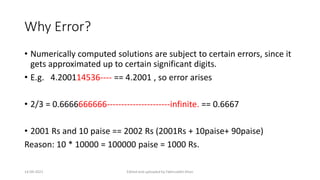
Why Error?
• Numerically computed solutions are subject to certain errors, since it
gets approximated up to certain significant digits.
• E.g. 4.200114536---- == 4.2001 , so error arises
• 2/3 = 0.6666666666----------------------infinite. == 0.6667
• 2001 Rs and 10 paise == 2002 Rs (2001Rs + 10paise+ 90paise)
Reason: 10 * 10000 = 100000 paise = 1000 Rs.
14-09-2021 Edited and uploaded by Fakhruddin Khan
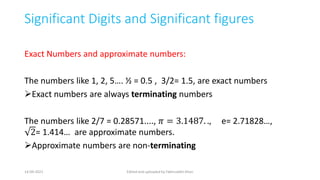
Significant Digits and Significant figures
Exact Numbers and approximate numbers:
The numbers like 1, 2, 5…. ½ = 0.5 , 3/2= 1.5, are exact numbers
➢Exact numbers are always terminating numbers
The numbers like 2/7 = 0.28571...., 𝜋 = 3.1487. ., e= 2.71828…,
2= 1.414… are approximate numbers.
➢Approximate numbers are non-terminating
14-09-2021 Edited and uploaded by Fakhruddin Khan
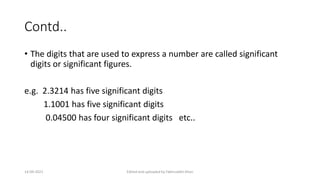
Contd..
• The digits that are used to express a number are called significant
digits or significant figures.
e.g. 2.3214 has five significant digits
1.1001 has five significant digits
0.04500 has four significant digits etc..
14-09-2021 Edited and uploaded by Fakhruddin Khan
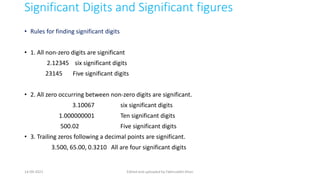
Significant Digits and Significant figures
• Rules for finding significant digits
• 1. All non-zero digits are significant
2.12345 six significant digits
23145 Five significant digits
• 2. All zero occurring between non-zero digits are significant.
3.10067 six significant digits
1.000000001 Ten significant digits
500.02 Five significant digits
• 3. Trailing zeros following a decimal points are significant.
3.500, 65.00, 0.3210 All are four significant digits
14-09-2021 Edited and uploaded by Fakhruddin Khan
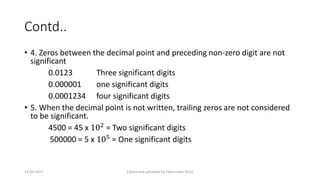
Contd..
• 4. Zeros between the decimal point and preceding non-zero digit are not
significant
0.0123 Three significant digits
0.000001 one significant digits
0.0001234 four significant digits
• 5. When the decimal point is not written, trailing zeros are not considered
to be significant.
4500 = 45 x 102 = Two significant digits
500000 = 5 x 105
= One significant digits
14-09-2021 Edited and uploaded by Fakhruddin Khan
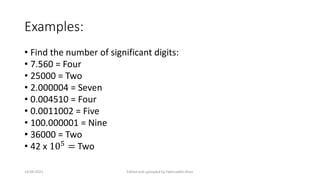
Examples:
• Find the number of significant digits:
• 7.560 = Four
• 25000 = Two
• 2.000004 = Seven
• 0.004510 = Four
• 0.0011002 = Five
• 100.000001 = Nine
• 36000 = Two
• 42 x 105
= Two
14-09-2021 Edited and uploaded by Fakhruddin Khan
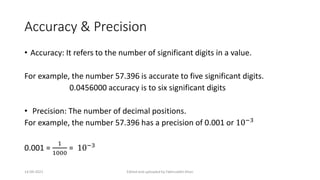
Accuracy & Precision
• Accuracy: It refers to the number of significant digits in a value.
For example, the number 57.396 is accurate to five significant digits.
0.0456000 accuracy is to six significant digits
• Precision: The number of decimal positions.
For example, the number 57.396 has a precision of 0.001 or 10−3
0.001 =
1
1000
= 10−3
14-09-2021 Edited and uploaded by Fakhruddin Khan
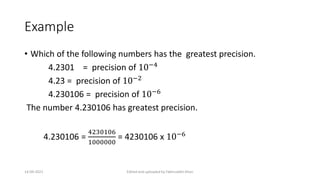
Example
• Which of the following numbers has the greatest precision.
4.2301 = precision of 10−4
4.23 = precision of 10−2
4.230106 = precision of 10−6
The number 4.230106 has greatest precision.
4.230106 =
4230106
1000000
= 4230106 x 10−6
14-09-2021 Edited and uploaded by Fakhruddin Khan
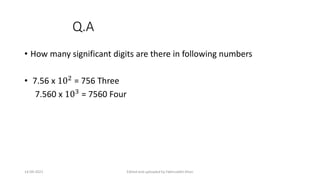
Q.A
• How many significant digits are there in following numbers
• 7.56 x 102 = 756 Three
7.560 x 103 = 7560 Four
14-09-2021 Edited and uploaded by Fakhruddin Khan
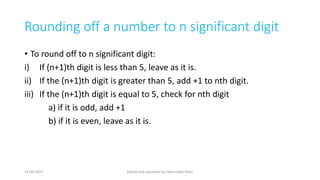
Rounding off a number to n significant digit
• To round off to n significant digit:
i) If (n+1)th digit is less than 5, leave as it is.
ii) If the (n+1)th digit is greater than 5, add +1 to nth digit.
iii) If the (n+1)th digit is equal to 5, check for nth digit
a) if it is odd, add +1
b) if it is even, leave as it is.
14-09-2021 Edited and uploaded by Fakhruddin Khan
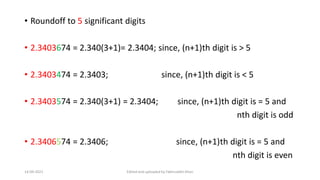
• Roundoff to 5 significant digits
• 2.3403674 = 2.340(3+1)= 2.3404; since, (n+1)th digit is > 5
• 2.3403474 = 2.3403; since, (n+1)th digit is < 5
• 2.3403574 = 2.340(3+1) = 2.3404; since, (n+1)th digit is = 5 and
nth digit is odd
• 2.3406574 = 2.3406; since, (n+1)th digit is = 5 and
nth digit is even
14-09-2021 Edited and uploaded by Fakhruddin Khan
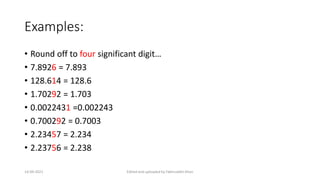
Examples:
• Round off to four significant digit…
• 7.8926 = 7.893
• 128.614 = 128.6
• 1.70292 = 1.703
• 0.0022431 =0.002243
• 0.700292 = 0.7003
• 2.23457 = 2.234
• 2.23756 = 2.238
14-09-2021 Edited and uploaded by Fakhruddin Khan
ERRORS
• When we approximate any number to a certain value or a function up
to certain terms, it produces errors.
Types of errors:
1. Inherent error
ii. Data error also called empirical error
iii. Conversion error
14-09-2021 Edited and uploaded by Fakhruddin Khan
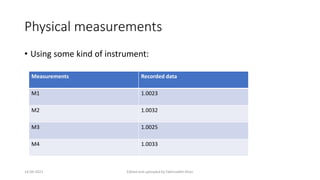
Physical measurements
• Using some kind of instrument:
Measurements Recorded data
M1 1.0023
M2 1.0032
M3 1.0025
M4 1.0033
14-09-2021 Edited and uploaded by Fakhruddin Khan
Contd..
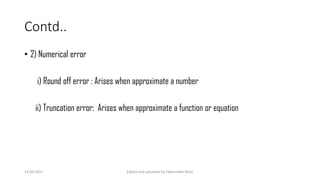
• 2) Numerical error
i) Round off error : Arises when approximate a number
ii) Truncation error: Arises when approximate a function or equation
14-09-2021 Edited and uploaded by Fakhruddin Khan
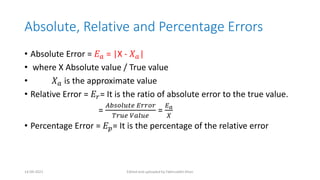
Absolute, Relative and Percentage Errors
• Absolute Error = 𝐸𝑎 = |X - 𝑋𝑎|
• where X Absolute value / True value
• 𝑋𝑎 is the approximate value
• Relative Error = 𝐸𝑟= It is the ratio of absolute error to the true value.
=
𝐴𝑏𝑠𝑜𝑙𝑢𝑡𝑒 𝐸𝑟𝑟𝑜𝑟
𝑇𝑟𝑢𝑒 𝑉𝑎𝑙𝑢𝑒
=
𝐸𝑎
𝑋
• Percentage Error = 𝐸𝑝= It is the percentage of the relative error
14-09-2021 Edited and uploaded by Fakhruddin Khan
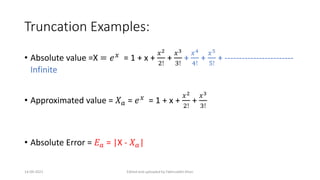
Truncation Examples:
• Absolute value =X = 𝑒𝑥 = 1 + x +
𝑥2
2!
+
𝑥3
3!
+
𝑥4
4!
+
𝑥5
5!
+ ------------------------
Infinite
• Approximated value = 𝑋𝑎 = 𝑒𝑥 = 1 + x +
𝑥2
2!
+
𝑥3
3!
• Absolute Error = 𝐸𝑎 = |X - 𝑋𝑎|
14-09-2021 Edited and uploaded by Fakhruddin Khan
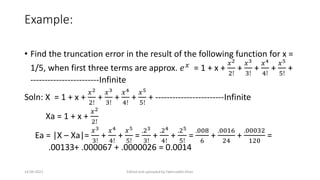
Example:
• Find the truncation error in the result of the following function for x =
1/5, when first three terms are approx. 𝑒𝑥 = 1 + x +
𝑥2
2!
+
𝑥3
3!
+
𝑥4
4!
+
𝑥5
5!
+
------------------------Infinite
Soln: X = 1 + x +
𝑥2
2!
+
𝑥3
3!
+
𝑥4
4!
+
𝑥5
5!
+ ------------------------Infinite
Xa = 1 + x +
𝑥2
2!
Ea = |X – Xa|=
𝑥3
3!
+
𝑥4
4!
+
𝑥5
5!
=
.23
3!
+
.24
4!
+
.25
5!
=
.008
6
+
.0016
24
+
.00032
120
=
.00133+ .000067 + .0000026 = 0.0014
14-09-2021 Edited and uploaded by Fakhruddin Khan
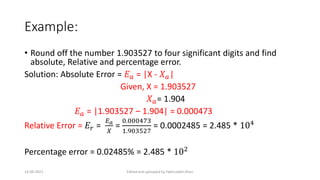
Example:
• Round off the number 1.903527 to four significant digits and find
absolute, Relative and percentage error.
Solution: Absolute Error = 𝐸𝑎 = |X - 𝑋𝑎|
Given, X = 1.903527
𝑋𝑎= 1.904
𝐸𝑎 = |1.903527 – 1.904| = 0.000473
Relative Error = 𝐸𝑟 =
𝐸𝑎
𝑋
=
0.000473
1.903527
= 0.0002485 = 2.485 * 104
Percentage error = 0.02485% = 2.485 * 102
14-09-2021 Edited and uploaded by Fakhruddin Khan
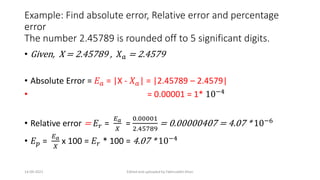
Example: Find absolute error, Relative error and percentage
error
The number 2.45789 is rounded off to 5 significant digits.
• Given, X = 2.45789 , 𝑋𝑎 = 2.4579
• Absolute Error = 𝐸𝑎 = |X - 𝑋𝑎| = |2.45789 – 2.4579|
• = 0.00001 = 1* 10−4
• Relative error = 𝐸𝑟 =
𝐸𝑎
𝑋
=
0.00001
2.45789
= 0.00000407 = 4.07 * 10−6
• 𝐸𝑝 =
𝐸𝑎
𝑋
x 100 = 𝐸𝑟 * 100 = 4.07 * 10−4
14-09-2021 Edited and uploaded by Fakhruddin Khan
Thank You
14-09-2021 Edited and uploaded by Fakhruddin Khan

Errors in computation

  • 1.
    Errors in Computation FakhruddinKhan Assistant Professor, Amity University, Patna 14-09-2021 Edited and uploaded by Fakhruddin Khan
  • 2.
    Why Error? • Numericallycomputed solutions are subject to certain errors, since it gets approximated up to certain significant digits. • E.g. 4.200114536---- == 4.2001 , so error arises • 2/3 = 0.6666666666----------------------infinite. == 0.6667 • 2001 Rs and 10 paise == 2002 Rs (2001Rs + 10paise+ 90paise) Reason: 10 * 10000 = 100000 paise = 1000 Rs. 14-09-2021 Edited and uploaded by Fakhruddin Khan
  • 3.
    Significant Digits andSignificant figures Exact Numbers and approximate numbers: The numbers like 1, 2, 5…. ½ = 0.5 , 3/2= 1.5, are exact numbers ➢Exact numbers are always terminating numbers The numbers like 2/7 = 0.28571...., 𝜋 = 3.1487. ., e= 2.71828…, 2= 1.414… are approximate numbers. ➢Approximate numbers are non-terminating 14-09-2021 Edited and uploaded by Fakhruddin Khan
  • 4.
    Contd.. • The digitsthat are used to express a number are called significant digits or significant figures. e.g. 2.3214 has five significant digits 1.1001 has five significant digits 0.04500 has four significant digits etc.. 14-09-2021 Edited and uploaded by Fakhruddin Khan
  • 5.
    Significant Digits andSignificant figures • Rules for finding significant digits • 1. All non-zero digits are significant 2.12345 six significant digits 23145 Five significant digits • 2. All zero occurring between non-zero digits are significant. 3.10067 six significant digits 1.000000001 Ten significant digits 500.02 Five significant digits • 3. Trailing zeros following a decimal points are significant. 3.500, 65.00, 0.3210 All are four significant digits 14-09-2021 Edited and uploaded by Fakhruddin Khan
  • 6.
    Contd.. • 4. Zerosbetween the decimal point and preceding non-zero digit are not significant 0.0123 Three significant digits 0.000001 one significant digits 0.0001234 four significant digits • 5. When the decimal point is not written, trailing zeros are not considered to be significant. 4500 = 45 x 102 = Two significant digits 500000 = 5 x 105 = One significant digits 14-09-2021 Edited and uploaded by Fakhruddin Khan
  • 7.
    Examples: • Find thenumber of significant digits: • 7.560 = Four • 25000 = Two • 2.000004 = Seven • 0.004510 = Four • 0.0011002 = Five • 100.000001 = Nine • 36000 = Two • 42 x 105 = Two 14-09-2021 Edited and uploaded by Fakhruddin Khan
  • 8.
    Accuracy & Precision •Accuracy: It refers to the number of significant digits in a value. For example, the number 57.396 is accurate to five significant digits. 0.0456000 accuracy is to six significant digits • Precision: The number of decimal positions. For example, the number 57.396 has a precision of 0.001 or 10−3 0.001 = 1 1000 = 10−3 14-09-2021 Edited and uploaded by Fakhruddin Khan
  • 9.
    Example • Which ofthe following numbers has the greatest precision. 4.2301 = precision of 10−4 4.23 = precision of 10−2 4.230106 = precision of 10−6 The number 4.230106 has greatest precision. 4.230106 = 4230106 1000000 = 4230106 x 10−6 14-09-2021 Edited and uploaded by Fakhruddin Khan
  • 10.
    Q.A • How manysignificant digits are there in following numbers • 7.56 x 102 = 756 Three 7.560 x 103 = 7560 Four 14-09-2021 Edited and uploaded by Fakhruddin Khan
  • 11.
    Rounding off anumber to n significant digit • To round off to n significant digit: i) If (n+1)th digit is less than 5, leave as it is. ii) If the (n+1)th digit is greater than 5, add +1 to nth digit. iii) If the (n+1)th digit is equal to 5, check for nth digit a) if it is odd, add +1 b) if it is even, leave as it is. 14-09-2021 Edited and uploaded by Fakhruddin Khan
  • 12.
    • Roundoff to5 significant digits • 2.3403674 = 2.340(3+1)= 2.3404; since, (n+1)th digit is > 5 • 2.3403474 = 2.3403; since, (n+1)th digit is < 5 • 2.3403574 = 2.340(3+1) = 2.3404; since, (n+1)th digit is = 5 and nth digit is odd • 2.3406574 = 2.3406; since, (n+1)th digit is = 5 and nth digit is even 14-09-2021 Edited and uploaded by Fakhruddin Khan
  • 13.
    Examples: • Round offto four significant digit… • 7.8926 = 7.893 • 128.614 = 128.6 • 1.70292 = 1.703 • 0.0022431 =0.002243 • 0.700292 = 0.7003 • 2.23457 = 2.234 • 2.23756 = 2.238 14-09-2021 Edited and uploaded by Fakhruddin Khan
  • 14.
    ERRORS • When weapproximate any number to a certain value or a function up to certain terms, it produces errors. Types of errors: 1. Inherent error ii. Data error also called empirical error iii. Conversion error 14-09-2021 Edited and uploaded by Fakhruddin Khan
  • 15.
    Physical measurements • Usingsome kind of instrument: Measurements Recorded data M1 1.0023 M2 1.0032 M3 1.0025 M4 1.0033 14-09-2021 Edited and uploaded by Fakhruddin Khan
  • 16.
    Contd.. • 2) Numericalerror i) Round off error : Arises when approximate a number ii) Truncation error: Arises when approximate a function or equation 14-09-2021 Edited and uploaded by Fakhruddin Khan
  • 17.
    Absolute, Relative andPercentage Errors • Absolute Error = 𝐸𝑎 = |X - 𝑋𝑎| • where X Absolute value / True value • 𝑋𝑎 is the approximate value • Relative Error = 𝐸𝑟= It is the ratio of absolute error to the true value. = 𝐴𝑏𝑠𝑜𝑙𝑢𝑡𝑒 𝐸𝑟𝑟𝑜𝑟 𝑇𝑟𝑢𝑒 𝑉𝑎𝑙𝑢𝑒 = 𝐸𝑎 𝑋 • Percentage Error = 𝐸𝑝= It is the percentage of the relative error 14-09-2021 Edited and uploaded by Fakhruddin Khan
  • 18.
    Truncation Examples: • Absolutevalue =X = 𝑒𝑥 = 1 + x + 𝑥2 2! + 𝑥3 3! + 𝑥4 4! + 𝑥5 5! + ------------------------ Infinite • Approximated value = 𝑋𝑎 = 𝑒𝑥 = 1 + x + 𝑥2 2! + 𝑥3 3! • Absolute Error = 𝐸𝑎 = |X - 𝑋𝑎| 14-09-2021 Edited and uploaded by Fakhruddin Khan
  • 19.
    Example: • Find thetruncation error in the result of the following function for x = 1/5, when first three terms are approx. 𝑒𝑥 = 1 + x + 𝑥2 2! + 𝑥3 3! + 𝑥4 4! + 𝑥5 5! + ------------------------Infinite Soln: X = 1 + x + 𝑥2 2! + 𝑥3 3! + 𝑥4 4! + 𝑥5 5! + ------------------------Infinite Xa = 1 + x + 𝑥2 2! Ea = |X – Xa|= 𝑥3 3! + 𝑥4 4! + 𝑥5 5! = .23 3! + .24 4! + .25 5! = .008 6 + .0016 24 + .00032 120 = .00133+ .000067 + .0000026 = 0.0014 14-09-2021 Edited and uploaded by Fakhruddin Khan
  • 20.
    Example: • Round offthe number 1.903527 to four significant digits and find absolute, Relative and percentage error. Solution: Absolute Error = 𝐸𝑎 = |X - 𝑋𝑎| Given, X = 1.903527 𝑋𝑎= 1.904 𝐸𝑎 = |1.903527 – 1.904| = 0.000473 Relative Error = 𝐸𝑟 = 𝐸𝑎 𝑋 = 0.000473 1.903527 = 0.0002485 = 2.485 * 104 Percentage error = 0.02485% = 2.485 * 102 14-09-2021 Edited and uploaded by Fakhruddin Khan
  • 21.
    Example: Find absoluteerror, Relative error and percentage error The number 2.45789 is rounded off to 5 significant digits. • Given, X = 2.45789 , 𝑋𝑎 = 2.4579 • Absolute Error = 𝐸𝑎 = |X - 𝑋𝑎| = |2.45789 – 2.4579| • = 0.00001 = 1* 10−4 • Relative error = 𝐸𝑟 = 𝐸𝑎 𝑋 = 0.00001 2.45789 = 0.00000407 = 4.07 * 10−6 • 𝐸𝑝 = 𝐸𝑎 𝑋 x 100 = 𝐸𝑟 * 100 = 4.07 * 10−4 14-09-2021 Edited and uploaded by Fakhruddin Khan
  • 22.
    Thank You 14-09-2021 Editedand uploaded by Fakhruddin Khan