POLYMERASE CHAIN
REACTION
PCR
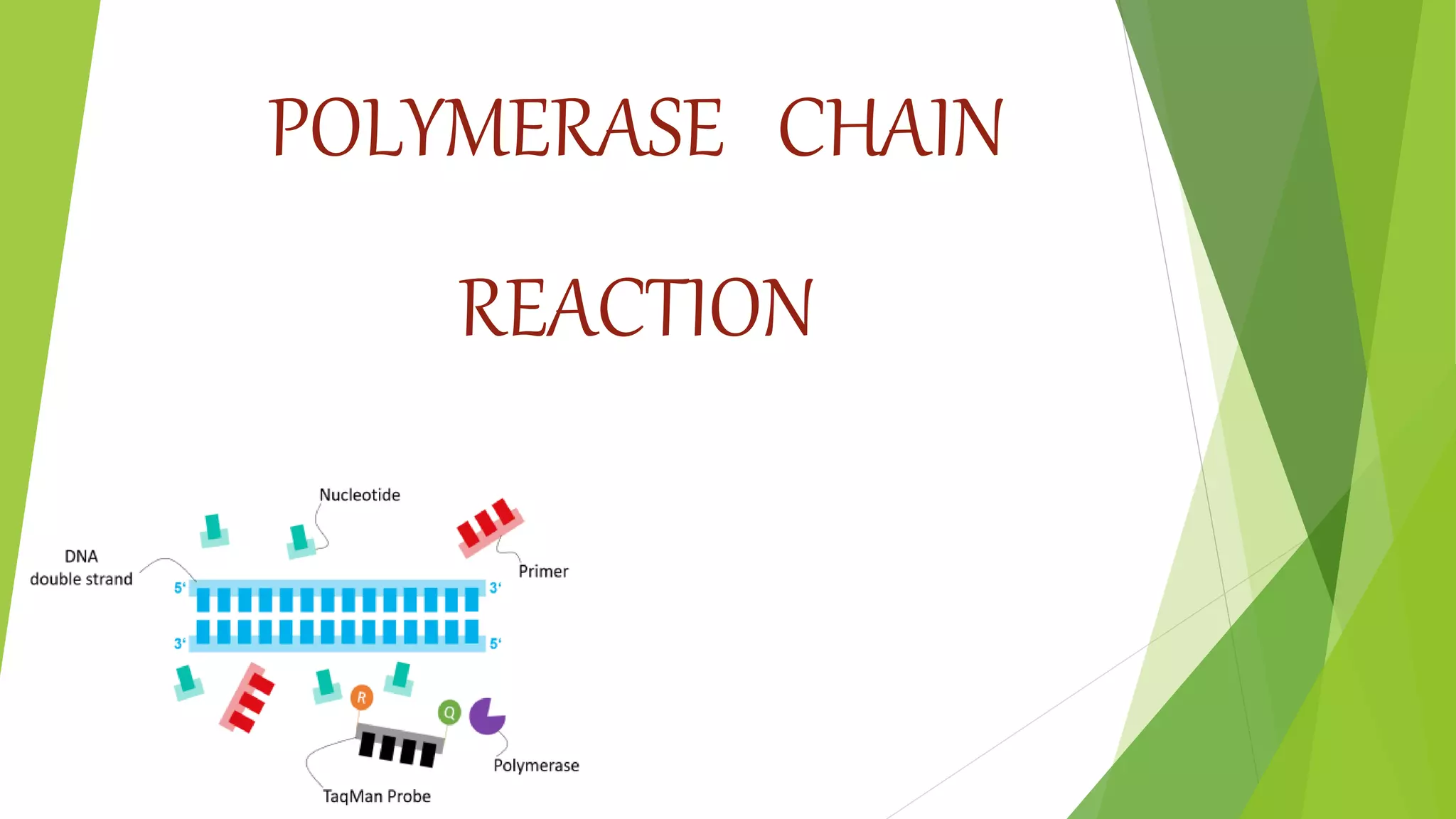
 Polymerase chain reaction is a revolutionary molecular biology
technique for enzymatically replicating DNA .
 The technique allows a small amount of the DNA molecule to be
amplified many times in an exponential manner .
 It is commonly used in medical and biological research labs for a
variety of tasks , such as the detection of hereditary diseases ,
identification of genetic fingerprints , diagnosis of infectious
disease , cloning of genes and paternity testing .
Components of PCR
DNA Template
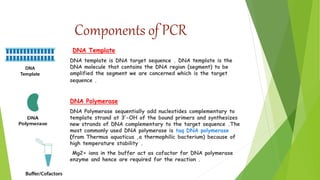
DNA template is DNA target sequence . DNA template is the
DNA molecule that contains the DNA region (segment) to be
amplified the segment we are concerned which is the target
sequence .
DNA Polymerase
DNA Polymerase sequentially add nucleotides complementary to
template strand at 3’-OH of the bound primers and synthesizes
new strands of DNA complementary to the target sequence .The
most commonly used DNA polymerase is taq DNA polymerase
(from Thermus aquaticus ,a thermophilic bacterium) because of
high temperature stability .
Mg2+ ions in the buffer act as cofactor for DNA polymerase
enzyme and hence are required for the reaction .
Primers
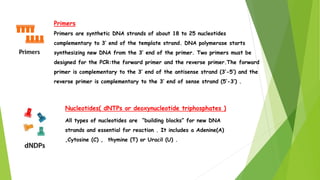
Primers are synthetic DNA strands of about 18 to 25 nucleotides
complementary to 3’ end of the template strand. DNA polymerase starts
synthesizing new DNA from the 3’ end of the primer. Two primers must be
designed for the PCR:the forward primer and the reverse primer.The forward
primer is complementary to the 3’ end of the antisense strand (3’-5’) and the
reverse primer is complementary to the 3’ end of sense strand (5’-3’) .
Nucleotides( dNTPs or deoxynucleotide triphosphates )
All types of nucleotides are “building blocks” for new DNA
strands and essential for reaction . It includes a Adenine(A)
,Cytosine (C) , thymine (T) or Uracil (U) .
Procedure
STEP 1:Denaturing
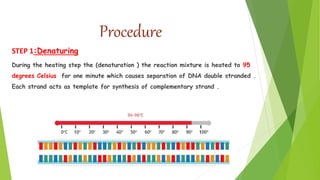
During the heating step the (denaturation ) the reaction mixture is heated to 95
degrees Celsius for one minute which causes separation of DNA double stranded .
Each strand acts as template for synthesis of complementary strand .
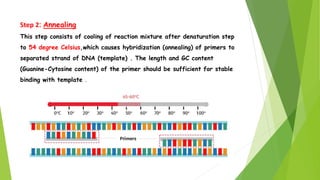
Step 2: Annealing
This step consists of cooling of reaction mixture after denaturation step
to 54 degree Celsius,which causes hybridization (annealing) of primers to
separated strand of DNA (template) . The length and GC content
(Guanine-Cytosine content) of the primer should be sufficient for stable
binding with template .
Step 3: Extension
The sample is then heated back up to approximately 72°C, which is the optimal
temperature for Taq polymerase to attach to the bound primers and extend the
new template strand in a 5’ to 3’ direction.
At the end of the extension step, the number of PCR product copies will have
doubled since the start of the PCR cycle.
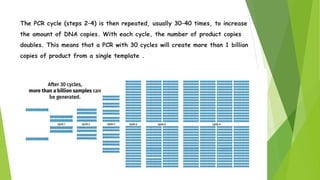
The PCR cycle (steps 2–4) is then repeated, usually 30–40 times, to increase
the amount of DNA copies. With each cycle, the number of product copies
doubles. This means that a PCR with 30 cycles will create more than 1 billion
copies of product from a single template .
Applications of PCR
1. MOLECULAR BIOLOGICAL RESEARCH – gene screening analysis (looking
for a gene) and DNA cloning (copying particular DNA sequences) .
2. GENETIC MAPPING STUDIES – e.g Human genome project , sequence
tagging on genome sites .
3. CLINICAL AND DIAGNOSTIC USES – screening and diagnosis of HIV;
cancer (detects mutations of oncogenes); genetic disorders e.g cystic
fibrosis .
4. GENETIC IDENTIFICATION & DNA TYPING – forensic and parentage
testing ; sex determination of pre-natal cells ; classification of species .
5. IDENTIFICATION of TRACE AMOUNTS of DNA – detection of
contamination of foodstuffs by: food-borne pathogens genetically modified
organism in food products , presence of pork in beef etc .
POLYMERASE   CHAIN   REACTION.pptx

POLYMERASE CHAIN REACTION.pptx

  • 1.
  • 2.
    PCR  Polymerase chainreaction is a revolutionary molecular biology technique for enzymatically replicating DNA .  The technique allows a small amount of the DNA molecule to be amplified many times in an exponential manner .  It is commonly used in medical and biological research labs for a variety of tasks , such as the detection of hereditary diseases , identification of genetic fingerprints , diagnosis of infectious disease , cloning of genes and paternity testing .
  • 3.
    Components of PCR DNATemplate DNA template is DNA target sequence . DNA template is the DNA molecule that contains the DNA region (segment) to be amplified the segment we are concerned which is the target sequence . DNA Polymerase DNA Polymerase sequentially add nucleotides complementary to template strand at 3’-OH of the bound primers and synthesizes new strands of DNA complementary to the target sequence .The most commonly used DNA polymerase is taq DNA polymerase (from Thermus aquaticus ,a thermophilic bacterium) because of high temperature stability . Mg2+ ions in the buffer act as cofactor for DNA polymerase enzyme and hence are required for the reaction .
  • 4.
    Primers Primers are syntheticDNA strands of about 18 to 25 nucleotides complementary to 3’ end of the template strand. DNA polymerase starts synthesizing new DNA from the 3’ end of the primer. Two primers must be designed for the PCR:the forward primer and the reverse primer.The forward primer is complementary to the 3’ end of the antisense strand (3’-5’) and the reverse primer is complementary to the 3’ end of sense strand (5’-3’) . Nucleotides( dNTPs or deoxynucleotide triphosphates ) All types of nucleotides are “building blocks” for new DNA strands and essential for reaction . It includes a Adenine(A) ,Cytosine (C) , thymine (T) or Uracil (U) .
  • 5.
    Procedure STEP 1:Denaturing During theheating step the (denaturation ) the reaction mixture is heated to 95 degrees Celsius for one minute which causes separation of DNA double stranded . Each strand acts as template for synthesis of complementary strand .
  • 6.
    Step 2: Annealing Thisstep consists of cooling of reaction mixture after denaturation step to 54 degree Celsius,which causes hybridization (annealing) of primers to separated strand of DNA (template) . The length and GC content (Guanine-Cytosine content) of the primer should be sufficient for stable binding with template .
  • 7.
    Step 3: Extension Thesample is then heated back up to approximately 72°C, which is the optimal temperature for Taq polymerase to attach to the bound primers and extend the new template strand in a 5’ to 3’ direction. At the end of the extension step, the number of PCR product copies will have doubled since the start of the PCR cycle.
  • 8.
    The PCR cycle(steps 2–4) is then repeated, usually 30–40 times, to increase the amount of DNA copies. With each cycle, the number of product copies doubles. This means that a PCR with 30 cycles will create more than 1 billion copies of product from a single template .
  • 9.
    Applications of PCR 1.MOLECULAR BIOLOGICAL RESEARCH – gene screening analysis (looking for a gene) and DNA cloning (copying particular DNA sequences) . 2. GENETIC MAPPING STUDIES – e.g Human genome project , sequence tagging on genome sites . 3. CLINICAL AND DIAGNOSTIC USES – screening and diagnosis of HIV; cancer (detects mutations of oncogenes); genetic disorders e.g cystic fibrosis . 4. GENETIC IDENTIFICATION & DNA TYPING – forensic and parentage testing ; sex determination of pre-natal cells ; classification of species . 5. IDENTIFICATION of TRACE AMOUNTS of DNA – detection of contamination of foodstuffs by: food-borne pathogens genetically modified organism in food products , presence of pork in beef etc .