SEMINAR
ON
CHHATTISGARH BASIN
ContentsContents
 Introduction
 Chhattisgarh Basin
 Lithology
 Classification
Singhora Group
Chandrapur Group
Raipur Group
 Evidence of life in Chhattisgarh Basin
 Conclusion
 References
IntroductionIntroduction
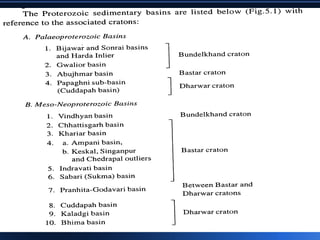
These are also called “Purana” basins in Indian
Stratigraphy. Purana basins are has a deposites of
Limestone and Dolomite, and other economic minerals like
phosphorite, chrysotile asbestos, Base metals and building
stones.
Chhattisgarh basin is one of the Proterozoic Sedimentary
Basin, these basins contain orthoquartzite-shale-carbonate
suites varying in thickness from 100-10,000m and
deposited alternately with frequent breaks in sedimentation,
over a time of 1,000 Ma.
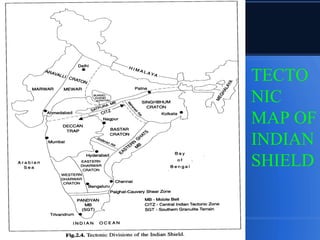
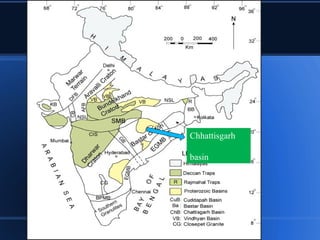
TECTO
NIC
MAP OF
INDIAN
SHIELD
Chhattisgarh
basin
Chhattisgarh BasinChhattisgarh Basin
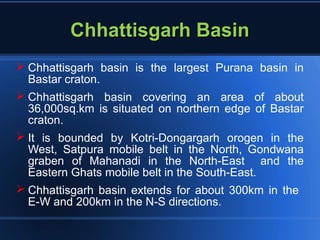
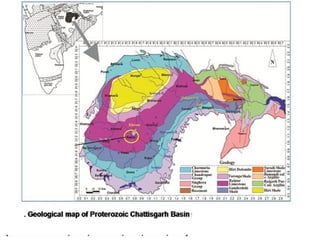
 Chhattisgarh basin is the largest Purana basin in
Bastar craton.
 Chhattisgarh basin covering an area of about
36,000sq.km is situated on northern edge of Bastar
craton.
 It is bounded by Kotri-Dongargarh orogen in the
West, Satpura mobile belt in the North, Gondwana
graben of Mahanadi in the North-East and the
Eastern Ghats mobile belt in the South-East.
 Chhattisgarh basin extends for about 300km in the
E-W and 200km in the N-S directions.
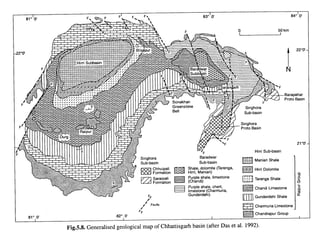
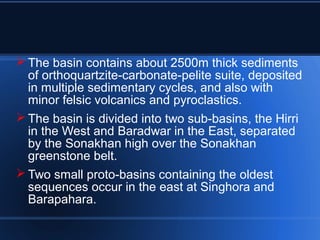
 The basin contains about 2500m thick sediments
of orthoquartzite-carbonate-pelite suite, deposited
in multiple sedimentary cycles, and also with
minor felsic volcanics and pyroclastics.
 The basin is divided into two sub-basins, the Hirri
in the West and Baradwar in the East, separated
by the Sonakhan high over the Sonakhan
greenstone belt.
 Two small proto-basins containing the oldest
sequences occur in the east at Singhora and
Barapahara.
LithologyLithology
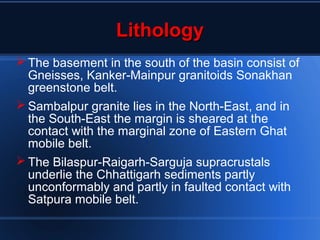
 The basement in the south of the basin consist of
Gneisses, Kanker-Mainpur granitoids Sonakhan
greenstone belt.
 Sambalpur granite lies in the North-East, and in
the South-East the margin is sheared at the
contact with the marginal zone of Eastern Ghat
mobile belt.
 The Bilaspur-Raigarh-Sarguja supracrustals
underlie the Chhattigarh sediments partly
unconformably and partly in faulted contact with
Satpura mobile belt.
Singhora Group
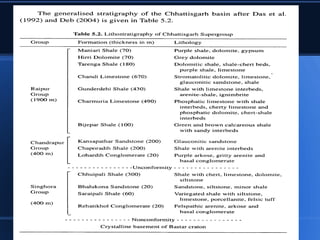
 The oldest Singhora Group is exposed in the
Singhora proto-basin in the southeast and the
Barapahar sub-basin in the northeast.
 Bhalukona Sandstone is probably a shore line
sediment, overlain by the shale-chert-stromatolitic
limestone-dolemite association of Chhuipali Shale
that is deposited in a shallow offshore environment.
 After Singhora Group the deposition followed by a
conglomerate and coarse arkosic sandstone in shale
dominated sequence of Chandrapur Group and it is
followed by a limestone –shale dominated sequence
of Raipur Group.
Chandrapur GroupChandrapur Group
 Chandrapur Group consist of three sandstone
intervals, separated by two mud bearing sequence.
 The basal conglomerate is called either as a alluvial
fan-fan delta deposit or as a beach deposit with
sandstone lenses resulting from stroms.
 Choparadih shale is interpreted to have a variable
from prodelta and intertidal –lagoonal zone.
 Kansapathar Sandstone is a strom-tide because of
shoreface and shelf deposit.
Raipur GroupRaipur Group
 Raipur Group conformably overlies Chandrapur
Group and consists of three carbonate-shale cycles.
 It starts from brown calcareous shale and green shale
about 100m thick and is called as Bijepar Shale, and
succeeding is carbonate-siliciclastic succession
deposited and upper member of pelagic limestone
grading into deep water Gunderdehi Shale.
 Raipur Group is believed to be deposited in two
separate basins Hirri and Baradwar , separated by
the Sonakhan high.
 Basic dykes intruded the sedimentary sequence at
different levels in many places.
Evidence of life in Chhattisgarh
basin
 Stromatolites have been reported from
Chhattisgarh basin, these indicate middle and
upper Riphean age.
 Microbiota- mostly prokaryotic cyanobactiria
(filamentous) and arcitarchs were recorded from
Chhattisgarh basin.
 Zircon from Raipur Group have been subjected
to SHRIMP analysis, which gives around 990-
1020 Ma (Deb et al., 2007) for the Chhattisgarh
basin.
ConclusionConclusion
 Chhattisgarh basin is the third largest Purana
basin after the Vindhyan and Cuddapah.
 The vast Limestone and Dolomite resources of
the basin feed the Bhilai Steel Plant and Cement
factories of the surrounding area.
 The Granitic terrain surrounding the basin has
been recently found to host number of Kimberlite
pipes.
 In comparison with the other Purana basins, a
time span between 1600 and 900 Ma may be
assigned to Chhattisgarh basin.
REFERENCE
Ramakrishnan. M and Vaidyanadhan. R (2008): Geology Of India
(volume 1) ,Geological Society of India Bangalore.pp-473-478
WEBSITES
www.wikipedia/chattisgarhbasin
www.geology.com/stratigraphy of chattisgarh basin
www.encyclopedia/chattisgarh basin
BOOKS
The time taken for light
from the sun to reach
the earth is
8.33 min or 499.8 seconds
THANK YOU

Chhattisgarh basin

  • 1.
  • 2.
    ContentsContents  Introduction  ChhattisgarhBasin  Lithology  Classification Singhora Group Chandrapur Group Raipur Group  Evidence of life in Chhattisgarh Basin  Conclusion  References
  • 3.
    IntroductionIntroduction These are alsocalled “Purana” basins in Indian Stratigraphy. Purana basins are has a deposites of Limestone and Dolomite, and other economic minerals like phosphorite, chrysotile asbestos, Base metals and building stones. Chhattisgarh basin is one of the Proterozoic Sedimentary Basin, these basins contain orthoquartzite-shale-carbonate suites varying in thickness from 100-10,000m and deposited alternately with frequent breaks in sedimentation, over a time of 1,000 Ma.
  • 4.
  • 5.
  • 7.
    Chhattisgarh BasinChhattisgarh Basin Chhattisgarh basin is the largest Purana basin in Bastar craton.  Chhattisgarh basin covering an area of about 36,000sq.km is situated on northern edge of Bastar craton.  It is bounded by Kotri-Dongargarh orogen in the West, Satpura mobile belt in the North, Gondwana graben of Mahanadi in the North-East and the Eastern Ghats mobile belt in the South-East.  Chhattisgarh basin extends for about 300km in the E-W and 200km in the N-S directions.
  • 10.
     The basincontains about 2500m thick sediments of orthoquartzite-carbonate-pelite suite, deposited in multiple sedimentary cycles, and also with minor felsic volcanics and pyroclastics.  The basin is divided into two sub-basins, the Hirri in the West and Baradwar in the East, separated by the Sonakhan high over the Sonakhan greenstone belt.  Two small proto-basins containing the oldest sequences occur in the east at Singhora and Barapahara.
  • 11.
    LithologyLithology  The basementin the south of the basin consist of Gneisses, Kanker-Mainpur granitoids Sonakhan greenstone belt.  Sambalpur granite lies in the North-East, and in the South-East the margin is sheared at the contact with the marginal zone of Eastern Ghat mobile belt.  The Bilaspur-Raigarh-Sarguja supracrustals underlie the Chhattigarh sediments partly unconformably and partly in faulted contact with Satpura mobile belt.
  • 13.
    Singhora Group  Theoldest Singhora Group is exposed in the Singhora proto-basin in the southeast and the Barapahar sub-basin in the northeast.  Bhalukona Sandstone is probably a shore line sediment, overlain by the shale-chert-stromatolitic limestone-dolemite association of Chhuipali Shale that is deposited in a shallow offshore environment.  After Singhora Group the deposition followed by a conglomerate and coarse arkosic sandstone in shale dominated sequence of Chandrapur Group and it is followed by a limestone –shale dominated sequence of Raipur Group.
  • 14.
    Chandrapur GroupChandrapur Group Chandrapur Group consist of three sandstone intervals, separated by two mud bearing sequence.  The basal conglomerate is called either as a alluvial fan-fan delta deposit or as a beach deposit with sandstone lenses resulting from stroms.  Choparadih shale is interpreted to have a variable from prodelta and intertidal –lagoonal zone.  Kansapathar Sandstone is a strom-tide because of shoreface and shelf deposit.
  • 15.
    Raipur GroupRaipur Group Raipur Group conformably overlies Chandrapur Group and consists of three carbonate-shale cycles.  It starts from brown calcareous shale and green shale about 100m thick and is called as Bijepar Shale, and succeeding is carbonate-siliciclastic succession deposited and upper member of pelagic limestone grading into deep water Gunderdehi Shale.  Raipur Group is believed to be deposited in two separate basins Hirri and Baradwar , separated by the Sonakhan high.  Basic dykes intruded the sedimentary sequence at different levels in many places.
  • 16.
    Evidence of lifein Chhattisgarh basin  Stromatolites have been reported from Chhattisgarh basin, these indicate middle and upper Riphean age.  Microbiota- mostly prokaryotic cyanobactiria (filamentous) and arcitarchs were recorded from Chhattisgarh basin.  Zircon from Raipur Group have been subjected to SHRIMP analysis, which gives around 990- 1020 Ma (Deb et al., 2007) for the Chhattisgarh basin.
  • 17.
    ConclusionConclusion  Chhattisgarh basinis the third largest Purana basin after the Vindhyan and Cuddapah.  The vast Limestone and Dolomite resources of the basin feed the Bhilai Steel Plant and Cement factories of the surrounding area.  The Granitic terrain surrounding the basin has been recently found to host number of Kimberlite pipes.  In comparison with the other Purana basins, a time span between 1600 and 900 Ma may be assigned to Chhattisgarh basin.
  • 18.
    REFERENCE Ramakrishnan. M andVaidyanadhan. R (2008): Geology Of India (volume 1) ,Geological Society of India Bangalore.pp-473-478 WEBSITES www.wikipedia/chattisgarhbasin www.geology.com/stratigraphy of chattisgarh basin www.encyclopedia/chattisgarh basin BOOKS
  • 19.
    The time takenfor light from the sun to reach the earth is 8.33 min or 499.8 seconds THANK YOU