SPONDAN BORA
INTRODUCTION
 Definition

Geophysical prospecting is the study of the structure
of the earth’s crust by physical methods for the
location and surveying of minerals and ores.
It is an integral part of geophysics.
OBJECTIVES
 To determine lithology of the area.
 To identify and locate exploitable reservoirs.

 To detect and delineate geothermal resources.
 Estimate geophysical properties of the geothermal

system.
 To determine the ground water conditions in the
regions.
METHODS
 Electrical Resistivity Method



Resistivity Profiling
Resistivity Sounding

 Seismic Refraction Method
 Gravity Geophysical Method

 Magnetic Method
 Geothermal Method
RESISTIVITY EXPLORATION


It is a sub surface exploration based on
the measurement of apparent
resistivity of subsurface materials.
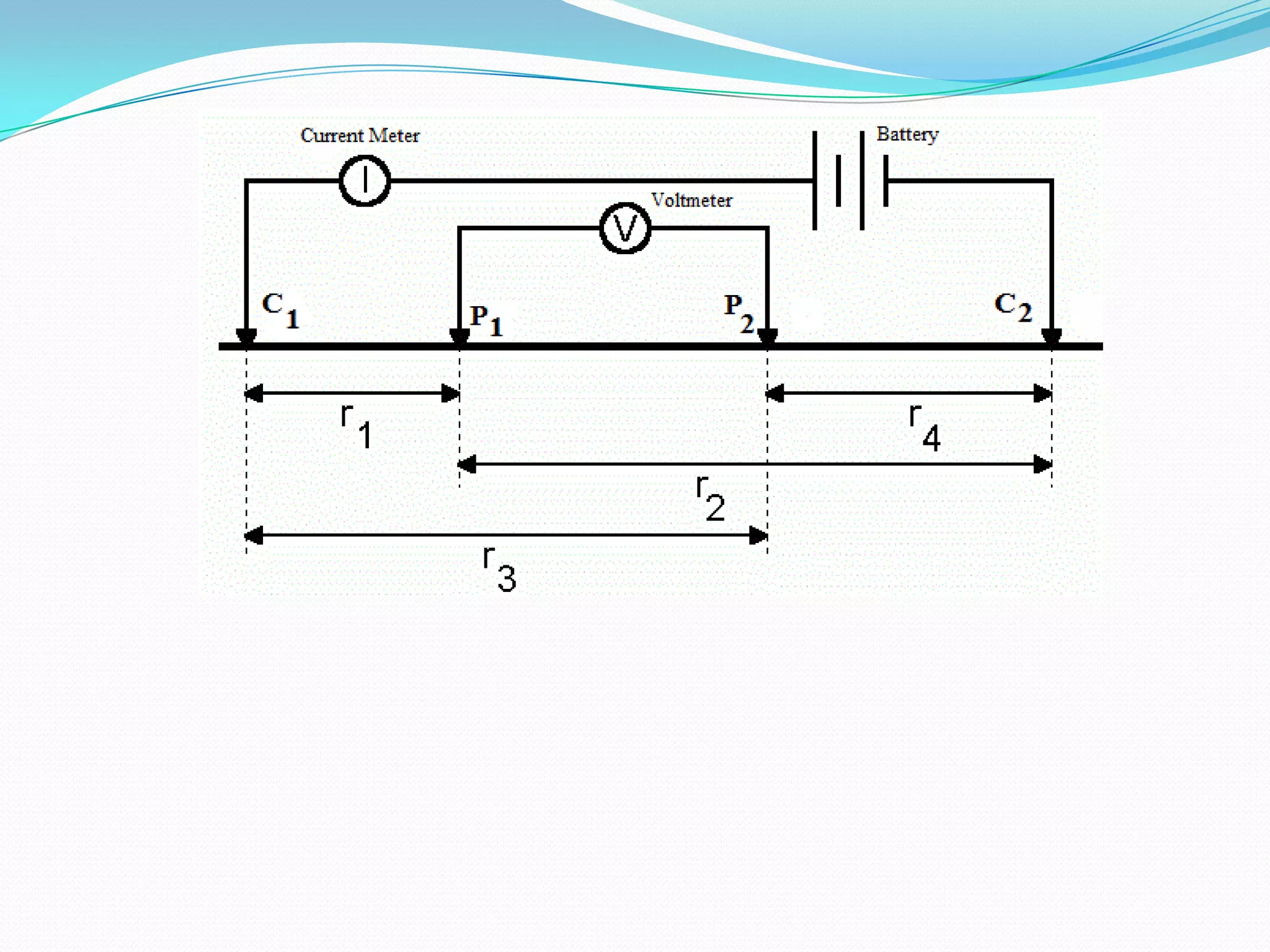
 Electrode arrangement
• Four metal spikes driven into the ground along a

straight line serve as electrodes.
• While using direct current, the potential electrodes

must be of non-polarizable type.
• For ensuring proper contact with the ground a little

water is poured in the pits a few minutes before
measurement is made.
TYPES OF RESISTIVITY SURVEY
 Resistivity profiling
 Used when lateral variation of soil is to be investigated.
 Keeping the electrode spacing constant, readings are taken either

along a single line or along several parallel lines.
 It is use determine the changes in the resistivity characteristics of
materials from one location to another.
 It is used to distinguish between layers of different resistivity.
 Uses
o Prospecting for sand and gravel deposits.
o Prospecting for ore bodies.
 Resistivity sounding
 Used when variation with depth is required.
 Keeping the centre of the electrode spread fixed, the electrode

spacing is increased from one reading to the next.
 The sounding data may be plotted either on ordinary graph paper or
on a log-log graph paper.
 Uses
o Estimation of thickness of layer.
o Estimation of depth of sand gravel.
o Estimation of the variation of resistivity with depth.
Geophysical prospecting

Geophysical prospecting

  • 1.
  • 2.
    INTRODUCTION  Definition Geophysical prospectingis the study of the structure of the earth’s crust by physical methods for the location and surveying of minerals and ores. It is an integral part of geophysics.
  • 3.
    OBJECTIVES  To determinelithology of the area.  To identify and locate exploitable reservoirs.  To detect and delineate geothermal resources.  Estimate geophysical properties of the geothermal system.  To determine the ground water conditions in the regions.
  • 4.
    METHODS  Electrical ResistivityMethod   Resistivity Profiling Resistivity Sounding  Seismic Refraction Method  Gravity Geophysical Method  Magnetic Method  Geothermal Method
  • 5.
    RESISTIVITY EXPLORATION  It isa sub surface exploration based on the measurement of apparent resistivity of subsurface materials.
  • 7.
     Electrode arrangement •Four metal spikes driven into the ground along a straight line serve as electrodes. • While using direct current, the potential electrodes must be of non-polarizable type. • For ensuring proper contact with the ground a little water is poured in the pits a few minutes before measurement is made.
  • 8.
    TYPES OF RESISTIVITYSURVEY  Resistivity profiling  Used when lateral variation of soil is to be investigated.  Keeping the electrode spacing constant, readings are taken either along a single line or along several parallel lines.  It is use determine the changes in the resistivity characteristics of materials from one location to another.  It is used to distinguish between layers of different resistivity.  Uses o Prospecting for sand and gravel deposits. o Prospecting for ore bodies.
  • 9.
     Resistivity sounding Used when variation with depth is required.  Keeping the centre of the electrode spread fixed, the electrode spacing is increased from one reading to the next.  The sounding data may be plotted either on ordinary graph paper or on a log-log graph paper.  Uses o Estimation of thickness of layer. o Estimation of depth of sand gravel. o Estimation of the variation of resistivity with depth.