1) Geophysical exploration techniques that

employ both gravity and magnetic are
passive. By this, we simply mean that
when using these two methods we
measure a naturally occurring field of the
earth. Collectively, the gravity and
magnetic methods are often referred to as
potential methods and the gravitational
and magnetic fields that we measure are
referred to as potential fields.
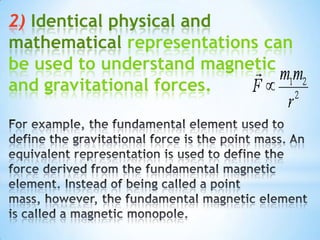
2) Identical physical and
mathematical representations can
be used to understand magnetic
and gravitational forces.
3) The acquisition ,reduction, and
interpretation
4) Vary from place to place.
5) Both are Vector fields
6) Both fields are force fields.
7) Drift correction is applied in both
methods.
8) Both fields exert force with a
speed equal to the speed of light.
Differences Between Gravity
and Magnetics

1) The fundamental parameter that controls gravity
variations of interest to us as exploration
geophysicists is rock density.

The highest densities we typically observe are about 3.0
gm/cm3and the lowest densities are about 1.0 gm/cm3.

The fundamental parameter controlling the
magnetic field variations of interest to us, is
magnetic susceptibility.
This variation is not only present amongst different rock
types, but wide variations in susceptibility also occur within a
given rock type.
2) Gravitational field is always

perpendicular to the surface of
earth.
Direction of Magnetic field
changes from place to place
3) Value of g is less near the
equator than at the poles

Magnetic field varies from the
equator to the poles in a range that
goes from 20000 nT to 70000 nT.
4) Gravity (mass) is monopolar it
always attracts.

Magnetism is dipolar; like poles
repel while unlike poles attract.
5) All matter has mass therefore
contributes to g.
While main magnetic field is
due to convection currents in the
core; it effects on some minerals
not all.
6) Gravitational field is measured by
Mechanical Instrument.
While magnetic field is measured by
purely electronic Instruments.

7) Gravimeter is relative
instrument magnetometer is
absolute.
8) tides are only external effect on
value of g and can be corrected effect
of magnetic storms cannot be removed
9) A properly reduced gravitational field is
always generated by subsurface variations
in rock density. ;
A properly reduced magnetic
field, however, can have as its origin at
least two possible sources.
10) Unlike the gravitational
field, which does not change
significantly with
time the magnetic field is highly time
dependent.

Similarities and differences between gravity and magnetic

  • 1.
    1) Geophysical explorationtechniques that employ both gravity and magnetic are passive. By this, we simply mean that when using these two methods we measure a naturally occurring field of the earth. Collectively, the gravity and magnetic methods are often referred to as potential methods and the gravitational and magnetic fields that we measure are referred to as potential fields.
  • 2.
    2) Identical physicaland mathematical representations can be used to understand magnetic and gravitational forces.
  • 3.
    3) The acquisition,reduction, and interpretation 4) Vary from place to place. 5) Both are Vector fields 6) Both fields are force fields. 7) Drift correction is applied in both methods. 8) Both fields exert force with a speed equal to the speed of light.
  • 4.
    Differences Between Gravity andMagnetics 1) The fundamental parameter that controls gravity variations of interest to us as exploration geophysicists is rock density. The highest densities we typically observe are about 3.0 gm/cm3and the lowest densities are about 1.0 gm/cm3. The fundamental parameter controlling the magnetic field variations of interest to us, is magnetic susceptibility. This variation is not only present amongst different rock types, but wide variations in susceptibility also occur within a given rock type.
  • 5.
    2) Gravitational fieldis always perpendicular to the surface of earth. Direction of Magnetic field changes from place to place
  • 6.
    3) Value ofg is less near the equator than at the poles Magnetic field varies from the equator to the poles in a range that goes from 20000 nT to 70000 nT.
  • 7.
    4) Gravity (mass)is monopolar it always attracts. Magnetism is dipolar; like poles repel while unlike poles attract. 5) All matter has mass therefore contributes to g. While main magnetic field is due to convection currents in the core; it effects on some minerals not all.
  • 8.
    6) Gravitational fieldis measured by Mechanical Instrument. While magnetic field is measured by purely electronic Instruments. 7) Gravimeter is relative instrument magnetometer is absolute.
  • 9.
    8) tides areonly external effect on value of g and can be corrected effect of magnetic storms cannot be removed 9) A properly reduced gravitational field is always generated by subsurface variations in rock density. ; A properly reduced magnetic field, however, can have as its origin at least two possible sources.
  • 10.
    10) Unlike thegravitational field, which does not change significantly with time the magnetic field is highly time dependent.