PETROLEUM  EXPLORATION FUNDAMENTALS OF
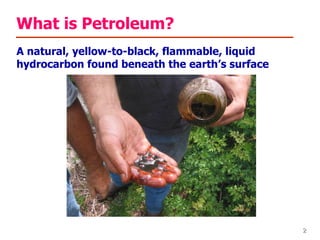
What is Petroleum? A natural, yellow-to-black, flammable, liquid hydrocarbon found beneath the earth’s surface
Petroleum – Properties & Products Definition of Petroleum:  The word Petroleum is coined from two latin words  “ Petra ”  meaning  “ rock ”  and  “ Oleum ”  meaning  “ oil ”. A generic name for hydrocarbons, including crude oil, natural gas liquids, natural gas and their products.
PETROLEUM Petroleum or hydrocarbons are  a mixture of  liquids, solids, semi-solids and gases  occurring naturally in the rocks and are loosely called as  MINERAL  FUELS  also. Chemically It  is  a mixture of Hydrogen and Carbon  with minor amounts of  nitrogen, oxygen, sulphur as impurities.
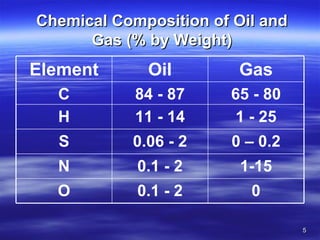
Chemical Composition of Oil and Gas (% by Weight) 0 0.1 - 2 O 1-15 0.1 - 2 N 0 – 0.2 0.06 - 2 S 1 - 25 11 - 14 H 65 - 80 84 - 87 C Gas Oil Element
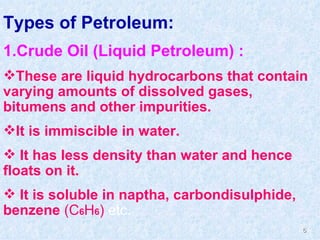
Types of Petroleum: 1.Crude Oil (Liquid Petroleum) :  These are liquid hydrocarbons that contain varying amounts of dissolved gases, bitumens and other impurities.  It is immiscible in water. It has less density than water and hence floats on it. It is soluble in naptha, carbondisulphide, benzene  (C 6 H 6 )  etc.
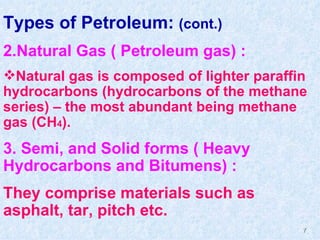
Types of Petroleum:  (cont.) 2.Natural Gas ( Petroleum gas) :  Natural gas is composed of lighter paraffin hydrocarbons (hydrocarbons of the methane series) – the most abundant being methane gas (CH 4 ). 3. Semi, and Solid forms ( Heavy Hydrocarbons and Bitumens) :  They comprise materials such as asphalt, tar, pitch etc.
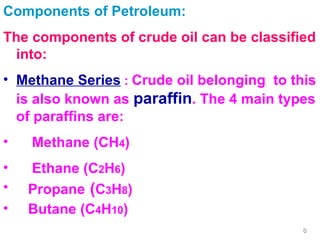
Components of Petroleum: The components of crude oil can be classified into: Methane Series  :  Crude oil belonging  to this is also known as  paraffin . The 4 main types of paraffins are: Methane (CH 4 ) Ethane (C 2 H 6 ) Propane   ( C 3 H 8 ) Butane (C 4 H 10 )
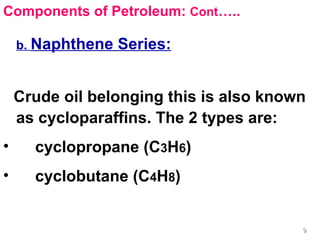
Components of Petroleum:  Cont ….. b.  Naphthene Series: Crude oil belonging this is also known as cycloparaffins. The 2 types are: cyclopropane (C 3 H 6 ) cyclobutane (C 4 H 8 )
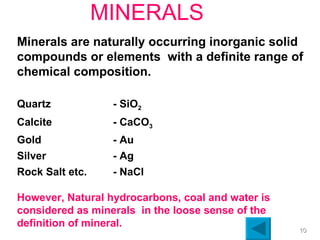
MINERALS Minerals are naturally occurring inorganic solid compounds or elements  with a definite range of chemical composition. Quartz - SiO 2 Calcite - CaCO 3 Gold - Au Silver - Ag Rock Salt etc. - NaCl However, Natural hydrocarbons, coal and water is considered as minerals  in the loose sense of the  definition of mineral.
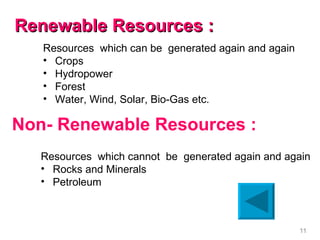
Renewable Resources : Resources  which can be  generated again and again Crops Hydropower Forest Water, Wind, Solar, Bio-Gas etc. Resources  which cannot  be  generated again and again Rocks and Minerals Petroleum Non- Renewable Resources :
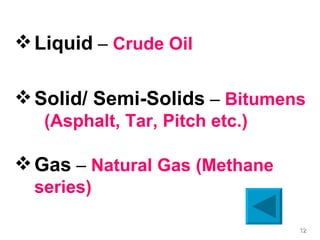
Liquid   –   Crude Oil Solid/ Semi-Solids  –   Bitumens  (Asphalt, Tar, Pitch etc.) Gas  –   Natural Gas (Methane series)
GEOLOGY Geology : ‘Geo’  means Earth and ‘logos’ means Science Geology : Its is the history of the  Earth.   To know history :  How it was formed – Origin – Planetary System – Solar System We have to know How old it is – Age What it is made up of – Rocks, Minerals What are the physical and chemical properties – Geophysical &    Geochemical  What kind of Deformations it has undergone – Tectonics How the deformation is manifested - Structures What is its  future – Geoenvironment
Naptha: The Hydrocarbons that boil below 250 °C and are liquid at standard conditions. Used as a cleaning fluid and solvent. It is also used in fertilizer manufacture.

FUNDAMENTAL OF PETROLEUM EXPLORATION

  • 1.
    PETROLEUM EXPLORATIONFUNDAMENTALS OF
  • 2.
    What is Petroleum?A natural, yellow-to-black, flammable, liquid hydrocarbon found beneath the earth’s surface
  • 3.
    Petroleum – Properties& Products Definition of Petroleum: The word Petroleum is coined from two latin words “ Petra ” meaning “ rock ” and “ Oleum ” meaning “ oil ”. A generic name for hydrocarbons, including crude oil, natural gas liquids, natural gas and their products.
  • 4.
    PETROLEUM Petroleum orhydrocarbons are a mixture of liquids, solids, semi-solids and gases occurring naturally in the rocks and are loosely called as MINERAL FUELS also. Chemically It is a mixture of Hydrogen and Carbon with minor amounts of nitrogen, oxygen, sulphur as impurities.
  • 5.
    Chemical Composition ofOil and Gas (% by Weight) 0 0.1 - 2 O 1-15 0.1 - 2 N 0 – 0.2 0.06 - 2 S 1 - 25 11 - 14 H 65 - 80 84 - 87 C Gas Oil Element
  • 6.
    Types of Petroleum:1.Crude Oil (Liquid Petroleum) : These are liquid hydrocarbons that contain varying amounts of dissolved gases, bitumens and other impurities. It is immiscible in water. It has less density than water and hence floats on it. It is soluble in naptha, carbondisulphide, benzene (C 6 H 6 ) etc.
  • 7.
    Types of Petroleum: (cont.) 2.Natural Gas ( Petroleum gas) : Natural gas is composed of lighter paraffin hydrocarbons (hydrocarbons of the methane series) – the most abundant being methane gas (CH 4 ). 3. Semi, and Solid forms ( Heavy Hydrocarbons and Bitumens) : They comprise materials such as asphalt, tar, pitch etc.
  • 8.
    Components of Petroleum:The components of crude oil can be classified into: Methane Series : Crude oil belonging to this is also known as paraffin . The 4 main types of paraffins are: Methane (CH 4 ) Ethane (C 2 H 6 ) Propane ( C 3 H 8 ) Butane (C 4 H 10 )
  • 9.
    Components of Petroleum: Cont ….. b. Naphthene Series: Crude oil belonging this is also known as cycloparaffins. The 2 types are: cyclopropane (C 3 H 6 ) cyclobutane (C 4 H 8 )
  • 10.
    MINERALS Minerals arenaturally occurring inorganic solid compounds or elements with a definite range of chemical composition. Quartz - SiO 2 Calcite - CaCO 3 Gold - Au Silver - Ag Rock Salt etc. - NaCl However, Natural hydrocarbons, coal and water is considered as minerals in the loose sense of the definition of mineral.
  • 11.
    Renewable Resources :Resources which can be generated again and again Crops Hydropower Forest Water, Wind, Solar, Bio-Gas etc. Resources which cannot be generated again and again Rocks and Minerals Petroleum Non- Renewable Resources :
  • 12.
    Liquid – Crude Oil Solid/ Semi-Solids – Bitumens (Asphalt, Tar, Pitch etc.) Gas – Natural Gas (Methane series)
  • 13.
    GEOLOGY Geology :‘Geo’ means Earth and ‘logos’ means Science Geology : Its is the history of the Earth. To know history : How it was formed – Origin – Planetary System – Solar System We have to know How old it is – Age What it is made up of – Rocks, Minerals What are the physical and chemical properties – Geophysical & Geochemical What kind of Deformations it has undergone – Tectonics How the deformation is manifested - Structures What is its future – Geoenvironment
  • 14.
    Naptha: The Hydrocarbonsthat boil below 250 °C and are liquid at standard conditions. Used as a cleaning fluid and solvent. It is also used in fertilizer manufacture.