Life conference and exhibition 2010
Steven Morrison and Alex McNeil


                                                         Application of Extreme
                                                           Value Theory to Risk
                                                             Capital Estimation
                                                                      7-9 November 2010
© 2010 The Actuarial Profession  www.actuaries.org.uk
Application of EVT to risk capital estimation:
Agenda

• Motivation
• Background theory
• VaR case study
• Summary
• Questions or comments?


© 2010 The Actuarial Profession  www.actuaries.org.uk
                                                         1
Application of extreme value theory to risk capital estimation
Steven Morrison and Alex McNeil


                                                           Motivation


© 2010 The Actuarial Profession  www.actuaries.org.uk
Motivation


• Measures of risk capital are based on the (extreme) tail of a distribution
   – Value at Risk (VaR)
   – Conditional Value at Risk (CVaR) / Expected Shortfall


• In particular, Solvency II SCR is defined as a 99.5% VaR over a one year
  horizon


• Generally needs to be estimated using simulation
   1. Generate real-world economic scenarios for all risk drivers affecting the
      balance sheet over one year
   2. Revalue the balance sheet under each real-world scenario
                         – e.g. Monte Carlo („nested stochastic), Replicating Formula, Replicating Portfolio

            3. Estimate the statistics of interest
© 2010 The Actuarial Profession  www.actuaries.org.uk
                                                                                                               3
Motivation


• An insurer who has gone through such a simulation exercise states
   – “Our Solvency Capital Requirement is £77.5m”


• How confident can we be in this number?


• Many sources of uncertainty
   – Choice of economic scenario generator (ESG) models and their
     calibration
   – Liability model assumptions e.g. dynamic lapse rules
   – Choice of scenarios sampled i.e. choice of real-world ESG random
     number seed


© 2010 The Actuarial Profession  www.actuaries.org.uk
                                                                        4
Motivation


• The same insurer re-runs their internal model using a different random
  number seed (but all other assumptions are unchanged)
   – “Our Solvency Capital Requirement is now £82.8m”


• So, simulation-based capital estimates are subject to statistical uncertainty
   – Can we estimate this statistical uncertainty?
   – How can we reduce the amount of statistical uncertainty?


• In this presentation, we will address these questions using a statistical
  technique known as Extreme Value Theory (EVT)


© 2010 The Actuarial Profession  www.actuaries.org.uk
                                                                                  5
Application of extreme value theory to risk capital estimation
Steven Morrison and Alex McNeil


                                                         Background theory


© 2010 The Actuarial Profession  www.actuaries.org.uk
Application of extreme value theory to risk capital estimation
Steven Morrison and Alex McNeil


                                                         VaR case study


© 2010 The Actuarial Profession  www.actuaries.org.uk
VaR Case study


Liability book
• UK-style with profits
   – Management actions, dynamic EBR, dynamic bonus rates,
     regular premiums

Valuation methodology
• Nested stochastic
   – 1,000 real-world outer scenarios
   – 1,000 risk-neutral inner scenarios per outer scenario


© 2010 The Actuarial Profession  www.actuaries.org.uk
                                                             8
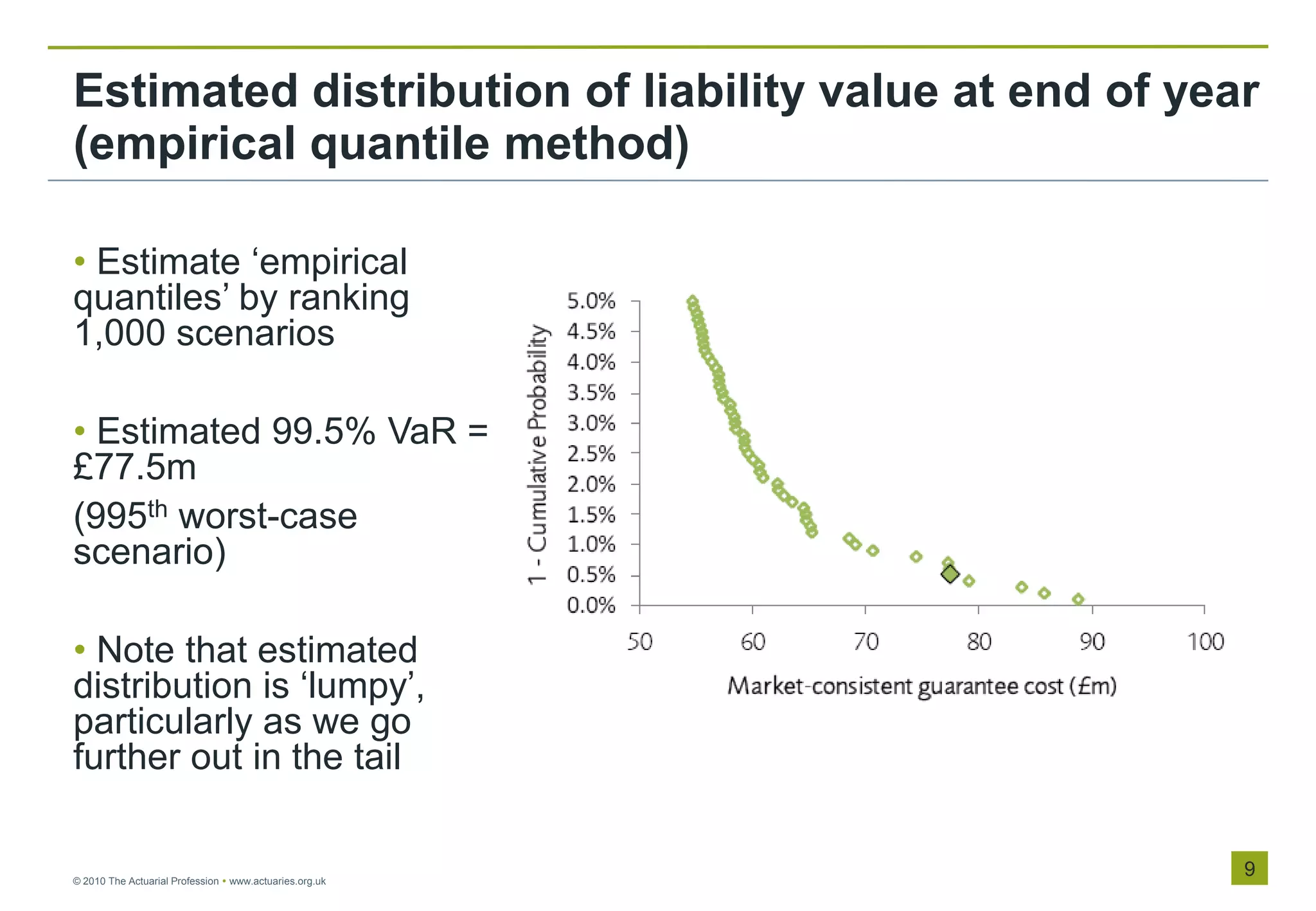
Estimated distribution of liability value at end of year
(empirical quantile method)

• Estimate „empirical
quantiles‟ by ranking
1,000 scenarios

• Estimated 99.5% VaR =
£77.5m
(995th worst-case
scenario)

• Note that estimated
distribution is „lumpy‟,
particularly as we go
further out in the tail


© 2010 The Actuarial Profession  www.actuaries.org.uk
                                                         9
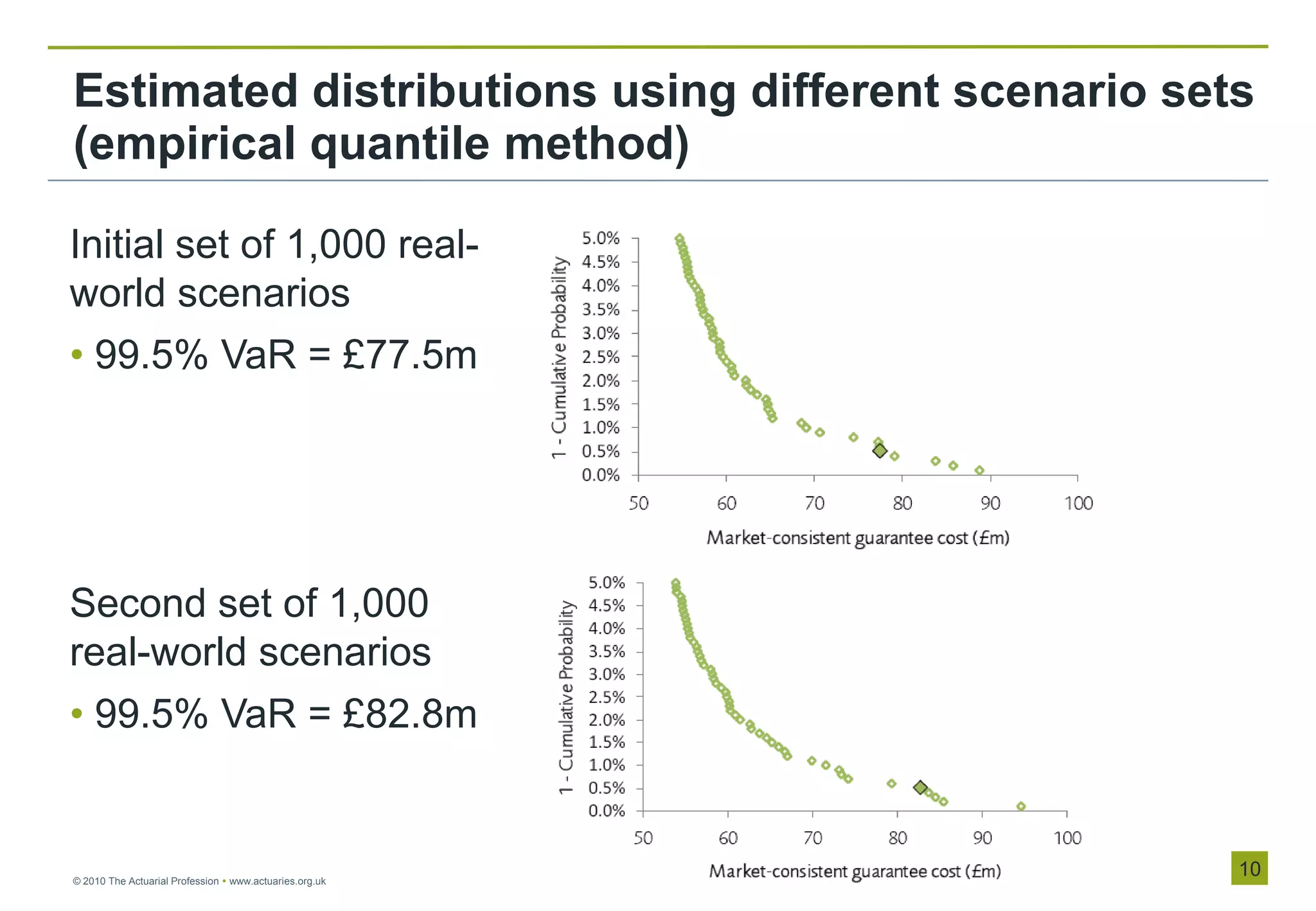
Estimated distributions using different scenario sets
(empirical quantile method)

Initial set of 1,000 real-
world scenarios
• 99.5% VaR = £77.5m


Second set of 1,000
real-world scenarios
• 99.5% VaR = £82.8m


© 2010 The Actuarial Profession  www.actuaries.org.uk
                                                         10
What is the ‘true’ VaR?


• Two different estimates for VaR
   – £77.5m
   – £82.8m
   – Which is „correct‟?

• Both use same (subjective) modelling assumptions
   – Same economic scenario generator and calibration
   – Same liability model assumptions e.g. dynamic lapse rules

• Difference is purely due to different random number streams
  used to generate the economic scenarios
© 2010 The Actuarial Profession  www.actuaries.org.uk
                                                                 11
Two important questions


1. Can we reduce the sensitivity of the estimate to the choice of
   random numbers?
   – Run more scenarios
                         – May not be feasible because of model run-time

            – Find a „better‟ estimator than the empirical quantile

2. Given a particular estimate of the 99.5% VaR, can we estimate
   the uncertainty around this?


© 2010 The Actuarial Profession  www.actuaries.org.uk
                                                                           12
Application of Extreme Value Theory


• Recall that Extreme Value Theory tells us something about the
  shape of the distribution in the tail
   – Distribution of liability value beyond some threshold is
     (approximately) Generalised Pareto
   – Parameterised by 2 parameters

• Estimate the tail of the distribution by:
   1. Picking a threshold
   2. Fitting the 2 parameters of the Generalised Pareto
      Distribution to values in excess of the threshold

© 2010 The Actuarial Profession  www.actuaries.org.uk
                                                                  13
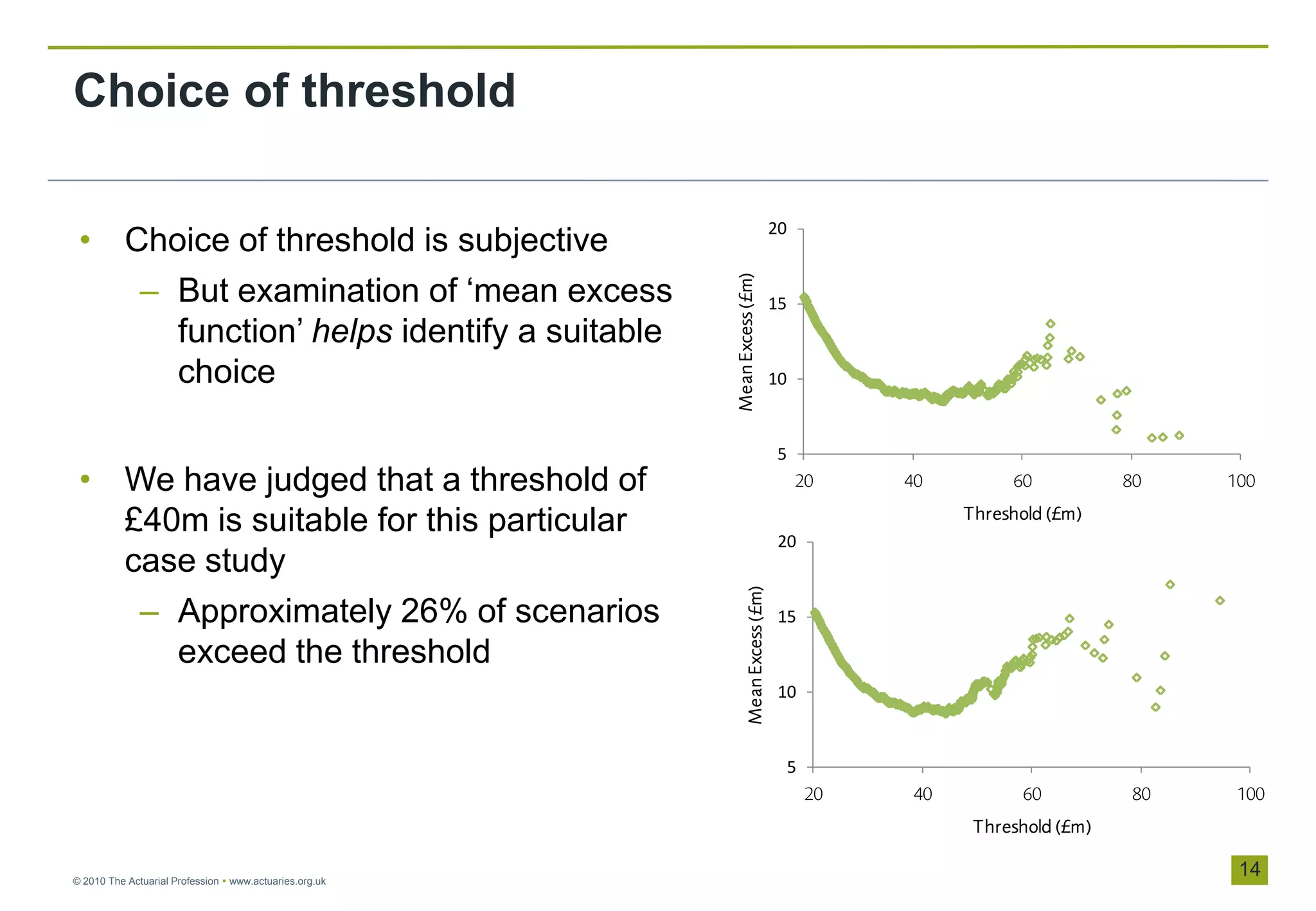
Choice of threshold

                                                                                   20
 • Choice of threshold is subjective
    – But examination of „mean excess


                                                         Mean Excess (£m)
                                                                                   15
      function‟ helps identify a suitable
      choice                                                                       10


                                                                                   5
 • We have judged that a threshold of                                                   20       40         60           80    100
                                                                                                       Threshold (£m)
   £40m is suitable for this particular                                             20
   case study


                                                                Mean Excess (£m)
    – Approximately 26% of scenarios                                                15

      exceed the threshold
                                                                                    10


                                                                                        5
                                                                                            20    40          60          80    100
                                                                                                        Threshold (£m)

© 2010 The Actuarial Profession  www.actuaries.org.uk
                                                                                                                                14
Estimated distributions using different scenario sets
(Extreme Value Theory method)
Initial set of 1,000 real-world
scenarios
• 99.5% VaR = £75.9m
• 95% confidence interval =
[71.1m, 84.3m]


Second set of 1,000 real-
world scenarios
• 99.5% VaR = £77.8m
• 95% confidence interval =
[72.2m, 87.7m]


© 2010 The Actuarial Profession  www.actuaries.org.uk
                                                         15
Application of extreme value theory to risk capital estimation
Steven Morrison and Alex McNeil


                                                             Summary


© 2010 The Actuarial Profession  www.actuaries.org.uk
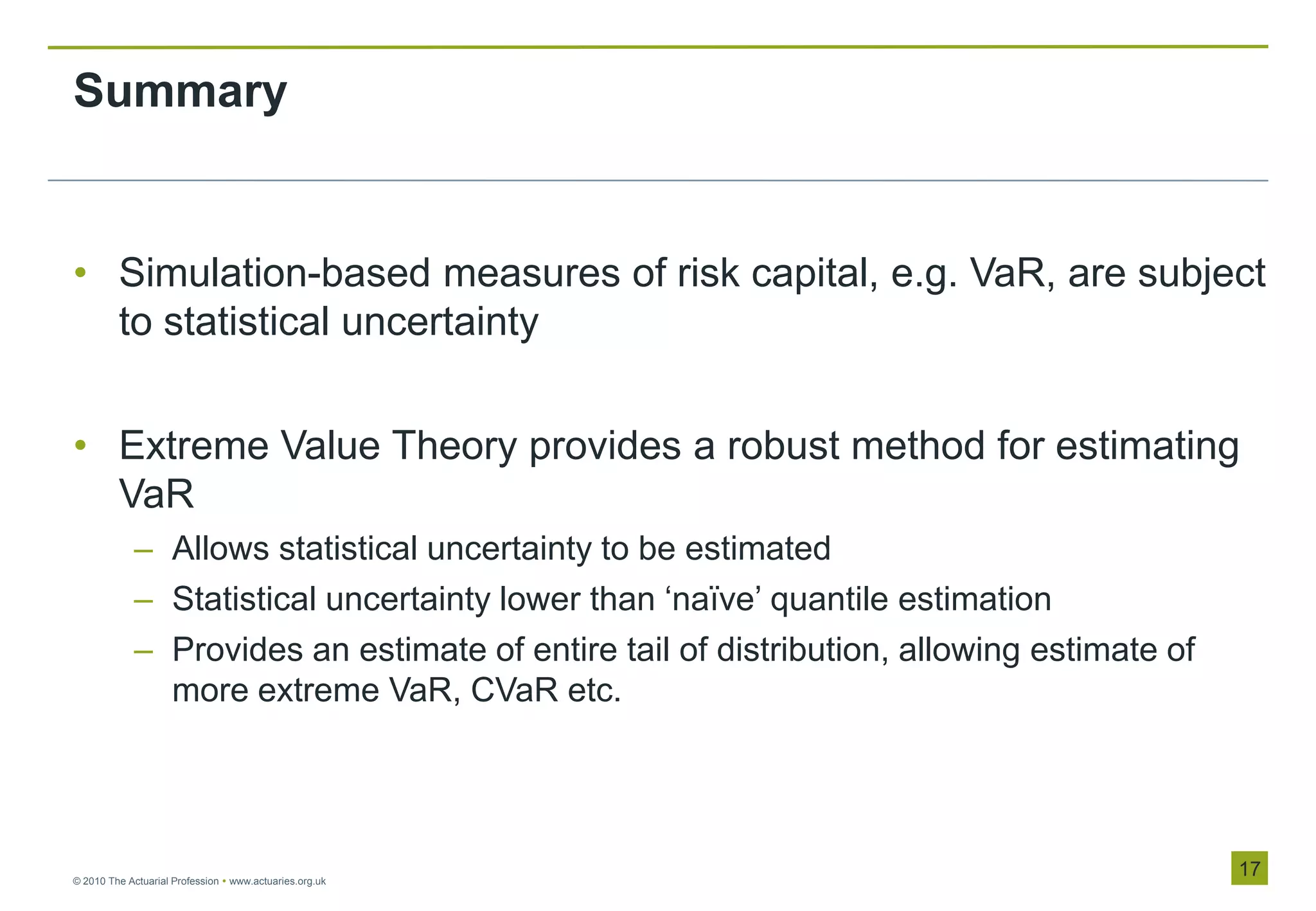
Summary


• Simulation-based measures of risk capital, e.g. VaR, are subject
  to statistical uncertainty


• Extreme Value Theory provides a robust method for estimating
  VaR
            – Allows statistical uncertainty to be estimated
            – Statistical uncertainty lower than „naïve‟ quantile estimation
            – Provides an estimate of entire tail of distribution, allowing estimate of
              more extreme VaR, CVaR etc.


© 2010 The Actuarial Profession  www.actuaries.org.uk
                                                                                          17
Questions or comments?


Expressions of individual views by
members of The Actuarial Profession
and its staff are encouraged.
The views expressed in this presentation
are those of the presenter.


© 2010 The Actuarial Profession  www.actuaries.org.uk
                                                         18

Application of Extreme Value Theory to Risk Capital Estimation

  • 1.
    Life conference andexhibition 2010 Steven Morrison and Alex McNeil Application of Extreme Value Theory to Risk Capital Estimation 7-9 November 2010 © 2010 The Actuarial Profession  www.actuaries.org.uk
  • 2.
    Application of EVTto risk capital estimation: Agenda • Motivation • Background theory • VaR case study • Summary • Questions or comments? © 2010 The Actuarial Profession  www.actuaries.org.uk 1
  • 3.
    Application of extremevalue theory to risk capital estimation Steven Morrison and Alex McNeil Motivation © 2010 The Actuarial Profession  www.actuaries.org.uk
  • 4.
    Motivation • Measures ofrisk capital are based on the (extreme) tail of a distribution – Value at Risk (VaR) – Conditional Value at Risk (CVaR) / Expected Shortfall • In particular, Solvency II SCR is defined as a 99.5% VaR over a one year horizon • Generally needs to be estimated using simulation 1. Generate real-world economic scenarios for all risk drivers affecting the balance sheet over one year 2. Revalue the balance sheet under each real-world scenario – e.g. Monte Carlo („nested stochastic), Replicating Formula, Replicating Portfolio 3. Estimate the statistics of interest © 2010 The Actuarial Profession  www.actuaries.org.uk 3
  • 5.
    Motivation • An insurerwho has gone through such a simulation exercise states – “Our Solvency Capital Requirement is £77.5m” • How confident can we be in this number? • Many sources of uncertainty – Choice of economic scenario generator (ESG) models and their calibration – Liability model assumptions e.g. dynamic lapse rules – Choice of scenarios sampled i.e. choice of real-world ESG random number seed © 2010 The Actuarial Profession  www.actuaries.org.uk 4
  • 6.
    Motivation • The sameinsurer re-runs their internal model using a different random number seed (but all other assumptions are unchanged) – “Our Solvency Capital Requirement is now £82.8m” • So, simulation-based capital estimates are subject to statistical uncertainty – Can we estimate this statistical uncertainty? – How can we reduce the amount of statistical uncertainty? • In this presentation, we will address these questions using a statistical technique known as Extreme Value Theory (EVT) © 2010 The Actuarial Profession  www.actuaries.org.uk 5
  • 7.
    Application of extremevalue theory to risk capital estimation Steven Morrison and Alex McNeil Background theory © 2010 The Actuarial Profession  www.actuaries.org.uk
  • 8.
    Application of extremevalue theory to risk capital estimation Steven Morrison and Alex McNeil VaR case study © 2010 The Actuarial Profession  www.actuaries.org.uk
  • 9.
    VaR Case study Liabilitybook • UK-style with profits – Management actions, dynamic EBR, dynamic bonus rates, regular premiums Valuation methodology • Nested stochastic – 1,000 real-world outer scenarios – 1,000 risk-neutral inner scenarios per outer scenario © 2010 The Actuarial Profession  www.actuaries.org.uk 8
  • 10.
    Estimated distribution ofliability value at end of year (empirical quantile method) • Estimate „empirical quantiles‟ by ranking 1,000 scenarios • Estimated 99.5% VaR = £77.5m (995th worst-case scenario) • Note that estimated distribution is „lumpy‟, particularly as we go further out in the tail © 2010 The Actuarial Profession  www.actuaries.org.uk 9
  • 11.
    Estimated distributions usingdifferent scenario sets (empirical quantile method) Initial set of 1,000 real- world scenarios • 99.5% VaR = £77.5m Second set of 1,000 real-world scenarios • 99.5% VaR = £82.8m © 2010 The Actuarial Profession  www.actuaries.org.uk 10
  • 12.
    What is the‘true’ VaR? • Two different estimates for VaR – £77.5m – £82.8m – Which is „correct‟? • Both use same (subjective) modelling assumptions – Same economic scenario generator and calibration – Same liability model assumptions e.g. dynamic lapse rules • Difference is purely due to different random number streams used to generate the economic scenarios © 2010 The Actuarial Profession  www.actuaries.org.uk 11
  • 13.
    Two important questions 1.Can we reduce the sensitivity of the estimate to the choice of random numbers? – Run more scenarios – May not be feasible because of model run-time – Find a „better‟ estimator than the empirical quantile 2. Given a particular estimate of the 99.5% VaR, can we estimate the uncertainty around this? © 2010 The Actuarial Profession  www.actuaries.org.uk 12
  • 14.
    Application of ExtremeValue Theory • Recall that Extreme Value Theory tells us something about the shape of the distribution in the tail – Distribution of liability value beyond some threshold is (approximately) Generalised Pareto – Parameterised by 2 parameters • Estimate the tail of the distribution by: 1. Picking a threshold 2. Fitting the 2 parameters of the Generalised Pareto Distribution to values in excess of the threshold © 2010 The Actuarial Profession  www.actuaries.org.uk 13
  • 15.
    Choice of threshold 20 • Choice of threshold is subjective – But examination of „mean excess Mean Excess (£m) 15 function‟ helps identify a suitable choice 10 5 • We have judged that a threshold of 20 40 60 80 100 Threshold (£m) £40m is suitable for this particular 20 case study Mean Excess (£m) – Approximately 26% of scenarios 15 exceed the threshold 10 5 20 40 60 80 100 Threshold (£m) © 2010 The Actuarial Profession  www.actuaries.org.uk 14
  • 16.
    Estimated distributions usingdifferent scenario sets (Extreme Value Theory method) Initial set of 1,000 real-world scenarios • 99.5% VaR = £75.9m • 95% confidence interval = [71.1m, 84.3m] Second set of 1,000 real- world scenarios • 99.5% VaR = £77.8m • 95% confidence interval = [72.2m, 87.7m] © 2010 The Actuarial Profession  www.actuaries.org.uk 15
  • 17.
    Application of extremevalue theory to risk capital estimation Steven Morrison and Alex McNeil Summary © 2010 The Actuarial Profession  www.actuaries.org.uk
  • 18.
    Summary • Simulation-based measuresof risk capital, e.g. VaR, are subject to statistical uncertainty • Extreme Value Theory provides a robust method for estimating VaR – Allows statistical uncertainty to be estimated – Statistical uncertainty lower than „naïve‟ quantile estimation – Provides an estimate of entire tail of distribution, allowing estimate of more extreme VaR, CVaR etc. © 2010 The Actuarial Profession  www.actuaries.org.uk 17
  • 19.
    Questions or comments? Expressionsof individual views by members of The Actuarial Profession and its staff are encouraged. The views expressed in this presentation are those of the presenter. © 2010 The Actuarial Profession  www.actuaries.org.uk 18