Quantitative MethodsHimanshu Shahshahhr21@gmail.com9970836701
OverviewTime value of Money
Discounted Cash Flow Applications
Statistical Concepts and market return
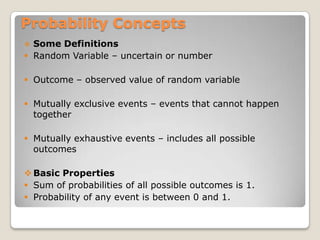
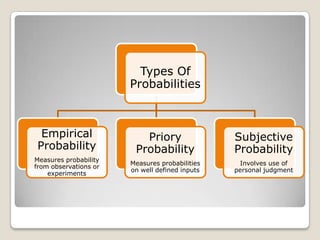
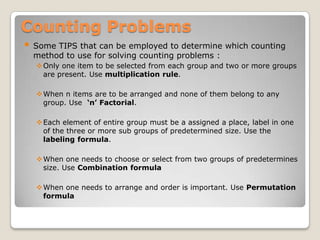
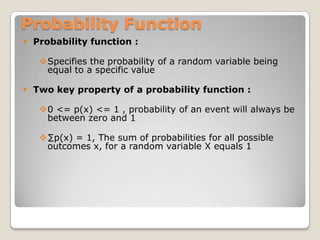
Probability Concept
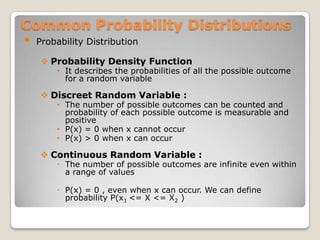
Common Probability Distribution
Sampling and Estimation
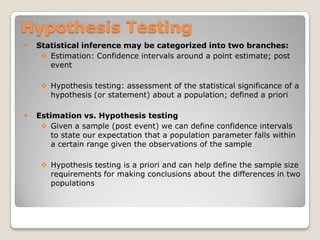
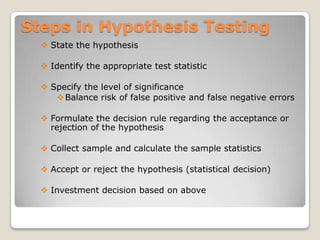
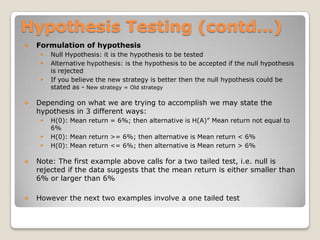
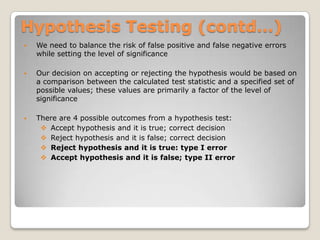
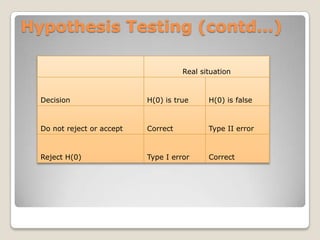
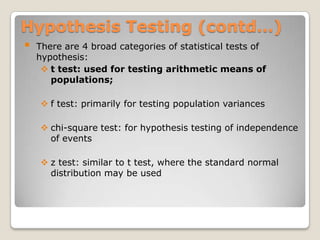
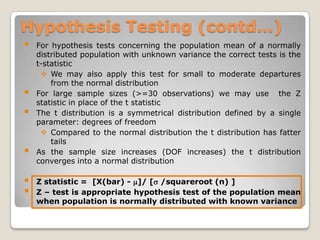
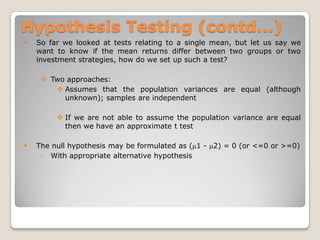
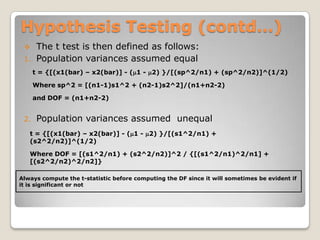
Hypothesis Testing
Technical AnalysisTime Value of Money (TVM)Concept is all about finding the future value of current Re.1 and finding the current value of future Re.1
Concept of Time Value of Money helps in arriving at comparable value of different rupee amounts at different points of time into equivalent values of particular time.
Investment decisions are generally taken on cash flow analysis – TVM is pre-condition
For TVM analysis, it is better to draw time line first denoting at what time how much cash flows have occurred
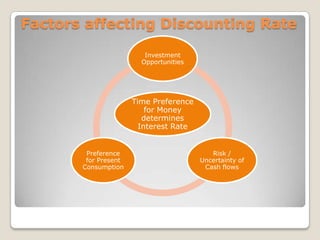
Decide the interest rate at which cash flows are to be discounted or compoundedFactors affecting Discounting Rate
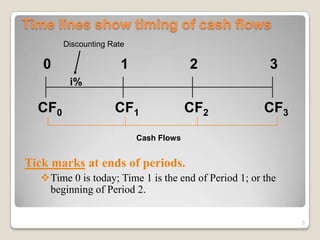
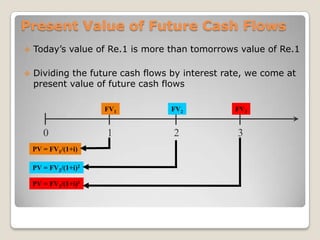
50123i%CF0CF1CF3CF2Time lines show timing of cash flows Discounting RateCash FlowsTick marks at ends of periods.Time 0 is today; Time 1 is the end of Period 1; or the beginning of Period 2.Present Value of Future Cash FlowsFV1FV2FV3PV = FV1/(1+i)PV = FV2/(1+i)21230PV = FV3/(1+i)3Today’s value of Re.1 is more than tomorrows value of Re.1
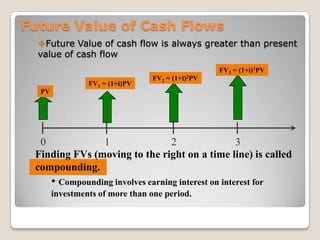
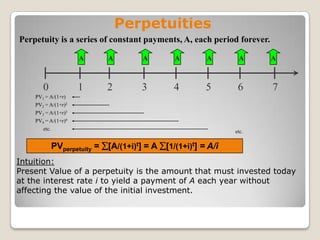
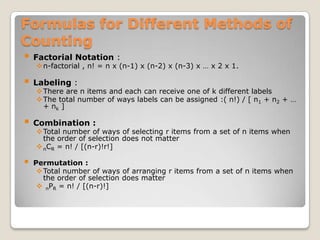
Dividing the future cash flows by interest rate, we come at present value of future cash flowsFuture Value of Cash FlowsFV3 = (1+i)3PVFV2 = (1+i)2PVPV1230Future Value of cash flow is always greater than present value of cash flowFV1 = (1+i)PVFinding FVs (moving to the right on a time line) is called compounding.  Compounding involves earning interest on interest for investments of more than one period.AAAAAAA12345670PV1 = A/(1+r)PV2 = A/(1+r)2PV3 = A/(1+r)3PV4 = A/(1+r)4etc.etc.PerpetuitiesPerpetuity is a series of constant payments, A, each period forever.PVperpetuity = [A/(1+i)t] = A [1/(1+i)t] = A/iIntuition:Present Value of a perpetuity is the amount that must invested today                  at the interest rate i to yield a payment of A each year without                         affecting the value of the initial investment.
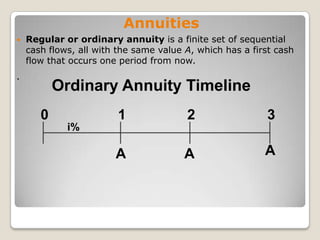
0123AnnuitiesRegular or ordinary annuity is a finite set of sequential cash flows, all with the same value A, which has a first cash flow that occurs one period from now..Ordinary Annuity Timelinei%AAA9
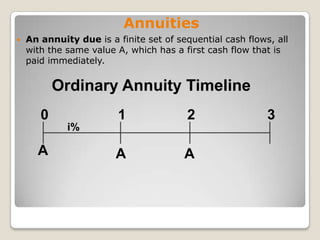
0123AnnuitiesAn annuity due is a finite set of sequential cash flows, all with the same value A, which has a first cash flow that is paid immediately.Ordinary Annuity Timelinei%AAA10
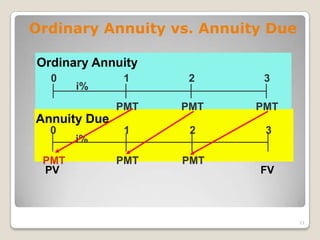
Ordinary Annuity0123i%PMTPMTPMTAnnuity Due0123i%PMTPMTPMTPVFVOrdinary Annuity vs. Annuity Due11
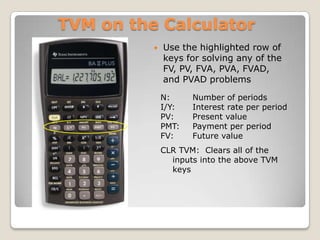
TVM on the CalculatorUse the highlighted row of keys for solving any of the FV, PV, FVA, PVA, FVAD, and PVAD problemsN:		Number of periodsI/Y:	Interest rate per periodPV:	Present valuePMT:	Payment per periodFV:	Future valueCLR TVM:  Clears all of the inputs into the above TVM keys
Discounted Cash flow Applications
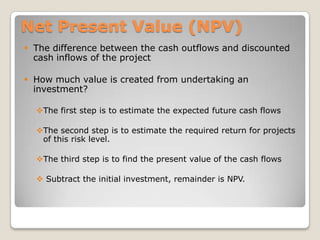
Net Present Value (NPV)The difference between the cash outflows and discounted cash inflows of the project
How much value is created from undertaking an investment?
The first step is to estimate the expected future cash flows
The second step is to estimate the required return for projects of this risk level.
The third step is to find the present value of the cash flows
 Subtract the initial investment, remainder is NPV.NPV (Decision Rule)If the NPV is positive, accept the project
A positive NPV means that the project is expected to add value to the firm and will therefore increase the wealth of the owners.
Since our goal is to increase owner wealth, NPV is a direct measure of how well this project will meet our goal.Internal Rate of Return (IRR)This is the most important alternative to NPV
It is based entirely on the estimated cash flows and is independent of interest rates found elsewhere
It is the interest rate at which PV of cash flows equates with PV cash outflows. Alternatively, at IRR, NPV of the project is zero.
Management, and individuals in general, often have a much better feel for percentage returns and the value that is created, than they do for dollar increases.IRR – Decision RuleDecision Rule:    Accept the project if the IRR is greater than the required returnWhen there is only one project/proposal under evaluation, then NPV and IRR gives the same decision that is acceptance or rejection of the projectProblems Associated with IRR methodSome cash flow structures yield more than one IRR
IRR can be misleading when mutually exclusively projects are compared as this method assumes that cash flows are reinvested at IRR only which may not be possible in every situation
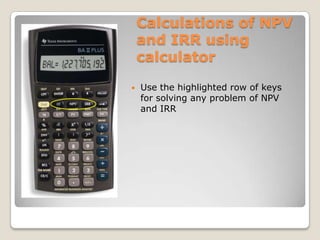
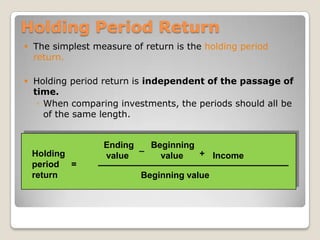
NPV is better method while comparing mutually exclusive projectsCalculations of NPV and IRR using calculatorUse the highlighted row of keys for solving any problem of NPV and IRRHolding Period ReturnThe simplest measure of return is the holding period return.
Holding period return is independent of the passage of time.When comparing investments, the periods should all be of the same length.Ending       Beginning value             value            Income_Holding period     =  return+Beginning value
Time weighted returnUse the basic measure of return (adjusted for cash flows) for sub-periods, and time-weighted returns for multiple periods.
Reflects compounding of returns
It is the rate at which Re.1 is compounded over a specified period of time
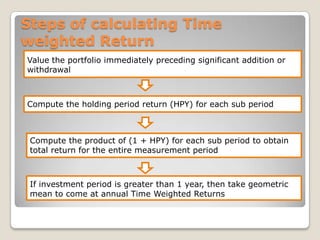
Perfect method of performance measurement as it is not affected by amount and timing of cash flow.Steps of calculating Time weighted ReturnValue the portfolio immediately preceding significant addition or withdrawal Compute the holding period return (HPY) for each sub periodCompute the product of (1 + HPY) for each sub period to obtain total return for the entire measurement periodIf investment period is greater than 1 year, then take geometric mean to come at annual Time Weighted Returns
Money weighted ReturnThe Money-Weighted Rate of Return (MWRR)…same as internal rate of return of portfolio.Initial deposit is considered as inflows and all withdrawals and ending value is considered as outflows.Not good for comparing different fund managers as MWRR over 0-T is also, generally, a function of the amount and timing of net new money – which is not in  the control of the fund manager.
Calculating Yields on T-billsSince T-bills are sold on a discount basis, their returns are not directly comparable to interest bearing bonds.
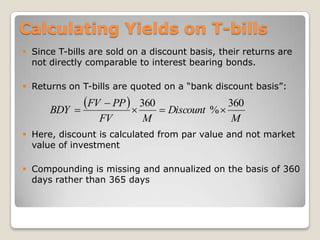
Returns on T-bills are quoted on a “bank discount basis”:
Here, discount is calculated from par value and not market value of investment
Compounding is missing and annualized on the basis of 360 days rather than 365 daysEffective Annual Yield Annualized value based on 365 days a year
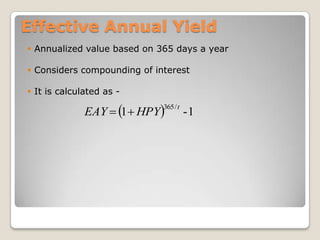
 Considers compounding of interest
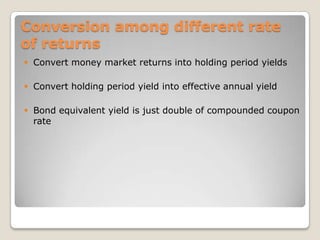
 It is calculated as -Conversion among different rate of returnsConvert money market returns into holding period yields
Convert holding period yield into effective annual yield
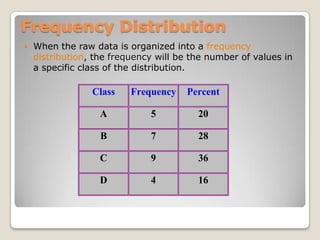
Bond equivalent yield is just double of compounded coupon rateFrequency DistributionWhen the raw data is organized into afrequency distribution, the frequency will be the number of values in a specific class of the distribution.
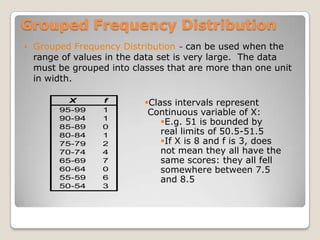
Grouped Frequency DistributionGrouped Frequency Distribution -can be used when the range of values in the data set is very large.  The data must be grouped into classes that are more than one unit in width.
Class intervals represent     Continuous variable of X:E.g. 51 is bounded by real limits of 50.5-51.5
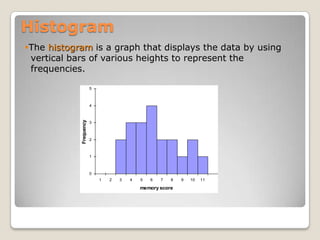
If X is 8 and f is 3, does not mean they all have the same scores: they all fell somewhere between 7.5 and 8.5 Histogram The histogram is a graph that displays the data by using                      vertical bars of various heights to represent the     frequencies.
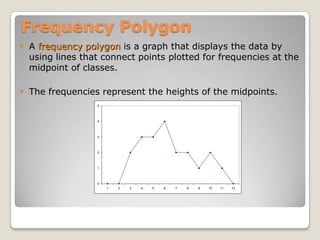
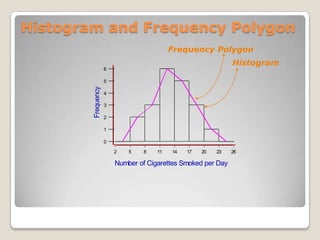
Frequency PolygonA frequency polygon is a graph that displays the data by using lines that connect points plotted for frequencies at the midpoint of classes.
The frequencies represent the heights of the midpoints.Histogram and Frequency PolygonFrequency PolygonHistogram65yc4neuq3erF210262320171411852NumberofCigarettesSmokedperDay
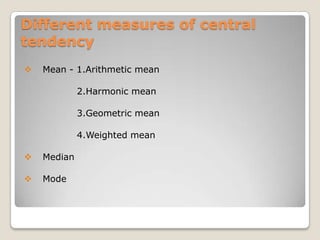
Different measures of central tendencyMean - 1.Arithmetic mean                 2.Harmonic mean                 3.Geometric mean                 4.Weighted mean Median
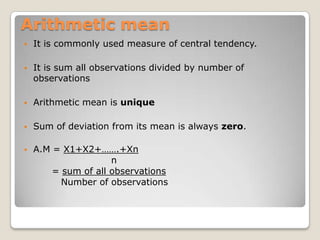
Mode Arithmetic meanIt is commonly used measure of central tendency.
It is sum all observations divided by number of  observations
Arithmetic mean is unique
Sum of deviation from its mean is always zero.
A.M = X1+X2+…….+Xn                            n         = sum of all observations        Number of observations
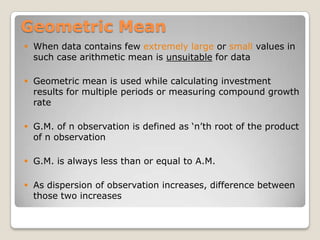
Geometric MeanWhen data contains few extremely large or small values in such case arithmetic mean is unsuitable for data
Geometric mean is used while calculating investment results for multiple periods or measuring compound growth rate
G.M. of n observation is defined as ‘n’th root of the product of n observation
G.M. is always less than or equal to A.M.
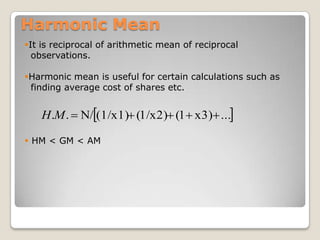
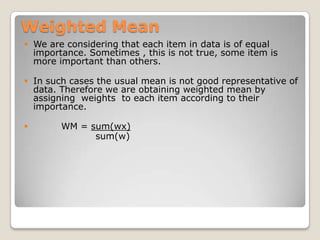
As dispersion of observation increases, difference between those two increasesHarmonic MeanIt is reciprocal of arithmetic mean of reciprocal   observations.Harmonic mean is useful for certain calculations such as     finding average cost of shares etc. HM < GM < AM Weighted MeanWe are considering that each item in data is of equal importance. Sometimes , this is not true, some item is more important than others.
In such cases the usual mean is not good representative of data. Therefore we are obtaining weighted mean by assigning  weights  to each item according to their importance.
         WM = sum(wx)                       sum(w)
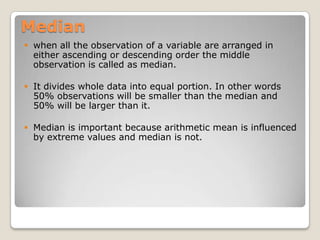
Medianwhen all the observation of a variable are arranged in either ascending or descending order the middle observation is called as median.
It divides whole data into equal portion. In other words 50% observations will be smaller than the median and 50% will be larger than it.
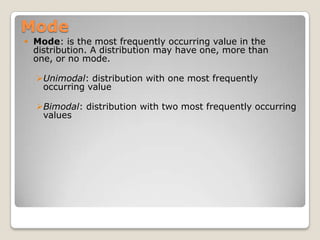
Median is important because arithmetic mean is influenced by extreme values and median is not.ModeMode: is the most frequently occurring value in the distribution. A distribution may have one, more than one, or no mode.
Unimodal: distribution with one most frequently occurring value
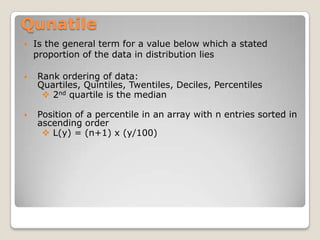
Bimodal: distribution with two most frequently occurring valuesQunatileIs the general term for a value below which a stated proportion of the data in distribution lies
Rank ordering of data: Quartiles, Quintiles, Twentiles, Deciles, Percentiles
2nd quartile is the median
Position of a percentile in an array with n entries sorted in ascending order
L(y) = (n+1) x (y/100)Measures of DispersionRange
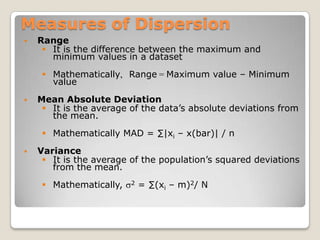
It is the difference between the maximum and minimum values in a dataset
Mathematically,   Range = Maximum value – Minimum value
Mean Absolute Deviation
It is the average of the data’s absolute deviations from the mean.
Mathematically MAD = ∑|xi – x(bar)| / n
Variance
It is the average of the population’s squared deviations from the mean.
Mathematically, 2 = ∑(xi – m)2/ N Measures of Dispersion (contd…)Standard deviation
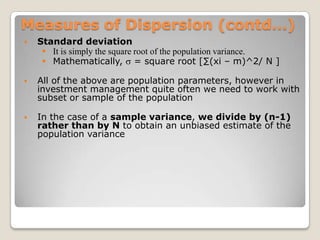
It is simply the square root of the population variance.
Mathematically,= square root [∑(xi – m)^2/ N ]
All of the above are population parameters, however in investment management quite often we need to work with subset or sample of the population
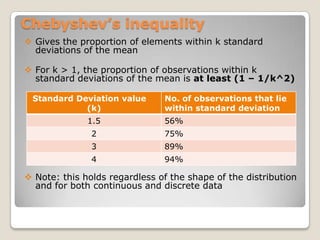
In the case of a sample variance, we divide by (n-1) rather than by N to obtain an unbiased estimate of the population varianceChebyshev’s inequalityGives the proportion of elements within k standard deviations of the mean
For k > 1, the proportion of observations within k standard deviations of the mean is at least (1 – 1/k^2)
Note: this holds regardless of the shape of the distribution and for both continuous and discrete dataRelative DispersionIs the amount of variability in comparison to a reference point or a benchmark
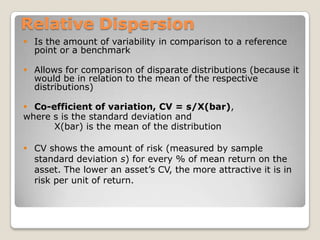
Allows for comparison of disparate distributions (because it would be in relation to the mean of the respective distributions)
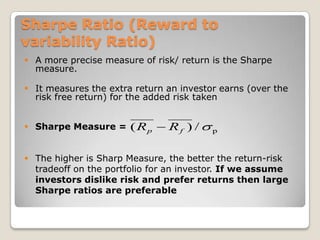
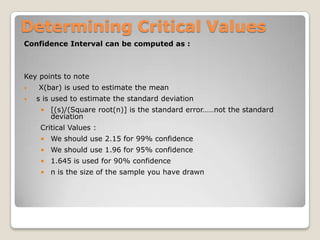
Co-efficient of variation, CV = s/X(bar), where s is the standard deviation and           X(bar) is the mean of the distributionCV shows the amount of risk (measured by sample standard deviation s) for every % of mean return on the asset. The lower an asset’s CV, the more attractive it is in risk per unit of return.Sharpe Ratio (Reward to variability Ratio)A more precise measure of risk/ return is the Sharpe measure.
It measures the extra return an investor earns (over the risk free return) for the added risk taken
Sharpe Measure =
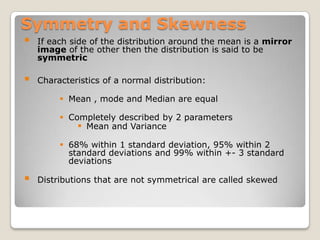
The higher is Sharp Measure, the better the return-risk tradeoff on the portfolio for an investor. If we assume investors dislike risk and prefer returns then large Sharpe ratios are preferableSymmetry and SkewnessIf each side of the distribution around the mean is a mirror image of the other then the distribution is said to be symmetric
Characteristics of a normal distribution:
Mean , mode and Median are equal
Completely described by 2 parameters
Mean and Variance
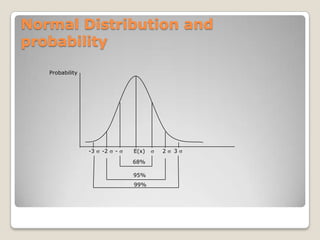
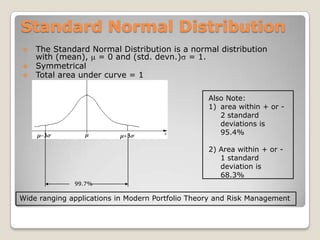
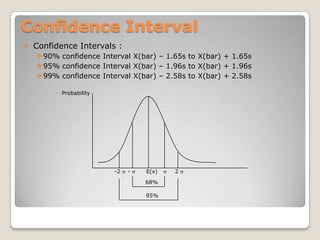
68% within 1 standard deviation, 95% within 2 standard deviations and 99% within +- 3 standard deviations
Distributions that are not symmetrical are called skewedNormal Distribution and probabilityProbability3 E(x)-  -2 2 -3 68%95%99%
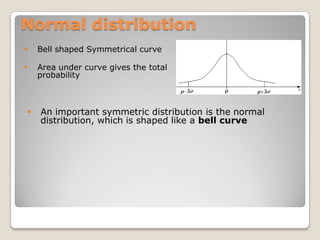
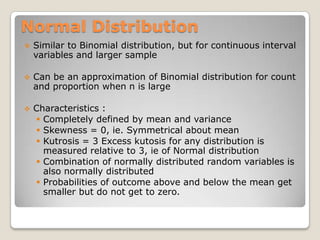
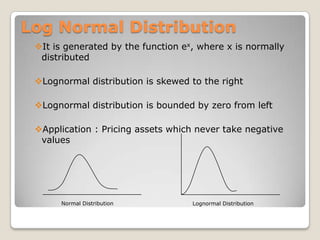
Normal distributionBell shaped Symmetrical curve
Area under curve gives the total probability
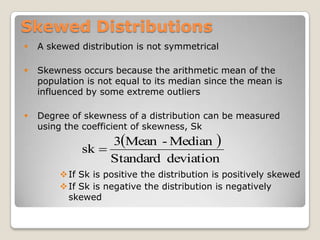
An important symmetric distribution is the normal distribution, which is shaped like a bell curveSkewed DistributionsA skewed distribution is not symmetrical
Skewness occurs because the arithmetic mean of the population is not equal to its median since the mean is influenced by some extreme outliers
Degree of skewness of a distribution can be measured using the coefficient of skewness, Sk
If Sk is positive the distribution is positively skewed
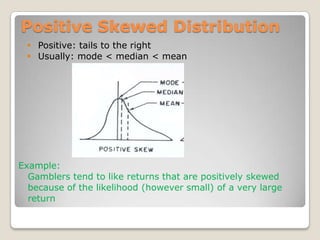
If Sk is negative the distribution is negatively skewedPositive Skewed DistributionPositive: tails to the right
Usually: mode < median < meanExample:      Gamblers tend to like returns that are positively skewed         because of the likelihood (however small) of a very large         return
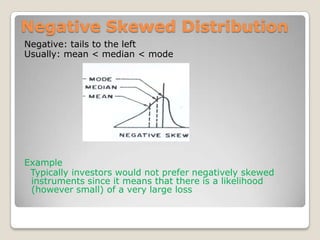
Negative Skewed DistributionNegative: tails to the left Usually: mean < median < modeExample  Typically investors would not prefer negatively skewed instruments since it means that there is a likelihood (however small) of a very large loss
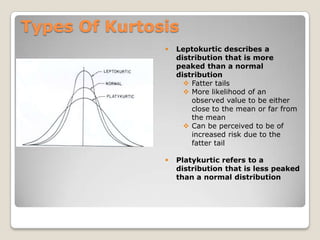
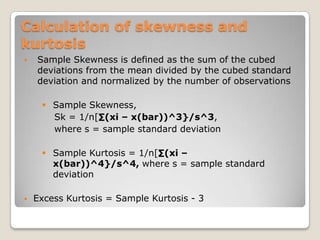
KurtosisKurtosis is a measure of the degree to which a distribution is more or less “peaked” than a normal distribution

Quantitative methods

  • 1.
  • 2.
  • 3.
  • 4.
  • 5.
  • 6.
  • 7.
  • 8.
  • 9.
    Technical AnalysisTime Valueof Money (TVM)Concept is all about finding the future value of current Re.1 and finding the current value of future Re.1
  • 10.
    Concept of TimeValue of Money helps in arriving at comparable value of different rupee amounts at different points of time into equivalent values of particular time.
  • 11.
    Investment decisions aregenerally taken on cash flow analysis – TVM is pre-condition
  • 12.
    For TVM analysis,it is better to draw time line first denoting at what time how much cash flows have occurred
  • 13.
    Decide the interestrate at which cash flows are to be discounted or compoundedFactors affecting Discounting Rate
  • 14.
    50123i%CF0CF1CF3CF2Time lines showtiming of cash flows Discounting RateCash FlowsTick marks at ends of periods.Time 0 is today; Time 1 is the end of Period 1; or the beginning of Period 2.Present Value of Future Cash FlowsFV1FV2FV3PV = FV1/(1+i)PV = FV2/(1+i)21230PV = FV3/(1+i)3Today’s value of Re.1 is more than tomorrows value of Re.1
  • 15.
    Dividing the futurecash flows by interest rate, we come at present value of future cash flowsFuture Value of Cash FlowsFV3 = (1+i)3PVFV2 = (1+i)2PVPV1230Future Value of cash flow is always greater than present value of cash flowFV1 = (1+i)PVFinding FVs (moving to the right on a time line) is called compounding. Compounding involves earning interest on interest for investments of more than one period.AAAAAAA12345670PV1 = A/(1+r)PV2 = A/(1+r)2PV3 = A/(1+r)3PV4 = A/(1+r)4etc.etc.PerpetuitiesPerpetuity is a series of constant payments, A, each period forever.PVperpetuity = [A/(1+i)t] = A [1/(1+i)t] = A/iIntuition:Present Value of a perpetuity is the amount that must invested today at the interest rate i to yield a payment of A each year without affecting the value of the initial investment.
  • 16.
    0123AnnuitiesRegular or ordinaryannuity is a finite set of sequential cash flows, all with the same value A, which has a first cash flow that occurs one period from now..Ordinary Annuity Timelinei%AAA9
  • 17.
    0123AnnuitiesAn annuity dueis a finite set of sequential cash flows, all with the same value A, which has a first cash flow that is paid immediately.Ordinary Annuity Timelinei%AAA10
  • 18.
  • 19.
    TVM on theCalculatorUse the highlighted row of keys for solving any of the FV, PV, FVA, PVA, FVAD, and PVAD problemsN: Number of periodsI/Y: Interest rate per periodPV: Present valuePMT: Payment per periodFV: Future valueCLR TVM: Clears all of the inputs into the above TVM keys
  • 20.
  • 21.
    Net Present Value(NPV)The difference between the cash outflows and discounted cash inflows of the project
  • 22.
    How much valueis created from undertaking an investment?
  • 23.
    The first stepis to estimate the expected future cash flows
  • 24.
    The second stepis to estimate the required return for projects of this risk level.
  • 25.
    The third stepis to find the present value of the cash flows
  • 26.
    Subtract theinitial investment, remainder is NPV.NPV (Decision Rule)If the NPV is positive, accept the project
  • 27.
    A positive NPVmeans that the project is expected to add value to the firm and will therefore increase the wealth of the owners.
  • 28.
    Since our goalis to increase owner wealth, NPV is a direct measure of how well this project will meet our goal.Internal Rate of Return (IRR)This is the most important alternative to NPV
  • 29.
    It is basedentirely on the estimated cash flows and is independent of interest rates found elsewhere
  • 30.
    It is theinterest rate at which PV of cash flows equates with PV cash outflows. Alternatively, at IRR, NPV of the project is zero.
  • 31.
    Management, and individualsin general, often have a much better feel for percentage returns and the value that is created, than they do for dollar increases.IRR – Decision RuleDecision Rule: Accept the project if the IRR is greater than the required returnWhen there is only one project/proposal under evaluation, then NPV and IRR gives the same decision that is acceptance or rejection of the projectProblems Associated with IRR methodSome cash flow structures yield more than one IRR
  • 32.
    IRR can bemisleading when mutually exclusively projects are compared as this method assumes that cash flows are reinvested at IRR only which may not be possible in every situation
  • 33.
    NPV is bettermethod while comparing mutually exclusive projectsCalculations of NPV and IRR using calculatorUse the highlighted row of keys for solving any problem of NPV and IRRHolding Period ReturnThe simplest measure of return is the holding period return.
  • 34.
    Holding period returnis independent of the passage of time.When comparing investments, the periods should all be of the same length.Ending Beginning value value Income_Holding period = return+Beginning value
  • 35.
    Time weighted returnUsethe basic measure of return (adjusted for cash flows) for sub-periods, and time-weighted returns for multiple periods.
  • 36.
  • 37.
    It is therate at which Re.1 is compounded over a specified period of time
  • 38.
    Perfect method ofperformance measurement as it is not affected by amount and timing of cash flow.Steps of calculating Time weighted ReturnValue the portfolio immediately preceding significant addition or withdrawal Compute the holding period return (HPY) for each sub periodCompute the product of (1 + HPY) for each sub period to obtain total return for the entire measurement periodIf investment period is greater than 1 year, then take geometric mean to come at annual Time Weighted Returns
  • 39.
    Money weighted ReturnTheMoney-Weighted Rate of Return (MWRR)…same as internal rate of return of portfolio.Initial deposit is considered as inflows and all withdrawals and ending value is considered as outflows.Not good for comparing different fund managers as MWRR over 0-T is also, generally, a function of the amount and timing of net new money – which is not in the control of the fund manager.
  • 40.
    Calculating Yields onT-billsSince T-bills are sold on a discount basis, their returns are not directly comparable to interest bearing bonds.
  • 41.
    Returns on T-billsare quoted on a “bank discount basis”:
  • 42.
    Here, discount iscalculated from par value and not market value of investment
  • 43.
    Compounding is missingand annualized on the basis of 360 days rather than 365 daysEffective Annual Yield Annualized value based on 365 days a year
  • 44.
  • 45.
    It iscalculated as -Conversion among different rate of returnsConvert money market returns into holding period yields
  • 46.
    Convert holding periodyield into effective annual yield
  • 47.
    Bond equivalent yieldis just double of compounded coupon rateFrequency DistributionWhen the raw data is organized into afrequency distribution, the frequency will be the number of values in a specific class of the distribution.
  • 48.
    Grouped Frequency DistributionGroupedFrequency Distribution -can be used when the range of values in the data set is very large. The data must be grouped into classes that are more than one unit in width.
  • 49.
    Class intervals represent Continuous variable of X:E.g. 51 is bounded by real limits of 50.5-51.5
  • 50.
    If X is8 and f is 3, does not mean they all have the same scores: they all fell somewhere between 7.5 and 8.5 Histogram The histogram is a graph that displays the data by using vertical bars of various heights to represent the frequencies.
  • 51.
    Frequency PolygonA frequencypolygon is a graph that displays the data by using lines that connect points plotted for frequencies at the midpoint of classes.
  • 52.
    The frequencies representthe heights of the midpoints.Histogram and Frequency PolygonFrequency PolygonHistogram65yc4neuq3erF210262320171411852NumberofCigarettesSmokedperDay
  • 53.
    Different measures ofcentral tendencyMean - 1.Arithmetic mean 2.Harmonic mean 3.Geometric mean 4.Weighted mean Median
  • 54.
    Mode Arithmetic meanItis commonly used measure of central tendency.
  • 55.
    It is sumall observations divided by number of observations
  • 56.
  • 57.
    Sum of deviationfrom its mean is always zero.
  • 58.
    A.M = X1+X2+…….+Xn n = sum of all observations Number of observations
  • 59.
    Geometric MeanWhen datacontains few extremely large or small values in such case arithmetic mean is unsuitable for data
  • 60.
    Geometric mean isused while calculating investment results for multiple periods or measuring compound growth rate
  • 61.
    G.M. of nobservation is defined as ‘n’th root of the product of n observation
  • 62.
    G.M. is alwaysless than or equal to A.M.
  • 63.
    As dispersion ofobservation increases, difference between those two increasesHarmonic MeanIt is reciprocal of arithmetic mean of reciprocal observations.Harmonic mean is useful for certain calculations such as finding average cost of shares etc. HM < GM < AM Weighted MeanWe are considering that each item in data is of equal importance. Sometimes , this is not true, some item is more important than others.
  • 64.
    In such casesthe usual mean is not good representative of data. Therefore we are obtaining weighted mean by assigning weights to each item according to their importance.
  • 65.
    WM = sum(wx) sum(w)
  • 66.
    Medianwhen all theobservation of a variable are arranged in either ascending or descending order the middle observation is called as median.
  • 67.
    It divides wholedata into equal portion. In other words 50% observations will be smaller than the median and 50% will be larger than it.
  • 68.
    Median is importantbecause arithmetic mean is influenced by extreme values and median is not.ModeMode: is the most frequently occurring value in the distribution. A distribution may have one, more than one, or no mode.
  • 69.
    Unimodal: distribution withone most frequently occurring value
  • 70.
    Bimodal: distribution withtwo most frequently occurring valuesQunatileIs the general term for a value below which a stated proportion of the data in distribution lies
  • 71.
    Rank ordering ofdata: Quartiles, Quintiles, Twentiles, Deciles, Percentiles
  • 72.
    2nd quartile isthe median
  • 73.
    Position of apercentile in an array with n entries sorted in ascending order
  • 74.
    L(y) = (n+1)x (y/100)Measures of DispersionRange
  • 75.
    It is thedifference between the maximum and minimum values in a dataset
  • 76.
    Mathematically, Range = Maximum value – Minimum value
  • 77.
  • 78.
    It is theaverage of the data’s absolute deviations from the mean.
  • 79.
    Mathematically MAD =∑|xi – x(bar)| / n
  • 80.
  • 81.
    It is theaverage of the population’s squared deviations from the mean.
  • 82.
    Mathematically, 2 =∑(xi – m)2/ N Measures of Dispersion (contd…)Standard deviation
  • 83.
    It is simplythe square root of the population variance.
  • 84.
    Mathematically,= square root[∑(xi – m)^2/ N ]
  • 85.
    All of theabove are population parameters, however in investment management quite often we need to work with subset or sample of the population
  • 86.
    In the caseof a sample variance, we divide by (n-1) rather than by N to obtain an unbiased estimate of the population varianceChebyshev’s inequalityGives the proportion of elements within k standard deviations of the mean
  • 87.
    For k >1, the proportion of observations within k standard deviations of the mean is at least (1 – 1/k^2)
  • 88.
    Note: this holdsregardless of the shape of the distribution and for both continuous and discrete dataRelative DispersionIs the amount of variability in comparison to a reference point or a benchmark
  • 89.
    Allows for comparisonof disparate distributions (because it would be in relation to the mean of the respective distributions)
  • 90.
    Co-efficient of variation,CV = s/X(bar), where s is the standard deviation and X(bar) is the mean of the distributionCV shows the amount of risk (measured by sample standard deviation s) for every % of mean return on the asset. The lower an asset’s CV, the more attractive it is in risk per unit of return.Sharpe Ratio (Reward to variability Ratio)A more precise measure of risk/ return is the Sharpe measure.
  • 91.
    It measures theextra return an investor earns (over the risk free return) for the added risk taken
  • 92.
  • 93.
    The higher isSharp Measure, the better the return-risk tradeoff on the portfolio for an investor. If we assume investors dislike risk and prefer returns then large Sharpe ratios are preferableSymmetry and SkewnessIf each side of the distribution around the mean is a mirror image of the other then the distribution is said to be symmetric
  • 94.
    Characteristics of anormal distribution:
  • 95.
    Mean , modeand Median are equal
  • 96.
  • 97.
  • 98.
    68% within 1standard deviation, 95% within 2 standard deviations and 99% within +- 3 standard deviations
  • 99.
    Distributions that arenot symmetrical are called skewedNormal Distribution and probabilityProbability3 E(x)-  -2 2 -3 68%95%99%
  • 100.
  • 101.
    Area under curvegives the total probability
  • 102.
    An important symmetricdistribution is the normal distribution, which is shaped like a bell curveSkewed DistributionsA skewed distribution is not symmetrical
  • 103.
    Skewness occurs becausethe arithmetic mean of the population is not equal to its median since the mean is influenced by some extreme outliers
  • 104.
    Degree of skewnessof a distribution can be measured using the coefficient of skewness, Sk
  • 105.
    If Sk ispositive the distribution is positively skewed
  • 106.
    If Sk isnegative the distribution is negatively skewedPositive Skewed DistributionPositive: tails to the right
  • 107.
    Usually: mode <median < meanExample: Gamblers tend to like returns that are positively skewed because of the likelihood (however small) of a very large return
  • 108.
    Negative Skewed DistributionNegative:tails to the left Usually: mean < median < modeExample Typically investors would not prefer negatively skewed instruments since it means that there is a likelihood (however small) of a very large loss
  • 109.
    KurtosisKurtosis is ameasure of the degree to which a distribution is more or less “peaked” than a normal distribution