Value at Risk
June 7, 2013
Amir Khwaja
www.clarusft.com
Agenda
 The Need for VaR
 Definition of VaR
 Uses of VaR
 VaR Methods
 VaR - Historical Simulation
 Changes since the Financial Crises of 2008
 Strengths and Weakness
 Summary
The Need for VaR
 Different Asset Classes use their own measures
 Fixed Income – Duration
 Interest Rates – DV01
 FX – Currency position
 Commodity – Number of contracts
 Equities – Number of shares
 Using these to compare risk in these portfolios is like
comparing apples and oranges
 An investor or owner needs a simple measure that can be
used in a consistent way to compare risk between these
portfolios
 And with the ability to aggregate risk appropriately
 Value at Risk is that risk measure
Definition of VaR
 How much could we lose over a specified holding period
with a defined probability
 So if a portfolio has a VaR of $20 million
 We need to know the confidence level used to calculate
 We need to know the holding period (time horizon)
 Say confidence level is 99% and holding period is 5 days
 This then means “We would expect to lose $20 million
or more over a 5 day period, in 1 out of 100 business
days”
 Note it does not tell us whether on that 1 day we could
lose $21 million or $200 million!
 So if we are relying only on VaR for the answer to that
then we are going to be in trouble
 For that we need Tail Measures or Stress Testing
Uses of VaR
 Made public by JP Morgan in 1994 with RiskMetrics
 Widely adopted in the industry very quickly after that
 Particularly for Derivatives where measures such as gross
notional or position in contracts units, are not that
insightful
 Basel II Capital Accord for Market Risk – 1995
 Internal Model Capital is VaR times a multiplier set for each
bank by its regulator as between 3 & 4
 Banks report VaR in Annual Financial Statements – 1997
 Internal 1d VaR and Regulatory 10d VaR
 Clearing Houses for Initial Margin – 1999 (LCH SwapClear)
 Margin from defaulting member used to cover the market risk
loss for the period it takes to close-out the portfolio
VaR Methods
 Three main methods
 Parametric (aka Variance-Covariance or Delta-Gamma)
 Historical Simulation
 Monte-Carlo Simulation
 Different assumptions, calculation steps, compute
efficiency but similar numbers for standard portfolios
 The most common is Historical Simulation
 As easiest to understand
 Simple assumptions on distributions of returns
 So if for our $20 million VaR portfolio, we also said that we
had used 5 Years of history as well as 99% and 5d
 We would say that “given how the market has performed
in the past 5 years” our VaR estimate is $20 million
VaR - Historical Simulation
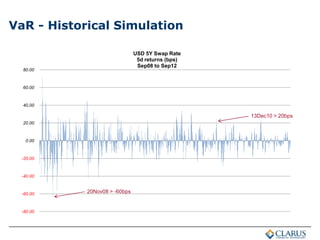
 It relies on choosing
 A historical period, e.g. 4 Years
 A holding period e.g. 5 days
 Generating daily holding period returns in this period
 Calculating the P&L impact on a portfolio by applying
these returns to today
 Ordering the P&L outcomes by decreasing loss
 Interpolating for a chosen confidence level e.g. 99%
VaR - Historical Simulation
-80.00
-60.00
-40.00
-20.00
0.00
20.00
40.00
60.00
80.00
USD 5Y Swap Rate
5d returns (bps)
Sep08 to Sep12
20Nov08 > -60bps
13Dec10 > 20bps
VaR - Historical Simulation
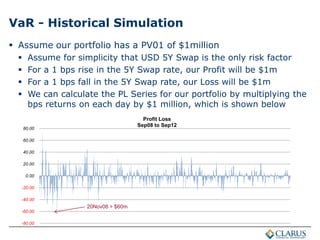
 Assume our portfolio has a PV01 of $1million
 Assume for simplicity that USD 5Y Swap is the only risk factor
 For a 1 bps rise in the 5Y Swap rate, our Profit will be $1m
 For a 1 bps fall in the 5Y Swap rate, our Loss will be $1m
 We can calculate the PL Series for our portfolio by multiplying the
bps returns on each day by $1 million, which is shown below
-80.00
-60.00
-40.00
-20.00
0.00
20.00
40.00
60.00
80.00
Profit Loss
Sep08 to Sep12
20Nov08 > $60m
VaR - Historical Simulation
 This PL Series
 Has a PL value for each business day from 5 Sep 08 to 4 Sep 12
 A total count of 1043 values
 Each corresponds to a specific scenario date, starting on 5 Sep 08
 The first element represents the PL outcome of applying the 5-day
return shift between 1 Sep 08 and 5 Sep 08 to todays market data
and todays portfolio
 We call this the PL vector of the portfolio
 The first few elements of which are shown below
-26.51
-5.97
-12.75
-6.47
-3.29
-15.83
-14.76
-37.08
-9.98
-16.55
22.76
71.55
09/05/2008
09/08/2008
09/09/2008
09/10/2008
09/11/2008
09/12/2008
09/15/2008
09/16/2008
09/17/2008
09/18/2008
09/19/2008
09/22/2008
For these dates
VaR - Historical Simulation
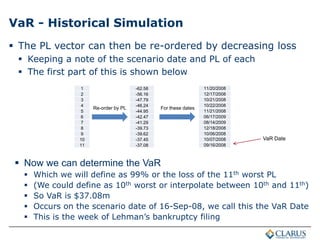
 The PL vector can then be re-ordered by decreasing loss
 Keeping a note of the scenario date and PL of each
 The first part of this is shown below
1
2
3
4
5
6
7
8
9
10
11
11/20/2008
12/17/2008
10/21/2008
10/22/2008
11/21/2008
06/17/2009
08/14/2009
12/18/2008
10/06/2008
10/07/2008
09/16/2008
-62.58
-56.16
-47.79
-46.24
-44.95
-42.47
-41.29
-39.73
-39.62
-37.45
-37.08
For these datesRe-order by PL
 Now we can determine the VaR
 Which we will define as 99% or the loss of the 11th worst PL
 (We could define as 10th worst or interpolate between 10th and 11th)
 So VaR is $37.08m
 Occurs on the scenario date of 16-Sep-08, we call this the VaR Date
 This is the week of Lehman’s bankruptcy filing
VaR Date
VaR - Historical Simulation
0
50
100
150
200
250
-70 -65 -60 -55 -50 -45 -40 -35 -30 -25 -20 -15 -10 -5 0 5 10 15 20 25 30 35 40 45 50 55 60 65 70 75 80
Frequency
5d PLs
Sep08 to Sep12
Mean -1.21
Standard Deviation 13.03
Kurtosis 2.63
Skewness 0.17
Range 134.13
Minimum -62.58
Maximum 71.55
VaR 99% -37.08
Count 1043
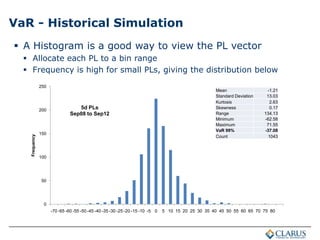
 A Histogram is a good way to view the PL vector
 Allocate each PL to a bin range
 Frequency is high for small PLs, giving the distribution below
VaR - Historical Simulation
 Zooming in to the largest losses
Mean -1.21
Standard Deviation 13.03
Kurtosis 2.63
Skewness 0.17
Range 134.13
Minimum -62.58
Maximum 71.55
VaR 99% -37.08
Count 1043
11th largest loss
Largest loss
Expected Shortfall
Changes since the Financial Crises of 2008
 Basell Capital Accord, introduced Stressed VaR
 So Trading Book Capital is the higher of Firm’s Multiplier *
VaR or Multiplier * Stressed VaR
 Where Stressed VaR covers a period of Market Stress
 The Financial Crises of 2008 qualifies as a period of stress
for most major markets
 Wider use of Tail measures
 Expected Shortfall (ES) or Worst Case Loss (WCL)
 Renewed focus that Stress testing must be performed and
the definition and results of these discussed within the firm
and with regulators
 Hence US & European Regulatory Stress Tests
Strengths and Weaknesses
 Strengths
 Reduces risk to a single $ amount
 Mark to market based measure (not original notional)
 Compare risk of different asset class portfolios
 Aggregate risk across portfolios
 Widely used since 1994
 Weaknesses
 Reduces risk to a single $ amount
 Assumptions may be complex
 Depends on market prices being observable and similar
behaviour to that observed in the past
 Long-tailed properties of financial markets
 Portfolio diversification is not there in a Crisis
 So correlation goes to 1
Summary
 It is crucial to understand any assumptions
 For VaR, these are
 Method e.g. Historical Simulation
 Confidence level e.g. 99.7%
 Holding Period e.g. 5 days
 Historical Period Used e.g. 5 Years
 And not use just a single VaR measure
 Or indeed discard VaR (and replace with what?)
 So, in addition to VaR
 Use Tail Measures e.g. ES or WCL
 Stress Tests – Historical and Hypothetical
 Independent price verification
 Gross measures
Contact Details
Our LinkedIn Page: Clarus Financial Technology
Our Website: www.clarusft.com
My contact details: amir@clarusft.com

Value at Risk

  • 1.
    Value at Risk June7, 2013 Amir Khwaja www.clarusft.com
  • 2.
    Agenda  The Needfor VaR  Definition of VaR  Uses of VaR  VaR Methods  VaR - Historical Simulation  Changes since the Financial Crises of 2008  Strengths and Weakness  Summary
  • 3.
    The Need forVaR  Different Asset Classes use their own measures  Fixed Income – Duration  Interest Rates – DV01  FX – Currency position  Commodity – Number of contracts  Equities – Number of shares  Using these to compare risk in these portfolios is like comparing apples and oranges  An investor or owner needs a simple measure that can be used in a consistent way to compare risk between these portfolios  And with the ability to aggregate risk appropriately  Value at Risk is that risk measure
  • 4.
    Definition of VaR How much could we lose over a specified holding period with a defined probability  So if a portfolio has a VaR of $20 million  We need to know the confidence level used to calculate  We need to know the holding period (time horizon)  Say confidence level is 99% and holding period is 5 days  This then means “We would expect to lose $20 million or more over a 5 day period, in 1 out of 100 business days”  Note it does not tell us whether on that 1 day we could lose $21 million or $200 million!  So if we are relying only on VaR for the answer to that then we are going to be in trouble  For that we need Tail Measures or Stress Testing
  • 5.
    Uses of VaR Made public by JP Morgan in 1994 with RiskMetrics  Widely adopted in the industry very quickly after that  Particularly for Derivatives where measures such as gross notional or position in contracts units, are not that insightful  Basel II Capital Accord for Market Risk – 1995  Internal Model Capital is VaR times a multiplier set for each bank by its regulator as between 3 & 4  Banks report VaR in Annual Financial Statements – 1997  Internal 1d VaR and Regulatory 10d VaR  Clearing Houses for Initial Margin – 1999 (LCH SwapClear)  Margin from defaulting member used to cover the market risk loss for the period it takes to close-out the portfolio
  • 6.
    VaR Methods  Threemain methods  Parametric (aka Variance-Covariance or Delta-Gamma)  Historical Simulation  Monte-Carlo Simulation  Different assumptions, calculation steps, compute efficiency but similar numbers for standard portfolios  The most common is Historical Simulation  As easiest to understand  Simple assumptions on distributions of returns  So if for our $20 million VaR portfolio, we also said that we had used 5 Years of history as well as 99% and 5d  We would say that “given how the market has performed in the past 5 years” our VaR estimate is $20 million
  • 7.
    VaR - HistoricalSimulation  It relies on choosing  A historical period, e.g. 4 Years  A holding period e.g. 5 days  Generating daily holding period returns in this period  Calculating the P&L impact on a portfolio by applying these returns to today  Ordering the P&L outcomes by decreasing loss  Interpolating for a chosen confidence level e.g. 99%
  • 8.
    VaR - HistoricalSimulation -80.00 -60.00 -40.00 -20.00 0.00 20.00 40.00 60.00 80.00 USD 5Y Swap Rate 5d returns (bps) Sep08 to Sep12 20Nov08 > -60bps 13Dec10 > 20bps
  • 9.
    VaR - HistoricalSimulation  Assume our portfolio has a PV01 of $1million  Assume for simplicity that USD 5Y Swap is the only risk factor  For a 1 bps rise in the 5Y Swap rate, our Profit will be $1m  For a 1 bps fall in the 5Y Swap rate, our Loss will be $1m  We can calculate the PL Series for our portfolio by multiplying the bps returns on each day by $1 million, which is shown below -80.00 -60.00 -40.00 -20.00 0.00 20.00 40.00 60.00 80.00 Profit Loss Sep08 to Sep12 20Nov08 > $60m
  • 10.
    VaR - HistoricalSimulation  This PL Series  Has a PL value for each business day from 5 Sep 08 to 4 Sep 12  A total count of 1043 values  Each corresponds to a specific scenario date, starting on 5 Sep 08  The first element represents the PL outcome of applying the 5-day return shift between 1 Sep 08 and 5 Sep 08 to todays market data and todays portfolio  We call this the PL vector of the portfolio  The first few elements of which are shown below -26.51 -5.97 -12.75 -6.47 -3.29 -15.83 -14.76 -37.08 -9.98 -16.55 22.76 71.55 09/05/2008 09/08/2008 09/09/2008 09/10/2008 09/11/2008 09/12/2008 09/15/2008 09/16/2008 09/17/2008 09/18/2008 09/19/2008 09/22/2008 For these dates
  • 11.
    VaR - HistoricalSimulation  The PL vector can then be re-ordered by decreasing loss  Keeping a note of the scenario date and PL of each  The first part of this is shown below 1 2 3 4 5 6 7 8 9 10 11 11/20/2008 12/17/2008 10/21/2008 10/22/2008 11/21/2008 06/17/2009 08/14/2009 12/18/2008 10/06/2008 10/07/2008 09/16/2008 -62.58 -56.16 -47.79 -46.24 -44.95 -42.47 -41.29 -39.73 -39.62 -37.45 -37.08 For these datesRe-order by PL  Now we can determine the VaR  Which we will define as 99% or the loss of the 11th worst PL  (We could define as 10th worst or interpolate between 10th and 11th)  So VaR is $37.08m  Occurs on the scenario date of 16-Sep-08, we call this the VaR Date  This is the week of Lehman’s bankruptcy filing VaR Date
  • 12.
    VaR - HistoricalSimulation 0 50 100 150 200 250 -70 -65 -60 -55 -50 -45 -40 -35 -30 -25 -20 -15 -10 -5 0 5 10 15 20 25 30 35 40 45 50 55 60 65 70 75 80 Frequency 5d PLs Sep08 to Sep12 Mean -1.21 Standard Deviation 13.03 Kurtosis 2.63 Skewness 0.17 Range 134.13 Minimum -62.58 Maximum 71.55 VaR 99% -37.08 Count 1043  A Histogram is a good way to view the PL vector  Allocate each PL to a bin range  Frequency is high for small PLs, giving the distribution below
  • 13.
    VaR - HistoricalSimulation  Zooming in to the largest losses Mean -1.21 Standard Deviation 13.03 Kurtosis 2.63 Skewness 0.17 Range 134.13 Minimum -62.58 Maximum 71.55 VaR 99% -37.08 Count 1043 11th largest loss Largest loss Expected Shortfall
  • 14.
    Changes since theFinancial Crises of 2008  Basell Capital Accord, introduced Stressed VaR  So Trading Book Capital is the higher of Firm’s Multiplier * VaR or Multiplier * Stressed VaR  Where Stressed VaR covers a period of Market Stress  The Financial Crises of 2008 qualifies as a period of stress for most major markets  Wider use of Tail measures  Expected Shortfall (ES) or Worst Case Loss (WCL)  Renewed focus that Stress testing must be performed and the definition and results of these discussed within the firm and with regulators  Hence US & European Regulatory Stress Tests
  • 15.
    Strengths and Weaknesses Strengths  Reduces risk to a single $ amount  Mark to market based measure (not original notional)  Compare risk of different asset class portfolios  Aggregate risk across portfolios  Widely used since 1994  Weaknesses  Reduces risk to a single $ amount  Assumptions may be complex  Depends on market prices being observable and similar behaviour to that observed in the past  Long-tailed properties of financial markets  Portfolio diversification is not there in a Crisis  So correlation goes to 1
  • 16.
    Summary  It iscrucial to understand any assumptions  For VaR, these are  Method e.g. Historical Simulation  Confidence level e.g. 99.7%  Holding Period e.g. 5 days  Historical Period Used e.g. 5 Years  And not use just a single VaR measure  Or indeed discard VaR (and replace with what?)  So, in addition to VaR  Use Tail Measures e.g. ES or WCL  Stress Tests – Historical and Hypothetical  Independent price verification  Gross measures
  • 17.
    Contact Details Our LinkedInPage: Clarus Financial Technology Our Website: www.clarusft.com My contact details: amir@clarusft.com