1
Issue: 3 In-house magazine of FCFP members January — February 2023
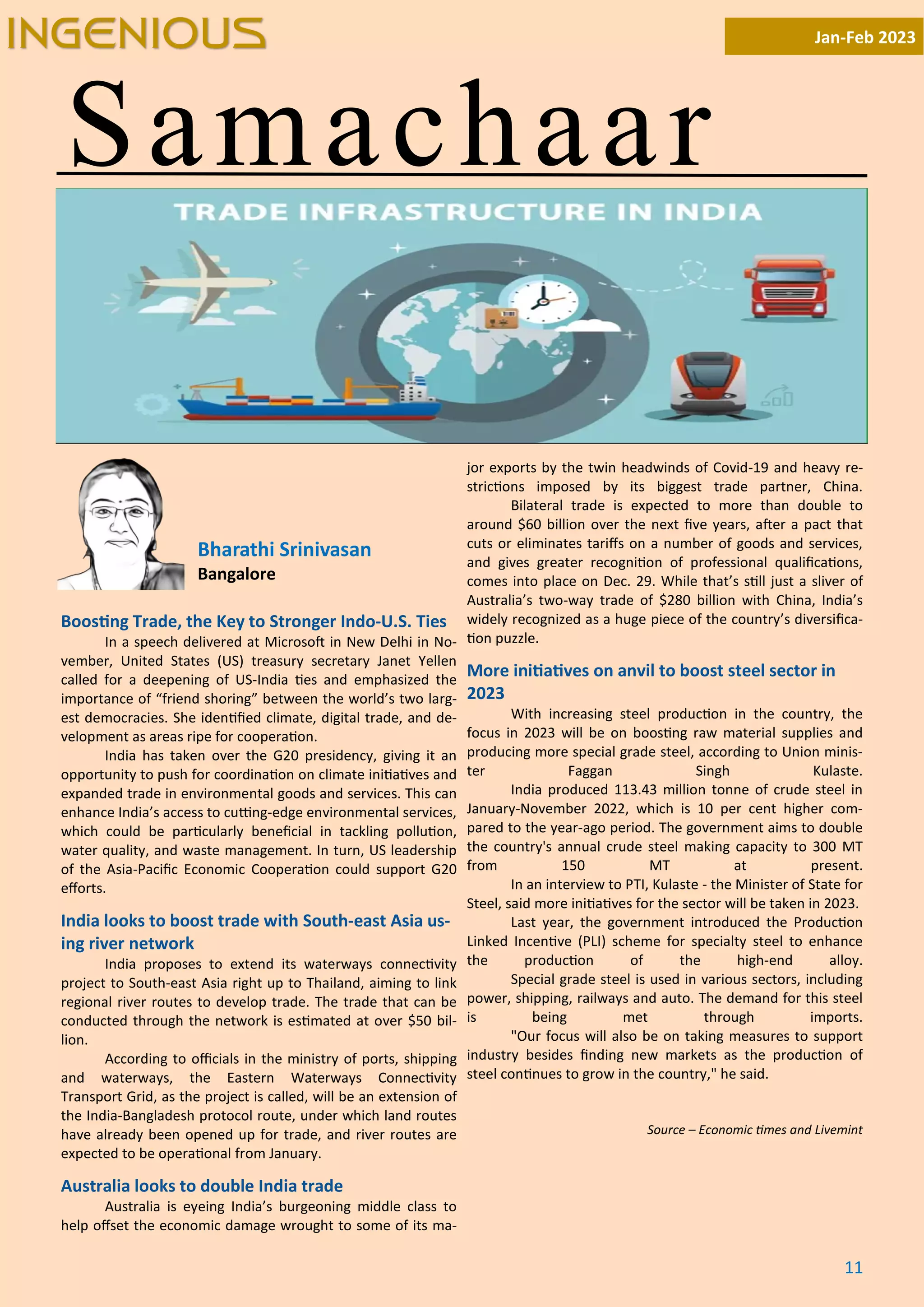
TRADE INFRA
IN
INDIA
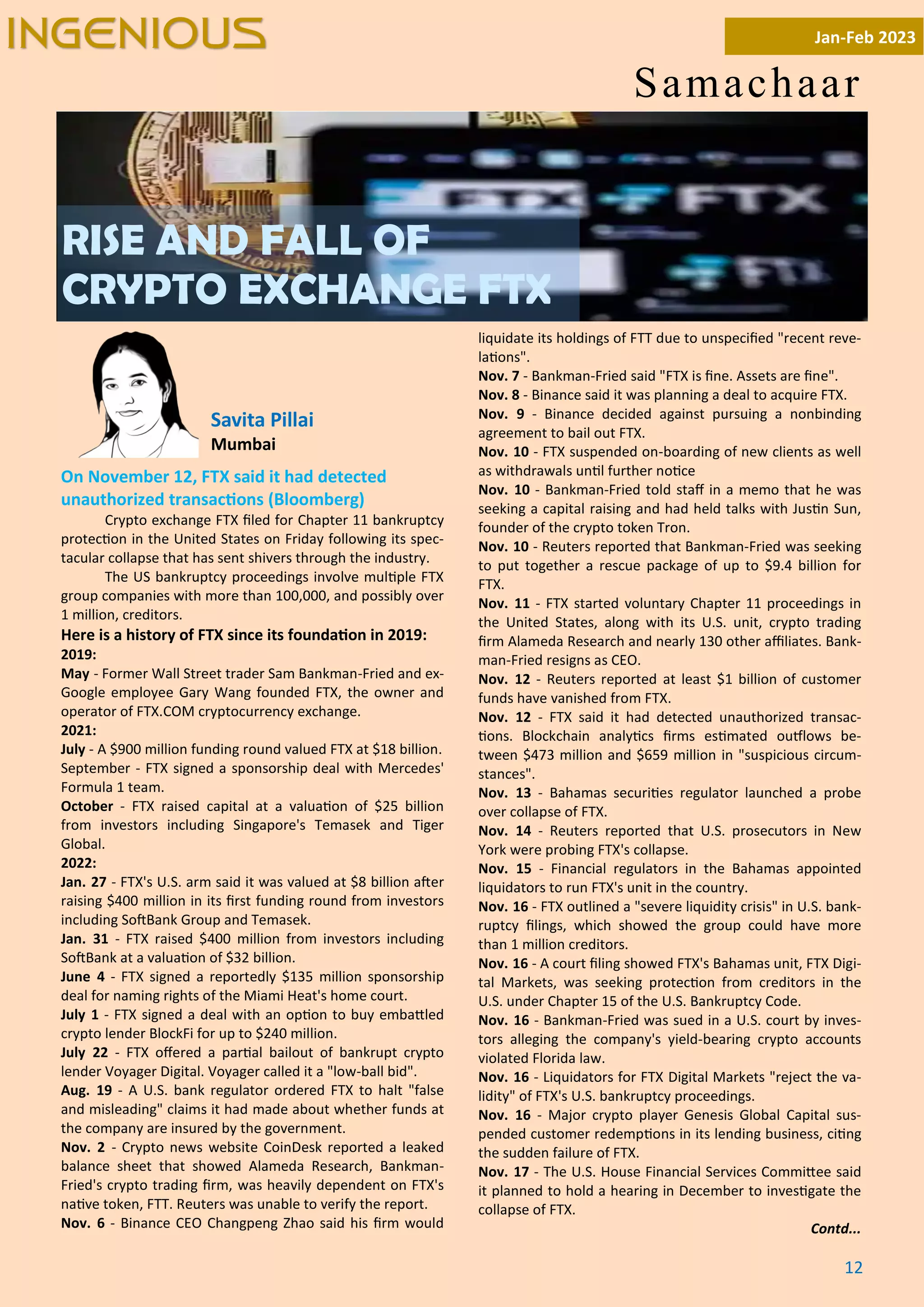
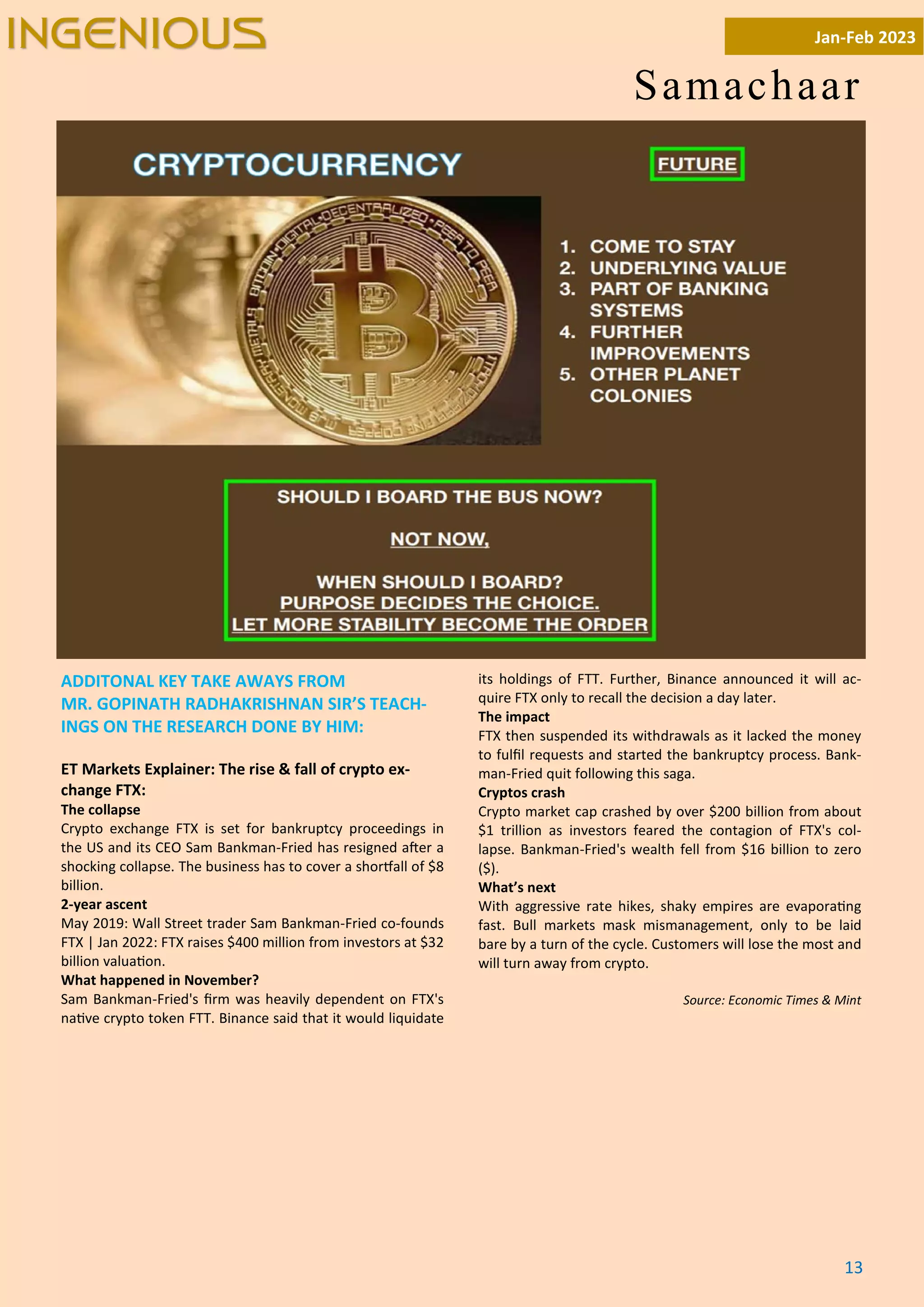
RISE & FALL
OF CRYPTO FTX
THE
PROGRESSION
2
Dear Readers,
HAPPY NEW YEAR 2023!
The past year 2022 has been one of the best as we had jointly initiated and launched our first bi-
monthly “Ingenious Magazine” on 15th
September 2022 and second issue was on 18th
November
2022; by the alumni of Foundation Course in Financial Planning (FCFP) 2022 1st
Batch from Gopast Centre for
Learning Pvt. Ltd., under the able guidance of our Guru Shri Gopinath Radhakrishnan Sir. It comprises of write
ups on financial products and latest news articles related to economy, finance and insurance industry based on
our research. This is our 3rd
bi-monthly magazine for January & February 2023.
Here are the links for our previous magazines:
https://www.slideshare.net/AnkurShah26/ingenious-sept-2022pdf
https://www.slideshare.net/AnkurShah26/ingenious-nov-dec-2022pdf
We just want to say how thankful we are for your support for the last year; and we are wishing you all the best
as we have already entered a grand new year 2023 and wish the same support from you all ahead too.
Wish you all a happy reading!
Thanking you & Regards,
Savita Pillai
Secretary
On behalf of the Organizing Committee
Alumni FCFP
Magazine designed and compiled by:
BINDRA Inderpal Singh
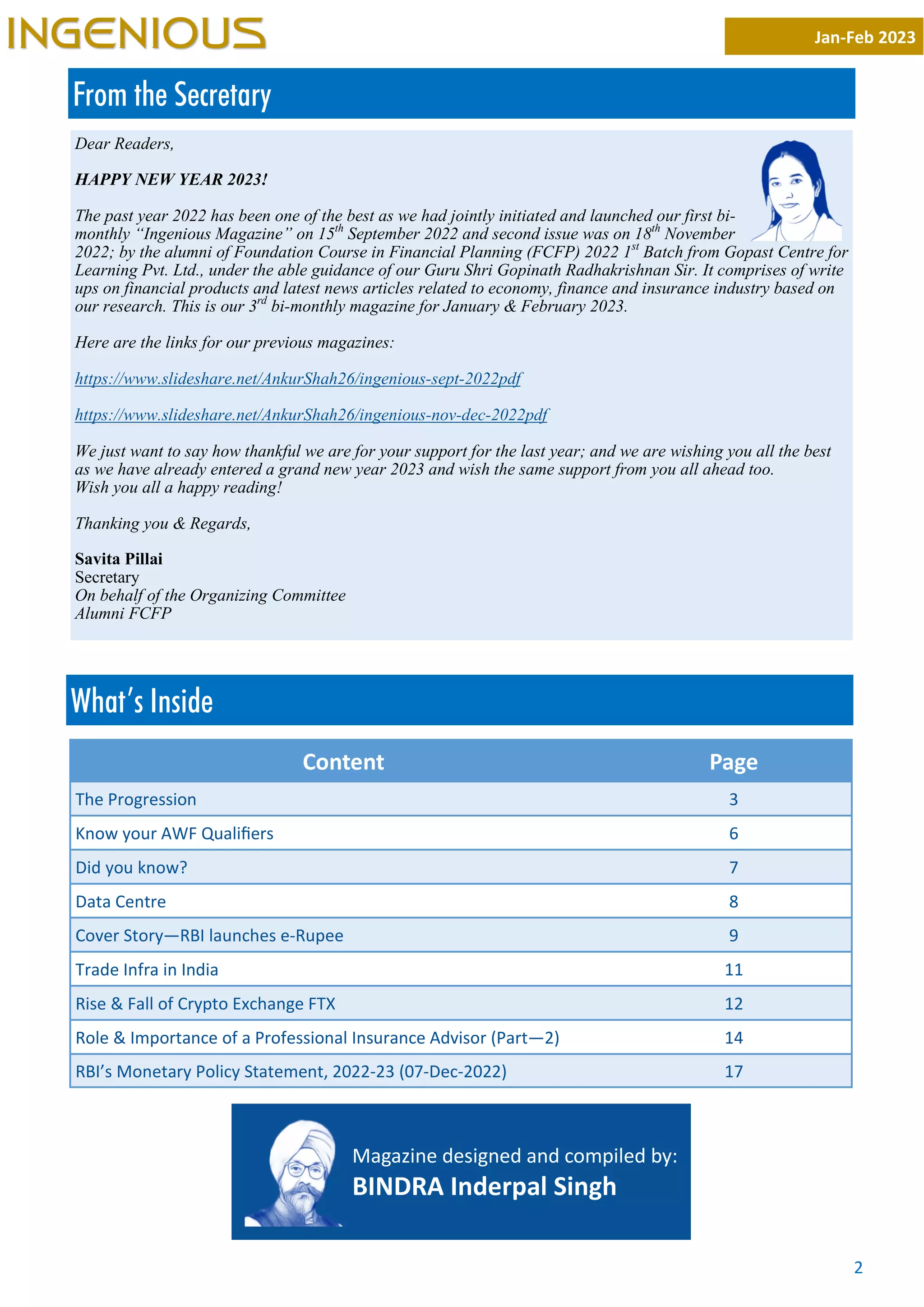
Content Page
The Progression 3
Know your AWF Qualifiers 6
Did you know? 7
Data Centre 8
Cover Story—RBI launches e-Rupee 9
Trade Infra in India 11
Rise & Fall of Crypto Exchange FTX 12
Role & Importance of a Professional Insurance Advisor (Part—2) 14
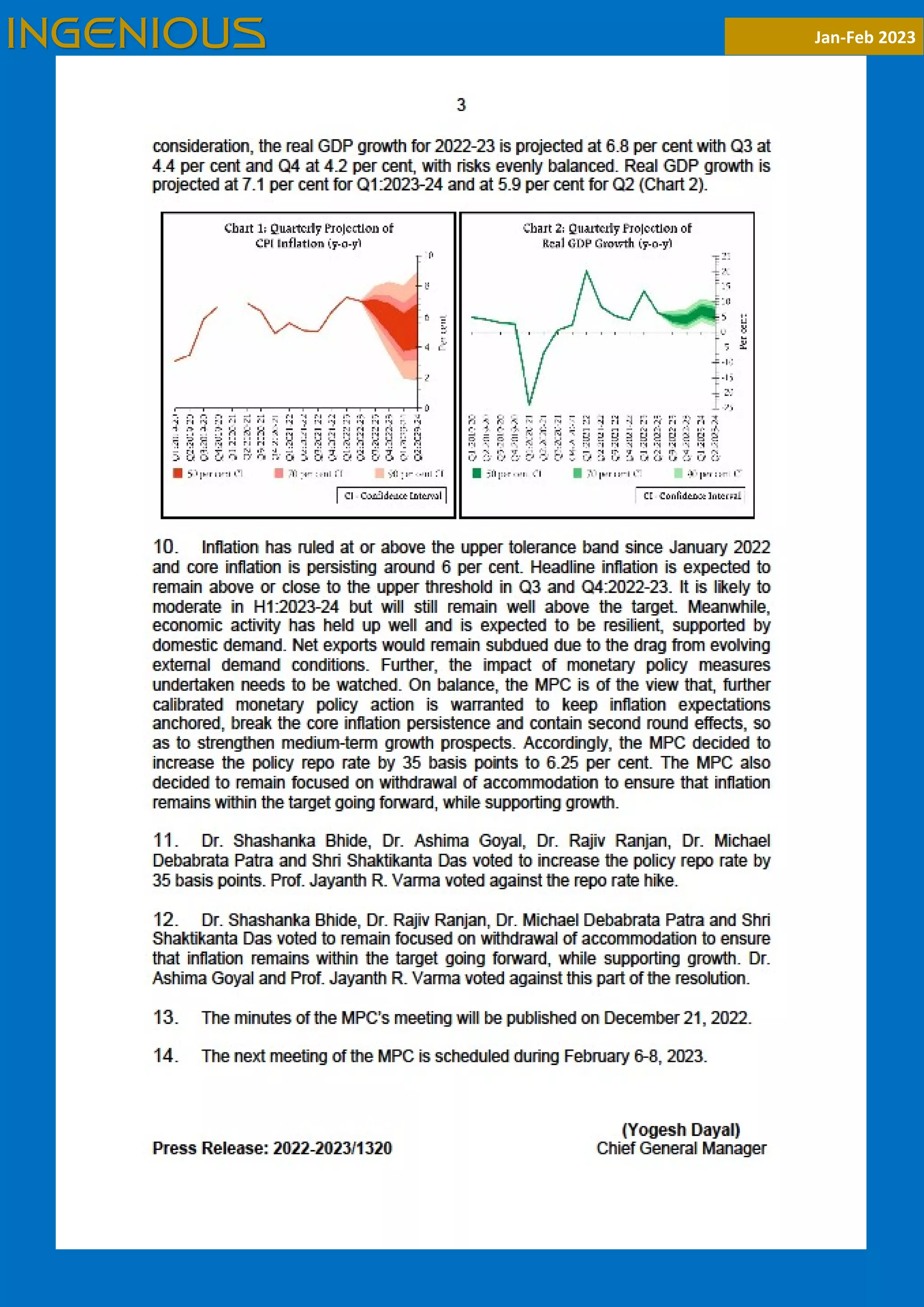
RBI’s Monetary Policy Statement, 2022-23 (07-Dec-2022) 17
Jan-Feb 2023
INGENIOUS
3
SOLVENCY:
The value of the assets of an enterprise, righ ully, should be
more than the value of its liabili es. Such enterprises are said
to be solvent. They will be able to meet their liabili es with
their assets.
For eg: Value of Assets: 100 Crores Value of liabili es : 95 Crores.
This enterprise is solvent.
SOLVENCY MARGIN:
This is to the extent the value of the assets are in excess of the
value of the liabili es. From the above example 5 crores is the
solvency margin.
Especially for life insurance companies this solvency margin
requirements ma er a lot. Therefore it is mandatory that the
value of the assets should exceed the value of liabili es by a
specified margin. This is required because of the nature of the
life insurance business. It is different from the nature of other
concerns in manufacturing or service sectors.
The liability under a life insurance policy in simple terms is
explained through this equa on:
Liability = (Value of Contractual Benefits payable under the
policy + Value of the Discre onary Benefits likely to be paid +
Value of the likely expenses in respect of that policy) - (Value
of the premiums receivable in future).
Every new business introduced in the life insurance company
will add to the liability of the company, and the prospects of
the future premium receivable from that new business will
cons tute the asset part of the company.
The benefits payable under a tradi onal life insurance policy
can be classified as under:
1. Contractual benefits; and
2. Discre onary benefits
Let us say a policy provides as under:
Upon survival of the life assured upto the end of 20 years (on
the maturity date) the Sum assured 1,00,000 is payable along
with all vested bonuses.
Upon death of the life assured during the term (before the
end of 20 years) the Sum assured 1,00,000 along with the bo-
nuses vested ll then is payable.
Contractual benefit at the end of five years of this policy will
be: (If the company had declared bonuses @50 per thousand
Sum assured)
· 1,25,000 payable on survival of the life assured on ma-
turity (15 years from now)
· 1,25,000 payable in case of death of the life assured
before maturity (within 15 years from now)
The Discre onary Benefits as at the end of 5th year will be
· The value of the bonuses that may be declared will be
payable on survival of the life assured at the end of 15
years from now.
· The value of the bonuses that may be declared ll year
of death of the life assured if death happens within the
next 15 years.
Future bonuses depends upon the quantum of profits gener-
ated therefore they form a part of the discre onary benefits.
But bonuses already declared have vested in the policy ac-
count therefore are a part of the contractual benefits.
VALUATION:
Let us use our above calcula on to understand in simple
terms how the valua on of liabili es are done by an insurance
company.
Value of the Contractual Benefits
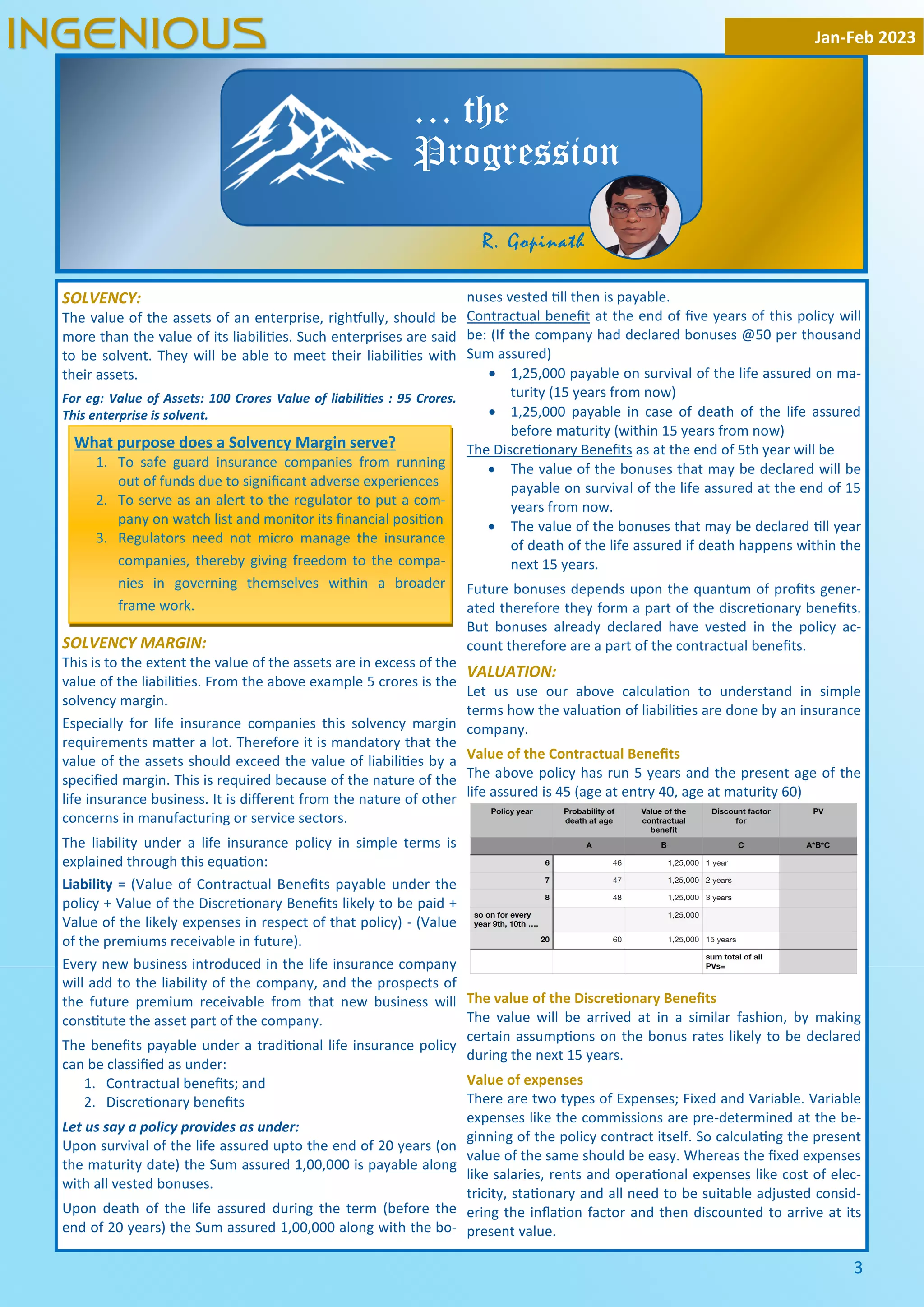
The above policy has run 5 years and the present age of the
life assured is 45 (age at entry 40, age at maturity 60)
The value of the Discre onary Benefits
The value will be arrived at in a similar fashion, by making
certain assump ons on the bonus rates likely to be declared
during the next 15 years.
Value of expenses
There are two types of Expenses; Fixed and Variable. Variable
expenses like the commissions are pre-determined at the be-
ginning of the policy contract itself. So calcula ng the present
value of the same should be easy. Whereas the fixed expenses
like salaries, rents and opera onal expenses like cost of elec-
tricity, sta onary and all need to be suitable adjusted consid-
ering the infla on factor and then discounted to arrive at its
present value.
Jan-Feb 2023
INGENIOUS
… the
Progression
What purpose does a Solvency Margin serve?
1. To safe guard insurance companies from running
out of funds due to significant adverse experiences
2. To serve as an alert to the regulator to put a com-
pany on watch list and monitor its financial posi on
3. Regulators need not micro manage the insurance
companies, thereby giving freedom to the compa-
nies in governing themselves within a broader
frame work.
R. Gopinath
4
Value of the premiums receivable
Policy year Probability of death at age Value of the contractual
benefit Discount factor for PV A B C A*B*C 6 46 1,25,000 1
year 7 47 1,25,000 2 years 8 48 1,25,000 3 years so on for eve-
ry year 9th, 10th …. 1,25,000 20 60 1,25,000 15 years sum
total of all PVs= The amount of premium receivable each year
for the next 15 years is mostly a constant figure. But we must
consider the probability of the life assured surviving for the
next 15 years, on a year by year basis.
The liability under this policy at the end of 5 years will be:
(PV of Benefits + PV of Expenses) - (PV of the Premiums).
The total assets of the company is then no onally distributed
among all policies in a manner that the value of the assets
allocate to each policy will be equal to the liability under that
policy. This value is technically called as the Asset Share of the
policy.
A er no onally alloca ng the assets to the policies, if further
value of assets remain, it is called as the Surplus.
You will observe from the above valua on process that many
factors involved in this exercise are based on some assump-
ons made. Generally the actuaries take a very conserva ve
approach in making these assump ons. For example slightly
higher rates of mortality, infla on and lower rates for interest
and yields. This to provide a margin as a buffer to meet any
adverse experiences. This margin is known as Margin for Ad-
verse Devia on (MAD). But this margin alone may not be suffi-
cient to take care of significant devia ons. Therefore in prac-
ce the Surplus generated as men oned in the previous para-
graph is not fully distributed, but a small por on of it is trans-
ferred to a special reserve account and this is known as
“Solvency Reserve”. This is also known as Solvency Margin
Reserve.
Available Solvency Margin:
· The Shareholder’s Capital and the Free reserves in
Shareholders’ fund.
· Any reserve held for solvency margin either in Share-
holder’s fund or in Policyholders’ fund.
When solvency reserve is held in the policyholders’ fund, it
gets invested as per the guidelines of investment of policy-
holders’ fund.
Normally such reserves in the Policyholders’ fund are main-
tained as implicit reserve, whereas the reserves held in Share-
holders fund mostly are explicit reserve and is created out of
the shareholders share of surplus.
Required Solvency Margin:
This is the minimum reserve that the regulator expects a com-
pany to maintain. It is prescribed as a formula:
RSM = (4% of Liability) + (0.3% of Sum at Risk)
Solvency ra o is the ra o of the Available Solvency Margin
and the Required Solvency Margin.
As per the present norms prescribed by IRDA under the insur-
ance act this ra o should be a minimum of 1.5
Jan-Feb 2023
INGENIOUS
… the
Progression
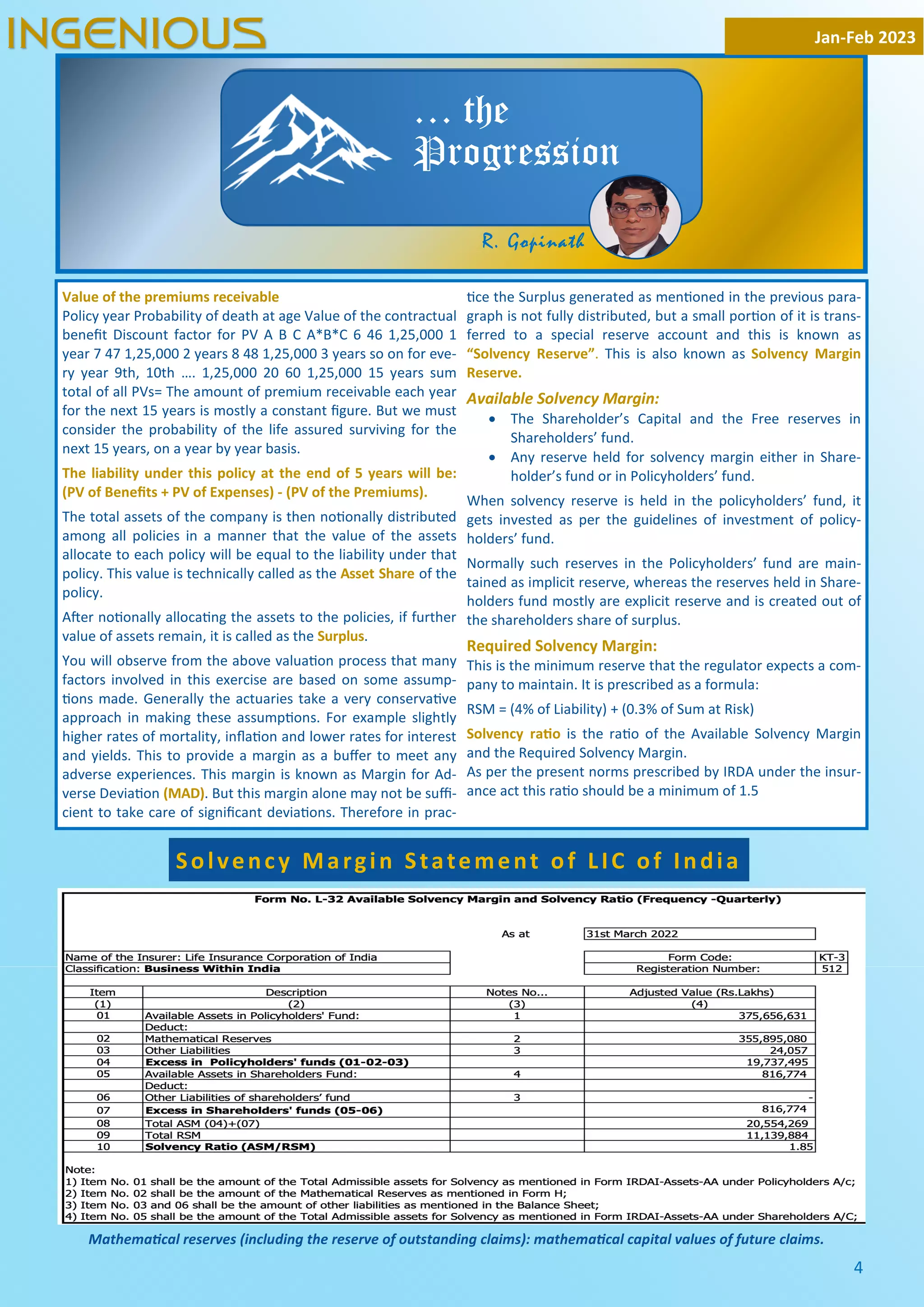
Solvency Margin Statement of LIC of India
Mathema cal reserves (including the reserve of outstanding claims): mathema cal capital values of future claims.
R. Gopinath
5
This statement obviously indicates the financial strength of
this company. This also shows the prudent approach this com-
pany has been taking in last so many decades in declaring ap-
propriate levels of bonuses and providing proper reserves to
meet the fluctua ons in the interest rates, infla onary trends
and changes in the yield on funds due to changing economic
condi ons globally and na onally. You will observe from the
above statement that even without the considera on of the
Shareholders’ fund, the Available reserve in the policyholders
fund itself is sufficient to demonstrate the solvency margin
requirements. This data substan ates the wisdom of the com-
pany in providing implicit reserves for years before the regula-
tor (IRDA) started prescribing Solvency Margin Rules for the
insurance companies in India. In fact given the Sovereign
Guarantee provision to the policies of LIC, the Company could
have afforded to be less prudent. But it has not done so, and
has followed the accoun ng and the actuarial principles pru-
dently. This helped the company to con nuously declare sur-
pluses year a er year withstanding the changes in the poli cal
scenario in the country, the economic swings country had
faced and the mortality experiences during epidemics and
calami es.
Jan-Feb 2023
INGENIOUS
… the
Progression
Solvency ra o does show the capacity of the
company in mee ng its obliga ons towards its
Policy holders.
But this alone is not a sufficient data for the intermediar-
ies to decide on selec ng a suitable company to place
their business with.
One must watch for the signals like:
· Making big promises to beat the compe on
· Price war strategies
· Not providing adequate reserves hoping that the
MAD factored alone will be sufficient to deal with
adverse situa ons
· Over dependence on the Shareholder’s capital with
less dependence of Policyholders’ fund to demon-
strate Solvency margins.
Historically such companies have got into trouble. So we
must make a comprehensive study of the company in eve-
ry aspect before we recommend it to our customers.
“
Opportunities search for people who
are well prepared to welcome it and
reach them. For others it may reach
only by it's own mistake which gets a
name "LUCK".
- rg
R. Gopinath
6
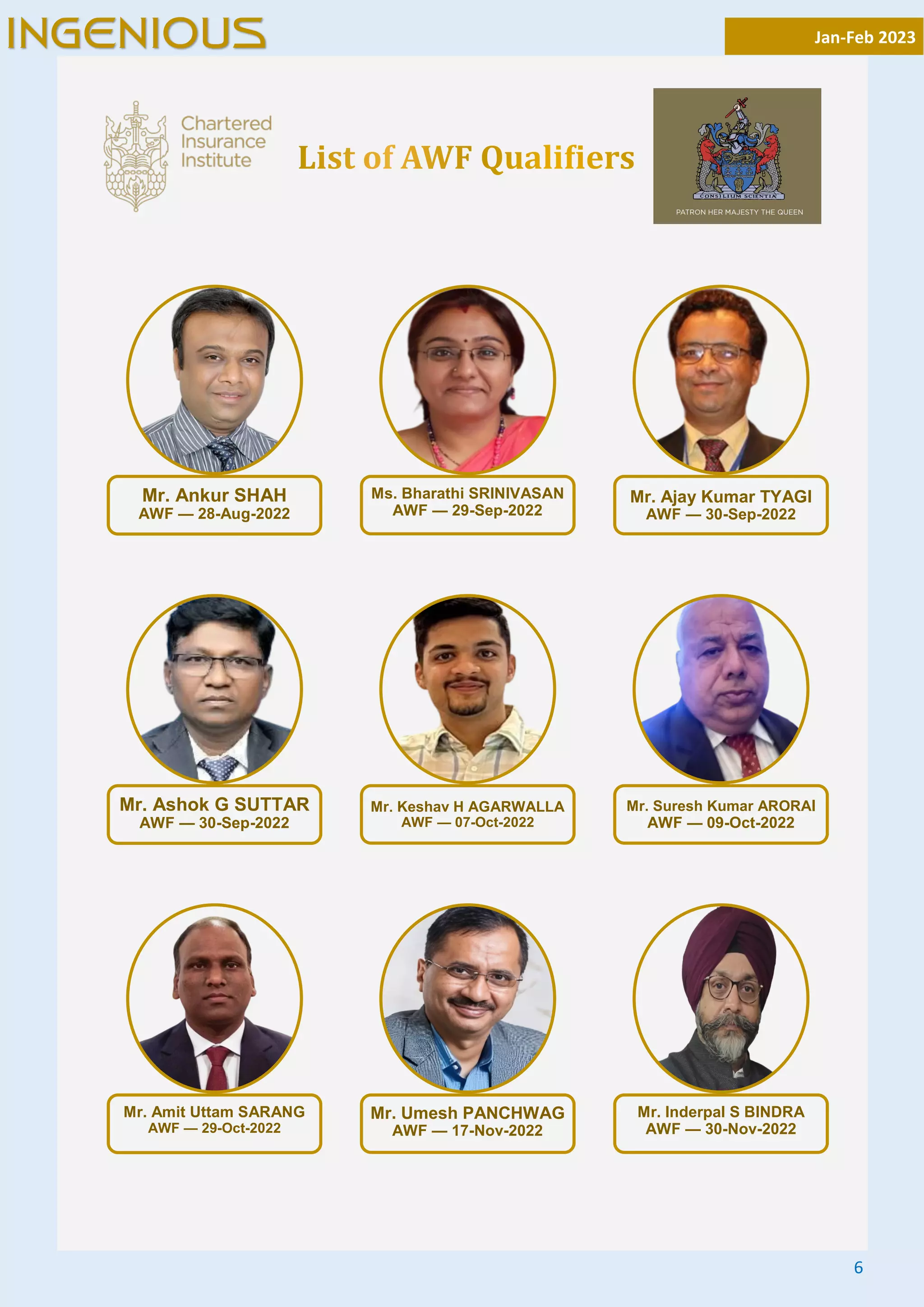
Mr. Ankur SHAH
AWF — 28-Aug-2022
Ms. Bharathi SRINIVASAN
AWF — 29-Sep-2022
Mr. Ajay Kumar TYAGI
AWF — 30-Sep-2022
Mr. Ashok G SUTTAR
AWF — 30-Sep-2022
Mr. Keshav H AGARWALLA
AWF — 07-Oct-2022
Mr. Suresh Kumar ARORAI
AWF — 09-Oct-2022
Mr. Amit Uttam SARANG
AWF — 29-Oct-2022
Mr. Umesh PANCHWAG
AWF — 17-Nov-2022
Mr. Inderpal S BINDRA
AWF — 30-Nov-2022
Jan-Feb 2023
INGENIOUS
7
Jan-Feb 2023
INGENIOUS
Inderpal Singh Bindra
We need to resist all that stops us from
realising our dreams. In that resistance
we pay the price for that prize.
-rg
In accordance with LIC’s circular dt. 24-Jan-2020; the suicide clause
(covered after 1 year) is applicable on all the plans introduced on or after 01-Jan-
2014 from the date of risk and also from the date of revival.
This indicates that whenever the premium is paid after the days of grace,
the policy is treated as revived and the waiting period for the suicide clause
comes into consideration (even during claim concession period).
Hence; in the future we need to ensure that all premiums should be paid be-
fore the end of grace period; to ensure 100% coverage of policy features for the
benefit of loved ones (family members) of every precious life insured.
8
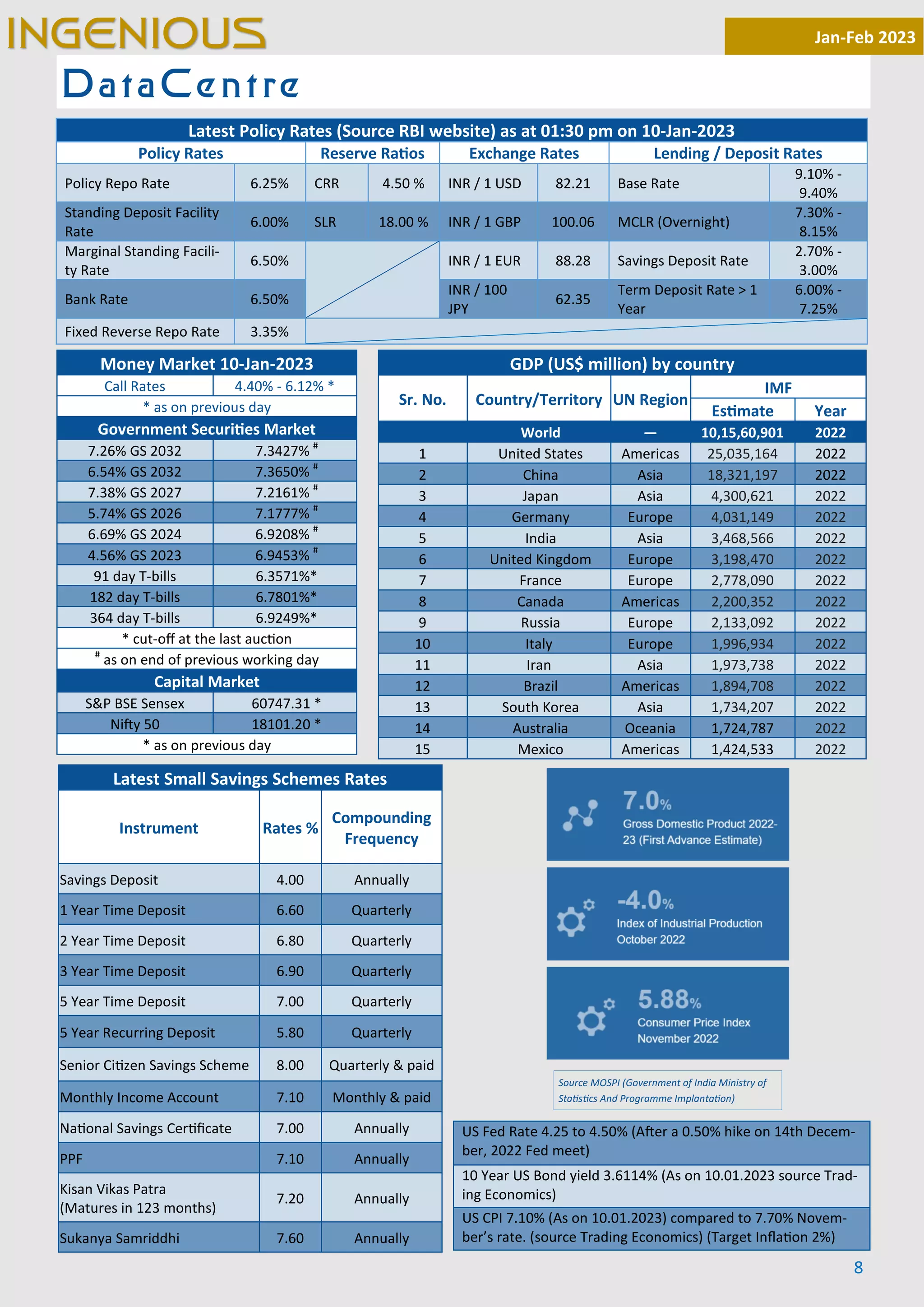
DataCentre
Money Market 10-Jan-2023
Call Rates 4.40% - 6.12% *
* as on previous day
Government Securi es Market
7.26% GS 2032 7.3427% #
6.54% GS 2032 7.3650% #
7.38% GS 2027 7.2161% #
5.74% GS 2026 7.1777% #
6.69% GS 2024 6.9208% #
4.56% GS 2023 6.9453% #
91 day T-bills 6.3571%*
182 day T-bills 6.7801%*
364 day T-bills 6.9249%*
* cut-off at the last auc on
#
as on end of previous working day
Capital Market
S&P BSE Sensex 60747.31 *
Ni y 50 18101.20 *
* as on previous day
GDP (US$ million) by country
Sr. No. Country/Territory UN Region
IMF
Es mate Year
World — 10,15,60,901 2022
1 United States Americas 25,035,164 2022
2 China Asia 18,321,197 2022
3 Japan Asia 4,300,621 2022
4 Germany Europe 4,031,149 2022
5 India Asia 3,468,566 2022
6 United Kingdom Europe 3,198,470 2022
7 France Europe 2,778,090 2022
8 Canada Americas 2,200,352 2022
9 Russia Europe 2,133,092 2022
10 Italy Europe 1,996,934 2022
11 Iran Asia 1,973,738 2022
12 Brazil Americas 1,894,708 2022
13 South Korea Asia 1,734,207 2022
14 Australia Oceania 1,724,787 2022
15 Mexico Americas 1,424,533 2022
Jan-Feb 2023
INGENIOUS
Latest Policy Rates (Source RBI website) as at 01:30 pm on 10-Jan-2023
Policy Rates Reserve Ra os Exchange Rates Lending / Deposit Rates
Policy Repo Rate 6.25% CRR 4.50 % INR / 1 USD 82.21 Base Rate
9.10% -
9.40%
Standing Deposit Facility
Rate
6.00% SLR 18.00 % INR / 1 GBP 100.06 MCLR (Overnight)
7.30% -
8.15%
Marginal Standing Facili-
ty Rate
6.50% INR / 1 EUR 88.28 Savings Deposit Rate
2.70% -
3.00%
Bank Rate 6.50%
INR / 100
JPY
62.35
Term Deposit Rate > 1
Year
6.00% -
7.25%
Fixed Reverse Repo Rate 3.35%
Latest Small Savings Schemes Rates
Instrument Rates %
Compounding
Frequency
Savings Deposit 4.00 Annually
1 Year Time Deposit 6.60 Quarterly
2 Year Time Deposit 6.80 Quarterly
3 Year Time Deposit 6.90 Quarterly
5 Year Time Deposit 7.00 Quarterly
5 Year Recurring Deposit 5.80 Quarterly
Senior Ci zen Savings Scheme 8.00 Quarterly & paid
Monthly Income Account 7.10 Monthly & paid
Na onal Savings Cer ficate 7.00 Annually
PPF 7.10 Annually
Kisan Vikas Patra
(Matures in 123 months)
7.20 Annually
Sukanya Samriddhi 7.60 Annually
Source MOSPI (Government of India Ministry of
Sta s cs And Programme Implanta on)
US Fed Rate 4.25 to 4.50% (A er a 0.50% hike on 14th Decem-
ber, 2022 Fed meet)
10 Year US Bond yield 3.6114% (As on 10.01.2023 source Trad-
ing Economics)
US CPI 7.10% (As on 10.01.2023) compared to 7.70% Novem-
ber’s rate. (source Trading Economics) (Target Infla on 2%)
9
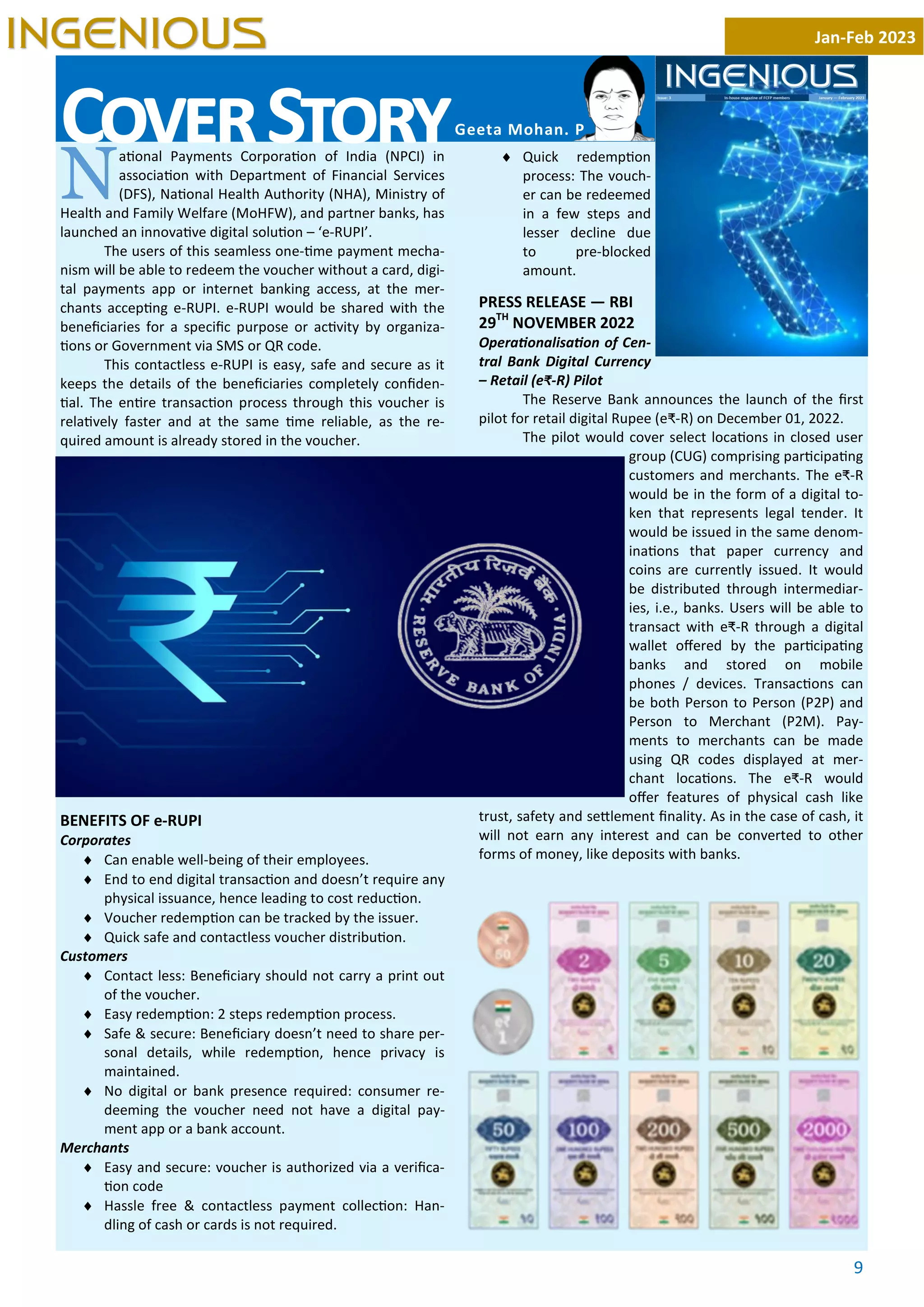
N
a onal Payments Corpora on of India (NPCI) in
associa on with Department of Financial Services
(DFS), Na onal Health Authority (NHA), Ministry of
Health and Family Welfare (MoHFW), and partner banks, has
launched an innova ve digital solu on – ‘e-RUPI’.
The users of this seamless one- me payment mecha-
nism will be able to redeem the voucher without a card, digi-
tal payments app or internet banking access, at the mer-
chants accep ng e-RUPI. e-RUPI would be shared with the
beneficiaries for a specific purpose or ac vity by organiza-
ons or Government via SMS or QR code.
This contactless e-RUPI is easy, safe and secure as it
keeps the details of the beneficiaries completely confiden-
al. The en re transac on process through this voucher is
rela vely faster and at the same me reliable, as the re-
quired amount is already stored in the voucher.
BENEFITS OF e-RUPI
Corporates
¨ Can enable well-being of their employees.
¨ End to end digital transac on and doesn’t require any
physical issuance, hence leading to cost reduc on.
¨ Voucher redemp on can be tracked by the issuer.
¨ Quick safe and contactless voucher distribu on.
Customers
¨ Contact less: Beneficiary should not carry a print out
of the voucher.
¨ Easy redemp on: 2 steps redemp on process.
¨ Safe & secure: Beneficiary doesn’t need to share per-
sonal details, while redemp on, hence privacy is
maintained.
¨ No digital or bank presence required: consumer re-
deeming the voucher need not have a digital pay-
ment app or a bank account.
Merchants
¨ Easy and secure: voucher is authorized via a verifica-
on code
¨ Hassle free & contactless payment collec on: Han-
dling of cash or cards is not required.
¨ Quick redemp on
process: The vouch-
er can be redeemed
in a few steps and
lesser decline due
to pre-blocked
amount.
PRESS RELEASE — RBI
29TH
NOVEMBER 2022
Opera onalisa on of Cen-
tral Bank Digital Currency
– Retail (e₹-R) Pilot
The Reserve Bank announces the launch of the first
pilot for retail digital Rupee (e₹-R) on December 01, 2022.
The pilot would cover select loca ons in closed user
group (CUG) comprising par cipa ng
customers and merchants. The e₹-R
would be in the form of a digital to-
ken that represents legal tender. It
would be issued in the same denom-
ina ons that paper currency and
coins are currently issued. It would
be distributed through intermediar-
ies, i.e., banks. Users will be able to
transact with e₹-R through a digital
wallet offered by the par cipa ng
banks and stored on mobile
phones / devices. Transac ons can
be both Person to Person (P2P) and
Person to Merchant (P2M). Pay-
ments to merchants can be made
using QR codes displayed at mer-
chant loca ons. The e₹-R would
offer features of physical cash like
trust, safety and se lement finality. As in the case of cash, it
will not earn any interest and can be converted to other
forms of money, like deposits with banks.
Jan-Feb 2023
INGENIOUS
C S Geeta Mohan. P
10
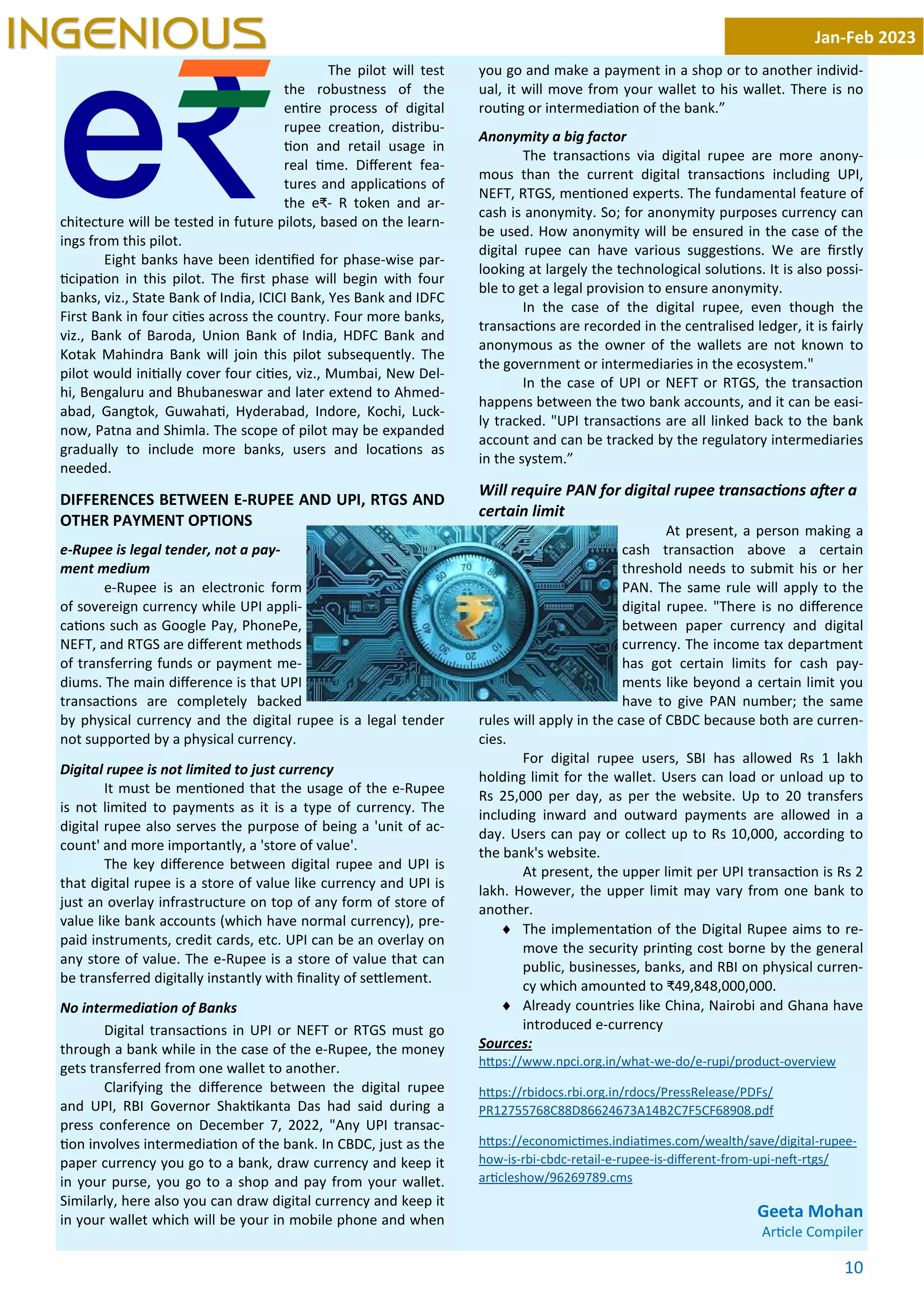
The pilot will test
the robustness of the
en re process of digital
rupee crea on, distribu-
on and retail usage in
real me. Different fea-
tures and applica ons of
the e₹- R token and ar-
chitecture will be tested in future pilots, based on the learn-
ings from this pilot.
Eight banks have been iden fied for phase-wise par-
cipa on in this pilot. The first phase will begin with four
banks, viz., State Bank of India, ICICI Bank, Yes Bank and IDFC
First Bank in four ci es across the country. Four more banks,
viz., Bank of Baroda, Union Bank of India, HDFC Bank and
Kotak Mahindra Bank will join this pilot subsequently. The
pilot would ini ally cover four ci es, viz., Mumbai, New Del-
hi, Bengaluru and Bhubaneswar and later extend to Ahmed-
abad, Gangtok, Guwaha , Hyderabad, Indore, Kochi, Luck-
now, Patna and Shimla. The scope of pilot may be expanded
gradually to include more banks, users and loca ons as
needed.
DIFFERENCES BETWEEN E-RUPEE AND UPI, RTGS AND
OTHER PAYMENT OPTIONS
e-Rupee is legal tender, not a pay-
ment medium
e-Rupee is an electronic form
of sovereign currency while UPI appli-
ca ons such as Google Pay, PhonePe,
NEFT, and RTGS are different methods
of transferring funds or payment me-
diums. The main difference is that UPI
transac ons are completely backed
by physical currency and the digital rupee is a legal tender
not supported by a physical currency.
Digital rupee is not limited to just currency
It must be men oned that the usage of the e-Rupee
is not limited to payments as it is a type of currency. The
digital rupee also serves the purpose of being a 'unit of ac-
count' and more importantly, a 'store of value'.
The key difference between digital rupee and UPI is
that digital rupee is a store of value like currency and UPI is
just an overlay infrastructure on top of any form of store of
value like bank accounts (which have normal currency), pre-
paid instruments, credit cards, etc. UPI can be an overlay on
any store of value. The e-Rupee is a store of value that can
be transferred digitally instantly with finality of se lement.
No intermediation of Banks
Digital transac ons in UPI or NEFT or RTGS must go
through a bank while in the case of the e-Rupee, the money
gets transferred from one wallet to another.
Clarifying the difference between the digital rupee
and UPI, RBI Governor Shak kanta Das had said during a
press conference on December 7, 2022, "Any UPI transac-
on involves intermedia on of the bank. In CBDC, just as the
paper currency you go to a bank, draw currency and keep it
in your purse, you go to a shop and pay from your wallet.
Similarly, here also you can draw digital currency and keep it
in your wallet which will be your in mobile phone and when
you go and make a payment in a shop or to another individ-
ual, it will move from your wallet to his wallet. There is no
rou ng or intermedia on of the bank.”
Anonymity a big factor
The transac ons via digital rupee are more anony-
mous than the current digital transac ons including UPI,
NEFT, RTGS, men oned experts. The fundamental feature of
cash is anonymity. So; for anonymity purposes currency can
be used. How anonymity will be ensured in the case of the
digital rupee can have various sugges ons. We are firstly
looking at largely the technological solu ons. It is also possi-
ble to get a legal provision to ensure anonymity.
In the case of the digital rupee, even though the
transac ons are recorded in the centralised ledger, it is fairly
anonymous as the owner of the wallets are not known to
the government or intermediaries in the ecosystem."
In the case of UPI or NEFT or RTGS, the transac on
happens between the two bank accounts, and it can be easi-
ly tracked. "UPI transac ons are all linked back to the bank
account and can be tracked by the regulatory intermediaries
in the system.”
Will require PAN for digital rupee transac ons a er a
certain limit
At present, a person making a
cash transac on above a certain
threshold needs to submit his or her
PAN. The same rule will apply to the
digital rupee. "There is no difference
between paper currency and digital
currency. The income tax department
has got certain limits for cash pay-
ments like beyond a certain limit you
have to give PAN number; the same
rules will apply in the case of CBDC because both are curren-
cies.
For digital rupee users, SBI has allowed Rs 1 lakh
holding limit for the wallet. Users can load or unload up to
Rs 25,000 per day, as per the website. Up to 20 transfers
including inward and outward payments are allowed in a
day. Users can pay or collect up to Rs 10,000, according to
the bank's website.
At present, the upper limit per UPI transac on is Rs 2
lakh. However, the upper limit may vary from one bank to
another.
¨ The implementa on of the Digital Rupee aims to re-
move the security prin ng cost borne by the general
public, businesses, banks, and RBI on physical curren-
cy which amounted to ₹49,848,000,000.
¨ Already countries like China, Nairobi and Ghana have
introduced e-currency
Sources:
h ps://www.npci.org.in/what-we-do/e-rupi/product-overview
h ps://rbidocs.rbi.org.in/rdocs/PressRelease/PDFs/
PR12755768C88D86624673A14B2C7F5CF68908.pdf
h ps://economic mes.india mes.com/wealth/save/digital-rupee-
how-is-rbi-cbdc-retail-e-rupee-is-different-from-upi-ne -rtgs/
ar cleshow/96269789.cms
Geeta Mohan
Ar cle Compiler
Jan-Feb 2023
INGENIOUS
11
Samachaar
Jan-Feb 2023
INGENIOUS
Boos ng Trade, the Key to Stronger Indo-U.S. Ties
In a speech delivered at Microso in New Delhi in No-
vember, United States (US) treasury secretary Janet Yellen
called for a deepening of US-India es and emphasized the
importance of “friend shoring” between the world’s two larg-
est democracies. She iden fied climate, digital trade, and de-
velopment as areas ripe for coopera on.
India has taken over the G20 presidency, giving it an
opportunity to push for coordina on on climate ini a ves and
expanded trade in environmental goods and services. This can
enhance India’s access to cu ng-edge environmental services,
which could be par cularly beneficial in tackling pollu on,
water quality, and waste management. In turn, US leadership
of the Asia-Pacific Economic Coopera on could support G20
efforts.
India looks to boost trade with South-east Asia us-
ing river network
India proposes to extend its waterways connec vity
project to South-east Asia right up to Thailand, aiming to link
regional river routes to develop trade. The trade that can be
conducted through the network is es mated at over $50 bil-
lion.
According to officials in the ministry of ports, shipping
and waterways, the Eastern Waterways Connec vity
Transport Grid, as the project is called, will be an extension of
the India-Bangladesh protocol route, under which land routes
have already been opened up for trade, and river routes are
expected to be opera onal from January.
Australia looks to double India trade
Australia is eyeing India’s burgeoning middle class to
help offset the economic damage wrought to some of its ma-
jor exports by the twin headwinds of Covid-19 and heavy re-
stric ons imposed by its biggest trade partner, China.
Bilateral trade is expected to more than double to
around $60 billion over the next five years, a er a pact that
cuts or eliminates tariffs on a number of goods and services,
and gives greater recogni on of professional qualifica ons,
comes into place on Dec. 29. While that’s s ll just a sliver of
Australia’s two-way trade of $280 billion with China, India’s
widely recognized as a huge piece of the country’s diversifica-
on puzzle.
More ini a ves on anvil to boost steel sector in
2023
With increasing steel produc on in the country, the
focus in 2023 will be on boos ng raw material supplies and
producing more special grade steel, according to Union minis-
ter Faggan Singh Kulaste.
India produced 113.43 million tonne of crude steel in
January-November 2022, which is 10 per cent higher com-
pared to the year-ago period. The government aims to double
the country's annual crude steel making capacity to 300 MT
from 150 MT at present.
In an interview to PTI, Kulaste - the Minister of State for
Steel, said more ini a ves for the sector will be taken in 2023.
Last year, the government introduced the Produc on
Linked Incen ve (PLI) scheme for specialty steel to enhance
the produc on of the high-end alloy.
Special grade steel is used in various sectors, including
power, shipping, railways and auto. The demand for this steel
is being met through imports.
"Our focus will also be on taking measures to support
industry besides finding new markets as the produc on of
steel con nues to grow in the country," he said.
Source – Economic mes and Livemint
Bharathi Srinivasan
Bangalore
12
On November 12, FTX said it had detected
unauthorized transac ons (Bloomberg)
Crypto exchange FTX filed for Chapter 11 bankruptcy
protec on in the United States on Friday following its spec-
tacular collapse that has sent shivers through the industry.
The US bankruptcy proceedings involve mul ple FTX
group companies with more than 100,000, and possibly over
1 million, creditors.
Here is a history of FTX since its founda on in 2019:
2019:
May - Former Wall Street trader Sam Bankman-Fried and ex-
Google employee Gary Wang founded FTX, the owner and
operator of FTX.COM cryptocurrency exchange.
2021:
July - A $900 million funding round valued FTX at $18 billion.
September - FTX signed a sponsorship deal with Mercedes'
Formula 1 team.
October - FTX raised capital at a valua on of $25 billion
from investors including Singapore's Temasek and Tiger
Global.
2022:
Jan. 27 - FTX's U.S. arm said it was valued at $8 billion a er
raising $400 million in its first funding round from investors
including So Bank Group and Temasek.
Jan. 31 - FTX raised $400 million from investors including
So Bank at a valua on of $32 billion.
June 4 - FTX signed a reportedly $135 million sponsorship
deal for naming rights of the Miami Heat's home court.
July 1 - FTX signed a deal with an op on to buy emba led
crypto lender BlockFi for up to $240 million.
July 22 - FTX offered a par al bailout of bankrupt crypto
lender Voyager Digital. Voyager called it a "low-ball bid".
Aug. 19 - A U.S. bank regulator ordered FTX to halt "false
and misleading" claims it had made about whether funds at
the company are insured by the government.
Nov. 2 - Crypto news website CoinDesk reported a leaked
balance sheet that showed Alameda Research, Bankman-
Fried's crypto trading firm, was heavily dependent on FTX's
na ve token, FTT. Reuters was unable to verify the report.
Nov. 6 - Binance CEO Changpeng Zhao said his firm would
liquidate its holdings of FTT due to unspecified "recent reve-
la ons".
Nov. 7 - Bankman-Fried said "FTX is fine. Assets are fine".
Nov. 8 - Binance said it was planning a deal to acquire FTX.
Nov. 9 - Binance decided against pursuing a nonbinding
agreement to bail out FTX.
Nov. 10 - FTX suspended on-boarding of new clients as well
as withdrawals un l further no ce
Nov. 10 - Bankman-Fried told staff in a memo that he was
seeking a capital raising and had held talks with Jus n Sun,
founder of the crypto token Tron.
Nov. 10 - Reuters reported that Bankman-Fried was seeking
to put together a rescue package of up to $9.4 billion for
FTX.
Nov. 11 - FTX started voluntary Chapter 11 proceedings in
the United States, along with its U.S. unit, crypto trading
firm Alameda Research and nearly 130 other affiliates. Bank-
man-Fried resigns as CEO.
Nov. 12 - Reuters reported at least $1 billion of customer
funds have vanished from FTX.
Nov. 12 - FTX said it had detected unauthorized transac-
ons. Blockchain analy cs firms es mated ou lows be-
tween $473 million and $659 million in "suspicious circum-
stances".
Nov. 13 - Bahamas securi es regulator launched a probe
over collapse of FTX.
Nov. 14 - Reuters reported that U.S. prosecutors in New
York were probing FTX's collapse.
Nov. 15 - Financial regulators in the Bahamas appointed
liquidators to run FTX's unit in the country.
Nov. 16 - FTX outlined a "severe liquidity crisis" in U.S. bank-
ruptcy filings, which showed the group could have more
than 1 million creditors.
Nov. 16 - A court filing showed FTX's Bahamas unit, FTX Digi-
tal Markets, was seeking protec on from creditors in the
U.S. under Chapter 15 of the U.S. Bankruptcy Code.
Nov. 16 - Bankman-Fried was sued in a U.S. court by inves-
tors alleging the company's yield-bearing crypto accounts
violated Florida law.
Nov. 16 - Liquidators for FTX Digital Markets "reject the va-
lidity" of FTX's U.S. bankruptcy proceedings.
Nov. 16 - Major crypto player Genesis Global Capital sus-
pended customer redemp ons in its lending business, ci ng
the sudden failure of FTX.
Nov. 17 - The U.S. House Financial Services Commi ee said
it planned to hold a hearing in December to inves gate the
collapse of FTX.
Contd...
Samachaar
Jan-Feb 2023
INGENIOUS
RISE AND FALL OF
CRYPTO EXCHANGE FTX
Savita Pillai
Mumbai
13
ADDITONAL KEY TAKE AWAYS FROM
MR. GOPINATH RADHAKRISHNAN SIR’S TEACH-
INGS ON THE RESEARCH DONE BY HIM:
ET Markets Explainer: The rise & fall of crypto ex-
change FTX:
The collapse
Crypto exchange FTX is set for bankruptcy proceedings in
the US and its CEO Sam Bankman-Fried has resigned a er a
shocking collapse. The business has to cover a shor all of $8
billion.
2-year ascent
May 2019: Wall Street trader Sam Bankman-Fried co-founds
FTX | Jan 2022: FTX raises $400 million from investors at $32
billion valua on.
What happened in November?
Sam Bankman-Fried's firm was heavily dependent on FTX's
na ve crypto token FTT. Binance said that it would liquidate
its holdings of FTT. Further, Binance announced it will ac-
quire FTX only to recall the decision a day later.
The impact
FTX then suspended its withdrawals as it lacked the money
to fulfil requests and started the bankruptcy process. Bank-
man-Fried quit following this saga.
Cryptos crash
Crypto market cap crashed by over $200 billion from about
$1 trillion as investors feared the contagion of FTX's col-
lapse. Bankman-Fried's wealth fell from $16 billion to zero
($).
What’s next
With aggressive rate hikes, shaky empires are evapora ng
fast. Bull markets mask mismanagement, only to be laid
bare by a turn of the cycle. Customers will lose the most and
will turn away from crypto.
Source: Economic Times & Mint
Samachaar
Jan-Feb 2023
INGENIOUS
14
Life insurance is a very important contract. When
there is a sufficient cover provided for the family in
case of unfortunate death of a family member a life insur-
ance policy becomes a life saver for the remaining family
members for their remaining life me. When a sum of mon-
ey or series of income or combina on of both is received
from a properly & professionally guided insurance policy it
takes care of a family’s all the future working capital need &
once a while nonnego able major expenses plus debt if any.
Role & knowledge of a professional insurance advisor is not
only important in analyzing client needs and sugges ng a
proper insurance policy or a combina on of policies in a
complex world of life insurance products but also in filling up
the proposal form. The ques ons are so technical, they also
require a help of an experienced professional advisor. If the
answers of proposal form are not properly given it may re-
sult in rejec on of a death claim up on which your family’s
en re future depends.
I will explain the role & importance of a professional advisor
in 2 stages.
· Need analysis for the recommenda on of right prod-
uct and in a proper quan fied manner.
· Technical things involved in processing of insurance
proposal form
In part 1 we discussed need analysis for the recommenda-
on of right product and in a proper quan fied manner in
previous issue. Now let’s discuss further in this issue.
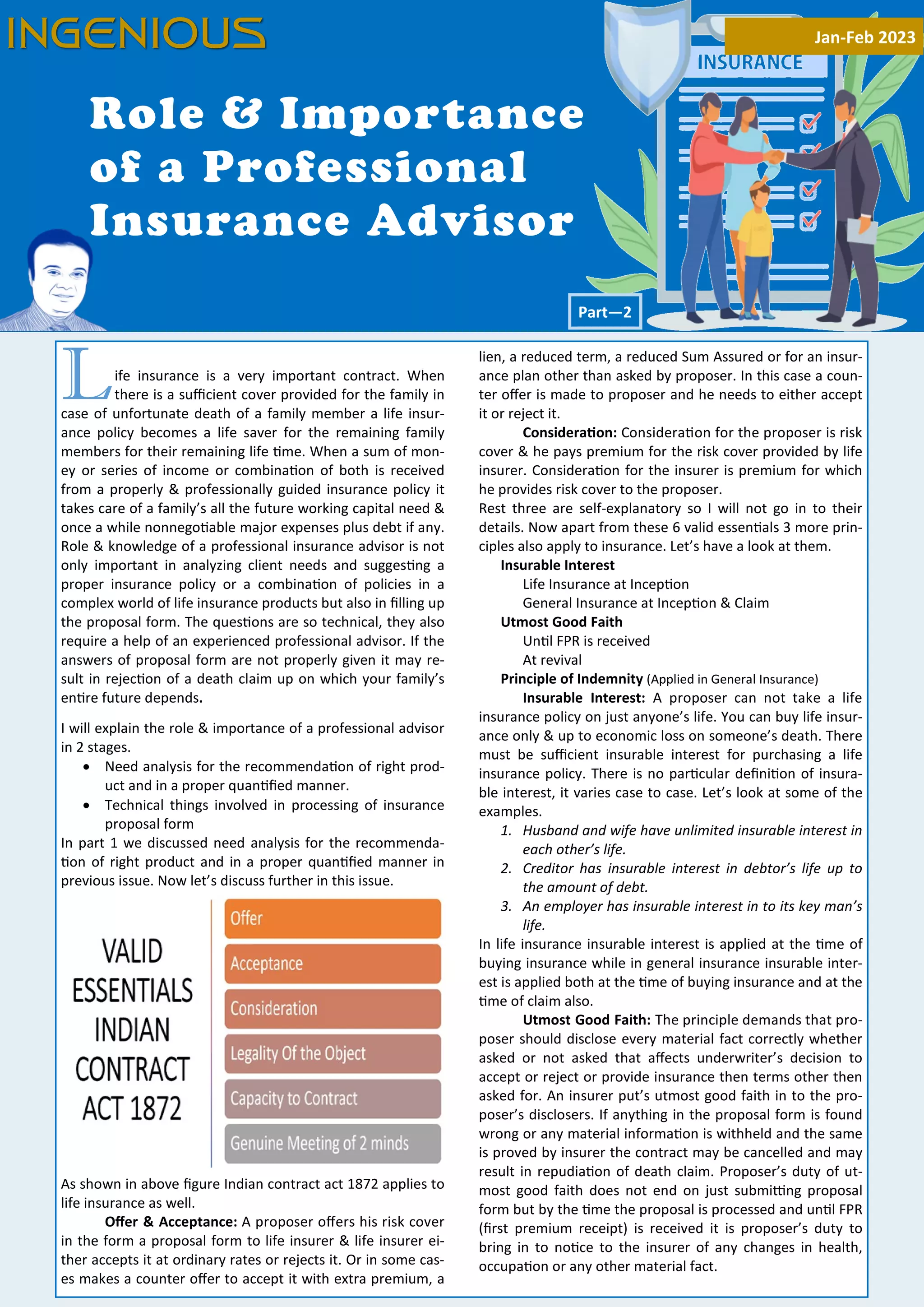
As shown in above figure Indian contract act 1872 applies to
life insurance as well.
Offer & Acceptance: A proposer offers his risk cover
in the form a proposal form to life insurer & life insurer ei-
ther accepts it at ordinary rates or rejects it. Or in some cas-
es makes a counter offer to accept it with extra premium, a
lien, a reduced term, a reduced Sum Assured or for an insur-
ance plan other than asked by proposer. In this case a coun-
ter offer is made to proposer and he needs to either accept
it or reject it.
Considera on: Considera on for the proposer is risk
cover & he pays premium for the risk cover provided by life
insurer. Considera on for the insurer is premium for which
he provides risk cover to the proposer.
Rest three are self-explanatory so I will not go in to their
details. Now apart from these 6 valid essen als 3 more prin-
ciples also apply to insurance. Let’s have a look at them.
Insurable Interest
Life Insurance at Incep on
General Insurance at Incep on & Claim
Utmost Good Faith
Un l FPR is received
At revival
Principle of Indemnity (Applied in General Insurance)
Insurable Interest: A proposer can not take a life
insurance policy on just anyone’s life. You can buy life insur-
ance only & up to economic loss on someone’s death. There
must be sufficient insurable interest for purchasing a life
insurance policy. There is no par cular defini on of insura-
ble interest, it varies case to case. Let’s look at some of the
examples.
1. Husband and wife have unlimited insurable interest in
each other’s life.
2. Creditor has insurable interest in debtor’s life up to
the amount of debt.
3. An employer has insurable interest in to its key man’s
life.
In life insurance insurable interest is applied at the me of
buying insurance while in general insurance insurable inter-
est is applied both at the me of buying insurance and at the
me of claim also.
Utmost Good Faith: The principle demands that pro-
poser should disclose every material fact correctly whether
asked or not asked that affects underwriter’s decision to
accept or reject or provide insurance then terms other then
asked for. An insurer put’s utmost good faith in to the pro-
poser’s disclosers. If anything in the proposal form is found
wrong or any material informa on is withheld and the same
is proved by insurer the contract may be cancelled and may
result in repudia on of death claim. Proposer’s duty of ut-
most good faith does not end on just submi ng proposal
form but by the me the proposal is processed and un l FPR
(first premium receipt) is received it is proposer’s duty to
bring in to no ce to the insurer of any changes in health,
occupa on or any other material fact.
Role & Importance
of a Professional
Insurance Advisor
Part—2
INGENIOUS Jan-Feb 2023
INGENIOUS
15
Once the FPR is issued there is no need to disclose any
changes that may happen a er it.
When a lapse policy is being revived it is as good as buying
new insurance and at the me of revival again proposer
need to follow principle of utmost good faith.
Principle of indemnity: The principle of indemnity
states that an insurance policy shall not provide compensa-
on to the policyholder that exceeds their economic loss.
This limits the benefit to an amount that is sufficient to re-
store the policyholder to the same financial state they were
in prior to the loss. In other words, the principle of indemni-
ty ensures that the insured gets made whole from their loss
but will not benefit, gain, or profit from an accident or claim.
Nor will you get less than what is necessary to restore you to
the same financial posi on. It is only applied to general in-
surance and not to the life insurance.
Preamble of a life insurance policy bond. Basically,
there are three parts in the preamble. Part 1 makes proposal
form basis and part of the contract. Part 2 provides opera-
ve clause. And part 3 is proviso (makes terms and condi-
ons printed on policy bond part of the contract).
Above is a typical sample of a preamble printed on a
stamp duty paid bond which makes proposal form basis and
part of the contract. Now you must have understood the
importance of role of a professional advisor in filling up the
proposal form.
Even the comple on of applica on forms, especially
those for insurance and pension products, calls for the advis-
er’s professional knowledge. For example:
· health ques ons may be difficult for the general pub-
lic to interpret;
· pension ques ons may require technical understand-
ing; and
· ques ons on occupa on and leisure ac vi es may
require supplementary informa on not indicated on
the ques onnaire.
There may be places on the applica on form where
untruthful answers appear to be more helpful to the success
of the client’s applica on than the truth. For example, the
client may not wish to disclose that they are overweight or
have an unhealthy lifestyle (e.g. a heavy smoker). Good
prac ce demands that the adviser insists on truthful an-
swers and points out the legal implica ons of misrepresen-
ta on and non-disclosure.
The adviser’s responsibility does not end when all the
applica ons are completed, signed and ready for submission
to product provider(s). Further tasks might include:
· explaining to the client the administra ve processes
the applica on will go through and the mescales
involved;
· telling the client about the documents they will re-
ceive and how to respond to them;
· preparing the client for the fact that medical reports
or examina ons may be required;
· arranging required medicals and seeing that the cli-
ent a ends; and
· ensuring that enquiries from product providers are
answered quickly and that all necessary ac ons are
taken to ensure that technical processing can be
completed efficiently.
By this me, you must have understood the role & im-
portance of a professional financial advisor. Now let’s look
at the dome of the data from IRDAI’s (Insurance Regulatory
and development authority) last annual report.
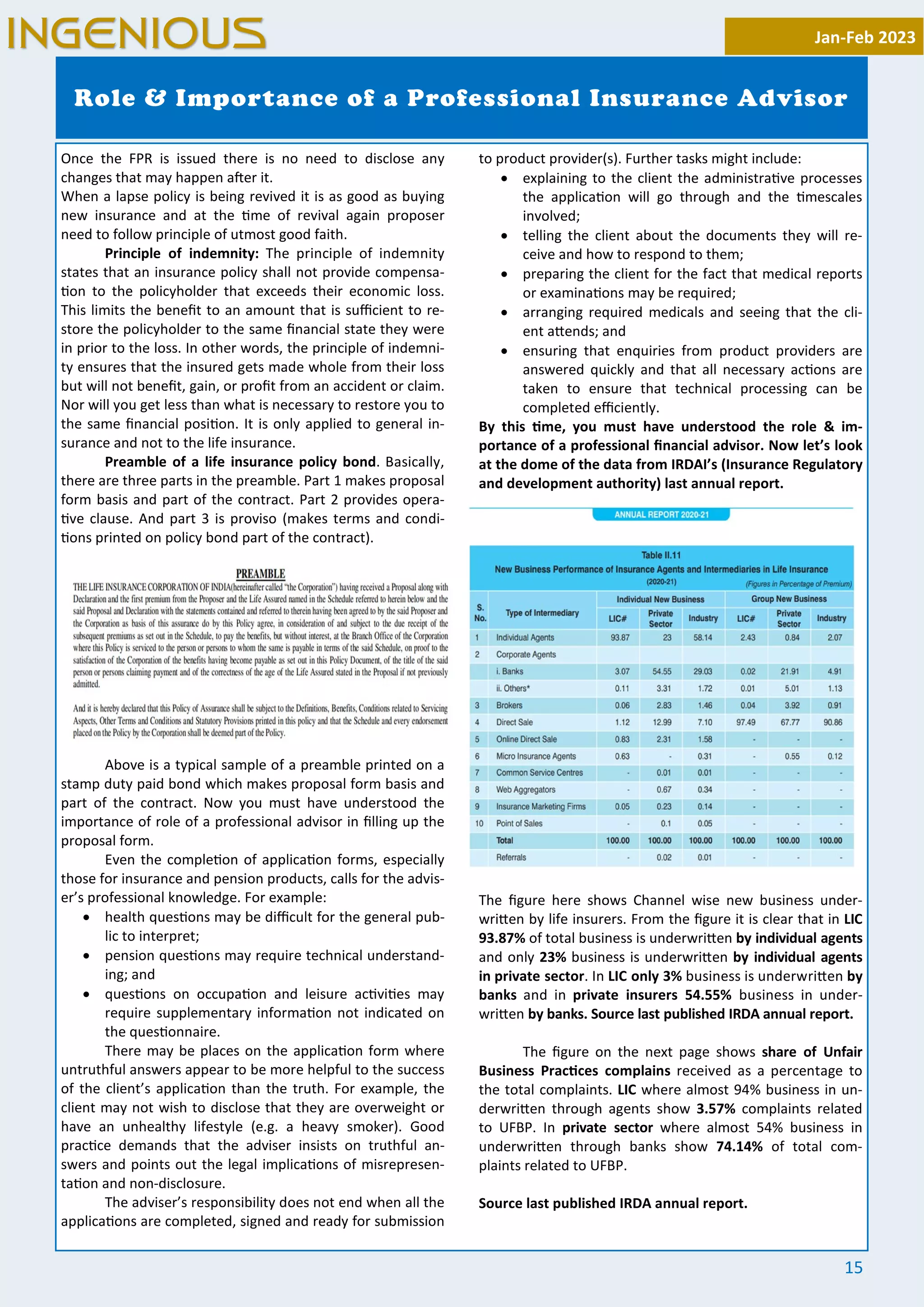
The figure here shows Channel wise new business under-
wri en by life insurers. From the figure it is clear that in LIC
93.87% of total business is underwri en by individual agents
and only 23% business is underwri en by individual agents
in private sector. In LIC only 3% business is underwri en by
banks and in private insurers 54.55% business in under-
wri en by banks. Source last published IRDA annual report.
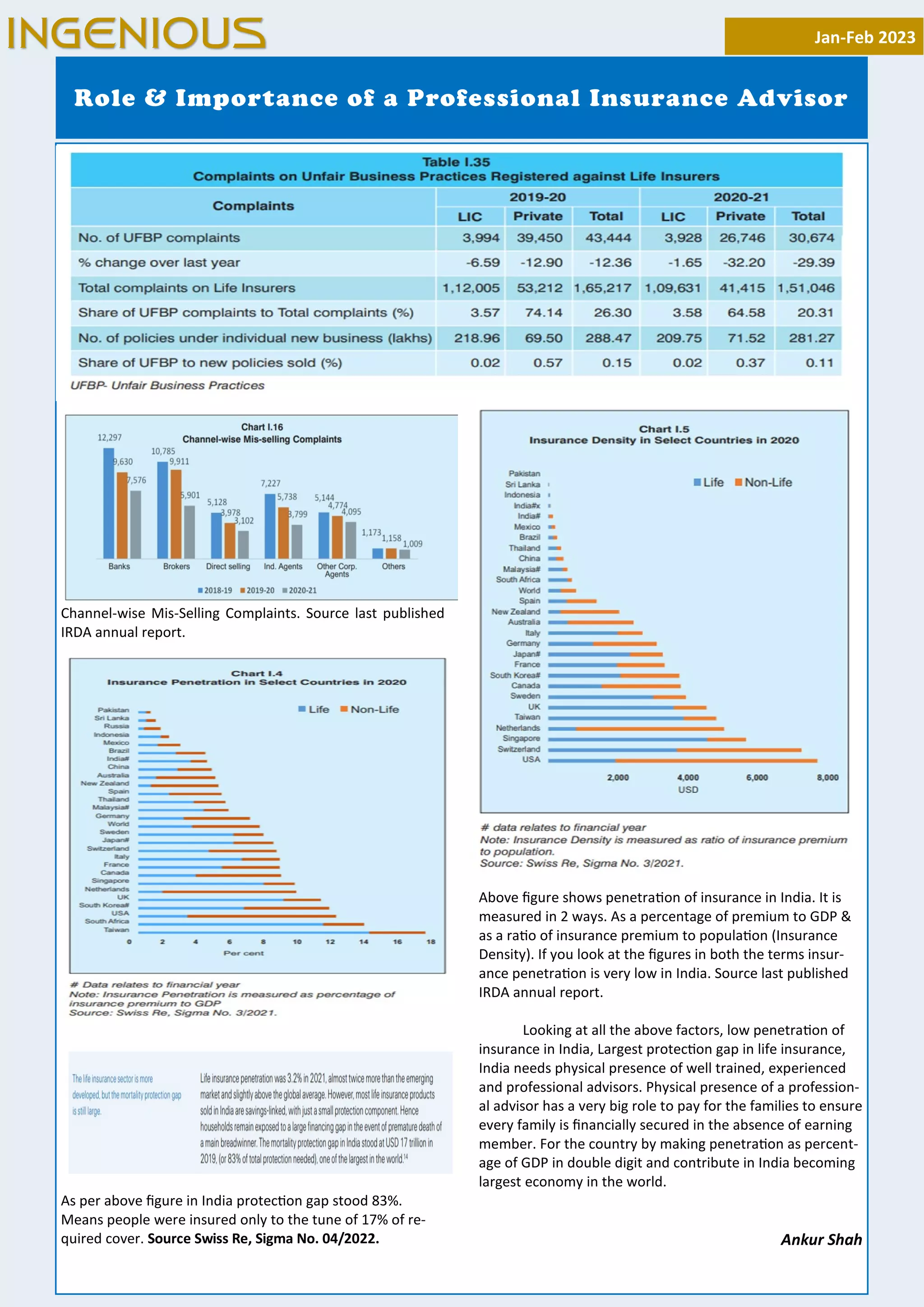
The figure on the next page shows share of Unfair
Business Prac ces complains received as a percentage to
the total complaints. LIC where almost 94% business in un-
derwri en through agents show 3.57% complaints related
to UFBP. In private sector where almost 54% business in
underwri en through banks show 74.14% of total com-
plaints related to UFBP.
Source last published IRDA annual report.
Role & Importance of a Professional Insurance Advisor
Jan-Feb 2023
INGENIOUS
16
Channel-wise Mis-Selling Complaints. Source last published
IRDA annual report.
As per above figure in India protec on gap stood 83%.
Means people were insured only to the tune of 17% of re-
quired cover. Source Swiss Re, Sigma No. 04/2022.
Above figure shows penetra on of insurance in India. It is
measured in 2 ways. As a percentage of premium to GDP &
as a ra o of insurance premium to popula on (Insurance
Density). If you look at the figures in both the terms insur-
ance penetra on is very low in India. Source last published
IRDA annual report.
Looking at all the above factors, low penetra on of
insurance in India, Largest protec on gap in life insurance,
India needs physical presence of well trained, experienced
and professional advisors. Physical presence of a profession-
al advisor has a very big role to pay for the families to ensure
every family is financially secured in the absence of earning
member. For the country by making penetra on as percent-
age of GDP in double digit and contribute in India becoming
largest economy in the world.
Ankur Shah
Role & Importance of a Professional Insurance Advisor
Jan-Feb 2023
INGENIOUS
17
Jan-Feb 2023
INGENIOUS
18
Jan-Feb 2023
INGENIOUS
19
Jan-Feb 2023
INGENIOUS
20
Disclaimer: This magazine is compiled by the Organising commi ee of the Alumni of the FCFP course of Gopast centre for learning Pvt Ltd., This is
meant for circula on amongst the associates of Gopast. This magazine is meant to be of academical value to them. The data and the sta s cs given in the
various ar cles are complied from public web-sites without infringing copyrights. The opinions expressed by the authors of the ar cles appearing here are
strictly their views, the publica on of it does not indicate that the publisher is suppor ng those views. It should be understood that such views expressed
and should not be considered as the official communica on of the ins tu ons these authors are working for or represen ng. Readers who would like to
repeat these contents either by copying from or by quo ng this magazine or using it to support their communica ons need to take specific permission
from the Organising commi ee which acts as the editorial board by mailing to gopinathr@go-past.com.
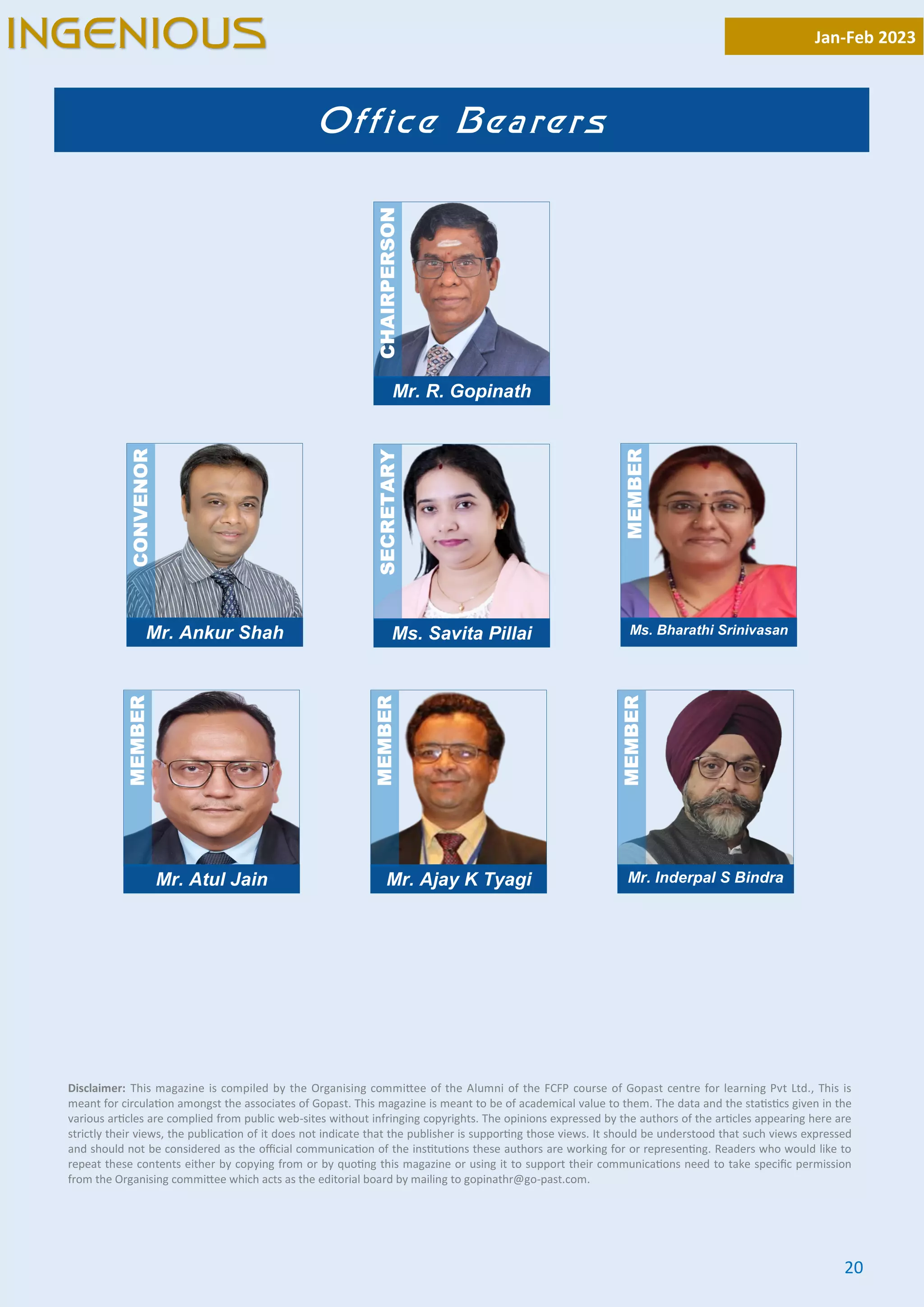
Mr. R. Gopinath
CHAIRPERSON
Office Bearers
Mr. Ankur Shah
CONVENOR
Ms. Savita Pillai
SECRETARY
Ms. Bharathi Srinivasan
MEMBER
Mr. Atul Jain
MEMBER
Mr. Ajay K Tyagi
MEMBER
Mr. Inderpal S Bindra
MEMBER
Jan-Feb 2023
INGENIOUS

Ingenious Jan-Feb 2023.pdf

  • 1.
    1 Issue: 3 In-housemagazine of FCFP members January — February 2023 TRADE INFRA IN INDIA RISE & FALL OF CRYPTO FTX THE PROGRESSION
  • 2.
    2 Dear Readers, HAPPY NEWYEAR 2023! The past year 2022 has been one of the best as we had jointly initiated and launched our first bi- monthly “Ingenious Magazine” on 15th September 2022 and second issue was on 18th November 2022; by the alumni of Foundation Course in Financial Planning (FCFP) 2022 1st Batch from Gopast Centre for Learning Pvt. Ltd., under the able guidance of our Guru Shri Gopinath Radhakrishnan Sir. It comprises of write ups on financial products and latest news articles related to economy, finance and insurance industry based on our research. This is our 3rd bi-monthly magazine for January & February 2023. Here are the links for our previous magazines: https://www.slideshare.net/AnkurShah26/ingenious-sept-2022pdf https://www.slideshare.net/AnkurShah26/ingenious-nov-dec-2022pdf We just want to say how thankful we are for your support for the last year; and we are wishing you all the best as we have already entered a grand new year 2023 and wish the same support from you all ahead too. Wish you all a happy reading! Thanking you & Regards, Savita Pillai Secretary On behalf of the Organizing Committee Alumni FCFP Magazine designed and compiled by: BINDRA Inderpal Singh Content Page The Progression 3 Know your AWF Qualifiers 6 Did you know? 7 Data Centre 8 Cover Story—RBI launches e-Rupee 9 Trade Infra in India 11 Rise & Fall of Crypto Exchange FTX 12 Role & Importance of a Professional Insurance Advisor (Part—2) 14 RBI’s Monetary Policy Statement, 2022-23 (07-Dec-2022) 17 Jan-Feb 2023 INGENIOUS
  • 3.
    3 SOLVENCY: The value ofthe assets of an enterprise, righ ully, should be more than the value of its liabili es. Such enterprises are said to be solvent. They will be able to meet their liabili es with their assets. For eg: Value of Assets: 100 Crores Value of liabili es : 95 Crores. This enterprise is solvent. SOLVENCY MARGIN: This is to the extent the value of the assets are in excess of the value of the liabili es. From the above example 5 crores is the solvency margin. Especially for life insurance companies this solvency margin requirements ma er a lot. Therefore it is mandatory that the value of the assets should exceed the value of liabili es by a specified margin. This is required because of the nature of the life insurance business. It is different from the nature of other concerns in manufacturing or service sectors. The liability under a life insurance policy in simple terms is explained through this equa on: Liability = (Value of Contractual Benefits payable under the policy + Value of the Discre onary Benefits likely to be paid + Value of the likely expenses in respect of that policy) - (Value of the premiums receivable in future). Every new business introduced in the life insurance company will add to the liability of the company, and the prospects of the future premium receivable from that new business will cons tute the asset part of the company. The benefits payable under a tradi onal life insurance policy can be classified as under: 1. Contractual benefits; and 2. Discre onary benefits Let us say a policy provides as under: Upon survival of the life assured upto the end of 20 years (on the maturity date) the Sum assured 1,00,000 is payable along with all vested bonuses. Upon death of the life assured during the term (before the end of 20 years) the Sum assured 1,00,000 along with the bo- nuses vested ll then is payable. Contractual benefit at the end of five years of this policy will be: (If the company had declared bonuses @50 per thousand Sum assured) · 1,25,000 payable on survival of the life assured on ma- turity (15 years from now) · 1,25,000 payable in case of death of the life assured before maturity (within 15 years from now) The Discre onary Benefits as at the end of 5th year will be · The value of the bonuses that may be declared will be payable on survival of the life assured at the end of 15 years from now. · The value of the bonuses that may be declared ll year of death of the life assured if death happens within the next 15 years. Future bonuses depends upon the quantum of profits gener- ated therefore they form a part of the discre onary benefits. But bonuses already declared have vested in the policy ac- count therefore are a part of the contractual benefits. VALUATION: Let us use our above calcula on to understand in simple terms how the valua on of liabili es are done by an insurance company. Value of the Contractual Benefits The above policy has run 5 years and the present age of the life assured is 45 (age at entry 40, age at maturity 60) The value of the Discre onary Benefits The value will be arrived at in a similar fashion, by making certain assump ons on the bonus rates likely to be declared during the next 15 years. Value of expenses There are two types of Expenses; Fixed and Variable. Variable expenses like the commissions are pre-determined at the be- ginning of the policy contract itself. So calcula ng the present value of the same should be easy. Whereas the fixed expenses like salaries, rents and opera onal expenses like cost of elec- tricity, sta onary and all need to be suitable adjusted consid- ering the infla on factor and then discounted to arrive at its present value. Jan-Feb 2023 INGENIOUS … the Progression What purpose does a Solvency Margin serve? 1. To safe guard insurance companies from running out of funds due to significant adverse experiences 2. To serve as an alert to the regulator to put a com- pany on watch list and monitor its financial posi on 3. Regulators need not micro manage the insurance companies, thereby giving freedom to the compa- nies in governing themselves within a broader frame work. R. Gopinath
  • 4.
    4 Value of thepremiums receivable Policy year Probability of death at age Value of the contractual benefit Discount factor for PV A B C A*B*C 6 46 1,25,000 1 year 7 47 1,25,000 2 years 8 48 1,25,000 3 years so on for eve- ry year 9th, 10th …. 1,25,000 20 60 1,25,000 15 years sum total of all PVs= The amount of premium receivable each year for the next 15 years is mostly a constant figure. But we must consider the probability of the life assured surviving for the next 15 years, on a year by year basis. The liability under this policy at the end of 5 years will be: (PV of Benefits + PV of Expenses) - (PV of the Premiums). The total assets of the company is then no onally distributed among all policies in a manner that the value of the assets allocate to each policy will be equal to the liability under that policy. This value is technically called as the Asset Share of the policy. A er no onally alloca ng the assets to the policies, if further value of assets remain, it is called as the Surplus. You will observe from the above valua on process that many factors involved in this exercise are based on some assump- ons made. Generally the actuaries take a very conserva ve approach in making these assump ons. For example slightly higher rates of mortality, infla on and lower rates for interest and yields. This to provide a margin as a buffer to meet any adverse experiences. This margin is known as Margin for Ad- verse Devia on (MAD). But this margin alone may not be suffi- cient to take care of significant devia ons. Therefore in prac- ce the Surplus generated as men oned in the previous para- graph is not fully distributed, but a small por on of it is trans- ferred to a special reserve account and this is known as “Solvency Reserve”. This is also known as Solvency Margin Reserve. Available Solvency Margin: · The Shareholder’s Capital and the Free reserves in Shareholders’ fund. · Any reserve held for solvency margin either in Share- holder’s fund or in Policyholders’ fund. When solvency reserve is held in the policyholders’ fund, it gets invested as per the guidelines of investment of policy- holders’ fund. Normally such reserves in the Policyholders’ fund are main- tained as implicit reserve, whereas the reserves held in Share- holders fund mostly are explicit reserve and is created out of the shareholders share of surplus. Required Solvency Margin: This is the minimum reserve that the regulator expects a com- pany to maintain. It is prescribed as a formula: RSM = (4% of Liability) + (0.3% of Sum at Risk) Solvency ra o is the ra o of the Available Solvency Margin and the Required Solvency Margin. As per the present norms prescribed by IRDA under the insur- ance act this ra o should be a minimum of 1.5 Jan-Feb 2023 INGENIOUS … the Progression Solvency Margin Statement of LIC of India Mathema cal reserves (including the reserve of outstanding claims): mathema cal capital values of future claims. R. Gopinath
  • 5.
    5 This statement obviouslyindicates the financial strength of this company. This also shows the prudent approach this com- pany has been taking in last so many decades in declaring ap- propriate levels of bonuses and providing proper reserves to meet the fluctua ons in the interest rates, infla onary trends and changes in the yield on funds due to changing economic condi ons globally and na onally. You will observe from the above statement that even without the considera on of the Shareholders’ fund, the Available reserve in the policyholders fund itself is sufficient to demonstrate the solvency margin requirements. This data substan ates the wisdom of the com- pany in providing implicit reserves for years before the regula- tor (IRDA) started prescribing Solvency Margin Rules for the insurance companies in India. In fact given the Sovereign Guarantee provision to the policies of LIC, the Company could have afforded to be less prudent. But it has not done so, and has followed the accoun ng and the actuarial principles pru- dently. This helped the company to con nuously declare sur- pluses year a er year withstanding the changes in the poli cal scenario in the country, the economic swings country had faced and the mortality experiences during epidemics and calami es. Jan-Feb 2023 INGENIOUS … the Progression Solvency ra o does show the capacity of the company in mee ng its obliga ons towards its Policy holders. But this alone is not a sufficient data for the intermediar- ies to decide on selec ng a suitable company to place their business with. One must watch for the signals like: · Making big promises to beat the compe on · Price war strategies · Not providing adequate reserves hoping that the MAD factored alone will be sufficient to deal with adverse situa ons · Over dependence on the Shareholder’s capital with less dependence of Policyholders’ fund to demon- strate Solvency margins. Historically such companies have got into trouble. So we must make a comprehensive study of the company in eve- ry aspect before we recommend it to our customers. “ Opportunities search for people who are well prepared to welcome it and reach them. For others it may reach only by it's own mistake which gets a name "LUCK". - rg R. Gopinath
  • 6.
    6 Mr. Ankur SHAH AWF— 28-Aug-2022 Ms. Bharathi SRINIVASAN AWF — 29-Sep-2022 Mr. Ajay Kumar TYAGI AWF — 30-Sep-2022 Mr. Ashok G SUTTAR AWF — 30-Sep-2022 Mr. Keshav H AGARWALLA AWF — 07-Oct-2022 Mr. Suresh Kumar ARORAI AWF — 09-Oct-2022 Mr. Amit Uttam SARANG AWF — 29-Oct-2022 Mr. Umesh PANCHWAG AWF — 17-Nov-2022 Mr. Inderpal S BINDRA AWF — 30-Nov-2022 Jan-Feb 2023 INGENIOUS
  • 7.
    7 Jan-Feb 2023 INGENIOUS Inderpal SinghBindra We need to resist all that stops us from realising our dreams. In that resistance we pay the price for that prize. -rg In accordance with LIC’s circular dt. 24-Jan-2020; the suicide clause (covered after 1 year) is applicable on all the plans introduced on or after 01-Jan- 2014 from the date of risk and also from the date of revival. This indicates that whenever the premium is paid after the days of grace, the policy is treated as revived and the waiting period for the suicide clause comes into consideration (even during claim concession period). Hence; in the future we need to ensure that all premiums should be paid be- fore the end of grace period; to ensure 100% coverage of policy features for the benefit of loved ones (family members) of every precious life insured.
  • 8.
    8 DataCentre Money Market 10-Jan-2023 CallRates 4.40% - 6.12% * * as on previous day Government Securi es Market 7.26% GS 2032 7.3427% # 6.54% GS 2032 7.3650% # 7.38% GS 2027 7.2161% # 5.74% GS 2026 7.1777% # 6.69% GS 2024 6.9208% # 4.56% GS 2023 6.9453% # 91 day T-bills 6.3571%* 182 day T-bills 6.7801%* 364 day T-bills 6.9249%* * cut-off at the last auc on # as on end of previous working day Capital Market S&P BSE Sensex 60747.31 * Ni y 50 18101.20 * * as on previous day GDP (US$ million) by country Sr. No. Country/Territory UN Region IMF Es mate Year World — 10,15,60,901 2022 1 United States Americas 25,035,164 2022 2 China Asia 18,321,197 2022 3 Japan Asia 4,300,621 2022 4 Germany Europe 4,031,149 2022 5 India Asia 3,468,566 2022 6 United Kingdom Europe 3,198,470 2022 7 France Europe 2,778,090 2022 8 Canada Americas 2,200,352 2022 9 Russia Europe 2,133,092 2022 10 Italy Europe 1,996,934 2022 11 Iran Asia 1,973,738 2022 12 Brazil Americas 1,894,708 2022 13 South Korea Asia 1,734,207 2022 14 Australia Oceania 1,724,787 2022 15 Mexico Americas 1,424,533 2022 Jan-Feb 2023 INGENIOUS Latest Policy Rates (Source RBI website) as at 01:30 pm on 10-Jan-2023 Policy Rates Reserve Ra os Exchange Rates Lending / Deposit Rates Policy Repo Rate 6.25% CRR 4.50 % INR / 1 USD 82.21 Base Rate 9.10% - 9.40% Standing Deposit Facility Rate 6.00% SLR 18.00 % INR / 1 GBP 100.06 MCLR (Overnight) 7.30% - 8.15% Marginal Standing Facili- ty Rate 6.50% INR / 1 EUR 88.28 Savings Deposit Rate 2.70% - 3.00% Bank Rate 6.50% INR / 100 JPY 62.35 Term Deposit Rate > 1 Year 6.00% - 7.25% Fixed Reverse Repo Rate 3.35% Latest Small Savings Schemes Rates Instrument Rates % Compounding Frequency Savings Deposit 4.00 Annually 1 Year Time Deposit 6.60 Quarterly 2 Year Time Deposit 6.80 Quarterly 3 Year Time Deposit 6.90 Quarterly 5 Year Time Deposit 7.00 Quarterly 5 Year Recurring Deposit 5.80 Quarterly Senior Ci zen Savings Scheme 8.00 Quarterly & paid Monthly Income Account 7.10 Monthly & paid Na onal Savings Cer ficate 7.00 Annually PPF 7.10 Annually Kisan Vikas Patra (Matures in 123 months) 7.20 Annually Sukanya Samriddhi 7.60 Annually Source MOSPI (Government of India Ministry of Sta s cs And Programme Implanta on) US Fed Rate 4.25 to 4.50% (A er a 0.50% hike on 14th Decem- ber, 2022 Fed meet) 10 Year US Bond yield 3.6114% (As on 10.01.2023 source Trad- ing Economics) US CPI 7.10% (As on 10.01.2023) compared to 7.70% Novem- ber’s rate. (source Trading Economics) (Target Infla on 2%)
  • 9.
    9 N a onal PaymentsCorpora on of India (NPCI) in associa on with Department of Financial Services (DFS), Na onal Health Authority (NHA), Ministry of Health and Family Welfare (MoHFW), and partner banks, has launched an innova ve digital solu on – ‘e-RUPI’. The users of this seamless one- me payment mecha- nism will be able to redeem the voucher without a card, digi- tal payments app or internet banking access, at the mer- chants accep ng e-RUPI. e-RUPI would be shared with the beneficiaries for a specific purpose or ac vity by organiza- ons or Government via SMS or QR code. This contactless e-RUPI is easy, safe and secure as it keeps the details of the beneficiaries completely confiden- al. The en re transac on process through this voucher is rela vely faster and at the same me reliable, as the re- quired amount is already stored in the voucher. BENEFITS OF e-RUPI Corporates ¨ Can enable well-being of their employees. ¨ End to end digital transac on and doesn’t require any physical issuance, hence leading to cost reduc on. ¨ Voucher redemp on can be tracked by the issuer. ¨ Quick safe and contactless voucher distribu on. Customers ¨ Contact less: Beneficiary should not carry a print out of the voucher. ¨ Easy redemp on: 2 steps redemp on process. ¨ Safe & secure: Beneficiary doesn’t need to share per- sonal details, while redemp on, hence privacy is maintained. ¨ No digital or bank presence required: consumer re- deeming the voucher need not have a digital pay- ment app or a bank account. Merchants ¨ Easy and secure: voucher is authorized via a verifica- on code ¨ Hassle free & contactless payment collec on: Han- dling of cash or cards is not required. ¨ Quick redemp on process: The vouch- er can be redeemed in a few steps and lesser decline due to pre-blocked amount. PRESS RELEASE — RBI 29TH NOVEMBER 2022 Opera onalisa on of Cen- tral Bank Digital Currency – Retail (e₹-R) Pilot The Reserve Bank announces the launch of the first pilot for retail digital Rupee (e₹-R) on December 01, 2022. The pilot would cover select loca ons in closed user group (CUG) comprising par cipa ng customers and merchants. The e₹-R would be in the form of a digital to- ken that represents legal tender. It would be issued in the same denom- ina ons that paper currency and coins are currently issued. It would be distributed through intermediar- ies, i.e., banks. Users will be able to transact with e₹-R through a digital wallet offered by the par cipa ng banks and stored on mobile phones / devices. Transac ons can be both Person to Person (P2P) and Person to Merchant (P2M). Pay- ments to merchants can be made using QR codes displayed at mer- chant loca ons. The e₹-R would offer features of physical cash like trust, safety and se lement finality. As in the case of cash, it will not earn any interest and can be converted to other forms of money, like deposits with banks. Jan-Feb 2023 INGENIOUS C S Geeta Mohan. P
  • 10.
    10 The pilot willtest the robustness of the en re process of digital rupee crea on, distribu- on and retail usage in real me. Different fea- tures and applica ons of the e₹- R token and ar- chitecture will be tested in future pilots, based on the learn- ings from this pilot. Eight banks have been iden fied for phase-wise par- cipa on in this pilot. The first phase will begin with four banks, viz., State Bank of India, ICICI Bank, Yes Bank and IDFC First Bank in four ci es across the country. Four more banks, viz., Bank of Baroda, Union Bank of India, HDFC Bank and Kotak Mahindra Bank will join this pilot subsequently. The pilot would ini ally cover four ci es, viz., Mumbai, New Del- hi, Bengaluru and Bhubaneswar and later extend to Ahmed- abad, Gangtok, Guwaha , Hyderabad, Indore, Kochi, Luck- now, Patna and Shimla. The scope of pilot may be expanded gradually to include more banks, users and loca ons as needed. DIFFERENCES BETWEEN E-RUPEE AND UPI, RTGS AND OTHER PAYMENT OPTIONS e-Rupee is legal tender, not a pay- ment medium e-Rupee is an electronic form of sovereign currency while UPI appli- ca ons such as Google Pay, PhonePe, NEFT, and RTGS are different methods of transferring funds or payment me- diums. The main difference is that UPI transac ons are completely backed by physical currency and the digital rupee is a legal tender not supported by a physical currency. Digital rupee is not limited to just currency It must be men oned that the usage of the e-Rupee is not limited to payments as it is a type of currency. The digital rupee also serves the purpose of being a 'unit of ac- count' and more importantly, a 'store of value'. The key difference between digital rupee and UPI is that digital rupee is a store of value like currency and UPI is just an overlay infrastructure on top of any form of store of value like bank accounts (which have normal currency), pre- paid instruments, credit cards, etc. UPI can be an overlay on any store of value. The e-Rupee is a store of value that can be transferred digitally instantly with finality of se lement. No intermediation of Banks Digital transac ons in UPI or NEFT or RTGS must go through a bank while in the case of the e-Rupee, the money gets transferred from one wallet to another. Clarifying the difference between the digital rupee and UPI, RBI Governor Shak kanta Das had said during a press conference on December 7, 2022, "Any UPI transac- on involves intermedia on of the bank. In CBDC, just as the paper currency you go to a bank, draw currency and keep it in your purse, you go to a shop and pay from your wallet. Similarly, here also you can draw digital currency and keep it in your wallet which will be your in mobile phone and when you go and make a payment in a shop or to another individ- ual, it will move from your wallet to his wallet. There is no rou ng or intermedia on of the bank.” Anonymity a big factor The transac ons via digital rupee are more anony- mous than the current digital transac ons including UPI, NEFT, RTGS, men oned experts. The fundamental feature of cash is anonymity. So; for anonymity purposes currency can be used. How anonymity will be ensured in the case of the digital rupee can have various sugges ons. We are firstly looking at largely the technological solu ons. It is also possi- ble to get a legal provision to ensure anonymity. In the case of the digital rupee, even though the transac ons are recorded in the centralised ledger, it is fairly anonymous as the owner of the wallets are not known to the government or intermediaries in the ecosystem." In the case of UPI or NEFT or RTGS, the transac on happens between the two bank accounts, and it can be easi- ly tracked. "UPI transac ons are all linked back to the bank account and can be tracked by the regulatory intermediaries in the system.” Will require PAN for digital rupee transac ons a er a certain limit At present, a person making a cash transac on above a certain threshold needs to submit his or her PAN. The same rule will apply to the digital rupee. "There is no difference between paper currency and digital currency. The income tax department has got certain limits for cash pay- ments like beyond a certain limit you have to give PAN number; the same rules will apply in the case of CBDC because both are curren- cies. For digital rupee users, SBI has allowed Rs 1 lakh holding limit for the wallet. Users can load or unload up to Rs 25,000 per day, as per the website. Up to 20 transfers including inward and outward payments are allowed in a day. Users can pay or collect up to Rs 10,000, according to the bank's website. At present, the upper limit per UPI transac on is Rs 2 lakh. However, the upper limit may vary from one bank to another. ¨ The implementa on of the Digital Rupee aims to re- move the security prin ng cost borne by the general public, businesses, banks, and RBI on physical curren- cy which amounted to ₹49,848,000,000. ¨ Already countries like China, Nairobi and Ghana have introduced e-currency Sources: h ps://www.npci.org.in/what-we-do/e-rupi/product-overview h ps://rbidocs.rbi.org.in/rdocs/PressRelease/PDFs/ PR12755768C88D86624673A14B2C7F5CF68908.pdf h ps://economic mes.india mes.com/wealth/save/digital-rupee- how-is-rbi-cbdc-retail-e-rupee-is-different-from-upi-ne -rtgs/ ar cleshow/96269789.cms Geeta Mohan Ar cle Compiler Jan-Feb 2023 INGENIOUS
  • 11.
    11 Samachaar Jan-Feb 2023 INGENIOUS Boos ngTrade, the Key to Stronger Indo-U.S. Ties In a speech delivered at Microso in New Delhi in No- vember, United States (US) treasury secretary Janet Yellen called for a deepening of US-India es and emphasized the importance of “friend shoring” between the world’s two larg- est democracies. She iden fied climate, digital trade, and de- velopment as areas ripe for coopera on. India has taken over the G20 presidency, giving it an opportunity to push for coordina on on climate ini a ves and expanded trade in environmental goods and services. This can enhance India’s access to cu ng-edge environmental services, which could be par cularly beneficial in tackling pollu on, water quality, and waste management. In turn, US leadership of the Asia-Pacific Economic Coopera on could support G20 efforts. India looks to boost trade with South-east Asia us- ing river network India proposes to extend its waterways connec vity project to South-east Asia right up to Thailand, aiming to link regional river routes to develop trade. The trade that can be conducted through the network is es mated at over $50 bil- lion. According to officials in the ministry of ports, shipping and waterways, the Eastern Waterways Connec vity Transport Grid, as the project is called, will be an extension of the India-Bangladesh protocol route, under which land routes have already been opened up for trade, and river routes are expected to be opera onal from January. Australia looks to double India trade Australia is eyeing India’s burgeoning middle class to help offset the economic damage wrought to some of its ma- jor exports by the twin headwinds of Covid-19 and heavy re- stric ons imposed by its biggest trade partner, China. Bilateral trade is expected to more than double to around $60 billion over the next five years, a er a pact that cuts or eliminates tariffs on a number of goods and services, and gives greater recogni on of professional qualifica ons, comes into place on Dec. 29. While that’s s ll just a sliver of Australia’s two-way trade of $280 billion with China, India’s widely recognized as a huge piece of the country’s diversifica- on puzzle. More ini a ves on anvil to boost steel sector in 2023 With increasing steel produc on in the country, the focus in 2023 will be on boos ng raw material supplies and producing more special grade steel, according to Union minis- ter Faggan Singh Kulaste. India produced 113.43 million tonne of crude steel in January-November 2022, which is 10 per cent higher com- pared to the year-ago period. The government aims to double the country's annual crude steel making capacity to 300 MT from 150 MT at present. In an interview to PTI, Kulaste - the Minister of State for Steel, said more ini a ves for the sector will be taken in 2023. Last year, the government introduced the Produc on Linked Incen ve (PLI) scheme for specialty steel to enhance the produc on of the high-end alloy. Special grade steel is used in various sectors, including power, shipping, railways and auto. The demand for this steel is being met through imports. "Our focus will also be on taking measures to support industry besides finding new markets as the produc on of steel con nues to grow in the country," he said. Source – Economic mes and Livemint Bharathi Srinivasan Bangalore
  • 12.
    12 On November 12,FTX said it had detected unauthorized transac ons (Bloomberg) Crypto exchange FTX filed for Chapter 11 bankruptcy protec on in the United States on Friday following its spec- tacular collapse that has sent shivers through the industry. The US bankruptcy proceedings involve mul ple FTX group companies with more than 100,000, and possibly over 1 million, creditors. Here is a history of FTX since its founda on in 2019: 2019: May - Former Wall Street trader Sam Bankman-Fried and ex- Google employee Gary Wang founded FTX, the owner and operator of FTX.COM cryptocurrency exchange. 2021: July - A $900 million funding round valued FTX at $18 billion. September - FTX signed a sponsorship deal with Mercedes' Formula 1 team. October - FTX raised capital at a valua on of $25 billion from investors including Singapore's Temasek and Tiger Global. 2022: Jan. 27 - FTX's U.S. arm said it was valued at $8 billion a er raising $400 million in its first funding round from investors including So Bank Group and Temasek. Jan. 31 - FTX raised $400 million from investors including So Bank at a valua on of $32 billion. June 4 - FTX signed a reportedly $135 million sponsorship deal for naming rights of the Miami Heat's home court. July 1 - FTX signed a deal with an op on to buy emba led crypto lender BlockFi for up to $240 million. July 22 - FTX offered a par al bailout of bankrupt crypto lender Voyager Digital. Voyager called it a "low-ball bid". Aug. 19 - A U.S. bank regulator ordered FTX to halt "false and misleading" claims it had made about whether funds at the company are insured by the government. Nov. 2 - Crypto news website CoinDesk reported a leaked balance sheet that showed Alameda Research, Bankman- Fried's crypto trading firm, was heavily dependent on FTX's na ve token, FTT. Reuters was unable to verify the report. Nov. 6 - Binance CEO Changpeng Zhao said his firm would liquidate its holdings of FTT due to unspecified "recent reve- la ons". Nov. 7 - Bankman-Fried said "FTX is fine. Assets are fine". Nov. 8 - Binance said it was planning a deal to acquire FTX. Nov. 9 - Binance decided against pursuing a nonbinding agreement to bail out FTX. Nov. 10 - FTX suspended on-boarding of new clients as well as withdrawals un l further no ce Nov. 10 - Bankman-Fried told staff in a memo that he was seeking a capital raising and had held talks with Jus n Sun, founder of the crypto token Tron. Nov. 10 - Reuters reported that Bankman-Fried was seeking to put together a rescue package of up to $9.4 billion for FTX. Nov. 11 - FTX started voluntary Chapter 11 proceedings in the United States, along with its U.S. unit, crypto trading firm Alameda Research and nearly 130 other affiliates. Bank- man-Fried resigns as CEO. Nov. 12 - Reuters reported at least $1 billion of customer funds have vanished from FTX. Nov. 12 - FTX said it had detected unauthorized transac- ons. Blockchain analy cs firms es mated ou lows be- tween $473 million and $659 million in "suspicious circum- stances". Nov. 13 - Bahamas securi es regulator launched a probe over collapse of FTX. Nov. 14 - Reuters reported that U.S. prosecutors in New York were probing FTX's collapse. Nov. 15 - Financial regulators in the Bahamas appointed liquidators to run FTX's unit in the country. Nov. 16 - FTX outlined a "severe liquidity crisis" in U.S. bank- ruptcy filings, which showed the group could have more than 1 million creditors. Nov. 16 - A court filing showed FTX's Bahamas unit, FTX Digi- tal Markets, was seeking protec on from creditors in the U.S. under Chapter 15 of the U.S. Bankruptcy Code. Nov. 16 - Bankman-Fried was sued in a U.S. court by inves- tors alleging the company's yield-bearing crypto accounts violated Florida law. Nov. 16 - Liquidators for FTX Digital Markets "reject the va- lidity" of FTX's U.S. bankruptcy proceedings. Nov. 16 - Major crypto player Genesis Global Capital sus- pended customer redemp ons in its lending business, ci ng the sudden failure of FTX. Nov. 17 - The U.S. House Financial Services Commi ee said it planned to hold a hearing in December to inves gate the collapse of FTX. Contd... Samachaar Jan-Feb 2023 INGENIOUS RISE AND FALL OF CRYPTO EXCHANGE FTX Savita Pillai Mumbai
  • 13.
    13 ADDITONAL KEY TAKEAWAYS FROM MR. GOPINATH RADHAKRISHNAN SIR’S TEACH- INGS ON THE RESEARCH DONE BY HIM: ET Markets Explainer: The rise & fall of crypto ex- change FTX: The collapse Crypto exchange FTX is set for bankruptcy proceedings in the US and its CEO Sam Bankman-Fried has resigned a er a shocking collapse. The business has to cover a shor all of $8 billion. 2-year ascent May 2019: Wall Street trader Sam Bankman-Fried co-founds FTX | Jan 2022: FTX raises $400 million from investors at $32 billion valua on. What happened in November? Sam Bankman-Fried's firm was heavily dependent on FTX's na ve crypto token FTT. Binance said that it would liquidate its holdings of FTT. Further, Binance announced it will ac- quire FTX only to recall the decision a day later. The impact FTX then suspended its withdrawals as it lacked the money to fulfil requests and started the bankruptcy process. Bank- man-Fried quit following this saga. Cryptos crash Crypto market cap crashed by over $200 billion from about $1 trillion as investors feared the contagion of FTX's col- lapse. Bankman-Fried's wealth fell from $16 billion to zero ($). What’s next With aggressive rate hikes, shaky empires are evapora ng fast. Bull markets mask mismanagement, only to be laid bare by a turn of the cycle. Customers will lose the most and will turn away from crypto. Source: Economic Times & Mint Samachaar Jan-Feb 2023 INGENIOUS
  • 14.
    14 Life insurance isa very important contract. When there is a sufficient cover provided for the family in case of unfortunate death of a family member a life insur- ance policy becomes a life saver for the remaining family members for their remaining life me. When a sum of mon- ey or series of income or combina on of both is received from a properly & professionally guided insurance policy it takes care of a family’s all the future working capital need & once a while nonnego able major expenses plus debt if any. Role & knowledge of a professional insurance advisor is not only important in analyzing client needs and sugges ng a proper insurance policy or a combina on of policies in a complex world of life insurance products but also in filling up the proposal form. The ques ons are so technical, they also require a help of an experienced professional advisor. If the answers of proposal form are not properly given it may re- sult in rejec on of a death claim up on which your family’s en re future depends. I will explain the role & importance of a professional advisor in 2 stages. · Need analysis for the recommenda on of right prod- uct and in a proper quan fied manner. · Technical things involved in processing of insurance proposal form In part 1 we discussed need analysis for the recommenda- on of right product and in a proper quan fied manner in previous issue. Now let’s discuss further in this issue. As shown in above figure Indian contract act 1872 applies to life insurance as well. Offer & Acceptance: A proposer offers his risk cover in the form a proposal form to life insurer & life insurer ei- ther accepts it at ordinary rates or rejects it. Or in some cas- es makes a counter offer to accept it with extra premium, a lien, a reduced term, a reduced Sum Assured or for an insur- ance plan other than asked by proposer. In this case a coun- ter offer is made to proposer and he needs to either accept it or reject it. Considera on: Considera on for the proposer is risk cover & he pays premium for the risk cover provided by life insurer. Considera on for the insurer is premium for which he provides risk cover to the proposer. Rest three are self-explanatory so I will not go in to their details. Now apart from these 6 valid essen als 3 more prin- ciples also apply to insurance. Let’s have a look at them. Insurable Interest Life Insurance at Incep on General Insurance at Incep on & Claim Utmost Good Faith Un l FPR is received At revival Principle of Indemnity (Applied in General Insurance) Insurable Interest: A proposer can not take a life insurance policy on just anyone’s life. You can buy life insur- ance only & up to economic loss on someone’s death. There must be sufficient insurable interest for purchasing a life insurance policy. There is no par cular defini on of insura- ble interest, it varies case to case. Let’s look at some of the examples. 1. Husband and wife have unlimited insurable interest in each other’s life. 2. Creditor has insurable interest in debtor’s life up to the amount of debt. 3. An employer has insurable interest in to its key man’s life. In life insurance insurable interest is applied at the me of buying insurance while in general insurance insurable inter- est is applied both at the me of buying insurance and at the me of claim also. Utmost Good Faith: The principle demands that pro- poser should disclose every material fact correctly whether asked or not asked that affects underwriter’s decision to accept or reject or provide insurance then terms other then asked for. An insurer put’s utmost good faith in to the pro- poser’s disclosers. If anything in the proposal form is found wrong or any material informa on is withheld and the same is proved by insurer the contract may be cancelled and may result in repudia on of death claim. Proposer’s duty of ut- most good faith does not end on just submi ng proposal form but by the me the proposal is processed and un l FPR (first premium receipt) is received it is proposer’s duty to bring in to no ce to the insurer of any changes in health, occupa on or any other material fact. Role & Importance of a Professional Insurance Advisor Part—2 INGENIOUS Jan-Feb 2023 INGENIOUS
  • 15.
    15 Once the FPRis issued there is no need to disclose any changes that may happen a er it. When a lapse policy is being revived it is as good as buying new insurance and at the me of revival again proposer need to follow principle of utmost good faith. Principle of indemnity: The principle of indemnity states that an insurance policy shall not provide compensa- on to the policyholder that exceeds their economic loss. This limits the benefit to an amount that is sufficient to re- store the policyholder to the same financial state they were in prior to the loss. In other words, the principle of indemni- ty ensures that the insured gets made whole from their loss but will not benefit, gain, or profit from an accident or claim. Nor will you get less than what is necessary to restore you to the same financial posi on. It is only applied to general in- surance and not to the life insurance. Preamble of a life insurance policy bond. Basically, there are three parts in the preamble. Part 1 makes proposal form basis and part of the contract. Part 2 provides opera- ve clause. And part 3 is proviso (makes terms and condi- ons printed on policy bond part of the contract). Above is a typical sample of a preamble printed on a stamp duty paid bond which makes proposal form basis and part of the contract. Now you must have understood the importance of role of a professional advisor in filling up the proposal form. Even the comple on of applica on forms, especially those for insurance and pension products, calls for the advis- er’s professional knowledge. For example: · health ques ons may be difficult for the general pub- lic to interpret; · pension ques ons may require technical understand- ing; and · ques ons on occupa on and leisure ac vi es may require supplementary informa on not indicated on the ques onnaire. There may be places on the applica on form where untruthful answers appear to be more helpful to the success of the client’s applica on than the truth. For example, the client may not wish to disclose that they are overweight or have an unhealthy lifestyle (e.g. a heavy smoker). Good prac ce demands that the adviser insists on truthful an- swers and points out the legal implica ons of misrepresen- ta on and non-disclosure. The adviser’s responsibility does not end when all the applica ons are completed, signed and ready for submission to product provider(s). Further tasks might include: · explaining to the client the administra ve processes the applica on will go through and the mescales involved; · telling the client about the documents they will re- ceive and how to respond to them; · preparing the client for the fact that medical reports or examina ons may be required; · arranging required medicals and seeing that the cli- ent a ends; and · ensuring that enquiries from product providers are answered quickly and that all necessary ac ons are taken to ensure that technical processing can be completed efficiently. By this me, you must have understood the role & im- portance of a professional financial advisor. Now let’s look at the dome of the data from IRDAI’s (Insurance Regulatory and development authority) last annual report. The figure here shows Channel wise new business under- wri en by life insurers. From the figure it is clear that in LIC 93.87% of total business is underwri en by individual agents and only 23% business is underwri en by individual agents in private sector. In LIC only 3% business is underwri en by banks and in private insurers 54.55% business in under- wri en by banks. Source last published IRDA annual report. The figure on the next page shows share of Unfair Business Prac ces complains received as a percentage to the total complaints. LIC where almost 94% business in un- derwri en through agents show 3.57% complaints related to UFBP. In private sector where almost 54% business in underwri en through banks show 74.14% of total com- plaints related to UFBP. Source last published IRDA annual report. Role & Importance of a Professional Insurance Advisor Jan-Feb 2023 INGENIOUS
  • 16.
    16 Channel-wise Mis-Selling Complaints.Source last published IRDA annual report. As per above figure in India protec on gap stood 83%. Means people were insured only to the tune of 17% of re- quired cover. Source Swiss Re, Sigma No. 04/2022. Above figure shows penetra on of insurance in India. It is measured in 2 ways. As a percentage of premium to GDP & as a ra o of insurance premium to popula on (Insurance Density). If you look at the figures in both the terms insur- ance penetra on is very low in India. Source last published IRDA annual report. Looking at all the above factors, low penetra on of insurance in India, Largest protec on gap in life insurance, India needs physical presence of well trained, experienced and professional advisors. Physical presence of a profession- al advisor has a very big role to pay for the families to ensure every family is financially secured in the absence of earning member. For the country by making penetra on as percent- age of GDP in double digit and contribute in India becoming largest economy in the world. Ankur Shah Role & Importance of a Professional Insurance Advisor Jan-Feb 2023 INGENIOUS
  • 17.
  • 18.
  • 19.
  • 20.
    20 Disclaimer: This magazineis compiled by the Organising commi ee of the Alumni of the FCFP course of Gopast centre for learning Pvt Ltd., This is meant for circula on amongst the associates of Gopast. This magazine is meant to be of academical value to them. The data and the sta s cs given in the various ar cles are complied from public web-sites without infringing copyrights. The opinions expressed by the authors of the ar cles appearing here are strictly their views, the publica on of it does not indicate that the publisher is suppor ng those views. It should be understood that such views expressed and should not be considered as the official communica on of the ins tu ons these authors are working for or represen ng. Readers who would like to repeat these contents either by copying from or by quo ng this magazine or using it to support their communica ons need to take specific permission from the Organising commi ee which acts as the editorial board by mailing to gopinathr@go-past.com. Mr. R. Gopinath CHAIRPERSON Office Bearers Mr. Ankur Shah CONVENOR Ms. Savita Pillai SECRETARY Ms. Bharathi Srinivasan MEMBER Mr. Atul Jain MEMBER Mr. Ajay K Tyagi MEMBER Mr. Inderpal S Bindra MEMBER Jan-Feb 2023 INGENIOUS