



• Cognizant 20-20 Insights


VaR Approximation Methods
Our study of various approximations to the full revaluation method of
computing value at risk using the historical simulation approach reveals
alternatives that can significantly reduce processing resources — but at
the acceptable expense of accuracy.

      Executive Summary                                    VaR measures the maximum potential loss in
                                                           the value of an asset or portfolio over a defined
         “When the numbers are running you instead
                                                           period, for a given confidence level. From a sta-
         of you running the numbers, it’s time to take
                                                           tistical point of view, VaR measures a particular
         your money off the table.” — Anonymous
                                                           quantile (confidence level) of the return distri-
      Banks and other financial institutions across the    bution of a particular period. Of all the methods
      world use various approaches to quantify risk        available for calculating VaR of a portfolio —
      in their portfolios. Regulators require that value   parametric, historical simulation and Monte Carlo
      at risk (VaR), calculated based on the historical    simulation — the historical simulation approach
      data, be used for certain reporting and capital      (HsVaR) alone doesn’t assume any distribution
      allocation purposes. Currently, this simple risk     for returns and directly employs actual past
      measure, historical VaR or HsVaR, is computed        data to generate possible future scenarios and
      by some firms using the full revaluation method,     determine the required quantile.
      which is computationally intensive.
                                                           Problem Statement
      This white paper offers an evaluation of alterna-    Currently, some financial institutions use the full
      tive methods to the HsVaR computation that can       revaluation method for computing HsVaR. While it
      significantly reduce the processing effort, albeit   is undoubtedly the most straightforward method
      at the cost of reduced accuracy. The resulting       without any implicit or explicit distributional
      VaR values and the corresponding number of           assumption, a major limitation of using it is that
      computations for the delta, delta-gamma, and         the entire portfolio needs to be valued for every
      delta-gamma-theta approximation methods were         data point of the period under consideration. For
      benchmarked against those from the full revalu-      example, if 99% — one day — HsVaR is calculated
      ation approach to evaluate the trade-off between     based on the past 500 days of market data of the
      the loss of accuracy and the benefit of reduced      risk factors, then the HsVaR calculation involves
      processing.                                          full revaluation of the entire portfolio, 500 times.
                                                           The method, therefore, requires an intensive
      Assessing Risk Assessment                            computational effort and exerts a heavy load
      Value at risk, or VaR as it is widely known, has     on existing calculation engines and other risk
      emerged as a popular method to measure               management systems.
      financial market risk. In its most general form,


      cognizant 20-20 insights | september 2012
The problem at hand is to explore various approx-         the instruments, as on the current date (Dec.
imation methods for calculating HsVaR that could          30, 2011), were then computed. The price of the
reduce the number of computations (valuations)            ETF was determined by mapping the underlying
significantly and yet yield an output that is close       returns and the ETF price returns for the past
enough to the full revaluation HsVaR.                     data and the price of index call options was
                                                          calculated using the Black-Scholes model. The
Approach and Methodology                                  dirty price of the bond was computed using the
A hypothetical sample portfolio was considered            built-in functions of Microsoft Excel. Finally, the
and various underlying risk factors that                  HsVaR of the portfolio was then calculated by
determine the value of the portfolio components           using the following methods.
were identified. Historical data pertaining to
those factors was collected. The current price            Full Revaluation
and sensitivities of the portfolio components to          The HsVaR determined through full revalua-
the underlying risk factors were then computed.           tion (FR) involved calculation of the price of the
HsVaR was calculated using various methods                individual instruments for each of the 499 possible
as detailed below; the results were tabulated to          values of the underlying risk factor (a total of 500
record the deviation of the VaR values computed           valuations including the current day’s price com-
from approximation methods vis-à-vis the full             putation, for each instrument). From the values of
revaluation method. Further, the numbers of               the individual instruments, the portfolio value for
computations involved in each of these method-            each of the scenarios was calculated and then the
ologies were compared to observe the benefits             daily returns were determined (over the current
accrued from using the approximation methods.             portfolio value). The required quantile (100% —
                                                          99% = 1%, in this case) was determined from the
For this study, a portfolio consisting of one long        sorted list of returns.
position each on an index ETF (SPDR S&P 500
ETF — a linear instrument), an index call option (on      Delta Approximation
S&P 500 expiring on June 16, 2012 — a nonlinear           The delta approximation (DA) method requires
instrument with short maturity) and a Treasury            the first order sensitivities (delta, in general,
bond (maturing on Nov. 15, 2019 — a nonlinear             for options; modified duration for bonds) of
instrument with longer maturity) was considered.          the individual instruments to be calculated up
The objective was to compute a 99% — one day              front. The driving force of this approach is the
— HsVaR with a settlement date (i.e., date of cal-        philosophy that the change in the returns of an
culation) of Dec. 30, 2011; the historical data used      instrument can be approximated by multiplying
corresponded to the trailing 500 days of market           the change in the returns of the underlying with
data (Jan. 8, 2010 to Dec. 30, 2011).                     the corresponding sensitivity of the instrument
The market data related to the underlying risk            toward the underlying. This approximation works
factors — S&P 500 Index for ETF & call option and         well for linear instruments and tends to deviate
yield to maturity (YTM) for the Treasury bond, was        for nonlinear instruments:
collected and the 499 (500 — 1) possible values           ∆(V) = Delta * ∆(X)
of the factors for the next day were determined
based on past data using this formula:                    Where:

X(t+1) = X(t) * X(i+1) ... X(i)                           •
                                                          	   ∆(V) is the change in the value of the
                                                              instrument.
Where:
                                                          •	 ∆(X) is the change in value of the underlying.
•	   X(t+1) is the calculated risk factor for the next
                                                          •	 Delta is the first order derivative of the
     day.                                                     instrument with respect to the underlying.
•	   X(t) is the value of the risk factor on the day of
                                                          Hence, for all the 499 possible returns of the
     calculation (Dec. 30, 2011, in this case).
                                                          underlying calculated, corresponding delta
•	 X(i) and X(i+1) are the value of the risk factors      returns (absolute dollar returns) of each
     on consecutive days (i = 1 to 500).
                                                          instrument were computed using the above
Once the possible scenarios of the underlying             formula. From the delta returns of the individual
risk factors for the next day were in place, the          instruments, the portfolio returns and the VaR
corresponding returns (in absolute terms) over            were computed (required quantile of the portfolio
the current value were computed. The prices of            returns).


                           cognizant 20-20 insights       2
Delta-Gamma Approximation                                we have limited ourselves to theta for the sake of
The delta-gamma approximation (DGA) method is
                                                         simplicity and ease of understanding.
similar to the delta approximation approach, but
                                                         Assumptions and Limitations
with a higher order of sensitivity. As portfolios in
real life are composed of instruments that are non-      The objective of the study was to explore various
linearly related to the underlying risk factors, the     approximations to the full revaluation method
delta approximation fares poorly due to the linear       and not to statistically validate them. Hence,
assumption involved (as the first order derivative is    the methodology employed had the following
nothing but the slope of the curve at a given point).    inherent assumptions to preserve simplicity:
The natural remedy to this is to incorporate the         •	 The    study focused on the approximation
next order derivative. The delta-gamma approxi-              methods to the full revaluation of the entire
mation requires the calculation of the second                portfolio and hence it was assumed that the
order derivative, gamma, in addition to the delta            underlying risk factors for various portfolio
and the returns of each instrument are calculated            components were predetermined and already
as below (derived from the Taylor’s series):                 in place. Accordingly, the study on various
∆(V) = Delta * ∆(X)+ 0.5 * Gamma * ∆(X) 2                    methods for choosing the right factors was out
                                                             of the scope.
Where:
•	Gamma is the second order derivative of the            •	 Since the regulatory requirement stipulates
                                                             that the VaR be calculated based on the
  instrument with respect to the underlying.
                                                             historical data, the data points considered
From the returns computed using the above                    in this study are directly taken from the real
formula, the portfolio returns are determined and            market historical data without any modifica-
the required quantile was chosen as the VaR. The             tions (i.e., all the data points are actual daily
delta-gamma method works reasonably well for                 market prices and had equal weight).
the simple nonlinear instruments (such as bonds
without put/call options) as the curvature of the
                                                         •	 As   the objective was to compute one-day
                                                             VaR, daily market data corresponding to the
relationship with the underlying risk factor can be
                                                             business days in the period under consider-
approximated by the convexity measure.
                                                             ation was used (i.e., one-day would mean next
Delta-Gamma-Theta Approximation                              business/trading day). The resulting one-day
                                                             VaR could be easily extended to any “n-day”
The delta-gamma-theta approximation (DGTA)
                                                             period by simply multiplying the square root of
approach takes into account an additional term
                                                             n to the one-day VaR.
that adjusts for the change in the value of an
instrument with respect to time. The partial             •	 The    problem of full revaluation is more
derivative of the portfolio or instrument with               prevalent for over the counter (OTC) products
respect to time is added to the above equation               where there is no market data for the trading
to determine the delta-gamma-theta returns and               instruments available. However, for this study,
subsequently the VaR is computed:                            instruments that were very actively traded were
                                                             chosen so that a simple pricing formula could
    ∆(V) = Delta * ∆(X) + 0.5 * Gamma * ∆(X)2                be employed and the focus would remain on the
                  + Theta * ∆(T)                             benefits of approximation methods rather than
Where:                                                       the complexities of the pricing. Therefore, the
•	Theta is the partial derivative of the instrument          computations in the study do suffer from model
                                                             risk and the inherent assumptions of these
  with respect to time.
                                                             pricing functions were applicable here too.
• ∆(T) is the change in time (one day in this case).
	
The DGTA method still accounts only for the
                                                         •	 The six-month Treasury bill rate and implied
                                                             volatility as calculated from the market
second order approximation but incorporates the              prices as on the date of calculation were
time effect on the returns (which is ignored in the          used, respectively, as the risk-free rate and
DGA method).                                                 volatility for calculation of option prices using
Note: The model can be further strengthened                  the Black-Scholes method. Similarly, prices of
by adding other sensitivities such as vega (to               the ETF were computed directly from the past
volatility) and rho (to interest rate). In this study,       daily returns by matching the corresponding
                                                             underlying index returns (as the objective of


                        cognizant 20-20 insights         3
the ETF was to generate returns correspond-                   ing to various data windows for thorough
   ing to the S&P 500 Index).                                    validation.

•	 The results of the study were not statistically          Results and Discussion
   validated. For real life implementation, the
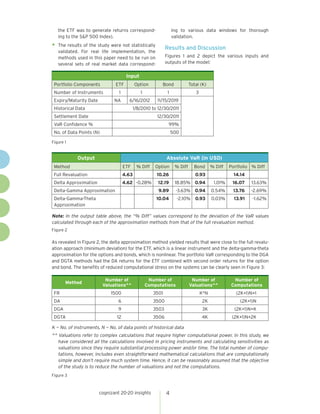
   methods used in this paper need to be run on             Figures 1 and 2 depict the various inputs and
   several sets of real market data correspond-             outputs of the model:

                                      Input
 Portfolio Components          ETF          Option       Bond              Total (K)
 Number of Instruments           1            1              1                3
 Expiry/Maturity Date          NA      6/16/2012      11/15/2019
 Historical Data                           1/8/2010 to 12/30/2011
 Settlement Date                                      12/30/2011
 VaR Confidence %                                            99%
 No. of Data Points (N)                                          500

Figure 1


            Output                                          Absolute VaR (in USD)
 Method                              ETF    % Diff    Option      % Diff     Bond       % Diff   Portfolio % Diff
 Full Revaluation                    4.63             10.26                   0.93                 14.14
 Delta Approximation                 4.62 -0.28%       12.19      18.85% 0.94            1.01%    16.07    13.63%
 Delta-Gamma Approximation                             9.89       -3.63% 0.94           0.54%     13.76    -2.69%
 Delta-Gamma-Theta                                    10.04        -2.10%     0.93      0.03%      13.91   -1.62%
 Approximation

Note: In the output table above, the “% Diff” values correspond to the deviation of the VaR values
calculated through each of the approximation methods from that of the full revaluation method.
Figure 2

As revealed in Figure 2, the delta approximation method yielded results that were close to the full revalu-
ation approach (minimum deviation) for the ETF, which is a linear instrument and the delta-gamma-theta
approximation for the options and bonds, which is nonlinear. The portfolio VaR corresponding to the DGA
and DGTA methods had the DA returns for the ETF combined with second order returns for the option
and bond. The benefits of reduced computational stress on the systems can be clearly seen in Figure 3:

                           Number of               Number of                Number of              Number of
       Method
                          Valuations^^            Computations             Valuations^^           Computations
 FR                          1500                    3501                         K*N               (2K+1)N+1
 DA                             6                    3500                         2K                  (2K+1)N
 DGA                            9                    3503                         3K               (2K+1)N+K
 DGTA                           12                   3506                         4K              (2K+1)N+2K

K — No. of instruments, N — No. of data points of historical data
^^ Valuations refer to complex calculations that require higher computational power. In this study, we
   have considered all the calculations involved in pricing instruments and calculating sensitivities as
   valuations since they require substantial processing power and/or time. The total number of compu-
   tations, however, includes even straightforward mathematical calculations that are computationally
   simple and don’t require much system time. Hence, it can be reasonably assumed that the objective
   of the study is to reduce the number of valuations and not the computations.
Figure 3


                        cognizant 20-20 insights            4
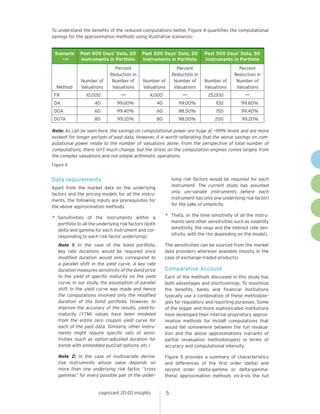
To understand the benefits of the reduced computations better, Figure 4 quantifies the computational
savings for the approximation methods using illustrative scenarios:


 Scenario     Past 500 Days’ Data, 20         Past 200 Days’ Data, 20            Past 500 Days’ Data, 50
    -->       Instruments in Portfolio        Instruments in Portfolio           Instruments in Portfolio
                               Percent                             Percent                        Percent
                             Reduction in                        Reduction in                   Reduction in
              Number of       Number of       Number of           Number of      Number of       Number of
  Method      Valuations      Valuations      Valuations          Valuations     Valuations      Valuations
 FR                10,000          —
                                   ­              4,000               —            25,000            —
 DA                   40         99.60%                 40          99.00%             100          99.60%
 DGA                  60         99.40%                 60          98.50%             150          99.40%
 DGTA                 80         99.20%                 80          98.00%            200           99.20%

Note: As can be seen here, the savings on computational power are huge at ~99% levels and are more
evident for longer periods of past data. However, it is worth reiterating that the above savings on com-
putational power relate to the number of valuations alone. From the perspective of total number of
computations, there isn’t much change, but the stress on the computation engines comes largely from
the complex valuations and not simple arithmetic operations.
Figure 4


Data requirements                                                lying risk factors would be required for each
Apart from the market data on the underlying
                                                                 instrument. The current study has assumed
factors and the pricing models for all the instru-
                                                                 only uni-variate instruments (where each
ments, the following inputs are prerequisites for
                                                                 instrument has only one underlying risk factor)
the above approximation methods.
                                                                 for the sake of simplicity.


•	 Sensitivities   of the instruments within a               •	 Theta, or the time sensitivity of all the instru-
                                                                 ments (and other sensitivities such as volatility
   portfolio to all the underlying risk factors (both
                                                                 sensitivity, the vega and the interest rate sen-
   delta and gamma for each instrument and cor-
                                                                 sitivity, with the rho depending on the model).
   responding to each risk factor underlying).
   Note 1: In the case of the bond portfolio,                The sensitivities can be sourced from the market
   key rate durations would be required since                data providers wherever available (mostly in the
   modified duration would only correspond to                case of exchange-traded products).
   a parallel shift in the yield curve. A key rate
   duration measures sensitivity of the bond price           Comparative Account
   to the yield of specific maturity on the yield            Each of the methods discussed in this study has
   curve. In our study, the assumption of parallel           both advantages and shortcomings. To maximize
   shift in the yield curve was made and hence               the benefits, banks and financial institutions
   the computations involved only the modified               typically use a combination of these methodolo-
   duration of the bond portfolio. However, to               gies for regulatory and reporting purposes. Some
   improve the accuracy of the results, yield-to-            of the bigger and more sophisticated institutions
   maturity (YTM) values have been modeled                   have developed their internal proprietary approx-
   from the entire zero coupon yield curve for               imation methods for HsVaR computations that
   each of the past data. Similarly, other instru-           would fall somewhere between the full revalua-
   ments might require specific sets of sensi-               tion and the above approximations (variants of
   tivities (such as option-adjusted duration for            partial revaluation methodologies) in terms of
   bonds with embedded put/call options, etc.)               accuracy and computational intensity.

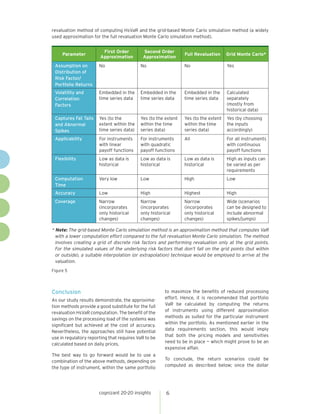
   Note 2: In the case of multivariate deriva-               Figure 5 provides a summary of characteristics
   tive instruments whose value depends on                   and differences of the first order (delta) and
   more than one underlying risk factor, “cross              second order (delta-gamma or delta-gamma-
   gammas” for every possible pair of the under-             theta) approximation methods vis-à-vis the full


                        cognizant 20-20 insights             5
revaluation method of computing HsVaR and the grid-based Monte Carlo simulation method (a widely
used approximation for the full revaluation Monte Carlo simulation method).


                        First Order         Second Order
     Parameter                                                  Full Revaluation     Grid Monte Carlo*
                       Approximation        Approximation
 Assumption on         No                  No                   No                   Yes
 Distribution of
 Risk Factor/
 Portfolio Returns
 Volatility and        Embedded in the     Embedded in the      Embedded in the      Calculated
 Correlation           time series data    time series data     time series data     separately
 Factors                                                                             (mostly from
                                                                                     historical data)
 Captures Fat Tails    Yes (to the         Yes (to the extent   Yes (to the extent   Yes (by choosing
 and Abnormal          extent within the   within the time      within the time      the inputs
 Spikes                time series data)   series data)         series data)         accordingly)
 Applicability         For instruments     For instruments      All                  For all instruments
                       with linear         with quadratic                            with continuous
                       payoff functions    payoff functions                          payoff functions
 Flexibility           Low as data is      Low as data is       Low as data is       High as inputs can
                       historical          historical           historical           be varied as per
                                                                                     requirements
 Computation           Very low            Low                  High                 Low
 Time
 Accuracy              Low                 High                 Highest              High
 Coverage              Narrow              Narrow               Narrow               Wide (scenarios
                       (incorporates       (incorporates        (incorporates        can be designed to
                       only historical     only historical      only historical      include abnormal
                       changes)            changes)             changes)             spikes/jumps)

* Note: The grid-based Monte Carlo simulation method is an approximation method that computes VaR
  with a lower computation effort compared to the full revaluation Monte Carlo simulation. The method
  involves creating a grid of discrete risk factors and performing revaluation only at the grid points.
  For the simulated values of the underlying risk factors that don’t fall on the grid points (but within
  or outside), a suitable interpolation (or extrapolation) technique would be employed to arrive at the
  valuation.
Figure 5


Conclusion                                             to maximize the benefits of reduced processing
                                                       effort. Hence, it is recommended that portfolio
As our study results demonstrate, the approxima-
                                                       VaR be calculated by computing the returns
tion methods provide a good substitute for the full
                                                       of instruments using different approximation
revaluation HsVaR computation. The benefit of the
                                                       methods as suited for the particular instrument
savings on the processing load of the systems was
                                                       within the portfolio. As mentioned earlier in the
significant but achieved at the cost of accuracy.
                                                       data requirements section, this would imply
Nevertheless, the approaches still have potential
                                                       that both the pricing models and sensitivities
use in regulatory reporting that requires VaR to be
                                                       need to be in place — which might prove to be an
calculated based on daily prices.
                                                       expensive affair.
The best way to go forward would be to use a
                                                       To conclude, the return scenarios could be
combination of the above methods, depending on
                                                       computed as described below; once the dollar
the type of instrument, within the same portfolio


                       cognizant 20-20 insights        6
return values for the scenarios are in place,          minimum or both, depending on the instrument)
HsVaR can be computed at the portfolio level           and performing the revaluation at these chosen
after aggregating the same.                            points. For other data points, the approximation
                                                       methods such as DGTA could be employed.
•	 For   linear instruments (such as equity
   positions, ETFs, forwards, futures, listed          The grid factor valuation, on the other hand,
   securities with adequate market liquidity, etc.),   involves choosing a set of discrete data points
   the DA method should be employed.                   from the historical risk factors data in such a way

•	 For plain vanilla derivative instruments and        that the chosen grid values span the entire data
                                                       set and form a reasonable representation of the
   fixed income products (such as simple bonds,
                                                       same. The revaluation is done only for these grid
   equity options, commodity options, etc.) that
                                                       values and for all the data points that don’t fall on
   are nonlinearly dependent on the underlying
                                                       the grid nodes, a suitable interpolation or extrap-
   factors, the DGTA method would be more
                                                       olation technique (linear or quadratic or higher
   suitable.
                                                       order) is employed to arrive at the value.
•	 For all other highly nonlinear, exotic derivative
   instruments (such as bonds with call/put            Note: Whatever the approximation method
   options, swaptions, credit derivatives, etc.) and   chosen, the same data needs to be validated
   instruments that are highly volatile (or where      across products for various historical windows
   volatility impacts are not linear) and illiquid,    before it can be applied to real portfolios. Further,
   full revaluation methodology is recommended         the model needs to be approved by regulators
   as the approximation methods would yield less       before being used for reporting or capital compu-
   accurate values.                                    tation purposes.

Simplification Techniques for Instru-                  In May 2012, the Basel Committee for Banking
ments that Require Full Revaluation                    Supervision (BCBS) released a consultative
                                                       document to help investment banks fundamentally
For the instruments where full revaluation was
                                                       review their trading books. The report mentioned
recommended, the computational burden could
                                                       the committee’s consideration of alternative risk
be reduced by employing techniques such as
                                                       metrics to VaR (such as expected shortfall) due
data filtering and grid factor valuation. These
                                                       to the inherent weaknesses in VaR of ignoring tail
methods, as explained below, simplify the calcula-
                                                       distribution. It should, however, be noted that the
tions to a great extent but their accuracy would
                                                       approximation methods considered in our study
largely depend on the number and choice of the
                                                       will be valid and useful even for the alternative
data points selected for revaluation.
                                                       risk metrics under the committee’s consideration
The data filtering technique involves filtering data   as the approximation methods serve as alterna-
points relating to the risk factors based on certain   tives for returns estimation alone and don’t affect
criteria (say, top “N” points where the movement       the selection of a particular scenario such as risk
of the underlying was either maximum or                metric.


References
•	 Revisions to the BASEL II Market Risk Framework, BASEL Committee on Banking Supervision, 2009.
   http://www.bis.org/publ/bcbs158.pdf
•	 William Fallon, Calculating Value-at-Risk, 1996.
•	 Linda Allen, Understanding Market, Credit & Operational Risk, Chapter 3: Putting VaR to Work, 2004.
•	 John C. Hull, Options, Futures, and Other Derivatives, Chapter 20: Value at Risk, 2009.
•	 Darrell Duffie and Jun Pan, “An Overview of Value at Risk,” 1997.
•	 Manuel Amman and Christian Reich, “VaR for Nonlinear Financial Instruments —
   Linear Approximations or Full Monte-Carlo?,” 2001.
•	 Michael S. Gibson and Matthew Pritsker, “Improving Grid-Based Methods for Estimating Value at
   Risk of Fixed-Income Portfolios,” 2000.
•	 Fundamental Review of the Trading Book, BASEL Committee on Banking Supervision, 2012.
   http://www.bis.org/publ/bcbs219.pdf


                       cognizant 20-20 insights         7
About the Authors
Krishna Kanth is a Consultant within Cognizant’s Banking and Financial Services Consulting Group,
working on assignments for leading investment banks in the risk management domain. He has four
years of experience in credit risk management and information technology. Krishna has passed the
Financial Risk Manager examination conducted by the Global Association of Risk Professionals and has
a post-graduate diploma in management from Indian Institute of Management (IIM), Lucknow, with a
major in finance. He can be reached at KrishnaKanth.Gadamsetty@cognizant.com.

Sathish Thiruvenkataswamy is a Senior Consulting Manager within Cognizant’s Banking and Financial
Services Consulting Group, where he manages consulting engagements in the investment banking,
brokerage and risk management domains. Sathish has over 11 years of experience in consulting and
solution architecture for banking and financial services clients. He has a post-graduate degree in com-
puter-aided management from Indian Institute of Management, Kolkatta. Sathish can be reached at
Sathish.Thiruvenkataswamy@cognizant.com.

Credits
The authors would like to acknowledge the review assistance provided by Anshuman Choudhary and
Rohit Chopra, Consulting Director and Senior Manager of Consulting, respectively, within Cognizant’s
Banking and Financial Services Consulting Group.


About Cognizant
Cognizant (NASDAQ: CTSH) is a leading provider of information technology, consulting, and business process out-
sourcing services, dedicated to helping the world’s leading companies build stronger businesses. Headquartered in
Teaneck, New Jersey (U.S.), Cognizant combines a passion for client satisfaction, technology innovation, deep industry
and business process expertise, and a global, collaborative workforce that embodies the future of work. With over 50
delivery centers worldwide and approximately 145,200 employees as of June 30, 2012, Cognizant is a member of the
NASDAQ-100, the S&P 500, the Forbes Global 2000, and the Fortune 500 and is ranked among the top performing
and fastest growing companies in the world. Visit us online at www.cognizant.com or follow us on Twitter: Cognizant.


                                         World Headquarters                  European Headquarters                 India Operations Headquarters
                                         500 Frank W. Burr Blvd.             1 Kingdom Street                      #5/535, Old Mahabalipuram Road
                                         Teaneck, NJ 07666 USA               Paddington Central                    Okkiyam Pettai, Thoraipakkam
                                         Phone: +1 201 801 0233              London W2 6BD                         Chennai, 600 096 India
                                         Fax: +1 201 801 0243                Phone: +44 (0) 20 7297 7600           Phone: +91 (0) 44 4209 6000
                                         Toll Free: +1 888 937 3277          Fax: +44 (0) 20 7121 0102             Fax: +91 (0) 44 4209 6060
                                         Email: inquiry@cognizant.com        Email: infouk@cognizant.com           Email: inquiryindia@cognizant.com


©
­­ Copyright 2012, Cognizant. All rights reserved. No part of this document may be reproduced, stored in a retrieval system, transmitted in any form or by any
means, electronic, mechanical, photocopying, recording, or otherwise, without the express written permission from Cognizant. The information contained herein is
subject to change without notice. All other trademarks mentioned herein are the property of their respective owners.

VaR Approximation Methods

  • 1.
    • Cognizant 20-20Insights VaR Approximation Methods Our study of various approximations to the full revaluation method of computing value at risk using the historical simulation approach reveals alternatives that can significantly reduce processing resources — but at the acceptable expense of accuracy. Executive Summary VaR measures the maximum potential loss in the value of an asset or portfolio over a defined “When the numbers are running you instead period, for a given confidence level. From a sta- of you running the numbers, it’s time to take tistical point of view, VaR measures a particular your money off the table.” — Anonymous quantile (confidence level) of the return distri- Banks and other financial institutions across the bution of a particular period. Of all the methods world use various approaches to quantify risk available for calculating VaR of a portfolio — in their portfolios. Regulators require that value parametric, historical simulation and Monte Carlo at risk (VaR), calculated based on the historical simulation — the historical simulation approach data, be used for certain reporting and capital (HsVaR) alone doesn’t assume any distribution allocation purposes. Currently, this simple risk for returns and directly employs actual past measure, historical VaR or HsVaR, is computed data to generate possible future scenarios and by some firms using the full revaluation method, determine the required quantile. which is computationally intensive. Problem Statement This white paper offers an evaluation of alterna- Currently, some financial institutions use the full tive methods to the HsVaR computation that can revaluation method for computing HsVaR. While it significantly reduce the processing effort, albeit is undoubtedly the most straightforward method at the cost of reduced accuracy. The resulting without any implicit or explicit distributional VaR values and the corresponding number of assumption, a major limitation of using it is that computations for the delta, delta-gamma, and the entire portfolio needs to be valued for every delta-gamma-theta approximation methods were data point of the period under consideration. For benchmarked against those from the full revalu- example, if 99% — one day — HsVaR is calculated ation approach to evaluate the trade-off between based on the past 500 days of market data of the the loss of accuracy and the benefit of reduced risk factors, then the HsVaR calculation involves processing. full revaluation of the entire portfolio, 500 times. The method, therefore, requires an intensive Assessing Risk Assessment computational effort and exerts a heavy load Value at risk, or VaR as it is widely known, has on existing calculation engines and other risk emerged as a popular method to measure management systems. financial market risk. In its most general form, cognizant 20-20 insights | september 2012
  • 2.
    The problem athand is to explore various approx- the instruments, as on the current date (Dec. imation methods for calculating HsVaR that could 30, 2011), were then computed. The price of the reduce the number of computations (valuations) ETF was determined by mapping the underlying significantly and yet yield an output that is close returns and the ETF price returns for the past enough to the full revaluation HsVaR. data and the price of index call options was calculated using the Black-Scholes model. The Approach and Methodology dirty price of the bond was computed using the A hypothetical sample portfolio was considered built-in functions of Microsoft Excel. Finally, the and various underlying risk factors that HsVaR of the portfolio was then calculated by determine the value of the portfolio components using the following methods. were identified. Historical data pertaining to those factors was collected. The current price Full Revaluation and sensitivities of the portfolio components to The HsVaR determined through full revalua- the underlying risk factors were then computed. tion (FR) involved calculation of the price of the HsVaR was calculated using various methods individual instruments for each of the 499 possible as detailed below; the results were tabulated to values of the underlying risk factor (a total of 500 record the deviation of the VaR values computed valuations including the current day’s price com- from approximation methods vis-à-vis the full putation, for each instrument). From the values of revaluation method. Further, the numbers of the individual instruments, the portfolio value for computations involved in each of these method- each of the scenarios was calculated and then the ologies were compared to observe the benefits daily returns were determined (over the current accrued from using the approximation methods. portfolio value). The required quantile (100% — 99% = 1%, in this case) was determined from the For this study, a portfolio consisting of one long sorted list of returns. position each on an index ETF (SPDR S&P 500 ETF — a linear instrument), an index call option (on Delta Approximation S&P 500 expiring on June 16, 2012 — a nonlinear The delta approximation (DA) method requires instrument with short maturity) and a Treasury the first order sensitivities (delta, in general, bond (maturing on Nov. 15, 2019 — a nonlinear for options; modified duration for bonds) of instrument with longer maturity) was considered. the individual instruments to be calculated up The objective was to compute a 99% — one day front. The driving force of this approach is the — HsVaR with a settlement date (i.e., date of cal- philosophy that the change in the returns of an culation) of Dec. 30, 2011; the historical data used instrument can be approximated by multiplying corresponded to the trailing 500 days of market the change in the returns of the underlying with data (Jan. 8, 2010 to Dec. 30, 2011). the corresponding sensitivity of the instrument The market data related to the underlying risk toward the underlying. This approximation works factors — S&P 500 Index for ETF & call option and well for linear instruments and tends to deviate yield to maturity (YTM) for the Treasury bond, was for nonlinear instruments: collected and the 499 (500 — 1) possible values ∆(V) = Delta * ∆(X) of the factors for the next day were determined based on past data using this formula: Where: X(t+1) = X(t) * X(i+1) ... X(i) • ∆(V) is the change in the value of the instrument. Where: • ∆(X) is the change in value of the underlying. • X(t+1) is the calculated risk factor for the next • Delta is the first order derivative of the day. instrument with respect to the underlying. • X(t) is the value of the risk factor on the day of Hence, for all the 499 possible returns of the calculation (Dec. 30, 2011, in this case). underlying calculated, corresponding delta • X(i) and X(i+1) are the value of the risk factors returns (absolute dollar returns) of each on consecutive days (i = 1 to 500). instrument were computed using the above Once the possible scenarios of the underlying formula. From the delta returns of the individual risk factors for the next day were in place, the instruments, the portfolio returns and the VaR corresponding returns (in absolute terms) over were computed (required quantile of the portfolio the current value were computed. The prices of returns). cognizant 20-20 insights 2
  • 3.
    Delta-Gamma Approximation we have limited ourselves to theta for the sake of The delta-gamma approximation (DGA) method is simplicity and ease of understanding. similar to the delta approximation approach, but Assumptions and Limitations with a higher order of sensitivity. As portfolios in real life are composed of instruments that are non- The objective of the study was to explore various linearly related to the underlying risk factors, the approximations to the full revaluation method delta approximation fares poorly due to the linear and not to statistically validate them. Hence, assumption involved (as the first order derivative is the methodology employed had the following nothing but the slope of the curve at a given point). inherent assumptions to preserve simplicity: The natural remedy to this is to incorporate the • The study focused on the approximation next order derivative. The delta-gamma approxi- methods to the full revaluation of the entire mation requires the calculation of the second portfolio and hence it was assumed that the order derivative, gamma, in addition to the delta underlying risk factors for various portfolio and the returns of each instrument are calculated components were predetermined and already as below (derived from the Taylor’s series): in place. Accordingly, the study on various ∆(V) = Delta * ∆(X)+ 0.5 * Gamma * ∆(X) 2 methods for choosing the right factors was out of the scope. Where: • Gamma is the second order derivative of the • Since the regulatory requirement stipulates that the VaR be calculated based on the instrument with respect to the underlying. historical data, the data points considered From the returns computed using the above in this study are directly taken from the real formula, the portfolio returns are determined and market historical data without any modifica- the required quantile was chosen as the VaR. The tions (i.e., all the data points are actual daily delta-gamma method works reasonably well for market prices and had equal weight). the simple nonlinear instruments (such as bonds without put/call options) as the curvature of the • As the objective was to compute one-day VaR, daily market data corresponding to the relationship with the underlying risk factor can be business days in the period under consider- approximated by the convexity measure. ation was used (i.e., one-day would mean next Delta-Gamma-Theta Approximation business/trading day). The resulting one-day VaR could be easily extended to any “n-day” The delta-gamma-theta approximation (DGTA) period by simply multiplying the square root of approach takes into account an additional term n to the one-day VaR. that adjusts for the change in the value of an instrument with respect to time. The partial • The problem of full revaluation is more derivative of the portfolio or instrument with prevalent for over the counter (OTC) products respect to time is added to the above equation where there is no market data for the trading to determine the delta-gamma-theta returns and instruments available. However, for this study, subsequently the VaR is computed: instruments that were very actively traded were chosen so that a simple pricing formula could ∆(V) = Delta * ∆(X) + 0.5 * Gamma * ∆(X)2 be employed and the focus would remain on the + Theta * ∆(T) benefits of approximation methods rather than Where: the complexities of the pricing. Therefore, the • Theta is the partial derivative of the instrument computations in the study do suffer from model risk and the inherent assumptions of these with respect to time. pricing functions were applicable here too. • ∆(T) is the change in time (one day in this case). The DGTA method still accounts only for the • The six-month Treasury bill rate and implied volatility as calculated from the market second order approximation but incorporates the prices as on the date of calculation were time effect on the returns (which is ignored in the used, respectively, as the risk-free rate and DGA method). volatility for calculation of option prices using Note: The model can be further strengthened the Black-Scholes method. Similarly, prices of by adding other sensitivities such as vega (to the ETF were computed directly from the past volatility) and rho (to interest rate). In this study, daily returns by matching the corresponding underlying index returns (as the objective of cognizant 20-20 insights 3
  • 4.
    the ETF wasto generate returns correspond- ing to various data windows for thorough ing to the S&P 500 Index). validation. • The results of the study were not statistically Results and Discussion validated. For real life implementation, the methods used in this paper need to be run on Figures 1 and 2 depict the various inputs and several sets of real market data correspond- outputs of the model: Input Portfolio Components ETF Option Bond Total (K) Number of Instruments 1 1 1 3 Expiry/Maturity Date NA 6/16/2012 11/15/2019 Historical Data 1/8/2010 to 12/30/2011 Settlement Date 12/30/2011 VaR Confidence % 99% No. of Data Points (N) 500 Figure 1 Output Absolute VaR (in USD) Method ETF % Diff Option % Diff Bond % Diff Portfolio % Diff Full Revaluation 4.63 10.26 0.93 14.14 Delta Approximation 4.62 -0.28% 12.19 18.85% 0.94 1.01% 16.07 13.63% Delta-Gamma Approximation 9.89 -3.63% 0.94 0.54% 13.76 -2.69% Delta-Gamma-Theta  10.04 -2.10% 0.93 0.03% 13.91 -1.62% Approximation Note: In the output table above, the “% Diff” values correspond to the deviation of the VaR values calculated through each of the approximation methods from that of the full revaluation method. Figure 2 As revealed in Figure 2, the delta approximation method yielded results that were close to the full revalu- ation approach (minimum deviation) for the ETF, which is a linear instrument and the delta-gamma-theta approximation for the options and bonds, which is nonlinear. The portfolio VaR corresponding to the DGA and DGTA methods had the DA returns for the ETF combined with second order returns for the option and bond. The benefits of reduced computational stress on the systems can be clearly seen in Figure 3: Number of Number of Number of Number of Method Valuations^^ Computations Valuations^^ Computations FR 1500 3501 K*N (2K+1)N+1 DA 6 3500 2K (2K+1)N DGA 9 3503 3K (2K+1)N+K DGTA 12 3506 4K (2K+1)N+2K K — No. of instruments, N — No. of data points of historical data ^^ Valuations refer to complex calculations that require higher computational power. In this study, we have considered all the calculations involved in pricing instruments and calculating sensitivities as valuations since they require substantial processing power and/or time. The total number of compu- tations, however, includes even straightforward mathematical calculations that are computationally simple and don’t require much system time. Hence, it can be reasonably assumed that the objective of the study is to reduce the number of valuations and not the computations. Figure 3 cognizant 20-20 insights 4
  • 5.
    To understand thebenefits of the reduced computations better, Figure 4 quantifies the computational savings for the approximation methods using illustrative scenarios: Scenario Past 500 Days’ Data, 20 Past 200 Days’ Data, 20 Past 500 Days’ Data, 50 --> Instruments in Portfolio Instruments in Portfolio Instruments in Portfolio Percent Percent Percent Reduction in Reduction in Reduction in Number of Number of Number of Number of Number of Number of Method Valuations Valuations Valuations Valuations Valuations Valuations FR 10,000 — ­ 4,000 — 25,000 — DA 40 99.60% 40 99.00% 100 99.60% DGA 60 99.40% 60 98.50% 150 99.40% DGTA 80 99.20% 80 98.00% 200 99.20% Note: As can be seen here, the savings on computational power are huge at ~99% levels and are more evident for longer periods of past data. However, it is worth reiterating that the above savings on com- putational power relate to the number of valuations alone. From the perspective of total number of computations, there isn’t much change, but the stress on the computation engines comes largely from the complex valuations and not simple arithmetic operations. Figure 4 Data requirements lying risk factors would be required for each Apart from the market data on the underlying instrument. The current study has assumed factors and the pricing models for all the instru- only uni-variate instruments (where each ments, the following inputs are prerequisites for instrument has only one underlying risk factor) the above approximation methods. for the sake of simplicity. • Sensitivities of the instruments within a • Theta, or the time sensitivity of all the instru- ments (and other sensitivities such as volatility portfolio to all the underlying risk factors (both sensitivity, the vega and the interest rate sen- delta and gamma for each instrument and cor- sitivity, with the rho depending on the model). responding to each risk factor underlying). Note 1: In the case of the bond portfolio, The sensitivities can be sourced from the market key rate durations would be required since data providers wherever available (mostly in the modified duration would only correspond to case of exchange-traded products). a parallel shift in the yield curve. A key rate duration measures sensitivity of the bond price Comparative Account to the yield of specific maturity on the yield Each of the methods discussed in this study has curve. In our study, the assumption of parallel both advantages and shortcomings. To maximize shift in the yield curve was made and hence the benefits, banks and financial institutions the computations involved only the modified typically use a combination of these methodolo- duration of the bond portfolio. However, to gies for regulatory and reporting purposes. Some improve the accuracy of the results, yield-to- of the bigger and more sophisticated institutions maturity (YTM) values have been modeled have developed their internal proprietary approx- from the entire zero coupon yield curve for imation methods for HsVaR computations that each of the past data. Similarly, other instru- would fall somewhere between the full revalua- ments might require specific sets of sensi- tion and the above approximations (variants of tivities (such as option-adjusted duration for partial revaluation methodologies) in terms of bonds with embedded put/call options, etc.) accuracy and computational intensity. Note 2: In the case of multivariate deriva- Figure 5 provides a summary of characteristics tive instruments whose value depends on and differences of the first order (delta) and more than one underlying risk factor, “cross second order (delta-gamma or delta-gamma- gammas” for every possible pair of the under- theta) approximation methods vis-à-vis the full cognizant 20-20 insights 5
  • 6.
    revaluation method ofcomputing HsVaR and the grid-based Monte Carlo simulation method (a widely used approximation for the full revaluation Monte Carlo simulation method). First Order Second Order Parameter Full Revaluation Grid Monte Carlo* Approximation Approximation Assumption on No No No Yes Distribution of Risk Factor/ Portfolio Returns Volatility and Embedded in the Embedded in the Embedded in the Calculated Correlation time series data time series data time series data separately Factors (mostly from historical data) Captures Fat Tails Yes (to the Yes (to the extent Yes (to the extent Yes (by choosing and Abnormal extent within the within the time within the time the inputs Spikes time series data) series data) series data) accordingly) Applicability For instruments For instruments All For all instruments with linear with quadratic with continuous payoff functions payoff functions payoff functions Flexibility Low as data is Low as data is Low as data is High as inputs can historical historical historical be varied as per requirements Computation Very low Low High Low Time Accuracy Low High Highest High Coverage Narrow Narrow Narrow Wide (scenarios (incorporates (incorporates (incorporates can be designed to only historical only historical only historical include abnormal changes) changes) changes) spikes/jumps) * Note: The grid-based Monte Carlo simulation method is an approximation method that computes VaR with a lower computation effort compared to the full revaluation Monte Carlo simulation. The method involves creating a grid of discrete risk factors and performing revaluation only at the grid points. For the simulated values of the underlying risk factors that don’t fall on the grid points (but within or outside), a suitable interpolation (or extrapolation) technique would be employed to arrive at the valuation. Figure 5 Conclusion to maximize the benefits of reduced processing effort. Hence, it is recommended that portfolio As our study results demonstrate, the approxima- VaR be calculated by computing the returns tion methods provide a good substitute for the full of instruments using different approximation revaluation HsVaR computation. The benefit of the methods as suited for the particular instrument savings on the processing load of the systems was within the portfolio. As mentioned earlier in the significant but achieved at the cost of accuracy. data requirements section, this would imply Nevertheless, the approaches still have potential that both the pricing models and sensitivities use in regulatory reporting that requires VaR to be need to be in place — which might prove to be an calculated based on daily prices. expensive affair. The best way to go forward would be to use a To conclude, the return scenarios could be combination of the above methods, depending on computed as described below; once the dollar the type of instrument, within the same portfolio cognizant 20-20 insights 6
  • 7.
    return values forthe scenarios are in place, minimum or both, depending on the instrument) HsVaR can be computed at the portfolio level and performing the revaluation at these chosen after aggregating the same. points. For other data points, the approximation methods such as DGTA could be employed. • For linear instruments (such as equity positions, ETFs, forwards, futures, listed The grid factor valuation, on the other hand, securities with adequate market liquidity, etc.), involves choosing a set of discrete data points the DA method should be employed. from the historical risk factors data in such a way • For plain vanilla derivative instruments and that the chosen grid values span the entire data set and form a reasonable representation of the fixed income products (such as simple bonds, same. The revaluation is done only for these grid equity options, commodity options, etc.) that values and for all the data points that don’t fall on are nonlinearly dependent on the underlying the grid nodes, a suitable interpolation or extrap- factors, the DGTA method would be more olation technique (linear or quadratic or higher suitable. order) is employed to arrive at the value. • For all other highly nonlinear, exotic derivative instruments (such as bonds with call/put Note: Whatever the approximation method options, swaptions, credit derivatives, etc.) and chosen, the same data needs to be validated instruments that are highly volatile (or where across products for various historical windows volatility impacts are not linear) and illiquid, before it can be applied to real portfolios. Further, full revaluation methodology is recommended the model needs to be approved by regulators as the approximation methods would yield less before being used for reporting or capital compu- accurate values. tation purposes. Simplification Techniques for Instru- In May 2012, the Basel Committee for Banking ments that Require Full Revaluation Supervision (BCBS) released a consultative document to help investment banks fundamentally For the instruments where full revaluation was review their trading books. The report mentioned recommended, the computational burden could the committee’s consideration of alternative risk be reduced by employing techniques such as metrics to VaR (such as expected shortfall) due data filtering and grid factor valuation. These to the inherent weaknesses in VaR of ignoring tail methods, as explained below, simplify the calcula- distribution. It should, however, be noted that the tions to a great extent but their accuracy would approximation methods considered in our study largely depend on the number and choice of the will be valid and useful even for the alternative data points selected for revaluation. risk metrics under the committee’s consideration The data filtering technique involves filtering data as the approximation methods serve as alterna- points relating to the risk factors based on certain tives for returns estimation alone and don’t affect criteria (say, top “N” points where the movement the selection of a particular scenario such as risk of the underlying was either maximum or metric. References • Revisions to the BASEL II Market Risk Framework, BASEL Committee on Banking Supervision, 2009. http://www.bis.org/publ/bcbs158.pdf • William Fallon, Calculating Value-at-Risk, 1996. • Linda Allen, Understanding Market, Credit & Operational Risk, Chapter 3: Putting VaR to Work, 2004. • John C. Hull, Options, Futures, and Other Derivatives, Chapter 20: Value at Risk, 2009. • Darrell Duffie and Jun Pan, “An Overview of Value at Risk,” 1997. • Manuel Amman and Christian Reich, “VaR for Nonlinear Financial Instruments — Linear Approximations or Full Monte-Carlo?,” 2001. • Michael S. Gibson and Matthew Pritsker, “Improving Grid-Based Methods for Estimating Value at Risk of Fixed-Income Portfolios,” 2000. • Fundamental Review of the Trading Book, BASEL Committee on Banking Supervision, 2012. http://www.bis.org/publ/bcbs219.pdf cognizant 20-20 insights 7
  • 8.
    About the Authors KrishnaKanth is a Consultant within Cognizant’s Banking and Financial Services Consulting Group, working on assignments for leading investment banks in the risk management domain. He has four years of experience in credit risk management and information technology. Krishna has passed the Financial Risk Manager examination conducted by the Global Association of Risk Professionals and has a post-graduate diploma in management from Indian Institute of Management (IIM), Lucknow, with a major in finance. He can be reached at KrishnaKanth.Gadamsetty@cognizant.com. Sathish Thiruvenkataswamy is a Senior Consulting Manager within Cognizant’s Banking and Financial Services Consulting Group, where he manages consulting engagements in the investment banking, brokerage and risk management domains. Sathish has over 11 years of experience in consulting and solution architecture for banking and financial services clients. He has a post-graduate degree in com- puter-aided management from Indian Institute of Management, Kolkatta. Sathish can be reached at Sathish.Thiruvenkataswamy@cognizant.com. Credits The authors would like to acknowledge the review assistance provided by Anshuman Choudhary and Rohit Chopra, Consulting Director and Senior Manager of Consulting, respectively, within Cognizant’s Banking and Financial Services Consulting Group. About Cognizant Cognizant (NASDAQ: CTSH) is a leading provider of information technology, consulting, and business process out- sourcing services, dedicated to helping the world’s leading companies build stronger businesses. Headquartered in Teaneck, New Jersey (U.S.), Cognizant combines a passion for client satisfaction, technology innovation, deep industry and business process expertise, and a global, collaborative workforce that embodies the future of work. With over 50 delivery centers worldwide and approximately 145,200 employees as of June 30, 2012, Cognizant is a member of the NASDAQ-100, the S&P 500, the Forbes Global 2000, and the Fortune 500 and is ranked among the top performing and fastest growing companies in the world. Visit us online at www.cognizant.com or follow us on Twitter: Cognizant. World Headquarters European Headquarters India Operations Headquarters 500 Frank W. Burr Blvd. 1 Kingdom Street #5/535, Old Mahabalipuram Road Teaneck, NJ 07666 USA Paddington Central Okkiyam Pettai, Thoraipakkam Phone: +1 201 801 0233 London W2 6BD Chennai, 600 096 India Fax: +1 201 801 0243 Phone: +44 (0) 20 7297 7600 Phone: +91 (0) 44 4209 6000 Toll Free: +1 888 937 3277 Fax: +44 (0) 20 7121 0102 Fax: +91 (0) 44 4209 6060 Email: inquiry@cognizant.com Email: infouk@cognizant.com Email: inquiryindia@cognizant.com © ­­ Copyright 2012, Cognizant. All rights reserved. No part of this document may be reproduced, stored in a retrieval system, transmitted in any form or by any means, electronic, mechanical, photocopying, recording, or otherwise, without the express written permission from Cognizant. The information contained herein is subject to change without notice. All other trademarks mentioned herein are the property of their respective owners.