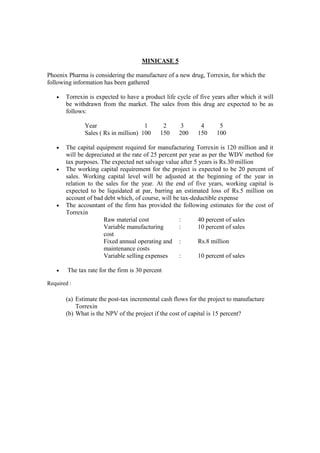
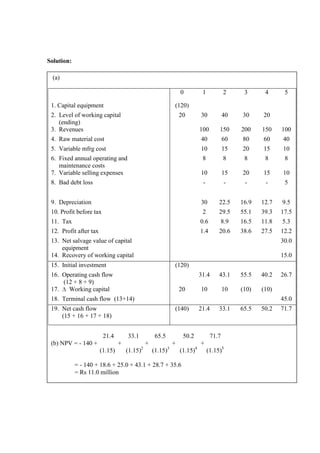
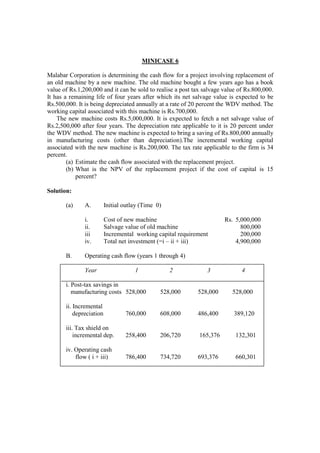
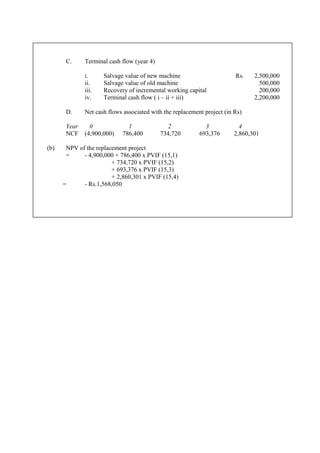
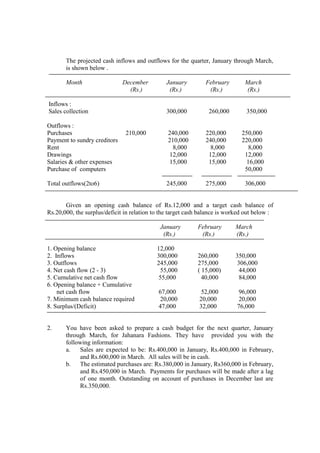
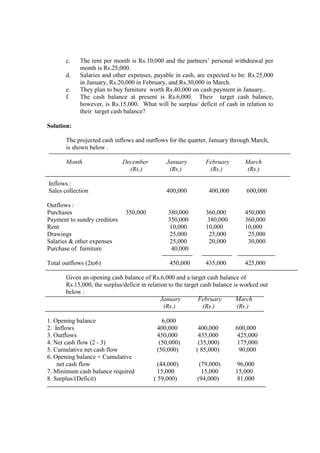
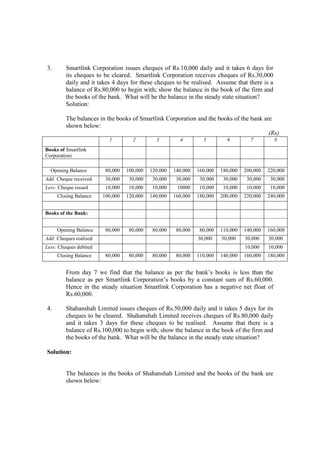
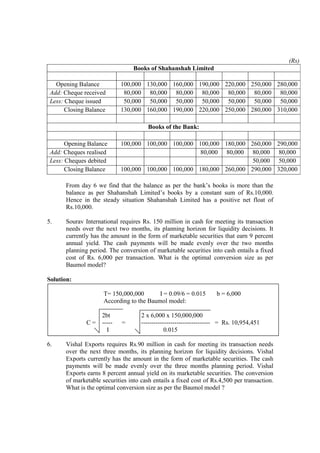
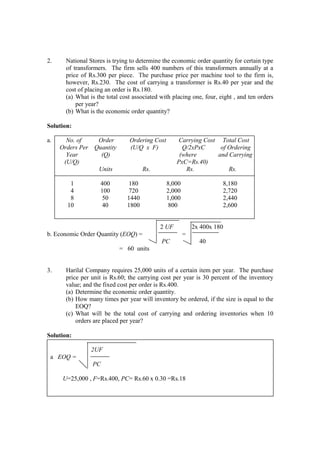
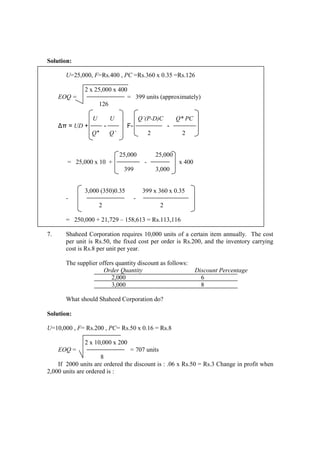
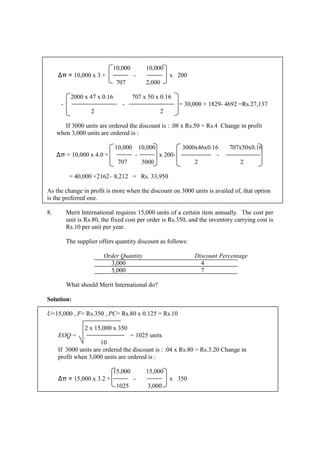
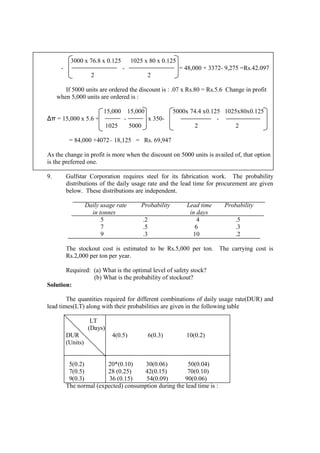
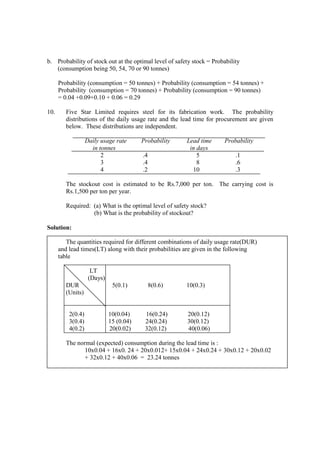
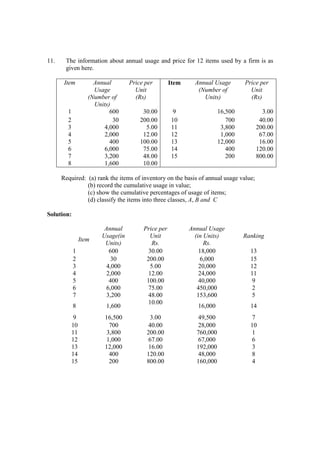
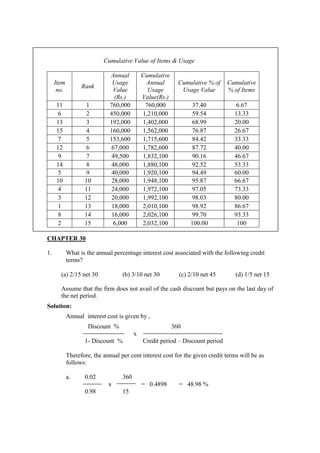
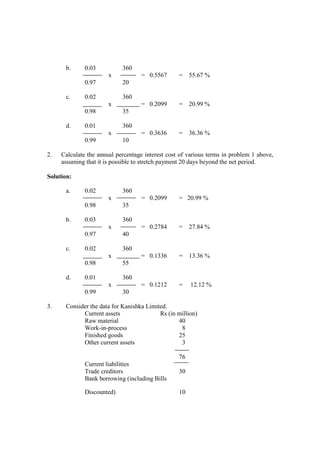
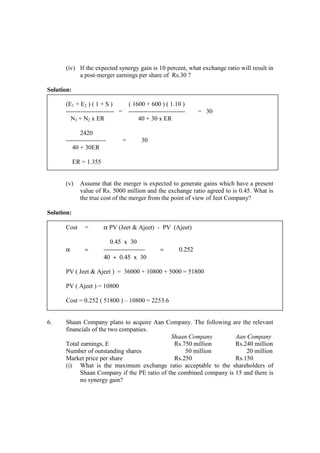
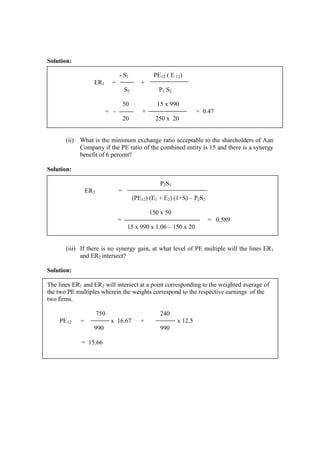
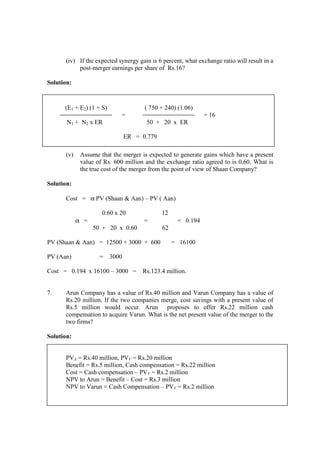
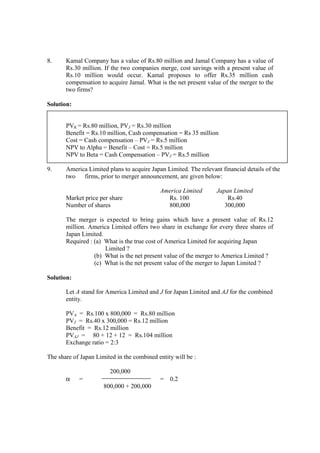
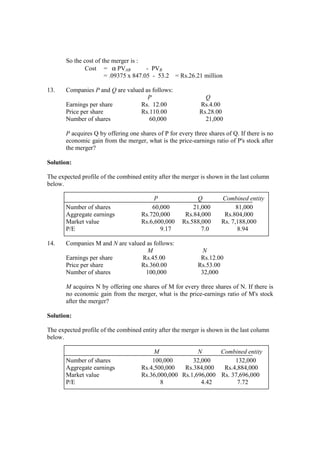
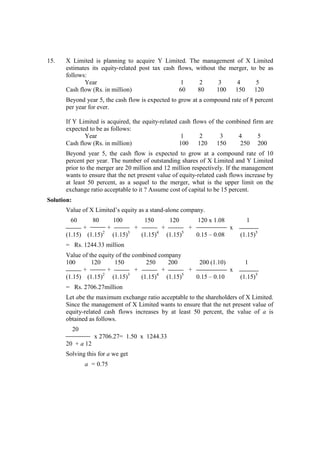
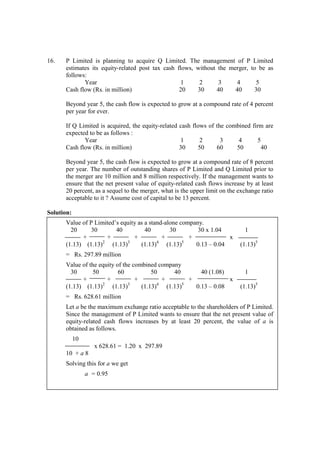
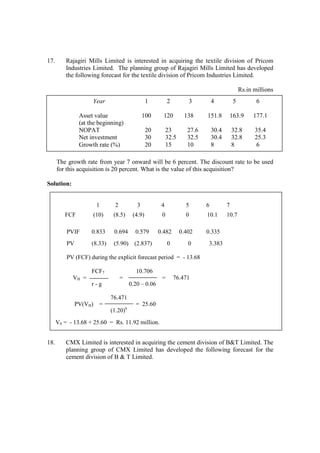
CHAPTER 2
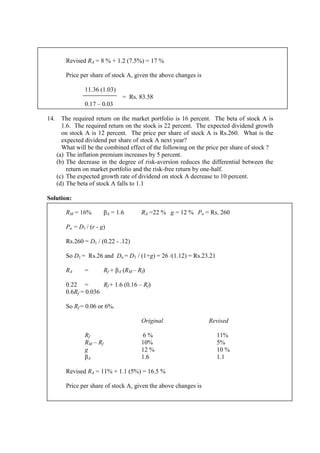
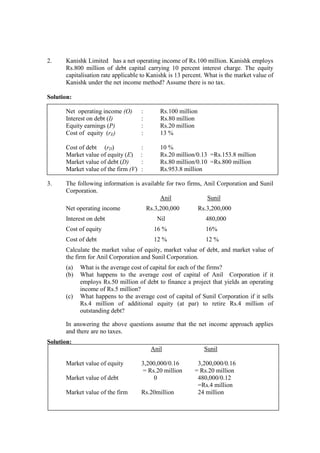
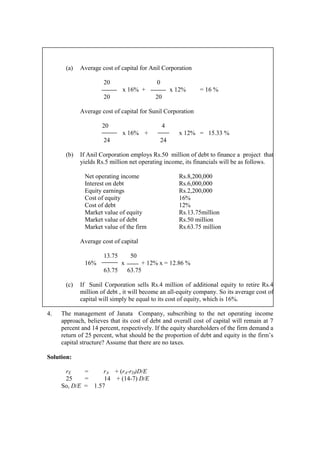
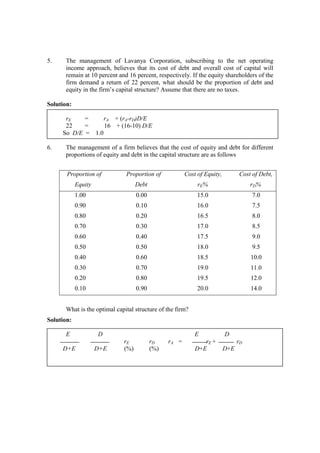
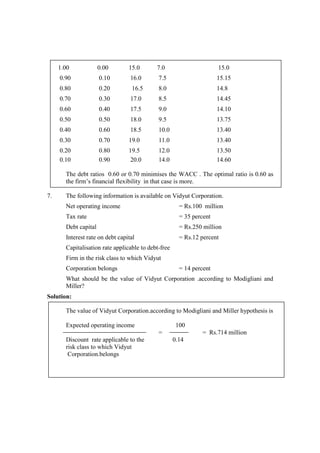
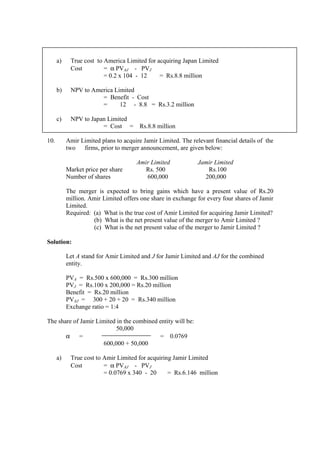
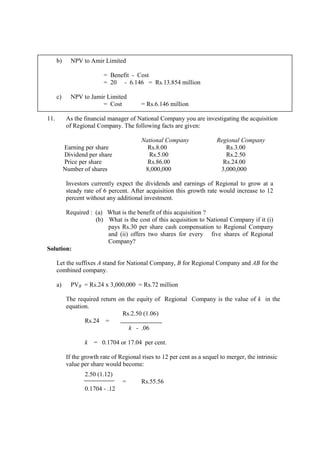
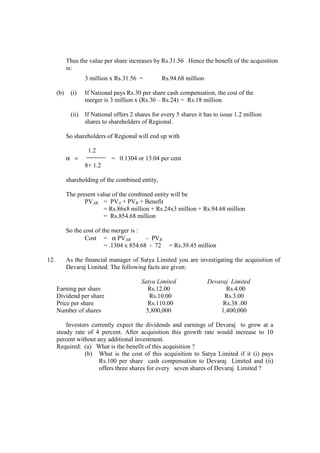
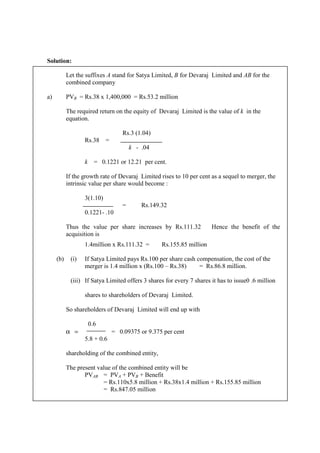
1. As a rule of thumb, real rates of interest are calculated by subtracting the inflation
rate from the nominal rate. What is the error from using this rule of thumb for
calculating real rates of return in the following cases?
Nominal rate (%) 7 12 18 22
Inflation rate (%) 4 6 8 10
Solution:
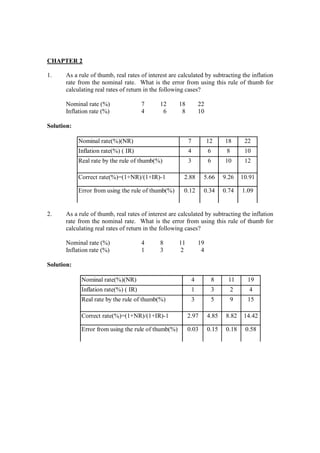
Nominal rate(%)(NR) 7 12 18 22
Inflation rate(%) ( IR) 4 6 8 10
Real rate by the rule of thumb(%)
Correct rate(%)=(1+NR)/(1+IR)-1
123 6 10
2.88 5.66 9.26 10.91
1.09Error from using the rule of thumb(%) 0.12 0.34 0.74
2. As a rule of thumb, real rates of interest are calculated by subtracting the inflation
rate from the nominal rate. What is the error from using this rule of thumb for
calculating real rates of return in the following cases?
Nominal rate (%) 4 8 11 19
Inflation rate (%) 1 3 2 4
Solution:
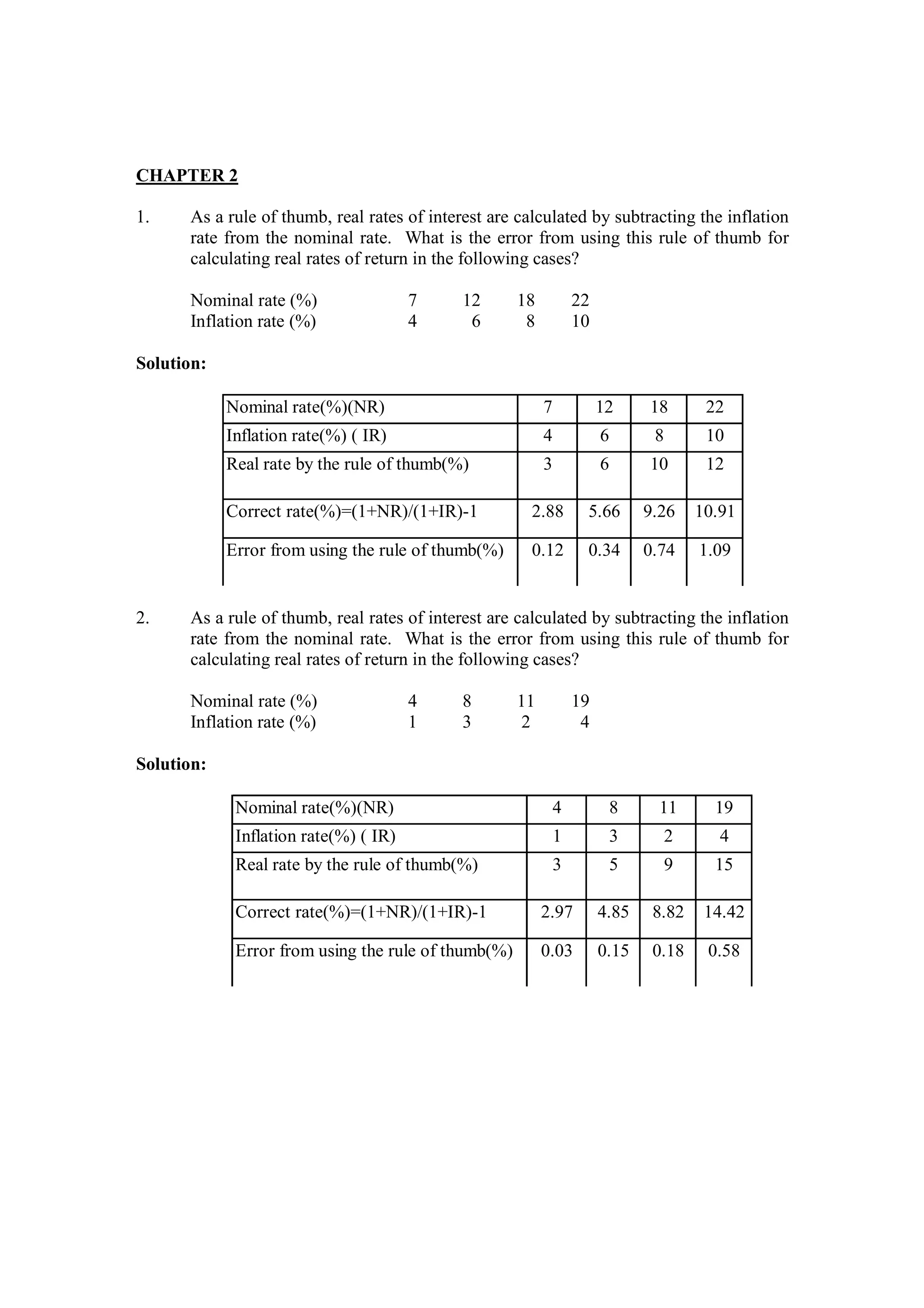
Nominal rate(%)(NR) 4 8 11 19
Inflation rate(%) ( IR) 1 3 2 4
Real rate by the rule of thumb(%)
Correct rate(%)=(1+NR)/(1+IR)-1
0.58Error from using the rule of thumb(%) 0.03 0.15 0.18
2.97 4.85 8.82 14.42
153 5 9
CHAPTER 3
1. At the end of March, 20X6 the balances in the various accounts of Dhoni &
Company are as follows:
Rs. in million
Accounts Balance
Equity capital 120
Preference capital 30
Fixed assets (net) 217
Reserves and surplus 200
Cash and bank 35
Debentures (secured) 100
Marketable securities 18
Term loans (secured) 90
Receivables 200
Short-term bank borrowing (unsecured) 70
Inventories 210
Trade creditors 60
Provisions 20
Pre-paid expenses 10
Required: Prepare the balance sheet of Dhoni & Company as per the format
specified by the Companies Act.
Solution:
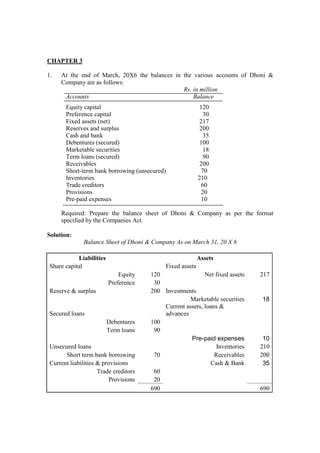
Balance Sheet of Dhoni & Company As on March 31, 20 X 6
Liabilities Assets
Share capital Fixed assets
Equity 120 Net fixed assets 217
Preference 30
Reserve & surplus 200 Investments
Marketable securities 18
Secured loans
Current assets, loans &
advances
Debentures 100
Term loans 90
Pre-paid expenses 10
Unsecured loans Inventories 210
Short term bank borrowing 70 Receivables 200
Current liabilities & provisions Cash & Bank 35
Trade creditors 60
Provisions 20
690 690
2. At the end of March, 20X7 the balances in the various accounts of Sania Limited
are as follows:
Rs. in million
Accounts Balance
Equity capital 250
Preference capital 80
Fixed assets (net) 380
Reserves and surplus 350
Cash and bank 100
Debentures (secured) 190
Marketable securities 30
Term loans (secured) 120
Receivables 420
Short-term bank borrowing (unsecured) 110
Inventories 310
Trade creditors 90
Provisions 70
Pre-paid expenses 20
Required: Prepare the balance sheet of Sania Limited as per the format specified by
the Companies Act.
Solution:
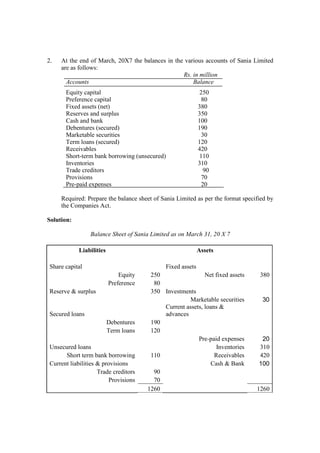
Balance Sheet of Sania Limited as on March 31, 20 X 7
Liabilities Assets
Share capital Fixed assets
Equity 250 Net fixed assets 380
Preference 80
Reserve & surplus 350 Investments
Marketable securities 30
Secured loans
Current assets, loans &
advances
Debentures 190
Term loans 120
Pre-paid expenses 20
Unsecured loans Inventories 310
Short term bank borrowing 110 Receivables 420
Current liabilities & provisions Cash & Bank 100
Trade creditors 90
Provisions 70
1260 1260
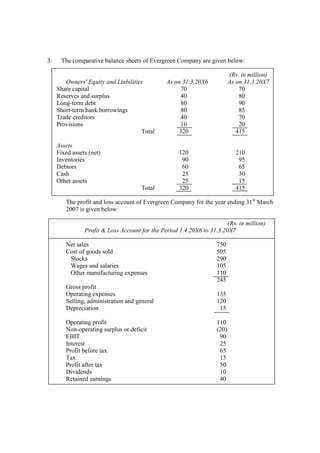
3. The comparative balance sheets of Evergreen Company are given below:
(Rs. in million)
Owners' Equity and Liabilities As on 31.3.20X6 As on 31.3.20X7
Share capital 70 70
Reserves and surplus 40 80
Long-term debt 80 90
Short-term bank borrowings 80 85
Trade creditors 40 70
Provisions 10 20
Total 320 415
Assets
Fixed assets (net) 120 210
Inventories 90 95
Debtors 60 65
Cash 25 30
Other assets 25 15
Total 320 415
The profit and loss account of Evergreen Company for the year ending 31st
March
2007 is given below:
(Rs. in million)
Profit & Loss Account for the Period 1.4.20X6 to 31.3.20X7
Net sales 750
Cost of goods sold 505
Stocks 290
Wages and salaries 105
Other manufacturing expenses 110
245
Gross profit
Operating expenses 135
Selling, administration and general 120
Depreciation 15
Operating profit 110
Non-operating surplus or deficit (20)
EBIT 90
Interest 25
Profit before tax 65
Tax 15
Profit after tax 50
Dividends 10
Retained earnings 40
Required: (a) Prepare the classified cash flow statement for the period 1.4.20X6
to 31.3.20X7
(b) Develop the cash flow identity for the period 1.4.20X6 to
31.3.20X7
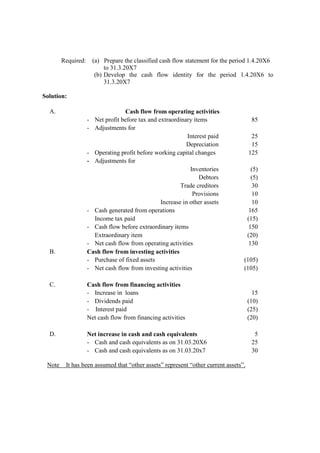
Solution:
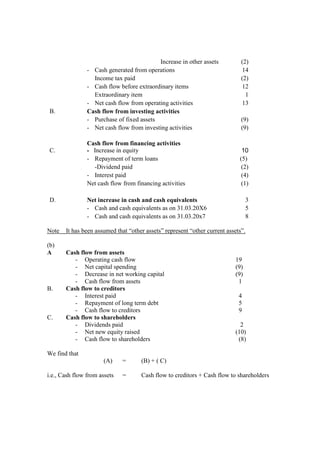
A. Cash flow from operating activities
- Net profit before tax and extraordinary items 85
- Adjustments for
Interest paid 25
Depreciation 15
- Operating profit before working capital changes 125
- Adjustments for
Inventories (5)
Debtors (5)
Trade creditors 30
Provisions 10
Increase in other assets 10
- Cash generated from operations 165
Income tax paid (15)
- Cash flow before extraordinary items 150
Extraordinary item (20)
- Net cash flow from operating activities 130
B. Cash flow from investing activities
- Purchase of fixed assets (105)
- Net cash flow from investing activities (105)
C. Cash flow from financing activities
- Increase in loans 15
- Dividends paid (10)
- Interest paid (25)
Net cash flow from financing activities (20)
D. Net increase in cash and cash equivalents 5
- Cash and cash equivalents as on 31.03.20X6 25
- Cash and cash equivalents as on 31.03.20x7 30
Note It has been assumed that “other assets” represent “other current assets”.
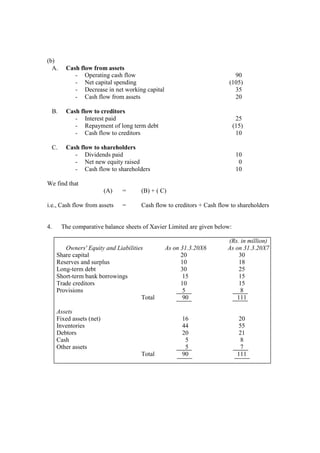
(b)
A. Cash flow from assets
- Operating cash flow 90
- Net capital spending (105)
- Decrease in net working capital 35
- Cash flow from assets 20
B. Cash flow to creditors
- Interest paid 25
- Repayment of long term debt (15)
- Cash flow to creditors 10
C. Cash flow to shareholders
- Dividends paid 10
- Net new equity raised 0
- Cash flow to shareholders 10
We find that
(A) = (B) + ( C)
i.e., Cash flow from assets = Cash flow to creditors + Cash flow to shareholders
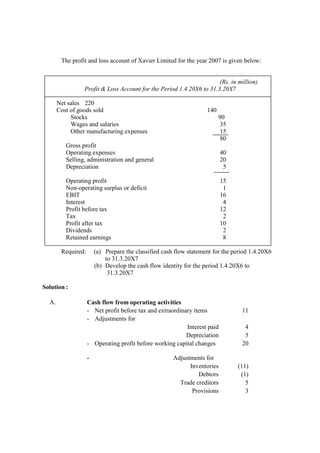
4. The comparative balance sheets of Xavier Limited are given below:
(Rs. in million)
Owners' Equity and Liabilities As on 31.3.20X6 As on 31.3.20X7
Share capital 20 30
Reserves and surplus 10 18
Long-term debt 30 25
Short-term bank borrowings 15 15
Trade creditors 10 15
Provisions 5 8
Total 90 111
Assets
Fixed assets (net) 16 20
Inventories 44 55
Debtors 20 21
Cash 5 8
Other assets 5 7
Total 90 111
The profit and loss account of Xavier Limited for the year 2007 is given below:
(Rs. in million)
Profit & Loss Account for the Period 1.4.20X6 to 31.3.20X7
Net sales 220
Cost of goods sold 140
Stocks 90
Wages and salaries 35
Other manufacturing expenses 15
80
Gross profit
Operating expenses 40
Selling, administration and general 20
Depreciation 5
Operating profit 15
Non-operating surplus or deficit 1
EBIT 16
Interest 4
Profit before tax 12
Tax 2
Profit after tax 10
Dividends 2
Retained earnings 8
Required: (a) Prepare the classified cash flow statement for the period 1.4.20X6
to 31.3.20X7
(b) Develop the cash flow identity for the period 1.4.20X6 to
31.3.20X7
Solution :
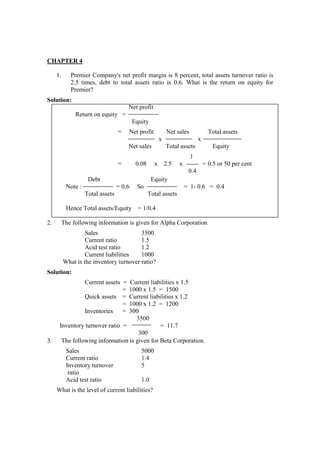
A. Cash flow from operating activities
- Net profit before tax and extraordinary items 11
- Adjustments for
Interest paid 4
Depreciation 5
- Operating profit before working capital changes 20
- Adjustments for
Inventories (11)
Debtors (1)
Trade creditors 5
Provisions 3
Increase in other assets (2)
- Cash generated from operations 14
Income tax paid (2)
- Cash flow before extraordinary items 12
Extraordinary item 1
- Net cash flow from operating activities 13
B. Cash flow from investing activities
- Purchase of fixed assets (9)
- Net cash flow from investing activities (9)
C.
Cash flow from financing activities
- Increase in equity 10
- Repayment of term loans (5)
-Dividend paid (2)
- Interest paid (4)
Net cash flow from financing activities (1)
D. Net increase in cash and cash equivalents 3
- Cash and cash equivalents as on 31.03.20X6 5
- Cash and cash equivalents as on 31.03.20x7 8
Note It has been assumed that “other assets” represent “other current assets”.
(b)
A Cash flow from assets
- Operating cash flow 19
- Net capital spending (9)
- Decrease in net working capital (9)
- Cash flow from assets 1
B. Cash flow to creditors
- Interest paid 4
- Repayment of long term debt 5
- Cash flow to creditors 9
C. Cash flow to shareholders
- Dividends paid 2
- Net new equity raised (10)
- Cash flow to shareholders (8)
We find that
(A) = (B) + ( C)
i.e., Cash flow from assets = Cash flow to creditors + Cash flow to shareholders
CHAPTER 4
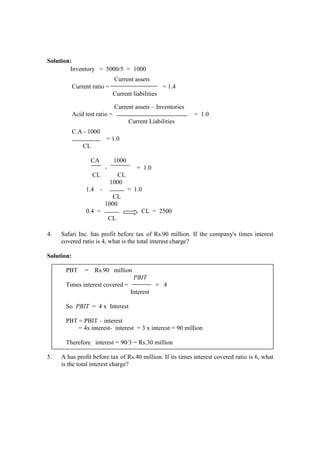
1. Premier Company's net profit margin is 8 percent, total assets turnover ratio is
2.5 times, debt to total assets ratio is 0.6. What is the return on equity for
Premier?
Solution:
Net profit
Return on equity =
Equity
= Net profit Net sales Total assets
x x
Net sales Total assets Equity
1
= 0.08 x 2.5 x = 0.5 or 50 per cent
0.4
Debt Equity
Note : = 0.6 So = 1- 0.6 = 0.4
Total assets Total assets
Hence Total assets/Equity = 1/0.4
2. The following information is given for Alpha Corporation
Sales 3500
Current ratio 1.5
Acid test ratio 1.2
Current liabilities 1000
What is the inventory turnover ratio?
Solution:
Current assets = Current liabilities x 1.5
= 1000 x 1.5 = 1500
Quick assets = Current liabilities x 1.2
= 1000 x 1.2 = 1200
Inventories = 300
3500
Inventory turnover ratio = = 11.7
300
3. The following information is given for Beta Corporation.
Sales 5000
Current ratio 1.4
Inventory turnover 5
ratio
Acid test ratio 1.0
What is the level of current liabilities?
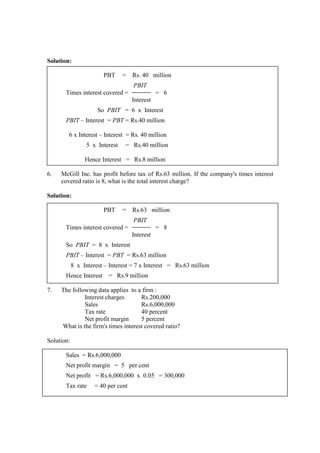
Solution:
4. Safari Inc. has profit before tax of Rs.90 million. If the company's times interest
covered ratio is 4, what is the total interest charge?
Solution:
PBT = Rs.90 million
PBIT
Times interest covered = = 4
Interest
So PBIT = 4 x Interest
PBT = PBIT – interest
= 4x interest- interest = 3 x interest = 90 million
Therefore interest = 90/3 = Rs.30 million
5. A has profit before tax of Rs.40 million. If its times interest covered ratio is 6, what
is the total interest charge?
Inventory = 5000/5 = 1000
Current assets
Current ratio = = 1.4
Current liabilities
Current assets – Inventories
Acid test ratio = = 1.0
Current Liabilities
C.A - 1000
= 1.0
CL
CA 1000
- = 1.0
CL CL
1000
1.4 - = 1.0
CL
1000
0.4 = CL = 2500
CL
Solution:
PBT = Rs. 40 million
PBIT
Times interest covered = = 6
Interest
So PBIT = 6 x Interest
PBIT – Interest = PBT = Rs.40 million
6 x Interest – Interest = Rs. 40 million
5 x Interest = Rs.40 million
Hence Interest = Rs.8 million
6. McGill Inc. has profit before tax of Rs.63 million. If the company's times interest
covered ratio is 8, what is the total interest charge?
Solution:
PBT = Rs.63 million
PBIT
Times interest covered = = 8
Interest
So PBIT = 8 x Interest
PBIT – Interest = PBT = Rs.63 million
8 x Interest – Interest = 7 x Interest = Rs.63 million
Hence Interest = Rs.9 million
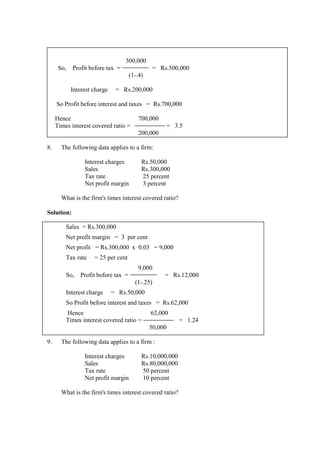
7. The following data applies to a firm :
Interest charges Rs.200,000
Sales Rs.6,000,000
Tax rate 40 percent
Net profit margin 5 percent
What is the firm's times interest covered ratio?
Solution:
Sales = Rs.6,000,000
Net profit margin = 5 per cent
Net profit = Rs.6,000,000 x 0.05 = 300,000
Tax rate = 40 per cent
300,000
So, Profit before tax = = Rs.500,000
(1-.4)
Interest charge = Rs.200,000
So Profit before interest and taxes = Rs.700,000
Hence 700,000
Times interest covered ratio = = 3.5
200,000
8. The following data applies to a firm:
Interest charges Rs.50,000
Sales Rs.300,000
Tax rate 25 percent
Net profit margin 3 percent
What is the firm's times interest covered ratio?
Solution:
Sales = Rs.300,000
Net profit margin = 3 per cent
Net profit = Rs.300,000 x 0.03 = 9,000
Tax rate = 25 per cent
9,000
So, Profit before tax = = Rs.12,000
(1-.25)
Interest charge = Rs.50,000
So Profit before interest and taxes = Rs.62,000
Hence 62,000
Times interest covered ratio = = 1.24
50,000
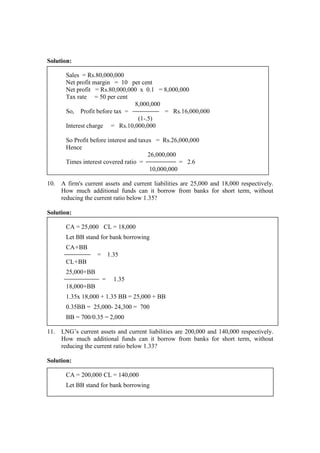
9. The following data applies to a firm :
Interest charges Rs.10,000,000
Sales Rs.80,000,000
Tax rate 50 percent
Net profit margin 10 percent
What is the firm's times interest covered ratio?
Solution:
Sales = Rs.80,000,000
Net profit margin = 10 per cent
Net profit = Rs.80,000,000 x 0.1 = 8,000,000
Tax rate = 50 per cent
8,000,000
So, Profit before tax = = Rs.16,000,000
(1-.5)
Interest charge = Rs.10,000,000
So Profit before interest and taxes = Rs.26,000,000
Hence
26,000,000
Times interest covered ratio = = 2.6
10,000,000
10. A firm's current assets and current liabilities are 25,000 and 18,000 respectively.
How much additional funds can it borrow from banks for short term, without
reducing the current ratio below 1.35?
Solution:
CA = 25,000 CL = 18,000
Let BB stand for bank borrowing
CA+BB
= 1.35
CL+BB
25,000+BB
= 1.35
18,000+BB
1.35x 18,000 + 1.35 BB = 25,000 + BB
0.35BB = 25,000- 24,300 = 700
BB = 700/0.35 = 2,000
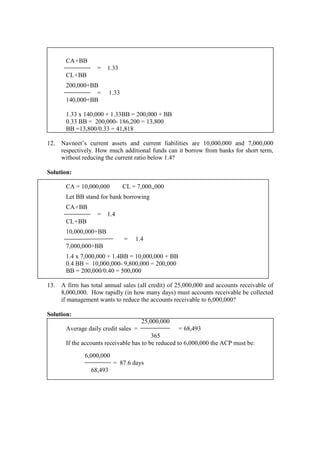
11. LNG’s current assets and current liabilities are 200,000 and 140,000 respectively.
How much additional funds can it borrow from banks for short term, without
reducing the current ratio below 1.33?
Solution:
CA = 200,000 CL = 140,000
Let BB stand for bank borrowing
CA+BB
= 1.33
CL+BB
200,000+BB
= 1.33
140,000+BB
1.33 x 140,000 + 1.33BB = 200,000 + BB
0.33 BB = 200,000- 186,200 = 13,800
BB =13,800/0.33 = 41,818
12. Navneet’s current assets and current liabilities are 10,000,000 and 7,000,000
respectively. How much additional funds can it borrow from banks for short term,
without reducing the current ratio below 1.4?
Solution:
CA = 10,000,000 CL = 7,000,,000
Let BB stand for bank borrowing
CA+BB
= 1.4
CL+BB
10,000,000+BB
= 1.4
7,000,000+BB
1.4 x 7,000,000 + 1.4BB = 10,000,000 + BB
0.4 BB = 10,000,000- 9,800,000 = 200,000
BB = 200,000/0.40 = 500,000
13. A firm has total annual sales (all credit) of 25,000,000 and accounts receivable of
8,000,000. How rapidly (in how many days) must accounts receivable be collected
if management wants to reduce the accounts receivable to 6,000,000?
Solution:
25,000,000
Average daily credit sales = = 68,493
365
If the accounts receivable has to be reduced to 6,000,000 the ACP must be:
6,000,000
= 87.6 days
68,493
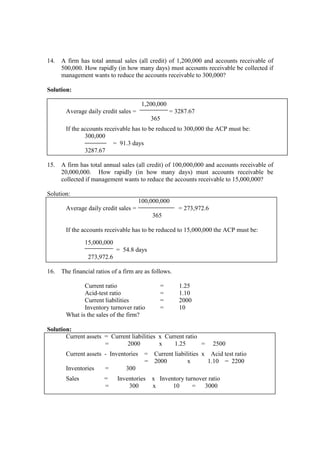
14. A firm has total annual sales (all credit) of 1,200,000 and accounts receivable of
500,000. How rapidly (in how many days) must accounts receivable be collected if
management wants to reduce the accounts receivable to 300,000?
Solution:
1,200,000
Average daily credit sales = = 3287.67
365
If the accounts receivable has to be reduced to 300,000 the ACP must be:
300,000
= 91.3 days
3287.67
15. A firm has total annual sales (all credit) of 100,000,000 and accounts receivable of
20,000,000. How rapidly (in how many days) must accounts receivable be
collected if management wants to reduce the accounts receivable to 15,000,000?
Solution:
100,000,000
Average daily credit sales = = 273,972.6
365
If the accounts receivable has to be reduced to 15,000,000 the ACP must be:
15,000,000
= 54.8 days
273,972.6
16. The financial ratios of a firm are as follows.
Current ratio = 1.25
Acid-test ratio = 1.10
Current liabilities = 2000
Inventory turnover ratio = 10
What is the sales of the firm?
Solution:
Current assets = Current liabilities x Current ratio
= 2000 x 1.25 = 2500
Current assets - Inventories = Current liabilities x Acid test ratio
= 2000 x 1.10 = 2200
Inventories = 300
Sales = Inventories x Inventory turnover ratio
= 300 x 10 = 3000
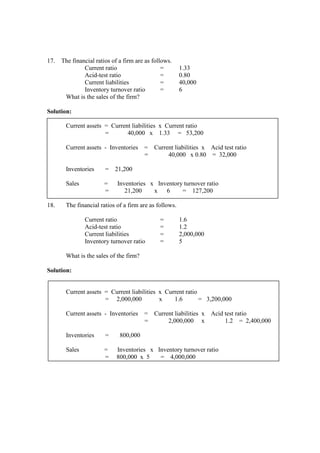
17. The financial ratios of a firm are as follows.
Current ratio = 1.33
Acid-test ratio = 0.80
Current liabilities = 40,000
Inventory turnover ratio = 6
What is the sales of the firm?
Solution:
Current assets = Current liabilities x Current ratio
= 40,000 x 1.33 = 53,200
Current assets - Inventories = Current liabilities x Acid test ratio
= 40,000 x 0.80 = 32,000
Inventories = 21,200
Sales = Inventories x Inventory turnover ratio
= 21,200 x 6 = 127,200
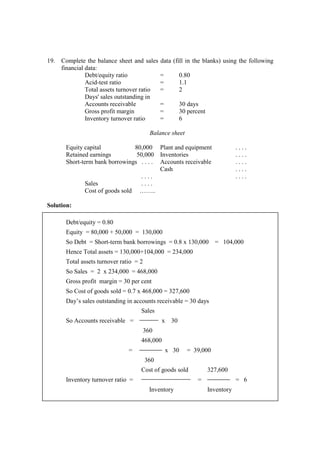
18. The financial ratios of a firm are as follows.
Current ratio = 1.6
Acid-test ratio = 1.2
Current liabilities = 2,000,000
Inventory turnover ratio = 5
What is the sales of the firm?
Solution:
Current assets = Current liabilities x Current ratio
= 2,000,000 x 1.6 = 3,200,000
Current assets - Inventories = Current liabilities x Acid test ratio
= 2,000,000 x 1.2 = 2,400,000
Inventories = 800,000
Sales = Inventories x Inventory turnover ratio
= 800,000 x 5 = 4,000,000
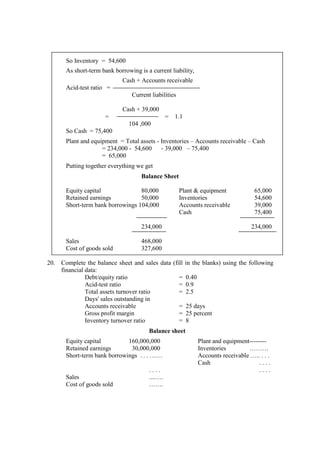
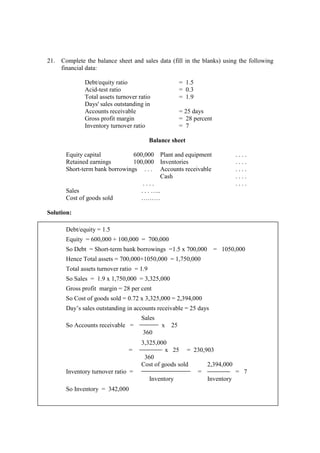
19. Complete the balance sheet and sales data (fill in the blanks) using the following
financial data:
Debt/equity ratio = 0.80
Acid-test ratio = 1.1
Total assets turnover ratio = 2
Days' sales outstanding in
Accounts receivable = 30 days
Gross profit margin = 30 percent
Inventory turnover ratio = 6
Balance sheet
Equity capital 80,000 Plant and equipment . . . .
Retained earnings 50,000 Inventories . . . .
Short-term bank borrowings . . . . Accounts receivable . . . .
Cash . . . .
. . . . . . . .
Sales . . . .
Cost of goods sold ……..
Solution:
Debt/equity = 0.80
Equity = 80,000 + 50,000 = 130,000
So Debt = Short-term bank borrowings = 0.8 x 130,000 = 104,000
Hence Total assets = 130,000+104,000 = 234,000
Total assets turnover ratio = 2
So Sales = 2 x 234,000 = 468,000
Gross profit margin = 30 per cent
So Cost of goods sold = 0.7 x 468,000 = 327,600
Day’s sales outstanding in accounts receivable = 30 days
Sales
So Accounts receivable = x 30
360
468,000
= x 30 = 39,000
360
Cost of goods sold 327,600
Inventory turnover ratio = = = 6
Inventory Inventory
So Inventory = 54,600
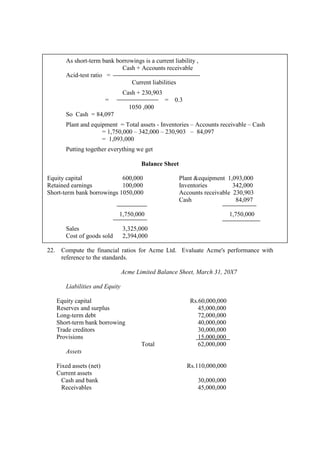
As short-term bank borrowing is a current liability,
Cash + Accounts receivable
Acid-test ratio =
Current liabilities
Cash + 39,000
= = 1.1
104 ,000
So Cash = 75,400
Plant and equipment = Total assets - Inventories – Accounts receivable – Cash
= 234,000 - 54,600 - 39,000 – 75,400
= 65,000
Putting together everything we get
Balance Sheet
Equity capital 80,000 Plant & equipment 65,000
Retained earnings 50,000 Inventories 54,600
Short-term bank borrowings 104,000 Accounts receivable 39,000
Cash 75,400
234,000 234,000
Sales 468,000
Cost of goods sold 327,600
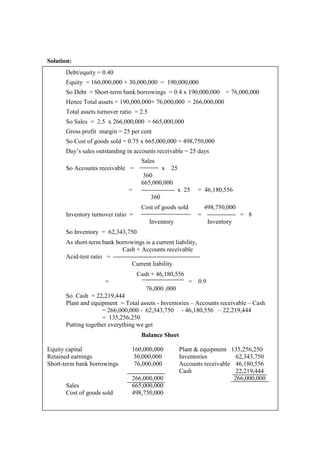
20. Complete the balance sheet and sales data (fill in the blanks) using the following
financial data:
Debt/equity ratio = 0.40
Acid-test ratio = 0.9
Total assets turnover ratio = 2.5
Days' sales outstanding in
Accounts receivable = 25 days
Gross profit margin = 25 percent
Inventory turnover ratio = 8
Balance sheet
Equity capital 160,000,000 Plant and equipment--------
Retained earnings 30,000,000 Inventories ………
Short-term bank borrowings . . . …… Accounts receivable ….. . . .
Cash . . . .
. . . . . . . .
Sales ....….
Cost of goods sold …….
Solution:
Debt/equity = 0.40
Equity = 160,000,000 + 30,000,000 = 190,000,000
So Debt = Short-term bank borrowings = 0.4 x 190,000,000 = 76,000,000
Hence Total assets = 190,000,000+ 76,000,000 = 266,000,000
Total assets turnover ratio = 2.5
So Sales = 2.5 x 266,000,000 = 665,000,000
Gross profit margin = 25 per cent
So Cost of goods sold = 0.75 x 665,000,000 = 498,750,000
Day’s sales outstanding in accounts receivable = 25 days
Sales
So Accounts receivable = x 25
360
665,000,000
= x 25 = 46,180,556
360
Cost of goods sold 498,750,000
Inventory turnover ratio = = = 8
Inventory Inventory
So Inventory = 62,343,750
As short-term bank borrowings is a current liability,
Cash + Accounts receivable
Acid-test ratio =
Current liability
Cash + 46,180,556
= = 0.9
76,000 ,000
So Cash = 22,219,444
Plant and equipment = Total assets - Inventories – Accounts receivable – Cash
= 266,000,000 - 62,343,750 - 46,180,556 – 22,219,444
= 135,256,250
Putting together everything we get
Balance Sheet
Equity capital 160,000,000 Plant & equipment 135,256,250
Retained earnings 30,000,000 Inventories 62,343,750
Short-term bank borrowings 76,000,000 Accounts receivable 46,180,556
Cash 22,219,444
266,000,000 266,000,000
Sales 665,000,000
Cost of goods sold 498,750,000
21. Complete the balance sheet and sales data (fill in the blanks) using the following
financial data:
Debt/equity ratio = 1.5
Acid-test ratio = 0.3
Total assets turnover ratio = 1.9
Days' sales outstanding in
Accounts receivable = 25 days
Gross profit margin = 28 percent
Inventory turnover ratio = 7
Balance sheet
Equity capital 600,000 Plant and equipment . . . .
Retained earnings 100,000 Inventories . . . .
Short-term bank borrowings . . . Accounts receivable . . . .
Cash . . . .
. . . . . . . .
Sales . . . …..
Cost of goods sold ………
Solution:
Debt/equity = 1.5
Equity = 600,000 + 100,000 = 700,000
So Debt = Short-term bank borrowings =1.5 x 700,000 = 1050,000
Hence Total assets = 700,000+1050,000 = 1,750,000
Total assets turnover ratio = 1.9
So Sales = 1.9 x 1,750,000 = 3,325,000
Gross profit margin = 28 per cent
So Cost of goods sold = 0.72 x 3,325,000 = 2,394,000
Day’s sales outstanding in accounts receivable = 25 days
Sales
So Accounts receivable = x 25
360
3,325,000
= x 25 = 230,903
360
Cost of goods sold 2,394,000
Inventory turnover ratio = = = 7
Inventory Inventory
So Inventory = 342,000
As short-term bank borrowings is a current liability ,
Cash + Accounts receivable
Acid-test ratio =
Current liabilities
Cash + 230,903
= = 0.3
1050 ,000
So Cash = 84,097
Plant and equipment = Total assets - Inventories – Accounts receivable – Cash
= 1,750,000 – 342,000 – 230,903 – 84,097
= 1,093,000
Putting together everything we get
Balance Sheet
Equity capital 600,000 Plant &equipment 1,093,000
Retained earnings 100,000 Inventories 342,000
Short-term bank borrowings 1050,000 Accounts receivable 230,903
Cash 84,097
1,750,000 1,750,000
Sales 3,325,000
Cost of goods sold 2,394,000
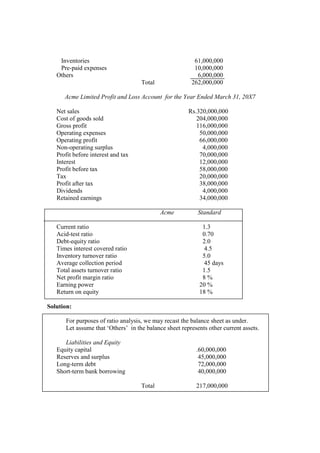
22. Compute the financial ratios for Acme Ltd. Evaluate Acme's performance with
reference to the standards.
Acme Limited Balance Sheet, March 31, 20X7
Liabilities and Equity
Equity capital Rs.60,000,000
Reserves and surplus 45,000,000
Long-term debt 72,000,000
Short-term bank borrowing 40,000,000
Trade creditors 30,000,000
Provisions 15,000,000
Total 62,000,000
Assets
Fixed assets (net) Rs.110,000,000
Current assets
Cash and bank 30,000,000
Receivables 45,000,000
Inventories 61,000,000
Pre-paid expenses 10,000,000
Others 6,000,000
Total 262,000,000
Acme Limited Profit and Loss Account for the Year Ended March 31, 20X7
Net sales Rs.320,000,000
Cost of goods sold 204,000,000
Gross profit 116,000,000
Operating expenses 50,000,000
Operating profit 66,000,000
Non-operating surplus 4,000,000
Profit before interest and tax 70,000,000
Interest 12,000,000
Profit before tax 58,000,000
Tax 20,000,000
Profit after tax 38,000,000
Dividends 4,000,000
Retained earnings 34,000,000
Acme Standard
Current ratio 1.3
Acid-test ratio 0.70
Debt-equity ratio 2.0
Times interest covered ratio 4.5
Inventory turnover ratio 5.0
Average collection period 45 days
Total assets turnover ratio 1.5
Net profit margin ratio 8 %
Earning power 20 %
Return on equity 18 %
Solution:
For purposes of ratio analysis, we may recast the balance sheet as under.
Let assume that ‘Others’ in the balance sheet represents other current assets.
Liabilities and Equity
Equity capital .60,000,000
Reserves and surplus 45,000,000
Long-term debt 72,000,000
Short-term bank borrowing 40,000,000
Total 217,000,000
Fixed assets (net) 110,000,000
Current assets
Cash and bank 30,000,000
Receivables 45,000,000
Inventories 61,000,000
Pre-paid expenses 10,000,000
Others 6,000,000 152,000,000
Less:
Current liabilities
Trade creditors 30,000,000
Provisions 15,000,000 45,000,000
Net current assets 107,000,000
Total 217,000,000
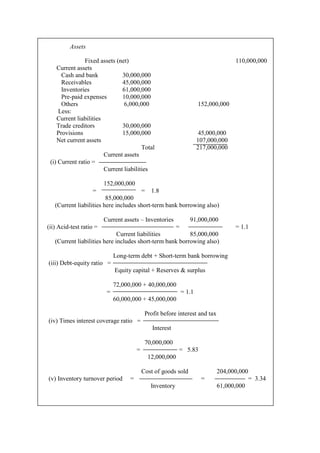
Current assets
(i) Current ratio =
Current liabilities
152,000,000
= = 1.8
85,000,000
(Current liabilities here includes short-term bank borrowing also)
Current assets – Inventories 91,000,000
(ii) Acid-test ratio = = = 1.1
Current liabilities 85,000,000
(Current liabilities here includes short-term bank borrowing also)
Long-term debt + Short-term bank borrowing
(iii) Debt-equity ratio =
Equity capital + Reserves & surplus
72,000,000 + 40,000,000
= = 1.1
60,000,000 + 45,000,000
Profit before interest and tax
(iv) Times interest coverage ratio =
Interest
70,000,000
= = 5.83
12,000,000
Cost of goods sold 204,000,000
(v) Inventory turnover period = = = 3.34
Inventory 61,000,000
Assets
365
(vi) Average collection period =
Net sales / Accounts receivable
365
= = 51.3 days
320,000,000/45,000,000
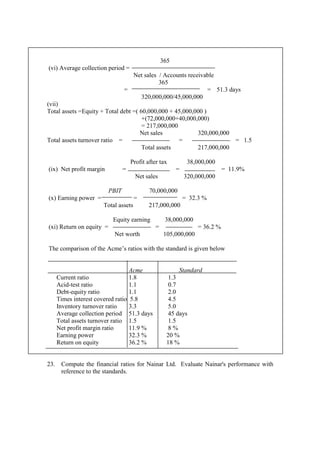
(vii)
Total assets =Equity + Total debt =( 60,000,000 + 45,000,000 )
+(72,000,000+40,000,000)
= 217,000,000
Net sales 320,000,000
Total assets turnover ratio = = = 1.5
Total assets 217,000,000
Profit after tax 38,000,000
(ix) Net profit margin = = = 11.9%
Net sales 320,000,000
PBIT 70,000,000
(x) Earning power = = = 32.3 %
Total assets 217,000,000
Equity earning 38,000,000
(xi) Return on equity = = = 36.2 %
Net worth 105,000,000
The comparison of the Acme’s ratios with the standard is given below
Acme Standard
Current ratio 1.8 1.3
Acid-test ratio 1.1 0.7
Debt-equity ratio 1.1 2.0
Times interest covered ratio 5.8 4.5
Inventory turnover ratio 3.3 5.0
Average collection period 51.3 days 45 days
Total assets turnover ratio 1.5 1.5
Net profit margin ratio 11.9 % 8 %
Earning power 32.3 % 20 %
Return on equity 36.2 % 18 %
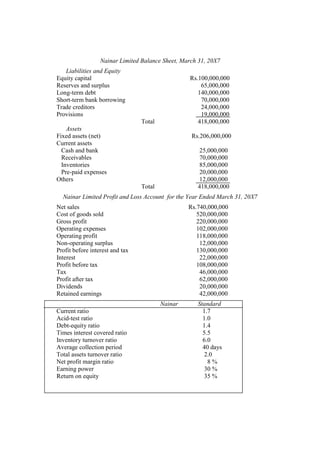
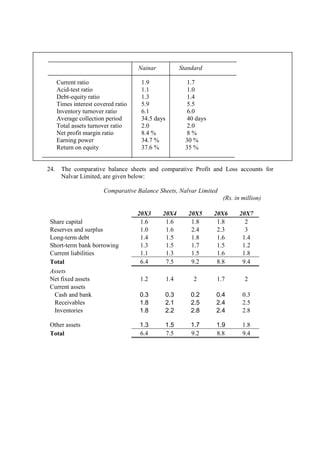
23. Compute the financial ratios for Nainar Ltd. Evaluate Nainar's performance with
reference to the standards.
Nainar Limited Balance Sheet, March 31, 20X7
Liabilities and Equity
Equity capital Rs.100,000,000
Reserves and surplus 65,000,000
Long-term debt 140,000,000
Short-term bank borrowing 70,000,000
Trade creditors 24,000,000
Provisions 19,000,000
Total 418,000,000
Assets
Fixed assets (net) Rs.206,000,000
Current assets
Cash and bank 25,000,000
Receivables 70,000,000
Inventories 85,000,000
Pre-paid expenses 20,000,000
Others 12,000,000
Total 418,000,000
Nainar Limited Profit and Loss Account for the Year Ended March 31, 20X7
Net sales Rs.740,000,000
Cost of goods sold 520,000,000
Gross profit 220,000,000
Operating expenses 102,000,000
Operating profit 118,000,000
Non-operating surplus 12,000,000
Profit before interest and tax 130,000,000
Interest 22,000,000
Profit before tax 108,000,000
Tax 46,000,000
Profit after tax 62,000,000
Dividends 20,000,000
Retained earnings 42,000,000
Nainar Standard
Current ratio 1.7
Acid-test ratio 1.0
Debt-equity ratio 1.4
Times interest covered ratio 5.5
Inventory turnover ratio 6.0
Average collection period 40 days
Total assets turnover ratio 2.0
Net profit margin ratio 8 %
Earning power 30 %
Return on equity 35 %
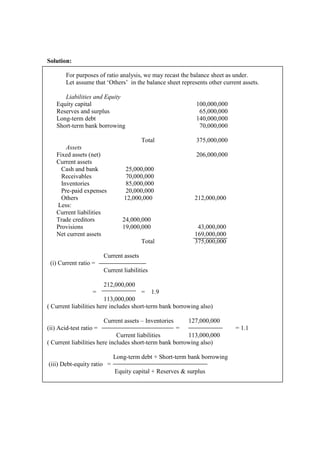
Solution:
For purposes of ratio analysis, we may recast the balance sheet as under.
Let assume that ‘Others’ in the balance sheet represents other current assets.
Liabilities and Equity
Equity capital 100,000,000
Reserves and surplus 65,000,000
Long-term debt 140,000,000
Short-term bank borrowing 70,000,000
Total 375,000,000
Assets
Fixed assets (net) 206,000,000
Current assets
Cash and bank 25,000,000
Receivables 70,000,000
Inventories 85,000,000
Pre-paid expenses 20,000,000
Others 12,000,000 212,000,000
Less:
Current liabilities
Trade creditors 24,000,000
Provisions 19,000,000 43,000,000
Net current assets 169,000,000
Total 375,000,000
Current assets
(i) Current ratio =
Current liabilities
212,000,000
= = 1.9
113,000,000
( Current liabilities here includes short-term bank borrowing also)
Current assets – Inventories 127,000,000
(ii) Acid-test ratio = = = 1.1
Current liabilities 113,000,000
( Current liabilities here includes short-term bank borrowing also)
Long-term debt + Short-term bank borrowing
(iii) Debt-equity ratio =
Equity capital + Reserves & surplus
140,000,000 + 70,000,000
= = 1.3
100,000,000 + 65,000,000
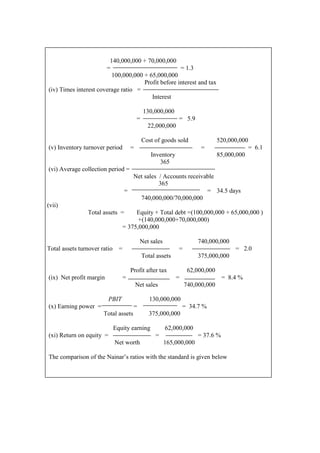
Profit before interest and tax
(iv) Times interest coverage ratio =
Interest
130,000,000
= = 5.9
22,000,000
Cost of goods sold 520,000,000
(v) Inventory turnover period = = = 6.1
Inventory 85,000,000
365
(vi) Average collection period =
Net sales / Accounts receivable
365
= = 34.5 days
740,000,000/70,000,000
(vii)
Total assets = Equity + Total debt =(100,000,000 + 65,000,000 )
+(140,000,000+70,000,000)
= 375,000,000
Net sales 740,000,000
Total assets turnover ratio = = = 2.0
Total assets 375,000,000
Profit after tax 62,000,000
(ix) Net profit margin = = = 8.4 %
Net sales 740,000,000
PBIT 130,000,000
(x) Earning power = = = 34.7 %
Total assets 375,000,000
Equity earning 62,000,000
(xi) Return on equity = = = 37.6 %
Net worth 165,000,000
The comparison of the Nainar’s ratios with the standard is given below
Nainar Standard
Current ratio 1.9 1.7
Acid-test ratio 1.1 1.0
Debt-equity ratio 1.3 1.4
Times interest covered ratio 5.9 5.5
Inventory turnover ratio 6.1 6.0
Average collection period 34.5 days 40 days
Total assets turnover ratio 2.0 2.0
Net profit margin ratio 8.4 % 8 %
Earning power 34.7 % 30 %
Return on equity 37.6 % 35 %
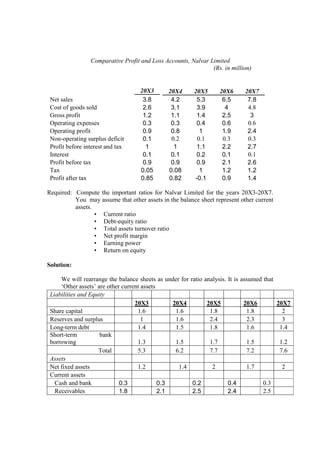
24. The comparative balance sheets and comparative Profit and Loss accounts for
Nalvar Limited, are given below:
Comparative Balance Sheets, Nalvar Limited
(Rs. in million)
20X3 20X4 20X5 20X6 20X7
Share capital 1.6 1.6 1.8 1.8 2
Reserves and surplus 1.0 1.6 2.4 2.3 3
Long-term debt 1.4 1.5 1.8 1.6 1.4
Short-term bank borrowing 1.3 1.5 1.7 1.5 1.2
Current liabilities 1.1 1.3 1.5 1.6 1.8
Total 6.4 7.5 9.2 8.8 9.4
Assets
Net fixed assets 1.2 1.4 2 1.7 2
Current assets
Cash and bank 0.3 0.3 0.2 0.4 0.3
Receivables 1.8 2.1 2.5 2.4 2.5
Inventories 1.8 2.2 2.8 2.4 2.8
Other assets 1.3 1.5 1.7 1.9 1.8
Total 6.4 7.5 9.2 8.8 9.4
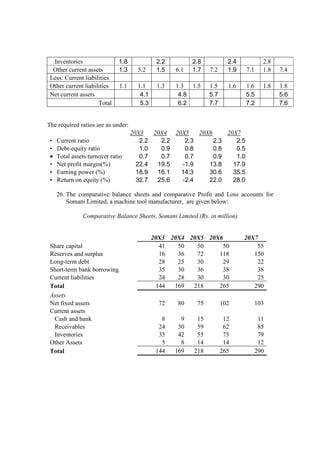
Comparative Profit and Loss Accounts, Nalvar Limited
(Rs. in million)
20X3 20X4 20X5 20X6 20X7
Net sales 3.8 4.2 5.3 6.5 7.8
Cost of goods sold 2.6 3.1 3.9 4 4.8
Gross profit 1.2 1.1 1.4 2.5 3
Operating expenses 0.3 0.3 0.4 0.6 0.6
Operating profit 0.9 0.8 1 1.9 2.4
Non-operating surplus deficit 0.1 0.2 0.1 0.3 0.3
Profit before interest and tax 1 1 1.1 2.2 2.7
Interest 0.1 0.1 0.2 0.1 0.1
Profit before tax 0.9 0.9 0.9 2.1 2.6
Tax 0.05 0.08 1 1.2 1.2
Profit after tax 0.85 0.82 -0.1 0.9 1.4
Required: Compute the important ratios for Nalvar Limited for the years 20X3-20X7.
You may assume that other assets in the balance sheet represent other current
assets.
• Current ratio
• Debt-equity ratio
• Total assets turnover ratio
• Net profit margin
• Earning power
• Return on equity
Solution:
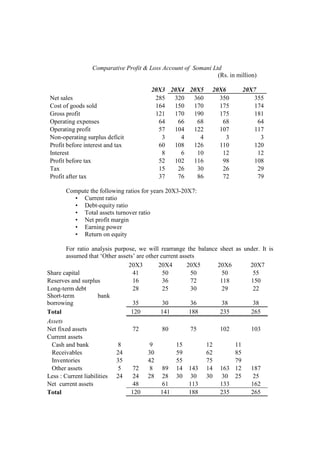
We will rearrange the balance sheets as under for ratio analysis. It is assumed that
‘Other assets’ are other current assets
Liabilities and Equity
20X3 20X4 20X5 20X6 20X7
Share capital 1.6 1.6 1.8 1.8 2
Reserves and surplus 1 1.6 2.4 2.3 3
Long-term debt 1.4 1.5 1.8 1.6 1.4
Short-term bank
borrowing 1.3 1.5 1.7 1.5 1.2
Total 5.3 6.2 7.7 7.2 7.6
Assets
Net fixed assets 1.2 1.4 2 1.7 2
Current assets
Cash and bank 0.3 0.3 0.2 0.4 0.3
Receivables 1.8 2.1 2.5 2.4 2.5
Inventories 1.8 2.2 2.8 2.4 2.8
Other current assets 1.3 5.2 1.5 6.1 1.7 7.2 1.9 7.1 1.8 7.4
Less: Current liabilities
Other current liabilities 1.1 1.1 1.3 1.3 1.5 1.5 1.6 1.6 1.8 1.8
Net current assets 4.1 4.8 5.7 5.5 5.6
Total 5.3 6.2 7.7 7.2 7.6
The required ratios are as under:
20X3 20X4 20X5 20X6 20X7
• Current ratio 2.2 2.2 2.3 2.3 2.5
• Debt-equity ratio 1.0 0.9 0.8 0.8 0.5
• Total assets turnover ratio 0.7 0.7 0.7 0.9 1.0
• Net profit margin(%) 22.4 19.5 -1.9 13.8 17.9
• Earning power (%) 18.9 16.1 14.3 30.6 35.5
• Return on equity (%) 32.7 25.6 -2.4 22.0 28.0
26. The comparative balance sheets and comparative Profit and Loss accounts for
Somani Limited, a machine tool manufacturer, are given below:
Comparative Balance Sheets, Somani Limited (Rs. in million)
20X3 20X4 20X5 20X6 20X7
Share capital 41 50 50 50 55
Reserves and surplus 16 36 72 118 150
Long-term debt 28 25 30 29 22
Short-term bank borrowing 35 30 36 38 38
Current liabilities 24 28 30 30 25
Total 144 169 218 265 290
Assets
Net fixed assets 72 80 75 102 103
Current assets
Cash and bank 8 9 15 12 11
Receivables 24 30 59 62 85
Inventories 35 42 55 75 79
Other Assets 5 8 14 14 12
Total 144 169 218 265 290
Comparative Profit & Loss Account of Somani Ltd
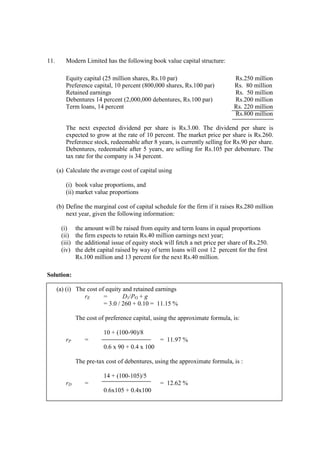
(Rs. in million)
20X3 20X4 20X5 20X6 20X7
Net sales 285 320 360 350 355
Cost of goods sold 164 150 170 175 174
Gross profit 121 170 190 175 181
Operating expenses 64 66 68 68 64
Operating profit 57 104 122 107 117
Non-operating surplus deficit 3 4 4 3 3
Profit before interest and tax 60 108 126 110 120
Interest 8 6 10 12 12
Profit before tax 52 102 116 98 108
Tax 15 26 30 26 29
Profit after tax 37 76 86 72 79
Compute the following ratios for years 20X3-20X7:
• Current ratio
• Debt-equity ratio
• Total assets turnover ratio
• Net profit margin
• Earning power
• Return on equity
For ratio analysis purpose, we will rearrange the balance sheet as under. It is
assumed that ‘Other assets’ are other current assets
20X3 20X4 20X5 20X6 20X7
Share capital 41 50 50 50 55
Reserves and surplus 16 36 72 118 150
Long-term debt 28 25 30 29 22
Short-term bank
borrowing 35 30 36 38 38
Total 120 141 188 235 265
Assets
Net fixed assets 72 80 75 102 103
Current assets
Cash and bank 8 9 15 12 11
Receivables 24 30 59 62 85
Inventories 35 42 55 75 79
Other assets 5 72 8 89 14 143 14 163 12 187
Less : Current liabilities 24 24 28 28 30 30 30 30 25 25
Net current assets 48 61 113 133 162
Total 120 141 188 235 265
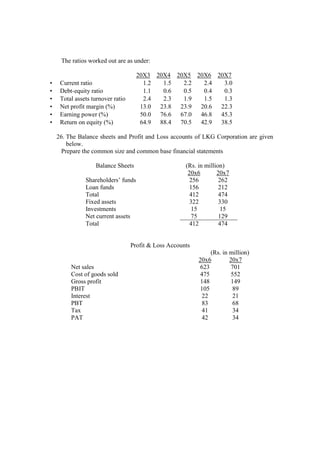
The ratios worked out are as under:
20X3 20X4 20X5 20X6 20X7
• Current ratio 1.2 1.5 2.2 2.4 3.0
• Debt-equity ratio 1.1 0.6 0.5 0.4 0.3
• Total assets turnover ratio 2.4 2.3 1.9 1.5 1.3
• Net profit margin (%) 13.0 23.8 23.9 20.6 22.3
• Earning power (%) 50.0 76.6 67.0 46.8 45.3
• Return on equity (%) 64.9 88.4 70.5 42.9 38.5
26. The Balance sheets and Profit and Loss accounts of LKG Corporation are given
below.
Prepare the common size and common base financial statements
Balance Sheets (Rs. in million)
20x6 20x7
Shareholders’ funds 256 262
Loan funds 156 212
Total 412 474
Fixed assets 322 330
Investments 15 15
Net current assets 75 129
Total 412 474
Profit & Loss Accounts
(Rs. in million)
20x6 20x7
Net sales 623 701
Cost of goods sold 475 552
Gross profit 148 149
PBIT 105 89
Interest 22 21
PBT 83 68
Tax 41 34
PAT 42 34
Solution:
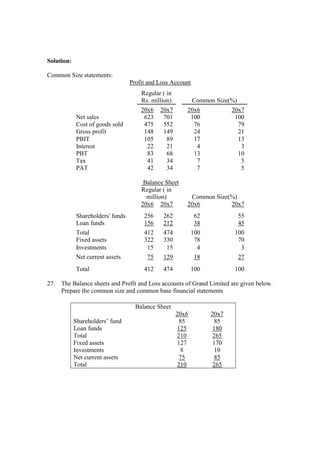
Common Size statements:
Profit and Loss Account
Regular ( in
Rs. million) Common Size(%)
20x6 20x7 20x6 20x7
Net sales 623 701 100 100
Cost of goods sold 475 552 76 79
Gross profit 148 149 24 21
PBIT 105 89 17 13
Interest 22 21 4 3
PBT 83 68 13 10
Tax 41 34 7 5
PAT 42 34 7 5
Balance Sheet
Regular ( in
million) Common Size(%)
20x6 20x7 20x6 20x7
Shareholders' funds 256 262 62 55
Loan funds 156 212 38 45
Total 412 474 100 100
Fixed assets 322 330 78 70
Investments 15 15 4 3
Net current assets 75 129 18 27
Total 412 474 100 100
27. The Balance sheets and Profit and Loss accounts of Grand Limited are given below.
Prepare the common size and common base financial statements
Balance Sheet
20x6 20x7
Shareholders’ fund 85 85
Loan funds 125 180
Total 210 265
Fixed assets 127 170
Investments 8 10
Net current assets 75 85
Total 210 265
Profit & Loss Account
20x6 20x7
Net sales 450 560
Cost of goods sold 320 410
Gross profit 130 150
PBIT 85 98
Interest 12 17
PBT 73 81
Tax 22 38
PAT 51 43
Solution:
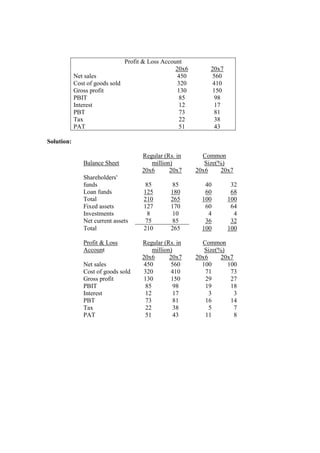
Balance Sheet
Regular (Rs. in
million)
Common
Size(%)
20x6 20x7 20x6 20x7
Shareholders'
funds 85 85 40 32
Loan funds 125 180 60 68
Total 210 265 100 100
Fixed assets 127 170 60 64
Investments 8 10 4 4
Net current assets 75 85 36 32
Total 210 265 100 100
Profit & Loss
Account
Regular (Rs. in
million)
Common
Size(%)
20x6 20x7 20x6 20x7
Net sales 450 560 100 100
Cost of goods sold 320 410 71 73
Gross profit 130 150 29 27
PBIT 85 98 19 18
Interest 12 17 3 3
PBT 73 81 16 14
Tax 22 38 5 7
PAT 51 43 11 8
Common base year statements
Balance Sheet
Regular (Rs. in
million)
Common base year
(%)
20x6 20x7 20x6 20x7
Shareholders' funds 85 85 100 100
Loan funds 125 180 100 144
Total 210 265 100 126
Fixed assets 127 170 100 134
Investments 8 10 100 125
Net current assets 75 85 100 113
Total 210 265 100 126
Profit & Loss Account
Regular (Rs. in
million)
Common base
year (%)
20x6 20x7 20x6 20x7
Net sales 450 560 100 124
Cost of goods sold 320 410 100 128
Gross profit 130 150 100 115
PBIT 85 98 100 115
Interest 12 17 100 142
PBT 73 81 100 111
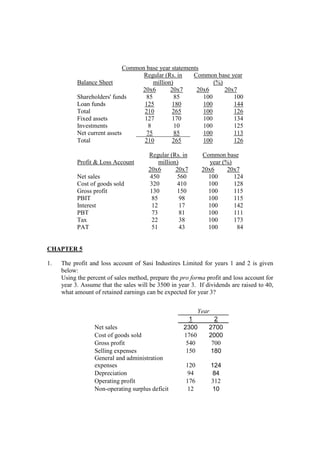
Tax 22 38 100 173
PAT 51 43 100 84
CHAPTER 5
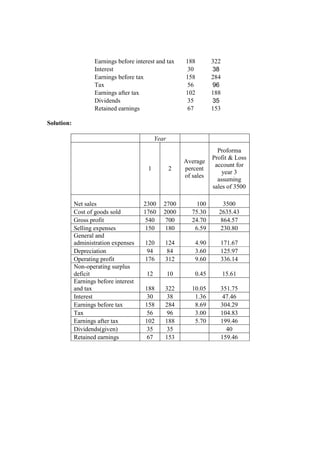
1. The profit and loss account of Sasi Industires Limited for years 1 and 2 is given
below:
Using the percent of sales method, prepare the pro forma profit and loss account for
year 3. Assume that the sales will be 3500 in year 3. If dividends are raised to 40,
what amount of retained earnings can be expected for year 3?
Year
1 2
Net sales 2300 2700
Cost of goods sold 1760 2000
Gross profit 540 700
Selling expenses 150 180
General and administration
expenses 120 124
Depreciation 94 84
Operating profit 176 312
Non-operating surplus deficit 12 10
Earnings before interest and tax 188 322
Interest 30 38
Earnings before tax 158 284
Tax 56 96
Earnings after tax 102 188
Dividends 35 35
Retained earnings 67 153
Solution:
Year
1 2
Average
percent
of sales
Proforma
Profit & Loss
account for
year 3
assuming
sales of 3500
Net sales 2300 2700 100 3500
Cost of goods sold 1760 2000 75.30 2635.43
Gross profit 540 700 24.70 864.57
Selling expenses 150 180 6.59 230.80
General and
administration expenses 120 124 4.90 171.67
Depreciation 94 84 3.60 125.97
Operating profit 176 312 9.60 336.14
Non-operating surplus
deficit 12 10 0.45 15.61
Earnings before interest
and tax 188 322 10.05 351.75
Interest 30 38 1.36 47.46
Earnings before tax 158 284 8.69 304.29
Tax 56 96 3.00 104.83
Earnings after tax 102 188 5.70 199.46
Dividends(given) 35 35 40
Retained earnings 67 153 159.46
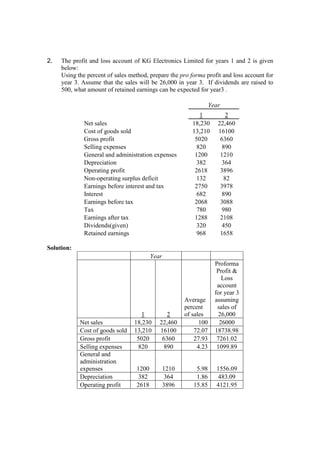
2. The profit and loss account of KG Electronics Limited for years 1 and 2 is given
below:
Using the percent of sales method, prepare the pro forma profit and loss account for
year 3. Assume that the sales will be 26,000 in year 3. If dividends are raised to
500, what amount of retained earnings can be expected for year3 .
Year
1 2
Net sales 18,230 22,460
Cost of goods sold 13,210 16100
Gross profit 5020 6360
Selling expenses 820 890
General and administration expenses 1200 1210
Depreciation 382 364
Operating profit 2618 3896
Non-operating surplus deficit 132 82
Earnings before interest and tax 2750 3978
Interest 682 890
Earnings before tax 2068 3088
Tax 780 980
Earnings after tax 1288 2108
Dividends(given) 320 450
Retained earnings 968 1658
Solution:
Year
1 2
Average
percent
of sales
Proforma
Profit &
Loss
account
for year 3
assuming
sales of
26,000
Net sales 18,230 22,460 100 26000
Cost of goods sold 13,210 16100 72.07 18738.98
Gross profit 5020 6360 27.93 7261.02
Selling expenses 820 890 4.23 1099.89
General and
administration
expenses 1200 1210 5.98 1556.09
Depreciation 382 364 1.86 483.09
Operating profit 2618 3896 15.85 4121.95
Non-operating
surplus deficit 132 82 0.54 141.59
Earnings before
interest and tax 2750 3978 16.40 4263.55
Interest 682 890 3.85 1001.48
Earnings before
tax 2068 3088 12.55 3262.07
Tax 780 980 4.32 1123.46
Earnings after tax 1288 2108 8.23 2138.61
Dividends(given) 320 450 500
Retained earnings 968 1658 1638.61
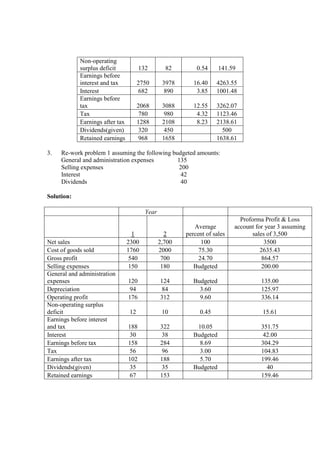
3. Re-work problem 1 assuming the following budgeted amounts:
General and administration expenses 135
Selling expenses 200
Interest 42
Dividends 40
Solution:
Year
1 2
Average
percent of sales
Proforma Profit & Loss
account for year 3 assuming
sales of 3,500
Net sales 2300 2,700 100 3500
Cost of goods sold 1760 2000 75.30 2635.43
Gross profit 540 700 24.70 864.57
Selling expenses 150 180 Budgeted 200.00
General and administration
expenses 120 124 Budgeted 135.00
Depreciation 94 84 3.60 125.97
Operating profit 176 312 9.60 336.14
Non-operating surplus
deficit 12 10 0.45 15.61
Earnings before interest
and tax 188 322 10.05 351.75
Interest 30 38 Budgeted 42.00
Earnings before tax 158 284 8.69 304.29
Tax 56 96 3.00 104.83
Earnings after tax 102 188 5.70 199.46
Dividends(given) 35 35 Budgeted 40
Retained earnings 67 153 159.46
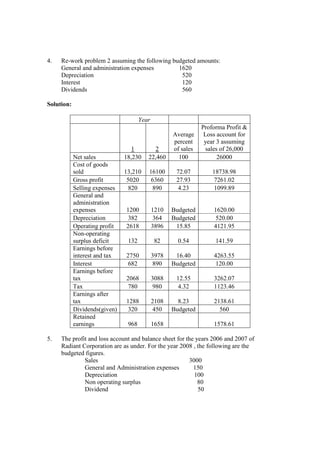
4. Re-work problem 2 assuming the following budgeted amounts:
General and administration expenses 1620
Depreciation 520
Interest 120
Dividends 560
Solution:
Year
1 2
Average
percent
of sales
Proforma Profit &
Loss account for
year 3 assuming
sales of 26,000
Net sales 18,230 22,460 100 26000
Cost of goods
sold 13,210 16100 72.07 18738.98
Gross profit 5020 6360 27.93 7261.02
Selling expenses 820 890 4.23 1099.89
General and
administration
expenses 1200 1210 Budgeted 1620.00
Depreciation 382 364 Budgeted 520.00
Operating profit 2618 3896 15.85 4121.95
Non-operating
surplus deficit 132 82 0.54 141.59
Earnings before
interest and tax 2750 3978 16.40 4263.55
Interest 682 890 Budgeted 120.00
Earnings before
tax 2068 3088 12.55 3262.07
Tax 780 980 4.32 1123.46
Earnings after
tax 1288 2108 8.23 2138.61
Dividends(given) 320 450 Budgeted 560
Retained
earnings 968 1658 1578.61
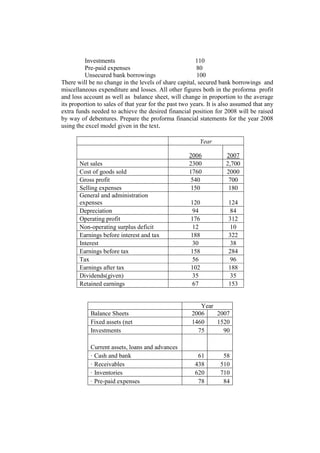
5. The profit and loss account and balance sheet for the years 2006 and 2007 of
Radiant Corporation are as under. For the year 2008 , the following are the
budgeted figures.
Sales 3000
General and Administration expenses 150
Depreciation 100
Non operating surplus 80
Dividend 50
Investments 110
Pre-paid expenses 80
Unsecured bank borrowings 100
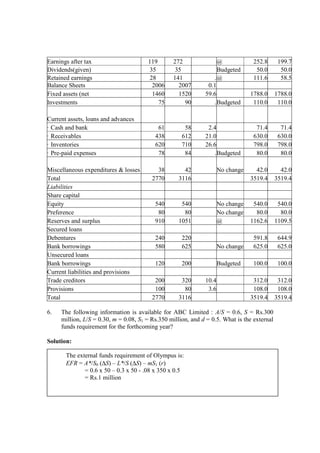
There will be no change in the levels of share capital, secured bank borrowings and
miscellaneous expenditure and losses. All other figures both in the proforma profit
and loss account as well as balance sheet, will change in proportion to the average
its proportion to sales of that year for the past two years. It is also assumed that any
extra funds needed to achieve the desired financial position for 2008 will be raised
by way of debentures. Prepare the proforma financial statements for the year 2008
using the excel model given in the text.
Year
2006 2007
Net sales 2300 2,700
Cost of goods sold 1760 2000
Gross profit 540 700
Selling expenses 150 180
General and administration
expenses 120 124
Depreciation 94 84
Operating profit 176 312
Non-operating surplus deficit 12 10
Earnings before interest and tax 188 322
Interest 30 38
Earnings before tax 158 284
Tax 56 96
Earnings after tax 102 188
Dividends(given) 35 35
Retained earnings 67 153
Year
Balance Sheets 2006 2007
Fixed assets (net 1460 1520
Investments 75 90
Current assets, loans and advances
· Cash and bank 61 58
· Receivables 438 510
· Inventories 620 710
· Pre-paid expenses 78 84
Miscellaneous expenditures &
losses 38 42
Total 2770 3014
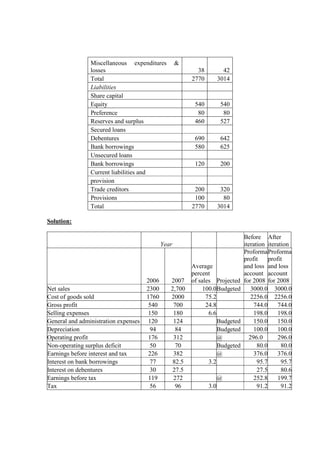
Liabilities
Share capital
Equity 540 540
Preference 80 80
Reserves and surplus 460 527
Secured loans
Debentures 690 642
Bank borrowings 580 625
Unsecured loans
Bank borrowings 120 200
Current liabilities and
provision
Trade creditors 200 320
Provisions 100 80
Total 2770 3014
Solution:
Year
Before
iteration
After
iteration
2006 2007
Average
percent
of sales Projected
Proforma
profit
and loss
account
for 2008
Proforma
profit
and loss
account
for 2008
Net sales 2300 2,700 100.0Budgeted 3000.0 3000.0
Cost of goods sold 1760 2000 75.2 2256.0 2256.0
Gross profit 540 700 24.8 744.0 744.0
Selling expenses 150 180 6.6 198.0 198.0
General and administration expenses 120 124 Budgeted 150.0 150.0
Depreciation 94 84 Budgeted 100.0 100.0
Operating profit 176 312 @ 296.0 296.0
Non-operating surplus deficit 50 70 Budgeted 80.0 80.0
Earnings before interest and tax 226 382 @ 376.0 376.0
Interest on bank borrowings 77 82.5 3.2 95.7 95.7
Interest on debentures 30 27.5 27.5 80.6
Earnings before tax 119 272 @ 252.8 199.7
Tax 56 96 3.0 91.2 91.2
Earnings after tax 119 272 @ 252.8 199.7
Dividends(given) 35 35 Budgeted 50.0 50.0
Retained earnings 28 141 .@ 111.6 58.5
Balance Sheets 2006 2007 0.1
Fixed assets (net 1460 1520 59.6 1788.0 1788.0
Investments 75 90 .Budgeted 110.0 110.0
Current assets, loans and advances
· Cash and bank 61 58 2.4 71.4 71.4
· Receivables 438 612 21.0 630.0 630.0
· Inventories 620 710 26.6 798.0 798.0
· Pre-paid expenses 78 84 .Budgeted 80.0 80.0
Miscellaneous expenditures & losses 38 42 No change 42.0 42.0
Total 2770 3116 3519.4 3519.4
Liabilities
Share capital
Equity 540 540 No change 540.0 540.0
Preference 80 80 No change 80.0 80.0
Reserves and surplus 910 1051 @ 1162.6 1109.5
Secured loans
Debentures 240 220 591.8 644.9
Bank borrowings 580 625 No change 625.0 625.0
Unsecured loans
Bank borrowings 120 200 Budgeted 100.0 100.0
Current liabilities and provisions
Trade creditors 200 320 10.4 312.0 312.0
Provisions 100 80 3.6 108.0 108.0
Total 2770 3116 3519.4 3519.4
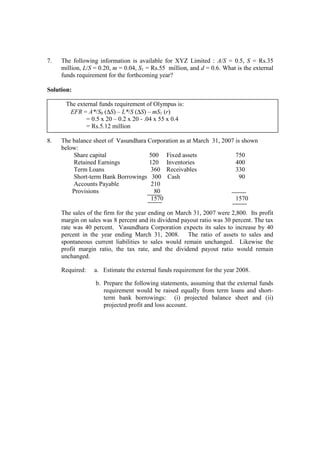
6. The following information is available for ABC Limited : A/S = 0.6, S = Rs.300
million, L/S = 0.30, m = 0.08, S1 = Rs.350 million, and d = 0.5. What is the external
funds requirement for the forthcoming year?
Solution:
The external funds requirement of Olympus is:
EFR = A*/S0 (∆S) – L*/S (∆S) – mS1 (r)
= 0.6 x 50 – 0.3 x 50 - .08 x 350 x 0.5
= Rs.1 million
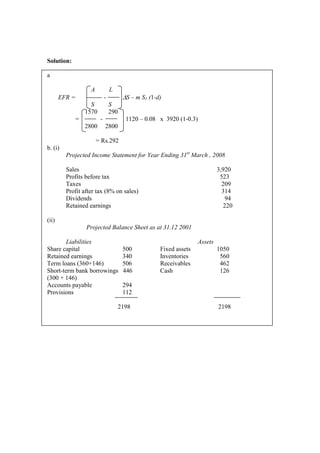
7. The following information is available for XYZ Limited : A/S = 0.5, S = Rs.35
million, L/S = 0.20, m = 0.04, S1 = Rs.55 million, and d = 0.6. What is the external
funds requirement for the forthcoming year?
Solution:
The external funds requirement of Olympus is:
EFR = A*/S0 (∆S) – L*/S (∆S) – mS1 (r)
= 0.5 x 20 – 0.2 x 20 - .04 x 55 x 0.4
= Rs.5.12 million
8. The balance sheet of Vasundhara Corporation as at March 31, 2007 is shown
below:
Share capital 500 Fixed assets 750
Retained Earnings 120 Inventories 400
Term Loans 360 Receivables 330
Short-term Bank Borrowings 300 Cash 90
Accounts Payable 210
Provisions 80
1570 1570
The sales of the firm for the year ending on March 31, 2007 were 2,800. Its profit
margin on sales was 8 percent and its dividend payout ratio was 30 percent. The tax
rate was 40 percent. Vasundhara Corporation expects its sales to increase by 40
percent in the year ending March 31, 2008. The ratio of assets to sales and
spontaneous current liabilities to sales would remain unchanged. Likewise the
profit margin ratio, the tax rate, and the dividend payout ratio would remain
unchanged.
Required: a. Estimate the external funds requirement for the year 2008.
b. Prepare the following statements, assuming that the external funds
requirement would be raised equally from term loans and short-
term bank borrowings: (i) projected balance sheet and (ii)
projected profit and loss account.
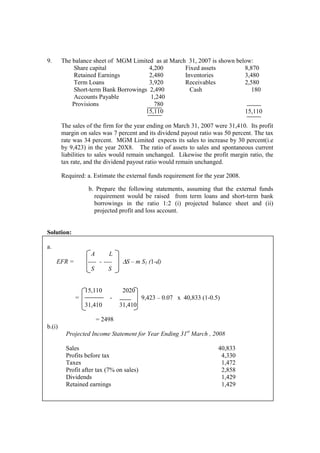
Solution:
a
A L
EFR = - ∆S – m S1 (1-d)
S S
1570 290
= - 1120 – 0.08 x 3920 (1-0.3)
2800 2800
= Rs.292
b. (i)
Projected Income Statement for Year Ending 31st
March , 2008
Sales 3,920
Profits before tax 523
Taxes 209
Profit after tax (8% on sales) 314
Dividends 94
Retained earnings 220
(ii)
Projected Balance Sheet as at 31.12 2001
Liabilities Assets
Share capital 500 Fixed assets 1050
Retained earnings 340 Inventories 560
Term loans (360+146) 506 Receivables 462
Short-term bank borrowings 446 Cash 126
(300 + 146)
Accounts payable 294
Provisions 112
2198 2198
9. The balance sheet of MGM Limited as at March 31, 2007 is shown below:
Share capital 4,200 Fixed assets 8,870
Retained Earnings 2,480 Inventories 3,480
Term Loans 3,920 Receivables 2,580
Short-term Bank Borrowings 2,490 Cash 180
Accounts Payable 1,240
Provisions 780
15,110 15,110
The sales of the firm for the year ending on March 31, 2007 were 31,410. Its profit
margin on sales was 7 percent and its dividend payout ratio was 50 percent. The tax
rate was 34 percent. MGM Limited expects its sales to increase by 30 percent(i.e
by 9,423) in the year 20X8. The ratio of assets to sales and spontaneous current
liabilities to sales would remain unchanged. Likewise the profit margin ratio, the
tax rate, and the dividend payout ratio would remain unchanged.
Required: a. Estimate the external funds requirement for the year 2008.
b. Prepare the following statements, assuming that the external funds
requirement would be raised from term loans and short-term bank
borrowings in the ratio 1:2 (i) projected balance sheet and (ii)
projected profit and loss account.
Solution:
a.
A L
EFR = ---- - ---- ∆S – m S1 (1-d)
S S
15,110 2020
= - 9,423 – 0.07 x 40,833 (1-0.5)
31,410 31,410
= 2498
b.(i)
Projected Income Statement for Year Ending 31st
March , 2008
Sales 40,833
Profits before tax 4,330
Taxes 1,472
Profit after tax (7% on sales) 2,858
Dividends 1,429
Retained earnings 1,429
(ii)
Projected Balance Sheet as at 31.3 2008
Liabilities Assets
Share capital 4,200 Fixed assets 11,531
Retained earnings 3,909 Inventories 4,524
Term loans (3920+2498x1/3) 4,753 Receivables 3,354
Short-term bank borrowings 4,155 Cash 234
(2490 + 2498x2/3)
Accounts payable 1,612
Provisions 1,014
19,643 19,643
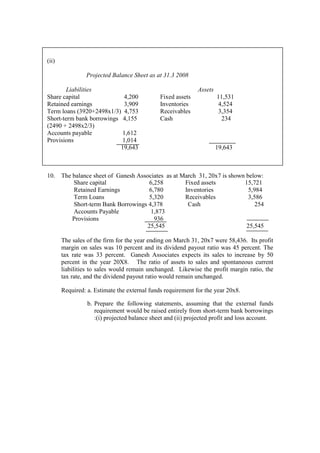
10. The balance sheet of Ganesh Associates as at March 31, 20x7 is shown below:
Share capital 6,258 Fixed assets 15,721
Retained Earnings 6,780 Inventories 5,984
Term Loans 5,320 Receivables 3,586
Short-term Bank Borrowings 4,378 Cash 254
Accounts Payable 1,873
Provisions 936
25,545 25,545
The sales of the firm for the year ending on March 31, 20x7 were 58,436. Its profit
margin on sales was 10 percent and its dividend payout ratio was 45 percent. The
tax rate was 33 percent. Ganesh Associates expects its sales to increase by 50
percent in the year 20X8. The ratio of assets to sales and spontaneous current
liabilities to sales would remain unchanged. Likewise the profit margin ratio, the
tax rate, and the dividend payout ratio would remain unchanged.
Required: a. Estimate the external funds requirement for the year 20x8.
b. Prepare the following statements, assuming that the external funds
requirement would be raised entirely from short-term bank borrowings
:(i) projected balance sheet and (ii) projected profit and loss account.
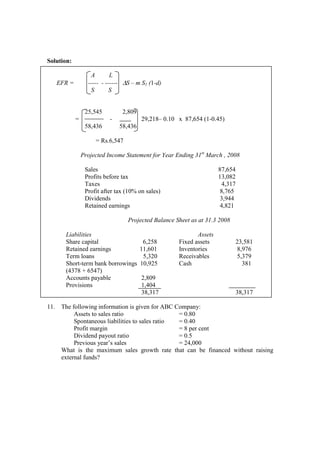
Solution:
A L
EFR = ----- - ------ ∆S – m S1 (1-d)
S S
25,545 2,809
= - 29,218– 0.10 x 87,654 (1-0.45)
58,436 58,436
= Rs.6,547
Projected Income Statement for Year Ending 31st
March , 2008
Sales 87,654
Profits before tax 13,082
Taxes 4,317
Profit after tax (10% on sales) 8,765
Dividends 3,944
Retained earnings 4,821
Projected Balance Sheet as at 31.3 2008
Liabilities Assets
Share capital 6,258 Fixed assets 23,581
Retained earnings 11,601 Inventories 8,976
Term loans 5,320 Receivables 5,379
Short-term bank borrowings 10,925 Cash 381
(4378 + 6547)
Accounts payable 2,809
Provisions 1,404
38,317 38,317
11. The following information is given for ABC Company:
Assets to sales ratio = 0.80
Spontaneous liabilities to sales ratio = 0.40
Profit margin = 8 per cent
Dividend payout ratio = 0.5
Previous year’s sales = 24,000
What is the maximum sales growth rate that can be financed without raising
external funds?
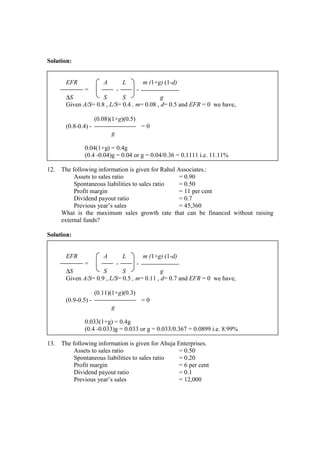
Solution:
EFR A L m (1+g) (1-d)
= - -
∆S S S g
Given A/S= 0.8 , L/S= 0.4 , m= 0.08 , d= 0.5 and EFR = 0 we have,
(0.08)(1+g)(0.5)
(0.8-0.4) - = 0
g
0.04(1+g) = 0.4g
(0.4 -0.04)g = 0.04 or g = 0.04/0.36 = 0.1111 i.e. 11.11%
12. The following information is given for Rahul Associates.:
Assets to sales ratio = 0.90
Spontaneous liabilities to sales ratio = 0.50
Profit margin = 11 per cent
Dividend payout ratio = 0.7
Previous year’s sales = 45,360
What is the maximum sales growth rate that can be financed without raising
external funds?
Solution:
EFR A L m (1+g) (1-d)
= - -
∆S S S g
Given A/S= 0.9 , L/S= 0.5 , m= 0.11 , d= 0.7 and EFR = 0 we have,
(0.11)(1+g)(0.3)
(0.9-0.5) - = 0
g
0.033(1+g) = 0.4g
(0.4 -0.033)g = 0.033 or g = 0.033/0.367 = 0.0899 i.e. 8.99%
13. The following information is given for Ahuja Enterprises.
Assets to sales ratio = 0.50
Spontaneous liabilities to sales ratio = 0.20
Profit margin = 6 per cent
Dividend payout ratio = 0.1
Previous year’s sales = 12,000
What is the maximum sales growth rate that can be financed without raising
external funds?
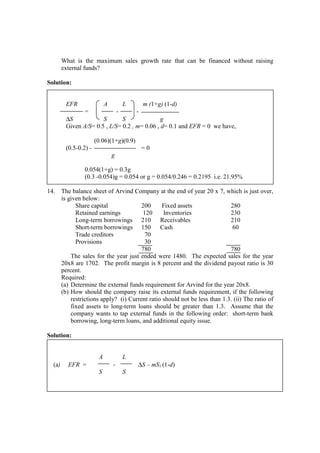
Solution:
EFR A L m (1+g) (1-d)
= - -
∆S S S g
Given A/S= 0.5 , L/S= 0.2 , m= 0.06 , d= 0.1 and EFR = 0 we have,
(0.06)(1+g)(0.9)
(0.5-0.2) - = 0
g
0.054(1+g) = 0.3g
(0.3 -0.054)g = 0.054 or g = 0.054/0.246 = 0.2195 i.e. 21.95%
14. The balance sheet of Arvind Company at the end of year 20 x 7, which is just over,
is given below:
Share capital 200 Fixed assets 280
Retained earnings 120 Inventories 230
Long-term borrowings 210 Receivables 210
Short-term borrowings 150 Cash 60
Trade creditors 70
Provisions 30
780 780
The sales for the year just ended were 1480. The expected sales for the year
20x8 are 1702. The profit margin is 8 percent and the dividend payout ratio is 30
percent.
Required:
(a) Determine the external funds requirement for Arvind for the year 20x8.
(b) How should the company raise its external funds requirement, if the following
restrictions apply? (i) Current ratio should not be less than 1.3. (ii) The ratio of
fixed assets to long-term loans should be greater than 1.3. Assume that the
company wants to tap external funds in the following order: short-term bank
borrowing, long-term loans, and additional equity issue.
Solution:
A L
(a) EFR = - ∆S – mS1 (1-d)
S S
780 100
= - x 222 – (0.08) (1702) (0.3)
1480 1480
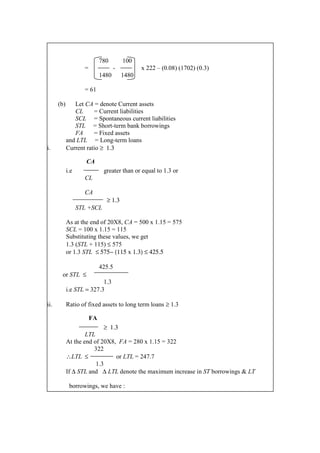
= 61
(b) Let CA = denote Current assets
CL = Current liabilities
SCL = Spontaneous current liabilities
STL = Short-term bank borrowings
FA = Fixed assets
and LTL = Long-term loans
i. Current ratio ≥ 1.3
CA
i.e greater than or equal to 1.3 or
CL
CA
≥ 1.3
STL +SCL
As at the end of 20X8, CA = 500 x 1.15 = 575
SCL = 100 x 1.15 = 115
Substituting these values, we get
1.3 (STL + 115) ≤ 575
or 1.3 STL ≤ 575− (115 x 1.3) ≤ 425.5
425.5
or STL ≤
1.3
i.e STL = 327.3
ii. Ratio of fixed assets to long term loans ≥ 1.3
FA
≥ 1.3
LTL
At the end of 20X8, FA = 280 x 1.15 = 322
322
∴LTL ≤ or LTL = 247.7
1.3
If ∆ STL and ∆ LTL denote the maximum increase in ST borrowings & LT
borrowings, we have :
∆ STL = STL (20X8) – STL (20X7) = 327.3 – 150 = 177.3
∆ LTL = LTL (20X8)- LTL (20X7) = 247.7 – 210 = 37.7
Hence, the suggested mix for raising external funds will be :
Short-term borrowings 61
Long-term loans -----
Additional equity issue --
61
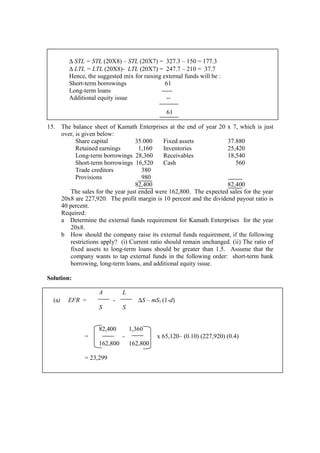
15. The balance sheet of Kamath Enterprises at the end of year 20 x 7, which is just
over, is given below:
Share capital 35.000 Fixed assets 37.880
Retained earnings 1,160 Inventories 25,420
Long-term borrowings 28,360 Receivables 18,540
Short-term borrowings 16,520 Cash 560
Trade creditors 380
Provisions 980
82,400 82,400
The sales for the year just ended were 162,800. The expected sales for the year
20x8 are 227,920. The profit margin is 10 percent and the dividend payout ratio is
40 percent.
Required:
a Determine the external funds requirement for Kamath Enterprises for the year
20x8.
b How should the company raise its external funds requirement, if the following
restrictions apply? (i) Current ratio should remain unchanged. (ii) The ratio of
fixed assets to long-term loans should be greater than 1.5. Assume that the
company wants to tap external funds in the following order: short-term bank
borrowing, long-term loans, and additional equity issue.
Solution:
A L
(a) EFR = - ∆S – mS1 (1-d)
S S
82,400 1,360
= - x 65,120– (0.10) (227,920) (0.4)
162,800 162,800
= 23,299
b
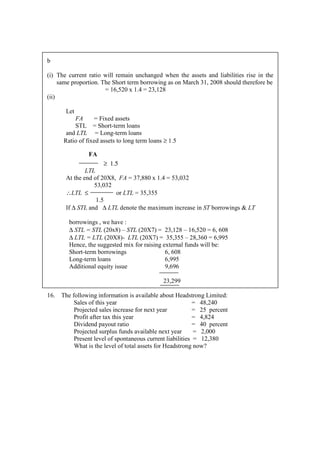
(i) The current ratio will remain unchanged when the assets and liabilities rise in the
same proportion. The Short term borrowing as on March 31, 2008 should therefore be
= 16,520 x 1.4 = 23,128
(ii)
Let
FA = Fixed assets
STL = Short-term loans
and LTL = Long-term loans
Ratio of fixed assets to long term loans ≥ 1.5
FA
≥ 1.5
LTL
At the end of 20X8, FA = 37,880 x 1.4 = 53,032
53,032
∴LTL ≤ or LTL = 35,355
1.5
If ∆ STL and ∆ LTL denote the maximum increase in ST borrowings & LT
borrowings , we have :
∆ STL = STL (20x8) – STL (20X7) = 23,128 – 16,520 = 6, 608
∆ LTL = LTL (20X8)- LTL (20X7) = 35,355 – 28,360 = 6,995
Hence, the suggested mix for raising external funds will be:
Short-term borrowings 6, 608
Long-term loans 6,995
Additional equity issue 9,696
23,299
16. The following information is available about Headstrong Limited:
Sales of this year = 48,240
Projected sales increase for next year = 25 percent
Profit after tax this year = 4,824
Dividend payout ratio = 40 percent
Projected surplus funds available next year = 2,000
Present level of spontaneous current liabilities = 12,380
What is the level of total assets for Headstrong now?
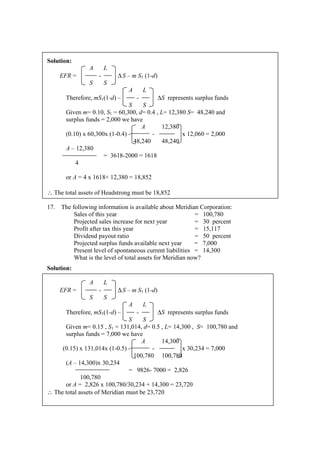
Solution:
A L
EFR = - ∆S – m S1 (1-d)
S S
A L
Therefore, mS1(1-d) – - ∆S represents surplus funds
S S
Given m= 0.10, S1 = 60,300, d= 0.4 , L= 12,380 S= 48,240 and
surplus funds = 2,000 we have
A 12,380
(0.10) x 60,300x (1-0.4) - - x 12,060 = 2,000
48,240 48,240
A – 12,380
= 3618-2000 = 1618
4
or A = 4 x 1618+ 12,380 = 18,852
∴ The total assets of Headstrong must be 18,852
17. The following information is available about Meridian Corporation:
Sales of this year = 100,780
Projected sales increase for next year = 30 percent
Profit after tax this year = 15,117
Dividend payout ratio = 50 percent
Projected surplus funds available next year = 7,000
Present level of spontaneous current liabilities = 14,300
What is the level of total assets for Meridian now?
Solution:
A L
EFR = - ∆S – m S1 (1-d)
S S
A L
Therefore, mS1(1-d) – - ∆S represents surplus funds
S S
Given m= 0.15 , S1 = 131,014, d= 0.5 , L= 14,300 , S= 100,780 and
surplus funds = 7,000 we have
A 14,300
(0.15) x 131,014x (1-0.5) - - x 30,234 = 7,000
100,780 100,780
(A – 14,300)x 30,234
= 9826- 7000 = 2,826
100,780
or A = 2,826 x 100,780/30,234 + 14,300 = 23,720
∴ The total assets of Meridian must be 23,720
18. Maharaja Limited has the following financial ratios:
Net profit margin ratio = 8 percent
Target dividend payout ratio = 40 percent
Assets-to-equity ratio = 3.0
Assets-to-sales ratio = 1.8
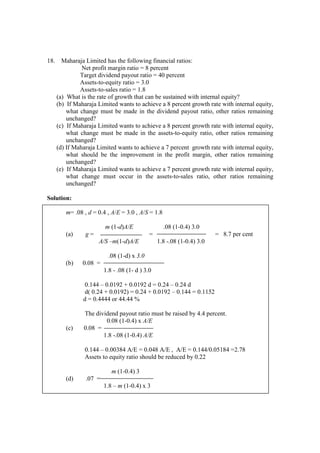
(a) What is the rate of growth that can be sustained with internal equity?
(b) If Maharaja Limited wants to achieve a 8 percent growth rate with internal equity,
what change must be made in the dividend payout ratio, other ratios remaining
unchanged?
(c) If Maharaja Limited wants to achieve a 8 percent growth rate with internal equity,
what change must be made in the assets-to-equity ratio, other ratios remaining
unchanged?
(d) If Maharaja Limited wants to achieve a 7 percent growth rate with internal equity,
what should be the improvement in the profit margin, other ratios remaining
unchanged?
(e) If Maharaja Limited wants to achieve a 7 percent growth rate with internal equity,
what change must occur in the assets-to-sales ratio, other ratios remaining
unchanged?
Solution:
m= .08 , d = 0.4 , A/E = 3.0 , A/S = 1.8
m (1-d)A/E .08 (1-0.4) 3.0
(a) g = = = 8.7 per cent
A/S –m(1-d)A/E 1.8 -.08 (1-0.4) 3.0
.08 (1-d) x 3.0
(b) 0.08 =
1.8 - .08 (1- d ) 3.0
0.144 – 0.0192 + 0.0192 d = 0.24 – 0.24 d
d( 0.24 + 0.0192) = 0.24 + 0.0192 – 0.144 = 0.1152
d = 0.4444 or 44.44 %
The dividend payout ratio must be raised by 4.4 percent.
0.08 (1-0.4) x A/E
(c) 0.08 =
1.8 -.08 (1-0.4) A/E
0.144 – 0.00384 A/E = 0.048 A/E , A/E = 0.144/0.05184 =2.78
Assets to equity ratio should be reduced by 0.22
m (1-0.4) 3
(d) .07 =
1.8 – m (1-0.4) x 3
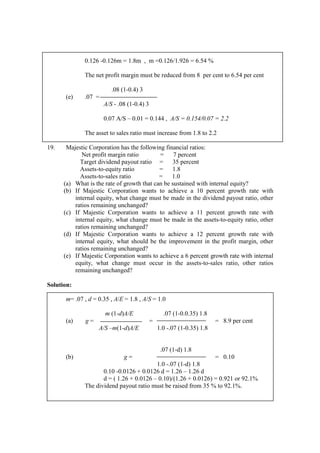
0.126 -0.126m = 1.8m , m =0.126/1.926 = 6.54 %
The net profit margin must be reduced from 8 per cent to 6.54 per cent
.08 (1-0.4) 3
(e) .07 =
A/S - .08 (1-0.4) 3
0.07 A/S – 0.01 = 0.144 , A/S = 0.154/0.07 = 2.2
The asset to sales ratio must increase from 1.8 to 2.2
19. Majestic Corporation has the following financial ratios:
Net profit margin ratio = 7 percent
Target dividend payout ratio = 35 percent
Assets-to-equity ratio = 1.8
Assets-to-sales ratio = 1.0
(a) What is the rate of growth that can be sustained with internal equity?
(b) If Majestic Corporation wants to achieve a 10 percent growth rate with
internal equity, what change must be made in the dividend payout ratio, other
ratios remaining unchanged?
(c) If Majestic Corporation wants to achieve a 11 percent growth rate with
internal equity, what change must be made in the assets-to-equity ratio, other
ratios remaining unchanged?
(d) If Majestic Corporation wants to achieve a 12 percent growth rate with
internal equity, what should be the improvement in the profit margin, other
ratios remaining unchanged?
(e) If Majestic Corporation wants to achieve a 6 percent growth rate with internal
equity, what change must occur in the assets-to-sales ratio, other ratios
remaining unchanged?
Solution:
m= .07 , d = 0.35 , A/E = 1.8 , A/S = 1.0
m (1-d)A/E .07 (1-0.0.35) 1.8
(a) g = = = 8.9 per cent
A/S –m(1-d)A/E 1.0 -.07 (1-0.35) 1.8
.07 (1-d) 1.8
(b) g = = 0.10
1.0 -.07 (1-d) 1.8
0.10 -0.0126 + 0.0126 d = 1.26 – 1.26 d
d = ( 1.26 + 0.0126 – 0.10)/(1.26 + 0.0126) = 0.921 or 92.1%
The dividend payout ratio must be raised from 35 % to 92.1%.
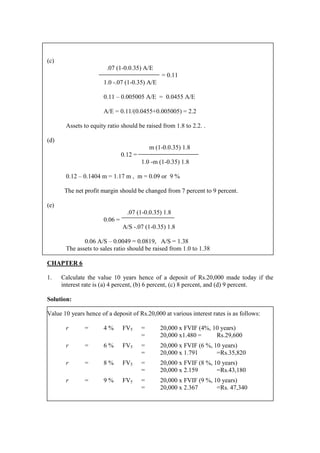
(c)
.07 (1-0.0.35) A/E
= 0.11
1.0 -.07 (1-0.35) A/E
0.11 – 0.005005 A/E = 0.0455 A/E
A/E = 0.11/(0.0455+0.005005) = 2.2
Assets to equity ratio should be raised from 1.8 to 2.2. .
(d)
m (1-0.0.35) 1.8
0.12 =
1.0 -m (1-0.35) 1.8
0.12 – 0.1404 m = 1.17 m , m = 0.09 or 9 %
The net profit margin should be changed from 7 percent to 9 percent.
(e)
.07 (1-0.0.35) 1.8
0.06 =
A/S -.07 (1-0.35) 1.8
0.06 A/S – 0.0049 = 0.0819, A/S = 1.38
The assets to sales ratio should be raised from 1.0 to 1.38
CHAPTER 6
1. Calculate the value 10 years hence of a deposit of Rs.20,000 made today if the
interest rate is (a) 4 percent, (b) 6 percent, (c) 8 percent, and (d) 9 percent.
Solution:
Value 10 years hence of a deposit of Rs.20,000 at various interest rates is as follows:
r = 4 % FV5 = 20,000 x FVIF (4%, 10 years)
= 20,000 x1.480 = Rs.29,600
r = 6 % FV5 = 20,000 x FVIF (6 %, 10 years)
= 20,000 x 1.791 =Rs.35,820
r = 8 % FV5 = 20,000 x FVIF (8 %, 10 years)
= 20,000 x 2.159 =Rs.43,180
r = 9 % FV5 = 20,000 x FVIF (9 %, 10 years)
= 20,000 x 2.367 =Rs. 47,340
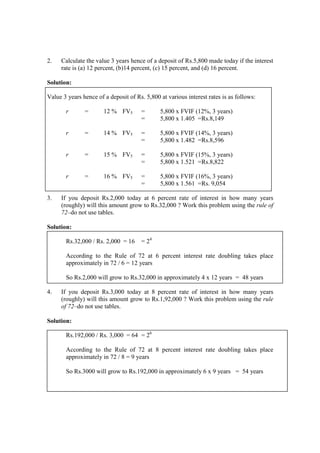
2. Calculate the value 3 years hence of a deposit of Rs.5,800 made today if the interest
rate is (a) 12 percent, (b)14 percent, (c) 15 percent, and (d) 16 percent.
Solution:
Value 3 years hence of a deposit of Rs. 5,800 at various interest rates is as follows:
r = 12 % FV5 = 5,800 x FVIF (12%, 3 years)
= 5,800 x 1.405 =Rs.8,149
r = 14 % FV5 = 5,800 x FVIF (14%, 3 years)
= 5,800 x 1.482 =Rs.8,596
r = 15 % FV5 = 5,800 x FVIF (15%, 3 years)
= 5,800 x 1.521 =Rs.8,822
r = 16 % FV5 = 5,800 x FVIF (16%, 3 years)
= 5,800 x 1.561 =Rs. 9,054
3. If you deposit Rs.2,000 today at 6 percent rate of interest in how many years
(roughly) will this amount grow to Rs.32,000 ? Work this problem using the rule of
72–do not use tables.
Solution:
Rs.32,000 / Rs. 2,000 = 16 = 24
According to the Rule of 72 at 6 percent interest rate doubling takes place
approximately in 72 / 6 = 12 years
So Rs.2,000 will grow to Rs.32,000 in approximately 4 x 12 years = 48 years
4. If you deposit Rs.3,000 today at 8 percent rate of interest in how many years
(roughly) will this amount grow to Rs.1,92,000 ? Work this problem using the rule
of 72–do not use tables.
Solution:
Rs.192,000 / Rs. 3,000 = 64 = 26
According to the Rule of 72 at 8 percent interest rate doubling takes place
approximately in 72 / 8 = 9 years
So Rs.3000 will grow to Rs.192,000 in approximately 6 x 9 years = 54 years
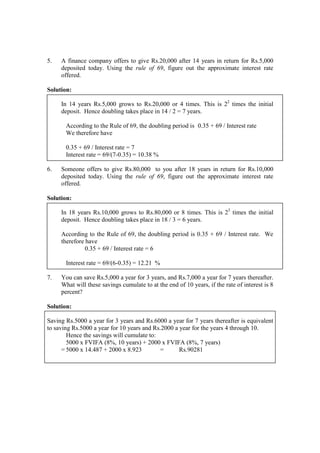
5. A finance company offers to give Rs.20,000 after 14 years in return for Rs.5,000
deposited today. Using the rule of 69, figure out the approximate interest rate
offered.
Solution:
In 14 years Rs.5,000 grows to Rs.20,000 or 4 times. This is 22
times the initial
deposit. Hence doubling takes place in 14 / 2 = 7 years.
According to the Rule of 69, the doubling period is 0.35 + 69 / Interest rate
We therefore have
0.35 + 69 / Interest rate = 7
Interest rate = 69/(7-0.35) = 10.38 %
6. Someone offers to give Rs.80,000 to you after 18 years in return for Rs.10,000
deposited today. Using the rule of 69, figure out the approximate interest rate
offered.
Solution:
In 18 years Rs.10,000 grows to Rs.80,000 or 8 times. This is 23
times the initial
deposit. Hence doubling takes place in 18 / 3 = 6 years.
According to the Rule of 69, the doubling period is 0.35 + 69 / Interest rate. We
therefore have
0.35 + 69 / Interest rate = 6
Interest rate = 69/(6-0.35) = 12.21 %
7. You can save Rs.5,000 a year for 3 years, and Rs.7,000 a year for 7 years thereafter.
What will these savings cumulate to at the end of 10 years, if the rate of interest is 8
percent?
Solution:
Saving Rs.5000 a year for 3 years and Rs.6000 a year for 7 years thereafter is equivalent
to saving Rs.5000 a year for 10 years and Rs.2000 a year for the years 4 through 10.
Hence the savings will cumulate to:
5000 x FVIFA (8%, 10 years) + 2000 x FVIFA (8%, 7 years)
= 5000 x 14.487 + 2000 x 8.923 = Rs.90281
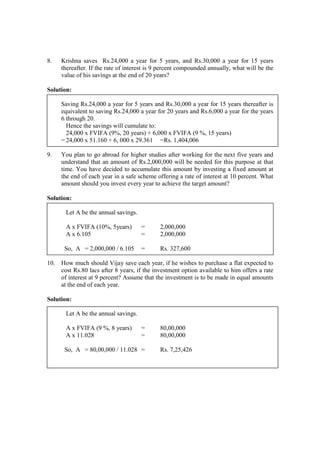
8. Krishna saves Rs.24,000 a year for 5 years, and Rs.30,000 a year for 15 years
thereafter. If the rate of interest is 9 percent compounded annually, what will be the
value of his savings at the end of 20 years?
Solution:
Saving Rs.24,000 a year for 5 years and Rs.30,000 a year for 15 years thereafter is
equivalent to saving Rs.24,000 a year for 20 years and Rs.6,000 a year for the years
6 through 20.
Hence the savings will cumulate to:
24,000 x FVIFA (9%, 20 years) + 6,000 x FVIFA (9 %, 15 years)
= 24,000 x 51.160 + 6, 000 x 29.361 =Rs. 1,404,006
9. You plan to go abroad for higher studies after working for the next five years and
understand that an amount of Rs.2,000,000 will be needed for this purpose at that
time. You have decided to accumulate this amount by investing a fixed amount at
the end of each year in a safe scheme offering a rate of interest at 10 percent. What
amount should you invest every year to achieve the target amount?
Solution:
Let A be the annual savings.
A x FVIFA (10%, 5years) = 2,000,000
A x 6.105 = 2,000,000
So, A = 2,000,000 / 6.105 = Rs. 327,600
10. How much should Vijay save each year, if he wishes to purchase a flat expected to
cost Rs.80 lacs after 8 years, if the investment option available to him offers a rate
of interest at 9 percent? Assume that the investment is to be made in equal amounts
at the end of each year.
Solution:
Let A be the annual savings.
A x FVIFA (9 %, 8 years) = 80,00,000
A x 11.028 = 80,00,000
So, A = 80,00,000 / 11.028 = Rs. 7,25,426
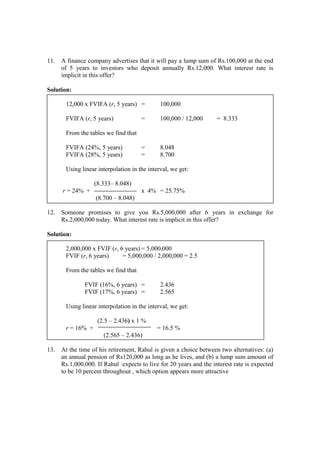
11. A finance company advertises that it will pay a lump sum of Rs.100,000 at the end
of 5 years to investors who deposit annually Rs.12,000. What interest rate is
implicit in this offer?
Solution:
12,000 x FVIFA (r, 5 years) = 100,000
FVIFA (r, 5 years) = 100,000 / 12,000 = 8.333
From the tables we find that
FVIFA (24%, 5 years) = 8.048
FVIFA (28%, 5 years) = 8.700
Using linear interpolation in the interval, we get:
(8.333– 8.048)
r = 24% + x 4% = 25.75%
(8.700 – 8.048)
12. Someone promises to give you Rs.5,000,000 after 6 years in exchange for
Rs.2,000,000 today. What interest rate is implicit in this offer?
Solution:
2,000,000 x FVIF (r, 6 years) = 5,000,000
FVIF (r, 6 years) = 5,000,000 / 2,000,000 = 2.5
From the tables we find that
FVIF (16%, 6 years) = 2.436
FVIF (17%, 6 years) = 2.565
Using linear interpolation in the interval, we get:
(2.5 – 2.436) x 1 %
r = 16% + = 16.5 %
(2.565 – 2.436)
13. At the time of his retirement, Rahul is given a choice between two alternatives: (a)
an annual pension of Rs120,000 as long as he lives, and (b) a lump sum amount of
Rs.1,000,000. If Rahul expects to live for 20 years and the interest rate is expected
to be 10 percent throughout , which option appears more attractive
Solution:
The present value of an annual pension of Rs.120,000 for 20 years when r = 10%
is:
120,000 x PVIFA (10%, 20 years)
= 120,000 x 8.514 = Rs.1,021,680
The alternative is to receive a lumpsum of Rs 1,000,000
Rahul will be better off with the annual pension amount of Rs.120,000.
14. A leading bank has chosen you as the winner of its quiz competition and asked you
to choose from one of the following alternatives for the prize: (a) Rs. 60,000 in cash
immediately or (b) an annual payment of Rs. 10,000 for the next 10 years. If the
interest rate you can look forward to for a safe investment is 9 percent, which
option would you choose?
Solution:
The present value of an annual payment of Rs.10,000 for 10 years when r = 9%
is:
10,000 x PVIFA ( 9 %, 10 years)
= 10,000 x 6.418 = Rs.64,180
The annual payment option would be the better alternative
15. What is the present value of an income stream which provides Rs.30,000 at the end
of year one, Rs.50,000 at the end of year three , and Rs.100,000 during each of the
years 4 through 10, if the discount rate is 9 percent ?
Solution:
The present value of the income stream is:
30,000 x PVIF (9%, 1 year) + 50,000 x PVIF (9%, 3 years)
+ 100,000 x PVIFA (9 %, 7 years) x PVIF(9%, 3 years)
= 30,000 x 0.917 + 50,000 x 0.772 + 100,000 x 5.033 x 0.0.772 = Rs.454,658.
16. What is the present value of an income stream which provides Rs.25,000 at the end
of year one, Rs.30,000 at the end of years two and three , and Rs.40,000 during
each of the years 4 through 8 if the discount rate is 15 percent ?
Solution:
The present value of the income stream is:
25,000 x PVIF (15%, 1 year) + 30,000 x PVIF (15%, 2 years)
+ 30,000 x PVIF (15%, 3 years)
+ 40,000 x PVIFA (15 %, 5 years) x PVIF (15%, 3 years)
= 25,000 x 0.870 + 30,000 x 0.756 + 30,000 x 0.658
+ 40,000 x 3.352 x 0.658 = Rs.152,395.
17. What is the present value of an income stream which provides Rs.1,000 a year for
the first three years and Rs.5,000 a year forever thereafter, if the discount rate is 12
percent?
Solution:
The present value of the income stream is:
1,000 x PVIFA (12%, 3 years) + (5,000/ 0.12) x PVIF (12%, 3 years)
= 1,000 x 2.402 + (5000/0.12) x 0.712
= Rs.32,069
18. What is the present value of an income stream which provides Rs.20,000 a year for
the first 10 years and Rs.30,000 a year forever thereafter, if the discount rate is 14
percent ?
Solution:
The present value of the income stream is:
20,000 x PVIFA (14%, 10 years) + (30,000/ 0.14) x PVIF (14%, 10 years)
= 20,000 x 5.216 + (30,000/0.14) x 0.270
= Rs.162,177
19. Mr. Ganapathi will retire from service in five years .How much should he deposit
now to earn an annual income of Rs.240,000 forever beginning from the end of 6
years from now ? The deposit earns 12 percent per year.
Solution:
To earn an annual income of Rs.240,000 forever , beginning from the end of 6 years
from now, if the deposit earns 12% per year a sum of
Rs.240,000 / 0.12 = Rs.2,000,000
is required at the end of 5 years. The amount that must be deposited to get this
sum is:
Rs.2,000,000 PVIF (12%, 5 years) = Rs.2,000,000 x 0.567
= Rs. 1,134,000
20. Suppose someone offers you the following financial contract. If you deposit
Rs.100,000 with him he promises to pay Rs.50,000 annually for 3 years. What
interest rate would you earn on this deposit?
Solution:
Rs.100,000 =- Rs.50,000 x PVIFA (r, 3 years)
PVIFA (r,3 years) = 2.00
From the tables we find that:
PVIFA (20 %, 3 years) = 2.106
PVIFA (24 %, 3 years) = 1.981
Using linear interpolation we get:
2.106 – 2.00
r = 20 % + ---------------- x 4%
2.106 – 1.981
= 23.39 %
21. If you invest Rs.600,000 with a company they offer to pay you Rs.100,000 annually
for 10 years. What interest rate would you earn on this investment?
Solution:
Rs.600,000 =- Rs.100,000 x PVIFA (r, 10 years)
PVIFA (r,10 years) = 6.00
From the tables we find that:
PVIFA (10 %, 10 years) = 6.145
PVIFA (11 %, 10 years) = 5.889
Using linear interpolation we get:
6.145 – 6.00
r = 10 % + ---------------- x 1%
6.145 – 5.889
= 10.57 %
22 What is the present value of the following cash flow streams?
End of year Stream X Stream Y Stream Z
1 500 750 600
2 550 700 600
3 600 650 600
4 650 600 600
5 700 550 600
6 750 500 600
---------------------------------------------------------------------------------------------
The discount rate is 18 percent.
Solution:
PV( Stream X) = 500 PV( 18%, 1yr) +550 PV( 18%, 2yrs) + 600 PV( 18%, 3yrs) + 650
PV( 18%, 4yrs) + 700 PV( 18%, 5yrs) + 750 PV( 18%, 6yrs)
= 500 x 0.847 +550 x 0.718 + 600 x 0.609 + 650 x 0.516 + 700 x 0.437 + 750 x 0.370 =
2102.6
PV( Stream X) = 750 PV( 18%, 1yr) +700 PV( 18%, 2yrs) + 650 PV( 18%, 3yrs) + 600
PV( 18%, 4yrs) + 550 PV( 18%, 5yrs) + 500 PV( 18%, 6yrs)
== 750 x 0.847 +700 x 0.718 + 650 x 0.609 + 600 x 0.516 + 550 x 0.437 + 500 x 0.370
= 2268.65
PV (Stream X) = 600 PVIFA (18%, 6yrs) = 600 x 3.498 = 2098.8
23. Suppose you deposit Rs.200,000 with an investment company which pays 12
percent interest with compounding done once in every two months, how much will
this deposit grow to in 10 years?
Solution:
FV10 = Rs.200,000 [1 + (0.12 / 6)]10x6
= Rs.200,000 (1.02)60
= Rs.200,000 x 3.281
= Rs.656,200
24. A bank pays interest at 5 percent on US dollar deposits, compounded once in every
six months. What will be the maturity value of a deposit of US dollars 15,000 for
three years?
Solution:
Maturity value = USD 15 ,000 [1 + (0.05 / 2)]3x2
= 15,000 (1.025)6
= 15,000 x 1.1597
= 17,395.50
25. What is the difference between the effective rate of interest and stated rate of
interest in the following cases:
Case A: Stated rate of interest is 8 percent and the frequency of compounding is six
times a year.
Case B: Stated rate of interest is 10 percent and the frequency of compounding is
four times a year.
Case C: Stated rate of interest is 12 percent and the frequency of compounding is
twelve times a year.
Solution:
A B C
Stated rate (%) 8 10 12
Frequency of compounding 6 times 4 times 12 times
Effective rate (%) (1 + 0.08/6)6
- 1 (1+0.10/4)4
–1 (1 + 0.12/12)12
-1
= 8.27 = 10.38 = 12.68
Difference between the
effective rate and stated
rate (%) 0.27 0.38 0.68
26. You have a choice between Rs.200,000 now and Rs.600,000 after 8 years. Which
would you choose? What does your preference indicate?
Solution:
The interest rate implicit in the offer of Rs.600,000 after 8 years in lieu of
Rs.200,000 now is:
Rs.200,000 x FVIF (r,8 years) = Rs.600,000
Rs.600,000
FVIF (r,8 years) = = 3.000
Rs.200,000
From the tables we find that
FVIF (15%, 8years) = 3.059
This means that the implied interest rate is nearly 15%.
I would choose Rs.600,000 after 8 years from now because I find a return of 15%
quite attractive.
27. Ravikiran deposits Rs.500,000 in a bank now. The interest rate is 9 percent and
compounding is done quarterly. What will the deposit grow to after 5 years? If the
inflation rate is 3 percent per year, what will be the value of the deposit after 5 years
in terms of the current rupee?
Solution:
FV5 = Rs.500,000 [1 + (0.09 / 4)]5x4
= Rs.500,000 (1.0225)20
= Rs.500,000 x 2.653
= Rs.780,255
If the inflation rate is 3 % per year, the value of Rs.780,255 5 years from now, in
terms of the current rupees is:
Rs.780,255 x PVIF (3%, 5 years)
= Rs.780,255 x 0. 863 = Rs.673,360
28. A person requires Rs.100,000 at the beginning of each year from 2015 to 2019.
Towards this, how much should he deposit ( in equal amounts) at the end of each
year from 2007 to 2011, if the interest rate is 10 percent.
Solution:
The discounted value of Rs.100,000 receivable at the beginning of each year from
2015 to 2019, evaluated as at the beginning of 2014 (or end of 2013) is:
Rs.100,000 x PVIFA (10%, 5 years)
= Rs.100,000 x 3.791= Rs.379,100
The discounted value of Rs.379,100 evaluated at the end of 2011 is
Rs.379,100 x PVIF (10 %, 2 years)
= Rs.379,100 x 0.826= Rs.313,137
If A is the amount deposited at the end of each year from 2007 to 2011 then
A x FVIFA (10%, 5 years) = Rs.313,137
A x 6.105 = Rs.313,137
A = Rs.313,137/ 6.105 = Rs.51,292
29. You require Rs.250 ,000 at the beginning of each year from 2010 to 2012. How
much should you deposit( in equal amounts) at the beginning of each year in 2007
and 2008 ? The interest rate is 8 percent.
Solution:
The discounted value of Rs.250,000 receivable at the beginning of each year from
2010 to 2012, evaluated as at the beginning of 2009 (or end of 2008) is:
Rs.250,000 x PVIFA (8 %, 3 years)
= Rs.250,000 x 2.577= Rs.644,250
To have Rs. 644,250 at the end of 2008, let A be the amount that needs to be
deposited at the beginning of 2007 and 2008.We then have
Ax (1+0.08) x FVIFA ( 8%, 2years) = 644,250
A x 1.08 x 2.080 = 644,250 or A = 286,792
30. What is the present value of Rs.120,000 receivable annually for 20 years if the first
receipt occurs after 8 years and the discount rate is 12 percent.
Solution:
The discounted value of the annuity of Rs.120,000 receivable for 20 years,
evaluated as at the end of 7th
year is:
Rs.120,000 x PVIFA (12%, 20 years) = Rs.120,000 x 7.469 = Rs.896,290
The present value of Rs. 896,290 is:
Rs. 896,290 x PVIF (12%, 7 years)
= Rs. 896,290 x 0.452
= Rs.405,119
31. What is the present value of Rs.89,760 receivable annually for 10 years if the first
receipt occurs after 5 years and the discount rate is 9 percent.
Solution:
The discounted value of the annuity of Rs.89,760 receivable for 10 years, evaluated
as at the end of 4th
year is:
Rs. 89,760 x PVIFA (9%, 10 years) = Rs. 89,760 x 6.418 = Rs.576,080
The present value of Rs. 576,080is:
Rs. 576,080x PVIF (9%, 4 years)
= Rs. 576,080x 0.708
= Rs.407,865
32. After eight years Mr.Tiwari will receive a pension of Rs.10,000 per month for 20
years. How much can Mr. Tiwari borrow now at 12 percent interest so that the
borrowed amount can be paid with 40 percent of the pension amount? The interest
will be accumulated till the first pension amount becomes receivable.
Solution:
40 per cent of the pension amount is
0.40 x Rs.10,000 = Rs.4,000
Assuming that the monthly interest rate corresponding to an annual interest rate of
12% is 1%, the discounted value of an annuity of Rs.4,000 receivable at the end of
each month for 240 months (20 years) is:
Rs.4,000 x PVIFA (1%, 240)
(1.01)240
- 1
Rs.4,000 x ---------------- = Rs.363,278
.01 (1.01)240
If Mr. Tiwari borrows Rs.P today on which the monthly interest rate is 1%
P x (1.01)96
= Rs. 363,278
P x 2.60 = Rs. 363,278
Rs. 363,278
P = ------------ = Rs.139,722
2.60
33. After one year Mr. Khanna will receive a pension of Rs.15,000 per month for 30
years. How much can Mr. Khanna borrow now at 12 percent interest so that the
borrowed amount can be paid with 25 percent of the pension amount? The interest
will be accumulated till the first pension amount becomes receivable.
Solution:
25 per cent of the pension amount is
0.25 x Rs.15,000 = Rs.3,750
Assuming that the monthly interest rate corresponding to an annual interest rate of
12% is 1%, the discounted value of an annuity of Rs.3,750 receivable at the end of
each month for 360 months (30 years) is:
Rs.3,750 x PVIFA (1%, 360)
(1.01)360
- 1
Rs.3,750 x ---------------- = Rs.364,569
.01 (1.01)360
If Mr. Khanna borrows Rs.P today on which the monthly interest rate is 1%
P x (1.01)12
= Rs. 364,569
P x 1.127 = Rs. 364,569
Rs. 364,569
P = ------------ = Rs.323,486
1.127
34. You buy a car with a bank loan of Rs.525,000. An instalment of Rs.25,000 is
payable to the bank for each of 30 months towards the repayment of loan with
interest. What interest rate does the bank charge?
Solution:
Rs.25,000 x PVIFA(r, 30 months) = Rs.525,000
PVIFA (r, 30 months) = Rs.525,000 / Rs.25,000= 21
From the tables we find that:
PVIFA(3%, 30) = 19.600
PVIFA (2%, 30) = 22.397
Using a linear interpolation
22.397 – 21.000
r = 2% + ---------------------- x 1%
22.397 – 19.600
= 2.50%
Thus, the bank charges an interest rate of 2.50 % per month.
The corresponding effective rate of interest per annum is
[ (1.0250)12
– 1 ] x 100 = 34.49 %
35. You take a bank loan of Rs.174,000 repayable with interest in 18 monthly
instalments of Rs.12,000 What is the effective annual interest rate charged by the
bank ?
Solution:
Rs.12,000 x PVIFA(r, 18 months) = Rs.174,000
PVIFA (r, 18 months) = Rs.174,000 / Rs.12,000= 14.5
From the tables we find that:
PVIFA(2%, 18) = 14.992
PVIFA (3%, 18) = 13.754
Using a linear interpolation
14.992 – 14.500
r = 2% + ---------------------- x 1%
14.992 – 13.754
= 2.397%
Thus, the bank charges an interest rate of 2.397 % per month.
The corresponding effective rate of interest per annum is
[ (1.02397)12
– 1 ] x 100 = 32.88 %
36. Metro Corporation has to retire Rs.20 million of debentures each at the end of 6, 7,
and 8 years from now. How much should the firm deposit in a sinking fund account
annually for 5 years, in order to meet the debenture retirement need? The net
interest rate earned is 10 percent.
Solution:
The discounted value of the debentures to be redeemed between 6 to 8 years
evaluated at the end of the 5th
year is:
Rs.20 million x PVIFA (10%, 3 years) = Rs.20 million x 2.487
= Rs.49.74million
If A is the annual deposit to be made in the sinking fund for the years 1 to 5,
then
A x FVIFA (10%, 5 years) = Rs.49.74 million
A x 6.105 = Rs.49.74 million
A = Rs.8,147,420
37. Ankit Limited has to retire Rs.30 million of debentures each at the end of 7, 8, 9
and 10 years from now. How much should the firm deposit in a sinking fund
account annually for 5 years, in order to meet the debenture retirement need? The
net interest rate earned is 12 percent.
Solution:
The discounted value of the debentures to be redeemed between 7 to 10 years
evaluated at the end of the 6th
year is:
Rs.30 million x PVIFA (12%, 4 years) = Rs.30 million x 3.037
= Rs.91.11 million
If A is the annual deposit to be made in the sinking fund for the years 1 to 6,
then
A x FVIFA (12%, 6 years) = Rs.91.11 million
A x 8.115 = Rs. 91.11 million
A = Rs.11,227,357
38. Mr.Mehta receives a provident fund amount or Rs.800,000. He deposits it in a bank
which pays 9 percent interest. If he plans to withdraw Rs.100,000 at the end of
each year, how long can he do so ?
Solution:
Let `n’ be the number of years for which a sum of Rs.100,000 can be withdrawn
annually.
Rs.100,000 x PVIFA (9%, n) = Rs.800,000
PVIFA (9%, n) = Rs.800,000 / Rs.100,000 = 8 .000
From the tables we find that
PVIFA (9%, 14 years) = 7.786
PVIFA (9%, 15 years) = 8.060
Using a linear interpolation we get
8.000 – 7.786
n = 14 + ----------------- x 1 = 14.78 years
8.060 – 7.786
39. Mr. Naresh wants to invest an amount of Rs. 400,000, in a finance company at an
interest rate of 12 percent, with instructions to the company that the amount with
interest be repaid to his son in equal instalments of Rs.100,000, for his education
expenses . How long will his son get the amount ?
Solution:
Let `n’ be the number of years for which a sum of Rs.100,000 can be withdrawn
annually.
Rs.100,000 x PVIFA (12%, n) = Rs.400,000
PVIFA (12 %, n) = Rs.400,000 / Rs.100,000 = 4
From the tables we find that
PVIFA (12%, 5 years) = 3.605
PVIFA (12%, 6 years) = 4.111
Using a linear interpolation we get
4.000 – 3.605
n = 5 + ----------------- x 1 = 5.78 years
4.111 – 3.605
40. Your company is taking a loan of 1,000,000, carrying an interest rate of 15 percent.
The loan will be amortised in five equal instalments. What fraction of the
instalment at the end of second year will represent principal repayment ?
Solution:
1,000,000
Annual instalment = = 298,329
3.352
Loan Amortisation Schedule
Year Beg. Instalment Interest Principal Balance
repayment
1 1,000,000 298,329 150,000 148,329 851,671
2 851,671 298,329 127,751 170,578 681,093
170,578 / 298,329 = 0.572 or 57.2%
41. Anurag Limited borrows Rs.2,000,000 at an interest rate of 12 percent. The loan is
to be repaid in 5 equal annual instalments payable at the end of each of the next 5
years. Prepare the loan amortisation schedule
Solution:
Equated annual installment = 2,000,000 / PVIFA(12%,5)
= 2,000,000 / 3.605
= Rs.554,785
Loan Amortisation Schedule
Beginning Annual Principal Remaining
Year amount installment Interest repaid balance
------ ------------- --------------- ----------- ------------- -------------
1 2,000,000 554,785 240,000 314,785 1,685,215
2 1,685,215 554,785 202,226 352,559 1,332,656
3 1,332,656 554,785 159.919 394,866 937,790
4 937,790 554,785 112,535 442,250 495,540
5 495,540 554,785 59,465 495320 220*
(*) rounding off error
42. You want to borrow Rs.3,000,000 to buy a flat. You approach a housing company
which charges 10 percent interest. You can pay Rs.400,000 per year toward loan
amortisation. What should be the maturity period of the loan?
Solution:
Let n be the maturity period of the loan. The value of n can be obtained from
the equation.
400,000 x PVIFA(10%, n) = 3,000,000
PVIFA (10%, n) = 7.5
From the tables we find that
PVIFA (10%,14 years) = 7.367
PVIFA (10 %, 15 years) = 7.606
Using a linear interpolation we get
7.500 – 7.367
n = 14 + ----------------- x 1 = 14.56 years
7.606 – 7.367
43. You want to borrow Rs.5,000,000 to buy a flat. You approach a housing company
which charges 11 percent interest. You can pay Rs.600,000 per year toward loan
amortisation. What should be the maturity period of the loan?
Solution:
Let n be the maturity period of the loan. The value of n can be obtained from
the equation.
600,000 x PVIFA(11%, n) = 5,000,000
PVIFA (11%, n) = 8.333
From the tables we find that
PVIFA (11%,20 years) = 7.963
PVIFA (11 %, 25 years) = 8.422
Using linear interpolation we get
8.333 – 7.963
n = 20 + ----------------- x 5 = 24.03 years
8.422 – 7.963
44. You are negotiating with the government the right to mine 160,000 tons of iron ore
per year for 20 years. The current price per ton of iron ore is Rs.3500 and it is
expected to increase at the rate of 8 percent per year. What is the present value of
the iron ore that you can mine if the discount rate is 15 percent
Solution:
Expected value of iron ore mined during year 1= 160,000x3500 = Rs.560 million
Expected present value of the iron ore that can be mined over the next 20 years
assuming a price escalation of 8% per annum in the price per ton of iron
1 – (1 + g)n
/ (1 + i)n
= Rs.560 million x ------------------------
i - g
= Rs.560 million x 1 – (1.08)20
/ (1.15)20
0.15 – 0.08
= Rs.560 million x 10.2173
= Rs.5,721,688,000
45. You are negotiating with the government the right to mine 300,000 tons of iron ore
per year for 25 years. The current price per ton of iron ore is Rs.3200 and it is
expected to increase at the rate of 7 percent per year. What is the present value of
the iron ore that you can mine if the discount rate is 18 percent
Solution:
Expected value of iron ore mined during year 1= 300,000x3200 = Rs.960 million
Expected present value of the iron ore that can be mined over the next 25 years
assuming a price escalation of 7% per annum in the price per ton of iron
1 – (1 + g)n
/ (1 + i)n
= Rs.960 million x ------------------------
i - g
= Rs.960 million x 1 – (1.07)25
/ (1.18)25
0.18 – 0.07
= Rs.960 million x 8.3036
= Rs.7,971,456,000
46. As a winner of a competition, you can choose one of the following prizes:
a. Rs. 800,000 now
b. Rs. 2,000,000 at the end of 8 years
c. Rs. 100,000 a year forever
d. Rs. 130,000 per year for 12 years
e. Rs. 32,000 next year and rising thereafter by 8 percent per year
forever.
If the interest rate is 12 percent, which prize has the highest present value?
Solution:
(a) PV = Rs.800,000
(b) PV = 2,000,000PVIF12%,8yrs = 2,000,000 x 0.0.404 = Rs.808,000
(c ) PV = 100,000/r = 100,000/0.12 = Rs. 833,333
(d) PV = 130,000 PVIFA12%,12yrs = 130,000 x 6.194 = Rs.805,220
(e) PV = C/(r-g) = 32,000/(0.12-0.08) = Rs.800,000
Option c has the highest present value viz. Rs.833,333
47. Oil India owns an oil pipeline which will generate Rs. 20 million of cash income in
the coming year. It has a very long life with virtually negligible operating costs.
The volume of oil shipped, however, will decline over time and, hence, cash flows
will decrease by 4 percent per year. The discount rate is 15 percent.
a. If the pipeline is used forever, what is the present value of its cash flows?
b. If the pipeline is scrapped after 30 years, what is the present value of its cash
flows?
Solution:
(a) PV = c/(r – g) = 20/[0.15 – (-0.04)] = Rs.105.26 million
1+g n
1 - -------
(b) 1+r
PV = A(1+g) ----------------- = 20 x 0.96 x 5.2398 = Rs.100.604 million
r - g
48. Petrolite owns an oil pipeline which will generate Rs. 15 million of cash income in
the coming year. It has a very long life with virtually negligible operating costs.
The volume of oil shipped, however, will decline over time and, hence, cash flows
will decrease by 6 percent per year. The discount rate is 18 percent.
a. If the pipeline is used forever, what is the present value of its cash flows?
b. If the pipeline is scrapped after 10 years, what is the present value of its cash
flows?
Solution:
(a) PV = c/(r – g) = 15/[0.18 – (-0.06)] = Rs.62.5 million
1+g n
1 - -------
(b) 1+r
PV = A(1+g) ----------------- = 15 x 0.94 x 3.7379 = Rs.52.704 million
r - g
49. An oil well presently produces 80,000 barrels per year. It will last for 20 years
more, but the production will fall by 6 percent per year. Oil prices are expected to
increase by 5 percent per year. Presently the price of oil is $80 per barrel. What is
the present value of the well's production if the discount rate is 15 percent?
Solution:
The growth rate in the value of oil produced, g = (1- 0.06)(1 +0.05) - 1 = - 0.013
Present value of the well’s production =
1+g n
1 - -------
1+r
PV = A(1+g) -----------------
r - g
= (80,000 x 80) x ( 1-0.013)x 1 – (0.987 / 1.15)20
0.15 + 0.013
= $ 36,930,756
MINICASE 1
1. As an investment advisor, you have been approached by a client called Vikas for your
advice on investment plan. He is currently 40 years old and has Rs.600,000 in the
bank. He plans to work for 20 years more and retire at the age of 60. His present
salary is Rs.500,000 per year. He expects his salary to increase at the rate of 12
percent per year until his retirement.
Vikas has decided to invest his bank balance and future savings in a balanced
mutual fund scheme that he believes will provide a return of 9 percent per year. You
agree with his assessment.
Vikas seeks your help in answering several questions given below. In answering
these questions, ignore the tax factor.
(i) Once he retires at the age of 60, he would like to withdraw Rs.800,000 per year
for his consumption needs from his investments for the following 15 years (He
expects to live upto the age of 75 years). Each annual withdrawal will be made at
the beginning of the year. How much should be the value of his investments
when Vikas turns 60, to meet this retirement need?
(ii) How much should Vikas save each year for the next 20 years to be able to
withdraw Rs.800,000 per year from the beginning of the 21st
year ? Assume that
the savings will occur at the end of each year.
(iii) Suppose Vikas wants to donate Rs.500,000 per year in the last 5 years of his life to a
charitable cause. Each donation would be made at the beginning of the year. Further,
he wants to bequeath Rs.1,000,000 to his son at the end of his life. How much should
he have in his investment account when he reaches the age of 60 to meet this need
for donation and bequeathing?
(iv) Vikas is curious to find out the present value of his lifetime salary income. For the
sake of simplicity, assume that his current salary of Rs.500,000 will be paid exactly
one year from now, and his salary is paid annually. What is the present value of his
life time salary income, if the discount rate applicable to the same is 7 percent?
Remember that Vikas expects his salary to increase at the rate of 12 percent per
year until retirement.
Solution:
(i)
This is an annuity due
Value of annuity due = Value of ordinary annuity (1 + r)
The value of investments when vikas turns 60 must be:
800,000 x PVIFA (9%, 15 years) x 1.09
= 800,000 x 8.060 x 1.09 = Rs.7,028,320
(ii)
He must have Rs.7,092,800 at the end of the 20th
year.
His current capital of Rs.600,000 will grow to:
Rs.600,000 x FVIF (9%, 20yrs) = 600,000 x 5.604
= Rs.3,362,400
So, what he saves in the next 15 years must cumulate to:
7,028,320 – 3,362,400 = Rs.3,665,920
A x FVIFA (9%, 20 yrs) = Rs.3,665,920
A x 51.160 = 3,665,920
A = 3,665,920/51.160 = Rs.71,656
(iii)
60 69 70 71 72 73 74 75
A A A A A
1,000,000
To meet his donation objective, Vikas will need an amount equal to:
500,000 x PVIFA (9%, 5years) when he turns 69.
This means he will need
500,000 x PVIFA (9%, 5yrs) x PVIF (9%, 9yrs) when he turns 60.
This works out to:
500,000 x 3.890 x 0.460 = Rs.894,700
To meet his bequeathing objective he will need
1,000,000 x PVIF (15%, 9yrs) when he turns 60
This works out to:
1,000,000 x 0.275 = Rs.275,000
So, his need for donation and bequeathing is: 894,700 + 275,000
= Rs.1,169,700
(iv)
MINICASE 2
2. As an investment advisor, you have been approached by a client called Ravi for
advice on his investment plan. He is 35 years and has Rs.200, 000 in the bank. He
plans to work for 25 years more and retire at the age of 60. His present salary is
500,000 per year. He expects his salary to increase at the rate of 12 percent per year
until his retirement.
Ravi has decided to invest his bank balance and future savings in a balanced
mutual fund scheme that he believes will provide a return of 9 percent per year.
You concur with his assessment.
Ravi seeks your help in answering several questions given below. In answering
these questions, ignore the tax factor.
(i) Once he retires at the age of 60, he would like to withdraw Rs. 900,000 per year
for his consumption needs for the following 20 years (His life expectancy is
80years).Each annual withdrawal will be made at the beginning of the year.
How much should be the value of his investments when he turns 60, to meet his
retirement need?
(ii) How much should Ravi save each year for the next 25 years to be able to
withdraw Rs.900, 000 per year from the beginning of the 26th
year for a period
of 20 years?
Assume that the savings will occur at the end of each year. Remember that he
already has some bank balance.
(iii) Suppose Ravi wants to donate Rs.600, 000 per year in the last 4 years of his life
to a charitable cause. Each donation would be made at the beginning of the year.
Further he wants to bequeath Rs. 2,000,000 to his daughter at the end of his life.
(1+g)n
(1+r)n
PVGA = A (1+g)
r – g
Where A(1+g) is the cash flow a year from now. In this case A (1+g) = Rs.500,000,
g = 12%, r = 7%, and n = 20
So,
(1.12)20
(1.07)20
PVGA = 500,000
0.07 – 0.12
= Rs.14,925,065
1-
1-
How much should he have in his investment account when he reaches the age of
60 to meet this need for donation and bequeathing?
(iv) Ravi wants to find out the present value of his lifetime salary income. For the
sake of simplicity, assume that his current salary of Rs 500,000 will be paid
exactly one year from now, and his salary is paid annually. What is the present
value of his lifetime salary income, if the discount rate applicable to the same is
8 percent? Remember that Ravi expects his salary to increase at the rate of 12
percent per year until retirement.
Solution:
(i)
900,000 x PVIFA ( 9 %, 20 ) x 1.09
900,000 x 9.128 x 1.09
= Rs. 8,954,568
(ii)
Ravi needs Rs. 8,954,568 when he reaches the age of 60.
His bank balance of Rs. 200,000 will grow to : 200,000 ( 1.09 )25
= 200,000 ( 8.623 ) = Rs. 1,724,600
This means that his periodic savings must grow to :
Rs. 8,954,568 - Rs. 1,724,600 = Rs. 7,229,968
His annual savings must be:
7,229,968 7,229,968
A = =
FVIFA ( 25, 9% ) 84.701
= Rs. 85,359
(iii)
75 76
600 600 600 600
2000
Amount required for the charitable cause:
600,000 x PVIFA ( 9% , 4yrs ) x PVIF ( 9%, 15yrs )
= 600,000 x 3.240 x 0.275
Rs. 534,600
Amount required for bequeathing
2,000,000 x PVIF ( 9%, 20yrs )
= 2,000,000 x 0.178 = Rs.356,000
(iv)
CHAPTER 7
1. The price of a Rs.1,000 par bond carrying a coupon rate of 8 percent and maturing
after 5 years is Rs.1020.
(i) What is the approximate YTM?
(ii) What will be the realised YTM if the reinvestment rate is 7 percent?
Solution:
(i)
80 + (1000 – 1020) / 5
YTM ~ = 7.51%
0.6 x 10²⁰ + 0.4 x 1000
(ii)
The terminal value will be
80 x FVIFA (7%, 5yrs) + 1000
80 x 5.751 + 1000 = 1460.08
The realised YTM will be:
1460.08 1/5
– 1 = 7.44%
1020
A ( 1 + g ) A ( 1 + g )n
0 1 n
( 1 + g )n
PVGA = A ( 1 + g ) 1 -
( 1 + r )n
r - g
( 1.12 )25
= 500,000 1 -
( 1.08 )25
0.08 - 0.12
= Rs. 18,528,922
2. The price of a Rs.1,000 par bond carrying a coupon rate of 7 percent and maturing
after 5 years is Rs.1040.
(i) What is the approximate YTM?
(ii) What will be the realised YTM if the reinvestment rate is 6 percent?
Solution:
(i)
(ii)
3. A Rs.1000 par value bond, bearing a coupon rate of 12 percent will mature after 6
years. What is the value of the bond, if the discount rate is 16 percent?
Solution:
6 120 1000
P = ∑ +
t=1 (1.16)t
(1.16)6
= Rs.120 x PVIFA(16%, 6 years) + Rs.1000 x PVIF (16%, 6 years)
= Rs.120 x 3.685 + Rs.1000 x 0.410
= Rs. 852.20
The approximate YTM is:
70 + (1000 – 1040)/5
= 0.0605 or 6.05 percent
0.6 x 1040 + 0.4 x 1000
0 1 2 3 4 5
-1040 70 70 70 70 70
1000
The terminal value at 6 percent reinvestment rate is:
70 x FVIFA (6%, 5yrs) + 1000
70 x 5.637 + 1000 = Rs.1394.59
1394.59 1/5
Realised yield to maturity = – 1 = 6.04%
1040
4. A Rs.100 par value bond, bearing a coupon rate of 9 percent will mature after 4
years. What is the value of the bond, if the discount rate is 13 percent?
Solution:
4 9 100
P = ∑ +
t=1 (1.13)t
(1.13)4
= Rs.9 x PVIFA(13%, 4 years) + Rs.100 x PVIF (13%, 4 years)
= Rs.9 x 2.974 + Rs.100 x 0.613
= Rs. 88.07
5. The market value of a Rs.1,000 par value bond, carrying a coupon rate of 10
percent and maturing after 5 years, is Rs.850. What is the yield to maturity on
this bond?
Solution:
The yield to maturity is the value of r that satisfies the following equality.
5 100 1,000
Rs.850 = ∑ +
t=1 (1+r) t
(1+r)5
Try r = 14%. The right hand side (RHS) of the above equation is:
Rs.100 x PVIFA (14%, 5 years) + Rs.1,000 x PVIF (14%, 5 years)
= Rs.100 x 3.433 + Rs.1,000 x 0.519
= Rs.862.30
Try r = 15%. The right hand side (RHS) of the above equation is:
Rs.100 x PVIFA (15%, 5 years) + Rs.1,000 x PVIF (15%, 5years)
= Rs.100 x 3.352 + Rs.1,000 x 0.497
= Rs.832.20
Thus the value of r at which the RHS becomes equal to Rs.850 lies between 14%
and 15%.
Using linear interpolation in this range, we get
862.30 – 850.00
Yield to maturity = 14% + 862.30 – 832.20 x 1%
= 14.41%
6. The market value of a Rs.100 par value bond, carrying a coupon rate of 8.5 percent
and maturing after 8 years, is Rs.95. What is the yield to maturity on this bond?
Solution:
The yield to maturity is the value of r that satisfies the following equality.
8 8.5 100
95 = ∑ +
t=1 (1+r) t
(1+r)8
Try r = 10%. The right hand side (RHS) of the above equation is:
8.5 x PVIFA (10%, 8 years) + Rs.100 x PVIF (10%, 8 years)
= Rs.8.5 x 5.335 + Rs.100 x 0.467
= Rs.92.05
Try r = 9%. The right hand side (RHS) of the above equation is:
8.5 x PVIFA (9 %, 8 years) + Rs.100 x PVIF (9%, 8years)
= 8.5 x 5.535 + Rs.100 x 0.502
= 47.04 + 50.20 = 97.24
Thus the value of r at which the RHS becomes equal to Rs.95 lies between 9%
and 10%.
Using linear interpolation in this range, we get
97.24 – 95.00
Yield to maturity = 9 % + 97.24 – 92.05 x 1%
= 9.43 %
7. A Rs.1000 par value bond bears a coupon rate of 10 percent and matures after 5
years. Interest is payable semi-annually. Compute the value of the bond if the
required rate of return is 18 percent.
Solution:
10 50 1000
P = ∑ +
t=1 (1.09) t
(1.09)10
= 50 x PVIFA (9%, 10 years) + 1000 x PVIF (9%, 10 years)
= 50 x 6.418 + Rs.1000 x 0.422
= Rs. 742.90
8. A Rs.100 par value bond bears a coupon rate of 8 percent and matures after 10
years. Interest is payable semi-annually. Compute the value of the bond if the
required rate of return is 12 percent.
Solution:
20 4 100
P = ∑ +
t=1 (1.06) t
(1.06)20
= 4 x PVIFA (6%, 20 years) + Rs.100 x PVIF (6%, 20 years)
= 6 x 11.470 + Rs.100 x 0.312
= Rs.100.02
9. You are considering investing in one of the following bonds:
Coupon rate Maturity Price/Rs.100 par value
Bond A 11% 8 yrs Rs.80
Bond B 9% 9 yrs Rs.70
Your income tax rate is 34 percent and your capital gains tax is effectively 10
percent. Capital gains taxes are paid at the time of maturity on the difference
between the purchase price and par value. What is your post-tax yield to maturity
from these bonds?
Solution:
The post-tax interest and maturity value are calculated below:
Bond A Bond B
* Post-tax interest (C ) 11(1 – 0.34) 9 (1 – 0.34)
=Rs.7.26 =Rs.5.94
* Post-tax maturity value (M) 100 - 100 -
[ (100-80)x 0.1] [ (100 – 70)x 0.1]
=Rs.98 =Rs.97
The post-tax YTM, using the approximate YTM formula is calculated below
7.26 + (98-80)/8
Bond A : Post-tax YTM = --------------------
0.6 x 80 + 0.4 x 98
= 10.91%
5.94 + (97 – 70)/9
Bond B : Post-tax YTM = ----------------------
0.6x 70 + 0.4 x 97
= 11.06 %
10. You are considering investing in one of the following bonds:
Coupon rate Maturity Price/Rs.1000 par value
Bond A 12% 7 yrs Rs. 930
Bond B 8 % 5 yrs Rs. 860
Your income tax rate is 33 percent and your capital gains tax is effectively 10
percent. Capital gains taxes are paid at the time of maturity on the difference
between the purchase price and par value. What is your post-tax yield to maturity
from these bonds?
Solution:
The post-tax interest and maturity value are calculated below:
Bond A Bond B
* Post-tax interest (C) 120(1 – 0.33) 80 (1 – 0.33)
=Rs.80.40 =Rs.53.6
* Post-tax maturity value (M) 1000 - 1000 -
[(1000-930) x 0.1] [ (1000 – 860)x 0.1]
=Rs. 993 =Rs.986
The post-tax YTM, using the approximate YTM formula is calculated below
80.40 + (993-930)/7
Bond A : Post-tax YTM = --------------------
0.6 x 930 + 0.4 x 993
= 9.36 %
53.6 + (986 – 860)/5
Bond B : Post-tax YTM = ----------------------
0.6x 860 + 0.4 x 986
= 8.66 %
11. A company's bonds have a par value of Rs.100, mature in 5 years, and carry a
coupon rate of 10 percent payable semi-annually. If the appropriate discount rate is
14 percent, what price should the bond command in the market place?
Solution:
10 5 100
P = ∑ +
t=1 (1.07) t
(1.07)10
= Rs.5 x PVIFA(7%, 10) + Rs.100 x PVIF (7%, 10)
= Rs.5 x 7.024 + Rs.100 x 0.508
= Rs. 85.92
12. A company's bonds have a par value of Rs.1000, mature in 8 years, and carry a
coupon rate of 14 percent payable semi-annually. If the appropriate discount rate is
12 percent, what price should the bond command in the market place?
Solution:
16 70 1000
P = ∑ +
t=1 (1.06) t
(1.06)16
= Rs.70 x PVIFA(6%, 16) + Rs.1000 x PVIF (6%, 16)
= Rs.70 x 10.106 + Rs.1000 x 0.394
= Rs. 1101.42
13. The share of a certain stock paid a dividend of Rs.3.00 last year. The dividend is
expected to grow at a constant rate of 8 percent in the future. The required rate of
return on this stock is considered to be 15 percent. How much should this stock sell
for now? Assuming that the expected growth rate and required rate of return remain
the same, at what price should the stock sell 3 years hence?
Solution:
Do = Rs.3.00, g = 0.08, r = 0.15
Po = D1 / (r – g) = Do (1 + g) / (r – g)
= Rs.3.00 (1.08) / (0.15 - 0.08)
= Rs.46.29
Assuming that the growth rate of 8% applies to market price as well, the market price at
the end of the 3rd
year will be:
P2 = Po x (1 + g)3
= Rs.46.29 (1.08)3
= Rs. 58.31
14. The share of a certain stock paid a dividend of Rs.10.00 last year. The dividend is
expected to grow at a constant rate of 15 percent in the future. The required rate of
return on this stock is considered to be 18 percent. How much should this stock sell
for now? Assuming that the expected growth rate and required rate of return remain
the same, at what price should the stock sell 4 years hence?
Solution:
Do = Rs.10.00, g = 0.15, r = 0.18
Po = D1 / (r – g) = Do (1 + g) / (r – g)
= Rs.10.00 (1.15) / (0.18 - 0.15)
= Rs.383.33
Assuming that the growth rate of 15% applies to market price as well, the market
price at the end of the 4th
year will be:
P2 = Po x (1 + g)4
= Rs.383.33 (1.15)4
= Rs. 669.87
15. The equity stock of Hansa Limited is currently selling for Rs.280 per share. The
dividend expected next is Rs.10.00. The investors' required rate of return on this
stock is 14 percent. Assume that the constant growth model applies to Hansa
Limited. What is the expected growth rate of Hansa Limited?
Solution:
Po = D1 / (r – g)
Rs.280 = Rs.10 / (0.14 – g)
0.14 –g = 10/280 = 0.0357
g = 0.14-0.0357 = 0.1043or 10.43 %
16. The equity stock of Amulya Corporation is currently selling for Rs.1200 per share.
The dividend expected next is Rs.25.00. The investors' required rate of return on
this stock is 12 percent. Assume that the constant growth model applies to Amulya
Corporation. What is the expected growth rate of Amulya Corporation?
Solution:
Po = D1 / (r – g)
Rs.1200 = Rs.25 / (0.12 – g)
0.12 –g = 25/1200 = 0.0208
g = 0.12-0.0208 = 0.0992 or 9.92 %
17. Sloppy Limited is facing gloomy prospects. The earnings and dividends are
expected to decline at the rate of 5 percent. The previous dividend was Rs.2.00. If
the current market price is Rs.10.00, what rate of return do investors expect from
the stock of Sloppy Limited?
Solution:
Po = D1/ (r – g) = Do(1+g) / (r – g)
Do = Rs.2.00, g = -0.05, Po = Rs.10
So
10 = 2.00 (1- .05) / (r-(-.05)) = 1.90 / (r + .05)
r +0.05 =1.90/10 = 0.19
r = 0.19 – 0.05 = 0.14
18. Mammoth Corporation is facing gloomy prospects. The earnings and dividends are
expected to decline at the rate of 10 percent. The previous dividend was Rs.3.00. If
the current market price is Rs.25.00, what rate of return do investors expect from
the stock of Mammoth Limited?
Solution:
Po = D1/ (r – g) = Do(1+g) / (r – g)
Do = Rs.3.00, g = -0.10, Po = Rs.25
So
25 = 3.00 (1- .10) / (r-(-.10)) = 2.7 / (r + .10)
r +0.10 =2.7/25 = 0.108
r = 0.108 – 0.10 = 0.008 or 0.8 percent
19. The current dividend on an equity share of Omega Limited is Rs.8.00 on an earnings
per share of Rs. 30.00.
(i) Assume that the dividend per share will grow at the rate of 20 percent per year for
the next 5 years. Thereafter, the growth rate is expected to fall and stabilise at 12
percent.
Investors require a return of 15 percent from Omega’s equity shares. What is the
intrinsic value of Omega’s equity share?
Solution:
(ii) Assume that the growth rate of 20 percent will decline linearly over a five year
period and then stabilise at 12 percent. What is the intrinsic value of Omega’s share
if the investors’ required rate of return is 15 percent?
Solution:
20. The current dividend on an equity share of Magnum Limited is Rs.4.00.
(i) Assume that Magnum’s dividend will grow at the rate of 18 percent per year for
the next 5 years. Thereafter, the growth rate is expected to fall and stabilise at 10
percent. Equity investors require a return of 15 percent from Magnum’s equity
shares. What is the intrinsic value of Magnum’s equity share?
g1 = 20 %, g2 = 12 %, n = 5 yrs , r = 15%
D1 = 8 (1.20) = Rs. 9.60
1+ g1
n
1 -
Po = D1 1 + r D1 (1 + g1)n - 1
(1 + g2 ) 1
+ x
r - g1 r - g2 ( 1 + r )n
1.20 5
1 -
= 9.60 1.15 9.60 ( 1.20)4
(1.12) 1
+ x
0.15 - 0.20 0.15 - 0.12 ( 1.15)5
= 45.53 + 369.49 = Rs. 415.02
D0 [ ( 1 + gn) + H ( ga - gn)]
P0 =
r - gn
8 [ (1.12) + 2.5 ( 0.20 - 0.12 )]
=
0.15 - 0.12
= Rs. 352
Solution:
(ii) Assume now that the growth rate of 18 percent will decline linearly over a period
of 4years and then stabilise at 10 percent . What is the intrinsic value per share of
Magnum, if investors require a return of 15 percent ?
Solution:
g1 = 18%, g2 = 10%, n = 5 yrs, r = 15%
D1 = 4 (1.18) = Rs.4.72
1 + g1
n
1 –
1 + r D1 (1 + g1) n – 1
(1 + g2) 1
P0 = D1 + x
r – g1 r – g2 (1 + r)n
1.18 5
1 -
1.15 4.72 (1.18)4
(1.10) 1
= 4.72 + x
0.15 – 0.18 0.15 – 0.10 (1.15)5
= 21.62 + 100.12
= 121.74
(1 + gn) + H (ga – gn)
P0 = D0
r – gn
(1.10) + 2 (0.18 – 0.10)
= 4.00
0.15 – 0.10
= Rs.100.8
21. The current dividend on an equity share of Omex Limited is Rs. 5.00 on an earnings
per share of Rs. 20.00.
(i) Assume that the dividend will grow at a rate of 18 percent for the next 4 years.
Thereafter, the growth rate is expected to fall and stabilize at 12 percent. Equity
investors require a return of 15 percent from Omex’s equity share. What is the
intrinsic value of Omex’s equity share?
Solution:
g1 = 18 %, g2 = 12 %, n = 4yrs , r = 15%
D1 = 5 (1.18) = Rs. 5.90
1+ g1
n
1 -
Po = D1 1 + r D1 (1 + g1)n - 1
(1 + g2 ) 1
+ x
r - g1 r - g2 ( 1 + r )n
1.18 4
1 -
= 5.90 1.15 5.90 ( 1.18 )3
( 1.12 ) 1
+ x
0.15 - 0.18 0.15 - 0.12 ( 1.15)4
= 21.34 + 206.92 = Rs. 228.35
22. You can buy a Rs.1000 par value bond carrying an interest rate of 10 percent
(payable annually) and maturing after 5 years for Rs.970. If the re-investment rate
applicable to the interest receipts from this bond is 15 percent, what will be your
yield to maturity?
Solution:
Terminal value of the interest proceeds
= 100 x FVIFA (15%,5)
= 100 x 6.742
= 674.20
Redemption value = 1,000
Terminal value of the proceeds from the bond = 1,674.20
let r be the yield to maturity. The value of r can be obtained from the equation
970 (1 + r)5
= 1,674.20
r = (1,674.20/970)1/5
-1
= 0.1153 or 11.53 %
23. You can buy a Rs.100 par value bond carrying an interest rate of 8 percent (payable
annually) and maturing after 8 years for Rs.90. If the re-investment rate applicable
to the interest receipts from this bond is 10 percent, what will be your yield to
maturity?
Solution:
Terminal value of the interest proceeds
= 8 x FVIFA (10%,8)
= 8 x 11.436
= 91.49
Redemption value = 100
Terminal value of the proceeds from the bond = 191.49
let r be the yield to maturity. The value of r can be obtained from the
equation
90 (1 + r)8
= 191.49
r = (191.49/90)1/8
-1
= 0.099 or 9.9 %
24. Keerthi Limited is expected to give a dividend of Rs.5 next year and the same
would grow by 12 percent per year forever. Keerthi pays out 60 percent of its
earnings. The required rate of return on Keerthi’s stock is 15 percent. What is the
PVGO?
Solution:
Po = D1
r – g
Po = 5 = Rs. 166.67
0.15-0.12
Po = E1 + PVGO
r
Po = 8.33 + PVGO
0.15
166.67 = 55.53 + PVGO
So, PVGO = 111.14
25. Adinath Limited is expected to give a dividend of Rs.3 next year and the same
would grow by 15 percent per year forever. Adinath pays out 30 percent of its
earnings. The required rate of return on Adinath’s stock is 16 percent. What is the
PVGO?
Solution:
Po = D1
r – g
Po = 3 = Rs. 300
0.16-0.15
Po = E1 + PVGO
r
Po = 10 + PVGO
0.16
300 = 62.5 + PVGO
So, PVGO = 237.5
CHAPTER 8
1. You are considering purchasing the equity stock of Electra Limited. The current
price per share is Rs.20. You expect the dividend a year hence to be Re.2.00. You
expect the price per share of Electra stock a year hence to have the following
probability distribution.
Price a year hence Rs.19 20 22
Probability 0.5 0.3 0.2
(a) What is the expected price per share a year hence?
(b) What is the probability distribution of the rate of return on Electra 's equity stock?
Solution:
(a) Expected price per share a year hence will be:
= 0.5 x Rs.19 + 0.3 x Rs.20 + 0.2 x Rs.22 = Rs. 19.90
(b) Probability distribution of the rate of return is
Rate of return (Ri) 5% 10 % 20 %
Probability (pi) 0.5 0.3 0.2
Note that the rate of return is defined as:
Dividend + Terminal price
-------------------------------- - 1
Initial price
2. You are considering purchasing the equity stock of Empire Corporation. The
current price per share is Rs.180. You expect the dividend a year hence to be
Re.8.00. You expect the price per share of Empire Corporation stock a year hence
to have the following probability distribution.
Price a year hence Rs.175 180 200
Probability 0.2 0.3 0.5
(a) What is the expected price per share a year hence?
(b) What is the probability distribution of the rate of return on Empire Corporation 's
equity stock?
Solution:
(a) Expected price per share a year hence will be:
= 0.2 x Rs.175 + 0.3 x Rs.180 + 0.5 x Rs.200 = Rs. 189
(c) Probability distribution of the rate of return is
Rate of return (Ri) 1.7 % 4.4 % 15.6 %
Probability (pi) 0.2 0.3 0.5
3. The stock of South India Corporation (SIC) performs well relative to other stocks
during recessionary periods. The stock of North India Corporation ( NIC), on the
other hand, does well during growth periods. Both the stocks are currently selling
for Rs.100 per share. The rupee return (dividend plus price change) of these stocks
for the next year would be as follows:
Economic condition
High growth Low growth Stagnation Recession
Probability 0.4 0.3 0.1 0.2
Return on SIC stock 40 60 70 80
Return on NIC stock 65 60 50 35
Calculate the expected return and standard deviation of:
(a) Rs.5,000 in the equity stock of SIC;
(b) Rs.5,000 in the equity stock of NIC;
(c) Rs.2,500 in the equity stock of SIC and Rs.2,500 in the equity stock of NIC;
(d) Rs.3,000 in the equity stock of SIC and Rs.2,000 in the equity of NIC.
Which of the above four options would you choose? Why?
Solution:
(a) For Rs.5,000, 50 shares of SIC’s stock can be acquired. The probability
distribution of the return on 50 shares is
Economic Condition Return (Rs) Probability
High Growth 50 x 40 = 2,000 0.4
Low Growth 50x 60 = 3,000 0.3
Stagnation 50x 70 = 3,500 0.1
Recession 50x 80 = 4,000 0.2
Expected return = (2,000 x 0.4) + (3,000 x 0.3) + (3,500 x 0.1) +
(4,000 x 0.2)
= Rs.2,850
Standard deviation of the return = [(2,000 –2,850)2
x 0.4 + (3,000 –2,850)2
x
0.3 + (3,500 –2,850)2
x 0.1+ (4,000 –2,850)2
x 0.2]1/2
= Rs. 776.21
(b) For Rs.5,000, 50 shares of NIC’s stock can be acquired. The probability
distribution of the return on 50 shares is:
Economic condition Return (Rs) Probability
High growth 50 x 65 = 3,250 0.4
Low growth 50 x 60 = 3,000 0.3
Stagnation 50 x 50 = 2,500 0.1
Recession 50 x 35 = 1,750 0.2
Expected return = (3,250 x 0.4) + (3,000 x 0.3) + (2,500 x 0.1) + (1,750 x 0.2)
= Rs. 2,800
Standard deviation of the return = [(3,250–2,800)2
x .4 + (3,000–2,800)2
x .3
+ (2,500– 2,800)2
x .1 + (1,750–2,800)2
x .2]1/2
= Rs. 567.89
(c) For Rs.2,500, 25 shares of SIC’s stock can be acquired; likewise for Rs.2,500, 25
shares of NIC’s stock can be acquired. The probability distribution of this option
is:
Return (Rs) Probability
(25 x 40) + (25 x 65) = 2,625 0.4
(25x 60) + (25x 60) = 3,000 0.3
(25 x 70) + (25x 50) = 3,000 0.1
(25x 80) + (25 x 35) = 2,875 0.2
Expected return = (2,625 x 0.4) + (3,000 x 0.3) + (3,000x 0.1) +
(2,875 x 0.2)
= Rs. 2825
Standard deviation = [(2,625 –2825)2
x 0.4 + (3,000–2825)2
x 0.3 +
(3,000–2825)2
x 0.1 + (2,875–2825)2
x 0.2 ]1/2
= Rs.169.56
d. For Rs.3000, 30 shares of SIC’s stock can be acquired; likewise for Rs.2000, 20
shares of NIC’s stock can be acquired. The probability distribution of this
option is:
Return (Rs) Probability
(30x 40) + (20x 65) = 2,500 0.4
(30 x 60) + (20x 60) = 3,000 0.3
(30x 70) + (20x 50) = 3,100 0.1
(30x 80) + (20x 35) = 3,100 0.2
Expected return = (2,500x 0.4) + (3,000x 0.3) + (3,100x 0.1) +
(3,100x 0.2)
= Rs.2,830
Standard deviation = [(2,500–2,830)2
x 0.4 + (3,000–2,830)2
x 0.3 +
(3,100–2,830)2
x 0.1 + (3,100–2,830)2
x 0.2]1/2
= Rs.272.21
The expected return to standard deviation of various options are as follows :
Option
Expected return
(Rs)
Standard deviation
(Rs)
Expected / Standard
return deviation
a 2,850 776.21 3.67
b 2,800 567.89 4.93
c 2,825 169.56 16.66
d 2,830 272.21 10.40
Option `c’ is the most preferred option because it has the highest return to risk
ratio.
4. The following table, gives the rate of return on stock of Apple Computers and on
the market portfolio for five years
Year Return on the stock Return
Apple Computers (%) Market Portfolio (%)
1 -13 -3
2 5 2
3 15 8
4 27 12
5 10 7
(i) What is the beta of the stock of Apple Computers?
(ii) Establish the characteristic line for the stock of Apple Computers.
Solution:
Year RA RM RA - RA RM - RM (RA - RA) (RM - RM) (RM - RM)2
1 -13 -3 -21.8 -8.2 178.76 67.24
2 5 2 -3.8 -3.2 12.16 10.24
3 15 8 6.2 2.8 17.36 7.84
4 27 12 18.2 6.8 123.76 46.24
5 10 7 1.2 1.8 2.16 3.24
Sum 44 26 334.2 134.8
Mean 8.8 5.2
134.8 334.2
σM
2
= = 33.7 Cov A,M = = 83.55
5 - 1 5 - 1
83.55
βA = = 2.48
33.7
(ii) Alpha = RA – βA RM
= 8.8 – (2.48 x 5.2) = - 4.1
Equation of the characteristic line is
RA = - 4.1 + 2.48 RM
5. The rate of return on the stock of Sigma Technologies and on the market portfolio
for 6 periods has been as follows:
Period Return on the stock Return on the
of Sigma Technologies (%) market portfolio (%)
1 16 14
2 12 10
3 -9 6
4 32 18
5 15 12
6 18 15
(i) What is the beta of the stock of Sigma Technologies.?
(ii) Establish the characteristic line for the stock of Sigma Technologies
Solution:
(i)
(ii) Alpha = RA – βA RM
= 27.2 – (1.196 x 25.6) = -3.42
Equation of the characteristic line is
RA = - 3.42 + 1.196 RM
Year RA (%) RM (%) RA-RA RM-RM (RA-RA)
x(RM-RM)
(RM-RM)2
1 36 28 8.8 2.4 21.12 5.76
2 24 20 -3.2 -5.6 17.92 31.36
3 -20 -8 -47.2 -33.6 1585.92 1128.96
4 46 52 18.8 26.4 496.32 696.96
5 50 36 22.8 10.4 237.12 108.16
Σ RA = 136 ΣRM = 128 2358.4
Cov A,M =
RA = 27.2 RM = 25.6 5 - 1
σ M
2
= 1971.2
5 – 1
2358.4 / (5-1)
βA = ------------------- = 1.196
1971.2 / (5-1)
6. The rate of return on the stock of Omega Electronics and on the market portfolio for
6 periods has been as follows :
Period Return on the stock Return on the
of Omega Electronics market portfolio
(%) (%)
1 18% 15%
2 10% 12%
3 -5% 5%
4 20% 14%
5 9% -2%
6 18% 16%
(i)What is the beta of the stock of Omega Electronics?
(ii) Establish the characteristic line for the stock of Omega Electronics.
Solution:
(ii) Alpha = RO – βA RM
= 11.67 – (0.86 x 10) = 3.07
Equation of the characteristic line is
RA = 3.07 + 0.86 RM
Period R0 (%) RM
(%)
(R0 – R0) (RM – RM) (R0 –R0) (RM – RM) (RM - RM)2
1 18 15 6.33 5 31.65 25
2 10 12 -1.67 2 - 3.34 4
3 - 5 5 -16.67 -5 83.35 25
4 20 14 8.33 4 33.32 16
5 9 - 2 - 2.67 -12 32.04 144
6 18 16 6.33 6 37.98 36
∑R0 = 70 ∑RM = 60 ∑(R0-R0) (RM-RM) = 215 250
R0 =11.67 RM = 10
250 215
σM
2
= = 50 CovO,M = = 43.0
5 5
43.0
β0 = = 0.86
50.0
7. The risk-free return is 8 percent and the return on market portfolio is 16 percent.
Stock X's beta is 1.2; its dividends and earnings are expected to grow at the constant
rate of 10 percent. If the previous dividend per share of stock X was Rs.3.00, what
should be the intrinsic value per share of stock X ?
Solution:
The required rate of return on stock A is:
RX = RF + βX (RM – RF)
= 0.08 + 1.2 (0.16 – 0.08)
= 0. 176
Intrinsic value of share = D1 / (r- g) = Do (1+g) / ( r – g)
Given Do = Rs.3.00, g = 0.10, r = 0.176
3.00 (1.10)
Intrinsic value per share of stock X =
0.176 – 0.10
= Rs. 43.42
8. The risk-free return is 7 percent and the return on market portfolio is 13 percent.
Stock P's beta is 0.8 ; its dividends and earnings are expected to grow at the
constant rate of 5 percent. If the previous dividend per share of stock P was
Rs.1.00, what should be the intrinsic value per share of stock P ?
Solution:
The required rate of return on stock P is:
RP = RF + βP (RM – RF)
= 0.07 + 0.8 (0.13 – 0.07)
= 0. 118
Intrinsic value of share = D1 / (r- g) = Do (1+g) / ( r – g)
Given Do = Rs.1.00, g = 0.05, r = 0.118
1.00 (1.05)
Intrinsic value per share of stock P =
0.118 – 0.05
= Rs. 15.44
9. The risk-free return is 6 percent and the expected return on a market portfolio is 15
percent. If the required return on a stock is 18 percent, what is its beta?
Solution:
The SML equation is RA = RF + βA (RM – RF)
Given RA = 18%. RF = 6%, RM = 15%, we have
0.18 = .06 + βA (0.15 – 0.06)
0.12
i.e.βA = = 1.33
0.09
Beta of stock = 1.33
10. The risk-free return is 9 percent and the expected return on a market portfolio is 12
percent. If the required return on a stock is 14 percent, what is its beta?
Solution:
The SML equation is RA = RF + βA (RM – RF)
Given RA = 14%. RF = 9%, RM = 12%, we have
0.14 = .09 + βA (0.12 – 0.09)
0.05
i.e.βA = = 1.67
0.03
Beta of stock = 1.67
11. The risk-free return is 5 percent. The required return on a stock whose beta is 1.1 is
18 percent. What is the expected return on the market portfolio?
Solution:
The SML equation is: RX = RF + βX (RM – RF)
We are given 0.18 = 0.05 + 1.1 (RM – 0.05) i.e., 1.1 RM = 0.185
or RM = 0.1681
Therefore return on market portfolio = 16.81 %
12. The risk-free return is 10 percent. The required return on a stock whose beta is 0.50
is 14 percent. What is the expected return on the market portfolio?
Solution:
The SML equation is: RX = RF + βX (RM – RF)
We are given 0.14 = 0.10 + 0.50 (RM – 0.10) i.e., 0.5 RM = 0.09
or RM = 0.18
Therefore return on market portfolio = 18 %
13. The required return on the market portfolio is 15 percent. The beta of stock A is
1.5. The required return on the stock is 20 percent. The expected dividend growth
on stock A is 6 percent. The price per share of stock A is Rs.86. What is the
expected dividend per share of stock A next year?
What will be the combined effect of the following on the price per share of stock ?
(a) The inflation premium increases by 3 percent.
(b) The decrease in the degree of risk-aversion reduces the differential between the
return on market portfolio and the risk-free return by one-fourth.
(c) The expected growth rate of dividend on stock A decrease to 3 percent.
(d) The beta of stock A falls to1.2
Solution:
RM = 15% βA = 1.5 RA =20 % g = 6 % Po = Rs.86
Po = D1 / (r - g)
Rs.86 = D1 / (0.20 - .06)
So D1 = Rs.12.04 and Do = D1 / (1+g) = 12.04 /(1.06) = Rs.11.36
RA = Rf + βA (RM – Rf)
0.20 = Rf + 1.5 (0.15 – Rf)
0.5Rf = 0.025
So Rf = 0.05 or 5%.
Original Revised
Rf 5% 8%
RM – Rf 10% 7.5%
g 6 % 3%
βA 1.5 1.2
Revised RA = 8 % + 1.2 (7.5%) = 17 %
Price per share of stock A, given the above changes is
11.36 (1.03)
= Rs. 83.58
0.17 – 0.03
14. The required return on the market portfolio is 16 percent. The beta of stock A is
1.6. The required return on the stock is 22 percent. The expected dividend growth
on stock A is 12 percent. The price per share of stock A is Rs.260. What is the
expected dividend per share of stock A next year?
What will be the combined effect of the following on the price per share of stock ?
(a) The inflation premium increases by 5 percent.
(b) The decrease in the degree of risk-aversion reduces the differential between the
return on market portfolio and the risk-free return by one-half.
(c) The expected growth rate of dividend on stock A decrease to 10 percent.
(d) The beta of stock A falls to 1.1
Solution:
RM = 16% βA = 1.6 RA =22 % g = 12 % Po = Rs. 260
Po = D1 / (r - g)
Rs.260 = D1 / (0.22 - .12)
So D1 = Rs.26 and Do = D1 / (1+g) = 26 /(1.12) = Rs.23.21
RA = Rf + βA (RM – Rf)
0.22 = Rf + 1.6 (0.16 – Rf)
0.6Rf = 0.036
So Rf = 0.06 or 6%.
Original Revised
Rf 6 % 11%
RM – Rf 10% 5%
g 12 % 10 %
βA 1.6 1.1
Revised RA = 11% + 1.1 (5%) = 16.5 %
Price per share of stock A, given the above changes is
23.21 (1.10)
= Rs. 392.78
0.165 – 0.10
CHAPTER 9
1. The returns of two assets under four possible states of nature are given below :
State of nature Probability Return on asset 1 Return on asset 2
1 0.40 -6% 12%
2 0.10 18% 14%
3 0.20 20% 16%
4 0.30 25% 20%
a. What is the standard deviation of the return on asset 1 and on asset 2?
b. What is the covariance between the returns on assets 1 and 2?
c. What is the coefficient of correlation between the returns on assets 1 and 2?
Solution:
(a)
E (R1) = 0.4(-6%) + 0.1(18%) + 0.2(20%) + 0.3(25%)
= 10.9 %
E (R2) = 0.4(12%) + 0.1(14%) + 0.2(16%) + 0.3(20%)
= 15.4 %
σ(R1) = [.4(-6 –10.9)2
+ 0.1 (18 –10.9)2
+ 0.2 (20 –10.9)2
+ 0.3 (25 –10.9)2
]½
13.98%
σ(R2) = [.4(12 –15.4)2
+ 0.1(14 –15.4)2
+ 0.2 (16 – 15.4)2
+ 0.3 (20 –15.4)2
] ½
= 3.35 %
(b) The covariance between the returns on assets 1 and 2 is calculated below
State of
nature
Probability Return on
asset 1
Deviation
of return
on asset 1
from its
mean
Return on
asset 2
Deviation
of the
return on
asset 2
from its
mean
Product of
deviation
times
probability
(1) (2) (3) (4) (5) (6) (2)x(4)x(6)
1 0.4 -6% -16.9% 12% -3.4% 22.98
2 0.1 18% 7.1% 14% -1.4% -0.99
3 0.2 20% 9.1% 16% 0.6% 1.09
4 0.3 25% 14.1% 20% 4.6% 19.45
Sum = 42.53
Thus the covariance between the returns of the two assets is 42.53.
(c) The coefficient of correlation between the returns on assets 1 and 2 is:
Covariance12 42.53
= = 0.91
σ1 x σ2 13.98 x 3.35
2. The returns of 4 stocks, A, B, C, and D over a period of 5 years have been as
follows:
1 2 3 4 5
A 8% 10% -6% -1% 9 %
B 10% 6% -9% 4 % 11%
C 9% 6% 3% 5% 8%
D 10% 8% 13% 7% 12%
Calculate the return on:
a. portfolio of one stock at a time
b. portfolios of two stocks at a time
c. portfolios of three stocks at a time.
d. a portfolio of all the four stocks.
Assume equiproportional investment.
Solution:
Expected rates of returns on equity stock A, B, C and D can be computed as
follows:
A: 8 + 10 – 6 -1+ 9 = 4 %
5
B: 10+ 6- 9+4 + 11 = 4.4%
5
C: 9 + 6 + 3 + 5+ 8 = 6.2%
5
D: 10 + 8 + 13 + 7 + 12 = 10.0%
5
(a) Return on portfolio consisting of stock A = 4 %
(b) Return on portfolio consisting of stock A and B in equal
proportions = 0.5 (4) + 0.5 (4.4)
= 4.2%
(c ) Return on portfolio consisting of stocks A, B and C in equal
proportions = 1/3(4 ) + 1/3(4.4) + 1/3 (6.2)
= 4.87%
(d) Return on portfolio consisting of stocks A, B, C and D in equal
proportions = 0.25(4) + 0.25(4.4) + 0.25(6.2) +0.25(10)
= 6.15%
3. A portfolio consists of 4 securities, 1, 2, 3, and 4. The proportions of these
securities are: w1=0.3, w2=0.2, w3=0.2, and w4=0.3. The standard deviations of
returns on these securities (in percentage terms) are : σ1=5, σ2=6, σ3=12, and σ4=8.
The correlation coefficients among security returns are: ρ12=0.2, ρ13=0.6, ρ14=0.3,
ρ23=0.4, ρ24=0.6, and ρ34=0.5. What is the standard deviation of portfolio return?
Solution:
The standard deviation of portfolio return is:
σp = [w1
2
σ1
2
+ w2
2
σ2
2
+ w3
2
σ3
2
+ σ4
2
σ4
2
+ 2 w1 w2 ρ12 σ1 σ2 + 2 w1 w3 ρ13 σ1 σ3 + 2 w1 w4
ρ14 σ1σ4 + 2 w2 w3 ρ23 σ2 σ3 + 2 w2 w4 ρ24 σ2 σ4 + 2 w3 w4 ρ34 σ3 σ4 ]1/2
= [0.32
x 52
+ 0.22
x 62
+ 0.22
x 122
+ 0.32
x 82
+ 2 x 0.3 x 0.2 x 0.2 x 5 x 6
+ 2 x 0.3 x 0.2 x 0.6 x 5 x 12 + 2 x 0.3 x 0.3 x 0.3 x 5 x 8
+ 2 x 0.2 x 0.2 x 0.4 x 6 x 12 + 2 x 0.2 x 0.3 x 0.6 x 6 x 8
+ 2 x 0.2 x 0.3 x 0.5 x 12 x 8]1/2
= 5.82 %
4. Assume that a group of securities has the following characteristics : (a) the standard
deviation of each security is equal to σA ; (b) covariance of returns σAB is equal for
each pair of securities in the group.
What is the variance of a portfolio containing six securities which are equally
weighted ?
Solution:
When there are 6 securities, you have 6 variance terms and 6 x 5 = 30 covariance
terms.
As all variance terms are the same, all covariance terms are the same, and all
securities are equally weighted, the portfolio variance is:
6wA
2
σA
2
+ 30 wA
2
σAB
5. The following information is given:
Expected return for the market = 15%
Standard deviation of the market return = 25%
Risk-free rate = 8%
Correlation coefficient between stock A and the market = 0.8
Correlation coefficient between stock B and the market = 0.6
Standard deviation for stock A = 30%
Standard deviation for stock B = 24%
(i) What is the beta for stock A?
Solution:
Cov (A,M) Cov (A,M)
ρAM = ; 0.8 = ⇒ Cov (A,M) = 600
σA σM 30 x 25
σM
2
= 252
= 625
Cov (A,M) 600
βA = = = 0.96
σM
2
625
(ii) What is the expected return for stock A ?
Solution:
E(RA) = Rf + βA (E (RM) - Rf)
= 8% + 0.96 (7%) = 14.72%
6. The following table gives an analyst’s expected return on two stocks for particular
market returns.
Market Return Aggressive Stock Defensive Stock
5% - 5% 10%
25% 45% 16%
(i) What is the ratio of the beta of the aggressive stock to the beta of the defensive
stock?
Solution:
(ii) If the risk-free rate is 7% and the market return is equally likely to be 5% and
25% what is the market risk premium?
Solution:
(iii) What is the alpha of the aggressive stock?
Solution:
7. The following table gives an analyst’s expected return on two stocks for particular
market returns.
Market Return Aggressive Stock Defensive Stock
8% 2% 10%
20% 32% 16%
(i) What is the beta of the aggressive stock?
Solution:
45 – (-5)
Beta of aggressive stock = = 2.5
25 – 5
16 - 10
Beta of defensive stock = = 0.30
25 – 5
Ratio = 2.5/0.30 = 8.33
E (RM) = 0.5 x 5 + 0.5 x 25 = 15%
Market risk premium = 15% - 7% = 8%
Expected return = 0.5 x –5 + 0.5 x 45 = 20%
Required return as per CAPM = 7% + 2.5 (8%) = 27%
Alpha = - 7%
32% - 2%
Beta = = 2.5
20% - 8%
(ii) If the risk-free rate is 6% and the market return is equally likely to be 8% and
20%, what is the market risk premium?
Solution:
(iii) What is the alpha of the aggressive stock?
Solution:
MINICASE(1)
Mr. Nitin Gupta had invested Rs.8 million each in Ashok Exports and Biswas Industries
and Rs. 4 million in Cinderella Fashions, only a week before his untimely demise . As per
his will this portfolio of stocks were to be inherited by his wife alone . As the partition
among the family members had to wait for one year as per the terms of the will, the
portfolio of shares had to be maintained as they were for the time being. The will had
stipulated that the job of administering the estate for the benefit of the beneficiaries and
partitioning it in due course was to be done by the reputed firm of Chartered
Accountants, Talwar Brothers. Meanwhile the widow of the deceased was very eager to
know certain details of the securities and had asked the senior partner of Talwar Brothers
to brief her in this regard. For this purpose the senior partner has asked you to prepare a
detailed note to him with calculations using CAPM, to answer the following possible
doubts.
1. What is the expected return and risk (standard deviation) of the portfolio?
2. What is the scope for appreciation in market price of the three stocks-are they
overvalued or undervalued?
You find that out the three stocks, your firm has already been tracking two viz. Ashok
Exports (A) and Biswas Industries (B)-their betas being 1.7 and 0.8 respectively.
The expected return on the market portfolio is:
0.5 x 8% + 0.5 x 20% = 14%
Since the risk-free rate is 6%, the market risk premium is 8%
Expected return on the aggressive stock = 0.5 x 2% + 0.5 x 32% = 17%
Required return = 6% + 8 x 2.5 = 26%
Alpha = 17 – 26% = – 9%
Further, you have obtained the following historical data on the returns of Cinderella
Fashions(C):
Period Market return (%) Return on
Cinderella Fashions (%)
-------- ------------- -------------------------------
1 10 14
2 5 8
3 (2) (6)
4 (1) 4
5 5 10
6 8 11
7 10 15
On the future returns of the three stocks, you are able to obtain the following forecast
from a reputed firm of portfolio managers.
-------------------------------------------------------------------------------------------------------
State of the Probability Returns ( in percentage )
Economy Treasury Ashok Biswas Cinderella Sensex
Bills Exports Industries Fashions
-------------------------------------------------------------------------------------------------------
Recession 0.3 7 5 15 (10) (2)
Normal 0.4 7 18 8 16 17
Boom 0.3 7 30 12 24 26
Required:
Prepare your detailed note to the senior partner.
Solution:
(1) Calculation of beta of Cinderella Fashions stock from the historical data
∑Rc=56 ∑Rm=35 ∑ (Rm-Rm)2
= 144 ∑ (Rc-Rc)(Rm-Rm)= 196
Rc= 8 Rm= 5 σm
2
= 144/6 =24 Cov(c,m) = 196/6= 32.7
Beta of Cinderella Fashions βc = 32.7/24= 1.36
(2) Calculation of expected returns, standard deviations and covariances
E(A) =[ 0.3x5] + [0.4x18] +[ 0.3x30] = 17.7
E(B)= [0.3x15] + [0.4x8] + [0.3x12] = 11.3
E(C)= [0.3x(-)10] + [0.4x16] +[0.3x24] = 10.6
E(M)= [0.3x(-)2]+ [0.4x17] + [0.3x26] = 14
σA = [ 0.3(5-17.7)2
+0.4(18-17.7)2
+0.3(30-17.7)2
]1/2
= [48.4 + 0.1+45.4]1/2
= 9.7
σB = [0.3(15-11.3)2
+ 0.4(8-11.3)2
+0.3(12-11.3)2
]1/2
= [ 4.11 +4.36+ 0.15]1/2
=2.94
σc = [0.3(-10-10.6)2
+0.4(16-10.6)2
+ 0.3(24-10.6)2
]1/2
= [ 127.31 +11.66+53.87]1/2
= 13.89
σM = [0.3(-2-14)2
+0.4(17-14)2
+0.3(26-14)2
]1/2
= [ 76.8 +3.6 +43.2]1/2
= 11.1
Calculation of covariances between the stocks
State of the
Economy
(1)
Prob-
ability
(2)
RA-RA
(3)
RB-RB
(4)
RC-RC
(5)
(2)x(3)
x (4)
(2)x(4)x(5) (2)x(3)x(5)
Recession 0.3 -12.7 3.7 -20.6 -14.1 -22.9 78.5
Normal 0.4 0.3 -3.3 5.4 -0.1 -7.1 0.6
Boom 0.3 12.3 0.7 13.4 2.6 2.8 49.4
σA,B = -11.6 σB,C= -27.2 σA,C= 128.5
Period Return
Rc ( % )
Return
Rm ( %)
Rc-Rc Rm-Rm (Rm-Rm)2
(Rc-Rc)
x (Rm-Rm)
1 14 10 6 5 25 30
2 8 5 0 0 0 0
3 (6) (2) (14) (7) 49 98
4 4 (1) (4) (6) 36 24
5 10 5 2 0 0 0
6 11 8 3 3 9 9
7 15 10 7 5 25 35
Expected return and standard deviation of the portfolio
E(P) = (0.4x17.7) + (0.4x11.3) +(0.2x10.6)= 13.7
σp = [ wA
2
σA
2
+ wB
2
σB
2
+ wC
2
σC
2
+ 2 wAwB σA,B +2 wBwC σB,C +2 wAwC σA,C]1/2
= [ 15.1+ 1.4 +7.7-3.7-4.4+ 20.6]1/2
= 6.1
( 3) Determining overpricing and underpricing using CAPM
βA =1.7 βB =0.8 βC = 1.36 E(RM) = 14 Rf =7%
SML = 7 + (14 -7)xBeta
= 7 + 7 x Beta
Required return on Ashok Exports = 7 + (7 x 1.7) = 18.9 %
Required return on Biswas Industries = 7 + (7 x 0.8 ) = 12.6 %
Required return on Cinderella Fashions = 7 + (7 x 1.36 ) =16.5 %
As the expected return of 17.7 % on Ashok Exports is slightly less than the required
return of 18.9 %, its expected return can be expected to go up to the fair return
indicated by CAPM and for this to happen its market price should come down. So it
is slightly overvalued.
In the case of Biswas Industries stock, as the expected return of 11.3% is again
slightly less than the required return of 12.6 %, its expected return can be expected to
go up and for this to happen its market price should come down. So it is also slightly
overvalued.
In the case of Cinderella Fashions the expected return is 10.6 % against the required
return of 16.5 %. So it is considerably overvalued.
MINICASE(2)
Seth Ratanlal, who was widower and issueless, had left his substantial wealth as legacy to
his nephew and niece through a will. Detailed instructions had been left on how the estate
should be shared between the two , once both of them attained the age of majority. A
week before his demise he had taken a fancy to the capital market and had invested a
sizeable amount in equity shares, specifically, Rs.6 million in Arihant Pharma, Rs.4.8
million in Best Industries and Rs. 1.2 million in Century Limited. As the partition among
the siblings had to wait for at least one more year as the girl was still a minor, the
portfolio of shares had to be maintained as they were for the time being. The will had
entrusted the job of administering the estate for the benefit of the beneficiaries and
partitioning in due course to the reputed firm of Chartered Accountants, Karaniwala and
Karaniwala. Meanwhile the young beneficiaries were very eager to know certain details
of the securities and had asked the senior partner of the firm to brief them in this regard.
For this purpose the senior partner has asked you to prepare a detailed note to him with
calculations using CAPM, to answer the following possible doubts.
1. What is the expected return and risk (standard deviation) of the portfolio?
2. What is the scope for appreciation in market price of the three stocks-are they
overvalued or undervalued?
You find that out the three stocks, your firm has already been tracking two viz.
Arihant Pharma (A) and Best Industries (B)-their betas being 1.2 and 0.8 respectively.
Further, you have obtained the following historical data on the returns of Century
Limited(C):
Period Market return (%) Return on
Century Limited (%)
-------- ------------- -------------------------------
1 8 10
2 (6) 8
3 12 25
4 10 (8)
5 9 14
6 9 11
On the future returns of the three stocks, you are able to obtain the following forecast
from a reputed firm of portfolio managers.
-------------------------------------------------------------------------------------------------------
State of the Probability Returns ( in percentage ) on
Economy Treasury Arihant Best Century Nifty
Bills Pharma Industries Limited
-------------------------------------------------------------------------------------------------------
Recession 0.2 6 (10) (8) 15 (8)
Normal 0.4 6 18 12 6 15
Boom 0.4 6 30 20 (10) 25
Prepare your report.
Solution:
(3) Calculation of beta of Century Limited stock from the historical data
∑Rc=60 ∑Rm=42 ∑ (Rm-Rm)2
=212 ∑ (Rc-Rc)(Rm-Rm)=57
Rc=10 Rm=7 σm
2
= 212/5 =42.4 Cov(c,m) = 57/5=11.4
Beta of Century Limited βc = 11.4/42.4 = 0.3
(4) Calculation of expected returns, standard deviations and covariances
E(A) =[ 0.2x(-)10] + [0.4x18] +[ 0.4x30] = -2+7.2+12=17.2
E(B)= [0.2x(-)8] + [0.4x12] + [0.4x20] = -1.6 +4.8+8 = 11.2
E(C)= [0.2x15] + [0.4x6] +[0.4x(-) 10] = 3+2.4- 4 = 1.4
E(M)= [0.2x(-)8]+ [0.4x15] + [0.4x25] = -1.6+6.0 +10=14.4
σA = [ 0.2(-10-17.2)2
+0.4(18-17.2)2
+0.4(30-17.2)2
]1/2
= [148 + 0.3+65.5]1/2
= 14.6
σB = [0.2(-8-11.2)2
+ 0.4(12-11.2)2
+0.4(20-11.2)2
]1/2
= [ 73.7 +0.3+31.0]1/2
=10.2
σc = [0.2(15-1.4)2
+0.4(6-1.4)2
+ 0.4(-10-1.4)2
]1/2
= [ 37 +8.5+52]1/2
= 9.9
σM = [0.2(-8-14.4)2
+0.4(15-14.4)2
+0.4(25-14.4)2
]1/2
= [ 100.4 +0.1 +44.9]1/2
= 12.1
Calculation of covariances between the stocks
State of the
Economy
(1)
Prob-
ability
(2)
RA-RA
(3)
RB-RB
(4)
RC-RC
(5)
(2)x(3)x(4) (2)x(4)x(5) (2)x(3)x(5)
Recession 0.2 (27.2) (19.2) 13.6 104.4 (52.2) (74.0)
Normal 0.4 0.8 0.8 4.6 0.3 1.5 1.5
Boom 0.4 12.8 8.8 (11.4) 45.1 (40.1) (58.4)
σA,B =149.8 σB,C=(90.8) σA,C= (130.9)
Expected return and standard deviations of the portfolio
Period Return
Rc ( % )
Return
Rm ( %)
Rc-Rc Rm-Rm (Rm-Rm)2
(Rc-Rc)
x (Rm-Rm)
1 10 8 0 1 1 0
2 8 (6) (2) (13) 169 26
3 25 12 15 5 25 75
4 (8) 10 (18) 3 9 (54)
5 14 9 4 2 4 8
6 11 9 1 2 4 2
E(P) = (0.5x17.2) + (0.4x11.2) +(0.1x1.4)=8.6+4.5+0.1=13.2%
σp = [ wA
2
σA
2
+ wB
2
σB
2
+ wC
2
σC
2
+ 2 wAwB σA,B +2 wBwC σB,C +2 wAwC σA,C]1/2
= [ 53.3 + 16.6 +1.0 + 59.9-7.3-13.1]1/2
= 10.5
( 3) Determining overpricing and underpricing using CAPM
βA =1.2 βB =0.8 βC = 0.3 E(RM) = 14.4 Rf =6%
SML = 6 + (14.4 -6)xBeta
= 6 + 8.4 x Beta
Required return on Arihant Pharma = 6 + (8.44 x 1.2 ) = 16.1%
Required return on Best Industries = 6 + (8.44 x 0.8 ) = 12.7%
Required return on Century Limited= 6 + (8.44 x 0.3 ) = 8.5%
As the expected return of 17.2 % on Arihant Pharma is slightly more than the
required return of 16.1 %, its expected return can be expected to come down to the
fair return indicated by CAPM and for this to happen its market price should go up.
So it is slightly undervalued.
In the case of Best Industries stock, as the expected return is slightly less than the
required return of 12.7%, its expected return can be expected to go up and for this to
happen its market price should go down. So it is slightly undervalued. Century Limited
can be considered as overvalued as its required return is far in excess of the expected
return which is likely to drive the market
CHAPTER 10
1. A stock is currently selling for Rs.80. In a year’s time it can rise by 50 percent or
fall by 20 percent. The exercise price of a call option is Rs.90.
(i) What is the value of the call option if the risk-free rate is 10 percent? Use the
option-equivalent method.
Solution:
(ii) What is the value of the call option if the risk-free rate is 6 percent? Use the
risk-neutral method.
Solution:
2. An equity share is currently selling for Rs 100. In a year’s time it can rise by 30
percent or fall by 10 percent. The exercise price of call option on this share is
Rs.110.
(i) What is the value of the call option if the risk – free rate is 7 percent ? Use the
option – equivalent method.
S0 = Rs.80 u = 1.5 d = 0.8
E = Rs.90 r = 0.10 R = 1.10
Cu – Cd 30 – 0 30
∆ = = =
(u – d) S 0.7 x 80 56
u Cd – d Cu 1.5 x 0 – 0.8 x 30
B = = = - 31.17
(u – d) R 0.7 x 1.10
C = ∆S + B
30
= x 80 – 31.17
56
= 11.69
[P x 50%] + [(1 – P) x – 20%] = 6%
50 P + 20 P = 26 ⇒ P = 0.37
Expected future value of a call
0.37 x 30 + 0.63 x 0 = Rs.11.10
Rs.11.10
Current value = = Rs.10.47
1.06
Solution:
(ii) What is the value of the call option if the risk-free rate is 6 percent? Use the risk
– neutral method.
Solution:
3. An equity share is currently selling for Rs.60. In a year’s time, it can rise by 50
percent or fall by 10 percent. The exercise price of a call option on this share is
Rs.70.
a. What is the value of the call option if the risk-free rate is 8 percent? Use the
option-equivalent method.
S0 = 100, E = 110, u = 1.3, d = 0.9, R = 1.07
=
Cu – Cd
=
20 – 0
=
20
= 0.5
( u – d) S0 0.4 x 100 40
B =
uCd – dCu
=
1.3 x 0 – 0.9 x 20
=
- 42.06
( u – d) R 0.4 x 1.07
C = S + B = 0.5 x 100 - 42.06 = 7.94
P x 30% + (1-P) x -10% = 6%
30P + 10P - 10 = 6 == P = 0.4
Expected future value of call
0.4 x 20 + 0.6 x 0 = Rs. 8.00
Current value = 8 = Rs. 7.55
1.06
Solution:
b. What is the value of the call option, if the risk-free rate is 6 percent? Use the
risk-neutral method.
Solution:
4. The following information is available for a call option:
Time to expiration (months) 3
Risk free rate 8%
Exercise price Rs.60
Stock price Rs.70
Call price Rs.14
What is the value of a put option if the time to expiration is 3 months, risk free rate is
8%, exercise price is Rs.60 and the stock price is Rs.70 ?
Hint : Use put-call parity theorem
S0 = Rs. 60, E = Rs. 70, u = 1.5, d = 0.9, R = 1.08
Cu - Cd 20 - 0 20
∆ = = =
(u - d ) So (0.6) 60 36
u Cd - d Cu 1.5 x 0 - 0.9 x 20
B = = = - 27.78
(u - d) R 0.6 x 1.08
C = ∆ S + B = 20 / 36 x 60 - 27.78 = Rs. 5.55
P x 50 % + ( 1 – P ) x -10% = 6 %
50 P + 10P - 10 = 6 P = 0.27
Expected future value of call
0.27 x 20 + 0.73 x 0 = 5.4
5.4
Current value = Rs. 5.09
1.06
Solution:
According to put-call parity theorem
P0 = C0 + E - S0
ert
= 14 + 60 - 70
e .08 x .25
= 14 + 60 - 70 = Rs.2.812
1.0202
5. Consider the following data for a certain share:
Price of the stock now = S0 = Rs.80
Exercise price = E = Rs.90
Standard deviation of continuously compounded annual return = σ = 0.3
Expiration period of the call option = 3 months
Risk-free interest rate per annum = 8 percent
(i) What is the value of the call option? Use the normal distribution table and
resort to linear interpolation.
Solution:
S0 = Rs. 80, E = Rs. 90, r = 0.08, σ = 0.3 , t = 0.25
E
Co = So N (d1) - N (d2)
ert
So σ 2
ln + r + t
E 2
d1 =
σ √ t
(ii) What is the value of a put option
Solution:
0.09
- 0.1178 + ( 0.08 + ) 0.25
2
= = - 0.577
0.3 √ 0.25
d2 = d1 - σ √ t = - 0.577 - 0.3 √ 0.25 = - 0.727
N (d1) = N (- 0.577) N ( - 0.600) = 0.2743
N (- 0.550 ) = 0.2912
N ( -0.577) = 0.2743 +( 0.023 / 0.050) [0.2912 – 0.2743]
= 0.2821
N(d2) = N ( - 0.727) N (- 0.750) = 0.2264
N (- 0.700) = 0.2420
N (- 0.727) = 0.2264 +(0 .023 /.050) [.2420 - .2264]
= 0.2336
90
Co = 80 x 0.2821 - x 0.2336
e 0.08 x 0.25
= 22.5 7 - 20.61 = Rs. 1.96
E
Po = Co - So +
e rt
90
= 1.96 - 80 + = Rs. 10.18
e0.08 x 0.25
6. Consider the following data for a certain share.
Current Price = S0 = Rs. 80
Exercise Price = E = Rs. 90
Standard deviation of continuously compounded annual return = σ = 0.5
Expiration period of the call option = 3 months
Risk – free interest rate per annum = 6 percent
(i) What is the value of the call option? Use the normal distribution table given at
the end of this booklet and resort to linear interpolation.
Solution:
S0 = Rs. 80 E = Rs. 90
r = 0.06, σ = 0.5, t = 0.25
C0 = S0N(d1) - E N (d2)
ert
d1 = ln S0 r + σ2
t
E + 2
=
σ t
=
-0.1178 + 0.06 + 0.25 0.25
2
0.5 0.25
- 0.2862
d2 = d1 – σ t = - 0.2862 - 0.5 0.25 = - 0.5362
N(d1) = N ( - 0.2862) N (-0.30) = 0.3821
N (-0.25) = 0.4013
N (-0.2862) =
=
0.3821 + 0.0138 [ 0.4013 – 0.3821]
0.05
0.3874
N(d2) = N( - 0.5362) N (-0.55) = 0.2912
N (-0.50) = 0.3085
N( - 0.5362) =
=
0.2912 + 0.0138 [ 0.3085 – 0.2912]
0.05
0.2960
C0 = 80 x 0.3874 - 90 x 2960
.06 x 0.25
=
=
30.99 - 26.24
Rs. 4.75
(ii) What is the value of a put option?
Solution:
7. Consider the following data for a certain stock:
Price of the stock now = S0 = Rs.150
Exercise price = E = Rs.140
Standard deviation of continuously compounded annual return = σ = 0.30
Expiration period of the call option = 3 months
Risk-free interest rate per annum = 6 percent
(i) What is the value of the call option? Use normal distribution table and resort to
linear interpolation?
Solution:
P0 = C0 – S0 + E
ert
= 4.75 - 80 + 90
e.06 x 0.25
= Rs. 13.41
C0 = S0 N(d1) – E N(d2)
ert
S0 = Rs.150, E = Rs.140, r = 0.06,
ln (S0/E) + (r + σ2
/2) t σ = 0.3, t = 0.25
d1 =
σ√ t
0.069 + (0.06 + 0.09/2) 0.25
= = 0.635
0.3√0.25
d2 = d1 - σ√ t = 0.485
N (d1) = N (0.635) = 0.7373 N (0.60) = 1 – 0.2743 = 0.7257
N (d2) = N (0.485) = 0.6861 N (0.65) = 1 – 0.2578 = 0.7422
.035
N (0.635) = 0.7257 + (.7422 –.7257)
.05
= 0.7373
140 N (0.45) = 1 – 0.3264 = 0.6736
C0 = 150 x 0.7373 – x 0.6861 N (0.50) = 1 – 0.3085 = 0.6915
e.06 x 0.25
.035
N (0.485) = 0.6736 + (.6915 – 0.6736)
.05
=110.60 – 94.62 = Rs.15.98 = 0.6861
(ii) What is the value of the put option?
Solution:
8. Lakshmi Limited has a current value of 8000. The face value of its outstanding
bonds is 6000. These are 1 year discount bonds with an obligation of 6000 in year
1. The risk-free interest rate is 8 percent and the variance of the continuously
compounded rate of return on the firm’s assets is 16 percent.
What is the present value of Lakshmi Limited’s equity, S0, and debt, B0?
Solution:
So = Vo N(d1) – B1 e –rt
N (d2)
= 8000 N (d1) – 6000 e – 0.08
N(d2)
ln (8000 / 6000) + (0.08 x 1) + (0.16/2)
d1 = ----------------------------------------------
√ 0.16 x √ 1
ln (1.333) + 0.16
=
0.4
= (0.2874+0.16)/0.4 = 1.1185
N(d1) = N (1.1185)
From the tables
N(1.10) = 1-0.1357 = 0.8643
N(1.15) = 1- 0.1251= 0.8749
By linear extrapolation N(1.1185) = 0.8643 +(1.1185-1.10)(0.8749-0.8643)/0.05
= 0.8643 + 0.003922 = 0.8682
E
P0 = C0 – S0 +
ert
140
= 15.98 – 150 +
e.06 x . 25
= Rs.3.90
d2 = 1.1185 - 0.4
= 0.7185
N (d2) = N (0.7185)
From the tables
N(0.70) = 1-0. 2420= 0.7580
N(0.75) = 1 – 0.2264 = 0.7736
By linear interpolation N(0.7185) = 0.7580+ (0.7185-0.70)(0.7736-0.7580)/0.05
= 0.7580+0.005772 = 0.7638
So = 8000 x 0.8682 – (6000 x 0.9231 x 0.7638)
= 2715
B0 = V0 – S0
= 8000 – 2715 = 5285
MINICASE
On majoring in finance you have got selected as the finance manager in Navin Exports, a
firm owned by Navin Sharma a dynamic young technocrat. The firm has been registering
spectacular growth in recent years. With a view to broad base its investments, the firm
had applied for the shares of Universal Industries a month back during its IPO and got
allotment of 5000 shares thereof. . Recently Mr. Sharma had attended a seminar on
capital markets organised by a leading bank and had decided to try his hand in the
derivatives market . So, the very next day you joined the firm, he has called you for a
meeting to get a better understanding of the options market and to know the implications
of some of the strategies he has heard about. For this he has placed before you the
following chart of the option quotes of Universal Industries and requested you to advise
him on his following doubts, based on the figures in the chart.
Universal Industries Option Quotes.
(All amounts are in rupees)
Stock Price :350
Calls Puts
Strike Price Jan Feb March Jan Feb March
300 50 55 - * - - -
320 36 40 43 3 5 7
340 18 20 21 8 11 -
360 6 9 16 18 21 23
380 4 5 6 - 43 -
* A blank means no quotation is available
1. List out the options which are out-of-the-money.
2. What are the relative pros and cons (i.e. risk and reward) of selling a call against
the 5000 shares held, using (i)Feb/380 calls versus (ii) March 320/ calls ?
3. Show how to calculate the maximum profit, maximum loss and break-even
associated with the strategy of simultaneously buying say March/340 call while
selling March/ 360 call?
4. What are the implications for the firm, if for instance, it simultaneously writes
March 360 call and buys March 320/put?
5. What should be value of the March/360 call as per the Black-Scholes Model?
Assume that t=3 months, risk-free rate is 8 percent and the standard deviation is
0.40
6. What should be the value of the March/360 put if the put-call parity is working?
Solution:
1) Calls with strike prices 360 and 380 are out –of –the- money.
2) (i) If the firm sells Feb/380 call on 5000 shares, it will earn a call premium of
Rs.25,000 now. The risk however is that the firm will forfeit the gains that it
would have enjoyed if the share price rises above Rs. 380.
(ii) If the firm sells March 320 calls on 5000 shares, it will earn a call premium of
Rs.215,000 now. It should however be prepared to forfeit the gains if the
share price remains above Rs.320.
3) Let s be the stock price, p1 and p2 the call premia for March/ 340 and March/ 360
calls respectively. When s is greater than 360, both the calls will be exercised and
the profit will be { s-340-p1} – { s-360- p2 } = Rs. 15
The maximum loss will be the initial investment , i.e. p1-p2 = Rs.5
The break even will occur when the gain on purchased call equals the net
premium paid
i.e. s-340 = p1 – p2 =5 Therefore s= Rs. 345
4) If the stock price goes below Rs.320, the firm can execute the put option and
ensure that its portfolio value does not go below Rs. 320 per share. However, if
stock price goes above Rs. 380, the call will be exercised and the stocks in the
portfolio will have to be delivered/ sold to meet the obligation, thus limiting the
upper value of the portfolio to Rs. 380 per share. So long as the share price hovers
between R. 320 and Rs. 380, the firm will lose Rs. 1 (net premium received) per
pair of call and put.
5)
S0 = 350 E =360 t =0.25 r = 0.07 σ =0.40
350 (0.40)2
ln + 0.07 + x 0.25
360 2
d1 =
0.40 x √ 0.25
= ( -0.0282 + 0.0375) / 0.2 = 0. 0465
d2 = 0.0465 -0.40 √¯ 0.25¯ ¯ = -0.1535
Using normal distribution table
N (0.00) = 1- 0.5000 = 0.5000
N (0.05) = 1 – 0.4801 = 0.5199
Therefore N( 0.0465) = 0.5000 + (0.0465/0.0500) x (0.5199 – 0.5000)
= 0.5185
N ( - 0.20) = 0.4207
N ( -0.15) = 0.4404
Therefore N ( -0.1535) = 0.4207 + ( 0.0465/0.0500) x(0.4404 – 0.4207)
= 0.4390
E / ert
= 360 / e0.07 x 0. 25
= 360 / 1. 01765 = 353.75
C0 = 350 x 0.5185 – 353.75 x 0.4390 = 181.480 – 155.30 = Rs. 26.18
6) If put- call parity is working, we have P0 = C0 – S0 + E/ert
Value of the March/360 put = 26.18 -350 + 353.75
= Rs.29.93
CHAPTER 11
1. Matrix Associates is evaluating a project whose expected cash flows are as follows:
Year Cash flow (Rs. in million)
0 (23)
1 6
2 8
3 9
4 7
The cost of capital for Matrix Associates is 14 percent.
(i) What is the NPV of the project?
Solution:
(ii) What is the IRR of the project?
Solution:
When the discount rate is 14 %, the NPV is -1.361
Trying a lower rate of 12%
6 8 9 7
NPV = -23 + -------- + -------- + -------- + ---------
(1.12) (1.12)2
(1.12)3
(1.12)4
= -23 + 5.357 + 6.378 + 6.406 + 4.449 = -0.41
Trying a still lower rate of 11%
6 8 9 7
NPV = -23 + -------- + -------- + -------- + -------
(1.11) (1.11)2
(1.11)3
(1.11)4
= -23 + 5.405 + 6.493 + 6.581+ 4.611 = 0.09
By linear interpolation we get
0.09
IRR = 11 + ------------------ = 11.18%
(0.41 + 0.09)
(iii) What is the NPV* of the project if the reinvestment rate is 18 percent?
Solution:
6 8 9 7
NPV = -23 + -------- + --------- + -------- + ---------
(1.14) ( 1.14)2
( 1.14)3
( 1.14)4
= -23 + 5.263 + 6.156 + 6.075 + 4.145
= -1.361
Terminal value = 6(1.18)3
+ 8(1.18)2
+ 9(1.18) + 7 = 38.617
NPV* = 38.617 / (1.14)4
- 23 = -0.136
(iv) What is the MIRR of the project if the reinvestment rate is 18 percent?
Solution:
2. Sigma Corporation is evaluating a project whose expected cash flows are as
follows:
Year Cash flow (Rs.in million)
0 - 16.0
1 3.2
2 4.5
3 7.0
4 8.4
The cost of capital for Sigma Corporation is 12 percent .
(i) What is the NPV of the project?
Solution:
(ii) What is the IRR of the project?
Solution:
23 (1+MIRR)4
= 38.617
(1+MIRR)4
= 38.617 / 23 = 1.679
MIRR = (1.679)1/4
– 1 = 13.83%
NPV = -16.0
+
3.2
+
4.5
+
7.0
+
8.4
(1.12) (1.12)2
(1.12)3
(1.12)4
2.8576 + 3.5865 + 4.984 + 5.3424
= 0.7705
At 12% discount rate NPV is 0.7705
Try 13%
NPV = -16 + 3.2 (0.885) + 4.5 (0.783) + 7 (0.693) + 8.4 (0.613)
= -16 + 2.832 + 3.5235 + 4.851 + 5.1492
= 0.3557
Try 14%
NPV = -16 + 3.2 (0.877) + 4.5 (0.769) + 7 (0.675) + 8.4 (0.592)
= -16 + 2.8064 + 3.4605 + 4.725 + 4.9728
= -0.0353
As this is very nearly zero, the IRR of the project is 14 %
(iii) What is the NPV *
of the project if the reinvestment rate is 16%?
Solution:
(iv) What is the IRR*
if the reinvestment rate is 16%?
Solution:
3. Dumas Company is evaluating a project whose expected cash flows are as follows:
Year Cash flow
0 - Rs.700,000
1 Rs.150,000
2 Rs.200,000
3 Rs.300,000
4 Rs.350,000
The cost of capital for Dumas Company is 12 percent
(i) What is the NPV of the project?
Terminal
Value = 3.2 (1.16)3
+ 4.5 (1.16)2
+ 7 (1.16)1
+ 8.4
= 3.2 (1.561) + 4.5 (1.346) + 7 (1.16) + 8.4
= 4.9952 + 6.057 + 8.12 + 8.4
= 27.5722
NPV*
= 27.5722 - 16 = 1.5359
(1.12)4
16 ( 1 + 1RR*)4
= 27.5722
( 1 + 1RR*)4
=
27.5722
= 1.7233
16
1RR*
= (1.7233) 1/4
-1
= 1.1457 - 1 = 14.57 %
Solution:
(ii)
Solution:
(iii) What is the NPV *
of the project if the reinvestment rate is 15% ?
Solution:
- 700,000 1.000 -700,000
150,000 0.893 133,950
200,000 0.797 159,400
300,000 0.712 213,600
350,000 0.636 222,600
29,550
13% 14%
PVIF PV PVIF PV
150,000
200,000
300,000
350,000
0.885
0.783
0.693
0.613
132,750
156,600
207,900
214,550
0.877
0.769
0.675
0.592
131,550
153,800
202,500
207,200
711,800 695,050
711,800 - 700,000
IRR = 13 % + x 1% = 13.70%
711,800 - 695,050
Terminal value = 150,000 (1.15)3
+ 200,000 (1.15)2
+ 300,000 ( 1.15)1
+ 350,000
= 150,000 (1.521) + 200,000 (1.322) + 300,000 (1.150)
+ 350,000
= 228,150 + 264,400 + 345,000 + 350,000
= 1,187,550
1,187,550
NPV * = - 700,000
(1.12)4
= 54,709
(iv) What is the IRR*
if the reinvestment rate is 15%?
Solution:
4. You are evaluating a project whose expected cash flows are as follows:
Year Cash flow
0 -1,000,000
1 200,000
2 300,000
3 400,000
4 500,000
What is the NPV of the project (in '000s) if the discount rate is 10 percent for year 1
and rises thereafter by 2 percent every year?
Solution:
200 300 400
PVB = + +
(1.10) (1.10) (1.12) (1.10) (1.12) (1.14)
500
+
(1.10) (1.12) (1.14) (1.16)
= 181.82 + 243.51 + 284.80 + 306.90
= 1017.03 ;
NPV = 1,017,030 – 1,000,000 = 17,030
5. The cash flows associated with an investment are given below:
Year Cash flow
0 Rs.(850,000)
1 120,000
2 450,000
3 360,000
4 210,000
5 130,000
700,000 ( 1 + IRR*)4
= 1,187,550
(1 + IRR*)4
= 1,187,550 / 700,000 = 1.6965
IRR* = (1.6965)¼
- 1
= 1.1413 - 1 = 14.13%
Calculate the benefit cost ratio of this investment, if the discount rate is 12
percent.
Solution:
PV of benefits (PVB) =120,000x PVIF (12,1)+450,000x PVIF (12,2)
+360,000x PVIF (12,3)+210,000x PVIF (12,4)
+130,000x PVIF (12,5)
=107,160+358,650+256,320+133,560+73,710
= Rs. 929,400(A)
Investment = 850,000 (B)
Benefit cost ratio (A/B) = 929,400/850,000 = 1.09
6. The cash flows associated with an investment are given below:
Year Cash flow
0 Rs.(260,000)
1 85,420
2 103,240
3 128,430
4 92,480
5 78,350
Calculate the benefit cost ratio of this investment, if the discount rate is 18
percent.
Solution:
PV of benefits (PVB) =85,420xPVIF (18,1)+ 103,240x PVIF (18,2)
+128,430xPVIF (18,3)+ 92,480x PVIF (18,4)
+78,350xPVIF (18,5)
=72,351+74,126+78,214+47,720+34,239
= Rs. 306,650(A)
Investment = 260,000 (B)
Benefit cost ratio(A/B) = 306,650/260,000 = 1.18
7. Your company is considering two mutually exclusive projects, A and B. Project A
involves an outlay of Rs.250 million which will generate an expected cash inflow
of Rs.60 million per year for 8 years. Project B calls for an outlay of Rs.100
million which will produce an expected cash inflow of Rs.25 million per year for
8 years. The company's cost of capital is 14 percent.
a. Calculate the NPV and IRR of each project
b. What is the NPV and IRR of the differential project (the project that reflects
the difference between Project B and Project A)
Solution:
(a) Project A
NPV at a cost of capital of 14%
= - 250 + 60 x PVIFA (14,8)
= Rs.-250+ 60x 4.639 = Rs.28.34 million
IRR (r ) can be obtained by solving the following equation for r.
60 x PVIFA (r,8) = 250
PVIFA (r,8) =4.17
From tables we see that when:
r =17 %, RHS = 4.207
r = 18%, RHS = 4.078
By extrapolation,
r =17 + (4.207-4.17)/(4.207-4.078) = 17.29 %
Project B
NPV at a cost of capital of 14%
= - 100 + 25 x PVIFA (14,8)
= Rs.15.98 million
IRR (r') can be obtained by solving the equation
25 x PVIFA (r',8) = 100
PVIFA (r’,8) =4
From tables we see that when:
r’ =18 %, RHS = 4.078
r’ = 19%, RHS = 3.954
By extrapolation,
r’ =18 + (4.078-4)/(4.078- 3.954) = 18.63 %
(b) Difference in capital outlays between projects A and B is Rs.150 million
Difference in net annual cash flow between projects A and B is Rs.35 million.
NPV of the differential project at 14%
= -150 + 35 x PVIFA (14,8)
= Rs.12.37 million
IRR (r'’) can be obtained by solving the equation
35 x PVIFA (r'’,8) = 150
PVIFA (r’’,8) = 4.286
From tables we see that when:
r’’ =16 %, RHS = 4.344
r’’ = 17%, RHS = 4.207
By extrapolation,
r’’ =16 + (4.344-4.286)/(4.344- 4.207) = 16.42 %
8. Your company is considering two projects, M and N. Each of which requires an
initial outlay of Rs.240 million. The expected cash inflows from these projects
are:
Year Project M Project N
1 85 100
2 120 110
3 180 120
4 100 90
a. What is the payback period for each of the projects?
b. What is the discounted payback period for each of the projects if the cost of
capital is 15 percent?
c. If the two projects are independent and the cost of capital is 15 percent, which
project(s) should the firm invest in?
d. If the two projects are mutually exclusive and the cost of capital is 12 percent,
which project should the firm invest in?
e. If the two projects are mutually exclusive and the cost of capital is 20 percent,
which project should the firm invest in?
f. If the cost of capital is 13 percent, what is the modified IRR of each project?
Solution:
Project M
The pay back period of the project lies between 2 and 3 years. Interpolating in
this range we get an approximate pay back period of 2.19 years.
Project N
The pay back period lies between 2 and 3 years. Interpolating in this range we
get an approximate pay back period of 2.25 years.
(b)
Project M
Cost of capital = 15 % p.a
Year Cash flow PV of cash flow Cumulative PV of
cash flow
1 85 73.91 73.91
2 120 90.74 164.65
3 180 118.35 283
4 100
Discounted pay back period (DPB) lies between 2 and 3 years. Interpolating in
this range we get an approximate DPB of 2.64 years.
Project N
Cost of capital = 15 % p.a
Year Cash flow PV of cash flow Cumulative PV of
cash flow
1 100 86.96 86.96
2 110 83.18 170.14
3 120 78.90 249.04
4 90
Discounted pay back period (DPB) lies between 2 and 3 years. Interpolating in
this range we get an approximate DPB of 2.89 years.
(c ) Project M
Cost of capital = 15% per annum
NPV = - 240 + 85 x PVIF (15,1)
+ 120 x PVIF (15,2) + 180 x PVIF (15,3)
+ 100 x PVIF (15,4)
= - 240 + 85 x 0.870+120 x 0.756 + 180 x0.658
+ 100 x 0.572
= Rs. 100.31million
Project N
Cost of capital = 12% per annum
NPV = - 240 + 100 x PVIF (15,1)
+ 110 x PVIF (15,2) + 120 x PVIF (15,3)
+ 90 x PVIF (15,4)
=- 240 + 100 x0.870+ 110 x 0.756 + 120 x 0.658
+ 90 x 0.572
= Rs. 60.6 million
Since the two projects are independent and the NPV of each project is positive,
both the projects can be accepted. This assumes that there is no capital constraint.
(d) Project M
Cost of capital = 12% per annum
NPV = Rs.123.23 million
Project N
Cost of capital = 10% per annum
NPV = Rs.79.59 million
Since the two projects are mutually exclusive, we need to choose the project with
the higher NPV i.e., choose project M.
NOTE: The MIRR can also be used as a criterion of merit for choosing between
the two projects because their initial outlays are equal.
(e) Project M
Cost of capital = 15% per annum
NPV = 66.56 million
Project N
Cost of capital: 15% per annum
NPV = Rs.32.57 million
Again the two projects are mutually exclusive. So we choose the project with the
higher NPV, i.e., choose project M.
(f) Project M
Terminal value of the cash inflows: 579.27
MIRR of the project is given by the equation
240 (1 + MIRR)4
= 579.27
i.e., MIRR = 24.64 %
Project N
Terminal value of the cash inflows: 510.35
MIRR of the project is given by the equation
240 ( 1+ MIRR)4
= 510.35
i.e., MIRR = 20.76 %
9. If an equipment costs Rs.350,000 and lasts 6 years, what should be the minimum
annual cash inflow before it is worthwhile to purchase the equipment ? Assume
that the cost of capital is 12 percent
Solution:
Let NCF be the minimum constant annual net cash flow that justifies the
purchase of the given equipment. The value of NCF can be obtained from the
equation
NCF x PVIFA (12,6) = 350,000
NCF = 350,000 / 4.111
= 85,137
10. If an equipment costs Rs.2.000,000 and lasts 8 years, what should be the
minimum annual cash inflow before it is worthwhile to purchase the equipment ?
Assume that the cost of capital is 14 percent
Solution:
Let NCF be the minimum constant annual net cash flow that justifies the
purchase of the given equipment. The value of NCF can be obtained from the
equation
NCF x PVIFA (14,8) = 2,000,000
NCF = 2,000,000 / 4.639
= 431,127
11. How much can be paid for a machine which brings in an annual cash inflow of
Rs.50,000 for 8 years ? Assume that the discount rate is 15 percent.
Solution:
Define I as the initial investment that is justified in relation to a net annual cash
inflow of Rs.50,000 for 8 years at a discount rate of 15% per annum. The value
of I can be obtained from the following equation
50,000 x PVIFA (15,8) = I
i.e., I = 50,000 x 4.487 = Rs. 224,350
12. How much can be paid for a machine which brings in an annual cash inflow of
Rs.600,000 for 12 years ? Assume that the discount rate is 16 percent.
Solution:
Define I as the initial investment that is justified in relation to a net annual cash
inflow of Rs.600,000 for 12 years at a discount rate of 16% per annum. The value
of I can be obtained from the following equation
600,000 x PVIFA (16 ,12) = I
i.e., I = 600,000 x 5.197 = Rs. 3,118,200
CHAPTER 12
MINICASE 1
Metaland is a major manufacturer of light commercial vehicles. It has a very strong R&D
centre which has developed very successful models in the last fifteen years. However,
two models developed by it in the last few years have not done well and were
prematurely withdrawn from the market.
The engineers at its R&D centre have recently developed a prototype for a new
light commercial vehicle that would have a capacity of 4 tons.
After a lengthy discussion, the board of directors of Metaland decided to carefully
evaluate the financial worthwhileness of manufacturing this model which they have
labeled Meta 4.
You have been recently hired as the executive assistant to Vijay Mathur, Managing
Director of Metaland. Vijay Mathur has entrusted you with the task of evaluating the
project.
Meta 4 would be produced in the existing factory which has enough space for one
more product. Meta 4 will require plant and machinery that will cost Rs.400 million. You
can assume that the outlay on plant and machinery will be incurred over a period of one
year. For the sake of simplicity assume that 50 percent will be incurred right in the
beginning and the balance 50 percent will be incurred after 1 year. The plant will
commence operation after one year.
Meta 4 project will require Rs.200 million toward gross working capital. You can
assume that gross working capital investment will occur after 1 year.
The proposed scheme of financing is as follows : Rs.200 million of equity, Rs.200
million of term loan, Rs.100 million of working capital advance, and Rs.100 million of
trade credit. Equity will come right in the beginning by way of retained earnings. Term
loan and working capital advance will be raised at the end of year 1.
The term loan is repayable in 8 equal semi-annual instalments of Rs.25 million
each. The first instalment will be due after 18 months of raising the term loan. The
interest rate on the term loan will be 14 percent.
The levels of working capital advance and trade credit will remain at Rs.100 million
each, till they are paid back or retired at the end of 5 years, after the project commences,
which is the expected life of the project. Working capital advance will carry an interest
rate of 12 percent.
Meta 4 project is expected to generate a revenue of Rs.750 million per year. The
operating costs (excluding depreciation and taxes) are expected to be Rs.525 million per
year.
For tax purposes, the depreciation rate on fixed assets will be 25 percent as per the
written down value method. Assume that there is no other tax benefit.
The net salvage value of plant and machinery is expected to be Rs.100 million at
the end of the project life. Recovery of working capital will be at book value.
The income tax rate is expected to be 30 percent.
Vijay Mathur wants you to estimate the cash flows from three different points of
view:
a. Cash flows from the point of all investors (which is also called the explicit cost
funds point of view).
b. Cash flows from the point of equity investors.
Solution:
Cash Flows from the Point of all Investors
Item 0 1 2 3 4 5 6
1. Plant and equipment (200) (200)
2. Net working capital (100)
3. Revenue 750 750 750 750 750
4. Operating costs 525 525 525 525 525
5. Depreciation 100 75 56.3 42.2 31.6
6. Profit before tax 125 150 168.7 182.8 193.4
7. Profit after tax 87.5 105 118.1 128.0 135.4
(0.7 x 6)
8. Net salvage value 100
of plant and
equipment
9. Recovery of net
working capital 100
10. Initial investment (200) (300)
11. Operating cash
flow (7 + 5) 187.5 180 174.4 170.2 167
12. Terminal cash
inflow 200
13. Net cash flow (200) (300) 187.5 180 174.4 170.2 367
Cash Flows from the Point of Equity Investors
Item 0 1 2 3 4 5 6
1. Equity funds (200)
2. Revenues 750 750 750 750 750
3. Operating costs 525 525 525 525 525
4. Depreciation 100 75 56.3 42.2 31.6
5. Interest on
working capital 12 12 12 12 12
6. Interest on term loan 28 26.3 19.3 12.3 5.3
7. Profit before tax 85 111.7 137.4 158.5 176.1
8. Profit after tax 59.5 78.2 96.2 111 123.3
9. Net salvage value of
plant & equipment 100
10. Recovery of working
capital 200
11. Repayment of term
loans 50 50 50 50
12. Repayment of
working capital
advance 100
13. Retirement of trade
credit 100
14. Initial investment (1) (200)
15. Operating cash
inflows (8 + 4) 159.5 153.2 152.5 153.2 154.9
16. Liquidation &
retirement cash
flows (50) (50) (50) 50
(9 + 10 – 13 – 14 – 15)
17. Net cash flow (200) - 159.5 103.2 102.5 103.2 204.9
MINICASE 2
Max Drugs Limited is a leader in the bulk drug industry. It manufactures a range of bulk
drugs, technically called APIs (active pharmaceutical ingredients). Max is considering a
new bulk drug called MBD-9.
You have recently joined Max as a finance officer and you report to Prakash Singh,
Vice President (Finance), who coordinates the capital budgeting activity. You have been
asked to develop the financials for MBD-9.
After discussing with marketing, technical, and other personnel, you have gathered
the following information.
The MBD-9 project has an economic life of 5 years. It would generate a revenue of
Rs.50 million in year1 which will rise by Rs.10 million per year for the following two
years. Thereafter, revenues will decline by Rs.10 million per year for the remaining two
years. Operating costs (costs before depreciation, interest, and taxes) will be 60 percent of
revenues. MBD-9 is expected to erode the revenues of an existing bulk drug. Due to this
erosion there will be a loss of Rs.4 million per year by way of contribution margin for
5 years. While there may be some other impacts as well, they may be ignored in the
present analysis.
MBD-9 will require an outlay of Rs.40 million in plant and machinery right in the
beginning. The same will be financed by equity and term loan in equal proportions. The
term loan will carry an interest of 8 percent per annum and will be repayable in 4 equal
annual instalments, the first instalment falling due at the end of year 1.
For tax purposes, the depreciation rate will be 15 percent as per the written down
value method. The net salvage value of plant and machinery after 5 years is expected to
be Rs.20 million.
The net working capital requirement will be 20 percent of revenues. Assume that
the investment in net working capital will be made right in the beginning of each year and
the same will be fully financed by working capital advance carrying an interest rate of 10
percent per annum. At the end of 5 years the working capital is expected to be liquidated
at par. The effective tax rate is 30%
Required
1. Estimate the net cash flows relating to explicit cost funds (investor claims) over
the 5-year period.
2. Estimate the net cash flows relating to equity over the 5-year period.
Solution:
Net Cash Flows Relating to Explicit Cost Funds
(Rs.in million)
0 1 2 3 4 5
1. Fixed assets (40.0)
2. Net working
capital
(10.0) (2.0) (2.0) 2.0 2.0
3. Revenues 50.0 60.0 70.0 60.0 50.0
4. Operating costs 30.0 36.0 42.0 36.0 30.0
5. Loss of contribution
margin
4.0 4.0 4.0 4.0 4.0
6. Depreciation 6.0 5.1 4.34 3.68 3.13
7. Profit before tax 10.0 14.9 19.66 16.32 12.87
8. Tax 3.0 4.47 5.90 4.90 3.86
9. Profit after tax 7.0 10.43 13.76 11.42 9.01
10. Net salvage value of
fixed assets
20.0
11. Recovery of
working capital
10.0
12. Initial outlay &
working capital
(50.0) (2.0) (2.0) 2.0 2.0
13. Operating cash
flow (9 + 6)
13.0 15.53 18.10 15.1 12.14
14. Terminal cash inflow
(10 + 11)
30.00
15. Net cash flow (50.0) 11.0 13.53 20.10 17.1 42.14
:
Net Cash Flows Relating to Equity(Rs.in million)
0 1 2 3 4 5
1. Equity funds (20.0) - - - - -
2. Revenues 50.0 60.0 70.0 60.0 50.0
3. Operating costs 30.0 36.0 42.0 36.0 30.0
4. Loss of contribution
margin
4.0 4.0 4.0 4.0 4.0
5. Depreciation 6.0 5.1 4.34 3.68 3.13
6. Interest on working
capital advance
1.0 1.2 1.40 1.20 1.00
7. Interest on term
loan
1.6 1.2 0.8 0.4 -
8. Profit before tax 7.4 12.5 17.46 14.72 11.87
9. Tax 2.22 3.75 5.24 4.42 3.56
10. Profit after tax 5.18 8.75 12.22 10.30 8.31
11. Net salvage value of
fixed assets
20.0
12. Net salvage value of
current assets
10.0
13. Repayment of term
loan
5.0 5.0 5.0 5.0 -
14. Repayment of working
capital advance
10.0
15. Initial investment (1) (20.0) - - - - -
16. Operating cash flows
(10 + 5)
11.18 13.85 16.56 13.98 11.44
17. Liquidation &
retirement cash flows
(11 + 12 – 13 – 14)
(5.0) (5.0) (5.0) (5.0) 20.0
18. Net cash flow
(15+16+17)
(20.0) 6.18 8.85 11.56 8.98 31.44
MINICASE 3
Medipharm, a pharmaceutical company, is considering the manufacture of a new
antibiotic preparation, M-cin, for which the following information has been gathered.
• M-cin is expected to have a product life cycle of five years and thereafter it would
be withdrawn from the market. The sales from this preparation are expected to be
as follows:
Year Sales ( Rs in million)
1 50
2 100
3 150
4 100
5 50
• The capital equipment required for manufacturing M-cin will cost Rs.80 million
and it will be depreciated at the rate of 25 percent per year as per the WDV
method for tax purposes. The expected net salvage value of the capital equipment
after 5 years is Rs.20 million.
• The net working capital requirement for the project is expected to be 25 percent of
sales. The net working capital will be adjusted at the beginning of the year in
relation to the expected sales for the year. For example, the net working capital at
the beginning of year 1 (i.e at the end year 0) will be Rs.12.5 million, that is 25
percent of the expected revenue of Rs.50.0 million for year 1.
• The accountant of the firm has provided the following cost estimates for M-cin :
Raw material cost : 40 percent of sales
Variable labour cost : 10 percent of sales
Fixed annual operating: Rs.4 million
and maintenance cost
Overhead allocation : 10 percent of sales
(excluding depreciation
maintenance, and interest)
While the project is charged an overhead allocation , it is not likely to
have any effect on overhead expenses as such.
• The manufacture of M-cin would use some of the common facilities of the firm.
The use of these facilities will necessitate reducing the production of other
pharmaceutical preparations of the firm. This will mean a reduction of Rs.10
million of contribution margin from those preparations.
• The tax rate applicable for this project is 30 percent.
(a) Estimate the post-tax incremental cash flows of the project viewed from the
point
of all investors(which is also called the explicit cost funds point of view).
(b) To calculate the cash flows from the point of equity investors, what additional
information would you need ?
Solution:
Cash Flows from the Point of All Investors
Item 0 1 2 3 4 5
1. Fixed assets (80)
2. Net working capit-
al level 12.5 25.0 37.5 25.0 12.5 –
3. Investment in net
working capital (12.5) (12.5) (12.5) 12.5 12.5 –
4. Sales 50.00 100.00 150.00 100.00 50.00
5. Raw material cost 20.00 40.00 60.00 40.00 20.00
6. Variable labour
cost 5.00 10.00 15.00 10.00 5.00
7. Fixed annual oper-
ating cost 4.00 4.00 4.00 4.00 4.00
8. Depreciation 20.00 15.00 11.25 8.44 6.33
9. Loss of contribu-
tion margin 10.00 10.00 10.00 10.00 10.00
10. Profit before tax ( 9.00) 21.00 49.75 27.56 4.67
11. Profit after tax (6.30) 14.70 34.83 19.29 3.27
12. NSV of fixed
assets 20.00
13. Recovery of NWC
at the end 12.5
14. Initial investment
in fixed assets (80)
15. ∆ Inv. In NWC (12.5) (12.5) (12.5) 12.5 12.5
16. Cash flow from
operation (11+8) 13.7 29.70 46.08 27.73 9.60
17. Terminal cash
flow (12+13) 32.5
Net Cash Flow (92.5) 1.20 17.20 58.58 40.23 42.10
b. The additional information needed for calculating the cash flow from the point of
view of equity investors are:
• Equity funds committed to the project
• Interest cost on all borrowings
• Repayment /retirement schedule of all borrowings and trade creditors
• Net salvage value of all current assets
• Preference dividend and redemption of preference capital
MINICASE 4
Zesna Auto Ltd is considering the manufacture of a new bike, Gale, for which the
following information has been gathered.
Gale is expected to have a product life cycle of five years after which it will be
withdrawn from the market. The sales from this product is expected to be as follows:
Year 1 2 3 4 5
Sales (Rs. in million) 700 850 1100 1000 800
• The capital equipment required for manufacturing Gale costs Rs.600 million and
it will be depreciated at the rate of 25 percent per year as per the WDV method
for tax purposes. The expected net salvage value after 5 years is Rs.100 million.
• The working capital requirement for the project is expected to be 10% of sales.
Working capital level will be adjusted at the beginning of the year in relation to
the sales for the year. At the end of five years, working capital is expected to be
liquidated at par, barring an estimated loss of Rs.5 million on account of bad debt,
which of course, will be tax-deductible expense.
• The accountant of the firm has provided the following estimates for the cost of
Gale.
Raw material cost : 40 percent of sales
Variable manufacturing cost : 20 percent of sales
Fixed annual operating and : Rs.2.5 million
maintenance costs
Variable selling expenses : 15 percent of
sales
• The tax rate for the firm is 30 percent.
Required:
(a) Estimate the post-tax incremental cash flows for the project to manufacture
Gale.
(b) What is the NPV of the project if the cost of capital is 18 percent?
Solution:
Cash flows for the Gale Project
(Rs. in million)
Year 0 1 2 3 4 5
1. Capital equipment 600
2. Level of working capital 70 85 110 100 80 -
3. Revenues 700 850 1100 1000 800
4. Raw material cost 280 340 440 400 320
5. Variable manufacturing cost 140 170 220 200 160
6. Operating and maintenance cost 2.5 2.5 2.5 2.5 2.5
7. Variable selling expenses 105 127.5 165 150 120
8. Depreciation 150 112.5 84.4 63.3 47.5
9. Bad debt loss 5
10.Profit before tax 22.5 97.5 188.1 184.2 145.0
11.Tax 6.8 29.25 56.4 55.3 43.5
12.Profit after tax 15.7 68.25 131.7 128.9 101.5
13.Net Salvage Value of Capital
Equipment
100
14.Recovery of Working Capital 75
15.Initial Investment (600)
16.Operating cash flow (12+8+9) 165.70 180.75 216.1 192.2 154.0
17. Terminal cash flow (13 + 14) 175
18. Working Capital investment (70) (15) (25) 10 20
19. Net cash flow
(15 + 16 + 17 + 18) (670) 150.7 155.75 226.1 212.2 329
150.70 155.75 226.1 212.2 329
(b) NPV = - 670 + + + + +
(1.18) (1.18)2
(1.18)3
(1.18)4
(1.18)5
= - 670 + 127.71 + 111.86 + 137.61 + 109.45 + 143.81
= -39.56
MINICASE 5
Phoenix Pharma is considering the manufacture of a new drug, Torrexin, for which the
following information has been gathered
• Torrexin is expected to have a product life cycle of five years after which it will
be withdrawn from the market. The sales from this drug are expected to be as
follows:
Year 1 2 3 4 5
Sales ( Rs in million) 100 150 200 150 100
• The capital equipment required for manufacturing Torrexin is 120 million and it
will be depreciated at the rate of 25 percent per year as per the WDV method for
tax purposes. The expected net salvage value after 5 years is Rs.30 million
• The working capital requirement for the project is expected to be 20 percent of
sales. Working capital level will be adjusted at the beginning of the year in
relation to the sales for the year. At the end of five years, working capital is
expected to be liquidated at par, barring an estimated loss of Rs.5 million on
account of bad debt which, of course, will be tax-deductible expense
• The accountant of the firm has provided the following estimates for the cost of
Torrexin
Raw material cost : 40 percent of sales
Variable manufacturing : 10 percent of sales
cost
Fixed annual operating and : Rs.8 million
maintenance costs
Variable selling expenses : 10 percent of sales
• The tax rate for the firm is 30 percent
Required :
(a) Estimate the post-tax incremental cash flows for the project to manufacture
Torrexin
(b) What is the NPV of the project if the cost of capital is 15 percent?
Solution:
(a)
0 1 2 3 4 5
1. Capital equipment (120)
2. Level of working capital
(ending)
20 30 40 30 20
3. Revenues 100 150 200 150 100
4. Raw material cost 40 60 80 60 40
5. Variable mfrg cost 10 15 20 15 10
6. Fixed annual operating and
maintenance costs
8 8 8 8 8
7. Variable selling expenses 10 15 20 15 10
8. Bad debt loss - - - - 5
9. Depreciation 30 22.5 16.9 12.7 9.5
10. Profit before tax 2 29.5 55.1 39.3 17.5
11. Tax 0.6 8.9 16.5 11.8 5.3
12. Profit after tax 1.4 20.6 38.6 27.5 12.2
13. Net salvage value of capital
equipment
30.0
14. Recovery of working capital 15.0
15. Initial investment (120)
16. Operating cash flow
(12 + 8 + 9)
31.4 43.1 55.5 40.2 26.7
17. ∆ Working capital 20 10 10 (10) (10)
18. Terminal cash flow (13+14) 45.0
19. Net cash flow
(15 + 16 + 17 + 18)
(140) 21.4 33.1 65.5 50.2 71.7
21.4 33.1 65.5 50.2 71.7
(b) NPV = - 140 + + + + +
(1.15) (1.15)2
(1.15)3
(1.15)4
(1.15)5
= - 140 + 18.6 + 25.0 + 43.1 + 28.7 + 35.6
= Rs 11.0 million
MINICASE 6
Malabar Corporation is determining the cash flow for a project involving replacement of
an old machine by a new machine. The old machine bought a few years ago has a book
value of Rs.1,200,000 and it can be sold to realise a post tax salvage value of Rs.800,000.
It has a remaining life of four years after which its net salvage value is expected to be
Rs.500,000. It is being depreciated annually at a rate of 20 percent the WDV method. The
working capital associated with this machine is Rs.700,000.
The new machine costs Rs.5,000,000. It is expected to fetch a net salvage value of
Rs.2,500,000 after four years. The depreciation rate applicable to it is 20 percent under
the WDV method. The new machine is expected to bring a saving of Rs.800,000 annually
in manufacturing costs (other than depreciation).The incremental working capital
associated with the new machine is Rs.200,000. The tax rate applicable to the firm is 34
percent.
(a) Estimate the cash flow associated with the replacement project.
(b) What is the NPV of the replacement project if the cost of capital is 15
percent?
Solution:
(a) A. Initial outlay (Time 0)
i. Cost of new machine Rs. 5,000,000
ii. Salvage value of old machine 800,000
iii Incremental working capital requirement 200,000
iv. Total net investment (=i – ii + iii) 4,900,000
B. Operating cash flow (years 1 through 4)
Year 1 2 3 4
i. Post-tax savings in
manufacturing costs 528,000 528,000 528,000 528,000
ii. Incremental
depreciation 760,000 608,000 486,400 389,120
iii. Tax shield on
incremental dep. 258,400 206,720 165,376 132,301
iv. Operating cash
flow ( i + iii) 786,400 734,720 693,376 660,301
C. Terminal cash flow (year 4)
i. Salvage value of new machine Rs. 2,500,000
ii. Salvage value of old machine 500,000
iii. Recovery of incremental working capital 200,000
iv. Terminal cash flow ( i – ii + iii) 2,200,000
D. Net cash flows associated with the replacement project (in Rs)
Year 0 1 2 3 4
NCF (4,900,000) 786,400 734,720 693,376 2,860,301
(b) NPV of the replacement project
= - 4,900,000 + 786,400 x PVIF (15,1)
+ 734,720 x PVIF (15,2)
+ 693,376 x PVIF (15,3)
+ 2,860,301 x PVIF (15,4)
= - Rs.1,568,050
MINICASE 7
Sangeeta Enterprises is determining the cash flow for a project involving replacement of
an old machine by a new machine. The old machine bought a few years ago has a book
value of Rs.2,800,000 and it can be sold to realise a post tax salvage value of
Rs.2,200,000. It has a remaining life of five years after which its net salvage value is
expected to be Rs.900,000. It is being depreciated annually at a rate of 30 percent the
WDV method. The working capital associated with this machine is Rs.1.000,000.
The new machine costs Rs.8,000,000. It is expected to fetch a net salvage value of
Rs.3,500,000 after five years. The depreciation rate applicable to it is 25 percent under
the WDV method. The new machine is expected to bring a saving of Rs.1,000,000
annually in manufacturing costs (other than depreciation).The incremental working
capital associated with the new machine is Rs.600,000. The tax rate applicable to the firm
is 33 percent.
(a) Estimate the cash flow associated with the replacement project.
(b) What is the NPV of the replacement project if the cost of capital is 14 percent?
Solution:
(a) A. Initial outlay (Time 0)
i. Cost of new machine Rs. 8,000,000
ii. Salvage value of old machine 2,200,000
iii Incremental working capital requirement 600,000
iv. Total net investment (=i – ii + iii) 6,400,000
E. Operating cash flow (years 1 through 4)
Year 1 2 3 4 5
i. Post-tax savings in
manufacturing costs 1,000,000 1,000,000 1,000,000 1,000,000 1,000,000
ii. Depreciation on
new machine 2,000,000 1,500,000 1,125,000 843,750 632,813
iii. Depreciation on
old machine 840,000 588,000 411,600 288,120 201,684
iv.Incremental
dereciation 1,160,000 912,000 713,400 555,630 431,129
v.Tax shield on
incremental dep. 382,800 300,960 235,422 183,358 142,273
iv. Operating cash
flow( i +v) 1,382,800 1,300,960 1,235,422 1,183,358 1,142,273
F. Terminal cash flow (year 5)
i. Salvage value of new machine Rs. 3,500,000
ii. Salvage value of old machine 900,000
iii. Recovery of incremental working capital 600,000
iv. Terminal cash flow ( i – ii + iii) 3,200,000
G. Net cash flows associated with the replacement project (in Rs)
Year 0 1 2 3 4 5
NCF (6,400,000) 1,382,800 1,300,960 1,235,422 1,183,358 4,342,273
(c) NPV of the replacement project
(6,400,000)+ 1,382,800x PVIF (14,1)+ 1,300,960x PVIF (14,2) + 1,235,422x
PVIF (14,3)+ 1,183,358x PVIF (14,4) +4,342,273x PVIF (14,5)
= - Rs.398,749
8. A machine costs Rs.250,000 and is subject to a depreciation rate of 24 percent
under the WDV method. What is the present value of the tax savings on account
of depreciation for a period of 5 years if the tax rate is 34 percent and the discount
rate is 16 percent?
Solution:
Tax shield (savings) on depreciation (in Rs)
Depreciation Tax shield PV of tax shield
Year charge (DC) =0.34 x DC @ 16% p.a.
1 60,000 20,400 17,586
2 45,600 15,504 11,522
3 34,656 11,783 7,549
4 26,339 8,955 4,946
5 20,017 6,806 3,240
----------
44,843
----------
Present value of the tax savings on account of depreciation = Rs.44,843
9. A machine costs Rs.680,000 and is subject to a depreciation rate of 27 percent
under the WDV method. What is the present value of the tax savings on account
of depreciation for a period of 4 years if the tax rate is 36 percent and the discount
rate is 18 percent?
Solution:
Tax shield (savings) on depreciation (in Rs)
Depreciation Tax shield PV of tax shield
Year charge (DC) =0.36 x DC @ 18% p.a.
1 183,600 66,096 56,014
2 134,028 48,250 34,652
3 97,840 35,222 21,437
4 71,423 25,712 13,262
----------
125,365
----------
Present value of the tax savings on account of depreciation = Rs.125,365
CHAPTER 13
1. A project requires an investment of 500,000. The unit selling price is 70 and the
unit variable cost is 35. Fixed costs other than depreciation will be 280,000 per
year. Depreciation will be 80,000 per year for tax purposes. The life of the project
is 5 years. The effective tax rate is 33 percent. The cost of capital is 14 percent.
What is the financial break-even point?
Solution:
Variable cost = 0.5 of sales (S)
Contribution = 0.5 of sales (S)
Fixed cost = 280,000
Depreciation = 80,000
Pre-tax profit = 0.5 S – 280,000 – 80,000 = 0.5 S – 360,000
Cash flow = (0.5 S – 360,000) (1-0.33) + 80,000
= 0.335 S - 161,200
PV of cash flow = (0.335 S -161,200) PVIFA (14%, 5)
= (0.335 S -161,200) x 3.433
Equating this with the initial investment, we get
(0.335 S -161,200) x 3.433 = 500,000
(0.335 S -161,200) = 145,645.21
S = 915,955.85
2. A project requires an investment of 800,000. The unit selling price is 50 and the
unit variable cost is 25. Fixed costs other than depreciation will be 250,000 per
year. Depreciation will be 85,000 per year for tax purposes. The life of the project
is 6 years. The effective tax rate is 20 percent. The cost of capital is 12 percent.
What is the financial break-even Point?
Solution:
3. A project requires an investment of 500,000. The unit selling price is 70 and the unit
variable cost is 35. Fixed costs other than depreciation will be 280,000 per year.
Depreciation will be 80,000 per year for tax purposes. The life of the project is 5 years.
The effective tax rate is 33 percent. The cost of capital is 14 percent. What is the financial
break-even point?
Solution:
Variable cost = 0.5 of sales (S)
Contribution = 0.5 of sales (S)
Fixed cost = 280,000
Depreciation = 80,000
Pre-tax profit = 0.5 S – 280,000 – 80,000 = 0.5 S – 360,000
Cash flow = (0.5 S – 360,000) (1-0.33) + 80,000
= 0.335 S - 161,200
PV of cash flow = (0.335 S -161,200) PVIFA (14%, 5)
= (0.335 S -161,200) x 3.433
Equating this with the initial investment, we get
(0.335 S -161,200) x 3.433 = 500,000
(0.335 S -161,200) = 145,645.21
S = 915,955.85
Variable cost = 50 percent of sales (S)
Contribution margin = 50 percent of sales (S)
Fixed costs = 250,000
Depreciation = 85,000
Pre-tax profit = (0.5S – 250,000 – 85,000)
Cash flow = (0.5S – 335,000) 0.8 + 85,000
= 0.4S - 183,000
Present value of cash flows is
(0.4S – 183,000) x 4.111
Equating this with the initial investment of 800,000 we get
1.6444 S – 752313 = 800,000
S = 943999.6
4. You are the financial manager of Navneet Limited. Navneet is planning to set up
a factory at Aurangabad. Your project staff has developed the following cash
flow forecast for the factory.
Cash Flow Forecast for Navneet’s factory
Rs. in million
Year 0 Years 1 - 10
Investment (500)
Sales 400
Variable costs (60% of sales) 240
Fixed costs 60
Depreciation (assumed at 10% of investment per annum) 50
Pre-tax profit 50
Tax ( at a rate assumed at 30 % of pre-tax profit) 15
Profit after tax 35
Cash flow from operations 85
Net cash flow 85
What is the NPV of the project? Assume that the cost of capital is 15 percent. The
range of values that the underlying variables can take is shown below:
Underlying Variable Pessimistic Expected Optimistic
Investment 400 500 700
(Rs. in million)
Sales (Rs. in million) 250 400 650
Variable cost as a percent 70 60 55
of sales
Fixed costs (Rs. in million) 65 60 50
Cost of capital (%) 18 15 12
a. Calculate the effect of variations in the values of the underlying variables on
NPV.
b. Calculate the accounting break-even point.
Solution:
Expected
Scenario
Optimistic
Scenario
Pessimistic
Scenario
1. Investment 500 400 700
2. Sales 400 650 250
Variable costs as a pecentage of sales 60 55 70
3. Variable costs 240 357.5 175
4. Fixed costs 60 50 65
5. Depreciation(assumed at 10% of investment
per annum)
50 40 70
6. Pre-tax profit 50 202.5 -60
7. Tax( at a rate assumed at 30 % of pre-tax
profit)
15 60.75 -18
8. Profit after tax 35 141.75 -42
9. Annual cash flow from operations 85 181.75 28
10. Net present value -73.40 626.93 -574.17
Assumptions: (1) The useful life is assumed to be 10 years under all three
scenarios. It is also assumed that the salvage value of the
investment after ten years is zero.
(2) The investment is assumed to be depreciated at 10% per annum;
and it is also assumed that this method and rate of depreciation are
acceptable to the IT (income tax) authorities.
(3) It is assumed that only loss on this project can be offset against the
taxable profit on other projects of the company; and thus the
company can claim a tax shield on the loss in the same year.
(b) Accounting break even point (under ‘expected’ scenario)
Fixed costs + depreciation = Rs. 110 million
Contribution margin ratio = 160 / 400 = 0.4
Break even level of sales = 110 / 0.4 = Rs.275 million
5. You are the financial manager of Magnum Corporation. Magnum is planning to
set up a Machine Tools plant at Chennai. Your project staff has developed the
following cash flow forecast for the project.
Cash Flow Forecast for Navneet’s factory
Rs. in million
Year 0 Years 1 - 8
Investment (1000)
Sales 800
Variable costs (70% of sales) 560
Fixed costs 90
Depreciation (assumed at 10% of investment per annum) 100
Pre-tax profit 50
Tax (at a rate assumed at 33 % of pre-tax profit) 16.5
Profit after tax 33.5
Cash flow from operations 133.5
Net cash flow 133.5
What is the NPV of the project ? Assume that the cost of capital is 14 percent. The
range of values that the underlying variables can take is shown below:
Underlying Variable Pessimistic Expected Optimistic
Investment 1300 1000 800
(Rs. in million)
Sales (Rs. in million) 650 800 1000
Variable cost as a percent 75 70 60
of sales
Fixed costs (Rs. in million) 95 90 80
Cost of capital (%) 16 14 13
(a) Calculate the effect of variations in the values of the underlying variables on
NPV.
(b) Calculate the accounting break-even point.
Solution:
Expected
Scenario
Optimistic
Scenario
Pessimistic
Scenario
1. Investment 1000 800 1300
2. Sales 800 1000 650
Variable costs as a percentage of sales 70 60 75
3. Variable costs 560 600 487.5
4. Fixed costs 90 80 95
5. Depreciation(assumed at 10% of investment per
annum)
100 80 130
6. Pre-tax profit 50 240 -62.5
7. Tax( at a rate assumed at 33 % of pre-tax profit) 16.5 79.2 -20.625
8. Profit after tax 33.5 160.8 -41.875
9. Annual cash flow from operations 133.5 240.8 88.125
10. Net present value -380.71 355.54 -917.22
Assumptions: (1) The useful life is assumed to be 8 years under all three
scenarios. It is also assumed that the salvage value of the
investment after eight years is zero.
(2) The investment is assumed to be depreciated at 10% per annum;
and it is also assumed that this method and rate of depreciation are
acceptable to the IT (income tax) authorities.
(3) It is assumed that only loss on this project can be offset against the
taxable profit on other projects of the company; and thus the
company can claim a tax shield on the loss in the same year.
(b) Accounting break even point (under ‘expected’ scenario)
Fixed costs + depreciation = Rs. 190 million
Contribution margin ratio = 0.3
Break even level of sales = 190 / 0.3 = Rs.633.33 million
6. Rakesh Limited is considering the risk characteristics of a certain project. The
firm has identified that the following factors, with their respective expected
values, have a bearing on the NPV of this project.
Initial investment Rs.50,000
Cost of capital 12%
Quantity manufactured and sold annually 2,800
Price per unit Rs.50
Variable cost per unit Rs.28
Fixed costs Rs.8,000
Depreciation Rs.5,000
Tax rate 35%
Life of the project 6 years
Net salvage value Nil
Assume that the following underlying variables can take the values as shown
below:
Underlying variable Pessimistic Optimistic
Quantity manufactured and sold 2,000 3,500
Price per unit Rs.35 Rs.60
Variable cost per unit Rs.35 Rs.20
a. Calculate the sensitivity of net present value to variations in (a) quantity
manufactured and sold, (b) price per unit, and (c) variable cost per unit.
Solution:
Sensitivity of net present value to quantity manufactured and sold
Expected Pessimistic Optimistic
Quantity manufactured and sold
annually 2,800 2000 3500
Initial investment 50,000 50,000 50,000
Sales revenue 140,000 100,000 175,000
Variable costs 78,400 56,000 98,000
Fixed costs 8,000 8,000 8,000
Depreciation 5,000 5,000 5,000
Profit before tax 48,600 31,000 64,000
Tax 17,010 10,850 22,400
Profit after tax 31,590 20,150 41,600
Net cash flow 36,590 25,150 46,600
NPV at a cost of capital of 12 %
and useful life of 6 years 100,436 53,402 141,592
Sensitivity of net present value to price per unit
Expected Pessimistic Optimistic
Price per unit 50 35 60
Initial investment 50,000 50,000 50,000
Sales revenue 140,000 98,000 168,000
Variable costs 78,400 78,400 78,400
Fixed costs 8,000 8,000 8,000
Depreciation 5,000 5,000 5,000
Profit before tax 48,600 6,600 76,600
Tax 17,010 2,310 26,810
Profit after tax 31,590 4,290 49,790
Net cash flow 36,590 9,290 54,790
NPV at a cost of capital of 12 %
and useful life of 6 years 100,436 -11,805 175,264
Sensitivity of net present value to variable cost per unit.
Expected Pessimistic Optimistic
Variable cost per unit 28 35 20
Initial investment 50,000 50,000 50,000
Sales revenue 140,000 140,000 140,000
Variable costs 78,400 98,000 56,000
Fixed costs 8,000 8,000 8,000
Depreciation 5,000 5,000 5,000
Profit before tax 48,600 29,000 71,000
Tax 17,010 10,150 24,850
Profit after tax 31,590 18,850 46,150
Net cash flow 36,590 23,850 51,150
NPV at a cost of capital of 12 %
and useful life of 6 years 100,436 48,057 160,298
7. A project involving an outlay of Rs.15 million has the following benefits
associated with it.
Year 1 Year 2 Year 3
Cash Flow Prob. Cash Flow Prob. Cash Flow Prob.
(Rs. in mln) (Rs. in mln) (Rs. in mln)
7 0.3 6 0.5 5 0.4
8 0.5 8 0.2 7 0.3
9 0.2 10 0.3 9 0.3
Assume that the cash flows are independent. Calculate the expected net present
value and the standard deviation of net present value assuming that i = 12 percent.
Solution:
Define At as the random variable denoting net cash flow in year t.
A1 = 7 x 0.3 + 8 x 0.5 + 9 x 0.2
= 7.9
A2 = 6 x 0.5 + 8 x 0.2 + 10 x 0.3
= 7.6
A3 = 5 x 0.4 + 7 x 0.3 + 9 x 0.3
= 6.8
NPV = 7.9 / 1.12 +7.6 / (1.12)2
+ 6.8 / (1.12)3
– 15
= Rs.2.95 million
σ1
2
= 0.3x(7-7.9)2
+ 0.5(8-7.9)2
+ 0.2(9-7.9)2
= 0.49
σ2
2
= 0.5(6-7.6)2
+0.2(8-7.6)2
+0.3(10-7.6)2
= 3.04
σ3
2
= 0.4(5-6.8)2
+0.3(7-6.8)2
+0.3(9-6.8)2
= 2.76
σ1
2
σ2
2
σ3
2
σ2
NPV = + +
(1.12)2
(1.12)4
(1.12)6
= 0.49/(1.12)2
+ 3.04/(1.12)4
+ 2.76/(1.12)6
= 3.72
σ (NPV) = Rs.1.93 million
8. A project involving an outlay of Rs.25 million has the following benefits
associated with it.
Year 1 Year 2 Year 3
Cash Flow Prob. Cash Flow Prob. Cash Flow Prob.
(Rs. in mln) (Rs. in mln) (Rs. in mln)
10 0.2 9 0.6 12 0.5
12 0.5 11 0.2 13 0.4
13 0.3 12 0.2 14 0.1
Assume that the cash flows are independent. Calculate the expected net present
value and the standard deviation of net present value assuming that i = 15 percent.
Solution:
Define At as the random variable denoting net cash flow in year t.
A1 = 10 x 0.2 + 12 x 0.5 + 13 x 0.3= 11.9
A2 = 9 x 0.6 + 11 x 0.2 + 12 x 0.2 = 10
A3 = 12 x 0.5 + 13 x 0.4 + 14 x 0.1= 12.6
NPV = 11.9 / 1.15 +10 / (1.15)2
+ 12.6 / (1.15)3
– 25 = Rs.1.19 million
σ1
2
= 0.2x(10-11.9)2
+ 0.5(12-11.9)2
+ 0.3(13-11.9)2
= 1.09
σ2
2
= 0.6(9-10)2
+0.2(11-10)2
+0.2(12-10)2
= 1.6
σ3
2
= 0.5(12-12.6)2
+0.4(13-12.6)2
+0.1(14-12.6)2
= 0.44
σ1
2
σ2
2
σ3
2
σ2
NPV = + +
(1.12)2
(1.12)4
(1.12)6
= 1.09/(1.15)2
+ 1.6/(1.15)4
+ 0.44/(1.15)6
= 1.93
σ (NPV) = Rs.1.39million
9. Mohan is considering an investment which requires a current outlay of Rs.25,000.
The expected value and standard deviation of cash flows are:
Year Expected Value Standard Deviation
1 Rs.25,000 Rs.3,000
2 15,000 4,000
3 14,000 4,000
4 10,000 2,000
The cash flows are perfectly correlated. Calculate the expected net present value
and standard deviation of net present value of this investment, if the risk-free interest
rate is 7 percent.
Solution:
Expected NPV
4 At
= ∑ - 25,000
t=1 (1.07)t
= 25,000/(1.07) + 15,000 / (1.07)2
+ 14,000 / (1.07)3
+ 10,000 / (1.07)4
– 25,000 = 30,523
Standard deviation of NPV
4 σt
∑
t=1 (1.07)t
= 3,000 / (1.07) + 4,000 / (1.07)2
+ 4,000 / (1.07)3
+ 2,000 / (1.07)4
= 11,088.48
10. Boldman is considering an investment which requires a current outlay of
Rs.100,000. The expected value and standard deviation of cash flows are:
Year Expected Value Standard Deviation
1 Rs.40,000 Rs.8,000
2 55,000 10,000
3 34,000 7,000
4 20,000 9,000
The cash flows are perfectly correlated. Calculate the expected net present value
and standard deviation of net present value of this investment, if the risk-free
interest rate is 10 percent.
Solution:
Expected NPV
4 At
= ∑ - 100,000
t=1 (1.1)t
= 40,000/(1.1) + 55,000 / (1.1)2
+ 34,000 / (1.1)3
+ 20,000 / (1.1)4
– 100,000 = 21,023
Standard deviation of NPV
4 σt
∑
t=1 (1.1)t
= 8,000 / (1.1) + 10,000 / (1.1)2
+ 7,000 / (1.1)3
+ 9,000 / (1.1)4
= 26,944
11. Dinesh Associates is considering an investment project which has an estimated
life of four years. The cost of project is 400,000 and the possible cash flows are
given below:
Year 1 Year 2 Year 3 Year 4
Cash Flow Prob. Cash Flow Prob. Cash Flow Prob. Cash Flow Prob.
110,000 0.3 120,000 0.5 130,000 0.2 110,000 0.4
120,000 0.4 130,000 0.3 140,000 0.3 120,000 0.4
130,000 0.3 140,000 0.2 150,000 0.5 130,000 0.2
The cash flows of various years are independent and the risk-free discount rate
(post-tax) is 8 percent.
(a) What is the expected NPV ?
(b) If the NPV is approximately normally distributed, what is the probability
that the NPV will be zero or less ?
(c) What is the probability that the profitability index will be greater than 1.1 ?
Solution:
(a) Expected NPV
4 At
= ∑ - 400,000 …. (1)
t=1 (1.08)t
A1 = 110,000 x 0.3 + 120,000 x 0.4 + 130,000 x 0.3 = 120,000
A2 = 120,000 x 0.5 + 130,000 x 0.3 + 140,000 x 0.2 = 127,000
A3 = 130,000 x 0.2 + 140,000 x 0.3 + 150,000 x 0.5 = 143,000
A4 = 110,000 x 0.4 + 120,000 x 0.4 + 130,000 x 0.2 = 118,000
Substituting these values in (1) we get
Expected NPV = NPV =120,000 / (1.08)+ 127,000 / (1.08)2
+ 143,000 / (1.08)3
+ 118,000 / (1.08)4
- 400,000 = 20,245
(b)
The variance of NPV is given by the expression
4 σ2
t
σ2
(NPV) = ∑ …….. (2)
t=1 (1.08)2t
σ1
2
= [(110,000–120,000)2
x0.3+(120,000–120,000)2
x0.4
= +(130,000 –120,000)2
x 0.3] = 60,000,000
σ2
2
= [(120,000 –127,000)2
x 0.5 + (130,000 –127,000)2
x 0.3
+ (140,000 –127,000)2
x 0.2]= 61,000,000
σ3
2
= [(130,000 –143,000)2
x 0.2 + (140,000 –143,000)2
x 0.3
+ (150,000 –143,000)2
x 0.5] = 61,000,000
σ4
2
= [(110,000 –118,000)2
x 0.4 + (120,000 –118,000)2
x 0.4
+ (130,000 –118,000)2
x 0.2]= 56,000,000
Substituting these values in (2) we get
σ2
(NPV) =60,000,000/ (1.08)2
+ 61,000,000/ (1.08)4
+ 61,000,000/ (1.08)6
+ 56,000,000/ (1.08)8
= 164,972,555
σ NPV = 164,972,555= Rs.12,844
NPV – NPV 0 - NPV
Prob (NPV < 0) = Prob. <
σ NPV σ NPV
0 – 20,245
= Prob Z <
12,844
= Prob (Z < - 1.58)
From the normal distribution tables, we have,
when Z = -1.60, the probability = 0.0548
when Z = -1.55, the probability =0.0606
Extrapolating, we get Prob (Z < - 1.58) = 0.0548 +(1.60-1.58)(0.0606 – 0.0548)/0.05
= 0.0548 + 0.00232
= 0.0571
So the probability of NPV being negative is 5.71 %
(c) Prob (P1 > 1.1) Prob (PV / I > 1.1)
Prob (NPV / I > 0.1)
Prob. (NPV > 0.1 x 400,000)
Prob (NPV > 40,000)
Prob (NPV > 40,000)= Prob (Z > (40,000- 20,245 )/ 12,844)
= Prob (Z > - 1.54)
From the normal distribution tables, we have,
when Z =1.55, the probability = 1 – 0.0606 =0.9394
when Z = 1.50, the probability = 1 – 0.0668 = 0.9332
Extrapolating, we get Prob (Z > - 1.54) = 0.9332 +(1.54-1.50)(0.9394 – 0.9332)/0.05
= 0.9332 + 0.00496
= 0.9382
So the probability of P1 > 1.1 is 93.82%
12. The expected cash flows of a project are given below:
Year Cash Flow
0 Rs. (50,000)
1 10,000
2 30,000
3 20,000
4 20,000
5 10 ,000
The certainty equivalent factor behaves as per the following equation : αt = 1 –
0.08t
Calculate the net present value of the project if the risk-free rate of return is 8
percent
Solution:
Year Cash Flow
Certainty
Equivalent Factor:
αt =1 - 0.08t
Certainty
Equivalent
value
Discount
Factor at
8%
Present
Value
0 -50000 1 -50000 1 -50000
1 10000 0.92 9200 0.925926 8519
2 30000 0.84 25200 0.857339 21605
3 20000 0.76 15200 0.793832 12066
4 20000 0.68 13600 0.73503 9996
5 10000 0.6 6000 0.680583 4083
NPV = 6270
CHAPTER 14
1 The latest balance sheet of ARN Limited is given below
Liabilities
Equity capital 3500
Preference capital 200
Reserves & Surplus 5200
Debentures 2600
Working capital loan 2500
Current liabilities & Provisions 1500
15500
Assets
Fixed assets 11000
Investments 800
Current assets, loans & advances 3700
15500
The target capital structure of ARN has 60 percent equity, 5 percent preference, and
35 percent debt. ARN’s preference capital has a post-tax cost of 7 percent. ARN’s
debentures consist of Rs.100 par, 8 percent coupon payable annually, with a residual
maturity of 3 years. The market price of these debentures is Rs.103. Working capital
loan carries an interest rate of 11 percent. ARN’s equity stock is currently selling for
Rs.102 per share. Its last dividend was Rs.3.00 per share and the dividend per share is
expected to grow at a rate of 14 percent per year in future.
ARN’s equity beta is 1.5, the risk-free rate is 6 percent, and the market risk
premium is 8 percent. ARN’s tax rate is 33 percent
(i) What is ARN’s average pre-tax cost of debt?
(Use the approximate yield formula)
Solution:
(ii) What is ARN’s cost of equity using the constant growth dividend discount model?
Solution:
8 + (100-103) / 3 7
Pre-tax cost of debenture = ---------------------------- = -------- = 6.88%
(0.4 x 100) + (0.6 x 10³) 101.8
Pre-tax cost of working capital loan = 11%
2600 2500
Average pre-tax cost of debt = -------- x 6.88 + -------- x 11 = 8.90 %
5100 5100
(iii) What is ARN’s post tax weighted average cost of capital? Use the CAPM to
estimate the cost of equity and employ the weights in the target capital structure.
Solution:
2. The latest balance sheet of MM Limited is given below
Liabilities
Equity capital 3200
Preference capital 300
Reserves & Surplus 6800
Debentures 2100
Working capital loan 2000
Current liabilities & Provisions 1700
16100
Assets
Fixed assets
10500
Investments
1100
Current assets, loans & advances
4500
16100
The target capital structure of MM has 65 percent equity, 5 percent preference, and 30
percent debt. MM’s preference capital has a post-tax cost of 8 percent. MM’s debentures
consist of Rs.100 par, 9 percent coupon payable annually, with a residual maturity of 4
years. The market price of these debentures is Rs.105. Working capital loan carries an
interest rate of 10 percent. MM’s equity stock is currently selling for Rs.90 per share. Its
last dividend was Rs.2.00 per share and the dividend per share is expected to grow at a
rate of 12 percent per year in future.
MM’s equity beta is 1.05, the risk-free rate is 7 percent, and the market risk premium is 6
percent. MM’s tax rate is 30 percent
(i) What is MM’s average pre-tax cost of debt?
(Use the approximate yield formula)
Solution:
D0 ( 1+g) 3.42
rE = ------------- + g = ------- + 0.14 = 17.35 %
P0 102
rE = 6 + 1.5 x 8 = 18%
rA = 0.60 x 18 + 0.05 x 7 + 0.35 x 8.90 (1-0.33) = 13.24%
(ii) What is MM’s cost of equity using the constant growth dividend discount model ?
Solution:
(iii) What is MM’s post tax weighted average cost of capital? Use the CAPM to
estimate the cost of equity and employ the weights in the target capital structure.
Solution:
rE = 7 + 1.05 (6) = 13.30%
rA = 0.65 x 13.3 + 0.05 x 8 + 0.3 x 8.73
= 8.645 + 0.4 + 2.619
= 11.664
Pre-tax cost of debenture
9 + (100 – 105) / 4 = 7.52%
0.6 x 10⁵ + 0.4 x 100
Pre-tax cost of working capital loan = 10%
Average pre-tax cost of debt
7.52%
2100
+ 10%
2000
4100 4100
= 3.85 + 4.88 = 8.73 %
rE =
D0 (1+g)
+g =
2 (1.12)
+ 0.12
P0 90
= 14.49 %
3. The latest balance sheet of Phoenix Limited is given below
Liabilities
Equity capital 1500
Preference capital 200
Reserves & Surplus 2000
Debentures 1800
Current liabilities & Provisions 1000
6500
Assets
Fixed assets 4000
Investments 1000
Current assets, loans & advances 1500
6500
The target capital structure of Phoenix has 70 percent equity, 5 percent preference, and 25
percent debt. Phoenix’s preference capital has a post-tax cost of 9 percent. Phoenix’s
debentures consist of Rs.100 par, 8 percent coupon payable annually, with a residual
maturity of 5 years. The market price of these debentures is Rs.105. Phoenix’s equity
stock is currently selling at Rs.125 per share. Its last dividend was Rs.3.00 per share and
the dividend per share is expected to grow at a rate of 12 percent per year in future.
Phoenix’s equity beta is 0.9, the risk-free rate is 7 percent, and the market risk premium
is 7 percent. Phoenix’s tax rate is 30 percent
(i) What is Phoenix’s pre-tax cost of debt?
(Use the approximate yield formula)
Solution:
(ii) What is Phoenix’ cost of equity using the constant growth dividend discount
model?
Solution:
(iii) What is Phoenix’s post tax weighted average cost of capital? Use the CAPM to
estimate the cost of equity and employ the weights in the target capital structure.
Solution:
8 + (100 – 105) / 5
= 6.80%
0.6 x 10⁵ + 0.4 x 100
D0 (1 + g ) 3 ( 1.12 )
rE = + g = + 0.12 = 14.69%
P0 125
rE = 7 + 0.9 ( 7 ) = 13.3%
rA = 0.70 x 13.3 + 0.05 x 9 + 0.25 x 6.80 ( 1 - 0.3 )
= 9.31 + 0.45 + 1.19 = 10.95 %
4. Nishant Limited’s WACC is 14 percent and its tax rate is 33 percent. Nishant’s
pre-tax cost of debt is 12 percent and its debt-equity ratio is 2:1. The risk-free rate
is 8 percent and the market risk premium is 6 percent. What is the beta of
Nishant’s equity?
Solution:
Given: 2/3 x 12% x (1 – 0.33) + 1/3 x r = 14% where r is the cost of equity
capital. Therefore r= (14-5.36)x 3 = 25.92 %
Using the SML equation we get: 8% + 6% x β = 25.92 %
Solving this equation we get β = 2.99
5. Astute Corporation’s WACC is 11 percent and its tax rate is 36 percent. Astute’s
pre-tax cost of debt is 10 percent and its debt-equity ratio is 1.5:1. The risk-free
rate is 7 percent and the market risk premium is 8 percent. What is the beta of
Astute’s equity?
Solution:
Given: (1.5/2.5) x 10% x (1 – 0.36) + (1/2.5) x r = 11 % where r is the cost of
equity capital. Therefore r= (11-3.84) x 2.5 = 17.9 %
Using the SML equation we get: 7% + 8% x β = 17.9%
Solving this equation we get β = 1.36
6. North Star Limited has 30 million equity shares outstanding. The book value per
share is Rs.60 and the market price per share is Rs.180. North Star has two
debenture issues outstanding. The first issue has a face value of Rs.400 million,
13 percent coupon, and sells for 95 percent of its face value. It will mature in 6
years. The second issue has a face value of Rs.300 million, 12 percent coupon,
and sells for 108 percent of its face value. It will mature in 7 years. North Star
also has a bank loan of Rs.300 million on which the interest rate is 14 percent.
What are North Star’s capital structure weights on a book value basis and on a
market value basis?
Solution:
The book value and market values of the different sources of finance are provided
in the following table. The book value weights and the market value weights are
provided within parenthesis in the table.
(Rs. in million)
Source Book value Market value
Equity 1800 (0.64) 5400 (0.84)
Debentures – first series 400 (0.14) 380 (0.06)
Debentures – second series 300 (0.11) 324 (0.05)
Bank loan 300 (0.11) 300 (0.05)
Total 2800 (1.00) 6404 (1.00)
7. Jaihind Corporation has 100 million equity shares outstanding. The book value
per share is Rs.100 and the market price per share is Rs.680. Jaihind has a
debenture issue outstanding with a face value of Rs.800 million. The coupon rate
for a debenture is 13 percent coupon, and it sells for 85 percent of its face value. It
will mature in 4 years. Jaihind also has a bank loan of Rs.600 million on which
the interest rate is 11 percent.
What are Jaihind’s capital structure weights on a book value basis and on a
market value basis?
Solution:
The book value and market values of the different sources of finance are provided
in the following table. The book value weights and the market value weights are
provided within parenthesis in the table.
(Rs. in million)
Source Book value Market value
Equity 10,000 (0.88) 68,000 (0.98)
Debentures 800 (0.07) 680(0.01)
Bank loan 600 (0.05) 600 (0.01)
Total 11,400 (1.00) 69,280 (1.00)
8. Friends Associates manufactures industrial solvents. Its debt-equity ratio is 5:3 Its
WACC is 13 percent and its tax rate is 34 percent.
a. If Friends Associate’s cost of equity is 22 percent, what is its pre-tax cost of
debt?
b. If Friends Associates can issue debt at an interest rate of 10 percent, what is its
cost of equity?
Solution:
(a) Given: rD x (1 – 0.34) x (5/8) + 22% x (3/8) = 13 %
rD = (13 -8.25)/0.4125 = 11.5%
where rD represents the pre-tax cost of debt.
9. Pioneer Limited’s capital structure in terms of market value is:
Debt Rs.30 million
Equity Rs.90 million
The company plans to maintain this market-value capital structure. The company
has a plan to invest Rs.16 million next year. This will be financed as follows:
Retained earnings Rs.6 million
Additional equity Rs.6 million
Debt Rs.4 million
The company’s equity stock presently sells for Rs.40 per share. The next dividend
expected is Rs.6.00. The expected rate of dividend growth is 6 percent. Additional
equity can be issued at Rs.35 per share (net). The interest rate applicable to
additional debt would be as follows:
First Rs.3 million 12 percent
Next Rs.1 million 14 percent
The tax rate for the firm is 33 percent.
Required:
(a) At what amounts of new capital will there be breaks in the marginal cost of
capital schedule?
(b) What will be the marginal cost of capital in the interval between each of the
breaks?
Solution:
Cost of equity = D1/P0 + g
= 6.00 / 40 + 0.06
= 21 %
(a) The first chunk of financing will comprise of Rs.6 million of retained earnings
and 3 millions of fresh equity costing 21 percent and Rs.3 million of debt
costing 12 (1-.33) = 8.04 per cent
The second chunk of financing will comprise of Rs.3 million of additional
equity costing 21 per cent and Rs.1million of debt costing 14(1-.33) = 9.38
per cent
The marginal cost of capital in the first chunk will be :
9/12 x 21% + 3/12 x 8.04 % = 17.76 %
The marginal cost of capital in the second chunk will be:
3/4 x 21% + 1/4 x 9.38 % = 18.1 %
Note : We have assumed that
(i) The net realisation per share will be Rs.35, after floatation costs, and
(ii) The planned investment of Rs.16 million is inclusive of floatation costs
10. Mahaveer Cotspin’s capital structure in terms of market value is:
Debt Rs.50 million
Equity Rs.75 million
The company plans to maintain this market-value capital structure. The company
has a plan to invest Rs.15 million next year. This will be financed as follows:
Retained earnings Rs.4.5 million
Additional equity Rs.4.5 million
Debt Rs.6 million
The company’s equity stock presently sells for Rs.20 per share. The next dividend
expected is Rs.4.00. The expected rate of dividend growth is 10 percent.
Additional equity can be issued at Rs.18 per share (net). The interest rate
applicable to additional debt would be as follows:
First Rs.4 million 14 percent
Next Rs.2 million 15 percent
The tax rate for the firm is 34 percent.
Required:
(a) At what amounts of new capital will there be breaks in the marginal cost of
capital schedule?
(b) What will be the marginal cost of capital in the interval between each of the
breaks?
Solution:
Cost of equity = D1/P0 + g
= 4.00 / 20 + 0.10
= 30 %
(b) The first chunk of financing will comprise of Rs.4.5 million of retained
earnings and 1.5 millions of fresh equity costing 30 percent and Rs.4 million
of debt costing 14 (1-.34) = 9.24 per cent
The second chunk of financing will comprise of Rs.3 million of additional
equity costing 30 per cent and Rs.2million of debt costing 15(1-.34) = 9.90
per cent
The marginal cost of capital in the first chunk will be :
6/10 x 30% + 4/10 x 9.24 % = 21.7 %
The marginal cost of capital in the second chunk will be:
6/10 x 30% + 4/10 x 9.90 % = 21.96 %
Note : We have assumed that
(i) The net realisation per share will be Rs.18, after floatation costs, and
(ii) The planned investment of Rs.15 million is inclusive of floatation costs
11. Modern Limited has the following book value capital structure:
Equity capital (25 million shares, Rs.10 par) Rs.250 million
Preference capital, 10 percent (800,000 shares, Rs.100 par) Rs. 80 million
Retained earnings Rs. 50 million
Debentures 14 percent (2,000,000 debentures, Rs.100 par) Rs.200 million
Term loans, 14 percent Rs. 220 million
Rs.800 million
The next expected dividend per share is Rs.3.00. The dividend per share is
expected to grow at the rate of 10 percent. The market price per share is Rs.260.
Preference stock, redeemable after 8 years, is currently selling for Rs.90 per share.
Debentures, redeemable after 5 years, are selling for Rs.105 per debenture. The
tax rate for the company is 34 percent.
(a) Calculate the average cost of capital using
(i) book value proportions, and
(ii) market value proportions
(b) Define the marginal cost of capital schedule for the firm if it raises Rs.280 million
next year, given the following information:
(i) the amount will be raised from equity and term loans in equal proportions
(ii) the firm expects to retain Rs.40 million earnings next year;
(iii) the additional issue of equity stock will fetch a net price per share of Rs.250.
(iv) the debt capital raised by way of term loans will cost 12 percent for the first
Rs.100 million and 13 percent for the next Rs.40 million.
Solution:
(a) (i) The cost of equity and retained earnings
rE = D1/PO + g
= 3.0 / 260 + 0.10 = 11.15 %
The cost of preference capital, using the approximate formula, is:
10 + (100-90)/8
rP = = 11.97 %
0.6 x 90 + 0.4 x 100
The pre-tax cost of debentures, using the approximate formula, is :
14 + (100-105)/5
rD = = 12.62 %
0.6x10⁵ + 0.4x100
The post-tax cost of debentures is
12.62 (1-tax rate) = 12.62 (1 – 0.34)
= 8.33%
The post-tax cost of term loans is
14 (1-tax rate) = 14 (1 – 0.34)
= 9.24 %
The average cost of capital using book value proportions is calculated below :
Source of capital Component Book value Book value Product of
Cost Rs. in million proportion (1) & (3)
(1) (2) (3)
Equity capital 11.15% 250 0.31 3.46
Preference capital 11.97% 80 0.10 1.20
Retained earnings 11.15% 50 0.06 0.67
Debentures 8.33 % 200 0.25 2.08
Term loans 9.24 % 220 0.28 2.59
800 Average cost 10.0 %
of capital
(ii) The average cost of capital using market value proportions is calculated below:
Source of capital Component Market value Market value Product of
proportion
cost Rs. in million
(1) (2) (3) (1) & (3)
Equity capital
and retained earnings 11.15% 6,500 0.93 10.37
Preference capital 11.97% 72 0.01 0.12
Debentures 8.33% 210 0.03 0.25
Term loans 9.24% 220 0.03 0.28
7,002 Average cost 11.02 %
of capital
(b) The Rs.280 million to be raised will consist of the following:
Retained earnings Rs.40 million
Additional equity Rs. 100 million
Debt Rs. 140 million
The first batch will consist of Rs. 40 million each of retained earnings and debt
costing 11.15 percent and 12(1-0.34)= 7.92 percent respectively. The second
batch will consist of Rs. 60 million each of additional equity and debt at 11.15
percent and 7.92 percent respectively. The third chunk will consist of Rs.40
million each of additional equity and debt costing 11.15 percent and 13(1-0.34) =
8.58 percent respectively.
The marginal cost of capital in the chunks will be as under
First batch : (0.5x11.15 ) + (0.5 x 7.92) = 9.54 %
Second batch : (0.5x11.15 ) + (0.5 x 7.92) = 9.54 %
Third batch : (0.5x11.15 ) + (0.5 x 8.58) = 9.87%
The marginal cost of capital schedule for the firm will be as under.
Range of total financing Weighted marginal cost of
(Rs. in million) capital (%)
0 - 200 9.54
201-280 9.87
Here it is assumed that the Rs.280 million to be raised is inclusive of floatation
costs.
12. Madhu Corporation has the following book value capital structure:
Equity capital (30 million shares, Rs.10 par) Rs.300 million
Preference capital, 15 percent (1,000,000 shares, Rs.100 par) Rs. 100 million
Retained earnings Rs. 100 million
Debentures 11 percent (2,500,000 debentures, Rs.100 par) Rs .250 million
Term loans, 13 percent Rs. 300 million
Rs.1050 million
The next expected dividend per share is Rs.4.00. The dividend per share is
expected to grow at the rate of 15 percent. The market price per share is Rs.80.
Preference stock, redeemable after 6 years, is currently selling for Rs.110 per
share. Debentures, redeemable after 6 years, are selling for Rs.102 per debenture.
The tax rate for the company is 35 percent.
(a) Calculate the average cost of capital using
(i) book value proportions, and
(ii) market value proportions
(b) Define the marginal cost of capital schedule for the firm if it raises Rs.450
million next year, given the following information:
(i) the amount will be raised from equity and term loans in the proportion 2:1.
(ii) the firm expects to retain Rs.80 million earnings next year;
(iii) the additional issue of equity stock will fetch a net price per share of
Rs.75.
(iv) the debt capital raised by way of term loans will cost 11percent for the
first
(v) Rs.100 million and 12 percent for amounts thereafter.
Solution:
(a) (i) The cost of equity and retained earnings
rE = D1/PO + g
= 4.0 / 80 + 0.15 = 20 %
The cost of preference capital, using the approximate formula, is :
15 + (100-110)/6
rP = = 12.58 %
0.6 x 110 + 0.4 x 100
The pre-tax cost of debentures, using the approximate formula, is :
11 + (100-102)/6
rD = = 10.54 %
0.6x10² + 0.4x100
The post-tax cost of debentures is
10.54 (1-tax rate) = 10.54 (1 – 0.35)
= 6.85 %
The post-tax cost of term loans is
13 (1-tax rate) = 13 (1 – 0.35)
= 8.45 %
The average cost of capital using book value proportions is calculated below:
Source of capital Component Book value Book value Product of
Cost Rs. in million proportion (1) & (3)
(1) (2) (3)
Equity capital 20.00% 300 0.29 5.8
Preference capital 12.58 % 100 0.09 1.13
Retained earnings 20.00% 100 0.09 1.80
Debentures 6.85 % 250 0.24 1.64
Term loans 8.45% 300 0.29 2.45
1050 Average cost 12.82 %
of capital
(ii) The average cost of capital using market value proportions is calculated below :
Source of capital Component Market value Market value Product of
proportion
cost Rs. in million
(1) (2) (3) (1) & (3)
Equity capital
and retained earnings 20.00% 2400 0.78 15.60
Preference capital 12.58% 110 0.04 0. 50
Debentures 6.85% 255 0.08 0. 55
Term loans 8.45% 300 0.10 0. 85
3065 Average cost 17.50 %
of capital
(b) The Rs.450 million to be raised will consist of the following:
Retained earnings Rs.80 million
Additional equity Rs. 220 million
Debt Rs. 150 million
The first batch will consist of Rs. 80 million of retained earnings and Rs.40
million of debt costing 20 percent and 11(1-0.35) = 7.15 percent respectively. The
second batch will consist of Rs. 120 million of additional equity and Rs. 60
million of debt at 20 percent 7.15 percent respectively. The third chunk will
consist of Rs.100 million of additional equity and Rs.50 million of debt costing 20
percent and 12(1-0.35) = 7.8 percent respectively.
The marginal cost of capital in the chunks will be as under
First batch : (2/3)x20 + (1/3) x 7.15 = 15.72 %
Second batch : (2/3)x20 + (1/3) x 7.15 = 15.72 %
Third batch : (2/3)x 20 + (1/3) x7.8 = 15.93%
The marginal cost of capital schedule for the firm will be as under.
Range of total financing Weighted marginal cost of
(Rs. in million) capital (%)
0 - 300 15.72
301-450 15.93
Here it is assumed that the Rs.450 million to be raised is inclusive of floatation
costs.
13. Imperial Industries is currently at its target debt-equity ratio of 0.8 : 1. It is
considering a proposal to expand capacity which is expected to cost Rs.600
million and generate after-tax cash flows of Rs.150 million per year for the next
10 years. The tax rate for the firm is 35 percent. Ganesh, the CFO of the company,
has considered two financing options : (i) Issue of equity stock. The required
return on the company’s new equity is 25 percent and the issuance cost will be 10
percent. (ii) Issue of debentures at a yield of 14 percent. The issuance cost will be
2 percent.
a. What is the WACC for Imperial Industries?
b. What is Imperial Industries’s weighted average floatation cost?
c. What is the NPV of the proposal after taking into account the floatation costs?
Solution:
(a) WACC = 4/9 x 14% x (1 – 0.35)
+ 5/9 x 25%
= 17.93%
(b) Weighted average floatation cost
= 4/9 x 2% + 5/9 x 10%
= 6.44 %
(c) NPV of the proposal after taking into account the floatation costs
= 150 x PVIFA (17.93%, 10) – 600 / (1 - 0.0644)
= 675.79 – 641.30 = Rs. 34.49million
14. Pan India Limited is currently at its target debt-equity ratio of 1.5 : 1. It is
considering a proposal to expand capacity which is expected to cost Rs.1000
million and generate after-tax cash flows of Rs.200 million per year for the next
12 years. The tax rate for the firm is 33 percent. Ravikiran, the CFO of the
company, has considered two financing options : (i) Issue of equity stock. The
required return on the company’s new equity is 19 percent and the issuance cost
will be 11 percent. (ii) Issue of debentures at a yield of 12 percent. The issuance
cost will be 1.5 percent.
a. What is the WACC for Pan India?
b. What is Pan India’s weighted average floatation cost?
c. What is the NPV of the proposal after taking into account the floatation costs?
Solution:
(a) WACC = (3/5) x 12% x (1 – 0.33) + (2/5) x 19%
= 12.42%
(b) Weighted average floatation cost
= 3/5 x 1.5 % + 2/5 x 11%
= 5.3 %
(c) NPV of the proposal after taking into account the floatation costs
= 200 x PVIFA (12.42%, 12) – 1000 / (1 - 0.0533)
= 1215.13 – 1056.30= Rs. 158.83million
15. Jawahar Associates, an all-equity firm, is evaluating the following projects:
Project Beta ExpectedReturn
(%)
A 0.4 12
B 0.8 14
C 1.3 18
D 1.8 24
The risk-fee rate is 8 percent and the expected market premium is 7 percent.
Jawahar’s cost of capital is 16 percent. Which projects would be accepted or
rejected incorrectly on the basis of the firm’s cost of capital as a hurdle rate?
Solution:
Required return
based on SML Expected
Project Beta equation (%) return (%)
A 0.4 10.8 12
B 0.8 13.6 14
C 1.3 17.1 18
D 1.8 20.6 24
Given a hurdle rate of 16% (the firm’s cost of capital), projects A and B would
have been rejected because the expected returns on these projects are below 16%.
Projects C and D would be accepted because the expected returns on these
projects exceed 16%. An appropriate basis for accepting or rejecting the projects
would be to compare the expected rate of return and the required rate of return for
each project. Based on this comparison, we find that all the four projects need to
be rejected.
16. Aryan Limited, an all-equity firm, is evaluating the following projects:
Project
No.
Beta ExpectedReturn
(%)
1 0.9 14
2 1.1 16
3 1.2 18
4 1.7 25
The risk-fee rate is 7 percent and the expected market premium is 9 percent.
Aryan’s cost of capital is 15 percent. Which projects would be accepted or
rejected incorrectly on the basis of the firm’s cost of capital as a hurdle rate?
Solution:
Required return
based on SML Expected
Project Beta equation (%) return (%)
1 0.9 15.1 14
2 1.1 16.9 16
3 1.2 17.8 18
4 1.7 22.3 25
Given a hurdle rate of 15% (the firm’s cost of capital), project 1 would have been
rejected because the expected returns on this project is below 15%. Projects 2, 3
and 4 would be accepted because the expected returns on these projects exceed
15%. An appropriate basis for accepting or rejecting the projects would be to
compare the expected rate of return and the required rate of return for each
project. Based on this comparison, we find that all the four projects need to be
rejected.
CHAPTER 15
1. Plastic emulsion for a building costs Rs.600,000 and has a life of 8 years.
Distemper painting costs Rs.250,000 and has a life of 4 years. How does the UAE
of plastic emulsion painting compare with that of distemper painting if the cost of
capital is 15 percent?
Solution:
EAC
(Plastic Emulsion) = 600000 / PVIFA (15%,8)
= 600000 / 4.487
= Rs.133,720
EAC
(Distemper Painting) = 250000 / PVIFA (15%,4)
= 250000 / 2.855
= Rs.87,566
Since EAC of distemper painting is less than that of plastic emulsion, it is the
preferred alternative.
2. The initial outlay on a security system would be Rs.2,000,000. The operating
costs are expected to be as follows:
Year Operating Costs (in Rs.)
1 500,000
2 720,000
3 860,000
4 530,000
5 400,000
The estimated salvage value at the end of five years is Rs.600,000. What is the
UAE if the cost of capital is 12 percent?
Solution:
PV of the net costs associated with the security system
= 2 000 000 + 500 000 x PVIF (12%,1) + 720 000 x PVIF (12%,2)
+ 860 000 x PVIF (12%,3) + 530 000 x PVIF (12%,4)
+ 400 000 x PVIF (12%,5) - 600 000 x PVIF (12%,5)
= 2 000 000 + 500 000 x 0.893 + 720 000 x0.797
+ 860 000 x 0.712 + 530 000 x 0.636
+ 400 000 x 0.567 - 600 000 x 0.567 = 3,856,340
EAC of the security system
= 3856340 / PVIFA (12%, 5)
= 3856340/ 3.605 = 1,069,720
3. The initial outlay for an internal transportation system would be Rs.900,000. The
operating costs are expected to be as follows:
Year Operating Costs (in Rs.)
1 100,000
2 182,000
3 290,000
4 240,000
5 140,000
The estimated salvage value at the end of five years is Rs.100,000. What is the
UAE if the cost of capital is 16 percent?
Solution:
PV of the net costs associated with the internal transportation system
= 900 000 + 100 000 x PVIF (16%,1) + 182 000 x PVIF (16%,2)
+ 290 000 x PVIF (16%,3) + 240 000 x PVIF (16%,4)
+ 140 000 x PVIF (16%,5) - 100 000 x PVIF (16%,5)
= 900 000 + 100 000 x 0.862 + 182 000 x0.743
+ 290 000 x 0.641 + 240 000 x 0.552
+ 140 000 x 0.476 - 100 000 x 0.476 = 1,458,836
EAC of the internal transportation system
= 1,458,836/ PVIFA (16%,5)
= 1,458,836/ 3.274 = 445,582
4. Hansen Electricals is evaluating a capital project requiring an outlay of Rs.1900
million. It is expected to generate a net cash inflow of Rs.600 million per year for
5 years. The opportunity cost of capital is 18 percent. Hansen Electricals can raise
a term loan of Rs.800 million for the project, carrying an interest rate of 8 percent
per year payable annually. The principal amount will be repayable in 4 equal
annual instalments, the first instalment falling due at the end of the second year.
The balance amount required for the project can be raised by issuing external
equity. The issue cost is expected to be 10 percent. The effective tax rate for the
company is 30 percent
(i) What is the base case NPV?
Solution:
(ii) What is the adjusted NPV if the adjustment is made only for the issue cost
of external equity?
Solution:
1100 = 1222.2
1 – 0.10
Issue cost = Rs. 122.2 million
Adjusted NPV considering only the issue cost
= -23.8 - 122.2 = - 146.0 million
(iii) What is the present value of the tax shield?
Solution:
Year Debt outstanding
at beginning
Interest Tax
shield
PV @ 8% discount rate PV
1 800 64 19.2 0.926 17.78
2 800 64 19.2 0.857 16.45
3 600 48 14.4 0.794 11.43
4 400 32 9.6 0.735 7.06
5 200 16 4.8 0.681 3.27
55.99
The base case NAV
= -1900 + 600 x PVIFA (18%, 5 yrs)
= -1900 + 600 x 3.127
= -23.8
5. Alok Appliances is evaluating a capital project requiring an outlay of Rs.1500
million. It is expected to generate a net cash inflow of Rs.400 million per year for
6 years. The opportunity cost of capital is 16 percent. Alok Appliances can raise a
term loan of Rs.900 million for the project, carrying an interest rate of 10 percent
per year payable annually. The principal amount will be repayable in 5 equal
annual instalments, the first instalment falling due at the end of the first year. The
balance amount required for the project can be raised by issuing external equity.
The issue cost is expected to be 9 percent. The effective tax rate for Alok
Appliances is 33 percent.
(i) What is the base case NPV?
Solution:
(ii) What is the adjusted NPV if the adjustment is made only for the issue cost
of external equity?
Solution:
(iii) What is the present value of the tax shield?
Solution:
Base case NPV = -1500 + 400 PVIFA (16%, 6) = -1500 + 400 x 3.685 = -26
600 / (1-0.09) = 659.34
Additional equity to be raised = 59.34
Adjusted NPV for issue cost = -26 -59.34 = -85.34
Year Debt outstanding Interest Tax shield PVIF@ 10% PV of tax shield
at the beginning
-------------------------------------------------------------------------------------------------
1 900 90 29.70 0.909 27.00
2 720 72 23.76 0.826 19.63
3 540 54 17.82 0.751 13.38
4 360 36 11.88 0.683 8.11
5 180 18 5.94 0.621 3.69
--------
71.81
6. Mitra Chemicals is evaluating a capital project requiring an outlay of Rs.1800
million. It is expected to generate a net cash inflow of Rs.500 million per year for
6 years. The opportunity cost of capital is 15 percent. Mitra Chemicals can raise a
term loan of Rs.800 million for the project. The term loan will carry an interest of
9 percent per year payable annually. The principal amount will be repayable in 4
equal annual instalments, the first instalment falling due at the end of the second
year. The balance amount required for the project can be raised by issuing
external equity. The issue cost is expected to be 7 percent. The effective tax rate
for the company is 30 percent
(i) What is the base case NPV?
Solution:
(ii) What is the adjusted NPV if the adjustment is made only for the issue cost
of external equity?
Solution:
(iii) What is the present value of the tax shield?
Solution:
-1800 + 500 x PVIFA ( 15 %, 6 yrs)
= - 1800 + 500 x 3.784
= - 92
1,000
= 1075 .3
1 – 0.07
Issue cost = Rs.75.3 million
Adjusted NPV considering only the issue cost
= - 92 – 75.3 = - 167.3 million
Year
Debt outstanding
at beginning
Interest Tax shield PV @ 9 %
discount
rate
PV
1
2
3
4
5
800
800
600
400
200
72
72
54
36
18
21.6
21.6
16.2
10.8
5.4
0.917
0.842
0.772
0.708
0.650
19.81
18.19
12.51
7.65
3.51
61.67
CHAPTER 18
1. Bearings Limited received a subscription for 390,000 shares as against 500,000
shares that were offered and fully underwritten. The underwritten commitments
of 5 underwriters P, Q, R, S, and T are as under:
Underwriting commitment Shares procured
P
90,000 70,000
Q 80,000 70,000
R 100,000 85,000
S 130,000 115,000
T 100,000 120,000
Determine the liability of each underwriter.
Solution:
Underwriting Shares Excess/ Credit Net
commitment procured shortfall shortfall
P 90,000 70,000 (20,000) 4500 (15,500)
Q 80,000 70,000 (10,000) 4000 (6,000)
R 100,000 85,000 (15,000) 5000 (10,000)
S 130,000 115,000 (15,000) 6500 ( 8,500)
T 100,000 120,000 20,000
2. Welcome Industries received a subscription for 850,000 shares as against
1,000,000 shares that were offered and fully underwritten. The underwritten
commitments of 4 underwriters M, N , O and P are as under:
Underwriting commitment Shares procured
M
200,000 160,000
N 300,000 220,000
O 400,000 345,000
P 100,000 125,000
Determine the liability of each underwriter.
Solution:
Underwriting Shares Excess/ Credit Net
commitment procured shortfall shortfall
M 200,000 160,000 (40,000) 5556 (34,444)
N 300,000 220,000 (80,000) 8333 (71,667)
O 400,000 345,000 (55,000) 11111 (43,889)
P 100,000 125,000 25,000
3. The equity stock of Paramount Corporation is selling for Rs.240 per share. The
firm is planning to issue rights shares in the ratio of one right share for every
existing four shares:
(a) What is the theoretical value of a right if the subscription price is Rs.220?
(b) What is the ex-rights value per share if the subscription price is Rs.210?
(c) What is the theoretical value per share when the stock goes ex-rights, if the
subscription price is Rs.240? Rs.200?
Solution:
Po = Rs.240 N = 4
a. The theoretical value of a right if the subscription price is Rs.220
Po – S 240 – 220
= = Rs.4
N+1 4+1
b. The ex-rights value per share if the subscription price is Rs.210
NPo + S 4 x 240 + 210
= = Rs.234
N+1 4+1
c. The theoretical value per share, ex-rights, if the subscription price is Rs.240? 100?
4 x 240 + 240
= Rs.240
4+1
4 x 240 + 100
= Rs.212
4+1
4. The equity stock of Parakram Limited is selling for Rs.860 per share. The firm is
planning to issue rights shares in the ratio of one right share for every existing
three shares:
(a) What is the theoretical value of a right if the subscription price is Rs.800 ?
(b) What is the ex-rights value per share if the subscription price is Rs.820 ?
(c) What is the theoretical value per share when the stock goes ex-rights, if the
subscription price is Rs.860? Rs.700?
Solution:
Po = Rs.860 N = 3
a. The theoretical value of a right if the subscription price is Rs.800
Po – S 860 – 800
= = Rs.15
N+1 3+1
b. The ex-rights value per share if the subscription price is Rs.820
NPo + S 3 x 860 + 820
= = Rs.850
N+1 3+1
c. The theoretical value per share, ex-rights, if the subscription price is Rs.860? 700?
3 x 860 + 860
= Rs.860
3+1
3x 860 + 700
= Rs.820
3+1
CHAPTER 19
1. Advaith Corporation has a net operating income of Rs.50 million. Advaith
employs Rs.200 million of debt capital carrying 12 percent interest charge. The
equity capitalisation rate applicable to Advaith is 14 percent. What is the market
value of Advaith under the net income method? Assume there is no tax.
Solution:
Net operating income (O) : Rs.50 million
Interest on debt (I) : Rs.24 million
Equity earnings (P) : Rs.26 million
Cost of equity (rE) : 14 %
Cost of debt (rD) : 12 %
Market value of equity (E) : Rs.26 million/0.14 =Rs.185.7 million
Market value of debt (D) : Rs.24 million/0.12 =Rs.200 million
Market value of the firm (V) : Rs.385.7 million
2. Kanishk Limited has a net operating income of Rs.100 million. Kanishk employs
Rs.800 million of debt capital carrying 10 percent interest charge. The equity
capitalisation rate applicable to Kanishk is 13 percent. What is the market value of
Kanishk under the net income method? Assume there is no tax.
Solution:
Net operating income (O) : Rs.100 million
Interest on debt (I) : Rs.80 million
Equity earnings (P) : Rs.20 million
Cost of equity (rE) : 13 %
Cost of debt (rD) : 10 %
Market value of equity (E) : Rs.20 million/0.13 =Rs.153.8 million
Market value of debt (D) : Rs.80 million/0.10 =Rs.800 million
Market value of the firm (V) : Rs.953.8 million
3. The following information is available for two firms, Anil Corporation and Sunil
Corporation.
Anil Sunil
Net operating income Rs.3,200,000 Rs.3,200,000
Interest on debt Nil 480,000
Cost of equity 16 % 16%
Cost of debt 12 % 12 %
Calculate the market value of equity, market value of debt, and market value of
the firm for Anil Corporation and Sunil Corporation.
(a) What is the average cost of capital for each of the firms?
(b) What happens to the average cost of capital of Anil Corporation if it
employs Rs.50 million of debt to finance a project that yields an operating
income of Rs.5 million?
(c) What happens to the average cost of capital of Sunil Corporation if it sells
Rs.4 million of additional equity (at par) to retire Rs.4 million of
outstanding debt?
In answering the above questions assume that the net income approach applies
and there are no taxes.
Solution:
Anil Sunil
Market value of equity 3,200,000/0.16 3,200,000/0.16
= Rs.20 million = Rs.20 million
Market value of debt 0 480,000/0.12
=Rs.4 million
Market value of the firm Rs.20million 24 million
(a) Average cost of capital for Anil Corporation
20 0
x 16% + x 12% = 16 %
20 20
Average cost of capital for Sunil Corporation
20 4
x 16% + x 12% = 15.33 %
24 24
(b) If Anil Corporation employs Rs.50 million of debt to finance a project that
yields Rs.5 million net operating income, its financials will be as follows.
Net operating income Rs.8,200,000
Interest on debt Rs.6,000,000
Equity earnings Rs.2,200,000
Cost of equity 16%
Cost of debt 12%
Market value of equity Rs.13.75million
Market value of debt Rs.50 million
Market value of the firm Rs.63.75 million
Average cost of capital
13.75 50
16% x + 12% x = 12.86 %
63.75 63.75
(c) If Sunil Corporation sells Rs.4 million of additional equity to retire Rs.4
million of debt , it will become an all-equity company. So its average cost of
capital will simply be equal to its cost of equity, which is 16%.
4. The management of Janata Company, subscribing to the net operating income
approach, believes that its cost of debt and overall cost of capital will remain at 7
percent and 14 percent, respectively. If the equity shareholders of the firm demand a
return of 25 percent, what should be the proportion of debt and equity in the firm’s
capital structure? Assume that there are no taxes.
Solution:
rE = rA + (rA-rD)D/E
25 = 14 + (14-7) D/E
So, D/E = 1.57
5. The management of Lavanya Corporation, subscribing to the net operating
income approach, believes that its cost of debt and overall cost of capital will
remain at 10 percent and 16 percent, respectively. If the equity shareholders of the
firm demand a return of 22 percent, what should be the proportion of debt and
equity in the firm’s capital structure? Assume that there are no taxes.
Solution:
rE = rA + (rA-rD)D/E
22 = 16 + (16-10) D/E
So D/E = 1.0
6. The management of a firm believes that the cost of equity and debt for different
proportions of equity and debt in the capital structure are as follows
What is the optimal capital structure of the firm?
Solution:
E D E D
rE rD rA = rE + rD
D+E D+E (%) (%) D+E D+E
Proportion of Proportion of Cost of Equity, Cost of Debt,
Equity Debt rE% rD%
1.00 0.00 15.0 7.0
0.90 0.10 16.0 7.5
0.80 0.20 16.5 8.0
0.70 0.30 17.0 8.5
0.60 0.40 17.5 9.0
0.50 0.50 18.0 9.5
0.40 0.60 18.5 10.0
0.30 0.70 19.0 11.0
0.20 0.80 19.5 12.0
0.10 0.90 20.0 14.0
0.10 0.90 20.0 14.0 14.60
The debt ratios 0.60 or 0.70 minimises the WACC . The optimal ratio is 0.60 as
the firm’s financial flexibility in that case is more.
7. The following information is available on Vidyut Corporation.
Net operating income = Rs.100 million
Tax rate = 35 percent
Debt capital = Rs.250 million
Interest rate on debt capital = Rs.12 percent
Capitalisation rate applicable to debt-free
Firm in the risk class to which Vidyut
Corporation belongs = 14 percent
What should be the value of Vidyut Corporation .according to Modigliani and
Miller?
Solution:
The value of Vidyut Corporation.according to Modigliani and Miller hypothesis is
Expected operating income 100
= = Rs.714 million
Discount rate applicable to the 0.14
risk class to which Vidyut
Corporation.belongs
1.00 0.00 15.0 7.0 15.0
0.90 0.10 16.0 7.5 15.15
0.80 0.20 16.5 8.0 14.8
0.70 0.30 17.0 8.5 14.45
0.60 0.40 17.5 9.0 14.10
0.50 0.50 18.0 9.5 13.75
0.40 0.60 18.5 10.0 13.40
0.30 0.70 19.0 11.0 13.40
0.20 0.80 19.5 12.0 13.50
8. The following information is available on Magnificent Corporation.
Net operating income = Rs.80 million
Tax rate = 33 percent
Debt capital = Rs.150 million
Interest rate on debt capital = Rs.14 percent
Capitalisation rate applicable to debt-free
Firm in the risk class to which
Magnificent Corporation. belongs = 15 percent
What should be the value of Magnificent Corporation, according to Modigliani
and Miller?
Solution:
The value of Magnificent Corporation, according to Modigliani and Miller
hypothesis is
Expected operating income 80
= = Rs.533 million
Discount rate applicable to the 0.15
risk class to which Magnificent
Corporation..belongs
9. If tc = 30%, tpe = 10%, and tpd = 20%, what is the tax advantage of a rupee of
debt?
Solution:
(1-tc) (1 – tpc) (1-0.3) (1-0.10)
1 - = 1 -
(1 - tpd) (1 – 0.20)
= 0.21 or 21 paise
10. If tc = 35%, tpe = 10%, and tpd = 25 %, what is the tax advantage of a rupee of
debt?
Solution:
CHAPTER 20
1. The profit and loss account for the year 1 (the year that has just ended) and the
balance sheet at the end of year 1 for Red Rock Limited are as follows.
(i) What should have been the ROI of Red Rock Limited for it to meet its target
ROE of 20 percent? Note that the pre-tax cost of debt is 8 percent.
Solution:
[ ROI + ( ROI - r) D / E ] ( 1 - tc ) = 20%
[ ROI + ( ROI - 8 ) 2 / 3 ] ( 1 - 0.3) = 20%
ROI = 20 .34%.
(1-tc) (1 – tpc) (1-0.35) (1-0.10)
1 - = 1 -
(1 - tpd) (1 – 0.25)
= 0.22 or 22 paise
Profit and Loss Account Balance Sheet
Rs.in crore Sources of Funds Rs. in crore
Sales 520 Shareholders’ Funds 300
PBIT 86 Paid up capital : 60
(Equity shares of par value Rs.10)
Interest 16 Reserves and Surplus: 240
PBT 70 Loan Funds 200
Tax (tc = 30%) 21 500
PAT 49 Application of Funds
Dividends (Rs. 3 per share) 18 Net fixed assets 350
Retained Earnings 31 Net current assets 150
(ii) Red Rock Limited requires Rs. 200 crore of external financing for which it
is considering two alternatives:
Alternative A : Issue of 1.6 crore equity shares of Rs 10 par at Rs. 125 each.
Alternative B : Issue of Rs.200 crore of debentures carrying 8 percent
interest rate.
What is the EPS-EBIT indifference point?
Solution:
2. The profit and loss account for year 1 (the year which has just ended) and the
balance sheet at the end of year 1 for Glendale are as follows:
(i) What should have been the ROI of Glendale Company to meet a target
ROE of 25 percent? Note that the pre-tax cost of debt is 10 percent
( EBIT – 16) ( 1 – 0.3 )
EPSA =
7.6
( EBIT - 32 ) ( 1 - 0.3 )
EPSB =
6
Equating EPSA and EPSB gives EBIT = Rs. 92 crore.
Balance Sheet Profit and Loss Account
Sources of Funds Rs. in crore Rs in crore
• Shareholders’ Funds 260 Sales 500
PBIT 80
Paid up capital : 60 Interest 10
(Equity shares of
Rs.10 par)
Reserves & surplus : 200 PBT 70
Tax (tc=30%) 21
• Loan Funds 100 PAT 49
360 Dividends 18
Application of Funds (Rs.3 per share)
• Net Fixed Assets 250 Retained earnings 31
• Net Current Assets 110
360
Solution:
(ii) Glendale Company requires Rs.50 crore of external financing for which it is
considering two alternatives:
Alternative A : Issue of 0.4 crore shares at Rs.125 each.
Alternative B : Issue of Rs.50 crore of debentures carrying 10 percent
interest rate.
What is the EPS-EBIT indifference point?
Solution:
3. A company’s present capital structure contains 4,000,000 equity shares and
100,000 preference shares. The firm’s current EBIT is Rs.25 million. Preference
shares carry a dividend of Rs.3 per share. The earnings per share is Rs.4. The
firm is planning to raise Rs.40 million of external financing. Two financing
alternatives are being considered: (i) issuing 4,000,000 equity shares for Rs.10
each, (ii) issuing debentures for Rs.40 million carrying 12 percent interest.
Required (a) Compute the EPS-EBIT indifference point.
(b) Define the alternative which maximises EPS for various levels of
EBIT.
[ROI + (ROI – r) D/E] (1 – tc) = 25%
[ROI + (ROI – .10) 0.385] (1 – 0.3) = 25%
⇒ ROI = 28.57%
(EBIT – 10) (1 – 0.3)
EPSA =
6.4
(EBIT – 15) (1 – 0.3)
EPSB =
6
Equating EPSA and EPSB gives
0.7 EBIT – 7 0.7 EBIT – 10.5
=
6.4 6.0
⇒ EBIT = Rs.90 crore
Solution:
(a) Currently
No. of shares = 4,000,000
EBIT = Rs 25 million
Interest = 0
Preference dividend = Rs.3 x 100,000 = Rs.0.3 million
EPS = Rs.4
(EBIT – Interest) (1-t) – Preference dividend
EPS =
No. of shares
(25,000,000 – 0 ) (1-t) – 300,000
4 =
4,000,000
Hence t = 0.348 or 34.8 per cent
The EPS under the two financing plans is :
Financing Plan A : Issue of 4,000,000 shares
(EBIT - 0 ) ( 1 – 0.348) - 300,000
EPSA =
8,000,000
Financing Plan B : Issue of Rs.10 million debentures carrying 15 per cent
interest
(EBIT – 4,800,000) (1-0.348) – 300,000
EPSB =
4,000,000
The EPS – EBIT indifference point can be obtained by equating EPSA and EPSB
(EBIT – 0 ) (1 – 0.348) – 300,000 (EBIT – 4,800,000) (1 – 0.348) – 300,000
=
8,000,000 4,000,000
0.652 EBIT -300,000 =2(0.652 EBIT-3,129,600 -300,000)
0.652 EBIT = 6,559,200 or EBIT = 10,060,123
(b) As long as EBIT is less than Rs.10,060,123 equity financing maximises
EPS.
When EBIT exceeds Rs. 10,060,123 debt financing maximises EPS.
4. BGM Limited’s present capital structure consists of 20 million equity shares of
Rs.10 each. It requires Rs.60 million of external financing. It is considering two
alternatives:
Alternative 1 : Issue of 3 million equity shares of Rs.10 par at Rs.15 each
and 1.5 million preference shares of Rs.10 par, carrying a
dividend rate of 10 percent.
Alternative 2 : Issue of 2 million equity shares of Rs.10 par at Rs.15 each
and debentures for Rs.30 million carrying an interest rate of
11 percent
The company’s tax rate is 35 percent? What is the EPS-PBIT indifference point?
Solution:
5. Keerthinath Corporation presently has two million outstanding equity shares
(Rs.10 par) selling at Rs.11 per share and no outstanding debt . It needs Rs.8
million of additional funds which can be raised in two ways:
(a) issue of 0.8 million equity shares at Rs.10 per share,
(b) issue of debt capital carrying 14 percent interest.
The expected earnings before interest and taxes after the new funds are raised will
be Rs.6 million per year with a standard deviation of Rs.2 million. Keerthinath
Corporation’s tax rate is 35 percent. What is the probability that the debt
alternative is better than the equity alternative with respect to earnings per share
Alternative 1
EPS =
( PBIT – 0) (1 – 0.35) – 1.5
23
Alternative 2
EPS =
( PBIT – 3.3) (1 – 0.35)
22
0.65 PBIT – 1.5 = 0.65 PBIT – 2.145
23 22
14.3 PBIT – 33 = 14.95 PBIT – 49.335
0.65 PBIT = 16.335
PBIT = 25.13
Solution:
Plan A : Issue 0.8 million equity shares at Rs. 10 per share.
Plan B : Issue Rs.8 million of debt carrying interest rate of 14 per cent.
(EBIT – 0 ) (1 – 0.35)
EPSA =
2,800,000
(EBIT – 1,120,000) (1 – 0.35)
EPSB =
2,000,000
Equating EPSA and EPSB, we get
(EBIT – 0 ) (1 – 0.35) (EBIT – 1,120,000) (1 – 0.35)
=
2,800,000 2,000,000
1.82 EBIT -2.0384 = 1.3 EBIT or EBIT = 3.92million
Thus the debt alternative is better than the equity alternative when
EBIT > 3.92 million
EBIT – EBIT 3.92 – 6.000
Prob(EBIT>3,920,000) = Prob >
σ EBIT 2.000
= Prob [z > - 1.04]
From the tables we have
when z = -1.00, the probability is = 1-0.1587 = 0.8413
when z = -1.05, the probability is = 1-0.1469 = 0.8531
By extrapolation we have
Prob [z > - 2.08] = 0.8413 + (1.04 -1)(0.8531 -0.8413)/0.05
= 0.8507 or 85.07 percent.
6. Innovation Limited presently has 10 million outstanding equity shares (Rs.10 par)
selling at Rs.11 per share and no outstanding debt. It needs Rs.60 million of
additional funds which can be raised in two ways:
(a) issue of 6 million equity shares at Rs.10 per share,
(b) issue of debt capital carrying 11 percent interest.
The expected earnings before interest and taxes after the new funds are raised will
be Rs.16 million per year with a standard deviation of Rs.8 million. Innovation
Limited tax rate is 33 percent. What is the probability that the debt alternative is
better than the equity alternative with respect to earnings per share.
Solution:
Plan A : Issue 6 million equity shares at Rs. 10 per share.
Plan B : Issue Rs.60 million of debt carrying interest rate of 11 per cent.
(EBIT – 0 ) (1 – 0.33)
EPSA =
16,000,000
(EBIT – 6,600,000) (1 – 0.33)
EPSB =
10,000,000
Equating EPSA and EPSB , we get
(EBIT – 0 ) (1 – 0.33) (EBIT – 6,600,000) (1 – 0.33)
=
16,000,000 10,000,000
10.72 EBIT -70.752 = 6.7 EBIT or EBIT = 17.6 million
Thus the debt alternative is better than the equity alternative when
EBIT > 17.6 million
EBIT – EBIT 17.6 – 16.0
Prob(EBIT>17,600,000) = Prob >
σ EBIT 8
= Prob [z > 0.2]
= 0.4207 or 42.07 %
7. Hurricane Transport has an average cost of 10 percent for debt financing. The
financial leverage ratio is 0.8 and the ROI is 15 percent. What is the ROE for the
company, if its tax rate is 40 percent?
Solution:
ROE = [15 + (15 – 10 ) 0.8 ] (1 – 0.4) = 11.4 %
8. Nanda Enterprises has a target ROE of 20 percent. The financial leverage ratio for
the firm is 0.6 and its tax rate is 33 percent. What ROI should the company plan
to earn? The cost of debt is 14 percent.
Solution:
20 = [ ROI + ( ROI – 14 ) 0.6 ] ( 1 – 0.33) = 0.67 ROI +0.402 ROI – 5.628
1.072 ROI = 25.628
ROI = 23.91 %
9. The following information is available about Excalibur Limited.
Depreciation Rs.5 million
EBIT Rs.35 million
Interest on debt Rs.7 million
Tax rate 35 percent
Loan repayment instalment Rs.4.0 million
Required: (a) Calculate the interest coverage ratio.
(b) Calculate the cash flow coverage ratio.
Solution:
EBIT
a. Interest coverage ratio =
Interest on debt
35
=
7
= 5.0
EBIT + Depreciation
b. Cash flow coverage ratio =
Loan repayment instalment
Int.on debt +
(1 – Tax rate)
= 35 + 5
= 3.04
7 + 4/0.65
10. The following information is available about Notting Hill Corporation.
Depreciation Rs.30 million
EBIT Rs.125 million
Interest on debt Rs.52 million
Tax rate 33 percent
Loan repayment instalment Rs.20.0 million
Required: (a) Calculate the interest coverage ratio.
(b) Calculate the cash flow coverage ratio.
Solution:
EBIT
a. Interest coverage ratio =
Interest on debt
125
=
52
= 2.40
EBIT + Depreciation
b. Cash flow coverage ratio =
Loan repayment instalment
Int.on debt +
(1 – Tax rate)
= 125 + 30
= 1.89
52 + 20/0.67
11. The following projections are available for Aristocrats Limited:
Rs. in million
Year 1 Year 2 Year 3 Year 4 Year 5
Profit after tax -3.0 13.0 24.00 28.00 25.00
Depreciation 15.0 11.25 8.43 6.33 4.75
Interest on term loan 14.00 14.00 14.0 11.20 8.4
Term loan repayment - - 20.00 20.00 20.00
instalment
Required: Calculate the debt service coverage ratio.
Solution:
The debt service coverage ratio for Aristocrats Limited is given by:
5
∑ ( PAT i + Depi + Inti)
i=1
DSCR = 5
∑ (Inti + LRIi)
i=1
= 87.00 + 45.76 + 61.6
61.6 + 60
= 194.36
121.6
= 1.60
12. The following projections are available for Oscar Corporation.
Rs. in million
Year 1 Year 2 Year 3 Year 4 Year 5
Profit after tax -4.0 -1.0 35.00 80.00 100.00
Depreciation 200 160 128 102.4 81.92
Interest on term loan 91.00 91.00 78.0 65.0 52.0
Term loan repayment - 100.00 100.00 100.00 100.00
instalment
Required: Calculate the debt service coverage ratio.
Solution:
The debt service coverage ratio for Oscar Corporation is given by :
5
∑ ( PAT i + Depi + Inti)
i=1
DSCR = 5
∑ (Inti + LRIi)
i=1
= 210 + 672.32 + 377
377 + 400
= 1259.32
777
= 1.62
13. Jaisurya Associates is embarking on an expansion plan requiring an outlay of
Rs.800 million. The management of the firm is convinced that debt is a cheaper
source of finance and is confident that it can raise the entire amount by debt
finance (perpetual) at a rate of 12 percent. However, there is some apprehension
about the firm’s ability to meet interest burden during a recessionary year. The
management feels that in a recessionary year, the net cash flows of the company,
not taking into account the interest burden on the new debt, would have an
expected value of Rs.200 million with a standard deviation of Rs.80 million.
Required: (a) What is the probability of cash inadequacy during a recessionary
year , if the entire Rs.800 million are raised as debt finance?
(b) If the management is prepared to accept only a 4 percent chance of
cash inadequacy, what proportion of Rs.800 million requirement
should be raised as debt finance?
Solution:
(a) If the entire outlay of Rs. 800 million is raised by way of debt carrying 12
per cent interest, the interest burden will be Rs. 96 million.
Considering the interest burden the net cash flows of the firm during a
recessionary year will have an expected value of Rs. 104 million (Rs.200 million
- Rs. 96 million ) and a standard deviation of Rs. 80 million .
Since the net cash flow (X) is distributed normally
X – 104
80
has a standard normal deviation
Cash flow inadequacy means that X is less than 0.
Prob(X<0) = Prob (z<- 1.3)
= 0.0968
(b) Since µ = Rs.200 million, σ= Rs.80 million , and the Z value corresponding to
the risk tolerance limit of 4 per cent is –1.75 , the cash available from the
operations to service the debt is equal to X which is defined as :
X – 200
= - 1.75
80
X = Rs.60 million
Given 15 per cent interest rate, the debt that be serviced is
60
= Rs. 500 million
0.12
14. Medicon Limited is embarking on an expansion plan requiring an outlay of
Rs.600 million. The management of the firm is convinced that debt is a cheaper
source of finance and is confident that it can raise the entire amount by debt
finance (perpetual) at a rate of 10 percent. However, there is some apprehension
about the firm’s ability to meet interest burden during a recessionary year. The
management feels that in a recessionary year, the net cash flows of the company,
not taking into account the interest burden on the new debt, would have an
expected value of Rs.150 million with a standard deviation of Rs.45 million.
Required: (a) What is the probability of cash inadequacy during a recessionary
year, if the entire Rs.600 million are raised as debt finance?
(b) If the management is prepared to accept only a 1 percent chance of
cash inadequacy, what proportion of Rs.600 million requirement
should be raised as debt finance ?
Solution:
(a) If the entire outlay of Rs. 600 million is raised by way of debt carrying 10
per cent interest, the interest burden will be Rs. 60 million.
Considering the interest burden, the net cash flows of the firm during a
recessionary year will have an expected value of Rs. 90 million (Rs.150
million - Rs. 60 million ) and a standard deviation of Rs. 45 million .
Since the net cash flow (X) is distributed normally
X – 90
45
has a standard normal deviation
Cash flow inadequacy means that X is less than 0.
Prob(X<0) = Prob (z<- 2.0)
= 0.0228
(c) Since µ = Rs.150 million, σ= Rs.45 million , and the Z value corresponding
to the risk tolerance limit of 1 per cent is –2.30 (approximately) , the cash
available from the operations to service the debt is equal to X which is
defined as :
X – 150
= - 2.30
45
X = Rs.46.5 million
Given 10 per cent interest rate, the debt than be serviced is
46.5
= Rs. 465 million
0.10
CHAPTER 21
1. The following data is available for Newton Limited:
Earnings per share = Rs.6.00
Rate of return = 18 percent
Cost of capital = 15 percent
(a) If Walter’s valuation formula holds, what will be the price per share when
the dividend payout ratio is 30 percent? 40 percent?
(b) If Gordon's basic valuation formula holds, what will be the price per share
when the dividend payout is 30 percent, 40 percent?
Solution:
(a) Payout ratio Price per share
6(0.3)+6(0.7) x 0.18
0.3
0.15
= Rs. 45.60
0.15
6(0.40)+6(0.6) 0.18
0.15
0.40 = Rs. 44.80
0.15
(b)
Dividend payout ratio
Price as per Gordon model
P0 =E1(1-b)/(k-br)
30 % = 6 x 0.70/(0.15 - 0.70x 0.18) =Rs. 175
40% = 6 x 0.60/(0.15 - 0.60x 0.18) =Rs.85.7
2. The stocks of firms A and B are considered to be equally risky. Investors expect
the share of firm A – the firm which does not plan to pay dividend -- to be worth
Rs 100 next year. From the share of firm B, too, investors expect a pay off of Rs
100 – Rs 10 by way of dividend and Rs 90 by way of share price a year from now.
Dividends are taxed at 25 percent and capital gains at 12 percent. What will be
the current price of the shares of A and B, if each of them offers an expected post-
tax rate of 18 percent? Assume that the radical position applies
Solution:
A B
• Next year’s price 100 90
• Dividend 0 10
• Current price A B
• Capital appreciation (100-A) (90-B)
• Post-tax capital appreciation 0.88(100-A) 0.88 (90-B)
• Post-tax dividend income 0 0.75 x 10
• Total return 0.88 (100-A)
A
= 18%
0.88 (90-B) + 7.5
B
=18%
• Current price (obtained by solving
the preceding equation)
A = Rs.83.02 B = Rs.81.79
3. The stocks of firms M and N are considered to be equally risky. Investors expect
the share of firm M – the firm which does not plan to pay dividend -- to be worth
Rs 180 next year. From the share of firm N, too, investors expect a pay off of Rs
180 – Rs 20 by way of dividend and Rs 160 by way of share price a year from
now. Dividends are taxed at 20 percent and capital gains at 10 percent. What will
be the current price of the shares of M and N, if each of them offers an expected
post-tax rate of 20 percent? Assume that the radical position applies
Solution:
M N
• Next year’s price 180 160
• Dividend 0 20
• Current price M N
• Capital appreciation (180-M) (160-N)
• Post-tax capital appreciation 0.9(180-M) 0.9 (160-N)
• Post-tax dividend income 0 0.8 x 20
• Total return 0.9 (180-M)
M
= 20 %
0.9 (160-N) + 16
N
=20 %
• Current price (obtained by solving
the preceding equation)
M =
Rs.147.27
N= Rs.145.45
4. Assume that investors expect a payoff of Rs.305.2 a year from now from one
share of Suman Company: Rs. 5.2 by way of dividend and Rs. 300 by way of
share price. If dividend is taxed at 10 percent and capital appreciation is taxed at
20 percent, what will be the current price of Suman Company’s share if investors
expect a post-tax return of 14 percent?
Solution:
Let the current price of the share be = P
Price one year hence = 300
Capital appreciation = (300 – P)
Dividend = 5.2
Post tax capital appreciation = 0.9 (300 – P)
Post tax dividend income = 0.8 (5.2)
Total return = 0.9 (300 – P) + 4.16 = 0.14
P
270 – 0.9P + 4.16 = 0.14P
1.04P = 274.16
P = Rs. 263.62
CHAPTER 22
1. Handsome Apparels expects that its net income and capital expenditures over the
next four years will be as follows:
Year Net Income (Rs.) Capital Expenditures (Rs.)
1 40,000 12,000
2 60,000 10,000
3 25,000 6,000
4 34,000 7,000
The company has 10,000 outstanding shares currently on which it pays a dividend
of two rupees per share. The debt- equity target of the firm is 1:1
Required:
(a) What will be the dividend per share if the company follows a pure residual
policy?
(b) What external financing is required if the company plans to raise dividends
by 15 percent every 2 years?
(c) What will be the dividend per share and external financing requirement if
the company follows a policy of a constant 50 percent payout ratio?
Solution:
a. Under a pure residual dividend policy, the dividend per share over the 4 year
period will be as follows:
DPS Under Pure Residual Dividend Policy
(in Rs.)
Year 1 2 3 4
Earnings 40,000 60,000 25,000 34,000
Capital expenditure 12,000 10,000 6,000 7,000
Equity investment 6,000 5,000 3,000 3,500
Pure residual
dividends 34,000 55,000 22,000 30,500
Dividends per share 3.4 5.5 2.2 3.05
b. The external financing required over the 4 year period (under the assumption
that the company plans to raise dividends by 15 percents every two years) is
given below :
Required Level of External Financing
(in Rs.)
Year 1 2 3 4
A . Net income 40,000 60,000 25,000 34,000
B . Targeted DPS 2.00 2.30 2.30 2.65
C . Total dividends 20,000 23,000 23,000 26,500
D . Retained earnings(A-C) 20,000 37,000 2,000 7,500
E . Capital expenditure 12,000 10,000 6,000 7,000
F . External financing
requirement 0 0 4,000 0
(E-D)if E > D or 0 otherwise
c. Given that the company follows a constant 50 per cent payout ratio, the
dividend per share and external financing requirement over the 4 year period
are given below
Dividend Per Share and External Financing Requirement
(in Rs.)
Year 1 2 3 4
A. Net income 40,000 60,000 25,000 34,000
B. Dividends 20,000 30,000 12,500 17,000
C. Retained earnings 20,000 30,000 12,500 17,000
D. Capital expenditure 12,000 10,000 6,000 7,000
E. External financing
(D-C)if D>C, or 0 0 0 0 0
otherwise
F. Dividends per share 2.00 3.00 1.25 1.70
2. Young Turk Associates expects that its net income and capital expenditures over
the next five years will be as follows:
Year Net Income (Rs.) Capital Expenditures (Rs.)
1 70,000 25,000
2 40,000 50,000
3 85,000 4,000
4 38,000 57,000
5 105,000 14,000
The company has 20,000 outstanding shares currently on which it pays a dividend
of two rupees per share. The debt- equity target of the firm is 3:2
Required:
a. What will be the dividend per share if the company follows a pure residual
policy?
b. What external financing is required if the company plans to raise dividends by
20 percent every 3 years?
c. What will be the dividend per share and external financing requirement if the
company follows a policy of a constant 60 percent payout ratio?
Solution:
a. Under a pure residual dividend policy, the dividend per share over the 4 year
period will be as follows:
DPS Under Pure Residual Dividend Policy
( in Rs.)
Year 1 2 3 4 5
Earnings 70,000 40,000 85,000 38,000 105,000
Capital expenditure 25,000 50,000 4,000 57,000 14,000
Equity investment 10,000 20,000 1,600 22,800 5,600
Pure residual
dividends
60,000 20,000 83,400 15,200 99,400
Dividends per share 3.0 1.0 4.17 0.76 4.97
b. The external financing required over the 5 year period (under the assumption
that the company plans to raise dividends by 20 percents every three years) is
given below:
Required Level of External Financing
(in Rs.)
Year 1 2 3 4 5
A . Net income 70,000 40,000 85,000 38,000 105,000
B . Targeted DPS 2.00 2.00 2.40 2.40 2.40
C . Total dividends 40,000 40,000 48,000 48,000 48,000
D . Retained earnings(A-C) 30,000 0 37,000 -10,000 57,000
E . Capital expenditure 25,000 50,000 4,000 57,000 14,000
F . External financing
requirement 0 50,000 0 67,000 0
(E-D)if E > D or 0 otherwise
c. Given that the company follows a constant 60 per cent payout ratio, the
dividend per share and external financing requirement over the 5 year period are
given below
Dividend Per Share and External Financing Requirement
(in Rs.)
Year 1 2 3 4
A. Net income 70,000 40,000 85,000 38,000 105,000
B. Dividends 42,000 24,000 51,000 22,800 63,000
C. Retained earnings 28,000 16,000 34,000 15,200 42,000
D. Capital expenditure 25,000 50,000 4,000 57,000 14,000
F. External financing
(D-C)if D>C, or 0 0 34,000 0 41,800 0
otherwise
F. Dividends per share 2.1 1.2 2.55 1.14 3.15
3. The dividend per share of a firm for the current year is Rs.4. What will be the
expected dividend per share of a firm for next year, if the expected EPS for that
year is Rs.20 and the target payout ratio is 30% and adjustment rate is 0.6?
Assume that the Lintner model applies.
Solution:
Dt = c. r. EPS1 + (1 – c) Dt – 1
= (0.6 x 0.3 x 20) + (0.4) x 4
= Rs.5.2
Dt = c.r.EPS1 + ( 1 – c ) Dt – 1
= ( 0.8 x 0.35 x 8 ) + ( 1 – 0.8 ) x 2.5
= 2.24 + 0.50 = 2.74
CHAPTER 23
1. Primtech Limited has a Rs.2,000 million 11 percent (coupon rate) bond issue
outstanding which has 4 years of residual maturity. The bonds were issued four
years ago at par for Rs.2,000 million and Primtech incurred floatation costs of
Rs.48 million which are being amortised for tax purposes at the rate of Rs.6
million per year. If the bonds are called, the amortised portion of the floatation
costs (Rs.24.0 million) can be deducted for tax purposes. Primtech’s tax rate is 30
percent. Primtech can call the bonds for Rs.2100 million. Assume that the call
premium of Rs.100 million can be treated as a tax-deductible expense.
Primetech has been advised by its merchant bankers that the firm can issue
Rs.2,000 million of new bonds at an interest rate of 9 percent and use the
proceeds for refunding the old bonds. The new issue will have a maturity of 4
years and involve a floatation cost of Rs.40 million, which can be amortised in 4
equal instalments for tax purposes.
(i) What will be the initial outlay?
Solution:
(ii) What will be the annual net cash savings?
Solution:
(a) Cost of calling the old bonds
Face value Rs.2000 million
Call premium 100 million
2100 million
(b) Net proceeds of the new issue
Gross proceeds Rs.2000 million
- Issue cost 40 million
1960 million
(c) Tax savings on tax-deductible expenses Rs. 37.2 million
Tax rate [Call premium + Unamortised issue costs on old bonds]
0.30 [100 + 24]
(d) Initial outlay: (a) – (b) – (c) Rs.102.8 million
(a) Annual net cash outflow on old bonds
Interest expense 220
- Tax savings on interest expense and amortisation 67.8
of issue expenses 0.3 (220 + 6)
152.2
(b) Annual net cash outflow on new bonds
Interest expense 180
- Tax saving on interest expense and amortisation of
issue expenses : 0.3 (180 + 10 ) 57
123.0
(c) Annual net cash savings: (a) – (b) 29.2
(iii) What is the NPV of refunding the bond?
Solution:
2. Sanofi Limited has a Rs.1200 million, 11 percent (coupon rate) bond issue
outstanding which has 4 years residual maturity. The bonds were issued 4 years
ago at par for Rs.1200 million and Sanofi incurred floatation costs of Rs.30
million which are being amortised for tax purposes at the rate of Rs.3.75 million
per year. If the bonds are called, the unamortised portion of the floatation costs
(Rs.15.0 million) can be deducted for tax purposes. Sanofi’s tax rate is 30 percent.
Sanofi can call the bonds for Rs.1266 million. Assume that the call premium of
Rs.66 million can be treated as a tax-deductible expense.
Sanofi has been advised by its merchant bankers that due to fall in interest rates,
the firm can issue Rs.1200 million of new bonds at an interest rate of 8 percent
and use the proceeds for refunding of old bonds. The new issue will have a
maturity of 4 years and involve a floatation cost of Rs. 24 million, which can be
amortised in 4 equal annual instalments for tax purposes.
(i) What will be the initial outlay?
Solution:
Present value of annual net cash savings: 0.09 (1- 0.3) = 0.063
29.2 x PVIFA (0.063, 4 yrs) PVIFA (0.063, 4 yrs)
= 29.2 x 3.441 = 100.48 1 – [1/(1.063)]4
- Initial outlay = 102.80 = = 3.441
- 2.32 0.063
(a) Cost of calling the old bonds
Face Value
Call premium
Rs. 1200 million
66 million
1266 million
(b) Net proceeds of the new issue
Gross Proceeds
- Issue costs
Rs. 1200 million
24 million
Rs. 1176 million
(c) Tax savings on tax-deductible expenses
Tax rate [Call premium + Unamortised issue
costs on old bonds]
0.30 [ 66 + 15 ]
24.3 million
(d) Initial outlay: ( a ) – ( b ) – ( c ) = Rs. 65.7 million
(ii) What will be the annual net cash savings?
Solution:
(iii) What is the NPV of refunding the bond?
Solution:
3. Synex Limited has a Rs.1000 million, 10 percent (coupon rate) bond issue
outstanding which has 5 years residual maturity. The bonds were issued 3 years
ago at par for Rs.1000 million and Synex incurred floatation costs of Rs.24
million which are being amortised for tax purposes at the rate of Rs.3.0 million
per year. If the bonds are called, the unamortised portion of the floatation costs
(Rs.15.0 million) can be deducted for tax purposes. Synex’s tax rate is 35 percent.
Synex can call the bonds for Rs.1060 million. Assume that the call premium of
Rs.60 million can be treated as a tax-deductible expense.
( a ) Annual net cash outflow on old bonds
Interest expense
- Tax savings on interest expense and amortisation
of issue expenses 0.30 ( 132 + 3.75) =
132.000
40.725
91.275
( b ) Annual net cash outflow on new bonds
Interest expense
- Tax saving on interest expense and amortisation
of issue expenses 0.30 (96 + 6)
96.000
30.600
65.400
( c ) Annual net cash savings ( a ) – ( b ) million 25.875
Present value of annual net cash
savings:
= 25.875 x 3.4971 = 90.487 million
- Initial outlay = -65.7 million
= 24.787 million
rd ( 1 – t ) = .08 ( 1 - .30)
= .056
1 4
1 - ------------
( 1.056 )
PVIFA 4.55% 6 yrs = --------------------------
.056
= 3.4971
Synex has been advised by its merchant bankers that due to fall in interest rates
the firm can issue Rs.1000 million of new debt at an interest rate of 7 percent and
use the proceeds for refunding of old bonds. The new issue will have a maturity of
5 years and involve a floatation cost of Rs. 20 million, which can be amortised in
5 equal annual installments for tax purposes.
(i) What will be the initial outlay?
Solution:
(ii) What will be the annual net cash savings?
Solution:
(a) Cost of calling the old bonds
Face value Rs.1000 million
Call premium 60 million
1060 million
(b) Net proceeds of the new issue
Gross proceeds Rs.1000 million
- Issue cost 20 million
980 million
(c) Tax savings on tax-deductible expenses Rs.26.25 million
Tax rate [Call premium + Unamortised issue costs on old bonds]
0.35 [60 + 15]
(d) Initial outlay: (a) – (b) – (c) Rs.53.75 million
(a) Annual net cash outflow on old bonds
Interest expense 100
- Tax savings on interest expense and amortisation 36.05
of issue expenses 0.35 ( 100 + 3)
63.95
(b) Annual net cash outflow on new bonds
Interest expense 70
- Tax saving on interest expense and amortisation of
issue expenses : 0.35 ( 70 + 4 ) 25.9
44.1
(c) Annual net cash savings : (a) – (b) 19.85
(iii) What is the NPV of refunding the bond?
Solution:
= 19.85 x 4.384 = 87.02
- Initial outlay = 53.75
33.27
Rs.33.27 million.
4. Consider the following data for government securities:
Face value Interest rate Maturity (years) Current price
Rs. 100,000 0 1 95,000
Rs. 100,000 7 % 2 99,500
Rs. 100,000 7 % 3 99,200
What is the forward rate for year 3(r3)?
Solution:
Present value of annual net cash savings: 0.07 ( 1- 0.35) = 0.0455
19.85 x PVIFA (0.0455, 5 yrs)
1 5
1.0455 = 4.384
PVIFA =
0.0455
100,000
= 95,000 r1 = 5.26 %
(1 + r1)
7,000 107,000
99,500 = + r2 = 9.48 %
(1.0526) (1.0526) (1 + r2)
7,000 7,000 107,000
99,200 = + +
(1.0526) (1.0526) (1.0948) (1.0526) (1.0948) (1+r3)
r3 = 7.37 %
5. Consider the following data for government securities:
Face value Interest rate (%) Maturity (years) Current price
100,000 0 1 94,250
100,000 6% 2 99,500
100,000 7% 3 100,500
What is the forward rate for year 3(r3)?
Solution:
6. Consider the following data for government securities:
Face value Interest rate Maturity (years) Current price
100,000 - 1 94,800
100,000 6% 2 99,500
100,000 7% 3 100,500
What is the forward rate for year 3(r3)?
Solution:
100,000
= 94,250 > r1 = 6.10%
(1+r1)
99,500 =
6000
+
106000 > r2 = 6.46%
(1.0610) (1.061) (1+r2)
100,500 = 7,000 + 7,000 + 107,000
(1.061) (1.061) (1.0646) (1.061) (1.0646) (1+r3)
r3 = 8.01%
100,000
= 94,800 ⇒ r1 = 5.49%
(1 + r1)
6,000 106,000
99500 = + ⇒ r2 = 7.11%
(1.0549) (1.0549) (1 + r2)
7000 7000 107000
100500 = + +
(1.0549) (1.0549) (1.0711) (1.0549) (1.0711) (1 + r3)
⇒ r = 8.01%
7. Consider three bonds, A, B and C
Bond A Bond B Bond C
Face value 1,000 1,000 100
Coupon (interest rate)
payable annually 12 percent 13 percent 14 percent
Years to maturity 5 6 7
Redemption value 1,000 1,000 100
Current market price Rs.900 Rs.850 92
What are the (a) yields to maturity (use the approximate formula) (b) durations,
and (c) volatilities of these bonds?
Solution:
a)
Yield to maturity of bond A, using the approximate formula, is
120 + (1000 – 900)/5
= ------------------------- = 14.89 %
0.4x1000 + 0.6x900
Yield to maturity of bond B, using the approximate formula, is
130 + (1000 – 850)/6
= ----------------------------- = 17.03 %
0.4x1000 + 0.6x850
Yield to maturity of bond C, using the approximate formula, is
14 + (100 – 92)/7
= -------------------------- = 15.91 %
0.4x100 + 0.6x92
(b) Duration of bond A is calculated as under:
Solution:
Year Cash flow
Present value at
14.89 percent
Proportion of the
bond's value
Proportion of the
bond's value x time
1 120 104.45 0.116 0.116
2 120 90.91 0.101 0.201
3 120 79.13 0.088 0.263
4 120 68.87 0.076 0.305
5 1120 559.51 0.620 3.099
Sum = 902.87 Duration = 3.98 years
Duration of bond B is calculated as under:
Year Cash flow
Present value at
17.03 percent
Proportion of the
bond's value
Proportion of the bond's
value x time
1 130 111.08 0.130 0.130
2 130 94.92 0.111 0.222
3 130 81.11 0.095 0.284
4 130 69.30 0.081 0.324
5 130 59.22 0.069 0.346
6 1130 439.84 0.514 3.085
Sum = 855.47 Duration= 4.39 years
Duration of bond C is calculated as under:
Year Cash flow
Present value at
15.91 percent
Proportion of the
bond's value
Proportion of the
bond's value x time
1 14 12.08 0.131 0.131
2 14 10.42 0.113 0.226
3 14 8.99 0.097 0.292
4 14 7.76 0.084 0.336
5 14 6.69 0.073 0.363
6 14 5.77 0.063 0.375
7 114 40.56 0.440 3.077
Sum = 92.27 Duration= 4.8 years
c)
Volatility of bond A Volatility of bond B Volatility of bond C
3.984 4.391 4.8
= 3.47 = 3.75 = 4.14
1.1489 1.1703 1.1591
CHAPTER 24
1. Optex Limited has decided to go for an equipment costing Rs. 60 million. Optex
is considering two alternatives: (i) leasing the equipment, and (ii) borrowing and
purchasing the equipment. GT capital is willing to lease the equipment to Optex
for an annual lease rental of Rs.16 million for 5 years, the lease rental being
payable in arrears. There is a management fees of Rs.1 million payable on signing
the lease contract.
The tax relevant depreciation rate on the equipment is 25 percent as per the WDV
method. The net salvage value of the equipment after five years is expected to be
Rs.14 million. Optex has an effective tax rate of 30 percent and its post- tax cost
of debt is 7 percent.
What is the net advantage of leasing (NAL) for Optex?
Solution:
2. Prajay Limited has decided to go for a pollution control equipment costing Rs. 50
million. Prajay is considering two alternatives: (i) leasing the equipment, and (ii)
borrowing and purchasing the equipment. GE capital is willing to lease the
equipment to Prajay for an annual lease rental of Rs.13.2 million for 5 years, the
lease rental being payable in arrears. There is a management fees of Rs. 1 million
payable on signing the lease contract.
The tax relevant depreciation rate on the equipment is 25 percent as per the WDV
method. The net salvage value of the equipment after five years is expected to be
Rs.10.5 million. Prajay has an effective tax rate of 35 percent and its post- tax cost
of debt is 6 percent.
What is the net advantage of leasing (NAL) for Prajay?
Rs. in million
0 1 2 3 4 5
1. Cost of plant +60.00
2. Management fee -1.00
3. Tax shield on
Management fee
0.30
4. Depreciation 15.000 11.250 8.438 6.328 4.746
5. Loss of
depreciation tax
shield
-4.500 -3.375 -2.531 -1.898 -1.424
6. Lease payment -16.000 -16.000 -16.000 -16.000 -16.000
7. Tax shield on lease
payment
4.800 4.800 4.800 4.800 4.800
8. Loss of salvage
value
-14.000
9. Cash flow of lease
(1) + (2) + (3) + (5)
+ (6) + (7) + (8)
+59.3 -15.700 -14.575 -13.731 -13.098 -26.624
10. Present value
factors
1.000 0.935 0.873 0.816 0.763 0.713
11. Present value
Of (9)
+59.3 -14.680 -12.724 -11.204 -9.994 -18.983
NAL of leasing 59.3 -14.680 -12.724 -11.204 -9.994 -18.983
= -8.285
Solution:
3. Sanjeev Limited has decided to go for an air conditioning plant costing Rs. 40
million. Sanjeev Limited is considering two alternatives: (i) leasing the plant, and
(ii) borrowing and purchasing the plant. GM capital is willing to lease the plant to
Sanjeev Limited for an annual lease rental of Rs.10.8 million for 5 years, the lease
rental being payable in arrears.
The tax relevant depreciation rate on the plant is 25 percent as per the WDV
method. The net salvage value of the plant after five years is expected to be Rs.8.5
million. Sanjeev Limited has an effective tax rate of 35 percent and its post- tax
cost of debt is 7 percent.
What is the net advantage of leasing (NAL) for Sanjeev Limited?
0 1 2 3 4 5
1. Cost of plant +50.000
2. Management
fee
-1.000
3. Tax shield on
Management
fee
0.350
4. Depreciation 12.500 9.375 7.031 5.273 3.955
5. Loss of
depreciation
tax shield
-4.375 -3.281 -2.461 -1.846 -1.384
6. Lease payment -13.200 -13.200 -13.200 -13.200 -13.200
7. Tax shield on
lease payment
4.620 4.620 4.620 4.620 4.620
8. Loss of salvage
value
-10.500
9. Cash flow of
lease (1) + (2)
+ (3) + (5) +
(6) + (7) + (8)
+49.350 -12.955 -11.861 -11.041 -10.426 -20.464
10. Present value
of factor
1.000 0.943 0.890 0.840 0.792 0.747
11. Present value
of (9)
+49.350 -12.217 -10.556 -9.274 -8.257 -15.287
NAL of leasing 49.350 -12.217 -10.556 -9.274 -8.257 -15.287
= -6.241
Solution:
4. Shiva Industries requires an asset costing Rs.3 million. Genuine Finance offers a
hire-purchase proposal for a period of 3 years at a flat interest of 14 per cent.
Genuine also gives a lease proposal wherein the lease rental would be Rs.320 per
Rs.1,000 per year for the first 5 years (primary period) and Rs.30,000 per year for
the next 5 years (secondary period). Thereafter, the asset would revert to
Genuine.
The depreciation rate on the asset is 25 per cent (WDV) and its net salvage value
after 10 years would be Rs.350,000. Shiva has a tax rate of 35 percent and its
post-tax cost of debt is 9 percent. Should Shiva choose the hire-purchase or the
leasing option?
Solution:
Under the hire purchase proposal the total interest payment is
3,000,000 x 0.14 x 3 = Rs. 1,260,000
The interest payment of Rs. . 1,260,000 is allocated over the 3 years period using
the sum of the years digits method as follows:
0 1 2 3 4 5
1.Cost of plant +40000
2.Depreciation 10.000 7.500 5.625 4.219 3.164
3.Loss of
depreciation tax
shield
-3.500 -2.625 -1.969 -1.477 -1.107
4.Lease payment -10.800 -10.800 -10.800 -10.800 -10.800
5.Tax shield on
lease payment 3.780 3.780 3.780 3.780 3.780
6.Loss of salvage
value -8.500
7.Cash flow of
lease (1) +(3)
+ (4) + (5) + (6) +40.000 -10.520 -9.645 -8.989 -8.497 -16.627
8. Present value
factor 1.000 0.935 0.873 0.816 0.763 0.713
9.Present value
of (7) 40.000 -9.836 -8.420 -7.335 -6.483 -11.855
NAL of Leasing 40.000 -9.836 -8.420 -7.335 -6.483 -11.855
= -3.929
Year Interest allocation
366
1 x Rs. . 1,260,000 = Rs.692,432
666
222
2 x Rs. . 1,260,000 = Rs.420,000
666
78
3 x Rs. . 1,260,000 = Rs.147,568
666
The annual hire purchase installments will be:
Rs.3,000,000 + Rs. . 1,260,000
= Rs.1,420,000
3
The annual hire purchase installments would be split as follows
Year Hire purchase installment Interest Principal repayment
1 Rs. 1,420,000 Rs. 692,432 Rs.727,568
2 Rs. 1,420,000 Rs. 420,000 Rs. 1,000,000
3 Rs. 1,420,000 Rs. 147,568 Rs. 1,272,432
The lease rental will be as follows:
Rs. 960,000 per year for the first 5 years
Rs. 30,000 per year for the next 5 years
The cash flows of the leasing and hire purchase options are shown below
Year Leasing Hire Purchase -It(1-tc)-PRt+
- LRt (1-tc) -It(1-tc) -PRt Dt(tc) NSVt Dt(tc)+NSVt
1 -960,000(1-.35)=-624,000 -692,432 (1-.35) -727,568 750,000(0.35) -915,149
2 -960,000(1-.35)=-624,000 -420,000 (1-.35) -1,000,000 562,500(0.35) -1,076,125
3 -960,000(1-.35)=-624,000 -147,568 (1-.35) -1,272,432 421,875(0.35) -1,220,695
4 -960,000(1-.35)=-624,000 316,406(0.35) 110,742
5 -960,000(1-.35)=-624,000 237,305(0.35) 83,057
6 - 30,000(1-.35)= - 19,500 177,979(0.35) 62,293
7 - 30,000(1-.35)= - 19,500 133,484(0.35) 46,719
8 - 30,000(1-.35)= - 19,500 100,113(0.35) 35,040
9 - 30,000(1-.35)= - 19,500 75,085(0.35) 26,280
10 - 30,000(1-.35)= - 19,500 56,314(0.35) 350,000 369,710
Present value of the leasing option
5 624,000 10 19,500
= - ∑ − ∑
t=1 (1.09)t
t=6 (1.09)t
= -624,000 PVIFA(9%,5yrs) - 19,500 PVIFA(9%,5yrs) PVIF(9%,5yrs)
= -624,000 x 3.890 - 19,500 x 3.890 x 0.650
= -2,427,360 – 49,306 = -2,476,666
Present value of the hire purchase option
= -915,149/(1.09) – 1,076,125/(1.09)2
-1,220,695/(1.09)3
+110,742/(1.09)4
+83,057/(1.09)5
+ 62,293/(1.09)6
+ 46,719/(1.09)7
+ 35,040/(1.09)8
+ 26,280/(1.09)9
+ 369,710/(1.09)10
= - 2,306,951
Since the hire purchase option costs less than the leasing option, Shiva should
choose the hire purchase option .
CHAPTER 25
1. Consider the following data:
• Number of shares outstanding : 80 million
• Current stock price : Rs 60
• Ratio of warrants issued to the number of outstanding shares : 0.05
• Exercise price : Rs 30
• Time to expiration of warrant : 3 years
• Annual standard deviation of stock price changes : 0.40
• Interest rate : 12 percent
What is the value of a warrant? Ignore the complication arising from dividends
and/or dilution.
Solution:
l (S/E) + (r + σ2
/2) t
d1 =
σ √ t
= ln (60 / 30) + [0.12 + (0.4)2
/2]3
0.4(3)1/2
= 0.6931 + 0.6
0.6928
= 1.8665
d2 = d1 - σ √ t
= 1.8665 – 0.6928
= 1.1737
N(d1) = N (1.8665).
From the tables we have N(1.85)= 1- 0.0322= 0.9678 and
N(1.90)= 1- 0.0287= 0.9713
By linear extrapolation, we get
N(1.8665) = 0.9678 + (1.8665 – 1.8500)(0.9713-0.9678)/0.05
= 0.9678 + 0.001155 = 0.9690
N(d2) = N(1.1737)
From the tables we have N(1.15) = 1- 0.1251 = 0.8749
N(1.20) = 1- 0.1151 = 0.8849
By linear extrapolation, we get
N(1.1737) = 0.8749 + (1.1737 – 1.1500)(0.8849 – 0.8749)/0.05
= 0.8749 + 0.00474 = 0.8796
E/ert
= 30/1.4333 = 20.93
C = So N(d1) – E. e-rt
. N(d2)
= 60 x 0.9690 – 20.93 x 0.8796= 39.73
Value of the warrant is Rs. 39.73.
2. Vishal Enterprises has just issued warrants. The following data is available:
• Number of shares outstanding = 60 million
• Current stock price = Rs 70
• Ratio of warrants issued to the number of outstanding shares = 8 percent
• Exercise price = Rs 40
• Time to expiration of warrants = 4 years
• Annual standard deviation of stock price changes = 30 percent
• Interest rate = 10 percent
What is the value of a warrant?
Solution:
l (S/E) + (r + σ2
/2) t
d1 =
σ √ t
= ln (70 / 40) + [0.10 + (0.3)2
/2]4
0.3(4)1/2
= 0.5596 + 0.5800
0.6
= 1.8993
d2 = d1 - σ √ t
= 1.8993 – 0.6
= 1.2993
N(d1) = N (1.8993) , which is very nearly equal to N(1.90)
From the tables we have N(1.90)= 1- 0.0287= 0.9713
N(d2) = N(1.2993), which is very nearly equal to N(1.30)
From the tables we have N(1.30) = 1- 0.0968 = 0.9032
E/ert
= 40/1.4918 = 26.81
C = So N(d1) – E. e-rt
. N(d2)
= 70 x 0.9713 – 26.81 x 0.9032= 43.78
Value of the warrant is Rs. 43.78.
3. Shivalik Combines issues a partly convertible debenture for Rs 900, carrying an
interest rate of 12 percent. Rs 300 will get compulsorily converted into two equity
shares of Shivalik Combines a year from now. The expected price per share of
Shivalik Combines’s equity a year from now would be Rs 200. The non-
convertible portion will be redeemed in three equal installments of Rs 200 each at
the end of years 4, 5 and 6 respectively. The tax rate for Shivalik is 35 percent
and the net price per share Shivalik would realise for the equity after a year
would be Rs 180.
(a) What is the value of convertible debenture? Assume that the investors’
required rate of return on the debt component and the equity component are
12 percent and 16 percent respectively.
(b) What is the post-tax cost of the convertible debenture to Shivalik ?
Solution:
(a) No. of shares after conversion in one year = 2
Value of the shares at the price of Rs.200 = 2 x 200 = Rs.400
PV of the convertible portion at the required rate of 16% = 400/1.16 =
Rs.344.82
Payments that would be received from the debenture portion:
Year Payments PVIF12%,t PV
1 108 0.893 96.44
2 72 0.797 57.38
3 72 0.712 51.26
4 272 0.636 172.99
5 248 0.567 140.62
6 224 0.507 113.57
Total= 632.26
Value of the convertible debenture = 344.82 + 632.26 = Rs. 977.08
(b)
The cash flow for Shivalik is worked out as under:
Year Cash flow
0 900
1 =-360-108*(1-0.35) -430
2 =-72*(1-0.35) -47
3 =-72*(1-0.35) -47
4 =-200-72*(1-0.35) -247
5 =-200-48*(1-0.35) -232
6 =-200-24*(1-0.35) -216
The post-tax cost of the convertible debenture to Shivalik is the IRR of the above cash
flow stream.
Let us try a discount rate of 10 %. The PV of the cash flow will then be
= 900 – 430/(1.1) -47/(1.1)2
- 47/(1.1)3
-247/(1.1)4
-232/(1.1)5
-216/(1.1)6
= 0.25 which is very near to zero.
So the post –tax cost of the convertible debenture to Shivalik is 10%
4. Brilliant Limited issues a partly convertible debenture for 1000, carrying an
interest rate of 10 percent. 360 will get compulsorily converted into two equity
shares of Brilliant Limited a year from now. The expected price per share of
Brilliant Limited’s equity a year from now would be Rs 300. The non-convertible
portion will be redeemed in four equal installments of Rs 160 each at the end of
years 3, 4, 5 and 6 respectively. The tax rate for Brilliant is 33 percent and the
net price per share Brilliant would realise for the equity after a year would be Rs
220.
(a) What is the value of convertible debenture? Assume that the investors’
required rate of return on the debt component and the equity component are
13 percent and 18 percent respectively.
(b) What is the post-tax cost of the convertible debenture to Brilliant?
Solution:
(a) No. of shares after conversion in one year = 2
Value of the shares at the price of Rs.300 = 2 x 300 = Rs.600
PV of the convertible portion at the required rate of 18% = 600/1.18 = Rs.508.47
Payments that would be received from the debenture portion:
Value of the convertible debenture = 508.47 + 610.08 = Rs. 1118.55
(b)
The cash flow for Brilliant is worked out as under:
Year Cash flow
0 1000
1 =-440-100*(1-0.33) -361.80
2 =-64*(1-0.33) -42.88
3 =-160-64*(1-0.33) -202.88
4 =-160-48*(1-0.33) -192.16
5 =-160-32*(1-0.33) -181.4
6 =-160-16*(1-0.33) -170.72
The post-tax cost of the convertible debenture to Brilliant is the IRR of the above
cash flow stream.
Let us try a discount rate of 4 %. The PV of the cash flow will then be
= 1000 – 361.8/(1.04) -42.88/(1.04)2
– 202.88/(1.04)3
-192.16/(1.04)4
-
181.4/(1.04)5
-170.72/(1.04)6
= -16.17
Trying a discount rate of 5 %. The PV of the cash flow will then be
= 1000 – 361.8/ (1.05) -42.88/(1.05)2
– 202.88/(1.05)3
-192.16/(1.05)4
-
181.4/(1.05)5
-170.72/(1.05)6
= 13.66
By extrapolation, we have the IRR = 4 + 16.17/(16.17 + 13.66) = 4.54 %
So the post –tax cost of the convertible debenture to Brilliant is 4.54 %
Year Payments PVIF13%,t PV
1 100 0.885 88.5
2 64 0.783 50.11
3 224 0.693 155.23
4 208 0.613 127.50
5 192 0.543 104.26
6 176 0.480 84.48
Total= 610.08
CHAPTER 26
1. The following information is available for NCEP Limited.
Profit and Loss Account Data Balance Sheet Data
Beginning of 20X6 End of 20X6
Sales 6000 Inventory 800 820
Cost of goods sold 4000 Accounts receivable 500 490
Accounts payable 290 205
What is the duration of the cash cycle?
Solution:
(800 + 820) / 2
Inventory Period = = 73.91
4000 / 365
(500 + 490) / 2
Accounts receivable = = 30.11
period 6000 / 365
(290 + 205) / 2
Accounts payable = = 22.58
4000 / 365
Cash cycle = 81.44 days
2. The following information is available for ABC Limited.
Profit and Loss Account Data Balance Sheet Data
Beginning of 20X5 End of 20X5
Sales 3000 Inventory 300 310
Cost of goods sold 1800 Accounts receivable 180 170
Accounts payable 85 95
What is the duration of the cash cycle?
Solution:
Inventory Period
=
(300+310) / 2
=
61.87
1800/365
Accounts receivable period
=
(180 + 170)/2
=
21.30
3000/365
Accounts payable
=
(85 + 95) / 2
=
18.25
1800/365
Cash Cycle = 64.9 days
3. The following annual figures relate to Sugarcolt Limited.
Rs.
Sales (at two months' credit) 6,000,000
Materials consumed (suppliers extend two months credit) 1,600,000
Wages paid (monthly in arrear) 1,300,000
Manufacturing expenses outstanding at the end of the year
(Cash expenses are paid one month in arrear)
140,000
Total administrative expenses, paid as incurred 440,000
Sales promotion expenses, paid quarterly in advance 200,000
The company sells its products on gross profit of 20 percent counting depreciation
as part of the cost of production. It keeps one month's stock each of raw materials
and finished goods, and a cash balance of Rs.200,000.
Assuming a 25 % safety margin, work out the working capital requirements of the
company on cash cost basis. Ignore work-in-process.
Solution:
Rs.
1. Sales 6,000,000
Less : Gross profit (20 per cent) 1,200,000
Total manufacturing cost 4,800,000
Less : Materials 1,600,000
Wages 1,300,000 2,900,000
Manufacturing expenses 1,900,000
2. Cash manufacturing expenses 1,680,000
(140,000 x 12)
3. Depreciation : (1) – (2) 220,000
4. Total cash cost
Total manufacturing cost 4,800,000
Less: Depreciation 220,000
Cash manufacturing cost 4,580,000
Add: Administration and sales
promotion expenses 640,000
5,220,000
A : Current Assets Rs.
Total cash cost 5,220,000
Debtors x 2 = x 2 = 870,000
12 12
Material cost 1,600,000
Raw material x 1 = x 1 = 133,333
stock 12 12
Cash manufacturing cost 4,580,000
Finished goods x 1 = x 1 = 381,667
stock 12 12
Sales promotion expenses 200,000
Prepaid sales x 3 = x 3 = 50,000
promotion 12 12
expenses
Cash balance A predetermined amount = 200,000
A : Current Assets = 1,635,000
B : Current Liabilities Rs.
Material cost 1,600,000
Sundry creditors x 2 = x 2 = 266,667
12 12
Manufacturing One month’s cash
expenses outstanding manufacturing expenses = 140,000
Wages outstanding One month’s wages = 108,333
B : Current liabilities 515,000
Working capital (A – B) 1,120,000
Add 25 % safety margin 280,000
Working capital required 1,400,000
4. The following annual figures relate to Universal Limited.
Rs.
Sales (at three months' credit) 8,000,000
Materials consumed (suppliers extend one months credit) 2,000,000
Wages paid (monthly in arrear) 1,600,000
Manufacturing expenses outstanding at the end of the year 100,000
(Cash expenses are paid one month in arrear)
Total administrative expenses, paid as incurred 500,000
Sales promotion expenses, paid quarterly in arrears 400,000
The company sells its products on gross profit of 30 percent counting depreciation
as part of the cost of production. It keeps two months’ stock each of raw
materials and finished goods, and a cash balance of Rs.300,000.
Assuming a 20 % safety margin, work out the working capital requirements of the
company on cash cost basis. Ignore work-in-process.
Solution:
Rs.
1. Sales 8,000,000
Less : Gross profit (30 per cent) 2,400,000
Total manufacturing cost 5,600,000
Less : Materials 2,000,000
Wages 1,600,000 3,600,000
Manufacturing expenses 2,000,000
2. Cash manufacturing expenses 1,200,000
(100,000 x 12)
3. Depreciation : (1) – (2) 800,000
5. Total cash cost
Total manufacturing cost 5,600,000
Less: Depreciation 800,000
Cash manufacturing cost 4,800,000
Add: Administration expenses 500,000
5,300,000
A : Current Assets Rs.
Total cash cost 5,300,000
Debtors x 3 = x 3 = 1,325,000
12 12
Material cost 2,000,000
Raw material x 2 = x 2 = 333,333
stock 12 12
Cash manufacturing cost 4,800,000
Finished goods x 2 = x 2 = 800,000
stock 12 12
Cash balance A predetermined amount = 300,000
A : Current Assets = 2,758,333
B : Current Liabilities Rs.
Material cost 2,000,000
Sundry creditors x 1 = x 1 = 166,667
12 12
Manufacturing One month’s cash
expenses outstanding manufacturing expenses = 100,000
Wages outstanding One month’s wages = 133,333
Sales Promotion expenses Three months’ expenses = 100,000
-------------
B : Current liabilities 500,000
Working capital (A – B) 2,258,333
Add 20 % safety margin 451,667
Working capital required 2,710,000
CHAPTER 27
1. You have been asked to prepare a cash budget for the next quarter, January
through March, for Sharmilee Exports. They have provided you with the
following information:
a. Sales are expected to be: Rs.300,000 in January, Rs.260,000 in February, and
Rs.350,000 in March. All sales will be in cash.
b. The estimated purchases are: Rs.240,000 in January, Rs.220,000 in February,
and Rs.250,000 in March. Payments for purchases will be made after a lag of
one month. Outstanding on account of purchases in December last are
Rs.210,000.
c. The rent per month is Rs.8,000 and the partners’ personal withdrawal per
month is Rs.12,000.
d. Salaries and other expenses, payable in cash, are expected to be: Rs.15,000 in
January, Rs.15,000 in February, and Rs.16,000 in March.
e. They plan to buy two computers worth Rs.50,000 on cash payment in March.
f. The cash balance at present is Rs.12,000. Their target cash balance,
however, is Rs.20,000. What will be surplus/ deficit of cash in relation to
their target cash balance?
Solution:
The projected cash inflows and outflows for the quarter, January through March,
is shown below .
Month December January February March
(Rs.) (Rs.) (Rs.) (Rs.)
Inflows :
Sales collection 300,000 260,000 350,000
Outflows :
Purchases 210,000 240,000 220,000 250,000
Payment to sundry creditors 210,000 240,000 220,000
Rent 8,000 8,000 8,000
Drawings 12,000 12,000 12,000
Salaries & other expenses 15,000 15,000 16,000
Purchase of computers 50,000
Total outflows(2to6) 245,000 275,000 306,000
Given an opening cash balance of Rs.12,000 and a target cash balance of
Rs.20,000, the surplus/deficit in relation to the target cash balance is worked out below :
January February March
(Rs.) (Rs.) (Rs.)
1. Opening balance 12,000
2. Inflows 300,000 260,000 350,000
3. Outflows 245,000 275,000 306,000
4. Net cash flow (2 - 3) 55,000 ( 15,000) 44,000
5. Cumulative net cash flow 55,000 40,000 84,000
6. Opening balance + Cumulative
net cash flow 67,000 52,000 96,000
7. Minimum cash balance required 20,000 20,000 20,000
8. Surplus/(Deficit) 47,000 32,000 76,000
2. You have been asked to prepare a cash budget for the next quarter, January
through March, for Jahanara Fashions. They have provided you with the
following information:
a. Sales are expected to be: Rs.400,000 in January, Rs.400,000 in February,
and Rs.600,000 in March. All sales will be in cash.
b. The estimated purchases are: Rs.380,000 in January, Rs360,000 in February,
and Rs.450,000 in March. Payments for purchases will be made after a lag
of one month. Outstanding on account of purchases in December last are
Rs.350,000.
c. The rent per month is Rs.10,000 and the partners’ personal withdrawal per
month is Rs.25,000.
d. Salaries and other expenses, payable in cash, are expected to be: Rs.25,000
in January, Rs.20,000 in February, and Rs.30,000 in March.
e. They plan to buy furniture worth Rs.40,000 on cash payment in January..
f. The cash balance at present is Rs.6,000. Their target cash balance,
however, is Rs.15,000. What will be surplus/ deficit of cash in relation to
their target cash balance?
Solution:
The projected cash inflows and outflows for the quarter, January through March,
is shown below .
Month December January February March
(Rs.) (Rs.) (Rs.) (Rs.)
Inflows :
Sales collection 400,000 400,000 600,000
Outflows :
Purchases 350,000 380,000 360,000 450,000
Payment to sundry creditors 350,000 380,000 360,000
Rent 10,000 10,000 10,000
Drawings 25,000 25,000 25,000
Salaries & other expenses 25,000 20,000 30,000
Purchase of furniture 40,000
Total outflows (2to6) 450,000 435,000 425,000
Given an opening cash balance of Rs.6,000 and a target cash balance of
Rs.15,000, the surplus/deficit in relation to the target cash balance is worked out
below :
January February March
(Rs.) (Rs.) (Rs.)
1. Opening balance 6,000
2. Inflows 400,000 400,000 600,000
3. Outflows 450,000 435,000 425,000
4. Net cash flow (2 - 3) (50,000) (35,000) 175,000
5. Cumulative net cash flow (50,000) ( 85,000) 90,000
6. Opening balance + Cumulative
net cash flow (44,000) (79,000) 96,000
7. Minimum cash balance required 15,000 15,000 15,000
8. Surplus/(Deficit) ( 59,000) (94,000) 81,000
3. Smartlink Corporation issues cheques of Rs.10,000 daily and it takes 6 days for
its cheques to be cleared. Smartlink Corporation receives cheques of Rs.30,000
daily and it takes 4 days for these cheques to be realised. Assume that there is a
balance of Rs.80,000 to begin with; show the balance in the book of the firm and
the books of the bank. What will be the balance in the steady state situation?
Solution:
The balances in the books of Smartlink Corporation and the books of the bank are
shown below:
(Rs)
1 2 3 4 5 6 7 8
Books of Smartlink
Corporation:
Opening Balance 80,000 100,000 120,000 140,000 160,000 180,000 200,000 220,000
Add: Cheque received 30,000 30,000 30,000 30,000 30,000 30,000 30,000 30,000
Less: Cheque issued 10,000 10,000 10,000 10000 10,000 10,000 10,000 10,000
Closing Balance 100,000 120,000 140,000 160,000 180,000 200,000 220,000 240,000
Books of the Bank:
Opening Balance 80,000 80,000 80,000 80,000 80,000 110,000 140,000 160,000
Add: Cheques realised 30,000 30,000 30,000 30,000
Less: Cheques debited 10,000 10,000
Closing Balance 80,000 80,000 80,000 80,000 110,000 140,000 160,000 180,000
From day 7 we find that the balance as per the bank’s books is less than the
balance as per Smartlink Corporation’s books by a constant sum of Rs.60,000.
Hence in the steady situation Smartlink Corporation has a negative net float of
Rs.60,000.
4. Shahanshah Limited issues cheques of Rs.50,000 daily and it takes 5 days for its
cheques to be cleared. Shahanshah Limited receives cheques of Rs.80,000 daily
and it takes 3 days for these cheques to be realised. Assume that there is a
balance of Rs.100,000 to begin with; show the balance in the book of the firm and
the books of the bank. What will be the balance in the steady state situation?
Solution:
The balances in the books of Shahanshah Limited and the books of the bank are
shown below:
(Rs)
Books of Shahanshah Limited
Opening Balance 100,000 130,000 160,000 190,000 220,000 250,000 280,000
Add: Cheque received 80,000 80,000 80,000 80,000 80,000 80,000 80,000
Less: Cheque issued 50,000 50,000 50,000 50,000 50,000 50,000 50,000
Closing Balance 130,000 160,000 190,000 220,000 250,000 280,000 310,000
Books of the Bank:
Opening Balance 100,000 100,000 100,000 100,000 180,000 260,000 290,000
Add: Cheques realised 80,000 80,000 80,000 80,000
Less: Cheques debited 50,000 50,000
Closing Balance 100,000 100,000 100,000 180,000 260,000 290,000 320,000
From day 6 we find that the balance as per the bank’s books is more than the
balance as per Shahanshah Limited’s books by a constant sum of Rs.10,000.
Hence in the steady situation Shahanshah Limited has a positive net float of
Rs.10,000.
5. Sourav International requires Rs. 150 million in cash for meeting its transaction
needs over the next two months, its planning horizon for liquidity decisions. It
currently has the amount in the form of marketable securities that earn 9 percent
annual yield. The cash payments will be made evenly over the two months
planning period. The conversion of marketable securities into cash entails a fixed
cost of Rs. 6,000 per transaction. What is the optimal conversion size as per
Baumol model?
Solution:
T= 150,000,000 I = 0.09/6 = 0.015 b = 6,000
According to the Baumol model:
2bt 2 x 6,000 x 150,000,000
C = ----- = --------------------------------- = Rs. 10,954,451
I 0.015
6. Vishal Exports requires Rs.90 million in cash for meeting its transaction needs
over the next three months, its planning horizon for liquidity decisions. Vishal
Exports currently has the amount in the form of marketable securities. The cash
payments will be made evenly over the three months planning period. Vishal
Exports earns 8 percent annual yield on its marketable securities. The conversion
of marketable securities into cash entails a fixed cost of Rs.4,500 per transaction.
What is the optimal conversion size as per the Baumol model ?
Solution:
7. Topnotch Corporation requires Rs.45 million in cash for meeting its transaction
needs over the next six months, its planning horizon for liquidity decisions.
Topnotch currently has the amount in the form of marketable securities. The cash
payments will be made evenly over the six month planning period. Topnotch
earns 6 percent annual yield on its marketable securities. The conversion of
marketable securities into cash entails a fixed cost of Rs.1,500 per transaction.
What is the optimal conversion size as per the Baumol model ?
Solution:
8. Ajit Associates expects its cash flows to behave in a random manner, as assumed by
the Miller and Orr model .The following information has been gathered.
• Annual yield on marketable securities = 9 percent
• The fixed cost of effecting a marketable securities transaction = Rs.2,800
• The standard deviation of the change in daily cash balance = Rs.19,000
• Minimum cash balance required to be maintained as per
management policy = Rs.2,500,000
What are the ‘return point’ and ‘upper control point’?
T = 90,000,000 I = 0.08/4 = 0.02 b = 4,500
According to the Baumol model:
2bT 2 x 4500 x 90,000,000
c = --------- = -------------------------------- = Rs. 6363961.03
I 0.02
T = 45,000,000 0.06 b = 1,500
I = = 0.03
2
According to the Baumol model:
2bT 2 x 1500 x 45,000,000
C = =
I 0.03
= Rs.2,121,320
Solution:
I = 0.09/360 = 0.00025
3bσ2
3 x 2,800 x 19,000 x 19,000
RP = 3 ------- + LL = 3 ----------------------------------- + 2,500,000
4I 4 x 0.00025
= Rs. 2,644,742
UL = 3 RP -2 LL = 3 x 2,644,742 – 2 x 2,500,000 = Rs. 2,934,226
9. Hanson Corporation expects its cash flows to behave in a random manner, as
assumed by the Miller and Orr model. The following information has been
gathered.
Annual yield on marketable securities = 8 percent
• The fixed cost of effecting a marketable securities transaction = Rs. 1700
• The standard deviation of the change in daily cash balance = Rs.27,000
• The management wants to maintain a minimum cash balance of Rs.3,500,000
What are the ‘return point’ and ‘upper control point’?
Solution:
I = 0.08 / 360 = 0.000222
3bσ 2
3 x 1700 x 27,000 x 27,000
RP = 3 -------- + LL = 3---------------------------------- + 3,500,000
UI 4 x 0.000222
= 3,661,174
UL = 3RP – 2LL = 3 x 3,661,174 - 2 x 3,500,000 = Rs. 3,983,522
10. Premier Limited expects its cash flows to behave in a random manner, as assumed
by the Miller and Orr model. The following information has been gathered.
• Annual yield on marketable securities = 5 percent
• The fixed cost of effecting a marketable securities transaction = Rs. 800
• The standard deviation of the change in daily cash balance = Rs.12,000
• The management wants to maintain a minimum cash balance of Rs.1,500,000
What are the ‘return point’ and ‘upper control point’?
Solution:
I = 0.05/360 = 0.000139
3bσ2
RP = 3 + LL
4I
3 x 800 x 12,000 x 12,000
= 3 + 1,500,000 = 1,585,343
4 x 0.000139
UL = 3 RP – 2LL = 1,756,029
CHAPTER 27
1. Rakesh Enterprises currently provides 30 days credit to its customers. Its present
sales are Rs. 200 million .Its cost of capital is 12 percent and the ratio of variable
costs to sales is 0.80 Rakesh Enterprises are considering extending the credit
period to 45 days which is likely to push sales up by Rs.60 million. The bad debt
proportion on additional sales would be 15 percent. The tax rate is 33 percent.
What will be the effect of lengthening the credit period on the residual income of
the firm?
Solution:
∆RI = [ ∆S(1-V) –∆Sbn](1-t) – k∆I
∆I = (ACPN – ACP0){ S0/360} + V(ACPN) ∆S/360
= (45-30) x (200,000,000/360) + 0.80 x 45 x ( 60,000,000/360)
= 14,333,333
∆RI = (60,000,000 x 0.20 - 60,000,000 x 0.15)(0.67) -0.12 x 14,333,333
= 290,000
2. Phoenix Limited currently provides 30 days of credit to its customers. Its present
level of sales is Rs.150 million. The firm’s cost of capital is 14 percent and the
ratio of variable costs to sales is 0.70. Phoenix is considering extending its credit
period to 60 days. Such an extension is likely to push sales up by Rs.12 million.
The bad debt proportion on the additional sales would be 6 percent. The tax rate
for Phoenix is 30 percent. What will be the effect of lengthening the credit period
on the residual income of Phoenix Limited? Assume 360 days to a year.
Solution:
[12,000,000 x 0.30 – 12,000,000 x 0.06] (1 – 0.3)
150,000,000 12,000,000
- 0.14 (60 – 30) x + 0.70 x 60 x
360 360
= 2,016,000 – 1,946,000
= 70,000
3. Acme Limited provides 30 days of credit to its customers. Its present level of
sales is Rs.300 million. The firm’s cost of capital is 12 percent and the ratio of
variable costs to sales is 0.75. Acme is considering extending its credit period to
45 days. Such an extension is likely to push sales up by Rs.25 million. The bad
debt proportion on the additional sales would be 8 percent. The tax rate for Acme
is 30 percent. What will be the effect of lengthening the credit period on the
residual income of Acme? Assume 360 days to a year.
Solution:
∆RI = [∆S (1-V) - ∆Sbn] (1–t) – k (ACPn – ACP0) + x ACPn x V
= [25,000,000 x 0.25 – 25,000,000 x .08] (1 – 0.3)
300,000,000 25,000,000
– 0.12 (45-30) + x 45 x 0.75
360 360
= 2,975,000 – 1,781,250
= 1,193,750
4. The present credit terms of Indus Industries are 3/15, net 30. Its sales are Rs.470
million, its average collection period is 45 days, its variable costs to sales ratio, V,
is 0.85, and its cost of capital is 12 percent. The proportion of sales on which
customers currently take discount, is 0.4. Indus is considering relaxing its credit
terms to 5/15, net 30. Such a relaxation is expected to increase sales by Rs.20
million, increase the proportion of discount sales to 0.6, and reduce the ACP to 40
days.
Indus’s tax rate is 30 percent.
What will be the effect of liberalising the cash discount on residual income?
Solution:
RI = [ S ( I – V ) - DIS ] (1 - t ) + R I
DIS = pn (S0 + S) dn - p0S0do
=
=
0.6 [470,000,000 + 20,000,000 ] x 0.05 - 0.4 x 470,000,000 x 0.03
9,060,000
I =
=
470,000,000 20,000,000
--------------------------------------------------------------------------------------------------------------------------------------------------------------------------------- (45 – 40) - 0.85 x -------------------------------------------------------------------------------------------------------------------------------------------------------------------------------- x 40
360 360
4,638,889
RI =
=
[ 20,000,000 x 0.15 - 9,060,000] 0.70 + 0.12 x 4,638,889
- 3,685,333
5. The present credit terms of Globus Corporation are 2/10, net 40. It sales are
Rs.650 million, its average collection period is 30 days, its variable costs to sales
ratio, V, is 0.75, and its cost of capital is 10 percent. The proportion of sales on
which customers currently take discount, is 0.3. Globus is considering relaxing its
credit terms to 3/10, net 40. Such a relaxation is expected to increase sales by
Rs.30 million, increase the proportion of discount sales to 0.5, and reduce the
ACP to 20 days. Globus’s tax rate is 35 percent.
What will be the effect of liberalising the cash discount on residual income?
Solution:
∆ RI = [∆S (1 – V) – ∆DIS] (1 – t) + R ∆ I
∆ DIS = pn (So + ∆S)dn – poso do
= 0.5 [650,000,000 + 30,000,000] .03 – 0.30 [650,000,000] .02
= 10,200,000 – 3,900,000 = 6,300,000
650,000,000 30,000,000
∆ I = (30 – 20) – 0.75 x x 20
360 360
= 18,055,556 – 1,250,000 = 16,805,556
∆ R I = [30,000,000 (0.25) – 6,300,000] (0.65) + 0.10 x 16,805,556
= 780,000 + 1,680,556
= 2,460,556
6. The present credit terms of Hitesh Limited are 1/10, net 30. It sales are Rs.800
million, its average collection period, ACP, is 22 days, its variable costs to sales
ratio, V, is 0.80, and its cost of capital, k, is 15 percent. The proportion of sales on
which customers currently take discount, po, is 0.4. Hitesh is considering relaxing
its credit terms to 2/10, net 30. Such a relaxation is expected to increase sales by
Rs.50 million, increase the proportion of discount sales to 0.6, and reduce the ACP
to 18 days. Hitesh’s tax rate is 30 percent.
What will be the effect of liberalising the cash discount on residual income?
Solution:
∆ RI = [∆S (1 – V) – ∆DIS] (1 – t) + R ∆ I
∆ DIS = pn (So + ∆S)dn – poso do
= 0.6 [800,000,000 + 50,000,000] .02 – 0.40 [800,000,000] .01
= 10,200,000 – 3,200,000 = 7,000,000
800,000,000 50,000,000
∆ I = (22 – 18) – 0.8 x x 18
360 360
= 8,888,889 – 2,000,000 = 6,888,889
∆ R I = [50,000,000, (0.2) – 7,000,000] (0.7) + 0.15 x 6,888,889
= 2,100,000 + 1,033,333
= 3,1333,333
7. The present sales of Nachiket Industries are Rs.100 million. The firm classifies
its customers into 3 credit categories: A, B, and C. The firm extends unlimited
credit to customers in category A, limited credit to customers in category B, and
no credit to customers in category C. As a result of this credit policy, the firm is
foregoing sales to the extent of Rs.10 million to customers in category B and
Rs.20 million to customers in category C. The firm is considering the adoption of
a more liberal credit policy under which customers in category B would be
extended unlimited credit policy and customers in category C would be provided
limited credit. Such relaxation would increase the sales by Rs.30 million on
which bad debt losses would be 10 percent. The contribution margin ratio for the
firm is 20 percent, the average collection period is 45 days, and the cost of capital
is 16 percent. The tax rate for the firm is 35 percent.
What will be the effect of relaxing the credit policy on the residual income of the
firm?
Solution:
∆ RI = [∆S(1-V)- ∆Sbn](1-t)- k ∆I
∆ S
∆ I = x ACP x V
360
∆ S = Rs.30 million, V=0.80, bn =0.10, ACP= 45 days, k=0.16, t = 0.35
Hence, ∆RI = [ 30,000,000(1-0.80)- 30,000,000 x 0.10 ] (1-0.35)
-0.16 x 30,000,000 x 45 x 0.80
360
= Rs. 1,470,000
8. The present sales of Purvanchal Limited are Rs.80 million. The firm is
considering the adoption of a more liberal credit policy under which customers
with annual income in excess of Rs.1million would be extended unlimited credit
and other customers limited credit. Such relaxation would increase the sales by
Rs.20 million on which bad debt losses would be 8 percent. The contribution
margin ratio for the firm is 25 percent, the average collection period is 30 days,
and the cost of capital is 18 percent. The tax rate for the firm is 34 percent.
What will be the effect of relaxing the credit policy on the residual income of the
firm?
Solution:
∆ RI = [∆S(1-V)- ∆Sbn](1-t)- k ∆I
∆ S
∆ I = x ACP x V
360
∆ S = Rs.20 million, V=0.75, bn =0.08, ACP= 30 days, k=0.18, t = 0.34
Hence, ∆RI = [ 20,000,000(1-0.75)- 20,000,000 x 0.08 ] (1-0.34)
-0.18 x 20,000,000 x 30 x 0.75
360
= Rs. 2,019,000
9. Garibdas Limited is considering relaxing its collection efforts. Presently its sales
are Rs.70 million, its average collection period 20 days, its variable costs to sales
ratio 0.60, its cost of capital 16 percent, and its bad debt ratio 0.05. The
relaxation in collection efforts is expected to push sales up by Rs.10 million,
increase the average collection period to 30 days, and raise the bad debts ratio to
0.08. The tax rate of the firm is 35 percent.
What will be the effect of relaxing the collection effort on the residual income of
the firm?
Solution:
∆ RI = [∆S(1-V)- ∆BD](1-t) –k∆ I
∆BD=bn(So+∆S) –boSo
So ∆S
∆I = (ACPN –ACPo) + x ACPN x V
360 360
So=Rs.70 million, ACPo=20, V=0.60, k=0.16, bo=0.05, ∆S=Rs.10 million,
ACPN=30 , bn= 0.08 , t = 0.35
∆RI = [ Rs.10,000,000(1-.60) –{.08(Rs.80,000,000)-.05(Rs.70,000,000)](1-0.35)
Rs.70,000,000 Rs.10,000,000
- 0.16 x (30-20) + x30 x 0.6
360 360
= Rs.323,889
10. Sonar Corporation is considering relaxing its collection efforts. Presently its
sales are Rs.200 million, its average collection period 30 days, its variable costs to
sales ratio 0.70, its cost of capital 18 percent, and its bad debt ratio 0.05. The
relaxation in collection efforts is expected to push sales up by Rs.20 million,
increase the average collection period to 40 days, and raise the bad debts ratio to
0.06. The tax rate of the firm is 33 percent.
What will be the effect of relaxing the collection effort on the residual income of
the firm?
Solution:
∆ RI = [∆S(1-V)- ∆BD](1-t) –k∆ I
∆BD=bn(So+∆S) –boSo
So ∆S
∆I = (ACPN –ACPo) + x ACPN x V
360 360
So=Rs.200 million, ACPo=30, V=0.70, k=0.18, bo=0.05, ∆S=Rs.20 million,
ACPN=40 , bn= 0.06 , t = 0.33
∆RI = [ Rs.20,000,000(1-.70) –{.06(Rs.220,000,000)-.05(Rs.200,000,000)](1-0.33)
Rs.200,000,000 Rs.20,000,000
- 0.18 x (40-30) + x40 x 0.70
360 360
= Rs.596,000
11. The financial manager of a firm is wondering whether credit should be granted to
a new customer who is expected to make a repeat purchase. On the basis of credit
evaluation, the financial manager feels that the probability that the customer will
pay is 0.70 and the probability that the customer will default is 0.30. Once the
customer pays for the first purchase, the probability that he will pay for the repeat
purchase will be 0.90. The revenue from the sale will be Rs.200,000 and the cost
of the sale will be Rs.160,000 – these figures apply to both the initial and the
repeat purchases.
What is the expected payoff if the credit is granted?
Solution:
12. The financial manager of a firm is wondering whether credit should be granted to
a new customer who is expected to make a repeat purchase. On the basis of credit
evaluation, the financial manager feels that the probability that the customer will
pay is 0.80 and the probability that the customer will default is 0.20. Once the
customer pays for the first purchase, the probability that he will pay for the repeat
purchase increases to 0.95. The revenue from the sale will be Rs.250,000 and the
cost of the sale would be Rs.180,000 – these figures apply to both the initial and
the repeat purchase.
What is the expected payoff if the credit is granted?
Solution:
Expected pay off = (0.80 x 70,000) - (0.2 x 180,000)
+ 0.80 [0.95 (70,000) – 0.05 x 180,000]
= 66,000
13. The financial manager of a firm is wondering whether credit should be granted to
a new customer who is expected to make a repeat purchase. On the basis of credit
evaluation, the financial manager feels that the probability that the customer will
pay is 0.70 and the probability that the customer will default is 0.30. Once the
customer pays for the first purchase, the probability that he will pay for the repeat
purchase will be 0.90. The revenue from the sale will be Rs.200,000 and the cost
of the sale will be Rs.160,000 – these figures apply to both the initial and the
repeat purchases.
What is the expected payoff if the credit is granted?
Solution:
14. Zenith Enterprises sells on terms, 2/10, net 30. Annual sales are Rs.200 million.
40 percent of its customers pay on the 10th
day and take the discount. If accounts
receivable average is Rs.15 million, what is the average collection period (ACP)
on non-discount sales?
Solution:
15. ATP Ltd. sells on terms 4/45, net 60 .Annual sales are Rs.200 million, 40 percent
of its customers pay on the 45th
day and take the discount. If the accounts
receivable average Rs.25 million, what is the average collection period (ACP) on
non discount sales?
Discount sales
Accounts receivable = [ACP on discount sales]
360
Non – discount sales
+ [ACP on non-discount sales]
360
80,000,000 120,000,000
15,000,000 = [10] + ACP
360 360
S0 ACP = 38.3 days
Solution:
Accounts receivable
Discount sales
= [ ACP on discount sales][ --------------------]
360
Non-discount sales
+[ACP on non-discount sales][ --------------------------]
360
0.4 x 200 0.6 x 200
25 = 45 x ------------------- + ACPND x -----------------
360 360
i.e. 25x 360 = 3600 + ACPND x 120
ACPND = 45
16. Zenith Enterprises sells on terms, 2/10, net 30. Annual sales are Rs.200 million.
40 percent of its customers pay on the 10th
day and take the discount. If accounts
receivable average is Rs.15 million, what is the average collection period (ACP)
on non-discount sales ?
Solution:
17. Malwa Industries sells on terms 3/10, net 30. Total sales for the year are Rs.60
million. Forty percent of the sales amount is paid on the tenth day (availing the
discount) and the remaining 60 percent pay, on average, 40 days after their
purchases.
Calculate the average collection period and the average investment in receivables.
Discount sales
Accounts receivable = [ACP on discount sales]
360
Non – discount sales
+ [ACP on non-discount sales]
360
80,000,000 120,000,000
15,000,000 = [10] + ACP
360 360
Solving the above we get ACP = 38.3 days
Solution:
40% of sales will be collected on the 10th
day
60% of sales will be collected on the 40th
day
ACP = 0.4 x 10 + 0.6 x 40 = 28 days
Rs.60,000,000
Value of receivables = x 28
360
= Rs.4,666,667
Assuming that V is the proportion of variable costs to sales, the investment in
receivables is :
Rs. 4,666,667 x V
18. Bheema Enterprises sells on terms 4/15, net 40. Total sales for the year are
Rs.100 million. Twenty percent of the sales amount is paid on the fifteenth day
(getting the benefit of discount) and the remaining 80 percent pay, on average, 60
days after their purchases.
Calculate the average collection period and the average investment in receivables.
Solution:
20% of sales will be collected on the 15th
day
80% of sales will be collected on the 60th
day
ACP = 0.2 x 15 + 0.8 x 60 = 51 days
Rs.100,000,000
Value of receivables = x 51
360
= Rs.14,166,667
Assuming that V is the proportion of variable costs to sales, the investment in
receivables is :
Rs. 14,166,667x V
19. A firm is wondering whether to sell goods to a customer on credit or not. The
revenues from sale will be Rs.50,000 and the cost of sale will be Rs.36,000. What
should be the minimum probability that the customer will pay, in order to sell
profitably?
Solution:
Profit when the customer pays = Rs.50,000 - Rs.36,000 = Rs.14,000
Loss when the customer does not pay = Rs.36,000
Expected profit = p1 x 14,000 –(1-p1)36,000
Setting expected profit equal to zero and solving for p1 gives:
p1 x 14,000 – (1- p1)36,000 = 0 p1 = 0.72
Hence the minimum probability that the customer must pay is 0.72
20. A firm is wondering whether to sell goods to a customer on credit or not. The
revenues from sale will be Rs.100,000 and the cost of sale will be Rs.80,000.
What should be the minimum probability that the customer will pay, in order to
sell profitably?
Solution:
Profit when the customer pays = Rs.100,000 - Rs.80,000 = Rs.20,000
Loss when the customer does not pay = Rs.80,000
Expected profit = p1 x 20,000 –(1-p1)80,000
Setting expected profit equal to zero and solving for p1 gives :
p1 x 20,000 – (1- p1)80,000 = 0 p1 = 0.8
Hence the minimum probability that the customer must pay is 0.8
CHAPTER 29
1. Pioneer Stores is trying to determine the economic order quantity for a certain
type of machine tool. The firm sells 60,000 numbers of this machine tool
annually at a price of Rs.80 per piece. The purchase price per machine tool to the
firm is, however, Rs.65. The cost of carrying a machine tool is Rs.10 per year
and the cost of placing an order is Rs.80.
(a) What is the total cost associated with placing one, two, five, and ten orders
per year?
(b) What is the economic order quantity?
Solution:
a. No. of Order Ordering Cost Carrying Cost Total Cost
Orders Per Quantity (U/Q x F) Q/2xPxC of Ordering
Year (Q) (where and Carrying
(U/Q) PxC=Rs.10)
Units Rs. Rs. Rs.
1 60,000 80 300,000 300,080
2 30,000 160 150,000 150,160
5 12,000 400 60,000 60,400
10 6,000 800 30,000 30,800
2 UF 2x60,000x 80
b. Economic Order Quantity (EOQ) = =
PC 10
= 980 units (approx)
2. National Stores is trying to determine the economic order quantity for certain type
of transformers. The firm sells 400 numbers of this transformers annually at a
price of Rs.300 per piece. The purchase price per machine tool to the firm is,
however, Rs.230. The cost of carrying a transformer is Rs.40 per year and the
cost of placing an order is Rs.180.
(a) What is the total cost associated with placing one, four, eight , and ten orders
per year?
(b) What is the economic order quantity?
Solution:
a. No. of Order Ordering Cost Carrying Cost Total Cost
Orders Per Quantity (U/Q x F) Q/2xPxC of Ordering
Year (Q) (where and Carrying
(U/Q) PxC=Rs.40)
Units Rs. Rs. Rs.
1 400 180 8,000 8,180
4 100 720 2,000 2,720
8 50 1440 1,000 2,440
10 40 1800 800 2,600
2 UF 2x 400x 180
b. Economic Order Quantity (EOQ) = =
PC 40
= 60 units
3. Harilal Company requires 25,000 units of a certain item per year. The purchase
price per unit is Rs.60; the carrying cost per year is 30 percent of the inventory
value; and the fixed cost per order is Rs.400.
(a) Determine the economic order quantity.
(b) How many times per year will inventory be ordered, if the size is equal to the
EOQ?
(c) What will be the total cost of carrying and ordering inventories when 10
orders are placed per year?
Solution:
2UF
a EOQ =
PC
U=25,000 , F=Rs.400, PC= Rs.60 x 0.30 =Rs.18
2 x 25,000 x 400
EOQ = = 1054 units.
18
25,000
b. Number of orders that will be placed is = 23.72
1,054
Note that though fractional orders cannot be placed, the number of orders relevant for the
year will be 23.72 . In practice 24 orders will be placed during the year. However, the
24th
order will serve partly(to the extent of 72 percent) the present year and partly(to the
extent of 28 per cent) the following year. So only 72 per cent of the ordering cost of the
24th
order relates to the present year. Hence the ordering cost for the present year will be
23.72 x Rs.400 = Rs.9,488
c. Total cost of carrying and ordering inventories
1054
= [ 23.72 x 400 + x 18 ] = Rs.18,974
2
4. Kamal and Company requires 50,000 units of a certain item per year. The
purchase price per unit is Rs.20; the carrying cost per year is 15 percent of the
inventory value; and the fixed cost per order is Rs.100.
(a) Determine the economic order quantity.
(b) How many times per year will inventory be ordered, if the size is equal to the
EOQ?
(c) What will be the total cost of carrying and ordering inventories when 10
orders are placed per year?
Solution:
2UF
a EOQ =
PC
U=50,000 , F=Rs.100, PC= Rs.20 x 0.15 =Rs.3
2 x 50,000 x 100
EOQ = = 1826 units.(approximately)
3
50,000
b. Number of orders that will be placed is = 27.38
1,826
Note that though fractional orders cannot be placed, the number of orders
relevant for the year will be 27.38 . In practice 28 orders will be placed during the
year. However, the 28th
order will serve partly(to the extent of 38 percent) the present
year and partly(to the extent of 62 per cent) the following year. So only 38 per cent of
the ordering cost of the 28th
order relates to the present year. Hence the ordering cost
for the present year will be 27.38 x Rs.100 = Rs.2,738
c. Total cost of carrying and ordering inventories
1826
= [ 27.38 x 100 + x 3 ] = Rs.5477
2
5. Consider the following data for a certain item purchased by Jaibharat Stores..
Annual usage = 10,000 units
Fixed cost per order = Rs.200
Purchase price per unit = Rs.160
Carrying cost = 25 percent of inventory value
What is the economic order quantity?
Now, assume that a discount of Rs.6 per unit is offered if the order size is 2,000
units. Should Jaibharat seek the quantity discount?
Solution:
U=10,000, F=Rs.200 , PC =Rs.160 x 0.25 =Rs.40
2 x 10,000 x 200
EOQ = = 316 units (approximately)
40
U U Q’(P-D)C Q* PC
∆π = UD + - F- -
Q* Q’ 2 2
10,000 10,000
= 10,000 x 6 + - x 200
316 2,000
2,000 (154)0.25 316 x 160 x 0.25
- -
2 2
= 60,000 + 5329 – 32,180 = Rs.33,149
6. Consider the following data for a certain item purchased by Liberty Stores.
Annual usage = 25,000 units
Fixed cost per order = Rs.400
Purchase price per unit = Rs.360
Carrying cost = 35 percent of inventory value
What is the economic order quantity?
Now, assume that a discount of Rs.10 per unit is offered if the order size is 3,000
units. Should Liberty seek the quantity discount?
Solution:
U=25,000, F=Rs.400 , PC =Rs.360 x 0.35 =Rs.126
2 x 25,000 x 400
EOQ = = 399 units (approximately)
126
U U Q’(P-D)C Q* PC
∆π = UD + - F- -
Q* Q’ 2 2
25,000 25,000
= 25,000 x 10 + - x 400
399 3,000
3,000 (350)0.35 399 x 360 x 0.35
- -
2 2
= 250,000 + 21,729 – 158,613 = Rs.113,116
7. Shaheed Corporation requires 10,000 units of a certain item annually. The cost
per unit is Rs.50, the fixed cost per order is Rs.200, and the inventory carrying
cost is Rs.8 per unit per year.
The supplier offers quantity discount as follows:
Order Quantity Discount Percentage
2,000 6
3,000 8
What should Shaheed Corporation do?
Solution:
U=10,000 , F= Rs.200 , PC= Rs.50 x 0.16 = Rs.8
2 x 10,000 x 200
EOQ = = 707 units
8
If 2000 units are ordered the discount is : .06 x Rs.50 = Rs.3 Change in profit when
2,000 units are ordered is :
10,000 10,000
∆π = 10,000 x 3 + - x 200
707 2,000
2000 x 47 x 0.16 707 x 50 x 0.16
- - = 30,000 + 1829- 4692 =Rs.27,137
2 2
If 3000 units are ordered the discount is : .08 x Rs.50 = Rs.4 Change in profit
when 3,000 units are ordered is :
10,000 10,000 3000x46x0.16 707x50x0.16
∆π = 10,000 x 4.0 + - x 200- -
707 3000 2 2
= 40,000 +2162– 8,212 = Rs. 33,950
As the change in profit is more when the discount on 3000 units is availed of, that option
is the preferred one.
8. Merit International requires 15,000 units of a certain item annually. The cost per
unit is Rs.80, the fixed cost per order is Rs.350, and the inventory carrying cost is
Rs.10 per unit per year.
The supplier offers quantity discount as follows:
Order Quantity Discount Percentage
3,000 4
5,000 7
What should Merit International do?
Solution:
U=15,000 , F= Rs.350 , PC= Rs.80 x 0.125 = Rs.10
2 x 15,000 x 350
EOQ = = 1025 units
10
If 3000 units are ordered the discount is : .04 x Rs.80 = Rs.3.20 Change in
profit when 3,000 units are ordered is :
15,000 15,000
∆π = 15,000 x 3.2 + - x 350
1025 3,000
3000 x 76.8 x 0.125 1025 x 80 x 0.125
- - = 48,000 + 3372- 9,275 =Rs.42.097
2 2
If 5000 units are ordered the discount is : .07 x Rs.80 = Rs.5.6 Change in profit
when 5,000 units are ordered is :
15,000 15,000 5000x 74.4 x0.125 1025x80x0.125
∆π = 15,000 x 5.6 + - x 350- -
1025 5000 2 2
= 84,000 +4072– 18,125 = Rs. 69,947
As the change in profit is more when the discount on 5000 units is availed of, that option
is the preferred one.
9. Gulfstar Corporation requires steel for its fabrication work. The probability
distributions of the daily usage rate and the lead time for procurement are given
below. These distributions are independent.
Daily usage rate Probability Lead time Probability
in tonnes in days
5 .2 4 .5
7 .5 6 .3
9 .3 10 .2
The stockout cost is estimated to be Rs.5,000 per ton. The carrying cost is
Rs.2,000 per ton per year.
Required: (a) What is the optimal level of safety stock?
(b) What is the probability of stockout?
Solution:
The quantities required for different combinations of daily usage rate(DUR) and
lead times(LT) along with their probabilities are given in the following table
LT
(Days)
DUR 4(0.5) 6(0.3) 10(0.2)
(Units)
5(0.2) 20*(0.10) 30(0.06) 50(0.04)
7(0.5) 28 (0.25) 42(0.15) 70(0.10)
9(0.3) 36 (0.15) 54(0.09) 90(0.06)
The normal (expected) consumption during the lead time is :
20x0.10 + 30x0. 06 + 50x0.04+ 28x0.25 + 42x0.15 + 70x0.10 + 36x0.15 +
54x0.09 + 90x0.06 = 41.76 tonnes
a. Costs associated with various levels of safety stock are given below :
Safety Stock Stock out Probability Expected Carrying Total Cost
Stock* outs(in Cost Stock out Cost
tonnes)
1 2 3 4 5 6 7
[3x4] [(1)x2,000] [5+6]
Tonnes Rs. Rs. Rs.
48.24 0 0 0 0 96,480 96,480
28.24 20 100,000 0.06 6,000 56,480 62,480
12.24 16 80,000 0.10 8,000
36 180,000 0.06 10,800 24,480 43,280
18,800
8.24 4 20,000 0.09 1,800
20 100,000 0.10 10,000
40 200,000 0.06 12,000 16,480 40,280
23,800
0.24 8 40,000 0.04 1,600
12 60,000 0.09 5,400
28 140,000 0.10 14,000
48 240,000 0.06 14,400 480
35,880
35,400
0 0.24 1,200 0.15 180
8.24 41,200 0.04 1,648
12.24 61,200 0.09 5,508
28.24 141,200 0.10 14,120
48.24 241,200 0.06 14,472 0 35,928
35.928
So the optimal safety stock= 0.24 tonnes
Reorder level = Normal consumption during lead time + safety stock
K= 41.76 + 0.24 = 42 tonnes
b. Probability of stock out at the optimal level of safety stock = Probability
(consumption being 50, 54, 70 or 90 tonnes)
Probability (consumption = 50 tonnes) + Probability (consumption = 54 tonnes) +
Probability (consumption = 70 tonnes) + Probability (consumption = 90 tonnes)
= 0.04 +0.09+0.10 + 0.06 = 0.29
10. Five Star Limited requires steel for its fabrication work. The probability
distributions of the daily usage rate and the lead time for procurement are given
below. These distributions are independent.
Daily usage rate Probability Lead time Probability
in tonnes in days
2 .4 5 .1
3 .4 8 .6
4 .2 10 .3
The stockout cost is estimated to be Rs.7,000 per ton. The carrying cost is
Rs.1,500 per ton per year.
Required: (a) What is the optimal level of safety stock?
(b) What is the probability of stockout?
Solution:
The quantities required for different combinations of daily usage rate(DUR)
and lead times(LT) along with their probabilities are given in the following
table
LT
(Days)
DUR 5(0.1) 8(0.6) 10(0.3)
(Units)
2(0.4) 10(0.04) 16(0.24) 20(0.12)
3(0.4) 15 (0.04) 24(0.24) 30(0.12)
4(0.2) 20(0.02) 32(0.12) 40(0.06)
The normal (expected) consumption during the lead time is :
10x0.04 + 16x0. 24 + 20x0.012+ 15x0.04 + 24x0.24 + 30x0.12 + 20x0.02
+ 32x0.12 + 40x0.06 = 23.24 tonnes
c. Costs associated with various levels of safety stock are given below :
Safety Stock Stock out Probability Expected Carrying Total Cost
Stock* outs(in Cost Stock out Cost
tonnes)
1 2 3 4 5 6 7
[3x4] [(1)x1,500] [5+6]
Tonnes Rs. Rs. Rs.
16.76 0 0 0 0 25,140 25,140
8.76 8 56,000 0.06 3,360 13,140 16,500
6.76 2 14,000 0.12 1,680
8 56,000 0.06 3,360 10,140 15,180
5,040
0.76 6 42,000 0.12 5,040
8 56,000 0.12 6,720
16 1,12,000 0.06 6,720 1,140 19,620
18,480
0 0.76 5,320 0.24 1,277
6.76 47,320 0.12 5,678
8.76 61,320 0.12 7,358
16.76 117,320 0.06 7,039
0 21,352
21,352
So the optimal safety stock= 6.76 tonnes
Reorder level = Normal consumption during lead time + safety stock
K= 23.24 + 6.76 = 30 tonnes
d. Probability of stock out at the optimal level of safety stock = Probability
(consumption being 30, 32, or 40 tonnes)
Probability (consumption = 30 tonnes) + Probability (consumption = 32 tonnes) +
Probability (consumption = 40 tonnes)
= 0.12 +0.12+ 0.06 = 0.30
11. The information about annual usage and price for 12 items used by a firm is as
given here.
Item Annual
Usage
(Number of
Units)
Price per
Unit
(Rs)
Item Annual Usage
(Number of
Units)
Price per
Unit
(Rs)
1 600 30.00 9 16,500 3.00
2 30 200.00 10 700 40.00
3 4,000 5.00 11 3,800 200.00
4 2,000 12.00 12 1,000 67.00
5 400 100.00 13 12,000 16.00
6 6,000 75.00 14 400 120.00
7 3,200 48.00 15 200 800.00
8 1,600 10.00
Required: (a) rank the items of inventory on the basis of annual usage value;
(b) record the cumulative usage in value;
(c) show the cumulative percentages of usage of items;
(d) classify the items into three classes, A, B and C
Solution:
Item
Annual
Usage(in
Units)
Price per
Unit
Rs.
Annual Usage
(in Units)
Rs.
Ranking
1 600 30.00 18,000 13
2 30 200.00 6,000 15
3 4,000 5.00 20,000 12
4 2,000 12.00 24,000 11
5 400 100.00 40,000 9
6 6,000 75.00 450,000 2
7 3,200 48.00 153,600 5
8 1,600
10.00
16,000 14
9 16,500 3.00 49,500 7
10 700 40.00 28,000 10
11 3,800 200.00 760,000 1
12 1,000 67.00 67,000 6
13 12,000 16.00 192,000 3
14 400 120.00 48,000 8
15 200 800.00 160,000 4
Cumulative Value of Items & Usage
Item
no.
Rank
Annual
Usage
Value
(Rs.)
Cumulative
Annual
Usage
Value(Rs.)
Cumulative % of
Usage Value
Cumulative
% of Items
11 1 760,000 760,000 37.40 6.67
6 2 450,000 1,210,000 59.54 13.33
13 3 192,000 1,402,000 68.99 20.00
15 4 160,000 1,562,000 76.87 26.67
7 5 153,600 1,715,600 84.42 33.33
12 6 67,000 1,782,600 87.72 40.00
9 7 49,500 1,832,100 90.16 46.67
14 8 48,000 1,880,100 92.52 53.33
5 9 40,000 1,920,100 94.49 60.00
10 10 28,000 1,948,100 95.87 66.67
4 11 24,000 1,972,100 97.05 73.33
3 12 20,000 1,992,100 98.03 80.00
1 13 18,000 2,010,100 98.92 86.67
8 14 16,000 2,026,100 99.70 93.33
2 15 6,000 2,032,100 100.00 100
CHAPTER 30
1. What is the annual percentage interest cost associated with the following credit
terms?
(a) 2/15 net 30 (b) 3/10 net 30 (c) 2/10 net 45 (d) 1/5 net 15
Assume that the firm does not avail of the cash discount but pays on the last day of
the net period.
Solution:
Annual interest cost is given by ,
Discount % 360
x
1- Discount % Credit period – Discount period
Therefore, the annual per cent interest cost for the given credit terms will be as
follows:
a. 0.02 360
x = 0.4898 = 48.98 %
0.98 15
b. 0.03 360
x = 0.5567 = 55.67 %
0.97 20
c. 0.02 360
x = 0.2099 = 20.99 %
0.98 35
d. 0.01 360
x = 0.3636 = 36.36 %
0.99 10
2. Calculate the annual percentage interest cost of various terms in problem 1 above,
assuming that it is possible to stretch payment 20 days beyond the net period.
Solution:
a. 0.02 360
x = 0.2099 = 20.99 %
0.98 35
b. 0.03 360
x = 0.2784 = 27.84 %
0.97 40
c. 0.02 360
x = 0.1336 = 13.36 %
0.98 55
d. 0.01 360
x = 0.1212 = 12.12 %
0.99 30
3. Consider the data for Kanishka Limited.
Current assets Rs (in million)
Raw material 40
Work-in-process 8
Finished goods 25
Other current assets 3
76
Current liabilities
Trade creditors 30
Bank borrowing (including Bills
Discounted) 10
Other current liabilities 4
44
What is the maximum permissible bank finance for Kanishka Limited under the
three methods suggested by the Tandon Committee? Assume that the core current
assets for Kanishka Limited are Rs.15 million.
Solution:
The maximum permissible bank finance under the three methods suggested by
The Tandon Committee are :
Method 1 : 0.75(CA-CL) = 0.75(76-44) = Rs.24 million
Method 2 : 0.75(CA)-CL = 0.75(76)-44 = Rs. 13 million
Method 3 : 0.75(CA-CCA)-CL = 0.75(76-15)-44 = Rs.1.75 million
4. Consider the data for Smartlink Corporation.
Current assets Rs (in million)
Raw material 280
Work-in-process 58
Finished goods 240
Other current assets 68
646
Current liabilities
Trade creditors 160
Bank borrowing (including Bills
Discounted) 200
Other current liabilities 42
402
What is the maximum permissible bank finance for Smartlink Corporation under
the three methods suggested by the Tandon Committee? Assume that the core
current assets for Smartlink Corporation are Rs.100 million.
Solution:
The maximum permissible bank finance under the three methods suggested by
The Tandon Committee are:
Method 1 : 0.75(CA-CL) = 0.75(646 -402) = Rs.183 million
Method 2 : 0.75(CA)-CL = 0.75(646) - 402 = Rs.82.5 million.
Method 3 : 0.75(CA-CCA)-CL = 0.75(646 -100)- 402 = Rs.7.5 million
CHAPTER 31
MINICASE 1
Vikram Thapar, CFO of Aman corporation, recently attended a seminar conducted by an
internationally renowned expert on credit analysis. Among various ideas and techniques
presented in that seminar, the technique of discriminant analysis impressed him. He felt
that it could be applied for classifying the credit applicants of Aman Corporation into
‘good’ and ‘bad’ categories.
He asked Sudarshan, a finance executive in his department who recently graduated
from a leading business school, to explore the possibility to using discriminant analysis
for credit evaluation in Aman Corporation.
Sudarshan suggested that the two ratios that are likely to be most helpful in
discriminating between the ‘good’ and ‘bad’ accounts are :
(i) current ratio (Current assets / Current liabilities), and
(ii) the earning power (PBIT/Capital employed)
Vikram Thapar concurred with Sudarshan’s suggestion.
Sudarshan gathered information on 18 accounts, 10 ‘good’ and 8 ‘bad’, which is
given below. A ‘good’ account is an account which pays within the stipulated credit
period and a ‘bad’ account is an account which does not pay within the stipulated credit
period.
Good Accounts Bad Accounts
Account
number
Xi
Current
ratio
Yi
Earning
power (%)
Account
number
Xi
Current
ratio
Yi
Earning
power (%)
1 1.20 16 11 1.10 9
2 1.30 17 12 1.00 – 6
3 1.40 14 13 1.20 6
4 1.00 20 14 0.90 8
5 1.50 13 15 1.10 4
6 1.60 12 16 1.20 10
7 1.80 15 17 0.90 7
8 1.60 10 18 1.10 2
9 1.20 15 19 0.80 6
10 1.40 8 20 0.70 4
Required: Estimate the discriminant function which best discriminates between
the ‘good’ and ‘bad’ applicants.
Solution:
Account
Number
Xi Yi Xi - X Yi – Y (Xi – X)2
(Yi – Y)2
∑(Xi – X) (Yi –Y)
1 1.2 16 0 6.5 0 42.25 0
2 1.3 17 0.1 7.5 .01 56.25 0.75
3 1.4 14 0.2 4.5 0.04 20.25 0.90
4 1.0 20 -0.2 10.5 0.04 110.25 -2.10
5 1.5 13 0.3 3.5 0.09 12.25 1.05
6 1.6 12 0.4 2.5 0.16 6.25 1.00
7 1.8 15 0.6 5.5 0.36 30.25 3.3
8 1.6 10 0.4 0.5 0.16 0.25 0.2
9 1.2 15 0.0 5.5 0.0 30.25 0
10 1.4 8 0.2 -1.5 0.04 2.25 -0.3
11 1.1 9 -0.1 -0.5 0.01 0.25 .05
12 1.0 -6 -0.2 -15.5 0.04 240.25 3.1
13 1.2 6 0.0 -3.5 0 12.25 0
14 0.9 8 -0.3 -1.5 0.09 2.25 0.45
15 1.1 4 -0.1 -5.5 0.01 30.25 0.55
16 1.2 10 0 +0.5 0 0.25 0
17 0.9 7 -0.3 -2.5 0.09 6.25 0.75
18 1.1 2 -0.1 -7.5 0.01 56.25 0.75
19 0.8 6 -0.4 -3.5 0.16 12.25 1.4
20 0.7 4 -0.5 -5.5 0.25 30.25 2.75
∑Xi = 24.0 ∑Yi = 190 ∑ (Xi –X)2
= 1.56 ∑(Yi –Y)2
∑(Xi – X) (Yi-Y )
X=1.2 Y = 9.5 =701 = 14.6
14.0 140 1.56 701
X1 = =1.4 Y1 = =14% σx2
= = .082 σy2
= =36.89
10 10 19 19
100 50 14.6
X2 = = 1.0 Y2 = = 5% σxy = = 0.768
10 10 19
dx = 0.4 dy = 9%
MINICASE 2
Somnath, Finance Director of Apex Electronics, was looking at ways and means of
improving credit evaluation of the potential customers of Apex.
He called Ravi, a product of a premier business school from Australia, who joined the
finance department of Apex recently, for a discussion.
Ravi showed Somnath a project on discriminant analysis that he had done as part of
his graduate studies in business. In that project Ravi had considered four independent
variables.
Somnath thought that Apex could also use discriminant analysis. However, to begin
with he felt that a discriminant model with two independent variables may be used. Ravi
concurred with this view.
Somnath and Ravi discussed this issue with the finance team of Apex. The consensus
view that emerged during the discussion was that the most appropriate ratios would be
(i) ROE (PAT/Net worth) and
(ii) Current Ratio (Current Assets / Current Liabilities). The group felt that a linear
discriminant function of these two ratios would be helpful in discriminating
between the ‘good’ and ‘bad’ accounts.
Ravi gathered information on 20 accounts, 10 ‘good’ and 10 ‘bad’ which is given
below. A ‘good’ account is an account which pays within the stipulated credit period and
a ‘bad’ account is an account which does not pay within the stipulated period.
σy2
.dx - σxy.dy 36.89 x 0.4 – 0.768 x 9 14.756 – 6.912
a = = =
σx2
.σy2
- σxy.σxy 0.082 x 36.89 – 0.768 x 0.768 3. 025– 0.590
7.844
= = 3.221
2.435
σx2
.dy - σxy.dx 0.082 x 9.0 – 0.768 x 0.4
b = =
σx2
.σy2
- σxy.σxy 0.082 x 36.89 – 0.768 x 0.768
0.431
= = 0.177
2.435
The discriminant function is:
Zi = 3.221Xi + 0.177 Yi
Good Accounts Bad Accounts
Account
Number
Xi
ROE
Yi
Current
ratio
Account
Number
Xi
ROE
Yi
Current
ratio
1 18% 1.50 11 -5% 1.10
2 15% 1.80 12 8% 1.20
3 13% 1.20 13 9% 0.90
4 20% 1.30 14 6% 1.10
5 12% 1.40 15 11% 1.00
6 9% 1.10 16 5% 1.40
7 16% 1.60 17 10% 1.10
8 14% 1.20 18 7% 1.20
9 6% 1.50 19 - 6% 1.10
10 25% 1.10 20 4% 1.20
Required: Estimate the discriminant function that best discriminates between the ‘good’
and ‘bad’ accounts.
Solution:
Account
Number
Xi Yi Xi - X Yi – Y (Xi – X)2
(Yi – Y)2
(Xi – X) (Yi -Y)
1 18 1.5 8.15 0.25 66.4225 0.0625 2.0375
2 15 1.8 5.15 0.55 26.5225 0.3025 2.8325
3 13 1.2 3.15 -0.05 9.9225 0.0025 -0.1575
4 20 1.3 10.15 0.05 103.0225 0.0025 0.5075
5 12 1.4 2.15 0.15 4.6225 0.0025 0.3225
6 9 1.1 -0.85 -0.15 0.7225 0.0225 0.3225
7 16 1.6 6.15 0.35 37.8225 0.1225 2.1525
8 14 1.2 4.15 -0.05 17.2225 0.0025 -0.2075
9 6 1.5 -3.85 0.25 14.8225 0.0625 -0.9625
10 25 1.1 15.15 -0.15 229.5225 0.0225 -2.2725
11 -5 1.1 -14.85 -0.15 220.5225 0.0225 2.2275
12 8 1.2 -1.85 -0.05 3.4225 0.0025 0.0925
13 9 0.9 -0.85 -0.35 0.7225 0.1225 0.2975
14 6 1.1 -3.85 -0.15 14.8225 0.0225 0.5775
15 11 1.0 1.15 -0.25 1.3225 0.0625 -0.2875
16 5 1.4 -4.85 0.15 23.5225 0.0225 -0.7275
17 10 1.1 0.15 -0.15 0.0225 0.0225 -0.0225
18 7 1.2 -2.85 -0.05 8.12 0.0025 0.1425
19 -6 1.1 -15.85 -0.15 251.2225 0.0225 2.3775
20 4 1.2 -5.85 -0.05 34.2225 0.0025 0.2925
197 Y= 25 ∑(Xi-X)2
=1068.55 0.93 9.35
∑X = 197 ∑Y = 25 ∑(X1 – X) = 1,068.55
197 25
X = = 9.85 Y = = 1.25 σx2
= ∑ (X1 – X)
20 20 1 – n
∑X1 = 148 ∑Y1 = 13.7
= 1068.55
148 13.7 19
X1 = 14.8 Y1 = 1.37 = 56.2395
10 10
∑X2 = 49 ∑Y2 = 11.3
49 11.3 ∑(Y1 – Y) = 0.93
X2 = = 4.9 Y2 = = 1.13 σy2
= 0.93
10 10 19
= 0.0489
dx = X1 – X2 dy = Y1 – Y2
= 14.8 – 4.9 = 1.37 – 1.13
= 9.9 = 0.24
9.35
∑(X1 – X) (Y1–Y) = 9.35 σxy = = 0.4921
19
σy2.dx - σxy.dy 0.0489 x 9.9 – 0.4921 x 0.24
a = =
σx2.σy2 - σxy.σxy 56.2395 x 0.489 – 0.4921 x 0.4921
0.3660
= = 0.1459
2.5079
σx2.dy - σxy.dx 56.2395 x 0.24 – 0.4921 x 9.9
b = =
σx2σy2 - σxyσxy 56.2395 x 0.0489 – 0.4921 x 0.4921
8.62569
= = 3.4394
2.5079
Discriminant function
Z = 0.1459Xi + 3.4394Yi
MINICASE 3
Ram Kumar, the CFO of Impex Limited, was discussing with Sreedhar, a senior
financial analyst in the company, the problem of judging the creditworthiness of the
various customers of Impex Limited.
Sreedhar suggested that discriminant analysis may be used for credit evaluation
purposes. Ram Kumar concurred with this suggestion.
Ram Kumar and Sreedhar felt that the two ratios that are likely to be most helpful in
discriminating between the ‘good’ and ‘bad’ accounts are (i) earning power
(PBIT/Capital employed) and (ii) quick ratio (Quick assets / Current liabilities).
Sreedhar gathered information on 18 accounts, 10 ‘good’ and 8 ‘bad’ which is given
below. A ‘good’ account is an account which pays within the stipulated credit period and
a ‘bad’ account is an account which does not pay within the stipulated credit period.
Good Accounts Bad Accounts
Account
Number
Earning
power
Xi
Quick
ratio
Yi
Account
Number
Earning
power
Quick
ratio
1 16% 0.70 11 6% 0.70
2 20 0.80 12 9 0.80
3 17 1.00 13 4 0.60
4 12 0.90 14 -5 0.80
5 14 0.70 15 2 0.60
6 13 1.00 16 10 0.70
7 7 0.90 17 8 0.50
8 15 1.10 18 7 0.90
9 10 0.90
10 15 0.80
Required: Estimate the discriminant function which best discriminates between the
‘good’ and the ‘bad’ applicants.
Solution:
Number Xi Yi Xi – X Yi – Y (Xi – X)2
(Yi – Y)2
Σ(Xi-X) (Yi-Y)
1 16% 0.70 6 –0.10 36 0.01 –0.6
2 20 0.80 10 0 100 0 0
3 17 1.00 7 0.20 49 0.04 1.4
4 12 0.90 2 0.1 4 0.01 0.2
5 14 0.70 4 –0.1 16 0.01 –0.4
6 13 1.00 3 0.2 9 0.04 0.6
7 7 0.90 –3 0.1 9 0.01 –0.3
8 15 1.10 5 0.3 25 0.09 1.5
9 10 0.90 0 0.1 0 0.01 0
10 15 0.80 5 0 25 0 0
11 6 0.70 –4 –0.1 16 0.01 0.4
12 9 0.80 –1 0 1 0 0
13 4 0.60 –6 –0.2 36 0.04 1.2
14 –5 0.80 –15 0 225 0 0
15 2 0.60 –8 –0.2 64 0.04 1.6
16 10 0.70 0 –0.1 0 0.01 0
17 8 0.50 –2 –0.3 4 0.09 0.6
18 7 0.90 –3 0.1 9 0.01 –0.3
ΣXi=180
Xi= 10
ΣYi=14.4
Yi= 0.8
Σ(Xi-X)2
= 628
Σ(Y-Y)2
= 0.42
Σ(Xi-X) (Yi-Y)
= 5.9
139 8.8 628 1
Xi = Yi = σx
2
= σxy = x 5.9
10 10 17 17
= 13.9% = 0.88 = 36.94 = 0.347
41 5.6 0.42
X2 = Y2 = σy
2
=
8 8 17
= 5.1% = 0.70 = 0.025
dx = 8.8 dy = 0.18
σy
2
.dx – σxy.dy
a =
σx
2
. σy
2
– σxy. σxy
0.025 x 8.8 – 0.347 x 0.18
=
36.94 x 0.025 – 0.347 x 0.347 Contd.
0.22 – 0.06246
a =
0.9235 – 0.1204
0.15754
=
0.8031
= 0.196
σx
2
.dy – σxy.dx
b =
σx
2
.σy
2
– σxy.σxy
36.94 x 0.18 – 0.347 x 8.8
=
36.94 x 0.025 – 0.347 x 0.347
6.6494 – 3.0536
=
0.8031
= 4.4774
Z = aXi + bYi
= 0.196Xi + 4.4774Yi
CHAPTER 32
1. The profit and loss account and balance sheet of a company for two years (1 and
2) are given below. Assume a tax rate of 30 percent for year 2.
Profit and Loss Account 1 2
• Net sales 40,000 50,000
• Income from marketable securities 800 1,000
• Non-operating income 600 1,000
• Total income 41,400 52,000
• Cost of goods sold 25,000 30,000
• Selling and administrative expenses 6,000 7,200
• Depreciation 2,400 3,000
• Interest expenses 2,500 2,600
• Total costs and expenses 35,900 42,800
• PBT 5,500 9,200
• Tax provision 1,500 2,700
• PAT 4,000 6,500
• Dividends 1,400 1,800
• Retained earnings 2,600 4,700
Balance Sheet
• Equity capital 6,000 6,000
• Reserves and surplus 10,000 14,700
• Debt 16,000 19,300
32,000 40,000
• Fixed assets 20,000 24,500
• Investments (marketable securities)*
7,000 8,500
• Net current assets 5,000 7,000
32,000 40,000
*
All of this represents excess marketable securities
(i) What is the EBIT for year 2?
Solution:
(ii) What is the tax on EBIT for year 2?
Solution:
Tax provision from profit and loss account 2700
+ Tax shield on interest expense 780
- Tax on interest income - 300
- Tax on non - operating income - 300
Tax on EBIT 2880
Profit before tax 9200
+ Interest expense + 2600
- Interest income - 1000
- Non – operating income - 1000
9,800
(iii) What is the FCFF for year 2?
Solution:
(iv) Show the break-up of the financing flow
Solution:
2. The profit and loss account and balance sheet of a company for two years (1 and
2) are given below. Assume a tax rate of 30 percent for year 2.
Profit and Loss Account 1 2
• Net sales 30,000 35,000
• Income from marketable securities 600 1,000
• Non-operating income 400 800
• Total income 31,000 36,800
• Cost of goods sold 18,000 21,000
• Selling and administrative expenses 3,800 4,600
• Depreciation 1,900 2,200
EBIT 9,800
- Tax on EBIT - 2,880
- Net investment - 6,500
+ Non – operating cash flow 700
(1000 x 0.7)
1120
After tax interest expense 1820
+ Cash dividend + 1800
+ Increase in borrowing - 3300
+ ∆ Excess marketable securities + 1500
- After tax income on excess
marketable securities - 700
1120
• Interest expenses 1,700 1,600
• Total costs and expenses 25,400 29,400
• PBT 5,600 7,400
• Tax provision 1,400 1,900
• PAT 4,200 5,500
• Dividends 1,200 1,400
• Retained earnings 3,000 4,100
Balance Sheet
• Equity capital 5,000 5,000
• Reserves and surplus 5,000 9,100
• Debt 15,000 14,900
25,000 29,000
• Fixed assets 15,000 18,500
• Investments (marketable securities)*
5,000 6,500
• Net current assets 5,000 4,000
25,000 29,000
*
All of this represents excess marketable securities
(i) What is the EBIT for year 2?
Solution:
Profit before tax 7400
+ Interest expense + 1600
- Interest income - 1000
- Non – operating income - 800
7200
(ii) What is the tax on EBIT for year 2?
Solution:
Tax provision from income statement 1900
+ Tax shield on interest expense 480
- Tax on interest income - 300
- Tax on non - operating income - 240
Tax on EBIT 1840
(iii) What is the FCFF for year 2?
Solution:
EBIT 7200
- Tax on EBIT - 1840
- Net investment - 2500
+ Non – operating cash flow + 560
3420
(iv) Show the break-up of the financing flow
Solution:
Rs. in million
After tax interest expense 1120
+ Cash dividend + 1400
+ Reduction in borrowing + 100
+ ∆ Excess marketable securities + 1500
- After tax income on excess
marketable securities - 700
3420
3. The profit and loss account and the balance sheet for Magna Corporation for two
years (year 1 and year 2) are given below :
Profit and Loss Account 1 2
• Net sales 16800 19320
• Income from marketable securities 420 630
• Non-operating income 210 420
• Total income 17430 20370
• Cost of goods sold 9660 11340
• Selling and administrative expenses 2100 2310
• Depreciation 1050 1260
• Interest expenses 1008 1176
• Total costs and expenses 13818 16086
• PBT 3612 4284
• Tax provision 1092 1344
• PAT 2520 2940
• Dividend 1260 1680
• Retained earnings 1260 1260
Balance Sheet 1 2
• Equity capital 6300 6300
• Reserves and surplus 5040 6300
• Debt 7560 8820
18900 21420
• Fixed assets 12600 13650
• Investments 3780 4200
• Net current assets 2520 3570
18900 21420
Assume that the tax rate is 40 percent.
(i) What is the EBIT (also called PBIT) for year 2?
Solution:
PBT 4284
+ Interest expense +1176
- Interest income - 630
- Non-operating income - 420
4410
(ii) What is the tax on EBIT for year 2 ?
Solution:
Tax provision from profit and loss account 1344
+ Tax shield on interest expense + 470.4
- Tax on interest income - 252
- Tax on non-operating income - 168
Tax on EBIT 1394.4
(iii) What is the NOPLAT for year 2 ?
Solution:
EBIT 4410
- Tax on EBIT - 1394.4
3015.6
(iv) What is the FCFF for year 2 ?
Solution:
NOPLAT 3015.6
- Net investment -2100.0
+ Non-operating cash flow 252.0
1167.6
4. Boldman Sachs, an investment banking firm, is engaged in valuing MLF Realty, a
firm which specialises in the construction of housing and commercial complexes.
MLF is currently riding a construction boom and is expected to grow at a healthy
rate for the next four years at least. Thereafter the growth rate is expected to
decline rather gradually for a few years before it stabilises at a modest level
You have recently moved to Boldman Sachs after a few years of experience in
another financial services firm. Your first assignment at Boldman Sachs is to
value MLF. Based on extensive discussion with management and industry experts
you have gathered the following information.
Base Year (Year 0) Information
------------------------------------------------
• Revenues Rs. 1400 crore
• EBIT ( 20 % of revenues) Rs. 280 crore
• Capital expenditure Rs. 350 crore
• Depreciation and amortisation Rs. 266 crore
• Working capital as a percentage of revenues 20 percent
• Tax rate 30 percent (for all time to
come)
Inputs for the High Growth Period
---------------------------------------------
• Length of the growth period = 4 years
• Growth rate in revenues, depreciation, EBIT
and capital expenditure = 25 percent
• Working capital as a percentage of revenues = 20 percent
• Cost of debt( pre-tax) = 10 percent
• Debt – equity ratio = 1.0
• Risk- free rate = 7.4 percent
• Market risk premium = 6 percent
• Equity beta = 1.2667
Inputs for the Transition Period
-----------------------------------------
• Length of the transition period = 3 years
• Growth rate in revenues, depreciation, EBIT and
Capital expenditures will decline from 25 percent
in year 4 to 10 percent in year 7 in linear increments
of 5 percent per year.
• Working capital as a percentage of revenues = 20 percent
• The cost of debt, debt-equity ratio, risk –free rate,
market risk premium and equity beta will be the
same as in the high growth period.
Inputs for the Stable Growth Period
----------------------------------------------
• Growth rate in revenues, EBIT, capital expenditure
and depreciation = 10 percent
• Working capital as a percentage of revenues = 20 percent
• The cost of debt, risk –free rate and market
risk premium will be the same as in the
previous stages.
• Debt-equity ratio = 2 : 3
• Equity beta = 1.322
a. What is the cost of capital in the three periods( high growth, transition, and
stable)?
What value would you impute to MLF Realty using the DCF method?
Solution:
a. WACC during the high growth and transit periods:
------------------------------------------------------------
re = 7.4 + 6 x 1.2667 = 15 %
WACC = 0.5 x 10 x ( 1 –0.30 ) + 0.5 x 15 = 11 %
WACC during the stable period:
---------------------------------------
re = 7.4 + 6 x 1.322 = 15.332 %
WACC = 2/5 x 10 x ( 1 – 0.30 ) + 3/5 x 15.332 = 12 %
b.
Period
Growth
Rate %
EBIT
EBIT
(1-t)
CAPEX Dep
CAPEX -
DEP WC ∆ WC FCFF
WACC
(%)
PV
1 25 350 245 437.50 332.50 105 350 70 70 11 63.06
2 25 437.50 306.25 546.88 415.63 131.25 437.50 87.5 87.5 11 71.02
3 25 546.88 382.82 683.59 519.53 164.06 546.88 109.37 109.37 11 79.98
4 25 683.59 478.51 854.49 649.41 205.08 683.60 136.73 136.7 11 90.05
5 20 820.31 574.22 1025.39 779.29 246.10 820.31 136.72 191.4 11 113.58
6 15 943.36 660.35 1179.19 896.19 283.00 943.36 123.05 254.3 11 135.96
7 10 1037.70 726.39 1297.11 985.81 311.30 1037.70 94.34 320.75 11 154.49
708.14
FCFF8 = FCFF7 (1.10) = 320.75 x (1.10) = 352.83
FCFF8 352.83
Terminal Value = --------------- = ------------ = 17641.50
WACC – g 0.12 – 0.10
Present value of terminal value = 17641.50 / (1.11 )7
= 8497.01
Present value of FCFF in the high growth and transit periods = 708.14
---------------
Value of the firm = Rs. 9205.15 crores
5. Multisoft Limited was set up about twelve years ago by a product-minded
technocrat. In the first five years, the company did exceptionally well, thanks to
the excellent response received by three of its initial products. The company
recorded a compound annual growth rate of 80 percent during this period.
Subsequently, however, the company floundered, as its product offerings were
superceded by the offerings of competitiors. In response, the management of
Multisoft emphasised software services. This strategy has worked well and the
company’s performance improved significantly in the last few years. The
management is quite optimistic about future and believes that its growth is more
predictable now.
Recently, Gautam Prabhu, the CEO of Multisoft Limited had a very fruitful
discussion with the CEO of Matrix Software wherein they explored the possibility
of a merger.
Gautam Prabhu believes that the compensation for the merger, if consummated,
will be in the form of the stock of Multisoft Limited. He has requested you to
value the equity of Multisoft and asked his CFO, Ranjan Kaul, to provide you
with the information about the current and projected financials of Multisoft.
The following information has been provided to you.
Base Year (Year 0) Information
Inputs for the High Growth Period
• Length of the high growth period = 3 years
• Growth rate in revenues, depreciation, EBIT
and capital expenditure
= 40 percent
• Working capital as a percentage of revenues = 30 percent
• Cost of debt (pre-tax) = 10 percent
• The tax rate will increase to 30 percent in linear
increments of 5 percent per year
• Debt-equity ratio = 0.5 : 1
• Risk-free rate = 7 percent
• Market risk premium = 6 percent
• Equity beta = 1.3
• Revenues Rs. 2000 million
• EBIT Rs. 750 million
• Capital expenditure Rs. 500 million
• Depreciation Rs. 140 million
• Working capital as a percentage of revenues 30 percent
• Corporate tax rate 15 percent
• Paid up capital (Rs.10 par) Rs. 600 million
• Market value of debt Rs. 300 million
Inputs for the Transition Period
• Length of the transition period = 5 years
• Growth rate in revenues, depreciation, EBIT, and capital
expenditures will decline from 40 percent in year 3 to 10
percent in year 8 in linear increments of 6 percent each year
• Working capital as a percentage of revenues = 30 percent
• Debt-equity ratio = 0.5 : 1
• Cost of debt (pre-tax) = 10 percent
• Risk-free rate = 6 percent
• Market risk premium = 7 percent
• Equity beta = 1.2
• Tax rate = 30 percent
Inputs for the Stable Growth Period
• Growth rate in revenues, EBIT, capital expenditure, and
depreciation
= 10 percent
• Working capital as a percentage of revenues = 30 percent
• Debt-equity ratio = 0.284 : 1
• Cost of debt (pre-tax terms) = 10 percent
• Risk-free rate = 7 percent
• Market risk premium = 7 percent
• Equity beta = 1.1
• Tax rate = 30 percent
Required
a. What will be the WACC (upto one decimal point) year-wise?
b. What is the present value of the FCF in the high growth period?
c. What is the present value of the FCF in the transition period?
d. What is the present value of the terminal value?
(Answers to (b), (c), and (d) must be in rupees in million upto one decimal
point)
e. What is the intrinsic value per share?
Solution:
(a) WACC
High growth period
Year Cost of equity Cost of debt WACC
1 7 + 1.3 (6) =14.8% 10 (1 – 0.20) = 8% 2/3 x 14.8 + 1/3 x 8 = 12.5
2 7 + 1.3 (6) = 14.8% 10 (1 – 0.25) = 7.5% 2/3 x 14.8 + 1/3 x 7.5 = 12.4
3 7 + 1.3 (6) = 14.8% 10 (1 – 0.30) = 7 .0% 2/3 x 14.8 + 1/3 x 7.0 = 12.2
Transition period
Cost of equity Cost of debt
WACC
6 + 1.2 (7) = 14.4% 10 (1 – 0.3) = 7% 2/3 x 14.4 +
1/3 x 7 = 11.9
Stable period
Cost of equity Cost of debt
WACC
7 + 1.1 (7) = 14.7% 10 (1 – 0.3) = 7% 1/1.284 x 14.7 + 0.284 /1.284 x 7 = 13.0%
Year
Growth
rate %
EBIT
Tax
rate (%)
EBIT
(1 –T)
Capex Deprn
WC ∆ WC FCF
WACC
%
PV
Factor
PV
0 750 15 500 140 600
1 40 1050 20 840 700 196 840 240 96 12.5 0.889 85.3
2 40 1470 25 1102.5 980 274.4 1176 336 60.9 12.4 0.791 48.2
3 40 2058 30 1440.6 1372 384.2 1646.4 470.4 (17.6) 12.2 0.705 (12.4)
4 34 2757.7 30 1930.4 1838.5 514.8 2206.2 559.8 46.9 11.9 0.630 29.5
5 28 3529.9 30 2470.9 2353.3 658.9 2823.9 617.7 158.8 11.9 0.563 89.4
6 22 4306.5 30 3014.5 2871.0 803.9 3445.2 621.3 326.1 11.9 0.503 164.0
7 16 4995.5 30 3496.8 3330.3 932.5 3996.4 551.2 547.8 11.9 0.450 246.5
8 10 5495.0 30 3846.5 3663.4 1025.7 4396.0 399.6 809.2 11.9 0.402 325.3
9 10 6044.5 30 4231.2 4029.7 1128.3 4835.6 439.6 890.2 13.0 0.356 316.9
(b) Present value of FCF in the high growth period
= 85.3 + 48.2 – 12.4 = Rs.121.1 million
(c) PV of FCF in the transition period
= 29.5 + 89.4 + 164 .0 + 246.5 + 325.3
= Rs.854.7 million
(d) PV of terminal value
890.2
= x 0.402 = Rs.11928.7 million
0.13 – 0.10
(e) Intrinsic value per share
Value of firm – Value of debt
Number of shares
121.1 + 854.7 + 11928.7 - 300
=
60
= Rs.210.1
6. Telesoft International was set up seven years ago to develop telecommunication
software. Though the company started with a bang, it entered a turbulent phase
because of the shrinkage in the global telecom market in the initial years of this
decade. Thanks to recovery in the last 18 months or so and a firm indication of
strong growth in the next few years, the management of Telesoft International is
quite upbeat about the future.
Recently, Pankaj Behl, the CEO of Telesoft International had a preliminary
dialogue with the CEO of a another company engaged in developing
telecommunication software to explore a possible merger. Both the CEOs felt
enthusiastic about this.
Pankaj Behl believes that the compensation for the merger, if consummated, will
be in the form of the stock of Telesoft International. He has requested you to
value the equity of Telesoft and asked Vijay Rao, Finance Director, Telesoft
International to provide you with information about the current and projected
financials of Telesoft International.
The following information has been provided to you.
Base Year (Year 0) Information
Revenues = Rs. 1200 million
EBIT = Rs. 350 million
Capital expenditure = Rs. 280 million
Depreciation = Rs. 140 million
Working capital as a percentage of revenues = 30 percent
Corporate tax rate = 10 percent
Paid up equity capital (Rs.10 par) = Rs. 300 million
Market value of debt = Rs. 300 million
Inputs for the High Growth Period
Length of the high growth period = 4 years
Growth rate in revenues, depreciation, EBIT and capital
expenditure
= 30 percent
Working capital as a percentage of revenues = 30 percent
Cost of debt = 10 percent (pre-tax)
Tax rate will increase to 30 percent in linear increment of
5 percent
Debt-equity ratio = 0.8:1
Risk-free rate = 7 percent
Market risk premium = 7 percent
Equity beta = 1.4
Inputs for the Transition Period
Length of the transition period = 4 years
Growth rate in revenues, depreciation, EBIT, and capital
expenditures will decline from 30 percent in year 4 to 10 percent
in year 8 in linear increments of 5 percent each year
Working capital as a percentage of revenues = 30 percent
Debt-equity ratio = 0.8:1
Cost of debt = 10 percent
(pre-tax)
Risk-free rate = 8 percent
Market risk premium = 6 percent
Equity beta = 1.1
Tax rate = 30 percent
Inputs for the Stable Growth Period
Growth rate in revenues, EBIT, capital expenditure and
depreciation
= 10 percent
Working capital as a percentage of revenues = 30 percent
Debt-equity ratio = 0.5:1.0
Cost of debt = 10 percent (pre-tax)
Risk-free rate
Market risk premium
= 8 percent
= 7 percent
Equity beta = 1.0
Tax rate = 30 percent
a. What will be the WACC, year-wise?
b. What is the present value of the FCF in the high growth period?
c. What is the present value of the FCF in the transition period?
d. What is the present value of the terminal value?
e. What is the intrinsic value value per share?
Solution:
(a) WACC
High growth period
Year Cost of equity Cost of debt WACC
1 7 + 1.4 x (7) = 16.8% 10 (1 – 0.15) = 8.5% (5/9)x16.8 + (4/9)x8.5 = 13.1%
2 7 + 1.4 x (7) = 16.8% 10 (1 – 0.20) = 8.0% (5/9)x16.8 + (4/9)x8.0 = 12.9%
3 7 + 1.4 x (7) = 16.8% 10 (1 – 0.25) = 7.5% (5/9)x16.8 + (4/9)x7.5 = 12.7%
4 7 + 1.4 x (7) = 16.8% 10 (1 – 0.30) = 7.0% (5/9)x16.8 + (4/9)x7.0 = 12.4%
Transition period
Cost of equity Cost of debt WACC
8 + 1.1(6) = 14.6% 10(1-0.3) = 7.0% (5/9) x 14.6 + (4/9) x 7 = 11.2%
Stable period
Cost of equity Cost of debt WACC
8 + 1.0 (7) = 15.0% 10 (1-0.3) = 7% (2/3) 75.0 + (1/3) x 7.0 = 12.3%
(b)
Year Growth
rate%
EBIT
Tax
rate
%
EBIT
(1-T)
Cap
Exp
Dep’n WC ∆WC FCF WACC
%
PV
Factor
PV of
FCF
0 350 10 280 140 360
1 30 455 15 387 364 182 468 108 97 13.1% 0.884 85.7
2 30 592 20 474 473 237 608 140 98 12.9% 0.783 76.7
3 30 769 25 577 615 308 791 183 87 12.7% 0.695 60.5
4 30 1000 30 700 800 400 1028 237 63 12.4% 0.618 38.9
5 25 1250 30 875 1000 500 1285 257 118 11.2% 0.556 65.6
6 20 1499 30 1049 1200 600 1542 257 192 11.2% 0.500 96.0
7 15 1724 30 1207 1379 690 1774 232 286 11.2% 0.450 128.7
8 10 1897 30 1328 1517 759 1951 177 393 11.2% 0.404 158.8
9 10 2087 30 1461 1669 835 2146 195 432 12.3%
PV of FCF in the high growth period.
85.7 + 76.7 + 60.5 + 38.9
= Rs. 261.8 million
(c) PV of FCF in the transition period
65.6 + 96.0 + 128.7 + 158.8 = Rs.449.1 million
(d) PV of the terminal value
432
x 0.404 = Rs.7588.2 million
0.123 – 0.10
(e) Intrinsic value per share
Value of firm – Value of debt
No. of shares
(261.8 + 449.1 + 7588.2) – 300
=
30
= Rs. 266.6
7. You are looking at the valuation of a stable firm, Solidaire Limited, done by an
investment analyst. Based on an expected free cash flow of Rs.70 million for the
following year and an expected growth rate of 10 per cent, the analyst has
estimated the value of the firm to be Rs.3000 million. However, he committed a
mistake of using the book values of debt and equity. You do not know the book
value weights employed by him but you know that the firm has a cost of equity of
22 per cent and a post-tax cost of debt of 9 per cent. The market value of equity is
twice its book value, whereas the market value of its debt is eight -tenths of its
book value. What is the correct value of the firm?
Solution:
70
3000 = ⇒ r = 0.1233 or 12.33 %
r – 0.10
0.1233 = x x 0.22 + (1-x) x 0.09 ⇒ x = 0.26
The weight assigned to equity is 0.26
So D/E = 0.74 / 0.26 = 2.85
Since the market value of equity is twice its book value and the market value of
debt is eight-tenths of its book value, the market value weights of equity and debt
are in the proportion: 0.26 x 2 and 0.74 x 0.8
That is 0. 52 and 0.59
Hence the WACC is
0.52 0.59
x 0.22 + x 0.09 = 0.1509 or 15.09 %
1.11 1.11
Hence the value of the firm is :
70
= Rs. 1149.43 million
.1509 - .09
CHAPTER 33
1. The income statement for year 0 (the year which has just ended) and the balance
sheet at the end of year 0 for Infotex Limited are as follows.
Infotex Limited is debating whether it should maintain the status quo or adopt a new
strategy. If it maintains the status quo:
• The sales will remain at 50,000
• The gross margin will remain at 20% and the selling, general, and
administrative expenses will be 8% of sales
• Depreciation charges will be equal to new investments
• The asset turnover ratios will remain constant
• The discount rate will be 14 percent
• The income tax rate will be 30 percent
If Infotex Limited adopts a new strategy, its sales will grow at the rate of 30 percent
per year for three years. Thereafter, sales will remain constant. The margins, the turnover
ratios, the capital structure, the income tax rate, and the discount rate, however, will
remain unchanged.
Depreciation charges will be equal to 10 percent of the net fixed assets at the
beginning of the year. After three years, capital expenditure will be equal to depreciation.
What value will the new strategy create?
Income statement Balance Sheet
Sales 50,000 Equity 30,000 Fixed assets 25,000
Gross margin (20%) 10,000
Selling & general admin- assets 5,000
Stration (8%) 4,000
Profit before tax 6,000
Tax
Profit after tax 4,200 30,000 30,000
Solution:
2. The income statement for year 0 (the year which has just ended) and the balance
sheet at the end of year 0 for Megastar Limited are as follows.
Income Statement Projections
Current
Values
(Year 0)
1 2 3
Residual
value
3 +
• Sales 50,000 65,000 84,500 109,850 109,850
• Gross margin (20%) 10,000 13,000 16,900 21,970 21,970
• Selling and general
administration (8%)
4,000 5,200 6,760 8,788 8,788
• Profit before tax 6,000 7,800 10,140 13,182 13,182
• Tax 1,800 2,340 3,042 3,955 3,955
• Profit after tax 4,200 5,460 7,098 9,227 9,227
Balance Sheet Projections
• Fixed assets 25,000 32,500 42,250 54,925 54,925
• Net current assets 5,000 6,500 8,450 10,985 10,985
• Total assets 30,000 39,000 50,700 65,910 65,910
• Equity 30,000 39,000 50,700 65,910 65,910
Cash Flow Projections
Profit after tax 5,460 7,098 9,227 9,227
+ Depreciation 2,500 3,250 4,225 5,493
- Capital expenditure 10,000 13,000 16,900 5,493
- Increase in net current assets 1,500 1,950 2,535 –
= Operating cash flow (3540) (4602) (5983) 9,227
Present value factor 0.877 0.769 0.675
Present value (3105) (3539) (4038)
• Present value of the operating cash flow stream = (10682)
• Residual value = 9227 / 0.4 = 65,907
• Present value of residual value = 65907 x 0.675 = 44,487
• Total shareholder value = 44,487 – 10682 = 33,805
4200
• Pre-strategy value = = 30,000
0.14
• Value of the strategy = 33,805 – 30,000 = 3,805
Megastar Limited is debating whether it should maintain the status quo or adopt a new
strategy. If it maintains the status quo:
• The sales will remain at 200,000
• The gross margin will remain at 25% and the selling, general, and
administrative expenses will be 10 % of sales
• Depreciation charges will be equal to new investments
• The asset turnover ratios will remain constant
• The discount rate will be 15 percent
• The income tax rate will be 33 percent
If Megastar Limited adopts a new strategy, its sales will grow at the rate of 30
percent per year for three years. Thereafter, sales will remain constant. The
margins, the turnover ratios, the capital structure, the income tax rate, and the
discount rate, however, will remain unchanged.
Depreciation charges will be equal to 20 percent of the net fixed assets at the
beginning of the year. After three years, capital expenditure will be equal to
depreciation.
What value will the new strategy create?
Solution:
Current
values Income statement projections
Year 0 1 2 3 4
Sales 200,000 260,000 338,000 439,400 439,400
Gross margin 50,000 65,000 84,500 109,850 109,850
Selling and general administration 20,000 26,000 33,800 43,940 43,940
Profit before tax 43,000 55,900 72,670 94,471 94,471
Tax 14,190 18,447 23,981 31,175 31,175
Profit after tax 28,810 37,453 48,689 63,296 63,296
Balance sheet projections
Fixed assets 150,000 195,000 253,500 329,550 329,550
Income statement Balance Sheet
Sales 200,000 Equity 250,000 Fixed assets 150,000
Gross margin (25%) 50,000 Net current
Selling & general admin- assets 100,000
Stration (10%) 20,000
Profit before tax 43,000
Tax 14,190
Profit after tax 28,810 250,000 250,000
Net current assets 100,000 130,000 169,000 219,700 219,700
Total assets 250,000 325,000 422,500 549,250 549,250
Equity 250,000 325,000 422,500 549,250 549,250
Cash Flow projections
Profit after tax 37,453 48,689 63,296 63,296
Depreciation 30,000 39,000 50,700 65,910
Capital expenditure 75,000 97,500 126,750 65,910
Increase in net current assets 30,000 39,000 50,700 0
Operating cash flow (37,547) (48,811) (63,454) 63,296
Present value of the operating
cash flow stream (111,280)
Residual value = 63,296/0.15 421,970
Present value of the residual value
= 421,970/(1.15)3
277,452
Total shareholder
value=(111,280)
+277452 166,172
Pre-strategy value = 28810/0.15 192,067
Value of the strategy =192,067 –
166,172 (25,895)
3. A new plant entails an investment of Rs.630 million (Rs.480 million in fixed
assets and Rs.150 million in net working capital). The plant has an economic life
of 8 years and is expected to produce a NOPAT of Rs.80 million every year. After
8 years, the net working capital will be realised at par but fixed assets will fetch
nothing. The cost of capital for the project is 12 percent. Assume that the straight-
line method of depreciation is used for tax as well as shareholder reporting
purposes.
(i) What will be the ROCE for year 3 ? Assume that the capital employed is
measured at the beginning of the year.
(ii) What will be the EVA (Rs.in million) for year 3 ?
(iii) What will be the ROGI for year 3 ?
(iv) What will be the CVA (Rs.in million) for year 3 ?
(v) What will be the CFROI for year 3?
Solution:
(Rs.in million)
1 2 3
• Net fixed assets (beginning) 480 420 360
• Net working capital (beginning) 150 150 150
• Capital employed (beginning) 630 570 510
• NOPAT 80 80 80
• Depreciation (Accounting) 60 60 60
• Economic depreciation 39.02 39.02 39.02
• Cash investment 630 630 630
• Cost of capital 12% 12% 12%
• Capital charge 75.6 68.4 61.2
480 480
Economic depreciation = = = 39.02
FVIFA12%, 8yr 12.30
ROCE3 = NOPAT3/CE = 80/510 = 15.69%
EVA3 = NOPAT – COC x CE
= 80 – 0.12 x 510 = 18.8
NOPAT + DEP 80 + 60
ROGI3 = = = 22.22%
CASH INVESTMENT 630
CVA3 = Operating cash flow – Eco.depreciation – Capital charge on full capital invested
= (80 + 60) – 39.02 – 0.12 x 630 = 25.38
Operating cash flow – Economic depreciation 140 –39.02
CFROI = = = 16.03%
Cash investment 630
3. A new plant entails an investment of Rs.800 (Rs.600 million in fixed assets and
Rs.200 million in net working capital). The plant has an economic life of 10 years
and is expected to produce a NOPAT of Rs.90 million every year. After 10 years,
the net working capital will be realised at par whereas fixed assets will fetch
nothing. The cost of capital for the project is 10 percent. Assume that the straight
line method of depreciation is used for tax as well as reporting purposes.
(i) What will be the ROCE for year 3 ? Assume that the capital employed is
measured at the beginning of the year.
(ii) What will be the EVA for year 3 ?
(iii) What will be the ROGI for year 3 ?
(iv) What will be the CVA for year 3 ?
(v) What will be the CFROI for year 3?
Solution:
1 2 3
• Net value of fixed assets (beginning) 600 540 480
• Investment in net working capital 200 200 200
• Capital employed (beginning) 800 740 680
• NOPAT 90 90 90
• Depreciation (Accounting & tax) 60 60 60
• Economic depreciation 37.65 37.65 37.65
• Cash investment 800 800 800
• Cost of capital 10% 10% 10%
• Capital charge 80 74 68
600 600
Economic depreciation = = = 37.65
FVIFA10%, 10yr 15.937
ROCE = NOPAT3/CE = 90/680 = 13.24%
EVA3 = NOPAT – COC x CE
= 90 – 0.10 x 680 = 22
NOPAT + DEP 90 + 60
ROGI3 = = = 18.75%
Cash Invest 800
CVA3 = Operating cash flow – Eco.deprn
– Capital charge on full cap.invested
= 150 – 37.65 – 80 = 32.35
Operating cash flow – Economic deprn
CFROI = = 14.04%
Cash investment
4. A new plant entails an investment of Rs.1000 million (Rs. 800 million in fixed
assets and Rs.200 million in net working capital).The net working capital will be
maintained at that level throughout the project life. The plant has an economic life
of 10 years and it is expected to produce a NOPAT of Rs.140 million every year.
After 10 years, the net working capital will be realised at par whereas fixed assets
will fetch nothing. The cost of capital for the project is 15 percent. Assume that
the straight line method of depreciation is used for tax as well as reporting
purposes.
(i) What will be the EVA for year 3?
(ii) What will be the ROGI for year 3?
(iii) What will be the CVA for year 3?
(iv) What will be the CFROI for year 3?
Solution:
1 2 3
• Net value of fixed assets (beginning) 800 720 640
• Investment in current assets 200 200 200
• Capital employed (beginning) 1000 920 840
• NOPAT 140 140 140
• Depreciation (Accounting and tax) 80 80 80
• Economic depreciation 39.40 39.40 39.40
• Cash investment 1000 1000 1000
• Cost of capital 15% 15% 15%
800 800
Economic depreciation = = = 39.40
FVIFA15%, 10 20.304
EVA3 = NOPAT3 – COC x CE
= 140 – 0.15 x 840 = 14
NOPAT + DEP 140 + 80
ROGI3 = = = 22 %
Cash Investment 1000
CVA3 = OPERATING CASH FLOW – ECONOMIC DEPRECIATION –
CAPITAL CHARGE ON FULL CAPITAL INVESTMENT.
= 220 – 39.40 – 0.15 (1000) = 30.60
OPERATING CASH FLOW – ECONOMIC DEPRECIATION
CFROI3 =
CASH INVESTMENT
220 – 39.40
= = 18.06%
1000
5. Biotech International earns a return on equity of 20 percent. The dividend payout
ratio is 0.25. Equity shareholders of Biotech require a return of 16 percent. The
book value per share is Rs.60.
(i) What is the market price per share, according to the Marakon model ?
Solution:
g = (1-b)r = 0.75 x 0.20 = 0.15
M r – g 0.20 – 0.15
= = = 5
B k – g 0.16 – 0.15
B = Rs. 60 M = 5 B = Rs.300
(ii) If the return on equity falls to 19 percent, what should be the payout ratio be
to ensure that the market price per share remains unchanged.
Solution:
6. Miocon Limited is considering a capital project for which the following
information is available.
Initial outlay : 50000 Depreciation method : Sinking fund
Project life : 5 years (for tax purposes)
Salvage value : 0 Tax rate : 30 %
Annual revenues : 60000 Debt-equity ratio : 1 : 1
Annual costs : 30000 Cost of equity : 14%
(excluding depreciation, Cost of debt : 6%
interest, and taxes) (post-tax)
Calculate the EVA of the project over its life.
Solution:
0.19 – g
= 5 g = 0.1525
0.16 – g
g = (1-b) r
0.1525 = (1-b) x 0.19
b = 0.1974 or 19.74 %
Sinking Fund Depreciation
A x PVIFA (10%, 5years) = 50,000
A x 3.791 = 50,000 ⇒ A = 13,189
Depreciation Schedule
1 2 3 4 5
• Investment (beginning) 50,000 41,811 32,803 22,894 11,994
• Depreciation 8,189 9,008 9,909 10,900 11,994
• 10% capital charge 5,000 4,181 3,280 2,289 1,199
• Annuity 13,189 13,189 13,189 13,189 13,189
1. Revenues 60,000 60,000 60,000 60,000 60,000
2. Costs 30,000 30,000 30,000 30,000 30,000
3. PBDIT 30,000 30,000 30,000 30,000 30,000
4. Depreciation 8,189 9,008 9,909 10,900 11,994
5. PBIT 21,811 20,992 20,091 19,100 18,006
6. NOPAT
(5) x 0.7
15,268 14,694 14,064 13,370 12,604
7. Capital at charge 50,000 41,811 32,803 22,894 11,994
8. Capital charge
(7 x 0.10)
5,000 4,181 3,280 2,289 1,199
9. EVA 10,268 10,513 10,784 11,081 11,405
7. Janbaz Limited is considering a capital project for which the following
information is available.
Initial outlay : 200,000 Depreciation method : Sinking fund
Project life : 4 years (for tax purposes)
Salvage value : 0 Tax rate : 30%
Annual revenues : 250,000 Debt-equity ratio : 1:1
Annual costs : 160,000 Cost of equity : 15%
Cost of debt (post tax) : 7%
The initial outlay is entirely for acquiring fixed assets.
Calculate the EVA of the project over its life.
Solution:
Sinking Fund Depreciation
A x PVIFA ( 11 %, 4yrs ) = 200,000
A x 3.102 = 200,000 A = 64475
Depreciation Schedule
1 2 3 4 5
• Investment
(beginning)
200,000 157,525 110,378 58,045
• Depreciation 42,475 47,147 52,333 58,090
• 11% Capital charge 22,000 17,328 12,142 6,385
• Annuity 64,475 64,475 64,475 64,475
1 2 3 4 5
1. Revenues 250,000 250,000 250,000 250,000
2. Costs 160,000 160,000 160,000 160,000
3. PBDIT 90,000 90,000 90,000 90,000
4. Depreciation 42,475 47,147 52,333 58.090
5. PBIT 47,525 42,853 37,667 31,910
6. NOPAT (5) x (0.7) 33,268 29,997 26,367 22,337
7. Capital at charge 200,000 157,525 110,378 58,045
8. Capital charge (7 x 0.11) 22,000 17,328 12,142 6,385
9. EVA 11,268 12,669 14,225 15,952
8. Polytex Limited is considering a capital project for which the following
information is available .
Investment outlay : 10000 Depreciation method : Sinking fund
Project life : 5 years (for tax purposes)
Salvage value : 0 Tax rate : 30 %
Annual revenues : 14000 Debt-equity ratio : 1 :1
Annual costs : 9000 Cost of equity : 16%
(excluding depreciation Cost of debt : 8%
interest, and taxes) (post-tax)
Calculate the EVA of the project over its life and the NPV.
Solution:
Sinking Fund Depreciation
A x PVIFA (12%,5yrs) = 10,000
A x 3.605 = 10,000 → A = 2774
Depreciation Schedule
1 2 3 4 5
• Investment(beginning) 10,000 8426 6663 4689 2478
• Depreciation 1574 1763 1974 2211 2478
• 12% Capital charge 1200 1011 800 563 297
• Annuity 2774 2774 2774 2774 2774
1 2 3 4 5
1. Revenues 14000 14000 14000 14000 14000
2. Costs 9000 9000 9000 9000 9000
3. PBDIT 5000 5000 5000 5000 5000
4. Depreciation 1574 1763 1974 2211 2477
5. PBIT 3426 3237 3026 2789 2523
6. NOPAT (5) x (0.7) 2398 2266 2118 1952 1766
7. Capital at charge 10000 8426 6663 4689 2478
8. Capital charge (7x 0.12) 1200 1011 800 563 297
9. EVA 1198 1255 1318 1389 1469
EVAt
NPV = ∑
(1.12)t
= 1198/1.12 + 1255/(1.12)2
+1318/(1.12)3
+ 1389/(1.12)4
+1469/ (1.12)5
= 4724.53
9. Simtek Limited is considering a capital project for which the following
information is available.
Investment outlay : 8000 Depreciation method : Sinking fund
Project life : 5 years (for tax purposes)
Salvage value : 0 Tax rate : 30 %
Annual revenues : 10000 Debt-equity ratio : 0.6 :1
Annual costs : 6400 Cost of equity : 15%
(excluding depreciation Cost of debt : 7%
interest, and taxes) (post-tax)
(i) What will be the depreciation charge for year 3?
Solution:
6 10
Post-tax cost of capital: x 7 + x 15
16 16
2.63 + 9.37 =12.00 percent
Sinking Fund Depreciation
A x PVIFA (12%, 5yrs) = 8000
A x 3.605 = 8000 ⇒ A = 2219
Depreciation Schedule
1 2 3
• Investment (beginning) 8000 6741 5331
• Depreciation 1259 1410 1579
• 12 percent charge 960 809 640
2219 2219 2219
(ii) What will be the EVA for year 3?
Solution:
1. Revenues 10000
2. Costs 6400
3. PBDIT 3600
4. Depreciation 1579
5. PBIT 2021
6. NOPAT 1415
7. Capital at charge 5331
8. Capital charge 640
9. EVA 775
(iii) Over time will the EVA of this project, increase, decrease or remains
unchanged?
Solution:
The book capital decreases over time, thanks to depreciation. Hence the capital charge
decreases. This leads to an increase in EVA over time.
10. Karishma Limited expects to earn a supernormal rate of return of 50 percent on
new investments to be made over the next 6 years. The projected new investment
per year is Rs.400 million. If the weighted average cost of capital for Karishma
Limited is 23 percent, what is the value of the forward plan?
Solution:
I = Rs.400 million
r = 0.50
c* = 0.23
T = 6 years
400 (0.50 – 0.23) 6
Value of forward plan =
0.23 (1.23)
= Rs.2290.56 million
11. Pinnacle Corporation expects to earn a supernormal rate of return of 60 percent on
new investments to be made over the next 4 years. The projected new investment
per year is Rs.200 million. If the weighted average cost of capital for Pinnacle
Corporation is 18 percent, what is the value of the forward plan?
Solution:
I = Rs.200 million
r = 0.60
c* = 0.18
T = 4 years
200 (0.60 – 0.18) 4
Value of forward plan =
0.18 (1.18)
= Rs. 1581.92 million
CHAPTER 34
1. Anil Company (the transferor company) and Sunil Company (the transferee
company) amalgamate in an exchange of stock to form Anil and Sunil Company.
The pre-amalgamation balance sheets of Sunil Company and Anil Company are
as follows:
Sunil Company Anil Company
(Rs. in million) (Rs. in million)
Fixed assets 45 25
Current assets 40 15
Total assets 85 40
Share capital (Rs.10 face value) 30 10
Reserves and surplus 20 20
Debt 35 10
85 40
The share swap ratio fixed is 2:5. The fair market value of the fixed assets and
current assets of Anil Company was assessed at Rs.50 million and Rs.20 million
respectively. Prepare the post-amalgamation balance sheet of Sunil & Anil
Company under the 'pooling' and 'purchase' methods.
Solution:
The pre-amalgamation balance sheets of Sunil Company and Anil Company and the
post-amalgamation balance sheet of the combined entity, Sunil and Anil Company,
under the ‘pooling’ method as well as the ‘purchase’ method are shown below:
Before Amalgamation After Amalgamation
Sunil & Anil Company
Sunil Anil Pooling method Purchase
method
Fixed assets 45 25 70 95
Current assets 40 15 55 60
Total assets 85 40 125 155
Share capital
(face value @ Rs.10)
Capital reserve
30 10 34
6
34
56
Reserves & surplus 20 20 40 20
Debt 35 10 45 45
Total liabilities 85 40 125 155
2. Yan Company (the transferor company) and Yin Company (the transferee company)
amalgamate in an exchange of stock to form Yin Yan Company. The pre-
amalgamation balance sheets of Yin Company and Yan Company are as follows:
Yin Company Yan Company
(Rs. in million) (Rs. in million)
Fixed assets 120 50
Current assets 240 80
Total assets 360 130
Share capital (Rs.10 face value) 150 40
Reserves and surplus 150 10
Debt 60 80
360 130
The exchange ratio fixed is one share for every two shares of transferor company.
The fair market value of the fixed assets, current assets and debt of Yan Company
was assessed at Rs.40 million , Rs.60 million and Rs.90 million respectively.
Prepare the post-amalgamation balance sheet of Yin Yan Company under the
'pooling' and 'purchase' methods.
Solution:
Yin & Yan Company
Yin Yan Pooling method Purchase method
Fixed assets 120 50 170 160
Current assets 240 80 320 300
Goodwill 10
Total assets 360 130 490 470
Share capital (face
value @ Rs.10)
150 40 170 170
Capital reserve 20
Reserves & surplus 150 10 160 150
Debt 60 80 140 150
Total liabilities 360 130 490 470
3. Bharat Company (the transferor company) and Jai Company (the transferee
company) amalgamate in an exchange of stock to form Jai Bharat Company. The
pre-amalgamation balance sheets of Jai Company and Bharat Company are as
follows:
Jai Company Bharat Company
(Rs. in million) (Rs. in million)
Fixed assets 80 40
Current assets 100 40
Total assets 180 80
Share capital (Rs.10 face value) 70 30
Reserves and surplus 50 20
Debt 60 30
180 80
The exchange ratio fixed is two shares for every five shares of the transferor
company. The fair market value of the fixed assets, current assets and debt of
Bharat Company was assessed at Rs.30 million, Rs.20 million and Rs.40 million
respectively . Prepare the post-amalgamation balance sheet of Jai Bharat
Company under the 'pooling' and 'purchase' methods.
Solution:
Before Amalgamation After Amalgamation
Jai Bharat Company
Jai Bharat Pooling method Purchase method
Fixed assets 80 40 120 110
Current assets 100 40 140 120
Goodwill 2
Total assets 180 80 260 232
Share capital (face
value @ Rs.10)
70 30 82 82
Capital reserve 18
Reserves & surplus 50 20 70 50
Debt 60 30 90 100
Total liabilities 180 80 260 232
4. Vijay Company plans to acquire Ajay Company. The following are the relevant
financials of the two companies.
Vijay Company Ajay Company
Total earnings, E Rs.200 million Rs.100 million
Number of outstanding shares 20 million 10 million
Market price per share Rs.200 Rs.120
(i) What is the maximum exchange ratio acceptable to the shareholders of
Vijay Company if the PE ratio of the combined company is 18 and there is
no synergy gain?
Solution:
(ii) What is the minimum exchange ratio acceptable to the shareholders of Ajay
Company if the PE ratio of the combined company is 18 and there is a
synergy gain of 6 percent?
Solution:
(iii) If there is no synergy gain, at what level of PE multiple will the lines ER1
and ER2 intersect?
Solution:
The lines ER1 and ER2 will intersect at a point corresponding to the weighted average of
the two PE multiples wherein the weights correspond to the respective earnings of the
two firms.
200 100
PE12 = x 20 + x 12
300 300
= 13.333 + 4 = 17.33
- S1 PE12 (E12)
ER1 = +
S2 P1 S2
20 18 (300)
= - + = 0.7
10 200 x 10
P2S1
ER2 =
(PE12) (E1 + E2) (1+S) – P2S2
120 x 20
= = 0.53
(18) (200 + 100) (1.06) -120 x 10
(iv) If the expected synergy gain is 8 percent, what exchange ratio will result in a
post-merger earnings per share of Rs.11?
Solution:
(v) Assume that the merger is expected to generate gains which have a present
value of Rs. 400 million and the exchange ratio agreed to is 0.6. What is
the true cost of the merger from the point of view of Vijay Company?
Solution:
Cost = α PV (Vijay and Ajay) – PV ( Ajay)
0.60 x 10
α = = 0.231
20 + 0.6 x 10
PV (Vijay & Ajay) = 4000 + 1200 + 400 = 5600 million
Cost = 0.231 x 5600 - 1200 = Rs.93.6 million
5. Jeet Company plans to acquire Ajeet Company. The following are the relevant
financials of the two companies.
Jeet Company Ajeet Company
Total earnings, E Rs.1600 million Rs.600 million
Number of outstanding shares 40 million 30 million
Market price per share Rs .900 Rs.360
(i) What is the maximum exchange ratio acceptable to the shareholders of Jeet
Company if the PE ratio of the combined company is 21 and there is no
synergy gain?
Solution:
(E1 + E2) (1 + S) (200 + 100) (1.08)
= = 11
N1 + N2 x ER 20 + 10 x ER
ER = 0.945
(ii) What is the minimum exchange ratio acceptable to the shareholders of Ajeet
Company if the PE ratio of the combined company is 20 and there is a
synergy benefit of 8 percent?
Solution:
(iii) If there is no synergy gain, at what level of PE multiple will the lines ER1
and ER2 intersect?
Solution:
The lines ER1 and ER2 will intersect at a point corresponding to the weighted average of
the two PE multiples wherein the weights correspond to the respective earnings of the
two firms.
1600 600
PE12 = ---------- x 22.5 + ---------- X 18
2200 2200
= 16.36 + 4.91
= 21.27
- S1 + PE12(E12)
ER1 = ------- ----------------
- S2 P1S2
- 40 + 21 x 2200
= ------- ----------------
30 900 X 30
= 0.378
P2S1
ER2 = --------------------------------------------
(PE12) (E1 + E2) ( 1 + S) – P2S2
360 x 40
= --------------------------------------------
20 x (2200) (1.08) - 360 x 30
= 0.392
(iv) If the expected synergy gain is 10 percent, what exchange ratio will result in
a post-merger earnings per share of Rs.30 ?
Solution:
(E1 + E2 ) ( 1 + S ) ( 1600 + 600 ) ( 1.10 )
----------------------- = --------------------------- = 30
N1 + N2 x ER 40 + 30 x ER
2420
------------------- = 30
40 + 30ER
ER = 1.355
(v) Assume that the merger is expected to generate gains which have a present
value of Rs. 5000 million and the exchange ratio agreed to is 0.45. What is
the true cost of the merger from the point of view of Jeet Company?
Solution:
Cost = α PV (Jeet & Ajeet) - PV (Ajeet)
0.45 x 30
α = −−−−−−−−−−−− = 0.252
40 + 0.45 x 30
PV ( Jeet & Ajeet ) = 36000 + 10800 + 5000 = 51800
PV ( Ajeet ) = 10800
Cost = 0.252 ( 51800 ) – 10800 = 2253.6
6. Shaan Company plans to acquire Aan Company. The following are the relevant
financials of the two companies.
Shaan Company Aan Company
Total earnings, E Rs.750 million Rs.240 million
Number of outstanding shares 50 million 20 million
Market price per share Rs.250 Rs.150
(i) What is the maximum exchange ratio acceptable to the shareholders of
Shaan Company if the PE ratio of the combined company is 15 and there is
no synergy gain?
Solution:
- S1 PE12 ( E 12)
ER1 = +
S2 P1 S2
50 15 x 990
= - + = 0.47
20 250 x 20
(ii) What is the minimum exchange ratio acceptable to the shareholders of Aan
Company if the PE ratio of the combined entity is 15 and there is a synergy
benefit of 6 percent?
Solution:
P2S1
ER2 =
(PE12) (E1 + E2) (1+S) – P2S2
150 x 50
= = 0.589
15 x 990 x 1.06 – 150 x 20
(iii) If there is no synergy gain, at what level of PE multiple will the lines ER1
and ER2 intersect?
Solution:
The lines ER1 and ER2 will intersect at a point corresponding to the weighted average of
the two PE multiples wherein the weights correspond to the respective earnings of the
two firms.
750 240
PE12 = x 16.67 + x 12.5
990 990
= 15.66
(iv) If the expected synergy gain is 6 percent, what exchange ratio will result in a
post-merger earnings per share of Rs.16?
Solution:
(v) Assume that the merger is expected to generate gains which have a present
value of Rs. 600 million and the exchange ratio agreed to is 0.60. What is
the true cost of the merger from the point of view of Shaan Company?
Solution:
Cost = α PV (Shaan & Aan) – PV ( Aan)
0.60 x 20 12
α = = = 0.194
50 + 20 x 0.60 62
PV (Shaan & Aan) = 12500 + 3000 + 600 = 16100
PV (Aan) = 3000
Cost = 0.194 x 16100 – 3000 = Rs.123.4 million.
7. Arun Company has a value of Rs.40 million and Varun Company has a value of
Rs.20 million. If the two companies merge, cost savings with a present value of
Rs.5 million would occur. Arun proposes to offer Rs.22 million cash
compensation to acquire Varun. What is the net present value of the merger to the
two firms?
Solution:
PVA = Rs.40 million, PVV = Rs.20 million
Benefit = Rs.5 million, Cash compensation = Rs.22 million
Cost = Cash compensation – PVV = Rs.2 million
NPV to Arun = Benefit – Cost = Rs.3 million
NPV to Varun = Cash Compensation – PVV = Rs.2 million
(E1 + E2) (1 + S) ( 750 + 240) (1.06)
= = 16
N1 + N2 x ER 50 + 20 x ER
ER = 0.779
8. Kamal Company has a value of Rs.80 million and Jamal Company has a value of
Rs.30 million. If the two companies merge, cost savings with a present value of
Rs.10 million would occur. Kamal proposes to offer Rs.35 million cash
compensation to acquire Jamal. What is the net present value of the merger to the
two firms?
Solution:
PVK = Rs.80 million, PVJ = Rs.30 million
Benefit = Rs.10 million, Cash compensation = Rs 35 million
Cost = Cash compensation – PVJ = Rs.5 million
NPV to Alpha = Benefit – Cost = Rs.5 million
NPV to Beta = Cash Compensation – PVJ = Rs.5 million
9. America Limited plans to acquire Japan Limited. The relevant financial details of the
two firms, prior to merger announcement, are given below:
America Limited Japan Limited
Market price per share Rs. 100 Rs.40
Number of shares 800,000 300,000
The merger is expected to bring gains which have a present value of Rs.12
million. America Limited offers two share in exchange for every three shares of
Japan Limited.
Required : (a) What is the true cost of America Limited for acquiring Japan
Limited ?
(b) What is the net present value of the merger to America Limited ?
(c) What is the net present value of the merger to Japan Limited ?
Solution:
Let A stand for America Limited and J for Japan Limited and AJ for the combined
entity.
PVA = Rs.100 x 800,000 = Rs.80 million
PVJ = Rs.40 x 300,000 = Rs.12 million
Benefit = Rs.12 million
PVAJ = 80 + 12 + 12 = Rs.104 million
Exchange ratio = 2:3
The share of Japan Limited in the combined entity will be :
200,000
α = = 0.2
800,000 + 200,000
a) True cost to America Limited for acquiring Japan Limited
Cost = α PVAJ - PVJ
= 0.2 x 10⁴ - 12 = Rs.8.8 million
b) NPV to America Limited
= Benefit - Cost
= 12 - 8.8 = Rs.3.2 million
c) NPV to Japan Limited
= Cost = Rs.8.8 million
10. Amir Limited plans to acquire Jamir Limited. The relevant financial details of the
two firms, prior to merger announcement, are given below:
Amir Limited Jamir Limited
Market price per share Rs. 500 Rs.100
Number of shares 600,000 200,000
The merger is expected to bring gains which have a present value of Rs.20
million. Amir Limited offers one share in exchange for every four shares of Jamir
Limited.
Required: (a) What is the true cost of Amir Limited for acquiring Jamir Limited?
(b) What is the net present value of the merger to Amir Limited ?
(c) What is the net present value of the merger to Jamir Limited ?
Solution:
Let A stand for Amir Limited and J for Jamir Limited and AJ for the combined
entity.
PVA = Rs.500 x 600,000 = Rs.300 million
PVJ = Rs.100 x 200,000 = Rs.20 million
Benefit = Rs.20 million
PVAJ = 300 + 20 + 20 = Rs.340 million
Exchange ratio = 1:4
The share of Jamir Limited in the combined entity will be:
50,000
α = = 0.0769
600,000 + 50,000
a) True cost to Amir Limited for acquiring Jamir Limited
Cost = α PVAJ - PVJ
= 0.0769 x 340 - 20 = Rs.6.146 million
b) NPV to Amir Limited
= Benefit - Cost
= 20 - 6.146 = Rs.13.854 million
c) NPV to Jamir Limited
= Cost = Rs.6.146 million
11. As the financial manager of National Company you are investigating the acquisition
of Regional Company. The following facts are given:
National Company Regional Company
Earning per share Rs.8.00 Rs.3.00
Dividend per share Rs.5.00 Rs.2.50
Price per share Rs.86.00 Rs.24.00
Number of shares 8,000,000 3,000,000
Investors currently expect the dividends and earnings of Regional to grow at a
steady rate of 6 percent. After acquisition this growth rate would increase to 12
percent without any additional investment.
Required : (a) What is the benefit of this acquisition ?
(b) What is the cost of this acquisition to National Company if it (i)
pays Rs.30 per share cash compensation to Regional Company
and (ii) offers two shares for every five shares of Regional
Company?
Solution:
Let the suffixes A stand for National Company, B for Regional Company and AB for the
combined company.
a) PVB = Rs.24 x 3,000,000 = Rs.72 million
The required return on the equity of Regional Company is the value of k in the
equation.
Rs.2.50 (1.06)
Rs.24 =
k - .06
k = 0.1704 or 17.04 per cent.
If the growth rate of Regional rises to 12 per cent as a sequel to merger, the intrinsic
value per share would become:
2.50 (1.12)
= Rs.55.56
0.1704 - .12
Thus the value per share increases by Rs.31.56 Hence the benefit of the acquisition
is:
3 million x Rs.31.56 = Rs.94.68 million
(b) (i) If National pays Rs.30 per share cash compensation, the cost of the
merger is 3 million x (Rs.30 – Rs.24) = Rs.18 million.
(ii) If National offers 2 shares for every 5 shares it has to issue 1.2 million
shares to shareholders of Regional.
So shareholders of Regional will end up with
1.2
α = = 0.1304 or 13.04 per cent
8+ 1.2
shareholding of the combined entity,
The present value of the combined entity will be
PVAB = PVA + PVB + Benefit
= Rs.86x8 million + Rs.24x3 million + Rs.94.68 million
= Rs.854.68 million
So the cost of the merger is :
Cost = α PVAB - PVB
= .1304 x 854.68 - 72 = Rs.39.45 million
12. As the financial manager of Satya Limited you are investigating the acquisition of
Devaraj Limited. The following facts are given:
Satya Limited Devaraj Limited
Earning per share Rs.12.00 Rs.4.00
Dividend per share Rs.10.00 Rs.3.00
Price per share Rs.110.00 Rs.38 .00
Number of shares 5,800,000 1,400,000
Investors currently expect the dividends and earnings of Devaraj to grow at a
steady rate of 4 percent. After acquisition this growth rate would increase to 10
percent without any additional investment.
Required: (a) What is the benefit of this acquisition ?
(b) What is the cost of this acquisition to Satya Limited if it (i) pays
Rs.100 per share cash compensation to Devaraj Limited and (ii)
offers three shares for every seven shares of Devaraj Limited ?
Solution:
Let the suffixes A stand for Satya Limited, B for Devaraj Limited and AB for the
combined company
a) PVB = Rs.38 x 1,400,000 = Rs.53.2 million
The required return on the equity of Devaraj Limited is the value of k in the
equation.
Rs.3 (1.04)
Rs.38 =
k - .04
k = 0.1221 or 12.21 per cent.
If the growth rate of Devaraj Limited rises to 10 per cent as a sequel to merger, the
intrinsic value per share would become :
3(1.10)
= Rs.149.32
0.1221- .10
Thus the value per share increases by Rs.111.32 Hence the benefit of the
acquisition is
1.4million x Rs.111.32 = Rs.155.85 million
(b) (i) If Satya Limited pays Rs.100 per share cash compensation, the cost of the
merger is 1.4 million x (Rs.100 – Rs.38) = Rs.86.8 million.
(iii) If Satya Limited offers 3 shares for every 7 shares it has to issue0 .6 million
shares to shareholders of Devaraj Limited.
So shareholders of Devaraj Limited will end up with
0.6
α = = 0.09375 or 9.375 per cent
5.8 + 0.6
shareholding of the combined entity,
The present value of the combined entity will be
PVAB = PVA + PVB + Benefit
= Rs.110x5.8 million + Rs.38x1.4 million + Rs.155.85 million
= Rs.847.05 million
So the cost of the merger is :
Cost = α PVAB - PVB
= .09375 x 847.05 - 53.2 = Rs.26.21 million
13. Companies P and Q are valued as follows:
P Q
Earnings per share Rs. 12.00 Rs.4.00
Price per share Rs.110.00 Rs.28.00
Number of shares 60,000 21,000
P acquires Q by offering one shares of P for every three shares of Q. If there is no
economic gain from the merger, what is the price-earnings ratio of P's stock after
the merger?
Solution:
The expected profile of the combined entity after the merger is shown in the last column
below.
P Q Combined entity
Number of shares 60,000 21,000 81,000
Aggregate earnings Rs.720,000 Rs.84,000 Rs.804,000
Market value Rs.6,600,000 Rs.588,000 Rs. 7,188,000
P/E 9.17 7.0 8.94
14. Companies M and N are valued as follows:
M N
Earnings per share Rs.45.00 Rs.12.00
Price per share Rs.360.00 Rs.53.00
Number of shares 100,000 32,000
M acquires N by offering one shares of M for every three shares of N. If there is
no economic gain from the merger, what is the price-earnings ratio of M's stock
after the merger?
Solution:
The expected profile of the combined entity after the merger is shown in the last column
below.
M N Combined entity
Number of shares 100,000 32,000 132,000
Aggregate earnings Rs.4,500,000 Rs.384,000 Rs.4,884,000
Market value Rs.36,000,000 Rs.1,696,000 Rs. 37,696,000
P/E 8 4.42 7.72
15. X Limited is planning to acquire Y Limited. The management of X Limited
estimates its equity-related post tax cash flows, without the merger, to be as
follows:
Year 1 2 3 4 5
Cash flow (Rs. in million) 60 80 100 150 120
Beyond year 5, the cash flow is expected to grow at a compound rate of 8 percent
per year for ever.
If Y Limited is acquired, the equity-related cash flows of the combined firm are
expected to be as follows:
Year 1 2 3 4 5
Cash flow (Rs. in million) 100 120 150 250 200
Beyond year 5, the cash flow is expected to grow at a compound rate of 10
percent per year. The number of outstanding shares of X Limited and Y Limited
prior to the merger are 20 million and 12 million respectively. If the management
wants to ensure that the net present value of equity-related cash flows increase by
at least 50 percent, as a sequel to the merger, what is the upper limit on the
exchange ratio acceptable to it ? Assume cost of capital to be 15 percent.
Solution:
Value of X Limited’s equity as a stand-alone company.
60 80 100 150 120 120 x 1.08 1
+ + + + + x
(1.15) (1.15)2
(1.15)3
(1.15)4
(1.15)5
0.15 – 0.08 (1.15)5
= Rs. 1244.33 million
Value of the equity of the combined company
100 120 150 250 200 200 (1.10) 1
+ + + + + x
(1.15) (1.15)2
(1.15)3
(1.15)4
(1.15)5
0.15 – 0.10 (1.15)5
= Rs. 2706.27million
Let abe the maximum exchange ratio acceptable to the shareholders of X Limited.
Since the management of X Limited wants to ensure that the net present value of
equity-related cash flows increases by at least 50 percent, the value of a is
obtained as follows.
20
x 2706.27= 1.50 x 1244.33
20 + a 12
Solving this for a we get
a = 0.75
16. P Limited is planning to acquire Q Limited. The management of P Limited
estimates its equity-related post tax cash flows, without the merger, to be as
follows:
Year 1 2 3 4 5
Cash flow (Rs. in million) 20 30 40 40 30
Beyond year 5, the cash flow is expected to grow at a compound rate of 4 percent
per year for ever.
If Q Limited is acquired, the equity-related cash flows of the combined firm are
expected to be as follows :
Year 1 2 3 4 5
Cash flow (Rs. in million) 30 50 60 50 40
Beyond year 5, the cash flow is expected to grow at a compound rate of 8 percent
per year. The number of outstanding shares of P Limited and Q Limited prior to
the merger are 10 million and 8 million respectively. If the management wants to
ensure that the net present value of equity-related cash flows increase by at least
20 percent, as a sequel to the merger, what is the upper limit on the exchange ratio
acceptable to it ? Assume cost of capital to be 13 percent.
Solution:
Value of P Limited’s equity as a stand-alone company.
20 30 40 40 30 30 x 1.04 1
+ + + + + x
(1.13) (1.13)2
(1.13)3
(1.13)4
(1.13)5
0.13 – 0.04 (1.13)5
= Rs. 297.89 million
Value of the equity of the combined company
30 50 60 50 40 40 (1.08) 1
+ + + + + x
(1.13) (1.13)2
(1.13)3
(1.13)4
(1.13)5
0.13 – 0.08 (1.13)5
= Rs. 628.61 million
Let a be the maximum exchange ratio acceptable to the shareholders of P Limited.
Since the management of P Limited wants to ensure that the net present value of
equity-related cash flows increases by at least 20 percent, the value of a is
obtained as follows.
10
x 628.61 = 1.20 x 297.89
10 + a 8
Solving this for a we get
a = 0.95
17. Rajagiri Mills Limited is interested in acquiring the textile division of Pricom
Industries Limited. The planning group of Rajagiri Mills Limited has developed
the following forecast for the textile division of Pricom Industries Limited.
Rs.in millions
The growth rate from year 7 onward will be 6 percent. The discount rate to be used
for this acquisition is 20 percent. What is the value of this acquisition?
Solution:
18. CMX Limited is interested in acquiring the cement division of B&T Limited. The
planning group of CMX Limited has developed the following forecast for the
cement division of B & T Limited.
1 2 3 4 5 6 7
FCF (10) (8.5) (4.9) 0 0 10.1 10.7
PVIF 0.833 0.694 0.579 0.482 0.402 0.335
PV (8.33) (5.90) (2.837) 0 0 3.383
PV (FCF) during the explicit forecast period = - 13.68
FCF7 10.706
VH = = = 76.471
r - g 0.20 – 0.06
76.471
PV(VH) = = 25.60
(1.20)6
V0 = - 13.68 + 25.60 = Rs. 11.92 million.
Year 1 2 3 4 5 6
Asset value 100 120 138 151.8 163.9 177.1
(at the beginning)
NOPAT 20 23 27.6 30.4 32.8 35.4
Net investment 30 32.5 32.5 30.4 32.8 25.3
Growth rate (%) 20 15 10 8 8 6
Rs.in millions
The growth rate from year 7 onward will be 10 percent. The discount rate to be used for
acquisition is 12 percent. What is the value of this acquisition?
Solution:
19. Rex Limited is interested in acquiring the cement division of Flex Limited. The
planning group of Rex Limited has developed the following forecast for the
cement division of Flex Limited
The growth rate from year 7 onward will be 8 percent. The discount rate to be
used for this acquisition is 15 percent.
What is the value of this acquisition?
Year 1 2 3 4 5 6
Asset value 100 140 175 210 241.5 277.7
(at the beginning)
NOPAT 20 25 30 34.5 39.7 43.7
Net investment 35 36.5 37 37.4 43.0 42.0
Growth rate (%) 40 25 20 15 15 10
1 2 3 4 5 6 7
FCF (15) (11.5) (7) (2.9) (3.3) 1.7
PVIF 0.893 0.797 0.712 0.636 0.567 0.507
PV (13.40) (9.17) (4.98) (1.84) (1.87) (0.86)
PV (FCF) during the explicit forecast period = -3.4
VH =
FCF7
=
1.87
= 93.5
r – g 0.12 – 0.10
PV (VH) = 93.5 / (1.12)6
= 47.37
V0 = - 30.40 + 47.37 = Rs. 16.97 million
Year 1 2 3 4 5 6
Asset value 100 125 150 172.5 193.2 212.50
NOPAT 14 17.5 21 24.2 27.1 29.80
Net investment 20 22.5 22.5 24.2 24.1 25.3
Growth rate(%) 25 20 15 12 10 8
Solution:
MINI CASE
Astra Pharma is a fairly diversified pharmaceutical company that has presence of most of
the therapeutic segments. It has grown at a healthy rate over the past fifteen years, thanks
to a balanced programme of internal growth and acquisitions.
In a recent strategy session, the management of Astra Pharma identified the
cardiovascular segment as a thrust area for the next few years. Though Astra Pharma has
a reasonable presence in this segment, the management is keen on pursuing aggressive
growth opportunities in this segment, especially through acquisitions. On the advice of
the management, the business development group at the head office examined several
independent pharmaceutical companies with a primary focus on the cardiovascular
segment. This group looked at things like revenues, growth rate, profit margin, market
capitalisation, attitude of incumbent management, and so on. Based on such analysis, it
zeroed in on Max Drugs as a potentially suitable candidate for acquisition by Astra
Pharma.
Max Drug is a two decade old company with a turnover of Rs.3040 million last year.
Max has had a chequered history, with a general upward trend.
The financial statements of Astra Pharma and Max Drugs for last year are given
below:
1 2 3 4 5 6 7
FCF (6) (5) (1.5) 0 3 4.5 4.9
PV 0.870 0.756 0.658 0.497 0.432
(5.22) (3.78) (0.99) – 1.50 1.94
PV (FCF) during the implicit forecast period
FCF7 4.9
VH = = = 70
r - g 0.15 – 0.08
1
PV(VH) = 70 x = 30.26
(1.15)6
V0 = – 6.55 + 30.26
= Rs.23.71
Astra Pharma Balance Sheet
Shareholder's Funds
(40 million shares, Rs 10 par)
Loan funds
4600
600
Fixed assets (net)
Investments
Net current assets
3300
500
1400
5200 5200
Astra Pharma Profit and Loss Account
Sales
Profit before depreciation, interest, and taxes
Depreciation
Profit before interest and taxes
Interest
Profit before tax
Tax
Profit after tax
9680
1920
500
1420
80
1340
440
900
Max Drugs Balance Sheet
Shareholder's Funds
(10 million shares, Rs 10 par)
Loan funds
1300
500
Fixed assets (net)
Investments
Net current assets
940
250
610
1800 1800
Max Drugs Profit and Loss Account
Sales
Profit before depreciation, interest, and taxes
Depreciation
Profit before interest and taxes
Interest
Profit before tax
Tax
Profit after tax
1520
230
70
160
30
130
35
95
The market price per share of Astra Pharma is Rs.360 and the market price per share for
Magnum Drugs is Rs. 110.
(a) Calculate the exchange ratio that gives equal weightage to book value per share,
earnings per share, and market price per share.
(b) If the merger is expected to generate a synergy gain of 5 percent, what is the
maximum exchange ratio Astra Pharma should accept to avoid initial dilution of
earnings per share?
(c) What will be the post-merger EPS of Astra Pharma if the exchange ratio is 1:3?
Assume that there is no synergy gain.
(d) What is the maximum exchange ratio acceptable to the shareholders of Astra
Pharma if the PE ratio of the combined entity is 15 and there is no synergy gain?
(e) What is the minimum exchange ratio acceptable to the shareholders of Max Drugs
if the PE ratio of the combined entity is 14 and there is a synergy benefit of 2
percent?
(f) Assuming that there is no synergy gain, at what level of the PE ratio will the lines
ER1 and ER2 intersect?
(g) Assume that the merger is expected to generate gains which have a present value
of Rs. 1000 million and the exchange ratio agreed to is 1:3. What is the true cost
of the merger from the point of view of Astra Pharma?
(h) What are the limitations of earnings per share as the basis for determining the
exchange ratio?
(i) List the five sins that plague acquisitions?
Solution:
Astra Max
Earnings E 900 million 95 million
No.Outstanding shares S 40 million 10 million
Shareholders’ funds 4600 million 1300 million
Market price per share P Rs.360 Rs.110
EPS Rs 22.5 Rs 9.5
Book value Rs 115 Rs 130
PE ratio 16 11.58
(a) Exchange ratio that gives equal weightage to book value per share, earnings per
share and market price per share = (130/115 + 9.5/22.5 + 110/360 )/3 = 0.62
(b) If there should not be initial dilution of EPS, the EPS of the merged company
should be at least Rs.22.5.
So, [(900 + 95) (1.05)] / [40 + ER x 10] = 22.5
1044.75 = 900 + 225 ER
Therefore maximum exchange ratio ER = 0.64
[Alternatively: As the EPS of Astra if remains unchanged, the PE of the merged
company has to be 16 and therefore maximum exchange ratio Astra Pharma
should accept is
= - S1 / S2 + PE12 (E12)/P1S2 = -40/10 + [16x 995(1.05)] / (360 x 10) =
0.64]
(c) Post-merger EPS of Astra Pharma
= 995,000,000 / [40,000,000 + 10,000,000/3] = Rs. 22.96
(d) Maximum exchange ratio acceptable to the shareholders of Astra Pharma
= -S1 / S2 + PE12(E12)/P1S2 = -40/10 + (15 x 995)/(360 x 10) = 0.15
(e) Minimum exchange ratio acceptable to the shareholders of Max Drugs
= P2S1 / ( P12E12 – P2S2) = (110 x 40) / [ 14 x (995x1.02) – 110 x 10] = 0.34
(f) To get the level of the PE ratio where the lines ER1 and ER2 will intersect we have
to solve the following for PE12
- S1 (E1 + E2) PE12 P2S1
+ =
S2 P1S2 PE12 (E1 + E2) – P2S2
- 40/10 + 995 PE12 / 360 x 10 = (110 x 40)/ [ PE12 x 995 -110 x 10]
995PE12 – 14,400 4,400
=
3,600 995 PE12 - 1100
990,025PE212 -14,328,000 PE12 -1,094,500PE12 + 15,840,000 = 15,840,000
990,025 PE212 = 15,422,500 PE12
PE12 = 15.58
(g) At the exchange ratio of 1:3, shareholders of Max drugs will get 10/3million shares
of Astra Pharma. So they will get
α = (10/3) / ( 40 + 10/3) = 7.69% share of Astra Pharma.
The present value of Astra Pharma after the merger will be
= 40 x 360 + 10 x 110 + 1000 = Rs.16500 million
Therefore the true cost of the merger from the point of view of Astra Pharma
= 0.0769 x 16500 – (10 x 110) = Rs.168.85 million
(h) An exchange ratio based on earnings per share fails to take into account the
following:
(i) The difference in the growth rate of earnings of the two companies.
(ii) The gains in earnings arising out of merger.
(iii) The differential risk associated with the earnings of the two companies.
(i) The five sins that plague acquisitions are the following:
a) Straying too far afield.
b) Striving for bigness.
c) Leaping before looking.
d) Overpaying.
e) Failing to integrate well.
CHAPTER 37
1. If the spot rate of the US dollar is Rs.40.00 and the three month forward rate is
Rs.40.25, what is the annualised forward premium on the dollar?
Solution:
The annualised premium is:
Forward rate – Spot rate 12
x
Spot rate Forward contract length in months
40.25 – 40.00 12
= x = 0.025 or 2.5 %
40.00 3
2. If the spot rate of the US dollar against Japanese yen 114.00 and the six month
forward rate is Rs.110, what is the annualised forward premium on the yen ?
Solution:
The annualised premium is :
114 – 110 12
= x = 0.0702 or 7.02 %
114 6
3. You have $300 million to invest. You are considering deposits in the US or U.K.
The US interest rate on 1 –year deposit of this size is 5.25 percent. The current spot
rate is 2.0341 dollars per sterling pound. The rate of interest on a 1-year deposit of
this size in U.K. is 5.75 percent. What forward exchange rate will make you
indifferent between investing in the US and depositing in the U.K. ?
Solution:
300
300 (1.0525) = x 1.0575 x F
2.0341
F = 2.0245
A forward exchange rate of 2.0245 dollars per sterling pound will mean indifference
between investing in the U.S and in the U.K.
4. You have Rs.100,000 to invest. You are considering deposit in India or the US.
The US interest rate on 1 –year deposit of this size is 5.25 percent while the rate
for a one year deposit in India is 8 percent .The current spot rate is Rs.39.50 per
dollar What forward exchange rate will make you indifferent between investing in
India and the the US .
Solution:
100,000
100,000(1.08) = x 1.0525 x F
39.50
F = 40.53
A forward exchange rate of Rs.40.53 per dollar will mean indifference between
investing in India and the U.S.
5. The exchange rate between US dollar and yen is as follows:
Spot 114.54 yen per dollar
30-day forwards 114.11 yen per dollar
90-day forwards 113.34yen per dollar
180-day forwards 112.30 yen per dollar
Required: (a) What is the annual percentage premium of the yen on the dollar ?
(b) What is the most likely spot rate 6 months hence?
(c) If the interest on 6-month deposit in the US is 2.48 percent (for 6
months), what is it likely to be in Japan?
Solution:
(a) The annual percentage premium of the yen on the dollar may be calculated with
reference to 30-days forwards
114.54 – 114.11 12
x = 4.50 %
114.54 1
(b) The most likely spot rate 6 months hence will be : 112.30 yen / dollar
(c) Forwards rate 1 + domestic interest rate
=
Spot rate 1 + foreign interest rate
112.3 1 + domestic interest rate in Japan
=
114.54 1.0248
Domestic interest rate in Japan = 0.00476 = 0.48 per cent for 6 months.
6. The exchange rate between euro and Australian dollar (AUD) is as follows:
Spot 1.5915 AUD per EUR
30-day forwards 1.5950 AUD per EUR
90-day forwards 1.6008 AUD per EUR
Required: (a) What is the annual percentage premium of the euro on the AUD ?
(b) What is the most likely spot rate 3 months hence?
(c) If the interest on 3-month deposit in Euro land is 2.28 percent (for
3 months), what is it likely to be in Australia ?
Solution:
The annual percentage premium of the euro may be calculated with reference to 30-
days forwards
1.5950 – 1.5915 12
x = 2.64 %
1.5915 1
(b) The most likely spot rate 3 months hence will be : 1.6008 AUD per euro
(c) Forwards rate 1 + domestic interest rate
=
Spot rate 1 + foreign interest rate
1.6008 1 + domestic interest rate in Japan
=
1.5915 1.0228
Domestic interest rate in Japan = 0.0288 = 2.88 per cent( for 3 months)
7. Navabharat Corporation, an Indian company, is considering a project to be set up in
US. The project will entail an initial outlay of USD 500 million and is expected to
generate the following cash flow over its five year life:
Year 1 2 3 4 5
Cash flow 100 250 400 400 300
(in USD millions)
The current spot exchange rate is Rs.39.40 per US dollar, the risk-free rate in India
is 8 percent and the risk-free rate in the US is 5.5 percent.
Navabharat Corporation’s required rupee return on a project of this kind is 17
percent.
Calculate the NPV of the project using the home currency approach.
Solution:
S0 = Rs.39.40 , rh = 8 per cent , rf = 5.5 per cent
Hence the forecasted spot rates are :
Year Forecasted spot exchange rate
1 Rs.39.40 (1.08 / 1.055)1
= Rs.40.33
2 Rs. 39.40 (1.08 / 1.055)2
= Rs.41.29
3 Rs. 39.40 (1.08 / 1.055)3
= Rs.42.27
4 Rs. 39.40 (1.08 / 1.055)4
= Rs.43.27
5 Rs. 39.40 (1.08 / 1.055)5
= Rs.44.29
The expected rupee cash flows for the project
Year Cash flow in dollars Expected exchange Cash flow in rupees
(million) rate (million)
0 -200 39.40 -7,880
1 100 40.33 4,033
2 250 41.2 10,300
3 400 42.27 16,908
4 400 43.27 17,308
5 300 44.29 13,287
Given a rupee discount rate of 17 per cent, the NPV in rupees is:
4,033 10,300 16,908
NPV = -7,880 + + +
(1.17)1
(1.17)2
(1.17)3
17,308 13,287
+ +
(1.17)4
(1.17)5
= Rs. 28,944.92 million
The dollar NPV is :
28,944.92 / 39.40 = 734.64 million dollars
8. Ashoka Limited , an Indian company, is considering a project to be set up in US.
The project will entail an initial outlay of USD 800 million and is expected to
generate the following cash flow over its six year life:
Year 1 2 3 4 5 6
Cash flow 200 350 500 800 700 500
(in USD millions)
The current spot exchange rate is Rs.39.00 per US dollar, the risk-free rate in
India is 7 percent and the risk-free rate in the US is 5 percent.
Ashoka Limited’s required rupee return on a project of this kind is 22 percent.
Calculate the NPV of the project using the home currency approach.
Solution:
S0 = Rs.39 , rh = 7 per cent , rf = 5 per cent
Hence the forecasted spot rates are:
Year Forecasted spot exchange rate
1 Rs.39 (1.07 / 1.05)1
= Rs.39.74
2 Rs. 39 (1.07 / 1.05)2
= Rs.40.50
3 Rs. 39 (1.07 / 1.05)3
= Rs.41.27
4 Rs. 39 (1.07 / 1.05)4
= Rs.42.06
5 Rs. 39 (1.07 / 1.05)5
= Rs.42.86
6 Rs. 39 (1.07 / 1.05)6
= Rs.43.67
The expected rupee cash flows for the project
Year Cash flow in dollars Expected exchange Cash flow in rupees
(million) rate (million)
0 -800 39.00 - 31,200
1 200 39.74 7,948
2 350 40.50 14,175
3 500 41.27 20,635
4 800 42.06 33,648
5 700 42.86 30,002
6 500 43.67 21,835
Given a rupee discount rate of 22 per cent, the NPV in rupees is :
7,948 14,175 20,635
NPV = -31,200 + + +
(1.22)1
(1.22)2
(1.22)3
33,648 30,002 21,835
+ + + -------
(1.22)4
(1.22)5
(1.22)6
= Rs. 29,114 million
The dollar NPV is:
29,114 / 39 = 746.51 million dollars
9. The 90-day interest rate is 1.25 percent in the U S and 1.50 percent in U K and the
current spot exchange rate is $ 2.02/£. What will be the 90-day forward rate?
Solution:
Forward rate 1 + domestic interest rate
=
Spot rate 1 + foreign interest rate
F 1 + .0125
=
2.02 1 + .0150
F = $ 2.015 / £
10. The 90-day interest rate is 1.27 percent in the U S and 1.07 percent in Euro land and
the current spot exchange rate is $ 1.4203/euro. What will be the 90-day forward
rate?
Solution:
Forward rate 1 + domestic interest rate
=
Spot rate 1 + foreign interest rate
F 1 + .0127
=
1.4203 1 + .0107
F = $ 1.4231/ euro
11. The current spot rate for the British pound is Rs.81 The expected inflation rate is 4
percent in India and 2.7 percent in U K. What is the expected spot rate of
British pound a year hence?
Solution:
Expected spot rate a year from now 1 + expected inflation in home country
=
Current spot rate 1 + expected inflation in foreign country
Expected spot rate a year from now 1.04
=
Rs.81 1.027
So, the expected spot rate a year from now is : 81 x (1.04 / 1.027) = Rs.82.03
12. The current spot rate for the euro is Rs.56.40 The expected inflation rate is 5 percent
in India and 3 percent in Euro land. What is the expected spot rate of euro a
year hence?
Solution:
Expected spot rate a year from now 1 + expected inflation in home country
=
Current spot rate 1 + expected inflation in foreign country
Expected spot rate a year from now 1.05
=
56.40 1.03
So, the expected spot rate a year from now is : 56.40 x (1.05 / 1.03) = Rs.57.50
13. Suppose India and UK produce only one good, copper. Suppose the price of copper
in India is Rs.28000 and in the UK it is $400.
a. According to the law of one price, what should the British Pound : Rupee
spot exchange rate be?
b. Suppose the price of copper over the next year is expected to rise is
Rs.30,000 in India and $460 in the UK. What should the one year British
Pound: Rupee forward rate be?
Solution:
(a) The spot exchange rate of one British Pound should be :
28000
= Rs.70
400
(b) One year forward rate of one British Pound should be :
30000
= Rs. 65.22
460
14. Suppose India and Singapore produce only one good, tin. Suppose the price of tin in
India is Rs.8000 and in Singapore it is Singapore dollar 300.
(a) According to the law of one price, what should the Singapore dollar: Rupee
spot exchange rate be?
(b) Suppose the price of tin over the next year is expected to rise to Rs.10,000 in
India and $330 in Singapore. What should the one year Singapore dollar:
Rupee forward rate be?
Solution:
(a) The spot exchange rate of one Singapore dollar should be :
8000
= Rs.26.67
300
(b) One year forward rate of one Singapore dollar should be :
10000
= Rs. 30.30
330
15. The inflation rate in US is expected to be 2.7 percent per year, and the inflation rate
in Japan is expected to be 0.4 percent per year. If the current spot rate is 114
yen/$ what will be the expected spot rate in 3 years?
Solution:
(1 + expected inflation in Japan)3
Expected spot rate = Current spot rate x
3 years from now (1 + expected inflation in UK)3
(1.004)3
= 114 x = 106.51 yen / $
(1.027)3
16. The inflation rate in euro currency area is expected to be 1.7 percent per year, and
the inflation rate in India is expected to be 3.5 percent per year. If the current spot
rate is Rs. 56.4 per euro what will be the expected spot rate in 2 years?
Solution:
(1 + expected inflation in India)2
Expected spot rate = Current spot rate x
2 years from now (1 + expected inflation in euro currency area)2
(1.035)2
= 56.4 x = Rs.58.41per euro
(1.017)2
17. Suppose the spot rate between AUD and USD is 0.8500 USD per AUD. This is
denoted as AUD/USD. The 90-day forward is 0.8530. U.S dollars can be lent or
borrowed at a rate of 5% p.a, while the rates for AUD deposits or loans is 4.5 % p.a.
How much risk-less profit can you make on a borrowing of 100 USD.
Solution:
Spot 90-day forward
AUD/ USD 0.8500 0.8530
Borrow 100 USD and convert it into AUD 117.65
Invest AUD 117.65 @ 4.5% p.a. for 90 days and get 117.65 [ 1 + 0.045 (90/360)]
= AUD 118.9736
Convert AUD into USD at the forward rate and receive dollars
= AUD 118.9736 x 0.8530 = $ 101.4845
Repay USD by paying 100 [ 1 + 0.05 (90/360)] = $ 101.25
Riskless profit = $ 101.4845 - $ 101.2500
= 0.2345
18. Suppose the spot rate between USD and INR is 46.50 INR per USD. This is
denoted as USD/INR. The 90-day forward is 47.20. Indian rupee can be lent or
borrowed at a rate 8 % p.a. while the rate for USD deposits or loans is 6.5% p.a.
How much risk-less profit can you make on a borrowing of Rs. 10,000?
Solution:
19. An Indian firm has a liability of £500,000 on account of purchases from a British
supplier, which is payable after 180 days. The 180-day money market rate for
deposits in UK is 2.5 percent. What steps should the Indian firm take to do a
money market hedge?
Solution:
(i) Determine the present value of the foreign currency liability (£500,000) by
using 180-day money market deposit rate applicable to the foreign country.
This works out to :
£500,000
= £ 487,805
(1.025)
(ii) Obtain £487,805 on today’s spot market
(iii) Invest £487,805 in the UK money market. This investment will grow to
£500,000 after 180 days
Spot 90 – day forward
USD/INR 46.50 47.20
Borrow 10,000 INR and convert it into USD 215.05
Invest USD 215.05 @ 6.5 % p.a for 90 days and get
215.05 [1 + 0.065 (90/360)]
= USD 218.54
Convert USD into INR at the forward rate and receive INR
USD 218.54 X 47.20 = INR 10315.088
Repay INR loan by paying 10,000 [ 1 + 0.08 ( 90/360) ] = 10,200
Riskless profit = 10315.088 - 10200
= INR 115.088 = INJR 115.09
20. An Indian firm has a receivable of £400,000 on account of exports to a British
firm, which is payable after 90 days. The 90-day money market borrowing rate in
UK is 2.0 percent. What steps should the Indian firm take to do a money market
hedge?
Solution:
(i) Determine the present value of the foreign currency asset (£400,000) by using
the 90-day money market borrowing rate of 2 per cent.
400,000
= £ 392,157
(1.02)
(ii) Borrow £392,157 in the UK money market and convert them to rupees in the
spot market.
(iii) Repay the borrowing of £392,157 which will compound to £400000 after 90
days with the collection of the receivable.
21. Sagar Ltd has a short-term fund surplus of Rs.100 million. The funds can be parked
for a six-month period. The company observes the following rates in the market.
Eurodollar 6 month LIBOR : 5 % p.a. ( This is the interest rate for a USD
deposit)
USD/ INR spot : 46.70/46.80
USD/ INR 6months forward : 46.90/ 47.00
If Sagar Ltd. parks its funds in the US dollar, what rupee rate of return will it
finally get over the 6 month period, if covered forward?
Solution:
100,000,000
Amount deposited in USD = = $2,136,752.14
46.80
Maturity value of the USD = 2,136,752.14 [1 + 0.05 (180/360)]
= $ 2,190,170.94
Rupee equivalent at the forward rate of 46.90 per USD
= $ 2,190,170.94 x 46.90
= Rs.102,719.017.10
Rupee rate of return = 2.719 %
22. Eastern Industries Ltd has a short- term fund surplus of Rs.120 million. The funds
can be parked for a six month period. The company observes the following rates
in the market. Eurodollar 6 month LIBOR : 5% p.a ( This is the interest rate for
a USD deposit)
USD/INR spot : 43.50/43.60
USD/INR 6 month forward : 43.80/43.90
If Eastern Industries parks its funds in the U.S dollar, What return will it finally
get over the 6-month period, if covered forward?
Solution:
23. A foreign exchange dealer in London normally quotes spot, one-month, and three-
month forward. When you ask over the telephone for current quotations for the
Japanese yen against the U.S. dollar, you hear:
110.50 / 55, 50/ 55, 70 / 75
(i) What would you receive in dollars if you sold Yen 20,000,000 spot?
Solution:
20,000,000
= $ 180,913.6137
110.55
Amount deposited in USD = 120,000,000 = $2,752,293.58
43.60
Maturity value of the USD deposit = 2,752,293.58 [1 + 0.05 (180/360)]
= $2,821,100.92
Rupee equivalent at the forward rate of 43.80 per USD
= 123,564,220.30
Rate of return =
3,564,220.30/120,000,000 =
0.0297 or 2.97 %
(ii) What would it cost you to purchase JPY 30,000,000 forward three-months
with dollars?
Solution:
Three months outright = ( 110.50 + 0.70 ) / ( 110.55 + 0.75 )
= 111.20 / 111.30
30,000,000
= = $ 269,784.1727
111.20
24. A foreign exchange dealer in London normally quotes spot, one-month and three-
month forward. When you ask over the telephone for current quotations for the
Japanese Yen against the US dollar, you hear
115.80/90, 40/45, 60/65
(i) What would you receive in dollars if you sold Yen 30,000,000 spot?
Solution:
30,000,000
= $258,843.83
115.90
(ii) What would it cost you to purchase JPY 40,000,000 forward three-months
with dollars ?
Solution:
Three months outright = (115.80 + 0.60 ) ( 115.90 + 0.65)
= 116.40 116.55
= 40,000,000
= $343,642.61
116.40
25. Suppose an Indian firm has a 3-month payable of JPY 80 million. The market
rates are as follows:
Mumbai USD/INR Spot : 43.50/60
3-months : 44.50/60
Singapore USD/JPY Spot : 115.20/30
3-months : 115.10/20
If the firm buys JPY forward against INR, how much will it have to pay?
Solution:
USD required =
80,000,000
= USD 695,047.78
115.10
Rupees required = USD 695,047.78 x 44.60
= Rs. 30,999,130.99
26. Suppose an Indian firm has a 3-month payable of JPY 80 million. The market
rates are as follows:
Mumbai: USD/ INR spot : 46.20/ 30
3 months : 45.80/ 90
Singapore: USD/ JPY spot : 118.50/ 60
3 months : 118.40/ 50
a. If the firm buys JPY forward against INR, how much will it have to pay?
Solution:
80,000,000
USD required = = USD 675,675.68
118.40
Rupees required = USD 675,675.68 X 45.90
= Rs. 31,013,513.71
CHAPTER 40
1. Price changes of two pharmaceutical stocks, P and Q, are positively correlated.
The historical relationship is as follows:
Average percentage change in P = 0.01 + 0.50 (Percentage change in Q)
Changes in Q account for 50 per cent of the variation of changes in P (R2
= 0.5).
(a) If an investor owns Rs.2 million of P, how much of Q should he sell to
minimise his risk?
(b) What is his hedge ratio?
(c) How should he create a zero value hedge?
Solution:
(a) The investor must short sell Rs.4 million (Rs.2 million / 0.50) of Q
(b) His hedge ratio is 0.50
(c) To create a zero value hedge he must deposit Rs.2 million in a bank.
2. The stock index is currently at 5,000 and the six month stock index futures is
trading at 5,100. The risk-free annual rate is 8 per cent. What is the average
annual dividend yield on the stocks in the index?
Solution:
Futures price Spot price x Dividend yield
= Spot price -
(1+Risk-free rate)0.5
5100 5000 x Dividend yield
= 5000 -
(1.08) 0.5
(1.08) 0.5
The dividend yield on a six months basis is 1.92 per cent. On an annual basis it is
approximately 3.84 per cent.
3. The stock index is currently at 18,000 and the three month stock index futures is
trading at 18,200. The risk-free annual rate is 9 per cent. What is the average
annual dividend yield on the stocks in the index?
Solution:
Futures price Spot price x Dividend yield
= Spot price -
(1+Risk-free rate)0.25
18200 18000 x Dividend yield
= 18000 -
(1.09) 0.25
(1.09) 0.25
The dividend yield on a three months basis is 1.067 per cent. On an annual basis it is
approximately 4.268 per cent.
4. The following information about copper scrap is given:
• Spot price : Rs.10,000 per ton
• Futures price : Rs.10,800 for a one year contract
• Interest rate : 12 per cent
• PV (storage costs) : Rs.500 per year
What is the PV (convenience yield) of copper scrap?
Solution:
Futures price
= Spot price + Present value of – Present value
(1+Risk-free rate)1
storagecosts of convenience yield
10,800
= 10,000 + 500 – Present value of convenience yield
(1.12)1
Hence the present value of convenience yield is Rs.857.14 per ton.
5. The following information about gunmetal scrap is given:
• Spot price : Rs.150,000 per ton
• Futures price : Rs.160,000 for a one year contract
• Interest rate : 13 per cent
• PV (storage costs) : Rs.800 per year
What is the PV (convenience yield) of gunmetal scrap?
Solution:
Futures price
= Spot price + Present value of – Present value
(1+Risk-free rate)1
storagecosts of convenience yield
160,000
= 150,000 + 800 – Present value of convenience yield
(1.13)1
Hence the present value of convenience yield is Rs.9,207 per ton.
6. Consider the following data
Amit Corpn. Sumit Corpn.
• Desired Funding Fixed Rate Floating Rate
5 years 5 years
50 million 50 million
• Cost of Fixed Rate 7.0 % 5.0 %
Funding
• Cost of Floating 6-month 6 month LIBOR
Rate Funding LIBOR +50 bp
Show how both the parties can save on funding cost by entering into a coupon
swap with the help of a swap bank. Assume that the bank wishes to earn 0.5 %
and the balance of savings is shared equally between the two firms.
Solution:
5.5% 5%
7. Consider the following data
Firm A Firm B
• Desired Funding Fixed Rate $ Floating Rate $
5 years 5 years
40 million 40 million
• Cost of Fixed Rate 7 % 5.50 %
Funding
• Cost of Floating 6-month 6 month LIBOR+25 bp
Rate Funding LIBOR + 100 bp
Swap
Bank
Amit
Ltd.
Sumit
Ltd.
LIBOR- 50 bp LIBOR-
50bp
LIBOR + 50bp 5% Fixed Rate
Show by way of a diagram how the parties can save on funding cost by entering
into a coupon swap with the help of a swap bank. Assume that the cost saved is
shared equally by the two firms and the bank.
Solution:
The total savings that will be effected will be
[(7% - 5.5%) – (LIBOR + 1.00% - LIBOR - 0.25%] = 0.75%. The share of each
in the savings is therefore 0.25%. To realise this, a swap can be arranged as shown in the
following diagram.
8. Consider the following data:
Excel Corpn. Apple Ltd
Desired Funding Fixed Rate $ Floating Rate $
5 years 5 years
200 million 200 million
Cost of Fixed Rate Funding: 6.25% 5%
Cost of Floating Rate Funding: 6month LIBOR+50bp 6 month LIBOR
Both the companies have approached you, a swap banker, for arranging a swap in
such a way that the savings is split equally among all the three. Show
diagrammatically how you will arrange such a swap.
Solution:
9. As a swap banker, you are approached by client A who has to fund itself in fixed
rate EUR though it prefers floating rate USD funding. Its funding cost in EUR is
5.25% while it is willing to pay floating at six-month LIBOR plus 50 bp. You
have another client B which has easy access to floating USD market at Sub-
LIBOR cost of LIBOR-50 bp. It would like EUR funding at no more than 5% to
acquire some EUR fixed rate assets. Show how the swap can be executed.
Assume that swap bank incurs savings in one currency and an additional payment
obligation in other currency.
Solution:

financial_management_solved_problems

  • 1.
    CHAPTER 2 1. Asa rule of thumb, real rates of interest are calculated by subtracting the inflation rate from the nominal rate. What is the error from using this rule of thumb for calculating real rates of return in the following cases? Nominal rate (%) 7 12 18 22 Inflation rate (%) 4 6 8 10 Solution: Nominal rate(%)(NR) 7 12 18 22 Inflation rate(%) ( IR) 4 6 8 10 Real rate by the rule of thumb(%) Correct rate(%)=(1+NR)/(1+IR)-1 123 6 10 2.88 5.66 9.26 10.91 1.09Error from using the rule of thumb(%) 0.12 0.34 0.74 2. As a rule of thumb, real rates of interest are calculated by subtracting the inflation rate from the nominal rate. What is the error from using this rule of thumb for calculating real rates of return in the following cases? Nominal rate (%) 4 8 11 19 Inflation rate (%) 1 3 2 4 Solution: Nominal rate(%)(NR) 4 8 11 19 Inflation rate(%) ( IR) 1 3 2 4 Real rate by the rule of thumb(%) Correct rate(%)=(1+NR)/(1+IR)-1 0.58Error from using the rule of thumb(%) 0.03 0.15 0.18 2.97 4.85 8.82 14.42 153 5 9
  • 2.
    CHAPTER 3 1. Atthe end of March, 20X6 the balances in the various accounts of Dhoni & Company are as follows: Rs. in million Accounts Balance Equity capital 120 Preference capital 30 Fixed assets (net) 217 Reserves and surplus 200 Cash and bank 35 Debentures (secured) 100 Marketable securities 18 Term loans (secured) 90 Receivables 200 Short-term bank borrowing (unsecured) 70 Inventories 210 Trade creditors 60 Provisions 20 Pre-paid expenses 10 Required: Prepare the balance sheet of Dhoni & Company as per the format specified by the Companies Act. Solution: Balance Sheet of Dhoni & Company As on March 31, 20 X 6 Liabilities Assets Share capital Fixed assets Equity 120 Net fixed assets 217 Preference 30 Reserve & surplus 200 Investments Marketable securities 18 Secured loans Current assets, loans & advances Debentures 100 Term loans 90 Pre-paid expenses 10 Unsecured loans Inventories 210 Short term bank borrowing 70 Receivables 200 Current liabilities & provisions Cash & Bank 35 Trade creditors 60 Provisions 20 690 690
  • 3.
    2. At theend of March, 20X7 the balances in the various accounts of Sania Limited are as follows: Rs. in million Accounts Balance Equity capital 250 Preference capital 80 Fixed assets (net) 380 Reserves and surplus 350 Cash and bank 100 Debentures (secured) 190 Marketable securities 30 Term loans (secured) 120 Receivables 420 Short-term bank borrowing (unsecured) 110 Inventories 310 Trade creditors 90 Provisions 70 Pre-paid expenses 20 Required: Prepare the balance sheet of Sania Limited as per the format specified by the Companies Act. Solution: Balance Sheet of Sania Limited as on March 31, 20 X 7 Liabilities Assets Share capital Fixed assets Equity 250 Net fixed assets 380 Preference 80 Reserve & surplus 350 Investments Marketable securities 30 Secured loans Current assets, loans & advances Debentures 190 Term loans 120 Pre-paid expenses 20 Unsecured loans Inventories 310 Short term bank borrowing 110 Receivables 420 Current liabilities & provisions Cash & Bank 100 Trade creditors 90 Provisions 70 1260 1260
  • 4.
    3. The comparativebalance sheets of Evergreen Company are given below: (Rs. in million) Owners' Equity and Liabilities As on 31.3.20X6 As on 31.3.20X7 Share capital 70 70 Reserves and surplus 40 80 Long-term debt 80 90 Short-term bank borrowings 80 85 Trade creditors 40 70 Provisions 10 20 Total 320 415 Assets Fixed assets (net) 120 210 Inventories 90 95 Debtors 60 65 Cash 25 30 Other assets 25 15 Total 320 415 The profit and loss account of Evergreen Company for the year ending 31st March 2007 is given below: (Rs. in million) Profit & Loss Account for the Period 1.4.20X6 to 31.3.20X7 Net sales 750 Cost of goods sold 505 Stocks 290 Wages and salaries 105 Other manufacturing expenses 110 245 Gross profit Operating expenses 135 Selling, administration and general 120 Depreciation 15 Operating profit 110 Non-operating surplus or deficit (20) EBIT 90 Interest 25 Profit before tax 65 Tax 15 Profit after tax 50 Dividends 10 Retained earnings 40
  • 5.
    Required: (a) Preparethe classified cash flow statement for the period 1.4.20X6 to 31.3.20X7 (b) Develop the cash flow identity for the period 1.4.20X6 to 31.3.20X7 Solution: A. Cash flow from operating activities - Net profit before tax and extraordinary items 85 - Adjustments for Interest paid 25 Depreciation 15 - Operating profit before working capital changes 125 - Adjustments for Inventories (5) Debtors (5) Trade creditors 30 Provisions 10 Increase in other assets 10 - Cash generated from operations 165 Income tax paid (15) - Cash flow before extraordinary items 150 Extraordinary item (20) - Net cash flow from operating activities 130 B. Cash flow from investing activities - Purchase of fixed assets (105) - Net cash flow from investing activities (105) C. Cash flow from financing activities - Increase in loans 15 - Dividends paid (10) - Interest paid (25) Net cash flow from financing activities (20) D. Net increase in cash and cash equivalents 5 - Cash and cash equivalents as on 31.03.20X6 25 - Cash and cash equivalents as on 31.03.20x7 30 Note It has been assumed that “other assets” represent “other current assets”.
  • 6.
    (b) A. Cash flowfrom assets - Operating cash flow 90 - Net capital spending (105) - Decrease in net working capital 35 - Cash flow from assets 20 B. Cash flow to creditors - Interest paid 25 - Repayment of long term debt (15) - Cash flow to creditors 10 C. Cash flow to shareholders - Dividends paid 10 - Net new equity raised 0 - Cash flow to shareholders 10 We find that (A) = (B) + ( C) i.e., Cash flow from assets = Cash flow to creditors + Cash flow to shareholders 4. The comparative balance sheets of Xavier Limited are given below: (Rs. in million) Owners' Equity and Liabilities As on 31.3.20X6 As on 31.3.20X7 Share capital 20 30 Reserves and surplus 10 18 Long-term debt 30 25 Short-term bank borrowings 15 15 Trade creditors 10 15 Provisions 5 8 Total 90 111 Assets Fixed assets (net) 16 20 Inventories 44 55 Debtors 20 21 Cash 5 8 Other assets 5 7 Total 90 111
  • 7.
    The profit andloss account of Xavier Limited for the year 2007 is given below: (Rs. in million) Profit & Loss Account for the Period 1.4.20X6 to 31.3.20X7 Net sales 220 Cost of goods sold 140 Stocks 90 Wages and salaries 35 Other manufacturing expenses 15 80 Gross profit Operating expenses 40 Selling, administration and general 20 Depreciation 5 Operating profit 15 Non-operating surplus or deficit 1 EBIT 16 Interest 4 Profit before tax 12 Tax 2 Profit after tax 10 Dividends 2 Retained earnings 8 Required: (a) Prepare the classified cash flow statement for the period 1.4.20X6 to 31.3.20X7 (b) Develop the cash flow identity for the period 1.4.20X6 to 31.3.20X7 Solution : A. Cash flow from operating activities - Net profit before tax and extraordinary items 11 - Adjustments for Interest paid 4 Depreciation 5 - Operating profit before working capital changes 20 - Adjustments for Inventories (11) Debtors (1) Trade creditors 5 Provisions 3
  • 8.
    Increase in otherassets (2) - Cash generated from operations 14 Income tax paid (2) - Cash flow before extraordinary items 12 Extraordinary item 1 - Net cash flow from operating activities 13 B. Cash flow from investing activities - Purchase of fixed assets (9) - Net cash flow from investing activities (9) C. Cash flow from financing activities - Increase in equity 10 - Repayment of term loans (5) -Dividend paid (2) - Interest paid (4) Net cash flow from financing activities (1) D. Net increase in cash and cash equivalents 3 - Cash and cash equivalents as on 31.03.20X6 5 - Cash and cash equivalents as on 31.03.20x7 8 Note It has been assumed that “other assets” represent “other current assets”. (b) A Cash flow from assets - Operating cash flow 19 - Net capital spending (9) - Decrease in net working capital (9) - Cash flow from assets 1 B. Cash flow to creditors - Interest paid 4 - Repayment of long term debt 5 - Cash flow to creditors 9 C. Cash flow to shareholders - Dividends paid 2 - Net new equity raised (10) - Cash flow to shareholders (8) We find that (A) = (B) + ( C) i.e., Cash flow from assets = Cash flow to creditors + Cash flow to shareholders
  • 9.
    CHAPTER 4 1. PremierCompany's net profit margin is 8 percent, total assets turnover ratio is 2.5 times, debt to total assets ratio is 0.6. What is the return on equity for Premier? Solution: Net profit Return on equity = Equity = Net profit Net sales Total assets x x Net sales Total assets Equity 1 = 0.08 x 2.5 x = 0.5 or 50 per cent 0.4 Debt Equity Note : = 0.6 So = 1- 0.6 = 0.4 Total assets Total assets Hence Total assets/Equity = 1/0.4 2. The following information is given for Alpha Corporation Sales 3500 Current ratio 1.5 Acid test ratio 1.2 Current liabilities 1000 What is the inventory turnover ratio? Solution: Current assets = Current liabilities x 1.5 = 1000 x 1.5 = 1500 Quick assets = Current liabilities x 1.2 = 1000 x 1.2 = 1200 Inventories = 300 3500 Inventory turnover ratio = = 11.7 300 3. The following information is given for Beta Corporation. Sales 5000 Current ratio 1.4 Inventory turnover 5 ratio Acid test ratio 1.0 What is the level of current liabilities?
  • 10.
    Solution: 4. Safari Inc.has profit before tax of Rs.90 million. If the company's times interest covered ratio is 4, what is the total interest charge? Solution: PBT = Rs.90 million PBIT Times interest covered = = 4 Interest So PBIT = 4 x Interest PBT = PBIT – interest = 4x interest- interest = 3 x interest = 90 million Therefore interest = 90/3 = Rs.30 million 5. A has profit before tax of Rs.40 million. If its times interest covered ratio is 6, what is the total interest charge? Inventory = 5000/5 = 1000 Current assets Current ratio = = 1.4 Current liabilities Current assets – Inventories Acid test ratio = = 1.0 Current Liabilities C.A - 1000 = 1.0 CL CA 1000 - = 1.0 CL CL 1000 1.4 - = 1.0 CL 1000 0.4 = CL = 2500 CL
  • 11.
    Solution: PBT = Rs.40 million PBIT Times interest covered = = 6 Interest So PBIT = 6 x Interest PBIT – Interest = PBT = Rs.40 million 6 x Interest – Interest = Rs. 40 million 5 x Interest = Rs.40 million Hence Interest = Rs.8 million 6. McGill Inc. has profit before tax of Rs.63 million. If the company's times interest covered ratio is 8, what is the total interest charge? Solution: PBT = Rs.63 million PBIT Times interest covered = = 8 Interest So PBIT = 8 x Interest PBIT – Interest = PBT = Rs.63 million 8 x Interest – Interest = 7 x Interest = Rs.63 million Hence Interest = Rs.9 million 7. The following data applies to a firm : Interest charges Rs.200,000 Sales Rs.6,000,000 Tax rate 40 percent Net profit margin 5 percent What is the firm's times interest covered ratio? Solution: Sales = Rs.6,000,000 Net profit margin = 5 per cent Net profit = Rs.6,000,000 x 0.05 = 300,000 Tax rate = 40 per cent
  • 12.
    300,000 So, Profit beforetax = = Rs.500,000 (1-.4) Interest charge = Rs.200,000 So Profit before interest and taxes = Rs.700,000 Hence 700,000 Times interest covered ratio = = 3.5 200,000 8. The following data applies to a firm: Interest charges Rs.50,000 Sales Rs.300,000 Tax rate 25 percent Net profit margin 3 percent What is the firm's times interest covered ratio? Solution: Sales = Rs.300,000 Net profit margin = 3 per cent Net profit = Rs.300,000 x 0.03 = 9,000 Tax rate = 25 per cent 9,000 So, Profit before tax = = Rs.12,000 (1-.25) Interest charge = Rs.50,000 So Profit before interest and taxes = Rs.62,000 Hence 62,000 Times interest covered ratio = = 1.24 50,000 9. The following data applies to a firm : Interest charges Rs.10,000,000 Sales Rs.80,000,000 Tax rate 50 percent Net profit margin 10 percent What is the firm's times interest covered ratio?
  • 13.
    Solution: Sales = Rs.80,000,000 Netprofit margin = 10 per cent Net profit = Rs.80,000,000 x 0.1 = 8,000,000 Tax rate = 50 per cent 8,000,000 So, Profit before tax = = Rs.16,000,000 (1-.5) Interest charge = Rs.10,000,000 So Profit before interest and taxes = Rs.26,000,000 Hence 26,000,000 Times interest covered ratio = = 2.6 10,000,000 10. A firm's current assets and current liabilities are 25,000 and 18,000 respectively. How much additional funds can it borrow from banks for short term, without reducing the current ratio below 1.35? Solution: CA = 25,000 CL = 18,000 Let BB stand for bank borrowing CA+BB = 1.35 CL+BB 25,000+BB = 1.35 18,000+BB 1.35x 18,000 + 1.35 BB = 25,000 + BB 0.35BB = 25,000- 24,300 = 700 BB = 700/0.35 = 2,000 11. LNG’s current assets and current liabilities are 200,000 and 140,000 respectively. How much additional funds can it borrow from banks for short term, without reducing the current ratio below 1.33? Solution: CA = 200,000 CL = 140,000 Let BB stand for bank borrowing
  • 14.
    CA+BB = 1.33 CL+BB 200,000+BB = 1.33 140,000+BB 1.33x 140,000 + 1.33BB = 200,000 + BB 0.33 BB = 200,000- 186,200 = 13,800 BB =13,800/0.33 = 41,818 12. Navneet’s current assets and current liabilities are 10,000,000 and 7,000,000 respectively. How much additional funds can it borrow from banks for short term, without reducing the current ratio below 1.4? Solution: CA = 10,000,000 CL = 7,000,,000 Let BB stand for bank borrowing CA+BB = 1.4 CL+BB 10,000,000+BB = 1.4 7,000,000+BB 1.4 x 7,000,000 + 1.4BB = 10,000,000 + BB 0.4 BB = 10,000,000- 9,800,000 = 200,000 BB = 200,000/0.40 = 500,000 13. A firm has total annual sales (all credit) of 25,000,000 and accounts receivable of 8,000,000. How rapidly (in how many days) must accounts receivable be collected if management wants to reduce the accounts receivable to 6,000,000? Solution: 25,000,000 Average daily credit sales = = 68,493 365 If the accounts receivable has to be reduced to 6,000,000 the ACP must be: 6,000,000 = 87.6 days 68,493
  • 15.
    14. A firmhas total annual sales (all credit) of 1,200,000 and accounts receivable of 500,000. How rapidly (in how many days) must accounts receivable be collected if management wants to reduce the accounts receivable to 300,000? Solution: 1,200,000 Average daily credit sales = = 3287.67 365 If the accounts receivable has to be reduced to 300,000 the ACP must be: 300,000 = 91.3 days 3287.67 15. A firm has total annual sales (all credit) of 100,000,000 and accounts receivable of 20,000,000. How rapidly (in how many days) must accounts receivable be collected if management wants to reduce the accounts receivable to 15,000,000? Solution: 100,000,000 Average daily credit sales = = 273,972.6 365 If the accounts receivable has to be reduced to 15,000,000 the ACP must be: 15,000,000 = 54.8 days 273,972.6 16. The financial ratios of a firm are as follows. Current ratio = 1.25 Acid-test ratio = 1.10 Current liabilities = 2000 Inventory turnover ratio = 10 What is the sales of the firm? Solution: Current assets = Current liabilities x Current ratio = 2000 x 1.25 = 2500 Current assets - Inventories = Current liabilities x Acid test ratio = 2000 x 1.10 = 2200 Inventories = 300 Sales = Inventories x Inventory turnover ratio = 300 x 10 = 3000
  • 16.
    17. The financialratios of a firm are as follows. Current ratio = 1.33 Acid-test ratio = 0.80 Current liabilities = 40,000 Inventory turnover ratio = 6 What is the sales of the firm? Solution: Current assets = Current liabilities x Current ratio = 40,000 x 1.33 = 53,200 Current assets - Inventories = Current liabilities x Acid test ratio = 40,000 x 0.80 = 32,000 Inventories = 21,200 Sales = Inventories x Inventory turnover ratio = 21,200 x 6 = 127,200 18. The financial ratios of a firm are as follows. Current ratio = 1.6 Acid-test ratio = 1.2 Current liabilities = 2,000,000 Inventory turnover ratio = 5 What is the sales of the firm? Solution: Current assets = Current liabilities x Current ratio = 2,000,000 x 1.6 = 3,200,000 Current assets - Inventories = Current liabilities x Acid test ratio = 2,000,000 x 1.2 = 2,400,000 Inventories = 800,000 Sales = Inventories x Inventory turnover ratio = 800,000 x 5 = 4,000,000
  • 17.
    19. Complete thebalance sheet and sales data (fill in the blanks) using the following financial data: Debt/equity ratio = 0.80 Acid-test ratio = 1.1 Total assets turnover ratio = 2 Days' sales outstanding in Accounts receivable = 30 days Gross profit margin = 30 percent Inventory turnover ratio = 6 Balance sheet Equity capital 80,000 Plant and equipment . . . . Retained earnings 50,000 Inventories . . . . Short-term bank borrowings . . . . Accounts receivable . . . . Cash . . . . . . . . . . . . Sales . . . . Cost of goods sold …….. Solution: Debt/equity = 0.80 Equity = 80,000 + 50,000 = 130,000 So Debt = Short-term bank borrowings = 0.8 x 130,000 = 104,000 Hence Total assets = 130,000+104,000 = 234,000 Total assets turnover ratio = 2 So Sales = 2 x 234,000 = 468,000 Gross profit margin = 30 per cent So Cost of goods sold = 0.7 x 468,000 = 327,600 Day’s sales outstanding in accounts receivable = 30 days Sales So Accounts receivable = x 30 360 468,000 = x 30 = 39,000 360 Cost of goods sold 327,600 Inventory turnover ratio = = = 6 Inventory Inventory
  • 18.
    So Inventory =54,600 As short-term bank borrowing is a current liability, Cash + Accounts receivable Acid-test ratio = Current liabilities Cash + 39,000 = = 1.1 104 ,000 So Cash = 75,400 Plant and equipment = Total assets - Inventories – Accounts receivable – Cash = 234,000 - 54,600 - 39,000 – 75,400 = 65,000 Putting together everything we get Balance Sheet Equity capital 80,000 Plant & equipment 65,000 Retained earnings 50,000 Inventories 54,600 Short-term bank borrowings 104,000 Accounts receivable 39,000 Cash 75,400 234,000 234,000 Sales 468,000 Cost of goods sold 327,600 20. Complete the balance sheet and sales data (fill in the blanks) using the following financial data: Debt/equity ratio = 0.40 Acid-test ratio = 0.9 Total assets turnover ratio = 2.5 Days' sales outstanding in Accounts receivable = 25 days Gross profit margin = 25 percent Inventory turnover ratio = 8 Balance sheet Equity capital 160,000,000 Plant and equipment-------- Retained earnings 30,000,000 Inventories ……… Short-term bank borrowings . . . …… Accounts receivable ….. . . . Cash . . . . . . . . . . . . Sales ....…. Cost of goods sold …….
  • 19.
    Solution: Debt/equity = 0.40 Equity= 160,000,000 + 30,000,000 = 190,000,000 So Debt = Short-term bank borrowings = 0.4 x 190,000,000 = 76,000,000 Hence Total assets = 190,000,000+ 76,000,000 = 266,000,000 Total assets turnover ratio = 2.5 So Sales = 2.5 x 266,000,000 = 665,000,000 Gross profit margin = 25 per cent So Cost of goods sold = 0.75 x 665,000,000 = 498,750,000 Day’s sales outstanding in accounts receivable = 25 days Sales So Accounts receivable = x 25 360 665,000,000 = x 25 = 46,180,556 360 Cost of goods sold 498,750,000 Inventory turnover ratio = = = 8 Inventory Inventory So Inventory = 62,343,750 As short-term bank borrowings is a current liability, Cash + Accounts receivable Acid-test ratio = Current liability Cash + 46,180,556 = = 0.9 76,000 ,000 So Cash = 22,219,444 Plant and equipment = Total assets - Inventories – Accounts receivable – Cash = 266,000,000 - 62,343,750 - 46,180,556 – 22,219,444 = 135,256,250 Putting together everything we get Balance Sheet Equity capital 160,000,000 Plant & equipment 135,256,250 Retained earnings 30,000,000 Inventories 62,343,750 Short-term bank borrowings 76,000,000 Accounts receivable 46,180,556 Cash 22,219,444 266,000,000 266,000,000 Sales 665,000,000 Cost of goods sold 498,750,000
  • 20.
    21. Complete thebalance sheet and sales data (fill in the blanks) using the following financial data: Debt/equity ratio = 1.5 Acid-test ratio = 0.3 Total assets turnover ratio = 1.9 Days' sales outstanding in Accounts receivable = 25 days Gross profit margin = 28 percent Inventory turnover ratio = 7 Balance sheet Equity capital 600,000 Plant and equipment . . . . Retained earnings 100,000 Inventories . . . . Short-term bank borrowings . . . Accounts receivable . . . . Cash . . . . . . . . . . . . Sales . . . ….. Cost of goods sold ……… Solution: Debt/equity = 1.5 Equity = 600,000 + 100,000 = 700,000 So Debt = Short-term bank borrowings =1.5 x 700,000 = 1050,000 Hence Total assets = 700,000+1050,000 = 1,750,000 Total assets turnover ratio = 1.9 So Sales = 1.9 x 1,750,000 = 3,325,000 Gross profit margin = 28 per cent So Cost of goods sold = 0.72 x 3,325,000 = 2,394,000 Day’s sales outstanding in accounts receivable = 25 days Sales So Accounts receivable = x 25 360 3,325,000 = x 25 = 230,903 360 Cost of goods sold 2,394,000 Inventory turnover ratio = = = 7 Inventory Inventory So Inventory = 342,000
  • 21.
    As short-term bankborrowings is a current liability , Cash + Accounts receivable Acid-test ratio = Current liabilities Cash + 230,903 = = 0.3 1050 ,000 So Cash = 84,097 Plant and equipment = Total assets - Inventories – Accounts receivable – Cash = 1,750,000 – 342,000 – 230,903 – 84,097 = 1,093,000 Putting together everything we get Balance Sheet Equity capital 600,000 Plant &equipment 1,093,000 Retained earnings 100,000 Inventories 342,000 Short-term bank borrowings 1050,000 Accounts receivable 230,903 Cash 84,097 1,750,000 1,750,000 Sales 3,325,000 Cost of goods sold 2,394,000 22. Compute the financial ratios for Acme Ltd. Evaluate Acme's performance with reference to the standards. Acme Limited Balance Sheet, March 31, 20X7 Liabilities and Equity Equity capital Rs.60,000,000 Reserves and surplus 45,000,000 Long-term debt 72,000,000 Short-term bank borrowing 40,000,000 Trade creditors 30,000,000 Provisions 15,000,000 Total 62,000,000 Assets Fixed assets (net) Rs.110,000,000 Current assets Cash and bank 30,000,000 Receivables 45,000,000
  • 22.
    Inventories 61,000,000 Pre-paid expenses10,000,000 Others 6,000,000 Total 262,000,000 Acme Limited Profit and Loss Account for the Year Ended March 31, 20X7 Net sales Rs.320,000,000 Cost of goods sold 204,000,000 Gross profit 116,000,000 Operating expenses 50,000,000 Operating profit 66,000,000 Non-operating surplus 4,000,000 Profit before interest and tax 70,000,000 Interest 12,000,000 Profit before tax 58,000,000 Tax 20,000,000 Profit after tax 38,000,000 Dividends 4,000,000 Retained earnings 34,000,000 Acme Standard Current ratio 1.3 Acid-test ratio 0.70 Debt-equity ratio 2.0 Times interest covered ratio 4.5 Inventory turnover ratio 5.0 Average collection period 45 days Total assets turnover ratio 1.5 Net profit margin ratio 8 % Earning power 20 % Return on equity 18 % Solution: For purposes of ratio analysis, we may recast the balance sheet as under. Let assume that ‘Others’ in the balance sheet represents other current assets. Liabilities and Equity Equity capital .60,000,000 Reserves and surplus 45,000,000 Long-term debt 72,000,000 Short-term bank borrowing 40,000,000 Total 217,000,000
  • 23.
    Fixed assets (net)110,000,000 Current assets Cash and bank 30,000,000 Receivables 45,000,000 Inventories 61,000,000 Pre-paid expenses 10,000,000 Others 6,000,000 152,000,000 Less: Current liabilities Trade creditors 30,000,000 Provisions 15,000,000 45,000,000 Net current assets 107,000,000 Total 217,000,000 Current assets (i) Current ratio = Current liabilities 152,000,000 = = 1.8 85,000,000 (Current liabilities here includes short-term bank borrowing also) Current assets – Inventories 91,000,000 (ii) Acid-test ratio = = = 1.1 Current liabilities 85,000,000 (Current liabilities here includes short-term bank borrowing also) Long-term debt + Short-term bank borrowing (iii) Debt-equity ratio = Equity capital + Reserves & surplus 72,000,000 + 40,000,000 = = 1.1 60,000,000 + 45,000,000 Profit before interest and tax (iv) Times interest coverage ratio = Interest 70,000,000 = = 5.83 12,000,000 Cost of goods sold 204,000,000 (v) Inventory turnover period = = = 3.34 Inventory 61,000,000 Assets
  • 24.
    365 (vi) Average collectionperiod = Net sales / Accounts receivable 365 = = 51.3 days 320,000,000/45,000,000 (vii) Total assets =Equity + Total debt =( 60,000,000 + 45,000,000 ) +(72,000,000+40,000,000) = 217,000,000 Net sales 320,000,000 Total assets turnover ratio = = = 1.5 Total assets 217,000,000 Profit after tax 38,000,000 (ix) Net profit margin = = = 11.9% Net sales 320,000,000 PBIT 70,000,000 (x) Earning power = = = 32.3 % Total assets 217,000,000 Equity earning 38,000,000 (xi) Return on equity = = = 36.2 % Net worth 105,000,000 The comparison of the Acme’s ratios with the standard is given below Acme Standard Current ratio 1.8 1.3 Acid-test ratio 1.1 0.7 Debt-equity ratio 1.1 2.0 Times interest covered ratio 5.8 4.5 Inventory turnover ratio 3.3 5.0 Average collection period 51.3 days 45 days Total assets turnover ratio 1.5 1.5 Net profit margin ratio 11.9 % 8 % Earning power 32.3 % 20 % Return on equity 36.2 % 18 % 23. Compute the financial ratios for Nainar Ltd. Evaluate Nainar's performance with reference to the standards.
  • 25.
    Nainar Limited BalanceSheet, March 31, 20X7 Liabilities and Equity Equity capital Rs.100,000,000 Reserves and surplus 65,000,000 Long-term debt 140,000,000 Short-term bank borrowing 70,000,000 Trade creditors 24,000,000 Provisions 19,000,000 Total 418,000,000 Assets Fixed assets (net) Rs.206,000,000 Current assets Cash and bank 25,000,000 Receivables 70,000,000 Inventories 85,000,000 Pre-paid expenses 20,000,000 Others 12,000,000 Total 418,000,000 Nainar Limited Profit and Loss Account for the Year Ended March 31, 20X7 Net sales Rs.740,000,000 Cost of goods sold 520,000,000 Gross profit 220,000,000 Operating expenses 102,000,000 Operating profit 118,000,000 Non-operating surplus 12,000,000 Profit before interest and tax 130,000,000 Interest 22,000,000 Profit before tax 108,000,000 Tax 46,000,000 Profit after tax 62,000,000 Dividends 20,000,000 Retained earnings 42,000,000 Nainar Standard Current ratio 1.7 Acid-test ratio 1.0 Debt-equity ratio 1.4 Times interest covered ratio 5.5 Inventory turnover ratio 6.0 Average collection period 40 days Total assets turnover ratio 2.0 Net profit margin ratio 8 % Earning power 30 % Return on equity 35 %
  • 26.
    Solution: For purposes ofratio analysis, we may recast the balance sheet as under. Let assume that ‘Others’ in the balance sheet represents other current assets. Liabilities and Equity Equity capital 100,000,000 Reserves and surplus 65,000,000 Long-term debt 140,000,000 Short-term bank borrowing 70,000,000 Total 375,000,000 Assets Fixed assets (net) 206,000,000 Current assets Cash and bank 25,000,000 Receivables 70,000,000 Inventories 85,000,000 Pre-paid expenses 20,000,000 Others 12,000,000 212,000,000 Less: Current liabilities Trade creditors 24,000,000 Provisions 19,000,000 43,000,000 Net current assets 169,000,000 Total 375,000,000 Current assets (i) Current ratio = Current liabilities 212,000,000 = = 1.9 113,000,000 ( Current liabilities here includes short-term bank borrowing also) Current assets – Inventories 127,000,000 (ii) Acid-test ratio = = = 1.1 Current liabilities 113,000,000 ( Current liabilities here includes short-term bank borrowing also) Long-term debt + Short-term bank borrowing (iii) Debt-equity ratio = Equity capital + Reserves & surplus
  • 27.
    140,000,000 + 70,000,000 == 1.3 100,000,000 + 65,000,000 Profit before interest and tax (iv) Times interest coverage ratio = Interest 130,000,000 = = 5.9 22,000,000 Cost of goods sold 520,000,000 (v) Inventory turnover period = = = 6.1 Inventory 85,000,000 365 (vi) Average collection period = Net sales / Accounts receivable 365 = = 34.5 days 740,000,000/70,000,000 (vii) Total assets = Equity + Total debt =(100,000,000 + 65,000,000 ) +(140,000,000+70,000,000) = 375,000,000 Net sales 740,000,000 Total assets turnover ratio = = = 2.0 Total assets 375,000,000 Profit after tax 62,000,000 (ix) Net profit margin = = = 8.4 % Net sales 740,000,000 PBIT 130,000,000 (x) Earning power = = = 34.7 % Total assets 375,000,000 Equity earning 62,000,000 (xi) Return on equity = = = 37.6 % Net worth 165,000,000 The comparison of the Nainar’s ratios with the standard is given below
  • 28.
    Nainar Standard Current ratio1.9 1.7 Acid-test ratio 1.1 1.0 Debt-equity ratio 1.3 1.4 Times interest covered ratio 5.9 5.5 Inventory turnover ratio 6.1 6.0 Average collection period 34.5 days 40 days Total assets turnover ratio 2.0 2.0 Net profit margin ratio 8.4 % 8 % Earning power 34.7 % 30 % Return on equity 37.6 % 35 % 24. The comparative balance sheets and comparative Profit and Loss accounts for Nalvar Limited, are given below: Comparative Balance Sheets, Nalvar Limited (Rs. in million) 20X3 20X4 20X5 20X6 20X7 Share capital 1.6 1.6 1.8 1.8 2 Reserves and surplus 1.0 1.6 2.4 2.3 3 Long-term debt 1.4 1.5 1.8 1.6 1.4 Short-term bank borrowing 1.3 1.5 1.7 1.5 1.2 Current liabilities 1.1 1.3 1.5 1.6 1.8 Total 6.4 7.5 9.2 8.8 9.4 Assets Net fixed assets 1.2 1.4 2 1.7 2 Current assets Cash and bank 0.3 0.3 0.2 0.4 0.3 Receivables 1.8 2.1 2.5 2.4 2.5 Inventories 1.8 2.2 2.8 2.4 2.8 Other assets 1.3 1.5 1.7 1.9 1.8 Total 6.4 7.5 9.2 8.8 9.4
  • 29.
    Comparative Profit andLoss Accounts, Nalvar Limited (Rs. in million) 20X3 20X4 20X5 20X6 20X7 Net sales 3.8 4.2 5.3 6.5 7.8 Cost of goods sold 2.6 3.1 3.9 4 4.8 Gross profit 1.2 1.1 1.4 2.5 3 Operating expenses 0.3 0.3 0.4 0.6 0.6 Operating profit 0.9 0.8 1 1.9 2.4 Non-operating surplus deficit 0.1 0.2 0.1 0.3 0.3 Profit before interest and tax 1 1 1.1 2.2 2.7 Interest 0.1 0.1 0.2 0.1 0.1 Profit before tax 0.9 0.9 0.9 2.1 2.6 Tax 0.05 0.08 1 1.2 1.2 Profit after tax 0.85 0.82 -0.1 0.9 1.4 Required: Compute the important ratios for Nalvar Limited for the years 20X3-20X7. You may assume that other assets in the balance sheet represent other current assets. • Current ratio • Debt-equity ratio • Total assets turnover ratio • Net profit margin • Earning power • Return on equity Solution: We will rearrange the balance sheets as under for ratio analysis. It is assumed that ‘Other assets’ are other current assets Liabilities and Equity 20X3 20X4 20X5 20X6 20X7 Share capital 1.6 1.6 1.8 1.8 2 Reserves and surplus 1 1.6 2.4 2.3 3 Long-term debt 1.4 1.5 1.8 1.6 1.4 Short-term bank borrowing 1.3 1.5 1.7 1.5 1.2 Total 5.3 6.2 7.7 7.2 7.6 Assets Net fixed assets 1.2 1.4 2 1.7 2 Current assets Cash and bank 0.3 0.3 0.2 0.4 0.3 Receivables 1.8 2.1 2.5 2.4 2.5
  • 30.
    Inventories 1.8 2.22.8 2.4 2.8 Other current assets 1.3 5.2 1.5 6.1 1.7 7.2 1.9 7.1 1.8 7.4 Less: Current liabilities Other current liabilities 1.1 1.1 1.3 1.3 1.5 1.5 1.6 1.6 1.8 1.8 Net current assets 4.1 4.8 5.7 5.5 5.6 Total 5.3 6.2 7.7 7.2 7.6 The required ratios are as under: 20X3 20X4 20X5 20X6 20X7 • Current ratio 2.2 2.2 2.3 2.3 2.5 • Debt-equity ratio 1.0 0.9 0.8 0.8 0.5 • Total assets turnover ratio 0.7 0.7 0.7 0.9 1.0 • Net profit margin(%) 22.4 19.5 -1.9 13.8 17.9 • Earning power (%) 18.9 16.1 14.3 30.6 35.5 • Return on equity (%) 32.7 25.6 -2.4 22.0 28.0 26. The comparative balance sheets and comparative Profit and Loss accounts for Somani Limited, a machine tool manufacturer, are given below: Comparative Balance Sheets, Somani Limited (Rs. in million) 20X3 20X4 20X5 20X6 20X7 Share capital 41 50 50 50 55 Reserves and surplus 16 36 72 118 150 Long-term debt 28 25 30 29 22 Short-term bank borrowing 35 30 36 38 38 Current liabilities 24 28 30 30 25 Total 144 169 218 265 290 Assets Net fixed assets 72 80 75 102 103 Current assets Cash and bank 8 9 15 12 11 Receivables 24 30 59 62 85 Inventories 35 42 55 75 79 Other Assets 5 8 14 14 12 Total 144 169 218 265 290
  • 31.
    Comparative Profit &Loss Account of Somani Ltd (Rs. in million) 20X3 20X4 20X5 20X6 20X7 Net sales 285 320 360 350 355 Cost of goods sold 164 150 170 175 174 Gross profit 121 170 190 175 181 Operating expenses 64 66 68 68 64 Operating profit 57 104 122 107 117 Non-operating surplus deficit 3 4 4 3 3 Profit before interest and tax 60 108 126 110 120 Interest 8 6 10 12 12 Profit before tax 52 102 116 98 108 Tax 15 26 30 26 29 Profit after tax 37 76 86 72 79 Compute the following ratios for years 20X3-20X7: • Current ratio • Debt-equity ratio • Total assets turnover ratio • Net profit margin • Earning power • Return on equity For ratio analysis purpose, we will rearrange the balance sheet as under. It is assumed that ‘Other assets’ are other current assets 20X3 20X4 20X5 20X6 20X7 Share capital 41 50 50 50 55 Reserves and surplus 16 36 72 118 150 Long-term debt 28 25 30 29 22 Short-term bank borrowing 35 30 36 38 38 Total 120 141 188 235 265 Assets Net fixed assets 72 80 75 102 103 Current assets Cash and bank 8 9 15 12 11 Receivables 24 30 59 62 85 Inventories 35 42 55 75 79 Other assets 5 72 8 89 14 143 14 163 12 187 Less : Current liabilities 24 24 28 28 30 30 30 30 25 25 Net current assets 48 61 113 133 162 Total 120 141 188 235 265
  • 32.
    The ratios workedout are as under: 20X3 20X4 20X5 20X6 20X7 • Current ratio 1.2 1.5 2.2 2.4 3.0 • Debt-equity ratio 1.1 0.6 0.5 0.4 0.3 • Total assets turnover ratio 2.4 2.3 1.9 1.5 1.3 • Net profit margin (%) 13.0 23.8 23.9 20.6 22.3 • Earning power (%) 50.0 76.6 67.0 46.8 45.3 • Return on equity (%) 64.9 88.4 70.5 42.9 38.5 26. The Balance sheets and Profit and Loss accounts of LKG Corporation are given below. Prepare the common size and common base financial statements Balance Sheets (Rs. in million) 20x6 20x7 Shareholders’ funds 256 262 Loan funds 156 212 Total 412 474 Fixed assets 322 330 Investments 15 15 Net current assets 75 129 Total 412 474 Profit & Loss Accounts (Rs. in million) 20x6 20x7 Net sales 623 701 Cost of goods sold 475 552 Gross profit 148 149 PBIT 105 89 Interest 22 21 PBT 83 68 Tax 41 34 PAT 42 34
  • 33.
    Solution: Common Size statements: Profitand Loss Account Regular ( in Rs. million) Common Size(%) 20x6 20x7 20x6 20x7 Net sales 623 701 100 100 Cost of goods sold 475 552 76 79 Gross profit 148 149 24 21 PBIT 105 89 17 13 Interest 22 21 4 3 PBT 83 68 13 10 Tax 41 34 7 5 PAT 42 34 7 5 Balance Sheet Regular ( in million) Common Size(%) 20x6 20x7 20x6 20x7 Shareholders' funds 256 262 62 55 Loan funds 156 212 38 45 Total 412 474 100 100 Fixed assets 322 330 78 70 Investments 15 15 4 3 Net current assets 75 129 18 27 Total 412 474 100 100 27. The Balance sheets and Profit and Loss accounts of Grand Limited are given below. Prepare the common size and common base financial statements Balance Sheet 20x6 20x7 Shareholders’ fund 85 85 Loan funds 125 180 Total 210 265 Fixed assets 127 170 Investments 8 10 Net current assets 75 85 Total 210 265
  • 34.
    Profit & LossAccount 20x6 20x7 Net sales 450 560 Cost of goods sold 320 410 Gross profit 130 150 PBIT 85 98 Interest 12 17 PBT 73 81 Tax 22 38 PAT 51 43 Solution: Balance Sheet Regular (Rs. in million) Common Size(%) 20x6 20x7 20x6 20x7 Shareholders' funds 85 85 40 32 Loan funds 125 180 60 68 Total 210 265 100 100 Fixed assets 127 170 60 64 Investments 8 10 4 4 Net current assets 75 85 36 32 Total 210 265 100 100 Profit & Loss Account Regular (Rs. in million) Common Size(%) 20x6 20x7 20x6 20x7 Net sales 450 560 100 100 Cost of goods sold 320 410 71 73 Gross profit 130 150 29 27 PBIT 85 98 19 18 Interest 12 17 3 3 PBT 73 81 16 14 Tax 22 38 5 7 PAT 51 43 11 8
  • 35.
    Common base yearstatements Balance Sheet Regular (Rs. in million) Common base year (%) 20x6 20x7 20x6 20x7 Shareholders' funds 85 85 100 100 Loan funds 125 180 100 144 Total 210 265 100 126 Fixed assets 127 170 100 134 Investments 8 10 100 125 Net current assets 75 85 100 113 Total 210 265 100 126 Profit & Loss Account Regular (Rs. in million) Common base year (%) 20x6 20x7 20x6 20x7 Net sales 450 560 100 124 Cost of goods sold 320 410 100 128 Gross profit 130 150 100 115 PBIT 85 98 100 115 Interest 12 17 100 142 PBT 73 81 100 111 Tax 22 38 100 173 PAT 51 43 100 84 CHAPTER 5 1. The profit and loss account of Sasi Industires Limited for years 1 and 2 is given below: Using the percent of sales method, prepare the pro forma profit and loss account for year 3. Assume that the sales will be 3500 in year 3. If dividends are raised to 40, what amount of retained earnings can be expected for year 3? Year 1 2 Net sales 2300 2700 Cost of goods sold 1760 2000 Gross profit 540 700 Selling expenses 150 180 General and administration expenses 120 124 Depreciation 94 84 Operating profit 176 312 Non-operating surplus deficit 12 10
  • 36.
    Earnings before interestand tax 188 322 Interest 30 38 Earnings before tax 158 284 Tax 56 96 Earnings after tax 102 188 Dividends 35 35 Retained earnings 67 153 Solution: Year 1 2 Average percent of sales Proforma Profit & Loss account for year 3 assuming sales of 3500 Net sales 2300 2700 100 3500 Cost of goods sold 1760 2000 75.30 2635.43 Gross profit 540 700 24.70 864.57 Selling expenses 150 180 6.59 230.80 General and administration expenses 120 124 4.90 171.67 Depreciation 94 84 3.60 125.97 Operating profit 176 312 9.60 336.14 Non-operating surplus deficit 12 10 0.45 15.61 Earnings before interest and tax 188 322 10.05 351.75 Interest 30 38 1.36 47.46 Earnings before tax 158 284 8.69 304.29 Tax 56 96 3.00 104.83 Earnings after tax 102 188 5.70 199.46 Dividends(given) 35 35 40 Retained earnings 67 153 159.46
  • 37.
    2. The profitand loss account of KG Electronics Limited for years 1 and 2 is given below: Using the percent of sales method, prepare the pro forma profit and loss account for year 3. Assume that the sales will be 26,000 in year 3. If dividends are raised to 500, what amount of retained earnings can be expected for year3 . Year 1 2 Net sales 18,230 22,460 Cost of goods sold 13,210 16100 Gross profit 5020 6360 Selling expenses 820 890 General and administration expenses 1200 1210 Depreciation 382 364 Operating profit 2618 3896 Non-operating surplus deficit 132 82 Earnings before interest and tax 2750 3978 Interest 682 890 Earnings before tax 2068 3088 Tax 780 980 Earnings after tax 1288 2108 Dividends(given) 320 450 Retained earnings 968 1658 Solution: Year 1 2 Average percent of sales Proforma Profit & Loss account for year 3 assuming sales of 26,000 Net sales 18,230 22,460 100 26000 Cost of goods sold 13,210 16100 72.07 18738.98 Gross profit 5020 6360 27.93 7261.02 Selling expenses 820 890 4.23 1099.89 General and administration expenses 1200 1210 5.98 1556.09 Depreciation 382 364 1.86 483.09 Operating profit 2618 3896 15.85 4121.95
  • 38.
    Non-operating surplus deficit 13282 0.54 141.59 Earnings before interest and tax 2750 3978 16.40 4263.55 Interest 682 890 3.85 1001.48 Earnings before tax 2068 3088 12.55 3262.07 Tax 780 980 4.32 1123.46 Earnings after tax 1288 2108 8.23 2138.61 Dividends(given) 320 450 500 Retained earnings 968 1658 1638.61 3. Re-work problem 1 assuming the following budgeted amounts: General and administration expenses 135 Selling expenses 200 Interest 42 Dividends 40 Solution: Year 1 2 Average percent of sales Proforma Profit & Loss account for year 3 assuming sales of 3,500 Net sales 2300 2,700 100 3500 Cost of goods sold 1760 2000 75.30 2635.43 Gross profit 540 700 24.70 864.57 Selling expenses 150 180 Budgeted 200.00 General and administration expenses 120 124 Budgeted 135.00 Depreciation 94 84 3.60 125.97 Operating profit 176 312 9.60 336.14 Non-operating surplus deficit 12 10 0.45 15.61 Earnings before interest and tax 188 322 10.05 351.75 Interest 30 38 Budgeted 42.00 Earnings before tax 158 284 8.69 304.29 Tax 56 96 3.00 104.83 Earnings after tax 102 188 5.70 199.46 Dividends(given) 35 35 Budgeted 40 Retained earnings 67 153 159.46
  • 39.
    4. Re-work problem2 assuming the following budgeted amounts: General and administration expenses 1620 Depreciation 520 Interest 120 Dividends 560 Solution: Year 1 2 Average percent of sales Proforma Profit & Loss account for year 3 assuming sales of 26,000 Net sales 18,230 22,460 100 26000 Cost of goods sold 13,210 16100 72.07 18738.98 Gross profit 5020 6360 27.93 7261.02 Selling expenses 820 890 4.23 1099.89 General and administration expenses 1200 1210 Budgeted 1620.00 Depreciation 382 364 Budgeted 520.00 Operating profit 2618 3896 15.85 4121.95 Non-operating surplus deficit 132 82 0.54 141.59 Earnings before interest and tax 2750 3978 16.40 4263.55 Interest 682 890 Budgeted 120.00 Earnings before tax 2068 3088 12.55 3262.07 Tax 780 980 4.32 1123.46 Earnings after tax 1288 2108 8.23 2138.61 Dividends(given) 320 450 Budgeted 560 Retained earnings 968 1658 1578.61 5. The profit and loss account and balance sheet for the years 2006 and 2007 of Radiant Corporation are as under. For the year 2008 , the following are the budgeted figures. Sales 3000 General and Administration expenses 150 Depreciation 100 Non operating surplus 80 Dividend 50
  • 40.
    Investments 110 Pre-paid expenses80 Unsecured bank borrowings 100 There will be no change in the levels of share capital, secured bank borrowings and miscellaneous expenditure and losses. All other figures both in the proforma profit and loss account as well as balance sheet, will change in proportion to the average its proportion to sales of that year for the past two years. It is also assumed that any extra funds needed to achieve the desired financial position for 2008 will be raised by way of debentures. Prepare the proforma financial statements for the year 2008 using the excel model given in the text. Year 2006 2007 Net sales 2300 2,700 Cost of goods sold 1760 2000 Gross profit 540 700 Selling expenses 150 180 General and administration expenses 120 124 Depreciation 94 84 Operating profit 176 312 Non-operating surplus deficit 12 10 Earnings before interest and tax 188 322 Interest 30 38 Earnings before tax 158 284 Tax 56 96 Earnings after tax 102 188 Dividends(given) 35 35 Retained earnings 67 153 Year Balance Sheets 2006 2007 Fixed assets (net 1460 1520 Investments 75 90 Current assets, loans and advances · Cash and bank 61 58 · Receivables 438 510 · Inventories 620 710 · Pre-paid expenses 78 84
  • 41.
    Miscellaneous expenditures & losses38 42 Total 2770 3014 Liabilities Share capital Equity 540 540 Preference 80 80 Reserves and surplus 460 527 Secured loans Debentures 690 642 Bank borrowings 580 625 Unsecured loans Bank borrowings 120 200 Current liabilities and provision Trade creditors 200 320 Provisions 100 80 Total 2770 3014 Solution: Year Before iteration After iteration 2006 2007 Average percent of sales Projected Proforma profit and loss account for 2008 Proforma profit and loss account for 2008 Net sales 2300 2,700 100.0Budgeted 3000.0 3000.0 Cost of goods sold 1760 2000 75.2 2256.0 2256.0 Gross profit 540 700 24.8 744.0 744.0 Selling expenses 150 180 6.6 198.0 198.0 General and administration expenses 120 124 Budgeted 150.0 150.0 Depreciation 94 84 Budgeted 100.0 100.0 Operating profit 176 312 @ 296.0 296.0 Non-operating surplus deficit 50 70 Budgeted 80.0 80.0 Earnings before interest and tax 226 382 @ 376.0 376.0 Interest on bank borrowings 77 82.5 3.2 95.7 95.7 Interest on debentures 30 27.5 27.5 80.6 Earnings before tax 119 272 @ 252.8 199.7 Tax 56 96 3.0 91.2 91.2
  • 42.
    Earnings after tax119 272 @ 252.8 199.7 Dividends(given) 35 35 Budgeted 50.0 50.0 Retained earnings 28 141 .@ 111.6 58.5 Balance Sheets 2006 2007 0.1 Fixed assets (net 1460 1520 59.6 1788.0 1788.0 Investments 75 90 .Budgeted 110.0 110.0 Current assets, loans and advances · Cash and bank 61 58 2.4 71.4 71.4 · Receivables 438 612 21.0 630.0 630.0 · Inventories 620 710 26.6 798.0 798.0 · Pre-paid expenses 78 84 .Budgeted 80.0 80.0 Miscellaneous expenditures & losses 38 42 No change 42.0 42.0 Total 2770 3116 3519.4 3519.4 Liabilities Share capital Equity 540 540 No change 540.0 540.0 Preference 80 80 No change 80.0 80.0 Reserves and surplus 910 1051 @ 1162.6 1109.5 Secured loans Debentures 240 220 591.8 644.9 Bank borrowings 580 625 No change 625.0 625.0 Unsecured loans Bank borrowings 120 200 Budgeted 100.0 100.0 Current liabilities and provisions Trade creditors 200 320 10.4 312.0 312.0 Provisions 100 80 3.6 108.0 108.0 Total 2770 3116 3519.4 3519.4 6. The following information is available for ABC Limited : A/S = 0.6, S = Rs.300 million, L/S = 0.30, m = 0.08, S1 = Rs.350 million, and d = 0.5. What is the external funds requirement for the forthcoming year? Solution: The external funds requirement of Olympus is: EFR = A*/S0 (∆S) – L*/S (∆S) – mS1 (r) = 0.6 x 50 – 0.3 x 50 - .08 x 350 x 0.5 = Rs.1 million
  • 43.
    7. The followinginformation is available for XYZ Limited : A/S = 0.5, S = Rs.35 million, L/S = 0.20, m = 0.04, S1 = Rs.55 million, and d = 0.6. What is the external funds requirement for the forthcoming year? Solution: The external funds requirement of Olympus is: EFR = A*/S0 (∆S) – L*/S (∆S) – mS1 (r) = 0.5 x 20 – 0.2 x 20 - .04 x 55 x 0.4 = Rs.5.12 million 8. The balance sheet of Vasundhara Corporation as at March 31, 2007 is shown below: Share capital 500 Fixed assets 750 Retained Earnings 120 Inventories 400 Term Loans 360 Receivables 330 Short-term Bank Borrowings 300 Cash 90 Accounts Payable 210 Provisions 80 1570 1570 The sales of the firm for the year ending on March 31, 2007 were 2,800. Its profit margin on sales was 8 percent and its dividend payout ratio was 30 percent. The tax rate was 40 percent. Vasundhara Corporation expects its sales to increase by 40 percent in the year ending March 31, 2008. The ratio of assets to sales and spontaneous current liabilities to sales would remain unchanged. Likewise the profit margin ratio, the tax rate, and the dividend payout ratio would remain unchanged. Required: a. Estimate the external funds requirement for the year 2008. b. Prepare the following statements, assuming that the external funds requirement would be raised equally from term loans and short- term bank borrowings: (i) projected balance sheet and (ii) projected profit and loss account.
  • 44.
    Solution: a A L EFR =- ∆S – m S1 (1-d) S S 1570 290 = - 1120 – 0.08 x 3920 (1-0.3) 2800 2800 = Rs.292 b. (i) Projected Income Statement for Year Ending 31st March , 2008 Sales 3,920 Profits before tax 523 Taxes 209 Profit after tax (8% on sales) 314 Dividends 94 Retained earnings 220 (ii) Projected Balance Sheet as at 31.12 2001 Liabilities Assets Share capital 500 Fixed assets 1050 Retained earnings 340 Inventories 560 Term loans (360+146) 506 Receivables 462 Short-term bank borrowings 446 Cash 126 (300 + 146) Accounts payable 294 Provisions 112 2198 2198
  • 45.
    9. The balancesheet of MGM Limited as at March 31, 2007 is shown below: Share capital 4,200 Fixed assets 8,870 Retained Earnings 2,480 Inventories 3,480 Term Loans 3,920 Receivables 2,580 Short-term Bank Borrowings 2,490 Cash 180 Accounts Payable 1,240 Provisions 780 15,110 15,110 The sales of the firm for the year ending on March 31, 2007 were 31,410. Its profit margin on sales was 7 percent and its dividend payout ratio was 50 percent. The tax rate was 34 percent. MGM Limited expects its sales to increase by 30 percent(i.e by 9,423) in the year 20X8. The ratio of assets to sales and spontaneous current liabilities to sales would remain unchanged. Likewise the profit margin ratio, the tax rate, and the dividend payout ratio would remain unchanged. Required: a. Estimate the external funds requirement for the year 2008. b. Prepare the following statements, assuming that the external funds requirement would be raised from term loans and short-term bank borrowings in the ratio 1:2 (i) projected balance sheet and (ii) projected profit and loss account. Solution: a. A L EFR = ---- - ---- ∆S – m S1 (1-d) S S 15,110 2020 = - 9,423 – 0.07 x 40,833 (1-0.5) 31,410 31,410 = 2498 b.(i) Projected Income Statement for Year Ending 31st March , 2008 Sales 40,833 Profits before tax 4,330 Taxes 1,472 Profit after tax (7% on sales) 2,858 Dividends 1,429 Retained earnings 1,429
  • 46.
    (ii) Projected Balance Sheetas at 31.3 2008 Liabilities Assets Share capital 4,200 Fixed assets 11,531 Retained earnings 3,909 Inventories 4,524 Term loans (3920+2498x1/3) 4,753 Receivables 3,354 Short-term bank borrowings 4,155 Cash 234 (2490 + 2498x2/3) Accounts payable 1,612 Provisions 1,014 19,643 19,643 10. The balance sheet of Ganesh Associates as at March 31, 20x7 is shown below: Share capital 6,258 Fixed assets 15,721 Retained Earnings 6,780 Inventories 5,984 Term Loans 5,320 Receivables 3,586 Short-term Bank Borrowings 4,378 Cash 254 Accounts Payable 1,873 Provisions 936 25,545 25,545 The sales of the firm for the year ending on March 31, 20x7 were 58,436. Its profit margin on sales was 10 percent and its dividend payout ratio was 45 percent. The tax rate was 33 percent. Ganesh Associates expects its sales to increase by 50 percent in the year 20X8. The ratio of assets to sales and spontaneous current liabilities to sales would remain unchanged. Likewise the profit margin ratio, the tax rate, and the dividend payout ratio would remain unchanged. Required: a. Estimate the external funds requirement for the year 20x8. b. Prepare the following statements, assuming that the external funds requirement would be raised entirely from short-term bank borrowings :(i) projected balance sheet and (ii) projected profit and loss account.
  • 47.
    Solution: A L EFR =----- - ------ ∆S – m S1 (1-d) S S 25,545 2,809 = - 29,218– 0.10 x 87,654 (1-0.45) 58,436 58,436 = Rs.6,547 Projected Income Statement for Year Ending 31st March , 2008 Sales 87,654 Profits before tax 13,082 Taxes 4,317 Profit after tax (10% on sales) 8,765 Dividends 3,944 Retained earnings 4,821 Projected Balance Sheet as at 31.3 2008 Liabilities Assets Share capital 6,258 Fixed assets 23,581 Retained earnings 11,601 Inventories 8,976 Term loans 5,320 Receivables 5,379 Short-term bank borrowings 10,925 Cash 381 (4378 + 6547) Accounts payable 2,809 Provisions 1,404 38,317 38,317 11. The following information is given for ABC Company: Assets to sales ratio = 0.80 Spontaneous liabilities to sales ratio = 0.40 Profit margin = 8 per cent Dividend payout ratio = 0.5 Previous year’s sales = 24,000 What is the maximum sales growth rate that can be financed without raising external funds?
  • 48.
    Solution: EFR A Lm (1+g) (1-d) = - - ∆S S S g Given A/S= 0.8 , L/S= 0.4 , m= 0.08 , d= 0.5 and EFR = 0 we have, (0.08)(1+g)(0.5) (0.8-0.4) - = 0 g 0.04(1+g) = 0.4g (0.4 -0.04)g = 0.04 or g = 0.04/0.36 = 0.1111 i.e. 11.11% 12. The following information is given for Rahul Associates.: Assets to sales ratio = 0.90 Spontaneous liabilities to sales ratio = 0.50 Profit margin = 11 per cent Dividend payout ratio = 0.7 Previous year’s sales = 45,360 What is the maximum sales growth rate that can be financed without raising external funds? Solution: EFR A L m (1+g) (1-d) = - - ∆S S S g Given A/S= 0.9 , L/S= 0.5 , m= 0.11 , d= 0.7 and EFR = 0 we have, (0.11)(1+g)(0.3) (0.9-0.5) - = 0 g 0.033(1+g) = 0.4g (0.4 -0.033)g = 0.033 or g = 0.033/0.367 = 0.0899 i.e. 8.99% 13. The following information is given for Ahuja Enterprises. Assets to sales ratio = 0.50 Spontaneous liabilities to sales ratio = 0.20 Profit margin = 6 per cent Dividend payout ratio = 0.1 Previous year’s sales = 12,000
  • 49.
    What is themaximum sales growth rate that can be financed without raising external funds? Solution: EFR A L m (1+g) (1-d) = - - ∆S S S g Given A/S= 0.5 , L/S= 0.2 , m= 0.06 , d= 0.1 and EFR = 0 we have, (0.06)(1+g)(0.9) (0.5-0.2) - = 0 g 0.054(1+g) = 0.3g (0.3 -0.054)g = 0.054 or g = 0.054/0.246 = 0.2195 i.e. 21.95% 14. The balance sheet of Arvind Company at the end of year 20 x 7, which is just over, is given below: Share capital 200 Fixed assets 280 Retained earnings 120 Inventories 230 Long-term borrowings 210 Receivables 210 Short-term borrowings 150 Cash 60 Trade creditors 70 Provisions 30 780 780 The sales for the year just ended were 1480. The expected sales for the year 20x8 are 1702. The profit margin is 8 percent and the dividend payout ratio is 30 percent. Required: (a) Determine the external funds requirement for Arvind for the year 20x8. (b) How should the company raise its external funds requirement, if the following restrictions apply? (i) Current ratio should not be less than 1.3. (ii) The ratio of fixed assets to long-term loans should be greater than 1.3. Assume that the company wants to tap external funds in the following order: short-term bank borrowing, long-term loans, and additional equity issue. Solution: A L (a) EFR = - ∆S – mS1 (1-d) S S
  • 50.
    780 100 = -x 222 – (0.08) (1702) (0.3) 1480 1480 = 61 (b) Let CA = denote Current assets CL = Current liabilities SCL = Spontaneous current liabilities STL = Short-term bank borrowings FA = Fixed assets and LTL = Long-term loans i. Current ratio ≥ 1.3 CA i.e greater than or equal to 1.3 or CL CA ≥ 1.3 STL +SCL As at the end of 20X8, CA = 500 x 1.15 = 575 SCL = 100 x 1.15 = 115 Substituting these values, we get 1.3 (STL + 115) ≤ 575 or 1.3 STL ≤ 575− (115 x 1.3) ≤ 425.5 425.5 or STL ≤ 1.3 i.e STL = 327.3 ii. Ratio of fixed assets to long term loans ≥ 1.3 FA ≥ 1.3 LTL At the end of 20X8, FA = 280 x 1.15 = 322 322 ∴LTL ≤ or LTL = 247.7 1.3 If ∆ STL and ∆ LTL denote the maximum increase in ST borrowings & LT borrowings, we have :
  • 51.
    ∆ STL =STL (20X8) – STL (20X7) = 327.3 – 150 = 177.3 ∆ LTL = LTL (20X8)- LTL (20X7) = 247.7 – 210 = 37.7 Hence, the suggested mix for raising external funds will be : Short-term borrowings 61 Long-term loans ----- Additional equity issue -- 61 15. The balance sheet of Kamath Enterprises at the end of year 20 x 7, which is just over, is given below: Share capital 35.000 Fixed assets 37.880 Retained earnings 1,160 Inventories 25,420 Long-term borrowings 28,360 Receivables 18,540 Short-term borrowings 16,520 Cash 560 Trade creditors 380 Provisions 980 82,400 82,400 The sales for the year just ended were 162,800. The expected sales for the year 20x8 are 227,920. The profit margin is 10 percent and the dividend payout ratio is 40 percent. Required: a Determine the external funds requirement for Kamath Enterprises for the year 20x8. b How should the company raise its external funds requirement, if the following restrictions apply? (i) Current ratio should remain unchanged. (ii) The ratio of fixed assets to long-term loans should be greater than 1.5. Assume that the company wants to tap external funds in the following order: short-term bank borrowing, long-term loans, and additional equity issue. Solution: A L (a) EFR = - ∆S – mS1 (1-d) S S 82,400 1,360 = - x 65,120– (0.10) (227,920) (0.4) 162,800 162,800 = 23,299
  • 52.
    b (i) The currentratio will remain unchanged when the assets and liabilities rise in the same proportion. The Short term borrowing as on March 31, 2008 should therefore be = 16,520 x 1.4 = 23,128 (ii) Let FA = Fixed assets STL = Short-term loans and LTL = Long-term loans Ratio of fixed assets to long term loans ≥ 1.5 FA ≥ 1.5 LTL At the end of 20X8, FA = 37,880 x 1.4 = 53,032 53,032 ∴LTL ≤ or LTL = 35,355 1.5 If ∆ STL and ∆ LTL denote the maximum increase in ST borrowings & LT borrowings , we have : ∆ STL = STL (20x8) – STL (20X7) = 23,128 – 16,520 = 6, 608 ∆ LTL = LTL (20X8)- LTL (20X7) = 35,355 – 28,360 = 6,995 Hence, the suggested mix for raising external funds will be: Short-term borrowings 6, 608 Long-term loans 6,995 Additional equity issue 9,696 23,299 16. The following information is available about Headstrong Limited: Sales of this year = 48,240 Projected sales increase for next year = 25 percent Profit after tax this year = 4,824 Dividend payout ratio = 40 percent Projected surplus funds available next year = 2,000 Present level of spontaneous current liabilities = 12,380 What is the level of total assets for Headstrong now?
  • 53.
    Solution: A L EFR =- ∆S – m S1 (1-d) S S A L Therefore, mS1(1-d) – - ∆S represents surplus funds S S Given m= 0.10, S1 = 60,300, d= 0.4 , L= 12,380 S= 48,240 and surplus funds = 2,000 we have A 12,380 (0.10) x 60,300x (1-0.4) - - x 12,060 = 2,000 48,240 48,240 A – 12,380 = 3618-2000 = 1618 4 or A = 4 x 1618+ 12,380 = 18,852 ∴ The total assets of Headstrong must be 18,852 17. The following information is available about Meridian Corporation: Sales of this year = 100,780 Projected sales increase for next year = 30 percent Profit after tax this year = 15,117 Dividend payout ratio = 50 percent Projected surplus funds available next year = 7,000 Present level of spontaneous current liabilities = 14,300 What is the level of total assets for Meridian now? Solution: A L EFR = - ∆S – m S1 (1-d) S S A L Therefore, mS1(1-d) – - ∆S represents surplus funds S S Given m= 0.15 , S1 = 131,014, d= 0.5 , L= 14,300 , S= 100,780 and surplus funds = 7,000 we have A 14,300 (0.15) x 131,014x (1-0.5) - - x 30,234 = 7,000 100,780 100,780 (A – 14,300)x 30,234 = 9826- 7000 = 2,826 100,780 or A = 2,826 x 100,780/30,234 + 14,300 = 23,720 ∴ The total assets of Meridian must be 23,720
  • 54.
    18. Maharaja Limitedhas the following financial ratios: Net profit margin ratio = 8 percent Target dividend payout ratio = 40 percent Assets-to-equity ratio = 3.0 Assets-to-sales ratio = 1.8 (a) What is the rate of growth that can be sustained with internal equity? (b) If Maharaja Limited wants to achieve a 8 percent growth rate with internal equity, what change must be made in the dividend payout ratio, other ratios remaining unchanged? (c) If Maharaja Limited wants to achieve a 8 percent growth rate with internal equity, what change must be made in the assets-to-equity ratio, other ratios remaining unchanged? (d) If Maharaja Limited wants to achieve a 7 percent growth rate with internal equity, what should be the improvement in the profit margin, other ratios remaining unchanged? (e) If Maharaja Limited wants to achieve a 7 percent growth rate with internal equity, what change must occur in the assets-to-sales ratio, other ratios remaining unchanged? Solution: m= .08 , d = 0.4 , A/E = 3.0 , A/S = 1.8 m (1-d)A/E .08 (1-0.4) 3.0 (a) g = = = 8.7 per cent A/S –m(1-d)A/E 1.8 -.08 (1-0.4) 3.0 .08 (1-d) x 3.0 (b) 0.08 = 1.8 - .08 (1- d ) 3.0 0.144 – 0.0192 + 0.0192 d = 0.24 – 0.24 d d( 0.24 + 0.0192) = 0.24 + 0.0192 – 0.144 = 0.1152 d = 0.4444 or 44.44 % The dividend payout ratio must be raised by 4.4 percent. 0.08 (1-0.4) x A/E (c) 0.08 = 1.8 -.08 (1-0.4) A/E 0.144 – 0.00384 A/E = 0.048 A/E , A/E = 0.144/0.05184 =2.78 Assets to equity ratio should be reduced by 0.22 m (1-0.4) 3 (d) .07 = 1.8 – m (1-0.4) x 3
  • 55.
    0.126 -0.126m =1.8m , m =0.126/1.926 = 6.54 % The net profit margin must be reduced from 8 per cent to 6.54 per cent .08 (1-0.4) 3 (e) .07 = A/S - .08 (1-0.4) 3 0.07 A/S – 0.01 = 0.144 , A/S = 0.154/0.07 = 2.2 The asset to sales ratio must increase from 1.8 to 2.2 19. Majestic Corporation has the following financial ratios: Net profit margin ratio = 7 percent Target dividend payout ratio = 35 percent Assets-to-equity ratio = 1.8 Assets-to-sales ratio = 1.0 (a) What is the rate of growth that can be sustained with internal equity? (b) If Majestic Corporation wants to achieve a 10 percent growth rate with internal equity, what change must be made in the dividend payout ratio, other ratios remaining unchanged? (c) If Majestic Corporation wants to achieve a 11 percent growth rate with internal equity, what change must be made in the assets-to-equity ratio, other ratios remaining unchanged? (d) If Majestic Corporation wants to achieve a 12 percent growth rate with internal equity, what should be the improvement in the profit margin, other ratios remaining unchanged? (e) If Majestic Corporation wants to achieve a 6 percent growth rate with internal equity, what change must occur in the assets-to-sales ratio, other ratios remaining unchanged? Solution: m= .07 , d = 0.35 , A/E = 1.8 , A/S = 1.0 m (1-d)A/E .07 (1-0.0.35) 1.8 (a) g = = = 8.9 per cent A/S –m(1-d)A/E 1.0 -.07 (1-0.35) 1.8 .07 (1-d) 1.8 (b) g = = 0.10 1.0 -.07 (1-d) 1.8 0.10 -0.0126 + 0.0126 d = 1.26 – 1.26 d d = ( 1.26 + 0.0126 – 0.10)/(1.26 + 0.0126) = 0.921 or 92.1% The dividend payout ratio must be raised from 35 % to 92.1%.
  • 56.
    (c) .07 (1-0.0.35) A/E =0.11 1.0 -.07 (1-0.35) A/E 0.11 – 0.005005 A/E = 0.0455 A/E A/E = 0.11/(0.0455+0.005005) = 2.2 Assets to equity ratio should be raised from 1.8 to 2.2. . (d) m (1-0.0.35) 1.8 0.12 = 1.0 -m (1-0.35) 1.8 0.12 – 0.1404 m = 1.17 m , m = 0.09 or 9 % The net profit margin should be changed from 7 percent to 9 percent. (e) .07 (1-0.0.35) 1.8 0.06 = A/S -.07 (1-0.35) 1.8 0.06 A/S – 0.0049 = 0.0819, A/S = 1.38 The assets to sales ratio should be raised from 1.0 to 1.38 CHAPTER 6 1. Calculate the value 10 years hence of a deposit of Rs.20,000 made today if the interest rate is (a) 4 percent, (b) 6 percent, (c) 8 percent, and (d) 9 percent. Solution: Value 10 years hence of a deposit of Rs.20,000 at various interest rates is as follows: r = 4 % FV5 = 20,000 x FVIF (4%, 10 years) = 20,000 x1.480 = Rs.29,600 r = 6 % FV5 = 20,000 x FVIF (6 %, 10 years) = 20,000 x 1.791 =Rs.35,820 r = 8 % FV5 = 20,000 x FVIF (8 %, 10 years) = 20,000 x 2.159 =Rs.43,180 r = 9 % FV5 = 20,000 x FVIF (9 %, 10 years) = 20,000 x 2.367 =Rs. 47,340
  • 57.
    2. Calculate thevalue 3 years hence of a deposit of Rs.5,800 made today if the interest rate is (a) 12 percent, (b)14 percent, (c) 15 percent, and (d) 16 percent. Solution: Value 3 years hence of a deposit of Rs. 5,800 at various interest rates is as follows: r = 12 % FV5 = 5,800 x FVIF (12%, 3 years) = 5,800 x 1.405 =Rs.8,149 r = 14 % FV5 = 5,800 x FVIF (14%, 3 years) = 5,800 x 1.482 =Rs.8,596 r = 15 % FV5 = 5,800 x FVIF (15%, 3 years) = 5,800 x 1.521 =Rs.8,822 r = 16 % FV5 = 5,800 x FVIF (16%, 3 years) = 5,800 x 1.561 =Rs. 9,054 3. If you deposit Rs.2,000 today at 6 percent rate of interest in how many years (roughly) will this amount grow to Rs.32,000 ? Work this problem using the rule of 72–do not use tables. Solution: Rs.32,000 / Rs. 2,000 = 16 = 24 According to the Rule of 72 at 6 percent interest rate doubling takes place approximately in 72 / 6 = 12 years So Rs.2,000 will grow to Rs.32,000 in approximately 4 x 12 years = 48 years 4. If you deposit Rs.3,000 today at 8 percent rate of interest in how many years (roughly) will this amount grow to Rs.1,92,000 ? Work this problem using the rule of 72–do not use tables. Solution: Rs.192,000 / Rs. 3,000 = 64 = 26 According to the Rule of 72 at 8 percent interest rate doubling takes place approximately in 72 / 8 = 9 years So Rs.3000 will grow to Rs.192,000 in approximately 6 x 9 years = 54 years
  • 58.
    5. A financecompany offers to give Rs.20,000 after 14 years in return for Rs.5,000 deposited today. Using the rule of 69, figure out the approximate interest rate offered. Solution: In 14 years Rs.5,000 grows to Rs.20,000 or 4 times. This is 22 times the initial deposit. Hence doubling takes place in 14 / 2 = 7 years. According to the Rule of 69, the doubling period is 0.35 + 69 / Interest rate We therefore have 0.35 + 69 / Interest rate = 7 Interest rate = 69/(7-0.35) = 10.38 % 6. Someone offers to give Rs.80,000 to you after 18 years in return for Rs.10,000 deposited today. Using the rule of 69, figure out the approximate interest rate offered. Solution: In 18 years Rs.10,000 grows to Rs.80,000 or 8 times. This is 23 times the initial deposit. Hence doubling takes place in 18 / 3 = 6 years. According to the Rule of 69, the doubling period is 0.35 + 69 / Interest rate. We therefore have 0.35 + 69 / Interest rate = 6 Interest rate = 69/(6-0.35) = 12.21 % 7. You can save Rs.5,000 a year for 3 years, and Rs.7,000 a year for 7 years thereafter. What will these savings cumulate to at the end of 10 years, if the rate of interest is 8 percent? Solution: Saving Rs.5000 a year for 3 years and Rs.6000 a year for 7 years thereafter is equivalent to saving Rs.5000 a year for 10 years and Rs.2000 a year for the years 4 through 10. Hence the savings will cumulate to: 5000 x FVIFA (8%, 10 years) + 2000 x FVIFA (8%, 7 years) = 5000 x 14.487 + 2000 x 8.923 = Rs.90281
  • 59.
    8. Krishna savesRs.24,000 a year for 5 years, and Rs.30,000 a year for 15 years thereafter. If the rate of interest is 9 percent compounded annually, what will be the value of his savings at the end of 20 years? Solution: Saving Rs.24,000 a year for 5 years and Rs.30,000 a year for 15 years thereafter is equivalent to saving Rs.24,000 a year for 20 years and Rs.6,000 a year for the years 6 through 20. Hence the savings will cumulate to: 24,000 x FVIFA (9%, 20 years) + 6,000 x FVIFA (9 %, 15 years) = 24,000 x 51.160 + 6, 000 x 29.361 =Rs. 1,404,006 9. You plan to go abroad for higher studies after working for the next five years and understand that an amount of Rs.2,000,000 will be needed for this purpose at that time. You have decided to accumulate this amount by investing a fixed amount at the end of each year in a safe scheme offering a rate of interest at 10 percent. What amount should you invest every year to achieve the target amount? Solution: Let A be the annual savings. A x FVIFA (10%, 5years) = 2,000,000 A x 6.105 = 2,000,000 So, A = 2,000,000 / 6.105 = Rs. 327,600 10. How much should Vijay save each year, if he wishes to purchase a flat expected to cost Rs.80 lacs after 8 years, if the investment option available to him offers a rate of interest at 9 percent? Assume that the investment is to be made in equal amounts at the end of each year. Solution: Let A be the annual savings. A x FVIFA (9 %, 8 years) = 80,00,000 A x 11.028 = 80,00,000 So, A = 80,00,000 / 11.028 = Rs. 7,25,426
  • 60.
    11. A financecompany advertises that it will pay a lump sum of Rs.100,000 at the end of 5 years to investors who deposit annually Rs.12,000. What interest rate is implicit in this offer? Solution: 12,000 x FVIFA (r, 5 years) = 100,000 FVIFA (r, 5 years) = 100,000 / 12,000 = 8.333 From the tables we find that FVIFA (24%, 5 years) = 8.048 FVIFA (28%, 5 years) = 8.700 Using linear interpolation in the interval, we get: (8.333– 8.048) r = 24% + x 4% = 25.75% (8.700 – 8.048) 12. Someone promises to give you Rs.5,000,000 after 6 years in exchange for Rs.2,000,000 today. What interest rate is implicit in this offer? Solution: 2,000,000 x FVIF (r, 6 years) = 5,000,000 FVIF (r, 6 years) = 5,000,000 / 2,000,000 = 2.5 From the tables we find that FVIF (16%, 6 years) = 2.436 FVIF (17%, 6 years) = 2.565 Using linear interpolation in the interval, we get: (2.5 – 2.436) x 1 % r = 16% + = 16.5 % (2.565 – 2.436) 13. At the time of his retirement, Rahul is given a choice between two alternatives: (a) an annual pension of Rs120,000 as long as he lives, and (b) a lump sum amount of Rs.1,000,000. If Rahul expects to live for 20 years and the interest rate is expected to be 10 percent throughout , which option appears more attractive
  • 61.
    Solution: The present valueof an annual pension of Rs.120,000 for 20 years when r = 10% is: 120,000 x PVIFA (10%, 20 years) = 120,000 x 8.514 = Rs.1,021,680 The alternative is to receive a lumpsum of Rs 1,000,000 Rahul will be better off with the annual pension amount of Rs.120,000. 14. A leading bank has chosen you as the winner of its quiz competition and asked you to choose from one of the following alternatives for the prize: (a) Rs. 60,000 in cash immediately or (b) an annual payment of Rs. 10,000 for the next 10 years. If the interest rate you can look forward to for a safe investment is 9 percent, which option would you choose? Solution: The present value of an annual payment of Rs.10,000 for 10 years when r = 9% is: 10,000 x PVIFA ( 9 %, 10 years) = 10,000 x 6.418 = Rs.64,180 The annual payment option would be the better alternative 15. What is the present value of an income stream which provides Rs.30,000 at the end of year one, Rs.50,000 at the end of year three , and Rs.100,000 during each of the years 4 through 10, if the discount rate is 9 percent ? Solution: The present value of the income stream is: 30,000 x PVIF (9%, 1 year) + 50,000 x PVIF (9%, 3 years) + 100,000 x PVIFA (9 %, 7 years) x PVIF(9%, 3 years) = 30,000 x 0.917 + 50,000 x 0.772 + 100,000 x 5.033 x 0.0.772 = Rs.454,658. 16. What is the present value of an income stream which provides Rs.25,000 at the end of year one, Rs.30,000 at the end of years two and three , and Rs.40,000 during each of the years 4 through 8 if the discount rate is 15 percent ? Solution: The present value of the income stream is: 25,000 x PVIF (15%, 1 year) + 30,000 x PVIF (15%, 2 years)
  • 62.
    + 30,000 xPVIF (15%, 3 years) + 40,000 x PVIFA (15 %, 5 years) x PVIF (15%, 3 years) = 25,000 x 0.870 + 30,000 x 0.756 + 30,000 x 0.658 + 40,000 x 3.352 x 0.658 = Rs.152,395. 17. What is the present value of an income stream which provides Rs.1,000 a year for the first three years and Rs.5,000 a year forever thereafter, if the discount rate is 12 percent? Solution: The present value of the income stream is: 1,000 x PVIFA (12%, 3 years) + (5,000/ 0.12) x PVIF (12%, 3 years) = 1,000 x 2.402 + (5000/0.12) x 0.712 = Rs.32,069 18. What is the present value of an income stream which provides Rs.20,000 a year for the first 10 years and Rs.30,000 a year forever thereafter, if the discount rate is 14 percent ? Solution: The present value of the income stream is: 20,000 x PVIFA (14%, 10 years) + (30,000/ 0.14) x PVIF (14%, 10 years) = 20,000 x 5.216 + (30,000/0.14) x 0.270 = Rs.162,177 19. Mr. Ganapathi will retire from service in five years .How much should he deposit now to earn an annual income of Rs.240,000 forever beginning from the end of 6 years from now ? The deposit earns 12 percent per year. Solution: To earn an annual income of Rs.240,000 forever , beginning from the end of 6 years from now, if the deposit earns 12% per year a sum of Rs.240,000 / 0.12 = Rs.2,000,000 is required at the end of 5 years. The amount that must be deposited to get this sum is: Rs.2,000,000 PVIF (12%, 5 years) = Rs.2,000,000 x 0.567 = Rs. 1,134,000 20. Suppose someone offers you the following financial contract. If you deposit Rs.100,000 with him he promises to pay Rs.50,000 annually for 3 years. What interest rate would you earn on this deposit?
  • 63.
    Solution: Rs.100,000 =- Rs.50,000x PVIFA (r, 3 years) PVIFA (r,3 years) = 2.00 From the tables we find that: PVIFA (20 %, 3 years) = 2.106 PVIFA (24 %, 3 years) = 1.981 Using linear interpolation we get: 2.106 – 2.00 r = 20 % + ---------------- x 4% 2.106 – 1.981 = 23.39 % 21. If you invest Rs.600,000 with a company they offer to pay you Rs.100,000 annually for 10 years. What interest rate would you earn on this investment? Solution: Rs.600,000 =- Rs.100,000 x PVIFA (r, 10 years) PVIFA (r,10 years) = 6.00 From the tables we find that: PVIFA (10 %, 10 years) = 6.145 PVIFA (11 %, 10 years) = 5.889 Using linear interpolation we get: 6.145 – 6.00 r = 10 % + ---------------- x 1% 6.145 – 5.889 = 10.57 % 22 What is the present value of the following cash flow streams? End of year Stream X Stream Y Stream Z 1 500 750 600 2 550 700 600 3 600 650 600 4 650 600 600 5 700 550 600 6 750 500 600 --------------------------------------------------------------------------------------------- The discount rate is 18 percent.
  • 64.
    Solution: PV( Stream X)= 500 PV( 18%, 1yr) +550 PV( 18%, 2yrs) + 600 PV( 18%, 3yrs) + 650 PV( 18%, 4yrs) + 700 PV( 18%, 5yrs) + 750 PV( 18%, 6yrs) = 500 x 0.847 +550 x 0.718 + 600 x 0.609 + 650 x 0.516 + 700 x 0.437 + 750 x 0.370 = 2102.6 PV( Stream X) = 750 PV( 18%, 1yr) +700 PV( 18%, 2yrs) + 650 PV( 18%, 3yrs) + 600 PV( 18%, 4yrs) + 550 PV( 18%, 5yrs) + 500 PV( 18%, 6yrs) == 750 x 0.847 +700 x 0.718 + 650 x 0.609 + 600 x 0.516 + 550 x 0.437 + 500 x 0.370 = 2268.65 PV (Stream X) = 600 PVIFA (18%, 6yrs) = 600 x 3.498 = 2098.8 23. Suppose you deposit Rs.200,000 with an investment company which pays 12 percent interest with compounding done once in every two months, how much will this deposit grow to in 10 years? Solution: FV10 = Rs.200,000 [1 + (0.12 / 6)]10x6 = Rs.200,000 (1.02)60 = Rs.200,000 x 3.281 = Rs.656,200 24. A bank pays interest at 5 percent on US dollar deposits, compounded once in every six months. What will be the maturity value of a deposit of US dollars 15,000 for three years? Solution: Maturity value = USD 15 ,000 [1 + (0.05 / 2)]3x2 = 15,000 (1.025)6 = 15,000 x 1.1597 = 17,395.50 25. What is the difference between the effective rate of interest and stated rate of interest in the following cases: Case A: Stated rate of interest is 8 percent and the frequency of compounding is six times a year. Case B: Stated rate of interest is 10 percent and the frequency of compounding is four times a year. Case C: Stated rate of interest is 12 percent and the frequency of compounding is twelve times a year.
  • 65.
    Solution: A B C Statedrate (%) 8 10 12 Frequency of compounding 6 times 4 times 12 times Effective rate (%) (1 + 0.08/6)6 - 1 (1+0.10/4)4 –1 (1 + 0.12/12)12 -1 = 8.27 = 10.38 = 12.68 Difference between the effective rate and stated rate (%) 0.27 0.38 0.68 26. You have a choice between Rs.200,000 now and Rs.600,000 after 8 years. Which would you choose? What does your preference indicate? Solution: The interest rate implicit in the offer of Rs.600,000 after 8 years in lieu of Rs.200,000 now is: Rs.200,000 x FVIF (r,8 years) = Rs.600,000 Rs.600,000 FVIF (r,8 years) = = 3.000 Rs.200,000 From the tables we find that FVIF (15%, 8years) = 3.059 This means that the implied interest rate is nearly 15%. I would choose Rs.600,000 after 8 years from now because I find a return of 15% quite attractive. 27. Ravikiran deposits Rs.500,000 in a bank now. The interest rate is 9 percent and compounding is done quarterly. What will the deposit grow to after 5 years? If the inflation rate is 3 percent per year, what will be the value of the deposit after 5 years in terms of the current rupee? Solution: FV5 = Rs.500,000 [1 + (0.09 / 4)]5x4 = Rs.500,000 (1.0225)20 = Rs.500,000 x 2.653 = Rs.780,255
  • 66.
    If the inflationrate is 3 % per year, the value of Rs.780,255 5 years from now, in terms of the current rupees is: Rs.780,255 x PVIF (3%, 5 years) = Rs.780,255 x 0. 863 = Rs.673,360 28. A person requires Rs.100,000 at the beginning of each year from 2015 to 2019. Towards this, how much should he deposit ( in equal amounts) at the end of each year from 2007 to 2011, if the interest rate is 10 percent. Solution: The discounted value of Rs.100,000 receivable at the beginning of each year from 2015 to 2019, evaluated as at the beginning of 2014 (or end of 2013) is: Rs.100,000 x PVIFA (10%, 5 years) = Rs.100,000 x 3.791= Rs.379,100 The discounted value of Rs.379,100 evaluated at the end of 2011 is Rs.379,100 x PVIF (10 %, 2 years) = Rs.379,100 x 0.826= Rs.313,137 If A is the amount deposited at the end of each year from 2007 to 2011 then A x FVIFA (10%, 5 years) = Rs.313,137 A x 6.105 = Rs.313,137 A = Rs.313,137/ 6.105 = Rs.51,292 29. You require Rs.250 ,000 at the beginning of each year from 2010 to 2012. How much should you deposit( in equal amounts) at the beginning of each year in 2007 and 2008 ? The interest rate is 8 percent. Solution: The discounted value of Rs.250,000 receivable at the beginning of each year from 2010 to 2012, evaluated as at the beginning of 2009 (or end of 2008) is: Rs.250,000 x PVIFA (8 %, 3 years) = Rs.250,000 x 2.577= Rs.644,250 To have Rs. 644,250 at the end of 2008, let A be the amount that needs to be deposited at the beginning of 2007 and 2008.We then have Ax (1+0.08) x FVIFA ( 8%, 2years) = 644,250 A x 1.08 x 2.080 = 644,250 or A = 286,792
  • 67.
    30. What isthe present value of Rs.120,000 receivable annually for 20 years if the first receipt occurs after 8 years and the discount rate is 12 percent. Solution: The discounted value of the annuity of Rs.120,000 receivable for 20 years, evaluated as at the end of 7th year is: Rs.120,000 x PVIFA (12%, 20 years) = Rs.120,000 x 7.469 = Rs.896,290 The present value of Rs. 896,290 is: Rs. 896,290 x PVIF (12%, 7 years) = Rs. 896,290 x 0.452 = Rs.405,119 31. What is the present value of Rs.89,760 receivable annually for 10 years if the first receipt occurs after 5 years and the discount rate is 9 percent. Solution: The discounted value of the annuity of Rs.89,760 receivable for 10 years, evaluated as at the end of 4th year is: Rs. 89,760 x PVIFA (9%, 10 years) = Rs. 89,760 x 6.418 = Rs.576,080 The present value of Rs. 576,080is: Rs. 576,080x PVIF (9%, 4 years) = Rs. 576,080x 0.708 = Rs.407,865 32. After eight years Mr.Tiwari will receive a pension of Rs.10,000 per month for 20 years. How much can Mr. Tiwari borrow now at 12 percent interest so that the borrowed amount can be paid with 40 percent of the pension amount? The interest will be accumulated till the first pension amount becomes receivable. Solution: 40 per cent of the pension amount is 0.40 x Rs.10,000 = Rs.4,000 Assuming that the monthly interest rate corresponding to an annual interest rate of 12% is 1%, the discounted value of an annuity of Rs.4,000 receivable at the end of each month for 240 months (20 years) is: Rs.4,000 x PVIFA (1%, 240) (1.01)240 - 1 Rs.4,000 x ---------------- = Rs.363,278 .01 (1.01)240
  • 68.
    If Mr. Tiwariborrows Rs.P today on which the monthly interest rate is 1% P x (1.01)96 = Rs. 363,278 P x 2.60 = Rs. 363,278 Rs. 363,278 P = ------------ = Rs.139,722 2.60 33. After one year Mr. Khanna will receive a pension of Rs.15,000 per month for 30 years. How much can Mr. Khanna borrow now at 12 percent interest so that the borrowed amount can be paid with 25 percent of the pension amount? The interest will be accumulated till the first pension amount becomes receivable. Solution: 25 per cent of the pension amount is 0.25 x Rs.15,000 = Rs.3,750 Assuming that the monthly interest rate corresponding to an annual interest rate of 12% is 1%, the discounted value of an annuity of Rs.3,750 receivable at the end of each month for 360 months (30 years) is: Rs.3,750 x PVIFA (1%, 360) (1.01)360 - 1 Rs.3,750 x ---------------- = Rs.364,569 .01 (1.01)360 If Mr. Khanna borrows Rs.P today on which the monthly interest rate is 1% P x (1.01)12 = Rs. 364,569 P x 1.127 = Rs. 364,569 Rs. 364,569 P = ------------ = Rs.323,486 1.127 34. You buy a car with a bank loan of Rs.525,000. An instalment of Rs.25,000 is payable to the bank for each of 30 months towards the repayment of loan with interest. What interest rate does the bank charge? Solution: Rs.25,000 x PVIFA(r, 30 months) = Rs.525,000 PVIFA (r, 30 months) = Rs.525,000 / Rs.25,000= 21
  • 69.
    From the tableswe find that: PVIFA(3%, 30) = 19.600 PVIFA (2%, 30) = 22.397 Using a linear interpolation 22.397 – 21.000 r = 2% + ---------------------- x 1% 22.397 – 19.600 = 2.50% Thus, the bank charges an interest rate of 2.50 % per month. The corresponding effective rate of interest per annum is [ (1.0250)12 – 1 ] x 100 = 34.49 % 35. You take a bank loan of Rs.174,000 repayable with interest in 18 monthly instalments of Rs.12,000 What is the effective annual interest rate charged by the bank ? Solution: Rs.12,000 x PVIFA(r, 18 months) = Rs.174,000 PVIFA (r, 18 months) = Rs.174,000 / Rs.12,000= 14.5 From the tables we find that: PVIFA(2%, 18) = 14.992 PVIFA (3%, 18) = 13.754 Using a linear interpolation 14.992 – 14.500 r = 2% + ---------------------- x 1% 14.992 – 13.754 = 2.397% Thus, the bank charges an interest rate of 2.397 % per month. The corresponding effective rate of interest per annum is [ (1.02397)12 – 1 ] x 100 = 32.88 %
  • 70.
    36. Metro Corporationhas to retire Rs.20 million of debentures each at the end of 6, 7, and 8 years from now. How much should the firm deposit in a sinking fund account annually for 5 years, in order to meet the debenture retirement need? The net interest rate earned is 10 percent. Solution: The discounted value of the debentures to be redeemed between 6 to 8 years evaluated at the end of the 5th year is: Rs.20 million x PVIFA (10%, 3 years) = Rs.20 million x 2.487 = Rs.49.74million If A is the annual deposit to be made in the sinking fund for the years 1 to 5, then A x FVIFA (10%, 5 years) = Rs.49.74 million A x 6.105 = Rs.49.74 million A = Rs.8,147,420 37. Ankit Limited has to retire Rs.30 million of debentures each at the end of 7, 8, 9 and 10 years from now. How much should the firm deposit in a sinking fund account annually for 5 years, in order to meet the debenture retirement need? The net interest rate earned is 12 percent. Solution: The discounted value of the debentures to be redeemed between 7 to 10 years evaluated at the end of the 6th year is: Rs.30 million x PVIFA (12%, 4 years) = Rs.30 million x 3.037 = Rs.91.11 million If A is the annual deposit to be made in the sinking fund for the years 1 to 6, then A x FVIFA (12%, 6 years) = Rs.91.11 million A x 8.115 = Rs. 91.11 million A = Rs.11,227,357 38. Mr.Mehta receives a provident fund amount or Rs.800,000. He deposits it in a bank which pays 9 percent interest. If he plans to withdraw Rs.100,000 at the end of each year, how long can he do so ? Solution: Let `n’ be the number of years for which a sum of Rs.100,000 can be withdrawn annually.
  • 71.
    Rs.100,000 x PVIFA(9%, n) = Rs.800,000 PVIFA (9%, n) = Rs.800,000 / Rs.100,000 = 8 .000 From the tables we find that PVIFA (9%, 14 years) = 7.786 PVIFA (9%, 15 years) = 8.060 Using a linear interpolation we get 8.000 – 7.786 n = 14 + ----------------- x 1 = 14.78 years 8.060 – 7.786 39. Mr. Naresh wants to invest an amount of Rs. 400,000, in a finance company at an interest rate of 12 percent, with instructions to the company that the amount with interest be repaid to his son in equal instalments of Rs.100,000, for his education expenses . How long will his son get the amount ? Solution: Let `n’ be the number of years for which a sum of Rs.100,000 can be withdrawn annually. Rs.100,000 x PVIFA (12%, n) = Rs.400,000 PVIFA (12 %, n) = Rs.400,000 / Rs.100,000 = 4 From the tables we find that PVIFA (12%, 5 years) = 3.605 PVIFA (12%, 6 years) = 4.111 Using a linear interpolation we get 4.000 – 3.605 n = 5 + ----------------- x 1 = 5.78 years 4.111 – 3.605 40. Your company is taking a loan of 1,000,000, carrying an interest rate of 15 percent. The loan will be amortised in five equal instalments. What fraction of the instalment at the end of second year will represent principal repayment ? Solution: 1,000,000 Annual instalment = = 298,329 3.352
  • 72.
    Loan Amortisation Schedule YearBeg. Instalment Interest Principal Balance repayment 1 1,000,000 298,329 150,000 148,329 851,671 2 851,671 298,329 127,751 170,578 681,093 170,578 / 298,329 = 0.572 or 57.2% 41. Anurag Limited borrows Rs.2,000,000 at an interest rate of 12 percent. The loan is to be repaid in 5 equal annual instalments payable at the end of each of the next 5 years. Prepare the loan amortisation schedule Solution: Equated annual installment = 2,000,000 / PVIFA(12%,5) = 2,000,000 / 3.605 = Rs.554,785 Loan Amortisation Schedule Beginning Annual Principal Remaining Year amount installment Interest repaid balance ------ ------------- --------------- ----------- ------------- ------------- 1 2,000,000 554,785 240,000 314,785 1,685,215 2 1,685,215 554,785 202,226 352,559 1,332,656 3 1,332,656 554,785 159.919 394,866 937,790 4 937,790 554,785 112,535 442,250 495,540 5 495,540 554,785 59,465 495320 220* (*) rounding off error 42. You want to borrow Rs.3,000,000 to buy a flat. You approach a housing company which charges 10 percent interest. You can pay Rs.400,000 per year toward loan amortisation. What should be the maturity period of the loan? Solution: Let n be the maturity period of the loan. The value of n can be obtained from the equation. 400,000 x PVIFA(10%, n) = 3,000,000 PVIFA (10%, n) = 7.5 From the tables we find that PVIFA (10%,14 years) = 7.367
  • 73.
    PVIFA (10 %,15 years) = 7.606 Using a linear interpolation we get 7.500 – 7.367 n = 14 + ----------------- x 1 = 14.56 years 7.606 – 7.367 43. You want to borrow Rs.5,000,000 to buy a flat. You approach a housing company which charges 11 percent interest. You can pay Rs.600,000 per year toward loan amortisation. What should be the maturity period of the loan? Solution: Let n be the maturity period of the loan. The value of n can be obtained from the equation. 600,000 x PVIFA(11%, n) = 5,000,000 PVIFA (11%, n) = 8.333 From the tables we find that PVIFA (11%,20 years) = 7.963 PVIFA (11 %, 25 years) = 8.422 Using linear interpolation we get 8.333 – 7.963 n = 20 + ----------------- x 5 = 24.03 years 8.422 – 7.963 44. You are negotiating with the government the right to mine 160,000 tons of iron ore per year for 20 years. The current price per ton of iron ore is Rs.3500 and it is expected to increase at the rate of 8 percent per year. What is the present value of the iron ore that you can mine if the discount rate is 15 percent Solution: Expected value of iron ore mined during year 1= 160,000x3500 = Rs.560 million Expected present value of the iron ore that can be mined over the next 20 years assuming a price escalation of 8% per annum in the price per ton of iron 1 – (1 + g)n / (1 + i)n = Rs.560 million x ------------------------ i - g
  • 74.
    = Rs.560 millionx 1 – (1.08)20 / (1.15)20 0.15 – 0.08 = Rs.560 million x 10.2173 = Rs.5,721,688,000 45. You are negotiating with the government the right to mine 300,000 tons of iron ore per year for 25 years. The current price per ton of iron ore is Rs.3200 and it is expected to increase at the rate of 7 percent per year. What is the present value of the iron ore that you can mine if the discount rate is 18 percent Solution: Expected value of iron ore mined during year 1= 300,000x3200 = Rs.960 million Expected present value of the iron ore that can be mined over the next 25 years assuming a price escalation of 7% per annum in the price per ton of iron 1 – (1 + g)n / (1 + i)n = Rs.960 million x ------------------------ i - g = Rs.960 million x 1 – (1.07)25 / (1.18)25 0.18 – 0.07 = Rs.960 million x 8.3036 = Rs.7,971,456,000 46. As a winner of a competition, you can choose one of the following prizes: a. Rs. 800,000 now b. Rs. 2,000,000 at the end of 8 years c. Rs. 100,000 a year forever d. Rs. 130,000 per year for 12 years e. Rs. 32,000 next year and rising thereafter by 8 percent per year forever. If the interest rate is 12 percent, which prize has the highest present value? Solution: (a) PV = Rs.800,000 (b) PV = 2,000,000PVIF12%,8yrs = 2,000,000 x 0.0.404 = Rs.808,000 (c ) PV = 100,000/r = 100,000/0.12 = Rs. 833,333 (d) PV = 130,000 PVIFA12%,12yrs = 130,000 x 6.194 = Rs.805,220
  • 75.
    (e) PV =C/(r-g) = 32,000/(0.12-0.08) = Rs.800,000 Option c has the highest present value viz. Rs.833,333 47. Oil India owns an oil pipeline which will generate Rs. 20 million of cash income in the coming year. It has a very long life with virtually negligible operating costs. The volume of oil shipped, however, will decline over time and, hence, cash flows will decrease by 4 percent per year. The discount rate is 15 percent. a. If the pipeline is used forever, what is the present value of its cash flows? b. If the pipeline is scrapped after 30 years, what is the present value of its cash flows? Solution: (a) PV = c/(r – g) = 20/[0.15 – (-0.04)] = Rs.105.26 million 1+g n 1 - ------- (b) 1+r PV = A(1+g) ----------------- = 20 x 0.96 x 5.2398 = Rs.100.604 million r - g 48. Petrolite owns an oil pipeline which will generate Rs. 15 million of cash income in the coming year. It has a very long life with virtually negligible operating costs. The volume of oil shipped, however, will decline over time and, hence, cash flows will decrease by 6 percent per year. The discount rate is 18 percent. a. If the pipeline is used forever, what is the present value of its cash flows? b. If the pipeline is scrapped after 10 years, what is the present value of its cash flows? Solution: (a) PV = c/(r – g) = 15/[0.18 – (-0.06)] = Rs.62.5 million 1+g n 1 - ------- (b) 1+r PV = A(1+g) ----------------- = 15 x 0.94 x 3.7379 = Rs.52.704 million r - g 49. An oil well presently produces 80,000 barrels per year. It will last for 20 years more, but the production will fall by 6 percent per year. Oil prices are expected to increase by 5 percent per year. Presently the price of oil is $80 per barrel. What is the present value of the well's production if the discount rate is 15 percent?
  • 76.
    Solution: The growth ratein the value of oil produced, g = (1- 0.06)(1 +0.05) - 1 = - 0.013 Present value of the well’s production = 1+g n 1 - ------- 1+r PV = A(1+g) ----------------- r - g = (80,000 x 80) x ( 1-0.013)x 1 – (0.987 / 1.15)20 0.15 + 0.013 = $ 36,930,756 MINICASE 1 1. As an investment advisor, you have been approached by a client called Vikas for your advice on investment plan. He is currently 40 years old and has Rs.600,000 in the bank. He plans to work for 20 years more and retire at the age of 60. His present salary is Rs.500,000 per year. He expects his salary to increase at the rate of 12 percent per year until his retirement. Vikas has decided to invest his bank balance and future savings in a balanced mutual fund scheme that he believes will provide a return of 9 percent per year. You agree with his assessment. Vikas seeks your help in answering several questions given below. In answering these questions, ignore the tax factor. (i) Once he retires at the age of 60, he would like to withdraw Rs.800,000 per year for his consumption needs from his investments for the following 15 years (He expects to live upto the age of 75 years). Each annual withdrawal will be made at the beginning of the year. How much should be the value of his investments when Vikas turns 60, to meet this retirement need? (ii) How much should Vikas save each year for the next 20 years to be able to withdraw Rs.800,000 per year from the beginning of the 21st year ? Assume that the savings will occur at the end of each year. (iii) Suppose Vikas wants to donate Rs.500,000 per year in the last 5 years of his life to a charitable cause. Each donation would be made at the beginning of the year. Further, he wants to bequeath Rs.1,000,000 to his son at the end of his life. How much should he have in his investment account when he reaches the age of 60 to meet this need for donation and bequeathing?
  • 77.
    (iv) Vikas iscurious to find out the present value of his lifetime salary income. For the sake of simplicity, assume that his current salary of Rs.500,000 will be paid exactly one year from now, and his salary is paid annually. What is the present value of his life time salary income, if the discount rate applicable to the same is 7 percent? Remember that Vikas expects his salary to increase at the rate of 12 percent per year until retirement. Solution: (i) This is an annuity due Value of annuity due = Value of ordinary annuity (1 + r) The value of investments when vikas turns 60 must be: 800,000 x PVIFA (9%, 15 years) x 1.09 = 800,000 x 8.060 x 1.09 = Rs.7,028,320 (ii) He must have Rs.7,092,800 at the end of the 20th year. His current capital of Rs.600,000 will grow to: Rs.600,000 x FVIF (9%, 20yrs) = 600,000 x 5.604 = Rs.3,362,400 So, what he saves in the next 15 years must cumulate to: 7,028,320 – 3,362,400 = Rs.3,665,920 A x FVIFA (9%, 20 yrs) = Rs.3,665,920 A x 51.160 = 3,665,920 A = 3,665,920/51.160 = Rs.71,656 (iii) 60 69 70 71 72 73 74 75 A A A A A 1,000,000 To meet his donation objective, Vikas will need an amount equal to: 500,000 x PVIFA (9%, 5years) when he turns 69. This means he will need 500,000 x PVIFA (9%, 5yrs) x PVIF (9%, 9yrs) when he turns 60. This works out to: 500,000 x 3.890 x 0.460 = Rs.894,700 To meet his bequeathing objective he will need 1,000,000 x PVIF (15%, 9yrs) when he turns 60 This works out to: 1,000,000 x 0.275 = Rs.275,000 So, his need for donation and bequeathing is: 894,700 + 275,000 = Rs.1,169,700
  • 78.
    (iv) MINICASE 2 2. Asan investment advisor, you have been approached by a client called Ravi for advice on his investment plan. He is 35 years and has Rs.200, 000 in the bank. He plans to work for 25 years more and retire at the age of 60. His present salary is 500,000 per year. He expects his salary to increase at the rate of 12 percent per year until his retirement. Ravi has decided to invest his bank balance and future savings in a balanced mutual fund scheme that he believes will provide a return of 9 percent per year. You concur with his assessment. Ravi seeks your help in answering several questions given below. In answering these questions, ignore the tax factor. (i) Once he retires at the age of 60, he would like to withdraw Rs. 900,000 per year for his consumption needs for the following 20 years (His life expectancy is 80years).Each annual withdrawal will be made at the beginning of the year. How much should be the value of his investments when he turns 60, to meet his retirement need? (ii) How much should Ravi save each year for the next 25 years to be able to withdraw Rs.900, 000 per year from the beginning of the 26th year for a period of 20 years? Assume that the savings will occur at the end of each year. Remember that he already has some bank balance. (iii) Suppose Ravi wants to donate Rs.600, 000 per year in the last 4 years of his life to a charitable cause. Each donation would be made at the beginning of the year. Further he wants to bequeath Rs. 2,000,000 to his daughter at the end of his life. (1+g)n (1+r)n PVGA = A (1+g) r – g Where A(1+g) is the cash flow a year from now. In this case A (1+g) = Rs.500,000, g = 12%, r = 7%, and n = 20 So, (1.12)20 (1.07)20 PVGA = 500,000 0.07 – 0.12 = Rs.14,925,065 1- 1-
  • 79.
    How much shouldhe have in his investment account when he reaches the age of 60 to meet this need for donation and bequeathing? (iv) Ravi wants to find out the present value of his lifetime salary income. For the sake of simplicity, assume that his current salary of Rs 500,000 will be paid exactly one year from now, and his salary is paid annually. What is the present value of his lifetime salary income, if the discount rate applicable to the same is 8 percent? Remember that Ravi expects his salary to increase at the rate of 12 percent per year until retirement. Solution: (i) 900,000 x PVIFA ( 9 %, 20 ) x 1.09 900,000 x 9.128 x 1.09 = Rs. 8,954,568 (ii) Ravi needs Rs. 8,954,568 when he reaches the age of 60. His bank balance of Rs. 200,000 will grow to : 200,000 ( 1.09 )25 = 200,000 ( 8.623 ) = Rs. 1,724,600 This means that his periodic savings must grow to : Rs. 8,954,568 - Rs. 1,724,600 = Rs. 7,229,968 His annual savings must be: 7,229,968 7,229,968 A = = FVIFA ( 25, 9% ) 84.701 = Rs. 85,359 (iii) 75 76 600 600 600 600 2000 Amount required for the charitable cause: 600,000 x PVIFA ( 9% , 4yrs ) x PVIF ( 9%, 15yrs ) = 600,000 x 3.240 x 0.275 Rs. 534,600 Amount required for bequeathing 2,000,000 x PVIF ( 9%, 20yrs ) = 2,000,000 x 0.178 = Rs.356,000
  • 80.
    (iv) CHAPTER 7 1. Theprice of a Rs.1,000 par bond carrying a coupon rate of 8 percent and maturing after 5 years is Rs.1020. (i) What is the approximate YTM? (ii) What will be the realised YTM if the reinvestment rate is 7 percent? Solution: (i) 80 + (1000 – 1020) / 5 YTM ~ = 7.51% 0.6 x 10²⁰ + 0.4 x 1000 (ii) The terminal value will be 80 x FVIFA (7%, 5yrs) + 1000 80 x 5.751 + 1000 = 1460.08 The realised YTM will be: 1460.08 1/5 – 1 = 7.44% 1020 A ( 1 + g ) A ( 1 + g )n 0 1 n ( 1 + g )n PVGA = A ( 1 + g ) 1 - ( 1 + r )n r - g ( 1.12 )25 = 500,000 1 - ( 1.08 )25 0.08 - 0.12 = Rs. 18,528,922
  • 81.
    2. The priceof a Rs.1,000 par bond carrying a coupon rate of 7 percent and maturing after 5 years is Rs.1040. (i) What is the approximate YTM? (ii) What will be the realised YTM if the reinvestment rate is 6 percent? Solution: (i) (ii) 3. A Rs.1000 par value bond, bearing a coupon rate of 12 percent will mature after 6 years. What is the value of the bond, if the discount rate is 16 percent? Solution: 6 120 1000 P = ∑ + t=1 (1.16)t (1.16)6 = Rs.120 x PVIFA(16%, 6 years) + Rs.1000 x PVIF (16%, 6 years) = Rs.120 x 3.685 + Rs.1000 x 0.410 = Rs. 852.20 The approximate YTM is: 70 + (1000 – 1040)/5 = 0.0605 or 6.05 percent 0.6 x 1040 + 0.4 x 1000 0 1 2 3 4 5 -1040 70 70 70 70 70 1000 The terminal value at 6 percent reinvestment rate is: 70 x FVIFA (6%, 5yrs) + 1000 70 x 5.637 + 1000 = Rs.1394.59 1394.59 1/5 Realised yield to maturity = – 1 = 6.04% 1040
  • 82.
    4. A Rs.100par value bond, bearing a coupon rate of 9 percent will mature after 4 years. What is the value of the bond, if the discount rate is 13 percent? Solution: 4 9 100 P = ∑ + t=1 (1.13)t (1.13)4 = Rs.9 x PVIFA(13%, 4 years) + Rs.100 x PVIF (13%, 4 years) = Rs.9 x 2.974 + Rs.100 x 0.613 = Rs. 88.07 5. The market value of a Rs.1,000 par value bond, carrying a coupon rate of 10 percent and maturing after 5 years, is Rs.850. What is the yield to maturity on this bond? Solution: The yield to maturity is the value of r that satisfies the following equality. 5 100 1,000 Rs.850 = ∑ + t=1 (1+r) t (1+r)5 Try r = 14%. The right hand side (RHS) of the above equation is: Rs.100 x PVIFA (14%, 5 years) + Rs.1,000 x PVIF (14%, 5 years) = Rs.100 x 3.433 + Rs.1,000 x 0.519 = Rs.862.30 Try r = 15%. The right hand side (RHS) of the above equation is: Rs.100 x PVIFA (15%, 5 years) + Rs.1,000 x PVIF (15%, 5years) = Rs.100 x 3.352 + Rs.1,000 x 0.497 = Rs.832.20 Thus the value of r at which the RHS becomes equal to Rs.850 lies between 14% and 15%. Using linear interpolation in this range, we get 862.30 – 850.00 Yield to maturity = 14% + 862.30 – 832.20 x 1% = 14.41%
  • 83.
    6. The marketvalue of a Rs.100 par value bond, carrying a coupon rate of 8.5 percent and maturing after 8 years, is Rs.95. What is the yield to maturity on this bond? Solution: The yield to maturity is the value of r that satisfies the following equality. 8 8.5 100 95 = ∑ + t=1 (1+r) t (1+r)8 Try r = 10%. The right hand side (RHS) of the above equation is: 8.5 x PVIFA (10%, 8 years) + Rs.100 x PVIF (10%, 8 years) = Rs.8.5 x 5.335 + Rs.100 x 0.467 = Rs.92.05 Try r = 9%. The right hand side (RHS) of the above equation is: 8.5 x PVIFA (9 %, 8 years) + Rs.100 x PVIF (9%, 8years) = 8.5 x 5.535 + Rs.100 x 0.502 = 47.04 + 50.20 = 97.24 Thus the value of r at which the RHS becomes equal to Rs.95 lies between 9% and 10%. Using linear interpolation in this range, we get 97.24 – 95.00 Yield to maturity = 9 % + 97.24 – 92.05 x 1% = 9.43 % 7. A Rs.1000 par value bond bears a coupon rate of 10 percent and matures after 5 years. Interest is payable semi-annually. Compute the value of the bond if the required rate of return is 18 percent. Solution: 10 50 1000 P = ∑ + t=1 (1.09) t (1.09)10 = 50 x PVIFA (9%, 10 years) + 1000 x PVIF (9%, 10 years) = 50 x 6.418 + Rs.1000 x 0.422 = Rs. 742.90
  • 84.
    8. A Rs.100par value bond bears a coupon rate of 8 percent and matures after 10 years. Interest is payable semi-annually. Compute the value of the bond if the required rate of return is 12 percent. Solution: 20 4 100 P = ∑ + t=1 (1.06) t (1.06)20 = 4 x PVIFA (6%, 20 years) + Rs.100 x PVIF (6%, 20 years) = 6 x 11.470 + Rs.100 x 0.312 = Rs.100.02 9. You are considering investing in one of the following bonds: Coupon rate Maturity Price/Rs.100 par value Bond A 11% 8 yrs Rs.80 Bond B 9% 9 yrs Rs.70 Your income tax rate is 34 percent and your capital gains tax is effectively 10 percent. Capital gains taxes are paid at the time of maturity on the difference between the purchase price and par value. What is your post-tax yield to maturity from these bonds? Solution: The post-tax interest and maturity value are calculated below: Bond A Bond B * Post-tax interest (C ) 11(1 – 0.34) 9 (1 – 0.34) =Rs.7.26 =Rs.5.94 * Post-tax maturity value (M) 100 - 100 - [ (100-80)x 0.1] [ (100 – 70)x 0.1] =Rs.98 =Rs.97 The post-tax YTM, using the approximate YTM formula is calculated below 7.26 + (98-80)/8 Bond A : Post-tax YTM = -------------------- 0.6 x 80 + 0.4 x 98 = 10.91% 5.94 + (97 – 70)/9 Bond B : Post-tax YTM = ---------------------- 0.6x 70 + 0.4 x 97 = 11.06 %
  • 85.
    10. You areconsidering investing in one of the following bonds: Coupon rate Maturity Price/Rs.1000 par value Bond A 12% 7 yrs Rs. 930 Bond B 8 % 5 yrs Rs. 860 Your income tax rate is 33 percent and your capital gains tax is effectively 10 percent. Capital gains taxes are paid at the time of maturity on the difference between the purchase price and par value. What is your post-tax yield to maturity from these bonds? Solution: The post-tax interest and maturity value are calculated below: Bond A Bond B * Post-tax interest (C) 120(1 – 0.33) 80 (1 – 0.33) =Rs.80.40 =Rs.53.6 * Post-tax maturity value (M) 1000 - 1000 - [(1000-930) x 0.1] [ (1000 – 860)x 0.1] =Rs. 993 =Rs.986 The post-tax YTM, using the approximate YTM formula is calculated below 80.40 + (993-930)/7 Bond A : Post-tax YTM = -------------------- 0.6 x 930 + 0.4 x 993 = 9.36 % 53.6 + (986 – 860)/5 Bond B : Post-tax YTM = ---------------------- 0.6x 860 + 0.4 x 986 = 8.66 %
  • 86.
    11. A company'sbonds have a par value of Rs.100, mature in 5 years, and carry a coupon rate of 10 percent payable semi-annually. If the appropriate discount rate is 14 percent, what price should the bond command in the market place? Solution: 10 5 100 P = ∑ + t=1 (1.07) t (1.07)10 = Rs.5 x PVIFA(7%, 10) + Rs.100 x PVIF (7%, 10) = Rs.5 x 7.024 + Rs.100 x 0.508 = Rs. 85.92 12. A company's bonds have a par value of Rs.1000, mature in 8 years, and carry a coupon rate of 14 percent payable semi-annually. If the appropriate discount rate is 12 percent, what price should the bond command in the market place? Solution: 16 70 1000 P = ∑ + t=1 (1.06) t (1.06)16 = Rs.70 x PVIFA(6%, 16) + Rs.1000 x PVIF (6%, 16) = Rs.70 x 10.106 + Rs.1000 x 0.394 = Rs. 1101.42 13. The share of a certain stock paid a dividend of Rs.3.00 last year. The dividend is expected to grow at a constant rate of 8 percent in the future. The required rate of return on this stock is considered to be 15 percent. How much should this stock sell for now? Assuming that the expected growth rate and required rate of return remain the same, at what price should the stock sell 3 years hence? Solution: Do = Rs.3.00, g = 0.08, r = 0.15 Po = D1 / (r – g) = Do (1 + g) / (r – g) = Rs.3.00 (1.08) / (0.15 - 0.08) = Rs.46.29 Assuming that the growth rate of 8% applies to market price as well, the market price at the end of the 3rd year will be: P2 = Po x (1 + g)3 = Rs.46.29 (1.08)3 = Rs. 58.31
  • 87.
    14. The shareof a certain stock paid a dividend of Rs.10.00 last year. The dividend is expected to grow at a constant rate of 15 percent in the future. The required rate of return on this stock is considered to be 18 percent. How much should this stock sell for now? Assuming that the expected growth rate and required rate of return remain the same, at what price should the stock sell 4 years hence? Solution: Do = Rs.10.00, g = 0.15, r = 0.18 Po = D1 / (r – g) = Do (1 + g) / (r – g) = Rs.10.00 (1.15) / (0.18 - 0.15) = Rs.383.33 Assuming that the growth rate of 15% applies to market price as well, the market price at the end of the 4th year will be: P2 = Po x (1 + g)4 = Rs.383.33 (1.15)4 = Rs. 669.87 15. The equity stock of Hansa Limited is currently selling for Rs.280 per share. The dividend expected next is Rs.10.00. The investors' required rate of return on this stock is 14 percent. Assume that the constant growth model applies to Hansa Limited. What is the expected growth rate of Hansa Limited? Solution: Po = D1 / (r – g) Rs.280 = Rs.10 / (0.14 – g) 0.14 –g = 10/280 = 0.0357 g = 0.14-0.0357 = 0.1043or 10.43 % 16. The equity stock of Amulya Corporation is currently selling for Rs.1200 per share. The dividend expected next is Rs.25.00. The investors' required rate of return on this stock is 12 percent. Assume that the constant growth model applies to Amulya Corporation. What is the expected growth rate of Amulya Corporation? Solution: Po = D1 / (r – g) Rs.1200 = Rs.25 / (0.12 – g) 0.12 –g = 25/1200 = 0.0208 g = 0.12-0.0208 = 0.0992 or 9.92 %
  • 88.
    17. Sloppy Limitedis facing gloomy prospects. The earnings and dividends are expected to decline at the rate of 5 percent. The previous dividend was Rs.2.00. If the current market price is Rs.10.00, what rate of return do investors expect from the stock of Sloppy Limited? Solution: Po = D1/ (r – g) = Do(1+g) / (r – g) Do = Rs.2.00, g = -0.05, Po = Rs.10 So 10 = 2.00 (1- .05) / (r-(-.05)) = 1.90 / (r + .05) r +0.05 =1.90/10 = 0.19 r = 0.19 – 0.05 = 0.14 18. Mammoth Corporation is facing gloomy prospects. The earnings and dividends are expected to decline at the rate of 10 percent. The previous dividend was Rs.3.00. If the current market price is Rs.25.00, what rate of return do investors expect from the stock of Mammoth Limited? Solution: Po = D1/ (r – g) = Do(1+g) / (r – g) Do = Rs.3.00, g = -0.10, Po = Rs.25 So 25 = 3.00 (1- .10) / (r-(-.10)) = 2.7 / (r + .10) r +0.10 =2.7/25 = 0.108 r = 0.108 – 0.10 = 0.008 or 0.8 percent 19. The current dividend on an equity share of Omega Limited is Rs.8.00 on an earnings per share of Rs. 30.00. (i) Assume that the dividend per share will grow at the rate of 20 percent per year for the next 5 years. Thereafter, the growth rate is expected to fall and stabilise at 12 percent. Investors require a return of 15 percent from Omega’s equity shares. What is the intrinsic value of Omega’s equity share? Solution:
  • 89.
    (ii) Assume thatthe growth rate of 20 percent will decline linearly over a five year period and then stabilise at 12 percent. What is the intrinsic value of Omega’s share if the investors’ required rate of return is 15 percent? Solution: 20. The current dividend on an equity share of Magnum Limited is Rs.4.00. (i) Assume that Magnum’s dividend will grow at the rate of 18 percent per year for the next 5 years. Thereafter, the growth rate is expected to fall and stabilise at 10 percent. Equity investors require a return of 15 percent from Magnum’s equity shares. What is the intrinsic value of Magnum’s equity share? g1 = 20 %, g2 = 12 %, n = 5 yrs , r = 15% D1 = 8 (1.20) = Rs. 9.60 1+ g1 n 1 - Po = D1 1 + r D1 (1 + g1)n - 1 (1 + g2 ) 1 + x r - g1 r - g2 ( 1 + r )n 1.20 5 1 - = 9.60 1.15 9.60 ( 1.20)4 (1.12) 1 + x 0.15 - 0.20 0.15 - 0.12 ( 1.15)5 = 45.53 + 369.49 = Rs. 415.02 D0 [ ( 1 + gn) + H ( ga - gn)] P0 = r - gn 8 [ (1.12) + 2.5 ( 0.20 - 0.12 )] = 0.15 - 0.12 = Rs. 352
  • 90.
    Solution: (ii) Assume nowthat the growth rate of 18 percent will decline linearly over a period of 4years and then stabilise at 10 percent . What is the intrinsic value per share of Magnum, if investors require a return of 15 percent ? Solution: g1 = 18%, g2 = 10%, n = 5 yrs, r = 15% D1 = 4 (1.18) = Rs.4.72 1 + g1 n 1 – 1 + r D1 (1 + g1) n – 1 (1 + g2) 1 P0 = D1 + x r – g1 r – g2 (1 + r)n 1.18 5 1 - 1.15 4.72 (1.18)4 (1.10) 1 = 4.72 + x 0.15 – 0.18 0.15 – 0.10 (1.15)5 = 21.62 + 100.12 = 121.74 (1 + gn) + H (ga – gn) P0 = D0 r – gn (1.10) + 2 (0.18 – 0.10) = 4.00 0.15 – 0.10 = Rs.100.8
  • 91.
    21. The currentdividend on an equity share of Omex Limited is Rs. 5.00 on an earnings per share of Rs. 20.00. (i) Assume that the dividend will grow at a rate of 18 percent for the next 4 years. Thereafter, the growth rate is expected to fall and stabilize at 12 percent. Equity investors require a return of 15 percent from Omex’s equity share. What is the intrinsic value of Omex’s equity share? Solution: g1 = 18 %, g2 = 12 %, n = 4yrs , r = 15% D1 = 5 (1.18) = Rs. 5.90 1+ g1 n 1 - Po = D1 1 + r D1 (1 + g1)n - 1 (1 + g2 ) 1 + x r - g1 r - g2 ( 1 + r )n 1.18 4 1 - = 5.90 1.15 5.90 ( 1.18 )3 ( 1.12 ) 1 + x 0.15 - 0.18 0.15 - 0.12 ( 1.15)4 = 21.34 + 206.92 = Rs. 228.35 22. You can buy a Rs.1000 par value bond carrying an interest rate of 10 percent (payable annually) and maturing after 5 years for Rs.970. If the re-investment rate applicable to the interest receipts from this bond is 15 percent, what will be your yield to maturity? Solution: Terminal value of the interest proceeds = 100 x FVIFA (15%,5) = 100 x 6.742 = 674.20 Redemption value = 1,000 Terminal value of the proceeds from the bond = 1,674.20
  • 92.
    let r bethe yield to maturity. The value of r can be obtained from the equation 970 (1 + r)5 = 1,674.20 r = (1,674.20/970)1/5 -1 = 0.1153 or 11.53 % 23. You can buy a Rs.100 par value bond carrying an interest rate of 8 percent (payable annually) and maturing after 8 years for Rs.90. If the re-investment rate applicable to the interest receipts from this bond is 10 percent, what will be your yield to maturity? Solution: Terminal value of the interest proceeds = 8 x FVIFA (10%,8) = 8 x 11.436 = 91.49 Redemption value = 100 Terminal value of the proceeds from the bond = 191.49 let r be the yield to maturity. The value of r can be obtained from the equation 90 (1 + r)8 = 191.49 r = (191.49/90)1/8 -1 = 0.099 or 9.9 % 24. Keerthi Limited is expected to give a dividend of Rs.5 next year and the same would grow by 12 percent per year forever. Keerthi pays out 60 percent of its earnings. The required rate of return on Keerthi’s stock is 15 percent. What is the PVGO? Solution: Po = D1 r – g Po = 5 = Rs. 166.67 0.15-0.12 Po = E1 + PVGO r Po = 8.33 + PVGO 0.15 166.67 = 55.53 + PVGO So, PVGO = 111.14
  • 93.
    25. Adinath Limitedis expected to give a dividend of Rs.3 next year and the same would grow by 15 percent per year forever. Adinath pays out 30 percent of its earnings. The required rate of return on Adinath’s stock is 16 percent. What is the PVGO? Solution: Po = D1 r – g Po = 3 = Rs. 300 0.16-0.15 Po = E1 + PVGO r Po = 10 + PVGO 0.16 300 = 62.5 + PVGO So, PVGO = 237.5 CHAPTER 8 1. You are considering purchasing the equity stock of Electra Limited. The current price per share is Rs.20. You expect the dividend a year hence to be Re.2.00. You expect the price per share of Electra stock a year hence to have the following probability distribution. Price a year hence Rs.19 20 22 Probability 0.5 0.3 0.2 (a) What is the expected price per share a year hence? (b) What is the probability distribution of the rate of return on Electra 's equity stock? Solution: (a) Expected price per share a year hence will be: = 0.5 x Rs.19 + 0.3 x Rs.20 + 0.2 x Rs.22 = Rs. 19.90 (b) Probability distribution of the rate of return is Rate of return (Ri) 5% 10 % 20 % Probability (pi) 0.5 0.3 0.2 Note that the rate of return is defined as: Dividend + Terminal price -------------------------------- - 1 Initial price
  • 94.
    2. You areconsidering purchasing the equity stock of Empire Corporation. The current price per share is Rs.180. You expect the dividend a year hence to be Re.8.00. You expect the price per share of Empire Corporation stock a year hence to have the following probability distribution. Price a year hence Rs.175 180 200 Probability 0.2 0.3 0.5 (a) What is the expected price per share a year hence? (b) What is the probability distribution of the rate of return on Empire Corporation 's equity stock? Solution: (a) Expected price per share a year hence will be: = 0.2 x Rs.175 + 0.3 x Rs.180 + 0.5 x Rs.200 = Rs. 189 (c) Probability distribution of the rate of return is Rate of return (Ri) 1.7 % 4.4 % 15.6 % Probability (pi) 0.2 0.3 0.5 3. The stock of South India Corporation (SIC) performs well relative to other stocks during recessionary periods. The stock of North India Corporation ( NIC), on the other hand, does well during growth periods. Both the stocks are currently selling for Rs.100 per share. The rupee return (dividend plus price change) of these stocks for the next year would be as follows: Economic condition High growth Low growth Stagnation Recession Probability 0.4 0.3 0.1 0.2 Return on SIC stock 40 60 70 80 Return on NIC stock 65 60 50 35 Calculate the expected return and standard deviation of: (a) Rs.5,000 in the equity stock of SIC; (b) Rs.5,000 in the equity stock of NIC; (c) Rs.2,500 in the equity stock of SIC and Rs.2,500 in the equity stock of NIC; (d) Rs.3,000 in the equity stock of SIC and Rs.2,000 in the equity of NIC. Which of the above four options would you choose? Why?
  • 95.
    Solution: (a) For Rs.5,000,50 shares of SIC’s stock can be acquired. The probability distribution of the return on 50 shares is Economic Condition Return (Rs) Probability High Growth 50 x 40 = 2,000 0.4 Low Growth 50x 60 = 3,000 0.3 Stagnation 50x 70 = 3,500 0.1 Recession 50x 80 = 4,000 0.2 Expected return = (2,000 x 0.4) + (3,000 x 0.3) + (3,500 x 0.1) + (4,000 x 0.2) = Rs.2,850 Standard deviation of the return = [(2,000 –2,850)2 x 0.4 + (3,000 –2,850)2 x 0.3 + (3,500 –2,850)2 x 0.1+ (4,000 –2,850)2 x 0.2]1/2 = Rs. 776.21 (b) For Rs.5,000, 50 shares of NIC’s stock can be acquired. The probability distribution of the return on 50 shares is: Economic condition Return (Rs) Probability High growth 50 x 65 = 3,250 0.4 Low growth 50 x 60 = 3,000 0.3 Stagnation 50 x 50 = 2,500 0.1 Recession 50 x 35 = 1,750 0.2 Expected return = (3,250 x 0.4) + (3,000 x 0.3) + (2,500 x 0.1) + (1,750 x 0.2) = Rs. 2,800 Standard deviation of the return = [(3,250–2,800)2 x .4 + (3,000–2,800)2 x .3 + (2,500– 2,800)2 x .1 + (1,750–2,800)2 x .2]1/2 = Rs. 567.89 (c) For Rs.2,500, 25 shares of SIC’s stock can be acquired; likewise for Rs.2,500, 25 shares of NIC’s stock can be acquired. The probability distribution of this option is: Return (Rs) Probability (25 x 40) + (25 x 65) = 2,625 0.4 (25x 60) + (25x 60) = 3,000 0.3 (25 x 70) + (25x 50) = 3,000 0.1 (25x 80) + (25 x 35) = 2,875 0.2
  • 96.
    Expected return =(2,625 x 0.4) + (3,000 x 0.3) + (3,000x 0.1) + (2,875 x 0.2) = Rs. 2825 Standard deviation = [(2,625 –2825)2 x 0.4 + (3,000–2825)2 x 0.3 + (3,000–2825)2 x 0.1 + (2,875–2825)2 x 0.2 ]1/2 = Rs.169.56 d. For Rs.3000, 30 shares of SIC’s stock can be acquired; likewise for Rs.2000, 20 shares of NIC’s stock can be acquired. The probability distribution of this option is: Return (Rs) Probability (30x 40) + (20x 65) = 2,500 0.4 (30 x 60) + (20x 60) = 3,000 0.3 (30x 70) + (20x 50) = 3,100 0.1 (30x 80) + (20x 35) = 3,100 0.2 Expected return = (2,500x 0.4) + (3,000x 0.3) + (3,100x 0.1) + (3,100x 0.2) = Rs.2,830 Standard deviation = [(2,500–2,830)2 x 0.4 + (3,000–2,830)2 x 0.3 + (3,100–2,830)2 x 0.1 + (3,100–2,830)2 x 0.2]1/2 = Rs.272.21 The expected return to standard deviation of various options are as follows : Option Expected return (Rs) Standard deviation (Rs) Expected / Standard return deviation a 2,850 776.21 3.67 b 2,800 567.89 4.93 c 2,825 169.56 16.66 d 2,830 272.21 10.40 Option `c’ is the most preferred option because it has the highest return to risk ratio. 4. The following table, gives the rate of return on stock of Apple Computers and on the market portfolio for five years
  • 97.
    Year Return onthe stock Return Apple Computers (%) Market Portfolio (%) 1 -13 -3 2 5 2 3 15 8 4 27 12 5 10 7 (i) What is the beta of the stock of Apple Computers? (ii) Establish the characteristic line for the stock of Apple Computers. Solution: Year RA RM RA - RA RM - RM (RA - RA) (RM - RM) (RM - RM)2 1 -13 -3 -21.8 -8.2 178.76 67.24 2 5 2 -3.8 -3.2 12.16 10.24 3 15 8 6.2 2.8 17.36 7.84 4 27 12 18.2 6.8 123.76 46.24 5 10 7 1.2 1.8 2.16 3.24 Sum 44 26 334.2 134.8 Mean 8.8 5.2 134.8 334.2 σM 2 = = 33.7 Cov A,M = = 83.55 5 - 1 5 - 1 83.55 βA = = 2.48 33.7 (ii) Alpha = RA – βA RM = 8.8 – (2.48 x 5.2) = - 4.1 Equation of the characteristic line is RA = - 4.1 + 2.48 RM 5. The rate of return on the stock of Sigma Technologies and on the market portfolio for 6 periods has been as follows:
  • 98.
    Period Return onthe stock Return on the of Sigma Technologies (%) market portfolio (%) 1 16 14 2 12 10 3 -9 6 4 32 18 5 15 12 6 18 15 (i) What is the beta of the stock of Sigma Technologies.? (ii) Establish the characteristic line for the stock of Sigma Technologies Solution: (i) (ii) Alpha = RA – βA RM = 27.2 – (1.196 x 25.6) = -3.42 Equation of the characteristic line is RA = - 3.42 + 1.196 RM Year RA (%) RM (%) RA-RA RM-RM (RA-RA) x(RM-RM) (RM-RM)2 1 36 28 8.8 2.4 21.12 5.76 2 24 20 -3.2 -5.6 17.92 31.36 3 -20 -8 -47.2 -33.6 1585.92 1128.96 4 46 52 18.8 26.4 496.32 696.96 5 50 36 22.8 10.4 237.12 108.16 Σ RA = 136 ΣRM = 128 2358.4 Cov A,M = RA = 27.2 RM = 25.6 5 - 1 σ M 2 = 1971.2 5 – 1 2358.4 / (5-1) βA = ------------------- = 1.196 1971.2 / (5-1)
  • 99.
    6. The rateof return on the stock of Omega Electronics and on the market portfolio for 6 periods has been as follows : Period Return on the stock Return on the of Omega Electronics market portfolio (%) (%) 1 18% 15% 2 10% 12% 3 -5% 5% 4 20% 14% 5 9% -2% 6 18% 16% (i)What is the beta of the stock of Omega Electronics? (ii) Establish the characteristic line for the stock of Omega Electronics. Solution: (ii) Alpha = RO – βA RM = 11.67 – (0.86 x 10) = 3.07 Equation of the characteristic line is RA = 3.07 + 0.86 RM Period R0 (%) RM (%) (R0 – R0) (RM – RM) (R0 –R0) (RM – RM) (RM - RM)2 1 18 15 6.33 5 31.65 25 2 10 12 -1.67 2 - 3.34 4 3 - 5 5 -16.67 -5 83.35 25 4 20 14 8.33 4 33.32 16 5 9 - 2 - 2.67 -12 32.04 144 6 18 16 6.33 6 37.98 36 ∑R0 = 70 ∑RM = 60 ∑(R0-R0) (RM-RM) = 215 250 R0 =11.67 RM = 10 250 215 σM 2 = = 50 CovO,M = = 43.0 5 5 43.0 β0 = = 0.86 50.0
  • 100.
    7. The risk-freereturn is 8 percent and the return on market portfolio is 16 percent. Stock X's beta is 1.2; its dividends and earnings are expected to grow at the constant rate of 10 percent. If the previous dividend per share of stock X was Rs.3.00, what should be the intrinsic value per share of stock X ? Solution: The required rate of return on stock A is: RX = RF + βX (RM – RF) = 0.08 + 1.2 (0.16 – 0.08) = 0. 176 Intrinsic value of share = D1 / (r- g) = Do (1+g) / ( r – g) Given Do = Rs.3.00, g = 0.10, r = 0.176 3.00 (1.10) Intrinsic value per share of stock X = 0.176 – 0.10 = Rs. 43.42 8. The risk-free return is 7 percent and the return on market portfolio is 13 percent. Stock P's beta is 0.8 ; its dividends and earnings are expected to grow at the constant rate of 5 percent. If the previous dividend per share of stock P was Rs.1.00, what should be the intrinsic value per share of stock P ? Solution: The required rate of return on stock P is: RP = RF + βP (RM – RF) = 0.07 + 0.8 (0.13 – 0.07) = 0. 118 Intrinsic value of share = D1 / (r- g) = Do (1+g) / ( r – g) Given Do = Rs.1.00, g = 0.05, r = 0.118 1.00 (1.05) Intrinsic value per share of stock P = 0.118 – 0.05 = Rs. 15.44
  • 101.
    9. The risk-freereturn is 6 percent and the expected return on a market portfolio is 15 percent. If the required return on a stock is 18 percent, what is its beta? Solution: The SML equation is RA = RF + βA (RM – RF) Given RA = 18%. RF = 6%, RM = 15%, we have 0.18 = .06 + βA (0.15 – 0.06) 0.12 i.e.βA = = 1.33 0.09 Beta of stock = 1.33 10. The risk-free return is 9 percent and the expected return on a market portfolio is 12 percent. If the required return on a stock is 14 percent, what is its beta? Solution: The SML equation is RA = RF + βA (RM – RF) Given RA = 14%. RF = 9%, RM = 12%, we have 0.14 = .09 + βA (0.12 – 0.09) 0.05 i.e.βA = = 1.67 0.03 Beta of stock = 1.67 11. The risk-free return is 5 percent. The required return on a stock whose beta is 1.1 is 18 percent. What is the expected return on the market portfolio? Solution: The SML equation is: RX = RF + βX (RM – RF) We are given 0.18 = 0.05 + 1.1 (RM – 0.05) i.e., 1.1 RM = 0.185 or RM = 0.1681 Therefore return on market portfolio = 16.81 %
  • 102.
    12. The risk-freereturn is 10 percent. The required return on a stock whose beta is 0.50 is 14 percent. What is the expected return on the market portfolio? Solution: The SML equation is: RX = RF + βX (RM – RF) We are given 0.14 = 0.10 + 0.50 (RM – 0.10) i.e., 0.5 RM = 0.09 or RM = 0.18 Therefore return on market portfolio = 18 % 13. The required return on the market portfolio is 15 percent. The beta of stock A is 1.5. The required return on the stock is 20 percent. The expected dividend growth on stock A is 6 percent. The price per share of stock A is Rs.86. What is the expected dividend per share of stock A next year? What will be the combined effect of the following on the price per share of stock ? (a) The inflation premium increases by 3 percent. (b) The decrease in the degree of risk-aversion reduces the differential between the return on market portfolio and the risk-free return by one-fourth. (c) The expected growth rate of dividend on stock A decrease to 3 percent. (d) The beta of stock A falls to1.2 Solution: RM = 15% βA = 1.5 RA =20 % g = 6 % Po = Rs.86 Po = D1 / (r - g) Rs.86 = D1 / (0.20 - .06) So D1 = Rs.12.04 and Do = D1 / (1+g) = 12.04 /(1.06) = Rs.11.36 RA = Rf + βA (RM – Rf) 0.20 = Rf + 1.5 (0.15 – Rf) 0.5Rf = 0.025 So Rf = 0.05 or 5%. Original Revised Rf 5% 8% RM – Rf 10% 7.5% g 6 % 3% βA 1.5 1.2
  • 103.
    Revised RA =8 % + 1.2 (7.5%) = 17 % Price per share of stock A, given the above changes is 11.36 (1.03) = Rs. 83.58 0.17 – 0.03 14. The required return on the market portfolio is 16 percent. The beta of stock A is 1.6. The required return on the stock is 22 percent. The expected dividend growth on stock A is 12 percent. The price per share of stock A is Rs.260. What is the expected dividend per share of stock A next year? What will be the combined effect of the following on the price per share of stock ? (a) The inflation premium increases by 5 percent. (b) The decrease in the degree of risk-aversion reduces the differential between the return on market portfolio and the risk-free return by one-half. (c) The expected growth rate of dividend on stock A decrease to 10 percent. (d) The beta of stock A falls to 1.1 Solution: RM = 16% βA = 1.6 RA =22 % g = 12 % Po = Rs. 260 Po = D1 / (r - g) Rs.260 = D1 / (0.22 - .12) So D1 = Rs.26 and Do = D1 / (1+g) = 26 /(1.12) = Rs.23.21 RA = Rf + βA (RM – Rf) 0.22 = Rf + 1.6 (0.16 – Rf) 0.6Rf = 0.036 So Rf = 0.06 or 6%. Original Revised Rf 6 % 11% RM – Rf 10% 5% g 12 % 10 % βA 1.6 1.1 Revised RA = 11% + 1.1 (5%) = 16.5 % Price per share of stock A, given the above changes is
  • 104.
    23.21 (1.10) = Rs.392.78 0.165 – 0.10 CHAPTER 9 1. The returns of two assets under four possible states of nature are given below : State of nature Probability Return on asset 1 Return on asset 2 1 0.40 -6% 12% 2 0.10 18% 14% 3 0.20 20% 16% 4 0.30 25% 20% a. What is the standard deviation of the return on asset 1 and on asset 2? b. What is the covariance between the returns on assets 1 and 2? c. What is the coefficient of correlation between the returns on assets 1 and 2? Solution: (a) E (R1) = 0.4(-6%) + 0.1(18%) + 0.2(20%) + 0.3(25%) = 10.9 % E (R2) = 0.4(12%) + 0.1(14%) + 0.2(16%) + 0.3(20%) = 15.4 % σ(R1) = [.4(-6 –10.9)2 + 0.1 (18 –10.9)2 + 0.2 (20 –10.9)2 + 0.3 (25 –10.9)2 ]½ 13.98% σ(R2) = [.4(12 –15.4)2 + 0.1(14 –15.4)2 + 0.2 (16 – 15.4)2 + 0.3 (20 –15.4)2 ] ½ = 3.35 % (b) The covariance between the returns on assets 1 and 2 is calculated below State of nature Probability Return on asset 1 Deviation of return on asset 1 from its mean Return on asset 2 Deviation of the return on asset 2 from its mean Product of deviation times probability (1) (2) (3) (4) (5) (6) (2)x(4)x(6) 1 0.4 -6% -16.9% 12% -3.4% 22.98 2 0.1 18% 7.1% 14% -1.4% -0.99 3 0.2 20% 9.1% 16% 0.6% 1.09 4 0.3 25% 14.1% 20% 4.6% 19.45 Sum = 42.53
  • 105.
    Thus the covariancebetween the returns of the two assets is 42.53. (c) The coefficient of correlation between the returns on assets 1 and 2 is: Covariance12 42.53 = = 0.91 σ1 x σ2 13.98 x 3.35 2. The returns of 4 stocks, A, B, C, and D over a period of 5 years have been as follows: 1 2 3 4 5 A 8% 10% -6% -1% 9 % B 10% 6% -9% 4 % 11% C 9% 6% 3% 5% 8% D 10% 8% 13% 7% 12% Calculate the return on: a. portfolio of one stock at a time b. portfolios of two stocks at a time c. portfolios of three stocks at a time. d. a portfolio of all the four stocks. Assume equiproportional investment. Solution: Expected rates of returns on equity stock A, B, C and D can be computed as follows: A: 8 + 10 – 6 -1+ 9 = 4 % 5 B: 10+ 6- 9+4 + 11 = 4.4% 5 C: 9 + 6 + 3 + 5+ 8 = 6.2% 5 D: 10 + 8 + 13 + 7 + 12 = 10.0% 5 (a) Return on portfolio consisting of stock A = 4 % (b) Return on portfolio consisting of stock A and B in equal proportions = 0.5 (4) + 0.5 (4.4) = 4.2%
  • 106.
    (c ) Returnon portfolio consisting of stocks A, B and C in equal proportions = 1/3(4 ) + 1/3(4.4) + 1/3 (6.2) = 4.87% (d) Return on portfolio consisting of stocks A, B, C and D in equal proportions = 0.25(4) + 0.25(4.4) + 0.25(6.2) +0.25(10) = 6.15% 3. A portfolio consists of 4 securities, 1, 2, 3, and 4. The proportions of these securities are: w1=0.3, w2=0.2, w3=0.2, and w4=0.3. The standard deviations of returns on these securities (in percentage terms) are : σ1=5, σ2=6, σ3=12, and σ4=8. The correlation coefficients among security returns are: ρ12=0.2, ρ13=0.6, ρ14=0.3, ρ23=0.4, ρ24=0.6, and ρ34=0.5. What is the standard deviation of portfolio return? Solution: The standard deviation of portfolio return is: σp = [w1 2 σ1 2 + w2 2 σ2 2 + w3 2 σ3 2 + σ4 2 σ4 2 + 2 w1 w2 ρ12 σ1 σ2 + 2 w1 w3 ρ13 σ1 σ3 + 2 w1 w4 ρ14 σ1σ4 + 2 w2 w3 ρ23 σ2 σ3 + 2 w2 w4 ρ24 σ2 σ4 + 2 w3 w4 ρ34 σ3 σ4 ]1/2 = [0.32 x 52 + 0.22 x 62 + 0.22 x 122 + 0.32 x 82 + 2 x 0.3 x 0.2 x 0.2 x 5 x 6 + 2 x 0.3 x 0.2 x 0.6 x 5 x 12 + 2 x 0.3 x 0.3 x 0.3 x 5 x 8 + 2 x 0.2 x 0.2 x 0.4 x 6 x 12 + 2 x 0.2 x 0.3 x 0.6 x 6 x 8 + 2 x 0.2 x 0.3 x 0.5 x 12 x 8]1/2 = 5.82 % 4. Assume that a group of securities has the following characteristics : (a) the standard deviation of each security is equal to σA ; (b) covariance of returns σAB is equal for each pair of securities in the group. What is the variance of a portfolio containing six securities which are equally weighted ? Solution: When there are 6 securities, you have 6 variance terms and 6 x 5 = 30 covariance terms. As all variance terms are the same, all covariance terms are the same, and all securities are equally weighted, the portfolio variance is: 6wA 2 σA 2 + 30 wA 2 σAB
  • 107.
    5. The followinginformation is given: Expected return for the market = 15% Standard deviation of the market return = 25% Risk-free rate = 8% Correlation coefficient between stock A and the market = 0.8 Correlation coefficient between stock B and the market = 0.6 Standard deviation for stock A = 30% Standard deviation for stock B = 24% (i) What is the beta for stock A? Solution: Cov (A,M) Cov (A,M) ρAM = ; 0.8 = ⇒ Cov (A,M) = 600 σA σM 30 x 25 σM 2 = 252 = 625 Cov (A,M) 600 βA = = = 0.96 σM 2 625 (ii) What is the expected return for stock A ? Solution: E(RA) = Rf + βA (E (RM) - Rf) = 8% + 0.96 (7%) = 14.72% 6. The following table gives an analyst’s expected return on two stocks for particular market returns. Market Return Aggressive Stock Defensive Stock 5% - 5% 10% 25% 45% 16% (i) What is the ratio of the beta of the aggressive stock to the beta of the defensive stock?
  • 108.
    Solution: (ii) If therisk-free rate is 7% and the market return is equally likely to be 5% and 25% what is the market risk premium? Solution: (iii) What is the alpha of the aggressive stock? Solution: 7. The following table gives an analyst’s expected return on two stocks for particular market returns. Market Return Aggressive Stock Defensive Stock 8% 2% 10% 20% 32% 16% (i) What is the beta of the aggressive stock? Solution: 45 – (-5) Beta of aggressive stock = = 2.5 25 – 5 16 - 10 Beta of defensive stock = = 0.30 25 – 5 Ratio = 2.5/0.30 = 8.33 E (RM) = 0.5 x 5 + 0.5 x 25 = 15% Market risk premium = 15% - 7% = 8% Expected return = 0.5 x –5 + 0.5 x 45 = 20% Required return as per CAPM = 7% + 2.5 (8%) = 27% Alpha = - 7% 32% - 2% Beta = = 2.5 20% - 8%
  • 109.
    (ii) If therisk-free rate is 6% and the market return is equally likely to be 8% and 20%, what is the market risk premium? Solution: (iii) What is the alpha of the aggressive stock? Solution: MINICASE(1) Mr. Nitin Gupta had invested Rs.8 million each in Ashok Exports and Biswas Industries and Rs. 4 million in Cinderella Fashions, only a week before his untimely demise . As per his will this portfolio of stocks were to be inherited by his wife alone . As the partition among the family members had to wait for one year as per the terms of the will, the portfolio of shares had to be maintained as they were for the time being. The will had stipulated that the job of administering the estate for the benefit of the beneficiaries and partitioning it in due course was to be done by the reputed firm of Chartered Accountants, Talwar Brothers. Meanwhile the widow of the deceased was very eager to know certain details of the securities and had asked the senior partner of Talwar Brothers to brief her in this regard. For this purpose the senior partner has asked you to prepare a detailed note to him with calculations using CAPM, to answer the following possible doubts. 1. What is the expected return and risk (standard deviation) of the portfolio? 2. What is the scope for appreciation in market price of the three stocks-are they overvalued or undervalued? You find that out the three stocks, your firm has already been tracking two viz. Ashok Exports (A) and Biswas Industries (B)-their betas being 1.7 and 0.8 respectively. The expected return on the market portfolio is: 0.5 x 8% + 0.5 x 20% = 14% Since the risk-free rate is 6%, the market risk premium is 8% Expected return on the aggressive stock = 0.5 x 2% + 0.5 x 32% = 17% Required return = 6% + 8 x 2.5 = 26% Alpha = 17 – 26% = – 9%
  • 110.
    Further, you haveobtained the following historical data on the returns of Cinderella Fashions(C): Period Market return (%) Return on Cinderella Fashions (%) -------- ------------- ------------------------------- 1 10 14 2 5 8 3 (2) (6) 4 (1) 4 5 5 10 6 8 11 7 10 15 On the future returns of the three stocks, you are able to obtain the following forecast from a reputed firm of portfolio managers. ------------------------------------------------------------------------------------------------------- State of the Probability Returns ( in percentage ) Economy Treasury Ashok Biswas Cinderella Sensex Bills Exports Industries Fashions ------------------------------------------------------------------------------------------------------- Recession 0.3 7 5 15 (10) (2) Normal 0.4 7 18 8 16 17 Boom 0.3 7 30 12 24 26 Required: Prepare your detailed note to the senior partner.
  • 111.
    Solution: (1) Calculation ofbeta of Cinderella Fashions stock from the historical data ∑Rc=56 ∑Rm=35 ∑ (Rm-Rm)2 = 144 ∑ (Rc-Rc)(Rm-Rm)= 196 Rc= 8 Rm= 5 σm 2 = 144/6 =24 Cov(c,m) = 196/6= 32.7 Beta of Cinderella Fashions βc = 32.7/24= 1.36 (2) Calculation of expected returns, standard deviations and covariances E(A) =[ 0.3x5] + [0.4x18] +[ 0.3x30] = 17.7 E(B)= [0.3x15] + [0.4x8] + [0.3x12] = 11.3 E(C)= [0.3x(-)10] + [0.4x16] +[0.3x24] = 10.6 E(M)= [0.3x(-)2]+ [0.4x17] + [0.3x26] = 14 σA = [ 0.3(5-17.7)2 +0.4(18-17.7)2 +0.3(30-17.7)2 ]1/2 = [48.4 + 0.1+45.4]1/2 = 9.7 σB = [0.3(15-11.3)2 + 0.4(8-11.3)2 +0.3(12-11.3)2 ]1/2 = [ 4.11 +4.36+ 0.15]1/2 =2.94 σc = [0.3(-10-10.6)2 +0.4(16-10.6)2 + 0.3(24-10.6)2 ]1/2 = [ 127.31 +11.66+53.87]1/2 = 13.89 σM = [0.3(-2-14)2 +0.4(17-14)2 +0.3(26-14)2 ]1/2 = [ 76.8 +3.6 +43.2]1/2 = 11.1 Calculation of covariances between the stocks State of the Economy (1) Prob- ability (2) RA-RA (3) RB-RB (4) RC-RC (5) (2)x(3) x (4) (2)x(4)x(5) (2)x(3)x(5) Recession 0.3 -12.7 3.7 -20.6 -14.1 -22.9 78.5 Normal 0.4 0.3 -3.3 5.4 -0.1 -7.1 0.6 Boom 0.3 12.3 0.7 13.4 2.6 2.8 49.4 σA,B = -11.6 σB,C= -27.2 σA,C= 128.5 Period Return Rc ( % ) Return Rm ( %) Rc-Rc Rm-Rm (Rm-Rm)2 (Rc-Rc) x (Rm-Rm) 1 14 10 6 5 25 30 2 8 5 0 0 0 0 3 (6) (2) (14) (7) 49 98 4 4 (1) (4) (6) 36 24 5 10 5 2 0 0 0 6 11 8 3 3 9 9 7 15 10 7 5 25 35
  • 112.
    Expected return andstandard deviation of the portfolio E(P) = (0.4x17.7) + (0.4x11.3) +(0.2x10.6)= 13.7 σp = [ wA 2 σA 2 + wB 2 σB 2 + wC 2 σC 2 + 2 wAwB σA,B +2 wBwC σB,C +2 wAwC σA,C]1/2 = [ 15.1+ 1.4 +7.7-3.7-4.4+ 20.6]1/2 = 6.1 ( 3) Determining overpricing and underpricing using CAPM βA =1.7 βB =0.8 βC = 1.36 E(RM) = 14 Rf =7% SML = 7 + (14 -7)xBeta = 7 + 7 x Beta Required return on Ashok Exports = 7 + (7 x 1.7) = 18.9 % Required return on Biswas Industries = 7 + (7 x 0.8 ) = 12.6 % Required return on Cinderella Fashions = 7 + (7 x 1.36 ) =16.5 % As the expected return of 17.7 % on Ashok Exports is slightly less than the required return of 18.9 %, its expected return can be expected to go up to the fair return indicated by CAPM and for this to happen its market price should come down. So it is slightly overvalued. In the case of Biswas Industries stock, as the expected return of 11.3% is again slightly less than the required return of 12.6 %, its expected return can be expected to go up and for this to happen its market price should come down. So it is also slightly overvalued. In the case of Cinderella Fashions the expected return is 10.6 % against the required return of 16.5 %. So it is considerably overvalued.
  • 113.
    MINICASE(2) Seth Ratanlal, whowas widower and issueless, had left his substantial wealth as legacy to his nephew and niece through a will. Detailed instructions had been left on how the estate should be shared between the two , once both of them attained the age of majority. A week before his demise he had taken a fancy to the capital market and had invested a sizeable amount in equity shares, specifically, Rs.6 million in Arihant Pharma, Rs.4.8 million in Best Industries and Rs. 1.2 million in Century Limited. As the partition among the siblings had to wait for at least one more year as the girl was still a minor, the portfolio of shares had to be maintained as they were for the time being. The will had entrusted the job of administering the estate for the benefit of the beneficiaries and partitioning in due course to the reputed firm of Chartered Accountants, Karaniwala and Karaniwala. Meanwhile the young beneficiaries were very eager to know certain details of the securities and had asked the senior partner of the firm to brief them in this regard. For this purpose the senior partner has asked you to prepare a detailed note to him with calculations using CAPM, to answer the following possible doubts. 1. What is the expected return and risk (standard deviation) of the portfolio? 2. What is the scope for appreciation in market price of the three stocks-are they overvalued or undervalued? You find that out the three stocks, your firm has already been tracking two viz. Arihant Pharma (A) and Best Industries (B)-their betas being 1.2 and 0.8 respectively. Further, you have obtained the following historical data on the returns of Century Limited(C): Period Market return (%) Return on Century Limited (%) -------- ------------- ------------------------------- 1 8 10 2 (6) 8 3 12 25 4 10 (8) 5 9 14 6 9 11 On the future returns of the three stocks, you are able to obtain the following forecast from a reputed firm of portfolio managers. ------------------------------------------------------------------------------------------------------- State of the Probability Returns ( in percentage ) on Economy Treasury Arihant Best Century Nifty Bills Pharma Industries Limited ------------------------------------------------------------------------------------------------------- Recession 0.2 6 (10) (8) 15 (8) Normal 0.4 6 18 12 6 15 Boom 0.4 6 30 20 (10) 25
  • 114.
    Prepare your report. Solution: (3)Calculation of beta of Century Limited stock from the historical data ∑Rc=60 ∑Rm=42 ∑ (Rm-Rm)2 =212 ∑ (Rc-Rc)(Rm-Rm)=57 Rc=10 Rm=7 σm 2 = 212/5 =42.4 Cov(c,m) = 57/5=11.4 Beta of Century Limited βc = 11.4/42.4 = 0.3 (4) Calculation of expected returns, standard deviations and covariances E(A) =[ 0.2x(-)10] + [0.4x18] +[ 0.4x30] = -2+7.2+12=17.2 E(B)= [0.2x(-)8] + [0.4x12] + [0.4x20] = -1.6 +4.8+8 = 11.2 E(C)= [0.2x15] + [0.4x6] +[0.4x(-) 10] = 3+2.4- 4 = 1.4 E(M)= [0.2x(-)8]+ [0.4x15] + [0.4x25] = -1.6+6.0 +10=14.4 σA = [ 0.2(-10-17.2)2 +0.4(18-17.2)2 +0.4(30-17.2)2 ]1/2 = [148 + 0.3+65.5]1/2 = 14.6 σB = [0.2(-8-11.2)2 + 0.4(12-11.2)2 +0.4(20-11.2)2 ]1/2 = [ 73.7 +0.3+31.0]1/2 =10.2 σc = [0.2(15-1.4)2 +0.4(6-1.4)2 + 0.4(-10-1.4)2 ]1/2 = [ 37 +8.5+52]1/2 = 9.9 σM = [0.2(-8-14.4)2 +0.4(15-14.4)2 +0.4(25-14.4)2 ]1/2 = [ 100.4 +0.1 +44.9]1/2 = 12.1 Calculation of covariances between the stocks State of the Economy (1) Prob- ability (2) RA-RA (3) RB-RB (4) RC-RC (5) (2)x(3)x(4) (2)x(4)x(5) (2)x(3)x(5) Recession 0.2 (27.2) (19.2) 13.6 104.4 (52.2) (74.0) Normal 0.4 0.8 0.8 4.6 0.3 1.5 1.5 Boom 0.4 12.8 8.8 (11.4) 45.1 (40.1) (58.4) σA,B =149.8 σB,C=(90.8) σA,C= (130.9) Expected return and standard deviations of the portfolio Period Return Rc ( % ) Return Rm ( %) Rc-Rc Rm-Rm (Rm-Rm)2 (Rc-Rc) x (Rm-Rm) 1 10 8 0 1 1 0 2 8 (6) (2) (13) 169 26 3 25 12 15 5 25 75 4 (8) 10 (18) 3 9 (54) 5 14 9 4 2 4 8 6 11 9 1 2 4 2
  • 115.
    E(P) = (0.5x17.2)+ (0.4x11.2) +(0.1x1.4)=8.6+4.5+0.1=13.2% σp = [ wA 2 σA 2 + wB 2 σB 2 + wC 2 σC 2 + 2 wAwB σA,B +2 wBwC σB,C +2 wAwC σA,C]1/2 = [ 53.3 + 16.6 +1.0 + 59.9-7.3-13.1]1/2 = 10.5 ( 3) Determining overpricing and underpricing using CAPM βA =1.2 βB =0.8 βC = 0.3 E(RM) = 14.4 Rf =6% SML = 6 + (14.4 -6)xBeta = 6 + 8.4 x Beta Required return on Arihant Pharma = 6 + (8.44 x 1.2 ) = 16.1% Required return on Best Industries = 6 + (8.44 x 0.8 ) = 12.7% Required return on Century Limited= 6 + (8.44 x 0.3 ) = 8.5% As the expected return of 17.2 % on Arihant Pharma is slightly more than the required return of 16.1 %, its expected return can be expected to come down to the fair return indicated by CAPM and for this to happen its market price should go up. So it is slightly undervalued. In the case of Best Industries stock, as the expected return is slightly less than the required return of 12.7%, its expected return can be expected to go up and for this to happen its market price should go down. So it is slightly undervalued. Century Limited can be considered as overvalued as its required return is far in excess of the expected return which is likely to drive the market CHAPTER 10 1. A stock is currently selling for Rs.80. In a year’s time it can rise by 50 percent or fall by 20 percent. The exercise price of a call option is Rs.90. (i) What is the value of the call option if the risk-free rate is 10 percent? Use the option-equivalent method. Solution:
  • 116.
    (ii) What isthe value of the call option if the risk-free rate is 6 percent? Use the risk-neutral method. Solution: 2. An equity share is currently selling for Rs 100. In a year’s time it can rise by 30 percent or fall by 10 percent. The exercise price of call option on this share is Rs.110. (i) What is the value of the call option if the risk – free rate is 7 percent ? Use the option – equivalent method. S0 = Rs.80 u = 1.5 d = 0.8 E = Rs.90 r = 0.10 R = 1.10 Cu – Cd 30 – 0 30 ∆ = = = (u – d) S 0.7 x 80 56 u Cd – d Cu 1.5 x 0 – 0.8 x 30 B = = = - 31.17 (u – d) R 0.7 x 1.10 C = ∆S + B 30 = x 80 – 31.17 56 = 11.69 [P x 50%] + [(1 – P) x – 20%] = 6% 50 P + 20 P = 26 ⇒ P = 0.37 Expected future value of a call 0.37 x 30 + 0.63 x 0 = Rs.11.10 Rs.11.10 Current value = = Rs.10.47 1.06
  • 117.
    Solution: (ii) What isthe value of the call option if the risk-free rate is 6 percent? Use the risk – neutral method. Solution: 3. An equity share is currently selling for Rs.60. In a year’s time, it can rise by 50 percent or fall by 10 percent. The exercise price of a call option on this share is Rs.70. a. What is the value of the call option if the risk-free rate is 8 percent? Use the option-equivalent method. S0 = 100, E = 110, u = 1.3, d = 0.9, R = 1.07 = Cu – Cd = 20 – 0 = 20 = 0.5 ( u – d) S0 0.4 x 100 40 B = uCd – dCu = 1.3 x 0 – 0.9 x 20 = - 42.06 ( u – d) R 0.4 x 1.07 C = S + B = 0.5 x 100 - 42.06 = 7.94 P x 30% + (1-P) x -10% = 6% 30P + 10P - 10 = 6 == P = 0.4 Expected future value of call 0.4 x 20 + 0.6 x 0 = Rs. 8.00 Current value = 8 = Rs. 7.55 1.06
  • 118.
    Solution: b. What isthe value of the call option, if the risk-free rate is 6 percent? Use the risk-neutral method. Solution: 4. The following information is available for a call option: Time to expiration (months) 3 Risk free rate 8% Exercise price Rs.60 Stock price Rs.70 Call price Rs.14 What is the value of a put option if the time to expiration is 3 months, risk free rate is 8%, exercise price is Rs.60 and the stock price is Rs.70 ? Hint : Use put-call parity theorem S0 = Rs. 60, E = Rs. 70, u = 1.5, d = 0.9, R = 1.08 Cu - Cd 20 - 0 20 ∆ = = = (u - d ) So (0.6) 60 36 u Cd - d Cu 1.5 x 0 - 0.9 x 20 B = = = - 27.78 (u - d) R 0.6 x 1.08 C = ∆ S + B = 20 / 36 x 60 - 27.78 = Rs. 5.55 P x 50 % + ( 1 – P ) x -10% = 6 % 50 P + 10P - 10 = 6 P = 0.27 Expected future value of call 0.27 x 20 + 0.73 x 0 = 5.4 5.4 Current value = Rs. 5.09 1.06
  • 119.
    Solution: According to put-callparity theorem P0 = C0 + E - S0 ert = 14 + 60 - 70 e .08 x .25 = 14 + 60 - 70 = Rs.2.812 1.0202 5. Consider the following data for a certain share: Price of the stock now = S0 = Rs.80 Exercise price = E = Rs.90 Standard deviation of continuously compounded annual return = σ = 0.3 Expiration period of the call option = 3 months Risk-free interest rate per annum = 8 percent (i) What is the value of the call option? Use the normal distribution table and resort to linear interpolation. Solution: S0 = Rs. 80, E = Rs. 90, r = 0.08, σ = 0.3 , t = 0.25 E Co = So N (d1) - N (d2) ert So σ 2 ln + r + t E 2 d1 = σ √ t
  • 120.
    (ii) What isthe value of a put option Solution: 0.09 - 0.1178 + ( 0.08 + ) 0.25 2 = = - 0.577 0.3 √ 0.25 d2 = d1 - σ √ t = - 0.577 - 0.3 √ 0.25 = - 0.727 N (d1) = N (- 0.577) N ( - 0.600) = 0.2743 N (- 0.550 ) = 0.2912 N ( -0.577) = 0.2743 +( 0.023 / 0.050) [0.2912 – 0.2743] = 0.2821 N(d2) = N ( - 0.727) N (- 0.750) = 0.2264 N (- 0.700) = 0.2420 N (- 0.727) = 0.2264 +(0 .023 /.050) [.2420 - .2264] = 0.2336 90 Co = 80 x 0.2821 - x 0.2336 e 0.08 x 0.25 = 22.5 7 - 20.61 = Rs. 1.96 E Po = Co - So + e rt 90 = 1.96 - 80 + = Rs. 10.18 e0.08 x 0.25
  • 121.
    6. Consider thefollowing data for a certain share. Current Price = S0 = Rs. 80 Exercise Price = E = Rs. 90 Standard deviation of continuously compounded annual return = σ = 0.5 Expiration period of the call option = 3 months Risk – free interest rate per annum = 6 percent (i) What is the value of the call option? Use the normal distribution table given at the end of this booklet and resort to linear interpolation. Solution: S0 = Rs. 80 E = Rs. 90 r = 0.06, σ = 0.5, t = 0.25 C0 = S0N(d1) - E N (d2) ert d1 = ln S0 r + σ2 t E + 2 = σ t = -0.1178 + 0.06 + 0.25 0.25 2 0.5 0.25 - 0.2862 d2 = d1 – σ t = - 0.2862 - 0.5 0.25 = - 0.5362 N(d1) = N ( - 0.2862) N (-0.30) = 0.3821 N (-0.25) = 0.4013 N (-0.2862) = = 0.3821 + 0.0138 [ 0.4013 – 0.3821] 0.05 0.3874 N(d2) = N( - 0.5362) N (-0.55) = 0.2912 N (-0.50) = 0.3085 N( - 0.5362) = = 0.2912 + 0.0138 [ 0.3085 – 0.2912] 0.05 0.2960 C0 = 80 x 0.3874 - 90 x 2960 .06 x 0.25 = = 30.99 - 26.24 Rs. 4.75
  • 122.
    (ii) What isthe value of a put option? Solution: 7. Consider the following data for a certain stock: Price of the stock now = S0 = Rs.150 Exercise price = E = Rs.140 Standard deviation of continuously compounded annual return = σ = 0.30 Expiration period of the call option = 3 months Risk-free interest rate per annum = 6 percent (i) What is the value of the call option? Use normal distribution table and resort to linear interpolation? Solution: P0 = C0 – S0 + E ert = 4.75 - 80 + 90 e.06 x 0.25 = Rs. 13.41 C0 = S0 N(d1) – E N(d2) ert S0 = Rs.150, E = Rs.140, r = 0.06, ln (S0/E) + (r + σ2 /2) t σ = 0.3, t = 0.25 d1 = σ√ t 0.069 + (0.06 + 0.09/2) 0.25 = = 0.635 0.3√0.25 d2 = d1 - σ√ t = 0.485 N (d1) = N (0.635) = 0.7373 N (0.60) = 1 – 0.2743 = 0.7257 N (d2) = N (0.485) = 0.6861 N (0.65) = 1 – 0.2578 = 0.7422 .035 N (0.635) = 0.7257 + (.7422 –.7257) .05 = 0.7373 140 N (0.45) = 1 – 0.3264 = 0.6736 C0 = 150 x 0.7373 – x 0.6861 N (0.50) = 1 – 0.3085 = 0.6915 e.06 x 0.25 .035 N (0.485) = 0.6736 + (.6915 – 0.6736) .05 =110.60 – 94.62 = Rs.15.98 = 0.6861
  • 123.
    (ii) What isthe value of the put option? Solution: 8. Lakshmi Limited has a current value of 8000. The face value of its outstanding bonds is 6000. These are 1 year discount bonds with an obligation of 6000 in year 1. The risk-free interest rate is 8 percent and the variance of the continuously compounded rate of return on the firm’s assets is 16 percent. What is the present value of Lakshmi Limited’s equity, S0, and debt, B0? Solution: So = Vo N(d1) – B1 e –rt N (d2) = 8000 N (d1) – 6000 e – 0.08 N(d2) ln (8000 / 6000) + (0.08 x 1) + (0.16/2) d1 = ---------------------------------------------- √ 0.16 x √ 1 ln (1.333) + 0.16 = 0.4 = (0.2874+0.16)/0.4 = 1.1185 N(d1) = N (1.1185) From the tables N(1.10) = 1-0.1357 = 0.8643 N(1.15) = 1- 0.1251= 0.8749 By linear extrapolation N(1.1185) = 0.8643 +(1.1185-1.10)(0.8749-0.8643)/0.05 = 0.8643 + 0.003922 = 0.8682 E P0 = C0 – S0 + ert 140 = 15.98 – 150 + e.06 x . 25 = Rs.3.90
  • 124.
    d2 = 1.1185- 0.4 = 0.7185 N (d2) = N (0.7185) From the tables N(0.70) = 1-0. 2420= 0.7580 N(0.75) = 1 – 0.2264 = 0.7736 By linear interpolation N(0.7185) = 0.7580+ (0.7185-0.70)(0.7736-0.7580)/0.05 = 0.7580+0.005772 = 0.7638 So = 8000 x 0.8682 – (6000 x 0.9231 x 0.7638) = 2715 B0 = V0 – S0 = 8000 – 2715 = 5285 MINICASE On majoring in finance you have got selected as the finance manager in Navin Exports, a firm owned by Navin Sharma a dynamic young technocrat. The firm has been registering spectacular growth in recent years. With a view to broad base its investments, the firm had applied for the shares of Universal Industries a month back during its IPO and got allotment of 5000 shares thereof. . Recently Mr. Sharma had attended a seminar on capital markets organised by a leading bank and had decided to try his hand in the derivatives market . So, the very next day you joined the firm, he has called you for a meeting to get a better understanding of the options market and to know the implications of some of the strategies he has heard about. For this he has placed before you the following chart of the option quotes of Universal Industries and requested you to advise him on his following doubts, based on the figures in the chart. Universal Industries Option Quotes. (All amounts are in rupees) Stock Price :350 Calls Puts Strike Price Jan Feb March Jan Feb March 300 50 55 - * - - - 320 36 40 43 3 5 7 340 18 20 21 8 11 - 360 6 9 16 18 21 23 380 4 5 6 - 43 - * A blank means no quotation is available
  • 125.
    1. List outthe options which are out-of-the-money. 2. What are the relative pros and cons (i.e. risk and reward) of selling a call against the 5000 shares held, using (i)Feb/380 calls versus (ii) March 320/ calls ? 3. Show how to calculate the maximum profit, maximum loss and break-even associated with the strategy of simultaneously buying say March/340 call while selling March/ 360 call? 4. What are the implications for the firm, if for instance, it simultaneously writes March 360 call and buys March 320/put? 5. What should be value of the March/360 call as per the Black-Scholes Model? Assume that t=3 months, risk-free rate is 8 percent and the standard deviation is 0.40 6. What should be the value of the March/360 put if the put-call parity is working? Solution: 1) Calls with strike prices 360 and 380 are out –of –the- money. 2) (i) If the firm sells Feb/380 call on 5000 shares, it will earn a call premium of Rs.25,000 now. The risk however is that the firm will forfeit the gains that it would have enjoyed if the share price rises above Rs. 380. (ii) If the firm sells March 320 calls on 5000 shares, it will earn a call premium of Rs.215,000 now. It should however be prepared to forfeit the gains if the share price remains above Rs.320. 3) Let s be the stock price, p1 and p2 the call premia for March/ 340 and March/ 360 calls respectively. When s is greater than 360, both the calls will be exercised and the profit will be { s-340-p1} – { s-360- p2 } = Rs. 15 The maximum loss will be the initial investment , i.e. p1-p2 = Rs.5 The break even will occur when the gain on purchased call equals the net premium paid i.e. s-340 = p1 – p2 =5 Therefore s= Rs. 345 4) If the stock price goes below Rs.320, the firm can execute the put option and ensure that its portfolio value does not go below Rs. 320 per share. However, if stock price goes above Rs. 380, the call will be exercised and the stocks in the portfolio will have to be delivered/ sold to meet the obligation, thus limiting the upper value of the portfolio to Rs. 380 per share. So long as the share price hovers between R. 320 and Rs. 380, the firm will lose Rs. 1 (net premium received) per pair of call and put.
  • 126.
    5) S0 = 350E =360 t =0.25 r = 0.07 σ =0.40 350 (0.40)2 ln + 0.07 + x 0.25 360 2 d1 = 0.40 x √ 0.25 = ( -0.0282 + 0.0375) / 0.2 = 0. 0465 d2 = 0.0465 -0.40 √¯ 0.25¯ ¯ = -0.1535 Using normal distribution table N (0.00) = 1- 0.5000 = 0.5000 N (0.05) = 1 – 0.4801 = 0.5199 Therefore N( 0.0465) = 0.5000 + (0.0465/0.0500) x (0.5199 – 0.5000) = 0.5185 N ( - 0.20) = 0.4207 N ( -0.15) = 0.4404 Therefore N ( -0.1535) = 0.4207 + ( 0.0465/0.0500) x(0.4404 – 0.4207) = 0.4390 E / ert = 360 / e0.07 x 0. 25 = 360 / 1. 01765 = 353.75 C0 = 350 x 0.5185 – 353.75 x 0.4390 = 181.480 – 155.30 = Rs. 26.18 6) If put- call parity is working, we have P0 = C0 – S0 + E/ert Value of the March/360 put = 26.18 -350 + 353.75 = Rs.29.93 CHAPTER 11 1. Matrix Associates is evaluating a project whose expected cash flows are as follows: Year Cash flow (Rs. in million) 0 (23) 1 6 2 8 3 9 4 7 The cost of capital for Matrix Associates is 14 percent. (i) What is the NPV of the project?
  • 127.
    Solution: (ii) What isthe IRR of the project? Solution: When the discount rate is 14 %, the NPV is -1.361 Trying a lower rate of 12% 6 8 9 7 NPV = -23 + -------- + -------- + -------- + --------- (1.12) (1.12)2 (1.12)3 (1.12)4 = -23 + 5.357 + 6.378 + 6.406 + 4.449 = -0.41 Trying a still lower rate of 11% 6 8 9 7 NPV = -23 + -------- + -------- + -------- + ------- (1.11) (1.11)2 (1.11)3 (1.11)4 = -23 + 5.405 + 6.493 + 6.581+ 4.611 = 0.09 By linear interpolation we get 0.09 IRR = 11 + ------------------ = 11.18% (0.41 + 0.09) (iii) What is the NPV* of the project if the reinvestment rate is 18 percent? Solution: 6 8 9 7 NPV = -23 + -------- + --------- + -------- + --------- (1.14) ( 1.14)2 ( 1.14)3 ( 1.14)4 = -23 + 5.263 + 6.156 + 6.075 + 4.145 = -1.361 Terminal value = 6(1.18)3 + 8(1.18)2 + 9(1.18) + 7 = 38.617 NPV* = 38.617 / (1.14)4 - 23 = -0.136
  • 128.
    (iv) What isthe MIRR of the project if the reinvestment rate is 18 percent? Solution: 2. Sigma Corporation is evaluating a project whose expected cash flows are as follows: Year Cash flow (Rs.in million) 0 - 16.0 1 3.2 2 4.5 3 7.0 4 8.4 The cost of capital for Sigma Corporation is 12 percent . (i) What is the NPV of the project? Solution: (ii) What is the IRR of the project? Solution: 23 (1+MIRR)4 = 38.617 (1+MIRR)4 = 38.617 / 23 = 1.679 MIRR = (1.679)1/4 – 1 = 13.83% NPV = -16.0 + 3.2 + 4.5 + 7.0 + 8.4 (1.12) (1.12)2 (1.12)3 (1.12)4 2.8576 + 3.5865 + 4.984 + 5.3424 = 0.7705 At 12% discount rate NPV is 0.7705 Try 13% NPV = -16 + 3.2 (0.885) + 4.5 (0.783) + 7 (0.693) + 8.4 (0.613) = -16 + 2.832 + 3.5235 + 4.851 + 5.1492 = 0.3557 Try 14% NPV = -16 + 3.2 (0.877) + 4.5 (0.769) + 7 (0.675) + 8.4 (0.592) = -16 + 2.8064 + 3.4605 + 4.725 + 4.9728 = -0.0353 As this is very nearly zero, the IRR of the project is 14 %
  • 129.
    (iii) What isthe NPV * of the project if the reinvestment rate is 16%? Solution: (iv) What is the IRR* if the reinvestment rate is 16%? Solution: 3. Dumas Company is evaluating a project whose expected cash flows are as follows: Year Cash flow 0 - Rs.700,000 1 Rs.150,000 2 Rs.200,000 3 Rs.300,000 4 Rs.350,000 The cost of capital for Dumas Company is 12 percent (i) What is the NPV of the project? Terminal Value = 3.2 (1.16)3 + 4.5 (1.16)2 + 7 (1.16)1 + 8.4 = 3.2 (1.561) + 4.5 (1.346) + 7 (1.16) + 8.4 = 4.9952 + 6.057 + 8.12 + 8.4 = 27.5722 NPV* = 27.5722 - 16 = 1.5359 (1.12)4 16 ( 1 + 1RR*)4 = 27.5722 ( 1 + 1RR*)4 = 27.5722 = 1.7233 16 1RR* = (1.7233) 1/4 -1 = 1.1457 - 1 = 14.57 %
  • 130.
    Solution: (ii) Solution: (iii) What isthe NPV * of the project if the reinvestment rate is 15% ? Solution: - 700,000 1.000 -700,000 150,000 0.893 133,950 200,000 0.797 159,400 300,000 0.712 213,600 350,000 0.636 222,600 29,550 13% 14% PVIF PV PVIF PV 150,000 200,000 300,000 350,000 0.885 0.783 0.693 0.613 132,750 156,600 207,900 214,550 0.877 0.769 0.675 0.592 131,550 153,800 202,500 207,200 711,800 695,050 711,800 - 700,000 IRR = 13 % + x 1% = 13.70% 711,800 - 695,050 Terminal value = 150,000 (1.15)3 + 200,000 (1.15)2 + 300,000 ( 1.15)1 + 350,000 = 150,000 (1.521) + 200,000 (1.322) + 300,000 (1.150) + 350,000 = 228,150 + 264,400 + 345,000 + 350,000 = 1,187,550 1,187,550 NPV * = - 700,000 (1.12)4 = 54,709
  • 131.
    (iv) What isthe IRR* if the reinvestment rate is 15%? Solution: 4. You are evaluating a project whose expected cash flows are as follows: Year Cash flow 0 -1,000,000 1 200,000 2 300,000 3 400,000 4 500,000 What is the NPV of the project (in '000s) if the discount rate is 10 percent for year 1 and rises thereafter by 2 percent every year? Solution: 200 300 400 PVB = + + (1.10) (1.10) (1.12) (1.10) (1.12) (1.14) 500 + (1.10) (1.12) (1.14) (1.16) = 181.82 + 243.51 + 284.80 + 306.90 = 1017.03 ; NPV = 1,017,030 – 1,000,000 = 17,030 5. The cash flows associated with an investment are given below: Year Cash flow 0 Rs.(850,000) 1 120,000 2 450,000 3 360,000 4 210,000 5 130,000 700,000 ( 1 + IRR*)4 = 1,187,550 (1 + IRR*)4 = 1,187,550 / 700,000 = 1.6965 IRR* = (1.6965)¼ - 1 = 1.1413 - 1 = 14.13%
  • 132.
    Calculate the benefitcost ratio of this investment, if the discount rate is 12 percent. Solution: PV of benefits (PVB) =120,000x PVIF (12,1)+450,000x PVIF (12,2) +360,000x PVIF (12,3)+210,000x PVIF (12,4) +130,000x PVIF (12,5) =107,160+358,650+256,320+133,560+73,710 = Rs. 929,400(A) Investment = 850,000 (B) Benefit cost ratio (A/B) = 929,400/850,000 = 1.09 6. The cash flows associated with an investment are given below: Year Cash flow 0 Rs.(260,000) 1 85,420 2 103,240 3 128,430 4 92,480 5 78,350 Calculate the benefit cost ratio of this investment, if the discount rate is 18 percent. Solution: PV of benefits (PVB) =85,420xPVIF (18,1)+ 103,240x PVIF (18,2) +128,430xPVIF (18,3)+ 92,480x PVIF (18,4) +78,350xPVIF (18,5) =72,351+74,126+78,214+47,720+34,239 = Rs. 306,650(A) Investment = 260,000 (B) Benefit cost ratio(A/B) = 306,650/260,000 = 1.18
  • 133.
    7. Your companyis considering two mutually exclusive projects, A and B. Project A involves an outlay of Rs.250 million which will generate an expected cash inflow of Rs.60 million per year for 8 years. Project B calls for an outlay of Rs.100 million which will produce an expected cash inflow of Rs.25 million per year for 8 years. The company's cost of capital is 14 percent. a. Calculate the NPV and IRR of each project b. What is the NPV and IRR of the differential project (the project that reflects the difference between Project B and Project A) Solution: (a) Project A NPV at a cost of capital of 14% = - 250 + 60 x PVIFA (14,8) = Rs.-250+ 60x 4.639 = Rs.28.34 million IRR (r ) can be obtained by solving the following equation for r. 60 x PVIFA (r,8) = 250 PVIFA (r,8) =4.17 From tables we see that when: r =17 %, RHS = 4.207 r = 18%, RHS = 4.078 By extrapolation, r =17 + (4.207-4.17)/(4.207-4.078) = 17.29 % Project B NPV at a cost of capital of 14% = - 100 + 25 x PVIFA (14,8) = Rs.15.98 million IRR (r') can be obtained by solving the equation 25 x PVIFA (r',8) = 100 PVIFA (r’,8) =4 From tables we see that when: r’ =18 %, RHS = 4.078 r’ = 19%, RHS = 3.954 By extrapolation, r’ =18 + (4.078-4)/(4.078- 3.954) = 18.63 %
  • 134.
    (b) Difference incapital outlays between projects A and B is Rs.150 million Difference in net annual cash flow between projects A and B is Rs.35 million. NPV of the differential project at 14% = -150 + 35 x PVIFA (14,8) = Rs.12.37 million IRR (r'’) can be obtained by solving the equation 35 x PVIFA (r'’,8) = 150 PVIFA (r’’,8) = 4.286 From tables we see that when: r’’ =16 %, RHS = 4.344 r’’ = 17%, RHS = 4.207 By extrapolation, r’’ =16 + (4.344-4.286)/(4.344- 4.207) = 16.42 % 8. Your company is considering two projects, M and N. Each of which requires an initial outlay of Rs.240 million. The expected cash inflows from these projects are: Year Project M Project N 1 85 100 2 120 110 3 180 120 4 100 90 a. What is the payback period for each of the projects? b. What is the discounted payback period for each of the projects if the cost of capital is 15 percent? c. If the two projects are independent and the cost of capital is 15 percent, which project(s) should the firm invest in? d. If the two projects are mutually exclusive and the cost of capital is 12 percent, which project should the firm invest in? e. If the two projects are mutually exclusive and the cost of capital is 20 percent, which project should the firm invest in? f. If the cost of capital is 13 percent, what is the modified IRR of each project? Solution: Project M The pay back period of the project lies between 2 and 3 years. Interpolating in this range we get an approximate pay back period of 2.19 years. Project N The pay back period lies between 2 and 3 years. Interpolating in this range we get an approximate pay back period of 2.25 years. (b)
  • 135.
    Project M Cost ofcapital = 15 % p.a Year Cash flow PV of cash flow Cumulative PV of cash flow 1 85 73.91 73.91 2 120 90.74 164.65 3 180 118.35 283 4 100 Discounted pay back period (DPB) lies between 2 and 3 years. Interpolating in this range we get an approximate DPB of 2.64 years. Project N Cost of capital = 15 % p.a Year Cash flow PV of cash flow Cumulative PV of cash flow 1 100 86.96 86.96 2 110 83.18 170.14 3 120 78.90 249.04 4 90 Discounted pay back period (DPB) lies between 2 and 3 years. Interpolating in this range we get an approximate DPB of 2.89 years. (c ) Project M Cost of capital = 15% per annum NPV = - 240 + 85 x PVIF (15,1) + 120 x PVIF (15,2) + 180 x PVIF (15,3) + 100 x PVIF (15,4) = - 240 + 85 x 0.870+120 x 0.756 + 180 x0.658 + 100 x 0.572 = Rs. 100.31million Project N Cost of capital = 12% per annum NPV = - 240 + 100 x PVIF (15,1) + 110 x PVIF (15,2) + 120 x PVIF (15,3) + 90 x PVIF (15,4) =- 240 + 100 x0.870+ 110 x 0.756 + 120 x 0.658 + 90 x 0.572 = Rs. 60.6 million Since the two projects are independent and the NPV of each project is positive,
  • 136.
    both the projectscan be accepted. This assumes that there is no capital constraint. (d) Project M Cost of capital = 12% per annum NPV = Rs.123.23 million Project N Cost of capital = 10% per annum NPV = Rs.79.59 million Since the two projects are mutually exclusive, we need to choose the project with the higher NPV i.e., choose project M. NOTE: The MIRR can also be used as a criterion of merit for choosing between the two projects because their initial outlays are equal. (e) Project M Cost of capital = 15% per annum NPV = 66.56 million Project N Cost of capital: 15% per annum NPV = Rs.32.57 million Again the two projects are mutually exclusive. So we choose the project with the higher NPV, i.e., choose project M. (f) Project M Terminal value of the cash inflows: 579.27 MIRR of the project is given by the equation 240 (1 + MIRR)4 = 579.27 i.e., MIRR = 24.64 % Project N Terminal value of the cash inflows: 510.35 MIRR of the project is given by the equation 240 ( 1+ MIRR)4 = 510.35 i.e., MIRR = 20.76 %
  • 137.
    9. If anequipment costs Rs.350,000 and lasts 6 years, what should be the minimum annual cash inflow before it is worthwhile to purchase the equipment ? Assume that the cost of capital is 12 percent Solution: Let NCF be the minimum constant annual net cash flow that justifies the purchase of the given equipment. The value of NCF can be obtained from the equation NCF x PVIFA (12,6) = 350,000 NCF = 350,000 / 4.111 = 85,137 10. If an equipment costs Rs.2.000,000 and lasts 8 years, what should be the minimum annual cash inflow before it is worthwhile to purchase the equipment ? Assume that the cost of capital is 14 percent Solution: Let NCF be the minimum constant annual net cash flow that justifies the purchase of the given equipment. The value of NCF can be obtained from the equation NCF x PVIFA (14,8) = 2,000,000 NCF = 2,000,000 / 4.639 = 431,127 11. How much can be paid for a machine which brings in an annual cash inflow of Rs.50,000 for 8 years ? Assume that the discount rate is 15 percent. Solution: Define I as the initial investment that is justified in relation to a net annual cash inflow of Rs.50,000 for 8 years at a discount rate of 15% per annum. The value of I can be obtained from the following equation 50,000 x PVIFA (15,8) = I i.e., I = 50,000 x 4.487 = Rs. 224,350 12. How much can be paid for a machine which brings in an annual cash inflow of Rs.600,000 for 12 years ? Assume that the discount rate is 16 percent.
  • 138.
    Solution: Define I asthe initial investment that is justified in relation to a net annual cash inflow of Rs.600,000 for 12 years at a discount rate of 16% per annum. The value of I can be obtained from the following equation 600,000 x PVIFA (16 ,12) = I i.e., I = 600,000 x 5.197 = Rs. 3,118,200 CHAPTER 12 MINICASE 1 Metaland is a major manufacturer of light commercial vehicles. It has a very strong R&D centre which has developed very successful models in the last fifteen years. However, two models developed by it in the last few years have not done well and were prematurely withdrawn from the market. The engineers at its R&D centre have recently developed a prototype for a new light commercial vehicle that would have a capacity of 4 tons. After a lengthy discussion, the board of directors of Metaland decided to carefully evaluate the financial worthwhileness of manufacturing this model which they have labeled Meta 4. You have been recently hired as the executive assistant to Vijay Mathur, Managing Director of Metaland. Vijay Mathur has entrusted you with the task of evaluating the project. Meta 4 would be produced in the existing factory which has enough space for one more product. Meta 4 will require plant and machinery that will cost Rs.400 million. You can assume that the outlay on plant and machinery will be incurred over a period of one year. For the sake of simplicity assume that 50 percent will be incurred right in the beginning and the balance 50 percent will be incurred after 1 year. The plant will commence operation after one year. Meta 4 project will require Rs.200 million toward gross working capital. You can assume that gross working capital investment will occur after 1 year. The proposed scheme of financing is as follows : Rs.200 million of equity, Rs.200 million of term loan, Rs.100 million of working capital advance, and Rs.100 million of trade credit. Equity will come right in the beginning by way of retained earnings. Term loan and working capital advance will be raised at the end of year 1. The term loan is repayable in 8 equal semi-annual instalments of Rs.25 million each. The first instalment will be due after 18 months of raising the term loan. The interest rate on the term loan will be 14 percent. The levels of working capital advance and trade credit will remain at Rs.100 million each, till they are paid back or retired at the end of 5 years, after the project commences, which is the expected life of the project. Working capital advance will carry an interest rate of 12 percent.
  • 139.
    Meta 4 projectis expected to generate a revenue of Rs.750 million per year. The operating costs (excluding depreciation and taxes) are expected to be Rs.525 million per year. For tax purposes, the depreciation rate on fixed assets will be 25 percent as per the written down value method. Assume that there is no other tax benefit. The net salvage value of plant and machinery is expected to be Rs.100 million at the end of the project life. Recovery of working capital will be at book value. The income tax rate is expected to be 30 percent. Vijay Mathur wants you to estimate the cash flows from three different points of view: a. Cash flows from the point of all investors (which is also called the explicit cost funds point of view). b. Cash flows from the point of equity investors. Solution: Cash Flows from the Point of all Investors Item 0 1 2 3 4 5 6 1. Plant and equipment (200) (200) 2. Net working capital (100) 3. Revenue 750 750 750 750 750 4. Operating costs 525 525 525 525 525 5. Depreciation 100 75 56.3 42.2 31.6 6. Profit before tax 125 150 168.7 182.8 193.4 7. Profit after tax 87.5 105 118.1 128.0 135.4 (0.7 x 6) 8. Net salvage value 100 of plant and equipment 9. Recovery of net working capital 100 10. Initial investment (200) (300) 11. Operating cash flow (7 + 5) 187.5 180 174.4 170.2 167 12. Terminal cash inflow 200 13. Net cash flow (200) (300) 187.5 180 174.4 170.2 367
  • 140.
    Cash Flows fromthe Point of Equity Investors Item 0 1 2 3 4 5 6 1. Equity funds (200) 2. Revenues 750 750 750 750 750 3. Operating costs 525 525 525 525 525 4. Depreciation 100 75 56.3 42.2 31.6 5. Interest on working capital 12 12 12 12 12 6. Interest on term loan 28 26.3 19.3 12.3 5.3 7. Profit before tax 85 111.7 137.4 158.5 176.1 8. Profit after tax 59.5 78.2 96.2 111 123.3 9. Net salvage value of plant & equipment 100 10. Recovery of working capital 200 11. Repayment of term loans 50 50 50 50 12. Repayment of working capital advance 100 13. Retirement of trade credit 100 14. Initial investment (1) (200) 15. Operating cash inflows (8 + 4) 159.5 153.2 152.5 153.2 154.9 16. Liquidation & retirement cash flows (50) (50) (50) 50 (9 + 10 – 13 – 14 – 15) 17. Net cash flow (200) - 159.5 103.2 102.5 103.2 204.9
  • 141.
    MINICASE 2 Max DrugsLimited is a leader in the bulk drug industry. It manufactures a range of bulk drugs, technically called APIs (active pharmaceutical ingredients). Max is considering a new bulk drug called MBD-9. You have recently joined Max as a finance officer and you report to Prakash Singh, Vice President (Finance), who coordinates the capital budgeting activity. You have been asked to develop the financials for MBD-9. After discussing with marketing, technical, and other personnel, you have gathered the following information. The MBD-9 project has an economic life of 5 years. It would generate a revenue of Rs.50 million in year1 which will rise by Rs.10 million per year for the following two years. Thereafter, revenues will decline by Rs.10 million per year for the remaining two years. Operating costs (costs before depreciation, interest, and taxes) will be 60 percent of revenues. MBD-9 is expected to erode the revenues of an existing bulk drug. Due to this erosion there will be a loss of Rs.4 million per year by way of contribution margin for 5 years. While there may be some other impacts as well, they may be ignored in the present analysis. MBD-9 will require an outlay of Rs.40 million in plant and machinery right in the beginning. The same will be financed by equity and term loan in equal proportions. The term loan will carry an interest of 8 percent per annum and will be repayable in 4 equal annual instalments, the first instalment falling due at the end of year 1. For tax purposes, the depreciation rate will be 15 percent as per the written down value method. The net salvage value of plant and machinery after 5 years is expected to be Rs.20 million. The net working capital requirement will be 20 percent of revenues. Assume that the investment in net working capital will be made right in the beginning of each year and the same will be fully financed by working capital advance carrying an interest rate of 10 percent per annum. At the end of 5 years the working capital is expected to be liquidated at par. The effective tax rate is 30% Required 1. Estimate the net cash flows relating to explicit cost funds (investor claims) over the 5-year period. 2. Estimate the net cash flows relating to equity over the 5-year period.
  • 142.
    Solution: Net Cash FlowsRelating to Explicit Cost Funds (Rs.in million) 0 1 2 3 4 5 1. Fixed assets (40.0) 2. Net working capital (10.0) (2.0) (2.0) 2.0 2.0 3. Revenues 50.0 60.0 70.0 60.0 50.0 4. Operating costs 30.0 36.0 42.0 36.0 30.0 5. Loss of contribution margin 4.0 4.0 4.0 4.0 4.0 6. Depreciation 6.0 5.1 4.34 3.68 3.13 7. Profit before tax 10.0 14.9 19.66 16.32 12.87 8. Tax 3.0 4.47 5.90 4.90 3.86 9. Profit after tax 7.0 10.43 13.76 11.42 9.01 10. Net salvage value of fixed assets 20.0 11. Recovery of working capital 10.0 12. Initial outlay & working capital (50.0) (2.0) (2.0) 2.0 2.0 13. Operating cash flow (9 + 6) 13.0 15.53 18.10 15.1 12.14 14. Terminal cash inflow (10 + 11) 30.00 15. Net cash flow (50.0) 11.0 13.53 20.10 17.1 42.14 :
  • 143.
    Net Cash FlowsRelating to Equity(Rs.in million) 0 1 2 3 4 5 1. Equity funds (20.0) - - - - - 2. Revenues 50.0 60.0 70.0 60.0 50.0 3. Operating costs 30.0 36.0 42.0 36.0 30.0 4. Loss of contribution margin 4.0 4.0 4.0 4.0 4.0 5. Depreciation 6.0 5.1 4.34 3.68 3.13 6. Interest on working capital advance 1.0 1.2 1.40 1.20 1.00 7. Interest on term loan 1.6 1.2 0.8 0.4 - 8. Profit before tax 7.4 12.5 17.46 14.72 11.87 9. Tax 2.22 3.75 5.24 4.42 3.56 10. Profit after tax 5.18 8.75 12.22 10.30 8.31 11. Net salvage value of fixed assets 20.0 12. Net salvage value of current assets 10.0 13. Repayment of term loan 5.0 5.0 5.0 5.0 - 14. Repayment of working capital advance 10.0 15. Initial investment (1) (20.0) - - - - - 16. Operating cash flows (10 + 5) 11.18 13.85 16.56 13.98 11.44 17. Liquidation & retirement cash flows (11 + 12 – 13 – 14) (5.0) (5.0) (5.0) (5.0) 20.0 18. Net cash flow (15+16+17) (20.0) 6.18 8.85 11.56 8.98 31.44
  • 144.
    MINICASE 3 Medipharm, apharmaceutical company, is considering the manufacture of a new antibiotic preparation, M-cin, for which the following information has been gathered. • M-cin is expected to have a product life cycle of five years and thereafter it would be withdrawn from the market. The sales from this preparation are expected to be as follows: Year Sales ( Rs in million) 1 50 2 100 3 150 4 100 5 50 • The capital equipment required for manufacturing M-cin will cost Rs.80 million and it will be depreciated at the rate of 25 percent per year as per the WDV method for tax purposes. The expected net salvage value of the capital equipment after 5 years is Rs.20 million. • The net working capital requirement for the project is expected to be 25 percent of sales. The net working capital will be adjusted at the beginning of the year in relation to the expected sales for the year. For example, the net working capital at the beginning of year 1 (i.e at the end year 0) will be Rs.12.5 million, that is 25 percent of the expected revenue of Rs.50.0 million for year 1. • The accountant of the firm has provided the following cost estimates for M-cin : Raw material cost : 40 percent of sales Variable labour cost : 10 percent of sales Fixed annual operating: Rs.4 million and maintenance cost Overhead allocation : 10 percent of sales (excluding depreciation maintenance, and interest) While the project is charged an overhead allocation , it is not likely to have any effect on overhead expenses as such. • The manufacture of M-cin would use some of the common facilities of the firm. The use of these facilities will necessitate reducing the production of other pharmaceutical preparations of the firm. This will mean a reduction of Rs.10 million of contribution margin from those preparations. • The tax rate applicable for this project is 30 percent. (a) Estimate the post-tax incremental cash flows of the project viewed from the point of all investors(which is also called the explicit cost funds point of view). (b) To calculate the cash flows from the point of equity investors, what additional information would you need ?
  • 145.
    Solution: Cash Flows fromthe Point of All Investors Item 0 1 2 3 4 5 1. Fixed assets (80) 2. Net working capit- al level 12.5 25.0 37.5 25.0 12.5 – 3. Investment in net working capital (12.5) (12.5) (12.5) 12.5 12.5 – 4. Sales 50.00 100.00 150.00 100.00 50.00 5. Raw material cost 20.00 40.00 60.00 40.00 20.00 6. Variable labour cost 5.00 10.00 15.00 10.00 5.00 7. Fixed annual oper- ating cost 4.00 4.00 4.00 4.00 4.00 8. Depreciation 20.00 15.00 11.25 8.44 6.33 9. Loss of contribu- tion margin 10.00 10.00 10.00 10.00 10.00 10. Profit before tax ( 9.00) 21.00 49.75 27.56 4.67 11. Profit after tax (6.30) 14.70 34.83 19.29 3.27 12. NSV of fixed assets 20.00 13. Recovery of NWC at the end 12.5 14. Initial investment in fixed assets (80) 15. ∆ Inv. In NWC (12.5) (12.5) (12.5) 12.5 12.5 16. Cash flow from operation (11+8) 13.7 29.70 46.08 27.73 9.60 17. Terminal cash flow (12+13) 32.5 Net Cash Flow (92.5) 1.20 17.20 58.58 40.23 42.10 b. The additional information needed for calculating the cash flow from the point of view of equity investors are: • Equity funds committed to the project • Interest cost on all borrowings • Repayment /retirement schedule of all borrowings and trade creditors • Net salvage value of all current assets • Preference dividend and redemption of preference capital
  • 146.
    MINICASE 4 Zesna AutoLtd is considering the manufacture of a new bike, Gale, for which the following information has been gathered. Gale is expected to have a product life cycle of five years after which it will be withdrawn from the market. The sales from this product is expected to be as follows: Year 1 2 3 4 5 Sales (Rs. in million) 700 850 1100 1000 800 • The capital equipment required for manufacturing Gale costs Rs.600 million and it will be depreciated at the rate of 25 percent per year as per the WDV method for tax purposes. The expected net salvage value after 5 years is Rs.100 million. • The working capital requirement for the project is expected to be 10% of sales. Working capital level will be adjusted at the beginning of the year in relation to the sales for the year. At the end of five years, working capital is expected to be liquidated at par, barring an estimated loss of Rs.5 million on account of bad debt, which of course, will be tax-deductible expense. • The accountant of the firm has provided the following estimates for the cost of Gale. Raw material cost : 40 percent of sales Variable manufacturing cost : 20 percent of sales Fixed annual operating and : Rs.2.5 million maintenance costs Variable selling expenses : 15 percent of sales • The tax rate for the firm is 30 percent. Required: (a) Estimate the post-tax incremental cash flows for the project to manufacture Gale. (b) What is the NPV of the project if the cost of capital is 18 percent?
  • 147.
    Solution: Cash flows forthe Gale Project (Rs. in million) Year 0 1 2 3 4 5 1. Capital equipment 600 2. Level of working capital 70 85 110 100 80 - 3. Revenues 700 850 1100 1000 800 4. Raw material cost 280 340 440 400 320 5. Variable manufacturing cost 140 170 220 200 160 6. Operating and maintenance cost 2.5 2.5 2.5 2.5 2.5 7. Variable selling expenses 105 127.5 165 150 120 8. Depreciation 150 112.5 84.4 63.3 47.5 9. Bad debt loss 5 10.Profit before tax 22.5 97.5 188.1 184.2 145.0 11.Tax 6.8 29.25 56.4 55.3 43.5 12.Profit after tax 15.7 68.25 131.7 128.9 101.5 13.Net Salvage Value of Capital Equipment 100 14.Recovery of Working Capital 75 15.Initial Investment (600) 16.Operating cash flow (12+8+9) 165.70 180.75 216.1 192.2 154.0 17. Terminal cash flow (13 + 14) 175 18. Working Capital investment (70) (15) (25) 10 20 19. Net cash flow (15 + 16 + 17 + 18) (670) 150.7 155.75 226.1 212.2 329 150.70 155.75 226.1 212.2 329 (b) NPV = - 670 + + + + + (1.18) (1.18)2 (1.18)3 (1.18)4 (1.18)5 = - 670 + 127.71 + 111.86 + 137.61 + 109.45 + 143.81 = -39.56
  • 148.
    MINICASE 5 Phoenix Pharmais considering the manufacture of a new drug, Torrexin, for which the following information has been gathered • Torrexin is expected to have a product life cycle of five years after which it will be withdrawn from the market. The sales from this drug are expected to be as follows: Year 1 2 3 4 5 Sales ( Rs in million) 100 150 200 150 100 • The capital equipment required for manufacturing Torrexin is 120 million and it will be depreciated at the rate of 25 percent per year as per the WDV method for tax purposes. The expected net salvage value after 5 years is Rs.30 million • The working capital requirement for the project is expected to be 20 percent of sales. Working capital level will be adjusted at the beginning of the year in relation to the sales for the year. At the end of five years, working capital is expected to be liquidated at par, barring an estimated loss of Rs.5 million on account of bad debt which, of course, will be tax-deductible expense • The accountant of the firm has provided the following estimates for the cost of Torrexin Raw material cost : 40 percent of sales Variable manufacturing : 10 percent of sales cost Fixed annual operating and : Rs.8 million maintenance costs Variable selling expenses : 10 percent of sales • The tax rate for the firm is 30 percent Required : (a) Estimate the post-tax incremental cash flows for the project to manufacture Torrexin (b) What is the NPV of the project if the cost of capital is 15 percent?
  • 149.
    Solution: (a) 0 1 23 4 5 1. Capital equipment (120) 2. Level of working capital (ending) 20 30 40 30 20 3. Revenues 100 150 200 150 100 4. Raw material cost 40 60 80 60 40 5. Variable mfrg cost 10 15 20 15 10 6. Fixed annual operating and maintenance costs 8 8 8 8 8 7. Variable selling expenses 10 15 20 15 10 8. Bad debt loss - - - - 5 9. Depreciation 30 22.5 16.9 12.7 9.5 10. Profit before tax 2 29.5 55.1 39.3 17.5 11. Tax 0.6 8.9 16.5 11.8 5.3 12. Profit after tax 1.4 20.6 38.6 27.5 12.2 13. Net salvage value of capital equipment 30.0 14. Recovery of working capital 15.0 15. Initial investment (120) 16. Operating cash flow (12 + 8 + 9) 31.4 43.1 55.5 40.2 26.7 17. ∆ Working capital 20 10 10 (10) (10) 18. Terminal cash flow (13+14) 45.0 19. Net cash flow (15 + 16 + 17 + 18) (140) 21.4 33.1 65.5 50.2 71.7 21.4 33.1 65.5 50.2 71.7 (b) NPV = - 140 + + + + + (1.15) (1.15)2 (1.15)3 (1.15)4 (1.15)5 = - 140 + 18.6 + 25.0 + 43.1 + 28.7 + 35.6 = Rs 11.0 million
  • 150.
    MINICASE 6 Malabar Corporationis determining the cash flow for a project involving replacement of an old machine by a new machine. The old machine bought a few years ago has a book value of Rs.1,200,000 and it can be sold to realise a post tax salvage value of Rs.800,000. It has a remaining life of four years after which its net salvage value is expected to be Rs.500,000. It is being depreciated annually at a rate of 20 percent the WDV method. The working capital associated with this machine is Rs.700,000. The new machine costs Rs.5,000,000. It is expected to fetch a net salvage value of Rs.2,500,000 after four years. The depreciation rate applicable to it is 20 percent under the WDV method. The new machine is expected to bring a saving of Rs.800,000 annually in manufacturing costs (other than depreciation).The incremental working capital associated with the new machine is Rs.200,000. The tax rate applicable to the firm is 34 percent. (a) Estimate the cash flow associated with the replacement project. (b) What is the NPV of the replacement project if the cost of capital is 15 percent? Solution: (a) A. Initial outlay (Time 0) i. Cost of new machine Rs. 5,000,000 ii. Salvage value of old machine 800,000 iii Incremental working capital requirement 200,000 iv. Total net investment (=i – ii + iii) 4,900,000 B. Operating cash flow (years 1 through 4) Year 1 2 3 4 i. Post-tax savings in manufacturing costs 528,000 528,000 528,000 528,000 ii. Incremental depreciation 760,000 608,000 486,400 389,120 iii. Tax shield on incremental dep. 258,400 206,720 165,376 132,301 iv. Operating cash flow ( i + iii) 786,400 734,720 693,376 660,301
  • 151.
    C. Terminal cashflow (year 4) i. Salvage value of new machine Rs. 2,500,000 ii. Salvage value of old machine 500,000 iii. Recovery of incremental working capital 200,000 iv. Terminal cash flow ( i – ii + iii) 2,200,000 D. Net cash flows associated with the replacement project (in Rs) Year 0 1 2 3 4 NCF (4,900,000) 786,400 734,720 693,376 2,860,301 (b) NPV of the replacement project = - 4,900,000 + 786,400 x PVIF (15,1) + 734,720 x PVIF (15,2) + 693,376 x PVIF (15,3) + 2,860,301 x PVIF (15,4) = - Rs.1,568,050
  • 152.
    MINICASE 7 Sangeeta Enterprisesis determining the cash flow for a project involving replacement of an old machine by a new machine. The old machine bought a few years ago has a book value of Rs.2,800,000 and it can be sold to realise a post tax salvage value of Rs.2,200,000. It has a remaining life of five years after which its net salvage value is expected to be Rs.900,000. It is being depreciated annually at a rate of 30 percent the WDV method. The working capital associated with this machine is Rs.1.000,000. The new machine costs Rs.8,000,000. It is expected to fetch a net salvage value of Rs.3,500,000 after five years. The depreciation rate applicable to it is 25 percent under the WDV method. The new machine is expected to bring a saving of Rs.1,000,000 annually in manufacturing costs (other than depreciation).The incremental working capital associated with the new machine is Rs.600,000. The tax rate applicable to the firm is 33 percent. (a) Estimate the cash flow associated with the replacement project. (b) What is the NPV of the replacement project if the cost of capital is 14 percent? Solution: (a) A. Initial outlay (Time 0) i. Cost of new machine Rs. 8,000,000 ii. Salvage value of old machine 2,200,000 iii Incremental working capital requirement 600,000 iv. Total net investment (=i – ii + iii) 6,400,000 E. Operating cash flow (years 1 through 4) Year 1 2 3 4 5 i. Post-tax savings in manufacturing costs 1,000,000 1,000,000 1,000,000 1,000,000 1,000,000 ii. Depreciation on new machine 2,000,000 1,500,000 1,125,000 843,750 632,813 iii. Depreciation on old machine 840,000 588,000 411,600 288,120 201,684 iv.Incremental dereciation 1,160,000 912,000 713,400 555,630 431,129 v.Tax shield on incremental dep. 382,800 300,960 235,422 183,358 142,273 iv. Operating cash flow( i +v) 1,382,800 1,300,960 1,235,422 1,183,358 1,142,273
  • 153.
    F. Terminal cashflow (year 5) i. Salvage value of new machine Rs. 3,500,000 ii. Salvage value of old machine 900,000 iii. Recovery of incremental working capital 600,000 iv. Terminal cash flow ( i – ii + iii) 3,200,000 G. Net cash flows associated with the replacement project (in Rs) Year 0 1 2 3 4 5 NCF (6,400,000) 1,382,800 1,300,960 1,235,422 1,183,358 4,342,273 (c) NPV of the replacement project (6,400,000)+ 1,382,800x PVIF (14,1)+ 1,300,960x PVIF (14,2) + 1,235,422x PVIF (14,3)+ 1,183,358x PVIF (14,4) +4,342,273x PVIF (14,5) = - Rs.398,749 8. A machine costs Rs.250,000 and is subject to a depreciation rate of 24 percent under the WDV method. What is the present value of the tax savings on account of depreciation for a period of 5 years if the tax rate is 34 percent and the discount rate is 16 percent? Solution: Tax shield (savings) on depreciation (in Rs) Depreciation Tax shield PV of tax shield Year charge (DC) =0.34 x DC @ 16% p.a. 1 60,000 20,400 17,586 2 45,600 15,504 11,522 3 34,656 11,783 7,549 4 26,339 8,955 4,946 5 20,017 6,806 3,240 ---------- 44,843 ---------- Present value of the tax savings on account of depreciation = Rs.44,843
  • 154.
    9. A machinecosts Rs.680,000 and is subject to a depreciation rate of 27 percent under the WDV method. What is the present value of the tax savings on account of depreciation for a period of 4 years if the tax rate is 36 percent and the discount rate is 18 percent? Solution: Tax shield (savings) on depreciation (in Rs) Depreciation Tax shield PV of tax shield Year charge (DC) =0.36 x DC @ 18% p.a. 1 183,600 66,096 56,014 2 134,028 48,250 34,652 3 97,840 35,222 21,437 4 71,423 25,712 13,262 ---------- 125,365 ---------- Present value of the tax savings on account of depreciation = Rs.125,365 CHAPTER 13 1. A project requires an investment of 500,000. The unit selling price is 70 and the unit variable cost is 35. Fixed costs other than depreciation will be 280,000 per year. Depreciation will be 80,000 per year for tax purposes. The life of the project is 5 years. The effective tax rate is 33 percent. The cost of capital is 14 percent. What is the financial break-even point? Solution: Variable cost = 0.5 of sales (S) Contribution = 0.5 of sales (S) Fixed cost = 280,000 Depreciation = 80,000 Pre-tax profit = 0.5 S – 280,000 – 80,000 = 0.5 S – 360,000 Cash flow = (0.5 S – 360,000) (1-0.33) + 80,000 = 0.335 S - 161,200 PV of cash flow = (0.335 S -161,200) PVIFA (14%, 5) = (0.335 S -161,200) x 3.433 Equating this with the initial investment, we get (0.335 S -161,200) x 3.433 = 500,000 (0.335 S -161,200) = 145,645.21 S = 915,955.85
  • 155.
    2. A projectrequires an investment of 800,000. The unit selling price is 50 and the unit variable cost is 25. Fixed costs other than depreciation will be 250,000 per year. Depreciation will be 85,000 per year for tax purposes. The life of the project is 6 years. The effective tax rate is 20 percent. The cost of capital is 12 percent. What is the financial break-even Point? Solution: 3. A project requires an investment of 500,000. The unit selling price is 70 and the unit variable cost is 35. Fixed costs other than depreciation will be 280,000 per year. Depreciation will be 80,000 per year for tax purposes. The life of the project is 5 years. The effective tax rate is 33 percent. The cost of capital is 14 percent. What is the financial break-even point? Solution: Variable cost = 0.5 of sales (S) Contribution = 0.5 of sales (S) Fixed cost = 280,000 Depreciation = 80,000 Pre-tax profit = 0.5 S – 280,000 – 80,000 = 0.5 S – 360,000 Cash flow = (0.5 S – 360,000) (1-0.33) + 80,000 = 0.335 S - 161,200 PV of cash flow = (0.335 S -161,200) PVIFA (14%, 5) = (0.335 S -161,200) x 3.433 Equating this with the initial investment, we get (0.335 S -161,200) x 3.433 = 500,000 (0.335 S -161,200) = 145,645.21 S = 915,955.85 Variable cost = 50 percent of sales (S) Contribution margin = 50 percent of sales (S) Fixed costs = 250,000 Depreciation = 85,000 Pre-tax profit = (0.5S – 250,000 – 85,000) Cash flow = (0.5S – 335,000) 0.8 + 85,000 = 0.4S - 183,000 Present value of cash flows is (0.4S – 183,000) x 4.111 Equating this with the initial investment of 800,000 we get 1.6444 S – 752313 = 800,000 S = 943999.6
  • 156.
    4. You arethe financial manager of Navneet Limited. Navneet is planning to set up a factory at Aurangabad. Your project staff has developed the following cash flow forecast for the factory. Cash Flow Forecast for Navneet’s factory Rs. in million Year 0 Years 1 - 10 Investment (500) Sales 400 Variable costs (60% of sales) 240 Fixed costs 60 Depreciation (assumed at 10% of investment per annum) 50 Pre-tax profit 50 Tax ( at a rate assumed at 30 % of pre-tax profit) 15 Profit after tax 35 Cash flow from operations 85 Net cash flow 85 What is the NPV of the project? Assume that the cost of capital is 15 percent. The range of values that the underlying variables can take is shown below: Underlying Variable Pessimistic Expected Optimistic Investment 400 500 700 (Rs. in million) Sales (Rs. in million) 250 400 650 Variable cost as a percent 70 60 55 of sales Fixed costs (Rs. in million) 65 60 50 Cost of capital (%) 18 15 12 a. Calculate the effect of variations in the values of the underlying variables on NPV. b. Calculate the accounting break-even point. Solution: Expected Scenario Optimistic Scenario Pessimistic Scenario 1. Investment 500 400 700 2. Sales 400 650 250 Variable costs as a pecentage of sales 60 55 70 3. Variable costs 240 357.5 175 4. Fixed costs 60 50 65 5. Depreciation(assumed at 10% of investment per annum) 50 40 70
  • 157.
    6. Pre-tax profit50 202.5 -60 7. Tax( at a rate assumed at 30 % of pre-tax profit) 15 60.75 -18 8. Profit after tax 35 141.75 -42 9. Annual cash flow from operations 85 181.75 28 10. Net present value -73.40 626.93 -574.17 Assumptions: (1) The useful life is assumed to be 10 years under all three scenarios. It is also assumed that the salvage value of the investment after ten years is zero. (2) The investment is assumed to be depreciated at 10% per annum; and it is also assumed that this method and rate of depreciation are acceptable to the IT (income tax) authorities. (3) It is assumed that only loss on this project can be offset against the taxable profit on other projects of the company; and thus the company can claim a tax shield on the loss in the same year. (b) Accounting break even point (under ‘expected’ scenario) Fixed costs + depreciation = Rs. 110 million Contribution margin ratio = 160 / 400 = 0.4 Break even level of sales = 110 / 0.4 = Rs.275 million 5. You are the financial manager of Magnum Corporation. Magnum is planning to set up a Machine Tools plant at Chennai. Your project staff has developed the following cash flow forecast for the project. Cash Flow Forecast for Navneet’s factory Rs. in million Year 0 Years 1 - 8 Investment (1000) Sales 800 Variable costs (70% of sales) 560 Fixed costs 90 Depreciation (assumed at 10% of investment per annum) 100 Pre-tax profit 50 Tax (at a rate assumed at 33 % of pre-tax profit) 16.5 Profit after tax 33.5 Cash flow from operations 133.5 Net cash flow 133.5
  • 158.
    What is theNPV of the project ? Assume that the cost of capital is 14 percent. The range of values that the underlying variables can take is shown below: Underlying Variable Pessimistic Expected Optimistic Investment 1300 1000 800 (Rs. in million) Sales (Rs. in million) 650 800 1000 Variable cost as a percent 75 70 60 of sales Fixed costs (Rs. in million) 95 90 80 Cost of capital (%) 16 14 13 (a) Calculate the effect of variations in the values of the underlying variables on NPV. (b) Calculate the accounting break-even point. Solution: Expected Scenario Optimistic Scenario Pessimistic Scenario 1. Investment 1000 800 1300 2. Sales 800 1000 650 Variable costs as a percentage of sales 70 60 75 3. Variable costs 560 600 487.5 4. Fixed costs 90 80 95 5. Depreciation(assumed at 10% of investment per annum) 100 80 130 6. Pre-tax profit 50 240 -62.5 7. Tax( at a rate assumed at 33 % of pre-tax profit) 16.5 79.2 -20.625 8. Profit after tax 33.5 160.8 -41.875 9. Annual cash flow from operations 133.5 240.8 88.125 10. Net present value -380.71 355.54 -917.22 Assumptions: (1) The useful life is assumed to be 8 years under all three scenarios. It is also assumed that the salvage value of the investment after eight years is zero. (2) The investment is assumed to be depreciated at 10% per annum; and it is also assumed that this method and rate of depreciation are acceptable to the IT (income tax) authorities.
  • 159.
    (3) It isassumed that only loss on this project can be offset against the taxable profit on other projects of the company; and thus the company can claim a tax shield on the loss in the same year. (b) Accounting break even point (under ‘expected’ scenario) Fixed costs + depreciation = Rs. 190 million Contribution margin ratio = 0.3 Break even level of sales = 190 / 0.3 = Rs.633.33 million 6. Rakesh Limited is considering the risk characteristics of a certain project. The firm has identified that the following factors, with their respective expected values, have a bearing on the NPV of this project. Initial investment Rs.50,000 Cost of capital 12% Quantity manufactured and sold annually 2,800 Price per unit Rs.50 Variable cost per unit Rs.28 Fixed costs Rs.8,000 Depreciation Rs.5,000 Tax rate 35% Life of the project 6 years Net salvage value Nil Assume that the following underlying variables can take the values as shown below: Underlying variable Pessimistic Optimistic Quantity manufactured and sold 2,000 3,500 Price per unit Rs.35 Rs.60 Variable cost per unit Rs.35 Rs.20 a. Calculate the sensitivity of net present value to variations in (a) quantity manufactured and sold, (b) price per unit, and (c) variable cost per unit.
  • 160.
    Solution: Sensitivity of netpresent value to quantity manufactured and sold Expected Pessimistic Optimistic Quantity manufactured and sold annually 2,800 2000 3500 Initial investment 50,000 50,000 50,000 Sales revenue 140,000 100,000 175,000 Variable costs 78,400 56,000 98,000 Fixed costs 8,000 8,000 8,000 Depreciation 5,000 5,000 5,000 Profit before tax 48,600 31,000 64,000 Tax 17,010 10,850 22,400 Profit after tax 31,590 20,150 41,600 Net cash flow 36,590 25,150 46,600 NPV at a cost of capital of 12 % and useful life of 6 years 100,436 53,402 141,592 Sensitivity of net present value to price per unit Expected Pessimistic Optimistic Price per unit 50 35 60 Initial investment 50,000 50,000 50,000 Sales revenue 140,000 98,000 168,000 Variable costs 78,400 78,400 78,400 Fixed costs 8,000 8,000 8,000 Depreciation 5,000 5,000 5,000 Profit before tax 48,600 6,600 76,600 Tax 17,010 2,310 26,810 Profit after tax 31,590 4,290 49,790 Net cash flow 36,590 9,290 54,790 NPV at a cost of capital of 12 % and useful life of 6 years 100,436 -11,805 175,264
  • 161.
    Sensitivity of netpresent value to variable cost per unit. Expected Pessimistic Optimistic Variable cost per unit 28 35 20 Initial investment 50,000 50,000 50,000 Sales revenue 140,000 140,000 140,000 Variable costs 78,400 98,000 56,000 Fixed costs 8,000 8,000 8,000 Depreciation 5,000 5,000 5,000 Profit before tax 48,600 29,000 71,000 Tax 17,010 10,150 24,850 Profit after tax 31,590 18,850 46,150 Net cash flow 36,590 23,850 51,150 NPV at a cost of capital of 12 % and useful life of 6 years 100,436 48,057 160,298 7. A project involving an outlay of Rs.15 million has the following benefits associated with it. Year 1 Year 2 Year 3 Cash Flow Prob. Cash Flow Prob. Cash Flow Prob. (Rs. in mln) (Rs. in mln) (Rs. in mln) 7 0.3 6 0.5 5 0.4 8 0.5 8 0.2 7 0.3 9 0.2 10 0.3 9 0.3 Assume that the cash flows are independent. Calculate the expected net present value and the standard deviation of net present value assuming that i = 12 percent. Solution: Define At as the random variable denoting net cash flow in year t. A1 = 7 x 0.3 + 8 x 0.5 + 9 x 0.2 = 7.9 A2 = 6 x 0.5 + 8 x 0.2 + 10 x 0.3 = 7.6 A3 = 5 x 0.4 + 7 x 0.3 + 9 x 0.3 = 6.8 NPV = 7.9 / 1.12 +7.6 / (1.12)2 + 6.8 / (1.12)3 – 15 = Rs.2.95 million
  • 162.
    σ1 2 = 0.3x(7-7.9)2 + 0.5(8-7.9)2 +0.2(9-7.9)2 = 0.49 σ2 2 = 0.5(6-7.6)2 +0.2(8-7.6)2 +0.3(10-7.6)2 = 3.04 σ3 2 = 0.4(5-6.8)2 +0.3(7-6.8)2 +0.3(9-6.8)2 = 2.76 σ1 2 σ2 2 σ3 2 σ2 NPV = + + (1.12)2 (1.12)4 (1.12)6 = 0.49/(1.12)2 + 3.04/(1.12)4 + 2.76/(1.12)6 = 3.72 σ (NPV) = Rs.1.93 million 8. A project involving an outlay of Rs.25 million has the following benefits associated with it. Year 1 Year 2 Year 3 Cash Flow Prob. Cash Flow Prob. Cash Flow Prob. (Rs. in mln) (Rs. in mln) (Rs. in mln) 10 0.2 9 0.6 12 0.5 12 0.5 11 0.2 13 0.4 13 0.3 12 0.2 14 0.1 Assume that the cash flows are independent. Calculate the expected net present value and the standard deviation of net present value assuming that i = 15 percent. Solution: Define At as the random variable denoting net cash flow in year t. A1 = 10 x 0.2 + 12 x 0.5 + 13 x 0.3= 11.9 A2 = 9 x 0.6 + 11 x 0.2 + 12 x 0.2 = 10 A3 = 12 x 0.5 + 13 x 0.4 + 14 x 0.1= 12.6 NPV = 11.9 / 1.15 +10 / (1.15)2 + 12.6 / (1.15)3 – 25 = Rs.1.19 million σ1 2 = 0.2x(10-11.9)2 + 0.5(12-11.9)2 + 0.3(13-11.9)2 = 1.09 σ2 2 = 0.6(9-10)2 +0.2(11-10)2 +0.2(12-10)2 = 1.6 σ3 2 = 0.5(12-12.6)2 +0.4(13-12.6)2 +0.1(14-12.6)2 = 0.44 σ1 2 σ2 2 σ3 2 σ2 NPV = + + (1.12)2 (1.12)4 (1.12)6
  • 163.
    = 1.09/(1.15)2 + 1.6/(1.15)4 +0.44/(1.15)6 = 1.93 σ (NPV) = Rs.1.39million 9. Mohan is considering an investment which requires a current outlay of Rs.25,000. The expected value and standard deviation of cash flows are: Year Expected Value Standard Deviation 1 Rs.25,000 Rs.3,000 2 15,000 4,000 3 14,000 4,000 4 10,000 2,000 The cash flows are perfectly correlated. Calculate the expected net present value and standard deviation of net present value of this investment, if the risk-free interest rate is 7 percent. Solution: Expected NPV 4 At = ∑ - 25,000 t=1 (1.07)t = 25,000/(1.07) + 15,000 / (1.07)2 + 14,000 / (1.07)3 + 10,000 / (1.07)4 – 25,000 = 30,523 Standard deviation of NPV 4 σt ∑ t=1 (1.07)t = 3,000 / (1.07) + 4,000 / (1.07)2 + 4,000 / (1.07)3 + 2,000 / (1.07)4 = 11,088.48 10. Boldman is considering an investment which requires a current outlay of Rs.100,000. The expected value and standard deviation of cash flows are: Year Expected Value Standard Deviation 1 Rs.40,000 Rs.8,000 2 55,000 10,000 3 34,000 7,000 4 20,000 9,000 The cash flows are perfectly correlated. Calculate the expected net present value and standard deviation of net present value of this investment, if the risk-free interest rate is 10 percent.
  • 164.
    Solution: Expected NPV 4 At =∑ - 100,000 t=1 (1.1)t = 40,000/(1.1) + 55,000 / (1.1)2 + 34,000 / (1.1)3 + 20,000 / (1.1)4 – 100,000 = 21,023 Standard deviation of NPV 4 σt ∑ t=1 (1.1)t = 8,000 / (1.1) + 10,000 / (1.1)2 + 7,000 / (1.1)3 + 9,000 / (1.1)4 = 26,944 11. Dinesh Associates is considering an investment project which has an estimated life of four years. The cost of project is 400,000 and the possible cash flows are given below: Year 1 Year 2 Year 3 Year 4 Cash Flow Prob. Cash Flow Prob. Cash Flow Prob. Cash Flow Prob. 110,000 0.3 120,000 0.5 130,000 0.2 110,000 0.4 120,000 0.4 130,000 0.3 140,000 0.3 120,000 0.4 130,000 0.3 140,000 0.2 150,000 0.5 130,000 0.2 The cash flows of various years are independent and the risk-free discount rate (post-tax) is 8 percent. (a) What is the expected NPV ? (b) If the NPV is approximately normally distributed, what is the probability that the NPV will be zero or less ? (c) What is the probability that the profitability index will be greater than 1.1 ? Solution: (a) Expected NPV 4 At = ∑ - 400,000 …. (1) t=1 (1.08)t A1 = 110,000 x 0.3 + 120,000 x 0.4 + 130,000 x 0.3 = 120,000 A2 = 120,000 x 0.5 + 130,000 x 0.3 + 140,000 x 0.2 = 127,000 A3 = 130,000 x 0.2 + 140,000 x 0.3 + 150,000 x 0.5 = 143,000 A4 = 110,000 x 0.4 + 120,000 x 0.4 + 130,000 x 0.2 = 118,000
  • 165.
    Substituting these valuesin (1) we get Expected NPV = NPV =120,000 / (1.08)+ 127,000 / (1.08)2 + 143,000 / (1.08)3 + 118,000 / (1.08)4 - 400,000 = 20,245 (b) The variance of NPV is given by the expression 4 σ2 t σ2 (NPV) = ∑ …….. (2) t=1 (1.08)2t σ1 2 = [(110,000–120,000)2 x0.3+(120,000–120,000)2 x0.4 = +(130,000 –120,000)2 x 0.3] = 60,000,000 σ2 2 = [(120,000 –127,000)2 x 0.5 + (130,000 –127,000)2 x 0.3 + (140,000 –127,000)2 x 0.2]= 61,000,000 σ3 2 = [(130,000 –143,000)2 x 0.2 + (140,000 –143,000)2 x 0.3 + (150,000 –143,000)2 x 0.5] = 61,000,000 σ4 2 = [(110,000 –118,000)2 x 0.4 + (120,000 –118,000)2 x 0.4 + (130,000 –118,000)2 x 0.2]= 56,000,000 Substituting these values in (2) we get σ2 (NPV) =60,000,000/ (1.08)2 + 61,000,000/ (1.08)4 + 61,000,000/ (1.08)6 + 56,000,000/ (1.08)8 = 164,972,555 σ NPV = 164,972,555= Rs.12,844 NPV – NPV 0 - NPV Prob (NPV < 0) = Prob. < σ NPV σ NPV 0 – 20,245 = Prob Z < 12,844 = Prob (Z < - 1.58) From the normal distribution tables, we have, when Z = -1.60, the probability = 0.0548 when Z = -1.55, the probability =0.0606 Extrapolating, we get Prob (Z < - 1.58) = 0.0548 +(1.60-1.58)(0.0606 – 0.0548)/0.05 = 0.0548 + 0.00232 = 0.0571 So the probability of NPV being negative is 5.71 % (c) Prob (P1 > 1.1) Prob (PV / I > 1.1) Prob (NPV / I > 0.1)
  • 166.
    Prob. (NPV >0.1 x 400,000) Prob (NPV > 40,000) Prob (NPV > 40,000)= Prob (Z > (40,000- 20,245 )/ 12,844) = Prob (Z > - 1.54) From the normal distribution tables, we have, when Z =1.55, the probability = 1 – 0.0606 =0.9394 when Z = 1.50, the probability = 1 – 0.0668 = 0.9332 Extrapolating, we get Prob (Z > - 1.54) = 0.9332 +(1.54-1.50)(0.9394 – 0.9332)/0.05 = 0.9332 + 0.00496 = 0.9382 So the probability of P1 > 1.1 is 93.82% 12. The expected cash flows of a project are given below: Year Cash Flow 0 Rs. (50,000) 1 10,000 2 30,000 3 20,000 4 20,000 5 10 ,000 The certainty equivalent factor behaves as per the following equation : αt = 1 – 0.08t Calculate the net present value of the project if the risk-free rate of return is 8 percent Solution: Year Cash Flow Certainty Equivalent Factor: αt =1 - 0.08t Certainty Equivalent value Discount Factor at 8% Present Value 0 -50000 1 -50000 1 -50000 1 10000 0.92 9200 0.925926 8519 2 30000 0.84 25200 0.857339 21605 3 20000 0.76 15200 0.793832 12066 4 20000 0.68 13600 0.73503 9996 5 10000 0.6 6000 0.680583 4083 NPV = 6270
  • 167.
    CHAPTER 14 1 Thelatest balance sheet of ARN Limited is given below Liabilities Equity capital 3500 Preference capital 200 Reserves & Surplus 5200 Debentures 2600 Working capital loan 2500 Current liabilities & Provisions 1500 15500 Assets Fixed assets 11000 Investments 800 Current assets, loans & advances 3700 15500 The target capital structure of ARN has 60 percent equity, 5 percent preference, and 35 percent debt. ARN’s preference capital has a post-tax cost of 7 percent. ARN’s debentures consist of Rs.100 par, 8 percent coupon payable annually, with a residual maturity of 3 years. The market price of these debentures is Rs.103. Working capital loan carries an interest rate of 11 percent. ARN’s equity stock is currently selling for Rs.102 per share. Its last dividend was Rs.3.00 per share and the dividend per share is expected to grow at a rate of 14 percent per year in future. ARN’s equity beta is 1.5, the risk-free rate is 6 percent, and the market risk premium is 8 percent. ARN’s tax rate is 33 percent (i) What is ARN’s average pre-tax cost of debt? (Use the approximate yield formula) Solution: (ii) What is ARN’s cost of equity using the constant growth dividend discount model? Solution: 8 + (100-103) / 3 7 Pre-tax cost of debenture = ---------------------------- = -------- = 6.88% (0.4 x 100) + (0.6 x 10³) 101.8 Pre-tax cost of working capital loan = 11% 2600 2500 Average pre-tax cost of debt = -------- x 6.88 + -------- x 11 = 8.90 % 5100 5100
  • 168.
    (iii) What isARN’s post tax weighted average cost of capital? Use the CAPM to estimate the cost of equity and employ the weights in the target capital structure. Solution: 2. The latest balance sheet of MM Limited is given below Liabilities Equity capital 3200 Preference capital 300 Reserves & Surplus 6800 Debentures 2100 Working capital loan 2000 Current liabilities & Provisions 1700 16100 Assets Fixed assets 10500 Investments 1100 Current assets, loans & advances 4500 16100 The target capital structure of MM has 65 percent equity, 5 percent preference, and 30 percent debt. MM’s preference capital has a post-tax cost of 8 percent. MM’s debentures consist of Rs.100 par, 9 percent coupon payable annually, with a residual maturity of 4 years. The market price of these debentures is Rs.105. Working capital loan carries an interest rate of 10 percent. MM’s equity stock is currently selling for Rs.90 per share. Its last dividend was Rs.2.00 per share and the dividend per share is expected to grow at a rate of 12 percent per year in future. MM’s equity beta is 1.05, the risk-free rate is 7 percent, and the market risk premium is 6 percent. MM’s tax rate is 30 percent (i) What is MM’s average pre-tax cost of debt? (Use the approximate yield formula) Solution: D0 ( 1+g) 3.42 rE = ------------- + g = ------- + 0.14 = 17.35 % P0 102 rE = 6 + 1.5 x 8 = 18% rA = 0.60 x 18 + 0.05 x 7 + 0.35 x 8.90 (1-0.33) = 13.24%
  • 169.
    (ii) What isMM’s cost of equity using the constant growth dividend discount model ? Solution: (iii) What is MM’s post tax weighted average cost of capital? Use the CAPM to estimate the cost of equity and employ the weights in the target capital structure. Solution: rE = 7 + 1.05 (6) = 13.30% rA = 0.65 x 13.3 + 0.05 x 8 + 0.3 x 8.73 = 8.645 + 0.4 + 2.619 = 11.664 Pre-tax cost of debenture 9 + (100 – 105) / 4 = 7.52% 0.6 x 10⁵ + 0.4 x 100 Pre-tax cost of working capital loan = 10% Average pre-tax cost of debt 7.52% 2100 + 10% 2000 4100 4100 = 3.85 + 4.88 = 8.73 % rE = D0 (1+g) +g = 2 (1.12) + 0.12 P0 90 = 14.49 %
  • 170.
    3. The latestbalance sheet of Phoenix Limited is given below Liabilities Equity capital 1500 Preference capital 200 Reserves & Surplus 2000 Debentures 1800 Current liabilities & Provisions 1000 6500 Assets Fixed assets 4000 Investments 1000 Current assets, loans & advances 1500 6500 The target capital structure of Phoenix has 70 percent equity, 5 percent preference, and 25 percent debt. Phoenix’s preference capital has a post-tax cost of 9 percent. Phoenix’s debentures consist of Rs.100 par, 8 percent coupon payable annually, with a residual maturity of 5 years. The market price of these debentures is Rs.105. Phoenix’s equity stock is currently selling at Rs.125 per share. Its last dividend was Rs.3.00 per share and the dividend per share is expected to grow at a rate of 12 percent per year in future. Phoenix’s equity beta is 0.9, the risk-free rate is 7 percent, and the market risk premium is 7 percent. Phoenix’s tax rate is 30 percent (i) What is Phoenix’s pre-tax cost of debt? (Use the approximate yield formula) Solution: (ii) What is Phoenix’ cost of equity using the constant growth dividend discount model? Solution: (iii) What is Phoenix’s post tax weighted average cost of capital? Use the CAPM to estimate the cost of equity and employ the weights in the target capital structure. Solution: 8 + (100 – 105) / 5 = 6.80% 0.6 x 10⁵ + 0.4 x 100 D0 (1 + g ) 3 ( 1.12 ) rE = + g = + 0.12 = 14.69% P0 125
  • 171.
    rE = 7+ 0.9 ( 7 ) = 13.3% rA = 0.70 x 13.3 + 0.05 x 9 + 0.25 x 6.80 ( 1 - 0.3 ) = 9.31 + 0.45 + 1.19 = 10.95 % 4. Nishant Limited’s WACC is 14 percent and its tax rate is 33 percent. Nishant’s pre-tax cost of debt is 12 percent and its debt-equity ratio is 2:1. The risk-free rate is 8 percent and the market risk premium is 6 percent. What is the beta of Nishant’s equity? Solution: Given: 2/3 x 12% x (1 – 0.33) + 1/3 x r = 14% where r is the cost of equity capital. Therefore r= (14-5.36)x 3 = 25.92 % Using the SML equation we get: 8% + 6% x β = 25.92 % Solving this equation we get β = 2.99 5. Astute Corporation’s WACC is 11 percent and its tax rate is 36 percent. Astute’s pre-tax cost of debt is 10 percent and its debt-equity ratio is 1.5:1. The risk-free rate is 7 percent and the market risk premium is 8 percent. What is the beta of Astute’s equity? Solution: Given: (1.5/2.5) x 10% x (1 – 0.36) + (1/2.5) x r = 11 % where r is the cost of equity capital. Therefore r= (11-3.84) x 2.5 = 17.9 % Using the SML equation we get: 7% + 8% x β = 17.9% Solving this equation we get β = 1.36 6. North Star Limited has 30 million equity shares outstanding. The book value per share is Rs.60 and the market price per share is Rs.180. North Star has two debenture issues outstanding. The first issue has a face value of Rs.400 million, 13 percent coupon, and sells for 95 percent of its face value. It will mature in 6 years. The second issue has a face value of Rs.300 million, 12 percent coupon, and sells for 108 percent of its face value. It will mature in 7 years. North Star also has a bank loan of Rs.300 million on which the interest rate is 14 percent. What are North Star’s capital structure weights on a book value basis and on a market value basis? Solution: The book value and market values of the different sources of finance are provided in the following table. The book value weights and the market value weights are provided within parenthesis in the table.
  • 172.
    (Rs. in million) SourceBook value Market value Equity 1800 (0.64) 5400 (0.84) Debentures – first series 400 (0.14) 380 (0.06) Debentures – second series 300 (0.11) 324 (0.05) Bank loan 300 (0.11) 300 (0.05) Total 2800 (1.00) 6404 (1.00) 7. Jaihind Corporation has 100 million equity shares outstanding. The book value per share is Rs.100 and the market price per share is Rs.680. Jaihind has a debenture issue outstanding with a face value of Rs.800 million. The coupon rate for a debenture is 13 percent coupon, and it sells for 85 percent of its face value. It will mature in 4 years. Jaihind also has a bank loan of Rs.600 million on which the interest rate is 11 percent. What are Jaihind’s capital structure weights on a book value basis and on a market value basis? Solution: The book value and market values of the different sources of finance are provided in the following table. The book value weights and the market value weights are provided within parenthesis in the table. (Rs. in million) Source Book value Market value Equity 10,000 (0.88) 68,000 (0.98) Debentures 800 (0.07) 680(0.01) Bank loan 600 (0.05) 600 (0.01) Total 11,400 (1.00) 69,280 (1.00) 8. Friends Associates manufactures industrial solvents. Its debt-equity ratio is 5:3 Its WACC is 13 percent and its tax rate is 34 percent. a. If Friends Associate’s cost of equity is 22 percent, what is its pre-tax cost of debt? b. If Friends Associates can issue debt at an interest rate of 10 percent, what is its cost of equity? Solution: (a) Given: rD x (1 – 0.34) x (5/8) + 22% x (3/8) = 13 % rD = (13 -8.25)/0.4125 = 11.5% where rD represents the pre-tax cost of debt.
  • 173.
    9. Pioneer Limited’scapital structure in terms of market value is: Debt Rs.30 million Equity Rs.90 million The company plans to maintain this market-value capital structure. The company has a plan to invest Rs.16 million next year. This will be financed as follows: Retained earnings Rs.6 million Additional equity Rs.6 million Debt Rs.4 million The company’s equity stock presently sells for Rs.40 per share. The next dividend expected is Rs.6.00. The expected rate of dividend growth is 6 percent. Additional equity can be issued at Rs.35 per share (net). The interest rate applicable to additional debt would be as follows: First Rs.3 million 12 percent Next Rs.1 million 14 percent The tax rate for the firm is 33 percent. Required: (a) At what amounts of new capital will there be breaks in the marginal cost of capital schedule? (b) What will be the marginal cost of capital in the interval between each of the breaks? Solution: Cost of equity = D1/P0 + g = 6.00 / 40 + 0.06 = 21 % (a) The first chunk of financing will comprise of Rs.6 million of retained earnings and 3 millions of fresh equity costing 21 percent and Rs.3 million of debt costing 12 (1-.33) = 8.04 per cent The second chunk of financing will comprise of Rs.3 million of additional equity costing 21 per cent and Rs.1million of debt costing 14(1-.33) = 9.38 per cent The marginal cost of capital in the first chunk will be : 9/12 x 21% + 3/12 x 8.04 % = 17.76 % The marginal cost of capital in the second chunk will be: 3/4 x 21% + 1/4 x 9.38 % = 18.1 % Note : We have assumed that (i) The net realisation per share will be Rs.35, after floatation costs, and (ii) The planned investment of Rs.16 million is inclusive of floatation costs
  • 174.
    10. Mahaveer Cotspin’scapital structure in terms of market value is: Debt Rs.50 million Equity Rs.75 million The company plans to maintain this market-value capital structure. The company has a plan to invest Rs.15 million next year. This will be financed as follows: Retained earnings Rs.4.5 million Additional equity Rs.4.5 million Debt Rs.6 million The company’s equity stock presently sells for Rs.20 per share. The next dividend expected is Rs.4.00. The expected rate of dividend growth is 10 percent. Additional equity can be issued at Rs.18 per share (net). The interest rate applicable to additional debt would be as follows: First Rs.4 million 14 percent Next Rs.2 million 15 percent The tax rate for the firm is 34 percent. Required: (a) At what amounts of new capital will there be breaks in the marginal cost of capital schedule? (b) What will be the marginal cost of capital in the interval between each of the breaks? Solution: Cost of equity = D1/P0 + g = 4.00 / 20 + 0.10 = 30 % (b) The first chunk of financing will comprise of Rs.4.5 million of retained earnings and 1.5 millions of fresh equity costing 30 percent and Rs.4 million of debt costing 14 (1-.34) = 9.24 per cent The second chunk of financing will comprise of Rs.3 million of additional equity costing 30 per cent and Rs.2million of debt costing 15(1-.34) = 9.90 per cent The marginal cost of capital in the first chunk will be : 6/10 x 30% + 4/10 x 9.24 % = 21.7 % The marginal cost of capital in the second chunk will be: 6/10 x 30% + 4/10 x 9.90 % = 21.96 % Note : We have assumed that (i) The net realisation per share will be Rs.18, after floatation costs, and (ii) The planned investment of Rs.15 million is inclusive of floatation costs
  • 175.
    11. Modern Limitedhas the following book value capital structure: Equity capital (25 million shares, Rs.10 par) Rs.250 million Preference capital, 10 percent (800,000 shares, Rs.100 par) Rs. 80 million Retained earnings Rs. 50 million Debentures 14 percent (2,000,000 debentures, Rs.100 par) Rs.200 million Term loans, 14 percent Rs. 220 million Rs.800 million The next expected dividend per share is Rs.3.00. The dividend per share is expected to grow at the rate of 10 percent. The market price per share is Rs.260. Preference stock, redeemable after 8 years, is currently selling for Rs.90 per share. Debentures, redeemable after 5 years, are selling for Rs.105 per debenture. The tax rate for the company is 34 percent. (a) Calculate the average cost of capital using (i) book value proportions, and (ii) market value proportions (b) Define the marginal cost of capital schedule for the firm if it raises Rs.280 million next year, given the following information: (i) the amount will be raised from equity and term loans in equal proportions (ii) the firm expects to retain Rs.40 million earnings next year; (iii) the additional issue of equity stock will fetch a net price per share of Rs.250. (iv) the debt capital raised by way of term loans will cost 12 percent for the first Rs.100 million and 13 percent for the next Rs.40 million. Solution: (a) (i) The cost of equity and retained earnings rE = D1/PO + g = 3.0 / 260 + 0.10 = 11.15 % The cost of preference capital, using the approximate formula, is: 10 + (100-90)/8 rP = = 11.97 % 0.6 x 90 + 0.4 x 100 The pre-tax cost of debentures, using the approximate formula, is : 14 + (100-105)/5 rD = = 12.62 % 0.6x10⁵ + 0.4x100
  • 176.
    The post-tax costof debentures is 12.62 (1-tax rate) = 12.62 (1 – 0.34) = 8.33% The post-tax cost of term loans is 14 (1-tax rate) = 14 (1 – 0.34) = 9.24 % The average cost of capital using book value proportions is calculated below : Source of capital Component Book value Book value Product of Cost Rs. in million proportion (1) & (3) (1) (2) (3) Equity capital 11.15% 250 0.31 3.46 Preference capital 11.97% 80 0.10 1.20 Retained earnings 11.15% 50 0.06 0.67 Debentures 8.33 % 200 0.25 2.08 Term loans 9.24 % 220 0.28 2.59 800 Average cost 10.0 % of capital (ii) The average cost of capital using market value proportions is calculated below: Source of capital Component Market value Market value Product of proportion cost Rs. in million (1) (2) (3) (1) & (3) Equity capital and retained earnings 11.15% 6,500 0.93 10.37 Preference capital 11.97% 72 0.01 0.12 Debentures 8.33% 210 0.03 0.25 Term loans 9.24% 220 0.03 0.28 7,002 Average cost 11.02 % of capital
  • 177.
    (b) The Rs.280million to be raised will consist of the following: Retained earnings Rs.40 million Additional equity Rs. 100 million Debt Rs. 140 million The first batch will consist of Rs. 40 million each of retained earnings and debt costing 11.15 percent and 12(1-0.34)= 7.92 percent respectively. The second batch will consist of Rs. 60 million each of additional equity and debt at 11.15 percent and 7.92 percent respectively. The third chunk will consist of Rs.40 million each of additional equity and debt costing 11.15 percent and 13(1-0.34) = 8.58 percent respectively. The marginal cost of capital in the chunks will be as under First batch : (0.5x11.15 ) + (0.5 x 7.92) = 9.54 % Second batch : (0.5x11.15 ) + (0.5 x 7.92) = 9.54 % Third batch : (0.5x11.15 ) + (0.5 x 8.58) = 9.87% The marginal cost of capital schedule for the firm will be as under. Range of total financing Weighted marginal cost of (Rs. in million) capital (%) 0 - 200 9.54 201-280 9.87 Here it is assumed that the Rs.280 million to be raised is inclusive of floatation costs. 12. Madhu Corporation has the following book value capital structure: Equity capital (30 million shares, Rs.10 par) Rs.300 million Preference capital, 15 percent (1,000,000 shares, Rs.100 par) Rs. 100 million Retained earnings Rs. 100 million Debentures 11 percent (2,500,000 debentures, Rs.100 par) Rs .250 million Term loans, 13 percent Rs. 300 million Rs.1050 million The next expected dividend per share is Rs.4.00. The dividend per share is expected to grow at the rate of 15 percent. The market price per share is Rs.80. Preference stock, redeemable after 6 years, is currently selling for Rs.110 per share. Debentures, redeemable after 6 years, are selling for Rs.102 per debenture. The tax rate for the company is 35 percent. (a) Calculate the average cost of capital using (i) book value proportions, and (ii) market value proportions
  • 178.
    (b) Define themarginal cost of capital schedule for the firm if it raises Rs.450 million next year, given the following information: (i) the amount will be raised from equity and term loans in the proportion 2:1. (ii) the firm expects to retain Rs.80 million earnings next year; (iii) the additional issue of equity stock will fetch a net price per share of Rs.75. (iv) the debt capital raised by way of term loans will cost 11percent for the first (v) Rs.100 million and 12 percent for amounts thereafter. Solution: (a) (i) The cost of equity and retained earnings rE = D1/PO + g = 4.0 / 80 + 0.15 = 20 % The cost of preference capital, using the approximate formula, is : 15 + (100-110)/6 rP = = 12.58 % 0.6 x 110 + 0.4 x 100 The pre-tax cost of debentures, using the approximate formula, is : 11 + (100-102)/6 rD = = 10.54 % 0.6x10² + 0.4x100 The post-tax cost of debentures is 10.54 (1-tax rate) = 10.54 (1 – 0.35) = 6.85 % The post-tax cost of term loans is 13 (1-tax rate) = 13 (1 – 0.35) = 8.45 %
  • 179.
    The average costof capital using book value proportions is calculated below: Source of capital Component Book value Book value Product of Cost Rs. in million proportion (1) & (3) (1) (2) (3) Equity capital 20.00% 300 0.29 5.8 Preference capital 12.58 % 100 0.09 1.13 Retained earnings 20.00% 100 0.09 1.80 Debentures 6.85 % 250 0.24 1.64 Term loans 8.45% 300 0.29 2.45 1050 Average cost 12.82 % of capital (ii) The average cost of capital using market value proportions is calculated below : Source of capital Component Market value Market value Product of proportion cost Rs. in million (1) (2) (3) (1) & (3) Equity capital and retained earnings 20.00% 2400 0.78 15.60 Preference capital 12.58% 110 0.04 0. 50 Debentures 6.85% 255 0.08 0. 55 Term loans 8.45% 300 0.10 0. 85 3065 Average cost 17.50 % of capital (b) The Rs.450 million to be raised will consist of the following: Retained earnings Rs.80 million Additional equity Rs. 220 million Debt Rs. 150 million The first batch will consist of Rs. 80 million of retained earnings and Rs.40 million of debt costing 20 percent and 11(1-0.35) = 7.15 percent respectively. The second batch will consist of Rs. 120 million of additional equity and Rs. 60 million of debt at 20 percent 7.15 percent respectively. The third chunk will consist of Rs.100 million of additional equity and Rs.50 million of debt costing 20 percent and 12(1-0.35) = 7.8 percent respectively.
  • 180.
    The marginal costof capital in the chunks will be as under First batch : (2/3)x20 + (1/3) x 7.15 = 15.72 % Second batch : (2/3)x20 + (1/3) x 7.15 = 15.72 % Third batch : (2/3)x 20 + (1/3) x7.8 = 15.93% The marginal cost of capital schedule for the firm will be as under. Range of total financing Weighted marginal cost of (Rs. in million) capital (%) 0 - 300 15.72 301-450 15.93 Here it is assumed that the Rs.450 million to be raised is inclusive of floatation costs. 13. Imperial Industries is currently at its target debt-equity ratio of 0.8 : 1. It is considering a proposal to expand capacity which is expected to cost Rs.600 million and generate after-tax cash flows of Rs.150 million per year for the next 10 years. The tax rate for the firm is 35 percent. Ganesh, the CFO of the company, has considered two financing options : (i) Issue of equity stock. The required return on the company’s new equity is 25 percent and the issuance cost will be 10 percent. (ii) Issue of debentures at a yield of 14 percent. The issuance cost will be 2 percent. a. What is the WACC for Imperial Industries? b. What is Imperial Industries’s weighted average floatation cost? c. What is the NPV of the proposal after taking into account the floatation costs? Solution: (a) WACC = 4/9 x 14% x (1 – 0.35) + 5/9 x 25% = 17.93% (b) Weighted average floatation cost = 4/9 x 2% + 5/9 x 10% = 6.44 % (c) NPV of the proposal after taking into account the floatation costs = 150 x PVIFA (17.93%, 10) – 600 / (1 - 0.0644) = 675.79 – 641.30 = Rs. 34.49million
  • 181.
    14. Pan IndiaLimited is currently at its target debt-equity ratio of 1.5 : 1. It is considering a proposal to expand capacity which is expected to cost Rs.1000 million and generate after-tax cash flows of Rs.200 million per year for the next 12 years. The tax rate for the firm is 33 percent. Ravikiran, the CFO of the company, has considered two financing options : (i) Issue of equity stock. The required return on the company’s new equity is 19 percent and the issuance cost will be 11 percent. (ii) Issue of debentures at a yield of 12 percent. The issuance cost will be 1.5 percent. a. What is the WACC for Pan India? b. What is Pan India’s weighted average floatation cost? c. What is the NPV of the proposal after taking into account the floatation costs? Solution: (a) WACC = (3/5) x 12% x (1 – 0.33) + (2/5) x 19% = 12.42% (b) Weighted average floatation cost = 3/5 x 1.5 % + 2/5 x 11% = 5.3 % (c) NPV of the proposal after taking into account the floatation costs = 200 x PVIFA (12.42%, 12) – 1000 / (1 - 0.0533) = 1215.13 – 1056.30= Rs. 158.83million 15. Jawahar Associates, an all-equity firm, is evaluating the following projects: Project Beta ExpectedReturn (%) A 0.4 12 B 0.8 14 C 1.3 18 D 1.8 24 The risk-fee rate is 8 percent and the expected market premium is 7 percent. Jawahar’s cost of capital is 16 percent. Which projects would be accepted or rejected incorrectly on the basis of the firm’s cost of capital as a hurdle rate?
  • 182.
    Solution: Required return based onSML Expected Project Beta equation (%) return (%) A 0.4 10.8 12 B 0.8 13.6 14 C 1.3 17.1 18 D 1.8 20.6 24 Given a hurdle rate of 16% (the firm’s cost of capital), projects A and B would have been rejected because the expected returns on these projects are below 16%. Projects C and D would be accepted because the expected returns on these projects exceed 16%. An appropriate basis for accepting or rejecting the projects would be to compare the expected rate of return and the required rate of return for each project. Based on this comparison, we find that all the four projects need to be rejected. 16. Aryan Limited, an all-equity firm, is evaluating the following projects: Project No. Beta ExpectedReturn (%) 1 0.9 14 2 1.1 16 3 1.2 18 4 1.7 25 The risk-fee rate is 7 percent and the expected market premium is 9 percent. Aryan’s cost of capital is 15 percent. Which projects would be accepted or rejected incorrectly on the basis of the firm’s cost of capital as a hurdle rate? Solution: Required return based on SML Expected Project Beta equation (%) return (%) 1 0.9 15.1 14 2 1.1 16.9 16 3 1.2 17.8 18 4 1.7 22.3 25 Given a hurdle rate of 15% (the firm’s cost of capital), project 1 would have been rejected because the expected returns on this project is below 15%. Projects 2, 3
  • 183.
    and 4 wouldbe accepted because the expected returns on these projects exceed 15%. An appropriate basis for accepting or rejecting the projects would be to compare the expected rate of return and the required rate of return for each project. Based on this comparison, we find that all the four projects need to be rejected. CHAPTER 15 1. Plastic emulsion for a building costs Rs.600,000 and has a life of 8 years. Distemper painting costs Rs.250,000 and has a life of 4 years. How does the UAE of plastic emulsion painting compare with that of distemper painting if the cost of capital is 15 percent? Solution: EAC (Plastic Emulsion) = 600000 / PVIFA (15%,8) = 600000 / 4.487 = Rs.133,720 EAC (Distemper Painting) = 250000 / PVIFA (15%,4) = 250000 / 2.855 = Rs.87,566 Since EAC of distemper painting is less than that of plastic emulsion, it is the preferred alternative. 2. The initial outlay on a security system would be Rs.2,000,000. The operating costs are expected to be as follows: Year Operating Costs (in Rs.) 1 500,000 2 720,000 3 860,000 4 530,000 5 400,000 The estimated salvage value at the end of five years is Rs.600,000. What is the UAE if the cost of capital is 12 percent?
  • 184.
    Solution: PV of thenet costs associated with the security system = 2 000 000 + 500 000 x PVIF (12%,1) + 720 000 x PVIF (12%,2) + 860 000 x PVIF (12%,3) + 530 000 x PVIF (12%,4) + 400 000 x PVIF (12%,5) - 600 000 x PVIF (12%,5) = 2 000 000 + 500 000 x 0.893 + 720 000 x0.797 + 860 000 x 0.712 + 530 000 x 0.636 + 400 000 x 0.567 - 600 000 x 0.567 = 3,856,340 EAC of the security system = 3856340 / PVIFA (12%, 5) = 3856340/ 3.605 = 1,069,720 3. The initial outlay for an internal transportation system would be Rs.900,000. The operating costs are expected to be as follows: Year Operating Costs (in Rs.) 1 100,000 2 182,000 3 290,000 4 240,000 5 140,000 The estimated salvage value at the end of five years is Rs.100,000. What is the UAE if the cost of capital is 16 percent? Solution: PV of the net costs associated with the internal transportation system = 900 000 + 100 000 x PVIF (16%,1) + 182 000 x PVIF (16%,2) + 290 000 x PVIF (16%,3) + 240 000 x PVIF (16%,4) + 140 000 x PVIF (16%,5) - 100 000 x PVIF (16%,5) = 900 000 + 100 000 x 0.862 + 182 000 x0.743 + 290 000 x 0.641 + 240 000 x 0.552 + 140 000 x 0.476 - 100 000 x 0.476 = 1,458,836 EAC of the internal transportation system = 1,458,836/ PVIFA (16%,5) = 1,458,836/ 3.274 = 445,582
  • 185.
    4. Hansen Electricalsis evaluating a capital project requiring an outlay of Rs.1900 million. It is expected to generate a net cash inflow of Rs.600 million per year for 5 years. The opportunity cost of capital is 18 percent. Hansen Electricals can raise a term loan of Rs.800 million for the project, carrying an interest rate of 8 percent per year payable annually. The principal amount will be repayable in 4 equal annual instalments, the first instalment falling due at the end of the second year. The balance amount required for the project can be raised by issuing external equity. The issue cost is expected to be 10 percent. The effective tax rate for the company is 30 percent (i) What is the base case NPV? Solution: (ii) What is the adjusted NPV if the adjustment is made only for the issue cost of external equity? Solution: 1100 = 1222.2 1 – 0.10 Issue cost = Rs. 122.2 million Adjusted NPV considering only the issue cost = -23.8 - 122.2 = - 146.0 million (iii) What is the present value of the tax shield? Solution: Year Debt outstanding at beginning Interest Tax shield PV @ 8% discount rate PV 1 800 64 19.2 0.926 17.78 2 800 64 19.2 0.857 16.45 3 600 48 14.4 0.794 11.43 4 400 32 9.6 0.735 7.06 5 200 16 4.8 0.681 3.27 55.99 The base case NAV = -1900 + 600 x PVIFA (18%, 5 yrs) = -1900 + 600 x 3.127 = -23.8
  • 186.
    5. Alok Appliancesis evaluating a capital project requiring an outlay of Rs.1500 million. It is expected to generate a net cash inflow of Rs.400 million per year for 6 years. The opportunity cost of capital is 16 percent. Alok Appliances can raise a term loan of Rs.900 million for the project, carrying an interest rate of 10 percent per year payable annually. The principal amount will be repayable in 5 equal annual instalments, the first instalment falling due at the end of the first year. The balance amount required for the project can be raised by issuing external equity. The issue cost is expected to be 9 percent. The effective tax rate for Alok Appliances is 33 percent. (i) What is the base case NPV? Solution: (ii) What is the adjusted NPV if the adjustment is made only for the issue cost of external equity? Solution: (iii) What is the present value of the tax shield? Solution: Base case NPV = -1500 + 400 PVIFA (16%, 6) = -1500 + 400 x 3.685 = -26 600 / (1-0.09) = 659.34 Additional equity to be raised = 59.34 Adjusted NPV for issue cost = -26 -59.34 = -85.34 Year Debt outstanding Interest Tax shield PVIF@ 10% PV of tax shield at the beginning ------------------------------------------------------------------------------------------------- 1 900 90 29.70 0.909 27.00 2 720 72 23.76 0.826 19.63 3 540 54 17.82 0.751 13.38 4 360 36 11.88 0.683 8.11 5 180 18 5.94 0.621 3.69 -------- 71.81
  • 187.
    6. Mitra Chemicalsis evaluating a capital project requiring an outlay of Rs.1800 million. It is expected to generate a net cash inflow of Rs.500 million per year for 6 years. The opportunity cost of capital is 15 percent. Mitra Chemicals can raise a term loan of Rs.800 million for the project. The term loan will carry an interest of 9 percent per year payable annually. The principal amount will be repayable in 4 equal annual instalments, the first instalment falling due at the end of the second year. The balance amount required for the project can be raised by issuing external equity. The issue cost is expected to be 7 percent. The effective tax rate for the company is 30 percent (i) What is the base case NPV? Solution: (ii) What is the adjusted NPV if the adjustment is made only for the issue cost of external equity? Solution: (iii) What is the present value of the tax shield? Solution: -1800 + 500 x PVIFA ( 15 %, 6 yrs) = - 1800 + 500 x 3.784 = - 92 1,000 = 1075 .3 1 – 0.07 Issue cost = Rs.75.3 million Adjusted NPV considering only the issue cost = - 92 – 75.3 = - 167.3 million Year Debt outstanding at beginning Interest Tax shield PV @ 9 % discount rate PV 1 2 3 4 5 800 800 600 400 200 72 72 54 36 18 21.6 21.6 16.2 10.8 5.4 0.917 0.842 0.772 0.708 0.650 19.81 18.19 12.51 7.65 3.51 61.67
  • 188.
    CHAPTER 18 1. BearingsLimited received a subscription for 390,000 shares as against 500,000 shares that were offered and fully underwritten. The underwritten commitments of 5 underwriters P, Q, R, S, and T are as under: Underwriting commitment Shares procured P 90,000 70,000 Q 80,000 70,000 R 100,000 85,000 S 130,000 115,000 T 100,000 120,000 Determine the liability of each underwriter. Solution: Underwriting Shares Excess/ Credit Net commitment procured shortfall shortfall P 90,000 70,000 (20,000) 4500 (15,500) Q 80,000 70,000 (10,000) 4000 (6,000) R 100,000 85,000 (15,000) 5000 (10,000) S 130,000 115,000 (15,000) 6500 ( 8,500) T 100,000 120,000 20,000 2. Welcome Industries received a subscription for 850,000 shares as against 1,000,000 shares that were offered and fully underwritten. The underwritten commitments of 4 underwriters M, N , O and P are as under: Underwriting commitment Shares procured M 200,000 160,000 N 300,000 220,000 O 400,000 345,000 P 100,000 125,000 Determine the liability of each underwriter.
  • 189.
    Solution: Underwriting Shares Excess/Credit Net commitment procured shortfall shortfall M 200,000 160,000 (40,000) 5556 (34,444) N 300,000 220,000 (80,000) 8333 (71,667) O 400,000 345,000 (55,000) 11111 (43,889) P 100,000 125,000 25,000 3. The equity stock of Paramount Corporation is selling for Rs.240 per share. The firm is planning to issue rights shares in the ratio of one right share for every existing four shares: (a) What is the theoretical value of a right if the subscription price is Rs.220? (b) What is the ex-rights value per share if the subscription price is Rs.210? (c) What is the theoretical value per share when the stock goes ex-rights, if the subscription price is Rs.240? Rs.200? Solution: Po = Rs.240 N = 4 a. The theoretical value of a right if the subscription price is Rs.220 Po – S 240 – 220 = = Rs.4 N+1 4+1 b. The ex-rights value per share if the subscription price is Rs.210 NPo + S 4 x 240 + 210 = = Rs.234 N+1 4+1 c. The theoretical value per share, ex-rights, if the subscription price is Rs.240? 100? 4 x 240 + 240 = Rs.240 4+1 4 x 240 + 100 = Rs.212 4+1
  • 190.
    4. The equitystock of Parakram Limited is selling for Rs.860 per share. The firm is planning to issue rights shares in the ratio of one right share for every existing three shares: (a) What is the theoretical value of a right if the subscription price is Rs.800 ? (b) What is the ex-rights value per share if the subscription price is Rs.820 ? (c) What is the theoretical value per share when the stock goes ex-rights, if the subscription price is Rs.860? Rs.700? Solution: Po = Rs.860 N = 3 a. The theoretical value of a right if the subscription price is Rs.800 Po – S 860 – 800 = = Rs.15 N+1 3+1 b. The ex-rights value per share if the subscription price is Rs.820 NPo + S 3 x 860 + 820 = = Rs.850 N+1 3+1 c. The theoretical value per share, ex-rights, if the subscription price is Rs.860? 700? 3 x 860 + 860 = Rs.860 3+1 3x 860 + 700 = Rs.820 3+1 CHAPTER 19 1. Advaith Corporation has a net operating income of Rs.50 million. Advaith employs Rs.200 million of debt capital carrying 12 percent interest charge. The equity capitalisation rate applicable to Advaith is 14 percent. What is the market value of Advaith under the net income method? Assume there is no tax. Solution: Net operating income (O) : Rs.50 million Interest on debt (I) : Rs.24 million Equity earnings (P) : Rs.26 million Cost of equity (rE) : 14 % Cost of debt (rD) : 12 % Market value of equity (E) : Rs.26 million/0.14 =Rs.185.7 million Market value of debt (D) : Rs.24 million/0.12 =Rs.200 million Market value of the firm (V) : Rs.385.7 million
  • 191.
    2. Kanishk Limitedhas a net operating income of Rs.100 million. Kanishk employs Rs.800 million of debt capital carrying 10 percent interest charge. The equity capitalisation rate applicable to Kanishk is 13 percent. What is the market value of Kanishk under the net income method? Assume there is no tax. Solution: Net operating income (O) : Rs.100 million Interest on debt (I) : Rs.80 million Equity earnings (P) : Rs.20 million Cost of equity (rE) : 13 % Cost of debt (rD) : 10 % Market value of equity (E) : Rs.20 million/0.13 =Rs.153.8 million Market value of debt (D) : Rs.80 million/0.10 =Rs.800 million Market value of the firm (V) : Rs.953.8 million 3. The following information is available for two firms, Anil Corporation and Sunil Corporation. Anil Sunil Net operating income Rs.3,200,000 Rs.3,200,000 Interest on debt Nil 480,000 Cost of equity 16 % 16% Cost of debt 12 % 12 % Calculate the market value of equity, market value of debt, and market value of the firm for Anil Corporation and Sunil Corporation. (a) What is the average cost of capital for each of the firms? (b) What happens to the average cost of capital of Anil Corporation if it employs Rs.50 million of debt to finance a project that yields an operating income of Rs.5 million? (c) What happens to the average cost of capital of Sunil Corporation if it sells Rs.4 million of additional equity (at par) to retire Rs.4 million of outstanding debt? In answering the above questions assume that the net income approach applies and there are no taxes. Solution: Anil Sunil Market value of equity 3,200,000/0.16 3,200,000/0.16 = Rs.20 million = Rs.20 million Market value of debt 0 480,000/0.12 =Rs.4 million Market value of the firm Rs.20million 24 million
  • 192.
    (a) Average costof capital for Anil Corporation 20 0 x 16% + x 12% = 16 % 20 20 Average cost of capital for Sunil Corporation 20 4 x 16% + x 12% = 15.33 % 24 24 (b) If Anil Corporation employs Rs.50 million of debt to finance a project that yields Rs.5 million net operating income, its financials will be as follows. Net operating income Rs.8,200,000 Interest on debt Rs.6,000,000 Equity earnings Rs.2,200,000 Cost of equity 16% Cost of debt 12% Market value of equity Rs.13.75million Market value of debt Rs.50 million Market value of the firm Rs.63.75 million Average cost of capital 13.75 50 16% x + 12% x = 12.86 % 63.75 63.75 (c) If Sunil Corporation sells Rs.4 million of additional equity to retire Rs.4 million of debt , it will become an all-equity company. So its average cost of capital will simply be equal to its cost of equity, which is 16%. 4. The management of Janata Company, subscribing to the net operating income approach, believes that its cost of debt and overall cost of capital will remain at 7 percent and 14 percent, respectively. If the equity shareholders of the firm demand a return of 25 percent, what should be the proportion of debt and equity in the firm’s capital structure? Assume that there are no taxes. Solution: rE = rA + (rA-rD)D/E 25 = 14 + (14-7) D/E So, D/E = 1.57
  • 193.
    5. The managementof Lavanya Corporation, subscribing to the net operating income approach, believes that its cost of debt and overall cost of capital will remain at 10 percent and 16 percent, respectively. If the equity shareholders of the firm demand a return of 22 percent, what should be the proportion of debt and equity in the firm’s capital structure? Assume that there are no taxes. Solution: rE = rA + (rA-rD)D/E 22 = 16 + (16-10) D/E So D/E = 1.0 6. The management of a firm believes that the cost of equity and debt for different proportions of equity and debt in the capital structure are as follows What is the optimal capital structure of the firm? Solution: E D E D rE rD rA = rE + rD D+E D+E (%) (%) D+E D+E Proportion of Proportion of Cost of Equity, Cost of Debt, Equity Debt rE% rD% 1.00 0.00 15.0 7.0 0.90 0.10 16.0 7.5 0.80 0.20 16.5 8.0 0.70 0.30 17.0 8.5 0.60 0.40 17.5 9.0 0.50 0.50 18.0 9.5 0.40 0.60 18.5 10.0 0.30 0.70 19.0 11.0 0.20 0.80 19.5 12.0 0.10 0.90 20.0 14.0
  • 194.
    0.10 0.90 20.014.0 14.60 The debt ratios 0.60 or 0.70 minimises the WACC . The optimal ratio is 0.60 as the firm’s financial flexibility in that case is more. 7. The following information is available on Vidyut Corporation. Net operating income = Rs.100 million Tax rate = 35 percent Debt capital = Rs.250 million Interest rate on debt capital = Rs.12 percent Capitalisation rate applicable to debt-free Firm in the risk class to which Vidyut Corporation belongs = 14 percent What should be the value of Vidyut Corporation .according to Modigliani and Miller? Solution: The value of Vidyut Corporation.according to Modigliani and Miller hypothesis is Expected operating income 100 = = Rs.714 million Discount rate applicable to the 0.14 risk class to which Vidyut Corporation.belongs 1.00 0.00 15.0 7.0 15.0 0.90 0.10 16.0 7.5 15.15 0.80 0.20 16.5 8.0 14.8 0.70 0.30 17.0 8.5 14.45 0.60 0.40 17.5 9.0 14.10 0.50 0.50 18.0 9.5 13.75 0.40 0.60 18.5 10.0 13.40 0.30 0.70 19.0 11.0 13.40 0.20 0.80 19.5 12.0 13.50
  • 195.
    8. The followinginformation is available on Magnificent Corporation. Net operating income = Rs.80 million Tax rate = 33 percent Debt capital = Rs.150 million Interest rate on debt capital = Rs.14 percent Capitalisation rate applicable to debt-free Firm in the risk class to which Magnificent Corporation. belongs = 15 percent What should be the value of Magnificent Corporation, according to Modigliani and Miller? Solution: The value of Magnificent Corporation, according to Modigliani and Miller hypothesis is Expected operating income 80 = = Rs.533 million Discount rate applicable to the 0.15 risk class to which Magnificent Corporation..belongs 9. If tc = 30%, tpe = 10%, and tpd = 20%, what is the tax advantage of a rupee of debt? Solution: (1-tc) (1 – tpc) (1-0.3) (1-0.10) 1 - = 1 - (1 - tpd) (1 – 0.20) = 0.21 or 21 paise
  • 196.
    10. If tc= 35%, tpe = 10%, and tpd = 25 %, what is the tax advantage of a rupee of debt? Solution: CHAPTER 20 1. The profit and loss account for the year 1 (the year that has just ended) and the balance sheet at the end of year 1 for Red Rock Limited are as follows. (i) What should have been the ROI of Red Rock Limited for it to meet its target ROE of 20 percent? Note that the pre-tax cost of debt is 8 percent. Solution: [ ROI + ( ROI - r) D / E ] ( 1 - tc ) = 20% [ ROI + ( ROI - 8 ) 2 / 3 ] ( 1 - 0.3) = 20% ROI = 20 .34%. (1-tc) (1 – tpc) (1-0.35) (1-0.10) 1 - = 1 - (1 - tpd) (1 – 0.25) = 0.22 or 22 paise Profit and Loss Account Balance Sheet Rs.in crore Sources of Funds Rs. in crore Sales 520 Shareholders’ Funds 300 PBIT 86 Paid up capital : 60 (Equity shares of par value Rs.10) Interest 16 Reserves and Surplus: 240 PBT 70 Loan Funds 200 Tax (tc = 30%) 21 500 PAT 49 Application of Funds Dividends (Rs. 3 per share) 18 Net fixed assets 350 Retained Earnings 31 Net current assets 150
  • 197.
    (ii) Red RockLimited requires Rs. 200 crore of external financing for which it is considering two alternatives: Alternative A : Issue of 1.6 crore equity shares of Rs 10 par at Rs. 125 each. Alternative B : Issue of Rs.200 crore of debentures carrying 8 percent interest rate. What is the EPS-EBIT indifference point? Solution: 2. The profit and loss account for year 1 (the year which has just ended) and the balance sheet at the end of year 1 for Glendale are as follows: (i) What should have been the ROI of Glendale Company to meet a target ROE of 25 percent? Note that the pre-tax cost of debt is 10 percent ( EBIT – 16) ( 1 – 0.3 ) EPSA = 7.6 ( EBIT - 32 ) ( 1 - 0.3 ) EPSB = 6 Equating EPSA and EPSB gives EBIT = Rs. 92 crore. Balance Sheet Profit and Loss Account Sources of Funds Rs. in crore Rs in crore • Shareholders’ Funds 260 Sales 500 PBIT 80 Paid up capital : 60 Interest 10 (Equity shares of Rs.10 par) Reserves & surplus : 200 PBT 70 Tax (tc=30%) 21 • Loan Funds 100 PAT 49 360 Dividends 18 Application of Funds (Rs.3 per share) • Net Fixed Assets 250 Retained earnings 31 • Net Current Assets 110 360
  • 198.
    Solution: (ii) Glendale Companyrequires Rs.50 crore of external financing for which it is considering two alternatives: Alternative A : Issue of 0.4 crore shares at Rs.125 each. Alternative B : Issue of Rs.50 crore of debentures carrying 10 percent interest rate. What is the EPS-EBIT indifference point? Solution: 3. A company’s present capital structure contains 4,000,000 equity shares and 100,000 preference shares. The firm’s current EBIT is Rs.25 million. Preference shares carry a dividend of Rs.3 per share. The earnings per share is Rs.4. The firm is planning to raise Rs.40 million of external financing. Two financing alternatives are being considered: (i) issuing 4,000,000 equity shares for Rs.10 each, (ii) issuing debentures for Rs.40 million carrying 12 percent interest. Required (a) Compute the EPS-EBIT indifference point. (b) Define the alternative which maximises EPS for various levels of EBIT. [ROI + (ROI – r) D/E] (1 – tc) = 25% [ROI + (ROI – .10) 0.385] (1 – 0.3) = 25% ⇒ ROI = 28.57% (EBIT – 10) (1 – 0.3) EPSA = 6.4 (EBIT – 15) (1 – 0.3) EPSB = 6 Equating EPSA and EPSB gives 0.7 EBIT – 7 0.7 EBIT – 10.5 = 6.4 6.0 ⇒ EBIT = Rs.90 crore
  • 199.
    Solution: (a) Currently No. ofshares = 4,000,000 EBIT = Rs 25 million Interest = 0 Preference dividend = Rs.3 x 100,000 = Rs.0.3 million EPS = Rs.4 (EBIT – Interest) (1-t) – Preference dividend EPS = No. of shares (25,000,000 – 0 ) (1-t) – 300,000 4 = 4,000,000 Hence t = 0.348 or 34.8 per cent The EPS under the two financing plans is : Financing Plan A : Issue of 4,000,000 shares (EBIT - 0 ) ( 1 – 0.348) - 300,000 EPSA = 8,000,000 Financing Plan B : Issue of Rs.10 million debentures carrying 15 per cent interest (EBIT – 4,800,000) (1-0.348) – 300,000 EPSB = 4,000,000 The EPS – EBIT indifference point can be obtained by equating EPSA and EPSB (EBIT – 0 ) (1 – 0.348) – 300,000 (EBIT – 4,800,000) (1 – 0.348) – 300,000 = 8,000,000 4,000,000 0.652 EBIT -300,000 =2(0.652 EBIT-3,129,600 -300,000) 0.652 EBIT = 6,559,200 or EBIT = 10,060,123 (b) As long as EBIT is less than Rs.10,060,123 equity financing maximises EPS. When EBIT exceeds Rs. 10,060,123 debt financing maximises EPS.
  • 200.
    4. BGM Limited’spresent capital structure consists of 20 million equity shares of Rs.10 each. It requires Rs.60 million of external financing. It is considering two alternatives: Alternative 1 : Issue of 3 million equity shares of Rs.10 par at Rs.15 each and 1.5 million preference shares of Rs.10 par, carrying a dividend rate of 10 percent. Alternative 2 : Issue of 2 million equity shares of Rs.10 par at Rs.15 each and debentures for Rs.30 million carrying an interest rate of 11 percent The company’s tax rate is 35 percent? What is the EPS-PBIT indifference point? Solution: 5. Keerthinath Corporation presently has two million outstanding equity shares (Rs.10 par) selling at Rs.11 per share and no outstanding debt . It needs Rs.8 million of additional funds which can be raised in two ways: (a) issue of 0.8 million equity shares at Rs.10 per share, (b) issue of debt capital carrying 14 percent interest. The expected earnings before interest and taxes after the new funds are raised will be Rs.6 million per year with a standard deviation of Rs.2 million. Keerthinath Corporation’s tax rate is 35 percent. What is the probability that the debt alternative is better than the equity alternative with respect to earnings per share Alternative 1 EPS = ( PBIT – 0) (1 – 0.35) – 1.5 23 Alternative 2 EPS = ( PBIT – 3.3) (1 – 0.35) 22 0.65 PBIT – 1.5 = 0.65 PBIT – 2.145 23 22 14.3 PBIT – 33 = 14.95 PBIT – 49.335 0.65 PBIT = 16.335 PBIT = 25.13
  • 201.
    Solution: Plan A :Issue 0.8 million equity shares at Rs. 10 per share. Plan B : Issue Rs.8 million of debt carrying interest rate of 14 per cent. (EBIT – 0 ) (1 – 0.35) EPSA = 2,800,000 (EBIT – 1,120,000) (1 – 0.35) EPSB = 2,000,000 Equating EPSA and EPSB, we get (EBIT – 0 ) (1 – 0.35) (EBIT – 1,120,000) (1 – 0.35) = 2,800,000 2,000,000 1.82 EBIT -2.0384 = 1.3 EBIT or EBIT = 3.92million Thus the debt alternative is better than the equity alternative when EBIT > 3.92 million EBIT – EBIT 3.92 – 6.000 Prob(EBIT>3,920,000) = Prob > σ EBIT 2.000 = Prob [z > - 1.04] From the tables we have when z = -1.00, the probability is = 1-0.1587 = 0.8413 when z = -1.05, the probability is = 1-0.1469 = 0.8531 By extrapolation we have Prob [z > - 2.08] = 0.8413 + (1.04 -1)(0.8531 -0.8413)/0.05 = 0.8507 or 85.07 percent. 6. Innovation Limited presently has 10 million outstanding equity shares (Rs.10 par) selling at Rs.11 per share and no outstanding debt. It needs Rs.60 million of additional funds which can be raised in two ways: (a) issue of 6 million equity shares at Rs.10 per share, (b) issue of debt capital carrying 11 percent interest.
  • 202.
    The expected earningsbefore interest and taxes after the new funds are raised will be Rs.16 million per year with a standard deviation of Rs.8 million. Innovation Limited tax rate is 33 percent. What is the probability that the debt alternative is better than the equity alternative with respect to earnings per share. Solution: Plan A : Issue 6 million equity shares at Rs. 10 per share. Plan B : Issue Rs.60 million of debt carrying interest rate of 11 per cent. (EBIT – 0 ) (1 – 0.33) EPSA = 16,000,000 (EBIT – 6,600,000) (1 – 0.33) EPSB = 10,000,000 Equating EPSA and EPSB , we get (EBIT – 0 ) (1 – 0.33) (EBIT – 6,600,000) (1 – 0.33) = 16,000,000 10,000,000 10.72 EBIT -70.752 = 6.7 EBIT or EBIT = 17.6 million Thus the debt alternative is better than the equity alternative when EBIT > 17.6 million EBIT – EBIT 17.6 – 16.0 Prob(EBIT>17,600,000) = Prob > σ EBIT 8 = Prob [z > 0.2] = 0.4207 or 42.07 % 7. Hurricane Transport has an average cost of 10 percent for debt financing. The financial leverage ratio is 0.8 and the ROI is 15 percent. What is the ROE for the company, if its tax rate is 40 percent? Solution: ROE = [15 + (15 – 10 ) 0.8 ] (1 – 0.4) = 11.4 %
  • 203.
    8. Nanda Enterpriseshas a target ROE of 20 percent. The financial leverage ratio for the firm is 0.6 and its tax rate is 33 percent. What ROI should the company plan to earn? The cost of debt is 14 percent. Solution: 20 = [ ROI + ( ROI – 14 ) 0.6 ] ( 1 – 0.33) = 0.67 ROI +0.402 ROI – 5.628 1.072 ROI = 25.628 ROI = 23.91 % 9. The following information is available about Excalibur Limited. Depreciation Rs.5 million EBIT Rs.35 million Interest on debt Rs.7 million Tax rate 35 percent Loan repayment instalment Rs.4.0 million Required: (a) Calculate the interest coverage ratio. (b) Calculate the cash flow coverage ratio. Solution: EBIT a. Interest coverage ratio = Interest on debt 35 = 7 = 5.0 EBIT + Depreciation b. Cash flow coverage ratio = Loan repayment instalment Int.on debt + (1 – Tax rate) = 35 + 5 = 3.04 7 + 4/0.65 10. The following information is available about Notting Hill Corporation. Depreciation Rs.30 million EBIT Rs.125 million Interest on debt Rs.52 million
  • 204.
    Tax rate 33percent Loan repayment instalment Rs.20.0 million Required: (a) Calculate the interest coverage ratio. (b) Calculate the cash flow coverage ratio. Solution: EBIT a. Interest coverage ratio = Interest on debt 125 = 52 = 2.40 EBIT + Depreciation b. Cash flow coverage ratio = Loan repayment instalment Int.on debt + (1 – Tax rate) = 125 + 30 = 1.89 52 + 20/0.67 11. The following projections are available for Aristocrats Limited: Rs. in million Year 1 Year 2 Year 3 Year 4 Year 5 Profit after tax -3.0 13.0 24.00 28.00 25.00 Depreciation 15.0 11.25 8.43 6.33 4.75 Interest on term loan 14.00 14.00 14.0 11.20 8.4 Term loan repayment - - 20.00 20.00 20.00 instalment Required: Calculate the debt service coverage ratio. Solution: The debt service coverage ratio for Aristocrats Limited is given by: 5 ∑ ( PAT i + Depi + Inti) i=1 DSCR = 5 ∑ (Inti + LRIi) i=1
  • 205.
    = 87.00 +45.76 + 61.6 61.6 + 60 = 194.36 121.6 = 1.60 12. The following projections are available for Oscar Corporation. Rs. in million Year 1 Year 2 Year 3 Year 4 Year 5 Profit after tax -4.0 -1.0 35.00 80.00 100.00 Depreciation 200 160 128 102.4 81.92 Interest on term loan 91.00 91.00 78.0 65.0 52.0 Term loan repayment - 100.00 100.00 100.00 100.00 instalment Required: Calculate the debt service coverage ratio. Solution: The debt service coverage ratio for Oscar Corporation is given by : 5 ∑ ( PAT i + Depi + Inti) i=1 DSCR = 5 ∑ (Inti + LRIi) i=1 = 210 + 672.32 + 377 377 + 400 = 1259.32 777 = 1.62 13. Jaisurya Associates is embarking on an expansion plan requiring an outlay of Rs.800 million. The management of the firm is convinced that debt is a cheaper source of finance and is confident that it can raise the entire amount by debt finance (perpetual) at a rate of 12 percent. However, there is some apprehension about the firm’s ability to meet interest burden during a recessionary year. The management feels that in a recessionary year, the net cash flows of the company, not taking into account the interest burden on the new debt, would have an expected value of Rs.200 million with a standard deviation of Rs.80 million. Required: (a) What is the probability of cash inadequacy during a recessionary year , if the entire Rs.800 million are raised as debt finance?
  • 206.
    (b) If themanagement is prepared to accept only a 4 percent chance of cash inadequacy, what proportion of Rs.800 million requirement should be raised as debt finance? Solution: (a) If the entire outlay of Rs. 800 million is raised by way of debt carrying 12 per cent interest, the interest burden will be Rs. 96 million. Considering the interest burden the net cash flows of the firm during a recessionary year will have an expected value of Rs. 104 million (Rs.200 million - Rs. 96 million ) and a standard deviation of Rs. 80 million . Since the net cash flow (X) is distributed normally X – 104 80 has a standard normal deviation Cash flow inadequacy means that X is less than 0. Prob(X<0) = Prob (z<- 1.3) = 0.0968 (b) Since µ = Rs.200 million, σ= Rs.80 million , and the Z value corresponding to the risk tolerance limit of 4 per cent is –1.75 , the cash available from the operations to service the debt is equal to X which is defined as : X – 200 = - 1.75 80 X = Rs.60 million Given 15 per cent interest rate, the debt that be serviced is 60 = Rs. 500 million 0.12 14. Medicon Limited is embarking on an expansion plan requiring an outlay of Rs.600 million. The management of the firm is convinced that debt is a cheaper source of finance and is confident that it can raise the entire amount by debt finance (perpetual) at a rate of 10 percent. However, there is some apprehension about the firm’s ability to meet interest burden during a recessionary year. The management feels that in a recessionary year, the net cash flows of the company, not taking into account the interest burden on the new debt, would have an expected value of Rs.150 million with a standard deviation of Rs.45 million.
  • 207.
    Required: (a) Whatis the probability of cash inadequacy during a recessionary year, if the entire Rs.600 million are raised as debt finance? (b) If the management is prepared to accept only a 1 percent chance of cash inadequacy, what proportion of Rs.600 million requirement should be raised as debt finance ? Solution: (a) If the entire outlay of Rs. 600 million is raised by way of debt carrying 10 per cent interest, the interest burden will be Rs. 60 million. Considering the interest burden, the net cash flows of the firm during a recessionary year will have an expected value of Rs. 90 million (Rs.150 million - Rs. 60 million ) and a standard deviation of Rs. 45 million . Since the net cash flow (X) is distributed normally X – 90 45 has a standard normal deviation Cash flow inadequacy means that X is less than 0. Prob(X<0) = Prob (z<- 2.0) = 0.0228 (c) Since µ = Rs.150 million, σ= Rs.45 million , and the Z value corresponding to the risk tolerance limit of 1 per cent is –2.30 (approximately) , the cash available from the operations to service the debt is equal to X which is defined as : X – 150 = - 2.30 45 X = Rs.46.5 million Given 10 per cent interest rate, the debt than be serviced is 46.5 = Rs. 465 million 0.10 CHAPTER 21 1. The following data is available for Newton Limited: Earnings per share = Rs.6.00 Rate of return = 18 percent
  • 208.
    Cost of capital= 15 percent (a) If Walter’s valuation formula holds, what will be the price per share when the dividend payout ratio is 30 percent? 40 percent? (b) If Gordon's basic valuation formula holds, what will be the price per share when the dividend payout is 30 percent, 40 percent? Solution: (a) Payout ratio Price per share 6(0.3)+6(0.7) x 0.18 0.3 0.15 = Rs. 45.60 0.15 6(0.40)+6(0.6) 0.18 0.15 0.40 = Rs. 44.80 0.15 (b) Dividend payout ratio Price as per Gordon model P0 =E1(1-b)/(k-br) 30 % = 6 x 0.70/(0.15 - 0.70x 0.18) =Rs. 175 40% = 6 x 0.60/(0.15 - 0.60x 0.18) =Rs.85.7 2. The stocks of firms A and B are considered to be equally risky. Investors expect the share of firm A – the firm which does not plan to pay dividend -- to be worth Rs 100 next year. From the share of firm B, too, investors expect a pay off of Rs 100 – Rs 10 by way of dividend and Rs 90 by way of share price a year from now. Dividends are taxed at 25 percent and capital gains at 12 percent. What will be the current price of the shares of A and B, if each of them offers an expected post- tax rate of 18 percent? Assume that the radical position applies
  • 209.
    Solution: A B • Nextyear’s price 100 90 • Dividend 0 10 • Current price A B • Capital appreciation (100-A) (90-B) • Post-tax capital appreciation 0.88(100-A) 0.88 (90-B) • Post-tax dividend income 0 0.75 x 10 • Total return 0.88 (100-A) A = 18% 0.88 (90-B) + 7.5 B =18% • Current price (obtained by solving the preceding equation) A = Rs.83.02 B = Rs.81.79 3. The stocks of firms M and N are considered to be equally risky. Investors expect the share of firm M – the firm which does not plan to pay dividend -- to be worth Rs 180 next year. From the share of firm N, too, investors expect a pay off of Rs 180 – Rs 20 by way of dividend and Rs 160 by way of share price a year from now. Dividends are taxed at 20 percent and capital gains at 10 percent. What will be the current price of the shares of M and N, if each of them offers an expected post-tax rate of 20 percent? Assume that the radical position applies Solution: M N • Next year’s price 180 160 • Dividend 0 20 • Current price M N • Capital appreciation (180-M) (160-N) • Post-tax capital appreciation 0.9(180-M) 0.9 (160-N) • Post-tax dividend income 0 0.8 x 20 • Total return 0.9 (180-M) M = 20 % 0.9 (160-N) + 16 N =20 % • Current price (obtained by solving the preceding equation) M = Rs.147.27 N= Rs.145.45 4. Assume that investors expect a payoff of Rs.305.2 a year from now from one share of Suman Company: Rs. 5.2 by way of dividend and Rs. 300 by way of share price. If dividend is taxed at 10 percent and capital appreciation is taxed at 20 percent, what will be the current price of Suman Company’s share if investors expect a post-tax return of 14 percent? Solution:
  • 210.
    Let the currentprice of the share be = P Price one year hence = 300 Capital appreciation = (300 – P) Dividend = 5.2 Post tax capital appreciation = 0.9 (300 – P) Post tax dividend income = 0.8 (5.2) Total return = 0.9 (300 – P) + 4.16 = 0.14 P 270 – 0.9P + 4.16 = 0.14P 1.04P = 274.16 P = Rs. 263.62 CHAPTER 22 1. Handsome Apparels expects that its net income and capital expenditures over the next four years will be as follows: Year Net Income (Rs.) Capital Expenditures (Rs.) 1 40,000 12,000 2 60,000 10,000 3 25,000 6,000 4 34,000 7,000 The company has 10,000 outstanding shares currently on which it pays a dividend of two rupees per share. The debt- equity target of the firm is 1:1 Required: (a) What will be the dividend per share if the company follows a pure residual policy? (b) What external financing is required if the company plans to raise dividends by 15 percent every 2 years? (c) What will be the dividend per share and external financing requirement if the company follows a policy of a constant 50 percent payout ratio? Solution: a. Under a pure residual dividend policy, the dividend per share over the 4 year period will be as follows:
  • 211.
    DPS Under PureResidual Dividend Policy (in Rs.) Year 1 2 3 4 Earnings 40,000 60,000 25,000 34,000 Capital expenditure 12,000 10,000 6,000 7,000 Equity investment 6,000 5,000 3,000 3,500 Pure residual dividends 34,000 55,000 22,000 30,500 Dividends per share 3.4 5.5 2.2 3.05 b. The external financing required over the 4 year period (under the assumption that the company plans to raise dividends by 15 percents every two years) is given below : Required Level of External Financing (in Rs.) Year 1 2 3 4 A . Net income 40,000 60,000 25,000 34,000 B . Targeted DPS 2.00 2.30 2.30 2.65 C . Total dividends 20,000 23,000 23,000 26,500 D . Retained earnings(A-C) 20,000 37,000 2,000 7,500 E . Capital expenditure 12,000 10,000 6,000 7,000 F . External financing requirement 0 0 4,000 0 (E-D)if E > D or 0 otherwise c. Given that the company follows a constant 50 per cent payout ratio, the dividend per share and external financing requirement over the 4 year period are given below
  • 212.
    Dividend Per Shareand External Financing Requirement (in Rs.) Year 1 2 3 4 A. Net income 40,000 60,000 25,000 34,000 B. Dividends 20,000 30,000 12,500 17,000 C. Retained earnings 20,000 30,000 12,500 17,000 D. Capital expenditure 12,000 10,000 6,000 7,000 E. External financing (D-C)if D>C, or 0 0 0 0 0 otherwise F. Dividends per share 2.00 3.00 1.25 1.70 2. Young Turk Associates expects that its net income and capital expenditures over the next five years will be as follows: Year Net Income (Rs.) Capital Expenditures (Rs.) 1 70,000 25,000 2 40,000 50,000 3 85,000 4,000 4 38,000 57,000 5 105,000 14,000 The company has 20,000 outstanding shares currently on which it pays a dividend of two rupees per share. The debt- equity target of the firm is 3:2 Required: a. What will be the dividend per share if the company follows a pure residual policy? b. What external financing is required if the company plans to raise dividends by 20 percent every 3 years? c. What will be the dividend per share and external financing requirement if the company follows a policy of a constant 60 percent payout ratio?
  • 213.
    Solution: a. Under apure residual dividend policy, the dividend per share over the 4 year period will be as follows: DPS Under Pure Residual Dividend Policy ( in Rs.) Year 1 2 3 4 5 Earnings 70,000 40,000 85,000 38,000 105,000 Capital expenditure 25,000 50,000 4,000 57,000 14,000 Equity investment 10,000 20,000 1,600 22,800 5,600 Pure residual dividends 60,000 20,000 83,400 15,200 99,400 Dividends per share 3.0 1.0 4.17 0.76 4.97 b. The external financing required over the 5 year period (under the assumption that the company plans to raise dividends by 20 percents every three years) is given below: Required Level of External Financing (in Rs.) Year 1 2 3 4 5 A . Net income 70,000 40,000 85,000 38,000 105,000 B . Targeted DPS 2.00 2.00 2.40 2.40 2.40 C . Total dividends 40,000 40,000 48,000 48,000 48,000 D . Retained earnings(A-C) 30,000 0 37,000 -10,000 57,000 E . Capital expenditure 25,000 50,000 4,000 57,000 14,000 F . External financing requirement 0 50,000 0 67,000 0 (E-D)if E > D or 0 otherwise c. Given that the company follows a constant 60 per cent payout ratio, the dividend per share and external financing requirement over the 5 year period are given below
  • 214.
    Dividend Per Shareand External Financing Requirement (in Rs.) Year 1 2 3 4 A. Net income 70,000 40,000 85,000 38,000 105,000 B. Dividends 42,000 24,000 51,000 22,800 63,000 C. Retained earnings 28,000 16,000 34,000 15,200 42,000 D. Capital expenditure 25,000 50,000 4,000 57,000 14,000 F. External financing (D-C)if D>C, or 0 0 34,000 0 41,800 0 otherwise F. Dividends per share 2.1 1.2 2.55 1.14 3.15 3. The dividend per share of a firm for the current year is Rs.4. What will be the expected dividend per share of a firm for next year, if the expected EPS for that year is Rs.20 and the target payout ratio is 30% and adjustment rate is 0.6? Assume that the Lintner model applies. Solution: Dt = c. r. EPS1 + (1 – c) Dt – 1 = (0.6 x 0.3 x 20) + (0.4) x 4 = Rs.5.2 Dt = c.r.EPS1 + ( 1 – c ) Dt – 1 = ( 0.8 x 0.35 x 8 ) + ( 1 – 0.8 ) x 2.5 = 2.24 + 0.50 = 2.74 CHAPTER 23 1. Primtech Limited has a Rs.2,000 million 11 percent (coupon rate) bond issue outstanding which has 4 years of residual maturity. The bonds were issued four years ago at par for Rs.2,000 million and Primtech incurred floatation costs of Rs.48 million which are being amortised for tax purposes at the rate of Rs.6 million per year. If the bonds are called, the amortised portion of the floatation costs (Rs.24.0 million) can be deducted for tax purposes. Primtech’s tax rate is 30 percent. Primtech can call the bonds for Rs.2100 million. Assume that the call premium of Rs.100 million can be treated as a tax-deductible expense.
  • 215.
    Primetech has beenadvised by its merchant bankers that the firm can issue Rs.2,000 million of new bonds at an interest rate of 9 percent and use the proceeds for refunding the old bonds. The new issue will have a maturity of 4 years and involve a floatation cost of Rs.40 million, which can be amortised in 4 equal instalments for tax purposes. (i) What will be the initial outlay? Solution: (ii) What will be the annual net cash savings? Solution: (a) Cost of calling the old bonds Face value Rs.2000 million Call premium 100 million 2100 million (b) Net proceeds of the new issue Gross proceeds Rs.2000 million - Issue cost 40 million 1960 million (c) Tax savings on tax-deductible expenses Rs. 37.2 million Tax rate [Call premium + Unamortised issue costs on old bonds] 0.30 [100 + 24] (d) Initial outlay: (a) – (b) – (c) Rs.102.8 million (a) Annual net cash outflow on old bonds Interest expense 220 - Tax savings on interest expense and amortisation 67.8 of issue expenses 0.3 (220 + 6) 152.2 (b) Annual net cash outflow on new bonds Interest expense 180 - Tax saving on interest expense and amortisation of issue expenses : 0.3 (180 + 10 ) 57 123.0 (c) Annual net cash savings: (a) – (b) 29.2
  • 216.
    (iii) What isthe NPV of refunding the bond? Solution: 2. Sanofi Limited has a Rs.1200 million, 11 percent (coupon rate) bond issue outstanding which has 4 years residual maturity. The bonds were issued 4 years ago at par for Rs.1200 million and Sanofi incurred floatation costs of Rs.30 million which are being amortised for tax purposes at the rate of Rs.3.75 million per year. If the bonds are called, the unamortised portion of the floatation costs (Rs.15.0 million) can be deducted for tax purposes. Sanofi’s tax rate is 30 percent. Sanofi can call the bonds for Rs.1266 million. Assume that the call premium of Rs.66 million can be treated as a tax-deductible expense. Sanofi has been advised by its merchant bankers that due to fall in interest rates, the firm can issue Rs.1200 million of new bonds at an interest rate of 8 percent and use the proceeds for refunding of old bonds. The new issue will have a maturity of 4 years and involve a floatation cost of Rs. 24 million, which can be amortised in 4 equal annual instalments for tax purposes. (i) What will be the initial outlay? Solution: Present value of annual net cash savings: 0.09 (1- 0.3) = 0.063 29.2 x PVIFA (0.063, 4 yrs) PVIFA (0.063, 4 yrs) = 29.2 x 3.441 = 100.48 1 – [1/(1.063)]4 - Initial outlay = 102.80 = = 3.441 - 2.32 0.063 (a) Cost of calling the old bonds Face Value Call premium Rs. 1200 million 66 million 1266 million (b) Net proceeds of the new issue Gross Proceeds - Issue costs Rs. 1200 million 24 million Rs. 1176 million (c) Tax savings on tax-deductible expenses Tax rate [Call premium + Unamortised issue costs on old bonds] 0.30 [ 66 + 15 ] 24.3 million (d) Initial outlay: ( a ) – ( b ) – ( c ) = Rs. 65.7 million
  • 217.
    (ii) What willbe the annual net cash savings? Solution: (iii) What is the NPV of refunding the bond? Solution: 3. Synex Limited has a Rs.1000 million, 10 percent (coupon rate) bond issue outstanding which has 5 years residual maturity. The bonds were issued 3 years ago at par for Rs.1000 million and Synex incurred floatation costs of Rs.24 million which are being amortised for tax purposes at the rate of Rs.3.0 million per year. If the bonds are called, the unamortised portion of the floatation costs (Rs.15.0 million) can be deducted for tax purposes. Synex’s tax rate is 35 percent. Synex can call the bonds for Rs.1060 million. Assume that the call premium of Rs.60 million can be treated as a tax-deductible expense. ( a ) Annual net cash outflow on old bonds Interest expense - Tax savings on interest expense and amortisation of issue expenses 0.30 ( 132 + 3.75) = 132.000 40.725 91.275 ( b ) Annual net cash outflow on new bonds Interest expense - Tax saving on interest expense and amortisation of issue expenses 0.30 (96 + 6) 96.000 30.600 65.400 ( c ) Annual net cash savings ( a ) – ( b ) million 25.875 Present value of annual net cash savings: = 25.875 x 3.4971 = 90.487 million - Initial outlay = -65.7 million = 24.787 million rd ( 1 – t ) = .08 ( 1 - .30) = .056 1 4 1 - ------------ ( 1.056 ) PVIFA 4.55% 6 yrs = -------------------------- .056 = 3.4971
  • 218.
    Synex has beenadvised by its merchant bankers that due to fall in interest rates the firm can issue Rs.1000 million of new debt at an interest rate of 7 percent and use the proceeds for refunding of old bonds. The new issue will have a maturity of 5 years and involve a floatation cost of Rs. 20 million, which can be amortised in 5 equal annual installments for tax purposes. (i) What will be the initial outlay? Solution: (ii) What will be the annual net cash savings? Solution: (a) Cost of calling the old bonds Face value Rs.1000 million Call premium 60 million 1060 million (b) Net proceeds of the new issue Gross proceeds Rs.1000 million - Issue cost 20 million 980 million (c) Tax savings on tax-deductible expenses Rs.26.25 million Tax rate [Call premium + Unamortised issue costs on old bonds] 0.35 [60 + 15] (d) Initial outlay: (a) – (b) – (c) Rs.53.75 million (a) Annual net cash outflow on old bonds Interest expense 100 - Tax savings on interest expense and amortisation 36.05 of issue expenses 0.35 ( 100 + 3) 63.95 (b) Annual net cash outflow on new bonds Interest expense 70 - Tax saving on interest expense and amortisation of issue expenses : 0.35 ( 70 + 4 ) 25.9 44.1 (c) Annual net cash savings : (a) – (b) 19.85
  • 219.
    (iii) What isthe NPV of refunding the bond? Solution: = 19.85 x 4.384 = 87.02 - Initial outlay = 53.75 33.27 Rs.33.27 million. 4. Consider the following data for government securities: Face value Interest rate Maturity (years) Current price Rs. 100,000 0 1 95,000 Rs. 100,000 7 % 2 99,500 Rs. 100,000 7 % 3 99,200 What is the forward rate for year 3(r3)? Solution: Present value of annual net cash savings: 0.07 ( 1- 0.35) = 0.0455 19.85 x PVIFA (0.0455, 5 yrs) 1 5 1.0455 = 4.384 PVIFA = 0.0455 100,000 = 95,000 r1 = 5.26 % (1 + r1) 7,000 107,000 99,500 = + r2 = 9.48 % (1.0526) (1.0526) (1 + r2) 7,000 7,000 107,000 99,200 = + + (1.0526) (1.0526) (1.0948) (1.0526) (1.0948) (1+r3) r3 = 7.37 %
  • 220.
    5. Consider thefollowing data for government securities: Face value Interest rate (%) Maturity (years) Current price 100,000 0 1 94,250 100,000 6% 2 99,500 100,000 7% 3 100,500 What is the forward rate for year 3(r3)? Solution: 6. Consider the following data for government securities: Face value Interest rate Maturity (years) Current price 100,000 - 1 94,800 100,000 6% 2 99,500 100,000 7% 3 100,500 What is the forward rate for year 3(r3)? Solution: 100,000 = 94,250 > r1 = 6.10% (1+r1) 99,500 = 6000 + 106000 > r2 = 6.46% (1.0610) (1.061) (1+r2) 100,500 = 7,000 + 7,000 + 107,000 (1.061) (1.061) (1.0646) (1.061) (1.0646) (1+r3) r3 = 8.01% 100,000 = 94,800 ⇒ r1 = 5.49% (1 + r1) 6,000 106,000 99500 = + ⇒ r2 = 7.11% (1.0549) (1.0549) (1 + r2) 7000 7000 107000 100500 = + + (1.0549) (1.0549) (1.0711) (1.0549) (1.0711) (1 + r3) ⇒ r = 8.01%
  • 221.
    7. Consider threebonds, A, B and C Bond A Bond B Bond C Face value 1,000 1,000 100 Coupon (interest rate) payable annually 12 percent 13 percent 14 percent Years to maturity 5 6 7 Redemption value 1,000 1,000 100 Current market price Rs.900 Rs.850 92 What are the (a) yields to maturity (use the approximate formula) (b) durations, and (c) volatilities of these bonds? Solution: a) Yield to maturity of bond A, using the approximate formula, is 120 + (1000 – 900)/5 = ------------------------- = 14.89 % 0.4x1000 + 0.6x900 Yield to maturity of bond B, using the approximate formula, is 130 + (1000 – 850)/6 = ----------------------------- = 17.03 % 0.4x1000 + 0.6x850 Yield to maturity of bond C, using the approximate formula, is 14 + (100 – 92)/7 = -------------------------- = 15.91 % 0.4x100 + 0.6x92 (b) Duration of bond A is calculated as under: Solution: Year Cash flow Present value at 14.89 percent Proportion of the bond's value Proportion of the bond's value x time 1 120 104.45 0.116 0.116 2 120 90.91 0.101 0.201 3 120 79.13 0.088 0.263 4 120 68.87 0.076 0.305 5 1120 559.51 0.620 3.099 Sum = 902.87 Duration = 3.98 years
  • 222.
    Duration of bondB is calculated as under: Year Cash flow Present value at 17.03 percent Proportion of the bond's value Proportion of the bond's value x time 1 130 111.08 0.130 0.130 2 130 94.92 0.111 0.222 3 130 81.11 0.095 0.284 4 130 69.30 0.081 0.324 5 130 59.22 0.069 0.346 6 1130 439.84 0.514 3.085 Sum = 855.47 Duration= 4.39 years Duration of bond C is calculated as under: Year Cash flow Present value at 15.91 percent Proportion of the bond's value Proportion of the bond's value x time 1 14 12.08 0.131 0.131 2 14 10.42 0.113 0.226 3 14 8.99 0.097 0.292 4 14 7.76 0.084 0.336 5 14 6.69 0.073 0.363 6 14 5.77 0.063 0.375 7 114 40.56 0.440 3.077 Sum = 92.27 Duration= 4.8 years c) Volatility of bond A Volatility of bond B Volatility of bond C 3.984 4.391 4.8 = 3.47 = 3.75 = 4.14 1.1489 1.1703 1.1591 CHAPTER 24 1. Optex Limited has decided to go for an equipment costing Rs. 60 million. Optex is considering two alternatives: (i) leasing the equipment, and (ii) borrowing and purchasing the equipment. GT capital is willing to lease the equipment to Optex for an annual lease rental of Rs.16 million for 5 years, the lease rental being payable in arrears. There is a management fees of Rs.1 million payable on signing the lease contract. The tax relevant depreciation rate on the equipment is 25 percent as per the WDV method. The net salvage value of the equipment after five years is expected to be Rs.14 million. Optex has an effective tax rate of 30 percent and its post- tax cost of debt is 7 percent. What is the net advantage of leasing (NAL) for Optex?
  • 223.
    Solution: 2. Prajay Limitedhas decided to go for a pollution control equipment costing Rs. 50 million. Prajay is considering two alternatives: (i) leasing the equipment, and (ii) borrowing and purchasing the equipment. GE capital is willing to lease the equipment to Prajay for an annual lease rental of Rs.13.2 million for 5 years, the lease rental being payable in arrears. There is a management fees of Rs. 1 million payable on signing the lease contract. The tax relevant depreciation rate on the equipment is 25 percent as per the WDV method. The net salvage value of the equipment after five years is expected to be Rs.10.5 million. Prajay has an effective tax rate of 35 percent and its post- tax cost of debt is 6 percent. What is the net advantage of leasing (NAL) for Prajay? Rs. in million 0 1 2 3 4 5 1. Cost of plant +60.00 2. Management fee -1.00 3. Tax shield on Management fee 0.30 4. Depreciation 15.000 11.250 8.438 6.328 4.746 5. Loss of depreciation tax shield -4.500 -3.375 -2.531 -1.898 -1.424 6. Lease payment -16.000 -16.000 -16.000 -16.000 -16.000 7. Tax shield on lease payment 4.800 4.800 4.800 4.800 4.800 8. Loss of salvage value -14.000 9. Cash flow of lease (1) + (2) + (3) + (5) + (6) + (7) + (8) +59.3 -15.700 -14.575 -13.731 -13.098 -26.624 10. Present value factors 1.000 0.935 0.873 0.816 0.763 0.713 11. Present value Of (9) +59.3 -14.680 -12.724 -11.204 -9.994 -18.983 NAL of leasing 59.3 -14.680 -12.724 -11.204 -9.994 -18.983 = -8.285
  • 224.
    Solution: 3. Sanjeev Limitedhas decided to go for an air conditioning plant costing Rs. 40 million. Sanjeev Limited is considering two alternatives: (i) leasing the plant, and (ii) borrowing and purchasing the plant. GM capital is willing to lease the plant to Sanjeev Limited for an annual lease rental of Rs.10.8 million for 5 years, the lease rental being payable in arrears. The tax relevant depreciation rate on the plant is 25 percent as per the WDV method. The net salvage value of the plant after five years is expected to be Rs.8.5 million. Sanjeev Limited has an effective tax rate of 35 percent and its post- tax cost of debt is 7 percent. What is the net advantage of leasing (NAL) for Sanjeev Limited? 0 1 2 3 4 5 1. Cost of plant +50.000 2. Management fee -1.000 3. Tax shield on Management fee 0.350 4. Depreciation 12.500 9.375 7.031 5.273 3.955 5. Loss of depreciation tax shield -4.375 -3.281 -2.461 -1.846 -1.384 6. Lease payment -13.200 -13.200 -13.200 -13.200 -13.200 7. Tax shield on lease payment 4.620 4.620 4.620 4.620 4.620 8. Loss of salvage value -10.500 9. Cash flow of lease (1) + (2) + (3) + (5) + (6) + (7) + (8) +49.350 -12.955 -11.861 -11.041 -10.426 -20.464 10. Present value of factor 1.000 0.943 0.890 0.840 0.792 0.747 11. Present value of (9) +49.350 -12.217 -10.556 -9.274 -8.257 -15.287 NAL of leasing 49.350 -12.217 -10.556 -9.274 -8.257 -15.287 = -6.241
  • 225.
    Solution: 4. Shiva Industriesrequires an asset costing Rs.3 million. Genuine Finance offers a hire-purchase proposal for a period of 3 years at a flat interest of 14 per cent. Genuine also gives a lease proposal wherein the lease rental would be Rs.320 per Rs.1,000 per year for the first 5 years (primary period) and Rs.30,000 per year for the next 5 years (secondary period). Thereafter, the asset would revert to Genuine. The depreciation rate on the asset is 25 per cent (WDV) and its net salvage value after 10 years would be Rs.350,000. Shiva has a tax rate of 35 percent and its post-tax cost of debt is 9 percent. Should Shiva choose the hire-purchase or the leasing option? Solution: Under the hire purchase proposal the total interest payment is 3,000,000 x 0.14 x 3 = Rs. 1,260,000 The interest payment of Rs. . 1,260,000 is allocated over the 3 years period using the sum of the years digits method as follows: 0 1 2 3 4 5 1.Cost of plant +40000 2.Depreciation 10.000 7.500 5.625 4.219 3.164 3.Loss of depreciation tax shield -3.500 -2.625 -1.969 -1.477 -1.107 4.Lease payment -10.800 -10.800 -10.800 -10.800 -10.800 5.Tax shield on lease payment 3.780 3.780 3.780 3.780 3.780 6.Loss of salvage value -8.500 7.Cash flow of lease (1) +(3) + (4) + (5) + (6) +40.000 -10.520 -9.645 -8.989 -8.497 -16.627 8. Present value factor 1.000 0.935 0.873 0.816 0.763 0.713 9.Present value of (7) 40.000 -9.836 -8.420 -7.335 -6.483 -11.855 NAL of Leasing 40.000 -9.836 -8.420 -7.335 -6.483 -11.855 = -3.929
  • 226.
    Year Interest allocation 366 1x Rs. . 1,260,000 = Rs.692,432 666 222 2 x Rs. . 1,260,000 = Rs.420,000 666 78 3 x Rs. . 1,260,000 = Rs.147,568 666 The annual hire purchase installments will be: Rs.3,000,000 + Rs. . 1,260,000 = Rs.1,420,000 3 The annual hire purchase installments would be split as follows Year Hire purchase installment Interest Principal repayment 1 Rs. 1,420,000 Rs. 692,432 Rs.727,568 2 Rs. 1,420,000 Rs. 420,000 Rs. 1,000,000 3 Rs. 1,420,000 Rs. 147,568 Rs. 1,272,432 The lease rental will be as follows: Rs. 960,000 per year for the first 5 years Rs. 30,000 per year for the next 5 years The cash flows of the leasing and hire purchase options are shown below Year Leasing Hire Purchase -It(1-tc)-PRt+ - LRt (1-tc) -It(1-tc) -PRt Dt(tc) NSVt Dt(tc)+NSVt 1 -960,000(1-.35)=-624,000 -692,432 (1-.35) -727,568 750,000(0.35) -915,149 2 -960,000(1-.35)=-624,000 -420,000 (1-.35) -1,000,000 562,500(0.35) -1,076,125 3 -960,000(1-.35)=-624,000 -147,568 (1-.35) -1,272,432 421,875(0.35) -1,220,695 4 -960,000(1-.35)=-624,000 316,406(0.35) 110,742 5 -960,000(1-.35)=-624,000 237,305(0.35) 83,057 6 - 30,000(1-.35)= - 19,500 177,979(0.35) 62,293 7 - 30,000(1-.35)= - 19,500 133,484(0.35) 46,719 8 - 30,000(1-.35)= - 19,500 100,113(0.35) 35,040 9 - 30,000(1-.35)= - 19,500 75,085(0.35) 26,280 10 - 30,000(1-.35)= - 19,500 56,314(0.35) 350,000 369,710
  • 227.
    Present value ofthe leasing option 5 624,000 10 19,500 = - ∑ − ∑ t=1 (1.09)t t=6 (1.09)t = -624,000 PVIFA(9%,5yrs) - 19,500 PVIFA(9%,5yrs) PVIF(9%,5yrs) = -624,000 x 3.890 - 19,500 x 3.890 x 0.650 = -2,427,360 – 49,306 = -2,476,666 Present value of the hire purchase option = -915,149/(1.09) – 1,076,125/(1.09)2 -1,220,695/(1.09)3 +110,742/(1.09)4 +83,057/(1.09)5 + 62,293/(1.09)6 + 46,719/(1.09)7 + 35,040/(1.09)8 + 26,280/(1.09)9 + 369,710/(1.09)10 = - 2,306,951 Since the hire purchase option costs less than the leasing option, Shiva should choose the hire purchase option . CHAPTER 25 1. Consider the following data: • Number of shares outstanding : 80 million • Current stock price : Rs 60 • Ratio of warrants issued to the number of outstanding shares : 0.05 • Exercise price : Rs 30 • Time to expiration of warrant : 3 years • Annual standard deviation of stock price changes : 0.40 • Interest rate : 12 percent What is the value of a warrant? Ignore the complication arising from dividends and/or dilution. Solution: l (S/E) + (r + σ2 /2) t d1 = σ √ t = ln (60 / 30) + [0.12 + (0.4)2 /2]3 0.4(3)1/2 = 0.6931 + 0.6 0.6928 = 1.8665 d2 = d1 - σ √ t = 1.8665 – 0.6928 = 1.1737 N(d1) = N (1.8665).
  • 228.
    From the tableswe have N(1.85)= 1- 0.0322= 0.9678 and N(1.90)= 1- 0.0287= 0.9713 By linear extrapolation, we get N(1.8665) = 0.9678 + (1.8665 – 1.8500)(0.9713-0.9678)/0.05 = 0.9678 + 0.001155 = 0.9690 N(d2) = N(1.1737) From the tables we have N(1.15) = 1- 0.1251 = 0.8749 N(1.20) = 1- 0.1151 = 0.8849 By linear extrapolation, we get N(1.1737) = 0.8749 + (1.1737 – 1.1500)(0.8849 – 0.8749)/0.05 = 0.8749 + 0.00474 = 0.8796 E/ert = 30/1.4333 = 20.93 C = So N(d1) – E. e-rt . N(d2) = 60 x 0.9690 – 20.93 x 0.8796= 39.73 Value of the warrant is Rs. 39.73. 2. Vishal Enterprises has just issued warrants. The following data is available: • Number of shares outstanding = 60 million • Current stock price = Rs 70 • Ratio of warrants issued to the number of outstanding shares = 8 percent • Exercise price = Rs 40 • Time to expiration of warrants = 4 years • Annual standard deviation of stock price changes = 30 percent • Interest rate = 10 percent What is the value of a warrant? Solution: l (S/E) + (r + σ2 /2) t d1 = σ √ t = ln (70 / 40) + [0.10 + (0.3)2 /2]4 0.3(4)1/2 = 0.5596 + 0.5800 0.6 = 1.8993 d2 = d1 - σ √ t = 1.8993 – 0.6 = 1.2993
  • 229.
    N(d1) = N(1.8993) , which is very nearly equal to N(1.90) From the tables we have N(1.90)= 1- 0.0287= 0.9713 N(d2) = N(1.2993), which is very nearly equal to N(1.30) From the tables we have N(1.30) = 1- 0.0968 = 0.9032 E/ert = 40/1.4918 = 26.81 C = So N(d1) – E. e-rt . N(d2) = 70 x 0.9713 – 26.81 x 0.9032= 43.78 Value of the warrant is Rs. 43.78. 3. Shivalik Combines issues a partly convertible debenture for Rs 900, carrying an interest rate of 12 percent. Rs 300 will get compulsorily converted into two equity shares of Shivalik Combines a year from now. The expected price per share of Shivalik Combines’s equity a year from now would be Rs 200. The non- convertible portion will be redeemed in three equal installments of Rs 200 each at the end of years 4, 5 and 6 respectively. The tax rate for Shivalik is 35 percent and the net price per share Shivalik would realise for the equity after a year would be Rs 180. (a) What is the value of convertible debenture? Assume that the investors’ required rate of return on the debt component and the equity component are 12 percent and 16 percent respectively. (b) What is the post-tax cost of the convertible debenture to Shivalik ? Solution: (a) No. of shares after conversion in one year = 2 Value of the shares at the price of Rs.200 = 2 x 200 = Rs.400 PV of the convertible portion at the required rate of 16% = 400/1.16 = Rs.344.82 Payments that would be received from the debenture portion: Year Payments PVIF12%,t PV 1 108 0.893 96.44 2 72 0.797 57.38 3 72 0.712 51.26 4 272 0.636 172.99 5 248 0.567 140.62 6 224 0.507 113.57 Total= 632.26
  • 230.
    Value of theconvertible debenture = 344.82 + 632.26 = Rs. 977.08 (b) The cash flow for Shivalik is worked out as under: Year Cash flow 0 900 1 =-360-108*(1-0.35) -430 2 =-72*(1-0.35) -47 3 =-72*(1-0.35) -47 4 =-200-72*(1-0.35) -247 5 =-200-48*(1-0.35) -232 6 =-200-24*(1-0.35) -216 The post-tax cost of the convertible debenture to Shivalik is the IRR of the above cash flow stream. Let us try a discount rate of 10 %. The PV of the cash flow will then be = 900 – 430/(1.1) -47/(1.1)2 - 47/(1.1)3 -247/(1.1)4 -232/(1.1)5 -216/(1.1)6 = 0.25 which is very near to zero. So the post –tax cost of the convertible debenture to Shivalik is 10% 4. Brilliant Limited issues a partly convertible debenture for 1000, carrying an interest rate of 10 percent. 360 will get compulsorily converted into two equity shares of Brilliant Limited a year from now. The expected price per share of Brilliant Limited’s equity a year from now would be Rs 300. The non-convertible portion will be redeemed in four equal installments of Rs 160 each at the end of years 3, 4, 5 and 6 respectively. The tax rate for Brilliant is 33 percent and the net price per share Brilliant would realise for the equity after a year would be Rs 220. (a) What is the value of convertible debenture? Assume that the investors’ required rate of return on the debt component and the equity component are 13 percent and 18 percent respectively. (b) What is the post-tax cost of the convertible debenture to Brilliant? Solution: (a) No. of shares after conversion in one year = 2 Value of the shares at the price of Rs.300 = 2 x 300 = Rs.600 PV of the convertible portion at the required rate of 18% = 600/1.18 = Rs.508.47 Payments that would be received from the debenture portion:
  • 231.
    Value of theconvertible debenture = 508.47 + 610.08 = Rs. 1118.55 (b) The cash flow for Brilliant is worked out as under: Year Cash flow 0 1000 1 =-440-100*(1-0.33) -361.80 2 =-64*(1-0.33) -42.88 3 =-160-64*(1-0.33) -202.88 4 =-160-48*(1-0.33) -192.16 5 =-160-32*(1-0.33) -181.4 6 =-160-16*(1-0.33) -170.72 The post-tax cost of the convertible debenture to Brilliant is the IRR of the above cash flow stream. Let us try a discount rate of 4 %. The PV of the cash flow will then be = 1000 – 361.8/(1.04) -42.88/(1.04)2 – 202.88/(1.04)3 -192.16/(1.04)4 - 181.4/(1.04)5 -170.72/(1.04)6 = -16.17 Trying a discount rate of 5 %. The PV of the cash flow will then be = 1000 – 361.8/ (1.05) -42.88/(1.05)2 – 202.88/(1.05)3 -192.16/(1.05)4 - 181.4/(1.05)5 -170.72/(1.05)6 = 13.66 By extrapolation, we have the IRR = 4 + 16.17/(16.17 + 13.66) = 4.54 % So the post –tax cost of the convertible debenture to Brilliant is 4.54 % Year Payments PVIF13%,t PV 1 100 0.885 88.5 2 64 0.783 50.11 3 224 0.693 155.23 4 208 0.613 127.50 5 192 0.543 104.26 6 176 0.480 84.48 Total= 610.08
  • 232.
    CHAPTER 26 1. Thefollowing information is available for NCEP Limited. Profit and Loss Account Data Balance Sheet Data Beginning of 20X6 End of 20X6 Sales 6000 Inventory 800 820 Cost of goods sold 4000 Accounts receivable 500 490 Accounts payable 290 205 What is the duration of the cash cycle? Solution: (800 + 820) / 2 Inventory Period = = 73.91 4000 / 365 (500 + 490) / 2 Accounts receivable = = 30.11 period 6000 / 365 (290 + 205) / 2 Accounts payable = = 22.58 4000 / 365 Cash cycle = 81.44 days 2. The following information is available for ABC Limited. Profit and Loss Account Data Balance Sheet Data Beginning of 20X5 End of 20X5 Sales 3000 Inventory 300 310 Cost of goods sold 1800 Accounts receivable 180 170 Accounts payable 85 95 What is the duration of the cash cycle?
  • 233.
    Solution: Inventory Period = (300+310) /2 = 61.87 1800/365 Accounts receivable period = (180 + 170)/2 = 21.30 3000/365 Accounts payable = (85 + 95) / 2 = 18.25 1800/365 Cash Cycle = 64.9 days 3. The following annual figures relate to Sugarcolt Limited. Rs. Sales (at two months' credit) 6,000,000 Materials consumed (suppliers extend two months credit) 1,600,000 Wages paid (monthly in arrear) 1,300,000 Manufacturing expenses outstanding at the end of the year (Cash expenses are paid one month in arrear) 140,000 Total administrative expenses, paid as incurred 440,000 Sales promotion expenses, paid quarterly in advance 200,000 The company sells its products on gross profit of 20 percent counting depreciation as part of the cost of production. It keeps one month's stock each of raw materials and finished goods, and a cash balance of Rs.200,000. Assuming a 25 % safety margin, work out the working capital requirements of the company on cash cost basis. Ignore work-in-process. Solution: Rs. 1. Sales 6,000,000 Less : Gross profit (20 per cent) 1,200,000 Total manufacturing cost 4,800,000 Less : Materials 1,600,000 Wages 1,300,000 2,900,000 Manufacturing expenses 1,900,000 2. Cash manufacturing expenses 1,680,000 (140,000 x 12) 3. Depreciation : (1) – (2) 220,000 4. Total cash cost Total manufacturing cost 4,800,000 Less: Depreciation 220,000 Cash manufacturing cost 4,580,000 Add: Administration and sales promotion expenses 640,000 5,220,000
  • 234.
    A : CurrentAssets Rs. Total cash cost 5,220,000 Debtors x 2 = x 2 = 870,000 12 12 Material cost 1,600,000 Raw material x 1 = x 1 = 133,333 stock 12 12 Cash manufacturing cost 4,580,000 Finished goods x 1 = x 1 = 381,667 stock 12 12 Sales promotion expenses 200,000 Prepaid sales x 3 = x 3 = 50,000 promotion 12 12 expenses Cash balance A predetermined amount = 200,000 A : Current Assets = 1,635,000 B : Current Liabilities Rs. Material cost 1,600,000 Sundry creditors x 2 = x 2 = 266,667 12 12 Manufacturing One month’s cash expenses outstanding manufacturing expenses = 140,000 Wages outstanding One month’s wages = 108,333 B : Current liabilities 515,000 Working capital (A – B) 1,120,000 Add 25 % safety margin 280,000 Working capital required 1,400,000 4. The following annual figures relate to Universal Limited. Rs. Sales (at three months' credit) 8,000,000 Materials consumed (suppliers extend one months credit) 2,000,000 Wages paid (monthly in arrear) 1,600,000 Manufacturing expenses outstanding at the end of the year 100,000
  • 235.
    (Cash expenses arepaid one month in arrear) Total administrative expenses, paid as incurred 500,000 Sales promotion expenses, paid quarterly in arrears 400,000 The company sells its products on gross profit of 30 percent counting depreciation as part of the cost of production. It keeps two months’ stock each of raw materials and finished goods, and a cash balance of Rs.300,000. Assuming a 20 % safety margin, work out the working capital requirements of the company on cash cost basis. Ignore work-in-process. Solution: Rs. 1. Sales 8,000,000 Less : Gross profit (30 per cent) 2,400,000 Total manufacturing cost 5,600,000 Less : Materials 2,000,000 Wages 1,600,000 3,600,000 Manufacturing expenses 2,000,000 2. Cash manufacturing expenses 1,200,000 (100,000 x 12) 3. Depreciation : (1) – (2) 800,000 5. Total cash cost Total manufacturing cost 5,600,000 Less: Depreciation 800,000 Cash manufacturing cost 4,800,000 Add: Administration expenses 500,000 5,300,000 A : Current Assets Rs. Total cash cost 5,300,000 Debtors x 3 = x 3 = 1,325,000 12 12 Material cost 2,000,000 Raw material x 2 = x 2 = 333,333 stock 12 12 Cash manufacturing cost 4,800,000 Finished goods x 2 = x 2 = 800,000 stock 12 12
  • 236.
    Cash balance Apredetermined amount = 300,000 A : Current Assets = 2,758,333 B : Current Liabilities Rs. Material cost 2,000,000 Sundry creditors x 1 = x 1 = 166,667 12 12 Manufacturing One month’s cash expenses outstanding manufacturing expenses = 100,000 Wages outstanding One month’s wages = 133,333 Sales Promotion expenses Three months’ expenses = 100,000 ------------- B : Current liabilities 500,000 Working capital (A – B) 2,258,333 Add 20 % safety margin 451,667 Working capital required 2,710,000 CHAPTER 27 1. You have been asked to prepare a cash budget for the next quarter, January through March, for Sharmilee Exports. They have provided you with the following information: a. Sales are expected to be: Rs.300,000 in January, Rs.260,000 in February, and Rs.350,000 in March. All sales will be in cash. b. The estimated purchases are: Rs.240,000 in January, Rs.220,000 in February, and Rs.250,000 in March. Payments for purchases will be made after a lag of one month. Outstanding on account of purchases in December last are Rs.210,000. c. The rent per month is Rs.8,000 and the partners’ personal withdrawal per month is Rs.12,000. d. Salaries and other expenses, payable in cash, are expected to be: Rs.15,000 in January, Rs.15,000 in February, and Rs.16,000 in March. e. They plan to buy two computers worth Rs.50,000 on cash payment in March. f. The cash balance at present is Rs.12,000. Their target cash balance, however, is Rs.20,000. What will be surplus/ deficit of cash in relation to their target cash balance? Solution:
  • 237.
    The projected cashinflows and outflows for the quarter, January through March, is shown below . Month December January February March (Rs.) (Rs.) (Rs.) (Rs.) Inflows : Sales collection 300,000 260,000 350,000 Outflows : Purchases 210,000 240,000 220,000 250,000 Payment to sundry creditors 210,000 240,000 220,000 Rent 8,000 8,000 8,000 Drawings 12,000 12,000 12,000 Salaries & other expenses 15,000 15,000 16,000 Purchase of computers 50,000 Total outflows(2to6) 245,000 275,000 306,000 Given an opening cash balance of Rs.12,000 and a target cash balance of Rs.20,000, the surplus/deficit in relation to the target cash balance is worked out below : January February March (Rs.) (Rs.) (Rs.) 1. Opening balance 12,000 2. Inflows 300,000 260,000 350,000 3. Outflows 245,000 275,000 306,000 4. Net cash flow (2 - 3) 55,000 ( 15,000) 44,000 5. Cumulative net cash flow 55,000 40,000 84,000 6. Opening balance + Cumulative net cash flow 67,000 52,000 96,000 7. Minimum cash balance required 20,000 20,000 20,000 8. Surplus/(Deficit) 47,000 32,000 76,000 2. You have been asked to prepare a cash budget for the next quarter, January through March, for Jahanara Fashions. They have provided you with the following information: a. Sales are expected to be: Rs.400,000 in January, Rs.400,000 in February, and Rs.600,000 in March. All sales will be in cash. b. The estimated purchases are: Rs.380,000 in January, Rs360,000 in February, and Rs.450,000 in March. Payments for purchases will be made after a lag of one month. Outstanding on account of purchases in December last are Rs.350,000.
  • 238.
    c. The rentper month is Rs.10,000 and the partners’ personal withdrawal per month is Rs.25,000. d. Salaries and other expenses, payable in cash, are expected to be: Rs.25,000 in January, Rs.20,000 in February, and Rs.30,000 in March. e. They plan to buy furniture worth Rs.40,000 on cash payment in January.. f. The cash balance at present is Rs.6,000. Their target cash balance, however, is Rs.15,000. What will be surplus/ deficit of cash in relation to their target cash balance? Solution: The projected cash inflows and outflows for the quarter, January through March, is shown below . Month December January February March (Rs.) (Rs.) (Rs.) (Rs.) Inflows : Sales collection 400,000 400,000 600,000 Outflows : Purchases 350,000 380,000 360,000 450,000 Payment to sundry creditors 350,000 380,000 360,000 Rent 10,000 10,000 10,000 Drawings 25,000 25,000 25,000 Salaries & other expenses 25,000 20,000 30,000 Purchase of furniture 40,000 Total outflows (2to6) 450,000 435,000 425,000 Given an opening cash balance of Rs.6,000 and a target cash balance of Rs.15,000, the surplus/deficit in relation to the target cash balance is worked out below : January February March (Rs.) (Rs.) (Rs.) 1. Opening balance 6,000 2. Inflows 400,000 400,000 600,000 3. Outflows 450,000 435,000 425,000 4. Net cash flow (2 - 3) (50,000) (35,000) 175,000 5. Cumulative net cash flow (50,000) ( 85,000) 90,000 6. Opening balance + Cumulative net cash flow (44,000) (79,000) 96,000 7. Minimum cash balance required 15,000 15,000 15,000 8. Surplus/(Deficit) ( 59,000) (94,000) 81,000
  • 239.
    3. Smartlink Corporationissues cheques of Rs.10,000 daily and it takes 6 days for its cheques to be cleared. Smartlink Corporation receives cheques of Rs.30,000 daily and it takes 4 days for these cheques to be realised. Assume that there is a balance of Rs.80,000 to begin with; show the balance in the book of the firm and the books of the bank. What will be the balance in the steady state situation? Solution: The balances in the books of Smartlink Corporation and the books of the bank are shown below: (Rs) 1 2 3 4 5 6 7 8 Books of Smartlink Corporation: Opening Balance 80,000 100,000 120,000 140,000 160,000 180,000 200,000 220,000 Add: Cheque received 30,000 30,000 30,000 30,000 30,000 30,000 30,000 30,000 Less: Cheque issued 10,000 10,000 10,000 10000 10,000 10,000 10,000 10,000 Closing Balance 100,000 120,000 140,000 160,000 180,000 200,000 220,000 240,000 Books of the Bank: Opening Balance 80,000 80,000 80,000 80,000 80,000 110,000 140,000 160,000 Add: Cheques realised 30,000 30,000 30,000 30,000 Less: Cheques debited 10,000 10,000 Closing Balance 80,000 80,000 80,000 80,000 110,000 140,000 160,000 180,000 From day 7 we find that the balance as per the bank’s books is less than the balance as per Smartlink Corporation’s books by a constant sum of Rs.60,000. Hence in the steady situation Smartlink Corporation has a negative net float of Rs.60,000. 4. Shahanshah Limited issues cheques of Rs.50,000 daily and it takes 5 days for its cheques to be cleared. Shahanshah Limited receives cheques of Rs.80,000 daily and it takes 3 days for these cheques to be realised. Assume that there is a balance of Rs.100,000 to begin with; show the balance in the book of the firm and the books of the bank. What will be the balance in the steady state situation? Solution: The balances in the books of Shahanshah Limited and the books of the bank are shown below:
  • 240.
    (Rs) Books of ShahanshahLimited Opening Balance 100,000 130,000 160,000 190,000 220,000 250,000 280,000 Add: Cheque received 80,000 80,000 80,000 80,000 80,000 80,000 80,000 Less: Cheque issued 50,000 50,000 50,000 50,000 50,000 50,000 50,000 Closing Balance 130,000 160,000 190,000 220,000 250,000 280,000 310,000 Books of the Bank: Opening Balance 100,000 100,000 100,000 100,000 180,000 260,000 290,000 Add: Cheques realised 80,000 80,000 80,000 80,000 Less: Cheques debited 50,000 50,000 Closing Balance 100,000 100,000 100,000 180,000 260,000 290,000 320,000 From day 6 we find that the balance as per the bank’s books is more than the balance as per Shahanshah Limited’s books by a constant sum of Rs.10,000. Hence in the steady situation Shahanshah Limited has a positive net float of Rs.10,000. 5. Sourav International requires Rs. 150 million in cash for meeting its transaction needs over the next two months, its planning horizon for liquidity decisions. It currently has the amount in the form of marketable securities that earn 9 percent annual yield. The cash payments will be made evenly over the two months planning period. The conversion of marketable securities into cash entails a fixed cost of Rs. 6,000 per transaction. What is the optimal conversion size as per Baumol model? Solution: T= 150,000,000 I = 0.09/6 = 0.015 b = 6,000 According to the Baumol model: 2bt 2 x 6,000 x 150,000,000 C = ----- = --------------------------------- = Rs. 10,954,451 I 0.015 6. Vishal Exports requires Rs.90 million in cash for meeting its transaction needs over the next three months, its planning horizon for liquidity decisions. Vishal Exports currently has the amount in the form of marketable securities. The cash payments will be made evenly over the three months planning period. Vishal Exports earns 8 percent annual yield on its marketable securities. The conversion of marketable securities into cash entails a fixed cost of Rs.4,500 per transaction. What is the optimal conversion size as per the Baumol model ?
  • 241.
    Solution: 7. Topnotch Corporationrequires Rs.45 million in cash for meeting its transaction needs over the next six months, its planning horizon for liquidity decisions. Topnotch currently has the amount in the form of marketable securities. The cash payments will be made evenly over the six month planning period. Topnotch earns 6 percent annual yield on its marketable securities. The conversion of marketable securities into cash entails a fixed cost of Rs.1,500 per transaction. What is the optimal conversion size as per the Baumol model ? Solution: 8. Ajit Associates expects its cash flows to behave in a random manner, as assumed by the Miller and Orr model .The following information has been gathered. • Annual yield on marketable securities = 9 percent • The fixed cost of effecting a marketable securities transaction = Rs.2,800 • The standard deviation of the change in daily cash balance = Rs.19,000 • Minimum cash balance required to be maintained as per management policy = Rs.2,500,000 What are the ‘return point’ and ‘upper control point’? T = 90,000,000 I = 0.08/4 = 0.02 b = 4,500 According to the Baumol model: 2bT 2 x 4500 x 90,000,000 c = --------- = -------------------------------- = Rs. 6363961.03 I 0.02 T = 45,000,000 0.06 b = 1,500 I = = 0.03 2 According to the Baumol model: 2bT 2 x 1500 x 45,000,000 C = = I 0.03 = Rs.2,121,320
  • 242.
    Solution: I = 0.09/360= 0.00025 3bσ2 3 x 2,800 x 19,000 x 19,000 RP = 3 ------- + LL = 3 ----------------------------------- + 2,500,000 4I 4 x 0.00025 = Rs. 2,644,742 UL = 3 RP -2 LL = 3 x 2,644,742 – 2 x 2,500,000 = Rs. 2,934,226 9. Hanson Corporation expects its cash flows to behave in a random manner, as assumed by the Miller and Orr model. The following information has been gathered. Annual yield on marketable securities = 8 percent • The fixed cost of effecting a marketable securities transaction = Rs. 1700 • The standard deviation of the change in daily cash balance = Rs.27,000 • The management wants to maintain a minimum cash balance of Rs.3,500,000 What are the ‘return point’ and ‘upper control point’? Solution: I = 0.08 / 360 = 0.000222 3bσ 2 3 x 1700 x 27,000 x 27,000 RP = 3 -------- + LL = 3---------------------------------- + 3,500,000 UI 4 x 0.000222 = 3,661,174 UL = 3RP – 2LL = 3 x 3,661,174 - 2 x 3,500,000 = Rs. 3,983,522 10. Premier Limited expects its cash flows to behave in a random manner, as assumed by the Miller and Orr model. The following information has been gathered. • Annual yield on marketable securities = 5 percent • The fixed cost of effecting a marketable securities transaction = Rs. 800 • The standard deviation of the change in daily cash balance = Rs.12,000 • The management wants to maintain a minimum cash balance of Rs.1,500,000 What are the ‘return point’ and ‘upper control point’?
  • 243.
    Solution: I = 0.05/360= 0.000139 3bσ2 RP = 3 + LL 4I 3 x 800 x 12,000 x 12,000 = 3 + 1,500,000 = 1,585,343 4 x 0.000139 UL = 3 RP – 2LL = 1,756,029 CHAPTER 27 1. Rakesh Enterprises currently provides 30 days credit to its customers. Its present sales are Rs. 200 million .Its cost of capital is 12 percent and the ratio of variable costs to sales is 0.80 Rakesh Enterprises are considering extending the credit period to 45 days which is likely to push sales up by Rs.60 million. The bad debt proportion on additional sales would be 15 percent. The tax rate is 33 percent. What will be the effect of lengthening the credit period on the residual income of the firm? Solution: ∆RI = [ ∆S(1-V) –∆Sbn](1-t) – k∆I ∆I = (ACPN – ACP0){ S0/360} + V(ACPN) ∆S/360 = (45-30) x (200,000,000/360) + 0.80 x 45 x ( 60,000,000/360) = 14,333,333 ∆RI = (60,000,000 x 0.20 - 60,000,000 x 0.15)(0.67) -0.12 x 14,333,333 = 290,000 2. Phoenix Limited currently provides 30 days of credit to its customers. Its present level of sales is Rs.150 million. The firm’s cost of capital is 14 percent and the ratio of variable costs to sales is 0.70. Phoenix is considering extending its credit period to 60 days. Such an extension is likely to push sales up by Rs.12 million. The bad debt proportion on the additional sales would be 6 percent. The tax rate for Phoenix is 30 percent. What will be the effect of lengthening the credit period on the residual income of Phoenix Limited? Assume 360 days to a year. Solution:
  • 244.
    [12,000,000 x 0.30– 12,000,000 x 0.06] (1 – 0.3) 150,000,000 12,000,000 - 0.14 (60 – 30) x + 0.70 x 60 x 360 360 = 2,016,000 – 1,946,000 = 70,000 3. Acme Limited provides 30 days of credit to its customers. Its present level of sales is Rs.300 million. The firm’s cost of capital is 12 percent and the ratio of variable costs to sales is 0.75. Acme is considering extending its credit period to 45 days. Such an extension is likely to push sales up by Rs.25 million. The bad debt proportion on the additional sales would be 8 percent. The tax rate for Acme is 30 percent. What will be the effect of lengthening the credit period on the residual income of Acme? Assume 360 days to a year. Solution: ∆RI = [∆S (1-V) - ∆Sbn] (1–t) – k (ACPn – ACP0) + x ACPn x V = [25,000,000 x 0.25 – 25,000,000 x .08] (1 – 0.3) 300,000,000 25,000,000 – 0.12 (45-30) + x 45 x 0.75 360 360 = 2,975,000 – 1,781,250 = 1,193,750 4. The present credit terms of Indus Industries are 3/15, net 30. Its sales are Rs.470 million, its average collection period is 45 days, its variable costs to sales ratio, V, is 0.85, and its cost of capital is 12 percent. The proportion of sales on which customers currently take discount, is 0.4. Indus is considering relaxing its credit terms to 5/15, net 30. Such a relaxation is expected to increase sales by Rs.20 million, increase the proportion of discount sales to 0.6, and reduce the ACP to 40 days. Indus’s tax rate is 30 percent. What will be the effect of liberalising the cash discount on residual income?
  • 245.
    Solution: RI = [S ( I – V ) - DIS ] (1 - t ) + R I DIS = pn (S0 + S) dn - p0S0do = = 0.6 [470,000,000 + 20,000,000 ] x 0.05 - 0.4 x 470,000,000 x 0.03 9,060,000 I = = 470,000,000 20,000,000 --------------------------------------------------------------------------------------------------------------------------------------------------------------------------------- (45 – 40) - 0.85 x -------------------------------------------------------------------------------------------------------------------------------------------------------------------------------- x 40 360 360 4,638,889 RI = = [ 20,000,000 x 0.15 - 9,060,000] 0.70 + 0.12 x 4,638,889 - 3,685,333 5. The present credit terms of Globus Corporation are 2/10, net 40. It sales are Rs.650 million, its average collection period is 30 days, its variable costs to sales ratio, V, is 0.75, and its cost of capital is 10 percent. The proportion of sales on which customers currently take discount, is 0.3. Globus is considering relaxing its credit terms to 3/10, net 40. Such a relaxation is expected to increase sales by Rs.30 million, increase the proportion of discount sales to 0.5, and reduce the ACP to 20 days. Globus’s tax rate is 35 percent. What will be the effect of liberalising the cash discount on residual income? Solution: ∆ RI = [∆S (1 – V) – ∆DIS] (1 – t) + R ∆ I ∆ DIS = pn (So + ∆S)dn – poso do = 0.5 [650,000,000 + 30,000,000] .03 – 0.30 [650,000,000] .02 = 10,200,000 – 3,900,000 = 6,300,000 650,000,000 30,000,000 ∆ I = (30 – 20) – 0.75 x x 20 360 360 = 18,055,556 – 1,250,000 = 16,805,556 ∆ R I = [30,000,000 (0.25) – 6,300,000] (0.65) + 0.10 x 16,805,556 = 780,000 + 1,680,556 = 2,460,556 6. The present credit terms of Hitesh Limited are 1/10, net 30. It sales are Rs.800 million, its average collection period, ACP, is 22 days, its variable costs to sales ratio, V, is 0.80, and its cost of capital, k, is 15 percent. The proportion of sales on
  • 246.
    which customers currentlytake discount, po, is 0.4. Hitesh is considering relaxing its credit terms to 2/10, net 30. Such a relaxation is expected to increase sales by Rs.50 million, increase the proportion of discount sales to 0.6, and reduce the ACP to 18 days. Hitesh’s tax rate is 30 percent. What will be the effect of liberalising the cash discount on residual income? Solution: ∆ RI = [∆S (1 – V) – ∆DIS] (1 – t) + R ∆ I ∆ DIS = pn (So + ∆S)dn – poso do = 0.6 [800,000,000 + 50,000,000] .02 – 0.40 [800,000,000] .01 = 10,200,000 – 3,200,000 = 7,000,000 800,000,000 50,000,000 ∆ I = (22 – 18) – 0.8 x x 18 360 360 = 8,888,889 – 2,000,000 = 6,888,889 ∆ R I = [50,000,000, (0.2) – 7,000,000] (0.7) + 0.15 x 6,888,889 = 2,100,000 + 1,033,333 = 3,1333,333 7. The present sales of Nachiket Industries are Rs.100 million. The firm classifies its customers into 3 credit categories: A, B, and C. The firm extends unlimited credit to customers in category A, limited credit to customers in category B, and no credit to customers in category C. As a result of this credit policy, the firm is foregoing sales to the extent of Rs.10 million to customers in category B and Rs.20 million to customers in category C. The firm is considering the adoption of a more liberal credit policy under which customers in category B would be extended unlimited credit policy and customers in category C would be provided limited credit. Such relaxation would increase the sales by Rs.30 million on which bad debt losses would be 10 percent. The contribution margin ratio for the firm is 20 percent, the average collection period is 45 days, and the cost of capital is 16 percent. The tax rate for the firm is 35 percent. What will be the effect of relaxing the credit policy on the residual income of the firm? Solution: ∆ RI = [∆S(1-V)- ∆Sbn](1-t)- k ∆I ∆ S ∆ I = x ACP x V 360 ∆ S = Rs.30 million, V=0.80, bn =0.10, ACP= 45 days, k=0.16, t = 0.35 Hence, ∆RI = [ 30,000,000(1-0.80)- 30,000,000 x 0.10 ] (1-0.35) -0.16 x 30,000,000 x 45 x 0.80 360 = Rs. 1,470,000
  • 247.
    8. The presentsales of Purvanchal Limited are Rs.80 million. The firm is considering the adoption of a more liberal credit policy under which customers with annual income in excess of Rs.1million would be extended unlimited credit and other customers limited credit. Such relaxation would increase the sales by Rs.20 million on which bad debt losses would be 8 percent. The contribution margin ratio for the firm is 25 percent, the average collection period is 30 days, and the cost of capital is 18 percent. The tax rate for the firm is 34 percent. What will be the effect of relaxing the credit policy on the residual income of the firm? Solution: ∆ RI = [∆S(1-V)- ∆Sbn](1-t)- k ∆I ∆ S ∆ I = x ACP x V 360 ∆ S = Rs.20 million, V=0.75, bn =0.08, ACP= 30 days, k=0.18, t = 0.34 Hence, ∆RI = [ 20,000,000(1-0.75)- 20,000,000 x 0.08 ] (1-0.34) -0.18 x 20,000,000 x 30 x 0.75 360 = Rs. 2,019,000 9. Garibdas Limited is considering relaxing its collection efforts. Presently its sales are Rs.70 million, its average collection period 20 days, its variable costs to sales ratio 0.60, its cost of capital 16 percent, and its bad debt ratio 0.05. The relaxation in collection efforts is expected to push sales up by Rs.10 million, increase the average collection period to 30 days, and raise the bad debts ratio to 0.08. The tax rate of the firm is 35 percent. What will be the effect of relaxing the collection effort on the residual income of the firm? Solution: ∆ RI = [∆S(1-V)- ∆BD](1-t) –k∆ I ∆BD=bn(So+∆S) –boSo So ∆S ∆I = (ACPN –ACPo) + x ACPN x V 360 360 So=Rs.70 million, ACPo=20, V=0.60, k=0.16, bo=0.05, ∆S=Rs.10 million,
  • 248.
    ACPN=30 , bn=0.08 , t = 0.35 ∆RI = [ Rs.10,000,000(1-.60) –{.08(Rs.80,000,000)-.05(Rs.70,000,000)](1-0.35) Rs.70,000,000 Rs.10,000,000 - 0.16 x (30-20) + x30 x 0.6 360 360 = Rs.323,889 10. Sonar Corporation is considering relaxing its collection efforts. Presently its sales are Rs.200 million, its average collection period 30 days, its variable costs to sales ratio 0.70, its cost of capital 18 percent, and its bad debt ratio 0.05. The relaxation in collection efforts is expected to push sales up by Rs.20 million, increase the average collection period to 40 days, and raise the bad debts ratio to 0.06. The tax rate of the firm is 33 percent. What will be the effect of relaxing the collection effort on the residual income of the firm? Solution: ∆ RI = [∆S(1-V)- ∆BD](1-t) –k∆ I ∆BD=bn(So+∆S) –boSo So ∆S ∆I = (ACPN –ACPo) + x ACPN x V 360 360 So=Rs.200 million, ACPo=30, V=0.70, k=0.18, bo=0.05, ∆S=Rs.20 million, ACPN=40 , bn= 0.06 , t = 0.33 ∆RI = [ Rs.20,000,000(1-.70) –{.06(Rs.220,000,000)-.05(Rs.200,000,000)](1-0.33) Rs.200,000,000 Rs.20,000,000 - 0.18 x (40-30) + x40 x 0.70 360 360 = Rs.596,000 11. The financial manager of a firm is wondering whether credit should be granted to a new customer who is expected to make a repeat purchase. On the basis of credit evaluation, the financial manager feels that the probability that the customer will pay is 0.70 and the probability that the customer will default is 0.30. Once the customer pays for the first purchase, the probability that he will pay for the repeat purchase will be 0.90. The revenue from the sale will be Rs.200,000 and the cost of the sale will be Rs.160,000 – these figures apply to both the initial and the repeat purchases. What is the expected payoff if the credit is granted?
  • 249.
    Solution: 12. The financialmanager of a firm is wondering whether credit should be granted to a new customer who is expected to make a repeat purchase. On the basis of credit evaluation, the financial manager feels that the probability that the customer will pay is 0.80 and the probability that the customer will default is 0.20. Once the customer pays for the first purchase, the probability that he will pay for the repeat purchase increases to 0.95. The revenue from the sale will be Rs.250,000 and the cost of the sale would be Rs.180,000 – these figures apply to both the initial and the repeat purchase. What is the expected payoff if the credit is granted? Solution: Expected pay off = (0.80 x 70,000) - (0.2 x 180,000) + 0.80 [0.95 (70,000) – 0.05 x 180,000] = 66,000 13. The financial manager of a firm is wondering whether credit should be granted to a new customer who is expected to make a repeat purchase. On the basis of credit evaluation, the financial manager feels that the probability that the customer will pay is 0.70 and the probability that the customer will default is 0.30. Once the customer pays for the first purchase, the probability that he will pay for the repeat purchase will be 0.90. The revenue from the sale will be Rs.200,000 and the cost of the sale will be Rs.160,000 – these figures apply to both the initial and the repeat purchases. What is the expected payoff if the credit is granted?
  • 250.
    Solution: 14. Zenith Enterprisessells on terms, 2/10, net 30. Annual sales are Rs.200 million. 40 percent of its customers pay on the 10th day and take the discount. If accounts receivable average is Rs.15 million, what is the average collection period (ACP) on non-discount sales? Solution: 15. ATP Ltd. sells on terms 4/45, net 60 .Annual sales are Rs.200 million, 40 percent of its customers pay on the 45th day and take the discount. If the accounts receivable average Rs.25 million, what is the average collection period (ACP) on non discount sales? Discount sales Accounts receivable = [ACP on discount sales] 360 Non – discount sales + [ACP on non-discount sales] 360 80,000,000 120,000,000 15,000,000 = [10] + ACP 360 360 S0 ACP = 38.3 days
  • 251.
    Solution: Accounts receivable Discount sales =[ ACP on discount sales][ --------------------] 360 Non-discount sales +[ACP on non-discount sales][ --------------------------] 360 0.4 x 200 0.6 x 200 25 = 45 x ------------------- + ACPND x ----------------- 360 360 i.e. 25x 360 = 3600 + ACPND x 120 ACPND = 45 16. Zenith Enterprises sells on terms, 2/10, net 30. Annual sales are Rs.200 million. 40 percent of its customers pay on the 10th day and take the discount. If accounts receivable average is Rs.15 million, what is the average collection period (ACP) on non-discount sales ? Solution: 17. Malwa Industries sells on terms 3/10, net 30. Total sales for the year are Rs.60 million. Forty percent of the sales amount is paid on the tenth day (availing the discount) and the remaining 60 percent pay, on average, 40 days after their purchases. Calculate the average collection period and the average investment in receivables. Discount sales Accounts receivable = [ACP on discount sales] 360 Non – discount sales + [ACP on non-discount sales] 360 80,000,000 120,000,000 15,000,000 = [10] + ACP 360 360 Solving the above we get ACP = 38.3 days
  • 252.
    Solution: 40% of saleswill be collected on the 10th day 60% of sales will be collected on the 40th day ACP = 0.4 x 10 + 0.6 x 40 = 28 days Rs.60,000,000 Value of receivables = x 28 360 = Rs.4,666,667 Assuming that V is the proportion of variable costs to sales, the investment in receivables is : Rs. 4,666,667 x V 18. Bheema Enterprises sells on terms 4/15, net 40. Total sales for the year are Rs.100 million. Twenty percent of the sales amount is paid on the fifteenth day (getting the benefit of discount) and the remaining 80 percent pay, on average, 60 days after their purchases. Calculate the average collection period and the average investment in receivables. Solution: 20% of sales will be collected on the 15th day 80% of sales will be collected on the 60th day ACP = 0.2 x 15 + 0.8 x 60 = 51 days Rs.100,000,000 Value of receivables = x 51 360 = Rs.14,166,667 Assuming that V is the proportion of variable costs to sales, the investment in receivables is : Rs. 14,166,667x V 19. A firm is wondering whether to sell goods to a customer on credit or not. The revenues from sale will be Rs.50,000 and the cost of sale will be Rs.36,000. What should be the minimum probability that the customer will pay, in order to sell profitably? Solution: Profit when the customer pays = Rs.50,000 - Rs.36,000 = Rs.14,000 Loss when the customer does not pay = Rs.36,000 Expected profit = p1 x 14,000 –(1-p1)36,000
  • 253.
    Setting expected profitequal to zero and solving for p1 gives: p1 x 14,000 – (1- p1)36,000 = 0 p1 = 0.72 Hence the minimum probability that the customer must pay is 0.72 20. A firm is wondering whether to sell goods to a customer on credit or not. The revenues from sale will be Rs.100,000 and the cost of sale will be Rs.80,000. What should be the minimum probability that the customer will pay, in order to sell profitably? Solution: Profit when the customer pays = Rs.100,000 - Rs.80,000 = Rs.20,000 Loss when the customer does not pay = Rs.80,000 Expected profit = p1 x 20,000 –(1-p1)80,000 Setting expected profit equal to zero and solving for p1 gives : p1 x 20,000 – (1- p1)80,000 = 0 p1 = 0.8 Hence the minimum probability that the customer must pay is 0.8 CHAPTER 29 1. Pioneer Stores is trying to determine the economic order quantity for a certain type of machine tool. The firm sells 60,000 numbers of this machine tool annually at a price of Rs.80 per piece. The purchase price per machine tool to the firm is, however, Rs.65. The cost of carrying a machine tool is Rs.10 per year and the cost of placing an order is Rs.80. (a) What is the total cost associated with placing one, two, five, and ten orders per year? (b) What is the economic order quantity? Solution: a. No. of Order Ordering Cost Carrying Cost Total Cost Orders Per Quantity (U/Q x F) Q/2xPxC of Ordering Year (Q) (where and Carrying (U/Q) PxC=Rs.10) Units Rs. Rs. Rs. 1 60,000 80 300,000 300,080 2 30,000 160 150,000 150,160 5 12,000 400 60,000 60,400 10 6,000 800 30,000 30,800 2 UF 2x60,000x 80 b. Economic Order Quantity (EOQ) = = PC 10 = 980 units (approx)
  • 254.
    2. National Storesis trying to determine the economic order quantity for certain type of transformers. The firm sells 400 numbers of this transformers annually at a price of Rs.300 per piece. The purchase price per machine tool to the firm is, however, Rs.230. The cost of carrying a transformer is Rs.40 per year and the cost of placing an order is Rs.180. (a) What is the total cost associated with placing one, four, eight , and ten orders per year? (b) What is the economic order quantity? Solution: a. No. of Order Ordering Cost Carrying Cost Total Cost Orders Per Quantity (U/Q x F) Q/2xPxC of Ordering Year (Q) (where and Carrying (U/Q) PxC=Rs.40) Units Rs. Rs. Rs. 1 400 180 8,000 8,180 4 100 720 2,000 2,720 8 50 1440 1,000 2,440 10 40 1800 800 2,600 2 UF 2x 400x 180 b. Economic Order Quantity (EOQ) = = PC 40 = 60 units 3. Harilal Company requires 25,000 units of a certain item per year. The purchase price per unit is Rs.60; the carrying cost per year is 30 percent of the inventory value; and the fixed cost per order is Rs.400. (a) Determine the economic order quantity. (b) How many times per year will inventory be ordered, if the size is equal to the EOQ? (c) What will be the total cost of carrying and ordering inventories when 10 orders are placed per year? Solution: 2UF a EOQ = PC U=25,000 , F=Rs.400, PC= Rs.60 x 0.30 =Rs.18
  • 255.
    2 x 25,000x 400 EOQ = = 1054 units. 18 25,000 b. Number of orders that will be placed is = 23.72 1,054 Note that though fractional orders cannot be placed, the number of orders relevant for the year will be 23.72 . In practice 24 orders will be placed during the year. However, the 24th order will serve partly(to the extent of 72 percent) the present year and partly(to the extent of 28 per cent) the following year. So only 72 per cent of the ordering cost of the 24th order relates to the present year. Hence the ordering cost for the present year will be 23.72 x Rs.400 = Rs.9,488 c. Total cost of carrying and ordering inventories 1054 = [ 23.72 x 400 + x 18 ] = Rs.18,974 2 4. Kamal and Company requires 50,000 units of a certain item per year. The purchase price per unit is Rs.20; the carrying cost per year is 15 percent of the inventory value; and the fixed cost per order is Rs.100. (a) Determine the economic order quantity. (b) How many times per year will inventory be ordered, if the size is equal to the EOQ? (c) What will be the total cost of carrying and ordering inventories when 10 orders are placed per year? Solution: 2UF a EOQ = PC U=50,000 , F=Rs.100, PC= Rs.20 x 0.15 =Rs.3 2 x 50,000 x 100 EOQ = = 1826 units.(approximately) 3 50,000 b. Number of orders that will be placed is = 27.38 1,826 Note that though fractional orders cannot be placed, the number of orders relevant for the year will be 27.38 . In practice 28 orders will be placed during the year. However, the 28th order will serve partly(to the extent of 38 percent) the present year and partly(to the extent of 62 per cent) the following year. So only 38 per cent of the ordering cost of the 28th order relates to the present year. Hence the ordering cost for the present year will be 27.38 x Rs.100 = Rs.2,738 c. Total cost of carrying and ordering inventories
  • 256.
    1826 = [ 27.38x 100 + x 3 ] = Rs.5477 2 5. Consider the following data for a certain item purchased by Jaibharat Stores.. Annual usage = 10,000 units Fixed cost per order = Rs.200 Purchase price per unit = Rs.160 Carrying cost = 25 percent of inventory value What is the economic order quantity? Now, assume that a discount of Rs.6 per unit is offered if the order size is 2,000 units. Should Jaibharat seek the quantity discount? Solution: U=10,000, F=Rs.200 , PC =Rs.160 x 0.25 =Rs.40 2 x 10,000 x 200 EOQ = = 316 units (approximately) 40 U U Q’(P-D)C Q* PC ∆π = UD + - F- - Q* Q’ 2 2 10,000 10,000 = 10,000 x 6 + - x 200 316 2,000 2,000 (154)0.25 316 x 160 x 0.25 - - 2 2 = 60,000 + 5329 – 32,180 = Rs.33,149 6. Consider the following data for a certain item purchased by Liberty Stores. Annual usage = 25,000 units Fixed cost per order = Rs.400 Purchase price per unit = Rs.360 Carrying cost = 35 percent of inventory value What is the economic order quantity? Now, assume that a discount of Rs.10 per unit is offered if the order size is 3,000 units. Should Liberty seek the quantity discount?
  • 257.
    Solution: U=25,000, F=Rs.400 ,PC =Rs.360 x 0.35 =Rs.126 2 x 25,000 x 400 EOQ = = 399 units (approximately) 126 U U Q’(P-D)C Q* PC ∆π = UD + - F- - Q* Q’ 2 2 25,000 25,000 = 25,000 x 10 + - x 400 399 3,000 3,000 (350)0.35 399 x 360 x 0.35 - - 2 2 = 250,000 + 21,729 – 158,613 = Rs.113,116 7. Shaheed Corporation requires 10,000 units of a certain item annually. The cost per unit is Rs.50, the fixed cost per order is Rs.200, and the inventory carrying cost is Rs.8 per unit per year. The supplier offers quantity discount as follows: Order Quantity Discount Percentage 2,000 6 3,000 8 What should Shaheed Corporation do? Solution: U=10,000 , F= Rs.200 , PC= Rs.50 x 0.16 = Rs.8 2 x 10,000 x 200 EOQ = = 707 units 8 If 2000 units are ordered the discount is : .06 x Rs.50 = Rs.3 Change in profit when 2,000 units are ordered is :
  • 258.
    10,000 10,000 ∆π =10,000 x 3 + - x 200 707 2,000 2000 x 47 x 0.16 707 x 50 x 0.16 - - = 30,000 + 1829- 4692 =Rs.27,137 2 2 If 3000 units are ordered the discount is : .08 x Rs.50 = Rs.4 Change in profit when 3,000 units are ordered is : 10,000 10,000 3000x46x0.16 707x50x0.16 ∆π = 10,000 x 4.0 + - x 200- - 707 3000 2 2 = 40,000 +2162– 8,212 = Rs. 33,950 As the change in profit is more when the discount on 3000 units is availed of, that option is the preferred one. 8. Merit International requires 15,000 units of a certain item annually. The cost per unit is Rs.80, the fixed cost per order is Rs.350, and the inventory carrying cost is Rs.10 per unit per year. The supplier offers quantity discount as follows: Order Quantity Discount Percentage 3,000 4 5,000 7 What should Merit International do? Solution: U=15,000 , F= Rs.350 , PC= Rs.80 x 0.125 = Rs.10 2 x 15,000 x 350 EOQ = = 1025 units 10 If 3000 units are ordered the discount is : .04 x Rs.80 = Rs.3.20 Change in profit when 3,000 units are ordered is : 15,000 15,000 ∆π = 15,000 x 3.2 + - x 350 1025 3,000
  • 259.
    3000 x 76.8x 0.125 1025 x 80 x 0.125 - - = 48,000 + 3372- 9,275 =Rs.42.097 2 2 If 5000 units are ordered the discount is : .07 x Rs.80 = Rs.5.6 Change in profit when 5,000 units are ordered is : 15,000 15,000 5000x 74.4 x0.125 1025x80x0.125 ∆π = 15,000 x 5.6 + - x 350- - 1025 5000 2 2 = 84,000 +4072– 18,125 = Rs. 69,947 As the change in profit is more when the discount on 5000 units is availed of, that option is the preferred one. 9. Gulfstar Corporation requires steel for its fabrication work. The probability distributions of the daily usage rate and the lead time for procurement are given below. These distributions are independent. Daily usage rate Probability Lead time Probability in tonnes in days 5 .2 4 .5 7 .5 6 .3 9 .3 10 .2 The stockout cost is estimated to be Rs.5,000 per ton. The carrying cost is Rs.2,000 per ton per year. Required: (a) What is the optimal level of safety stock? (b) What is the probability of stockout? Solution: The quantities required for different combinations of daily usage rate(DUR) and lead times(LT) along with their probabilities are given in the following table LT (Days) DUR 4(0.5) 6(0.3) 10(0.2) (Units) 5(0.2) 20*(0.10) 30(0.06) 50(0.04) 7(0.5) 28 (0.25) 42(0.15) 70(0.10) 9(0.3) 36 (0.15) 54(0.09) 90(0.06) The normal (expected) consumption during the lead time is :
  • 260.
    20x0.10 + 30x0.06 + 50x0.04+ 28x0.25 + 42x0.15 + 70x0.10 + 36x0.15 + 54x0.09 + 90x0.06 = 41.76 tonnes a. Costs associated with various levels of safety stock are given below : Safety Stock Stock out Probability Expected Carrying Total Cost Stock* outs(in Cost Stock out Cost tonnes) 1 2 3 4 5 6 7 [3x4] [(1)x2,000] [5+6] Tonnes Rs. Rs. Rs. 48.24 0 0 0 0 96,480 96,480 28.24 20 100,000 0.06 6,000 56,480 62,480 12.24 16 80,000 0.10 8,000 36 180,000 0.06 10,800 24,480 43,280 18,800 8.24 4 20,000 0.09 1,800 20 100,000 0.10 10,000 40 200,000 0.06 12,000 16,480 40,280 23,800 0.24 8 40,000 0.04 1,600 12 60,000 0.09 5,400 28 140,000 0.10 14,000 48 240,000 0.06 14,400 480 35,880 35,400 0 0.24 1,200 0.15 180 8.24 41,200 0.04 1,648 12.24 61,200 0.09 5,508 28.24 141,200 0.10 14,120 48.24 241,200 0.06 14,472 0 35,928 35.928 So the optimal safety stock= 0.24 tonnes Reorder level = Normal consumption during lead time + safety stock K= 41.76 + 0.24 = 42 tonnes
  • 261.
    b. Probability ofstock out at the optimal level of safety stock = Probability (consumption being 50, 54, 70 or 90 tonnes) Probability (consumption = 50 tonnes) + Probability (consumption = 54 tonnes) + Probability (consumption = 70 tonnes) + Probability (consumption = 90 tonnes) = 0.04 +0.09+0.10 + 0.06 = 0.29 10. Five Star Limited requires steel for its fabrication work. The probability distributions of the daily usage rate and the lead time for procurement are given below. These distributions are independent. Daily usage rate Probability Lead time Probability in tonnes in days 2 .4 5 .1 3 .4 8 .6 4 .2 10 .3 The stockout cost is estimated to be Rs.7,000 per ton. The carrying cost is Rs.1,500 per ton per year. Required: (a) What is the optimal level of safety stock? (b) What is the probability of stockout? Solution: The quantities required for different combinations of daily usage rate(DUR) and lead times(LT) along with their probabilities are given in the following table LT (Days) DUR 5(0.1) 8(0.6) 10(0.3) (Units) 2(0.4) 10(0.04) 16(0.24) 20(0.12) 3(0.4) 15 (0.04) 24(0.24) 30(0.12) 4(0.2) 20(0.02) 32(0.12) 40(0.06) The normal (expected) consumption during the lead time is : 10x0.04 + 16x0. 24 + 20x0.012+ 15x0.04 + 24x0.24 + 30x0.12 + 20x0.02 + 32x0.12 + 40x0.06 = 23.24 tonnes
  • 262.
    c. Costs associatedwith various levels of safety stock are given below : Safety Stock Stock out Probability Expected Carrying Total Cost Stock* outs(in Cost Stock out Cost tonnes) 1 2 3 4 5 6 7 [3x4] [(1)x1,500] [5+6] Tonnes Rs. Rs. Rs. 16.76 0 0 0 0 25,140 25,140 8.76 8 56,000 0.06 3,360 13,140 16,500 6.76 2 14,000 0.12 1,680 8 56,000 0.06 3,360 10,140 15,180 5,040 0.76 6 42,000 0.12 5,040 8 56,000 0.12 6,720 16 1,12,000 0.06 6,720 1,140 19,620 18,480 0 0.76 5,320 0.24 1,277 6.76 47,320 0.12 5,678 8.76 61,320 0.12 7,358 16.76 117,320 0.06 7,039 0 21,352 21,352 So the optimal safety stock= 6.76 tonnes Reorder level = Normal consumption during lead time + safety stock K= 23.24 + 6.76 = 30 tonnes d. Probability of stock out at the optimal level of safety stock = Probability (consumption being 30, 32, or 40 tonnes) Probability (consumption = 30 tonnes) + Probability (consumption = 32 tonnes) + Probability (consumption = 40 tonnes) = 0.12 +0.12+ 0.06 = 0.30
  • 263.
    11. The informationabout annual usage and price for 12 items used by a firm is as given here. Item Annual Usage (Number of Units) Price per Unit (Rs) Item Annual Usage (Number of Units) Price per Unit (Rs) 1 600 30.00 9 16,500 3.00 2 30 200.00 10 700 40.00 3 4,000 5.00 11 3,800 200.00 4 2,000 12.00 12 1,000 67.00 5 400 100.00 13 12,000 16.00 6 6,000 75.00 14 400 120.00 7 3,200 48.00 15 200 800.00 8 1,600 10.00 Required: (a) rank the items of inventory on the basis of annual usage value; (b) record the cumulative usage in value; (c) show the cumulative percentages of usage of items; (d) classify the items into three classes, A, B and C Solution: Item Annual Usage(in Units) Price per Unit Rs. Annual Usage (in Units) Rs. Ranking 1 600 30.00 18,000 13 2 30 200.00 6,000 15 3 4,000 5.00 20,000 12 4 2,000 12.00 24,000 11 5 400 100.00 40,000 9 6 6,000 75.00 450,000 2 7 3,200 48.00 153,600 5 8 1,600 10.00 16,000 14 9 16,500 3.00 49,500 7 10 700 40.00 28,000 10 11 3,800 200.00 760,000 1 12 1,000 67.00 67,000 6 13 12,000 16.00 192,000 3 14 400 120.00 48,000 8 15 200 800.00 160,000 4
  • 264.
    Cumulative Value ofItems & Usage Item no. Rank Annual Usage Value (Rs.) Cumulative Annual Usage Value(Rs.) Cumulative % of Usage Value Cumulative % of Items 11 1 760,000 760,000 37.40 6.67 6 2 450,000 1,210,000 59.54 13.33 13 3 192,000 1,402,000 68.99 20.00 15 4 160,000 1,562,000 76.87 26.67 7 5 153,600 1,715,600 84.42 33.33 12 6 67,000 1,782,600 87.72 40.00 9 7 49,500 1,832,100 90.16 46.67 14 8 48,000 1,880,100 92.52 53.33 5 9 40,000 1,920,100 94.49 60.00 10 10 28,000 1,948,100 95.87 66.67 4 11 24,000 1,972,100 97.05 73.33 3 12 20,000 1,992,100 98.03 80.00 1 13 18,000 2,010,100 98.92 86.67 8 14 16,000 2,026,100 99.70 93.33 2 15 6,000 2,032,100 100.00 100 CHAPTER 30 1. What is the annual percentage interest cost associated with the following credit terms? (a) 2/15 net 30 (b) 3/10 net 30 (c) 2/10 net 45 (d) 1/5 net 15 Assume that the firm does not avail of the cash discount but pays on the last day of the net period. Solution: Annual interest cost is given by , Discount % 360 x 1- Discount % Credit period – Discount period Therefore, the annual per cent interest cost for the given credit terms will be as follows: a. 0.02 360 x = 0.4898 = 48.98 % 0.98 15
  • 265.
    b. 0.03 360 x= 0.5567 = 55.67 % 0.97 20 c. 0.02 360 x = 0.2099 = 20.99 % 0.98 35 d. 0.01 360 x = 0.3636 = 36.36 % 0.99 10 2. Calculate the annual percentage interest cost of various terms in problem 1 above, assuming that it is possible to stretch payment 20 days beyond the net period. Solution: a. 0.02 360 x = 0.2099 = 20.99 % 0.98 35 b. 0.03 360 x = 0.2784 = 27.84 % 0.97 40 c. 0.02 360 x = 0.1336 = 13.36 % 0.98 55 d. 0.01 360 x = 0.1212 = 12.12 % 0.99 30 3. Consider the data for Kanishka Limited. Current assets Rs (in million) Raw material 40 Work-in-process 8 Finished goods 25 Other current assets 3 76 Current liabilities Trade creditors 30 Bank borrowing (including Bills Discounted) 10
  • 266.
    Other current liabilities4 44 What is the maximum permissible bank finance for Kanishka Limited under the three methods suggested by the Tandon Committee? Assume that the core current assets for Kanishka Limited are Rs.15 million. Solution: The maximum permissible bank finance under the three methods suggested by The Tandon Committee are : Method 1 : 0.75(CA-CL) = 0.75(76-44) = Rs.24 million Method 2 : 0.75(CA)-CL = 0.75(76)-44 = Rs. 13 million Method 3 : 0.75(CA-CCA)-CL = 0.75(76-15)-44 = Rs.1.75 million 4. Consider the data for Smartlink Corporation. Current assets Rs (in million) Raw material 280 Work-in-process 58 Finished goods 240 Other current assets 68 646 Current liabilities Trade creditors 160 Bank borrowing (including Bills Discounted) 200 Other current liabilities 42 402 What is the maximum permissible bank finance for Smartlink Corporation under the three methods suggested by the Tandon Committee? Assume that the core current assets for Smartlink Corporation are Rs.100 million.
  • 267.
    Solution: The maximum permissiblebank finance under the three methods suggested by The Tandon Committee are: Method 1 : 0.75(CA-CL) = 0.75(646 -402) = Rs.183 million Method 2 : 0.75(CA)-CL = 0.75(646) - 402 = Rs.82.5 million. Method 3 : 0.75(CA-CCA)-CL = 0.75(646 -100)- 402 = Rs.7.5 million CHAPTER 31 MINICASE 1 Vikram Thapar, CFO of Aman corporation, recently attended a seminar conducted by an internationally renowned expert on credit analysis. Among various ideas and techniques presented in that seminar, the technique of discriminant analysis impressed him. He felt that it could be applied for classifying the credit applicants of Aman Corporation into ‘good’ and ‘bad’ categories. He asked Sudarshan, a finance executive in his department who recently graduated from a leading business school, to explore the possibility to using discriminant analysis for credit evaluation in Aman Corporation. Sudarshan suggested that the two ratios that are likely to be most helpful in discriminating between the ‘good’ and ‘bad’ accounts are : (i) current ratio (Current assets / Current liabilities), and (ii) the earning power (PBIT/Capital employed) Vikram Thapar concurred with Sudarshan’s suggestion. Sudarshan gathered information on 18 accounts, 10 ‘good’ and 8 ‘bad’, which is given below. A ‘good’ account is an account which pays within the stipulated credit period and a ‘bad’ account is an account which does not pay within the stipulated credit period. Good Accounts Bad Accounts Account number Xi Current ratio Yi Earning power (%) Account number Xi Current ratio Yi Earning power (%) 1 1.20 16 11 1.10 9 2 1.30 17 12 1.00 – 6 3 1.40 14 13 1.20 6 4 1.00 20 14 0.90 8 5 1.50 13 15 1.10 4 6 1.60 12 16 1.20 10 7 1.80 15 17 0.90 7
  • 268.
    8 1.60 1018 1.10 2 9 1.20 15 19 0.80 6 10 1.40 8 20 0.70 4 Required: Estimate the discriminant function which best discriminates between the ‘good’ and ‘bad’ applicants. Solution: Account Number Xi Yi Xi - X Yi – Y (Xi – X)2 (Yi – Y)2 ∑(Xi – X) (Yi –Y) 1 1.2 16 0 6.5 0 42.25 0 2 1.3 17 0.1 7.5 .01 56.25 0.75 3 1.4 14 0.2 4.5 0.04 20.25 0.90 4 1.0 20 -0.2 10.5 0.04 110.25 -2.10 5 1.5 13 0.3 3.5 0.09 12.25 1.05 6 1.6 12 0.4 2.5 0.16 6.25 1.00 7 1.8 15 0.6 5.5 0.36 30.25 3.3 8 1.6 10 0.4 0.5 0.16 0.25 0.2 9 1.2 15 0.0 5.5 0.0 30.25 0 10 1.4 8 0.2 -1.5 0.04 2.25 -0.3 11 1.1 9 -0.1 -0.5 0.01 0.25 .05 12 1.0 -6 -0.2 -15.5 0.04 240.25 3.1 13 1.2 6 0.0 -3.5 0 12.25 0 14 0.9 8 -0.3 -1.5 0.09 2.25 0.45 15 1.1 4 -0.1 -5.5 0.01 30.25 0.55 16 1.2 10 0 +0.5 0 0.25 0 17 0.9 7 -0.3 -2.5 0.09 6.25 0.75 18 1.1 2 -0.1 -7.5 0.01 56.25 0.75 19 0.8 6 -0.4 -3.5 0.16 12.25 1.4 20 0.7 4 -0.5 -5.5 0.25 30.25 2.75 ∑Xi = 24.0 ∑Yi = 190 ∑ (Xi –X)2 = 1.56 ∑(Yi –Y)2 ∑(Xi – X) (Yi-Y ) X=1.2 Y = 9.5 =701 = 14.6 14.0 140 1.56 701 X1 = =1.4 Y1 = =14% σx2 = = .082 σy2 = =36.89 10 10 19 19 100 50 14.6 X2 = = 1.0 Y2 = = 5% σxy = = 0.768 10 10 19 dx = 0.4 dy = 9%
  • 269.
    MINICASE 2 Somnath, FinanceDirector of Apex Electronics, was looking at ways and means of improving credit evaluation of the potential customers of Apex. He called Ravi, a product of a premier business school from Australia, who joined the finance department of Apex recently, for a discussion. Ravi showed Somnath a project on discriminant analysis that he had done as part of his graduate studies in business. In that project Ravi had considered four independent variables. Somnath thought that Apex could also use discriminant analysis. However, to begin with he felt that a discriminant model with two independent variables may be used. Ravi concurred with this view. Somnath and Ravi discussed this issue with the finance team of Apex. The consensus view that emerged during the discussion was that the most appropriate ratios would be (i) ROE (PAT/Net worth) and (ii) Current Ratio (Current Assets / Current Liabilities). The group felt that a linear discriminant function of these two ratios would be helpful in discriminating between the ‘good’ and ‘bad’ accounts. Ravi gathered information on 20 accounts, 10 ‘good’ and 10 ‘bad’ which is given below. A ‘good’ account is an account which pays within the stipulated credit period and a ‘bad’ account is an account which does not pay within the stipulated period. σy2 .dx - σxy.dy 36.89 x 0.4 – 0.768 x 9 14.756 – 6.912 a = = = σx2 .σy2 - σxy.σxy 0.082 x 36.89 – 0.768 x 0.768 3. 025– 0.590 7.844 = = 3.221 2.435 σx2 .dy - σxy.dx 0.082 x 9.0 – 0.768 x 0.4 b = = σx2 .σy2 - σxy.σxy 0.082 x 36.89 – 0.768 x 0.768 0.431 = = 0.177 2.435 The discriminant function is: Zi = 3.221Xi + 0.177 Yi
  • 270.
    Good Accounts BadAccounts Account Number Xi ROE Yi Current ratio Account Number Xi ROE Yi Current ratio 1 18% 1.50 11 -5% 1.10 2 15% 1.80 12 8% 1.20 3 13% 1.20 13 9% 0.90 4 20% 1.30 14 6% 1.10 5 12% 1.40 15 11% 1.00 6 9% 1.10 16 5% 1.40 7 16% 1.60 17 10% 1.10 8 14% 1.20 18 7% 1.20 9 6% 1.50 19 - 6% 1.10 10 25% 1.10 20 4% 1.20 Required: Estimate the discriminant function that best discriminates between the ‘good’ and ‘bad’ accounts. Solution: Account Number Xi Yi Xi - X Yi – Y (Xi – X)2 (Yi – Y)2 (Xi – X) (Yi -Y) 1 18 1.5 8.15 0.25 66.4225 0.0625 2.0375 2 15 1.8 5.15 0.55 26.5225 0.3025 2.8325 3 13 1.2 3.15 -0.05 9.9225 0.0025 -0.1575 4 20 1.3 10.15 0.05 103.0225 0.0025 0.5075 5 12 1.4 2.15 0.15 4.6225 0.0025 0.3225 6 9 1.1 -0.85 -0.15 0.7225 0.0225 0.3225 7 16 1.6 6.15 0.35 37.8225 0.1225 2.1525 8 14 1.2 4.15 -0.05 17.2225 0.0025 -0.2075 9 6 1.5 -3.85 0.25 14.8225 0.0625 -0.9625 10 25 1.1 15.15 -0.15 229.5225 0.0225 -2.2725 11 -5 1.1 -14.85 -0.15 220.5225 0.0225 2.2275 12 8 1.2 -1.85 -0.05 3.4225 0.0025 0.0925 13 9 0.9 -0.85 -0.35 0.7225 0.1225 0.2975 14 6 1.1 -3.85 -0.15 14.8225 0.0225 0.5775 15 11 1.0 1.15 -0.25 1.3225 0.0625 -0.2875 16 5 1.4 -4.85 0.15 23.5225 0.0225 -0.7275 17 10 1.1 0.15 -0.15 0.0225 0.0225 -0.0225 18 7 1.2 -2.85 -0.05 8.12 0.0025 0.1425 19 -6 1.1 -15.85 -0.15 251.2225 0.0225 2.3775 20 4 1.2 -5.85 -0.05 34.2225 0.0025 0.2925 197 Y= 25 ∑(Xi-X)2 =1068.55 0.93 9.35
  • 271.
    ∑X = 197∑Y = 25 ∑(X1 – X) = 1,068.55 197 25 X = = 9.85 Y = = 1.25 σx2 = ∑ (X1 – X) 20 20 1 – n ∑X1 = 148 ∑Y1 = 13.7 = 1068.55 148 13.7 19 X1 = 14.8 Y1 = 1.37 = 56.2395 10 10 ∑X2 = 49 ∑Y2 = 11.3 49 11.3 ∑(Y1 – Y) = 0.93 X2 = = 4.9 Y2 = = 1.13 σy2 = 0.93 10 10 19 = 0.0489 dx = X1 – X2 dy = Y1 – Y2 = 14.8 – 4.9 = 1.37 – 1.13 = 9.9 = 0.24 9.35 ∑(X1 – X) (Y1–Y) = 9.35 σxy = = 0.4921 19 σy2.dx - σxy.dy 0.0489 x 9.9 – 0.4921 x 0.24 a = = σx2.σy2 - σxy.σxy 56.2395 x 0.489 – 0.4921 x 0.4921 0.3660 = = 0.1459 2.5079 σx2.dy - σxy.dx 56.2395 x 0.24 – 0.4921 x 9.9 b = = σx2σy2 - σxyσxy 56.2395 x 0.0489 – 0.4921 x 0.4921 8.62569 = = 3.4394 2.5079 Discriminant function Z = 0.1459Xi + 3.4394Yi
  • 272.
    MINICASE 3 Ram Kumar,the CFO of Impex Limited, was discussing with Sreedhar, a senior financial analyst in the company, the problem of judging the creditworthiness of the various customers of Impex Limited. Sreedhar suggested that discriminant analysis may be used for credit evaluation purposes. Ram Kumar concurred with this suggestion. Ram Kumar and Sreedhar felt that the two ratios that are likely to be most helpful in discriminating between the ‘good’ and ‘bad’ accounts are (i) earning power (PBIT/Capital employed) and (ii) quick ratio (Quick assets / Current liabilities). Sreedhar gathered information on 18 accounts, 10 ‘good’ and 8 ‘bad’ which is given below. A ‘good’ account is an account which pays within the stipulated credit period and a ‘bad’ account is an account which does not pay within the stipulated credit period. Good Accounts Bad Accounts Account Number Earning power Xi Quick ratio Yi Account Number Earning power Quick ratio 1 16% 0.70 11 6% 0.70 2 20 0.80 12 9 0.80 3 17 1.00 13 4 0.60 4 12 0.90 14 -5 0.80 5 14 0.70 15 2 0.60 6 13 1.00 16 10 0.70 7 7 0.90 17 8 0.50 8 15 1.10 18 7 0.90 9 10 0.90 10 15 0.80 Required: Estimate the discriminant function which best discriminates between the ‘good’ and the ‘bad’ applicants. Solution:
  • 273.
    Number Xi YiXi – X Yi – Y (Xi – X)2 (Yi – Y)2 Σ(Xi-X) (Yi-Y) 1 16% 0.70 6 –0.10 36 0.01 –0.6 2 20 0.80 10 0 100 0 0 3 17 1.00 7 0.20 49 0.04 1.4 4 12 0.90 2 0.1 4 0.01 0.2 5 14 0.70 4 –0.1 16 0.01 –0.4 6 13 1.00 3 0.2 9 0.04 0.6 7 7 0.90 –3 0.1 9 0.01 –0.3 8 15 1.10 5 0.3 25 0.09 1.5 9 10 0.90 0 0.1 0 0.01 0 10 15 0.80 5 0 25 0 0 11 6 0.70 –4 –0.1 16 0.01 0.4 12 9 0.80 –1 0 1 0 0 13 4 0.60 –6 –0.2 36 0.04 1.2 14 –5 0.80 –15 0 225 0 0 15 2 0.60 –8 –0.2 64 0.04 1.6 16 10 0.70 0 –0.1 0 0.01 0 17 8 0.50 –2 –0.3 4 0.09 0.6 18 7 0.90 –3 0.1 9 0.01 –0.3 ΣXi=180 Xi= 10 ΣYi=14.4 Yi= 0.8 Σ(Xi-X)2 = 628 Σ(Y-Y)2 = 0.42 Σ(Xi-X) (Yi-Y) = 5.9 139 8.8 628 1 Xi = Yi = σx 2 = σxy = x 5.9 10 10 17 17 = 13.9% = 0.88 = 36.94 = 0.347 41 5.6 0.42 X2 = Y2 = σy 2 = 8 8 17 = 5.1% = 0.70 = 0.025 dx = 8.8 dy = 0.18 σy 2 .dx – σxy.dy a = σx 2 . σy 2 – σxy. σxy 0.025 x 8.8 – 0.347 x 0.18 = 36.94 x 0.025 – 0.347 x 0.347 Contd.
  • 274.
    0.22 – 0.06246 a= 0.9235 – 0.1204 0.15754 = 0.8031 = 0.196 σx 2 .dy – σxy.dx b = σx 2 .σy 2 – σxy.σxy 36.94 x 0.18 – 0.347 x 8.8 = 36.94 x 0.025 – 0.347 x 0.347 6.6494 – 3.0536 = 0.8031 = 4.4774 Z = aXi + bYi = 0.196Xi + 4.4774Yi CHAPTER 32 1. The profit and loss account and balance sheet of a company for two years (1 and 2) are given below. Assume a tax rate of 30 percent for year 2. Profit and Loss Account 1 2 • Net sales 40,000 50,000 • Income from marketable securities 800 1,000 • Non-operating income 600 1,000 • Total income 41,400 52,000 • Cost of goods sold 25,000 30,000 • Selling and administrative expenses 6,000 7,200 • Depreciation 2,400 3,000 • Interest expenses 2,500 2,600 • Total costs and expenses 35,900 42,800 • PBT 5,500 9,200
  • 275.
    • Tax provision1,500 2,700 • PAT 4,000 6,500 • Dividends 1,400 1,800 • Retained earnings 2,600 4,700 Balance Sheet • Equity capital 6,000 6,000 • Reserves and surplus 10,000 14,700 • Debt 16,000 19,300 32,000 40,000 • Fixed assets 20,000 24,500 • Investments (marketable securities)* 7,000 8,500 • Net current assets 5,000 7,000 32,000 40,000 * All of this represents excess marketable securities (i) What is the EBIT for year 2? Solution: (ii) What is the tax on EBIT for year 2? Solution: Tax provision from profit and loss account 2700 + Tax shield on interest expense 780 - Tax on interest income - 300 - Tax on non - operating income - 300 Tax on EBIT 2880 Profit before tax 9200 + Interest expense + 2600 - Interest income - 1000 - Non – operating income - 1000 9,800
  • 276.
    (iii) What isthe FCFF for year 2? Solution: (iv) Show the break-up of the financing flow Solution: 2. The profit and loss account and balance sheet of a company for two years (1 and 2) are given below. Assume a tax rate of 30 percent for year 2. Profit and Loss Account 1 2 • Net sales 30,000 35,000 • Income from marketable securities 600 1,000 • Non-operating income 400 800 • Total income 31,000 36,800 • Cost of goods sold 18,000 21,000 • Selling and administrative expenses 3,800 4,600 • Depreciation 1,900 2,200 EBIT 9,800 - Tax on EBIT - 2,880 - Net investment - 6,500 + Non – operating cash flow 700 (1000 x 0.7) 1120 After tax interest expense 1820 + Cash dividend + 1800 + Increase in borrowing - 3300 + ∆ Excess marketable securities + 1500 - After tax income on excess marketable securities - 700 1120
  • 277.
    • Interest expenses1,700 1,600 • Total costs and expenses 25,400 29,400 • PBT 5,600 7,400 • Tax provision 1,400 1,900 • PAT 4,200 5,500 • Dividends 1,200 1,400 • Retained earnings 3,000 4,100 Balance Sheet • Equity capital 5,000 5,000 • Reserves and surplus 5,000 9,100 • Debt 15,000 14,900 25,000 29,000 • Fixed assets 15,000 18,500 • Investments (marketable securities)* 5,000 6,500 • Net current assets 5,000 4,000 25,000 29,000 * All of this represents excess marketable securities (i) What is the EBIT for year 2? Solution: Profit before tax 7400 + Interest expense + 1600 - Interest income - 1000 - Non – operating income - 800 7200 (ii) What is the tax on EBIT for year 2? Solution: Tax provision from income statement 1900 + Tax shield on interest expense 480 - Tax on interest income - 300 - Tax on non - operating income - 240 Tax on EBIT 1840
  • 278.
    (iii) What isthe FCFF for year 2? Solution: EBIT 7200 - Tax on EBIT - 1840 - Net investment - 2500 + Non – operating cash flow + 560 3420 (iv) Show the break-up of the financing flow Solution: Rs. in million After tax interest expense 1120 + Cash dividend + 1400 + Reduction in borrowing + 100 + ∆ Excess marketable securities + 1500 - After tax income on excess marketable securities - 700 3420 3. The profit and loss account and the balance sheet for Magna Corporation for two years (year 1 and year 2) are given below : Profit and Loss Account 1 2 • Net sales 16800 19320 • Income from marketable securities 420 630 • Non-operating income 210 420 • Total income 17430 20370
  • 279.
    • Cost ofgoods sold 9660 11340 • Selling and administrative expenses 2100 2310 • Depreciation 1050 1260 • Interest expenses 1008 1176 • Total costs and expenses 13818 16086 • PBT 3612 4284 • Tax provision 1092 1344 • PAT 2520 2940 • Dividend 1260 1680 • Retained earnings 1260 1260 Balance Sheet 1 2 • Equity capital 6300 6300 • Reserves and surplus 5040 6300 • Debt 7560 8820 18900 21420 • Fixed assets 12600 13650 • Investments 3780 4200 • Net current assets 2520 3570 18900 21420 Assume that the tax rate is 40 percent. (i) What is the EBIT (also called PBIT) for year 2? Solution: PBT 4284 + Interest expense +1176 - Interest income - 630 - Non-operating income - 420 4410
  • 280.
    (ii) What isthe tax on EBIT for year 2 ? Solution: Tax provision from profit and loss account 1344 + Tax shield on interest expense + 470.4 - Tax on interest income - 252 - Tax on non-operating income - 168 Tax on EBIT 1394.4 (iii) What is the NOPLAT for year 2 ? Solution: EBIT 4410 - Tax on EBIT - 1394.4 3015.6 (iv) What is the FCFF for year 2 ? Solution: NOPLAT 3015.6 - Net investment -2100.0 + Non-operating cash flow 252.0 1167.6 4. Boldman Sachs, an investment banking firm, is engaged in valuing MLF Realty, a firm which specialises in the construction of housing and commercial complexes. MLF is currently riding a construction boom and is expected to grow at a healthy
  • 281.
    rate for thenext four years at least. Thereafter the growth rate is expected to decline rather gradually for a few years before it stabilises at a modest level You have recently moved to Boldman Sachs after a few years of experience in another financial services firm. Your first assignment at Boldman Sachs is to value MLF. Based on extensive discussion with management and industry experts you have gathered the following information. Base Year (Year 0) Information ------------------------------------------------ • Revenues Rs. 1400 crore • EBIT ( 20 % of revenues) Rs. 280 crore • Capital expenditure Rs. 350 crore • Depreciation and amortisation Rs. 266 crore • Working capital as a percentage of revenues 20 percent • Tax rate 30 percent (for all time to come) Inputs for the High Growth Period --------------------------------------------- • Length of the growth period = 4 years • Growth rate in revenues, depreciation, EBIT and capital expenditure = 25 percent • Working capital as a percentage of revenues = 20 percent • Cost of debt( pre-tax) = 10 percent • Debt – equity ratio = 1.0 • Risk- free rate = 7.4 percent • Market risk premium = 6 percent • Equity beta = 1.2667 Inputs for the Transition Period ----------------------------------------- • Length of the transition period = 3 years • Growth rate in revenues, depreciation, EBIT and Capital expenditures will decline from 25 percent in year 4 to 10 percent in year 7 in linear increments of 5 percent per year. • Working capital as a percentage of revenues = 20 percent • The cost of debt, debt-equity ratio, risk –free rate, market risk premium and equity beta will be the same as in the high growth period. Inputs for the Stable Growth Period ---------------------------------------------- • Growth rate in revenues, EBIT, capital expenditure and depreciation = 10 percent • Working capital as a percentage of revenues = 20 percent
  • 282.
    • The costof debt, risk –free rate and market risk premium will be the same as in the previous stages. • Debt-equity ratio = 2 : 3 • Equity beta = 1.322 a. What is the cost of capital in the three periods( high growth, transition, and stable)? What value would you impute to MLF Realty using the DCF method? Solution: a. WACC during the high growth and transit periods: ------------------------------------------------------------ re = 7.4 + 6 x 1.2667 = 15 % WACC = 0.5 x 10 x ( 1 –0.30 ) + 0.5 x 15 = 11 % WACC during the stable period: --------------------------------------- re = 7.4 + 6 x 1.322 = 15.332 % WACC = 2/5 x 10 x ( 1 – 0.30 ) + 3/5 x 15.332 = 12 % b. Period Growth Rate % EBIT EBIT (1-t) CAPEX Dep CAPEX - DEP WC ∆ WC FCFF WACC (%) PV 1 25 350 245 437.50 332.50 105 350 70 70 11 63.06 2 25 437.50 306.25 546.88 415.63 131.25 437.50 87.5 87.5 11 71.02 3 25 546.88 382.82 683.59 519.53 164.06 546.88 109.37 109.37 11 79.98 4 25 683.59 478.51 854.49 649.41 205.08 683.60 136.73 136.7 11 90.05 5 20 820.31 574.22 1025.39 779.29 246.10 820.31 136.72 191.4 11 113.58 6 15 943.36 660.35 1179.19 896.19 283.00 943.36 123.05 254.3 11 135.96 7 10 1037.70 726.39 1297.11 985.81 311.30 1037.70 94.34 320.75 11 154.49 708.14 FCFF8 = FCFF7 (1.10) = 320.75 x (1.10) = 352.83 FCFF8 352.83 Terminal Value = --------------- = ------------ = 17641.50 WACC – g 0.12 – 0.10 Present value of terminal value = 17641.50 / (1.11 )7 = 8497.01 Present value of FCFF in the high growth and transit periods = 708.14 --------------- Value of the firm = Rs. 9205.15 crores
  • 283.
    5. Multisoft Limitedwas set up about twelve years ago by a product-minded technocrat. In the first five years, the company did exceptionally well, thanks to the excellent response received by three of its initial products. The company recorded a compound annual growth rate of 80 percent during this period. Subsequently, however, the company floundered, as its product offerings were superceded by the offerings of competitiors. In response, the management of Multisoft emphasised software services. This strategy has worked well and the company’s performance improved significantly in the last few years. The management is quite optimistic about future and believes that its growth is more predictable now. Recently, Gautam Prabhu, the CEO of Multisoft Limited had a very fruitful discussion with the CEO of Matrix Software wherein they explored the possibility of a merger. Gautam Prabhu believes that the compensation for the merger, if consummated, will be in the form of the stock of Multisoft Limited. He has requested you to value the equity of Multisoft and asked his CFO, Ranjan Kaul, to provide you with the information about the current and projected financials of Multisoft. The following information has been provided to you. Base Year (Year 0) Information Inputs for the High Growth Period • Length of the high growth period = 3 years • Growth rate in revenues, depreciation, EBIT and capital expenditure = 40 percent • Working capital as a percentage of revenues = 30 percent • Cost of debt (pre-tax) = 10 percent • The tax rate will increase to 30 percent in linear increments of 5 percent per year • Debt-equity ratio = 0.5 : 1 • Risk-free rate = 7 percent • Market risk premium = 6 percent • Equity beta = 1.3 • Revenues Rs. 2000 million • EBIT Rs. 750 million • Capital expenditure Rs. 500 million • Depreciation Rs. 140 million • Working capital as a percentage of revenues 30 percent • Corporate tax rate 15 percent • Paid up capital (Rs.10 par) Rs. 600 million • Market value of debt Rs. 300 million
  • 284.
    Inputs for theTransition Period • Length of the transition period = 5 years • Growth rate in revenues, depreciation, EBIT, and capital expenditures will decline from 40 percent in year 3 to 10 percent in year 8 in linear increments of 6 percent each year • Working capital as a percentage of revenues = 30 percent • Debt-equity ratio = 0.5 : 1 • Cost of debt (pre-tax) = 10 percent • Risk-free rate = 6 percent • Market risk premium = 7 percent • Equity beta = 1.2 • Tax rate = 30 percent Inputs for the Stable Growth Period • Growth rate in revenues, EBIT, capital expenditure, and depreciation = 10 percent • Working capital as a percentage of revenues = 30 percent • Debt-equity ratio = 0.284 : 1 • Cost of debt (pre-tax terms) = 10 percent • Risk-free rate = 7 percent • Market risk premium = 7 percent • Equity beta = 1.1 • Tax rate = 30 percent Required a. What will be the WACC (upto one decimal point) year-wise? b. What is the present value of the FCF in the high growth period? c. What is the present value of the FCF in the transition period? d. What is the present value of the terminal value? (Answers to (b), (c), and (d) must be in rupees in million upto one decimal point) e. What is the intrinsic value per share?
  • 285.
    Solution: (a) WACC High growthperiod Year Cost of equity Cost of debt WACC 1 7 + 1.3 (6) =14.8% 10 (1 – 0.20) = 8% 2/3 x 14.8 + 1/3 x 8 = 12.5 2 7 + 1.3 (6) = 14.8% 10 (1 – 0.25) = 7.5% 2/3 x 14.8 + 1/3 x 7.5 = 12.4 3 7 + 1.3 (6) = 14.8% 10 (1 – 0.30) = 7 .0% 2/3 x 14.8 + 1/3 x 7.0 = 12.2 Transition period Cost of equity Cost of debt WACC 6 + 1.2 (7) = 14.4% 10 (1 – 0.3) = 7% 2/3 x 14.4 + 1/3 x 7 = 11.9 Stable period Cost of equity Cost of debt WACC 7 + 1.1 (7) = 14.7% 10 (1 – 0.3) = 7% 1/1.284 x 14.7 + 0.284 /1.284 x 7 = 13.0% Year Growth rate % EBIT Tax rate (%) EBIT (1 –T) Capex Deprn WC ∆ WC FCF WACC % PV Factor PV 0 750 15 500 140 600 1 40 1050 20 840 700 196 840 240 96 12.5 0.889 85.3 2 40 1470 25 1102.5 980 274.4 1176 336 60.9 12.4 0.791 48.2 3 40 2058 30 1440.6 1372 384.2 1646.4 470.4 (17.6) 12.2 0.705 (12.4) 4 34 2757.7 30 1930.4 1838.5 514.8 2206.2 559.8 46.9 11.9 0.630 29.5 5 28 3529.9 30 2470.9 2353.3 658.9 2823.9 617.7 158.8 11.9 0.563 89.4 6 22 4306.5 30 3014.5 2871.0 803.9 3445.2 621.3 326.1 11.9 0.503 164.0 7 16 4995.5 30 3496.8 3330.3 932.5 3996.4 551.2 547.8 11.9 0.450 246.5 8 10 5495.0 30 3846.5 3663.4 1025.7 4396.0 399.6 809.2 11.9 0.402 325.3 9 10 6044.5 30 4231.2 4029.7 1128.3 4835.6 439.6 890.2 13.0 0.356 316.9 (b) Present value of FCF in the high growth period = 85.3 + 48.2 – 12.4 = Rs.121.1 million
  • 286.
    (c) PV ofFCF in the transition period = 29.5 + 89.4 + 164 .0 + 246.5 + 325.3 = Rs.854.7 million (d) PV of terminal value 890.2 = x 0.402 = Rs.11928.7 million 0.13 – 0.10 (e) Intrinsic value per share Value of firm – Value of debt Number of shares 121.1 + 854.7 + 11928.7 - 300 = 60 = Rs.210.1 6. Telesoft International was set up seven years ago to develop telecommunication software. Though the company started with a bang, it entered a turbulent phase because of the shrinkage in the global telecom market in the initial years of this decade. Thanks to recovery in the last 18 months or so and a firm indication of strong growth in the next few years, the management of Telesoft International is quite upbeat about the future. Recently, Pankaj Behl, the CEO of Telesoft International had a preliminary dialogue with the CEO of a another company engaged in developing telecommunication software to explore a possible merger. Both the CEOs felt enthusiastic about this. Pankaj Behl believes that the compensation for the merger, if consummated, will be in the form of the stock of Telesoft International. He has requested you to value the equity of Telesoft and asked Vijay Rao, Finance Director, Telesoft International to provide you with information about the current and projected financials of Telesoft International. The following information has been provided to you. Base Year (Year 0) Information Revenues = Rs. 1200 million EBIT = Rs. 350 million Capital expenditure = Rs. 280 million Depreciation = Rs. 140 million Working capital as a percentage of revenues = 30 percent Corporate tax rate = 10 percent Paid up equity capital (Rs.10 par) = Rs. 300 million Market value of debt = Rs. 300 million
  • 287.
    Inputs for theHigh Growth Period Length of the high growth period = 4 years Growth rate in revenues, depreciation, EBIT and capital expenditure = 30 percent Working capital as a percentage of revenues = 30 percent Cost of debt = 10 percent (pre-tax) Tax rate will increase to 30 percent in linear increment of 5 percent Debt-equity ratio = 0.8:1 Risk-free rate = 7 percent Market risk premium = 7 percent Equity beta = 1.4 Inputs for the Transition Period Length of the transition period = 4 years Growth rate in revenues, depreciation, EBIT, and capital expenditures will decline from 30 percent in year 4 to 10 percent in year 8 in linear increments of 5 percent each year Working capital as a percentage of revenues = 30 percent Debt-equity ratio = 0.8:1 Cost of debt = 10 percent (pre-tax) Risk-free rate = 8 percent Market risk premium = 6 percent Equity beta = 1.1 Tax rate = 30 percent Inputs for the Stable Growth Period Growth rate in revenues, EBIT, capital expenditure and depreciation = 10 percent Working capital as a percentage of revenues = 30 percent Debt-equity ratio = 0.5:1.0 Cost of debt = 10 percent (pre-tax) Risk-free rate Market risk premium = 8 percent = 7 percent Equity beta = 1.0 Tax rate = 30 percent a. What will be the WACC, year-wise? b. What is the present value of the FCF in the high growth period? c. What is the present value of the FCF in the transition period? d. What is the present value of the terminal value? e. What is the intrinsic value value per share?
  • 288.
    Solution: (a) WACC High growthperiod Year Cost of equity Cost of debt WACC 1 7 + 1.4 x (7) = 16.8% 10 (1 – 0.15) = 8.5% (5/9)x16.8 + (4/9)x8.5 = 13.1% 2 7 + 1.4 x (7) = 16.8% 10 (1 – 0.20) = 8.0% (5/9)x16.8 + (4/9)x8.0 = 12.9% 3 7 + 1.4 x (7) = 16.8% 10 (1 – 0.25) = 7.5% (5/9)x16.8 + (4/9)x7.5 = 12.7% 4 7 + 1.4 x (7) = 16.8% 10 (1 – 0.30) = 7.0% (5/9)x16.8 + (4/9)x7.0 = 12.4% Transition period Cost of equity Cost of debt WACC 8 + 1.1(6) = 14.6% 10(1-0.3) = 7.0% (5/9) x 14.6 + (4/9) x 7 = 11.2% Stable period Cost of equity Cost of debt WACC 8 + 1.0 (7) = 15.0% 10 (1-0.3) = 7% (2/3) 75.0 + (1/3) x 7.0 = 12.3% (b) Year Growth rate% EBIT Tax rate % EBIT (1-T) Cap Exp Dep’n WC ∆WC FCF WACC % PV Factor PV of FCF 0 350 10 280 140 360 1 30 455 15 387 364 182 468 108 97 13.1% 0.884 85.7 2 30 592 20 474 473 237 608 140 98 12.9% 0.783 76.7 3 30 769 25 577 615 308 791 183 87 12.7% 0.695 60.5 4 30 1000 30 700 800 400 1028 237 63 12.4% 0.618 38.9 5 25 1250 30 875 1000 500 1285 257 118 11.2% 0.556 65.6 6 20 1499 30 1049 1200 600 1542 257 192 11.2% 0.500 96.0 7 15 1724 30 1207 1379 690 1774 232 286 11.2% 0.450 128.7 8 10 1897 30 1328 1517 759 1951 177 393 11.2% 0.404 158.8 9 10 2087 30 1461 1669 835 2146 195 432 12.3% PV of FCF in the high growth period. 85.7 + 76.7 + 60.5 + 38.9 = Rs. 261.8 million
  • 289.
    (c) PV ofFCF in the transition period 65.6 + 96.0 + 128.7 + 158.8 = Rs.449.1 million (d) PV of the terminal value 432 x 0.404 = Rs.7588.2 million 0.123 – 0.10 (e) Intrinsic value per share Value of firm – Value of debt No. of shares (261.8 + 449.1 + 7588.2) – 300 = 30 = Rs. 266.6 7. You are looking at the valuation of a stable firm, Solidaire Limited, done by an investment analyst. Based on an expected free cash flow of Rs.70 million for the following year and an expected growth rate of 10 per cent, the analyst has estimated the value of the firm to be Rs.3000 million. However, he committed a mistake of using the book values of debt and equity. You do not know the book value weights employed by him but you know that the firm has a cost of equity of 22 per cent and a post-tax cost of debt of 9 per cent. The market value of equity is twice its book value, whereas the market value of its debt is eight -tenths of its book value. What is the correct value of the firm? Solution: 70 3000 = ⇒ r = 0.1233 or 12.33 % r – 0.10 0.1233 = x x 0.22 + (1-x) x 0.09 ⇒ x = 0.26 The weight assigned to equity is 0.26 So D/E = 0.74 / 0.26 = 2.85 Since the market value of equity is twice its book value and the market value of debt is eight-tenths of its book value, the market value weights of equity and debt are in the proportion: 0.26 x 2 and 0.74 x 0.8 That is 0. 52 and 0.59
  • 290.
    Hence the WACCis 0.52 0.59 x 0.22 + x 0.09 = 0.1509 or 15.09 % 1.11 1.11 Hence the value of the firm is : 70 = Rs. 1149.43 million .1509 - .09 CHAPTER 33 1. The income statement for year 0 (the year which has just ended) and the balance sheet at the end of year 0 for Infotex Limited are as follows. Infotex Limited is debating whether it should maintain the status quo or adopt a new strategy. If it maintains the status quo: • The sales will remain at 50,000 • The gross margin will remain at 20% and the selling, general, and administrative expenses will be 8% of sales • Depreciation charges will be equal to new investments • The asset turnover ratios will remain constant • The discount rate will be 14 percent • The income tax rate will be 30 percent If Infotex Limited adopts a new strategy, its sales will grow at the rate of 30 percent per year for three years. Thereafter, sales will remain constant. The margins, the turnover ratios, the capital structure, the income tax rate, and the discount rate, however, will remain unchanged. Depreciation charges will be equal to 10 percent of the net fixed assets at the beginning of the year. After three years, capital expenditure will be equal to depreciation. What value will the new strategy create? Income statement Balance Sheet Sales 50,000 Equity 30,000 Fixed assets 25,000 Gross margin (20%) 10,000 Selling & general admin- assets 5,000 Stration (8%) 4,000 Profit before tax 6,000 Tax Profit after tax 4,200 30,000 30,000
  • 291.
    Solution: 2. The incomestatement for year 0 (the year which has just ended) and the balance sheet at the end of year 0 for Megastar Limited are as follows. Income Statement Projections Current Values (Year 0) 1 2 3 Residual value 3 + • Sales 50,000 65,000 84,500 109,850 109,850 • Gross margin (20%) 10,000 13,000 16,900 21,970 21,970 • Selling and general administration (8%) 4,000 5,200 6,760 8,788 8,788 • Profit before tax 6,000 7,800 10,140 13,182 13,182 • Tax 1,800 2,340 3,042 3,955 3,955 • Profit after tax 4,200 5,460 7,098 9,227 9,227 Balance Sheet Projections • Fixed assets 25,000 32,500 42,250 54,925 54,925 • Net current assets 5,000 6,500 8,450 10,985 10,985 • Total assets 30,000 39,000 50,700 65,910 65,910 • Equity 30,000 39,000 50,700 65,910 65,910 Cash Flow Projections Profit after tax 5,460 7,098 9,227 9,227 + Depreciation 2,500 3,250 4,225 5,493 - Capital expenditure 10,000 13,000 16,900 5,493 - Increase in net current assets 1,500 1,950 2,535 – = Operating cash flow (3540) (4602) (5983) 9,227 Present value factor 0.877 0.769 0.675 Present value (3105) (3539) (4038) • Present value of the operating cash flow stream = (10682) • Residual value = 9227 / 0.4 = 65,907 • Present value of residual value = 65907 x 0.675 = 44,487 • Total shareholder value = 44,487 – 10682 = 33,805 4200 • Pre-strategy value = = 30,000 0.14 • Value of the strategy = 33,805 – 30,000 = 3,805
  • 292.
    Megastar Limited isdebating whether it should maintain the status quo or adopt a new strategy. If it maintains the status quo: • The sales will remain at 200,000 • The gross margin will remain at 25% and the selling, general, and administrative expenses will be 10 % of sales • Depreciation charges will be equal to new investments • The asset turnover ratios will remain constant • The discount rate will be 15 percent • The income tax rate will be 33 percent If Megastar Limited adopts a new strategy, its sales will grow at the rate of 30 percent per year for three years. Thereafter, sales will remain constant. The margins, the turnover ratios, the capital structure, the income tax rate, and the discount rate, however, will remain unchanged. Depreciation charges will be equal to 20 percent of the net fixed assets at the beginning of the year. After three years, capital expenditure will be equal to depreciation. What value will the new strategy create? Solution: Current values Income statement projections Year 0 1 2 3 4 Sales 200,000 260,000 338,000 439,400 439,400 Gross margin 50,000 65,000 84,500 109,850 109,850 Selling and general administration 20,000 26,000 33,800 43,940 43,940 Profit before tax 43,000 55,900 72,670 94,471 94,471 Tax 14,190 18,447 23,981 31,175 31,175 Profit after tax 28,810 37,453 48,689 63,296 63,296 Balance sheet projections Fixed assets 150,000 195,000 253,500 329,550 329,550 Income statement Balance Sheet Sales 200,000 Equity 250,000 Fixed assets 150,000 Gross margin (25%) 50,000 Net current Selling & general admin- assets 100,000 Stration (10%) 20,000 Profit before tax 43,000 Tax 14,190 Profit after tax 28,810 250,000 250,000
  • 293.
    Net current assets100,000 130,000 169,000 219,700 219,700 Total assets 250,000 325,000 422,500 549,250 549,250 Equity 250,000 325,000 422,500 549,250 549,250 Cash Flow projections Profit after tax 37,453 48,689 63,296 63,296 Depreciation 30,000 39,000 50,700 65,910 Capital expenditure 75,000 97,500 126,750 65,910 Increase in net current assets 30,000 39,000 50,700 0 Operating cash flow (37,547) (48,811) (63,454) 63,296 Present value of the operating cash flow stream (111,280) Residual value = 63,296/0.15 421,970 Present value of the residual value = 421,970/(1.15)3 277,452 Total shareholder value=(111,280) +277452 166,172 Pre-strategy value = 28810/0.15 192,067 Value of the strategy =192,067 – 166,172 (25,895) 3. A new plant entails an investment of Rs.630 million (Rs.480 million in fixed assets and Rs.150 million in net working capital). The plant has an economic life of 8 years and is expected to produce a NOPAT of Rs.80 million every year. After 8 years, the net working capital will be realised at par but fixed assets will fetch nothing. The cost of capital for the project is 12 percent. Assume that the straight- line method of depreciation is used for tax as well as shareholder reporting purposes. (i) What will be the ROCE for year 3 ? Assume that the capital employed is measured at the beginning of the year. (ii) What will be the EVA (Rs.in million) for year 3 ? (iii) What will be the ROGI for year 3 ? (iv) What will be the CVA (Rs.in million) for year 3 ? (v) What will be the CFROI for year 3? Solution: (Rs.in million) 1 2 3 • Net fixed assets (beginning) 480 420 360 • Net working capital (beginning) 150 150 150 • Capital employed (beginning) 630 570 510 • NOPAT 80 80 80 • Depreciation (Accounting) 60 60 60 • Economic depreciation 39.02 39.02 39.02 • Cash investment 630 630 630 • Cost of capital 12% 12% 12% • Capital charge 75.6 68.4 61.2
  • 294.
    480 480 Economic depreciation= = = 39.02 FVIFA12%, 8yr 12.30 ROCE3 = NOPAT3/CE = 80/510 = 15.69% EVA3 = NOPAT – COC x CE = 80 – 0.12 x 510 = 18.8 NOPAT + DEP 80 + 60 ROGI3 = = = 22.22% CASH INVESTMENT 630 CVA3 = Operating cash flow – Eco.depreciation – Capital charge on full capital invested = (80 + 60) – 39.02 – 0.12 x 630 = 25.38 Operating cash flow – Economic depreciation 140 –39.02 CFROI = = = 16.03% Cash investment 630 3. A new plant entails an investment of Rs.800 (Rs.600 million in fixed assets and Rs.200 million in net working capital). The plant has an economic life of 10 years and is expected to produce a NOPAT of Rs.90 million every year. After 10 years, the net working capital will be realised at par whereas fixed assets will fetch nothing. The cost of capital for the project is 10 percent. Assume that the straight line method of depreciation is used for tax as well as reporting purposes. (i) What will be the ROCE for year 3 ? Assume that the capital employed is measured at the beginning of the year. (ii) What will be the EVA for year 3 ? (iii) What will be the ROGI for year 3 ? (iv) What will be the CVA for year 3 ? (v) What will be the CFROI for year 3? Solution: 1 2 3 • Net value of fixed assets (beginning) 600 540 480 • Investment in net working capital 200 200 200 • Capital employed (beginning) 800 740 680 • NOPAT 90 90 90 • Depreciation (Accounting & tax) 60 60 60 • Economic depreciation 37.65 37.65 37.65 • Cash investment 800 800 800 • Cost of capital 10% 10% 10% • Capital charge 80 74 68
  • 295.
    600 600 Economic depreciation= = = 37.65 FVIFA10%, 10yr 15.937 ROCE = NOPAT3/CE = 90/680 = 13.24% EVA3 = NOPAT – COC x CE = 90 – 0.10 x 680 = 22 NOPAT + DEP 90 + 60 ROGI3 = = = 18.75% Cash Invest 800 CVA3 = Operating cash flow – Eco.deprn – Capital charge on full cap.invested = 150 – 37.65 – 80 = 32.35 Operating cash flow – Economic deprn CFROI = = 14.04% Cash investment 4. A new plant entails an investment of Rs.1000 million (Rs. 800 million in fixed assets and Rs.200 million in net working capital).The net working capital will be maintained at that level throughout the project life. The plant has an economic life of 10 years and it is expected to produce a NOPAT of Rs.140 million every year. After 10 years, the net working capital will be realised at par whereas fixed assets will fetch nothing. The cost of capital for the project is 15 percent. Assume that the straight line method of depreciation is used for tax as well as reporting purposes. (i) What will be the EVA for year 3? (ii) What will be the ROGI for year 3? (iii) What will be the CVA for year 3? (iv) What will be the CFROI for year 3? Solution: 1 2 3 • Net value of fixed assets (beginning) 800 720 640 • Investment in current assets 200 200 200 • Capital employed (beginning) 1000 920 840 • NOPAT 140 140 140 • Depreciation (Accounting and tax) 80 80 80 • Economic depreciation 39.40 39.40 39.40 • Cash investment 1000 1000 1000 • Cost of capital 15% 15% 15%
  • 296.
    800 800 Economic depreciation= = = 39.40 FVIFA15%, 10 20.304 EVA3 = NOPAT3 – COC x CE = 140 – 0.15 x 840 = 14 NOPAT + DEP 140 + 80 ROGI3 = = = 22 % Cash Investment 1000 CVA3 = OPERATING CASH FLOW – ECONOMIC DEPRECIATION – CAPITAL CHARGE ON FULL CAPITAL INVESTMENT. = 220 – 39.40 – 0.15 (1000) = 30.60 OPERATING CASH FLOW – ECONOMIC DEPRECIATION CFROI3 = CASH INVESTMENT 220 – 39.40 = = 18.06% 1000 5. Biotech International earns a return on equity of 20 percent. The dividend payout ratio is 0.25. Equity shareholders of Biotech require a return of 16 percent. The book value per share is Rs.60. (i) What is the market price per share, according to the Marakon model ? Solution: g = (1-b)r = 0.75 x 0.20 = 0.15 M r – g 0.20 – 0.15 = = = 5 B k – g 0.16 – 0.15 B = Rs. 60 M = 5 B = Rs.300
  • 297.
    (ii) If thereturn on equity falls to 19 percent, what should be the payout ratio be to ensure that the market price per share remains unchanged. Solution: 6. Miocon Limited is considering a capital project for which the following information is available. Initial outlay : 50000 Depreciation method : Sinking fund Project life : 5 years (for tax purposes) Salvage value : 0 Tax rate : 30 % Annual revenues : 60000 Debt-equity ratio : 1 : 1 Annual costs : 30000 Cost of equity : 14% (excluding depreciation, Cost of debt : 6% interest, and taxes) (post-tax) Calculate the EVA of the project over its life. Solution: 0.19 – g = 5 g = 0.1525 0.16 – g g = (1-b) r 0.1525 = (1-b) x 0.19 b = 0.1974 or 19.74 % Sinking Fund Depreciation A x PVIFA (10%, 5years) = 50,000 A x 3.791 = 50,000 ⇒ A = 13,189 Depreciation Schedule 1 2 3 4 5 • Investment (beginning) 50,000 41,811 32,803 22,894 11,994 • Depreciation 8,189 9,008 9,909 10,900 11,994 • 10% capital charge 5,000 4,181 3,280 2,289 1,199 • Annuity 13,189 13,189 13,189 13,189 13,189 1. Revenues 60,000 60,000 60,000 60,000 60,000 2. Costs 30,000 30,000 30,000 30,000 30,000 3. PBDIT 30,000 30,000 30,000 30,000 30,000 4. Depreciation 8,189 9,008 9,909 10,900 11,994 5. PBIT 21,811 20,992 20,091 19,100 18,006
  • 298.
    6. NOPAT (5) x0.7 15,268 14,694 14,064 13,370 12,604 7. Capital at charge 50,000 41,811 32,803 22,894 11,994 8. Capital charge (7 x 0.10) 5,000 4,181 3,280 2,289 1,199 9. EVA 10,268 10,513 10,784 11,081 11,405 7. Janbaz Limited is considering a capital project for which the following information is available. Initial outlay : 200,000 Depreciation method : Sinking fund Project life : 4 years (for tax purposes) Salvage value : 0 Tax rate : 30% Annual revenues : 250,000 Debt-equity ratio : 1:1 Annual costs : 160,000 Cost of equity : 15% Cost of debt (post tax) : 7% The initial outlay is entirely for acquiring fixed assets. Calculate the EVA of the project over its life. Solution: Sinking Fund Depreciation A x PVIFA ( 11 %, 4yrs ) = 200,000 A x 3.102 = 200,000 A = 64475 Depreciation Schedule 1 2 3 4 5 • Investment (beginning) 200,000 157,525 110,378 58,045 • Depreciation 42,475 47,147 52,333 58,090 • 11% Capital charge 22,000 17,328 12,142 6,385 • Annuity 64,475 64,475 64,475 64,475 1 2 3 4 5 1. Revenues 250,000 250,000 250,000 250,000 2. Costs 160,000 160,000 160,000 160,000 3. PBDIT 90,000 90,000 90,000 90,000 4. Depreciation 42,475 47,147 52,333 58.090 5. PBIT 47,525 42,853 37,667 31,910 6. NOPAT (5) x (0.7) 33,268 29,997 26,367 22,337 7. Capital at charge 200,000 157,525 110,378 58,045 8. Capital charge (7 x 0.11) 22,000 17,328 12,142 6,385 9. EVA 11,268 12,669 14,225 15,952
  • 299.
    8. Polytex Limitedis considering a capital project for which the following information is available . Investment outlay : 10000 Depreciation method : Sinking fund Project life : 5 years (for tax purposes) Salvage value : 0 Tax rate : 30 % Annual revenues : 14000 Debt-equity ratio : 1 :1 Annual costs : 9000 Cost of equity : 16% (excluding depreciation Cost of debt : 8% interest, and taxes) (post-tax) Calculate the EVA of the project over its life and the NPV. Solution: Sinking Fund Depreciation A x PVIFA (12%,5yrs) = 10,000 A x 3.605 = 10,000 → A = 2774 Depreciation Schedule 1 2 3 4 5 • Investment(beginning) 10,000 8426 6663 4689 2478 • Depreciation 1574 1763 1974 2211 2478 • 12% Capital charge 1200 1011 800 563 297 • Annuity 2774 2774 2774 2774 2774 1 2 3 4 5 1. Revenues 14000 14000 14000 14000 14000 2. Costs 9000 9000 9000 9000 9000 3. PBDIT 5000 5000 5000 5000 5000 4. Depreciation 1574 1763 1974 2211 2477 5. PBIT 3426 3237 3026 2789 2523 6. NOPAT (5) x (0.7) 2398 2266 2118 1952 1766 7. Capital at charge 10000 8426 6663 4689 2478 8. Capital charge (7x 0.12) 1200 1011 800 563 297 9. EVA 1198 1255 1318 1389 1469 EVAt NPV = ∑ (1.12)t = 1198/1.12 + 1255/(1.12)2 +1318/(1.12)3 + 1389/(1.12)4 +1469/ (1.12)5 = 4724.53
  • 300.
    9. Simtek Limitedis considering a capital project for which the following information is available. Investment outlay : 8000 Depreciation method : Sinking fund Project life : 5 years (for tax purposes) Salvage value : 0 Tax rate : 30 % Annual revenues : 10000 Debt-equity ratio : 0.6 :1 Annual costs : 6400 Cost of equity : 15% (excluding depreciation Cost of debt : 7% interest, and taxes) (post-tax) (i) What will be the depreciation charge for year 3? Solution: 6 10 Post-tax cost of capital: x 7 + x 15 16 16 2.63 + 9.37 =12.00 percent Sinking Fund Depreciation A x PVIFA (12%, 5yrs) = 8000 A x 3.605 = 8000 ⇒ A = 2219 Depreciation Schedule 1 2 3 • Investment (beginning) 8000 6741 5331 • Depreciation 1259 1410 1579 • 12 percent charge 960 809 640 2219 2219 2219 (ii) What will be the EVA for year 3? Solution: 1. Revenues 10000 2. Costs 6400 3. PBDIT 3600 4. Depreciation 1579 5. PBIT 2021 6. NOPAT 1415 7. Capital at charge 5331 8. Capital charge 640 9. EVA 775
  • 301.
    (iii) Over timewill the EVA of this project, increase, decrease or remains unchanged? Solution: The book capital decreases over time, thanks to depreciation. Hence the capital charge decreases. This leads to an increase in EVA over time. 10. Karishma Limited expects to earn a supernormal rate of return of 50 percent on new investments to be made over the next 6 years. The projected new investment per year is Rs.400 million. If the weighted average cost of capital for Karishma Limited is 23 percent, what is the value of the forward plan? Solution: I = Rs.400 million r = 0.50 c* = 0.23 T = 6 years 400 (0.50 – 0.23) 6 Value of forward plan = 0.23 (1.23) = Rs.2290.56 million 11. Pinnacle Corporation expects to earn a supernormal rate of return of 60 percent on new investments to be made over the next 4 years. The projected new investment per year is Rs.200 million. If the weighted average cost of capital for Pinnacle Corporation is 18 percent, what is the value of the forward plan? Solution: I = Rs.200 million r = 0.60 c* = 0.18 T = 4 years 200 (0.60 – 0.18) 4 Value of forward plan = 0.18 (1.18) = Rs. 1581.92 million
  • 302.
    CHAPTER 34 1. AnilCompany (the transferor company) and Sunil Company (the transferee company) amalgamate in an exchange of stock to form Anil and Sunil Company. The pre-amalgamation balance sheets of Sunil Company and Anil Company are as follows: Sunil Company Anil Company (Rs. in million) (Rs. in million) Fixed assets 45 25 Current assets 40 15 Total assets 85 40 Share capital (Rs.10 face value) 30 10 Reserves and surplus 20 20 Debt 35 10 85 40 The share swap ratio fixed is 2:5. The fair market value of the fixed assets and current assets of Anil Company was assessed at Rs.50 million and Rs.20 million respectively. Prepare the post-amalgamation balance sheet of Sunil & Anil Company under the 'pooling' and 'purchase' methods. Solution: The pre-amalgamation balance sheets of Sunil Company and Anil Company and the post-amalgamation balance sheet of the combined entity, Sunil and Anil Company, under the ‘pooling’ method as well as the ‘purchase’ method are shown below: Before Amalgamation After Amalgamation Sunil & Anil Company Sunil Anil Pooling method Purchase method Fixed assets 45 25 70 95 Current assets 40 15 55 60 Total assets 85 40 125 155 Share capital (face value @ Rs.10) Capital reserve 30 10 34 6 34 56 Reserves & surplus 20 20 40 20 Debt 35 10 45 45 Total liabilities 85 40 125 155
  • 303.
    2. Yan Company(the transferor company) and Yin Company (the transferee company) amalgamate in an exchange of stock to form Yin Yan Company. The pre- amalgamation balance sheets of Yin Company and Yan Company are as follows: Yin Company Yan Company (Rs. in million) (Rs. in million) Fixed assets 120 50 Current assets 240 80 Total assets 360 130 Share capital (Rs.10 face value) 150 40 Reserves and surplus 150 10 Debt 60 80 360 130 The exchange ratio fixed is one share for every two shares of transferor company. The fair market value of the fixed assets, current assets and debt of Yan Company was assessed at Rs.40 million , Rs.60 million and Rs.90 million respectively. Prepare the post-amalgamation balance sheet of Yin Yan Company under the 'pooling' and 'purchase' methods. Solution: Yin & Yan Company Yin Yan Pooling method Purchase method Fixed assets 120 50 170 160 Current assets 240 80 320 300 Goodwill 10 Total assets 360 130 490 470 Share capital (face value @ Rs.10) 150 40 170 170 Capital reserve 20 Reserves & surplus 150 10 160 150 Debt 60 80 140 150 Total liabilities 360 130 490 470 3. Bharat Company (the transferor company) and Jai Company (the transferee company) amalgamate in an exchange of stock to form Jai Bharat Company. The pre-amalgamation balance sheets of Jai Company and Bharat Company are as follows:
  • 304.
    Jai Company BharatCompany (Rs. in million) (Rs. in million) Fixed assets 80 40 Current assets 100 40 Total assets 180 80 Share capital (Rs.10 face value) 70 30 Reserves and surplus 50 20 Debt 60 30 180 80 The exchange ratio fixed is two shares for every five shares of the transferor company. The fair market value of the fixed assets, current assets and debt of Bharat Company was assessed at Rs.30 million, Rs.20 million and Rs.40 million respectively . Prepare the post-amalgamation balance sheet of Jai Bharat Company under the 'pooling' and 'purchase' methods. Solution: Before Amalgamation After Amalgamation Jai Bharat Company Jai Bharat Pooling method Purchase method Fixed assets 80 40 120 110 Current assets 100 40 140 120 Goodwill 2 Total assets 180 80 260 232 Share capital (face value @ Rs.10) 70 30 82 82 Capital reserve 18 Reserves & surplus 50 20 70 50 Debt 60 30 90 100 Total liabilities 180 80 260 232 4. Vijay Company plans to acquire Ajay Company. The following are the relevant financials of the two companies. Vijay Company Ajay Company Total earnings, E Rs.200 million Rs.100 million Number of outstanding shares 20 million 10 million Market price per share Rs.200 Rs.120
  • 305.
    (i) What isthe maximum exchange ratio acceptable to the shareholders of Vijay Company if the PE ratio of the combined company is 18 and there is no synergy gain? Solution: (ii) What is the minimum exchange ratio acceptable to the shareholders of Ajay Company if the PE ratio of the combined company is 18 and there is a synergy gain of 6 percent? Solution: (iii) If there is no synergy gain, at what level of PE multiple will the lines ER1 and ER2 intersect? Solution: The lines ER1 and ER2 will intersect at a point corresponding to the weighted average of the two PE multiples wherein the weights correspond to the respective earnings of the two firms. 200 100 PE12 = x 20 + x 12 300 300 = 13.333 + 4 = 17.33 - S1 PE12 (E12) ER1 = + S2 P1 S2 20 18 (300) = - + = 0.7 10 200 x 10 P2S1 ER2 = (PE12) (E1 + E2) (1+S) – P2S2 120 x 20 = = 0.53 (18) (200 + 100) (1.06) -120 x 10
  • 306.
    (iv) If theexpected synergy gain is 8 percent, what exchange ratio will result in a post-merger earnings per share of Rs.11? Solution: (v) Assume that the merger is expected to generate gains which have a present value of Rs. 400 million and the exchange ratio agreed to is 0.6. What is the true cost of the merger from the point of view of Vijay Company? Solution: Cost = α PV (Vijay and Ajay) – PV ( Ajay) 0.60 x 10 α = = 0.231 20 + 0.6 x 10 PV (Vijay & Ajay) = 4000 + 1200 + 400 = 5600 million Cost = 0.231 x 5600 - 1200 = Rs.93.6 million 5. Jeet Company plans to acquire Ajeet Company. The following are the relevant financials of the two companies. Jeet Company Ajeet Company Total earnings, E Rs.1600 million Rs.600 million Number of outstanding shares 40 million 30 million Market price per share Rs .900 Rs.360 (i) What is the maximum exchange ratio acceptable to the shareholders of Jeet Company if the PE ratio of the combined company is 21 and there is no synergy gain? Solution: (E1 + E2) (1 + S) (200 + 100) (1.08) = = 11 N1 + N2 x ER 20 + 10 x ER ER = 0.945
  • 307.
    (ii) What isthe minimum exchange ratio acceptable to the shareholders of Ajeet Company if the PE ratio of the combined company is 20 and there is a synergy benefit of 8 percent? Solution: (iii) If there is no synergy gain, at what level of PE multiple will the lines ER1 and ER2 intersect? Solution: The lines ER1 and ER2 will intersect at a point corresponding to the weighted average of the two PE multiples wherein the weights correspond to the respective earnings of the two firms. 1600 600 PE12 = ---------- x 22.5 + ---------- X 18 2200 2200 = 16.36 + 4.91 = 21.27 - S1 + PE12(E12) ER1 = ------- ---------------- - S2 P1S2 - 40 + 21 x 2200 = ------- ---------------- 30 900 X 30 = 0.378 P2S1 ER2 = -------------------------------------------- (PE12) (E1 + E2) ( 1 + S) – P2S2 360 x 40 = -------------------------------------------- 20 x (2200) (1.08) - 360 x 30 = 0.392
  • 308.
    (iv) If theexpected synergy gain is 10 percent, what exchange ratio will result in a post-merger earnings per share of Rs.30 ? Solution: (E1 + E2 ) ( 1 + S ) ( 1600 + 600 ) ( 1.10 ) ----------------------- = --------------------------- = 30 N1 + N2 x ER 40 + 30 x ER 2420 ------------------- = 30 40 + 30ER ER = 1.355 (v) Assume that the merger is expected to generate gains which have a present value of Rs. 5000 million and the exchange ratio agreed to is 0.45. What is the true cost of the merger from the point of view of Jeet Company? Solution: Cost = α PV (Jeet & Ajeet) - PV (Ajeet) 0.45 x 30 α = −−−−−−−−−−−− = 0.252 40 + 0.45 x 30 PV ( Jeet & Ajeet ) = 36000 + 10800 + 5000 = 51800 PV ( Ajeet ) = 10800 Cost = 0.252 ( 51800 ) – 10800 = 2253.6 6. Shaan Company plans to acquire Aan Company. The following are the relevant financials of the two companies. Shaan Company Aan Company Total earnings, E Rs.750 million Rs.240 million Number of outstanding shares 50 million 20 million Market price per share Rs.250 Rs.150 (i) What is the maximum exchange ratio acceptable to the shareholders of Shaan Company if the PE ratio of the combined company is 15 and there is no synergy gain?
  • 309.
    Solution: - S1 PE12( E 12) ER1 = + S2 P1 S2 50 15 x 990 = - + = 0.47 20 250 x 20 (ii) What is the minimum exchange ratio acceptable to the shareholders of Aan Company if the PE ratio of the combined entity is 15 and there is a synergy benefit of 6 percent? Solution: P2S1 ER2 = (PE12) (E1 + E2) (1+S) – P2S2 150 x 50 = = 0.589 15 x 990 x 1.06 – 150 x 20 (iii) If there is no synergy gain, at what level of PE multiple will the lines ER1 and ER2 intersect? Solution: The lines ER1 and ER2 will intersect at a point corresponding to the weighted average of the two PE multiples wherein the weights correspond to the respective earnings of the two firms. 750 240 PE12 = x 16.67 + x 12.5 990 990 = 15.66
  • 310.
    (iv) If theexpected synergy gain is 6 percent, what exchange ratio will result in a post-merger earnings per share of Rs.16? Solution: (v) Assume that the merger is expected to generate gains which have a present value of Rs. 600 million and the exchange ratio agreed to is 0.60. What is the true cost of the merger from the point of view of Shaan Company? Solution: Cost = α PV (Shaan & Aan) – PV ( Aan) 0.60 x 20 12 α = = = 0.194 50 + 20 x 0.60 62 PV (Shaan & Aan) = 12500 + 3000 + 600 = 16100 PV (Aan) = 3000 Cost = 0.194 x 16100 – 3000 = Rs.123.4 million. 7. Arun Company has a value of Rs.40 million and Varun Company has a value of Rs.20 million. If the two companies merge, cost savings with a present value of Rs.5 million would occur. Arun proposes to offer Rs.22 million cash compensation to acquire Varun. What is the net present value of the merger to the two firms? Solution: PVA = Rs.40 million, PVV = Rs.20 million Benefit = Rs.5 million, Cash compensation = Rs.22 million Cost = Cash compensation – PVV = Rs.2 million NPV to Arun = Benefit – Cost = Rs.3 million NPV to Varun = Cash Compensation – PVV = Rs.2 million (E1 + E2) (1 + S) ( 750 + 240) (1.06) = = 16 N1 + N2 x ER 50 + 20 x ER ER = 0.779
  • 311.
    8. Kamal Companyhas a value of Rs.80 million and Jamal Company has a value of Rs.30 million. If the two companies merge, cost savings with a present value of Rs.10 million would occur. Kamal proposes to offer Rs.35 million cash compensation to acquire Jamal. What is the net present value of the merger to the two firms? Solution: PVK = Rs.80 million, PVJ = Rs.30 million Benefit = Rs.10 million, Cash compensation = Rs 35 million Cost = Cash compensation – PVJ = Rs.5 million NPV to Alpha = Benefit – Cost = Rs.5 million NPV to Beta = Cash Compensation – PVJ = Rs.5 million 9. America Limited plans to acquire Japan Limited. The relevant financial details of the two firms, prior to merger announcement, are given below: America Limited Japan Limited Market price per share Rs. 100 Rs.40 Number of shares 800,000 300,000 The merger is expected to bring gains which have a present value of Rs.12 million. America Limited offers two share in exchange for every three shares of Japan Limited. Required : (a) What is the true cost of America Limited for acquiring Japan Limited ? (b) What is the net present value of the merger to America Limited ? (c) What is the net present value of the merger to Japan Limited ? Solution: Let A stand for America Limited and J for Japan Limited and AJ for the combined entity. PVA = Rs.100 x 800,000 = Rs.80 million PVJ = Rs.40 x 300,000 = Rs.12 million Benefit = Rs.12 million PVAJ = 80 + 12 + 12 = Rs.104 million Exchange ratio = 2:3 The share of Japan Limited in the combined entity will be : 200,000 α = = 0.2 800,000 + 200,000
  • 312.
    a) True costto America Limited for acquiring Japan Limited Cost = α PVAJ - PVJ = 0.2 x 10⁴ - 12 = Rs.8.8 million b) NPV to America Limited = Benefit - Cost = 12 - 8.8 = Rs.3.2 million c) NPV to Japan Limited = Cost = Rs.8.8 million 10. Amir Limited plans to acquire Jamir Limited. The relevant financial details of the two firms, prior to merger announcement, are given below: Amir Limited Jamir Limited Market price per share Rs. 500 Rs.100 Number of shares 600,000 200,000 The merger is expected to bring gains which have a present value of Rs.20 million. Amir Limited offers one share in exchange for every four shares of Jamir Limited. Required: (a) What is the true cost of Amir Limited for acquiring Jamir Limited? (b) What is the net present value of the merger to Amir Limited ? (c) What is the net present value of the merger to Jamir Limited ? Solution: Let A stand for Amir Limited and J for Jamir Limited and AJ for the combined entity. PVA = Rs.500 x 600,000 = Rs.300 million PVJ = Rs.100 x 200,000 = Rs.20 million Benefit = Rs.20 million PVAJ = 300 + 20 + 20 = Rs.340 million Exchange ratio = 1:4 The share of Jamir Limited in the combined entity will be: 50,000 α = = 0.0769 600,000 + 50,000 a) True cost to Amir Limited for acquiring Jamir Limited Cost = α PVAJ - PVJ = 0.0769 x 340 - 20 = Rs.6.146 million
  • 313.
    b) NPV toAmir Limited = Benefit - Cost = 20 - 6.146 = Rs.13.854 million c) NPV to Jamir Limited = Cost = Rs.6.146 million 11. As the financial manager of National Company you are investigating the acquisition of Regional Company. The following facts are given: National Company Regional Company Earning per share Rs.8.00 Rs.3.00 Dividend per share Rs.5.00 Rs.2.50 Price per share Rs.86.00 Rs.24.00 Number of shares 8,000,000 3,000,000 Investors currently expect the dividends and earnings of Regional to grow at a steady rate of 6 percent. After acquisition this growth rate would increase to 12 percent without any additional investment. Required : (a) What is the benefit of this acquisition ? (b) What is the cost of this acquisition to National Company if it (i) pays Rs.30 per share cash compensation to Regional Company and (ii) offers two shares for every five shares of Regional Company? Solution: Let the suffixes A stand for National Company, B for Regional Company and AB for the combined company. a) PVB = Rs.24 x 3,000,000 = Rs.72 million The required return on the equity of Regional Company is the value of k in the equation. Rs.2.50 (1.06) Rs.24 = k - .06 k = 0.1704 or 17.04 per cent. If the growth rate of Regional rises to 12 per cent as a sequel to merger, the intrinsic value per share would become: 2.50 (1.12) = Rs.55.56 0.1704 - .12
  • 314.
    Thus the valueper share increases by Rs.31.56 Hence the benefit of the acquisition is: 3 million x Rs.31.56 = Rs.94.68 million (b) (i) If National pays Rs.30 per share cash compensation, the cost of the merger is 3 million x (Rs.30 – Rs.24) = Rs.18 million. (ii) If National offers 2 shares for every 5 shares it has to issue 1.2 million shares to shareholders of Regional. So shareholders of Regional will end up with 1.2 α = = 0.1304 or 13.04 per cent 8+ 1.2 shareholding of the combined entity, The present value of the combined entity will be PVAB = PVA + PVB + Benefit = Rs.86x8 million + Rs.24x3 million + Rs.94.68 million = Rs.854.68 million So the cost of the merger is : Cost = α PVAB - PVB = .1304 x 854.68 - 72 = Rs.39.45 million 12. As the financial manager of Satya Limited you are investigating the acquisition of Devaraj Limited. The following facts are given: Satya Limited Devaraj Limited Earning per share Rs.12.00 Rs.4.00 Dividend per share Rs.10.00 Rs.3.00 Price per share Rs.110.00 Rs.38 .00 Number of shares 5,800,000 1,400,000 Investors currently expect the dividends and earnings of Devaraj to grow at a steady rate of 4 percent. After acquisition this growth rate would increase to 10 percent without any additional investment. Required: (a) What is the benefit of this acquisition ? (b) What is the cost of this acquisition to Satya Limited if it (i) pays Rs.100 per share cash compensation to Devaraj Limited and (ii) offers three shares for every seven shares of Devaraj Limited ?
  • 315.
    Solution: Let the suffixesA stand for Satya Limited, B for Devaraj Limited and AB for the combined company a) PVB = Rs.38 x 1,400,000 = Rs.53.2 million The required return on the equity of Devaraj Limited is the value of k in the equation. Rs.3 (1.04) Rs.38 = k - .04 k = 0.1221 or 12.21 per cent. If the growth rate of Devaraj Limited rises to 10 per cent as a sequel to merger, the intrinsic value per share would become : 3(1.10) = Rs.149.32 0.1221- .10 Thus the value per share increases by Rs.111.32 Hence the benefit of the acquisition is 1.4million x Rs.111.32 = Rs.155.85 million (b) (i) If Satya Limited pays Rs.100 per share cash compensation, the cost of the merger is 1.4 million x (Rs.100 – Rs.38) = Rs.86.8 million. (iii) If Satya Limited offers 3 shares for every 7 shares it has to issue0 .6 million shares to shareholders of Devaraj Limited. So shareholders of Devaraj Limited will end up with 0.6 α = = 0.09375 or 9.375 per cent 5.8 + 0.6 shareholding of the combined entity, The present value of the combined entity will be PVAB = PVA + PVB + Benefit = Rs.110x5.8 million + Rs.38x1.4 million + Rs.155.85 million = Rs.847.05 million
  • 316.
    So the costof the merger is : Cost = α PVAB - PVB = .09375 x 847.05 - 53.2 = Rs.26.21 million 13. Companies P and Q are valued as follows: P Q Earnings per share Rs. 12.00 Rs.4.00 Price per share Rs.110.00 Rs.28.00 Number of shares 60,000 21,000 P acquires Q by offering one shares of P for every three shares of Q. If there is no economic gain from the merger, what is the price-earnings ratio of P's stock after the merger? Solution: The expected profile of the combined entity after the merger is shown in the last column below. P Q Combined entity Number of shares 60,000 21,000 81,000 Aggregate earnings Rs.720,000 Rs.84,000 Rs.804,000 Market value Rs.6,600,000 Rs.588,000 Rs. 7,188,000 P/E 9.17 7.0 8.94 14. Companies M and N are valued as follows: M N Earnings per share Rs.45.00 Rs.12.00 Price per share Rs.360.00 Rs.53.00 Number of shares 100,000 32,000 M acquires N by offering one shares of M for every three shares of N. If there is no economic gain from the merger, what is the price-earnings ratio of M's stock after the merger? Solution: The expected profile of the combined entity after the merger is shown in the last column below. M N Combined entity Number of shares 100,000 32,000 132,000 Aggregate earnings Rs.4,500,000 Rs.384,000 Rs.4,884,000 Market value Rs.36,000,000 Rs.1,696,000 Rs. 37,696,000 P/E 8 4.42 7.72
  • 317.
    15. X Limitedis planning to acquire Y Limited. The management of X Limited estimates its equity-related post tax cash flows, without the merger, to be as follows: Year 1 2 3 4 5 Cash flow (Rs. in million) 60 80 100 150 120 Beyond year 5, the cash flow is expected to grow at a compound rate of 8 percent per year for ever. If Y Limited is acquired, the equity-related cash flows of the combined firm are expected to be as follows: Year 1 2 3 4 5 Cash flow (Rs. in million) 100 120 150 250 200 Beyond year 5, the cash flow is expected to grow at a compound rate of 10 percent per year. The number of outstanding shares of X Limited and Y Limited prior to the merger are 20 million and 12 million respectively. If the management wants to ensure that the net present value of equity-related cash flows increase by at least 50 percent, as a sequel to the merger, what is the upper limit on the exchange ratio acceptable to it ? Assume cost of capital to be 15 percent. Solution: Value of X Limited’s equity as a stand-alone company. 60 80 100 150 120 120 x 1.08 1 + + + + + x (1.15) (1.15)2 (1.15)3 (1.15)4 (1.15)5 0.15 – 0.08 (1.15)5 = Rs. 1244.33 million Value of the equity of the combined company 100 120 150 250 200 200 (1.10) 1 + + + + + x (1.15) (1.15)2 (1.15)3 (1.15)4 (1.15)5 0.15 – 0.10 (1.15)5 = Rs. 2706.27million Let abe the maximum exchange ratio acceptable to the shareholders of X Limited. Since the management of X Limited wants to ensure that the net present value of equity-related cash flows increases by at least 50 percent, the value of a is obtained as follows. 20 x 2706.27= 1.50 x 1244.33 20 + a 12 Solving this for a we get a = 0.75
  • 318.
    16. P Limitedis planning to acquire Q Limited. The management of P Limited estimates its equity-related post tax cash flows, without the merger, to be as follows: Year 1 2 3 4 5 Cash flow (Rs. in million) 20 30 40 40 30 Beyond year 5, the cash flow is expected to grow at a compound rate of 4 percent per year for ever. If Q Limited is acquired, the equity-related cash flows of the combined firm are expected to be as follows : Year 1 2 3 4 5 Cash flow (Rs. in million) 30 50 60 50 40 Beyond year 5, the cash flow is expected to grow at a compound rate of 8 percent per year. The number of outstanding shares of P Limited and Q Limited prior to the merger are 10 million and 8 million respectively. If the management wants to ensure that the net present value of equity-related cash flows increase by at least 20 percent, as a sequel to the merger, what is the upper limit on the exchange ratio acceptable to it ? Assume cost of capital to be 13 percent. Solution: Value of P Limited’s equity as a stand-alone company. 20 30 40 40 30 30 x 1.04 1 + + + + + x (1.13) (1.13)2 (1.13)3 (1.13)4 (1.13)5 0.13 – 0.04 (1.13)5 = Rs. 297.89 million Value of the equity of the combined company 30 50 60 50 40 40 (1.08) 1 + + + + + x (1.13) (1.13)2 (1.13)3 (1.13)4 (1.13)5 0.13 – 0.08 (1.13)5 = Rs. 628.61 million Let a be the maximum exchange ratio acceptable to the shareholders of P Limited. Since the management of P Limited wants to ensure that the net present value of equity-related cash flows increases by at least 20 percent, the value of a is obtained as follows. 10 x 628.61 = 1.20 x 297.89 10 + a 8 Solving this for a we get a = 0.95
  • 319.
    17. Rajagiri MillsLimited is interested in acquiring the textile division of Pricom Industries Limited. The planning group of Rajagiri Mills Limited has developed the following forecast for the textile division of Pricom Industries Limited. Rs.in millions The growth rate from year 7 onward will be 6 percent. The discount rate to be used for this acquisition is 20 percent. What is the value of this acquisition? Solution: 18. CMX Limited is interested in acquiring the cement division of B&T Limited. The planning group of CMX Limited has developed the following forecast for the cement division of B & T Limited. 1 2 3 4 5 6 7 FCF (10) (8.5) (4.9) 0 0 10.1 10.7 PVIF 0.833 0.694 0.579 0.482 0.402 0.335 PV (8.33) (5.90) (2.837) 0 0 3.383 PV (FCF) during the explicit forecast period = - 13.68 FCF7 10.706 VH = = = 76.471 r - g 0.20 – 0.06 76.471 PV(VH) = = 25.60 (1.20)6 V0 = - 13.68 + 25.60 = Rs. 11.92 million. Year 1 2 3 4 5 6 Asset value 100 120 138 151.8 163.9 177.1 (at the beginning) NOPAT 20 23 27.6 30.4 32.8 35.4 Net investment 30 32.5 32.5 30.4 32.8 25.3 Growth rate (%) 20 15 10 8 8 6
  • 320.
    Rs.in millions The growthrate from year 7 onward will be 10 percent. The discount rate to be used for acquisition is 12 percent. What is the value of this acquisition? Solution: 19. Rex Limited is interested in acquiring the cement division of Flex Limited. The planning group of Rex Limited has developed the following forecast for the cement division of Flex Limited The growth rate from year 7 onward will be 8 percent. The discount rate to be used for this acquisition is 15 percent. What is the value of this acquisition? Year 1 2 3 4 5 6 Asset value 100 140 175 210 241.5 277.7 (at the beginning) NOPAT 20 25 30 34.5 39.7 43.7 Net investment 35 36.5 37 37.4 43.0 42.0 Growth rate (%) 40 25 20 15 15 10 1 2 3 4 5 6 7 FCF (15) (11.5) (7) (2.9) (3.3) 1.7 PVIF 0.893 0.797 0.712 0.636 0.567 0.507 PV (13.40) (9.17) (4.98) (1.84) (1.87) (0.86) PV (FCF) during the explicit forecast period = -3.4 VH = FCF7 = 1.87 = 93.5 r – g 0.12 – 0.10 PV (VH) = 93.5 / (1.12)6 = 47.37 V0 = - 30.40 + 47.37 = Rs. 16.97 million Year 1 2 3 4 5 6 Asset value 100 125 150 172.5 193.2 212.50 NOPAT 14 17.5 21 24.2 27.1 29.80 Net investment 20 22.5 22.5 24.2 24.1 25.3 Growth rate(%) 25 20 15 12 10 8
  • 321.
    Solution: MINI CASE Astra Pharmais a fairly diversified pharmaceutical company that has presence of most of the therapeutic segments. It has grown at a healthy rate over the past fifteen years, thanks to a balanced programme of internal growth and acquisitions. In a recent strategy session, the management of Astra Pharma identified the cardiovascular segment as a thrust area for the next few years. Though Astra Pharma has a reasonable presence in this segment, the management is keen on pursuing aggressive growth opportunities in this segment, especially through acquisitions. On the advice of the management, the business development group at the head office examined several independent pharmaceutical companies with a primary focus on the cardiovascular segment. This group looked at things like revenues, growth rate, profit margin, market capitalisation, attitude of incumbent management, and so on. Based on such analysis, it zeroed in on Max Drugs as a potentially suitable candidate for acquisition by Astra Pharma. Max Drug is a two decade old company with a turnover of Rs.3040 million last year. Max has had a chequered history, with a general upward trend. The financial statements of Astra Pharma and Max Drugs for last year are given below: 1 2 3 4 5 6 7 FCF (6) (5) (1.5) 0 3 4.5 4.9 PV 0.870 0.756 0.658 0.497 0.432 (5.22) (3.78) (0.99) – 1.50 1.94 PV (FCF) during the implicit forecast period FCF7 4.9 VH = = = 70 r - g 0.15 – 0.08 1 PV(VH) = 70 x = 30.26 (1.15)6 V0 = – 6.55 + 30.26 = Rs.23.71
  • 322.
    Astra Pharma BalanceSheet Shareholder's Funds (40 million shares, Rs 10 par) Loan funds 4600 600 Fixed assets (net) Investments Net current assets 3300 500 1400 5200 5200 Astra Pharma Profit and Loss Account Sales Profit before depreciation, interest, and taxes Depreciation Profit before interest and taxes Interest Profit before tax Tax Profit after tax 9680 1920 500 1420 80 1340 440 900 Max Drugs Balance Sheet Shareholder's Funds (10 million shares, Rs 10 par) Loan funds 1300 500 Fixed assets (net) Investments Net current assets 940 250 610 1800 1800 Max Drugs Profit and Loss Account Sales Profit before depreciation, interest, and taxes Depreciation Profit before interest and taxes Interest Profit before tax Tax Profit after tax 1520 230 70 160 30 130 35 95 The market price per share of Astra Pharma is Rs.360 and the market price per share for Magnum Drugs is Rs. 110. (a) Calculate the exchange ratio that gives equal weightage to book value per share, earnings per share, and market price per share.
  • 323.
    (b) If themerger is expected to generate a synergy gain of 5 percent, what is the maximum exchange ratio Astra Pharma should accept to avoid initial dilution of earnings per share? (c) What will be the post-merger EPS of Astra Pharma if the exchange ratio is 1:3? Assume that there is no synergy gain. (d) What is the maximum exchange ratio acceptable to the shareholders of Astra Pharma if the PE ratio of the combined entity is 15 and there is no synergy gain? (e) What is the minimum exchange ratio acceptable to the shareholders of Max Drugs if the PE ratio of the combined entity is 14 and there is a synergy benefit of 2 percent? (f) Assuming that there is no synergy gain, at what level of the PE ratio will the lines ER1 and ER2 intersect? (g) Assume that the merger is expected to generate gains which have a present value of Rs. 1000 million and the exchange ratio agreed to is 1:3. What is the true cost of the merger from the point of view of Astra Pharma? (h) What are the limitations of earnings per share as the basis for determining the exchange ratio? (i) List the five sins that plague acquisitions? Solution: Astra Max Earnings E 900 million 95 million No.Outstanding shares S 40 million 10 million Shareholders’ funds 4600 million 1300 million Market price per share P Rs.360 Rs.110 EPS Rs 22.5 Rs 9.5 Book value Rs 115 Rs 130 PE ratio 16 11.58 (a) Exchange ratio that gives equal weightage to book value per share, earnings per share and market price per share = (130/115 + 9.5/22.5 + 110/360 )/3 = 0.62 (b) If there should not be initial dilution of EPS, the EPS of the merged company should be at least Rs.22.5. So, [(900 + 95) (1.05)] / [40 + ER x 10] = 22.5 1044.75 = 900 + 225 ER Therefore maximum exchange ratio ER = 0.64
  • 324.
    [Alternatively: As theEPS of Astra if remains unchanged, the PE of the merged company has to be 16 and therefore maximum exchange ratio Astra Pharma should accept is = - S1 / S2 + PE12 (E12)/P1S2 = -40/10 + [16x 995(1.05)] / (360 x 10) = 0.64] (c) Post-merger EPS of Astra Pharma = 995,000,000 / [40,000,000 + 10,000,000/3] = Rs. 22.96 (d) Maximum exchange ratio acceptable to the shareholders of Astra Pharma = -S1 / S2 + PE12(E12)/P1S2 = -40/10 + (15 x 995)/(360 x 10) = 0.15 (e) Minimum exchange ratio acceptable to the shareholders of Max Drugs = P2S1 / ( P12E12 – P2S2) = (110 x 40) / [ 14 x (995x1.02) – 110 x 10] = 0.34 (f) To get the level of the PE ratio where the lines ER1 and ER2 will intersect we have to solve the following for PE12 - S1 (E1 + E2) PE12 P2S1 + = S2 P1S2 PE12 (E1 + E2) – P2S2 - 40/10 + 995 PE12 / 360 x 10 = (110 x 40)/ [ PE12 x 995 -110 x 10] 995PE12 – 14,400 4,400 = 3,600 995 PE12 - 1100 990,025PE212 -14,328,000 PE12 -1,094,500PE12 + 15,840,000 = 15,840,000 990,025 PE212 = 15,422,500 PE12 PE12 = 15.58 (g) At the exchange ratio of 1:3, shareholders of Max drugs will get 10/3million shares of Astra Pharma. So they will get α = (10/3) / ( 40 + 10/3) = 7.69% share of Astra Pharma. The present value of Astra Pharma after the merger will be = 40 x 360 + 10 x 110 + 1000 = Rs.16500 million Therefore the true cost of the merger from the point of view of Astra Pharma
  • 325.
    = 0.0769 x16500 – (10 x 110) = Rs.168.85 million (h) An exchange ratio based on earnings per share fails to take into account the following: (i) The difference in the growth rate of earnings of the two companies. (ii) The gains in earnings arising out of merger. (iii) The differential risk associated with the earnings of the two companies. (i) The five sins that plague acquisitions are the following: a) Straying too far afield. b) Striving for bigness. c) Leaping before looking. d) Overpaying. e) Failing to integrate well. CHAPTER 37 1. If the spot rate of the US dollar is Rs.40.00 and the three month forward rate is Rs.40.25, what is the annualised forward premium on the dollar? Solution: The annualised premium is: Forward rate – Spot rate 12 x Spot rate Forward contract length in months 40.25 – 40.00 12 = x = 0.025 or 2.5 % 40.00 3 2. If the spot rate of the US dollar against Japanese yen 114.00 and the six month forward rate is Rs.110, what is the annualised forward premium on the yen ? Solution: The annualised premium is : 114 – 110 12 = x = 0.0702 or 7.02 % 114 6
  • 326.
    3. You have$300 million to invest. You are considering deposits in the US or U.K. The US interest rate on 1 –year deposit of this size is 5.25 percent. The current spot rate is 2.0341 dollars per sterling pound. The rate of interest on a 1-year deposit of this size in U.K. is 5.75 percent. What forward exchange rate will make you indifferent between investing in the US and depositing in the U.K. ? Solution: 300 300 (1.0525) = x 1.0575 x F 2.0341 F = 2.0245 A forward exchange rate of 2.0245 dollars per sterling pound will mean indifference between investing in the U.S and in the U.K. 4. You have Rs.100,000 to invest. You are considering deposit in India or the US. The US interest rate on 1 –year deposit of this size is 5.25 percent while the rate for a one year deposit in India is 8 percent .The current spot rate is Rs.39.50 per dollar What forward exchange rate will make you indifferent between investing in India and the the US . Solution: 100,000 100,000(1.08) = x 1.0525 x F 39.50 F = 40.53 A forward exchange rate of Rs.40.53 per dollar will mean indifference between investing in India and the U.S. 5. The exchange rate between US dollar and yen is as follows: Spot 114.54 yen per dollar 30-day forwards 114.11 yen per dollar 90-day forwards 113.34yen per dollar 180-day forwards 112.30 yen per dollar Required: (a) What is the annual percentage premium of the yen on the dollar ? (b) What is the most likely spot rate 6 months hence? (c) If the interest on 6-month deposit in the US is 2.48 percent (for 6 months), what is it likely to be in Japan? Solution: (a) The annual percentage premium of the yen on the dollar may be calculated with reference to 30-days forwards
  • 327.
    114.54 – 114.1112 x = 4.50 % 114.54 1 (b) The most likely spot rate 6 months hence will be : 112.30 yen / dollar (c) Forwards rate 1 + domestic interest rate = Spot rate 1 + foreign interest rate 112.3 1 + domestic interest rate in Japan = 114.54 1.0248 Domestic interest rate in Japan = 0.00476 = 0.48 per cent for 6 months. 6. The exchange rate between euro and Australian dollar (AUD) is as follows: Spot 1.5915 AUD per EUR 30-day forwards 1.5950 AUD per EUR 90-day forwards 1.6008 AUD per EUR Required: (a) What is the annual percentage premium of the euro on the AUD ? (b) What is the most likely spot rate 3 months hence? (c) If the interest on 3-month deposit in Euro land is 2.28 percent (for 3 months), what is it likely to be in Australia ? Solution: The annual percentage premium of the euro may be calculated with reference to 30- days forwards 1.5950 – 1.5915 12 x = 2.64 % 1.5915 1 (b) The most likely spot rate 3 months hence will be : 1.6008 AUD per euro (c) Forwards rate 1 + domestic interest rate = Spot rate 1 + foreign interest rate 1.6008 1 + domestic interest rate in Japan = 1.5915 1.0228 Domestic interest rate in Japan = 0.0288 = 2.88 per cent( for 3 months)
  • 328.
    7. Navabharat Corporation,an Indian company, is considering a project to be set up in US. The project will entail an initial outlay of USD 500 million and is expected to generate the following cash flow over its five year life: Year 1 2 3 4 5 Cash flow 100 250 400 400 300 (in USD millions) The current spot exchange rate is Rs.39.40 per US dollar, the risk-free rate in India is 8 percent and the risk-free rate in the US is 5.5 percent. Navabharat Corporation’s required rupee return on a project of this kind is 17 percent. Calculate the NPV of the project using the home currency approach. Solution: S0 = Rs.39.40 , rh = 8 per cent , rf = 5.5 per cent Hence the forecasted spot rates are : Year Forecasted spot exchange rate 1 Rs.39.40 (1.08 / 1.055)1 = Rs.40.33 2 Rs. 39.40 (1.08 / 1.055)2 = Rs.41.29 3 Rs. 39.40 (1.08 / 1.055)3 = Rs.42.27 4 Rs. 39.40 (1.08 / 1.055)4 = Rs.43.27 5 Rs. 39.40 (1.08 / 1.055)5 = Rs.44.29 The expected rupee cash flows for the project Year Cash flow in dollars Expected exchange Cash flow in rupees (million) rate (million) 0 -200 39.40 -7,880 1 100 40.33 4,033 2 250 41.2 10,300 3 400 42.27 16,908 4 400 43.27 17,308 5 300 44.29 13,287 Given a rupee discount rate of 17 per cent, the NPV in rupees is: 4,033 10,300 16,908 NPV = -7,880 + + + (1.17)1 (1.17)2 (1.17)3
  • 329.
    17,308 13,287 + + (1.17)4 (1.17)5 =Rs. 28,944.92 million The dollar NPV is : 28,944.92 / 39.40 = 734.64 million dollars 8. Ashoka Limited , an Indian company, is considering a project to be set up in US. The project will entail an initial outlay of USD 800 million and is expected to generate the following cash flow over its six year life: Year 1 2 3 4 5 6 Cash flow 200 350 500 800 700 500 (in USD millions) The current spot exchange rate is Rs.39.00 per US dollar, the risk-free rate in India is 7 percent and the risk-free rate in the US is 5 percent. Ashoka Limited’s required rupee return on a project of this kind is 22 percent. Calculate the NPV of the project using the home currency approach. Solution: S0 = Rs.39 , rh = 7 per cent , rf = 5 per cent Hence the forecasted spot rates are: Year Forecasted spot exchange rate 1 Rs.39 (1.07 / 1.05)1 = Rs.39.74 2 Rs. 39 (1.07 / 1.05)2 = Rs.40.50 3 Rs. 39 (1.07 / 1.05)3 = Rs.41.27 4 Rs. 39 (1.07 / 1.05)4 = Rs.42.06 5 Rs. 39 (1.07 / 1.05)5 = Rs.42.86 6 Rs. 39 (1.07 / 1.05)6 = Rs.43.67 The expected rupee cash flows for the project
  • 330.
    Year Cash flowin dollars Expected exchange Cash flow in rupees (million) rate (million) 0 -800 39.00 - 31,200 1 200 39.74 7,948 2 350 40.50 14,175 3 500 41.27 20,635 4 800 42.06 33,648 5 700 42.86 30,002 6 500 43.67 21,835 Given a rupee discount rate of 22 per cent, the NPV in rupees is : 7,948 14,175 20,635 NPV = -31,200 + + + (1.22)1 (1.22)2 (1.22)3 33,648 30,002 21,835 + + + ------- (1.22)4 (1.22)5 (1.22)6 = Rs. 29,114 million The dollar NPV is: 29,114 / 39 = 746.51 million dollars 9. The 90-day interest rate is 1.25 percent in the U S and 1.50 percent in U K and the current spot exchange rate is $ 2.02/£. What will be the 90-day forward rate? Solution: Forward rate 1 + domestic interest rate = Spot rate 1 + foreign interest rate F 1 + .0125 = 2.02 1 + .0150 F = $ 2.015 / £ 10. The 90-day interest rate is 1.27 percent in the U S and 1.07 percent in Euro land and the current spot exchange rate is $ 1.4203/euro. What will be the 90-day forward rate?
  • 331.
    Solution: Forward rate 1+ domestic interest rate = Spot rate 1 + foreign interest rate F 1 + .0127 = 1.4203 1 + .0107 F = $ 1.4231/ euro 11. The current spot rate for the British pound is Rs.81 The expected inflation rate is 4 percent in India and 2.7 percent in U K. What is the expected spot rate of British pound a year hence? Solution: Expected spot rate a year from now 1 + expected inflation in home country = Current spot rate 1 + expected inflation in foreign country Expected spot rate a year from now 1.04 = Rs.81 1.027 So, the expected spot rate a year from now is : 81 x (1.04 / 1.027) = Rs.82.03 12. The current spot rate for the euro is Rs.56.40 The expected inflation rate is 5 percent in India and 3 percent in Euro land. What is the expected spot rate of euro a year hence? Solution: Expected spot rate a year from now 1 + expected inflation in home country = Current spot rate 1 + expected inflation in foreign country Expected spot rate a year from now 1.05 = 56.40 1.03 So, the expected spot rate a year from now is : 56.40 x (1.05 / 1.03) = Rs.57.50
  • 332.
    13. Suppose Indiaand UK produce only one good, copper. Suppose the price of copper in India is Rs.28000 and in the UK it is $400. a. According to the law of one price, what should the British Pound : Rupee spot exchange rate be? b. Suppose the price of copper over the next year is expected to rise is Rs.30,000 in India and $460 in the UK. What should the one year British Pound: Rupee forward rate be? Solution: (a) The spot exchange rate of one British Pound should be : 28000 = Rs.70 400 (b) One year forward rate of one British Pound should be : 30000 = Rs. 65.22 460 14. Suppose India and Singapore produce only one good, tin. Suppose the price of tin in India is Rs.8000 and in Singapore it is Singapore dollar 300. (a) According to the law of one price, what should the Singapore dollar: Rupee spot exchange rate be? (b) Suppose the price of tin over the next year is expected to rise to Rs.10,000 in India and $330 in Singapore. What should the one year Singapore dollar: Rupee forward rate be? Solution: (a) The spot exchange rate of one Singapore dollar should be : 8000 = Rs.26.67 300 (b) One year forward rate of one Singapore dollar should be : 10000 = Rs. 30.30 330 15. The inflation rate in US is expected to be 2.7 percent per year, and the inflation rate in Japan is expected to be 0.4 percent per year. If the current spot rate is 114 yen/$ what will be the expected spot rate in 3 years? Solution: (1 + expected inflation in Japan)3 Expected spot rate = Current spot rate x 3 years from now (1 + expected inflation in UK)3
  • 333.
    (1.004)3 = 114 x= 106.51 yen / $ (1.027)3 16. The inflation rate in euro currency area is expected to be 1.7 percent per year, and the inflation rate in India is expected to be 3.5 percent per year. If the current spot rate is Rs. 56.4 per euro what will be the expected spot rate in 2 years? Solution: (1 + expected inflation in India)2 Expected spot rate = Current spot rate x 2 years from now (1 + expected inflation in euro currency area)2 (1.035)2 = 56.4 x = Rs.58.41per euro (1.017)2 17. Suppose the spot rate between AUD and USD is 0.8500 USD per AUD. This is denoted as AUD/USD. The 90-day forward is 0.8530. U.S dollars can be lent or borrowed at a rate of 5% p.a, while the rates for AUD deposits or loans is 4.5 % p.a. How much risk-less profit can you make on a borrowing of 100 USD. Solution: Spot 90-day forward AUD/ USD 0.8500 0.8530 Borrow 100 USD and convert it into AUD 117.65 Invest AUD 117.65 @ 4.5% p.a. for 90 days and get 117.65 [ 1 + 0.045 (90/360)] = AUD 118.9736 Convert AUD into USD at the forward rate and receive dollars = AUD 118.9736 x 0.8530 = $ 101.4845 Repay USD by paying 100 [ 1 + 0.05 (90/360)] = $ 101.25 Riskless profit = $ 101.4845 - $ 101.2500 = 0.2345 18. Suppose the spot rate between USD and INR is 46.50 INR per USD. This is denoted as USD/INR. The 90-day forward is 47.20. Indian rupee can be lent or borrowed at a rate 8 % p.a. while the rate for USD deposits or loans is 6.5% p.a. How much risk-less profit can you make on a borrowing of Rs. 10,000?
  • 334.
    Solution: 19. An Indianfirm has a liability of £500,000 on account of purchases from a British supplier, which is payable after 180 days. The 180-day money market rate for deposits in UK is 2.5 percent. What steps should the Indian firm take to do a money market hedge? Solution: (i) Determine the present value of the foreign currency liability (£500,000) by using 180-day money market deposit rate applicable to the foreign country. This works out to : £500,000 = £ 487,805 (1.025) (ii) Obtain £487,805 on today’s spot market (iii) Invest £487,805 in the UK money market. This investment will grow to £500,000 after 180 days Spot 90 – day forward USD/INR 46.50 47.20 Borrow 10,000 INR and convert it into USD 215.05 Invest USD 215.05 @ 6.5 % p.a for 90 days and get 215.05 [1 + 0.065 (90/360)] = USD 218.54 Convert USD into INR at the forward rate and receive INR USD 218.54 X 47.20 = INR 10315.088 Repay INR loan by paying 10,000 [ 1 + 0.08 ( 90/360) ] = 10,200 Riskless profit = 10315.088 - 10200 = INR 115.088 = INJR 115.09
  • 335.
    20. An Indianfirm has a receivable of £400,000 on account of exports to a British firm, which is payable after 90 days. The 90-day money market borrowing rate in UK is 2.0 percent. What steps should the Indian firm take to do a money market hedge? Solution: (i) Determine the present value of the foreign currency asset (£400,000) by using the 90-day money market borrowing rate of 2 per cent. 400,000 = £ 392,157 (1.02) (ii) Borrow £392,157 in the UK money market and convert them to rupees in the spot market. (iii) Repay the borrowing of £392,157 which will compound to £400000 after 90 days with the collection of the receivable. 21. Sagar Ltd has a short-term fund surplus of Rs.100 million. The funds can be parked for a six-month period. The company observes the following rates in the market. Eurodollar 6 month LIBOR : 5 % p.a. ( This is the interest rate for a USD deposit) USD/ INR spot : 46.70/46.80 USD/ INR 6months forward : 46.90/ 47.00 If Sagar Ltd. parks its funds in the US dollar, what rupee rate of return will it finally get over the 6 month period, if covered forward? Solution: 100,000,000 Amount deposited in USD = = $2,136,752.14 46.80 Maturity value of the USD = 2,136,752.14 [1 + 0.05 (180/360)] = $ 2,190,170.94 Rupee equivalent at the forward rate of 46.90 per USD = $ 2,190,170.94 x 46.90 = Rs.102,719.017.10 Rupee rate of return = 2.719 %
  • 336.
    22. Eastern IndustriesLtd has a short- term fund surplus of Rs.120 million. The funds can be parked for a six month period. The company observes the following rates in the market. Eurodollar 6 month LIBOR : 5% p.a ( This is the interest rate for a USD deposit) USD/INR spot : 43.50/43.60 USD/INR 6 month forward : 43.80/43.90 If Eastern Industries parks its funds in the U.S dollar, What return will it finally get over the 6-month period, if covered forward? Solution: 23. A foreign exchange dealer in London normally quotes spot, one-month, and three- month forward. When you ask over the telephone for current quotations for the Japanese yen against the U.S. dollar, you hear: 110.50 / 55, 50/ 55, 70 / 75 (i) What would you receive in dollars if you sold Yen 20,000,000 spot? Solution: 20,000,000 = $ 180,913.6137 110.55 Amount deposited in USD = 120,000,000 = $2,752,293.58 43.60 Maturity value of the USD deposit = 2,752,293.58 [1 + 0.05 (180/360)] = $2,821,100.92 Rupee equivalent at the forward rate of 43.80 per USD = 123,564,220.30 Rate of return = 3,564,220.30/120,000,000 = 0.0297 or 2.97 %
  • 337.
    (ii) What wouldit cost you to purchase JPY 30,000,000 forward three-months with dollars? Solution: Three months outright = ( 110.50 + 0.70 ) / ( 110.55 + 0.75 ) = 111.20 / 111.30 30,000,000 = = $ 269,784.1727 111.20 24. A foreign exchange dealer in London normally quotes spot, one-month and three- month forward. When you ask over the telephone for current quotations for the Japanese Yen against the US dollar, you hear 115.80/90, 40/45, 60/65 (i) What would you receive in dollars if you sold Yen 30,000,000 spot? Solution: 30,000,000 = $258,843.83 115.90 (ii) What would it cost you to purchase JPY 40,000,000 forward three-months with dollars ? Solution: Three months outright = (115.80 + 0.60 ) ( 115.90 + 0.65) = 116.40 116.55 = 40,000,000 = $343,642.61 116.40 25. Suppose an Indian firm has a 3-month payable of JPY 80 million. The market rates are as follows: Mumbai USD/INR Spot : 43.50/60 3-months : 44.50/60 Singapore USD/JPY Spot : 115.20/30 3-months : 115.10/20
  • 338.
    If the firmbuys JPY forward against INR, how much will it have to pay? Solution: USD required = 80,000,000 = USD 695,047.78 115.10 Rupees required = USD 695,047.78 x 44.60 = Rs. 30,999,130.99 26. Suppose an Indian firm has a 3-month payable of JPY 80 million. The market rates are as follows: Mumbai: USD/ INR spot : 46.20/ 30 3 months : 45.80/ 90 Singapore: USD/ JPY spot : 118.50/ 60 3 months : 118.40/ 50 a. If the firm buys JPY forward against INR, how much will it have to pay? Solution: 80,000,000 USD required = = USD 675,675.68 118.40 Rupees required = USD 675,675.68 X 45.90 = Rs. 31,013,513.71 CHAPTER 40 1. Price changes of two pharmaceutical stocks, P and Q, are positively correlated. The historical relationship is as follows: Average percentage change in P = 0.01 + 0.50 (Percentage change in Q) Changes in Q account for 50 per cent of the variation of changes in P (R2 = 0.5). (a) If an investor owns Rs.2 million of P, how much of Q should he sell to minimise his risk? (b) What is his hedge ratio? (c) How should he create a zero value hedge?
  • 339.
    Solution: (a) The investormust short sell Rs.4 million (Rs.2 million / 0.50) of Q (b) His hedge ratio is 0.50 (c) To create a zero value hedge he must deposit Rs.2 million in a bank. 2. The stock index is currently at 5,000 and the six month stock index futures is trading at 5,100. The risk-free annual rate is 8 per cent. What is the average annual dividend yield on the stocks in the index? Solution: Futures price Spot price x Dividend yield = Spot price - (1+Risk-free rate)0.5 (1+Risk-free rate)0.5 5100 5000 x Dividend yield = 5000 - (1.08) 0.5 (1.08) 0.5 The dividend yield on a six months basis is 1.92 per cent. On an annual basis it is approximately 3.84 per cent. 3. The stock index is currently at 18,000 and the three month stock index futures is trading at 18,200. The risk-free annual rate is 9 per cent. What is the average annual dividend yield on the stocks in the index? Solution: Futures price Spot price x Dividend yield = Spot price - (1+Risk-free rate)0.25 (1+Risk-free rate)0.25 18200 18000 x Dividend yield = 18000 - (1.09) 0.25 (1.09) 0.25 The dividend yield on a three months basis is 1.067 per cent. On an annual basis it is approximately 4.268 per cent.
  • 340.
    4. The followinginformation about copper scrap is given: • Spot price : Rs.10,000 per ton • Futures price : Rs.10,800 for a one year contract • Interest rate : 12 per cent • PV (storage costs) : Rs.500 per year What is the PV (convenience yield) of copper scrap? Solution: Futures price = Spot price + Present value of – Present value (1+Risk-free rate)1 storagecosts of convenience yield 10,800 = 10,000 + 500 – Present value of convenience yield (1.12)1 Hence the present value of convenience yield is Rs.857.14 per ton. 5. The following information about gunmetal scrap is given: • Spot price : Rs.150,000 per ton • Futures price : Rs.160,000 for a one year contract • Interest rate : 13 per cent • PV (storage costs) : Rs.800 per year What is the PV (convenience yield) of gunmetal scrap? Solution: Futures price = Spot price + Present value of – Present value (1+Risk-free rate)1 storagecosts of convenience yield 160,000 = 150,000 + 800 – Present value of convenience yield (1.13)1 Hence the present value of convenience yield is Rs.9,207 per ton.
  • 341.
    6. Consider thefollowing data Amit Corpn. Sumit Corpn. • Desired Funding Fixed Rate Floating Rate 5 years 5 years 50 million 50 million • Cost of Fixed Rate 7.0 % 5.0 % Funding • Cost of Floating 6-month 6 month LIBOR Rate Funding LIBOR +50 bp Show how both the parties can save on funding cost by entering into a coupon swap with the help of a swap bank. Assume that the bank wishes to earn 0.5 % and the balance of savings is shared equally between the two firms. Solution: 5.5% 5% 7. Consider the following data Firm A Firm B • Desired Funding Fixed Rate $ Floating Rate $ 5 years 5 years 40 million 40 million • Cost of Fixed Rate 7 % 5.50 % Funding • Cost of Floating 6-month 6 month LIBOR+25 bp Rate Funding LIBOR + 100 bp Swap Bank Amit Ltd. Sumit Ltd. LIBOR- 50 bp LIBOR- 50bp LIBOR + 50bp 5% Fixed Rate
  • 342.
    Show by wayof a diagram how the parties can save on funding cost by entering into a coupon swap with the help of a swap bank. Assume that the cost saved is shared equally by the two firms and the bank. Solution: The total savings that will be effected will be [(7% - 5.5%) – (LIBOR + 1.00% - LIBOR - 0.25%] = 0.75%. The share of each in the savings is therefore 0.25%. To realise this, a swap can be arranged as shown in the following diagram. 8. Consider the following data: Excel Corpn. Apple Ltd Desired Funding Fixed Rate $ Floating Rate $ 5 years 5 years 200 million 200 million Cost of Fixed Rate Funding: 6.25% 5% Cost of Floating Rate Funding: 6month LIBOR+50bp 6 month LIBOR
  • 343.
    Both the companieshave approached you, a swap banker, for arranging a swap in such a way that the savings is split equally among all the three. Show diagrammatically how you will arrange such a swap. Solution: 9. As a swap banker, you are approached by client A who has to fund itself in fixed rate EUR though it prefers floating rate USD funding. Its funding cost in EUR is 5.25% while it is willing to pay floating at six-month LIBOR plus 50 bp. You have another client B which has easy access to floating USD market at Sub- LIBOR cost of LIBOR-50 bp. It would like EUR funding at no more than 5% to acquire some EUR fixed rate assets. Show how the swap can be executed. Assume that swap bank incurs savings in one currency and an additional payment obligation in other currency.
  • 344.