Value at Risk By A V Vedpuriswar September 15, 2009
What is VAR? VAR summarizes the worst loss over a target horizon that will not be exceeded at a given level of  confidence.  For example, “under normal market conditions, the most the portfolio can lose over a month is about $3.6 billion at the 99% confidence level.”  The main idea behind VAR is to consider the total portfolio risk at the highest level of the institution. Initially applied to market risk, it is now used to measure credit risk, operational risk and enterprise wide risk.  Many banks can now use their own VAR models as the basis for their required capital for market risk.
Average revenue = $5.1 million per day Total no. of observations = 254.  Std dev = $9.2 million Confidence level = 95% No. of observations < - $10 million = 11 No. of observations < - $ 9 million = 15 Find VAR. Illustration
Find  the point  such that the no. of observations to the left  = (254) (.05) = 12.7 (12.7 – 11) /( 15 – 11 ) = 1.7 / 4 ≈  .4 So required point  = - (10 - .4) = - $9.6 million VAR = E (W) – (-9.6)  = 5.1 – (-9.6)  = $14.7 million If we assume a normal distribution, Z at 95% confidence interval, 1 tailed = 1.645 VAR = (1.645) (9.2)  = $ 15.2 million
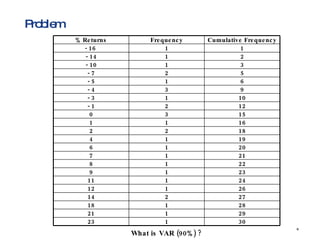
Problem What is VAR (90%) ? % Returns Frequency Cumulative Frequency - 16  1 1 - 14 1 2 - 10 1 3 - 7 2 5 - 5 1 6 - 4 3 9 - 3 1 10 - 1 2 12 0 3 15 1 1 16 2 2 18 4 1 19 6 1 20 7 1 21 8 1 22 9 1 23 11 1 24 12 1 26 14 2 27 18 1 28 21 1 29 23 1 30
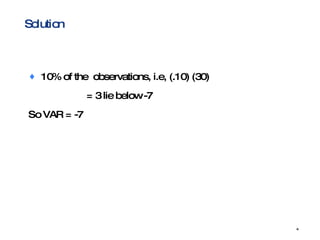
10% of the  observations, i.e, (.10) (30)  = 3 lie below -7 So VAR = -7 Solution
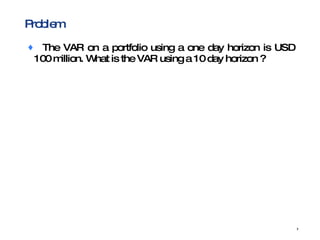
Problem The VAR on a portfolio using a one day horizon is USD 100 million. What is the VAR using a 10 day horizon ?
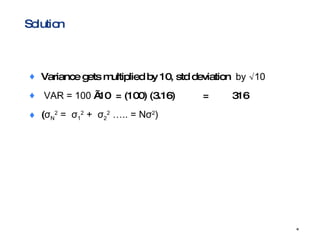
Solution Variance gets multiplied by 10, std deviation  by √10 VAR = 100  √10  = (100) (3.16)  = 316 ( σ N 2  =  σ 1 2  +  σ 2 2  ….. = N σ 2 )
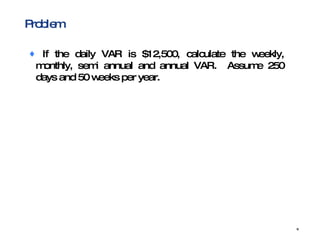
Problem If the daily VAR is $12,500, calculate the weekly, monthly, semi annual and annual VAR.  Assume 250 days and 50 weeks per year.
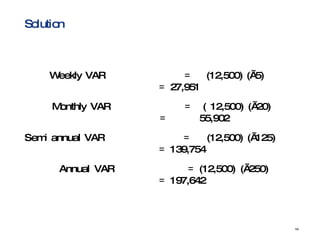
Solution  Weekly VAR     =   (12,500) (√5)    = 27,951  Monthly VAR    =   ( 12,500) (√20)     =  55,902 Semi annual VAR     =  (12,500) (√125)     = 139,754 Annual VAR   = (12,500) (√250)     = 197,642
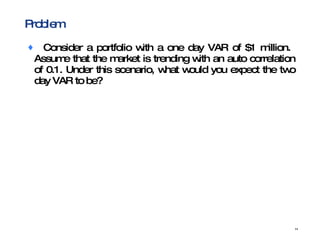
Problem Consider a portfolio with a one day VAR of $1 million.  Assume that the market is trending with an auto correlation of 0.1. Under this scenario, what would you expect the two day VAR to be?
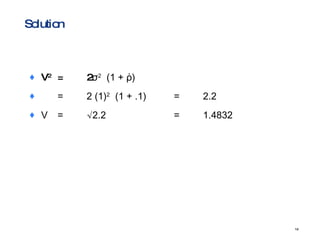
Solution V 2   = 2 σ 2   (1 +  ῤ ) = 2 (1) 2   (1 + .1) = 2.2  V = √2.2 = 1.4832
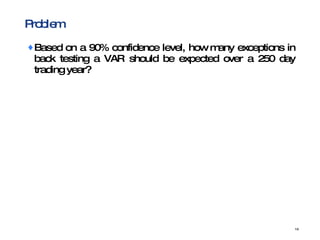
Problem Based on a 90% confidence level, how many exceptions in back testing a VAR should be expected over a 250 day trading year?
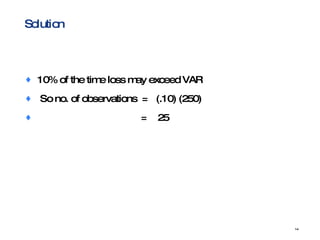
Solution  10% of the time loss may exceed VAR  So no. of observations  =  (.10) (250)  =  25
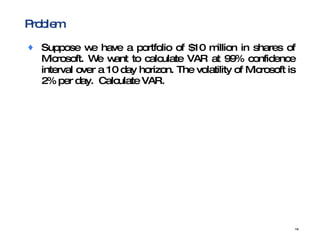
Problem Suppose we have a portfolio of $10 million in shares of Microsoft. We want to calculate VAR at 99% confidence interval over a 10 day horizon. The volatility of Microsoft is 2% per day.  Calculate VAR.
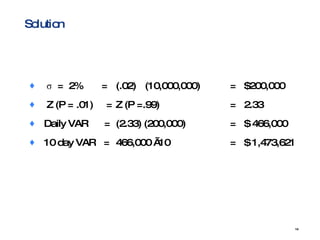
Solution σ =  2%  = (.02) (10,000,000)   =  $200,000 Z (P = .01)  = Z (P =.99)    =  2.33 Daily VAR  = (2.33) (200,000)   =  $ 466,000 10 day VAR  = 466,000 √10    =  $ 1,473,621
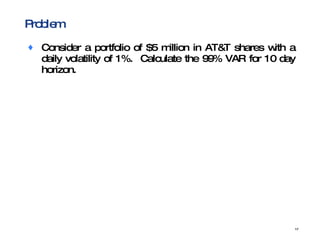
Problem Consider a portfolio of $5 million in AT&T shares with a daily volatility of 1%.  Calculate the 99% VAR for 10 day horizon.
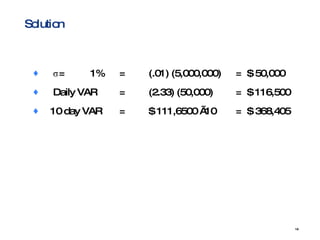
Solution σ= 1% = (.01) (5,000,000) =  $ 50,000 Daily VAR = (2.33) (50,000) =  $ 116,500  10 day VAR = $ 111,6500 √10 =  $ 368,405
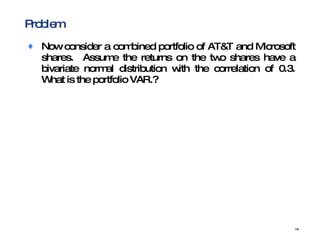
Problem Now consider a combined portfolio of AT&T and Microsoft shares.  Assume the returns on the two shares have a bivariate normal distribution with the correlation of 0.3. What is the portfolio VAR.?
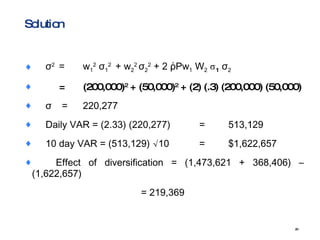
Solution σ 2  = w 1 2   σ 1 2  + w 2 2  σ 2 2  + 2  ῤ Pw 1  W 2   σ 1   σ 2     = (200,000) 2  + (50,000) 2  + (2) (.3) (200,000) (50,000) σ   = 220,277 Daily VAR = (2.33) (220,277)  =  513,129 10 day VAR = (513,129) √10 = $1,622,657 Effect of diversification = (1,473,621 + 368,406) – (1,622,657) = 219,369
VAR can be used as a company wide yardstick to compare risks across different markets.  VAR can also be used to understand whether risk has increased over time.  VAR can be used to  drill down into  risk reports to understand whether the higher risk is due to  increased volatility or bigger bets. VAR as a benchmark measure
VAR can also give a broad idea of the worst loss an institution can incur.  The choice of time horizon must correspond to the time required for corrective action as losses start to  develop.  Corrective action may include reducing the risk  profile of the institution or raising new capital. Banks may use daily VAR because of  the liquidity and rapid turnover in their portfolios.  In contrast, pension funds generally invest in less liquid portfolios and adjust their risk exposures only slowly.  So a one month horizon makes more sense.  VAR as a potential loss measure
VAR can be used to determine the amount of capital needed. The VAR measure should adequately capture all the risks facing the institution -  market risk, credit risk, operational risk and other risks.  The higher the degree of risk aversion of the company, the higher the confidence level chosen.  If the bank is targeting a particular credit rating, the expected default rate can be converted directly into a confidence level. Higher credit ratings should lead to a higher confidence level.  VAR as equity capital
Banks can disclose their aggregated risk without revealing their individual positions.  Ideally, institutions should provide summary VAR figures on a daily, weekly or monthly basis.  Disclosure of information is an effective means  of market discipline. VAR as an information reporting tool
Position limits alone do not give a complete picture.  The same limit on a 30  year treasury, (compared to 5 year treasury) may be more risky.  VAR limits can supplement position limits.  In volatile environments, VAR can be used as the basis for scaling down positions. VAR acts as a common denominator for  comparing various risky activities.  VAR as  a risk control tool .
VAR can be viewed as a measure of risk capital or economic capital required to support a financial activity.  The economic capital is the aggregate capital required as a cushion against unexpected losses.  VAR helps in measuring risk adjusted return.  Without controlling for risk, traders may become reckless.  A trader making a large profit, receives a large bonus.  If the trader  makes a loss, the worst that can happen is a small fine.  VAR as a measure of risk adjusted performance
The application of VAR in performance measurement depends on its intended purposes. Internal performance measurement aims at rewarding people for actions they have full control over.  The individual/undiversified VAR seems the appropriate choice. External performance measurement aims at allocation of existing / new capital to existing or  new business units.  Such decisions should be based on marginal and diversified VAR measures.
A strong capital allocation process produces substantial benefits. The process almost always leads to improvements.  Finance executives are forced to examine  prospects for revenues, costs and risks in all their business activities.  Managers start to learn things about their business they did not know.
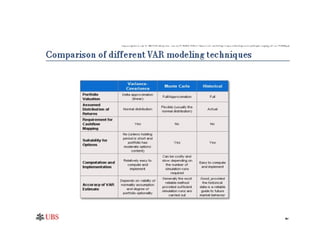
Parametric and non parametric methods Non parametric method  : This is the most general method which does not make any assumption about the shape of the distribution of returns. Parametric method:  VAR computation becomes much easier if a distribution, such as normal, is assumed.
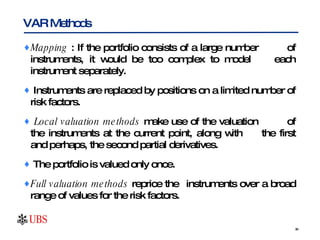
Mapping  : If the portfolio consists of a large number  of instruments, it would be too complex to model  each instrument separately.  Instruments are replaced by positions on a limited number of risk factors.  Local valuation methods  make use of the valuation  of the instruments at the current point, along with  the first and perhaps, the second partial derivatives.  The portfolio is valued only once. Full valuation methods  reprice the  instruments over a broad range of values for the risk factors. VAR Methods
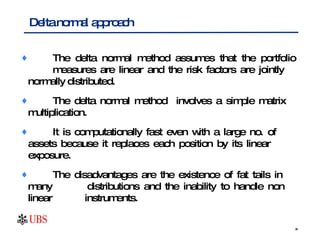
The delta normal method assumes that the portfolio  measures are linear and the risk factors are jointly  normally distributed.  The delta normal method  involves a simple matrix  multiplication.  It is computationally fast even with a large no. of  assets because it replaces each position by its linear  exposure.  The disadvantages are the existence of fat tails in  many  distributions and the inability to handle non  linear  instruments.  Delta normal approach
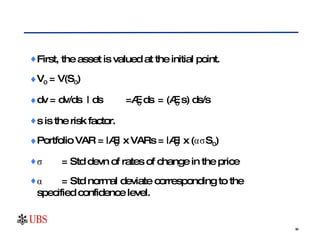
First, the asset is valued at the initial point. V 0  = V(S 0 ) dv = dv/ds  | ds =∆ 0  ds  = (∆ 0  s) ds/s s is the risk factor. Portfolio VAR = |∆ 0 | x VARs = |∆ 0 | x (ασS 0 ) σ  = Std devn of rates of change in the price α = Std normal deviate corresponding to the      specified confidence level.
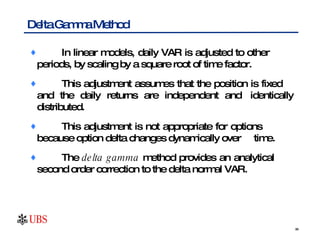
In linear models, daily VAR is adjusted to other  periods, by scaling by a square root of time factor.  This adjustment assumes that the position is fixed  and the daily returns are independent and  identically distributed.  This adjustment is not appropriate for options  because option delta changes dynamically over  time.  The  delta gamma  method provides an analytical  second order correction to the delta normal VAR. Delta Gamma Method
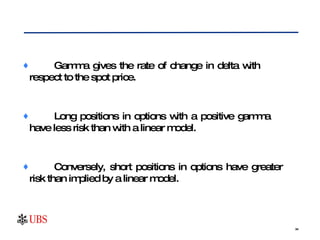
Gamma gives the rate of change in delta with  respect to the spot price. Long positions in options with a positive gamma  have less risk than with a linear model.  Conversely, short positions in options have greater  risk than implied by a linear model.
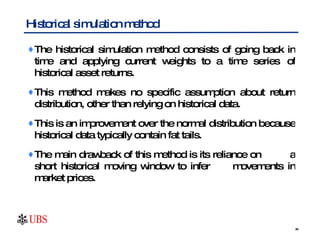
The historical simulation method consists of going back in time and applying current weights to a time series  of historical asset returns. This method makes no specific assumption about return distribution, other than relying on historical data.  This is an improvement over the normal distribution because historical data typically contain fat tails.  The main drawback of this method is its reliance on  a short historical moving window to infer  movements in market prices.  Historical simulation method
The sampling variation of historical simulation VAR  is greater than for a parametric method. Longer sample paths are required to obtain meaningful quantities.  The dilemma is that this may involve observations that are no longer relevant.  Banks use periods between 250 and 750 days. This is taken as a reasonable trade off between  precision and non stationarity. Many institutions are now using historical simulation over a window of 1-4 years, duly  supplemented by stress tests.
The Monte Carlo Simulation Method is similar to the historical simulation, except that movements in risk factors are generated by drawings from some pre-specified distribution.  The risk manager samples pseudo random numbers from this distribution and then generates pseudo-dollar returns as before.  Finally, the returns are sorted to produce the desired VAR. This method uses computer simulations to generate random price paths.  Monte Carlo Simulation Method
Monte Carlo methods  are  by far the most powerful approach to VAR.  They can account for a wide range of risks including price risk, volatility risk, fat tails and extreme  scenarios and complex interactions.  Non linear exposures and complex  pricing patterns can also be handled.  Monte Carlo analysis can deal with  time decay of options, daily settlements & associated cash flows  and the effect of pre specified trading or hedging strategies.
The Monte Carlo approach requires users to make assumptions about the stochastic process and to understand the sensitivity of the results to these assumptions. Different random numbers will lead to different results.  A large number of iterations may be needed to  converge to a stable VAR measure.  When all the risk factors have a normal distribution and exposures are linear, the method should  converge to the VAR produced by the delta-normal VAR.
The Monte Carlo  approach is computationally quite demanding.  It requires marking to market the whole portfolio over a large number of realisations of underlying  random variables.  To speed up the process, methods, have been  devised to break the link between the number of Monte Carlo draws and the number of times the portfolio is repriced.  In the grid Monte Carlo approach, the portfolio is exactly valued over a limited number of grid points.  For each simulation, the portfolio is valued using a linear interpolation from the exact values at adjoining grid points.
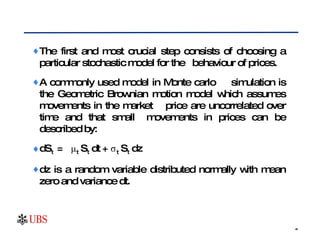
The first and most crucial step consists of choosing a particular stochastic model for the  behaviour of prices.  A commonly used model in Monte carlo  simulation is the Geometric Brownian motion model which assumes movements in the market  price are uncorrelated over time and that small  movements in prices can be described by: dS t  =  μ t  S t  dt + σ t  S t  dz dz is a random variable distributed normally with mean zero and variance dt.
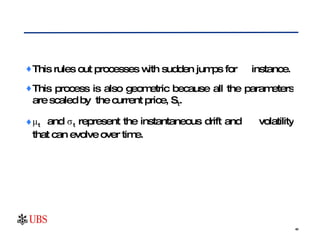
This rules out processes with sudden jumps for  instance.  This process is also geometric because all the parameters are scaled by  the current price, S t .  μ t   and σ t  represent the instantaneous drift and  volatility that can evolve over time.
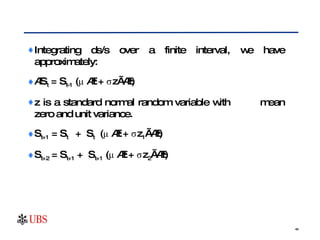
Integrating ds/s over a finite interval, we have approximately: ∆ S t  = S t-1  (μ ∆t + σz√∆t) z is a standard normal random variable with  mean zero and unit variance.  S t+1  = S t  +  S t   (μ ∆t + σz 1 √∆t) S t+2  = S t+1  +  S t+1  (μ ∆t + σz 2 √∆t)
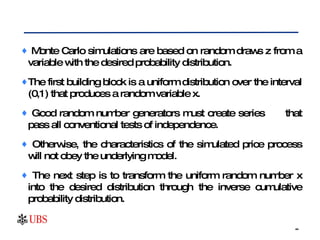
Monte Carlo simulations are based on random draws z from a variable with the desired probability distribution.  The first building block is a uniform distribution over the interval (0,1) that produces a random variable x.  Good random number generators must create series  that pass all conventional tests of independence.  Otherwise, the characteristics of the simulated price process will not obey the underlying model.  The next step is to transform the uniform random number x into the desired distribution through the inverse cumulative probability distribution.
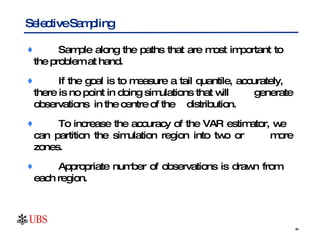
Sample along the paths that are most important to  the problem at hand.  If the goal is to measure a tail quantile, accurately,  there is no point in doing simulations that will  generate observations  in the centre of the  distribution.  To increase the accuracy of the VAR estimator, we  can partition the simulation region into two or  more zones.  Appropriate number of observations is drawn from  each region.  Selective Sampling
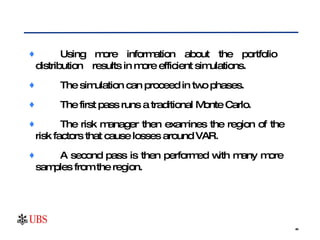
Using more information about the portfolio  distribution  results in more efficient simulations.  The simulation can proceed in two phases.  The first pass runs a traditional Monte Carlo.  The risk manager then examines the region of the  risk factors that cause losses around VAR.  A second pass is then performed with many more  samples from the region.
 
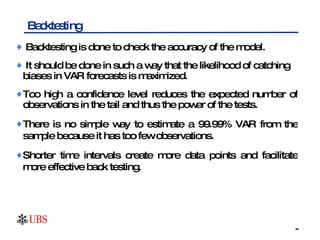
Backtesting is done to check the accuracy of the model. It should be done in such a way that the likelihood of catching  biases in VAR forecasts is maximized.  Too high a confidence level reduces the expected number of observations in the tail and thus the power of the tests.  There is no simple way to estimate a 99.99% VAR from the sample because it has too few observations.  Shorter time intervals create more data points and facilitate more effective back testing. Backtesting
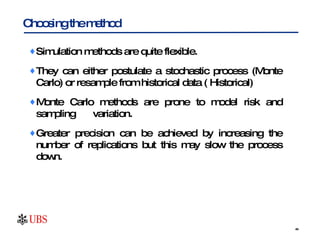
Simulation methods are quite flexible.  They can either postulate a stochastic process (Monte Carlo) or resample from historical data ( Historical)  Monte Carlo methods are prone to model risk and sampling  variation.  Greater precision can be achieved by increasing the number of replications but this may slow the process down. Choosing the method
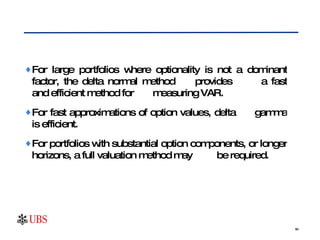
For large portfolios where optionality is not a dominant factor, the delta normal method  provides  a fast and efficient method for  measuring VAR.  For fast approximations of option values, delta  gamma is efficient.  For portfolios with substantial option components, or longer horizons, a full valuation method may  be required.
If the stochastic process chosen for the price is unrealistic, so will be the estimate of VAR.  For example, the geometric Brownian motion  model adequately describes the behaviour of stock prices and exchange rates but not that of fixed income securities.  In Brownian motion models, price shocks are  never reversed and prices move as a random walk.  This cannot be the price process for default free bond prices which must converge to their face value at expiration.
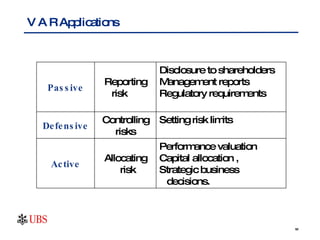
V A R Applications Passive Reporting risk Disclosure to shareholders  Management reports Regulatory requirements Defensive Controlling risks Setting risk limits Active Allocating risk  Performance valuation Capital allocation ,  Strategic business decisions.
VAR can also be used at the strategic level to  identify where shareholder value is being added  throughout the corporation.  VAR can help management take decisions about  which business lines to expand, maintain or reduce. And also  about the appropriate level of capital to hold.
VAR methods represent the culmination of a  trend towards centralized risk management. Many institutions have started to measure  market risk on a global basis because the sources of risk have multiplied and volatility has  increased.  A portfolio approach gives a better picture of  risk rather than looking at different instruments  in isolation.
Centralization makes sense for credit risk management  too.  A financial institution may have myriad transactions with  the same counterparty, coming from various desks such as currencies, fixed income  commodities  and so on.  Even though all the desks may have a reasonable exposure when considered on an individual basis, these exposures may add up to an unacceptable risk.  Also, with netting agreements, the total exposure depends on the net current value of contracts  covered by the agreements.  All these steps are not possible in the absence of a global measurement system.
Institutions which will benefit most from a global  risk management system are those which are  exposed to: - diverse risk - active positions taking / proprietary trading - complex instruments
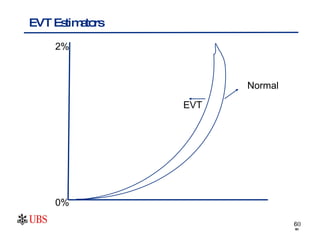
EVT extends the central limit theorem which  deals with the distribution of the average of  identically and independently distributed  variables from an unknown distribution to the  distribution of their tails.  The EVT approach is useful for estimating tail probabilities of extreme events.  For very high confidence levels (>99%), the normal distribution generally underestimates  potential losses.  Extreme Value Theory (EVT)
Empirical distributions suffer from a lack of  data in the tails.  This makes it difficult to estimate VAR reliably.  EVT helps us to draw smooth curves through the extreme tails of the distribution based on powerful statistical theory.  In many cases the  t  distribution with 4-6  degrees of freedom is adequate to describe the tails of financial data.
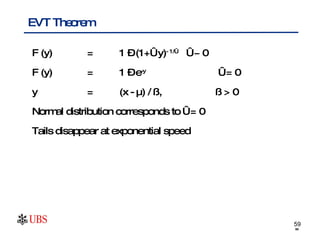
EVT Theorem  F (y)  =  1 – (1+€ y) - 1/€  € ≠ 0 F (y)  = 1 – e -y  € = 0 y  = (x - µ) / ß,  ß > 0 Normal distribution corresponds to € = 0 Tails disappear at exponential speed
EVT Estimators  2% Normal EVT 0%
Fitting EVT functions to recent historical data is  fraught with the same pitfalls as VAR. Once in a lifetime events cannot be taken into account even by powerful statistical tools. So they need to be complemented by stress testing. The goal of stress testing is to identify unusual scenarios that would not occur under standard VAR models. Stress testing
The problem with stress testing is the stress needs to  be pertinent to the type of risk the institution has.  Otherwise, the complex portfolio models banks generally employ may give the illusion of accurate simulation at the  expense of substance.
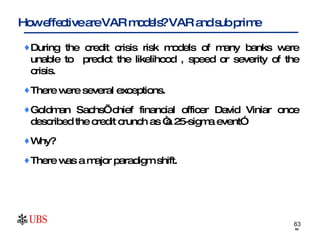
During the credit crisis risk models of many banks were unable to  predict the likelihood , speed or severity of the crisis. There were several exceptions. Goldman Sachs’ chief financial officer David Viniar once described the credit crunch as “a 25-sigma event” Why? There was a major paradigm shift. How effective are VAR models? VAR and sub prime
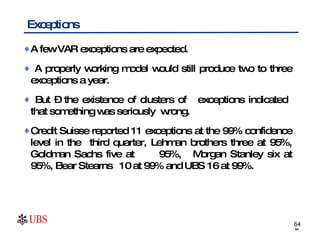
Exceptions A few VAR exceptions are expected. A properly working model would still produce two to three exceptions a year. But – the existence of clusters of  exceptions indicated  that something was seriously  wrong. Credit Suisse reported 11 exceptions at the 99% confidence level in the  third quarter, Lehman brothers three at 95%, Goldman Sachs five at  95%,  Morgan Stanley six at 95%, Bear Stearns  10 at 99% and UBS 16 at 99%.
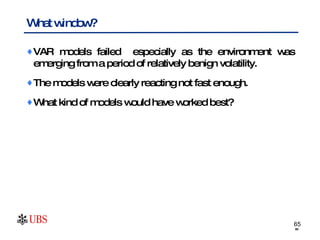
What window?  VAR models failed  especially as the environment was emerging from a period of relatively benign volatility. The models were clearly reacting not fast enough.  What kind of models would have worked best?
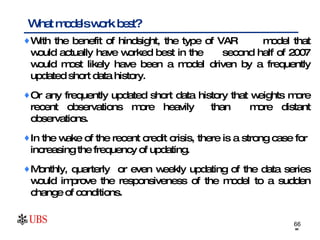
What models work best?  With the benefit of hindsight, the type of VAR  model that would actually have worked best in the  second half of 2007 would most likely have been a model driven by a frequently updated short data history.  Or any frequently updated short data history that weights more recent observations more heavily  than  more distant observations. In the wake of the recent credit crisis, there is a strong case for  increasing the frequency of updating.  Monthly, quarterly  or even weekly updating of the data series would improve the responsiveness of the model to a sudden change of conditions.
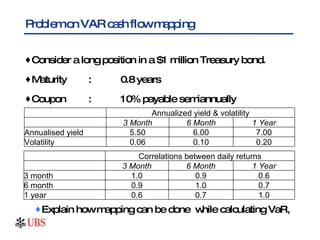
Problem on VAR cash flow mapping Consider a long position in a $1 million Treasury bond.  Maturity : 0.8 years Coupon : 10% payable semiannually  Explain how mapping can be done  while calculating VaR, Annualized yield & volatility 3 Month 6 Month 1 Year Annualised yield 5.50 6.00 7.00 Volatility 0.06 0.10 0.20 Correlations between daily returns 3 Month 6 Month 1 Year 3 month 1.0 0.9 0.6 6 month 0.9 1.0 0.7 1 year 0.6 0.7 1.0
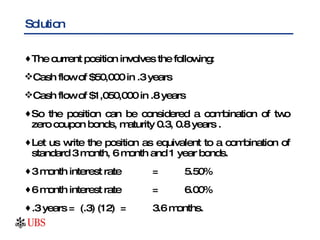
Solution  The current position involves the following: Cash flow of $50,000 in .3 years Cash flow of $1,050,000 in .8 years So the position can be considered a combination of two zero coupon bonds, maturity 0.3, 0.8 years . Let us write the position as equivalent to a combination of standard 3 month, 6 month and 1 year bonds. 3 month interest rate = 5.50% 6 month interest rate = 6.00% .3 years =  (.3) (12)  = 3.6 months.
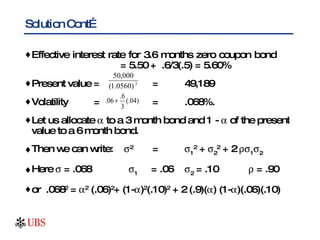
Solution Cont… Effective interest rate for 3.6 months zero coupon bond  = 5.50 +  .6/3(.5) = 5.60% Present value = = 49,189 Volatility   =  = .068%. Let us allocate    to a 3 month bond and 1 -    of the present value to a 6 month bond. Then we can write:   2 =  1 2  +   2 2  + 2   1  2 Here    = .068    1   = .06  2  = .10   = .90 or  .068 2  =   2  (.06) 2 + (1-  ) 2 (.10) 2  + 2 (.9)(  ) (1-  )(.06)(.10)
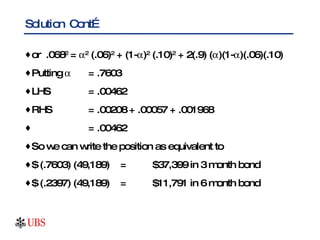
Solution  Cont…  or  .068 2  =   2  (.06) 2  + (1-  ) 2  (.10) 2  + 2(.9) (  )(1-  )(.06)(.10) Putting     = .7603 LHS  = .00462 RHS = .00208 + .00057 + .001968 = .00462 So we can write the position as equivalent to  $ (.7603) (49,189)  = $37,399 in 3 month bond $ (.2397) (49,189) = $11,791 in 6 month bond
Solution  Cont…  Now consider $1,050,000 received after 0.8 years. It can be considered a combination of 6 month and 12 month positions. Interpolating the interest rate we get:  = .066 Volatility = [.1 + (3.6/6)(0.1) ]  = 0.16 Present value of cash flows  =   = $997,662
Let    be the position in the 6 month bond and (1-  ) in the 12 month bond. Then we can write:  2   =   2    1 2  + (1-  ) 2    2 2  + 2    (1-  )   1  2 Or (.16) 2   =   2  (.1) 2  + (1-  ) 2  (.2) 2  + 2 (.7) (  ) (1-  ) (.1)(.2) LHS = .0256  Put   = .320337 We get RHS =.001026 + .01848 + .006096  ≈ .0256
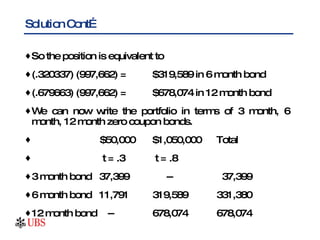
Solution Cont… So the position is equivalent to  (.320337) (997,662) = $319,589 in 6 month bond (.679663) (997,662) = $678,074 in 12 month bond We can now write the portfolio in terms of 3 month, 6 month, 12 month zero coupon bonds.   $50,000 $1,050,000  Total   t = .3  t = .8 3 month bond  37,399   --   37,399 6 month bond  11,791 319,589 331,380 12 month bond  -- 678,074 678,074
Solution Cont… Let   1 ,   2 ,   3  be the volatilities of the 3 month, 6 months, 12 months bonds and   12,    13 ,   23  be the respective correlations. Then   2   =   1 2  +   2 2  +   3 2  + 2  12  1  2  + 2  23  2  3  +    2  13  1  3 =  [(37,399) 2  (.06) 2  + (331,380) 2  (.10) 2  +    (678,074) 2  (.20) 2   + (2) (37,399) (331,380) (.06) (.10) (.90) + (2) (331,380) (678,074) (.10) (.20) (.70) + (2) (37,399) (678,074) (.06) (.20) (.60)] x 10 -4 = [5,035,267 + 1,098,127,044 + 18,391,373,980 +    133,847,431+6,291,604,539+365,173,769]x10 -4
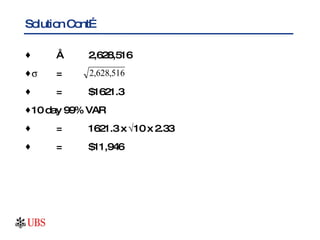
Solution Cont… ≈ 2,628,516  = = $1621.3 10 day 99% VAR = 1621.3 x   10 x 2.33 = $11,946

Value At Risk Sep 22

  • 1.
    Value at RiskBy A V Vedpuriswar September 15, 2009
  • 2.
    What is VAR?VAR summarizes the worst loss over a target horizon that will not be exceeded at a given level of confidence. For example, “under normal market conditions, the most the portfolio can lose over a month is about $3.6 billion at the 99% confidence level.” The main idea behind VAR is to consider the total portfolio risk at the highest level of the institution. Initially applied to market risk, it is now used to measure credit risk, operational risk and enterprise wide risk. Many banks can now use their own VAR models as the basis for their required capital for market risk.
  • 3.
    Average revenue =$5.1 million per day Total no. of observations = 254. Std dev = $9.2 million Confidence level = 95% No. of observations < - $10 million = 11 No. of observations < - $ 9 million = 15 Find VAR. Illustration
  • 4.
    Find thepoint such that the no. of observations to the left = (254) (.05) = 12.7 (12.7 – 11) /( 15 – 11 ) = 1.7 / 4 ≈ .4 So required point = - (10 - .4) = - $9.6 million VAR = E (W) – (-9.6) = 5.1 – (-9.6) = $14.7 million If we assume a normal distribution, Z at 95% confidence interval, 1 tailed = 1.645 VAR = (1.645) (9.2) = $ 15.2 million
  • 5.
    Problem What isVAR (90%) ? % Returns Frequency Cumulative Frequency - 16 1 1 - 14 1 2 - 10 1 3 - 7 2 5 - 5 1 6 - 4 3 9 - 3 1 10 - 1 2 12 0 3 15 1 1 16 2 2 18 4 1 19 6 1 20 7 1 21 8 1 22 9 1 23 11 1 24 12 1 26 14 2 27 18 1 28 21 1 29 23 1 30
  • 6.
    10% of the observations, i.e, (.10) (30) = 3 lie below -7 So VAR = -7 Solution
  • 7.
    Problem The VARon a portfolio using a one day horizon is USD 100 million. What is the VAR using a 10 day horizon ?
  • 8.
    Solution Variance getsmultiplied by 10, std deviation by √10 VAR = 100 √10 = (100) (3.16) = 316 ( σ N 2 = σ 1 2 + σ 2 2 ….. = N σ 2 )
  • 9.
    Problem If thedaily VAR is $12,500, calculate the weekly, monthly, semi annual and annual VAR. Assume 250 days and 50 weeks per year.
  • 10.
    Solution WeeklyVAR = (12,500) (√5) = 27,951 Monthly VAR = ( 12,500) (√20) = 55,902 Semi annual VAR = (12,500) (√125) = 139,754 Annual VAR = (12,500) (√250) = 197,642
  • 11.
    Problem Consider aportfolio with a one day VAR of $1 million. Assume that the market is trending with an auto correlation of 0.1. Under this scenario, what would you expect the two day VAR to be?
  • 12.
    Solution V 2 = 2 σ 2 (1 + ῤ ) = 2 (1) 2 (1 + .1) = 2.2 V = √2.2 = 1.4832
  • 13.
    Problem Based ona 90% confidence level, how many exceptions in back testing a VAR should be expected over a 250 day trading year?
  • 14.
    Solution 10%of the time loss may exceed VAR So no. of observations = (.10) (250) = 25
  • 15.
    Problem Suppose wehave a portfolio of $10 million in shares of Microsoft. We want to calculate VAR at 99% confidence interval over a 10 day horizon. The volatility of Microsoft is 2% per day. Calculate VAR.
  • 16.
    Solution σ = 2% = (.02) (10,000,000) = $200,000 Z (P = .01) = Z (P =.99) = 2.33 Daily VAR = (2.33) (200,000) = $ 466,000 10 day VAR = 466,000 √10 = $ 1,473,621
  • 17.
    Problem Consider aportfolio of $5 million in AT&T shares with a daily volatility of 1%. Calculate the 99% VAR for 10 day horizon.
  • 18.
    Solution σ= 1%= (.01) (5,000,000) = $ 50,000 Daily VAR = (2.33) (50,000) = $ 116,500 10 day VAR = $ 111,6500 √10 = $ 368,405
  • 19.
    Problem Now considera combined portfolio of AT&T and Microsoft shares. Assume the returns on the two shares have a bivariate normal distribution with the correlation of 0.3. What is the portfolio VAR.?
  • 20.
    Solution σ 2 = w 1 2 σ 1 2 + w 2 2 σ 2 2 + 2 ῤ Pw 1 W 2 σ 1 σ 2 = (200,000) 2 + (50,000) 2 + (2) (.3) (200,000) (50,000) σ = 220,277 Daily VAR = (2.33) (220,277) = 513,129 10 day VAR = (513,129) √10 = $1,622,657 Effect of diversification = (1,473,621 + 368,406) – (1,622,657) = 219,369
  • 21.
    VAR can beused as a company wide yardstick to compare risks across different markets. VAR can also be used to understand whether risk has increased over time. VAR can be used to drill down into risk reports to understand whether the higher risk is due to increased volatility or bigger bets. VAR as a benchmark measure
  • 22.
    VAR can alsogive a broad idea of the worst loss an institution can incur. The choice of time horizon must correspond to the time required for corrective action as losses start to develop. Corrective action may include reducing the risk profile of the institution or raising new capital. Banks may use daily VAR because of the liquidity and rapid turnover in their portfolios. In contrast, pension funds generally invest in less liquid portfolios and adjust their risk exposures only slowly. So a one month horizon makes more sense. VAR as a potential loss measure
  • 23.
    VAR can beused to determine the amount of capital needed. The VAR measure should adequately capture all the risks facing the institution - market risk, credit risk, operational risk and other risks. The higher the degree of risk aversion of the company, the higher the confidence level chosen. If the bank is targeting a particular credit rating, the expected default rate can be converted directly into a confidence level. Higher credit ratings should lead to a higher confidence level. VAR as equity capital
  • 24.
    Banks can disclosetheir aggregated risk without revealing their individual positions. Ideally, institutions should provide summary VAR figures on a daily, weekly or monthly basis. Disclosure of information is an effective means of market discipline. VAR as an information reporting tool
  • 25.
    Position limits alonedo not give a complete picture. The same limit on a 30 year treasury, (compared to 5 year treasury) may be more risky. VAR limits can supplement position limits. In volatile environments, VAR can be used as the basis for scaling down positions. VAR acts as a common denominator for comparing various risky activities. VAR as a risk control tool .
  • 26.
    VAR can beviewed as a measure of risk capital or economic capital required to support a financial activity. The economic capital is the aggregate capital required as a cushion against unexpected losses. VAR helps in measuring risk adjusted return. Without controlling for risk, traders may become reckless. A trader making a large profit, receives a large bonus. If the trader makes a loss, the worst that can happen is a small fine. VAR as a measure of risk adjusted performance
  • 27.
    The application ofVAR in performance measurement depends on its intended purposes. Internal performance measurement aims at rewarding people for actions they have full control over. The individual/undiversified VAR seems the appropriate choice. External performance measurement aims at allocation of existing / new capital to existing or new business units. Such decisions should be based on marginal and diversified VAR measures.
  • 28.
    A strong capitalallocation process produces substantial benefits. The process almost always leads to improvements. Finance executives are forced to examine prospects for revenues, costs and risks in all their business activities. Managers start to learn things about their business they did not know.
  • 29.
    Parametric and nonparametric methods Non parametric method : This is the most general method which does not make any assumption about the shape of the distribution of returns. Parametric method: VAR computation becomes much easier if a distribution, such as normal, is assumed.
  • 30.
    Mapping :If the portfolio consists of a large number of instruments, it would be too complex to model each instrument separately. Instruments are replaced by positions on a limited number of risk factors. Local valuation methods make use of the valuation of the instruments at the current point, along with the first and perhaps, the second partial derivatives. The portfolio is valued only once. Full valuation methods reprice the instruments over a broad range of values for the risk factors. VAR Methods
  • 31.
    The delta normalmethod assumes that the portfolio measures are linear and the risk factors are jointly normally distributed. The delta normal method involves a simple matrix multiplication. It is computationally fast even with a large no. of assets because it replaces each position by its linear exposure. The disadvantages are the existence of fat tails in many distributions and the inability to handle non linear instruments. Delta normal approach
  • 32.
    First, the assetis valued at the initial point. V 0 = V(S 0 ) dv = dv/ds | ds =∆ 0 ds = (∆ 0 s) ds/s s is the risk factor. Portfolio VAR = |∆ 0 | x VARs = |∆ 0 | x (ασS 0 ) σ = Std devn of rates of change in the price α = Std normal deviate corresponding to the specified confidence level.
  • 33.
    In linear models,daily VAR is adjusted to other periods, by scaling by a square root of time factor. This adjustment assumes that the position is fixed and the daily returns are independent and identically distributed. This adjustment is not appropriate for options because option delta changes dynamically over time. The delta gamma method provides an analytical second order correction to the delta normal VAR. Delta Gamma Method
  • 34.
    Gamma gives therate of change in delta with respect to the spot price. Long positions in options with a positive gamma have less risk than with a linear model. Conversely, short positions in options have greater risk than implied by a linear model.
  • 35.
    The historical simulationmethod consists of going back in time and applying current weights to a time series of historical asset returns. This method makes no specific assumption about return distribution, other than relying on historical data. This is an improvement over the normal distribution because historical data typically contain fat tails. The main drawback of this method is its reliance on a short historical moving window to infer movements in market prices. Historical simulation method
  • 36.
    The sampling variationof historical simulation VAR is greater than for a parametric method. Longer sample paths are required to obtain meaningful quantities. The dilemma is that this may involve observations that are no longer relevant. Banks use periods between 250 and 750 days. This is taken as a reasonable trade off between precision and non stationarity. Many institutions are now using historical simulation over a window of 1-4 years, duly supplemented by stress tests.
  • 37.
    The Monte CarloSimulation Method is similar to the historical simulation, except that movements in risk factors are generated by drawings from some pre-specified distribution. The risk manager samples pseudo random numbers from this distribution and then generates pseudo-dollar returns as before. Finally, the returns are sorted to produce the desired VAR. This method uses computer simulations to generate random price paths. Monte Carlo Simulation Method
  • 38.
    Monte Carlo methods are by far the most powerful approach to VAR. They can account for a wide range of risks including price risk, volatility risk, fat tails and extreme scenarios and complex interactions. Non linear exposures and complex pricing patterns can also be handled. Monte Carlo analysis can deal with time decay of options, daily settlements & associated cash flows and the effect of pre specified trading or hedging strategies.
  • 39.
    The Monte Carloapproach requires users to make assumptions about the stochastic process and to understand the sensitivity of the results to these assumptions. Different random numbers will lead to different results. A large number of iterations may be needed to converge to a stable VAR measure. When all the risk factors have a normal distribution and exposures are linear, the method should converge to the VAR produced by the delta-normal VAR.
  • 40.
    The Monte Carlo approach is computationally quite demanding. It requires marking to market the whole portfolio over a large number of realisations of underlying random variables. To speed up the process, methods, have been devised to break the link between the number of Monte Carlo draws and the number of times the portfolio is repriced. In the grid Monte Carlo approach, the portfolio is exactly valued over a limited number of grid points. For each simulation, the portfolio is valued using a linear interpolation from the exact values at adjoining grid points.
  • 41.
    The first andmost crucial step consists of choosing a particular stochastic model for the behaviour of prices. A commonly used model in Monte carlo simulation is the Geometric Brownian motion model which assumes movements in the market price are uncorrelated over time and that small movements in prices can be described by: dS t = μ t S t dt + σ t S t dz dz is a random variable distributed normally with mean zero and variance dt.
  • 42.
    This rules outprocesses with sudden jumps for instance. This process is also geometric because all the parameters are scaled by the current price, S t . μ t and σ t represent the instantaneous drift and volatility that can evolve over time.
  • 43.
    Integrating ds/s overa finite interval, we have approximately: ∆ S t = S t-1 (μ ∆t + σz√∆t) z is a standard normal random variable with mean zero and unit variance. S t+1 = S t + S t (μ ∆t + σz 1 √∆t) S t+2 = S t+1 + S t+1 (μ ∆t + σz 2 √∆t)
  • 44.
    Monte Carlo simulationsare based on random draws z from a variable with the desired probability distribution. The first building block is a uniform distribution over the interval (0,1) that produces a random variable x. Good random number generators must create series that pass all conventional tests of independence. Otherwise, the characteristics of the simulated price process will not obey the underlying model. The next step is to transform the uniform random number x into the desired distribution through the inverse cumulative probability distribution.
  • 45.
    Sample along thepaths that are most important to the problem at hand. If the goal is to measure a tail quantile, accurately, there is no point in doing simulations that will generate observations in the centre of the distribution. To increase the accuracy of the VAR estimator, we can partition the simulation region into two or more zones. Appropriate number of observations is drawn from each region. Selective Sampling
  • 46.
    Using more informationabout the portfolio distribution results in more efficient simulations. The simulation can proceed in two phases. The first pass runs a traditional Monte Carlo. The risk manager then examines the region of the risk factors that cause losses around VAR. A second pass is then performed with many more samples from the region.
  • 47.
  • 48.
    Backtesting is doneto check the accuracy of the model. It should be done in such a way that the likelihood of catching biases in VAR forecasts is maximized. Too high a confidence level reduces the expected number of observations in the tail and thus the power of the tests. There is no simple way to estimate a 99.99% VAR from the sample because it has too few observations. Shorter time intervals create more data points and facilitate more effective back testing. Backtesting
  • 49.
    Simulation methods arequite flexible. They can either postulate a stochastic process (Monte Carlo) or resample from historical data ( Historical) Monte Carlo methods are prone to model risk and sampling variation. Greater precision can be achieved by increasing the number of replications but this may slow the process down. Choosing the method
  • 50.
    For large portfolioswhere optionality is not a dominant factor, the delta normal method provides a fast and efficient method for measuring VAR. For fast approximations of option values, delta gamma is efficient. For portfolios with substantial option components, or longer horizons, a full valuation method may be required.
  • 51.
    If the stochasticprocess chosen for the price is unrealistic, so will be the estimate of VAR. For example, the geometric Brownian motion model adequately describes the behaviour of stock prices and exchange rates but not that of fixed income securities. In Brownian motion models, price shocks are never reversed and prices move as a random walk. This cannot be the price process for default free bond prices which must converge to their face value at expiration.
  • 52.
    V A RApplications Passive Reporting risk Disclosure to shareholders Management reports Regulatory requirements Defensive Controlling risks Setting risk limits Active Allocating risk Performance valuation Capital allocation , Strategic business decisions.
  • 53.
    VAR can alsobe used at the strategic level to identify where shareholder value is being added throughout the corporation. VAR can help management take decisions about which business lines to expand, maintain or reduce. And also about the appropriate level of capital to hold.
  • 54.
    VAR methods representthe culmination of a trend towards centralized risk management. Many institutions have started to measure market risk on a global basis because the sources of risk have multiplied and volatility has increased. A portfolio approach gives a better picture of risk rather than looking at different instruments in isolation.
  • 55.
    Centralization makes sensefor credit risk management too. A financial institution may have myriad transactions with the same counterparty, coming from various desks such as currencies, fixed income commodities and so on. Even though all the desks may have a reasonable exposure when considered on an individual basis, these exposures may add up to an unacceptable risk. Also, with netting agreements, the total exposure depends on the net current value of contracts covered by the agreements. All these steps are not possible in the absence of a global measurement system.
  • 56.
    Institutions which willbenefit most from a global risk management system are those which are exposed to: - diverse risk - active positions taking / proprietary trading - complex instruments
  • 57.
    EVT extends thecentral limit theorem which deals with the distribution of the average of identically and independently distributed variables from an unknown distribution to the distribution of their tails. The EVT approach is useful for estimating tail probabilities of extreme events. For very high confidence levels (>99%), the normal distribution generally underestimates potential losses. Extreme Value Theory (EVT)
  • 58.
    Empirical distributions sufferfrom a lack of data in the tails. This makes it difficult to estimate VAR reliably. EVT helps us to draw smooth curves through the extreme tails of the distribution based on powerful statistical theory. In many cases the t distribution with 4-6 degrees of freedom is adequate to describe the tails of financial data.
  • 59.
    EVT Theorem F (y) = 1 – (1+€ y) - 1/€ € ≠ 0 F (y) = 1 – e -y € = 0 y = (x - µ) / ß, ß > 0 Normal distribution corresponds to € = 0 Tails disappear at exponential speed
  • 60.
    EVT Estimators 2% Normal EVT 0%
  • 61.
    Fitting EVT functionsto recent historical data is fraught with the same pitfalls as VAR. Once in a lifetime events cannot be taken into account even by powerful statistical tools. So they need to be complemented by stress testing. The goal of stress testing is to identify unusual scenarios that would not occur under standard VAR models. Stress testing
  • 62.
    The problem withstress testing is the stress needs to be pertinent to the type of risk the institution has. Otherwise, the complex portfolio models banks generally employ may give the illusion of accurate simulation at the expense of substance.
  • 63.
    During the creditcrisis risk models of many banks were unable to predict the likelihood , speed or severity of the crisis. There were several exceptions. Goldman Sachs’ chief financial officer David Viniar once described the credit crunch as “a 25-sigma event” Why? There was a major paradigm shift. How effective are VAR models? VAR and sub prime
  • 64.
    Exceptions A fewVAR exceptions are expected. A properly working model would still produce two to three exceptions a year. But – the existence of clusters of exceptions indicated that something was seriously wrong. Credit Suisse reported 11 exceptions at the 99% confidence level in the third quarter, Lehman brothers three at 95%, Goldman Sachs five at 95%, Morgan Stanley six at 95%, Bear Stearns 10 at 99% and UBS 16 at 99%.
  • 65.
    What window? VAR models failed especially as the environment was emerging from a period of relatively benign volatility. The models were clearly reacting not fast enough. What kind of models would have worked best?
  • 66.
    What models workbest? With the benefit of hindsight, the type of VAR model that would actually have worked best in the second half of 2007 would most likely have been a model driven by a frequently updated short data history. Or any frequently updated short data history that weights more recent observations more heavily than more distant observations. In the wake of the recent credit crisis, there is a strong case for increasing the frequency of updating. Monthly, quarterly or even weekly updating of the data series would improve the responsiveness of the model to a sudden change of conditions.
  • 67.
    Problem on VARcash flow mapping Consider a long position in a $1 million Treasury bond. Maturity : 0.8 years Coupon : 10% payable semiannually Explain how mapping can be done while calculating VaR, Annualized yield & volatility 3 Month 6 Month 1 Year Annualised yield 5.50 6.00 7.00 Volatility 0.06 0.10 0.20 Correlations between daily returns 3 Month 6 Month 1 Year 3 month 1.0 0.9 0.6 6 month 0.9 1.0 0.7 1 year 0.6 0.7 1.0
  • 68.
    Solution Thecurrent position involves the following: Cash flow of $50,000 in .3 years Cash flow of $1,050,000 in .8 years So the position can be considered a combination of two zero coupon bonds, maturity 0.3, 0.8 years . Let us write the position as equivalent to a combination of standard 3 month, 6 month and 1 year bonds. 3 month interest rate = 5.50% 6 month interest rate = 6.00% .3 years = (.3) (12) = 3.6 months.
  • 69.
    Solution Cont… Effectiveinterest rate for 3.6 months zero coupon bond = 5.50 + .6/3(.5) = 5.60% Present value = = 49,189 Volatility = = .068%. Let us allocate  to a 3 month bond and 1 -  of the present value to a 6 month bond. Then we can write:  2 =  1 2 +  2 2 + 2  1  2 Here  = .068  1 = .06  2 = .10  = .90 or .068 2 =  2 (.06) 2 + (1-  ) 2 (.10) 2 + 2 (.9)(  ) (1-  )(.06)(.10)
  • 70.
    Solution Cont… or .068 2 =  2 (.06) 2 + (1-  ) 2 (.10) 2 + 2(.9) (  )(1-  )(.06)(.10) Putting  = .7603 LHS = .00462 RHS = .00208 + .00057 + .001968 = .00462 So we can write the position as equivalent to $ (.7603) (49,189) = $37,399 in 3 month bond $ (.2397) (49,189) = $11,791 in 6 month bond
  • 71.
    Solution Cont… Now consider $1,050,000 received after 0.8 years. It can be considered a combination of 6 month and 12 month positions. Interpolating the interest rate we get: = .066 Volatility = [.1 + (3.6/6)(0.1) ] = 0.16 Present value of cash flows = = $997,662
  • 72.
    Let  be the position in the 6 month bond and (1-  ) in the 12 month bond. Then we can write:  2 =  2  1 2 + (1-  ) 2  2 2 + 2  (1-  )  1  2 Or (.16) 2 =  2 (.1) 2 + (1-  ) 2 (.2) 2 + 2 (.7) (  ) (1-  ) (.1)(.2) LHS = .0256 Put  = .320337 We get RHS =.001026 + .01848 + .006096 ≈ .0256
  • 73.
    Solution Cont… Sothe position is equivalent to (.320337) (997,662) = $319,589 in 6 month bond (.679663) (997,662) = $678,074 in 12 month bond We can now write the portfolio in terms of 3 month, 6 month, 12 month zero coupon bonds. $50,000 $1,050,000 Total t = .3 t = .8 3 month bond 37,399 -- 37,399 6 month bond 11,791 319,589 331,380 12 month bond -- 678,074 678,074
  • 74.
    Solution Cont… Let  1 ,  2 ,  3 be the volatilities of the 3 month, 6 months, 12 months bonds and  12,  13 ,  23 be the respective correlations. Then  2 =  1 2 +  2 2 +  3 2 + 2  12  1  2 + 2  23  2  3 + 2  13  1  3 = [(37,399) 2 (.06) 2 + (331,380) 2 (.10) 2 + (678,074) 2 (.20) 2 + (2) (37,399) (331,380) (.06) (.10) (.90) + (2) (331,380) (678,074) (.10) (.20) (.70) + (2) (37,399) (678,074) (.06) (.20) (.60)] x 10 -4 = [5,035,267 + 1,098,127,044 + 18,391,373,980 + 133,847,431+6,291,604,539+365,173,769]x10 -4
  • 75.
    Solution Cont… ≈2,628,516  = = $1621.3 10 day 99% VAR = 1621.3 x  10 x 2.33 = $11,946