Presented by
Muhammad Hossain Khan
4th year 2nd Semester
Dept. of Textile Engineering
Ahsanullah University of Science & Technology
Course Title: Accounting & Marketing
Course No-Hum-401
History
Company Profile ,Mission & Vision
Target Customer & Product Type
Outlet in the World
Present brand position & values
Marketing policy
Distribution Channel
Conclusion
Name Apple Incorporation
Former CEO Steve Job
New CEO Tim Cook
Revenue $ 233.715 billion (2015)
Area served Worldwide
Headquarter California, United States.
Total number of employees 115,000(july2015)
. Steve Jobs and Steve
Wozniak laid the
foundation of APPLE
COMPUTERS INC. on
April 1,1976 to sell the
Apple 1 (personal
computer kit)
FOUNDATION OF
APPLE
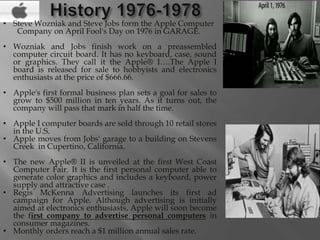
• Steve Wozniak and Steve Jobs form the Apple Computer
Company on April Fool's Day on 1976 in GARAGE.
• Wozniak and Jobs finish work on a preassembled
computer circuit board. It has no keyboard, case, sound
or graphics. They call it the Apple® I….The Apple I
board is released for sale to hobbyists and electronics
enthusiasts at the price of $666.66.
• Apple's first formal business plan sets a goal for sales to
grow to $500 million in ten years. As it turns out, the
company will pass that mark in half the time.
• Apple I computer boards are sold through 10 retail stores
in the U.S.
• Apple moves from Jobs' garage to a building on Stevens
Creek in Cupertino, California.
• The new Apple® II is unveiled at the first West Coast
Computer Fair. It is the first personal computer able to
generate color graphics and includes a keyboard, power
supply and attractive case .
• Regis McKenna Advertising launches its first ad
campaign for Apple. Although advertising is initially
aimed at electronics enthusiasts, Apple will soon become
the first company to advertise personal computers in
consumer magazines.
• Monthly orders reach a $1 million annual sales rate.
 The name was taken by Steve Jobs.
 The first Apple logo was designed by Ron
Wayne, co-founder of Apple Computer. It was
rather a picture than a logo. It showed Sir Isaac
Newton sitting beneath the famous Apple tree
thinking about gravity.
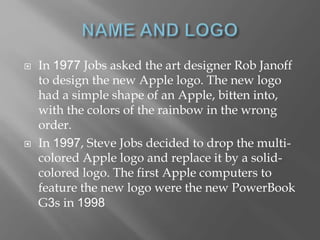
 In 1977 Jobs asked the art designer Rob Janoff
to design the new Apple logo. The new logo
had a simple shape of an Apple, bitten into,
with the colors of the rainbow in the wrong
order.
 In 1997, Steve Jobs decided to drop the multi-
colored Apple logo and replace it by a solid-
colored logo. The first Apple computers to
feature the new logo were the new PowerBook
G3s in 1998
1977 1997 20061975 2013
1974
The idea for Apple
Computers was
BORN
1976
First Computer was
SOLD
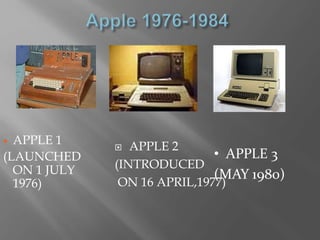
 APPLE 1
(LAUNCHED
ON 1 JULY
1976)
 APPLE 2
(INTRODUCED
ON 16 APRIL,1977)
• APPLE 3
(MAY 1980)
1984
The Macintosh was
INTRODUCED
1985
was discharged
Steve Jobs
1998 1999
Apple introduced all-in-
one
the iMac
Also Apple unveiled
the iBook
And the Innovations continue…
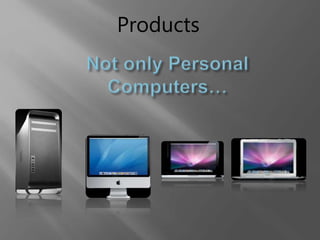
Products
iMac
iPod iPod Nano
iPad
Mac Book Air iPhone 4s iPhone 5s iPhone 5C
Target Customer
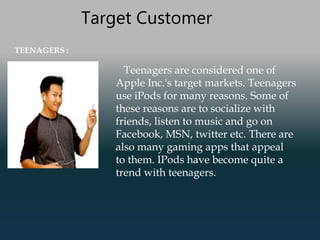
TEENAGERS :
Teenagers are considered one of
Apple Inc.'s target markets. Teenagers
use iPods for many reasons. Some of
these reasons are to socialize with
friends, listen to music and go on
Facebook, MSN, twitter etc. There are
also many gaming apps that appeal
to them. IPods have become quite a
trend with teenagers.
 COLLEGE AND UNIVERSITY
STUDENTS :
.College and university students
are also targeted by Apple Inc.
These students use Apple Inc.
products such as iPad's,
MacBook's, iPhone's etc to quickly
record notes. These notes are kept
organized in their devices. Also
these products are light which
makes carrying devices to and
from school much easier.
 BUSINESS PEOPLE :
Business people are
very intrigued by Apple
products. All Apple devices
(iPhone's, iPad's, MacBook's
etc.) have a business quality
that is very useful. These
devices are used to finish
work efficiently and to
communicate with clients
easily. In addition, sending
documentsis easy and
organized.
YOUNG CHILDREN AND KIDS :
Apple products are also useful
to young children and kids. The
reason for this is that devices such
as iPods and iPads are easy to use
due to their touch screen quality
which is good for children. Parents
can download learning game apps
on Apple devices to teach young
children and kids.
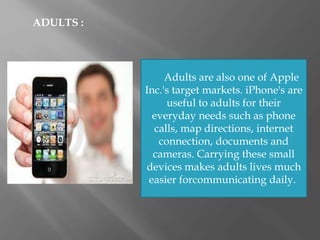
ADULTS :
Adults are also one of Apple
Inc.'s target markets. iPhone's are
useful to adults for their
everyday needs such as phone
calls, map directions, internet
connection, documents and
cameras. Carrying these small
devices makes adults lives much
easier forcommunicating daily.
OUTLETS IN THE WORLD:
)
Headquarteres in Infinite
Loop Cupertino,Califor
nia
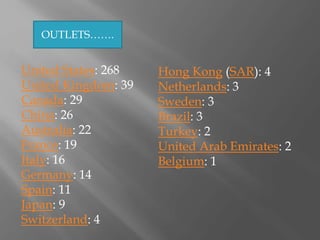
Apple has 472 retail
stores in 18 countries
and an online store
available in 39
countries.
OUTLETS…….
Hong Kong (SAR): 4
Netherlands: 3
Sweden: 3
Brazil: 3
Turkey: 2
United Arab Emirates: 2
Belgium: 1
United States: 268
United Kingdom: 39
Canada: 29
China: 26
Australia: 22
France: 19
Italy: 16
Germany: 14
Spain: 11
Japan: 9
Switzerland: 4
Present Brand Position
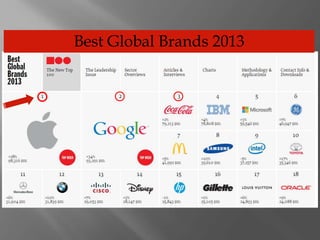
Best Global Brands Of 2015
Best Global Brands 2013
APPLE SOLD 56.8 MILLION iPHONES LAST YEAR.
116,800 iPhones per day
officially bigger than Microsoft ($93.58
billion)
Now, Apple generated revenue
of
$233.715 billion
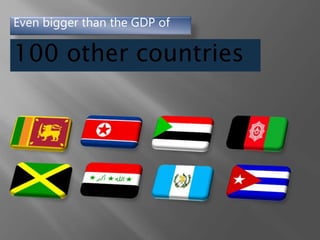
Even bigger than the GDP of
100 other countries
$470.94 B $231.2 B
Enterprise Value Total GDP
Marketing Policy
Key factors of policy
A design firm
A media platform
A publishing company
A software powerhouse
A computer builder
A movement
Apple’s distribution
structure
B2B CUSTOMERS
SME
Added
Value
Reselle
r
On-line
store
Education
Added
Value
Reselle
r
On-line
store
Direct
sales
force
Enterprise & Gov.
Direct
sales
force
On-line
store
Offer
solicitat
ion
Not sold through
direct sales force
due to small
volume
High level of
service
Channel with high
level of control
from Apple
Need for consultancy
and assistance
Crucial consultant role
Use in educational
environment also has a
promotional dimension
Shorter channel due to
the active role of Apple in
the design of this systems
On-line services for
companies similar to Dell
Governments buy mainly
through tenders
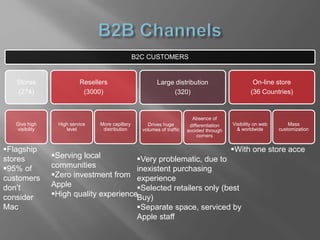
B2C CUSTOMERS
Stores
(274)
Give high
visibility
Resellers
(3000)
High service
level
More capillary
distribution
Large distribution
(320)
Drives huge
volumes of traffic
Absence of
differentiation
avoided through
corners
On-line store
(36 Countries)
Visibility on web
& worldwide
Mass
customization
Flagship
stores
95% of
customers
don’t
consider
Mac
Serving local
communities
Zero investment from
Apple
High quality experience
Very problematic, due to
inexistent purchasing
experience
Selected retailers only (best
Buy)
Separate space, serviced by
Apple staff
With one store acce
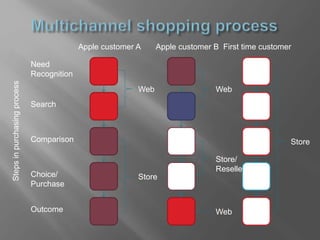
Need
Recognition
Search
Comparison
Choice/
Purchase
Outcome
Web
Store
Web
Store/
Reseller
Web
Store
First time customerApple customer A Apple customer B
Stepsinpurchasingprocess
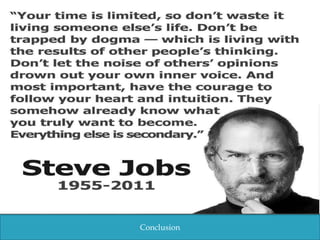
Conclusion
Stay Hungry, Stay Foolish.
Think Different

Apple Inc.

  • 1.
    Presented by Muhammad HossainKhan 4th year 2nd Semester Dept. of Textile Engineering Ahsanullah University of Science & Technology Course Title: Accounting & Marketing Course No-Hum-401
  • 2.
    History Company Profile ,Mission& Vision Target Customer & Product Type Outlet in the World Present brand position & values Marketing policy Distribution Channel Conclusion
  • 3.
    Name Apple Incorporation FormerCEO Steve Job New CEO Tim Cook Revenue $ 233.715 billion (2015) Area served Worldwide Headquarter California, United States. Total number of employees 115,000(july2015)
  • 4.
    . Steve Jobsand Steve Wozniak laid the foundation of APPLE COMPUTERS INC. on April 1,1976 to sell the Apple 1 (personal computer kit) FOUNDATION OF APPLE
  • 5.
    • Steve Wozniakand Steve Jobs form the Apple Computer Company on April Fool's Day on 1976 in GARAGE. • Wozniak and Jobs finish work on a preassembled computer circuit board. It has no keyboard, case, sound or graphics. They call it the Apple® I….The Apple I board is released for sale to hobbyists and electronics enthusiasts at the price of $666.66. • Apple's first formal business plan sets a goal for sales to grow to $500 million in ten years. As it turns out, the company will pass that mark in half the time. • Apple I computer boards are sold through 10 retail stores in the U.S. • Apple moves from Jobs' garage to a building on Stevens Creek in Cupertino, California. • The new Apple® II is unveiled at the first West Coast Computer Fair. It is the first personal computer able to generate color graphics and includes a keyboard, power supply and attractive case . • Regis McKenna Advertising launches its first ad campaign for Apple. Although advertising is initially aimed at electronics enthusiasts, Apple will soon become the first company to advertise personal computers in consumer magazines. • Monthly orders reach a $1 million annual sales rate.
  • 6.
     The namewas taken by Steve Jobs.  The first Apple logo was designed by Ron Wayne, co-founder of Apple Computer. It was rather a picture than a logo. It showed Sir Isaac Newton sitting beneath the famous Apple tree thinking about gravity.
  • 7.
     In 1977Jobs asked the art designer Rob Janoff to design the new Apple logo. The new logo had a simple shape of an Apple, bitten into, with the colors of the rainbow in the wrong order.  In 1997, Steve Jobs decided to drop the multi- colored Apple logo and replace it by a solid- colored logo. The first Apple computers to feature the new logo were the new PowerBook G3s in 1998
  • 8.
  • 10.
    1974 The idea forApple Computers was BORN 1976 First Computer was SOLD
  • 11.
     APPLE 1 (LAUNCHED ON1 JULY 1976)  APPLE 2 (INTRODUCED ON 16 APRIL,1977) • APPLE 3 (MAY 1980)
  • 12.
  • 13.
    1998 1999 Apple introducedall-in- one the iMac Also Apple unveiled the iBook
  • 14.
  • 15.
  • 17.
    iMac iPod iPod Nano iPad MacBook Air iPhone 4s iPhone 5s iPhone 5C
  • 19.
    Target Customer TEENAGERS : Teenagersare considered one of Apple Inc.'s target markets. Teenagers use iPods for many reasons. Some of these reasons are to socialize with friends, listen to music and go on Facebook, MSN, twitter etc. There are also many gaming apps that appeal to them. IPods have become quite a trend with teenagers.
  • 20.
     COLLEGE ANDUNIVERSITY STUDENTS : .College and university students are also targeted by Apple Inc. These students use Apple Inc. products such as iPad's, MacBook's, iPhone's etc to quickly record notes. These notes are kept organized in their devices. Also these products are light which makes carrying devices to and from school much easier.
  • 21.
     BUSINESS PEOPLE: Business people are very intrigued by Apple products. All Apple devices (iPhone's, iPad's, MacBook's etc.) have a business quality that is very useful. These devices are used to finish work efficiently and to communicate with clients easily. In addition, sending documentsis easy and organized.
  • 22.
    YOUNG CHILDREN ANDKIDS : Apple products are also useful to young children and kids. The reason for this is that devices such as iPods and iPads are easy to use due to their touch screen quality which is good for children. Parents can download learning game apps on Apple devices to teach young children and kids.
  • 23.
    ADULTS : Adults arealso one of Apple Inc.'s target markets. iPhone's are useful to adults for their everyday needs such as phone calls, map directions, internet connection, documents and cameras. Carrying these small devices makes adults lives much easier forcommunicating daily.
  • 24.
    OUTLETS IN THEWORLD: ) Headquarteres in Infinite Loop Cupertino,Califor nia Apple has 472 retail stores in 18 countries and an online store available in 39 countries.
  • 25.
    OUTLETS……. Hong Kong (SAR):4 Netherlands: 3 Sweden: 3 Brazil: 3 Turkey: 2 United Arab Emirates: 2 Belgium: 1 United States: 268 United Kingdom: 39 Canada: 29 China: 26 Australia: 22 France: 19 Italy: 16 Germany: 14 Spain: 11 Japan: 9 Switzerland: 4
  • 26.
  • 27.
  • 28.
  • 29.
    APPLE SOLD 56.8MILLION iPHONES LAST YEAR. 116,800 iPhones per day
  • 30.
    officially bigger thanMicrosoft ($93.58 billion) Now, Apple generated revenue of $233.715 billion
  • 31.
    Even bigger thanthe GDP of 100 other countries
  • 32.
    $470.94 B $231.2B Enterprise Value Total GDP
  • 34.
    Marketing Policy Key factorsof policy A design firm A media platform A publishing company A software powerhouse A computer builder A movement
  • 37.
  • 38.
    B2B CUSTOMERS SME Added Value Reselle r On-line store Education Added Value Reselle r On-line store Direct sales force Enterprise &Gov. Direct sales force On-line store Offer solicitat ion Not sold through direct sales force due to small volume High level of service Channel with high level of control from Apple Need for consultancy and assistance Crucial consultant role Use in educational environment also has a promotional dimension Shorter channel due to the active role of Apple in the design of this systems On-line services for companies similar to Dell Governments buy mainly through tenders
  • 39.
    B2C CUSTOMERS Stores (274) Give high visibility Resellers (3000) Highservice level More capillary distribution Large distribution (320) Drives huge volumes of traffic Absence of differentiation avoided through corners On-line store (36 Countries) Visibility on web & worldwide Mass customization Flagship stores 95% of customers don’t consider Mac Serving local communities Zero investment from Apple High quality experience Very problematic, due to inexistent purchasing experience Selected retailers only (best Buy) Separate space, serviced by Apple staff With one store acce
  • 40.
  • 46.
  • 48.
    Stay Hungry, StayFoolish. Think Different

Editor's Notes

  • #10 Apple lives this vision through the technologies it develops for consumers and corporations. It strives to make its customers masters of the products they have bought. Apple doesn't simply make a statement. It lives it by ensuring that its employees understand the vision and strive to reach it. It has put systems in place to enable smooth customer interaction. It has put objectives in place to continuously move forward; implemented strategies to fulfil these objectives; and ensured that the right marketing, financial and operational structures are in place to apply the strategies
  • #30 And 4,583 iPhones per hour. And 76 iPhones per minute. And 1.27 iPhones per second! The iPhone is now sold in 89 countries.