Apoptosis Necrosis
Apoptosis
• Cell death that is induced by a tightly
  regulated intracellular program

     “Programmed Cell Death”

• Causes of Apoptosis
    - Physiologic situations
   - Pathologic conditions
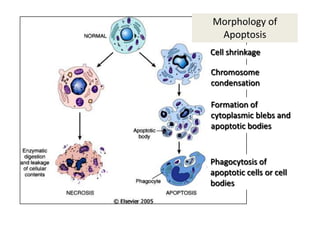
Morphology of
 Apoptosis
Cell shrinkage

Chromosome
condensation

Formation of
cytoplasmic blebs and
apoptotic bodies


Phagocytosis of
apoptotic cells or cell
bodies
Apoptosis in Physiologic Situations

• Programmed destruction of cell during embryogenesis
• Hormone-dependent involution
    - endometrial cells (menstrual cycle)
• Cell deletion in proliferating cell population
• Death of host cells - neutrophils
• Elimination of self reactive lymphocyte
• Cell death induced by cytotoxic T-cells
     - viral infected or tumor cells
Apoptosis in Pathologic Conditions
• Cell death produced by injurious stimuli –
  radiation, cytotoxic drug
• Cell injury in certain viral diseases – viral
  hepatitis
• Pathologic atrophy
• Cell death in tumors
Intracellular Accumulations
• Manifestation of “metabolic derangements”
  :intracellular accumulation of abnormal amounts
  of various substances
       Fat
       Protein
       Glycogen
       Pigments
Mechanisms of
intracellular accumulations

(1) abnormal metabolism
(2) alterations in protein folding
    and transport
(3) deficiency of critical enzymes
(4) inability to degrade
    phagocytosed particles
Intracellular Accumulations of Lipids
•    Accumulation of Lipids
       - Triglycerides
       - Cholesterol

•     Steatosis (fatty change)
     : abnormal accumulation of triglycerides within
      parenchymal cells
        – fatty liver in chronic alcoholism
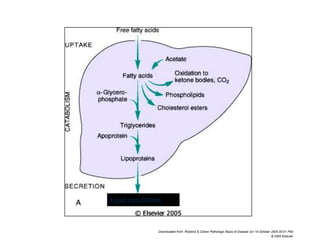
Lipid circulation


                Downloaded from: Robbins & Cotran Pathologic Basis of Disease (on 19 October 2005 05:51 PM)
                                                                                             © 2005 Elsevier
Fatty liver
              Downloaded from: Robbins & Cotran Pathologic Basis of Disease (on 19 October 2005 05:51 PM)
                                                                                           © 2005 Elsevier
Intracellular Accumulations of
                    Lipids
• Cholesterol and Cholesterol Esters
    :Atherosclerosis
       - accumulation of cholesterol-laden
  macrophage (foam cell) and smooth muscle
  cells in the intima of aorta and arteries
    :Cholesterolosis
       - accumulation of foam cells in the lamina
  propria of gallbladder
Downloaded from: Robbins & Cotran Pathologic Basis of Disease (on 19 October 2005 05:51 PM)
                                                                             © 2005 Elsevier
Intracellular Accumulations of Proteins
• Accumulation of protein droplets in proximal
  renal tubule
     - renal disease with heavy protein leakage
  across the glomerular filter
Protein reabsorption droplets in the renal tubular epithelium.

                               Downloaded from: Robbins & Cotran Pathologic Basis of Disease (on 19 October 2005 05:51 PM)
                                                                                                            © 2005 Elsevier
Intracellular Accumulations of Proteins
• Defects in protein folding
   :Defective intracellular transport and
  secretion
   :ER stress induced by unfolded and misfolded
  protein – cell death
   :Aggregation of abnormal folded protein -
  amyloidosis
Intracellular Accumulations of
                 Glycogen
“Patients with abnormal metabolism of glucose
  or glycogen”

• Diabetes mellitus
    :disorder of glucose metabolism
       - glycogen accumulate in epithelial cells of
  renal tubules, liver cells, beta-cells of the
  islets of Langerhans and heart muscle cells
Intracellular Accumulations of
              Glycogen

• Glycogen storage disease (Glycogenosis)
       - genetic diseases
     - defect of enzymes in the synthesis or
  breakdown of glycogen
  accumulation cell injury death
Accumulation of Pigments
• Exogenous pigments
    Carbon ( anthracosis)
    Coal dust ( pneumoconiosis)
  Lung: pick up by alveolar macrophages
  regional lymph nods

  blackening the tissues of the lungs
        (anthracosis)
Accumulation of Pigments
• Endogenous pigment
   :Lipofuscin – aging pigment
      lipid, phospholipid-protein complex (lipid
  peroxidation)

   :Melanin – in melanocyte

   :Hemosiderin – aggregates of ferritin micelles (iron +
  apoferritin = ferritin)
Pathologic Calcification
• Abnormal tissue deposition of Calcium Salts
• Two forms
    1. Dystrophic calcification
    2. Metastatic calcification
Pathologic Calcification
 Dystrophic Calcification
    - Area of tissue necrosis
   - Aging or damage heart valve
   - Atherosclerosis
    - Single necrotic cell
        “psammoma body”
Pathologic Calcification
 Metastatic Calcification
    - Occur in normal tissue in
“hypercalcemia”
      Hypercalcemia
      • Hyperparathyroidism
      • Destruction of bone tissue
      • Renal failure
Morphology of Cell Injury and
             Necrosis
• Cell Injury – Reversible
           – Irreversible

• Cell Death – Necrosis
          – Apoptosis
Morphology of Cell Injury
Reversible Injury
        Cellular swelling
        Fatty change

•   Plasma membrane alteration
•   Mitochondrial Changes
•   Dilation of Endoplasmic reticulum
•   Nuclear Alteration
Morphology of Necrotic Cells
• Increased Eosinophilia
     - loss of RNA (basophilia)
     - denatured cytoplasmic protein
• Nuclear Changes
     - Pyknosis
     - Karyorrhexis
     - Karyolysis
• Myelin figure
     – large, whorled phospholipid mass
  (phospholipid precipitate)
HISTOLOGIC FEATURES OF
                                     COAGULATIVE NECROSIS


Normal cell                                       Karyorrhexis

              Reversible
              cell injury
              with              Irreversible
              cytoplasmic &     cell injury                  Karyolysis
              organelle         with rupture of
              swelling, blebb   membrane &
              ing &             organelles, &
              ribosome          nuclear
              detachment        pyknosis
Morphologic pattern of Necrotic Cell
                  mass
•   Coagulative necrosis
•   Liquefactive necrosis
•   Caseous necrosis
•   Fat necrosis
Morphologic pattern of Necrotic Cell mass

• Coagulative Necrosis
   :intracellular acidosis
       – protein denatured
       – proteolysis inhibited
Ischemic necrosis of the myocardium
A, Normal myocardium.
B, Myocardium with coagulation necrosis
Morphologic pattern of Necrotic Cell mass

• Liquefactive Necrosis
   :focal bacterial (or fungal) infections
        – accumulation of inflammatory
          cells
   :hypoxic death of cells within CNS
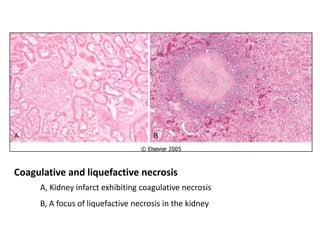
Coagulative and liquefactive necrosis
     A, Kidney infarct exhibiting coagulative necrosis
     B, A focus of liquefactive necrosis in the kidney
Morphologic Pattern of Necrotic Cell Mass

• Caseous necrosis
       :gross appearance
      :microscopic – granulomatous
  inflammation
A tuberculous lung with a large area of caseous necrosis
Tuberculous granuloma showing an area of central necrosis, epithelioid
cells, multiple Langhans-type giant cells, and lymphocytes.
Foci of fat necrosis with saponification in the mesentery
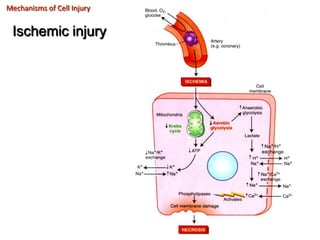
Ischemic injury
Mechanisms of Cell Injury


 Ischemic injury
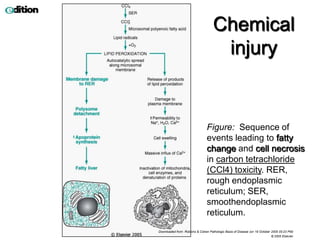
Chemical
                                      injury


                                Figure: Sequence of
                                events leading to fatty
                                change and cell necrosis
                                in carbon tetrachloride
                                (CCl4) toxicity. RER,
                                rough endoplasmic
                                reticulum; SER,
                                smoothendoplasmic
                                reticulum.
Downloaded from: Robbins & Cotran Pathologic Basis of Disease (on 19 October 2005 05:23 PM)
                                                                             © 2005 Elsevier

Apoptosis

  • 1.
  • 2.
    Apoptosis • Cell deaththat is induced by a tightly regulated intracellular program “Programmed Cell Death” • Causes of Apoptosis - Physiologic situations - Pathologic conditions
  • 3.
    Morphology of Apoptosis Cellshrinkage Chromosome condensation Formation of cytoplasmic blebs and apoptotic bodies Phagocytosis of apoptotic cells or cell bodies
  • 4.
    Apoptosis in PhysiologicSituations • Programmed destruction of cell during embryogenesis • Hormone-dependent involution - endometrial cells (menstrual cycle) • Cell deletion in proliferating cell population • Death of host cells - neutrophils • Elimination of self reactive lymphocyte • Cell death induced by cytotoxic T-cells - viral infected or tumor cells
  • 5.
    Apoptosis in PathologicConditions • Cell death produced by injurious stimuli – radiation, cytotoxic drug • Cell injury in certain viral diseases – viral hepatitis • Pathologic atrophy • Cell death in tumors
  • 6.
    Intracellular Accumulations • Manifestationof “metabolic derangements” :intracellular accumulation of abnormal amounts of various substances Fat Protein Glycogen Pigments
  • 7.
    Mechanisms of intracellular accumulations (1)abnormal metabolism (2) alterations in protein folding and transport (3) deficiency of critical enzymes (4) inability to degrade phagocytosed particles
  • 8.
    Intracellular Accumulations ofLipids • Accumulation of Lipids - Triglycerides - Cholesterol • Steatosis (fatty change) : abnormal accumulation of triglycerides within parenchymal cells – fatty liver in chronic alcoholism
  • 9.
    Lipid circulation Downloaded from: Robbins & Cotran Pathologic Basis of Disease (on 19 October 2005 05:51 PM) © 2005 Elsevier
  • 10.
    Fatty liver Downloaded from: Robbins & Cotran Pathologic Basis of Disease (on 19 October 2005 05:51 PM) © 2005 Elsevier
  • 11.
    Intracellular Accumulations of Lipids • Cholesterol and Cholesterol Esters :Atherosclerosis - accumulation of cholesterol-laden macrophage (foam cell) and smooth muscle cells in the intima of aorta and arteries :Cholesterolosis - accumulation of foam cells in the lamina propria of gallbladder
  • 12.
    Downloaded from: Robbins& Cotran Pathologic Basis of Disease (on 19 October 2005 05:51 PM) © 2005 Elsevier
  • 13.
    Intracellular Accumulations ofProteins • Accumulation of protein droplets in proximal renal tubule - renal disease with heavy protein leakage across the glomerular filter
  • 14.
    Protein reabsorption dropletsin the renal tubular epithelium. Downloaded from: Robbins & Cotran Pathologic Basis of Disease (on 19 October 2005 05:51 PM) © 2005 Elsevier
  • 15.
    Intracellular Accumulations ofProteins • Defects in protein folding :Defective intracellular transport and secretion :ER stress induced by unfolded and misfolded protein – cell death :Aggregation of abnormal folded protein - amyloidosis
  • 16.
    Intracellular Accumulations of Glycogen “Patients with abnormal metabolism of glucose or glycogen” • Diabetes mellitus :disorder of glucose metabolism - glycogen accumulate in epithelial cells of renal tubules, liver cells, beta-cells of the islets of Langerhans and heart muscle cells
  • 17.
    Intracellular Accumulations of Glycogen • Glycogen storage disease (Glycogenosis) - genetic diseases - defect of enzymes in the synthesis or breakdown of glycogen accumulation cell injury death
  • 18.
    Accumulation of Pigments •Exogenous pigments Carbon ( anthracosis) Coal dust ( pneumoconiosis) Lung: pick up by alveolar macrophages regional lymph nods blackening the tissues of the lungs (anthracosis)
  • 19.
    Accumulation of Pigments •Endogenous pigment :Lipofuscin – aging pigment lipid, phospholipid-protein complex (lipid peroxidation) :Melanin – in melanocyte :Hemosiderin – aggregates of ferritin micelles (iron + apoferritin = ferritin)
  • 20.
    Pathologic Calcification • Abnormaltissue deposition of Calcium Salts • Two forms 1. Dystrophic calcification 2. Metastatic calcification
  • 21.
    Pathologic Calcification  DystrophicCalcification - Area of tissue necrosis - Aging or damage heart valve - Atherosclerosis - Single necrotic cell “psammoma body”
  • 22.
    Pathologic Calcification  MetastaticCalcification - Occur in normal tissue in “hypercalcemia” Hypercalcemia • Hyperparathyroidism • Destruction of bone tissue • Renal failure
  • 23.
    Morphology of CellInjury and Necrosis • Cell Injury – Reversible – Irreversible • Cell Death – Necrosis – Apoptosis
  • 24.
    Morphology of CellInjury Reversible Injury Cellular swelling Fatty change • Plasma membrane alteration • Mitochondrial Changes • Dilation of Endoplasmic reticulum • Nuclear Alteration
  • 26.
    Morphology of NecroticCells • Increased Eosinophilia - loss of RNA (basophilia) - denatured cytoplasmic protein • Nuclear Changes - Pyknosis - Karyorrhexis - Karyolysis • Myelin figure – large, whorled phospholipid mass (phospholipid precipitate)
  • 27.
    HISTOLOGIC FEATURES OF COAGULATIVE NECROSIS Normal cell Karyorrhexis Reversible cell injury with Irreversible cytoplasmic & cell injury Karyolysis organelle with rupture of swelling, blebb membrane & ing & organelles, & ribosome nuclear detachment pyknosis
  • 29.
    Morphologic pattern ofNecrotic Cell mass • Coagulative necrosis • Liquefactive necrosis • Caseous necrosis • Fat necrosis
  • 30.
    Morphologic pattern ofNecrotic Cell mass • Coagulative Necrosis :intracellular acidosis – protein denatured – proteolysis inhibited
  • 31.
    Ischemic necrosis ofthe myocardium A, Normal myocardium. B, Myocardium with coagulation necrosis
  • 32.
    Morphologic pattern ofNecrotic Cell mass • Liquefactive Necrosis :focal bacterial (or fungal) infections – accumulation of inflammatory cells :hypoxic death of cells within CNS
  • 33.
    Coagulative and liquefactivenecrosis A, Kidney infarct exhibiting coagulative necrosis B, A focus of liquefactive necrosis in the kidney
  • 34.
    Morphologic Pattern ofNecrotic Cell Mass • Caseous necrosis :gross appearance :microscopic – granulomatous inflammation
  • 35.
    A tuberculous lungwith a large area of caseous necrosis
  • 36.
    Tuberculous granuloma showingan area of central necrosis, epithelioid cells, multiple Langhans-type giant cells, and lymphocytes.
  • 37.
    Foci of fatnecrosis with saponification in the mesentery
  • 38.
  • 39.
    Mechanisms of CellInjury Ischemic injury
  • 40.
    Chemical injury Figure: Sequence of events leading to fatty change and cell necrosis in carbon tetrachloride (CCl4) toxicity. RER, rough endoplasmic reticulum; SER, smoothendoplasmic reticulum. Downloaded from: Robbins & Cotran Pathologic Basis of Disease (on 19 October 2005 05:23 PM) © 2005 Elsevier