Cellular Injury,
Necrosis, Apoptosis
Cell injury results when
cells are stressed and
can no longer adapt
Injury may progress
through a reversible
stage
Reduced oxidative phosphorylation with
resultant depletion of energy stores in the
form of adenosine triphosphate (ATP)
Cellular swelling caused by changes in ion
concentrations and water influx
Reversible Cell Injury
Cell Death
Necrosis- pathologic
Damage to membranes is severe, lysosomal enzymes enter
the cytoplasm and digest the cell, and cellular contents leak
out
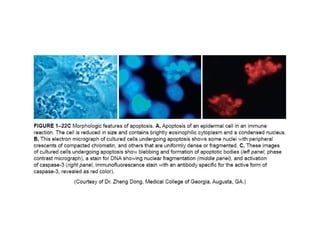
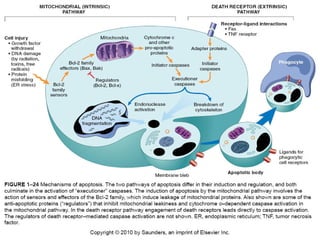
Apoptosis- normal and pathologic
DNA or proteins are damaged beyond repair, the cell kills
itself characterized by nuclear dissolution, fragmentation of
the cell without complete loss of membrane integrity
Autophagy- normal and pathologic
Oxygen Deprivation
Hypoxia is a deficiency of oxygen that can result in a reduction in aerobic oxidative
respiration. Extremely important common cause of cell injury/cell death.
Causes include reduced blood flow (ischemia), inadequate oxygenation of the
blood, decreased blood oxygen-carrying capacity.
Physical Agents
Mechanical trauma, extremes of temperature (burns and deep cold), sudden
changes in atmospheric pressure, radiation, and electric shock.
Chemical Agents and Drugs
Infectious Agents
Immunologic Reactions
Genetic Derangements
Nutritional Imbalances
Protein-calorie and/or vitamin deficiencies. Nutritional excesses (overnutrition)
Causes of Cell Injury
Morphology of Cell Injury
http://www.biooncology.com/research-
education/apoptosis/images/critical_ta
ble_1_1.gif
http://www.med.umich.edu/lrc/coursepages/m1/anatomy2010/htm
l/quizzes/practical/kidney_practical/s20.14.htm
Normal Kidney
http://www.bmb.leeds.ac.uk/illingwort
h/bioc3800/kidney.jpg
Normal kidney tubules
• Epithelial cells stain
evenly pink
(eosinophilic) in
cytoplasm, with
purple, basophilic,
nucleic acids
confined to the nuclei
• Apical surfaces are
ciliated
• Interstitia not
infiltrated with
immune cells nor
congested with
proteins
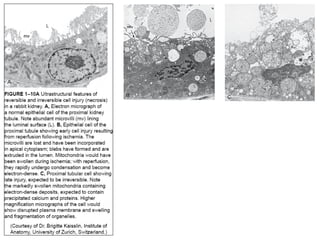
Swollen kidney tubules
• Increased eosinophilic
staining
• Decreased basophilic
staining (RNA)
• Plasma membrane
rounding, blebbing,
loss of cilia, due to
loss of connections
with cytoskeleton
• Integrity of tubules
degrading, but
basement membranes
intact
• Nuclei largely intact,
slightly narrowed,
pyknotic
Boudreault F , Grygorczyk R J Physiol 2004;561:499-513
©2004 by The Physiological Society
How much can a cell swell?
Reversible damage – cellular swelling
Cellular swelling (synonyms: hydropic change, vacuolar degeneration, cellular edema) is an acute reversible
change resulting as a response to nonlethal injuries. It is an intracytoplasmic accumulation of water due to
incapacity of the cells to maintain the ionic and fluid homeostasis. It is easy to be observed in parenchymal
organs : liver (hepatitis, hypoxia), kidney (shock), myocardium (hypoxia, phosphate intoxication). It may be
local or diffuse, affecting the whole organ.
Reversible damage – fatty change
Intracellular accumulations of a variety of materials can occur in response to
cellular injury. Here is fatty metamorphosis (fatty change) of the liver in which
deranged lipoprotein transport from injury (most often alcoholism) leads to
accumulation of lipid in the cytoplasm of hepatocytes.
Necrotic kidney tubules
• Cellular
fragmentation
• Loss and fading of
nuclei--karyolysis
• Burst membranes
• Loss of tissue
architecture
The morphologic appearance of necrosis is the result of
denaturation of intracellular proteins and enzymatic digestion.
Necrotic cells are unable to maintain membrane integrity and
their contents often leak out, a process that may elicit
inflammation in the surrounding tissue.
The enzymes that digest the necrotic cell are derived from the
lysosomes of the dying cells themselves and from the
lysosomes of leukocytes that are called in as part of the
inflammatory reaction.
Digestion of cellular contents and the host response may take
hours to develop. The earliest histologic evidence of necrosis
may not become apparent until 4 to 12 hours.
Necrosis
Increased eosinophilia in hematoxylin and eosin (H & E) stains,
attributable in part to the loss of cytoplasmic RNA (which binds the blue
dye, hematoxylin) and in part to denatured cytoplasmic proteins (which
bind the red dye, eosin).
When enzymes have digested the cytoplasmic organelles, the cytoplasm
becomes vacuolated and appears moth-eaten.
Dead cells may be replaced by large, whorled phospholipid masses
called myelin figures that are derived from damaged cell membranes.
These phospholipid precipitates are then either phagocytosed by other
cells or further degraded into fatty acids; calcification of such fatty acid
residues results in the generation of calcium soaps. Thus, the dead cells
may ultimately become calcified.
Necrosis- cytoplasm
Nuclear changes appear in one of three patterns
Karyolysis, the basophilia of the chromatin fades which appears to
reflect loss of DNA because of enzymatic degradation by due to
endonucleases.
Pyknosis, characterized by nuclear shrinkage and increased
basophilia.
Karyorrhexis, the pyknotic nucleus undergoes fragmentation. With the
passage of time (a day or two), the nucleus
in the necrotic cell totally disappears.
Necrosis- nucleus
http://www.vetmed.vt.edu/education/Curriculum/VM830
4/vet%20pathology/CASES/CELLINJURY2/karyorrhexd
iag%20copy.JPG
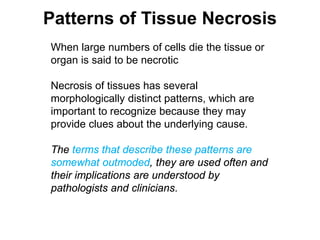
When large numbers of cells die the tissue or
organ is said to be necrotic
Necrosis of tissues has several
morphologically distinct patterns, which are
important to recognize because they may
provide clues about the underlying cause.
The terms that describe these patterns are
somewhat outmoded, they are used often and
their implications are understood by
pathologists and clinicians.
Patterns of Tissue Necrosis
“Types” of Tissue necrosis
• Coagulative
• Liquefactive
• Gangrenous
• Caseous
• Fat
• Fibrinoid
Architecture of dead tissues is
preserved for a span of at least some
days.
Tissues exhibit a firm texture
Injury denatures proteins and enzymes
blocking proteolysis of the dead cells;
Eosinophilic, anucleate cells may
persist for days or weeks.
Ultimately the necrotic cells are
removed by phagocytosis of the
cellular debris by infiltrating
leukocytes.
Coagulative Necrosis
Coagulative necrosis—kidney infarction
This is the typical pattern with ischemia and infarction (loss of
blood supply and resultant tissue anoxia). Here, there is a wedge-
shaped pale area of coagulative necrosis (infarction) in the renal
cortex of the kidney. Microscopically, the renal cortex has
undergone anoxic injury at the left so that the cells appear pale
and ghost-like. There is a hemorrhagic zone in the middle where
the cells are dying or have not quite died, and then normal renal
parenchyma at the far right.
Coagulative necrosis—myocardial infarction
Here is myocardium in which the cells are
dying as a result of ischemic injury from
coronary artery occlusion. This is early in
the process of necrosis. The nuclei of the
myocardial fibers are being lost. The
cytoplasm is losing its structure, because
no well-defined cross-striations are seen.
http://bcrc.bio.umass.edu/histology/files/images/SZR
1.preview.jpg
http://library.med.utah.edu/WebPath/CINJHT
ML/CINJ013.html
Digestion of the dead
Transformation of the tissue into a
liquid viscous mass.
The necrotic material is frequently
creamy yellow because of the
presence of dead leukocytes and is
called pus.
Liquefactive Necrosis
http://wikidoc.org/images/c/c8/Liquefactive_necr
osis_Lung_7.jpg
Not a specific pattern.
Term is commonly used in clinical
practice.
Usually applied to a limb, generally the
lower leg, that has lost its blood supply
and has undergone, typically,
coagulative necrosis
Gangrenous Necrosis
http://meded.ucsd.edu/clinicalimg/skin_gangrene_dic.jpg
Sepsis induced DIC has led to extensive arterial
thrombosis, resulting in
profound tissue death.
http://www.microscopy-uk.org.uk/mag/imgaug02/HistPaper01_Fig2.jpg
WebPath/CINJHTML/CINJ051.htm
“Caseous” (cheeselike) is derived from
the friable white appearance of the
area of necrosis
Necrotic area appears as a collection
of fragmented or lysed cells and
amorphous granular debris enclosed
within a distinctive inflammatory
border; this appearance is
characteristic of a focus of
inflammation known as a granuloma.
Caseous Necrosis
http://granuloma.hom
estead.com/files/gran
uloma_apoptotic2.jpg
http://www.me
d.nus.edu.sg/
path/images/t
b-myco.jpg
Not a specific pattern
Focal areas of fat destruction, typically
resulting from release of activated
pancreatic lipases into the substance
of the pancreas and the peritoneal
cavity.
Lipases split the triglyceride esters
contained within fat cells. Free fatty
acids can combine with calcium to
produce grossly visible chalky-white
areas (fat saponification).
Fat Necrosis
http://pancreas.org/wp-
content/uploads/nl-pancreas-cells.jpg
Usually seen in immune reactions
involving blood vessels.
Deposits of “immune complexes,”
together with fibrin that has leaked out
of vessels.
Bright pink and amorphous
appearance in H&E stains, called
“fibrinoid” (fibrin-like) by pathologists.
Fibrinoid Necrosis
Mechanisms leading to necrotic cells
Energy depletion
• Inhibition of oxidative phosphorylation
• [ATP] decreases
• Small changes, 5 - 10%, are sufficient to limit the
Na/K-ATPase and Ca/Mg ATPase
• Glycolytic capacity (glycogen stores) protects
from ATP depletion but leads to acidification
– Plasma and ER membranes swell
– Enzyme kinetics change; proteins begin to denature
– Chromatin clumps
• Denatured proteins either coagulate resulting in
necrosis or bind HSPs triggering apoptosis
http://ars.els-cdn.com/content/image/1-s2.0-
S0163725809001120-gr2.jpg
Intracellular, cytosolic [Ca++] as
many as 4 orders of magnitude
lower than extracellular or
organellar (ER, SR, Mt)
Mitochondrial damage and ER
swelling releases Ca++ to
cytosol
Hydrolytic enzymes activated
Apoptosis may be activated
Necrosis occurs
Calcium Flux
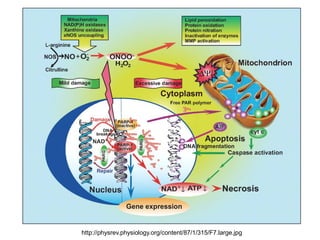
ROS and free radicals
• Hydroxyl radicals and hydrogen may be split
from water by ionizing radiation
• Superoxide radicals, hydrogen peroxide, lipid
peroxides normally present in small amounts
– Neutralized by catalase or glutathione peroxidase
• ROS created and released by neutrophils in
response to microbial infection
• Toxic chemicals natively, or after activation by
P450 redox in liver or kidney, may result in free
radicals
• ROS initiate chain reaction of lipid peroxidation
in membranes
http://physrev.physiology.org/content/87/1/315/F7.large.jpg
Loss of ER Homeostasis
http://www.sciencedirect.com/science/article/pii/S1550413112001027
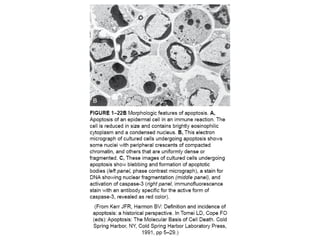
Apoptosis
• Programmed cell death
– Especially during fetal development
– In response to hormonal cycles (e.g.
endometrium)
– Normal turnover in proliferating tissues (e.g.
intestinal epithelium)
• Cells shrink, not swell
• Nuclei condense and DNA fragments
• Cells fragment into membrane-bound bits
• Bits are phagocytosed by macrophages
Apoptotic fetal thymus
In this fetal thymus there is involution of
thymic lymphocytes by the mechanism
of apoptosis. In this case, it is an
orderly process and part of normal
immune system maturation. Individual
cells fragment and are consumed by
phagocytes to give the appearance of
clear spaces filled with cellular debris.
Apoptosis is controlled by many
mechanisms. Genes such as BCL-2
are turned off and Bax genes turned
on. Intracellular proteolytic enzymes
called caspases produce much cellular
breakdown.
Apoptotic liver
Apoptosis is a more orderly process of
cell death. Apoptosis is individual cell
necrosis, not simultaneous localized
necrosis of large numbers of cells. In
this example, hepatocytes are dying
individually (arrows) from injury through
infection by viral hepatitis. The
apoptotic cells are enlarged, pink from
loss of cytoplasmic detail, and without
nuclei. The cell nucleus and cytoplasm
become fragmented as enzymes such
as caspases destroy cellular
components.
http://www.nature.com/cr/journal/v17/n9/fig_tab/cr200752f1.html
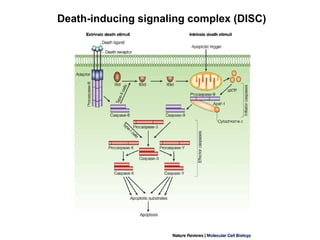
Death-inducing signaling complex (DISC)
Apoptosome

Cell death.pptx

  • 1.
  • 2.
    Cell injury resultswhen cells are stressed and can no longer adapt Injury may progress through a reversible stage
  • 3.
    Reduced oxidative phosphorylationwith resultant depletion of energy stores in the form of adenosine triphosphate (ATP) Cellular swelling caused by changes in ion concentrations and water influx Reversible Cell Injury
  • 4.
    Cell Death Necrosis- pathologic Damageto membranes is severe, lysosomal enzymes enter the cytoplasm and digest the cell, and cellular contents leak out Apoptosis- normal and pathologic DNA or proteins are damaged beyond repair, the cell kills itself characterized by nuclear dissolution, fragmentation of the cell without complete loss of membrane integrity Autophagy- normal and pathologic
  • 5.
    Oxygen Deprivation Hypoxia isa deficiency of oxygen that can result in a reduction in aerobic oxidative respiration. Extremely important common cause of cell injury/cell death. Causes include reduced blood flow (ischemia), inadequate oxygenation of the blood, decreased blood oxygen-carrying capacity. Physical Agents Mechanical trauma, extremes of temperature (burns and deep cold), sudden changes in atmospheric pressure, radiation, and electric shock. Chemical Agents and Drugs Infectious Agents Immunologic Reactions Genetic Derangements Nutritional Imbalances Protein-calorie and/or vitamin deficiencies. Nutritional excesses (overnutrition) Causes of Cell Injury
  • 6.
  • 8.
  • 9.
  • 10.
    Normal kidney tubules •Epithelial cells stain evenly pink (eosinophilic) in cytoplasm, with purple, basophilic, nucleic acids confined to the nuclei • Apical surfaces are ciliated • Interstitia not infiltrated with immune cells nor congested with proteins
  • 11.
    Swollen kidney tubules •Increased eosinophilic staining • Decreased basophilic staining (RNA) • Plasma membrane rounding, blebbing, loss of cilia, due to loss of connections with cytoskeleton • Integrity of tubules degrading, but basement membranes intact • Nuclei largely intact, slightly narrowed, pyknotic
  • 12.
    Boudreault F ,Grygorczyk R J Physiol 2004;561:499-513 ©2004 by The Physiological Society How much can a cell swell?
  • 13.
    Reversible damage –cellular swelling Cellular swelling (synonyms: hydropic change, vacuolar degeneration, cellular edema) is an acute reversible change resulting as a response to nonlethal injuries. It is an intracytoplasmic accumulation of water due to incapacity of the cells to maintain the ionic and fluid homeostasis. It is easy to be observed in parenchymal organs : liver (hepatitis, hypoxia), kidney (shock), myocardium (hypoxia, phosphate intoxication). It may be local or diffuse, affecting the whole organ.
  • 14.
    Reversible damage –fatty change Intracellular accumulations of a variety of materials can occur in response to cellular injury. Here is fatty metamorphosis (fatty change) of the liver in which deranged lipoprotein transport from injury (most often alcoholism) leads to accumulation of lipid in the cytoplasm of hepatocytes.
  • 15.
    Necrotic kidney tubules •Cellular fragmentation • Loss and fading of nuclei--karyolysis • Burst membranes • Loss of tissue architecture
  • 16.
    The morphologic appearanceof necrosis is the result of denaturation of intracellular proteins and enzymatic digestion. Necrotic cells are unable to maintain membrane integrity and their contents often leak out, a process that may elicit inflammation in the surrounding tissue. The enzymes that digest the necrotic cell are derived from the lysosomes of the dying cells themselves and from the lysosomes of leukocytes that are called in as part of the inflammatory reaction. Digestion of cellular contents and the host response may take hours to develop. The earliest histologic evidence of necrosis may not become apparent until 4 to 12 hours. Necrosis
  • 19.
    Increased eosinophilia inhematoxylin and eosin (H & E) stains, attributable in part to the loss of cytoplasmic RNA (which binds the blue dye, hematoxylin) and in part to denatured cytoplasmic proteins (which bind the red dye, eosin). When enzymes have digested the cytoplasmic organelles, the cytoplasm becomes vacuolated and appears moth-eaten. Dead cells may be replaced by large, whorled phospholipid masses called myelin figures that are derived from damaged cell membranes. These phospholipid precipitates are then either phagocytosed by other cells or further degraded into fatty acids; calcification of such fatty acid residues results in the generation of calcium soaps. Thus, the dead cells may ultimately become calcified. Necrosis- cytoplasm
  • 20.
    Nuclear changes appearin one of three patterns Karyolysis, the basophilia of the chromatin fades which appears to reflect loss of DNA because of enzymatic degradation by due to endonucleases. Pyknosis, characterized by nuclear shrinkage and increased basophilia. Karyorrhexis, the pyknotic nucleus undergoes fragmentation. With the passage of time (a day or two), the nucleus in the necrotic cell totally disappears. Necrosis- nucleus http://www.vetmed.vt.edu/education/Curriculum/VM830 4/vet%20pathology/CASES/CELLINJURY2/karyorrhexd iag%20copy.JPG
  • 21.
    When large numbersof cells die the tissue or organ is said to be necrotic Necrosis of tissues has several morphologically distinct patterns, which are important to recognize because they may provide clues about the underlying cause. The terms that describe these patterns are somewhat outmoded, they are used often and their implications are understood by pathologists and clinicians. Patterns of Tissue Necrosis
  • 22.
    “Types” of Tissuenecrosis • Coagulative • Liquefactive • Gangrenous • Caseous • Fat • Fibrinoid
  • 23.
    Architecture of deadtissues is preserved for a span of at least some days. Tissues exhibit a firm texture Injury denatures proteins and enzymes blocking proteolysis of the dead cells; Eosinophilic, anucleate cells may persist for days or weeks. Ultimately the necrotic cells are removed by phagocytosis of the cellular debris by infiltrating leukocytes. Coagulative Necrosis
  • 25.
    Coagulative necrosis—kidney infarction Thisis the typical pattern with ischemia and infarction (loss of blood supply and resultant tissue anoxia). Here, there is a wedge- shaped pale area of coagulative necrosis (infarction) in the renal cortex of the kidney. Microscopically, the renal cortex has undergone anoxic injury at the left so that the cells appear pale and ghost-like. There is a hemorrhagic zone in the middle where the cells are dying or have not quite died, and then normal renal parenchyma at the far right.
  • 26.
    Coagulative necrosis—myocardial infarction Hereis myocardium in which the cells are dying as a result of ischemic injury from coronary artery occlusion. This is early in the process of necrosis. The nuclei of the myocardial fibers are being lost. The cytoplasm is losing its structure, because no well-defined cross-striations are seen. http://bcrc.bio.umass.edu/histology/files/images/SZR 1.preview.jpg http://library.med.utah.edu/WebPath/CINJHT ML/CINJ013.html
  • 27.
    Digestion of thedead Transformation of the tissue into a liquid viscous mass. The necrotic material is frequently creamy yellow because of the presence of dead leukocytes and is called pus. Liquefactive Necrosis http://wikidoc.org/images/c/c8/Liquefactive_necr osis_Lung_7.jpg
  • 28.
    Not a specificpattern. Term is commonly used in clinical practice. Usually applied to a limb, generally the lower leg, that has lost its blood supply and has undergone, typically, coagulative necrosis Gangrenous Necrosis http://meded.ucsd.edu/clinicalimg/skin_gangrene_dic.jpg Sepsis induced DIC has led to extensive arterial thrombosis, resulting in profound tissue death. http://www.microscopy-uk.org.uk/mag/imgaug02/HistPaper01_Fig2.jpg WebPath/CINJHTML/CINJ051.htm
  • 29.
    “Caseous” (cheeselike) isderived from the friable white appearance of the area of necrosis Necrotic area appears as a collection of fragmented or lysed cells and amorphous granular debris enclosed within a distinctive inflammatory border; this appearance is characteristic of a focus of inflammation known as a granuloma. Caseous Necrosis http://granuloma.hom estead.com/files/gran uloma_apoptotic2.jpg http://www.me d.nus.edu.sg/ path/images/t b-myco.jpg
  • 30.
    Not a specificpattern Focal areas of fat destruction, typically resulting from release of activated pancreatic lipases into the substance of the pancreas and the peritoneal cavity. Lipases split the triglyceride esters contained within fat cells. Free fatty acids can combine with calcium to produce grossly visible chalky-white areas (fat saponification). Fat Necrosis http://pancreas.org/wp- content/uploads/nl-pancreas-cells.jpg
  • 31.
    Usually seen inimmune reactions involving blood vessels. Deposits of “immune complexes,” together with fibrin that has leaked out of vessels. Bright pink and amorphous appearance in H&E stains, called “fibrinoid” (fibrin-like) by pathologists. Fibrinoid Necrosis
  • 32.
    Mechanisms leading tonecrotic cells
  • 33.
    Energy depletion • Inhibitionof oxidative phosphorylation • [ATP] decreases • Small changes, 5 - 10%, are sufficient to limit the Na/K-ATPase and Ca/Mg ATPase • Glycolytic capacity (glycogen stores) protects from ATP depletion but leads to acidification – Plasma and ER membranes swell – Enzyme kinetics change; proteins begin to denature – Chromatin clumps • Denatured proteins either coagulate resulting in necrosis or bind HSPs triggering apoptosis
  • 34.
  • 35.
    Intracellular, cytosolic [Ca++]as many as 4 orders of magnitude lower than extracellular or organellar (ER, SR, Mt) Mitochondrial damage and ER swelling releases Ca++ to cytosol Hydrolytic enzymes activated Apoptosis may be activated Necrosis occurs Calcium Flux
  • 38.
    ROS and freeradicals • Hydroxyl radicals and hydrogen may be split from water by ionizing radiation • Superoxide radicals, hydrogen peroxide, lipid peroxides normally present in small amounts – Neutralized by catalase or glutathione peroxidase • ROS created and released by neutrophils in response to microbial infection • Toxic chemicals natively, or after activation by P450 redox in liver or kidney, may result in free radicals • ROS initiate chain reaction of lipid peroxidation in membranes
  • 41.
  • 42.
    Loss of ERHomeostasis http://www.sciencedirect.com/science/article/pii/S1550413112001027
  • 46.
    Apoptosis • Programmed celldeath – Especially during fetal development – In response to hormonal cycles (e.g. endometrium) – Normal turnover in proliferating tissues (e.g. intestinal epithelium) • Cells shrink, not swell • Nuclei condense and DNA fragments • Cells fragment into membrane-bound bits • Bits are phagocytosed by macrophages
  • 48.
    Apoptotic fetal thymus Inthis fetal thymus there is involution of thymic lymphocytes by the mechanism of apoptosis. In this case, it is an orderly process and part of normal immune system maturation. Individual cells fragment and are consumed by phagocytes to give the appearance of clear spaces filled with cellular debris. Apoptosis is controlled by many mechanisms. Genes such as BCL-2 are turned off and Bax genes turned on. Intracellular proteolytic enzymes called caspases produce much cellular breakdown.
  • 50.
    Apoptotic liver Apoptosis isa more orderly process of cell death. Apoptosis is individual cell necrosis, not simultaneous localized necrosis of large numbers of cells. In this example, hepatocytes are dying individually (arrows) from injury through infection by viral hepatitis. The apoptotic cells are enlarged, pink from loss of cytoplasmic detail, and without nuclei. The cell nucleus and cytoplasm become fragmented as enzymes such as caspases destroy cellular components.
  • 54.
  • 55.
  • 58.