PA 2.5 B
DESCRIBE & DISCUSS
PATHOLOGICAL CALCIFICATION
Dr IRA BHARADWAJ
MCI TEACHER ID: PAT 2300569
KUHS FACULTY ID: M21512
REFRENCES
• ROBBINS BASIC PATHOLOGY
• HARSH MOHAN TEXTBOOK OF PATHOLOGY
• OTHER STANDARD REFRENCES
• PHOTOGRAPHS OF GROSS SPECIMEN
• MICROPHOTOGRAPHS OF HISTOPATHOLOGY SLIDE
• DIAGRAM
SLO
• DEFINITION OF PATHOLOGICAL CALCIFICATION
• TYPES OF PATHOLOGICAL CALCIFICATION
• MORPHOLOGY OF PATHOLOGICAL CALCIFICATION
• DYSTROPHIC CALCIFICATION – DEFINITION,
ETIOPATHOGENESIS, EXAMPLES
• METASTATIC CALCIFICATION – DEFINITION,
ETIOPATHOGENESIS, SITES
• CALCINOSIS CUTIS – DEFINITION, ETIOLOGY, MORPHOLOGY,
CLINICAL FEATURES & CASE
PATHOLOGICAL [HETEROTOPIC] CALCIFICATION
DEFINITION & TYPES
DEFINITION:
Deposition of Calcium salts in tissues other than osteoid &
enamel
TYPES [common]:
• DYSTROPHIC - deposition in dead & degenerated tissue
• METASTATIC– deposition in normal tissue
• CALCINOSIS CUTIS – deposition of calcium in skin
PATHOLOGICAL [HETEROTOPIC] CALCIFICATION
TYPES
TYPES [uncommon]
• In some cases it starts in a single cell, around which
concentric layers of calcium & minerals are deposited to give
lamellated sand like appearance – psammoma bodies
• In asbestosis, calcium & iron salts deposit along asbestos
spicules creating beaded dumbbell shapes
PATHOLOGICAL [HETEROTOPIC] CALCIFICATION
MORPHOLOGY
Irrespective of type of pathological calcification, the
morphology remains same
GROSS
• Presents as firm to hard whitish areas, which are gritty to
cut
MICROSCOPY
• Shows deep blue granular irregular material, may be
intra/extra cellular
SPECIAL STAIN – von Kossa – black color, alizarin red - red
DYSTROPHIC CALCIFICATION
DEFINITION & ETIOPATHOGENESIS
DEFINITION
• Deposition of calcium salts in dead & degenerating tissues
other than osteoid & enamel
ETIOLOGY& PATHOGENESIS
• Serum Ca & Ca metabolism are normal.
• Ca is deposited in dead & degenerated cells by process of
initiation & propagation
DYSTROPHIC CALCIFICATION
PATHOGENESIS: INITIATION & PROPAGATION
• Intracellular accumulation of Ca in mitochondria of dead &
dying cells, as well as in membrane bound vesicles (acidic
phospholipids in mitochondria & vesicles attract Ca)
• Phosphatases lead to accumulation of phosphates
• Ca and phosphates interact to form crystals [increased by
osteopontin, collagen & Decreased by mineral inhibitors]
• Cellular membranes rupture & release the crystals outside
the cells (extra cellular)
DYSTROPHIC CALCIFICATION
EXAMPLES
DEAD TISSUE
• Caseous & fat necrosis
• Dead parasite
DEGENERATED TISSUE
• Atheroma,
• Tumors,
• Cardiac valves
• Scars
DYSTROPHIC CALCIFICATION
EXAMPLE: CARDIAC VALVE
METASTATIC CALCIFICATION
DEFINITION
• Deposition of calcium salts in normal tissues other than
osteoid & enamel
ETIOPATHOGENESIS
• Serum Ca is increased & excess calcium is deposited in cells ,
which bind phosphates
Some causes are :
• Hyper parathyroid function
METASTATIC CALCIFICATION
• Increased resorption of bone as in Multiple Myeloma,
tumors, immobilization of bone due to any cause
• Increased absorption of Ca in hypervitaminosis D, milk alkali
syndrome
• Renal failure
SITES
Common sites of deposition are kidney, lung, gastric mucosa,
internal elastic lamina of blood vessels, cornea & synovium
CALCINOSIS CUTIS
DEFINITION
Calcification occurring in skin [dermis] & subcutaneous tissue
ETIOLOGY
• Idiopathic [most cases]
• Sometimes due to dystrophic calcification associated with
immunological connective tissue diseases, eg, systemic
sclerosis [CREST syndrome]
• Infrequently as part of metastatic calcification
CALCINOSIS CUTIS
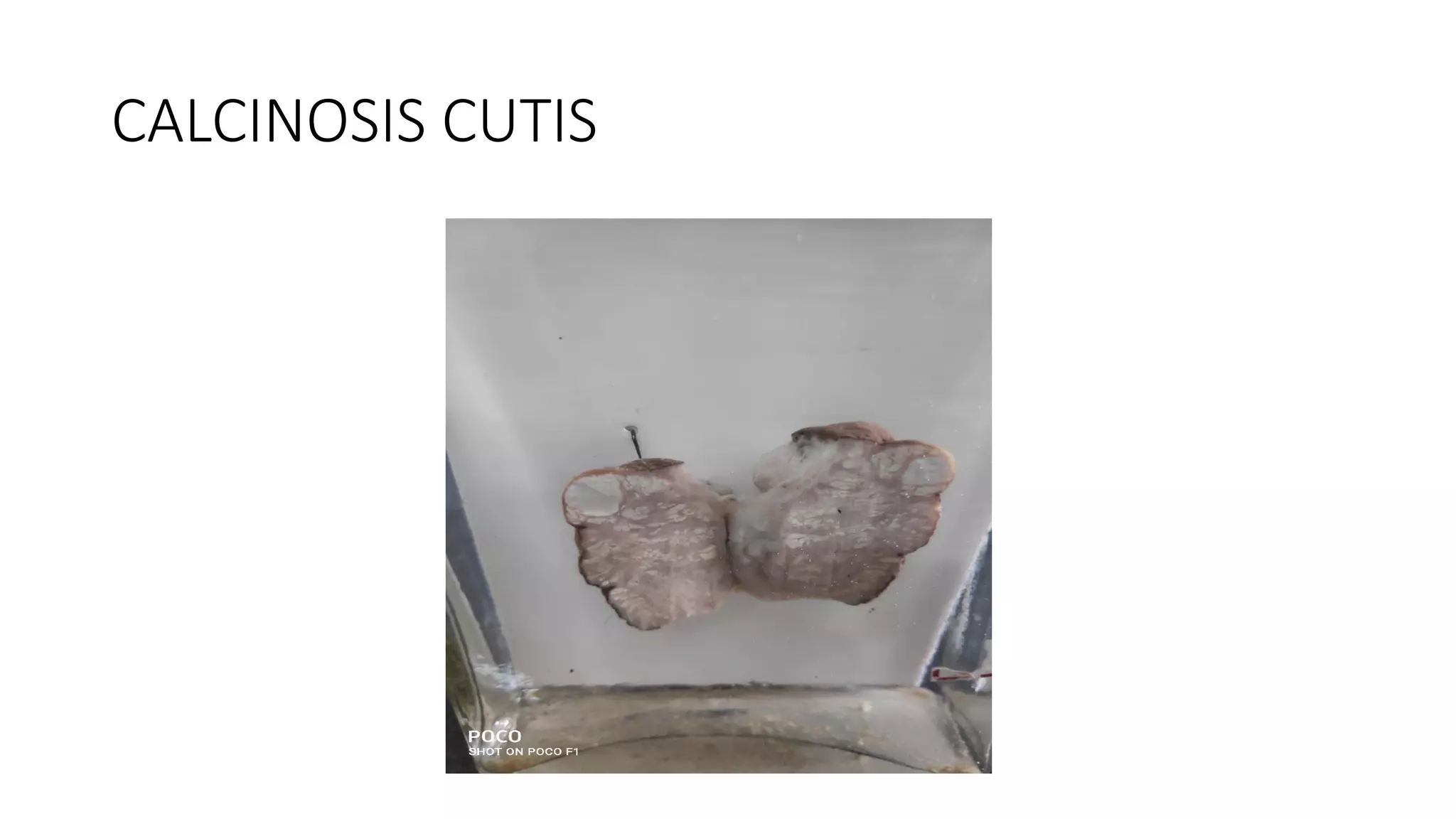
GROSS:
• Most common in skin [dermis] & subcutaneous tissue of
scrotum and around iliac crests
• Skin appears nodular
• Seen as chalky white areas closely related to skin
• Cuts firm to hard with gritty sensation
CALCINOSIS CUTIS
CALCINOSIS CUTIS
WET SPECIMEN
CALCINOSIS CUTIS
MICROSCOPY:
• The epidermis appears normal.
• Focal irregular dark blue (calcium deposition) areas of
amorphous morphology are seen in dermis & subcutaneous
tissue.
• Usually there is no inflammation.
• Special stains for calcium are von Kossa & alizarin red
CALCINOSIS CUTIS
CALCINOSIS CUTIS
CALCINOSIS CUTIS
CLINICAL FEATURES
• Initially asymptomatic hard nodules [ D/D neoplasia]
• Later may ulcerate, discharge chalky white contents
• Other symptoms may be present according to etiology
SHORT ESSAY – CLINICAL CASE
A 60 yr old male presented with hard nodules in the scrotum.
On examination multiple small hard nodules were present in
the scrotal skin. Thick milky white fluid discharge was seen
from one nodule.
Answer the following:
• What is your diagnosis?, give two reasons.
• What is the etiopathogenesis of this condition?
• What microscopic features do you expect on biopsy
• Name one blood investigation which you will do

PATHOLOGICAL CALCIFICATION

  • 1.
    PA 2.5 B DESCRIBE& DISCUSS PATHOLOGICAL CALCIFICATION Dr IRA BHARADWAJ MCI TEACHER ID: PAT 2300569 KUHS FACULTY ID: M21512
  • 2.
    REFRENCES • ROBBINS BASICPATHOLOGY • HARSH MOHAN TEXTBOOK OF PATHOLOGY • OTHER STANDARD REFRENCES • PHOTOGRAPHS OF GROSS SPECIMEN • MICROPHOTOGRAPHS OF HISTOPATHOLOGY SLIDE • DIAGRAM
  • 3.
    SLO • DEFINITION OFPATHOLOGICAL CALCIFICATION • TYPES OF PATHOLOGICAL CALCIFICATION • MORPHOLOGY OF PATHOLOGICAL CALCIFICATION • DYSTROPHIC CALCIFICATION – DEFINITION, ETIOPATHOGENESIS, EXAMPLES • METASTATIC CALCIFICATION – DEFINITION, ETIOPATHOGENESIS, SITES • CALCINOSIS CUTIS – DEFINITION, ETIOLOGY, MORPHOLOGY, CLINICAL FEATURES & CASE
  • 4.
    PATHOLOGICAL [HETEROTOPIC] CALCIFICATION DEFINITION& TYPES DEFINITION: Deposition of Calcium salts in tissues other than osteoid & enamel TYPES [common]: • DYSTROPHIC - deposition in dead & degenerated tissue • METASTATIC– deposition in normal tissue • CALCINOSIS CUTIS – deposition of calcium in skin
  • 5.
    PATHOLOGICAL [HETEROTOPIC] CALCIFICATION TYPES TYPES[uncommon] • In some cases it starts in a single cell, around which concentric layers of calcium & minerals are deposited to give lamellated sand like appearance – psammoma bodies • In asbestosis, calcium & iron salts deposit along asbestos spicules creating beaded dumbbell shapes
  • 6.
    PATHOLOGICAL [HETEROTOPIC] CALCIFICATION MORPHOLOGY Irrespectiveof type of pathological calcification, the morphology remains same GROSS • Presents as firm to hard whitish areas, which are gritty to cut MICROSCOPY • Shows deep blue granular irregular material, may be intra/extra cellular SPECIAL STAIN – von Kossa – black color, alizarin red - red
  • 7.
    DYSTROPHIC CALCIFICATION DEFINITION &ETIOPATHOGENESIS DEFINITION • Deposition of calcium salts in dead & degenerating tissues other than osteoid & enamel ETIOLOGY& PATHOGENESIS • Serum Ca & Ca metabolism are normal. • Ca is deposited in dead & degenerated cells by process of initiation & propagation
  • 8.
    DYSTROPHIC CALCIFICATION PATHOGENESIS: INITIATION& PROPAGATION • Intracellular accumulation of Ca in mitochondria of dead & dying cells, as well as in membrane bound vesicles (acidic phospholipids in mitochondria & vesicles attract Ca) • Phosphatases lead to accumulation of phosphates • Ca and phosphates interact to form crystals [increased by osteopontin, collagen & Decreased by mineral inhibitors] • Cellular membranes rupture & release the crystals outside the cells (extra cellular)
  • 9.
    DYSTROPHIC CALCIFICATION EXAMPLES DEAD TISSUE •Caseous & fat necrosis • Dead parasite DEGENERATED TISSUE • Atheroma, • Tumors, • Cardiac valves • Scars
  • 10.
  • 11.
    METASTATIC CALCIFICATION DEFINITION • Depositionof calcium salts in normal tissues other than osteoid & enamel ETIOPATHOGENESIS • Serum Ca is increased & excess calcium is deposited in cells , which bind phosphates Some causes are : • Hyper parathyroid function
  • 12.
    METASTATIC CALCIFICATION • Increasedresorption of bone as in Multiple Myeloma, tumors, immobilization of bone due to any cause • Increased absorption of Ca in hypervitaminosis D, milk alkali syndrome • Renal failure SITES Common sites of deposition are kidney, lung, gastric mucosa, internal elastic lamina of blood vessels, cornea & synovium
  • 13.
    CALCINOSIS CUTIS DEFINITION Calcification occurringin skin [dermis] & subcutaneous tissue ETIOLOGY • Idiopathic [most cases] • Sometimes due to dystrophic calcification associated with immunological connective tissue diseases, eg, systemic sclerosis [CREST syndrome] • Infrequently as part of metastatic calcification
  • 14.
    CALCINOSIS CUTIS GROSS: • Mostcommon in skin [dermis] & subcutaneous tissue of scrotum and around iliac crests • Skin appears nodular • Seen as chalky white areas closely related to skin • Cuts firm to hard with gritty sensation
  • 15.
  • 16.
  • 17.
    CALCINOSIS CUTIS MICROSCOPY: • Theepidermis appears normal. • Focal irregular dark blue (calcium deposition) areas of amorphous morphology are seen in dermis & subcutaneous tissue. • Usually there is no inflammation. • Special stains for calcium are von Kossa & alizarin red
  • 18.
  • 19.
  • 20.
    CALCINOSIS CUTIS CLINICAL FEATURES •Initially asymptomatic hard nodules [ D/D neoplasia] • Later may ulcerate, discharge chalky white contents • Other symptoms may be present according to etiology
  • 21.
    SHORT ESSAY –CLINICAL CASE A 60 yr old male presented with hard nodules in the scrotum. On examination multiple small hard nodules were present in the scrotal skin. Thick milky white fluid discharge was seen from one nodule. Answer the following: • What is your diagnosis?, give two reasons. • What is the etiopathogenesis of this condition? • What microscopic features do you expect on biopsy • Name one blood investigation which you will do