Deep Dive into Project
Tungsten: Bringing Spark
Closer to Bare Metal
Josh Rosen (@jshrsn)
June 16, 2015
About Databricks
Offers a hosted service:
•  Spark on EC2
•  Notebooks
•  Plot visualizations
•  Cluster management
•  Scheduled jobs
2
Founded by creators of Spark and remains largest contributor
Goals of Project Tungsten
Substantially improve the memory and CPU efficiency of
Spark applications .
Push performance closer to the limits of modern
hardware.
3
In this talk
4
• Motivation: why we’re focusing on compute instead of IO
• How Tungsten optimizes memory + CPU
• Case study: aggregation
• Case study: record sorting
• Performance results
• Roadmap + next steps
Many big data workloads are now
compute bound
5
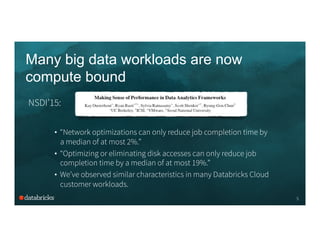
NSDI’15:
•  “Network optimizations can only reduce job completion time by
a median of at most 2%.”
•  “Optimizing or eliminating disk accesses can only reduce job
completion time by a median of at most 19%.”
•  We’ve observed similar characteristics in many Databricks Cloud
customer workloads.
Why is CPU the new bottleneck?
6
•  Hardware has improved:
–  Increasingly large aggregate IO bandwidth, such as 10Gbps links in
networks
–  High bandwidth SSD’s or striped HDD arrays for storage
•  Spark’s IO has been optimized:
–  many workloads now avoid significant disk IO by pruning input data
that is not needed in a given job
–  new shuffle and network layer implementations
•  Data formats have improved:
–  Parquet, binary data formats
•  Serialization and hashing are CPU-bound bottlenecks
How Tungsten improves CPU & memory
efficiency
•  Memory Management and Binary Processing: leverage
application semantics to manage memory explicitly and
eliminate the overhead of JVM object model and garbage
collection
•  Cache-aware computation: algorithms and data structures to
exploit memory hierarchy
•  Code generation: exploit modern compilers and CPUs; allow
efficient operation directly on binary data
7
8
The overheads of Java objects
“abcd”
9
•  Native: 4 bytes with UTF-8 encoding
•  Java: 48 bytes
java.lang.String object internals:	
OFFSET SIZE TYPE DESCRIPTION VALUE	
0 4 (object header) ...	
4 4 (object header) ...	
8 4 (object header) ...	
12 4 char[] String.value []	
16 4 int String.hash 0	
20 4 int String.hash32 0	
Instance size: 24 bytes (reported by Instrumentation API)	
12 byte object header
8 byte hashcode
20 bytes of overhead + 8 bytes for chars
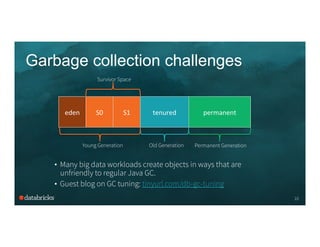
Garbage collection challenges
•  Many big data workloads create objects in ways that are
unfriendly to regular Java GC.
•  Guest blog on GC tuning: tinyurl.com/db-gc-tuning
10
eden	
   S0	
   S1	
   tenured	
   permanent	
  
Permanent GenerationOld GenerationYoung Generation
Survivor Space
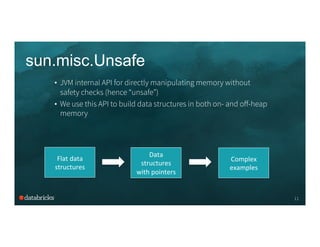
sun.misc.Unsafe
11
•  JVM internal API for directly manipulating memory without
safety checks (hence “unsafe”)
•  We use this API to build data structures in both on- and off-heap
memory
Data	
  
structures	
  
with	
  pointers	
  
Flat	
  data	
  
structures	
  
Complex	
  
examples	
  
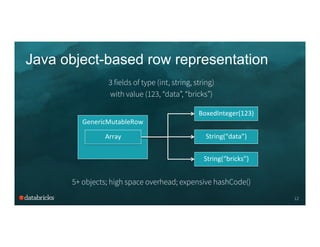
Java object-based row representation
12
3 fields of type (int, string, string)
with value (123, “data”, “bricks”)
GenericMutableRow	
  
Array	
   String(“data”)	
  
String(“bricks”)	
  
5+ objects; high space overhead; expensive hashCode()
BoxedInteger(123)	
  
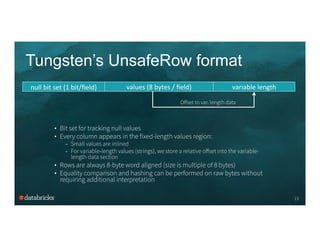
Tungsten’s UnsafeRow format
13
•  Bit set for tracking null values
•  Every column appears in the fixed-length values region:
–  Small values are inlined
–  For variable-length values (strings), we store a relative offset into the variable-
length data section
•  Rows are always 8-byte word aligned (size is multiple of 8 bytes)
•  Equality comparison and hashing can be performed on raw bytes without
requiring additional interpretation
null	
  bit	
  set	
  (1	
  bit/field)	


values	
  (8	
  bytes	
  /	
  field)	


variable	
  length	


Offset to var. length data
6 “bricks”
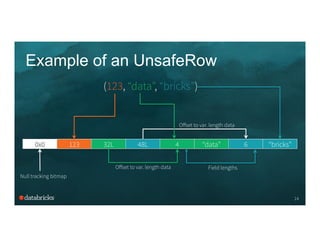
Example of an UnsafeRow
14
0x0 123 32L 48L 4 “data”
(123, “data”, “bricks”)
Null tracking bitmap
Offset to var. length data
Offset to var. length data Field lengths
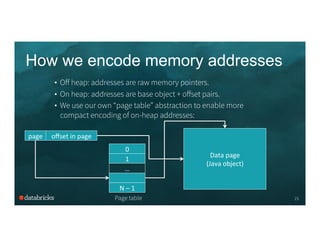
How we encode memory addresses
15
•  Off heap: addresses are raw memory pointers.
•  On heap: addresses are base object + offset pairs.
•  We use our own “page table” abstraction to enable more
compact encoding of on-heap addresses:
0	
  
1	
  
…	
  
N	
  –	
  1	
  
Page table
Data	
  page	
  
(Java	
  object)	
  
page	
   offset	
  in	
  page	
  
16
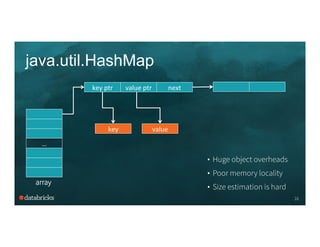
java.util.HashMap
…	
  
key	
  ptr	
   value	
  ptr	
   next	
  
key	
   value	
  
array
•  Huge object overheads
•  Poor memory locality
•  Size estimation is hard
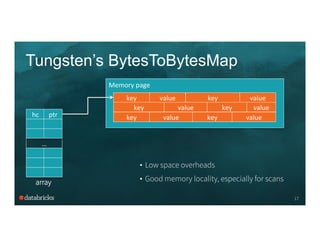
Memory	
  page	
  
hc	
  
17
Tungsten’s BytesToBytesMap
ptr	
  
…	
  
array
•  Low space overheads
•  Good memory locality, especially for scans
key	
   value	
   key	
   value	
  
key	
   value	
   key	
   value	
  
key	
   value	
   key	
   value	
  
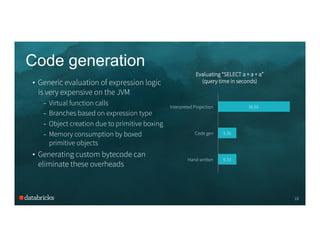
Code generation
•  Generic evaluation of expression logic
is very expensive on the JVM
–  Virtual function calls
–  Branches based on expression type
–  Object creation due to primitive boxing
–  Memory consumption by boxed
primitive objects
•  Generating custom bytecode can
eliminate these overheads
18
9.33
9.36
36.65
Hand written
Code gen
Interpreted Projection
Evaluating “SELECT a + a + a”
(query time in seconds)
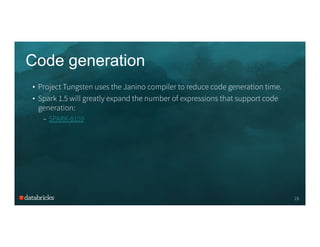
Code generation
•  Project Tungsten uses the Janino compiler to reduce code generation time.
•  Spark 1.5 will greatly expand the number of expressions that support code
generation:
–  SPARK-8159
19
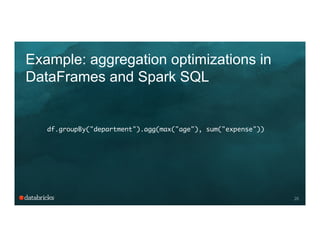
Example: aggregation optimizations in
DataFrames and Spark SQL
20
df.groupBy("department").agg(max("age"), sum("expense"))
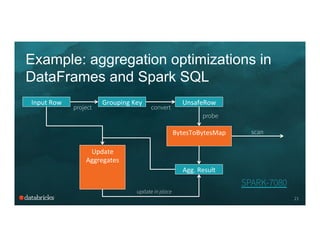
Example: aggregation optimizations in
DataFrames and Spark SQL
21
Input	
  Row	
   Grouping	
  Key	
   UnsafeRow	
  
project convert
BytesToBytesMap	
   scan
Update	
  
Aggregates	
  
Agg.	
  Result	
  
update in place
probe
SPARK-7080
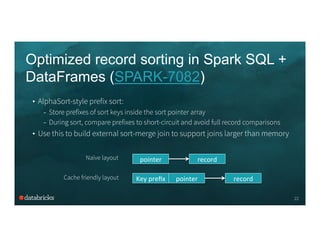
Optimized record sorting in Spark SQL +
DataFrames (SPARK-7082)
22
pointer	
  
•  AlphaSort-style prefix sort:
–  Store prefixes of sort keys inside the sort pointer array
–  During sort, compare prefixes to short-circuit and avoid full record comparisons
•  Use this to build external sort-merge join to support joins larger than memory
record	
  
Key	
  prefix	
   pointer	
   record	
  
Naïve layout
Cache friendly layout
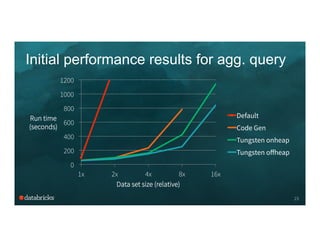
Initial performance results for agg. query
23
0
200
400
600
800
1000
1200
1x 2x 4x 8x 16x
Run time
(seconds)
Data set size (relative)
Default
Code Gen
Tungsten onheap
Tungsten offheap
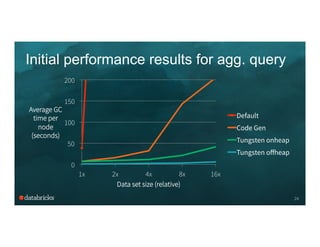
Initial performance results for agg. query
24
0
50
100
150
200
1x 2x 4x 8x 16x
Average GC
time per
node
(seconds)
Data set size (relative)
Default
Code Gen
Tungsten onheap
Tungsten offheap
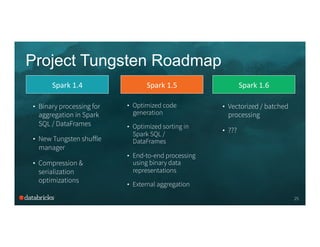
Project Tungsten Roadmap
25
Spark	
  1.4	
   Spark	
  1.5	
   Spark	
  1.6	
  
•  Binary processing for
aggregation in Spark
SQL / DataFrames
•  New Tungsten shuffle
manager
•  Compression &
serialization
optimizations
•  Optimized code
generation
•  Optimized sorting in
Spark SQL /
DataFrames
•  End-to-end processing
using binary data
representations
•  External aggregation
•  Vectorized / batched
processing
•  ???
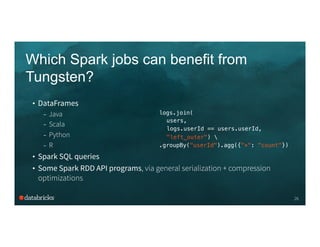
Which Spark jobs can benefit from
Tungsten?
26
•  DataFrames
–  Java
–  Scala
–  Python
–  R
•  Spark SQL queries
•  Some Spark RDD API programs, via general serialization + compression
optimizations
logs.join(!
"users,!
"logs.userId == users.userId,!
""left_outer") !
.groupBy("userId").agg({"*": "count"})!
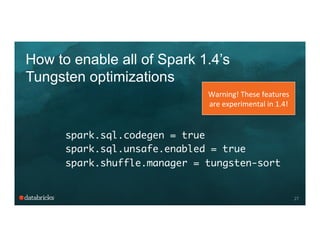
How to enable all of Spark 1.4’s
Tungsten optimizations
27
spark.sql.codegen = true	
spark.sql.unsafe.enabled = true	
spark.shuffle.manager = tungsten-sort	
Warning!	
  These	
  features	
  
are	
  experimental	
  in	
  1.4!	
  
Thank you.
Follow our progress on JIRA: SPARK-7075

Deep Dive into Project Tungsten: Bringing Spark Closer to Bare Metal-(Josh Rosen, Databricks)

  • 1.
    Deep Dive intoProject Tungsten: Bringing Spark Closer to Bare Metal Josh Rosen (@jshrsn) June 16, 2015
  • 2.
    About Databricks Offers ahosted service: •  Spark on EC2 •  Notebooks •  Plot visualizations •  Cluster management •  Scheduled jobs 2 Founded by creators of Spark and remains largest contributor
  • 3.
    Goals of ProjectTungsten Substantially improve the memory and CPU efficiency of Spark applications . Push performance closer to the limits of modern hardware. 3
  • 4.
    In this talk 4 • Motivation:why we’re focusing on compute instead of IO • How Tungsten optimizes memory + CPU • Case study: aggregation • Case study: record sorting • Performance results • Roadmap + next steps
  • 5.
    Many big dataworkloads are now compute bound 5 NSDI’15: •  “Network optimizations can only reduce job completion time by a median of at most 2%.” •  “Optimizing or eliminating disk accesses can only reduce job completion time by a median of at most 19%.” •  We’ve observed similar characteristics in many Databricks Cloud customer workloads.
  • 6.
    Why is CPUthe new bottleneck? 6 •  Hardware has improved: –  Increasingly large aggregate IO bandwidth, such as 10Gbps links in networks –  High bandwidth SSD’s or striped HDD arrays for storage •  Spark’s IO has been optimized: –  many workloads now avoid significant disk IO by pruning input data that is not needed in a given job –  new shuffle and network layer implementations •  Data formats have improved: –  Parquet, binary data formats •  Serialization and hashing are CPU-bound bottlenecks
  • 7.
    How Tungsten improvesCPU & memory efficiency •  Memory Management and Binary Processing: leverage application semantics to manage memory explicitly and eliminate the overhead of JVM object model and garbage collection •  Cache-aware computation: algorithms and data structures to exploit memory hierarchy •  Code generation: exploit modern compilers and CPUs; allow efficient operation directly on binary data 7
  • 8.
  • 9.
    The overheads ofJava objects “abcd” 9 •  Native: 4 bytes with UTF-8 encoding •  Java: 48 bytes java.lang.String object internals: OFFSET SIZE TYPE DESCRIPTION VALUE 0 4 (object header) ... 4 4 (object header) ... 8 4 (object header) ... 12 4 char[] String.value [] 16 4 int String.hash 0 20 4 int String.hash32 0 Instance size: 24 bytes (reported by Instrumentation API) 12 byte object header 8 byte hashcode 20 bytes of overhead + 8 bytes for chars
  • 10.
    Garbage collection challenges • Many big data workloads create objects in ways that are unfriendly to regular Java GC. •  Guest blog on GC tuning: tinyurl.com/db-gc-tuning 10 eden   S0   S1   tenured   permanent   Permanent GenerationOld GenerationYoung Generation Survivor Space
  • 11.
    sun.misc.Unsafe 11 •  JVM internalAPI for directly manipulating memory without safety checks (hence “unsafe”) •  We use this API to build data structures in both on- and off-heap memory Data   structures   with  pointers   Flat  data   structures   Complex   examples  
  • 12.
    Java object-based rowrepresentation 12 3 fields of type (int, string, string) with value (123, “data”, “bricks”) GenericMutableRow   Array   String(“data”)   String(“bricks”)   5+ objects; high space overhead; expensive hashCode() BoxedInteger(123)  
  • 13.
    Tungsten’s UnsafeRow format 13 • Bit set for tracking null values •  Every column appears in the fixed-length values region: –  Small values are inlined –  For variable-length values (strings), we store a relative offset into the variable- length data section •  Rows are always 8-byte word aligned (size is multiple of 8 bytes) •  Equality comparison and hashing can be performed on raw bytes without requiring additional interpretation null  bit  set  (1  bit/field)     values  (8  bytes  /  field)       variable  length     Offset to var. length data
  • 14.
    6 “bricks” Example ofan UnsafeRow 14 0x0 123 32L 48L 4 “data” (123, “data”, “bricks”) Null tracking bitmap Offset to var. length data Offset to var. length data Field lengths
  • 15.
    How we encodememory addresses 15 •  Off heap: addresses are raw memory pointers. •  On heap: addresses are base object + offset pairs. •  We use our own “page table” abstraction to enable more compact encoding of on-heap addresses: 0   1   …   N  –  1   Page table Data  page   (Java  object)   page   offset  in  page  
  • 16.
    16 java.util.HashMap …   key  ptr   value  ptr   next   key   value   array •  Huge object overheads •  Poor memory locality •  Size estimation is hard
  • 17.
    Memory  page   hc   17 Tungsten’s BytesToBytesMap ptr   …   array •  Low space overheads •  Good memory locality, especially for scans key   value   key   value   key   value   key   value   key   value   key   value  
  • 18.
    Code generation •  Genericevaluation of expression logic is very expensive on the JVM –  Virtual function calls –  Branches based on expression type –  Object creation due to primitive boxing –  Memory consumption by boxed primitive objects •  Generating custom bytecode can eliminate these overheads 18 9.33 9.36 36.65 Hand written Code gen Interpreted Projection Evaluating “SELECT a + a + a” (query time in seconds)
  • 19.
    Code generation •  ProjectTungsten uses the Janino compiler to reduce code generation time. •  Spark 1.5 will greatly expand the number of expressions that support code generation: –  SPARK-8159 19
  • 20.
    Example: aggregation optimizationsin DataFrames and Spark SQL 20 df.groupBy("department").agg(max("age"), sum("expense"))
  • 21.
    Example: aggregation optimizationsin DataFrames and Spark SQL 21 Input  Row   Grouping  Key   UnsafeRow   project convert BytesToBytesMap   scan Update   Aggregates   Agg.  Result   update in place probe SPARK-7080
  • 22.
    Optimized record sortingin Spark SQL + DataFrames (SPARK-7082) 22 pointer   •  AlphaSort-style prefix sort: –  Store prefixes of sort keys inside the sort pointer array –  During sort, compare prefixes to short-circuit and avoid full record comparisons •  Use this to build external sort-merge join to support joins larger than memory record   Key  prefix   pointer   record   Naïve layout Cache friendly layout
  • 23.
    Initial performance resultsfor agg. query 23 0 200 400 600 800 1000 1200 1x 2x 4x 8x 16x Run time (seconds) Data set size (relative) Default Code Gen Tungsten onheap Tungsten offheap
  • 24.
    Initial performance resultsfor agg. query 24 0 50 100 150 200 1x 2x 4x 8x 16x Average GC time per node (seconds) Data set size (relative) Default Code Gen Tungsten onheap Tungsten offheap
  • 25.
    Project Tungsten Roadmap 25 Spark  1.4   Spark  1.5   Spark  1.6   •  Binary processing for aggregation in Spark SQL / DataFrames •  New Tungsten shuffle manager •  Compression & serialization optimizations •  Optimized code generation •  Optimized sorting in Spark SQL / DataFrames •  End-to-end processing using binary data representations •  External aggregation •  Vectorized / batched processing •  ???
  • 26.
    Which Spark jobscan benefit from Tungsten? 26 •  DataFrames –  Java –  Scala –  Python –  R •  Spark SQL queries •  Some Spark RDD API programs, via general serialization + compression optimizations logs.join(! "users,! "logs.userId == users.userId,! ""left_outer") ! .groupBy("userId").agg({"*": "count"})!
  • 27.
    How to enableall of Spark 1.4’s Tungsten optimizations 27 spark.sql.codegen = true spark.sql.unsafe.enabled = true spark.shuffle.manager = tungsten-sort Warning!  These  features   are  experimental  in  1.4!  
  • 28.
    Thank you. Follow ourprogress on JIRA: SPARK-7075