Chapter 16 Waves and Sound
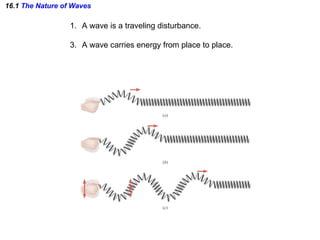
16.1  The Nature of Waves A wave is a traveling disturbance. A wave carries energy from place to place.
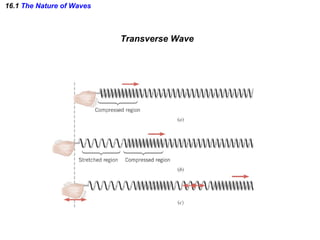
16.1  The Nature of Waves Transverse Wave
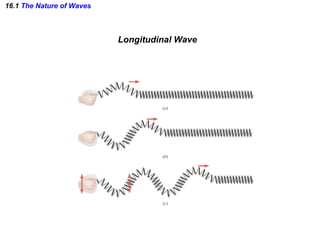
16.1  The Nature of Waves Longitudinal Wave
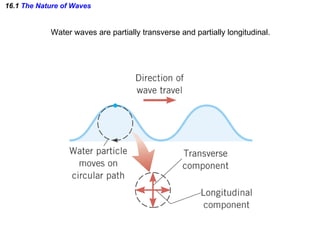
16.1  The Nature of Waves Water waves are partially transverse and partially longitudinal.
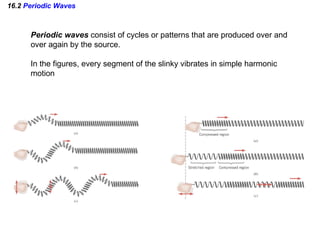
16.2  Periodic Waves Periodic waves  consist of cycles or patterns that are produced over and  over again by the source. In the figures, every segment of the slinky vibrates in simple harmonic motion
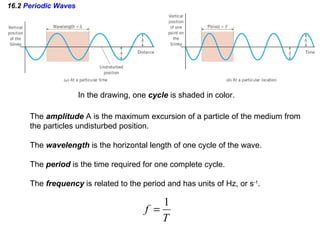
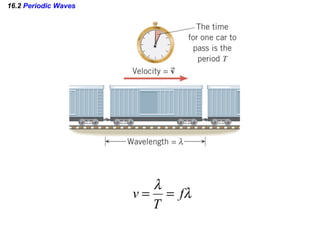
16.2  Periodic Waves In the drawing, one  cycle   is shaded in color. The  amplitude  A is the maximum excursion of a particle of the medium from the particles undisturbed position. The  wavelength  is the horizontal length of one cycle of the wave. The  period   is the time required for one complete cycle.  The  frequency  is related to the period and has units of Hz, or s -1 .
16.2  Periodic Waves
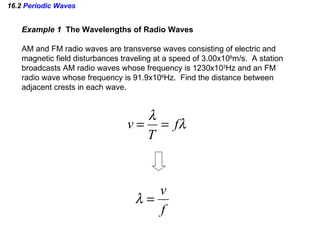
16.2  Periodic Waves Example 1   The Wavelengths of Radio Waves AM and FM radio waves are transverse waves consisting of electric and magnetic field disturbances traveling at a speed of 3.00x10 8 m/s.  A station broadcasts AM radio waves whose frequency is 1230x10 3 Hz and an FM  radio wave whose frequency is 91.9x10 6 Hz.  Find the distance between  adjacent crests in each wave.
16.2  Periodic Waves AM FM
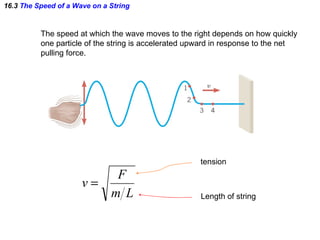
16.3  The Speed of a Wave on a String The speed at which the wave moves to the right depends on how quickly one particle of the string is accelerated upward in response to the net  pulling force. tension Length of string
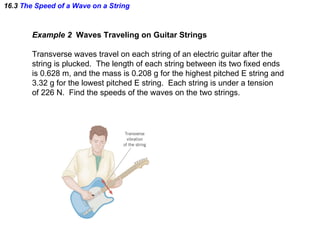
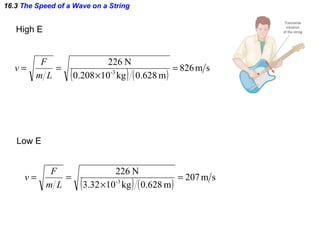
16.3  The Speed of a Wave on a String Example 2  Waves Traveling on Guitar Strings Transverse waves travel on each string of an electric guitar after the string is plucked.  The length of each string between its two fixed ends is 0.628 m, and the mass is 0.208 g for the highest pitched E string and 3.32 g for the lowest pitched E string.  Each string is under a tension  of 226 N.  Find the speeds of the waves on the two strings.
16.3  The Speed of a Wave on a String High E Low E
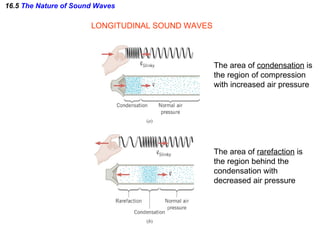
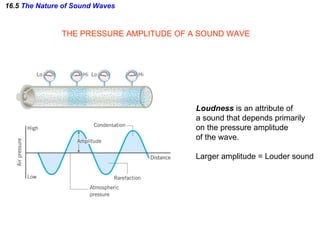
16.5  The Nature of Sound Waves LONGITUDINAL SOUND WAVES The area of  condensation  is the region of compression with increased air pressure The area of  rarefaction  is the region behind the condensation with decreased air pressure
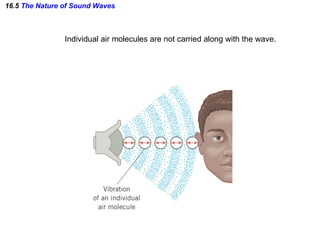
16.5  The Nature of Sound Waves Individual air molecules are not carried along with the wave.
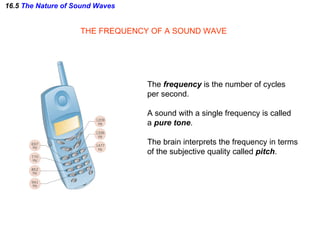
16.5  The Nature of Sound Waves THE FREQUENCY OF A SOUND WAVE The  frequency  is the number of cycles per second. A sound with a single frequency is called a  pure tone . The brain interprets the frequency in terms of the subjective quality called  pitch .
16.5  The Nature of Sound Waves THE PRESSURE AMPLITUDE OF A SOUND WAVE Loudness  is an attribute of a sound that depends primarily  on the pressure amplitude of the wave. Larger amplitude = Louder sound
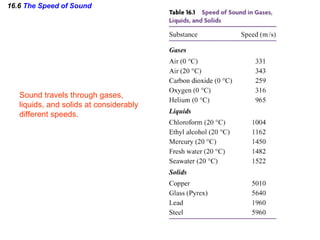
16.6  The Speed of Sound Sound travels through gases,  liquids, and solids at considerably different speeds.
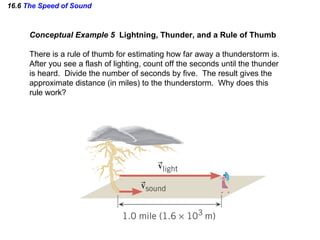
16.6  The Speed of Sound Conceptual Example 5  Lightning, Thunder, and a Rule of Thumb There is a rule of thumb for estimating how far away a thunderstorm is. After you see a flash of lighting, count off the seconds until the thunder  is heard.  Divide the number of seconds by five.  The result gives the approximate distance (in miles) to the thunderstorm.  Why does this rule work?
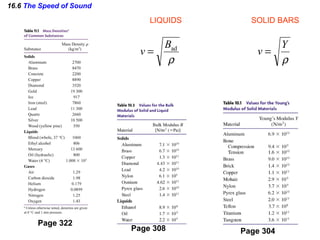
16.6  The Speed of Sound LIQUIDS SOLID BARS Page 304 Page 322 Page 308
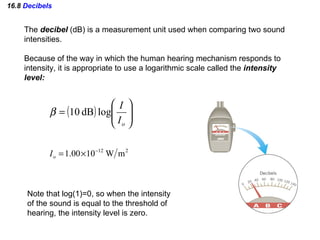
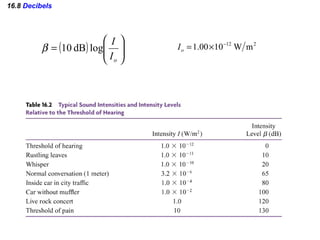
16.8  Decibels The  decibel  (dB) is a measurement unit used when comparing two sound intensities.  Because of the way in which the human hearing mechanism responds to intensity, it is appropriate to use a logarithmic scale called the  intensity level: Note that log(1)=0, so when the intensity  of the sound is equal to the threshold of  hearing, the intensity level is zero.
16.8  Decibels
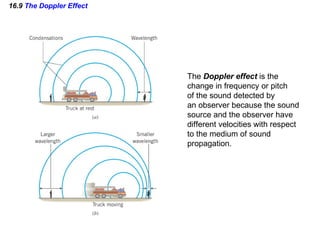
16.9  The Doppler Effect The  Doppler effect  is the  change in frequency or pitch of the sound detected by an observer because the sound source and the observer have different velocities with respect to the medium of sound  propagation.
16.10  Applications of Sound in Medicine By scanning ultrasonic waves across the body and detecting the echoes from various locations, it is possible to obtain an image.
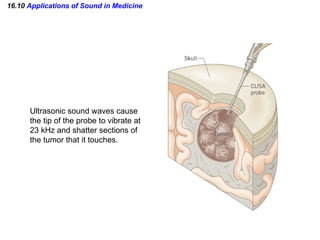
16.10  Applications of Sound in Medicine Ultrasonic sound waves cause the tip of the probe to vibrate at 23 kHz and shatter sections of the tumor that it touches.

AP Physics - Chapter 16 Powerpoint

  • 1.
  • 2.
    16.1 TheNature of Waves A wave is a traveling disturbance. A wave carries energy from place to place.
  • 3.
    16.1 TheNature of Waves Transverse Wave
  • 4.
    16.1 TheNature of Waves Longitudinal Wave
  • 5.
    16.1 TheNature of Waves Water waves are partially transverse and partially longitudinal.
  • 6.
    16.2 PeriodicWaves Periodic waves consist of cycles or patterns that are produced over and over again by the source. In the figures, every segment of the slinky vibrates in simple harmonic motion
  • 7.
    16.2 PeriodicWaves In the drawing, one cycle is shaded in color. The amplitude A is the maximum excursion of a particle of the medium from the particles undisturbed position. The wavelength is the horizontal length of one cycle of the wave. The period is the time required for one complete cycle. The frequency is related to the period and has units of Hz, or s -1 .
  • 8.
  • 9.
    16.2 PeriodicWaves Example 1 The Wavelengths of Radio Waves AM and FM radio waves are transverse waves consisting of electric and magnetic field disturbances traveling at a speed of 3.00x10 8 m/s. A station broadcasts AM radio waves whose frequency is 1230x10 3 Hz and an FM radio wave whose frequency is 91.9x10 6 Hz. Find the distance between adjacent crests in each wave.
  • 10.
    16.2 PeriodicWaves AM FM
  • 11.
    16.3 TheSpeed of a Wave on a String The speed at which the wave moves to the right depends on how quickly one particle of the string is accelerated upward in response to the net pulling force. tension Length of string
  • 12.
    16.3 TheSpeed of a Wave on a String Example 2 Waves Traveling on Guitar Strings Transverse waves travel on each string of an electric guitar after the string is plucked. The length of each string between its two fixed ends is 0.628 m, and the mass is 0.208 g for the highest pitched E string and 3.32 g for the lowest pitched E string. Each string is under a tension of 226 N. Find the speeds of the waves on the two strings.
  • 13.
    16.3 TheSpeed of a Wave on a String High E Low E
  • 14.
    16.5 TheNature of Sound Waves LONGITUDINAL SOUND WAVES The area of condensation is the region of compression with increased air pressure The area of rarefaction is the region behind the condensation with decreased air pressure
  • 15.
    16.5 TheNature of Sound Waves Individual air molecules are not carried along with the wave.
  • 16.
    16.5 TheNature of Sound Waves THE FREQUENCY OF A SOUND WAVE The frequency is the number of cycles per second. A sound with a single frequency is called a pure tone . The brain interprets the frequency in terms of the subjective quality called pitch .
  • 17.
    16.5 TheNature of Sound Waves THE PRESSURE AMPLITUDE OF A SOUND WAVE Loudness is an attribute of a sound that depends primarily on the pressure amplitude of the wave. Larger amplitude = Louder sound
  • 18.
    16.6 TheSpeed of Sound Sound travels through gases, liquids, and solids at considerably different speeds.
  • 19.
    16.6 TheSpeed of Sound Conceptual Example 5 Lightning, Thunder, and a Rule of Thumb There is a rule of thumb for estimating how far away a thunderstorm is. After you see a flash of lighting, count off the seconds until the thunder is heard. Divide the number of seconds by five. The result gives the approximate distance (in miles) to the thunderstorm. Why does this rule work?
  • 20.
    16.6 TheSpeed of Sound LIQUIDS SOLID BARS Page 304 Page 322 Page 308
  • 21.
    16.8 DecibelsThe decibel (dB) is a measurement unit used when comparing two sound intensities. Because of the way in which the human hearing mechanism responds to intensity, it is appropriate to use a logarithmic scale called the intensity level: Note that log(1)=0, so when the intensity of the sound is equal to the threshold of hearing, the intensity level is zero.
  • 22.
  • 23.
    16.9 TheDoppler Effect The Doppler effect is the change in frequency or pitch of the sound detected by an observer because the sound source and the observer have different velocities with respect to the medium of sound propagation.
  • 24.
    16.10 Applicationsof Sound in Medicine By scanning ultrasonic waves across the body and detecting the echoes from various locations, it is possible to obtain an image.
  • 25.
    16.10 Applicationsof Sound in Medicine Ultrasonic sound waves cause the tip of the probe to vibrate at 23 kHz and shatter sections of the tumor that it touches.