This document provides an overview of key concepts in fluid mechanics, including:
- Mass density and its definition in terms of mass and volume.
- Pressure and its definition in terms of force and area. Examples of calculating pressure and force.
- How pressure changes with depth in static fluids based on the fluid's density and depth.
- Pascal's principle which states that pressure changes are transmitted undiminished throughout a fluid.
- Archimedes' principle regarding buoyant forces on submerged objects equaling the weight of fluid displaced.
FLUIDS
Chapter 11
Engr. Vicente Y. Buenconsejo, Jr., PECE, MT
Area Head – ECE & CpE, College of Engineering
Colegio San Agustin-Bacolod
vicbuen76@yahoo.com
11.1 Mass Density
Example1 Blood as a Fraction of Body Weight
The body of a man whose weight is 690 N contains
about 5.2x10⁻³ m3 of blood.
(a)Find the blood’s weight and
(b)express it as a percentage of the body weight.
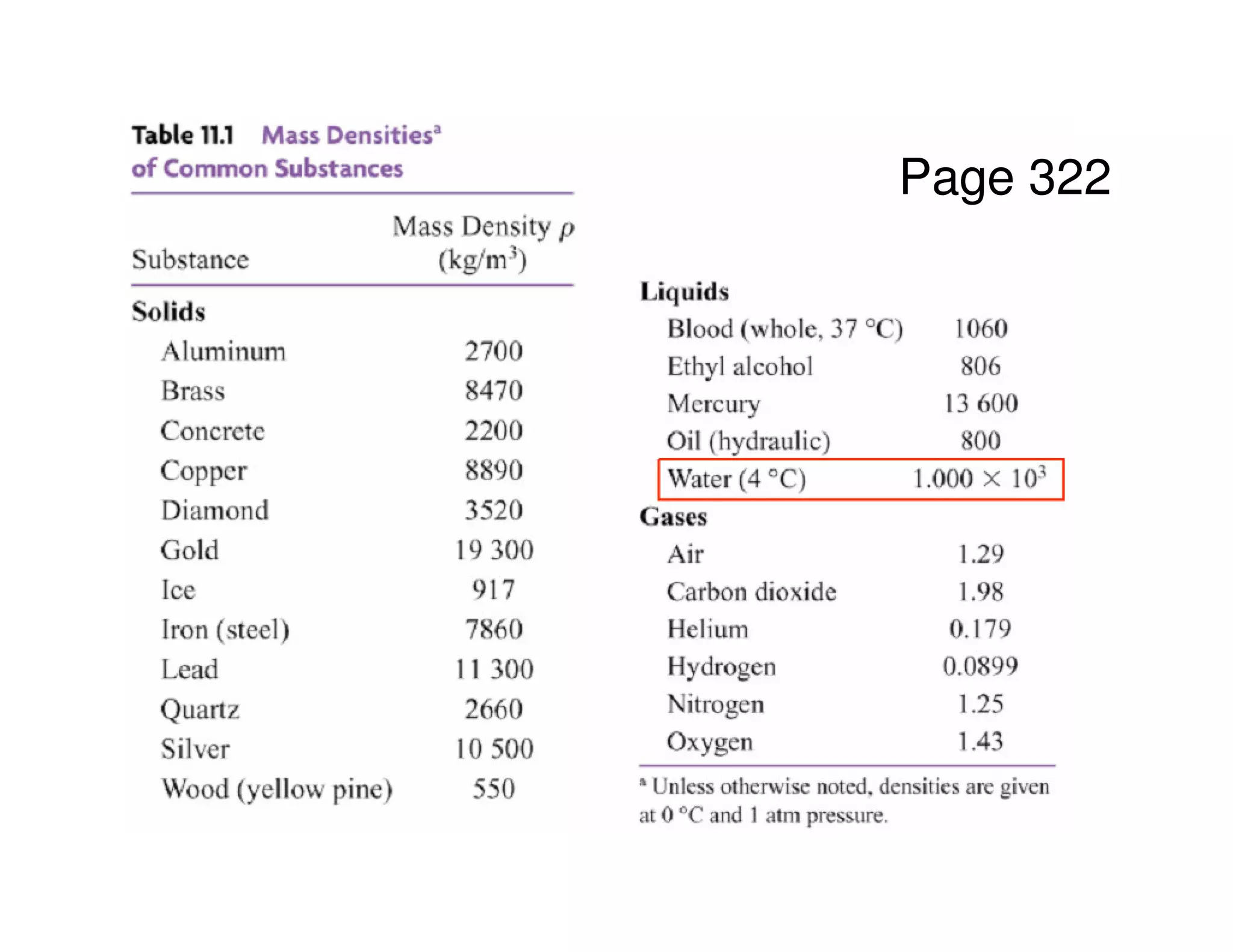
m = Vρ = (5.2 × 10 −3 m 3 ) (1060 kg m 3 ) = 5.5 kg
5.
11.1 Mass Density
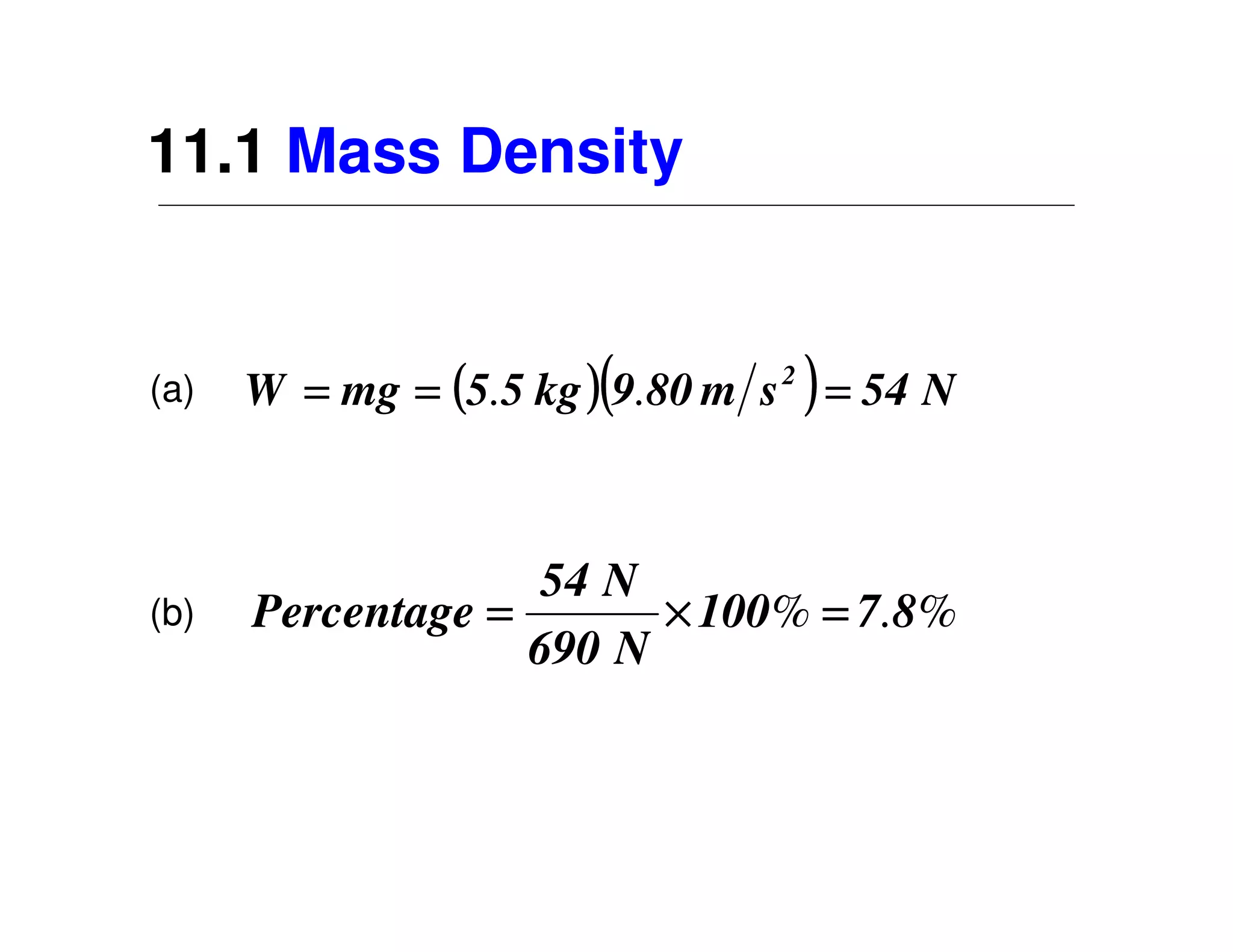
(a) W = mg = (5.5 kg )(9.80 m s 2
) = 54 N
54 N
(b) Percentage = × 100% = 7.8%
690 N
6.
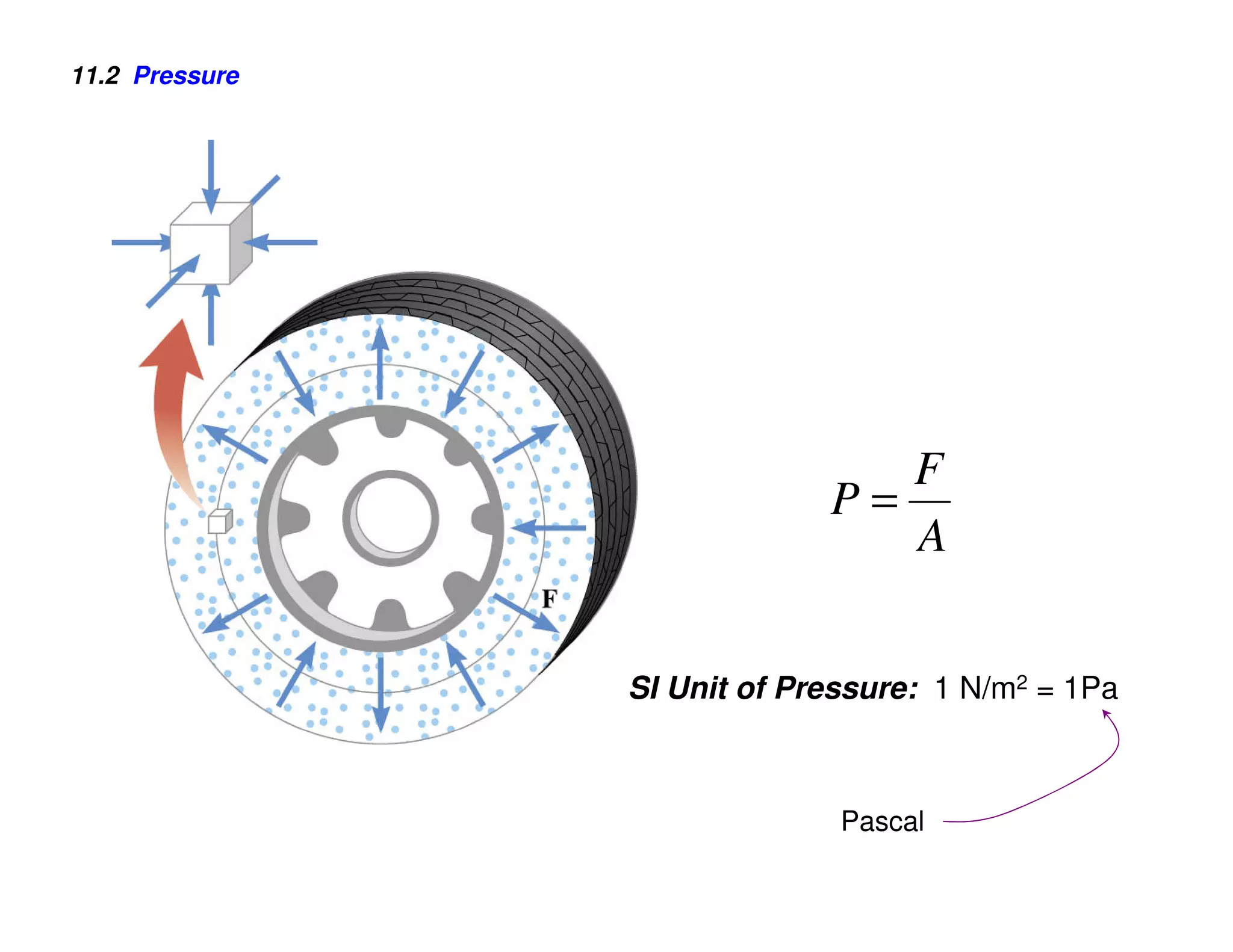
11.2 Pressure
F
P=
A
SI Unit of Pressure: 1 N/m2 = 1Pa
Pascal
7.
11.2 Pressure
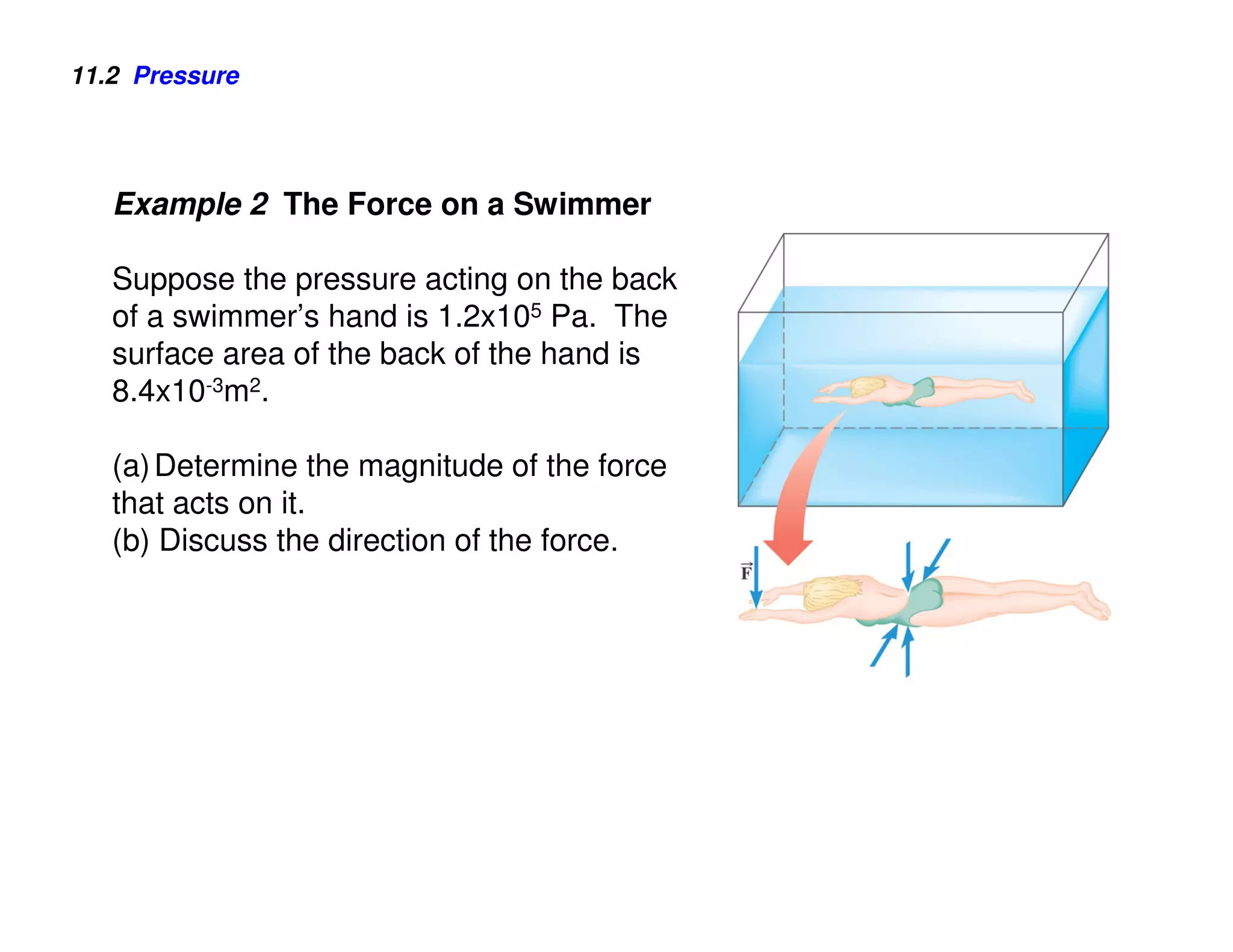
Example 2 The Force on a Swimmer
Suppose the pressure acting on the back
of a swimmer’s hand is 1.2x10⁵ Pa. The
surface area of the back of the hand is
8.4x10⁻³m2.
(a) Determine the magnitude of the force
that acts on it.
(b) Discuss the direction of the force.
8.
11.2 Pressure
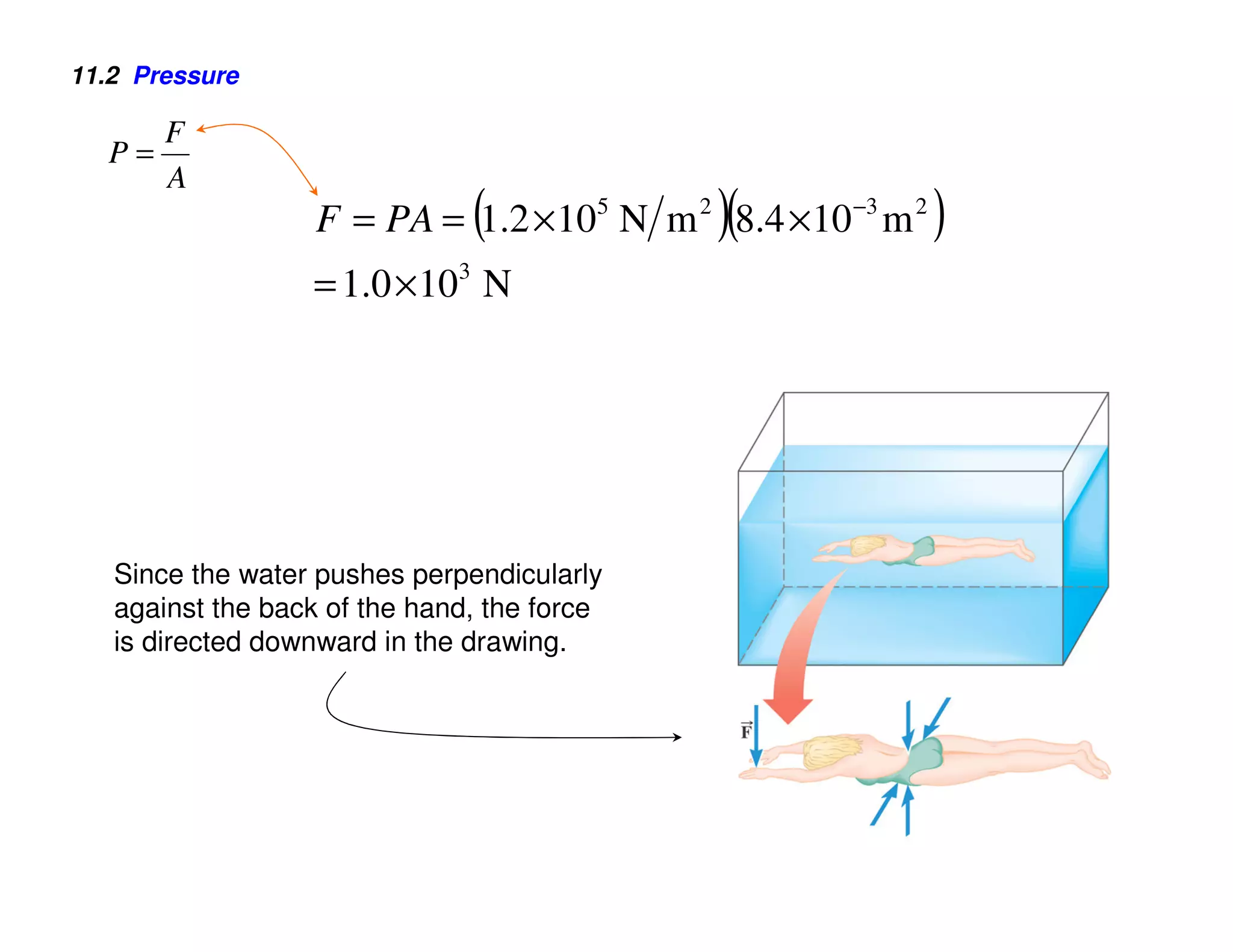
F
P=
A
( )(
F = PA = 1.2 × 10⁵ N m 2 8.4 ×10 −3 m 2 )
= 1.0 × 10³ N
Since the water pushes perpendicularly
against the back of the hand, the force
is directed downward in the drawing.
9.
11.2 Pressure
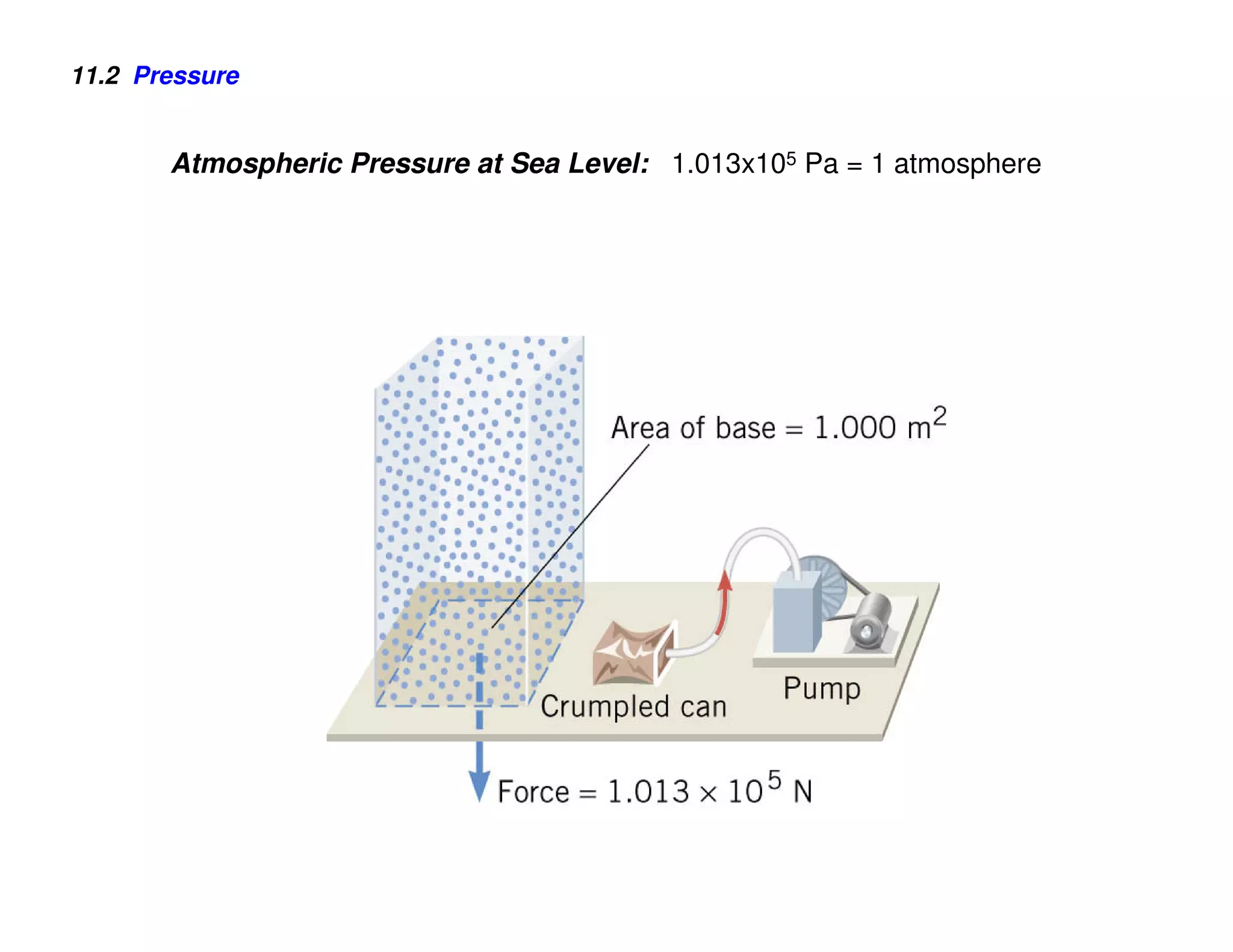
Atmospheric Pressure at Sea Level: 1.013x10⁵ Pa = 1 atmosphere
10.
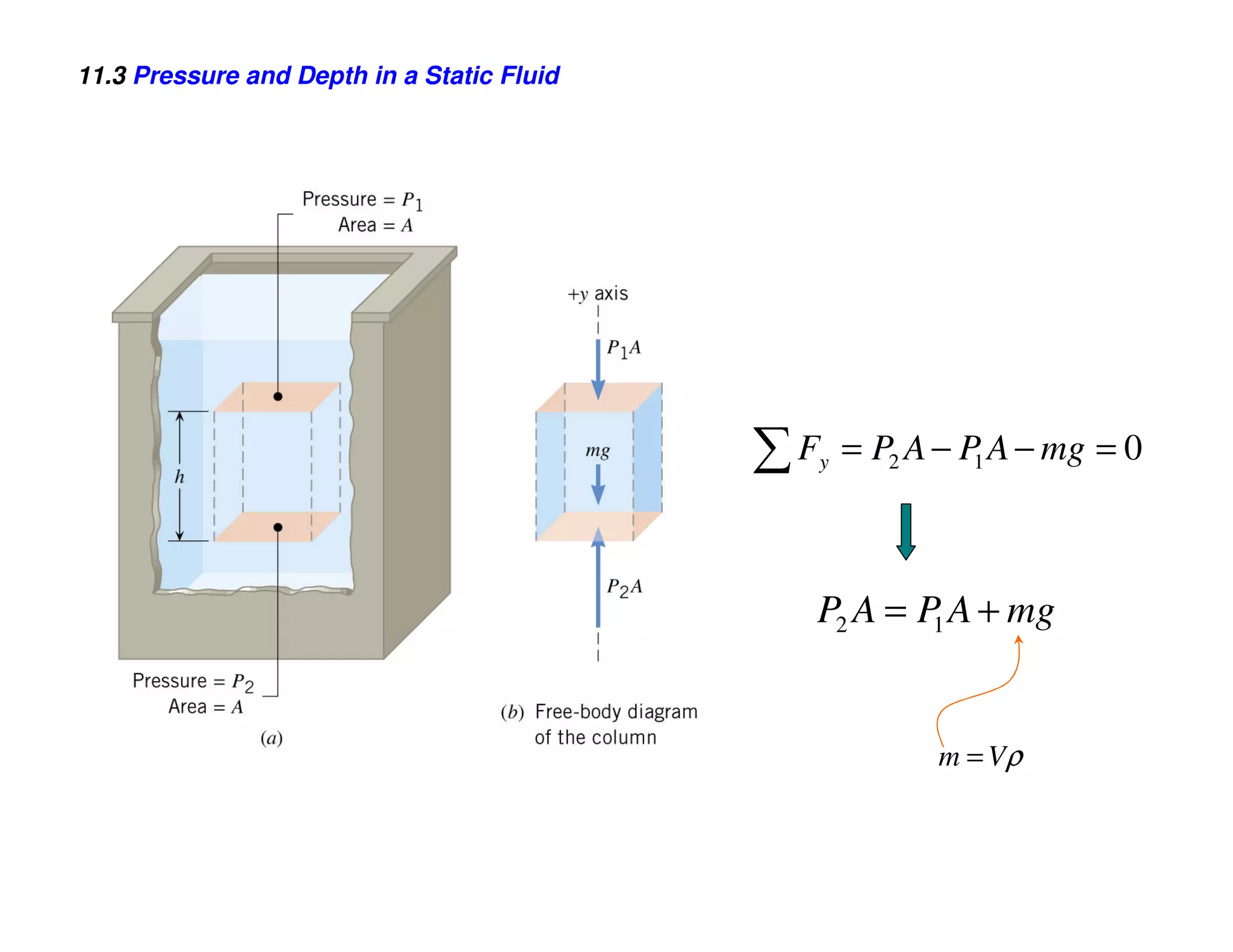
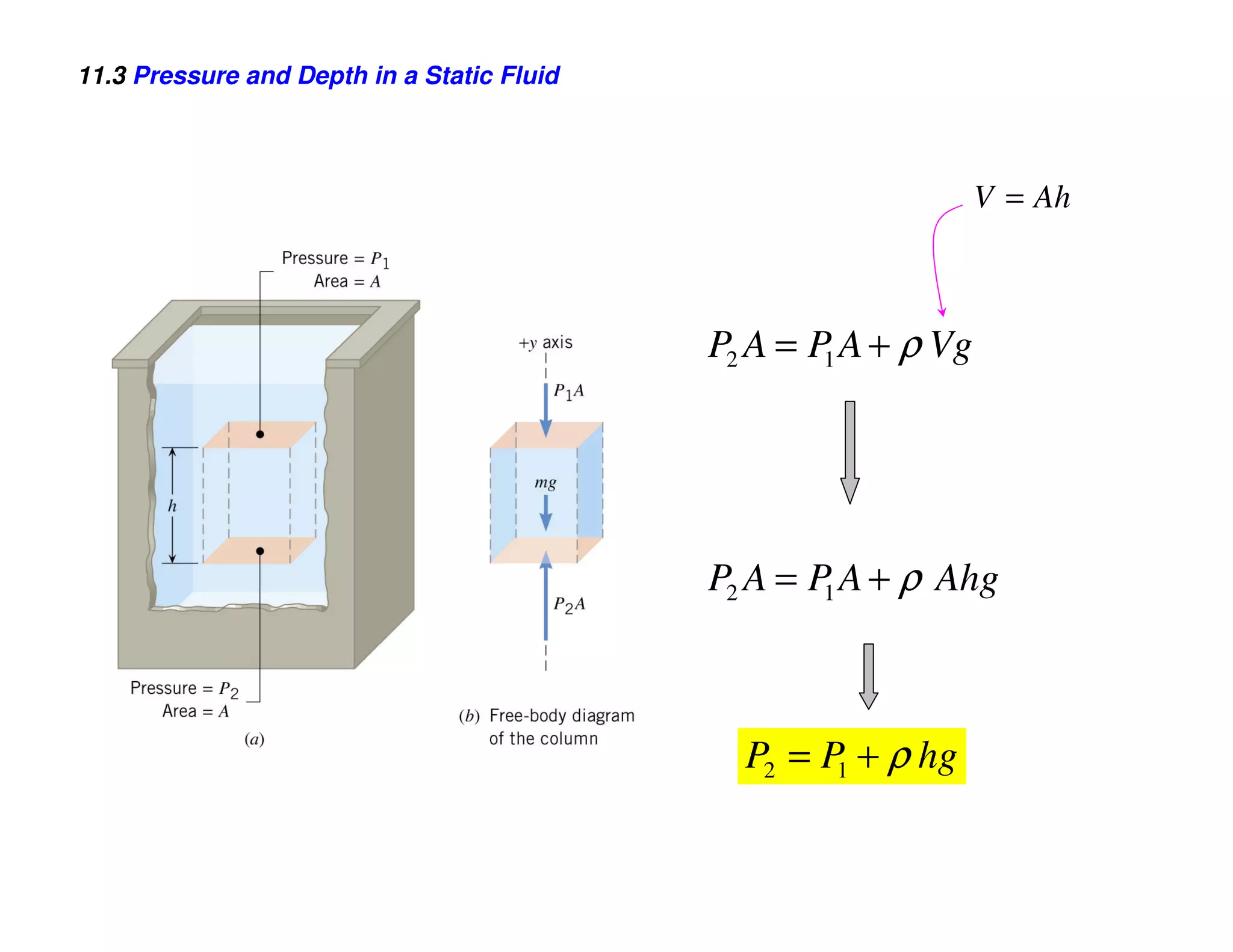
11.3 Pressure andDepth in a Static Fluid
∑F
y = P2 A − P A − mg = 0
1
P2 A = P A + mg
1
m = Vρ
11.
11.3 Pressure andDepth in a Static Fluid
V = Ah
P2 A = P A + ρ Vg
1
P2 A = P A + ρ Ahg
1
P2 = P + ρ hg
1
12.
11.3 Pressure andDepth in a Static Fluid
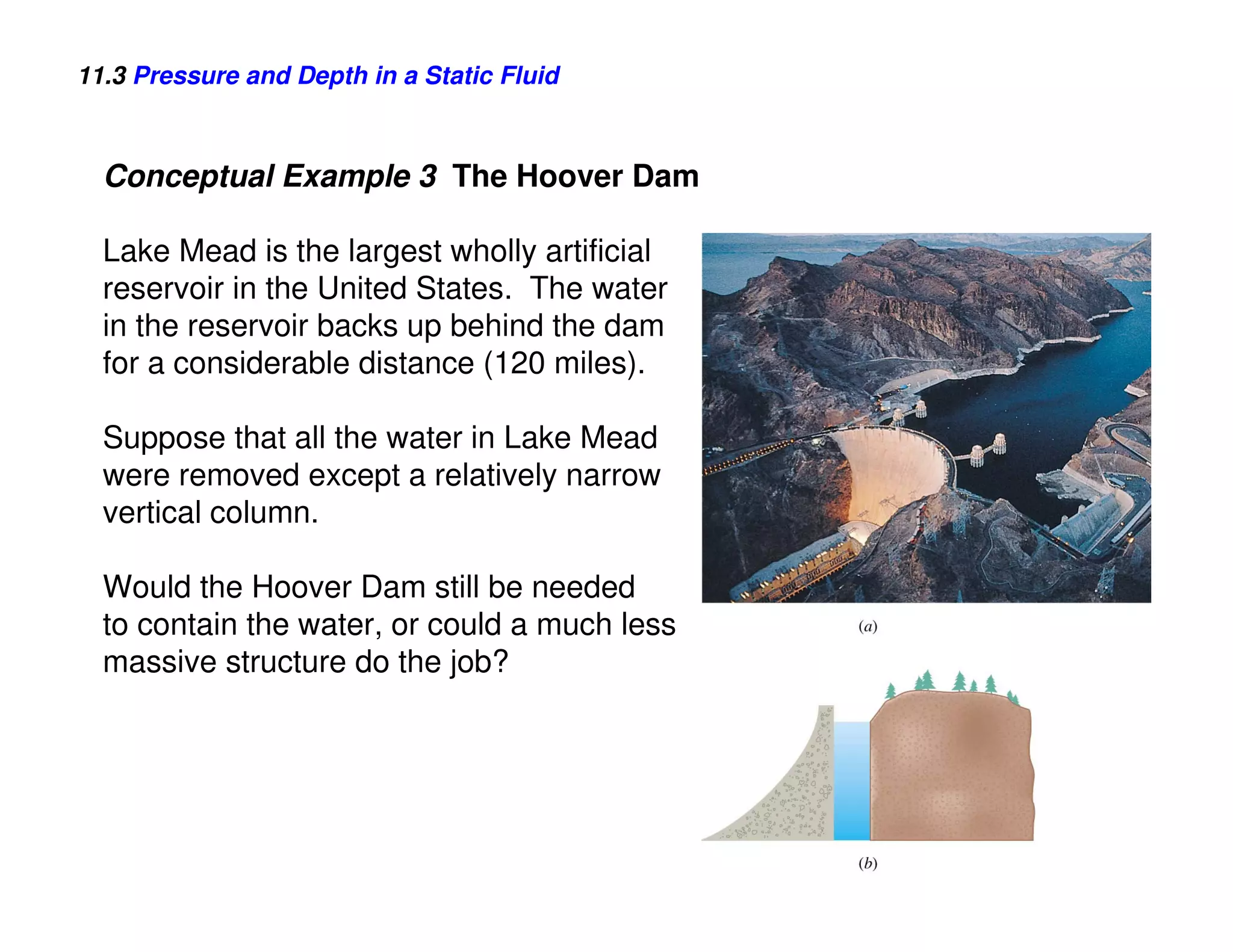
Conceptual Example 3 The Hoover Dam
Lake Mead is the largest wholly artificial
reservoir in the United States. The water
in the reservoir backs up behind the dam
for a considerable distance (120 miles).
Suppose that all the water in Lake Mead
were removed except a relatively narrow
vertical column.
Would the Hoover Dam still be needed
to contain the water, or could a much less
massive structure do the job?
13.
11.3 Pressure andDepth in a Static Fluid
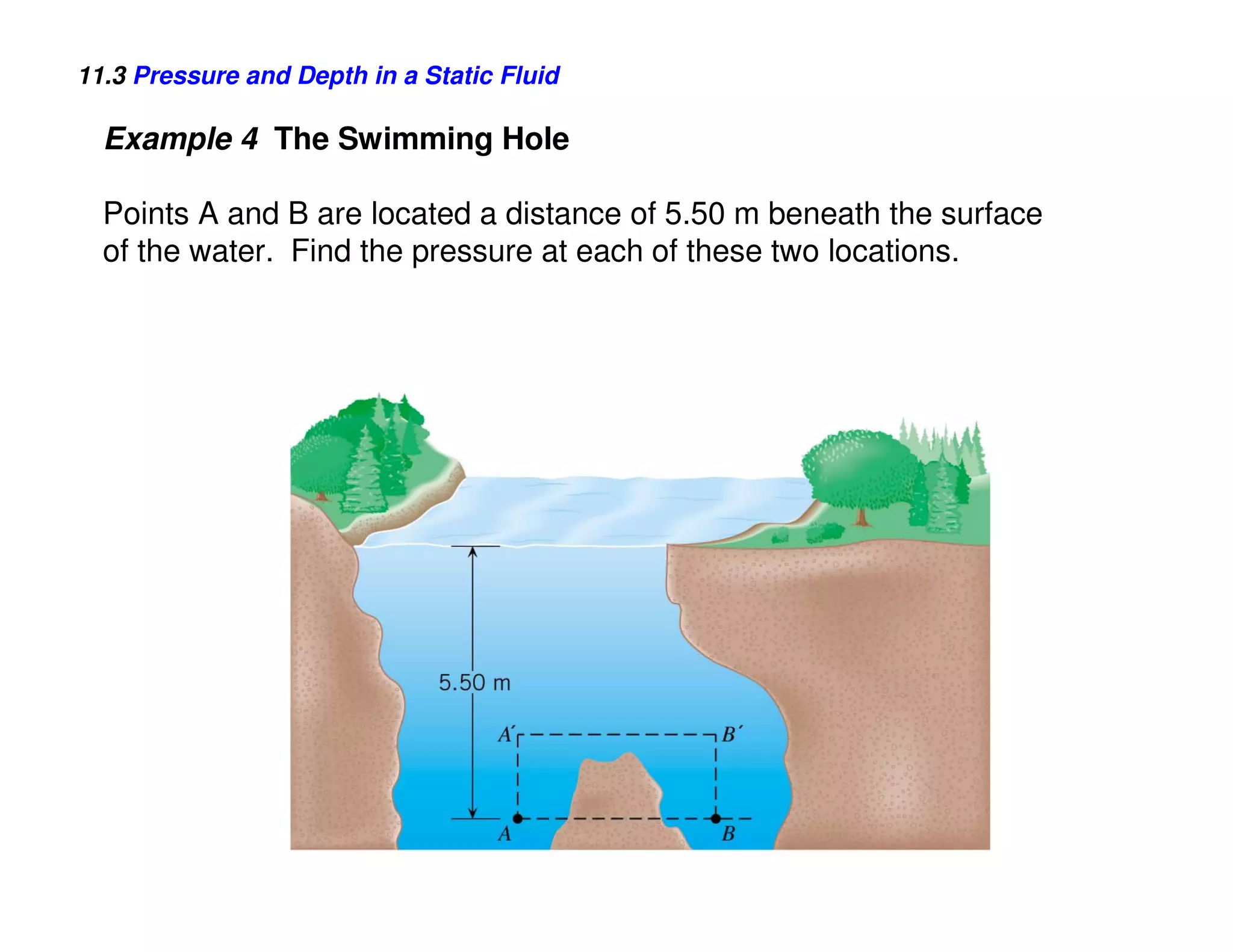
Example 4 The Swimming Hole
Points A and B are located a distance of 5.50 m beneath the surface
of the water. Find the pressure at each of these two locations.
14.
11.3 Pressure andDepth in a Static Fluid
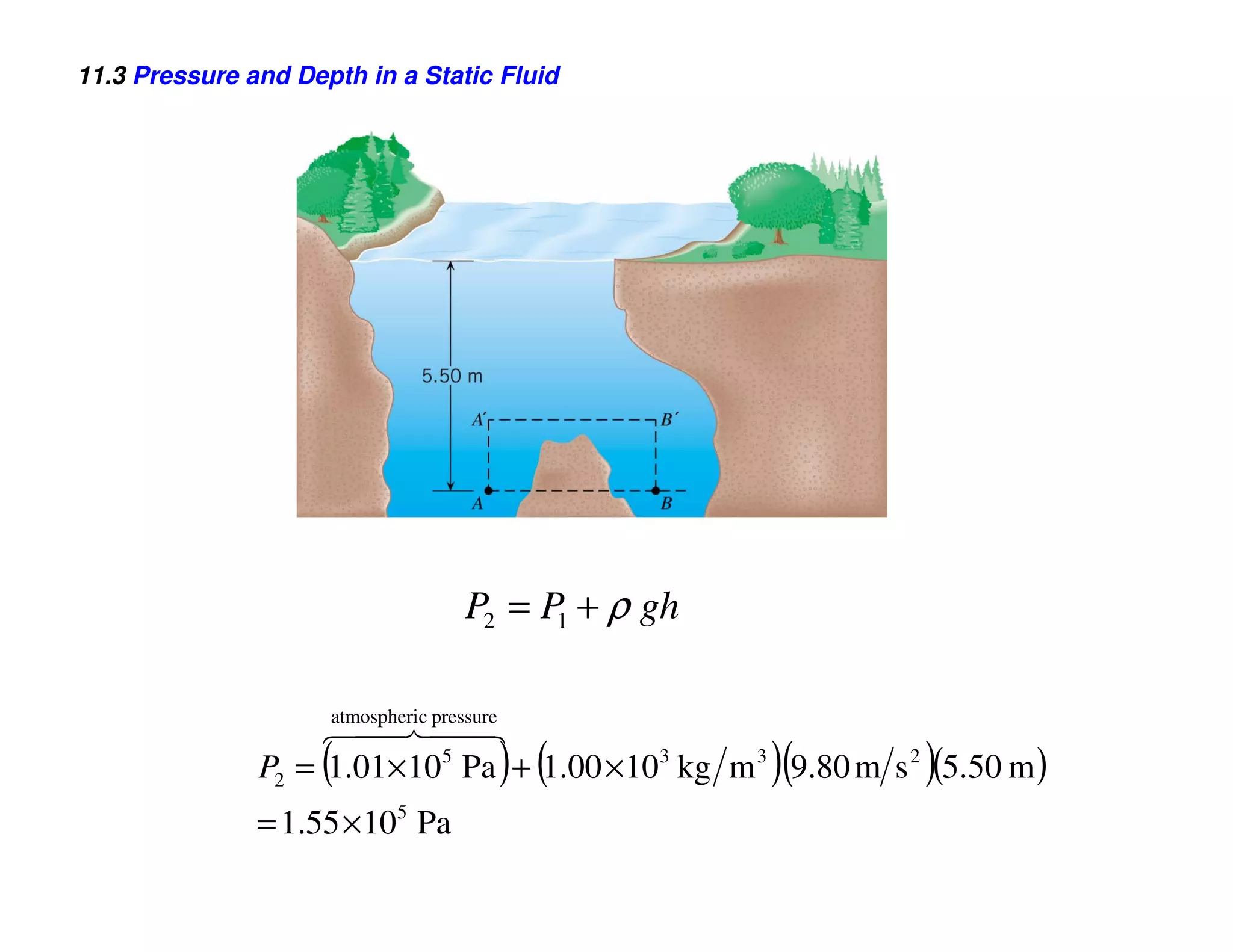
P2 = P + ρ gh
1
atmospheric pressure
64 744
4 8
( ) ( )( )
P2 = 1.01× 10⁵ Pa + 1.00 ×10³ kg m 3 9.80 m s 2 (5.50 m )
= 1.55 × 10⁵ Pa
15.
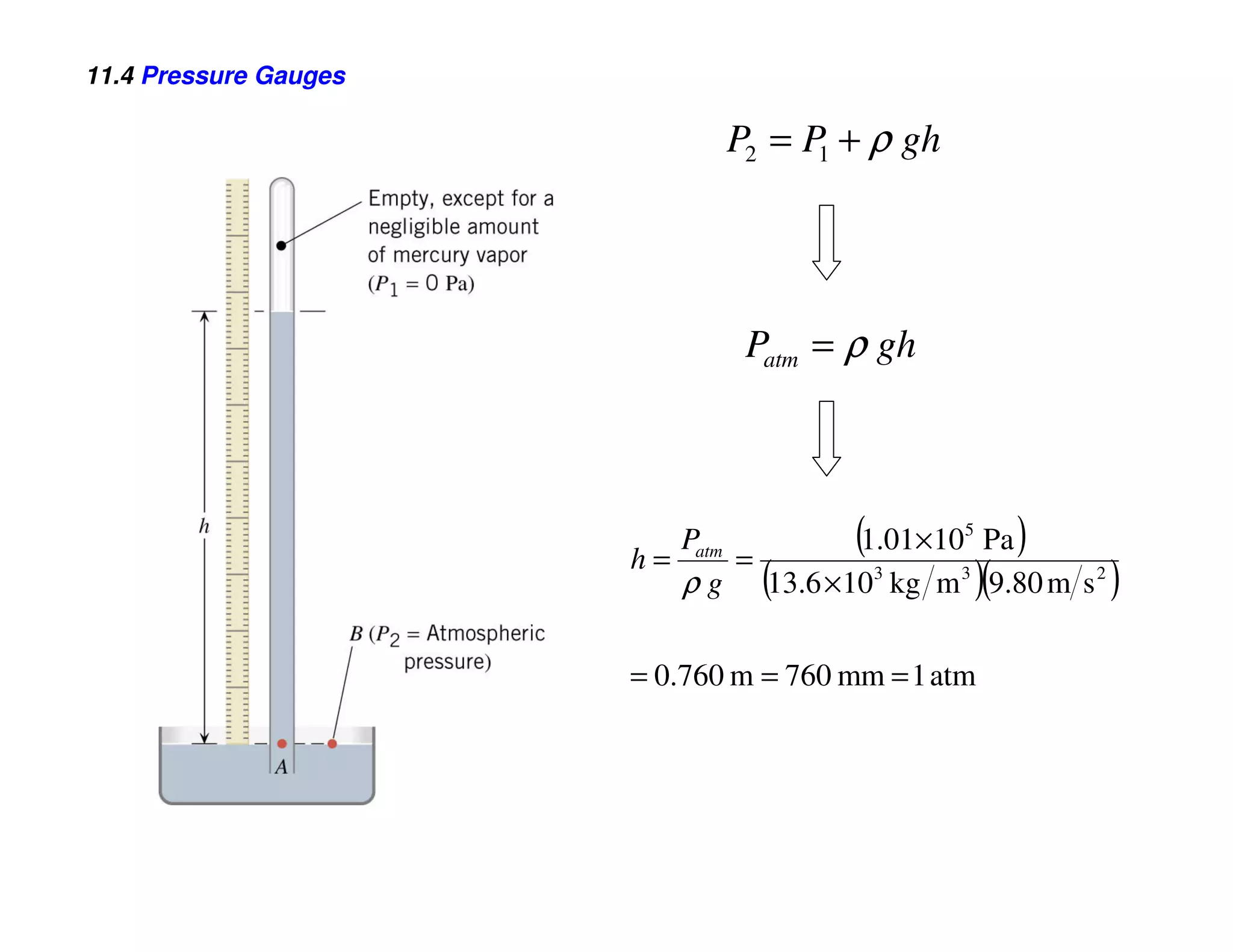
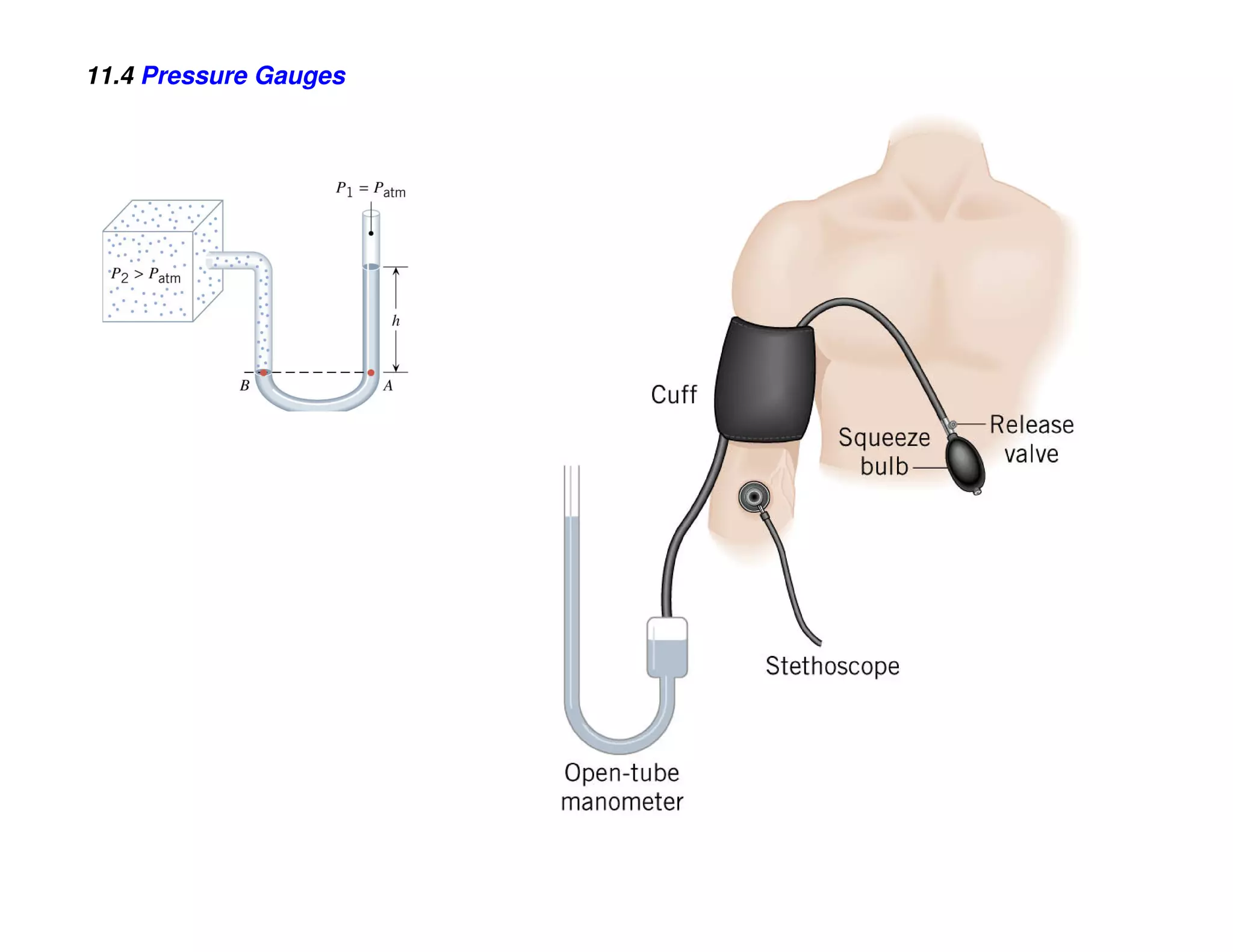
11.4 Pressure Gauges
P2 = P + ρ gh
1
Patm = ρ gh
h=
Patm
=
(
1.01×10⁵ Pa )
( )(
ρ g 13.6 × 10³ kg m 3 9.80 m s 2 )
= 0.760 m = 760 mm = 1 atm
11.5 Pascal’s Principle
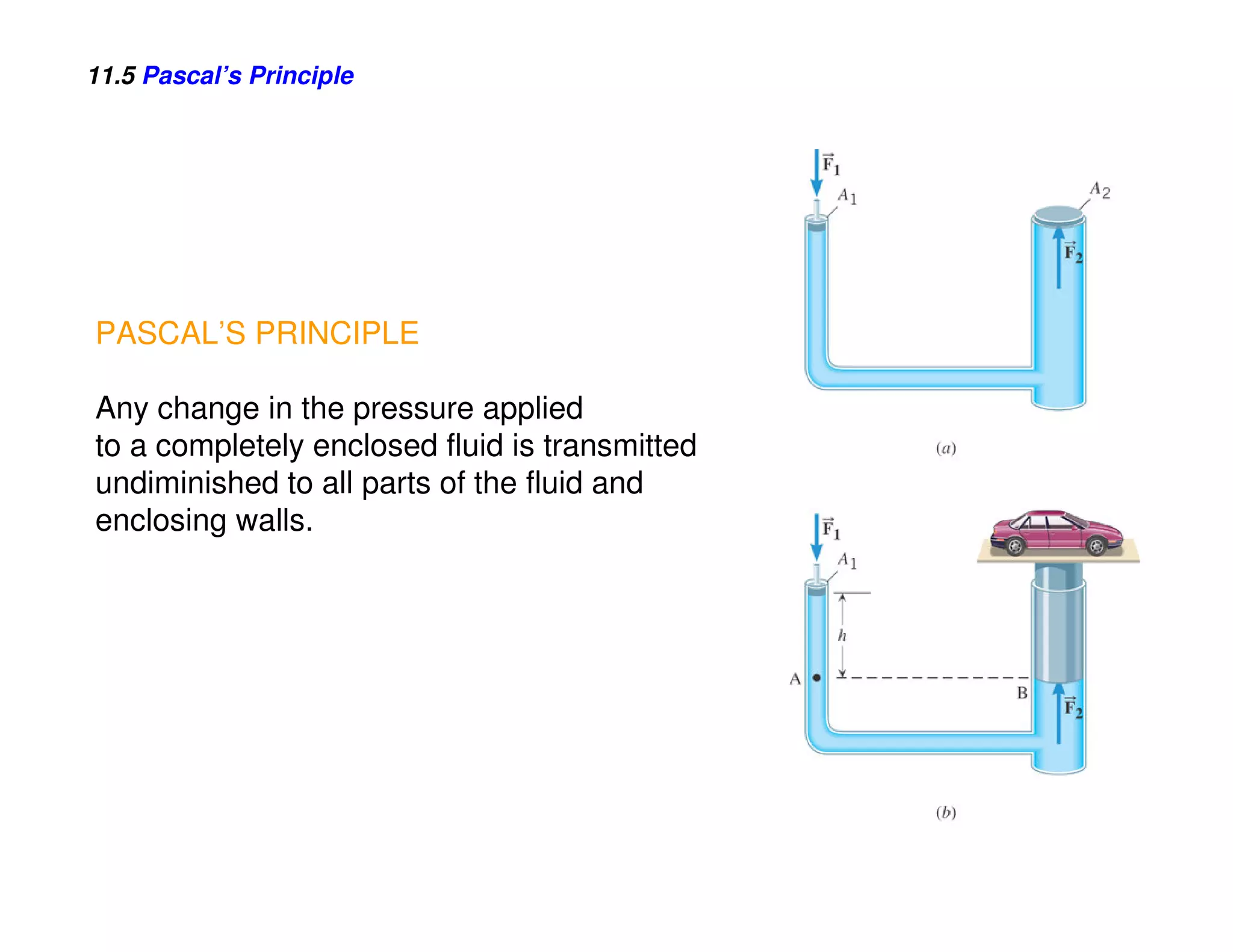
PASCAL’SPRINCIPLE
Any change in the pressure applied
to a completely enclosed fluid is transmitted
undiminished to all parts of the fluid and
enclosing walls.
11.5 Pascal’s Principle
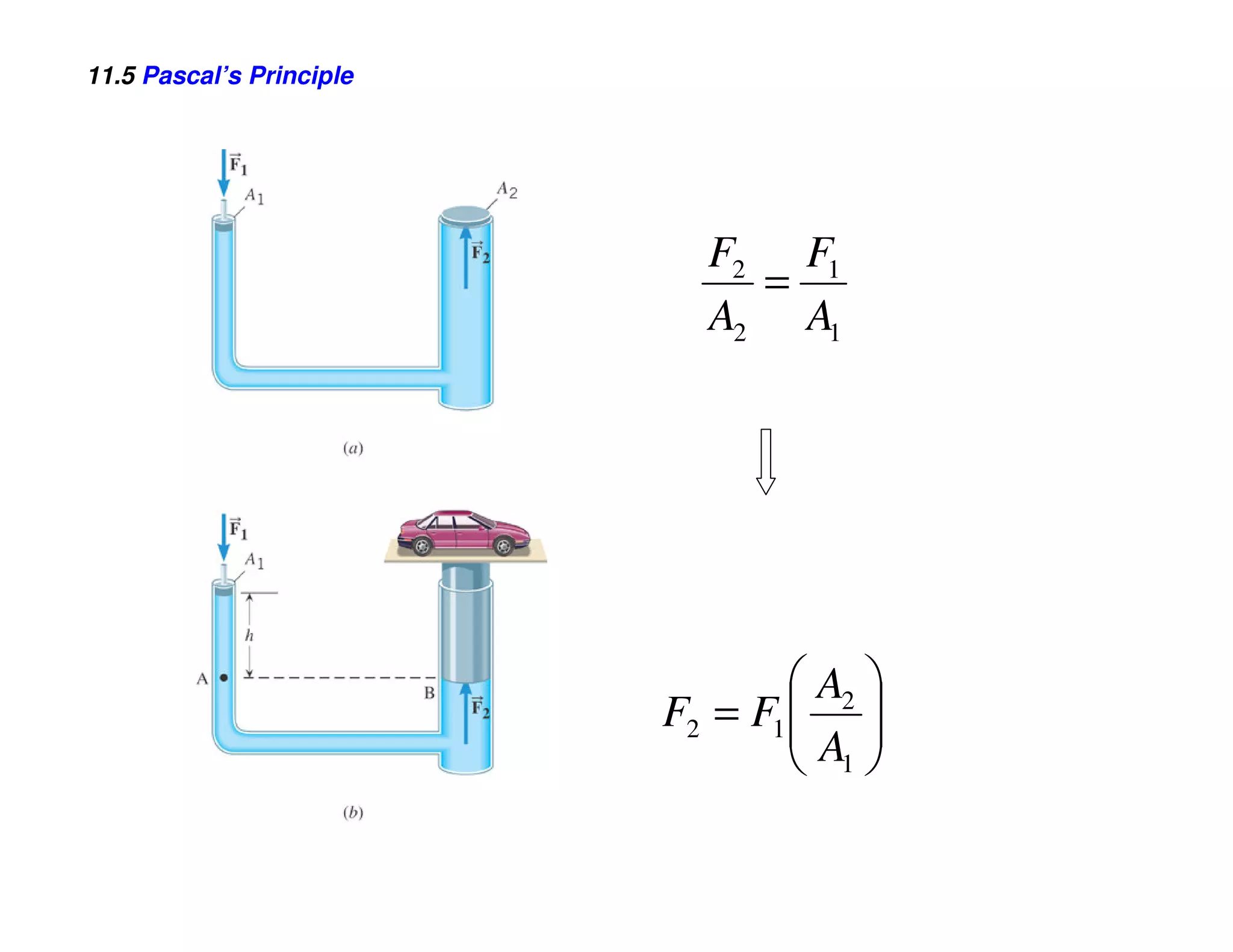
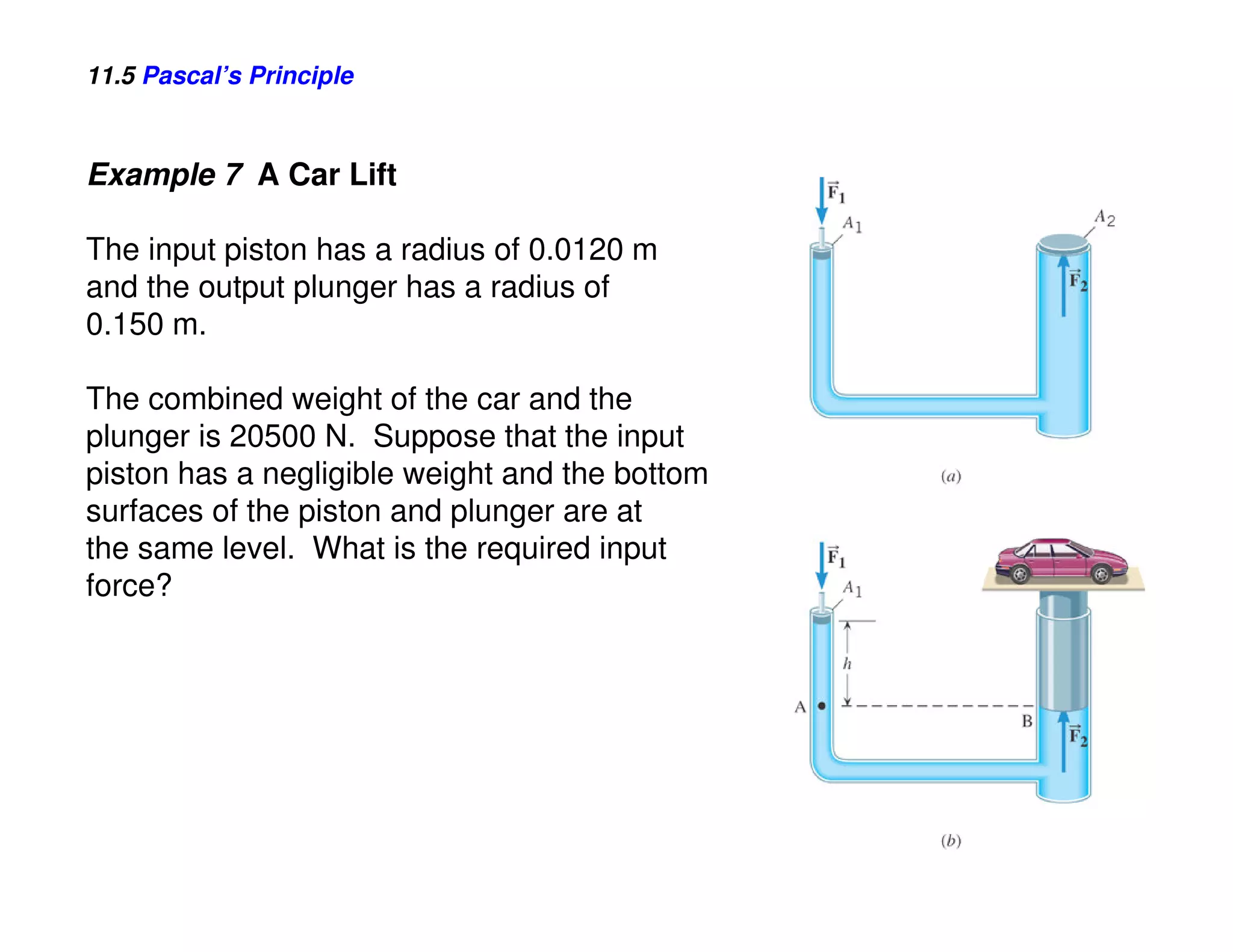
Example7 A Car Lift
The input piston has a radius of 0.0120 m
and the output plunger has a radius of
0.150 m.
The combined weight of the car and the
plunger is 20500 N. Suppose that the input
piston has a negligible weight and the bottom
surfaces of the piston and plunger are at
the same level. What is the required input
force?
20.
11.5 Pascal’s Principle
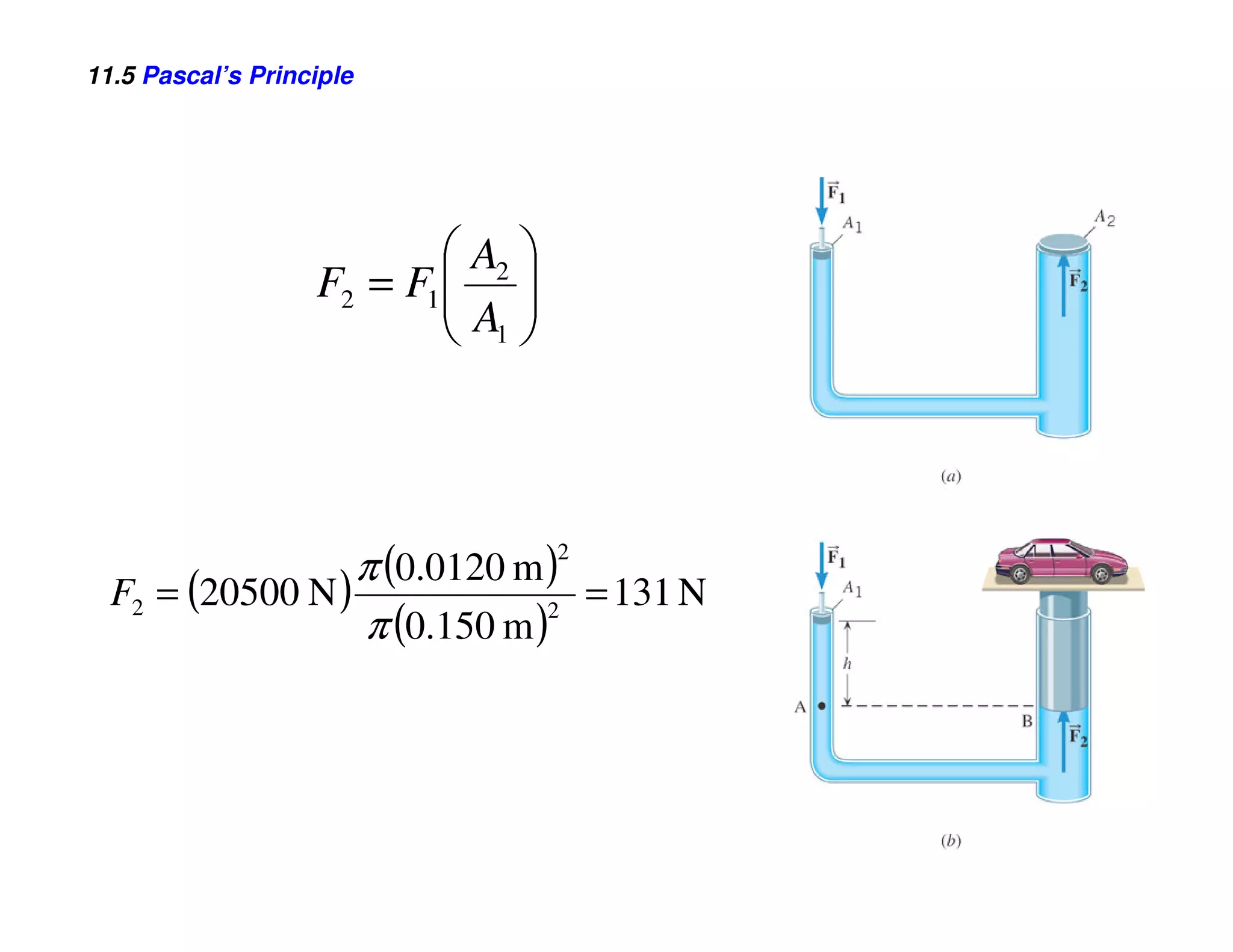
A2
F2 = F1
A
1
2
π (0.0120 m )
F2 = (20500 N ) 2
= 131 N
π (0.150 m )
21.
11.6 Archimedes’ Principle
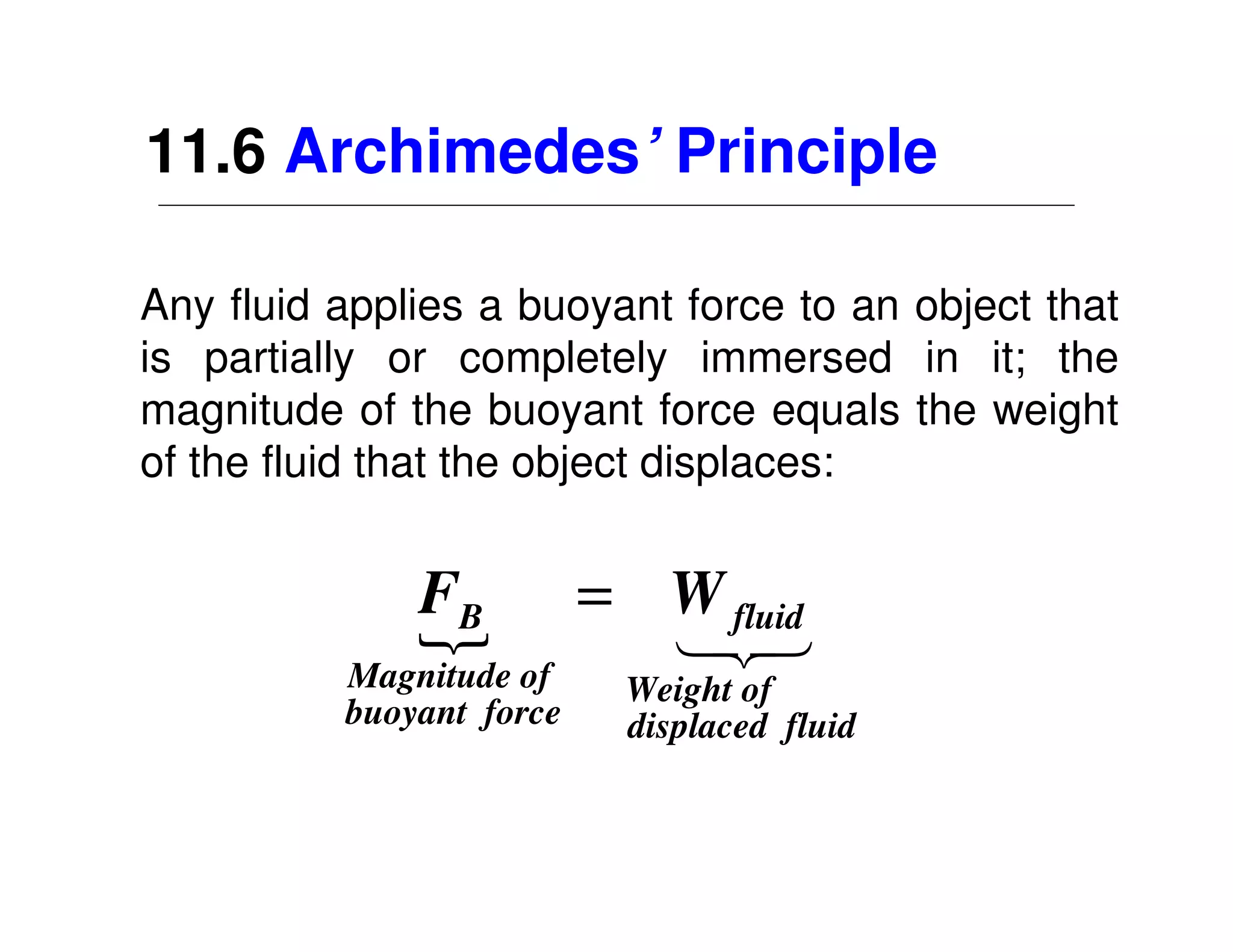
Anyfluid applies a buoyant force to an object that
is partially or completely immersed in it; the
magnitude of the buoyant force equals the weight
of the fluid that the object displaces:
FB
{ = W fluid
13
2
Magnitude of Weight of
buoyant force displaced fluid
22.
11.6 Archimedes’ Principle
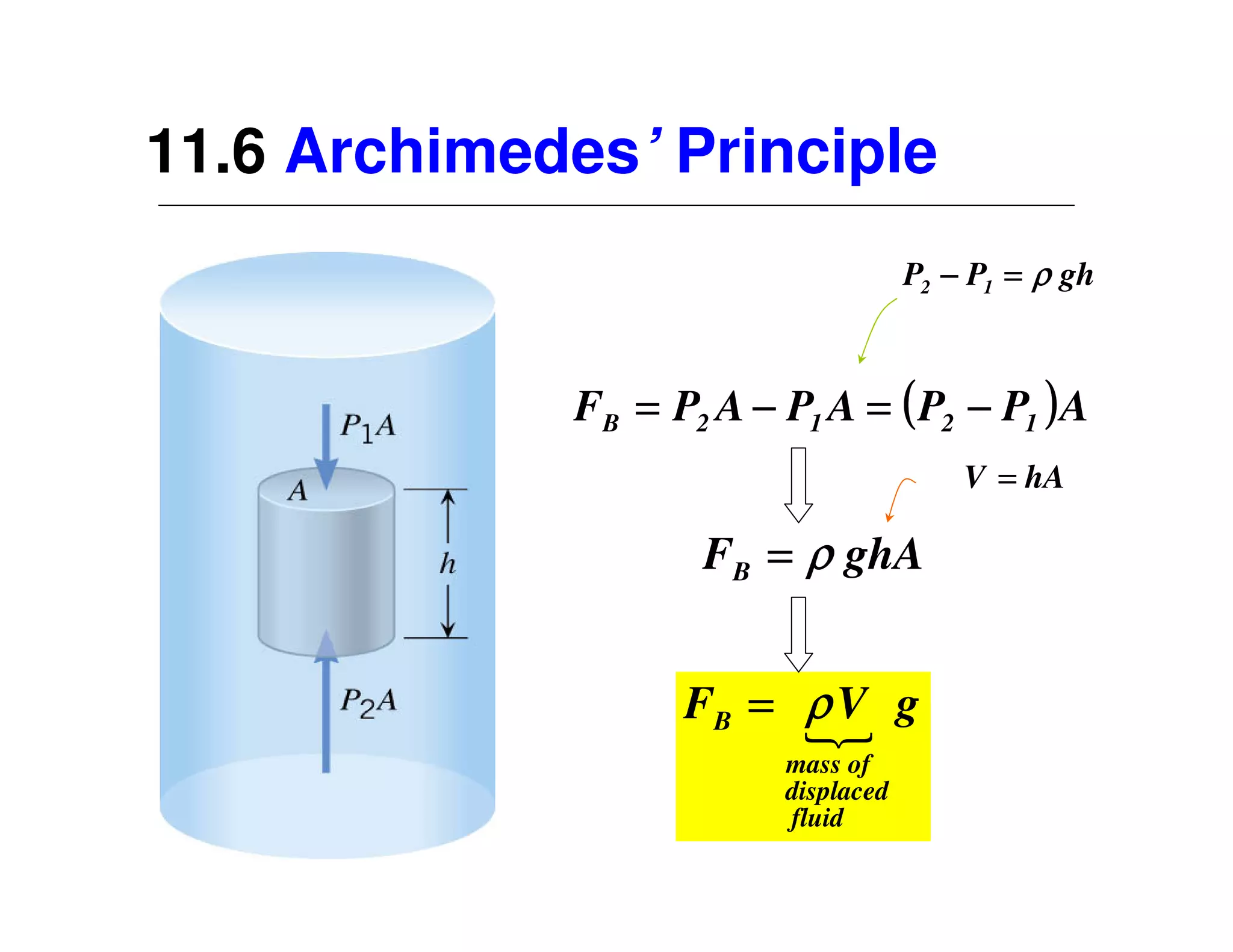
P2 − P1 = ρ gh
FB = P2 A − P1 A = ( P2 − P1 ) A
V = hA
FB = ρ ghA
ρV
FB = { g
mass of
displaced
fluid
23.
11.6 Archimedes’ Principle
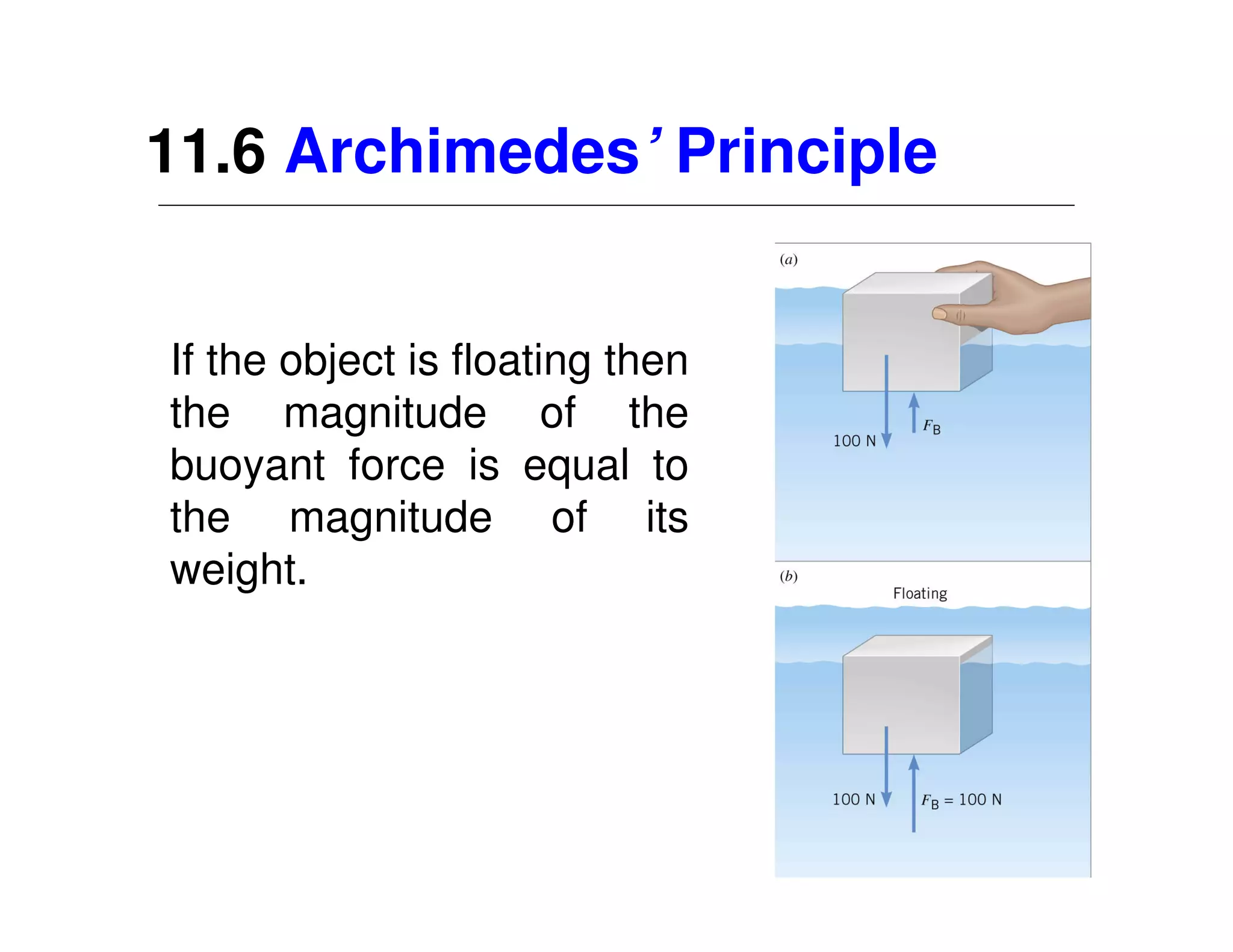
Ifthe object is floating then
the magnitude of the
buoyant force is equal to
the magnitude of its
weight.
24.
11.6 Archimedes’ Principle
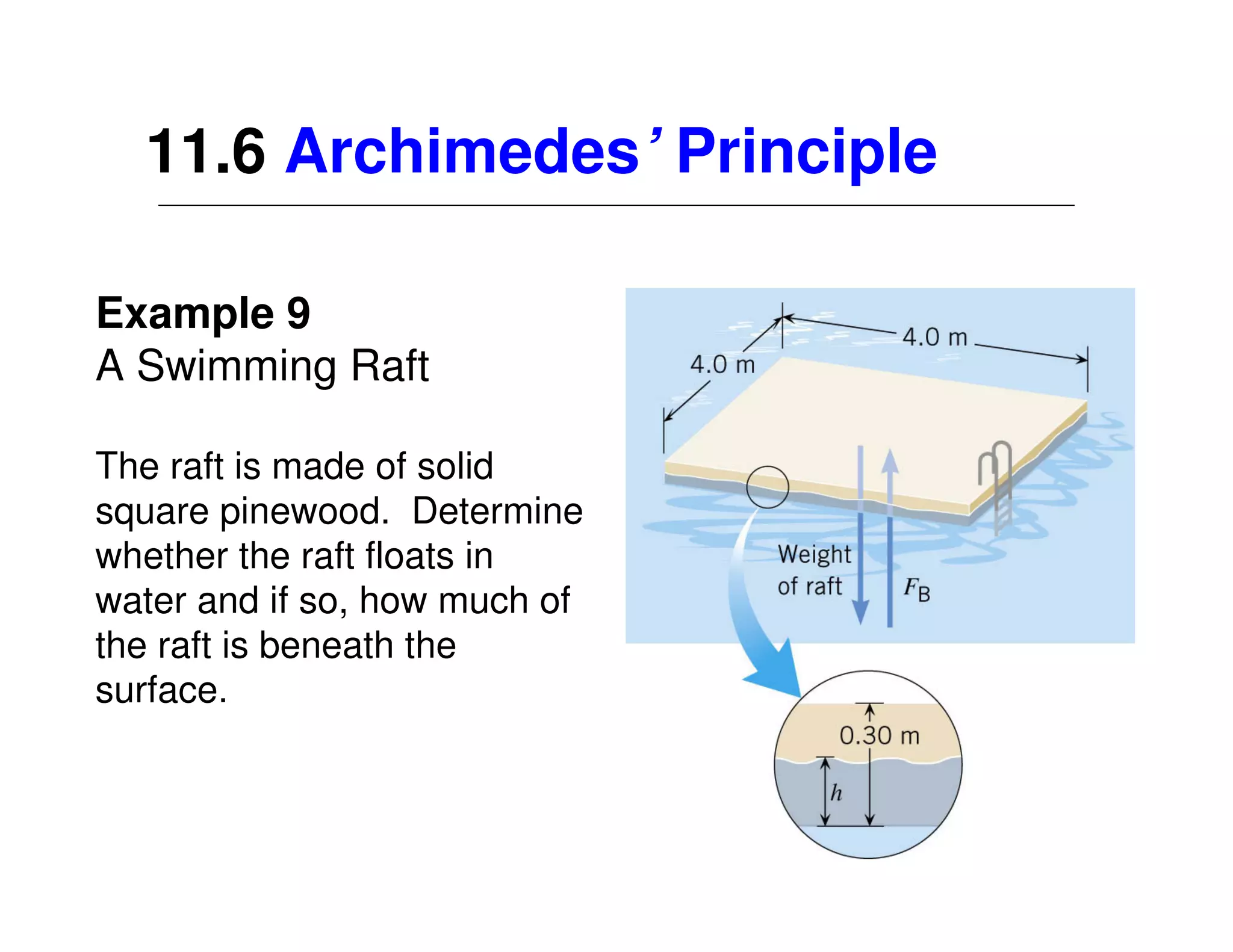
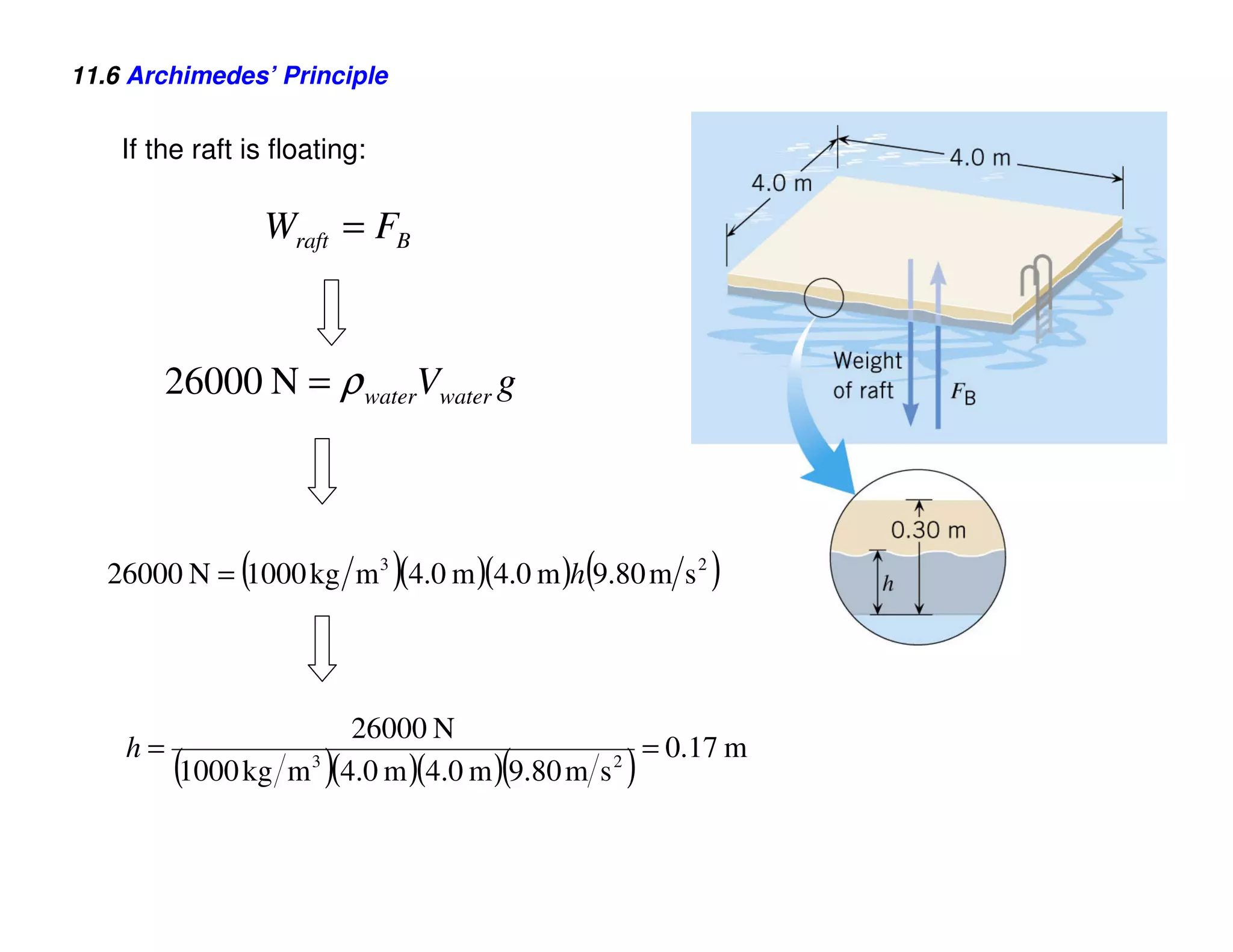
Example9
A Swimming Raft
The raft is made of solid
square pinewood. Determine
whether the raft floats in
water and if so, how much of
the raft is beneath the
surface.
25.
11.6 Archimedes’ Principle
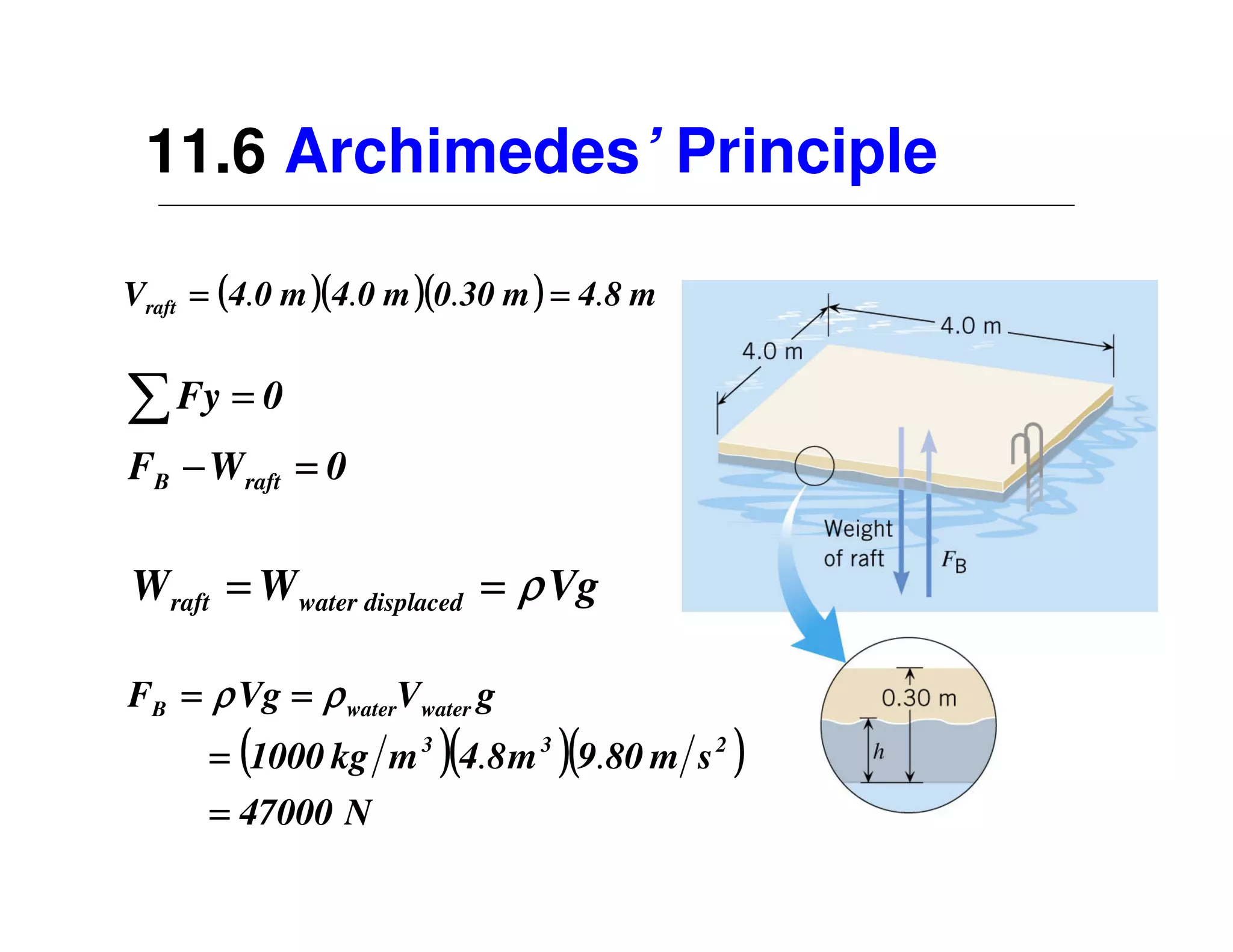
Vraft= (4.0 m )(4.0 m )(0.30 m ) = 4.8 m
∑ Fy = 0
FB − Wraft = 0
Wraft = W water displaced = ρ Vg
FB = ρ Vg = ρ waterVwater g
= (1000 kg m 3 )(4.8 m 3 )(9.80 m s 2 )
= 47000 N
26.
11.6 Archimedes’ Principle
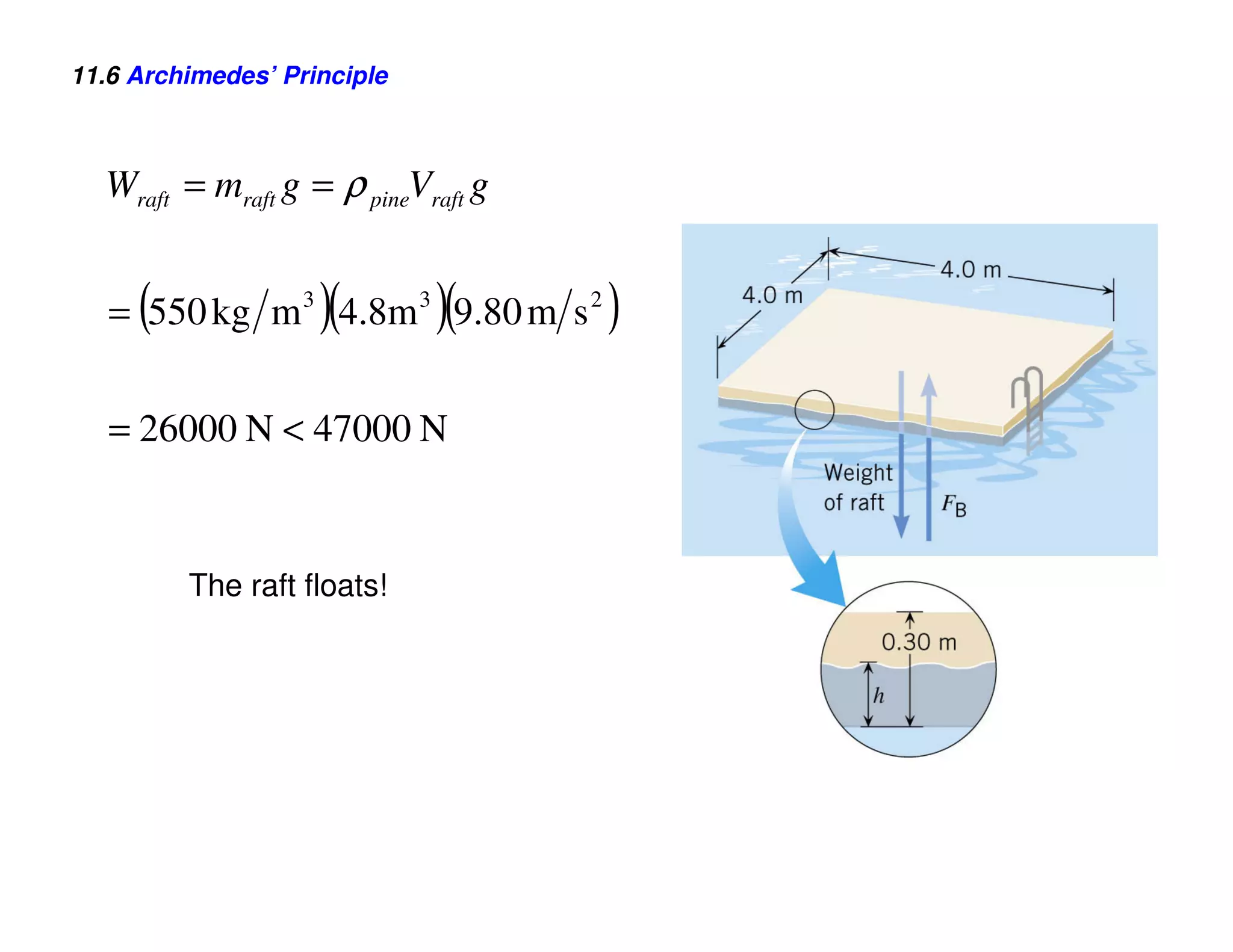
Wraft = mraft g = ρ pineVraft g
( )( )(
= 550 kg m 3 4.8m 3 9.80 m s 2 )
= 26000 N < 47000 N
The raft floats!
27.
11.6 Archimedes’ Principle
If the raft is floating:
Wraft = FB
26000 N = ρ waterVwater g
( ) (
26000 N = 1000 kg m 3 (4.0 m )(4.0 m )h 9.80 m s 2 )
26000 N
h= = 0.17 m
( ) (
1000 kg m (4.0 m )(4.0 m ) 9.80 m s
3 2
)
28.
11.6 Archimedes’ Principle
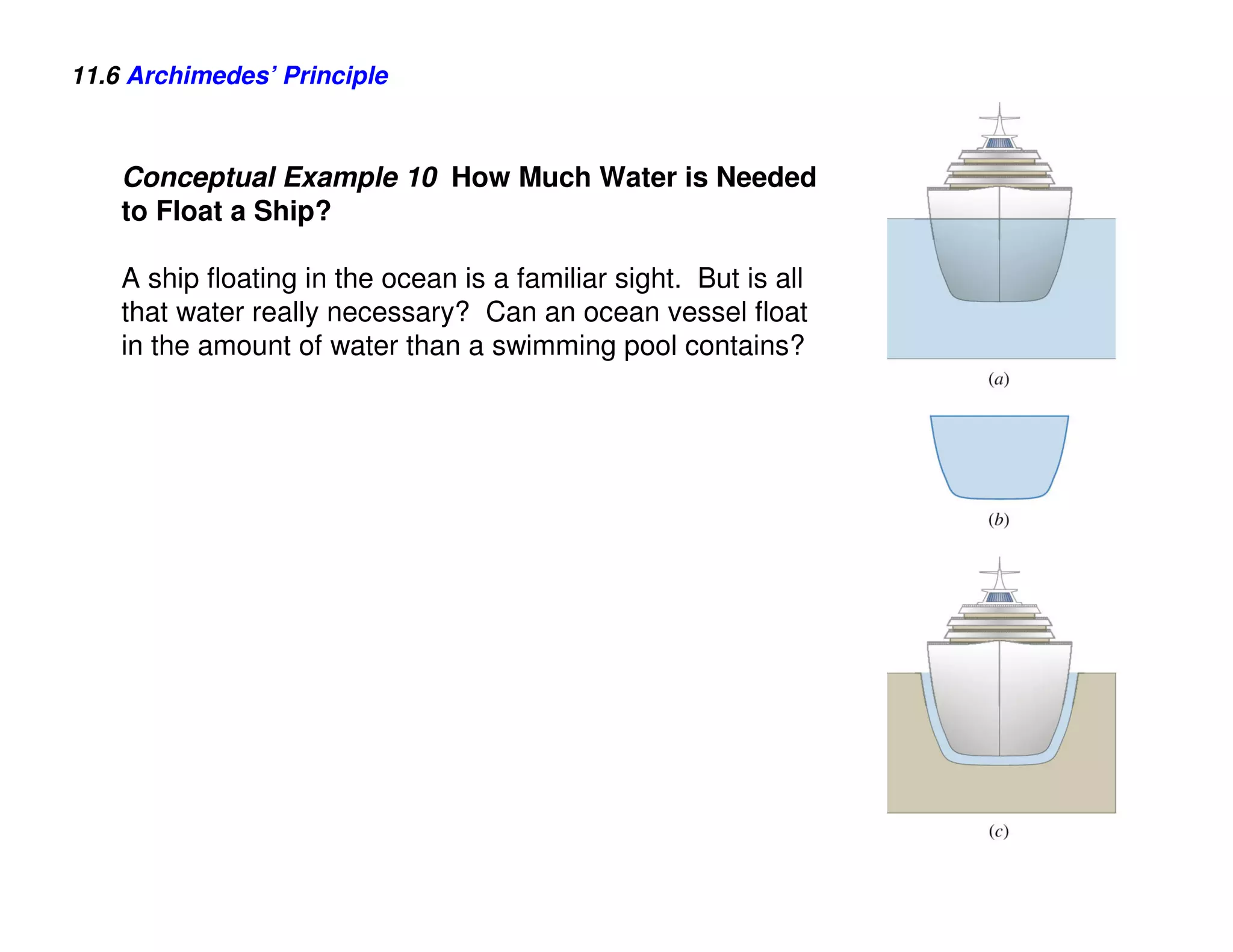
Conceptual Example 10 How Much Water is Needed
to Float a Ship?
A ship floating in the ocean is a familiar sight. But is all
that water really necessary? Can an ocean vessel float
in the amount of water than a swimming pool contains?
29.
11.7 Fluids inMotion
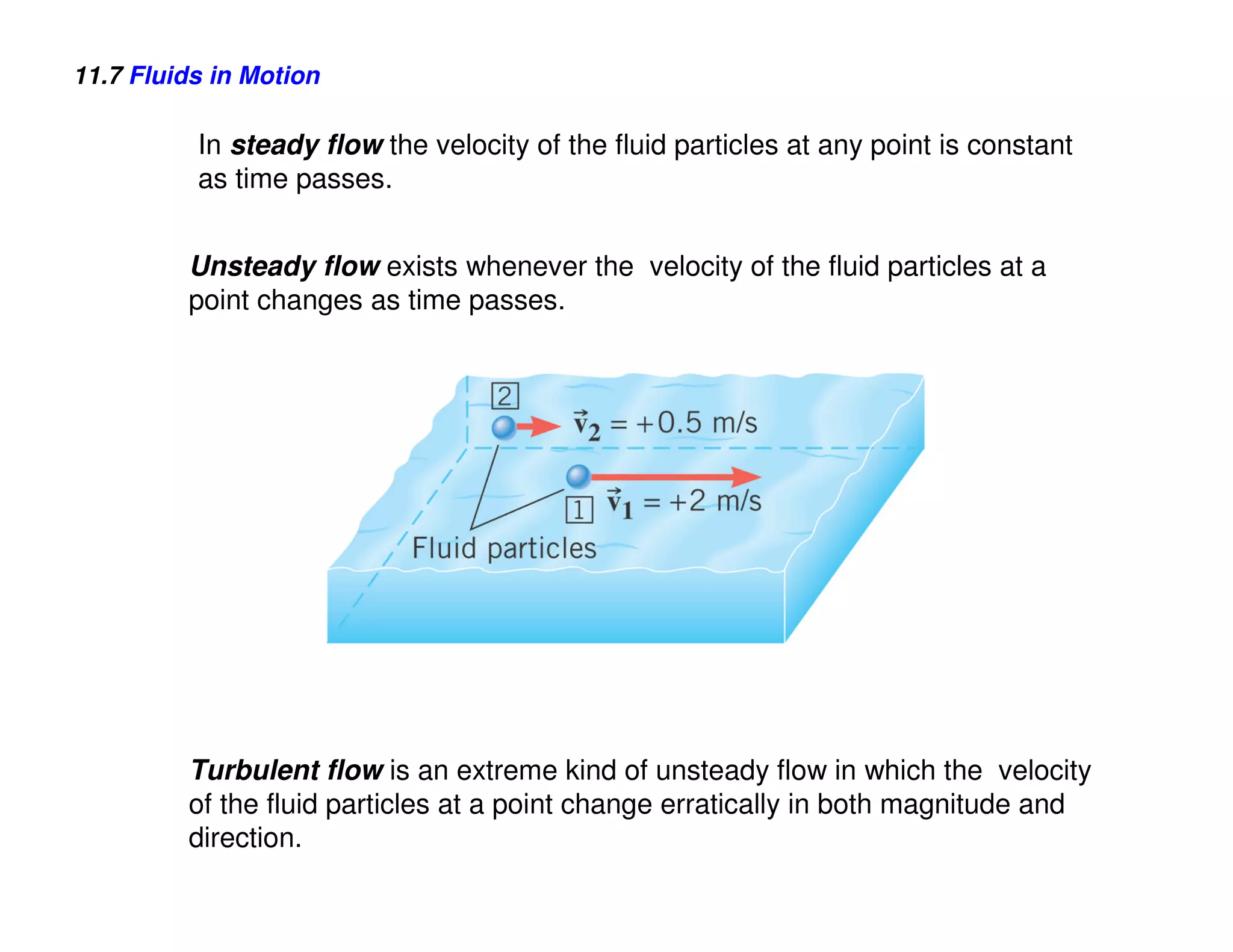
In steady flow the velocity of the fluid particles at any point is constant
as time passes.
Unsteady flow exists whenever the velocity of the fluid particles at a
point changes as time passes.
Turbulent flow is an extreme kind of unsteady flow in which the velocity
of the fluid particles at a point change erratically in both magnitude and
direction.
30.
11.7 Fluids inMotion
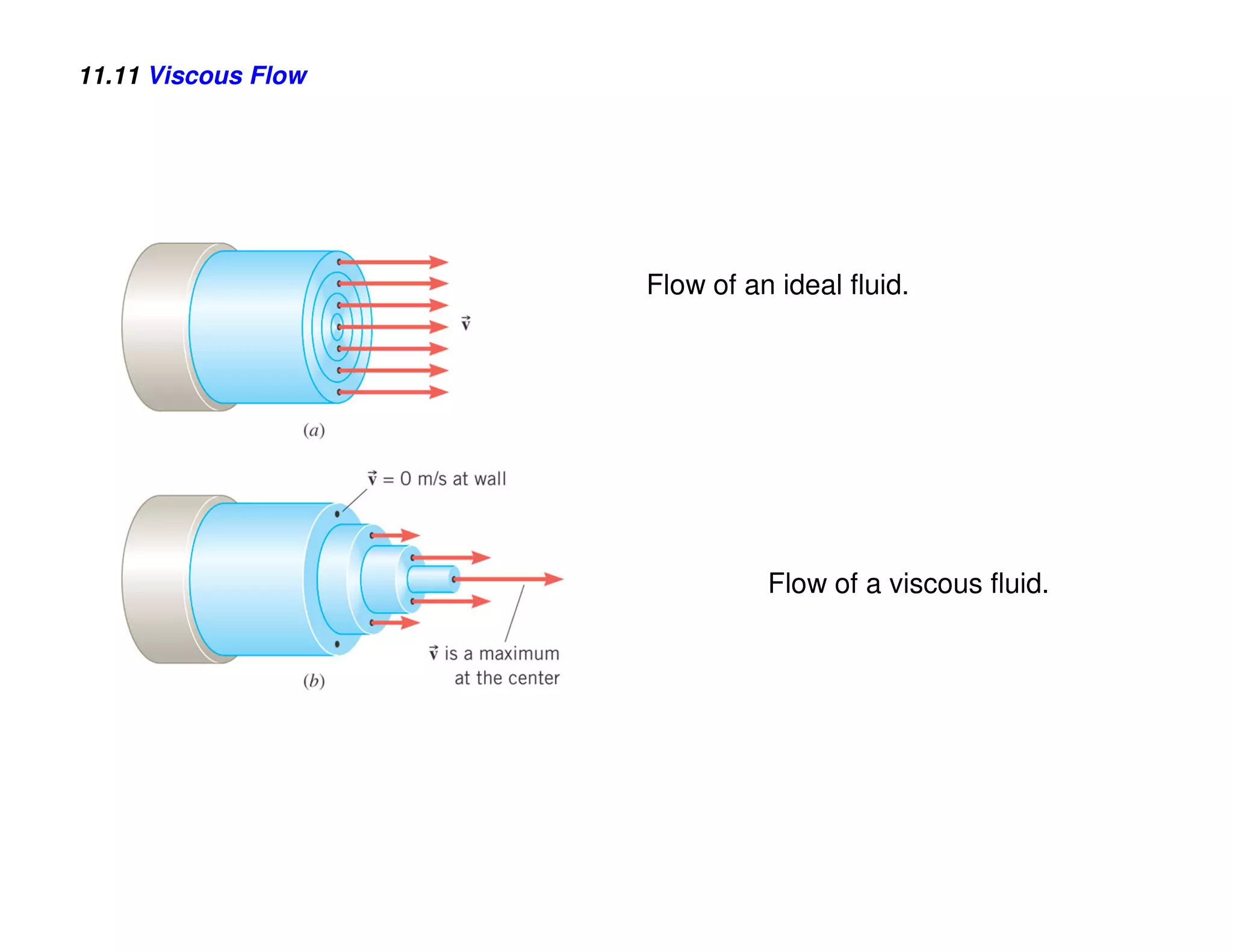
Fluid flow can be compressible or incompressible. Most liquids are
nearly incompressible.
Fluid flow can be viscous or nonviscous.
An incompressible, nonviscous fluid is called an ideal fluid.
31.
11.8 The Equationof Continuity
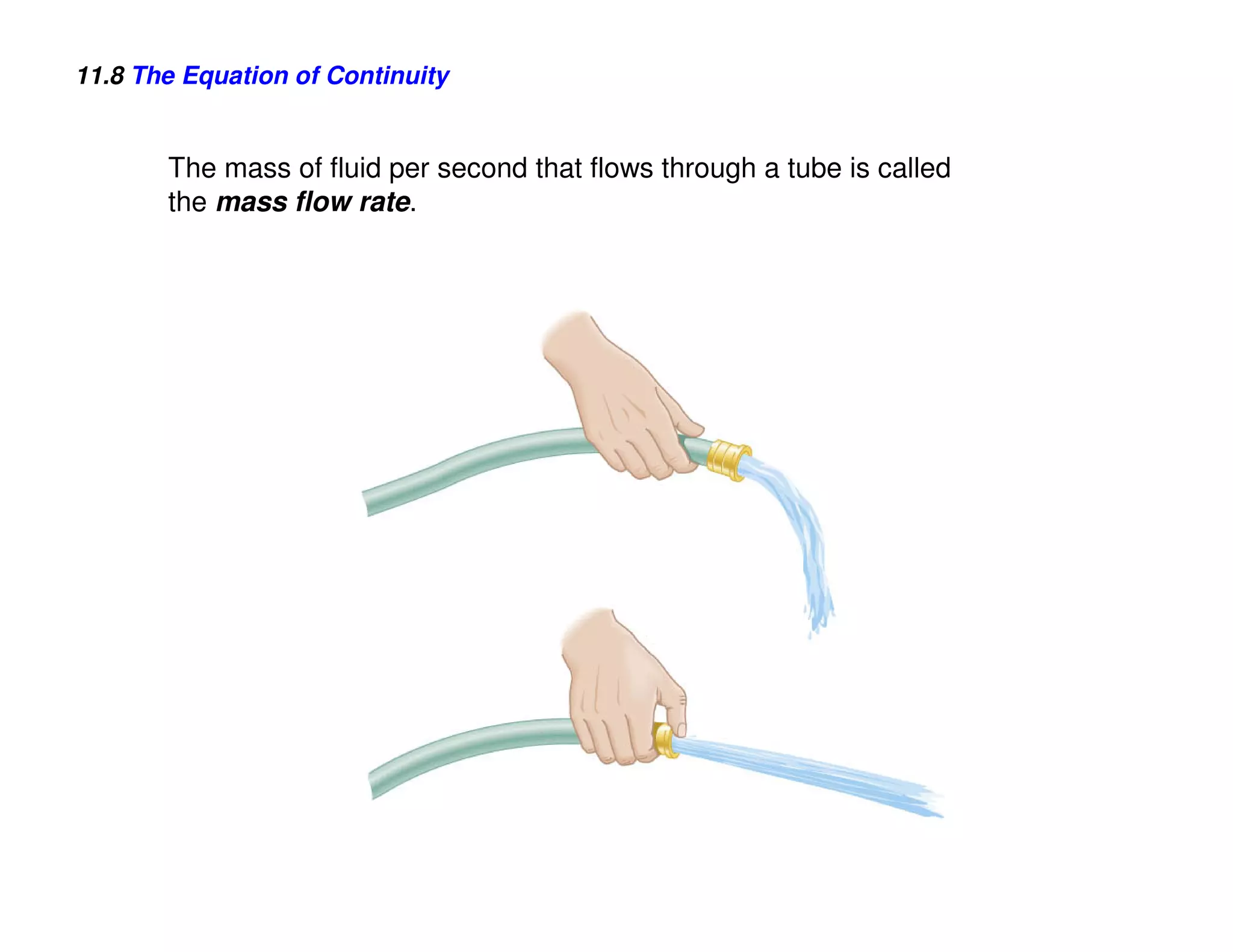
The mass of fluid per second that flows through a tube is called
the mass flow rate.
32.
11.8 The Equationof Continuity
EQUATION OF CONTINUITY
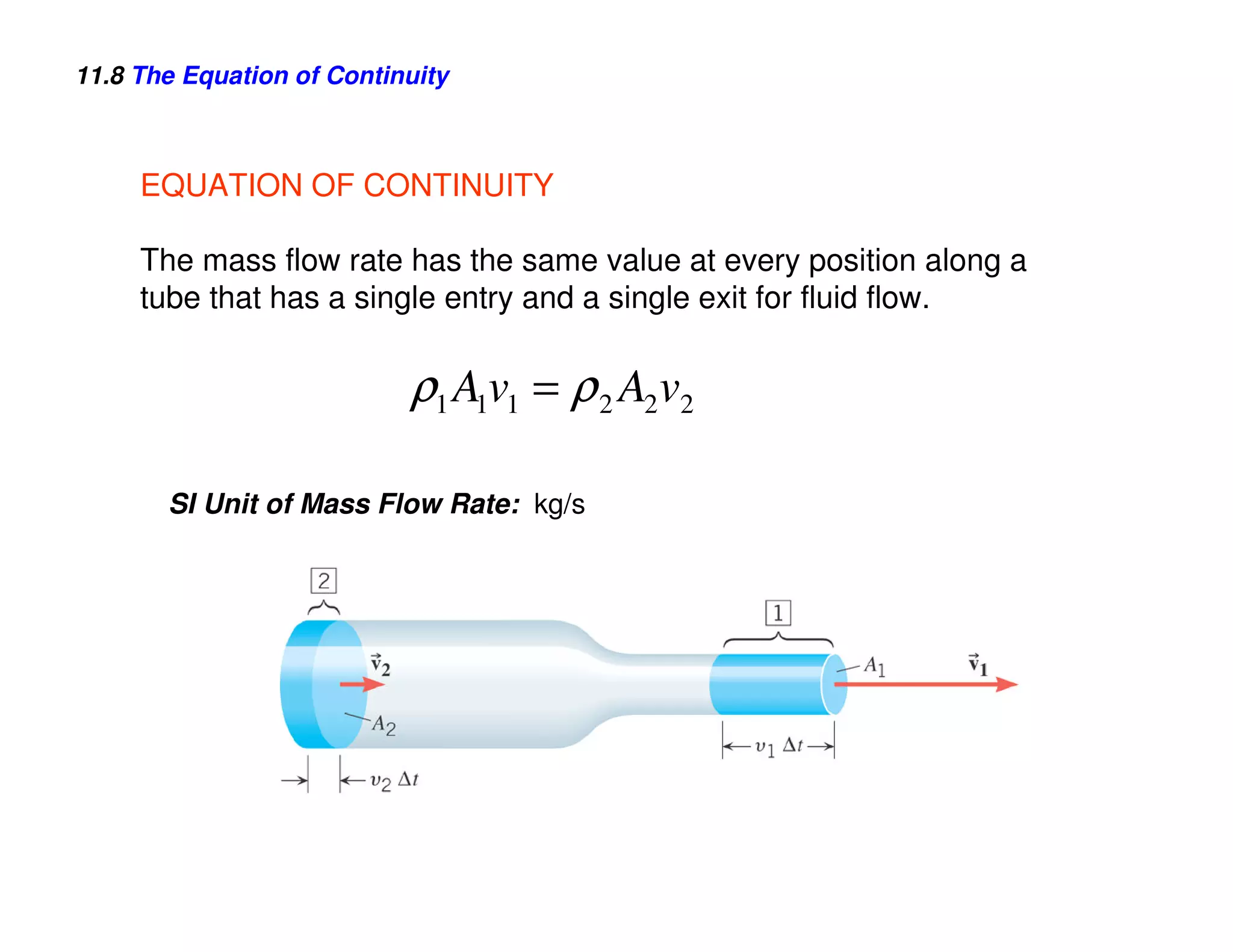
The mass flow rate has the same value at every position along a
tube that has a single entry and a single exit for fluid flow.
ρ1 A1v1 = ρ 2 A2 v2
SI Unit of Mass Flow Rate: kg/s
33.
11.8 The Equationof Continuity
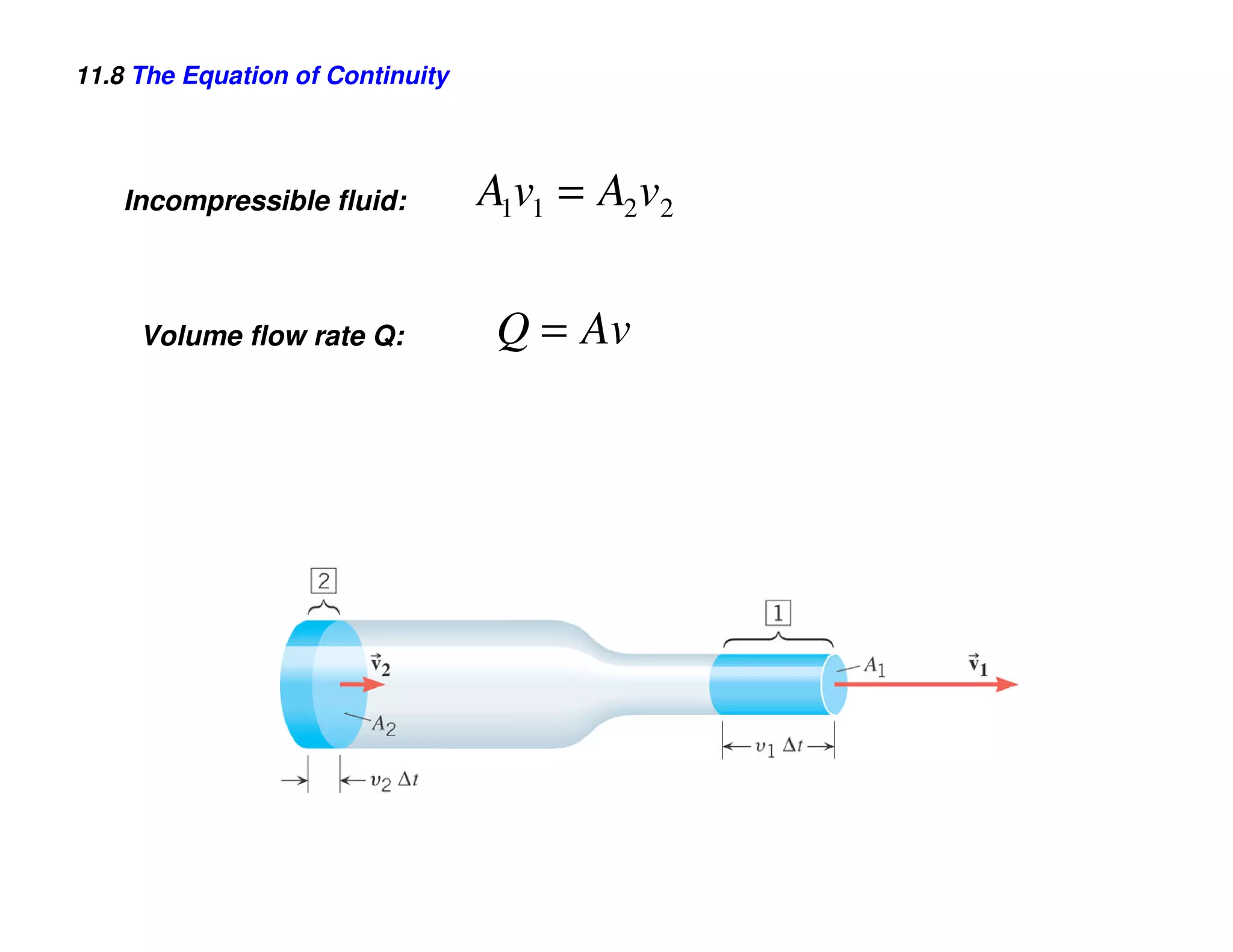
Incompressible fluid: A1v1 = A2 v2
Volume flow rate Q: Q = Av
34.
11.8 The Equationof Continuity
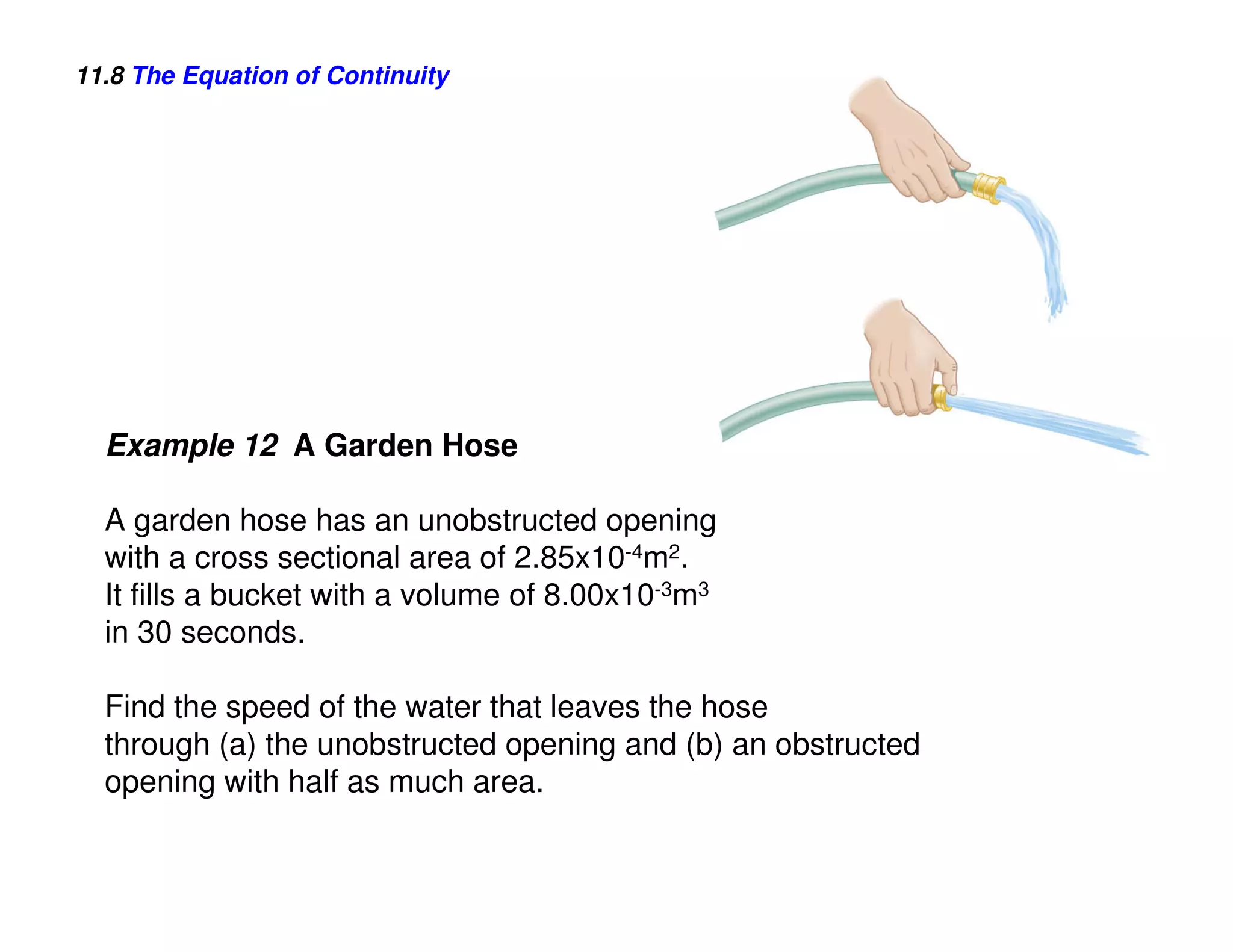
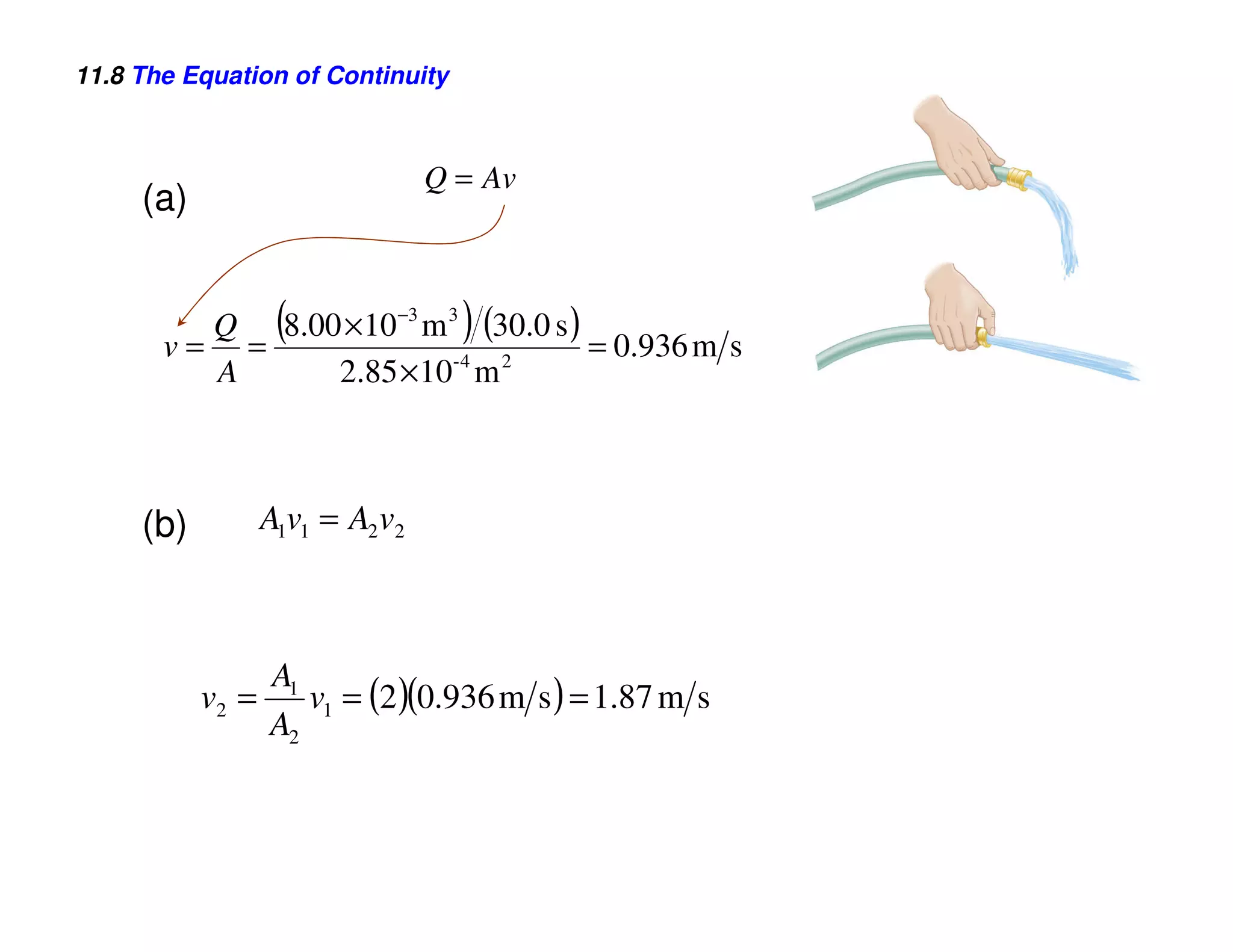
Example 12 A Garden Hose
A garden hose has an unobstructed opening
with a cross sectional area of 2.85x10⁻⁴m2.
It fills a bucket with a volume of 8.00x10⁻³m3
in 30 seconds.
Find the speed of the water that leaves the hose
through (a) the unobstructed opening and (b) an obstructed
opening with half as much area.
35.
11.8 The Equationof Continuity
Q = Av
(a)
( )
Q 8.00 ×10 −3 m 3 (30.0 s )
v= = = 0.936 m s
-4 2
A 2.85 ×10 m
(b) A1v1 = A2 v2
A1
v2 = v1 = (2 )(0.936 m s ) = 1.87 m s
A2
36.
11.9 Bernoulli’s Equation
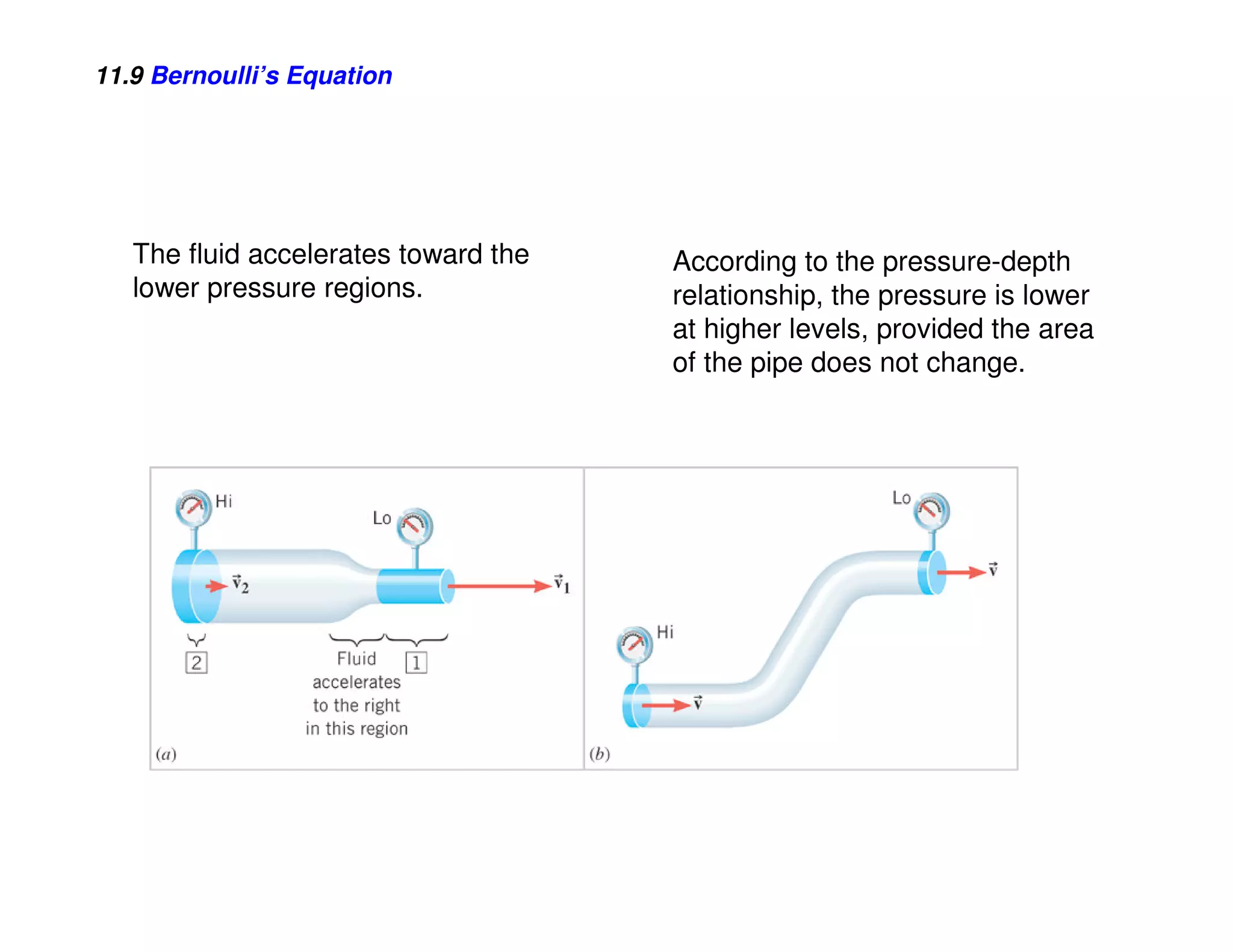
The fluid accelerates toward the According to the pressure-depth
lower pressure regions. relationship, the pressure is lower
at higher levels, provided the area
of the pipe does not change.
11.9 Bernoulli’s Equation
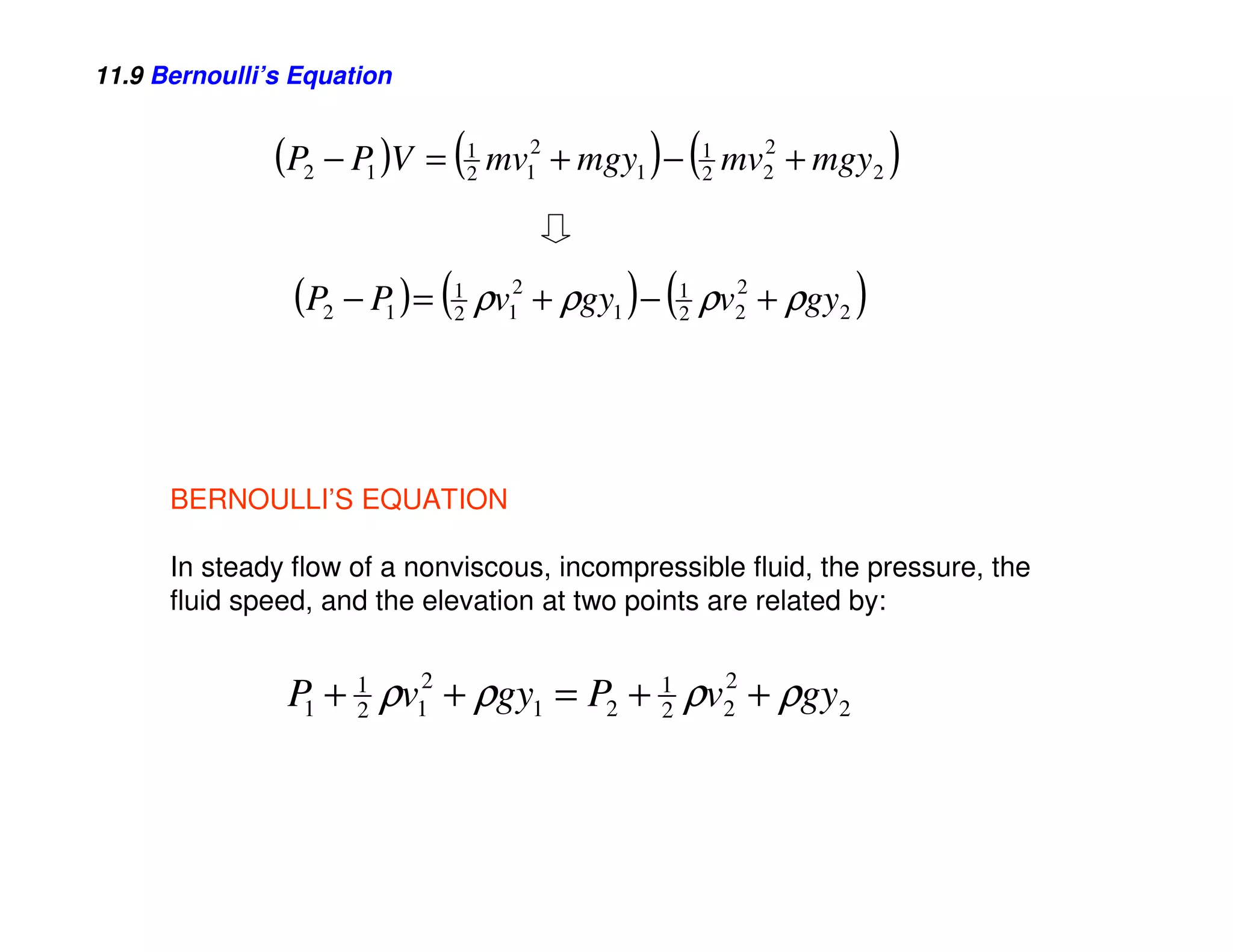
(P2 − P1 )V = (1 mv12 + mgy1 ) − (1 mv22 + mgy2 )
2 2
(P2 − P1 ) = (1 ρv12 + ρgy1 ) − (1 ρv22 + ρgy2 )
2 2
BERNOULLI’S EQUATION
In steady flow of a nonviscous, incompressible fluid, the pressure, the
fluid speed, and the elevation at two points are related by:
P + 1 ρv12 + ρgy1 = P2 + 1 ρv2 + ρgy2
1 2 2
2
39.
11.10 Applications ofBernoulli’s Equation
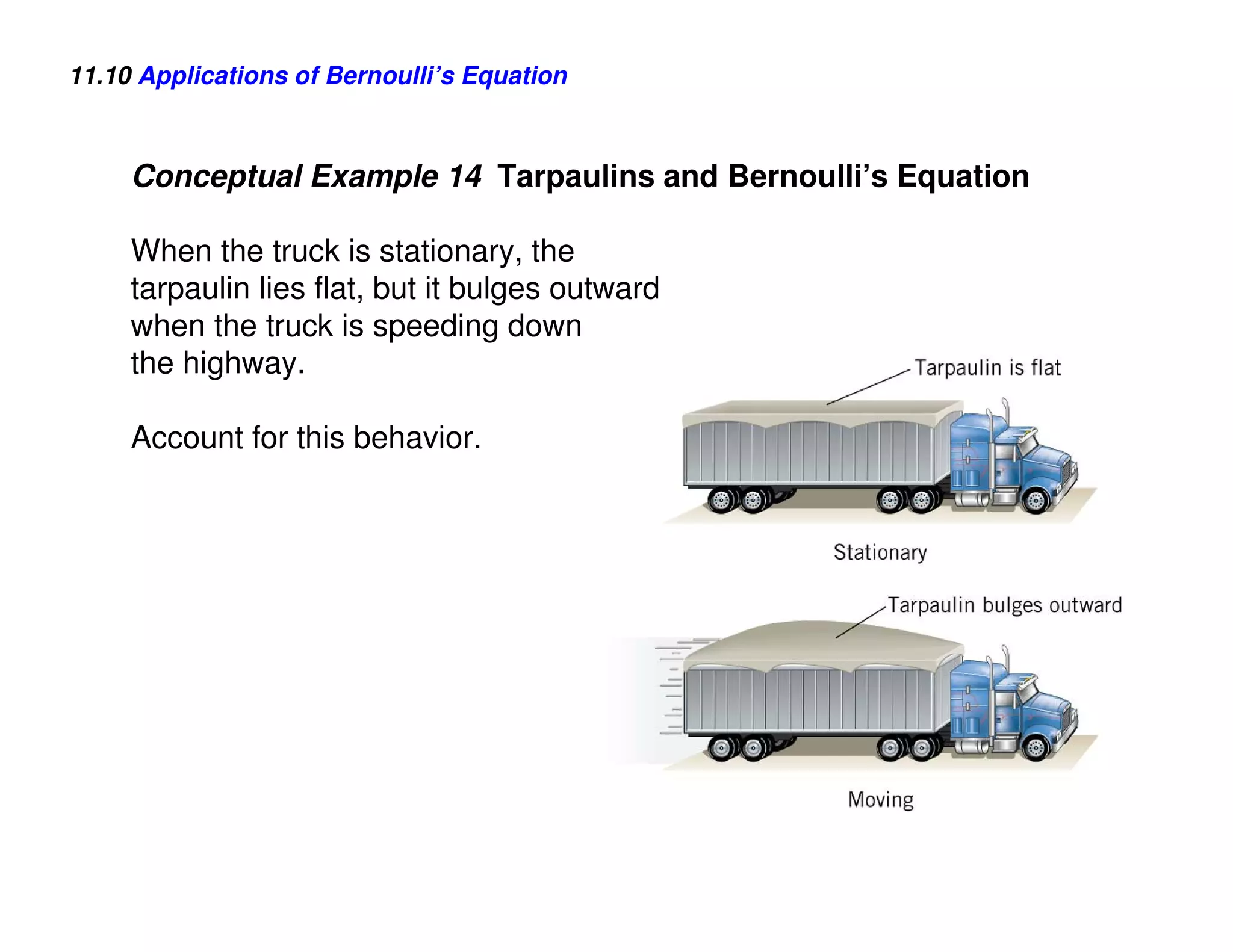
Conceptual Example 14 Tarpaulins and Bernoulli’s Equation
When the truck is stationary, the
tarpaulin lies flat, but it bulges outward
when the truck is speeding down
the highway.
Account for this behavior.