CASE SCENARIO:
A 45yrs old man comes to the Emergency department with
severe chest pain radiating to his back. He says that the pain started
suddenly 2 hours ago and is most severe between his shoulder
blades with no remarkable laboratory findings. He has no significant
past medical history. vital signs are : Temp (98.6F),BP = 170/100
mg. Radial pulses are absent bilaterally.ECG demonstrates sinus
tachycardia with a rate of 100/min without any evidence of
ischemia. A Chest X-ray shows widened mediastinum patient was
initially stabilized with betablockers and opioid and shifted to ccu
for further investigation and management.
Can you identify the condition?
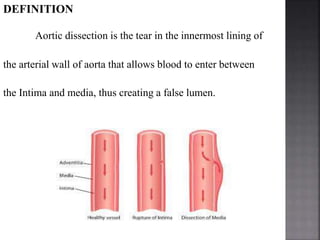
DEFINITION
Aortic dissection is the tear in the innermost lining of
the arterial wall of aorta that allows blood to enter between
the Intima and media, thus creating a false lumen.
INCIDENCE
 Aortic dissection affects 1 per 10,000 person ,
approximately 2000 new cases are reported each year.
 More common in blacks than in whites
 More common in males than females(3:1)
ETIOLOGY
 Uncontrolled high blood pressure
 Blunt trauma
 Atherosclerosis
 Aortic coarctation
 Previous heart surgery (aortic valve replacement)
 Genetic disease (Turner’s syndrome ,Marfan’s syndrome,
other connective tissue disorders, Inflammatory or infectious
conditions)
HTN
Hypertrophy of Vaso
vasorum
Decreased blood flow to
the aortic wall
Loss/death of smooth
muscle cells in aorta
Weakness of aortic wall
AORTIC DISSECTION
Coarctation of Aorta
Lower left chamber of the
heart works harder to pump
blood through narrowed
aorta
Increases blood pressure
Walls of the blood vessels
get hypertrophy
AORTIC DISSECTION
Connective tissue disorders
(Marfan’s Syndrome)
Autosomal dominant
disorders
Produces weak elastin
tissue(Defect in fibrilin
synthesis )
Dilation of aortic walls
AORTIC DISSECTION
RISK FACTORS
 Sex
 Age
 Cocaine use
 Pregnancy
 High intensity weight lifting
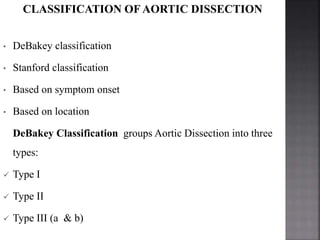
CLASSIFICATION OF AORTIC DISSECTION
• DeBakey classification
• Stanford classification
• Based on symptom onset
• Based on location
DeBakey Classification groups Aortic Dissection into three
types:
 Type I
 Type II
 Type III (a & b)
Type I : Originates in the ascending aorta propagates at least to
the aortic arch.
They are typically seen in patients under 65yrs and
carry the highest mortality.
Type II : Confined to the ascending aorta
Classically in elder patients with atherosclerotic
disease and hypertension.
Type III : Originates from the descending aorta.
Further subdivided into IIIa which extends to the
diaphragm.
IIIb which extends beyond the diaphragm into the
abdominal aorta.
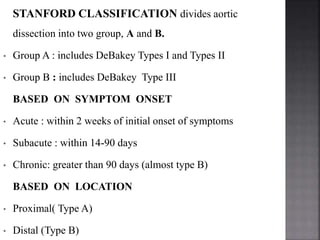
STANFORD CLASSIFICATION divides aortic
dissection into two group, A and B.
• Group A : includes DeBakey Types I and Types II
• Group B : includes DeBakey Type III
BASED ON SYMPTOM ONSET
• Acute : within 2 weeks of initial onset of symptoms
• Subacute : within 14-90 days
• Chronic: greater than 90 days (almost type B)
BASED ON LOCATION
• Proximal( Type A)
• Distal (Type B)
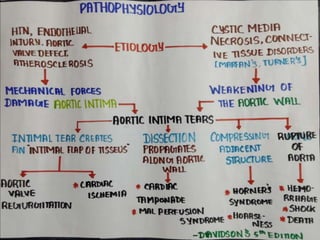
PATHOPHYSIOLOGY
CLINICAL MANIFESTATION
1.Severe chest pain
• Characteristic: Tearing, ripping, shearing sensation
• Mostly 80% occurs in acute type A aortic dissection
• Region: Anterior chest (60%)
Back (55%)
Abdomen (30%)
May extend down to hip and legs
2.Shortness of breath
3.Weakened or absent carotid and temporal pulse
4.Diaphoresis
• Decrescendo diastolic blowing murmur
• Weak pulse in one arm or thigh compared with the other
• Difficulty in walking
• Sudden severe abdominal pain
• Neurological deficit
• Loss of vision
• Sudden difficulty in speaking
• Weakness or paralysis of one side of body
• Dizziness
• Syncope
DIAGNOSTIC EVALUATION
Detecting an aortic dissection can be tricky because the
symptoms are similar to those of variety of heart problems.
• History collection
• Physical examination
• ECG:
More often ECG demonstrates normal results. One study
has reported normal ECG findings in 63 (90% of 70 patients
with aortic dissection.
Proximal dissection (Type A) shows inferior wall MI
• Chest X-ray
Chest X-ray is useful study in patient with
suspected aortic dissection.
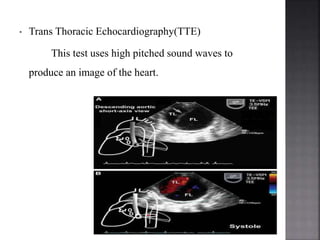
• Trans Thoracic Echocardiography(TTE)
This test uses high pitched sound waves to
produce an image of the heart.
• Computerized Tomography(CT) : windsock sign
(intussusception between true and false lumen)
• Magnetic Resonance Imaging (MRI) : Site of Intimal tear,
types and extent of dissection
MANAGEMENT
GOAL:
• Stabilize the patient
• Decrease the BP and diminish the shearing force on the aorta
(Target: BP =100-120 mm Hg systolic with HR less than 60
beats)
• Pain management
MEDICAL MANAGEMENT
First Line Drugs : Beta Blockers, Alpha Blockers, Opioid
Analgesics.
Second Line Drugs: Vaso dilators, calcium channel blockers
BETA BLOCKERS STARTING DOSE MAINTENANCE
DOSE
Propranolol 1-3mg (IV) 1-3 mg (IV) every 4
hours
Metoprolol 5mg (IV) 5 mg (IV) every 6
hours
Esmolol 500mcg/kg (IV) Continuous IV 50-
300mcg/kg/min
ALPHA AND BETABLOCKERS
Labetalol 20mg (IV),then 40-80 mg
(IV) every 10 min
Continuous IV 1-2
mg/min titrate to
6mg/min
OPIOID ANALGESICS
Morphine 0.1mg/kg (IV) 4-8mg (IV) every 4-6
hours
Hydromorphone 1 mg (IV) 1-4mg (IV) every 3-6
hours
Fentanyl 1-2 mcg/kg (IV) 1-3 mcg/kg/hr
continuous IV infusion
VASODILATORS STARTING DOSE MAINTENANCE
DOSE
Sodium Nitroprusside 0.5-3 mcg/kg/min( IV) Continuous (IV )1-3
mcg/kg/min
Nitroglycerin 5mcg/min (IV) Continuous (IV)
5 mcg/min increase
5-20mcg/min
(every 3-5 min)
CALCIUM CHANNEL BLOCKERS
Diltiazem 0.25mg/kg (IV) Continuous (IV)
5-10 mg/hr
Verapamil 2.5-5mg (IV) May repeat 5-10mg (IV)
in 30 min
SURGICAL MANAGEMENT
AORTIC DISSECTION
Type A Type B
Open heart complicated uncomplicated
surgery
Endovascular Medical mgt
Dissection Repair
TEVAR
Open heart repair or David procedure or Valve
sparing root replacement
Thoracic Endovascular Aortic Repair (TEVAR ): is a
minimally invasive treatment for aortic dissection. A
Stent graft is a tube made of a thin metal mesh (stent). It
is covered with a thin polyester fabric (the graft). It is
used to seal the aorta and expand the true lumen in order
to improve the blood flow to other organs.
NURSING DIAGNOSIS
• Ineffective tissue perfusion related to compromised
arterial blood flow.
• Decreased cardiac output secondary to progressive
dissection of the aorta
• Acute pain related to decreased myocardial blood flow
SUMMARY
A 45yrs old man comes to the Emergency department
with severe chest pain radiating to his back. He says that the
pain started suddenly 2 hours ago and is most severe between
his shoulder blades with no remarkable laboratory findings. He
has no significant past medical history. vital signs are : Temp
(98.6F),BP = 170/100 mg. Radial pulses are absent
bilaterally.ECG demonstrates sinus tachycardia with a rate of
100/min without any evidence of ischemia. A Chest X-ray
shows widened mediastinum patient was initially stabilized
with betablockers and opioid and shifted to ccu for further
investigation and management.
REFERENCE
JOURNALS
• König, K. C., Lahm, H., Dreßen, M., Doppler, S. A.,
Eichhorn, S., Beck, N., ... & Krane, M. (2021). Aggrecan:
a new biomarker for acute type A aortic
dissection. Scientific Reports, 11(1), 1-12.
https://doi.org/10.1038/s41598-021-89653-y
• Chen, S. W., Chan, Y. H., Chien-Chia Wu, V., Cheng, Y.
T., Chen, D. Y., Lin, C. P., ... & Chou, A. H. (2021).
Effects of fluoroquinolones on outcomes of patients with
aortic dissection or aneurysm. Journal of the American
College of Cardiology, 77(15), 1875-1887.
AORTIC DISSECTION
AORTIC DISSECTION

AORTIC DISSECTION

  • 1.
    CASE SCENARIO: A 45yrsold man comes to the Emergency department with severe chest pain radiating to his back. He says that the pain started suddenly 2 hours ago and is most severe between his shoulder blades with no remarkable laboratory findings. He has no significant past medical history. vital signs are : Temp (98.6F),BP = 170/100 mg. Radial pulses are absent bilaterally.ECG demonstrates sinus tachycardia with a rate of 100/min without any evidence of ischemia. A Chest X-ray shows widened mediastinum patient was initially stabilized with betablockers and opioid and shifted to ccu for further investigation and management. Can you identify the condition?
  • 9.
    DEFINITION Aortic dissection isthe tear in the innermost lining of the arterial wall of aorta that allows blood to enter between the Intima and media, thus creating a false lumen.
  • 10.
    INCIDENCE  Aortic dissectionaffects 1 per 10,000 person , approximately 2000 new cases are reported each year.  More common in blacks than in whites  More common in males than females(3:1)
  • 11.
    ETIOLOGY  Uncontrolled highblood pressure  Blunt trauma  Atherosclerosis  Aortic coarctation  Previous heart surgery (aortic valve replacement)  Genetic disease (Turner’s syndrome ,Marfan’s syndrome, other connective tissue disorders, Inflammatory or infectious conditions)
  • 12.
    HTN Hypertrophy of Vaso vasorum Decreasedblood flow to the aortic wall Loss/death of smooth muscle cells in aorta Weakness of aortic wall AORTIC DISSECTION Coarctation of Aorta Lower left chamber of the heart works harder to pump blood through narrowed aorta Increases blood pressure Walls of the blood vessels get hypertrophy AORTIC DISSECTION Connective tissue disorders (Marfan’s Syndrome) Autosomal dominant disorders Produces weak elastin tissue(Defect in fibrilin synthesis ) Dilation of aortic walls AORTIC DISSECTION
  • 13.
    RISK FACTORS  Sex Age  Cocaine use  Pregnancy  High intensity weight lifting
  • 14.
    CLASSIFICATION OF AORTICDISSECTION • DeBakey classification • Stanford classification • Based on symptom onset • Based on location DeBakey Classification groups Aortic Dissection into three types:  Type I  Type II  Type III (a & b)
  • 15.
    Type I :Originates in the ascending aorta propagates at least to the aortic arch. They are typically seen in patients under 65yrs and carry the highest mortality. Type II : Confined to the ascending aorta Classically in elder patients with atherosclerotic disease and hypertension. Type III : Originates from the descending aorta. Further subdivided into IIIa which extends to the diaphragm. IIIb which extends beyond the diaphragm into the abdominal aorta.
  • 17.
    STANFORD CLASSIFICATION dividesaortic dissection into two group, A and B. • Group A : includes DeBakey Types I and Types II • Group B : includes DeBakey Type III BASED ON SYMPTOM ONSET • Acute : within 2 weeks of initial onset of symptoms • Subacute : within 14-90 days • Chronic: greater than 90 days (almost type B) BASED ON LOCATION • Proximal( Type A) • Distal (Type B)
  • 18.
  • 21.
    CLINICAL MANIFESTATION 1.Severe chestpain • Characteristic: Tearing, ripping, shearing sensation • Mostly 80% occurs in acute type A aortic dissection • Region: Anterior chest (60%) Back (55%) Abdomen (30%) May extend down to hip and legs 2.Shortness of breath 3.Weakened or absent carotid and temporal pulse 4.Diaphoresis
  • 22.
    • Decrescendo diastolicblowing murmur • Weak pulse in one arm or thigh compared with the other • Difficulty in walking • Sudden severe abdominal pain • Neurological deficit • Loss of vision • Sudden difficulty in speaking • Weakness or paralysis of one side of body • Dizziness • Syncope
  • 23.
    DIAGNOSTIC EVALUATION Detecting anaortic dissection can be tricky because the symptoms are similar to those of variety of heart problems. • History collection • Physical examination • ECG: More often ECG demonstrates normal results. One study has reported normal ECG findings in 63 (90% of 70 patients with aortic dissection. Proximal dissection (Type A) shows inferior wall MI
  • 24.
    • Chest X-ray ChestX-ray is useful study in patient with suspected aortic dissection.
  • 26.
    • Trans ThoracicEchocardiography(TTE) This test uses high pitched sound waves to produce an image of the heart.
  • 27.
    • Computerized Tomography(CT): windsock sign (intussusception between true and false lumen)
  • 30.
    • Magnetic ResonanceImaging (MRI) : Site of Intimal tear, types and extent of dissection
  • 31.
    MANAGEMENT GOAL: • Stabilize thepatient • Decrease the BP and diminish the shearing force on the aorta (Target: BP =100-120 mm Hg systolic with HR less than 60 beats) • Pain management MEDICAL MANAGEMENT First Line Drugs : Beta Blockers, Alpha Blockers, Opioid Analgesics. Second Line Drugs: Vaso dilators, calcium channel blockers
  • 32.
    BETA BLOCKERS STARTINGDOSE MAINTENANCE DOSE Propranolol 1-3mg (IV) 1-3 mg (IV) every 4 hours Metoprolol 5mg (IV) 5 mg (IV) every 6 hours Esmolol 500mcg/kg (IV) Continuous IV 50- 300mcg/kg/min ALPHA AND BETABLOCKERS Labetalol 20mg (IV),then 40-80 mg (IV) every 10 min Continuous IV 1-2 mg/min titrate to 6mg/min OPIOID ANALGESICS Morphine 0.1mg/kg (IV) 4-8mg (IV) every 4-6 hours Hydromorphone 1 mg (IV) 1-4mg (IV) every 3-6 hours Fentanyl 1-2 mcg/kg (IV) 1-3 mcg/kg/hr continuous IV infusion
  • 33.
    VASODILATORS STARTING DOSEMAINTENANCE DOSE Sodium Nitroprusside 0.5-3 mcg/kg/min( IV) Continuous (IV )1-3 mcg/kg/min Nitroglycerin 5mcg/min (IV) Continuous (IV) 5 mcg/min increase 5-20mcg/min (every 3-5 min) CALCIUM CHANNEL BLOCKERS Diltiazem 0.25mg/kg (IV) Continuous (IV) 5-10 mg/hr Verapamil 2.5-5mg (IV) May repeat 5-10mg (IV) in 30 min
  • 34.
    SURGICAL MANAGEMENT AORTIC DISSECTION TypeA Type B Open heart complicated uncomplicated surgery Endovascular Medical mgt Dissection Repair TEVAR
  • 35.
    Open heart repairor David procedure or Valve sparing root replacement
  • 37.
    Thoracic Endovascular AorticRepair (TEVAR ): is a minimally invasive treatment for aortic dissection. A Stent graft is a tube made of a thin metal mesh (stent). It is covered with a thin polyester fabric (the graft). It is used to seal the aorta and expand the true lumen in order to improve the blood flow to other organs.
  • 39.
    NURSING DIAGNOSIS • Ineffectivetissue perfusion related to compromised arterial blood flow. • Decreased cardiac output secondary to progressive dissection of the aorta • Acute pain related to decreased myocardial blood flow
  • 40.
    SUMMARY A 45yrs oldman comes to the Emergency department with severe chest pain radiating to his back. He says that the pain started suddenly 2 hours ago and is most severe between his shoulder blades with no remarkable laboratory findings. He has no significant past medical history. vital signs are : Temp (98.6F),BP = 170/100 mg. Radial pulses are absent bilaterally.ECG demonstrates sinus tachycardia with a rate of 100/min without any evidence of ischemia. A Chest X-ray shows widened mediastinum patient was initially stabilized with betablockers and opioid and shifted to ccu for further investigation and management.
  • 41.
  • 42.
    JOURNALS • König, K.C., Lahm, H., Dreßen, M., Doppler, S. A., Eichhorn, S., Beck, N., ... & Krane, M. (2021). Aggrecan: a new biomarker for acute type A aortic dissection. Scientific Reports, 11(1), 1-12. https://doi.org/10.1038/s41598-021-89653-y • Chen, S. W., Chan, Y. H., Chien-Chia Wu, V., Cheng, Y. T., Chen, D. Y., Lin, C. P., ... & Chou, A. H. (2021). Effects of fluoroquinolones on outcomes of patients with aortic dissection or aneurysm. Journal of the American College of Cardiology, 77(15), 1875-1887.