Area of Study 1 - Representation
On completion of this unit, students should be able to describe
the construction of specific media representations and explain
how the process of representation reproduces the world
differently from the direct experience of it.
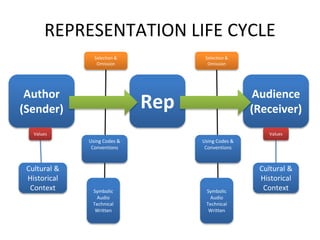
REPRESENTATION LIFE CYCLE
Author
(Sender) Rep Audience
(Receiver)
Using Codes &
Conventions
Cultural &
Historical
Context Symbolic
Audio
Technical
Written
Cultural &
Historical
Context
Selection &
Omission
Selection &
Omission
Values Values
Using Codes &
Conventions
Symbolic
Audio
Technical
Written
DEFINITION
The act of ‘re-presenting’ or attempting to
depict reality. The creator constructs a
representation that attempts to portray reality;
this is mediated in a number of ways by the
process of selection, omission, construction, and
interpretation by the receiver.
TYPES OF REPRESENTION
Representations can depict:
• Individuals (celebrities, public figures)
• Social groupings (families, ethnic groups)
• Institutions (the law)
• Ideas (freedom)
• Events (war)
• Issues (terrorism)
REPRESENTATION & MEANING
• An image does not carry meaning in itself; it
is the reader that creates meaning within an
image.
• The audience plays an essential role in the
creation of meaning behind a representation.
• Audiences read and interpret a
representation based on a number of factors.
CONNOTATION & DENOTATION
• Connotation is the meaning is attached to an
object
• Denotation is the name attached to an object
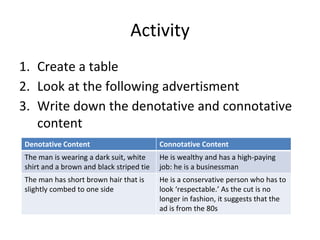
Activity
1. Create a table
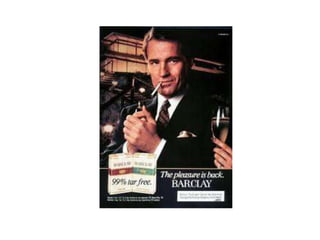
2. Look at the following advertisment
3. Write down the denotative and connotative
content
Denotative Content Connotative Content
The man is wearing a dark suit, white
shirt and a brown and black striped tie
He is wealthy and has a high-paying
job: he is a businessman
The man has short brown hair that is
slightly combed to one side
He is a conservative person who has to
look ‘respectable.’ As the cut is no
longer in fashion, it suggests that the
ad is from the 80s
SYMBOLIC & CULTURAL CODES
• Meaning is also attached to images through
references to, and within, culture or society.
• Meanings are specific to the society or culture
in which they are viewed.
• Meaning is attached via what Barthes called a
‘cultural code’, which is knowledge gained
from living in, absorbing and consuming
products of a culture.
CODES & CONVENTIONS
The word ‘code’ refers to any system of signs
that are used to communicate meaning.
‘Conventions’ are well-established ways of
constructing texts.
Representation & Ethnicity
• Representations can reveal a lot about the
attitudes and values of the society towards
ethnicity
• Postcolonialism, the study of the cultural
aftermath of colonial rule, explores the effects on
a society after experiencing a period of foreign
control
• Edward Said argued that Europe has defined itself
at the centre, with all others as outsiders. Terms
such as ‘the East’ defined other cultures by their
relationship to Europe as the centre
Stereotypes
• An oversimplified version of a representation
is called a stereotype. These can often be
quite negative as they don’t give a detailed,
accurate portrayal of the truth
• These representations are used mostly in
advertising

Ao s 1 - representation

  • 1.
    Area of Study1 - Representation On completion of this unit, students should be able to describe the construction of specific media representations and explain how the process of representation reproduces the world differently from the direct experience of it.
  • 2.
    REPRESENTATION LIFE CYCLE Author (Sender)Rep Audience (Receiver) Using Codes & Conventions Cultural & Historical Context Symbolic Audio Technical Written Cultural & Historical Context Selection & Omission Selection & Omission Values Values Using Codes & Conventions Symbolic Audio Technical Written
  • 3.
    DEFINITION The act of‘re-presenting’ or attempting to depict reality. The creator constructs a representation that attempts to portray reality; this is mediated in a number of ways by the process of selection, omission, construction, and interpretation by the receiver.
  • 4.
    TYPES OF REPRESENTION Representationscan depict: • Individuals (celebrities, public figures) • Social groupings (families, ethnic groups) • Institutions (the law) • Ideas (freedom) • Events (war) • Issues (terrorism)
  • 5.
    REPRESENTATION & MEANING •An image does not carry meaning in itself; it is the reader that creates meaning within an image. • The audience plays an essential role in the creation of meaning behind a representation. • Audiences read and interpret a representation based on a number of factors.
  • 6.
    CONNOTATION & DENOTATION •Connotation is the meaning is attached to an object • Denotation is the name attached to an object
  • 7.
    Activity 1. Create atable 2. Look at the following advertisment 3. Write down the denotative and connotative content Denotative Content Connotative Content The man is wearing a dark suit, white shirt and a brown and black striped tie He is wealthy and has a high-paying job: he is a businessman The man has short brown hair that is slightly combed to one side He is a conservative person who has to look ‘respectable.’ As the cut is no longer in fashion, it suggests that the ad is from the 80s
  • 9.
    SYMBOLIC & CULTURALCODES • Meaning is also attached to images through references to, and within, culture or society. • Meanings are specific to the society or culture in which they are viewed. • Meaning is attached via what Barthes called a ‘cultural code’, which is knowledge gained from living in, absorbing and consuming products of a culture.
  • 10.
    CODES & CONVENTIONS Theword ‘code’ refers to any system of signs that are used to communicate meaning. ‘Conventions’ are well-established ways of constructing texts.
  • 11.
    Representation & Ethnicity •Representations can reveal a lot about the attitudes and values of the society towards ethnicity • Postcolonialism, the study of the cultural aftermath of colonial rule, explores the effects on a society after experiencing a period of foreign control • Edward Said argued that Europe has defined itself at the centre, with all others as outsiders. Terms such as ‘the East’ defined other cultures by their relationship to Europe as the centre
  • 12.
    Stereotypes • An oversimplifiedversion of a representation is called a stereotype. These can often be quite negative as they don’t give a detailed, accurate portrayal of the truth • These representations are used mostly in advertising