Summary

Your task it to look closely at the language
  and images and explain HOW they are
used to persuade the reader to agree with
 the author’s point of view (contention)
Reading Carefully
0 Ask questions as you read each article/blog/speech etc:

WHAT? HOW?    WHEN YOU ARE READING, YOU SHOULD …
WHY?

WHAT IS THE     Identify the main contention. (THIS IS VERY VERY IMPORTANT!!)
WRITER          List or highlight the arguments.
SAYING?
HOW IS IT       Write a few key words down to describe the tone/style and when
SAID?           it changes
                Highlight thesupporting persuasive words phrases and
                techniques used.
WHY IS IT       Consider why some of the highlighted words and techniques are
PERSUASIVE?     persuasive.
                Think about how the words, phrases and techniques make you feel.
                How to these words, phrases and techniques help to persuade you
                to agree with the writer?
                How do these persuasive elements reinforce what the writer is
                saying and their purpose in saying it?
Plan Your Response
0 Write the main contention in your own words
0 Dot point supporting arguments
0 Select which persuasive techniques you will discuss
  (3/4)
0 Identify which examples/quotations you will use as
  evidence
0 Decide what you will look at in each body paragraph
Introduction
YOU MUST INCLUDE THE FOLLOWING…
 0 Name/Title of the text and text type
   (opinion piece/speech/blog)
 0 Writers name & contention
 0 Where published/presented (if a speech)
 0 Description of overall tone on the piece
SENTENCE STARTERS: INTRO
0 The writer asserts that …
  Contending that … , the writer then …
  The author quickly establishes the main contention that …
0 In a … tone, the writer declares that …
0 The point of view presented by [name of writer] is …
0 Adopting a controversial position, the writer argues that …
0 The writer argues that … which influences the reader to …
0 The use of … positions the reader to share the writer’s
  viewpoint that …
SYNONYMS FOR THE WORD ‘ARGUE’

0 Asserts        0 Suggests
0 Alleges        0 States
0 Contends       0 Emphasizes
0 Declares       0 Demands
0 Affirms        0 Implies
0 Makes a case   0 Recommends
0 Reasons
Body Paragraphs
Generally 3 or 4 body paragraphs (may be more, not
less than three)
Follow TEEL
  0 Topic Sentence – Point one of your analysis, identify an
    important part of the writer’s argument or a key
    persuasive technique that is used by the writer
  0 Examples & Evidence
  0 Explanation of HOW/WHY the writer/speaker is
    persuasive
  0 Link examples back to your topic sentence &/
    contention
SENTENCE STARTERS:
          MAIN PARAGRAPHS
0 By introducing a controversial example, writer positions us to …
0 The use of colourful language predisposes us to …
0 Reference to … (experts/scientific findings/statistics) lend
  credibility to the writer’s argument.
0 The use of a stereotypical example contributes to the effect of …
0 Highly emotive language, for example … , influences us to accept …
0 Through repetition of the word … , the writer seeks to coerce the
  reader into believing that …
0 With a series of rhetorical questions the author aims to appeal to …
0 The connotations of the word/phrase … have the effect of …
0 By relentlessly attacking the opposing the view, the author leads us
  to accept that …
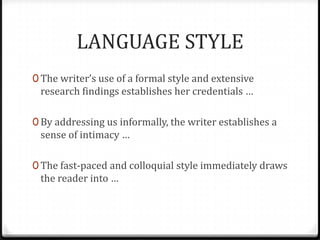
LANGUAGE STYLE
0 The writer’s use of a formal style and extensive
 research findings establishes her credentials …

0 By addressing us informally, the writer establishes a
 sense of intimacy …

0 The fast-paced and colloquial style immediately draws
 the reader into …
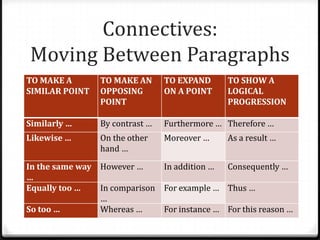
Connectives:
Moving Between Paragraphs
TO MAKE A        TO MAKE AN      TO EXPAND     TO SHOW A
SIMILAR POINT    OPPOSING        ON A POINT    LOGICAL
                 POINT                         PROGRESSION

Similarly …      By contrast …   Furthermore … Therefore …
Likewise …       On the other    Moreover …    As a result …
                 hand …

In the same way However …     In addition …  Consequently …
…
Equally too …   In comparison For example … Thus …
                …
So too …        Whereas …     For instance … For this reason …
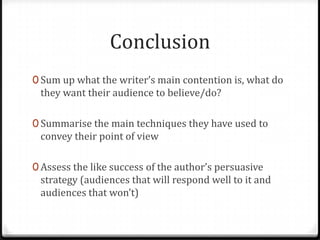
Conclusion
0 Sum up what the writer’s main contention is, what do
 they want their audience to believe/do?

0 Summarise the main techniques they have used to
 convey their point of view

0 Assess the like success of the author’s persuasive
 strategy (audiences that will respond well to it and
 audiences that won’t)

Language Analysis Essay Writing

  • 2.
    Summary Your task itto look closely at the language and images and explain HOW they are used to persuade the reader to agree with the author’s point of view (contention)
  • 3.
    Reading Carefully 0 Askquestions as you read each article/blog/speech etc: WHAT? HOW? WHEN YOU ARE READING, YOU SHOULD … WHY? WHAT IS THE Identify the main contention. (THIS IS VERY VERY IMPORTANT!!) WRITER List or highlight the arguments. SAYING? HOW IS IT Write a few key words down to describe the tone/style and when SAID? it changes Highlight thesupporting persuasive words phrases and techniques used. WHY IS IT Consider why some of the highlighted words and techniques are PERSUASIVE? persuasive. Think about how the words, phrases and techniques make you feel. How to these words, phrases and techniques help to persuade you to agree with the writer? How do these persuasive elements reinforce what the writer is saying and their purpose in saying it?
  • 4.
    Plan Your Response 0Write the main contention in your own words 0 Dot point supporting arguments 0 Select which persuasive techniques you will discuss (3/4) 0 Identify which examples/quotations you will use as evidence 0 Decide what you will look at in each body paragraph
  • 5.
    Introduction YOU MUST INCLUDETHE FOLLOWING… 0 Name/Title of the text and text type (opinion piece/speech/blog) 0 Writers name & contention 0 Where published/presented (if a speech) 0 Description of overall tone on the piece
  • 6.
    SENTENCE STARTERS: INTRO 0The writer asserts that … Contending that … , the writer then … The author quickly establishes the main contention that … 0 In a … tone, the writer declares that … 0 The point of view presented by [name of writer] is … 0 Adopting a controversial position, the writer argues that … 0 The writer argues that … which influences the reader to … 0 The use of … positions the reader to share the writer’s viewpoint that …
  • 7.
    SYNONYMS FOR THEWORD ‘ARGUE’ 0 Asserts 0 Suggests 0 Alleges 0 States 0 Contends 0 Emphasizes 0 Declares 0 Demands 0 Affirms 0 Implies 0 Makes a case 0 Recommends 0 Reasons
  • 8.
    Body Paragraphs Generally 3or 4 body paragraphs (may be more, not less than three) Follow TEEL 0 Topic Sentence – Point one of your analysis, identify an important part of the writer’s argument or a key persuasive technique that is used by the writer 0 Examples & Evidence 0 Explanation of HOW/WHY the writer/speaker is persuasive 0 Link examples back to your topic sentence &/ contention
  • 9.
    SENTENCE STARTERS: MAIN PARAGRAPHS 0 By introducing a controversial example, writer positions us to … 0 The use of colourful language predisposes us to … 0 Reference to … (experts/scientific findings/statistics) lend credibility to the writer’s argument. 0 The use of a stereotypical example contributes to the effect of … 0 Highly emotive language, for example … , influences us to accept … 0 Through repetition of the word … , the writer seeks to coerce the reader into believing that … 0 With a series of rhetorical questions the author aims to appeal to … 0 The connotations of the word/phrase … have the effect of … 0 By relentlessly attacking the opposing the view, the author leads us to accept that …
  • 10.
    LANGUAGE STYLE 0 Thewriter’s use of a formal style and extensive research findings establishes her credentials … 0 By addressing us informally, the writer establishes a sense of intimacy … 0 The fast-paced and colloquial style immediately draws the reader into …
  • 11.
    Connectives: Moving Between Paragraphs TOMAKE A TO MAKE AN TO EXPAND TO SHOW A SIMILAR POINT OPPOSING ON A POINT LOGICAL POINT PROGRESSION Similarly … By contrast … Furthermore … Therefore … Likewise … On the other Moreover … As a result … hand … In the same way However … In addition … Consequently … … Equally too … In comparison For example … Thus … … So too … Whereas … For instance … For this reason …
  • 12.
    Conclusion 0 Sum upwhat the writer’s main contention is, what do they want their audience to believe/do? 0 Summarise the main techniques they have used to convey their point of view 0 Assess the like success of the author’s persuasive strategy (audiences that will respond well to it and audiences that won’t)