Area of Study 1 - Representation
   On completion of this unit, students should be
    able to describe the construction of specific
    media representations and explain how the
  process of representation reproduces the world
    differently from the direct experience of it.
Area of Study 1 - Representation
Key knowledge
• Media representation and its relationship to the selection and
   construction of reality in various media forms
• The nature of codes and conventions evident in media productions,
   and the meanings they create
• The nature and role of audiences in reading media representations
• notions of ‘realism’ in media texts
• Representations within the context of values such as those related
   to gender, age, ethnicity, culture and socioeconomic status
• The influence of institutional and social practices on the nature of
   representations, and their availability and accessibility
• Representations within the context of media history and culture,
   including the emergence and development of stereotypes, styles
   and generic conventions within media
Unit 1 – Representation and
     Technologies of Representation
Key Skills
• Describe representations in media texts
• Compare the construction of representations in a range
  of media texts and across media forms
• Use concepts of representation, selection, omission
  and construction in the evaluation of media texts
• Discuss how audiences make judgments about how
  realism is represented in specific media texts
• Analyse representations within the context of
  institutional practices, media history and cultural
  values.
What is this?
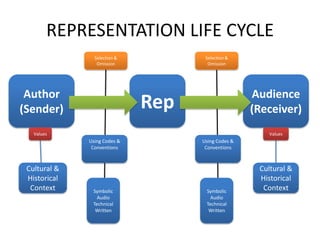
REPRESENTATION LIFE CYCLE
                Selection &          Selection &
                 Omission             Omission


 Author                                             Audience
(Sender)                      Rep                   (Receiver)
   Values                                              Values
              Using Codes &         Using Codes &
               Conventions           Conventions


 Cultural &                                          Cultural &
 Historical                                          Historical
  Context      Symbolic              Symbolic         Context
                 Audio                 Audio
               Technical             Technical
                Written               Written
Activity 1: Selection & Omission
• Drawn the object that has been placed on the
  table
• Use the full size of the paper provided
• In groups of four, choose the drawing that you
  would give to the Head Dean and Cambridge
  University
Cont.
• If you were to find out that the Head Dean of
  Cambridge University was a fan of surrealist
  art, would this change you decision?
• Justify your answer
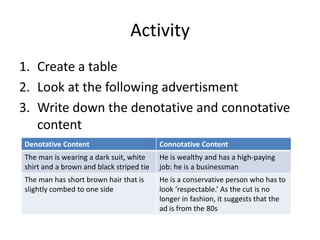
Activity
1. Create a table
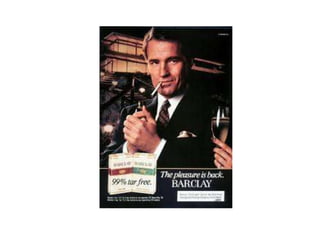
2. Look at the following advertisment
3. Write down the denotative and connotative
   content
Denotative Content                        Connotative Content
The man is wearing a dark suit, white     He is wealthy and has a high-paying
shirt and a brown and black striped tie   job: he is a businessman
The man has short brown hair that is      He is a conservative person who has to
slightly combed to one side               look ‘respectable.’ As the cut is no
                                          longer in fashion, it suggests that the
                                          ad is from the 80s
Codes & Conventions
• Systems of generally accepted signs that help
  create and communicate meaning
• Audio/Visual codes can be categorised into four:
  –   Index
  –   Symbolic
  –   Written
  –   Audio
  –   Technical

                  * Codes don’t work in isolation *
Index Signs
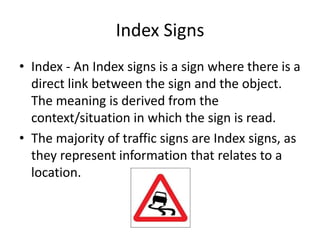
• Index - An Index signs is a sign where there is a
  direct link between the sign and the object.
  The meaning is derived from the
  context/situation in which the sign is read.
• The majority of traffic signs are Index signs, as
  they represent information that relates to a
  location.
Index Signs
• Colours are frequently used to reference meaning, but
  the context in which a colour is perceived plays a big
  part in the meaning it carries (Indexical)
• Write down two different meanings for each of the
  colours below and two different contexts/settings that
  change the meaning:
   –   Black
   –   White
   –   Blue
   –   Red
   –   Green
Symbolic Codes
• A symbol has no logical meaning between it and the
  object
• Flags are symbols that represent countries or
  organisations
• Film clips often operate by using symbolism to
  communicate meaning
• Watch the film clip ‘November Rain’ and write down as
  many symbolic references under the headings of:
   – Props & Costume
   – Setting
   – Colours
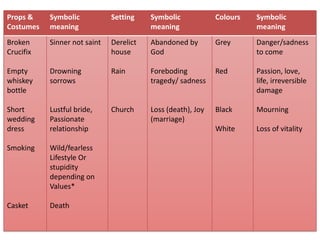
Props &    Symbolic           Setting    Symbolic            Colours   Symbolic
Costumes   meaning                       meaning                       meaning
Broken     Sinner not saint   Derelict   Abandoned by        Grey      Danger/sadness
Crucifix                      house      God                           to come

Empty      Drowning           Rain       Foreboding          Red       Passion, love,
whiskey    sorrows                       tragedy/ sadness              life, irreversible
bottle                                                                 damage

Short      Lustful bride,     Church     Loss (death), Joy   Black     Mourning
wedding    Passionate                    (marriage)
dress      relationship                                      White     Loss of vitality

Smoking    Wild/fearless
           Lifestyle Or
           stupidity
           depending on
           Values*

Casket     Death
Written Codes
• Can be very powerful at creating meaning
• Almost impossible for text on screen not to be
  read
• Written statements are credible as our culture
  respects the written word
• Can intro setting, time, place or work to
  anchor the meaning of an image
• What is written (How it is written = Technical
  Code)
• How important is setting/context in the way
  codes are read by an audience?
• Choose one code and provided a different
  meaning by deconstructing it from a different
  perspective
Written Codes
• The following is the film clip Everybody Hurts
  by R.E.M.
  – How have they used written codes?
  – What effect does it have?
  – How did it make you feel?
  – In what other ways could this technique be used?
  – Same video, different text = changed meaning
Written Codes anchor meaning


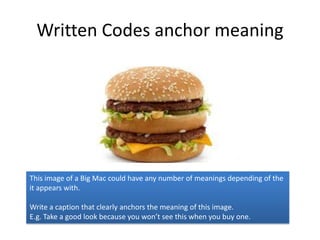
This image of a Big Mac could have any number of meanings depending of the
it appears with.

Write a caption that clearly anchors the meaning of this image.
E.g. Take a good look because you won’t see this when you buy one.
Audio Codes
• Audio codes are used to enhance the illusion of
  reality. The filmmaker can use music, sound
  effects or dialogue to assist in this deception,
  even though these sounds weren’t present when
  shooting took place.
• Diegetic Audio – Audio that takes place in the
  world of the representation. The characters can
  hear it, react and interact with it.
• Non-diegetic Audio – Audio that takes place
  outside the world of the representation. Only the
  audience can hear it.
TV & Movie Themes

Track 1 – Raiders of the Lost Ark            Track 5 – Pulp Fiction
             (adventure)                                  (crime/thriller)


Track 2 - E.T.                                Track 6 - Schindler’s List
                 (family/adventure)                         (biography/drama/history)


 Track 3 – Halloween                          Track 7 - The Crow
              (horror/thriller)                            (action/fantasy/thriller)


 Track 4 – Monty Python and the Holy Grail    Track 8 – The Godfather
             (comedy)                                      (crime/drama)
Duck Amuck
• Often, we take audio codes for granted, accepting that
  what we hear is just what should be heard. What about
  when we watch an animated cartoon when all we’re
  watching are thousands of drawings providing the illusion
  of reality? How are the audio codes used then?

  In this Warner Brother’s cartoon, notice how
   – Music
   – Sound effects &
   – Dialogue
   are all used to construct reality and to make the audience aware
   that it operates under different conventions.
Technical Codes
• Codes of the profession, these codes are the
  techniques of construction
• They can be broken down into any of these
  production elements:
  – Camera
  – Lighting
  – Editing
  – Mise en scene/Visual Composition
Technical Codes
• Tech codes are interested in the reasons
  behind certain shots / composition / lights /
  editing has been used
The Matrix
• In groups, examine:
  – Camera
  – Mise en scene
  – Lighting
  – Editing

  What has been used? Why has it been used? What
   meaning does it communicate?
Stereotypes
• An oversimplified version of a representation
  is called a stereotype. These can often be
  quite negative as they don’t give a detailed,
  accurate portrayal of the truth
• These representations are used mostly in
  advertising
Stereotypes
• Stereotypes are quick and easy to use, as they
  are easily assembled and easily understood
  – Write down a group of commonly stereotyped
    people
  – Write down five stereotypical objects/qualities
    that could be used to identify them
  – Beware the Wog – The Late Show
Values
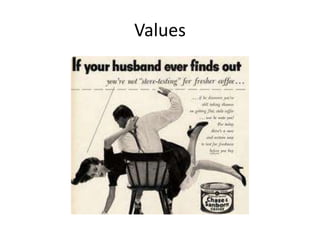
• Society is held together by beliefs and ideals
• Values are ideas that people hold to be ‘true’
  or ‘important’ and society reflects these
  beliefs
• Media products reflect these beliefs as they
  are created within a particular time and
  society
• Values are expressed as attitudes towards an
  idea, e.g. Education is important
Values
Realism
• The reality of a representation is influenced by
  the point of view of the author and the
  experiences of the audience
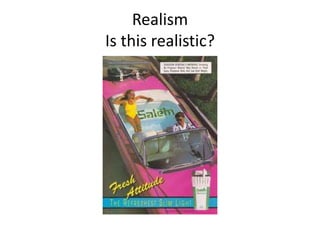
Realism
Is this realistic?

Area of study 1 representation

  • 1.
    Area of Study1 - Representation On completion of this unit, students should be able to describe the construction of specific media representations and explain how the process of representation reproduces the world differently from the direct experience of it.
  • 2.
    Area of Study1 - Representation Key knowledge • Media representation and its relationship to the selection and construction of reality in various media forms • The nature of codes and conventions evident in media productions, and the meanings they create • The nature and role of audiences in reading media representations • notions of ‘realism’ in media texts • Representations within the context of values such as those related to gender, age, ethnicity, culture and socioeconomic status • The influence of institutional and social practices on the nature of representations, and their availability and accessibility • Representations within the context of media history and culture, including the emergence and development of stereotypes, styles and generic conventions within media
  • 3.
    Unit 1 –Representation and Technologies of Representation Key Skills • Describe representations in media texts • Compare the construction of representations in a range of media texts and across media forms • Use concepts of representation, selection, omission and construction in the evaluation of media texts • Discuss how audiences make judgments about how realism is represented in specific media texts • Analyse representations within the context of institutional practices, media history and cultural values.
  • 4.
  • 5.
    REPRESENTATION LIFE CYCLE Selection & Selection & Omission Omission Author Audience (Sender) Rep (Receiver) Values Values Using Codes & Using Codes & Conventions Conventions Cultural & Cultural & Historical Historical Context Symbolic Symbolic Context Audio Audio Technical Technical Written Written
  • 6.
    Activity 1: Selection& Omission • Drawn the object that has been placed on the table • Use the full size of the paper provided • In groups of four, choose the drawing that you would give to the Head Dean and Cambridge University
  • 7.
    Cont. • If youwere to find out that the Head Dean of Cambridge University was a fan of surrealist art, would this change you decision? • Justify your answer
  • 8.
    Activity 1. Create atable 2. Look at the following advertisment 3. Write down the denotative and connotative content Denotative Content Connotative Content The man is wearing a dark suit, white He is wealthy and has a high-paying shirt and a brown and black striped tie job: he is a businessman The man has short brown hair that is He is a conservative person who has to slightly combed to one side look ‘respectable.’ As the cut is no longer in fashion, it suggests that the ad is from the 80s
  • 10.
    Codes & Conventions •Systems of generally accepted signs that help create and communicate meaning • Audio/Visual codes can be categorised into four: – Index – Symbolic – Written – Audio – Technical * Codes don’t work in isolation *
  • 11.
    Index Signs • Index- An Index signs is a sign where there is a direct link between the sign and the object. The meaning is derived from the context/situation in which the sign is read. • The majority of traffic signs are Index signs, as they represent information that relates to a location.
  • 12.
    Index Signs • Coloursare frequently used to reference meaning, but the context in which a colour is perceived plays a big part in the meaning it carries (Indexical) • Write down two different meanings for each of the colours below and two different contexts/settings that change the meaning: – Black – White – Blue – Red – Green
  • 13.
    Symbolic Codes • Asymbol has no logical meaning between it and the object • Flags are symbols that represent countries or organisations • Film clips often operate by using symbolism to communicate meaning • Watch the film clip ‘November Rain’ and write down as many symbolic references under the headings of: – Props & Costume – Setting – Colours
  • 14.
    Props & Symbolic Setting Symbolic Colours Symbolic Costumes meaning meaning meaning Broken Sinner not saint Derelict Abandoned by Grey Danger/sadness Crucifix house God to come Empty Drowning Rain Foreboding Red Passion, love, whiskey sorrows tragedy/ sadness life, irreversible bottle damage Short Lustful bride, Church Loss (death), Joy Black Mourning wedding Passionate (marriage) dress relationship White Loss of vitality Smoking Wild/fearless Lifestyle Or stupidity depending on Values* Casket Death
  • 15.
    Written Codes • Canbe very powerful at creating meaning • Almost impossible for text on screen not to be read • Written statements are credible as our culture respects the written word • Can intro setting, time, place or work to anchor the meaning of an image • What is written (How it is written = Technical Code)
  • 16.
    • How importantis setting/context in the way codes are read by an audience? • Choose one code and provided a different meaning by deconstructing it from a different perspective
  • 17.
    Written Codes • Thefollowing is the film clip Everybody Hurts by R.E.M. – How have they used written codes? – What effect does it have? – How did it make you feel? – In what other ways could this technique be used? – Same video, different text = changed meaning
  • 18.
    Written Codes anchormeaning This image of a Big Mac could have any number of meanings depending of the it appears with. Write a caption that clearly anchors the meaning of this image. E.g. Take a good look because you won’t see this when you buy one.
  • 19.
    Audio Codes • Audiocodes are used to enhance the illusion of reality. The filmmaker can use music, sound effects or dialogue to assist in this deception, even though these sounds weren’t present when shooting took place. • Diegetic Audio – Audio that takes place in the world of the representation. The characters can hear it, react and interact with it. • Non-diegetic Audio – Audio that takes place outside the world of the representation. Only the audience can hear it.
  • 20.
    TV & MovieThemes Track 1 – Raiders of the Lost Ark Track 5 – Pulp Fiction (adventure) (crime/thriller) Track 2 - E.T. Track 6 - Schindler’s List (family/adventure) (biography/drama/history) Track 3 – Halloween Track 7 - The Crow (horror/thriller) (action/fantasy/thriller) Track 4 – Monty Python and the Holy Grail Track 8 – The Godfather (comedy) (crime/drama)
  • 21.
    Duck Amuck • Often,we take audio codes for granted, accepting that what we hear is just what should be heard. What about when we watch an animated cartoon when all we’re watching are thousands of drawings providing the illusion of reality? How are the audio codes used then? In this Warner Brother’s cartoon, notice how – Music – Sound effects & – Dialogue are all used to construct reality and to make the audience aware that it operates under different conventions.
  • 22.
    Technical Codes • Codesof the profession, these codes are the techniques of construction • They can be broken down into any of these production elements: – Camera – Lighting – Editing – Mise en scene/Visual Composition
  • 23.
    Technical Codes • Techcodes are interested in the reasons behind certain shots / composition / lights / editing has been used
  • 24.
    The Matrix • Ingroups, examine: – Camera – Mise en scene – Lighting – Editing What has been used? Why has it been used? What meaning does it communicate?
  • 25.
    Stereotypes • An oversimplifiedversion of a representation is called a stereotype. These can often be quite negative as they don’t give a detailed, accurate portrayal of the truth • These representations are used mostly in advertising
  • 26.
    Stereotypes • Stereotypes arequick and easy to use, as they are easily assembled and easily understood – Write down a group of commonly stereotyped people – Write down five stereotypical objects/qualities that could be used to identify them – Beware the Wog – The Late Show
  • 27.
    Values • Society isheld together by beliefs and ideals • Values are ideas that people hold to be ‘true’ or ‘important’ and society reflects these beliefs • Media products reflect these beliefs as they are created within a particular time and society • Values are expressed as attitudes towards an idea, e.g. Education is important
  • 28.
  • 29.
    Realism • The realityof a representation is influenced by the point of view of the author and the experiences of the audience
  • 30.