A2 G325:
Critical Perspectives
in Media
Theoretical Evaluation
Of Production
1b) Representations
Question 1b
• This question asks you to write about one of
your media productions – in this case your
SOAP OPERA TRAILER and ancillary tasks can
also be referenced.
• You will be asked to write about the
production by applying ONE media concept
REPRESENTATION
• This is the process whereby the media
construct versions of people, places and
events in mages, words or sound for the
transmission through media texts to
audiences. Representation is the basis of all
media products. We live our lives through
actual experience of others and the world
around us. Media products construct versions
of reality. What does this trailer say about ‘the media’?
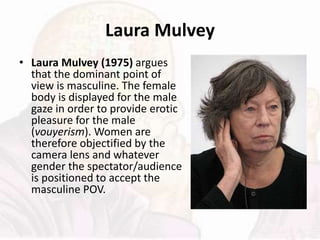
What is the overarching message the media
communicates with regards to gender
representation?
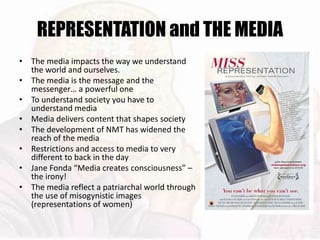
REPRESENTATION and THE MEDIA
• The media impacts the way we understand
the world and ourselves.
• The media is the message and the
messenger… a powerful one
• To understand society you have to
understand media
• Media delivers content that shapes society
• The development of NMT has widened the
reach of the media
• Restrictions and access to media to very
different to back in the day
• Jane Fonda “Media creates consciousness” –
the irony!
• The media reflect a patriarchal world through
the use of misogynistic images
(representations of women)
REPRESENTATION
• Representations provide models of how we see
gender, social groups and places – aspects of the
world we inhabit
• They are ideological in that they are constructed
within a framework of values and beliefs
• They are mediated by individuals and media
organisations and reflect the value systems of
their sources
• No representations are real; they are only
versions of the real.
Ideology is ideas,
values and beliefs in a
society. These are
often taken for
granted and seen as
‘commonsense’.
REPRESENTATION
What should be done in terms of your coursework is
three things:
1. You must detail how and why you have used Media
Language to represent people (gender, class, age,
sexuality), places and ideas (the storyline)?
2. Detail what you have done to represent the genre?
3. What ideological messages have you communicated
through the way you have represented? (this may be
address through the previous two questions)
QUESTIONS ON REPRESENTATION
• Richard Dyer (1983) posed a few questions
when analysing media representations in
general.
1. What sense of the world is it making?
2. What does it imply? Is it typical of the world
or deviant?
3. Who is it speaking to? For whom? To whom?
4. What does it represent to us and why? How
do we respond to the representation?
MEDIA LANGUAGE
Some tools for analysis
• How have you used the following to represent
people, places, ideas?:
• Cinematography (Camera work & Lighting)
• Sound
• Editing
• Mise-en-scene
• Include the use of apposite terminology and
theory
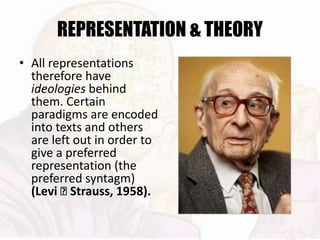
REPRESENTATION & THEORY
• All representations
therefore have
ideologies behind
them. Certain
paradigms are encoded
into texts and others
are left out in order to
give a preferred
representation (the
preferred syntagm)
(Levi 􏰂 Strauss, 1958).
SOAP OPERA STUDIES
• Women and Soap Opera: A Cultural Feminist
Perspective By Dannielle Blumenthal
• ‘Although feminism is humanistic in nature,
directed against domination in general, it is also
concerned more specifically with eliminating the
source of women’s oppression, commonly called
“patriarchy.” Patriarchy is “father-rule,” meaning
the systematic domination of women/feminity by
men/masculinity, and or ideologies, social
structures, languages, and so on that privilege
men's masculinity over women/feminity.’
SOAP OPERA STUDIES
• CONSTRUCTION OF CONTEMPORARY WOMEN IN SOAP OPERAS -
Dr. Aaliya Ahmed & Ms. Malik Zahra Khalid
• In families in which the gender roles are largely traditional,
television may tend to serve to reinforce such gender roles. In this
way television certainly plays a role in the construction of gender
roles. All viewers have several options regarding gender images: to
accept them, to disregard them, to interpret them in their own way;
and to reject them.
• Contemporary soap-operas telecast from satellite channels, mostly
have female protagonists, who is traditional, yet at the same time
independent and strong.
• A prominent and striking characteristic of all soap operas is their
focus on interpersonal relationship, especially interpersonal
problems. For example, extra marital relationship among the
characters in the soaps is very high.
SOAP OPERA STUDIES
• COMING CLEAN ON GENDER IN SOAP
OPERAS- ERIN BLAKEMORE
• He (Jeremy G. Butler) makes the case that it’s
time for the toolbox of film studies techniques
to be turned to “the quite distinct audial and
visual style of soap opera, a style uniquely
adapted to the preservation of enigmas rather
than their resolution.”
REPRESENTATION & THEORY
• 􏰆In terms of your coursework you will be
looking at representation in terms of :
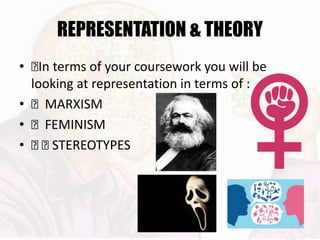
• 􏰆 MARXISM
• 􏰆 FEMINISM
• 􏰆 􏰆 STEREOTYPES
Ideologies and Representation
(MARXISM)
• A hegemonic view of society 􏰆fundamental
inequalities in power between social groups.
Groups in power exercise their influence
culturally rather than by force.
• 􏰆Concept has origins in Marxist theory - ruling
capitalist class are able to protect their economic
interests.
• 􏰆Representations are encoded into mass media
texts in order to do this 􏰆 reinforce dominant
ideologies in society.
• Tim O’􏰂Sullivan et al. (1998) Ideology 􏰆 refers to
a set of ideas which produces a partial and
selective view of reality. Notion of ideology
entails widely held ideas or beliefs which are seen
as 􏰆common􏰆 sense and become naturalised.
•
• What is important is that, in Marxist terms, the
media􏰆s role may be seen as :
• Circulating and reinforcing dominant ideologies
• 􏰆(less frequently) undermining and challenging
such ideologies.
Consider the dominant ideological representations of women in soap opera –
what are they? Have you gone with this ideology or gone against it? Try not to
stick with stereotypical representations – refer to the varied female
representations that are present due to the contemporary time we live in?
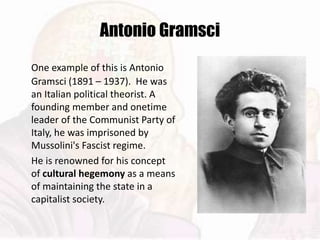
Antonio Gramsci
One example of this is Antonio
Gramsci (1891 – 1937). He was
an Italian political theorist. A
founding member and onetime
leader of the Communist Party of
Italy, he was imprisoned by
Mussolini's Fascist regime.
He is renowned for his concept
of cultural hegemony as a means
of maintaining the state in a
capitalist society.
Hegemony
Hegemony is the way in
which those in power
maintain their control.
Dominant ideologies are
considered hegemonic;
power in society is
maintained by constructing
ideologies which are usually
promoted by the mass
media.
How have you tried to break with
hegemony in the way that you have
represented gender in your Soap Opera
trailer?
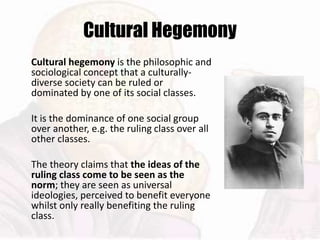
Cultural Hegemony
Cultural hegemony is the philosophic and
sociological concept that a culturally-
diverse society can be ruled or
dominated by one of its social classes.
It is the dominance of one social group
over another, e.g. the ruling class over all
other classes.
The theory claims that the ideas of the
ruling class come to be seen as the
norm; they are seen as universal
ideologies, perceived to benefit everyone
whilst only really benefiting the ruling
class.
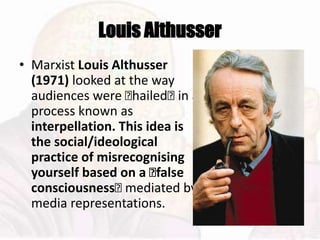
Louis Althusser
• Marxist Louis Althusser
(1971) looked at the way
audiences were 􏰆hailed􏰆 in a
process known as
interpellation. This idea is
the social/ideological
practice of misrecognising
yourself based on a 􏰂false
consciousness􏰆 mediated by
media representations.
Interpellation
• Althusser did not believe that the individual is a self-conscious,
autonomous being whose actions can be explained by personal
beliefs, intentions, preferences and so on.
• Rather he sees individuals as subjects constituted as a result of pre-
given structures. He introduces the concept of ‘interpellation’ to
describe the process by which individuals are constituted as
subjects.
• Ideology operates to do this. Individuals are interpellated (have
social identities conferred on them) through ideological states
apparatuses from which people gain their sense of identity as well
as their understanding of reality.
• Like all structuralists Althusser sees the human being as determined
by pre-given structures such as language, family relations, cultural
conventions and other social forces. Althusser did not concede that
the individuals could resist the process of interpellation.
Interpellation: summary
• Interpellation is a term used to explain how the
media text constructs a subject (represents a
person) and positions them a way that the
representation is seen as every day and normal.
• For interpellation to work we must recognise and
accept the representations that we see and how
we fit in with them.
• So, interpellation is like ‘recruitment’ – it invites a
person into accepting a subject position (a
collective identity) and also the ideology (beliefs
and ideas) that go with that collective group
Gender and Ideology (FEMINISM)
• 􏰆Masculinity and femininity are socially
constructed.
• Ideas about gender are produced and reflected in
language O􏰂 Sullivan et al (1998).
• 􏰆Feminism is a label that refers to a broad range
of views containing one shared assumption 􏰆
gender inequalities in society, historically
masculine power (patriarchy) exercised at right of
women􏰆s interests and rights.
Laura Mulvey
• Laura Mulvey (1975) argues
that the dominant point of
view is masculine. The female
body is displayed for the male
gaze in order to provide erotic
pleasure for the male
(vouyerism). Women are
therefore objectified by the
camera lens and whatever
gender the spectator/audience
is positioned to accept the
masculine POV.
Stereotypes?
• O􏰂Sullivan et al (1998) details that a
stereotype is a label that involves a process of
categorisation and evaluation.
• We can call stereotypes shorthand to
narratives because such simplistic
representations define our understanding of
media texts 􏰆 e.g we know who is good and
who is evil.
Stereotypes?
• First coined by Walter Lippmann (1956) the
word stereotype wasn􏰆t meant to be negative
and was simply meant as a shortcut or
ordering process.
• 􏰆In ideological terms, stereotyping is a means
by which support is provided by one group􏰆s
differential against another.
Stereotypes?
• 􏰆 Tessa Perkins (1979) says, however, that stereotyping is
not a simple process. She identified that some of the many
ways that stereotypes are assumed to operate aren􏰆t true.
• 􏰆 They aren􏰆t always negative (French good cooks)
• 􏰆 They aren􏰆t always about minority groups or those less
• powerful (upper class twits)
• 􏰆 They are not always false 􏰆 supported by empirical
evidence.
• 􏰆 They are not always rigid and unchanging.
• Perkins argues that if stereotypes were always so simple
then they would not work culturally and over time.
Stereotypes
• Martin Barker (1989) - stereotypes are
condemned for misrepresenting the 􏰆real world􏰆.
(e.g. Reinforcing that the (false) stereotype that
women are available for sex at any time) . He also
says stereotypes are condemned for being too
close to real world (e.g showing women in home
servicing men, which many still do).
• 􏰆 Bears out Perkins􏰆 point that for stereotypes to
work they need audience recognition.
Stereotypes
• Dyer (1977) details that if we are to be told that we are
going to see a film about an alcoholic then we will
know that it will be a tale either of sordid decline or of
inspiring redemption.
• 􏰆 He suggests this is a particularly interesting potential
use of stereotypes, in which the character is
constructed, at the level of dress, performance, etc., as
a stereotype but is deliberatIey given a narrative
function that is not implicit in the stereotype, thus
throwing into question the assumptions signalled by
the stereotypical iconography.
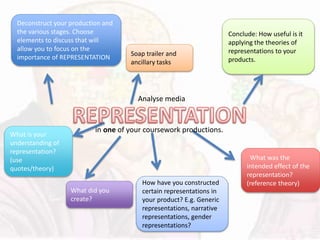
Analyse media
Deconstruct your production and
the various stages. Choose
elements to discuss that will
allow you to focus on the
importance of REPRESENTATION
Soap trailer and
ancillary tasks
What did you
create?
What is your
understanding of
representation?
(use
quotes/theory)
Conclude: How useful is it
applying the theories of
representations to your
products.
How have you constructed
certain representations in
your product? E.g. Generic
representations, narrative
representations, gender
representations?
in one of your coursework productions.
What was the
intended effect of the
representation?
(reference theory)

Exam lessons 3 (representation) - Section A A2 Media Exam

  • 1.
    A2 G325: Critical Perspectives inMedia Theoretical Evaluation Of Production 1b) Representations
  • 2.
    Question 1b • Thisquestion asks you to write about one of your media productions – in this case your SOAP OPERA TRAILER and ancillary tasks can also be referenced. • You will be asked to write about the production by applying ONE media concept
  • 3.
    REPRESENTATION • This isthe process whereby the media construct versions of people, places and events in mages, words or sound for the transmission through media texts to audiences. Representation is the basis of all media products. We live our lives through actual experience of others and the world around us. Media products construct versions of reality. What does this trailer say about ‘the media’? What is the overarching message the media communicates with regards to gender representation?
  • 4.
    REPRESENTATION and THEMEDIA • The media impacts the way we understand the world and ourselves. • The media is the message and the messenger… a powerful one • To understand society you have to understand media • Media delivers content that shapes society • The development of NMT has widened the reach of the media • Restrictions and access to media to very different to back in the day • Jane Fonda “Media creates consciousness” – the irony! • The media reflect a patriarchal world through the use of misogynistic images (representations of women)
  • 5.
    REPRESENTATION • Representations providemodels of how we see gender, social groups and places – aspects of the world we inhabit • They are ideological in that they are constructed within a framework of values and beliefs • They are mediated by individuals and media organisations and reflect the value systems of their sources • No representations are real; they are only versions of the real. Ideology is ideas, values and beliefs in a society. These are often taken for granted and seen as ‘commonsense’.
  • 6.
    REPRESENTATION What should bedone in terms of your coursework is three things: 1. You must detail how and why you have used Media Language to represent people (gender, class, age, sexuality), places and ideas (the storyline)? 2. Detail what you have done to represent the genre? 3. What ideological messages have you communicated through the way you have represented? (this may be address through the previous two questions)
  • 7.
    QUESTIONS ON REPRESENTATION •Richard Dyer (1983) posed a few questions when analysing media representations in general. 1. What sense of the world is it making? 2. What does it imply? Is it typical of the world or deviant? 3. Who is it speaking to? For whom? To whom? 4. What does it represent to us and why? How do we respond to the representation?
  • 8.
    MEDIA LANGUAGE Some toolsfor analysis • How have you used the following to represent people, places, ideas?: • Cinematography (Camera work & Lighting) • Sound • Editing • Mise-en-scene • Include the use of apposite terminology and theory
  • 9.
    REPRESENTATION & THEORY •All representations therefore have ideologies behind them. Certain paradigms are encoded into texts and others are left out in order to give a preferred representation (the preferred syntagm) (Levi 􏰂 Strauss, 1958).
  • 10.
    SOAP OPERA STUDIES •Women and Soap Opera: A Cultural Feminist Perspective By Dannielle Blumenthal • ‘Although feminism is humanistic in nature, directed against domination in general, it is also concerned more specifically with eliminating the source of women’s oppression, commonly called “patriarchy.” Patriarchy is “father-rule,” meaning the systematic domination of women/feminity by men/masculinity, and or ideologies, social structures, languages, and so on that privilege men's masculinity over women/feminity.’
  • 11.
    SOAP OPERA STUDIES •CONSTRUCTION OF CONTEMPORARY WOMEN IN SOAP OPERAS - Dr. Aaliya Ahmed & Ms. Malik Zahra Khalid • In families in which the gender roles are largely traditional, television may tend to serve to reinforce such gender roles. In this way television certainly plays a role in the construction of gender roles. All viewers have several options regarding gender images: to accept them, to disregard them, to interpret them in their own way; and to reject them. • Contemporary soap-operas telecast from satellite channels, mostly have female protagonists, who is traditional, yet at the same time independent and strong. • A prominent and striking characteristic of all soap operas is their focus on interpersonal relationship, especially interpersonal problems. For example, extra marital relationship among the characters in the soaps is very high.
  • 12.
    SOAP OPERA STUDIES •COMING CLEAN ON GENDER IN SOAP OPERAS- ERIN BLAKEMORE • He (Jeremy G. Butler) makes the case that it’s time for the toolbox of film studies techniques to be turned to “the quite distinct audial and visual style of soap opera, a style uniquely adapted to the preservation of enigmas rather than their resolution.”
  • 13.
    REPRESENTATION & THEORY •􏰆In terms of your coursework you will be looking at representation in terms of : • 􏰆 MARXISM • 􏰆 FEMINISM • 􏰆 􏰆 STEREOTYPES
  • 14.
    Ideologies and Representation (MARXISM) •A hegemonic view of society 􏰆fundamental inequalities in power between social groups. Groups in power exercise their influence culturally rather than by force. • 􏰆Concept has origins in Marxist theory - ruling capitalist class are able to protect their economic interests. • 􏰆Representations are encoded into mass media texts in order to do this 􏰆 reinforce dominant ideologies in society.
  • 15.
    • Tim O’􏰂Sullivanet al. (1998) Ideology 􏰆 refers to a set of ideas which produces a partial and selective view of reality. Notion of ideology entails widely held ideas or beliefs which are seen as 􏰆common􏰆 sense and become naturalised. • • What is important is that, in Marxist terms, the media􏰆s role may be seen as : • Circulating and reinforcing dominant ideologies • 􏰆(less frequently) undermining and challenging such ideologies. Consider the dominant ideological representations of women in soap opera – what are they? Have you gone with this ideology or gone against it? Try not to stick with stereotypical representations – refer to the varied female representations that are present due to the contemporary time we live in?
  • 16.
    Antonio Gramsci One exampleof this is Antonio Gramsci (1891 – 1937). He was an Italian political theorist. A founding member and onetime leader of the Communist Party of Italy, he was imprisoned by Mussolini's Fascist regime. He is renowned for his concept of cultural hegemony as a means of maintaining the state in a capitalist society.
  • 17.
    Hegemony Hegemony is theway in which those in power maintain their control. Dominant ideologies are considered hegemonic; power in society is maintained by constructing ideologies which are usually promoted by the mass media. How have you tried to break with hegemony in the way that you have represented gender in your Soap Opera trailer?
  • 18.
    Cultural Hegemony Cultural hegemonyis the philosophic and sociological concept that a culturally- diverse society can be ruled or dominated by one of its social classes. It is the dominance of one social group over another, e.g. the ruling class over all other classes. The theory claims that the ideas of the ruling class come to be seen as the norm; they are seen as universal ideologies, perceived to benefit everyone whilst only really benefiting the ruling class.
  • 19.
    Louis Althusser • MarxistLouis Althusser (1971) looked at the way audiences were 􏰆hailed􏰆 in a process known as interpellation. This idea is the social/ideological practice of misrecognising yourself based on a 􏰂false consciousness􏰆 mediated by media representations.
  • 20.
    Interpellation • Althusser didnot believe that the individual is a self-conscious, autonomous being whose actions can be explained by personal beliefs, intentions, preferences and so on. • Rather he sees individuals as subjects constituted as a result of pre- given structures. He introduces the concept of ‘interpellation’ to describe the process by which individuals are constituted as subjects. • Ideology operates to do this. Individuals are interpellated (have social identities conferred on them) through ideological states apparatuses from which people gain their sense of identity as well as their understanding of reality. • Like all structuralists Althusser sees the human being as determined by pre-given structures such as language, family relations, cultural conventions and other social forces. Althusser did not concede that the individuals could resist the process of interpellation.
  • 21.
    Interpellation: summary • Interpellationis a term used to explain how the media text constructs a subject (represents a person) and positions them a way that the representation is seen as every day and normal. • For interpellation to work we must recognise and accept the representations that we see and how we fit in with them. • So, interpellation is like ‘recruitment’ – it invites a person into accepting a subject position (a collective identity) and also the ideology (beliefs and ideas) that go with that collective group
  • 22.
    Gender and Ideology(FEMINISM) • 􏰆Masculinity and femininity are socially constructed. • Ideas about gender are produced and reflected in language O􏰂 Sullivan et al (1998). • 􏰆Feminism is a label that refers to a broad range of views containing one shared assumption 􏰆 gender inequalities in society, historically masculine power (patriarchy) exercised at right of women􏰆s interests and rights.
  • 23.
    Laura Mulvey • LauraMulvey (1975) argues that the dominant point of view is masculine. The female body is displayed for the male gaze in order to provide erotic pleasure for the male (vouyerism). Women are therefore objectified by the camera lens and whatever gender the spectator/audience is positioned to accept the masculine POV.
  • 24.
    Stereotypes? • O􏰂Sullivan etal (1998) details that a stereotype is a label that involves a process of categorisation and evaluation. • We can call stereotypes shorthand to narratives because such simplistic representations define our understanding of media texts 􏰆 e.g we know who is good and who is evil.
  • 25.
    Stereotypes? • First coinedby Walter Lippmann (1956) the word stereotype wasn􏰆t meant to be negative and was simply meant as a shortcut or ordering process. • 􏰆In ideological terms, stereotyping is a means by which support is provided by one group􏰆s differential against another.
  • 26.
    Stereotypes? • 􏰆 TessaPerkins (1979) says, however, that stereotyping is not a simple process. She identified that some of the many ways that stereotypes are assumed to operate aren􏰆t true. • 􏰆 They aren􏰆t always negative (French good cooks) • 􏰆 They aren􏰆t always about minority groups or those less • powerful (upper class twits) • 􏰆 They are not always false 􏰆 supported by empirical evidence. • 􏰆 They are not always rigid and unchanging. • Perkins argues that if stereotypes were always so simple then they would not work culturally and over time.
  • 27.
    Stereotypes • Martin Barker(1989) - stereotypes are condemned for misrepresenting the 􏰆real world􏰆. (e.g. Reinforcing that the (false) stereotype that women are available for sex at any time) . He also says stereotypes are condemned for being too close to real world (e.g showing women in home servicing men, which many still do). • 􏰆 Bears out Perkins􏰆 point that for stereotypes to work they need audience recognition.
  • 28.
    Stereotypes • Dyer (1977)details that if we are to be told that we are going to see a film about an alcoholic then we will know that it will be a tale either of sordid decline or of inspiring redemption. • 􏰆 He suggests this is a particularly interesting potential use of stereotypes, in which the character is constructed, at the level of dress, performance, etc., as a stereotype but is deliberatIey given a narrative function that is not implicit in the stereotype, thus throwing into question the assumptions signalled by the stereotypical iconography.
  • 29.
    Analyse media Deconstruct yourproduction and the various stages. Choose elements to discuss that will allow you to focus on the importance of REPRESENTATION Soap trailer and ancillary tasks What did you create? What is your understanding of representation? (use quotes/theory) Conclude: How useful is it applying the theories of representations to your products. How have you constructed certain representations in your product? E.g. Generic representations, narrative representations, gender representations? in one of your coursework productions. What was the intended effect of the representation? (reference theory)

Editor's Notes

  • #4 Media is actually the plural of medium Break this down a little more and show video – trailer for Miss Representation - the point being to understand how much media the average person consumes on a regular basis and how that impacts the way we understand the world and ourselves. The media is the message and the messenger… a powerful one To understand society you have to understand media Media delivers content that shapes society The development of NMT has widened the reach of the media Restrictions and access to media to very different to back in the day Jane Fonda ‘Media creates consciousness’ The media reflect a patriarchal world and through the use of misogynistic images (representations of women)
  • #7 This is just guidance and can be deviated away from
  • #8 Questions to help them think – These are questions not necessarily to be answered but to get you thinking about HOW you have used the concept of REPRESENTATION
  • #9 Go through the trailer and help students to create links and write analytically about their work link to slide 6 questions
  • #10 For example you wanted to switch between a representation of a strong and weak female – consider where this comes from? We live a partriarchal society, frequently in television women are portrayed as irrational beings – a stereotype forced upon women by men – but the more frequently we see this representation the more is becomes naturalised and seen as ‘normal’
  • #11 https://books.google.co.uk/books?id=jb6XWrcYfqwC&printsec=frontcover#v=onepage&q&f=false Go through the quotes break them down to help students make them relevant to their production work
  • #15 http://yasminwatkinsunitg325.blogspot.co.uk/p/representation.html
  • #16 Consider the dominant ideological representations of women in soap opera – what are they? Have you gone with this ideology or gone against it? (try not to stick with stereotypical representations – refer to the varied female representations that are present due to the contemporary time we live in?
  • #22 Ho have you used interpellation in your soap opera trailer?