Understanding Intercultural
  Communication Second Edition
   Chapter 4

   What are the Keys to Understanding
   Cultural & Ethnic Identities?

   Stella Ting-Toomey & Leeva C. Chung


   OXFORD UNIVERSITY PRESS

PowerPoint Slides Designed by Alex Flecky and Noorie Baig
TODAY’S MENU
I.     Family and Gender Socialization

II. Group Membership: Intercultural
     Boundary Crossing

III. Group Affiliation and Identity
   Formation

IV. Ethnic–Racial Identity Change
  Process

V. Intercultural Reality Check: Do-
An Application Exercise

       Who Am I?
          and
      Who Are YOU?
I. Family and Gender
Socialization
Identity: reflective self-conception or self-
  image that we derive from
  family, gender, cultural, ethnic, and
  individual socialization processes.
     “Social identities”
 cultural, ethnic, gender,         sexual
 orientation, social class, age,
     disability, or professional identity.
    “Personal identities” unique attributes
 we            associate with our
 individuated self        in comparison
I. Family and Gender
Socialization
A. Families Come in Different Shapes
   1. Types of families: diverse types
   2. Two family types: personal and
positional


B. Gender Socialization and Interaction
   Patterns
   1. Gender identity: Meanings and
              interpretations concerning
gender images
II. Group Membership: Intercultural
      Boundary Crossing

A. The Process of Acculturation &
 Enculturation
   Acculturation: incremental identity-related
     change process of immigrants and
 refugees      in a new environment from a
 long-term     perspective.

  Enculturation: sustained, primary
   socialization process of
   individuals in their original home
   culture wherein they have
II. Group Membership: Intercultural
      Boundary Crossing

    B. Systems-level Factors

    C. Individual-level Factors

    D. Interpersonal F2F and Network-Level
       Factors

    E. Mass Media–Level Factors
III. Group Affiliation and Identity
Formation
 A. Cultural Identity Conceptualizations
       Cultural identity
       Cultural identity salience


B. Ethnic Identity Conceptualizations
       Ethnic identity
       Ethnic value content
       Ethnic identity salience


  Click here to find out about the origin of the Hapa identity.
IV. Ethnic–Racial Identity Change
Process
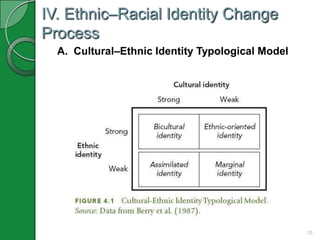
A. Cultural–Ethnic Identity Typological Model
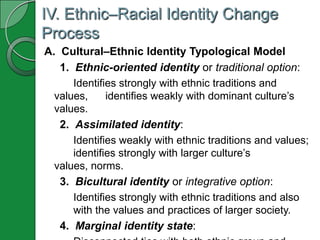
   1. Ethnic-oriented identity or traditional option:
      Identifies strongly with ethnic traditions and
  values,     identifies weakly with dominant culture’s
  values.
   2. Assimilated identity:
      Identifies weakly with ethnic traditions and values;
      identifies strongly with larger culture’s
  values, norms.
   3. Bicultural identity or integrative option:
      Identifies strongly with ethnic traditions and also
      with the values and practices of larger society.
   4. Marginal identity state:
IV. Ethnic–Racial Identity Change
Process
  A. Cultural–Ethnic Identity Typological Model


                                                  10
IV. Ethnic–Racial Identity Change
Process
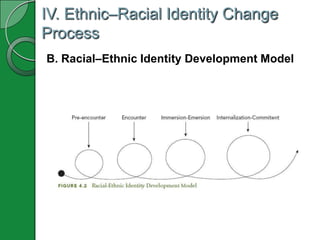
B. Racial–Ethnic Identity Development Model
IV. Ethnic–Racial Identity Change
Process
my.blogs 4.2 and 4.3

Assess your Cultural Identity and
 Marginal Identity on p. 78

Assess your Ethnic Identity and Bicultural
 Identity on p. 80
IV. Ethnic–Racial Identity Change Process
C. Multiracial and Biracial Identity
  Social identity complexity theory
     a. Intersection:
             Compound identity with 2 (or more) social
                  membership categories cross to form
   a single,      claimed identity.
     b. Dominance:
            Individual adopts one major social identity.
     c. Compartmentalization:
            Shifting of social identity category serving
   as              basis of identification based on
   context or                     situation.
     d. Merger:
             Deep awareness of the complex
   multifaceted         spheres of identity
   memberships and the                importance of
   multiple ingroups.
V. Intercultural Reality Check:
   Do-Ables
   A. Practice Mindful Listening
    •   Thoughtful attention to both verbal and
        nonverbal messages.
    •   Check responsively for accuracy.
    •   Involves a consciously competent shift of
        perspective. (How do things look from the
        other’s identity perspective?)


   B. Practice Identity Validation Skills
    •   Use verbal and nonverbal confirming
        messages.
    •   Recognize group- and person-based
        identities.
Parting Thoughts. . .


He who knows others
     is learned;
He who knows
himself
     is wise.

         ~ Lao Tzu

Chapter4

  • 1.
    Understanding Intercultural Communication Second Edition Chapter 4 What are the Keys to Understanding Cultural & Ethnic Identities? Stella Ting-Toomey & Leeva C. Chung OXFORD UNIVERSITY PRESS PowerPoint Slides Designed by Alex Flecky and Noorie Baig
  • 2.
    TODAY’S MENU I. Family and Gender Socialization II. Group Membership: Intercultural Boundary Crossing III. Group Affiliation and Identity Formation IV. Ethnic–Racial Identity Change Process V. Intercultural Reality Check: Do-
  • 3.
    An Application Exercise Who Am I? and Who Are YOU?
  • 4.
    I. Family andGender Socialization Identity: reflective self-conception or self- image that we derive from family, gender, cultural, ethnic, and individual socialization processes. “Social identities” cultural, ethnic, gender, sexual orientation, social class, age, disability, or professional identity. “Personal identities” unique attributes we associate with our individuated self in comparison
  • 5.
    I. Family andGender Socialization A. Families Come in Different Shapes 1. Types of families: diverse types 2. Two family types: personal and positional B. Gender Socialization and Interaction Patterns 1. Gender identity: Meanings and interpretations concerning gender images
  • 6.
    II. Group Membership:Intercultural Boundary Crossing A. The Process of Acculturation & Enculturation Acculturation: incremental identity-related change process of immigrants and refugees in a new environment from a long-term perspective. Enculturation: sustained, primary socialization process of individuals in their original home culture wherein they have
  • 7.
    II. Group Membership:Intercultural Boundary Crossing B. Systems-level Factors C. Individual-level Factors D. Interpersonal F2F and Network-Level Factors E. Mass Media–Level Factors
  • 8.
    III. Group Affiliationand Identity Formation A. Cultural Identity Conceptualizations Cultural identity Cultural identity salience B. Ethnic Identity Conceptualizations Ethnic identity Ethnic value content Ethnic identity salience Click here to find out about the origin of the Hapa identity.
  • 9.
    IV. Ethnic–Racial IdentityChange Process A. Cultural–Ethnic Identity Typological Model 1. Ethnic-oriented identity or traditional option: Identifies strongly with ethnic traditions and values, identifies weakly with dominant culture’s values. 2. Assimilated identity: Identifies weakly with ethnic traditions and values; identifies strongly with larger culture’s values, norms. 3. Bicultural identity or integrative option: Identifies strongly with ethnic traditions and also with the values and practices of larger society. 4. Marginal identity state:
  • 10.
    IV. Ethnic–Racial IdentityChange Process A. Cultural–Ethnic Identity Typological Model 10
  • 11.
    IV. Ethnic–Racial IdentityChange Process B. Racial–Ethnic Identity Development Model
  • 12.
    IV. Ethnic–Racial IdentityChange Process my.blogs 4.2 and 4.3 Assess your Cultural Identity and Marginal Identity on p. 78 Assess your Ethnic Identity and Bicultural Identity on p. 80
  • 13.
    IV. Ethnic–Racial IdentityChange Process C. Multiracial and Biracial Identity Social identity complexity theory a. Intersection: Compound identity with 2 (or more) social membership categories cross to form a single, claimed identity. b. Dominance: Individual adopts one major social identity. c. Compartmentalization: Shifting of social identity category serving as basis of identification based on context or situation. d. Merger: Deep awareness of the complex multifaceted spheres of identity memberships and the importance of multiple ingroups.
  • 14.
    V. Intercultural RealityCheck: Do-Ables A. Practice Mindful Listening • Thoughtful attention to both verbal and nonverbal messages. • Check responsively for accuracy. • Involves a consciously competent shift of perspective. (How do things look from the other’s identity perspective?) B. Practice Identity Validation Skills • Use verbal and nonverbal confirming messages. • Recognize group- and person-based identities.
  • 15.
    Parting Thoughts. .. He who knows others is learned; He who knows himself is wise. ~ Lao Tzu