Representation
in the Media
Representation
• By definition, all media texts are representations of
reality.
• This means that they are intentionally composed, lit,
written, framed, cropped, captioned, branded, targeted
and censored by their producers, and that they are
ultimately artificial versions of the reality we perceive
around us.
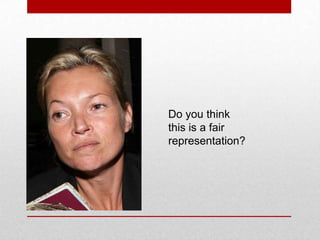
Do you think
this is a fair
representation?
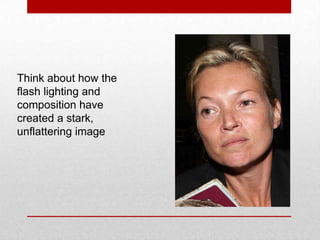
Think about how the
flash lighting and
composition have
created a stark,
unflattering image
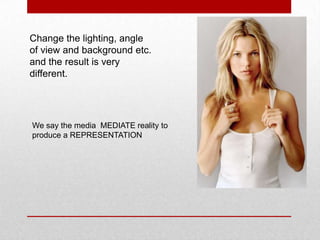
Change the lighting, angle
of view and background etc.
and the result is very
different.

We say the media MEDIATE reality to
produce a REPRESENTATION
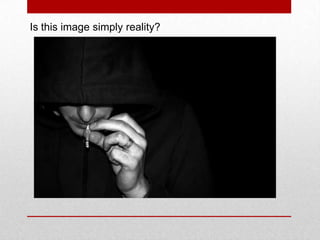
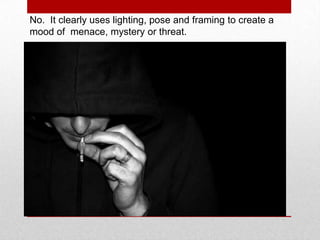
Is this image simply reality?
No. It clearly uses lighting, pose and framing to create a
mood of menace, mystery or threat.
When studying the media it is vital to remember this - every media form, from a
home video to a glossy magazine, is…

A representation of someone's concept of existence, codified into a series of
signs and symbols which can be read by an audience.

REMEMBER SEMIOTICS – study of signs: denotation (meaning)
and connotation.
Truth or Lies?

• Media representations - and the extent to which we accept them – is a very
political issue.

• As the influence the media exerts a major impact on the way we view the
world.
• By viewing media representations our prejudices can be reinforced or
shattered.

• Generally, audiences accept that media texts are fictional to one extent or
another. Sometimes!!
Studying Representation
The study of representation is about decoding the different layers of
truth/fiction/whatever.
In order to fully appreciate the part representation plays in a media text you must
consider:

• Who produced it?
• What/who is represented in the text?
• How is that thing represented?

• Why was this particular representation (this shot, framed from this angle, this story
phrased in these terms, etc) selected, and what might the alternatives have been?
• What frame of reference does the audience use when understanding the
representation?
Analysing Representation
The analysis of different sorts of representation forms an important part
Of Media Studies.
The factors of representation most commonly addressed are:
• Class
• Age
• Gender

• Ethnicity
• Reality is subject to mediation.

Mediation
“The process by which an institution or
individual or a technology comes between events that
happen in the world and the audience that receive this
Representation”.
• Representation is a fluid, two-way process:

• Producers position a text somewhere in relation to reality
and audiences assess a text on its relationship to reality.

• This is mediation in play – it is VERY important to be
aware of this.
Representation is concerned with how media texts
present and mediate ideas of the following:

People
How are they represented? What activities are they doing?

Places
How is this place „given‟ to the audience?

Events
In the represented event, what is included and what parts
are left out?
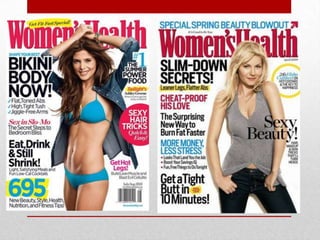
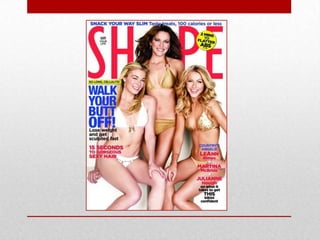
Consider the following images taken from a Google
search on Women and Men on Magazine covers…
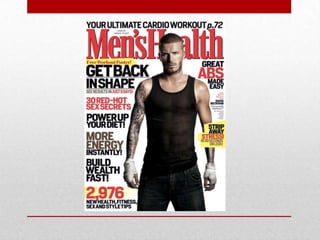
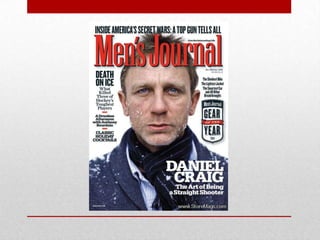
You might think they are typical images from women‟s magazines.
Compare them to some equivalent images of men….
Mediation

• The media create reality:

They take something that is real, a person or an event and
they change its form to produce whatever text we end up with.

• Reality goes through a process.
Mediation and the News
• We tend to believe what is said in the news – but it is sure
to mediated as anything else.

• Someone decides on the news items that are „newsworthy‟
– chosen shots, graphics etc.
• So it is mediated because it is completely different from
the experience of someone who was at the scene of a
news event.
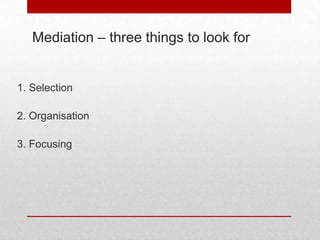
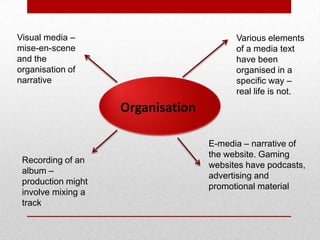
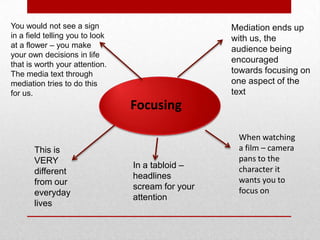
Mediation – three things to look for

1. Selection
2. Organisation
3. Focusing
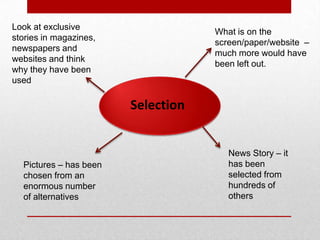
Look at exclusive
stories in magazines,
newspapers and
websites and think
why they have been
used

What is on the
screen/paper/website –
much more would have
been left out.

Selection

Pictures – has been
chosen from an
enormous number
of alternatives

News Story – it
has been
selected from
hundreds of
others
Visual media –
mise-en-scene
and the
organisation of
narrative

Various elements
of a media text
have been
organised in a
specific way –
real life is not.

Organisation

Recording of an
album –
production might
involve mixing a
track

E-media – narrative of
the website. Gaming
websites have podcasts,
advertising and
promotional material
You would not see a sign
in a field telling you to look
at a flower – you make
your own decisions in life
that is worth your attention.
The media text through
mediation tries to do this
for us.

Mediation ends up
with us, the
audience being
encouraged
towards focusing on
one aspect of the
text

Focusing
This is
VERY
different
from our
everyday
lives

In a tabloid –
headlines
scream for your
attention

When watching
a film – camera
pans to the
character it
wants you to
focus on
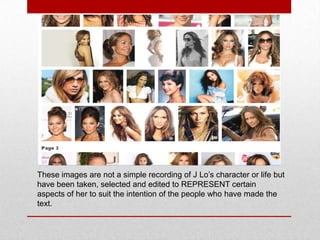
These images are not a simple recording of J Lo‟s character or life but
have been taken, selected and edited to REPRESENT certain
aspects of her to suit the intention of the people who have made the
text.
Representation Theory
Professor Stuart Hall introduced a theory about how we
make sense of representations.
This is based on how we “read” representation.
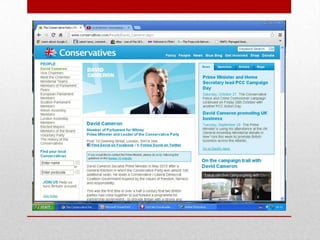
Look at this website and then a close up of one image
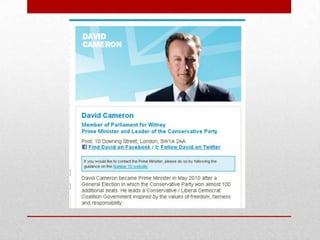
and think about how it is coded…
You might have noticed:

1. The image itself is a head and shoulders shot emphasizing his
expression of seriousness, sincerity ?
2. He is facing the camera directly to perhaps suggest the same
qualities
3. He is wearing a suit with a BLUE tie (Conservative colour)
4. The image is “professionally” lit – although this is a little odd actually
but still has connotations of high status, authority.
5. His image has been cut out and put onto a stylised Union Flag
signifying patriotism and authority. (Q. Would this have conveyed a
different meaning had he been shown in front of his country house? Or
in his car?)
6. There is other coding in e.g. the text when it uses words like freedom,
fairness, responsibility.
You could have broadly three reactions to this representation.
1. I am convinced! He is an honest, competent leader who loves his
country and whose posh social background doesn‟t matter as he
believes in all the right things.
2. He is a total idiot! We are being fooled by the images and text – I
don‟t trust or like him at all.
The whole thing was put together to give us a false picture of him
and his party.

3. I don‟t go along with all the things the image suggests but I suppose
he has some abilities as a politician and is doing the best as he sees
it.
The first of these would be called the preferred reading (meaning that it
is the one the producers of the website wanted you to have)

The second is called an oppositional reading. (You reject or oppose the
meaning offered).

The third is called a negotiated reading. You take -or perhaps we
should say- you make your own meaning depending on your knowledge,
life experience etc.
So the three readings are:

• PREFERRED
• OPPOSITIONAL
• NEGOTIATED
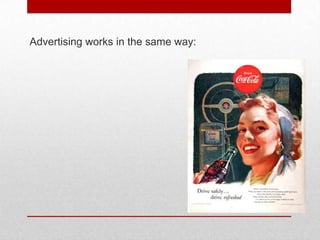
Advertising works in the same way:
Preferred reading would be something like – attractive young people
drink Coca-Cola… I want to be like that so I will buy a Coke!

An oppositional reading could be – I hate big companies selling us junk
by appealing to our material desires.
A negotiated reading could be – I know they just want us to buy their
brand but actually this ad is quite fun and I do like the drink so I may
consider it next time I am in the supermarket…
Any representation is a mixture of:
• The thing itself.
• The opinions of the people doing the representation. (presenter, web
designer etc.)
• The reaction of the individual to the representation. (us, how we
understand it, preferred, oppositional or negotiated reading)
• The context of the society in which the representation is taking place.
(hierarchal/social/political)