-RIYA SANJAY BAGHELE
NAGPUR
Bones are made up of a framework of a protein
called collagen, with a mineral called calcium phosphate that
makes the framework hard and strong. Bones
store calcium and release some into the bloodstream when
it's needed by other parts of the body.
The bone marrow contains stem cells, which produce the
body's red blood cells and platelets, and some types of white
blood cells. Red blood cells carry oxygen to the body's
tissues, and platelets help with blood clotting when
someone has a cut or wound. White blood cells help the
body fight infection.
Broken bones are usually considered as bone fractures.
Healthcare providers can usually categorize a bone fracture
based on its features. The categories include:
Closed or open fractures: If the injury doesn’t break open
the skin, it’s called a closed fracture. If the skin does open,
it’s called an open fracture or compound fracture.
Complete fractures: The break goes completely through
the bone, separating it in two.
Displaced fractures: A gap forms where the bone breaks.
Often, this injury requires surgery to fix.
Partial fractures: The break doesn’t go all the way through
the bone.
Stress fractures: The bone gets a crack in it, which is
sometimes tough to find with imaging.
To understand what is orthopedic implant.
To understand orthopedic internal fixation surgery.
To study some common orthopedic implants.
To study common orthopedic fixation surgeries.
An orthopedic implant is the medical device
manufactured to replace the missing joint or bone or to
support a damaged bone.
The medical implant is mainly fabricated using stainless
steel and titanium alloys for strength and the plastic
coating that is done on it acts as an artificial cartilage.
Internal fixation is an operation in orthopedics that
involves the surgical implementation of implants for
the purpose of repairing a bone.
During this surgury bone are first reduced into their
normal alignment then they are held together with
the help of internal fixators such as plates, screws,
nails, pins and wires.
•Screw is a cylinder with spiral threads running on its outer
surface. It converts torsional forces into compression. The
primary functional objective in the design of a screw is to
dissipate and distribute the mechanical load.
•Thread design should maximise initial contact, enhance
surface area, dissipate and distribute stresses at the screw-
bone interface and increase the pullout strength.
•Screws can be used for attachment of implants to bone,
bone to bone fixation or for soft tissue fixation or
anchorage.
•Newer locking acts as an internal fixator by using locking
of screw head into the reciprocal threads of the plate to
form a fixed angle construct.
Structure of Screw
Screw has the following parts
•Core – Solid section from which the threads project out wards.
The size of core determines the strength of screw and its
fatigue resistance. The size of drill bit used is equal to the core
diameter.
•Threads- Thread diameter is the maximum diameter of
threads. Thread depth is half of the difference between thread
diameter and core diameter. The thread depth determines the
amount of contact with the bones which in turn determines the
resistance to pull out. The size of tap is equal to the thread
diameter.
• Head – Prevents sinking of screw into the bone.
Hemispherical in shape to increase the surface area for load
transfer and to allow angulated insertion. Can be improved by
use of washer. Allows attachment of screw driver. The slot for
screw driver may be star, hexagonal or Philips.
• Tip – May be blunt, corkscrew, self tapping or trocar tip.
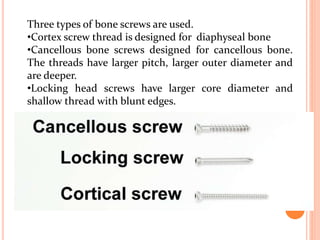
Three types of bone screws are used.
•Cortex screw thread is designed for diaphyseal bone
•Cancellous bone screws designed for cancellous bone.
The threads have larger pitch, larger outer diameter and
are deeper.
•Locking head screws have larger core diameter and
shallow thread with blunt edges.
Bone plates are used in internal fixation of fractures. The plate is fixed to
the bone by application of screws on both sides of the fracture.
Plating is widely used for fixation of diaphyseal fractures of upper extremity
and metaphyseal and articular fractures
Plates are now widely accepted with different standard techniques of
osteosynthesis, throughout the skeleton. Different anatomical locations
demand different shapes and sizes of plates.
For a plate to be effective means of fixation it should meet the following
requirements
It should be of appropriate width and thickness for the given bone
The plate must have adequate and symmetric hold on either side of the
fracture
The plate must be closely opposed to the contour of bone. A prebent plate
or over-contoured plate is an exception.
The plate must neutralize all forces acting on the fracture i.e bending,
compression, shear and torque.
The use of plate is indicated:
•When anatomical alignment must be restored accurately
•Where the use of screws alone is inadequate
•When load sharing may be achieved with confidence. If this cannot be
guaranteed, then a bone graft may be added at the site of any deficit.
The areas of the body where the conditions described above arise
commonly are:
•Around joints – failure to restore a joint surface to its normal shape may
lead to osteoarthritis because of uneven wear of the joint surfaces.
•In the bone of the forearm, which rotates about each other.
•On the pelvis especially around the acetabulum
•On the face and jaw
Other areas where plates are sometimes used include the tibia and the
femur. However, these long bone are subject to large forces, so alternative
techniques using intramedullary nails have been developed. Non-weight
bearing long bones such as the humerus may be plated although nails are
sometimes used in this site also.
Types of orthopedic plates
Compression Mode
The word compression in fracture fixation means bringing the two
fragments closer to each other so that the fragments oppose well.
When the plate is used to achieve compression in addition to fixation of
a fracture, it is said to be used in compression mode.
Neutralization Mode
In this type of plating, a lag screw is used to neutralize bending, shear and
rotational forces. The aim of this type of plating is not to achieve
compression [This has already been achieved by the lag screw.]
Buttress plate
A buttress is an architectural structure built against or projecting from a
wall which serves to support or reinforce the wall.
A buttress plate is used to prevent a collapse in fracture patterns which are
unstable under compressive forces.
Antiglide Plate
In antiglide plating, the plate is
fixed to the bone in such a way
that it prevents the distal
fragment from overriding when
force is applied along the long axis
of the bone. ‘
Span Plating or Bridge Plating
It is a modification of
neutralization mode which is
applied when there is
comminution and one does not
want to dissect the fracture area to
avoid devitalization of the
fragments.
Kirschner wires or K-wires or pins are sterilized, sharpened,
smooth stainless steel pins. Introduced in 1909 by Martin Kirschner,
the wires are now widely used in orthopedics and other types of
medical and veterinary surgery. They come in different sizes and are
used to hold bone fragments together (pin fixation) or to provide an
anchor for skeletal traction. The pins are often driven into the bone
through the skin (percutaneous pin fixation) using a power or hand
drill.
Hip replacement is a surgical procedure in which
the hip joint is replaced by a prosthetic implant, that
is, a hip prosthesis. Hip replacement surgery can be
performed as a total replacement or a hemi (half)
replacement. Such joint replacement orthopaedic
surgery is generally conducted to
relieve arthritis pain or in some hip fractures. A total
hip replacement (total hip arthroplasty or THA)
consists of replacing both the acetabulum and the
femoral head while hemiarthroplasty generally only
replaces the femoral head.
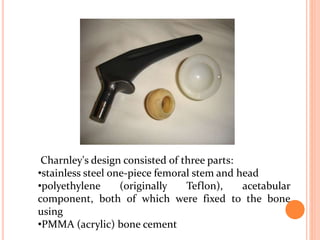
Charnley's design consisted of three parts:
•stainless steel one-piece femoral stem and head
•polyethylene (originally Teflon), acetabular
component, both of which were fixed to the bone
using
•PMMA (acrylic) bone cement
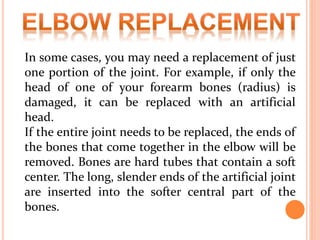
In some cases, you may need a replacement of just
one portion of the joint. For example, if only the
head of one of your forearm bones (radius) is
damaged, it can be replaced with an artificial
head.
If the entire joint needs to be replaced, the ends of
the bones that come together in the elbow will be
removed. Bones are hard tubes that contain a soft
center. The long, slender ends of the artificial joint
are inserted into the softer central part of the
bones.
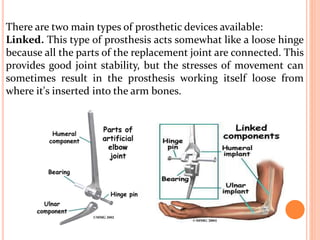
There are two main types of prosthetic devices available:
Linked. This type of prosthesis acts somewhat like a loose hinge
because all the parts of the replacement joint are connected. This
provides good joint stability, but the stresses of movement can
sometimes result in the prosthesis working itself loose from
where it's inserted into the arm bones.
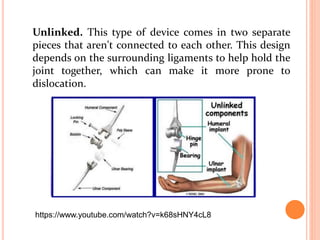
Unlinked. This type of device comes in two separate
pieces that aren't connected to each other. This design
depends on the surrounding ligaments to help hold the
joint together, which can make it more prone to
dislocation.
https://www.youtube.com/watch?v=k68sHNY4cL8
Titanium and Titanium Alloys
Titanium is a common metal used for implantation in
orthopedic surgery. While titanium is a metallic
element, the majority of orthopedic "titanium
implants" are, in fact, alloys. These alloys are
typically proprietary blends - differing from
manufacturer to manufacturer. For this article, we will
consider them all closely related and discuss them as
such. The physical properties (below) make titanium a
desirable material in orthopedic applications.
Common Uses
Titanium is a common material in a variety of orthopedic
implants. Most total hip femoral stem components are
made of a titanium alloy. The same can be said of most
total shoulder arthroplasty stems. Furthermore, nearly all
currently used intramedullary rods are composed of
titanium alloy. Traditional stainless steel plating systems
have been in use for decades for fracture
stabilization. Many surgeons can choose either stainless
steel or titanium plates and screws. There has been much
research regarding decreasing bacterial adherence to
titanium, which may be more prone to allowing
adherence. They are also employed in a variety of spine
surgery applications, including some pedicle screws, rods,
and interbody devices.
Orthopedic implants used in Operation Theater

Orthopedic implants used in Operation Theater

  • 1.
  • 2.
    Bones are madeup of a framework of a protein called collagen, with a mineral called calcium phosphate that makes the framework hard and strong. Bones store calcium and release some into the bloodstream when it's needed by other parts of the body. The bone marrow contains stem cells, which produce the body's red blood cells and platelets, and some types of white blood cells. Red blood cells carry oxygen to the body's tissues, and platelets help with blood clotting when someone has a cut or wound. White blood cells help the body fight infection.
  • 3.
    Broken bones areusually considered as bone fractures. Healthcare providers can usually categorize a bone fracture based on its features. The categories include: Closed or open fractures: If the injury doesn’t break open the skin, it’s called a closed fracture. If the skin does open, it’s called an open fracture or compound fracture. Complete fractures: The break goes completely through the bone, separating it in two. Displaced fractures: A gap forms where the bone breaks. Often, this injury requires surgery to fix. Partial fractures: The break doesn’t go all the way through the bone. Stress fractures: The bone gets a crack in it, which is sometimes tough to find with imaging.
  • 4.
    To understand whatis orthopedic implant. To understand orthopedic internal fixation surgery. To study some common orthopedic implants. To study common orthopedic fixation surgeries.
  • 5.
    An orthopedic implantis the medical device manufactured to replace the missing joint or bone or to support a damaged bone. The medical implant is mainly fabricated using stainless steel and titanium alloys for strength and the plastic coating that is done on it acts as an artificial cartilage.
  • 6.
    Internal fixation isan operation in orthopedics that involves the surgical implementation of implants for the purpose of repairing a bone. During this surgury bone are first reduced into their normal alignment then they are held together with the help of internal fixators such as plates, screws, nails, pins and wires.
  • 7.
    •Screw is acylinder with spiral threads running on its outer surface. It converts torsional forces into compression. The primary functional objective in the design of a screw is to dissipate and distribute the mechanical load. •Thread design should maximise initial contact, enhance surface area, dissipate and distribute stresses at the screw- bone interface and increase the pullout strength. •Screws can be used for attachment of implants to bone, bone to bone fixation or for soft tissue fixation or anchorage. •Newer locking acts as an internal fixator by using locking of screw head into the reciprocal threads of the plate to form a fixed angle construct.
  • 8.
    Structure of Screw Screwhas the following parts •Core – Solid section from which the threads project out wards. The size of core determines the strength of screw and its fatigue resistance. The size of drill bit used is equal to the core diameter. •Threads- Thread diameter is the maximum diameter of threads. Thread depth is half of the difference between thread diameter and core diameter. The thread depth determines the amount of contact with the bones which in turn determines the resistance to pull out. The size of tap is equal to the thread diameter. • Head – Prevents sinking of screw into the bone. Hemispherical in shape to increase the surface area for load transfer and to allow angulated insertion. Can be improved by use of washer. Allows attachment of screw driver. The slot for screw driver may be star, hexagonal or Philips. • Tip – May be blunt, corkscrew, self tapping or trocar tip.
  • 9.
    Three types ofbone screws are used. •Cortex screw thread is designed for diaphyseal bone •Cancellous bone screws designed for cancellous bone. The threads have larger pitch, larger outer diameter and are deeper. •Locking head screws have larger core diameter and shallow thread with blunt edges.
  • 10.
    Bone plates areused in internal fixation of fractures. The plate is fixed to the bone by application of screws on both sides of the fracture. Plating is widely used for fixation of diaphyseal fractures of upper extremity and metaphyseal and articular fractures Plates are now widely accepted with different standard techniques of osteosynthesis, throughout the skeleton. Different anatomical locations demand different shapes and sizes of plates. For a plate to be effective means of fixation it should meet the following requirements It should be of appropriate width and thickness for the given bone The plate must have adequate and symmetric hold on either side of the fracture The plate must be closely opposed to the contour of bone. A prebent plate or over-contoured plate is an exception. The plate must neutralize all forces acting on the fracture i.e bending, compression, shear and torque.
  • 11.
    The use ofplate is indicated: •When anatomical alignment must be restored accurately •Where the use of screws alone is inadequate •When load sharing may be achieved with confidence. If this cannot be guaranteed, then a bone graft may be added at the site of any deficit. The areas of the body where the conditions described above arise commonly are: •Around joints – failure to restore a joint surface to its normal shape may lead to osteoarthritis because of uneven wear of the joint surfaces. •In the bone of the forearm, which rotates about each other. •On the pelvis especially around the acetabulum •On the face and jaw Other areas where plates are sometimes used include the tibia and the femur. However, these long bone are subject to large forces, so alternative techniques using intramedullary nails have been developed. Non-weight bearing long bones such as the humerus may be plated although nails are sometimes used in this site also.
  • 12.
    Types of orthopedicplates Compression Mode The word compression in fracture fixation means bringing the two fragments closer to each other so that the fragments oppose well. When the plate is used to achieve compression in addition to fixation of a fracture, it is said to be used in compression mode. Neutralization Mode In this type of plating, a lag screw is used to neutralize bending, shear and rotational forces. The aim of this type of plating is not to achieve compression [This has already been achieved by the lag screw.] Buttress plate A buttress is an architectural structure built against or projecting from a wall which serves to support or reinforce the wall. A buttress plate is used to prevent a collapse in fracture patterns which are unstable under compressive forces.
  • 13.
    Antiglide Plate In antiglideplating, the plate is fixed to the bone in such a way that it prevents the distal fragment from overriding when force is applied along the long axis of the bone. ‘ Span Plating or Bridge Plating It is a modification of neutralization mode which is applied when there is comminution and one does not want to dissect the fracture area to avoid devitalization of the fragments.
  • 14.
    Kirschner wires orK-wires or pins are sterilized, sharpened, smooth stainless steel pins. Introduced in 1909 by Martin Kirschner, the wires are now widely used in orthopedics and other types of medical and veterinary surgery. They come in different sizes and are used to hold bone fragments together (pin fixation) or to provide an anchor for skeletal traction. The pins are often driven into the bone through the skin (percutaneous pin fixation) using a power or hand drill.
  • 15.
    Hip replacement isa surgical procedure in which the hip joint is replaced by a prosthetic implant, that is, a hip prosthesis. Hip replacement surgery can be performed as a total replacement or a hemi (half) replacement. Such joint replacement orthopaedic surgery is generally conducted to relieve arthritis pain or in some hip fractures. A total hip replacement (total hip arthroplasty or THA) consists of replacing both the acetabulum and the femoral head while hemiarthroplasty generally only replaces the femoral head.
  • 16.
    Charnley's design consistedof three parts: •stainless steel one-piece femoral stem and head •polyethylene (originally Teflon), acetabular component, both of which were fixed to the bone using •PMMA (acrylic) bone cement
  • 17.
    In some cases,you may need a replacement of just one portion of the joint. For example, if only the head of one of your forearm bones (radius) is damaged, it can be replaced with an artificial head. If the entire joint needs to be replaced, the ends of the bones that come together in the elbow will be removed. Bones are hard tubes that contain a soft center. The long, slender ends of the artificial joint are inserted into the softer central part of the bones.
  • 18.
    There are twomain types of prosthetic devices available: Linked. This type of prosthesis acts somewhat like a loose hinge because all the parts of the replacement joint are connected. This provides good joint stability, but the stresses of movement can sometimes result in the prosthesis working itself loose from where it's inserted into the arm bones.
  • 19.
    Unlinked. This typeof device comes in two separate pieces that aren't connected to each other. This design depends on the surrounding ligaments to help hold the joint together, which can make it more prone to dislocation. https://www.youtube.com/watch?v=k68sHNY4cL8
  • 20.
    Titanium and TitaniumAlloys Titanium is a common metal used for implantation in orthopedic surgery. While titanium is a metallic element, the majority of orthopedic "titanium implants" are, in fact, alloys. These alloys are typically proprietary blends - differing from manufacturer to manufacturer. For this article, we will consider them all closely related and discuss them as such. The physical properties (below) make titanium a desirable material in orthopedic applications.
  • 21.
    Common Uses Titanium isa common material in a variety of orthopedic implants. Most total hip femoral stem components are made of a titanium alloy. The same can be said of most total shoulder arthroplasty stems. Furthermore, nearly all currently used intramedullary rods are composed of titanium alloy. Traditional stainless steel plating systems have been in use for decades for fracture stabilization. Many surgeons can choose either stainless steel or titanium plates and screws. There has been much research regarding decreasing bacterial adherence to titanium, which may be more prone to allowing adherence. They are also employed in a variety of spine surgery applications, including some pedicle screws, rods, and interbody devices.