Fracture Healing and
Mechanical stability
Visit and read it freely here -
https://sethiortho.blogspot.com
SethiNet presentations
Contents
 Introduction
 Perren`s strain theory
 Fracture healing
 Indirect Healing
 Direct healing
 Fixation techniques and stability
 Nonunion and Management
Introduction
 Fracture healing -
 Biological environment –
 Age
 Nutritional status
 Blood supply
 Metabolic
 Mechanical stability –
 Absolute
 Relative
 Surgical procedure Alters biological environment
 Selection of fixation Alters mechanical environment
Outcome
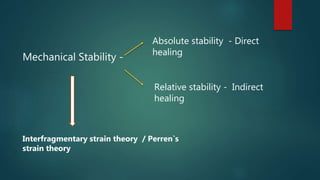
Mechanical Stability -
Absolute stability - Direct
healing
Relative stability - Indirect
healing
Interfragmentary strain theory / Perren`s
strain theory
Parren's strain theory
Strain
 Relative deformation of a material when a given
force is applied
 Relative changes in the fracture gap divided by
original fracture gap = L / L
 Stability determines the Strain at the fracture site
Stable fixation – less strain
Unstable fixation – high strain
Large gap fracture – less strain
Cross section of the fracture-
L= original gap
length
L= change in
the gap
length
Fracture gap strain VS cells response
 The degree of inter fragmentary strain appears to govern the
cellular response.
 Each of these tissues is able to tolerate a different amount of
strain:
 Granulation tissue: up to 100%
 Fibrous connective tissue: up to 10 -17%.
 Fibrocartilage: 2–10%.
 Lamellar bone: < 2%
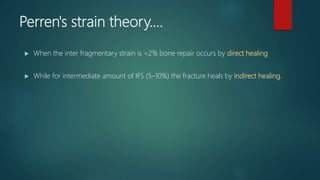
Perren's strain theory….
 When the inter fragmentary strain is <2% bone repair occurs by direct healing
 While for intermediate amount of IFS (5–10%) the fracture heals by indirect healing.
Stain theory of healing –Indirect healing
Fracture Strain is high
Strain become less,
stimulate soft callus
formation
Strain become less
Transition
from soft to
hard callus
Indirect
Fracture
healing
Granulation tissue
formation
Indirect
Healing
Hematoma formation
-Immediate
-immobilization of the fracture
-facilitate the movement of
inflammatory cells and mediators
Acute inflammatory phase
 < 1 week
 Remove the injuries agents/
necrotic bone
 Granulation tissue formation
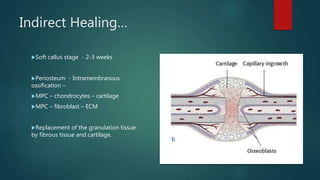
Indirect Healing…
Soft callus stage - 2-3 weeks
Periosteum - Intramembranous
ossification –
MPC – chondrocytes – cartilage
MPC – fibroblast – ECM
Replacement of the granulation tissue
by fibrous tissue and cartilage.
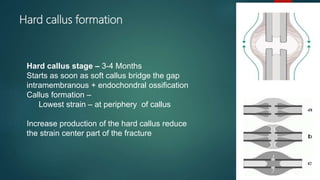
Hard callus formation
Hard callus stage – 3-4 Months
Starts as soon as soft callus bridge the gap
intramembranous + endochondral ossification
Callus formation –
Lowest strain – at periphery of callus
Increase production of the hard callus reduce
the strain center part of the fracture
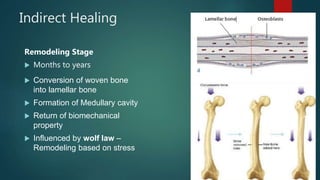
Indirect Healing
Remodeling Stage
 Months to years
 Conversion of woven bone
into lamellar bone
 Formation of Medullary cavity
 Return of biomechanical
property
 Influenced by wolf law –
Remodeling based on stress
Stain theory of healing…pseudo arthrosis
Complete instability
 Callus is unable to form because
the strain is too much for it to
tolerate.
 The more strain-tolerant fibrous
tissue forms
 Bone ends are sealed over with
cortical bone
 Formation of false joint with
synovial fluid in the gap
Hypertrophic nonunion
Unstable fracture
 Excess callus formation unable to reduce the IFS
 Creates a hypertrophic non union
Direct Healing
 Anatomically reduced rigid fixed fractures
 Formation of cutting cones
 >100,000 remodeling units work at time
 Direct osteonal remodeling
 Without callous
 Activation resorption by osteoclasts osteoid formation by osteoclasts
Primary osteons Mineralization
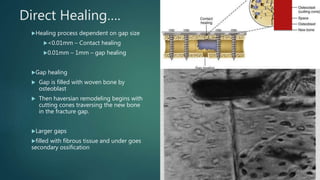
Direct Healing….
Healing process dependent on gap size
<0.01mm – Contact healing
0.01mm – 1mm – gap healing
Gap healing
 Gap is filled with woven bone by
osteoblast
 Then haversian remodeling begins with
cutting cones traversing the new bone
in the fracture gap.
Larger gaps
filled with fibrous tissue and under goes
secondary ossification
FIXATION TECHNIQUES AND STABILITY
Relative stability
Intramedullary nailing
 Load sharing device
 Inter fragmentary micro motion
 Fracture gap strain is usually 2-10%
 Body responds by forming more soft callus
to try and decrease the strain
 Fixation of diaphyseal fractures – strength
and less duration
Relative stability
Bridge plating technique
 Comminated fractures
 Strain is get divided within these
fragments
 Less strain favors indirect healing
 External fixation
 POP cast
 Traction
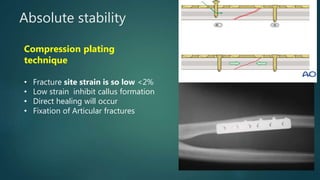
Absolute stability
Compression plating
technique
• Fracture site strain is so low <2%
• Low strain inhibit callus formation
• Direct healing will occur
• Fixation of Articular fractures
Absolute stability
 TBW
 Lag screw fixation
Interfragmentary
strain,
Nonunion and
Management
Nonunion ….
 Fracture is fixed rigidly but a gap is present
 Direct healing may not be able to bridge the gap
 The lack of strain may inhibit callus formation
and secondary healing
 Predispose to non-union
 Management –
 Increase the flexibility
 Reduce the gap by compression
Nonunion….
a- Hypertrophic nonunion after
unlocked intramedullary nail
b – Instability due to short unlock nail
creating a resorption cavity
C- Additional stability gained by over
reaming and insertion of a thicker and
longer dynamically locked nail
Valgus osteotomy – Femoral neck
fracture
Strain is high because of
high shear force
Valgus osteotomy
changes the shear force
into compressive force
Management of
pseudo arthrosis
 If bone resection need Oblique
osteotomy is preferred rather
than transverse osteotomy
 Limited compression can be
obtained with a plate
 ``Compression in to the axilla``
technique with a plate and lag
screw
Thank You

Fracture Healing.pptx

  • 1.
    Fracture Healing and Mechanicalstability Visit and read it freely here - https://sethiortho.blogspot.com SethiNet presentations
  • 2.
    Contents  Introduction  Perren`sstrain theory  Fracture healing  Indirect Healing  Direct healing  Fixation techniques and stability  Nonunion and Management
  • 3.
    Introduction  Fracture healing-  Biological environment –  Age  Nutritional status  Blood supply  Metabolic  Mechanical stability –  Absolute  Relative  Surgical procedure Alters biological environment  Selection of fixation Alters mechanical environment Outcome
  • 4.
    Mechanical Stability - Absolutestability - Direct healing Relative stability - Indirect healing Interfragmentary strain theory / Perren`s strain theory
  • 5.
    Parren's strain theory Strain Relative deformation of a material when a given force is applied  Relative changes in the fracture gap divided by original fracture gap = L / L  Stability determines the Strain at the fracture site Stable fixation – less strain Unstable fixation – high strain Large gap fracture – less strain Cross section of the fracture- L= original gap length L= change in the gap length
  • 6.
    Fracture gap strainVS cells response  The degree of inter fragmentary strain appears to govern the cellular response.  Each of these tissues is able to tolerate a different amount of strain:  Granulation tissue: up to 100%  Fibrous connective tissue: up to 10 -17%.  Fibrocartilage: 2–10%.  Lamellar bone: < 2%
  • 7.
    Perren's strain theory…. When the inter fragmentary strain is <2% bone repair occurs by direct healing  While for intermediate amount of IFS (5–10%) the fracture heals by indirect healing.
  • 8.
    Stain theory ofhealing –Indirect healing Fracture Strain is high Strain become less, stimulate soft callus formation Strain become less Transition from soft to hard callus Indirect Fracture healing Granulation tissue formation
  • 9.
    Indirect Healing Hematoma formation -Immediate -immobilization ofthe fracture -facilitate the movement of inflammatory cells and mediators Acute inflammatory phase  < 1 week  Remove the injuries agents/ necrotic bone  Granulation tissue formation
  • 10.
    Indirect Healing… Soft callusstage - 2-3 weeks Periosteum - Intramembranous ossification – MPC – chondrocytes – cartilage MPC – fibroblast – ECM Replacement of the granulation tissue by fibrous tissue and cartilage.
  • 11.
    Hard callus formation Hardcallus stage – 3-4 Months Starts as soon as soft callus bridge the gap intramembranous + endochondral ossification Callus formation – Lowest strain – at periphery of callus Increase production of the hard callus reduce the strain center part of the fracture
  • 12.
    Indirect Healing Remodeling Stage Months to years  Conversion of woven bone into lamellar bone  Formation of Medullary cavity  Return of biomechanical property  Influenced by wolf law – Remodeling based on stress
  • 13.
    Stain theory ofhealing…pseudo arthrosis Complete instability  Callus is unable to form because the strain is too much for it to tolerate.  The more strain-tolerant fibrous tissue forms  Bone ends are sealed over with cortical bone  Formation of false joint with synovial fluid in the gap
  • 14.
    Hypertrophic nonunion Unstable fracture Excess callus formation unable to reduce the IFS  Creates a hypertrophic non union
  • 15.
    Direct Healing  Anatomicallyreduced rigid fixed fractures  Formation of cutting cones  >100,000 remodeling units work at time  Direct osteonal remodeling  Without callous  Activation resorption by osteoclasts osteoid formation by osteoclasts Primary osteons Mineralization
  • 16.
    Direct Healing…. Healing processdependent on gap size <0.01mm – Contact healing 0.01mm – 1mm – gap healing Gap healing  Gap is filled with woven bone by osteoblast  Then haversian remodeling begins with cutting cones traversing the new bone in the fracture gap. Larger gaps filled with fibrous tissue and under goes secondary ossification
  • 17.
  • 18.
    Relative stability Intramedullary nailing Load sharing device  Inter fragmentary micro motion  Fracture gap strain is usually 2-10%  Body responds by forming more soft callus to try and decrease the strain  Fixation of diaphyseal fractures – strength and less duration
  • 19.
    Relative stability Bridge platingtechnique  Comminated fractures  Strain is get divided within these fragments  Less strain favors indirect healing  External fixation  POP cast  Traction
  • 20.
    Absolute stability Compression plating technique •Fracture site strain is so low <2% • Low strain inhibit callus formation • Direct healing will occur • Fixation of Articular fractures
  • 21.
  • 22.
  • 23.
    Nonunion ….  Fractureis fixed rigidly but a gap is present  Direct healing may not be able to bridge the gap  The lack of strain may inhibit callus formation and secondary healing  Predispose to non-union  Management –  Increase the flexibility  Reduce the gap by compression
  • 24.
    Nonunion…. a- Hypertrophic nonunionafter unlocked intramedullary nail b – Instability due to short unlock nail creating a resorption cavity C- Additional stability gained by over reaming and insertion of a thicker and longer dynamically locked nail
  • 25.
    Valgus osteotomy –Femoral neck fracture Strain is high because of high shear force Valgus osteotomy changes the shear force into compressive force
  • 26.
    Management of pseudo arthrosis If bone resection need Oblique osteotomy is preferred rather than transverse osteotomy  Limited compression can be obtained with a plate  ``Compression in to the axilla`` technique with a plate and lag screw
  • 27.