Pre Basic Course

Plates - form and function


Dr Sudarshan Bhandary
Plate : Form and Function

•   To understand how changes in the design of
    plates has evolved to meet the needs of the
    patient
•   To understand how you can use a plate in
    several different ways to achieve different
    types of fixation
Plate : Form and Function
•   Absolute stability challenged by biological
    fixation
•   Osteosynthesis with plates has a firm place in #
    treatment
•   Articular #s require stable fixation
•   Compromise of cortical blood supply a major
    drawback of conventional plating
Plate : Form

•   DCP
•   Reconstruction plate
•   Semitubular - 1/3rd Tubular Plate
•   LC-DCP
•   PC-FIX
•   LCP
•   LISS
DCP - 3.5 and 4.5

•   First introduced in 1969 by Danis
•   Revolutionary concept of compression plating
•   Featured a new hole designed for axial compression
•   Broad 4.5 for Femur & Narrow 4.5 for Humerus &
    Tibia
•   DCP 3.5 for Forearm, Fibula, Pelvis & Clavicle
•   The screw hole in DCP is like a portion of an inclined
    & angled cylinder


•   When the screw is tightened it results in a movement
    of bone fragment in relation to the plate
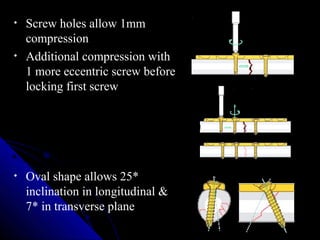
•   Screw holes allow 1mm
    compression
•   Additional compression with
    1 more eccentric screw before
    locking first screw


•   Oval shape allows 25*
    inclination in longitudinal &
    7* in transverse plane
Technique of application
3 drill guides
a)   Concentric (Neutral) - Green collar - 0.1 mm offset
b)   Eccentric (Load) - Gold collar - 1 mm offset
c)   Universal for buttress mode
Problems with DCP

•   Unstable fixation leads to fatigue & failure
•   Strict adherence to principles of compression
•   Compromised blood supply due to intimate
    contact with underlying cortex
•   “Refractures” after plate removal
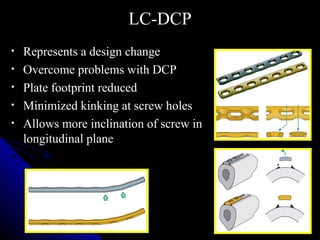
LC-DCP
•   Represents a design change
•   Overcome problems with DCP
•   Plate footprint reduced
•   Minimized kinking at screw holes
•   Allows more inclination of screw in
    longitudinal plane
Technique of application
•   New spring loaded drill guide
•   Without pressure - Eccentric hole
•   With pressure - Neutral
Tubular plates

•   3.5 system - 1/3rd Tubular
•   4.5 system - Semitubular
•   Limited stability
•   Collared hole

•   Lateral malleolus
•   Distal ulna / Olecranon
•   Distal humerus
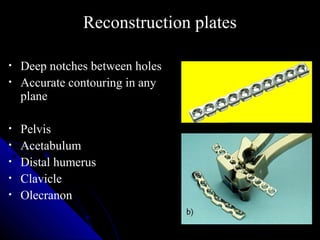
Reconstruction plates

•   Deep notches between holes
•   Accurate contouring in any
    plane

•   Pelvis
•   Acetabulum
•   Distal humerus
•   Clavicle
•   Olecranon
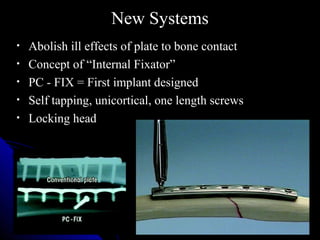
New Systems
•   Abolish ill effects of plate to bone contact
•   Concept of “Internal Fixator”
•   PC - FIX = First implant designed
•   Self tapping, unicortical, one length screws
•   Locking head
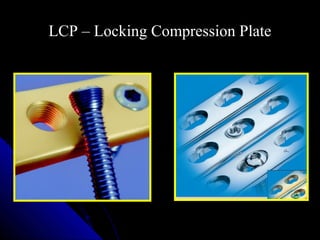
LCP – Locking Compression Plate
LCP
•   Latest in the evolution
•   “ Internal fixator ”
•   Combination of locking
    screw with conventional
    screw
•   Extraperiosteal
    location of plate
LCP
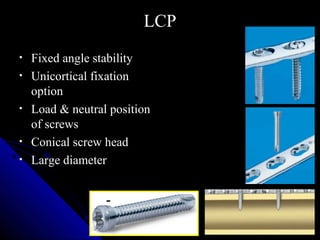
•   Fixed angle stability
•   Unicortical fixation
    option
•   Load & neutral position
    of screws
•   Conical screw head
•   Large diameter
LISS-Less Invasive Stabilization System
LISS
Plate: Function
Principles of rigid internal fixation with plates


•   Neutralization Plate
•   Compression plate
•   Buttress Plate
•   Bridge Plate
•   Tension Band Plate
Neutralisation Plate

•   Used with lag screws , plate is
    protective
•   Neutralises the weight bearing forces
    to protect the lag screws from axial
    loading
•   Lag screw generates forces of 3000 N
Compression plating
                   Techniques

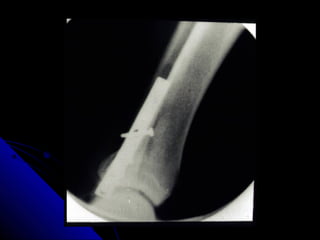
•   With dynamic compression principle
    (DCP/LC-DCP)
•   With tension devise
•   By contouring plate
•   Additional lag screw thro plate
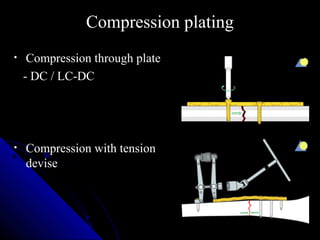
Compression plating
•    Compression through plate
    - DC / LC-DC


•   Compression with tension
    devise
Compression with external devise
Contouring Plates
•   To fit anatomy of bone
•   Bending pliers
•   Weakens plate
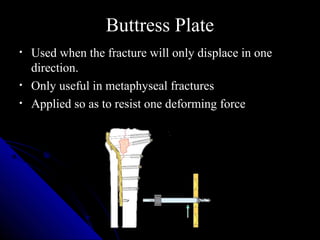
Buttress Plate
•   Used when the fracture will only displace in one
    direction.
•   Only useful in metaphyseal fractures
•   Applied so as to resist one deforming force
AO Organisation

☻ Philosophies   and techniques of treatment will
    change with time

☻    The philosophy that we exist to improve the
    care given to our patients will last forever
THANK YOU

Plates-form and function

  • 1.
    Pre Basic Course Plates- form and function Dr Sudarshan Bhandary
  • 2.
    Plate : Formand Function • To understand how changes in the design of plates has evolved to meet the needs of the patient • To understand how you can use a plate in several different ways to achieve different types of fixation
  • 3.
    Plate : Formand Function • Absolute stability challenged by biological fixation • Osteosynthesis with plates has a firm place in # treatment • Articular #s require stable fixation • Compromise of cortical blood supply a major drawback of conventional plating
  • 4.
    Plate : Form • DCP • Reconstruction plate • Semitubular - 1/3rd Tubular Plate • LC-DCP • PC-FIX • LCP • LISS
  • 5.
    DCP - 3.5and 4.5 • First introduced in 1969 by Danis • Revolutionary concept of compression plating • Featured a new hole designed for axial compression • Broad 4.5 for Femur & Narrow 4.5 for Humerus & Tibia • DCP 3.5 for Forearm, Fibula, Pelvis & Clavicle
  • 6.
    The screw hole in DCP is like a portion of an inclined & angled cylinder • When the screw is tightened it results in a movement of bone fragment in relation to the plate
  • 7.
    Screw holes allow 1mm compression • Additional compression with 1 more eccentric screw before locking first screw • Oval shape allows 25* inclination in longitudinal & 7* in transverse plane
  • 8.
    Technique of application 3drill guides a) Concentric (Neutral) - Green collar - 0.1 mm offset b) Eccentric (Load) - Gold collar - 1 mm offset c) Universal for buttress mode
  • 9.
    Problems with DCP • Unstable fixation leads to fatigue & failure • Strict adherence to principles of compression • Compromised blood supply due to intimate contact with underlying cortex • “Refractures” after plate removal
  • 10.
    LC-DCP • Represents a design change • Overcome problems with DCP • Plate footprint reduced • Minimized kinking at screw holes • Allows more inclination of screw in longitudinal plane
  • 11.
    Technique of application • New spring loaded drill guide • Without pressure - Eccentric hole • With pressure - Neutral
  • 12.
    Tubular plates • 3.5 system - 1/3rd Tubular • 4.5 system - Semitubular • Limited stability • Collared hole • Lateral malleolus • Distal ulna / Olecranon • Distal humerus
  • 13.
    Reconstruction plates • Deep notches between holes • Accurate contouring in any plane • Pelvis • Acetabulum • Distal humerus • Clavicle • Olecranon
  • 14.
    New Systems • Abolish ill effects of plate to bone contact • Concept of “Internal Fixator” • PC - FIX = First implant designed • Self tapping, unicortical, one length screws • Locking head
  • 15.
    LCP – LockingCompression Plate
  • 16.
    LCP • Latest in the evolution • “ Internal fixator ” • Combination of locking screw with conventional screw • Extraperiosteal location of plate
  • 17.
    LCP • Fixed angle stability • Unicortical fixation option • Load & neutral position of screws • Conical screw head • Large diameter
  • 18.
  • 19.
  • 20.
  • 21.
    Principles of rigidinternal fixation with plates • Neutralization Plate • Compression plate • Buttress Plate • Bridge Plate • Tension Band Plate
  • 22.
    Neutralisation Plate • Used with lag screws , plate is protective • Neutralises the weight bearing forces to protect the lag screws from axial loading • Lag screw generates forces of 3000 N
  • 24.
    Compression plating Techniques • With dynamic compression principle (DCP/LC-DCP) • With tension devise • By contouring plate • Additional lag screw thro plate
  • 25.
    Compression plating • Compression through plate - DC / LC-DC • Compression with tension devise
  • 26.
  • 29.
    Contouring Plates • To fit anatomy of bone • Bending pliers • Weakens plate
  • 30.
    Buttress Plate • Used when the fracture will only displace in one direction. • Only useful in metaphyseal fractures • Applied so as to resist one deforming force
  • 35.
    AO Organisation ☻ Philosophies and techniques of treatment will change with time ☻ The philosophy that we exist to improve the care given to our patients will last forever
  • 36.