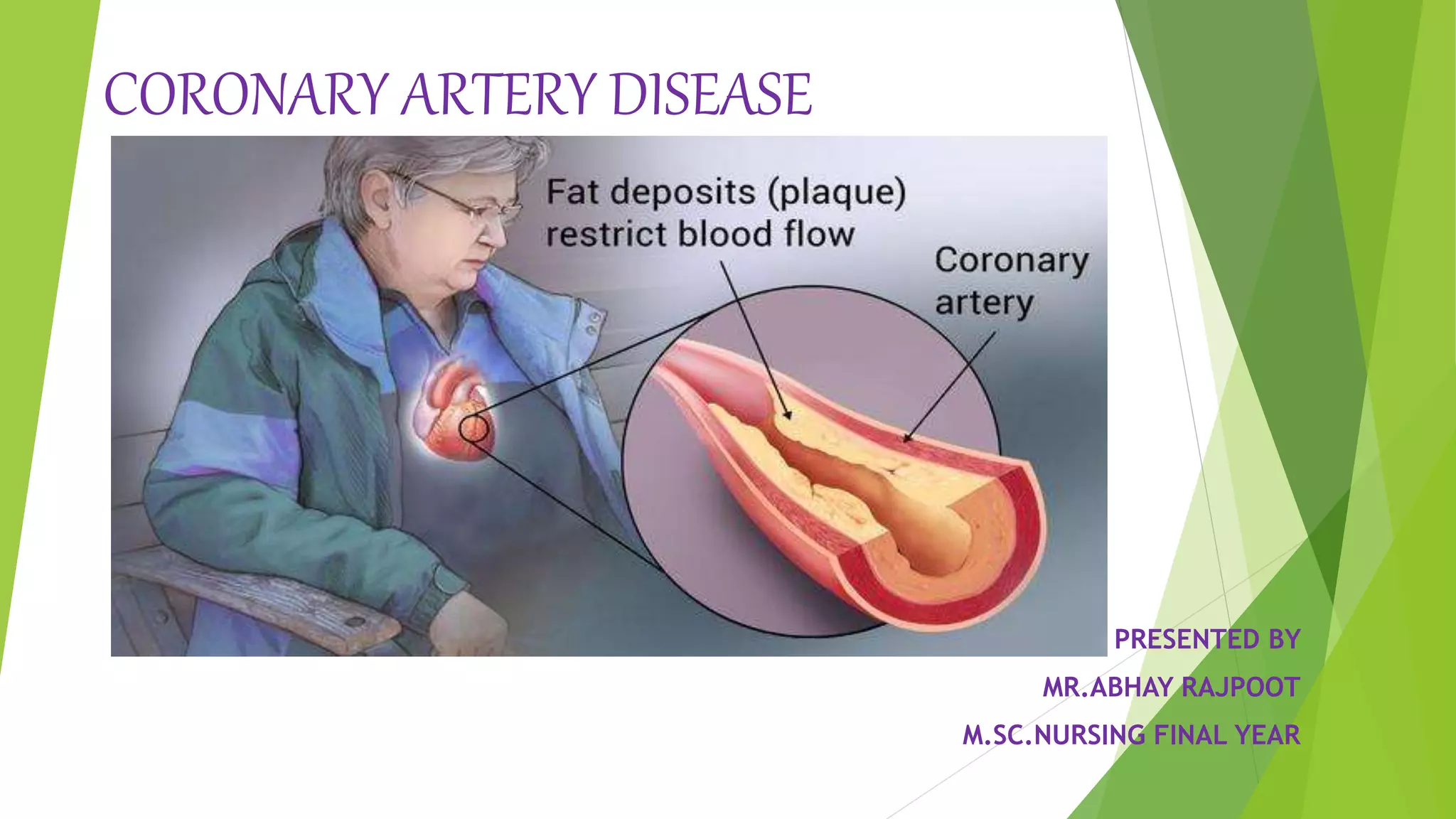
CORONARY ARTERY DISEASE
PRESENTED BY
MR.ABHAY RAJPOOT
M.SC.NURSING FINAL YEAR
DEFINITION
Coronary artery disease is the narrowing or blockage of the coronary
arteries, usually caused by atherosclerosis.
INCIDENCE:
Cardiovascular diseases, especially coronary heart disease (CHD),
are epidemic in India. The Registrar General of India reported
that CHD led to 17% of total deaths and 26% of adult deaths in 2001-
2003, which increased to 23% of total and 32% of adult deaths in
2010-2013.
RISK FACTORS:
MODIFIABLE RISK FACTORS:
 Tobacco use
 High blood cholesterol or triglyceride levels
 Lack of exercise
 Obesity
 Stress
NONMODIFIABLE RISK FACTORS:
 Family history of heart disease
 Older age
 Diabetes
 High blood pressure
CAUSES
Development of atherosclerosis;
Coronary artery disease is thought to begin with damage or injury to
the inner layer of a coronary artery, sometimes as early as childhood.
The damage may be caused by various factors, including:
 Smoking
 High blood pressure
 High cholesterol
 Diabetes or insulin resistance
 Sedentary lifestyle
PATHOPHYSIOLOGY:
SYMPTOMS:
CARDIOVASCULAR-
 Angina pectoris
 Ischemia
 Low cardiac output-
 Bradycardia (Decrease pulse rate)
 Hypertension
 Myocardial infarction-
 Diaphoresis –excessive sweating
 ECG changes – ST segment and T wave changes, also show
tachycardia, bradcardia, or dysrhythimas.
 Dysarrithmias
Conti….
RESPIRATORY-
 Dyspnea-Shortness of breath.
 Pulmonary edema
 Chest heaviness
 Fatigue
Conti….
 Genitourinary-Decreased Urinary Output May Indicate Cardiogenic
Shock.
 Gastrointestinal- Nausea And Vomiting
 Skin- Cool, Clammy ,Diaphoretic , And Pale Appearance On Skin
DIAGNOSTIC EVALUATION
 Physical Examination
 History collection
 Stress test
Chest X-ray.
Electrocardiogram (ECG).
Echocardiogram
Cardiac catheterization (angiogram).
COMPLICATIONS:
 Chest pain (angina)
 Heart attack
 Heart failure
 Abnormal heart rhythm (arrhythmia)
PREVENTION:
 Quit smoking
 Control conditions such as high blood pressure, high cholesterol
and diabetes
 Stay physically active
 Eat a low-fat, low-salt diet that's rich in fruits, vegetables and
whole grains
 Maintain a healthy weight
 Reduce and manage stress
MEDICAL MANAGEMENT:
Various drugs can be used to treat coronary artery disease, including:
 Vasodilators (These drugs acts as blood vessel dilator):
• Nitrates
 Beta-Blockers (Decrease work load in heart):
• Propranolol 20-40 mg
 Calcium channel blocker (They improve coronary blood flow):
• Nifedipine
• Verapamil
CONTI….
 Anticoagulant Drugs:
 Heparin
 Opiate Analgesic (For reduce pain)
 Morphine sulphate
 Thrombolytic Drugs:
 Streptokinase,Urokinase
ANTIHYPERTENSIVE MEDICINES-
 Methydopa- This medication is used alone or with other medications
to treat high blood pressure (hypertension). Lowering high blood
pressure helps prevent strokes, heart attacks, and kidney problems.
Methyldopa works by relaxing blood vessels so blood can flow more
easily.
 Sodium nitroprusside- It is used for lowering the blood pressure.
 Amlodipine- Amlodipine is used with or without other medications
to treat high blood pressure. Lowering high blood pressure helps
prevent strokes, heart attacks, and kidney problems. Dose-10 mg,20
mg.
SURGICAL MANAGEMENT
 Angioplasty and stent placement (percutaneous coronary revascularization):
Coronary artery bypass surgery:
NURSING MANAGEMENT
 Instruct the client regarding the purpose of diagnostic medical &
surgical procedures and the pre- & post procedure expectations.
 Assist the client to identify risk factors that can be modified, and set
goals that will promote change in lifestyle to reduce the impact of risk
factors.
 Instruct client regarding a low-calorie, low-sodium, low-cholesterol,
low-fat diet with a increase in dietary fiber. Stress that dietary changes
are not temporary and must be maintained for life.
 Provide community resources to client regarding exercise, smoking
cessation and stress reduction.
NURSING DIAGNOSIS
 Impaired gas exchange related to decreased blood flow as evidenced by
breathlessness
 Acute pain related to disease condition as evidenced by patient
verbalization
 Impaired physical mobility related to weakness as evidenced by patient
is unable to perform daily activity.
 Imbalanced nutrition less than body requirement related to less intake of
food as evidenced by weight loss
RESEARCH STUDY
A new study has found that the heart’s small left ventricle with thick
walls, can be the strongest predictor of morphologic remodeling, which is
most likely to be considered a first step towards heart failure in patients
with ischemic heart disease. According to study coordinators Frank
Rademakers and Jan D’Hooge, the results of the DOPPLER-CIP
(Determining Optimal non-invasive Parameters for the Prediction of Left
ventricular morphologic and functional Remodeling in Chronic Ischemic
Patients).
Summary
CONCLUSION
Drug-eluting stents — a less-invasive alternative to bypass surgery — are as
effective as surgery for many patients with a blockage in the left main
coronary artery, a study has found. Coronary artery bypass graft (CABG)
surgery has long been considered the definitive treatment for patients with
left main coronary artery disease (LMCAD), in which the artery that supplies
oxygen-rich blood to most of the heart muscles is clogged with
atherosclerotic plaque. However, stents, which are placed into the diseased
artery via a catheter that is inserted through a small opening in a blood vessel
in the groin, arm, or neck, are a less-invasive treatment option for many
people with coronary artery disease.
Assignment
Difference BETWEEN angiography and angioplasty
BIBLIOGRAPHY:
 Black M. joyce, Hwks hokanson jane,medical surgical nursing.8th edition. volume 2.
New delhi ;Reed elsevier india private limited:2009.p1411-1426.
 Suddarth’s and brunner, Hinkle L.Janice, Cheever H.Kerry. text book of medical
surgical nursing.13th edition . volume 1.New delhi: wolters kluwer india Pvt ltd
;2014.p729-759.
 Chugh N S . text book of medical surgical nursing .volume 1.delhi;avichal publisher
company:2013.p303-310.
 https://www.webmd.com/heart-disease/guide/heart-disease-coronary-artery-disease#1
 http://www.heart.org/en/health-topics/consumer-healthcare/what-is-cardiovascular-
disease/coronary-artery-disease
 https://www.nhlbi.nih.gov/health-topics/coronary-heart-disease
 https://my.clevelandclinic.org/health/diseases/16898-coronary-artery-disease
Coronary Artery Disease

Coronary Artery Disease

  • 1.
    CORONARY ARTERY DISEASE PRESENTEDBY MR.ABHAY RAJPOOT M.SC.NURSING FINAL YEAR
  • 2.
    DEFINITION Coronary artery diseaseis the narrowing or blockage of the coronary arteries, usually caused by atherosclerosis.
  • 3.
    INCIDENCE: Cardiovascular diseases, especiallycoronary heart disease (CHD), are epidemic in India. The Registrar General of India reported that CHD led to 17% of total deaths and 26% of adult deaths in 2001- 2003, which increased to 23% of total and 32% of adult deaths in 2010-2013.
  • 4.
    RISK FACTORS: MODIFIABLE RISKFACTORS:  Tobacco use  High blood cholesterol or triglyceride levels  Lack of exercise  Obesity  Stress NONMODIFIABLE RISK FACTORS:  Family history of heart disease  Older age  Diabetes  High blood pressure
  • 5.
    CAUSES Development of atherosclerosis; Coronaryartery disease is thought to begin with damage or injury to the inner layer of a coronary artery, sometimes as early as childhood. The damage may be caused by various factors, including:  Smoking  High blood pressure  High cholesterol  Diabetes or insulin resistance  Sedentary lifestyle
  • 6.
  • 7.
    SYMPTOMS: CARDIOVASCULAR-  Angina pectoris Ischemia  Low cardiac output-  Bradycardia (Decrease pulse rate)  Hypertension  Myocardial infarction-  Diaphoresis –excessive sweating  ECG changes – ST segment and T wave changes, also show tachycardia, bradcardia, or dysrhythimas.  Dysarrithmias
  • 8.
    Conti…. RESPIRATORY-  Dyspnea-Shortness ofbreath.  Pulmonary edema  Chest heaviness  Fatigue
  • 9.
    Conti….  Genitourinary-Decreased UrinaryOutput May Indicate Cardiogenic Shock.  Gastrointestinal- Nausea And Vomiting  Skin- Cool, Clammy ,Diaphoretic , And Pale Appearance On Skin
  • 10.
    DIAGNOSTIC EVALUATION  PhysicalExamination  History collection  Stress test
  • 11.
  • 12.
  • 13.
  • 14.
  • 16.
    COMPLICATIONS:  Chest pain(angina)  Heart attack  Heart failure  Abnormal heart rhythm (arrhythmia)
  • 17.
    PREVENTION:  Quit smoking Control conditions such as high blood pressure, high cholesterol and diabetes  Stay physically active  Eat a low-fat, low-salt diet that's rich in fruits, vegetables and whole grains  Maintain a healthy weight  Reduce and manage stress
  • 18.
    MEDICAL MANAGEMENT: Various drugscan be used to treat coronary artery disease, including:  Vasodilators (These drugs acts as blood vessel dilator): • Nitrates  Beta-Blockers (Decrease work load in heart): • Propranolol 20-40 mg  Calcium channel blocker (They improve coronary blood flow): • Nifedipine • Verapamil
  • 19.
    CONTI….  Anticoagulant Drugs: Heparin  Opiate Analgesic (For reduce pain)  Morphine sulphate  Thrombolytic Drugs:  Streptokinase,Urokinase
  • 20.
    ANTIHYPERTENSIVE MEDICINES-  Methydopa-This medication is used alone or with other medications to treat high blood pressure (hypertension). Lowering high blood pressure helps prevent strokes, heart attacks, and kidney problems. Methyldopa works by relaxing blood vessels so blood can flow more easily.  Sodium nitroprusside- It is used for lowering the blood pressure.  Amlodipine- Amlodipine is used with or without other medications to treat high blood pressure. Lowering high blood pressure helps prevent strokes, heart attacks, and kidney problems. Dose-10 mg,20 mg.
  • 21.
    SURGICAL MANAGEMENT  Angioplastyand stent placement (percutaneous coronary revascularization):
  • 22.
  • 23.
    NURSING MANAGEMENT  Instructthe client regarding the purpose of diagnostic medical & surgical procedures and the pre- & post procedure expectations.  Assist the client to identify risk factors that can be modified, and set goals that will promote change in lifestyle to reduce the impact of risk factors.  Instruct client regarding a low-calorie, low-sodium, low-cholesterol, low-fat diet with a increase in dietary fiber. Stress that dietary changes are not temporary and must be maintained for life.  Provide community resources to client regarding exercise, smoking cessation and stress reduction.
  • 24.
    NURSING DIAGNOSIS  Impairedgas exchange related to decreased blood flow as evidenced by breathlessness  Acute pain related to disease condition as evidenced by patient verbalization  Impaired physical mobility related to weakness as evidenced by patient is unable to perform daily activity.  Imbalanced nutrition less than body requirement related to less intake of food as evidenced by weight loss
  • 25.
    RESEARCH STUDY A newstudy has found that the heart’s small left ventricle with thick walls, can be the strongest predictor of morphologic remodeling, which is most likely to be considered a first step towards heart failure in patients with ischemic heart disease. According to study coordinators Frank Rademakers and Jan D’Hooge, the results of the DOPPLER-CIP (Determining Optimal non-invasive Parameters for the Prediction of Left ventricular morphologic and functional Remodeling in Chronic Ischemic Patients).
  • 26.
  • 27.
    CONCLUSION Drug-eluting stents —a less-invasive alternative to bypass surgery — are as effective as surgery for many patients with a blockage in the left main coronary artery, a study has found. Coronary artery bypass graft (CABG) surgery has long been considered the definitive treatment for patients with left main coronary artery disease (LMCAD), in which the artery that supplies oxygen-rich blood to most of the heart muscles is clogged with atherosclerotic plaque. However, stents, which are placed into the diseased artery via a catheter that is inserted through a small opening in a blood vessel in the groin, arm, or neck, are a less-invasive treatment option for many people with coronary artery disease.
  • 28.
  • 29.
    BIBLIOGRAPHY:  Black M.joyce, Hwks hokanson jane,medical surgical nursing.8th edition. volume 2. New delhi ;Reed elsevier india private limited:2009.p1411-1426.  Suddarth’s and brunner, Hinkle L.Janice, Cheever H.Kerry. text book of medical surgical nursing.13th edition . volume 1.New delhi: wolters kluwer india Pvt ltd ;2014.p729-759.  Chugh N S . text book of medical surgical nursing .volume 1.delhi;avichal publisher company:2013.p303-310.  https://www.webmd.com/heart-disease/guide/heart-disease-coronary-artery-disease#1  http://www.heart.org/en/health-topics/consumer-healthcare/what-is-cardiovascular- disease/coronary-artery-disease  https://www.nhlbi.nih.gov/health-topics/coronary-heart-disease  https://www.nhlbi.nih.gov/health-topics/coronary-heart-disease  https://my.clevelandclinic.org/health/diseases/16898-coronary-artery-disease