ANTITUSSIVE 
1
Contents 
 Introduction 
 Definition 
 Mechanism of cough production 
 Types of cough 
 Classification 
 Antitussives MOA 
 Drugs 
 Screening methods 
2
Introduction 
 Symptom of respiratory system: 
no sputum---antitussives 
 Cough 
sputum --- expectorants 
 Asthma ----- antiasthmatic drugs 
3
DEFINITION 
 ANTITUSSIVE:- 
A drug that suppresses coughing possibly by 
reducing the activity of the cough center in the brain. 
 EXPECTORANT:- 
A drug that enhances the secretion of sputum. 
4
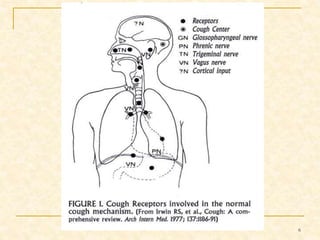
 Cough receptors (chemo-and-mechano receptors ) 
lie in mucosa of the bronchial tree from the nose 
to the distal bronchi. 
 The impulses from these receptors are 
transmitted through the vagus and 
glossopharyngeal nerves to the cough center in 
the medulla. 
5
6
Mechanism of cough production 
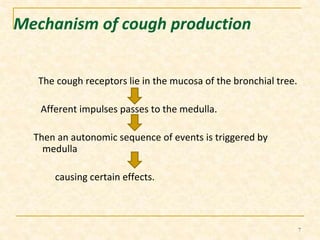
The cough receptors lie in the mucosa of the bronchial tree. 
Afferent impulses passes to the medulla. 
Then an autonomic sequence of events is triggered by 
medulla 
causing certain effects. 
7
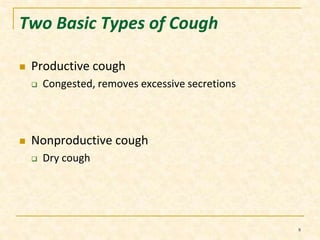
Two Basic Types of Cough 
 Productive cough 
 Congested, removes excessive secretions 
 Nonproductive cough 
 Dry cough 
8
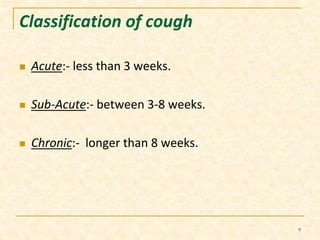
Classification of cough 
 Acute:- less than 3 weeks. 
 Sub-Acute:- between 3-8 weeks. 
 Chronic:- longer than 8 weeks. 
9
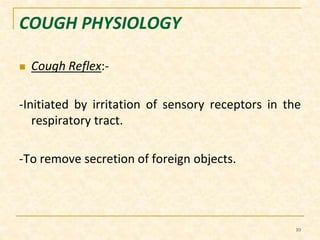
COUGH PHYSIOLOGY 
 Cough Reflex:- 
-Initiated by irritation of sensory receptors in the 
respiratory tract. 
-To remove secretion of foreign objects. 
10
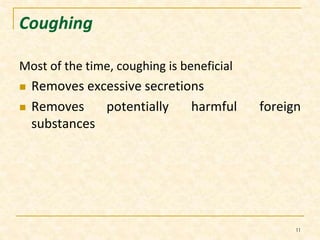
Coughing 
Most of the time, coughing is beneficial 
 Removes excessive secretions 
 Removes potentially harmful foreign 
substances 
11
CLASSIFICATION 
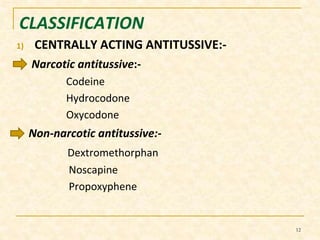
1) CENTRALLY ACTING ANTITUSSIVE:- 
Narcotic antitussive:- 
Codeine 
Hydrocodone 
Oxycodone 
Non-narcotic antitussive:- 
Dextromethorphan 
Noscapine 
Propoxyphene 
12
CLASSIFICATION 
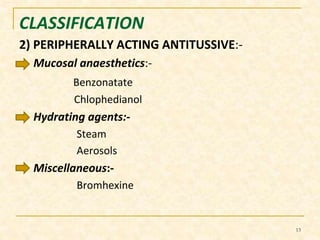
2) PERIPHERALLY ACTING ANTITUSSIVE:- 
Mucosal anaesthetics:- 
Benzonatate 
Chlophedianol 
Hydrating agents:- 
Steam 
Aerosols 
Miscellaneous:- 
Bromhexine 
13
ANTITUSSIVE MOA 
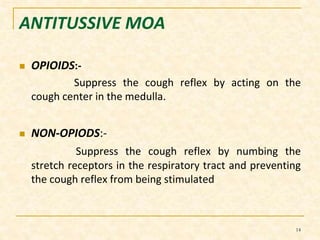
 OPIOIDS:- 
Suppress the cough reflex by acting on the 
cough center in the medulla. 
 NON-OPIODS:- 
Suppress the cough reflex by numbing the 
stretch receptors in the respiratory tract and preventing 
the cough reflex from being stimulated 
14
ANTITUSSIVE INDICATION 
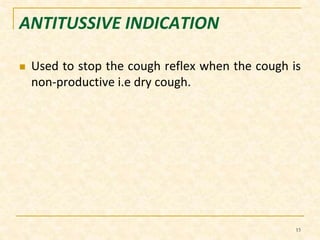
 Used to stop the cough reflex when the cough is 
non-productive i.e dry cough. 
15
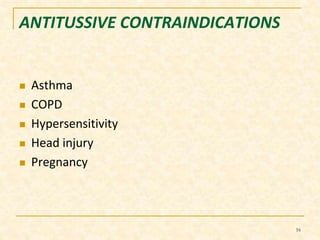
ANTITUSSIVE CONTRAINDICATIONS 
 Asthma 
 COPD 
 Hypersensitivity 
 Head injury 
 Pregnancy 
16
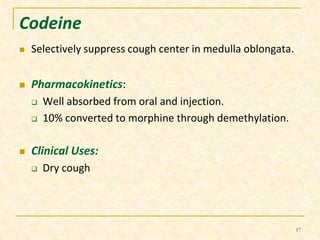
Codeine 
 Selectively suppress cough center in medulla oblongata. 
 Pharmacokinetics: 
 Well absorbed from oral and injection. 
 10% converted to morphine through demethylation. 
 Clinical Uses: 
 Dry cough 
17
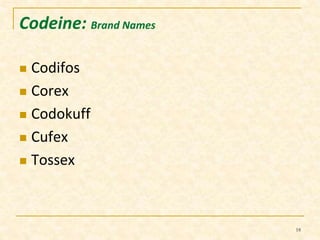
Codeine: Brand Names 
 Codifos 
 Corex 
 Codokuff 
 Cufex 
 Tossex 
18
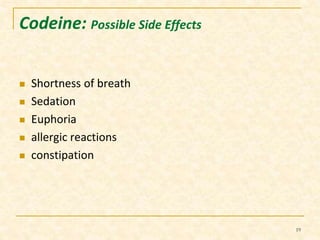
Codeine: Possible Side Effects 
 Shortness of breath 
 Sedation 
 Euphoria 
 allergic reactions 
 constipation 
19
Hydrocodone 
 Antitussive agent 
 Analgesic agent 
 more potent than codeine 
 5mg of hydrocodone is equivalent to 30 mg of 
codeine when administered orally 
 Is combined with an anticholinergic drug 
(homatropine) 
20
Hydrocodone: 
Possible Side Effects 
 Light-headedness 
 Sedation 
 Constipation 
 allergic reactions 
21
Dextromethorphan 
 Dextrorotatory stereoisomers of a methylated 
derivative of levorphanol. 
 Clinical Use: 
 Dry cough. 
22
Dextromethorphan: Brand Names 
 Suppressa 
 Corex-DX 
 Cotuss 
23
Dextromethorphan :Possible Side Effects 
 Slow breathing 
 Confusion, hallucinations 
 Anxiety 
 Restless feeling 
 Nervousness 
24
Benzonatate 
 Is a non-narcotic cough medicine 
 It works by numbing the throat and lungs, making 
the cough reflex less active 
25
Benzonatate: Possible Side Effects 
 Headache 
 Drowsiness 
 Upset stomach 
 Constipation 
 Mild itching or skin rash 
26
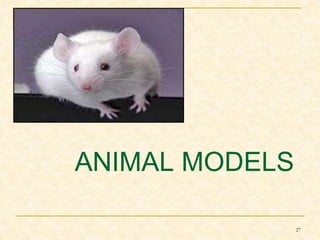
ANIMAL MODELS 
27
ANIMAL MODELS 
1. Antitussive activity after irritant inhalation in guinea pig. 
2. Cough induced by mechanical stimulation. 
3. Cough induced by stimulation of the nervus laryngicus 
superior. 
4. Cough induced by ammonia in the cat 
5. Cough induced by sulfuric acid in the dog 
28
Antitussive activity after irritant inhalation in 
guinea pig 
Purpose and rationale:- 
The sensitive receptars are located in bronchial tree and 
stimulated mechanically and chemically. 
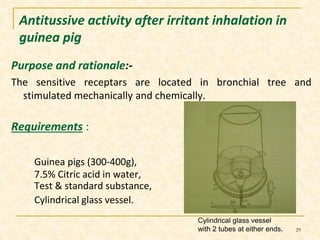
Requirements : 
Guinea pigs (300-400g), 
7.5% Citric acid in water, 
Test & standard substance, 
Cylindrical glass vessel. 
Cylindrical glass vessel 
with 2 tubes at either ends. 29
 Procedure:- 
Guinea pig of either sex 300-400gm 
Animal placed in cylindrical glass vessel 
Guinea pig exposed to aerosol of 7.5% citric acid in water 10 min 
No of tussive response is registered 
One hour later test substance is applied s.c or orally 
After 30 min guinea pig is subjected to aerosol again 
30
 Evaluation:- 
The number of coughs after treatment is 
expressed as percentage of the control period. Using 
various doses ED50 values can be calculated. 
31
Cough induce by mechanical stimulation 
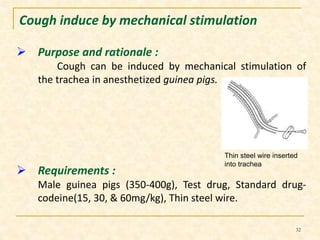
 Purpose and rationale : 
Cough can be induced by mechanical stimulation of 
the trachea in anesthetized guinea pigs. 
 Requirements : 
Thin steel wire inserted 
into trachea 
Male guinea pigs (350-400g), Test drug, Standard drug-codeine( 
15, 30, & 60mg/kg), Thin steel wire. 
32
Procedure : 
Male guinea pigs are lightly anesthetized. 
Maintain constant body temperature of 370C by means of heated plate. 
Thin steel wire is gently inserted into the trachea through a small 
incision near cricoid cartilage. 
Coughs are evoked by pushing the steel wire to reach bifurcation of 
trachea 
Animals are randomly assigned to receive the test drug at various doses 
or the standard (codeine 15, 30, 60mg/kg).Ten animals per dose are 
used. 
33
 Evaluation : 
• Evaluation of statistical significance of the result is performed 
with student’s t-test. 
• ED50 values determined by logit transformation. 
34
Cough induced by stimulation of the nervus 
laryngicus superior : 
 Purpose and rationale : 
Stimulation of Nervous laryngicus superior induces 
coughing. Antitussive agents with predominately central 
action suppress the coughing reflex. 
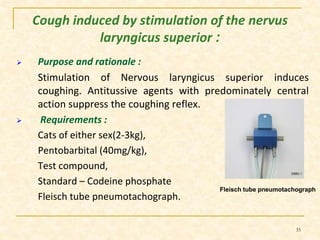
 Requirements : 
Cats of either sex(2-3kg), 
Pentobarbital (40mg/kg), 
Test compound, 
Standard – Codeine phosphate 
Fleisch tube pneumotachograph. 
Fleisch tube pneumotachograph 
35
 Procedure : 
Cats of either sex are anesthetized. 
The fur is shaved ventrally at the neck & small incisions are made at both sides 
of larynx. 
The trachea is cannulated. The cannula is connected with Fleisch tube 
One femoral artery and one femoral vein is cannulated 
Small hook electrodes are attached to each laryngeal nerve and Wave 
impulses are applied every 5min (control) 
Intensity of forced expiration is measured by Fleisch pneumotachograph & 
recorded with blood pressure on a polygraph. The stimuli are repeated 
36
 Evaluation : 
Total or partial suppression of forced 
expiration are recorded over time & expressed as 
percentage of control. 
37
Cough induced by ammonia in the cat 
 Purpose and rationale : 
Cough is induce with the help of ammonia. 
 Requirements : 
Cats, 6% pentobarbitone sodium, smoked paper 
kymograph, Tracheal cannula, ammonia vapour, polythene 
tube. 
38
 Procedure : 
Cats are lightly anaesthetized. 
The trachea is then cannulated; The carotid artery is connected 
to a mercury nanometer. 
Injections are made intravenously in the femoral vein. 
Coughs are recorded on a smoked kymograph by a lightly sprung 
lever 
Ammonia is lead into respiratory system by means of a three way 
tap. 
39
The cat is allowed to inhale ammonia vapour for one inspiration. 
The cough stimuli are applied every three minutes until 3 or 4 
control 
cough responses of similar intensity and duration are obtained. 
The test drug is then administered intravenously and cough 
stimuli are 
repeated at similar intervals until the cough response returns to 
normal. 
40
 Evaluation : 
codeine is used as the antitussive standard, since it 
supresses coughing completely at a dose of 2mg/kg or less. 
Pholcodeine an dihydrocodeine are approximately as potent as 
codeine. The test drugs are scored accordingly. 
41
Cough induced by sulfuric acid in the dog 
 Rationale: 
Cough is induce with the help of sulfuric acid 
 Requirments: 
Dogs, De Vilbiss nebulizers,0.5M Sulfuric acid, Codeine, 
dihydrocodeine, test antitussive drugs. 
42
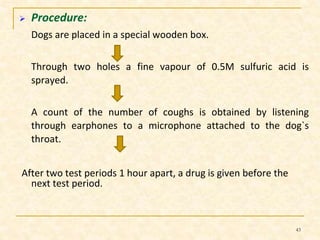
 Procedure: 
Dogs are placed in a special wooden box. 
Through two holes a fine vapour of 0.5M sulfuric acid is 
sprayed. 
A count of the number of coughs is obtained by listening 
through earphones to a microphone attached to the dog`s 
throat. 
After two test periods 1 hour apart, a drug is given before the 
next test period. 
43
 Evaluation: 
The percent inhibition is obtained by dividing the 
number of coughs by the number of coughs during the control 
period. 
44
Referensces 
 Vogel, W.H., Scholkens, B.A., Sandow, J., Muller, G. and Vogel 
W.F.,: Drug Discovery and Evaluation Pharmacological Assays. 
2nd ed. Spinger-Verlag Berlin Heidelberg, New York, Germany, 
pp. 352-376 (2002). 
 Turner, R.A., Hebborn, P.,: Screening Methods of 
Pharmacology, Vol.-1. Academic Press, London, pp. 238 
(1971). 
 www.wikipedia.com. 
 Tripathi, K.D.,: Essentials of Medical Pharmacology. 5th ed. 
Jaypee Brothers Medical Publishers (P)Ltd., New Delhi, India, 
pp. 195, 209 (2004). 
 www.googleimages.com 
45
THANK YOU 
46
BACK UP SLIDES 
47

Antitussive mechanism ppt

  • 1.
  • 2.
    Contents  Introduction  Definition  Mechanism of cough production  Types of cough  Classification  Antitussives MOA  Drugs  Screening methods 2
  • 3.
    Introduction  Symptomof respiratory system: no sputum---antitussives  Cough sputum --- expectorants  Asthma ----- antiasthmatic drugs 3
  • 4.
    DEFINITION  ANTITUSSIVE:- A drug that suppresses coughing possibly by reducing the activity of the cough center in the brain.  EXPECTORANT:- A drug that enhances the secretion of sputum. 4
  • 5.
     Cough receptors(chemo-and-mechano receptors ) lie in mucosa of the bronchial tree from the nose to the distal bronchi.  The impulses from these receptors are transmitted through the vagus and glossopharyngeal nerves to the cough center in the medulla. 5
  • 6.
  • 7.
    Mechanism of coughproduction The cough receptors lie in the mucosa of the bronchial tree. Afferent impulses passes to the medulla. Then an autonomic sequence of events is triggered by medulla causing certain effects. 7
  • 8.
    Two Basic Typesof Cough  Productive cough  Congested, removes excessive secretions  Nonproductive cough  Dry cough 8
  • 9.
    Classification of cough  Acute:- less than 3 weeks.  Sub-Acute:- between 3-8 weeks.  Chronic:- longer than 8 weeks. 9
  • 10.
    COUGH PHYSIOLOGY Cough Reflex:- -Initiated by irritation of sensory receptors in the respiratory tract. -To remove secretion of foreign objects. 10
  • 11.
    Coughing Most ofthe time, coughing is beneficial  Removes excessive secretions  Removes potentially harmful foreign substances 11
  • 12.
    CLASSIFICATION 1) CENTRALLYACTING ANTITUSSIVE:- Narcotic antitussive:- Codeine Hydrocodone Oxycodone Non-narcotic antitussive:- Dextromethorphan Noscapine Propoxyphene 12
  • 13.
    CLASSIFICATION 2) PERIPHERALLYACTING ANTITUSSIVE:- Mucosal anaesthetics:- Benzonatate Chlophedianol Hydrating agents:- Steam Aerosols Miscellaneous:- Bromhexine 13
  • 14.
    ANTITUSSIVE MOA OPIOIDS:- Suppress the cough reflex by acting on the cough center in the medulla.  NON-OPIODS:- Suppress the cough reflex by numbing the stretch receptors in the respiratory tract and preventing the cough reflex from being stimulated 14
  • 15.
    ANTITUSSIVE INDICATION Used to stop the cough reflex when the cough is non-productive i.e dry cough. 15
  • 16.
    ANTITUSSIVE CONTRAINDICATIONS Asthma  COPD  Hypersensitivity  Head injury  Pregnancy 16
  • 17.
    Codeine  Selectivelysuppress cough center in medulla oblongata.  Pharmacokinetics:  Well absorbed from oral and injection.  10% converted to morphine through demethylation.  Clinical Uses:  Dry cough 17
  • 18.
    Codeine: Brand Names  Codifos  Corex  Codokuff  Cufex  Tossex 18
  • 19.
    Codeine: Possible SideEffects  Shortness of breath  Sedation  Euphoria  allergic reactions  constipation 19
  • 20.
    Hydrocodone  Antitussiveagent  Analgesic agent  more potent than codeine  5mg of hydrocodone is equivalent to 30 mg of codeine when administered orally  Is combined with an anticholinergic drug (homatropine) 20
  • 21.
    Hydrocodone: Possible SideEffects  Light-headedness  Sedation  Constipation  allergic reactions 21
  • 22.
    Dextromethorphan  Dextrorotatorystereoisomers of a methylated derivative of levorphanol.  Clinical Use:  Dry cough. 22
  • 23.
    Dextromethorphan: Brand Names  Suppressa  Corex-DX  Cotuss 23
  • 24.
    Dextromethorphan :Possible SideEffects  Slow breathing  Confusion, hallucinations  Anxiety  Restless feeling  Nervousness 24
  • 25.
    Benzonatate  Isa non-narcotic cough medicine  It works by numbing the throat and lungs, making the cough reflex less active 25
  • 26.
    Benzonatate: Possible SideEffects  Headache  Drowsiness  Upset stomach  Constipation  Mild itching or skin rash 26
  • 27.
  • 28.
    ANIMAL MODELS 1.Antitussive activity after irritant inhalation in guinea pig. 2. Cough induced by mechanical stimulation. 3. Cough induced by stimulation of the nervus laryngicus superior. 4. Cough induced by ammonia in the cat 5. Cough induced by sulfuric acid in the dog 28
  • 29.
    Antitussive activity afterirritant inhalation in guinea pig Purpose and rationale:- The sensitive receptars are located in bronchial tree and stimulated mechanically and chemically. Requirements : Guinea pigs (300-400g), 7.5% Citric acid in water, Test & standard substance, Cylindrical glass vessel. Cylindrical glass vessel with 2 tubes at either ends. 29
  • 30.
     Procedure:- Guineapig of either sex 300-400gm Animal placed in cylindrical glass vessel Guinea pig exposed to aerosol of 7.5% citric acid in water 10 min No of tussive response is registered One hour later test substance is applied s.c or orally After 30 min guinea pig is subjected to aerosol again 30
  • 31.
     Evaluation:- Thenumber of coughs after treatment is expressed as percentage of the control period. Using various doses ED50 values can be calculated. 31
  • 32.
    Cough induce bymechanical stimulation  Purpose and rationale : Cough can be induced by mechanical stimulation of the trachea in anesthetized guinea pigs.  Requirements : Thin steel wire inserted into trachea Male guinea pigs (350-400g), Test drug, Standard drug-codeine( 15, 30, & 60mg/kg), Thin steel wire. 32
  • 33.
    Procedure : Maleguinea pigs are lightly anesthetized. Maintain constant body temperature of 370C by means of heated plate. Thin steel wire is gently inserted into the trachea through a small incision near cricoid cartilage. Coughs are evoked by pushing the steel wire to reach bifurcation of trachea Animals are randomly assigned to receive the test drug at various doses or the standard (codeine 15, 30, 60mg/kg).Ten animals per dose are used. 33
  • 34.
     Evaluation : • Evaluation of statistical significance of the result is performed with student’s t-test. • ED50 values determined by logit transformation. 34
  • 35.
    Cough induced bystimulation of the nervus laryngicus superior :  Purpose and rationale : Stimulation of Nervous laryngicus superior induces coughing. Antitussive agents with predominately central action suppress the coughing reflex.  Requirements : Cats of either sex(2-3kg), Pentobarbital (40mg/kg), Test compound, Standard – Codeine phosphate Fleisch tube pneumotachograph. Fleisch tube pneumotachograph 35
  • 36.
     Procedure : Cats of either sex are anesthetized. The fur is shaved ventrally at the neck & small incisions are made at both sides of larynx. The trachea is cannulated. The cannula is connected with Fleisch tube One femoral artery and one femoral vein is cannulated Small hook electrodes are attached to each laryngeal nerve and Wave impulses are applied every 5min (control) Intensity of forced expiration is measured by Fleisch pneumotachograph & recorded with blood pressure on a polygraph. The stimuli are repeated 36
  • 37.
     Evaluation : Total or partial suppression of forced expiration are recorded over time & expressed as percentage of control. 37
  • 38.
    Cough induced byammonia in the cat  Purpose and rationale : Cough is induce with the help of ammonia.  Requirements : Cats, 6% pentobarbitone sodium, smoked paper kymograph, Tracheal cannula, ammonia vapour, polythene tube. 38
  • 39.
     Procedure : Cats are lightly anaesthetized. The trachea is then cannulated; The carotid artery is connected to a mercury nanometer. Injections are made intravenously in the femoral vein. Coughs are recorded on a smoked kymograph by a lightly sprung lever Ammonia is lead into respiratory system by means of a three way tap. 39
  • 40.
    The cat isallowed to inhale ammonia vapour for one inspiration. The cough stimuli are applied every three minutes until 3 or 4 control cough responses of similar intensity and duration are obtained. The test drug is then administered intravenously and cough stimuli are repeated at similar intervals until the cough response returns to normal. 40
  • 41.
     Evaluation : codeine is used as the antitussive standard, since it supresses coughing completely at a dose of 2mg/kg or less. Pholcodeine an dihydrocodeine are approximately as potent as codeine. The test drugs are scored accordingly. 41
  • 42.
    Cough induced bysulfuric acid in the dog  Rationale: Cough is induce with the help of sulfuric acid  Requirments: Dogs, De Vilbiss nebulizers,0.5M Sulfuric acid, Codeine, dihydrocodeine, test antitussive drugs. 42
  • 43.
     Procedure: Dogsare placed in a special wooden box. Through two holes a fine vapour of 0.5M sulfuric acid is sprayed. A count of the number of coughs is obtained by listening through earphones to a microphone attached to the dog`s throat. After two test periods 1 hour apart, a drug is given before the next test period. 43
  • 44.
     Evaluation: Thepercent inhibition is obtained by dividing the number of coughs by the number of coughs during the control period. 44
  • 45.
    Referensces  Vogel,W.H., Scholkens, B.A., Sandow, J., Muller, G. and Vogel W.F.,: Drug Discovery and Evaluation Pharmacological Assays. 2nd ed. Spinger-Verlag Berlin Heidelberg, New York, Germany, pp. 352-376 (2002).  Turner, R.A., Hebborn, P.,: Screening Methods of Pharmacology, Vol.-1. Academic Press, London, pp. 238 (1971).  www.wikipedia.com.  Tripathi, K.D.,: Essentials of Medical Pharmacology. 5th ed. Jaypee Brothers Medical Publishers (P)Ltd., New Delhi, India, pp. 195, 209 (2004).  www.googleimages.com 45
  • 46.
  • 47.