Dr. NIKHILKUMAR S SAKLE
Assistant Professor
Dept of pharmacology
y. b. Chavan college of pharmacy, aurangabad
Drugs for Cough
Introduction
 Cough is a protective reflex, its purpose being expulsion of respiratory secretions or foreign particles
from air passages.
 It occurs due to stimulation of mechano- or chemoreceptors in throat, respiratory passages or stretch
receptors in the lungs.
 Cough may be useful or useless. Useless (nonproductive) cough should be suppressed. Useful
(productive) cough serves to drain the airway, its suppression is not desirable, may even be harmful,
except if the amount of expectoration achieved is small compared to the effort of continuous coughing.
 Apart from specific remedies (antibiotics, etc.), cough may be treated as a symptom (nonspecific
therapy) with:
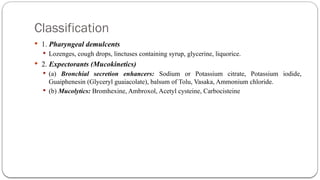
Classification
 1. Pharyngeal demulcents
 Lozenges, cough drops, linctuses containing syrup, glycerine, liquorice.
 2. Expectorants (Mucokinetics)
 (a) Bronchial secretion enhancers: Sodium or Potassium citrate, Potassium iodide,
Guaiphenesin (Glyceryl guaiacolate), balsum of Tolu, Vasaka, Ammonium chloride.
 (b) Mucolytics: Bromhexine, Ambroxol, Acetyl cysteine, Carbocisteine
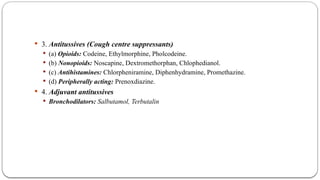
 3. Antitussives (Cough centre suppressants)
 (a) Opioids: Codeine, Ethylmorphine, Pholcodeine.
 (b) Nonopioids: Noscapine, Dextromethorphan, Chlophedianol.
 (c) Antihistamines: Chlorpheniramine, Diphenhydramine, Promethazine.
 (d) Peripherally acting: Prenoxdiazine.
 4. Adjuvant antitussives
 Bronchodilators: Salbutamol, Terbutalin
DEMULCENTS AND EXPECTORANTS
 Pharyngeal demulcents sooth the throat and reduce afferent impulses
from the inflamed/irritated pharyngeal mucosa, thus provide
symptomatic relief in dry cough arising from throat. Expectorants
(Mucokinetics) are drugs believed to increase bronchial secretion or
reduce its viscosity, facilitating its removal by coughing.
 Sodium and potassium citrate are considered to increase bronchial
secretion by salt action. Potassium iodide is secreted by bronchial glands
and can irritate the airway mucosa.
 Prolonged use can affect thyroid function and produce iodism. It is NOT
used now.
 Guaiphenesin, vasaka, tolu balsum are plant products which are supposed to
enhance bronchial secretion and mucociliary function while being secreted
by tracheobronchial glands.
 Ammonium salts are nauseating—reflexly increase respiratory secretions.
 A variety of expectorant formulations containing an assortment of the above
ingredients, often in combination with antitussives/antihistaminics are
marketed and briskly promoted, but objective evidence of efficacy of these
is non-conclusive.
 The US-FDA has stopped marketing of all expectorants, except
guaiphenesin. Steam inhalation and proper hydration may be more
helpful in clearing airway mucus.
 Mucolytics
 Bromhexine A derivative of the alkaloid vasicine obtained from Adhatoda
vasica (Vasaka), is a potent mucolytic and mucokinetic, capable of inducing
thin copious bronchial secretion. It depolymerises mucopolysaccharides
directly as well as by liberating lysosomal enzymes—network of fibres in
tenacious sputum is broken. It is particularly useful if mucus plugs are
present.
 Side effects are rhinorrhoea and lacrimation, nausea, gastric irritation,
hypersensitivity.
 Ambroxol A metabolite of bromhexine having similar mucolytic action, uses
and side effects.
 ANTITUSSIVES
 These are drugs that act in the CNS to raise the threshold of cough
centre or act peripherally in the respiratory tract to reduce tussal
impulses, or both these actions.
 Aim to control rather than eliminate cough, antitussives should be used
only for dry nonproductive cough or if cough is unduly tiring, disturbs
sleep or is hazardous (hernia, piles, cardiac disease, ocular surgery).
 Opioids
 Codeine An opium alkaloid, qualitatively similar to and less potent than
morphine, but is more selective for cough centre. Codeine is regarded as
the standard antitussive; suppresses cough for about 6 hours. The
antitussive action is blocked by naloxone indicating that it is exerted
through opioid receptors in the brain. Abuse liability is low, but present;
constipation is the chief drawback. At higher doses respiratory
depression and drowsiness can occur, especially in children. Driving
may be impaired. Like morphine, it is contraindicated in asthmatics and
in patients with diminished respiratory reserve; should be avoided in
children.
 Nonopioids
 Noscapine An opium alkaloid of the benzoisoquinoline series. It depresses cough but has
no narcotic, analgesic or dependence inducing properties. It is nearly equipotent antitussive
as codeine, especially useful in spasmodic cough.
 Headache and nausea occur occasionally as side effect. It can release histamine and
produce bronchoconstriction in asthmatics.
 Dextromethorphan A synthetic central NMDA (N-methyl D-aspartate) receptor
antagonist; the d-isomer has antitussive action while l-isomer is analgesic.
Dextromethorphan does not depress mucociliary function of the airway mucosa and is
practically devoid of constipating action. Though considered nonaddicting, some drug
abusers indulge in it.
 Side effect: Dizziness, nausea, drowsiness; at high doses hallucinations and ataxia may
occur.
 Antihistamines
 Many H1 antihistamines have been conventionally added to
antitussive/expectorant formulations. They afford relief in cough due to their
sedative and anticholinergic actions, but lack selectivity for the cough centre.
They have no expectorant property, may even reduce secretions by
anticholinergic action. They have been specially promoted for cough in
respiratory allergic states, though their lack of efficacy in asthma is legendary.
 Chlorpheniramine (2–5 mg), Diphenhydramine (15–25 mg) and Promethazine
(15–25 mg) are commonly used.
 Second generation antihistamines like fexofenadine, loratadine, etc. are
ineffective.
 Peripherally acting antitussives
 Prenoxdiazine In contrast to other antitussives, it acts peripherally;
desensitizes the pulmonary stretch receptors and reduces tussal
impulses originating in the lungs. It is indicated in cough of bronchial
origin. Efficacy, however, is not impressive. Though an old drug
developed in Hungary, it has been introduced recently in India.
 Bronchodilators
 Bronchospasm can induce or aggravate cough. Stimulation of
pulmonary receptors can trigger both cough and bronchoconstriction,
especially in individuals with bronchial hyperreactivity. Bronchodilators
relieve cough in such individuals and improve the effectiveness of cough in
clearing secretions by increasing surface velocity of airflow during the
act of coughing. They should be used only when an element of
bronchoconstriction is present and not routinely.
 Their fixed dose combinations with antitussives are not satisfactory
because of differences in time course of action of the components and
liability for indiscriminate use.