DRUGS FOR COUGH
Dr.Vijay Bhushanam
Cough (Introduction)
• Cough is an explosive expiration, that provides a normal
protective mechanism for clearing the tracheo-bronchial
tree of secretions and foreign material.
• When excessive or bothersome, it is also one of the most
common symptoms for which patients seek medical
attention.
• Reasons for this include discomfort from the cough itself,
interference with normal lifestyle, and concern for the
cause of the cough, especially fear of cancer.
Mechanism of cough
• Coughing may be initiated either voluntarily or reflexively.
• As a defensive reflex it has both afferent and efferent
pathways.
• The afferent limb includes receptors within the sensory
distribution of the trigeminal, glossopharyngeal, superior
laryngeal and vagus nerves.
• The efferent limb includes the recurrent laryngeal nerve
and the spinal nerves.
Mechanism of cough (Cont.)
• Deep inspiration glottic closure  relaxation of the
diaphragm  muscle contraction against a closed glottis
 markedly positive intrathoracic pressure narrowing
of the trachea  glottis opens at once  the large
pressure differential between the airways and the
atmosphere coupled with tracheal narrowing produces
rapid flow rates through the trachea COUGH
• The shearing forces that develop aid in the elimination of
mucus and foreign materials.
Etiology of Cough
• The most common causes of cough can be categorized
according to the duration of the cough.
• Acute cough (<3 weeks): URTIs (especially the common
cold, acute bacterial sinusitis, and pertussis), pneumonia,
pulmonary embolus, and congestive heart failure.
• Sub-acute cough (3-8 weeks): post-infectious
• Chronic cough (>8 weeks):
In a smoker: chronic obstructive lung disease or
bronchogenic carcinoma.
In a nonsmoker: postnasal drip (sometimes
termed the upper airway cough syndrome), asthma, and
gastroesophageal reflux.
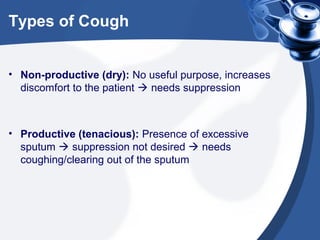
Types of Cough
• Non-productive (dry): No useful purpose, increases
discomfort to the patient  needs suppression

• Productive (tenacious): Presence of excessive
sputum  suppression not desired  needs
coughing/clearing out of the sputum
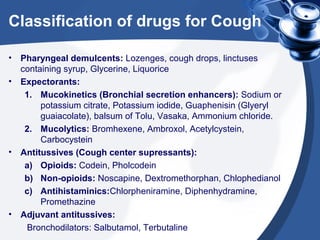
Classification of drugs for Cough
•
•

•

•

Pharyngeal demulcents: Lozenges, cough drops, linctuses
containing syrup, Glycerine, Liquorice
Expectorants:
1. Mucokinetics (Bronchial secretion enhancers): Sodium or
potassium citrate, Potassium iodide, Guaphenisin (Glyeryl
guaiacolate), balsum of Tolu, Vasaka, Ammonium chloride.
2. Mucolytics: Bromhexene, Ambroxol, Acetylcystein,
Carbocystein
Antitussives (Cough center supressants):
a) Opioids: Codein, Pholcodein
b) Non-opioids: Noscapine, Dextromethorphan, Chlophedianol
c) Antihistaminics:Chlorpheniramine, Diphenhydramine,
Promethazine
Adjuvant antitussives:
Bronchodilators: Salbutamol, Terbutaline
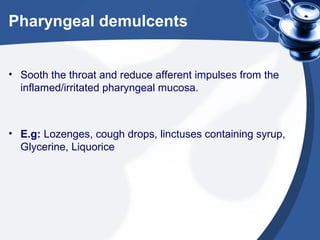
Pharyngeal demulcents
• Sooth the throat and reduce afferent impulses from the
inflamed/irritated pharyngeal mucosa.

• E.g: Lozenges, cough drops, linctuses containing syrup,
Glycerine, Liquorice
Expectorants
• Increase bronchial secretions or reduce its viscosity,
facilitating its removal by coughing
• E.g:
• Mucokinetics (Bronchial secretion enhancers): Sodium or
potassium citrate, Potassium iodide, Guaphenisin (Glyeryl
guaiacolate), balsum of Tolu, Vasaka, Ammonium
chloride.
• Mucolytics: Bromhexene, Ambroxol, Acetylcystein,
Carbocystein
Antitussives
(Cough center supressants)
• These act
– in CNS to raise the threshold of cough center (and/or)
– peripherally in Respiratory tract to reduce tussal impulse
• Should be used only for dry unproductive cough (or)
• if the cough is unduly tiring, disturbs sleep (or)
• is hazardous (hernia, piles, cardiac ds., ocular surgery etc)
• E.g:
• Opioids: Codein, Pholcodein
• Non-opioids: Noscapine, Dextromethorphan,
Chlophedianol
• Antihistaminics: Chlorpheniramine, Diphenhydramine,
Promethazine
Bronchodilators
• Bronchospasm can induce/aggravate cough, especially
in individuals with bronchial hyperreactivity
• Bronchodilators relieve cough in such individuals
• Improve the effectiveness of cough in clearing
secretions by increasing the surface velocity of airflow
during cough
• E.g: Salbutamol, Terbutalin
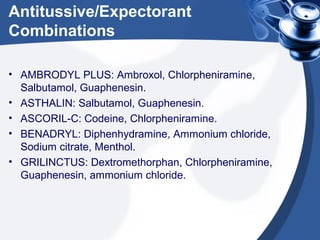
Antitussive/Expectorant
Combinations
• AMBRODYL PLUS: Ambroxol, Chlorpheniramine,
Salbutamol, Guaphenesin.
• ASTHALIN: Salbutamol, Guaphenesin.
• ASCORIL-C: Codeine, Chlorpheniramine.
• BENADRYL: Diphenhydramine, Ammonium chloride,
Sodium citrate, Menthol.
• GRILINCTUS: Dextromethorphan, Chlorpheniramine,
Guaphenesin, ammonium chloride.
Specific Rx for cough
• URTI/LRTI  Appropriate antibiotics
• Smoking/Chr. Bronchitis  Cessation of smoking/
avoidance of pollutants
• PTB ATT
• Post nasal drip due to sinusitis Antibiotics/Nasal
decongestants/H1 antihistaminics
• Postnasal drip due to allergy Avoidance of precipitating
factors/Corticosteroid nasal spray/H1 antihistaminics
• GERD H2 blockers/PPIs/Cisapride
• ACE inhibitor induced cough  Switch to ARBs/CCBs
• Asthmatic cough Inhaled β2
agonists/Ipratropium/Corticosteroids
THANK
YOU

Antitussives

  • 1.
  • 2.
    Cough (Introduction) • Coughis an explosive expiration, that provides a normal protective mechanism for clearing the tracheo-bronchial tree of secretions and foreign material. • When excessive or bothersome, it is also one of the most common symptoms for which patients seek medical attention. • Reasons for this include discomfort from the cough itself, interference with normal lifestyle, and concern for the cause of the cough, especially fear of cancer.
  • 3.
    Mechanism of cough •Coughing may be initiated either voluntarily or reflexively. • As a defensive reflex it has both afferent and efferent pathways. • The afferent limb includes receptors within the sensory distribution of the trigeminal, glossopharyngeal, superior laryngeal and vagus nerves. • The efferent limb includes the recurrent laryngeal nerve and the spinal nerves.
  • 4.
    Mechanism of cough(Cont.) • Deep inspiration glottic closure  relaxation of the diaphragm  muscle contraction against a closed glottis  markedly positive intrathoracic pressure narrowing of the trachea  glottis opens at once  the large pressure differential between the airways and the atmosphere coupled with tracheal narrowing produces rapid flow rates through the trachea COUGH • The shearing forces that develop aid in the elimination of mucus and foreign materials.
  • 5.
    Etiology of Cough •The most common causes of cough can be categorized according to the duration of the cough. • Acute cough (<3 weeks): URTIs (especially the common cold, acute bacterial sinusitis, and pertussis), pneumonia, pulmonary embolus, and congestive heart failure. • Sub-acute cough (3-8 weeks): post-infectious • Chronic cough (>8 weeks): In a smoker: chronic obstructive lung disease or bronchogenic carcinoma. In a nonsmoker: postnasal drip (sometimes termed the upper airway cough syndrome), asthma, and gastroesophageal reflux.
  • 6.
    Types of Cough •Non-productive (dry): No useful purpose, increases discomfort to the patient  needs suppression • Productive (tenacious): Presence of excessive sputum  suppression not desired  needs coughing/clearing out of the sputum
  • 7.
    Classification of drugsfor Cough • • • • Pharyngeal demulcents: Lozenges, cough drops, linctuses containing syrup, Glycerine, Liquorice Expectorants: 1. Mucokinetics (Bronchial secretion enhancers): Sodium or potassium citrate, Potassium iodide, Guaphenisin (Glyeryl guaiacolate), balsum of Tolu, Vasaka, Ammonium chloride. 2. Mucolytics: Bromhexene, Ambroxol, Acetylcystein, Carbocystein Antitussives (Cough center supressants): a) Opioids: Codein, Pholcodein b) Non-opioids: Noscapine, Dextromethorphan, Chlophedianol c) Antihistaminics:Chlorpheniramine, Diphenhydramine, Promethazine Adjuvant antitussives: Bronchodilators: Salbutamol, Terbutaline
  • 8.
    Pharyngeal demulcents • Sooththe throat and reduce afferent impulses from the inflamed/irritated pharyngeal mucosa. • E.g: Lozenges, cough drops, linctuses containing syrup, Glycerine, Liquorice
  • 9.
    Expectorants • Increase bronchialsecretions or reduce its viscosity, facilitating its removal by coughing • E.g: • Mucokinetics (Bronchial secretion enhancers): Sodium or potassium citrate, Potassium iodide, Guaphenisin (Glyeryl guaiacolate), balsum of Tolu, Vasaka, Ammonium chloride. • Mucolytics: Bromhexene, Ambroxol, Acetylcystein, Carbocystein
  • 10.
    Antitussives (Cough center supressants) •These act – in CNS to raise the threshold of cough center (and/or) – peripherally in Respiratory tract to reduce tussal impulse • Should be used only for dry unproductive cough (or) • if the cough is unduly tiring, disturbs sleep (or) • is hazardous (hernia, piles, cardiac ds., ocular surgery etc) • E.g: • Opioids: Codein, Pholcodein • Non-opioids: Noscapine, Dextromethorphan, Chlophedianol • Antihistaminics: Chlorpheniramine, Diphenhydramine, Promethazine
  • 11.
    Bronchodilators • Bronchospasm caninduce/aggravate cough, especially in individuals with bronchial hyperreactivity • Bronchodilators relieve cough in such individuals • Improve the effectiveness of cough in clearing secretions by increasing the surface velocity of airflow during cough • E.g: Salbutamol, Terbutalin
  • 12.
    Antitussive/Expectorant Combinations • AMBRODYL PLUS:Ambroxol, Chlorpheniramine, Salbutamol, Guaphenesin. • ASTHALIN: Salbutamol, Guaphenesin. • ASCORIL-C: Codeine, Chlorpheniramine. • BENADRYL: Diphenhydramine, Ammonium chloride, Sodium citrate, Menthol. • GRILINCTUS: Dextromethorphan, Chlorpheniramine, Guaphenesin, ammonium chloride.
  • 13.
    Specific Rx forcough • URTI/LRTI  Appropriate antibiotics • Smoking/Chr. Bronchitis  Cessation of smoking/ avoidance of pollutants • PTB ATT • Post nasal drip due to sinusitis Antibiotics/Nasal decongestants/H1 antihistaminics • Postnasal drip due to allergy Avoidance of precipitating factors/Corticosteroid nasal spray/H1 antihistaminics • GERD H2 blockers/PPIs/Cisapride • ACE inhibitor induced cough  Switch to ARBs/CCBs • Asthmatic cough Inhaled β2 agonists/Ipratropium/Corticosteroids
  • 14.